Noquiyisi transfer to EBCI completes the circle Page 12
On the Cover:
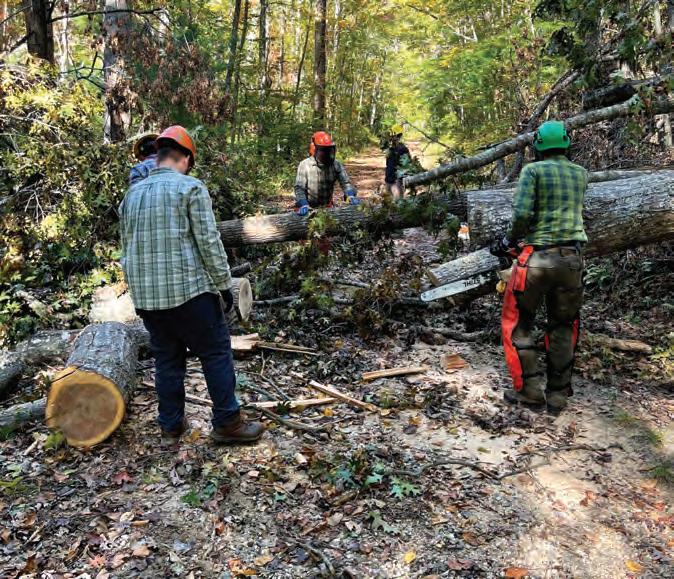
It’s a hard job, but somebody has to do it. And in fact, the tree crew at Great Smoky Mountains National Park enjoys the work, which requires dangling high up in the forest and cutting limbs to ensure the safety of park visitors. Pictured here is Ken Gragg, tree crew supervisor for GSMNP, climbing a red maple tree slated for removal at Elkmont Campground. (Page 24) Holly Kays, Smokies Life photo
News
FEMA frustration boils over as Waynesville faces $3.8 million gap....................4
Unpaid FEMA claims force Waynesville into budget reckoning............................6
Steady hand steps aside in Waynesville......................................................................7
In Waynesville, it’s market pay vs. municipal reality ..................................................8 Shining Rock votes to end high school instruction................................................10
Noquiyisi transfer completes the circle......................................................................12 Education briefs..................................................................................................................13
Opinion
Taking out tyrants this way can’t be celebrated........................................................14 What trees will you plant? ..............................................................................................14
A&E
New listening room offers ‘transcendent music and spiritual exploration’......16 Country legend rolls into Franklin................................................................................ 21
Outdoors
The Joyful Botanist: Blowing in the windflower........................................................26 Hurricane recovery receives boost from Forest Service ......................................27
E
D
D IGITAL MARKETING S PECIALIST Tyler Auffhammer. . . .
ADVERTISING SALES: Amanda Bradley. .
micah@smokymountainnews.com
jack.s@smokymountainnews.com
tyler.a@mtnsouthmedia.com
amanda.b@smokymountainnews.com Maddie Woodard.
C LASSIFIEDS: Jamie Cogdill. . . . . . . . . .
N EWS E DITOR: Kyle Perrotti.
WRITING: Lily Levin. .
Cory Vaillancourt.
Garret K. Woodward. . . .
ACCOUNTING & O FFICE MANAGER: Jamie Cogdill. .
maddie.w@smokymountainnews.com
classads@smokymountainnews.com
kyle.p@smokymountainnews.com
lily.l@smokymountainnews.com
cory@smokymountainnews.com
garret@smokymountainnews.com
smnbooks@smokymountainnews.com
C ONTRIBUTING: Jeff Minick (writing), Susanna Shetley (writing), Adam Bigelow (writing), Thomas Crowe (writing)
I NFO & B ILLING | P.O. Box 629, Waynesville, NC 28786
Copyright 2026 by The Smoky Mountain News.™ Advertising copyright 2026 by The Smoky Mountain News.™ All rights reserved. Reproduction in whole or in part without permission is prohibited. The Smoky Mountain News is available for free in Haywood, Jackson, Macon, Swain and parts of Buncombe counties. Limit one copy per person. Additional copies may be purchased for $1, payable at the Smoky Mountain News office in advance. No person may, without prior written permission of The Smoky Mountain News, take more than one copy of each issue.
FEMA frustration boils over as Waynesville faces $3.8 million gap
BY CORY VAILLANCOURT POLITICS EDITOR
More than 17 months after Hurricane Helene carved a path of destruction through Western North Carolina, the floodwaters have long since receded — but Waynesville officials say the federal reimbursement process remains mired in uncertainty, denials, reversals and what several described as mounting roadblocks.
During a Feb. 27 budget retreat, council members and staff walked methodically through a presentation by Waynesville Assistant Finance Director Charam Miller detailing the status of every FEMA project still open, pending or completed. The numbers were stark.
“The issue we have with a lot of this is that we followed [FEMA’s] advice from literally the week after the hurricane,” said Rob Hites, Waynesville’s town manager. “In every case that you’re seeing here, we are following FEMA’s advice to the letter, and now they’re coming back and saying, ‘Well, we’re not going to pay you for this.’ So we feel like we have been completely led astray by FEMA, and it’s irritating.”
The presentation opened with a slope repair project, estimated at $450,000.
“I think one of the most frustrating parts about this is that this has been on our damage inventory with FEMA since the hurricane,” Miller said. “Just last week, they told us it would not be FEMA-eligible.”
The town will pursue other funding opportunities, but those would likely result in the town coming out-of-pocket for at least 40% of the cost.
Next, the discussion moved to the Wildcat subdivision, a $500,000 multi-phase repair.
“FEMA only wanted to give us $60,000 in reimbursement and $40,000 in mitigation costs, which would only cover $100,000, so we are going to be working through the appeals process with FEMA to see what our next steps would be,” said Miller.
Council also learned about the status of the Walnut Trail Bridge, which provides
access to the town’s new wastewater treatment plant and carries an estimated $1.5 million repair cost.
“[The State of North Carolina] turned us down for a grant because we hadn’t been formally rejected by FEMA,” said Hites. “And then three days, four days later, we were formally rejected by FEMA.”
suggesting replacement and mitigation funds would be available. Hites said they followed that advice with the town’s proposed relocation of the dog park, estimated at $349,000. FEMA has signaled it would reimburse only up to roughly $150,000 to restore the dog park to pre-Helene condition, not to relocate it.
The Bi-Lo Pavilion, estimated at $106,000 to rebuild, is another sticking point. FEMA has offered roughly $35,000, arguing only submerged components should be repaired.
“We sent them a very long letter outlining their statutes and why we chose to rebuild and not [just] repair,” Miller said. “We have not heard anything back about that.”
The Vance Street Ballfield Complex carries a $353,000 price tag. Of roughly $100,000 submitted for architecture and engineering, FEMA deemed $60,000 unallowable and offered $40,000.
“They started pushing for me to go in and sign that paperwork, and I said I didn’t feel
Parts of Waynesville were devastated by Hurricane Helene in September 2024.
Hites said the town had been told informally that the rejection came because FEMA believed the bridge was owned by the Lake Junaluska Assembly.
“It’s not, by the way” Assistant Town Manager Jesse Fowler interjected.
The town will again try for the state grant, according to Hites.
Initially, FEMA advised the town to relocate improvements out of the floodplain,
“We submitted the request to relocate the dog park last May,” Miller explained. “They lost that request three times.”
The town’s FEMA contact, Miller said, had seen his own supervisor change 13 times since the storm, prompting derisive laughter from council members and staff.
“We constantly have to talk to new folks who say, ‘Well, I don’t know anything about this,’” Hites said.
comfortable signing paperwork that was going to short the town money,” said Miller.
The Recreational Ballfield Complex, estimated at $274,000, faces similar treatment. FEMA offered only $44,000 of $130,000 submitted.
Vehicle losses total about $300,000. FEMA has indicated it would only reimburse deductibles totaling roughly $3,500. F
Cory Vaillancourt photo
“I am currently working with them to find out what they would be willing to reimburse and why it’s different for us than some other communities, that their vehicles were fully reimbursed,” Miller said. The town’s insurance company has paid a portion of the vehicle replacement costs, but not enough to repurchase everything the town had before Helene.
Across all open projects, the estimated town exposure stands at $3,832,000. Current estimates of $500,000 in probable reimbursement from FEMA would be “generous,” Miller said.
September but because of the late start ultimately became due around Nov. 16, never materialized.
The council’s charter was originally set to expire on Jan. 24 of this year, even though the report was never delivered, so Trump reauthorized the council through March 25. As of press time on March 3, the report has still not been produced.
“We’re expecting to be able to finish up that report in the next several weeks,” Whatley told The Smoky Mountain News Feb. 2. “We will get those recommendations to the president.”
Lavender BALL
A NIGHT OF ART, HEART & HOPE
“So right now, FEMA has effectively said, ‘We will reimburse the citizens of Waynesville 13% of the damage that has was caused by Helene?’” Alderman Jon Feichter asked.
THURSDAY, MARCH 12 6 P.M.
The 13% figure is in line with estimates of federal reimbursements provided to the state thus far.
Hites did have good things to say about Western North Carolina’s federal representatives; Sen. Ted Budd has a staffer dedicated to Helene recovery, with whom town officials had a nearly three-hour conference.
Congressman Chuck Edwards, whose rural district bore the brunt of the storm, has been “accommodating” and arranged two video conferences with FEMA representatives that were “absolutely useless,” according to Hites.
“We feel like that FEMA is not paying the slightest bit of attention to our Washington elected officials,” he said.
Edwards, who sits on the House appropriations committee and supposedly authored a $110 billion continuing resolution in December 2024, has been roundly criticized for failing to satisfy the needs of his storm-stricken constituents. The bill is projected to bring only between $9 billion and $15 billion in federal recovery funding to North Carolina — of more than $60 billion in damage claimed by the state.
Further up the chain of responsibility, Michael Whatley, the former chair of the Republican National Committee who is now seeking the U.S. Senate seat being vacated by retiring Sen. Thom Tillis, was appointed Helene “recovery czar” by President Donald Trump on Jan. 24, 2025.
That FEMA needs substantial reform is undisputable by most people, including Trump; on the same day Trump “put Michael in charge of making sure everything goes well,” Trump established the FEMA Review Council, to be composed of no more than 20 members and co-chaired by Department of Homeland Security Secretary Kristi Noem and Department of War Secretary Pete Hegseth. Whatley was appointed to the council April 28, 2025.
The council was charged with collecting public input and discussing potential FEMA reform and was ordered to hold its first public meeting 90 within days its establishment. A report on the council’s findings was to be presented to Trump within 180 days of that meeting, but the council blew through both of those deadlines.
Its first public meeting was held on May 20, nearly a month late. The 180-day report, which should have been due in mid-
Last December, Matt Calabria, director of Gov. Josh Stein’s GROW-NC recovery office, told SMN he’d only spoken to Whatley once, nearly a year after the storm. A subsequent public records request by SMN found that there is no proof of Whatley ever speaking to North Carolina Department of Emergency Management Director Will Ray, his Chief of Staff Don Campbell or Assistant Director of Recovery Joe Stanton.
On Feb. 2, Whatley told SMN that he’d instead been speaking with county-level officials and with Sharon Decker, who took a leave of absence from the Tryon International Equestrian Center leadership team to serve with GROW-NC. Decker, however, didn’t even assume her role with the recovery group until more than eight months after Helene.
Hites extended his appreciation to Gov. Josh Stein and his staff, but said they appear to be experiencing the same problems with federal responsiveness.
“Everyone seems to run into this mysterious force in Washington, and they don’t just get told ‘no,’ they just get no answers,” Hites said. “They absolutely get no answers, and that’s the frustrating thing for all of us.”
At one point, Miller said she spends “considerable” time on the phone with FEMA, “probably 15 to 20 times a week.”
Feichter again pondered the implications of inefficiency and asked town staff to try to document the number of hours employees had spent dealing with FEMA.
“Sitting here, listening to you guys talk about the amount of time that you have spent pursuing what’s right, that’s another cost that will never, ever be reimbursed,” he said.
Council member Anthony Sutton, a member of the American Flood Coalition who like others in the region has visited Washington, D.C. to inquire about the missing reimbursements, suggested another trip was in order.
“We can coordinate a big group from Western North Carolina to go,” Sutton said. “I think the only thing that would work is to embarrass them.”
The storm itself lasted hours. The recovery has entered its 17th month. Waynesville is now suffering through its second budget cycle without adequate recovery funding — leading the town’s budget planners to look for any ways possible to avoid passing the cost of a failed recovery onto taxpayers during difficult economic times.
“We’re not going to give up,” said Mayor Gary Caldwell.
Join the Haywood Community College Foundation for the Lavender Ball—a heartfelt fundraising event held on the HCC campus to support students in need.
Enjoy live and silent auctions, appetizers, a buffet dinner, and a four-piece jazz band.
Festive lavender cocktail attire encouraged.
Scan the code to purchase tickets online. To purchase in person, contact Hylah Birenbaum at 828.627.4544 or hebirenbaum@haywood.edu
Unpaid FEMA claims force Waynesville into budget reckoning
BY CORY VAILLANCOURT POLITICS EDITOR
Crumbling promises and frozen FEMA reimbursements cast a long shadow over Waynesville’s budget retreat, where town officials confronted a stark reality — a $5.4 million deficit for the coming fiscal year, nearly $4 million of it tied up in lagging FEMA reimbursements from Hurricane Helene.
With insurance costs climbing, mandated retirement contributions rising and capital requests topping $20 million, Waynesville Town Council will now face what one member called “the worst ever” budget picture in recent memory.
Rising health insurance (3%) and retirement costs (1.2%) also strained personnel spending, which accounted for 69.44% of all town spending.
A countywide, state-mandated property revaluation drove a 25% residential tax base surge in the 2021-22 fiscal year, lowering the revenue-neutral rate to $0.4127. The board adopted $0.4392 instead, just as the budget message acknowledged the town’s projections on the fiscal impact of the Coronavirus Pandemic were “overly pessimistic” — thanks to an unexpected tourism boom that saw people scrambling to escape major cities for the relative isolation of
ance was appropriated; however, personnel and fringe benefits grew to 77.9% of all town spending.
By fiscal year 2024-25, the general fund would reach $19.07 million, driven largely by employee compensation pressures and a property tax rate increase to $0.479. The town was in the last year of using assessed property values from the 2020 revaluation — when market-to-actual values lag most — but could look forward to a fresh set of values for the 2025-26 budget.
Then, just three months into the 2024-25 fiscal year, Hurricane Helene changed everything.
As the town dug out from under the unexpected expenses associated with the extreme weather event, the 2025-26 fiscal year represented a significant challenge. Six months after the storm, most local governments, including Waynesville, hadn’t seen a nickel in federal reimbursements. Haywood County commissioners voted to postpone the property revaluation out of sympathy for those who had lost property — and lives — until 2027. Waynesville’s budget retained the $0.4790 property tax rate, producing a $19 million general fund that remained essentially flat. The town’s steady march through shifting economic conditions, from COVID to revaluation to Helene, brought Council back to the current budget planning cycle, where Finance Director Ian Barrett stood before them on Feb. 27 — not to recount history, but to outline the narrowing margin for error ahead.
For all the alarm in the room, Waynesville’s current fiscal strain did not emerge overnight. The town’s budget over the past six years tells a story of pandemic shocks, tourism rebounds, aggressive pay adjustments, rising insurance costs and, ultimately, a natural disaster that upended even cautious financial planning.
In the 2020-21 fiscal year, COVID uncertainty shaped a $15.75 million general fund, with flat property taxes and cautious revenue projections based on a property tax rate of $0.4957 cents per $100 in assessed value. Sales tax volatility and economic slowdown pressured operations, requiring a $1.45 million fund balance utilization while deferring equipment and capital spending.
“In Fiscal Year 2020-21 the budget team has had to revise the original financial plans for the upcoming fiscal year and adjust the Town’s finances to reflect a rapid downturn in revenues,” read’s the annual budget message. “The ‘Shelter in Place’ policy and closing of non-essential businesses has severely damaged Waynesville’s economy.”
prioritized a major pay plan overhaul, career track raises and deferred capital spending, with no water or electric rate increases, a 10% sewer hike tied to plant debt and $984,000 in general fund balance utilization.
For the 2022-23 fiscal year, the general fund and tax rate remained flat at $17.08 million and $0.4392, respectively. Personnel still accounted for 69% of spending as the town completed market pay adjustments and added a 2% cost of living adjustment. President Joe Biden’s American Rescue Plan supplied the first of what would ultimately become more than $3 million in funds, reducing capital spending strain.
In the 2023-24 budget, COVID-era supply chain disruptions lingered, increasing the cost and limiting the availability of everything from building materials to vehicles. Revenue growth was slim but would allow a slightly higher $17.45 million general fund based on that same $0.4392 property tax rate. In the continuing struggle to retain high-quality employees, a 2% COLA was funded, and no general fund bal-
Barrett opened the session by presenting the town’s financial position, beginning with yearend figures from the prior fiscal year and progressing toward projected cash for fiscal year 2026-27.
Revenues for the current fiscal year appear generally on track. Through Feb. 19, the town had collected 76% of its $19 million general fund budget. Ad valorem tax collections were at 98%, and prior-year collections exceeded projections. Currently, the total amount of property taxes still owed to the town from the past 10 years is an astonishingly low $4,327.
Sales tax collections stood at 44.5% through five distributions, totaling $2.1 million against a $4.7 million budget. That may appear off, but it’s simply a trick of the calendar, as sales tax distributions roll in with a two-month lag; Barrett noted an 8% year-over-year increase in sales tax through that point and recommended budgeting a 2% to 3% increase next year, but he cautioned that the December distribution would better indicate whether revenues were stabilizing or softening.
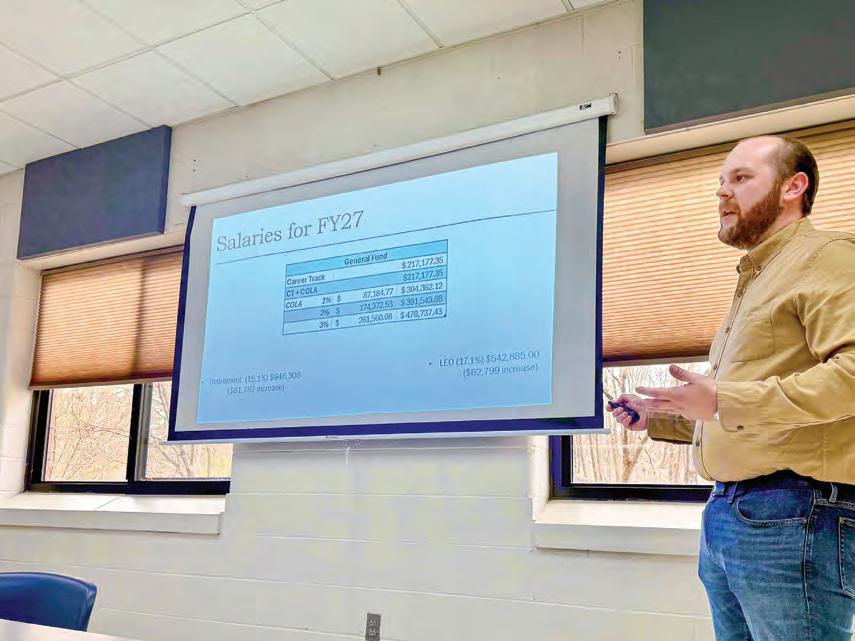
On the expenditure side, state-mandated employee retirement contributions will rise to $946,308 — an $81,787 increase. Similarly mandated law enforcement retirement contributions will rise to $542,885 — a $62,799 increase.
“These are what we have to pay as employers,” Barrett said.
Health insurance looms as the most dramatic increase. Preliminary estimates project a 33% hike.
Town Manager Rob Hites asked whether the weakening of the Affordable Care Act was contributing to the spike. Barrett said it was.
“We are now seeing a rate increase passed on to us because of the changes in the administration,” Hites said, referring to the Donald Trump White House. The projected loss of Affordable Care Act participants F
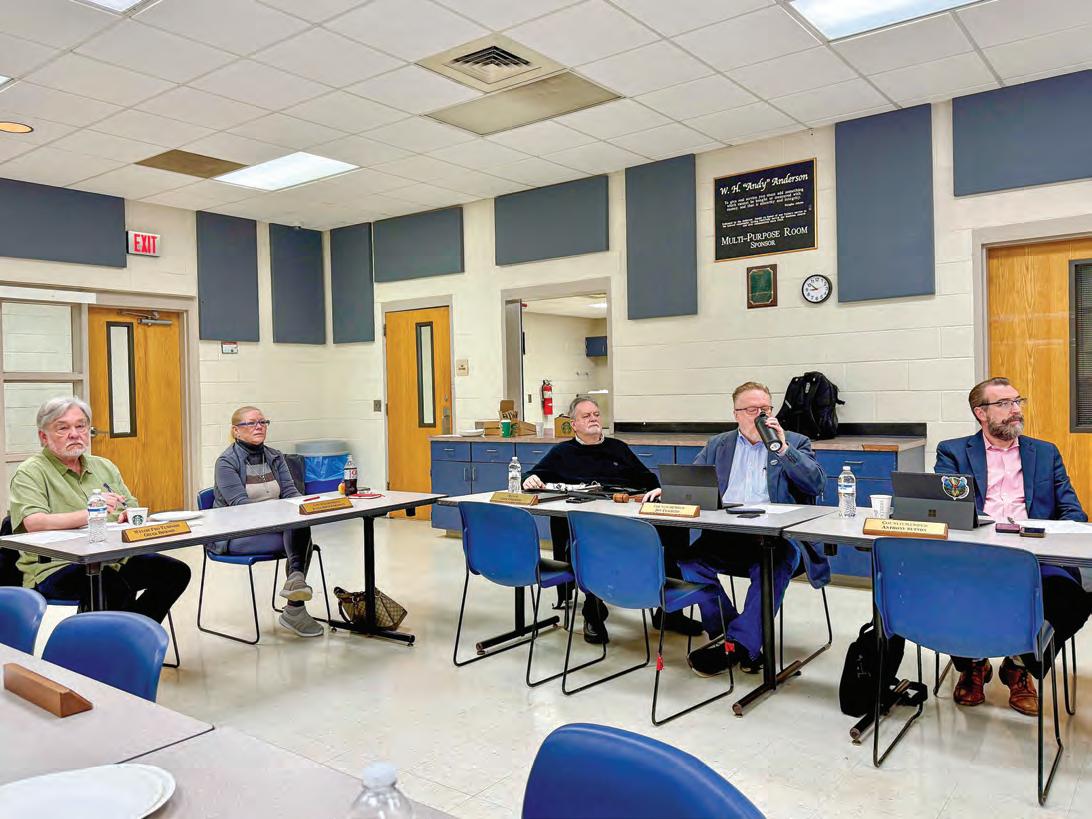
Members of Waynesville’s Town Council (left to right) Chuck Dickson, Julia Freeman, Mayor Gary Caldwell, Jon Feichter and Anthony Sutton emerged from a seven-hour budget workshop with a hard road ahead. Cory Vaillancourt photo
Steady hand steps aside in Waynesville
BY CORY VAILLANCOURT POLITICS EDITOR
After nearly a decade at the helm of Waynesville government, Town Manager Rob Hites announced Feb. 27 that he will retire July 1.
Hites arrived in 2016 following a long career in local government across North Carolina. Born in Reno and raised in Alabama, he graduated from the University of North Carolina at Greensboro. An urban government course led to an internship with the Greensboro mayor, setting him on a path that would lead to decades of local government administration.
After Greensboro, Hites attended graduate school at American University in Washington, D.C., and began working full-time for the General Accounting Office. He was then selected to help set up the Federal Election Commission as one its first 16 employees.
His first town manager job was in Pittsboro, but his
stems from federal policy changes — championed by Congressman Chuck Edwards (RHenderson) — that cut ACA subsidies.
Town Council Member Anthony Sutton said the health care coverage cost projection aligned with what he’d heard from other municipalities.
Workers’ compensation insurance is projected to rise 7%, and property and liability insurance 12%.
career would include city manager posts in multiple municipalities before his hiring in Waynesville.
When he took the job, Hites said he hoped to build on the town’s strengths while positioning it for long-term growth. During his tenure, Waynesville navigated major infrastructure investments, personnel transitions and recovery from the Great Recession, the Coronavirus Pandemic, Tropical Storm Fred and Hurricane Helene.
Working under the council-manager form of government, Hites oversaw day-to-day operations while implementing policy set by the mayor and town council.
Council members have not yet detailed a succession plan but are expected to begin a search process in the coming months using consultants to solicit candidates and narrow the field.
“If I’ve done my job right,” Hites said, “you won’t know that I’m gone.”
year and a half, and here we are.”
Waynesville officials say FEMA has reimbursed only about 13% of Hurricane Helene damages, leaving the town exposed to millions in unrecovered costs. Frustration is mounting as denials, delays and reversals threaten a second budget cycle without adequate federal recovery funding.
Council members repeatedly voiced continuing frustration at the federal reimburse-
FEMA uncertainty, infrastructure demands and broader budget constraints.
Hites placed the shortfall in a broader context, noting that Haywood County government remains roughly $14-16 million short on reimbursements. The county’s budget retreat will be scheduled for some time in mid-March, when further impacts will become more visible.
Against that backdrop, Barrett presented a stunning bottom line — $19.2 million in projected general fund revenue against $24.6 million in expenses
Outstanding FEMA reimbursements account for approximately $4 million of that gap.
“I want to stress that so much of that is FEMA tie-ups,” Barrett said. “It’s stuff we could get, but we’ve been at it for almost a
ment process, describing projects in “FEMA purgatory” and funds “not obligated” despite repeated assurances and constant effort.
Insurance and proposed salary increases add another $1.4 million. Waynesville officials have begun a multi-phase pay classification overhaul, focused on initial adjustments for below-market positions. While aiming to stay competitive without leading the market, leaders weighed salary alignment against
Meanwhile, department heads have submitted $20.12 million in capital requests so far — including fire, police, electric, water and sewer needs. Those requests will remain largely unfunded under current projections.
Utility rate adjustments could offer incremental relief. A 2% water rate increase would generate about $67,497, while 10% would produce roughly $337,488. Sewer increases range from $84,150 at 2% to $420,750 at 10%. Electric increases range from $210,010 at 2% to more than $1 million at 10%.
Notably, Council hasn’t yet decided on implementing such increases, as the budget is only in the preliminary planning stages and will change often before it’s passed, likely in late May or early June. But those discussions carry political weight, especially for residents on fixed incomes.
“Those have been scenarios that have been brought to my attention,” Barrett said. “Recently, I’ve been having more fixedincome customers call me directly. Trying to come up with good solutions as we look to
this next budget year, I think that’s really important.”
The conversation repeatedly returned to growth. A one-cent increase in the property tax rate generates about $153,663 in revenue. Barrett estimated the town is short 7 to 8 cents on the tax rate simply to maintain current service levels, accounting for FEMA delays and mandated spending increases.
“Let’s just be honest,” Sutton said. “We either have to raise the taxes, increase your tax base, or you have to cut your expenses. That’s your only three options.”
Recent growth added about $30 million in property value, generating roughly $150,000 in new revenue. But that alone cannot offset a multimillion-dollar shortfall.
“We either grow or we die,” Sutton said.
The looming 2027 countywide revaluation adds another layer of complexity. That revaluation will affect the town’s 2027-28 budget, potentially increasing the tax base significantly. Council members will then face a pivotal decision — adopt a revenue-neutral rate or retain some of the increased revenues to address structural costs.
“You’ll have to look at that revaluation as tremendous opportunity. And I really don’t recommend anybody going out and saying, ‘I promise you that we’ll go revenue neutral,’” Hites said. “You may very well need every bit of that, plus a couple cents [on the tax rate].”
For now, council appears to be crafting the 2026-27 budget with that longer horizon in mind — balancing immediate fiscal triage against strategic positioning for the postrevaluation year.
“We’re not alone in this,” Barrett said of FEMA delays and insurance spikes. But the numbers, as he told council earlier in the session, “don’t lie.”
Waynesville’s budget workshop closed without any final decisions, but with clarity on the scale of the challenge.
Between frozen federal reimbursements, mandated cost increases and uncertain revenue growth, town leaders now face months of difficult deliberations — weighing service levels, tax burdens and long-term stability in a region that’s beginning to realize real recovery may never come.
Hites has been with the Town of Waynesville for about a decade. File photo
Town of Waynesville Finance Director
Ian Barrett gives a rundown of revenue and expenses during a Feb. 27 budget workshop. Cory Vaillancourt photo
Rising electric rates revive Waynesville solar push
BY CORY VAILLANCOURT POLITICS EDITOR
Waynesville did not reject solar last year; it hesitated. Twelve months later, amid skyrocketing electricity costs, a shortened federal incentive window, a roof nearing the end of its life and more rate spikes on the way, council is again weighing whether the town’s recreation center should become its own power producer.
The solar push aligns with the town’s goal of carbon neutrality and net zero emissions by 2050.
“This is the continuation of the project that we talked about a year ago,” said ouncil member Chuck Dickson, a major proponent. “We have even better figures for you this year.”
Environmental Sustainability Board Chair William Hite returned to Waynesville’s budget retreat on Feb. 27 to make the case for panels atop the town’s sprawling recreation center, describing the proposal as, “simply put, an opportunity to lower municipal emissions, generate savings and inspire the community.”
Council heard a similar pitch in 2025, when solar was proposed for both the recreation center and the public works building. The ESB later secured a $500,000 Dogwood Health Trust grant for solar plus battery storage at the public works building on Legion Drive. That project is expected to be completed by summer, but the recreation center remains unresolved.
Hite said two developments have now changed the calculus.
rising electricity costs. File photo
The first is electricity demand driven by artificial intelligence and data centers. Data centers consumed 4% of U.S. electricity in 2024, he said, and that figure is projected to reach 12% by 2028.
“When supply doesn’t keep up with demand, the price rises,” Hite said. “This is important, because in none of our lifetimes have we experienced such a steep change in electricity demand. The last time this occurred was the introduction of central heating and air in the 1950s.”
The second is the federal One Big Beautiful Bill Act, which accelerated deadlines tied to clean energy incentives originally extended through 2032.
“Currently there is still available a 30%-to-40% investment tax credit,” Hite said.
According to Hite’s presentation, the One Big Beautiful Bill Act “unwittingly forced communities to decision points on key provisions originally part of the [Biden-era Inflation Reduction Act]. No longer projected to sunset in 2032, the OBBBA forces municipalities and nonprofits to the decision table in 2026.”
Under the proposal, the recreation center’s aging roof would be replaced at a cost of about $430,000, even though it still has about five years left of useful life.
A 382.4-kilowatt solar array would cost roughly $630,000 before incentives. With a 40% investment tax credit, the net solar cost drops to about $378,000.
The system would offset approximately 65% of the building’s electricity use and produce an estimated 521,575 kilowatthours annually.
Hite emphasized that the town’s wholesale electric rate of 3.7 cents per kilowatt-hour is not the whole story. Demand charges push the levelized cost closer to 8.1 cents per kilowatt-hour.
“When energy costs more, the rate of return for solar increases, lowering the payback period,” he said.
Savings scenarios presented to council showed payback periods between seven and 10 years depending on future electric rates. At current rates with a 2% annual escalator, projected total proceeds over 25 years
exceeded $1.2 million.
Finance staff reported that the recreation center alone paid about $151,000 for electricity last year. Hite said solar would offset 65% of that cost, or roughly $98,000 annually in avoided costs.
Financing would be available at approximately 3.9%, with amortization options over 10 or 25 years. The first-year payment would be higher to account for receipt of the tax credit, after which monthly payments would decrease.
Council member Anthony Sutton asked if there was an alternative to putting the panels on the roof, however installers from Rhino Renewables present at the meeting said such options are possible but generally more expensive due to structural requirements.
The current proposal does not include batteries, which remain expensive; Hite pointed out that the public works project’s cost was driven largely by battery storage.
Sutton also asked about energy production guarantees.
“We are so far in the hole,” Sutton said. “We need some kind of guarantee that this will pay for itself.”
Equipment warranties would extend up to 30 years on panels and 20 years on inverters, but generation guarantees would need to be negotiated in an RFP. The concerns arose in context of the town’s broader financial position — currently weakened due to lagging federal reimbursements related to Hurricane Helene.
Hite also highlighted secondary benefits, including reduced cooling loads because panels shade and protect the roof membrane. As the discussion wound down, officials agreed the next step would be securing a structural analysis and refining financing assumptions.
“It’s a great opportunity for the town,” Hite said. “It is a way to save money, both today and tomorrow.”
Council took no formal action, but unlike last year, the numbers — and the deadlines — appear to be pushing the conversation closer to a decision.
In Waynesville, it’s market pay vs. municipal reality
BY CORY VAILLANCOURT POLITICS EDITOR
At a Feb. 27 budget retreat, Waynesville aldermen confronted a familiar tension — how to keep municipal salaries competitive in a tightening labor market while staring down mounting infrastructure demands and lingering financial uncertainty tied to Hurricane Helene.
Two presentations from Human Resources Director Page McCurry outlined the first steps in an overhaul of pay classifications, beginning with public works positions and moving next to police and fire.
“This is technically phase one of pay classification studies, pay studies that we’re doing across all divisions and departments,” McCurry said.
She noted that it had been several years since the town
last undertook a full pay and classification review.
The sustainability division study, conducted by consultant DeLane Huneycutt of MAPS Group, focused on positions funded through enterprise revenues — water, sewer, electric distribution and related roles. The executive summary presented to the board outlined market data for benchmark positions and final recommendations. What Huneycutt found was a mix.
Several positions — including lab analyst, advanced plant operator, utility maintenance specialist, treatment plant operator, utility locator, senior plant operator and all electric distribution positions — were below market average.
Others, including treatment plant superintendents, lab supervisor, pump mechanics, chief plant operators, distribution and collections superintendent, crew leaders and meter readers, were at or above market average.
McCurry explained the standard used to determine those classifications.
“The market is defined as being less than 3.5% from the market midpoint,” she said.
If a position fell more than 3.5% below the market midpoint, it was flagged for adjustment. If it fell within that window — even slightly below — it was considered aligned.
“That is a standard amount that consultants in pay class use,” McCurry said.
The recommendations were straightforward; the consultant suggested a 7% increase for all below-market roles, twoto three-grade increases in those classifications, reclassification of two roles, the addition of five new pay grades at the top of the scale and correction of pay-grade compression gaps.
Pay grade compression occurs when there are
The Town of Waynesville is again considering solar power as a hedge against
only small differences in pay between employees — regardless of experience, seniority or skills. Often, pay grade compression occurs when starting salaries for new hires climb faster than raises for existing staff.
Implementing those changes immediately for the remainder of the current fiscal year, excluding overtime adjustments, would be surprisingly reasonable.
“The total impact, if we implement the increases beginning with the March 5 pay period, is $41,764.14,” McCurry said. “I think this is great news.”
That figure would be spread across respective enterprise funds, with general fund impact limited to less than $1,200. Enterprise fund expenditures and revenues are sequestered in their respective funds and are not comingled with general fund expenditures or revenues.
The modest nearterm cost offered some reassurance, but board members pressed on methodology and philosophical direction.
Council member Jon Feichter questioned whether the 3.5% market window might mask employees hovering just under competitiveness.
“That three-and-ahalf percent seems like a big window to me,” Feichter said.
Waynesville Fire Department — with a timeline already in motion.
The methodology calls for identifying a core market of roughly a dozen peer comparison organizations, with flexibility to expand if necessary.
Unlike the enterprise study, police and fire leadership selected their own peer comparison organizations, a move McCurry described as intentional.
“They were the ones who identified the particular organizations that they felt were our competitors,” she said.
Limitations include incomplete salary range data and the unavailability of information from nonprofit fire departments that are not subject to public records laws.
Jon Feichter, a member of the Waynesville Town Council, listens to a presentation on salaries at the town’s annual budget retreat. Cory Vaillancourt photo
McCurry responded that the study examined positions, not individuals, and that minor variances — positive or negative — indicated overall alignment.
“What that tells us is that we are on target for market,” she said.
McCurry added that the town’s pay philosophy has historically aimed for close agreement with the current employment conditions.
“We want to be in alignment with the market. We don’t want to lag or lead,” she said.
Still, she acknowledged that today, financial realities temper ambition.
“If we didn’t have the outstanding FEMA projects and infrastructure projects that we have financially, I would say, ‘Let’s go for it, folks.’ But I don’t know that today’s the right time,” McCurry said.
The conversation widened into broader fiscal concerns, including dependence on property tax revenue and the difficulty of balancing ad valorem rates against service expectations.
“The challenge for all of us is to balance the impact of your ad valorem taxes and your fees [and] your utility fees for the citizens against the needs,” said Town Manager Rob Hites.
The sustainability study represents only phase one.
Phase two focuses on public safety — Waynesville Police Department and
Despite those hurdles, McCurry said the process is ahead of schedule and aimed at delivering draft findings by early April so that any compensation adjustments can be incorporated into the upcoming fiscal year budget, which must be passed by July 1.
She emphasized that the goal is not to hand out windfalls but to ensure fairness and competitiveness.
“I don’t go into this hoping that everybody gets big fat raises, because that means we’ve not done a good job,” McCurry said.
Her hope, she added, is simpler.
“I want to be able to say, ‘Hey, we’ve done this right the whole time,’” she said.
Phase three, slated to begin in July, will address all remaining administrative and general fund positions not included in the first two phases.
For town council, the coming months will require weighing consultant data against economic headwinds and long-term capital demands. Competitive pay may be essential to retaining skilled operators, police officers and firefighters, but every adjustment reverberates through rate structures and tax bills.
Near the end of the meeting, Council approved unanimously by motion the initial pay adjustments for the current budget and included one position that didn’t quite meet the 3.5% limit but was close. The total ended up at $46,752.99.
Shining Rock votes to end high school instruction
BY LILY LEVIN STAFF WRITER
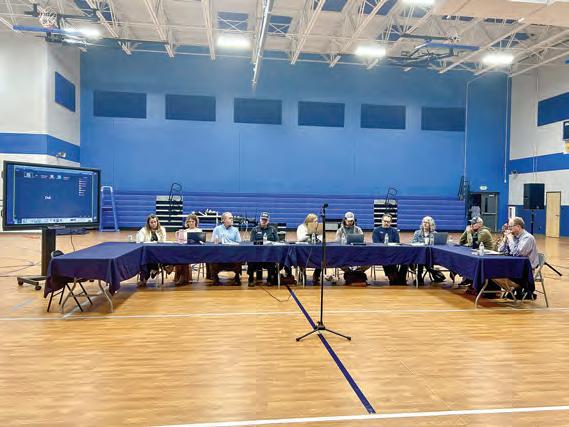
The Shining Rock Classical Academy board at its Feb. 25 meeting voted unanimously to end grades 9-11 instruction effective June 30, 2026, and to close grade 12 after the fall 2026 semester, in front of an audience of more than 100 people. The high school had been consistently running a deficit, and the board argued that it has a fiduciary responsibility to move the organization in the right direction.
“We cannot continue operating the high school grades without jeopardizing the long-term financial stability of the entire organization,” said Chair Alyson Weimar in a Feb. 26 press release.
The board also announced the nonrenewal of its rental contract with the Dellwood campus, where grades K-8 were held before the acquisition of the Russ Ave building and where high school instruction has taken place since 2022. The 10-year lease on the older property, owned by Lake Junaluska Assembly, is set to expire by the end of 2026. Meanwhile, the Dellwood campus has been increasingly expensive to operate, and its buildings have already reached the end of their lifespan, said Weimar last Wednesday.
Before the vote, she took some time to explain to attendees why financing the high school has become unsustainable and how actions of former board members inadvertently led Shining Rock into its recent trend of annual deficit.
Shining Rock in 2022 obtained roughly $21 million in bonds through 2057 consisting of $19.5 million in land and construction fees for the Russ Ave building and $1.7 million of debt owed to the Dellwood facility. No feasibility studies were conducted at the time of bond acquisition.
bond agreement in FY2023, it had $2 million in savings and loan funds outweighed debt to the Dellwood property.
But by the end of FY2024, it had weathered a loss of $400,000 dollars and was far from reaching its projected enrollment. The school continued to operate at a loss in FY2025 and 2026, losing roughly $200,000 annually. Plus, even with four full grades of high school in FY2025, enrollment stagnated at just over 100, far lower than initial expectations of 160 students.
“[FY2025 was] the first year that we really realized with all four grades in place, the high school was not producing sustainable student staff ratios. We’re a school of choice. People chose other things,” Weimar said.
Weimar said there had been warnings of unrealistic enrollment projections by one finance committee member as early as 2019, and financial advisor CSP further underscored the need to reach enrollment figures in 2022 or else face operational consequences. When the school entered the
Board meeting notes from September 2025 show that Shining Rock’s Debt Service Coverage Ratio was 0.86, while bondholders require 1.10. Any score above 1 indicates that an organization has surplus funding to cover its debts, while a score below 1 indicates insufficient funding.
The most common repercussion, according to the document, was that “an independent monitor may be engaged by bondholders to ensure this doesn’t happen again.”
Nonetheless, minutes show that board members expected Shining Rock to have a 1.03 FY2026 debt ratio, shifting its status out of the red. And in mid-December 2025, the organization seemed on track to achieve this number, writing that “our ratio is staying consistent at 1.04.”
But on Feb. 19, Shining Rock reported $220,000 in deficit, risking falling short of its coverage ratio and being in technical default — in other words, violating the terms of the bond. It was then that board members first discussed winding down the high school and Dellwood campus.
Weimar told attendees at the Feb. 25 meeting that the school’s financial outlook was clarified when Shining Rock undertook a self-study with financial advisor CSP in fall 2025 and reported the results in January to the board.
Currently, Shining Rock’s fund balance is $1.2 million, 60% of its total four years prior, though Weimar admitted recent local crises — Hurricane Helene and the closure of Pactiv Evergreen in Canton — likely also played a role.
OPTIMISTIC PUBLIC COMMENT
During the public comment period at the top of the agenda, the majority of speakers held onto hope, urging the board to be proactive, keep the school open and let the next few years play out.
“Would you rather say we are going to have a rough few years while we fix and rebuild our vision, or say we are shutting down high school and only going to have about 400 kids K-8? Because those would be the numbers you are looking at once the high school is gone, maybe less if you do not fix the larger issue,” said Anna Eason, Shining Rock parent and former board chair.
After the final public comment, Jeffrey Delannoy, parent of two Shining Rock students, announced from the audience that he’d like a chance to speak.
“No, we are going to call our policy tonight, and we needed to sign up for public comments. We’re going to move on. I’m sorry. We do have public comment at every board meeting,” Weimar responded, directing the board to report on the school’s clubs and participation in the latest science fair. When committee reports concluded a halfhour later, Delannoy once again spoke up from the audience.
Shining Rock Classical Academy’s K-8 instruction will not be affected, for now. Lily Levin photo
“I have a question,” he said.
“I’m sorry. I’m not going to start this. I have officers here. They will remove you. I’m — not here, not going to start this. Officer Reeves,” Weimar said.
Delannoy was indeed removed from the meeting. In the lobby area, he told The Smoky Mountain News that he’d tried to sign up for public comment the day prior, but was told he’d have to add his name immediately before the meeting. He arrived three minutes late due to a previous commitment.
The Shining Rock parent had only positive things to say about the school, though he questioned why board members had taken so long to inform the public of its financial challenges.
“I love the school, I love the teachers, I love the faculty. I love what they’re doing with the students,” he said. “We should have known about this at the beginning of the year. We shouldn’t be talking about this in February. We should have been talking about this in September.”
Delannoy told SMN that he’d wanted to speak to the percentage of children receiving a special education curriculum — which Head of School Josh Morgan put at one in every five students, exceeding the state’s enrollment funding cap.
The state of North Carolina allots an extra $5,309 per student qualifying for special education services but will only fund up to 13% of the total enrollment population, at the detriment of schools like Shining Rock, with more disabled students.
Delannoy thought board members could consider pursuing a related grant.
“I want them to be educated that they can move forward and that they haven’t exhausted every viable source,” he said. “That’s why I was here in the first place, was to light a spark, like, you don’t quit. You don’t quit on a bunch of kids that you’ve had from kindergarten through eighth grade and now have to change schools.”
In the end, however, the board didn’t seem to take even the spoken public comments into much consideration. Its presentation about the school’s contingency plans for its junior class demonstrated that members had already arrived at and extensively planned for their ensuing vote.
Christina White, Shining Rock teacher and chair of the academic committee, alongside School Director Heather Wilson, presented a proposed “Junior Pathway to December 2026 Graduation” program that would, through a combination of contracted teachers and NC virtual public school summer programs, allow current juniors to complete requisite high school courses by the end of 2026 and obtain a Shining Rock diploma.
After the details of this plan were hashed out, the board went into its series of votes that would finalize the outcome of Shining Rock’s high school. The meeting ended just after 8 p.m., nearly a half hour ahead of schedule.
Dozens of emotional parents and students lingered after the board’s adjournment to exchange tears, words and hugs.
Noquiyisi transfer completes the circle
BY LILY LEVIN STAFF WRITER
Just after 1 p.m. on Thursday, Feb. 26, the drizzle became a downpour — a moment of serendipity for those gathered in what’s now the town of Franklin to watch the deed transfer of the Noquiyisi (Nikwasi) mound to the Eastern Band of Cherokee Indians.
“Any time it rains, it always washes away anything that’s happened. So, it’s like a cleansing so it’s almost a perfect weather, you know? That this rain is here. It’s kind of washed away for a new beginning,” tribal council member Adam Wachacha said to the audience.
The event, at just over an hour, took place at Gaduni Kanohesgi, or “The Franklin Storyteller.” Over 100 gathered in the small, covered space adjacent to the mound, with some sitting and many more standing in clusters behind the chairs. Speakers and honorees included town and EBCI officials, members of the Noquisi Initiative and others who played a role in facilitating the relinquishment of the mound by the town of Franklin. The program featured instrumentals, dancing and songs bearing witness to the importance of this moment; more than two centuries after its 1819 seizure by European settlers, the largest unexcavated mound in the Southeastern U.S. was finally being returned to the stewardship of the tribe.
While the transfer was unanimously approved by Franklin Town Council last month, it was nearly 14 years in the making. Franklin officials in April 2012 decided to remove the mound’s natural grass and plant a lower-growing artificial species, sparking outrage from tribal leaders and marking the beginning of a years-long reconciliation
Three years later, the town awarded it the deed to the mound.
Noquiyisi, meaning “star place,” served as the cultural and political center of the larger Cherokee “Mother Town” as the site of its council house. It also was inhabited, according to Cherokee tradition, by the Nunne’hi, immortal protectors of the town.
The program featured instrumentals, dancing and song bearing witness to the importance of the moment and the property transfer. Lily Levin photo
process between the town and EBCI. The Noquisi Initiative, a nonprofit that includes officials from Macon County and Franklin, Mainspring Conservation Trust and the Eastern Band, was founded in 2016 to bridge the gap between tribal and local leaders.
doing the right thing matters more than economics, that sometimes the soul of a place is worth more than the price of a parcel of land.
“And wouldn’t our world be a better place?” He asked the audience. “Wouldn’t our government at every level be stronger if we led with that principle more often?”
Speaking directly to Franklin officials, Principal Chief Michell Hicks emphasized that restoring the mound was about relationship with, not ownership of the land.
“This is not a land transaction,” he said. “Today, you guys are sharing with us part of our history. You’re bringing back just a piece of who we were. It’ll never be the same. Never in the future will it be the same. But you have helped to mend that little bit.”
Hicks also admitted to the audience that he was reading without a script because he wanted his words to come from the heart.
“I’m unscripted today because this means so much to us that I can’t explain. And you’re not going to find one Cherokee in this room that can explain to you what this mound means to us, but we know right here,” he said, gesturing to his heart, “we know exactly what It means to us.”
Its location along the Little Tennessee river links it to other Cherokee mother towns in Southern Appalachia, each with its own mound.
EBCI member and Noquisi Initiative Board of Directors Co-Chair Juanita Wilson testified to the significance of the moment.
“I am locked in a battle with chemotherapy, two more treatments. But you know what? Today was so important — rain, sleet, snow or chemo treatment would not keep me away from here,” she said.
Franklin Mayor Stacy Guffey acknowledged that the deed transfer couldn’t reverse history and was but a “small gesture” in reconciling years of cruelty inflicted on Indigenous people — and that it was necessary, nonetheless.
“Too often, we measure everything in dollars, in cost and profit, in short-term gain. And if you ask me, ‘What’s the economic benefit for the town of Franklin of returning the mound?’ The honest answer is, ‘I don’t know.’ And my other answer is, ‘I don’t care,’ because that was never the point,” Guffey said, adding that “sometimes
EBCI member and Cultural Institutional Review Board Chair Angelina Jumper was pulled in last minute to sign on as secretary of the deed transfer document. She had an equally difficult time putting words to the extraordinary weight of what that meant.
“We didn’t have to buy [the mound] back, and it was given back with good faith. And I think that that just fits in my heart some type of way, because I can tell that my ancestors must feel that from way back in the day — things that they didn’t think when they had to walk away from this mountain, from the Treaty of 1819, until now. I don’t think that they ever thought maybe we’d end up here again,” she told The Smoky Mountain News, adding that “it’s just a beautiful time to be alive, to be able to see something like this happen.”
She said the plan is to turn Gaduni Kanohesgi into “a place that tells the story about the land,” (hence its name) noting that the logistics are still being hashed out.
After the signing, the event culminated in a song, youth dance performance and finally, a circle of dancing outside Gaduni Kanohesgi that was open to all. The rain had subsided, and nearly everyone joined hands under the open sky.
Lake Junaluska looking to hire seasonal employees
The Human Resources Department at Lake Junaluska will host a recruitment event from noon to 5 p.m. Thursday, March 5; 9 a.m. to 1 p.m. Thursday, March 19; and noon to 5 p.m. Thursday, April 9, in Room 202 of Harrell Center.
These events are for potential employees to learn more about Lake Junaluska’s open positions for full- and part-time seasonal opportunities and to interview on the spot.
Lake Junaluska is hiring for part-time and full-time positions in food services, housekeeping and recreation. A recruiting table will be set up where visitors can apply on the spot or have their questions answered. Employee perks include free access to the pool and fitness center and no golf course greens fees.
Online applications also are available at lakejunaluska.com/about-us/jobs.
A beloved spiritual retreat center and scenic community in the mountains of Western North Carolina, Lake Junaluska welcomes guests and residents every day to recharge, renew and reconnect. Learn more at lakejunaluska.com.
‘One Day for Western’ set for March 25
Western Carolina University will hold its fourth annual “One Day for Western” on Wednesday, March 25, rallying alumni, friends and supporters for a 24hour day of giving to enhance student experiences and advance key university priorities.
The 2026 ‘One Day for Western’ event will allow donors to support WCU athletics. Donated photo
This year’s effort will again focus on support for sport-specific funds benefiting Catamount athletics, including all varsity teams, the cheerleading program, the Catamount Club Scholarship Fund, and ongoing athletics facilities improvements.
In addition, donors will be encouraged to con-
tribute to excellence endowments that enrich student learning across WCU’s academic colleges, the Graduate School, Highlands Biological Station and Hunter Library.
The 2026 event will feature a series of donor challenges to maximize impact, with goals based on both participation and total dollars raised.
All gifts made on March 25 count toward Fill the Western Sky, WCU’s comprehensive campaign to raise at least $100 million for academics, student engagement and athletics. For more information or to make a gift, visit oneday.wcu.edu or westernsky.wcu.edu, call 828.227.7124 or email advancement@wcu.edu.
Jackson Schools awarded exceptional children’s grant
Jackson County Public Schools announced that it has been selected as a recipient of the Exceptional Children’s Competitive Grant from the North Carolina Department of Public Instruction. The $65,600 grant will support transition programs for middle and high school students to improve post-secondary success. The NCDPI Exceptional Children’s Division awarded over $4 million in competitive grants to fifty-two entities. Jackson County’s proposal focused on transition programs for middle and high school students.
For more information about Jackson County Public Schools and its Exceptional Children’s Program, visit jcpsnc.org/programs/ecp.
SCC Foundation receives ‘full-ride’ scholarship for opticianry students
Students at Southwestern Community College have a new opportunity to receive full tuition coverage with the Opening Your Eyes (OYES) funded by The Vision Council through the SCC Foundation.
The $6,000 full-ride scholarship will be given annually to qualifying students who are pursuing a degree in Opticianry, one of only two programs in the state that prepares students to adapt and fit corrective eyewear.
To learn more about the SCC Foundation, contact Evan Hatch at e_hatch@southwesterncc.edu or 828.339.4241. For more information about the opticianry program, contact Program Coordinator Rebecca Morton at r_morton@southwesterncc.edu or 828.339.4307.
HCC announces ‘Future Leaders in Health’ scholarship
Haywood Community College announced its participation in the UnitedHealthcare Future Leaders in Health Scholarship Program, a new initiative aimed at training the next generation of rural healthcare professionals.
UnitedHealthcare has invested $500,000 in a new scholarship program that will benefit state community college students, including at Haywood Community College. The scholarship program supports students pursuing both short-term credentials and degrees in healthcare.
This gift is the latest chapter in UnitedHealthcare’s commitment to North Carolina’s rural health infrastructure.
The scholarships are designed to be comprehensive, covering costs ranging from tuition and testing to basic living expenses and transportation.
Students interested in applying for the UnitedHealthcare Future Leaders in Health Scholarship should contact HCC’s Foundation at hebirenbaum@haywood.edu or 828.627.4544.
SEANC Scholarship application deadline nears
The State Employees Association of North Carolina will offer several state and district scholarships worth over $40,000 in 2026.
Applicants must be active or associate members of SEANC, or the spouse, children and grandchildren of those members. Scholarships also will be awarded by SEANC District 1, which includes Cherokee, Clay, Graham, Swain, Jackson and Macon counties. This year all applications must be submit-
ted online by filling out the application at seanc.org/scholarship.
Categories are financial need, merit, which excludes financial need, and SEANC Member Only. Applicants must be enrolled at or have applied to a recognized and accredited post-secondary school, college, university, trade school or other institution of higher learning.
Information may be obtained by going online at seanc.org/scholarship-apply or by contacting Tammy Haskett at tghaskett1@gmail.com. All applications must be completed by April 15, 2026.
828.785.1881
Most insurances will cover 100% of your breast pump and other supplies. text to order & find out more
Taking out tyrants this way can’t be celebrated
The United States cannot keep breaking the rules of international law and then congratulate itself for the results. That is the uncomfortable truth exposed by the 2026 military operations in Venezuela and Iran. Both actions removed brutal, destabilizing leaders — one captured and jailed, the other killed. Many around the world understandably welcomed those outcomes. But the way the United States achieved them violated the very legal order that keeps the world from sliding toward permanent conflict.
On Jan. 3, 2026, U.S. forces launched a major strike in Venezuela, seized President Nicolás Maduro and his wife, and transported them to the United States to face what President Trump described as a “narco-terrorism” trial. International law experts were unequivocal: the operation “runs afoul of the United Nations Charter that prohibits unjustified uses of military force by one country against another.”
The Feb. 28, 2026, attack on Iran followed the same pattern: no armed attack triggered self-defense, and the UN Security Council did not authorize force. By any measure, these were unauthorized uses of force against sovereign states. The law is clear — and the U.S. helped write it.
After the devastation of two world wars, the UN Charter drew a bright line: states may not use force against one another except in self-defense or with Security Council authorization. That rule is not a technicality. It is the backbone of global stability. It protects weaker states from stronger ones and prevents powerful nations from deciding unilaterally which governments may live or die.
When the United States violates that rule, it does more than break international law. It undermines the very system it helped build — and the one it relies on to restrain the ambitions of other major powers.
The U.S. Constitution is just as clear. Article I gives Congress — not the president — the power to declare war. The War Powers Resolution requires congressional approval for sustained hostilities. Yet neither the Venezuela operation nor the Iran strike received such approval. Constitutional scholars cited in early 2026 noted that the Venezuela attack violated both international and domestic law, including the requirement that Congress authorize the use of force abroad.
When presidents bypass Congress, they do more than ignore a procedural formality. They erode democratic accountability and concentrate war-making power in a single pair of hands. The Framers feared exactly this kind of unilateral executive action.
The paradox: good ends, dangerous means.
There is no need to pretend that Maduro’s fall or the removal of Iran’s hardline leadership is a tragedy. Both regimes inflicted enormous suffering on their own people and destabilized their regions. Their departure from power may well improve international peace and security.
What trees will you plant?
This past Sunday at church, someone quoted the old Greek proverb, “A society grows great when old men plant trees in whose shade they know they shall never sit.” As the speaker continued to make a connection with the proverb and the future of our church, I quietly sat with the words and let them wash over me.
The ancient stoics and philosophers were beyond wise. Often with little else to do, they sat for hours with their own thoughts. In the stillness, they heard the wisdom of the ages. If only modern humanity would follow the advice from our ancestors, the world would be so much kinder, more genuine and more meaningful.
I know many wonderful older men and women who are working hard and using their time and resources to offer “shade” they may never sit in. I love seeing older people use reusable water bottles or take their own grocery bags to the store. I know these are small actions, but it shows me that they care what happens to our planet for generations to come.
I know older individuals who give time and money to our local schools, churches and youth sports, even if they don’t have grandchildren participating. They are happy to share their talents, knowledge and resources to create more “shade.”
“Planting trees” and “creating shade” offer
a multitude of metaphors, but at their core, it essentially means the older generations will create a better world for the younger generations.
From a local lens, I still see a lot of trees being planted, but from a global lens, it can seem that older generations are unconcerned about the future of our world.
Unfortunately, the loudest voices often get the most attention and with young minds being impressionable, this can feel disorienting.
One of the most well-known verses of the Tao Te Ching, the guiding principles for Taoism, says:
Those who know do not talk.
Those who talk do not know.
We need to remind our children that the truly wise are often quiet and only speak when there is something profound to be said.
Modern culture promotes winning, accumulating and a performative nature. On the surface, it makes it appear that individualism is more important than altruism. Again, we must intentionally teach our children and model that giving back is more fulfilling than obsessing over personal gains.
But if powerful states can remove tyrants whenever they choose, the world becomes less safe, not more. Every aggressor claims noble motives. Every unlawful intervention can be dressed up as liberation. The UN Charter exists precisely to prevent that slippery slope.
The end may be laudable. The means must be discredited. A precedent the world cannot afford.
When the United States violates the rules it helped create, it hands a gift to authoritarian powers. Russia’s foreign ministry immediately labeled the Venezuela strike “an act of armed aggression,” warning that the pretexts used to justify it were “unfounded.”
This is not mere diplomatic theater. The United States cannot credibly condemn Russia’s aggression in Ukraine — or any future act of unlawful force — while normalizing its own.
A world governed by law or by power?
The U.S. faces a choice. It can recommit to the principles it helped establish: peaceful dispute resolution, collective security and constitutional governance. Or it can continue down the path of unilateral force, joining the ranks of states that treat military power as a routine instrument of foreign policy.
The fall of tyrants may be worth celebrating. But the United States cannot make the use of force a habit, nor can it ignore the legal limits that protect global stability. If America wants a world where law restrains power, it must restrain itself first.
(David Crane is a retired U.S. Army Officer and lives in Maggie Valley.)
David Brooks, former political columnist for The New York Times and moderate conservative, quoted a few concerning statistics in a recent episode of Amanpour & Co. He said that when survey participants were asked if they trust their neighbors, 60% of baby boomers (born 1946-1964) and Gen X folks (born 1965-1980) said yes, while only 19% of millennials (born 1981-1996) and Gen Z individuals (born 19972012) said yes.
Additionally, when millennials and Gen Z participants were asked if most people are selfish and out to get you, 72% said yes. Younger generations view the world as harsh, bitter and challenging to navigate.
Despite the depressing statistics, Brooks went on to talk about “rupture and repair.” It happens in our own lives and in collective cultures. It’s a period of time where we have to break down old thought patterns and habits to rebuild something stronger, better and more suited to the zeit-
geist. As a country, we’re currently in a state of rupture and repair, and we just need to hold steady, be patient, question the loudest voices and have faith that we’ll come out of stronger.
All of these thoughts combined motivate me to help shift the narrative for our youth. I’m the mom/stepmom to five teenagers/young adults, and I want more than anything for them to have hope in and excitement for the future. But it doesn’t merely come from me as their parent, it must come from all of us — friends, extended family, mentors, teachers, coaches, church members, neighbors, everyone. Let’s not always focus on national and global issues. Let’s reel it back in a little to our families and communities. Offering a solid base and deep roots is often the best thing we can do for young people.
As you go about your week and your life, I want you to consider this question. What trees will you plant in whose shade you may never sit?
Guest Columnist
David M. Crane
Columnist
Susanna Shetley
File photo
breakfast corner. Yoou’r nvvited to come view your future retreat! Adventure out to hike th af or r ftttheNantahala! Just 20 minutes to Sy
& Nature? Search no at 3500 f feeet in elevation, ing o Offffeer ovver 3,800 square his home is sure to please. island, nces, , , pantry & k and en open dec nvvision kwa e the Blue Ridge Par ay y to Asheville.
AyurPrana Listening Room has become a cultural haven for unique live shows and musical experiences in Asheville. ALR photos
AyurPrana Listening Room offers transcendent music and spiritual exploration
BY GARRET K. WOODWARD A&E EDITOR
Situated on the corner of Haywood Road and Swannanoa Avenue in West Asheville, the AyurPrana Listening Room has become a haven for music lovers and artists well-versed in the sacred art of performance.
“[AyurPrana] somehow creates a ‘live studio’ atmosphere, almost like a set or soundstage or theater,” said Bryce Franich, music manager for AyurPrana. “The room feels like you’re there to experience something rare or once-in-a-lifetime, which seems to engage attendees in a theater-like manner.”
With a deeply-held ethos of “bolstering artistic innovation, spiritual exploration, and transcendent curiosities,” AyurPrana is the counterpoint to loud venues and neighborhood bars, where musical acts are treated more like background noise than melodic magic.
“They want to experience a connection with the artist,” Franich said. “In that respect, it also naturally halts the urge to pull out your phone. It’s just so incredibly intimate that people almost instinctually lock in with the atmosphere.”
The seed for the inception of AyurPrana was initially planted by the late David Newman, who was the founding music director. In 2022, when the space opened, it was Newman who saw the potential for the intimate room and what it could host and showcase.
Want to go?
mately has led to the perpetuation of “transcendence through music.”
“Transcendence is what much of David’s programming provided to the culture he created. We agreed the programming would have to usher attendees outside of their current field and allow them to dissolve everyday stresses for a few hours — a sonic meditation of sorts,” Franich said. “It’s interesting to see how much uplifting high-vibe and challenging avant-garde music have in common. Both scenes seek the same results: to feel moved and inspired.
Franich, who was a touring musician for several years, would find himself passing through Asheville, only to circle back down the road and decide for himself to put down roots in a scene that’s become one of the most cherished and vibrant in America.
Known as an event space “that seeks to elevate consciousness through music, movement, education and healing,” the AyurPrana Listening Room is located at 312 Haywood Road in West Asheville.
To note, the ALR is an alcohol-free venue which offers “a variety of locally made beverages.” Food is not available onsite. It is also a cashless venue. Doors open one hour before events are scheduled to start. Events are both seated and standing.
For more information, a full schedule of events and/or to purchase tickets, visit ayurpranalisteningroom.com, call 828.785.5228 or email events@liveayurprana.com.
“David recognized the craftsmanship with meticulous sound treatment [of the space],” Franich said. “[His] mission for the room was to uplift and heal through music. David’s programming was designed to act as sonic medicine for the community surrounding the Ayurvedic Institute and Asheville Yoga Center.”
When Franich came onboard at AyurPrana, his work ethic and sense of purpose mirrored that of Newman, which ulti-
“After living in Brooklyn for 20 years, my wife and I were searching for a town with access to nature and tranquility without sacrificing culture and the arts,” Franich said. “Asheville is that rare bird, overflowing with ambitious artists who have created a nurturing scene that bolsters the creative spirit. The amount of radical artistically challenging music from this gorgeous mountain town is confounding.”
In the midst of a live performance, when the musician(s) and the audience are genuinely connected in this twoway street of energy, respect and artistry, Franich can’t help but harbor immense gratitude for that moment unfolding in real time each and every single night.
“Sharing music I love with the community is why I do this. It’s one of the greatest joys in my life,” Franich said. “I don’t know that I have the lexicon to describe the feeling of having a room full of friends and family locked into a transcendental state, or how wonderful it feels to hear that the artist had a similar experience in the room.”
Upcoming events
• Every Thursday: “Live Music Yoga” with various artists at 9 a.m.
• Second Tuesday of each month: “Ram Dass Local Asheville Fellowship” at 6:30 p.m.
• Saturday, March 7: Mt. Kili & Liliana Hudgens (Americana/indie-folk).
• Friday, March 20: Sean Johnson & The Wild Lotus Band (rock/world).
• Saturday, March 21: Marc Ribot (roots/folk).
• Wednesday, March 25: Rosenau & Sanborn with Joe Westerlund (Americana).
• Thursday, March 26: Tara Clerkin Trio & Walt McClements (Americana).
• Friday, March 27: Wendy Eisenberg with Sally Anne Morgan (indie-folk).
• Saturday, April 4: Sophia Corrine with Laney Barnett (Americana).
• Tuesday, April 7: “Experimentation Meditation Club” with Kelly Kelbel & Tony Rolando.
For tickets, visit ayurpranalisteningroom.com/events.
Donated photo
This must be the place
BY GARRET K. WOODWARD
‘Mornin’ finds you on the shore, quiet coastline never ask for more’
Hello from Room 216 at the Holiday Inn Express & Suites on the southern edge of Steamboat Springs, Colorado. It’s 9:30 a.m. Gazing out the window of the hotel, I can see the ancient ridges of the snowy Park Range Mountains surrounding the community in this high desert corner of the West.
It’s 1,601 miles door-to-door from my humble abode in Waynesville to this Holiday Inn. That journey yesterday included driving to the Asheville airport, a direct flight to Denver (including an hour-delay leaving), a two-hour delay in Denver in catching the next flight to Steamboat, only to then wait for the long shuttle from the airport to the hotel. In total, the trek took around 14 hours. And upon check-in, I wasn’t on the guest check-in list.
Not a good spot to be in nearing midnight, especially in a ski town where everything is closed by 9 p.m. and everyone is fast asleep in hopes of scoring first chair on the ski slopes in the morning. No matter though; Rosa at the front desk was incredibly compassionate. It appeared my name was on the list, but starting tomorrow. And yet, she was able to give me the last room available, hand me a key and told me, “We’ll figure everything out in the morning.”
What’s Montucky, you ask? Well, it’s a popular beer brand in the Rocky Mountains and West Coast markets (it has also recently found its way in Southern Appalachia). Founded in 2012 in Bozeman, Montana, by two young friends, it has, in all honesty, become a favorable symbol of the Wild West with its iconic horse logo and genuine passion to donate to local organizations throughout the Rockies and beyond. Simply put? They’re good folk.
I first crossed paths with the Montucky crew last summer while covering the Under the Big Sky music festival in Whitefish, Montana. I was on assignment for Rolling Stone, and they were the main beer sponsor for the massive event. And we all ended up hanging out that weekend, kindred spirits from around America exploring this small western outpost town together. Good times, truly.
Moseying downstairs for breakfast, I entered a lobby full of skiers and snowmobilers covered in or carrying gear and ready for the impending day. City transit services and resort shuttles pick up the skiers, while the snowmobilers head into the parking lot, inspect their trailers and hop into large diesel trucks: all disappearing into the peaks and valleys.
Me? I sat in the lobby, consuming oatmeal, yogurt and scrambled eggs at my own pace and leisure. Although I’m a lifelong skier, I’m, sadly, not here to hit the picturesque slopes. I am, however, here to do one of my other favorite activities in life, which is to see and write about live music. Cue Winter WonderGrass.
Celebrating its 13th installment, WWG is the seasonal mecca for all things bluegrass and Americana music. And I’ve been wanting to check it out for years. Beyond squirreling away numerous interviews with an array of artists for future articles and such, I’m mainly here to run around the Steamboat Ski Resort and film onsite conversations with marquee musicians for Montucky.
HOT PICKS
1
Spiro Nicolopoulos Blues Apocalypse will perform at 8 p.m. Saturday, March 7, at The Scotsman Public House in Waynesville.
2
Singer-songwriter Anna Victoria will perform at 7 p.m. Saturday, March 7, at Lazy Hiker Brewing in Franklin.
3
Western Carolina University’s annual “Juried Undergraduate Exhibition” will run through March 20 at the Fine Art Museum on campus in Cullowhee.
4
Haywood Community College Foundation will hold its annual gala event, the “Lavender Ball” at 6 p.m. Thursday, March 12, in the HCC Library on campus in Clyde.
5
Valley Tavern (Maggie Valley) will host Sweetlife (acoustic/pop) at 6 p.m. Friday, March 6.
adulthood throughout said states in my own travels, as well as Colorado, North/South Dakota, Utah and so forth.
As stated in previous columns, a large chunk of my heart was carefully placed in the Rockies when I left the West after a stint as a rookie reporter in Driggs, Idaho. It was September 2008. I exited the Grand Teton Mountains bound for my native Upstate New York the same exact day Wall Street collapsed due to the toxic housing market. Regardless, I remember standing in the Jackson Lake Lodge that afternoon and saying goodbye to the Tetons and the West.
And now here we are, in Steamboat. End of February. The year is quickly fleeting as it always does when you get older and when you’re having fun. Sheesh, feels like we just celebrated New Year’s Eve. Blink of an eye and now it’s almost spring. Currently, I’m sitting at a desk in my hotel room. I’ve moved the piece of furniture to face out the window. I want to look at the mountains, trees, snowpack and western blue skies when I’m typing away wildly.
What’s dancing around in my mind right now? Thoughts of being back out West, this seemingly never-ending landscape that (happily) haunts my dreams, either consciously or subconsciously. It’s always such a weird, surreal and splendid feeling to wake up, pull open the drapes and see the Rocky Mountains. It’s the same way I feel each day I leave the front door of my one-bedroom apartment and look up at the Blue Ridge peaks in gratitude. But, the West is an entirely different animal: in spirit, in method and how it affects my heart and soul. You see, I’ve been lucky enough to wander and ponder the Rockies ever since I was a little kid, whether it was Montana, Wyoming or Idaho, onward to
To that, I only get to hold that large chunk of my heart whenever I find myself back in the West, like today and in the hereand-now, in Steamboat, some 19 years since I left Idaho, some 34 years since I first entered this region (I’m 41 now). And I think of what I wrote when I left the West in September 2008:
“I swept the last of the dust from the floor. Placed the broom and dustpan in the corner and locked the door. Standing on the steps, I didn’t know where to go. Backing out of the driveway, I stopped and took one more look at my old apartment. I thought of all the lonely nights staring up at the stars outside the window. I thought of all I was leaving behind and all I was soon to reclaim back east. The pickup truck was packed precisely like it was those many months ago in Upstate New York. Numerous concert posters I had ripped occasionally from the walls of the Knotty Pine Supper Club now filled the last of the space in the truck bed. Drifting down the Teton Pass, I crossed into Wyoming. Though my eyes were focused on the road, thoughts were stuck looking behind me, peeking over the seat like a little kid leaving summer camp, at the present life I knew which would soon become dusty memories.”
Life is beautiful, grasp for it, y’all.
Alternative • Singer-Songwriter
Steamboat Springs, Colorado.
Garret K. Woodward photo
‘Celebrating Creativity’ at WCU
Western Carolina University’s annual “Juried Undergraduate Exhibition” will run through March 20 at the Fine Art Museum on campus in Cullowhee.
This exhibition is an extraordinary opportunity for WCU undergraduate students to share their artwork with a larger public and to enhance their skills in presenting artwork in a professional gallery setting. Entries are reviewed by an outside art professional who selects the works for exhibition at the museum.
Visit arts.wcu.edu/58-juried to learn more about the exhibition and reception. To see BAC’s full calendar of events, visit arts.wcu.edu/explore or call 828.227.ARTS. The museum is open from 10 a.m. to 4 p.m. Tuesday through Friday and 10 a.m. to 7 p.m. Thursday.
• WNC Paint Events will host painting sessions throughout the region on select dates. For more information and/or to sign up, visit wncpaint.events.
• Marianna Black Library (Bryson City) will host “ArtWorks” at 1 p.m. every second Thursday of the month. Come create your own masterpiece. The materials for art works are supplied and participants are welcome to bring ideas and supplies to share with each other. Ages 16 and up. Space limited to 10 participants. Free and open to the public. 828.488.3030 / vroberson@fontanalib.org.
On the stage
• Haywood Arts Regional Theatre (Waynesville) will host semi-regular stage productions on the weekends. 828.456.6322 / harttheatre.org.
• CRE828 (Waynesville) will offer a selection of art classes and workshops at its studio located at 1283 Asheville Road. Workshops will include art journaling, watercoloring, mixed media, acrylic painting and more. 828.283.0523 / cre828.com.
• Gallery Zella (Bryson City) will be hosting an array of artist receptions, exhibits and showcases. The gallery is open from noon to 5 p.m. Wednesday through Saturday. 517.881.0959 / galleryzella.com.
• Haywood County Arts Council (Waynesville)
• Harrah’s Cherokee Casino Resort (Cherokee) will host semi-regular stage productions on the weekends. For tickets, visit caesars.com/harrahs-cherokee.
HCAC’s ‘Little Hands, Big Imagination’
The latest exhibit, “Little Hands, Big Imagination,” will be showcased through April 13 in the Haywood Handmade Gallery at the Haywood County Arts Council in downtown Waynesville. Join the HCAC for a joyful exhibit of largescale collaborative artwork created by elementary students across Haywood County. Each school contributes one piece, made with many little hands and big imaginations. All works will be auctioned off to support each school’s art program.
A work from Meadowbrook Elementary. Donated photo
In celebration of Dr. Seuss’ birthday, HCAC is also partnering with the Friends of the Library for a children’s book exchange, so bring a book and take a new story home.
A special reception will be held from 5-8 p.m. Friday, March 6, at the gallery. The exhibit and the reception are both free and open to the public.
For more information, visit haywoodarts.org or stop by the gallery during regular business hours.
will offer a wide range of classes, events and activities for artisans, locals and visitors. The HCAC gallery is open seven days a week from 10 a.m. to 5 p.m. and 11 a.m. to 4 p.m. Sundays. 828.452.0593 / haywoodarts.org.
• Jackson County Green Energy Park (Dillsboro) will be offering a slew of classes, events and activities for artisans, locals and visitors. 828.631.0271 / jcgep.org.
ALSO:
• Dogwood Crafters in Dillsboro will offer a selection of upcoming art classes and workshops. 828.586.2248 / dogwoodcrafters.com.
• Cowee School Arts & Heritage Center (Franklin) will host semi-regular arts and crafts workshops. 828.369.4080 / coweeschool.org.
• Southwestern Community College Swain Arts Center (Bryson City) will host an array of workshops for adults and kids. 828.339.4000 / southwesterncc.edu/scclocations/swain-center.
HART presents ‘Honk! Kids’
A special stage production of “Honk! Kids” will be held at 6:30 p.m. March 6 and 13 and 2 p.m. March 7-8 and 14-15 at the Haywood Arts Regional Theatre in Waynesville. Featuring book and lyrics by Anthony Drewe and music by George Stiles, “Honk! Kids” is a charming 30-minute adaptation of “Honk! Jr.,” specially designed for young performers and family audiences.
• Smoky Mountain Center for the Performing Arts (Franklin) will host semiregular stage productions on the weekends. 866.273.4615 / smokymountainarts.com.
Cherokee Event Center. File photo
• Highlands Performing Arts Center (Highlands) will host semi-regular stage productions on the weekends. 828.526.9047 / mountaintheatre.com.
• Peacock Performing Arts Center (Hayesville) will host a stage production of “Chapter Two” at 7:30 p.m. March 6-7, 13-14 and 2:30 p.m. March 8 and 15. 828.389.ARTS / thepeacocknc.org.
ALSO:
• Swain Arts Center (Bryson City) will host semi-regular stage productions on the weekends. 828.488.7843 / swainartscenter.com.
Based on the classic tale of “The Ugly Duckling,” the story follows one very different duck on a journey filled with humor, heart and self-discovery. It’s a heartwarming reminder that sometimes the thing that makes you different is the very thing that makes you shine.
Billed as a tale that proves it’s cool to be you, “Honk! Kids” celebrates courage, friendship and the joy of embracing what makes each of us unique. Along the way, audiences will meet a flock of colorful characters and enjoy catchy songs that make this musical adventure both entertaining and uplifting.
Under Annie Dragoo’s direction, this production showcases the energy, creativity and talent of HART’s young performers. With playful storytelling and a message that resonates across generations, “Honk! Kids” offers a welcoming theater experience for first-time audiences and seasoned patrons alike.
For more information and/or to purchase tickets, visit harttheatre.org or call the box office at 828.456.6322.
‘Honk! Kids!’ will be at HART on select dates. Donated photo
Harrah’s
‘Altered Rebar’ by Macie Bishop. WCU photo
a C
, Relaxing Atmosp
On the beat
• 4118 Kitchen & Bar (Highlands) will host live music 6-8 p.m. Thursdays. Free and open to the public. 828.526.5002 or 4118kitchenbar.toast.site.
• Albert Carlton-Cashiers Community Library (Cashiers) will host “Community Jam Sessions” from 2-4 p.m. the second and fourth Sunday of each month. Informal jamming. All skill levels are welcome. Free and open to the public. 828.743.0215 / fontanalib.org/cashiers.
• Assembly On Main (Waynesville) will host “Open Mic Night” 7-9 p.m. Mondays (signup at 6:30 p.m.), “Trivia Night” 6 p.m. Tuesdays and “Karaoke Night” 7 p.m. Thursdays. Free and open to the public. 828.246.0839 / assemblyonmain.com.
• Balsam Falls Brewing (Sylva) will host “Open Mic” 8-10 p.m. Thursdays. Free and open to the public. 828.631.1987 / balsamfallsbrewing.com.
• Balsam Mountain Inn (Balsam) will host “Picking on the Porch” (open community jam) 6 p.m. Tuesdays, “Trivia Night” 7 p.m. Wednesdays and a special “dinner and a show” with Anya Hinkle & Libby Weitnauer (Americana/folk) 6 p.m. April 17 (tickets are now available). 828.283.0145 / thebalsammountaininn.com.
• Blue Ridge Beer Hub (Waynesville) will host “Music Bingo Night” 6:30 p.m. Tuesdays, The Blue Mountaineers (Americana/bluegrass) on Thursdays and semi-regular live music on the weekends. All music starts at 5 p.m. Free and open to the public. 828.246.9320 / facebook.com/brbeerhub.
Victoria returns to Lazy Hiker
public. 828.246.0350 / boojumbrewing.com.
• Breadheads Tiki Shak (Sylva) will host “Tiki Trivia” at 7 p.m. every other Thursday of the month and Patrick Campbell (singer-songwriter) 1 p.m. March 14 (brunch show). 828.307.2160 / breadheadstikishak.com.
• Cataloochee Ranch (Maggie Valley) will host Kelly Morris (Americana/indie) March 4 and Marc & Anita Pruett (Americana/bluegrass) March 11. All shows begin at 5 p.m. unless
Rising Jackson County singer-songwriter Anna Victoria will perform at 7 p.m. Saturday, March 7, at Lazy Hiker Brewing in Franklin. The performance is free and open to the public. To learn more about Victoria, go to facebook.com/annavictoriamusic. For more information and a complete schedule of events at the brewery, visit lazyhikerbrewing.com.
• Boojum Brewing (Waynesville) will host “Karaoke Night” 9 p.m. Wednesdays, “Trivia” 7 p.m. Thursdays, “Open Jam” 10 p.m. Thursdays and semi-regular live music on the weekends. All shows are located in The Gem downstairs taproom and begin at 9 p.m. unless otherwise noted. Free and open to the
otherwise noted. Admission is $25 per person. For tickets and reservations, visit cataloocheeranch.com/ranch-event.
• Cowee School Arts & Heritage Center (Franklin) will host “Open Mic” at 6 p.m. every second Friday of the month and Kaira Ba (world) 4 p.m. April 12 ($15 adults, $7.50 kids). 828.369.4080 / coweeschool.org/music.
• Frog Level Brewing (Waynesville) will host “Jazz On The Level” 5:30 p.m. Tuesdays, The Fabulous Stairwells 5 p.m. March 5, Ashley Chambliss (singer-songwriter) March 6, Skylar Jacobson (singer-songwriter) 1 p.m. March 7, Ben & The Borrowed Band (country/rock) March 7, Myron Human (singer-songwriter) 3 p.m. March 8, Mike Oregano (singer-songwriter) 5:30 p.m. March 10, Jacob Donjam (singersongwriter) March 13, Rich Manz Trio (acoustic/oldies) March 14 and Abby Winters (singer-songwriter) 3 p.m. March 15. All shows begin at 6 p.m. unless otherwise noted. Free and open to the public. 828.454.5664 / froglevelbrewing.com.
• Frog Quarters (Franklin) will host live music from 11 a.m. to 1 p.m. Saturdays with Jim Corbett (oldies/originals) March 7 and Shifty Sisters (Americana/blues) March 14 and Cricket Woodward & Budding Hollies (Americana) March 14 (noon). Free and open to the public. 828.369.8488 / littletennessee.org.
ends. Free and open to the public. 828.482.4502 / highcountrywineandprovisions.com.
• High Dive (Highlands) will host “Trivia” 7 p.m. on Thursdays and semi-regular live music on the weekends. 828.526.2200 / highlandsdive.com.
• Higher Rock (Waynesville) is currently seeking singer-songwriters for the new venue, which is expected to open in April. If interested, contact Cyndi Sullivan at 704.579.0482 or email cyndisullivan1969@gmail.com.
• Highlander Mountain House (Highlands) will host “Blues & Brews” with Scott Low 6-9 p.m. Thursdays ($5 cover), Zorki (singer-songwriter) 1-3 p.m. Saturdays, “Bluegrass Brunch” 10 a.m. to 1:30 p.m. Sundays (free) and the “Salon Series” with Logan Ledger (singersongwriter) 8:30 p.m. March 26 ($41.84 per person, tax included). 828.526.2590 / highlandermountainhouse.com.
• Lazy Hiker Brewing (Franklin) will host “Board Game Night” 5 p.m. Mondays, “Music Bingo” 7 p.m. Tuesdays, “Trivia Night” 6:30 p.m. Wednesdays, “Open Mic Night” 6:30 p.m. Thursdays and Anna Victoria (singer-songwriter) March 7. All shows begin at 7 p.m. unless otherwise noted. Free and open to the public. 828.349.2337 / lazyhikerbrewing.com.
• Lazy Hiker Brewing (Sylva) will host “Music Bingo” 7 p.m. Mondays, “Trivia Night” 6:30 p.m. Tuesdays, “Old Time Jam” 6:30 p.m. Thursdays and semi-regular live music on the weekends. All shows begin at 8 p.m. Free and open to the public unless otherwise noted. 828.349.2337 / lazyhikerbrewing.com.
• Legends Sports Bar & Grill (Maggie Valley) will host Blue Mountaineers (Americana/bluegrass) 5-7 p.m. Mondays, “Open Mic Night” 6:30 p.m. Wednesdays, Karaoke Thursdays (6 p.m.) and Saturdays (7 p.m.), with live music each Friday (8 p.m.). Free and open to the public. 828.944.0403 / facebook.com/legendssportsgrillmaggievalley.
• Macon County Public Library (Franklin) will host The Vagabonds (Americana) at 2 p.m. the first and third Monday and a “Song Circle” open jam from 3-6 p.m. the first Tuesday each month. Free and open to the public. 828.524.3600 or fontanalib.org/franklin.
• Meadowlark Motel (Maggie Valley) will host semi-regular live music on the weekends. All shows begin at 8 p.m. unless otherwise noted. Free and open to the public. 828.926.1717 / meadowlarkmotel.com.
• Happ’s Place (Glenville) will host semi-regular live music on the weekends. All shows begin at 6 p.m. Free and open to the public. 828.742.5700 / happsplace.com.
• Harrah’s Cherokee Casino Resort (Cherokee) will host Clay Walker (country) 9 p.m. March 13. For tickets, visit caesars.com/harrahscherokee.
• High Country Wine & Provisions (Highlands) will host semi-regular live music on the week-
• Mountain Layers Brewing (Bryson City) will host “Open Mic Night” with Frank Lee every Thursday and Somebody’s Child (Americana) March 13. All shows begin at 6 p.m unless otherwise noted. Free and open to the public. 828.538.0115 / mountainlayersbrewingcompany.com.
• Old Edwards Inn (Highlands) will host live music in the Hummingbird Lounge at 5:30 p.m. every Friday and F
Anna Victoria will play Franklin March 7. File photo
Country legend rolls into Franklin
Marquee country star Terri Clark will perform at 7:30 p.m. Saturday, March 14, at the Smoky Mountain Center for the Performing Arts in Franklin.
From paying her dues at Tootsie’s Orchid Lounge in Nashville to holding the honor of being the only Canadian female member of the Grand Ole Opry, Clark continues to build an unforgettable legacy primed for the history books of country music.
The multi-JUNO Award winner boasts over five million albums sold; three RIAA Platinum and two RIAA Gold-certified albums; Canadian Gold, Platinum, Double Platinum and Triple Platinum-certified albums; 13 Top 10 singles including six No. 1s in Canada and the U.S.; 19 CCMA Awards and multiple ACM and CMA “Female Vocalist of the Year” award nominations.
Clark also hosts the internationally syndicated, CMA and ACM Award-nominated radio show, “Country Gold with Terri Clark,” which can be heard on radio stations across the U.S. and Canada.
In 2018, Clark was inducted into the Canadian Country Music Hall of Fame, and most recently she was inducted into the Canadian Music Hall of Fame — joining the likes of Joni Mitchell, Sarah McLachlan, Alanis Morissette, Neil Young and Shania Twain in one of Canada’s highest honors.
Clark has performed for sold-out audiences in both Canada and the U.S., headlining her own shows and joining George Strait, Toby Keith, Brooks & Dunn and Brad Paisley.
In 2022 and 2023, Clark hit the road with Reba McEntire, continuing to captivate audiences as she took command of the iconic stages of Madison Square Garden, Hollywood Bowl and more. Admission is $23 per person, with seating upgrades available. Tickets now available. 866.273.4615 / smokymountainarts.com.
Saturday. Free and open to the public. 866.526.8008 / oldedwardshospitality.com.
• Orchard Coffee (Waynesville) will host “Open Mic Night” 6 p.m. on the first Friday of every month and semi-regular live music on the weekends. 828.246.9264 / orchardcoffeeroasters.com.
• Peacock Performing Arts Center (Hayesville) will host Wyatt Espalin & The Riverstones (Americana) March 20. All shows begin at 7:30 p.m. For tickets, 828.389.ARTS / thepeacocknc.org.
• Quirky Birds Treehouse & Bistro (Dillsboro) will host Open Mic Night at 7 p.m. Tuesdays and semi-regular live music on the weekends. Free and open to the public. 828.586.1717 / facebook.com/quirkybirdstreehouse.
• Rathskeller Coffee Haus & Pub (Franklin) will host “Karaoke” 7 p.m. Wednesdays, “Trivia Night” 6:30 p.m. Thursdays, “Open Mic” 6:30 p.m. Fridays and semi-regular live music on the weekends. All shows begin at 7 p.m. unless otherwise noted. Free and open to the public. 828.369.6796 / facebook.com/rathskellercoffeebarandpub.
• Salty Dog’s Seafood & Grill (Maggie Valley) will host “Karaoke Night” on Mondays and semiregular live music on the weekends. All shows begin at 7 p.m. unless otherwise noted. Free and open to the public. 828.926.9105 / facebook.com/saltydogs2005.
• Santé Wine Bar (Sylva) will host semi-regular live music on Sundays. All shows begin at 5 p.m. Free and open to the public. 828.631.3075 / facebook.com/thewinebarandcellar.
• Sauced (Waynesville) will host “Music Bingo” 7 p.m. Feb. 25 and semi-regular live music on the weekends. Free and open to the public. 828.246.9585 / saucedwnc.com.
• Scotsman (Waynesville) will host “Open Mic” the first Wednesday of every month, Anthony Wayne (singer-songwriter) March 5, Celtic Road Jam (Celtic/world) 4 p.m. March 7, Spiro Nicolopoulos Blues Apocalypse (blues/rock) March 7, An Tir Nua (Celtic/world) 3 p.m. March 8, Phil Thomas (indie/folk) March 12 and “Scotsman’s Fourth Anniversary Party” noon to midnight March 14 (Celtic Road (Celtic/world) 4 p.m. and Smashing Mouths (rock/pop) 8 p.m.), Jenny & The Weazels 3 p.m. March 15, Bratfolk 5 p.m. March 16 and “St. Paddy’s Day Celebration” noon to midnight March 17 (Holler & Crow (Americana) 12:30 p.m., Celtic Road (Celtic/world) 4 p.m. and An Tir Nua (Celtic/world) 8 p.m.). All shows begin at 8 p.m. unless otherwise noted. Free and open to the public. 828.246.6292 / scotsmanpublic.com.
• Slanted Window Tasting Station (Franklin) will host Valley View 6 p.m. March 6, Steve Vaclavik (singer-songwriter) 4 p.m. March 8, Rail Town (Americana) 6 p.m. March 13, “Music Bingo” 2 p.m. March 14 and Ray Ferrara (singer-songwriter) 4 p.m. March 15. 828.276.9463 / slantedwindow.com.
• Smoky Mountain Center for the Performing Arts (Franklin) will host Terri Clark (country/Americana) 7:30 p.m. March 14. Admission is $23 per person, with seating upgrades available. Tickets now available, with seating upgrades offered. 866.273.4615 / smokymountainarts.com.
• Valley Cigar & Wine Company (Waynesville) will host Rene Russell (singer-songwriter) 4 p.m. Tuesdays and semi-regular live music on the weekends. All shows begin at 2 p.m. unless otherwise noted. Free and open to the public. 828.944.0686 / valleycigarandwineco.com.
Reduce / Enlarge, Scanning Color or B&W • Print from e-files
(Lim eragebev arm local f Sampl
MARCH THU mitedAvailability) ers includ mak ood a ers and f om oducts fr e pr H 12 • 3PM-6 RSDAY ing: nd m PM y Cr Sunn O Sunbu Pisg a
Terri Clark will play Franklin March 14. File photo
On the table On the street
• Cataloochee Ranch (Maggie Valley) will host semi-regular culinary events and workshops throughout the week. For a full schedule of upcoming activities, tickets and reservations, visit cataloocheeranch.com/ranch-event.
• Blue Ridge Beer Hub (Waynesville) will host semi-regular tap-takeovers from local and regional breweries on the weekends. Free and open to the public. 828.246.9320 / blueridgebeerhub.com.
• Balsam Mountain Inn (Balsam) will host “Wind Down Wine Flights” 6 p.m. Thursdays. 828.283.0145 / thebalsammountaininn.com.
• Classic Wineseller (Waynesville) will have the wine bar open from 4-8 p.m. Fridays/Saturdays, with semi-regular wine tastings on the weekends. 828.452.6000 / classicwineseller.com.
• “Flights & Bites” will be held at 4 p.m. Thursdays and Fridays at Bosu’s Wine Shop in downtown Waynesville. 828.452.0120 / waynesvillewine.com.
• “Take A Flight” with four new wines every Friday and Saturday at the Bryson City Wine Market. Select from a gourmet selection of charcuterie to enjoy with your wines. Educational classes and other events are also available. 828.538.0420.
• “Uncorked: Wine & Rail Pairing Experience” will be held on select dates at the Great Smoky Mountains Railroad in Bryson City. Full service all-adult first class car. Wine pairings with a meal and more. There will also be a special “Carolina Moonshine” train on select dates. 800.872.4681 / gsmr.com.
HCC’s ‘Lavender Ball’
The Haywood Community College Foundation will hold its annual gala event, the “Lavender Ball,” at 6 p.m. Thursday, March 12, in the HCC Library on campus in Clyde.
Each year, the event supports the area in the most need for HCC. This year, support for the event will benefit the Lavender Fund. These funds are available for HCC students who face an unexpected financial hardship during their time at the college.
Many HCC students are balancing work, family and school, and when an unexpected event or expense arises, the HCC Foundation is able to support their needs to ensure they can stay on track with their coursework.
An HCC student that has received support from the Lavender Fund recently shared: “Thank you so much for all the assistance. My family is going through a new chapter, and being able to find kindness in this struggle is truly a blessing. We can’t thank you enough.”
In support of the impactful work of the Lavender Fund, the gala promises an unforgettable evening with a purpose. Proceeds from the event, including live and silent auctions, will directly support the Lavender Fund, expanding resources that benefit HCC students.
Tickets are $75 and include an elegant evening of appetizers, a buffet dinner, live jazz entertainment and exciting auction opportunities, all in celebration of community, generosity and student success.
Guests will hear first-hand from students who have benefited from the Lavender Fund to gain a better understanding of the true impact this support can make in the lives of students and their families.
Tickets can be purchased online or at the door the evening of the event. Additionally, guests can purchase a special swag bag (limited quantity) of lavender-themed gifts. For more information and/or to purchase tickets, visit givebutter.com/lavenderball.
On the beat
CONTINUED FROM 21
• Valley Tavern (Maggie Valley) will host “Tom’s Trivia Night” Wednesdays, “Music Bingo” Saturdays, Sweetlife (acoustic/pop) March 6 and “DJ KO 80s Party” March 13. All shows and events begin at 6 p.m. unless otherwise noted. Free and open to the public. 828.926.7440 / valley-tavern.com.
• Vineyard At High Holly (Scaly Mountain) will
host Katie & Ezra (Americana) March 7, Tim Austin (singer-songwriter) March 8, Mountain Muse March 14 and Rail Town (Americana) March 15. All shows begin at 2 p.m. unless otherwise noted. Free and open to the public. 828.482.5573 / thevineyardathighholly.com.
• Water’n Hole Bar & Grill (Waynesville) will host “Trivia Night” 7 p.m. Mondays, “Karaoke Night” 8 p.m. Thursdays with semi-regular DJs and live music on the weekends. All shows begin at 9 p.m. 828.456.4750 / facebook.com/waternhole.bar.
‘Community Contra Dance’ in Franklin
A “Community Contra Dance” will be held at 6:30 p.m. Thursday, March 19, at the Macon County Public Library in Franklin.
Contra dance is a form of social folk dancing from which square dancing evolved, so it shares many of the same movements. As always, no partner is necessary, generations mix. All are welcome, including beginners. No dance experience or fancy clothing are necessary. Those who would like to come out just to listen to the music are welcome, too.
For the uninitiated, the caller walks the dancers through the steps of the upcoming dance for a few minutes and then continues to call the moves in time to the music so the dancers know what to do next. Dances will include contras, squares, mixers and perhaps a few other types of folk dances appropriate to the level of the dancers in attendance.
Beginners are strongly encouraged to arrive by 6:30 p.m. for the instruction. The dance itself will run from 7-9 p.m. Experienced dancers are quite willing to help those new to contra dance get started with the movements.
A suggested donation of $10 per person goes to pay the band and caller. Kids age 14 and under are free. Children over age 8, who are game to participate or sit and watch with an adult, may also attend.
Bring a closed water container and a snack if you wish. Smooth-soled shoes work best for dancing on wood floors. Please do not wear perfume or other scents to the dances.
For more information, visit facebook.com/franklincontra for photos and details about upcoming dances or email contradancefranklinnc@gmail.com.
HCC Library. File photo
Balsam Mountain Inn. File photo
File photo
Jimmy Lai’s extraordinary struggle for freedom
At the opening of a documentary on the life of Jimmy Lai, pronounced “Lie,” we hear words from a Chinese proverb. “If you are a bird, you would rather die singing than living a quiet life.”
people killed range from hundreds to thousands, with the Army suppression centered on Tiananmen Square in June of 1989.
The people of Hong Kong, who had always considered themselves Chinese, largely supported the protestors. After Tiananmen Square, they begin to see themselves differently, as Hong Kongers. Lai was shocked by the killing of students, of “children.”
life.” He decided to become baptized. “Whenever I am in crisis,” he said about that decision, “I feel I am going to be okay. I live in grace. This is what faith gave me.”
Lai was never destined to live a quiet life, as we learn in “The Hong Konger: Jimmy Lai’s Extraordinary Struggle for Freedom,” released in 2022 by Acton Films. He was born in China in 1948, the son of a successful businessman. The next year, the Communists under Mao Zedong overthrew the government. Businessmen were the enemy. Lai’s father is not mentioned in the film, but apparently he escaped, and his mother was put in a labor camp. Their children got by however they could. Among other things, Lai carried luggage for tips in the railway station, and tells a story of being given a chocolate bar by one passenger. “Where are you from?” asked the boy, after taking a bite. “It must be heaven.” The man answered, “Hong Kong.”
Lai , age 12, stowed away on a Chinese fishing boat and made it to Hong Kong, an island off mainland China and then a British colony. He began work immediately in a factory, but he says “it was a very happy time.” He tears up telling this as an adult, “I knew I had a future.”
In 1898, Hong Kong had been acquired by Great Britain from China on a 99-year lease. It was not much more than a fishing village until the end of World War ll, when immigrants from mainland China came in great numbers. As colonial subjects, these immigrants did not have the right to vote, but they had all the supportive institutions of a democracy: the rule of law, free speech, and a free market. They wanted to work. In short order, they transformed Hong Kong, which had no natural resources and was “basically a pile of rock in the South China Sea,” as one commenter describes it, into a thriving modern city.
Hard-working, risk-taking Lai moved ahead in business. He started a clothing line that became very successful selling its product in China. He assumed that China would become more like the West. It would become a free market economy, with individual rights, rather than a government-controlled economy.
Lai was not the only one who thought that mainland China would expand rights. After Mao died, there was a period of political uncertainty. Protests sprang up, with protestors wanting various reforms including an end to Communist Party corruption, guarantees for workers’ rights and for free speech and control of inflation. Party leadership debated between reconciliation and suppression. The latter view prevailed. Estimates of
In 1997, Great Britain handed Hong Kong to the Chinese Communist Party. The island was promised autonomy for 50 years. The predominant view, the hope, was that China would evolve in those fifty years to become more democratic.
“All of a sudden, it was if my mother was calling in the darkness of the night. And my heart opened up.” He decided to start a new venture.
“If I go into the media business, I deliver choices, and choice is freedom.” He started a newspaper, Apple Daily, the only prodemocracy newspaper printed in Chinese. It was very successful.
The 99-year lease by which Great Britain controlled Hong Kong was due to expire in 1997. Lai, as publisher of a paper very critical of Chinese Communist leadership, could not help worrying about his fate after the takeover, the likelihood of arrest. He had always been “pro-religion,” stated one of the film’s commenters, “but like a lot of Chinese, didn’t have any religion.” His wife, Teresa, was a devout Catholic, and he had attended her church for years. A priest friend speculated that he found in Teresa’s faith “a stability, a reason to see the moral purpose of his
There were immediate signs that the Party was not going to allow autonomy. You can have the vote, said the Party, but we will provide the candidates. Protests began slowly. With the proposed 2019 Extradition Law, which said that anyone who violated a law could be taken to mainland China for jail and sentencing, more and more people joined protests. At one point, two million people, on an island of seven million, were protesting. Lai and other leaders preached non-violence. We can only have “real victory,” he said, “if it is built on the presence of peace, love and our moral power.” China withdrew the Extradition Law.
The next year, 2020, the Party passed the National Security Law, which set up, as one commentator described, “special courts, special police to operate in any situation that the CCP decides is a threat to Chinese National Security.” Any criticism could be labeled criminal. “It is a foregone conclusion that you will be convicted,” stated another commenter.
Lai said, “It is impossible for media to survive. Whatever we say can be labeled subversive.” He knew he would be arrested. He could have left Hong Kong, but “I came here without anything. Anything I have is this place. I owe freedom my life.” He stayed.
In that same year, Lai was arrested and sentenced to 5 years in prison.
The documentary was released in 2022. Last month, Lai, in prison, was sentenced to 20 additional years. As a 78-year-old diabetic, that is essentially a life sentence.
His family and supporters continue to call for his release. They do not give up hope.
(Anne Bevilacqua lives in Haywood County.)
Writer Ann Bevilacqua
Tree crew scales up park safety
A blue winter sky offers plenty of light as tree crew member Colyn Petty prepares to saw away a dead branch from a tree in Elkmont Campground. Holly Kays/Smokies Life photo
Word from the Smokies
BY HOLLY KAYS FOR SMOKIES LIFE
With spikes on his shoes, a helmet on his head, a rope on his harness and a chainsaw on his belt, Ken Gragg starts to climb. He moves easily up the red maple tree, pausing as he reaches a Y in the trunk. Balancing on his spikes, he assesses his surroundings, draws his chainsaw and cuts away the smaller half of the Y. It falls to the ground with a crackle and a thump, and Gragg continues climbing.
“A lot of people see trees getting cut, and it’s a negative connotation,” said Gragg, supervisor of the recently formed hazard tree crew at Great Smoky Mountains National Park. “But our main goal is just to keep the forest healthy and people as safe as possible.”
Gragg’s team is in week two of four assessing and cutting hazard trees at Elkmont Campground which, with 211 sites is the park’s largest camping area. The red maple was slat-ed for removal due to its proximity to the bathrooms and the area of rot setting in near its base, creating a risk of failure later.
Gragg cuts away branches as he climbs, his footing sure in the spikes and his safety ensured by the rope attached to his harness. The branches gone, he removes the tapering trunk in the tree’s crown, one section at a time. Finally, all that remains is the main stem. Gragg returns to the ground, holding taut a rope he’s tied around the top of the remaining trunk, guiding it in the direction he wants it to fall. His colleague Colyn Petty makes the final cuts, carefully calculating each tap of the axe and slice of the chainsaw.
the one Gragg cut down at Elkmont, have similarly short lifespans. Though the longer-lived trees that typically follow as a forest matures can live for much longer — before it died in 2016, a white oak tree in New Jersey was believed to be the nation’s oldest, at 600 years old — their longevity depends on a variety of factors. Soil quality, rainfall, competition from other trees and orientation to the sun all play a role. Increasingly, so do invasive species.
“We have the hemlock wooly adelgid that’s been taking out the hemlocks, and then also the emerald ash borer that’s been taking out the ash trees,” Gragg said. “So a lot of different factors for hazard trees have culminated in the need for a hazard tree crew.”
Within an hour of Gragg’s ascent, the tree is on the ground.
“If we can prune a tree so that it’s safer and leave it, that’s our goal,” Gragg says. “But with the age of the forest here, a lot of the trees have reached their average lifespan, and the pressure especially comes from invasive species that are killing a lot of trees.”
CREATING THE CREW
Before forming the hazard tree crew, the park removed dangerous trees primarily by contracting with local companies. But those services are more expensive than in-house labor, with slower response times and less ability to conduct thorough hazard assessments of critical areas like campgrounds.
When the Park It Forward parking tag program was implemented in 2023, the park began planning to use some of the funds to form a hazard tree crew. Gragg was hired as the crew’s supervisor at the beginning of 2024 and selected a team of four to start work that December. Contracted crews still do some tree work — along roads, utility lines, and the park boundary — but the Smokies crew does the rest.
“The goal was to have a professional arborist crew that can do all aspects of hazard tree work and also assess trees that need to be taken throughout the Smokies,” said Gragg. “So the educational background I was looking for is an arborist certification and also the skillset of climbing — so no fear of heights —
and then equipment operation. It’s a wide skill set that the four people on the crew have.”
The crew’s formation comes at an apt time in the life of the park. Most of the land that now forms Great Smoky Mountains National Park was logged in the early 1900s, and since then the forest has been regenerating. Now, many of the trees that first sprang up on the newly logged land are reaching the end of their lifespan.
The crew has stayed busy over the past year, taking down more than 1,300 hazard trees in 2025 alone. Completing that work with contracted crews would have cost over $1.3 million, more than what the park is paying to maintain the five-person team and specialized equipment.
“Financially it’s a win, and for the safety of the public and the staff, it’s a win as well,” said Gragg. “If somebody calls about a hazard tree endangering the visitor center or a walkway that’s heavily populated, we can run out there and grab it instead of needing to call a contractor in and wait several days for them to arrive.”
“If you were to clearcut this forest, a lot of what would grow up would be black locust,” Gragg explained. “And black locust has a lifespan, typically thirty to forty years, but they can live to 100. And then they fall over, and that’s the cycle of the forest.”
Other tree species that might pop up on newly cleared land, including red maples like
HAZARDS HIGH UP
Injuries from falling trees are rare, but they do happen. Between 2007 and 2024, four people died from falling trees in Great Smoky Mountains National Park. Nature is unpredictable, and even healthy
A photo taken prior to the park’s creation shows how completely the logging companies that once owned the land denuded these mountains. Most trees in the Smokies are about 100 years old, having grown up after the loggers left. Great Smoky Mountains National Park photo
A big brown bat clings to the roof of a cave. In the wintertime, bats leave the tree roosts they use during the warmer months to migrate south or hibernate in caves, giving tree crews a window to work without disturbing them. Ann
trees can fail without warning. To help reduce this risk, Gragg and his crew assess, monitor and respond to hazardous trees. Their top priority: removing such trees from the park’s 10 campgrounds to reduce the risk and make them safer for visitors.
“That’s where people are sleeping,” said Gragg. “If a windstorm comes through,
several weeks,” said Gragg. “And when we’re done with Elkmont, we’ll move to Cades Cove, Cosby, Smokemont — all the campgrounds throughout the Smokies.”
The job starts with an assessment. Crew members survey each campground, using their trained eyes to look for dead branches, signs of rot or instability, and proximity to buildings or other areas where people are likely to be. Then they analyze their observations and make a plan.
they’re not typically going to get up and pack up camp and leave the campground.”
In the Smokies, the winter months offer a welcome break from the hectic pace of spring, summer and fall, when visitation is high and the park is most ecologically active. But for the tree crew, it’s the busiest time of the year. This is due both to the fact that it’s safer to fell trees when facilities are closed or more lightly used, and to something known as the “bat window.”
In the wintertime, bats either migrate to warmer climates or hibernate in protected areas like caves or abandoned mines. But in the summer, they often roost in trees. To protect them, the National Park Service is required to assess whether bats are present before cutting any trees in the warmer months. Those restrictions are lifted each year between December and April, so that’s when the tree crew does most of its cutting.
“We come into the campground annually, assess it, mitigate hazards, and for a campground as big as Elkmont it takes us
Water monitoring volunteers needed
In 1996, the Volunteer Water Information Network (VWIN) program was established as a water quality monitoring program for many Western North Carolina counties. In Haywood County, Haywood Waterways Association manages 25 sites on 19 streams. The program’s purpose is to provide long term water quality monitoring information to
Outside of the bat window, the team spends more of its time responding to individual hazard tree reports than systematically working through larger areas like Elkmont Campground.
In the warmer months, the team often partners with the park’s wildlife crew to determine whether bats are present in target trees.
The tree crew has several tools at its disposal when deciding how to deal with a hazard tree. They can use a tool known as an ascender to quickly climb through the air on a suspended rope, strap on spikes to scale a tree slated for complete removal or use a bucket truck to get up high and make cuts without climbing the tree itself.
Crew members appreciate the bucket truck, but they love the climbing. It’s a job that requires complete focus, subduing the chaos and stress of daily life to create a paradoxical calm.
“I’m ecstatic that I get to do the job that I do in the Smokies,” Gragg said.
(Holly Kays is the lead writer for the 29,000member Smokies Life, a nonprofit dedicated to supporting the scientific, historical and interpretive activities of Great Smoky Mountains National Park by providing educational products and services such as this column. Learn more at smokieslife.org or reach the author at hollyk@smokieslife.org.)
help leverage grant funding for water quality improvement projects.Volunteers collect water samples from assigned sites the second Saturday of each month as close to noon as possible. Haywood Waterways needs a backup volunteer to fill in when the primary volunteer is unavailable for the Crabtree area. No experience needed. Training and materials will be provided. If interested, contact John Allar at john@haywoodwaterways.org or 828.476.4667, ext. 12.
Froschauer/USFW photo
The new hazard tree team helps reduce the risk to visitors from the many trees scattered through park campgrounds. Holly Kays/Smokies Life photo
Volunteer collect water samples the second Saturday of each month. Donated photo
The Joyful Botanist
BY ADAM BIGELOW
Blowing in the windflower
Many years ago, I was given great advice on how to take better photographs, especially of subjects like the wildflowers that I love. That advice was to get the image focused and framed well, and then to take in a long breath, hold it and slowly breathe out. At the end of the exhale, snap the picture. This is similar to the concept of Chi energy found in Asian philosophies and martial arts.
This works great, and I use this practice
and pink. As mentioned, there is one large central flower with smaller flowers displayed to the sides of this central bloom. There are what appear to be between five and 10 petals on each flower, but they technically aren’t petals but modified, colored sepals. A sepal is a part of the flower that covers and protects the unopened bud and holds and supports the open flower from below. Sepals are usually green and look like leaves. In the case of windflower, they serve as petals, helping to attract pollinating insects to the central flowers where the pollen is produced.
in taking photos of almost all the flowers I like to capture. That is, except for the windflower (Thalictrum thalictroides), a beautiful little spring ephemeral wildflower that most people would know by its other common name, rue-anemone. I like calling it windflower because it’s poetic and the slightest little breeze will cause it to shake and shiver.
That is why I violate my own given advice to take photos of windflower. Often lying prone on the forest floor, I will line up my shot of rue-anemone, take in the long slow breath and then snap the pic while holding my breath. Even my breath would make the image blurry, and that just won’t do.
The windflower quivers in the breeze because it has a large, central flower and two, sometimes three or four, smaller lateral flowers all held aloft on a skinny, central stalk. This causes the plant to be top-heavy and ready to dance and sway in any wind, even a breath.
Windflower mostly blooms white, but I have seen some showing shades of lavender
The full Latin name of this plant is interesting. Thalictrum is the genus. There are nine members of this genus found in North Carolina, and all but one are found in mountain counties. Eight of the nine species of Thalictrum resemble each other and are referred to as meadow-rue, like early meadow-rue (T. dioicum) and tall meadow-rue (T. pubescence). The one species that looks like none of the others, making it easy to identify is the windflower, a.k.a. rue-anemone. This is hilarious to me, as the one standout of the Thalictrum genus is the species given the name Thalictrum thalictroides. In Botanical Latin, the suffix “oides” (pronounced as oy-deez) means “looks like.” Thalictroides would therefore mean “looks like Thalictrum, or meadow-rue.” That specific epithet, the second name in a species that follows the genus name, also shows up in the spring flower called blue cohosh (Caulophyllum thalictroides) because the leaves of blue cohosh resemble those of meadow-rue. They also kind of look like the small fronds of maidenhair ferns (Adiantum pedatum).
It’s funny that the one species of Thalictrum that looks like none of the others is given a name that basically means, “the Thalictrum that looks like Thalictrum.” And it doesn’t. Not at all. Why was that done, you might ask? I don’t know. That answer might just be blowing in the windflower.
(The Joyful Botanist leads weekly wildflower walks most Fridays and offers consultations and private group tours through Bigelow’s Botanical Excursions. bigelownc@gmail.com.)
Windflower, a.k.a. rue-anemone, is a beautiful and small ephemeral spring wildflower.
Adam Bigelow photo
Hurricane recovery receives a boost
U.S. Department of Agriculture’s Forest Service and the North Carolina Wildlife Resources Commission have entered into a $290 million Good Neighbor Agreement to support Hurricane Helene recovery efforts in Western North Carolina. The agreement — the largest of its kind for the Forest Service — will speed up recovery efforts, create new jobs, reduce overall costs and strengthen communities impacted by the hurricane.
This agreement empowers the commission to perform comprehensive recovery efforts across the Pisgah and Nantahala national forests during the next 10 years. The commission will remove storm debris, repair roads and recreation areas, manage invasive species, restore damaged watersheds and improve wildlife habitat.
Hurricane Helene had a tremendous impact on the Pisgah and Nantahala national forests, including tens of thousands of acres of blown-down timber, widespread damage to roads and infrastructure and wildlife habitat destruction, as well as leaving an unprecedented level of fuel for wildfires in the form of the downed trees and devastated vegetation.
While the majority of both the Pisgah and Nantahala national forests have
Haywood hosts annual plant sale
The annual Haywood County Extension Master Gardener plant sale is taking place now. Available are bare root strawberries, raspberries, black raspberries, elderberries, blackberries, asparagus and horseradish, along with potted blueberries at excellent prices.
This sale is pre-order only. You may order online with a credit card or download the order forms (to print and mail in with a check) at go.ncsu.edu/haywoodplantsales.
Orders must be pre-paid and are due by March 6. Edibles orders (bare root plants) will be available for pickup on Saturday, April 18. Proceeds from the plant sale fund education-related horticulture projects in Haywood County, including elementary school gardens, community gardens and demonstration gardens.
For information about the plant sale and other Extension Master Gardener activities, visit haywood.ces.ncsu.edu or call 828.456.3575.
NC greenhouse gas emissions lowest in decades, uptick projected
North Carolina’s annual greenhouse gas emissions are at their lowest levels in decades. However, forecasts indicate that increased reliance on natural gas and coal for electricity generation could temporarily offset these gains in the coming years.
The North Carolina Department of Environmental Quality has released an update to the state’s greenhouse gas inventory. The comprehensive report contains detailed estimates of greenhouse gas emissions in key source categories from 1990 to 2022 (the most recent year for which historical data is consistently available) and projects emissions through 2050.
The inventory found that between 2005 and 2022, North Carolina reduced gross greenhouse gas emissions by approximately 21% and net emissions (which account for all carbon absorbed by natural lands) by 30%. Emissions fell even as North Carolina’s popu-
lation grew 23% and real Gross State Product increased 38% during the same time.
Energy showing an increase in burning natural gas and coal.
The full state greenhouse gas inventory, executive summary and quick facts info-
While emissions have declined, the state still projects a rise over the next few years. Donated
Net emissions are projected to increase 7% between 2022-2030 before beginning to drop again through 2050. The increase is largely driven by new forecasts from Duke
reopened following Hurricane Helene, a significant amount of work remains to repair
damage to roads, recreation areas, trails and watersheds.
photo
The Pisgah Conservancy photo
Market PLACE WNC
MarketPlace information:
The Smoky Mountain News Marketplace has a distribution of 16,000 copies across 500 locations in Haywood, Jackson, Macon and Swain counties, including the Qualla Boundary and west Buncombe County. Visit www.wncmarketplace.com to place your ad!
Rates:
• $15 — Classified ads that are 25 words, 25¢ per word after.
• Free — Lost or found pet ads.
• $6 — Residential yard sale ads.*
• $1 — Yard Sale Rain Insurance Yard sale rained out? Call us by 10a.m. Monday for your ad to run again FREE
• $375 — Statewide classifieds run in 170 participating newspapers with 1.1+ million circulation. (Limit 25 words or less)
• Boost Online — Have your ad featured at top of category online $4
• Boost in Print
• Add Photo $6
• Bold ad $2
• Yellow, Green, Pink or Blue Highlight $4
• Border $4
Note: Highlighted ads automatically generate a border so if you’re placing an ad online and select a highlight color, the “add border” feature will not be available on the screen.
Note: Yard sale ads require an address. This location will be displayed on a map on www.wncmarketplace.com
NOTICE OF SERVICE OF PROCESS BY PUBLICATION STATE OF NORTH CAROLINA CHEROKEE COUNTY DISTRICT Court
24JT001045-190.
In re Doe, To: The Unknown Father of a minor male child, born on or about March 19, 2024 in Union County, Georgia. Take notice that a pleading seeking relief against you has been special proceeding. The nature of the relief being sought is as follows: Petition Seeking Termination of Parental Rights. You are required to make defense to such pleading not later than March 23, 2026 and upon your failure to do so the against you will apply to the court for the relief sought. This, the 18th day of February, 2026.
for Petitioner PO Box 993, Murphy, NC 28906
NOTICE OF ADMINISTRATION
Case No.26E000046-490
Personal Represen
Terrill Rodney Burns of Jackson County, North Carolina, this is to
to present them to the undersigned on or before May 25 2026, or this notice will be pleaded immediate payment.
Limited Personal Representative
c/o Harrison C. Dusek,
37 Church St., Ste. 2100 Waynesville, NC 28786
NOTICE OF ADMINISTRATION
Case No.26E000066-430
Patricia Jones Bond
LOCKE M. JONES (A/K/A LOCKE MACARTHUR JONES) of Haywood County, North Carolina, this is to
to present them to the undersigned on or before May 19 2026, or this notice will be pleaded
NOTICE OF ADMINISTRATION
Case No.26E000018-490
Jennifer B. Caywood,
of SHEILA J. HOOPER (A/K/A SHEILA JOYCE HOOPER) of Haywood County, North Carolina, this is to notify all persons
to the undersigned on or before May 19 2026, or this notice will be pleaded
immediate payment.
Executor
PO Box 3180 Asheville, NC 28802
NOTICE OF ADMINISTRATION
Case No.26E000042-430
immediate payment.
Co-Executors
PO Box 3180 Asheville, NC 28802
NOTICE OF ADMINISTRATION
Case No.26E000032-430
Earl Riley Gibson of Haywood County, North Carolina, this is to notify all persons
to the undersigned on or before May 25 2026, or this notice will be pleaded
immediate payment.
Administrator
89 Wild Rose Lane Canton NC 28716
NOEL WESLEY HENSLEY of Haywood County, North Carolina, this is to
to present them to the undersigned on or before May 11 2026, or this notice will be pleaded
immediate payment.
Limited Personal Representative c/o Harrison C. Dusek,
37 Church St. Ste. 2100 Waynesville, NC 28786
NOTICE OF ADMINISTRATION
Case No.26E000090-430
of Mary L. Burgin of Haywood County, North Carolina, this is to notify
present them to the undersigned on or before Jun 04 2026, or this notice will be pleaded
immediate payment. Executor PO Box 45 Lake Junaluska, NC 28745
NOTICE OF ADMINISTRATION
Case No.19E000461-430
James R. Queen Jr.,
tate of Sarah Jo Queen, aka Jo Lohr Queen of Haywood County, North Carolina, this is to
to present them to the undersigned on or before May 25 2026, or this notice will be pleaded immediate payment. Administrator 15 Queens Farm Lane Waynesville, NC 28786 Announcements
DENTAL
from Physicians Mutu al Insurance Company. procedures. Real den a discount plan. Do not wait! Call now! Get your
Safety and Peace of Mind.
Free Brochure! Call To
GOT AN UNWANTED CAR?
Fast free pick up. Patriot
their own business. Call
GET DISH Satellite TV + Internet! Free Install,
To $600 In Gift Cards.
DENIED SOCIAL SECURITY DISABILITY?
SSD and denied, our at Pay Nothing! Strong, re cent work history needed.
Auction
SPRING ANTIQUE AUCTION Buttermilk Farms is offering a fan tastic Spring Sportsman
offered in this sale will be antique Thermometers, ing Rods, Reels, Creels, Cherokee Baskets and
ing, Taxidermy, Fenton,
Jugs and much more. Check out our full ad on our Facebook page,
added up to sale time.
February 24th. Plenty of seating. Plenty of park
Concession stand on
site. Cash and Credit Cards accepted. Busi ness checks only. Join us for this packed sale with tons of beautiful antiques
frontier.com
Miscellaneous
PREPARE FOR POWER OUTAGES today with a Generac Home Stand
warranty with qualifying
months of Max, Para mount+, Showtime, Starz, MGM+ and Cinemax in cluded. Choice package $84.99/mo. Some re strictions apply. Call DI
STOP OVERPAYING FOR AUTO INSURANCE!
us show you how much
ATTENTION
CONNECT TO THE BEST wireless home in
tracts, easy installation, and data plans up to 300
DIRECTV tainment. Nothing on your
PEST CONTROL: PRO
pests safely and afford ably. Roaches, Bed Bugs, Rodent, Termite, Spiders
PEOPLE WITH CONNECTIONS
ACROSS
1 Stew morsels
5 G-man, e.g.
8 Bun-topping seeds
15 Razor brand
19 "That's --!" ("Untrue!")
20 God, in Turin
21 Perk up
22 Picnic pests
23 "Secret Love" singer having two opposing personalities?
26 Performs like LL Cool J
27 2007 documentary about the U.S. health care system
28 Pick-up-sticks math game
29 Suffix with 110-Across
30 "Aquaman" star Jason
31 "Seven Year Ache" singer buying goods at wholesale?
37 -- kwon do
39 Change habitats
40 Brigitte of "Contempt"
41 Not smart
44 Height: Abbr.
45 Ghana's capital
47 Biol. or geol.
49 Star of many silent Westerns creating an ensemble?
53 Butterfly food
55 Cineplex -- (old theater)
56 Alternatives to coffees
57 Distinctive times
59 Wife of Zeus
60 Stimpy's pal
61 Go -- ride
63 Luau gift
64 "ER" co-star Anthony
67 "Sleuth" co-star por-
of "equi-"
Inflated head
Telly
"Oliver!" Oscar nominee being zany?
Writer -- Stanley Gardner
Robert of "The Sopranos"
In view
Got narrower
It's opposite NNW
Fast plane
In the style of
Suffix with alp
owned and af fordable. or an inspection today!
WESLEY FINANCIAL GROUP,
timeshare debt and fees cancelled in 2019. Get free informational pack age and learn how to get rid of your timeshare!
WATER DAMAGE of water can lead to ma
Our trusted professionals do complete repairs to protect your family and location ready when you call!
Pets
BLIZZARD Medium
GET A BREAK ON your taxes! Donate your car, truck, or SUV to assist and secure a generous Heritage for the Blind To today!
WE BUY VINTAGE GUITAR’S!
tin, Fender, Gretsch, te, Rickenbacker, Prairie brands only! Call for a
mixed breed dog — black & white. 1.5 years old, 47 lbs. Playful, sweet boy. Loves walks/hikes; has already learned some commands.
Asheville Humane Society (828) 761-2001 adoptions@ashevillehumane.org
WORKING CATS
Asheville Humane Society has adult cats available who are best suited to life in a barn/farm, warehouse, etc. Vaccinated and spayed/neutered. (828) 761-2001 adoptions@ashevillehumane.org
SUDOKU
Here’s How It Works: Sudoku puzzles are formatted as a 9x9 grid, broken down into nine 3x3 boxes. To solve a sudoku, the numbers 1 through 9 must fill each row, column and box. Each number can appear only once in each row, column and box. You can figure out the order in which the numbers will appear by using the numeric clues already provided in the boxes. The more numbers you name, the easier it gets to solve the puzzle!
WE BUY HOUSES for
cash offer and get paid. Call today for your fair cash
Construction/ Remodeling
WATER DAMAGE damage and mold growth complete repairs to pro tect your family and your Home
Improvement
NEED NEW WINDOWS? Drafty rooms? Chipped or damaged frames? Need outside noise reduction?