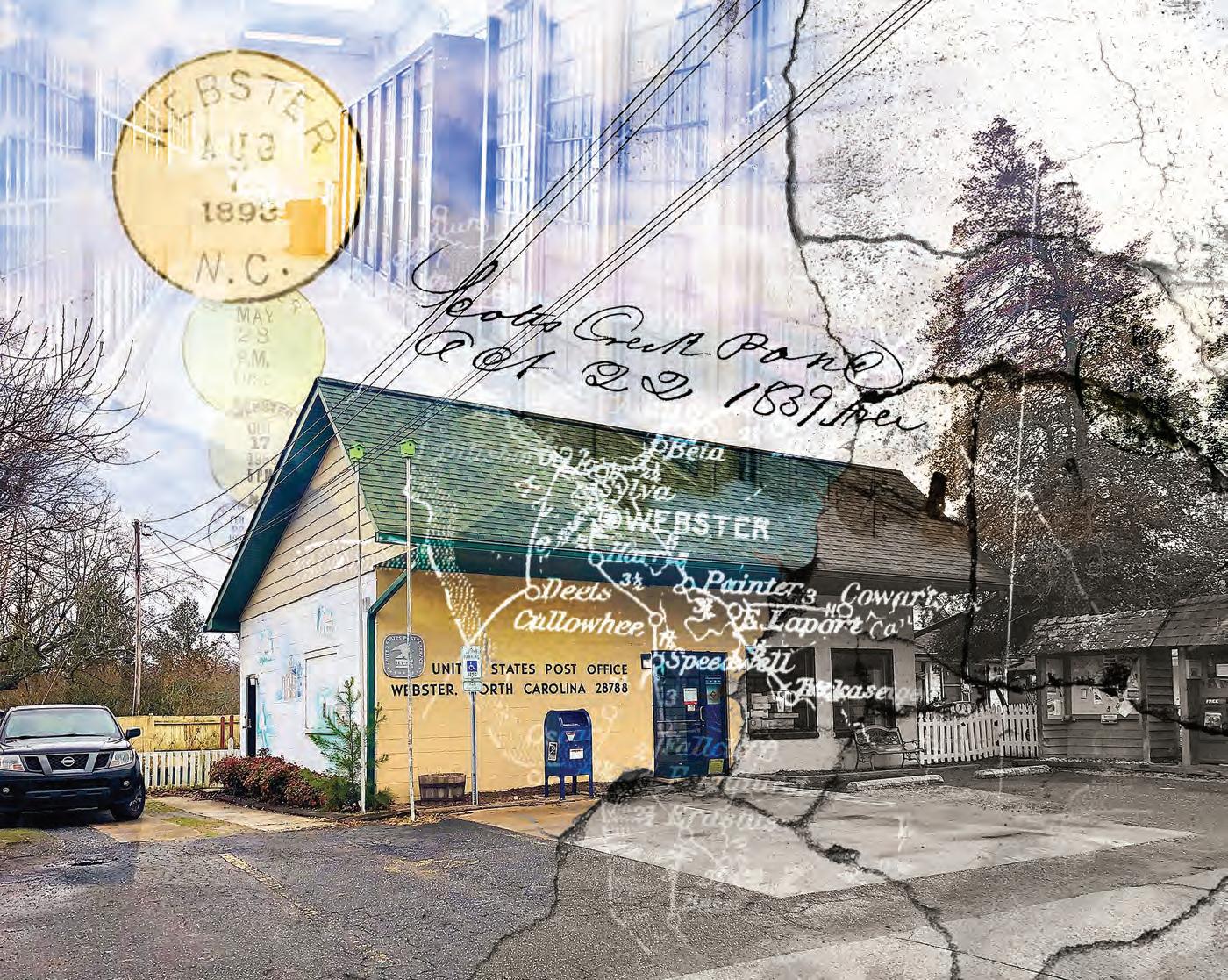
Webster’s post office, nestled in a rural corner of Jackson County, has been closed almost a year now. More than just a place to send and receive letters and packages, the building served as a community hub where vital information could be passed and relationships with neighbors could be strengthened. But while the building has shuddered, residents haven’t given up hope. (Page 6) Jack Snyder illustration
News
Fontana Regional Library board finds footing, but challenges loom....................4 Federal failures cast shadow over Haywood Budget................................................5 Shining Rock head of school resigns after eight years of allegations..............11 Name change resolution instigates discussion of identity within EBCI............12
Opinion
Never discount the power of awe................................................................................14 The 7th Crusade — US folly in Iran..............................................................................14
A&E
Shabbat Shirah brings music, meaning to Mountain Synagogue......................16 Learn about the Cherokee People and the American Revolution......................19
Outdoors
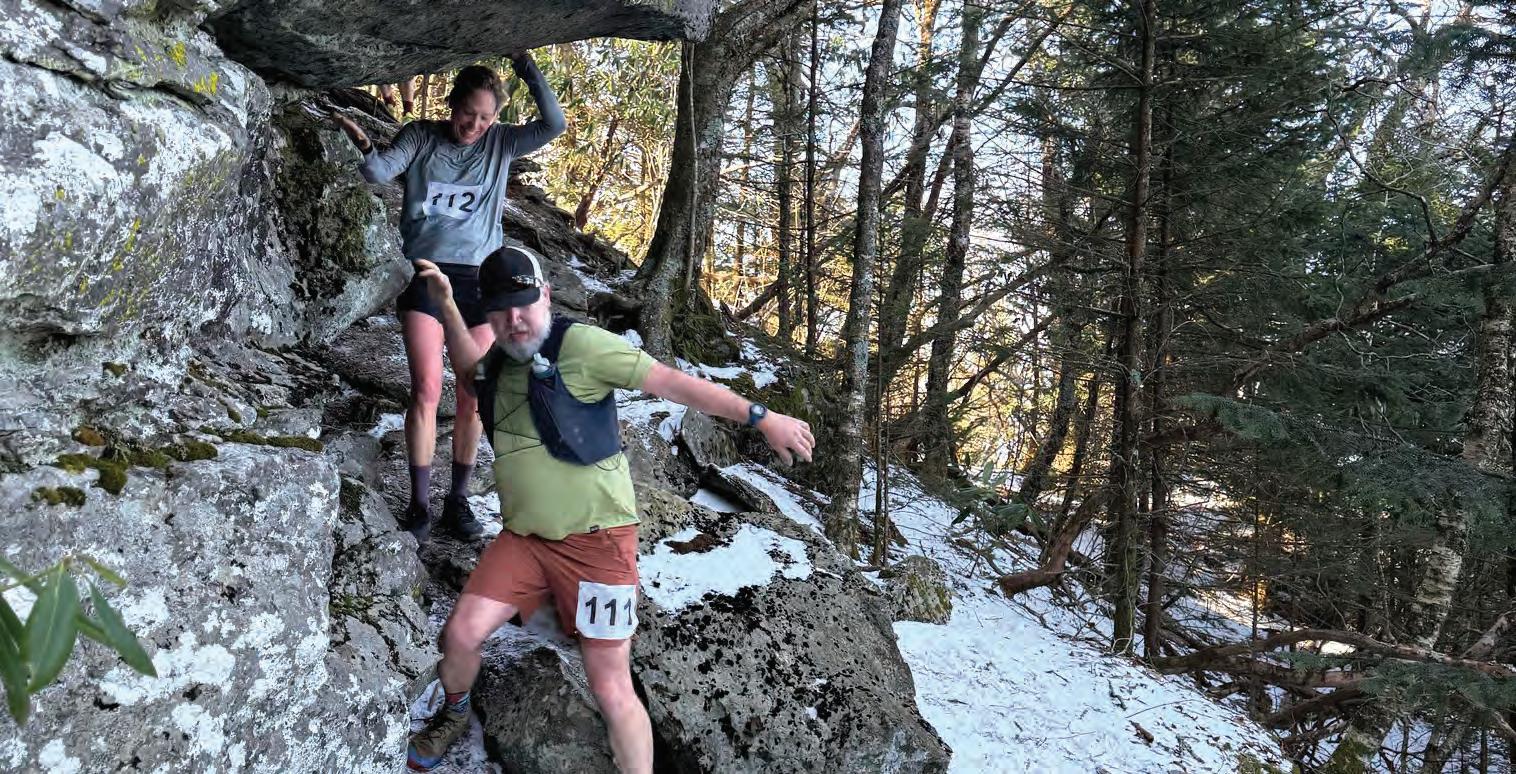
Assault on BlackRock trail race turns 15..................................................................24
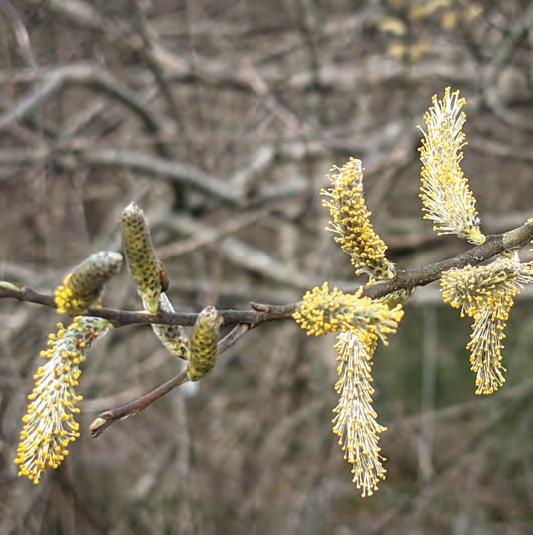
The Joyful Botanist: pussy willows..............................................................................26
I NFO & B ILLING | P.O. Box 629, Waynesville, NC 28786
Copyright 2026 by The Smoky Mountain News.™ Advertising copyright 2026 by The Smoky Mountain News.
S UBSCRIPTIONS
SUBSCRIPTION:
Fontana Regional Library board finds footing, but challenges loom
BY KYLE PERROTTI NEWS EDITOR
The palpable undertones of tension felt at the last several Fontana Regional Library board meetings seemed to have subsided at last week’s trustees meeting, but the system’s challenges continue to mount.
During the meeting, held March 10 at the Hudson Library in Highlands, trustees announced that after the better part of a year without legal representation, they have found a large firm to take on FRL as a client, and following last month’s departure of Director Tracy Fitzmaurice, interviews with two candidates are already scheduled later this month, with more expected. Showing more unity than in the past, the board also voted unanimously on all items other than a lone abstention on a few votes.
However, the board is also navigating tricky personnel situations and financial hurdles ahead of Jackson County’s withdrawal from the three-county system, leaving Macon, Swain and the FRL board to put everything back together.
As of Feb. 26, Fitzmaurice’s last day on the job, the library system has been without a director. The job is currently posted to the FRL website with a salary range of $65,000-$90,000. For now, Board Chair Bill McGaha is serving in the role on an interim basis. McGaha said that he expects the board will announce a special called meeting to appoint an interim director in the coming days, something that must be done by March 26 to comply with the bylaws.
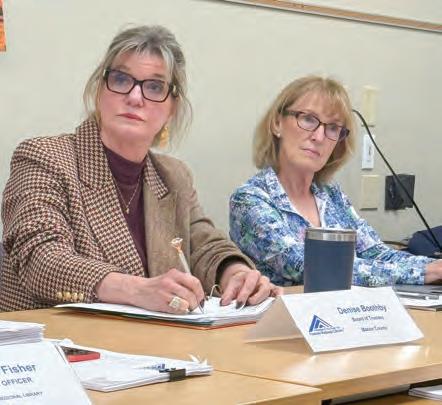
New board member Denise Boothby, of Macon County, was introduced at the March 10 meeting. Boothby replaces Marsha Moxley, who resigned from the board in January. Boothy was appointed by Macon County commissioners in February. Boothby said she moved to the area with her husband and dog, Zeus, in 2021. She discussed a lifelong
appreciation of both the mountains she now calls home and its libraries.
“This is my favorite thing is to get to go to the library every week and pick up big books,” she said. “I think it’s worth so much imagination and creativity. It helped with my education and inspired me and motivated me, and so I’m really proud to be a part of the Fontana library board.”
While Boothby abstained from voting on some items and was reticent during some of the conversation, she did have some input when discussing certain items, largely urging a measured approach to financial decisions.
One matter thoroughly discussed by the board involved personnel decisions ahead of Jackson County’s withdrawal from the system. The board’s personnel committee met with Jackson County Manager Kevin King and HR Director Kathryn Breedlove and agreed to post job announcements for the five current FRL vacancies in that county under the condition that new employees are offered the chance to stay employed in Jackson following the split. Those announce-
who lose their job or suffer a reduction in hours that affects their health care coverage. McGaha noted that to maintain coverage for the lapse they’ll face, employees would have to pony up about $1,100 to get coverage for the month of July. The board voted unanimously to give every current Jackson employee who remains with the system through June 30, the day before Jackson’s withdrawal, a stipend of $1,500 (before taxes). While it’s intended to bridge the insurance gap, employees can do whatever they want with that money.
Another issue brought on by the withdrawal will be an increased share of the financial burden shouldered by Macon and Swain counties. Every year, the board must approve “budget input” numbers, the amount of tax dollars it will request from each county for annual operations. This year, Jackson didn’t factor into the calculations, meaning more will be paid by the remaining two counties to sustain basic operations previously split by all three.
Because Swain County only has the Mariana Black Library and Macon has the Hudson Library, the Macon County Library and the Nantahala Library, it has a higher share of the remaining cost. McGaha said the board anticipates an increase in expenses of at least $186,000. There is also a projected revenue decrease of about $155,000, meaning an overall budget hit of about $371,000.
After going without legal representation since last sum-
ments aren’t yet posted on the FRL website but should be soon.
At this point, current FRL employees working at Jackson County Libraries need to be officially informed that their positions in the system are being terminated. At the meeting, the board voted unanimously to pass a reduction in force plan. The plan dictates that a formal letter will be sent to affected employees, as many as 29 people if all vacancies are filled by then.
Prior to her leaving, Fitzmaurice sent a note to board members saying she was concerned that employees’ health insurance would lapse for a month due to the termination of their positions in the library system.
The U.S. Department of Labor offers Continuation of Health Coverage plans, known as COBRA, to employees
Grants available through Haywood Health Foundation
grams related to improving healthcare in Haywood County.
organizations, government agencies and schools for healthcare initiatives, as well as educational and leadership pro-
The grant application should include a description of the grant’s direct impact on the improvement of the health and well-being of Haywood County residents.
Grant proposals can be addressed to a specif-
mer, it was announced that King Law, which has offices in North Carolina, South Carolina and Tennessee, will now represent FRL. The board discussed a number of items already in the “queue” for attorneys, which will be ordered by priority. Some of the high-priority items that must undergo such review before coming before the board for a vote are the new collection development policy, the RIF letters and changes to the bylaws.
The law firm will charge the board for time spent on communications in blocks of six minutes. Trustees said they want to avoid duplicative or otherwise unnecessary communications to avoid shelling out extra money. Along with unanimously voting in favor of signing a contract with King Law, it voted to designate the board chair, director and finance officer to communicate with the attorneys.
ic healthcare program, health educational materials or equipment. Initiatives can range broadly, such as maternal/infant health, chronic diseaserelated initiatives, nutrition, substance abuse, dental care for an underserved population, mental health care, senior healthcare issues, environmental health issues, obesity and social determinants of health.
Grant applications are available by calling
Marge Stiles at the HHF office at 828.452.8343.
Grant applications are due April 9 by 4 p.m.
Completed grant applications will be accepted by mail at Haywood Health Foundation, 262 Leroy George Drive, Clyde, NC 28721, or emailed to marge.stiles@haywoodhealthfoundation.org.
The final recommendations will be presented for approval by the HHF board at its June meeting. All applicants will be notified of the results.
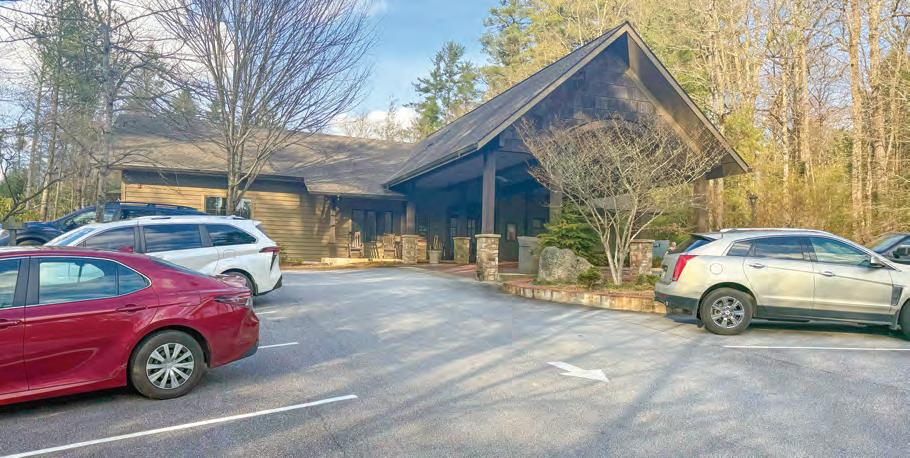
The Fontana Regional Library Board met at the Hudson Library in Highlands. Kyle Perrotti photo
The March Fontana Regional Library board meeting was new member Denise Boothby’s first. Kyle Perrotti photo
Haywood Health Foundation announced its Annual Request For Proposals for Grants Pertaining to Unmet Healthcare Needs in Haywood County. HHF’s grant program will provide grants to Haywood County non-profit
Federal failures cast shadow over Haywood budget
BY CORY VAILLANCOURT POLITICS EDITOR
Failures in the federal response to Hurricane Helene are still rippling into Haywood County’s bottom line, forcing the county — like most of its municipalities — to build a budget around uncertainty and delay rather than recovery.
County Manager Bryant Morehead’s March 16 presentation made clear that millions in storm-related costs remain unreimbursed, leaving the county to carry the financial burden 18 months after the disaster.
Of roughly $19.2 million in submitted FEMA projects, only about $1.58 million has been received, with more than $17.7 million still outstanding, per Morehead. Much of it remains tied up in pending reviews or federal processing delays.
Helene struck near the beginning of the 2024-25 fiscal year budget. When commissioners passed the first post-Helene budget, effective July 1, 2025, they originally planned to use $10.9 million in fund balance. But that wouldn’t be the end of it — the county ended up having to come out-of-pocket for twice that amount.
“The big one on here is the debris,” Morehead said. “We appropriated $11 million shortly after we adopted the budget, and that’s really driving our fund balance use this year.”
The amended fund balance appropriation for the current fiscal year surged to nearly $24.7 million, more than double earlier projections and underscoring how disaster costs have overwhelmed normal budgeting assumptions.
Commissioner Jennifer Best pointed out that past criticisms of the county for holding “too much” fund balance have been proven short-sighted.
“In the case of an emergency, where we’re able to respond very quickly because we have the savings account to do it with, what would happen if we didn’t?” she asked Morehead rhetorically.
“It’s frustrating to me,” said Commissioner Brandon Rogers. “I guess I want to go on the record as saying so — that we can’t get this money any quicker from the federal government.”
Rogers, who has traveled to Washington, D.C., several times since Helene with a delegation of regional elected officials and the American Flood Coalition to ask for the money the county is owed, went on to reiterate points he’s made before — bipartisan points about cutting out the “middle man” and pushing federal recovery funding directly to affected counties.
“We’re held accountable every day for money that’s handed down either through the federal government or through the state,” he said. “They need to do the same thing with storm cleanup.”
Morehead explained that the county had paid its vendors in good faith, expecting to recapture those costs from the federal government, and had closely followed instructions on reimbursement.
“It’s putting all of us kind of in a corner of making decisions on what programs we can and can’t fund at the local level while we’re waiting on reimbursements,” he said.
Even as revenues remain relatively stable, expenditures continue to climb. General fund spending has trended upward over the past decade and currently sits at $111.9 million, reflecting both cost pressures and storm-related impacts.
Employee compensation continues to rise through cost-of-living adjustments, merit increases and escalating health insurance costs, projected to increase by $1,800 to $21,800 per employee. Morehead devoted significant effort to illustrate the true costs of employee turnover, justifying the COLA and benefit structure.
Retirement contributions are also increasing, while new federal policy changes are pushing additional administrative burdens onto local government, including expanded SNAP eligibility that requires more staffing.
At the same time, core county obligations are growing. Education funding for Haywood County Schools and Haywood Community College remains a major driver, alongside capital needs like facility upgrades and new projects. Routine expenses such as fuel, utilities, insurance and maintenance contracts are all trending upward, adding pressure to an already strained budget framework.
Public safety costs are also expanding. The county is preparing for additional vehicle replacements, ambulance needs and the ongoing financial impact of the jail expansion, which will require a $2.27 million payment in the coming fiscal year, with only modest declines in interest costs over time.
Meanwhile, economic indicators offer mixed signals. Property tax collections have grown steadily in recent years but declined slightly to $56.6 million in the current budget. Collection rates remain strong, hovering around 98%, but have declined in each year of outgoing Tax Collector Sebastian Cothran’s tenure.
Sales tax performance shows signs of volatility, with recent monthly collections dipping below prior-year levels. Investment earnings, once a strong supplemental revenue source, are declining as well, further tightening the county’s financial outlook.
Against that backdrop, the county is also seeing increased demand for services. Medicaid enrollment has climbed steadily, reaching nearly 20,000 residents, while foster care numbers and dental patient visits continue to rise, reflecting broader economic stress across the community.
Morehead’s presentation wasn’t the end of budget discussions. On May 4, Morehead plans to present what’s called the “manager’s budget,” which will be closer to the final product. He hopes to have the final product ready for approval by commissioners on May 18. Local governments have until July 1 to pass annual budgets.
WEBSTER’S POST OFFICE DISAPPEARS. A town loses its center.
POLITICS EDITOR
It was always more than just a place to pick up the mail. Long before asphalt and electronic highways reduced time and space to mere trivialities, a quieter system stitched scattered settlements together. The tiny Jackson County municipality of Webster grew up around that system, bringing residents together, creating a sense of identity and promising them that even remote mountain towns belonged to a wider republic.
Now that the Webster post office is gone — the boxes hauled away, the building under renovation — residents are ultimately optimistic it may return but remain frustrated by the loss of a longtime civic center with roots in a colonial-era institution and disappointed with the temporary relocation.
“It’s such a strain on older people who can’t really make that trip and who rely on it for medications and bills,” said Louise Runyon, a Webster resident. “Just looking at
the broader community and the loss of the regional library system, that’s part of the fabric of the community. A post office is part
of the fabric of the community. It seems that these things are being regularly threatened and disappearing.”
Sland in the mid-1790s, atop a subtle hill cradled by a sharp bend in the Tuckaseegee River in what was then Buncombe County but would become Haywood County in 1808.
On May 24, 1832, William Thomas was appointed postmaster of Scotts Creek, serving until 1843. Scholars today call him William Holland Thomas. Thomas, sometimes referred to as “the White chief of the Cherokee,” was a heavily mythologized Southern Appalachian frontiersman and cultural intermediary who advocated for the Cherokee people around the time of the Trail of Tears while also operating within, and benefiting from, the power structures of antebellum Southern society. By the 1830s, Thomas was operating a trading post at Scotts Creek, where he conducted his Cherokee-related affairs — sending letters to and receiving letters from Washington, D.C., that would ultimately lead to the preserva- F
Jack Snyder illustration
These post office boxes, now located at Sylva’s post office in Jackson Plaza, are all that remain — besides memories — of Webster’s old post office. Cory Vaillancourt photo
tion of Cherokee culture in their ancestral homeland.
After Jackson County was created from parts of Haywood and Macon counties in 1851, Scotts Creek was formally incorporated as the Town of Webster in 1859, renamed for a New Hampshire native who was probably the most prominent attorney of the 19th century and served as Secretary of State under three presidents. Daniel Webster died in 1852.
The Town of Webster was originally purpose-built as the 18-acre county seat of Jackson County, but railroad barons bypassed it in favor of a growing neighbor and a fire in 1913 decimated local businesses. Voters chose Sylva as the new county seat that same year by a 2-to-1 margin.
By 1920, Webster had lost 67% of its population, dwindling to just 74 people. Important buildings that hadn’t burned down fell into disuse or disrepair and were demolished — but not all of them.
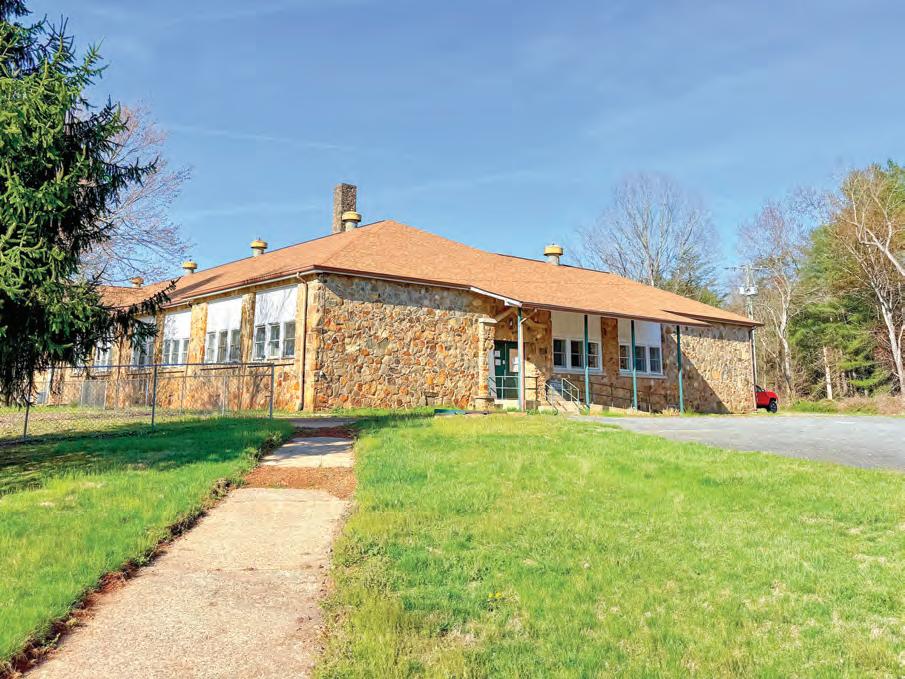
A 120-year-old Victorian-style church welcomes many visitors to town from the south. Another has stood beside Webster Road, the 1,800-foot main drag, since 1887. Farther on up the road, a half-dozen structures from the same era are listed on the National Register of Historic Places, including the old Webster Rock School, a Works Progress Administration project that was completed in 1938 in the utilitarian, localized WPA style known widely across Southern Appalachia.
At its heart, the place that tied it all together, was the old post office at 1345 Webster Road.
“There’s the larger issue of community identity, and this was a central space in our town for folks to get news and exchange information with each other,” said Leigh Anne Young, Webster’s mayor since late 2025. “It really is a central community space that we lost.”
Young, who has lived in Webster for 20 years, also has an interesting link to the long history of postal service in Webster.
Eugenia M. Allison, born in 1878 and widowed in 1906 when her husband Thomas Bragg Allison passed away, was
Along the rest of Webster Road were handsome mid-20th Century homes with neatly kept lawns cornered by split-rail fences on spacious, airy lots, some more than an acre. Residents have repeatedly expressed great satisfaction with the town’s walkability and residential character. Its zoning ordinances reflect that. There’s almost no multifamily housing within town limits and almost no zoning for businesses. There’s no bar, no barber shop, no bookstore, no coffee shop, no diner, no retail at all.
Now home to 372 residents and comprising a total area of one square mile, Webster is part of a rapidly vanishing small-town America where neighbors all know each other, where children still run through forests and pastures and parks, where the real information superhighway is the sidewalk that embraces both sides of Webster Road and the only watchdog is a collared brown and white pittie mix strolling around the United Methodist Church grounds, delicately sniffing flowers like she owns the place.
appointed postmaster of Webster on June 27, 1914. Their son, Dan, became a prominent legislator and public servant. Allison served as postmaster until 1948, running operations from her home. Young and her family now live in that home.
“I have plenty of stories from Webster old-timers about retrieving their mail from Miss Allison’s front porch,” Young said.
Webster’s most recent post office also had a beloved longtime postmaster, Mark Jamison, a blues guitarist with roots in Louisiana, Mississippi and North Carolina who in 1984 joined the United States Postal Service in Waukegan, Illinois, after he decided to trade chasing late-night gigs across the Chicagoland blues circuit for a steady paycheck, federal benefits and the more austere rhythm of sorting letters. Making stops in Augusta, Georgia and then in Sylva, Jamison went on to various supervisory positions in Otto and Franklin until taking the postmaster job in Webster in 1998, where he quickly became an important part of daily life.
He knew everyone’s name. He knew who would be expecting packages. He even knew which families would be out of town on vacation, because they’d leave their checkbooks with him so he could pay their bills.
“A couple of the older women would come when they got home from the grocery store, and I’d go out there and open all their jars for them,” Jamison told The Smoky Mountain News. “I mean, rural postmasters do this stuff. That’s why rural post offices were so important.”
In 2008, Jamison bought the post office building — a concrete block structure of 1,008 square feet built on a 0.14acre parcel in 1962 — and the cozy, century-old house on the half-acre lot next door, which he quickly made his home.
The post office building had originally been Reinhart’s General Store, and then later the headquarters of Doyle Conville’s potato chip vending operation. Jamison thinks the building was first leased to the USPS in the 1970s.
Once he purchased the building, Jamison erected an old bulletin board outside the post office where people would post community notices or information about lost pets. Beside it, he built a little free library in honor of his friend and nextdoor neighbor George Penland, a normally tightlipped World War II veteran who loved to read and was prone to spouting Shakespearian sonnets while gardening. Nearby, newspaper racks for the Macon County News, Mountain Xpress, Sylva Herald and The Smoky Mountain News connected the community to the rest of the region, the state and the world.
“Towards the end of my term there, I had a three-legged dog that everybody loved. Otis the Three-legged Monster Dog. He would sit in the yard and people would come by,” Jamison said. “It was the gathering center.”
A tireless advocate for rural post offices, Jamison has appeared in publications like The Guardian and The Washington Post, as well as on television’s Meet the Press after he began contributing to meetings of the Postal Regulatory Commission around the time of his retirement in 2012.
During one of those meetings, Jamison responded to a proposal to close thousands of rural post offices across the country.
“Within the context of the USPS, we often return to the words ‘binding the nation together.’ We do so because they speak to the fundamental wisdom of the Founding Fathers. They understood that a healthy and robust post was an integral part in the physical, commercial and intellectual infrastructure of the nation,” he said. “From that first principle, from that grand idea, we are able to articulate the essential truth embodied in the concept of the universal service obligation. There is a profound truth in the concept of universal service. There is an understanding that a successful democracy relies on our ability to provide equal access to all our citizens.”
Indeed, colonial America’s first postmaster general, Benjamin Franklin, said that “the business of the post office is of the greatest importance to the public” not only because it promotes commercial activity but also because “it facilitates correspondence between distant friends.”
As the USPS grew out of the Royal Mail system over the SEE WEBSTER, PAGE 8
Extra space at the Webster Rock School, completed in 1938 and listed on the National Register of Historic Places, was unsuccessfully floated as an option for a new post office. Cory Vaillancourt photo
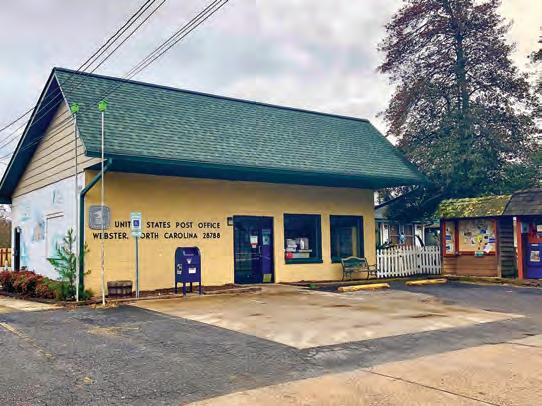
Built in 1962, Webster’s post office was one of very few non-residential buildings on Webster Road. Wikipedia photo
next two centuries — Franklin had been the joint deputy postmaster general for the Crown since 1753 — the number of U.S. post offices peaked around 77,000 in 1901, shortly before Rural Free Delivery was instituted. RFD led to the closure of thousands of rural post offices in the early part of the 20th century by providing universal service to farms and isolated cabins, thus eliminating the need for rural residents to travel to far-flung, ersatz post offices squeezed into inns, taverns, trading posts or private homes like Miss Allison’s.
Before RFD, Jackson County alone had more than 80 post offices, most from unique rural communities now consigned to the cobwebbed, yellowed pages of memory, their distinct identities mostly lost to the inevitable encroachment of development.
maintenance of far more retail locations than either Subway, Starbucks, McDonalds or Dollar General — without the kind of regular appropriations that sustain most other federal entities.
There were four post offices in North Carolina in 1789, according to a 1996 publication by the North Carolina Postal History Society. By 1971, that number had grown to 6,681. Far below the historical trends, the state has about 850 today. Most recently, Jackson County had 10.
“Within the context of the USPS, we often return to the words ‘binding the nation together.’ We do so because they speak to the fundamental wisdom of the Founding Fathers. They understood that a healthy and robust post was an integral part in the physical, commercial and intellectual infrastructure of the nation.”
– Mark Jamison, retired Webster postmaster
Less than a year ago, that number decreased by one.
After Jamison purchased the Webster post office building, he continued to lease it to the USPS, most recently in 2020, for five years at below-market rates.
“I had to fight with them to get $545 a month,” Jamison said. “That’s all they would do.”
With just under two weeks’ notice to customers, the post office closed at the end of May 2025.
Runyon, a postal box customer, said the boxes were picked up with a forklift and moved to Jackson Plaza, about 4.5 miles away, off Grindstaff Cove Road.
“It’s really significant for seniors, who can just take a quick trip to the post office and not have to brave downtown Sylva and not have to brave [busy five-lane N.C. Highway] 107,” she said. “It just makes a really big difference to have somewhere you can go regularly.”
Mail delivery was not affected by the closure. The town’s sense of identity was.
“When my family and I relocated here,” said Brandon Core, Webster’s vice mayor, “we knew that we had the opportunity to opt for a Webster post office box or a Sylva street box, although our street box would need to be off site from our home, kind of in a cluster. We purposely opted for a Webster one. There was a sense of nostalgia of having a post office in our small town that our family could not only walk to, but a place where our kids could get suckers or lollipops from the postal clerk every time we went.”
There was Addie and Alice and Argura. There was Barker and Bessie and Bluefield. There was Big Laurel and Big Ridge and Big Spring. Cashers Valley became Cashiers, Compton came and went, and others — tiny communities with strong names, like Grimshawes — flickered briefly on the postal map before simply ceasing to exist.
Up through the 1960s, around 1,100 post offices had closed each decade. With the advent and expansion of consumer electronic communications systems and privatized package delivery in the 1970s and 1980s, the total now stands around 33,000 nationwide.
You can help
Unlike most federal agencies, the USPS operates largely without direct taxpayer support. The USPS funds its operations primarily through the sale of postage, shipping services and related products, meaning the price of a stamp and other mailing fees provide the bulk of the agency’s revenue. Although Congress occasionally authorizes limited financial relief or policy changes affecting postal finances, routine operations are expected to be self-sustaining. In practice, that structure leaves the postal system responsible for covering its own expenses — from employee salaries to vehicles to the
The property changed hands after Jamison, but things remained largely the same until only recently.
In June 2024, a buyer purchased the old post office on Webster Road and the cozy century-old house on the half-acre lot next door — where Mark Jamison wrote out money orders for people who were illiterate, where Otis the Three-legged Monster Dog received well-wishers in the front yard, where Leigh Anne Young took her young children as a special treat, where Louise Runyon checked her mail.
The historic Town of Webster is advocating for a new post office after the existing facility closed in May 2025. Although the United States Postal Service has proposed relocating the post office to a new facility, logistical complications have complicated the process. The process, however, does include an opportunity for public comment — by mail only. Webster is encouraging residents and greater Jackson County to send written comments to the USPS, including support for a new facility, thoughts on potential locations or desired accessibility features. The deadline for comments is March 27.
Mail them to:
Around the time of the post office’s closing, meetings of the town’s governing board became a popular place for residents to advocate for a new one. During municipal election campaigns last fall, the topic even became an election issue, although not an issue in the traditional sense of proponents vs. opponents — more in a sense of, are we doing enough?
“Since I’ve been on the town board, it’s been neat to see the effort that everybody on the town board is putting towards getting attention,” said Brad Reisinger, a Webster commissioner first elected in November 2025. “We’ve had some community members really encourage us in this direction, and it’s neat to see representation actually happening that people want — that the town board is taking up the concerns of the community.”
The United States Postal Service
Attn: Webster NC main office relocation P.O. Box 27497
Greensboro, NC 27498-1103
For more information and updates, visit townofwebster.org.
When the property changed hands, there were still several months left on the lease Jamison had negotiated with the USPS back in 2020. The new owner and the USPS could not come to terms on a lease renewal, according to the USPS. Through a third party, the new owner declined to speak with SMN.
Core, Reisinger, Young and others have been searching for a new location for the post office, although the confluence of Webster’s layout with USPS requirements have made that a turbulent endeavor.
The town’s annual budget is just $168,500, based on a 15-cent property tax rate per $100 in assessed value. According to a postcard mailed by the USPS to postal customers, the USPS is seeking a new location of approximately 1,000 square feet of existing space, or 15,000 square feet of land — about one-third of an acre — within a two-mile radius of the former location. Like many other small Western North Carolina municipalities, the town spends most of its annual budget revenue on residential services like public
Courtesy of North Carolina Postal History Society
safety, streetlights, cemetery upkeep and sidewalk maintenance; Webster’s residents have been primarily concerned with other issues like broadband access, road and sewer improvements and environmental sustainability — not on using limited funds to purchase suitable real estate that doesn’t really exist under USPS criteria.
Members of the community have offered up several options to the USPS, all of which involved the Webster Rock School. The Southwestern Child Development Commission now owns and operates the 3.3-acre property as a 20,000 square-foot childcare facility with ample parking and multiple access points to Webster Road.
Core, who also serves as chair of the Jackson County Historic Preservation Commission and president of the Webster Historical Society, said that SWCDC offered the USPS more than 1,300 square feet and a separate, ADA-compliant entrance to its building.
SWCDC Director of Employee Relations and Compensation Stephanie Lovedahl said the offer was declined because the USPS wanted to alter the historic river rock structure so the windows would reach all the way down to the floor — even though the historic post office in Boone, constructed in a similar style, does not feature floor-length windows.
SWCDC alternately offered the use of a detached outbuilding of more than 1,000 square feet behind the main structure, near the softball field and playground. The USPS declined that offer as well, Lovedahl said, because of concerns that high school softball games, held three months a year and usually after 5 p.m., would obstruct parking for postal service customers. The former post office had only three parking spaces.
SWCDC even offered the use of another back corner of its parking lot, where a modular structure could be placed on a temporary or permanent basis. Lovedahl said the USPS told her she didn’t want that.
“I kinda got the impression they don’t want to do small, rural post offices,” she said.
Jamison said he doubts Webster will regain its post office, despite the USPS’ stated effort to locate a new site. From his perspective, the situation follows a pattern he’s seen play out repeatedly across rural America, where small facilities disappear not through formal closure orders but through lease disputes, delays and bureaucratic inertia that gradually shift operations elsewhere.
“They got smart at some point and said, ‘We don’t have to close them; we can just let them fail by themselves because what happened to this one will happen. Buildings will deteriorate, and the owners, whatever … stuff happens,” he said.
Given the existence of nearby post offices in Sylva and Cullowhee and the availability of universal street delivery across the area, Jamison said the Postal Service has little operational incentive to restore a retail facility in Webster.
Even if the Postal Service ultimately
AREA’S BEST BURGER
agrees to establish a new facility, Jamison said its location could determine whether it truly functions as a Webster post office in the traditional sense. The former site occupied the only place many residents would identify as the town’s center — physically, culturally, emotionally.
Jamison believes the agency will likely continue to assume the posture of a kindly federal partner pursuing a new location, but he remains skeptical that those assurances will translate into action.
“They’ll say all the right things, but they’re never going to actually do anything,” he said.
On Feb. 5, a real estate specialist with the USPS’ Greensboro office sent a letter to Mayor Young reiterating the desire to procure a new site and assuring postal customers that retail operations, including the availability of post office boxes, would continue at the Jackson Plaza post office “until the new post office is up and running.”
The next day, a release on the USPS website noted that “the Postal Service is sensitive to the impact this decision has on our customers and the community [and] customer input will be sought and considered as we continue the relocation process.”
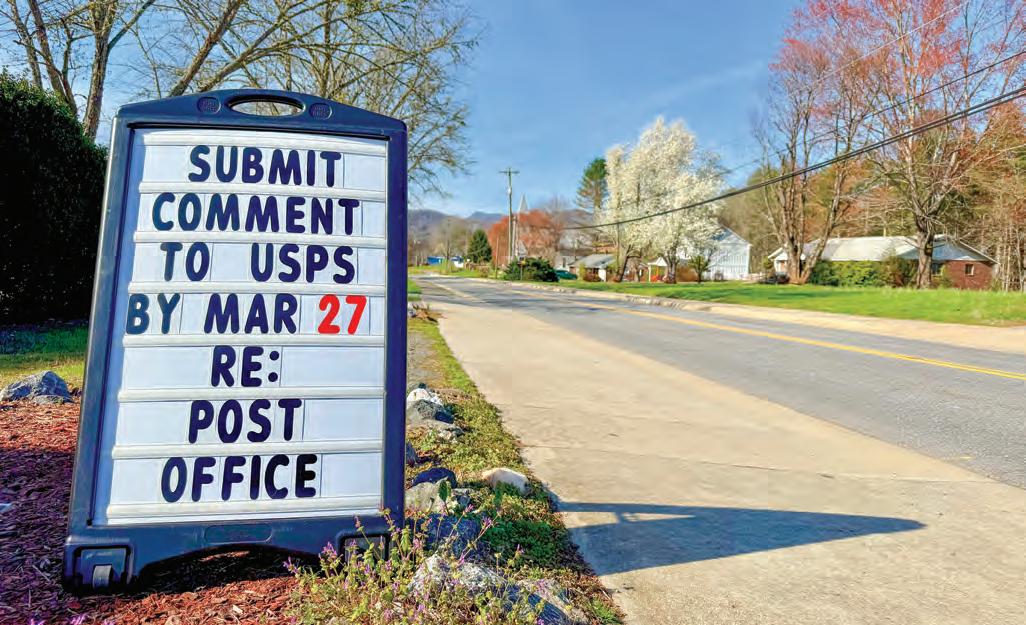
Webster’s town government has posted a notice on its website encouraging residents to avail themselves of the customer input process before the deadline of March 27 by sending written comments to the USPS, which did not provide an option to submit comments by telephone or email.
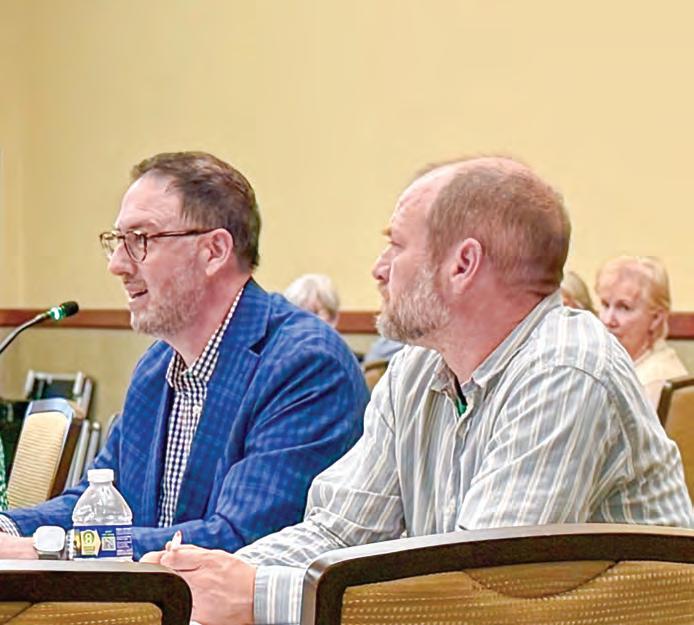
On March 10, Jackson County Commissioners called an unusual joint meeting with every incorporated municipality in the county. More than 20 elected officials attended. The purpose of the meeting was to recap previous accomplish-
ments and share challenges faced by each of the five governing boards representing some 44,000 residents — Jackson County, Dillsboro, Forest Hills, Sylva and Webster.
“In some ways, I felt a little intimidated because both Sylva and Dillsboro were able to share all of these capital projects and these land acquisitions that they’re doing, and I really felt like the report that I was giving looked vastly different,” said Core, who with Reisinger brought Webster’s concerns to the collective body. “We are not doing a lot of capital projects or acquiring buildings or land or anything like that, but our community is important to us, and I believe that community and that sense of community is important to the people of Webster.”
Webster’s plight seemed to draw sympathy from other municipalities at the meeting. Jackson County Commissioner Todd Bryson suggested the county could send a letter in support of a new post office to the USPS as part of the customer input process.
“That’s a big part of that community there and it has been for years,” said Bryson, who grew up in the area and often played there as a kid. “It’s sad to see it gone now, really.”
Sylva Mayor Johnny Phillips asked if the new post office had to be within the town limits of Webster and said that through his contacts with regional grocery store chain Ingles, which operates a location just off N.C. 107 and Webster Road in unincorporated Jackson County, he believed that the grocer would be amenable to some sort of deal so long as they made out financially.
“I sort of thought that got killed because it was outside the city limits,” Phillips said.
“That’s a really good question,” Core replied, bringing up further ambiguities in the USPS’ stated requirements, including
tional need, now and in the future. We thank customers for their patience and continued support.”
The zip code issue remains troubling — the Webster zip code coveted by some, 28788, doesn’t exist on a map. Customers with Webster post office boxes, now located at the Jackson Plaza Post office, utilize the Webster zip code and have a Webster mailing address. At their homes in Webster, those same customers utilize the Sylva zip code of 28779 and have Sylva mailing addresses.
Bogenberger did not respond to an email requesting clarification.
For the first time in the nearly two centuries since letters to and from William Holland Thomas passed through Scotts Creek, Webster does not have its own post office.
The most recent post office building now sits vacant and quiet, cordoned off by stanchions strung with chains, hemmed in by the inevitable encroachment of development and a complex mixture of zoning, topography and federal regulations. The old bulletin board is gone. The little free library is gone. Residents know how easily places like these fade.
whether the new post office would need to be located in the same zip code.
When SMN asked Phillip Bogenberger, corporate communications for the USPS in Raleigh, for specifics about city limits, zip codes and size constraints stated by USPS, Bogenberger answered. Sort of.
“The Postal Service continues to make progress with the relocation of the Webster Post Office,” he wrote. “The new location should be within a two-mile radius in the same zip code that is convenient for customers while being suitable for our opera-
There was East Laporte and Effie and Erastus. There was Gay and Georgetown and Granite. There was Hooper and Hoosier and Hornet. Tunnel became Dillsboro, Horse Cove came and went, and Webster just might do the same — another forgotten name in some obscure historical document sitting in a library somewhere.
“You know, almost everybody went to the post office at one time or another. People are spread out, and there aren’t businesses in the town and stuff like that,” Runyon said. “I think it was the one thing that kind of unified the community.”
Rep. Chuck Edwards, Webster’s member of Congress, did not respond to an interview request from The Smoky Mountain News.
WEBSTER, CONTINUED FROM 9
Outside town hall, a sign reminds residents to respond to USPS postcards notifying them of the opportunity to share their views on the post office. Cory Vaillancourt photo
Town of Webster Vice Mayor Brandon Core (left) and Commissioner Brad Reisinger speak at a joint meeting of all five local governments in Jackson County on March 10. Cory Vaillancourt photo
Shining Rock Head of School Josh Morgan resigns after eight years of allegations
BY LILY LEVIN STAFF WRITER
The Shining Rock Classical Academy Board of Directors on March 10 unanimously accepted the resignation of Head of School Joshua Morgan, approving 90 days of severance pursuant to an attorney-drafted agreement. After a five-year tenure as Shining Rock school director, Sara Jenkins will serve as the school’s interim executive director, effective immediately.
Chair Alyson Weimar made both announcements at a March 11 special called meeting, adding that the board will move forward with the support and guidance of Leaders Building Leaders.
LBL is a charter school business development program providing services such as Board Leadership Academy, described as “A step-by-step program for charter school leaders and board members to create or strengthen their leadership model to navigate the organization towards significance!”
“The past few weeks have involved necessary but important decisions,” said Weimar in a press release after the meeting, likely also referring to the board’s unanimous late February vote to close its high school. Starting in fall 2026, Shining Rock will only offer instruction to grade K-8 students.
Throughout Morgan’s Shining Rock career, parents, teachers and staff have made serious allegations against him, many of which The Smoky Mountain News has covered.
Morgan was born and raised in Haywood County, completing his undergraduate education at Appalachian State University. He earned his first master’s degree in elementary and middle school administration and another in secondary school administration from Western Carolina University. He’s been employed in the public system as a teacher, an assistant principal and principal at various schools in Buncombe County, Haywood County and South Carolina.
He began his tenure at Shining Rock in August 2018 as assistant principal but became interim head of school in early 2019, after former head of school Nathan Duncan was fired on the grounds of alleged sexual harassment. He was officially awarded Duncan’s old job in July 2019. By that point, Morgan himself had faced of a host of allegations. Several parents had claimed he bullied those around him and intimidated children at the school. Their grievances were dismissed after an internal investigation by the board’s attorney. The parents, in turn, escalated their complaints to the Waynesville Police Department, but the district attorney’s office declined to file charges.
Then, in January 2022, Morgan put the 11year-old disabled son of a Shining Rock board member in the back of the police car used by the school resource officer.
In the months after, she was alienated by
other board members and eventually voted off. Undeterred, she continued making noise through other avenues.
Rebecca Fitzgibbon in September 2022 filed a disciplinary-related grievance with the Office of Charter Schools at the NC Department of Public Instruction, maintaining that Morgan had emotionally and physically abused Shining Rock children by, among other things, dragging, yanking, mocking and mimicking them. She asserted that Morgan’s bullying and intimidation had been witnessed by several others, who had declined to report this behavior, fearing retaliation.
OCS declined to get involved, determining Fitzgibbon had not “followed the school grievance policy” and that her complaint was outside of its jurisdiction.
The Shining Rock parent began requesting public records at the school herself, as did SMN. Both parties were given the same answer: access to the records came with a steep price tag, driving Fitzgibbon to file a lawsuit against Morgan and the school. In response, the defendants countersued for defamation, citing what they alleged were harmful and false online posts and statements.
Shining Rock additionally pursued criminal cyberstalking charges against Fitzgibbon in 2023 — she’d been sending countless emails to board members, educators and administrators. The charges were later dismissed but resulted in her banishment from school premises, exempting student pickup and drop-off.
The public records case went to trial in June 2025.
Court testimony from Sharon Breedlove, a teacher at Shining Rock from 2022 to 2024 with nearly three decades of classroom experience, asserted that Morgan was a bully to educators as well as students.
Breedlove said she’d witnessed SRO Bryan Reeves use a “come along” hold, breaking the wrist of a child. After this incident and given what she’d seen of Morgan’s rapport with students, the former SRCA teacher filed reports with the Waynesville Police Department and the Department of Social Services.
Breedlove said she quit the following day after a series of events led her to believe Morgan knew about the report and was planning to fire her. At his request, she retrieved her personal items that weekend. She said some had been “intentionally broken,” a claim denied by Morgan.
Other teachers took to the stand, speaking similarly of Morgan’s behavior.
Fitzgibbon won on all counts in June 2025. The former head of school was found legally liable for the “improper use of government authority” in refusing to provide public records documenting SRCA’s disciplinary process and training requirements, and the judge dismissed the countersuit charges.
Catering is Our Passion!
We Can Cater Everything from an Intimate Get-Together to a Large, Formal Gathering & Everything In-Between!
828-452-7837
294 N. Haywood Street Waynesville
Name change resolution instigates discussion of identity within EBCI
BY LILY LEVIN STAFF WRITER
Former Eastern Band of Cherokee
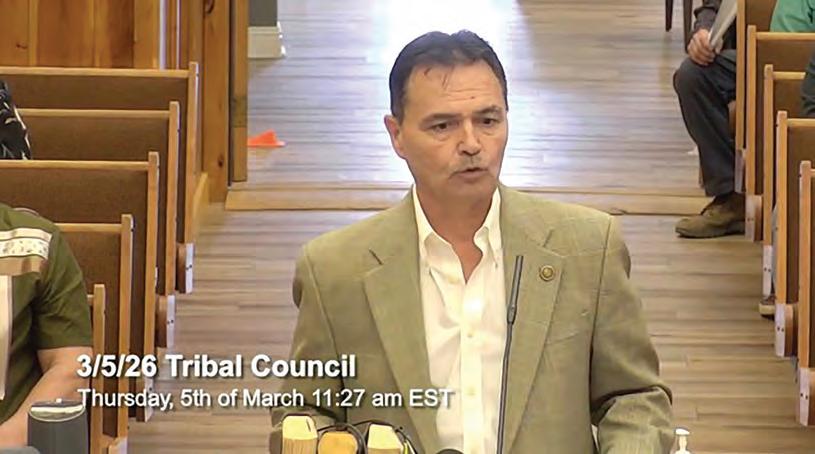
Indians Principal Chief Patrick Lambert and Beloved Woman Myrtle Driver proposed a resolution renaming the tribe the “Eastern Cherokee Nation” and later encouraged tribal council to withdraw it.
In those 30 minutes between Resolution 147’s introduction and withdrawal, tribal council and public commenters engaged in rich discussion centering tradition, history and identity. When Lambert approached tribal council to promote the resolution, he first made the distinction of “band” versus “nation.”
“In the [Cherokee] translation, there’s a big difference,” he said. “It’s time to take that step and remove the colonial attachment of calling us a band whenever, really and truly we are a nation, we have our own courts, we … pass our own laws, we govern ourselves. That’s more than a band does.”
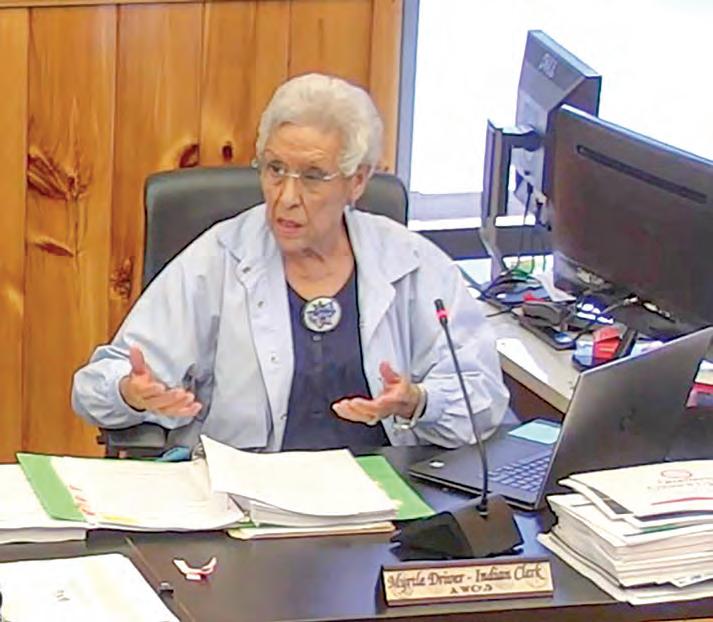
Driver also emphasized the linguistic comparison.
thing else, we have put out in the public the difference in the translation of band and nation,’” she said.
Tribe), the Ho-Chunk Nation (formerly Wisconsin Winnebago), the Muscogee Nation (formerly Muscogee (Creek) Nation),
(Yellowhill), however, had another proposal: why not take the name change a step forward if it’s already on the table?
“From where I sit, I think that nothing in English can name us. Nothing in English is who we are. And so, I think that if we’re going to entertain or even discuss a name change, that name change needs to come in our original language,” she said.
“Tsalagi” is the English transliteration for Cherokee in the Cherokee people’s original language. Later in the discussion, Feather drew on historical precedent of the Haudenosaunee Confederacy, the proper and restored name of a group of nations called “Iroquois” by French settlers after contact.
Just as Resolution 472 was about addressing who the EBCI was internally, so too had authors considered the message it might send to other tribal nations.
“The Cherokee Nation has even said publicly that we’re just a splinter group, that we’re just a band, we’re not to be taken seriously,” Lambert said, adding that the other tribe “will stand up and fight us, our tribe, because they think that everything here is their history, not ours.”
“I said, ‘Even if we don’t accomplish any-
The resolution listed examples of name changes in other tribal nations, such as the “Tohono O’odham Nation (formerly Papago
the Northern Cheyenne Nation (formerly Northern Cheyenne Tribe).” Council member Shennelle Feather
Council member Boyd Owle (Birdtown) framed Cherokee Nation’s behavior as reason to oppose the resolution. He explained that during Principal Chief Michell Hicks’ November 2025 Senate testimony against Lumbee recognition, Sen. n s s Compressio as sing Br Nur umps t P Breas
828.785.1881 Most insurances will cover 100% of your breast pump and other supplies. text to order & find out more
Co-author Patrick Lambert speaks to tribal council about the name change resolution.
Markwayne Mullin (R-Oklahoma) — a Cherokee Nation citizen set to replace Kristi Noem as Homeland Security Director — made clear a belief that the EBCI is a faction of the Cherokee Nation. Consequently, Owle questioned why the EBCI would want to adopt a name that might signify further affiliation with the other tribe. Moreover, he testified that the resolution had not been performing well in the court of public opinion, at least among those he represents.
“I probably got more comments on this than anything that’s ever been on the agenda since I’ve been in council, going on my ninth year,” Owle noted.
That was no surprise to Lambert, who’d first approached the council with an awareness that the ordinance was not popular among members of the EBCI.
Co-author Myrtle Driver underscored the difference between ‘band’ and ‘nation.’
to them. It’s a sense of pride. It’s not just an emblem,” Hicks added.
Along those lines, multiple council members agreed that because a name-change affects every member of the tribe, it should be decided only by public opinion. Feather suggested the resolution be added to the tribe’s ongoing draft constitution or put to a vote through a referendum. She proposed tabling the ordinance pending more community conversations. Wolfe seconded the motion.
“There’s conversations happening now, and that’s good, and that’s what we need. I will support to table it, have you go out and educate, go to our communities, have these forums, educate more. And then I would support a referendum,” she said.
Council Member Michael Stamper
“Rather than kill it — I’ve heard discussions on killing it — would you consider tabling it and let us take it out into the communities to give us a chance?” he asked.
Council member Venita Wolfe (Big Cove) was more inclined to take Lambert’s suggestion. She said she’d received slightly more mixed feedback — not always positive but not completely negative, either.
Hicks reflected some of this ambivalence, telling council that while he’s glad to see this conversation happening, he’s worried about legal, political and even emotional name-change repercussions. For example, he said, changing EBCI’s name and seal on all legal documents and buildings and agreements is “not an easy task.” Then there’s the emotional connection many have with the title “Eastern Band of Cherokee Indians.”
“We have a lot of tribal members that have the seal attached to their bodies with tattoos. I mean, think about it. I didn’t think about that. And they’re like, ‘What do I do if this name changes?’ That means something
(Painttown) made an alternate motion to kill the document, though he cited a similar explanation.
“I will make the move to kill this resolution just because these talks in the community can still happen. They can still go out there and lobby for this type of effort. But if it’s not driven by the people — to have a referendum to make this decision — then this avenue right here is not the correct mechanism for us to make a decision like this,” he said.
Fellow council member Mike Parker (Wolftown/Big-Y) seconded Stamper’s motion.
In the end, Driver proposed that the ordinance be withdrawn so she and Lambert could do exactly what had been suggested.
“And then after [the vote], we go out into the communities, get their input and come back,” she said.
Lambert concurred. Both Feather and Stamper promptly rescinded their motions, and tribal council voted unanimously to withdraw the resolution.
MARCH 27 6:30PM - 7:30PM
Y GROUP A MAR 6 P
Hop in to a monthly grounding, nurturing and elevating meditation and sound bath with songstress, Meredith Swaim. Expect to feel into your breath and body for a deep relaxation, to imagine and to visualize, and then to
singing bowls and vocal toning. Each month will have a theme relevant tthtdth
RECURS ON THE LAST FRIDAY OF EVERY MONTH FROM 6:30 TO 7:30 AT SUNDARAH WELLNESS. M 7:30 - :30PM CH 27
to the moment and the season. RECUR EVER A $25 per person, limited to small groups of 8. Visit our website to reserve your spot. | 828.944.0288
461 MOODY FARM RD | MAGGIE
Never discount the power of awe
Inow realize why coloring books and sidewalk chalk were so appealing when I was a child, why watching snow fall out the window and staring at the flame of a candle calmed my racing thoughts, why exploring our wooded backyard, collecting leaves and rocks, felt like a grand adventure.
Before the modern age of technology, “slow dopamine release” wasn’t a catch phrase or something to be studied, it was simply the way life was. If you’re reading this column, you likely have similar memories, although yours may involve fishing or sewing or brushing a horse’s mane. Maybe you remember a long walk to school with neighborhood kids, making homemade cookies with your grandmother or sorting baseball cards on the floor of your living room.
Perhaps it’s a memory of listening to an album from beginning to end, never tiring of the same voice crooning through the speakers, or maybe a memory of making a mix tape, cutting magazine pictures for a collage or spending hours arranging photographs in a scrapbook.
When I think back on my childhood and even the early years of my boys’ lives, the movie reel of my mind moves in slow motion, and I think it’s because the days unfolded at a more relaxed pace. We weren’t bombarded with cell phone notifications, 24-hour news cycles and a constant social media stream of everyone’s highs and lows.
Not to mention the surge of AI to where now it’s hard to believe anything one sees online. I remember when Facebook launched, then Twitter then Pinterest. With each new platform, I resisted, not wanting to jump on a bandwagon, until eventually, I felt like I was living in the past while everyone else propelled into the future. I succumbed and joined the platforms myself.
Now, I feel like the same is happening with AI. Believe me or not, but I’ve yet to get on ChatGPT. I know plenty of people who use it to plan trips, find workouts, help write emails or create lesson plans, and obviously there are time-saving benefits to having a bot help create things, but to what end? With each task we automate, we use critical thinking, problem solving and creative skill sets less and less, and that bothers me deeply.
As part of my spiritual practice, I read a verse of the Tao Te Ching each morning. This is the set of principles written 2,500 years ago by Lao-tzu that guide Taoism (also known as Daoism).
One of the verses I read this week was Verse 72, which says: When people lack a sense of awe, there will be disaster. When people do not fear worldly power, a greater power will arrive.
Do not limit the view of yourself. Do not despise the conditions of your birth. Do not resist the natural course of your life.
The 7th Crusade—US Folly in Iran
The United States has once again plunged into a war convinced that righteous purpose, overwhelming force and moral certainty will deliver victory. But history — ancient and modern — keeps teaching the same lesson: macho crusades fail. They fail because they are built on arrogance, miscalculation and the belief that military might can substitute for strategy. The current U.S. war in Iran is not an exception. It is the latest chapter in a thousand-year pattern of powerful nations mistaking zeal for wisdom.
The medieval Crusades are often remembered as grand, heroic campaigns. In reality, most were disasters. The First Crusade succeeded largely because of Muslim political fragmentation, not Western brilliance. The Second was a catastrophe. The Third ended in stalemate. The Fourth never reached the Holy Land. And the Seventh — Louis IX’s doomed invasion of Egypt — collapsed in disease, ransom and humiliation. The Crusaders believed their moral purity guaranteed victory. Reality proved otherwise.
That same delusion now shapes Washington D.C.’s approach to Iran. What makes this moment even more alarming is that the United States is no longer disguising the religious framing of its war. At a Pentagon news conference recently, the Secretary of Defense quoted the Bible and described the campaign as a struggle ordained by faith. When a superpower with unmatched military capacity casts an aggressive war in explicitly
religious terms, it is not strategy — it is crusading. And crusades, history shows, end badly.
FORCE WITHOUT FORESIGHT
The United States keeps returning to the same failed playbook: launch a war quickly, assume overwhelming force will produce political transformation, and ignore the complexities that follow. The results are familiar.
• In Iraq, the U.S. toppled a dictator in weeks but unleashed 20 years of instability.
• In Afghanistan, it defeated the Taliban in months but lost the war in slow motion.
• In Libya, it removed a tyrant but left chaos that still reverberates across Africa. These were not failures of bravery. They were failures of imagination — wars launched without a plan for the day after, without understanding local dynamics, and without appreciating the limits of American power.
Iran is following the same script. Washington, D.C. expected a swift, punishing campaign that would cripple the regime. Instead, it has triggered a sprawling regional conflict, empowered Iranian proxies and forced the U.S. into an open-ended commitment with
In this way, you will never tire of this world. Therefore, the sage knows himself but makes no show of himself; loves himself but does not exalt himself. He prefers what is within to what is without.
The sentiment of this verse centers on awe and total acceptance. When we live in a state of awe of the miraculous nature of our earth and the humans who walk among us, we can’t help but feel fully alive. Similarly, when we allow total acceptance of our circumstances and the world in which we live, each experience feels lighter, easier, more exciting.
One of my favorite Christmas memories is of lighting all the candles we owned and staring at the many flickering flames, no two of them alike. Despite all the gifts and hoopla surrounding my girlhood Christmases, this memory of watching the candles always comes to the forefront of my mind, and that says a lot to me. It’s the moments of awe — the flicker of a candle, the appearance of the first spring flower, the giggle of a baby, a sunrise over the sea — that stirs the soul.
As with social media, I’m sure I’ll ultimately embrace this new digital age and maybe even utilize ChatGPT, but I also know that it’s organic wanderlust and surrendering to the unknown that truly make life magical.
(Susanna Shetley is a writer and editor who lives in Haywood County. susanna.b@smokymountainnews.com.)
no clear objective. America may win battles, but Iran is winning the war of endurance.
THE DANGER OF MORAL ABSOLUTISM
Crusades depend on the belief that one side holds moral purity. The medieval Crusaders believed they were liberating holy lands. Today, American leaders claim they are defending freedom or restoring order. But when a war is launched without congressional authorization, without international support and without a clear threat to national security, the moral high ground collapses instantly.
The Secretary of Defense’s biblical rhetoric only deepens the problem. When the world hears the United States describe a war as a sacred mission, it does not see resolve — it sees extremism. Allies recoil. Adversaries mobilize. And the conflict becomes harder, not easier, to end.
MACHO FOREIGN POLICY IS NOT STRENGTH
At the heart of America’s repeated misadventures is a cultural reflex: the belief that restraint is weakness, that diplomacy is unmanly and that toughness requires action. This macho approach to foreign policy has produced a century of unnecessary wars, each justified by the same language of resolve and each ending in disappointment.
Iran exposes the hollowness of that worldview. The United States cannot bomb its way to legitimacy. It cannot intimidate a nation that has survived sanctions, isolation and conflict for decades. And it cannot force a region as complex as the Middle East to conform to its strategic fantasies.
LEARNING THE LESSON HISTORY KEEPS TEACHING
The Crusades failed because they were built on arrogance, misunderstanding and the belief that righteousness guaranteed victory. America’s war in Iran is failing for the same reasons. The United States does not need another crusade. It needs humility, strategy and the courage to choose diplomacy over dominance.
If Washington continues down this path — framing war as a sacred mission, dismissing diplomacy as weakness and assuming force can substitute for strategy — it will discover what Louis IX learned the hard way: crusades do not end in triumph. They end in exhaustion.
(David M. Crane is a global leader in international criminal justice and the founding Chief Prosecutor of the UN Special Court for Sierra Leone. He has spent decades shaping accountability mechanisms around the world, including serving as a driving architect behind the Special Tribunal against Ukraine. Crane is a distinguished scholar of international law, a former senior U.S. national security official, and a leading voice on the rule of law, state responsibility, and the legal limits on the use of force.)
Columnist
Susanna Shetley
Guest Columnist
David M. Crane
Shabbat Shirah brings music, meaning to Mountain Synagogue
BY LILY LEVIN STAFF WRITER
Atambourine-lover with creative tactics meant to take congregants outside of their comfort zone, Rabbi RuthE Levy of Mountain Synagogue in Franklin doesn’t mess around when it comes to musical shabbat.
Known in Hebrew as Shabbat Shirah, this service takes place at the beginning of the harvest season, long before the Jewish holiday of Passover — the latter holiday at the start of April 2026, the former portion in late February — but it tells a well-known Passover story. The fourth of 13 special shabbats on the Jewish calendar, Shabbat Shirah, which means sabbath of Singing, celebrates the splitting of the Sea of Reeds after the Israelites’ exodus from Egypt — and the power of Jewish women’s song.
Meanwhile, Levy had invited former rabbinical school classmate and current Knoxville-based rabbi Shoshanah “Shush” Carson to shake up that Saturday morning parashah, strumming and singing beautiful melodies for the 20 or so in attendance.
In a pre-event press release, Levy described Carson as a musician that “weaves Torah, prayer and the sacredness of everyday life through text, mysticism and personal story, giving voice to what is often hidden between the lines.”
Carson’s artistic talent was introduced by short Torah passage clarifying the day’s special designation within Jewish liturgy as Shabbat Shirah.
A congregant read the verses’ English translation: “Then Miriam, the prophet Aaron’s sister, picked up a hand drum, and all the women went out after her dance with hand drums, and Miriam chanted for them, ‘sing to God who has triumphed gloriously. Horse and driver have been hurled into the sea.’”
According to biblical tradition, the moment was marked by ‘Shirat HaYam,’ or ‘Song of the Sea,’ a melody of both migration and presence that acknowledges the long path ahead while finding comfort in the eternal company of God.
Carson explained that she’d be performing Ozi v’Zimrat Yah, one of the better-known parts of Shirat HaYam, and reached for her guitar. She closed her eyes and strummed the first few chords, voice filled with deep, resonant vibrato, head swaying with the ebb and flow of the sound.
At the end of the Torah service, Levy directed two attendees to lift the scrolls and spread them lengthwise so the portion would be visible to the audience. At first, the confusion was palpable, but congregants quickly understood what Levy was getting at upon seeing the verses.
In any given service, full Torah columns etched with Hebrew letters document the weekly portion. This parashah, however, looks like poetry — lines of different lengths, more
empty space than words.
Levy clarified that Shabbat Shirah is one of only three sabbaths when this phenomenon occurs.
Carson, meanwhile, underscored the day’s philosophical importance. Shabbat Shirah, she said, is a “space for the unsayable, because not everything that matters can be written in ink.”
characters and sometimes lacking agency, power or autonomy.
The same day, she said, “I told RuthE that I was writing a paper about the possibility of there being female angels in Judaism, asking whether, somewhere in our vast and beautiful tradition, there might be a messenger of God with a feminine face.”
Not too long after that conversation, Levy
Concerned, he unrolled the scrolls, and the room filled with laughter and sound. Turns out the malchot were hiding within the sacred words.
“And they took something with them, the musical notes and the vowels. That’s why the Torah is written with no vowels,” said Carson.
“The Torah does not sing on its own. It
“Our tradition teaches us that the Torah was given black fire written upon white fire.
The black fire is what we see — the letters, the words, the laws, the stories — but the white fire is just as sacred … We’re reminded [by white fire] that the Torah is not only read, but it’s chanted; not only transmitted, but it’s voiced; not only written, but it’s heard,” continued Carson.
The rabbi recounted that once, she’d confided in Levy that while she loved the Torah, she couldn’t quite see herself in its verses. The stories, Carson had told her friend of four years, are mainly about men. So are the ideas. And so are the voices. Women appear every so often, but mainly as supporting
wrote and sent Carson her very own textual interpretation, or midrash.
“It was her way of saying, ‘you are in the Torah, you are seen,’” Carson said of the other rabbi’s gift before reciting the story to the audience.
According to Carson’s recounting of Levy’s words, when Ezra began the great undertaking of writing the Torah, God sent him a chorus of helpers: “malchot,” or “playful little girl angels.”
As he etched the letters, the angels would sing a corresponding tune.
But when Ezra had nearly finished writing the Torah — all but a single stroke — the malchot were nowhere to be found.
waits for human breath, for human voice, for us to uncover the white fire hidden in between the black ink. Each time we chant Torah, we release the angels. Each time we sing, the letters awaken. Each time we dare to bring our own voice to the sacred text, the Torah becomes whole again,” she added.
After the midrash, announcements were read and the two rabbis led the group in several other tunes and prayers, encouraging congregants to make use of the tambourines on their chairs.
When the service ended, in typical Jewish fashion, attendees reorganized the small, converted church space into a row of tables, brought out the food and prepared for nosh.
Congregants display the Shabbat Shirah Torah portion. Lily Levin photo
This must be the place
BY GARRET K. WOODWARD
‘Dry leaves under my shoes, I’ve got nothin’ to lose’
Hello from St. Augustine, Florida. Specifically, a small bungalow a few blocks from the Spanish ruins and the heart of the city. This place has been rented by my folks for the month of March for the last 13 years, these two snowbirds fleeing the frozen North Country that is our native Upstate New York.
Last night, I rolled in around 11 p.m. Door-to-door from my humble abode in Waynesville is about nine hours (including gas stops, etc.).
Yesterday (Thursday), as I stepped out the front door of my apartment, I could see a blanket of white thrown over the high peaks surrounding downtown. And as I was packing up my truck, snowflakes started to cascade down from above, a far cry from the 70-degree warmth felt on Wednesday afternoon. Luckily, I was able to bolt out of town and leave the last of the winter weather in the rearview mirror. By the time I crossed into South Carolina on Interstate 26 and slid below the Plateau, the temperatures rose back into the 60s with sunshine, all right when I pulled over for a quick run on the Palmetto Trail near the small community of Prosperity (just outside Columbia).
walk the beach.” A five-minute walk from the bungalow to the Spanish ruins, old Irish pubs and an array of delicious Mexican restaurants, not to mention raucous music venues. The memories conjured and cultivated here are something held onto tightly by my folks (and me, too), especially when the below zero winter temperatures overtake their Canadian border farmhouse — visions of warm sunshine and white sand beaches keeping them sane.
Once I leave I-26 and merge onto I-95 in South Carolina, it’s a straight shot to St. Augustine. The blazing sun fading below the flat horizon of vast fields and swamps. Windows rolled down. A cool breeze swirling around me. The sounds of Bob Wills & His Texas Playboys, I’m With Her, Neil Young, Pink Floyd, Kelsey Waldon, Joni Mitchell, Herbie Hancock and others radiate out of the stereo — steady hands on the wheel, restless thoughts soon becoming at ease.
HOT PICKS
1
Museum of the Cherokee People (Cherokee) is currently showcasing its latest exhibit, “Unrelenting: Cherokee People and the American Revolution.”
2
Americana/blues artist Heidi Holton will perform at 6 p.m. Friday, March 20, at Mountain Layers Brewing in Bryson City.
3
Haywood Arts Regional Theatre (Waynesville) will host a production of “Ethnically Ambiguous” at 7:30 p.m. March 2021, 27-28 and 2 p.m. March 22, 29.
4
Woolybooger (blues/folk) will hit the stage at 10 p.m. Friday, March 20, at Breadheads Tiki Shak in Sylva.
5
Singer-songwriter A. Lee Edwards will perform at 5 p.m. Sunday, March 22, and March 29, at the Cataloochee Ranch in Maggie Valley.
For me, this annual trek to “The Sunshine State” is the official kickoff for the spring/summer shenanigans. Once the doldrums of winter melt away, both physically and intrinsically, it’s usually when I hop into the old pickup and duck down here. This weeklong odyssey has been something I’ve been able to do for several years now. It’s a chance to not only reconnect with my parents, who I don’t see that often and it’s also a moment to reflect and gaze ahead. For the last 19 years, they’ve been cruising below the Mason-Dixon Line every March. Originally, back in 2007, they started out renting a bungalow in Tybee Island, Georgia. That first year, I was 22 and a senior in college in Connecticut. My two best college buddies and I drove down to Tybee and crashed on the couches at their bungalow for a wild-n-out weekend of beer and beaches. Thankfully, my folks have always enjoyed company whenever on vacation. Six years later, they relocated to St. Augustine because “Tybee got too cold to
Not long after sunset, the large sign appears: “Florida Welcomes You.” Finally. Pull off at the rest area on the state line. Emerge from the vehicle and smell the sweet air. The nighttime warmth wraps around your body. Muscles in your neck and back seem to relax immediately. Back on the road and the last of the journey to St. Augustine. The unrelenting traffic of I-95 transitions into the secondary roads heading into “The Ancient City,” now quiet this time of night.
Opening my eyes this morning, it took me a moment or so to realize where I was. It wasn’t another anonymous hotel room from coast to coast while on assignment. Not my one-bedroom apartment, either. It was the familiar guest room with the squeaky ceiling fan and big bedposts like something out of a Disney film. Wander into the kitchen in search of coffee. And while I’m just beginning to think about what to have for breakfast, my folks are already making lunch and planning for dinner. Maybe the beach between then.
It’s now early afternoon. The sunshine has finally broken through the cloud cover. Throw the beach chairs and cooler into the truck and motor over to the shores of the mighty Atlantic Ocean across the Bridge of Lions to Anastasia Island. Don’t forget the running shoes, seeing as I’m in dire need for a beach jog in shorts and a T-shirt after an entire winter of being bundled up to trudge through the snow and ice of the unforgiving
Although the work emails never stop coming, and although I’ll be on deadline and writing articles throughout this entire jaunt to Florida, it doesn’t matter in essence and in truth. For what matters most is making the trip here and spending quality time with them. My dad is turning 84 on Monday, which is a big reason why I find myself in Florida each year. Mom turned 77 in January.
I don’t take for granted that the three of us get along and enjoy each other’s company. That isn’t the case for many others, whether it’s simply based on family dynamics and haphazard relationships or merely the fact their loved ones may not be currently traversing this earth — their memory being shared, cherished and rehashed by beloved friends and family in their absence as the universe itself continues on like it always does.
While finishing this column, my mom is patiently awaiting its completion so that we can finally head to the beach. Maybe we’ll track down a late afternoon margarita in the depths of St. Augustine, most likely at Casa Reina or Casa Maya. Walk down to do so from the bungalow, perhaps a bite to eat at either culinary destination, all before tracking down some live music at Prohibition Kitchen, Colonial Oak Music Park or the Mill Top Tavern.
To that, St. Patrick’s Day is right around the corner. I can see a Guinness in my future, maybe even some Celtic tunes and singalongs at Ann O’Malley’s or Meehan’s. Who knows? Who cares? Let the unknown day unfold in its own time and place. Go with the flow. You can’t force life, it just happens at its own pace, with the honest ethos of “kindness breeds kindness” ringing true in any situation, encounter or interaction with fellow humans and animals alike.
Life is beautiful, grasp for it, y’all.
The bungalow in St. Augustine. Garret K. Woodward photo
‘Cherokee People and the American Revolution’
A first-of-its-kind exhibition centering Native voices, perspectives and creativity in response to the 250th anniversary of the founding of the United States, the exhibition “Unrelenting: Cherokee People and the American Revolution” is currently being showcased at the Museum of the Cherokee People (MotCP) in Cherokee.
people, and we partake in rituals commemorating historical events. But how often do most people sit around and actually talk about those events?”
In addition to showcasing historic objects, including weapons, adornments and archival materials, MotCP invited Cherokee artists to create new works in response to historic
On view through Dec. 30, the exhibition features historic objects in conversation with works by Cherokee artists, merging cultural heritage, military history and contemporary art for a nuanced examination of a pivotal moment in Cherokee and American history.
“As a sovereign nation and the tribal museum of the Eastern Band of Cherokee Indians, we are so pleased we can present this self-funded, independent exhibition from a Cherokee perspective,” said MotCP Executive Director Shana Bushyhead Condill (Eastern Band of Cherokee Indians).
With research beginning in 2022, the exhibition’s curators — MotCP Director of Education Dakota Brown (Eastern Band of Cherokee Indians), MotCP Director of Collections and Exhibitions Evan Mathis and guest curator Brandon Dillard (Cherokee Nation), director of Historic Interpretation and Audience Engagement at Monticello — sought Cherokee accounts of the American Revolution (1775-1783) and the Cherokee American War (1776-1794), highlighting the complexities of memory and commemoration.
“For those of us from the South, memory is inscribed on the landscape in countless ways that are so naturalized that they feel omnipresent,” Dillard said. “Most people drive by roadside markers commemorating long-forgotten battles every day. We pass statues in public squares, learn and work in buildings named after complicated and often fraught
• Dillsboro Makers Market will be held from 10 a.m. to 3 p.m. Saturday, April 4, at 31 Front Street in downtown. Hosted every first Saturday of the month (April-November), the market features an array of local artisans. For more information, email jcgep@jacksonnc.org.
• “Didanisisgi Gadagwatli: A Showcase of Pottery from the Mud Dauber Community Workshop” is now on display at the Museum of the Cherokee People in Cherokee. On view through May 2026, the exhibition features works by students of Tara McCoy (Eastern Band of Cherokee Indians) handcrafted during an intensive three-month workshop. For more information, visit motcp.org.
• Dillsboro Glass Arts Festival will be held from 11 a.m. to 7 p.m. Saturday, March 28, on Front Street. Live mobile glassblowing and lampworking demonstrations by premier regional artists. Beyond the demonstrations, you can browse and purchase one-of-a-kind handcrafted pieces from a variety of glass art vendors, find creative fun at the kids’ activity tent and enjoy a selection of local food/craft beer. Admission and parking are free. For more information, visit dillsboronc.org.
• WNC Paint Events will host painting sessions throughout the region on select dates. For more information and/or to sign up, visit wncpaint.events.
10 participants. Free and open to the public. 828.488.3030 / vroberson@fontanalib.org.
• CRE828 (Waynesville) will offer a selection of art classes and workshops at its studio located at 1283 Asheville Road. Workshops will include art journaling, watercoloring, mixed media, acrylic painting and more. 828.283.0523 / cre828.com.
• Gallery Zella (Bryson City) will be hosting an array of artist receptions, exhibits and showcases. The gallery is open from noon to 5 p.m. Wednesday through Saturday. 517.881.0959 / galleryzella.com.
• Haywood County Arts Council (Waynesville) will offer a wide range of classes, events and activities for artisans, locals and visitors. HCAC’s Haywood Handmade Gallery is open seven days a week from 10 a.m. to 5 p.m. and 11 a.m. to 4 p.m. Sundays. 828.452.0593 / haywoodarts.org.
• Jackson County Green Energy Park (Dillsboro) will be offering a slew of classes, events and activities for artisans, locals and visitors. 828.631.0271 / jcgep.org.
• Southwestern Community College Swain Arts Center (Bryson City) will host an array of workshops for adults and kids. 828.339.4000 / southwesterncc.edu/scclocations/swain-center.
treaties and documents from the Revolutionary era. Ranging in mediums from spoken word songs to paintings to beadwork, these contemporary creative expressions “make it impossible for the viewer to put us, as Cherokee people, in the past,” Condill said.
As the nation commemorates the 250th anniversary of the signing of the Declaration of Independence, the curators of the exhibition aspire to spark conversation about American identity and sovereignty among visitors of all walks of life, sharing new research in the first exhibit about Cherokees in the American Revolution by Cherokee scholars.
“Because American nationalist mythology pretends like Native people belong in the past, our contemporary existence contradicts the dominant memory and commemorative landscape of the United States,” Dillard said. “With ‘Unrelenting,’ we just wanted to invite people to think about some of those things and recognize how complicated it all is and, most importantly, to welcome complexity when thinking about the past.”
General admission tickets are $15 for adults, $8 for children ages 6-12 and free for children ages 5 and under. MotCP offers free admission to members of federally recognized tribes and museum members. Student, educator, senior and military rates available. Admission to all changing exhibitions is included in the general admission ticket price. For more information, visit motcp.org.
• Marianna Black Library (Bryson City) will host “ArtWorks” at 1 p.m. every second Thursday of the month. Come create your own masterpiece. The materials for art works are supplied, and participants are welcome to bring ideas and supplies to share with each other. Ages 16 and up. Space limited to
• Dogwood Crafters in Dillsboro will offer a selection of upcoming art classes and workshops. 828.586.2248 / dogwoodcrafters.com.
• Cowee School Arts & Heritage Center (Franklin) will host semi-regular arts and crafts workshops. 828.369.4080 / coweeschool.org.
HCAC’s ‘Little Hands, Big Imagination’
The latest exhibit, “Little Hands, Big Imagination,” will be showcased through April 13 in the Haywood Handmade Gallery at the Haywood County Arts Council in downtown Waynesville.
Join the HCAC for a joyful exhibit of largescale collaborative artwork created by elementary students across Haywood County. Each school contributes one piece, made with many little hands and big imaginations. All works will be auctioned off to support each school’s art program.
In celebration of Dr. Seuss’ birthday, HCAC is also partnering with the Friends of the Library for a children’s book exchange, so bring a book and take a new story home.
The exhibit is free and open to the public. For more information, visit haywoodarts.org or stop by the gallery during regular business hours.
The MotCP. File photo
A work by Bethel Elementary. Donated photo
On the beat
• Assembly On Main (Waynesville) will host “Open Mic Night” 7-9 p.m. Mondays (signup at 6:30 p.m.), “Trivia Night” 6 p.m. Tuesdays and “Karaoke Night” 7 p.m. Thursdays. Free and open to the public. 828.246.0839 / assemblyonmain.com.
• Balsam Falls Brewing (Sylva) will host “Open Mic” 8-10 p.m. Thursdays. Free and open to the public. 828.631.1987 / balsamfallsbrewing.com.
• Balsam Mountain Inn (Balsam) will host “Picking on the Porch” (open community jam) 6 p.m. Tuesdays, “Trivia Night” 7 p.m. Wednesdays and a special “dinner and a show” with Anya Hinkle & Libby Weitnauer (Americana/folk) 6 p.m. April 17 (tickets are now available). 828.283.0145 / thebalsammountaininn.com.
• Blue Ridge Beer Hub (Waynesville) will host “Music Bingo Night” 6:30 p.m. Tuesdays, The Blue Mountaineers (Americana/bluegrass) Thursdays and semi-regular live music on the weekends. All music starts at 5 p.m. Free and open to the public. 828.246.9320 / facebook.com/brbeerhub.
• Boojum Brewing (Waynesville) will host “Karaoke Night” 9 p.m. Wednesdays, “Trivia” 7 p.m. Thursdays, “Open Jam” 10 p.m. Thursdays and semi-regular live music on the weekends. All shows are located in The Gem downstairs taproom and begin at 9 p.m. unless otherwise noted. Free and open to the public. 828.246.0350 / boojumbrewing.com.
• Breadheads Tiki Shak (Sylva) will host “Tiki Trivia” at 7 p.m. every other Thursday of the month, Woolybooger (blues/folk) 10 p.m. March 20 and The Loverfaces & Gulf Of Mexico 10 p.m. March 28. 828.307.2160 / breadheadstikishak.com.
• Cataloochee Ranch (Maggie Valley) will host Hill Country Band (bluegrass) March 18, Alan Edwards (Americana/indie) March 22, 29 and Marc & Anita Pruett (Americana/bluegrass) March 25. All shows begin at 5 p.m. unless otherwise noted. Admission is $25 per person. For tickets and reservations, visit cataloocheeranch.com/ranch-event.
• Classic Wineseller (Waynesville) will host Bob Zullo (guitar/vocals) 7 p.m. March 20. Reservations highly recommended ($10 per person minimum food purchase). The kitchen and wine bar open at 4 p.m. 828.452.6000 or classicwineseller.com.
• Cowee School Arts & Heritage Center (Franklin) will host “Open Mic” at 6 p.m. every second Friday of the month and Kaira Ba (world) 4 p.m. April 12 ($15 adults, $7.50 kids). 828.369.4080 / coweeschool.org/music.
• Farm At Old Edwards (Highlands) will host the “Fireside at the Farm” on select dates.
All shows begin at 6 p.m. Admission is $40 per person, with discounts rates available for hotel guests and members. 866.526.8008 / oldedwardshospitality.com.
• Folkmoot Friendship Center (Waynesville) will host “World Drum Classes” every Friday at 2:30 p.m. (adults, free) and 4 p.m. (family friendly, all ages, free), “Waynesville Acoustic Guitar Group” 2-4 p.m. every second and fourth Saturday of the month (free) and semi-regular live music monthly. 828.452.2997 / folkmoot.org.
• Harrah’s Cherokee Casino Resort (Cherokee) will host Three Dog Night (classic rock) 9 p.m. March 27. For tickets, click on caesars.com/harrahs-cherokee.
• Higher Rock (Waynesville) is currently seeking singer-songwriters for the new venue, which is expected to open in April. If interested, contact Cyndi Sullivan at 704.579.0482 or email cyndisullivan1969@gmail.com.
• Highlander Mountain House (Highlands) will host “Blues & Brews” with Scott Low 6-9 p.m. Thursdays ($5 cover), Zorki (singer-songwriter) 1-3 p.m. Saturdays, “Bluegrass Brunch” 10 a.m. to 1:30 p.m. Sundays (free) and the “Salon Series” with Logan Ledger (singer-
Breadheads gets the blues
Americana/folk act Woolybooger will hit the stage at 10 p.m. Friday, March 20, at Breadheads Tiki Shak in Sylva.
Creating sound dubbed “music to grow your hair out to,” the Murphy musician, whose real name is Gavin Graves, is well-regarded in this region for his mix of blues and roots music into a unique Southern Appalachian tone.
For more information, call 828.307.2160 or visit breadheadstikishak.com.
Holton returns to Mountain Layers
Woolybooger will play Sylva March 20. File photo
Regional blues/folk singer-songwriter Heidi Holton will perform at 6 p.m. Friday, March 20, at Mountain Layers Brewing in Bryson City. Holton is turning heads with her unique take on one of America’s oldest popular musical traditions: the blues. She began young, leaving Murphy to play in rock bands in Athens, Georgia and New Orleans, Louisiana, before the blues called and she answered.
Heidi Holton will play Bryson City March 20. File photo
She studied under the great Jorma Kaukonen (Jefferson Airplane/Hot Tuna) and then disappeared to Alaska’s arctic interior to perfect her craft. She has then moved back to Murphy and is touring around the country. The show is free and open to the public. 828.538.0115 or mountainlayersbrewingcompany.com.
• Las Barricas (Franklin) will host C-Square Band 11 a.m. on the fourth Friday of each month. Free and open to the public. 828.349.4484 / lasbarricasmexicanrestaurant.com.
• Lazy Hiker Brewing (Franklin) will host “Board Game Night” 5 p.m. Mondays, “Music Bingo” 7 p.m. Tuesdays, “Trivia Night” 6:30 p.m. Wednesdays, “Open Mic Night” 6:30 p.m. Thursdays, Hammock Theory (reggae/funk) March 20, Grizzly Mammoth (rock/jam) March 21, “Karaoke” March 27 and Canon Tyler (country/bluegrass) March 28. All shows begin at 7 p.m. unless otherwise noted. Free and open to the public. 828.349.2337 / lazyhikerbrewing.com.
• Lazy Hiker Brewing (Sylva) will host “Music Bingo” 7 p.m. Mondays, “Trivia Night” 6:30 p.m. Tuesdays, “Old Time Jam” 6:30 p.m. Thursdays, Shane Meade & Rob Masten (indie/soul) March 20 and The V8s (rock/soul) March 27. All shows begin at 8 p.m. Free and open to the public unless otherwise noted. 828.349.2337 / lazyhikerbrewing.com.
• Legends Sports Bar & Grill (Maggie Valley) will host Blue Mountaineers (Americana/bluegrass) 5-7 p.m. Mondays, “Open Mic Night” 6:30 p.m. Wednesdays, Karaoke Thursdays (6 p.m.) and Saturdays (7 p.m.), with live music each Friday (8 p.m.). Free and open to the public. 828.944.0403 / facebook.com/legendssportsgrillmaggievalley.
• Macon County Public Library (Franklin) will host The Vagabonds (Americana) at 2 p.m. the first and third Monday and a “Song Circle” open jam from 3-6 p.m. the first Tuesday each month. Free and open to the public. 828.524.3600 or fontanalib.org/franklin.
• Mountain Layers Brewing (Bryson City) will host “Open Mic Night” with Frank Lee every Thursday, Heidi Holton (Americana/blues) March 20, Shane Meade (indie/soul) March 21, Alma Russ (Americana/folk) 5 p.m. March 22, Mountain Gypsy (Americana) March 27, Ron Neill (singer-songwriter) March 28 and Frank Lee (Americana/roots) 5 p.m. March 29. All shows begin at 6 p.m unless otherwise noted. Free and open to the public. 828.538.0115 / mountainlayersbrewingcompany.com.
• Frog Level Brewing (Waynesville) will host “Jazz On The Level” 5:30 p.m. Tuesdays, Jim Cook (singer-songwriter) March 20, David Cheatham (singer-songwriter) March 21, Kevin Dolan & Paul Koptak 3 p.m. March 22, Couple Of Wanderers 5:30 p.m. March 26, “Trivia Night” March 26, Frances Eliza March 27, Bo Bullman (country gold) March 28 and Mike Hollon (singer-songwriter) 3 p.m. March 29. All shows begin at 6 p.m. unless otherwise noted. Free and open to the public. 828.454.5664 / froglevelbrewing.com.
• Frog Quarters (Franklin) will host live music from 11 a.m. to 1 p.m. Saturdays with Jim Austin’s Classic Country Band March 21 and Burningtown Bluegrass Gospel Band March 28. Free and open to the public. 828.369.8488 / littletennessee.org.
songwriter) 8:30 p.m. March 26 ($41.84 per person, tax included). 828.526.2590 / highlandermountainhouse.com.
• Highlands Performing Arts Center will host semi-regular live music on the weekends. 828.526.9047 / highlandsperformingarts.com.
• Innovation Brewing (Sylva) will host “Monday Night Trivia” every week, “Open Mic” on Wednesdays and semi-regular live music on the weekends. All shows and events begin at 7 p.m. unless otherwise noted. Free and open to the public. 828.586.9678 / innovation-brewing.com.
• Innovation Station (Dillsboro) will host semiregular live music on the weekends. All events begin at 7 p.m. unless otherwise noted. Free and open to the public. 828.226.0262 / innovation-brewing.com.
• Peacock Performing Arts Center (Hayesville) will host Wyatt Espalin & The Riverstones (Americana) March 20, Tattoo You (Rolling Stones tribute) March 21 and Dr. Iconic (70s/80s tribute) March 28. All shows begin at 7:30 p.m. For tickets, 828.389.ARTS / thepeacocknc.org.
• Rathskeller Coffee Haus & Pub (Franklin) will host “Karaoke” 7 p.m. Wednesdays, “Trivia Night” 6:30 p.m. Thursdays, “Open Mic” 6:30 p.m. Fridays, Joe Munoz (singer-songwriter) March 20, Justin Brown (singer-songwriter) March 21, Frances Eliza (singer-songwriter) 6:30 p.m. March 24, R.A. Nightingale (singersongwriter) March 28 and Jason Rogers (singer-songwriter) 6:30 p.m. March 31. All shows begin at 7 p.m. unless otherwise noted. Free and open to the public. 828.369.6796 / F
Cataloochee Ranch goes Americana
A. Lee Edwards will play Maggie Valley March 22 and 29.
File photo
facebook.com/rathskellercoffeebarandpub.
Americana/indie singer-songwriter A. Lee
Edwards will perform at 5 p.m. Sunday, March 22, and March 29, at the Cataloochee Ranch in Maggie Valley.
Edwards has been a singer-songwriter for over 30 years. With roots steeped in the tradition of storytellers like John Prine and Townes Van Zandt, Edwards crafts songs that are both spare and richly evocative. In a career spanning three decades, his music has been featured across the country. Admission is $25 per person. For more information and/or to purchase tickets, visit cataloocheeranch.com/ranch-event.
• Salty Dog’s Seafood & Grill (Maggie Valley) will host “Karaoke Night” on Mondays, Ginny McAfee (singer-songwriter) March 20, Riyen Roots (Americana) March 21, “KO/Keith” March 27 and Wayne McAllister & Eric March 28. All shows begin at 7 p.m. unless otherwise noted. Free and open to the public. 828.926.9105 / facebook.com/saltydogs2005.
• Santé Wine Bar (Sylva) will host semi-regular live music on Sundays. All shows begin at 5 p.m. Free and open to the public. 828.631.3075 / facebook.com/thewinebarandcellar.
• Scotsman (Waynesville) will host “Open Mic” the first Wednesday of every month, Alma Russ (Americana/folk) March 19, Brian Ashley Jones & Melanie Jean (Americana/classic country) March 21, TC Costello (Celtic/world) 3 p.m. March 22, Bo Bullman (country gold) March 26, TrancEnd (pop/rock) 9 p.m. March 28 and Trippin’ Up The Stairs (Celtic/world) 3 p.m. March 29. All shows begin at 8 p.m. unless otherwise noted. Free and open to the public. 828.246.6292 / scotsmanpublic.com.
• Slanted Window Tasting Station (Franklin) will host Madison Owenby (singer-songwriter) 6 p.m. March 20, Tim Austin (singersongwriter) 4 p.m. March 22, Generations 6 p.m. March 27 and Michael Kitchens (singer-songwriter) 4 p.m. March 29. 828.276.9463 / slantedwindow.com.
• Smoky Mountain Center for the Performing Arts (Franklin) will host Mark Lowry (Christian) 7:30 p.m. March 26. Tickets now available, with seating upgrades offered. 866.273.4615 / smokymountainarts.com.
• Stubborn Bull (Highlands) will host “Live Music Mondays” with local/regional singersongwriters. All shows begin at 5:30 p.m. Free and open to the public. 828.200.0813 / the-stubborn-bull.com.
• Ugly Dog Pub (Highlands) will host “Bluegrass Music” 6:30 p.m. Wednesdays, “Karaoke” 9:30 p.m. Fridays, “Music Bingo” 7 p.m. Sundays and semi-regular live music on the weekends. 828.526.8364 / theuglydogpub.com.
SEE ON THE BEAT, PAGE 22
‘Community Contra Dance’ in Franklin
The next “Community Contra Dance” will be held at 6:30 p.m. Thursday, March 19, at the Macon County Public Library in Franklin.
Contra dance is a form of social folk dancing from which square dancing evolved, so it shares many of the same movements. As always, no partner is necessary, generations mix. All are welcome, including beginners. No dance experience or fancy clothing are necessary. Those who would like to come out just to listen to the music are welcome, too.
For the uninitiated, the caller walks the dancers through the steps of the upcoming dance for a few minutes and then continues to call the moves in time to the music so the dancers know what to do next. Dances will include contras, squares, mixers and perhaps a few other types of folk dances appropriate to the level of the dancers in attendance. Beginners are strongly encouraged to arrive by 6:30 p.m. for the instruction. The dance itself will run from 7-9 p.m. Experienced dancers are quite willing to help those new to contra dance get started with the movements.
A suggested donation of $10 per person goes to pay the band and caller. Kids age 14 and under are free. Children over age 8, who are game to participate or sit and watch with an adult, may also attend.
Bring a closed water container and a snack if you wish. Smooth-soled shoes work best for dancing on wood floors. Please do not wear perfume or other scents to the dances.
For more information, visit facebook.com/franklincontra for photos and details about upcoming dances or email contradancefranklinnc@gmail.com.
written by Ingles Dietitian Leah M
USING YOUR FREEZER FOR MEAL SOLU cGrath
TIONS zer to its full freezer.
I’ll admit that I am not always the best about using our freezer to its full advantage; but here are some things I do like to keep in the fr
• Cheese pizza — I like to look for sales on good quality cheese and keep a couple on hand for those nights when we don’t feel like cooking or eating out. I can quickly top a cheese pizza with sliced tomatoes, spinach or even zucchini slices or fresh arugula of the oven). My husband and I both really like anchovies so those ar an add on.
• Frozen cooked shredded chicken — I can quickly make noodle soup with this shredded chicken. Defrost it and add it to rice or pasta along with vegetables for a quick casserole.
heese pizzas feel like h vegetables like ugula (once out those are often e up a chicken d it to rice or
• Frozen mixed vegetables — a bag of frozen mixed vegetables is handy for making soups or casseroles.
• Ground meat — Ground meat in a one-pound pack is helpful to have in the freezer and can be defrosted in the microwave or thawed in the fridge.
• Chicken breasts — Keeping some chicken breasts in the freezer is also T a good idea. Trransfer to your fridge the night before and then plan on using for dinner the next day.
I also usually have overripe bananas in a freezer bag that I can drop into the blender and use to make smoothies.
What about you? What do you like to keep stocked in your frreeezer?
Leah McGrath, RDN, LDN
Ingles Market Corporate Dietitian
Leah McGrath - Dietitian
• Cataloochee Ranch (Maggie Valley) will host semi-regular culinary events and workshops throughout the week. For a full schedule of upcoming activities, tickets and reservations, visit cataloocheeranch.com/ranch-event.
• Classic Wineseller (Waynesville) will have the wine bar open from 4-8 p.m. Fridays/Saturdays, with a “Port Tasting” 4:30 p.m. March 21 ($35 per person, advance purchase required). 828.452.6000 / classicwineseller.com.
• Blue Ridge Beer Hub (Waynesville) will host semi-regular tap-takeovers from local and regional breweries on the weekends. Free and open to the public. 828.246.9320 / blueridgebeerhub.com.
• “Flights & Bites” will be held at 4 p.m.
Thursdays and Fridays at Bosu’s Wine Shop in downtown Waynesville. 828.452.0120 / waynesvillewine.com.
ALSO:
• “Take A Flight” with four new wines every Friday and Saturday at the Bryson City Wine Market. Select from a gourmet selection of charcuterie to enjoy with your wines. Educational classes and other events are also available. 828.538.0420.
• “Uncorked: Wine & Rail Pairing Experience” will be held on select dates at the Great Smoky Mountains Railroad in Bryson City. Full service all-adult first class car. Wine pairings with a meal and more. There will also be a special “Carolina Moonshine” train on select dates. 800.872.4681 / gsmr.com.
thevineyardathighholly.com.
CONTINUED FROM 21
• Valley Cigar & Wine Company (Waynesville) will host Rene Russell (singer-songwriter) 4 p.m. Tuesdays and semi-regular live music on the weekends. All shows begin at 2 p.m. unless otherwise noted. Free and open to the public. 828.944.0686 / valleycigarandwineco.com.
• Valley Tavern (Maggie Valley) will host “Trivia With Tom” Wednesdays, “Music Bingo” Saturdays, Will Shepherd (singersongwriter) March 20 and The Brue March 27. All shows and events begin at 6 p.m. unless otherwise noted. Free and open to the public. 828.926.7440 / valleytavern.com.
• Vineyard At High Holly (Scaly Mountain) will host Zorki (singer-songwriter) March 22, Madison Owenby (singer-songwriter) March 28 and Jordan Denton (singersongwriter) March 29. All shows begin at 2 p.m. unless otherwise noted. Free and open to the public. 828.482.5573 /
• Water’n Hole Bar & Grill (Waynesville) will host “Trivia Night” 7 p.m. Mondays, “Karaoke Night” 8 p.m. Thursdays, with semi-regular DJs and live music on the weekends. All shows begin at 9 p.m. 828.456.4750 / facebook.com/waternhole.bar.
• Western Carolina Brew & Wine (Highlands) will host live music 4-6 p.m. Saturdays. Free and open to the public. 828.342.6707 / wcbrewandwine.com.
• Whiteside Brewing (Cashiers) will host semi-regular live music on the weekends. All shows begin at 6 p.m. unless otherwise noted. Free and open to the public. 828.743.6000 / whitesidebrewing.com.
• Yonder Community Market (Franklin) will host “Country Thursdays” (Americana/country) 6 p.m. Thursdays and semi-regular live music on the weekends. Family/dog friendly. 828.200.2169 / eatrealfoodinc.com.
On the stage
• Highlands Performing Arts Center (Highlands) will host semi-regular stage productions on the weekends. 828.526.9047 / mountaintheatre.com.
• Peacock Performing Arts Center (Hayesville) will host a stage production of “Chapter Two” at 7:30 p.m. March 13-14 and 2:30 p.m. March 15. 828.389.ARTS / thepeacocknc.org.
• Swain Arts Center (Bryson City) will host a special production of “Into the Woods” at 6 p.m. March 20-21, 27-28 and 2:30 p.m. March 22, 29. Tickets are $10 adults, $6 students in advance ($12 adults, $8 students at the door). 828.488.7843 / swainartscenter.com.
• Tuscola High School (Waynesville) will host a special production of “The Little Mermaid” at 7 p.m. March 20, 27 and 2 p.m. March 21, 22, 28. Presented by Tuscola High School Stage & Song. The shows will be held at the Tuscola Auditorium, located at 564 Tuscola School Road.
HART presents ‘Ethnically Ambiguous’
A special stage production of “Ethnically Ambiguous” will be held at 7:30 p.m. March 20-21, 27-28 and 2 p.m. March 22, 29 at Haywood Arts Regional Theatre in Waynesville.
Alex McDonald Villarreal shares his hilarious and heartfelt journey of growing up Mexican-American, navigating family and carving out a place in the world as an “ethnically ambiguous” actor.
Tickets are available at harttheatre.org or by calling the box office at 828.456.6322.
Indie, soul at Lazy Hiker
Indie/soul singer-songwriters Shane Meade & Rob Masten will perform at 8 p.m. Friday, March 20, at Lazy Hiker Brewing in Sylva.
Hailing from Elkins, West Virginia, Meade is a self-taught late bloomer who borrowed an old guitar from his father. He began playing and writing songs in the summer of 2000 before relocating to Florida, eventually leaving the corporate world and pursuing music full-time in 2005.
The event is free and open to the public. For more information, call 828.349.2337 or visit lazyhikerbrewing.com.
Alex McDonald Villarreal. File photo
More strands for the tapestry
“Attention must be paid.”
Linda Loman, wife of Willy Loman, delivers that well-known line in Arthur Miller’s play “Death of a Salesman.” Willy is crashdiving into catastrophe, suffering from exhaustion, failure and delusions, and Linda wants her sons to step up and pity and support their father: “He put his whole life into you and you’ve turned your back on him.” she tells them, “So attention must be paid. He’s not to be allowed to fall in his grave like an old dog. Attention, attention must finally be paid to such a person.”
thinkers, maps and lists. The narrative prose is crystal clear, a professor in print opening up the past to students and to anyone else with an interest in the story of Western civilization.
In the last few pages before its invaluable
Odd as it may be, Linda Loman’s speech popped to mind recently on reading the introduction to “The Golden Thread: Volume II: A History of the Western Tradition: The Modern and Contemporary West” (Encounter Books, 2026). Here Princeton University’s Allen Guelzo and retired Harvard professor James Hankins write, “In recent decades, the Western past has been widely condemned and even held in contempt, and surprisingly from a position of near-total ignorance. Voices from outside and inside the Western tradition have condemned Westerners as oppressors, imperialists, colonizers and appropriators.”
Guelzo and Hankins are not averse to such views — self-criticism, they agree, is a hallmark of Western civilization — but do take to task those critics who launch such attacks “in the attitude of novelty, performance even self-adulation than out of serious argument.” But their real answer to these detractors of Western civilization are the two volumes of “The Golden Thread,” the history on which they collaborated.
Back in the fall, I reviewed Volume I of “Golden Thread” for The Smoky Mountain News. Written by Hankins, that 1,200-page book serves both as an excellent to Western history up through the Renaissance and as a portable art museum. Now Guelzo completes this dynamic story with his 900-word history from the Reformation to the end of the 20th century.
Like its companion, Volume II is filled with all sorts of ancillary marvels, paintings and photographs, excerpts from writers and
Appendix, Guelzo’s “Gold Thread” concludes with the juxtaposition of Francis Fukuyama’s “end of history” theory and Samuel Huntington’s “clash of civilizations.”
With the downfall of the Berlin Wall in 1989 followed by the collapse of the Soviet Union, Fukuyama had posited that the termination of the Cold War had resulted in “the universalization of Western liberal democracy as the final form of human government.” Huntington countered Fukuyama’s thesis with the argument that civilizations aren’t based as much on political and economic systems as they are on culture. A country like Saudi Arabia, for instance, can readily and willingly adapt Western technology and banking, but remain a cultural entity distinct from France or Canada.
Guelzo then points readers to the differences between Western and Middle Eastern cultures. In a few pages, he covers the cultural and sometimes martial conflicts between Western nations, like the United States and Israel, and Arab countries. He then ends “The Golden Thread” with a look at Ramzi Yousef, the militant Islamist involved in the 1993 plot to bring down the Twin Towers with a bomb. Guelzo writes, “At his trial in 1997, he saw nothing unjustified in using mass murder to strike terror into Western hearts.” Guelzo then supplies this statement made by Yousef at that trial:
“Yes, I am a terrorist and I am proud of it. And I support terrorism as long as it was against the United States government and against Israel, because you are more than terrorists; you are the one who invented terrorism and using it every day.”
Guelzo then ends his study of history with this comment: “This did not sound like the end of history. And the next quarter century would demonstrate all too well how great the challenges to Western civilization would remain.” The next two pages feature a 1980 nighttime shot of the New York City skyline and the Twin Towers.
Given the ongoing clash of cultures in the world, we must remain awake to attacks on the West and its culture.
Attention must be paid. (Jeff Minick reviews books and has written four of his own: two novels, “Amanda Bell” and “Dust On Their Wings,” and two works of nonfiction, “Learning As I Go” and “Movies Make the Man.” minick0301@gmail.com.)
Upcoming events at City Lights
The following readings will be held at City Lights Bookstore in Sylva.
• Julie L. Reed will present her new book, “Land, Language, and Women: A Cherokee and Ameri-can Educational History,” at 6 p.m. Thursday, March 19. Reed uses Cherokee teaching and learning traditions spanning four centuries to rethink Native American educational history. A citizen of the Cherokee Nation, she recently joined the history and anthropology departments at the University of Tulsa.
• Mae Miner will share her new book, “Stories from the Nurse In Me and the Writer In Me to Tell,” at 3 p.m. Saturday, March 21. A nurse for 56 years, Miner draws on her experiences in ho-pice care and writes poetry, nonfiction and fiction. She is also the author of “Pastor Beloved: Finding the Spiritual in Religion.”
Both events are free and open to the public. For more information, call 828.586.9499 or visit citylightsnc.com.
Writer Jeff Minick
Coming down the mountain
Assault on BlackRock trail race turns 15
BY GARRET K. WOODWARD SMN EDITOR
With a deceptively simple slogan of “Run Walk Crawl,” the annual Assault on BlackRock trail race in Sylva is more than meets the eye. In truth, the slogan should read “Arduous Rough Grueling.” You can also add the words “glorious” and “gratitude” to all of the above, seeing as when one completes the course, a deep sense of self and of fellowship soon emerges.
“The experience is definitely a Type 2 type of fun, at least for the first half of the race, but most people would say for the entire race,” said Brian Barwatt, AOBR founder/race director. “The best comparison I can think of when completing this race would be like competing on the TV show ‘Hot Ones’ — almost everyone dreads it but are stoked to have completed it.”
With around 2,800 feet of elevation gain in the first half and 2,800 feet of elevation loss in the second half, the seven-mile out and back — including 650 feet of elevation gain in the final one-third of a mile climb to the summit of BlackRock — has become a thing of legend within running communities in Western North Carolina and greater Southern Appalachia.
“I try not to sugarcoat the experience of the race. I tell people that it will suck, but you will be glad you did it when it’s over,” Barwatt
said. “The one piece of advice I will give to non-elite runners is to power walk the first two miles. From my experience, you can move faster versus trying to run it.”
Created in 2011, the AOBR starts at the trailhead gate in Sylva’s Pinnacle Park. It immediately begins with a steep climb towards the main bulk of the race, the rugged route winding through a spruce forest toward the summit of BlackRock (elevation: 5,810 feet). At the top, a race official marks your bib and you begin the descent back down to the gate. Everything in-between? A whole range of emotions — excitement to frustration, despair to euphoria.
“I honestly enjoy seeing people finish the race looking like they almost died, and a little blood makes me smile, too,” Barwatt said. “But, the amount of talent that we have locally has blown me away.”
In full disclosure, I’ve run and completed the AOBR twice. At age 41, I’ve been a consistent and passionate runner since I was 12. A highly-competitive athlete through middle/high school, I even ran D-1 track and field. Hundreds of races on the track and in the woods, not to mention all of the trail running and hiking I’ve done from coast-to-coast. And yet, amid all of that experience and endurance, the AOBR remains the craziest race I’ve ever done.
“When I started this race, I didn’t even know if runners would want to compete in it. I also thought that they might ridicule the race for being too extreme,” Barwatt admits. “I was totally wrong, I’ve had many runners
Ready to run?
The annual Assault on BlackRock trail run will take place at 9 a.m. Saturday, March 21, at Pinnacle Park, located at 2110 Fisher Creek Road in Sylva.
The race is a seven-mile out-and-back (total) trek with 2,770 feet of elevation gain throughout the route. Check-in time is 7-8:45 a.m. Racers will report to the starting line at 8:45 a.m.
All participants will be required to sign a liability waiver at check-in. Racers under age 18 will need a parent/legal guardian’s signature at check-in for the liability waiver.
Entry fee is $35 per person. Proceeds from the race will go to the Sylva Art & Design Committee an organization with a focus on bringing more art (outdoor murals) to downtown Sylva. To register , go to ultrasignup.com and search “Assault on BlackRock.”
Awards will be given to the overall top three female and male finishers and the top individual female and male “Masters” finishers (50+). Runners who complete the “BlackRock 101 Challenge” will receive a belt buckle if they finish the course in 101 minutes or less. The first participant to complete the course in under an hour will win $400.
To note, The Smoky Mountain News is a proud, longtime sponsor of the AOBR. For more information, call 828.506.2802 or email barwatt@hotmail.com. You can also go to Facebook and search “Assault on BlackRock.”
come back year after year, and people are now putting down times that I would have thought were impossible 15 years ago.”
As it stands, the course record is “slowly getting closer and closer to one hour,” with the current record owned by Asheville’s Will Keller, who posted a time of 01:04:59 last year. Barwatt is offering a cash reward of $400 to whoever breaks the one-hour mark, with the pot growing by $100 each year until the achievement happens. The women’s course record is 01:25:33, set by Leah Nicholson in 2019.
“Once the race starts, I have about an hour to relax before the organized chaos begins,” Barwatt said. “Once the runners start crossing the finish line, there’s about a two-hour time period where I probably look like a chicken with its head cut off running around trying to keep times, present awards and make sure there’s food and drinks available for everyone.”
For Barwatt, AOBR is also an opportunity to help his neighbors. Each year, proceeds from the race go to local nonprofits. To date, “the race has raised over $44,000 for 11 different nonprofit organizations in Sylva.”
“I look at it as my yearly contribution to giving back to the community,” Barwatt said. “None of this would be possible though, without the help from my many sponsors, friends, wife and volunteers who have helped me put it on every year.”
Celebrating 15 years in 2026, the AOBR has evolved from this crazy idea for a trail race into this immediate
Assault on BlackRock is a popular annual trail race in Sylva. Brian Barwatt photos
Spring series returns to The North Carolina Arboretum
The North Carolina Arboretum invites everyone to join in the reawakening of a new season with Spring Into the Arb. Now in its second year, this series of plant shows and sales, science and nature activities and music and art is a wonderful way to reemerge and reconnect with nature.
Throughout the season, guests can enjoy magnificent displays like the “Asheville Orchid Festival” and the annual ikebana and rose shows, or purchase plants of their own at the “Spring Plant Sale and Market.” Guests can get back to their roots with “Native Azalea Day,” “Mountain Science Expo,” and “Nature Play Day.” The series culminates with “Bonsai In the Blue Ridge” in June.
The North Carolina Arboretum will offer a whole host a series of events to celebrate spring. Donated photo
the Blue Ridge.’ More info at ncarboretum.org.
Spring Into the Arb 2026 event calendar:
• Asheville Orchid Festival: March 28-29
• Music in the Mountains Day: April 4
• Arbor Day celebration: April 11
• Native Azalea Day: April 18
• Mountain Science Expo: April 25
• World Bonsai Day: May 9
Spring Into the Arb events and programs are included with the regular Arboretum parking fee of $25 per vehicle. Arboretum Society members get in free. Additional admission is required for the Asheville ‘Orchid Festival’ and ‘Bonsai in
• Spring into Ikebana: May 16-17
• The Asheville-Blue Ridge Rose Society Exhibition: May 22-24
• The Arb in Focus: Opening May 23
• Spring Plant Sale and Market: May 29-30
• Bonsai in the Blue Ridge: June 4-7
bond between those who tackle it each March. For Barwatt, it’s surreal to see how much the race has taken on a life and lore of its own — this journey of the heart and soul, all done one step at a time.
“Honestly, the growth of the race has baffled me. For the first few years, I was averaging 60-70 people, and now I’m aver-
Cost-saving energy program now available in all 100 counties
The North Carolina Department of Environmental Quality’s Energy Saver North Carolina program is now available in all 100 North Carolina counties, empowering eligible households to lower their energy bills. Residents can now check eligibility and apply for rebates to lower their electricity costs by making their homes more energy efficient. More than $200 million is available for home efficiency upgrades.
An eligible household can receive up to $16,000 in rebates for energy efficiency improvements such as heat pump heating and cooling systems and insulation, and initial estimates show a household could achieve nearly $1,000 in energy savings over the course of a year. Additional rebates of up to $14,000 are available for high efficiency electrical appliances such as water heaters and electric cooktops.
Last January, DEQ launched Energy Saver
NC in a limited number of counties and added more counties throughout the year. Since its launch, initial estimates show Energy Saver NC has installed $777,000 worth of rebate-eligible projects in 51 households. However, the program is receiving and approving applications every day. Energy Saver NC has received more than 4,800 applications, with more than 1,700 applications approved and working through the rebate reservation process. Rebates are based on household income and projected energy savings. Rebates include: • Full Rebates – Up to 100% of project costs covered by the rebate up to a certain amount. Available for single-family homeowners or renters earning less than 80% of their Area Median Income as determined by the United States Department of Housing and Urban Development.
• Partial Rebates – Up to 50% of project costs covered by the rebate up to a certain amount. Available for moderate-income homeowners or renters earning 80% to 150% of the AMI.
For a breakdown of income eligibility, visit the AMI Income Summary. To learn more about Energy Saver NC, visit energysavernc.org.
Learn about solar energy and incentives
The Environmental Action Community of WNC invites supporters and the public to its New Solar Financing for Organizations and Residents from 6-7 p.m. on Thursday, March 26, at the First United Methodist Church gymnasium located at 566 S. Haywood St. in Waynesville. The event will feature an informative program on FUMC’s solar energy plan and new financing options to make solar affordable for everyone. There will also be resource tables and light refreshments. The answers to most solar power questions can be found at this presentation. Come listen to and talk with the experts.
aging probably twice that,” Barwatt said. “I spend about $25 per year in advertising on Facebook and that’s it. I like to think that this race has slowly grown over the years by word of mouth. That’s the way I would prefer the most, because then it will have a stronger foundation each year in my opinion.”
The Joyful Botanist
BY ADAM BIGELOW
Pussy willows
Every year in early spring, I try to maintain some sense of normalcy and keep to regular schedules and rhythms of work and life. I try, but spring fever infects me each year, and I get caught up in the beautiful excitement of springtime. If this is a sickness, then I hope there’s no cure.
These are only the answers.
Sometimes I have to leave Southern Appalachia in the springtime for work or family obligations. As much as I try not to, it does happen. Coming home after a week or even a few days, the changes that have occurred seem rapid and striking. I’ve been on one of those family trips, and before I
them. It is so large that I’ve placed a nice garden bench under it to take advantage of the shade it gives in summer. I am not sur,e and even doubtful, that this one is a native species.
Many willow plants that people assume are native to Appalachia are not; they’ve just been here a long time. Not a long time compared to the millions of years that native species have existed and co-evolved on the land, but a long time to our own human reckoning and remembrance. The beautiful weeping willow (Salix babylonica) and the large, gnarled tree with twisty, curling branches called “dragon’s claw willow” that has one of my favorite botanical names, Salix matsudana
left town last week, spring had begun to spring up around my home.
I’m fully expecting to return to a yard that has almost completely changed from the winter look the mountains have held for many months. Just days before leaving, all of the spicebush (Lindera benzoin) along the driveway and up the hillsides had begun blooming. Such a subtle shift in the color palette, from the winter browns to this dull yellow sheen that spicebush gives to the hillsides when in early spring bloom.
The redbud tree I planted began showing the secret of why we call this purple flowering tree “redbud.” The buds were swelling with anticipation, and the first color to show is red before the purples and pinks take over. However, purplebud tree just doesn’t have the same ring to it.
Down the hill next to my garden space is a giant of a pussy willow bush (Salix sp.). It is obviously old and happy where it is growing. Large branches have fallen along the ground, and many new shoots arise from
‘Tortuosa’ are not native to North America, let alone Cullowhee. And neither are most of the plants we would call “pussy willow.” North Carolina has only five native species of willow. The black willow (Salix nigra) is a large tree often growing near creeks and rivers. Also along the creeks is the shrub called silky willow (Salix sericea), which ironically is one of my cats’ names. There are the uncommonly seen dwarf upland willow (Salix occidentalis) and a coastal plain willow (Salix caroliniana) that does not occur in the mountains.
This leaves Salix humilis, the prairie willow, also known as “upland willow” and “small pussy willow.” While I’m doubtful that this is the species in my yard, it does occur uncommonly throughout the mountains. It also earns the name “small pussy willow” as this species grows at most to 10 feet high. The one in my yard is easily 20 feet tall.
I’m fully expecting to return to a yard and hillside filled with flowering shrubs and trees, and I’m excited to see what new blooms have emerged under them. Springtime is infectious, and surely the only treatment is to get outside and go look for wildflowers blooming. I’ll join you.
(The Joyful Botanist leads weekly wildflower walks most Fridays and offers consultations and private group tours through Bigelow’s Botanical Excursions. bigelownc@gmail.com.)
The distinctive and odd blooms of willow. Adam Bigelow photo
Volunteers will assist and guide visitors, providing valuable information about elk and how to behave around the animals. Donated photo
Smokies seeks elk rover volunteers for 2026
The Great Smoky Mountains National Park is seeking individuals to join the elk rover volunteer team for the upcoming season. Elk rovers share information with visitors about safe viewing and help keep elk and visitors safe. Elk rovers will be stationed at the Oconaluftee Visitor Center, located near Cherokee.
Volunteer duties include:
• Sharing information with visitors about elk and wildlife safety.
• Assisting with traffic management along US 441/Newfound Gap Road.
• Assisting and guiding visitors.
• Standing and walking for extended peri-
Drought, yard burns raise wildfire risk
With North Carolina’s spring wildfire season arriving at a time when most of the state is experiencing moderate to severe drought, the N.C. Forest Service is urging the public to apply best practices and common sense with all outdoor fire, especially yard debris burns.
Escaped yard debris burns, largely due to carelessness, continue to be the leading cause of wildfires across the state, accounting for nearly half of all wildfires in North Carolina. In general, human activity is responsible for 99% of wildfires, and spring weather tends to draw people outdoors to work in their yards, with many choosing to burn as a method to dispose of leaves, limbs and other yard debris.
HCC hosts annual WNC Environmental Summit
Haywood Community College will welcome multiple speakers, guests and partners to campus on Friday, March 20, for the WNC Environmental Summit.
The WNC Environmental Summit will provide educational opportunities for regional groups to come together, share ideas, encourage each other and take action to make a difference. Community leaders, experts, agencies and partners will share expertise related to WNC environmental topics. The conference is designed for adults and youth, offering opportunities for everyone to share ideas and connect.
pate in two panels: one on fish and wildlife conservation and change, and the other on resilience in WNC’s waterways. Featuring over 20 community partners, this event will showcase the good work being done in our region with hands-on workshops and teaching booths.
This event will be held from 9 a.m. to 2 p.m. on Friday, March 20, on the campus of
ods.
• Answering general questions about the park. Interested volunteers should commit to one, 4-hour afternoon shift per week on either Fri-day, Saturday or Sunday between May and mid-November.
All new elk rovers are required to attend a mandatory in-person training session in May. Additionally, volunteers will have the opportunity to learn alongside a dedicated team of experienced rovers and park rangers who will provide on-the-job training.
Learn more on the park website.
• Check local burning laws. Some communities allow burning only during specified hours.
Others forbid it entirely.
• Make sure you have a valid permit. You can obtain a burn permit at any N.C. Forest Service office or authorized permitting agent or online at www.ncforestservice.gov/burnpermit.
• Keep an eye on the weather. Don’t burn on dry, windy days.
Other forms of human-caused wildfires stem from machine and vehicle use, dragging tow chains, arson and escaped campfires.
Before starting an outdoor fire, contact your local NCFS county ranger’s office. For safe burning practices to help prevent wildfire, the NCFS offers the following guidance:
• Never use kerosene, gasoline, diesel fuel or other flammable liquids to speed up debris burning.
• Stay with your fire until it is completely out. If it’s too hot to touch, it’s too hot to leave. To learn more about preparing for and preventing wildfires, visit preventwildfirenc.org.
This conference will inspire hope to take action through various presentations and workshops. Programs will feature local youth action leaders, community leaders and scientists. Special youth-led sessions will allow middle and high school students to collaborate and discover ways to step up as leaders.
Additional science speakers will partici-
Haywood Community College. The conference is free to attend. For more details or to RSVP, visit haywood.edu/events/summit.php.
HCC will host WNC Environmental Summit, a conference-style event for groups to come together, share ideas, encourage each other and take action to make a difference. Travis Bumgardner photo
Market PLACE WNC
MarketPlace information:
The Smoky Mountain News Marketplace has a distribution of 16,000 copies across 500 locations in Haywood, Jackson, Macon and Swain counties, including the Qualla Boundary and west Buncombe County. Visit www.wncmarketplace.com to place your ad!
Rates:
• $15 — Classified ads that are 25 words, 25¢ per word after.
• Free — Lost or found pet ads.
• $6 — Residential yard sale ads.*
• $1 — Yard Sale Rain Insurance Yard sale rained out? Call us by 10a.m. Monday for your ad to run again FREE
• $375 — Statewide classifieds run in 170 participating newspapers with 1.1+ million circulation. (Limit 25 words or less)
• Boost Online — Have your ad featured at top of category online $4
• Boost in Print
• Add Photo $6
• Bold ad $2
• Yellow, Green, Pink or Blue Highlight $4
• Border $4
Note: Highlighted ads automatically generate a border so if you’re placing an ad online and select a highlight color, the “add border” feature will not be available on the screen.
Note: Yard sale ads require an address. This location will be displayed on a map on www.wncmarketplace.com
REQUEST FOR PROPOSAL. Great Smoky Mountains Railroad is seeking bids for upcoming 2026 FRRCSI grant projects. Materials needed: 650 - 6” Creo-Borage treated Crossties. 450 - Grade 4/5 Creo-Borate Treated Crossties. 5,500; New 5/8 x 6” prime spikes; 211 tons road bond; 1000 tons railroad ballast; 48 tons of chad/78M gravel. All materials must include delivery to Great Smoky Mountains Railroad Rail Yard: 973 Haywood Road, Dillsboro NC 28725. Partial bids for materials are accepted and may be rewarded. This is a formal sealed bidding process. Bids must comply with domestic steel and Buy America
participation is highly encouraged. Projects will be awarded at GSMR’s sole discretion to the supplier or suppliers whose proposal offers the best value. GSMR reserves the right to reject any and all bids. Proposal is
due no later than 2:00pm deadline on Tuesday, March 24, 2026. Formal Bid Opening Date: March 24, 2026 at 2PM. All proposals may be submitted to the following: Great Smoky Mountains Railroad Attn: Kim Albritton
Street, Bryson City NC 28713. kimalbritton@ gsmr.com. 828-488-7008 desk
NOTICE OF ADMINISTRATION
Case No.26E000046-490
Tasha Ann Bell, having
Personal RepresenTerrill Rodney Burns of Jackson County, North Carolina, this is to notify all persons having
to present them to the undersigned on or before May 25 2026, or this notice will be pleaded in bar of their recovery. All persons indebted to immediate payment.
Limited Personal Representative c/o Harrison C. Dusek,
37 Church St., Ste. 2100 Waynesville, NC 28786
NOTICE OF ADMINISTRATION
Case No.26E000077-430
Penny Osborne Robinson and Thomas Massie Os-
Joan McElroy
Osborne of Haywood County, North Carolina, this is to notify all persons having claims against the
to the undersigned on or before Jun 18 2026, or this notice will be pleaded in bar of their recovery. All persons indebted to immediate payment.
Earl Riley Gibson of Haywood County, North Carolina, this is to notify all persons having claims against the
to the undersigned on or before May 25 2026, or this notice will be pleaded in bar of their recovery.
All persons indebted to
immediate payment.
Administrator
89 Wild Rose Lane Canton NC 28716
NOTICE OF ADMINISTRATION
Case No.26E000111-430
SANDRA BANKS, having ROY
BANKS a/k/a ROY SAMUEL BANKS of Haywood County, North Carolina,
this is to notify all persons having claims against the to the undersigned on or before Jun 18 2026, or this notice will be pleaded in bar of their recovery. All persons indebted to immediate payment.
of BETTY LEATHERMAN ROSS of Haywood County, North Carolina, this is to notify all persons having claims against the to the undersigned on or before Jun 11 2026, or this notice will be pleaded in bar of their recovery. All persons indebted to immediate payment.
Executor 570 Elbert Burnett Rd Canton, NC 28716
NOTICE OF ADMINISTRATION
Case No.26E000090-430 of Mary L. Burgin of Haywood County, North Carolina, this is to notify all persons having claims present them to the undersigned on or before Jun 04 2026, or this notice will be pleaded in bar of their recovery. All persons indebted to immediate payment.
Executor
NOTICE OF ADMINISTRATION
Case No.19E000461-430
James R. Queen Jr., -
tate of Sarah Jo Queen, aka Jo Lohr Queen of Haywood County, North Carolina, this is to notify all persons having
to present them to the undersigned on or before May 25 2026, or this notice will be pleaded in bar of their recovery. All persons indebted to immediate payment. Administrator 15 Queens Farm Lane Waynesville, NC 28786
Announcements
WE BUY HOUSES for Cash AS-IS! No repairs. No fuss. Any condition.
cash offer and get paid. Call today for your fair cash offer: 1-919-9256362.
DONATE YOUR CAR today, running or not. Support Patriotic Hearts for our Veterans and their Families! Free fast pickup. May be tax deductable. now: 877-317-3360
YMT VACATIONS. Over 50 guided tours available. Affordable, social and stress-free travel designed for mature travelers. Our tours include accommodations, transportation, baggage handling, sightseeing, entrance fees, a professional Tour Director and select meals. For a limall tours. Call YMT today. 1-866-314-6821
HOME BREAK-INS take
Don’t wait! Protect your family, your home, your
as 70¢ a day! Call 1-833881-2713
GOT AN UNWANTED CAR?
Fast free pick up. Patriot-
ic Hearts’ programs help their own business. Call 24/7: 1-833-426-0086
Miscellaneous
WE BUY Vintage Guitar’s!
Gibson, Martin, Fender, Mosrite, Rickenbacker, Prairie State, D’Angelico, Stromberg. And Gibson Mandolins / Banjos. These brands only! Call for a quote: 1-833-6416577
DENIED SOCIAL SECURITY DISABILITY? Ap-
SSD and denied, our at-
Pay Nothing! Strong, recent work history needed. 877-553-0252 [Steppach-
Ave Scranton PA 18503]
GET A BREAK on your taxes! Donate your car, truck, or SUV to assist the blind and visually impaired. Arrange a swift, no-cost vehicle pickup and secure a generous tax credit for 2025. Call Heritage for the Blind Today at 1-855-869-7055 today!
BEHIND ON YOURhelp! Call the Homeowner mortgage specialist 844492-0883
GET DISH Satellite TV + Internet! Free Install, Free HD-DVR Upgrade, 80,000 On-Demand Movies, Plus
In Gift Cards. Call Today! 1-877-920-7405
PREPARE FOR POWER OUTAGES today with a Generac Home Standby Generator. Act now to warranty with qualifying purchase. Call 1-866381-0627 today to schedule a free quote. It’s not just a generator. It’s a power move.
CONNECT
joy speeds from 5G andtracts, easy installation, and data plans up to 300 GB. Call 855-873-2215
STOP OVERPAYING FOR AUTO INSUR-
says that most Americans are overpaying for us show you how much you can save. Call Now for a no-obligation quote: 1-833-399-1539
PEST CONTROL: PRO-
pests safely and affordably. Roaches, Bed Bugs, Rodent, Termite, Spiders
owned and affordable. Call for a quote, service or an inspection today! 1-833-406-6971
Real Estate Announcements
WESLEY FINANCIAL GROUP, LLC Timeshare
timeshare debt and fees cancelled in 2019. Get free informational package and learn how to get rid of your timeshare!
Free consultations. Over 450 positive reviews. Call 844-213-6711
Services
Construction/ Remodeling
WATER DAMAGE
-
RATION: A small amount of water can lead to major damage in your home. Our trusted professionals do complete repairs to protect your family and your home’s value! Call 24/7: 1-833-928-1861. Have zip code of service location ready when you call!
Home Improvement
NO MORE CLEANING out gutters. Guaranteed!
no-clog guarantee and lifetime transferrable warranty. Call today 1-877649-1190 to schedule a obligation estimate. Plus get 75% off installation -
SUDOKU
Here’s How It Works: Sudoku puzzles are formatted as a 9x9 grid, broken down into nine 3x3 boxes. To solve a sudoku, the numbers 1 through 9 must fill each row, column and box. Each number can appear only once in each row, column and box. You can figure out the order in which the numbers will appear by using the numeric clues already provided in the boxes. The more numbers you name, the easier it gets to solve the puzzle!
Restrictions apply, see representative for warranty and offer details.
REPLACE YOUR ROOF with the best looking and longest lasting material
Roofs! Three styles and multiple colors available. Guaranteed to last a life– up to 50% off installation + Additional 10% off install (for military, -
Roofs: 1-855-585-1815
NEED NEW WINDOWS?dows may be the answer! 1-833-890-1293
WE BUY VINTAGE GUITARS!
1980 Gibson, Martin,phone, Guild, Mosrite, Rickenbacker, Prairie State, D’Angelico, Stromberg. And Gibson Mandolins / Banjos. These brands only! Call for a quote: 1-833-641-6624