National park backcountry rangers hike to help Page 24
On the Cover:
As more money tied to name, image and licensing floods college sports, larger universities, like those in the power four conferences, are able to outpace smaller schools even more than they already were. In addition, the flow of NIL money has disproportionately gone toward just a few men’s sports, creating a lack of equity across athletics departments. Now, Western Carolina University is grappling with how to handle athletics in an NIL world. (Page 6) Donated photo
News
EBCI chief criticizes Lumbee as federal recognition nears finish line..................4 IOLTA funding freeze puts Pisgah Legal Services in bind......................................5 WCU navigates budget uncertainty, prepares for what’s ahead..........................7 Macon commissioners approve $10 million for landfill expansion........................8 Federal gridlock continues to stall Helene recovery................................................10 Student’s diligence, attention to detail lead to early cancer discovery............12 Community briefs..............................................................................................................13
Opinion
The brazen closing of WCU’s voting site ..................................................................14 Advent: A different take on the holiday season ......................................................14
A&E
Looking for something good: The Infamous Stringdusters return to WNC....16 Brothers Gillespie to rock Scotsman..........................................................................20
Outdoors
Backcountry rangers hike to help................................................................................24 Ski Cataloochee with Jackson County Recreation..................................................25
ADVERTISING D IRECTOR: Greg Boothroyd.
ART D IRECTOR: Micah McClure.
D ESIGN & PRODUCTION: Jack Snyder.
D IGITAL MARKETING S PECIALIST Tyler Auffhammer. . . . . . . .
ADVERTISING SALES: Amanda Bradley. .
Maddie Woodard.
C LASSIFIEDS: Jamie Cogdill. . .
N EWS E DITOR: Kyle Perrotti. . . . .
WRITING: Lily Levin. . .
Cory Vaillancourt. . . . .
Garret K. Woodward.
ACCOUNTING & O FFICE MANAGER: Jamie Cogdill.
greg@smokymountainnews.com
micah@smokymountainnews.com
jack.s@smokymountainnews.com
tyler.a@mtnsouthmedia.com
amanda.b@smokymountainnews.com
maddie.w@smokymountainnews.com
classads@smokymountainnews.com
kyle.p@smokymountainnews.com
lily.l@smokymountainnews.com
cory@smokymountainnews.com
garret@smokymountainnews.com
smnbooks@smokymountainnews.com
C ONTRIBUTING: Jeff Minick (writing), Susanna Shetley (writing), Adam Bigelow (writing), Thomas Crowe (writing)
I NFO & B ILLING | P.O. Box 629, Waynesville, NC 28786
Copyright 2025 by The Smoky Mountain News.™ Advertising copyright 2025 by The Smoky Mountain News.™ All rights reserved. Reproduction in whole or in part without permission is prohibited. The Smoky Mountain News is available for free in Haywood, Jackson, Macon, Swain and parts of Buncombe counties. Limit one copy per person. Additional copies may be purchased for $1, payable at the Smoky Mountain News office in advance. No person may, without prior written permission of The Smoky Mountain News, take more than one copy of each issue.
EBCI chief criticizes Lumbee as federal recognition nears finish line
BY LILY LEVIN STAFF W RITER
The National Defense Authorization Act cleared the House with bipartisan support last week, prompting the Senate’s Dec. 15 procedural vote — which all but guarantees that the $901 billion spending bill will be at the president’s desk before the holidays. This year, the “must-pass” annual legislation will represent the largest single sum of funds devoted military programs in the nation’s history. And yet, those appropriations have nothing to do with the strong opposition voiced by a community in Western North Carolina.
English and indigenous heritage among tribal ancestors.
While a Pentagon spending bill seems an unexpected document to house a measure of tribal sovereignty, it commonly includes congressional items unrelated to the defense budget. In 2019, the legislation awarded sovereignty to Montana’s Little Shell Tribe of Chippewa Indians.
This year, the NDAA’s Indigenous focus was expected to span beyond Lumbee recognition. According to Deborah Parker, chief executive officer of the National Native American Boarding School Healing Coalition, a provision to create a Truth and
decision rather than a documented determination, it places the legitimacy of federal recognition into question,” he told SMN.
Indeed, the Lumbee have powerful friends in Washington, D.C. Sen. Thom Tillis spearheaded the Lumbee Fairness Act, and President Donald Trump made a campaign promise in 2024 to sign it when members supported his candidacy in staggering numbers — potentially influencing his North Carolina win during the most recent election.
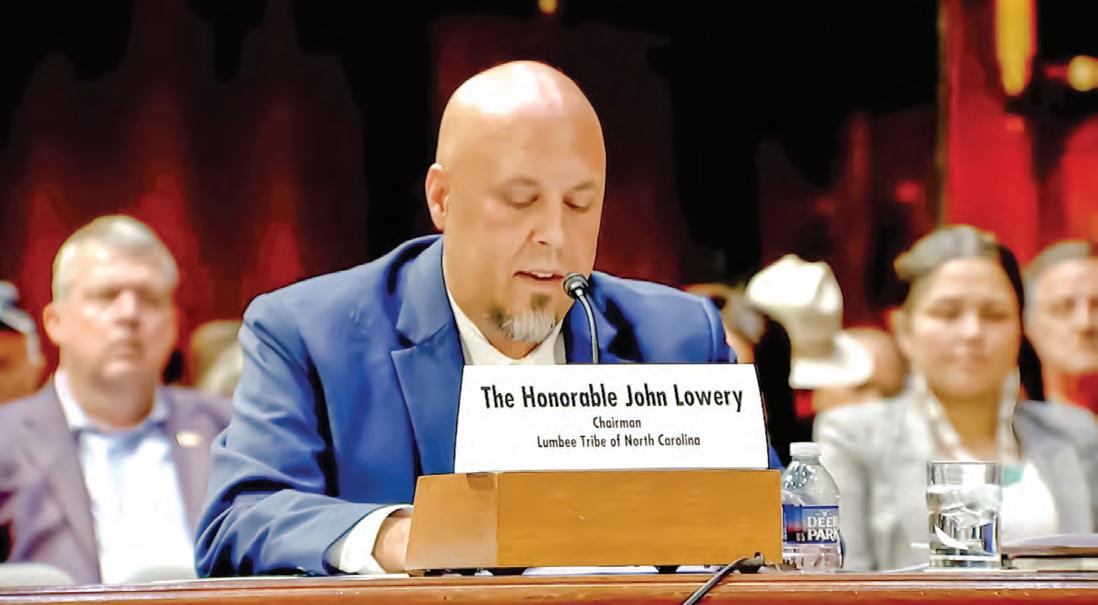
Lumbee Chairman John Lowery claimed EBCI, which he called the ‘Eastern Band Splinter Group,’ had political tactics of its own.
Native peoples have survived so much — removal, relocation, racism, poverty, and political neglect. We are stronger than the division we are seeing tonight,” he wrote in a Nov. 5 statement.
But to Hicks, there’s little that connects the Cherokee to the eastern North Carolina tribe.
While the Lumbee, hailing from four of the poorest counties in North Carolina, would benefit tremendously from federal recognition, benefits and funding, Hicks said “shared hardship alone does not create tribal identity.”
al recognition for the over 55,000 Lumbee living in the state’s eastern region.
EBCI Principal Chief Michell Hicks cited inconsistent Lumbee claims of ancestral ties to multiple tribes — including the Cherokee — and what he said was the community’s inability to “demonstrate descent from a historic tribe or continuity of tribal governance.”
“The Lumbee began identifying as ‘Cherokee Indians of Robeson County’ in the early 1900s,” Hicks wrote to The Smoky Mountain News in a statement.
The Lumbee, however, say their identity originated when displaced members of multiple tribes intermarried with locals of various ethnic and racial backgrounds. They point to common Lumbee surnames shared by members of the Lost Colony, which researchers speculate may have assimilated into local tribes.
Contemporary research into Lumbee genealogy suggests a blend of African,
addendum. Both were cut from the final document.
tions,” Lowery wrote in a Dec. 11 statement.
“Let’s step back from the name-calling and the heat of the moment. Let’s raise the conversation, not sink it. North Carolina’s Native peoples have survived so much — removal, relocation, racism, poverty, and political neglect. We are stronger than the division we are seeing tonight.”
Former EBCI Principal Chief Patrick Lambert
Still, Hicks argues that the legislation is an inappropriate vehicle through which to grant Lumbee recognition. The chief’s reasoning doesn’t center the NDAA’s irrelevancy, but rather the absence of standards he believes are vital to establishing tribal sovereignty.
“Once recognition becomes a political
Former EBCI Principal Chief Patrick Lambert discouraged such strife between the EBCI and Lumbee, while arguing that all North Carolina native communities are intertwined.
“Let’s step back from the name-calling and the heat of the moment. Let’s raise the conversation, not sink it. North Carolina’s
“Once recognition becomes a political decision rather than a documented determination, it places the legitimacy of federal recognition into question.
—
The EBCI chief also refuted claims that opposition to Lumbee recognition is driven by the concerns about revenue loss in the event of another new casino. There’s currently one in the state — in Cherokee — but the $1 billion Catawba King’s Mountain casino is slated to open in 2026, and federal recognition would permit the Lumbee to build their own.
“The Eastern Band’s position long predates Indian gaming. For more than a century, well before casinos existed, the Eastern Band raised concerns about the Lumbee’s claims,” Hicks told SMN.
Either way, the Lumbee will finally see a desired outcome over 130 years after their first bid for federal recognition. But the conflict between the two tribes has also encompassed many decades, and it will likely continue.
Hicks described the implications of the NDAA’s eventual passage as “largely uncharted territory,” adding that “to our knowledge, the Lumbee would be the first group to receive federal recognition without demonstrating descent from a historic tribe or continuity of tribal governance.”
As for what the Cherokee might do next, the chief told SMN that “At this point, it would be premature to speculate about specific actions,” though they’ll “remain attentive as this situation develops.”
The Lumbee chairman also issued future guidance regarding inter-tribal relations.
“We do not hate them, nor do we wish them harm. But we must be wise,” Lowery wrote in the same Dec. 11 statement. “A snake may shed its skin, but it remains a snake, and the Lumbee have been dealing with the bite for over 30 years. Our future leaders must carry that understanding forward, always.”
Lumbee
Chairman John Lowery speaks in Washington, D.C. From YouTube
Nonprofits that provide legal services are calling for North Carolina’s General Assembly to unfreeze funds necessary to their operations. In Western North Carolina, Pisgah Legal Services is one of the most crucial entities that represent people in need who find themselves in civil litigation. Now, some of those services may be in jeopardy.
The Bill of Rights entitles criminal defendants to legal representation; however, there’s no federal or state law saying someone is entitled to such representation in civil court. This is why services provided by the likes of Pisgah Legal are so vital. Many who need to consult with the nonprofit’s attorneys are in court for things that can happen to just about anyone: evictions, foreclosures and disputes over medical debts.
longtime recipient of IOLTA funding.
“When I say that, I mean for decades,” Kiger noted.
Where other funding has come and gone, IOLTA has been stable and has consistently filled gaps in budgets to maintain continuity of services.
Along with representing people with standard civil cases seen in any state courthouse in the country, Pisgah Legal Services has also played a significant role in the wake of Hurricane Helene to make sure people properly navigated complicated FEMA and insurance protocols.
“How do we serve people with the needs that we’ve seen before, and then you add on new needs like FEMA and homeowners insurance issues with repairing and rebuilding?”
Pisgah Legal receives a sizable chunk of money from the North Carolina Interest on Lawyers’ Trust Accounts fund. When attorneys take payment handing a case, the money goes into a pool, IOLTA, the interest from which is divvied out to programs like Pisgah Legal, as decided by a board.
Pisgah Legal Services offers representation in civil court for people experiencing a wide variety of issues. Stock photo
In June, the House and Senate voted in favor of SB 429, the “Public Safety Act,” which included a provision to put a hold on IOLTA funds.
Legal Aid of North Carolina, the hardest hit nonprofit providing such services in the state, estimates that 8,000 fewer clients will get service after it cuts 45 jobs and closes or consolidates nine offices across the state. While the impacts of the funding freeze won’t be felt at Pisgah Legal until 2026, its ability to help clients will likewise take a significant hit, with CEO Jackie Kiger noting that the nonprofit may serve up to 5,000 fewer people if that money isn’t unfrozen.
“It’s devastating and frustrating, because the money is there,” Kiger said. “It’s just frozen, and people who need our services are going to suffer.”
At an Oct. 22 hearing, House Oversight and Reform Committee Chair Harry Warren (R-Rowan) expressed concern that some of the recipients of IOLTA funds are going to “groups with leftist ideologies.”
“These dollars are helping the most vulnerable people in Western North Carolina — seniors, veterans, children, people living with disabilities, domestic violence survivors and their children,” Kiger said when asked about Warren’s statements. “We have been doing this work for decades. This is critical, essential work. We are operating within the law. We are following, of course, every single regulation around how funding can be used. We are not a political entity.”
Kiger said that Pisgah Legal had been a
Kiger said. “And more people are now in poverty because they lost their nest egg or the little bit of a savings they had because of Helene?”
Although the direct effects of the funding freeze won’t hurt Pisgah Legal until next year, Kiger said they are already scaling back in anticipation of the blow.
“We should be adding staff right now because of Helene, and we’re not,” Kiger said. “And we’re going to need to look at raising money from other sources to at least sustain and maintain the staff we have, because our demand for services, it’s just not stopping.”
Kiger said that if funding gaps end up large enough, Pisgah Legal may be in a position to close offices, lay off staff and ultimately serve less of the community.
“And we’ve actually laid off staff for the first time this year because of that uncertainty with our budget, although that has to do with Medicaid,” Kiger said. “But it all is coupled together. Like if we knew what our [IOLTA] grant would be for 2026, we would be able to plan accordingly for our staffing and our budget.”
Kiger said she and others at Pisgah Legal have been urging lawmakers to understand the impact and “irreparable harm” the freeze may do to the region. The situation is dire and time sensitive, she added. Pisgah Legal has served Western North Carolina since 1978 with what Kiger called a clear mission that hasn’t changed. As the dark clouds of uncertainty approach, she said the nonprofit will continue to strive toward fulfilling that mission.
“We are helping low-income people with their meet their most basic needs through civil legal aid, services and advocacy,” she said. “That’s what we do. That’s what we will continue to do.”
(Anyone interested in using the nonprofit’s services or helping out can visit pisgahlegal.org or call 828.253.0406.)
WCU grapples with cost, resources amid changes in NCAA policy
BY LILY LEVIN STAFF W RITER
For decades, college athletes generated millions of dollars in revenue for universities in exchange for a full tuition scholarship, at best. But a series of lawsuits beginning in the late 2000s — and a cultural shift toward athlete equity — paved the way for a monumental National Collegiate Athletic Association decision. The policy change, effective July 1, 2021, allowed these players to profit from any promotional use of their name, image and likeness, known as NIL, in company marketing.
However, the legal challenges didn’t stop when the NCAA permitted NIL deals with external brands and sponsors. In the landmark House v. NCAA lawsuit earlier this year, the organization went to court over what the plaintiffs argued was pay retroactively owed to qualifying pre-2021 athletes.
The dispute was resolved in a nearly $2.8 billion settlement divided among the 319 participating Division I universities. And it resulted in a series of policies — including the creation of a College Sports Commission to oversee all deals over $600 — affecting far more than simply backend profit.
While NIL partnerships were previously third-party territory, presiding Judge Claudia Wilkens permitted universities to engage in revenue sharing agreements. This meant on July 1, schools opting in to the settlement would begin paying their athletes up to $20.5 million for NIL usage.
Technical and multifaceted, the outcome of House v. NCAA has drastically shifted the collegiate athletic landscape in Western North Carolina.
nisms the university has used to keep its top players.
Chandler mentioned the practice of “not paying [athletes] in full up front,” adding that “they have obligations as an athlete and representing our institution.”
Pifer explained that retention strategy can be influenced by academic timing.
Football spans only one semester, he said, but “we want [football players] to pass classes be eligible. We’ll pay them some after that happens in December.”
He added that while basketball “goes over” two semesters, “the transfer portal opens in March, and so we have payments in April and May that they will receive if they do not go into the portal … So, we put some incentive there for them to stay.”
ences.
Plus, roster restrictions mean well-resourced schools will be pickier about who they select — which might facilitate transfer portal usage among talented players from lower ranked conferences.
“Are [top athletics schools] going to groom an 18-yearold when they can go find a 20- to 21-year-old that’s been molded already and experienced?” Chavis rhetorically posed to the audience.
“The shifts in retention and recruiting are changing,” he added.
And the rapidly evolving college athletic landscape affects more than coaches and athletes. A strong program enhances student feelings of belonging, boosts name recognition of the university and encourages alumni engagement. Then there’s the ‘Flutie Effect’ — the spike in applications to a university driven by a major success of its sports team.
A Dec. 11 board of trustees’ advancement and athletics subcommittee meeting revealed that Western Carolina University, having opted into the settlement, is responsible for payments totaling $270,000. At the same time, the Cullowhee institution is still grappling with July-mandated revenue sharing agreements and roster limits — and the potential implications of each policy.
REVENUE SHARES NOT CREATED EQUAL
The initial $20.5 million revenue share cap per institution is meant to mitigate university over-expenditures in hopes of securing a competitive advantage. But with an athletic budget of less than 75% of the settlement’s limit, WCU seems to be struggling with the opposite problem.
At the Dec. 11 meeting, Director of Athletics Kyle Pifer said WCU’s $15 million allotted to sports ranks “towards the bottom” of the Southern Conference.
When it comes revenue sharing, the university currently pays nine athletes a total of $213,000 — nowhere near the likes of $1 million, let alone $20.5. That puts the school at a disadvantage with any recruits looking to maximize athletic deals, payment and resources. Schools from the “power four” athletic conferences, on average, pay their athletes a total of $20.5 million. Mid-major schools spend, on average, $3.3 million. FCS schools give just over $929,000 total, schools without football about $570,000.
But WCU isn’t completely out of options.
Travis Chandler, assistant athletics director for compliance, teamed up with Pifer to discuss a few creative mecha-
ROSTER AND CONFERENCE CHANGES
The House settlement instated equivalent roster limits across all Division I conferences — likely reducing or eliminating walk-ons — while axing athlete scholarship restrictions. Conferences were free to further those limits or retain old regulations, provided that each policy followed NCAA guidelines.
“Even though the House settlement says we can have 105 [football players] and our roster limits 105 as a Southern Conference, we can only have 63 student athlete equivalencies,” Chandler told the audience.
SoCon, he explained, has chosen to “retain scholarship limits in old legislation.”
This conference-level policy was perhaps implemented to prevent member schools — smaller, non-flagship, with modestly-funded athletic budgets — from bankrupting the program through the provision of scholarships.
Indeed, financial capacity varies wildly among schools of different Division I conferences, and analysts have noted an increasing disparity in conference-based revenue.
In a Sept. 10 press release, the U.S. Senate Committee on Commerce, Science and Transportation reported that, when comparing power four schools and those of all other conferences, “a revenue gap that was approximately $6 million per school per year in 2002, has grown to over $43 million per school per year in 2023.”
The release also noted that TV media deals provide excessive financial gains for top schools in power confer-
A 2014 Higher Ed Dive article reported that at the University of Florida, “it was estimated that the back-to-back victories [in 2006 and 2007 March Madness] were responsible for 1,805 of 2,286 new applicants, or roughly 79%.”
EQUITY CONCERNS
Many advocates praise NIL policy for ending an era in which unpaid talent generated millions of dollars for coaches, universities and administrators. Some critics argue that while NIL deals represent a first step, they’re far from equitable or fairly distributed. And it’ll be difficult to ascertain the specifics of NIL deals moving forward, at least those existing among public universities in North Carolina. The state passed a law shielding all public universitymaintained NIL contracts from public records requests just a week shy of the House v. NCAA settlement.
It’s clear, however, that universities tend to give the best packages to athletes that generate the most revenue — meaning deals are skewed heavily toward men who play certain sports. For example, of the $213,000 in WCU revenue shares, about $200,000 is entirely devoted to men’s basketball. That means the money is monopolized by a single sport — and a single gender. And this isn’t just a WCU problem; it’s the reality of paying college athletes.
Power four schools, for example, spend an average of 75% of revenue shares on football, 15% on men’s basketball, and 10% on everything else — including women’s sports.
American University’s Journal of Gender, Social Policy, and the Law reported that “as of 2024, schools that provided NIL data shared that men out-earned women $92 million to $19 million.”
The Biden administration’s January 2025 declaration that NIL third party payments were subject to Title IX policies — and thus must be equitably distributed — was an attempt to level the playing field. Trump’s Department of Education reversed it the next month. Furthermore, Judge Wilkens initially held that Title IX did not apply to the $2.8 billion backend payments, and on Nov. 13, overruled Title IX objections pertaining to House on the grounds that the court lacked the ability to modify the settlement or its provisions.
She did, however, leave room for future lawsuits challenging school-specific Title IX violations.
WCU’s $15 million allotted to sports ranks ‘towards the bottom’ of the Southern Conference. Donated photo
WCU navigates budget uncertainty, prepares for what’s ahead
BY LILY LEVIN STAFF W RITER
Six months after the North Carolina General Assembly’s deadline to produce an annual budget, Western Carolina University in Cullowhee is left weathering the effects of this stalemate — and preparing for an uncertain future.
At the Dec. 11 academic and student affairs subcommittee meeting, Richard Starnes, history professor and dean of the college of arts and sciences, informed fellow members of the board that “academic affairs leadership has been working through a proactive budget planning exercise to help us prepare for possible financial scenarios.”
He added that “In the absence of a state budget, no official reductions have been mandated.”
In such a scenario, Starnes explained, North Carolina’s automatic continuing resolution statute “provides that state agencies are funded” at the base amount budgeted for the previous fiscal year.
But it also means that in higher education, empty positions cannot be filled, salaries cannot be increased, grants are limited and situational needs are unmet. The state endured a similar stalemate most recently in 2019, but legislators passed a mini budget in the interim to fill in the inevitable yearly gaps.
ments, in comparison to the 66% average of the entire UNC system, and 18 engagements among two staff members, in comparison to a 3.78 system-wide average per individual. Auditors did not find any compliance issues.
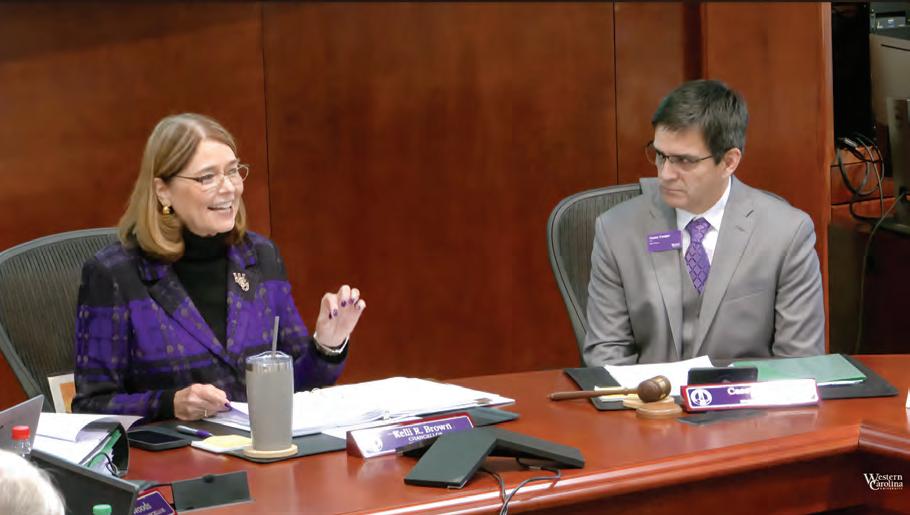
In an interview with The Smoky Mountain News, Chancellor Kelli Brown echoed WCU’s commitment to intentional, minimal spending.
Since long before her time, Brown said,
“One of my goals has always been, ‘How can we make sure we can go forward without impacting people?’” she said.
In addition to budget restrictions, university officials have a solid idea of what 2026 will bring based on the content of long session deliberations. The Senate’s budget proposal earlier this year, for example, required the UNC Board of Governors to increase annual tuition to $3000 for WCU
“In this case, we've not seen a lot of [interim appropriations],” Starnes said.
And while state lawmakers returned to sessions on Dec. 15, the agenda did not reference a new budget. That’s bad news, though an indirect consequence of something good — the Cullowhee university saw a 1.36% increase in overall enrollment this fall, a measure that warrants proportionally increased funding. Instead, it’s having to subsist at the base level of the previous year.
“The reality is that without the budget, we can't fund the enrollment growth. And consequently, enrollment growth is the system and system office and the Board of Governors’ number one priority for the short session 2026, short session of the General Assembly,” said trustee Kathryn Greeley during board’s general meeting on Dec. 12.
“[On] campuses like this one, it’s hard, as the chancellor indicated, to maintain the quality and affordability without the enrollment growth money,” she added.
Despite these unprecedented circumstances, fiscally speaking, WCU has maintained a calculated and risk-averse internal track record.
At a prior finance, administration and audit subcommittee meeting, it was revealed that auditors completed 82% of plan engage-
standing the importance of that, that we are a state public institution … And so, I think going into this [state] budget process, and what we're going into now, we've been very conservative.”
Starnes said that when legislators reconvene for the 2026 short session on April 21, there’s a chance they pass a retroactive budget by July 1, 2025. That possibility, he said, “is one of the reasons why we are proactive
As a part of the N.C. Promise Fund — alongside UNC-Pembroke, Fayetteville State and Elizabeth City State — the university has historically set a tuition rate of $500 for in-state and $2,500 for out-of-state students.
This program has been a success, and Greeley spoke to the impact it’s had on economic outcomes among community members.
“Both the House and the Senate are projecting budget cuts to the UNC system, and we want to be prepared for that.”
— Kelli Brown
in this budget planning exercise.”
It would also require adjustments to reflect new allocations and spending mandated throughout the 2025 fiscal year.
Unfortunately, official state revenue projections predict at least a $100 million deficit starting in 2026, which will likely have downstream effects on North Carolina’s higher education budget.
“Both the House and the Senate are projecting budget cuts to the UNC system, and we want to be prepared for that,” Brown told SMN.
The chancellor’s top priority is absorbing a reduction in funding without affecting faculty, staff or students.
“Not only has it attracted first generation students and lowincome students, but it has allowed middle income students at Western Carolina to graduate without crippling debt,” she said, adding that 50% of students are debt-free upon graduation.
Greeley then announced to fellow trustees that the UNC Board of Governors had raised out-of-state tuition to $3,500. As it turns out, a price increase can still occur pending passage of the state budget — not to mention the annual upward trend of student fees adjusted for inflation.
But Brown said the university is preparing for a variety of possible scenarios and that WCU has many promising years ahead, even amid these precarious circumstances.
“We're not sitting back and waiting for things to happen,” she said. “We're being very proactive. So, I think the future looks bright for 2026.”
WCU Chancellor Kelli Brown talks fiscal responsibility. From YouTube
Macon OKs $10 million landfill expansion
BY KYLE P ERROTTI
EWS E DITOR
The decision to secure over $10 million to build two new landfill cells was, in a sense, an easy one for Macon County commissioners to make, but what lies ahead is less certain.
The issue has come before commissioners each of the last few months. The board had chewed on the facts and thought about the complicated situation during that time, so although the Dec. 9 vote to fund the project was relatively quick, the process has been deliberate and required a good deal of work from County Manager Warren Cabe and Interim Solid Waste Management Director Jaimie Picou.
Commissioners thanked Picou for the work she’d put into best presenting the series of imperfect options to the board over the last few months. During each meeting, she’s faced questions from curious commissioners, which required her to build a significant knowledge base in a short amount of time.
“She’s swimming in trash now,” Commissioner Gary Shields joked. Picou, formerly the landfill’s environmental waste specialist, told The Smoky Mountain News that the learning curve has indeed been sharp, mostly because she’s had so little time to get up to speed on the issue. “If I would have been able to do it in a
longer time, it would have been not as hard,” she said.
Even residents have taken notice of the large task Picou took on. During the Dec. 9 meeting, Betsy Baste, a former teacher, offered praise during an aside during her public comment.
“That’s the best presentation I’ve ever seen for how to understand a complicated issue,” Baste said of Picou’s use of a PowerPoint presentation to commissioners during a previous meeting.
The current landfill is expected to reach capacity this summer, and a finding a home for future waste must be addressed quickly. While the operable dump can exceed capacity by 10%, that still doesn’t leave much of a buffer, and once new cells open up in about 300 days, that overflow must be moved to the newly opened area. Commissioners voted to finance the construction of the new cells, 2A and 2B, using a bond issued by Webster Bank. The new cells are expected to last about 10 years.
While Commissioner Barry Breeden voted against authorizing county administrators to secure funding for the landfill, the vote in favor of the contractor, FM Kitchens Construction Services out of Jefferson, Georgia, was unanimous. There were five bidders, and Kitchens’ $8.41 million bid was more than $1 million lower than the second lowest. The amount appropriated for the
project included the $8.41 million, as well as about $2 million for associated fees and contingencies.
Cabe admitted that the deep investigation required to present the options to the board that he and Picou undertook was “probably one of the hardest” he’s seen as an administrator, adding that he doesn’t exactly like all the options, but the situation requires quick action. He had a recommendation for the board.
“I think we need to proceed with the financing approval for the landfill sale and construction,” he said.
During the meeting last week, Cabe mentioned that the waste stream has exceeded expectations the last few years.
While solutions beyond the new cells weren’t discussed as though they’d be implemented any time soon, board members did ponder what could be done in the interim to mitigate what could be a headache for future commissioners. While there is still land that could be converted for landfill expansion, other commissioners echoed Breeden’s sentiment and expressed some desire to get ahead of the problem and avoid having to use that land.
The proposal was to finance the construction of the cells on a total of about 12.5 acres adjacent to the current landfill and the necessary equipment to operate it using special obligation bonds, which will be paid for by revenue generated from the landfill, meaning it operates almost more like a private enterprise than a government service.
Commissioner Barry Breeden was the lone dissenting vote.
“It’s all about buying time,” Commission Chair Josh Young said.
“I feel like we’re backed into a corner and we don’t have enough time to do anything but build a landfill,” he said, adding that it’s “hard to sign onto $10.5 or $13 million with interest.”
Over the last few months, commissioners have considered shipping waste out of the county; however, that option requires the construction of a large and expensive transfer station, and hauling costs more in the long run. Right now, Highlands, which produces about a quarter of the county’s trash, runs its waste through a transfer station, so commissioners considered that shipping just that waste out of the county instead of to the Macon landfill could buy some time.
Prior to that vote, he elaborated on his concerns, which in reality extended beyond the matter right in front of the board. His question, basically, was what happens when 10 years fly by and the county finds itself again in the same position. While there is more land that can be turned into landfill cells, Breeden said he doesn’t want to convert more of Macon County into a waste dump, and even if that were to happen, it’s ultimately a solution that can serve for only a few decades total.
Commissioner John Shearl, who lives in and represents Highlands, said he’s seen trailer after trailer loaded with large debris as people tear down old houses to make room for new construction, and that just shipping trash that goes through that transfer station would spare the landfill all that volume.
Another option is to reduce the volume of waste that enters the landfill by focusing more on recycling. Because those materials are processed separately, that could slow the new cells’ rise toward capacity.
Picou said that the total 20-or-so additional acres the county owns that could be used for further landfill expansion would work for about 30 years. The plan for the new cells is 10 years, but there’s no guarantee those won’t fill up faster than that.
Cabe also discussed charging more for certain items and spoke with particular disdain about mattresses, common items that don’t compress and simply end up taking up space.
“Maybe it costs more than a dollar and a half to put a mat-
Macon County has found itself backed up against a wall with the need to construct new landfill cells. File photo
NCDOT awards contract for N.C. 107 reconfiguration
The N.C. Department of Transportation recently awarded a contract to improve travel conditions on N.C. 107 through Sylva.
Buchanan & Sons of Whittier earned the $103 million contract for a transformative project that will improve safety for drivers, cyclists and pedestrians. In general, the project will convert N.C. 107 from a narrow, five-lane highway into a safer, wider highway featuring turn lanes, bulb-outs and bike lanes.
The entire project encompasses 2.6 miles of N.C. 107, from Mill Street to Lovedale Road and a short stretch of U.S. 23 Business where it meets N.C. 107. Overhead utility lines are currently being moved and construction operations should begin in the spring on the 1,674-footlong Mill Creek culvert.
The project includes the following features:
• One new signalized intersection — Cherry Street and East Hall Heights.
• Six new bulb-outs providing U-turn accessibility.
• Six upgraded traffic signals.
• 24 retaining walls to reduce property acquisition.
• Two new bike lanes — one in each direction.
The contract allows crews to begin operations in April of 2026 and calls for the work to be completed by late 2031. The contract requires for most of the work to be conducted at night to reduce impacts to traffic and local economic activity in the corridor. The construction is phased to keep at least one lane in each direction open at all times along with access to every business along the route.
tress in,” Cabe said.
Breeden said just because they authorized the funding for construction of cells 2A and 2B, that doesn’t mean that they shouldn’t still build a new transfer station — which would cost about $8 million and take a year and a half to build — for the county just to get ahead of the inevitable.
“We could haul two or three days a week and maybe make this thing last 20 years,” Breeden posited.
“Is it feasible to build that cell and a transfer station?” he asked Picou.
“It is if you have that money,” Picou responded.
“I think we need to get on that road to a transfer station quick,” Young said later in the meeting.
Cabe said that either way, he intends on pursuing grants through the North Carolina Department of Environmental Quality that are available to areas impacted by Hurricane Helene in September 2024 and could help the county address this problem.
Once all was decided, as commissioners got ready to move onto the next agenda item, Shearl reiterated the theme of the discussion.
“I really want to get down to the nitty gritty with this for future planning,” Shearl said.
“I have the same want,” said Picou.
Federal gridlock continues to stall Helene recovery
BY C ORY VAILLANCOURT P OLITICS E DITOR
Nearly 15 months after Hurricane Helene tore through rural Appalachia, North Carolina recovery officials said in a Dec. 15 meeting and press conference that federal recovery programs meant to help communities rebuild after $60 billion in damages are still slowing them down.
Michael Whatley, appointed by President Donald Trump as Helene recovery czar in January, has spoken to the head of the governor’s recovery task force only once this year.
“That was in September, in conjunction with the review council meeting in Western North Carolina held in Asheville,” said Matt Calabria, director of the Governor’s Recovery Office for Western North Carolina. “We talked about the improvements that we were hoping to see and are hoping to see in FEMA as we go forward.”
In April, an investigation by The Smoky Mountain News found that by the six-month anniversary of the storm, local governments across the region had seen just 4% of funding needs met. Near the nine-month anniversary, the Asheville Citizen-Times reported that total had reached 6%. By the one-year anniversary, Gov. Josh Stein reported 9%.
“We are currently working through the same issues that we’ve been dealing with
signed, forcing local governments to revisit prior decisions, resubmit materials or effec-
Calabria said that although he can testify to some successes in speeding up project reviews by the Department of Government Efficiency, nothing has really changed since his conversation with Whatley in September.
Among the roadblocks mentioned by Calabria were shifting FEMA requirements and frequent turnover among on-the-ground staff, which officials say has repeatedly disrupted projects already underway.
Communities report that a FEMA staffer may approve or “green-light” elements of a project, only for that person to be reas-
Don Campbell, chief of staff for the Division of Emergency Management at the North Carolina Department of Public Safety, said during the GROW NC meeting that the scale of work underway remains enormous, but the pace of federal approvals has become a serious problem.
More than 4,000 FEMA public assistance
projects tied to Hurricane Helene are currently active statewide, with nearly 1,900 into [U.S. Department of Health and Human Services] payment systems which FEMA utilizes for public assistance,” he said.
Campbell added that state officials have managed to reduce some delays by fiddling with keywords and using other administrative tools to change how information is packaged and submitted to the federal government — cut- F
Western North Carolina’s road to recovery remains fraught with challenges. Bob Scott photo
ting some approval timelines from as long as 90 days down to as little as 48 hours — but other speedbumps remain out of the state’s control.
Debris removal projects have been hit particularly hard. Several counties opted to manage debris cleanup themselves rather than rely on the Army Corps of Engineers, a decision Campbell praised but said has exposed them to extra scrutiny.
“We also recognize that those debris projects in many of our counties are being held up through a number of additional reviews through FEMA,” Campbell said. “We are continuing to work with FEMA to try to expedite those processes so those debris projects can, most importantly, be reimbursed, because the funding that is needed for those projects needs to get back to our counties so they can continue to use those funds for other areas of their recovery overall.”
Those conclusions represent a reality far detached from what Whatley — appointed by Trump on Jan. 24 to make sure “everything goes well” — has been telling the press across the state.
In a May podcast appearance with Spectrum’s Tim Boyum, Whatley claimed FEMA had “eliminated the red tape” and that there had been a “massive acceleration” in debris removal.
On Aug. 1, a story in the Asheville Citizen-Times suggested debris removal had actually slowed. Local governments continued to report denials.
On Aug. 8, a FEMA official directly contradicted Whatley on the elimination of red tape, saying the delays in federal relief were due to “new red tape.”
Later that month, former Gov. Roy Cooper told SMN in hard-hit Chimney Rock that he did not think everything was “going well” with recovery and said that Whatley was part of the problem.
“Washington, D.C. insiders have made it so much more difficult for people in Western North Carolina to recover, and in fact, people in Western North Carolina have been left holding the bag,” Cooper said.
Cooper, a Democrat, is likely to face Whatley, a Republican, in the race for the U.S. Senate seat being vacated by Republican Thom Tillis next year. Cooper and Whatley have Primary Election opponents, but are both expected to prevail.
In October, Western North Carolina residents — even Republicans — were harshly critical of Whatley’s performance, with one essentially saying Whatley should step down because he never really stepped up.
Around that time, 120 people from 17 affected counties signed a letter to DHS Secretary Kristi Noem and FEMA Review Council co-chair Pete Hegseth, the Secretary of Defense, asking them to remove Whatley from his oversight role. That obviously didn’t happen; however, a new petition with even more signatures is circulating, again calling for Whatley’s ouster.
The calls come as Noem’s Federal Emergency Management Agency remains in a state of flux, operationally and organizationally.
Asheville Mayor Esther Manheimer, who,
with Sen. Kevin Corbin (R-Macon), co-chairs GROW NC, said that Community Development Block Grant funding seems to be flowing without issues, but that anything going through DHS/FEMA is not.
In November, acting FEMA head David Richardson resigned six months into the job after criticism of the agency’s response to deadly floods in Texas. Trump has discussed abolishing the agency, against the counsel of advisors. Reporting by The Washington Post last month says Noem wants that too, but that members of the FEMA Review Council want the opposite — elevation of FEMA to a cabinet-level agency.
The council, of which Whatley is a member, was established by presidential executive order in January and charged with producing a report on FEMA reform within 180 days of its first public meeting, which was May 20. That deadline has long passed, but no report has been issued.
During the Dec. 15 GROW NC meeting, Kevin Leonard, executive director of the North Carolina Association of County Commissioners, said he felt that both regional and national FEMA leaders had been “tone deaf.” After Leonard voiced his concerns at the previous meeting, he suggested that retaliation ensued.
“It’s like they doubled down on increasing regulations that create increased red tape for reimbursements for the people in our communities, for our local governments,” he said. “That’s going to stifle growth, or stifle recovery growth in North Carolina even further.”
On Dec. 16, the Town of Waynesville announced that after several denials, it had finally been reimbursed by a state program for out-of-pocket expenses related to the reopening of the Depot Street bridge in April — not by FEMA, not by the Federal Highway Administration, but by a state program.
North Carolina’s Attorney General, Jeff Jackson, had to sue FEMA to restore roughly $200 million that the agency yanked from more than 60 infrastructure projects.
Since the storm, there’s been only one bill passed in Congress addressing North Carolina’s $60 billion in damages. It’s expected to bring between $9 billion and $15 billion. Congressman Chuck Edwards (R-Henderson), who represents the most severely impacted portion of the state, sits on the powerful House appropriations committee but has refused to speak to SMN about his inability to satisfy fully the needs of his constituents.
Nevertheless, Calabria believes the most significant thing the state can do on the federal level in 2026 is to secure an additional federal appropriation. Leonard agreed, saying the NCACC is meeting with county managers this week to verify the situation on the ground.
“We’re going to take that information, and we’re going to go back to Washington in the first part of the year and start banging on doors again,” Leonard said. “This has to change.”
A spokesperson for Michael Whatley did not return a message seeking an interview by SMN.
SCC student’s diligence, attention to detail lead to early cancer discovery
Throughout her first two-and-a-half semesters in Southwestern Community College’s Medical Sonography program, Emma Dao heard her instructors repeatedly emphasize the value of curiosity.
Because Dao took that message to heart, one area woman received an early cancer diagnosis and now has a much better outlook for treatment and recovery.
tude to both Dao and her instructors.
Ashley Folse, Medical Sonography program coordinator at SCC, also praised Dao’s efforts.
“My immediate reaction was one of profound relief and immense gratitude that the patient had found her way to us,” Folse said. “That feeling quickly transformed into feeling so proud of our student Emma. Her commitment to truly listening to the patient — not
Dao happened to be working when the Jackson County resident took advantage of the Medical Sonography program’s carotid screenings earlier this fall. The carotid scan was clean, but a conversation with the patient prompted Dao to check her thyroid.
That screen revealed an anomaly, which Dao identified as a potential area of concern — so she made some measurements and printed images for the patient to take to her doctor.
just performing a routine scan — prompted a more thorough examination. It was a tangible affirmation of what a patient-first approach looks like in practice, and it filled me with a sense of gratitude for the good work our program is doing.”
For Dao, who initially had pursued a fouryear degree in Forensic Science, the discovery during a free clinic helped validate her decision to switch to the Medical Sonography career field.
A subsequent biopsy came back with a diagnosis of papillary carcinoma, meaning Dao’s diligence provided the patient and her physicians with valuable time and more options than would have been available had more time passed before the condition was discovered.
“I feel like I’m going toward the right direction with what I want to do with my life,” Dao said. “And I’m just very grateful for the patient that the cancer was caught early enough. That’s the goal, right? It’s to aid in diagnosis and help people.”
“Our instructors are always very adamant that when we’re screening one area on a patient, it’s a good idea to check anything else nearby as well,” Dao said. “With this particular individual, she told me that she’d been planning to come to our thyroid screening here in the spring — but she hadn’t been able to come because she was sick. So after I checked her carotid, I said I could just take a quick peek at her thyroid.”
Though the patient prefers to maintain her anonymity, she’s expressed significant grati-
All of the SCC Medical Sonography program’s clinics are for educational purposes only. They are free and open to the public by appointment only from 8:30 a.m. to 3:30 p.m. on Mondays and follow the college’s academic calendar and inclement weather closings.
For more information about the Medical Sonography program at SCC, including the free clinics it offers, visit southwesterncc.edu or contact Pamela Judson at 828.339.4198 or pjudson@southwesterncc.edu.
Emma Dao is a second-year student in the medical sonography program at Southwestern Community College. Donated photo
Community Almanac
Christmas-themed Sunday brunch offered at Lake Junaluska
Lake Junaluska is offering a special Christmas-themed brunch on Sunday, Dec. 21, at York Dining Commons.
The menu will feature holiday-themed food such as hot chocolate and a pancake bar with adult and child-friendly toppings, along with baked ham, herb-roasted turkey, green bean casserole, desserts, scrambled eggs, bacon, sausage and other traditional brunch items.
The brunch buffet will be served from 11 a.m. to 2 p.m. and cost $20 per person, including tax and tip, for guests age 12 and older; $10 for children ages 5 to 11, and free for children 4 years old and younger.
Additionally, each guest will receive a small festive gift at the end of their meal.
Colquitt Foundation continues support for UWHC
United Way of Haywood County received another donation of $100,000 from the Colquitt Foundation to use for flood recovery following Hurricane Helene.
In late October, the Colquitt Foundation, a charitable organization based in Knoxville announced its fifth donation to UWHC. This comes in addition to $500,000 from the Foundation, its most substantial gift to date.
“We chose to contribute to the United Way of Haywood County given our confidence in its leadership under Celesa Willett and also in its ability to use these funds in a way that would impact Haywood County for the better,” said David and Annie Colquitt. “They have a deep, deep understanding of Haywood County and also know which partner organizations are making a positive, strategic impact. We can trust the United Way of Haywood County to use these resources for good.”
In total, UWHC has received $891,000 over the last year from the Colquitt Foundation. These gifts come as part of the Foundation’s $2 million commitment to the region following Hurricane Helene.
To make your own donation to the Flood Recovery Fund, please visit uwhaywood.com.
Macon library shows new Christmas movie
The Macon County Public Library in Franklin will show a new Christmas movie starring Andi McDowell and Danny DeVito.
In the movie, an American couple brings their daughter to her grandfather’s hotel in Italy to tell her that they are separating. Hoping to bring them back together, she asks to celebrate one last Christmas together, even though it’s August.
Showings will be Wednesday, Dec. 17, at 2 and 3:30 p.m.
Grants awarded to education, human service nonprofits
The Community Foundation of Western North Carolina (CFWNC) approved focus area grants in the Education and Human Services focus areas totaling $1,833,089, with co-investment of nearly $800,000. Complete grant lists are at cfwnc.org.
“Our region continues to experience the lingering effects of Helene including increased demands for services,” said Vice President for Programs Tara Scholtz. “With food costs high and insecurity regarding programs like SNAP, we saw an increase in requests for food aid across the board.”
Twenty-five grants totaling $573,585 were awarded to support early childhood development, K-12, and adult education in Western North Carolina with co-investment of $256,250. Fiftythree Human Services grants totaling $1,259,504 were approved with co-investment of $540,093.
CFWNC works with families, businesses and nonprofits to strengthen communities through the creation of charitable funds and strategic grantmaking. A permanent charitable resource, the Foundation manages over 1,300 funds and facilitated $69 million in grants last year bringing total distributions to more than $456 million since its founding in 1978. Learn more at cfwnc.org.
Haywood County sees chickenpox case
Haywood Health and Human Services confirmed a case of chickenpox (also called varicella) at Waynesville Middle School.
Most children recover without any problems. However, chickenpox can be serious, even lifethreatening, in babies, adolescents, adults, pregnant women and people with weakened immune systems. Complications include skin and blood infections, dehydration, pneumonia, brain swelling, and bleeding problems.
Chickenpox is a very contagious viral infection that is spread from person to person through coughing, sneezing, or direct contact with blisters. A person with chickenpox is contagious starting one to two days before the rash develops until all blisters have formed scabs. Symptoms may develop up to 21 days after exposure.
Experts encourage people to make sure children are up-to-date on the varicella vaccine. Individuals who develop symptoms should avoid social gatherings such as school, daycare, work and church until blisters form scabs or chickenpox is ruled out by a medical provider.
Call ahead to inform healthcare facilities of a possible exposure to ensure appropriate precautions are followed.
For more information, contact the Haywood County Health Department at 828.452.6675.
Sylva ups its selfie game
and Visitor Center, in collaboration with the Jackson County Tourism Development Authority (TDA), announced the installation of Sylva’s first “Perfect Spot for a Selfie” stickers. Designed to encourage exploration, engagement and community pride, these designated selfie spots are now located at the intersection of West Main Street and Keener Street — one on each corner. Visitors and locals are encouraged to snap a
photo at the designated spots and share their selfies on social media using #discoverjacksonnc to help highlight the beauty and spirit of Sylva. This initiative highlights one of Sylva’s most photogenic downtown locations and invites everyone to capture and share their experiences. By promoting organic social media engagement, the project aims to boost visibility for local businesses and enhance tourism throughout Jackson County.
Sylva now has two spots marked where people can stand to get the perfect selfie. Donated photos
The brazen closing of WCU’s voting site
The utter guile of this state’s GOP leaders to rig elections in their favor should cause a hue and cry from honorable, ordinary taxpaying citizens of all political stripes. But when it comes to partisanship, these are not ordinary times, which is an understatement of almost comical proportions.
Last week, the Jackson County Board of Elections voted along party lines to close the early voting site on the campus of Western Carolina University. The measure awaits approval by the state board, but the GOP majority in the recently re-jiggered election hierarchy in Raleigh no doubt has the rubber stamp inked and ready. Although the Cullowhee site closure was touted as a cost-savings measure, no one presented any credible information on those savings during the hearing. Others pointed out that other nearby sites will need additional staffing if Cullowhee is closed (meaning more expenditures).
According to WCU political science professor Chris Cooper, who spoke at the hearing, data shows that during the 2024 Primary Election, “the average age of the people who voted at the WCU campus was the youngest of any early voting site in the state” and that upon the site’s establishment in 2016, the percentage of votes from 18 to 25-year-olds initially tripled or quadrupled before settling into roughly double prior levels of around 3%. More than 76,000 people have voted at the site since its inception.
According to Democracy Docket, county boards of elections in Guilford, Harnett, Craven, Cumberland and Pitt counties have joined Jackson election supervisors by voting to
close other early voting sites. In Guilford, that included sites on the campuses of N.C. A&T and at UNC Greensboro. In addition to campus voting sites, the GOP-led election boards are closing others that operate on Sunday, polls typically used by working class voters who can’t take a day off and churches who transport elderly and handicapped people to vote.
Guilford County elections board chair Eugene Lester III justified his board’s decision by arguing that voting is a privilege, not a right. Right, a privilege that we will now only make available to the privileged.
Taken together, these measures are obviously meant to raise barriers to participation for young and minority voters who tend to lean Democratic. The same conservatives pushing these measures often bemoan the lack of civic education in our schools and the lack of civic engagement among our youth. Ever wonder why some young people might get cynical about what their elected leaders are doing?
If inhibiting voting wasn’t brazen enough, look what our state’s GOP leadership did back in October. The General Assembly voted to redraw state congressional maps at the behest of President Trump, providing one safer Republican district. North Carolina has 14 seats in the U.S. House of Representatives — and currently has 10 Republicans and four
Democrats in its delegation. The redrawn map makes District I — currently represented by Democrat Rep. Donald Davis (D-NC, 4th) in the state’s northeastern corner — reliably Republican to secure an 11-3 majority.
Trump won the state in 2024 with 50.86 percent of the vote. So a state which many of us proudly proclaim as purple has been painted red when it comes to Congress, comfortably and brazenly gerrymandered by Sen. Ralph Hise (R-Mitchell), Sen. President Pro Tem Phil Berger (R-Guilford, Rockingham), and all of the GOP legislators (including all of our WNC reps) who giddily bend the knee to and kiss the ring of Donald Trump.
Why openly support partisan gerrymandering? Because they can. The U.S. Supreme Court in 2023 ruled that states can gerrymander for political advantage as long as the districts aren’t drawn based on race. A lawsuit filed by the NAACP to challenge the redrawn districts in North Carolina has already lost.
“As Democrat-run states like California do everything in their power to undermine President Trump’s administration and agenda, North Carolina Republicans went to work to protect the America First Agenda,” Berger wrote in a press release following the vote.
In a season where we talk often about values and honesty, let’s remember those elected and appointed leaders who would win at all costs rather than play fair, who wouldn’t dream of letting scruples get in the way of their politics. (Scott McLeod can be reached at info@smokymountainnews.com.)
Advent: A different take on the holiday season
In late fall, after all the Halloween candy has been consumed and the fall décor removed from store clearance aisles, we step on a conveyor belt heading straight for Christmas. Even those hangers-on who kept their rotting pumpkins on their porches through Thanksgiving finally pull out the twinkle lights and decorate their trees. Christmas music blasts in every store. Eggnog and cookies are consumed at will. For many people, the span of weeks from Thanksgiving to Christmas is a blur of planning, partying and shopping.
Some would argue there is nothing wrong with this. We’ve been well trained to rehearse, “It’s the most wonderful time of the year!” And in many ways, it is. I love eggnog. But the relentless rush toward Christmas — and its uniquely consumeristic zeal — falls short of the season’s true meaning. It can run us ragged at best or leave us feeling hollow at worst. Many of us will wake up on Christmas morning burnt out and broke, pretending to feel happy even if we don’t.
Historically, those who celebrated Christmas prepared for it very differently than we do today. In the weeks after Thanksgiving, they observed Advent, a season of self-reflection and repentance. With roots in the fourth century, Advent cultivates the opposite of the “shop ‘til you drop, fake it ‘til you make it” kind of holiday cheer that has come to characterize American expressions of
the season. It is not holly or jolly. However, in an era of widespread cultural disillusionment, of political violence and loneliness and mistrust, I believe Advent is an especially timely gift for modern people.
“For Christians,” Tish Harrison Warren writes, “Christmas is a celebration of Jesus’ birth — that light has come into darkness and, as the Gospel of John says, ‘the darkness could not overcome it.’ But Advent bids us first to pause and to look, with complete honesty, at that darkness.”
Advent invites us to get in touch with the ways our world needs healing — and the ways we need healing. In the time leading up to the joy of Christmas, we needn’t pretend everything is fine when it isn’t. Instead, we can acknowledge the ways we aren’t fine and don’t know how to fix it. We can put ourselves in the way of the gift we all need.
On Thanksgiving Day in 2018, I woke up to learn that my brother had died by suicide. In the disorientation of that grief, I felt jarringly out of touch with “the Christmas spirit.” My lifeline that year was Advent: the permission to name my pain and to ask for God to come into it. At my church, I was comfort-
ed by the minor key music of Advent hymns and the sparsely decorated sanctuary. At home I lit the candles of my Advent wreath and prayed wordlessly, understanding perhaps for the first time that this place of word-
less desperation, this ache, is where we encounter the real power of the Christmas story. The light of the world comes not to a comfortably lit room, but into the terror of darkness.
The sting of my grief has lessened over the years, but in my ministry as a pastor I have
seen the importance of Advent for people in all kinds of situations. Whether we are reeling from a recent loss or celebrating a new member in the family, whether we are pleased with the current state of public life or despairing over it, Advent invites us to pause and reflect. It’s a time to take inventory not only of our wishlists and meal plans, but also of our hearts. During Advent we ask, “What needs renewal in my life and in our world?”
That renewal won’t be found on a rack at Nordstrom or through our collective positivity. Counterintuitively, perhaps, this is good news: peace on earth ultimately isn’t up to us. But it is on offer. The Christmas story reminds us that our rescue comes in the form we might least expect: A baby, wrapped in blankets, is somehow the one who will change everything. I still don’t fully understand this story, but I find it more beautiful than anything of my own making. Grace doesn’t need to make sense; it only needs to be received. That’s what makes Christmas a gift.
Miller King is
and
(Hannah
a priest at the Vine Anglican Church in Clyde
the author of ’Feasting On Hope: How God Sets a Table in the Wilderness.”)
Editor Scott McLeod
Hannah Miller King
Looking for something good
The Infamous Stringdusters roll into WNC
B A I blown rock show attitude.
“When you’ve been a band for 20 years, a lot of things change, including your perspective on how to create music and art,” said dobroist Andy Hall. “When you’re first starting out, there’s an intense desire to create and you’re just ‘going for it.’ As you go along, your time is more precious, where writing and making music together is more focused.”
To celebrate, the groundbreaking jam-grass quintet will release its latest album, “20/20,” on Jan. 26. Twenty songs for 20 times that the calendar has been swapped out on the walls of time. Those endless miles in pursuit of a dream. The surreal, whirlwind shows of transcendence and lore.
“We’ve been around for 20 years, and I feel like we’re putting more into our music — both writing and the live shows — than we ever have,” said banjoist Chris Pandolfi. “And the reality is, that you do need to step a little harder on the gas to get the same results — it takes real intention.”
“The world is our oyster, as far as what we want to create and what we want to do,” Hall added. “And bluegrass continues to be a foundational thread that we come back to, album after album — it’s exciting.”
At its foundation, the album marks this important milestone for the group that happily exemplifies sonic mischief and endless curiosity amid a keen sense of musical tradition — under the bright stage lights or in the middle of a recording session.
“We’ve always been very intentional in how we wanted our show to sound and to look,” Pandolfi said. “And, 20 years later, we’re still working at distilling the best of what it is we all bring to the band.”
Alongside Hall and Pandolfi, Jeremy Garrett (mandolin), Andy Falco (guitar) and Travis Book (bassist) round-out the all-star line-
it’s infinitely deep.”
Initially, the idea for the Dusters bubbled up from the friendship of Hall and Pandolfi, all while they were students at the famed Berklee School of Music in Boston. Each trying to figure out what their future may look like.
Even back then, when the duo eventually landed in Nashville, they were looking to strike fire somewhere, anywhere within the “high lonesome, sound” created by the “Father of Bluegrass,” Bill Monroe. And just like today, the early intent was to present something new and different.
Want to go?
Renowned jam-grass act The Infamous Stringdusters will hit the stage at 7 p.m. Tuesday, Dec. 30, at The Orange Peel in Asheville.
Nowadays, the Dusters themselves are considered pioneers and possibilities of what can be conjured and captured — either in the depths of the studio or simply in the heat of performance.
Doors at 6 p.m. Ages 18 and over. Tickets are $44.10 per person (tax included). For more information and/or to purchase tickets, visit theorangepeel.net.
As well, the group will also be opening for The Avett Brothers at 8:30 p.m. Wednesday, Dec. 31, at the Harrah’s Cherokee Center in Asheville.
“Bluegrass is a little confusing sometimes,” Pandolfi said. “Because what’s coming out of the instruments is rock-n-roll as hell, but guys are just standing there [onstage] in a suit. When we came to [bluegrass], we loved the music, but the vibe wasn’t representative of who we were.”
Doors at 7:30 p.m. For more information and/or to purchase tickets, visit harrahscherokeecenterasheville.com.
Pointing to early influences like Leftover Salmon, String Cheese Incident and, most importantly, Yonder Mountain String Band, the Dusters aimed to locate this crossroads, one where the intricate nature and mastery of bluegrass instrumentation could be channeled through a modern lens of frenzied stage energy and aweinspiring production.
“It took a few years and some experience to let all of those things come together,” Pandolfi said. “We started to tease these things out of the music, but also out of the show, the production, and our personality.”
“When you have this shared knowledge and understanding
“As we’ve gotten a little bit older, we’re seeing what’s happening with bluegrass, and how great the bands are getting,” Pandolfi said. “Well, guess what? That inspires us to dig even deeper into ourselves to figure out what we can do, what we are.”
Within the ensemble, each member of the Dusters remains a musical sponge of sorts. All are involved in an array of solo projects outside of the band, only to circle back with a constant stream of inspiration — with “20/20” offering the essence of that experimentation and precision.
“And when all of those individual efforts come back together into the band, it creates a really powerful synergy,” Hall said. “Not only has the band grown up, but individually, I see every band member becoming a master in everything they’re trying to do, whether it’s their instrument or writing. All of the creative endeavors have gotten deeper.”
For Pandolfi, who also takes his first real dive into songwriting on “20/20,” what ultimately remains between he and his bandmates is this common goal of persistence and passion, one where gratitude and grace swirl around a continued intent to explore, discover and cultivate deep from within.
“Life is coming at us and changing,” Pandolfi said. “But the attention to the music and the shows? It’s just really cool to share that desire and keep pushing that front further ahead this late in our career — and I hope we always do that.”
The Infamous Stringdusters will play Asheville Dec. 30-31. Daniel Milchev photo
This must be the place
BY GARRET K. WOODWARD
‘Memories of candles and incense, and all of these things, remember these?’
Hello from Room 1001 at the Cambria hotel in downtown Asheville. It’s Saturday afternoon and I’m currently sitting at this writing desk (pictured), I’m overlooking the intersection of Haywood Street and Page Avenue, the Harrah’s Cherokee Center and former George Vanderbilt Hotel within sight.
Last night, the city was on fire with live music in seemingly every direction in preparation for the 33rd installment of the “Warren Haynes Presents: The Christmas Jam,” which is taking place this evening at the civic center. Every single spot had something going on, and something really damn good. To note, legendary rock act Stone Temple Pilots are heading Xmas Jam.
So, Friday night, I’m bouncing between The One Stop and The Orange Peel, etc. Amazing bands. Wild crowds. A smile ear-to-ear. Anyhow, I feel a little overwhelmed, so I decide to wander over to The Vault for a quiet nightcap and to just kind of decompress. Thus, I walk in and I immediately recognize the dude sitting at the nearby table. It was Eric Kretz.
No recording devices. No photos. Just two humans connecting. As I get up to leave, he gives me his number and said to call the next time I’m in LA, or he’ll call me when he’s in Western North Carolina (he really wants to visit the Wheels Through Time museum in Maggie Valley).
To that, I tell him at one point, in all sincerity, “Eric, your band is the reason I became a music journalist. I saw an AD for STP at the Rolling Rock festival in 2001 in Rolling Stone when I was 16, and I was so bummed that I couldn’t afford to go or be able to get in, and so, I subconsciously decided that I would become a music journalist, and that set me on this journey.”
STP has been “my band” since I was in middle school, growing up in a small Canadian border town in Upstate New York. When I saw them live in 1999 in Montreal, it changed my life. STP tore the roof off the Bell Centre. The band was a muscle car, with lead singer Scott Weiland the highoctane gasoline. Walking away from that performance, I knew, even then at age 14, that all I wanted to do was be around music, especially when performed live.
And through all the ups and downs of STP, Weiland still remained my all-time favorite front man. Nobody even comes close to him, in vocal range and in stage presence. To which, that iconic performance at the Rolling Rock festival in Latrobe, Pennsylvania, shows the band at its pinnacle. The footage still gives me chills. Track it down and give it a whirl.
HOT PICKS
1
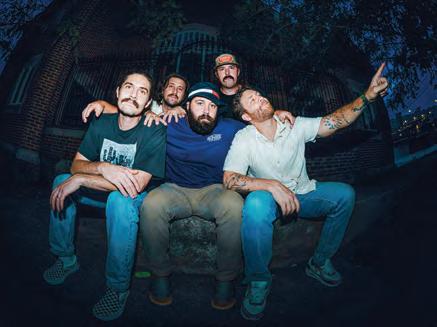
The Scotsman (Waynesville) will host The Brothers Gillespie (Americana/indie-rock) at 10 p.m. Saturday, Dec. 20.
2
A special production of “The Best Christmas Pageant Ever” will hit the stage at 7:30 p.m. Dec. 19-20 and 2 p.m. Dec. 20-21 at the Haywood Arts Regional Theatre in Waynesville.
3
Lazy Hiker Brewing (Sylva) will host Natti Love Joys (reggae/roots) at 8 p.m. Friday, Dec. 19.
4
Mountain Layers Brewing (Bryson City) will host Wyatt Espalin (singer-songwriter) at 6 p.m. Saturday, Dec. 20.
5
Smoky Mountain Center for the Performing Arts (Franklin) will host a stage production of “The Velveteen Rabbit” at 7 p.m. Thursday, Dec. 18.
actions and motives. Weiland sang about deeply sensitive and personal topics, where you knew that beneath all of his bravado and tough skin was a guy who was just as vulnerable and in search for truth as the rest of us were. He was innately human, and projected that more so than many of his contemporaries in the grunge era.”
That Asheville interaction with Weiland was surreal, to say the least. A true full-circle moment in my life. I had sincerely befriended my favorite musician, only to tragically find out just days later of his untimely passing on Dec. 3, 2015. He was just 47 years old. The music of STP will always be the vast majority of the “soundtrack of my life,” perhaps the entire mix, you know? The melodies are as timeless as they are filled with this sense of urgency.
I turn to my friend, “Dude, that’s Eric Kretz.” My friend: “Who’s Eric Kretz?” Me: “The drummer of Stone Temple Pilots.” My all-time favorite band that literally changed the course of my life. And there he is, just hanging there, all while his drum tech was making some phone calls.
My friend leaves to go back to The One Stop. I walk over to Eric. Me: “You’re Eric Kretz.” Him: “I am. You’re the first person to recognize me.” We talk for a hot minute and I take my cue to say it was nice to meet and so forth and aim to leave. Eric goes, “Grab a beer, let’s sit down and talk.” So, I do.
And for the next hour, we talked about nothing and everything: STP recording sessions, motorcycles, Louisiana, kinesio tape, etc. Nonstop and enjoyable conversation.
As I became a music journalist in the following years, Weiland sat at the very top of my wishlist of musicians/people I always wanted to interview. On Nov. 22, 2015, I had the honor of finally sitting down and interviewing him face-to-face backstage at The Orange Peel during his solo tour that fall.
To preface, that 2015 interview became a lengthy feature I wrote for Live for Live Music, with the following sentiments of mine still ringing true:
“I was an odd, somewhat alienated and picked-on adolescent, something that I found solidarity in with the persona, words and sounds that radiated from Weiland. He was out there, almost to a fault, where the more you tried to pin him down, the more elusive he became. He didn’t want to be defined, and also was so transparent in his
In a recent issue of The Smoky Mountain News, I had the sincere privilege of interviewing STP guitarist Dean DeLeo. It was recorded several years ago and remained unpublished until the appropriate time, which became this upcoming appearance this evening at Xmas Jam. To which, I’ll be interviewing STP bassist Robert DeLeo (Dean’s brother) at some point later today.
“Well, I know what I’m sitting on, musically speaking. And I know what Robert has. There’s a lot left. We just love making music. And we love being able to share it with you,” Dean told me. “And I got to tell you, I don’t want to claim ownership on this thing. You know, this [music] belongs to all of us. This is all of ours. I just want us all to really have it be a place where we can completely dip our minds and find every emotion in it. And if we just get to do that, then that makes me feel good, man.”
As I get up to leave The Vault, I shake Eric’s hand to say goodbye and add, “Your music changed my life, and all for the better, so thank you.”
Life is beautiful, grasp for it, y’all.
Tenth floor at the Cambria in Asheville. Garret K. Woodward photo
Cherokee pottery exhibition
A special showcase, “Didanisisgi Gadagwatli: A Showcase of Pottery from the Mud Dauber Community Workshop,” is now on display at the Museum of the Cherokee People in Cherokee.
On view through May 2026, the exhibition features works by students of Tara McCoy (Eastern Band of Cherokee Indians) handcrafted during an intensive threemonth workshop.
Renowned for her pottery, McCoy began making crafts at 12 years old. She honed her skills while taking arts and crafts classes with Alyne Stamper (EBCI) and has won numerous awards at the Cherokee Fall Festival and at Southwestern Association of Indian Arts (SWAIA) Santa Fe Indian Market.
“The Didanisisgi Gadagwatli pottery workshop is an example of how museums can support and uplift great work already happening in the community,” says MotCP Director of Education Dakota Brown (EBCI).
MotCP is located in Cherokee. Donated photo
“Tara’s dedication to gadugi (community working together for the common good) and intensive approach to teaching has been hugely successful and is a powerful example of reconnections and resurgence. Connection and practice to our material culture is a continuation of our shared Cherokee identity and perpetuates Cherokee pride.”
• “Holiday Market” will run through Dec. 27 at The Bascom Center for the Visual Arts in Highlands. Discover unique, handcrafted gifts by local and regional artists, including members of The Bascom Clay Studio. Celebrate the season with holiday-themed workshops for children and adults. For more information, call 828.526.4949 or visit thebascom.org.
• WNC Paint Events will host painting sessions throughout the region on select dates. For more information and/or to sign up, visit wncpaint.events.
• Marianna Black Library (Bryson City) will host “ArtWorks” at 1 p.m. every second Thursday of the month. Come create your own masterpiece. The materials for art works are supplied and participants are welcome to bring ideas and supplies to share with each other. Ages 16 and up. Space limited to 10 participants. Free and open to the public. 828.488.3030 / vroberson@fontanalib.org.
• Waynesville Photography Club meets at 7 p.m. every third Monday each month on the second floor of the Haywood Regional Health & Fitness Center in Clyde. The club is a nonprofit organization that exists for the enjoyment of photography and the improvement of one’s skills. The club welcomes photographers of all skill levels to share ideas and images at the monthly meetings. waynesvillephotoclub@charter.net.
• Haywood County Arts Council (Waynesville) will offer a wide range of classes, events and activities for artisans, locals and visitors. The HCAC gallery is open seven days a week from 10 a.m. to 5 p.m. and 11 a.m. to 4 p.m. Sundays. 828.452.0593 / haywoodarts.org.
• Jackson County Green Energy Park (Dillsboro) will be offering a slew of classes, events and activities for artisans, locals and visitors. 828.631.0271 / jcgep.org.
Today, she shares her knowledge with others. Designed to increase and uplift pottery-making among members of the Eastern Band of Cherokee Indians, McCoy’s workshop uses a hands-on approach, empowering first-time potters to bring their own personal style to ancestral techniques and methods.
The artists exhibited include Annette Saunooke Clapsaddle (EBCI), Barbara Jones (EBCI), Paula Wojtkowski (EBCI), Marisa “Sis” Cabe (EBCI), Lisa Howell (EBCI, Pawnee Nation) Malia Crowe Skulski (EBCI), Samantha Cole-Daniels (EBCI), Elvia Walkingstick (EBCI), Maggie Jackson (EBCI), Michelle Lynn Long (EBCI, Mvskoke Creek Nation) and Tara McCoy (EBCI).
For more information, visit motcp.org.
HCAC ‘Small Works’ exhibit
The Haywood County Arts Council’s “Small Works” exhibit will run through Dec. 31 at the HCAC Gallery & Gifts showroom in downtown Waynesville.
The annual exhibit expands the types of work for sale in the downtown Waynesville gallery, as well as who can display their work. Other than specially curated exhibits, which occur a couple times annually, this exhibit is the only one that allows any artist within the western mountain region to participate for a small fee.
With dozens of artists participating, the exhibit promises to be eclectic. Although the only requirement is that the pieces be 12 inches in any dimension or smaller, HCAC challenged participants who are making holiday-themed works to consider artistic expressions that are multicultural in nature and celebrate the many different holidays — ways of celebrating and experiencing holidays.
• will be held from 9 a.m. to 5:30 p.m. through the holidays at the Bryson City open to the public. greatsmokies.com/events.
• CRE828 (Waynesville) will offer a selection of art classes and workshops at its studio located at 1283 Asheville Road. Workshops will include art journaling, watercoloring, mixed media, acrylic painting and more. 828.283.0523 / cre828.com.
• Gallery Zella (Bryson City) will be hosting an array of artist receptions, exhibits and showcases. The gallery is open from noon to 5 p.m. Wednesday through Saturday. 517.881.0959 / galleryzella.com.
• Southwestern Community College Swain Arts Center (Bryson City) will host an array of workshops for adults and kids. 828.339.4000 / southwesterncc.edu/scclocations/swain-center.
• Dogwood Crafters (Dillsboro) will offer a selection of upcoming art classes and workshops. 828.586.2248 / dogwoodcrafters.com.
• Cowee School Arts & Heritage Center (Franklin) will host semi-regular arts and crafts workshops. 828.369.4080 / coweeschool.org.
• Cataloochee Ranch (Maggie Valley) will host semi-regular culinary events and workshops throughout the week. For a full schedule of upcoming activities, tickets and reservations, visit cataloocheeranch.com/ranchevent.
• Balsam Mountain Inn (Balsam) will host “Wind Down Wine Flight” 6 p.m. Thursdays. 828.283.0145 / thebalsammountaininn.com.
• Classic Wineseller (Waynesville) will have its wine bar open 4-8 p.m. Fridays/Saturdays and semi-regular wine tastings on the weekends. 828.452.6000 / classicwineseller.com.
• Blue Ridge Beer Hub (Waynesville) will host semi-regular tap-takeovers from local and regional breweries on the weekends. Free and open to the public. 828.246.9320 / blueridgebeerhub.com.
• “Flights & Bites” will be held starting at 4 p.m. on Thursdays and Fridays at Bosu’s Wine Shop in downtown Waynesville. 828.452.0120 / waynesvillewine.com.
• “Take A Flight” with four new wines every Friday and Saturdays at the Bryson City Wine Market. Select from a gourmet selection of charcuterie to enjoy with your wines. Educational classes and other events are also available. 828.538.0420.
• “Uncorked: Wine & Rail Pairing Experience” will be held from 11 a.m. to 3 p.m. on select dates at the Great Smoky Mountains Railroad in Bryson City. Full service all-adult first class car. Wine pairings with a meal and more. There will also be a special “Beer Train” on select dates. 800.872.4681 / gsmr.com.
The ‘Small Works’ showcase will be held at HCAC. File photo
Balsam Mountain Inn. File photo
On the beat
• Balsam Mountain Inn (Balsam) will host “Picking on the Porch” (open community jam) 6 p.m. Tuesdays, “Trivia Night” 7 p.m. Wednesdays and semi-regular live music on the weekends. 828.283.0145 / thebalsammountaininn.com.
• Boojum Brewing (Waynesville) will host “Karaoke Night” 9 p.m. Wednesdays, “Trivia” 7 p.m. Thursdays, “Open Jam” 10 p.m. Thursdays, “DJ Shayla’s Ugly Sweater Party” Dec. 19, Random Animals (rock/jam) Dec. 20 and “New Year’s Eve Bash” 6 p.m. Dec. 31. All shows are located in The Gem downstairs taproom and begin at 9 p.m. unless otherwise noted. Free and open to the public. 828.246.0350 / boojumbrewing.com.
friendly, all ages, free), “Waynesville Acoustic Guitar Group” 2-4 p.m. every second and fourth Saturday of the month (free) and Chikoko Marimba 5 p.m. Jan. 10. (pay what you can). 828.452.2997 / folkmoot.org.
• Frog Level Brewing (Waynesville) will host “Jazz On The Level” 5:30 p.m. Tuesdays, Rick James (singer-songwriter) Dec. 19, “Women Of Music” (Americana/folk) 1-9 p.m. Dec. 20, Paul Edelman (singer-songwriter) 3 p.m. Dec. 21, Kaileen & Pat (Americana) 5:30 p.m. Dec. 22, Scott Stetson (singer-songwriter) Dec. 26, David Cheatham (singersongwriter) Dec. 27 and Kevin Dolan & Paul Koptak (Americana) 3 p.m. Dec. 28. All shows begin at 6 p.m. unless otherwise
Brothers Gillespie to rock Scotsman
Popular Haywood County Americana/rock act Brothers Gillespie will perform at 10 p.m. Saturday, Dec. 20, at The Scotsman Public House in Waynesville.
Since their formation in 2018, the band has become one of the mustsee rock acts emerging from Western North Carolina and greater Southern Appalachia. A sonic blend of Americana, indie and folk stylings, the quintet remain steadfast, inspired and, more importantly, hungry for what’s just beyond the horizon of their intent.
“Creatively and sonically, we’re better than we’ve ever been,” guitarist Aaron Gillespie told The Smoky Mountain News earlier this year.
• Bryson City Brewing (Bryson City) will host Crimson Moon 8 p.m. Dec. 19, Mile High (classic rock/country gold) Dec. 20, Flat Lincoln Dec. 26 and High Sierra 6 p.m. Dec. 28. All shows begin at 7 p.m. unless otherwise noted. Free and open to the public. 828.538.0085 / brysoncitybrewing.com.
• Farm At Old Edwards (Highlands) will host the “Fireside at the Farm” with Mike Kinnebrew (singer-songwriter) Dec. 17. All shows begin at 6 p.m. Admission is $40 per person, with discounts rates available for hotel guests and members. 866.526.8008 / oldedwardshospitality.com.
• Folkmoot Friendship Center (Waynesville) will host “World Drum Classes” every Friday at 2:30 p.m. (adults, free) and 4 p.m. (family
• Highlander Mountain House (Highlands) will host “Blues & Brews” with Scott Low 6-9 p.m. Thursdays ($5 cover), Zorki (singer-songwriter) 1-3 p.m. Saturdays, “Bluegrass Brunch” 10 a.m. to 1:30 p.m. Sundays (free) and the “Salon Series” on select dates. 828.526.2590 / highlandermountainhouse.com.
• Lazy Hiker Brewing (Franklin) will host “Music Bingo” 7 p.m. Tuesdays, “Trivia Night” 6:30 p.m. Wednesdays, “Open Mic Night” 6:30 p.m. Thursdays, Shane Meade (acoustic/soul) Dec. 20 and The Log Noggins (rock) Dec. 27. All shows begin at 7 p.m. unless otherwise noted. Free and open to the public. 828.349.2337 / lazyhikerbrewing.com.
noted. Free and open to the public. 828.454.5664 / froglevelbrewing.com.
• Happ’s Place (Glenville) will host Charles Walker (singer-songwriter) Dec. 19 and Doug Ramsay (singer-songwriter) Dec. 27. All shows begin at 6 p.m. Free and open to the public. 828.742.5700 / happsplace.com.
• Harrah’s Cherokee Casino Resort (Cherokee) will host Grand Funk Railroad (classic rock) 7:30 p.m. Jan. 10. For tickets, visit caesars.com/harrahs-cherokee.
• High Country Wine & Provisions (Highlands) will host Zorki (singer-songwriter) 5 p.m. Dec. 26. Free and open to the public. 828.482.4502 / highcountrywineandprovisions.com.
‘Christmas with The Isaacs’
Renowned act The Isaacs will perform a special Christmas show at 7 p.m. Friday, Dec. 19, at the Smoky Mountain Center for the Performing Arts in Franklin.
The Isaacs are a Nashville-based, award-winning family group, consisting of siblings Ben Isaacs, Sonya Isaacs Yeary, Rebecca Isaacs Bowman and their mother, Lily Isaacs, who is the daughter of Polish and Jewish Holocaust survivors.
The band’s unique style showcases tight family harmony and blends their multi-genre musical influences of bluegrass, rhythm/blues, folk, country and Southern Gospel. And now, The Isaacs invite you to celebrate the traditional and sacred sounds of the Christmas Season, from their family to yours. Tickets start at $22 per person. For more information and/or to purchase tickets, click on smokymountainarts.com or call 828.524.1598.
The Isaacs will play Franklin Dec. 19.
Dec. 20, R.A. Nightingale (singer-songwriter) 6:30 p.m. Dec. 23 and Steve Vaclavick (singersongwriter) Dec. 27. All shows begin at 7 p.m. unless otherwise noted. Free and open to the public. 828.369.6796 / facebook.com/rathskellercoffeebarandpub.
• Salty Dog’s Seafood & Grill (Maggie Valley) will host “Karaoke with Russell” on Mondays, Shane Meade (acoustic/soul) Dec. 19, Susie Copeland (singer-songwriter) 6:30 p.m. Dec. 20, Chris Williams (singer-songwriter) Dec. 26 and Ginny McAfee (singer-songwriter) Dec. 27. All shows begin at 7 p.m. unless otherwise noted. Free and open to the public. 828.926.9105 / facebook.com/saltydogs2005.
• Santé Wine Bar (Sylva) will host semi-regular live music on Sundays. All shows begin at 5 p.m. Free and open to the public.
“When we first started out, like all bands, there’s a period of becoming, where you kind of figure out your sound and your style and who you are.”
With its last album, “American Pastoral” (2022), TBG offered up a 19-song opus about the state of this country, the “Where are we?” and “Where to from here?” sentiment floating the minds of many looking around and trying to see the forest for the trees. And it was during this recording where the group started to truly find its musical identity. Admission is $10 at the door (card/cash). For more information, call 828.246.6292 or visit scotsmanpublic.com.
Thursdays, Natti Love Joys (reggae/roots) Dec. 19 and “New Year’s Eve Celebration” with The V8s (rock/oldies) 8:30 p.m. Dec. 31. All shows begin at 8 p.m. Free and open to the public unless otherwise noted. 828.349.2337 / lazyhikerbrewing.com.
• Legends Sports Bar & Grill (Maggie Valley) will host Blue Mountaineers (Americana/bluegrass) 5-7 p.m. Mondays, “Open Mic Night” 6:30 p.m. Wednesdays, Karaoke Thursdays (6 p.m.) and Saturdays (7 p.m.), with live music each Friday (8 p.m.). Free and open to the public. 828.944.0403 / facebook.com/legendssportsgrillmaggievalley.
• Meadowlark Motel (Maggie Valley) will host Chris Morel (singer-songwriter) Dec. 20. All shows begin at 7 p.m. unless otherwise noted. Free and open to the public. 828.926.1717 / meadowlarkmotel.com.
• Mountain Layers Brewing (Bryson City) will host “Open Mic Night” with Frank Lee every Thursday, Mountain Gypsy (Americana) Dec. 19, Wyatt Espalin (singer-songwriter) Dec. 20, Shane Meade (acoustic/soul) 5 p.m. Dec. 21, Somebody’s Child (Americana) Dec. 26, Ron Neill (singer-songwriter) Dec. 27 and Mountain Gypsy (Americana) 5 p.m. Dec. 28. All shows begin at 6 p.m. unless otherwise noted. Free and open to the public. 828.538.0115 / mountainlayersbrewingcompany.com.
• Rathskeller Coffee Haus & Pub (Franklin) will host “Karaoke” 7 p.m. Wednesdays, “Trivia Night” 6:30 p.m. Thursdays, “Open Mic” 6:30 p.m. Fridays, George James (singer-songwriter) Dec. 19, Michael Kitchens (singer-songwriter)
828.631.3075 / facebook.com/thewinebarandcellar.
• Scotsman (Waynesville) will host “Open Mic” first Wednesday of every month, Holler & Crow “Ugly Christmas Sweater Party” Dec. 17, Brothers Gillespie (Americana/indie-rock) 10 p.m. Dec. 20, Bratfolk (Celtic) 3 p.m. Dec. 21, TrancEnd (rock/pop) 9 p.m. Dec. 27, Trippin’ Up The Stairs (Celtic) 3 p.m. Dec. 28 and “New Year’s Eve Y2K Party” with DJ BooShaylee (pop/rock) 9 p.m. Dec. 31. All shows begin at 8 p.m. unless otherwise noted. Free and open to the public. 828.246.6292 / scotsmanpublic.com.
• Slanted Window Tasting Station (Franklin) will host Jim Austin (singer-songwriter) 6 p.m. Dec. 19, Harvest String Duo (Americana) 4 p.m. Dec. 21, Jamie Rasso (singer-songwriter) 5 p.m. Dec. 22, Roberto Obregon (singer-songwriter) 5 p.m. Dec. 23 and Madison Owenby (singer-songwriter) 6 p.m. Dec. 26. 828.276.9463 / slantedwindow.com.
• Smoky Mountain Center for the Performing Arts (Franklin) will host “Christmas With The Isaacs” (Christian/gospel) 7 p.m. Dec. 19. Tickets now available, with seating upgrades offered. 866.273.4615 / smokymountainarts.com.
• Smoky Mountain Dog Bar (Waynesville) will host “Open Mic Night” 5-7 p.m. Fridays. Free and open to the public. 828.246.0726 / smokymountaindogbakery.com.
• Stecoah Valley Center (Robbinsville) will host a commu-
Brothers Gillespie will play Waynesville Dec. 20. Donated photo
Espalin returns to Mountain Layers
Singer-songwriter Wyatt Espalin will hit the stage at 6 p.m. Saturday, Dec. 20, at Mountain Layers Brewing in Bryson City. Born and raised in Hiawassee, Georgia, Espalin has been entertaining audiences since he was eight years old. A blend of Americana, bluegrass and indie-roots music, he’s a beloved fixture on the Southern Appalachian live music circuit. Free and open to the public. For more information, call 828.538.0115 or visit mtnlayersbeer.com. To learn more about Espalin, go to wyattespalinmusic.com.
Wyatt Espalin will play Bryson City Dec. 20
AREA’S BEST BURGER
nity jam 5:30-7:30 p.m. every third Thursday of the month (free) and Appalachian Road Show (Americana/bluegrass) 7:30 p.m. Dec. 13 ($30 for adults, $10 for students). 828.479.3364 / stecoahvalleycenter.com.
• Stubborn Bull (Highlands) will host “Live Music Mondays” with local/regional singersongwriters. All shows begin at 5:30 p.m. Free and open to the public. 828.200.0813 / thestubborn-bull.com.
• Trailborn (Highlands) will host its “Carolina Concert Series” with Melissa McKinney (Americana/soul) Dec. 18. All shows begin at 6 p.m. Free and open to the public. 828.482.1581 or trailborn.com/highlands.
• Valley Tavern (Maggie Valley) will host “Karaoke with Jason” Tuesdays, “Tom’s Trivia Night” Wednesdays and “New Year’s Glow Party” 6 p.m. Dec. 31. All shows and events begin at 6 p.m. unless otherwise noted. Free and open to the public. 828.926.7440 / valley-tavern.com.
• Veterans Of Foreign Wars Post 5202 (Waynesville) will host semi-regular live music on the weekends. 828.456.9356 / vfw5202.org.
• Vineyard At High Holly (Scaly Mountain) will host David Crisp (singer-songwriter) Dec. 20, Zorki (singer-songwriter) Dec. 21, Breeze Cable (singer-songwriter) Dec. 27 and Tim Austin (singer-songwriter) Dec. 28. All shows begin at 2 p.m. unless otherwise noted. Free and open to the public. 828.482.5573 / thevineyardathighholly.com.
• Water’n Hole Bar & Grill (Waynesville) will host “Open Mic Night” 8 p.m. Mondays, “Ugly Sweater Karaoke Party” Dec. 18, Carolina Clay Dec. 19 and DJ Kountry Dec. 20. All shows S EE ON THE BEAT, PAGE 22
On the street On the stage
All aboard ‘The Polar Express’
“The Polar Express” train ride will roll down the tracks on select dates from the Great Smoky Mountains Railroad depot in downtown Bryson City.
Climb aboard one of the powerful locomotives and historic train cars as it departs the Bryson City Depot for the North Pole to pick up Santa Claus himself. Upon arriving at the depot, you’ll be immersed in the story as GSMR chefs serve you hot chocolate and
sweet treats while singing and dancing all the way to the North Pole.
On the return trip to Bryson City, Santa will visit each coach and hand out the first gift of Christmas to each child. To note, there are a handful of seating and pricing options
‘The Polar Express’ is a popular WNC ride. File photo
‘The Best Christmas Pageant Ever’
Christmas
Ever’ will be at HART on select dates. Donated photo
• “Christmas Light Show Drive-Thru” is running everyday through the holidays at the Great Smoky Mountains Event Park in Bryson City, except Thanksgiving Day, Christmas Eve and Christmas Day. Admission is $20 for cars and family vans, $40 for activity vans and limousines. Tour buses and school buses are not allowed due to the tight turns at the entrance. For more information, visit explorebrysoncity.com/events/christmasholiday/christmas-lights.
For a complete listing of departure dates and times, call 800.872.4681 or visit gsmr.com.
• “Christmas Wonderland” hayrides will be held at Darnell Farms through Dec. 28 in Bryson City. Closed Christmas Eve and Christmas Day. Limited seating available. For a full schedule and/or to purchase tickets, visit on darnellfarms.com.
• “Winterfest” ice skating and food truck rodeo runs every Friday and Saturday through Dec. 27 at the Cherokee Welcome Center. visitcherokeenc.com/event/2025winterfest.
A special production of “The Best Christmas Pageant Ever” will hit the stage at 7:30 p.m. Dec. 19-20 and 2 p.m. Dec. 20-21 at the Haywood Arts Regional Theatre in Waynesville. When the unruly Herdman kids, the “worst children in the history of the world,” show up at church and muscle their way into the annual Christmas pageant, everyone expects total disaster. What they get instead is the most surprising, hilarious and heartfelt pageant ever staged.
Full of mischief, laughter and unexpected moments of grace, Barbara Robinson’s beloved classic is a holiday favorite for the whole family.
For more information and/or to purchase tickets, visit harttheatre.org or call the box office at 828.456.6322.
• Smoky Mountain Center for the Performing Arts (Franklin) will host a stage production of “The Velveteen Rabbit” 7 p.m. Dec. 18. smokymountainarts.com / 866.273.4615.
• Harrah’s Cherokee Casino Resort (Cherokee) will host semi-regular stage productions on the weekends. For tickets, click on caesars.com/harrahs-cherokee.
• Highlands Performing Arts Center (Highlands) will host a special production of “Home for the Holidays” on select dates and times through Dec. 21. mountaintheatre.com / 828.526.9047.
• Peacock Performing Arts Center (Hayesville) will host semi-regular stage productions on the weekends. thepeacocknc.org / 828.389.ARTS.
• Swain Arts Center (Bryson City) will host semi-regular stage productions on the weekends. 828.488.7843 / swainartscenter.com.
Y S UNDA C EMBER , DE ST 2 1
Experience a C
lwalksoflif Perfectf fe fooral fee, from fam on using fresh ingredients from our
Casuall, , Relaxing Atmosp ilies to golf groups to ladies who lunc gardens and supporting local farmers. sphere W ch. We e pride ourselves it e pr The dettaails ar rior ty y
On the beat
ON THE BEAT, CONTINUED FROM PAGE 21
begin at 9 p.m. 828.456.4750 / facebook.com/waternhole.bar.
Reggae, soul at Lazy Hiker
• Wells Events & Reception Center (Waynesville) will host semi-regular live music on the weekends. 828.476.5070 / wellseventcenter.simpletix.com.
• Western Carolina Brew & Wine (Highlands) will host live music 4-6 p.m. Saturdays and “Music Bingo” 6 p.m. Dec. 19. Free and open to the public. 828.342.6707 / wcbrewandwine.com.
The Natti Love Joys will perform at 8 p.m. Friday, Dec. 19, at Lazy Hiker Brewing in Sylva A roots-rock-reggae band that has been playing live since 2003, the group consists of husband and wife duo Anthony “Jatti” Allen and Sonia “Marla” Allen (formerly Sonia Abel). Jatti was previously the bassist for the reggae group The Congos, while Marla originates from the cult all female reggae group Love Joys, where she recorded two albums under the legendary Wackies label run by Lloyd Barnes (Bullwackie).
The show is free and open to the public. For more information, visit lazyhikerbrewing.com.
‘The Best
Pageant
Discovering ‘Stoner,’ the novel I almost missed
In a review written in 2013 of John Williamson’s “Stoner,” Tim Kreider snagged the attention of The New Yorker readers with this title: “The Greatest American Novel You’ve Never Heard of.”
This year, when my friend Anne introduced me to “Stoner,” I still belonged to the ignorant crowd. I’d never heard of the man or his book.
Given the title and its publication in 1965, I immediately assumed “Stoner” featured hippies and potheads. But when Anne explained that it was the story of a Midwestern professor of literature and his lifetime of suffering and failure, I realized I was way off base.
The plot of Williamson’s novel is simple enough. Raised on a hard-scrabble Missouri farm in the late 19th century, William Stoner takes the advice of his father and heads off to college to study new methods in farming. There the young man takes a literature class that leaves him drunk on words and ideas, so much so that he changes his major to English. He doesn’t explain this change to his parents until his graduation, when he also tells them he won’t be returning to work the farm.
In graduate school — Stoner aims to become a professor — he makes two good friends, both of whom enlist to fight in the first world war. Dave Masters dies in battle, while Gordon Finch returns home an officer and a hero of sorts. Meanwhile, Stoner meets and eventually weds Edith, who is of a higher social class.
In their horrible, failed marriage — Edith fears and despises the sex act, and Stoner is too inept and uncommunicative as a lover and husband to shift her opinion — the sadness and stoicism which haunts Stoner becomes more and more apparent. Once Edith decides she wants a child, she becomes affectionate for a time, but with her pregnancy and the birth of their daughter Grace, she falls back into frigidity and neuroticism. Grace becomes a battlefield between her mother and father, and eventually resembles her mother, with alcoholism as an additional handicap.
When Stoner flunks an arrogant and lazy graduate student, the student’s mentor, Professor Hollis Lomax, becomes Stoner’s implacable enemy, throwing barriers into his path whenever the opportunity occurs. Meanwhile, Stoner meets another lover of literature, Katherine Driscoll, and these two wounded souls enter into an affair which eventually leads to scandal.
To say more of the plot will spoil the rest of the story. Instead, let’s look at some other features of “Stoner,” including its publishing history.
One mark of the book’s genius is the
voice. Using third-person narration, Williams controls the style and syntax so that the plain, straight-up prose matches Stoner’s interior landscape of thought and emotion. There are no missteps here, no jarring intrusions. Descriptions of what happens, however bleak, seem as natural and
his refusal to buckle to Professor Lomax, we can reply in the affirmative. Is he a coward?
Regarding his marital floundering and his broken relationship with his daughter, the conclusion to his affair with Katherine, and even perhaps his failure to join his two friends and march off to war, we can again reply in the affirmative. In short, Williams has created in Stoner that amalgamation of virtues and vices that define most of us.
unpretentious as the farm of Stoner’s youth. Here, for instance, is an example of both the prose and Stoner’s revelations about life:
“In his extreme youth Stoner had thought of love as an absolute state of being to which, if one were lucky, one might find access; in his maturity he had decided it was the heaven of a false religion, toward which one ought to gaze with an amused disbelief, a gently familiar contempt, and an embarrassed nostalgia. Now in his middle age he began to know that it was neither a state of grace nor an illusion; he saw it as a human act of becoming, a condition that was invented and modified moment by moment and day by day, by the will and the intelligence and the heart.”
Moreover, though he gives us a man in full, Williams never explicitly imposes on the reader some moral lesson to be drawn from that life. Consequently, Stoner becomes more fully human, which means that the more we know of him, just as with our family and our friends, the more a mystery he becomes.
Is Stoner a hero? In his perseverance in his marriage, his devotion to literature, and
The novel’s publication history reflects its quirks and dichotomies. Published in 1965, “Stoner” sold only 2,000 copies before going out of print. The novel was republished in the 1970s, gaining new fans, but it wasn’t until the 21st century, and in Europe rather than America, that the novel finally grew wings and flew from the shelves to become an international bestseller. By that time Williamson had died, in a sense a Stoneresque fate for the author and his own hopes and ambitions.
Near the novel’s end, Stoner “contemplated the failure that his life must appear to be. He had wanted friendship and the closeness of friendship that might hold him in the race of mankind,” yet he had failed to attain that desire. He had wanted “the connective passion of marriage,” but that again never materialized. He had wanted love, “but had relinquished it, had let it go into the chaos of potentiality.” Finally, he had wanted to inspire his students, to find purity and integrity in his teaching and in the institution where he taught, yet he had instead “found compromise and the assaulting diversion of triviality.”
Stoner ticks through this list, then asks himself, “What did you expect?”
For me, this question lies at the heart of the book. Our expectations of life may be dashed to pieces or, possibly worse, fulfilled but leaving us empty and disappointed. When my mother was still alive, and I would express some ambition, large or small, she often said, “Be careful what you wish for.”
Perhaps that is one lesson we can take from “Stoner.”
(Jeff Minick reviews books and has written four of his own: two novels, “Amanda Bell” and “Dust On Their Wings,” and two works of nonfiction, “Learning As I Go” and “Movies Make the Man.” minick0301@gmail.com.)
Writer Jeff Minick
Backcountry rangers hike to help
Backcountry rangers Lydia Williams and Jordan Gibeault have almost reached their destination, Kephart Prong Shelter, when they purposefully veer off trail. They descend a slight hill, emerge into a small creekside clearing, and immediately turn their attention to a rocky outcrop protruding from the hillside. It’s ringed with stones and filled with ash. “This is a great example of an illegal fire ring,” Williams said. “Every time we come here, we’re dealing with it again and again.”
Gibeault and Williams are two of the four rangers currently working in the park’s Backcountry Office. This tiny team bears the giant responsibility of patrolling the park’s 850 miles of hiking trails and monitoring its more than 100 backcountry campsites. Team members work four 10-hour days each week, typically spending two of those days in the Backcountry Office at Sugarlands Visitor Center near Gatlinburg and the other two out on the trail.
“This small but mighty team of backcountry rangers is essential to our efforts to care for trails, protect wilderness areas and ensure the safety of our visitors,” said Acting Superintendent Charles Sellars. “They provide an invaluable service — helping people craft safe and enjoyable itineraries and maintaining backcountry sites for overnight stays."
In 2024 alone, the park recorded over
“We’re almost like glorified backcountry janitors,” said Williams. “We’re the keepers of these facilities out here.”
It’s a description that is both apt and incomplete. Many backcountry ranger tasks could be considered janitorial, but these rangers are also highly skilled in the outdoors. They have an intimate knowledge of the park’s terrain, trails, and weather patterns — and a willingness to put their skills to use for anyone in need.
“You’re usually rolling into the shelter and there will be four or five backpackers sitting,” said Gibeault. “So that always evolves into something else.”
Rangers carry radios with them that they can use to contact the Backcountry Office even when they’re out of cell phone range, so when they encounter a backpacker who is behind on their intended itinerary or needs to change their plan due to incoming weather, they can check availability, suggest route adjustments and issue permits accordingly.
71,000 overnights in the backcountry, and the Backcountry Office fielded more than 10,000 phone calls — an average of nearly 30 calls per day, a figure that doesn’t count foot traffic to the office located within the park’s busiest visitor center. People call seeking everything from general park information to backcountry permits and help with trip planning. With every contact comes an opportunity to convey important safety and resource protection information before visitors hit the trail. A lot of “really good conversations” happen in that office, said Williams, a native of Sevier County who has been a backcountry ranger since May 2020.
“It’s a really good balance,” she said. “It’s working with people, but also everything we do has a focus of resource protection, and that's what I want to do. I want to protect people from the resource, and to protect the resource from people.”
Williams and her colleagues report to Sugarlands every morning, either settling in for a day at the office, which is open every day but Christmas, or deploying toward their assigned on-trail mission. On a typical day, rangers might hike in to resolve a known issue, like a broken bear cable or full privy, or they might check in on a busy campsite like Kephart Prong, where they’re basically guaranteed to find trash in need of collecting or illegal campfire rings in need of dispersing.
Other times, a lengthy drive and long hike might be scheduled to visit one of the park’s more remote campsites, which also need regu-
the other end of the spectrum are destinations
sites scattered along Fontana Lake, two hours away from Sugarlands and accessible only by boat. Those trips are now a bit easier than they used to be — Friends of the Smokies donated a boat earlier this year that the back-
It’s not unusual for rangers to remove large amounts of trash and abandoned gear from backcountry sites, such as this haul from Campsite 20 near Elkmont.
“That, to me, is our most valuable service,” Gibeault said. “You’ll go up on the AT some days at peak season and change 10 itineraries, that had they not run into you, they may have gone on ahead anyway and gotten hurt, or they may have gone to a different shelter out of compliance, and then the shelter’s overfull, so that’s dampening the visitor experience for others who are within compliance.”
On a cold, rainy Tuesday morning, full shelters are not a problem on Kephart Prong Trail. The area is deserted when we arrive, and Williams and Gibeault lose no time in getting to work “brushing out” the illegal campsite. They use the avalanche shovels they’ve packed with them to dig ash from the campfire, scattering it in the nearby woods. Then they fill in the cavity with heavy rocks that had been used to ring the campfire. They sprinkle fallen leaves and branches over the rocks and bare earth nearby.
country team uses to reach these sites.
“Having a boat allows us to get out there, educate folks, clean sites up, and assist visitors who are having issues,” said Williams. “So that’s been huge.”
In 2024, the backcountry team hiked a cumulative 1,968 miles. They packed out over half a ton of trash and abandoned gear, dismantled 70 illegal fire rings, installed nine 35pound metal fire rings, and emptied the waste from six privies.
“A huge challenge of our job is just trying to change human behavior,” Williams said. “When we’re here cleaning up these spots that are not legal campsites, we’re thinking about, ‘How do we train people away from this area?’ You’re just making it harder for them to do the wrong thing.”
Tent camping is not allowed at shelter sites in the park, and at all campsites, campers must use the facilities provided — campsites, fire rings, privies, bear cables — rather than establishing their own. Reservations and permits are required. There’s good reason for these rules, Gibeault said after he finished burying a wad of dirty toilet paper next to the site. F
Backcountry rangers Lydia Williams (left) and Jordan Gibeault dismantle an illegal campfire ring near Kephart Prong Shelter. Holly Kays, Smokies Life, photo
NPS photo
State warns of consequences of turning deer into pets
The N.C. Wildlife Resources Commission is advising residents that it is illegal to keep deer as pets and unwise to try to tame deer. Several incidents have occurred across the state this year involving people and dogs being attacked and injured by deer that were likely raised by humans illegally and regularly fed by local neighbors.
Over the past year, there have been reported incidents of people or dogs being attacked by deer in Rockingham, Randolph, Wilkes, Onslow, Iredell and Cherokee counties. Most of these incidents occurred with deer that had either been regularly fed by residents or illegally raised by humans.
“These shelters are built strategically. Toilet areas have got to be 100 feet away from water sources. Of course, this is the water source,” he said, waving toward nearby Kephart Prong, “and when they’re camping down here, they’re using the bathroom
Lydia Williams discusses her role as a backcountry ranger while cleaning ash from the fire ring at Kephart Prong Shelter.
In North Carolina, it is unlawful to hold a wild animal in captivity, including deer or wild birds, as a pet, for amusement or companionship purposes. A wildlife captivity license issued by NCWRC can authorize an individual to possess wild animals or wild birds for scientific, educational or exhibition purposes. Further, only licensed wildlife rehabilitators are allowed to rehabilitate fawns in North Carolina.
While it is not illegal to feed deer in most places, NCWRC advises residents against handfeeding deer or feeding deer to condition them to people. However, in an effort to reduce the spread of Chronic Wasting Disease, the state prohibits baiting and feeding between Jan. 2 through Aug. 31 in CWD Surveillance Areas.
NCWRC advises the public to contact NCWRC’s Wildlife Hotline if someone is illegally housing deer or for guidance on addressing human-deer conflicts.
fire ring, carefully picking out any pieces of charred trash before spreading the ash. They make sure the bear cables are operational and remove an abandoned tarp and large log. Then they don plastic gloves to collect the frayed pieces of toilet paper scattered atop the sleeping platforms, the result of a left-behind roll that got wet and was then chewed by mice. We’re just about to turn around when Williams finds a second illegal campsite. She and Gibeault repeat a now-familiar procedure — scattering ash, moving rocks, covering the area with leaves and fallen limbs.
the bathroom essentially in the water source that people drink from. That’s pretty gross.”
Left unchecked, illegal sites tend to expand, causing ever-increasing environmental damage and wildlife conflicts. Overcrowded camping areas increase the odds that animals such as bears will be attracted by the scent of human food, perhaps bringing harm to themselves or their human neighbors.
The rangers finish cleaning out the illegal site in about 15 minutes, but their work is far from over. Next up is the shelter itself. They shovel out the fireplace and outdoor
Ski Cataloochee with Jackson County Rec
Winter weather has arrived in Western North Carolina and the snow guns are blasting at the Cataloochee Ski Area in Haywood County.
As folks prepare to hit the slopes, the Jackson County Recreation is offering night trips over to the ski area, including special rates for passes and equipment rentals.
Dates for trips will be Thursdays (Dec. 18, Jan. 8, Jan. 15, Feb. 5 and Feb. 12) and Fridays (Dec. 19, Jan. 23, Feb. 20, Feb. 27 and March 6).
In addition, there are a five-week course for those who want to learn to ski. Classes will be five consecutive Sundays and is $150 for lessons only or $385 for lessons and a slope pass.
Trips run from 5 p.m.-10 p.m. and are open to anyone ages five and up.
To register, visit jcprd.recdesk.com/community/program.
Take part in the Assault on BlackRock
The 2026 Assault on BlackRock trail race has been set for Saturday, March 21 in Sylva. All proceeds from this race will go to the Sylva Art & Design Committee with a focus on bringing more art (outdoor murals) to downtown Sylva. T-shirts are guaranteed to those registered prior to March 1, 2026, prizes will be awarded to top finishers and anyone who completes the BlackRock 101 challenge will get a belt buckle. There is also a $400 cash award to the first person who completes the course on race day in under one hour.
The cost is $35 to pre-register and $45 on race day. Register online at ultrasignup.com/register.aspx?did=131374.
Small spots of blue sky peek around the clouds as we descend, and by the time we reach the trailhead, the day hikers are out in full force. Williams and Gibeault greet everyone we pass, between encounters discussing where they might go next. It’s only noon, and they still have six hours left in their workday.
“It’s very rewarding work,” Williams said. “I feel very lucky.”
Salaries for backcountry rangers like Williams and Gibeault are paid using revenues from backcountry camping fees. Fees are currently set at $8 per person, per night. For more information about backcountry camping, including a reservation portal, visit nps.gov/grsm/planyourvisit/backcountrycamping.htm. Help support backcountry work by packing out what you pack in, minimizing your impact at campsites and doing your research before hitting the trail.
(Holly Kays is the lead writer for the 29,000member Smokies Life, a nonprofit dedicated to supporting the scientific, historical, and interpretive activities of Great Smoky Mountains National Park by providing educational products and services such as this column. Learn more at SmokiesLife.org or reach the author at hollyk@smokieslife.org.)
Holly Kays, Smokies Life, photo
Ingles Nutrition N
Notes
written by Ingles Dietitian Leah M
McGrath
The Joyful Botanist
BY ADAM B IGELOW
Home For the Holidays
The word home evokes images that go deeper than its definition “the place where one lives.”
Home means more than a house or domicile. It speaks of a place you live, and
them. One of the main reasons I recommend people leave the dead and dry stalks of last summer’s wildflowers standing all winter long is that these hollow stickweeds are often used by native bees and other insects as a winter home for themselves or the next generation.
3S
ONOMEGA3’S
Whatarre e omega 3-fatty acids? They are polyunsaturated acids (PUFFAA’s) that can be found in various foods.
There have been a variety data.
How much is r reecommended per day? For adults 19+ recommendation for men is 1.6 grams (1600 milligrams) for women 1.1 grams (1100 milligrams/day)
What the best sources of omega 3-fatty acids? oil.
ed fatty ty of claims years the per day and
The grand stately manor of plant homes are trees, like this future home created by pileated woodpeckers to then be used by all manner of other
have a house or apartment. Home is where the heart is.
Plants’ connections to home live in all of its multitude of meanings. From the wood used for building a house to the furniture we use within it, and even the cotton sheets on our beds, plants make up a home. We use living plants around our homes to provide shade, look beautiful and feed us from our gardens and the surrounding forest.
It could be said that a plant’s home could be the soil, a living, breathing and, I believe, sentient being that is more than a matrix or medium for holding plants up. A plant’s home could also be the ecological niche a plant species or community of plants live in. From dry, rocky outcroppings or a damp and frequently waterlogged bog to the deep shade of an evergreen forest or the full sun of a meadow, different plant species are at home in different locations and conditions.
Plants also can serve as homes themselves, giving shelter to all of the critters large and small that can live in and on
The leaf litter on the forest floor is also home for many animals, including overwintering cocoons of certain moths. Spiders, frogs, fireflies, salamanders, chipmunks, turtles and many other animals use the fallen leaves of plants as their homes during the dormant season. This is why we recommend leaving the leaves where they’ve fallen, instead of raking and blowing them off the land. Plus, leaf blowers are loud and can produce carbon emissions.
The grand stately manor of plant homes are definitely trees, both living and dead, fallen or standing. Trees provide homes while they are living for squirrels and bats, owls and songbirds nesting in their boughs or within their heartwood. Home is where the heartwood is. Mosses and lichens make a home on the outside of a tree, while fungi can reside within, often bursting through the bark with a flush of mushrooms ripe for the picking. Lion’s mane (Hericium spp.), oyster mushrooms (Pleurotus ostreatus), chicken-of-the-woods (Laetiporus sulphureus) and hen-of-thewoods (Grifola frondosa) are all found growing out of living trees.
A dead tree is alive with tenants and squatters living on and inside it. Think of it as an apartment complex with diverse residents. As busy as the comings and goings of any big city tenement, a fallen and rotting log or standing dead snag serve as food and shelter for hundreds of forest beings over many years.
I hope your home, no matter how you define it, is safe and warm, filled with comfort, good food and good smells. On your walks in the woods this winter, I invite you to look for the homes of your non-human neighbors in the weeds, shrubs and trees all snuggled in for the winter.
(The Joyful Botanist leads weekly wildflower walks most Fridays and offers consultations and private group tours through Bigelow’s Botanical Excursions. bigelownc@gmail.com.)
critters. Adam Bigelow photo
WCU brings holiday cheer with ‘Education Days’
Western Carolina University Athletics welcomed more than 1,000 Jackson County Public Schools students to campus for its annual “Education Days” basketball games — bringing early holiday cheer and an unforgettable afternoon of hoops.
Over two days, elementary and middle school students filled the Liston B. Ramsey Center to cheer on the Catamounts during men’s and women’s basketball matchups.
“Education Day” has been a tradition for women’s basketball for many years, and WCU added the men’s game a few years ago. Students in grades 1–4 attend the women’s game, while grades 5–8 attend the men’s game.
Dana Ayers, superintendent of JCPS, emphasized the impact of the event:
“Chad has been an integral part of early planning to accommodate our school needs and schedule. Perhaps most interesting is that many of our students haven’t been on the WCU campus or had the opportunity to visit. We are fortunate to have a community college and a university in our community. The chance for more than half of JCPS students to visit a college campus and experience a college basketball game is meaningful and fun for them all.”
The men’s game also featured a special holiday surprise: Better Homes and Gardens Real Estate Heritage donated wrapped gifts, which WCU Athletics placed on the court for children who may need
continues to support the Appalachian Trail
The Appalachian Trail Conservancy is celebrating 100 years and revamping its com-
Santa tosses candy canes to the excited crowd of students. Donated photo
extra community support during the season. Students enjoyed interactive games during timeouts and halftime, sang along to favorite children’s songs, and even received a visit from Santa Claus.
in
has recently renewed their status.
To learn more about supporting Franklin's book.com/franklinatmile110 or email franklinatcc@gmail.com.
The FATCC meets quarterly; the next meeting is 9 a.m. Jan. 12 at the Macon County Public Library. Anyone interested in supporting the outdoor community is welcome.
The Macon County Public Library
Pictured
front of the library are Franklin Appalachian Trail Community Council members Stacia Bennett, Renee Vargas, Betsy Bevis, Kristina
Market PLACE WNC
MarketPlace information:
The Smoky Mountain News Marketplace has a distribution of 16,000 copies across 500 locations in Haywood, Jackson, Macon and Swain counties, including the Qualla Boundary and west Buncombe County. Visit www.wncmarketplace.com to place your ad!
Rates:
• $15 — Classified ads that are 25 words, 25¢ per word after.
• Free — Lost or found pet ads.
• $6 — Residential yard sale ads.*
• $1 — Yard Sale Rain Insurance Yard sale rained out? Call us by 10a.m. Monday for your ad to run again FREE
• $375 — Statewide classifieds run in 170 participating newspapers with 1.1+ million circulation. (Limit 25 words or less)
• Boost Online — Have your ad featured at top of category online $4
• Boost in Print
• Add Photo $6
• Bold ad $2
• Yellow, Green, Pink or Blue Highlight $4
• Border $4
Note: Highlighted ads automatically generate a border so if you’re placing an ad online and select a highlight color, the “add border” feature will not be available on the screen.
Note: Yard sale ads require an address. This location will be displayed on a map on www.wncmarketplace.com
County of Haywood v. Gary Dewayne Messer, Derek Michael Messer, Robert Samuel Messer, Tanner Logan Messer
To: Gary Dewayne Messer, Derek Michael Messer, Robert Samuel Messer, Tanner Logan Messer
You and each of you are hereby GIVEN NOTICE that a civil action has been commenced against you as referenced above. The nature of the relief being sought is: mandatory injunction prohibiting continued occupancy of the site without proper permits and requiring immediate cleanup of your site at Little East Fork Road, Canton NC 28716; order of abatement upon failure of defendants to comply with cleanup of the site and charging the costs of abatement to the defendants.
You and each of you are required to make defense to such pleading not later than January 27, 2026, which is at least 40 days after the initial publication of this notice on December 17, 2025. Upon your failure to do so the party seeking service against you will apply to the court for the relief sought.
This the 17 th day of December, 2025.
Frank G. Queen, PLLC By: Frank G. Queen
Attorney for the Plaintiff 154 N. Main Street, Ste 2 Waynesville NC 28786 (828) 452-3336 frank@queenmountainlaw.com
NOTICE OF SERVICE BY PUBLICATION
25CV001732-430
Haywood County v. Linda Darlene Bradshaw Stokely, Robert Stokely, and William Stokely
To: Linda Darlene Bradshaw Stokely, Robert Stokely, and William Stokely
You and each of you shall TAKE NOTICE that a civil action has been commenced against you as referenced above. The nature of the relief being sought is: mandatory injunction requiring immediate abatement of the unsanitary conditions at your property at 268 Log Cabin Road, Waynesville NC; preliminary and permanent injunction prohibiting the deposit of solid waste on the site; upon failure of the defendants to abate the conditions authorizing the plaintiff to abate the conditions and charging the defendants and the property with the costs thereof; attorney fees and costs.
You and each of you are required to make defense to such pleading not later than January 27, 2026, which is at least 40 days after the initial publication of this notice on December 17, 2025. Upon your failure to do so the party seeking service against
you will apply to the court for the relief sought.
This the 17 th day of December, 2025.
Frank G. Queen, PLLC
By: Frank G. Queen
Attorney for the Plaintiff 154 N. Main Street, Ste 2 Waynesville NC 28786 (828) 452-3336 frank@queenmountainlaw.com
NOTICE OF SERVICE BY PUBLICATION 25CV001722-430
Haywood County Superior Court
Haywood County vs. Deborah Donaldson, Billy Davis, Alisha Messer, Michelle Worley, Rita Jean Surrett, Shane Donaldson, Peter Wyatt, Tom Wyatt
To: Deborah Donaldson, Billy Davis, Alisha Messer, Michelle Worley, Rita Jean Surrett, Shane Donaldson, Peter Wyatt, Tom Wyatt
You and each of you are hereby GIVEN NOTICE that a civil action has
been commenced against you as referenced above. The nature of the relief being sought is: mandatory injunctions ordering you to immediately abate all solid waste violations, electrical and water-supply and disposal hazards on your property at 1446 Thompson Cove Road, Clyde NC; preliminary injunction for the immediate remediation of the public health hazards on the property; prohibitory injunctions against future occupancy of the property without compliance with law; attorney fees and costs.
You and each of you are required to make defense to such pleading not later than January 27, 2026, which is at least 40 days after the initial publication of this notice on December 17, 2025. Upon your failure to do so the party seeking service against you will apply to the court for the relief sought.
This the 17 th day of December, 2025.
Frank
G. Queen, PLLC By: Frank G. Queen Attorney for the Plaintiff 154 N. Main Street, Ste 2
Waynesville NC 28786
(828) 452-3336
frank@queenmountainlaw.com
NOTICE OF ADMINISTRATION
Case No.25E000669-430
Earlene Rebecca Gibson Robinson, having
of the Estate of Norma June Gibson of Haywood County, North Carolina, this is to notify all persons having claims against the Estate to present them to the undersigned on or before Mar 03 2026, or this notice will be pleaded in bar of their recovery.
All persons indebted to said Estate, please make immediate payment.
Executor
Attn: Earlene Robinson
89 Wild Rose Lane Canton NC 28716
NOTICE OF ADMINISTRATION
Case No.25E000690-430
Claudia Denise Burrell,
Administrator of the Estate of Orpha Ilah Clark Burrell of Haywood County, North Carolina, this is to notify all persons having claims against the Estate to present them to the undersigned on or before Mar 03 2026, or this notice will be pleaded in bar of their recovery.
All persons indebted to said Estate, please make immediate payment.
Administrator 5 Knoll Ridge Rd Candler, NC 28715
NOTICE OF ADMINISTRATION
Case No.25E000685-430
Ann Elizabeth Ensley,
of Rufus Neal Ensley of Haywood County, North Carolina, this is to notify all persons having claims against the Estate to present them to the undersigned on or before Mar 17 2026, or this notice will be pleaded in bar of their recovery.
All persons indebted to said Estate, please make immediate payment.
Executor
721 N Main Street Waynesville, NC 28786
NOTICE OF ADMINISTRATION
Case No.25E000615-430
and Robert M. Barrett,
of Mason Moore Barrett of Haywood County, North Carolina, this is to notify all persons having claims against the Estate to present them to the undersigned on or before Mar 17 2026, or this notice will be pleaded in bar of their recovery. All persons indebted to said Estate, please make immediate payment.
Co-Executor
C/O Robert D. Douglas, III
300 North Greene Street, Suite 200 Greensboro, NC 27401
CREDITOR’S
NOTICE
Administrator of the Estate of Myrtice Longwith, deceased, late of Jackson County, North Carolina, this is to notify all persons having claims against the Estate of said deceased
undersigned at 721 North Main St., Waynesville, NC 28786 on or before the 17th day of March 2026, or this Notice will be pleaded in bar of their recovery. All persons indebted to said Estate will please make immediate payment.
This the 11th day of December.
Deborah Simpson Administrator of the Estate of Myrtice Longwith
C/O Brian P. Schaefer, Esq.
GRIFFIN & SCHAEFER, P.A.
721 N. Main Street Waynesville, NC 28786
Please publish on the following dates:
Wed. Dec. 17 th , 2025
Wed. Dec. 24 th , 2025
Wed. Dec. 31 st , 2025
Wed. January 7 th , 2026
Name of 12 popes
Small bills
Sidewalk smooches, e.g., for short
Leg it
Prez after FDR
ANSWERS ON PAGE 26
GET DISH Satellite TV + Internet! Free Install, Free HD-DVR Upgrade, 80,000 On-Demand Movies, Plus Limited Time Up To $600 In Gift Cards. Call Today! 1-877-9207405
PREPARE FOR POWER OUTAGES today with a Generac Home Standby Generator. Act now to receive a FREE 5-Year warranty with qualifying purchase. Call 1-866381-0627 today to schedule a free quote. It’s not just a generator.
MOBILEHELP America’s Premier Mobile Medical Alert System. Whether You’re Home or Away. For Safety and Peace of Mind. No Long Term Contracts! Free Brochure! Call Today! 1-877-667-4685
GOT AN UNWANTED CAR? DONATE IT TO PATRIOTIC HEARTS. Fast free pick up. Patriotic Hearts’ programs help
their own business. Call 24/7: 1-833-426-0086
STOP OVERPAYING FOR AUTO INSURANCE! A recent survey says that most Americans are overpaying for their car insurance. Let us show you how much you can save. Call Now for a no-obligation quote: 1-833-399-1539
Miscellaneous
GET A HIGH QUALITY
Modern Design bath or shower transformation in as little as One Day. $0 Down, $0 Installation, $0 Payments for 12 months! Call: 1-877-243-7050.
GET A BREAK on your
truck, or SUV to assist the blind and visually impaired. Arrange a swift, no-cost vehicle pickup and secure a generous
Heritage for the Blind Today at 1-855-869-7055 today!
CONNECT TO THE BEST WIRELESS home internet with EarthLink. Enjoy speeds from 5G and 4G LTE networks, no contracts, easy installation, and data plans up
SUDOKU
Here’s How It Works: Sudoku puzzles are formatted as a 9x9 grid, broken down into nine 3x3 boxes. To solve a sudoku, the numbers 1 through 9 must fill each row, column and box. Each number can appear only once in each row, column and box. You can figure out the order in which the numbers will appear by using the numeric clues already provided in the boxes. The more numbers you name, the easier it gets to solve the puzzle!
to 300 GB. Call
855-8732215
PEST CONTROL PROTECT YOUR HOME from pests safely and affordably. Roaches, Bed Bugs, Rodent, Termite, Spiders and other pests. Locally owned and affordable. Call for a quote, service or an inspection today! 1-833-406-6971
Pets
DUKE Hound mix — white & brown. 5 yr-old male, 69 lbs. Friendly with humans of all ages; hesitant with other dogs. Asheville Humane Society (828) 761-2001 adoptions@ashevillehumane.org
WE BUY HOUSES for Cash AS-IS! No repairs. No fuss. Any condition. Easy process: Call, get cash offer and get paid. Call today for your fair cash offer: 1-877-9391331