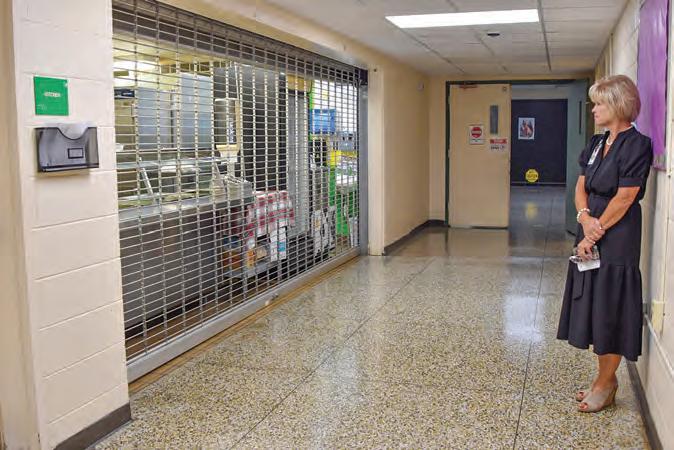
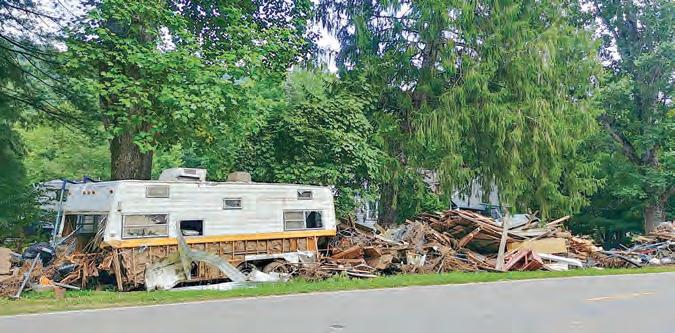
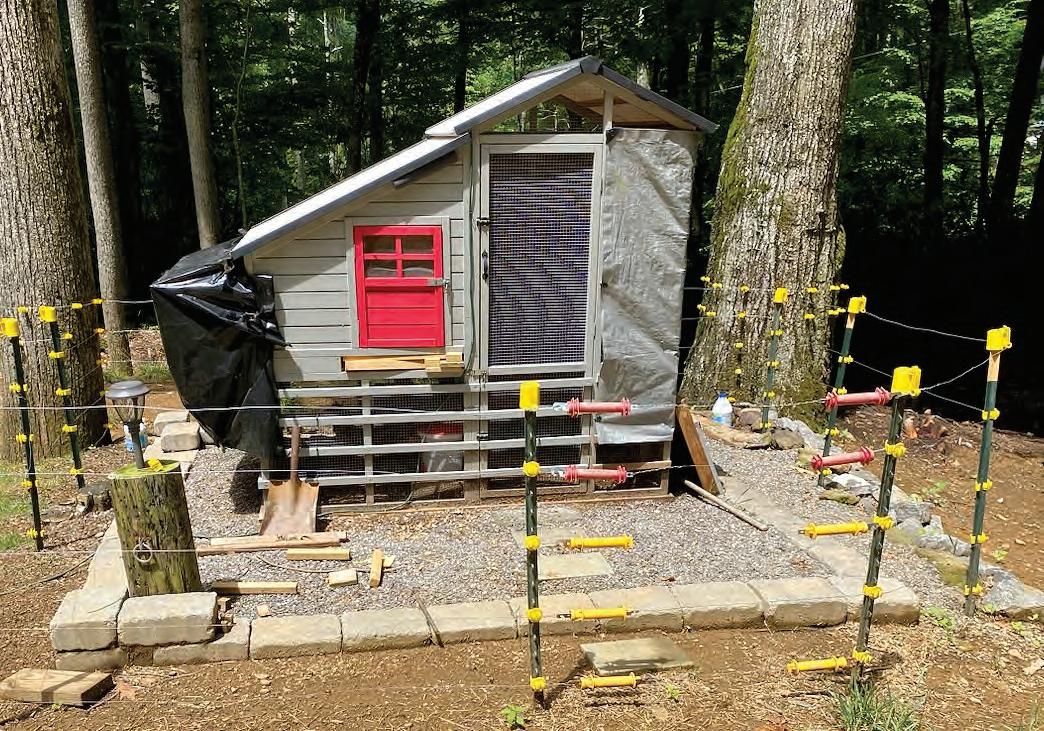
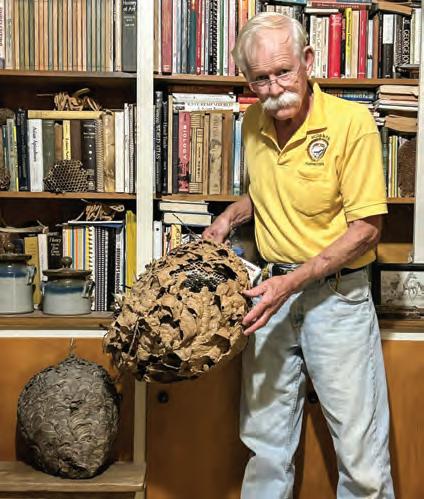
Electrified wires emerge as solution for bear problems Page 24
On the Cover:
As young attorneys are increasingly drawn to urban areas to practice law, more rural counties are turning into “legal deserts,” defined as having less than one lawyer per 1,000 residents. Out of the seven westernmost counties in North Carolina, two — perhaps three — are legal deserts. An overall lack of attorneys in the area is creating barriers to legal representation and a backlog of cases. As the problem gets worse, judicial officials are trying some innovative solutions. (Page 6) Jack Snyder illustration
News
Jackson schools weighs needs and wants ahead of bond vote............................4
Haywood commissioners briefed on emergency flood sirens................................5
WCU partners with local hospitals for care, performance support......................9 For any need, call Restoration House..........................................................................10
Opinion
Trusting the unknowns......................................................................................................14 Local newspapers play essential roles in their communities................................14
A&E
Quilting stitched Appalachian communities together............................................16 Pigeon Center continues ‘Conversations with Storytellers’..................................22
Outdoors
NCWRC advocates for electrified wires to thwart mischievous bears............24 Invasive hornet species found in North Carolina......................................................25
ART D IRECTOR: Micah McClure. .
D ESIGN & PRODUCTION: Jack Snyder. .
D IGITAL MARKETING S PECIALIST Tyler Auffhammer. . . .
ADVERTISING SALES: Amanda Bradley. . . .
Maddie Woodard. .
C LASSIFIEDS: Jamie Cogdill. . .
N EWS E DITOR: Kyle Perrotti. .
WRITING: Lily Levin. .
Alex Perri. .
Garret K. Woodward.
ACCOUNTING & O FFICE MANAGER: Jamie Cogdill.
greg@smokymountainnews.com
micah@smokymountainnews.com
jack.s@smokymountainnews.com
tyler.a@mtnsouthmedia.com
amanda.b@smokymountainnews.com
maddie.w@smokymountainnews.com
classads@smokymountainnews.com
kyle.p@smokymountainnews.com
lily.l@smokymountainnews.com
alex.p@smokymountainnews.com
garret@smokymountainnews.com
smnbooks@smokymountainnews.com
C ONTRIBUTING: Jeff Minick (writing), Susanna Shetley (writing), Adam Bigelow (writing), Thomas Crowe (writing)
I NFO & B ILLING | P.O. Box 629, Waynesville, NC 28786
Copyright 2026 by The Smoky Mountain News.™ Advertising copyright 2026 by The Smoky Mountain News.™ All rights reserved. Reproduction in whole or in part without permission is prohibited. The Smoky Mountain News is available for free in Haywood, Jackson, Macon, Swain and parts of Buncombe counties. Limit one copy per person. Additional copies may be purchased for $1, payable at the Smoky Mountain News office in advance. No person may, without prior written permission of The Smoky Mountain News, take more than one copy of each issue.
Jackson schools weighs needs and wants ahead of bond vote
BY ALEX PERRI STAFF WRITER
School starts Aug. 12 for Jackson County Public School students, and throughout the county, district faculty staff are busy sprucing up their campuses for the next batch of learners to walk through their doors.
For educators across the country, now is crunch time. Painters are adding the final touches to new murals in school hallways. Custodians are applying fresh coats of wax to the floors. Teachers are stapling new posters to their bulletin boards. It’s also the time of year when educators notice that a fresh coat of paint can only do so much.
With the prospect of a $105 school bond on the ballot this November, faculty, staff and administrators at JCPS are hoping there will be funds to address needs beyond the cosmetic across the district’s schools.
“This whole area would be such a wonderful space if it could just get renovated,” said Smoky Mountain High School Principal Joey Robinson inside the high school’s old gym. The bathrooms in the building have not been updated in decades, and Robinson said the men’s room was so badly run down, few students elected to use it.
As it stands, Jackson County has allocated $2.6 million to SMH for facilities upgrades — the bond would add $8 million to the budget to complete a list of projects JCPS says they need to be addressed now.
One of the school’s biggest needs is renovations to its stadium. To add a ramp that is Americans with Disabilities Act compliant to the stadium, Jackson County Public Schools Superintendent Dana Ayers said the estimated cost is $3 million
“It doesn’t seem like it should be that extraordinary, but building costs are very high, and we recognize that,” Ayers said. “But that, to me, is not a want. That is a need.”
Making sure the stadium is accessible is essential to students and the community, Robinson said, and the current stadium is not ADA compliant.
Additionally, as the new semester approaches, soon the SMH fieldhouse will be overstuffed, Robinson said, and logistics become challenging when there is not enough room to accommodate players, coaches, visiting teams and officials. It’s also a safety issue.
Just down the road at Cullowhee Valley School, Ayers was thrilled to see new windows, a project that did not need bond funding to complete. The windows had risen to the top of the district’s list of needed repairs,
and the old windows were so warped they couldn’t properly shut. Not only did this present a safety issue, but it also presented a problem when it came to climate control and the occasional unwanted critter.
The new windows are sleek and now safe. But with this project ticked off the list, the district will move on to the next greatest need — often an issue that poses the greatest health and safety risk — while less urgent improvements are kicked down the road.
For example, Cullowhee Valley School Principal Melanie Jacobs would love to add an ADA compliant bathroom to the school. The current bathrooms are outdated, one student in a wheelchair uses the staff bathroom. The fence separating the school from the adjacent Cullowhee Rec Center also needs repairing, as do drainage issues in the parking lot.
“But we have to take turns,” Jacobs said. “It’s been a need for many years, people’s roofs are more important than our fence, so we have to take turns.”
The growing list of deferred maintenance projects isn’t unique to Jackson County Public Schools. In the last N.C. Public School Facility Needs Survey, the N.C. Department of Public Instruction identified nearly $12.8 billion in needs for the state’s 115 school districts in 2021. Adjusted for inflation, that number has risen to nearly $16 billion, and with construction costs showing no sign of dropping soon, Ayers is adamant that the cheapest time to address these needs is now. With the over $18 million in the proposed bond allocation numbers reserved for general needs and remodels, Ayers hopes to tackle those deferred maintenance needs.
In Cashiers, Blue Ridge School stands to gain the most funding from the bond at
the youngest students drop their tray of food on their way to the lunch tables every day. Additionally, the capacity at the BRS gym is maxed out. Frizzell said the gym is in constant use during the school day with P.E. classes, which leaves no large common space for things like assemblies or school meetings. During game days and graduations, there is not enough room for spectators, nor is there much in the way of ADA accommodations.
More than those immediate needs, however, BRS wants to build a performing arts auditorium and new classroom space, two items that are looking increasingly like a pipe dream without the bond passing.
Finally, Ayers is adamant that JCPS staff need a new bus garage.
“Having the extra space to get some of our newer busses in here to work on is a great need for us,” Josh Francis, JCPS Director of Transportation said.
$23.8 million (not including the proposed Smoky Mountain Middle School) of all the county’s existing public schools. The $15 million currently allocated to BRS from the county budget is not enough, Ayers said. The two most urgent needs at the school are remodeling the gym and adding a new cafeteria, the projected costs of which are already threatening to exceed that $15 million amount.
In the current space, lunchtime presents a challenge for BRS faculty and staff. The school’s kitchen is in the hallway next to the gymnasium. During lunch, students from pre-K to sixth grade line up on one side of the hallway to wait their turn. On the other side of the hallway, they grab their hot food, and in the middle, P.E. students and students who’ve made it through the line filter through back and forth.
Ayers said it is not up to code, and Blue Ridge Early College Principal Nathan Frizzell said it’s not uncommon to see one or two of
When the bus garage was built in the 1950s, busses were much shorter. The average school bus fit 66 passengers and was about 39 feet long. Today’s busses are quite a bit longer and taller, Francis said. The current bus garage is too small for staff to work on more than one bus at a time, meaning mechanics have to take much of their work outside in the elements. The current bus garage also has a leak in the roof. If the bond doesn’t pass, Ayers said JCPS will have to find funding somewhere to fix the leaking roof, which will kick the can for the new building down the road indefinitely.
With a new building, Francis said his staff could work on more busses at a time, significantly improving productivity. Additionally, he said he would like to see his staff get a break room with air conditioning and room for the bus driver training classes all bus drivers must complete.
If the bond passes, Jackson County would raise property taxes by 4.86% to pay the principal and interest. The maximum aggregate principal amount of the bond be $105 million, while the total amount of interest paid on the bond would not exceed $35,647,256. Jackson County Commissioners will vote whether to authorize the bond referendum following a public hearing at their Sept. 1 meeting. JCPS and Jackson County Commissioners urge the public to provide comment.
Jackson County Public Schools’ current bus garage is too small for staff to work on multiple busses at a time, meaning mechanics have to take much of their work outside into the elements. Alex Perri photo
Jackson County Schools Superintended Dana Ayers has been weighing the needs and wants of the school system. Alex Perri photo
Haywood commissioners briefed on emergency flood sirens
BY KYLE PERROTTI NEWS EDITOR
There is a simple phrase Haywood County leaders want residents to remember: “Hi-Lo, time to go!”
Those simple words can save lives, Haywood County Recovery and Resiliency Manager Cody Grasty told county commissioners during their Aug. 3 meeting. Grasty came before the board to discuss the county’s 18 now-operational emergency flood sirens that were approved following Tropical Storm Fred in August 2021.
Six lives were lost in that storm, which caused extensive flooding in the southeastern part of the county. Five more people died during Hurricane Helene in September 2024, only reinforcing the need for a local emergency alert system, especially as cellular networks went down during that storm.
people may be used to. Following the tone is a spoken message saying, “Climb to higher ground.”
If someone hears the siren, the instructions are simple. Immediately climb upward. Bring only people, pets and a phone, if possible. Grasty instructed people not to get in a vehicle as trying to drive around floodwaters can itself be hazardous.
“If you hear it activate, don’t hesitate,” Grasty said.
“Treat it like a firefighter knocking on the door saying, “it’s time to go,’” he added.
The tones from the sirens can travel about a quarter mile, depending on foliage and weather conditions. Each siren features an array of speakers. They’re placed in locations determined to be the most effective through acoustic modeling.
The county runs a “silent test” every day,
Catering is Our Passion!
We Can Cater Everything from an Intimate Get-Together to a Large, Formal Gathering & Everything In-Between!
828-452-7837
294 N. Haywood Street
or carry out
“These improve how we alert people in areas that have poor cellular reception,” Grasty said.
There are now 10 sirens along Cruso Road, four in the Lake Logan area, and one each in Waynesville, Clyde, Center Pigeon and near the Smoky Mountain Event
Center. Grasty highlighted one of the Lake Logan-area sirens near Camp Daniel Boone and the SMEC siren, noting that those will alert “special populations” not likely acquainted with mountain flooding since they attract large number of outof-town visitors.
There are now 10 sirens along Cruso Road, four in the Lake Logan area, and one each in Waynesville, Clyde, Center Pigeon and near the Smoky Mountain Event Center.
basically just a process to check that the circuitry is operational. It will do an audible test once per year. Grasty said that ahead of these tests, emergency officials will put the word out with signs and mobile alerts. If people hear the siren, he said, when in doubt, take the emergency actions.
Commissioner Terry Ramey asked whether sirens will be placed in more populated areas prone to flooding. Grasty said he has been in discussions with towns about where those may go while also exploring funding opportunities.
Those who aren’t close to a flood siren should stay aware of weather conditions, watch for mobile alerts and keep a backup means of obtaining information like a weather or am/fm radio, Grasty said.
In the future, sirens can be activated automatically when rain or river gauges hit a certain setpoint. For now, they are operated manually either at a remote location or at a specific siren. The sound is a “digital” rising and falling noise more akin to an emergency response vehicle siren than the old klaxon
For more information on the flood sirens and up-to-date emergency information, visit readyhaywood.com.
Flooding has devastated Haywood County three times in the 21st century. Local leaders are trying to prevent unnecessary loss of life. File photo
WNC legal deserts hinder access to justice
While some urban areas in North Carolina have a glut of attorneys, the western part
Judicial leaders test new solutions
BY KYLE PERROTTI NEWS EDITOR
When Mack Tallant returned home to Western North Carolina to practice law in 1995, he was one of five attorneys based out of Graham County. In 2026, his is the only full-time law office.
“I’m either the best attorney in the county or the worst attorney in the county depending on the day,” he said with a chuckle.
Tallant, 57, is hitting the short-term planning stages for his retirement. While some lawyers will continue to work into their 70s and even 80s, he wants to slow down and enjoy the fruits of his labor. However, he’s concerned with the state of the judicial system in the region and how future generations will be affected.
Tallant, who grew up in neighboring Cherokee County, initially practiced law in a variety of areas, although he admitted he’s never had a stomach for criminal defense work, which is adversarial and emotionally taxing. Now, he spends 95% of his time as a
real estate attorney, satisfying the growing demand for such work with people from out of state purchasing and building second homes. He also works from time to time on wills and estates.
Even still, Tallant said that he feels spread too thin.
“I can’t always get to things in what I would consider a timely manner or go in depth on things I feel like I need to spend time with,” he said.
DRYING OUT
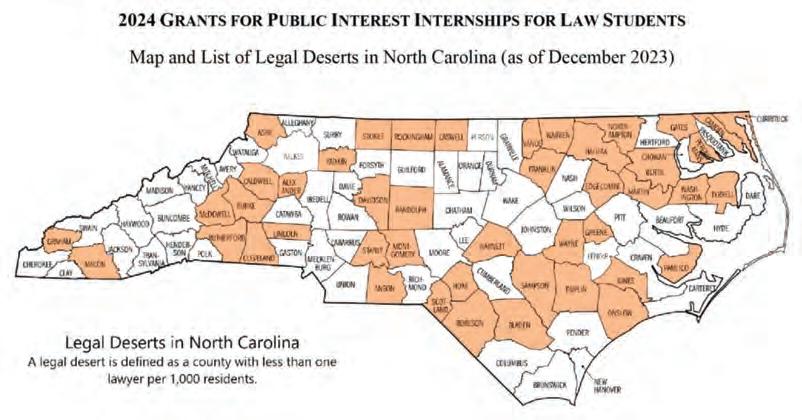
The concern Tallant described to The Smoky Mountain News has been echoed by leaders in the region’s judicial system as the state grapples with an increasing number of legal deserts in rural counties, defined as an area with less than one attorney per 1,000 residents. Almost half of the state’s 100 counties are legal deserts, and the majority of North Carolina lawyers practice in just five urban counties. The seven westernmost counties comprise the 43rd Judicial District — Haywood, Jackson, Macon, Swain, Clay, Graham and Cherokee. As of December 2023, Graham and Macon are considered legal deserts, although given recent trends,
it’s likely that Swain has joined the club. Legal deserts create a host of problems. Parties in cases must travel longer distances and spend more time dealing with court cases, and backlogs can develop in civil and criminal court, delaying due process and wasting taxpayer dollars. According to an article published on the American Bar Association website, children in rural areas are more likely to experience maltreatment and become involved in the juvenile court system than children in urban areas. The judicial district’s resident senior superior court judge, Roy Wijewickrama, has been calling for more attorneys to practice in the area for years, even back to his time on the District Court bench in 2024. Wijewickrama believes the problem is getting worse. Echoing Tallant’s concerns, the judge noted the large number of lawyers who’ve retired over the last decade and all the years of experience they’ve taken
with them. With a lot of older attorneys practicing in WNC, that problem will only get worse, Wijewickrama said.
“They are not being replaced,” he said. Wijewickrama was born and raised in Haywood County and returned home in 2001 after law school. He worked as an assistant district attorney, tribal prosecutor for the Eastern Band of Cherokee Indians and in private practice before becoming a district court judge in 2014. Coming home and entering the legal field used to be more common than it is now, Wijewickrama said. He attributes the change to a growing disparity in pay and perks between WNC and bigger cities, which also offer unique opportunities for career growth, mentorship and specialization. Of course, some are simply drawn to the exciting big-city lifestyle. He could think of several law students over the years for whom he’s written rec- F
of the state has several counties that are considered legal deserts.
Superior Court Judge Roy Wijewickrama
ommendations but ended up in the Charlotte or Raleigh areas or even out of state.
“Now, I’ll tell them I’ll write it under one condition — if they come back to Western North Carolina and practice law,” he joked.
Some attorneys who practice in the region may also hear the call of higher-paying opportunities in their own backyard. Several sources interviewed for this story said the Eastern Band of Cherokee Indians draws talented lawyers with positions in one of its departments that offer better pay and benefits. EBCI
Attorney General Mike McConnell did not respond to a request for an interview about trends seen on the Qualla Boundary.
THE PUBLIC SERVANTS
of experience. She’s been able to fill those positions with young attorneys, most of whom have ties to this area. Those established support systems help in myriad ways, including financial. The salary for inexperienced assistant district attorneys is $57,200, although Hornsby said starting pay in her office is higher. Nonetheless, there are likely always more lucrative options.
District Attorney Ashley Hornsby, originally from Henderson County, returned to the region and advanced her legal career into elected office in 2014. She is running unopposed this year to secure her fourth term. Hornsby moved home after graduating law school in 2003 and worked for the district there before moving out to Franklin and joining then-District Attorney Mike Bonfoey’s staff in 2005, where she served until she was elected almost a decade later. She didn’t know early in her career where she’d end up, but she knew she’d found her calling.
Hornsby is a career prosecutor. She knew what she wanted at just 13, when she witnessed part of a murder trial and was fascinated that there was a person arguing on behalf of crime victims to secure justice. She always had the desire to come home, although she admitted that in Henderson County, it felt odd to send people she knew to jail. Moving west to Franklin also gave her the opportunity to try “bigger,” “more complicated” cases, she said. Hornsby believes that during her tenure in elected office, the hiring process in her office hasn’t changed much other than having more positions to fill. The larger staff has been necessary to meet a growing demand.
“I will say that the workload has not eased up at all,” Hornsby said. “In a lot of ways, it’s gotten harder.”
While she said she hasn’t had trouble finding talented attorneys, it does take a unique kind of person to want to be a prosecutor, which winnows the field off the bat and creates a relatively high attrition rate.
“I think most of the people in this office love being prosecutors,” she said. “That’s why we’re here. But it’s hard to keep people when the day in and day out is pounding the pavement for clients.”
Like in other legal offices, Hornsby has recently lost senior personnel with decades
This map shows which counties in North Carolina are legal deserts. UNC School of Law graphic
partner, also an attorney.
“My intern this year was excellent, and he does hope to come back,” she said. “We’ll do what it takes.”
Grace
Grace blends ancient techniques, deep compressions, and assisted stretching with deep tissue and trigger point therapy to create sessions that are both grounding and deeply restorative.
She recently earned her Corrective Exercise Specialization, adding tools to help clients build strength, mobility, and confidence that carry into daily life.
O’Neil Call
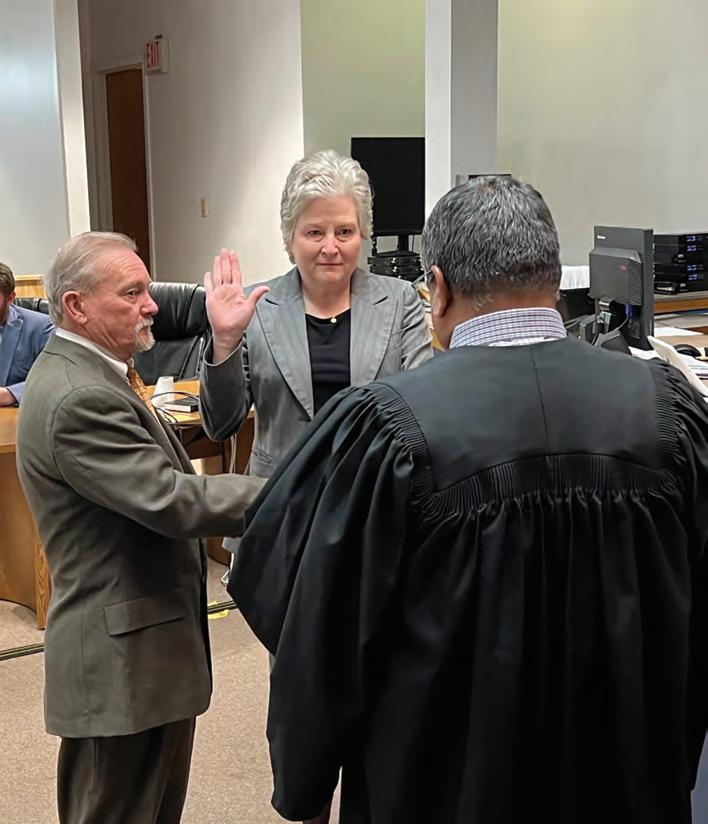
Janna Allison was sworn in by Judge Roy Wijewickrama in as the Chief Public Defender for the new 43rd Defender District on Jan. 2, 2024.
North Carolina Office of Indigent Services photo
WCU continues partnership with hospitals for care, support
BY ALEX PERRI STAFF WRITER
Catamount fans might notice a new logo on the football field at Western Carolina University this season, as a partnership between Harris Regional and Swain Community Hospitals and the university has just been renewed for another four years. The renewed partnership comes as a sign of growth between two of the largest organizations in the state’s westernmost counties.
This longstanding partnership has made Harris Regional and Swain Community Hospitals the official health care providers for WCU Athletics and provides comprehensive health and performance support to Catamount student-athletes.
“Having a hospital geographically this close and willing to be here, be supporting, they’re basically a part of our team within the athletic department,” said WCU Director of Athletics Kyle Pifer. “When our athletes need medical care, there’s no hesitation.”
Harris Orthopedics and Sports Medicine, a department of Harris Regional Hospital, provides team physician coverage and collaborates with WCU’s athletic training and athletics staff as part of a coordinated network of care.
Pifer, WCU Chancellor Kelly R. Brown and Harris and Swain Community Hospitals CEO Ashley Hindman officially extended the agreement at a signing ceremony last week on WCU’s campus. The partnership renewal also comes with an increased brand presence and the hospitals’ logo added to the field and student athletes’ uniforms this year.
According to Pifer, speed and proximity to treatment are paramount to making sure student-athletes are not only fit to perform when it’s gametime but also in the classroom. This hospital partnership means WCU dedicated team doctors on site helping prevent and treat injuries.
“They are here. They are on site. If we need to get them to the hospital, it’s a quick run. We couldn’t function otherwise. That’s how important it is to have this partnership at Western Carolina,” Pifer said.
letes’ health, Brown said the partnership is also significant to the community. When the two institutions work together, she said, it helps to strengthen them both.
“We focus on education; Ashley [Hindman] focuses on the healthcare,” Brown said. “Coming together, we really make a really great team for Western North Carolina, and I think that that's what this partnership really talks about — doing this for the community, Jackson County, Haywood County and those to the west of us.”
Hindman said he was excited to be a part of WCU’s recent growth.
Last week, the university announced it expects a record-setting freshman class this year, which comes on the heels of strategic efforts to expand recruitment, strengthen academic programs and elevate the student experience, according to a WCU news release.
The previous fall enrollment record for the university was in 2018, with 2,186 incoming freshmen. This year, school officials believe the class could exceed 2,400, the highest in the university’s 137-year history.
following Hurricane Helene, the university considers the projected rebound to be an indicator of significant economic recovery, the news release said.
Hindman sees this as an opportunity to grow together.
“We just want to be a part of that,” he said. “It’s great from our perspective. It may be a subtle recognition of the great healthcare we provide to the university’s athletic department. To entrust the care of their stu-
providers, that speaks volumes.” He said it will be a springboard for more collaboration between the two institutions to come. Hindman said he was honored to be a part of this tight-knit community. Classes begin at WCU on Monday, Aug. 17, and the first home football game kicks off on Aug. 29. Brown encouraged Catamount fans to purchase their tickets soon, as she expects the home opener to be a sellout.
The Western Carolina University football field will sport a new logo this season, highlighting a partnership between the school and local hospitals. WCU photo
For any need, call Restoration House
BY LILY LEVIN STAFF WRITER
Restoration House staff didn’t hesitate when they found a familiar woman suffering from a panic attack, lying face-down in the dirt. Once Dedey Mathis was safely inside their vehicle, they drove off in search of help.
Seizures render Mathis unable to drive, so she walks nearly everywhere. Restoration House Executive Director Amy Dodson and case manager Pattie Ivey give her a ride when she can’t reach her destination on foot. Because of that small, nondescript white building on Academy Street in downtown Bryson City, she can also take warm showers, access her prescriptions and restock her cabinet. Restoration House is a lifeline to Mathis — and to hundreds just like her throughout Swain County.
Despite the breadth of its services — among them, also a MANNA-sponsored food pantry serving about 2,000 monthly, a grab-and-go outdoor refrigerator that’s stocked with meals and always open, a diaper bank, free Narcan and over-the-counter medication — the organization is assumed by many to only serve the unhoused population. That’s a false narrative, said Board Chair Dan Manley.
“Yes, we do embrace our homeless population as our family here. But most importantly, all of our services that comes out of the Restoration House is geared towards anybody that is struggling at all in this community, whether it’s food insecurity, whether it’s a housing issue, whether it’s an emergency with paying your bills,” he said.
“You can come to us with something bizarre and usually Pattie [Ivey] or I will be able to fix it by the end of the day,” said Director of Recovery Operations Amanda Caldwell. “I’ve given a puppy its shots. We do a lot.”
The nonprofit is also run according to the principle that barriers to entry must be eliminated to adequately cater to the community.
“You show up at our door and say, ‘I need food.’ You have self-declared your need,” said Manley.
Restoration House’s Diane Rosenberg, whose position is funded by the State of Franklin Health Council, emphasized how foreign that practice felt to pantry newcomers, used to filling out forms and jumping through hoops to prove eligibility.
“People will always say, ‘What do you need from me? You need my driver’s license, my birthday?’” she recounted, adding that the only information she requires is a name and the size of one’s household. “That’s all I need.”
If preferred, a fake name is also permissible, so long as it is used each visit.
Volunteer Keonta Ardrey said Restoration House is unique in how it facilitates guests’ agency.
“This place provides things that most places don’t provide,” he said. “Like a full kitchen over here … You come in here and
cook your own food.”
Furthermore, Restoration House has taken on the cost-of-living crisis within the area, perhaps the base from which the misleading claim of “homeless only” arose. Staff agreed that the cause of Swain County’s unaffordable housing is the nationwide trend of increasing rental prices. Another is the prevalence of short-term rentals.
61.5% throughout fiscal year 2025-26, with increased nightly rates and revenue, reported AirROI.
Short-term rentals are not regulated (nor are restrictions in process) at either the county or town level, unlike other parts of The Smoky Mountain News coverage area. Highlands, in Macon County, has strict STR regulations in residential zones subject to
ers’ property. In fierce opposition from the beginning was Commissioner David Loftis.
“I believe we’re intruding too much on the landlords and all this junk about the law and forcing, tearing it down and stuff,” he said at a May 5 meeting.
The Affordable Housing Committee at a June 2 joint meeting with the commission raised concerns that the ordinance might displace residents, though temporary lodging was offered as a solution. It was later tabled indefinitely.
On the pricing side, Ivey routinely helps
A recent TIME article outlining the former root cause explained that buyers competing for a new apartment building will bid with a loan secured from the bank based on rent growth forecasts. Generally, greater rent growth forecasts will enable higher loans — and increase the likelihood of the bid going through. Upon purchase, the building is bound to the rent growth prediction. Landlords price units at the highest market-permissible amount, so when the market speculates steep increases, rent hikes are the “business plan.”
As for the latter issue, Restoration House employees could speak to personal experience.
“I watched people I had known my whole life get evicted because their house was cute and they rented it, and now it’s an Airbnb, and it generates so much more money,” said Caldwell. “We’re losing the local people, which loses the culture of our area.”
Airbnb supply in Swain County grew
ongoing litigation; Sylva, passed a STR ordinance in August 2022 and Waynesville, is developing one.
But Swain County doesn’t lack housing. In fact, numbers point to the opposite: The county house vacancy rate in 2022 was 32.7%, compared to 0.7% for all of North Carolina. What it does lack, said Ivey, is housing that is decently priced and habitable.
“When we had the [Healthy Opportunities Pilot] program, half of these rentals didn’t even pass their inspection because HOP would only give you the money if it was a safe place to live,” she said.
Swain County does not have a minimum housing ordinance, and even when one was proposed earlier this summer, it was described as primarily tenant complaint-driven, rather than mandating a habitability inspection. Immediately, commissioners had mixed reactions. Chairman Jay Kirkland wanted renters to have a safe place to live but felt conflicted about imposing on oth-
folks with Section 8 subsidized housing applications, but she’s not optimistic about their chances. One apartment complex is attempting to nix its Section 8 status, she said, even as locally, the voucher program already sports a waitlist.
“Affordable housing now is even shrinking more,” said Ivey. “These people can have two, three jobs, and they still can’t make rent.”
A common misconception is that those living on the streets are unwilling to work — and that housing inevitably comes with employment. In reality, the leading root cause of homelessness in the United States is a lack of affordable housing. Studies from 1988 to 2023 by agencies from the Institute of Medicine to Zillow point to a direct relationship between homelessness and availability of low-cost housing. Furthermore, it’s far more difficult for someone experiencing homelessness to find employment.
“People forget [that] for a job, F
From diapers to mac ’n’ cheese, Restoration House supplies various basic essentials. Lily Levin photo
even, a lot of these folks don’t have identification, so we’ve got to get a birth certificate, a Social Security card. We’ve got to go get them their I.D. It’s a process, so that’s why sometimes it feels like it takes so long,” said Ivey.
Job applications typically require a home address, which unhoused individuals do not possess.
Up to 40-60% of the homeless population is employed despite that fact, and Restoration House has been able to get some of these people off the streets and into stable housing situations.
“I am up to 19 people that were on the street this year that we’ve got into stable housing. Some of them became homeless, and we were able to fix it inside a month,” said Caldwell. The nonprofit previously operated a nightly Bryson City shelter called Sweet Dreams with the capacity to house six individuals.
But operations eventually “fizzled out,” said Dodson.
So Sweet Dreams briefly became HOP program headquarters until funding lapsed in late 2025, as the Republicanled General Assembly then hadn’t passed a budget. The Medicaid-based program, focused on addressing social determinants of health through preventative measures like promoting access to fresh food and addressing residential toxins, reduced annual healthcare spending, on average, by more than $1,000 per enrollee throughout its three-year rollout.
At the time, the board opened its meetings to anyone with doubts, urging them to listen and learn about the project. According to Dodson, some attended.
“They left nodding their heads,” she recounted.
Still, she said, they maintained the same opposition in the days that followed.
HOP’s discontinuation was the true dealbreaker. Program funding has been restored with the June 2026 biennial budget — though only partially. The legislature satisfied $25 million of the $80 million HOP appropriations originally requested. And there could be repercussions from such a pause, NC Health News reported. Previous employees might not return. Participating farms may supply fewer produce.
Likewise, state appropriations will not prompt Restoration House’s return to the historic hotel. Staff have moved onto the smaller, less visible Sweet Dreams (with a name change still up for discussion).
“I am up to 19 people that were on the street this year that we’ve got into stable housing. Some of them became homeless, and we were able to fix it inside a month.”
Amanda Caldwell, Director of Recovery Operation
Without HOP appropriations, Restoration House staff, again made to rethink Sweet Dreams’ purpose, settled on their own pilot: a four-month supply of workforce transitional housing. This was not a new idea, though it would be a new initiative. The organization had tried in 2025 to implement an identical model at Calhoun House, a historic hotel named for William Calhoun, a descendant of former Vice President John C. Calhoun.
Calhoun House felt ideal for two reasons: accommodations for 21 living units and a history that fit the bill. About 90 years ago, the hotel was converted into apartments for the Fontana Dam construction workforce.
But the Calhoun House initiative ran into two major problems: it infuriated some of the public and it relied predominately on HOP appropriations. Community members and Bryson City business owners became falsely convinced the building’s new occupants would bring drugs and filth to the area, said Manley.
“We wanted to help people who were working be in a place that only cost them $800, $850 a month to live,” he explained, noting that this price point would ensure they’d have enough left over to afford essentials like car repair and clothing.
Sweet Dreams’ under-the-radar status — an absence of drugs, filth and other negative associations some have with the indigent and unhoused — is a point of pride for Dodson.
“The police said they didn’t even know about it … They didn’t know we owned a second location,” she said.
While the building hasn’t yet opened its doors to full capacity, it has piloted with several community members. And the outcomes have been promising.
“We had a young man who had a 10year-old son. They were living in their truck in the parking lot, and so we tested it out. For four months he stayed in a room, and at the end of the four months, not only had we helped him get a job, but he was stable. He got a home someplace else,” said Dodson.
After four months of workforce transitional housing, another 19-year-old boy had saved 80% of what he’d earned.
Restoration House staff told The Smoky Mountain News that these results point to success at a larger scale. When Sweet Dreams does take off, occupancy will come with a major stipulation.
“They’re going to have to be drug-free, but we are not going to drug test because it is not going to be a halfway house,” said Dodson.
The notion that the nonprofit’s primary location — not Sweet Dreams — attracts those addicted to drugs may have some truth to it, said community member Amanda Carpenter, who was at Restoration House to grab food from the pantry and spoke to SMN with two kids in tow. But, she said, it’s for one specific reason.
“This is the only place they can find to get help.”
And the assistance offered, she added, is extremely valuable.
“This place has got a lot of people off drugs, and that’s what I really want to see around,” she said.
Carpenter has a personal stake in substance use disorder rehabilitation. At 13 years old — the era of girlhood that brings lowered self-confidence, peer pressure and a still-developing body and brain — she began using methamphetamine. Early use significantly increases the risk of long-term addiction, which became Capenter’s reality.
At one point, when she was living in a camper, the Department of Social Services terminated custody of her children. What brought her to sobriety was that even in the throes of her addiction, she cared about her kids far more than the drugs.
But after four years sober, the urge doesn’t get any easier.
“Every day, I fight to stay away from methamphetamine. It’s a very hard thing to do,” she said.
Both the American Medical Society and American Society of Addiction Medicine classify substance use disorder as a disease rather than a moral failing. A biogenetic predisposition to addictive behaviors and chemicals increases one’s risk of substance abuse but is not generally a causal factor without other predispositions such as early-life traumatic experiences.
High-risk drug use can increase one’s risk of homelessness, but homelessness can also cause or worsen high-risk drug use.
Yet Carpenter said locally, some of the services that made life a little bit easier for unhoused substance users hardly exist anymore.
“You can’t use the [public] bathrooms because they lock them up. I mean, just because they do drugs doesn’t mean they can’t go in there and wash their freaking hands and live — still live,” she said.
Other challenges faced by the
population aren’t as
as an inaccessible stall. Carpenter and Mathis both agreed Swain County law enforcement is especially hos-
local homeless
passive
Nonprofit staff and volunteers, like RJ Hensley, sort and maintain food pantry shelves. Lily Levin photo
“‘You can’t be homeless around here,’ is what they try to say,” said Carpenter, adding that when she lived on the streets, she was forced to move to Robbinsville because of the informal prohibition.
Mathis, who has also experienced homelessness, put it in more explicit terms. “‘Out of sight, out of mind.’ That’s what the cops are saying.”
themselves and cook and clean,” she said.
Mathis said that while the homeless are seen as dirty, most keep their living space as hygienic as possible.
“The tent is like your house. It’s very neat and clean,” she explained.
Meanwhile, key differences between tents and houses include the latter’s insulated physical structure and permanent foundation. So, transition from life on the street
But a large body of research points to the opposite, deeming ‘out-of-sight’ policies ineffective and unjust. A comprehensive Oxford University Press study noted that laws and actions treating homelessness as a crime — such as encampment relocations, property destruction and citations — “fail to reduce urban disorder but create instead a spatial churn in which homeless people circulate between neighborhoods and police jurisdictions rather than leaving public space.” Antihomeless laws not only harm the health and safety of homeless people but also reduce their ability to find help, housing and employment, which in turn may increase their likelihood of remaining unhoused.
Carpenter explained why people experiencing homelessness prefer to remain proximate to town.
“They [stay] out close to here so they can be sanitary and come and wash
to within four walls can be jarring, according to the National Health Care for the Homeless Council. While no one chooses to be homeless, Mathis told SMN that someone acclimated to prolonged homelessness might struggle in a different environment.
“[When] you get used to [life on the street] for so long, you can’t function in a home,” she said.
A comprehensive Oxford University Press study noted that laws and actions treating homelessness as a crime — such as encampment relocations, property destruction and citations — “fail to reduce urban disorder but create instead a spatial churn in which homeless people circulate between neighborhoods and police jurisdictions rather than leaving public space.”
That Mathis and Carpenter were able to weather this adjustment speaks in part to the work of Restoration House. For example, with $200 from nonprofit’s emergency financial assistance fund, Mathis secured power for her property. For Carpenter, who takes care of her four children and mother-in-law, it’s uplifting to know that she’ll find food and community in that small, white Academy Street building.
“God bless this place for helping when people need it,” she said.
Restoration House sits in downtown Bryson City, just off exit 67. Lily Levin photo
Trusting the unknown
Everything is as it should be.
“Meditations” by Marcus Aurelius is based on this philosophy, and I often whisper these words as a mantra when life seems confusing or frustrating.
Everything is as it should be.
Controlling an outcome is futile, but human nature is forgetful, so again and again, we find ourselves contorting and pushing to reach a desired conclusion — when letting go and trusting the unknown is perhaps the best course of action.
We’ve all experienced serendipitous events that seem too bizarre to explain as a mere coincidence. In fact, over the past week, a number of ironic encounters and synchronous moments reminded me that a force bigger than myself is steering the ship.
Several summers ago, I moved through a spiritual metamorphosis, and this wasn’t the first time. Throughout my life, there have been periods where I shed stagnant, unproductive thoughts and beliefs in order to dive deeper into my faith and the meaning of our existence on earth. It involves a lot of reading, praying, meditating, journaling and quiet time. When I was in the middle of this most recent evolution, I dug into the topic of universal laws, which are spiritual and metaphysical practices that help guide us toward the next right thing.
The total list of 12 includes the law of divine oneness, the law of vibration, the law of action, the law of correspondence, the law of cause and effect, the law of compensation, the law
of attraction, the law of perpetual transmutation of energy, the law of relativity, the law of polarity, the law of rhythm and the law of gender.
There’s an abundance of podcasts and books on these laws, so I won’t spend time explaining them here, but I have my favorites such as the law of divine oneness (we’re all connected) the law of vibration (we’re drawn to people and experiences on the same frequency, and we have the power to increase our frequency at any moment), and the classic law of attraction (positive attracts positive while negative attracts negative).
I’ve learned that being open to and aware of these laws is the first step in allowing them to influence your life. When I try to resist the natural flow of things, even if I’m not quite getting my way, I feel more stressed and tense than when I go with the flow. Feeling stuck is another indicator that I’m trying to bend things to my will instead of being open and curious to the myriad possibilities.
I’ve mentioned in previous columns that my older son is currently being recruited to run in college, and it’s a huge decision that will affect his life trajectory in significant ways. He and I have both discovered that keeping an open mind and taking the time needed for reflection have been helpful.
Even though we went into the experience with preconceived notions and desired outcomes, we quickly realized that was only going to cause stress and possibly regret.
Similarly, I’ve been reminded lately that human relationships are hard, but sometimes the beauty is in the mess. It’s only through struggle that we heal, grow and discover our deepest vulnerabilities and triggers, and it’s from these dark places that we learn where the work needs to be done. As Rumi said, “It’s through the wound where the light enters you.”
This back-to-school season brings monumental “first days.” We have two kids starting their senior year in high school, another starting his freshman year in high school, a fourth starting his sophomore year in college, and a fifth who for the first time since she was a small girl, won’t have a first day of school at all since she graduated college last spring.
I know the kiddos in this household will grow and change tremendously over this next year. Decisions about colleges will be made and as their parents, we’ll help them navigate their paths, trust in their inner guides, stay curious and not force outcomes. I’m working hard to embrace the wisdom of uncertainty. Instead of fearing the unknown, I’m allowing life to be a wonder and a gift, a treasure trove of infinite possibilities.
And I keep reminding myself, everything is as it should be.
(Susanna Shetley is writer and editor who lives in Waynesville. susanna.b@smokymountainnews.com.)
Local newspapers play essential roles in their communities
It was 40 years ago this week that I wrote my first column for North Carolina newspapers. Still in journalism school at UNC-Chapel Hill, I was interning that summer at two outlets based in Nash County: the Spring Hope Enterprise, which covered the southern part of the county; and a startup called the Rocky Mount Record.
Although I enjoyed covering municipal affairs, county government, school systems and local businesses, I’d long been enamored by the opinion pages of my hometown paper, The Charlotte Observer, and such regular columnists as William F. Buckley on the right and William Raspberry on the left. Having penned columns in my school paper, The Declaration of Independence (High), I asked the Enterprise editor, the late Ken Ripley, for the chance to try my hand at it. He said yes, although he knew my views were very different from his. Check that — he said yes because he knew my views were very different from his. Ken believed local newspapers ought to offer a spectrum of opinions, not only to reflect the breadth of their communities, but also to inform, challenge and deepen the understanding of their readers.
As it happened, my first column championed a cause we both favored: abolishing North Carolina’s sodomy laws. They violated the fundamental principle of individual liberty, I argued, as well as the principle of equal protection (married couples were virtually never prosecuted while prosecutors often filed sodomy charges when they couldn’t prove rape or assault).
Over the ensuing four decades of columns, written weekly for the first 25 years and then twice a week for the next 15, I have covered a wide array of subjects, from state politics and history to economic and social policy. The column still runs in the Spring Hope Enterprise. The Record didn’t last long, but I was soon privileged to add the Rocky Mount Telegram to my list. By the mid-1990s, the column ran in more than a dozen North Carolina papers, including the statewide publication I founded in 1991, Carolina Journal. Today, it appears regularly in more than 50 outlets from the mountains to the coast.
If you are reading this in your local newspaper’s print or online edition, thank you. I don’t just mean I appreciate you perusing my column. By consuming local media, you are doing yourself and others a great service.
As we know, nearly all local newspapers have endured shrinking revenues and audiences. Some have closed altogether. I’m a market guy. The invention of the internet was bound to disrupt the newspaper business, which combined revenue streams from want ads, home sales, automobile sales, retail and subscriptions to finance a bundle of news, entertainment and consumer information. Some media companies handled the transition better than others, but neither management acumen nor government intervention could
ever have blocked it.
Still, that bundle had long conferred many benefits. Readers primarily interested in sports scores or movie listings encountered news, features or opinions they’d otherwise missed. Local journalists broke stories, exposed misconduct and dug into complicated issues. You can still have such experiences online, of course, and national news outlets remain plentiful, diverse and scrappy. What’s missing is regular and trustworthy attention to your own community. You only get that by consuming local media.
What happens when local newspapers shrink or fold? There is no need to speculate. Careful empirical research has found that newspaper closures lead to higher property taxes and borrowing costs for governments and businesses (a watchdog effect), less competition in local elections (an information effect), lower voter turnout (an engagement effect) and revenue losses among small businesses that compete with national chains (a brand-awareness effect).
Neither public subsidy nor protective regulation is the right response to these consequences. As fellow citizens of a free society, we already possess the power to act. Alter your media diet to watch or listen to more locally produced news. Support nonprofits that fund investigative journalism. And subscribe to your local newspaper.
(John Hood is a John Locke Foundation board member. His books “Mountain Folk,” “Forest Folk,” and “Water Folk” combine epic fantasy and American history.)
Guest Columnist
John Hood
Columnist
Susanna Shetley
Quilting stitched Appalachian communities together
Word from the Smokies
BY HOLLY KAYS FOR SMOKIES LIFE
On a May Saturday more than 100 years ago, friends and family gathered at the home of Willis Willocks of Friendsville, Tennessee, to celebrate his 35th birthday. After enjoying a three-course noon meal and presenting Willocks with his gifts, the guests spent the afternoon sewing quilt squares, “making him [Willocks] a real nice quilt, each square bearing the name of the giver,” The Maryville Times reported in its May 12, 1920, edition.
The archives of this and other regional newspapers are full of similar snippets: a December 1919 meeting of the Ladies Aid and Missionary Society in Waynesville, North Carolina, where an all-day “quilting” yielded six quilts for the Baulfour Orphanage; a “fine day” in April 1890 where the men gathered to work at John Shuler’s place in Deep Creek, while their wives spent the day quilting; a young people’s social near Maryville, Tennessee, in February 1894 where, after spending the day quilting with the older women, the girls invited the young men to “help shake the cat” — a tradition in which a cat was placed in the center of the quilt as the girls shake its edges. The direction of the cat’s jump was said to indicate which girl would be the next to be married.
COMMUNAL QUILTING
Quilts, commonly associated with the self-sufficiency and frugality that have long characterized Appalachian life, represented far more to the
people living here than a warm nighttime covering.
“Quilts convey comfort and love,” said quilt historian Merikay Waldvogel. A resident of Knoxville, Tennessee, since 1977, she’s been enamored with quilts since the mismatched blocks of a North Carolina Lily pattern caught her eye in the window of an Illinois antique shop in 1974. “They’re precious, and every quilt is one-of-a-kind. There’s a lot of work that needs to be done in making a quilt.”
Often in Appalachia, that work was shared within communities.
Jeanine Ferrence. “That’s something that’s really common in Appalachian communities is taking work and making it into a social event. You see that not just with quilts, but with agricultural work like threshing together or a barn raising.”
In an era when most written documents focused on the lives of men, quilts served as a lasting testament to the artistry, thriftiness, industriousness and social connectedness of women.
Taken together, the fabrics, threads, stitching and block patterns in each quilt tell a story. Sometimes, they even reveal the names of their makers, as is the case with so-called friendship quilts like the one Willocks received.
nique of stitching multiple layers of fabric into a padded textile originated millennia ago on the other side of the world. Medieval Europeans later used quilting to make armor padding, clothing and bed covers, and these quilting and needlework traditions crossed the Atlantic with their descendants during the colonial era. In the Appalachians, European settlers, Native Americans and free and enslaved Africans all developed unique aesthetics and cultural traditions around quilting.
Women might sew their quilt patches together during quiet moments at home, but quilting the decorative top layer with the backing and insulative cotton batting frequently became a social event.
“It offered the women that were doing it an opportunity to be creative, and it offered them an opportunity also to socialize,” said Park Ranger
“They would put their names on each block, either in ink or embroidered,” Waldvogel said. “They were meant as gifts, and they are really important historical documents, because women rarely make it into any history book, but they made their mark often on quilts.”
PRIDE IN PROVISION
Though quilting is often thought of as synonymous with Appalachian culture, the tech-
However, for the first part of America’s national history, quilt-making was not nearly as widespread as it later became. Cutting up laboriously hand-woven fabrics just to sew them back together was an unnecessarily complicated way to make a blanket, and, especially in the Smokies, most people were still weaving their own fabric until the mid-1800s. That’s when the Industrial Revolution that originated in Great Britain during the 1760s finally began blossoming in America. The advent of machine-woven cloth made quilting much more practical, and therefore popular. But even in the pre-industrial era, Appalachian women were expressing their artistic talents through quilting.
“Weaving is a really core part of quilt-making in the Appalachians,” Waldvogel said.
During the Civil War in particular, there was a “renewed interest” in handweaving when wartime blockades cut off the commercial fabric trade.
“They felt pride in being able to produce something from their own hands, their own farms,” Waldvogel said. “They were overcoming
Choosing various fabrics, colors and block patterns offers ample opportunity for quiltmakers to express their creativity. Holly Kays photo, courtesy of Smokies Life.
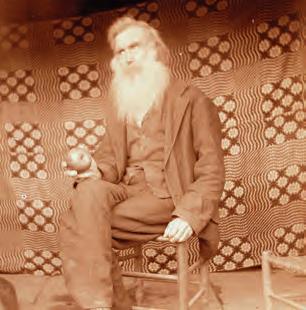
John Walker, father of the Walker sisters who once lived in Little Greenbrier Cove, sits in front of a woven overshot coverlet circa 1915. Often featuring bold geometric designs, this type of textile was common in the Appalachians.
Jim Shelton photo courtesy of GSMNP Archives.
This must be the place
BY GARRET K. WOODWARD
‘In a minute I’ll be free, and we’ll be splashing in the sea’
Hello from the Restaurant Bonaparte in the depths of Old Montreal, Quebec, Canada. Partly cloudy skies. A warm breeze drifting throughout streets and backalleys over 400 years old. A glass of sauvignon blanc and hearty conversation. Fine French cuisine and nowhere to be but here, and now.
I found myself here today on a simple whim by my mother who, yesterday evening, turned to me in the living room of my parents’ North Country farmhouse during a rerun of her favorite show “Everybody Loves Raymond” and said, “You want to get lunch in Montreal tomorrow?” Yes. Sold. It was decided to find a French dining establishment and leave come late morning.
It was only about an hour drive from their home over the border into Quebec and into one of the world’s finest cities. A metropolis I’ve known and loved since I was a child, first coming up there in the winter for the underground markets and ice skating, as a teenager for the endless concerts at Parc JeanDrapeau and as a young adult for the nightlife and cold Canadian lager beers. Nowadays, I wander the streets for the stunning architecture and pure culture.
latest trek of adventures, whether planned or unplanned (all of which greatly appreciated).
For now? Restaurant Bonaparte. Threecourse meal for $44 (Canadian). Start with the mixed green salad with roasted almonds, thinly sliced apples and cider vinaigrette. Main course? A sliced breast of chicken with melted brie cheese and sage sauce. Dessert? cheesecake with maple and blackberry. Top it off with a couple cans of Kronenbourg 1664 lagers. Eat with gusto. Tip accordingly to the jovial souls attending our table. Their smiles are genuine.
The dining room booth was very snug, which I would assume would be ideal for a first date or to sit across from your significant other on some special occasion. I kept thinking how (maybe someday) I’d bring my girlfriend, Rebecca, here, maybe even stay in the hotel upstairs, park my rusty, musty truck with dirty North Carolina plates just around the corner, maybe even go for a midnight stroll along the centuries-old cobblestone streets. Someday. But, today? The person sitting across from me was my “best girl,” I guess you could say. Kathy (aka: “mom”). She was grinning ear-to-ear when we got seated at the window booth, even more so when her butternut squash soup arrived, and then the nicoise salad with fresh tuna showed up. But, that would pale in comparison when her beloved French chocolate mousse showed up at the end of the meal. I was allowed one delicious bite. I left her the rest to enjoy.
HOT PICKS
1
Smoky Mountain Center for the Performing Arts (Franklin) will host Creedence Revived (Creedence Clearwater Revival tribute) at 7:30 p.m. Saturday, Aug. 8.
2
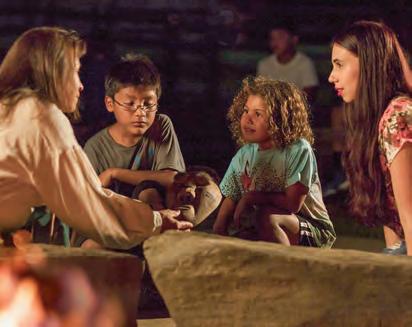
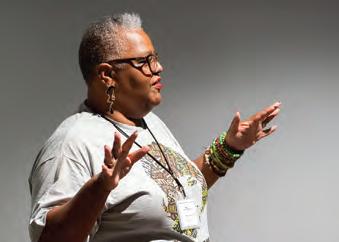
The “Conversations with Storytellers” series will continue with Nancy Tolson at 6 p.m. Thursday, Aug. 13, at the Pigeon Community Multicultural Development Center in Waynesville.
3
Concerts On The Creek (Sylva) will host Whiskey Mountain Band (Americana) at 7 p.m. Friday, Aug. 7.
4
A special stage production of “The Savannah Sipping Society” will be held on select dates and times Aug. 7-30 at the Haywood Arts Regional Theatre in Waynesville.
5
Spencer K.M. Brown will share his new story collection, “Slow Fire,” in conversation with Alice Martin at 3 p.m. Saturday, Aug. 8, at City Lights Bookstore in Sylva.
proper, and also very young. I wondered how old they actually were, where they grew up, and where they might be headed once back on their ships. We thanked them for their service in passing. They smiled awkwardly like young adults do.
Down by the river, the Amerigo Vespucci was docked. According to Montreal news outlet The Gazette, the ship was constructed in 1931 and had recently “traversed the Atlantic with allmanual technology.” “A nearly century-old Italian navy training vessel, dubbed ‘the most beautiful ship in the world,’ is visiting Montreal this week,” the article went on to say. Standing on the walkway and viewing the gorgeous ship among countless others, I concurred.
Today was my sixth border crossing between Canada and the United States in the last three weeks or so. Twice earlier in the month between Upstate New York and Montreal to fly out to the West. Twice between Montana and British Columbia. Twice today for lunch. It ain’t lost on me how special and wild and surreal it is, and remains, to cross an international boundary in search of purpose and truth. Don’t take for granted what it means to freely travel between countries of our sacred world, and do so with a kind heart and a trajectory of compassion and curiosity. Remain curious. Remain kind.
In the next few days, I’ll finally be making my way back below the Mason-Dixon Line to Western North Carolina. It’s been almost two months since I slept in my own bed, drank a cappuccino at the shop around the corner, ate lunch on Main Street in Waynesville or had a cold Coors Light at my neighborhood bar. Same goes with the desk in my office at the newsroom for this newspaper, everything on said desk now covered in a slight layer of dust, nothing moved or shifted since early June when I set out on this
Leaving the restaurant, there were still two hours left on the parking meter. Wandering down Rue Saint Francois-Xavier, we ducked down Rue Saint Paul and grabbed a seat at sidewalk cafe for a glass of wine and more friendly banter. Talk about how each of our respective lives are, whether it be loved ones near and far, loved ones not on this earth anymore, rehashing tall tales of family lore from past summer vacations, or simply discussing future dreams. Not once does a moment of the conversation feel forced. And it’s always been like that between mom and I, thankfully. “We’re cut from the same cloth,” as she’s told me throughout my life. It’s also not lost on me being able to spend quality time with her, especially in a foreign country over a great meal and within Old Montreal and all of its aesthetic beauty surrounding oneself. Finishing the last sips of the wine, it was onward to the port shoreline.
Stroll along Rue Saint Pierre towards the mighty Saint Lawrence River. While in motion, we noticed members of the Royal Canadian Navy in their pristine uniforms streaming through the streets. They looked prim and
Soon, the parking meter was to be concluded with our $20 purchase of time and space. Motoring out of this world-class city, Montreal appeared in the rearview mirror, the suburbs quickly transitioning into endless farmfields. Nothing but open land between the metropolis and the Canadian Border some 45 minutes south. We crossed over into the States via the Route 276 station. A couple miles or so down 276, we passed my old high school. It looked pretty much the exact same as when I graduated: a generic-looking warehouse.
And even though, at age 41, I still feel like that same happy-go-lucky and compassionate person as I was then (or at least truly aimed to be), I could sense the immense distance, whether geographically or intrinsically, from that starting line of an academic building surrounded by soccer/baseball fields I used to roam, all of which surrounded by cornfields I used to pass by each day to and from school to my parents’ old farmhouse. The gratitude of a constant evolution of self remains, as does an unrelenting curiosity of life itself, too. Life is beautiful, grasp for it, y’all.
Old Montreal. Garret K. Woodward photo
On the stage
HART presents ‘The Savannah Sipping Society’
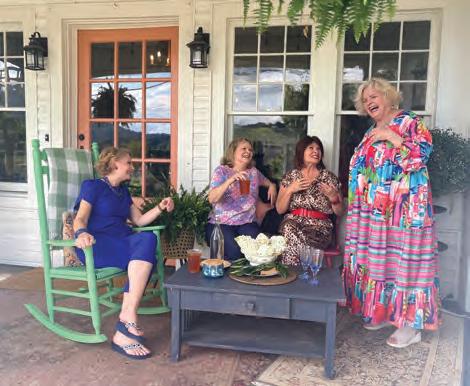
Pull up a chair, pour a drink and spend an evening on the porch with a special stage production of “The Savannah Sipping Society” on select dates and times Aug. 7-30 at the Haywood Arts Regional Theatre in Waynesville.
Directed by Annie Dragoo, this warm and witty comedy by Jones Hope Wooten celebrates unexpected friendship, fresh starts and discovering that it is never too late to find where you belong.
Set on a picturesque veranda in Savannah, Georgia, “The Savannah Sipping Society” follows four Southern women who meet at moments when each could use a change. Randa Covington is struggling to adjust after an unexpected career shift. Dot Haigler is navigating life after the loss of her husband. Marlafaye Mosley is recovering from heartbreak, while the free-spirited Jinx Jenkins arrives determined to give the other women the push they need to shake things up.
The story blends sharp Southern humor with a heartfelt look at friendship, resilience and starting over. Beneath the laughs is a reminder that family is not always something we are born into. Sometimes, it is something we find and choose for ourselves. What begins as a series of weekly happy hours soon becomes something much more. Between laughter, porch conversations, questionable deci-
ALSO:
sions and a drink or two, the four women begin taking chances, rediscovering themselves and building a friendship none of them realized they needed.
HART is offering a paywhat-you-can performance on the first Saturday of the production run to help keep theatre accessible to all. Paywhat-you-can tickets will go on sale one week before show day. Standard tickets for all other performances are available now.
For more information and/or to purchase tickets, visit harttheatre.org or call 828.456.6322.
• Peacock Performing Arts Center (Hayesville) will host a special stage production of the musical “9 to 5” on select dates and times Aug. 7-16. With music/lyrics by Dolly Parton and book by Patricia Resnick, the musical is based on the seminal 1980 hit movie. Set in the late 1970s, this hilarious story of friendship and revenge in the Rolodex era is outrageous, thought-provoking and even a little romantic. For tickets, 828.389.ARTS / thepeacocknc.org.
QUILTING, CONTINUED FROM 16
the hardships of the Civil War by going back to weaving.”
One of her favorite stories concerns a quilt made of homespun linsey, a coarse fabric of wool and cotton. Waldvogel interviewed the quilt’s owner, Willie Ellen Atchley, in the early
The children of Grover Moore (1892–1960), who was a son of Will Walker, the first permanent resident of Walker Valley in Tremont, sit on a quilt. GSMNP Archives photo.
1980s and heard how, as a child in the 1910s, she would sleep with her sister in the attic of their Sevier County cabin under a pile of quilts. The heavy, handwoven linsey quilt sat on top, holding the other quilts down. Even on mornings when they woke to find snow on top of the linsey quilt, the children stayed warm.
The Walker Sisters, who lived in their cabin at Little Greenbrier until the last of them died in 1966, also had a linsey quilt among their impressive trove of patchwork.
In addition to weaving their own fabric,
some families produced their own cotton batting. Waldvogel once spoke with a woman named Georgia Mize who said that during the 1930s, her mother would grow a row of cotton in their Sevier County garden every summer, harvesting the cotton bolls to dry by the fire during wintertime. The children would be tasked with separating out the seeds so their mother could card and comb the fibers. At first Waldvogel thought it was a one-off tale, “and then I began to hear that story from other people too,” she said.
A NATIONAL PASTIME
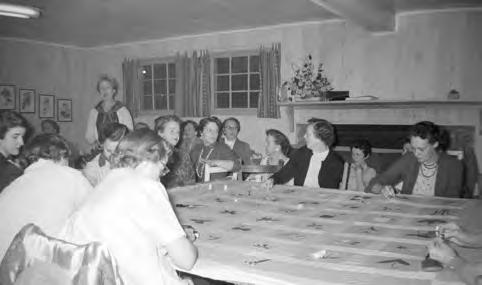
The Park Service Wives group works on a quilt for Becky Hummel, wife of then-superintendent Edward Hummel, during a going-away party for the couple as Hummel’s time as superintendent concluded in 1958. GSMNP
Store-bought fabric was the more common quilting material, especially after the Civil War. Cotton print fabric became easy to get, as did women’s magazines featuring quilt block patterns.
The block is the pattern in which fabric patches are sewn together. Joining multiple blocks forms the decorative top side of the quilt. These blocks were often given names that reveal something about the lives, values and beliefs of the people who used them. The Churn Dash block, for example, refers to a tool farming families used to make their own butter, the Bear Paw to the footprint of the mountains’ most iconic residents and the Crown of Thorns to the crucifixion of Christ.
“People reflected in the names they gave to blocks what was important to them in their everyday life,” Ferrence said.
Often, quilt patterns blended frugality with artistry. In the Smokies, there was a specific type of “crazy quilt” — a quilt made from scraps of fabric sewn together with no particular block pattern — that, rather than the more typical silk or satin, used lightweight wool fabric and woolen thread embroidery. Similarly, the string quilt was made of cotton scrap materials such as bits of fabric left over from other projects, or intact scraps cut from worn-out clothes. During the 20th century, through the 1960s, many families made quilts and clothing
from feed sack fabric. Mountain people “just did not want to throw things away,” Waldvogel said.
Throughout America’s history, moments of national celebration have spurred renewed interest in quilting. The centennial in 1876 saw an explosion of blankets featuring eagles, flags and patriotic color schemes.
Another spike in interest came 100 years later during the bicentennial. Quilting has become something of a national pastime — but with unique expression in the Smokies.
“Quilts represent hard work, generosity, good will, doing the right thing,” said Waldvogel.
“That’s what
we want in our country. Those are the traditions that we all want as humans.”
Learn more about the Smokies’ quilting tradition through the Fabric of Appalachia, a national quilt-along hosted by Great Smoky Mountains National Park. Each week, a tutorial on how to create a traditional quilt block —and its connections to American and Appalachian history — will be posted. In addition, the park is holding in-person stitching bees from 10 a.m. to 2 p.m. on Saturday, Aug. 22, at Sugarlands Training Room (beside the visitor center), and Saturday, Sept. 19, on the Oconaluftee Visitor Center porch. Holly Kays is the lead writer for the 29,000-member Smokies Life, a nonprofit dedicated to supporting the scientific, historical and interpretive activities of Great Smoky Mountains National Park by providing educational products and services such as this column. Learn more at SmokiesLife.org, or reach the author at hollyk@smokieslife.org.
‘The Savannah Sipping Society.’ HART photo
Archives photo
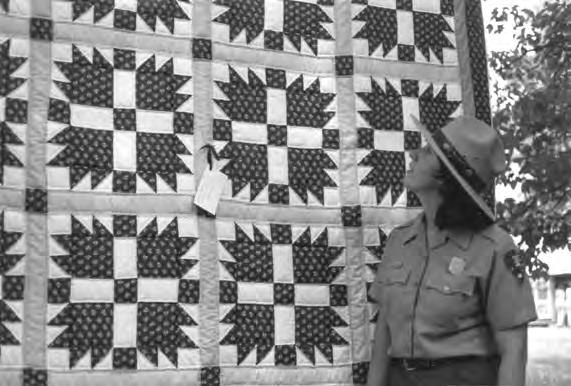
Margaret Yates, seasonal interpreter at Great Smoky Mountains National Park, looks up at a quilt displayed during the first Cades Cove Quilt Show in 1986, which she organized. Photo by Stephanie Gibert, couretsy of GSMNP Archives
On the wall
‘The Way We See the World’
The Museum of the Cherokee People’s annual Indigenous pop culture event “The Way We See the World” will be held from 5-8 p.m. Friday, Aug. 7, in the Council Fire Ballroom at Harrah’s Cherokee Casino Resort.
Now in its fifth year, MOTCP’s signature summer event showcases contemporary perspectives for Cherokee people, primarily by Cherokee people. This communitycentered celebration puts Native selfrepresentation in the spotlight, uplifting creative work that explores identity through film, music and visual art. This year’s event invites audiences to be inspired and laugh out loud with two short documentaries, a short romantic comedy, a live DJ set, silent auction, 50/50 raffle and art market.
• “Farmers & Artisans Market” will be every Friday morning (May-October) at 117 Island Street in Bryson City. Stop by the old barn along the river for local, homegrown produce, as well as baked goods, jellies/preserves, authentic crafts and more. Picnic tables onsite. There will also be live music. Leashed pets are welcome. This is an outdoor event. Free and open to the public. 828.488.7857.
“It’s hard to believe we have been hosting this event for five years,” said Executive Director Shana Bushyhead Condill (Eastern Band of Cherokee Indians). “This has grown into a fun evening that our community looks forward to, as do we. Celebrating and sharing our Native self-representation is incredibly powerful.”
Free tickets can be reserved via Eventbrite. “The Way We See the World” events are offered at no cost thanks to the generous support of our sponsors, Cherokee Preservation Foundation, Management Resource Associates, The Center for Native Health and Two Dots Studio.
For more information, visit motcp.org.
‘Don’t Be Square’ at HCAC
The Haywood County Arts Council’s latest exhibition, “Don’t Be Square: Art Beyond Right Angles,” will be on display through Aug. 31 at Haywood Handmade Gallery on Main Street in Waynesville.
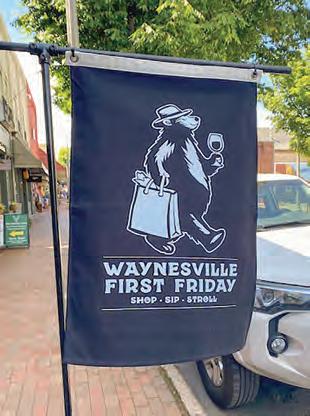
The public is invited to the opening reception during the “Waynesville First Friday: Shop, Sip, & Stroll” from 5-8 p.m. Friday, Aug. 7. Guests will enjoy complimentary refreshments, meet exhibiting artists and be among the first to experience this imaginative collection of artwork while exploring downtown Waynesville.
meet WEB, learn about his creative process and see the craftsmanship behind his work. He also creates hand-painted dough bowls and original canvases, showcasing his creativity across multiple mediums.
• WNC Paint Events will host painting sessions throughout the region on select dates. For more information and/or to sign up, visit wncpaint.events.
• Marianna Black Library (Bryson City) will host “ArtWorks” at 1 p.m. every second Thursday of the month. Come create your own masterpiece. The materials for art works are supplied, and participants are welcome to bring ideas and supplies to share with each other. Ages 16 and up. Space limited to 10 participants. Free and open to the public. 828.488.3030 / vroberson@fontanalib.org.
• CRE828 (Waynesville) will offer a selection of art classes and workshops at its studio located at 1283 Asheville Road. Workshops will include art journaling, watercoloring, mixed media, acrylic painting and more. 828.283.0523 / cre828.com.
The reception will also feature a live demonstration by WEB, a talented local artist best known for his handcrafted jewelry. Guests can
“Don’t Be Square” challenges artists to move beyond traditional square and rectangular formats by creating artwork on surfaces without right angles. While artists may still work on canvas and other familiar materials, the exhibit encourages exploration of unconventional shapes and dimensions. The result is a collection of paintings, fiber art, mixed media and other original works that invite viewers to experience art from a new perspective. For more information, visit haywoodarts.org.
‘Cherokee People and the American Revolution’
A first-of-its-kind exhibition centering Native voices, perspectives and creativity in response to the 250th anniversary of the founding of the United States, the exhibition “Unrelenting: Cherokee People and the American Revolution” is currently being showcased at the Museum of the Cherokee People (MotCP) in Cherokee.
On view through Dec. 30, the exhibition features historic objects in conversation with works by Cherokee artists, merging cultural heritage, military history and contemporary art for a nuanced examination of a pivotal moment in Cherokee and American history.
General admission tickets are $15 for adults, $8 for children ages 6-12 and free for children ages 5 and under. MotCP offers free admission to members of federally recognized tribes and museum members. Student, educator, senior and military rates available. Admission to all changing exhibitions is included in the general admission ticket price. For more information, visit motcp.org.
• Haywood County Arts Council (Waynesville) will offer a wide range of classes, events and activities for artisans, locals and visitors. HCAC’s Haywood Handmade Gallery is open seven days a week from 10 a.m. to 5 p.m. and 11 a.m. to 4 p.m. Sundays. 828.452.0593 / haywoodarts.org.
• Stecoah Valley Cultural Arts Center (Robbinsville) will host an array of workshops for adults and kids. 828.479.3364 / stecoahvalleycenter.com.
• Southwestern Community College Swain Arts Center (Bryson City) will host an array of workshops for adults and kids. 828.339.4000 / southwesterncc.edu/scclocations/swain-center.
• Dogwood Crafters (Dillsboro) will offer a selection of upcoming art classes and workshops. 828.586.2248 / dogwoodcrafters.com.
• Cowee School Arts & Heritage Center (Franklin) will host semi-regular arts and crafts workshops. 828.369.4080 / coweeschool.org.
• Folkmoot Friendship Center (Waynesville) will host semi-regular artist gatherings and workshops. 828.452.2997 / folkmoot.org.
• Three Rivers Gallery (Bryson City) will be hosting an array of artist receptions, exhibits and showcases, including a “Meet The Artists” gathering at 3 p.m. Saturday, Aug. 15. The gallery is open from 10 a.m. to 5 p.m. Tuesday through Sunday. 828.488.3638 / threeriversgallery.com.
OUR AYURVEDIC SPECIALIST WILL GUIDE YOU ON ACHIEVING BALANCE THROUGH A HOLISTIC ROUTINE OF DIET, EXERCISE, BREATH WORK, AND HERBAL SUPPLEMENTS. THIS CONSULTATION IS GREAT FOR THOSE CURRENTLY EXPERIENCING IMBALANCES, OR THOSE WHO SIMPLY WISH TO LIVE A HEALTHIER LIFESTYLE.
A R BES THERAPIS T OR
BEST OF HAYWOOD 2026 VOTED NUMBER 1 BEST DAY SPA & NUMBER 2 BEST MASSAGE THERAPIST
$99 FOR A 90 MIN CONSULTATION ($26 OFF) TYLE. THIER LIFES LT HE O Y T , AL Y AT TION GRE LTTA .MENTS AL , HERB ORK ATH , BRE CISE , EXER T OUTINE TIC R OUGH ANCE THR AL CHIEVING OU A T YURVEDIC GE T A TED NUMBER 1 O Y AY BES TA T HA V &NUMBER MASS A SPECIALIS Y B HOLIS W SUPPLE CONSUL CURRENTL IMBANCES SIMPL AL T T A Y
• American Legion Post 47 (Waynesville) will host an “Open Mic” 6:30 p.m. Mondays and semi-regular live music on the weekends. Free and open to the public. 828.456.8691.
• Angry Elk Brewing (Whittier) will host semi-regular live music on the weekends. All shows are free and open to the public. 828.497.1015 / facebook.com/angryelkbrewingco.
• Balsam Falls Brewing (Sylva) will host “Open Mic” 8-10 p.m. Thursdays. Free and open to the public. 828.631.1987 / balsamfallsbrewing.com.
open to the public. 828.246.9320 / facebook.com/brbeerhub.
• Boojum Brewing (Waynesville) will host “Karaoke Night” 9 p.m. Wednesdays, “Trivia” 7 p.m. Thursdays, “Open Jam” 10 p.m. Thursdays and semi-regular live music on the weekends. All shows are located in The Gem downstairs taproom and begin at 9 p.m. unless otherwise noted. Free and open to the public. 828.246.0350 / boojumbrewing.com.
• Breadheads Tiki Shak (Sylva) will host “Tiki Trivia” at 7 p.m. every other Thursday of the
open at 4 p.m. 828.452.6000 or classicwineseller.com.
• Concerts On The Creek (Sylva) will host Whiskey Mountain Band (Americana) Aug. 7 and Dashboard Blue Aug 14. All shows are at Bridge Park and begin at 7 p.m. Everyone is encouraged to bring a chair or blanket. These events are free, but donations are encouraged. 828.586.2155 / mountainlovers.com/concertson-the-creek.
• Cowee School Arts & Heritage Center (Franklin) will host “Open Mic” at 6 p.m. every second Friday of the month and Ritchie & Rosie (Americana/folk) Sept. 20 ($15 adults, $7.50 kids). 828.369.4080 / coweeschool.org/concert-series.
Americana, folk at Mountain Layers
Jackson County Americana/indie-folk duo Bird in Hand will perform at 6 p.m. Saturday, Aug. 8, at Mountain Layers Brewing Company in Bryson City.
The road less traveled has always been the way for husband-and-wife duo Bird in Hand. Bryan & Megan Thurman call the Great Smoky Mountains of Western North Carolina home, and the region is directly reflected in their music. Bird in Hand is upbeat and new while still rooted in the traditions of American folk.
The two have played all over the Appalachian region, as well as across the country, and share an onstage chemistry that demands attention. They need to be seen live to understand the meaning of “Appalachian Thunder Folk.”
The show is free and open to the public. For more information, visit mountainlayersbrewingcompany.com.
• Balsam Mountain Inn (Balsam) will host “Picking on the Porch” (open community jam) 6 p.m. Tuesdays and semi-regular live music on the weekends. 828.283.0145 / thebalsammountaininn.com.
• Bascom Center For The Visual Arts (Highlands) will host a “Community Barn Dance” from 5:30-7:30 p.m. Aug. 6. Admission is $10 for adults, free for kids ages 12 and under. 828.526.4949 / thebascom.org.
• Blue Ridge Beer Hub (Waynesville) will host “Music Bingo Night” 6:30 p.m. Tuesdays, The Blue Mountaineers (bluegrass) Thursdays and semi-regular live music on Fridays and Saturdays. All music starts at 5 p.m. Free and
• Farm At Old Edwards (Highlands) will host the “Orchard Sessions” with Shane Meade & The Sound (indie/soul) Aug. 5. All shows begin at 6 p.m. Admission is $50 per person, with discounts rates available for hotel guests and members. 866.526.8008 / oldedwardshospitality.com.
• Folkmoot Friendship Center (Waynesville) will host “World Drum Classes” every Friday at 2:30 p.m. (adults, free) and 4 p.m. (family friendly, all ages, free), “Waynesville Acoustic Guitar Group” 2-4 p.m. every second and fourth Saturday of the month (free) and semi-regular live music monthly. 828.452.2997 / folkmoot.org.
month and semi-regular live music on the weekends. 828.307.2160 / breadheadstikishak.com.
• Cataloochee Ranch (Maggie Valley) will host Alan Edwards (Americana/indie) Aug. 5, Hill Country Band (bluegrass) Aug. 12 and Brian Ashley Jones (blues/country) Aug. 19. All shows begin at 5 p.m. and admission is $30 per person unless otherwise noted. For tickets and reservations, visit cataloocheeranch.com/ranchevent.
• Classic Wineseller (Waynesville) will host Brent LaCasce (jazz piano/vocals) Aug. 7 ($10 cover). All shows begin at 6 p.m. Reservations highly recommended. The kitchen and wine bar will
• Currahee Brewing (Franklin) will host a “10th Anniversary Party” noon to 10 p.m. Aug. 15 and The Boondock Saints (southern rock) 7 p.m. Aug. 15. All shows begin at 6 p.m. unless otherwise noted. Free and open to the public. 828.634.0078 / curraheebrew.com.
• Current Tavern (Canton) will host the “Music at the Tavern” summer series with The Borrowed Band Aug. 8. All shows begin at 7 p.m. unless otherwise noted. Free and open to the public. 828.492.0249.
• Dancing On The Square (Robbinsville) will host Tim Austin (country/rock) Aug. 7 (special line dance night) and Steve Jordan Band Aug. 14. All events begin at 7:30 p.m. Free and open to the public. 704.840.8525.
• Franklin Town Square (Franklin) will host a “Community Drum Circle” from 6-8 p.m. Aug. 15 and Sept. 19. People of all ages are invited to participate. You may bring your own hand drums and rhythm instruments or use one of our percussion instruments. Bring a lawn chair. In case of rain, the event will be held under the gazebo stage tent. Free and open to the public. 828.524.ARTS / artscouncilofmacon.org.
• Friday Night Live Concert Series (Highlands) will host Johnny Webb Band (Americana/country) Aug. 7 and McClain Family Band Aug. 14. All shows begin at 6 p.m. Free and open to the public. highlandschamber.org.
• Frog Level Brewing (Waynesville) will host “Jazz On The Level” 5:30 p.m. Tuesdays, Paul Edelman (singer-songwriter) 5:30 p.m. Aug. 5, Shane Meade (indie/folk) 5:30 p.m. Aug. 6, Simple Folk Aug. 7, Rich Manz Trio (acoustic/oldies) Aug. 8, Chad Carlson (singersongwriter) 3 p.m. Aug. 9, “Beats & Feets Drum/Dance Circle” 5:30 p.m. Aug. 10, Chris Wilhelm (singer-songwriter) 5:30 p.m. Aug. 12, David Cheatham Band Aug. 14, Scenic Radio Aug. 15 and Jim Cook (singer-songwriter) 3 p.m. Aug. 16. All shows begin at 6 p.m. unless otherwise noted. Free and open to the public. 828.454.5664 / froglevelbrewing.com.
• Groovin’ on the Green (Cashiers) will host The Wandering Hours Aug. 14. Shows begin at 6 p.m. Free and open to the public. Donations encouraged. villagegreencashiersnc.com/concerts.
• Happ’s Place (Glenville) will host Corey Stevenson Aug. 5, Dillon & Company Aug. 6, Doug Ramsay F
Bird in Hand. File photo
Aug. 7, 11 North Aug. 8, Doug Ramsay Aug. 13, Canon Cohen Band Aug. 14 and Rock Holler Aug. 15. All shows begin at 6 p.m. unless otherwise noted. Free and open to the public. 828.742.5700 / happsplace.com.
• Harrah’s Cherokee Casino Resort (Cherokee) will host Gary Allan (country) 9 p.m. Aug. 7. For tickets, visit caesars.com/harrahs-cherokee.
• Highlander Mountain House (Highlands) will host “Blues & Brews” with Scott Low 6-9 p.m. Thursdays, Zorki (singer-songwriter) 1-3 p.m. Saturdays, “Bluegrass Brunch” 11 a.m. to 1 p.m. Sundays, the “Salon Series” with Hayes Carll 8:30 p.m. Aug. 20 ($58.93 per person, tax included). Reservations encouraged for all performances. 828.526.2590 / highlandermountainhouse.com.
• Highlands Creek Village (Highlands) will host Gillian Grogan (singer-songwriter) 6:30 p.m. Aug. 5. Admission by donation. 828.487.4099 / unfurlwellnessspa.com.
• Highlands Performing Arts Center (Highlands) will host Gershon/Cohn Final Gala Concert (classical) Aug. 9. All shows begin at 5 p.m. unless otherwise noted. 828.526.9047 / highlandsperformingarts.com.
• Innovation Brewing (Sylva) will host “Monday Night Trivia” every week, “Open Mic” on Wednesdays and semi-regular live music on the weekends. All shows and events begin at 7 p.m. unless otherwise noted. Free and open to the public. 828.586.9678 / innovationbrewing.com.
• Lazy Hiker Brewing (Franklin) will host “Board Game Night” 5 p.m. Mondays, “Music Bingo” 7 p.m. Tuesdays, “Trivia Night” 6:30 p.m. Wednesdays, “Open Mic Night” 6:30 p.m. Thursdays, Bryan & Al (rock/pop) Aug. 7, Cody Marlowe (roots/rock) Aug. 8, “Karaoke By Spoon” Aug. 14 and Old Souls Duo (honkytonk/country) Aug. 15. All shows begin at 7 p.m. unless otherwise noted. Free and open to the public. 828.349.2337 / lazyhikerbrewing.com.
• Lazy Hiker Brewing (Sylva) will host “Music Bingo” 7 p.m. Mondays, “Trivia Night” 6:30 p.m. Tuesdays, “Old Time Jam” 6:30 p.m. Thursdays, Grizzly Mammoth (funk/rock) Aug. 7, “Karaoke By Spoon” 7 p.m. Aug. 8 and Ghost Pipe Sound Machine (groove/jam) Aug. 15. All shows begin at 8 p.m. Free and open to the public unless otherwise noted. 828.349.2337 / lazyhikerbrewing.com.
• Legends Sports Bar & Grill (Maggie Valley) will host “Open Mic Night” 6:30 p.m. Wednesdays, Karaoke Thursdays (6 p.m.) and Saturdays (7 p.m.), with live music each Friday (8 p.m.). Free and open to the public. 828.944.0403 / facebook.com/legendssportsgrillmaggievalley.
• Macon County Public Library (Franklin) will host The Vagabonds (Americana) at 2 p.m. the first and third Monday and a “Song Circle” open jam from 3-6 p.m. the first Tuesday each month. Free and open to the public. 828.524.3600 or fontanalib.org/franklin.
• Mountain Layers Brewing (Bryson City) will
host “Open Mic Night” with Frank Lee every Tuesday, Mountain Gypsy (Americana) Aug 7, Bird In Hand (Americana/indie-folk) Aug. 8, Alma Hammett (Americana/folk) 5 p.m. Aug. 9, Granny’s Mason Jar (Americana/bluegrass) Aug. 15 and Mountain Gypsy (Americana) 5 p.m. Aug. 16. All shows begin at 6 p.m. unless otherwise noted. Free and open to the public. 828.538.0115 / mountainlayersbrewingcompany.com.
• Nantahala Outdoor Center (Nantahala Gorge) will host “Music Bingo” 6 p.m. Aug. 6 (at Big Wesser), Ryan Barber (singer-songwriter) 5 p.m. Aug. 7, Michael Corwin (singer-songwriter) 1 p.m. Aug. 8, Shane Meade Duo (indie/soul) 5 p.m. Aug. 8, “Blues With Blue” (Americana/blues) 2 p.m. Aug. 9, “Music Bingo” 6 p.m. Aug. 13 (at Big Wesser), Ryan Barber (singer-songwriter) 5 p.m. Aug. 14, Dave Desmelik (singer-songwriter) 1 p.m. Aug. 15 and “Blues With Blue” (Americana/blues) 2 p.m. Aug. 16. Free and open to the public. 828.785.5082 / noc.com/events/2026-summermusic-series.
• Pickin’ In The Park (Canton) will host Hill Country Band (Americana/bluegrass) and Balsam Mountain Cloggers 6 p.m. Aug. 7. Free and open to the public.
• Pickin’ On The Square (Franklin) will host Tuxedo Junction (Motown/oldies) Aug. 8. All shows begin at 6 p.m. at the Gazebo in downtown. Free and open to the public. franklinnc.com/pickin-on-the-square.html.
• Rathskeller Coffee Haus & Pub (Franklin) will host “Karaoke” 7 p.m. Wednesdays, “Trivia Night” 6:30 p.m. Thursdays, “Open Mic” 6:30 p.m. on certain Fridays, Steve Vaclavik (singersongwriter) 7 p.m. Aug. 7, Owen Walsh (singersongwriter) 6:30 p.m. Aug. 11 and Michael Kitchens (singer-songwriter) 7 p.m. Aug. 15. Free and open to the public. 828.369.6796 / facebook.com/rathskellercoffeebarandpub.
• Salty Dog’s Seafood & Grill (Maggie Valley) will host “Karaoke With Russell” on Mondays, Adi The Monk (singer-songwriter) Aug. 7, Michael Blakey (singer-songwriter) Aug. 8, “Music Bingo” Aug. 11 and Lance Turner (singer-songwriter) Aug. 14. All shows begin at 7 p.m. unless otherwise noted. Free and open to the public. 828.926.9105 / facebook.com/saltydogs2005.
• Saturdays On Pine Concert Series (Highlands) will host Blake Ellege & The Resonators (Americana/rock) Aug. 8. All shows begin at 6 p.m. Free and open to the public. highlandschamber.org.
• Scotsman (Waynesville) will host “Open Mic Night” every second Monday of the month with Bridget Gossett (sign-up at 6:30 p.m.), Anthony Wayne (rock/grunge) Aug. 6, Celtic Road (Celtic/world) 4 p.m. Aug. 8, Spiro Nicolopoulos Blues Apocalypse (rock/blues) Aug. 8, Mooncoin (Celtic/world) 3 p.m. Aug. 9, Gavin Graves (blues/folk) Aug. 13, TracEnd (rock/pop) 9 p.m. Aug. 15 and Jenny & The Weazels (Celtic/world) 3 p.m. Aug. 16. All shows begin at 8 p.m. unless otherwise noted. Free and open to the public. 828.246.6292 / scotsmanpublic.com.
• Skyline Lodge (Highlands) will host Nitrograss (Americana/bluegrass) 6 p.m. Aug. 8. Free and open to the public. 828.526.4008 / skylinelodge.com.
• Smoky Mountain Center for the Performing Arts (Franklin) will host Creedence Revived (Creedence Clearwater Revival tribute) 7:30 p.m. Aug. 8. Tickets start at $26 per person, with seating upgrades offered. 866.273.4615 / smokymountainarts.com.
• Stecoah Valley Center (Robbinsville) will host the “An Appalachian Evening” summer music series with Appalachian Smoke (Americana/bluegrass) 7:30 p.m. Aug. 8, Jeff Little Trio (Americana) Aug 15 and a “Community Jam” 6 p.m. Aug. 18 (free). 828.479.3364 / stecoahvalleycenter.com.
• Stubborn Bull (Highlands) will host “Live Music Monday” each week with local singer-songwriters including Zorki Nastasic Aug. 10 and Mick Mayer Aug. 17. All shows begin at 5:30 p.m. unless otherwise noted. Free and open to the public. 828.200.0813 / the-stubborn-bull.com.
• Swain Arts Center (Bryson City) will host semiregular live music on the weekends. 828.488.7843 / swainartscenter.com.
• Ugly Dog Pub (Highlands) will host “Bluegrass Music” with Nitrograss 6 p.m. Wednesdays, “Karaoke” 9:30 p.m. Fridays, “Music Bingo” 7 p.m. Sundays and semi-regular live music on the weekends. 828.526.8364 / theuglydogpub.com.
• Valley Cigar & Wine Company (Waynesville) will host Simple Folk (Americana) 2 p.m. Aug 2, Amos Jackson (Motown/R&B) 5 p.m. Aug. 14 and Hallowed Has Beens (southern rock/country) 2 p.m. Aug. 16. Free and open to the public. 828.944.0686 / valleycigarandwineco.com.
• Vineyard At High Holly (Scaly Mountain) will host Rail Town (Americana) 3 p.m. Aug. 7, Tim Austin (country/rock) 2 p.m. Aug. 9, Shawn Hart (singer-songwriter) 3 p.m. Aug. 14 and Rail Town (Americana) 2 p.m. Aug. 16. Free and open to the public. 828.482.5573 / thevineyardathighholly.com.
• Western Carolina Brew & Wine (Highlands) will host David Crisp (singer-songwriter) Aug. 8 and Max Watson (singer-songwriter) Aug. 15. All shows begin at 1 p.m. Free and open to the public. 828.342.6707 / wcbrewandwine.com.
• Whiteside Brewing (Cashiers) will host Seth & Sara (Americana) Aug. 7, Busy Aug. 8, Isaiah Breedlove (singer-songwriter) Aug. 14 and Angela Easterling (singer-songwriter) Aug. 15. All shows begin at 6 p.m. unless otherwise noted. Free and open to the public. 828.743.6000 / whitesidebrewing.com.
• Yonder Community Market (Franklin) will host “First Friday Classic Country: Jim Austin & Friends” (Americana/country) 6 p.m. each month (Aug. 7, Sept. 4, Oct. 2) and the “On the Lawn at Yonder” live music series with Alexa Rose & Josh Oliver (Americana/folk) 4 p.m. Aug. 23 (admission by donation). Family/dog friendly. 828.200.2169 / eatrealfoodinc.com.
On the table On the street
Ready for dinner ‘Under the Stars’?
The popular “Under the Stars, On the Rocks” culinary series is currently underway at the Oak Steakhouse at the Skyline Lodge in Highlands.
The events feature renowned chefs from around the Southeast on select dates through the fall: Aug. 11, Sept. 8 and Oct. 13. Each four-course meal in the series is unique and personal to the guest chef, offering a one-of-akind outdoor dining experience.
Dinners are $175 per person (including
• Cataloochee Ranch (Maggie Valley) will host semi-regular culinary events and workshops throughout the week. For a full schedule of upcoming activities, tickets and reservations, visit cataloocheeranch.com/ranch-event.
• Classic Wineseller (Waynesville) will have the wine bar and kitchen open from 4-8 p.m. Fridays/Saturdays. There will also be special wine dinners and cheese tastings on select dates. 828.452.6000 / classicwineseller.com.
• “Flights & Bites” will be held at 4 p.m. Thursdays and Fridays at Bosu’s Wine Shop in downtown Waynesville and special semiregular wine dinners. 828.452.0120 / waynesvillewine.com.
Skyline Lodge. File photo
beverage pairings). Reservations required. For more information and/or to make reservations, call 828.526.4008 or visit skyline-lodge.com.
• “Take A Flight” with four new wines every Friday and Saturday at the Bryson City Wine Market. Select from a gourmet selection of charcuterie to enjoy with your wines.
ALSO:
Educational classes and other events are also available. 828.538.0420.
• “Uncorked: Wine & Rail Pairing Experience” will be held on select dates at the Great Smoky Mountains Railroad in Bryson City. Full service all-adult first class car. Wine pairings with a meal and more. There will also be a special “Carolina Moonshine” train on select dates. 800.872.4681 / gsmr.com.
Cherokee Bonfire & Storytelling
The Cherokee Bonfire & Storytelling will be held from 7-9 p.m. Aug. 8, 15, 22 and 29 at the Old Acquani Expo Center in Cherokee.
Learn about Cherokee traditions and lifestyle from educators, roast marshmallows with the kids and enjoy social dances by the river. The bonfire is free and open to the public.
For more information, call 800.438.1601 or go to visitcherokeenc.com.
The Cherokee Bonfire is a family-friendly gathering. File photo
Waynesville’s ‘Shop, Sip, Stroll’
The monthly “Waynesville First Friday: Shop, Sip, Stroll” will take place downtown from 5-8 p.m. Friday, Aug. 7.
The downtown merchant corridor transforms into a lively celebration of local art, music and community. Stroll the streets, explore galleries, meet artists, enjoy live music and discover local shops and delicious restaurants.
Free and open to the public. For more information, visit facebook.com/waynesvillefirstfriday.
‘Waynesville First Friday’ will be Aug 7. File photo
Pigeon Center ‘Conversations with Storytellers’
The next installment of the “Conversations with Storytellers” series will continue with Dr. Nancy Tolson at 6 p.m. Thursday, Aug. 13, at the Pigeon Community Multicultural Development Center in Waynesville.
A proud product of the Detroit Public Schools, Tolson received her masters and Ph.D. from the University of Iowa, researching the history and development of Black children’s literature. She has been a Ford Fellow, a NEH facilitator as well as a Fulbright scholar/lecturer at the University of Cape Coast (Ghana) while conducting research on West African folklore. For three years, Tolson was an Illinois Humanities’ “Road Scholar,” storytelling throughout the state. She is the author of “Black Children’s Literature Got de Blues: The Creativity of Black Writers and Illustrators” (2008) and “Tales of Africa” (1998). She is a commissioner for the Columbia Museum of Art, as well as an active docent there.
This curated series will showcase award-winning storytellers from Western North Carolina’s African American, Hispanic and Eastern Band of Cherokee Indian communities. Through live storytelling, readings, music and focused questions, the series examines the purpose and power of storytelling in underrepresented communities.
The conversations are casual and will allow for audience participation. The series will continue on the second Thursday of each month through September at the Pigeon Center.
Tickets are $10 for community members, $7 for seniors ages 65 and over and $5 for students. Children 12 and under may attend free of charge. Tickets may be purchased in advance and can be purchased at the door of each performance. Reduced price $50/$40/$30 series passes are also available. Refreshments are available for purchase.
For more information, visit pcmdc.org.
Dr. Nancy Tolson.
File photo
Love, loss, and the ghosts we carry
“Now, in my eight-second year, my allegiance is to ghosts.”
— Mark Helprin
Ssupporters, who harass him, throw stones through the windows of his home, and eventually burn it to the ground.
one example:
o the unnamed 82-year-old narrator declares early on in Mark Helprin’s novel “Elegy in Blue” (Harry N. Abrams, 2026, 256 pages). He then proceeds to blend his present with his past, a life turned upside down by the murder of his beloved wife, the destruction by arson of nearly all that he owned, his wealth wiped away by a vengeful set of crazed parents and a legal system gone awry, and the challenge of battling an evil drug cartel that has set up shop in Brooklyn.
He’s lived a life in full. He spent his early years in a house on the Hudson, living modestly with his mother — his father has died in the fighting after the Normandy invasion — surrounded by valuable works of art his father had collected years earlier when paintings sold for a song in post-World War I Europe. From that idyllic boyhood, he and a group of eccentric friends founded an investment bank, which though off to a rocky start made him a man of means.
In his mid-thirties, living in Brooklyn and still struggling to make a go of the business, he meets an attorney, Clare Kennedy, with whom he instantly falls “recklessly but gently in love.” When it becomes apparent that she feels the same, they marry, have a son, and his life and days become a hymn to beauty and goodness. Later, the wars in the Middle East take the life of his son, and he and Clare are left bereft.
They are some 40 years married and still deeply in love when on a long walk they are passing a Jewish school when a Nazi-Hamas lunatic wades into the crowd of mothers and children, swinging a razor-sharp machete and intent on mass murder. The narrator responds by thwarting the attack, killing the murderer, but Clare is mortally wounded in the struggle.
The narrator goes into a sort of shock, disconnecting his phone and throwing his mail into the trash, drenched in memories of Clare. Yet manipulators of the news and social media cast the narrator as an out-ofcontrol vigilante, and he becomes the target of other lunatics, including some Hamas
Aided by a former colleague at the bank, the narrator settles into a small apartment in Brooklyn, left with his memories and his ghosts. Yet circumstances — a janitor in the
building is threatened with death if he doesn’t soon turn over his teenage daughter to a drug lord — bring him one more opportunity to try and restore some balance of justice in the world.
But enough. I’ve probably given away more of the plot than necessary, yet some details of the story need inclusion for a look at what so attracted me to “Elegy in Blue.”
First, Helprin’s prose often reads like poetry, as it does in his other books. Here his lush descriptions of Brooklyn, of the physical and emotional landscape of his childhood, and especially of his love for Clare are for me words and sentences of beauty, whereas readers more accustomed to the customary mundane prose of contemporary fiction and to skimming online articles and social media may find Helprin’s descriptions roadblocks rather than pleasures. Here’s just
“Rhapsody and elegy, tragedy and comedy: New York is like that and always has been. There’s something about this city of islands and rivers that braids together two such opposites until they are inextricable, and then you love them both and — forgive me or not if I cannot refrain from speaking of broken hearts — they break your heart. But in breaking it they resurrect it as well, and show you what you love enough to die for.”
As that passage indicates, “Elegy in Blue” is laced with comedy as well as tragedy.
“When I was young, circuses and carnivals still had sideshows (indeed, there were still circuses and carnivals), but now that would just be everyday life.” Or this one, when the narrator is a boy and his mother owns a shack at the beach: “The water came from a cistern outside the house, and we used it sparingly. As in so many luxurious beach houses, we did have an outdoor shower: but ours was called rain.”
Perhaps best of all, at least in the opinion of your reviewer, who is five years past his biblically allotted three-score-andten, is Helprin’s portrait of the aged narrator: “He is a library, a treasure house of memories as vivid as if they were imprinted on the mind just that morning, as are so many elderly men and women.”
The memories are ghosts, but they are also as real as the day’s headlines or the coffee sipped at dawn. Here, for me and for the narrator, is the beauty that lies at the heart of having grown old, and loved, and lost:
“In recollection, all the things of those days are still alive. They are all I have and all I have ever wanted. Thus, I look forward to distant prospects straight up and into the dark, alluring sky. Perhaps by the grace of God the past will become more alive than the fading present, for there I’m with them, and Clare is young.”
(Jeff Minick reviews books and has written four of his own: two novels, “Amanda Bell” and “Dust On Their Wings,” and two works of nonfiction, “Learning As I Go” and “Movies Make the Man.” minick0301@gmail.com.)
Upcoming events at City Lights
City Lights Bookstore in Sylva will host two upcoming author events:
• Spencer K.M. Brown will discuss his new story collection, “Slow Fire,” with Alice Martin at 3 p.m. Saturday, Aug. 8. The collection explores life on the margins of faith, family and survival in the South through stories of loss, resilience and redemption. Brown is an award-winning author whose work has earned multiple national honors and Pushcart Prize nominations.
• Timothy S. Moore will present “Mountain Ramblings: An Exploration of a Place and Its People” at 6 p.m. Thursday, Aug. 13. Blending memoir, essays, poetry and travel writing, the book reflects on Southern Appalachia through themes of faith, community, ecology and place, offering a heartfelt tribute to the region and its people.
All events are free and open to the public. For more information, call 828.586.9499 or visit citylightsnc.com.
Writer Jeff Minick
A electrified fence is a great way to prevent bears from disrupting and destroying property, especially when it comes to chicken coops and vegetable gardens. NCWRC photo
The bear necessities
NCWRC advocates for electrified wires to thwart mischievous bears
BY GARRET K. WOODWARD A&E EDITOR
In a move to properly mitigate bear disruptions on your property — whether it be chicken coops, vegetable gardens, compost piles, beehives or simply your backyard possessions — the North Carolina Wildlife Resources Commission is recommending residents use electrified wires to deter the curious animals.
According to NCWRC BearWise Coordinator Ashley Hobbs, “electrified wires are the most effective, non-lethal tool to keep people, property and bears safe.” Upon contact with the wires, the bears experience a brief shock, which “causes no permanent harm to the bear.” These measures train the bear to stay away from the protected entities. The wiring is also cost effective and easy to maintain, with the setup lasting “for years without needing replacement.”
“Electrified wire is always working, even when you’re away from home or in the middle of the night when you’re in bed asleep. It’s also cost-effective and easy to maintain,” said
Hobbs. “Once installed, an electrified set up lasts for years without needing replacement. Long-term maintenance looks like testing the wire frequently to ensure it’s conducting enough charge and keeping weeds and vegetation away from the wires.”
Although all of Western North Carolina is susceptible to the trials and tribulations of bears in the mountains of the Blue Ridge and Great Smoky ranges, Hobbs noted that Buncombe County is especially high in terms of interactions with the animals coming onto one’s property in search of food.
BearWise Hazing Rules
Want to know more?
When thinking about ways to deter bears on your property, check with your HOA, community or county for any local regulations before installing electrified wires, mats or fencing. To learn more about using electrified wires in bear country, please visit bearwise.org and contact North Carolina Wildlife Resources Commission’s “Wildlife Helpline” for assistance at 866.318.2401 from 8 a.m. to 5 p.m. Monday through Friday.
sistently to set and enforce those boundaries,” Hobbs said. “Boundaries can be set for bears through hazing and removing any human-provided food sources. All food sources must be removed from the property, stored inside the home or secured with sturdy locks.”
Hobbs reiterated that the main goal of setting boundaries around homes and communities is to keep bears and people safe, stressing that bears will lose any fear of humans and entering your property if they’re able to access what they’re seeking out — food, garbage, etc. — without any consequence.
“[Bears] also start to associate our homes as a source of food,” Hobbs said. “As bears become more comfortable in our communities, they begin looking for food everywhere and sometimes progress to looking for food inside of our homes and vehicles.”
“It can depend on where you’re located. Buncombe County is the hot spot in our state for human-bear interactions,” Hobbs said. “Most bears are attracted to homes and communities by unsecured food attractants, like birdseed, hummingbird feeders, pet food and garbage.”
If electrified wires aren’t something you might be interested in installing on your property, Hobbs suggested setting boundaries with the bears through other non-lethal methods. Safe ways to scare the bear include: asserting your dominance, making noise, shooting paintballs (where legal) and using motionactivated devices.
“Hazing requires you to be more alert to bear activity, and you’ll have to haze bears con-
Bears typically avoid people whenever possible, but easy access to garbage, bird seed, pet food and other food sources can attract bears. Scaring the bear can temporarily stop unwanted behavior and give you time to remove or secure attractants.
The following are some helpful tips from the NCWRC in dealing with bears on your property:
• Never approach, corner or chase the bear.
• Stand in a safe place (bring kids and dogs inside).
• Be sure the bear has an escape route away from you.
• Stop hazing when the bear runs away or climbs a tree.
• If the bear approaches, do not run. Use bear spray.
• Be careful. Any hazing is done at your own risk.
Bear activity is high right now. Donated photo
Sadly, if the bear becomes too confident and/or aggressive, where the human safety risk is now heightened, the NCWRC has to step in and put the bear down to protect the community. To note, the NCWRC “cannot relocate bears in [North Carolina] as it’s ineffective for both bears and people and doesn’t address the root cause of the issue.”
“If human behavior doesn’t change, then the next bear that enters the community is likely to repeat the undesired behavior,” Hobbs said. “When bears are kept from accessing human-provided foods, they’re more likely to pass through the community, rather than sticking around and interacting with homes and people.”
More information can be found at bearwise.org/keep-bears-out/scare-the-bear.
Invasive hornet species found in North Carolina
The North Carolina Department of Agriculture and Consumer Services has confirmed the first established state presence of the invasive yellow-legged hornet (Vespa velutina) in Matthews.
Yellow-Legged Hornet adults were reported to NCDA&CS by a Union County homeowner who noticed suspicious hornet activity at her hummingbird feeder. A follow-up survey found additional adults near the UnionMecklenburg county line.
Survey, trapping and response efforts by NCDA&CS and USDA-APHIS-PPQ are ongoing.
Beekeepers are asked to keep watch for hornets around hives exhibiting “hawking-like behavior.” This behavior is a distinctive characteristic to the yellow-legged hornet, as they prey on bees. Their hives are another distinctive feature, as they can grow much larger than other hornet nests and have a reddish, muddy color to them compared to gray colored nests of bald-faced hornets, for example. At this time in the season, hives would likely be the size of a volleyball, although they can grow in size to fill a pickup truck bed. Because yellowlegged hornets attack honeybees, they can cause reduced foraging and colony failure.
remove the yellow-legged hornet nest to prevent further spread. More than 200 survey traps have been set in the area surrounding the Union County home where the adults were spotted to target the nest and find additional
Yellow-Legged Hornet nests are a reddish, muddy color. NCDA&CS photo
NCDA&CS is working to locate and
Nearly two years after Hurricane Helene, a heavily impacted section of the Appalachian National Scenic Trail on the North CarolinaTennessee border has reopened.
The U.S. Department of Agriculture’s Forest Service ended the closure order on 5.5 miles of the A.T. in the Iron Mountain Gap area (Northbound miles 360.6 to 366.1) after extensive salvage logging to remove downed trees left by the storm in September 2024.
“This is a significant milestone in the ongoing, long-term recovery and repair efforts of the iconic Appalachian Trail following one of the most devastating storms to hit the Southern Appalachian region,” said Franklin Tate, Appalachian Trail Conservancy southern regional director. “While the A.T. is reopened, there is still work to be done in this section to rehab the trail. We’re grateful to the USDA Forest Service and volunteers with Tennessee Eastman Hiking and Canoeing Club for their continued collaboration and hard work, and to the many hikers who tackled the detour’s numerous steps during the closure.”
Work by the Appalachian Trail Conservancy and Tennessee Eastman Hiking and Canoeing Club continues north of Iron Mountain Gap (NOBO miles 364.8 to 366.1) to repair the footpath, and hikers will need to follow a dirt road
populations. Homeowners and beekeepers throughout North Carolina are encouraged to visit ncagr.gov/ylh build, report and monitor traps on their property.
Five miles of AT reopen after Helene damage
that parallels the trail. Also, hikers should expect overgrowth on the southern section of reopened trail (NOBO miles 360.6 to 364.8) while the Southern Appalachian Wilderness Stewards works to clear the trail. More information can be found at appalachiantrail.org/trailupdates/iron-mtn-gap-detour/.
Over the past two years, donations to the ATC’s A.T. Resiliency Fund enabled repair efforts in this section and other parts of the trail impacted by Helene. Volunteers with TEHCC, ATC’s Konnarock and SWEAT Trail Crews, and staff from Southern Appalachian Wilderness Stewards tackled extensive treadway damage, including root ball holes and erosion caused by major blowdowns with support from the Resiliency Fund and other Helene-related funding.
Two Helene-related closures and detours remain on the Appalachian Trail, after the storm impacted more than 800 miles of trail. North of Damascus, Virginia, 9.2 miles of the A.T. are closed by the USDA Forest Service until March 31, 2027, during construction to rebuild the Virginia Creeper National Recreation Trail. And a 3.6-mile detour to cross the Nolichucky River in Erwin, Tennessee, remains in place while a new bridge is built to replace the Chestoa Bridge washed away during Helene.
The Joyful Botanist
BY ADAM BIGELOW
Oh Lobelia, you’re helping my heart
Summer’s heat is at full boil, the garden’s bounty is filling baskets and bellies and the Lobelias are blooming. Must be August in Appalachia. Such a serious month, August, filled with trips to the local rivers, lakes, swimming holes and waterfalls, sunset picnics on the parkway and an embarrassing abundance of blooms and plant growth.
Amid the many shades of green in the woods and meadows this time of year, a
the expression of the recessive genes for white flowers. There are none of those genes in dark blue lobelias, and in light blue lobelias it is more prevalent. Sometimes in larger populations, the genes mix in such a way that a plant with pure white flowers blooms. Were you to collect and grow the seeds from one of these white ones, the offspring would most likely be some shade of blue.
While not likely, it is possible to see an all-American splash of color where the red cardinal flower and white and blue forms of the great blue lobelia are lined up in a row like a patriotic celebration of North
shock of vibrant color will always stand out and catch my eye. This often happens when I’m driving, prompting either 45 mph roadside wildflower identification or, if time and safety allow, a quick turnaround to try and figure out what it is.
Yellow, orange and white are the most common wildflower colors of summer, so when my eye is drawn to patches of red or blue, they stand out and invite further exploration. Sometimes the red is that of scarlet bee balm, also known as wild bergamot or Oswego tea (Monarda didyma).
If you’re in a sunny lowland area, it’s likely that that the fiery flash as you drive by is the cardinal flower (Lobelia cardinalis), which loves to grow in open, wet meadows and riparian zones along rivers and creeks. This beautiful plant grows upward of 4 feet tall and 2 feet wide with a cluster of bright red flowers on raceme. The flowers begin blooming from the bottom of the raceme first, and eventually all bloom along the whole cluster.
If the flash of color is cooler and bluer while driving by a wet meadow, then it’s likely you’re seeing the great blue lobelia (Lobelia siphiliticum), which also bears its flowers on a similar raceme. Great blue lobelia can express their flowers in different shades from light to dark blue.
Sometimes a rarer white form shows up. It is not a different species or subspecies but
American native plants.
Across North Carolina, there are 14 different species in the genus Lobelia. Here in Western North Carolina, there are eight species of Lobelia. Most of them are diminutive and really cute. This includes the species Lobelia inflata, known as Indian tobacco and once used by Cherokee people to treat respiratory and skin diseases and in ceremonies. This species has tiny flowers only up to a quarter-inch long and wide. They are easily overlooked.
As I drive the back mountain roads in the summer with so many blooms catching my eye, I’m reminded of this incredible and hilarious wildflower identification book that is sadly only available online as a PDF, but I dream of having it live on my bookshelf. It is called “A Field Guide to Roadside Wildflowers at Full Speed” and was written by Prairie Ecologist Chris Helzer.
This book takes itself seriously in all of its ridiculousness as it teaches you how to make out what prairie species you are seeing as you drive at 70 miles per hour down the highway. All of the photographs are blurry, and the descriptions of the plants are detailed with tips on how to make out the many blurred flowers you’ll see at 70 mph.
(The Joyful Botanist leads weekly wildflower walks most Fridays and offers consultations and private group tours through Bigelow’s Botanical Excursions. bigelownc@gmail.com.)
Blue lobelia and red cardinal flower provide stunning blooms in summer. Adam Bigelow photo
Paddle tour at Lake Logan with Haywood Waterways
A paddle tour of Lake Logan is being offered from 6-8:30 p.m. Tuesday, Aug. 11. Participants will meet at the Lake Logan boat house on the south side of the lake. The event is sponsored by Haywood Waterways Association. The event is part of Haywood Waterways “Get to Know Your Watershed” series of outdoor hikes, lectures and paddle tours. The organization works to maintain and improve the waterways of Haywood County through education, public events and partnerships that bring technical and financial resources to restore degraded waterways.
their own equipment. Minors must be accompanied by an adult. The event is free for members and a $5
Highlands Biological Foundation announces new director
The Highlands Biological Foundation announced the appointment of Leslie Manning as its new executive director.
Lake Logan has been a natural attraction for residents and guests for decades. File photo
donation for nonmembers. Haywood Waterways' memberships start at $25.
Boats, paddles and life jackets will be provided, but guests are welcome to bring
Space is limited to eight individuals. RSVP no later than Monday, Aug. 10, be emailing katy@haywoodwaterways.org or calling 828.476.4667, ext. 13.
Manning brings nearly two decades of nonprofit leadership and development experience to HBF. According to an HBF press release, throughout her career, she has demonstrated a strong commitment to building thriving communities, strengthening organizations and cultivating meaningful relationships with donors, volunteers and community partners.
Most recently, Manning served as regional development director for Pisgah Legal Services. Prior to that, she was executive director of the Counseling Center in Highlands, a nonprofit organization providing free mental health services to the community.
“Leslie brings a unique combination of leadership experience, fundraising expertise
Birding in Franklin
The Franklin Bird Club leads walks along the greenway on Wednesday mornings at 8 a.m. through September. Walks start at alternating locations: Macon County Public Library, Big Bear Park and Salali Lane.
Walks are about two-and-a-half hours. The public is welcome. All walks are weather dependent.
and passion for our mission,” said Tom Holmes, president of the Highlands Biological Foundation Board of Directors. “She has already demonstrated her commitment to HBF through her service on our Board of Directors and Strategic Planning Committee. We are excited to welcome her as executive director and look forward to the vision and energy she will bring to this role.”
Schedule for upcoming walks:
• Aug. 12, meet at the Salali Lane parking lot.
• Aug. 19, meet at the Macon County Library parking lot.
• Aug. 26, meet at Big Bear parking lot near the dog park area.
A full schedule and directions to each starting location can be found at facebook.com/groups/franklinbirdclub/ or littletennessee.org/franklin-bird-club.
HBF Board President Tom Holmes with executive director Leslie Manning. HBF photo
MarketPlace information:
The Smoky Mountain News Marketplace has a distribution of 16,000 copies across 500 locations in Haywood, Jackson, Macon and Swain counties, including the Qualla Boundary and west Buncombe County. Visit www.wncmarketplace.com to place your ad!
Rates:
• $15 — Classified ads that are 25 words, 25¢ per word after.
• Free — Lost or found pet ads.
• $6 — Residential yard sale ads.*
• $1 — Yard Sale Rain Insurance Yard sale rained out? Call us by 10a.m. Monday for your ad to run again FREE
• $375 — Statewide classifieds run in 170 participating newspapers with 1.1+ million circulation. (Limit 25 words or less)
• Boost Online — Have your ad featured at top of category online $4
• Boost in Print
• Add Photo $6
• Bold ad $2
• Yellow, Green, Pink or Blue Highlight $4
• Border $4
Note: Highlighted ads automatically generate a border so if you’re placing an ad online and select a highlight color, the “add border” feature will not be available on the screen.
Note: Yard sale ads require an address. This location will be displayed on a map on www.wncmarketplace.com
Carolyn H. Davis, having Robert Steve Davis Oct 15 2026, or Executrix
95 Depot Street Waynesville, NC 28786
NOTICE OF ADMINISTRATION
Case No.25E000686-430
than Cheek Nov 05 2026, or Administrator PO Box 886 Clyde NC 28721
NOTICE OF ADMINISTRATION
Case No.26E000358-430
Administrator
210 Patton Mountain Rd. Apt B Asheville, NC 28804
Announcements
UNWANTED CAR?
Susan Marie Merrell Nov 05 2026
David Jona-
PREPARE FOR POWER
Employment
HIRING FOR EVENT STAFF
Axis Event Services is hiring part-time event staff to work at the WCU football games as well as other regional events. Areas of operation include parking staff, stadium staff and ticket takers. Competitive pay, no experience necessary, with multiple shifts available that can be adjusted to your schedule. Opportunities to work concerts, regional sporting events, and NASCAR are also available. To apply or for more information, contact bill@axissecurityinc.com (828) 421-7452
LLC
for "king"
103 Squid's squirt 104 Act litigiously 107 Climbed up 109 City in west Texas 110 Having more climbing plants
111 Best-suited 114 Anwar with a Peace
116 Greased up
Opera tune 118 Butter slices 119 Lymph bump 123 Sooner than, in poetry
124 Actress Vardalos
125 Sinful
126 Folk rocker DiFranco
127 Cola cubes
129 Exist
130 Devitalize
ANSWERS ON PAGE 26
AUDIEN HEARING
REPAIRING OR REPLACING
BROWN TABBY CAT
— PHO 7 year old girl with bold stripes. Talkative and loving but slightly shy. Asheville Humane Society (828) 761-2001 adoptions@ashevillehumane.org
Real Estate Announcements
TWO HOMES FOR $559K!
Pets
DOLLY Medium mixedbreed dog — black & white, 52-lb girl, 2 yrs old. Playful and energetic, while also affectionate and lovable. Asheville Humane Society (828) 761-2001 adoptions@ ashevillehumane.org
SUDOKU
Here’s How It Works: Sudoku puzzles are formatted as a 9x9 grid, broken down into nine 3x3 boxes. To solve a sudoku, the numbers 1 through 9 must fill each row, column and box. Each number can appear only once in each row, column and box. You can figure out the order in which the numbers will appear by using the numeric clues already provided in the boxes. The more numbers you name, the easier it gets to solve the puzzle!