Author discusses new Christian theology book Page 22
Page 12




Author discusses new Christian theology book Page 22
Page 12
Over the last decade, many Western North Carolina residents have lamented disappearing farmland and the housing developments built in their place. At a Farm Bureau breakfast held last week in Haywood County — which has lost nearly half of its farmland those in the agriculture industry voiced these concerns while raising questions about preserving the agricultural resources that still exist. (Page 30) Cory Vaillancourt photo
Waynesville startup targets medical bill chaos ........................................................
Farmers still waiting on Helene recovery....................................................................
EBCI tribal council suspends Qualla Enterprises board ........................................7
Haywood schools requests an extra $3 million in county funding
Former Jackson nonprofit director charged with 10 felonies ..............................10
West appointed interim Haywood tax collector ......................................................11
Roundtable examines homelessness divide in Sylva
Sylva takes another stand in library conflict..............................................................14
Hoxit permanently removed as Graham County Sheriff........................................15
Swain public hearing brings moratorium support, data center opposition......16
The endgame was always just to blow things up ..................................................20
must come before explanations
Author
new Christian theology
Tickets on sale for Blue Ghost Firefly tour
Micah McClure.
D ESIGN & PRODUCTION: Jack Snyder.
D IGITAL MARKETING S PECIALIST Tyler Auffhammer.
ADVERTISING SALES: Amanda Bradley.
greg@smokymountainnews.com
micah@smokymountainnews.com
jack.s@smokymountainnews.com
tyler.a@mtnsouthmedia.com
amanda.b@smokymountainnews.com Maddie Woodard.
C LASSIFIEDS: Jamie Cogdill.
N EWS E DITOR: Kyle Perrotti. .
WRITING: Lily Levin.
maddie.w@smokymountainnews.com
classads@smokymountainnews.com
kyle.p@smokymountainnews.com
lily.l@smokymountainnews.com Cory Vaillancourt.
Garret K. Woodward.
ACCOUNTING & O FFICE MANAGER: Jamie Cogdill. .
cory@smokymountainnews.com
garret@smokymountainnews.com
smnbooks@smokymountainnews.com
C ONTRIBUTING: Jeff Minick (writing), Susanna Shetley (writing), Adam Bigelow (writing), Thomas Crowe











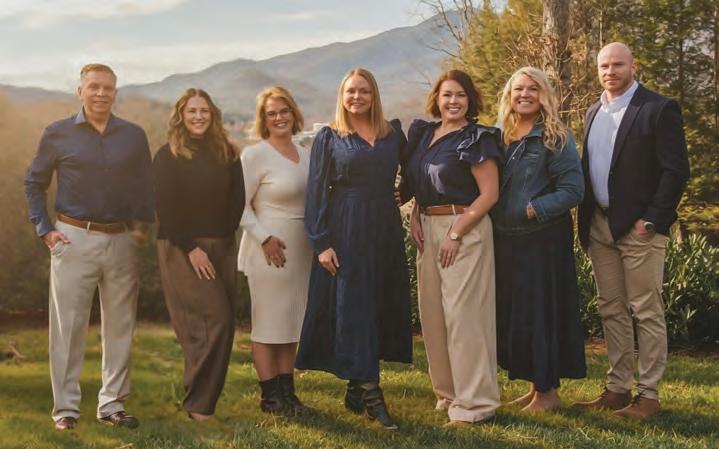




BY CORY VAILLANCOURT POLITICS EDITOR
The numbers arrive without warning, often weeks after the crisis has passed, stamped in clinical language and coded in ways few patients understand — turning moments of vulnerability into prolonged financial strain.
“My first feeling was a very big thud in my stomach to get a big bill like that and not at all expect it. And then the second feeling was like, what the hell?” said Kasha Williamson. “A little bit of anger, I would say.”
Across Western North Carolina and beyond, patients facing high deductibles or those with no coverage at all are discovering that the hardest part of a medical emergency may not be the diagnosis or the treatment, but the opaque billing systems that follow.
For self-employed residents in their 50s, like Kasha and her husband Kelly, those bills can feel less like a statement of services and more like an unsolvable puzzle. After receiving two separate hospital bills last year, the couple found themselves immersed in a labyrinth of billing codes, classifications and pricing discrepancies.
“I thought, well, I can resolve this problem just simply by calling the number on the bill and getting this taken care of, because I’m the customer and all I have to do is call to get this taken care of,” Kelly said. “When I did that, I was given the runaround and then the frustration sets in, because the process is not easy to actually work through — getting the bill figured out and getting it resolved.”
large language models, to analyze medical bills. The goal was not simply to interpret charges but to identify inconsistencies, flag potential errors and guide users through the process of disputing questionable costs.
The process proved more complicated than expected. Medical billing is governed by layers of coding systems and regulatory frameworks, each interacting in ways that even professionals struggle to navigate. Early experiments made clear that no single AI system could reliably handle that complexity on its own. Instead, the solution emerged as a hybrid approach. By combining multiple AI tools with databases of benchmark pricing and coding rules, the couple developed a system designed to replicate the kind of detailed review typically performed by billing specialists.
The result is FairMedBill, a home-based startup in Waynesville offering a flat-fee service aimed at making bill analysis accessible to ordinary patients. For a modest cost, users can upload multiple bills and receive a structured
Reviewing the fine print and pushing back, patients are now challenging a confusing medical billing system where the stakes — and the costs — keep climbing. FairMed photo
who converts them into standardized billing codes. From there, the billing department assigns charges based on those codes. Because this process involves interpretation at multiple stages, inaccuracies can occur — such as selecting the wrong code, failing to use the most appropriate code for the situation or choosing a code that results in higher charges than warranted.
“Then there’s things that aren’t exactly errors,” Kelly said. “They’re actually what we call ‘systemic billing practices.’”
One such practice is called unbundling — basically, charging a là carte prices for services or supplies that should all be part of one treatment or procedure.
“That’s not allowed, basically,” Kasha said. “In all those procedures, there’s already sets of rules around that. Sometimes it’s a mistake, and sometimes it’s systemic.”
The tool does not promise automatic reductions or guaranteed outcomes. Instead, it focuses on equipping patients with information, helping them understand what they were charged and why, and identifying areas where those charges may not align with standard practices.

One bill, labeled as an emergency room Level 4 visit, appeared inconsistent with the care received. Another, tied to a routine mammogram and follow up, raised similar questions. What should have been straightforward medical encounters instead triggered weeks of research into “current procedural terminology” codes and federal billing regulations. Their experience exposed a gap between what patients are charged and what they are equipped to understand. That gap, often widened by time constraints and financial pressure, leaves many people paying bills they can not fully comprehend, let alone challenge.
Frustration led to exploration for the Williamsons. Existing medical bill negotiation services offered help but at a cost that mirrored the very problem they aimed to solve, taking 20% to 30% of any savings secured. For patients already struggling to pay their bills, that model offered little relief.
Out of that frustration came an idea rooted in both necessity and practicality. Rather than outsourcing the fight, the couple began exploring whether the tools already reshaping other industries could be adapted to empower patients directly.
What followed was months of intensive development. Drawing on a background in IT and engineering, Kelly began testing multiple artificial intelligence platforms, including
review that highlights potential errors and provides guidance on how to challenge them.
Customer information is protected by HIPAA laws, is never seen by human eyes and is not retained once the review is complete.
The concept reflects a broader shift in how consumers now interact with healthcare systems. As insurance coverage becomes less predictable and out-of-pocket costs rise, patients are increasingly forced into roles once reserved for industry insiders, acting as their own advocates in disputes over pricing and classification.
For many, that role is overwhelming. FairMedBill is designed to break that cycle, offering users a starting point rather than a final answer.
“There are a several different types of errors that can occur,” Kelly said.
One category involves straightforward clerical or arithmetic mistakes. Pure math errors are relatively uncommon because much of that process is automated, but they can still happen.
Clerical issues are more frequent and tend to arise during the multi-step billing process. After a patient visit, a physician records notes, which are then interpreted by a coder
That distinction is central to the company’s approach. While some consumers may assume that artificial intelligence can instantly resolve billing disputes, the reality is more nuanced. Effective challenges still require human involvement, persistence and, in many cases, direct communication with providers or insurers.
The platform aims to streamline that process, reducing the time required to identify issues and organize a response.
The timing of the launch reflects a growing need. As policy changes and market shifts alter the landscape of health coverage, more individuals find themselves underinsured or uninsured, facing higher deductibles and greater exposure to unexpected costs. In that environment, tools that enable patients to question and verify charges take on increased significance.
At the same time, the rise of artificial intelligence has created new possibilities for analyzing complex data sets. By leveraging those capabilities, FairMedBill represents an attempt to translate technological advances into practical benefits for consumers, particularly those who lack the resources to hire professional negotiators.
The early results, while limited, have been encouraging for the founders. Personal use of the system led to significant savings on their own bills, and initial testing with a relative produced similar outcomes. Those experiences suggest that, when applied correctly, detailed analysis can uncover discrepancies that might otherwise go unnoticed.
Still, the company remains in its early stages, with broader adoption and long-term impact yet to be determined and a patent on the technology currently pending. Questions remain about scalability, accuracy and the extent to which users will be able to translate insights into successful disputes.
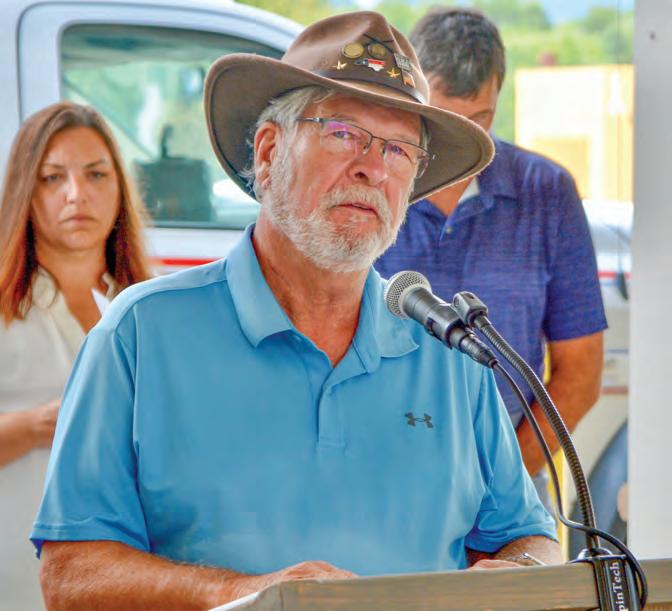



Mike Clampitt, the Swain County native and retired fire captain who represented portions of Western North Carolina in the General Assembly until his passing after a long illness on March 18, was laid to rest at the Lauada Cemetery in Bryson City on April 4, after a service at Western Carolina University’s Bardo Arts Center.
As a Republican, Clampitt won his first term in the legislature in 2016, defeating Waynesville Democrat Joe Sam Queen, but then lost to Queen in 2018. In 2020, Clampitt again prevailed over Queen and
Those uncertainties highlight the challenges inherent in any effort to disrupt established systems. Medical billing practices are deeply embedded in the healthcare industry. Changing how patients interact with those systems will require not only new tools, but also shifts in behavior and expectations.
For now, the focus remains on accessibility. By offering a low-cost entry point, the platform seeks to reach individuals who might otherwise forgo any attempt to review their bills. In doing so, it positions itself as both a practical resource and a form of consumer advocacy.
“People are already dealing with medical debt. Why would we want to then make the situation worse? This is really a passion project,” Kasha said. “From our perspective, we’re not looking to Silicon Valley, we’re not looking to cash out. This is really out of a feeling of wanting to be able to help people who are in a bad situation.”
The broader implications extend beyond individual savings. Increased scrutiny of medical bills has the potential to influence provider practices, encouraging greater transparency and accountability. While a
never looked back, winning against other opponents in 2022 and 2024. Clampitt was poised to seek his fifth term in the General Assembly after winning his March 3 Primary Election handily but passed away at Duke University Hospital in Durham barely two weeks later.
Discussions on who will replace Clampitt in the General Assembly and on the November ballot are ongoing; while they needn’t be the same person, Transylvania County Democrat Mark Burrows awaits whoever is selected to run.
single tool is unlikely to reshape the system on its own, it may contribute to a gradual shift in how billing is perceived and contested.
In Western North Carolina, where small businesses and self-employed residents make up a significant portion of the population, those changes carry a particular weight. Financial resilience often depends on the ability to manage unexpected expenses, and medical bills remain one of the most unpredictable variables.
By framing billing review as a do-it-yourself process supported by technology, FairMedBill aligns with a wider trend toward consumer empowerment. Whether that approach will gain traction on a larger scale remains to be seen, but it reflects a growing recognition that patients need more than information — they need tools that make that information usable. For the Williamsons, that’s what success looks like.
“It’s just knowing that people use it,” Kelly said. “It’ll be good just knowing that people use and get some savings out of it.”
For more information, visit fairmedbill.com.


























BY CORY VAILLANCOURT POLITICS EDITOR
The message at the Haywood County Farm Bureau’s April 1 legislative breakfast was unmistakable — more than 18 months after Hurricane Helene, recovery is moving, but not at the pace or scale many farmers say is necessary to stabilize their operations.
Held annually, the breakfast serves as a touchpoint between Haywood County’s agricultural community and the policymakers charged with supporting it. This year’s gathering, however, carried a different weight, shaped by the long tail of a disaster that continues to define planting decisions, financial outlooks and the viability of farms across the region.
revenue impacts for perennial crops are all being addressed through separate application processes, reflecting the layered nature of agricultural recovery.
Even with those programs in place, Rathbone emphasized that timing and accessibility remain challenges, particularly for smaller operations navigating complex application requirements while trying to rebuild.
Federal representatives echoed both the progress and the limitations of current recovery efforts, pointing to ongoing legislative work while acknowledging the uneven pace of assistance.
Kai Laughter, a spokesperson for Sen. Ted Budd, said proposed legislation called “The Disaster Recovery Improvement Act”
between funds that are technically approved and those that are practically available.
Chris Burns, representing Congressman Chuck Edwards, pointed to areas where federal programs have functioned more effectively, particularly within the Department of Agriculture.
“USDA is doing a great job,” Burns said.
Burns added that USDA programs have been more efficient in distributing funds, particularly those tied directly to agricultural losses. He encouraged farmers to apply for available assistance before looming deadlines.
The comparison highlights a recurring theme in disaster recovery — variability across agencies that can leave farmers navigating inconsistent timelines and requirements.
approved for Haywood County, but the gap between obligation and reimbursement continues to strain local resources, forcing counties to front costs while waiting for federal dollars to arrive.
Speakers throughout the morning emphasized that recovery is not solely about replacing what was lost but about sustaining operations long enough to remain viable. For farms that rely on seasonal income and tight margins, delays in assistance can have cascading effects.


Kaleb Rathbone, a Haywood native working in North Carolina Agriculture
Commissioner Steve Troxler’s office, provided a detailed overview of recovery efforts, describing a system that has delivered substantial funding while still struggling to fully address the scope of losses.
“You know, we’re two years out past Helene, but there’s still a lot of gaps,” Rathbone said. “We’re trying our best to cover those, seeing how the ag community has circled around this issue.”
Rathbone said the state has appropriated roughly $440 million for agricultural recovery with more than $280 million already distributed through direct payments and infrastructure programs. That funding is being supplemented by a $221 million federal block grant administered through the U.S. Department of Agriculture, intended to fill gaps left by earlier relief efforts.
He described three active disaster programs operating simultaneously, including two state-funded initiatives and the new federal block grant, each targeting different categories of loss. Infrastructure damage, timber loss, market disruption and long-term
would create a task force composed of federal officials, governors and local leaders to identify gaps in disaster response and make recommendations to improve future recovery efforts. The goal, he said, is not to expand government but to better coordinate it.
Regardless, the legislation would expand government and appears largely duplicative of the FEMA Review Council — a group chartered by President Donald Trump in January 2025 that has blown through deadlines, had its original one-year charter renewed twice and has failed to produce the recommendations Trump demanded.
Republican Senate Candidate Michael Whatley is the only representative from North Carolina on the council.
Recent funding approvals offer a mixed picture. Laughter noted that $165.9 million in public assistance has been approved for North Carolina, but the total amount of funding remains far below the $60 billion in damage claimed by state estimates.
For farmers still dealing with the aftermath of Helene, those distinctions underscore a broader frustration — the difference
At the local level, those delays translate into tangible challenges, from repairing infrastructure to restoring production capacity. For many farmers, recovery is not a single milestone but a prolonged process shaped by both policy decisions and physical realities.
Haywood County Commissioner Tommy Long, who also represents the state’s heavily rural, westernmost counties through the North Carolina Association of County Commissioners, framed the issue through his own experience as a cattle rancher during and after the storm.
Long described the immediate aftermath of Helene as a period of relentless work, moving equipment, tending livestock and navigating damaged infrastructure with little rest. At one point, he said, he’d been up for roughly 48 hours.
Those experiences inform his perspective on recovery, which he believes has been driven more effectively at the state level than at the federal level.
“I will say that the state has done more by accident to help us than the federal government has done on purpose,” Long said.
Long acknowledged efforts by federal representatives, including Edwards, to secure funding and push for reimbursements, but said the pace of federal response remains a concern, particularly as local governments enter budget season.
“We’re on hook for about $17 million and they can let their purse strings down pretty soon,” he said, referring to Haywood County’s storm-related outlays that hadn’t been reimbursed.
Later that morning, a release from Budd’s office noted that $12.5 million in public assistance funding had just been
Rathbone noted that newer programs are attempting to address those longer-term impacts, including provisions for future revenue loss tied to perennial crops that take years to return to full production. He said the federal block grant includes categories designed to cover not just immediate damage but also the extended economic consequences of the storm, including losses tied to agritourism, direct sales and storage disruptions.
Those additions reflect lessons learned from earlier disasters, where traditional aid models often failed to capture the full scope of agricultural loss.
Still, the need to navigate multiple programs, each with its own criteria and timeline, remains a challenge for farmers already stretched thin by recovery efforts.
Laughter said the goal of federal legislation is to identify and correct those gaps but acknowledged that systemic changes take time.
Burns encouraged farmers to stay engaged with federal offices and to seek assistance when encountering obstacles in the application process, emphasizing that advocacy can help move cases forward — despite Edwards’ failure to deliver the assistance residents, farmers and local governments in his district have been calling for over the past 18 months.
At its core, the conversation returned repeatedly to a central tension — the difference between policy intent and lived experience.
On paper, hundreds of millions of dollars have been allocated and distributed. In practice, many farmers continue to operate in a state of uncertainty, balancing recovery efforts with the demands of a new growing season.
The Farm Bureau’s legislative breakfast, in that sense, functioned less as a progress report than as a checkpoint, a moment to measure how far recovery has come and how far it still has to go.
Funding is flowing, but unevenly. Programs are expanding, but remain complex. Recovery is underway, but incomplete.
For the farmers gathered in the room, those realities are not abstract policy questions but daily calculations — whether to repair, replant or wait, whether to invest in the future or focus on surviving the present.
As another season begins, the storm’s legacy continues to shape those decisions, ensuring that even as recovery progresses, it remains far from finished.
BY LILY LEVIN STAFF WRITER
Just as the members of Qualla Enterprises’ board were all suspended, its attorney and chair may have engaged in the unauthorized practice of law.
Qualla Enterprises, LLC, owned by the Eastern Band of Cherokee, is the only cultivator of legal cannabis in the state of North Carolina. It sells recreational products to the public through its subsidiary, Great Smoky Mountains Dispensary. From its inception in 2023 as a medical cannabis venture, the company has received more than $50 million in loans from the tribe since converted to equity. On April 20, enrolled EBCI members will receive their first per capita payment.
During its April 2 meeting, tribal council voted 11-1 — councilmember Bo Crowe abstained — to suspend board members Tagan Crowe, Morgan Owle Crisp, Jacob Reed and Albert Rose with removal pending an Office of Internal Audit and Ethnics Investigation.
A separate resolution, passed along the same lines, removed board Chair Carolyn West, alleging she “disclosed information and conducted herself such that she would be removed from the board.” West is also an attorney licensed to practice in EBCI territory and the state of North Carolina.
As chairperson, she hired attorney Richard “Rico” Frias to provide legal advice to the company. Frias is licensed to practice law in New Mexico and does not have comity to practice in North Carolina. On April 2, Frias represented Qualla Enterprises as its legal counsel, possibly engaging in the unauthorized practice of law.
According to the American Bar Association, a lawyer not licensed to practice in a jurisdiction cannot “except as authorized by these Rules or other law, establish an office or other systematic and continuous presence in this jurisdiction for the practice of law; or hold out to the public or otherwise represent that the lawyer is admitted to practice law in this jurisdiction.”
Additionally, Section 87-1 of EBCI Municipal Code requires that certain professionals practicing “within the territory of the Eastern Band,” — including attorneys — “have a current license issued by the appropriate state regulatory agency authorizing them to practice their profession in the State of North Carolina, and must be in good standing with that regulatory agency.”
The unauthorized practice of law is a Class 1 misdemeanor, subject to up to one year in jail and/or a fine of up to $5,000, civil and/or criminal sanctions. The North Carolina State Bar can impose disciplinary measures ranging from admonition to disbarment.
West — governed by the North Carolina Rules of Professional Conduct to remain in “good standing” as a practicing state lawyer — stood beside Frias on April 2 and let him
talk, perhaps contemporaneously engaging in the unauthorized practice of law. Rule 5.1 of NCRPC states that “A lawyer having direct supervisory authority over another lawyer shall make reasonable efforts to ensure that the other lawyer conforms to the Rules of Professional Conduct,” in this case, not practicing while unlicensed by the jurisdiction.
If she violated the state ethical code, West did not retain “good standing” with the state bar and thus was also in violation of Section 87-1, subject to the Class 1 misdemeanor charge.
who appears before you to provide information,” adding that “it’s up to you if you want to let him [do that].”
Both West and Frias had appeared before council to advocate for a resolution permanently removing then-suspended board member Tagan Crowe, bringing multiple accusations under the pretense of representing Qualla Enterprises. Resolution 177 alleged that Crowe, appointed in December 2025, forwarded several confidential and sensitive documents to his personal Gmail address. Additionally, it claimed Crowe attested to attending an
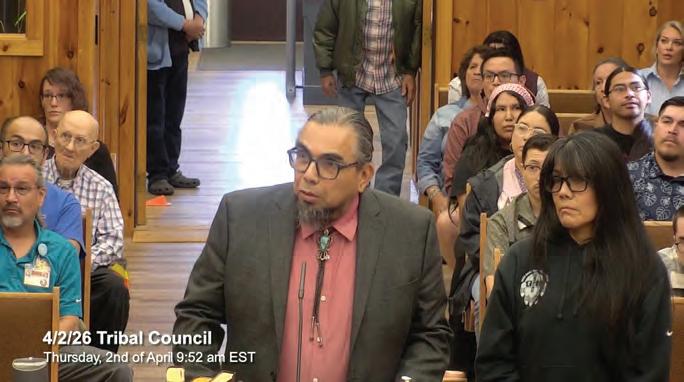
Frias introduced himself as an “attorney,” only admitting he’s unlicensed to practice in North Carolina after asked by Vice Chair David Wolfe — though the question was originally prompted by enrolled member Mary Crowe.
(Principal Chief Michell Hicks, Vice Chief Alan Ensley were not in attendance due to undisclosed medical emergency reasons. Chairman Jim Owle was also not in attendance.)
Attorney General Mike McConnell, representing the executive branch of EBCI, then addressed council members to contextualize the situation, noting that “the rule in the state is that an attorney from out of state can serve as in-house counsel for a corporation, for a business entity within the state.” But Frias may have represented Qualla Enterprises in an official capacity by acting not as “in-house” but external counsel.
McConnell added that attorneys licensed in different states can sometimes be permitted to appear before tribal court through a clause called “pro hac vice admission.”
Pro hac vice requires explicit prior permission from tribal court, and attorneys must act alongside a member of the Bar of Cherokee Court acting as local counsel.
McConnell told council members that “in the past, tribal council has been a little more flexible in that regard, in the sense of
upon the condition of a closed session.
For over an hour, the chairperson, Frias and eventually Vice Chair Morgan Owle Crisp took turns defending the resolution in the face of pointed questions, drawing increasing frustration and ire from traibal members and officials.
Applause echoed throughout the room after councilmember Shennelle Feather emphasized the need to see just one Qualla Enterprises financial statement.
Then West admitted she’d also sent emails to her personal Gmail.
To make matters worse, councilmember Lavita Hill disclosed that the Qualla Enterprises chairperson had once addressed an internal email to the personal account of a non-board member, a graver offense than Crowe’s alleged behavior.
“I would like to amend [Resolution 177] and remove Tagan Crowe and add Carolyn West’s name,” Hill added, also receiving a round of applause from the audience.
Crowe subsequently addressed council with the intention of not only pleading his case but also exposing what he claimed had happened behind closed doors. As for his former motivation, Crowe said there was “zero proof” he had committed any wrongdoing and that he’d attended the conference to educate himself more about the industry.
“There’s nothing on any materials that the board provided showing that I was attending that conference as a Qualla representative. I was there as a private citizen, on my own time and my own money,” he said.
important conference last-minute while on an ice fishing trip with his father, when he’d agreed a month earlier to participate as a panelist.
“There has been a flagrant disregard for the fiduciary duties of [Crowe], which from that right, in the best interest of company, that would be to remove somebody who flagrantly disregards those duties, loyalty and care. [At] any other company, he would have been removed,” Frias said.
The company board had suspended Crowe’s access to his account in late February following the conference and noted that he’d tried to log in multiple times throughout the next week.
Several tribal officials were taken aback by the resolution, which made public a process meant to be pursued through the Office of Audit and Internal Ethics to avoid public shaming and uncorroborated allegations.
Council member Venita Wolfe asked the board to approach the body “to explain this resolution to us.” Seeing that West and Frias were the only two in attendance — and West the only board representative — Wolfe asked about the whereabouts of other members. “They are on their way,” West responded.
Wolfe also requested meeting minutes and other evidentiary materials. None were provided, as council denied West’s offer to present and discuss relevant documents
Finally, Crowe told council he was suspended without notice and the login attempts were evidence of his belief that he was still part of the board. He addressed what he saw as systemic issues within the company, raising concerns about the “the lack of oversight, transparency and accountability” and influence of contractors.
“There’s no adherence to Robert’s Rules of Order, no meaningful oversight. Instead, all the decisions that are made are heavily influenced, if not outright controlled, by independent contractors who are also in the room,” he said.
After some discussion, tribal council voted 11-1, with Bo Crowe as the sole opposition, to table Resolution 177 — and to draft an emergency resolution later that afternoon referring the case to the Office of Internal Audit and Ethics and outlining disciplinary measures for all members pending results of the investigation.
At the start of the second session, council passed one resolution terminating West’s position and another suspending every other member.
To achieve a quorum and prevent contractors, including Qualla Enterprises CEO Forrest Parker, from acting as its sole oversight during the investigation, the legislation included a clause allowing tribal council and Hicks to appoint one and two interim board members, respectively.
Qualla Enterprises has yet to publish a forensic audit, despite requests dating back to 2023 from then-Chief Richard Sneed.
The Smoky Mountain News did not receive a response after reaching out to the AG’s office.

BY LILY LEVIN STAFF WRITER
For fiscal year 2026-2027, Haywood County Schools is requesting an additional $3 million in annual county funding.




The ask is driven by several overlapping needs — offsetting state and federal cuts, avoiding fund balance appropriations, covering a $400,000 increase in annual operating costs, financing salary raises and supporting continued program needs — all while facing a budget shortfall between $700,000 and $740,000.
The requested appropriations would require a 4.29-cent property tax increase, equivalent to an additional $12 per month for the average homeowner.
bership — a single measure of total enrollment at county public and charter schools the year prior — was set at 7,034 this fiscal year and 6,934 for the next. However, public schools only lost 11 students, with enrollment counts of 6,370 and 6,359, respectively, in the last two years.
Superintendent Trevor Putnam was clear that additional appropriations were necessary for the school system to maintain — rather than expand — existing programs. If HCS were to keep last year’s budget, Putnam told commissioners that more than 25 teaching positions would be cut, class sizes would increase, staff would be strained and special education student services restricted.
Most of the requested additional funding is connected to the school system’s 2025
allocated to salaries, with 20% toward employee benefits and purchase services like utilities and maintenance, leaving the remaining 35% to every other line item.
Professional compensation is also one of the main drivers of educational inequality among school districts statewide. Competitive pay strengthens educational outcomes by mitigating staffing shortages and retaining experienced teachers.
Counties fund salary supplements, so high-wealth districts — typically those with a large tax base — tend to offer better pay than their low-wealth counterparts, even though the state provides the latter group with up to $4,250 in additional supplements.
In the 2023-24 school year, Haywood County offered a supplement of $2,968. Wake County, with the highest locally funded supplement, offered $9,828.









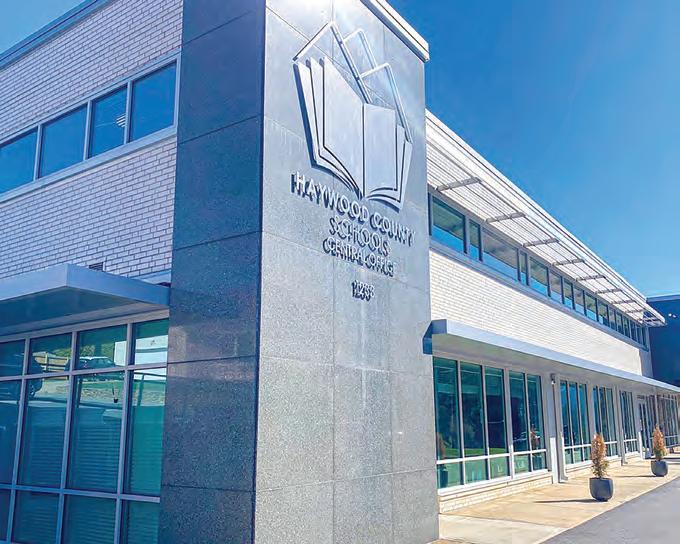
The HCS board held a March 26 work session to discuss the funding increase in conjunction with county commissioners and a March 30 public hearing to explain the changes impacting its projected FY 2026-27 expenditures. The board voted unanimously to approve its budget request at the March 30 meeting.
HCS’ 2025-26 local budget totaled $19.37 million, with $719,483 derived from its fund balance, $345,000 in fines and forfeitures, $24,000 in ABC revenues, and $18.29 million in county appropriations.
The district projects a 2026-27 operating budget of $21.54 million, $21.29 million of which will be provided by the county. When divided by enrollment numbers, the budget allots an average of $3,052 per student, about $500 more than the current fiscal year.
Haywood County’s average daily mem-
classified and non-certified salary study. Its results align the salaries of these two employment categories with the North Carolina Office of Human Resources schedule.
“[This] is designed to strengthen our ability to attract and retain qualified employees,” said HCS Finance Director Leanna Moody.
Similarly, the 1% increase in child nutrition funding mainly goes toward greater benefits and compensation for employees and substitutes.
The department “use[s] substitutes quite regularly and usually do[es] not have enough substitutes to fill in, in those positions,” said Director Alison Francis, adding that she’s grateful for a more robust 2026-27 budget.
Indeed, employees are the main benefactors of local district appropriations in North Carolina. At HCS, 45% of local funding is
Still, HCS maintains high academic performance, consistently ranking in the top 10% of North Carolina school systems.
As the school board requests a significant increase in local appropriations, Haywood commissioners are grappling with strained existing funding.
The county has yet to receive more than $17 million in federal Hurricane Helene reimbursements. Reduced tax collections total between $250,000 and $300,000. There’s been an absence of funding dedicated to SNAP Medicaid and other federal and state services. Revenues have plateaued despite a growing community, and with the closure of Canton’s papermill, the county lost a tax base of $190 million.
At the state level, the General Assembly still hasn’t passed a budget, so yearly mandated stepwise salary increases are optional at the discretion of the local education agency and dictated by the 2024-2025 pay scale. Teachers on average have received 1% less pay this year without accounting for inflation, according to the NC Department of Instruction.
Next year doesn’t look much better either.
“The fiscal year [20]27 state planning budget that — this was released from the state — includes reductions across several areas, including teacher assistant funding, central office allotments and teacher positions, which results in a combined impact of approximately $350,000,” Moody told other board members.
And North Carolina is set to face a $3.5 billion budget shortfall — which Gov. Josh Stein has warned poses the largest threat to public school systems — one year after that.
HCS plans to pass a resolution outlining the $3 million funding request and mandating the 4.29 cent property tax increase in early April, which members will present to commissioners on April 20.
BY KYLE PERROTTI NEWS EDITOR
Gretta Worley, the former director of a Jackson County nonprofit established to help support the area’s homeless residents, has been charged with 10 felonies related to the alleged improper use of credit cards.
Worley, 60, served as the director of HERE in Jackson County from 2022 until late last year. After her December departure, The Sylva Herald reported that Worley had chosen to “go in a different direction,” at which point she took a job with the domestic violence support agency Helpmate in Asheville.

On March 31, she was indicted on 10 felony counts of obtaining property by false pretenses. According to the indictment, Worley used her position as director of the nonprofit to “obtain and use multiple credit cards” that were used by her and her family for “person expenditures not authorized by her position.” The total value of items allegedly purchased is in excess of $100,000.
According to court records, Worley faced a host of similar charges — including larceny, identity theft, writing bad checks and obtaining property by false pretenses — between 2001 and 2007 but hasn’t had any between then and her recent arrest.
HERE Board Chair Rady Large sent a statement to The Smoky Mountain News.
“On October 10, 2025 members of the Board of Directors of HERE in Jackson obtained information that suggested there were multiple issues of mismanagement occurring in the organization,” the statement reads. “On October 14, 2025 the Board of Directors placed Executive Director Gretta Worley on Investigatory Leave and began investigating these allegations. The findings of this investigation lead the Board of Directors to dismiss Executive Director Gretta Worley on October 23, 2025 and involve the Sylva Police Department for a potential criminal investigation.
“The Board of Directors of HERE has been committed to ensuring that this organization operates with integrity and diligence to help those in need. The Board and Staff of HERE would like to let the public know that we are indeed still HERE to help.”
While nine of Worley’s charges are relatively low-level felonies, one is a class C. If convicted on the class C charge, Worley will face a mandatory prison sentence that can range over 10 years.




































































BY CORY VAILLANCOURT POLITICS EDITOR
Afamiliar face is returning to county government sooner than expected, as former tax collector Greg West steps back into the role following Sebastian Cothran’s sudden resignation.
“I would just like to say thank you,” West said. “I appreciate all the support I received during the Primary Election. I’m humbled and very appreciative. I look forward to the opportunity to get back in the office and work hard for the citizens of Haywood County. It’s my home; I’m proud to be here, and I again want to say thank you to everyone, and I’m looking forward to the next four years.”
His early appointment follows the abrupt March 24 resignation of Sebastian Cothran, a first-term Republican whose tenure as the state’s only elected tax collector began with a high-profile 2022 victory while he was still a college student and only 21 years old.
not to run for reelection. No other candidates filed for the race, so West was slated to take office later this year pending his likely victory in November.
Once Cothran’s resignation became known, West was the obvious choice to fill out the rest of Cothran’s term, but the vacancy prompted legal and procedural questions — particularly over who had the authority to fill the unexpired term.
there were no findings of any discrepancies?”
“No findings at all,” Owen said.
As of Cothran’s last day in office, Owen said the collection rate for the current fiscal year was 96.14%.
Commissioner Jennifer Best asked Owen how that figure compared to previous years. Owen said it couldn’t be.
“This is an unusual circumstance,” she said. “We don’t usually have a mid-year settlement rate.”

Some initially believed the Haywood County Republican Party would submit a binding recommendation, as is common for other vacancies in partisan offices.

The incumbent he beat — West — was a Democrat at the time and had previously notched the highest tax collection rate in county history, 98.35%.
Although Cothran’s collection rates remained solid, they declined each year and never surpassed the benchmark set by West.
West, now a Republican, bested two opponents in the March 3 Republican Primary Election after Cothran opted
County Attorney Frank Queen — citing state law, a county attorney’s memo and a 1998 attorney general opinion — found that the sole authority to appoint an interim replacement rests with commissioners.
Two other procedural issues had to be addressed before anyone could be appointed.
On April 6, Finance Director Kristian Owen told commissioners in a meeting that per state law, she’d performed an audit and basically “closed out” Cothran’s books without discovering anything unusual.
“We always have these conspiracy theorists that’s always chumming the waters with misinformation,” Commissioner Tommy Long said to Owen. “So, just for the record, we are required by law to do this, in unusual circumstances, and
There are, however, still almost three months left in the current fiscal year for property owners to make tax payments, so that figure will climb. Collection rates over the past decade have generally hovered around 98%.
The other procedural step was to obtain a professional bond for the new tax collector, essentially an insurancebacked financial guarantee required by North Carolina law to protect the county against losses from errors, misconduct or failure to properly handle public funds.
The amount of the bond can be thought of as the perceived the risk associated with the person bonded.
Owen said there were no issues getting West bonded, and the turnaround on the $100,000 bond was same-day — something that hadn’t been the case in the past.
“I just gotta say this, we have had trouble getting tax collectors bonded, and it’s nice not to have that issue because we have somebody very qualified,” said Chair Kevin Ensley.
In 2014, an incoming tax collector wasn’t able to be sworn in because he couldn’t obtain his $410,000 bond in time.
When Cothran took office in 2022, his age prompted heightened scrutiny around his required bond, but unlike his predecessor, he secured a $250,000 bond without delay and took office as scheduled.
West will be re-sworn later this year once he’s certified as the winner of his Nov. 3 race and will then serve out his fouryear term.
BY CORY VAILLANCOURT POLITICS EDITOR
Anew political ad marks a sharp escalation in the U.S. Senate race between Democrat Roy Cooper and Republican Michael Whatley, turning Hurricane Helene recovery into a central line of attack by accusing Whatley of overseeing delays of more than $100 million in disaster relief and framing the stalled aid as a failure of leadership, rather than of bureaucracy.
A pair of ads center on the claim that Whatley was tapped to lead the recovery but failed to deliver timely assistance.
One spot focuses narrowly on the alleged delay of more than $100 million in disaster relief for roads, homes and businesses, framing the issue as a matter of basic accountability.
A second, more expansive version amplifies the emotional stakes, describing “biblical devastation.” It links the same funding delays to families losing homes and to stalled support for schools and water systems, portraying the recovery effort as both insufficient and overdue.
Following Helene, President Donald Trump publicly elevated Michael Whatley to “recovery czar” during a visit to Asheville, later casting him as part of a newly formed FEMA review process.
That process, formalized through the FEMA Review Council, was tasked with evaluating federal disaster response and producing recommendations last fall, but questions have since emerged about its transparency, pace and output after blowing through deadlines and having its original one-year charter renewed twice.
A leaked draft of the council’s final report suggested a focus on structural reforms and longterm changes, placing significantly more responsibility on state and local governments already frustrated by the lack of federal support 18 months after the storm.
Both ads are also cast against the backdrop of a larger funding gap, and a larger campaign.

Floodwaters carved a path of destruction — now the political fight over delayed relief is carving its own. Majority Forward photo
Both ads close with a direct appeal for action, urging Whatley to “do your job” and release recovery funds immediately. The ads overstate Whatley’s formal power, but they accurately exploit a leadership vacuum where everyone seems to be in charge but no one seems to be in control.
According to state estimates, North Carolina suffered $60 billion in damage from the Sept. 27, 2024 storm. Recent figures show faster disbursements under new Homeland Security Secretary Markwayne Mullin than under previous Secretary Kristi Noem, but less than 15% of that total has reached state and local agencies, farmers and homeowners. The campaign between Cooper and Whatley for the seat of retiring Republican Sen. Thom Tillis could be the costliest of all time and will have national implications. A series of recent polls have shown Cooper, the state’s former two-term governor and attorney general, with a sizeable lead. The General Election, however, is still more than six months away and earlyphase spending by Dem-aligned PACs like Majority Forward, which paid six figures for
the anti-Whatley ads, will become larger and more frequent.
According to recent reporting by WRAL’s Will Doran, the GOP’s Senate Leadership Fund plans to spend $71 million in the race. Candidates, PACs and other dark money groups could push total combined spending in the race well above $500 million.
Accountability for the lagging Helene recovery already been an issue in Western North Carolina elections. Rep. Chuck Edwards (R-Henderson) sits on the House appropriations committee and represents the congressional district that took the brunt of the damage, but has thus far failed to deliver anywhere near $60 billion — despite claiming authorship of a $110 billion continuing resolution in December 2024 that only promised between $9 billion and $15 billion for North Carolina.
Edwards’ Primary Election opponent basically ran on Edwards’ inadequacies, breaking off about 30% of the vote in his unsuccessful bid to unseat Edwards.
Edwards’ General Election opponent, Democrat and farmer Jamie Ager, has also been critical of Edwards’ response and said Edwards had actually “made things worse.” Ager was added to the Democratic Congressional Campaign Committee’s “red to blue” list in March.


BY CORY VAILLANCOURT POLITICS EDITOR
Silicon Valley and Sylva are about as different as any two places can be, but they do share at least one thing in common.
In Cupertino, billion-dollar office buildings rise within sight of tents and tarps. People sleep in cars or on bare ground backdropped by a landscape where extreme wealth and extreme poverty exist side by side.



In Sylva and the rest of Western North Carolina, multi million-dollar vacation homes loom far above homeless camps nestled under railroad bridges or in woody patches alongside creeks and rivers where affluence and austerity also coexist, on the same narrow ground.
while lacking stable housing — challenging common assumptions about poverty and personal responsibility.
Barth’s work is rooted in immersive techniques, spending time with unhoused individuals to understand their circumstances sperate from statistics or policy debates. His reporting highlights the structural pressures that contribute to homelessness, including gaps in social services. Rather than framing homelessness as an isolated issue, Barth presents it as a condition shaped by broader economic and social systems.
His connection to Western North Carolina informs his perspective on housing instability outside major urban centers — Barth’s family has ties to the region, and he grew up spending protracted periods in Sylva and Webster, including during the Coronavirus Pandemic.

The commonality is immediate and unavoidable, a physical expression of inequality that defines daily life. Substance abuse, mental health issues, rising housing costs and stagnant wage growth push working people toward instability in communities that continue to grow around them — and depend on them to perform the humblest of jobs that keep the wheels of society turning.
That uneasy proximity between prosperity and precarity will shape a community roundtable April 16 in Sylva, where residents, officials and service providers will examine homelessness as both a local issue and part of a broader national crisis.
Hosted in the Community Room of Jackson County Public Library, the event is sponsored by City Lights Bookstore, the Jackson County Public Library and Indivisible/Common Ground of WNC.
The discussion will feature retiring Sylva Police Chief Chris Hatton, HERE in Jackson County Interim Supervisor Paul Phillips and investigative journalist Brian Barth.
Barth’s work focuses on homelessness, inequality and the systems that shape both. He is the author of “Front Street: Resistance and Rebirth in the Tent Cities of Techlandia,” a 2025 book that blends reporting, memoir, history and cultural analysis to document life inside Silicon Valley’s homeless encampments.
Barth argues that understanding homelessness requires shifting perspective from judgment to recognition, acknowledging how structural pressures affect individuals across income levels. The systems that produce visible homelessness in major cities can operate more quietly in rural and mountain communities, creating instability that is less visible but no less real.
“People have more agency than they think,” Barth said.
That idea speaks to the role individuals can play in addressing homelessness, not through sweeping policy changes alone but through direct engagement, relationshipbuilding and connection to resources. Barth emphasizes that meaningful change often begins at a personal level, where small interventions can alter outcomes over time.
Those experiences reinforce the central argument of “Front Street” — that homelessness is not confined to any one place but is part of a wider national crisis that manifests differently depending on local conditions.
In “Front Street,” Barth seeks to humanize people experiencing homelessness, emphasizing resilience and basic human dignity while challenging readers to reconsider how they view unhoused individuals and recognize the shared vulnerability that exists across economic lines.
Organizers say the roundtable is intended as an open forum where community members can ask questions and participate in a conversation about homelessness and housing challenges.
Barth’s book anchors that discussion in a national context by confronting conventional thinking about homelessness and focusing on the lived experiences of people navigating instability in a region defined by wealth. He documents how individuals form communities, maintain self-respect and attempt to survive within systems that often fail to support them, revealing how quickly stability can disappear, even for people who once had secure housing and steady employment.
“They tell people to pull themselves up by their bootstraps, but when there are no boots, no straps and nowhere stable to stand, that idea collapses,” Barth said.
That philosophy is reflected locally in Sylva’s Community Care program, an initiative that integrates social workers and Western Carolina University student interns into policing. The program focuses on identifying root causes and connecting individuals with services rather than relying solely on enforcement and incarceration.
The approach represents a shift from reactive policing to proactive engagement. Instead of responding only to complaints or visible behavior, the program works to understand underlying issues and guide individuals toward solutions that can provide long-term stability.
As an example, Sylva police officers first connected with a man in October 2022 after repeated encounters and a referral identifying him as someone in need of additional support. He had been sleeping behind a vacant building, exposed to the elements and cycling through daily police calls from concerned residents reporting his presence. Instead of treating those calls as isolated incidents, Sylva’s Community Care team followed up, meeting him where he was and beginning the slower work of building trust.
Over time, that contact became a relationship. The team worked to understand his circumstances, identify what he needed and connect him with local resources, while maintaining consistent communication through setbacks and small gains. Progress did not come quickly, but with continued encouragement and coordination among community partners, he eventually secured employment and moved into stable housing. Since then, the calls for service that once brought officers to him regularly have stopped entirely, marking a shift not just in his situation but in how the system responded to it.
Partnerships played a key role in that success. HERE in Jackson County and regional workforce programs help connect services and provide support, illustrating how collaboration across agencies can create more effective responses to homelessness.



Through extensive on-the-ground reporting, Barth examines how people survive in one of the wealthiest regions in the country
In Western North Carolina, homelessness may not always appear in large encampments, but it indeed exists in less visible forms. People may live in vehicles, double up with family members or move between temporary arrangements that provide no long-term security. Service providers say those conditions often go unnoticed until a crisis brings them into public view.
Phillips will bring that local perspective to the roundtable, discussing trends in Jackson County and the challenges facing organizations working to connect people with housing and support
A roundtable discussion on homelessness will take place April 16 at the Jackson County Public Library in Sylva, bringing together local officials, advocates and an investigative journalist to examine the issue from both national and local perspectives.
Sponsored by City Lights Bookstore, the Jackson County Public Library and Indivisible/Common Ground of WNC, the event begins at 6 p.m. in the library’s Community Room, with light refreshments available at 5:30 p.m.
Award-winning investigative journalist Brian Barth will read from his book “Front Street,” which examines homelessness in Silicon Valley through reporting, memoir and cultural analysis.
Retiring Sylva Police Chief Chris Hatton will discuss the town’s Community Care program, which pairs officers with a social worker and student interns to connect unhoused individuals with services rather than jail. Paul Phillips, interim supervisor of HERE in Jackson County, will address local homelessness trends.
Organizers say the event is intended as an open forum where community members can ask questions and participate in discussion about homelessness and housing challenges.
services. His work involves coordinating outreach efforts, identifying gaps in resources and responding to increasing demand in a region where affordable housing remains limited.
Organizers say the roundtable is designed to encourage dialogue, allowing residents to engage directly with panelists and explore the complexities of homelessness in their own community. The goal is not simply to present information but to foster understanding and create space for meaningful conversation.
Barth wants attendees to leave with a clearer picture of how widespread housing instability has become and how much it affects everyday life.
“I hope people walk away with a deeper understanding of how close this issue is to all of us and see the humanity in people they might otherwise overlook,” Barth said.
His work suggests that the boundary between housed and unhoused is more fragile than many assume.
As Western North Carolina continues to grow, those pressures are likely to increase, making conversations like the Sylva roundtable more urgent. Addressing homelessness will require a combination of policy, resources and personal engagement, shaped by an understanding of both local conditions and broader trends.
For Barth, the message is rooted in recognition and shared experience.
“In reality, they’re much more like us than we realize,” he said. “In fact, they are they are us. They are us — just in a different context in their lives.”

BY CORY VAILLANCOURT POLITICS EDITOR
The question of who will control one of Jackson County’s most visible public assets is beginning to draw clear lines, and on March 26, Sylva’s Board of Commissioners stepped firmly onto one side.
In a unanimous vote, commissioners adopted a resolution supporting continued control of the Jackson County Library Complex by the Jackson County Public Library, signaling opposition to any effort that would shift authority elsewhere.
The measure was presented by Mayor Pro Tem Brad Waldrop, who also serves as Sylva’s representative on the Jackson County Public Library Board. After the resolution was read into the record, commissioners approved it without discussion or dissent.
“It was just out of an overall concern for the future of the library and the complex. I want to make sure it remains true to what we know works and remains true to the initial stakeholders and the community,” Waldrop told The Smoky Mountain News. “There’s significance to that history, and what it was meant for — it was meant to be a unified complex, rather than a library and another building.”
Efforts by Jackson County commissioners to withdraw from the Fontana Regional Library system last year marked a dramatic shift in an eight-decade regional partnership, driven largely by disputes over LGBTQ materials.
Commissioners moved to assert greater local control over the Jackson County Public Library while critics warned the move could fracture shared resources, increase exposure to First Amendment lawsuits, strain smaller counties and jeopardize funding and services built through decades of cooperation. The debate exposed deeper tensions over censorship,
public oversight and the role of elected officials in representing their constituents — who vehemently and overwhelmingly opposed the withdrawal — placing Jackson County at the center of a broader conflict playing out in libraries across North Carolina.

The resolution frames the library complex as a central civic resource, describing it as more than a collection of books. It encompasses the main library building, public meeting areas and the historic courthouse, all of which function as the only indoor community space for education, programming and public gatherings in Jackson County.
Town officials emphasized the library system’s longstand-
ing role in managing and leasing those spaces, arguing that continuity in that arrangement is critical to maintaining stable operations and broad public access. Emails between FRL board member Bill McGaha and Commissioner John Smith from early 2025 seem to suggest that access could be in jeopardy.
Antoinette MacWatt, a Jackson County resident opposed to withdrawal from the FRL who has closely followed the library dispute, said those emails created growing concern that the original purpose of the complex could be undermined.
MacWatt said the library and courthouse were never intended to function as separate entities but as a unified complex built through a combination of public funding, private donations and volunteer effort. She said that history — and the promises made during fundraising — still carry weight.
According to MacWatt, Sylva’s resolution was appropriate because it reinforces the original intent behind the project. She said the complex was designed to ensure that large, noncommercial community events would always have a home, something the library building was never designed to accommodate.
She also expressed concern that changes to the lease or governance structure could limit access to those shared spaces, effectively restricting their use to library-sponsored activities and excluding broader community functions.
“In my opinion, the impetus is to make sure that the community room is not booked by anyone related to the Pride community,” MacWatt said.
The resolution asserts that the library’s oversight has historically ensured that decisions about the facility align with community needs and the institution’s educational mission.

BY KYLE PERROTTI NEWS EDITOR
Superior Court Judge William T. Stetzer has ruled that former Graham County Sheriff Brad Hoxit will not return to his former office.
In his order, Stetzer determined that Hoxit engaged in “willful misconduct and maladministration.”
District Attorney Ashley Welch filed a petition for Hoxit’s removal on Jan. 29, alleging Hoxit abused his power as his office built a case against County Commissioner Jacob Nelms, whose ex-wife Adarian Nelms had been in an on-and-off relationship with Hoxit since before he took office.
“When a sheriff uses the power and tools of his office and the justice system to actively investigate a citizen with whom he has a personal conflict that requires recusal, the public is not safe,” the petition reads.
Hoxit, seen here testifying during his removal hearing, will not be able to return as sheriff. Kyle
“These repeated bouts of dishonesty amount to willful misconduct,” it reads. Hoxit had been removed from office pending the hearing back on Jan. 29, when Welch’s petition was filed. The following day, Graham County commissioners decided that Hoxit’s chief deputy, Travis Brooks, would assume the duties of sheriff.
On Feb. 20, the board named Russell Moody, a Republican who’d served in the office from 2007 to 2011, sheriff. Hoxit had begun a campaign to gain the requisite signatures to appear on the 2026 ballot as an unaffiliated candidate, but he failed to collect enough endorsements.
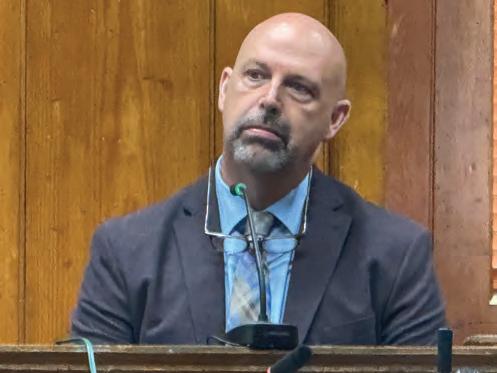
In a hearing held late last month in Graham County Superior Court, Welch argued that preserving the integrity of the critical institution meant keeping a corrupt sheriff out of power, while Hoxit’s defense team claimed that a message must be sent that a sheriff can execute his duties without fear of political retribution.
Stetzer agreed with Welch in his ruling, writing that “the Nelms investigation involved multiple acts of dishonesty.”
Sylva’s position also reflects its own reliance on the complex. The resolution notes that municipal officials have used meeting rooms within the courthouse when town facilities could not accommodate larger crowds, underscoring the practical importance of how the space is governed.
At the heart of the resolution is concern that any change in control could disrupt that balance. In the resolution, Sylva commissioners warned that transferring or reducing the library system’s authority could create uncertainty around scheduling, access and longterm use, with potential consequences for residents and local organizations that depend on the facility.
The resolution also touches on governance, emphasizing that the library system operates under a structure intended to prioritize public service over politics. Maintaining that framework, the resolution suggests, helps ensure that decisions about the complex remain focused on education, culture and community benefit.
Rather than merely opposing change, the



“I was in the process of getting my signatures to get on the ballot and then this here happened,” he testified during the hearing.
Republican Primary winner Caleb Stiles will face off against Democratic sheriff candidate Reba Louanne Jenkins McMahan in November.
town is also calling for cooperation. The resolution encourages Jackson County leaders and the library board to work together on any future decisions involving the complex, with an emphasis on preserving public access and supporting the library’s broader mission.
Copies of the resolution will be sent to county commissioners, the library board of trustees and the FRL administration, placing Sylva’s position squarely into an ongoing conversation about the future governance of the library complex as the library itself formally exits the FRL system on July 1.
MacWatt said that despite the ongoing conflict, her focus remains on the long-term health of the institution and the people now tasked with leading it forward.
“I just want to say this — the Friends of the Library, the Jackson County Public Library Allies, me personally — [County Manager] Kevin King and Grace Powell, as the new head librarian, have our entire and complete backing,” she said. “We want them to be successful. That’s what we want for our community — a successful library.”

BY LILY LEVIN STAFF WRITER
AMarch 31 Swain County public hearing for a data center moratorium drew a crowd of around 140 people, a turnout proportionate to 12,900 residents in Wake County, confronting commissioners to plead their case.
Hyper-scale data centers have become a focal issue in communities nationwide. File photo
hyperscale data centers — and the massive cost of these centers themselves, with a continuous power demand of around 100 megawatts and a daily water consumption of 5 million gallons — has placed them at the top of the list of priorities for local politicians.
Global corporations like Meta,
mines for future hyper-scale operations.
While data centers moderately expand a county’s tax base — Cherokee County’s Marble facility, for example, paid approximately $362,000 in combined 2023 personal and property taxes — residents consistently complain that the harm outweighs the good. Among other things, these facilities strain
Over almost two hours, commissioners heard from over 30 constituents, more than a handful of whom had registered with the false belief they were completing a sign-in sheet — and only one of whom was opposed to the moratorium. Their testimony showed that Swain County has been paying attention.
“My sister lives on Fairview, the Marble side, and I could hear [the data center] there. It’s miles away from her house. Now she is up on a mountain, but you could still hear it. You could see lights,” said Carla Piercy.
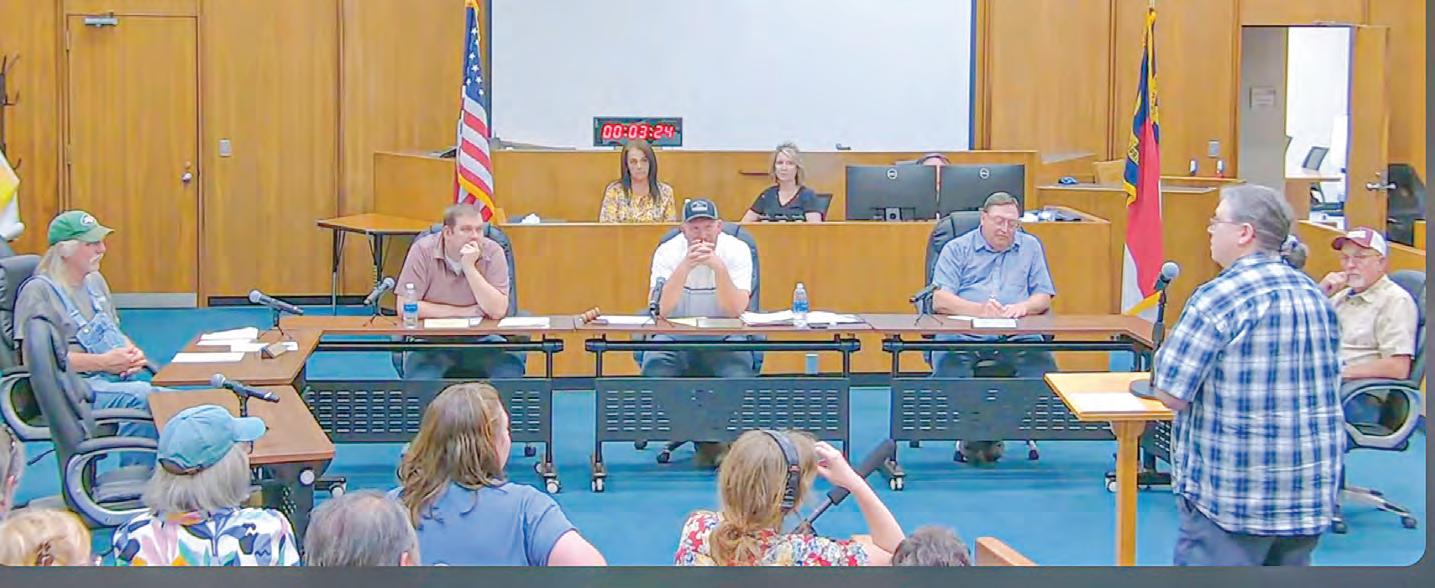
Attendees filled the six rows facing commissioners, leaving a couple dozen straining to watch the event behind the open doubledoors. All had shown up to be part of the conversation about hyper-scale data centers and out of concern for about how these facilities could impact every aspect of their livelihoods.
Hyper-scale data centers have become a defining contemporary issue in communities nationwide. Data centers were around long before this moment, but as smaller, quieter facilities, hidden inside office parks. However, the massive proliferation of AI
Microsoft, Google and Amazon are behind these projects, which tend to target Black and indigenous rural, low-income communities, a truth that is not lost on Swain residents. The county fits three out of four listed criteria — low-income, rural and while mostly white, also includes a large part of the Qualla Boundary of the Eastern Band of Cherokee Indians.
What’s more, former industrial sites in Swain County — and all of Appalachia — are attractive data center locations. In Virginia, West Virginia and Kentucky, corporations are seeking out abandoned coal
power grids, lower property values, inflate ambient temperatures, pollute the environment and produce noise pollution.
While Swain County’s moratorium doesn’t prohibit data centers outright, it provides a year of protection while the county investigates how it’ll respond to the growing threat of AI expansion.
As favored by the majority at the public hearing, commissioners might subsequently choose to ban high-impact facilities indefinitely. Alternatively, they could choose to allow data centers in certain districts but impose regulations.
As names were called and speeches read, attendees clapped and cheered, sometimes interrupting with encouraging words.
Courtney Dills highlighted the painful and unforgiving past of many rooted generationally in this part of Western North Carolina — forced removal through the Trail of Tears in the 1800s and, a century later, evacuations in service of the fledgling Great Smoky Mountains National Park. For Dills, this history has facilitated an inseverable connection to the earth. “I don’t have a memory in my life, no matter what stage of my life I’ve been in, that has not involved these rivers and rocks and trees,” she said.

















Another speaker, Mariah Hanson, encouraged attendees not to forget the motivations of their adversaries.
“When we boil everything down to it, it’s us, the average people that are hard-working, against billionaires,” she said. “No matter how these incredibly rich people spin it, these centers are just for one thing, and that’s to make them richer. It has nothing to do with us.”
“I think we’re David fighting Goliath, and I think we can do this. We have all we need here, and we can’t replace our environment with anything else, not any money in the world,” Kathy Peterson said, echoing Hanson’s sentiment.
The most powerful testimony came from Celia Baker, a Swain County resident with over 30 years of professional experience in global data security and information technology. She spoke about high impact facilities from a place of personal knowledge and firsthand witness.
“The data center developers are targeting rural counties, poor rural counties, low on the tax burden, low on the educated workplace burden, high on the natural resource availability, because they are coming in to exploit that. That is what they do. That’s what they’ve always done,” she said.
Baker received a standing ovation from multiple members of the audience.
W. Kent Maxey, former candidate for Bryson City alderman, was the sole voice against the moratorium. His words were met with intermittent shouting and jeers and other interruptions.
“Tonight, I’d like to ask our elected officials and everyone else here to consider one simple question, ‘Are we about to say no to something that we fully do not understand yet?’ Because once we make that decision, this permanent ban that I keep hearing, we can’t go back,” he said.
In a Jan. 20 meeting, Swain Commission Vice Chair Tanner Lawson mentioned a suggestion, first made by Courtney Dills, to buy the old airport property, ensuring that the county could deny permitting to high-impact industrial uses.
Commissioners in an early February meeting briefly discussed the possibility of passing an ordinance to prevent the development of data centers. The conversation continued throughout the next few weeks, and after the town of Canton passed its own moratorium, these facilities became a hot-button issue.
A year-long moratorium bars the county from accepting, processing, or approving any applications for “1) building permits (except for interior renovations that do not expand capacity or impact exterior appearance/noise); and 2) Environmental health permits; and 3) Any other development approval required by law for the establishment, construction, erection, alteration or expansion of any data center, cryptocurrency mining facility or other high-impact data processing facility” within all unincorporated areas of Swain County. It exempts existing permitted facilities and applications approved before the moratorium is passed. Months one through six
involve studying potential effects of highimpact facilities. Commissioners will draft “land use ordinances and/or amendments and performance standards to regulate these facilities” in months six and seven, with public input accepted and workshops held from months seven through 10. During the final two months, commissioners will hold public hearings to consider and adopt such ordinances.
Multiple residents offered comments about how the process might unfold. The first, Fred Crawford, advocated for a citizens’ committee that would draft land use ordinances in clear, concise legal language and bring those to the board. Anne Herzog, adding that any solution must be individualized to the geographic area, reiterated Crawford’s suggestion.
“I also believe we do need some sort of ad hoc community committee to be part of researching this while the moratorium is put in place,” she said.
The idea was so popular that some even volunteered to be part of such a committee, even though it was not listed as part of the moratorium document.
Regardless of who surveys the area, they’ll be starting with essentially a blank slate. Outside of Bryson City, the county lacks any sort of zoning. Weak or absent regulation puts any jurisdiction in a vulnerable position pending a moratorium — but Swain’s specific situation provides some advantages when commissioners enter the planning stage.
While North Carolina doesn’t prohibit banning data centers outright like several other states, the General Assembly recently weakened one avenue of opposition. A small section within the 2024 Disaster Recovery Act, passed as a response to Hurricane Helene, prevents municipalities from “downzoning” parcels without written consent from all property owners. In application, this means a county acting alone cannot restrict use of a parcel by changing its zoning classification.
To effectively restrict data center development, local governments often define “data center” as a specific land-use category and exclude it from permitted uses within industrial zoning districts. However, this could be interpreted as “down-zoning” as defined by the statute if those districts previously allowed similar high-impact uses.
For example, Jackson County permits cryptocurrency mining with several imposed regulations. A future attempt to restrict data centers could fall under “down-zoning” given that both industries could be interpreted as high-impact uses under municipal code. However, Swain County, without comprehensive zoning ordinances, would not be subject to this legislation.
According to public record, Swain commissioners have not received a single letter of interest — nor any form of communication — from corporate owners of data centers.
A data center moratorium on the Qualla Boundary, which includes parts of Swain County, was listed on the EBCI April 2 tribal council agenda, though it was not discussed during the meeting.
The Swain board will vote on the countywide moratorium at its April 21 work session.
























Haywood Community College is announcing a new partnership with the The Forward Fund, an additional funding source available for students to help with tuition costs for the Truck Driving (CDL) and Lineworker programs offered at the college.
The CDL course is a 13-week program which teaches proper driving procedures, safe driver responsibility, commercial motor vehicle laws and regulations, and the principles and practices for operating commercial vehicles. Upon course completion, students are qualified to take the Commercial Driver’s License exam to become employable by trucking firms. The next class begins in August.
The new Lineworker program will begin soon at the college, offering students the necessary education to support their community through this high-demand field.
Both programs will not only be held at HCC’s newly constructed Outdoor Training Facility which will be open later this Spring, but both qualify for The Forward Fund (TFF) Zero-Interest Loan Program.
TFF finances short-term, high-yield training programs in critical sectors, including the skilled trades, technology, and healthcare. By facilitating access to education and training, TFF aims to empower local workers to maximize their earning potential, thus fostering economic growth and community development.
In addition to the Forward Fund, HCC also offers grants and scholarships for students in these two programs.
For more information about the CDL program, visit haywood.edu/cdl.
After a nationwide search, Western Carolina University has appointed Andrew Kenneth Gay as the new dean of the David Orr Belcher College of Fine and Performing Arts, effective July 1.
Gay succeeds George Brown, who retired last June after a decade of service as dean and more than 30 years of contributions to professional and university theater.
Gay joins WCU from Southern Oregon University, where he most recently served as dean of the College of Arts and Humanities and executive director of the Oregon Center for the Arts. Since joining SOU in 2014, he has held numerous academic and administrative leadership roles, including faculty trustee on the SOU Board of Trustees, chair of the Department of Communication, Media and Cinema, chair of the Faculty Senate and the provost’s lead on general education reform. He was also selected as a fellow
Through its first 61 years, Southwestern Community College has steadily grown and essentially utilized all buildable sites on the 59-acre Jackson Campus.
That’s why college officials did not hesitate when learning recently that a 26.96-acre plot of adjoining land was going on the market. SCC’s Board of Trustees and Dr. Don Tomas, Southwestern’s President, seized the rare opportunity to secure space for future growth and secured funding from the Jackson County Board of Commissioners.

SCC’s Jackson Campus is growing by nearly 50% with the acquisition of 26 acres, which are contiguous to the college’s original 59 acres on Webster road between Highway 107 and the town of Webster. Donated photo
On March 20, the N.C. Community College System office approved SCC’s request to purchase neighboring land off Webster Road from the Allman Family
in the American Association of Colleges and Universities’ New Leadership Academy Fellows Program in 2023.
A tenured full professor, Gay has taught storytelling, production and career development coursework and was honored with the University Film and Video Association’s National Excellence in Teaching Award in 2022. He has also guided major curricular innovation, including the creation of SOU’s BFA in Film and Digital Cinema — recognized by “MovieMaker Magazine” as a Top 30 film school in the U.S. and Canada in both 2024 and 2025.
Mission Health is accepting applications from throughout the communities we serve for the Kesha Young Health Careers Scholarship. Now in its 29th year, the aim of this scholarship is to support education goals for high school seniors and college students in Western North Carolina, who are interested in healthcare careers.
Interested candidates can apply at missionhealth.org/keshayoung and the deadline for application materials is 5 p.m. on April 17. This program was created to strengthen the pipeline of future healthcare professionals who bring warmth and a strong spirit to patient care.
The State Employees Association of North Carolina will offer several state and district scholarships worth over $40,000 in 2026.
Estate for $529,200.
Ninety percent of that funding will be provided by Jackson County; the rest would be covered by SCC.
The primary reason for acquiring the real estate is to provide future college leaders with the space to meet the ever-evolving educational and training needs of Jackson, Macon, Swain Counties and the Qualla Boundary.
More immediate plans for SCC on the current Jackson Campus are the construction of a new learning commons, including a library, as well as more dedicated classroom and training space for the college’s Workforce Continuing Education division.
The process of developing a new master plan could begin within a year. Asked which areas of the college are currently in the greatest need of new or larger facilities, Dr. Tomas pointed at the Career Technologies Division.
Applicants must be active or associate members of SEANC, or the spouse, children and grandchildren of those members. Scholarships also will be awarded by SEANC District 1, which includes Cherokee, Clay, Graham, Swain, Jackson and Macon counties. This year all applications must be submitted online by filling out the application at seanc.org/scholarship.
Haywood Community College is welcoming back Community Science Night for the community. This event is in partnership with NC SciFest and is part of a statewide effort to hold science-related events throughout April.
Bring the entire family out for an evening of hands-on, science-based activities at HCC. Every participant can complete each station and bring their creations home. This event is free and open to all ages. Activities will include:
Fossil Finders: How do fossils form, and what stories do they tell about North Carolina millions of years ago? Explore real fossil-rich dirt from the Aurora Fossil Museum and uncover your own pieces of ancient marine life.
Flying Machines: Build a simple flying machine that propels upward. Aviation is not only part of our state’s history, but offers numerous career opportunities from the technicins and engineers who build them, to the commercial and military pilots who operate their own flying machines.
Binary Code Keychain: Discover how computers “chat” by understanding their primary language — binary code. Master the foundations of coding, while also creating a keychain with your “initiatls” to keep.
Light-up Nametags: Create an electrical cur-
rent and turn your nametag into a light show. The power is in your hands, let’s turn invisible energy into something we can see.
Sticking Together Matters: Celebrate teamwork, art, and science by collaborating to create insect posters, one pixel at a time. As you place each sticker “pixel”, you’ll explore the basics of digital art while discovering the diversity of insets and the vital roles they play in ecosystems.
HCC’s Community Science Night will be held from 6-8 p.m. on Thursday, April 23, in the Hickory Building. Pizza will be provided, courtesy of Pratt & Whitney. Participants should RSVP by April 10 to ensure a spot is reserved for the activities and free pizza. For more details and to register, visit haywood.edu/events/science-night.php.
Anyone who had a K-12 education interrupted prior to graduation can earn a diploma in a month or less with Southwestern Community College’s Fast-Track program.
Classes will meet Monday through Thursday from 10 a.m. to 1 p.m. starting April 13 on the Jackson Campus in Sylva.
There is no cost for tuition, books or other materials, and regular attendance will be required to complete the program. The cost for the GED is $26 per test with four tests in total, amounting to $104. For the HiSet the cost is $18 per test with five tests in total, amounting to $90.
To register, visit bit.ly/4qgiJa2?r=qr or contact Heather Stephan at h_stephan@SouthwesternCC.edu or 828.339.4272.
The war with Iran is not only a perfect metaphor for Trump’s presidency and the MAGA movement in general, but it is also revealing of a basic truth that MAGA opponents can never quite seem to grasp: Trump’s supporters do not now, nor have they ever, looked to him for consistency, coherence, dignity, wisdom or even decency.
His popularity is the result of one thing and one thing only — the failure of the two-party system and modern politics to speak to, much less address, their problems. The election of Trump in 2016 was a stunning rebuke of “politics as usual.” Trump was not just a sledgehammer elected to knock down specific walls in the structure. He was the bomb that was supposed to blow it all to hell.
To the extent that Trump does whatever he wants, indulging every whim, saying whatever he likes, however offensive, and ranting nearly every day about his many enemies — basically everyone who is not loyal to him without exception or condition — the MAGA crowd loves him all the more, because it reinforces what they liked about him in the first place. He will not be “tamed” or controlled by anyone or anything.
This, by the way, is why there are “No Kings” marches, which infuriates the MAGA crowd because it is a reminder that the country is, after all, based on a certain set of principles enshrined in the Constitution, a document that was once much discussed in MAGA land, but not so much these days. Trump often flirts with the idea of a third term, much to the delight of his supporters, whose grasp of the actual details in the Constitution is apparently as tenuous as right-wing Evangelicals’ grasp of the details in the New Testament.
There is an element of schadenfreude to all of this as well. Right-wing media has been very persuasive in blaming liberals for every single problem that people have, both real and perceived. The left has done a terrible job of making its case, or even having a case to make, and therein lies one huge part of the problem.
It is great fun, even cathartic, for MAGAs to see Trump blasting liberals day in and day out, since they blame liberals and not Trump for their problems, even as they confront —
To the Editor:
In reading the official press release from March 31, “USDA Prioritizing Common Sense Forest Management, Moves Forest Service Headquarters to Salt Lake City,” one would think, “All right, common sense!”
But hold on a minute. In reality, behind the curtain, this is another Trump/GOP scheme destroying regulatory systems that get in the way of extractive, destructive theft of our national commons, thus rewarding their supporters while simultaneously ruining and/or causing pain to the very citizens who helped to build this United States. We will spend years recovering from all the damage that President Trump and his fellow grifters have caused.
There is no limit, and certainly no expectation, that the GOP will buck up and do that “separation of powers” thing. They’ve not had
or refuse to confront — the reality that Trump has been a massive failure on every single campaign promise he made: no war, lower prices and the release of the Epstein files (with prosecution of the pedophiles and justice for the victims).
In spite of this, the Democrats have trouble making any hay of it. Quite the opposite of popular perception, the party has for the most part been moving to the center or even center-right on most of the big issues for the past several decades.

Bill Clinton was certainly no liberal. Neither was Hillary, and certainly not Joe Biden. Even Barack Obama felt that he had to move toward the center to get elected. He took some heat from the left for refusing to take a strong stance on gay marriage during his first campaign, just as one example.
Even a cursory examination of their voting records on the issues would reveal that they are all centrists, more or less, on most things. Of course, Bill Clinton, Obama and Biden were all elected, and the Democrats believed they had learned an important lesson about the country — that most people are either very conservative or somewhat conservative, and that you can’t win an election without appealing to these voters and their issues.
That was the wrong lesson, but the party’s belief in it has cost them dearly. The actual lesson should have been as follows: people may identify as conservative or liberal or moderate, but what everyone wants is someone who will provide answers or direction to their problems. People want genuine reform of the system. They want campaign finance reform. They want term limits. They want to curb the corrupting influence of power. They want to be able to afford a home where they grew up. They want politicians who don’t talk down to them or make them feel stupid.
This is why the right wing’s strategy of winning elections by misdirection has been so effective. When you get people focusing on illegal immigration or transgender athletes
a spine since Eisenhower. We’re allowing this administration to systematically dismantle the federal government, losing knowledge, skills and experience gained by the hard work of good people.
Lives, years and our dollars have been spent to build our United States. Our country should not be subject to the whims of a wannabe dictator. Congress has been abdicating its responsibilities every chance it gets to roll over for the Donald. There is no citizen mandate, no overwhelming landslide victory. Those are just talking point lies, as are the lies about election fraud. A pessimist might come to the conclusion that the GOP has lost its collective mind and is bent only on stuffing their pockets at the expense of all of us who still hold the quaint belief in the so-called “rule of law.”
This GOP can only win by cheating. Expect massive efforts to spoil the vote in their favor. How else could they stay in office?
As always, try and learn what is being
instead of income disparity or the lack of healthcare options in America, you win by controlling the narrative. Time and time again, Democrats fail to seize the narrative because they think they have to play moderate to win. This is both a colossal failure of nerve and a terrible political miscalculation.
To win, the Democrats must understand and address the anger of these voters, of all voters. They must admit that the system has not served “we the people” for decades. They must have ideas and then articulate those ideas. Other than taxing the rich for their fair share, how will income disparity be addressed on the other side? What will the healthcare plan be? How will it be paid for, and why will it be worth it?
What we are seeing every day is an orgy of blowing stuff up, the “bombs bursting in air,” and tough guy posturing and preening by our feckless Secretary of War, Pete Hegseth, whose every press conference is an utter embarrassment. It is beside the point that there is no plan, no strategy at all, no concept of what all of this will look like in six months, or what it will cost not only in terms of dollars, which is already staggering beyond belief, but in terms of U.S. investment in the Middle East.
Blowing stuff up is one thing. But then what? With Trump, there was never going to be anything more than rubble, not in Iran and not in America. For him, the only endgame is the adulation of the MAGA crowd to feed his ego and the enormous increase of wealth of his family and his cronies that will be much-discussed for generations to come, as people struggle to understand how this could have happened in the United States of America.
It happened because the system was broken, and nobody had a real plan to fix it. Blowing it up has been something to see. But what is next? Whoever can answer that question can redefine the future of their party and possibly save this dying republic.
(Chris Cox is a recently retired college English teacher and Haywood County resident whose columns have appeared in The Smoky Mountain News for nearly two decades. Reach him at (jchriscox@live.com and find more of his writing at chriscox157.substack.com.)
done and why, and who is responsible. Vote as if our country depends on it. Help if there’s any way possible. Let’s all climb out of this seemingly bottomless hole Trump keeps digging deeper.
We are better than this.
Bil Aylor Swain County
To the Editor:
Last month, Charlie Sellers was appointed to lead the Smokies — an achievement wellearned. A Haywood County native, Charlie began his career with the National Park Service as a draftsman for the Blue Ridge Parkway. He later served as deputy chief of facilities for Great Smoky Mountains National Park — our park — steadily rising through the ranks to this latest leadership role.
We are fortunate to have a local voice rep-
resenting what is often called the “forgotten side” of the park. I had the pleasure of sharing dinner with Charlie last year and discovered we have many mutual friends. I am confident he will accomplish great things for the Smokies.
Under his leadership, I am hopeful that unallocated funds from the Park It Forward campaign will be directed toward long-overdue priorities, including repairs to Heintooga and Straight Fork roads, which have remained closed since Hurricane Helene. I also hope to see investment in the restoration and reopening of Mingus Mill, which has been listed as “temporarily” closed since 2022. These treasured places in North Carolina deserve timely attention and preservation.
We are fortunate to have you at the helm, Charlie. We look forward to your leadership and to the future of Great Smoky Mountains National Park under your direction. Welcome home.
Who is to blame for North Carolina losing its industrial base over the past two decades? Misguided federal lawmakers who passed free-trade agreements? Foolish state policymakers who refused to invest in new infrastructure? Overzealous local regulators?
I’ve heard each of these explanations before. Perhaps you have, too. But none constitutes a valid explanation for North Carolina’s shrinking industrial base — because, contrary to popular belief, our industrial base hasn’t been shrinking!

In the latest year for which all the data are available, 2024, facilities in North Carolina produced nearly $104 billion worth of manufactured goods. Adjusted for inflation, our manufacturing output in 2004 was about $100 billion. If we broaden the scope to goods-producing industries — including not just manufacturing but agriculture, forestry, mining and other resource extraction — North Carolina’s output in 2024 was $154 billion, up from $144 billion in 2004.
Of course, the state’s overall economy grew by far more than 7% during the period. Manufacturing made up 12% of North Carolina’s GDP in 2024, down from 21% in 2004. Goods production was 18%, down from 27%. When people claim we have “deindustrialized,” these are the statistics they cite, along with the undeniable truth that a smaller share of North Carolinians work in manufacturing and other goods production today than was true for past generations.
While these statistics are valid, the gloom-and-doom conclusions drawn from them are invalid. That manufacturers produce as much or more annual output with fewer workers indicates productivity gains, not sectoral declines. Indeed, the investment in plants, machines, hardware, software, and robotics required to be competitive in 21stcentury manufacturing is pretty much the opposite of deindustrialization!
And when health care, finance, recreation, entertainment and other services grow more rapidly than goods-producing sectors, that doesn’t mean the latter are shrinking or inadequate to supply what consumers demand.
When the vast majority of North Carolinians worked in farming, the vast
majority were, by today’s standards, grindingly poor. This was no coincidence. As new techniques and devices revolutionized agriculture, producing much more food and fiber with many fewer human and natural resources, workers shifted to higher-value labor, including manufacturing. The process has continued throughout the 20th and 21st centuries, with the shift from goods to services accompanied by a rising standard of living.
I know the deindustrialization myth won’t go away anytime soon. In part, it reflects a fundamental insight from classical economics: that people often form conclusions based on what they personally witness, fail to recognize the significance of things they don’t and then resist attempts to convince them otherwise.
In our state, factory closures have been readily apparent. Most of the furniture plants that employed my grandfather and great-grandfathers in Caldwell and Burke counties no longer exist. Neither do many factories that once produced textiles, apparel, and tobacco products. Indeed, the output of North Carolina’s non-durable manufacturing sector did shrink by 17% from 2004 to 2024.
During the same time, however, the manufacture of durable goods shot up 48%. We currently produce machine tools, appliances, buses, tractors, trucks, trains, planes, engines and much else. These plants aren’t necessarily in the same communities where prior generations produced towels, socks or cigarettes.
“Between a good and a bad economist this constitutes the whole difference,” wrote the French analyst Frédéric Bastiat, in that “the one takes account only of the visible effect [while] the other takes account of both the effects which are seen and those which it is necessary to foresee.”
Some accept these realities but argue that such economic changes have ruined the prospects for young men. This claim is also invalid. Women have enjoyed larger income gains than men, but most of the latter also gained. Scott Winship, a scholar at the American Enterprise Institute, estimates that median pre-tax earnings of men aged 25 to 29 rose 24% from 1973 to 2024. Their median post-tax compensation rose 40%.
I’m all for making North Carolina more hospitable to investment and industry. But let’s stick to the facts.
(John Hood is a John Locke Foundation board member. His books “Mountain Folk,” “Forest Folk,” and “Water Folk” combine epic fantasy with American history.)

BY SCOTT MCLEOD PUBLISHER
When money, manpower and supplies from all over the world poured into Western North Carolina after the devastation wrought by Helene, writer and religious scholar Bart Ehrman understood the genesis of this altruism better than most.
In his new book, “Love Thy Stranger: How
the Teachings of Jesus Transformed the Moral Conscience of the West,” Ehrman argues that prior to the rise of Christianity, the concept of providing material help and compassion toward strangers was not in the religious or ethical toolbox of previous Western societies.
“This is a modern phenomenon. In a crisis today, people feel a moral obligation to lend a hand, even to strangers who live hundreds or thousands of miles away,” Ehrman writes.
Although the idea for the book predated Helene, Ehrman witnessed first-hand what happened after that disaster. He’s a recently retired distinguished professor of religious studies at UNC Chapel Hill and has a home in Haywood County. He was staying in that

house when Helene hit.
“People were sending donations in, people were bringing water, by animal, and, you know, people were just really concerned for those who were put out of house and home, and whose businesses had been destroyed … in the ancient world, that never happened. If there was a disaster, and it was people you didn’t know, they weren’t your family, they weren’t your friends … you wouldn’t help them,” Ehrman said in an interview last week.
In the book, Ehrman uses historical examples to prove this argument, particularly events in Greek and Roman societies.
“We know of horrible natural disasters from antiquity: epidemics (the horrible plague in Athens, fifth century BCE), devastating fires (Rome, 64 CE), volcanic eruptions that wiped out entire cities (Vesuvius, 79 CE) ... But concern for the unknown poor and destitute — that is, for the vast majority of the population — was never on the radar screen,” he writes.
Ehrman, who is also a popular podcaster, was originally a Christian believer who now considers himself agnostic. One point he thinks a lot of people don’t understand about Jesus’ teachings is how revolutionary they were during his lifetime.
ty.’
“And that’s true. You probably do need to give more of it. But that’s not what Jesus was saying. He was literally saying, ‘Sell everything’ … I think he really meant it,” he said.
Ehrman says that Jesus’ concept of love is also often misunderstood, especially his admonition to “love your enemies.”

“Jesus’ teachings were so radical that nobody followed them. People get upset with me when I say that, but it’s true,” Ehrman said. “I mean, when Jesus told a rich man to sell everything he has and give to the poor, he really meant it. Right. And people today think, ‘OK, I need to be more generous. I need to give a little more to my church. I need to give a little more to chari-
“So when he’s talking about love, and when the New Testament talks about love, it’s not a feeling or an emotion, it’s how you act, and you act in somebody else’s best interest,” Ehrman said. “That doesn’t mean that you love your enemies, because if so, then you help them destroy you, but it means that you want the best for them, which in this case, may be for them to stop trying to destroy you.”
Several of Ehrman’s books have been New York Times bestsellers, and his discussion at HART Theater at 7 p.m. on April 8 is sponsored by Blue Ridge Books.
Bart Ehrman will discuss his newest book, “Love Thy Stranger: How the Teachings of Jesus Transformed the Moral Conscience of the West” at a ticketed event at 7 p.m. on April 8 in the Feichter Studio at Haywood Arts Repertory Theatre. Tickets are $12 and can be purchased at Blue Ridge Books.
Book purchases prior to the discussion include a free ticket.
Ehrman recently retired as a professor of Religious Studies at UNC-Chapel Hill. He is considered one of the leading scholars on textual criticism in the New Testament and early Christian history.

BY GARRET K. WOODWARD
‘It’s somewhere I know, every piece I ever have found’
Hello from Room 8 at the Atlantis Inn, located in downtown Tybee Island, Georgia. It’s Monday morning and I’m currently sitting on the small balcony attached to the room. Sunshine overhead, the ocean just a block away.
This is the final day of an extended road trip down to Saint Augustine, Florida, and back to my humble abode in Waynesville. I’ve been gone for the better part of the last three weeks, albeit working remotely and unrelentingly, as per usual. The news never stops, nor does my eternal quest of wandering and pondering. Thus, here I sit on this balcony, reflecting on this latest trek.
I just finished up a quite enjoyable breakfast with a new friend at the Sunrise Restaurant, just a stone’s throw from the inn. She and I talked at length about our respective lives, families, friends, dreams and aspirations, all while swapping wild-n-out tales from the road. We’re both restless old souls in constant motion and in search of unique people, places and things.
It was a little over a week ago when we initially crossed paths in Saint Augustine, Florida. We each attended the Sunday night finale of rock juggernaut Widespread Panic’s sold out three-night run at the Saint Augustine Amphitheatre. We didn’t know one another, at least not yet. Well, that was until we were two of the last people leaving the show, myself trying to order an Uber back into downtown. She ended up standing next to me by chance.
ing to a random person in search of a miracle outside of the venue before the gig.
The night was still young and she asked where I was headed. I said over the Bridge of Lions and back into downtown Saint Augustine, specifically Trade Winds Lounge (an iconic dive bar) for the late-night band. “If it’s cool with you, I’d like to join you and see some music,” she asked. Sure, no problem. Let’s go. She seemed like good folk and nice company. So, why not, eh?
The simple beauty of time and place, of genuine conversation and sincere interaction. Sitting in Trade Winds, we learned about each other’s path in life. She’s originally from Baltimore, Maryland. Went to college in Virginia. Lived in Charlottesville for a period. Bounced around the country in the name of live music and irresponsible enlightenment (of which I found great solidarity), and now has called Jacksonville Beach, Florida, home in recent years.
1
A stage production of “Men in Suits” will take place at 7:30 p.m. April 10-11, 17-18 and 2 p.m. April 12, 19 at the Haywood Arts Regional Theatre in Waynesville.
2
Acclaimed Americana/bluegrass ensemble Unspoken Tradition will perform at 7 p.m. Saturday, April 11, at the Peacock Performing Arts Center in Hayesville.
3
Smoky Mountain Center for the Performing Arts (Franklin) will host a stage production of “Guys & Dolls” at 7 p.m. April 10-11 and 17-18.
4
“North Carolina Symphony: Classical Favorites Celebrating America 250,” will take place at 7:30 p.m. Thursday, April 16, at Western Carolina University in Cullowhee.
5















Haywood County Arts Council’s “Art Off the Wall” fundraiser will take place from 6-8 p.m. Wednesday, April 16, at the Haywood Handmade Gallery in Waynesville.








I told her about growing up on the Canadian Border in Upstate New York, attending college in Connecticut, living out west in my early 20s, and what it’s like being a journalist in Western North Carolina for the last 14 years. Soon, stories started pouring out of me about unreal interviews and unforgettable moments of pure bliss, whether it be in the presence of live music or merely a sit-down conversation with some vibrant soul somewhere for an article.
And yet, that’s what it takes to continue to pursue my wildest dreams in real time — provoke the chaos of the universe, I say.


The first thing I noticed was the hat she was wearing, a Montucky beer cap, a beloved Rocky Mountains brand that I’ve been doing some work with as of late out west (interviewing bands at festivals Montucky sponsors for the brand’s socials). Anyhow, I said, “Hey, nice hat. Montucky is a great company.” She smiled and replied, “Thanks. I don’t know anything about the beer. It was just a cool hat that my exboyfriend owned. I took it when we ended things.”
She then told me she had initially thought about not coming to the show, seeing as her two friends bailed at the last minute. But, nonetheless, she wanted to see Panic in all its glory, and if it meant flying solo, then so be it. Nothing ventured, nothing gained. I concurred, seeing as I also went to the concert alone. I even had an extra press ticket, which I ended up giv-
The next day, I invited her to the beach. I enjoyed the previous evening, so let’s rev the engine up again and keep the banter going. Kind souls mingling at the edge of the Atlantic Ocean. I wanted to go during low tide, so it was decided to rendezvous at the Saint Augustine Pier in the late afternoon. Beach chairs and blankets. Sunglasses and cold beer. Sunset and crashing waves. Laughter, too.
She spoke about the dynamics of her family, with her siblings scattered across America and Europe, her folks splitting time between Florida and their home in Connecticut. Then, she dove deep into what she’s passionate about: music, travel, interior design, fashion, collecting vintage items from antique stores and thrift stores (all of which combining into her magnetic personality).
I peeled back the layers of my own family dynamics, the emotional whirlwind and sometimes rollercoaster ride that is being a human being living and working nowhere near his family or hometown, and the stresses that puts on having older parents, the sometimes lonely feeling of being on your own and out in the world.
Before I headed back to WNC, I had decided to swing by Tybee Island for a night after leaving Florida. She mentioned to me that she’d never been to Tybee before. “Well, when do you have to work next?” I asked on Sunday when I was packing up my truck in Florida. “Not until Wednesday,” she replied. Next thing I know, we’re caravanning over state lines to Tybee. Parking at the Atlantis Inn, we strolled down to the beach. It was windy, but sunny. A tad cool, but the view was worth any goosebumps. Unroll the beach blanket and bury your toes in the sand. A week into this friendship and interaction, plans were coming into focus when to see each other again. Maybe late April at MerleFest? Maybe later this spring when I plan to head up to Maine for an extended trip to work on a big book project (more on that later).
Who knows? Who cares? The current moment on the Tybee beach is the only priority. With the sun slowly falling behind the island bungalows, it was decided to grab some pizza at Farace’s and track down a game of pool at Quarter’s. Not to mention a quick stop at HucA-Poo’s to show her the legend and lore of that surreal, captivating place, which is filled to the brim with cherished misfit toys (my favorite kind of people).
By the next morning, time for breakfast and time to part ways, but not before a leisurely walk along the river in downtown Savannah. Admiring the ancient trees canopies in seemingly every direction, the Spanish moss wafting in the breeze. Reading any historical markers that we wandered by. Until next time. Life is beautiful, grasp for it, y’all.




Western Carolina University is currently showcasing its Master of Fine Arts (MFA) thesis exhibition at the Fine Art Museum on campus in Cullowhee.
Experience the culmination of three years of intense creative study and exploration in this exhibition highlighting artwork from graduating MFA students in the WCU School of Art and Design.
This year’s exhibition showcases work in various media by five artists: Holly Hill, Lynne M. Hudson, Reese Seigfried, Brooklin Routt and Remi Roce. The five exhibiting artists offer a wide range of conceptual approaches and mediums.

A work by Reese Seigfried.
The exhibition will be on display through May 1. A reception will be held from 5-7 p.m. Thursday, April 9, at the museum. Complimentary appetizers and beverages will be available at the reception. Free parking is available at the Bardo Arts Center parking lot.
To learn more about the exhibition and reception, visit arts.wcu.edu/mfa-26. To see BAC’s full calendar of events, please visit arts.wcu.edu/explore or call 828.227.ARTS. The museum is open from 10 a.m. to 4 p.m. Tuesday through Friday and 10 a.m. to 7 p.m. Thursday.
The latest exhibit, “Little Hands, Big Imagination,” will be showcased through April 13 in the Haywood Handmade Gallery at the Haywood County Arts Council in downtown Waynesville.
Join the HCAC for a joyful exhibit of largescale collaborative artwork created by elementary students across Haywood County. Each school contributes one piece made with many little hands and big imaginations. All works
will be auctioned off to support each school’s art program.

A work by Bethel Elementary. Donated photo
• “Weird & Wacky,” the latest exhibit from the Haywood County Arts Council, will open Friday, April 17, at HCAC’s Haywood Handmade Gallery in Waynesville. This imaginative and playful exhibition will be on display through June 1, inviting visitors to explore art that celebrates the unusual, the quirky and the wonderfully unexpected. The opening reception will take place from 5-8 p.m. Friday, April 17, at the gallery. This free event offers the public an opportunity to meet participating artists, enjoy light refreshments and experience the exhibit firsthand. For more information, visit haywoodarts.org.
• “Didanisisgi Gadagwatli: A Showcase of Pottery from the Mud Dauber Community Workshop” is now on display at the Museum of the Cherokee People in Cherokee. On view through May, the exhibition features works by students of Tara McCoy (Eastern Band of Cherokee Indians) handcrafted during an intensive three-month workshop. For more

In celebration of Dr. Seuss’ birthday, HCAC is also partnering with the Friends of the Library for a children’s book exchange, so bring a book and take a new story home. The exhibit is free and open to the public. For more information, visit haywoodarts.org or stop by the gallery during regular business hours.
information, visit motcp.org.
• WNC Paint Events will host painting sessions throughout the region on select dates. For more information and/or to sign up, visit wncpaint.events.
• Marianna Black Library (Bryson City) will host “ArtWorks” at 1 p.m. every second Thursday of the month. Come create your own masterpiece. The materials for art works are supplied and participants are welcome to bring ideas and supplies to share with each other. Ages 16 and up. Space limited to 10 participants. Free and open to the public. 828.488.3030 / vroberson@fontanalib.org.
• Bosu’s Wine Shop (Waynesville) will host a “Paint & Sip” event at 5:30 p.m. Tuesday, April 21 ($30 per person). 828.452.0120 / waynesvillewine.com.
The Haywood County Arts Council invites the community to experience “Art Off the Wall,” a unique and intimate fundraising event taking place from 6-8 p.m. Wednesday, April 16, at the HCAC’s Haywood Handmade Gallery in Waynesville.
With only 30 tickets available, this exclusive evening promises a memorable blend of art, atmosphere and excitement. Guests will enjoy heavy appetizers, beverages and live music by Betina Morgan, whose harp performance creates a soothing, dreamlike backdrop for the night.
The highlight of the event is a fun and suspenseful twist: each ticket holder will select a duck from the “pond.” On the bottom of each duck is a number corresponding to a
• CRE828 (Waynesville) will offer a selection of art classes and workshops at its studio located at 1283 Asheville Road. Workshops will include art journaling, watercoloring, mixed media, acrylic painting and more. 828.283.0523 / cre828.com.
• Gallery Zella (Bryson City) will be hosting an array of artist receptions, exhibits and showcases. The gallery is open from noon to 5 p.m. Wednesday through Saturday. 517.881.0959 / galleryzella.com.
• Haywood County Arts Council (Waynesville) will offer a wide range of classes, events and activities for artisans, locals and visitors. HCAC’s Haywood Handmade Gallery is open seven days a week from 10 a.m. to 5 p.m. and 11 a.m. to 4 p.m. Sundays. 828.452.0593 / haywoodarts.org.
• Jackson County Green Energy Park (Dillsboro) will be offering a slew of classes, events and activities for artisans, locals and
piece of artwork displayed in the gallery. Guests will then take home the piece of art that matches their number.
“This event is all about joy, creativity and community,” said HCAC Executive Director Tonya Harwood. “There’s something really exciting about not knowing which piece of art you’ll take home. It makes the experience memorable and meaningful, while directly supporting local artists and programs like our Kids Art Club.”
Tickets are $100 each. All proceeds support HCAC programming, including initiatives like the Kids Art Club and the continued operation of the Haywood Handmade Gallery on Main Street.
To purchase tickets, visit haywoodarts.org.
visitors. 828.631.0271 / jcgep.org.
• Stecoah Valley Cultural Arts Center (Robbinsville) will host an array of workshops for adults and kids, including “Woodcarving with Corbin Wildcatt” noon to 4 p.m. Saturday, April 18 ($45 per person). 828.479.3364 / stecoahvalleycenter.com.
• Southwestern Community College Swain Arts Center (Bryson City) will host an array of workshops for adults and kids. 828.339.4000 / southwesterncc.edu/scc-locations/swaincenter.
• Dogwood Crafters (Dillsboro) will offer a selection of upcoming art classes and workshops. 828.586.2248 / dogwoodcrafters.com.
• Cowee School Arts & Heritage Center (Franklin) will host semi-regular arts and crafts workshops. 828.369.4080 / coweeschool.org.
A first-of-its-kind exhibition centering Native voices, perspectives and creativity in response to the 250th anniversary of the founding of the United States, the exhibition
“Unrelenting: Cherokee People and the American Revolution” is currently being showcased at the Museum of the Cherokee People (MotCP) in Cherokee.
On view through Dec. 30, the exhibition features historic objects in conversation with works by Cherokee artists, merging cultural heritage, military history and contemporary art for a nuanced examination of a pivotal moment in Cherokee and American history.
“As a sovereign nation and the tribal museum of the Eastern Band of Cherokee Indians, we are so pleased we can present this self-funded, independent exhibition from a Cherokee perspective,” said MotCP Executive Director Shana Bushyhead Condill (Eastern Band of Cherokee Indians).










































With research beginning in 2022, the exhibition’s curators — MotCP Director of Education Dakota Brown (Eastern Band of Cherokee Indians), MotCP Director of Collections and Exhibitions Evan Mathis and guest curator Brandon Dillard (Cherokee Nation), director of Historic Interpretation and Audience Engagement at Monticello — sought Cherokee accounts of the American Revolution (1775-1783) and the Cherokee American War (1776-1794), highlighting the complexities of memory and commemoration.
As the nation commemorates the 250th anniversary of the signing of the Declaration of Independence, the curators of the exhibition aspire to spark conversation about American identity and sovereignty among visitors of all walks of life, sharing new research in the first exhibit about Cherokees in the American Revolution by Cherokee scholars.
General admission tickets are $15 for adults, $8 for children ages 6-12 and free for children ages 5 and under. MotCP offers free admission to members of federally recognized tribes and museum members. Student, educator, senior and military rates available. Admission to all changing exhibitions is included in the general admission ticket price.
For more information, visit motcp.org.






























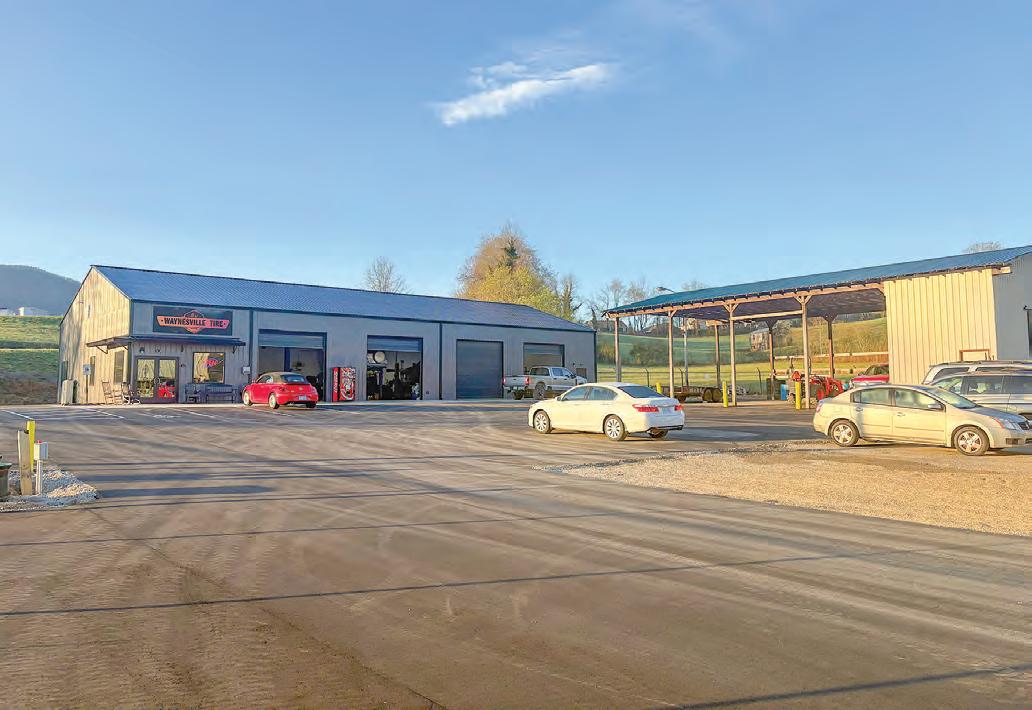










































































• Albert Carlton-Cashiers Community Library (Cashiers) will host “Community Jam Sessions” from 2-4 p.m. the second and fourth Sunday of each month. Informal jamming. All skill levels are welcome. Free and open to the public. 828.743.0215 / fontanalib.org/cashiers.
facebook.com/brbeerhub.
• Boojum Brewing (Waynesville) will host “Karaoke Night” 9 p.m. Wednesdays, “Trivia” 7 p.m. Thursdays, “Open Jam” 10 p.m. Thursdays and semi-regular live music on the weekends. All shows are located in The Gem downstairs taproom and begin at 9 p.m.
• Folkmoot Friendship Center (Waynesville) will host “World Drum Classes” every Friday at 2:30 p.m. (adults, free) and 4 p.m. (family friendly, all ages, free), “Waynesville Acoustic Guitar Group” 2-4 p.m. every second and fourth Saturday of the month (free) and semiregular live music monthly. 828.452.2997 / folkmoot.org.
• Frog Level Brewing (Waynesville) will host
A special performance, “North Carolina Symphony: Classical Favorites Celebrating America 250,” will take place at 7:30 p.m. Thursday, April 16, at the Bardo Arts Center on the campus of Western Carolina University in Cullowhee.
This enchanting evening features music from timeless masterpieces by Bernstein and Copland, along with the cinematic brilliance of John Williams. This concert offers something for everyone, whether you’re a lifelong classical music lover or a first-time listener.

The NC Symphony will play Cullowhee April 16. NC Symphony photo
Founded in 1932, the North Carolina Symphony (NCS) is a vital and honored component of our state’s cultural life. Each year, more than 300 concerts, education programs and commu-
• Assembly On Main (Waynesville) will host “Open Mic Night” 7-9 p.m. Mondays (sign-up at 6:30 p.m.), “Trivia Night” 6 p.m. Tuesdays and “Karaoke Night” 7 p.m. Thursdays. Free and open to the public. 828.246.0839 / assemblyonmain.com.
• Balsam Falls Brewing (Sylva) will host “Open Mic” 8-10 p.m. Thursdays. Free and open to the public. 828.631.1987 / balsamfallsbrewing.com.
• Balsam Mountain Inn (Balsam) will host “Picking on the Porch” (open community jam) 6 p.m. Tuesdays, “Trivia Night” 7 p.m. Wednesdays and a special “dinner and a show” with Anya Hinkle & Libby Weitnauer (Americana/folk) 6 p.m. April 17 (tickets are now available). 828.283.0145 / thebalsammountaininn.com.
• Blue Ridge Beer Hub (Waynesville) will host “Music Bingo Night” 6:30 p.m. Tuesdays, The Blue Mountaineers (Americana/bluegrass) Thursdays and regular live acts on Saturdays. All music starts at 5 p.m. Free and open to the public. 828.246.9320 /
10. Free and open to the public. 828.482.4502 / highcountrywineandprovisions.com.
• Higher Rock (Waynesville) is currently seeking singer-songwriters for the new venue, which is expected to open in April. If interested, contact Cyndi Sullivan at 704.579.0482 or email cyndisullivan1969@gmail.com.
nity engagement offerings reach adults and schoolchildren in all 100 North Carolina counties — in communities large and small, concert halls, auditoriums, gymnasiums, restaurants, clubs and outdoor settings.
The North Carolina Symphony gratefully acknowledges financial support from Wake County, the City of Raleigh and the state of North Carolina.
Doors open at 7 p.m. This concert is a free event. All audience members must reserve a ticket at either the online or physical Bardo Arts Center Box Office. Reserve your ticket by visiting arts.wcu.edu/tickets or calling 828.227.2479. Patrons must have tickets in hand to enter the performance.
unless otherwise noted. Free and open to the public. 828.246.0350 / boojumbrewing.com.
• Bread Heads Tiki Shak (Sylva) will host “Tiki Trivia” at 7 p.m. every other Thursday of the month and Bird In Hand (Americana/indie) with Hotdog Sunrise (rock/jam) starting at 3 p.m. April 25. 828.307.2160 / breadheadstikishak.com.
• Cataloochee Ranch (Maggie Valley) will host Marc & Anita Pruett (Americana/bluegrass) April 8, Alan Edwards (Americana/indie-folk) April 12, Kelly Morris (indie/soul) April 15 and the “Cataloochee Barn Dance” with the J. Creek Cloggers 4:30-6:30 p.m. April 17 ($50 per person). All shows begin at 5 p.m. unless otherwise noted. Admission is $25 per person. For tickets and reservations, visit cataloocheeranch.com/ranch-event.
• Classic Wineseller (Waynesville) will host Dulci Ellenberger (Americana/pop) 7 p.m. April 10. Reservations highly recommended ($10 per person minimum food purchase). The kitchen and wine bar open at 4 p.m. 828.452.6000 or classicwineseller.com.
A “Community Contra Dance” will be held from 2:30 p.m. Sunday, April 19, at the Cowee School Arts & Heritage Center in Franklin. Contra dance is a form of social folk dancing from which square dancing evolved, so it shares many of the same movements. As always, no partner is necessary, generations mix. All are welcome, including beginners. No dance experience or fancy clothing are necessary. Those who would like to come out just to listen to the music are welcome, too. This dance will feature both Contra and Bal Folk traditions. If you enjoy the energy of Contra and partner dancing, chances are high you’ll
“Jazz On The Level” 5:30 p.m. Tuesdays, Justin Brown (singer-songwriter) April 10, Rich Manz Trio (oldies/acoustic) April 11, Patty M. (singer-songwriter) 3 p.m. April 12, The Local Chapter April 17, The Young Ones April 18, Martin Vietnieks (singer-songwriter) 11:30 a.m. April 19 and Shane Meade Duo (indie/soul) 3 p.m. April 19. All shows begin at 6 p.m. unless otherwise noted. Free and open to the public. 828.454.5664 / froglevelbrewing.com.
• Happ’s Place (Glenville) will host Charles Walker (singer-songwriter) April 10, Rock Holler April 11, Dylan Armour (singer-songwriter) April 17 and Sam Underwood (singersongwriter) April 18. All shows begin at 6 p.m. Free and open to the public. 828.742.5700 / happsplace.com.
• Harrah’s Cherokee Casino Resort (Cherokee) will host Warren Zeiders (country) 8:30 p.m. April 10. For tickets, visit caesars.com/harrahs-cherokee.
• High Country Wine & Provisions (Highlands) will host Zorki (singer-songwriter) 5 p.m. April
enjoy Bal Folk. Come try this special opportunity to sample dances from various regions of France and Europe ranging from raucous to rhythmic, from circular or linear in form to partner dances.
For the uninitiated, the caller walks the dancers through the steps of the upcoming dance for a few minutes, and then continues to call the moves in time to the music so the dancers know what to do next. Dances will include contras, squares, mixers and perhaps a few other types of folk dances appropriate to the level of the dancers in attendance.
Beginners are strongly encouraged to arrive by 2:30 p.m. for the instruction. The dance is from 3-5 p.m. Experienced dancers are quite
• Highlander Mountain House (Highlands) will host “Blues & Brews” with Scott Low 6-9 p.m. Thursdays ($5 cover), Zorki (singer-songwriter) 1-3 p.m. Saturdays, “Bluegrass Brunch” 10 a.m. to 1:30 p.m. Sundays (free) and the “Salon Series” with Tyler Ramsey & Carl Broemel (Americana/indie-folk) 8:30 p.m. April 30 ($58.93 per person, tax included). 828.526.2590 / highlandermountainhouse.com.
• Innovation Station (Dillsboro) will host semiregular live music on the weekends. All events begin at 7 p.m. unless otherwise noted. Free and open to the public. 828.226.0262 / innovation-brewing.com.
• John C. Campbell Folk School (Brasstown) will host a “Community Jam” 7 p.m. Thursdays at the nearby Crown Restaurant and semi-regular live music on the weekends. folkschool.org.
• Lazy Hiker Brewing (Franklin) will host “Board Game Night” 5 p.m. Mondays, “Music Bingo” 7 p.m. Tuesdays, “Trivia Night” 6:30 p.m. Wednesdays, “Open Mic Night” 6:30 p.m. Thursdays, The V8s (rock/oldies) April 11, Tim Austin (multi-instrumentalist) April 17 and Grizzly Mammoth & Fringe Revival (rock/psychedelic) April 18. All shows begin at 7 p.m. unless otherwise noted. Free and open to the public. 828.349.2337 / lazyhikerbrewing.com.
• Lazy Hiker Brewing (Sylva) will host “Music Bingo” 7 p.m. Mondays, “Trivia Night” 6:30 p.m. Tuesdays, “Old Time Jam” 6:30 p.m. Thursdays, Lillie Syracuse (Americana/soul) April 10 and Grizzly Mammoth (rock/psychedelic) April 17. All shows begin at 8 p.m. Free and open to the public unless otherwise noted. 828.349.2337 / lazyhikerbrewing.com.
• Macon County Public Library (Franklin) will host The Vagabonds (Americana) at 2 p.m. the first and third Monday and a “Song Circle” open jam from 3-6 p.m. the first Tuesday each month. Free and open to the public. 828.524.3600 or fontanalib.org/franklin.
willing to help those new to Contra dance get started with the movements.
A suggested donation of $10-20 per person goes to pay the band and caller. Kids age 14 and under are free. Children over age 8, who are game to participate or sit and watch with an adult, may also attend. Bring a closed water container and a snack if you wish. Smoothsoled shoes work best for dancing on wood floors. Please do not wear perfume or other scents to the dances.
For more information, visit facebook.com/franklincontra for photos and details about upcoming dances or email contradancefranklinnc@gmail.com.
• Mountain Layers Brewing (Bryson City) will host “Open Mic Night” with Frank Lee every Thursday, Scott James Stambaugh (singersongwriter) April 10, Granny’s Mason Jar (Americana/bluegrass) April 11, Bridget Gossett (singer-songwriter) 5 p.m. April 12 and Mountain Gypsy (Americana) April 17. All shows begin at 6 p.m. unless otherwise noted. Free and open to the public. 828.538.0115 / mountainlayersbrewingcompany.com.
• Papertown Billiards (Canton) will host “Open Mic” 7-9 p.m. Wednesdays. Sign-up is at 6:30 p.m. Hosted by Bridget Gossett (singersongwriter). Free and open to the public. 828.492.0588 / papertownbilliards.com.
• Peacock Performing Arts Center (Hayesville) will host Unspoken Tradition (Americana/bluegrass) April 11 and “Songwriters Showcase 59” April 18. All shows begin at 7:30 p.m. unless otherwise noted. For tickets, 828.389.ARTS / thepeacocknc.org.
• Rathskeller Coffee Haus & Pub (Franklin) will host “Karaoke” Wednesdays, “Trivia Night” 6:30 p.m. Thursdays, “Open Mic” 6:30 p.m. Fridays, Dirty Dave & Friends April 11, Carlos Wilson (singer-songwriter) 6:30 p.m. April 14, Jamie Rasso (singer-songwriter) 6:30 p.m. April 15, R.A. Nightingale (singersongwriter) April 17 and Michael Kitchens (singer-songwriter) April 18. All shows begin at 7 p.m. unless otherwise noted. Free and open to the public. 828.369.6796 / facebook.com/rathskellercoffeebarandpub.
• Salty Dog’s Seafood & Grill (Maggie Valley) will host “Karaoke with Russell” Mondays, Ginny McAfee (singer-songwriter) April 11 and Amos Jackson (R&B/soul) April 17. All shows begin at 7 p.m. unless otherwise noted. Free and open to the public. 828.926.9105 / facebook.com/saltydogs2005.
• Scotsman (Waynesville) will host “Open Mic” the first Wednesday of every month, Kieran
Acclaimed Americana/bluegrass ensemble
Unspoken Tradition will perform at 7 p.m. Saturday, April 11, at the Peacock Performing Arts Center in Hayesville.
Unspoken Tradition is about new, original bluegrass. Inspired by their own influences and the roots of traditional and newgrass music, this Western North Carolina-based quintet brings a sound that is both impassioned and nostalgic, hard-driving and sincere. In recent years, their singles have all charted
Anderson (singer-songwriter) April 9, Bear Creek String Bandits (Americana) April 11, Holler & Crow (Celtic/world) 3 p.m. April 12, Rene Russell & Rob Matsen (Americana/rock) April 16, Shane Meade Trio (indie/soul) April 18 and “Celtic Sunday” with Jenny & The Weazels (Celtic/world) 3 p.m. April 19. All shows begin at 8 p.m. unless otherwise noted. Free and open to the public. 828.246.6292 / scotsmanpublic.com.
• Slanted Window Tasting Station (Franklin) will host Jamie Rasso (singer-songwriter) 6 p.m. April 10, “Music Bingo” 2 p.m. April 11, Madison Owenby (singer-songwriter) 4 p.m. April 12, Rail Town (Americana) 6 p.m. April 17 and Blue Jazz (blues/jazz) 6 p.m. April 18. 828.276.9463 / slantedwindow.com.
• Smoky Mountain Center for the Performing Arts (Franklin) will host Little Texas (country) 7:30 p.m. April 24. Tickets now available, with seating upgrades offered. 866.273.4615 / smokymountainarts.com.
• Swain Arts Center (Bryson City) will host The Legacy Motown Revue (Motown/oldies) 7 p.m. April 17 ($10 adults, $6 students). 828.488.7843 / swainartscenter.com.
• Trailborn (Highlands) will host its “Carolina Concert Series” on semi-regular dates on the weekends. All shows begin at 6 p.m. Free and open to the public. 828.482.1581 or trailborn.com/highlands.
• Valley Cigar & Wine Company (Waynesville) will host Rene Russell (singer-songwriter) 4 p.m. Tuesdays and Ginny McAfee (singersongwriter) April 12. All shows begin at 2 p.m. unless otherwise noted. Free and open to the public. 828.944.0686 / valleycigarandwineco.com.
• Valley Tavern (Maggie Valley) will host “Country & Western Night” Tuesdays, “Trivia With Tom” Wednesdays, “Music Bingo” Saturdays, Contagious (rock) April 10, Tricia Ann Band (rock/country) 4 p.m. April 12 and Break Cutter (rock/jam) 4 p.m. April 19. All
in the Bluegrass Today top 20, including “California” (No. 1) “Irons in the Fire” (No. 2) and “Carolina and Tennessee” (No. 4).
A 2019 release, “Myths We Tell Our Young,” debuted at No. 5 on the Billboard Bluegrass charts and has seen five top-charting radio singles, including a No. 1 spot on the Bluegrass Today chart for “Dark Side of the Mountain.”
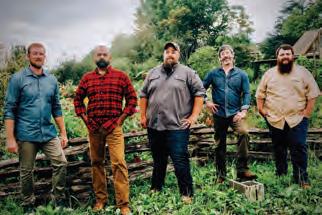
Unspoken Tradition will play Hayesville April 11. File photo
The show will serve as a benefit for the Clay County Community Revitalization Association. Tickets are $29.50 for adults, with discounts available for seniors, military, students and children.
For more information and/or to purchase tickets, visit thepeacocknc.org or call 828.389.ARTS.
Americana/indie singer-songwriter A. Lee Edwards will perform at 5 p.m. Sunday, April 12, at the Cataloochee Ranch in Maggie Valley.
Edwards has been a singer-songwriter for over 30 years. With roots steeped in the tradition of storytellers like John Prine and Townes Van Zandt, Edwards crafts songs that are both spare and richly evocative. In a career spanning three decades, his music has been featured across the country.
Admission is $25 per person. For more information and/or to purchase tickets, visit cataloocheeranch.com/ranch-event.
shows and events begin at 6 p.m. unless otherwise noted. Free and open to the public. 828.926.7440 / valley-tavern.com.
• Vineyard At High Holly (Scaly Mountain) will host David Crisp (singer-songwriter) April 11, Tim Austin (multi-instrumentalist) April 12, Zoran April 18 and Rail Town (Americana) April 19. All shows begin at 2 p.m. unless otherwise noted. Free and open to the public. 828.482.5573 / thevineyardathighholly.com.
• Water’n Hole Bar & Grill (Waynesville) will host “Trivia Night” 7 p.m. Mondays, “Karaoke Night” 8 p.m. Thursdays, with semi-regular DJs and live music on the weekends. All shows begin at 9 p.m. 828.456.4750 / facebook.com/waternhole.bar.

April 12. File photo
• Western Carolina Brew & Wine (Highlands) will host live music 4-6 p.m. Saturdays. Free and open to the public. 828.342.6707 / wcbrewandwine.com.
• Whiteside Brewing (Cashiers) will host semiregular live music on the weekends. All shows begin at 6 p.m. unless otherwise noted. Free and open to the public. 828.743.6000 / whitesidebrewing.com.
• Yonder Community Market (Franklin) will host “Country Thursdays” (Americana/country) 6 p.m. Thursdays and semi-regular live music on the weekends. Family/dog friendly. 828.200.2169 / eatrealfoodinc.com.



• Cataloochee Ranch (Maggie Valley) will host semi-regular culinary events and workshops throughout the week. For a full schedule of upcoming activities, tickets and reservations, visit cataloocheeranch.com/ranch-event.
• Balsam Mountain Inn (Balsam) will host “Wind Down Wine Flights” 6 p.m. Thursdays. 828.283.0145 / thebalsammountaininn.com.
• Classic Wineseller (Waynesville) will have the wine bar open from 4-8 p.m. Fridays/Saturdays and host semi-regular tastings on the weekends. 828.452.6000 / classicwineseller.com.
• Blue Ridge Beer Hub (Waynesville) will host semi-regular tap-takeovers from local and regional breweries on the weekends. Free and open to the public. 828.246.9320 / blueridgebeerhub.com.
waynesvillewine.com.
• “Take A Flight” with four new wines every Friday and Saturday at the Bryson City Wine Market. Select from a gourmet selection of charcuterie to enjoy with your wines. Educational classes and other events are also available. 828.538.0420.

A special stage production of “Men in Suits” will take place at 7:30 p.m. April 1011, and 17-18 and at 2 p.m. April 12 and 19 at the Haywood Arts Regional Theatre in Waynesville.
In a world where loyalty is everything and mistakes are deadly, “Men in Suits” follows two rising mafiosos — Bobby (Tom Bastek) and Max (Matt Edwardsen). Bobby has always followed orders without question, fiercely loyal to the legendary Boss, while Max is beginning to crack under the weight of the lives they’ve taken.
But, when the pair mistakenly kill the wrong man in Grand Central Station, their carefully controlled world unravels. With the truth closing in, they flee toward Vermont on a desperate mission to confess their mistake before it’s too late and before the Boss (Pasquale LaCorte) finds out first.
• “Flights & Bites” will be held at 4 p.m. Thursdays and Fridays at Bosu’s Wine Shop in downtown Waynesville. There will also be a special French wine dinner 6 p.m. May 19. 828.452.0120 /
• “Uncorked: Wine & Rail Pairing Experience” will be held on select dates at the Great Smoky Mountains Railroad in Bryson City. Full service all-adult first class car. Wine pairings with a meal and more. There will also be a special “Carolina Moonshine” train on select dates. 800.872.4681 / gsmr.com.
Tickets are $25 per person, with discounts available for groups, seniors, military and students. For more information and/or to purchase tickets, call the box office at 828.456.6322 or visit harttheatre.org.

‘Men in Suits’ will be at HART on select dates. Donated photo










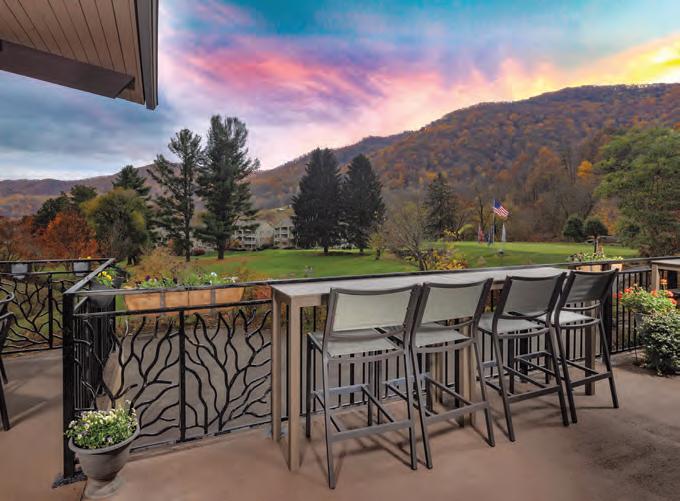
Experience a C lwalksoflif Perfectf fe fooral fee, from fam on using fresh ingredients from our Casuall, , Relaxing Atmosp ilies to golf groups to ladies who lunc gardens and supporting local farmers. sphere W ch. We e pride ourselves it e pr The dettaails ar rior ty y

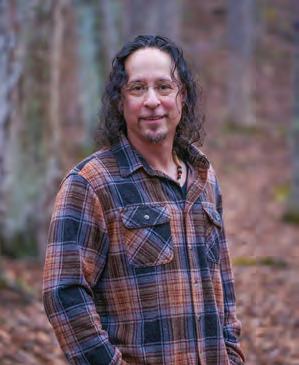
The first “Conversations with Storytellers” of the 2026 season with Chris Aluka Berry will be held at 6 p.m. Thursday, April 9, at the Pigeon Community Multicultural Development Center in Waynesville. Berry has worked in the South as an award-winning documentary photographer for more than 20 years, with his images appearing in major American and international publications.
Storytellers is a monthly performance series hosted by the PCMDC from April-September every year. CWS is PCMDC’s celebration of the power and purpose of narrative in underserved communities.
Admission is $10 for community members, $7 for seniors age 65 (and over) and $5 for students. Children 12 and under may attend free of charge. Tickets may be purchased in advance and can be purchased at the door of each performance. Reduced price $50/$40/$30 series passes are also available.
Refreshments are available for purchase. For more information and/or to purchase tickets, visit pcmdc.org.
• Smoky Mountain Center for the Performing Arts (Franklin) will host a special stage production of “Guys & Dolls” at 7 p.m. April 1011 and 17-18. 866.273.4615 / smokymountainarts.com.
• Peacock Performing Arts Center (Hayesville) will host semi-regular stage productions on the weekends. 828.389.ARTS / thepeacocknc.org.



• Haywood Arts Regional Theatre (Waynesville) will host semi-regular stage productions on the weekends. 828.456.6322 / harttheatre.org.
• Swain Arts Center (Bryson City) will host semi-regular stage productions on the weekends. 828.488.7843 / swainartscenter.com.






• Harrah’s Cherokee Casino Resort (Cherokee) will host semi-regular stage productions on the weekends. For tickets, visit caesars.com/harrahs-cherokee.
• Highlands Performing Arts Center (Highlands) will host semi-regular stage productions on the weekends. 828.526.9047 / mountaintheatre.com.
If you want to feel how lucky you are, just read Brian Barth’s “Front Street (Resistance and Rebirth in the Tent Cities of Techlandia)” (Astra House, 2025, 287 pages). Barth, with maternal roots in WNC going back eight generations and who is a freelance journalist who writes for National Geographic, The Nation, The New Yorker and others and who has won prestigious medals and awards, literally takes us in hand to some of the most populated homeless camps in Silicon Valley in the Bay Area of northern California, introducing us to a cast of characters, describing their personal stories, private philosophies and political activism in order to explain why the country’s current approach to homelessness has become at once cruel and ineffective. In doing so, he also makes the point that these camps have something important to teach the rest of us about dignity, connection and care.
tion. But there is also plenty of peace, love, and harmony in these camps — the lesserknown side of anarchy.”
Getting down to brass tacks, the author gets into the factual details and the numbers.
“California is the undisputed capital of both the crisis and the unhoused empowerment movement and has the nation’s highest per capita rate of homelessness and half of the nation’s total unsheltered population

Blending his memoir with investigative reporting, history, and cultural criticism, Barth paints a picture about the struggle for housing as tech companies moving into the Bay Area raised the price and value of real estate, driving long-time residents out of their homes and into the streets. Regularly harassed by police and local government, Barth challenges the notion that homeless encampments are simply lawless and debased eyesores.
Instead, he urges us to take a compassionate second look and that these camps can offer at-risk adults freedom, independence, safety and community. “This book is my journey from journalist to friend of the unhoused, a transformation that revealed an activist that I didn’t know was hiding inside of me,” states Barth in his prologue. Historically, Barth uses Charlie Chaplin’s film character of The Tramp as a model for the homeless during and after the Great Depression in the U.S. before carrying his conversation forward into the present tense. Using the word “anarchy” to describe the politics of many homeless people he encountered, he explains: “Perhaps there were ancient humans who found themselves in utopic anarchies, but the nature of anarchy situated within a social system that hotly contests its existence is one of extreme fric-
within the subcultures — Black, Latino, hippie, punk; lifestyles based around particular drugs or illegal activities and so on,” he acknowledges.
While the first half of the book is an introduction to the various encampments and “new friends” living there and their problems, the second half of “Front Street” is more about solutions and the future. “The future happens here first,” says a homeless man named Newsom, spinning the trope that the state of California is the progressive trendsetter in the U.S.

estimated to be more than 650,000. Including the unhoused living with friends and family, the estimate of the country’s unhoused population is in the neighborhood of six million.”
In his opinion, Barth proclaims that the homeless in the Bay Area are a persecuted minority and are aggressively criminalized. He quotes a homeless man from Oakland named Monte who says, “We need to fight. And we need to make the fight large enough that the world is watching.” Then he cites an example of a homeless man in San Francisco who died when someone set his sleeping bag on fire with him in it. “Stepping into a camp is like stepping into an alternate dimension — the rules and norms that govern that world are not the same as those that govern the housed world. And there are subcultures

Another of Barth’s “new friends” is a man named Theo, who is something of a spokesman for his unhoused community and who told Barth, “I told the governor, I said, dude, if you’re gonna sit in meetings with your friends and make decisions about our lives, you need to include representatives from our community at those meetings.”
Moving on to the section on World-Building, we are told of an unhoused woman named Cynthia and her experiences and vision for the future. “How do the homeless folks envision The Fix?” writes Barth. “In a multitude of ways. But the gestalt is to re-create the world, or at least create their own world within it.”
And then there’s Tiny, another homeless woman who is an artist and is building her “new world” by creating art exhibitions or “shows” such as “The Art of Homelessness.”
And others who created a magazine titled POOR. Their magazine embodies the notion that poor people should tell their own stories, make their own media, and claim political power in the process.
In the end, Barth concludes that “The Fix” is an illusion and that there exists no grand solution to the homeless problem. But then on a positive note, he quotes, again, his homeless friend Monte, who says “I’m not staying out here to kill myself. I do see a light at the end of the tunnel. Spirits’ energy can’t be destroyed, can’t be consumed. It’s our spark. That spark still exists after the flesh is gone. It’s what’s given me a new lease on life.”
(Thomas Rain Crowe is the author of more than 30 books, including the award-winning nature memoir “Zoro’s Field: My Life in the Appalachian Woods,” and is a longtime resident of Jackson County.)
Brian Barth will read from his first book, “Front Street (Resistance and Rebirth in the Tent Cities of Techlandia)” at 6 p.m. on April 16 in the Community Room of the Jackson County Public Library in Sylva.
Following the reading, there will be a roundtable discussion on homelessness that will include Sylva Police Chief Chris Hatton and Paul Phillips, interim supervisor of HERE In Jackson County.
Hatton will speak about Community Care, Sylva’s innovative program pairing a social worker with police officers. Phillips will discuss local homelessness. The roundtable will be a forum for community discussion and everyone with interest or questions is encouraged to attend and participate. This event is co-sponsored by City Lights Bookstore, Jackson County Public Library and Indivisible/Common Ground of WNC.






















A Jonathan Creek field once meant for crops and cows now comes with a sales pitch — where pasture meets
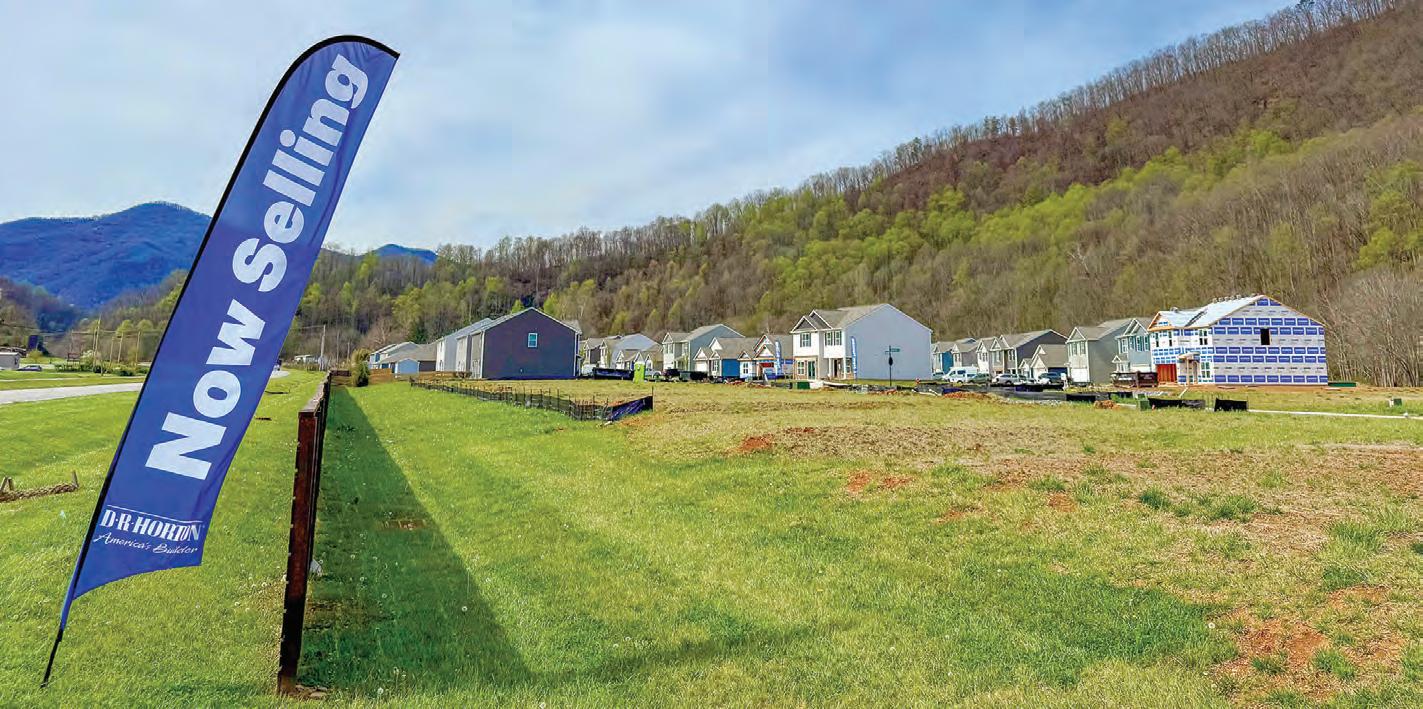
BY CORY VAILLANCOURT POLITICS EDITOR
Alow-flying plane circling his property was the first sign. The passes were frequent enough to be noticed. Haywood County farmer and longtime Farm Bureau President Don Smart knew immediately what that kind of attention usually means.
In the old days, Smart said, they’d have been looking for illegal cannabis or tobacco plantings, but that wasn’t why the plane was tracing slow, deliberate circles in the sky over his farm. Two weeks later, confirmation of his suspicions arrived in writing. National homebuilder D.R. Horton wanted to buy his farm. Smart called the number on the letter.
“Give Mr. Horton a message,” Smart said. “Tell him he’ll be a-drivin’ a coal truck in hell before he builds a house on my farm.”
The interest in his property wasn’t random, Smart said at the Farm Bureau’s annual legislative breakfast, held at Lake Junaluska on April 1. His farm sits near infrastructure that developers look for — water, sewer and transportation — making it more valuable to them as a building site than as working land.
The plane, he said, made that clear before the letter even hit his mailbox.
Horton’s approach reflects a broader reality facing farmers across Western North Carolina, where land is increasingly viewed as a commodity rather than a resource as growth
accelerates and land values climb, forcing farmers into a narrowing space where holding onto land often means turning down lifechanging money.
That tension — between agricultural use and development value — has been building for years across the region. Farm Bureau leaders have warned that farmland is being lost at an unsustainable rate, driven by population growth and steady in-migration into rural areas.
North Carolina has lost more than 600,000 acres of farmland since 2015, a figure that continues to grow as development expands outward from urban centers like Asheville and into mountain communities.
The American Farmland Trust’s 2024 “Farms Under Threat” report found that millions of acres of U.S. farmland have already been lost to development and millions more are at risk if current trends continue, threatening food production, environmental health and rural economies. In North Carolina, the report projects roughly 1.2 million acres could be lost by 2040, ranking the state second in the nation for farmland loss. Much of that conversion is expected to occur on the state’s most productive land, driven by lowdensity sprawl and population growth.
In 2024 Smart said that 40 years ago, Haywood County had nearly 80,000 acres of farmland, but now has less than 50,000.
Valleys once defined by open pasture and working farms are increasingly being subdivided, with new construction replacing fields that had remained in agriculture for generations.
At the same time, farming itself has become more difficult. Rising input costs, labor shortages and unpredictable markets caused by short-sighted foreign policy decisions have made it harder for farmers to maintain operations, particularly when compared to the massive financial returns offered by selling land.
Hurricane Helene intensified those pressures. Flooding damaged farmland, destroyed
ket — a gap that continues to drive farmland loss.
State Rep. Karl Gillespie (R-Macon) represents one of the most rural districts in North Carolina and works as a cattle farmer, giving him direct experience with the pressures facing agriculture. Gillespie said preservation efforts must be tied to the economic realities of farming if they are to succeed.
“I personally believe from my own experience the best way to do that, one of the best ways, in addition to preservation, is to make farming sustainable,” Gillespie said. “The best way to make farming sustainable and make it profitable.”
“Give Mr. Horton a message. Tell him he’ll be a-drivin’ a coal truck in hell before he builds a house on my farm.”
— Don Smart
infrastructure and forced farmers into extended recovery efforts that strained both time and resources.
For some, the storm accelerated decisions that had already been forming, pushing property owners closer to selling. The result is a widening gap between what land is worth agriculturally and what it is worth on the mar-
He said the state’s growth, while beneficial in many ways, is contributing to the loss of agricultural land. New residents are often drawn to rural areas, increasing demand for housing in places historically used for farming.
“North Carolina is doing a lot of great things drawing people to F
Demand for state farmland preservation dollars currently outstrips supply by a factor of 8. File photo


the state, but those folks are using valuable agricultural land when they come, so we’ve got to protect that agricultural land,” Gillespie said.
At the county level, Haywood Commissioner Tommy Long, also a cattle rancher, has experienced those pressures firsthand. Long said Hurricane Helene required immediate and sustained effort to protect livestock and equipment. That experience, he said, highlighted the physical demands of farming as well as the vulnerability of agricultural operations to extreme weather.
He also pointed to a potential funding mechanism tied to presentuse value taxation, which allows farmland to be taxed based on agricultural use rather than development value.
When land exits that program — usually as the result of a sale — three years of rollback taxes are collected, creating a potential source of funding for preservation.





into residential developments.
“If you want to see what that new land use looks like when you leave here, just drive down Raccoon Road and look to the right, and you will see what that new land use looks like,” Manning said.
Haywood County has lost nearly 50% of its farmland over the past 50 years. File photo












“All five commissioners agreed to have our staff look at some of these other counties that are doing that — set that money aside that’s paid back when a farm sells,” he said. “Set it aside and have a kitty there to help buy or help contribute to farmland preservation.”
Ryan Manning works in farmland conservation across North Carolina for the Working Lands Trust, created in 2013 through a partnership led by the North Carolina Forestry Association alongside the North Carolina Department of Agriculture and other conservation and agriculture stakeholders to establish a nonprofit focused on protecting working farms and forests across the state. Manning said the issue is becoming more urgent as the farming population ages.
“The average age of the farmer in North Carolina is about 60 years old, which means, unfortunately, that we don’t have the luxury of time,” he said.
That shift, Manning said, will likely lead








Existing preservation programs, Manning noted, are not funded at levels sufficient to meet demand, with the gap between funding and need continuing to widen.
“The state only gets about six million recurring dollars for farmland preservation, and the demand is now regularly in about the $50 million range,” Manning said.
He said local funding will likely be necessary to close that gap, and that local communities will need to decide if and how much they are willing to invest in preserving farmland.
Echoing Smart’s grim prognosis, Manning warned that continued farmland loss could undermine the state’s number one industry, which generates more than $110 billion annually and accounts for about one-sixth of the state’s income and employment.
“It’s time to really put our money where our mouth is,” Manning said.






















































The easy-to-moderate hike will offer plenty of opportunities for wildflower



Haywood Waterways Association will lead a hike to Mouse Falls in the Big Creek Watershed of the Great Smoky Mountains National Park on Sunday, April 12.
The event is free for members and a $5 donation for nonmembers. Haywood Waterways memberships start at $25.
Please note, the new national park parking fee is in effect. Participants will need to have a parking pass for this event. Parking passes can be purchased onsite or by visiting nps.gov/grsm/planyourvisit/fees.htm. A day pass is $5.
Hikers will meet at the end parking lot just before the campground at 9:30 a.m. and will conclude by 3 p.m.
Local Horticulturalist and Smoky Mountain News columnist Adam Bigelow will help identify the great diversity of flowers on display this time of year. Bigelow
leads guided walks and hikes all over Southern Appalachia.
Learn more about Bigelow’s Botanical Excursions at bigelowbotanicalexcursions.com. The outing will start with a short walk up Baxter Falls trail, and for those that want to extend the outing, an easy-to-moderate 4mile hike (round trip) to Mouse Creek Falls will follow. Information on hiking Big Creek can be found at hikingthecarolinas.com/bigc.php.
Wear comfortable trail shoes, weatherappropriate clothing and bring water and lunch. Don’t forget your camera and wildflower books. Please leave pets at home. Carpooling is highly encouraged.
Reserve a spot by emailing Katy WarrenParker at katy@haywoodwaterways.org or calling 828.476.4667.
North Carolina citizens and stakeholders who use their scientific, academic, habitat and partnership expertise to provide advice to the NCWRC on nongame wildlife conservation issues and opportunities for the state’s most vulnerable wildlife populations. This input includes guidance on changes to the North Carolina protected species list, development of conservation plans for endangered, threatened and special concern species, as well as sharing of conservation actions among partners to achieve common goals.
NCWRC asks advisory members to participate actively throughout their terms. The advisory committee meets four times a year, usually at NCWRC’s headquarters in Raleigh. The NCWRC’s Board will appoint
Tickets are now on sale for the 2026 “Blue Ghost Firefly Tour” at the Cradle of Forestry in America.
This annual event offers a rare opportunity to witness the mesmerizing display of the elusive Blue Ghost Fireflies (Phausis reticulata) in their natural habitat.
Blue Ghost fireflies are a rare firefly species found in the mountains of Southern Appalachia, known for their distinctive glow and tiny size. While their glow is lime green, it usually appears blue because of the Purkinje effect — a visual phenomenon when colors appear different in low light.
The Cradle of Forestry “Blue Ghost Firefly Tours” begins with an educational presentation at the outdoor amphitheater, where guests will have the opportunity to learn about the fascinating world of the blue ghost firefly. Following the presentation, visitors will embark on a hike under the cover of darkness along a paved trail through the forest, at their own pace, where they’ll have the chance to observe these enchanting creatures up close. Doors open at 8 p.m., with the event beginning at 8:45.
Event dates are May 9-24 and June 6-8. Tickets are $55 for adults and $27 for youth ages 4-12.
Tickets and more information are available at gofindoutdoors.org/blueghost.
The open burning of trash, metal, plastic and all other man-made materials not only harms the environment and poses a public health risk, and it’s against state law.
While many chose to burn debris outdoors for disposal in spring, the North Carolina Department of Environmental Quality’s Division of Air Quality is reminding North Carolinians: that if it doesn’t grow, don’t burn it.
The open burning rule, the state’s oldest air quality regulation, limits what can be burned outdoors and when.
Commercial land clearing operations are also limited by the open burning rule. Land clearing is the uprooting or clearing of vegetation in connection with construction, land development or mining, or the initial clearing of vegetation to enhance property value.
The Division of Air Quality enforces the state open burning rule, partnering with local law enforcement, firefighters and fire marshals and the N.C. Forest Service to ensure compliance. Violators can be fined up to $25,000 per violation per day. To submit an open burning complaint, contact the DEQ Regional Office that serves your county.
advisory committee members based on the nominees’ credentials, expertise, affiliation and constituency at large.
Nominations for the NWAC may be submitted by filling out the online form at ncwildlife.az1.qualtrics.com/jfe/form/SV_ d129HkIpCYTt8hM with information regarding affiliation and expertise, cover letter and résumé (if available). Self-nominations are welcome as well. Electronic submissions are preferred; however, hard copies may be mailed to the Nongame Wildlife Advisory Committee, Attn: Shauna Glover, Wildlife Management Division, MSC 1721, Raleigh, NC 27699-1700. For more information about the committee or the nomination process, contact Shauna Glover at 919.707.0064.


















































The U.S. District Court for the Western District of North Carolina ruled that the U.S. Fish and Wildlife Service and Forest Service violated the Endangered Species Act by relying on a faulty analysis during the creation of the controversial NantahalaPisgah Forest Plan. The court’s decision effectively prohibits the Forest Service from relying on the plan.
The ruling comes after the Southern Environmental Law Center, on behalf of Defenders of Wildlife, MountainTrue, Sierra Club and the Center for Biological Diversity, sued the Forest Service and Fish and Wildlife Service in April 2024. The lawsuit challenged the revised Nantahala-Pisgah Forest Plan, which was finalized in 2023 and guides the long-term future of two of the nation’s most popular public lands.

The plan proposed a massive increase in logging in the forests and put sensitive areas, including habitat for endangered forest bats, on the chopping block. But the federal agencies failed to show that these rare and federally protected bats — the northern long-eared bat, Indiana bat, Virginia big-eared bat, and gray bat — could withstand harmful logging.
The court ruled the agencies’ analysis — called a biological opinion — was clearly flawed, writing in its decision that the agencies’ conclusions were “unexplained,” “unsupported,” “deficient,” and “of almost no value.” The court also found that since

the biological opinion is unlawful, that “void[s] [the] authority for the Revised Forest Plan” itself.
“The court’s decision confirms that the Forest Service unlawfully cut corners in its planning process, resulting in a NantahalaPisgah Forest Plan that pushed rare and engendered wildlife even closer to the brink of extinction. With the agencies’ reckless analysis thrown out, we can look toward creating a better, more protective Forest Plan that prioritizes the health of the Nantahala and Pisgah national forests and all the animals and communities that rely on them,” SELC staff attorney Spencer Scheidt said. “This ruling is a major victory for these incredible forests and sends a clear message that federal agencies are required to follow the law.”
“This is a massive victory for wildlife — and for the millions of people who visit these cherished forests,” said Will Harlan, southeast director at the Center for Biological Diversity. “The Forest Service’s aggressive and illegal logging plans completely ignored science and the public, who overwhelmingly support protecting these forests. This ruling is a dagger to the destructive forest plan and a lifeline for wildlife and communities. The Pisgah and Nantahala are two of the most popular and biologically diverse forests in the country, and they are worth far more standing than cut down.”
Knots can mean the difference between success and struggle in the great outdoors. A hands-on class will dive into the essential knots every adventurer should know — whether securing gear, building a shelter or handling unexpected challenges in the wild.
Under the guidance of expert Search and Rescue trainer Steve Kuni, participants will learn, practice and perfect their knot-tying techniques in a controlled field environment.
The class will be held from 10 a.m. to noon Sunday, April 12, at Allens Creek Park in Waynesville. Register at secure.rec1.com/nc/haywood-county-nc/catalog/index.
“Barn Owlet Watch 2026” is underway for a nest box with six barn owl eggs, and the public has 24-hour access to the N.C. Wildlife Resources Commission’s live cam with audio to watch all the action in real time. The expected “hatch” date is between April 9 and 15.
NCWRC believes this is the same nesting pair that has used this nest in the past. Last December, the pair returned to the nest, and the female laid the first of her six eggs March 11.
August 2025 and, so far, have operated steadily since December with minimal interruptions.
While this is the first live camera experience offered by NCWRC, the agency hopes
NCWRC Conservation Biologist Joe Tomcho said his best estimate for the first egg to hatch is April 12, based on a normal 32-day incubation period.
The live cameras were installed in
there will be more in the future.
More information about barn owls may be found on the agency’s website. Visit the Barn live cam at ncwildlife.gov/outdoors/barn-owl-live-cam.
Great Smoky Mountains National Park invites the public to the annual “Signs of Spring” event from 9 a.m. to 4 p.m. on April 18 in Cades Cove. The event celebrates National American Sign Language Day. Visitors will have the opportunity to learn about the Smokies from park rangers and members of the deaf community.
Park rangers and members of the deaf community will jointly present educational programs throughout the day.
Program locations and time: Cades Cove Orientation Shelter
• 9–9:30 a.m.
• 10–10:30 a.m.
• 11–11:30 a.m.
Methodist Church
• 10–10:30 a.m.
• 11–11:30 a.m.
• 12–12:30 p.m.

Cable Mill Area
• Drop in at the Junior Ranger station anytime between 11 a.m. and 2:30 p.m.
Dan Lawson Place
• 12:30–1 p.m.
• 1:30–2 p.m.
• 2:30–3 p.m.
Lequire Cemetery
• 1:30–2 p.m.
• 2:30–3 p.m.
• 3:30–4 p.m.
While visitors are welcome to attend any of the programs individually, stations are designed to build on one another, and participants are encouraged to attend in the order listed.
Haywood Christian Ministries has announced its fourth annual Farm Fresh 5K on to be run at 9 a.m. Saturday, April 18.
The Farm Fresh 5K is a chance to come together as a community and make a difference. Runners will support local farmers, putting food on the tables of families in need while strengthening the local economy.
Register for an exciting day dedicated to our community and local agriculture.
Sign up on HCM’s website, hcmnc.org/farm-fresh-5k. The event will take place at 5095 Old River Road in Waynesville.



















































2,500+












































The Smoky Mountain News Marketplace has a distribution of 16,000 copies across 500 locations in Haywood, Jackson, Macon and Swain counties, including the Qualla Boundary and west Buncombe County. Visit www.wncmarketplace.com to place your ad!
Rates:
• $15 — Classified ads that are 25 words, 25¢ per word after.
• Free — Lost or found pet ads.
• $6 — Residential yard sale ads.*
• $1 — Yard Sale Rain Insurance Yard sale rained out? Call us by 10a.m. Monday for your ad to run again FREE
• $375 — Statewide classifieds run in 170 participating newspapers with 1.1+ million circulation. (Limit 25 words or less)
• Boost Online — Have your ad featured at top of category online $4
• Boost in Print
• Add Photo $6
• Bold ad $2
• Yellow, Green, Pink or Blue Highlight $4
• Border $4
Note: Highlighted ads automatically generate a border so if you’re placing an ad online and select a highlight color, the “add border” feature will not be available on the screen.
Note: Yard sale ads require an address. This location will be displayed on a map on www.wncmarketplace.com
p: 828.452.4251 · f:828.452.3585 classads@smokymountainnews.com www.wncmarketplace.com
NOTICE OF SERVICE OF PROCESS BY PUBLICATION STATE OF NORTH CAROLINA HAYWOOD COUNTY IN THE GENERAL COURT OF JUSTICE DISTRICT COURT DIVISION IN THE MATTER OF MASON JAMES PONDER FILE NO. 26JT000006-430
TAKE NOTICE that a pleading seeking relief against you has been action. The nature of the relief being sought is as follows:
TERMINATION OF YOUR PARENTAL RIGHTS TO THE JUVENILE, MASON JAMES PONDER, BORN AUGUST 28, 2023 , IN HAYWOOD COUNTY, NORTH CAROLINA
Filed January 26, 2026 in the District Court in Haywood County, North Carolina
TO: THE UNKNOWN FATHER OF A MALE JUVENILE BORN ON OR ABOUT AUGUST 28, 2023, IN HAYWOOD COUNTY, NORTH CAROLINA.
A petition seeking termination of your parental
an Answer and make a defense to such pleading no later than 30 days publication of this notice, May 8, 2026 and upon your failure to do so, the Petitioner, the Jackson County Department of
apply to the Court for the relief sought. Your parental rights will be terminated upon your failure to answer the petition within the time prescribed.
You may contact the Haywood County, North Carolina, Clerk of Court, at 828-454-6501, for more information and to inquire about making application for a court appointed attorney, if you so desire.
This the 8th day of April, 2026.
S./ Mary G. Holliday Mary G. Holliday Attorney for Petitioner Jackson County Depart-
PO Box 597 Webster, North Carolina 28788 (828) 631-0346
NOTICE OF ADMINISTRATION
Case No.26E000202-430 -
istrator of the Estate of Franklin D. Pressley of Haywood County, North Carolina, this is to claims against the Estate to present them to the

undersigned on or before Jul 01 2026, or this notice will be pleaded in bar of indebted to said Estate, please make immediate payment.
Administrator 217 Mountain Crest Lane Canton, NC 28716
NOTICE OF ADMINISTRATION
Case No.26E000174-430the Estate of Ray Carroll Johnson of Haywood County, North Carolina, this is to notify all persons
Estate to present them to the undersigned on or before Jul 08 2026, or this notice will be pleaded
All persons indebted to said Estate, please make immediate payment.
Executor 972 Hunan St, NE Palm Bay, FL 32907
NOTICE OF ADMINISTRATION
Case No.26e000063-490 Lyndon Kermit Casey,
the Administrator of the Estate of Mary Sue Casey of Jackson County, North Carolina, this is to claims against the Estate to present them to the undersigned on or before Jul 01 2026, or this notice will be pleaded in bar of
indebted to said Estate, please make immediate payment.
Administrator c/o Lyndon Kermit Casey, Jr.
705 W Main Street Sylva, NC 28779
NOTICE OF ADMINISTRATION
Case No.26E000068-490
Donna Marie Faber,
Executor of the Estate of Marguerite Jean Betts
aka Marguerite Jean Faber of Jackson County, North Carolina, this is to -
ing claims against the Estate to present them to the undersigned on or before Jun 25 2026, or this notice will be pleaded
All persons indebted to said Estate, please make immediate payment.
Executor
c/o Coward, Hicks & Siler
705 W Main Street Sylva, NC 28779
NOTICE OF ADMINISTRATION
Case No.26E000062-430
Annie Reed Jones aka Annie Rebecca Reed
as the Ancillary Executor of the Estate of Thomas Matney Reed of Haywood County, North Carolina, this is to claims against the Estate to present them to the undersigned on or before Jul 01 2026, or this notice will be pleaded in bar of indebted to said Estate, please make immediate payment.
Ancillary Executor P.O. Box 613 Linville, NC 28646
NOTICE OF ADMINISTRATION
Case No.26E000151-430istrator of the Estate of Mary Stiles Inman of Haywood County, North Carolina, this is toing claims against the Estate to present them to the undersigned on or before Jun 25 2026, or this notice will be pleaded
All persons indebted to said Estate, please make immediate payment.
Administrator 349 Ricky Lane Canton, N.C. 28716
NOTICE OF ADMINISTRATION
Case No.26e000084-490
Thomas Clay Elders,
Executor of the Estate of Loretta Smith of Jackson County, North Carolina, this is to notify all persons
Estate to present them to the undersigned on or before Jul 08 2026, or this notice will be pleaded
All persons indebted to said Estate, please make immediate payment.
Executor c/o Thomas Elders 705 W Main Street Sylva, NC 28779
NOTICE OF ADMINISTRATION
Case No.19E000705-430
Nikki Elaine Barnwell,
Administrator of the Estate of Illa Faye O’Neil Teixeira of Haywood County, North Carolina, this is to notify all persons
Estate to present them to the undersigned on or before Jun 25 2026, or this notice will be pleaded
All persons indebted to said Estate, please make immediate payment.
Administrator 84 Whitetail Dr Horseshoe, NC 28742
NOTICE OF ADMINISTRATION
Case No.26E000203-430
istrator of the Estate of Frances Louise Pressley of Haywood County, North Carolina, this is to
claims against the Estate to present them to the undersigned on or before Jul 01 2026, or this notice will be pleaded in bar of indebted to said Estate, please make immediate payment.
Administrator 217 Mountain Crest Ln. Canton, NC 28716
NOTICE OF ADMINISTRATION
Case No.26E000176-430 -
istrator of the Estate of Rodney Lyle Palmer of Haywood County, North Carolina, this is to
claims against the Estate to present them to the undersigned on or before Jul 01 2026, or this notice



































58
70
ANSWERS ON PAGE 34

will be pleaded in bar of indebted to said Estate, please make immediate payment.
Administrator
281 Setzer Cove Road Maggie Valley, NC 28751
NOTICE OF ADMINISTRATION
Case No.26E000077-430
Penny Osborne Robinson and Thomas Massie Os-
the Co-Executors of the Estate of Joan McElroy Osborne of Haywood County, North Carolina, this is to notify all persons
Estate to present them to the undersigned on or before Jun 18 2026, or this notice will be pleaded
All persons indebted to said Estate, please make immediate payment.
Co-Executor
Penny Robinson 630 Stamey Cove Road Clyde NC 28721
NOTICE OF ADMINISTRATION
Case No.26E000043-490
Patricia Ann Robinson,
Executor of the Estate of Arthur David Robinson,
Jr. of Jackson County, North Carolina, this is toing claims against the Estate to present them to the undersigned on or before Jun 25 2026, or this notice will be pleaded
All persons indebted to said Estate, please make immediate payment.
Executor
P.A.
721 N. Main St. Waynesville, NC 28786
NOTICE OF ADMINISTRATION
Case No.26E000111-430
of the Estate of ROY BANKS a/k/a ROY SAMUEL BANKS of Haywood County, North Carolina, this is to notify all persons
Estate to present them to the undersigned on or before Jun 18 2026, or this notice will be pleaded
All persons indebted to said Estate, please make immediate payment.
Executor 505 Meadow Brook Road Leicester, NC 28748
Here’s How It Works: Sudoku puzzles are formatted as a 9x9 grid, broken down into nine 3x3 boxes. To solve a sudoku, the numbers 1 through 9 must fill each row, column and box. Each number can appear only once in each row, column and box. You can figure out the order in which the numbers will appear by using the numeric clues already provided in the boxes. The more numbers you name, the easier it gets to solve the puzzle!
NOTICE OF ADMINISTRATION
Case No.26E000199-430
Margaret C. Cable,
Executor of the Estate of Zdenko (Stanley) Koschar of Haywood County, North Carolina, this is to
claims against the Estate to present them to the undersigned on or before Jul 01 2026, or this notice will be pleaded in bar of
indebted to said Estate, please make immediate payment.
Executor
91 Hacienda Lane Sylva, NC 28779
NOTICE OF ADMINISTRATION
Case No.26E000063-430
Howard E. Phillippi,
Limited Personal Repreof Jimmy Earl Phillippi of Haywood County, North Carolina, this is to claims against the Estate to present them to the undersigned on or before Jul 01 2026, or this notice will be pleaded in bar of indebted to said Estate,

please make immediate payment.
Limited Personal Representative
c/o Selena A. King, PLLC
37 Church St., Ste. 2100 Waynesville, NC 28786
NOTICE OF ADMINISTRATION
Case No.26E000204-430 -
Successor Executor of the Estate of William Thomas Hollingsworth of Haywood County, North Carolina, this is to
claims against the Estate to present them to the undersigned on or before Jul 01 2026, or this notice will be pleaded in bar of indebted to said Estate, please make immediate payment.
Successor Executor 28 Kelley Street Waynesville, NC 28786
NOTICE OF ADMINISTRATION
Case No.25E000307-430
Jason Andrew Obermiller, Executor of the Estate of Robert Leon Obermiller of Haywood County, North Carolina, this is to claims against the Estate to present them to the undersigned on or before Jul 08 2026, or this notice will be pleaded in bar of
indebted to said Estate, please make immediate payment.
of Martha Sharpe Bradley, PLLC
370 N. Main Street, Suite 310 Waynesville, NC 28786
DONATE YOUR CAR today, running or not. Support Patriotic Hearts for our Veterans and their Families! Free fast pickup. May be tax deductable. Se habla Español. Call now: 877-317-3360
YMT VACATIONS.able. Affordable, socialel designed for mature -
clude accommodations, transportation, baggage
handling, sightseeing, entrance fees, a professional Tour Director and select meals. For a limited time SAVE $250 on all tours. Call YMT today. 1-866-314-6821
STEREO EQUIPMENT
Duel 1019 Turntable walnut case w/smokedtridges, plays 78, 45, 33 & 16 records w/original operating manual; two Fisher Walnut Bookshelf
Speakers & lots of 33 LP records. Call for price & details. (828) 586-0777
DENIED SOCIAL SECURITY DISABILITY? Ap-
SSD and denied, our attorneys can help! Win or Pay Nothing! Strong, recent work history needed. 877-553-0252 [Steppach-
GET A BREAK on your taxes! Donate your car, truck, or SUV to assistpaired. Arrange a swift, and secure a generous tax credit for 2025. Call Heri-
tage for the Blind Today at 1-855-869-7055 today!
GET DISH Satellite TV + Internet! Free Install, Free HD-DVR Upgrade, -
ies, Plus Limited Time Up To $600 In Gift Cards. Call Today! 1-877-9207405
PREPARE FOR POWER OUTAGES today with a Generac Home Standby Generator. Act now to
warranty with qualifying purchase. Call 1-866381-0627 today to schedule a free quote. It’s not just a generator. It’s a
STOP OVERPAYING FOR AUTO INSUR-
says that most Ameritheir car insurance. Let us show you how much for a no-obligation quote: 1-833-399-1539
PEST CONTROL: PROTECT YOUR HOME from pests safely and affordably. Roaches, Bed Bugs, Rodent, Termite, Spiders and other pests. Locally owned and affordable.
or an inspection today! 1-833-406-6971






CAT, BASHFUL 8 yr old male; calm and reserved but also curious, sweet, and loving. Asheville Humane Society (828) 761-2001 publicrelations@ashevillehumane.org
ANGELA Hound mix — reddish brown. 4 yrs old; 55 lbs. Energetic, playful girl; would love to keep working on training. Asheville Humane Society (828) 761-2001 adoptions@ashevillehumane.org
CAMPER FOR SALE
A-Liner Sportliner 2000, 12 ft. in length, towable tires, new 12V marine battery; Gas 3-burner
heater, VERY CLEAN! Asking $2,500. (828) 586-0777
WATER DAMAGE
CLEANUP & RESTO-
RATION: A small amount of water can lead to major damage in your home. Our trusted professionals do complete repairs to protect your family and 24/7: 1-833-928-1861.
location ready when you call!
NO MORE CLEANING out gutters. Guaranteed! LeafFilter is backed by a no-clog guarantee and lifetime transferrable war-
ranty. Call today 1-877649-1190 to schedule a FREE inspection and no obligation estimate. Plus get 75% off installation and a bonus $250 discount! Limited time only Restrictions apply, seety and offer details.
REPLACE YOUR ROOF with the best looking and longest lasting materia – steel from Erie Meta Roofs! Three styles and
Guaranteed to last a lifetime! Limited Time Offer – up to 50% off installation + Additional 10% off install (for military health workers & 1st responders.) Call Erie Meta Roofs: 1-855-585-1815
NEED
Drafty rooms? Chipped or damaged frames? Need outside noise reduction?
windows may be the answer! Call for a consultation & FREE quote today 1-833-890-1293