Page 17 Extreme drought expands in North Carolina Page 31

Page 17 Extreme drought expands in North Carolina Page 31
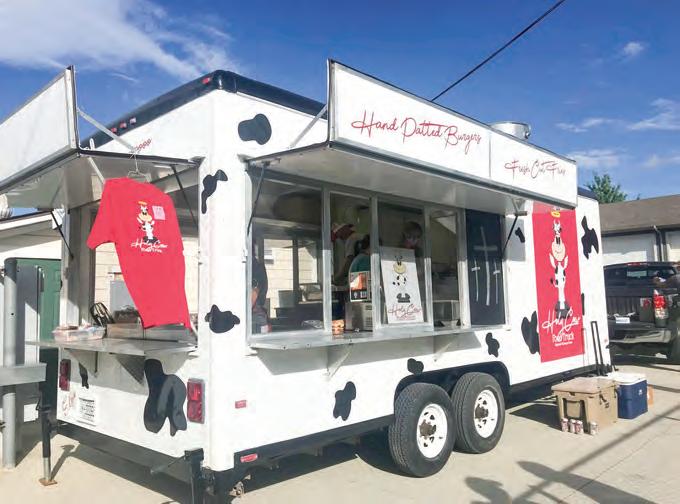
Haywood Pathways Center has announced a temporary pause of its Holy Cow Food Truck operations as the organization evaluates the program’s long-term sustainability amid shifting funding conditions.
The Holy Cow Food Truck has served thousands of delicious, hot meals to individuals and families across Haywood County, becoming a visible and vital extension of Pathways’ mission to meet immediate needs with dignity while connecting individuals to longer-term support.
The decision to pause Holy Cow services was not taken lightly. Holy Cow has been an important part of how Pathways serves the community. As the organization evaluates the current funding landscape, leadership is working to ensure that every program remains sustainable and strengthens the core mission.
The pause comes as Haywood Pathways Center navigates a gap between grant funding cycles and broader changes in funding sources that have impacted service delivery across the region.

Donations can be made online at: https://glassregister.societ.com/haywoodpathwayscenterinc/ form?id=0deddda4-948a-4788-8a7b-320be7666f6f
Haywood Pathways Center provides emergency shelter, transitional housing, and supportive services for individuals and families experiencing homelessness in Haywood County. Through housing, case management, and community partnerships, Pathways works to create stability, restore dignity, and build pathways toward independence.
In response, two local donors have stepped forward with a matching gift long-term stability.
This is an urgent moment for the community to come together! This matching opportunity provides a double impact for every dollar donated. Please make a donation today!
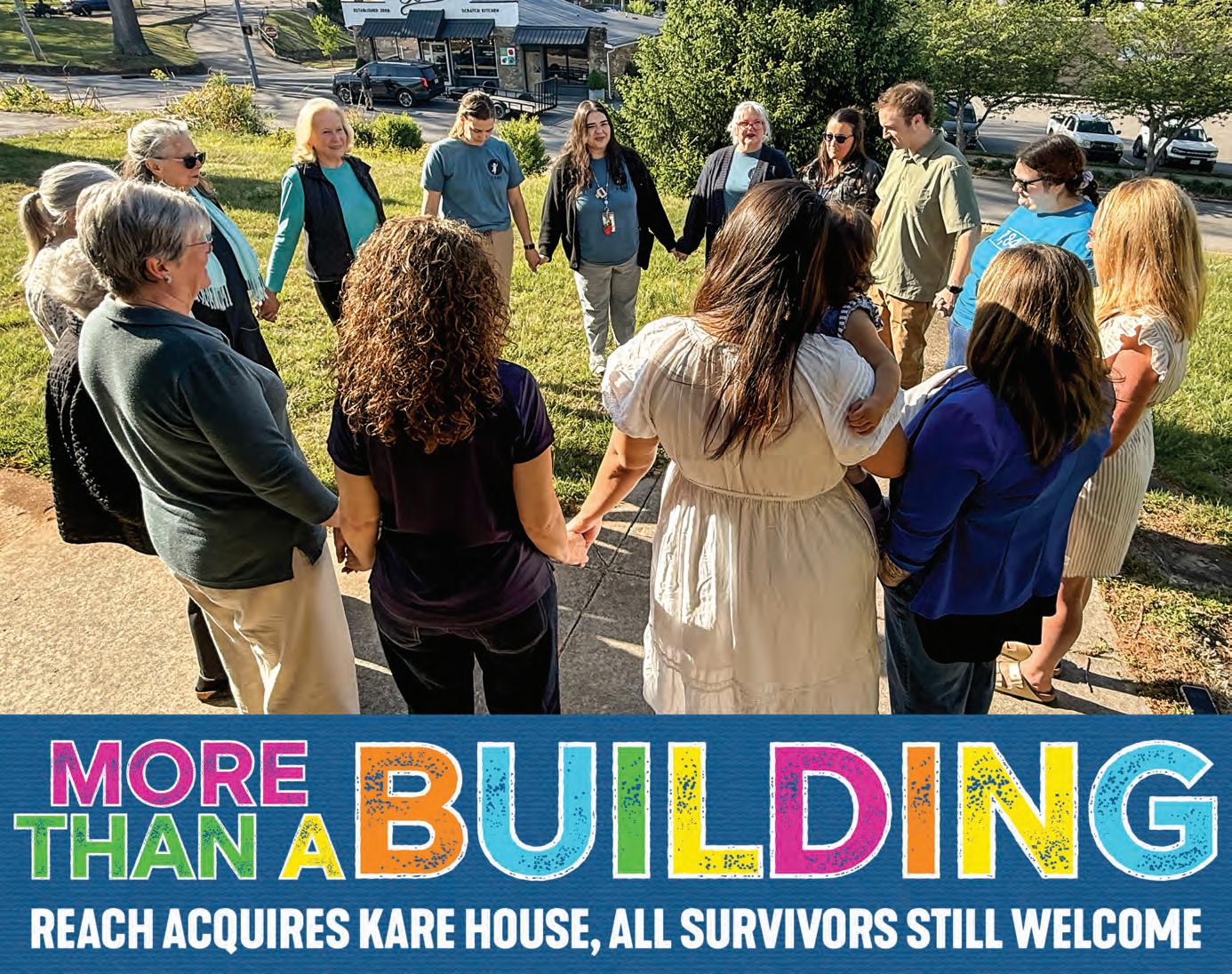
REACH, the Haywood County nonprofit whose mission is to support survivors of domestic violence and sexual assault, recently moved into the house formerly occupied by KARE, the organization dedicated to helping child victims of domestic and sexual abuse. (Page 4) Kyle Perrotti photo
What does consent really mean......................................................................................5
Buffy Queen dedicates years to helping middle-schoolers ....................................7
Teaching kids to recognize grooming............................................................................8
KARE’s Multi-Disciplinary Team........................................................................................9
Helping a friend..................................................................................................................10
A mother-daughter take Rape Aggression Defense class....................................10
Sometimes kindness is the best answer....................................................................11 The things we never say in Appalachia......................................................................12
HCC, Haywood Schools budget proposals garner different reactions............14
Proposed state bill named in honor of recently deceased legislator................16 Canton joins other local governments in opposing property tax cap................17
NCCAT expansion provides new resources for teacher training........................19
Waynesville alderman explains vote on Queen’s Farm annexation....................20
Out on a limb: The Hip Snacks make WNC debut................................................22 Haywood Community Band............................................................................................27
Waynesville’s Main Street welcomes Tuckaseegee Fly Shop............................30 Up Moses Creek: No Lie................................................................................................34
E DITOR /PUBLISHER: Scott McLeod.
ADVERTISING D IRECTOR: Greg Boothroyd.
ART D IRECTOR: Micah McClure.
D ESIGN & PRODUCTION: Jack Snyder. .
D IGITAL MARKETING S PECIALIST Tyler Auffhammer. .
ADVERTISING SALES: Amanda Bradley.
info@smokymountainnews.com
greg@smokymountainnews.com
micah@smokymountainnews.com
jack.s@smokymountainnews.com
tyler.a@mtnsouthmedia.com
amanda.b@smokymountainnews.com Maddie Woodard.
C LASSIFIEDS: Jamie Cogdill.
N EWS E DITOR: Kyle Perrotti.
WRITING: Lily Levin. .
maddie.w@smokymountainnews.com
classads@smokymountainnews.com
kyle.p@smokymountainnews.com
lily.l@smokymountainnews.com Cory Vaillancourt.
cory@smokymountainnews.com Garret K. Woodward.
ACCOUNTING & O FFICE MANAGER: Jamie Cogdill. .
garret@smokymountainnews.com
smnbooks@smokymountainnews.com
C ONTRIBUTING: Jeff Minick (writing), Susanna Shetley (writing), Adam Bigelow (writing), Thomas Crowe (writing)




As Sexual Assault Awareness Month comes to a close, Haywood County is witnessing a powerful moment of continuity, collaboration and commitment to ending violence.
On April 27, REACH of Haywood County officially purchased the longtime home of KARE at 1159 North Main Street — a transition that reflects far more than a change in ownership. It is a passing of purpose, a shared mission and a promise that survivors of sexual violence will never be left behind.
For over 30 years, KARE has served as a beacon of hope for children and families navigating the trauma of abuse, neglect, and exploitation. As a nationally accredited Children’s Advocacy Center, its work has focused on addressing sexual violence and harm against children — often in cases that are as complex as they are heartbreaking. Through a coordinated, multidisciplinary approach, KARE has ensured that young survivors receive compassionate care in a safe, child-centered environment.
REACH of Haywood County, now stepping into this space, continues that mission across the lifespan — supporting teens, adults and older adults who have experienced sexual assault, domestic violence, elder abuse and human trafficking. Together, these two organizations represent a continuum of care in Haywood County, addressing some of the most difficult and often hidden forms of violence that occur behind closed doors.
“This moment is incredibly meaningful,” said Sara Vogel, executive director of REACH of Haywood County. “During Sexual Assault Awareness Month, we talk so much about prevention, support and community responsibility. This building represents all of those things. The walls here have held unimaginable pain, but they have also witnessed resilience, courage and healing. We are honored to carry that legacy forward.”
hands of an organization committed to healing and safety is incredibly special.”
For REACH, the purchase comes at a pivotal time. As the organization celebrates 40 years of service, it is also expanding its vision for the future — one that includes increasing access to services, strengthening partnership, and ensuring that survivors have spaces that reflect dignity and care.
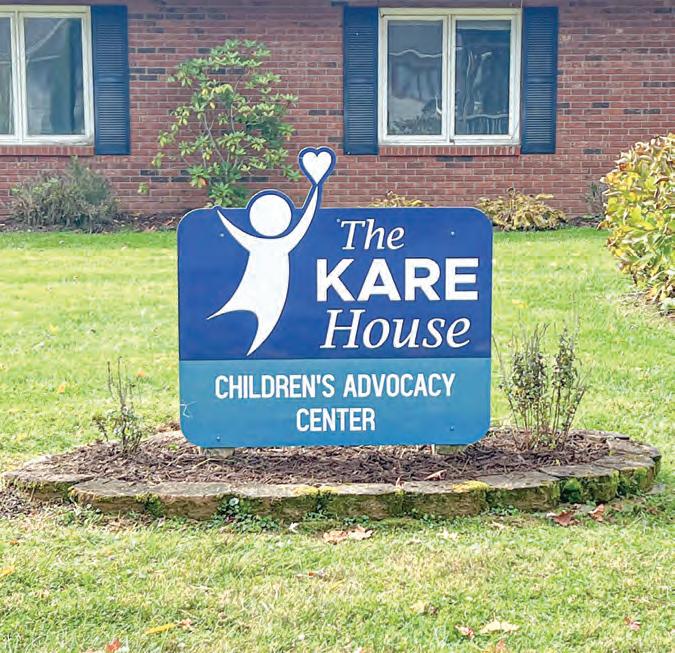
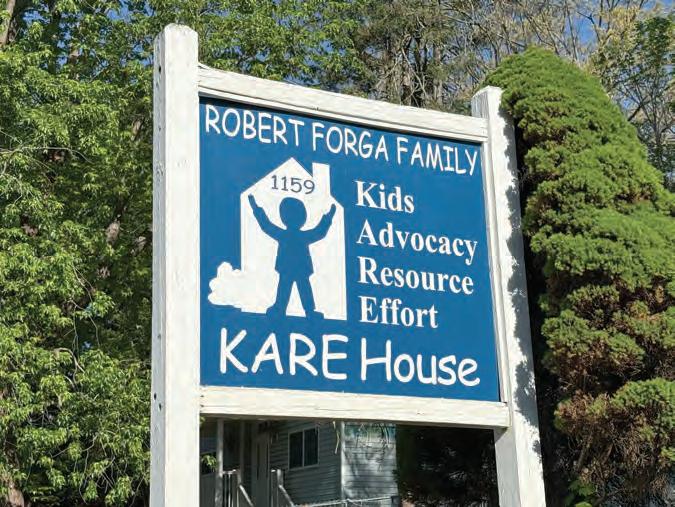
The house has a legacy of care that REACH aims to continue in the decades to come, and its story began when the Robert Forga family generously provided a space for KARE House to call home. The Forga family’s vision was simple yet profound: to create a welcoming, comforting space where children could feel safe during some of the most vulnerable moments of their lives. Inside, books, toys, snacks and drinks offered a sense of normalcy while families navigated intake processes and next steps. Now that KARE House has outgrown its space, it has moved its services to 465 Boyd Ave., in the community just below Waynesville Middle School.
The home provides a kind of philanthropy that feels distinctly rooted in Haywood County — creative, personal and deeply invested in the wellbeing of neighbors.
“For decades, this house has served Haywood County children and families as a place of healing and safety,” said Abby Bearden, chief operations officer of KARE. “It has provided a safe, welcoming environment where survivors of
child abuse could share their stories — feeling seen, heard and believed — while experiencing the comfort of a warm home, rather than a more formal setting like a police station or medical office. Knowing it will continue to serve survivors, even as it enters a new chapter, means everything to us.”
That sense of continuity is not lost on those helping facilitate the transition. Pamela Penny Williams, co-founder of Gateway Realty Group and the one overseeing the sale, describes the process as one of the most meaningful transactions of her career.
“You don’t often get to be part of something like this,” Williams said. “This isn’t just a property — it’s a place with history, with purpose, with heart. Seeing it remain in the
“The acquisition of this property will enable REACH to continue to grow our services,” said Peg Ganger, REACH board chair. “Our strategic plan focuses on growth, including hiring additional staff and increasing community involvement. This wonderful house will support this expansion, offering space for future needs as well as a large meeting room suitable for trainings, support groups and small community events.”
For REACH, the purchase comes at a pivotal time.
As the organization celebrates 40 years of service, it is also expanding its vision for the future one that includes increasing access to services, strengthening partnerships and ensuring that survivors have spaces that reflect dignity and care.
In a community where resources can be limited, collaboration between organizations like KARE and REACH is essential. Their partnership demonstrates what is possible when agencies align around a shared mission: reducing harm, supporting survivors and working toward a future free from violence.
The building itself stands as a symbol of that work. Within its walls are stories of some of the most heinous acts imaginable — but also stories of survival, of strength and of hope. It is a place where trauma has been met with compassion and where healing has been given room to begin.
As REACH prepares to take ownership, that identity will not change. If anything, it will deepen.
And as Sexual Assault Awareness Month comes to a close, this moment serves as a reminder that awareness must always be paired with action — and that action is strongest when it is rooted in community.
For those who feel called to be part of that work, REACH is inviting community members to consider how they, too, can help shape the future of Haywood County. REACH will launch a capital campaign to support renovations to the home and pay down the mortgage in the coming years — ensuring that this space remains a dedicated place of healing for generations.
If you are looking to make a lasting impact in Haywood County, now is the time.
Because this has never been just a building.
It is a promise — to every survivor who walks through the door — that they will be seen, supported and never alone.
BY DR. SARA VOGEL EXECUTIVE DIRECTOR OF REACH OF HAYWOOD COUNTY
As of April 1, I marked my first full year as the Executive Director of REACH of Haywood County. After nearly a decade working in this field — seven years as a Title IX Coordinator and now leading a nonprofit that serves survivors of domestic violence and sexual assault — I’ve come to believe something deeply: awareness is only the beginning. Prevention must be the goal.
For most of my career, I have worked in systems designed to respond after harm has already occurred. I’ve sat with survivors in the aftermath of sexual violence. I’ve walked alongside them through hospital exams, courtrooms, counseling sessions and the long, quiet process of rebuilding a life. I’ve witnessed extraordinary resilience.
For decades, our approach to sexual violence prevention has been rooted in fear. We teach people how to avoid assault, how to say no, how to report.
These efforts matter. But they are not enough. What we often fail to teach is how to say yes.
We don’t teach what healthy, consensual and mutually respectful intimacy actually looks like. We don’t give young people the tools to understand their bodies, their desires or their boundaries. And we avoid conversations about pleasure altogether — even though research shows that comprehensive, sex-positive education reduces rates of sexual violence.
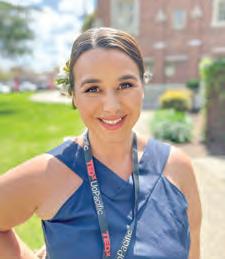
I didn’t begin to understand this until my second year of college, when I attended a workshop led by a sex educator. It was the first time I had ever been given permission to think about intimacy from a place of agency instead of fear. That experience changed everything.
Sharing my story publicly — through my TEDx talk — was one of the most vulnerable decisions I have ever made. For years, those experiences lived quietly in the background of my life. Naming them out loud changed me. It allowed me to take something that once caused me pain and transform it into something that could help others. It allowed me to metabolize that pain into purpose. And then something unexpected happened.
My 13-year-old niece called me to tell me her class was watching my TEDx talk in school. She was learning about consent — not as an abstract concept, but as something real. She was learning that she has agency. That she has a voice.
I didn’t have that at 13. That moment reminded me exactly why this work matters.
At REACH of Haywood County, we provide emergency shelter, court advocacy, counseling and a 24/7 crisis line. These services are essential. They save lives. But they exist because something has already gone wrong.
That their bodies belong to them. That consent is enthusiastic, informed, and ongoing.
That curiosity does not make them bad. That if something happens to them, they will be met with support — not judgment. We have to be willing to have these conversations — in our homes, in our schools, in our communities. Because prevention isn’t just about what we stop. It’s about what we build. We build safety through honesty. We build resilience through connection. We build change by breaking the silence we were taught to keep.
This Sexual Assault Awareness Month, I hope we continue to support survivors with the full force of our compassion and resources. But I also hope we do something more. I hope we choose prevention.
Because awareness is important. But prevention is powerful.

If you or someone you love may have experienced sexual assault, you are not alone. Confidential support is available. REACH of Haywood County offers a 24/7 crisis line, advocacy, and counseling services at no cost. Call us anytime at 828-4567898. We are here to listen, believe you, and walk alongside you.
And I’ve also seen, over and over again, the same quiet truth: we are pouring enormous resources into what happens after violence — and not nearly enough into stopping it before it starts.
We are good at crisis response. We are far less comfortable with prevention.
During my first year of college, a friend told me about what she described as a “perfect” first sexual experience — candles, music, rose petals. It was the story so many of us were sold: intimacy would be mutual, meaningful and beautiful.
That wasn’t my experience.
My first sexual encounter didn’t feel like a choice. It happened within a relationship where I cared deeply about the person I was with, but where pressure, persistence and emotional manipulation blurred the line between consent and compliance. I remember lying there afterward, confused, questioning myself more than him, wondering why I hadn’t done more to stop it.
It would take years for me to understand what happened.
What I experienced was sexual coercion — unwanted sexual activity that occurs through pressure, guilt or manipulation rather than physical force. And like many survivors, I didn’t have the language to name it at the time.
That is part of the problem.
When we fail to give young people the language to understand their experiences, we take away their ability to advocate for themselves.
For the first time, I understood that my voice mattered. That consent wasn’t just about preventing harm — it was about actively choosing what felt right for me. And I often wonder how different my first experience might have been if I — and my partner — had been taught those things earlier.
Today, in my role at REACH, I see the consequences of that gap in education every single day.
Sexual assault does not end when the incident is over. It reshapes how a person experiences safety, relationships and even their own body. Survivors often carry not only the trauma of what happened but also the weight of shame, stigma and silence. Many withdraw. Many question themselves. Many blame themselves. And healing is not linear.
For some, it begins with simply not being alone. For others, it looks like therapy, journaling, creative expression or reconnecting with their bodies through movement, nature or safe touch. Our senses — sight, sound, touch — can trigger trauma, but they can also become tools for grounding and healing. What survivors need most is not to be rushed, fixed, or questioned. They need to be believed. They need to feel safe. They need space to heal at their own pace.
And they need compassion — especially from themselves. Because trauma responses are not signs of weakness. They are normal responses to abnormal experiences.
If we truly want to reduce sexual violence, we have to be willing to think bigger. We have to move beyond silence, beyond shame and beyond outdated approaches that prioritize avoidance over understanding.
We have to teach our children:
If you are interested in watching the full TEDx talk, it is located here as well as through the QR code above: https://www.youtube.com/watch?v=K8QqmN1hLY&t=148s
Dr. Sara Vogel is Executive Director of REACH of Haywood County.






















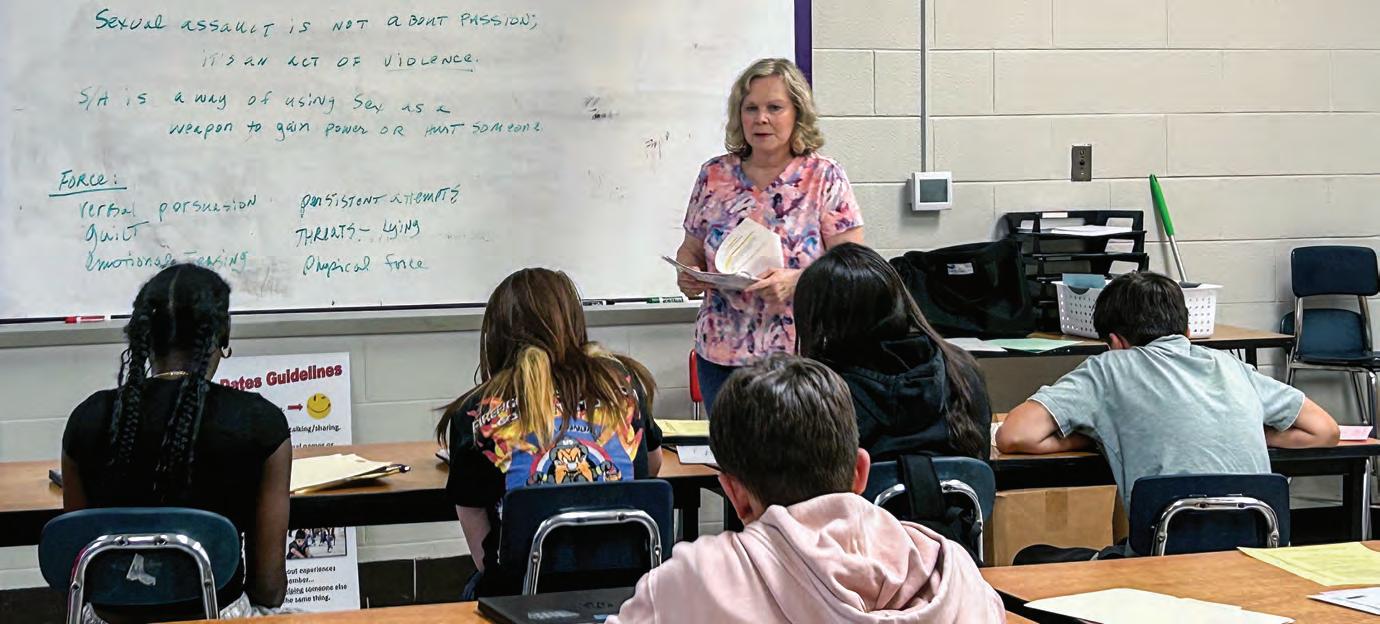
Safe Dates is a three-to-four-day Hazelton Betty Ford Foundation course about healthy relationships, and for nearly 20 years, Buffy Queen has been bringing it to Haywood middle schools.
She started at KARE House, a Haywood County advocacy center responding to child abuse and neglect through outreach and intervention, after a grant enabled the nonprofit to train a staff member through the nationally recognized curriculum.
As grant funding began to dwindle — and eventually stopped — she still believed Safe Dates was necessary. So, in 2009 she started looking around.
REACH of Haywood County, a nonprofit “dedicated to supporting survivors of domestic violence, sexual assault, elder abuse and human trafficking” through “comprehensive, trauma-informed services,” seemed the perfect place to house a long-term program.
Queen contacted then-Executive Director Julia Freeman and proposed Safe Dates exist within the organization through the lens of prevention.
Freeman immediately expressed her support.
“[She] said, ‘Our boards just started talking about prevention, because we handle everybody who comes in who’ve had those violent relationships in their life, sexual assault, elder abuse, whatever. But we really need prevention,” Queen recounted.
That’s how she became responsible for REACH’s prevention arm.
For seventh graders, Safe Dates consists of three interactive workshops centering relationships through unhealthy and healthy communication: what each looks like, how to distinguish the former and how to use the latter.
“We do a lot of fun things, like dating bingo and all kinds of stuff like that. I give them a lot of gifts for doing their homework and for participating in class, helping me carry all
my stuff in,” Queen said.
The eighth-grade curriculum also involves a review of healthy and unhealthy relationships — including psychological disorders that might play a role in the psychology of an abuser. The third session involves how to help a friend who might be going through something akin to abuse. This workshop, Queen explained, encourages empathy for rather than blame of assault survivors, even as students learn how to better protect themselves from this form of violence during the final class.
REACH sends each student home with a resource packet introduced by a letter about the class — it does not encourage early dating, is free of sexually explicit content and prepares children to identify red flags they might later encounter — addressed to parents and/or guardians.
Additionally, the packet encourages parents to believe their children in the event of an assault disclosure. It explains how to “keep your teen safe on a date” and how to
While no longer present at the middle school level, KARE house is still Haywood’s go-to for its elementary school education program.
The group was founded in 1981 as a prevention-based organization, after a group of advocates discovered Haywood was the top county for child abuse in North Carolina, according to Chief Executive Officer Abby Bearden.
While the curriculum has changed and developed over time, the foundation has continued.
Students discuss safe and unsafe touch and how to identify trusted adults using “fun and child-friendly and ageappropriate” course materials, Bearden said.
Children also learn the three rules of body safety and what to do if one is broken, such as saying no, leaving the situation and telling a trusted adult.
The program spans kindergarten through fifth grade and is largely repetitive, she told The Smoky Mountain News, likening it to a fire drill. In other words, while it’s uncommon for a body boundary to be violated, you want to be prepared in case it does.
“The most [common] thing I get from parents and from kids who come tell me what their parents said, is their mom says, ‘Boy, I wish I’d had this when I was your age.’”
— Buffy Queen
spot warning signs of dating abuse.
After reading through the handouts, parents usually express excitement with the material.
“The most [common] thing I get from parents and from kids who come tell me what their parents said, is their mom says, ‘Boy, I wish I’d had this when I was your age,’” Queen recounted.
But she’s been at it so long that some former students are now adults.
“I was going into the grocery store at Ingles and two young gals come out. They say, ‘Oh, hi, Ms. Queen,” she said. “I’m now starting to ask the baggers, ‘Were you in my Safe Dates class?’”
However, the curriculum does not aim to instill fear; it is meant to empower.
“It’s really coming from a place of, ‘Hey, you have a voice. You can use it to speak up. You have people in your corner who love you and want you to be safe. You just have to talk to them, you know, you have to let them know,’” said Bearden.
And when students graduate elementary school, continuity is ensured through the Safe Dates program.
“When Buffy [Queen] goes in and is teaching kids about healthy relationships, it’s building on that same material of, ‘Hey, if anybody is crossing a body boundary in any way or making you feel uncomfortable or unsafe, you can do something about it,’” she said.
SEE MARK, PAGE 8
BY KIT GRUELLE
April is Sexual Assault Awareness Month. REACH advocates routinely work with victims and survivors of all forms of sexual assault and abuse. After 38 years in this work, I can say, without reservation, that sexual assault, particularly child sexual assault, is our most underreported crime. It devastates victims in innumerable ways and leads to many other forms of both victimization and perpetration.
When a perpetrator looks for a (potential) victim, gaining and maintaining access is their chief goal.
Abusers never start their abuse right away. They groom victims using a variety of tactics. How do we recognize this hidden conduct, and how do we help?
Sadly, those who choose to abuse (yes, it is a CHOICE) come from all walks of life. They can be anyone from a family member (including a sibling) to a neighbor, family friend, highly regarded community member, pastor, teacher, coach or another trusted person. Sexual abuse is committed most often by someone the victim knows.
What do sexual predators look like? They look and act like everyone. There’s no “type,” as is often portrayed in movies. Predators often have dual personalities. This is part of what makes it so difficult for victims and those who care for them. How can it be that Mr. Nice Guy is also capable of sexually abusing a child or a teenager?
What do predators look for in a potential victim? First and foremost, they want access. They look for children and/or teens who are vulnerable, who feel isolated and alone. Abusers use that isolation to their advantage by focusing positive attention on them, by filling in the lonely and frightening gaps in their lives with lots of encouraging attention, affection and gifts. They look to establish a “special relationship” with the victim, to make the connection between them seem indispensable. They want the victim to feel unique and special.
Then, once the special relationship is established, the boundaries are tested. It begins with “game-playing,” but this is no
game. It is an act of predation. The abuser might want to see if the victim will “keep a secret” between just the two of them. The victim wants to please this person who has been paying such close attention to them; children are taught to please adults in ways that can be a setup for abuse.
Little girls are often taught to “be nice” to their adult family member or friend, to sit on his lap and “be sweet.” This is a terrible requirement to put on girls, as it creates an expectation in the child that she is supposed to please the adult. It’s a dynamic that leads to a (potential) lifetime of abuse.
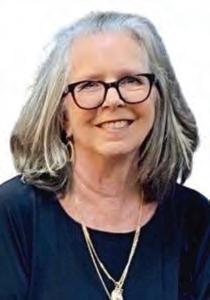
Kit Gruelle
Little boys, like little girls, are often taught to look up to adults in their lives or in the community.
Adolescence is always a difficult and confusing time for kids, and they may or may not have anyone they feel they can be open with. Many predators know this and take full advantage of it. Once they’ve established that predator/prey relationship, the downward spiral for the victim has begun.
What do we look for with a victim of sexual predation? Anxiety, withdrawal, mood swings (which are common in adolescents to begin with), depression (which can present in different ways in girls and boys) and being defensive of the person who is abusing them. It can also include running away, having problems at school, early sexualization in both boys and girls and a complete lack of trust in anyone. In other words, child and teenage sexual abuse is devastating, traumatic and can create life-long negative consequences.
This is why we feel it’s so important for victims and those who care about them to have a safe place to come and process what’s happened. REACH is committed to making sure caring, safe adults can find safety and support for identifying a way forward after the sexual abuse has been disclosed. We
work with the advocates at KARE who do such invaluable work across Haywood County to assist child survivors and their families.
Abuse of any form is despicable. If it occurs within the family and/or trusted relationships, it shatters the victim’s ability to trust anyone.
Healing from abuse is a process, not an event. What the victim needs and deserves is a chance to find help and understanding,
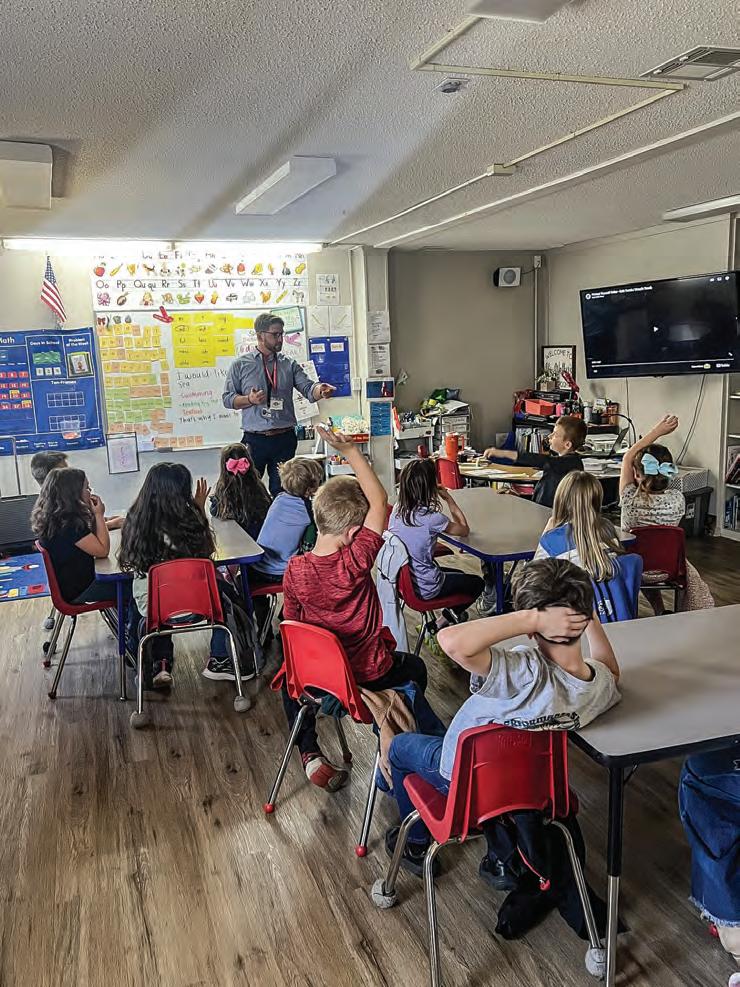
Queen began her fourth session on April 16 by posing two questions to the eighth-grade class at Waynesville Middle School: Who wants to avoid being a rapist, and who wants to avoid being sexually assaulted?
The group processed her inquiry, and hands shot up from the audience. Everyone was keen to stay clear of both. The REACH educator, while emphasizing that sexual assault can happen to anybody, told students she’ll be sharing tools about how to recognize, prevent and defend oneself
against it.
Then, she walked the room, giving all who had completed last night’s homework permission to grab a snack at the back table. After everyone had returned to their seats, she instructed the group to take out their packets and turn to the sheet with nine true-or-false statements related to sexual assault.
As students were evaluating the statements, Queen wrote a message on the whiteboard.
“Sexual assault is not about passion; it is an act of violence. S/A is a way of using sex as a weapon to gain power or hurt someone,” it said.
Individual answers were graded through a peer swap as
and to begin to learn that trusting relationships can still be found. There are, in fact, many good people who want to stand beside them as they start to move forward, away from the abuse and toward safety. For more information, see RAINN.org and bravehearts.org. Call REACH of Haywood County at 828.456.7898 for more options and resources.
(Kit Gruelle is the Victim Advocate at REACH of Haywood County)
one student volunteer read aloud and identified the correct answer to each statement.
During the exercise, Queen corrected the misconception that perpetrators appear mentally ill or creepy, emphasizing that most assaults happen between acquaintances. She explained that rape is any forced sexual activity, regardless of prior consented sexual activity — and that force usually involves verbal coercion, persistent attempts and teasing, rather than physical harm.
“We talk about active consent — that’s really, really important, and you must always know that your partner is very much OK and enthusiastic about what you might want to do with them on a physical, personal

BY ABBY BEARDEN
Protecting children from harm requires a coordinated, informed, and proactive approach. KARE House, a children’s advocacy center in Haywood County, is dedicated to supporting children and families affected by abuse, neglect or exploitation. This work is carried out through comprehensive services including outreach, advocacy, specialized interventions and a collaborative, multidisciplinary approach designed to put children first.
At the center of this approach is the Multidisciplinary Team (MDT), a group of professionals from different fields who work together when there are concerns about child abuse. Rather than agencies operating in isolation, the MDT brings together law enforcement, child protective services, med-
nature,” she told The Smoky Mountain News before the class, noting that this person must be sober, awake, enthusiastic and verbal.
“I let them know I’m not talking about necessarily, you’ve been dating somebody for six months, and you know when they would like you to kiss them … But if you’re first starting a relationship or you want to do something new with someone, always be sure that you have active consent,” she added.
But what happens if you’re on the other side of the equation?
Families are supported throughout the process with access to counseling, advocacy, and resources that help them navigate difficult circumstances. By improving communication and collaboration, the MDT ensures that no part of a child’s well-being is overlooked.
KARE House also offers safety education in all of Haywood County’s elementary schools. These programs are designed to teach children the skills and knowledge they need to recognize unsafe situations and seek help.
KARE’s Body Safety program focuses on clear, ageappropriate concepts that empower children without causing fear. Students learn the difference between safe and unsafe touch, and they are taught that their bodies belong to them and that they have the right to say “no” if something makes them feel uncomfortable or scared. Students are also taught to identify trusted adults they can talk to if something feels wrong. This reinforces the idea that they are not alone and that help is available.
A key part of the program is learning how to respond if someone violates a boundary by using the three-part safety rule: say “no,” get away, and tell a trusted adult. Children also learn to distinguish between safe secrets (like surprises) and unsafe secrets that need to be told.
For caregivers, it is important to understand that body safety education is not about exposing children to inappropriate content. Instead, it means using child-friendly language and concepts to build confidence and awareness aimed at preventing abuse from ever occurring. These programs are carefully designed to match developmental levels and are delivered by trained educators in a classroom setting.
The goal is to create an environment where children feel safe asking questions and speaking up. Caregivers play a vital role in reinforcing these lessons. Talking regularly with children about feelings, boundaries and safety helps build trust and keeps communication open. When children feel heard and believed, they are far more likely to speak up if something is wrong.
Protecting children is a shared responsibility. Through coordinated response efforts like the MDT and proactive safety education programs, communities can work together to prevent abuse and support those affected by it. We all have a role to play in keeping children safe.
For more information or to get involved, visit karehouse.org.
(Abby Bearden is Chief Operating Officer at KARE.)
ical professionals, mental health providers, prosecutors and victim advocates. Each member contributes their expertise to ensure a coordinated, thorough and childcentered response.
The primary goal of the MDT is to protect children while minimizing further trauma. One of the most important ways this is achieved is through a streamlined process for gathering information. Instead of repeating their experience multiple times, a child shares their story one time with a trained forensic interviewer in a safe, supportive space. The process is child-centered and focused on comfort and trust — not interrogation. This interview can then be shared across the team, reducing stress on the child while preserving the accuracy and integrity of their story.
Beyond the interview process, the MDT works together to coordinate every aspect of the response — prioritizing the safety, healing and long-term stability of each child.
Queen posed an example to the class involving someone tearing at your clothes with their arms wrapped around you.
“What can you do right then, to disable them, to stop them, just for a second, so you get away?” she asked.
“You can kick them. Then you can hit them with your shoe. You can slam the door on an arm. Whatever you want to do. You don’t have to kill them, but you can do whatever you need to do to stop it. Everybody understand that that is called self-defense. That’s allowed,” she said.

BY ELAN SEAGO
It usually doesn’t start with a report or a formal complaint — it starts with a conversation. A friend, a classmate or a roommate quietly says, “Can I tell you something?” and suddenly, you’re the person they trust with something heavy.
For many college students who experience sexual assault or relationship violence, confiding in a peer feels safer than reaching out to an office or making an official report. That means students are often the first line of support in moments that matter most. Knowing how to respond, with empathy and nonjudgmental support, can make a powerful difference in whether someone feels heard, supported and encouraged to seek help.
While these conversations may feel rare or unexpected, they are more common than many realize. According to RAINN (the Rape, Abuse & Incest National Network), 13% of all students experience rape or sexual assault, with rates even higher for undergraduate women (26.4%) and students with marginalized or nonconforming identities (21%).
sobering statistics like this, the chances are relatively high that you could have a friend confide in you about experiencing sexual violence.
If a friend chooses to confide in you, recognize it as a huge sign of trust and acknowledge how brave it took for them to open up. Along with listening nonjudgmentally, say-
Avoid saying things that could be interpreted as victim-blaming or not believing them. Some examples of what not to say include things like, “Are you sure that’s what happened?” “It could have been worse,” or “Why would you even put yourself in that situation?” If a survivor discloses to you, don’t ask what they were wearing, if they were drinking, or why they didn’t report to the police. These questions remove blame from the perpetrator and place it on the survivor, causing even more pain.
the perfect response. You just have to show up and hold space. Additionally, don’t pressure them to share all the details. What they share with you is their choice, and pushing them to relive every detail could cause more harm.
You can also offer to help your friend connect with additional support, whether that means going with them to an appointment or simply helping them explore their options. In Haywood County, resources like Reach of Haywood County and WNC Alliance provide support for survivors. On campus, Haywood Community College’s Student Wellness office offers free counseling and can help students connect with local services. With that said, remember that being a good advocate is not about pushing someone to speak out, report, or take action before they’re ready. Respect your friend’s autonomy and support them no matter what they choose to do.
Women ages 18-24 who are college students are 3 times more likely than women in general to experience sexual violence. With
ing something like, “Thank you for telling me,” “I’m so sorry that happened to you,” or “I’m here for you,” can go a long way.
Just listen. Sit with them. Show that you care. Remember, supporting someone doesn’t mean fixing the situation or having
BY WENDOLYN FORBES
In the quiet moments of a morning at Panacea Coffee House, a chance conversation with Waynesville Police Chief David Adams sparked an unexpected journey for my daughter and me. He mentioned the upcoming Rape Aggression Defense (RAD) program at the Waynesville Recreation Center, hosted by REACH of Haywood County, our local rape and domestic violence crisis center, and the Waynesville Police Department.
I realized, despite a career focused on risk management and planning, I had never taken a formal self-defense course. I immediately recognized this as a skillset I wanted to cultivate, and I knew I wanted my daughter to develop these skills alongside me.
For any parent, the desire to protect their child is a constant, quiet hum in the background of daily life. However, transitioning from protecting her to empowering her to protect herself is a profound shift. During the
course, my daughter shared that she previously felt unsure of how to defend herself. Attending together made the experience a collaborative effort for both of us.
The atmosphere in the class was transformative. One finds a specific kind of strength in a room full of people who share similar concerns and goals. My daughter noted that having a parent by her side made the experience feel more powerful, and seeing others engage with the material reinforced the idea that we are all capable of reclaiming our sense of security.
One of the most significant takeaways from the RAD course was the dismantling of the perfect response myth. We learned that in a moment of crisis, doing something is always better than doing nothing, and self-protection is about options. Understanding that you have options — whether that is a verbal boundary, a tactical retreat or a physical strike — replaces a feeling of helplessness with a feeling of agency.
Supporting a friend through a situation like this can be heavy, and it’s important to take care of yourself, too. Give yourself space to process and recharge. If you need to talk to someone, do so in a way that protects your friend’s privacy and confidentiality. Showing up for someone in a difficult moment isn’t about having all the answers. It’s about being present, compassionate, and willing to listen; and how you respond in that moment can shape whether someone feels safe enough to seek further help.
(Elan Seago is Haywood Community College’s Student Life and Wellness Specialist.)
My daughter was particularly struck by the course’s physical mechanics, specifically noting how certain body parts can be incredibly effective tools for defense. For her, the focus was on risk reduction and gaining the tactical knowledge to navigate the world with a more informed sense of safety.
The two-day course in September left a lasting impression. We sometimes discuss how to identify risks and the importance of situational awareness. Further, the booklet received at the end of the course provided additional educational information so my daughter and I could talk about the topics and revisit specific moves, strategies and options at any time.
As we recognize Sexual Assault Awareness Month this April, I believe it is important to acknowledge partners like REACH of Haywood County and our local law enforcement who provide these educational resources. Sharing this experience with my daughter did more than teach us about safety options and techniques: it opened a door for us to talk about boundaries, strength, and the fact that our safety is something we have the right and the ability to defend. I now know that I am capable of taking care of myself in a different way than I was before. Moreover, my daughter knows that she is capable, too.
We walked out of those sessions feeling emboldened, knowing we are capable and, most importantly, that we have options.
BY KATIE MILLER
My high school English teacher might have had a love-hate relationship with the phrase “hurt people hurt people,” challenged by its poetic symmetry yet grammatical ambiguity. My hesitation in putting it on a bumper sticker is that it could easily be mistaken for an imperative. It isn’t. A less succinct — but clearer — version would read: People who are hurting often hurt others.
This thought comes to mind every time I sit in the afternoon car line at a local elementary school and notice a bumper sticker that reads, “Shoot your local pedophile.” While I understand the anger and fear that can motivate such feelings, violence cannot be solved with more violence. Complex problems rarely yield to simple solutions, and cycles of harm cannot be broken by perpetuating them.
April is Domestic Violence and Sexual Assault Awareness Month. At first glance, focusing on those who commit violence may seem counterintuitive during a time meant to center survivors. Supporting survivors is essential and must remain a priority.
research paints a complicated picture. Violence is not simply the result of individual moral failure, nor is it predetermined by childhood trauma. Instead, it emerges from a complex interaction of social conditions, personal experiences, and biological responses to stress. Breaking cycles of harm, therefore, requires more than a reaction to violence. If we understand the origins of violence, we can begin to counteract it at the community and individual levels.
Programs that work with individuals who perpetrate violence are an important part of preventing future harm and improving community safety, and it does not mean abandoning accountability. In fact, accountability is often a crucial part of the healing process.
But if our goal is truly to reduce — and ultimately eliminate — the suffering caused by violence, we must also examine the conditions that lead people to harm others and commit to practicing daily, garden-variety compassion.
Researchers have long described what is known as the “cycle of violence,” in which early exposure to abuse, neglect, or household trauma increases the likelihood of harmful behavior later in life. A landmark longitudinal study found that children who experienced abuse or neglect were about 30% more likely to be arrested for violent crimes as adults than those who were not maltreated. Importantly, this does not mean that survivors inevitably become perpetrators — most do not — but it demonstrates how unaddressed trauma can create risk factors that make cycles of violence more likely to continue if meaningful intervention is absent.
Emerging research in epigenetics further illustrates how deeply trauma can affect individuals. Chronic stress in childhood can alter the body’s stress-response systems through biological processes that affect how certain genes are expressed. Studies suggest that about 60% of adults report at least one significant childhood trauma. In other words, trauma can shape not only behavior, but also the ways our bodies respond to threat and stress. Taken together, this
Acknowledging harm, taking responsibility, and engaging in meaningful change can reduce the likelihood that violence will be repeated. Of course, prioritizing the safety of survivors is paramount, but we can center survivors and still acknowledge that prevention requires addressing the conditions that produce violence in the first place. These programs operate at the organizational level and better position communities to interrupt cycles of violence. At the individual level, however, there is something available to each of us that is deceptively simple, yet powerful: kindness.
Kindness is often dismissed as soft or naïve, but in reality, it can be a profoundly disruptive force against cycles of harm. At the individual level, small acts of empathy and compassion can help counter the isolation, shame, and unresolved pain that often sit beneath harmful behavior. At the community level, cultures that value kindness create environments where violence is less likely to take root. Kindness does not excuse harmful behavior, nor does it replace justice. Instead, it helps create the conditions where healing and change become possible.
Violence thrives in cycles. If our only response is anger and punishment, those cycles will continue indefinitely. But if we invest in prevention, healing, and accountability — and if we choose compassion over cruelty in our daily interactions — we begin to build communities where cycles of violence can finally be broken. Sometimes the most powerful medicine available to us is also the most accessible: a commitment to seeing one another’s humanity and choosing kindness by default. In this way, I believe that hurt people can become healed people. That’s the bumper sticker and world that I want to see.
(Katie Miller is a Sexual Assault Nurse Examiner.)
























BY KAYLA BROWN
In the part of southern Appalachia where I was raised, there were certain things you learned early: how to be polite, how to mind your elders, how to carry yourself in a way that didn’t invite trouble. And then there were the things no one quite said out loud, but you still somehow understood: good girls don’t talk about sex, don’t think about it and certainly don’t have it.
We were taught abstinence, not as one option among many, but as the only moral path. It was framed as protection, as purity, as worth. But what we weren’t given was language. There were no real conversations about our bodies, about consent, about desire, about safety. Silence filled in the gaps where education should have been.
And silence has a way of shaping how you see yourself.
I remember being called a “whore” before I had ever even had sex. The word came easily to others, heavy to me. It didn’t matter what I had or hadn’t done; just existing as a young woman in a small community meant walking a narrow line, one that could

When I did lose my virginity, it wasn’t with the confidence or clarity that comes from understanding your own body and boundaries. It came from curiosity, from pressure, from not fully knowing I had the right to say no, or how to say yes on my own terms. And when I became pregnant, the weight of that silence came crashing down all at once. There was no roadmap, no honest framework to fall back on. Just judgment, fear and a deep sense that I had somehow failed.
But looking back now, I don’t see failure the same way. I see a system of quiet, one that left too many of us unprepared and alone.
April is Sexual Assault Awareness Month, and in communities like ours, awareness has to start with honesty. It has to start with breaking the silence that so many of us were raised in. Because the truth is, abstinence-only messaging doesn’t prevent harm; it often just makes it harder to recognize, name and respond to.
If we want something different for the next generation in Appalachia, we have to be willing to speak differently.
We have to teach our children that their bodies belong to them. That consent is not just the absence of “no,” but the presence of an informed, enthusiastic “yes.” That they deserve to understand their own anatomy, their emotions and their boundaries — without shame attached.
We have to tell them that being curious doesn’t make them bad. That making a mistake doesn’t make F

them unworthy. That if something happens to them, whether it’s coercion, assault or simply a situation they didn’t feel ready for, they can come to us and be met with support instead of judgment.
And, most importantly, we have to unlearn some of what we were taught.
That’s not easy work. It means questioning traditions that feel deeply rooted. It means having uncomfortable conversations at kitchen tables and in church parking lots. It means admitting that what we were given wasn’t enough, and choosing to do better anyway.
Appalachia is a place of strong values, deep ties and resilient people. Those strengths don’t have to be lost as we grow; they can be the very foundation for change. We can hold onto our sense of community while also expanding what care and protection look like.
Because protecting our children isn’t about keeping them in the dark. It’s about giving them the tools to walk in the light, fully informed, fully empowered and fully supported.
Our stories matter. Even the hard ones. Especially the hard ones.
When we speak them out loud, we don’t just unburden ourselves; we make space for someone else to feel less alone. And in that space, awareness turns into understanding, and understanding into change.
That’s where healing begins.
(Kayla Brown is Director of Operations for Reflections of Inspiration in Sylva.)
























































































































































HCC gets support while large HCS hike gets tepid response
BY LILY LEVIN STAFF WRITER
Haywood Community College President Shelley White got little pushback for the additional $268,000 she has asked for from county commissioners in HCC’s 2026-27 budget proposal, but Haywood County Schools Superintendent Trevor Putnam’s request for an extra $3 million encountered some resistance.
Both school leaders presented their final 2026-27 budget proposals to county commissioners at an April 20 meeting.
White was joined in attendance by Vice President of Infrastructure Operations and Technology Breck Lanning and two HCC board members.
She explained HCC’s requested appropriations would represent 6.81% of its total budget and be allocated to areas such as salaries, utilities, insurance, service agreements and contracted services.
Inflation is the key driver of many rising costs.
For example, utility expenses are projected to surpass $750,000, in comparison to $710,000 for the current fiscal year, even though HCC has become more energy efficient.
“Our actual energy usage in those facilities is lower than it was previously. It’s just, it can’t quite keep up with the cost increase,” White said.
HCC’s $405,000 repairs to facilities fund would remain unchanged in the budget proposal, but the institution is requesting an additional $315,000 for Hemlock building restroom renovations and $30,000 for vehicle replacement.
The Hemlock building houses the auditorium, boardroom facilities, bookstore, student services and business office.
ing out of our public schools and that are preparing for a career in the future,” said Commissioner Jennifer Best.
In fact, HCC is now officially recognized as a level II accredited arboretum by ArbNet, an international arboretum network.
“As Commissioner Tommy Long said, we stand behind you, the board and the college altogether,” said Commission Vice Chair Brandon Rogers.
“These are high-traffic areas and are in need of a refresh,” the HCC president said.
Commissioners received White’s presentation positively, praising the college for its academic accomplishments and transformative work within the county.
“[HCC is] just such a good cornerstone to our community and our young people com-

He then pivoted to a question about HCC’s rate of faculty turnover, a problem confronting many academic institutions.
White said while HCC does have issues with turnover, “it’s actually decreased from the past year, and it’s lower than average for higher education.”
The campus has a “fully operational childcare center” for employees, she added, which must also be factored into the equation.
Since early 2020, North Carolina has weathered a net loss of 367 childcare programs, 21 of which occurred between October and December 2025.
So, guaranteed childcare would likely contribute to higher employee retention.
And it means HCC “[has] to consider turnover rates for childcare centers as well as part of how we look at our numbers,” White noted.






Haywood County Schools is requesting $21 million in appropriations for its 2026-2027 budget, a nearly 17% increase from the $18 million allocated for last fiscal year.
In late March, the school board unanimously approved the budget request, which was explained in depth by The Smoky Mountain News.
The largest increases are in salaries, which total roughly $1.3 million. Of the remaining $1.7 million, approximately $700,000 would cover the school system’s budget shortfall, which it pulled from its fund balance to finance 2025-2026 expenditures.
The final $1 million, Putnam explained, would maintain 16 “teaching positions that we feel are critical to our ongoing performance at its current pace.”
Unlike HCC, the North Carolina General Assembly is seemingly the most influential force behind HCS’ growing annual expenditures.
This is due to several factors — an unforgiving funding formula, a mandatory yet unfinanced minimum wage set at $15 per hour and the continued absence of a state budget.
In the U.S., 41 states employ a per-pupil model to allocate district appropriations, often weighted to ensure sufficient support for highneed students. From NC Forum to the John Locke Foundation, student-based funding is supported by thinktanks across the political spectrum.
Meanwhile, North Carolina uses a complicated hybrid for-




















































mula based on average daily membership — the average number of students present during the first 20 days of the school year rounded to the nearest whole number. A total of 18 students will fund one kindergarten teacher while 29 students fund an educator for grades 10-12.
“The funding formula is great if you’re adding students, but when you are not, it’s on a steady decline. It’s a negative residual,” explained Putnam to commissioners.
Moreover, he said, because educators are funded uniformly per average daily membership allotment, without consideration for degree or credentials, “you could end up with an effective cut just because of the way the formula is created.”
In a county like Haywood, with “several master’s level teachers with national board certification,” it’s essentially a “spray and pray,” said Putnam.
As for the $15-per-hour minimum wage, the HCS superintendent lauded the General Assembly’s decision several years ago to institute such a requirement but emphasized that the state “didn’t send any additional money” to cover increased expenses.
dent as means of justifying the proposed spending hikes.
She noted that in HCS placed first out of 14 western region school districts in 20232024 and 2024-2025 for academic performance; among North Carolina’s top 10 traditional high schools, Tuscola scored the highest ACT and Math 3 in Western North Carolina; Students district-wide earned a total of 3,593 Career and Technical Education credits in 2024-2025, up from 587 in 2021-2022; and Haywood Early College took fifth place for best ACT composite in North Carolina and achieved a 100% college acceptance rate.
Consequently, the county was forced to flatten the pay table, raising starting salaries without proportionally compensating veteran employees.
Putnam spoke of a clerical employee at Waynesville Middle School who’d worked her way up throughout the years to $15.52 an hour. After the General Assembly passed the legislation, “the person hired next to her was now going to make only 52 cents less,” he said.
“So, it created a huge morale issue.”
HCS responded through its classified and non-certified graduated salary study, the results of which would raise graduated compensation levels to meet the recommendations of the North Carolina Department of Instruction and necessitate an additional $1.3 million from commissioners.
Regardless, the school system must navigate hypotheticals without a North Carolina budget.
“Please note that our budget assumptions include the retirement rate of 64.67% and a $500 annual increase in health insurance premiums for all full-time staff,” said HCS Finance Director Leanna Moody.
But the future doesn’t look much brighter for HCS in the event of a functional budget. Its passage promises $350,000 in district cuts, including three teaching positions.
Putnam, framing the situation as a catch22, made a desperate plea to commissioners.
“The reality is we have two major revenue streams. One’s from the county and one’s from the state, and the state keeps cutting us. We got only one place left to go ...” Said Putnam.
Moody gave a presentation on the academic accomplishments of Haywood’s stu-
“I could stand up here all day and just rattle on about all of our schools. We have fantastic schools in Haywood County. These achievements aren’t just in the classroom,” said Moody.
High rankings could also raise district average daily membership by attracting more students.
Best said as a rental property manager, she’s seen this phenomenon, albeit after a family relocates to the area.
“One of the things that [people] ask is, ‘How are the schools there?’ And I can always say — I almost sound like I work for [HCS] instead of for the county — I’m like, ‘Well, let me tell you about it. Let me tell you how good they are,’” she said.
But as much as commissioners praised the district, they appeared hesitant to commit to its budget proposal.
“I assume that the (school) board backs this request up,” said Rogers.
Immediately, Putnam responded, “100% approval.”
“I’m not trying to cast shade on your needs, trust me. But we have big, big fish to fry,” said Long, referencing the county’s several dozen departments and the $17 million in Hurricane Helene-related expenditures FEMA has yet to reimburse.
However, commissioners would not be appropriating existing county funding to HCS. The proposed budget would require a 4.29-cent property tax increase, totaling around $12 per month for the average Haywood homeowner.
Best discussed what she saw as a need to relay the importance of HCS’ proposed funding to Haywood voters.
“I want my constituents and the residents that I see in the — I always say, ‘In the frozen food aisle of the grocery store,’ I want them to understand what that’s about,” she said.
“I’m going to be looking hard at this. I think it’s, you know, our young people, they’re going to be taking care of us one day,” said Chair Kevin Ensley.
But Putnam clarified what the consequences would be if those young people are denied quality education right now.
“As the superintendent of Haywood County Schools, when I tell you I don’t want to cut anymore, it’s going to have dire impacts— I hope you’ll believe me,” he said.




BY CORY VAILLANCOURT POLITICS EDITOR
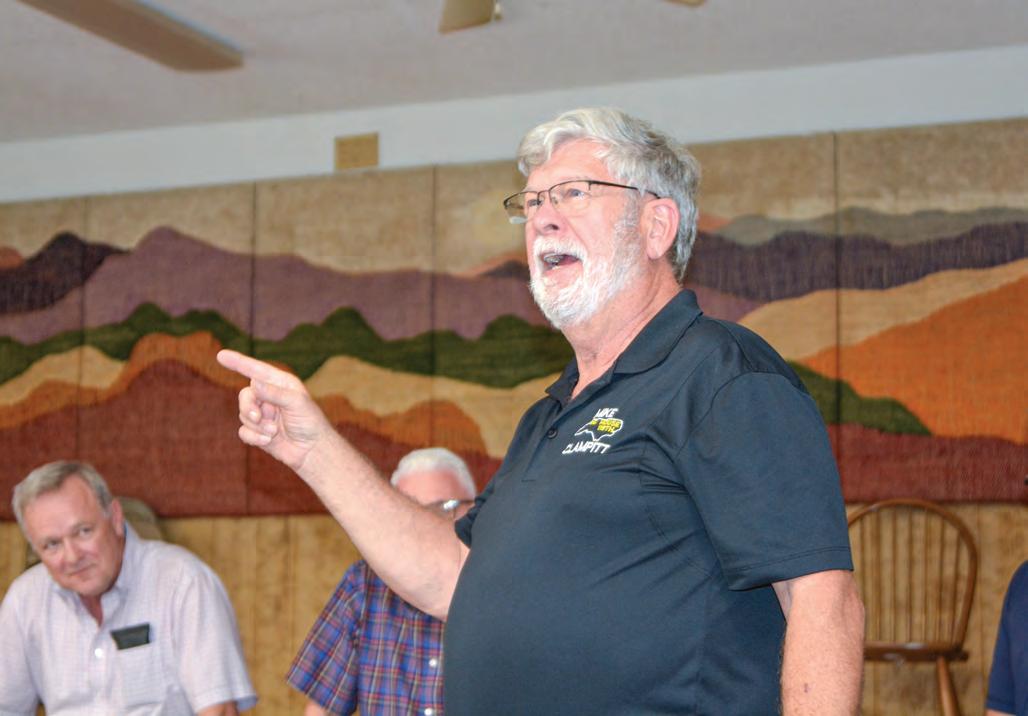
Aprominent Western North Carolina legislator may be gone, but his legacy of commitment to public safety and first responders will live on thanks to a bill filed in the General Assembly a month after his passing.
House Bill 1019, titled the “Mike Clampitt 1st Responder Tax Fairness Act,” proposes a targeted change to North Carolina’s tax code aimed at reducing financial burdens on certain volunteer emergency service organizations.
Representing Jackson, Swain and Transylvania counties, Clampitt died in March after a long battle with cancer, ending a career that spanned decades of public service from his time as a firefighter to multiple terms in the North Carolina House of Representatives.
Clampitt had announced his diagnosis of myelodysplastic syndrome in 2025 and continued seeking reelection even as his condition worsened, remaining active on issues like disaster recovery and public safety. His death prompted an outpouring of tributes from colleagues and community members who described him as a dedicated, approachable lawmaker and a strong advocate for Western North Carolina.
At its core, the bill expands an existing exemption from the state’s highway use tax, which is typically applied when a vehicle title is transferred.
Under current law, some vehicles transferred to qualifying organizations may already be exempt. This bill broadens that exemption specifically for volunteer fire departments and volunteer rescue squads that meet certain criteria.
To qualify for the expanded exemption, an organization must not be part of a unit of local government unit, must have no more than two paid employees and must already be exempt from state income tax under existing statutes.
These conditions are designed to focus the benefit on smaller, largely volunteerrun operations rather than larger or government-funded entities.
The exemption would apply only to specific types of vehicles used directly in emergency response and firefighting. These include fire trucks, pump trucks, tanker trucks and ladder trucks used to suppress fires.
services vehicles.
By limiting the exemption to these specific categories, the bill ensures that the tax relief is tied directly to public safety functions rather than general transportation needs.
and service.
“I talked to some volunteer fire departments and ran across this issue,” Pyrtle told The Smoky Mountain News. “I thought it was something to be addressed.”
Pyrtle, who retired as the police chief of Eden, first went to Raleigh to fill the unexpired term of Jerry Carter. When he got there, his office was located close to Clampitt’s, and the two developed a friendship. Pyrtle called

think it’s of such a significant amount that it’s going to affect the Highway Trust Fund or anything like that.”
In practical terms, the legislation would reduce the cost for qualifying volunteer departments to acquire or receive essential emergency vehicles. Highway use tax can represent a significant expense during vehicle transfers, especially for specialized equipment. Expanding this exemption could make it easier for smaller departments to upgrade aging fleets, accept donated vehicles or otherwise maintain operational readiness without additional financial strain.
It also includes fourwheel-drive vehicles outfitted for forest firefighting, such as those equipped with water tanks and hoses, as well as other emergency
The bill takes effect for taxable years beginning on or after July 1, 2026 and would apply to vehicle titles issued on or after that date.
Overall, the measure is narrowly tailored to support volunteer emergency responders by easing tax obligations tied to critical equipment, with the broader goal of strengthening local emergency response capacity in communities that rely heavily on volunteer services.
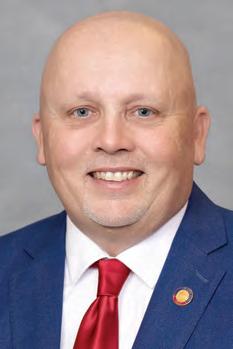
The bill’s primary sponsor, Reece Pyrtle (R-Rockingham), praised Clampitt’s character
Clampitt “an excellent mentor and a good guy who was very passionate about public safety.”
Pyrtle added that he’d been working on the bill before Clampitt’s passing and had spoken with Clampitt about it, but it didn’t come together until only recently.
Despite the four primary sponsors all being Republicans, the bill does have significant support in the form of Democratic cosponsors, including Rep. Lindsey Prather (DBuncombe) and Rep. Eric Ager (D-Buncombe), who had also worked closely on Clampitt’s signature legislation, the Sober Operator Act.
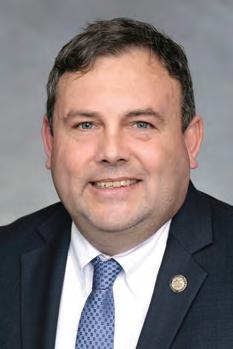
“I’ve said it a lot of times. Mike and I were friends, despite our political differences in most cases,” Ager said. “Mike was always supportive of first responders and firefighters specifically. I think he would have appreciated it. It’s a sweet gesture.”
The North Carolina Highway Trust Fund is a state fund dedicated to major transportation projects, especially those tied to long-term mobility and economic growth. It was created in 1989, during the administration of thenGov. Jim Martin to finance an ambitious effort to expand and modernize the state’s highway system.
Unlike the state’s general transportation fund, which covers routine maintenance and smaller projects, the Highway Trust Fund is primarily used for large-scale construction — things like new highways, major road widenings and improvements to key corridors. A central goal of the fund has been to connect all of North Carolina’s counties to the interstate system, improving access for rural areas and supporting statewide commerce.
But it’s not just a sweet gesture, according to Ager.
“First of all, it’s a good bill,” he said. “It provides relief to rural fire departments. I don’t
The fund is financed mainly through the highway use tax, which is collected when vehicle titles are transferred, along with a portion of other transportation-related revenues. Because of that structure, it is closely tied to vehicle purchases and economic activity.
The Mike Clampitt 1st Responder Tax Fairness Act was filed on April 21 and sent to the committee on judiciary. If the bill advances, it will go next to the House rules, calendar and operations committee.
BY CORY VAILLANCOURT POLITICS EDITOR
Canton has entered the growing statewide fight over property tax limits, with town officials adopting a resolution opposing legislation that would restrict how local governments fund the bulk of their operations.
“I think it’s in line with what is happening across the state — the possibility of what the General Assembly will do and what effect that will have on our already strained budgets,” said Canton Mayor Zeb Smathers. “Whether it be Hurricane Helene or general affordability, our ability to do more with less is becoming more challenging by the day. I understand the desire for new tax policy, but these changes will have real world consequences for every local government in NC.”
The move places the town squarely in a broader debate unfolding in Raleigh, where lawmakers are considering proposals to cap property tax growth or require voter approval before local governments can exceed those limits.
Throughout early 2026, the House Select Committee on Property Tax Reduction and Reform met repeatedly to discuss state preemption of local taxation authority. On April 15, the committee cleared a constitutional rate cap proposal to the General Assembly. The measure would be put to voters statewide in November if it passes.
immediate,
disastrous consequences for service delivery.
The resolution also takes aim at the structure of the proposed limits, particularly provisions that would require voter referenda to exceed set caps. The resolution contends that such requirements would introduce delays and uncertainty into the budgeting process, complicating efforts to fund services that must operate without interruption.
Canton’s argument extends beyond day-today operations into long-term financial planning. The document warns that rigid caps could force local governments into reactive decisionmaking, delaying investments in infrastructure and other needs while driving up costs over time.
Underlying the resolution is a broader assertion about governance. Canton officials argue that local elected leaders are directly accountable to their residents and are best positioned to make informed decisions about taxation and service levels. Stateimposed limits, they say, would weaken that accountability by shifting key decisions away from the local level.

Local governments are concerned that possible action in Raleigh could tie the hands of elected officials. File photo
For Canton and other local governments, the issue is less about taxation itself and more about preserving the authority to manage its own finances.
Property taxes serve as the primary funding source for local government operations across North Carolina, supporting essential services that range from public safety to street maintenance and community amenities.
Unlike enterprise funds sustained through user fees, general government services depend heavily on this single revenue stream, leaving municipalities vulnerable to state-imposed constraints.
Canton’s resolution outlines that vulnerability, warning that limits on property tax revenue would restrict the town’s ability to maintain service levels, respond to growth and plan for the future. The resolution emphasizes that such constraints would come at a time when many communities are already facing rising costs and increasing demand for services.
Concerns about public safety also feature prominently in the town’s position. Law enforcement and emergency response functions are among the most resource-intensive responsibilities local governments carry, requiring consistent funding for staffing, training and operations. Any disruption to that funding could have
The resolution makes that point explicitly, calling for the preservation of local control and warning that limiting revenue will not reduce the need for services, only the ability to provide them effectively.
Canton also took the additional step of directing that the resolution be shared with members of the General Assembly, legislative leadership and statewide organizations that represent local governments. That outreach signals an effort to influence the conversation as lawmakers weigh potential changes.
For now, the resolution serves as a formal statement of opposition, adding Canton’s voice to a growing list of communities wary of losing control over their primary source of revenue. Whether that message resonates in Raleigh will determine how much authority local governments retain in shaping their own financial future.
Those concerns echo themes already raised by local officials in Haywood County, who have pointed to mounting financial pressures tied to Hurricane Helene recovery efforts, personnel costs and continued growth in passing their own resolution on April 20. In that environment, flexibility in setting tax rates has become a key tool for balancing competing demands.
Cherokee County commissioners passed a similar resolution that same day. More local governments are expected to take up the matter as momentum builds; in a recent story by The News & Observer, outgoing Senate President Phil Berger (R-Rockingham) said he believes the legislation could pass by mid-May.






Offering Cook & Sip classes for beginner chefs
May 7th - 5pm & May 10th - 2pm
Learn to make a variety of 4 different hors d'oeuvres while sipping wine 8 spots available per class, $70 per person, please call to sign up and/or get more information

828-452-7837 294 N. Haywood Street Waynesville

























































BY LILY LEVIN STAFF WRITER
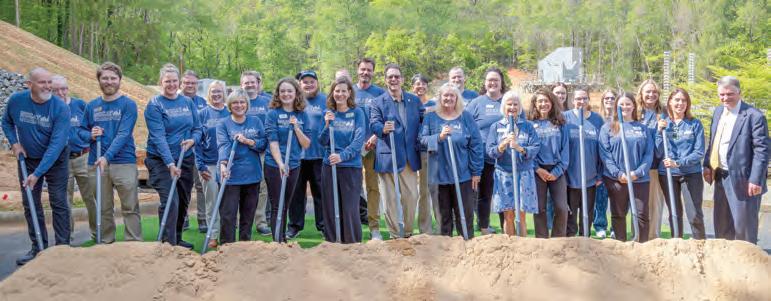
On April 24, the N.C. Center for the Advancement of Teaching celebrated the groundbreaking of its 51-bedroom residential expansion at its main campus in Cullowhee. The capital project is underway thanks to a $30 million, five-year grant from the General Assembly and it also includes renovations to NCCAT’s existing facility. The expansion is expected to partially open by August and the project should be completed by August 2027, according to Adam Caruthers, an architect working on the expansion.
NCCAT describes itself as an organization that “helps North Carolina teachers grow in knowledge, skills, compassion, and professionalism so that students become engaged, self-motivated, and successful.”
In addition to the site in Western North Carolina, NCCAT has a smaller Ocracoke-based campus.
The renovation will eliminate the road-crossing and level the ground elevation to make the Cullowhee property more walkable, accessible and residential.
The literacy center is another key focus.
“We are one generation away from having the best readers in the world. We’re also one generation away from having kids that can’t read. And so NCCAT is going to be committed to making sure that there is quality literacy instruction for as long as we’re around,” said Business Manager Will Putman.
And an additional 51 beds means upgrading the central facility to accommodate more people.
“When we have special events, like beginning teacher or our curriculum leaders conference … we’ll be able to open all four of those walls and easily seat 150,” he said, explaining that this number will allow the facility to serve at least one representative from each of the state’s 115 districts.
The ceremony was marked by several brief speeches about the importance of NCCAT and its ongoing project.
Programming at the center helps teachers fine-tune their craft, explained Chief Academic Officer Karen Sumner.
“We know that at least 25 hours of professional development is what makes change happen,” she said, adding that these benefits will only grow after the completion of the project.
classroom begins with a teacher who is learning and growing in their craft,” he said.
Executive Director M. Brock Womble began his remarks with gratitude for those who’d made the project possible, including late Rep. Mike Clampitt (R-Swain) and Sen. Kevin Corbin (R-Macon), who had helped to secure state funding. He noted that future expansion will only build upon the stellar reputation NCCAT possesses now.
Beautiful Bill awarding up to $1,700 in tax credits to private school scholarship-granting nonprofit donors.
According to the Wake Forest Law Review, “there may be greater potential for H.B. 87 to divert funding from public schools than what was apportioned in the OSP.”
Funding cuts manifest as low per-pupil spending. North Carolina ranks second-to-last nationwide in this category to the detriment of public-school students — and their educators.
In 2025, more than 1 in 10 teachers statewide — 10.11% — left the profession, and retention was disproportionately low among teachers with less than five or more than 30 years of experience.

These rates “underscore the consequences of the General Assembly’s policy choices — prioritizing tax cuts for corporations and the wealthy, as well as expanding private school vouchers for affluent families,” wrote the North Carolina Association of Educators.
NCCAT could be poised to aid the state’s attrition crisis; it certainly transformed 2021 Beginning Teacher of the Year Emilee Higdon. Higdon, a speaker at the April 24 ceremony, said at the time, she’d been teaching at Bartram Academy in Franklin, an alternative school for students facing barriers to education, whether those be academic, linguistic, behavioral or related to other conditions.
“It’s just amazing to me, when you travel the state, what people — when you say, ‘NCCAT,’ what that means to educators,” Womble said, before introducing Corbin, who’d arrived to speak after a 10:30 a.m. General Assembly session in Raleigh.
“He’s for K-12 education. He’s supportive of NCCAT. He’s supportive of Western North Carolina. This, we would not be here today without Senator Kevin Corbin and I — he is a friend, but also, more than anything, he is just a publicschool person who believes in what we do in public schools every day,” Womble told the audience.
Corbin said he was thrilled to support appropriations for the capital project, a necessary use of state funding — both for education and Western North Carolina.
“We have such great public schools in North Carolina, and I support you 100%,” he said.
“The expanded space is going to allow that to happen even more — more content area expertise, being able to serve far greater features and in all different kinds of ways, and stronger in-house expertise,” she added.
Board of Trustees member Rick Stout discussed the benefits NCCAT passes onto students.
“When educators participate in our programs, they gain new knowledge that they can use right away. They deepen their understanding of the content they teach … every strong
However, during his time in the North Carolina General Assembly, the senator has voted in favor of multiple bills that would reduce public school funding. Corbin supported legislation that would’ve appropriated another $248 million in taxpayer funding to private school vouchers
in 2024-2025, in addition to the $384.5 million the state had already allocated.
The bill also expanded Opportunity Scholarship Program eligibility requirements so more students could qualify, which, according to one estimate by the office of state budget and management, could have resulted in a $203.8 million cut to annual public-school funding.
The Macon senator last year voted to pass H.B. 87, forcing North Carolina to comply with a section of the One Big
“As a beginning teacher, it was overwhelming. Although my education program at UNC Wilmington prepared me to meet these needs in some capacity, the sheer mass and depth of needs in this particular environment exhausted me,” she said.
By the time she arrived at NCCAT for finalist week, she was actively looking for other opportunities and considering leaving education altogether.
But NCCAT changed her mind.
“I learned so many things about pedagogy, about classroom management, about myself as a teacher.”
The professional development was unlike any training she’d attended.
The leadership, the organization — it was the “Disney World for teachers,” she said.
“When they called my name as the state beginning teacher of the year. I walked down the steps of the Ramsey Center and heard my friend whispers, ‘You can’t leave those kids now.’”
Higdon recounted returning “as a different person,” someone capable of “finding joy in the classroom again.”
Although NCCAT hosts a variety of seminars and is currently undergoing expansion, the center seems to put more focus on professional development than it does preventing burnout.
Yet, before it was first put on the chopping block, NCCAT prioritized both categories of program. It was even nicknamed ‘Balm for Burnout’ in a 2000 New York Times article.
Those who advocated the facility be fully defunded, like Senate Pro Tem President Phil Berger, targeted wellness-driven courses such as “Everyday Healthful Living: A Whole New You,” and “The Healing Power of the Arts.”
In 2011, when the retention rate of teachers it trained was 97%, NCCAT was squeezed of half its funding.
Womble in 2012 joined the center’s board of trustees upon a four-year appointment by Berger.
Throughout Gov. Pat McCrory’s term, NCCAT stood at the brink of shutdown, saved in 2013 by the House budget after neither the governor nor the Senate earmarked any funding.
The center got its break in 2014, when it once again was designated under the category of recurring funding.
Upon the request of the NCGA, it had made “significant changes to its programmatic offerings,” according to NC Newsline.
Iappreciate my colleague taking the time to explain his vote (“Why I voted to annex Queen’s Farm,” April 22 SMN) to annex Queen’s Farm. These are the kinds of decisions that deserve a full and open discussion.
We agree on many of the challenges facing our community. Growth is happening. Affordable housing is scarce. And we have a responsibility to provide services without placing an unnecessary burden on taxpayers.
Where we differ is on what this decision represents. The 2035 Plan is important, and I supported it when we adopted it. But a plan is just a guide. It’s meant to inform our decisions, not dictate them. It doesn’t relieve us of the responsibility to look at what’s in front of us and decide whether it makes sense today. After all, when the 2035 Plan was adopted, this kind of large-scale development wasn’t on anyone’s radar.
For me, this vote came down to a bigger question: not whether we grow, but how we grow. I said it during the hearing, and I believe it: growth is inevitable, but how we grow is a choice.
The kind of growth we see in these developments is something we’ve seen play out across Haywood County. It pushes infrastructure outward, increases long-term obligations, and changes the character of the community in ways that are here to stay.
To the Editor:
In light of the shortcomings in the Town of Waynesville Development Plan surfaced by Queen’s Farm phases 1 and 2, it might be a good time to look back to the 1990s when the Old Asheville Highway was slated for improvement — from where Lowe’s is now to Downtown Waynesville.
That windy two-lane road into town was scheduled to be straightened and widened. NCDOT spent an enormous amount of time and effort to engage the community in order to learn of concerns and needs before drawing up a plan. And as you might imagine, there were all sorts of opinions — from a five-lane highway to just straightening the two lanes — and everything in between. Some favored roundabouts; others preferred stop lights at intersections.
Henry Foy, the Waynesville mayor at the time, advocated for a pleasing entrance into downtown, as it would serve as an important entryway. He was also concerned about safety — how a four- or five-lane road would safely integrate into the two-lane downtown. Mayor Foy had a vision of what an aesthetically pleasing road into downtown would mean for development and growth. In the end, a compromise was crafted to best reflect all the opinions and concerns.
I believe Mayor Foy is rolling over in his grave at the prospect of where development not only in Waynesville but in the entire county is going. Despite a well-intentioned effort to draft a development plan that worked for
And when I talk about “character,” I’m not just talking about what you see, although that beautiful farmland becoming row after row of houses is certainly part of it. I’m also talking about the people who live here and the connections between us.

On housing, affordability is absolutely a concern. But this type of development doesn’t meaningfully address that problem. The median sales price of homes in Phase 1 is over $440,000, and that means far too many families in Waynesville can’t afford the monthly payment that comes with it. These homes may be an option for some, but they do little to address the need for housing that’s accessible for working families in our community.
When it comes to taxes, we shouldn’t assume the choice is between this kind of growth and raising the tax rate. These developments bring revenue, but they also bring ongoing costs — police and fire protection, garbage collection, and maintaining water and sewer systems, to name a few. And those costs are often higher because infrastructure has to be extended farther out.
It’s true that the developer will build the greenway and
the community and developers, it seems what’s evolved reflects an imbalance between the desires and needs of developers and the desires and needs of the community. The current plan has a vision. However, what we have are rules and a process that have fallen far short of delivering on that vision.
I understand that the town does have the ability to amend the current plan. I hope the Town Board will invest the time and energy to work with the planning board, developers and the community to revisit the current plan, confirm a vision for growth and development, and craft a better balance that is so badly needed and would avoid the contentious nature of planning board and town meetings that merely reflect the failure of the current plan.
Mark Jaben Waynesville
Trump’s pardons are a farce
To the Editor:
“The prior administration failed in its duty to protect the American people by refusing to pursue and carry out the ultimate punishment against the most dangerous criminals, including terrorists, child murderers and cop killers,” Acting Attorney General Todd Blanche said in a statement. “Under President Trump’s leadership, the Department of Justice is once again enforcing the law and standing with victims.”
In my view, Acting AG Todd Blanche, who
install the initial water and sewer infrastructure. But there’s a big difference between who pays to build something and who pays to maintain it. Once those improvements are turned over to the town, the ongoing cost of maintaining them permanently falls to Waynesville taxpayers. Developers move on. We don’t.
Not all growth pays for itself, and part of our job is to consider not only the revenue a development will bring in, but also the long-term costs before making decisions. What good is it to grow today if we can’t afford to maintain it tomorrow?
There is another way. The way Waynesville has traditionally grown — house by house, street by street, a little at a time — also increases revenue, but costs are lower because we’re building onto existing systems rather than stretching them farther out. That allows us to grow responsibly, expand the tax base, and stay true to the character of this community.
In the end, my vote was based on what I believe is in the best interest of Waynesville, not just today, but for decades to come.
These aren’t easy calls, and reasonable people can disagree. But the choices we make today — about where we grow, how fast, and who this community is being built for — will shape Waynesville for decades to come. Growth is inevitable. How we grow is up to us.
(Jon Feichter is a Waynesville alderman.)

was also appointed by Trump at the same time and unlawfully, of course, as Librarian of Congress, is obviously addressing, in the first paragraph, not the previous administration, but the current.
I will remember Todd Blanche as Trump’s personal attorney and for his actions with the convicted trafficker/predator Ghislaine Maxwell, moving the criminal to a “Club Fed” and providing her with amenities upon request. Truly, the GOP has come to stand for “guard our predators”.
The Trump administration has failed, in
countless ways, to meet its Constitutional responsibilities to the United States. We have all observed Trump’s commutation and subsequent pardoning of the terrorist insurrectionists whom he incited to assault our nation’s capitol and injure and kill law enforcement officers.
Trump’s DOJ has moved to vacate the convictions of the most egregious of these insurrectionists. It is important to note that vacating a conviction will result in these criminals having their records expunged and their Second Amendment rights
The older and wiser I become, the more I appreciate people who vibrate at a high frequency, not because they make everyone around them feel better (although that is part of it), but because vibrating at a high frequency requires openness, honesty and authenticity, traits I highly respect and admire in others.

In previous columns, I referenced a book by Dr. David Hawkins called “Power vs. Force,” and I’ve noticed myself referring to his teachings on several recent occasions, especially when it comes to parenting. This book is an impactful resource.
His research on human consciousness spanned three decades and from this landmark study, he created the Map of Consciousness that rates emotional states. The highest state of consciousness is enlightenment, which vibrates at a level of 700-1,000 and has only been achieved by such individuals as Jesus and Buddha.
Below that is peace (600-700), joy (540600), love (500- 540), reason (400-500, acceptance (350-400), willingness (310350), neutrality (250-310), courage (200250), pride (175-200), anger (150-175), desire (125-150), fear (100-125), grief (75100), apathy (50-75), guilt (30-50), and shame (below 30).
Obviously, the goal is to move higher up the scale. If you’re vibrating at anything below 200, truth and wisdom are blocked. And if you’re struggling with guilt, shame, anger or any of the very low-level emotions, you’re most certainly caught in an extremely low vibration which can often manifest as sickness, addictions, fatigue, relationship struggles and money issues.
We are currently working through an exciting but challenging decision for one of our children. At first, we let our conscious minds take over and made lengthy plus/delta charts and consulted with others for advice and opinions leading to a bit of analysis paralysis. There is no “bad” choice in the scenario, but as the decision became more complicated and emotional, I was reminded of Dr. Hawkins research and how vibrating at a higher frequency leads a per-
reinstated. Even more absurdly, their actions on January 6 cannot be presented as evidence in their trials regarding future offenses. How many of us believe that the Proud Boys and Oath Keepers, who are essentially Trump’s own militia leaders, are in any way
son to the truth more quickly and with more clarity.
I’m encouraging my child to do some inner work to elevate his consciousness. I’m hopeful this will guide him to some answers. I’m suggesting he find stillness and spend time in nature without the company of others or a device so he can hear his inner guide more clearly.
Additionally, I learned that when faced with a hard choice, it’s helpful to put some space between the emotion and the decision. A way to do this is to pretend like a friend is struggling with the same decision. What advice would you give them if they came to you for guidance? This practice moves us to a place of love and willingness because we’re thinking of someone else instead of ourselves. Additionally, once a decision is made, a person needs to accept it whole heartedly since acceptance is a higher frequency emotion, as opposed to feeling fearful it was the wrong decision.
I want my children to grow up listening to their intuition and learning how to easily move away from low frequency states and toward high frequency states. This is why soul work is much more important than overexerting oneself for external praise or accolades.
The 14th century Christian mystic said it beautifully with these words: “The outer work can never be small if the inner work is great. And the outer work can never be great if the inner work is small.”
Whatever you have going on in your own life, if you stay stuck in those lowvibration energy states, you’ll never find your way out. It’s impossible to see the truth and light from the darkest depths. You must move toward enlightenment to find answers, feel good about your choices and lean into the highest version of yourself.
Most importantly, if you have young people in your life over whom you offer influence, guide them to do the same. Let’s help them learn how to turn away from fear and pressure and toward joy, love and peace. This is a skill that will benefit them in all walks of life, and as the seemingly older, mature person, what greater gift can we give them?
(Susanna Shetley is a writer and editor who lives in Haywood County. susanna.b@smokymountainnews.com.)
entitled to the right to bear arms? Does anyone doubt that these actions by Trump are a precursor to further electoral fraud? I do not.
Bil Aylor, USAF 1966-73, Bryson City


BY GARRET K. WOODWARD ARTS & ENTERTAINMENT EDITOR
With its latest album, “Out On A Limb,” Denver, Coloradobased rock-n-soul outfit The Hip Snacks are taking the leap into the national spotlight, a realm the group has quickly been pushing towards through powerful live performances and a keen musicianship guided by guitar prowess and towering vocals.
“The more shows I’ve done, the more comfortable I’ve been and it’s just so much fun now,” said lead singer Kara Durante.
“Especially with this new album coming out, we’re just so excited about these songs. It’s just been such a cool journey so far.”
Captured by Steve Avedis at Colorado Sounds Studios, the whirlwind 10-song LP is the follow-up album to The Hip Snacks 2024 debut release, “What Lies Ahead” (also recorded by Avedis).
“This time around with Steve, we had a bit more room to explore some ideas,” Durante said. “And just feeling more confident [in the studio].”
The Hip Snacks journey started thousands of miles away from Colorado in Maryland, where Durante was living with her husband/bandmate, Ben Suarez, who was already a known musician in touring acts. Eventually, Durante started to get the itch to perhaps jump up behind the microphone and see where music could take her — this voice within one of sheer power and force.
The inception of The Hip Snacks takes place in 2022. Durante and Suarez left the East Coast and relocated to Colorado, all with hopes of not only creating a new life in Denver, but also launching a group, too. The duo looked at the city as a vivacious, endless landscape of music and connectivity.
“We came out here to start a new band,” Suarez said. “We were here to meet new people, and we were lucky enough to meet those people soon after.”
Hitting the ground running in the Mile-High City, Durante and Suarez started going to local open mic nights and a slew of weekly gatherings at various venues. And it was interacting with these artistic circles where they crossed paths with guitarist Felipe Cantuaria and drummer Dylan French.
“Two months later, we asked them to join [our] band,” Suarez chuckled. “It was all pretty crazy and super serendipitous.”
Soon after, the musicians were hired to play a church gig, only
to encounter guitarist Ricky Feria, with keyboardist Adam Schini coming into the fold through another community jam. From there, the sextet was formed, with its first show taking place on May 29, 2023.
“We’re entering our fourth year as a band and [being in Denver] keeps you on your toes,” Suarez said. “There’s so much talent, so much musicianship here. It’s also a fun environment to keep you pushing ahead. It’s such a welcoming scene here. There’s so much going on, and everyone is so inclusive.”
That inclusive, intricate nature of the Denver live music scene lent itself to the fast trajectory of The Hip Snacks — its intent and its sound. Soaking in all they could from attending performances and jumping onstage with anyone who wanted to play, this musical spectrum emerged within the ensemble, one that encompasses the essence of soul, rock, pop, jam and even hip-hop influences.
With all these different avenues of tone and approach seamlessly coming together in the melodic landscape of The Hip Snacks, it circles back to the initial meeting of Durante and Suarez at the All Good Music Festival in 2011. As longtime festival goers, their inspiration for music comes from an appreciation for a variety of acts presented onstage, live and in the moment: Lake Street Dive to Lettuce, Tedeschi Trucks Band to Lotus and beyond.



“I’ve been singing my whole life, singing in church choirs and school choirs,” Durante reflected. “I was always singing with other people and going to concerts all the time, watching these badass ladies up onstage singing their hearts out, rocking out. I remember being like, ‘I want to do that.’”
That path for Durante came to fruition in the country of Panama one fateful evening several years ago. One of Suarez’s former bands was playing an intimate show for a group of their friends there, with Durante finding herself in front of the microphone, her voice stunning those in attendance.
“I don’t know what it was that made me so petrified to [sing live], but it just took a really long time to come out of my shell,” Durante reminisced. “Eventually, I started rehearsing with Ben’s old band and took the leap to sing at the Panama show and [I’ve] never looked back.”
Colorado-based rock-n-soul ensemble
The Hip Snacks will perform at 8 p.m. Friday, May 8, on the Taproom Stage at Pisgah Brewing in Black Mountain.
Doors open at 7 p.m. Admission is $11.55 per person (fees included). For more information and/or to purchase tickets, visit pisgahbrewing.com/events.
“[Our sound] is definitely not trying to get stuck in any one genre,” Suarez said. “I’m definitely influenced heavily by southern soul music and grew up listening to a ton of hip-hop. So, the melting pot [of this band] is natural and organic based on six different personalities coming together.”
When one lets “Out On A Limb” unfold in real time, you’ll see exactly what Suarez and his bandmates are radiating, which is this deep, genuine sense of various sonic textures, each complemented by the soaring vocal range of Durante — the singer positioned at the core of the instrumentation swirling around her, ultimately inspiring the subtle tones that set the group apart.
With the album’s titled an ode to Durante’s leap of faith, “Out On A Limb” is chock-full of fiery guitar solos and soothing keyboard nuances, coupled with a roaring drums-n-bass combination, the culmination of which vividly heard and felt on tracks like “Footsteps,” “When You’re Around” and “Counting On You.” In terms of Feria and Schini, the record also features key melodies from each, ultimately elevating the sound into fresh, vibrant heights.
“They’re always counting on you, no time for busking around,” Durante’s voice and bravado echoes out into the ether during “Counting On You,” penned by Schini. “Surrounding all that you do, in watching out for yourself.”
In truth, the “Out On A Limb” stands on its own in its uniqueness and capacity, this passionate offering from a determined band looking to break nationally.
“We’ve always been interested in bands that could get people to really get lost in the escape [of music] and be captivating,” Suarez noted. “And we want to make sure we’re always steering towards something that gets you to move.”

BY GARRET K. WOODWARD
‘I can hear the hound dogs howlin’, chasin’ that old fox where I used to roam’
Hello from Room 323 at the Hyatt Place in downtown Athens, Georgia. A quiet Monday morning here in “Bulldog Country” with the hotel right on the edge of the campus of the University of Georgia. Lots of thoughts are ricocheting around my mind, especially with the Boston Marathon currently on the TV.
graduated college. Those chills running through me of heated races and hard-fought victories.
To preface, even though I’ve run in hundreds of races (road and track) and was a Division 1 college athlete at the pinnacle of my career, I’ve never run a marathon (26.2 miles). Heck, I’ve never done a half marathon, but have done training runs nearing that distance of 13.1 miles. And yet, running is a part of my daily life and schedule. Crazily enough, I have a running streak entering its 11th year, where I’ve run every single day since Dec. 31, 2015, averaging around three miles per jog. And I couldn’t imagine it not in my life.
1
A special stage production of “Legally Blonde Jr.” will be held at 7:30 p.m. May 1 and 2 p.m. May 2-3 at the Haywood Arts Regional Theatre in Waynesville.
2
Cataloochee Ranch (Maggie Valley) will host the “Cataloochee Square Dance” with Darren Nicholson Band (Americana/bluegrass) at 4:30 p.m. Friday, May 1.
3
The annual Smoky Mountain SpringFest will be held from 11 a.m. to 4 p.m. Saturday, May 2, at the Stecoah Valley Cultural Arts Center in Robbinsville.
4


First and foremost, the marathon itself: the 130th running in Boston. This is a legendary race and world cultural touchstone, one that I’ve been around pretty much since I was born, seeing as my first trip (and airplane ride) out of my hometown was in April 1985, when I was just two months old and my parents took me to Massachusetts to cheer my dad on as he ran the marathon.

My father, Frank, has run the Boston Marathon 14 times, his best time being 02:48:15 in 1979. His first was 1978, with his last in 1999. And every year he ran it, we’d watch him, many-a-time at the finish line. In total, he’s run over 80 marathons in his day, with thousands of other road races sprinkled in, too. At age 84, he still runs often, usually shuffling along some silent trail in the backwoods of my native North Country of Upstate New York.
Heck, he even appeared in Runner’s World magazine one time. The image (pictured) is of Frank crossing the line at the 1978 Boston Marathon, just edging out the guy in the buffalo head, aka “The Cow Man,” who was a legend of the race of years. It was 42 degrees out, and yet my father went shirtless, with the act being a family tradition that remained for years, of which I would also partake during races (once at a frozen Thanksgiving Turkey Trot).
“I was coming around to the finish and I see this damn guy wearing a buffalo head, and I thought, ‘There is no damn way a guy in a buffalo head is going to beat me,’ so I ran as hard as I could and beat him at the line,” my father told me years ago over the phone while we talked about running and life in general. Sitting in the comfy hotel bed, back up against the headboard, my eyes are focused on the televised race. And all of these deep feelings and emotions, these memories and moments, begin to flood my field-of-vision. Images of my old days of competitive running, something that was a huge part of my existence from the first day of seventh grade until I
Beyond being raised in a running household, it’s something that’s a pillar of my heart and soul. And has been for decades now, wherever I may wander and ponder. Not to mention how much it has, happily, affected my body and mind. For those who know, there’s nothing like a run that hits that ideal rhythm of time and space, where your flesh and bones seem to align perfectly with the cosmic wavelength of the greater universe. Pure bliss and serenity.
But, it wasn’t always like that, at least in the very beginning. I remember wanting to play soccer when I entered middle school. My dad had other plans, ultimately pushing me into running. Although I’m forever indebted to him for doing that, as a kid it definitely created a lot of expectations and anxiety, especially when I started winning races right off the bat and quickly becoming the only middle schooler on the varsity team running with the seniors.
No matter, I loved all of those experiences. And I’m still in cahoots with some of those former teammates. Even with the stress of training and stepping up to the start line, the sweaty palms and fast-beating heart of competition and those mad dashes to the finish line, those moments really defined who I ultimately have become as an adult, whether it be simple discipline and goal-setting or merely this wildfire within to compete and give my all.
It hearkens back to that sacred quote from the late, great Steve Prefontaine, arguably the most famous runner in American history, a rebel of pure intent and talent, who said once,
Smoky Mountain Center for the Performing Arts (Franklin) will host acclaimed comedian Etta May at 7:30 p.m. Friday, May 1.
5
Pigeon Community “Cinco de Mayo” community celebration will be held from 5-9 p.m. Tuesday, May 5, at the Pigeon Community Multicultural Development Center in Waynesville.
“To give anything less than your best is to sacrifice the gift.” I first heard that saying from my late running coach, Brian Power, when I was 12 years old and sitting in the lobby of the high school, listening to him explain our impending practice. That quote changed everything for me.
And here I sit, in this Athens hotel room, some 1,200 miles from that Canadian Border hometown of Rouses Point, New York. Age 41 with head held high. Dressed in my running clothes, I’ll soon lace up my shoes and start searching my All Trails app for a new trail to disappear down on my way back to my humble abode in Waynesville. It’s tracking down those surreal and serene spots by chance and happenstance for a run that conjures happiness.
Oh, and why am I in Athens? Well, I’m gathering more stories and quotes for this massive bluegrass book project I’ll be putting together for the better part of the next year for a major publisher. This book will be a culmination of 20 years of running around the country in this constant search for the people, places and things that make up the legend, lore and legacy of the “high, lonesome sound” that is bluegrass music. Stay tuned on that front for more.
In truth, my attitude and ethos in approaching and attacking this project is the same strategy that I learned and earned as a competitive runner all those years ago. And, for that? The gratitude remains. For everything in life that’s worthwhile is worth fighting for, this “thing” within you that puts you “in the zone” to achieve your dreams, come hell or high water.
Life is beautiful, grasp for it, y’all.









A special showcase, “Didanisisgi Gadagwatli: A Showcase of Pottery from the Mud Dauber Community Workshop,” is now on display at the Museum of the Cherokee People in Cherokee. On view through May, the exhibition features works by students of Tara McCoy (Eastern Band of Cherokee Indians) handcrafted during an intensive three-month workshop.
Renowned for her pottery, McCoy began making crafts at 12 years old. She honed her skills while taking arts and crafts classes with Alyne Stamper (EBCI) and has won numerous awards at the Cherokee Fall Festival and at Southwestern Association of Indian Arts (SWAIA) Santa Fe Indian Market.

Today, she shares her knowledge with others. Designed to increase and uplift pottery making among members of the Eastern Band of Cherokee Indians, McCoy’s workshop uses a hands-on approach, empowering first-time potters to bring their own personal style to ancestral techniques and methods.
The artists exhibited include Annette Saunooke Clapsaddle (EBCI), Barbara Jones (EBCI), Paula Wojtkowski (EBCI), Marisa “Sis” Cabe (EBCI), Lisa Howell (EBCI, Pawnee Nation) Malia Crowe Skulski (EBCI), Samantha Cole-Daniels (EBCI), Elvia Walkingstick (EBCI), Maggie Jackson (EBCI), Michelle Lynn Long (EBCI, Mvskoke Creek Nation) and Tara McCoy (EBCI).
For more information, visit motcp.org.
• “Unrelenting: Cherokee People and the American Revolution” is currently being showcased at the Museum of the Cherokee People (MotCP) in Cherokee. A first-of-its-kind exhibition centering Native voices, perspectives and creativity in response to the 250th anniversary of the founding of the United States, the showcase features historic objects in conversation with works by Cherokee artists, merging cultural heritage, military history and contemporary art for a nuanced examination of a pivotal moment in Cherokee and American history. It will be on display through Dec. 30. General admission tickets are $15 for adults, $8 for children ages 6-12 and free for children ages 5 and under. MotCP offers free admission to members of federally recognized tribes and museum members. Student, educator, senior and military rates available. For more information, visit motcp.org.
• “Spring Craft & More Fling” will be held from 10 a.m. to 4 p.m. Saturday, May 9, at the Great Smoky Mountains Event Park in Bryson City. Local crafters, antique sellers and more. 828.488.3848.
• “Mother’s Day Gemboree” will be held May
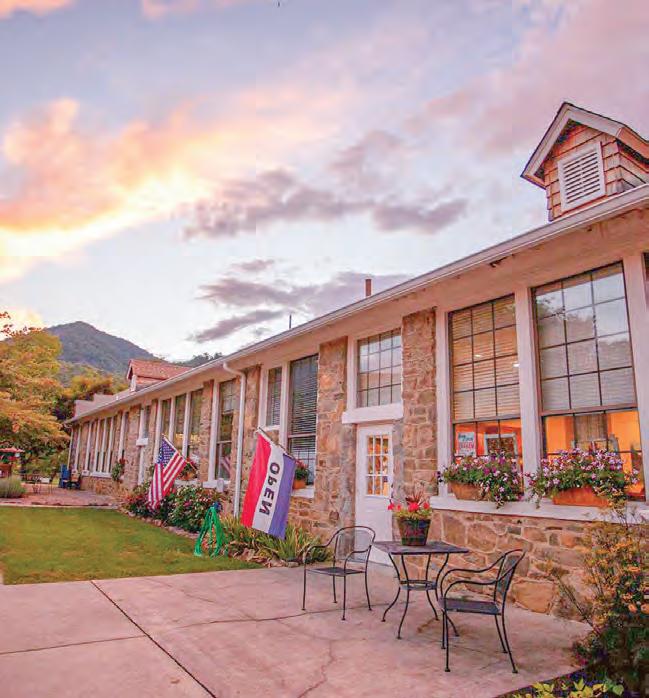
The annual Smoky Mountain SpringFest will be held from 11 a.m. to 4 p.m. Saturday, May 2, at the Stecoah Valley Cultural Arts Center in Robbinsville.
8-10 at the Macon County Community Building in Franklin. From 10 a.m. to 6 p.m. Friday/Saturday and 10 a.m. to 4 p.m. Sunday. franklin-chamber.com.
• “Riverside Artisan Market” will be held 11 a.m. to 5 p.m. Saturday, May 9, at the Nantahala Outdoor Center in Bryson City. Shop local for jewelry, pottery, unique creations and fresh goods from talented artisans and farmers every month (May-September). Free and open to the public. For more information, visit noc.com/events.
• WNC Paint Events will host painting sessions throughout the region on select dates. For more information and/or to sign up, visit wncpaint.events.
• Marianna Black Library (Bryson City) will host “ArtWorks” at 1 p.m. every second Thursday of the month. Come create your own masterpiece. The materials for art works are supplied, and participants are welcome to bring ideas and supplies to share with each other. Ages 16 and up. Space limited to 10 participants. Free and open to the public. 828.488.3030 / vroberson@fontanalib.org.
With a focus on outdoor activities and recreation, the festival provides a selection of art, craft and food vendors, demonstrations, live music, dancing, kids activities and more.
• Bosu’s Wine Shop (Waynesville) will host a “Paint & Sip” event at 5:30 p.m. Tuesday, April 21 ($30 per person). 828.452.0120 / waynesvillewine.com.
• CRE828 (Waynesville) will offer a selection of art classes and workshops at its studio located at 1283 Asheville Road. Workshops will include art journaling, watercoloring, mixed media, acrylic painting and more. 828.283.0523 / cre828.com.
• Gallery Zella (Bryson City) will be hosting an array of artist receptions, exhibits and showcases. The gallery is open from noon to 5 p.m. Wednesday through Saturday. 517.881.0959 / galleryzella.com.
• Haywood County Arts Council (Waynesville) will offer a wide range of classes, events and activities for artisans, locals and visitors. HCAC’s Haywood Handmade Gallery is open seven days a week from 10 a.m. to 5 p.m. and 11 a.m. to 4 p.m. Sundays. 828.452.0593 / haywoodarts.org.
• Jackson County Green Energy Park (Dillsboro) will be offering a slew of classes, events and activities for artisans, locals and visitors.
The event is free and open to the public. For more information, visit stecoahvalleycenter.com.
828.631.0271 / jcgep.org.
• Stecoah Valley Cultural Arts Center (Robbinsville) will host an array of workshops for adults and kids, including “Woodcarving with Corbin Wildcatt” noon to 4 p.m. Saturday, April 18 ($45 per person). 828.479.3364 / stecoahvalleycenter.com.
• Southwestern Community College Swain Arts Center (Bryson City) will host an array of workshops for adults and kids. 828.339.4000 / southwesterncc.edu/scclocations/swain-center.
• Dogwood Crafters (Dillsboro) will offer a selection of upcoming art classes and workshops. 828.586.2248 / dogwoodcrafters.com.
• Cowee School Arts & Heritage Center (Franklin) will host semi-regular arts and crafts workshops. 828.369.4080 / coweeschool.org.
• Folkmoot Friendship Center (Waynesville) will host semi-regular artist gatherings and workshops. 828.452.2997 / folkmoot.org.
The popular “Under the Stars, On the Rocks” culinary series is currently underway at the Oak Steakhouse at the Skyline Lodge in Highlands.

The events feature renowned chefs from around the Southeast on select dates through the fall: May 12, June 9, July 7, Aug. 11, Sept. 8, Oct. 13. Each four-course meal in the series is unique and personal to the guest chef, offering a one-of-a-kind outdoor dining experience.
Dinners are $175 per person (including beverage pairings). Reservations required. Guests can also purchase a “season pass” to the series.
For more information and/or to make reservations, call 828.526.4008 or visit skyline-lodge.com.
• Cataloochee Ranch (Maggie Valley) will host semi-regular culinary events and workshops throughout the week. For a full schedule of upcoming activities, tickets and reservations, visit cataloocheeranch.com/ranchevent.
• Balsam Mountain Inn (Balsam) will host “Wind Down Wine Flights” 6 p.m. Thursdays. 828.283.0145 / thebalsammountaininn.com.
• Classic Wineseller (Waynesville) will have the wine bar open from 4-8 p.m. Fridays/Saturdays and host semi-regular tastings on the weekends. 828.452.6000 / classicwineseller.com.
• “Take A Flight” with four new wines every Friday and Saturday at the Bryson City Wine Market. Select from a gourmet selection of charcuterie to enjoy with your wines. Educational classes and other events are also available. 828.538.0420.
• “Uncorked: Wine & Rail Pairing Experience” will be held on select dates at the Great Smoky Mountains Railroad in Bryson City. Full service all-adult first class car. Wine pairings with a meal and more. There will also be a special “Carolina Moonshine” train on select dates. 800.872.4681 / gsmr.com.
• Assembly On Main (Waynesville) will host “Trivia Night” 6 p.m. Tuesdays and “Karaoke Night” 7 p.m. Thursdays. Free and open to the public. 828.246.0839 / assemblyonmain.com.
• Balsam Falls Brewing (Sylva) will host “Open Mic” 8-10 p.m. Thursdays. Free and open to the public. 828.631.1987 / balsamfallsbrewing.com.
• Balsam Mountain Inn (Balsam) will host “Picking on the Porch” (open community jam) 6 p.m. Tuesdays, “Trivia Night” 7 p.m. Wednesdays and semi-regular live music on the weekends. 828.283.0145 / thebalsammountaininn.com.
• Blue Ridge Beer Hub (Waynesville) will host “Music Bingo Night” 6:30 p.m. Tuesdays, The Blue Mountaineers (Americana/bluegrass) Thursdays and semi-regular live music on the weekends. All music starts at 5 p.m. Free and open to the public. 828.246.9320 / facebook.com/brbeerhub.
• Boojum Brewing (Waynesville) will host “Karaoke Night” 9 p.m. Wednesdays, “Trivia” 7 p.m. Thursdays, “Open Jam” 10 p.m. Thursdays and semi-regular live music on the weekends. All shows are located in The Gem downstairs taproom and begin at 9 p.m. unless otherwise noted. Free and open to the public. 828.246.0350 / boojumbrewing.com.
• Bread Heads Tiki Shak (Sylva) will host “Tiki Trivia” at 7 p.m. every other Thursday of the month and a “Brunch Show” with Sophia Redd (singer-songwriter) 1 p.m. May 2 and Skyler Jacobson (singer-songwriter) 1 p.m. May 9. Free and open to the public. 828.307.2160 / breadheadstikishak.com.
• Bryson City Brewing (Bryson City) will host semi-regular live music on the weekends. All shows begin at 7 p.m. unless otherwise noted. Free and open to the public. 828.538.0085 / brysoncitybrewing.com.
• Cataloochee Ranch (Maggie Valley) will host Kelly Morris (indie/soul) April 29, “Cataloochee Square Dance” with Darren Nicholson Band (Americana/bluegrass) 4:30 p.m. May 1 ($50 adults, $42 children ages 3-11, kids under two are free) and Brian Ashley Jones (Americana) May 6. All shows begin at 5 p.m. unless otherwise noted. Admission is $25 per person unless otherwise noted. For tickets and reservations, visit cataloocheeranch.com/ranch-event.
• Cowee School Arts & Heritage Center (Franklin) will host “Open Mic” at 6 p.m. every second Friday of the month and Flat Bridge (Americana) 4 p.m. May 3 (admission by donation). 828.369.4080 / coweeschool.org/concert-series.
• Currahee Brewing (Franklin) will host “Music Bingo” Thursdays and semi-regular live music on the weekends. All shows begin
at 7 p.m. unless otherwise noted. Free and open to the public. 828.634.0078 / curraheebrew.com.
• Episcopal Church Of The Incarnation (Highlands) will host Terra Quartet (classical/world) 5 p.m. May 2. Free and open to the public.
• Farm At Old Edwards (Highlands) will host the “Fireside at the Farm” on select dates. All shows begin at 6 p.m. Admission is $40 per person, with discounts rates available for hotel guests and members.
866.526.8008 / oldedwardshospitality.com.
“Jazz On The Level” 5:30 p.m. Tuesdays and semi-regular live music on the weekends. All shows begin at 6 p.m. unless otherwise noted. Free and open to the public. 828.454.5664 / froglevelbrewing.com.
• Happ’s Place (Glenville) will host Doug Ramsay (singer-songwriter) May 1, Sam Underwood (singer-songwriter) May 2, Rock Holler May 9 and Cory Stevenson (singersongwriter) noon May 10. All shows begin at 6 p.m. unless otherwise noted. Free and open to the public. 828.742.5700 / happsplace.com.
• Harrah’s Cherokee Casino Resort (Cherokee) will host ZZ Top (classic rock) 9 p.m. May 1 and Yacht Rock Revue (classic rock) 9 p.m. May 8. For tickets, visit cae-
The annual Sweet Carolina Music Festival will hit the stage from 2-9 p.m. Saturday, May 2, at Veterans Memorial Park in Franklin.
Performers will include John Morgan, Jennifer Hart, Kody Paul, Madison Owenby, Justin Corley, Jason Passmore and Next Paige.
A Grammy-nominated singer-songwriter based in Nashville, Tennessee, Morgan is a Sylva native who has written hit melodies that have been recorded by Jason Aldean, Carrie Underwood, Jon Pardi, Thomas Rhett and Dustin Lynch.
Food trucks will also be onsite. Gates open at 1 p.m. General admission is $30 per person, with VIP passes for $50. Kids ages three and under are free.
For information and/or to purchase tickets, visit ticketsignup.io/sweetcarolina. John
• Folkmoot Friendship Center (Waynesville) will host “World Drum Classes” every Friday at 2:30 p.m. (adults, free) and 4 p.m. (family friendly, all ages, free), “Waynesville Acoustic Guitar Group” 2-4 p.m. every second and fourth Saturday of the month (free) and semi-regular live music monthly. 828.452.2997 / folkmoot.org.
• Frog Level Brewing (Waynesville) will host
A renowned Haywood County-based Americana/bluegrass act, the Darren Nicholson Band will hit the stage for a special “Cataloochee Square Dance” gathering at 4:30 p.m. Friday, May 1, at the Cataloochee Ranch in Maggie Valley.
A Grammy-nominee and winner of 13 International Bluegrass Music Association (IBMA) awards, Nicholson has taken his own brand of mountain music around the world.
A regular for years on the Grand Ole Opry and a founding member of acclaimed Western North Carolina bluegrass group Balsam Range, Nicholson now spends his time recording, writing new songs and performing as a solo act.
Admission is $50 for adults, $42 for children ages 3-11. For tickets and reservations, visit cataloocheeranch.com/ranch-event.
sars.com/harrahs-cherokee.
• High Dive (Highlands) will host “Trivia” 7 p.m. on Thursdays and semi-regular live music on the weekends. 828.526.2200 / highlandsdive.com.
• Highlands Performing Arts Center will host Balsam Range (bluegrass) 4 p.m. May 17 (tickets start at $57.75 per person with seating upgrades available). 828.526.9047 / highlandsperformingarts.com.
• Innovation Brewing (Sylva) will host “Monday Night Trivia” every week, “Open Mic” on Wednesdays and semi-regular live music on the weekends. All shows and events begin at 7 p.m. unless otherwise noted. Free and open to the public. 828.586.9678 / innovation-brewing.com.
• Innovation Station (Dillsboro) will host semi-regular live music on the weekends. All events begin at 7 p.m. unless otherwise noted. Free and open to the public. 828.226.0262 / innovation-brewing.com.
• John C. Campbell Folk School (Brasstown) will host a “Community Jam” 7 p.m. Thursdays at the nearby Crown Restaurant and semi-regular live music on the weekends. folkschool.org.
• Las Barricas (Franklin) will host C-Square Band 11 a.m. on the fourth Friday of each month. Free and open to the public. 828.349.4484 / lasbarricasmexicanrestaurant.com.
• Lazy Hiker Brewing (Franklin) will host “Board Game Night” 5 p.m. Mondays, “Music Bingo” 7 p.m. Tuesdays, “Trivia Night” 6:30 p.m. Wednesdays, “Open Mic Night” 6:30 p.m. Thursdays and semi-regular live music on the weekends. All shows begin at 7 p.m. unless otherwise noted. Free and open to the public. 828.349.2337 / lazyhikerbrewing.com.
• Lazy Hiker Brewing (Sylva) will host “Music Bingo” 7 p.m. Mondays, “Trivia Night” 6:30 p.m. Tuesdays, “Old Time Jam” 6:30 p.m. Thursdays and semi-regular live music on the weekends. All shows begin at 8 p.m. Free and open to the public unless otherwise noted. 828.349.2337 / lazyhikerbrewing.com.
• Legends Sports Bar & Grill (Maggie Valley) will host “Open Mic Night” 6:30 p.m. Wednesdays, Karaoke Thursdays (6 p.m.) and Saturdays (7 p.m.), with live music each Friday (8 p.m.). Free and open to the public. 828.944.0403 / facebook.com/legendssportsgrillmaggievalley.
• Long’s Chapel Methodist Church (Waynesville) will host the Haywood Community Band 4 p.m. May 3. Free and open to the public. haywoodcommunityband.com.
• Highlander Mountain House (Highlands) will host “Blues & Brews” with Scott Low 6-9 p.m. Thursdays, Zorki (singer-songwriter) 13 p.m. Saturdays, “Bluegrass Brunch” 11 a.m. to 1 p.m. Sundays and the “Salon Series” with Candi Jenkins (singer-songwriter) 8:30 p.m. May 14 ($30.45 per person, tax included). Reservations encouraged for all performances. 828.526.2590 / highlandermountainhouse.com.
• Macon County Public Library (Franklin) will host The F
The annual Steve Sutton Fest will take place May 8-9 in the Stuart Auditorium at the Lake Junaluska Conference & Retreat Center.
A nonprofit event, the showcase benefits youth music programs in Haywood County. This year’s stellar lineup includes Authentic Unlimited (three-time IBMA “Vocal Group of the Year”), Red Camel Collective (IBMA “New Artist of the Year”), Alecia Nugent, Darren Nicholson, Upstream Rebellion, Donna Ulisse & Rick Stanley, Whitewater Bluegrass Company and more.
There will also be mountain tradition cloggers, dance/songwriting workshops, a special performance by the Junior Appalachian Musicians (JAM) and other activities.
Steve Sutton was a beloved WNC musician. File photo
A longtime member of The Darren Nicholson Band and Whitewater Bluegrass Company, Sutton was 60 years old when he passed away in his sleep on May 13, 2017, one day shy of his 61st birthday.
A Grammy-nominated, multiple IBMA award-winner himself, Sutton graduated from Tuscola High School in Waynesville. Upon graduation, he was simultaneously offered gigs with the “Godfather of Bluegrass” Bill Monroe and bluegrass legend Jimmy Martin.
In 1974, Sutton joined Martin on the road, kicking off a career that took him across the globe, ultimately gracing the Grand Ole Opry stage numerous times. Sutton also had stints with Alecia Nugent and Rhonda Vincent.
Tickets are $30 per day for adults and $10 per day for kids. The two-day songwriting workshop is $250.
For more information, a full schedule of acts and/or to purchase tickets, visit stevesuttonfest.com.
(Celtic/world) 4 p.m. May 9, Cloud Circuit (trip-hop) May 9 and Jenny & The Weazels (Celtic/folk) 3 p.m. May 10. All shows begin at 8 p.m. unless otherwise noted. Free and open to the public. 828.246.6292 / scotsmanpublic.com.
• Slanted Window Tasting Station (Franklin) will host semi-regular live music on the weekends. 828.276.9463 / slantedwindow.com.
• Smoky Mountain Center for the Performing Arts (Franklin) will host Brothers Of The Heart (country/gospel) 7 p.m. May 18 (tickets start at $35 per person with seating upgrades available). Tickets now available, with seating upgrades offered. 866.273.4615 / smokymountainarts.com.
• Swain Arts Center (Bryson City) will host Double Helix (Steely Dan tribute) 6 p.m. May 21 ($10 adults, $5 students). 828.488.7843 / swainartscenter.com.
• Trailborn (Highlands) will host its “Carolina Concert Series” on semi-regular dates on the weekends. All shows begin at 6 p.m. Free and open to the public. 828.482.1581 or trailborn.com/highlands.
• Ugly Dog Pub (Cashiers) will host semi-regular live music on the weekends. 828.743.3000 / theuglydogpub.com.
• Ugly Dog Pub (Highlands) will host “Bluegrass Music” with Nitrograss 6 p.m. Wednesdays, “Karaoke” 9:30 p.m. Fridays, “Music Bingo” 7 p.m. Sundays and semiregular live music on the weekends. 828.526.8364 / theuglydogpub.com.
• Valley Cigar & Wine Company (Waynesville) will host The Paper Crowns (Americana) 6 p.m. May 8. All shows begin at 2 p.m. unless otherwise noted. Free and open to the public. 828.944.0686 / valleycigarandwineco.com.
• Valley Tavern (Maggie Valley) will host “Country & Western Night” Tuesdays, “Trivia With Tom” Wednesdays, “Music Bingo” Saturdays and Blackwater Station 2 p.m. May 3. All shows and events begin at 6 p.m. unless otherwise noted. Free and open to the public. 828.926.7440 / valley-tavern.com.
• Veterans Of Foreign Wars Post 5202 (Waynesville) will host semi-regular live music on the weekends. 828.456.9356 / vfw5202.org.
• Twisted Spoke Food & Tap (Maggie Valley) will host semi-regular live music on the weekends. Free and open to the public. 828.926.1730 / facebook.com/twistedspokerestaurant.
SEE ON THE BEAT, PAGE 28 Vagabonds (Americana) at 2 p.m. the first and third Monday and a “Song Circle” open jam from 3-6 p.m. the first Tuesday each month. Free and open to the public. 828.524.3600 or fontanalib.org/franklin.
• Mountain Layers Brewing (Bryson City) will host “Open Mic Night” with Frank Lee every Thursday and semi-regular live music on the weekends. All shows begin at 6 p.m. unless otherwise noted. Free and open to the public. 828.538.0115 / mountainlayersbrewingcompany.com.
• Mountain Vibes Kava Lounge (Waynesville) will host “Trivia Night” 7 p.m. Mondays and semi-regular live music on the weekends. 828.246.9283.
• Old Edwards Inn (Highlands) will host live music in the Hummingbird Lounge at 5:30 p.m. every Friday and Saturday. Free and open to the public. 866.526.8008 / oldedwardshospitality.com.
• Peacock Performing Arts Center (Hayesville) will host Chi-Town Transit Authority (Chicago tribute) May 22 and “Songwriters Showcase 60” May 23. All shows begin at 7:30 p.m. unless otherwise noted. For tickets, 828.389.ARTS / thepeacocknc.org.
• Pickin’ On The Square (Franklin) will host Tugalo Holler (bluegrass/gospel) May 9. All shows begin at 6 p.m. at the Gazebo in downtown. Free and open to the public. franklinnc.com/pickin-on-the-square.html.
• Rathskeller Coffee Haus & Pub (Franklin) will host “Karaoke” Wednesdays, “Trivia Night” 6:30 p.m. Thursdays, “Open Mic” 6:30 p.m. Fridays and semi-regular live music on the weekends. All shows begin at 7 p.m. unless otherwise noted. Free and open to the public. 828.369.6796 / facebook.com/rathskellercoffeebarandpub.
• Salty Dog’s Seafood & Grill (Maggie Valley) will host “Karaoke with Russell” Mondays, Bridget Gossett (singer-songwriter) May 2 and Susie Copeland (singer-songwriter) May 9. All shows begin at 7 p.m. unless otherwise noted. Free and open to the public. 828.926.9105 / facebook.com/saltydogs2005.
• Scotsman (Waynesville) will host “Open Mic” 7 p.m. Mondays, Anna Victoria (singer-songwriter) April 30, Anthony Wayne Vibe (altrock) May 2, “Celtic Sunday” with Bratfolk (Celtic/world) 3 p.m. May 3, Tricia Ann (Americana) May 7, Celtic Road
The Haywood Community Band will host a special performance at 4 p.m. Sunday, May 3, at Long’s Chapel Methodist Church in Waynesville. If you are into all things British, take a jolly good musical romp through the English countryside with the HCB. The large ensemble will perform British-inspired music that brings the hills, gardens, villages and pubs right to your ears.
The show is free and open to the public. Donations received provide support for young people excitedly learning an instrument and playing in a school band.
For more information, visit haywoodcommunityband.com.
• Vineyard At High Holly (Scaly Mountain) will host Monica Spears (singer-songwriter) May 3, Rail Town (Americana) 3 p.m. May 8 and Tim Austin (singer-songwriter) May 10. All shows begin at 2 p.m. unless otherwise

The annual Airing of the Quilts celebration will be from 11 a.m. to 3 p.m. Saturday, May 2, at the Appalachian Women’s Museum in Dillsboro.
The airing of the quilts is a traditional rite of spring in the mountains. After a long winter with families snuggled under layers of handmade quilts, the warmer weather of springtime gave people a chance to freshen up and air-out these essential covers.
To honor this tradition, the AWM held its first event in 2018 with more than 65 quilts hanging on the wraparound porch, from clotheslines in the yard and on quilt racks and other surfaces throughout the first floor of the museum.
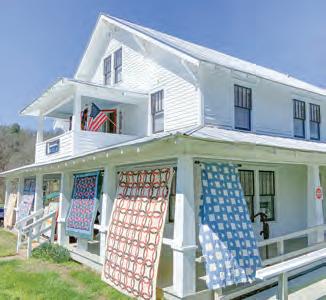
There will also be a fabric scrap exchange, a quilt pattern and book exchange, raffle and live music. The event is free and open to the public. For more information, visit appwomen.org.
The 23rd annual Whole Bloomin’ Thing Festival will take place from 9 a.m. to 4 p.m. Saturday, May 9, in the Historic Frog Level District of Waynesville. Featuring over 70 vendors, there will also be children’s activities, local growers
and artisans/crafters, flowering baskets, herbs, outdoor decor, live music and more. Businesses in the district will also be open, including a coffee café and brewery.
The event is free and open to the public. Family-friendly. Rain or shine. For more information, visit wholebloominthing.com.
• Pigeon Community “Cinco de Mayo” community celebration will be held from 5-9 p.m. Tuesday, May 5, at the Pigeon Community Multicultural Development Center in Waynesville. An evening filled with vibrant music, delicious food, beverages and activities. This gathering promises to be a memorable experience for all attendees. Admission is $10 per person. Ages 21 and over. To purchase tickets, go to tinyurl.com/2c4zfxb9. For more information, visit pcmdc.org or call 828.452.7232.
A special stage production of “Legally Blonde Jr.” will be held at 7:30 p.m. May 1 and 2 p.m. May 2-3 at the Haywood Arts Regional Theatre in Waynesville.
“Legally Blonde Jr.” follows Elle Woods as she trades her signature style for a new challenge at Harvard Law School. What begins as a journey to win back the love she lost quickly becomes something much bigger, as Elle discovers her own strength, intelligence and unstoppable determination.

Along the way, she proves that you can be both kind and confident, stylish, smart and that believing in yourself is always in fashion. Packed with catchy songs, dynamic dance numbers and a whole lot of pink, this joyful production is a celebration of confidence, friendship and staying true to yourself.
Admission starts at $19 per person with seating upgrades and discounts available. For more information and/or to purchase tickets, visit harttheatre.org or call the box office at 828.456.6322.
CONTINUED FROM 27
noted. Free and open to the public. 828.482.5573 / thevineyardathighholly.com.
• Water’n Hole Bar & Grill (Waynesville) will host “Trivia Night” 7 p.m. Mondays, “Karaoke Night” 8 p.m. Thursdays, with semi-regular DJs and live music on the weekends. All shows begin at 9 p.m. 828.456.4750 / facebook.com/waternhole.bar.
• Whiteside Brewing (Cashiers) will host Andy Ferrell (singer-songwriter) May 22. All shows begin at 6 p.m. unless otherwise noted. Free and open to the public. 828.743.6000 / whitesidebrewing.com.
• Yonder Community Market (Franklin) will host “Country Thursdays” (Americana/country) 6 p.m. Thursdays and semi-regular live music on the weekends. Family/dog friendly. 828.200.2169 / eatrealfoodinc.com.
• Smoky Mountain Center for the Performing Arts (Franklin) will host acclaimed comedian Etta May at 7:30 p.m. Friday, May 1. Tickets start at $15 per person with seating upgrades available. 866.273.4615 / smokymountainarts.com.
• Haywood Arts Regional Theatre (Waynesville) will host semi-regular stage productions on the weekends. 828.456.6322 / harttheatre.org.
• Harrah’s Cherokee Casino Resort (Cherokee) will host semi-regular stage productions on the weekends. For tickets, visit
The popular “Concerts on the Creek” summer music series at Bridge Park in Sylva has once again been nominated for the prestigious USA TODAY 10Best Readers’ Choice Awards in the category of “Best Outdoor Concert Series.” This national recognition highlights the series’ continued impact as a beloved community event and regional attraction. Voting is now open to the public and runs through 11:59 a.m. Monday, May 11.

caesars.com/harrahs-cherokee.
• Peacock Performing Arts Center (Hayesville) will host “It Runs in the Family” 7:30 p.m. May 8-9, 15-16 and 2:30 p.m. May 10, 17. 828.389.ARTS / thepeacocknc.org.
• Swain Arts Center (Bryson City) will host semi-regular stage productions on the weekends. 828.488.7843 / swainartscenter.com.
• Highlands Performing Arts Center (Highlands) will host semi-regular stage productions on the weekends. 828.526.9047 / mountaintheatre.com.
Supporters are encouraged to cast their vote daily during the four-week voting period using the following link: 10best.usatoday.com/qr/59093.
The 17th annual “Concerts on the Creek” season will start on Friday, May 23 (Memorial Day weekend) and end on Friday, Aug. 29 (Labor Day weekend). That will be 17 Fridays of Concerts on the Creek, with the “Fireworks Festivities” and concert on Friday, July 4. The series is free and open to the public.
For more information and a full schedule of live acts to appear at the series, visit mountainlovers.com/concerts-on-the-creek.


Sometimes a book appears which changes the course of our nation’s history and culture.
Harriet Beecher Stowe’s “Uncle Tom’s Cabin” gave a face to slavery and helped bring on the Civil War. Now rarely read, Upton Sinclair’s 1906 novel “The Jungle” exposed the unsanitary conditions of the meatpacking industry and so repulsed the American people that it brought about federal reforms regarding food safety. Rachel Carlson’s “Silent Spring” pointed out the ruinous effects of certain chemicals on the environment and sparked the creation of the Environmental Protection Agency.

In March 2024, Jonathan Haidt’s “The Anxious Generation: How the Great Rewiring of Childhood Is Causing an Epidemic of Mental Illness” appeared and shot to the top of the best-seller lists. Here Haidt argues that a rising tide of mental and emotional illnesses among young people, particularly anxiety and depression, is directly linked to their attraction — in many cases, seen as addictive — to screens and cell phones. He called the attention of millions to his thesis that childhood had become “phone-based” rather than “play-based.”
Though some experts have attempted to discredit or minimize Haidt’s conclusions, many parents and teachers found his study a match with their own observations of their children and students. Since the book’s release, countless parents have begun delaying their children’s ownership and access to phones, many schools throughout the country have banned phones, and educators have called into question the rampant usage of technology in the classroom.
That brings us to Freya India and her just-released book, “Girls®: Generation Z and the Commodification of Everything.”
India is a brilliant 26-year-old British writer whose work has appeared online these last few years at various publications and on her Substack, “GIRLS.” She writes most often about the negative effects of phones and social media on Gen Z women, speaking both from her own experience and from the data she’s collected. Recently she has joined forces with Haidt, working on his Substack “After Babel” and promoting his ideas
online.
With “Girls®,” India aims a battery of her own heavy artillery at the negative effects of social media and its covert algorithmic manipulations of its users, especially young females. She reveals the damage done by screens over the last 15 years: the damaging comparisons made by girls to online images,
book.” The first is those women her own age who went through a journey similar to her own. The second is younger girls, “those who have never known a world than this one.” Here she hopes to show them “how drastically life has changed in the last fifteen years and that things weren’t always this way.”

the influencers who attract and then exploit girls and young women in all aspects of life from fashion and style to their mental health and the “friends,” both human and electronic, who do the same.
As she writes in the very first sentences of her book, “This is not the story of a generation falling apart. This is the story of a generation being remade, from people into products, from girls into GIRLS®.”
Yet “Girls®” is not some political or cultural diatribe. In addition to personal anecdotes, India brings to nearly every page the firepower of statistics and studies, so much so that sometimes readers may feel as if they themselves are being bombarded. At the end of the book are 87 pages of footnotes, a remarkable achievement of organization and use of online sources.
In her introduction, India writes that she has “three main audiences in mind for this
The following readings will be held at City Lights Bookstore in Sylva.
Then she writes, “Lastly, this book is for older readers: parents, grandparents, aunts, uncles, caregivers, teachers, anybody who has a girl or young woman in their life.” Here she strives to show an older audience how different the world for girls has become, how the desires and dreams of girls became drawn to an online world, how the traditional anxieties of girlhood are being refashioned and commodified.
As a father, a grandfather and a man interested in culture, I second India’s hopes that this last group will take this book to heart as both an education and as a warning. I would even go a step further and recommend it to all adult readers who want to understand more deeply what our nearobsessive attraction to screens is doing to us. Millions of Americans, male and female, middle-aged and elderly, are caught up just like these girls in social media, shaped into products and performers.
At the end of “Girls,®” Freya India writes, “Right now, we stand at a crossroads. We can keep going down this path, allowing billion-dollar industries to dictate not only how we look but how we feel, how we live and how we see ourselves, or we can remember what has been taken from us, and turn back. We can remind our daughters, granddaughters, and future generations of girls what real beauty, real friendship, real lives, real community, real confidence, real life is, and help them remember what it means to be human.”
Check out India’s essays online. Read the book. This “girl” has something important to tell us.
(Jeff Minick reviews books and has written four of his own: two novels, “Amanda Bell” and “Dust On Their Wings,” and two works of nonfiction, “Learning As I Go” and “Movies Make the Man.” minick0301@gmail.com.)
• Julia Elliott will present her new short story collection, “Hellions,” in conversation with Ashleigh Bryant Phillips at 3 p.m. Saturday, May 2.
• Rebecca McClanahan will share her new book, “Light Falls on Everything: A Daughter's Memoir of Caregiving, Grief, and Possibility,” at 1 p.m. Sunday, May 3.
• Ron Robinson will share his new book, “Practices of Resilient Companies: Overcome Disruption with Compassion, Collaboration, and Knowledge,” at 6 p.m. Thursday, May 7.
All events are free and open to the public. For more information, call 828.586.9499 or visit citylightsnc.com.





















Fly fishing is a pillar of the outdoor recreation scene in WNC.
BY GARRET K. WOODWARD ARTS & ENTERTAINMENT EDITOR
Anew, highly anticipated storefront has recently popped up on Main Street in Waynesville. Tuckaseegee Fly Shop, a popular fly fishing outfitter and guiding service in Western North Carolina, relocated the Waynesville store from Depot to Main in an effort to expand the company and grow its clientele.
“As a Haywood County local with a deep appreciation for the area’s fly fishing history, I felt that Waynesville truly needed a dedicated fly shop — one that could serve both the local community and visiting anglers,” said Waynesville TFS manager Justin Pilat.
To note, the original Waynesville location on Depot Street opened in 2021. Leading up to that launch, TFS also opened locations in Bryson City (2014) and Sylva (2017). Founded by Dale Collins and Bobby Bennett, the business offers “a full selection of fly fishing gear, flies, guided fishing trips and regional fishing reports, along with expert advice for anglers exploring the rivers and streams of the Great Smoky Mountains and surrounding waters.”
“Our [recent] move to Main Street placed us right in the heart of downtown Waynesville,” Pilat said. “It’s been an important step forward, giving us greater visibility and allowing us to better connect with the people we serve.”
Growing up in Waynesville, Pilat has been

fishing the waters of Western North Carolina for over 20 years. He was six years old when he first learned to fly fish with his father, he said, “and it’s been a part of my life ever since.”
“Fly fishing has always been therapeutic — an escape and a way to clear my head and stay grounded,” Pilat said. “I’m especially passionate about wild and native fish. Whether I’m fishing close to home or traveling, I love hiking into backcountry creeks and chasing
The Tuckaseegee Fly Shop in Waynesville recently relocated from Depot Street to Main Street in a move to grow the popular local business.

small, wild fish on dry flies.”
For those who fly fish, it’s a lifelong passion and hobby. And as the sport continues to spread in popularity, there may be some apprehension for beginners to walk into the shop and ask what they need for gear, where to fish and what to do when they get there. Pilat assures that all who walk through the door will be greatly taken care of, regardless of skillset or knowledge.

All of Western North Carolina is renowned for its fly fishing. And its reputation continues to grow. Jackson County developed the first officially mapped fly fishing trail — dubbed the Western North Carolina Fly Fishing Trail. And, of course, there are plenty of outfitters and guides ready to take visitors to the best fishing holes in the mountains. Encompassing big rivers, small streams, easy access points and backcountry hike-ins, the 15-spot trail was the first of its kind in the United States. For more information and a complete list of the 15 spots on the Fly Fishing Trail, visit flyfishingtrail.com.
As well, complimentary fishing maps and lodging details are available by contacting the Jackson County Chamber of Commerce at 828.586.2155 or the Jackson County Tourism Development Authority at 800.962.1911. Both are located in Sylva.
“When beginners come into the shop, many feel intimidated by fly fishing,” Pilat said. “Between casting, choosing flies, understanding gear and figuring out where to go, it can feel overwhelming at first. I always tell them to keep it simple and not overcomplicate things.”
Pilat emphasizes to those new to the sport “to lean on their local fly shop — that’s what we’re here for,” and that there’s no such thing as a bad question.
“When someone is getting started, I’ll walk them through an assortment of flies that are working for that time of year and what to expect in the months ahead,” Pilat said. “I’ll also show them how to do a basic roll cast and try to give them the tools and confidence they need to get on the water.”
Lastly, Pilat also recommends booking a guided half-day trip through TFS.
“In just four hours with a knowledgeable guide, beginners can learn a tremendous amount and significantly shorten their learning curve,” Pilat said. “No matter how long you’ve been fishing, it’s important to stay curious and always be willing to learn. After more than 20 years in this sport, I’m still learning every time I get on the water.”

The North Carolina Department of Agriculture and Consumer Services, under the leadership of longtime Agriculture Commissioner Steve Troxler, will host a Farmland Preservation Advocacy Day on Wednesday, May 13, at the General Assembly in Raleigh.
The event aims to rally support for increased funding to protect North Carolina’s working farms and forests.
The Haywood County Farm Bureau is organizing a trip to ensure local voices are heard. A charter bus will depart from the Haywood County Farm Bureau office, located at 1520 Asheville Road in Waynesville, at 3 p.m. on Tuesday, May 12, and return the evening of May 13. Hotel accommodations have been secured for attendees.
This advocacy effort comes at a critical time. During the most recent funding cycle, farmland preservation requests across the state totaled $59 million, yet only $3.1 million was available, leaving many farms unprotected despite strong local support.
Event organizers will encourage legislators to increase recurring funding to $25 million, provide additional support for federal partnership projects, expand con-
servation programs and enhance tax credits that help preserve agricultural land.
Haywood County Farm Bureau is covering the cost of transportation, lodging and meals for Haywood County attendees, with Farm Bureau members receiving priority.
Residents from other Western North Carolina counties are also welcome to join if space allows, with estimated costs of $75 for a bus seat and $101 per hotel room. Shared rooms can reduce expenses. Participants from other counties will need to schedule their own meetings with legislators in advance. Haywood County attendees will have assistance with scheduling.
Community members, farmers and advocates are encouraged to take part in this important opportunity to support the future of agriculture in North Carolina.
Those interested in attending should contact Mandy Stasi, county liaison for Haywood County Farm Bureau, at haywoodliaison@ncfbssc.com or 828.452.1426. While the NCDA&CS requests RSVPs by April 30 — especially for those wishing to speak — Haywood County will continue accepting participants until the bus is full.
Haywood Regional Medical Center will host its annual free sports physicals event for local student-athletes from 3-7 p.m. Thursday, May 21, at the Haywood Regional Health & Fitness Center located at 75 Leroy George Drive in Clyde.
Open to middle and high school students, this event provides a convenient, no-cost opportunity to complete required physicals ahead of the upcoming sports season. Students will be seen based on their school’s designated time: Canton Middle and Bethel Middle from 3-4:30 p.m., Waynesville Middle from 4:30–5:30 p.m. and Tuscola High School from 5:30–7 p.m. Fifth-grade students should attend during the time slot for the school they will attend next year.
Families should contact their child’s school to obtain and complete the required registration packet prior to arrival. No appointments are necessary.
Drought conditions have expanded in North Carolina. Forty-seven counties are now experiencing extreme drought, including the entire Smoky Mountain News coverage area.
The public should check with their local water supply system for any information on water use restrictions that may be in place.
“Water utilities’ websites are the best place for residents to look for information on active conservation measures,” said Klaus Albertin, chair of the DMAC. “The best time to water is the morning before it gets hot out. Less water will evaporate so less water is wasted.”
Rainfall totals recorded by gages across the state have been 10 inches or more below
The entire Smoky Mountain News coverage area is experiencing an extreme drought. Donated photo
normal for the last six months, based on data from the Southeast Regional Climate Center. Groundwater and streamflow levels across the state are also below normal levels, according to the state’s monitoring network.
“Rainfall helps to replenish not only streams, lakes, rivers and drinking water reservoirs, but also groundwater levels in our aquifers,” said Gabrielle Chianese, DEQ Division of Water Resources Groundwater Resources Branch supervisor. “Currently, we’re seeing near-record low groundwater levels in many areas of the state.”
The N.C. Forest Service’s ban on all open burning remains in effect until further notice.
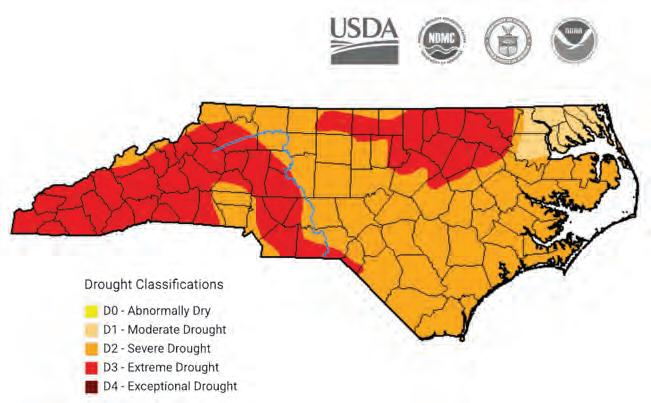















































Come out to Wildcat Ridge Farm during May to enjoy a blooming peony paradise. The farm will be open every day from 10 a.m. to 4 p.m., and admission is free for all visitors.
are known for their sturdy stems and vibrant, pastel color combinations. Wildcat Ridge Farm is located at 3553 Panther Creek Road inClyde.











As a Certified Appalachian Grown farm, Wildcat Ridge specializes in the finest herbaceous and intersectional peony plants and cut blooms. Herbaceous peonies are durable perennials that can live for over 100 years, while Intersectional (Itoh) peonies
Cash or checks accepted. Anyone planning on taking home cut flowers should bring a bucket. All potted peony plants include planting instructions from a master gardener.
For more information, visit wildcatridgefarm.com or call 828.246.7542.

Plants can be purchased with cash, check or card.



Lake Junaluska’s Spring Plant Sale will be 8 a.m. to 1 p.m. Saturday, May 2, at the Nanci Weldon Memorial Gym.






For sale will be a few thousand plants, including an assortment of annuals, perennials, herbs and vegetables, hanging baskets and several varieties of native plants from the Corneille Bryan Native Garden, said Melissa
Marshall, Lake Junaluska grounds director. Plants range from $3 to $45 and can be purchased by cash, check or card. Proceeds from the plant sale directly support landscaping at Lake Junaluska, where the grounds and gardens are open for all to enjoy and are made possible through charitable giving. Proceeds from the sale of the native plants will specifically benefit the Corneille Bryan Native Garden. To volunteer, send an email to mmarshall@lakejunaluska.com.















































































































































BY BURT KORNEGAY
One of the questions the doctor always asks when I go for my annual Medicare Wellness checkup is, “Have you been falling recently?” — to which I always answer, “No.” And technically that’s not a lie.
The “no” would have been true through and through in my younger years. I could walk a skinny branch in a gale. But now, a decade into Medicare, my balance has become “a diminished thing,” to borrow from Robert Frost, and I do fall from time to time. But the way I figure it, the doctor’s question is about falling in life’s usual places — in houses, stores and other buildings, on sidewalks, in parking lots and yards. We live on surfaces that are flattened and smoothed for the human foot.
But that’s not where I take my tumbles. Rather, they happen on the ridge behind our house. I hike daily there, make trails, and enjoy the life of the forest. But the ridge is also a place where Mother Nature shapes the surfaces, and she likes them steep, rocky and tangled with roots and vines. “You fall in crazy places,” is the way Becky puts it. So I tell my doctor, “No.”
But a crazy fall I took last month did call for a doctor.
I was rebuilding a trail that angles up a steep slope just below the ridge top, and I fell backward off the locust log “cribbing” that holds the trail in place like a low retaining wall. I had a mattock, and when I stepped back to swing it, I just kept on going. I remember trying to chop the mattock into the cribbing to stop my fall — too late! Then, searing pain shot through my back, and I almost passed out. As chance would have it, an arm-thick locust branch lay on the ground about five feet below the trail. The branch was bent in the shape of an elbow, with the point cocked up, and that’s where I landed.
Becky had been right earlier when, after reassuring her that I move slowly when
working on the ridge, she remarked: “You move slow all right, until you fall. Then you’re fast.”
I rolled off the branch with a groan and lay face down in the leaves, breathing hard. After some minutes, I reached back with my hand to see if there was blood, but it came away clean. I’d been elbowed, not stabbed. If I could make it back up to the trail, I thought, maybe I could shake things off and get back to work. But when I tried to draw my feet under me, it stoked the pain. I began to fear that I’d broken something and that trying to stand would make the injury worse. Not helping, the slope was icy slick with dry oak leaves.
Henry Kornegay looks south over Caney Fork valley and the Cowee Mountains from the ridge behind Burt and
downhill hand. I’d slide for a few feet then stop to let the pain subside.
My immediate goal was the tractor path at the slope’s base. It was wide and pretty level, and it led on down to the yard. Once I reached the path, I held onto a tree and slowly stood. I tried a baby step, then another, and then crept along the path.
the nurse had waved a magic wand over my back. That must be why the drug is named after Morpheus, the Greek god of sleep. It puts pain to bed.
Unable to go back up, I looked down. The trees had not yet leafed, and I could just make out the roof of our house, far below. Becky was there with her friends. It was her turn to host the Caney Fork card group in their weekly game of Hand and Foot. I couldn’t shout loud enough to tell her I’d been dealt a hand of “Elbow and Back.” And I didn’t have a phone.
Turning over gingerly, with my feet stuck out in front of me, I started sliding down through the leaves on my butt, homeward bound. I did have help in this from “The Big Fellow,” my name for gravity. It’s true that gravity had taken advantage of my carelessness to yank me backward off the trail. But now, damage done, he lent me a


When I left the house earlier that afternoon, the card ladies had settling down to play. I was dressed in work clothes and boots, and as I headed out the door, I waved a hearty goodbye to them. But now I had barely crossed the threshold back into the house, unable to stand up straight, before I heard a chorus of, “Are you okay?”
An hour later I was with Becky in examination room No. 8 at Harris Regional Hospital, where I’d been eased onto a bed. After wrapping a blood-pressure cuff on one of my arms, a nurse inserted an IV needle in the other and asked if I wanted something for the pain. I decided to tough it out and told her no. It served me right for being careless on the ridge. But after waiting a long while for a doctor, I pushed the call bell button to tell the nurse I’d changed my mind.
The morphine worked so fast it felt like
A CAT scan followed the morphine, and finally, after another wait, a second doctor came in and told me the result. To make sure I understood, I boiled his diagnosis down: “No bones broken, no internal bleeding, right?” He nodded yes. The relief on hearing that was as salutary as Morpheus himself. I relaxed, began to feel like I was back in the saddle again. Driving me home late that evening, Becky pulled into Domino’s to pick up a pizza.
The next afternoon, I followed in reverse my baby-step route of the day before on the tractor path. My back was sore and would stay sore for a month, but there was trail work to be done. I’d let pain be my guide. When I reached the base of the steep slope, I saw coming down through the woods the long dark skid mark my butt had made in the leaves.
To Becky go the parting words, which she wrote of this story: “Grow old along with me. The best is yet to be. Yeah, right.” (Burt and Becky Kornegay live in Jackson County.)

















Waynesville is inviting residents to attend a second open house for its parks and recreation Master Plan on from 4-7 p.m. Tuesday, May 19, at the Waynesville Recreation Center.
Following an initial round of public input earlier this year, this second open house will give community members an opportunity to review draft recommendations shaped by that feedback and help refine priorities that will guide improvements and investment in Waynesville’s parks and recreation system over the next 10 years.
will serve as a roadmap for future investments in parks, facilities, recreation opportunities, trails, accessibility and quality-oflife amenities throughout Waynesville.
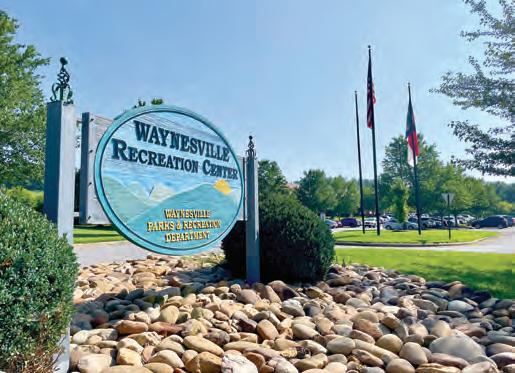
Held in a drop-in format, the open house allows residents to stop by to learn more about the planning process, view preliminary action items, and share additional input before the master plan is finalized.
The master plan is a 10-year vision that
Residents of all ages are encouraged to attend and continue being part of the planning process.
For additional information, contact Luke Kinsland at lkinsland@waynesvillenc.gov or visit the Town of Waynesville Parks and Recreation website.
The Franklin Bird Club leads walks along the Greenway on Wednesday mornings at 8 a.m. through September. Walks start at alternating locations: Macon County Public Library, Big Bear Park and Salali Lane.
Walks are about two and a half hours. The public is welcome. All walks are weather dependent. Additional information, including directions to each location and a bird club check list can be found at littletennessee.org/franklin-bird-club.
Schedule for upcoming walks:
• May 6, meet at the Macon County Public Library parking lot
• May 13, meet at the Big Bear parking lot near the dog park
• May 20, meet at the Salali Lane parking area
A full schedule and directions to each starting location can be found at facebook.com/groups/franklinbirdclub/ or littletennessee.org/franklin-bird-club.
The Blue Ridge Parkway Foundation recently appointed new board officers and members to the organization’s Board of Trustees and Council of Advisors.
The group will provide leadership for the nonprofit organization, which partners with the National Park Service to preserve and enhance the country’s most-visited national park unit.
The Board of Trustees elected the following officers:
• Former Vice Chair Sam Johnson of Dahlonega, Ga., was elected chair of the Board of Trustees. He is a partner with Nautilus Strategy Group.
• Former Secretary James Houchins of Stuart, Va., was named vice chair. He is the director of tourism & marketing for Patrick County.
• Roberts Bass of Winston-Salem and Meadows of Dan, Va., was selected to be treasurer. He serves as a fractional CFO.
• Marsha Ralls Hershman of Asheville was selected to be secretary. She is the Founder and CEO of The Phoenix Wellness Retreat.
The Council of Advisors most recently welcomed Melissa Booth, Katy Clune, Rob Griffin, Daniel Key, Omari Simmons and Zoe van Buren.
The Blue Ridge Parkway Foundation is the fundraising partner for the Blue Ridge Parkway. Since 1997, the nonprofit has provided more than $26 million in support for the country’s most visited national park unit. To learn more, visit brpfoundation.org.

The Smoky Mountain News Marketplace has a distribution of 16,000 copies across 500 locations in Haywood, Jackson, Macon and Swain counties, including the Qualla Boundary and west Buncombe County. Visit www.wncmarketplace.com to place your ad!
Rates:
• $15 — Classified ads that are 25 words, 25¢ per word after.
• Free — Lost or found pet ads.
• $6 — Residential yard sale ads.*
• $1 — Yard Sale Rain Insurance Yard sale rained out? Call us by 10a.m. Monday for your ad to run again FREE
• $375 — Statewide classifieds run in 170 participating newspapers with 1.1+ million circulation. (Limit 25 words or less)
• Boost Online — Have your ad featured at top of category online $4
• Boost in Print
• Add Photo $6
• Bold ad $2
• Yellow, Green, Pink or Blue Highlight $4
• Border $4
Note: Highlighted ads automatically generate a border so if you’re placing an ad online and select a highlight color, the “add border” feature will not be available on the screen.
Note: Yard sale ads require an address. This location will be displayed on a map on www.wncmarketplace.com
p: 828.452.4251 · f:828.452.3585 classads@smokymountainnews.com www.wncmarketplace.com
NOTICE OF ADMINISTRATION
Case No.26E000238-430
Kenneth Tim Lowe,Mary June Lowe Jul 15 2026
Jul 22 2026
Administrator 388 River Point Rd Canton, NC 28716
NOTICE OF ADMINISTRATION
Case No.26E000174-430Ray Carroll
Johnson Jul 08 2026
Executor
705 W Main Street Sylva, NC 28779
NOTICE OF ADMINISTRATION
Case No.26E000098-490
Executor 2552 Truman Ave Knoxville, Tennessee, 37921
NOTICE OF ADMINISTRATION
Case No.26e000084-490
Loretta Smith Jul 08 2026
Nancy Gay Townsend Jul 29 2026
Co-Executors
705 W Main Street Sylva, NC 28779
NOTICE OF ADMINISTRATION
Case No.26E000222-430
Executor
972 Hunan St, NE Palm Bay, FL 32907
NOTICE OF ADMINISTRATION
Case No.26E000085-490
Carolyn Havens Whitman
Zettie Plemmons Jul 15 2026
Executor
705 W Main Street Sylva, NC 28779
NOTICE OF ADMINISTRATION
Case No.26E000185-430Rolf
Kaufman Jul 29 2026
Robert Leon Obermiller Jul 08 2026 of Martha Sharpe Bradley, PLLC 370 N. Main Street, Suite 310 Waynesville, NC 28786
GOT AN UNWANTED CAR?
Stephen Kaufman, Executor Estate of Rolf Kaufman
c/o Bailey A. Humphries McGuire, Wood & Bissette, P.A. PO Box 3180 Asheville, NC 28802
NOTICE OF ADMINISTRATION
Case No.25E000307-430
WE BUY HOUSES


































1 Sturdily built
7 Evergreen-scented cleaning brand
14 Cows' milk deliverers
20 Perjurious way to be caught
21 Transition zone between biomes
22 Go on a trip
23 "... at least"
24 Hundredth of a peseta
25 Cure
26 Managers' evaluations of employees
29 "Rope-a-dope" boxer
30 Gas brand in Ontario
31 "Ltd." cousin
ANSWERS ON PAGE 34

BROWN TABBY CAT — PHO 7 year old girl with bold stripes. Talkative and loving but slightly shy. Asheville Humane Society (828) 761-2001 adoptions@ashevillehumane.org
ANGELA-Hound mix, reddish brown. 4 yrs old; 55 lbs. Energetic, playful girl; would love to keep working on training. Asheville Humane Society (828) 761-2001 adoptions@ ashevillehumane.org
Here’s How It Works: Sudoku puzzles are formatted as a 9x9 grid, broken down into nine 3x3 boxes. To solve a sudoku, the numbers 1 through 9 must fill each row, column and box. Each number can appear only once in each row, column and box. You can figure out the order in which the numbers will appear by using the numeric clues already provided in the boxes. The more numbers you name, the easier it gets to solve the puzzle!