Peregrine falcons soar from the brink of extinction Page 30
CONTENTS
On the Cover:
The petition to remove Graham County Sheriff Brad Hoxit from office is hardly the first such petition that has been filed in recent years, but it is the first one to move all the way through a full hearing. Last week, amid tight security and heaps of speculation, District Attorney Ashley Welch made the case that Hoxit abused his power while in office. The Smoky Mountain News dives in deep to explain the process and the hearing. (Page 6) Micah McClure illustration
News
‘Empty Bowl’: fundraising, food, fellowship......................................................................4 Canton wastewater woes bubbling up again..................................................................5 No Kings 3 protests reshape identity across rural America....................................14 Stein pushes $792M Helene plan as recovery lags..................................................16 Canton eyes future with Park Street overhaul..............................................................19
Opinion
Let’s stop asking kids what they want to be ............................................................20
Trump demeans dignified transfer ..............................................................................20
A&E
Chain Yer Dragon: Rick Mitarotonda of Goose........................................................22
Storytellers series returns to Pigeon Center..............................................................24
Outdoors
Peregrine falcons soar from brink of extinction........................................................30
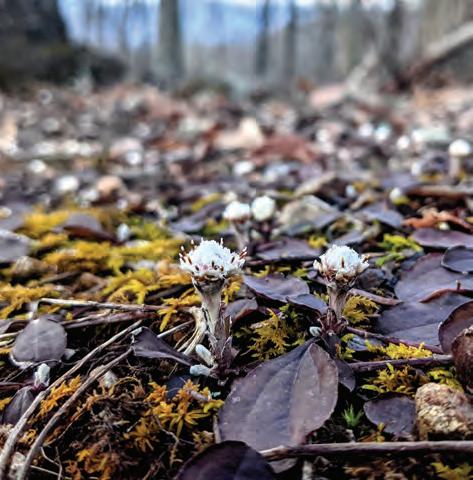
The Joyful Botanist: Pussytoes, pussytoes, I love you............................................32
STAFF
E DITOR /PUBLISHER: Scott McLeod.
ADVERTISING D IRECTOR: Greg Boothroyd.
ART D IRECTOR: Micah McClure.
D ESIGN & PRODUCTION: Jack Snyder.
D IGITAL MARKETING S PECIALIST Tyler Auffhammer.
ADVERTISING SALES: Amanda Bradley.
info@smokymountainnews.com
greg@smokymountainnews.com
micah@smokymountainnews.com
jack.s@smokymountainnews.com
tyler.a@mtnsouthmedia.com
amanda.b@smokymountainnews.com Maddie Woodard.
C LASSIFIEDS: Jamie Cogdill. .
N EWS E DITOR: Kyle Perrotti. .
WRITING: Lily Levin. .
Cory Vaillancourt.
Garret K. Woodward.
ACCOUNTING & O FFICE MANAGER: Jamie Cogdill.
maddie.w@smokymountainnews.com
classads@smokymountainnews.com
kyle.p@smokymountainnews.com
lily.l@smokymountainnews.com
cory@smokymountainnews.com
garret@smokymountainnews.com
smnbooks@smokymountainnews.com
C ONTRIBUTING: Jeff Minick (writing), Susanna Shetley (writing), Adam Bigelow (writing), Thomas Crowe (writing)
WAYNESVILLE | 144 Montgomery, Waynesville, NC 28786 SYLVA | 629 West Main Street, Sylva, NC 28779
‘Empty Bowl’
Fundraising, food, fellowship
And we’ve got everything from student potters — elementary school kids — all the way up to nationally award-winning professionals, so you can choose what’s going to make you happy.”
There’s also a raffle with donated items ranging from LED candles to a cast iron griddle. Attendees may enter with a contribution of $5 per ticket.
ADDRESSING LOCAL HUNGER
BY LILY LEVIN STAFF WRITER
The Community Table is in a small and unassuming brick building nestled between Sylva’s Municipal Drive and Poteet Park.
It’s also a local lifeline. Every year, tens of thousands of community members visit the nonprofit — which since 1999 has envisioned a Jackson County in which no one “goes to bed hungry” — and are welcomed inside its doors.
To that tune, there’s a dual purpose to the Community Table’s annual “Empty Bowl” fundraiser. Just as collecting donations is important, so too is engagement with its broader network — guests, volunteers, employees and members of the board.
The event is “still a really vital part of what we do and how we connect with the community,” said Community Table Executive Director Paige Christie.
This year’s event takes place from 4-8 p.m. on Saturday, April 11, at the First United Methodist Church of Sylva.
Open Monday through Friday except Wednesday, Community Table serves a free 4-5:30 p.m. dinner daily and offers a food pantry from 11 a.m. to 5:30 p.m., available to individuals and families on a biweekly basis.
Staff pride themselves on minimizing barriers to entry so often required by service providers, such as proof of qualification and bureaucratic paperwork. MANNA food bank donations are available on a take-as-many-as-needed basis. Everyone present for the evening meal will be served.
Community Table services are especially crucial given the nationwide rise in food insecurity and homelessness, a trend that has not spared Western North Carolina. According to the Jackson County 2024 Community Health Assessment Summary, that year, 35% of residents reported “that they had run out of food at least one time in the past year and/or were worried about running out of food in the past year,” an increase from previous surveys.
Empty Bowl offers a menu of eight soups, ranging from vegan tomato basil to Brunswick stew, available dine-in or to-go. All are homemade, courtesy of Community Table staff.
“My kitchen crew is busting a move right now,” Christie told The Smoky Mountain News.
After the soup is made, it must be transferred to tubs and carted off to the church. This year will mark the first time Empty Bowl is hosted at an external location, a consequence of the event’s popularity that requires extra logistical coordination. Hence, April 11 volunteer slots are available morning to for roles such as set-up and takedown.
The fundraiser itself features an array of beautiful pottery from which attendees may choose a piece to take home. The minimum standard donation is $30 per person, the “cost” of one piece of pottery — for example, a $60 donation would buy two — though anyone served by the Community Table is welcome free of charge.
“If [our clients] want to come and get an extra meal and participate, they can come, as well. So that’s kind of fun, because then everybody gets to mix together and talk to each other and hear their stories, and that’s super important,” Christie said.
As for the vibe of Empty Bowl, it’s “pretty informal,” she said.
“You’ll come in, you’ll make your donation, and then we’ll give you a bag for each [pottery piece],” she explained. “We’ve got mugs and vases and all kinds of stuff that that our potters have donated.
The Sylva nonprofit has experienced the downstream effects of growing hunger within the area. In 2020, during the height of the COVID pandemic, Community Table served 4,222 families, 14,362 individuals and 1,585 children. In 2021, federal assistance programs kicked in, and the nonprofit saw a significant decrease in annual numbers, though a gradual upward creep in subsequent years culminated in 2025’s record high. Despite a three-week closure for repairs, Community Table last year served 4,975 children — a 300% increase from 2020 — 5,737 families and 16,781 individuals.
That’s because inflation is on the rise and people are struggling, Christie said, including the fundraiser’s contributing artists, some of whom are just getting back on their feet after Hurricane Helene.
While Empty Bowl has always included pottery, the executive director’s past as a handcrafted gallery owner — disconnected as it might seem from her job now — has played in essential role in spearheading a new pottery collection system.
“As [Empty Bowl] began to grow, the amount that potters could donate locally was becoming a stress on the potters,” Christie said.
She called up former art gallery clients throughout the country, soliciting pieces and offering compensation. The ticket price was raised two years ago to account for this decision. Still, though, much of what Community Table receives is donated, and compensation isn’t always financial — the nonprofit provides various kinds of payment.
For example, some attend the event free of charge in exchange for their art. Others, such as a group out of the Swain Center at Southwestern Community College, will receive new clay, as per request.
Christie said 50% of proceeds from Empty Bowl are put toward operating costs, the other half to purchasing food.
The double-whammy is that as need is greater than ever, the money from the event doesn’t go as far as it used to. Beyond covering the cost of the fundraiser, Christie estimated donations will roughly cover only three weeks of Community Table expenses.
“There are a lot of hungry humans out there,” she explained.
The ‘Empty Bowl’ fundraiser is hosted annually by the Community Table. Donated photo
Canton wastewater woes bubbling up again
BY CORY VAILLANCOURT POLITICS EDITOR
Alooming deadline on a critical wastewater agreement has exposed a growing divide between Canton officials and their private partner, with negotiations stalled over cost, oversight and the data needed to shape the town’s long-term infrastructure plans.
Town leaders confirmed they do not yet have an extension in place for wastewater treatment services as the current agreement with mill site owner Eric Spirtas was set to expire at 5 p.m. March 31 — when The Smoky Mountain News went to print — leaving only days to resolve a dispute that has been building over months.
For decades, the mill’s owners treated the town’s municipal wastewater at nearly no cost to the town, but when the decision to close the mill was announced on March 6, 2023, the future of wastewater treatment became an urgent concern.
Spirtas purchased the mill site in January 2025 and operated the plant at his own expense for several months until coming to an agreement with the town that May.
“We just can’t take someone’s word for what is happening down there. We have been down this path before by trusting a company,” Smathers said of the mill site’s previous owner, Pactiv Evergreen. “We’re not doing that again.”
To address those concerns, both sides have been working toward a separate agreement focused on testing and sampling, including the installation of new equipment and shared access to results. Engineers are expected to collect data over time, accounting for seasonal changes such as rainfall, before it can be used to guide design decisions.
Even with that progress, the financial dispute remains unresolved.
Although residents benefitted from cost-free wastewater treatment for more than 60 years, many expressed outrage when the town had to raise rates significantly to pay Spirtas’ $140,000 monthly bill.
Efforts to secure a simple extension through the end of the year broke down after Spirtas sought additional compensation, forcing the board to weigh further rate increases against mounting pressure from residents already struggling with higher costs. Negotiations had been ongoing for more than a month but had reached an impasse.
“We are very actively in negotiation,” said Jeffrey Goss, an attorney who’s been handling various matters associated with redevelopment for the town. “We’ve been trying to get there, but we’ve had a bit of a stalemate.”
Officials framed the disagreement as more than a contract dispute, pointing to deeper concerns about transparency and the need for independent verification of wastewater flows and composition.
That push for better data comes as the town prepares to design and build a new wastewater treatment plant, a process that depends heavily on accurate information about volume and chemical makeup.
Mayor Zeb Smathers said the town would not move forward without reliable data.
“This board has no appetite, nor do we feel that the rates of the Town of Canton and its citizens need to be raised any more than $140,000, and that has clearly been expressed to the company,” Smathers said. Canton’s rate increase was a difficult but necessary step, taken at a time when many households were already facing rising costs for housing, fuel and basic goods. That broader affordability crisis continues to shape the board’s approach as it negotiates the next phase of the agreement.
Concerns about environmental accountability also surfaced during discussion, with officials emphasizing the importance of understanding how wastewater is being handled and ensuring the newly revitalized Pigeon River is protected.
While negotiations remain unresolved, town officials expressed confidence that wastewater treatment will continue even if the agreement lapses, noting there are no immediate concerns about service disruption or environmental risk.
“There’s no magical valves that can be turned or switched, that can be flipped, to stop flows going to that plant,” said Goss, who currently serves as the chair of the Tuckasegee Water and Sewer Authority and has a base of knowledge on municipal water infrastructure.
Goss’ assurance provides some shortterm stability, but it does little to resolve the underlying conflict, which now centers on how much the town should pay, how data will be verified and how quickly both sides can reach terms.
Without an agreement, Canton risks entering uncertain territory at a moment when accurate data and stable costs are essential to planning the next generation of wastewater infrastructure — a system that will shape the town’s growth, environmental health and financial outlook for decades.
Canton’s wastewater plant sits at the center of a costly standoff. Haywood GIS photo
Keeping the faith
First-of-its kind sheriff removal hearing plays out in Graham County
BY KYLE PERROTTI NEWS EDITOR
There was no shortage of gray-haired attorneys in Graham County Superior Court last week. Some represented witnesses; others were just curious to watch a proceeding not seen in modern history.
Maintaining faith in the justice system and protecting law enforcement were the themes of the four-day hearing held last week in Robbinsville to determine whether Graham County Sheriff Brad Hoxit — now suspended amid allegations of misconduct tied to an investigation of the ex-husband of his current wife — would be officially barred from returning to office. District Attorney Ashley Hornsby Welch sought to prevent Hoxit from regaining his badge, arguing that preserving the integrity of the critical institution meant keeping a corrupt sheriff out of power, while Hoxit’s defense team claimed that a message must be sent that a sheriff can execute his duties without fear of political retribution.
Welch filed the petition for Hoxit’s removal on Jan. 29, alleging he abused his power as his office built the case against County Commissioner Jacob Nelms, whose ex-wife Adarian Nelms had been in an on-and-off relationship with Hoxit since before he took office.
“When a sheriff uses the power and tools of his office and the justice system to actively investigate a citizen with whom he has a personal conflict that requires recusal, the public is not safe,” the petition reads.
The same day the petition was filed, Superior Court
Judge Tessa Sellers signed an order suspending Hoxit pending the removal hearing. The following day, Graham County commissioners decided that Hoxit’s Chief Deputy, Travis Brooks, would assume the duties of sheriff. On Feb. 20, the board named Russell Moody, a Republican who’d served in the office from 2007 to 2011, sheriff. According to reporting from The Graham Star, at that meeting, Moody and Brooks got into a physical altercation that was escalating before they were separated.
Hoxit had begun a campaign to gain the requisite signatures to appear on the 2026 ballot as an unaffiliated candidate, but he failed to retrieve enough endorsements.
“I was in the process of getting my signatures to get on the ballot and then this here happened,” he testified during the hearing.
Because no Democrats filed for sheriff in Graham County, Republican Primary winner Caleb Stiles will assume office at the end of this year.
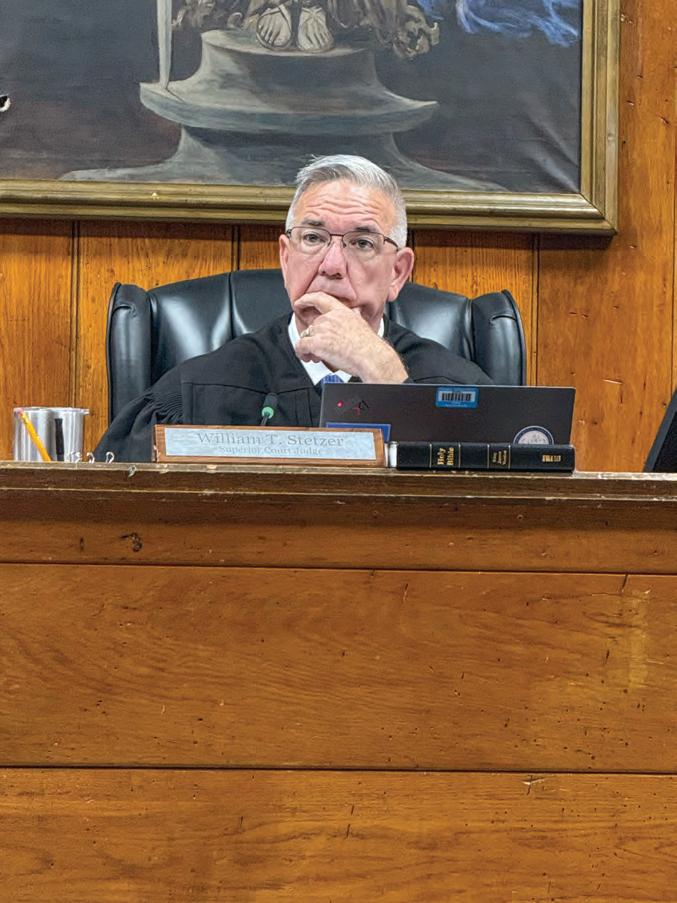
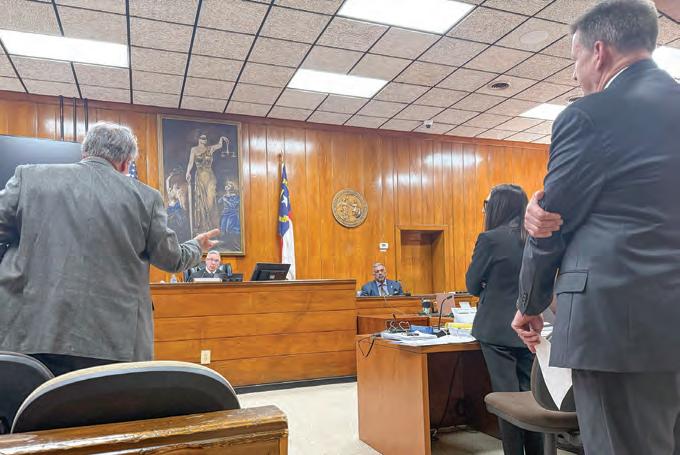
Hoxit’s removal hearing began Tuesday, March 24, at a heavily guarded Graham County Courthouse with Judge William T. Stetzer, of Gaston County, presiding. Welch was joined by Assistant District Attorney Jim Moore and other staffers. Hoxit showed up alongside attorney Stephen Lindsay, who owns his own Asheville law firm, as well as two lawyers he employs, Mary Ann Hollocker and Keith Gregory.
The hearing, which lasted through Friday, March 27, was unusual in several ways, most notably in how it will set case law, considering it was the first of its kind to make it to the
finish line in as long as anyone can remember. In 1983, a hearing for the removal of then-Rutherford County Sheriff Damon H. Huskey established limited precedent as an interlocutory appeal was heard in a higher court. That case was cited in Welch’s Jan. 29 petition. In 2023, the removal petition of Columbus County Sheriff Jody Greene was never gaveled in as Greene resigned at the last minute. In January of this year, a Superior Court judge dismissed a removal petition against Mecklenburg County Sheriff Garry McFadden.
It was brought up several times during the hearing how the parties were wading through unfamiliar waters together.
“We are in a statutory and case law framework that is almost entirely uncharted,” Stetzer noted at one point.
While the removal hearing was technically neither civil nor criminal, its structure largely mirrored a Superior Court criminal proceeding, albeit without a jury. The lack of a jury was in a sense, a good thing as there were several occasions that tricky issues arose, issues that could have been a headache for Stetzer had he needed to explain them to 12 laypeople.
“My intention is to proceed with this like a regular trial,” the judge said at the outset.
The hearing was the first time Welch or any other practicing attorney argued a removal petition in a North Carolina court, but in the last year, she has pushed two sheriffs out of office amid serious allegations. In June of last year, thenSwain County Sheriff Curtis Cochran was arrested on several charges that were filed in both Eastern F
The hearing was held at the Graham County Courthouse in Robbinsville. Kyle Perrotti photo
Band of Cherokee Indians and Swain County courts related to the alleged sexual assault of two women. Cochran subsequently retired.
On Feb. 5 of this year, Cherokee County Sheriff Dustin Smith left office when Welch sent him a letter demanding his resignation following a series of serious problems that began on Dec. 12, 2022, when an unarmed man was shot in the doorway of his own home.
Welch, who has been in office since 2015 and acts as the chief prosecutor for a district encompassing the state’s seven westernmost counties, made it clear from the outset that she intended on sending a message to any crooked law enforcement leaders and the public alike that there is a means to remove corrupt officials, even those who hold a great deal of power.
“What we’re going to ask the court to do is undo what the voters of this county decided to do four years ago,” Welch said during her opening argument.
BEEFING UP SECURITY
The Graham County Courthouse presents as a soft target, an outdated building with more vulnerability to security breaches than its counterparts in the other western counties. It sits out in the open and is surrounded by several vantage points and buildings with opaque windows. In addition, it has poor infrastructure and several entry points that are hard to secure.
The Smoky Mountain News verified from two independent sources that there was a credible threat against one of the parties in the hearing, witnesses or the proceeding itself, but details on the nature of the threat weren’t disclosed.
In response, the building was thoroughly swept for safety and security every morning throughout the hearing. A staggering law enforcement presence was seen each day, and a separate command center was set up about a half-mile away. In addition, a Cherokee Indian Police Department SWAT team, equipped with long guns and tactical gear, was staged throughout at the courthouse.
In an email to SMN, Haywood County Sheriff’s Office Public Information Officer Gina Zachary, who was also the PIO for the command center, said that officials couldn’t comment on who received law enforcement escorts, but each morning, Stetzer drove in behind a state trooper, and any time Welch went to or from the courthouse, she rode in an SUV with two law enforcement vehicles in front and two behind.
According to Zachary’s email, the operation was run off a “unified command structure,” with Moody, who is obligated by statute to provide courthouse security, requesting resources and coordinating. The email said that the effort began as a “coordinated partnership” with the North Carolina Sheriff’s Association, which worked with Moody to help develop a plan and engage nearby agencies to support the operation.
In the email, Zachary explained some of the logic, although she noted that she couldn’t speak to the nature of any specific threat or tactical details.
“The case had the potential to draw a large number of attendees to the Graham County Courthouse from both within and outside the county, and the hearing was expected to last numerous days and involve many witnesses,” she wrote. “We have had strong cooperation from multiple Sheriff’s Offices across the region — Henderson, Haywood, Buncombe, Clay, Macon, Swain, Cherokee [counties] and also the NC State Highway Patrol, Cherokee Indian Police, Graham County Emergency Services and Graham County 911.”
sations so she wouldn’t have to.
Last Tuesday, Lindsay argued that his client had the constitutional right to confront and cross-examine his accuser on the stand, a right ubiquitously afforded to criminal defendants.
“As the petitioner, [Welch] is a party to this,” Lindsay said.
Welch said she’d consulted with the state bar and the University of North Carolina School of Government to determine whether she should recuse herself and received advice that she was not an essential witness. She
In addition, deputies and officers from those assisting agencies helped Graham County by answering calls for service and supporting overall operations. There is a formal memorandum of understanding that outlines the framework for the multi-agency coordination under North Carolina’s mutual aid statutes.
MOTION TO RECUSE
During a Feb. 20 hearing, Hollocker said Welch should be disqualified from representing the state, telling Stetzer that because the district attorney was the petitioner, she had “inserted herself as a witness.” Welch said others could corroborate any information she had that could be pertinent to the case. Saying she “knew something bad was fixing to happen,” she kept people around who could serve as witnesses to key conver-
state. After the state rested its case, prior to Lindsay presenting his own evidence, this was almost the basis for an interlocutory appeal — which is filed during a hearing rather than after its completion and is used to address a critical issue that can’t wait until a proceeding is over. This could still be the focus of an appeal should Hoxit lose this hearing; however, by the time the appeals process plays out, Hoxit’s term would likely have ended, rendering such an action moot unless all Hoxit is interested in is shelling out more money for legal fees simply to clear his name.
A MESSY SITUATION
Hoxit was elected sheriff in 2022 as an unaffiliated candidate, easily defeating Moody with over two-thirds of the vote. Previously, he’d voted in a couple of Democratic Primaries but for the last decade pulled Republican ballots. Prior to becoming sheriff, he was a state trooper and polygraph examiner.
According to Hoxit’s testimony, he began a sexual relationship with Adarian Nelms before he was elected. Jacob Nelms had been a Graham County commissioner since 2014 and finished third in the 2026 Republican Primary, just good enough to retain his seat amid no Democratic opposition.
In March 2023, Adarian and Jacob Nelms became business partners with Hoxit and his then-fiancé of 20 years in a food service venture at nearby Fontana Village. Hoxit testified that the business “never flourished.”
In February 2024, after about 17 years of marriage, Jacob and Adarian Nelms separated. Hoxit said that in early 2025, he and his fiancé broke up, and he and Adarian Nelms began a serious relationship that has been “on-again, off-again.” On Aug. 7, 2025, they got married in Transylvania County.
THE INVESTIGATION
told Stetzer she also wanted to limit the strain the hearing could place on her office should she step aside.
“This is such an uncomfortable proceeding,” she said. “Especially as a district attorney, I didn’t want people in my office to be involved for multiple reasons, one of which is safety.”
Welch also felt responsible as the elected district attorney to take on the matter.
“This is my job,” she added. “I’m bringing this on behalf of the people of the county, on behalf of Mr. Nelms, [witnesses] and the behalf of people of this county. It is my statutory and constitutional obligation to ensure that the laws and rules are being followed and the people of this community are safe, particularly from the people in the highest positions of power.”
Stetzer ruled that Welch was not an essential witness and could represent the
In early 2024, GCSO began looking into Jacob Nelms, with Hoxit assigning the matter to Det. Graham Page, a purportedly straight-up deputy with strong loyalty to Hoxit. Page had already been the case agent on Operation Dirty Laundry, which utilized an undercover officer to infiltrate a local drug and gambling ring. The arrests that followed garnered praise from Sen. Ted Budd. Page said he looked up to and admired Hoxit.
“I was going to ask him when my son was born to be the godfather,” he said.
Around the time Operation Dirty Laundry wrapped up, Hoxit asked Page to work on the Nelms case, claiming he’d received complaints that inspections records and time sheets related to his job as a county building inspector were being falsified. Page said he coordinated details of the investigation and associated search warrants with David Wijewickrama, the attorney who represented GCSO at the time.
“Sheriff Hoxit didn’t want the district attorney’s office involved at all,” he testified. SEE HOXIT, PAGE 8
Superior Court Judge William T. Stetzer presided over the hearing. Kyle Perrotti photo
The case wasn’t even entered into RMS, a program that allows deputies to log incident reports and updates. This was unusual, but Hoxit expressed concern that county IT staff having access could compromise its integrity.
During Operation Dirty Laundry, Page persuaded the sheriff to buy vehicle trackers. On Feb. 8, 2025 — around the time Hoxit’s relationship with Adarian Nelms became more serious — the detective traveled to Buncombe County, where Superior Court Judge Alan Thornburg authorized the use of a vehicle tracker. That order was good for 90 days, and in May 2025, it was renewed for another three months. While Page requested to use trackers on both Nelms’ truck and work vehicle, Thornburg’s order, obtained by SMN, only authorized a tracker on Nelms’ truck. Trackers ended up on both vehicles, but this was not brought up during the hearing.
Page said that once the tracking devices were placed, Hoxit was in frequent contact, speaking to him “maybe hundreds of times” about Jacob Nelms.
“When he calls asking about a case, you answer what the sheriff wants,” he said. Hoxit asked Page to reach out to the Office of the State Fire Marshall to see if it could pick up the case due to the sheriff’s conflict over Adarian Nelms. OSFM said the North Carolina Department of Insurance can investigate and even prosecute such matters. DOI Special Agent Jasmine Hanline
took the assignment.
On Aug. 28, 2025, Jacob Nelms traveled to DOI’s Gastonia office for an interview with Hanline. He showed up with his attorney, Zeyland McKinney, who was also in court for the entirety of the removal hearing.
deputies and forwarded to Hanline.
Hanline said that the data dump rendered evidence that supported their case. Despite his obligation to physically examine buildings, Jacob Nelms was receiving text messages with pictures of things like electrical boxes and then signing inspections com-
When the interview concluded, Hanline provided a search warrant for Nelms’ cell phone. Because GCSO had equipment that DOI at that time lacked, the phone’s data was then “dumped” and collected by
Hoxit said he wanted to clear the air with Welch, who couldn’t meet again in short order but invited the sheriff to her office on Jan. 6. Chief Deputy Brooks accompanied Hoxit to the meeting, and Welch brought along Burrows. Burrows recorded the conversation on a device hidden on a chair across from Hoxit and Brooks. This is allowed by state law as long as one party knows a conversation is being recorded. That recording, almost two hours long, was played in court.
The conversation was circular with Welch repeatedly expressing concern over Hoxit’s secret marriage and the sheriff reiterating that he had nothing to hide, that he was an “open book.” Welch told him that his failure to inform her of the conflict was tantamount to lying by omission.
“You know me well enough to know I don’t like surprises,” she told Hoxit in the recording.
Hoxit insisted he stayed out of things, but Welch continued to push.
“What you failed to disclose to me is that there was a relationship at all,” she said.
The reason for his reticence, Hoxit explained, was that he didn’t want controversy prior to the candidate filing period for the 2026 election. Welch said she didn’t care about any relationship he may have, but to not disclose it to her is an action worthy of a Giglio order, which requires a prosecutor to disclose when a law enforcement officer has had credibility issues before calling them as a witness in a criminal case, essentially rendering them useless in criminal investigation.
plete. She testified that he said that practice was adopted during the COVID-19 pandemic, and he thought was still acceptable. Likewise, he had an explanation for time sheets that didn’t align with tracker data that indicated he was claiming hours worked while not actually on the job.
“He said he had permission to flex his time, and sometimes the sheet may differ from what is said on inspections,” Hanline said.
“I’m not telling you that you shouldn’t have reported it; you most certainly should,” Welch said. “Problem is that you should have stayed out of it. This is why we have the [State Bureau of Investigation]. It’s why you’ve got the Department of Insurance. It concerns me that your judgment is so poor that you still don’t understand why this is a problem.”
A DOI special prosecutor reviewed the evidence and declined to file criminal charges, instead referring the case to a branch that handles regulatory issues. While that arm of DOI can levy fines and suspend licenses, it can’t press criminal charges. Hanline said she thought there was evidence of Nelms generating false reports and perhaps embezzlement.
THE TURNING POINT
Page and Hoxit met Welch in her office at the Haywood County Courthouse on Aug. 13, 2025, to talk about the details of the Nelms investigation. At that meeting, Hoxit said that DOI was working the case because he had a conflict, but he didn’t elaborate. What he failed to tell Welch was that less than a week earlier, he and Adarian Nelms got married.
A few days after the meeting, Welch found out from Zeyland McKinney that Hoxit and Adarian Nelms were in a relationship. When she called Wijewickrama, he told her they had been but that he thought it had been over for a little while. A few days later, she received a phone call saying the two were married. Dani Burrows, a retired Macon County Sheriff’s Office captain who now works as an investigator in Welch’s office, pulled the marriage license.
Throughout the conversation, Hoxit shifted blame to Wijewickrama, claiming he knew about the relationship — although not the marriage. Hoxit said the attorney instructed him not to tell Welch unless she asked. On the recording, Welch said Wijewickrama had already refuted that assertion and told Hoxit that if the attorney was lying, she would be obligated to file a bar complaint.
“I’ll put my hand on the Bible, whatever you want me to do,” Hoxit told her.
Wijewickrama testified that in September, he resigned the same day he heard about the marriage. The next morning, as Hoxit was en route to his parents’ home in Transylvania County, he made an unannounced visit to Wijewickrama’s downtown Waynesville office. Wijewickrama pulled into the parking lot at about 7:30 that morning, he said, and before he even got out of his truck, Hoxit pulled up and tried to convince him to stay on as the GCSO attorney.
Wijewickrama answering Welch’s questions about a former client required him to walk a tightrope between providing accurate testi-
Graham County Sheriff’s Office had a Humvee and other emergency response vehicles staged around the courthouse. Kyle Perrotti photo
mony and not violating attorney-client privi-
which the state contended had been waived due to Hoxit’s discussion of privileged conversations during the Jan. 6 meeting. Despite Lindsay’s frequent objections on those grounds, the testimony continued. On two occasions, Wijewickrama requested to pause his testimony to consult with his attorney, Raleigh’s Mitch Armbruster, who was hired specifically to help protect him as a witness in this case. While this is uncommon, Stetzer was happy to accommodate considering the sensitive nature of the testimony.
He answered most of Welch’s questions with a simple “yes” or “no,” largely refuting Hoxit’s previous statement that he’d instructed his client to withhold information regarding his conflict. He said that about three and a half months before Hoxit and Adarian Nelms got married, the sheriff had told him the relationship was over.
Hoxit’s testimony pointed the finger back at Wijewickrama, saying that the attorney helped Adarian Nelms in her search for a separation lawyer in early 2024. Text messages introduced into evidence corroborated the claim that Wijewickrama knew there was some form of a romantic relationship at some point. However, Hoxit did not provide testimony or evidence that indicated Wijewickrama instructed his client to withhold information regarding his conflict or that he had knowledge of the relationship at the time he and Adarian Nelms got married. Lindsay surprisingly waived cross-examination of Wijewickrama but did request that he turn over all files related to his representation of GCSO, saying that the testimony was broader than Hoxit’s legal counsel expected. He wanted a chance to review any concurrent notes and documents to corroborate or impeach Wijewickrama’s testimony, he said.
“This is a hearing in which due process is supposed to apply,” Lindsay said. “I have a right to cross examine him fully and thoroughly.”
Armbruster spoke on Wijewickrama’s behalf, arguing that they’d already discussed whether there was any other discovery that Hoxit’s counsel would want.
“There was a long period of time that if we needed to resolve something, if they needed something, I would have tried to work it out with them,” Armbruster said. Lindsay wanted to keep Wijewickrama under subpoena in case he would like to call him as a witness. At this point, Welch voiced her frustration with Hoxit’s counsel, going as far as insinuating that they were causing undue hardship for Wijewickrama, who was paying Armbruster out of his own pocket even though he wasn’t a party in the hearing. She further alleged that Hoxit’s attorneys were using vague threats to intimidate herself and Wijewickrama.
“I don’t know if Your Honor’s picked up on it — I suspect that you have — but throughout this hearing … there have been insinuations of bar complaints coming towards that man right there and me, and it’s coming from that table,” Welch said, ges-
turing toward the defense attorneys. “It’s offensive, it’s inappropriate, and it keeps coming.”
Stetzer ruled that the files wouldn’t need to be turned over, and Wijewickrama was never called back to testify.
CONTINUING THE PUSH
By January of this year, Page was dealing with medical issues and was unable to work the Nelms case, so it was handed over to
judge to take the stand, but Davis was subpoenaed and testified, expressing how bewildered he was by the warrant. He questioned what kind of evidence Daniels expected to find but didn’t receive a clear answer.
“It appeared that the focus of the search warrant was a Mr. Nelms, but the person who was being searched was a Mr. Seagle,” Davis said.
Davis was also confounded by the nature of the case itself. Even without knowledge of Hoxit’s relationship with Adarian Nelms, he considered that county commissioners hold the purse strings for the sheriff’s office,
hadn’t heard from since he’d left office.
“He said he had enough dirt on Sheriff Hoxit to throw him under the jail, but he didn’t go into no details,” Crisp recalled.
It was enough to for Crisp to decide he wanted nothing to do with the Nelms case.
“Me personally, I’d want to stay away from it like a loaded gun,” he said.
Special Agent Hanline testified that on Jan. 8, she had a missed call from Hoxit that she returned the next day.
“He stated that he’d had a meeting with DA’s office … and they were requesting us to continue the investigation,” Hanline said.
OTHER ALLEGATIONS
Cody George became chief deputy at GCSO once Hoxit took office and said he worked well with his boss until he learned of just how serious his situation with Adarian Nelms was. George found out about the clandestine relationship in August of last year but didn’t yet know the two had gotten married. Late last summer, Hoxit asked George if he would be willing to step up and run to replace him.
“He said if I decided to run for sheriff that he would let me run, but I had to stand
Tracking data indicated that Jacob Nelms, while on the clock, had spent two hours at a Swain County business, Smoky Mountain Consultive Services, owned by former Swain County Commission chair and licensed building inspector Kevin Seagle, who abruptly resigned from that board in August of last year. With that information, Daniels wrote a search warrant to obtain records from Seagle, apparently to see whether Nelms was employed at SMCS and was double dipping by logging hours with the county while working there.
On Jan. 6, the same day Hoxit and Brooks met with Welch and Burrows, Daniels traveled to Swain County, where Superior Court Judge Tommy Davis was presiding. Between sessions, Daniels visited Davis in his chambers. Davis reviewed the warrant and determined it was too broad. Daniels attempted to rework it, but Davis still refused to sign it. It’s unusual for a sitting Superior Court
which is enough of a conflict that it should have been passed off to a state agency.
“Haven’t y’all got better things to do than search this guy?” Davis recalled thinking at the time.
Meanwhile, Hoxit was still trying to find an avenue to continue the investigation. The state called former Graham County Sheriff Jerry Crisp, who served from 2020-2022, to the stand. During a January meeting, Hoxit requested Crisp help with the Nelms case, adding that he would also help supervise other investigations. At some point, the conflict regarding Adarian Nelms came up, and Crisp told Hoxit that the state should be brought in to handle the matter. Nonetheless, he told the Hoxit he’d think on it.
Crisp was enjoying retirement, but he didn’t rule out the possibility of contracting with the sheriff’s office. He went home, spoke with his wife and prayed. That night, he got a phone call from Graham Page, someone he initially hired on at GSCO but
Around that time, Chief Deputy Brooks requested that DOI Criminal Investigations Western Commander Leonard Stump — Hanline’s supervisor — come meet with Hoxit. On Jan. 20, Stump was in Asheville with DOI Regional Director Ken Green for a meeting, and the men made the two-hour drive over to Robbinsville. Hoxit asked them why the criminal case against Jacob Nelms hadn’t been prosecuted, adding that Welch had given the “green light” to pursue the matter, Stump said.
“What he said was she was good with the prosecution and that I could call her to confirm that,” he testified, adding that he never followed up with Welch.
According to testimony, Hoxit also requested a meeting with the DOI special prosecutor who had declined to charge Jacob Nelms, but that meeting never came to fruition.
Hoxit’s alleged abuse of power during the investigation into Nelms was the first of three misconduct claims Welch argued.
behind the Jacob Nelms investigation,” George said.
But George said that once he became aware of the marriage, he couldn’t in good conscience back what he considered a moral and ethical conflict.
“I was A-OK with an outside agency, but I felt like the Graham County Sheriff’s Office did not need to be involved in that investigation,” he testified
George said Hoxit began acting odd and at one point told him he’d “heard” George had physically assaulted his wife. It was “out of character” for Hoxit to mention such a baseless claim, Geroge recalled.
“It was an attack on my character, and I was very upset,” he said.
Hoxit told George to not tell anyone about the rumor, but George told his wife that night. George said Hoxit called him the next morning and was upset. Word had already gotten back to him.
“When I tell you not to say something to somebody, I expect
GCSO Det. Dillion Daniels.
District Attorney Ashley Welch takes a moment to speak with members of her staff. Kyle Perrotti photo
you not to say it,” George said Hoxit told him.
On Oct. 10, 2025, Hoxit called George to inform him he was going to run for reelection and that the chief deputy needed to get on board. A few days later, George requested a meeting with Hoxit. The two agreed to meet at the sheriff’s office at 8 a.m. Once 10 o’clock rolled around and Hoxit still wasn’t there, George packed up his office with the intention of resigning.
The next day, Hoxit showed up at George’s house and asked him to go for a ride. According to testimony from both George and Hoxit, the sheriff drove his chief deputy around Graham County’s backroads for over two hours, trying to convince him that all he needed to do was tell people that the office had received a complaint regarding Jacob Nelms and then the DOI took over. But the problem was George hadn’t even seen anything about the investigation, even in RMS, despite his status as administrator over the system. He’d been kept in the dark.
During the conversation, George told Hoxit that he’d found a discrepancy in Det. Page’s time cards. The hours just didn’t add up. Page may have been logging hours he didn’t work. What George didn’t know was that Page was logging those hours to quietly work on the Nelms case. George said that when he brought up the issue, Hoxit’s tone became “aggressive.”
“I had never seen him snap the way he snapped,” George said.
George asked to be taken home multiple times. Hoxit repeatedly insisted that the two should keep talking but eventually brought him back. One of the three allegations in the removal petition is that Hoxit used his position of power over George to hold him against his will; however, George said he never felt threatened and didn’t think Hoxit did anything illegal in urging him to stay in the vehicle.
The third allegation the petition raises is that Hoxit extorted one of his former employees, Detention Officer Vanessa Carpenter. Carpenter was an outspoken advocate for increased detention-officer pay and improving hazardous jail conditions, including mitigating the presence of lead and asbestos.
Carpenter said Hoxit requested she create a fake email account from which she could request Jacob Nelms’ tax and pay information. She told the court that Hoxit told her not to tell anyone. If she did, Carpenter testified, she’d “never work in law enforcement again.” This was the basis for the extortion claim.
Tangentially, Carpenter also alleged that while “using” an inmate as a narc, Hoxit urged him to discuss a detention officer suspected of bringing illegal drugs into the jail. She was present for one meeting between the inmate and Hoxit before which she said Hoxit mentioned he would try to provoke the inmate so they could tase him.
Hoxit told the court that he brought a taser into the room to control the situation if it became physical since the inmate was
AREA’S BEST BURGER
physically imposing and could become a threat, but he said he never said anything about goading anyone into acting aggressively. He also claimed that Carpenter made the fake email address and sent information requests of her own volition as part of her quest to raise awareness around jail issues.
“If I wanted to do it, I would have done it myself,” he said.
MAKING THE CASE
The most dramatic moments of the hearing came during Welch’s cross-examination of Hoxit, during which two uniformed law enforcement officers sat front-and-center in the gallery, watching intently.
The prosecutor began by asking questions about the sheriff’s oath. Hoxit, admitting he hadn’t reviewed the oath since he took it, struggled to recall what it said.
“What if anything does it say about personal bias and prejudice with regard to your role?” she asked.
“If you’re telling me it’s in there, it’s in there,” Hoxit replied.
“So you’re just going to take my word for it?” Welch bit back.
The district attorney averred that because Hoxit and Adarian Nelms were in an “onagain, off-again” relationship with plenty of break-ups and make-ups, the sheriff would become curious what she was doing when they were in an “off-again” phase. During one breakup in 2025, Adarian Nelms was living
at home with Jacob. Welch asked a few different ways whether Hoxit was worried about Adarian Nelms being back with her family, and Hoxit responded each time flatly that he didn’t care.
he asked deputies to print off the large volume of text messages obtained through the data dump of Jacob Nelms’ phone, messages that filled thousands of pages. Welch had several binders containing information from
ttorney Stephen Lindsay argues that former Graham County Sheriff’s Office Attorney David Wijewickrama should turn the files from his work for the sheriff over as District Attorney Ashley Welch and Wijewickrama’s attorney, Mitch Armbruster, look on. Kyle Perrotti photo
About the time of the breakup Welch referenced, Page obtained the initial tracker warrant. Hoxit testified that he never tried to gain details from Page and hadn’t even logged into RMS. However, he admitted that
the Nelms investigation that Hoxit had in his personal vehicle even after Sellers issued her suspension order, which also barred him from the sheriff’s office.
“I didn’t study it,” Hoxit said. “I wasn’t
infatuated with it or anything like that.”
“Are you aware that after the [Feb. 20] hearing, this didn’t come from the sheriff’s office,” she said, plopping a binder full of tracking data in front of Hoxit, “but that it came from you?”
Hoxit said that following that hearing, he gave the binders to his attorneys.
“Were you in possession of material that would show you where Jacob Nelms was during the period of time where you and Adarian were broken up?” Welch asked.
“Yes,” Hoxit said with a hint of frustration.
Hoxit confirmed that he and Adarian Nelms weren’t together around Memorial Day of last year. Welch called attention to a page in the binder marked with a sticky note.
“And what’s the day on the GPS on that printout where you’ve got the sticky note?” Welch asked.
“May 31, 2025,” Hoxit responded.
“Convenient information to have when you break up with somebody and she might be going back and forth, correct?” Welch said.
“It wasn’t used in no official capacity other than the investigation,” Hoxit replied. Welch questioned why Hoxit continued to pursue — or least call on his detectives to pursue — the Nelms case despite his conflict and the fact that DOI had already declined to press charges. But there was an even simpler question. As sheriff, to avoid even the appearance of ignoring a clear conflict, why not just pick up a phone and pass it along?
“You had every authority as sheriff to pick up the phone and call SBI,” she said. Hoxit agreed.
“But you didn’t do that,” Welch said.
During her closing argument, Welch claimed that Hoxit demonstrated a pattern of manipulation and even intimidation. She recalled Hoxit’s expertise in interrogation learned at polygraph examiner school, expertise honed over thousands of interviews with suspects.
“When he realized that he’d gotten caught, he comes into the DA’s office, and you heard that recording,” Welch said. “He never raises his voice … but what it sounds like is an interrogation.”
The sheriff is the most powerful person in any county, and Welch asserted that in smaller counties (Graham County has about 8,000 residents), that power is even more outsized. She said Hoxit felt he could use his power for personal ends, even at the expense of others in the community. In her final words to Stetzer, she drove home her thesis. By removing Hoxit, the judge would maintain the public faith in the justice system so crucial to its functionality. In a case this rare and this important, the precedent set will echo well into the future.
“It’s not for his punishment,” Welch said. “It’s for protection, because if we don’t set an example, and we don’t stand up and say, ‘You can’t do this; you are not allowed to get away with this,’ then what are we doing? Why do we have a constitution?”
During many of his cross examinations, Lindsay asked what individuals’ prior relationships with Hoxit were like, and each testified that it had been positive up to the point the Nelms operation complicated things.
“Sheriff Hoxit was very good to me the first two years,” former Chief Deputy George said. “I’ve not hid that from nobody.”
Likewise, Lindsay worked to paint Hoxit as someone less interested in micromanaging the Nelms case than a leader who just
wanted to be updated on a sensitive matter.
“If I got any information, I passed it on,” Hoxit had said during testimony.
Like Welch, during his closing argument, Lindsay highlighted the great power vested in the sheriff’s office. Deputies serve at the pleasure of the sheriff, and the sheriff has the ability to hire or fire at will in a way he thinks best serves his office’s mission. Loyalty is necessary, Lindsay posited, adding that the claims against Nelms were strong enough that not investigating would have itself been an injustice.
“This type of thing has been ignored for too long in this county,” he said.
As defense attorneys frequently do in closing arguments, Lindsay painted witnesses favorable to Welch’s case as people with grudges against Hoxit, especially George, Carpenter and Page — all former sworn GCSO employees who left under acrimonious circumstances.
Lindsay also called attention to things Hoxit had done throughout his career, especially focusing on the success of Operation Dirty Laundry, a difficult investigation that required commitment from Hoxit and those working under him.
Finally, he said that while Hoxit has made mistakes, he did the best he could in a difficult situation, and granting Hoxit’s removal would send a message to other law enforcement leaders that would give them pause during complex, urgent situations.
“Return him to the position that the people of this community elected him to, so that he can serve up the balance of his term to the end of this year,” Lindsay said. “He’s not on the ballot. Next time, somebody else will take over the position, and hopefully they’ll move forward with diligence and duty and honor.”
Following the closing arguments, Stetzer explained that he had three legal pads full of notes and plenty of case law to review, and that while he will try to deliver a timely ruling in accordance with state law, it could take up to two weeks.
Hoxit speaks with his attorneys. Kyle Perrotti photo
No Kings 3
Protests reshape identity across America
BY CORY VAILLANCOURT POLITICS EDITOR
Before the chants started and long before the first speaker took the microphone, people were already drifting toward one another — introducing themselves, comparing stories, soaking up the quiet relief of being in a crowd where, for once, they didn’t feel outnumbered.
What emerged in those early moments of the March 28 “No Kings 3” rallies in Haywood and Jackson counties wasn’t just a protest but a kind of recognition, a temporary reordering of identity where private beliefs, often muted in churches, social circles or workplaces, could be expressed openly and without hesitation.
In a region where political expression can carry personal risk, the “No Kings” movement has become an act of self-definition — not only against something, but alongside others who shared the same unease.
That evolution, from hesitation to habit, was echoed throughout the large crowds, where many described participation not as a single act but as an ongoing shift in how they saw themselves and their place in public life. What had once felt like stepping outside of identity had, over time, become central to it.
“It was a big step a year ago when I came out for my first protest, because I’m 70 years old and had never protested before,” said Mary Ford, a retired Air Force officer and one of the organizers of the Haywood County event. “And as things have gone on, and we’ve done our weekly protest, and the big protests, I’m finding it easier when I go out in public to speak my truth.”
The third iteration of the “No Kings” protest movement unfolded as a coordinated global day of action spanning more than a dozen countries and roughly 3,300 events, with millions participating in what organizers and observers described as one of the largest protest mobilizations in modern history.
The movement, launched in 2025 and
organized by a coalition including Indivisible and the 50501 network, has rapidly scaled from earlier multi-million-person demonstrations into an international expression of opposition to the second Trump administration.
Nationally, rallies reached all 50 states and increasingly penetrated smaller and more conservative communities, with turnout estimates ranging into the millions and flagship events drawing crowds in the hundreds of thousands. At the state and local level, the move-
A protester holds a sign outside the Historic Haywood County Courthouse as “No Kings 3” rallies drew residents navigating identity, belonging and political expression in public.
Cory Vaillancourt photos
Personal identity and civic expression are increasingly intertwined in small-town communities.
ment manifested through dozens to hundreds of events per state, including rural gatherings and small-town demonstrations alongside major urban marches.
In Western North Carolina and other rural regions, that structure produced parallel rallies in neighboring towns, underscoring how a global protest framework filters down into hyperlocal expressions of political identity, civic ritual and resistance while reflecting a structure that relies on local organizers to translate broad national grievances into community-specific action.
On the ground, the reasons people cited for showing up were less abstract and more personal, tied to a long and growing list of grievances that had accumulated over time and, for many, crossed a threshold.
Signs at the events mentioned concerns over bribery, economic instability, gas prices, Hurricane Helene recovery, ICE killings, national park funding, pedophilia, presidential immunity, Venezuela, Cuba and Iran.
That sprawling list reflected not a single issue but a convergence of anxieties, with the most recent — the escalating conflict in Iran — emerging as a focal point that connected foreign policy to local consequences. For some, it wasn’t just about geopolitics but about priorities, about what it meant to be American and about who those decisions ultimately served.
“I am conservative on a strong military, but I want a wise military and proper use thereof,” said Tom Baker, a Webster native, Vietnam veteran and leader of a local veterans’ group. “I’m anti-Trump. Trump and [Secretary of War Pete] Hegseth are the two most stupid leaders we’ve had in my lifetime.”
Baker’s presence complicated any easy assumptions about who belongs at a protest like this. His identity as a veteran and a conservative didn’t align neatly with the liberal stereotypes often attached to mass demonstrations, yet his reasoning echoed a broader sentiment visible throughout the crowd — that participation wasn’t about abandoning one identity for another, but about reconciling them.
For Baker and others, opposition to the war in Iran didn’t contradict support for the military but reinforced a belief in how and when it should be used. That distinction, between supporting troops and questioning leadership, became another thread in a day defined by overlapping and sometimes unexpected identities.
Across the rallies, people moved between those identities fluidly — neighbor and activist, conservative and critic, first-time protester and weekly regular — forming a kind of temporary community that felt both new and deeply familiar. Conversations unfolded between strangers who spoke as if they had known each other for years, bound less by shared biography than by shared recognition.
That sense of belonging, Ford said, was as important as any political outcome.
“It gives people a chance to know that they’re not alone, that they have somebody that they can stand with, that they can lean on,” Ford said.
Stein pushes $792M Helene plan as recovery lags
Carolina, where work only began in earnest within the past year. Additional projects are underway in Mitchell and Avery counties.
Catering is Our Passion! 828-452-7837
We Can Cater Everything from an Intimate Get-Together to a Large, Formal Gathering & Everything In-Between!
294 N. Haywood Street Waynesville
BY CORY VAILLANCOURT POLITICS EDITOR
More than 18 months after Hurricane Helene caused roughly $60 billion in damage across Western North Carolina, only about 12% of federal recovery funding has arrived — as FEMA delays persist and questions about the agency’s future mount — leaving displaced families in campers, local governments with budget gaps and Gov. Josh Stein proposing another $792 million in state spending to keep a stalled federal recovery from slipping further behind.
a temporary solution that quickly became something closer to permanence — a camper parked on their own land, a reminder of what was lost and what had yet to return.
The structure now rising in its place is being built by the Appalachian Service Project, a nonprofit that has become one of the most visible on-the-ground actors in Helene recovery, filling gaps left by both federal programs and the slow churn of state bureaucracy.
Stein used the moment to underscore both progress and its limits — a single home in a region where thousands still wait.
Gates said the organization relies on a mix of funding sources — state grants, private donations and partnerships with local recovery groups — to deliver what she described as “a gift of grace” to families who have nowhere else to turn.
“There is no cost to the homeowner,” she said. “Our goal is to just get them back home.”
The work is labor-intensive and often unpredictable, especially once construction moves beyond volunteer-driven framing into the realm of skilled trades, where timelines can stretch based on availability. But for families like the Randalls, the difference is immediate and profound — a path out of temporary living conditions that have stretched far
On a warm, clear March 26 afternoon, Stein marked that reality not with a ribboncutting but with a ceremonial block, placed into the foundation of a home that is not yet complete.
Behind him sat a camper where a family has lived for months. Behind that, the unfinished skeleton of recovery.
“Take a look behind me. Are we finished? We are not finished,” Stein said. “We have more work to do.”
The home belongs to the Randall family, longtime residents of Mitchell County whose house was rendered uninhabitable when floodwaters surged through their property during the storm. Water rose to the floor, undermined the foundation and eventually left behind the kind of lingering damage that doesn’t always show up in photographs — mold.
For a time, they tried to stay. They couldn’t. Health concerns forced them out, and like many across the region, they retreated to
“My administration recently awarded ASP $2.2 million for this work. They’re moving quickly and making a real difference in the region,” Stein said. “They’ve completed eight homes already. There’s another 16 in progress. When they’re all said and done, they will have built or rebuilt 50 homes in Western North Carolina with the grant that we have provided.”
ASP has spent decades repairing homes across central Appalachia, but Helene has reshaped its mission, accelerating its shift toward disaster response and full home replacement.
Belle Gates, a marketing and communications specialist with the organization, described an operation that has scaled rapidly to meet the moment.
The organization serves a multi-state region stretching from eastern Tennessee through Western North Carolina and into Kentucky, Virginia and West Virginia, but Helene brought a renewed focus to North
longer than anyone expected.
While nonprofits have stepped in to address individual needs, local governments are grappling with a different kind of crisis — one measured not in mold or displacement but in budgets.
Mitchell County commissioners Jeff Harding and Lee Ellis described a financial picture that remains precarious, shaped by tens of millions of dollars in damage and a federal reimbursement process that has yet to catch up.
Harding estimated total damage in the county between $65 million and $80 million, a staggering figure for a county with an annual general fund budget of roughly $34 million. Notably, the county lost two wastewater treatment plants and is still waiting on a substantial sum to shore up county finances.
“I think the remaining balance is $17.5 million,” Harding said.
That gap represents not just delayed reimbursement but a F
Gov. Josh Stein places a ceremonial block in the foundation of house under construction outside Bakersville.
Cory Vaillancourt photo
structural challenge — one that forces counties to front the cost of recovery while continuing to provide basic services.
Ellis said the timing could not be worse, coming as counties prepare their annual budgets amid rising demands and uncertain revenues.
“We’re not looking forward to this year,” he said. “It’s going to be tough, and we’re going to be asked for more money from everyone, from education to smaller departments within our own county, and we’re already concerned that we don’t have enough to meet the needs of last year, from a tax revenue standpoint.”
Those pressures form the backdrop for Stein’s latest proposal — a $792 million package representing his third round of state funding aimed at Helene recovery.
The plan, outlined in detail in a 12-page document released by the governor’s office, attempts to address what Stein described as unmet needs across multiple sectors, from housing and infrastructure to economic recovery and disaster preparedness.
At its core, the proposal reflects a shift in emphasis — from immediate response to longer-term stabilization.
Roughly $80 million is directed toward economic recovery, including a $50 million revolving loan program designed to provide cash flow to local governments awaiting FEMA reimbursements, as well as $20 million in forgivable loans for small businesses still struggling to recover.
Another $10 million is earmarked for tourism promotion, an acknowledgment that the region’s economy remains heavily dependent on visitors who have yet to fully return.
Housing support includes $10 million for rental and utility assistance, targeting families displaced by the storm who continue to face financial strain.
Infrastructure accounts for a significant portion of the proposal, with more than $230 million allocated to projects ranging from private road and bridge repairs to flood mitigation, dam safety and wastewater system restoration. Among the largest single line items is $100 million for private roads and bridges, reflecting both the scale of damage and the limited availability of federal funding for those projects.
Additional funding would support debris removal, emergency communication systems and flood monitoring networks like FIMAN, all aimed at improving resilience ahead of future disasters.
The proposal also includes funding for wildfire mitigation, recognizing the increased risk posed by storm debris, as well as investments in state parks and forests damaged by the hurricane.
Perhaps most significant is the $450 million set aside for federal match requirements and cash flow support, a recognition that accessing federal funds often requires upfront state investment but can bring back many times the state’s outlay.
“If they can get it passed, it will be an immediate influx of revenue to the folks that desperately need it right now,” Ellis said. “I think that each topic that [Stein] hit on during his presentation is still a need in our
county — infrastructure, housing, tourism. With each one of them, we’re still suffering, especially with the Blue Ridge Parkway closed.”
Even so, Stein’s proposal does not attempt to replace federal funding so much as compensate for its delays — a distinction that underscores the broader tension at the heart of the recovery effort.
That tension came into sharper focus during a question about the FEMA Review Council, a federal body tasked with evaluating the agency’s performance and recommending reforms.
Nearly 15 months after its creation by President Donald Trump, the council has blown through deadlines, has seen its original one-year charter extended twice and has yet to release a final report.
A leaked draft of the final report, which was supposed to be approved in a Dec. 11, 2025 meeting that was subsequently canceled, has raised concerns about shifting more responsibility onto states. Republican Senate candidate Michael Whatley is the only North Carolina representative on the council.
“Basically, I want to fix FEMA, not eliminate FEMA,” Stein said, drawing parallels between his views and those of new Department of Homeland Security Secretary Markwayne Mullin. “To get rid of the federal agency that exists to support states recovering from natural disaster would be a manmade disaster on top of a natural disaster.”
Stein said he’d invited Mullin to visit Western North Carolina and had already sent him a letter urging him to expedite hazard mitigation grant funding. Of roughly 600 homeowners seeking a buyout, Stein said, only a few dozen have been approved.
Such delays are among the most pressing issues, Stein said, and the implications are not theoretical. They are visible in places like Mitchell County, where infrastructure remains damaged, tourism has yet to fully rebound and local officials are bracing for difficult budget decisions. They are visible in the camper behind Stein, where a family has spent months waiting for a home. They are visible in the numbers — billions in damage, millions in state funding and a federal response that has yet to meet the scale of the need.
For Stein, the message was clear.
“Western North Carolinians have been working their tails off. We cannot leave them hanging,” Stein said. “We cannot stop now. We have to match their grit, we have to match their determination, we have to match their urgency, because the recovery is not over.”
Whether the General Assembly will approve the full $792 million request remains uncertain, but the pressure to act is unlikely to ease.
Recovery, as Stein noted, is not a moment but a process — one that stretches far beyond the headlines and into the daily lives of those still rebuilding.
On a ruddy red hillside in Mitchell County, where flakes of mica sparkle in the sun like fool’s gold, that process is measured one block at a time. And for now, it remains far from finished.
2,500+ 5-STAR REVIEWS!
Canton eyes future with Park Street overhaul
BY CORY VAILLANCOURT POLITICS EDITOR
Canton is preparing to turn one of its most flood-prone, long-neglected buildings into something it has rarely been in decades — useful.
Once the project is complete, the aging structure at 225 Park St. will become a flexible, flood-adapted gathering space designed not just to survive the next storm but to anchor a broader transformation already reshaping the surrounding blocks.
The project targets a site that has long defied easy answers. Hemmed in by FEMA buyouts and repeated flooding, the building sits in a highly visible location adjacent Sorrells Street Park but has remained largely inactive, more a reminder of past damage than a participant in the town’s daily life.
Town leaders now see that constraint differently — not as a reason to avoid investment, but as a challenge around which to design. Instead of trying to outbuild the river, the plan accepts its presence and works with it.
Funding for the project originated with a North Carolina Department of Commerce Rural Transformation Grant awarded in 2022 following Tropical Storm Fred. After Hurricane Helene, the agreement was amended, increasing the guaranteed maximum price to $672,203 and allowing additional work to be incorporated into the project.
as a boundary, the structure is intended to act as a gateway — visually opening toward the park and physically accommodating movement between spaces. Plans include removing the existing storefront façade and replacing it with large openings, including garage-style doors that can be raised during events to create an indoor-outdoor environment.
“We’re suggesting removing that front storefront glass to create a covered seating space that can be used for Labor Day Festival, farmers markets, any sort of events,” Ward said.
framed the project as part of a broader effort to reshape Canton’s identity.
The building has long been seen as an eyesore — a highly visible structure that reflected years of inactivity and missed opportunity. Its transformation, they argue, carries symbolic weight that extends beyond its footprint.
“I think this is a game changer,” said Zeb Smathers, Canton’s mayor.
That sense of momentum ties into larger redevelopment efforts already underway nearby, including changes to munici-
Early concepts pushed well beyond that limit. Initial estimates approached $868,000, forcing the design team to reevaluate priorities and scale back features that could be deferred to later phases.
Through months of revision, the project has been brought closer to budget. As of late March, estimates hovered just above the cap, with officials expressing confidence that final bidding could close the remaining gap.
“If you pull out the contingency line item of that [budget], we are about $14,000 under budget,” said Travis Klondike, an assistant research professor at Coastal Dynamics Design Lab at NC State who presented project updates at a March 26 meeting.
The building itself is being reimagined as an adaptable space — one that can host events, support park activity and recover quickly after flooding. Its current form, largely closed off, will give way to something more permeable and connected to its surroundings.
Designers focused heavily on how the structure interacts with Sorrells Street Park and nearby redevelopment sites, including the future conversion of the existing William G. Stamey Municipal Building property into green space.
“You’ve got the park right next door, you’ve got this site right across the street where the [old] town hall and the [old] police station will eventually be demolished and changed into green space,” said Ethan Ward, an architect with McMillan Pazdan Smith.
That broader context shaped decisions about how the building should look, feel and function. Rather than serving
Inside, the layout centers on a flexible event space supported by storage areas and open circulation zones. Outside, improvements to the surrounding area are intended to better organize parking and expand usable park space.
Flooding remains the defining constraint — and the design’s central organizing principle. Instead of attempting to keep water out, the building is being designed to allow water to pass through with minimal damage.
Elevated utilities, durable materials and breakaway features are intended to ensure that when flooding occurs, recovery is measured in days rather than months.
“These kind of new openings [are] creating a resilience to this building where it can be opened up and flood waters can just run through it,” Ward said.
Construction is expected to take approximately five months once contracts are finalized. Officials anticipate moving to bid in April or May with completion targeted for early fall. Alderwoman Kristian Proctor remarked on the slow progress of most other town recovery projects — not only from Hurricane Helene in 2024, but also from Tropical Storm Fred in 2021.
“I feel like I’m being teased right now, because it’s like, we could have a building by Halloween?” Proctor asked.
Staging plans call for most construction activity to occur on the parking lot side of the building, minimizing disruption to the adjacent splash pad and seasonal events.
“We do want to be sensitive to how that might impact Labor Day Festival,” Klondike said.
Beyond the technical details, town leaders repeatedly
pal properties and the uncertain future of the former mill site.
Officials say the goal is not simply to improve aesthetics or add another venue but to create conditions that make Canton more attractive to the type of residents that sustain rural communities.
“We want young families because young families are in your schools, they’re in your churches, they’re on your ball fields,” Smathers said. “Many of us are products of families being here. If we can create a future around attracting young families, we’re not just going to be good, we’re going to be great.”
For longtime residents, the building’s history adds another layer to its transformation. Decades of disuse have made it a familiar but largely unproductive presence in the town’s landscape.
Smathers acknowledged that history directly.
“You drive by that building, and I think it shows and reminds you of a Canton that was empty, busted, questioned, dusty,” Smathers said. “This project shows where we’re going. No more will there be an empty building, run down.”
The contrast between that past and the town’s ambitions for the future now defines the project. Whether the building ultimately fulfills that promise will depend on how it is used once complete — whether it becomes a true gathering space or simply another improvement in a long list of incremental changes. For now, town leaders are betting that this one matters.
“Those days of the past are behind us,” Smathers said. “This is a statement to our future.”
An architectural rendering of the old building at 225 Park St. in Canton shows what its next chapter may hold. Town of Canton photo
Let’s stop asking kids what they want to be
When I was young, there were a handful of future professions that my friends and I aspired to be — doctor, nurse, teacher, actor, writer, artist, farmer, lawyer, journalist, astronaut, president, model, fashion designer, rockstar and famous athlete, among others. Personally, I vacillated among several of these through the years, until I ultimately became a teacher then a writer.
But then something interesting happened. My writing stretched into blogging which later stretched into online writing, social media management and digital marketing to where now, most of the work I do is something that was unfathomable when I was a kid in the 80s and 90s.
While I am a columnist for The Smoky Mountain News, a children’s book author, aspiring women’s fiction novelist and freelance writer for other publications, I’m also a brand partnership manager for six popular YouTube channels. I work with brands to negotiate ad space spending on these channels. If you’ve ever watched a long-form YouTube video, you’ve likely noticed a sponsored ad that runs somewhere in the middle of the video, very similar to the commercials we used to watch back in the day. I communicate with the brands to negotiate rates, ad length and finalize content for the ad space.
It’s something that I fell into five years ago and enjoy as it allows me to continue the writing work I’m passionate about and offers flexibility so I can be an involved mom. On that note, working from home or hybrid work environments (part in person and part remote) were also nonexistent a few decades ago.
Similarly, when I was teaching, we used to say, “We’re preparing kids for an unknown future.” It’s no secret that
Young Republicans want new members
To the Editor:
Why should Haywood County young adults consider joining and participating with the Mountain View Young Republicans? The reasons are many, but here are just a few reasons:
• The Mountain View Young Republicans will offer resources to enhance young adults’ political understanding and awareness of current issues.
• Haywood County young adults will have opportunities to engage in discussions and activities that shape the future of the Republican Party.
• Joining the Mountain View Young Republicans allows young adults to meet and connect with peers who share similar political beliefs.
• The Mountain View Young Republicans will offer young adults an opportunity to help host networking events, creating a platform to build relationships and collaborate on initiatives.
• The Mountain View Young Republicans focuses on training future leaders, equipping young adults with the skills necessary for political involvement.
technology and AI are rapidly changing work environments in every profession, so much so that we don’t know how certain jobs will shift from one year to the next, much less five or ten years from now.
This knowledge, combined with having five teenagers/young adults in our family, has made me more sensitive to the ever-changing, somewhat confusing future of most professions and to the conversations surrounding this topic.
A couple of times in the recent past, someone has asked my 14-yearold son, “What do you want to be when you grow up?” Both times, he answered with, “I’m not sure.” And it’s not because he’s unaware of his strengths or that he doesn’t know what he would want to be at this very moment if he were an adult. It’s because jobs are evolving daily, so he is honestly unsure. One can say they want to be a doctor, but what will a doctor look like in 10 years? Same with teacher, attorney, electrician, engineer … fill in the blank.
I don’t blame people, especially older individuals for asking this question, as it’s the main question adults have asked kids for generations. With the future employment landscape so vague, asking kids what they want to be when they grow up is no longer a relevant conversation starter, and from my observations, it feels antiquated and can make a kid shut down when they feel unprepared to answer.
Again, I don’t bemoan adults for trying their best to chat
LETTERS
• The Mountain View Young Republicans participate in campaigns and support Republican candidates, helping young adults gain practical experience in political processes.
Joining the Mountain View Young Republicans is straightforward. Interested young adults can reach out to Kendal Burnette at 828.593.9871 and he will get you started.
L.E.
Cossette Haywood County
Trump demeans
Dignified Transfer
To the Editor:
During the first Dignified Transfer of six fallen soldiers, I was stunned to see Trump wearing a baseball cap. He sells these online for $55, proceeds going to himself. You may have done a double take, as I did. Was Trump actually defying protocol and showing such disrespect to these grieving families? He was. The whole world saw it and then moved on. But we should not move on. This was not an insignificant little faux pas. Someone surely informed Trump about proper protocol at a Dignified Transfer, but he chose to wear his baseball cap anyway. No one stopped him.
All of us, including Trump supporters, can no longer look the other way or find it amusing when Trump behaves in crude, inappropriate or childish ways. Examples are numerous, but several that stand out are when he
with young people using the same tactic they’ve used for years, but there are better questions to ask these days. If you want a child or teen to open up, ask things like “What fun things do you have going on right now?” or “What’s on the horizon for next year?”
Something I admire about today’s youth is they’re more attuned with the present than previous generations. My generation and older generations charged full-steam ahead into the future confident we would eventually reach the pinnacle of contentment and achievement, but then we age, grow wise and realize no such place exists, so why not embrace the moment we’re in? Why not enjoy the journey instead of focusing so much on the destination?
I love that we’re shifting away from the pension-minded, daily-grind, hustle mentality where everyone is working for the weekend to a more refreshing pace where younger generations are curious about the employment landscape and trying to find careers they truly enjoy.
Instead of nudging my own children to think decades in advance, I’ve started using the “next right thing” philosophy. What’s the next right step or next right choice based on where you want to be in a few years? Another way to illustrate this is the headlights on a foggy night metaphor. When you’re driving on a foggy night, your headlights show enough of the road to keep you safe, but no more. When life feels overwhelming or when the jobscape of our future world is unknown, it’s best to look only a short distance in front of us — just enough to keep our hearts and psyches safe.
(Susanna Shetley is a writer and digital media specialist who lives in Haywood County.susanna.b@smokymountainnews.com.)
belittled a female reporter with “quiet piggy” and called Haitian immigrants “garbage.” This week when asked if he had any remarks about Gov. Newsom having dyslexia, Trump replied, “everything about him is dumb,”
affiliation, should be shocked and angered by these remarks.
So, here’s the question … would you let your five-year-old say such things? Or your preacher? Or a school superintendent? And yet we allow the president of the United States do so. How many more times will we simply watch as Trump behaves with gross disrespect or cringe at his crude, hurtful language we would never let a child use? Our silence enables him to test the limits of what he can get away with, like any fiveyear-old will do.
referring to the governor as “Newscum.”
Then, scraping the bottom of the barrel for words, Trump released comments concerning the death of Robert Mueller. “Good. I’m glad he’s dead,” is how the commander-inchief noted the passing of a twice decorated Vietnam War veteran and former FBI Director. Every American, regardless of party
But, if you think Trump’s unethical behavior should be reined in, then contact our senators Thom Tillis and Ted Budd and demand they start a motion to censure Trump for undignified conduct. We can’t pretend we don’t see it any longer — or worse, that it doesn’t matter.
Faye
Kennedy Whittier
Columnist
Susanna Shetley
Chain Yer Dragon
Rick Mitarotonda of Goose
BY GARRET K. WOODWARD ARTS & ENTERTAINMENT EDITOR
In October 2020, amid the shutdown and about halfway through the first set of the sold-out Goose drive-in show at the Smoky Mountain Event Center on the outskirts of Waynesville, a friend turned to me and said with a smile, “You know, we’re probably going to follow this band around for the next few decades, right?”
Nodding in sincere agreement, I sipped my drink and gazed around the massive property. I took inventory of not only the 375 cars of joyous music freaks pushing up the hill and over the ridge of the fairgrounds, but also the serene and jovial tone of one of the emerging torchbearers of live music.
Coming to fruition in Connecticut in 2014, Goose is a young, incredibly intricate and creatively hungry ensemble, one that resides at the intersection of rock, jam, funk and soul music. It’s wildly catchy and genuinely inclusive. And yet, doesn’t shy away from complex improvisation jams, always in search of the “you had to be there” moments on a nightly basis.
In recent years, Goose has exploded onto the national scene, going from small club shows in its native New England to selling out arenas from coast-to-coast. On June 28, 2025, the ensemble packed out Madison Square Garden in New York City, something that was recently replicated, seeing as the band has already sold-out MSG for a special two-night run on June 19-20.
“We love when people get fired up and yelling [in excitement during the show], this huge pull of energy,” Rick Mitarotonda, lead singer/guitarist for Goose, told me following the Waynesville performance. “But, I’ve started to get more patient and listen and get a little quiet at certain times during the whole thing, which I think, in the long run,
is a really good thing for the evolution of the band, the sound and our improvisational language.”
When the popular drive-in series took the lead on the slow reopening of the music industry across America during the pandemic, these shows provided an outlet after seven months of radio silence in the live music realm — sold-out show after show of national touring acts, all eager to perform in real time in front of real faces again.
Until those outdoor shows started to appear that summer of 2020, most bands during that period had to get creative, with Goose way ahead of the curve, in terms of online streaming and innovative avenues in developing digital content and attracting viewers. Even before the shutdown, Goose was constantly filming and uploading its music for consumption.
Want to go?
live performance. My life has revolved around concerts since I was in middle school. It’s the place by which I’ve been able to put down deep roots — as a journalist, but more so as an utter music freak.
“There’s a lot of moments where I’m going with ‘it’ or staying in the moment, responding to what needs to get done in that moment [onstage],” Mitarotonda said. “But then I’ll see something online and I realize all these individuals, they’re not just numbers on a page — they’re people out there and they’re coming to [the show]. They know what we’re doing and their lives are affected by it in some way. And I just want to do the best I can to serve that.”
Renowned jam-rock act Goose will be kicking off its Spring 2026 tour with a special performance at 7 p.m. Friday, April 10, at the Harrah’s Cherokee Center in Asheville. The tour will also make stops in Alabama, Florida, Louisiana and Texas. To note, the ensemble recently released its latest album, “Life at Madison Square Garden,” which celebrates the group selling out the storied venue on June 28, 2025.
For more information and/or to purchase tickets, visit harrahscherokeecenterasheville.com/eventstickets. To learn more about Goose, click on goosetheband.com.
“When you’re a young band going out on the road, trying to build a grassroots following one person at a time, word of mouth is the strongest thing. But, if you create a little bit of a buzz [online], people want to find out about the band and see what’s going on,” Mitarotonda said. “It’s video. It’s soundboard recordings [from shows] and studio recordings. Content for [listeners] to go find that exists online. So, at a certain point, it became our goal to create this little world [online] for people to go to.”
Strolling the perimeter of the Smoky Mountain Event Center, an odd, yet familiar feeling came over me, that sense of self that only reveals itself in the sacred, ancient realm of
Looking towards the massive stage bordering Route 209 in rural Haywood County, I started to come out of my fog of this “new normal” for society and humanity, at that time and in general. Being in the presence of pure tension and release that resides in the depths of a 20minute jam, the line between Goose and the audience became blurred by the immense energy radiating from both sides of the microphone.
“You know, it’s a strange thing, but the joy in playing music? It’s a fine line between becoming really proficient at an instrument and maintaining your personal connection to music and your real enjoyment from playing music,” Mitarotonda said. “It’s [remembering] that the instrument is a communication piece [to connect people].”
Goose. Juliana Bernstein photo
This must be the place
BY GARRET K. WOODWARD
‘All the summer, all the fall, trying to find my all in all’
It’s a crazy world out there, folks. And yet, it’s always been kind of nuts, just more so under the current circumstances. But, I remain optimistic. Shit, what’s the alternative? Freak out and bail on the universe? Nah, not my cup o’tea. As an older millennial, this is another bump in the road of life. All the wars, economic recessions, political chaos, cultural shifts and social unrest (and also the pandemic), with most of it since I entered the workforce 19 years ago. And through all of that, I’m still (happily and proudly) a writer and journalist.
I remember 2008 vividly. Fresh out of college, I got my first newspaper gig with the tiny Teton Valley News in Driggs, Idaho. Unrooted my entire life in Upstate New York and headed West. Whatever didn’t fit in the back of my 2001 GMC Sonoma didn’t come with me. The inventory was pretty much this: three garbage bags of clothes, two boxes of vinyl records, three boxes of books and miscellaneous items (cooking gear, lamp, stereo).
For the better part of 2008, I roamed around Eastern Idaho and Western Wyoming, tracking down and writing stories about cattle ranchers, pro skiers, brewers, dog sled champions, blacksmiths and so forth. Oh, and an infamous cover story about breakfast toast that caused a community uproar (still haven’t lived that one down).
I loved my job. I was living in my most favorite place in the entire world (Grand Teton Mountains) and scraping by as a writer. Just barely enough of a paycheck for rent, groceries, gas and a nightly bar tab at the nearby Knotty Pine Supper Club. By the end of the summer of 2008, my head was hitting the ceiling with the small newspaper. I wanted to venture out more, write bigger and more intricate features, and expand my knowledge of the cosmic magic that is everyday life in happenstance situations.
So, right before Labor Day 2008, I put in my two-week notice and headed into Nevada’s Black Rock Desert to find myself at the annual Burning Man gathering. I ended up running around out there in the geographical and spiritual abyss for a week with the rest of my unused vacation days. I returned to Teton Valley, Idaho, from the desert with a whole new perspective on life. Out in the desolation of Nevada, I saw my future amid the dust storms and chaos of “The Burn:” I was not going to be a writer, I was a writer.
That light switch in my mind flicked on
and I never looked back. I’m a writer and that is what I will do with my life, come hell or high water. Back in Idaho, it was just about mid-September 2008 and I packed up my things and said goodbye: to my apartment, my friends, my co-workers and to the Knotty Pine. With the truck aimed for Plattsburgh, New York, I headed east. That first night (Sept. 15, 2008), I made it as far as Miles City, Montana. I got a cheap hotel room and a six-pack of beer. I was 23 and anything was possible now.
Cracking that first Miller High Life, I turned on the TV. The news was on and it was frantic: Lehman Brothers had collapsed and Wall Street was in a freefall. The United States economy was headed towards a meltdown and there I was, day one into my “new life” with high hopes of another newspaper gig in New York. Suddenly, the whole world seems like it was cracking.
For the next three days, I drove across America. More radio reports of financial institutions collapsing. I even remember paying $4.47 a gallon for gas somewhere in rural Iowa. When I got back to the North Country, Wall Street was ablaze. The entire country had changed since I left Idaho. For the next four years, I struggled and fought to stay in the industry I adored: journalism. Newspapers and magazines were also disappearing every single day. Those once promising job opportunities were vanishing. But, I didn’t care. I would figure it out, somehow. And I did. I slept in a guest room in my parent’s house, slept on couches, slept in the back of my truck, slept in rest areas and in truck stops, all while writing freelance articles for $40 apiece. I was even a substitute teacher for a period at my old high school to make ends meet. It was terrible, but I never questioned
HOT PICKS
1
Harrah’s Cherokee Casino Resort (Cherokee) will host Santana (classic rock) at 7:30 p.m. Saturday, April 4.
2
Mountain Layers Brewing (Bryson City) will host Bird In Hand (Americana/folk) at 6 p.m. Friday, April 3.
3
The first “Conversations with Storytellers” of the 2026 season with Chris Aluka Berry will be held at 6 p.m. Thursday, April 9, at the Pigeon Community Multicultural Development Center in Waynesville.
4
Garrett Ashley will read from his debut full-length poetry collection, “Habitats,” at 3 p.m. Saturday, April 4, at City Lights Bookstore in Sylva.
5
Dillsboro Makers Market will be held from 10 a.m. to 3 p.m. Saturday, April 4, at 31 Front Street in downtown.
that journalism was what I wanted to do with my time on this planet. I pushed ahead and just barely made enough to keep going. Then, in June 2012, I got a phone call from Scott McLeod, publisher of The Smoky Mountain News in Waynesville. He liked my work and offered me a dream gig: arts and entertainment editor.
I jumped on it. Packed up the truck with my garbage bags of clothes, vinyl records and books and drove 1,100 miles from my folks’ farmhouse in Plattsburgh, New York, to Haywood County. That first week on the job, I slept underneath my desk in the newsroom. I went broke moving to Carolina and had to wait for my first paycheck to use as a deposit for an apartment.
But, I didn’t care. I was living my truth and I wasn’t going to let anything get in the way. Thus, here we are, some 14 years later. Another possible economic recession, another war, more social unrest and political chaos spiraling out of control in seemingly every direction, but nowadays for an entirely different and surreal reasons (although sometimes it’s “same shit, different day”).
Yes, the newspaper, like any small, independent business, has had to make financial decisions over the decades to stay afloat and navigate correctly through uncertain times and choppy waters. But, I’m still here. We’re still here. And you’re still here. Everything remains in motion, too.
All those memories of struggle from 2008-2012 are never too far from my thoughts. I didn’t give up then, won’t give up now. Nor should any of you out there. Keep your head up. Appreciate the small, precious things in life. Remember what you’re made of, use that as fuel for inspiration and determination moving ahead. We’ll get through this. This ain’t our first rodeo.
Life is beautiful, grasp for it, y’all.
The backroads of Florida. Garret K. Woodward photo
WCU MFA exhibition
Western Carolina University will host the Master of Fine Art (MFA) Thesis Exhibition starting Tuesday, April 7, at the Fine Art Museum on campus in Cullowhee.
Experience the culmination of three years of intense creative study and exploration in this exhibition highlighting artwork from graduating MFA students in the WCU
• Dillsboro Makers Market will be held from 10 a.m. to 3 p.m. Saturday, April 4, at 31 Front Street in downtown. Hosted every first Saturday of the month (AprilNovember), the market features an array of local artisans. For more information, email jcgep@jacksonnc.org.
• “Didanisisgi Gadagwatli: A Showcase of Pottery from the Mud Dauber Community Workshop” is now on display at the Museum of the Cherokee People in Cherokee. On view through May 2026, the exhibition features works by students of Tara McCoy (Eastern Band of Cherokee Indians) handcrafted during an intensive three-month workshop. For more information, visit motcp.org.
On the stage
School of Art and Design.
This year’s exhibition showcases work in various media by artists Holly Hill, Lynne M. Hudson, Reese Seigfried, Brooklin Routt and Remi Roce. The five exhibiting artists offer a wide range of conceptual approaches and mediums.
The exhibition will be on display through May 1. A reception will be held from 5-7 p.m. Thursday, April 9, at the museum. Complimentary appetizers and beverages will be available at the reception. Free parking is available at the Bardo Arts Center parking lot.
To learn more about the exhibition and reception, visit arts.wcu.edu/mfa-26. To see BAC’s full calendar of events, please visit arts.wcu.edu/explore or call 828.227.ARTS. The museum is open from 10 a.m. to 4 p.m. Tuesday through Friday and 10 a.m. to 7 p.m. Thursday.
• WNC Paint Events will host painting sessions throughout the region on select dates. For more information and/or to sign up, visit wncpaint.events.
• Marianna Black Library (Bryson City) will host “ArtWorks” at 1 p.m. every second Thursday of the month. Come create your own masterpiece. The materials for art works are supplied, and participants are welcome to bring ideas and supplies to share with each other. Ages 16 and up. Space limited to 10 participants. Free and open to the public. 828.488.3030 / vroberson@fontanalib.org.
• CRE828 (Waynesville) will offer a selection of art classes and workshops at its studio located at 1283 Asheville Road. Workshops will include
Storytellers series returns to Pigeon Center
The first “Conversations with Storytellers” of the 2026 season with Chris Aluka Berry will be held at 6 p.m. Thursday, April 9, at the Pigeon Community Multicultural Development Center in Waynesville.
Berry has worked in the South as an award-winning documentary photographer for more than 20 years, with his images appearing in major American and international publications.
Storytellers is a monthly performance series hosted by the PCMDC from April-September every year. CWS is PCMDC’s celebration of the power and purpose of narrative in underserved communities.
Admission is $10 for community members, $7 for seniors age 65 (and over) and $5 for students. Children 12 and under may attend free of charge.
Tickets may be purchased in advance and can be purchased at the door of each performance. Reduced price $50/$40/$30 series passes are also available. Refreshments are available for purchase.
For more information and/or to purchase tickets, visit pcmdc.org.
• Smoky Mountain Center for the Performing Arts (Franklin) will host a special stage production of “Guys & Dolls” at 7 p.m. April 10-11 and 17-18. 866.273.4615 / smokymountainarts.com.
• Harrah’s Cherokee Casino Resort (Cherokee) will host semiregular stage productions on the weekends. For tickets, visit
HCAC’s ‘Little Hands, Big Imagination’
The latest exhibit, “Little Hands, Big Imagination,” will be showcased through April 13 in the Haywood Handmade Gallery at the Haywood County Arts Council in downtown Waynesville.
Join the HCAC for a joyful exhibit of large-scale collaborative artwork created by elementary students across Haywood County. Each school contributes one piece, made with many little hands and big imaginations. All works will be auctioned off to support each school’s art program.
In celebration of Dr. Seuss’ birthday, HCAC is also partnering with the Friends of the Library for a children’s book exchange, so bring a book and take a new story home.
The exhibit is free and open to the public. For more information, visit haywoodarts.org or stop by the gallery during regular business hours.
art journaling, watercoloring, mixed media, acrylic painting and more. 828.283.0523 / cre828.com.
ALSO:
• Gallery Zella (Bryson City) will be hosting an array of artist receptions, exhibits and showcases. The gallery is open from noon to 5 p.m. Wednesday through Saturday. 517.881.0959 / galleryzella.com.
• Haywood County Arts Council (Waynesville) will offer a wide range of classes, events and activities for artisans, locals and visitors. HCAC’s Haywood Handmade Gallery is open seven days a week from 10 a.m. to 5 p.m. and 11 a.m. to 4 p.m. Sundays. 828.452.0593 / haywoodarts.org.
• Jackson County Green Energy Park (Dillsboro) will be offering a slew of classes, events and activities for artisans, locals and visitors. 828.631.0271 / jcgep.org.
• Southwestern Community College Swain Arts Center (Bryson City) will host an array of workshops for adults and kids. 828.339.4000 / southwesterncc.edu/scc-locations/swaincenter.
• Dogwood Crafters in Dillsboro will offer a selection of upcoming art classes and workshops. 828.586.2248 / dogwoodcrafters.com.
• Cowee School Arts & Heritage Center (Franklin) will host semi-regular arts and crafts workshops. 828.369.4080 / coweeschool.org.
Ready for ‘The Revelry Ball’?
The Smut Oracle and Painted Soul Studios will present “The Revelry Ball” at 6:30 p.m. Saturday, April 4, at the Haywood Arts Regional Theatre in Waynesville.
This is an immersive Regency-inspired masquerade designed to transport guests into an evening of dinner, gossip and high-society spectacle. The event invites attendees to step into a world shaped by romance, elegance and playful intrigue.
Guests are encouraged to attend in Regencyinspired attire and masks as they take part in an evening of dancing, mingling, live performances and interactive storytelling. Rather than a traditional performance, “The Revelry Ball” is designed as a participatory experience, one where guests themselves become part of the spectacle.
Throughout the evening, attendees will encounter
caesars.com/harrahs-cherokee.
• Highlands Performing Arts Center (Highlands) will host semi-regular stage productions on the weekends. 828.526.9047 / mountaintheatre.com.
• Peacock Performing Arts Center (Hayesville) will host semi-
costumed characters, curated moments of theatrical interaction and the atmosphere of a grand society gathering where every guest has the chance to shine among the Ton.
The event will feature a champagne welcome, evening fare, immersive entertainment and a cash bar, along with a variety of ticket tiers offering enhanced experiences including preferred seating and exclusive VIP accommodations.
Co-created by The Smut Oracle and Painted Soul Studios, two local curators of immersive and bookinspired experiences, “The Revelry Ball” marks the beginning of a new series of literary-inspired events designed to bring storytelling to life through atmosphere, community and imagination.
Tickets range from $125-$425. For ticket information and event details, thesmutoracle.com/events.
regular stage productions on the weekends. 828.389.ARTS / thepeacocknc.org.
• Swain Arts Center (Bryson City) will host semi-regular stage productions on the weekends. 828.488.7843 / swainartscenter.com.
The 2025 Thesis Exhibition. Courtesy of WCU
‘Cardinal Dreams’ by Clyde Elementary. Donated photo
Chris Aluka Berry. File photo
On the table
• Cataloochee Ranch (Maggie Valley) will host semi-regular culinary events and workshops throughout the week. For a full schedule of upcoming activities, tickets and reservations, visit cataloocheeranch.com/ranchevent.
• Balsam Mountain Inn (Balsam) will host “Wind Down Wine Flights” 6 p.m. Thursdays. 828.283.0145 / thebalsammountaininn.com.
• Classic Wineseller (Waynesville) will have the wine bar open from 4-8 p.m. Fridays/Saturdays and host semi-regular tastings on the weekends. 828.452.6000 / classicwineseller.com.
• Blue Ridge Beer Hub (Waynesville) will host semi-regular tap-takeovers from local and regional breweries on the weekends. Free and open to the public. 828.246.9320 / blueridgebeerhub.com.
• “Flights & Bites” will be held at 4 p.m. Thursdays and Fridays at Bosu’s Wine Shop in downtown Waynesville. There will also be a Roseblood pop-up tasting at 6 p.m. April 8 and a special Italian wine dinner at 6 p.m. Tuesday, April 14. 828.452.0120 / waynesvillewine.com.
• “Take A Flight” with four new wines every Friday and Saturday at the Bryson City Wine Market. Select from a gourmet selection of charcuterie to enjoy with your wines. Educational classes and other events are also available. 828.538.0420.
• “Uncorked: Wine & Rail Pairing Experience” will be held on select dates at the Great Smoky Mountains Railroad in Bryson City. Full service all-adult first class car. Wine pairings with a meal and more. There will also be a special “Carolina Moonshine” train on select dates. 800.872.4681 / gsmr.com.
Cataloochee Ranch. File phto
On the beat
• 4118 Kitchen & Bar (Highlands) will host live music 6-8 p.m. Thursdays. Free and open to the public 828.526.5002 or 4118kitchenbar.toast.site.
• Albert Carlton-Cashiers Community Library (Cashiers) will host “Community Jam Sessions” from 2-4 p.m. the second and fourth Sunday of each month. Informal jamming. All skill levels are welcome. Free and open to the public. 828.743.0215 / fontanalib.org/cashiers.
“Open Mic Night” 7-9 p.m. Mondays (signup at 6:30 p.m.), “Trivia Night” 6 p.m. Tuesdays and “Karaoke Night” 7 p.m. Thursdays. Free and open to the public. 828.246.0839 / assemblyonmain.com.
• Balsam Falls Brewing (Sylva) will host “Open Mic” 8-10 p.m. Thursdays. Free and open to the public. 828.631.1987 / balsamfallsbrewing.com.
• Balsam Mountain Inn (Balsam) will host
• Blue Ridge Beer Hub (Waynesville) will host “Music Bingo Night” 6:30 p.m. Tuesdays, The Blue Mountaineers (Americana/bluegrass) Thursdays and semi-regular live music on the weekends. All music starts at 5 p.m. Free and open to the public. 828.246.9320 / facebook.com/brbeerhub.
• Boojum Brewing (Waynesville) will host “Karaoke Night” 9 p.m. Wednesdays, “Trivia” 7 p.m. Thursdays, “Open Jam” 10 p.m. Thursdays and semi-regular live music on the weekends. All shows are located in The Gem downstairs taproom and begin at 9 p.m. unless otherwise noted. Free and open
Peacock welcomes Unspoken Tradition
shows begin at 7 p.m. unless otherwise noted. Free and open to the public. 828.538.0085 / brysoncitybrewing.com.
• Cataloochee Ranch (Maggie Valley) will host Hill Country Band (bluegrass) April 1, Marc & Anita Pruett (Americana/bluegrass) April 8 and Alan Edwards (Americana/indie-folk) April 12. All shows begin at 5 p.m. unless otherwise noted. Admission is $25 per person. For tickets and reservations, visit cataloocheeranch.com/ranch-event.
Tradition will
Acclaimed Americana/bluegrass ensemble Unspoken Tradition will perform at 7 p.m. Saturday, April 11, at the Peacock Performing Arts Center in Hayesville.
Unspoken Tradition is about new, original bluegrass. Inspired by their own influences and the roots of traditional and newgrass music, this Western North Carolina-based quintet brings a sound that is both impassioned and nostalgic, hard-driving and sincere. In recent years, their singles have all charted in the Bluegrass Today Top 20, including “California” (No. 1) “Irons in the Fire” (No. 2) and “Carolina and Tennessee” (No. 4).
• American Legion Post 47 (Waynesville) will host an “Open Mic” 3 p.m. Tuesdays and semi-regular live music on the weekends. Free and open to the public. 828.456.8691.
• Angry Elk Brewing (Whittier) will host semiregular live music on the weekends. All shows are free and open to the public. 828.497.1015 / facebook.com/angryelkbrewingco.
• Assembly On Main (Waynesville) will host
A 2019 release, “Myths We Tell Our Young,” debuted at No. 5 on the Billboard Bluegrass charts and has seen five top-charting radio singles, including a No. 1 spot on the Bluegrass Today chart for “Dark Side of the Mountain.”
The show will serve as a benefit for the Clay County Community Revitalization Association. Tickets are $29.50 for adults, with discounts available for seniors, military, students and children.
For more information and/or to purchase tickets, visit thepeacocknc.org or call 828.389.ARTS.
“Picking on the Porch” (open community jam) 6 p.m. Tuesdays, “Trivia Night” 7 p.m. Wednesdays and a special “dinner and a show” with Anya Hinkle & Libby Weitnauer (Americana/folk) 6 p.m. April 17 (tickets are now available). 828.283.0145 / thebalsammountaininn.com.
• Bevel Bar (Waynesville) will host semi-regular live music on the weekends. 828.246.0996 / bevelbar.com.
to the public. 828.246.0350 / boojumbrewing.com.
• Breadheads Tiki Shak (Sylva) will host “Tiki Trivia” at 7 p.m. every other Thursday of the month, Asheville Mountain Boys 10 p.m. April 3, and Steve & The People Pleasers 10 p.m. April 4. 828.307.2160 / breadheadstikishak.com.
• Bryson City Brewing (Bryson City) will host semi-regular live music on the weekends. All
• Classic Wineseller (Waynesville) will host Brent LaCasce (jazz piano/vocals) 7 p.m. April 3 and Dulci Ellenberger (Americana/pop) 7 p.m. April 10. Reservations highly recommended ($10 per person minimum food purchase). The kitchen and wine bar open at 4 p.m. 828.452.6000 or classicwineseller.com.
• Cowee School Arts & Heritage Center (Franklin) will host “Open Mic” at 6 p.m. every second Friday of the month and Kaira Ba (world) 4 p.m. April 12 ($15 adults, $7.50 kids). 828.369.4080 / coweeschool.org/music.
• Currahee Brewing (Franklin) will host “Music Bingo” Thursdays and semi-regular live music on the weekends. All shows begin at 7 p.m. unless otherwise noted. Free and open to the public. 828.634.0078 / curraheebrew.com.
• Farm At Old Edwards (Highlands) will host the “Fireside at the Farm” on select dates. All shows begin at 6 p.m. Admission is $40 per person, with discounts rates available for hotel guests and members. 866.526.8008 / oldedwardshospitality.com.
• Folkmoot Friendship Center (Waynesville) will host “World Drum Classes” every Friday at 2:30 p.m. (adults, free) and 4 p.m. (family friendly, all ages, free), “Waynesville Acoustic Guitar Group” 2-4 p.m. every second and fourth Saturday of the month (free) and semi-regular live music monthly. 828.452.2997 / folkmoot.org.
• Frog Level Brewing (Waynesville) will host “Jazz On The Level” 5:30 p.m. Tuesdays and semi-regular live music on the weekends. All shows begin at 6 p.m. unless otherwise noted. Free and open to the public. 828.454.5664 / froglevelbrewing.com.
• Frog Quarters (Franklin) will host live music from 11 a.m. to 1 p.m. Saturdays. Free and open to the public. 828.369.8488 / littletennessee.org.
• Happ’s Place (Glenville) will host Cory Stevenson (singer-songwriter) April 3, Doug Ramsay (singer-songwriter) April 4, Charles Walker (singer-songwriter) April 10 and Rock Holler April 11. All shows begin at 6 p.m. Free and open to the public. 828.742.5700 / happsplace.com.
• Harrah’s Cherokee Casino Resort (Cherokee) will host Santana (classic rock) 7:30 p.m. April 4 F
Unspoken
play Hayesville April 11. File photo
and Warren Zeiders (country) 8:30 p.m. April 10. For tickets, visit caesars.com/harrahscherokee.
• High Country Wine & Provisions (Highlands) will host Zorki (singer-songwriter) 5 p.m. April 10. Free and open to the public. 828.482.4502 / highcountrywineandprovisions.com.
• High Dive (Highlands) will host “Trivia” 7 p.m. on Thursdays and semi-regular live music on the weekends. 828.526.2200 / highlandsdive.com.
• Higher Rock (Waynesville) is currently seeking singer-songwriters for the new venue, which is expected to open in April. If interested, contact Cyndi Sullivan at 704.579.0482 or email cyndisullivan1969@gmail.com.
• Highlander Mountain House (Highlands) will host “Blues & Brews” with Scott Low 6-9 p.m. Thursdays ($5 cover), Zorki (singersongwriter) 1-3 p.m. Saturdays, “Bluegrass Brunch” 10 a.m. to 1:30 p.m. Sundays (free) and the “Salon Series” with Tyler Ramsey & Carl Broemel (Americana/indie-folk) 8:30 p.m. April 30 ($58.93 per person, tax included). 828.526.2590 / highlandermountainhouse.com.
• Highlands Smokehouse (Highlands) will host live music from 1-3 p.m. Sundays. 828.526.3554 / highlandsmokehouse.com.
• Innovation Brewing (Sylva) will host “Monday Night Trivia” every week, “Open Mic” on Wednesdays and semi-regular live music on the weekends. All shows and events begin at 7 p.m. unless otherwise noted. Free and open to the public. 828.586.9678 / innovation-brewing.com.
• Innovation Station (Dillsboro) will host semiregular live music on the weekends. All events begin at 7 p.m. unless otherwise noted. Free and open to the public. 828.226.0262 / innovation-brewing.com.
• John C. Campbell Folk School (Brasstown) will host a “Community Jam” 7 p.m. Thursdays at the nearby Crown Restaurant and semi-regular live music on the weekends. folkschool.org.
• J.R. Chophouse (Franklin) will host semi-regular live music on the weekends. Free and open to the public. 828.369.3663 / jrchophouse.com.
• Las Barricas (Franklin) will host C-Square Band 11 a.m. on the fourth Friday of each month. Free and open to the public. 828.349.4484 / lasbarricasmexicanrestaurant.com.
• Lazy Hiker Brewing (Franklin) will host “Board Game Night” 5 p.m. Mondays, “Music Bingo” 7 p.m. Tuesdays, “Trivia Night” 6:30 p.m. Wednesdays, “Open Mic Night” 6:30 p.m. Thursdays and semi-regular live music on the weekends. All shows begin at 7 p.m. unless otherwise noted. Free and open to the public. 828.349.2337 / lazyhikerbrewing.com.
• Lazy Hiker Brewing (Sylva) will host “Music Bingo” 7 p.m. Mondays, “Trivia Night” 6:30 p.m. Tuesdays, “Old Time Jam” 6:30 p.m. Thursdays and semi-regular live music on the weekends. All shows begin at 8 p.m. Free and open to the public unless otherwise noted. 828.349.2337 / lazyhikerbrewing.com.
• Legends Sports Bar & Grill (Maggie Valley) will host Blue Mountaineers (Americana/bluegrass) 5-7 p.m. Mondays, “Open Mic Night” 6:30 p.m. Wednesdays, Karaoke Thursdays (6 p.m.) and Saturdays (7 p.m.), with live music each Friday (8 p.m.). Free and open to the public. 828.944.0403 / facebook.com/legendssportsgrillmaggievalley.
• Macon County Public Library (Franklin) will host The Vagabonds (Americana) at 2 p.m. the first and third Monday and a “Song Circle” open jam from 3-6 p.m. the first Tuesday each month. Free and open to the public. 828.524.3600 or fontanalib.org/franklin.
• Meadowlark Motel (Maggie Valley) will host semi-regular live music on the weekends. All shows begin at 8 p.m. unless otherwise noted. Free and open to the public. 828.926.1717 / meadowlarkmotel.com.
• Mountain Layers Brewing (Bryson City) will host “Open Mic Night” with Frank Lee every Thursday, Bird In Hand (Americana/folk) April 3, Liz Petty (singer-songwriter) April 4 and Somebody’s Child (Americana) April 18. All shows begin at 6 p.m. unless otherwise noted. Free and open to the public. 828.538.0115 / mountainlayersbrewingcompany.com.
• Mountain Vibes Kava Lounge (Waynesville) will host “Trivia Night” 7 p.m. Mondays and semi-regular live music on the weekends. 828.246.9283.
• Old Edwards Inn (Highlands) will host live music in the Hummingbird Lounge at 5:30 p.m. every Friday and Saturday. Free and open to the public. 866.526.8008 / oldedwardshospitality.com.
• Orchard Coffee (Waynesville) will host “Open Mic Night” 6 p.m. on the first Friday of every month and semi-regular live music on the weekends. 828.246.9264 / orchardcoffeeroasters.com.
• Peacock Performing Arts Center (Hayesville) will host Greg Shaddix (Bob Dylan/John Prine tribute) April 4 and Unspoken Tradition (Americana/bluegrass) April 11. All shows begin at 7:30 p.m. unless otherwise noted. For tickets, 828.389.ARTS / thepeacocknc.org.
• Quirky Birds Treehouse & Bistro (Dillsboro) will host Open Mic Night at 7 p.m. Tuesdays and semi-regular live music on the weekends. Free and open to the public.
On the beat
828.586.1717 / facebook.com/quirkybirdstreehouse.
• Rathskeller Coffee Haus & Pub (Franklin) will host “Karaoke” 7 p.m. Wednesdays, “Trivia Night” 6:30 p.m. Thursdays, “Open Mic” 6:30 p.m. Fridays and semi-regular live music on the weekends. All shows begin at 7 p.m. unless otherwise noted. Free and open to the public. 828.369.6796 / facebook.com/rathskellercoffeebarandpub.
• Salty Dog’s Seafood & Grill (Maggie Valley) will host “Karaoke Night” on Mondays, Mike Hollon (singer-songwriter) April 3, Susie Copeland (singer-songwriter) April 4 and Ginny McAfee (singer-songwriter) April 11. All shows begin at 7 p.m. unless otherwise noted. Free and open to the public. 828.926.9105 / facebook.com/saltydogs2005.
• Santé Wine Bar (Sylva) will host semi-regular live music on Sundays. All shows begin at 5 p.m. Free and open to the public. 828.631.3075 / facebook.com/thewinebarandcellar.
• Sauced (Waynesville) will host “Music Bingo” 7 p.m. every other Wednesday (April 8 and 22) and semi-regular live music on the weekends. Free and open to the public. 828.246.9585 / saucedwnc.com.
• Scotsman (Waynesville) will host “Open Mic” the first Wednesday of every month, Bobby G. April 2, Bridget Gossett (Americana) April 4, Bratfolk (Celtic/world) 3 p.m. April 5, Kieran Anderson (singer-songwriter) April 9, Bear Creek String Bandits (Americana) April 11 and Holler & Crow (Celtic/world) 3 p.m. April 12. All shows begin at 8 p.m. unless otherwise noted. Free and open to the public. 828.246.6292 / scotsmanpublic.com.
ALSO:
• Slanted Window Tasting Station (Franklin) will host R.A. Nightingale (singersongwriter) 6 p.m. April 3 and Blue Jazz (blues/jazz) 6 p.m. April 18. 828.276.9463 / slantedwindow.com.
• Smoky Mountain Center for the Performing Arts (Franklin) will host semi-regular live music on the weekends. Tickets now available, with seating upgrades offered. 866.273.4615 / smokymountainarts.com.
• Smoky Mountain Dog Bar (Waynesville) will host “Open Mic Night” 5-7 p.m. Fridays. Free and open to the public. 828.246.0726 / smokymountaindogbakery.com.
• Stecoah Valley Center (Robbinsville) will host a Community Jam 5:30-7:30 p.m. every third Thursday of the month (free) and semiregular live music on the weekends. 828.479.3364 / stecoahvalleycenter.com.
• Stubborn Bull (Highlands) will host “Live Music Mondays” with local/regional singersongwriters. All shows begin at 5:30 p.m. Free and open to the public. 828.200.0813 / the-stubborn-bull.com.
• Trailborn (Highlands) will host its “Carolina Concert Series” on semi-regular dates on the weekends. All shows begin at 6 p.m. Free and open to the public. 828.482.1581 or trailborn.com/highlands.
• Twisted Spoke Food & Tap (Maggie Valley) will host semi-regular live music on the weekends. Free and open to the public. 828.926.1730 / facebook.com/twistedspokerestaurant.
6 p.m. unless otherwise noted. Free and open to the public. 828.926.7440 / valleytavern.com.
• Veterans Of Foreign Wars Post 5202 (Waynesville) will host semi-regular live music on the weekends. 828.456.9356 / vfw5202.org.
• Vineyard At High Holly (Scaly Mountain) will host Kody Paul (singer-songwriter) April 4, Monica Spears (singer-songwriter) April 5, David Crisp (singer-songwriter) April 11 and Tim Austin (singer-songwriter) April 12. All shows begin at 2 p.m. unless otherwise noted. Free and open to the public. 828.482.5573 / thevineyardathighholly.com.
Asheville Mountain Boys roll into Sylva
A rising Americana/bluegrass act, the Asheville Mountain Boys will perform at 10 p.m. Friday, April 3, at Bread Heads Tiki Shack in Sylva.
A super-group of sorts, the outfit is a well-oiled machine of some of the finest pickers and grinners around in Southern Appalachia. It features John Duncan (banjo/fiddle), Zeb Gambill (mandolin), Jacob Brewer (bass) and Marshall Brown (guitar).
The sheer beauty and fundamental foundation of bluegrass music resides in one simple truth about the tones, textures and talents within the “high, lonesome sound” — its timelessness.
A song written and recorded a century ago could (and often does) sound as fresh, relevant and soothing right now in this exact moment in time. Whereas something conceived and captured today could have the same historic parameters and effect on the sentimental, jovial mind-
set as it did decades previous. Case-in-point, the Asheville Mountain Boys are the latest bluegrass ensemble to make waves around Western North Carolina when it comes to real deal, highquality acoustic melodies in the realms of Americana, folk, roots and mountain music.
The show is free and open to the pub-
lic. For more information, call 828.307.2160 or visit breadheadstikishak.com.
• Ugly Dog Pub (Cashiers) will host semi-regular live music on the weekends. 828.743.3000 / theuglydogpub.com.
• Ugly Dog Pub (Highlands) will host “Bluegrass Music” 6:30 p.m. Wednesdays, “Karaoke” 9:30 p.m. Fridays, “Music Bingo” 7 p.m. Sundays and semi-regular live music on the weekends. 828.526.8364 / theuglydogpub.com.
• Valley Cigar & Wine Company (Waynesville) will host Rene Russell (singer-songwriter) 4 p.m. Tuesdays, Jerry Gaff (singer-songwriter) April 4 and Ginny McAfee (singer-songwriter) April 12. All shows begin at 2 p.m. unless otherwise noted. Free and open to the public. 828.944.0686 / valleycigarandwineco.com.
• Valley Tavern (Maggie Valley) will host “Country & Western Night” Tuesdays, “Trivia With Tom” Wednesdays, “Music Bingo” Saturdays and semi-regular live music on the weekends. All shows and events begin at
• Water’n Hole Bar & Grill (Waynesville) will host “Trivia Night” 7 p.m. Mondays, “Karaoke Night” 8 p.m. Thursdays, with semi-regular DJs and live music on the weekends. All shows begin at 9 p.m. 828.456.4750 / facebook.com/waternhole.bar.
• Western Carolina Brew & Wine (Highlands) will host live music 4-6 p.m. Saturdays. Free and open to the public. 828.342.6707 / wcbrewandwine.com.
• Whiteside Brewing (Cashiers) will host semi-regular live music on the weekends. All shows begin at 6 p.m. unless otherwise noted. Free and open to the public. 828.743.6000 / whitesidebrewing.com.
• Yonder Community Market (Franklin) will host “Country Thursdays” (Americana/country) 6 p.m. Thursdays and semi-regular live music on the weekends. Family/dog friendly. 828.200.2169 / eatrealfoodinc.com.
Asheville Mountain Boys will play Sylva April 3. File photo
From Watergate to Lamontgate — ‘The Accident Report’
“On the day Richard Nixon resigned the presidency, Ronald Truluck drove the long way to work so he could smoke a celebratory joint.”
So begins Ralph Ellis’s comic novel “The Accident Report” (Black Rose Writing, 2025, 223 pages). A recent graduate of Chapel Hill, Ronald Truluck is a reporter for “The Eagle,” a local paper which only reports the news of the fictional Millerton, North Carolina.
Though he works the police beat, the reality is that Truluck spends most of his time chasing down minor accidents, misdemeanor marijuana arrests and stolen vehicles, most recently a riding lawn mower which the thief drove down one of the town’s streets.
But things are about to change for Truluck. Betty Stokes, a desk sergeant for the police department, first tips him off about a strange accident where a drunk drove a Bonneville into a yard and destroyed a birdbath. The police file no official report of the incident, and after some investigation Truluck discovers the likely suspect is city councilman Lamont Moody. Sensing a coverup and corruption, Truluck launches an investigation, which becomes Lamontgate in his mind, with the hope that if he busts the case open he’ll gain enough of a reputation to move to a larger paper, maybe even the zenith of his aspirations, the Washington Post.
Once embarked on this odyssey of investigation, Truluck gains and loses a girlfriend, befriends a free-spirited female reporter, learns the back alleyways of city government and the good old boy network, and manages to spark chaos all along the way.
“The Accident Report” should delight readers of all ages for several reasons. First, Ellis recreates the 1970s with an array of details. The cars of that decade, the music, the dress, the divisions in Millerton over Vietnam and Watergate: all are here.
Then there is the comedy, often delivered with droll subtlety. When a hulking cop, Joe Stoneman, pulls Truluck over for no plausible reason other than intimidation, a warning to back off his investigation of Lamont Moody, Ellis has Truluck ask, “Did Lamont tell you to pull me over?” then adds, “Cops
didn’t like to answer questions, but Ronald kept asking them. It was a particular mental illness that affected reporters.”
A few pages later, Truluck sets up an appointment for an interview with Moody at his heavy equipment company. They meet in his office, but before Truluck can even begin the interview, “A commode flushed. A door Ronald hadn’t noticed opened and a man in
blue work clothes walked out buckling his pants and wheezing, a cloud of internal body odors rolling behind him.”
This is Turkey Stoneman, Joe Stoneman’s brother, who works for Moody and is present as another intimidator. After the introductions comes this paragraph:
“That meant two big guys were looking out for Lamont. Turkey extended a right hand that moments earlier had explored his nether regions. If Ronald shook, he might be contaminated by Turkey’s bacteria. To not shake would cast a pall over the interview. Ronald made a professional sacrifice.”
Ellis, who was born in Waynesville, worked as a journalist for several publications and offers other amusing and accurate
Religious scholar to discuss new book
comments on reporters and the news business. At one point, after Truluck is beaten up, we read, “Ronald was bruised and sore but would not be denied the satisfaction of writing about the Stoneman brothers’ arrest. Ronald was part of the story, so recusing himself would be the ethical thing to do, but nobody else in the office could write cop news like him. If you had to choose between good ethics and a good story, the story won.”
Here’s a perfect novel for springtime, for reading on the porch or deck, a story that will please readers looking for a well-told quest tale that will keep them engaged, bring some chuckles, and ends with justice done.
Learn more about Ralph Ellis and enjoy his articles at ralphellisauthor.com.
•••
Summer will follow that springtime, which means young people are out of school, which in turn means they have more time to enjoy some reading. Gladys and Mark Hunt offer some great help in “Honey for a Child’s Heart: The Imaginative Use of Books in Family Life,” while Hunt and Barbara Hampton do the same in “Honey for a Teen’s Heart: Using Books to Communicate with Teens.”
Both these books have had a long shelf life and sold tens of thousands of copies for a good reason, they offer a multitude of resources, reviews, classics and new titles, and many suggestions on sharing books. The book for teens, for example, includes advice on making books and reading more attractive to young people, and includes suggestions, as the subtitle indicates, on strengthening ties with a teen through shared books.
This summer, set aside some time, connect your kids with some good books, and let the magic begin.
(Jeff Minick reviews books and has written four of his own: two novels, “Amanda Bell” and “Dust On Their Wings,” and two works of nonfiction, “Learning As I Go” and “Movies Make the Man.” minick0301@gmail.com.)
Dr. Bart Ehrman will discuss his newest book, “Love Thy Stranger: How the Teachings of Jesus Transformed the Moral Conscience of the
eted event at 7 p.m. Wednesday, April 8 in the Feichter Studio at Haywood Arts
This is a ticketed event and seating is limited. Books purchased in advance include one ticket to the event and individual tickets are available for $12 only at Blue Ridge Books in Waynesville. Come by or call 828.456.6000. Books will also be available at the reading.
Writer Jeff Minick
Word from the Smokies
BY HOLLY KAYS FOR SMOKIES LIFE
Peregrine falcons soar from brink of extinction
With striking white-and-gray plumage, yellow beaks and talons and powerfully compact bodies, peregrine falcons (Falco peregrinus) are beautiful birds in any posture. But they’re downright magical in the air — aerial acrobats capable of reaching 200 mph as they dive down onto their prey. For Johnson City, Tennessee, ornithologist Rick Knight, such sightings are especially rich in meaning.
“It’s like watching one of my kids or grandkids making his own in the world,” he said.
In the summer of 1984, Knight was 28 years old, an East Tennessee farm boy with a bachelor’s degree in biology and an abiding love for the outdoors. When he learned about an opportunity to get paid to spend all summer camping in Great Smoky Mountains National Park, he jumped at the chance.
The job revolved around four fluffy peregrine falcon chicks, which wildlife managers hoped would become the first wild peregrines to soar over the Smokies in decades. The Smokies reintroduction was a joint effort of the National Park Service, U.S. Fish and Wildlife Service, Tennessee Valley Authority, Tennessee Wildlife Resources Agency and The Peregrine Fund.
Due to the insecticide DDT, peregrine populations in the eastern United States began crashing in the 1950s and had vanished
by the mid 1960s. The small birds that peregrines preyed upon began accumulating the chemical in their bodies when they consumed contaminated foods. When peregrines ate the birds, they also ate the built-up DDT. At such high levels, DDT disrupted the peregrine’s ability to create strong eggshells, resulting in weak-walled eggs that would inevitably be crushed during incubation.
DDT was banned in 1972, and when the Endangered Species Act passed the following year, the peregrine falcon — by now gone from the eastern US and suffering heavy declines in the West — was on the list of protected species. Meanwhile, The Peregrine Fund, founded in 1970 by Cornell University ornithology professor Tom Cade, developed a process, called hacking, for releasing captivebred chicks into the wild. In the Southeast, Great Smoky Mountains National Park was critical to the falcon’s resurgence, the release site for 13 of the 44 falcon chicks hacked in Tennessee.
“The overall plan was to saturate the region of Southern Appalachia with young falcons and hope they would return to the general area when they grew up to start nesting,” Knight said.
Knight and fellow “falcon-sitter” Bob Shumate hiked up to the hacking site on Greenbrier Pinnacle with their food and gear, together with National Park Service employees bearing the birds. A helicopter delivered the plywood box that would shelter the chicks over the coming weeks, as well as a long pipe
“After about the eighth or ninth week,” Knight said, “they would disperse from the site, and we wouldn’t see them anymore. We assumed they were on their own and hoped they would make it.”
It was a magical experience, so much so that Knight spent two more summers hacking subsequent clutches of peregrine chicks on Greenbrier Pinnacle.
Peregrine falcons (Falco peregrinus) can reach speeds of 200 mph as they drop toward their prey but typically travel at 25–34 mph, accelerating to 69 mph in direct pursuit of prey. Bryan Watts photo
that Knight and Shumate would use as a chute to deliver food unseen — secrecy necessary to ensure the birds would eventually start catching their own meals. For more than two months, Rick and Shumate lived at the release site, spending their days feeding the chicks and watching them from a nearby observation post, where they meticulously recorded notes about their behavior and developmental progress.
“It was a lot of fun,” Knight said. “I was sort of roughing it like one of the pioneers up in the mountains, getting to do something in the park that a lot of people aren’t able to do.”
For two weeks, the box stayed shut, protecting the birds while they were still too young to fly and teaching them to think of it as their homebase. Within a couple days of representatives from The Peregrine Fund opening the box, the young falcons had taken their first flight, instinctually learning how to hunt on the wing.
Between 1984 and 1993, 44 peregrine chicks were released at four sites in Tennessee. The last of the 92 birds to be released in North Carolina were hacked in 1997, and the state documented its first territorial peregrine falcon pair in 1986. Knight, under contract with TWRA to monitor the region for returning peregrines, recorded Tennessee’s first successful breeding pair in 1997 near Alum Cave Bluff. Nationwide, The Peregrine Fund bred and released more than 4,000 falcons between 1974 and 1997.
By 1999, populations had recovered so well that the peregrine falcon was removed from listing under the Endangered Species Act. Today, it’s considered a species of “least conservation concern,” equally at home on sheer, rugged cliffs as on urban bridges and skyscrapers.
“They made a remarkable comeback,” said retired migratory bird biologist Keith Watson, who spent much of the late ’80s and early ’90s helping to hack falcons in Shenandoah National Park before moving to the Smokies in the early 2000s.
In Great Smoky Mountains National Park, Inspiration Point on Alum Cave Trail is the best place to see a peregrine falcon. They’ve been nesting in that area “pretty much nonstop” since their reintroduction, said Paul Super, who recently retired as the park’s science coordinator. Peregrines mate for life; likely, it’s the same pair returning year after year to raise their chicks.
“They don’t really build nests,” said
Though still too young to fly, these young peregrine falcons are growing fast, with feathers starting to replace their fluffy white newborn down. Bryan Watts photo
“I guess it was sort of like a parent watching their kids taking their first steps,” Knight said. “It was very gratifying. They were amazing flyers. Especially after a couple of weeks, they were very fast, very maneuverable.”
Initially, the birds still came back to the box for food, testing their skills chasing insects and other birds. But within a few weeks, they were catching their own meals.
Watson. “They just kind of scrape out a place on a ledge that they can drop a couple of eggs and then tenaciously defend that area. It’s pretty amazing to watch. Sometimes when we go up there in June, especially after the young ones have fledged, you can
Applications open for second wave of EV charging stations
Businesses can now apply for the second wave of federal funds to build and operate electric vehicle charging stations to be installed on North Carolina’s interstates and major highways.
NCDOT issued a request for proposals Friday for firms interested in applying for the second round of National Electric Vehicle Infrastructure (NEVI) Program funds. This second round of NEVI funding will provide money to help build and operate 16 EV charging stations along the state’s alternative fuel corridors. Businesses interested in applying should
see the parents out teaching them how to fly and how to catch things in the air, and all kinds of aerial acrobatics. It’s a lot of fun.”
Though peregrine falcons aren’t apex predators — great horned owls will prey on them — they’re close to the top of the food
A peregrine falcon turns the eggs in its nest, helping ensure the chicks develop properly.
visit the NCDOT NEVI Program website. The request for proposals will close at midnight May 11.
This latest batch of EV chargers will add to the chargers being constructed along interstates and highways by six firms already under contract.
NCDOT expects it will take another three years to build out the remaining charging infrastructure on the alternative fuel corridors, which include Interstate 40, I-77 and U.S. 17.
Once these charging stations are built, North Carolina will transition to Phase 2 of the NEVI buildout and move toward developing the charging network in communities and other rural areas where there are fewer chargers and greater needs. Phase 2 will focus on Level 2 chargers, which take between 4 hours and 8 hours to charge a vehicle, and DC fast chargers.
It’s a similar story to that of the eastern elk (Cervus elaphus canadensis), the subspecies that was native to the Appalachians before being hunted to extinction. Several successful elk reintroductions have since taken place — including in the Smokies — using the closely related Manitoban subspecies (Cervus elaphus manitobensis). The reintroduced animals are extremely similar to the original inhabitants, but the population’s genetic makeup is forever changed.
chain. Their success indicates a harmonious ecosystem that’s functioning largely as intended.
“You need predators to keep your ecosystem healthy and keep biodiversity going, and so they’re serving that purpose,” Super said.
The peregrine’s comeback is a dramatic success story, paralleling that of other species whose populations were decimated by DDT, such as bald eagles, ospreys and brown pelicans. These birds have all since shed their endangered species status and achieved stable populations.
But peregrine genetics still bear the marks of the past. Prior to the 1950s, three subspecies of peregrine falcon lived in North America — Falco peregrinus anatum in the east, Falco peregrinus pealei in the northwest, and Falco peregrinus tundrius in the north. DDT reduced anatum falcon populations so much that the captive breeding program used to produce chicks for reintroduction had to crossbreed the remaining anatum falcons with pealei and tundrius falcons and, to a lesser extent, peregrine subspecies from other continents.
“The bird we have in the East now is not really the bird that was here before,” Watson said. “It’s a mix of genetics.”
“It’s easier to save something when they’re still relatively common than when they’re critically endangered,” said Knight. “There’s a lesson there to be learned if we take the opportunity to learn that lesson.”
While peregrine falcons are doing quite well these days, many other bird species are not. A startling study published in 2019 found that nearly 3 billion fewer birds exist in North America today than in 1970.
“We’ve had some successes, but we can’t rest on our laurels,” Knight said. “There’s still work to be done for other species. We need to continue educating the public that conservation is a valuable issue and something that we can’t ignore. We need to continue pressing forward to make sure the world is a healthy place for all organisms, including ourselves.”
Keith Watson will lead a hike to Inspiration Point on Thursday, May 21, to search for migrant songbirds and nesting peregrine falcons. The hike is one of the many Branch Out events available to members of Smokies Life. Find out how to join at smokieslife.org/membership.
(Holly Kays is the lead writer for the 29,000member Smokies Life, a nonprofit dedicated to supporting the scientific, historical and interpretive activities of Great Smoky Mountains National Park by providing educational products and services such as this column. Learn more at SmokiesLife.org or reach the author at hollyk@smokieslife.org.)
Bryan Watts photo
Experience a C lwalksoflif Perfectf fe fooral fee, from fam on using fresh ingredients from our
Casuall, , Relaxing Atmosp ilies to golf groups to ladies who lunc gardens and supporting local farmers.
The Joyful Botanist
BY ADAM BIGELOW
Pussytoes, pussytoes, I love you
Ilove walking in the woods in springtime. Flowers begin to line the trail in late February, and by the first of April, only a fool would fail to notice the abundance and diversity of flowers surrounding them as they saunter through the forest. The first spring wildflowers are all small, blooming just above the ground.
of Antennaria is a reference to the flower stalks, or male staminate flowers resembling insect’s antenna.
These two commonly found pussytoes are easy to differentiate, and knowing both the common names and the botanical names can help. Both have the distinctive flowers that give them their common names. Blooming white with shades hinting at lavender and pale purple, the flowers of pussytoes are held in a cluster — or composite — that gives away its membership in the aster family. These soft and fuzzy clusters look to the artistic eye like the delicate toes of cats.
This helps these early flowers survive the ups and downs, highs and lows, freezes and thaws that define springtime. Most people’s short-term recollection seems to keep them from remembering that springtime includes all types of weather and is not just warm and nice. That’s what we call summer. Springtime is defined by flowers. And Southern Appalachia is filled with springtime flowers.
I try to take great care while walking in the woods in springtime to not step on the already blooming flowers, or the young shoots of those to come. As I am cat footing through the leaf litter, stalking the first of each species to bloom, ready to pounce with camera in hand, I will let out a great howl of joy and excitement when I come across the tiny blooms of solitary pussytoes (Antennaria solitaria).
One of many species of Antennaria that grow throughout North Carolina and Southern Appalachia, the solitary pussytoes bloom singularly from March to May depending on elevation and other environmental factors. Other members of this genus that live in this state include the commonly found plantain-leaved pussytoes (Antennaria plantaginifolia), which has been documented from the mountains to the sea along many a trail. The genus name
If there are multiple flower clusters on a stalk, then you are likely looking at the plantain-leaved pussytoes. If there is only one single cluster of flowers, then the common name of solitary pussytoes gives away which species you’re seeing. Antennaria species are dioecious, literally translated as “two houses,” which means there are separate female or male flowering plants. Monecious plants have both types of flowers, and monecious transliterates to “one house.” To distinguish between the two, a hand lens or magnifying glass is helpful, or you can zoom in close with your phone to look for either pollen producing stamens or the female flowering pistils. The solitary pussytoes form a densely spreading mat of plants and make for a great groundcover in deep to partial shade. They are also important sources of nectar for early emerging bees and flies, and both species are the host plant for caterpillars of the American lady butterfly (Vanessa virginiensis) a beautiful orange and black butterfly that can be seen from May to November in the woods and fields around us.
I like to groom the leaves and twigs off of a patch of pussytoes before taking their photo. Even a whisker of a pine needle can throw off the image, keeping it from being perfect. Keep an eye to the ground as you walk in the woods this spring, and you might just spot a cluster of pussytoes enjoying a lightly sunny spot. You can even try to call them with a pss-pss-pss, but just like their namesake, they probably won’t be bothered to come to you.
(The Joyful Botanist leads weekly wildflower walks most Fridays and offers consultations and private group tours through Bigelow’s Botanical Excursions. bigelownc@gmail.com.)
The soft and fuzzy flowers of pussytoes are said to resemble a cat’s paw. Adam Bigelow photo
Ingles Nutrition N
written by Ingles Dietitian Leah M
LESSONS ON LONGEVITY
It may be tempting to believe some of the claims you see on social media about buying certain supplements that can help you achieve longevityy, , but the truth is actually much more mundane. Good
• Do you get adequate sleep most nights?
• Do you get r reegular exercise and activity?
• Do you eat fruits and vegetables with most every meal? elationship with your health car
• Do you have a good r re re e provider shingles?
you try and get most of your nutrients frroom eating a balanced e you social, ar •Arre re e you in contact with family and do you ha community?
cGrath otes social media magical overall health der and get diet? ve friends in your
Visitors of Whiteoak Sink reminded of group size limits
As spring approaches, Great Smoky Mountains National Park reminds visitors of group size limits during the popular
wildflower season at Whiteoak Sink. Individuals and small groups of eight or fewer people may access the Whiteoak Sink area throughout the wildflower season from April 1 through May 3.
Whiteoak Sink is a sensitive area that hosts many rare plants. Park managers limit group size to protect sensitive wildflower species from trampling. Overuse of the area causes impacts like damage to plants and soil compaction when large groups crowd around plants off trail to take photos or closely view flowers. Parking is limited, so visitors should plan ahead and come prepared with alternative destinations in case they do not find parking available at Whiteoak Sink. Parking is not permitted on road shoulders.
A team of volunteers on site will provide wildflower viewing information and collect monitoring data. Park managers have monitored sensitive wildflower species in the Whiteoak Sink area since 2016.
Little League and youth players enjoyed an on-field experience at the Smoky Mountain baseball field. Donated photo
State stream management grant proposals
The North Carolina Department of Environmental Quality Division of Water Resources is now accepting proposals statewide for projects that address stream restoration, water-based restoration and water management until June 30.
DWR is seeking proposals for projects through the current spring 2026 application cycle of the Water Resources Development Grant Program.
Through this program, DWR provides two types of grants: the State & Local program provides cost-sharing grants of up to 50% of
Smoky Mountain baseball team hosts youth night
Smoky Mountain High School baseball team held a special “Youth Night” Thursday night to give the kids a wonderful experience with the varsity players.
Little League and youth players enjoyed an on-field experience at the Smoky Mountain baseball field just prior to the game between the Smoky Mountain Mustangs and the Tuscola Mountaineers.
Boys and girls were admitted free to the game, got to meet the players, and even stand with them during the playing of “The
National Anthem.” The kids also signed a banner signifying themselves at “Future Mustangs.” Each also received a Smoky Mountain Baseball wristband.
One student got to be a part of a special ceremonial first pitch, followed by the youngsters lining up with varsity players for the playing of “The Star-Spangled Banner.”
The Mustangs fought hard but came up a run short with a tough loss with a score of 9-8 to the Mountaineers.
non-federal project costs for stream restoration, water-based restoration and water management projects.
In addition, grants are offered for stream restoration projects on agricultural lands that are cost-shared with the Natural Resources Conservation Service Environmental Quality Incentives Program (EQIP). EQIP applications will be accepted until July 30.
For more information, visit the Water Resources Development Grant program website or contact Amin Davis, grant manager, at amin.davis@deq.nc.gov.
Locals can save on golf at Lake Junaluska
Full-time residents of Haywood, Jackson and Buncombe counties can save money playing golf at Lake Junaluska Golf Course with a seasonal rate discount card.
With the purchase of a $50 discount card, residents can save $9 on 18holes of golf with a cart, $4.50 on nine-holes of golf with a cart and $5 off each nine-hole round walking the course. The discount is good May 1 through Oct. 31.
Lake Junaluska Golf Course, an 18-hole course for players of all levels. Donated
Cards must be purchased in person at the Lake Junaluska Golf Course with a valid ID that shows proof of residency.
For more information, call 828.456.5777.
photo
Market PLACE WNC
Legals
MarketPlace information:
The Smoky Mountain News Marketplace has a distribution of 16,000 copies across 500 locations in Haywood, Jackson, Macon and Swain counties, including the Qualla Boundary and west Buncombe County. Visit www.wncmarketplace.com to place your ad!
Rates:
• $15 — Classified ads that are 25 words, 25¢ per word after.
• Free — Lost or found pet ads.
• $6 — Residential yard sale ads.*
• $1 — Yard Sale Rain Insurance Yard sale rained out? Call us by 10a.m. Monday for your ad to run again FREE
• $375 — Statewide classifieds run in 170 participating newspapers with 1.1+ million circulation. (Limit 25 words or less)
• Boost Online — Have your ad featured at top of category online $4
• Boost in Print
• Add Photo $6
• Bold ad $2
• Yellow, Green, Pink or Blue Highlight $4
• Border $4
Note: Highlighted ads automatically generate a border so if you’re placing an ad online and select a highlight color, the “add border” feature will not be available on the screen.
Note: Yard sale ads require an address. This location will be displayed on a map on www.wncmarketplace.com
Project Name: Junaluska Sanitary District – HCC/ Oak Park Low Pressure Water Line Rehabilitation
Project Description: The Junaluska Sanitary District is replacing old, undersized water lines within its District for improved water service and water quality. The project generally consists of the following:
• Installation of approximately 27,800 l.f. of 6-inch and 8 inch DIP water line and associated appurtenances
• Installation of water booster station and water tank
Work shall include the installation of valves, connections, service line connections, and other typical work associated with waterline installation.
Location: Lake Junaluska/Clyde, Haywood County, NC
Owner: Junaluska Sanitary District 228 Edwards Rd Clyde, NC 28721
Engineer: Brown Consultants PA 30 Ben Lippen School Road Asheville, NC 28806 828-350-7683 or jtbrown@brownpa.net
Bids Due: The JSD will receive bids and open bids for the project at their __11:00 AM on April 30, 2026___at 228 Edwards Rd, Clyde, NC 28721. Bids should be in a sealed envelope with attached label as follows:
Junaluska Sanitary District – HCC/Oak Park Low Pressure Water Line Rehabilitation
Sealed Bid: Brown Consultants, PA, Project No: SRF-D-2059
Attn: Josh Nickol, Manager
Bidding Documents:
The Information for Bidders, Bid Form, Contract,
contract documents may be examined at the following location: Thetants, PA. A complete set of bidding and contract documents must be purchased, non-refundable, for $50.00 for paper set or jump drive if both are required $ 75 from the engineer.
Bid Security: A 5% bid security is required for this project
Contractors offering a bid on the project must be licensed to perform Utility work in the State of North Carolina in accordance with North Carolina General Statutes and the General Requirements of the NCDEQ. The contractor will be required to provide
proof of work successfully performed of similar type as this project.
NCDEQ – Requirements: This project is funded with SRF funds. Both bid and post bid submittals to meet all MBE/WBE and American Iron and Steel requirements for this project.
Award Requirements: The project will be awardsubmitting the lowest bid total. Upon award of the project, the successful bidder will be required to provide Payment and Performance Bonds, and proof of general liability and workman’s compensation insurance for this project.
Withdraw of Bid and Informalities: No bidder may withdraw his bid within 90 days after the actual date of the opening thereof. The Owner reserves the right to waive any informalities or to reject any or all bids.
Junaluska Sanitary District
Josh Nickol Finance Director/Manager
NOTICE OF ADMINISTRATION
Case No.26E000176-430
Robin R. Palmer, having -
istrator of the Estate of Rodney Lyle Palmer of Haywood County, North Carolina, this is to notify all persons having claims against the Estate to present them to the undersigned on or before Jul 01 2026, or this notice will be pleaded in bar of
Administrator
281 Setzer Cove Road Maggie Valley, NC 28751
NOTICE OF ADMINISTRATION
Case No.26E000202-430
Diane P. Rowland, having -
istrator of the Estate of Franklin D. Pressley of Haywood County, North Carolina, this is to notify all persons having claims against the Estate to present them to the undersigned on or before Jul 01 2026, or this notice will be pleaded in bar of their recovery. All persons indebted to said Estate, please make immediate payment.
Administrator 217 Mountain Crest Lane Canton, NC 28716
NOTICE OF ADMINISTRATION
Case No.26E000068-490
Donna Marie Faber,
Executor of the Estate of Marguerite Jean Betts aka Marguerite Jean Faber of Jackson County, North Carolina, this is to notify all persons having claims against the Estate to present them to the undersigned on or before Jun 25 2026, or this notice will be pleaded in bar of their recovery. All persons indebted to said Estate, please make immediate payment.
Executor
c/o Coward, Hicks & Siler 705 W Main Street Sylva, NC 28779
NOTICE OF ADMINISTRATION
Case No.26E000062-430
Annie Reed Jones aka Annie Rebecca Reed
as the Ancillary Executor of the Estate of Thomas Matney Reed of Haywood County, North Carolina, this is to notify all persons having claims against the Estate to present them to the undersigned on or before Jul 01 2026, or this notice will be pleaded in bar of their recovery. All persons indebted to said Estate, please make immediate payment.
Ancillary Executor
P.O. Box 613
Linville, NC 28646
NOTICE OF ADMINISTRATION
Case No.26E000199-430
Margaret C. Cable,
Executor of the Estate of Zdenko (Stanley) Koschar of Haywood County, North Carolina, this is to notify all persons having claims against the Estate to present them to the undersigned on or before Jul 01 2026, or this notice will be pleaded in bar of their recovery. All persons indebted to said Estate, please make immediate payment.
Executor 91 Hacienda Lane Sylva, NC 28779
NOTICE OF ADMINISTRATION
Case No.26E000151-430
Suzanne Inman, havingistrator of the Estate of Mary Stiles Inman of Haywood County, North Carolina, this is to notify all persons having claims against the Estate to present them to the undersigned on or before Jun 25 2026, or this notice will be pleaded in bar of their recovery. All persons indebted to said Estate, please make immediate payment.
Administrator 349 Ricky Lane Canton, N.C. 28716
NOTICE OF ADMINISTRATION
Case No.26E000204-430
Julie Ann Lovett, hav-
Successor Executor of the Estate of William Thomas Hollingsworth of Haywood County, North Carolina, this is to notify all persons having claims against the Estate to present them to the undersigned on or before Jul 01 2026, or this notice will be pleaded in bar of their recovery. All persons indebted to said Estate, please make immediate payment.
Successor Executor 28 Kelley Street Waynesville, NC 28786
NOTICE OF ADMINISTRATION
Case No.19E000705-430
Nikki Elaine Barnwell,
Administrator of the Estate of Illa Faye O’Neil Teixeira of Haywood County, North Carolina, this is to notify all persons having claims against the Estate to present them to the undersigned on or before Jun 25 2026, or this notice will be pleaded in bar of their recovery. All persons indebted to said Estate, please make immediate payment.
Administrator 84 Whitetail Dr Horseshoe, NC 28742
NOTICE OF ADMINISTRATION
Case No.26E000203-430
Diane P. Rowland, having -
istrator of the Estate of Frances Louise Pressley of Haywood County, North Carolina, this is to notify all persons having claims against the Estate to present them to the undersigned on or before Jul 01 2026, or this notice will be pleaded in bar of their recovery. All persons indebted to said Estate, please make immediate payment.
the Co-Executors of the Estate of Joan McElroy Osborne of Haywood County, North Carolina, this is to notify all persons having claims against the Estate to present them to the undersigned on or before Jun 18 2026, or this notice will be pleaded in bar of their recovery. All persons indebted to said Estate, please make immediate payment.
the Administrator of the Estate of Mary Sue Casey of Jackson County, North Carolina, this is to notify all persons having claims against the Estate
to present them to the undersigned on or before Jul 01 2026, or this notice will be pleaded in bar of their recovery. All persons indebted to said Estate, please make immediate payment.
Administrator c/o Lyndon Kermit Casey, Jr.
705 W Main Street Sylva, NC 28779
NOTICE OF ADMINISTRATION
Case No.26E000043-490
Patricia Ann Robinson,
Executor of the Estate of Arthur David Robinson, Jr. of Jackson County, North Carolina, this is to notify all persons having claims against the Estate to present them to the undersigned on or before Jun 25 2026, or this notice will be pleaded in bar of their recovery. All persons indebted to said Estate, please make immediate payment.
Executor
P.A.
721 N. Main St. Waynesville, NC 28786
NOTICE OF ADMINISTRATION
Case No.26E000111-430
SANDRA BANKS, having
of the Estate of ROY BANKS a/k/a ROY SAMUEL BANKS of Haywood County, North Carolina, this is to notify all persons having claims against the Estate to present them to the undersigned on or before Jun 18 2026, or this notice will be pleaded in bar of their recovery. All persons indebted to said Estate, please make immediate payment.
Executor 505 Meadow Brook Rd. Leicester, NC 28748
NOTICE OF ADMINISTRATION
Case No.26E00136-430
JACOB CARL ROSS,
Executor of the Estate of BETTY LEATHERMAN ROSS of Haywood County, North Carolina, this is to notify all persons having claims against the Estate to present them to the undersigned on or before Jun 11 2026, or this notice will be pleaded in bar of their recovery.
All persons indebted to said Estate, please make immediate payment.
Executor
570 Elbert Burnett Rd Canton, NC 28716
NOTICE OF ADMINISTRATION
Case No.26E000063-430
Howard E. Phillippi,
to care or gap, in health
ANSWERS ON PAGE 34
Limited Personal Representative of the Estate of Jimmy Earl Phillippi of Haywood County, North Carolina, this is to notify all persons having claims against the Estate to present them to the undersigned on or before Jul 01 2026, or this notice will be pleaded in bar of their recovery. All persons indebted to said Estate, please make immediate payment.
Limited Personal Representative
c/o Selena A. King, PLLC 37 Church St., Ste. 2100 Waynesville, NC 28786
Automobiles
2020 FORD SUPER DUTY F-350 DRW Godzilla 7.3 Liter gas. (904) 910-1614 ADEAKINS@GMAIL.COM
Electronics
STEREO EQUIPMENT
Duel 1019 Turntable walnut case w/smoked dust cover, 2 extra cartridges, plays 78, 45, 33 & 16 records w/original operating manual; two Fisher Walnut Bookshelf
Speakers & lots of 33 LP records. Call for price & details. (828) 586-0777
Pets
CAT, BASHFUL 8 yr old male; calm and reserved but also curious, sweet, and loving. Asheville Humane Society (828) 761-2001 publicrelations@ashevillehumane.org
ANGELA Hound mix — reddish brown. 4 yrs old; 55 lbs. Energetic, playful girl; would love to keep working on training. Asheville Humane Society (828) 761-2001 adoptions@ashevillehumane.org
SUDOKU
Here’s How It Works: Sudoku puzzles are formatted as a 9x9 grid, broken down into nine 3x3 boxes. To solve a sudoku, the numbers 1 through 9 must fill each row, column and box. Each number can appear only once in each row, column and box. You can figure out the order in which the numbers will appear by using the numeric clues already provided in the boxes. The more numbers you name, the easier it gets to solve the puzzle!
CAMPER FOR SALE
A-Liner Sportliner 2000, 12 ft. in length, towable w/small vehicle, 2 new tires, new 12V marine battery; Gas 3-burner stove, refrigerator, and heater, VERY CLEAN! Asking $2,500. (828) 586-0777
Construction/ Remodeling
WATER DAMAGE
CLEANUP & RESTO-
RATION: A small amount of water can lead to major damage in your home. Our trusted professionals do complete repairs to protect your family and your home’s value! Call 24/7: 1-833-928-1861. Have zip code of service location ready when you call!
NEED NEW WINDOWS? Drafty rooms? Chipped or damaged frames? Need outside noise reduction?
windows may be the answer! Call for a consultation & FREE quote today: 1-833-890-1293