![]()


Before the Art of Music Festival came to fruition, we had our Winter Concert Series in Canton at the Colonial Theatre for several years. And when we decided to start the festival in Lake Junaluska, we wanted to do one big weekend of live music and coming together — a boost for local businesses, a boost for everyone in our community.
All these years later since the inception of Art of Music, it remains a productive, fun experience for everyone involved. And there’s a specific reason why we call it the Art of Music, because we wanted an eclectic blend of really talented people — that’s been the main focus.
Throughout the Art of Music celebration, we’ve had everyone from Marty Stuart & His Fabulous Superlatives to Sierra Hull, Tim O’Brien to Travelin’ McCourys, Rhonda Vincent to Dan Tyminski. This event is simply about the music and collaborating with musicians we respect and admire.
For Balsam Range, we’ve done a lot of great things worldwide, but our favorite accomplishment over the years is what we’ve done in Haywood County. With any project you undertake, there’s a bit of nervousness that goes along with it, especially since the Art of Music is a big production. But, it always seems to come together and we’re proud of that. The Art of Music is a labor of love


that continually pays off with unforgettable moments and a true sense of the holiday by coming together as a community to honor and celebrate our region.
Thank you for attending.


Shackford Hall
• 7 p.m. — Balsam Range Art of Music Kickoff
The official festival kickoff event is always a special, intimate evening of music from Balsam Range, which will also spotlight other cherished Haywood County musicians.
Stuart Auditorium
• 6 p.m. — Upstream Rebellion
Hailing from the depths of Western North Carolina, Upstream Rebellion is rooted in the intricate musical traditions of the Blue Ridge and Great Smoky mountain ranges. The ensemble showcases a captivating blend of bluegrass standards and original numbers.
• 7 p.m. — Darren Nicholson Band
A Grammy-nominee and winner of 13 International Bluegrass Music Association (IBMA) awards, Nicholson has taken his own brand of mountain music around the world.
A regular for years on the Grand Ole Opry and a founding member of acclaimed bluegrass group Balsam Range, Nicholson now spends his time recording, writing new songs and performing as a solo act.
• 8 p.m. — Russell Moore & IIIrd Tyme Out
In 1985, Moore went to work for Doyle Lawson & Quicksilver. After six years, and seven recordings with Quicksilver,

Russell left to form IIIrd Tyme Out in 1991. Moore is the IBMA’s most awarded “Male Vocalist of the Year,” having won an unprecedented six times (1994, 1997, 2010, 2011, 2012, 2019).
To note, IIIrd Tyme out has also

• Visit balsamrangeartofmusicfestival.com or call 800.222.4930.
• For tickets and lodging information at Lake Junaluska, call 800.222.4930 or visit lakejunaluska.com.
received the IBMA for “Vocal Group of the Year” seven times (1994, 1995, 1996, 1997, 1998, 1999, 2000).
• 9:15 p.m. — Balsam Range & Atlanta Pops Orchestra Ensemble
Founded in 1944, the Pops were initially a way for the finest musicians in Atlanta to come together and perform as one entity, whether it be on the radio or onstage for public viewing.
It’s all in an effort to spread the love, passion and talent of music to others, in hopes of perhaps sparking a creative fire with earshot — a professional vision and personal sentiment that resides between the Pops and Balsam Range.
Stuart Auditorium
• 7 p.m. — The Cleverlys
The Cleverlys are a one-of-a-kind comedy/music blend coming from the remote part of the Ozark Mountains (near Cane Spur, Arkansas).
Digger Cleverly, along with his
On Saturday, Dec. 6, there will be a handful of workshops for musicians and the curious alike as part of the Art of Music festivities. Topics and lectures will ranges from songwriting and musicianship, storytelling to instrument building, with some of the sessions being led by members of Balsam Range. All workshops are free — first come, first served.

nephews Ricky Lloyd, Sock, DVD and Cub, make up The Cleverlys. They have traveled the globe, if the globe only consisted of the United States, performing at music venues and some of the nation’s largest festivals like Stagecoach, Telluride, CMA Music Fest and even the Grand Ole Opry.
The New York Times wrote, “If Earl Scruggs, Dolly Parton, and Spinal Tap spawned a litter of puppies, it would be the Cleverlys.”
• 8 p.m. — Darrell Scott
A pillar of the Nashville music scene and regarded as one of the torchbearers of modern-day Americana, Scott is a widely sought-after singer-songwriter and multi-instrumentalist.
Aside from recently touring with Robert Plant (of Led Zeppelin) and the Zac Brown Band, he also produced albums for Malcolm Holcomb and the late Guy Clark, on
top of being named “Songwriter of the Year” for both ASCAP and NSAI. His songs have been recorded by dozens of artists, including Dixie Chicks, Keb Mo, Faith Hill, Guy Clark, Sam Bush, Maura O’Connell, Kathy Mattea, Brad Paisley, Sara Evans, Garth Brooks, Patty Loveless, Trace Adkins and Tim McGraw.
• 9:15 p.m. — Balsam Range & Studio Dream-Team Band
A special grouping of some of the finest studio musicians in modern music, The Studio Band — Milan Miller, Tony Creasman, Jeff Collins and David Johnson — will showcase its various talents on several instruments as the act rolls through a slew of well-known selections and in-the-moment improvisational jams. For information, a full schedule of events and daytime workshops or to purchase tickets, go to balsamrangeartofmusicfestival.com.


At age 66, legendary singer-songwriter and multi-instrumentalist
Darrell Scott is having a career rebirth of sorts.
Though he’s always been known as a prolific and productive artist — whether in Nashville musical circles or endless touring from coast-to-coast and beyond — this current chapter of his storied life has evolved into a full circle kind of thing, where Scott is reevaluating just what it means to create in your autumn years.
As a songwriter and musician, what’s been your thought process as you’ve approached this age?
Well, oddly enough, I think I spent a couple of years wondering if I should just turn all this down and just stay out at my farm. But, in fact, I’m more energized than I’ve been in decades about music, projects, playing music and new ideas. So, when I was very much considering toning it all down, I’m doing the opposite. I’m working on [all kinds of] records right now. For whatever reason, I’m more energized than ever.
Well, it’s a whole other chapter that is unwritten.
Yeah. And that’s the way I feel. But you know, for a while, I didn’t know if I was just old and in the way. But, it’s just not the truth. I have a lot more to say. I have a lot more music to put out and for some reason I’ve got the energy. It seems like I’ve got the green light on all of that. I’m just going with all that stuff and then putting out more music and videos. We’re kind of going after it just because the energy seems to be there.
It comes down to such a simple thing — this is what you do and what you love, so why not?
Yeah. I finally turned that corner. I’m working on more things than any other

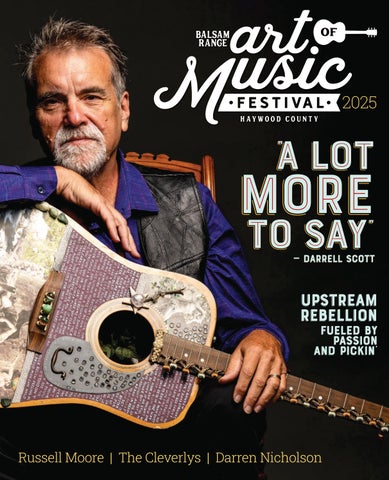
“I have a lot more to say. I have a lot more music to put out and for some reason I’ve got the energy. It seems like I’ve got the green light on all of that.”
— Darrell Scott

period of my life. I can’t even think of anything that comes close and, very specifically, to it also being me putting out my own records. I’ve never done so much for myself than what I’m doing right now.
Do you think that was the inevitable, as in that’s just how things roll out?
It is that. And the other thing, it’s like Sherlock Holmes, where he was about the “science of deduction.” So, I deduced the things I don’t want to do. I get them out of the way and then all that’s left is the stuff I want to do. And right now, it’s about working on my own stuff and not really kind of watering it down by playing with other folks or being in their bands or being a studio musician in Nashville. Putting out a working on my own music — it’s really detoxifying.
And there has to be intrinsic value with that.
There is. And I think that’s where this energy of working harder on this stuff than I ever have is coming from.
It’s because I don’t really have the other stuff to be working on. I mean, it’s not that I’m sitting around, but I have to do away with the things I’m not going to spend my time on. And that leaves me with the things that I’m going to monkey with.
What does that also reveal to you as your purpose as not only a musician, but an artist, in general?
Well, I would say it’s about time on one level, and then on the other hand, you could say, “Why didn’t I do this when I was 20 or 30?” [Back then], I always sort of had four or five irons in the fire — a session life, a songwriting life or road life, a family life. I get to work on what I want to work on. Something has basically given me full permission to just do this and, silently, I’m listening.
What is the role of the songwriter in the 21st century in the digital age?
I think it moves around. I think for some it’s to have hits. For others, it’s to talk and comment about what’s going
on in our world — the social, the political, the environmental, the emotional side of humanity. So, the good news is it’s a bunch of things, there’s no one thing that it is. Some people will be chasing the hits and others will be trying to write about their mother that they lost when they were six years old. Of course, my leaning is toward the latter. They’re writing about something that means something to you. That’s a very important expression to make. I’m way more interested in the expression than the hit climbing style.
It’s about making a connection about the human condition with another human being.
Yeah. And that’d be great. I mean, sometimes hits do that, too. But, it’s about the intention. I don’t think there’s one answer to it, but I’m really trying to answer that as to what I want to say and do as a songwriter — a maker of albums and makers of shows, of travel and all that stuff. It’s becoming more personal to me. It always was, but now I’m not confused at all about that.

Hailing from the backwoods of the Ozark Mountains in Arkansas, The Cleverlys combine vaudeville-style comedy and pickin’-ngrinnin’ bluegrass.
“The New York Times described us as, ‘if Earl Scruggs, Dolly Parton, and Spinal Tap spawned a litter of puppies, it would be the Cleverlys,’” Paul Harris chuckled. “We do a lot of comedy. There’s a lot of satire. The musicianship is incredible. We all play characters.” Harris, aka “Digger Cleverly,” fronts the wildly popular group, who, in recent years is rapidly rising on the national
scene. It isn’t necessarily that the act is doing something new, rather it’s reviving a long lost, and vital, part of bluegrass and traditional country music — comedy.
As far back as those beloved genres go, comedy was always in the mix. Those early radio broadcasts would include some sort of comedy and/or storytelling component to the performances. And take into account the vast influence that “high, lonesome sound” had on the world — and future musicians — through television programs like “Hee Haw,” “The Beverly Hillbillies”
and “The Andy Griffith Show.”
“Even the Grand Ole Opry used to have a comedic element to it. That’s the stuff that always got me into music, was the act and the theatre around it. The different characters, the country comedy and the storytelling,” Harris said. “That’s part of our heritage, that country Southern heritage, it’s all about making fun, making fun of yourself, making fun of your partners, kidding and ribbing people — it’s a form of endearment.”
Growing up, Harris was continually fascinated by simply being backstage and listening to others tell tall tales,
joke around or recite some of the rich, vibrant history behind the melodies being played.
“As a young musician and entertainer, when I was exposed to these national players I looked up to, I would just sit and blend in, and listen to Mike Snider and different people tell stories. I could listen to them all day,” Harris said. “That’s the element my character, Digger Cleverly, brings to the stage. Sometimes I’m channeling Dr. Ralph Stanley when I’m up there. Sometimes I’m channeling Del McCoury and the inflections in his voice. Those are the people I’m trying to think about and be inspired by when I’m doing that.”
“I grew up in a bluegrass community and I got to see all these stereotypes when I was growing up,” Harris said. “So, I thought it’d be funny to play on those stereotypes, the clichés of bluegrass music and bluegrass musicians. And add comedy, and also the irony of us doing these crazy songs.”
But, above all, even in the halls of satire, Harris takes what he does seriously, which is a trait crucial to success in comedy, and in music. It’s about respecting the two art forms, and being able to marry them in such a unique and intriguing way, something completely their own.
“It’s all about showmanship,” Harris


Harris and the rest of The Cleverlys base their characters from real people in each of their lives, where the essence of those folks really shines through in the moment of live performance in front of an utterly captivated audience.
said. “A lot of people hear with their eyes. If there’s not something interesting going on, then they miss some brilliant music because they’re not sucked into the visual aspect of what’s going on.”


In what will amount to an early Christmas present for bluegrass pickers and music lovers across Western North Carolina and beyond, there’s a brand-new album from the late Carroll Best.
“What he did with the banjo was above and beyond,” said French Kirkpatrick, a Haywood County musician, who was part of The White Oak String Band with Best. “He was, probably without a doubt, the most creative banjo player I was ever in a room with.”
Aptly titled, “The Best of Best,” these never before released recordings were compiled by Dr. Ted Olson, professor of Appalachian studies at East Tennessee State University in Johnson City. The Grammy-nominated educator and musicologist is well-known for scour-
ing archives at ETSU and the Library of Congress, ultimately bringing to light numerous recordings of legendary Southern Appalachian musicians and groups. Best is the latest project.
Regarded as one of the finest banjo players to ever pick up the instrument, Best, a Haywood County native, was known for his signature “fiddle style,” which was a melodic, syncopated three-finger stroke he evolved and perfected. That specific style of playing allowed Best the capability to perform a wide-array of songs by following fiddle tunes note for note.
“Carroll was a gifted, regional banjo player who influenced national musicians. He was among the first, if not the very first banjo player to move three-finger hillbilly ‘pickin’ toward
jazz and melodic melodies requiring a sophisticated ear and independent dexterity given only to few,” said Marc Pruett, Grammy Award-winning banjoist of Balsam Range. “He farmed, he worked in the local mill for years, and to those of us lucky enough to have known him, he freely shared his music.”
Throughout his life, Best played all around the Southern Appalachia region, winning banjos competitions, ultimately establishing his reputation as one of the finest pickers in the industry. Sadly, on May 8, 1995, Best was murdered by his brother, Sam. Though his life extended 64 years, Carroll’s influence will seemingly live on forever in the hearts of those who continually discover and rediscover his deep catalog of material.
“Carroll Best was the ‘best,’” the late Steve Sutton, the Grammy-nominated banjoist of Whitewater Bluegrass Company, told The Smoky Mountain News in 2014. “We played together under a tree at Merlefest the evening before his death. It was tragic and such a loss in so many ways. [He made] the most beautiful sounds to ever come from a banjo. He showed me just how versatile the instrument could be — he was a one-of-a-kind.”
How did this project come about?
Ted Olson: I first learned about Carroll Best maybe 35 years ago when his band performed at the Smoky Mountain Folk Festival at Lake Junaluska’s Stuart Auditorium. I was also a performer at the festival that year and I was moved by Carroll’s music. What struck me most was that his band looked like a bluegrass group, but sounded like an old-time band.
A major reason was Carroll’s virtuosic “fiddle-style” banjo, which emphasized the melodies of tunes. Much bluegrass music was driven by the lightning-fast rolls of Scruggs-style banjo, essentially arpeggios of chord formations, but Carroll’s approach to playing the banjo, structured around a tune’s melody line, was simultaneously colorful and gentle.
At about this same time, I became aware of other, younger musicians who played an alternative, more melodic style of bluegrass banjo than that modeled by Scruggs. I began to wonder if there might have been a connection between Carroll’s “fiddle-style” and the approaches of the younger banjo players, whose style was often referred to as melodic three-finger banjo.
Later, as a professor at ETSU, I became interested in exploring the oral histories and music recordings made by linguist Joseph Hall in the Great Smoky Mountains. Beginning in the 1930s, Hall made recordings of people in the process of leaving their homes and farms in the Smokies to create the park, and he continued to return to the Smokies to document the life of those same people as they adjusted to life outside the park.
On one of those collecting trips in 1956, Hall recorded a group of friends who were making music together in Hay-
wood County’s White Oak community, and the banjo player in that group was Carroll Best. Hall made more recordings in that same community in 1959.
Hearing those recordings from the 1950s and comparing them to what Carroll had played at the Smoky Mountain Folk Festival, it was obvious that Carroll’s banjo technique was fully formed in the 1950s. This was before anyone else was playing melodic three-finger banjo style. It was obvious that Carroll played a role in pioneering the style.

What about Best and his music really speaks to you, so much so you felt the need to put this project together?
When I first heard Carroll at that festival, I was impressed with his virtuosity on the banjo, and I wanted to hear more. Somewhere I heard that he had made an album with his band in the early 1980s, but I couldn’t find a copy of the album. It had been released on the tiny Western North Carolina label [called] Skyline Records.
One other album by Carroll, on the Ivy Creek label, was released during his lifetime, but that one was likewise difficult to locate. A posthumous album arrived in 1999 from Copper Creek Records, but this influential musician has remained overlooked 30 years after his untimely death in 1995.
The new album from Patuxent Music, “The Best of Best,” is an effort to introduce Carroll’s music, highlights from the
recordings he had made, to a new generation of old-time and bluegrass fans. My sense is that many people will be grateful to know about Carroll’s music and his life story. His life may have ended tragically, but he lived his life humbly and heroically. And he was always a proud citizen of Haywood County.
When you look at and analyze Best’s technique and style on the banjo, what are you noticing, hearing, and taking away from what made him so unique with his instrument and approach?
As I studied his life and music, and as I interviewed people close to him, such as his wife Louise as well as his former bandmate French Kirkpatrick, I concluded that Carroll had inspired the people who were generally credited with popularizing the melodic three-finger banjo style, Bobby Thompson and Bill Keith.
My liner notes for “The Best of Best” attempt to tell the story of how this farmer/laborer/amateur musician in Haywood County mastered a style of banjo playing that later became associated with better-known musicians. I hope this new album will establish Best not only as a pioneer of the melodic three-finger banjo style, but also as a significant figure in old-time and bluegrass music.”
With all of your research and interest in Best, what have you ultimately come to realize is his legacy? Where does he stand in the banjo world?
Contemporary banjo great Tony Trischka referred to Carroll as “one of the greatest banjoists who ever lived.” Certainly, Carroll’s “fiddle-style” banjo playing was one-of-a-kind, and surely those who were fortunate enough to hear him play live were impressed by his technique. But, because he did not tour and because his recordings were difficult to find, Carroll’s music was not widely heard during his lifetime.
Now, with the release of this new album, younger banjo players — really, anyone who appreciates a virtuosic musician — can appreciate Carroll’s achievement.

Earlier this year at MerleFest, the nation’s premier Americana/ bluegrass festival in Wilkesboro, an emerging act from our backyard, Upstream Rebellion, not only made its debut at the gathering as part of the band competition, the members also walked away immensely inspired.
“The feeling of playing there was fulfilling,” said guitarist Adam Winebarger. “The band competition was really just an excuse for us to come to the place where those who have inspired us spent plenty of time playing music.”
And although the group didn’t win the competition, what does remain is this fresh, hungry act eager to make its mark on the storied acoustic scene here
in Western North Carolina and greater Southern Appalachia.
“There are countless distractions to get caught up in nowadays, but perhaps the healthiest one to lose yourself in is music,” said guitarist Andrew Bivens.
The band looks at its job onstage as one where the listener and audience at-large get to escape the hustle and bustle of daily life, only to immerse themselves in the soothing sounds of live music.
“We as a band want to serve as a beneficial distraction to all our listeners,” Bivens said. “I hope that every time one of our songs come on, it brightens someone’s day.”
Upstream Rebellion is comprised
entirely of musicians from WNC. Alongside Winebarger (Trap Hill) and Bivens (Rutherfordton), the ensemble includes banjoist Max Rogers (Waynesville), dobroist Cooper Franklin (Canton), mandolinist Walker Ballance (Waynesville) and bass fiddler Jared Wills (Murphy).
“I think our biggest goal as a band is to show people that bluegrass can be more than what it seems on the surface,” Bivens said.
Formed while students at Western Carolina University in Cullowhee, Upstream Rebellion came together by happenstance. Although Rogers, Ballance and Franklin knew one another from growing up in Haywood County,
they crossed paths with the others through impromptu jam sessions in the dorms.
“After many noise complaints and common room jams later, we stumbled into more pickers on campus,” Ballanace said. “We knew something special was being formed when Adam, Andrew and Jared started joining the jams.”
To note, Rogers was initially not a fan of bluegrass as a kid. But, that sentiment quickly shifted when his grandfather handed him a banjo at age 15. The elder told the teenager to try to learn the instrument.
“I was pretty stubborn, so I set out to prove I couldn’t play it,” Rogers said. “But, within a few days, something clicked. It felt natural, like the banjo had been waiting for me. That’s when everything changed. I fell in love with the instrument first, then the music.”
The banjo became a way to creatively express himself. Between the rhythm, melody and “this raw character in the tone,” the music spoke to the aspiring musician.
“I’ve learned a lot from players like Jim Mills, Ron Block, Ron Stewart and J.D. Crowe,” Rogers said. “They showed me how deep the banjo can go. Not just technically, but emotionally, too. They’ve set the standard for me, and their playing still shapes the way I approach every note.”
The name of the group comes partly from a can of chewing tobacco. Although already kicking around the idea of having the word “rebellion” somewhere in the moniker, the final piece of the puzzle came when Ballance was reading the label on a can of Kodiak.
“The phrase [on the can] said, ‘Discovery Lies Upstream,’” Balance said.
So, just what is it about the “high, lonesome sound” that continues to captive these young musicians in search of their musical identity?
“The thing that makes bluegrass so special is its authenticity,” Bivens said. “From its lyrics, harmonies and roots to the physical challenge of playing it — it’s all real and people enjoy that down to earth sound.”
As of late, the band has been growing leaps and bounds, from casual jamming

to consistent performances around the area. They’ve also added a contemporary element by doing bluegrass renditions of modern songs, including Adele’s “Set Fire to the Rain” and “Use Somebody” by Kings of Leon.
“Upstream Rebellion ultimately plans
to continue to grow as a band,” Winebarger said. “Most importantly, we each plan to grow as musicians considering the passion and backgrounds that each one of us comes from.”
“The thing that makes bluegrass so special is its authenticity. From its lyrics, harmonies and roots to the physical challenge of playing it — it’s all real and people enjoy that down to earth sound.”
— Andrew Bivens
Recently, Upstream Rebellion raised more than a few eyebrows when the sextet opened for Woody Platt & The Bluegrass Gentlemen during “An Evening Under the Arch” in downtown Waynesville. Platt is the Grammy-winning former front man for the Steep Canyon Rangers, with his solo outfit now featuring Buddy Melton, formerly of acclaimed bluegrass band Balsam Range.
“Making more bluegrass lovers is something that drives us, and I think we’re accomplishing that,” Bivens said. “[And] while also, hopefully, paying our respects to the people who started the genre and defined its core.”
“At the end of the day, whether it’s live onstage or through someone’s phone screen, it’s about making honest music that connects,” Rogers added. “That connection is what keeps us moving forward.”