7 A&E 4 CENTERSPREAD 8-9 SPORTS 10 CENTERSPREAD 7 47 CENTERSPREAD 8-9 A&E 8-9 SPORTS 10 A&E 13 14 SPORTS black panther: DHTH: National novel Spring black panther: wakanda forever DHTH: National novel makeDear scented candles Spring Diary: 2026-27month New Studio Ghibli Fest sports recap wakanda forever writing make scented candles Fall Sports Preview movie review sports recap writing month Senior Backpack Faculty 2026movie at Cinemark review
FEATURE FEATURE FEATURE
THE THE
VOL. 59, NO. 6 VOL. 62, 59, NO. 1 6
SMOKE S IGNAL MOKE IGNAL MISSION SAN JOSE HIGH SCHOOL 41717 PALM AVENUE, FREMONT, CA 94539 MISSION SAN JOSE HIGH SCHOOL
March 22, 2024 September March11, 22,2026 2024
41717 PALM AVENUE, FREMONT, CA 94539
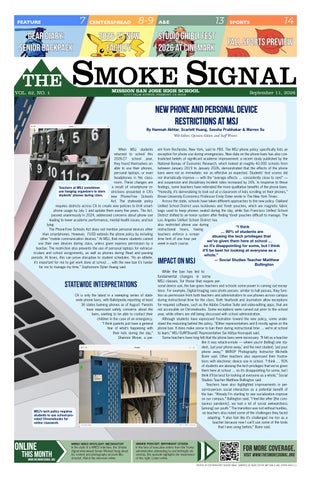
new phone and personal device restrictions at msj By Hamnah Akhtar, Scarlett Huang, Saesha Prabhakar & Warren Su Web Editor, Opinion Editor, and Staff Writers When MSJ students returned to school this 2026-27 school year, they found themselves unable to use their phones, personal laptops, or even headphones in the classroom. These changes are a result of smartphone reTeachers at MSJ sometimes use hanging organizers to store strictions presented in CA’s students’ phones during class. new Phone-Free Schools Act. The statewide policy requires districts across CA to create new policies to limit smartphone usage by July 1 and update them every five years. The Act, passed unanimously in 2024, addressed concerns about phone use leading to lower academic performance, mental health issues, and bullying. The Phone-Free Schools Act does not mention personal devices other than smartphones. However, FUSD extends the phone policy by including other “mobile communication devices.” At MSJ, that means students cannot use their own devices during class, unless given express permission by a teacher. The restriction also prevents the use of personal laptops for extracurriculars and school assignments, as well as phones during Read and passing periods. At times, this can prove disruptive to student schedules. “As an athlete, it’s important for me to get work done at school … with the new ban it’s harder for me to manage my time,” Sophomore Dylan Huang said.
Statewide Interpretations CA is only the latest in a sweeping series of statewide phone bans, with Ballotpedia reporting at least 36 states banning phones as of August. Parents have expressed safety concerns about the bans, wanting to be able to contact their children in the case of an emergency. “I think parents just have a general fear of what’s happening with their kids during the day,” Shannon Moser, a par-
MSJ’s tech policy requires students to use school-provided Chromebooks for online classwork.
ONLINE ONLINE THIS MONTH
THIS MONTH
www.thesmokesignal.org www.thesmokesignal.org
WIRED VIDEOSCENTED SPOTLIGHT: MICSHOOTSIT DHTH MAKE CANDLES
In themonth, style offour a WIRED interview, the Smoke This Smokies compete to creDHTH MAKE CANDLES Signal interviewed Senior Michael Hung about ate their ownSCENTED scented candles from scratch. Check out the Smoke Signal’s full video his and photography account MicThiscontent month, four Smokies compete to covcreerage online. ate their Watch own scented candles from scratch. shootsit. the interview online. Check out the Smoke Signal’s full video coverage online.
ent from Rochester, New York, said to PBS. The MSJ phone policy specifically lists an exception for phone use during emergencies. New data on the phone bans has also contradicted beliefs of significant academic improvement: a recent study published by the National Bureau of Economic Research, which looked at roughly 40,000 schools from between January 2019 to January 2026, demonstrated that the effects of the phone bans were not as immediate, nor as effective as expected. Students’ test scores did not dramatically improve — with the “average effects … consistently close to zero” — and suspension and disciplinary incident rates increased by 16%. In response to these findings, some teachers have reiterated the more qualitative benefits of the phone bans. “Honestly, it’s demoralizing to look out at a classroom of kids scrolling on their phones,” Brown University Economics Professor Emily Oster wrote in The New York Times. Across the state, schools have taken different approaches to the new policy. Oakland Unified School District uses lockboxes and Yondr pouches, which are magnetic fabric bags used to keep phones sealed during the day, while San Francisco Unified School District shifted to an honor system after finding Yondr pouches difficult to manage. The Los Angeles Unified School District has also restricted phone use during “I think instructional hours, having … 90% of students are teachers enforce a screen abusing the tech privileges that time limit of one hour per we’ve given them here at school … week in each course.
Impact on MSJ
so it’s disappointing for some, but I think it’ll be best for looking at everyone as a whole.” — Social Studies Teacher Matthew Bullington
While the ban has led to fundamental changes in some MSJ classes, for those that require personal device use, the ban gives teachers and schools some power in carving out exceptions. For example, Digital Imaging uses photo passes: similar to hall passes, they function as permission from both teachers and administrators to use phones across campus during instructional time for the class. Both Yearbook and Journalism allow exceptions for required software, such as the Adobe Creative Suite and video-editing apps, that are not accessible on Chromebooks. Some exceptions were carved out prior to the school year, while others are still being discussed with school administration. Although students have expressed frustration toward the new policy, some understand the reasoning behind the policy. “[Other representatives and I] mostly agree on the phone ban. It does make sense to ban them during instructional time … we’re at school to learn,” MSJ SURFBoardE Representative Sai Aditya Koorapati said. Some teachers have long felt that the phone bans were necessary. “It felt as a teacher like it was whack-a-mole — where you’re [telling] one student, ‘put your phone away,’ and the next student, ‘put your phone away,’” MVROP Photography Instructor Michelle Boire said. Other teachers also expressed their frustrations with electronic device use in school. “I think … 90% of students are abusing the tech privileges that we’ve given them here at school … so it’s disappointing for some, but I think it’ll be best for looking at everyone as a whole,” Social Studies Teacher Matthew Bullington said Teachers have also highlighted improvements in person-to-person social interaction as a potential benefit of the ban. “Already I’m starting to see socialization improve on our campus,” Bullington said. “I feel like after [the coronavirus pandemic], we had a lot of social awkwardness [among] our youth.” The transition was not without hurdles, as teachers also noted some of the challenges they faced adapting. “I also feel like it’s challenged me too as a teacher because now I can’t use some of the tools that I was using before,” Boire said.
SMOKIE PODCAST: GIRLS GOLF NCS BIRTHRIGHT CITIZEN-
In face of31, executive orders Onthe October MSJ Girls Golffrom won the the Trump NCS GIRLSGolf GOLFDivision NCS administration attempting to end birthright citiGirls’ 1 Championship for the first time this in 10 years. Find more about the zenship, episode the On October 31, MSJ highlights Girlsout Golf wonimportance the NCS team’s performance online. Girls’ 1 Championship for the of this Golf right.Division Listen online. first time in 10 years. Find out more about the team’s performance online.
FOR MORE COVERAGE, VISIT www.THESMOKESIGNAL.ORG FOR MORE COVERAGE, VISIT www.THESMOKESIGNAL.ORG
PHOTOS BY EDITOR-IN-CHIEF EKASHA SIKKA. GRAPHICS BY NEWS EDITOR AMY HAN & A&E EDITOR KAYLA LI.
2 News
WWW.THESMOKESIGNAL.ORG
The Smoke Signal
Friday, September 11, 2026
MSJ prepares for major campus renovations starting spring 2027 By Jessica Cao, Veer Mahajan & Matthew Zhang Feature Editor, Sports Editor, and Staff Writer Compiled by Jessica Cao, Ariel Duong & Matthew Zhang Staff Writers
In Phase 1 of the renovations, the Palm Avenue horseshoe will be replaced by a wider parking loop and a new building with a parking lot.
LOCAL Courtesy Senior Alisha Arora
Members of Universal Performers posing for a photo after winning a gold medal at LENAEA.
Universal Performers’ original play wins gold at local film festival Senior Alisha Arora’s original play script “The Removal” wins Gold at LENAEA, an annual high school theater festival and competition hosted in Sacramento. As a member of Universal Performers, she and five other students from the organization came together to put on the play, innovating locations to rehearse because of the limited funding toward the arts and drama departments to have a specifically allocated rehearsal space. The production process was a combined effort from the club’s members; Arora co-directed the play with Tommy Baria, a rising senior and member of Universal Performers. The play itself took bronze for its performance, but Arora took gold for the play’s script. Universal Performers, which has faced challenges surrounding advisor support in the past, continues to be a primarily student-run organization on campus. ▪
NATIONAL
Nine years after the installation of MSJ’s $8.1 million swimming pool, FUSD requested plans for a major reconstruction project at MSJ this past June, including the construction of a new 70,000-square-foot, two-story administration and classroom building with $5055 million in investment. The project also involves demolishing, replacing, and renovating buildings throughout the school. MSJ’s campus has undergone several expansions and renovations over time. Originally built for about 1,600 to 1,800 students, the school has been gradually adding new facilities — including the A-wing and the second story of the P-wing — throughout the years. The upcoming renovations will focus mainly on modernizing the M and N-wings of the campus. The aging of campus facilities have resulted in some infrastructural issues around the school. “These buildings are from the 1960s. They are really old, and they
Supreme Court allows $400 million White House ballroom project to proceed The U.S. Supreme Court on Monday, Aug. 31, allowed construction to continue on President Donald Trump’s proposed $400 million White House ballroom while legal challenges move forward. The court ruled 5 to 4, with Chief Justice John Roberts joining the court’s three liberal justices in dissent. The National Trust for Historic Preservation has challenged the project, arguing that the administration needed congressional approval to demolish the historic East Wing and begin construction. The Supreme Court did not rule on whether the project is ultimately legal, meaning the legal battle will continue in lower courts even as construction proceeds. The White House ballroom is one of several construction projects initiated by the Trump administration; their legality is still uncertain. ▪
INTERNATIONAL US Navy under Public Domain
Tensions near the Strait of Hormuz have accelerated after US strikes on Iran resumed on August 31.
Iran vows to neutralize economic war and issues fresh Strait of Hormuz warning On Saturday, Mohsen Rezaee, the head of Iran’s Supreme National Security Council, said countries that participate in US sanctions would be considered enemies of Iran. He warned that Iran will target the countries that refused to distance themselves from the US. The US says the pressure is intended to force Iran to end its nuclear program and reopen the Strait of Hormuz for international shipping. Egypt is attempting to restart negotiations between Iran and the US, with discussions focusing on the June agreement of understanding and resolving fights over the Strait of Hormuz. Iran has allowed some Iraqi oil tankers to pass through the strait after repeated requests from Baghdad. The renewed conflict traces back to Israeli-US strikes on Iran on February 28, and the lapsing of a US-Iran memorandum of understanding in August. ▪
istrar’s office. Everything’s [going to] be pretty much in one location,” Perez said. The district has still been working with the project’s architect primarily on the building’s logistics, determining how many classrooms are needed, what each space will be used for, and where all offices and bathrooms will be located. For a campus that has remained recognizable for generations of students, the next few years mark the beginning of a newer MSJ — one that retains its bell tower and other familiar landmarks while upgrading the infrastructure surrounding them.
need renovation for sure,” Mathematics Teacher Ümit Şahin said. The reconstruction project is receiving funding through Measure M, a $919 million general obligation school bond. Fremont voters approved the measure by 64.3% on Nov. 5, 2024, and it will eventually affect nearly every part of the campus. The first major phase will begin in the spring of 2027 with renovations to the dirt track and the rest of the athletic field. Unlike the current dirt-and-grass track, students can look forward to the new track featuring a level turf field, The renovation plans include replacing the bookroom and its surrounding buildings a modern synthetic-rubber track, with a parking lot. and fencing. Construction will demolished in summer 2027 af- Still, students can rest assured be completed by the start of the ter classes currently in the wing that construction is not expected 2028-29 school year, although are gradually relocated. The dis- to disrupt their education. “We’re administrators caution that trict has many plans so far, in- going to make it work. As far as construction timelines are often cluding the aforementioned $50- school goes, it’s not going to afdifficult to predict and could be 55 million L-shaped building to fect [students]. [They] are still extended further. The athletic consolidate much of the school’s going to have six classes. The bell construction will also affect the academic and administrative schedule is still going to be the staff and student parking lot, function. “Almost all of the class- same. Nothing’s going to change which construction crews will use es will be there, including all the [in terms of students] getting as a staging and equipment area. science labs, special education, their education,” Assistant PrinWhile MSJ will remain an our wellness center, and our reg- cipal Jeana Nightengale said. ▪
Staff ColumnS
Wikimedia Commons under CC BY-SA2.0
A 5 to 4 ruling by the Supreme Court allowed construction of the White House ballroom to continue.
open-campus school, administrators are considering adding fencing around open areas on campus to improve security and protect the school from vandalism and theft. The intent is not to completely close the campus, but to make it more difficult for unauthorized people to enter while preserving students’ ability to leave campus during lunch. “Our campus is very open. It’s more aesthetic … but [currently] it’s not the safest because people could just walk onto campus whenever they want,” Principal Amy Perez said. The existing N-wing will be
This is what K-pop taught me about parasocialism By Jessica Cao Centerspread Editor At the age of twelve, I solemnly vowed that I would never become a K-pop stan. The shallowness and artificiality of the industry repulsed me, and I was even more put-off by what I saw as the irrationally obsessive behavior of its fans. I probably thought, at some point, that never in a hundred years would someone catch me fangirling over an idol. Ironically, that vow lasted less than a year. I spent an innocent summer afternoon watching Stray Kids music videos, and quickly fell down the rabbit hole — learning members’ names, watching interviews, and listening to their music on repeat. For the next two-and-a-half years, I was hopelessly captivated by eight Korean boys. The visual appeal is what initially draws many people into idol culture: choreography, fashion, polished performances and perfect faces. But what makes people stay is an illusion of intimacy that hypnotizes them and exploits their emotions. Once you become invested in an idol or group, the industry gives you endless reasons to become even more obsessed. You can stream their music, view all their videos, subscribe to receive personal-sounding messages, buy albums and merchandise, attend fan meetings, and watch hours of behind-the-scenes footage. Every new piece of content is specially designed to make fans feel just a little bit closer to idols who have no idea they exist.
And that is no natural thing. I remember the strange feeling of joining an idol’s social media livestream and instinctively feeling fondness and admiration — as though they were talking directly to me. I knew, rationally, that their words were being
Cao amassed a large photo collection.
played to thousands of fans at once, but the distinction was surprisingly easy to forget. However one-sided the relationship was, it felt far different then. K-pop has built an extraordinarily effective business model around parasocial relationships. The industry doesn’t just sell music; it sells false intimacy. It creates an environment where friendship and romantic relationships can be simulated and then repeatedly monetized, destroying real-life interpersonal relationships at the same time, especially in younger
fans. Why pursue an awkward, complicated relationship with a person in your life when your favorite idol seems perfect? They are attractive, appealing, funny, endlessly attentive to their fans and, conveniently, incapable of actually disagreeing with you. You can construct an idealized version of them who is “perfect” for you that no real person could possibly compare to. Yet, every time I screamed over a performance video, the excitement was real. When I felt as if the trajectory of my entire life was changed after going to a concert, that feeling was real. Spending months mourning the end of a concert because nothing could match the high of seeing the “love of my life” in person was real, too. But how much of that emotional attachment would exist without an industry specifically designed to cultivate it? What my twelve-year-old self did not understand was that parasocialism was not “fake.” In fact, the system was designed to amplify genuine emotions and see how much fans were willing to pay for their feelings. The community surrounding K-pop is perfect evidence that the industry cultivates obsessive fan culture. A fandom can be an incredible place to meet people, but it can also become an exhausting ecosystem of fan wars and an echo-chamber for endless hate. Most of the time, people aren’t just discussing music; a fan who
opens TikTok, or Instagram looking for updates can just as easily end up watching people dissect an idol’s appearance, criticize their personality, compare their talent, or turn the smallest of mistakes into a scandal. Eventually, the videos blend together and start sounding like a series of negative product reviews. Capitalism has always been good at finding ways to monetize human desire, but parasocialism takes it a step further: it monetizes our desire to be known, loved, and connected. It takes something fundamentally human — our capacity to form emotional bonds — and turns it into a revenue stream. When you subscribe to parasocialism in any way, you are subscribing to a business model that profits from making you feel close to someone. Your emotions aren’t necessarily fake, but the circumstances that produce and encourage them have been carefully and insidiously manufactured. This summer, I sold my photocard collection and watched my favorite groups fade from my Spotify playlists, officially closing the chapter of my K-pop obsession. Looking at the stack of cards I had once treasured, the strangeness of it suddenly became apparent — I had poured so much money and emotion into tiny pieces of paper bearing the faces of people I had never met. I don’t regret having been a fan. This period of my life has taught me numerous things about myself and brought me joy, but it did confirm the shallowness and artificiality of K-pop from my initial assessment. So, let me revamp my vow: I will never engage in parasocialism again. ▪ PHOTOS BY CENTERSPREAD EDITOR JESSICA CAO
Friday, September 11, 2026
The Smoke Signal
Putting UC to the
TEST.
WWW.THESMOKESIGNAL.ORG
sought to expand — may arrive with substantial preparation gaps that only become visible after enrollment. UC can’t pretend that two students who received radically different educations arrive on campus equally prepared. But it also can’t treat the consequences of that inequality as evidence that one student is inherently more deserving than another. Context should shape what a score tells an admissions officer, not render the score meaningless. Used this way, a common benchmark could help UC identify who needs additional support or different placement without becoming an admissions obstacle. The strongest case for testing, then, isn’t that the SAT can measure a student’s worth. It’s that a university responsible for educating that student needs some credible way to understand what they already know.
Against Testing
Declining student preparedness more directly reflects an unequal K-12 system than the efficacy of standardized tests in measuring college readiness. Decades of residential segregation and discriminatory housing policies have left many low-income Black and Latino students concentrated in schools with fewer resources, and school funding and attendance boundaries remain closely tied to the wealth of the communities they serve. These disparities translate into concrete differences in preparation: schools with high Black and Latino enrollment are less likely to offer advanced courses such as calculus and computer science, limiting students’ opportunities to build the very skills colleges later expect them to demonstrate. Reinstating a test cannot correct the unequal education that precedes it; by using scores to cherry-pick an incoming class that looks cleaner on paper, schools risk neglecting underprivileged candidates who lacked equal opportunities to demonstrate their potential numerically.
The standardized testing debate misses a deeper problem with student preparedness.
H
By Janet Guan, Kayla Li, Abigaile Lei, & Michael Qin Editor-in-Chief, A&E Editor, and Staff Writers
ow much can a single number tell you about an individual? In 2020, the University of California (UC) decided: not enough. Spurred by the logistical difficulties of administering the SAT/ACT during the coronavirus pandemic and mounting criticism of the tests as indicators of economic privilege rather than merit, the UC Board of Regents voted to abolish standardized testing from admissions criteria on May 21, 2020. UC adopted a testblind policy starting with the fall 2021 admissions cycle. Now, more than six years later, UC has circled back to the same question it confronted in 2020: what role, if any, should standardized tests play in admissions? Recent placement exam results have revealed concerning dips in first-year undergraduate preparedness. One 2025 report from UC San Diego found that the number of freshmen who scored below high school level math standards had increased nearly thirtyfold in an open letter released on June 5, UC STEM faculty described a “widening divergence in mathematical preparation levels within the same classroom” and having to teach middle school math to struggling students. More than 3,000 faculty members signed the letter, which further urged UC to reconsider standardized testing After initially announcing a broader admissions review in June, the UC Academic Senate formally charged its Board of Admissions and Relations with Schools in July with reviewing standardized testing, with recommendations due to the Board of Regents by June 2027.
“
UC shoUld restore the benChmark, not simply reinstate the old gatekeeper.”
UC’s reconsideration comes as elite universities increasingly retreat from pandemic-era test-optional policies, including all eight Ivy League schools, the Massachusetts Institute of Technology, and John Hopkins University. Students, however, continue to push back. The UC Student Association, which represents more than 237,000 students, argues that reinstating testing neglects underlying inequalities in the K-12 educational system and disadvantages applicants with fewer resources. Both positions identify a real problem, but neither fully addresses it. UC needs to establish a common, contextualized measure of academic readiness; whether the SAT/ACT deserve to serve that role is what its 2027 review should determine. Identifying a preparation gap should not automatically determine how UC responds to it. Some gaps may justify additional support or different placement, while others may make direct entry into certain programs unrealistic. The fairest system isn’t one that pretends every applicant starts equally; it is one that holds students to meaningful academic expectations while recognizing that they had unequal opportunities to reach them. UC should restore the benchmark, not simply reinstate the old gatekeeper.
Opinion 3
stUdents sCoring 700 or higher on 2020
sat math seCtion
DATA FROM WWW.BROOKINGS.EDU
Tutoring companies, academic counselors, and every other gear in the multibillion-dollar industry built around test preparation have transformed testing into a gameable system, with one caveat: players need to pay. According to The College Review, students can typically expect to pay between $50 and $200 per hour for private tutoring. For low-income students, this assistance is a luxury. The contrast is especially visible at MSJ, where the average household income is more than $200,000. Students are surrounded by test-prep centers, SAT courses, advanced math instruction, and college counseling; students trade practice tests, compare scores, and often begin preparing months before test day. Students also report that, while standardized tests rely on basic knowledge grounded in school curricula, excelling requires substantial effort beyond the classroom. “I do not think the school curriculum prepared me at all for [the SAT] because [the SAT is] structured [so that it’s] very focus[ed] on patterns that you have to notice, and schools don’t really teach you that,” MSJ Senior Ruby Luu said. “School absolutely did not prepare me for the English section … a majority of the second module math questions [were] things that I’ve never seen in school before,” Calmont High School Senior Aeron Gurskis said. Free preparation materials may reduce the financial barrier to testing, but they cannot create the hours needed to use them. Students who don’t have to worry about supporting their families financially or navigating instability can devote more time to practicing standardized test format and timing, advantages that are not particularly reflections of greater academic ability. As a result, high scores reflect not only what a student knows, but also how much time and support they had to learn how to take the test itself. “I think [the SAT is] not a good metric for anything but how well you can take the SAT,” Gurskis said.These inequalities are reflected clearly in standardized test scores. According to a paper written by Opportunity Insights, a Harvard University-affiliated nonprofit that researches disparities in economic opportunity, students with family incomes in the top 1% nationally are more than 50 times more likely to score a 1500 or higher on the SAT or a 34 or higher on the ACT than students with family incomes in the bottom 50%. Furthermore, these disparities disproportionately disadvantage Black and Latino students as opposed to their white and Asian counterparts. Research conducted by Brookings Institution, a public policy nonprofit, found that 43% and 45% of those who scored a 700 or higher on the 2020 SAT math section were Asian and white respectively, while 6% were Latino and 1% were Black. Giving the students already equipped to score well on standardized tests an advantage in college admissions only perpetuates these inequities.
For Testing The SAT/ACT cannot capture an applicant holistically, but a transcript also isn’t enough to indicate college readiness. CA students apply from thousands of high schools with different grading practices, course offerings, levels of rigor, and access to advanced classes, meaning identical GPAs can represent very different levels of preparation. A common assessment can’t erase differences in grading standards but can reveal information that transcripts alone obscure. In its 2020 review, UC’s own Standardized Testing Task Force found that SAT/ACT scores were better predictors of first-year UC GPA than high school GPA and roughly as useful at predicting longer term outcomes like retention and graduation. The task force ultimately recommended retaining testing while UC searched for a better replacement — not because a score represented a student’s entire potential, but because it could provide another point of comparison. Recent faculty concerns make that information harder to dismiss. Eliminating the SAT may not necessarily reduce college readiness, but removing a measurement doesn’t erase the preparation gap itself; it simply postpones when a university discovers it. This is where the debate often confuses readiness with merit. A student who attended an underfunded school with few advanced courses may be highly capable while entering UC, even with substantial gaps in preparation. But concealing those gaps with test-blind admission doesn’t necessarily benefit that student either. UC San Diego found that students from under-resourced high schools were disproportionately represented in its remedial math courses, raising the concern that low-income and educationally disadvantaged students — whose access and success the UC Board of Regents has explicitly
Conclusion Whether a student is capable of succeeding in college is far more complex than their ability to ace tests. The SAT/ACT cannot fully quantify a student’s academic merit or potential. A 1530 SAT says nothing by itself about a student’s experiences — the hours they may spend fulfilling family responsibilities, taking care of their community, participating diligently in the classroom — or character. Assuming otherwise only reinforces the barriers that education, as an opportunity, should bridge. UC is being asked to confront two truths: standardized tests reflect unequal educational opportunities, and those inequalities create real differences in academic preparation. An easy cure simply does not exist; removing the measurement doesn’t fix the gap and neither does reinstating it. The upcoming review in 2027 should resist treating the question as a referendum on whether the SAT/ ACT are “good” or “bad.” Rather, UC should determine whether SAT/ACT scores provide meaningful information about college readiness after accounting for high school grades, course rigor, and the rest of its holistic review. If the answer is yes, scores should return only as one contextualized measure of the application process, taking into complete account students’ circumstances and available resources, and not an automatic cutoff or universal ranking of merit. After all, attending university opens new doors for students of a huge variety of backgrounds. The real test for UC, then, isn’t whether it brings back the SAT, but whether it can measure readiness without mistaking advantage for merit. ▪ PHOTOS BY UNSPLASH, DEVIANTART UNDER CC BY-SA 2.0. GRAPHICS BY OPINION EDITOR ERIKA LIU
4 Opinion
The Smoke Signal
WWW.THESMOKESIGNAL.ORG
THE SMOKE SIGNAL Mission San Jose High School Est. 1964 Vol. 62, No. 1 September 11, 2026 www.thesmokesignal.org 41717 Palm Ave. Fremont, CA 94539 510-657-3600, ext. 37074 MISSION STATEMENT The Smoke Signal’s mission is to represent the voices of the MSJ community and serve the public by providing accurate, meaningful, and engaging information presented through print and digital media. SCHOOL POPULATION 1794 students EDITORS-IN-CHIEF Janet Guan, Ekasha Sikka NEWS Amy Han, Cham Yu OPINION Erika Liu, Warren Su FEATURE Ariel Duong, Aarva Vashisht CENTERSPREAD Jessica Cao, Ariana Yi A&E Kayla Li, Leland Yu SPORTS Veer Mahajan, Andy Zhang GRAPHICS Cecilia Cheng, Emily Zhang WEB Scarlett Huang, Finnegan McCarthy ADVERTISING/TECH Amber Halvorsen BUSINESS Saesha Prabhakar CIRCULATION Abigaile Lei, Joseph Miao EVENTS Felicity He STAFF MEMBERS Alice Hu, Amrita Gunasekaran, Ananya Rawlani, Anchal Verma, Audrey Tseng, Carol McCarthy, Gurleen Bangar, Hamnah Akhtar, Irene Lu, Julianna Kuo, Katherine Chen, Kaysten Ho, Kelly Shi, Leina Ikeda, Lucas Yao, Matteo Regala, Matthew Wang, Matthew Zhang, Michael Qin, Rebecca Dou, Renushree Mandala, Ruoxi Guo, Sabrina Zeng, Sandra Choi, Simin Hassan, Sophia Liao, Sreeja Madabhushi, Tanish Thunuguntla, Tharun Mahesh, Valentina Tsui, Yewon Kim, Zoey Wang ADVISER YC Low The Smoke Signal‘s name originated from traditional forms of long-distance communication and honors cultures around the world, including China, Greece, and Rome. To advertise in the Smoke Signal, please email ads@thesmokesignal.org. Advertising that is included on the pages of, or carried within, the Smoke Signal, is paid advertising, and as such is independent of the news and feature content. The Smoke Signal ’s right to freedom of speech and press is protected by the First Amendment of the US Constitution and California Education Code Section 48907. All policies on distribution, corrections, and bylines can be found at www.thesmokesignal.org/about. Send Letters to the Editor and Guest Essays at opinion@thesmokesignal.org.
Erika’s Epic
WarrEn’s Wisdom
47 seconds
Learning to live with yourself
By Erika Liu Opinion Editor
By Warren Su Opinion Editor
Unlike others in the skramz genre, which would, according to one archived Drowned in Sound blogpost, “literally sprint toward the finish line ... barely even considering structure or dynamics,” City of Caterpillar takes its time. It’s not uncommon for a single track from this band to last over 10 minutes. Oceanic rhythms may go on for minutes at a time, punctuated by frenetic scream-singing and apocalyptic finales. It’s a poignant effect, emergent in only something cumulative, something spanning the greater end of ten minutes. As Norwegian philosopher Guttorm Floistad once wrote, “If you want to hang on, you better speed up.” City of Caterpillar didn’t hang on and didn’t speed up and are, along with long songs in general, mostly phased out of the current industry. Songs under three minutes, one Washington Post article says, have exploded in popularity in recent years to make up a majority of top 100 hits. Albums today have swelled to an average of 15 songs per 30-minute release in the interest of maximizing streaming revenue. On the flip side, the number of top 100 songs over five minutes has shrunk to 0–1% on yearly charts. Slowing down is a sort of reprieve from the anxiety of taking part in a world whose pace is dictated by our own rapidly disintegrating attention spans.
People’s attention is a finite currency that companies want to exploit. This is especially so on social media, where a flashier headline, brighter image, or shorter song might trans-
late to money in the real world. In a modern world where we’re surrounded by a constant, seething static of new things to watch, experience, learn, and listen to, oftentimes, this “attention” that influencers, corporations, and algorithms vie for so viciously might be better described as a rapidly-worsening inattention. There is a reason as to why the average adult attention span has dropped from 30 minutes in the 1980s to 47 seconds today, why songs race with increasing desperation toward that 2-minute or even 1-minute mark, and why many long acts get selectively bred out of an increasingly cutthroat, metrics-driven industry. It’s not that short songs are bad. It’s just that they fit an increasingly narrow description of how you make art in an age defined by people’s attention and the profits you reap by exploiting people’s attention. Slowing down is a sort of reprieve from the anxiety of taking part in a world whose pace is dictated by our own rapidly disintegrating attention spans. Maybe City of Caterpillar stuck out to me because of its unmanufactured sincerity to that end. It was not created to hang on, keep up, or profit off of. It is slow and almost archaic in a way that is totally human. I’ll probably keep scrolling. I get bored. But I will still feel a sort of regret. Attention, outside of being a fungible asset, is a way of taking part in this world. We should try to set aside at least some of it, unfractured, for ourselves. ▪
The Opinion of the Smoke Signal Editorial Board Editorial
MSJ’s tech ban is a step too far
AB 3216—Gov. Gavin Newsom’s Phone-Free School Act—was first proposed in 2024 as a solution to the current rise in teen mental illness rates. Once passed, it required all CA public schools to adopt or implement individualized cell phone bans by July 1, 2026. The bizarre patchwork of district-to-district policies emerging from AB 3216 has been met with widespread backlash — from students frustrated by a perceived administrative overreach, to parents concerned over their children’s safety, to teachers bewildered by ad hoc regulations across districts. These widespread anxieties are not unfounded. Whether we like it or not, digital technology has become deeply enmeshed into our current education system, and total, blanket bans — like MSJ’s restriction of personal laptops and iPads on top of phones — can severely hinder productive work. Homework, textbooks, gradebooks, and almost every other aspect of education has been digitized in some way. Certain classes on campus — including AP Art, AP Computer Science A, Yearbook, Intro to C++, and the Smoke Signal itself — practically run on students’ freedom to use personal computers and devices during school hours. Administrative failures to account for these basic exceptions undermine the idea that this phone ban is supposed to be helpful to the interests of the student body. It’s a fundamental overreach that fails to recognize actual student needs. Other concerns have been raised surrounding school Chromebooks, the proposed alternative to personal technology. Aside from being ridic-
Friday, September 11, 2026
ulously slow, digital privacy groups like the Electronic Frontier Foundation have raised red flags about the possibility that they contain spyware. GoGuardian, a widely-used educational software, has repeatedly fallen under scrutiny for invading student privacy. The software has been accused of not only creating comprehensive profiles for students based on search history and location, but also needlessly flagging certain students as “dangerous” or “at risk” — alerts that can be sent to police. For a period, Chicago public schools were even able to view student homes through GoGuardian web cameras, according to the Chicago Sun Times. According to the Center of Democracy & Technology (CDT), there is also a distinctive difference between device-based monitoring and browser-based monitoring, with the former being particularly invasive as it operates directly through a device’s operating system, giving schools broader access to information and greater control over the device itself. While schools may argue that this monitoring is necessary to prevent device misuse or protect students, these technologies can create significant privacy risks, particularly when students who can’t afford their own devices take school issued devices home, blurring the line between a student’s school life and private life. How can administrators and policymakers claim to support digital wellness in light of that? Despite these obvious drawbacks, students and teachers alike have noticed some positives. Especially during Read, students appear more present and interactive with one another. People are engaging in more
face-to-face interaction unmediated by technology. The internet is an inherently lonely place. Prioritizing physical presence — as AB 3216 does — might truly be the solution to teen mental illness today. While there does indeed exist a significant body of studies pointing to the idea that limited tech usage is conducive to mental health, recent studies have yielded mixed results in schools. The first nationally representative look at phone bans was conducted by the CA startup Yondr, which produces lockable phone pouches. Yondr’s study was not only sobering, but contradictory to all popular belief — GPA, attendance, attention levels, bullying rates, and standardized test scores remained overall stable, with student well-being even dipping slightly immediately following the phone ban. Especially for seniors at MSJ, many of whom will be expected to live somewhat independently in less than a year from now, autonomy is important. When you strip students of choice when it comes to how they use technology, you assume a delayed maturity — maybe fine in middle schools, but difficult to work around with 18-year-old high schoolers. It is naive to pin the current state of teen mental health on phone usage. Technology addiction is harmful, but it is up to us as burgeoning members of society to develop good habits on our own. Schools should allow for more flexible policies that accommodate for interconnectedness of technology and education. You cannot frame tech as something taboo, then expect students to be fully digitally literate and independent by graduation. ▪
I didn’t have a smartphone last year. I didn’t have Instagram, Facebook, or TikTok, even now. From most students’ perspective, I lived underneath a rock. This was all my choice. I had chosen not to have a phone because I didn’t want to succumb to endless scrolling and addiction, something I saw all too common in my peers around me. It was only this year, when I traveled around the country, where I got one for safety. And, immediately, my fears were realized. I started to look at it more. Every time I had to wait for something, there was always the web. When my phone buzzed, I restlessly checked my emails. Every minor inconvenience no longer stayed inconvenient because of this small, magical box in my pocket that could solve all of my issues. I knew what it looked like as an external observer to be glued to a phone — I had never before felt what it was like on the other side. That’s not to say that I was perfect before — far from it. I would procrastinate by spending time watching YouTube, scrolling Reddit, and worrying while I did all of this. I became susceptible to the same dopamine traps that I saw in others. One solution to phone addiction comes in the form of phone bans, newly implemented across California schools. When we think about them, we often talk a lot about the phones themselves and less about what happens next. What happens when social media is replaced by nothingness? In my experience, it’s almost like a withdrawal: anxiety slowly sets in, stress builds up, and disaster strikes. We don’t know what to do when we aren’t
Graphic
OPINIONS
given this technology to numb us.. In the book Brave New World by Aldous Huxley, the characters consume a magical drug; it has no downsides and just creates a pure feeling of bliss. “All of the advantages of Christianity and alcohol,” Huxley writes, “[and] none of their defects.” What is this drug? Soma. Happiness. But fake, chemically engineered happiness. I am not the first to compare phones to soma. I am not going so far as to say that they fully are, or that social media is wholly bad. What I am saying is that we have created a drug — something that imprisons our brain and leaves us with little else to enjoy. Why do we choose to scroll? Because it’s easy. And, frankly, because we’re tired. Because we’re insecure. Because it takes too much energy to pick up a book and sit down to read it, and when we have that much energy we have the energy to do what we need to do. Because we’re afraid that we don’t know where to start. This is fine. I can say from experience that boredom is good. It makes you more creative, forces you to come up with new ways to entertain yourself, or it causes you to think, and think, and think. And that’s why we’re so afraid of it. But, boredom makes us find new ways of entertaining ourselves. I find that my best thoughts often come when I’m getting ready to sleep, or waiting for something, or walking outside — social media has shut off my ability to think during the day. Phone bans create this new world where we must sit with ourselves. It will be difficult to let go of our phones. But difficult is good. ▪
By Janet Guan & Cecilia Cheng Editor-in-Chief and Graphics Editor
GRAPHICS BY EDITOR-IN-CHIEF JANET GUAN
GRAPHICS BY GRAPHICS EDITOR CECILIA CHENG
Friday, September 11, 2026
The Smoke Signal
WWW.THESMOKESIGNAL.ORG
Opinion 5
Staff ColumnS Stet, or the art of leaving yourself alone
Between the Lines
By Kayla Li A&E Editor
By Abigaile Lei Staff Writer
Forever 21, and the city knows it. In the version of my life I return to most often, New York is already warm when I leave my apartment. Somebody is waiting downstairs, and somebody else is texting the address of a bar I’ve never been to. There are rooftops I remember from their lighting and cocktail menus filled with words I mispronounce confidently. 21 seems like a good age to remain. I would take 19, actually. 19 has a certain tragic glamour to it, forever balanced on the last year of being a teenager, if not for the irritating fact that I could not legally drink, which ruins the fantasy considerably. 21 it is. Maybe I am Anna Wintour in another life. In this one, I would at least like an internship at Milan Fashion Week, opinions about whatever is showing at Palais de Tokyo, Bemelmans on an otherwise undeserving Tuesday, friends who become inseparable from certain streets. But the same future also contains long stretches where I want everyone to leave me alone: a small apartment, freelance work open on my laptop, and whole afternoons with nowhere to be. The fantasy is greedy. It wants noise and privacy, a crowded table and the pleasure of going home from it. For a long time, I assumed these contradictions meant I had not imagined myself carefully enough. One version would eventually prove more authentic and absorb the others, leaving behind someone consistent enough to explain. Growing up, I assumed, was convergence. That expectation followed me into smaller things, too. A conversation ends and, hours later, one sentence comes back wrong. I replay the pause after it, the half-smile, where their eyes went when I was speaking. Why did I say that? By then the memory is
mostly fiction, but no matter. I continue drawing a police sketch from scraps. I know how ridiculous this is because I am fluent in the opposite advice. Nobody cares! Wear it. Send it. Ask. Go. People are thinking about themselves, not you. Then I go home and conduct the autopsy. I edit for the Smoke Signal, so perhaps I have acquired an editor’s pathology. Editing teaches you to be suspicious; a sentence is rarely innocent. A word can be cleaner. A sentence can be tighter. This paragraph would really be better up there. There is, thankfully, a mark for the opposite instinct — stet. From Latin: let it stand. An editor marks something for correction, then changes their mind and writes stet. Ignore me. Put it back. Four severe little letters, for what is essentially: actually, nevermind. Well, I am terrible at it. The problem is that an editor’s instinct has poor boundaries. Don’t seem too excited, don’t be the person who cares more, don’t talk about something long enough for people to understand how much you love it. Nobody gave me these instructions. I wrote the stylebook myself. It is a species of perfectionism less in-
Don’t seem too excited, don’t be the person who cares more, don’t talk about something long enough for people to understand how much you love it. Nobody gave me these instructions. I wrote the stylebook myself. terested in being perfect than in being legible. I would simply like to make sense. Unfortunately, modern life has a great appetite for summaries — intended major, MBTI, Spotify Wrapped. If Spotify can turn an entire year of listening into five artists and a pleasant little taxonomy,
surely I should be able to do something similar with myself. But I know what happens when you edit writing toward perfect coherence. First goes the strange sentence, then the sentimental one, god forbid you are anything other than nonchalant. Eventually, the paragraph becomes smooth, competent, and attributable to anyone. The same hand that removes the error can remove the pulse. The person I was at 12 loved things I no longer love and believed things I no longer believe. I used to think of her as a rough draft, full of awkward phrasing and structural issues, but, all things considered, showing promise. How condescending. A draft exists because a final version is expected, but she was not waiting to become me. Whatever she loved, she loved in the present tense. Maybe growing up is closer to accumulation: you do not arrive at one self so much as acquire a strange archive of them, each speaking, for a while, in present tense. Maybe I get the New York life. Maybe I discover that bars are mostly sticky tables and shouting over songs I dislike. Maybe at 25 I read this and find the whole fantasy impossibly young. That would not make it any less true. I have edited this while writing about editing myself. Some sentences disappeared because they were bad; others because they sounded too sincere. Eventually, though, a personal piece has to leave you. Somebody reads it without you hovering over their shoulder providing footnotes and clarification. Maybe they think something is embarrassing, maybe they misunderstand a sentence. More likely, they finish and move on. Nobody cares. Stet. ▪
It’s not difficult to see the love between my parents. It’s not electric or fiery, but it’s there. However, when I imagine love, I think about butterflies in the stomach and starry-eyed conversations. In the current day, with so many portrayals of couples online to model ourselves after, it’s easy to get mixed up in the different feelings and stages of love, and misinterpret it for something else. Observing my parents over the years proves a different story, and it took me a long time to realize that. They met at Berkeley, my mom studying CS and my dad pursuing electrical engineering. Their relationship is easy yet complex; my mom is moody and my dad is upbeat, she is quick to anger while he is cool-headed, she cooks and he cleans. Everything is understood between them, and they rarely fight, if ever, and never in front of me or my sister. I once asked my mom why she fell for my dad. She laughed at looked at him, telling me about how when they were young and dating, he used to arrange orange slices into flowers for her on the plate and make her curry after a long day. “He spoils me,” she said, grabbing his hand. As the years went by, I witnessed my parent’s relationship from different stages of my own life, from watching them eat dinner in elementary school to laughing together during family trips as a teen. As I grew older, I realized that their relationship is unique and mature, built less on grand gestures I see everywhere online and more on the
little moments, those that might be overlooked if not noticed immediately. When I grew into the age when I was ready to search for my own relationship, I was determined I knew where to look. But in a world where there is always something to look at, I wonder whether seeing so many relationships from an external lens has actually made it harder to understand what I want. In the digital age, social media introduces constant comparisons, promotes unrealistic expectations, and makes affection feel increasingly performative. I grew up surrounded by reels of elaborate dates, expensive gift portrayals on TV, and couples documenting every milestone they tackled together. For a long time, I measured love in gifts and material gain, and the more I watched my parents grow together, the more my understanding changed of what many mistake for love; sometimes, real love is not about how loudly you express it, but how consistently you show it. Somehow, amidst all the noise and business of the world, my parents still find little moments together. My dad never misses a chance to tell my mom he loves her, and she never fails to cook his favorite foods. When I asked my dad about what he believed love was, his answer was something I expected to hear but struggled to grasp. “Love is actually not a feeling; it’s a commitment,” my dad said. “It’s being there for someone and showing up when it means the most to them.” ▪
Flock surveillance system creates a risk for civil rights By Scarlett Huang, Veer Mahajan & Cham Yu Web Editor, Sports Editor & News Editor Like many cities nationwide, Fremont’s streets and intersections have become littered with license plate-reading traffic cameras in recent years. These cameras — provided by the company Flock Safety — are primarily used by local jurisdictions to track license plates and vehicle characteristics for law enforcement. Yet the system has been criticized for its large-scale surveillance capacity, generating online criticism from high profile platforms like the American Civil Liberties Union (ACLU) and bipartisan local pushback across the country. Flock uses AI — a technology prone to error — to track vehicles, which has resulted in faulty accusations and arrests. These systems are intended to decrease crime by providing a stream of detailed, easily searchable vehicle information to police officers. However, these raise ethical concerns regarding privacy, and while the system certainly carries efficiency improvements, local governments that implement Flock must grapple with its repercussions. Entrusting law enforcement with large-scale data collection decreases citizen confidence in police departments. The analysis with error-prone AI as a basis of arrest, made possible by Flock cameras, ultimately creates privacy risks that may violate citizens’ civil rights. Flock has emerged as a widespread tool not only in the Bay Area, but throughout the country — and abuse has proliferated as well. There are upwards of 100,000 Flock cameras across the 49 of the 50 US states. Fremont is no stranger to the trend. The city has been collaborating with the company at an ever-increasing rate; in late June to early July, Alameda County approved a $2.45 million investment into more Flock cameras and resources, including the software Nova, which allows for real-time data collection with the ability to record plate numbers, track movements, and create heat maps, all in addition to the more than 300 already present Flock cameras. However, Nova’s
centralization of data makes it easier for mali- used, both at an individual scale and a larger, cious actors to gain access to sensitive data, a organized level. Immigrants are not the only concern that has already materialized in police targets, either; the Electric Frontier Foundepartments around the country. dation found that in Texas and other states In San Francisco, a recent data breach oc- with anti-abortion laws, pregnant women atcurred when the Northern California Re- tempting to cross state lines for abortions were gional Intelligence Center accessed data from tracked by officers using Flock-provided data. San Francisco’s Flock system without full dis- In Johnson County, Texas, the sheriff ’s office closure. Data breaches such as this are a sub- was found to have searched through 83,000 stantial encroachment upon citizens’ right to of Flock’s collected records with the reason privacy due to the Flock system’s security vul- “had an abortion, search for female.” The risks nerabilities. for misuse extend to racial discrimination. In The massive amounts of data stored 2025, hundreds of Flock searches were made in Flock systems create opportunities for words like “gypsy” or “roma” — such as for abuse and exploitation. Few safety specifically “gypsy vehicle,” or “possible measures exist to prevent illegal data gypsy,” or “roma traveler” — by operators. usage, and existing implementations of The discriminatory practice is enabled Flock have already violated these laws. by Flock’s data centralization, demIn Georgia in August, the Savannah Poonstrating how indirectly supportlice Department dismissed six employees ing centuries-old discrimination found to have been using Flock cameraagainst the Romani people. As provided data for personal uses, sharing of now, the ability for any givaccess to the data with external en individual to perform mass organizations, and tracking targeted searches threatens personal, allegedly romantic various freedoms — including acquaintances. The alarming expression and speech, which thing here is that Flock and law adheres to all American citizens. enforcement agencies took no acThe subjective nature of these tion to prevent these activities from searches, coupled with the conoccurring; these officers were caught sistent monitoring of every peronly in post-facto checks, highlighting a son in range of Flock technology severe lack of necessary makes it so each perFlock Safety has installed more than 300 cameras and significant guardrails son is at risk of being around Fremont, including this one on Shinn Street. — such as restrictions to targeted on a whim. only subpoenas or warrants — against the ac- Such casual violation of constitutional rights cess of information. going unrecognized affects the foundation of Illegal circulation is also common, especial- America’s democracy. ly with Immigration and Customs EnforceOften, issues that are associated with ment (ICE). Flock was found to have furnished Flock are due to negligence and a lack of due ICE with information that helped it identify diligence by law enforcement agencies, rather immigrants — regardless of citizenship status. than flaws within Flock itself; Flock stores Whether intentionally shared by Flock or not, electronic records of every search made, with the point remains that Flock in its current state user information and stated reasons for the makes it far too simple for the data to be mis- search provided, but the onus lies on enforce-
ment agencies to actually use this information, which they often fail to effectively do. Furthermore, Flock has started offering the Flock Safety Audit Assist since April 2026, which flags irregularities and suspicious behaviors on the enforcement end, and is also planning further improvements. Yet the existence of security breaches — like in the case in Savannah — demonstrates that existing safeguards are not enough to fully prevent discriminatory data targeting, as well as unauthorized data access. The lack of real failsafes for data breaches, and the continued expansion of the software for financial gain, must be addressed by heightened preventative measures against abuse. In its current configuration, the presence of Flock cameras augments the ability of cybercriminals to misuse information collected. This opens opportunities for violations of citizens’ civil rights, despite the intended purpose of increasing safety. Consequently, the continued implementation of Flock cameras must address key concerns about the information security and privacy and include greater guardrails — or be stopped entirely. Citizens everywhere should stand up for their rights, and recognize that Flock technology in their current state is a mass surveillance tool that infringes on the privacy and safety of citizens everywhere. ▪ PHOTOS BY EDITOR-IN-CHEF EKASHA SIKKA
6 Advertisement
WWW.THESMOKESIGNAL.ORG
The Smoke Signal
Friday, September 11, 2026
SAT COURSES Includes 4 Months Free of Practice Tests & Online Review Sessions
Use code SIGNAL50 to get $50 off your course!
What’s Included? SAT Guaranteed 200+ point increase
2 full-length practice exams
Fremont September 10th to October 1st Thursday 6pm - 9pm Saturday 2pm to 5pm Sunday 10am - 1pm
October 3rd to November 1st Saturday 10am - 1pm Sunday 10am - 1pm
November 3rd to November 29th 10 sessions, 3 hours each
We Also Offer:
Tuesday 6pm - 9pm Saturday 10am - 1pm Sunday 10am - 1pm
Live-Online
September 11th to October 2nd 1-on-1 Tutoring (In-Person and Online)
Friday 4pm - 7pm Saturday 8am - 11am Sunday 12pm - 3pm
Free Diagnostic Test
4160 Technology Dr Fremont, CA 94538 (510) 490-7000 | info@exceltest.com | www.exceltest.com
The Smoke Signal
WWW.THESMOKESIGNAL.ORG
&'
Opinion & Feature 7
("&)#&"*+ "Social media ... in a way, forces me to be radical about certain things ... [Be' cause of social media,] I'm very much more left leaning. I didn't believe in ,-
!" #$ %"
Friday, September 11, 2026
things like welfare for a while. I thought that, you know, maybe it's best if we leave that kind of system out. But as you know, social media has been coming to me, and as I've been seeing how it's been used to help people come out of different places, [I've begun] seeing [welfare] as a tool for social mobility and whatnot. You have to get involved in politics at an early age, and you have to be knowing who the politicians near you Social media has become increasingly involved in politics. In the days prior to the August 5 [are], what elections are happening ... because they're really shaping policy. Senate election in Michigan, now Senator-elect Abdul El-Sayed campaigned on stage with It's eventually going to affect you, right? Maybe it's not affecting you right highly influential and controversial leftist Twitch influencer Hasan Piker, who has been now because you're under your parents' roof and you're living comfortably, but lambasted in the past for his intense brand of Democratic socialism, which even other leftit's eventually going to affect you ... You have to make sure that you are speaking for yourself. leaning commentators have described as blantantly inflammatory, hypocritical, and often That you are critically analyzing [information] yourself. I think change actually comes from based upon misinformation or hyperbole. Meanwhile, Zohran Mamdani — the charismatresearching what you see rather than trusting a viral post. If you feel like someone else doesn't have the opinion you share, you can always voice that." ic mayor of New York City — has begun using social media very differently: as a platform "I think social media is a ... way to learn new information [about] events through which to better connect with the common people, offering a platform through happening in the world, and it may not be the most accurate, but it ,, which voters can directly involve themselves with political decisions. is a very easy way for people to receive new information ... But also, maybe certain social media things need to have an age limit so that + ', , # 2 people aren't being 'indoctrinated at too young of an age' ... before they can comprehend "I think I have definitely changed ' things and think for themselves. [B]eing able to be engaged in politics as a youth is a my viewpoint ... based off social good way to segue into political participation as an adult, as it builds a habit, but also media ... an example of me doit creates an environment where you're able to learn more and go about politics without ing this would be with AI ushaving heavy repercussions. Youth should also be more aware of how they're learning about age because back in the day politics and how they're becoming more aware of it because there's an increasing amount when I was a little freshman, I of misinformation online ... I think the Internet has a very wide spectrum of people who proloved AI, I loved ChatGPT ... I mote different things. There are people who counter ignorance by speaking out, promoting political ideologies onwas like, yes, ChatGPT is feeding line, and keeping people updated on current events. But on the other hand, having a shallow amount of information me all the right information. I'm just on something and thinking you're very informed is also a dangerous form of ignorance — it creates overconfidence gonna take what ChatGPT says for granted. where you think you know more than you actually do ... Ultimately, it depends on how the audience handles it." But after using social media ... I think I've definitely started to reconsider my AI use ... And I feel like if ... [a] streamer were to play video games, I wouldn't want to hop onto my Genshin "I know that [Hasan Piker] is a major left-wing political streamer on Twitch, and I know that he spends most of his Impact live stream and watch some person talk about politics, livestreams discussing US politics, but that's really all I know. I have very frequently [changed my viewpoints], especially that's not why I'm there. If I were to watch Genshin Impact I with consuming content from social media sites. I'm ashamed to admit it, but TikTok has influenced my opinion quite other than actual news sources ... It's definitely not [appropriate to make political statements on casual would be trying to relax and have a great time, and I feel like if a bit, streaming services], especially if they don't have credible sourcing or evidence. I think [political someone's trying to push all these political things to me, espe1 8 +' , 6 % commentators] can be useful as an entry point into politics, but they are a really weak substitute cially if I don't agree with [them], I'm not gonna enjoy watching 3 for actually wanting to learn or understand the issue ... but social media politics is partly enterthat, I'm gonna stop watching and stuff ... [I]f you're making tainment ... So, I think it's important for someone to consider both sides of the story and to public announcements and you're being racist, you should learn more. Although I think that young people engage in politics ... I feel like some shortknow that yes, you can say those statements because of free form content political creators rely on shock value and baiting a reaction out of the viewer. I speech, but you're also gonna get flamed and canceled and think the discourse that social media has created encourages youth to go into more of an igstuff. So I don't know. I think it depends on how you use norant perspective when considering politics and political information, usually due to shortthe Internet, because I feel like there are some really stuened attention spans and making a connection with the content creator ... It's important to pid people. [T]here's some Instagram accounts that lowkey have a reality check and to know what content you're consuming before telling people or havaren't that accurate, and they exaggerate everything. But I also ing a conversation, because it's really easy to spread misinformation due to your own ignorance." like [how] the Internet's a great way to get information."
3"&"1$%
"'
./"0#"
1
345/6'7"1
+'
Social Media and Politics
PHOTOS BY SPORTS EDITOR ANDY ZHANG
June 2, 2013 @ 3 p.m Dear Diary Senior Backpack By Andy Zhang Sports Editor Every August, millions of character-themed backpacks meant for elementary students are snatched off the shelves of department stores. The culprit? High school seniors. One Stitch backpack watches as they take his peers Spider-Man, Bluey, and Hello Kitty and quietly awaits his turn, hoping that he won’t end up in the hands of a grubby first grader. Throughout his life, he’s passed between the hands of many, each finding a special appreciation for the backpack — whether it be for his looks, utility or value. Follow along with him as he reflects on his adventures.
Aug. 7, 2o26 @ 8 a.m. “Mom! I don’t want this backpack! It’s so childish!” These were the foolish words spoken by Jordan Piao, a simpleton I used to know. He appreciated my beauty at first, but as a sixth grader, he’s lost his appreciation for my qualities. His mother — wise as she is — urged him to bring me to school, but he firmly refused, whining that he wanted a new “Jansport”
Ah, an entire year of high school, gone with the wind. I was retrieved from the aisle of a thrift store by a kind young woman, a student at an institution called MSJ. Over the year, she brought me everywhere she went: we watched the sunrise together, where her friends all gawked at my beauty, snapping photos of me on their cellular devices; we studied for tests together at the library, and she employed me to carry a semester’s worth of calculus notes; and we celebrated the last day of school together. As I watched her throw her papers in the air, I couldn't help but reminisce about the good times we had together. I’ll miss her.
Aug. 1, 2o10 @ 8 a.m. A crowd of children surrounded me, their hands reaching onto the top aisle to feel my coveted majestic blue fluff. One lucky six-year old finally grasped my straps, and held me above his head like he had won the jackpot (which he has). As we headed out through the checkout line, I saw that I’m apparently worth $5.79. What fools — they have yet to learn that I’m priceless. The next day, my new friend paraded me around playground, showing off my beauty for all of his fellow students to see. “Woah! Where’d you buy that bag?” students asked. Finally, I was g e t t i n g t h e a t t e n t i o n I d e s e r v e d .
me to pose on the floor. I was able to get a glimpse at his phone; he was selling me on “Depop as a vintage backpack. In two days I was shipped off. At least he respectected my value.
Aug. 7th, 2026 @ 6 p.m. Upon reflection, I’ve realized that I had a good life, exploring at least a dozen different homes and schools. Each of my friends has found something special about me: the blue fluff I carry proudly, my spacious interior, and my monetary value. They’ve all taken great care of me. But I’m also getting old; my fabric is stretched out and my straps barely tighten. Perhaps I’ve served out my purpose in this life. Hours have passed. It’s been lonely in here, with nothing around but my own thoughts. My eyes closed as I prepared to accept my fate — but then the door cracked open. “WOAH! THAT’S SO CUTE!” It was his older sister Jalena — a senior in high school. She raised me up in her arms. “You’re coming with me to school!” Maybe I have
Sept. 18, 2015 @ 1 p.m. I’ve waited for six years in this forsaken place, surrounded by ragged, torn, garments. They say it's called a “Goodwill,” but I think I’ll only find it “good” when I get out of here; I belong on the highest shelf, not at the bottom of this bin. When a pair of hands finally embraced me, I thought I’d be freed from this misery. But as I saw the eyes of my savior, I saw only one thing — greed.. He purchased me for merely five dollars, and then took me home and forced
GRAPHICS BY OPINION EDITOR ERIKA LIU
8 Centerspread
WWW.THESMOKESIGNAL.ORG
The Smoke Signal
Friday, September 11, 2026
Veronique Greene
By Andy Zhang, Joseph Miao, S French Teacher Veronique Greene was inspired to teach high school students about the French language and its culture due to her love for cultural education, drawing on her experience as a native French speaker. Before joining MSJ, Greene taught French 1 and 2 at American High School for eight years. “[At MSJ], it’s just a different vibe. I think the students are a bit different,” Greene said. She looks forward to getting to know MSJ students better throughout the year. At MSJ, she hopes to maintain discipline in her classes while incorporating fun activities and projects for her students. Apart from teaching, Greene enjoys spending time in nature, meeting with friends, visiting family, and shopping.
Sports Editor and
MSJ is welcoming 12 new faculty memb Smoke Signal interviewed 9 of the new include English teacher Benjamin Carte SDC teacher M
Jaso
Manyee Wong
Math Teacher Manyee Wong was inspired to pursue teaching after spending more than a decade as an electronics engineer in the semiconductor computer industry. After she became a mother, Wong realized that teaching was a large part of raising a child, and decided to extend her teaching experience by becoming a substitute teacher. Her experience as a substitute at MSJ further encouraged her to pursue teaching math full-time. “The math department is stellar here, and [I also enjoy] the camaraderie and ... community,” Wong said. Currently teaching Algebra 1, Algebra 2, and Trigonometry, Wong hopes to help students develop their problem-solving skills and use math to guide them towards their personal goals. Outside of school, Wong enjoys hiking and attending musicals.
After 20 years as a professiona decided he wanted to use music t on himself. While working as a lo during the spring of 2022, he disc that goal. “I realized that I could community through music,” Sarte vocalist, his prior experience with Albany, Texas inspired him to instr wind ensemble, orchestra, and m both he and his students can impro learn to [turn in paperwork] on tim music and less time stressing.” Ou playing World of Warcraft.
Jennifer MC
Mengjiao Cyr
Driven by her passion for educational access, Core Support Teacher Jennifer Menjivar-Corpuz brings 17 years of teaching experience to MSJ. After earning a degree in marine biology, Menjivar-Corpuz previously worked as an aquarium educator, where she developed her passion for education. “Teaching students about how they learn is important to me,” Menjivar-Corpuz said. She aims to provide students with the necessary encouragement and resources to build confidence in their learning abilities. Though she was initially surprised by MSJ’s large campus, in contrast to the schools where she had previously worked, seeing students joking around the campus assured her that kids are kids everywhere. “It doesn’t matter where you go, students are the same,” Menjivar-Corpuz said.
Math Teacher Mengjiao Cyr began her teaching career at an afterschool program where she taught Chinese to children and discovered her love for educating others. She was inspired to teach math in part by her aptitude for the subject, but also by its multifaceted nature. Having previously taught at Foothill High School, Cyr has experience teaching high school students, and she has found a unique appreciation for MSJ. “I think [MSJ students] are smart, and everybody is energetic about learning,” Cyr said. “All of the teachers are [also] very helpful. I can ask the math department to get any help, so I keep on improving [my lessons].” Outside of teaching, Cyr loves to make tea, as her family owns a tea farm in China. She also shares this love with her students, steeping tea for them occasionally.
Friday, September 11, 2026
WWW.THESMOKESIGNAL.ORG
The Smoke Signal
Centerspread 9
Olena Petrova
Saesha Prabakhar & Kelly Shi
d Staff Writers
Physics Teacher Olena Petrova finds her inspiration for teaching in her journey with raising her two kids, and is fueled by a passion for scientific discoveries and dark matter. She has been an educator for the last 10 years, and she is enjoying the atmosphere at MSJ so far. As a physics teacher, she hopes to disprove the stigma that physics is a scary subject and to make her class memorable. Teaching alongside her is Skippy, Petrova’s puppet and companion that observes the class and watches students complete labs. “[Skippy and I] want students to remember this class 20 years after they graduate,” Petrova said. Outside of school, Petrova also loves Ukrainian traditional dance, and performs with her group Leleka.
bers for the 2026-27 school year. The w staff members but were unable to er, English teacher Anna Rivera, and Madison Kam.
on Sarten
Jonathan Wang
al singer, Music Instructor Jason Sarten to uplift a community, rather than focusing ong-term substitute music teacher at MSJ covered that teaching allowed him to pursue d ... [support] a community and [build] a en said. Although he primarily worked as a h band and orchestra at another school in ruct MSJ’s concert band, symphonic band, marching band. This year, Mr. Sarten hopes ove turning in paperwork on time. “If we can me, we can spend more time talking about utside the classroom, he enjoys reading and
Inspired by his 10th grade history teacher and AP Psychology teacher, Irvington High School graduate and MSJ Social Studies Teacher Jonathan Wang decided to pay his knowledge forward by teaching. He fully set his feet down the path of education after taking a career course. Although he initially hoped to become a math teacher, taking history courses in college changed his perspective on the subject. “I think high school history oftentimes ends up just being ... remember dates, remember events. [In] college ... they [make] you really understand the importance of what was happening in the past,” Wang said. Now, he hopes to teach history in a way that helps students understand why it matters. “I really wanted to let students understand ... the paths they can take in life and help inspire students into where they want to go in their future,” Wang said.
Irina Neymark
Irina Neymark is MSJ’s new Multilingual Learner Support counselor for this school year. She is driven to reduce the stress within MSJ’s student body by her love for working with children. After earning her master’s degree in counseling psychology, she obtained her school counselor certification. She also practices as a registered associate marriage and family therapist. Through her experience in these roles, Neymark aspires to support students through their growth in high school. Her first impression of MSJ has been extremely positive. “I’m loving it here. The staff is extremely supportive and the students are very polite, very helpful, and ... very welcoming,” Neymark said. This year, she hopes to continue learning and developing her identity as both a therapist and a counselor within a school setting. Outside of work, Ms. Neymark enjoys traveling around the world with her family, hiking, and yoga.
Brian Siesel
Chemistry Teacher Brian Siesel earned his Ph.D. in chemistry at UC Berkeley, and initially worked in the pharmaceutical and biotech industries, where he wrote patents and contributed to a published textbook. He later stepped away from his career to become a stay-at-home dad, a role he took on for more than a decade. Eventually, Siesel’s passion for teaching led him to return to chemistry — this time as a professor. He taught Organic Chemistry at UC Berkeley, as well as science classes at both San Jose and Palo Alto. Although learning to teach the MSJ science curriculum is new to Siesel, he has quickly grown accustomed to the environment. “I love the students and the faculty. Everyone is great,” Siesel said. This year, he aims to prepare his AP Chemistry students to excel on the AP exam. “I’ve got a great group of students, so it's just going to be my responsibility to push them all year long to make sure they’re prepared,” Siesel said.
PHOTOS BY SPORTS EDITOR ANDY ZHANG & STAFF WRITER JOSEPH MIAO. GRAPHICS BY CENTERSPREAD EDITORS JESSICA CAO & ARIANA YI
10 Feature
The Smoke Signal
WWW.THESMOKESIGNAL.ORG
Composed by Jessica Cao & Felicity He Centerspread Editor &
By Amy Han, Cham Yu, & Felicity He News Editors and Staff Writer
As MSJ students await the 3:17 p.m. bell to be dismissed, some of their peers sit in class at the Ohlone campus. What started off as a small cohort of John F. Kennedy High School students has grown into the Ohlone College Connections program. The program has recently expanded to include 32 high school seniors from across FUSD, including four MSJ students. The program splits the school day between MSJ and Ohlone for students to earn college and high school credits simultaneously. Senior Cody Pang learned about Ohlone College Connections through his counselor and decided that the program would give him
At exclusively MSJ, California's Phone-Free Schools Act (AB 3216) is applicable to all personal devices. Instead of reaching to their phones or computers during passing period, they now have to wait to open their devices after school. This month, MSJ students were asked “Now that phones are locked away for most of the school day, what's the first thing you check the second you get yours back?"
Friday, September 11, 2026
graduating early was when my friend Srijith took the GED and attended Ohlone for his junior year. I also took into consideration that I would go to community college if I hadn’t been accepted into any universities I wanted to attend,” Pang said. He had taken a Precalculous course as a prerequisite for Calculus 101A at Ohlone juggling college courses has given Pang a larger sense of responsibility. Pang felt he had more time to pursue personal growth. “At Ohlone, my success or failures don’t stem from the tough academic environment, but from myself, my discipline, and my own motivation,” Pang said. Still, Pang has found the transition more manageable compared to MSJ courses. “It’s really chill and has brought up my mental health a ton,” Pang said. For Pang, Ohlone College Connections has been a chance to take greater control over his education.
Senior Avina Wong is a committed member of campus leadership, juggling both airband practices and Ohlone College Connections. Wong
run of college. Not only that, I can manage my time more said. Wong realized that learning attitudes are fundamentally
"[After I get home,] I check my Instagram for for messages that I miss throughout the day and any messages from the previous night that I wasn't able to check. I also write down all the things that I have to do for the day on my phone. I used to do [type it in my phone] whenever I got assignments [in class], but I can't anymore, so I write it down on a post-it, and then I transfer it onto my phone [when I get home]." — Anna Dai, 11
"I think I check Instagram first thing to communicate with my friends and check for my airband. I think [not having Instagram] is pretty trash, because during passing periods, I can't find my friends anymore through Instagram, and I also, for example today, didn't know something was due for my airband, and one of my friends texted me, and then I lowkey didn't realize." — Andrew Tang, 10
program. “Learning at Ohlone is based solely on what you want to learn. At Mission, a lot of things overlap, and it’s really easy to get overwhelmed,” Wong said. While she enjoys the freedom of program, she points out that successful students need a disciplined mindset to make better use of their time. “If you have discipline, can hold yourself accountable, and have a general idea of what you Wong said.
“I've just kind of been doing my own thing in my free time. I've gotten close with two people in my class who also went to MSJ, and we've been hanging out and getting closer. When I get home, I've had more time. ... I've gotten into journaling, which I would say is good for my mental health. I've just been overall kind of happier and more free. It's been great.” — Senior Anshika Jain
second-semester senior, but I also
Senior Anshika Jain had already decided that she wanted to experience college early before discovering Ohlone College Connections. After hearing about the program from family friends who participated in it, Jain registered in the program. Jain had found the transition to Ohlone College Connections to be more relaxed than anticipated. “I’m on top of my work for my other two classes and just making sure I get all my homework done on time. I’m understanding all the material and making sure I’m prepared for upcoming quizzes and tests,” Jain said. Outside of class, she has been learning to organize her responsibilities without the structure of MSJ. “I’ve just been overall kind of happier and more free. It’s been great,” Jain said. She has even picked up journaling in her spare time.
Senior Megha Vashisht saw Ohlone College Connections as an escape from her year, I just really wanted to get out of MSJ,” Vashisht said. Immediately after classes, with Ohlone courses more focused on pursuing students’ personal interests. “I feel like at MSJ you don’t learn how to learn, and you learn how to get good grades,” Vashisht said. With an adaptable schedule, Vashisht also has more time to socialize and plan out coursework in manageable portions. “[My friend there’s a couch area, and we just stay and study there,” Vashisht said. Ohlone is the professors. Instead of following a strict curriculum, they give met at least — are super friendly, and they’re genuinely passionate about what they teach and all the students that are taking the classes too,” Vashisht said. To her, the program is an opportunity for a fresh start. “It is very freeing,” Vashisht said.
classrooms campus exploring
beyond
PHOTOS BY DANIEL LOU. COURTESY PHOTO BY ANSHIKA JAIN, CODY PANG, MEGHA VASHISHT, & AVINA WONG. GRAPHICS BY FEATURE EDITOR ARIEL DUONG
Friday, September 11, 2026
The Smoke Signal
WWW.THESMOKESIGNAL.ORG
Feature & Arts & Entertainment 11
Feature’s Most Asked w / Micshootsit
What does MicShootsIt think is the best event he has ever photographed? “Now I have photographed a lot of school events. I feel like my two favorite
Compiled By: Leland Yu A&E Editor
show that we had, so that one — the car meet — was really fun. I had a good post over there. I had a lot of good photos of the cars, and my second one
What does MicShootsIt think is harder, making a basket or getting a good photo?
I just like capturing the moment that can never come back ever again.”
“[For me], getting a good photo is so much harder than getting a basket … Making a basket is just making the shot. When you get a good photo, you have to make sure the person in the frame is doing what they’re supposed to do [and] they look good in it. And you have to make sure, for example, the background is nice, the lighting is nice. It’s just so much more that you have to think about. But for sure, getting a good photo is harder, but it’s nicer when you get [a good photo].”
Would MicShootsIt rather take photos at a sports game or at a school event? “Well, actually, I really like this question. Personally, I like school events better because school events just [have so] much joy, and I could just see everyone having fun. Rather in a basketball game, sometimes I get nervous whether I could get this action shot or not. But for school events, I feel like it’s more fun and it’s more in the moment. I really like those moments, and I love capturing those moments.”
Would MicShootsIt rather be known as MSJ’s best basketball player or best photographer? “I think I’d rather be known as the best photography, and I feel like basketball [is] fun, photographer is just cooler.”
photographer. I really like but I feel like being the best
Would MicShootsIt rather lose his camera or basketball forever? my camera forever. Wait, no, I would lose my basketball forever because I feel like a camera is so important. It just captures the moments that I live, and basketball doesn't capture the moment.”
Want to watch the FULL Interview w/ Michael Hung Scan to view this story and similar articles?
“Palantir Parker” undermines Spider-Man’s original message By Erika Liu, Warren Su, & Finn McCarthy Opinion Editors and Web Editor While pursuing the supervillain Scorpion, Peter Parker, better known as Spider-Man, announces in Marvel’s most recent release, Spider-Man: Brand New Day:
“I have every camera in the city running a facial recognition scan for [Scorpion].” — Peter Parker, in SPider-M an: Br and new day “That sounds super illegal, Spider-Man,” his friend, Detective DeWolff, quipped. “I’m going to pretend I didn’t hear that.” Brand New Day’s Peter Parker — or, as X has dubbed him, “Palantir Parker” — has grown suspiciously receptive to mass surveillance technologies. It’s a surreal change, taking into account Parker’s earlier iterations; even in the relatively recent Spider-Man: Far From Home, Parker openly reviled the usage of Iron Man’s surveillance eyewear, the “EDITH glasses.” Regardless, one thing is certain: whatever strong sense of justice Parker demonstrated in Far From Home has evaporated in the span of just a few years. Once a masked vigilante, hated by supervillains and police alike, Spider-Man now proudly conducts surveillance scans over New York City in conjunction with law enforcement. He is friends with cops, has a personal AI assistant — affectionately dubbed EV — and contradicts years of anti-authoritarian messaging with zero moral qualms. Parker uses AI and surveillance most prominently in his battle to defend the Department of Damage Control (DoDC) from Jean Grey, a grief-stricken teenager and the main antagonist. Driven by interpersonal conflict with Damage Control, Grey adopts a hateful and destructive attitude toward the often brutal effects of militaristic action on common people. It’s a familiar story — one paralleling that of Parker and his mentor, Tony Stark. Spider-Man must not realize this similarity. Throughout the movie, Parker repeatedly cooperates with Damage Control to create increasingly invasive technologies
to persecute Grey. This ranges from EV scans compiling data profiles on individual citizens to DNA suppression chips designed to control mutants. Though portrayed light-heartedly, it’s ironic to consider that Parker, a paragon of justice, accepts this brutality; that there is no other vigilante to defend NYC anymore from the supervillains that roam its streets. Marvel’s always been enmeshed in politics, something that’s been abundantly clear since Iron Man (2008), the first installment of the Marvel Cinematic Universe. Stark’s originally Vietnam-based backstory was abruptly retconned into Afghanistan right as the War on Terror was reaching a fever pitch. The blatantly pro-military messaging was evident: despite some criticism of Stark Industries’ weapons, the US military was portrayed as favorable and glamorous — the “right hands” for the weapons to fall into. The US Department of Defense reviewed and edited Iron Man to their liking. Marvel and the Pentagon have worked quid pro quo on at least six Marve Cinematic Universe films, with the Penta gon providing military equipment in exchange for reviews. It’s not farfetched to assume that now, when military-driven AI and data collection is leading the modern world, Marvel might approach surveillance through the same rosy lens too. Today, 28 federal agencies have multi-million-dollar contracts with Palantir Technologies for data collection and defense Camera 1
analytics, including data collection of civilians through Palantir software Gotham and Foundry. And though 77% of US adults don’t trust responsible government AI usage, Marvel is still forcing surveillance themes into populist superhero intellectual properties. It’s no lie that the Marvel Cinematic Universe has major influence in pop culture: the franchise was the first to generate more than $30 billion total at the box office. Avengers: Endgame (2019) is still the second highest-grossing film of all time, and Brand New Day itself brought in $2 billion globally within less than a month after release. Given Marvel’s massive platform, its purposeful messaging surrounding military presence feels less than ethical. In an interview with Business Insider, political scientist Nicholas Carnes said that Spider-Man’s one-off line to DeWolff could “only exist in a world where people are accustomed to being surveilled.” Whether or not Carnes is right, introducing government-aligned stances into mainstream media like Brand New Day is a depressing glimpse into the entertainment industry’s response to encroaching federal influence. In 1987, Uncle Ben told Parker that “with great power comes great responsibility.” Brand New Day’s Spider-Man has become a total antithesis to himself. It’s time that Spider-Man — and Marvel in general — try holding their ground for the good of the people. ▪
SONY PICTURES. GRAPHICS BY A&E EDITOR KAYLA LI
12 Advertisement
The Smoke Signal
WWW.THESMOKESIGNAL.ORG
Friday, September 11, 2026
2027 www.asdrp.org WHO WE ARE The Aspiring Scholars Directed Research Program (ASDRP) is a 501(c)(3) nonprofit, private research institution in Fremont, California. ASDRP is the Bay Area's premier precollegiate research & development institution, run by a consortium of highly skilled scientists, engineers, and researchers with years of academic and industry experience who collectively seek to push forward the current frontiers in biology, chemistry, physics, computer science, psychology, medicine, engineering, and more. We mentor high school students - budding scientists in 9th through 12th grade - who come from every corner of the greater Bay Area, California, and across the United States. We seek student researchers who are passionate, who are unafraid of a steep learning curve, and who want to be involved in real science that has real impact on society.
WHAT WE DO
Application Details Spring 2027 Final Applications Due: December 15, 2025
Past ASDRP publications →
Quite simply, we do research. Our investigators and student researchers strive to make impact in fields ranging from cancer biology, drug discovery, environmental science, and computer-guided drug design to radioastronomy, machine learning, and urban sustainability. As in any other R&D establishment, we publish papers, present work at conferences, and generate intellectual property. Check out some of our latest preprints, publications, and conference proceedings online.
MISSION & VISION ASDRP is not a class, not a tutoring center, and not a summer camp. We are scientists and engineers who aim to push the frontiers of scientific discovery through rigorous and cutting edge basic & applied research across the life sciences, physical sciences, and engineering, while bringing out the best in the aspiring scientists we mentor.
Summer 2027 Applications Open: October 17, 2027 Early Application Deadline: February 1, 2027 Final Applications Due: April 15, 2027 Applications are competitive. Apply online at www.asdrp.org/apply.
Research @ ASDRP at a Glance -
-
34 research faculty members across the biological and chemical sciences, ecology, physics, neuroscience, computer science, and applied engineering 78 research grade instruments, including mass spectrometry, nuclear magnetic resonance spectroscopy, cancer research, and electron microscopy capabilities 17,000 square ft. R&D laboratory campus divided into 18 unique laboratory spaces
What kind of research is performed at ASDRP? Research at ASDRP is divided into three Departments - Biological, Human, and Life Sciences; Chemistry, Biochemistry & Physics; and Computer Science & Engineering. Our scientists are involved in developing novel therapies against cancer, using data science to understand the impact of climate change on society, synthesizing the next generation of cancer therapeutics, developing machine learning platforms for drug discovery, understanding mechanisms of memory acquisition, probing the universe for ultrafast radioburst signals, and much, much more. Read more about our research online at www.asdrp.org/research.
ASDRP is a production of Olive Children Foundation, a 501(c)(3) nonprofit educational organization in Fremont, CA. Copyright 2025
Interested in finding out more? RSVP for an informational open house event at www.asdrp.org/rsvp.
E-mail: admissions@asdrp.org 46307 Warm Springs Blvd. Fremont, CA 94539
Friday, September 11, 2026
v
The Smoke Signal
WWW.THESMOKESIGNAL.ORG
Arts & Entertainment
C R I T I C S’ C O R N E R
13
CASTLE IN THE SKY STILL FLOATS A Different Kind of Odyssey TODAY By Felicity He Staff Writer
By Abigaile Lei Staff Writer
It’s not a stretch to say that Castle in the Sky is the blueprint of many Studio Ghibli films. Released in 1986, it is the studio’s first feature film and contains themes and elements found across many of its later works. Four decades later, Castle in the Sky stands the test of time at the STUDIO GHIBLI 2026 Ghiblifest. The film follows two orphaned er unafraid to do what is right. Mean- composition, and his greenness shows children, Pazu (James Van Der while, Pazu starts out tunnel-visioned with its inconsistency. While the reBeek) and Sheeta (Anna Paquin), and a little self-centered, hellbent on curring audio motif, featured in the who must avoid being captured by a finding Laputa and its riches to clear ending credits song “Carrying You” government agent and a crew of pi- his father’s name. However, after meet- by Azumi Inoue, perfectly complerates while all three factions race to ing Sheeta he assumes a protector’s ments the atmosphere of the film — its find Laputa, an ancient floating city role, leading him to care more about swirling melody reminiscent of windy in the sky filled with powerful tech- the entire world as a whole and cata- and melancholy scenes — many of nology and treasure. Director Hayao lyzing his change into a more selfless the soundtracks were unneeded. In scenes that were slower, the music was Miyazaki addresses issues that are character. The film has gorgeous animation loud and did not match the serenity prominent in much of his later filmography, chiefly environmentalism, that is, however, just below average of what was on screen. Moments that greed, and the duality of technology. for Studio Ghibli. The film’s age re- were meant for quiet reflection were He contrasts the film’s protagonists ally shows in the animation, especially instead drowned out by intense strings with its primary antagonist, govern- when it comes to the details of faces, and bass. Despite its flaws, Castle in the Sky ment agent Muska (Mark Hamill). clothing, and shading, making some Over the course of the story, Pazu moments appear flat. That is not to succeeds in its solid, heartwarming and Sheeta develop an adorable rela- say that the animation is bad. Cer- story. Audiences can’t help but feel for tionship with each other that is built tain scenes, particularly wide shots of Pazu and Sheeta, and the movie’s meson trust, relying and caring for each dramatic, imposing storm clouds and sage — the dangers of technological vibrant, verdant overgrowth, contain hubris and the need for harmony beother during their journey. Castle in the Sky is a story driven the beauty and dimensionality typical tween humans and nature — is even more relevant today than it was 40 more by its plot and themes than of Miyazaki films. Aside from beautiful animation, years ago. It’s not hard to see why this its characters, who function largely as symbols; still, our protagonists Ghibli movies are known to be soni- timeless movie set up Studio Ghibli’s evolve subtly over the course of the cally stunning as well. Joe Hisaishi, a catalogue for years to come, cementing film. Sheeta goes from a timid, dam- regular collaborator with Miyazaki, itself as a legend in animation history. sel-in-distress sort of girl to gaining scored Castle in the Sky. The movie’s Grade: B+ agency and transforming into a lead- soundtrack was his second cinematic
BOOKBYTES
By Michael Qin Staff Writer Student Recommendation Title: The Martian Author: Andy Weir Genre: Science fiction Left behind on Mars by his team, astronaut Mark Watney, has no contact to Earth. With limited supplies, he must use his scientific knowledge to survive while NASA works to bring him home. “I found it really fascinating, and also I watched the movie, and that made [me love] the book even more because I could imagine the character going through [his] struggles on Mars.”— Mustafa Syed 11 Staff Recommendation Title: Harry Potter and the Chamber of Secrets Author: JK Rowling Genre: Fantasy, Mystery, Adventure, Coming-of-age During Harry Potter’s second year at Hogwarts, students face mysterious attacks throughout the school. As rumors of the legendary Chamber of Secrets arise, Harry and his friends investigate its history while trying to uncover who is behind the attacks. “I really like [the series] because there’s so many of them and they’re mysterious and engaging and captivating … I like all of them, but if I were to choose just one, maybe the Chamber of Secrets.”— Jennifer Yen, Wellness Center Smokie Recommendation Title: Dead Poets Society Author: Nancy H Kleinbaum Genre: Fiction, Drama, Comingof-age As an English teacher at the Welton Academy, John Keating encourages his students to think independently, beyond their current circumstances. Inspired by his lessons, a group of students revive the Dead Poets Society and begin to question the social expectations shaping their futures, while clashing with their school’s rigid demands. “It just left a really deep impression on me because all the characters were so diverse, and the emotion was very raw in that book … I think my favorite part of the book isn’t a specific part, but the overall friendships and relationships that the characters have with each other.”— Yewon Kim, 10
September 2026 Student Faves MOVIE: My Neighbor Totoro — Castor Li, 11 TV SHOW: The Office — Danny Lou, 12 ALBUM: Sweet Boy by Malcom Todd — Hana Lach, 10 BOOK: Keeper of the Lost Cities by Shannon Messenger — Anna Mach, 9 GAME: Super Smash Bros. Ultimate — Kenji Tan, 9
With a budget of over $250 million, dozens of big name actors, and the reputation of Christopher Nolan behind the screen, it is no wonder that The Odyssey received enormous anticipation ahead of its release. Based on the timeless Greek epic of the same name, Nolan’s adaptation MELINDA SUE GORDON transitions between Odysseus’ (Matt Damon) journey home to Ithaca af- planning its escape from the Polyter the Trojan War and the political phemus’ cave to Odysseus’ reunion instability his wife, Penelope (Anne with his son. It creates a sense of hyHathaway), and son, Telemachus peractivity that can become tiring to (Tom Holland), face while he is sit through for nearly two hours. away. Rather than strictly retelling From a fully functional 115Homer’s epic scene by scene, No- foot wooden Viking longship to the lan stresses more modern themes of half-buried Trojan Horse in the besurvivor’s guilt, war trauma, and the ginning of the film, Nolan’s use of difficulty of facing loved ones after practical effects over computer-genexperiencing violence. erated imagery (CGI) is the icing on One of the most suspenseful the cake for The Odyssey. They remove characteristics of the film is its par- the artificiality of CGI and bring the allel storylines: one follows Odysseus film to a higher level of realism. Noand his crew as they battle monsters lan’s expertise with forced-perspective and overcome obstacles on their camera angles and prosthetics brings journey after the Trojan War, and a terrifying authenticity to the story’s the other centers on Penelope and most impossible aspects. Telemachus as they fend off suitors Nolan twists some of the original seeking Ithaca’s throne. The contrast themes of homecoming and hospibetween the two keeps audiences tality in Homer’s epic by taking the hooked between the intense adren- darker, psychological path of the stoaline rush of Odysseus’ journey and ry. Telling the story through traumatthe slow burning drama of the court. ic flashbacks, he paints Odysseus as a Each storyline builds its own sense of war veteran suffering from survivor’s tension, colliding at the end of the guilt and the psychological trauma movie when Odysseus finally returns and aftermath of the Trojan War. Alto Ithaca to drive away the suitors. though this interpretation works in However, the pacing of each its own unique way, it comes at the scene is inconsistent and abrupt. expense of the mythological timelessPenelope’s monologue while con- ness that has allowed Homer’s epic to fronting her son over his claim to endure for thousands of years. Nolan the throne is one of the most pow- doesn’t necessarily make the story erful moments the character has in worse or better — he makes it differthe film, but rather than letting her ent. But in making it his own, he risks presence dominate the screen, her diminishing what made it ageless in speech is interrupted by two-three the first place. second reaction cuts to Telemachus. This choppy filming is demonstratGrade: B+ ed throughout the most important parts of the movie, from the crew
PHOEBE BRIDGER’S LOST WEEKEND EXPLORES THE COMPLEXITY OF GRIEF
BANDCAMP
By Amber Halvorsen Staff Writer
ration for Lost Weekend. She has not- for him. into a low glitching audio followed ed in her past music that she and her The contradictory yet candid emo- by a pause. The song then bursts into father, who struggled with addiction tions conveyed by Bridgers’ lyrics an outro with scattered gasps, quick Phoebe Bridgers’ new album Lost and anger issues, did not have a close offer listeners a raw representation tempo changes, and sporadic static Weekend, released on August 14, may relationship. This is clear in tracks of grief. She chooses not to filter out sounds in the background. Bridgers have taken the crown for the most such as “Kyoto” from Punisher where any emotions that would be consid- uses these chaotic sequences to immelancholy album in her discog- she sings about her father forgetting ered atypical when dealing with the merse her listeners in the conflicted raphy. After her father passed away her little brother’s birthday. Her new death of a family member, avoiding a emotions she felt when writing. Lost Weekend is a collection of poiin January 2023, Bridgers took a record opens with a distorted, robot- one-dimensional portrayal of loss that three-year break from making music. ic voice in “The Outside.” “One more would make her music less authentic gnant, bittersweet songs that engage the audience with Bridgers’ multiThough her first two solo albums, time for old time’s sake / I’ll watch to listeners. Throughout Lost Weekend, Bridg- faceted emotions while mourning Stranger in the Alps and Punisher, him get carried away,” Bridgers sings, were known for being heartbreak- comparing her frustration with her ers’ pairing of striking production the loss of a loved one. While mainingly tragic, Lost Weekend evokes father’s detachment with seeing his qualities with lamenting lyrics adds taining its storytelling aspect from emotions more complex than any of casket carried away during his funeral. depth to her music and gives listen- before, Bridgers’ music has evolved her music, taking inspiration from Bridgers reflects on her father’s passing ers a more profound understanding significantly; it has become a more Bridgers’ grief. Reflected through her while still fostering bitterness about his of her songwriting. More specifically, vulnerable storybook of her thoughts, lyrics accompanied by complemen- shortcomings in their relationship. De- Bridgers’ use of instrumental breaks capturing all of her complex feelings tary production qualities, her music spite the distance between them, losing and unpredictable sounds and textures through each and every layer of her further explores the intricacy of the him forced Bridgers to confront the capture the chaos in her life since her songwriting. After six years of silence, grief she experiences, where she’s fact that she still misses and loves him. father’s passing. “Kill Me,” the third Bridgers has come back to the music conflicted by simultaneous gratitude “I can’t imagine you dead / But you are track on the album, concludes with world with her most emotionally inand resentment towards her father. every day / Thank you for everything,” a moment of silence followed by the volved record yet. Right away, Bridgers introduces she sings in “Still Standing,” focusing loud banging of drums and harsh guiGrade: A her father’s death as the main inspi- more on the sorrow she felt following tar chords. Title track “Lost Weekend” her father’s death and her appreciation transitions from a final line of lyric
SMOKIE PLAYLIST AARAV: “Mayflowers” by Boy in Space | AMY: “I think about it all the time” by Charli xcx | ANDY: “stupid song” by Olivia Rodrigo | ARIANA : “Mayflowers” by Boy in Space | ARIEL: “Boom Clap” by Charli xcx | CECILIA: “Lemon Tree” by Fools Garden | CHAM: “505” by Arctic Monkeys | EKASHA: “Night Changes” by One Direction Sentimental September | EMILY: “Starry Eyes” by Cigarettes After Sex | ERIKA: “Leave Everything” by Vs Self | FINN: “Cool Kids” by Echosmith | JANET: “Two Slow Dancers” by Mitski JESSICA: “Forever” by Keshi | KAYLA: “Falling Slowly” by Glen Hansard | LELAND: “The One That Got Away” by Katy Perry | SCARLETT: “First of May” by Bee Gees | VEER: “Seasons in the Sun” by Terry Jacks | WARREN: “Sign of the Times” by Harry Styles | TR. LOW: “The State That I Am In” by Belle and Sebastian
14 Sports
The Smoke Signal
WWW.THESMOKESIGNAL.ORG
Friday, September 11, 2026
Fall Sports Preview By Ariana Yi & Kelly Shi Centerspread Editor and Staff Writer
Boys Water Polo With a relatively young roster, Boys Water Polo is working to establish a strong foundation for the season. The team is focused on growing together; they aim to improve with every game and finish the season with more wins than losses. Through a larger emphasis on watching g a m e film and strengthening the trust and communication needed to work together to score, the team hopes to turn each game into an opportunity to learn. “We just need to trust each other with the ball more, because if there’s no trust, then that also becomes a problem within the team,” Captain Senior Danny Lou said. With their game against American High School serving as this year’s Homecoming game, the team is excited to use the energy of the home crowd to start the season off strong.
Cross Country Cross Country is entering the season with new runners and high hopes, aiming to finish in the top three this year at MVALs. “Our new leadership is showing up to practice on time, we’re super optimistic and happy, and we’re bringing the vibes to the track,” Captain Senior Kaylin Teo said. This year, the team is taking a more comprehensive approach to training, placing an emphasis on higher mileage, hill work, and plyometrics — highly intensive muscle-strengthening exercises — to build a strong foundation that will carry over to races. As the season progresses, the team hopes their hard work in daily practices will bring them closer to their goal of finishing among the top teams in MVALs this season.
Girls Water Polo As the girls enter into a competitive fall season, the team is focusing on building both endurance and team chemistry. Beyond training at practices, captains are actively mentoring new players to prepare them for the intense physical plays they will encounter during matches. “It takes time — no one starts out super comfortable getting physical, but exposing new players to it helps them gain confidence where it really counts,” Captain Senior Katelynn Tran said. Looking ahead, the team is set on avenging last year’s narrow loss during their Senior Night rematch against Washington.
“Our new leadership is showing up to practice on time, we’re super optimistic and happy, and we’re bringing the vibes to the track.” — Cross Country Captain Senior Kaylin Teo
Girls Golf
Girls Tennis
Girls Golf is getting ready for another high energy season, balancing early course preparation and strong team unity. With tryouts and preseason having ended, returning players help incoming freshmen settle down with various team bonding events. Beyond building camaraderie, upperclassmen are also taking time to guide them to master proper course etiquette. Even though team members are disconnected and separated at times on the course, the squad stays unified and hyped through pre-match team cheers and constant motivation throughout play. Coming off of a close loss to American High School last year, the team hopes to zero in on this rivalry to help them secure a spot in the NCS championship. “Since it’s my last year, I’m really hoping that we make it to NCS and do well, and that the team just gets closer overall,” Captain Senior Meera Anand said.
After seeing rival teams improve their play in recent years, new Girls Tennis Coach Kevin Han hopes to sharpen the team’s edge and reclaim top standing this season. “I’m looking forward to really helping the program, helping the girls, and just getting us back on top,” Han said. Co-Captains Senior Shilpa Athur, Senior Emma Feng, and Junior Kuhu Samant have been setting the tone early with off-season bonding activities and team practices to make sure newcomers feel welcome. The captains believe the support from teammates is especially crucial for a sport that is often played solo. “You have everybody cheering for you on the side, so you really don’t feel alone while you’re playing ... you kind of know that everyone has your back,” Samant said.
Girls Volleyball After last season’s placement near the top of the league, Girls Volleyball is entering the new season with a focus on growth and building a strong foundation for the future. With their ambitious goal of finishing in the top two out of eight teams in the league, the team is emphasizing consistency, discipline, and a strong mentality, working to improve through consistent, daily practice. “The biggest expectation for the team is just growth, not just as players, but as people, mentally as well as physically,” Coach Colby Albrecht said. Looking beyond this season, the team hopes to develop strong chemistry and establish a program that can continue to grow for years to come.
“The biggest expectation for the team is just growth, not just as players, but as people, mentally as well as physically.” — Girls Volleyball Coach Colby Albrecht
“You have everybody cheering for you on the side, so you really don’t feel alone while you’re playing ... you kind of know that everyone has your back.” — Girls Tennis Co-Captain Junior Kuhu Samant PHOTOS BY SPORTS EDITOR VEER MAHAJAN, COURTESY KEVIN HWANG. GRAPHICS BY SPORTS EDITORS VEER MAHAJAN & ANDY ZHANG
Friday, September 11, 2026
The Smoke Signal
WWW.THESMOKESIGNAL.ORG
Sports 15
FIFA’s private investment plan invites greater corruption By Hamnah Akhtar, Michael Qin & Matthew Zhang Staff Writers Soccer fans globally hate bad refereeing, but FIFA may have finally found the one thing they hate more: selling off part of the World Cup. In July, International Federation of Association Football (FIFA) President Gianni Infantino proposed that private investors buy a part of the World Cup’s future profits. Within days, the idea blew up into one of the biggest controversies soccer has seen in years, causing FIFA to eventually discard the plan. The Union of European Football Associations (UEFA) threatened boycotts, and fans accused FIFA of selling out the sport. But the controversy goes beyond the proposal itself: by privatizing a portion of FIFA’s commercial assets, the plan would have shifted the power to hold FIFA accountable away from the fans, players, national associations, and other stakeholders that make up the sport.
Scandals and allegations of corruption have haunted FIFA’s leadership and public credibility for decades. During this year’s World Cup in July, FIFA suspended US striker Folarin Balogun’s one-match ban after President Donald Trump contacted Gianni Infantino. The decision completely bypassed the standard protocol, which requires a formal appeal, raising concerns about FIFA’s disciplinary and moral foundations. Yet worries over FIFA’s leadership extend far beyond Infantino’s tenure. Between 1974 and 1998, former FIFA President João Havelange rapidly expanded the organization’s sponsorships and television rights, increasing its annual revenue from $20 million to more than $250 million and transforming it into a global business empire. However, investigations revealed years later that FIFA’s former marketing partner International Sports and Leisure had paid bribes to Havelange, former executive Ricardo Teixeira, and former South American Football Confederation president Nicolás Leoz to secure lucrative contracts. The problems did not end there. In 2004, FIFA’s executive committee selected South Africa over Morocco and Egypt to host the World Cup. According to The Associated Press, in 2008, a FIFA account in Switzerland transferred three payments totaling $10 million to former FIFA Vice President Jack Warner. The US Department of Justice found that South Africa’s World Cup organizing committee had provided the funds for these payments. Given FIFA’s history of scandals and poor transparency, the FFE proposal — which allocates 20% of its assets to private investors — would have made it even harder for fans and players to hold FIFA accountable. FIFA responded to backlash from fans and players, according to ESPN, by arguing that the proposal could fund soccer development Current FIFA president Gianni Infantino is to stand FIFA re-election.
A crowd protests against FIFA in Copacabana in Brazil.
in smaller countries. By selling a 20% stake in FFE, estimated at $4.2 billion, FIFA could have guaranteed a fixed capital to smaller national federations and reduced the need for approval from FIFA’s central committees. However, the proposal transfers executive power toward private shareholders who have no guaranteed obligation to prioritize funding smaller federations over their own financial interests. As privatization removes the mechanisms that allow for players, fans, and national associations, like UEFA, to have oversight over FIFA funds, FIFA could claim that such a business move benefits global development without actually disclosing those claims. A June 2026 research paper from North Carolina State University further demonstrates why clear disclosures are necessary: though figures supposedly estimate up to $620 million in generated gross domestic product for US host cities during the 2026 FIFA World Cup, economists have argued that these economic impacts are overstated and rarely reach local communities as promised. When FIFA controls billions in funding with little transparency, players, fans, and national associations
lose influence over how those funds are used, reinforcing a system where decisions are made from the top down. As a result, funding meant for youth training, facilities, and local development can be redirected without scrutiny, leaving fans and players to bear the consequences of decisions made behind closed doors. FIFA’s failed plan to create FFE and sell up to a 20% stake of it to private investors shows just how much power lies within individuals like Infantino. In order to become more transparent and accountable, FIFA must make sure that major financial decisions are subject to greater transparency, oversight, and accountability, rather than controlled by a small number of powerful people, to break the same cycle of corruption that has harmed its reputation for decades. Time and time again, FIFA has made attempts to commercialize or privatize, always resulting in corruption scandals and bribery. It is time for supporters, fans, and players around the world to demand greater transparency, oversight, and real accountability in FIFA’s financial decisions and put the future of soccer ahead of money. ▪
Cyril Macasero: from the court to the classroom By Emily Zhang & Joseph Miao Graphics Editor and Staff Writer For Ethnic Studies and AP Government/ Economics teacher Cyril Macasero, tennis has been a constant throughout his life. His connection to the sport started at the age of eight, when he would watch tennis matches on the TV with his dad, who played tennis himself. Macasero was initially drawn not to the sport itself, but to the opportunity to spend more quality time with his father. Out of fascination and curiosity, he eventually joined his dad on the court, playing recreationally. His growing interest led his dad to enroll him in tennis classes, setting him on a journey that would make tennis a lasting part of his life. Throughout elementary and middle school, Macasero largely adhered to recreational tennis. He began to play more competitively as he entered high school, where he participated in the junior varsity tennis team. In college, he continued to develop his skills through
Macasero is currently a social studies teacher, teaching AP Government, Economics, and Ethnic Studies.
entering in United States Tennis Association (USTA) tournaments. While there wasn’t one defining spike of improvement in his life, the team that he was surrounded by constantly improved, providing constant motivation to improve and maintain his spot on the lineup for tournaments. His current team — the Fremont Tennis Center Adult 40 & Over Men’s 4.5 team — recently
throughout the past years has supported and set the foundation for many young athletes. His own experience with the sport has influenced the way he coaches. Having entered competitive tennis gradually rather than training intensely from a young age, he emphasizes patience in improvement rather than immediate expectations. “I approach [coaching] like I understand the journey of trying to get
qualified for 2026 USTA League National Championships, and while Macasero is on the roster as a backup, his continual training and passion will continue in preparation for the tournament. Macasero’s passion for tennis has shaped his journey at MSJ as well. During his second year of teaching, he stepped up for the school’s tennis program. Although coaching the Girls Tennis team at MSJ hasn’t necessarily furthered his own competitive career, his help
better, so ... I’m more patient than others. I don’t have a drill instructor mentality because of my background,” Macasero said. In the classroom, Macasero’s coaching and tennis experience affects how he teaches his students. In AP Government, he uses repetition in practice problems and task verbs to help students understand and build their knowledge over time, comparing the process to tennis drills. “There’s got to be progress, but also ... incremental progress. You can’t ex-
pect to be perfect right away,” Macasero said.
“There’s got to be progress, but also ... incremental progress. You can’t expect to be perfect right away.” — SOCIAL STUDIES TEACHER CYRIL MACASERO
Whether he is working through a lecture in the classroom, coaching a player through a match, or practicing on the court himself, Macasero brings the same focus on incremental progress to each role. His learning philosophy and consistent training have taken him from watching tennis beside his father to now joining his team on the national stage. ▪
Macasero awards a trophy to Senior Callan Pang, one of the athletes he coached on Boys Tennis.
PHOTOS BY SPORTS EDITOR ANDY ZHANG & STAFF WRITER JOSEPH MIAO, AGÊNCIA BRASIL UNDER CC BY 3.0 BR, BRYAN BERLIN UNDER CC BY-SA 4.0, COURTESY MICHAEL HUNG & ANCHITH ARJI
16 Photo
WWW.THESMOKESIGNAL.ORG
The Smoke Signal
Friday, September 11, 2026