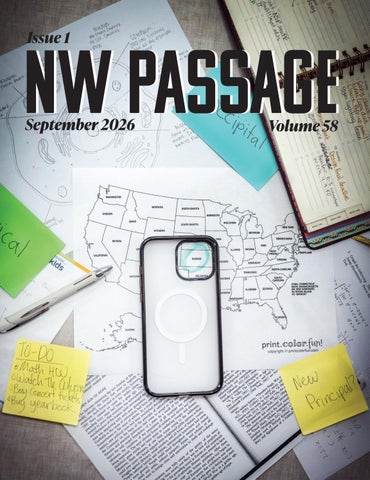
Issue 1
NW PASSAGE September 2026
Volume 58
WHERE TO FIRST? PACKAGE
SOMETHING’S MISSING 1 PG. 11 Students at Northwest figure out their new school routine without phones
PART OF THE JOB 1 PG. 14 The Kansas phone ban has caused Northwest Administration to adjust and solve new problems
SPONSORS CUBS SPONSERS
John Erickson Peggy Myers
WHITE SPONSORS BLACK SPONSORS Susan Rogers Alana Beirne
The Ward Family
Want to be a sponsor? Sign up here! Want to be a Subscriber? Sign up here!
PARENTS DIVIDED 1 PG. 16
Parents have split opinions on the new phone ban
Q&A 1 PG. 17 The Northwest Passage asked students to submit questions they had about the phone ban. Here is Associate Principal Britt Haney’s responses
STUDENTS SHOULD HAVE PHONES TO IMPROVE “REAL-WORLD” LEARNING 1 PG. 19 The Kansas phone ban negatively impacts Northwest’s extracurricular activities
MEET THE STAFF PASSAGE OVERSIGHT Editor-in-Chief Harper Ward Head of Content Sophia Ragan Managing Editor Hope Hunt Copy Editors Kayla Chega Claire Rogers Dayla Jertson
Co-Head Photo Editors Claire Rogers Maddi Roof Online Editor Finn Bedell STAFF MEMBERS Kennedy Woolf Sophia Ragan Maddi Roof Hope Hunt Finn Bedell
Ava Campbell Kayla Chega Claire Rogers Harper Ward Mary Kate Mitchell Doris Hernandez Sanchez Dayla Jertson Isabelle Hladky Kelsha Trice ADVISER Chris Heady
In the Issue News | Pg. 3 ATQP | Pg. 20 Feature | Pg. 4 Sports | PG. 22 Package | Pg.11 a&e | PG. 26
front cover photo by maddi roof
package photo by maddi roof
SMNW ATHLETICS HAS NO OFFICIAL RULES REGARDING SPORTS-BRAS AT PRACTICE DESIGN BY FINN BEDELL WRITTEN BY DAYLA JERTSON
W
hile confusion has circulated around Northwest about whether or not female athletes are allowed to exclusively wear sports bras without a shirt during practice, the rumors aren’t true, according to athletic director Dr. Heath Wilson. There is no official rule from SMNW athletics about female attire at practice. “Every program has its own rules, and I leave that up to the program,” Dr. Wilson said. “Anytime our male athletes are either working out in the weight room or they’re on the fields with their shirts off, I always say put a shirt on.” According to the Kansas State High School Activities Association (KSHSAA) handbook, girls tennis players are required to compete in a full-length shirt and shorts/skirt “worn as the manufacturer intended.” Likewise, the rules for cross country state that “any visible garments
worn underneath the uniform top is considered to be a foundation garment” and is allowed – only if there is no distinguishable logo. The rules between practice and competition vary and the rules between sports are left up to the discretion of the coach. “At the end of the day, whatever the tennis coach feels appropriate that they can wear, they can wear. And I support that,” Wilson said. Most fall spots at Northwest are outside during the tail ends of summer weather and practices can be held as long as the weather falls under 89.8º F, according to the Wet Bulb Globe Temperature, a measure that combines air temperature, humidity, wind speed and sunlight. Athletes feel that, with the high heat, they should be allowed to practice in what they feel most comfortable in. “Being able to practice in a sports bra especially in the heat is so important, it can become almost a safety hazard not to,” said cross country runner, sophomore Eleanor McCarter. “The environment around clothing is to wear what is best for you, and
ISSUE 1 NORTHWEST PASSAGE
03
what makes you feel comfortable.” High temperatures have an effect on almost every aspect of practices, according to McCarter. It limits how much athletes can practice and how long they can practice. “Running in the heat can add minutes to race times because your body is already working so hard it can’t figure out how to handle anything else,” McCarter said. As a result of the high heat, practices were changed the week of August 31-September 4th to the mornings when the sky is still dark. “When it’s hot, having a shirt often restricts my movement while playing tennis,” said senior Phoebe Baumgartel. “The heat makes me not even want to run after the ball.” The District athletic office has not made official rules regarding female sports attire, outside of KSHSAA regulations. However, every team has individual practice and competition etiquette for athletes to abide by. “This is another case where it’s just really important for athletes to have conversations with coaches if they have an issue,” Wilson said.
Students Adjust to New Züm Bus Service
T
WRITTEN BY ISABELLE HLADKY
he district’s new Zum transportation system is changing how students ride the buses by bringing updated buses and a new tracking system while also creating challenges as riders learn new routes and procedures. For freshman Alice Jordan, who rides the bus home Monday through Thursday, the most noticeable change was the bus’s appearance. “My first day, I took a photo of the bus and sent it to all my friends.” Jordan said. “They were so pretty.” The district introduced Zum buses this school year as part of an effort to modernize student transportation. New technology, including student bus passes, is designed to make unloading the bus more efficient. Jordan says the bus passes speed up drop-offs because drivers no longer have to check students out individually at each stop. “I think the new bus system is more efficient to get home,” Jordan said. While students have welcomed some of the changes, the transition has not been without problems.
Jordan said that no certain location of your bus has made dismissal confusing. She recalled missing her bus after having trouble finding its location. “I’ve been calling you. Where’s the bus?” Jordan remembered asking a friend after realizing she could not find her route. By then, the bus had already left. Jordan had to call her friend’s mom to come pick her up. She believes clearer communication about where your bus is located would help students avoid this situation. Despite those frustrations, Jordan said the bus service remains a reliable option for students who depend on school transportation. “If your parents are unavailable, you know, a bus can take you home and it’s quick and easy and is air conditioned and you won’t die,” Jordan said. Freshman Abby McCoy, who rides the bus every morning, said her first impression of the buses was positive because they were very modern and clean. “One of the first things I noticed was that the buses still had their temporary license plate tags,” McCoy said.
Although McCoy likes having the new buses, she said the updated route system can sometimes be confusing. “You have the bus number, and then you have the route number, and those numbers are very, very different,” McCoy said. McCoy said the biggest challenge has been the bus passes. Students must scan their bus pass when leaving and boarding the bus, which McCoy thinks slows the process down. “I just think it’s very annoying,” McCoy said. Students may find this process annoying but Zum uses it to notify parents when kids board the bus and get to school or back home. While many students have enjoyed the modern buses, the transition has also brought challenges. Earlier this fall, local news reports from KCTV5 highlighted parent concerns about late buses, route changes and tracking issues during the beginning of the school year. Haney said those early difficulties are part of adjusting to a new program. “I think they have some really great ideas that will be amazing once we get them in place. But, like many new technology initiatives, there have been many speed bumps this fall,” Haney said.
NEWS
04
ISSUE 1 NORTHWEST PASSAGE
feature
“There’s
GREA DESIGN BY SOPHIA RAGAN
Principal Dr.LaTisha Williams sings to students in the stands at the Everyday Champions Assembly Aug.18 in the Main Gym. Photo By Claire Rogers
WRITTEN BY SOPHIA RAGAN
D
r. LaTisha Williams starts her day at five in the morning with a workout, but rather than go to a class at the YMCA in Atchison like she did for 20 years, she’s in her garage in Shawnee, with a YouTube video playing from a TV and free weights. She ends her workout at 5:45 a.m., then grabs her daily devotional. She leaves her home around 6:35 a.m., and pulls into Shawnee Mission Northwest between 6:50 to 7:00 a.m. ready to greet students in the mall. Dr. Williams welcomes students she’s never met before, in a school brand new to her, rather than the 450 Atchison students she’d known for years. “I feel like being here and knowing that there’s more folks, getting around to get to know everybody is really hard,” Dr. Williams said. “That was my biggest worry, I was like ‘How am I going to get to know them?’” Dr. Williams is in her first year at Northwest, replacing Dr. Lisa Gruman, who left NW last year after 20 years for a job in the Blue Valley School District. “Dr. Gruman did such a good job to make sure it was a smooth transition,” associate principal Connie Springfield said. “Just overall from where we left off at the end of the school year last year, to stay ahead of the planning was just a smooth transition where nothing really had to be changed.” Dr. Williams is from a “family town,” as she puts it, and grew up with a single mother and two siblings. Her mom was a department manager at Walmart. “I came from a mom who had to work a whole lot,” Dr. Williams said. “So, I always had to have somebody, not that my mom didn’t pour into me, but I always had someone at school that was my safe place as well.” While attending Atchison High School, a para teacher, Marla Kelley, showed Dr. Williams she can be whatever she wants to. “She told me every single day ‘Much is given, much is required,’ I don’t care what your circumstance is, I don’t care what you come from, who your mom or your dad is, you get to write your own story,” Dr. Williams said. As a freshman, that made Dr. Williams think about life beyond just ninth grade. Kelley helped Dr. Williams realize she wanted to go into Special Education. Dr. Williams went to Benedictine College on a
ISSUE 1 NORTHWEST PASSAGE
05
ATNESS Here.” Small town principal Dr. LaTisha Williams enters the brand new phase of her life as principal of Shawnee Mission Northwest
full-ride scholarship. She got her undergraduate degree in special education and elementary learning. Later, she received her masters in administration from Benedictine, a doctorate from Kansas State University. In 1999, Dr. Williams started as a student teacher at the Atchison Middle School, then was hired as the 8th grade Special Education teacher the year after. “I absolutely loved special education because you are those kids’ advocates,” Dr. Williams said. From there, Dr. Williams experienced nearly all levels of education over the next 20 years. She spent eight years as a special education teacher in Atchison, followed by four years as a third grade teacher, then four years as an elementary-level special education teacher in Dallas, then four years as an English teacher in Atchison, moving back after her mother became ill. In 2018, Willams became principal for the alternative school in Atchison, Central School. After four years, she became the principal at Atchison High and worked alongside some of the teachers that she had growing up. “I really enjoyed being a principal there because I knew families,” Willliams said. “That was kind of a benefit, I would tell kids ‘I know your mom, I know she wouldn’t appreciate that.’” In 2025, after finishing her doctorate at K-State, and devoting 21 years to the Atchison Schools, Dr. Williams was looking for a new position. “I finished up my doctorate in 2025 to be a superintendent, so I was looking to do that,” Dr. Williams said. In January of 2026, Dr. Williams applied to become the Riverside USD 114 superintendent, a twenty minute drive from her home in Atchison. She was one of three finalists interviewed. She was not chosen. Dr. Williams believed that when the superintendent door closed, a new one would open. A couple months later, one did. “[There] is something about being denied and told no that you just keep fighting for the next thing,” Dr. Williams said. “Since I did not get that position, I applied at Northwest.” In May, she went through three rounds of interviews, visited the school, then had one last interview at the Center of Academic Achievement(CAA). Afterwards, Dr. Williams was chosen to be the new principal at NW. “That’s what I truly believe, that I have purpose here. It’s meant for me to be here,” Dr. Williams said.
Dr. Williams walked into Northwest and met the person who’d been running it for the past 12. Standing there was Dr. Gruman. They immediately hugged. “Her energy, her care, her dedication and kindness. I mean, just immediately I could tell she was amazing,” Gruman said. “I just felt, you know, like Northwest was going to be in such great hands with her leadership and just immediately felt comfortable and so excited for the next step [Northwest] would be taking.” In mid-July, Dr. Williams sat in her new office
She directs the freshmen to place their hands on their chest and tell themselves “There is greatness here.” She made them repeat it again. And again: “There is greatness here.” “Actually her first day with the freshman was very enlightening in the sense that she just came in, it sounded like she was a natural,” Springfield said. “She was very peppy, she’s got a lot of school spirit and her overall goal is that she wants the best for every student.” After her greatness speech, Dr. Williams sang “Pay Attention,” from Whoopi Goldberg’s 1993 film “Sister Act 2.”
“I JUST KNOW THAT IT’S A PART OF MY PLAN TO BE HERE, AND A PART OF MY PURPOSE TO BE HERE, SO I WANT TO DO IT TO THE FULLEST.” - DR. LATISHA WILLIAMS SAID. for the first time with no air conditioning, since it’s turned off for the summer. She couldn’t take the heat, so she explored the school, in search of anything that could cool her off. A fan, anything. After talking to the custodians, she walked through the mall area and heard music booming from the basement. “I walked downstairs to the weight room and I’m like ‘Hey I’m your new principal’ and they’re like ‘Who is this crazy lady?’ Dr. Williams said. “But everyone immediately started talking to me and having conversations with me and I thought that was cool.” Throughout the summer Dr. Williams connected and worked with the administration team. “She was all in 100% as soon as day one started in July,” Springfield said. “And you don’t see that a lot, it’s very rare, so I knew we had someone special.” Dr. Williams first student-facing task at Northwest was freshman first day. She was going to have to introduce herself and let the peopleperson in her shine in front of the jam packed aux gym. Growing up attending church at Shiloh Baptist, with a family full of singers, she thought singing would win over the hearts of the freshman. “My immediate family on my grandmother’s side are singers,” Dr. Williams said. “It’s mostly gospel music because I grew up a church kid, and so I sang on the praise and worship team.”
“If you want to be somebody, If you want to go somewhere, Then you’ve got to wake up and pay attention.” At the Everyday Champion assembly, she went in with the same attitude. “One of my main messages at the back to school assembly was that there is greatness that lives here,” Dr. Williams said. “Greatness doesn’t necessarily have to be something as far as biblical or spiritual because everybody I feel like has greatness within. And I feel like you just have to find it and realize that gift in ways that inspire other people and so that’s one message that was always told to me as a young girl that there’s greatness that lives here, use your gift.” Dr. Williams is one month into her tenure. She and her husband, Donell, are moved in. Their youngest of three children, Kassius, started 3rd grade at Benninghoven across the street. Their other two in college. On the announcements, Dr. Williams is asking students to pat themselves on the back for showing up to school. She’s popped into classes to interact with students and teachers. She’s at volleyball and football games and helped the crowd cheer, proving to the NW community that she may not be a Shawnee kid but she’s here now. “I just know that it’s a part of my plan to be here, and a part of my purpose to be here, so I want to do it to the fullest,” Dr. Williams said.
06
ISSUE 1 NORTHWEST PASSAGE
More Than
Flight
Feature
Junior Gina Duarte comes to America to find that High School isn’t like all the movies
DESIGN BY SOPHIA RAGAN WRITTEN BY ISABELLE HLADKY
B
y the time junior Gina Duarte walked through the doors of Shawnee Mission Northwest High School, she knew she was lost. Students moved confidently through crowded hallways while she stared at room numbers that made no sense. Teachers pointed in directions she didn’t understand. The bell rang. The school seemed enormous. Only two months ago, Duarte was living in Tangancicuaro, Mexico. At 10 a.m., Duarte sat in the Guadalajara Airport eating a Shake Shack burger. Suitcases stuffed with clothes, documents and pieces of the life they were leaving behind surrounded her. When the family’s first flight landed late in Dallas, they went through immigration, grabbed their luggage and hurried through security to reach their connecting flight. Missing it could have delayed everything. Hours later, they landed in Kansas City, where a father she hardly knew was waiting. Leaving everything behind in Mexico; lifelong friends, grandparents, and her old school Centro Escolar Juana de Asbaje, Preparatoria Jose Sixto Verduzco. Adjusting to life in Shawnee has come with its challenges, but Daurte feels safer here than she did in Mexico. Her former school environment was violent. “A friend of mine got her nose broken because someone decided it was a good idea to push her head into the desk,” Daurte said. One time, her friends almost got kidnapped on the way to Walmart, and there was bomb threats and shooting threats all the time. She also noted differences in how girls are treated, saying that in Mexico, teenage girls often feel uncomfortable because of unwanted attention from men. “Here is a safer environment for people to express themselves and dress however they like,” Duarte said. “Especially for girls.” Despite missing her friends and family back home, Duarte said the sense of safety and acceptance she has found in Shawnee has helped make the transition easier. She had known for months the move was coming but she waited to tell many of her friends. She knew saying goodbye would be difficult. Daurte was waiting for the “High School Musical” version of America. The ones she saw in “Spiderman, “Stranger
Things,” “Mean Girls” and Nickelodeon TV series’. Big schools with all the singing, yellow school buses, football games, school pride, meeting new people, and classic lunch of pizza and an apple. But instead of finding a musical, she found real experiences. She learned how the credit system worked, E-Hall passes, using a Macbook. Outside of school, life is just as new. After years of living apart from her dad, the entire family
“HERE IS A SAFER ENVIRONMENT FOR PEOPLE TO EXPRESS THEMSELVES AND DRESS HOWEVER THEY LIKE,” - JUNIOR GINA DUARTE was together again. Her dad has worked in Shawnee 12 years before Daurte and her family moved. Her mother is working to transfer teaching credentials to the United States. Her younger sister is learning English. Daurte now has to take care of her sister before school while her parents work. Despite the challenges, she has embraced the opportunities that come with her new home in Shawnee. She enjoys soccer and hopes to play on a club team and plans to play at Northwest in the spring. She enjoys AP American History with Mr. Wolfe, AP Language and Composition with Dr. Boren and AP Bio with Ms. Demke. She likes the college pathways and programs that can help her grow in her bilingual skills for a future career hopefully in medicine and developing her business, where she sells baked goods. “When I first arrived, I was completely clueless,” Duarte said. “But now that I’ve been investigating more, I’ve been looking at my options.” Now she walks through hallways where the numbers make sense. The teachers’ directions are no longer confusing. The school that once felt enormous has become a place where she is building her future.
ISSUE 1 NORTHWEST PASSAGE
07
08 feature
ISSUE 1 NORTHWEST PASSAGE
Running Toward
Recovery Junior Dash Hemenway’s journey from a traumatic brain injury turning back to school.
DESIGNED BY KENNEDY WOOLF WRITTEN BY DORIS HERNANDEZ SANCHEZZ
T
he field is silent. The 300 track athletes, coaches and parents notice the boy on the ground. His eyes are rolling into the back of his head, his body is convulsing. None of it seems right. Minutes before, the boy was running, cheering for a teammate during the 4x400 relay, when his head smashed into the head of another athlete warming up. On the other side of the SMNW track, then-junior Will Riekenberg sees the boy fall. “Wait, is that Dash?” He asks junior Phoebe Baumgartel and junior Paige Swanson as their eyes bolt over to the 30-yard line. They rush over. A crowd forms around him, Dash Hemenway, one of the most energetic and friendly people at Northwest. Athletes from different schools began to circle him. “He’s constantly making jokes that maybe aren’t the funniest, but it cracks you up every time.” Kaleb Barikmo says. “He’s [always] putting people up, never putting anybody down.” Then-sophomore Kaleb sees Coach Elissa Ojeda sprinting as fast as she can over to him. Ojeda and the other coaches tell everyone not to get too close. Dash’s body won’t stop convulsing. “Kaleb, do you have Dash’s mom’s phone number?” Coach Ojeda asks. Kaleb runs as fast as possible to get his phone. A mile away, Meghan Hemenway’s phone rings from an unfamiliar number. She left the meet hours ago after Dash’s final event, the 2 mile. An odd feeling lingers as she swipes the answer button. “There has been an accident,” Ojeda says, “They called the ambulance, drive safely, but come on back.” The impact injured Dash’s left side of his brain and sent him into a seizure. His breathing is erratic. “He was shaking enough that one of his shoes came off,” Riekenberg said. Prayer circles form around the field, athletes get on a knee circling Dash as the ambulance arrives. A normal track and field meet on April 9th had been cut short by a crowd silencing injury. Megan gets in with her son. They’re headed to Children’s Mercy in Overland Park. Her worry isn’t high yet, Dash has ridden in ambulances before. Dash’s eyes are open but he’s not there. She can see the fear in the emergency responder’s eyes as they realize this is a critical situation. He begins to seize again. *** Dash lays in the ICU with a tube down his throat. The sedation is keeping him asleep, to stop him from seizing again. The doctors occasionally attempt to take him off of it, but decide it’s best to keep him under to let his brain rest and heal. A feeding tube runs through his nose and down his throat. A neck brace keeps his head still to prevent a recurring childhood injury, Grisel Syndrome, which is a partial dislocation of the joint between the first and second vertebrae, caused by the inflammations of tissues in the head and neck. Dash has around-the-clock care, every part of his body being monitored.
Before this, Dash would be at school around the clock going to symphonic band and track practice at the end of the school day. Meghan is right by his side. Relatives take care of Dash’s younger brother. Heck, at home who isn’t allowed to come into the hospital because of the returning flu season. Meghan is grateful for the Ronald McDonald House Nonprofit Organization that supports families with kids in the ICU; by offering food, beds, and showers while she stays at the hospital. Five long days go by and Dash is ready to wake up. His body is fighting the drugs keeping him sedated. His energetic self is fighting to escape. As the doctors pull the tube from his throat, they race against his body trying to wake up, having to speed up the process. Dash wakes up feeling groggy and relaxed. “It felt so peaceful, so [many] hours of sleep.” Dash says. The doctors don’t let him speak yet because his throat is in pain from the tube – and he hasn’t spoken for a week. Confusion spreads through his face. Meghan sits next to him wondering if he will be able to remember who she is, or hold a pen. “You’re in the hospital,” she says. “Everything’s okay.” Dash is diagnosed with a traumatic brain injury, which caused him to not be able to stay awake for long periods of time. A traumatic brain injury is an injury caused by blunt force to the brain that can send someone into prolonged loss of consciousness, disorientation, and amnesia. He received the broad idea of what happened to him from his mother. “It just felt kind of like a crescendo, just like piano,” Dash said. He managed to find peace in the moment. He no longer had to worry about his honors English Independent Reading Project that he had been dreading doing, or any schoolwork for that matter. *** Dash lays in his bed at home, listening to the “Harry Potter and the Sorcerers’ Stone” audiobook. He is stuck in the constant cycle of feeling tethered to his bed, and attempting to get back to his routine. Dash’s appetite has decreased after being fed via feeding tube for a week. He finds everything gross. The only thing of interest is the box of Rice Krispies his grandma bought for him. Dash’s mom presents each meal she makes as an offering to see if he will eat it, sometimes he takes it, sometimes he doesn’t. After being discharged, Dash spent the next couple of weeks at home, playing Hogwarts Legacy to attempt to cure his boredom, trying anything to entertain himself. He also watches soccer games in Spanish, and an old princess show with his grandma while they made fun of the characters. Dash is still drowned in fatigue, leaving his room felt like a chore. Dash is not allowed to see people for long periods of time because they can cause headaches, so his occasional visitors can only stay for a couple minutes. Visitors included his best friends, sophomore Duncan Hirsch, along with junior Sofia and sophomore Gabriella Latta. During the couple minutes that they could see him they asked if he was OK. “I think the hardest part for them seemed to be that period where it was unclear whether I was gonna make it,” Dash said. “I’m back at the house, but they don’t know what state I am in. I saw [it] in their faces like, oh, he’s still okay.” Cross country coach Justin Stigge scheduled with Meghan a time that he could come and mow the lawn along with a group of cross country runners when he is unable to. The Northwest
ISSUE 1 NORTHWEST PASSAGE
drumline raised money through GoFundMe for a care package, and filled it with a stuffed duck, “Stranger Things” socks and a giant Bigfoot stuffed animal. Dash read all the letters sent by his friends. When he was finally allowed to check his phone, it was filled with messages of encouragement. He was a little surprised at some messages from people he’s not very close with. “That was pretty fun just to go through and just be like, ‘oh wow, this person went out of their way to find my phone number to text me,’ Dash said. *** Dash’s mother was worried that he will get another bad headache, but she trusts that he will stop when he needs to. “You have to trust Dash to stop or to slow down, which was scary because a headache is a checkpoint,” Meghan said. “But I don’t know if you’re having a headache. No one can tell. So if you say you’re not, we have to trust you.” Dash was allowed to return to school, excited to be able to see his friends after so long, but nervous for his ability to do what he used to. “If using my brain for a while makes my head hurt, how am I gonna go to school?” Dash said. Dash was worried about his return to school -a place where he is a fixture. He loves school. He loves asking people about their days, and talking to everyone in cross country and band - trying to make a joke and making people feel like they belong. He went for partial days at first, to get reintroduced to the noise and activity of a school day. At school, Dash was asked daily if he was OK, how he was doing. “He was surprised at first that everybody knew,” Megan said. “I think he didn’t understand how significant that event was.” Dash was excused from all the school work he missed during his recovery. But school was a challenge. His first hour was Symphonic band, which meant he either had to skip because of all the noise or spent the hour in a practice room, where the sounds are dimmed, and watch from afar as his friends played. The danger is the headaches. Any headache could slow down his recovery. He has a cold cap that he places over his head to numb the pain when he has a headache. Dash also experienced amnesia from the seizures, where he couldn’t remember the right word for something he was talking about, causing him to stutter and get frustrated. One day during Band, director Brett Eichman announces a drumline event. Eichman told Dash – who plays snare drum – he didn’t have to go. But Dash wanted to. He craved normalcy. Dash went without letting his mom know. He played stand tunes with his drumline friends and could finally relax a little bit. No headaches. It felt great. “I’m gonna be able to go back.” Dash said. “I’m gonna be able to do band.” Every week, Dash goes to physical therapy to normalize his sense of balance. Dash equates the feeling to being on a rocking boat. He also had a hitch in his eyes as he moved them across. A hitch is where your eyes get stuck for a half second as you move them from side to side. The
09
lack of training and exercise during his time in the hospital and at home caused his muscles to weaken. His physical therapist is a guy named Frank. “He was bald, and he felt like a fictional character, because he was just so perfect,” Dash said And I would make jokes with my mom about how absolutely adorable he was.” He and his physical therapist, Frank, do light jogs around the building. Soon, after Dash goes on his first run is by himself at Mill Creek Park, and with each step, he feels himself slowly being pieced back together. “It felt like I was treading on ice, I was unsure whether I’d be able to keep going,” Dash said. “I kept going, and the ice held up.” *** Starting the new school year feels like a reset button for Dash. He has had time to reflect on the empty week in April he can’t remember. “I cannot believe I’m that fragile, [it’s such a] small amount of events for it to cause so much damage,” Dash said. “I’m back to a place where I’m okay with myself [now], so I don’t want to change anything that happened.” This accident has made Dash realize how much of an impact this had on the people he loves, and how hard it must have been for them to go through the unknown while he was unconscious and recovering. “A lot of people were really scared, and that’s the part that I think worries me most,” Dash said. “If I had died or been really badly injured,
“I CANNOT BELIEVE I’M THAT FRAGILE.”
- JUNIOR DASH HEMENWAY it would have really badly hurt the people closest to me. Like, my mom, my brother, Gabriella. It would be a really big weight on all of those people’s lives.” He’s gotten a fresh start and plans to go the whole year without missing any events. Dash has rejoined cross country and is attempting to run closer and closer to his old pace as the weeks go by. As he is entering his junior cross country season, he doesn’t know if he will keep his varsity spot. His friends sometimes still tiptoe around the injury, making sure that he is okay, always worried they will cause another injury. “He does the same dumb jokes with me all the time,” Milo Langford said. “He’s still got a lot of energy in him, bouncing off the walls.” “It was hard for Dash to be confused and scared,” Meghan said. “Doctors said they didn’t know how long his recovery would take.” Turns out, less than 6 months. “It was, boom, done,” Meghan said. “He’s recovered so fast. It was wild.”
COMPLETE AUTO REPAIR & SERVICE 9940 West 62nd Terrace - Merriam, Kansas - 66203
913-236-6300
Fax: 913-236-6302
SOMETHING’S MISSING
ISSUE 1 NORTHWEST PASSAGE
11
DESIGN BY HARPER WARD
Northwest figures out how to adapt to new school routines without phones
12
S
ISSUE 1 NORTHWEST PASSAGE
Package
Are you blind-folded? WRITTEN BY HOPE HUNT
T
he phone ban doesn’t just affect cheating on assignments or minimizing distractions in class, it’s also affecting students who keep to themselves. Sophomore Noah Phillips says that he’s seen students at lunch sitting by themselves, staring into space. “What ended up happening is people who were on their phone sitting alone at lunch, seem even more sad and lonely than they were before,” Phillps says. Those thirty minutes at the lunch table is some students’ time to relax, and put their life that’s constantly going for seven hours, on pause. If they don’t have someone to talk to, it tends to be students’ first instinct is to grab their phone. It’s something they’ll always have, it’s comforting. Now that safety net is gone, and they have to get out of their shell. “Before the ban I didn’t get on my phone that much outside of lunch and passing period. I would play games on my phone when I was done with an assignment in class, but now you can just play them on a MacBook,” Phillips says. If you walk into a class and pay attention to the computer screens, the majority of them have unblocked games or youtube. With the ban students keep putting in effort to go around it, and find ways to continuously entertain themselves. “It is so easy to get them, despite all the districts’ efforts. There is some crazy tech that you can use to unblock stuff on your MacBooks and more people are doing it now than ever,” Phillips says. “Anyone who was distracted on their phone before is just distracted on their MacBook.” Students who do abide by the new restrictions, go the entire school day without checking their device. “They wait all day without checking their phone, to get out of school and go to the parking lot. They go into their car and continue checking their phones. When they’re leaving the school parking lot, they’re still checking their phone,” Phillps has noticed. This not only is a disruption to the attention being put on the road, but this is a huge safety issue if this progresses. “Last year the parking lot was already like a war zone. Now it’s even worse. Now it’s a war zone, but everyone’s blindfolded,” Phillps says.
“Are we going to get caught?” WRITTEN BY HOPE HUNT
*Names have been changed to protect the identity of the student.
“Last year the parking lot was already like a war zone. Now it’s even worse. Now it’s a war zone, but everyone’s blindfolded” - Sophomore Noah Phillps
enior Jennie Walton walks into the bathroom during passing period and sees about six girls on their phones. Some are up against the wall texting, others are taking group selfies in the mirrors. They only have five minutes to check all their notifications, and decompress on their device, while still trying to get to class in time, but everyone feels the anxiety that a teacher will walk in. Though there’s a state-wide phone ban in schools, students are still finding loopholes, ignoring the risk of getting their device confiscated. “It’s getting to be a problem where every time I go to the bathroom, everyone’s just using their phone. They’re not even using the bathroom,” Walton says. Passing period isn’t the only thing that’s changed. Communicating with friends has been altered as well. Students are now resorting to emailing or having a shared Google Document to communicate with each other. When the lessons become dull, Walton makes an E-Hall pass to the bathroom. She grabs her phone from her bag and texts her friends to meet up in the halls for a break. Grabbing her phone just seems easier to communicate rather than pulling out her MacBook. “Some friends that I don’t have classes with I have to text, but teachers are still going to take my phone for that.” With it being her senior year, documenting little moments in class or at lunch feels very important. She wants to make sure she remembers the year. “It’s the social aspect of it. What if I want to make a cute TikTok with my friends? I feel like making memories and keeping them, now it’s something I can’t do anymore,” Walton says. Students have resorted to digital cameras now. At Senior Sunrise, the majority of students were taking pictures with their friends on their cameras. Even Spirit Club is using their digital cameras to take pictures of teachers and students in their Adam Sandeler fits during the first week of spirit days this year, for Instagram. Walton feels as if it’s a lot harder to document the moment. “I don’t want to get my camera out, I’ll get my phone instead. It’s quicker.” Walton has seemed to notice that the ban has students spending more time figuring out how to hide their device, rather than just existing at school. “People are gonna still be on their phone,” Walton said. “Now it’s just, are we going to get caught or not?”
“We didn’t create the problem” WRITTEN BY CLAIRE ROGERS
T
he Gen Z and Alpha generations were raised in a world where technology was continuously pushed on them. Now the same generations that created the technology are blaming the younger generations for being attached to the addictive algorithms they programmed. Junior Rachel Pierce is not highly affected by the phone ban but finds adults’ obsession
with Gen-Z’s use of technology rather hypocritical. “It’s like you created it. You push us on it, and then now you’re taking it away, and then blaming us when we rebel against it,” Pierce says. She recognizes the problems phones have caused in schools including decreased attention span and negative mental health repercussions, but doesn’t believe the full ban was very necessary. “Even when we didn’t have the phone ban, I feel like when I was at school, I wasn’t on it a bunch anyways,” Pierce says. Members of the Generations X, Millennials, and baby boomers created the ban in schools with the intention of helping Gen Z and Alpha learn. Pierce thinks there are likely deep reasons students don’t want to learn. “I don’t think our phones are the reason why we don’t want to learn. I’m not on my phone, and I still don’t want to learn in your class,” she says. Older generations have created an all or nothing mindset around technology. Putting all the attention on phones may not be the only answer to the problem older generations were trying to solve with the phone ban.
POSITIVE CHANGE WRITTEN BY CLAIRE ROGERS
T
he phone ban was put in place to improve social interaction and limit distraction in the classroom. Junior Jo Ridgway has found the ban overall to be doing just that. Over the years Ridgway has struggled to keep up with the timeliness of her course work. This year she hasn’t. “This year I’m so much more ahead than I was this time last year,” she says. She would often reach for her phone after instructional time and near the end of class. Now with that option taken away she has found other ways to fill that time. “I’m finding other things to do because I’m
so used to not being on my phone,” Ridgway says,“I’ve been drawing a lot recently and practicing music.” She agrees that the extremes taken in the phone ban including not being able to use it at lunch are a bit excessive, but the positives the ban has created prove to overshine in her life. “I’ve gotten used to not needing my phone. Even at home, I’ve noticed that I just keep my phone away,” she says. In the past Ridgway has struggled with her mental health, not always knowing what the “reasoning” was. “Myself and my parents realized that it could have been my phone because I would just scroll,” Ridgway said. “I was super reliant on my phone.” There was a span of time when Ridgway wasn’t allowed on her phone for long durations. An event that would seem to enrage most teens, Ridgways recalls fondly. “I was so much happier in that period that I just wasn’t on my phone all the time,” she says. Similar to that time of screen use restriction, Ridgway has noticed a positive change in her mental well being since reducing the time on her phone due to the ban. “I have definitely noticed a positive change on my mental health and overall attitude,” she says. Ridgway’s social life has also benefited from the ban. “I’ve made more friends and I’ve put myself out there more because I’m not just in the corner on my phone,” she says. When Ridgway walks into the lunch room she sees friends actually talking to each other, a girl listening to a Fleetwood Mac CD in her pink discman, and a boy doing his math homework. “I can see people being less reliant on their devices,” she says. Ridgway has experienced and witnessed the positive changes from the phone ban. “A lot of people I’ve heard think it’s kind of, completely ridiculous,” she says, “I think maybe they say that just to fit in.”
Of students say they still use their phone in class
Of students say they don’t use their phones in class
illustrations by harper ward
66% 34%
13 WILL IT HOLD? ISSUE 1 NORTHWEST PASSAGE
Many students wonder whether the phone ban will last. Here is what three students had to say
“I don’t think it will be forever, but I know many people want to get rid of it and they are very against it” - Senior Barleen Bhatia
“I think it will last. A lot of parents and teachers support it” - Senior Phoebe Baumgartel
“ I think the phone ban won’t last due to safety especially during code red situations” - Junior Kruz Kramer photos by maddi roof reporting by ava campbell
14 PACKAGE
Part
ISSUE 1 NORTHWEST PASSAGE
The Kansas phone ban has caused Northwest Administration to adjust and solve new problems DESIGN BY DAYLA JERTSON
I
t’s 4th hour, the call comes from a teacher and Associate Principal Britt Haney is immediately walking through the halls and into a class room where he confiscates the next phone. “The Honeymoon is over,” Haney said. “There were a lot of kids wanting to get on their phones yesterday, about 30 something.” The lunch bell rings and as Haney looks down at his watch it reads, 10,000 steps. That’s the amount he would normally go home with last year and now he’s gotten the number by lunch. “I know for the students the days are slow, the days are not slow for me, I look up and it’s already 2:40,” Haney said. For the administration and teachers of Northwest the changing phone ban policy has altered their everyday routine. On March 19, 2026 Gov. Laura Kelly signed House Bill 2299, which bans students from using electronic communication devices during school hours. The Kansas phone ban follows a trend of states like Texas and Utah, who have already implemented a similar ban. “The focus of the state is removing distractions from the classroom,” Haney said, “so they’ve kinda done a two part attack.” Part 1, remove all phones from school. The state rolled this restriction out at the beginning of the 2026-2027 school year. Students cannot have phones on their person from the first to the final bell of the school day. In the law it is mandated that students keep their phones in their locker, car or at home. Yet, according to the Northwest Passage’s poll on Instagram 66% of students say they still use their phones in class. That’s the reason Haney is back and forth between classes everyday. Part 2, remove all social media requirements through the school. Teachers can no longer message students on social media platforms
RIGHT Attendance Clerk Jamie Prosser sorts through phones, handing them back to students at the end of the day. Photo by Audrey Novack.
WRITTEN BY HARPER WARD
o
of the JOB ISSUE 1 NORTHWEST PASSAGE
such as GroupMe, which many sports and school activities have used religiously in the past. Now, with many forms of communication banned, teachers have had to adjust. Specifically, Theatre has moved towards their student leadership team running communication. “Occasional reminders or things like that get lost, but I do have students who are running a chat platform to help one another out and clarify issues,” Theatre teacher Shawnasea Holst said. With the implementation of the phone ban unexpected problems have started to arise. Like how there were no clocks in the mall. “They took out all the clocks because kids had clocks in their phones,” Haney said, “Then we found out the first week of school that these kids don’t know what time they were supposed to be going back to class.” So now the mall has a clock over the admission office and in the main cafeteria area. Though not everything has changed. At lunch Haney is still patrolling the mall looking for kids keeping their heads down or suspiciously scrolling in their lunch box. “It’s the same thing as trying to keep my seniors in open lunch and my juniors not going to open lunch,” Haney said. “Just part of the job.” When a student is caught with their phone they will normally give excuses. “My alarm went off in my bag.” “My phone fell out when I was grabbing something.” “I wasn’t even on it!” Yet, because of the law, the punishments have become concrete. “First offense is the phone goes into phone jail and students pick it up at the end of the day. Second offense is the phone gets confiscated and a parent has to pick it up,” Haney said, “Offense 3, we’re going to work on a plan with the kids, and that’s where they check it into the phone jail first thing in the morning and pick it up at the end of the day.” At exactly 2:40 the attendance office window with the words “Hello Fall” stuck on the glass is pulled open. An immediate line of students forms and Shannon McLeroy, the Northwest clerical aid, is out of her office chair and furiously writing on sticky notes. “Name,” she asks. The student responds. “7,” she tells Attendance Clerk Jamie Prosser. Prosser hands her the phone, McLeroy hands it back to the student. They do this everyday, around 30 times a day. Name, number, hand phone back, repeat.
15
The phones are kept in a silver steel box with a clear door. It’s locked during the day and kept on the far left side of the attendance office under a shelf. Each slot has a blue number above it which corresponds to the number in McLeroy’s spreadsheet.
“The Honeymoon is over... for the students the days are slow, the days are not slow for me, I look up and it’s already 2:40” - Associate Principal Britt Haney Occasionally a student will be on their second offense and they will tell them to talk to an administrator, sometimes that means a parent will have to take it. Sometimes that means ISS or OSS. “It’s going very smoothly,” McLeroy said. “We try and do it quickly for the kids on the bus, or the kids who have sports.” The process is normally done within five minutes. For McLeroy and Prosser it’s not that much of a change of pace. “It’s like monitoring a lost and found,” Prosser said. While in other parts of the office the pace seems to keep increasing. “It’s hectic,” said Haney. “There’s always something to do.” Along with the phone ban administration has been adjusting to using a new bus system, the attendance office moving and the new parent communication system, ParentSquare. “There’s a lot on everyone’s plate,” said Haney. “But the admin team is staying and working together and I’ve been really proud of the staff and the follow through.”
16
Photo illustration by Finn Bedell
ISSUE 1 NORTHWEST PASSAGE
PACKAGE
Parents divided Parents have split opinions on the new phone ban DESIGN BY MARY KATE MITCHELL WRITTEN BY KAYLA CHEGE
A
new Kansas law requires school districts to keep personal electronic devices stored away during the school day somewhere where they can’t access them. Which means schools must now provide a way for students to contact their parents during the school day. The policy has received mixed reactions from parents. For parents in support of the law, no phones means promoting a better learning environment by reducing distractions. For parent Brad Collins, keeping phones away during the school day could help students focus and develop stronger critical thinking skills. “Usage has done nothing but up, the times that high school kids are on phones, they are using apps, connecting with these platforms that are engineered to hack their brain into staying on the programs longer and longer and longer and longer,” Collins said. “And it kind of ruins critical thinking, attention, those types of things.” Collins’ concerns are around how much time students spend on their
“Ideal phone policy would be to address the kids who aren’t following the rules, and not punish the kids who follow the rules” - PARENT JILL SWANSON
phones and the effect that has on their attention. Parent Jan Gavilanes also is in support of the policy and believes students don’t need phones in class. “I think it’s great,” Gavilanes said. “I think that the one they have now is pretty good, just keeping it in the locker checking in at lunch and after school is plenty. I think it’s too distracting to have in class.” School administration has also said they haven’t seen significant pushback from parents about the policy. “I’ve never had a parent come in to pick up a phone upset,” Associate Principal Brit Haney said. Parent Angie Salmon said she would not be upset with the school over the policy, but rather her student for violating it. “I wouldn’t be upset with the school,” Salmon said. I would probably be somewhat upset with our students, because that was probably because she violated the policy.” For Parent Kyla Williams-Bowles, the concern is more about communication. “As a parent I want to be able to connect with my child. There’s too many things going on in the world right now for me to be worried that my child is at school without his phone if something happens,” Williams-Bowles said.
Gavilanes doesn’t share the same concern. “I think that the teachers can communicate with us if they need something,” Gavilanes said. Williams-Bowles said she understands the need for limits but believes students should be taught how to use technology responsibly. “You have to teach responsibility,” Williams-Bowles said. The idea of responsibility also comes into play when questioning how students should be disciplined for following the policy. Jill Swanson believes consequences should focus on students who do not follow the rules rather than affecting students who do. “Ideal phone policy would be to address the kids who aren’t following the rules, and not punish the kids who follow the rules,” Swanson said. Swanson also believes that individual districts should have a say in how the law is handled. “I think the district should be able to make rules for their students instead of the state,” Swanson said.
Q & A
The Northwest Passage asked students to submit questions they had about the phone ban. Here is Associate Principal Britt Haney’s responses.
ISSUE 1 NORTHWEST PASSAGE
Can we get rid of the phone ban? H. “In order for that to happen [students] would have to get the law changed.”
What if there is an emergency? H. “Most students have their phone in their backpack or purse and can get to it if there is an emergency.”
Why can’t we use our phones during school for rides and transportation? H. “You can contact your parents for rides or transportation. Just get that done before school starts.”
Are there any exceptions? H. “Mainly just for medical purposes. We have a few kids who have apps on their phones that monitor blood sugar and stuff like that.”
Why did they do a phone ban? H. “[The state] is trying to get rid of distractions in the classroom.”
Are grades better because of this? H. “It’s a little too early to ask.”
Why can’t we have it at lunch? H. “The ban is from bell to bell. So you don’t have first lunch people posting and people in class during fourth hour wanting to know what they are doing.”
What do we gain from this? H. “More instructional time. So if you go into classrooms you will definitely see more people participating in class.”
17
16322 W 65th Street Shawnee, KS 66217 (913) 306-4253 Call for orders or any questions! Your Go-To Mexican Spot!
FOR MORE CONTENT VISIT OUR WEBSiTE AND INSTAGRAM
@smnwdotcom
Smnw.com
Photos by Maddi Roof & Cooper Evans
ISSUE 1 NORTHWEST PASSAGE
19 Editorial
EDITORIAL:
F
or the 2026-2027 school year, the district hired a counselor intended to direct the new realworld learning goals for students. However, as the school year begins, the new state mandated phone ban has created restrictions around real-world learning opportunities for students at NW. Real-world learning is the act of guiding students through high school in a way that will prepare them for future jobs. The district does this by creating curriculums based on work environment needs. While the district attempts to enforce this, the state banned the use of phones, a primary tool in realworld work environments. The marching band previously used apps on their phone, such as Ultimate Drill Book, to learn drills for their marching. Students use their phones as a map to get to their spots. Without this, they have to rely on the 40 minutes they have before school and Monday night rehearsals. This is not enough time to learn all four parts of their show and have it ready for football games and marching competitions. Because of the lack of phones, they now have to rely solely on memory. Students in the band have said that they feel like they are going slower this year than any other year prior. Often, student sports teams use their devices to communicate about practices and scheduling that may have been altered according to the weather, or conflicts. Teachers and coaches can no longer message their students through GroupMe. They now have to learn to navigate a new app BAND. GroupMe uses their app to send messages like a text, while BAND uses students’ emails and notifications directly to their macbooks. BAND often does not send timely notifications. Not getting notifications can mean missing practice. Programs such as STUCO, Spirit Club and student run clubs use their phones to promote school events on social media. These messages are harder to get out when students can’t use their phones. Communication is key in any real world
Students should have phones for “real world” learning
the
vote
A staff editorial is an opinion piece crafted by a single writer and voted on by the entire staff of the NW Passage. It is not an unbiassed news article, but an opnion piece tackling a major issue. Here is how the NW Passage voted on this editorial.
14 0 0 agree
disagree
obstain
job setting. Not receiving notifications can lead to a habit of poor communication. For the journalism programs, announcing breaking news during the school day is near impossible when posting on social media isn’t an option.Because of this, the proximity aspect of news is gone. The reality is that phones are everywhere now and relied upon in a work environment. The state should have exceptions to the phone ban to assure that they follow the real-world learning initiatives they have introduced to high school students. These exceptions could be specific to each extracurricular such as letting students use their devices during marching band hour, or allowing journalism students use their phone to record interviews. Regardless of the ban, students continue to bring their phone in their backpack. It would be simple to allow them to access their devices in the classes that work towards real world learning initiatives, and regulate the use of phones in classes they don’t need them for. The way people communicate has changed drastically throughout the last 20 years. The world’s screentime has increased drastically with modern dependency on it. For the past decade, students have been issued their own ipad or laptop for school work along with being told to download apps to communicate through their phones. Technology has been introduced as an easier way to do everyday things including communicating and learning. If the state wants to ban phones, they should make the reliable apps that students use for real world learning easier to get approved on their student device app store. This would assure that students are confidently receiving notifications and not missing important messages and learning to the maximums of the real world learning curriculums.
20
ISSUE 1 NORTHWEST PASSAGE
Documenting the quiet, and often overlooked, moments at Northwest through student life, struggles and success ABOVE - Pointing, freshman Oliver Davis talks to his coach Aug. 18 in the Main Gym. Davis was at the annual Everyday Champions assembly. Photo by Lucy Wilson
ISSUE 1 NORTHWEST PASSAGE
21
A Spirited Surprise
Freshman Oliver Davis navigates varsity cheer while having Oliver Davis had been camped out at camp. Before the hearing loss. DESIGN BY KENNEDY WOOLF WRITTEN BY DAYLA JERTSON
F
reshman Oliver Davis started the music. Hip-hop played as he walked through the routine he’d only practiced once. All of the hopeful cheerleaders stood anxiously in the Shawnee Mission Northwest Gym. Waiting for the results, which would be uploaded that night onto Instagram, “I had one of my friends with me, so I was less nervous,” Davis said. As he waited for his turn, an interpreter stood off to the side, translating in ASL for Davis when needed and aiding him with the counts. Davis has hearing loss, once he takes his hearing aids out, he is completely deaf. “It’s nice to have someone there to help me, and they are there to give me support.” Davis said of his two district-provided sign language interpreters. Davis is a freshman on varsity. He’s only cheered for one year, after doing gymnastics for six. “I’m used to all the tumbling and flips,” Davis said. “Since I’m the only freshman, all the girls are used to high school, used to each other. I just wanted to try something new.” The National Cheerleaders Association (NCA) camp was held on July 20-23rd during the summer in hopes to strengthen the cheer team’s skills and bonds with one another. From 8:30 in the morning to 9:00 in the evening,
adrenaline wore out and exhaustion set in from a long day of running through routines, Oliver spent his days meeting new people from around the Kansas City area. Davis would practice with the NCA staff and get private lessons on tips on how to improve and refine the cheer routines. “It was different from what I’m used to,” Davis said. “You were meeting lots of different teams, getting a new experience.” On the last day of camp, people started lining up and cheer teams waited – not so patiently – as the NCA staff started with the end-of-camp speech. While other schools had gotten the spirit stick during camp, Northwest hadn’t and the team had started to doubt themselves. “And the spirit stick goes to…!” the NCA staff starts, their voices booming through the silent ballroom as cheer teams sit impatiently in circles. After one final glance around the room, the staff looked at a team sitting in orange and black uniforms, and said, “Shawnee Mission Northwest!” Shrieks and cheers burst from cheerleaders and coaches huddled together as they accepted the spirit stick for the first time all camp. “Other teams had gotten it for the day,” Davis said. “We weren’t expecting to get it, I was emotional.” After the claps and cheers died down, everyone hugged, celebrating their spirit stick win. “It felt so surreal to be a part of a big family like that,” Davis said. “I honestly just couldn’t believe we got it in my first year at camp. NW cheer hadn’t gotten that award in years.”
22 sports
ISSUE 1 NORTHWEST PASSAGE
like a Looks
Shawnee Mission’s Northwest’s first girls flag football team has started its season
DESIGN BY AVA CAMPBELL
I
WRITTEN BY KAYLA CHEGE
t’s Wednesday, August 19th and the sun is beating down on the Benninghoven field. It’s day three of tryouts. A group of girls in white shirts, with tryout numbers written in black sharpie stretch before drills start. “Okay, name, grade, and how your day was,” junior Reagan Irwin asks the group. The question bounces around from girl to girl, accompanied by arm and leg stretches. At water break, assistant coach Hannah Mott starts braiding a girl’s hair. Nearby other girls talk about team hairstyles. Then, it’s time for sprints. The whistle blows, and the girls dash towards the 10-yard line then the 20, all at different speeds. “Look like a team!”office receptionist, Nicole
team
Shay, yells out to the girls. Back in March, Shay didn’t expect a spontaneous conversation with the athletic director to become a serious commitment. She simply said she would be interested if the chance came up. At the time, she wasn’t thinking becoming a flag football coach was a real possibility. Then it happened. On April 23, the Kansas State High School Activities Association board of directors voted 61-1 to sanction girls flag football as an official high school sport. The decision made Kansas the 18th state to pass this law with the sport starting during the 2026-2027 school year. The decision followed a push from the Kansas City Chiefs “Let Her Play’ campaign, which more than 11,000 people signed. Suddenly what Shay had just mentioned in March has become a reality. “I guess we’re doing this,” Shay recalls thinking.
The sport is new to Kansas. And for most of the girls and the coaches on the Benninghoven field, it’s new for them too. “I didn’t even know how to catch a football whenever tryouts started,” junior Bella Butler said. Butler had never played a team sport before, only cross country and wrestling which had both been individual sports. “There were so many things I didn’t know, not because I was trying to be difficult. I just didn’t know how to do it.” Butler said. Butler wasn’t alone on this, most girls coming into tryouts had never played a real game of football and neither had the coaches. Something as simple as a route running from cone to cone could send the whole group into the wrong direction. A dropped pass could draw blame before anyone knew how to catch it in the first place. It wasn’t only the game they didn’t know. They
didn’t know each other. Varsity and JV players stuck to their separate corners barely speaking. “JV girls supposedly thought we hated them so they hated us,” junior Shayla Perry said. “I don’t really know why it was like that.” The tension wasn’t always obvious, it didn’t erupt into any big fights, instead it settled who did and didn’t talk to you, a hunch that the girl sitting next to you probably doesn’t want you there. There was one girl on the team that Butler didn’t get along with. The two had history dating back to freshman year and the feeling was mutual. But during an interception drill in August, the girl stepped wrong and went down, leaving her ankle bent in a bad angle. It was one of the hottest days of practice and the field had no shade. Butler walked over anyway. “Hey, is it okay that I’m here?” Butler asked. The girl said yes. Butler picked her up and carried her all the way down to the trainers. The two talked on the way down. “I don’t want to sit here and be best friends with her,” Butler said. “But that doesn’t mean I’m going to let her sit in pain as my teammate. She’s not some rando anymore.” It took a sit-down at practice and a first game to start closing that gap. ... It’s 7:00 p.m. on a Wednesday and it’s 93 degrees. The sun is so bright it’s difficult to see across the field, and the Shawnee Mission Northwest girls flag football team is about to step on the field for the first time ever. “Know your spots, you don’t even need to huddle up, just go!” Dan Shay, Nicole Shay’s husband, calls from the sideline. The group of varsity girls in white numbered
jerseys and pink flags around their waists huddle up. “1-2-3 Cougars!” the team chants, before breaking into their spots. In the stands, parents and siblings watch as the girls rush to their positions. “Starts by the 10, not the four! That’s the wrong spot!” Dan Shay yells out. A voice from the crowd responds, “mind you, none of these girls have played football before.” Into the second quarter, junior Kenley Dearing scores the first touchdown of the season. The intercom announces: “Pass made by number 55 Kenley Dearing. Catch by number 19 Reagan Irwin. ” A white 6 appears under the guest sign. “Me and Reagan just made history, that was our first ever touchdown. It was a wow moment, like we’re going to go down in history as the first ones to ever get a touchdown,” Dearing said. The girls didn’t win their first game. But after the final whistle a group of girls started dancing. “This was our first game ever,” Butler said. “We should be more excited about that. We could sit here and be upset about losing, or we could be happy and thankful we were even able to play. Not everyone felt that way, some players were frustrated, but for Butler and a few others the loss didn’t change what the night truly was, a vote from five months ago turning into reality. Last Saturday, the Shawnee Mission Northwest girls Varsity flag football team played their third and fourth game of the season. The girls lost both games, the first one 7-0 and the second 56-6 Five months ago, none of this existed — not the sport, not the team, not the friendships of the girls who now know each other’s names.
ISSUE 1 NORTHWEST PASSAGE
23
Being a team to Shay isn’t about who scores the most or is the fastest, it’s a lot simpler. “Don’t leave anyone in the dust,” Shay said. “Yes, you want to look good as a player, but also, they’re not looking at you as one single player. You
“they’re not looking at you as one single player You are a team. So act like a team.” - Head Coach Nicole shay are a team. So act like a team.” After the loss, the team piled around four pushed-together tables at Johnny’s Tavern for a team lunch. JV and varsity sat together, even though it had only been a varsity game. Dan ordered chips and salsa, nachos and fried pickles for the table. Boyfriends and water boys showed up later, too. Shay hugs a player from behind. Laughter and conversations carried across the table in the freezing cold restaurant as they ate their food still in their jerseys, for a moment, they look like a team.
ABOVE - Coach Nicole Shay talks to the varsity girls flag football team Sept. 2 at the Olathe district activity complex. Photo by Jack Pischke LEFT - In a huddle, juniors Eleanor Thortin and Isabella Butler cheer with their team Sept. 2 at the LEFT - Laughing, Junior Raegan Irwin stands in line waiting for a drill Olathe District Activity Complex. Even after A loss against Olathe West they celebrated playing their to start Aug.21 at the NW flag football practice field . Photo by Jack first ever girls flag football game. “I was more happy that we were even able to play,” Butler said “we Pischke need to be more grateful [for that].” Photo by Maddi Roof
24
ISSUE 1 NORTHWEST PASSAGE
JUST YOU AND THE RACQUET Senior Erin O’Neal reflects on her tennis career, while preparing to play singles for the first time
Photo by Finn Bedell
WRITTEN BY KELSHA TRICE DESIGN BY FINN BEDELL
“I
started playing [tennis] when I was around seven,” said senior Erin O’Neal. “I played with my dad because he played in high school, and he’s also a coach. He cares about it a lot. It’s probably his most important hobby other than his job.” O’Neal is on the varsity girls’ tennis team and competes one to two times a week, weather allowing. She played soccer and began to play tennis when she was younger, soon falling in love with the sport. “The thing I liked about soccer was it’s a team sport, you always have other people on the field. With tennis the difference is it’s just you and I really liked that mental aspect of it,” O’Neal said. She’s played at the Overland Park Racquet Club for a year and a half, where she currently takes weekly private lessons. In O’Neal’s first three years of high school, she had a doubles partner named Syra Honargohar, who graduated last year. O’Neal no longer plays doubles but is instead competing in singles, a whole new world for her. “I’m a little bit nervous because it’s my senior year, it’s something completely new. I really liked
the aspect of having a partner, because it takes the pressure off of you, takes the light off of you.” O’Neal said, “I figured I would be able to build on the last three years, which I am, but it’s also a turn in a different direction.” ... Having the right coach and a strong support system can help a person do better in a game,
O’neal values her relationship with Moberg; she’s there for her, whether she wins a match or not. “I know that she really cares about me as a person, which I feel like a lot of people can’t say for a coach.” Mrs. Moberg isn’t just O’Neal’s coach, she’s her guide, her friend.
“Tennis can hurt you in some ways, but it can also help you, and I think it’s made me stronger mentally to be able to figure out what I’m doing wrong and right,” - Senior Erin O’NEal and help improve their mentality towards the sport. O’Neal works with two different coaches, Austin, a private coach for during the summer, and sophomore English teacher, tennis coach for Northwest and spirit club sponsor, Mrs. Moberg. “I’ve been working with Austin for about three months, the thing I like about him is he’s a very technical coach, and it’s not just, the basics, like, move your feet, keep your rack in front of you, but it’s tricks that I can keep to learn how to figure things out for myself.
“I’ll go talk to her, she’s [also] our spirit club sponsor. I love just knowing she’s there. After a game, you normally go to the fence. You go talk to your coach, figure out what you can do better. Even when I didn’t really need help or I was winning by a considerable amount, I would still go talk to Moberg, just ‘cause it regulates my nervous system.”
ISSUE 1 NORTHWEST PASSAGE
24
DESIGN BY MADDILYNN ROOF
BONFIRE
TOP - Smiling, senior Mitchell Palacio Sanchez holds the spirit stick Sept. 2 in the Main Gym. Seniors won the spirit stick by showing the most enthusiasm at the bonfire assembly. “[When we won the spirit stick] I was feeling a lot of emotions, mostly happiness,” said Palacio Sanchez. Photo by Natalie Shinabargar ABOVE - Smiling, senior Kaili Szerwinski dances at the bonfire assembly Sept. 2 in the Faculty Parking Lot. Szerwinski is the varsity dance team’s captain.
ABOVE - Performing, junior Landon Rice dances in the Main Gym during the bonfire assembly on Sept. 2. Each grade level choreographs dance routines to match a mash up of different songs. “It feels so great being included with kids my age,” Rice said. “Being able to show off two days of work always feels so rewarding.” Photo by Erik Gregory LEFT - Dancing, Junior Josephine Ridgway plays the snare drum during bonfire, Sept. 3 in the faculty parking lot. Ridgway enjoyed dancing around and having energy while performing stand tunes. “We were playing one of our stand tunes, and whenever we play stand tunes,I’m really supposed to be paying attention to how I’m playing it,” Ridgway said. “but I usually am just having a fun time and dancing around.” Photo by Zoey Yearout
26
ISSUE 1 NORTHWEST PASSAGE
Photo by Olaf Grind
a&e
“Lost Weekend” is a driving Hazard DESIGN BY CLAIRE ROGERS WRITTEN BY CLAIRE ROGERS
L
ooking for a new favorite album that will rip your heart out but also make you think of the happiest moments of your life? Phoebe Bridgers’ new album “Lost weekend” is just the thing. One tip from a Phoebe Bridgers fanatic, don’t listen to it for the first time while driving down the interstate. Great for 5th time listening. Just not first. Phoebe Bridgers is an indie folk artist, famous for creating mass existential crisis and also for her hits “Scott Street” and “Motion Sickness”. Bridgers has not released a solo studio album in six years. The last two of those six years, she disappeared almost completely from the public eye. Many believed she would never make music again. August 14, she released her new album consisting of 16 tracks titled “Lost Weekend” after the announcement of her Lost Weekend World Tour. As a long-time fan of Bridgers, the announcement had me jumping up and down. Literally, I was actually jumping. My schedule is packed and I didn’t have time to sit down and listen to the album all at once. This meant, the last four songs were listened to while driving down I-35 in my red mini cooper on my way to scoop ice cream for five hours at work. A poor choice, given the final two tracks left me with full body chills and a face full of tears. The album starts with new creative tracks “The Outside”, “Lost Boys”, “Kill me”, “The Governor’s Waltz” and “Bobby” . They play with Phoebe’s typical breathy vocals and emotionally indepth, metaphorical lyricism, while also mixing in new and fun sounds. There’s distorted vocals and layered production of breath work, everyday sounds such as hanging up the phone and instrumentation. As the album inches closer to
the end, there is a sense of freedom in the lyrics of the songs, not heard in previous Phoebe songs. This feeling caught me by surprise given that most of Bridgers’ songs in her previous albums “Stranger in the Alps” and “Punisher” are very accepting of sadness. She resides in it. That’s just the way she has accepted herself to be. This album is different. This feeling of hope and freedom especially stood out during the final two tracks “As Above” and “Lost Weekend (The Reprise)”. “As Above” is a memoriam of Bridgers letting herself free from her time with her since broken up band Boygenius with members Lucy Dacus and Julian Baker. She includes lyrics from the song “Afraid of Heights”, one of the last songs ever written by the band. These songs will always be a part of her but she is no longer them. She can now view them from above instead of completely absorbing them. She’s not afraid of heights anymore; she now sees that she actually has a better view from up above. The final track “Lost Weekend (The Reprise)” was the tip over the edge from chills to tears. As memories of my grandfather flooded my memory and apparently also my tear ducts. “I still live by the things he taught me” breaks me as Bridgers’ describes a memory of her deceased dad teaching her how to forgive. All of a sudden I’m back in that high backed chair, pushed into the glass table in the living room, my grandma to my left, my grandpa to my right, a deck of cards in my little, six year old hands. I look down at the cards. It’s my turn to deal. I cut the cards and flail them around in an attempt to shuffle. “Here I’ll show you,” my grandpa says, noticing my struggle. I set the cards down and his wrinkled hands grab them. He puts his thumbs on the top of the deck and pushes down. “See, like this,” he says. “Now you try.” He places the deck back on the table and I envision his hands and mimic them with my own. I place my
thumbs on the top of the two stacks of cards, release them, and they begin flowing together. “Good job Ava! You did it!” Grand pa says. Phoebe continues to sing. “You love me and I won’t ever let you forget. Not yet.” I’ve now switched times. It’s present day and I’m walking down the hall of the same house I played so many rounds of cards in, ruminating on my grandfather’s words. “Sandra’s down the hall doing the laundry if you want to see her.” Grandma. Grandma’s down the hall. He doesn’t know I’m his granddaughter. Tears are streaming down my face as I turn a curve and merging onto the offramp for my exit onto Johnson Drive. The lyrics hit me deep but as Phoebe continues to sing “oh ooo o oh oo oo ah oooo o” and a distorted orchestra plays in the back I’m filled with hope. I remember the lyric just before “We’re gonna be alright me and you.” This time a hopeful happy memory plays over the song. I bend over to give my grandpa a hug as he sits in his cream cushioned chair. “I love you, I’ll see you soon,” I say close to his ear so he can hear. I brave saying the words every time, but only hear them in return a fraction of it. As I lean up I hear “I love you too, sweetie.” He may not know me. But he knows he loves me. And I’ll never let him forget. I often catch myself lingering on the negative moments of my grandfather’s Alzheimer’s. Phoebe made me think of that bad memory but then overpowered it with a good one. This album has a special ability to make you remember the terrible times but ultimately at the end remember the good ones. It makes you realize that both hold value and deserve space and neither define who you are. This album is a masterpiece and I would recommend it to any empathic soul
“
“
ISSUE 1 NORTHWEST PASSAGE
27
Photo credits Universal Pictures
“The Odyssey” Surpringly Wasn’t Boring DESIGN BY CLAIRE ROGERS WRITTEN BY HOPE HUNT
he Odyssey” is a compelling tale of all the mythology from the Trojan war put together in one big poem but also is now a 2 hour and 52 minute movie. As someone who had heard of “The Odyssey” by Homer, a Greek poet, but knew absolutely nothing about the specifics, I was intrigued when it felt like all I could hear was my friends wanting to see “The Odyssey,” the movie. I’m not sure if it was the thrill of the movie that hooked them, or Tom Holland, I just know I was itching to see this movie. The director of the movie, Christopher Nolan, intended for the film to only be seen in 70 millimeter IMAX film. It’s a special type of movie theater screen that has higher resolution, making it clearer, and you can sit closer so you can see every single pore on Matt Damon. For me, long winded and unrealistic films tend to bore me. It’s not just that, a movie that has intense conflict just gives me immense anxiety. I normally feel like I’m in the movie and then I become terrified for my life, like I’m in that cave, hiding from the real cyclops. But when
“T
I went to see The Odyssey, I sat there explaining every moment to my friends next to me, like they weren’t watching the same exact thing as me. I felt immersed. Each five times I’ve seen it. That damn Poseidon. The entire film, he’s just following Odysseus’ crew around, throwing around obstacles for them to attempt to overcome. When you think they’re safe, another thing just has to happen. One of which is the Scylla, a cliff monster. Looks like a normal cliff, but has long, moving rocks that grab things by the whirlpool and just had to devour six of their soldiers. According to Britannica, Poseidon is the Greek god of the sea, as well as earthquakes and horses. The meaning of his name is “husband of the earth” and/ or “lord of the earth.” Most of Odysseus’ awful adventures occurred because of nature itself, so I mean it all does make sense (I only know this because of Google). Though everyone is supposed to be in power of the gods, they are all second to Zeus, even Posideon himself. Maybe I’m a fan of this movie so much because the entire film revolves around Zeus’s law. These are basically the terms and conditions to life in “The Odyssey.” Though not everyone abides by these
morals, they do end up getting bad karma so… The quick summary of Zeus’s law is that if there’s anyone needing food or shelter, you offer it to them. Not all beggars are beggars. You never know, they might end up being a god or your long lost guide who taught you how to fight, Eumaeus, played by John Leguizamo. Eumaeus was the saddest little guy I saw the entire movie. He’s a blind, old man, with a kind heart. He gets pushed around by Antinous, who is just heinous, played by Robert Pattison. Antinous is hoping to become a suitor to Penlope, Odysseus’ wife, who is acted out by Anne Hathaway , since the town of Ithaca hasn’t had a ruler for over a decade due to the Trojan War. I think if I had to aspire to be similar to anyone in this tale it would be Odysseus only because of his cleverness. The entire movie, I was thinking “wow I definitely wouldn’t have thought of that.” He just pulls unobtainable knowledge out of nowhere, the entire movie. There was a moment in the film where Cyclops, a one eyed baby appears (who is mildly uncomfortable to look at) but considering all of the odd creatures this isn’t the worst of them all. He is the son of Poseidon and Thoosa. In order to escape from his giant
Just What I Wanted
“S
pider-Man Brand New Day” hit the theaters sprinting on Jul 31. According to Rotten Tomatoes, opening weekend its box-office two and a half million dollars behind “Avengers: Endgame,” three days later, it was nearly three million ahead of “Endgame.” The next weekend, it joins the list of movies to have broken a second weekend, $100 million box office with an impressive...
babies cave, they all dress up as the sheep that Cyclops takes care of. This managed to keep the majority of them alive, with six passing. Penelope and Odysseus raised their son, who is played by Tom Holland, Telemachus, so well. He’s like if there was a coming of age story, during a war. He seems to care about everyone, and is so intentional about his actions (there weren’t many, he was kinda lazy). I would say though, this wasn’t the best acting Tom has had before. Maybe it was the jitters from being in a huge movie, especially a movie produced by Christopher Nolan, so I’ll give him credit for that. I could write about this movie for hours. Due to this incredible movie, I’ve decided to dive more into Greek mythology. Please if you have the chance, and when it gets on streaming services, go watch this movie. Make sure to skip the part of the movie where the men encounter a witch who does some pretty disturbing stuff to the crew. She turns them all into pigs, and it’s so disgusting to watch and did in fact give me nightmares for a few nights afterwards… But other than that this is a pretty good movie!
Scan here For more
28 A+E
MUSIC TO ISSUE 1 NORTHWEST PASSAGE
Teens are going to concerts way more frequently in 2026, here are some to look forward to:
Photos courtesty of Dan Garcia and Laura Jerele
MY EARS
ISSUE 1 NORTHWEST PASSAGE
DESIGN BY MARY KATE MITCHELL WRITTEN BY KELSHA TRICE
T
his summer was full of live music. Although most high school students don’t normally get to meet their favorite celebrity, they can see them in concerts instead. The Morton Amphitheater opened on June 1st 2026 and was developed by Live Nations Global Venue development team. The theatre is sponsored by the Morton Salt Company, whose headquarters are nearby Overland Park, Kansas. According to the Morton Amphitheater website, the venue was a 135 million dollar investment with over 16,000 attendees, so far. This venue has recently gained an immense amount of traction in Kansas City. Lawn tickets have cost as low as $16, attracting teenage customers. Even though the Morton Amphitheater is new, Kansas City also has the T-Mobile center where larger audiences are able to see more renowned artists. Some artists that have performed in Kansas City this past summer are Megan Moroney, J-Cole, Don-Toliver, Alex Warren and Ke$ha. The T-Mobile Center, after being renamed from the Sprint Center in 2020, opened on October 10th 2007 where Elton John performed three days after their grand opening. Since then there have been many live events hosted there like basketball games, monster truck shows and orchestra symphonies. The Morton Amphitheater can fit up to 60,000 people while the T-Mobile Center 20,000 people, according to each venue’s website. The T-Mobile Center is in downtown Kansas City and the Morton Amphitheater is in Riverside, Missouri, making both popular for a close and wide audience, geographically. Two big differences between the T-Mobile Center and the Morton Amphitheater are sizing and pricing. The T-Mobile Center ticket prices are significantly higher than the Morton Amphitheater. “Our friend knows a bodyguard, and they offered for us to meet Cardi B,” said senior Anna Bruyn. “The concert atmosphere was so nice, our friend made us shirts too.” Bryun had family friend connections that allowed her to meet her favorite artist, hip-hop artist and rapper Cardi B, at the T-mobile Center, where
“OUR FRIEND KNOWS A BODYGUARD, AND THEY OFFERED FOR US TO MEET CARDI B, OUR FRIEND MADE US SHIRTS TOO. THE CONCERT ATMOSPHERE WAS SO NICE.” -- SENIOR ANNA BRYUN
29
about 13,000 people were in attendance. “My favorite concert was Tate McCrae,” said sophomore Reese Nigro. “I went to Guns-N-Roses this summer at Morton Amphitheater and the tickets were 17 dollars, but the Tate McCrae tickets were $250 a piece.” The atmosphere at the Morton Amphitheater is different because of the outdoor environment, while the lawn makes the performances feel more intimate compared to sitting in the nose bleeds at The T-Mobile Center. “I like how Morton is run and how everything sounds,” Nigro said. “I prefer Morton over T-Mobile because Morton has better acoustics and seems bigger. I just prefer outdoor venues. Concerts are relatively cheap at the Morton Amphitheater and it is helpful to still be able to enjoy concerts and live music without spending a lot of money.”
30
ISSUE 1 MONTH IN PHOTOS
MONTH I
MIP MIP
ABOVE With her hands up, sophomore Kinzley Williams watches as her teammates struggle to blow a balloon during balloon relay Aug. 21 outside the CAA. The goal of the relay was to blow up a balloon and pop it without using your hands. “I was very shocked that neither of them knew how to blow up a balloon. I kept thinking that maybe there was a hole in it,” Williams said. “There was spit flying everywhere, it was really gross.” Photo by Maddilynn Roof
ABOVE Talking, senior Carson Newkirk sits on the gym floor Aug. 18 in the Main Gym. This is Newkirk’s first year on the cheer team. “[My favorite cheer memory is] the first time I was successfully at the top of a stunt,” Newkirk said. Photo by Lucy Wilson RIGHT Determined, sophomore Rylee Neff and junior Hannah Wobker block the ball Sept.1 in the Main Gym. This was the first varsity volleyball home game of the season. “It’s fun I’m with a lot of the older girls and I can look up to them,” Neff said. Photo by Natalie Shinabargar
IN PHOTOS
ISSUE 1 NORTHWEST PASSAGE
31
DESIGN BY MADDILYNN ROOF
LEFT In pursuit, junior Clark Salem dives in for a tackle on Sept. 4 at the SM North Stadium during the varsity game. Salem tackles a Mill Valley player after a long run broke out. “The rush of just trying to make the next big play always excites me,” Salem says. “Playing under the lights adds just so much more adrenaline.” Photo by Erik Gregory
ABOVE Hitting a ball, senior Allison Sands plays spikeball Aug. 14 on the football field. At senior sunrise, seniors can do things like play yard games, eat pancakes, and take pictures. “It was so fun to meet up with my friends and take cute pictures I can look back upon in twenty years,” Sands said. Photo by Natalie Shinabargar
LEFT Trying to pop a balloon, senior Gus Striling and freshman Corde Brown play a game Aug. 13 in the Auxiliary Gym. Stirling’s job as a LINK crew leader is to assist the freshman on their first day. “We work with them, warming them up to the new environment,” Sterling said. “We take them on a tour of the school, we do small activity groups where we do different games, and we sit in the assembly and talk to different freshmen during the assembly.” Photo by Lucy Wilson
ana t-
NW MEDIA KICKOFF
NW media staffs meet participate in a two day event of games, classes and bonding activities Aug 21-22
RIGHT - Smiling, sophomore Isabelle Hladky and junior Kayla Chege try to pop a balloon during relays at the annual NW Media Kickoff Aug. 21 outside the CAA. The goal of the relay was to blow up a balloon and pop it without using your hands. “I was laughing so hard because me and Kayla were talking about how we were gonna use our nails to pop it instead of actually following the rules,” Hladky. Photo by Lucy Wilson MIDDLE - Holding a camera, freshman Marley Garret gets help from instructor Jim McCrossen Aug. 21 at the CAA. Garret was in the photojournalism class at the annual NW Media Kickoff. Photo by Ella Oler
ABOVE - Holding her arm up, junior Claire Rogers plays bodies to bodies Aug. 21 at the CAA. The goal of the game was to quickly find a partner to pair up with before the others did. “Kickoff is one of my favorite parts of the year,” Rogers said.“planning Kickoff is super stressful, but it’s so worth it.”. Photo by Lucy Wilson LEFT - Dancing, junior Jo Ridgeway plays as Elsa in the Kickoff lip sync battle Aug. 22 in the Auditorium. Ridgeway was on team Frozen and they placed third in the lip sync battle. Photo by Lucy Wilson
ABOVE - Eyes closed, senior Ary Hussaini attempts to get an oreo from her forehead to her mouth Aug. 21 outside the CAA. Hussaini team spent the longest of the five other teams on the oreo relay. Photo by Maddilynn Roof