
Welcometothestartofthe 2026-27 schoolyear! Itrust thismessagefindsyou andyour lovedonesingoodhealth.
Asweembark onanotherschoolyeardedicatedto preparingallstudentsfor their futuresincollegeand careers, Iameagerlyanticipatingtheopportunityforour teachers,administrators,andstafftoreconnectwithour studentsandtheirfamilies.Together, weaimtomakethis yearanexceptionalexperienceforeverystudentwithin the Santa MariaJoint Union High School District -where greatnessgrows.


Pleaseview this Handbookasyouressentialcompanion fortheacademicyear. Itcontainscrucial detailsaboutour schoolsanddistrict, including summaries ofpertinent stateandfederallawsoutliningparent/guardianrightsand responsibilities.
Your ongoingsupportandthetrustyouplaceinour schools, tonurtureboth thelearning andwell-being ofour students are deeply appreciated. Shouldyouhaveany questions, pleasedon'thesitatetoreachouttoyour school'soffice. Ilookforwardtoasafe, productive, and enriching schoolyearaheadforallour students.
AntonioGarcia SUPERINTENDENT
Disclaimer: The Student Handbook is a general reference guide only and is designed to be in harmony with board policy and the Student Code of Conduct. Please be aware that it is not a complete statement of all policies, procedures, or rules that may be applicable in a given circumstance. In case of conflict between board policy (including the Student Code of Conduct) and any provisions of Student Handbooks, the provisions of board policy and the Student Code of Conduct are to be followed. Please be aware that the handbook is updated yearly, while policy adoption and revision may occur throughout the year. Changes in policy or other rules that affect Student Handbook provisions will be made available to students and parents through newsletter or other communications. The district reserves the right to modify provisions of the Student Handbook at any time, whenever it is deemed necessary. Notice of any revision or modification will be given as is reasonably practical under the circumstances.


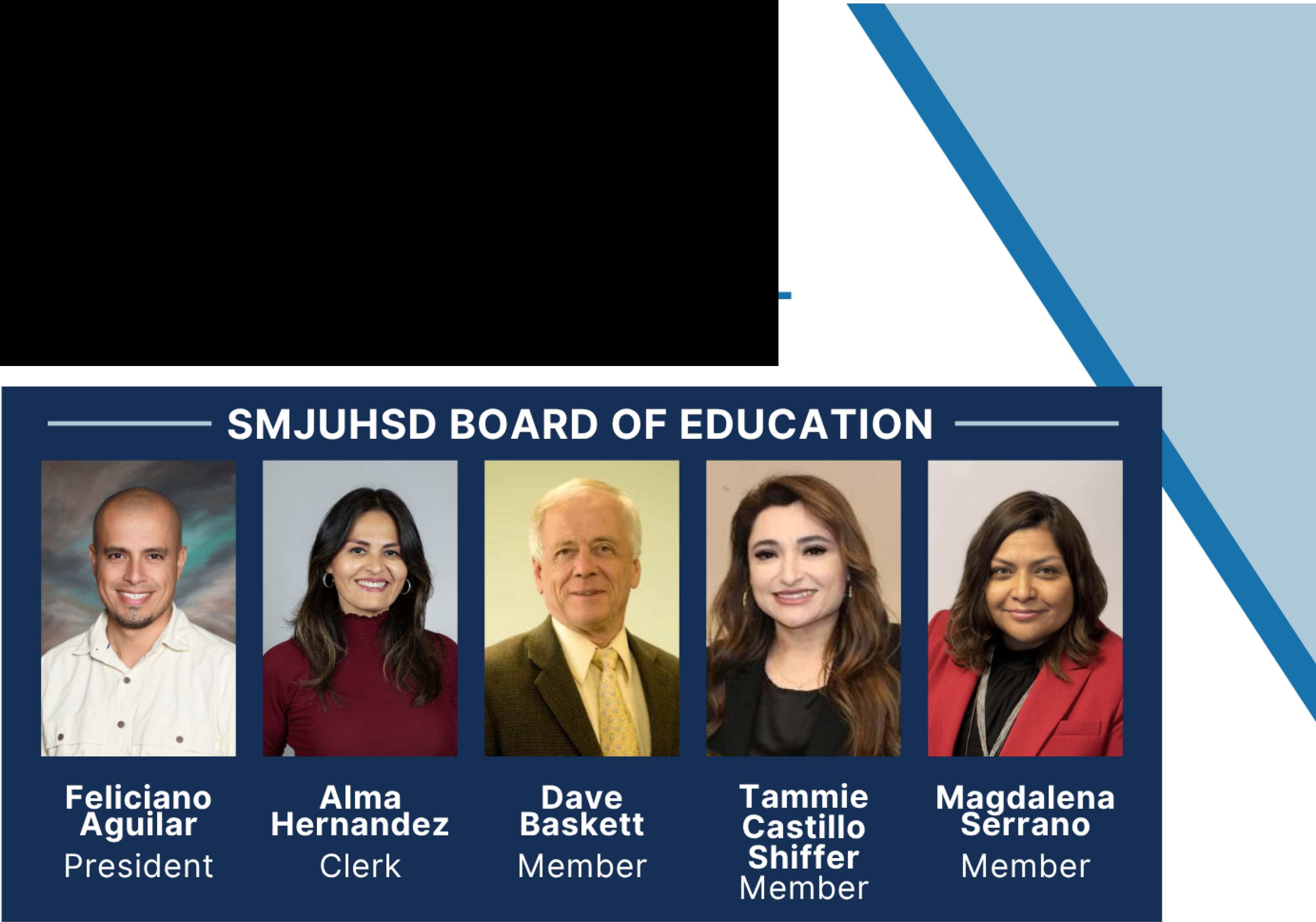
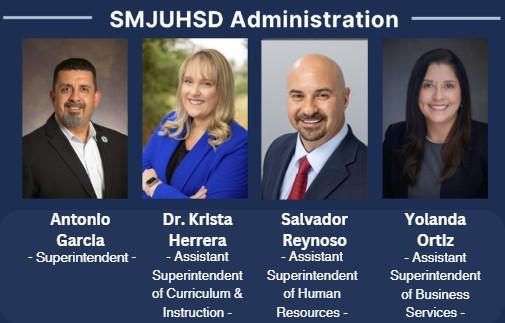
ANNUAL NOTIFICATION OF PARENTS'/STUDENTS' RIGHTS FOR THE 2026-27 SCHOOL YEAR IS AVAILABLE ON THE DISTRICT’S WEBSITE OR BY REQUEST.
As required by law, I wish to notify you of your rights and responsibilities as parents and/or guardians of students enrolled in our schools. Therefore, I ask that you please take a moment to carefully review the district and school handbooks that have been provided to you on the District’s and your child’s school websites. This parent/guardian acknowledgment indicates you have reviewed these materials. If you have any questions regarding this information, please feel free to contact our District Office. After your review, please sign and return this form to the Records Office at your student's school. — Antonio Garcia, Superintendent
Education Code Section 48982 requires parents or guardians to sign and return this acknowledgment. By signing below, I am neither giving nor withholding consent for my child(ren) to participate in any program. I am merely indicating that I have received and read the information with notices regarding my rights relating to activities which might affect my child(ren).
➡ STUDENT NAME: SCHOOL:
➡ STUDENT NAME: SCHOOL:
➡ STUDENT NAME: ______________________________________________________________ SCHOOL:
RECEIVED BY: ______________________________________________________________
(Parent or Guardian Name Printed)
SIGNATURE: DATE: (Parent or Guardian) Date
TEACHER QUALIFICATIONS NOTIFICATION
A provision of federal Title 1 requires all districts to notify parents of students in Title 1 schools that they have the right to request and receive timely information on the professional qualifications of classroom teachers and paraprofessionals, including state qualifications, licensing for the grade level or subject taught, any waivers for qualifications, emergency provisions, college major, graduate degrees and subject, and if paraprofessionals are in the classroom and their qualifications.
The rights of parents/guardians of district students include, but are not limited to, the following:
● To observe, within a reasonable period of time after making the request, the classroom(s) in which their child is enrolled or for the purpose of selecting the school in which their child will be enrolled
● To meet, within a reasonable time of their request, with their child’s teacher(s) and the principal
● Under supervision of district employees, to volunteer their time and resources for the improvement of school facilities and school programs, including, but not limited to, providing assistance in the classroom with the approval, and under the direct supervision, of the teacher
● To be notified on a timely basis if their child is absent from school without permission
● To receive the results of their child’s performance and the school’s performance on standardized tests and statewide tests
● To request a particular school for their child and to receive a response from the district
● To have a school environment for their child that is safe and supportive of learning
● To examine the curriculum materials of the class(es) in which their child is enrolled
● To be informed of their child’s progress in school and of the appropriate school personnel whom they should contact if problems arise with their child
● For parents/guardians of English learners, to support their child’s advancement toward literacy
● For parents/guardians of English learners, to be informed, through the school accountability report card, about statewide and local academic standards, testing programs, accountability measures and school improvement efforts
● To have access to the school records of their child
● To receive information concerning the academic performance standards, proficiencies, or skills their child is expected to accomplish
● To be informed in advance about school rules, including disciplinary rules and procedures, attendance policies, dress codes, and procedures for visiting the school
● To be notified, as early in the school year as practicable, if their child is identified as being at risk of retention and of their right to consult with school personnel responsible for a decision to promote or retain their child and to appeal such a decision
● To receive information about any psychological testing the school does involving their child and to deny permission to give the test
● To refuse to submit or to participate in any assessment, analysis, evaluation, or monitoring of the quality or character of the student’s home life, any form of parental screening or testing, any nonacademic home-based counseling program, parent training, or any prescribed family education service plan, and to inspect any survey collecting personal information
● To participate as a member of a parent advisory committee, school site council or site-based management leadership team in accordance with any rules and regulations governing membership in these organizations
● To question anything in their child’s record that the parent/guardian believes is inaccurate, misleading, or is an invasion of privacy and to receive a response from the school
● To provide informed, written, parental consent before their child is tested for a behavioral, mental, or emotional evaluation
● To opt out of state testing, a parent must initiate a letter in writing to the principal stating they do not want their student to participate.
● To request information re: professional qualifications of child’s teacher and paraprofessional, or a code of conduct.
● A student’s citizenship, place of birth, or national origin will not be released without parental consent or a court order.
The free school guarantee under the California Constitution prohibits charging students any fee, charge or deposit for curricular, extracurricular, credit, or non-credit activities that are part of the District’s or a school sites’ educational program. (California Constitution, article IX, § 5, Hartzell v. Connell (1984) 35 Cal.3d 899, 5 CCR § 350)
Complaints regarding fees, charges, or deposits may be pursued using the district’s Uniform Complaint Procedures.
Parents/guardians may support the learning environment of their child by:
● Monitoring school attendance of their child
● Ensuring that homework is completed and turned in on time
● Encouraging their child to participate in extracurricular and co-curricular activities
● Monitoring and regulating the television viewed by their child
● Working with their child at home in learning activities that extend the classroom learning
● Volunteering in their child’s classroom(s) or for other school activities
● Participating in decisions related to the education of their own child or the total school program as appropriate
● Students have the right to a free, public education in a safe, clean environment, regardless of any status or belief.
● Students have the right to full use of class time for receiving instruction and learning.
● Students have the right to fair, consistent, and respectful treatment by staff members and other students.
● If expelled, students have the right to appeal the decision of the Board of Education within 30 days of the decision.
● Students have the right to free expression. They are free to voice their concerns through student government, student advisory committees, school newspapers, teachers, counselors, and administrators, and any other channel of communication. However, it must be stressed that any expression or communication must not be obscene, libelous, or slanderous; create a clear and present danger of the commission of unlawful acts on school grounds; substantially disrupt or threaten to disrupt the orderly and safe operation of the school; or violate school regulations.
● Pregnant and parenting students in the district shall have the same educational and extracurricular opportunities as all students. Participation in special programs or schools shall be voluntary.
PLEASE NOTE: Throughout this booklet, the term “parent” refers to natural or adoptive parent, legal guardian, or legal caregiver of the student. Abbreviations used in this booklet:
BP/AR Board Policy/Administrative Regulation HS Health and Safety Code
CC California Civil Code
CCR Code of California Regulations
EC California Education Code
VC Vehicle Code
PC California Health Code
CFR Code of Federal Regulations
USC United States Code

All counseling staff and materials do not discriminate against any student based on actual or perceived ancestry, age, color, disability, gender, gender identity, gender expression, nationality, race or ethnicity, religion, sex, sexual orientation, or association with a person or a group with one or more of these actual or perceived characteristics. (EC §§ 200, 220, 221.5, and 260; GC § 11135; PC § 422.55; 5 CCR §§ 4900, 4902, 4930, 4931, 4940 and 4960)
Annually the district prepares curriculum, course titles, aims and descriptions in prospectus. The prospectus is available at each school site and may be reproduced at cost. [E.C. 49063, 49091.14]
A program of study that involves a multi-year sequence of courses that integrates core academic knowledge with technical and occupational knowledge to provide students with a pathway to postsecondary education and careers. More information is available about Career Technical Education at California Department of Education, http://www.cde.ca.gov/ci/ct
High school counselors are trained to help students prepare for college or career training. They take students through all steps to ensure all financial aid information is completed, requirements, and careers. Most counselors are available by appointment and will meet with students and their families. [E.C. 51229]
Transfers are granted for:
● Lack of prerequisite
● Previous enrollment in that class
● Administrative or clerical error.
Transfers are not permitted for:
● Not liking the subject
● Not liking the teacher
● Not receiving a passing grade
With the approval of the principal or designee, a student may repeat a course in order to raise his/her grade. Both grades received shall be entered on the student’s transcript. Repeated courses must be the same course. If a student is repeating a course previously taken, the higher of the two grades will be applied to the course and elective course credit will be given for the lower grade attempted provided it’s a passing grade. The repeated course should be averaged along with all of the courses during the grading. AR 5121(b)
This is an online program where students work at their own pace to make up failed courses needed for graduation.
Students who drop a course during the first 20 school days of the semester, may do so without any entry on his/her permanent record. A student who drops a course after 20 school days of enrollment in a class shall receive an “F” on their permanent record unless otherwise decided by the principal or designee because of extenuating circumstances. Teachers do not drop students from class. This is done ONLY by administration. AR5121(c)
The Board of Education believes good communication between parents and teachers is important in the educational process. All appropriate forms of communication should be used. The progress report should reflect student progress in classwork and proficiency levels and indicate educational growth in relation to student’s ability, citizenship and effort. [E.C. 49067]
Grades for achievement shall be reported each marking periods as follows:
● A (90% - 100%) — Outstanding Achievement
● B (80% - 89%) — Above Average Achievement
● C (70% - 79%) — Average Achievement
● D (60% - 69%) — Below Average Achievement
● F (0 – 59%) — Little or No Achievement
● I — Incomplete [AR5121]
● CR (60-100% for SMJUHSD 0 grade points & 70-100% for Dual Enrollment courses
● NC (0-59% for SMJUHSD & 0-69% for Dual Enrollment courses) 0 grade points
● X is used for students who have P.E. waived
*If for some extraordinary reason, a student is unable to complete a class (i.e., poor health), the student may receive an “Incomplete ” The student must complete the work by the end of the first 6-weeks of the following term, or the “Incomplete” will turn into an “F” grade. Plus and minus signs may be used at the option of the teacher. No grade of a student participating in a physical education class may be adversely affected due to the fact that the student, because of circumstances beyond his/her control, does not wear standardized physical education apparel. [E.C. 49066] Whenever it becomes evident to a teacher that a student is in danger of failing a course, the teacher shall arrange a conference with the student’s parent/guardian or send the parent/guardian a written report (Education Code 49067)
The GPA is the total average of grade point earned by a student. Points are assigned to each letter grade:
A = 4 B = 3 C = 2 D = 1 F = 0
A = 5 for Honors, AP, Concurrent Courses
B = 4 for Honors, AP, Concurrent Courses
C = 3 for Honors, AP, Concurrent Courses
Honors or Advanced Placement Unit
According to the University of California guidelines, an extra point is given for Honors (H) and Advanced Placement (AP) classes for 11th and 12th graders only. Tenth grade students may receive the extra point if they take junior or senior Honors or AP classes, but only for calculating their high school GPA. This will not be included in the UC system GPA calculation.
To be eligible for the Golden State Seal Merit Diploma, students must:
Must be eligible to receive a high school diploma.
Must have demonstrated the mastery of the curriculum in at least six subject areas. For the subject area details and further eligibility information, please visit https://www.cde.ca.gov/ta/tg/ca/gssmdeligibility.asp
Students enrolled in classes at a Community College must request the college registrar send the transcript to the student’s home school after the grades are posted at the end of the semester To be on time for graduation in June, the college transcript should be hand carried, not mailed. The units from college courses are multiplied by 3.3 and rounded off to the highest whole number to determine the high school unit value.
Grading Appeal Process
Students/parents have the right to appeal grades for academics, citizenship or attendance records This may be done first to the classroom teacher within 2 weeks for academics or attendance. If not satisfied, he/she may ask to meet with the assistant principal. Until the appeal is decided, a student who has lost privileges may not participate in extra-curricular activities
Students who will be out of school for an extended time (3 or more days) due to an accident or illness may request homework by e-mailing or calling teachers directly, or check the school’s Web page. Homework for students on school suspension will be requested by the Administration Office
Graduation/Diploma Information
Students must have all fees paid or cleared to participate in the graduation ceremony and before picking up their diploma.
High School Diplomas will not be mailed home Contact your school for their pickup dates and times The student must be present to sign for the receipt of their diploma.
English English Learners may earn a maximum of 20 English credits from English Language Development (ELD) course. The remaining English credits must be earned from grade-level English courses
Math Students shall complete at least one mathematics course that meets the state academic content standards for Algebra I or Integrated Mathematics I. Students may complete such coursework prior to grade 9 provided that they also complete two mathematics courses in grades 9-12 (three courses for the graduating class of 2028 and beyond).
5 credits of PE 2 may be waived for any student athlete who participates in a full season of extracurricular athletics during the 9th grade year. A student athlete who participates in an additional full season of extracurricular athletics during their 10th grade year may waive the remaining 5 credits towards PE 2. This waiver process also includes students who participate in Marching Band during the 9th and 10th grade year. No more than 10 credits may be earned in non-physical education classes and applied toward the 20-unit physical education requirement. Non-physical education courses approved by the site in excess of the five credits will earn elective credit.
The Board of Education encourages students to take academically challenging courses and to go beyond the minimum local and State graduation requirements. To recognize students who avail themselves of this academically enriched course of study, the Board of Education will bestow the Academic Scholar Diploma Seal to those students enrolled at the comprehensive high schools who have successfully completed the following requirements:
1. Achievement of a cumulative grade point average (non weighted) of 3.5 or above from the beginning of the ninth grade year to the end of the first semester and/or second term of their senior year
2. Completion of the minimum University of California (A-G) requirements for college admission
3. Completion of 230 or more credits
1. If a student with disabilities does not meet state and local requirements for earning a high school diploma then the local educational agency may award the student a certificate or document of educational achievement or completion pursuant to Education code Section 56390, if the student meets anyone of the following conditions:
a. Individual has satisfactorily completed a prescribed alternative course of study approved by the Board of Education of the district in which the student attended school or the district with jurisdiction over the student as identified in his/her IEP.
b. Individual has satisfactorily met his/her goals and objectives during high school as identified in his/her IEP; OR
c. Individual has satisfactorily attended high school, participated in the instruction as prescribed in his/her IEP and met the objectives of the statement of transition services.
English
Math
Laboratory Science
History/ Social Science
Visual & Performing Art
Languages Other Than English
College Preparatory Elective
Four Years Required
Four years of college-preparatory English that include frequent and regular writing, and reading of classic and modern literature, and practice with listening and speaking
Three Years Required / Four Years Recommended
Three years of college-preparatory mathematics that includes the topics covered in elementary and advanced algebra and two- and three-dimensional geometry
Two Years Required / Three Years Recommended
Two years of laboratory science providing fundamental knowledge in at least two of the three disciplines of biology, chemistry and physics
Two Years Required
Two years of history/social science, including one year of world history, cultures and geography; and one year of U S history or one-half year of U S history and one-half year of civics or American government.
One Year Required
Including dance, drama/theater, music or visual art.
Two Years Required / Three Years Recommended
Two years of the same language other than English or equivalent to the second-level or high school.
One Year Required
Chosen from the “a-f” courses beyond those used to satisfy the requirements above, or courses that have been approved solely for use as “g” electives.

The CSU requires a minimum 15-unit pattern of courses for admission as a first-time freshman Each unit is equal to a year of study in a subject area A grade of C or higher is required for each course you use to meet any subject requirement.
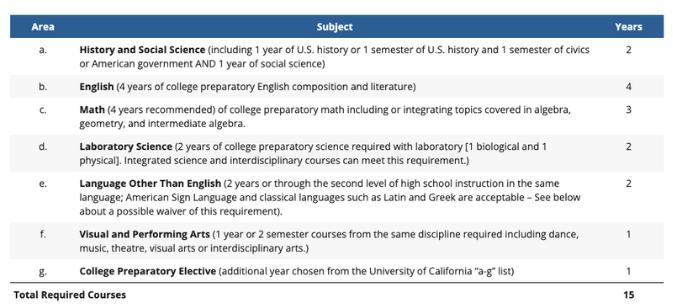
There are career and technical education (CTE) courses that can be used to meet any of the subject area requirements listed above. Please refer to the University of California’s Course List Search for the entire listing of approved courses.
If you can demonstrate competency in a language other than English that is equivalent to or higher than that expected of students who have completed two years of language other than English study, you may be allowed a waiver to the foreign language requirement. For further information, contact the CSU campuses to which you are applying

(Sample four-year plan. Contact your counselor for your specific plan)
● ENGLISH: English 1 (P)
● MATH: Integrated Math 1, Integrated Math 2
● SCIENCE: Ag Science 1 (P), Biology (P), Physics of the Universe (P)
● PE: 9th Grade PE
Grade 9
Grade 10
● INTERNATIONAL LANGUAGES: French 1 (P), Spanish 1 (P), Spanish for Spanish Speakers 1 (P)
● EGS: Intro To Ethnic and Gender Studies
● ELECTIVE: Refer to sample electives
SAMPLE NINTH GRADE ELECTIVES (Varies by school): Computer Applications, Culinary Arts, Business, Graphic Arts, Mechanical Drawing, Band, Chorus, Intro to Art, Leadership, Relationships & Family, Theatre Arts
● ENGLISH: English 2 (P), (H)
● MATH: IntegratedMath2,IntegratedMath3
● SCIENCE: Biology (P), Ag Biology (P)
● SOCIAL SCIENCE: Modern World History (P), AP World History
● PE / HEALTH: 10TH Grade PE
● INTERNATIONAL LANGUAGE: French 2 (P), Spanish 2 (P), Spanish for Spanish Speakers 2 (P)
● ELECTIVE: Refer to sample electives
SAMPLE TENTH GRADE ELECTIVES (Varies by school): Computer Applications, Creative Home Arts, Architectural Drawing, Band, Choir, Culinary Arts, Intro to Art, Intermediate Drawing, Painting, Leadership, Health, Theatre Arts
● ENGLISH: English 3 (P); AP English Language and Composition
● MATH: IntegratedMath3,IntegratedMath3Accelerated
● SCIENCE: Chemistry (P) (H), Physiology/Anatomy (P)
● SOCIAL SCIENCE: AP United States History, US History (P)
● ELECTIVE: Refer to sample electives
● ELECTIVE: Refer to sample electives
SAMPLE ELEVENTH GRADE ELECTIVES (Varies by school): Spanish 2 or 3 (P) or other International Language, PE, Psychology (P), Leadership, Choir, Band, Intro to Art, Intermediate Drawing, Painting, Drafting, Ag Mechanics, Ornamental Horticulture, AHC Concurrent courses, Theatre Arts
● ENGLISH: English 4 (P), AP English Literature & Composition, Senior English Class
● MATH: Math Analysis (P), Calculus (P)
● SCIENCE: Physics (P), Physiology/Anatomy (P)
● SOCIAL SCIENCE: US Government (P), Economics (P) (AP)
● ELECTIVE: Refer to sample electives
● ELECTIVE: Refer to sample electives
SAMPLE TWELFTH GRADE ELECTIVES (Varies by school): Physiology/Anatomy (P), Spanish 4 (P) Spanish Literature (AP), Psychology (P), PE, Leadership, Choir, Band, Intro to Art, Intermediate Drawing, Painting, AHC Concurrent, Theatre Arts
Ninth, tenth, and eleventh grade comprehensive high school students must be enrolled in a minimum of 60 credits (6 periods on a traditional bell schedule. Twelfth grade students in good academic standing and not credit deficient may be approved to take a reduced class schedule of a minimum of 50 credits (5 periods on a traditional bell schedule) per school year.
Legend: (P) College Prep Course Level; (H) Honors / by teacher recommendation; (AP) Advanced Placement
● College prep students should be sure to make-up any required course if they received lower than a “C-” grade (i.e., English, Science, Math, Social Studies).
● Students may be placed in Honors courses by teacher recommendation only.
● One year of either Fine Arts, Foreign Language, or CTE Pathway course must be chosen for an elective during the 9th, 10th, 11th or 12th grade year
Unit System A student will receive five credits at the end of each course in which a “D” grade or better is earned. Permanent grades and units are recorded at the end of each grading period.
Concurrent course offerings vary by site
What is the State Seal of Biliteracy?
The California State Seal of Biliteracy is denoted by a gold seal affixed to the diploma and serves to recognize high school graduates who have demonstrated a high level of proficiency in one or more languages in addition to English.
Purpose:
•Serves as an asset when applying to colleges and future employers
•Supports students in becoming college- and career-ready in a global society

•Strengthens intergroup relationships, affirms the value of diversity, and honors the multiple cultures and languages within a community
•Encourages and recognizes the study of world languages
Requirements:
Must meet ONE of the following criteria:
Complete English Language Arts requirements for graduation (4 years/40 credits of high school coursework) with a GPA of 3.0 or higher in those classes. (OR)
Must meet ONE of the following Criteria:
Complete four years of high school International Languages coursework (or the equivalent) with a GPA of 3.0 or higher in that course of study AND pass the oral portion of the Avant exam with a score of 5 or higher. (OR)
Earn a score of 3 or higher on the AP English Language & Composition or AP English Literature and Composition Exam).
Earn a score of 480 or higher on the SAT Evidence-Based Reading & Writing section.
Earn a score of at least 2583 on the CAASPP English Language Arts section in 11th grade.
Earn a score of 3 or higher on the AP International Language exam.
Earn a composite score of 6 or higher on a district- approved language proficiency test in a language other than English.
Earn a score of 3 or higher on the Mixteco Oral Exam
In addition to the above criteria, emerging multilingual students must attain an Oral Language composite score of level 4 on the English Language Proficiency Assessments for California ELPAC.
See your School Counselor or International Language Teacher for information
Availability of Course Prospectus [E.C. 49063, 49091.14]
The Board of Education believes that the education of the district’s students is a shared responsibility. In an effort to foster this partnership with parents, including titles, descriptions, and instructional aims of every course offered, will be compiled and made available annually. The core curriculum is based on the State content standards and both State and district-adopted instructional materials. Course descriptions and curriculum materials are available upon request.
Language acquisition programs are educational programs designed for English learners to ensure English acquisition occurs as rapidly and effectively as possible, and provides instruction to English learners based on the state-adopted academic content standards, including English language development (ELD) standards. (20 U.S.C. § 6312 (e)(3)(A)(iii)(v); EC Section 306(c); Cal. Code Regs., tit. 5, § 11309)
English Learners (EL) Program [E.C. 305, 306, 310, 52164.1, 52164.3; BP/AR 6174]
Students whose primary language is one other than English will be assessed, and their parents will be notified as to whether their child has attained fluent English proficiency or has been identified as an English learner.
Parents of English learners will receive a letter, within the first 30 days of the beginning of the school year, informing them of their child’s English proficiency level, program placement, and general EL Program information.
Parents/Guardians may choose an available language acquisition program that best suits their child, if available. However, schools in which the parents or legal guardians of 30 pupils or more per school or the parents or legal guardians of 20 pupils or more in any grade request a language acquisition program that is designed to provide language instruction shall be required to offer such a program to the extent possible. Upon meeting these thresholds, the requests for the same or substantially similar type of language acquisition program shall be responded to consistent with the process set forth in Title 5 of the California Code of Regulations, section 11311, subdivision (h), which may or may not result in implementation of the language acquisition program that was requested. 20 U.S.C. § 6312 (e)(3)(A)(viii)(III); EC Section 310(a); Cal. Code Regs., tit. 5, §11310, subd. (b)(4))
Parents/guardians of English learners have a right to decline, opt their children out of the school district’s language acquisition program, or opt out of particular English learner service within a language acquisition program. (20 U.S.C Section 6313(e)(3)(A)(viii)) However, the District remains obligated to provide the student with meaningful instruction until the student is reclassified, inform the parent when progress is not made, and offer the parent programs and services to consider at that time (Cal Code Regs , tit 5, §11302)
The Student Success Team (SST) is composed of various staff, the student’s parent/guardian and the student, if appropriate. An SST can be convened whenever a student is identified as having any barriers to being successful in the classroom or on the school site so the situation can be discussed and appropriate actions will be taken. An SST meeting can be requested by school staff or parents. The purpose of the SST meeting is to discuss the student’s strengths and needs, as well as design any necessary accommodations to assist the student in being more successful.
Multi-Tiered System of Support is a schoolwide process of early intervention and prevention of academic, social emotional and behavioral needs It is a process that utilizes all resources within a school in a collaborative manner to create a single, well-integrated system of instruction and interventions guided by student outcome data.
MTSS functions on a set of guiding principles that inform and direct the process of strategic intervention. The primary principle is that, the earlier an intervention is implemented, the more effective it will be for the student. Another principle is the curriculum, past or present, is implemented to meet a particular struggling learner’s needs. It is essential to use data to understand a struggling learner’s needs and targeting them with specific, meaningful interventions is critical Social and emotional skills are the tools both children and adults use in social interactions and to manage every day emotional responses Things like social awareness, setting goals, and taking responsibility for oneself are imperative to maintaining healthy relationships and practicing self-care The final principle is that speculation is insufficient to determine the efficacy of an intervention; therefore, regular progress monitoring is essential to determine if continued intervention or return to the general curriculum is required
Students who lose or damage library materials will pay the current cost of an item. Library book processing standards prohibit the school
district from accepting donated copies of a library book that has been lost or damaged in lieu of payment.
California students take several mandated statewide tests These tests provide parents/guardians, teachers, and educators with information about how well students are learning and becoming college and career ready The test results may be used for local, state, and federal accountability purposes Pursuant to California Education Code Section 60615, parents/guardians may annually submit to the school a written request to excuse their child from any or all of the California Assessment of Student Performance and Progress (CAASPP) assessments
The California Assessment of Student Performance and Progress (CAASPP) tests consist of the following:
The Smarter Balanced computer adaptive assessments are aligned with the Common Core State Standards (CCSS). English language arts/literacy (ELA) and mathematics tests are administered in grades three through eight and grade eleven to measure whether students are on track to college and career readiness. In grade eleven, results from the ELA and mathematics assessments can be used as an indicator of college readiness
The computer-based CAST measures students’ achievement of the California Next Generation Science Standards (CA NGSS) through the application of their knowledge and skills of the Science and Engineering Practices, Disciplinary Core Ideas, and Crosscutting Concepts. The CAST is administered to all students in grades five and eight and once in high school (i.e., grade ten, eleven, or twelve).
Only eligible students students whose individualized education program (IEP) identifies the use of alternate assessments may participate in the administration of the CAAs Test examiners administer the computer-based CAAs for ELA, mathematics, and science one-on-one to students Students in grades three through eight and grade eleven will take the CAA for ELA and mathematics Test items developed for ELA and mathematics are aligned with the CCSS and are based on the Core Content Connectors
The optional CSA for Reading/Language Arts in Spanish is aligned with the California Common Core State Standards en Español. This computer-based test allows students to demonstrate their Spanish skills in listening, reading, and writing mechanics.
Advanced Placement Examination Fees [E C 48980]
State funding is available for eligible economically disadvantaged high school pupils to reduce or cover the costs of Advanced Placement exam fees.
Advanced Placement students can request this information from the AP Testing Coordinator or school counselor
Any person 16 years of age or older, or who has been enrolled in the 10th grade for a year, or who is currently enrolled in the final semester of 10th grade, may be granted a Certificate of Proficiency by the California Department of Education (CDE) if s/he passes the performance tests established by the CDE. The principal of each school maintaining 11th and 12th grades will make information available to each student about the California High School Proficiency Examination when requested. The notification is to be made in time to enable interested students to meet examination registration requirements for the Fall test.
Parental Consequences for Student Non-Attendance [E.C. 48293]
Any pupil subject to compulsory full-time education or to compulsory continuation education who is absent from school without valid excuse for three full days in one school year or tardy or absent for more than any 30-minute-period during the school day without a valid excuse on three occasions in one school year, or any combination thereof, is a truant and shall be reported to the attendance supervisor or the superintendent of the school district. [E.C. 48260(a)] A school may send the first truancy notification to a parent/guardian after their student has met the above qualifications.
Any pupil who has once been reported as a truant and who is again absent from school without valid excuse one or more days, or tardy on one or more days, shall again be reported as a truant to the attendance supervisor or the superintendent of the district. [E.C. 48261] A school may send the second truancy notification to a parent/guardian after their student has met the above qualifications.
Any pupil is deemed a habitual truant who has been reported as a truant three or more times per school year, provided that no pupil shall be deemed a habitual truant unless an appropriate district officer or employee has made a conscientious effort to hold at least one conference with a parent or guardian of the pupil and the pupil himself. [E.C. 48262] A school may send the third truancy notification to a parent/guardian after their student has met the above qualifications.
Annual Parent/Guardian Notifications
When a student has had absences due to illness that have been verified equal to or surpassing 10% of the school days to date or of the total school days for the current academic year, the student must obtain verification from a physician, school nurse, or other school personnel for an additional absence. Failure to provide verification from the physician, school nurse, or other school personnel will result in those additional absences being recorded as unexcused. [AR 5113] Any parent who fails to ensure his/her student's attendance in school, unless excused or exempted, is guilty of an infraction and can be sanctioned by a court.
If any minor pupil in any district of a county is a habitual truant, or is irregular in attendance at school, as defined in this article, or is habitually insubordinate or disorderly during attendance at school, the pupil may be referred to a School Attendance Review Board (SARB) [E.C. 48263]. When a student is referred to SARB, a hearing is held and includes the parents of the minor. Although the goal of SARB is to keep students in school and provide them with a meaningful educational experience, SARB does have the power, when necessary, to refer students to Community School or the parents may be referred to the County Truancy Board or directly to the District Attorney. For pupils 13 and older, SARB may also request law enforcement to write a citation for truancy.
Instructional Minutes – Physical Education
High School Students in Grades 9-12: Unless exempted pursuant to Education Code section 51241, students are required to receive at least 400 minutes of physical education instruction each 10 school days. High school students may be excused from physical education classes during one of grades 10, 11 or 12 for up to 24 clock hours in order to participate in automobile driver training, but must still attend a minimum of 7,000 minutes of physical education instruction during that school year.
Any questions or concerns regarding this requirement should be directed first to the school principal. If a parent/guardian believes that the school is not meeting this minimum requirement, a formal complaint under the District’s Uniform Complaint Procedures may also be filed. Complaint forms are available at all school sites and the district office.
As required by law and the educational code, parents/guardians are responsible for enrollment and regular attendance of their school-age children in their district and school of residence. Regular attendance in all classes is a priority and is important for a successful academic experience culminating in graduation and college and career preparedness.
A direct correlation exists between good attendance and high academic achievement, a rewarding and positive high school experience, and eventual success in higher education and/or a career in the work force. Building good habits for life, such as reliability, punctuality and personal responsibility, are equally important. For these reasons and because attendance at school is the law, our district takes attendance very seriously and sees it as a top priority.
Student attendance also has a financial impact on the quality of education the school is able to provide as the school only receives funding when the student is in class or otherwise accounted for. Therefore, absences of any kind can have an adverse financial effect on the instructional materials, textbooks, field trips, and other important services provided to your student.
For special situations or circumstances that may require a student to miss school, not specifically listed below in subsection (a), 1) through 9), it is extremely important that the parent communicate with the school site (teacher, school counselor, and attendance office). This will help prevent unnecessary and continuous absence notifications, and most importantly, subsequent designation as a truant with referral to the School Attendance Review Board (SARB).
A pupil shall be excused from school when the absence meets the criteria listed below:
(a)Notwithstanding Section 48200, a pupil shall be excused from school when the absence is:
● Due to his or her illness including an absence for the benefit of the pupil’s mental or behavioral health.
● Due to quarantine under the direction of a county or city health officer.
● For the purpose of having medical, dental, optometric, or chiropractic services rendered.
● For the purpose of attending the funeral services of a member of his or her immediate family, so long as the absence is not more than one day if the service is conducted in California and not more than three days if the service is conducted outside California.
● For the purpose of jury duty in the manner provided for by law.
● Due to the illness or medical appointment during school hours of a child of whom the pupil is the custodial parent, including absences to care for a sick child, for which the school shall not require a note from a doctor.
● For justifiable personal reasons, including, but not limited to, an appearance in court, attendance at a funeral service, observance of a holiday or ceremony of his or her religion, attendance at religious retreats, attendance at an employment conference, or attendance at an educational conference on the legislative or judicial process offered by a nonprofit organization when the pupil's absence is requested in writing by the parent or guardian and approved by the principal or a designated representative pursuant to uniform standards established by the governing board.
● For the purpose of serving as a member of a precinct board for an election pursuant to Section 12302 of the Elections Code.
● For the purpose of spending time with a member of the pupil's immediate family, who is an active duty member of the uniformed services, as defined in Section 49701, and has been called to duty for, is on leave from, or has immediately returned from, deployment to a combat zone or combat support position. Absences granted pursuant to this paragraph shall be granted for a period of time to be determined at the discretion of the superintendent of the school district.
● For the purpose of attending the pupil’s naturalization ceremony to become a United States citizen.
● For the purpose of participating in a cultural ceremony or event.
● For the purpose of engaging in a civic or political event, provided that the pupil notifies the school ahead of the absence.
● Authorized at the discretion of a school administrator, as described in subdivision (c) of Section 48260.
● A pupil absent from school under this section shall be allowed to complete all assignments and tests missed during the absence that can be reasonably provided and, upon satisfactory completion within a reasonable period of time, shall be given full credit therefor. The teacher of the class from which a pupil is absent shall determine which tests and assignments shall be reasonably equivalent to, but not necessarily identical to, the tests and assignments that the pupil missed during the absence.
● Student absence for religious instruction or participation in religious exercises away from school property may be considered excused subject to law and administrative regulations. (Education Code 46014) For purposes of this section, attendance at religious retreats shall not exceed four hours per semester.
● Absences pursuant to this section are deemed to be absences in computing average daily attendance and shall not generate state apportionment payments.
● "Immediate family," as used in this section, means the parent or guardian, brother or sister, grandparent, or any other relative living in the household of the pupil. (Education Code 48205(e)(3))
Upon being reported as absent by a classroom teacher, an automated school messenger computer system will call home as a courtesy on the day of your student’s absence/tardy each evening between the hours of 6:30 and 7:30 p.m. The automated School Messenger calls any time a student is marked out of class. If your student
had permission to attend a school event and was present, this absence will not count as a cut and will be cleared by the teacher/coach the next day.
The timeline for notifying, verifying and clearing absences will be on the day they are absent and within 2 days of the school returning to school. When notifying the school of your student’s absence, please ensure you include the following when you call-in, email, or send a note to the school: Student’s First Name, Last Name, Grade; ID Number; date and reason for absence, parent/guardian name and relationship to student; and a phone number where the parent/guardian can be reached in case of questions or follow-up. Reporting and clearing of absences will generally be a two-step process with the only exception being an unforeseen emergency/situation.
Step 1:
Parents should notify the school the day that their student will not be attending school. Parents will be allowed to report absences in person, via email, parent portal or phone call by accessing the parent portal, and/or the attendance phone line or email address providing the information as required above.
Step 2:
From the day their student is absent to no more than 2 days after returning to school, parents/guardians are to verify and clear absences by phone call, submitting a written note, parent portalor email by accessing the attendance phone line or attendance email address.
Please note: Students who are found attempting to clear absences without a parent’s permission or have excessive excused absences WILL NOT be allowed to submit via email or phone call. They will instead be required to submit written verification (handwritten note). Per district policy, excessive excused absences are defined as 14 or more days of excused absences. In this case, future absences for illness will require verification in writing by a physician
Truancy Intervention & Parent Accountability Program
The Truancy Intervention Program is collaboration between the Santa Maria Joint Union High School District, Santa Barbara County District Attorney, Santa Barbara County Probation Department, Santa Maria Police Department, and the Santa Barbara County Juvenile Courts. The purpose of the program is to implement a
series of interventions aimed at reducing truancy in the Santa Maria Joint Union High School District. Truancy interventions include the following:
STEP 1 - Letter #1:
● # of unexcused absences: 3 days or 18 periods
● Action taken: Send Notification Letter #1
STEP 2 - Letter #2:
● # of unexcused absences: 6 days or 36 periods
● Action taken:
○ Send Notification Letter #2 &
○ Meeting with an administrator focusing on addressing individual attendance needs, and where a contract with the school may be signed
● # of unexcused absences: 12 days or 54 periods
● Action taken:
○ Send Notification Letter #3
○ Meeting with independent panel of district, county and community representatives, where a contract with the SARB panel may be signed, and with a possible referral to interventions that may remove the barriers that are impacting attendance to school.
Effective August 16, 2006 the City of Santa Maria will enact for enforcement a City of Santa Maria Anti-loitering ordinance. This ordinance makes it unlawful for any minor under the age of eighteen (18) years, who is subject to compulsory education or to compulsory continuation education, to loiter upon the public streets, avenues, highways, roads, alleys, sidewalks, parks, playgrounds or other public grounds, public places, parking lots or vacant lots in the City during the minor’s school hours. Violation of his ordinance is guilty of an infraction punishable by a fine not to exceed $10,000 and/or (10) hours of community service. Community service shall be served during a time other than the minor’s hours of school attendance or employment.
If your child has a temporary disability preventing him/her from attending regular classes, the district will provide individual instruction when possible, [E.C. 48206.3, 48980(b)]
Hospital-bound students (not classified as exceptional children) with TEMPORARY DISABILITIES and residing in a hospital or a residential health care facility are deemed to comply with residency requirements for that district and are entitled to an individualized instructional program. The parent or guardian of the pupil with temporary disability is responsible for notifying the district where the parent resides and where the health facility is located. Upon receipt of notification, the district shall commence specific EDUCATIONAL RESPONSIBLITIES within a mandated timeline. [E.C. 48206.3, 48207, 48208(a) (b)]
“The governing board of the Santa Maria Joint Union High School District, pursuant to Section 44808.5 of the Education Code, has decided to permit pupils enrolled at Delta School to leave the school grounds during the lunch period. Neither the school district nor any officer or employee thereof shall be liable for the conduct or safety of any pupil during such time as the pupil has left the school grounds pursuant to this section.” The district permits students in grades 10 through 12 at Delta High School this privilege. Students may not leave campus at any other school site for lunch. [E.C. 44808.5]
California state law authorizes all school districts to provide for alternative schools. Section 58500 of the Education Code defines alternative schools as a school or separate class group within a school which is operated in a manner designed to:
● Maximize the opportunity for students to develop the positive values of self-reliance, initiative, kindness, spontaneity,
● Resourcefulness, courage, creativity responsibility and joy.
● Recognize that the best learning takes place when the student learns because of his desire to learn.
Maintain a learning situation maximizing student self-motivation and encouraging student in his own time to follow his own interests. These interests may be conceived by him totally and independently or may result in whole or part from a presentation by his teachers of choice of learning projects.
● Maximize the opportunity for teachers, parents and students to cooperatively develop the learning process and its subject matter. This opportunity shall be continuous, permanent process.
● Maximize the opportunity for students, teachers, and parents to continuously react to the changing world, including but not limited to the community in which the school is located.
In the event any parent, pupil, or teacher is interested in further information concerning alternative schools, the county superintendent of schools, in the administrative office of his district, and the principal’s office in each attendance unit have copies of the law available for your information. This law particularly authorizes interested
persons to request the Board of Education of the district to establish alternative school programs in each district [E.C. 58501]
Parents shall be advised of any scheduled minimum days or staff development days in which students do not attend school no later than one month prior.
Primary enrollment determination is based on district boundary guidelines. Enrollment decisions shall not be based on a student’s academic or athletic performance. Once enrolled in a school on an Intra-district Transfer a student shall not have to apply for readmission.
Inter-district Transfers are transfers between school districts Parents use the same transfer form but fill out the section referring to Inter-district Transfers. These transfers must be approved by both the school district of residence and the school district requested Once the form is signed by the official Superintendent’s Designee of both districts the transfer is official Students on an inter-district transfer must submit a new transfer request each year.
No student currently residing within a school’s attendance area shall be displaced by a student residing outside a school’s attendance area The Governing Board retains the authority to maintain appropriate racial and ethnic balances among District schools. Once enrolled at a school of residence or a school of choice through the Open
Enrollment process a student shall not have to reapply for readmission Priority for intra-district transfers under the ESEA 2001 Act requires districts to allow students to change schools if their neighborhood school has been deemed by the state department of education to be dangerous or where the student has been a victim of a violent crime.
If a transfer is denied, a written appeal may be filed with the Superintendent’s Designee or the Superintendent For information, call (805) 922-4573, Ext. 4215.
A student may establish residency by documenting that he/she lives with a parent/guardian within the district; that he/she is an emancipated minor living in the district; that he/she is in the court-appointed care of a licensed foster home, family home, or children’s institution within the district, or that he/she lives in the home of a care-giving adult within the District (E C 48204)
Reasonable evidence of residency may be established by documentation including but not limited to any of the following: property tax payment receipts, rent payment receipts, two utility bills, Landlord/Homeowner Verification of Residence Form plus proof of residence for the landlord/homeowner (i.e. utility bill, payroll stub with the residence address, permanent driver's license, public assistance paperwork, SSI, Cal Works, Welfare, Disability, or two forms of permanent I.D. indicating the address of the residence). E.C. 48204, 48980(g)]
If your child lives in the home of a care-giving adult, as defined by law, your child may request to attend the school district in which that residence is located. There is no guarantee as to the school assigned. The Superintendent or his Designee shall consider space availability and other pertinent factors prior to enrollment Execution of an affidavit by the care-giving adult is required to enroll the student in school The affidavit is to be signed under penalty of perjury pursuant to Part 1 5 (commencing with section 6550) of Division II of the Family Code [E C 48204(a)(5), 48980(h)]
There are specific criteria to be met to comply with residency requirements for school attendance in a school district for students when one or both parents/legal guardians are employed within the boundaries of that school district [E C 48204(a)(7)]
The governing board annually reviews attendance options including how students may attend a district school outside their attendance area (Intra-district) This district has non-arbitrary rules explaining how students may apply, be accepted or denied transfer to district schools Many districts also allow the transfer of students from or to other districts (Inter-district). In some cases the district must provide transportation. [E.C. 46600, 48204, 48301, 48306, 48980]
Students transferring into and out of the district will be considered on a case-by-case basis through the inter-district attendance request process For students transferring into the district from neighboring districts, placements will be in the school which is closest in geographical proximity to their home district or the least impacted school. Inter-district transfer requests out of the district will be denied if our district can accommodate the student The district may revoke a student’s enrollment if he/she is recommended for expulsion pursuant to Education Code 48918.
The Intra-district Transfer involves consideration of an Intra-district Attendance Permit Application submitted at any time to transfer from one SMJUHSD site to another Space availability will be a primary consideration
The superintendent or designee shall identify those schools which may have space available for additional students for the current school year. A list of these schools will be maintained by the Director of Student Services at the SMJUHSD Office Parents/guardians and students (18 or older) may submit applications for consideration throughout the year. However, consideration will be given to appropriate timing relative to a change of enrollment. If there are more applicants than a school can accommodate, a waiting list shall be established to indicate the order in which students may be considered, as openings occur under the Intra-district Transfer Policy. The superintendent or designee shall inform applicants by mail as to whether their applications have been approved, denied, or placed on a waiting list Applicants who receive approval must confirm their enrollment within two weeks Any complaint regarding the selection process should be taken to the superintendent or designee (Assistant Superintendent of Curriculum and Instruction).
Requests for transfers between district schools will be considered under the Intra-district Transfer policy Each request is considered on a case-by-case basis with the following priorities for consideration:
● The Board’s authority to maintain appropriate racial and ethnic balances
● State Designation of Persistently Dangerous Status of a School
● Victim of a violent criminal offense
● Space availability
● Special Circumstances/danger to the student as verified by statement from law enforcement, social services, a licensed therapist, or a court restraining order
● Siblings of students already in attendance at the requested school
A student whose parent is assigned to the requested school as his/her primary place of employment.

Our district participates in the National School Lunch Program and the School Breakfast Program which provides breakfast and lunch daily at no cost to enrolled students. Daily offerings include a variety of fresh, made-to-order, seasonal, and ethnically diverse cuisine. Menus include fresh salads, homemade sandwiches, pizza, daily specials, and favorites such as burgers and fries. We collaborate with local businesses and farmers to provide fresh baked goods and seasonal produce.
Although families do not need to submit an application to receive meals at no cost, we are requesting that they complete a Household Income Data Survey by completing the online AERIES Parent Data Confirmation. The information collected ensures maximum student support services for our student(s). Our schools receive additional State and Federal funding to support supplemental education programs and services. Your family may receive additional benefits such as college admissions test and application fee waivers and home internet discounts.
Surveys will also be available at each school site's community liaisons' office and at the District Support Services Center.
Our Foods Services Department maintains strict compliance with the Policy of the SB 19 Bill that mandates nutritional standards for our students' meals. The District's Wellness Policy is available for viewing on this website under the Board Policies, BP 5030.
Please refer to the District’s or school’s website for further details.
Every school in California is required by state law to publish a School Accountability Report Card (SARC). The SARC contains information about the condition and performance of each California public school and describes how they intend to meet annual school-specific goals for all pupils, with specific activities to address state and local priorities. [E.C. 33126, 35256, 35258]. The report is available on the district website at www.smjuhsd.org, the school’s website, or a hard copy is available upon request at the school site.
Every year, each school shall review and update its plan by March 1. The plan will include an earthquake emergency procedure system and disaster policy for buildings with a capacity of 50 or more people. Each school shall report on the status of its school safety plan to numerous community leaders and include a description of its key elements in it’s school accountability report card. [E.C. 32281, 32286, 32288]
All counseling staff and materials do not discriminate against any student based on actual or perceived ancestry, age, color, disability, gender, gender identity, gender expression, nationality, race or ethnicity, religion, sex, sexual orientation, or association with a person or a group with one or more of these actual or perceived characteristics (EC §§ 200, 220, 221 5, and 260; GC § 11135; PC § 422 55; 5 CCR §§ 4900, 4902, 4930, 4931, 4940 and 4960)
Parents are informed that schools ensure sex equity related to career counseling, career course selection opportunities and athletics Parents also have the right to participate in counseling sessions and decisions [EC 221 5]
Parents may refuse to allow their students to participate in a child abuse primary prevention program. [WIC 18976.5]
The District applies no rule concerning a student’s actual or potential parental, family, or marital status that treats students differently on the basis of sex. (5 CCR § 4950; 34 CFR § 106.40(a))
The District does not exclude or deny any student from any educational program or activity solely on the basis of pregnancy, childbirth, false pregnancy, termination of pregnancy, or recovery therefrom.
(5 CCR § 4950(a); 34 CFR § 106 40(b)(1))
Pregnant students and parenting male or female students are not excluded from participation in their regular school programs or required to participate in pregnant-student programs or alternative educational programs (5 CCR § 4950(c); 34 CFR § 106.40(b)(1))
Pregnant/parenting students who voluntarily participate in alternative programs are given educational programs, activities, and courses equal to the regular program. (5 CCR § 4950(c); 34 CFR § 106.40(b)(3))
The District treats pregnancy, childbirth, false pregnancy, termination of pregnancy, and recovery therefrom in the same manner and under the same policies as any other temporary disability [(5 CCR § 4950(d); 34 CFR § 106.40(b)(4)].
The District shall provide reasonable accommodations to a lactating pupil on a school campus to express breast milk, breast-feed an infant child, or address other needs related to breast-feeding. Lactating students are made aware of lactating accommodations through the student handbook, the health office, counselor, or as part of the Cal-Safe Program Accommodations are as follows
● Cal-Safe Program - (805) 925-2567 ext 1830
● ERHS Health Office - (805) 937-2051 ext 2718
● DHS Support Office, Room 111 - (805) 937-6356 ext. 1711
● SMHS Health Office - (805) 925-2567 ext. 3581
● PVHS Health Office - (805) 922-1305 ext. 5753
Reasonable accommodations under this section include, but are not limited to, all of the following:
1. Access to a private and secure room, other than a restroom, to express breast milk or breast-feed an infant child.
2. Permission to bring onto a school campus a breast pump and any other equipment used to express breast milk.
3. Access to a power source for a breast pump or any other equipment used to express breast milk.
4. Access to a place to store expressed breast milk safely.
The district shall provide a lactating pupil on a school campus with a reasonable amount of time to accommodate her need to express breast milk or breast-feed an infant child.
The district shall ensure that a pupil does not incur an academic penalty as a result of her use, during the school day, of the reasonable accommodations specified in this section, and pupils are provided the opportunity to make up any work missed due to such use. EC § 222(a), (b), (e)
Equal Educational Access
The District programs, activities, and student clubs are available to all persons without regard to actual or perceived ancestry, age, color, disability, gender, gender identity, gender expression, nationality, race, ethnicity, religion, sex, sexual orientation, or association with a person or a group with one or more of these actual or perceived characteristics. (EC §§ 200, 220, and 260; 5 CCR §§ 4925-4926)
All student clubs have equal access to facilities and a fair opportunity to meet. (5 CCR § 4927)
No course or activity is labeled or scheduled in a way which results in the separation of students on the basis of sex, sexual orientation, gender identity, race, ancestry, national origin, religion, color, and mental or physical disability. (5 CCR § 4940(d))
Sex-segregated programs, activities, and facilities, including the participation on all sex-segregated athletic teams and in all sex-segregated competitions, shall be available to all pupils on the basis of their individual gender identity, irrespective of the gender listed on a pupil's records. (EC § 221.5(f))
The Superintendent or designee shall establish regulations governing student access to technology that are age appropriate. These regulations shall address the safety and security of students when using electronic mail, chat rooms and other forms of direct electronic communication as well as shall prohibit access to harmful matter on the Internet, which may be obscene or pornographic, and preclude other misuses of the system. In addition, these regulations shall establish the fact that users have no expectation of privacy, and district staff may monitor or examine all system activities to ensure proper use of the system. Students who fail to abide by district rules shall be subject to disciplinary action, revocation of access to these technologies and legal action as appropriate.
Due to the internet containing an unregulated collection of resources, the district cannot guarantee the accuracy of the information or the appropriateness of any material that a student may encounter. Therefore, before using the district's on-line resources, each student and his/her parent/guardian shall sign and return an Acceptable Use Agreement This agreement shall specify user obligations and responsibilities and shall indemnify the district for any damages The parent/guardian shall agree not to hold the District responsible for materials acquired by the student on the system, for violations of copyright restrictions, users' mistakes, negligence or any costs incurred by users Staff shall supervise students while using on-line services and may ask teacher aides and student aides to assist in this supervision The Superintendent or designee shall ensure that all district computers with Internet access have a technology protection measure that blocks or filters Internet access to visual depictions that are obscene, child pornography, or harmful to minors, and that the operation of such measures is enforced. [47 USC 254]
The district's system shall be used only for purposes related to education. Commercial, political and/or personal use unrelated to an educational purpose is strictly prohibited Disclosure, use and dissemination of personal identification information regarding students are prohibited
State funding may be available to qualified low-income students to cover the costs of advanced placement exam fees. A grant program also exists to defray costs to low-income students taking the International Baccalaureate and advanced placement exams; however, the state budget crisis has given districts flexibility in providing these services. [E.C. 48980, 52240]
For the protection of your child’s health and welfare, the Governing Board of any school district may require the parent/guardian of a pupil to keep current at the pupil’s school of attendance, emergency information including the home address and telephone number, business address, and telephone number of the parents/guardians, and the name, address and telephone number of a relative or friend who is authorized to care for the pupil in any emergency situation if the parent/guardian cannot be reached. [E.C. 49408].
We ask that you update contact information through the AERIES parent portal. Please provide the Records Office with updated proof of address.
If your address, phone numbers or other personal information changes over the course of the school year, it is very important to update through your AERIES parent portal
Reports, newsletters, announcements and reminders of meetings are often mailed home. In order for the school to keep parents/guardians well informed, and to insure that contact can be made quickly if necessary, it is imperative that the Records Office be informed of any change of address, phone number and guardianship. Changes of data forms are available at the Records office
You and your children over 18 have the right to review, get copies, and inspect their school records within five business days of a written request or oral request or before any meeting regarding an individualized education program or a hearing. Those records are confidential, and privacy will be maintained, except in some instances such as when your child transfers to another school. The records include transcripts, discipline letters, recommendations, attendance, and health information. The records are maintained at the school office by the registrar. There is someone to help interpret the material. When more than one child is named in the records, parents may only see material related to their child. If requested, the district will provide a list of types of records held and their location. District policy or administrative regulation sets forth the criteria by which school officials and employees can look at, change or delete the files and why Files may be reviewed to identify students eligible for public school choice or supplemental educational services
You may have copies made free of charge You also have the right to file a written request with the superintendent challenging the records You can challenge how your request was handled with the district or with United States Department of Education if you think there is an inaccuracy, unsubstantiated conclusion or inference, a conclusion outside the observer’s expertise, comment not based on personal observation with time and date noted, misleading information or violation of privacy rights. You will get to meet with the superintendent or designee within 30 days. If your challenge is sustained, the changes will be made. If not, you can appeal to the school board, which has final authority. If you still have a different view, your view can be included in the student’s record.
For further information or assistance, contact the District Office at 922-4573, extension 4215, or the Family Policy Compliance office, U S Department of Education, 600 Independence Avenue, SW, Washington, DC 20202-4605 [E C 49063, 49060, 49070, 56043, 56504; Family Educational Rights and Privacy Act (FERPA); 34 CFR Part 99; ne]
For a smoother transition, through a relationship established with the Department of Defense and the California Department of Education, the district has established guidelines for transferring credits and meeting graduation requirements of students from military families. [E.C. 51250]
The law allows schools to release "directory information" to certain persons or organizations including military recruiters Directory information includes name, address, telephone number, electronic mail address, photograph, date and place of birth of students in grades 11 and 12 You may have the district withhold any of this information by submitting a request in writing or indicating on applicable forms In the case of students with
exceptional needs, no material can be released without parent or guardian consent. [E.C.49061(c), 49070, 56515; FERPA]
Supplemental Notification of Rights under Family Educational Rights and Privacy Act of 1974 (FERPA) as amended (FERPA, 34 Code of Federal Regulations, Part 99) and to state laws and regulations regarding educational records, privacy, and confidentiality.
The Family Educational Rights and Privacy Act (FERPA) affords parents and students over 18 years of age (“eligible students”) certain rights with respect to the student’s education records. These rights are:
1 The right to inspect and review the student’s education records within 45 days of the day the District receives a request for access Parents or eligible students should submit to the superintendent or designee a written request that identifies the record(s) they wish to inspect The superintendent or designee will make arrangements for access and notify the parent or eligible student of the time and place where the records may be inspected
2. The right to request the amendment of the student’s education records that the parent or eligible student believes are inaccurate. Parents or eligible students may ask the superintendent or designee to amend a record that they believe is inaccurate. They should write the superintendent or designee, clearly identify the part of the record they want changed, and specify why it is inaccurate. If the District decides not to amend the record as requested by the parent or eligible student, the District will notify the parent or eligible student of the decision and advise them of their right to a hearing regarding the request for amendment. Additional information regarding the hearing procedures will be provided to the parent or eligible student when notified of the right to a hearing.
3 The right to consent to disclosures of personally identifiable information contained in the student’s education records, except to the extent that FERPA authorizes disclosure without consent One exception, which permits disclosure without consent, is disclosure to school officials with legitimate educational interests A school official is a person employed by the School as an administrator, supervisor, instructor, or support staff member (including health or medical staff and law enforcement unit personnel); a person serving on the School Board; a person or company with whom the School has contracted to perform a special task (including, but not limited to, an attorney, auditor, consultant, or therapist); or a parent or student serving on an official committee, such as a disciplinary or grievance committee, or assisting another school official in performing his or her tasks. A school official has a legitimate educational interest if the official needs to review an education record in order to fulfill his or her professional responsibility.
4. The right to file a complaint with the U.S. Department of Education concerning alleged failures by the School District to comply with the requirements of FERPA. The name and address of the Office that
administers FERPA is: Family Policy Compliance Office U.S. Department of Education 400 Maryland Avenue, SW Washington, DC 20202-5901
Any information of a personal nature disclosed to a counselor by a student who is 12 years of age or older and who is in the process of receiving counseling from a school counselor, or by a parent of such a student, is confidential. The information shall not be revealed, released, discussed, or referred to except as follows:
Discussing with health care providers or the school nurse for the purpose of referring the student for treatment;
● Reporting of child abuse or neglect;
● Reporting information to the principal or parents when the counselor has reasonable cause to believe disclosure is necessary to avert clear and present danger to safety, health, or welfare of the student or school community;
● Reporting information to the principal or other persons in the school as necessary, the parents, and persons outside the school when a crime involving the likelihood of personal injury or significant or substantial property losses will be or has been committed;
● Reporting information to persons specified in a written waiver after the waiver is read and signed by the pupil and preserved in the student’s file.
The counselor shall not disclose information deemed confidential to the parent when the counselor has reasonable cause to believe it might result in clear and present danger to the health, safety, or welfare of the student Counselors shall disclose confidential information to law enforcement agencies when ordered to do so by a court of law, aid in the investigation of a crime, or when ordered to testify in administrative or judicial proceedings The counselor may confer with other school staff, as appropriate, regarding modification of the student’s academic program and career counseling
Privacy Policy Re: Tests, Surveys, Examinations, Personal Information for Marketing [E.C. 51513, 60614; 20 USC 1232h; AR 5022; BP 6162.8]
Unless the parent, or student if over 18, gives written permission, the student will not be given any test, questionnaire, survey, examination, assessment, analysis, or evaluation about the student’s or parent’s personal beliefs or practices in politics; mental health; sexual behavior or attitudes; illegal, anti-social, self-incriminating, or demeaning behavior; critical appraisals of other individuals close to the family; legally recognized privileged relationships, such as lawyers, doctors, and ministers; income (unless to determine eligibility in a program or for receiving assistance); family life; morality; or religion Parents may also opt out of their student supplying information to be used for marketing Parents have the right to review any survey or educational materials related to any of the above
Definition of “Homeless”:
● The term “homeless” means individuals who lack a fixed, regular, and adequate nighttime residence. The definition includes: children and youths who are sharing the housing of other persons due to loss of housing, economic hardship, or a similar reason; are living in motels, hotels, trailer parks, or camping grounds due to the lack of alternative adequate accommodations; are living in emergency or transitional shelters; are abandoned in hospitals; or are awaiting foster care placement;
● children and youths who have a primary night-time residence that is a public or private place not designed for or ordinarily used as a regular sleeping accommodation for human beings;
● children and youths who are living in cars, parks, public spaces, abandoned buildings, substandard housing, bus or train stations, or similar settings; and
● migratory children who qualify as homeless because the children are living in circumstances described above.
The school district shall provide an educational environment that treats all students with dignity and respect. Every homeless student shall have equal access to the same free and appropriate educational opportunities as students who are not homeless. This commitment to the educational rights of homeless children, youth, and youth not living with a parent or guardian applies to all services, programs, and activities provided or made available
● Immediate school enrollment: A school must immediately enroll students including unaccompanied youth, even if they lack health, immunization or school records, proof of guardianship, or proof of residency.
● Enroll in: The school s/he attended when permanently housed (school of origin), within the school of residence located within the current homeless attendance area, or the school in which he/she was last enrolled (school of origin).
● Remain enrolled: in his/her selected school for as long as s/he remains homeless or, if the student becomes permanently housed, until the end of the academic year.
● Participate in: a tutorial-instructional support program, school-related activities, extracurricular and cocurricular activities and/or receive other support services similar to those offered to other students
● Obtain information regarding how to get fee waivers, free and reduced lunch, and low-cost or free medical referrals.
● Transportation Services: A homeless student attending his/her school of origin has a right to transportation to and from the school as long as he/she is homeless
● Dispute Resolution: If you disagree with school officials about enrollment, transportation or fair treatment of a homeless child or youth, you may file a dispute with the school district The school district must respond and attempt to resolve it quickly Any complaint regarding Homeless Education should be filed in Student Support Services
Authority of the Driver [5 CCR 14103]
Pupils transported in a school bus or in a school pupil activity bus (charter bus on a school field trip) shall be under the authority of, and responsible directly to, the driver of the bus; and the driver shall be held responsible for the orderly conduct of the pupils while they are on the bus or being escorted across a street, highway, or road Continued disorderly conduct or persistent refusal to submit to the authority of the driver shall be sufficient reason for a pupil to be denied transportation A bus driver shall not require any pupil to leave the school bus while traveling between home and school or other destination.
Governing boards shall adopt rules to enforce this section. Such rules shall include, but not be limited to, specific administration procedures relating to suspension of riding privileges and shall be made available to parents, pupils, teachers, and other interested parties.
Bus
[13
Consideration must be given to homeowners’ property at and near the bus stop There should not be excessive noise or any destruction of property Complaints by homeowners may result in moving or eliminating a stop Students must observe safe, responsible conduct at all times while waiting for the bus
Students must walk safely to and from the bus stop. They must walk on the sidewalk or as close to the edge of the road as possible. Younger children should be given instruction on what to do if an adult is not at their stop or at their home. The bus driver cannot wait for parents to arrive at the stop.
Students should be dropped off on the same side of the street as the bus stop to avoid crossing the street. Students should be at their bus stop five minutes prior to the scheduled pickup time Parents are requested to park behind the bus if needed If students cross the street, they must be escorted by a school bus driver under the protection the red light cross-over system
The driver shall stop to receive or discharge pupils only at school bus stops designated by the school district superintendent or authorized by the superintendent for school activity trips When pupils must cross the highway or private road upon which the school bus is stopped, at a location where traffic is not controlled by a traffic officer or official traffic control signal, the bus driver will:
Activate the flashing red signal (crossover) lamps.
Before opening the entrance/exit door, ensure that it is safe for pupils to exit the school bus and/or to cross the highway or private road.
Escort all pupils who attend a pre-kindergarten, elementary or middle school across the highway or private road
The driver must use an approved handheld stop sign while escorting any pupil The driver is not required to escort any pupil at a location where traffic is controlled by a traffic control signal, unless required to do so by the school district
Require all pupils to walk in front of the bus as they cross the highway.
Ensure that all discharged pupils who must cross the highway have crossed safely and all other discharged pupils are a safe distance from the bus before setting the bus in motion.
The cost of providing student transportation exceeds state funding Therefore, the governing board finds it necessary to charge fees for home-to-school student transportation Information on transportation fees is provided to parents at the beginning of each school year There is a two-week grace period at the beginning of the school year for parents required to pay transportation fees to comply This decision is based on free/reduced lunch status.
Bus passes will be issued and in the possession of the student and must be presented to the driver prior to boarding bus in the morning and in the afternoon. Student will not be transported without a bus pass present. NO PASS – NO RIDE.
● It is the intended desire to provide transportation to all league activities and CIF playoffs whenever possible and at the discretion of the Assistant Superintendent – Business Services. Muni transport for school bus holds nine passengers. All others will be self-transported and not transported on a school bus. Conduct and behavior expectations are the same on these trips as on a home-to-school ride. While teachers and chaperones are expected to maintain appropriate conduct of the students, the bus driver is the ultimate authority on the bus at all times Regardless of material, cleats will not be allowed on buses and must be replaced with appropriate foot coverings Dangerous objects, such as starting guns, shot puts, and other loose projectiles, will only be transported if the items can be safely stored in a baggage area or stowed within a seating compartment Other equipment must be loaded so as not to protrude into exit areas, the aisle, or the stepwell of the bus Items cannot be transported in the aisles or be carried where they could block an emergency exit Seat belts must be worn if the bus is equipped
School-Sponsored Field/Study Trips [BP/AR 6153; 13 CCR 1212.5]
Transportation will be provided for approved district- and site-funded trips for groups to attend selected festivals, concert tours, and conferences. When at all possible, all such trips should be scheduled to leave after 6 a.m. and
return no later than midnight the same day. The organization will be responsible for the expense of approved housing and meals for the bus driver for overnight trips. General rules of conduct applicable to regular home-school/school-home transportation apply to educational, athletic, and other trips. A faculty member or parent is required on each bus for each field/study trip
Because of insurance risks, the district will not rent or lease school vehicles for community service.
The area directly around the school bus is called the danger zone. The danger zone is created because of the size of the bus and the obstruction of vision it creates. The two most dangerous areas around the bus are directly in front of the bus and near the rear tires and back of the bus on the passenger loading side Students should never be in the danger zone They must stay out of this area at all times After leaving the bus, students must walk away from the bus and not return If they drop or lose belongings, they must make eye contact with the driver and wait for help Students must never go under the bus or touch the wheels The driver is trained to watch for any activity around the bus before putting it in motion
Parents dropping off or picking up students at the bus stop must not create a safety hazard by parking where the bus needs to unload. Parents must keep toddlers, strollers, and pets far away from the unloading area so that the bus can park safely.
Parents of Special Needs Students must be available to receive their student at the student’s school release time
Waterways Protection
Storm drains, parking lot run-off, and gutters drain into our creeks and ocean Most drain grates on district property have been marked with a fish symbol to remind people that nothing but clear water should be allowed into the storm drain system Parents and students should all do what they can to protect our creeks and coast Additional information on what is being done to protect these waterways from pollution is available at www.stormwaterinfo.org.
Pursuant to Education Code section 49392, California school districts are required to annually provide information to parents/guardians regarding the safe storage of firearms. This information is provided to you in compliance with that requirement. Below is the information from the California Department of Education, which is to be provided to parents/guardians.
The purpose of this memorandum is to inform and to remind parents and legal guardians of all students in the Santa Maria Joint Union High School District of their responsibilities for keeping firearms out of the hands of children as required by California law. There have been many news reports of children bringing firearms to school. In many instances, the child obtained the firearm(s) from his or her home. These incidents can be easily prevented by storing firearms in a safe and secure manner, including keeping them locked up when not in use and storing them separately from ammunition.
To help everyone understand their legal responsibilities, this memorandum spells out California law regarding the storage of firearms. Please take some time to review this memorandum and evaluate your own personal practices to assure that you and your family are in compliance with California law.
● With very limited exceptions, California makes a person criminally liable for keeping any firearm, loaded or unloaded, within any premises that are under their custody and control where that person knows or reasonably should know that a child is likely to gain access to the firearm without the permission of the child’s parent or legal guardian, and the child obtains access to the firearm and thereby (1) causes death or injury to the child or any other person; (2) carries the firearm off the premises or to a public place, including to any preschool or school grades kindergarten through twelfth grade, or to any school-sponsored event, activity, or performance; or (3) unlawfully brandishes the firearm to others.
Note: The criminal penalty may be significantly greater if someone dies or suffers great bodily injury as a result of the child gaining access to the firearm.
● With very limited exceptions, California also makes it a crime for a person to negligently store or leave any firearm, loaded or unloaded, on their premises in a location where the person knows or reasonably should know that a child is likely to gain access to it without the permission of the child’s parent or legal guardian, unless reasonable action is taken to secure the firearm against access by the child, even where a minor never actually accesses the firearm.
● In addition to potential fines and terms of imprisonment, as of January 1, 2020, a gun owner found criminally liable under these California laws faces prohibitions from possessing, controlling, owning, receiving, or purchasing a firearm for 10 years.
● Finally, a parent or guardian may also be civilly liable for damages resulting from the discharge of a firearm by that person’s child or ward.
Note: Your county or city may have additional restrictions regarding the safe storage of firearms.
Besmartforkid.org has additional information; please contact your school if you have questions.
Thank you for helping to keep our children and schools safe. Remember that the easiest and safest way to comply with the law is to keep firearms in a locked container or secured with a locking device that renders the firearm inoperable. October 2024 | California Department of Education
In partnership with California College Guidance Initiative (CCGI), Santa Maria Joint Union High School District uses the California Colleges program for early college and career planning in order to provide each student with a free web-based account that will help your child monitor their academic progress and identify college and university opportunities that offer degrees that fit their interest. We invite you and your child to use this website as a key resource to plan for life after high school, regardless of your child’s post-secondary goals.
The California College program is a one-stop shop for SMJUHSD students to plan for college and careers. This website is free for all SMJUHSD students and their parents/guardians and offers the following:
❖ An Academic Planner that shows student courses and grades beginning in 9th grade (2nd semester)
❖ Quick and easy career assessment tools.
❖ Personal tab where students can save:
oCollege lists
oCareer lists
oGoals/journals
oExperiences that support the preparation of a resume
oLetters of Recommendation/Personal Essay/UC Personal Questions
❖ Opportunities for seniors to apply to and Launch their:
oUCs, CSUs, and community colleges and request to have all courses imported instead of hand-entering them
oFinancial Aid Application.
❖ Parents/guardians with educational rights can view their child’s personal tabs (parent editing is not available)
To establish student accounts, SMJUHSD will provide the CCGI/Foundation with student directory information, transcripts, demographics, and student ID numbers. In addition, CCGI/Foundation supports data-sharing between Santa Maria Joint Union High School District and California higher education institutions in which students are interested to help smooth the students’ school transition from Santa Maria Joint Union High School District to higher education.
The District has a data sharing and services agreement in place that requires student data shared with CCGI to be stored securely, with all appropriate safeguards provided by federal and state law. With prior student/parent approval CCGI may release certain data to an individual
college, university, or scholarship provider that may offer an opportunity for your child, only by student or parent request.
If you don’t want your child to have access to this program, please complete the OPT-OUT form which can be requested at your school site. The form must be completed and dropped off at the enrollment office of your student’s school site.

The Board of Education recognizes that parents/guardians are their children's first and most influential teachers and that sustained parent involvement in the education of their children contributes greatly to student achievement and a positive school environment. The Superintendent or designee shall work with staff and parents/guardians to develop meaningful opportunities at all grade levels for parents/guardians to be involved in district and school activities; advisory, decision-making and advocacy roles; and activities to support learning at home
Parents/guardians shall be notified of their rights to be informed about and to participate in their children's education and of the opportunities available to them to do so.
The Superintendent or designee shall regularly evaluate and report to the Board on the effectiveness of the district's parent involvement efforts, including, but not limited to, input from parents/guardians and school staff on the adequacy of parent involvement opportunities and barriers that may inhibit parent/guardian participation.
The Superintendent or designee shall regularly evaluate and report to the Board on the effectiveness of the district's parent involvement efforts, including, but not limited to, input from parents/guardians and school staff on the adequacy of parent involvement opportunities and barriers that may inhibit parent/guardian participation
Each year the Superintendent or designee shall identify specific objectives of the district's parent involvement program for schools that receive Title I funding He/she shall ensure that parents/guardians are consulted and participate in the planning, design, implementation, and evaluation of the parent involvement program. (Education Code 11503)
The Superintendent or designee shall ensure that the district's parent involvement strategies are jointly developed with and agreed upon by parents/guardians of students participating in Title I programs Those strategies shall establish expectations for parent involvement and describe how the district will carry out each activity listed in 20 USC 6318 (20 USC 6318)
The Superintendent or designee shall ensure that each school receiving Title I funds develops a school-level parent involvement policy in accordance with 20 USC 6318.
To ensure that parents/guardians of students participating in Title I programs are provided with opportunities to be involved in their children's education, the Superintendent or designee shall:
1 Involve parents/guardians of participating students in the joint development of the Title I local educational agency (LEA) plan pursuant to 20 USC 6312 and the process of school review and
improvement pursuant to 20 USC 6316 (20 USC 6318)
The Superintendent or designee may:
a. Establish a district-level committee including parent/guardian representatives from each school site to review and comment on the LEA plan in accordance with the review schedule established by the Governing Board
b Invite input on the LEA plan from other district committees and school site councils
c Communicate with parents/guardians through the district newsletter, web site, or other methods regarding the LEA plan and the opportunity to provide input
d Provide copies of working drafts of the LEA plan to parents/guardians in an understandable and uniform format and, to the extent practicable, in a language the parents/guardians can understand
e. Ensure that there is an opportunity at a public Board meeting for public comment on the LEA plan prior to the Board's approval of the plan or revisions to the plan
f. Ensure that school-level policies on parent involvement address the role of school site councils and other parents/guardians as appropriate in the development and review of school plans
2 Provide coordination, technical assistance, and other support necessary to assist Title I schools in planning and implementing effective parent involvement activities to improve student academic achievement and school performance (20 USC 6318)
The Superintendent or designee may:
a. Assign person(s) in the district office to serve as a liaison to the schools regarding Title I parent involvement issues
b. Provide training for the principal or designee of each participating school regarding Title I requirements for parent involvement, leadership strategies, and communication skills to assist him/her in facilitating the planning and implementation of parent involvement activities
c Provide information to schools about the indicators and assessment tools that will be used to monitor progress
d. Provide information to schools about the indicators and assessment tools that will be used to monitor progress
3 Build the capacity of schools and parents/guardians for strong parent involvement
The Superintendent or designee shall: (20 USC 6318)
a Assist parents/guardians in understanding such topics as the state's academic content standards and academic achievement standards, state and local academic assessments, the requirements of Title I, and how to monitor a child's progress and work with educators to improve the achievement of their children
b. Provide materials and training to help parents/guardians work with their children to improve their children's achievement, such as literacy training and using technology, as appropriate, to foster parent involvement c. Educate teachers, student services personnel, principals, and other staff, with the assistance of parents/guardians, in the value and utility of parent/guardian contributions
and in how to reach out to, communicate with, and work with parents/guardians as equal partners, implement and coordinate parent/guardian programs, and build ties between parents/guardians and the schools
c. To the extent feasible and appropriate, coordinate and integrate parent involvement programs and activities with Head Start, Reading First, Early Reading First, Even Start, Home Instruction Programs for Preschool Youngsters, Parents as Teachers Program, public preschool, and other programs, and conduct other activities, such as parent resource centers, that encourage and support parents/guardians in more fully participating in their children's education e. Ensure that information related to school and parent/guardian programs, meetings, and other activities is sent to the parents/guardians of participating students in a format and, to the extent practicable, in a language the parents/guardians can understand
d. Provide other such reasonable support for parent involvement activities as parents/guardians may request
e. Inform parents/guardians and parent organizations of the existence and purpose of parent information and resource centers in the state that provide training, information, and support to parents/guardians of participating students
In addition, the Superintendent or designee may:
f. Involve parents/guardians in the development of training for teachers, principals, and other educators to improve the effectiveness of such training
g. Provide necessary literacy training, using Title I funds if the district has exhausted all other reasonably available sources of funding for such training
h. Pay reasonable and necessary expenses associated with parent involvement activities, including transportation and child care costs, to enable parents/guardians to participate in school-related meetings and training sessions d. Train parents/guardians to enhance the involvement of other parents/guardians
i. Arrange school meetings at a variety of times or, when parents/guardians are unable to attend such conferences, conduct in-home conferences between parents/guardians and teachers or other educators who work directly with participating students
j. Adopt and implement model approaches to improving parent involvement
k. Establish a districtwide parent advisory council to provide advice on all matters related to parent involvement in Title I programs
l. Develop appropriate roles for community-based organizations and businesses in parent involvement activities
m. Make referrals to community agencies and organizations that offer literacy training, parent education programs, and/or other services that help to improve the conditions of parents/guardians and families
n. Provide a master calendar of district activities and district meetings
o. Provide information about opportunities for parent involvement through the district newsletter, website, or other written or electronic means
p. Engage parent-teacher organizations to actively seek out and involve parents/guardians through regular communication updates and information sessions
q. To the extent practicable, provide translation services at school sites and at meetings involving parents/guardians as needed
r. Provide training and information to members of district and school site councils and advisory committees to help them fulfill their functions
s. Regularly evaluate the effectiveness of staff development activities related to parent involvement
t Include expectations for parent/guardian outreach and involvement in staff job descriptions and evaluations
4. Coordinate and integrate Title I parent involvement strategies with Head Start, Reading First, Early Reading First, Even Start, Home Instruction Program for Preschool Youngsters, Parents as Teachers Program, public preschool, and other programs (20 USC 6318)
The Superintendent or designee may:
a a Identify overlapping or similar program requirements
b. b. Involve district and school site representatives from other programs to assist in identifying specific population needs c Schedule joint meetings with representatives from related programs and share data and information across programs d. Develop a cohesive, coordinated plan focused on student needs and shared goals
5 Conduct, with involvement of parents/guardians, an annual evaluation of the content and effectiveness of the parent involvement policy in improving the academic quality of the schools served by Title I (20 USC 6318)
The Superintendent or designee shall:
a. Ensure that the evaluation include the identification of barriers to greater participation in parent involvement activities, with particular attention to parents/guardians who are economically disadvantaged, are disabled, have limited English proficiency, have limited literacy, or are of any racial or ethnic minority background (20 USC 6318) b Use the evaluation results to design strategies for more effective parent involvement and, if necessary, to recommend changes in the parent involvement policy (20 USC 6318)
b. Assess the district's progress in meeting annual objectives for the parent involvement program, notify parents/guardians of this review and assessment through regular school communications mechanisms, and provide a copy to parents/guardians upon their request (Education Code 11503)
The Superintendent or designee may:
c Use a variety of methods, such as focus groups, surveys, and workshops, to evaluate the satisfaction of parents/guardians and staff with the quality and frequency of district communications
d. Gather and monitor data regarding the number of parents/guardians participating in district activities and the types of activities in which they are engaged
e. Recommend to the Board measures to evaluate the impact of the district's parent involvement efforts on student achievement
f Involve parents/guardians in the activities of schools served by Title I (20 USC 6318)
6 Involve parents/guardians in the activities of schools served by Title I (20 USC 6318)
The Superintendent or designee may:
a. Include information about school activities in district communications to parents/guardians
b. To the extent practicable, assist schools with translation services or other accommodations needed to encourage participation of parents/guardians with special needs
c Establish processes to encourage parent/guardian input regarding their expectations and concerns for their children
The district's Board policy and administrative regulation containing parent involvement strategies shall be incorporated into the LEA plan and distributed to parents/guardians of students participating in Title I programs (20 USC 6318)
At each school receiving Title I funds, a written policy on parent involvement shall be developed jointly with and agreed upon by parents/guardians of participating students. Such policy shall describe the means by which the school will: (20 USC 6318)
1 Convene an annual meeting, at a convenient time, to which all parents/guardians of participating students shall be invited and encouraged to attend, in order to inform parents/guardians of their school's participation in Title I and to explain Title I requirements and the right of parents/guardians to be involved
2. Offer a flexible number of meetings, such as meetings in the morning or evening, for which related transportation, child care, and/or home visits may be provided as such services relate to parent involvement
3. Involve parents/guardians in an organized, ongoing, and timely way in the planning, review, and improvement of Title I programs, including the planning, review, and improvement of the school's parent involvement policy and, if applicable, the joint development of the plan for schoolwide programs pursuant to 20 USC 6314
The school may use an existing process for involving parents/guardians in the joint planning and design of the school's programs provided that the process includes adequate representation of parents/guardians of participating students
4. Provide the parents/guardians of participating students all of the following:
a. Timely information about Title I programs
b. A description and explanation of the school's curriculum, forms of academic assessment used to measure student progress, and the proficiency levels students are expected to meet
c. If requested by parents/guardians, opportunities for regular meetings to formulate suggestions and to participate, as appropriate, in decisions related to their children's education, and, as soon as practicably possible, responses to the suggestions of parents/guardians
5. If the schoolwide program plan is not satisfactory to the parents/guardians of participating students, submit any parent/guardian comments when the school makes the plan available to the district
6 Jointly develop with the parents/guardians of participating students a school-parent compact that outlines how parents/guardians, the entire school staff, and students will share responsibility for improved student academic achievement and the means by which the school and parents/guardians will build a partnership to help students achieve state standards
This compact shall address:
a. The school's responsibility to provide high-quality curriculum and instruction in a supportive and effective learning environment that enables participating students to achieve the state's student academic achievement standards b. Ways in which parents/guardians will be responsible for supporting their children's learning, such as monitoring attendance, homework completion, and television viewing; volunteering in the classroom; and participating, as appropriate, in decisions related to their children's education and the positive use of extracurricular time c The importance of communication between teachers and parents/guardians on an ongoing basis through, at a minimum:
i Parent-teacher conferences in elementary schools, at least annually, during which the compact shall be discussed as it relates to the student's achievement
ii Frequent reports to parents/guardians on their children's progress
iii Reasonable access to staff, opportunities to volunteer and participate in their child's classroom, and observation of classroom activities
7. Build the capacity of the school and parents/guardians for strong parent involvement by implementing the activities described in items #3a-f in the section "District Strategies for Title I Schools" above
8. To the extent practicable, provide full opportunities for the participation of parents/guardians with limited English proficiency, parents/guardians with disabilities, and parents/guardians of migrant children, including providing information and school reports required under 20 USC 6311(h) in a format and language such parents/guardians can understand
If the school has a parent involvement policy that applies to all parents/guardians, it may amend that policy to meet the above requirements (20 USC 6318)
Each school's parent involvement policy shall be made available to the local community and distributed to parents/guardians of participating students in an understandable and uniform format and, to the extent practicable, provided in a language the parents/guardians can understand. (20 USC 6318)
Each school receiving Title I funds shall annually evaluate the effectiveness of its parent involvement policy. Such evaluation may be conducted during the process of reviewing the school's single plan for student achievement in accordance with Education Code 64001
The principal or designee, jointly with parents/guardians of participating students, shall periodically update the school's policy to meet the changing needs of parents/guardians and the school (20 USC 6318)
For each school that does not receive federal Title I funds, the Superintendent or designee shall, at a minimum:
The Superintendent or designee may:
1. Engage parents/guardians positively in their children's education by helping them develop skills to use at home that support their children's academic efforts at school and their children's development as responsible members of society (Education Code 11502, 11504)
The Superintendent or designee may:
a Provide or make referrals to literacy training and/or parent education programs designed to improve the skills of parents/guardians and enhance their ability to support their children's education
b Provide information, in parent handbooks and through other appropriate means, regarding academic expectations and resources to assist with the subject matter
c. Provide parents/guardians with information about students' class assignments and homework assignments
2 Inform parents/guardians that they can directly affect the success of their children's learning, by providing them with techniques and strategies that they may use to improve their children's academic success and to assist their children in learning at home (Education Code 11502, 11504)
The Superintendent or designee may:
a Provide parents/guardians with information regarding ways to create an effective study environment at home and to encourage good study habits
b. Encourage parents/guardians to monitor their children's school attendance, homework completion, and television viewing
c. Encourage parents/guardians to volunteer in their child's classroom and to participate in school advisory committees
3. Build consistent and effective communication between the home and school so that parents/guardians may know when and how to assist their children in support of classroom learning activities (Education Code 11502, 11504)
The Superintendent or designee may:
a. Ensure that teachers provide frequent reports to parents/guardians on their children's progress and hold parent-teacher conferences at least once per year with parents/guardians of elementary school students
b Provide opportunities for parents/guardians to observe classroom activities and to volunteer in their child's classroom
c. Provide information about parent involvement opportunities through district, school, and/or class newsletters, the district's web site, and other written or electronic communications
d To the extent practicable, provide notices and information to parents/guardians in a format and language they can understand
e. Develop mechanisms to encourage parent/guardian input on district and school issues
f Identify barriers to parent/guardian participation in school activities, including parents/guardians who are economically disadvantaged, are disabled, have limited English proficiency, have limited literacy, or are of any racial or ethnic minority background
g. Encourage greater parent/guardian participation by adjusting meeting schedules to accommodate parent/guardian needs and, to the extent practicable, by providing translation or interpreter services, transportation, and/or child care
4 Train teachers and administrators to communicate effectively with parents/guardians (Education Code 11502, 11504)
The Superintendent or designee may:
a. a. Provide staff development to assist staff in strengthening two-way communications with parents/guardians, including parents/guardians who have limited English proficiency or limited literacy
b. b. Invite input from parents/guardians regarding the content of staff development activities pertaining to home-school communications
5 Integrate parent involvement programs into school plans for academic accountability
The Superintendent or designee may:
a Include parent involvement strategies in school reform or school improvement initiatives
Involve parents/guardians in school planning processes
School Responsibilities
1. Provide leadership in creating a school vision and quality educational program.
2 Provide an integrated, comprehensive curricular program based on California State Standards
3 Maintain communication to parents through student progress reports, school newsletters, parent conferences, phone contacts, and informational meetings
4 Maintain an atmosphere that fosters learning by providing opportunities for success for every student utilizing various instructional strategies, groups and settings
5 Provide necessary support services for students and families to address academic, physical, and emotional needs.
6. Facilitate an open communication policy with community members, parents, school staff and students, utilizing a shared decision making process.
7. Welcome cultural diversity by showing respect to every staff member, student, family and community member.
8. Provide a safe school environment.
➡ Signature of School Representative:
Family Responsibilities
1. Participate with school staff and students in creating a school vision and quality educational program.
2. Provide adequate food and rest so my student is ready to learn.
3. Provide a time and place each evening for quiet study or reading at home and communicating with my student.
4. Actively monitor homework and my student’s school attendance.
5. Maintain open communication with school staff to ensure the success of my student. Ask for support when needed
6 Participate in school activities including parent education programs, parent/teacher conferences, and Open House When possible, serve as a volunteer for school committees and activities
7 Welcome cultural diversity by showing respect to every staff member, student and family
8 Support a safe school environment
➡ Signature of Parent:
Student Responsibilities
1. Participate with parents and school staff in creating a school vision and quality educational program.
2 Participate in school activities with my parents and teachers
3 Complete all class work and homework to the best of my ability
4 Attend school every day and be on time for classes
5 Be a responsible learner Ask for help with skills or concepts not understood
6 Maintain two-way communication by telling my parents honestly what is happening at school
7. Welcome cultural diversity by showing respect to other students, teachers and staff members.
8. Support a safe school environment.
➡ Signature of Student:
The Board of Education believes that dances and social events should promote a positive school climate.
The principal or designee shall ensure that guests at dances:
● Are under the age of 21 as verified by driver’s license or other identification
● Are accompanied by a currently-enrolled student
● Have completed a Guest Pass form signed by a designated site administrator
Students must present a school identification card and/or Associate Student Body (ASB) card to enter a dance.
The principal or designee shall schedule social events so as to minimize disruptions and meet the requirements of law and negotiated agreements. All dances and special events shall comply with district and site procedures for approval (ef5137 – Positive School Climate).
Students must maintain a 2.0 “C” grade point average to be eligible to participate in extra-curricular activities. Eligibility is determined at each six-week grading period. Students who receive below a 2.0 “C” are ineligible until the next 6-week grading period. Progress reports DO determine eligibility.
For additional athletic information, contact the Athletic Director at:
● ERHS 937-2051, ext. 2715
● PVHS 922-1305, ext. 5511
● SMHS 925-2567, ext. 3540
For clubs and activities, contact the Activities Director at:
● ERHS 937-2051, ext. 2505
● PVHS 922-1305, ext. 5508
● SMHS 925-2567, ext. 3225/3229
For safety, all students are required to have a school ID picture taken and have the card with them at all times. Student ID cards are used for textbooks, transportation, cafeteria, and entrance to school activities. Students may purchase school pictures at the time their ID card picture is taken.
Tickets are available for sale prior to the dance (pre-sale) Students must have a school picture identification card to be admitted to a dance.
The established dress code for students will be in effect during school sponsored dances. Students who are dressed inappropriately will be asked to change into appropriate clothing If the student cannot or refuses to change into appropriate clothing, he/she will be directed to leave the dance. The student's parents/guardians will be contacted and arrangements will be made for the student to go home.
Each individual school will coordinate with the DJ to ensure that the lighting at all dances is appropriate. If no agreement can be reached, the administrator or designee in charge will have the final say
Each individual school will coordinate with the DJ the music selection. If a DJ is playing music that is inappropriate as determined by the school's administration and/or Activities Director, the DJ will be directed to change the music selection. If the DJ refuses to comply, the administrator or designee is authorized to close down the dance
Dance Supervision
There will be school staff supervision at all dances to ensure a safe and healthy environment for students.
Any provocative dancing, as determined by the administrator will not be permitted. More specifically, dancing styles that involve touching of breasts, buttocks or genitals, grinding, straddling each other's legs, or those that simulate sexual activity are not permitted. When dancing back to front, all dancers must remain upright - no hands on knees and no hands on the dance floor with buttocks touching dance partner or other dancers.
Wristbands which are required to be worn at the dance, will be issued during the check-in process If a staff member determines that a student is dancing inappropriately, they will give the student one warning and remove his/her wristband. If the same student is dancing inappropriately a second time (this student would not be wearing a wristband), he/she would be directed to leave the dance Parents/guardians will be contacted and arrangements will be made for the student to go home.
Students and guests attending a school dance will be held accountable for abiding by all applicable school rules and regulations.
Board Adoption: September 10, 2008
Senior Portrait Dress Code
The Board of Education of the Santa Maria Joint Union High School District has approved the following dress code for senior portraits to be included in the yearbook
Not considered suitable for publication are, but not limited to, the following:
● Others in the picture with the senior: no children, spouses, friends, or relatives
● Attire which is not neat, clean
● Hats or any head covering / head gear except as permitted by law
● Clothing which does not cover the chest and upper torso
● Any apparel with rips or holes
● Visible tattoos
● Weapons of any kind
● Anything that promotes, advertises, implies or suggest the use of drugs, alcohol or tobacco
● Obscenity or lewdness
● Anything that is inflammatory in regard to race, religion or heritage
● Anything that identifies, promotes or relates to gangs or gang affiliation
Seniors and their parents may choose to have portraits taken as they desire; however the above specifications must be followed for the picture to be included in the yearbook. Please review this list and keep these guidelines in mind when you schedule senior pictures. Your cooperation is requested.
Senior must be considered in good standing in order to participate in senior activities including Senior Prom and Grad Night (Policies vary at each school site Please inquire with your student’s school for the Senior Privileges Policy)
All students are required to complete twenty (20) units of physical education to graduate. All ninth grade students will be enrolled in physical education and will be required to participate in state-mandated physical fitness testing during the spring
All students enrolled in PE class will be issued a PE locker Lockers are to be used for PE uniforms only Students are required to provide their own lock for their PE locker The District is not responsible for lost or stolen items during PE or athletic events
If you are interested in participating in one or more of the following sports, contact the Athletic Director at your school of attendance
Boys’/Girls’ Cross-Country
Football
Girls’ Flag Football
Boys’/Girls’ Water Polo
Girls’ Tennis
Girls’ Volleyball
Girls’ Golf
Boys’/Girls’ Basketball
Boys’/Girls’ Soccer
Boys’/Girls’ Wrestling
Baseball Softball
Boys’ Volleyball
Boys’/Girls’ Swimming
Boys’ Tennis
Boys’/Girls’ Track & Field
Boys’ Golf
All athletes and their parent/guardian must sign the Student Athletic Agreement in order to participate in sports
All sports require a physical examination before trying out. They are good for one calendar year.
Under state law, school districts are required to ensure that all members of school athletic teams have accidental injury insurance that covers medical and hospital expenses. This insurance requirement can be met by the school district offering insurance or other health benefits that cover medical and hospital expenses. [E.C. 32221.5(b)] Participation in additional insurance programs is the financial responsibility of the parents/guardians.
Some students may qualify to enroll in no-cost or low-cost local, state, or federally sponsored health insurance programs Information about these programs may be obtained by contacting the following:
Healthy Families & Medi-Cal Programs (888) 747-1222 or (800) 880-5305
SISC Supplement Insurance Program (800) 972-1727
All students participating in the Tackle Football Program must complete the Football Insurance Verification form indicating either the purchase of the district offered SISC Tackle Football Insurance or providing private/public insurance information to comply with having the California Education Code Sections 32220-24 and 35330-3 The insurance requirement is to have medical and hospital coverage in the amount of at least $1500. This form also holds harmless the Santa Maria Joint Union High School District, in regards to participating in the Tackle Football Program as well as giving authorization The SISC Tackle Football Insurance Enrollment form and Football Insurance Verification form are available at each school’s Athletic Director’s office.
The development of a well-rounded student is a major goal of all educational institutions, and the Santa Maria Joint Union High School District encourages all students to participate in a varied extra-curricular activities program. It is the belief of the District that a strong extra-curricular program creates and maintains positive school spirit and fosters student responsibility.
Participation in extra-curricular activities is a privilege, not a basic right of all students The school has the authority to revoke this privilege Certain rules have been established for all students who become involved in the extra-curricular program The Athletic/Extra-Curricular Code and Contract sets forth these expectations
Students must have a 2 0 grade point average and pass 20 credits at each grading period to participate in extra-curricular activities In addition, students must have passed at least 20 credits at the completion of the last regular grading period Athletes must also maintain minimum progress toward meeting the high school graduation requirements as prescribed by the Governing Board Maintaining minimum progress toward graduation is defined by earning 50 credits by the start of the sophomore year, 110 credits by the start of the junior year and 170 credits by the start of the senior year, or has a graduation plan with their counselor. An ineligible student is expected to attend all off-season workouts and may practice in-season during his/her period of ineligibility. An ineligible student may not compete or travel with the team for any game unless he/she qualifies and exercises their one-time waiver (Please see next section for waiver eligibility).
No student whose nineteenth birthday is attained prior to June 1st shall participate or practice on any team in the following school year
All students entering a Santa Maria Joint Union High School District school may use an academic waiver one time in their high school career at any of the schools in the District This waiver may only be used for one academic grading period and students must meet the following criteria to receive an academic waiver:
● The participant must have at least a 1.5 G.P.A. for the last recorded grading period used to determine eligibility
● The participant must be on a varsity-level team
● The Athletic Director, the coach, the parent/s and/or guardian/s of the participant must all agree on the use of the academic waiver with final approval from the Principal
● The participant must utilize one of the interventions on a weekly basis to continue on the waiver This may include, but not be limited to, before/after school tutoring, student study teams, weekend/Saturday classes, or department tutoring.
● The participant must turn-in a weekly progress report to the Athletic Director to remain eligible for the waiver
● The participant must meet all other C.I.F., district, school, and team requirements during the waiver period
5 credits of PE 2 may be waived for any student athlete who participates in a full season of extracurricular athletics during the 9th grade year A student athlete who participates in an additional full season of extracurricular athletics during their 10th grade year may waive the remaining 5 credits towards PE 2 This waiver process also includes students who participate in Marching Band during the 9th and 10th grade year. No more than 10 credits may be earned in non-physical education classes and applied toward the 20-unit physical education requirement. Non-physical education courses approved by the site in excess of the five credits will earn elective credit.
All extra-curricular participants are expected to display reasonable behavior, respect the rights of others and abide by school rules All rules and consequences in the Santa Maria Joint Union High School District Discipline Handbook apply before, during, and after all extra-curricular school events Suspension from school will carry additional consequence(s) or removal from extracurricular activities, including practice, for the period of suspension and/or may result in removal from the activities beyond the period of suspension Any inappropriate behavior will carry an additional consequence of possible suspension from school and/or activity. All extra-curricular participants should not be in the presence of another or others where illegal use of alcoholic beverages and/or drugs is taking place.
The primary responsibility for all team and individual sports discipline rests with the Head Coach. The administration may also impose discipline if a situation warrants such actions pursuant to the Santa Maria Joint Union High School District, the school site’s handbook, Athletic Code, and/or C.I.F. regulations.
Any incident involving the actions listed below will likely result in disciplinary actions taken by the high school administrative staff.
● Illegal activity
● Severe violations including but not limited to vandalism, theft, possession of a weapon(s), harassment, hate crime, verbal abuse of other students or adults, mutual combat, and unprovoked assault.
● Substance abuse, steroid use, possession of alcohol or any other intoxicant or mind-altering chemical or substance or paraphernalia on or off campus at any time during the school year, including summer
● Possession or use of tobacco or any vaping products.
First Offense: students participating in extracurricular activities who commit their first offense shall be disciplined based on the severity of the behavior
● If the behavior warrants the District's "In-School-Intervention (ISI)," the student is not to participate in any team or extracurricular activity for the days while in ISI. The student may return to practice with their athletic team when ISI assigned day(s) are complete, including assigned interventions, on the day after ISI assigned day(s) are complete In conjunction, depending on the severity of the behavior, the student may be given a one-day non-participation in an athletic contest(s) or more and will not be allowed to travel with the team or attend the event, whether at home or away
● If the student commits an offense where the student is suspended from school for any reason, the student is ineligible for all activities during the suspension period. When the suspension is complete, the student may return to practice with their athletic team on the day after the last day of suspension. In
addition, the student will not be allowed to participate in at least two consecutive days of athletic contest(s) and will not be allowed to travel with the team or attend the events, whether at home or away.
Two or More Offenses: students participating in extracurricular activities who commit their second or more offenses shall be disciplined based on the severity of the behavior
● If the behavior warrants the District's "In-School-Intervention (ISI)," the student is not to participate in any team activity for the days while in ISI. The student may return to practice with their athletic team when ISI assigned day(s) are complete, including assigned interventions, on the day after ISI assigned day(s) are complete. In addition, based on the severity of the behavior, the student may be banned from participating in at least two consecutive-days of athletic contest(s) and will not be allowed to travel with the team or attend the event, whether at home or away
● If the student commits an offense where the student is suspended from school for any reason, the student is ineligible for all activities during the suspension period. When the assigned day(s) of suspension is complete, including assigned interventions, the student may return to practice with their athletic team on the day after the last day of suspension. In conjunction, the student is given four consecutive days of non-participation in an athletic contest(s) or more and will not be allowed to travel with the team or attend the events, whether at home or away.
After continued interventions and student conferences, students participating in extracurricular activities who commit a serious offense or are determined to be habitual behavior offenders of an athletic team, extracurricular activities, or in the classroom may have their playing time in athletic contests or extracurricular activity reduced, be suspended from a team on a temporary basis or permanently removed from the team if the inappropriate behavior continues School administrators are directed to consult with Student Services at the District Office when taking action to remove a student from the team in order to ensure consistency with decision-making
Students who participate in extracurricular activities must attend 4 out of 6 normal schedule classes (excluding athletic PE classes) during the school day of the extracurricular event Any exception must have prior approval from the principal or administrator in charge of the extracurricular activity, or the Athletic Director Truancy/unexcused absences result in disciplinary action that suspends participation in forthcoming events
● FIRST OFFENSE: The student will be suspended from athletic participation for 10% of the scheduled season from the notification date of the documented incident Including one day of non-participation in
an athletic contest(s) or more, and not allowed to travel with the team or attend the event, whether at home or away.
● SECOND OFFENSE: The student will be suspended from athletic participation for 20% of the scheduled season from the notification date of the documented incident. Including one day of non-participation in an athletic contest(s) or more, and not allowed to travel with the team or attend the event, whether at home or away
● After continued interventions and student conferences, students participating in extracurricular activities determined to be habitual attendance offenders of an athletic team, extracurricular activities, or in the classroom may have their playing time in athletic contests or extracurricular activity reduced, be suspended from a team on a temporary basis or permanently removed from the team if attendance does not improve.
Participants must travel to and from contests in transportation provided for or arranged by the school. Exceptions require prior written arrangement between participant’s parent/guardian and the athletic director one day prior to the event. Students may be released to their parent or guardians following any contest, however, under no circumstances are athletes to be released to any other parent without prior written arrangement one day in advance. No student shall drive themselves or others to or from any off campus extra-curricular event. An exception to allow a student to drive himself/herself to an off-campus event may be granted by the principal or athletic director through an authorized administrative, parent and student signed waiver. In-town events (e.g., within a 5-8 mile radius) may operate on drop-off-only transportation models or supervised self-transport, as approved by site administration, when full-route busing presents instructional or logistical inefficiencies.
All participants are responsible for all equipment checked out to them andmustreturnitinreasonablecondition. ReimbursementforlossordestructionofpropertyshallbeinaccordancewithlawandDistrictpolicy.
No participant may drop one activity and become involved in another without the mutual consent of all parties involved.
An extra-curricular appeals committee composed of no less than three appropriate staff or faculty members, including an administrator, will review all appeals regarding eligibility and violations of this Code and Contract.
The district is responsible for ensuring that all individuals are treated equitably in the District’s programs, activities, practices and employment and shall be free from unlawful discrimination, including discriminatory harassment, intimidation, retaliation, and bullying consistent with federal and state nondiscrimination laws. The district shall provide a safe school environment that allows all students equal access and opportunities in the district's academic, extracurricular, and other educational support programs, services, and activities.
The district prohibits, at any district school or school activity, unlawful discrimination, including discriminatory harassment, intimidation, and bullying, targeted at any student by anyone, based on the student's actual or perceived race or ethnicity, color, ancestry, nationality, national origin, ethnic group identification, age, religion, marital, family, or parental status, physical or mental disability, medical condition, sex, sexual orientation, gender, gender identity, gender expression, genetic information, homelessness or foster status, or any other characteristic identified in Education Code 200 or 220, Penal Code 422.55, or Government Code 11135, or based on association with a person or group with one or more of these actual or perceived characteristics.
This policy shall apply to all acts related to school activity or to school attendance occurring within a district school, and to acts which occur off campus or outside of school-related or school-sponsored activities but which may have an impact or create a hostile environment at school.
The District is primarily responsible for compliance with state and federal laws and regulations and has procedures to address allegations of unlawful discrimination and complaints alleging violation of laws governing educational programs. Employees, students, parents or guardians, advisory committees, and other interested parties are advised how to file a complaint if they so desire.
Complaints Regarding Discrimination, Exceptional Need Students, Categorical Programs, Federally Funded Programs
The district shall follow uniform complaint procedures when addressing complaints alleging unlawful discrimination against any protected group as identified under Education Code, California Code of Regulations and Government Code including actual or perceived race, ethnicity, color, ancestry, nationality, national origin, ethnic group, identification, age, religion, marital, family or parental status, physical or mental disability, medical condition, sex, sexual orientation, gender, gender identity, gender expression, genetic information, homelessness or foster status, or based on association with a person or group with one or more of these actual or perceived characteristics in any district program or activity that receives or benefits from state financial assistance.
The District shall promote programs that ensure non-discriminatory practices in all district activities. If you want further details in this regard, or wish to file a complaint, please contact the District's Uniform Complaint Officer. The Governing Board designates the following compliance officer to receive and investigate all complaints and ensure district compliance with law:
Salvador Reynoso, Assistant Superintendent of Human Resources 2560 Skyway Drive, Santa Maria, CA 93455 (805) 922-4573
The Uniform Complaint Procedure can be used in cases of discrimination in adult education, consolidated categorical aide programs, career/technical education and training programs, and special education programs that receive state or federal financial assistance as well as Williams Settlement issues and other areas designated by the District. [E.C. 200, 220, 234, 260 et seq., 56501; Penal Code 422.55; Title IX; 20 USC 1681-1688,42 USC 2000d-2000d7; 34 CFR 106.9, Title VI of the Civil Rights Act of 1964, Section 504 of the Rehabilitation Act of 1973; Individuals with Disabilities Education Act (IDEA); 1135; 5 CCR 4610, 4622]
You may go to our website or contact your school's office or the District office to obtain a copy of the district's complaint procedures. The UCP process may be used to report a failure to comply with applicable state and federal laws and regulations; file complaints alleging discrimination, harassment, intimidation, and/or bullying; unauthorized charging of pupil fees for educational activities; failure to comply with education provisions for students in foster care and students who are homeless; courses without educational content and previously completed/graded courses sufficient for satisfying requirements/prerequisites for post-secondary education and receipt of a diploma, except under specified conditions; failure to reasonably accommodate lactating students; and/or alleging failure to comply with legal requirements under the Local Control and Accountability Plan (LCAP). Complaints alleging discrimination may be filed by a person on their own behalf or on behalf of another person or group of people within six months of the occurrence or when facts became known. Complaints regarding a special needs student may be filed within 12 months of the occurrence. Staff have been trained to deal with these types of complaints. [E.C. 56500.2
● Complaints made under this procedure shall be directed to the Uniform Complaint Officer who is responsible for processing the claims. A complaint under the Uniform Complaint Procedure should be completed within 60 days from the receipt of the complaint unless the complainant agrees in writing to extend the timeline.
● You may contact the UCP Officer to obtain a copy of the complaint process.
● You may choose to have your complaint mediated.
● There shall be an investigative meeting after receiving the complaint.
● The compliance officer shall send a written report about the investigation and decision. Within 5 days of the decision, you may submit an appeal to the Board of Education.
● If you are not satisfied with the results, you have 15 days to appeal to the California Department of Education. The appeal must include a copy of the locally filed complaint and a copy of the LEA decision.
● You may forward your complaint directly to CDE and they may choose to intervene immediately based on established criteria.
● Nothing in this process shall preclude a complainant from pursuing available civil law remedies outside of the district's complaint procedures. Such remedies may include mediation, attorneys, and legal remedies. Civil law remedies may include, but are not limited to: injunctions and restraining orders.
For discrimination complaints, 60 days must elapse from the time an appeal is filed with CDE before pursuing civil remedies, except for an injunction. Complaints may also be forwarded to appropriate state or federal agencies in the following cases:
● American Civil Liberties Act 504 - Office of Civil Rights
● Child Abuse - Department of Social Services, Protective Services Division, or law enforcement
● Discrimination/Nutritional Services - U.S. Secretary of Agriculture
● Employment Discrimination - Department of Fair Employment and Housing, Equal Employment Opportunity Commission
● General Education - This school district
● Health and Safety/Child Development - Department of Social Services
● Student Records - Family Policy Compliance Office (FPCO), U.S. Department of Education
Parents should use the District Uniform Complaint Procedure to identify and resolve any deficiencies regarding instructional materials, facility cleanliness and safety, emergency or urgent facility conditions that pose a health or safety threat to students or staff, and teacher vacancies or mis-assignments. [E.C. 35186]
Forms are available at the school, at no charge, or at the district's website, www.smjuhsd.org but the form need not be used to make a complaint. The Uniform Complaint Procedure shall be used for filing Williams related complaints with the following special circumstances applying:
● Forms can be turned into the principal or designee who will make every reasonable attempt to investigate.
● Complaints beyond the site authority will be forwarded to the District within 10 days.
● Complaints may be filed anonymously. A response may be requested if complainant is identified and will be sent to the mailing address on complaint.
● If the District is required to provide material in a foreign language based on California Department of Education census data; and if requested, the response and report shall be written in English and the primary language in which the complaint was filed.
● The form will have a box to request a response and indicate where to file the form.
● Valid complaints should be remedied within 30 days of receipt.
● Within 45 days of resolution, notice should be sent to complainant when a response was requested. A principal will also inform the Superintendent of resolution in the same timeframe.
● If unsatisfied with resolution, a complainant may describe the complaint to the governing board at a regularly scheduled meeting.
● The District will report quarterly on the number of resolved and unresolved complaints and summarize data regarding complaints and resolutions to the county superintendent and the local governing board in public session making it part of the public records. [E.C. 35186,48985]
The following information will assist parents and guardians in determining whether or not child abuse has occurred and, if so, how to file a complaint of child abuse with local law enforcement. This information has been taken from the California Child Abuse and Neglect Reporting Act in the California Penal Code and from sections of the California Education Code.
Child abuse can be any of the following:
● A physical injury which is inflicted on a child by another person other than by accidental means.
● The sexual abuse, assault, or exploitation of a child.
● The negligent treatment or maltreatment of a child by a person responsible for the child’s welfare under circumstances indicating harm or threatened harm to the child’s health or welfare, whether the harm or threatened harm is from acts or omissions on the part of the responsible person.
● The willful infliction upon a child of any cruel or inhumane corporal punishment or any injury resulting in a traumatic condition.
● The willful harming or injuring of a child or endangering of the person or the health of a child where the person responsible for the child’s welfare is a licensee, administrator, or employee of any facility licensed to care for children or an administrator or employee of a public or private school or other institution or agency.
Child abuse does not include:
● A mutual fight between minors
● An injury that is caused by the actions of a peace officer using reasonable and necessary force within the scope of his or her employment;
● An injury caused by any force that is reasonable and necessary for a person employed by or engaged in a school:
● To stop a disturbance threatening physical injury to people or damage to property;
● For purpose of self-defense;
● To obtain possession of weapons or other dangerous objects within control of a pupil; or
● To exercise the degree of control reasonably necessary to maintain order, protect property, protect the health and safety pupils, and maintain proper and appropriate conditions conducive to learning.
Parents and guardians of pupils have the right to file a complaint against a school employee or other person that they suspect has engaged in abuse of a child at a school site. To file a complaint, the parent or guardian must file a formal report with an appropriate local law enforcement agency. An appropriate law enforcement agency may be one of the following:
● A Police or Sheriff’s Department (not including a school district police department or school security department)
● A County Probation Department if designated by the county to receive a child abuse reports, or
● A County Welfare Department/County Welfare Services
A complaint may be filed over the telephone, in person, or in writing. A complaint may also be filed at the same time with your school district or county office of education. School districts and county offices of education, however, do not investigate child abuse allegations.
The local law enforcement agency is required to investigate all complaints.
The Board of Trustees is committed to maintaining a safe school environment that is free from harassment and discrimination. The Board prohibits sexual harassment of students at school or at school-sponsored or school-related activities. The Board also prohibits retaliatory behavior or action against any person who reports, files a complaint or testifies about, or otherwise supports a complainant in alleging sexual harassment.
The district strongly encourages any student who feels that he/she is being or has been sexually harassed on school grounds or at a school-sponsored or school-related activity by another student or an adult to immediately contact his/her teacher, the principal, or any other available school employee. Any employee who receives a report or observes an incident of sexual harassment shall notify the principal or a district compliance officer.
Complaints regarding sexual harassment shall be investigated and resolved in accordance with law and district procedures specified in AR 1312.3 - Uniform Complaint Procedures. Principals are responsible for notifying students and parents/guardians that complaints of sexual harassment can be filed under AR 1312.3 and where to obtain a copy of the procedures. (cf. 1312.3 - Uniform Complaint Procedures)
The Superintendent or designee shall take appropriate actions to reinforce the district's sexual harassment policy.
The Superintendent or designee shall ensure that all district students receive age-appropriate information on sexual harassment. Such instruction and information shall include:
● What acts and behaviors constitute sexual harassment, including the fact that sexual harassment could occur between people of the same sex and could involve sexual violence.
● A clear message that students do not have to endure sexual harassment under any circumstance.
● Encouragement to report observed incidents of sexual harassment even where the alleged victim of the harassment has not complained.
● A clear message that student safety is the district's primary concern, and that any separate rule violation involving an alleged victim or any other person reporting a sexual harassment incident will be addressed separately and will not affect the manner in which the sexual harassment complaint will be received, investigated, or resolved.
● Information about the district's procedure for investigating complaints and the person (s) to whom a report of sexual harassment should be made.
● Information about the rights of students and parents/guardians to file a civil or criminal complaint, as applicable.
Any student who engages in sexual harassment or sexual violence at school or at a school- sponsored or school-related activity is in violation of this policy and shall be subject to disciplinary action. For students in grades 4-12, disciplinary action may include suspension and/or expulsion, provided that, in imposing such discipline, the entire circumstances of the incident (s) shall be taken into account.
Any staff member found to have engaged in sexual harassment or sexual violence toward any student shall be subject to discipline up to and including dismissal in accordance with applicable policies, laws, and/or collective bargaining agreements.
The Superintendent or designee shall maintain a record of all reported cases of sexual harassment to enable the district to monitor, address, and prevent repetitive harassing behavior in district schools.
For full description of Board Policy 5145.7, Revised November 14, 2017 please visit the district website.
You have a right to review school and district rules regarding student discipline. If you wish to do so, please contact the school office [E C 35291,48980]
Release of Student to Peace Officer
If a school releases your student from school to a peace officer for the purpose of removing him/her from the school premises, the school official shall take immediate steps to notify you or a responsible relative of your child, except when a student has been taken into custody as a victim of suspected child abuse. In those cases, the peace officer will notify the parent or guardian [E C 48906; Penal Code 11165 6]
Pupils are required to comply and conform to school regulations, obey directions, be diligent in study and respectful to teachers and others in authority, and refrain from the use of profane and vulgar language. [5 CCR §300]
Parents or guardians are liable for all the damages caused by the willful misconduct of their minor children that result in death or injury to other students, school personnel, or damage to school property Parents are also liable for any school property loaned to the student and willfully not returned Parents’ or guardians’ liability may be as much as $10,000, adjusted annually for inflation in damages and another maximum of $10,000, adjusted annually for inflation for payment of a reward, if any The school district may withhold the grades, diplomas, or transcripts of the student responsible until such damages are paid or the property returned or until completion of a volunteer work program in lieu of payment of money. If your child commits an obscene act or engages in habitual profanity or vulgarity, disrupts school activities, or otherwise willfully defies the authority of school personnel, and is suspended for such misconduct, you may be required to attend a portion of a school day in your child’s classroom [E C 489001 , 48904; Civil Code 1714 1; Government Code 53069 5]
Graffiti and scratching glass or other material on someone else's property is now considered vandalism and those convicted face fines, imprisonment, and court orders to clean up the damage or perform community service. Parents may be liable to pay fines as high as $50,000 and be required to participate in the clean up. [Penal Code 594]
The school principal or designee may search the person of a student, the student's locker, backpack or purse if there is a reasonable suspicion to believe the student may have a concealed weapon, narcotics, stolen property, or contraband. [U.S. Supreme Court Case: New Jersey v. T.L.O. (1985) 469 U.S. 325]
Santa Maria Joint Union High School District has enforced a discipline policy regarding Education Code 48915(c). E.C. 48915(c) states: “The principal or superintendent of schools shall immediately suspend, pursuant to Section 48911, and shall recommend expulsion of a pupil that he or she determines has committed any of the following acts at school or at school activity off school grounds:
● Possessing, selling, or otherwise furnishing a firearm
● Brandishing a knife at another person.
● Unlawfully selling a controlled substance listed in Chapter 2 (commencing with Section 11053) of Division 10 of the Health and Safety Code
● Committing or attempting to commit a sexual assault as defined in subdivision (n) of Section 48900 or committing a sexual battery as defined in subdivision (n) of Section 48900.
● Possession of an explosive
A student may be suspended or expelled for acts related to school activity or attendance that occur at any time, including but not limited to, any of the following: (1) While on school grounds (2) While going to or coming from school (3) During the lunch period, whether on or off the campus (4) During, or while going to or coming from, a school sponsored activity
A student may be subject to suspension or expulsion when it is determined that he/she violated:
48900 A pupil shall not be suspended from school or recommended for expulsion, unless the superintendent or the principal of the school in which the pupil is enrolled determines that the pupil has committed an act as defined pursuant to any of the subdivisions (a) to (r), inclusive:
(a)(1) Caused, attempted to cause, or threatened to cause physical injury to another person
(a)(2) Willfully used force or violence upon the person of another, except in self-defense
(b) Possessed, sold, or otherwise furnished any firearm, knife, explosive or other dangerous object, unless, in the case of possession of any object of this type, the student had obtained written permission to possess the item from a certificated school employee, which is concurred in by the principal or the designee of the principal
(c) Unlawfully possessed, used, sold, or otherwise furnished, or was under the influence of, a controlled substance listed in Chapter 2 (commencing with Section 11053) of division 10 of the Health and Safety Code, an alcoholic beverage, or an intoxicant of any kind.
(d) Unlawfully offered, arranged, or negotiated to sell any controlled substance listed in chapter 2 (commencing with Section 11053) of Division 10 of the Health and Safety Code, an alcoholic beverage, or an intoxicant of any kind, and either sold, delivered, or otherwise furnished to a person another liquid, substance, or material and represented the liquid, substance, or material as a controlled substance, alcoholic beverage, or intoxicant
(e) Committed or attempted to commit robbery or extortion
(f) Caused or attempted to cause damage to school property or private property
(g) Stolen or attempted to steal school or private property.
(h) Possessed or used tobacco, or any products containing tobacco or nicotine products, including, but not limited to, cigarettes, cigars, miniature cigars, clove cigarettes, smokeless tobacco, snuff, chew packets, and betel However, this section does not prohibit use or possession by a pupil of his or her own prescription products
(i) Committed an obscene act or engaged in habitual profanity or vulgarity
(j) Unlawfully possessed or unlawfully offered, arranged, or negotiated to sell any drug paraphernalia, as defined in Section 11014.5 of the Health and Safety Code.
(k) Disrupted school activities or otherwise willfully defied the valid authority of supervisors, teachers, administrators, or school officials, or other school personnel engaged in the performance of their duties
((l) Knowingly received stolen school or private property
(m) Possessed an imitation firearm As used in this section, “imitation firearm” means a replica of a firearm that is so substantially similar in physical properties to an existing firearm as lead a reasonable person to conclude that the replica is a firearm.
(n) Committed or attempted to commit a sexual assault as defined in Section 261, 266c, 286, 287, 288, or 289 or former section 288a of the Penal Code or committed a sexual battery as defined in Section 243.4 of the Penal code.
(o) Harassed, threatened, or intimidated a student who is a complaining witness or witness in a school disciplinary proceeding for the purpose of preventing that pupil from being a witness or retaliating against that pupil for being a witness or both
(p) Unlawfully offered, arranged to sell, negotiated to sell, or sold the prescription drug Soma.
(q) Engaged in, or attempted to engage in, hazing. For purposes of this subdivision, “hazing” means a method of initiation or pre initiation into a pupil organization or body, whether or not the organization or body is officially recognized by an educational institution, which is likely to cause serious bodily injury or personal degradation or disgrace resulting in physical or mental harm to a former, current, or prospective pupil For purposes of this subdivision, “hazing” does not include athletic events or school-sanctioned events
Engaged in an act of bullying, including, but not limited to, bullying committed by means of an electronic act, as defined in subdivisions 9(f) and (g) of Section 32261, directed specifically toward a pupil or school personnel
1. “Bullying” means any severe or pervasive physical or verbal act or conduct, including communications made in writing or by means of an electronic act, and including one or more acts committed by a pupil or groups of pupils as defined by Section 48900.2, 48900.3, or 48900.4, directed toward one or more pupils that has or can be reasonably predicated to have the effect of one or more of the following:
a. Placing a reasonable pupil or pupils in fear of harm to that pupil’s or those pupil’s person or property.
b Causing a reasonable pupil to experience a substantially detrimental effect on the pupil’s physical or mental health
c Causing a reasonable pupil to experience substantial interference with the pupil’s academic performance
d Causing a reasonable pupil to experience substantial interference with the pupil’s ability to participate in or benefit from the services, activities, or privileges provided by a school
(s) A pupil shall not be suspended or expelled for any of the acts enumerated in this section, unless that act is related to school activity or school attendance occurring within a school under the jurisdiction of the superintendent of the school district or principal or occurring within any other school district. A pupil maybe suspended or expelled for acts that are enumerated in this section and related to school activity or attendance that occur at any time, including, but not limited to, any of the following:
● While in school grounds
● While going to or coming from school.
● During the lunch period whether on or off the campus
● During, or while going to or coming from, a school sponsored activity
(t) A pupil who aids or abets, as defined in Section 31 of the Penal Code, the infliction or attempted infliction of physical injury to another person may be subject to suspension, but not expulsion, pursuant to this section, except that a pupil who has been adjudged by a juvenile court to have committed as an aider an abettor, a crime of physical violence in which the victim suffered great bodily injury or serious bodily injury shall be subject to discipline pursuant to subdivision (a).
(u) As used in this section, “school property” includes, but is not limited to, electronic files and databases
(v) A superintendent of the school district or principal may use his or her discretion to provide alternatives to suspension or expulsion, using a research-based framework with strategies that improve behavioral and academic outcomes, that are age appropriate and designed to address and correct the pupil’s specific misbehavior as specified in section 48900 5
(w)(1) It is the intent of the legislature that alternatives to suspension or expulsion be imposed against a pupil who is truant, tardy, or other wise absent from school activities
(2) It is the further intent of the legislature that the Multi-Tiered System of Supports, which includes restorative justice practices, trauma-informed practices, social and emotional learning, and schoolwide positive behavior interventions and support, may be used to help pupils gain critical social and emotional skills, receive support to help transform trauma-related responses, understand the impact of their actions, and develop meaningful methods for repairing harm to the school community
**The recommendation of expulsion shall be based on one or both of the following (E.C. 48915(b)):
● Other means of correction are not feasible or have repeatedly failed to bring about proper conduct
● Due to the nature of the act, the presence of the pupil causes a continuing danger to the physical
The District is committed to providing a safe, supportive, and positive school environment which is conducive to student learning and will help prepare students for responsible citizenship by fostering self-discipline and personal responsibility. The District believes that high expectations for student behavior, use of effective school and classroom management strategies, provision of appropriate intervention and support, and parent involvement can minimize the need for disciplinary measures that exclude students from instruction as a means for correcting student misbehavior.
Discipline (i e teaching and responding to student behavior) occurs along a continuum in schools; beginning with universal school-wide preventative strategies to ensure daily civility, to best practices for alternative means
of correction, to formal school discipline (e.g., suspension, expulsion). When misconduct occurs, staff shall attempt to identify the causes of the student’s behavior and implement age-appropriate disciplinary strategies When choosing between different disciplinary strategies or deciding on the number of days the student should be suspended for, staff shall consider the effect of each option on the student’s health, well-being, and opportunity to learn Staff shall enforce disciplinary rules fairly, consistently, and in accordance with the District’s nondiscrimination policies.
Administrators should be mindful that the cumulative total of suspension days shall not exceed 20 schooldays unless recommending for expulsion. Also, the below days of suspension should be considered recommendations rather than requirements, unless the student has committed an Education Code section 48915(c) offense
The following Major Discipline Matrix includes the most common offenses and disciplinary actions. The district has the right to suspend/expel for additional portions of Section 48900 of the Education Code even though they are not listed in the following matrix.
The following Major Discipline Matrix includes the most common offenses and disciplinary actions. The district has the right to suspend/expel for additional portions of Section 48900 of the Education Code even though they are not listed in the following matrix. E.C. 48900
(a)(1)
(a)(2)
48915
(a)(5) 489007
Fighting/Battery
E. C. 48900 (a)
P. C. 415, 415.5
Assault and battery upon any school employee; terrorist threats against school officials, school property, or both E C 44811, 44014; P. C. 240, 241.6, 242, 243.6, 71
(f) Arson Any fire on the campus will be reported to Law Enforcement and investigated by both Law Enforcement and school officials.
E. C. 48900 (f); PC 450, 451, 452
(b) Fireworks
E C 48900 (b)
(b) (m)
Possession of a Weapon: An “injurious object” shall mean those objects specified in P. C. 12001, and objects capable of inflicting substantial bodily damage; not necessary for the academic purpose of the pupil; such as a
● Possible 1-5 Day Suspension
● Possible Recommendation for Expulsion
● Referral to Law Enforcement Agency
● Possible 1-5 Day Suspension
● Possible Recommendation for Expulsion
● Referral to Law Enforcement Agency
● Possible 3-5 Day Suspension
● Plus Restitution
● Possible Recommendation for Expulsion
● Law Enforcement Involvement
● Possible 1-3 Day Suspension
● Possible Recommendation for Expulsion
● Law Enforcement Involvement
● 3-5 Day Suspension
● Possible Recommendation for Expulsion
● Referral to Law Enforcement Agency
● 3-5 Day Suspension
● Possible Recommendation for Expulsion
● Referral to Law Enforcement Agency
● Possible 5 Day Suspension
● Possible Recommendation for Expulsion
● Referral to Law Enforcement Agency
knife, an imitation or real firearm, pepper spray, other mace-like items, etc.;
E. C. 48900 (b, m)
(c) Unlawfully possessed, used, sold or otherwise furnished or been under the influence of alcohol, drugs or controlled substance
E. C. 48915 A (1)(c), 380, 381; E. C. 48900 (c)
● Possible 1-5 Day Suspension
● Referral to Law Enforcement Agency
● Recommend Crisis Intervention Consultant
● Possible Recommendation for Expulsion
● 3-5 Day Suspension
● Possible Recommendation for Expulsion
● Referral to Law Enforcement Agency
(j) Unlawfully possessed or unlawfully offered, arranged or negotiated to sell any drug paraphernalia as defined in Section 11014.5 of the Health and Safety Code.
E. C. 48900 (j)
(d) Sale of alcohol or controlled substance, including furnishing such to other students
E. C. 48900 (d)
(e) (f)
(g)
(l) Robbery or Extortion; Damaged School or Private Property; Theft of School or Private Property; Received Stolen School or Private Property
E. C. 48900(e), (f), (g), (l), (t); E. C. 48915(a)(4) Burglary P.C. 459
(f) Vandalism/Graffiti (Parents are liable for damages up to $10,000 for each incident—up to $50,000 maximum.)
E. C. 48900 (f)
● Possible 1-5 Day Suspension
● Referral to Law Enforcement Agency
● Recommend Crisis Intervention Consultant
● Possible Recommendation for Expulsion
● 1-5 Day Suspension
● Possible Recommendation for Expulsion
● Referral to Law Enforcement Agency
● Possible 1-5 Day Suspension
● Recommendation for Expulsion
● Referral to Law Enforcement Agency
● Possible 1-5 Day Suspension
● Possible Recommendation for Expulsion
● Referral to Law Enforcement Agency
● Restitution if warranted
● Possible 1-5 Day Suspension
● Restitution
● School Community Service
● 1-5 Day Suspension
● Restitution
● Referral to Law Enforcement Agency
P.C. 594, 640.5 E. C. 48900.6
(h) Smoking or Possession of Tobacco Products
E.C. 48900 (h)
P.C. 308 (b)
(i) Profanity, Vulgarity
E.C. 48900 (i)
(k) Cheating
(k) Defiance of authority, disruption of school activity, or interfering with an Administrator’s effort to maintain a safe campus.
E.C. 48900(k)
(k) Dress Code Violations “Neat, clean and non-disruptive.” Appropriate dress per site policy guidelines
● Possible Expulsion
● Referral to Law Enforcement Agency
● In School Intervention (ISI)
● Possible 1-5 Day Suspension
● Possible Law Enforcement Ticket
● Recommend Cessation Program
● In School Intervention (ISI)
● Possible 1-5 Day Suspension
● Possible Referral to Agency
● Possible Recommendation for Expulsion
● Possible Law Enforcement Involvement
● Refer to Teacher’s Course Syllabus
● Parent Contact
● 1-5 Day Suspension
● Law Enforcement Ticket
● Possible Recommendatio n for Expulsion
● Recommend Cessation Program
● 1-5 Day Suspension
● Possible Recommendatio n for Expulsion
● Possible Law Enforcement Involvement
● 1-5 Day Suspension
● Law Enforcement Ticket
● Possible Recommendation for Expulsion
● Recommend Cessation Program
● 1-5 Day Suspension
● Possible Recommendation for Expulsion
● Possible Law Enforcement Involvement
● In School Intervention (ISI) (OCS)
● Possible 1-3 Day Suspension
● Possible 1-5 Day Suspension
● In School Intervention (ISI)
● Administrative Disciplinary Action
● 3-5 Day Suspension
● Parent Contact
● Student Changes Clothes
● In School Intervention (ISI)
● Possible 1-Day Suspension or Detention(s)
● Student Changes
● Possible 1-3 Day Suspension
● n School Intervention (ISI)
(k)
Electronic Devices
(Laser Pens/Pointers)
(Cell Phones/Cameras/Music players or other electronic devices may not interfere with the instructional process)
E C 48901 5, E C 51512
(k)
Forgery, falsifying, misrepresentation
False name, failure to identify
·Confiscate
·Parent pick up
·Confiscate
·On-campus suspension (OCS)
·Detention
·1-Day Suspension
Parent pick up
Possible 1-5 Day Suspension
3-5 Day Suspension
·Possible Recommendation for Expulsion
·Confiscate
·2 Day Suspension
Parent pick up in Administrator’s Office
(k)
Internet misuse and inappropriate use of technology, including computers, video equipment, digital cameras, cell phone/cameras/text messaging.
E. C. 48900 (k)
·Parent Contact
·Revoke Privileges
·Possible 1-3 Day Suspension
·Possible Law Enforcement Involvement
·Restitution if warranted
·3-5 Day Suspension
·Possible Law Enforcement Involvement
·Restitution if warranted
·Revoke Privileges
5 Day Suspension
Possible Recommendation for Expulsion
·3-5 Day Suspension
·Possible Law Enforcement Involvement
·Restitution if warranted
·Revoke Privileges
(n)
Sexual Harassment
E. C. 48900.2
·Possible 1-5 Day Suspension
·Possible
·5-Day Suspension
· Possible Recommendation for
·5-Day Suspension
· Possible Recommendation for
(o) (n) (a) (l) (q) (r)
P C 261, 266 (c), 286, 288, 288 (a), 289, 243 4, 243
Recommendation for Expulsion
·Possible Law Enforcement Involvement Expulsion
·Referral to Law Enforcement Agency Expulsion
·Referral to Law Enforcement Agency
Intimidation, Hazing, Sexual assault, Harassment, Bullying or challenging to Fight, Hate violence E C
48900 4, 48900 3; P C 415, 415 5
Bullying, including, but not limited to, bullying committed by means of an electronic act
·Possible 1-3 Day Suspension
·Possible Referral to Agency
·Possible Recommendation for Expulsion
·Possible Law Enforcement Involvement
·1-5 Day Suspension
·Possible Recommendation for Expulsion
·Possible Law Enforcement Involvement
·1-5 Day Suspension
·Possible Recommendation for Expulsion
·Possible Law Enforcement Involvement
(a)(1)
(a)(2) Fighting/Battery
E C 48900 (a)
P. C. 415, 415.5
·Possible 1-5 Day Suspension
Possible Recommendation for Expulsion
·Referral to Law Enforcement Agency
·Possible 1-5 Day Suspension
Possible Recommendation for Expulsion
·Referral to Law Enforcement Agency
·Possible 1-5 Day Suspension
Possible Recommendation for Expulsion
·Referral to Law Enforcement Agency
48915
(a)(5) 489007
Assault and battery upon any school
employee; terrorist threats against school officials, school property, or both
E. C. 44811, 44014; P C 240, 241 6, 242,
·Possible 1-5 Day Suspension
·Possible Recommendation for Expulsion
·Referral to Law Enforcement Agency
·Possible 1-5 Day Suspension
·Possible Recommendation for Expulsion
·Referral to Law Enforcement Agency
·Possible 1-5 Day Suspension
·Possible Recommendation for Expulsion
·Referral to Law Enforcement Agency
(b)
Arson—Any fire on the campus will be reported to Law Enforcement and investigated by both Law Enforcement and school officials.
E C 48900 (f); PC 450, 451, 452
·Possible 3-5 Day Suspension
·Plus Restitution
Possible
Recommendation for Expulsion
·Law Enforcement Involvement
·3-5 Day Suspension
Possible Recommendation for Expulsion
·Referral to Law Enforcement Agency
·3-5 Day Suspension
Possible Recommendation for Expulsion
·Referral to Law Enforcement Agency
Fireworks
E. C. 48900 (b)
Possible 1-3 Day Suspension
Possible recommendation for Expulsion
· Law Enforcement Involvement
1-5 Day Suspension
·Possible Recommendation for Expulsion
Referral to Law Enforcement Agency
1-5 Day Suspension
·Possible Recommendation for Expulsion
Referral to Law Enforcement Agency
(b)
(m) Possession of a Weapon: An “injurious object” shall mean those objects specified in P. C. 12001, and objects capable of inflicting substantial bodily damage; not necessary for the academic purpose of the pupil; such as a knife, an imitation or real firearm, pepper spray, other mace-like items, etc.;
Possible 5-Day Suspension
Possible Recommendation for Expulsion
·Referral to Law Enforcement Agency
Possible 5-Day Suspension
Possible Recommendation for Expulsion
·Referral to Law Enforcement Agency
Possible 5-Day Suspension
Possible Recommendation for Expulsion
·Referral to Law Enforcement Agency
E C 48900 (b, m)
(c)
Unlawfully possessed, used, sold or otherwise furnished or been under the influence of alcohol, drugs or controlled substance
E C 48915 A (1)(c), 380, 381;E. C. 48900 (c)
·Possible 1-5 Day Suspension
·Referral to Law Enforcement Agency
·Recommend Crisis Intervention
·Possible Recommendation for Expulsion
·1-5 Day Suspension
Possible Recommendation for Expulsion
·Referral to Law Enforcement Agency
·1-5 Day Suspension
Possible Recommendation for Expulsion
·Referral to Law Enforcement Agency
(j)
Unlawfully possessed or unlawfully offered, arranged or negotiated to sell any drug paraphernalia as defined in Section 11014.5 of the Health and Safety Code.
E. C. 48900 (j)
·Possible 1-5 Day Suspension
·Referral to Law Enforcement Agency Recommend
Crisis Intervention Consultant
· Possible Recommendation for Expulsion
·1-5 Day Suspension
Possible Recommendation for Expulsion
·Referral to Law Enforcement Agency
·1-5 Day Suspension
Possible Recommendation for Expulsion
·Referral to Law Enforcement Agency
(d)
Sale of alcohol or controlled substance, including furnishing such to other students
E. C. 48900 (d)
Robbery or Extortion; Damaged School or
·Possible 1-5 Day Suspension
·Recommendation for Expulsion
·Referral to Law Enforcement Agency
·Possible 1-5 Day Suspension
·Recommendation for Expulsion
·Referral to Law Enforcement Agency
·Possible 1-5 Day Suspension
·Recommendation for Expulsion
·Referral to Law Enforcement Agency
Possible 1-5 Day Suspension
Possible 1-5 Day Suspension
Possible 1-5 Day Suspension
Private Property;
Theft of School or Private Property;
Received Stolen School or Private Property
E C 48900(e), (f), (g), (l), (t); E. C. 48915(a)(4)
Burglary PC 459
Vandalism/Graffiti
(Parents are liable for damages up to $10,000 for each incident—up to $50,000 maximum.)
E. C. 48900 (f)
P C 594, 640 5 E C 48900.6
(o (a)(1) Gang Harassment or Intimidation
E. C. 48900.4,
P. C. 422.6 (a), 186.22(f), 186 2-186 33(a)
·Possible Recommendation for Expulsion
Referral to Law Enforcement Agency
Restitution if warranted
·Possible Recommendation for Expulsion
Referral to Law Enforcement Agency
Restitution if warranted
·Possible Recommendation for Expulsion
Referral to Law Enforcement Agency
Restitution if warranted
Possible 1-5 Day Suspension
Restitution School Community Service Possible Expulsion
·Referral to Law Enforcement Agency
1-5 Day Suspension
·Restitution
·Referral to Law Enforcement Agency
1-5 Day Suspension
·Restitution
·Referral to Law Enforcement Agency
Illegal Parking
Possible 1-5 Day Suspension and/or
Referral to Agency
·Possible Recommendation for Expulsion
3-5 Day Suspension
·Possible recommendation for Expulsion 5-Day Suspension
·Possible recommendation for Expulsion
•$25 00 Ticket will be issued
·$50 00 Ticket will be issued
·Parent Notified
$75 00 ticket
·Car may be towed at owner’s expense
·Revoke On-Campus Parking Privilege
Riding Bicycles, Skateboards, Roller Blades, Scooters, etc. on campus
•Warning – Written or Verbal
•Confiscate - Student may pick up after school
·Confiscate - Parent must claim
·Detention On-campus suspension (OCS)
·Possible Law Enforcement Involvement
·Confiscate - Parent must claim
·Detention On-campus suspension (OCS)
·Possible Law Enforcement Involvement
Truant – Includes students brought in by law enforcement agencies or staff when students are to be legally in school.
E C 48264, 48265, 48900
Parent Contact
· Detention
·Possible County/City
Loitering Truancy Ordinance Citation
Parent Contact
· Detention
·Possible County/City
Loitering Truancy Ordinance Citation
Parent Contact
·Detention
·Possible County/City
·Loitering Truancy
·Ordinance Citation
Recommend School Attendance Review Board (SARB)
Unsafe use of Motor Vehicles (i.e., speeding, braking traction, etc.)
Parent Notified
·Detention
·Possible Law Enforcement ticket
Ticket
·Parent Notified
·Possible 1-5 Day Suspension
·Possible Law Enforcement Ticket
Ticket
·Parent Notified
·Revoke On-Campus Parking Privilege
·Possible Law Enforcement Ticket
(a1) Causing serious physical injury
(c1) Possessing, selling or otherwise furnishing a firearm
5 Day Suspension
·Recommendation for Expulsion
·Referral to Law Enforcement Agency
5 Day Suspension
·Recommendation for Expulsion
·Referral to Law Enforcement Agency
5 Day Suspension
·Recommendation for Expulsion
·Referral to Law Enforcement Agency
(c2) Brandishing a knife
(c3) Selling a controlled substance
(c4) Committing or attempting to commit sexual assault or sexual battery
(c5) Possession of an explosive
A student may be suspended or expelled for acts related to school activity or attendance that occur at any time, including but not limited to, any of the following:
1. While on school grounds.
2. While going to or coming from school.
3. During the lunch period, whether on or off the campus.
4. During, or while going to or coming from, a school sponsored activity……E. C. 48900 (s)
Santa Maria Joint Union High School District is committed to maintaining a safe school learning environment. In doing so, the administration reserves the right to:
● Assign interventions which may include, but are not limited to: Detention, In-School Intervention (ISI) and/or School Community Service, CHC
● Cessation Program or Community Service.
● Increase penalties as the severity if the incident warrants.
● Randomly search cars, backpacks, personal belongings and lockers when there is reasonable suspicion that warrants the search.
● Surveillance cameras, alcohol detection devices and metal detectors in order to maintain a positive learning environment at school and school-sponsored activities. The information acquired from these devices will be utilized for disciplinary action, restitution, and prosecution if warranted.
● Utilize the Santa Barbara County or Santa Maria Police Department drug dog in keeping the campus free of illegal substances.
● Shall have the right to request any assignments or tests missed.
● Shall not report to school during the period of suspension/expulsion without prior arrangement with an administrator.
● Shall not be allowed to attend any school activity on or off any of the district’s campuses.
● Shall have the right to access his/her records.

The Individuals with Disabilities Education Act (IDEA) defines special education as: "Specially designed instruction, at no cost to parents, to meet the unique needs of a child with a disability."
Special education ensures that the unique needs of students with disabilities are met through additional services, supports, programs, specialized placements, or environments. Special education services are provided to eligible students at no cost to the families. The core purpose of special education is to provide specially designed instruction and intervention, as well as to give students with disabilities access to the same educational programs and/or activities that are available to their nondisabled peers
Identification and Evaluation of Individuals for Special Education E.C. 56301; B.P. and AR 6164.4 The Governing Board recognizes the need to actively seek out and evaluate district residents from birth through age twenty-one (21) who have disabilities in order to provide them with appropriate educational opportunities in accordance with state and federal law. The District wants to locate, identify, and assess all children with disabilities whether homeless, wards of the state, or enrolled in public or private schools in order to provide a free and appropriate education. [E.C. 56020 et seq., 56040, 56301; 20 USC 1412, (10)(A)(ii); 34 CFR 300.121]. The Superintendent or designee shall identify processes to determine when an individual's academic, behavioral, or other difficulties may be related to disabilities and shall establish systematic procedures for special education identification, referral, assessment, planning, implementation, review, and triennial assessment A student shall be referred for special educational instruction and services only after the resources of the regular (general) education program have been considered and used where appropriate The Superintendent or designee shall consult with appropriate representatives of private school children with disabilities on how to identify, locate and evaluate these children The Superintendent or designee shall notify parents/guardians in writing of their rights related to identification, referral, assessment, instructional planning, implementation, and review, including the District’s procedures for initiating a referral for assessment to identify individuals. For assessment purposes, staff shall use appropriate tests to identify specific information about the student’s abilities in skill areas. In addition, staff shall use multiple measures, including direct observation, to study the effect of interventions or modifications to the regular instructional program. Staff also may consider the student’s personal history, development, and adaptive behavior.
The Individuals with Disabilities Education Act (IDEA) is a federal law that requires school districts to provide a free appropriate public education to eligible children with disabilities A “free appropriate public education” (FAPE) means special education (specially designed instruction) and related services are to be provided as described in an Individualized Education Program (IEP) at no cost to the parent and student or
parent/guardian/surrogate parent of children with disabilities/adult student with disabilities. Parents, guardians, surrogate parents of children with disabilities, and adult students with disabilities have the right to participate in the development of the IEP, to participate in IEP team meetings about the identification (eligibility), assessment, or educational placement of the child, and to receive information about the availability of a free appropriate public education including all program options, and all available alternative programs, both public and nonpublic (20 USC 1401[3], 1412[a][3]; 34 CFR 300111; EC 56301, 56341 1[g][1], and 56506)
A referral may be made by a parent or by any person concerned about a child. Parent involvement and agreement is obtained prior to any further action. Information is confidential and the privacy of children and parent is protected.
School districts are required to conduct Child Find for all parentally placed children with disabilities attending private schools within the district’s boundaries Once the child is located and identified, the school district where the private school is located is responsible, upon parental consent, to conduct an initial evaluation.
Determines whether or not your child is eligible for special education services and, if so, what special education services are most appropriate for your child. There are five basic steps in the special education process:
(1) Referral for Assessment; (2) Assessment; (3) The Individualized Education Program (IEP) Meeting; (4) Determination; and (5) IEP Review.
Procedural Safeguards (also known as Parents’ Rights)
Provides the parent/guardian/surrogate parent of a child with disabilities/adult student with disabilities ages 18 through 21 with an overview of the educational rights of children with disabilities ages three through twenty-one
The Notice of Procedural Safeguards must be provided to you:
When you request a copy the first time your child is referred for a special education assessment, each time you are given an assessment plan to evaluate your child, upon receipt of the first state or due process complaint in a school year, and when a decision is made to make a removal that constitutes a change of placement (20 USC 1415[d]; 34 CFR 300 504; EC 56301[d] [2], EC 56321, and 56341 1[g] [1])
Eligibility
Eligibility of students with disabilities for special education is determined by the Individualized Education Program (IEP) team according to specific criteria for each of the eligibility categories shown below
A student cannot be eligible for special education if the determining factor for eligibility is a lack of appropriate instruction in reading, including the essential components of reading instruction, lack of instruction in math, or solely because they are an English learner Essential components of reading instruction means explicit and systemic instruction in phonemic awareness; phonics; vocabulary development; reading fluency, including oral reading skills; and reading comprehension strategies. Special education services can begin at birth and continue until the age of twenty-two (22).
The IDEA includes 14 primary terms under the main definition of “a child with a disability.” These federal definitions guide how states define who is eligible for a free appropriate public education (FAPE) under special education law: Autism, Deaf-Blindness, Deafness, Development Delay, Emotional Disturbance, Hearing Impairment, Intellectual Disabilities, Multiple Disabilities, Orthopedic Impairment, Other Health Impairment, Specific Learning Disability, Speech or Language Impairment, Traumatic Brain Injury and Visual Impairment including Blindness.
The law requires that to the maximum extent appropriate, children with disabilities be educated with children without disabilities This placement is called "the least restrictive environment " The least restrictive environment is determined in a step-by-step process that starts with the assumption that the student will attend a mainstream classroom in his/her neighborhood school. First, the Individualized Education Program (IEP) team looks at whether the student’s placement in the regular classroom can be achieved satisfactorily - The IEP team must assess the following factors:
1 Can supplementary aids and services be used to accommodate the student in a mainstream classroom in his/her neighborhood?
2. In considering a range of placement and support services, how do the academic benefits of the mainstream classroom compare with the benefits of the more segregated classroom?
3 What is the student’s overall experience in general education, including nonacademic benefits?
4 What will be the effect of the student’s presence on the mainstream classroom?
Second, if the IEP team determines that educating the student in the mainstream classroom is not appropriate; the team must still try to mainstream the student to the maximum extent appropriate, such as during recess, assemblies, special outings and events, etc. The IEP team may consider more restrictive environments ONLY AFTER weighing the above factors and rejecting a less restrictive environment Programs, Supports and Services
A continuum of program options to students found eligible for special education. Individualized Education Program (IEP) teams must consider the general education classroom first in exploring the best setting for the delivery of special education services to students with disabilities Special education services and supports are provided in a variety of ways including, but not limited to Regular education program and include:
Resource Specialist Program - Instruction and services for students whose needs have been identified in an IEP, who are assigned to regular classrooms for the majority of the school day and are working towards a high school diploma
Special Day Program (Core Curriculum) - Is designed for students with mild-to-moderate disabilities who are participating in the general education/core curriculum and are working toward a high school diploma. Students are assigned to special education classroom teachers for a majority of a school day (usually more than 50%), and those minutes are counted as outside of the general education program
Special Day Program (Alternative Curriculum) - Is a setting that serves students with moderate-to-severe disabilities which impact the student’s academic, non-academic, cognitive, and adaptive/daily living functioning. High school level program is designed for students who will not enroll in the “a-g” sequence of courses or work toward a diploma and will instead work toward a certificate of completion Students may be included/mainstreamed in general education classes or programs pursuant to their IEPs in order to provide opportunities to engage with typical peers in the least restrictive environment.
Designated Instruction and Services (Referred to as “Related Services”)
Services include: Speech and Language, Audiological, Orientation and Mobility, Home or Hospital instruction, Adapted Physical Education (APE), Physical Therapy, Occupational Therapy, Vision services, Counseling, and guidance (including rehabilitation counseling, Psychological, Health and Nursing, Social Worker, Vocational Education and Career Development, and Recreational Therapy.
Behavioral Intervention
Supports, and other strategies are used in consideration of the student’s physical freedom and social interaction, are administered in a manner that respects human dignity and personal privacy, and ensures a student’s right to placement in the least restrictive educational environment.
Is available as a related service if is necessary for a student to receive FAPE. In making this determination the IEP team must consider: (1) the needs of the student; and (2) the least restrictive form of transportation appropriate for the student
Transportation is provided as a related service for students with disabilities if the following conditions exist:
● A student is placed by the District at a school other than their school of residence, which is referred to as the “home school ” “Home school” is defined as the student’s school of residence or school of choice
● A student’s disability prohibits them from getting to school in the same manner as their non-disabled peers If the student requires transportation, the justification must be included on their IEP
ESY services are provided for students who require special education and related services in excess of the regular academic year Such disabilities are likely to continue indefinitely or for a prolonged period, and interruption of the student’s educational programming may cause regression, when coupled with limited recoupment capacity, rendering it impossible or unlikely that the student will attain the level of self-sufficiency and independence that would otherwise be expected in view of his or her disabling condition The lack of clear
evidence of such factors may not be used to deny an individual an extended school year program if the IEP team determines the need for such a program and includes extended school year in the IEP.
The District must inform you about proposed evaluations of your child in a written notice that is understandable and in your native language or other mode of communication, unless it is clearly not feasible to do so This notice must also be given when the District proposes or refuses to initiate a change in the identification, assessment, or educational placement of your child with special needs or a provision of a free appropriate public education. (20 USC 1415[b][3] and (4), 1415[c][1], 1414[b][1]; 34 CFR 300.503; EC 56329 and 56506[a])
The Prior Written Notice must include the following:
1 A description of the actions proposed or refused by the school district;
2 An explanation of why the action was proposed or refused;
3. A description of each assessment procedure, record, or report the agency used as a basis for the action proposed or refused;
4. A statement that a child with a disability has protection under the procedural safeguards;
5. Sources for parents to contact to obtain assistance in understanding the provisions related to the actions;
6. A description of other options that the IEP team considered and the reasons those options were rejected;
7. A description of any other factors relevant to the action proposed or refused;
8 A description of the actions proposed when a parent/guardian/surrogate parent/ adult student revokes consent in writing for the receipt of special education services after the child is initially provided special education and related services If the notice is not in regard to an initial referral for assessment, the notice must provide a statement that you have protection under procedural safeguards; information on how you can obtain a copy of described procedural safeguards; and sources of additional assistance in understanding the procedural safeguards (20 USC, Sec 1415 (c); CFR Title 34, Sec 300 503; AR 61591)
9 State law requires that either party filing for a due process hearing must provide a copy of the written request to the other party. (20 USC Sec.1415 (h); CFR, Title 34, Sec. 300.507; EC 56502 (a)) After a written request is filed, a due process hearing is immediately scheduled, including any mediation conference, and must be completed within forty-five (45) days of the request, with a written, final decision provided. [(E.C. 56505 (f)]
You have a right to inspect and review all of your child’s education records without unnecessary delay including prior to an IEP meeting or before a due process hearing. The school district must provide you access to records and copies, if requested, within five (5) business days after the request has been made orally or in writing. (U.S.C., Title 20, Sec. 1415 (b); EC 49060, 56043[n], 56501[b][3], and 56504)
Parent or Adult student can request to withdraw consent for special education services at any time. Withdrawing consent: The request to revoke consent must be in writing and should specify the request for revocation of all special education and related services, and must be dated and signed by the parent/adult student. Within five (5) business days from the receipt of parent/adult student’s request to revoke consent, the District will provide prior written notice informing the parent/adult of the impact of the request on the educational program and the timeline for the cessation of services All special education and related services will cease fifteen (15) calendar days from the date documented on the completed prior written notice form
Schools maintain various student record concerning students Though some of these records must be permanently maintained as mandatory permanent records, mandatory interim records may be disposed of in three years once a student leaves or the records are no longer useful pursuant to Ed code 34 CFR 303 416(a)mandates that, “The public agency must inform parents when personally identifiable information collected, maintained, or used under this part is no longer needed to provide educational services to the child ”
The SMJUHSD provides a free and appropriate public education designed to meet the educational needs of students with disabilities as adequately as the needs of non-disabled students are met The District provides accommodations for all students in the general education population who have a physical or mental impairment that substantially limits a major life activity (like learning or working) A few examples of physical or mental impairments are: Diabetes, Seizure Disorders, Attention Deficit Disorder, Auditory Processing Deficit, Asthma, Cerebral Palsy, Depression, Eating Disorders; and/or Auto-Immune Illnesses
Once a Section 504 referral is made, a school site team of individuals (who are knowledgeable about the student) is convened to determine Section 504 eligibility. For all eligible students, a 504 Accommodation Plan is written. Students who are receiving Special Education services on an Individualized Education Plan (IEP) generally do not need a 504 Accommodation Plan. This would be a duplication of service.
for Due Process Complaint for Students with Disabilities
How do I request a due process hearing?
You need to file a written request for a due process hearing. Parents should use the OAH (Office of Administrative Hearings) Form. You or your representative need to submit the following information in your request:
● Name of the child;
● Address of the residence of the child;
● Name of the school the child is attending; and
● A description of the nature of the problem, including facts relating to the problem(s) and a proposed resolution to the problem(s) to the extent the parent knows what would solve the problem
If the request does not contain enough information, the due process request can be dismissed The district must hold a resolution session within 15 days of receipt of the due process complaint unless there is a written waiver by both parties (EC 56500 3 (e))
Can my child be suspended or expelled?
Children with disabilities may be suspended or placed in other alternative interim settings or other settings to the same extent these options would be used for children without disabilities If a child exceeds ten (10) days of suspension a Manifestation Determination Meeting must be held to determine whether the child’s misconduct is caused by the disability When a student is recommended for expulsion, the Manifestation Determination Meeting must take place within 10 days of the date of disciplinary action U S C Title 20, Sec 1415 (k) As a parent/guardian, you will be invited to participate as a member of this Manifestation Determination Meeting. The school district may be required to develop an assessment plan to address the misconduct or, if your child has a behavior intervention plan, review and modify the plan, as necessary. If the Manifestation Determination Meeting concludes that the misconduct was not a manifestation of your child’s disability, the school district may take disciplinary action, such as expulsion, in the same manner as it would for a child without disabilities.
If you disagree with the Manifestation Determination Meeting’s decision, you may request an expedited due process hearing from the US Office for Civil Rights of Education’s Special Education Office of Administrative Hearings Office

The safety and well-being of our students is Santa Maria Joint Union High School’s highest priority. In accordance with Board Policy and California law, we are writing to inform you of the protocols we have in place for registered sex offenders and to provide resources to stay informed.
Our Partnership with Law Enforcement The District maintains an ongoing relationship with local law enforcement to monitor the safety of our school communities. It is important to note that law enforcement is the agency best able to assess the relative danger of a sex offender. Consequently, the District relies on its professional assessment and legal authority to guide our safety responses.
Access to Information (Megan’s Law) To empower parents and guardians with information, we want to remind you that the California Department of Justice maintains a publicly accessible database of registered sex offenders. You can view this information at any time by visiting Megan’s Law Website: www.meganslaw.ca.gov.
General Awareness: We encourage all parents to utilize the Megan’s Law website to be aware of their surroundings.
Specific Threats: If law enforcement notifies the District of a specific offender who poses a risk to our students, we will consult with them to determine the appropriate scope of disclosure. Any specific community notifications will be directed and authorized by law enforcement officials.
School Safety Protocols Our staff is trained to report any suspicious individuals or known offenders seen on or near school grounds immediately. We remain vigilant in monitoring our campuses to ensure a safe learning environment for your child.
[E.C. 48216, 49403, 120370, 120375; BP/AR 5141.31]
Students entering the District shall have received the following: measles/mumps/rubella, diphtheria, tetanus, pertussis, polio, hepatitis B; and varicella. Specific dose and age requirements can be obtained from the shotsforschool.org, school nurse or a local physician’s office.
[E.C. 49452.6]
Type 1 diabetes in children is an autoimmune disease that can be fatal if untreated. See Guidesheet from the CDE.
[E.C. 49061(a), 49062, 49063, 49068-49070, 49073; 20 USC 1232g; 34 CFR 99.7; BP/AR 5125]
In order to comply with federal law as delineated in the Every Student Succeeds Act (ESSA) of 2001 (20 U.S.C. Sec. 6301 et seq.), California Education Code Section 60900 requires local educational agencies to use unique pupil identification numbers (Statewide Student Identifiers or SSIDs) for students enrolled in California public K-12 local educational agencies, and retain all data required by ESSA, including, but not limited to, data required to calculate enrollment and dropout and graduation rates. Parents have the right to inspect student information maintained by the CALPADS program.
Store it unloaded in a locked container, such as a California-approved lock box or a gun sage. Store your gun in a different location than the ammunition. For maximum safety you should use both a locking device and a storage container.
Security cameras may be present on any district campus. Video and audio recordings may take place. These recordings may be reviewed as needed.
The district has developed a procedure for receiving and communicating information about registered sex offenders residing within district boundaries. Specific information about persons required to register as sex offenders can be found on the Attorney General’s website, www.meganslaw.ca.gov.
In accordance with California Education Code 49381, the District provides to parents of students in grades 6-12 the following information on human trafficking. https://ccsso.org/resource-library/dept-state-15-ways-you-can-help-fight-human-trafficking
The superintendent is specifically authorized by law to allow buses to be overloaded beyond the limits of the normal seating capacity when s/he determines that a natural disaster or hazard exists that requires that pupils be moved immediately to ensure their safety.
California Education Code 49414 authorizes school districts to provide epinephrine auto-injectors to trained personnel to use to provide emergency medical aid to persons suffering from an anaphylactic reaction.
Anaphylaxis is a rapid, severe allergic response triggered by insect stings, foods, medications, latex materials, exercise, or in rare cases by unknown causes. This is a life-threatening allergic condition, requiring immediate treatment. Administering epinephrine to students during a medical emergency may help to insure the student’s health and safety at school. Therefore, Santa Maria Joint Union High School District has adopted a policy for giving life-saving epinephrine to students in need of such treatment.
This policy states that a credentialed, licensed school nurse or trained, unlicensed school staff, under the direct or indirect supervision of the credentialed school nurse (or supervisor of health), may administer epinephrine in the form of an EpiPen during a severe, life-threatening allergic reaction. The EpiPen rapidly delivers a pre-measured, sterile, single dose of epinephrine by direct injection through the skin. If parents/guardians do not wish their child to receive this treatment, they must indicate in writing within two weeks of the beginning of school.
Naloxone is a medicine that rapidly reverses an opioid overdose It is an opioid antagonist This means that it attaches to opioid receptors and reverses and blocks the effects of other opioids Naloxone can quickly restore normal breathing to a person if their breathing has slowed or stopped because of an opioid overdose But, naloxone has no effect on someone who does not have opioids in their system, and it is not a treatment for opioid use disorder
Each school site has trained staff to administer naloxone hydrochloride The District has made naloxone hydrochloride or another opioid antagonist available for emergency medical aid to anyone suffering or reasonably believed to be suffering from an opioid overdose. (Education Code 49414.3)
The district may elect to make emergency naloxone hydrochloride or another opioid antagonist available at schools for the purpose of providing emergency medical aid to persons suffering, or reasonably believed to be suffering, from an opioid overdose. In determining whether to make this medication available, the Superintendent or designee shall evaluate the emergency medical response time to the school and determine whether initiating emergency medical services is an acceptable alternative to providing opioid antagonist and training personnel to administer the medication. (Education Code 49414.3)
When available at the school site, the school nurse shall provide emergency naloxone hydrochloride or another opioid antagonist for emergency medical aid to any person exhibiting potentially life-threatening symptoms of an opioid overdose at school or a school activity. Other designated personnel who have volunteered and have received training may administer such medication when a school nurse or physician is unavailable and shall only administer the medication by nasal spray or auto-injector (Education Code 49414 3)
At least once per school year, the Superintendent or designee shall distribute to all staff a notice requesting volunteers to be trained to administer naloxone hydrochloride or another opioid antagonist, describing the training that the volunteer will receive, and explaining the right of the volunteer to rescind the offer to volunteer at any time, including after receiving training The notice shall also include a statement that no benefit will be granted to or withheld from any employee based on the offer to volunteer and that there will be no retaliation against any employee for rescinding the offer to volunteer. (Education Code 49414.3)
The principal or designee may designate one or more volunteer employees to receive initial and annual refresher training, based on standards adopted by the SPI, regarding the storage and emergency use of naloxone hydrochloride or another opioid antagonist. The training shall be provided at no cost to the employee, conducted during regular working hours, and be provided by a school nurse or other qualified person designated by an authorizing physician and surgeon. Written materials provided during the training shall be retained at the school for reference. (Education Code 49414.3)
A school nurse, other qualified supervisor of health, or, if the district does not have a qualified supervisor of health, a district administrator shall obtain a prescription for naloxone hydrochloride or another opioid antagonist
for each school from an authorized physician and surgeon. Such prescription may be filled by local or mail-order pharmacies or manufacturers (Education Code 49414 3)
If the medication is used, the school nurse, other qualified supervisors of health, or district administrator, as applicable, shall restock the medication as soon as reasonably possible, but no later than two weeks after it is used. In addition, the medication shall be restocked before its expiration date. (Education Code 49414.3)
Information regarding defense and indemnification provided by the district for any and all civil liability for volunteers administering naloxone hydrochloride or another opioid antagonist for emergency aid shall be provided to each volunteer and retained in the employee's personnel file. (Education Code 49414.3)
A school may accept gifts, grants, and donations from any source for the support of the school in carrying out the requirements of Education Code 49414 3, including, but not limited to, the acceptance of the naloxone hydrochloride or another opioid antagonist from a manufacturer or wholesaler. (Education Code 49414.3)
The Superintendent or designee shall maintain records regarding the acquisition and disposition of naloxone hydrochloride or another opioid antagonist for a period of three years from the date the records were created (Business and Professions Code 4119 8)
E.C. 48980; B.P. 5141.31; A.R. 5141.31
To be admitted to school, children must be fully immunized in accordance with the law. Children shall be excluded from school or exempted from immunization requirements only as allowed by law California law describes exemptions to student immunization requirements:
● Medical Exemptions: Physicians (MD or DO) may grant in writing an exemption for students for whom immunizations are not medically indicated, which occurs infrequently
E.C. 48216 (a), (b) & (c); A.R. 5141.31, E.C. 48216 (a)
The County Office of Education or the Governing Board of the school district of attendance shall exclude any pupil who has not been immunized properly pursuant to Chapter 1 (commencing with Section 120325) of Part 2 of Division 105 of the Health and Safety Code
E.C. 48216 (b)
The Governing Board of the district shall notify the parent/guardian of the pupil that they have two (2) weeks to supply evidence either that the pupil has been properly immunized, or that the pupil is exempted from the immunization requirement pursuant to Section 120365 or 120370 of the Health and Safety Code
E.C. 48216 (c)
The Governing Board of the District, in the notice, shall refer the parent/guardian of the pupil to the pupil’s usual source of medical care to obtain the immunization, or if no usual source exists, either refer the parent/guardian to the county health department or to notify the parent/guardian that the immunizations will be administered at the school of the district
E.C. 48216, 49403 (a); A.R. 5141.31
Notwithstanding any other law, the Governing Board of any school district shall cooperate with the local health officer in measures necessary for the prevention and control of communicable diseases in school-age children. For that purpose, the Board may use any funds, property, and personnel of the District, and may permit any person licensed as an authorized health care provider and surgeon, to administer an immunizing agent to any pupil whose parents/guardians have consented in writing to the administration of such immunizing agent Any student without the required evidence of immunization shall be excluded from school until the immunization is obtained or until the student presents a letter or affidavit of exemption Exemption is allowed to the extent indicated by an authorized health care provider’s written statement describing the medical condition of the child and the probable duration of the medical condition or circumstances which contraindicate immunization H & S C 120370, 120375
School authorities may excuse any pupil from the school for the purpose of obtaining confidential medical services without the consent of the pupil’s parent or guardian
E.C. 49423, 49480; A.R. 5141.21
California Education Code allows school district employees to assist students with medication they are required to take during the regular school day. In order for students to take medication at school the following conditions must be met:
● The school must have a written statement from the student’s authorized health care provider detailing the method, amount, and time medication is to be taken;
● The school also needs a written statement from the parent/guardian of the student giving permission for school staff to assist the student with the medication; and
● The medication must be in the container with the pharmacist label attached (or in the original container for non-prescription medications)
● Upon written request by the parent/guardian and with the approval of the student's physician, a student may be allowed to self-administer auto-injectable epinephrine or inhaled asthma medication The physician must confirm that the student is able to self-administer the medication (Education Code 49423, 49423 1) California law allows students with asthma to carry and self-administer their prescribed inhaled asthma medication. The law requires:
● That the school have on file a written statement from the prescribing physician confirming the student is able to self-administer the medication and;
● That the school have a written statement from the parent/guardian providing consent to self administer and a release to allow the school nurse to consult with the student’s physician (AB2132-Amends CEC 49423)
● An Asthma Action Plan should be completed and signed by the physician/health provide and signed by the parent This will meet the requirements of the “Right to Carry” law for asthma inhalers as described in section 4 above The Asthma Action Plan can be obtained by the student or parent from the school Health Office All medications, prescription and over-the-counter, require a written note from the doctor. The instructions on the pharmacy label are not enough. Medications brought to school without following the above guidelines will NOT be given at school.
E.C. 49472
The Governing Board of any school District or Districts which does not employ at least five (5) authorized health care providers as full-time supervisors of health, or the equivalent thereof, may provide, or make available, medical or hospital service, or both through nonprofit membership corporations defraying the cost of medical service or hospital service, or both, or through group, blanket or individual policies of accident insurance or through policies of liability insurance from authorized insurers, for injuries to pupils of the District or Districts arising out of accidents occurring while in or on buildings and other premises of the District or Districts during the time such pupils are required to be therein or thereon by reason of their attendance upon a regular school day of such District or Districts or while being transported by the District or Districts to and from school or other place of instruction, or while being transported to, from and between such places NO pupils shall be compelled to accept such service without his/her consent, or if a minor without the consent of his/her parent/guardian The cost of the insurance or membership may be paid, from the funds of the District or Districts, or by the insured pupil, his/her parent/guardian Such insurance may be purchased from or such membership may be taken in, only such companies or corporations as are authorized to do business in California
E.C. 48207; A.R. 6183
Home hospital instruction is available to students who have been declared to have a temporary disability due to illness, condition or injury. For purposes of this service, a student must be declared home bound by their treating physician and unable to leave their home, hospital room or residential health facility and unable to attend an alternative education program offered through the district The student must be a resident of the district and be enrolled in a school site within the district Contact the school nurse at your child's school for an application
It shall be the primary responsibility of the parent/guardian to notify the school district in which the student is temporarily residing of his/her presence in a qualifying hospital Within five (5) working days of the notification, the school district shall determine eligibility, and shall, if eligible, place the student within an additional five (5) days in an instructional program
Parent’s/Guardian’s
E.C. 49451; B.P. 5141.3
A parent/guardian having control or charge of any child enrolled in the public schools may file annually with the Principal of the school in which he/she is enrolled a statement in writing signed by the parent/guardian stating that he/she will not consent to a physical examination of his/her child Thereupon the child shall be exempt from any physical examination, but whenever there is a good reason to believe that the child is suffering from a recognized contagious or infectious disease, he/she shall be sent home and shall not be permitted to return until the school authorities are satisfied that any contagious or infectious disease does not exist
California Education Code allows district personnel authorized to conduct testing (stated in sections 49452, 49454) to district students pursuant to Education Code 49452 and 49454. A written statement must be filed annually with the principal by a parent/guardian requesting exemption of his/her child from the routine hearing screening. Each student enrolled in a special education program, other than those enrolled because of a hearing problem, shall be given a hearing test when enrolled in the program and every third year thereafter. Hearing tests may be given more frequently as needed, based on the individualized education program team's evaluation of the student.
In the interest of public health, the Santa Maria Joint Union High School Board of Education, prohibits the use of products containing tobacco or nicotine, including, but not limited to, smokeless tobacco, snuff, chew, and clove cigarettes, on district owned or leased property, and in district vehicles at all times This prohibition also applies
to electronic nicotine delivery systems, such as electronic cigarettes, electronic hookahs, and other vapor emitting devices, with or without nicotine content, that mimic the use of tobacco products any time. This policy applies to all students, staff, visitors, and civic use permit holders. However, this section does not prohibit the use or possession of prescription products, or other FDA approved cessation aids such as nicotine patches, or nicotine gum Student use or possession of such products must conform to laws governing student use and possession of medication on school property
This notice is provided in compliance with the requirements of state and federal law as a part of the district's drug, alcohol, and tobacco prevention programs The unlawful manufacture, distribution, dispensation, possession, or use of illicit drugs, alcohol, or any form of tobacco product on District premises or as a part of any of its activities is wrong, harmful and is strictly prohibited. Tobacco use is prohibited. All pupils will abide by this prohibition as a condition of attendance. Any violations of District or school standards of conduct, rules and regulations or state or federal laws regarding illicit drugs, alcohol and tobacco will be investigated. Violators will be subject to prosecution in accordance with local, state and federal law and District disciplinary action up to and including expulsion, and/or required to satisfactorily complete a drug abuse assistance, tobacco cessation program, or rehabilitation program selected by the District in conformance with law.
The District's drug, alcohol and tobacco education and prevention programs are designed to address the legal, social and health consequences of drug, alcohol and tobacco use and to provide pupils with effective techniques for resisting peer pressure to use illicit drugs, alcohol or tobacco Information about any drug, alcohol and tobacco counseling, rehabilitation, and re-entry programs available to pupils may be obtained by contacting their school This information may include programs sponsored or maintained by various community groups or agencies. The District neither supports nor endorses any specific program, agency or film. The information is provided only to assist parents and pupils who may desire information regarding the resources available to assist them.
High school athletes must sign a pledge they are not using steroids illegally or they will not be allowed to participate. Parents must sign a form notifying them of the restriction. [E.C. 49033, 60041; Health and Safety Code 11032]
Sun Protection
Students when outdoors can wear sun protective clothing, including, but not limited to hats [E C 35183 5]
Students may also apply sunscreen during the day without a doctor's note or prescription [E C 35291, 35294 6]
E.C. 51240; B.P. 6142.1
Whenever any part of the instruction in health, family life education, and sex education conflicts with the religious training and beliefs of the parent/guardian of any pupil, the pupil, on written request of the
parent/guardian, the pupil shall be excused from the part of the training which conflicts with such religious training and beliefs.
Our district provides insurance on individual students for medical and hospital services for injuries arising from school programs or activities. This coverage is secondary to other medical coverage that students may have, except Medi-Cal and Tricare. The coverage maximum benefit is $2,500 per injury and has limitations and exclusions including but not limited to fighting and tackle football.
This insurance covers our students while on school grounds during the time students are required to be there because of attendance during a regular school day of the district; or while being transported by the district to and from school or other place of instruction; or while at any other place as an incident to school-sponsored activities. The school district assumes no liability for accidents to students at school. No student shall be compelled to accept medical services without his/her consent or, if a minor, without the consent of a parent or guardian. [E.C. 32221.5, 49472]
Parents/guardians may purchase at their own expense, additional student insurance only from companies or corporations that are authorized to do business in California. [E.C. 49472]
E.C. 51938; B.P. 6142.1; A.R. 6142.1
Requires written notification of the purpose of AIDS instruction to parents/guardians of pupils in grades 7-12 and requires the notification to specify that parents/guardians may request that his/her child not receive such instruction.
In the California Comprehensive Sexual Health and HIV/AIDS Prevention course curriculum written and audio-visual educational material will be used, and are available for inspection prior to the start of classes. You have a right to request, in writing, that your child not attend these classes. You may withdraw this request at any time. School districts must ensure that all pupils receive sexual health instruction from adequately trained personnel in appropriate courses. In this District, staff and contractors give such instruction. If taught by a consultant or in an assembly, parents will be given notice at least 14 days prior to the dates of the class or assembly. Contractor's material will be accurate and age appropriate. This instruction will emphasize that sexual abstinence and abstinence from intravenous drug use, are the most effective means for AIDS prevention and avoiding sexually transmitted diseases. The instruction will also include development of refusal skills to assist pupils to overcome peer pressure and use effective decision-making skills to avoid high-risk activities.
During this class, students in grades 7 - 12, may be asked to anonymously, voluntarily, and confidentially fill out evaluation and research tools such as surveys, tests, and questionnaires measuring student attitudes toward health, sex, and risk behaviors. Parents will be notified in writing and given the opportunity to review the material and can request in writing that their child not participate in any or all of the above activities. Copies of Education Code Sections 51938 and 51934 can be requested from your district or can be obtained online at www.leginfo.ca.gov. [E.C.51933,51934,51937-51939; Health and Safety Code 151000]
If your child chooses not to participate in the dissection of animals, and if the teacher believes that an adequate alternative education project is possible, the teacher may work with the student to develop and agree upon an alternative education project for the purpose of providing your child an alternate avenue for obtaining the information required by the class. The school will need a signed note from you indicating your child's objection. [E.C. 32255, 32255.1]
Unless you give written permission, your student may not be given a behavioral, mental, or emotional evaluation and will not be given any test, questionnaire, survey, or examination containing any questions about your child's, or his/her parents' or guardians' personal beliefs or practices in sex, family life, morality, or religion. Parents have the right to review any survey or educational materials related to the survey on any of the above items. The District has developed policies relating to the surveys and personal information. [E.C. 60650, 51513, 60614, 60615; PPRA, 20 U.S.C 1232h]
If a student participates in a survey regarding information about beliefs and practices as identified above, school officials and staff members shall not request or disclose the student's identity.
Rules/Rights/Responsibilities
The dress code complies with District and State policies and applies to all school activities. These policies require that student attire be neat, clean, and non-disruptive. Interpretation of this policy rests with the individual classroom instructor, site administrators or any staff member while students are on campus.
Requirements apply to all students, as provided in the Education Code and/or District Policy. They are:
1. No attire including clothing, jewelry, hats or personal items:
a. May promote or advertise drugs, alcohol or tobacco use.
b. Depict obscenity or lewdness.
c. Be inflammatory with regard to race, religion or heritage.
d. May promote gang affiliation.
2. Feet must be covered, minimally, providing protection to the bottom of the foot.
3 The upper torso must be covered Clothes shall be sufficient to conceal undergarments at all times See-through or fishnet fabrics, halter tops, spaghetti straps (must be two inches wide), off-the-shoulder or low-cut tops, bare midriffs and skirts or shorts shorter than mid-thigh are prohibited
4 Pajamas and slippers are not appropriate school apparel
Students who are not in compliance with this dress code will:
● Be referred to an assistant principal.
● Have their parents contacted by the school.
● Not be permitted to return to class until the dress code infraction is corrected
● Repeated non-compliance may result in on- or off-campus suspension
Due to law enforcement identification of student use of hat wear to indicate affiliation with particular gangs, the District is restricting the use of sun-protective clothing worn during regular school activities on the head to school-logoed caps or all-black caps without a school logo. Students may purchase a school-logoed cap or an all-black cap; students who cannot afford to pay for the cap may request a waiver of the payment Each school in the District will implement this policy, and language regarding the same shall be included in the parent/guardian handbook and annual notification Students who cannot wear the cap for religious observance and/or disability accommodation should consult with school officials for accommodations
Electronic devices may be carried by students, but will be confiscated if they disrupt the educational process. Two-way radios, laser pointers, and/or any type of electronic devices designed for communication are not permitted on campus. CD players, iPods, cameras, and portable speakers are not permitted during instructional time. Fog machines are not allowed on campus. If any of the above items become an educational disruption, they will be taken from the student and not returned until at least the end of the class period, with the exception of a cell phone The school is not financially responsible for any lost or stolen items During testing, all students will turn off all electronic devices including mobile devices, speakers, iPods, MP3’s and any form of technology and place them with personal belongings
Use of a cell phone, smartwatch, pager, or other mobile communication device during instructional time or in an unauthorized manner in violation of district policy
Such devices shall be turned off in class, except when being used for a valid instructional or other school-related purpose as determined by the teacher or other district employee, and at any other time directed by a district
employee. Any device with camera, video, or voice recording function shall not be used in any manner which infringes on the privacy rights of any other person.
No student shall be prohibited from possessing or using an electronic signaling device that is determined by a licensed physician or surgeon to be essential for the student's health and the use of which is limited to purposes related to the student's health (Education Code 48901 5)
● In the case of an emergency, or in response to a perceived threat of danger
● When a teacher or administrator grants permission to the student to possess or use a mobile communication device, subject to any reasonable limitation imposed by that teacher or administrator
● When a licensed physician or surgeon determines that the possession or use is necessary for the student's health and well-being
● When the possession or use is required by the student's individualized education program
Smartphones and other mobile communication devices shall not be used in any manner which infringes on the privacy rights of any other person
When a school official reasonably suspects that a search of a student's mobile communication device will turn up evidence of the student's violation of the law or school rules, such a search shall be conducted in accordance with BP/AR 5145.12 - Search and Seizure.
When a student uses a mobile communication device in an unauthorized manner, the student may be disciplined and a district employee may confiscate the device The employee shall store the device securely until it is returned to the student or turned over to the principal or designee, as appropriate
A student may also be subject to discipline, in accordance with law, Board policy, or administrative regulation, for off-campus use of a mobile communication device which poses a threat or danger to the safety of students, staff, or district property or substantially disrupts school activities.
School is not the right place for students to engage in public displays of affection (e g , kissing, lap-sitting, standing with bodies in contact or walking with arms wrapped around each others’ waist, etc ) During school hours, this becomes a distraction from educational learning, and at times, an uncomfortable situation for both students and adults
All vehicles are required to have a permit to park on campus. Permit applications may be obtained from the ASB Business Office. Items required include a valid driver’s license, proof of insurance, and registration. Students must maintain good academic standing, attendance and citizenship with no outstanding school charges. Permits are not-transferable Use of the school parking lot is a privilege that can be revoked at the school’s discretion
For detailed information such as student parking requirements and fees, contact your school’s Administration Office.
SMJUHSD campuses are a tobacco free work site. This means all tobacco products are prohibited at any school-sponsored event. This applies to all staff, students, parents and community members. Tobacco cessation information is available in the Health Offices.
Federal and State law and the Board policies of the Santa Maria Joint Union High School District authorize the use of trained nonaggressive dogs to sniff out and alert staff to the presence of substances prohibited by law or Board Policy. The dogs may sniff the air around lockers, desks, or vehicles on district property or at district-sponsored events. The use of contraband detection dogs will be conducted only in accordance with the law and Board Policy 5145.12(a)
The use of notes, documents, answers, or electronic communication devices (i.e. cell phones) during a test, or the copying of one student's completed assignments or answers by another; allowing another to do the same, or having access to information such as formulas or calculations.
Giving or receiving limited help in troubleshooting a part of an assignment is not normally considered cheating. However, allowing another student to write any part of an assignment, copying another's file, or assignment, and excessive collaboration on assignments, are all considered cheating. Unless specifically approved by the teacher, the student providing such assistance is considered to be cheating as well. Never allow another student to look at your assignment nor to borrow your electronic file.
The Santa Maria Joint Union High School District defines plagiarism as follows:
The use of another's words, ideas, or creative productions without assigning credit to the original source.
To plagiarize is to take ideas or words of another person and pass them off as one’s own. In short, it is stealing something intangible rather than an object. Obviously, it is not necessary to state the source of well-known or easily verifiable facts. But students are expected to acknowledge the sources of ideas and expressions they use in their written work, whether those expressions are quoted directly or paraphrased. To provide adequate documentation is not only an indication of academic honesty, but also a courtesy which enables the reader to consult your sources with ease. Failure to do so constitutes plagiarism.
It is also considered plagiarism and/or cheating if a student submits a paper written in whole or in part by someone other than themselves or copies the answer or answers of another student in any test, examination, or assignment.
The Santa Maria Joint Union High School District defines unauthorized collaboration as follows:
Collaborating with students, non-students, and artificial intelligence in a manner not deemed appropriate by your teacher.
With access to collaborative tools like Microsoft Office 365 and Google for Education, students have the ability to share and collaborate on content with each other. In addition, with the onset of open artificial intelligence platforms (Open AI), and a wide range of information from the internet, students have access to a plethora of information and content. It is considered unauthorized collaboration when students utilize these collaborative tools outside the scope and directions set forth by the teacher for an assignment or test. Unauthorized collaboration will be deemed plagiarism and appropriate consequences assigned.
References:
● BP 5131 – Conduct
● BP 6163.4 – Student Use of Technology
● AR 6163.4 – Student Use of Technology
● Student Technology Acceptable Use Agreement
Megan's Law
Information about sex offenders may be obtained from local law enforcement agencies.
We are committed to preserving the integrity of the instructional process and classroom interruptions are considered a major disruption. We do not interrupt classes to call students out of class for:
● Keys
● Lunch or lunch money (we do not accept any money for student delivery)
● Personal deliveries (flowers, balloons, PE clothes, class projects)
Messages from parents or guardians only will be limited to emergency messages only. Emergency requests will be directed to an administrator.
To ensure the safety of students and staff and minimize interruption of the instructional program, the Superintendent or designee shall establish procedures which facilitate visits during regular school days. Visits during school hours should be arranged with the principal or designee. When a visit involves a conference with a teacher or the principal, an appointment should be scheduled during noninstructional time.
● Closed Campus Hours: 8:00 a.m. – 4:30 p.m.
● As per Board Policy 1250, only pre-arranged visitors are allowed on campus between 8:00 a.m. and 4:30 p.m.
● Staff who are pre-arranging for a visitor must notify reception and the principal’s secretary via email the day before the visit including the visitor’s name, purpose of visit, and expected arrival/departure times.
● All guest speakers will be escorted to and from the front office by the staff member or their designee.
● Lunchtime activities/assemblies are for current students. Parents and other visitors are not allowed at these closed events.
● Students are not permitted to bring visitors.
● The administration reserves the right to refuse admission anyone.
In accordance with Penal Code 626.7, the principal or designee may request that any individual who is causing a disruption, including exhibiting volatile, hostile, aggressive, or offensive behavior immediately leave school grounds
Parent volunteers are always needed and welcomed. However, before a volunteer can provide services to our school, a parent volunteer form must be filled out and approved by the principal/designee. Parent volunteer forms may be obtained in the Principal’s Office.
In compliance with the U.S. Environmental Protection Agency (EPA) Asbestos Hazard Emergency Response Act (AHERA), in 1990 the district performed inspections of each school building for asbestos-containing building materials. The inspection findings and asbestos management plans have been on file in the maintenance director’s office as well as in each school maintenance office since that time.
The EPA requires us to perform re-inspections of asbestos materials every three years. During November 2015, an accredited asbestos inspector performed these re-inspections. An accredited management planner reviewed the results of the re-inspections and recommended actions we should take to safely manage each asbestos material in our buildings.
Significant abatement events occurred during the 2023-24 school year:
● Abated floor tile and flooring mastic in Ernest Righetti High School in room 407
● Abated drywall/joint compound, roofing mastic and roofing felt in the Ernest Righetti High School Modernization Project: Buildings 200(D) and 300(C)
The results of the reinspection are on file in the management plan in the maintenance director’s office as well as in each school’s maintenance office [Code of Federal Regulations: 40 CFR 763.93]. Everyone is welcome to view these anytime during normal school hours.
In September 2000, Governor Davis signed into law the Healthy Schools Act of 2000 (Assembly Bill 2260). The law was amended in 2014 (SB1405). It changed the requirements for reporting and integrated pest management. This law requires schools to notify parents, guardians and school employees about pesticides used in their schools. It also requires the Department of Pesticide Regulation to promote the adoption of integrated pest management (IPM) practices in California schools. Most provisions of the law became effective January 1, 2001. Each school district is to implement the following requirements of the law:
● Notification of all pesticide products the school district expects to use on school grounds must be sent annually to parents or guardians of all students. These products include over-the-counter pesticides available at retail outlets, but do not include certain products exempted under the law. The notifications must list the active ingredients in each pesticide product and the Internet address for the Department of Pesticide Regulation (DPR) to access additional information. Visit DPR's Web site at http://www.cdpr.ca.gov and click on Pest Management Schools.
● Each school district will establish a list of parents or guardians who want to be notified before individual pesticide applications are made.
● Each school district will ensure that warning notices are posted in areas where pesticides will be applied. Notices will be posted 24 hours in advance and 72 hours after application of pesticides, and will contain information as specified in the law.
Each school will maintain records of all pesticide use at the school for four years and the records will be available to the public upon request.
Sign up to receive an email or text message before the scheduled application of California restricted material pesticides on farms. You can sign up anonymously. You only need an address (any public postal address) and an email or cell phone number to sign up, no other personal information is needed.
SprayDays
https://spraydays.cdpr.ca.gov/
Further information regarding our district schools, programs, policies, and procedures is available to any interested person upon request to our district office. [FERPA, 34CFR Section 99.7(b)]
Periodically, the District applies pesticides and herbicides to control unwanted pests and weeds. Prior to applying any chemicals, the area is posted with a notice showing the product to be applied and the dates of application.
If you would also like to be notified of each application, please send a written request to the Maintenance Department at the following address:
Director of Maintenance, Operations, and Transportation
Santa Maria Joint Union High School District 2560 Skyway Drive, Santa Maria CA 93455 clugo@smjuhsd.org
Products that may be applied during the 2024-2025 School Year:
Deadline MP
Metaldehyde
Snails, Slugs
Demand CS Synthetic Pyrethiod, Lambda-cyhalothrin Termites, General pests
Hot Shot
Jecta Diffusible Boracide
Maxforce FC Professional Insect Control Ant Bait Stations
Maxforce FC Professional Insect Control RoachKiller Bait Gel
Maxforce Professional Insect Control Granular Insect Bait
Merit 75 WSP Insecticide
OptiGard Flex
Ortho Home Defense MAX
Ortho Hornet & Wasp Killer
Power Plant
PRECOR 2000 Plus
Pyrethrins, Piperonyl Butoxide Ants, Flies, Spiders
Ethylene glycol Borate Solution Ants
Fipronil Ants
Fipronil Roaches
Hydramethylnon Ants
Imidacloprid Tree Insects
Thiamethoxam Termites, Ants, Roaches
Bifenthrin Ants, spiders, beetles, mites, ticks, roaches, crickets
Tetramethrin Hornets, Wasps
D-Limonene Termites
(S)Methoprene, permethin, phenothrin, N-oxtyl bicycloheptene dicarboximide, piperonylbutoxide Termites
Premise 75 Imidacloprid Termites
PT565 Plus Pyrethrin Ants, Fleas
Shockwave Fogging Concentrate
Suspend SC Insecticide
Talstar Termiticide, insecticide granular
Tempo 20 WP
Pyrethrins; Piperonyl Butoxide, (N-Octyl Bicycloheptene Dicarboximide) Nylar (Pyriproxyfen) Esfenvalerate Spiders
Deltamethrin; 1,2-Propanediol
Bifenthrin 2-methyl, 1, 1-biphenyl, 3-y:, dimethylyvlopropane carboxylate
Ants
Termites, Ants, Spiders
Cyfluthrin, cyano (fluoro-3-phenoxyphenyl) methyl-3 Termites
Termidor Fripronil
Termin-8 Wood Preservative
Ants/Termites
Copper Naphthenate 25% Termites
The Giant Destroyer N/A Gophers
Wasp Freeze
Wilco Gopher Getter Type 2
Wilco Ground Squirrel Bait
Bayer Ronstar
Phenothrin, D-Trans Allethrin Wasps
Chlolophacinone Gophers
Diphacinone (2-Diphenylacety) 1-1, 3 Indanione Squirrels
Oxadiazon [2-tert-butyl-4-(2,4-dichloro-5-isopropoxyph
Weeds (Pre-Emergent)
Best Turf Supreme plus Trimec
Dimension EC Herbicide
Dupont Oust Herbicide
Garden Safe Fungicide 3 Concentrate
Grass B Gon
Grass Getter
Monsanto Round-up Pro, Pro Max; Ranger PRO; Monterey Lawn & Garden Remuda
Ortho Groundclear
PBI /Gordon Speed Zone Southern
Monterey Weed Whacker
enyl)-1,3,4-oxadiazolin-5-one]
2,4-D Dichlorophenoxyacetic acid 2-(2-methyl-4-chlorophenoxy) propionic acid Dicamba (3,6-dichloro-o-anisic-acid)
Dithiopyr, Heavy aromatic naphtha, Trimethylbenzene
Sulfometuron methyl {Methyl 2-[[[[(4,6-dimethyl-2-pyrimidinyl)amino]-carb onyl] amino]sulfonyl]benzoate}
Weeds
Crabgrass, Foxtails (Pre-Emergent)
Weeds (Pre-Emergent)
Clarified hydrophobic Extract of neem Oil Insecticide, Fungicide
Fluazifop-P-butyl, Butyl Propanoate Grass Killer
Sethoxydim, Solvent Naptha Grass Killer
Glyphosate-N-(phosphonomethyl) glycine
Glyphosate, isopropylamine salt, Imazapyr, isopropylamine salt
Carfentrazone-ethyl, 2,4-D, 2- ethylhexyl ester, Mecoprop-p and Dicamba acid
Dimethylamine Salt
Non-selective Weeds
Weeds (Pre & Post Emergent)
Broadleaf Weeds
Broadleaf Weeds
Generic or alternate brand products with the same active ingredients may be applied in place of listed items.
You can find more information regarding these pesticides and pesticide use reduction at the Department of Pesticide Regulation’s Web site at http://www.cdpr.ca.gov
If you have any questions, please contact Cesar Lugo at (805) 922-4573, ext. 4701.
Although transportation of students to and from school is the legal responsibility of parents, the district does assist in that process by providing transportation for students that live within the approved transportation areas for their assigned school. Bus schedules are established prior to the opening of school and are subject to change.
Students need to be at their assigned bus stop 5 minutes prior to the scheduled arrival of the bus. The bus will leave at assigned times to maintain the bus schedule. Students who are late need to find other means of transportation to school. Students may only board and disembark at their approved stop.
Students must present a valid school identification card with the proper bus assignment indicated prior to boarding and exiting the school bus. Failure to present an identification card will lead to denial of service.
The District does not digitally track what stop the student enters and exits the bus.
The bus driver’s authority as defined in the California Code of regulations, Title 5, Section 14103:
(a)Pupils transported in a school bus or in a school pupil activity bus shall be under the authority of, and responsible directly to, the driver of the bus, and the driver shall be held responsible for the orderly conduct of the pupils while they are on the bus or being escorted across a street, highway or road. Continued disorderly conduct or persistent refusal to submit to the authority of the driver shall be sufficient reason for a pupil to be denied transportation. A bus driver shall not require any pupil to leave the bus en route between home and school or other destinations.
(b)Governing boards shall adopt rules to enforce this section. Such rules shall include, but not be limited to, specific administration procedures relating to suspension of riding privileges and shall be made available to parents, pupils, teachers, and other interested parties.
All conduct reports must be signed by the parent and returned to the driver. Failure to return a signed conduct report will result in denial of transportation. If a student is denied school bus transportation, it is still the responsibility of the parent to transport their student to and from school. Any absences incurred due to denial of school bus transportation will be unexcused.
A copy of the School Bus Conduct report is included on the next page for parent and student information.
Surveillance systems may be installed and students may be monitored on school buses and other district vehicles which transport students in order to ensure student safety, improve discipline, and help deter misconduct. The contents of the video and audio recordings from these surveillance systems may constitute a student record which could be used in disciplinary proceedings or provided to law enforcement where appropriate. Students are prohibited from tampering with the bus surveillance system and any student discovered tampering with the system shall be subject to discipline and shall be responsible for the costs of any necessary repairs or replacement. (See Board Policy and Administrative Regulation 5131.1)
Student Name:
School/Grade:
Driver: Bus Stop/Bus #:
Date:
Period:
Administrative Refferal:
The school bus is an extension of the classroom. Your student has been denied transportation and referred to the appropriate administrator for suspension, possible expulsion and/or contact with law enforcement for the infractions marked below:
● Possession/use of any weapon. (Ed Code 48900(b), 48900(m), 48915)
● Possession/use of any illegal substance or alcohol. (Ed Code 48900(c), 48900(d))
● Lighting matches, lighters, smoking, or setting fires on the bus. (Ed Code 48900(b), 48900(f))
● Any damage to or defacing of the bus. (Parents may be held financially responsible for repairs) (Ed Code 48900(f), 48900(k))
● Intimidation. (Ed Code 48900(o), 48900(n), 48900.4; P.C. 415, 415.5)
● Behavior which is deemed unsafe to other passengers or the general public. (Ed Code 48900(k))
● Physical or Verbal abuse towards the driver. (Ed Code 48900(a), 48915)
School Bus Driver Action
● 1st notice = Conduct Report – Warning
● 2nd notice = Conduct Report – Warning
● 3rd notice = Conduct Report – Denial of transportation – 2 days
● 4th notice = Conduct Report – Denial of transportation – 5 days
● More then 4 = Referral to Site Administration for possible revocation of transportation privilege
Comments:
Return conduct report signed by a parent to the driver before resuming transportation.
Parent Signature:
Date: