
14953 TU SME Workforce Brochure 2026

Page 1


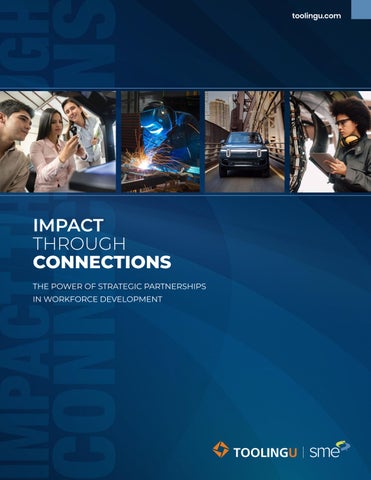
IMPACT THROUGH CONNECTIONS

THE POWER OF STRATEGIC PARTNERSHIPS IN WORKFORCE DEVELOPMENT

IMPACT THROUGH CONNECTIONS

The Power of Strategic Partnerships in Workforce Development

Inflection Point: 2026 Marks a Transformative Era

Today, manufacturing is at an inflection point — on the edge of extraordinary opportunity and rapid technological advancement, while still facing real challenges in adoption, competitiveness, and workforce readiness.

In 2025, manufacturing operations, workforce strategies, and supply chains were shaped by powerful external forces — tariffs, a government shutdown, labor challenges, and the accelerating adoption of advanced technologies like AI and robotics.

The industry evolved. Fueled by AI and digital acceleration, change came faster than ever, but it was measured. Many manufacturers built on what worked while cautiously adapting to what was next, evaluating innovation and technology for usability, scalability, and profitability.

In 2026, global supply chains will likely continue to shift; AI, automation, and connected systems will move toward becoming the eventual default; and U.S. manufacturing capacity and technological leadership will increasingly define global competitiveness. Everything will move faster.

What’s clear is that people remain at the center of this transformation — and represent the greatest opportunity for sustained competitive advantage and the greatest risk of failure if not properly addressed.

The future is not about technology or talent alone. It’s about advancing both

— together, intentionally, and at speed while maintaining a sharp eye on cyber-physical security. When technology is embedded into how we hire, train, and grow people, productivity increases, resilience strengthens, and innovation accelerates.

While there is nothing “easy” about what stands in front of manufacturing, the industry is defined by solving complex problems. That is simply what we do.

Manufacturing is the engine that turns innovation into impact. We look forward to continuing to work with manufacturers, educators, partners, members and the entire manufacturing industry to drive economic growth, accelerate innovation, and build the skilled workforce needed for the next industrial era.

Thank you for your ongoing support, and we look forward to working together in 2026 as we continue to strengthen manufacturing during this transformative time.

Focus: HOPE

HOPE SPRINGS ETERNAL IN

DETROIT

Focus: HOPE was founded in Detroit in 1968 to respond to deep community needs, starting with food programs and later expanding into technical training. Its Machinist Training Institute, launched in 1981, opened career paths in advanced manufacturing for women and people of color. Today it enrolls about 200 students each year in a free, 15-week pre-apprenticeship program designed for people seeking solid, long-term careers.

The institute has evolved with industry demands, adding welding, robotics and forklift training, and moving to a hybrid learning model after COVID. Students now blend hands-on work on campus with remote learning in math and blueprint reading. Tooling U-SME anchors the curriculum, giving every student access to recognized credentials and ensuring employers can trust the program’s standards. Instructors with decades of experience lead every course and have strongly embraced the platform.

We want to help as many people as we can, as much as we can, for as long as we can.”

- Kevin Green, Manager, The Machinist Training Institute

Technical skills are only half the mission. Focus: HOPE uses what it calls the “psychology of success” to build professionalism, communication and accountability. Industry partners like AAM hire its graduates because they show reliability as well as readiness for manufacturing work. With an 80% completion and placement target and more than 26,000 alumni since 1981, the program has become a trusted talent pipeline. Michigan has honored its workforce impact, and the organization sees its model as a national example..

Highlights:

• Free 15-week pre-apprenticeship with stipends

• Hybrid model: two days hands-on, three days remote

• More than 26,000 graduates since launch

• Recognized by Michigan for workforce impact

Read more about how Focus: HOPE is jumpstarting manufacturing careers in Detroit, Michigan.

The Power of Strategic Partnerships in Workforce Development

The Machinists Institute

CHANGING LIVES WITH APPRENTICESHIP PROGRAMS

The Machinists Institute, a nonprofit educational institution in Washington state, is making a significant impact on workforce development by providing accessible, industry-aligned training for aerospace, manufacturing, and automotive careers.

With six registered apprenticeships, a state-approved pre-apprenticeship, and an AAS degree program, the Institute offers multiple pathways that meet individuals

Apprenticeships change lives generationally, providing a career with wages and no college debt.”

- Shana Peschek, Executive Director Machinists Institute

where they are—supporting diverse learners and addressing barriers such as geography, caregiving, and financial limitations. Their mobile training labs, virtual learning models, and wraparound services ensure education reaches underserved and rural communities.

A hallmark of the Institute’s approach is deep collaboration—with employers to shape curriculum, and with community-based organizations to design culturally responsive programs. This ensures training aligns with real-world job requirements while supporting learners holistically. Employers like SSA Marine and Vulcan Metals credit the Institute with developing tailored apprenticeship models that close skills gaps, boost employee confidence, and improve retention. Essential skills such as

communication, mentorship, and workplace behaviors are woven alongside technical training to support long-term career success.

The Institute’s impact is already substantial: hundreds of students have completed pre-apprenticeship and training pathways, and 800 incumbent workers have gained new skills since 2021. Their model is now active in four states, with plans to expand nationally. As Executive Director Shana Peschek emphasizes, their mission is to help individuals find the training that best serves them—whether or not that path remains with the Institute. Their work demonstrates how apprenticeships can deliver generational change by building strong careers while supplying manufacturers with the skilled talent they urgently need.

Impact since 2021:

• 230 pre-apprenticeship students

• 275 enrolled/completed pathway training

• 800 incumbent workers trained

Read more about how The Machinist Institute is transforming manufacturing education in Washington state and beyond.

Rivian Automotive

A BRIGHT NEW NORMAL IN ILLINOIS

The partnership between Rivian Automotive, Heartland Community College (HCC), and the state of Illinois shows how industry, academia, and government can work together to build a strong workforce pipeline.

When Rivian arrived in Normal, Illinois, it needed workers with both foundational and specialized skills. At the same time, HCC was seeking to expand its career and technical programs, and state leaders were eager to grow jobs in the electric vehicle sector. Together, the partners built a lean, responsive model to train new workers quickly and effectively.

Thanks to the partnership with Rivian and community colleges like Heartland, we’re tackling workforce development from a micro scale all the way to the macro level.”

- Lisa Clemmons Stott, Illinois DCEO

Beginning in 2021, Rivian and HCC co-developed programs such as the Electric Vehicle Energy Storage certificate and expanded into tool-and-die and industrial maintenance apprenticeships. Training occurs across state-of-the-art facilities at HCC and Rivian, with curricula designed directly by industry professionals to meet employer needs, including essential soft skills. Demand continues to grow, prompting recruitment of adjunct instructors and plans for future apprenticeship tracks. Rivian also upskills its current workforce through platforms like Tooling U-SME, with more than 27,000 courses completed by employees. Illinois has scaled this work regionally, investing in advanced manufacturing training centers and piloting EV education pathways in K-12 schools. Rivian collaborates with statewide workforce

hubs and helps recruit residents into high-quality manufacturing roles, especially as it expands operations in Normal. While challenges persist— including outdated perceptions of manufacturing and the need for more flexible learning models— the partners continue building momentum. Their shared approach demonstrates how coordinated, cross-sector collaboration can strengthen both local economies and long-term manufacturing talent pipelines.

Highlights:

• Rivian employees have completed 27,250 Tooling U-SME online courses

• Illinois invested $7.5M each in two manufacturing training academies

• Pilot EV career pathway for high schools underway in Normal

Learn more about how Rivian,

an EV workforce pipeline.

HCC, and Illinois leaders united to build

The Power of Strategic Partnerships in Workforce Development

Matrix Human Services

LAUNCHES PROGRAM TO DEVELOP DETROIT’S ELECTRIC VEHICLE TECH WORKFORCE

Matrix Human Services, a long-standing Detroit nonprofit, has launched Skills to Build—Electric Vehicle (EV) & Clean Energy Program, a pilot designed to prepare metro Detroit residents for the rapidly expanding EV and clean energy sectors.

Backed by a $400,000 General Motors grant and supported by SME, St. Vincent and Sarah Fisher Center, and EDSI, the program brings together technical training, soft skills development, and wraparound services to help participants enter high-demand manufacturing roles. As Michigan continues its leadership in manufacturing, especially EV production, this initiative provides a powerful local solution to a national workforce need.

The program features a six-week, cohort-based model that blends technical certification pathways with flexible, modular learning. Participants train using SME’s Certified Manufacturing Associate (CMfgA) and Electric Vehicle Fundamentals (EVF) certifications, along with tutoring, digital literacy support, and career coaching. Matrix pairs learners

Read more about Matrix Human Services’ lasting impact in Detroit.

with coaches to remove barriers such as childcare, transportation, and housing, ensuring individuals not only complete training but are ready for employment. With a goal of 40 trained participants by year-end and strong completion and placement targets, the program serves as a catalyst for economic mobility in communities historically impacted by unemployment and limited access to opportunity.

Skills to Build also prioritizes employer engagement, directly connecting graduates to high-demand jobs in EV and clean energy manufacturing. By aligning partners across industry, nonprofit, and education sectors, the initiative embodies SME’s “Think Nationally. Act Locally” philosophy. As the clean energy economy accelerates, this model demonstrates how community-focused workforce strategies can scale nationally to strengthen supply chains, expand opportunity, and support a thriving advanced manufacturing workforce.

Highlights:

• $400,000 GM grant to launch the program

• Matrix Human Services: 119 years old, serving 20,000+ people annually

• Michigan manufacturing: 600,000 jobs statewide

• Program goals: 40 trainees, 85% certification completion, 75% job placement

Real Life Rosies

FORGING FUTURES: HOW REAL LIFE ROSIES® IS REVOLUTIONIZING MANUFACTURING CAREERS IN NEW YORK

Real Life Rosies® is a rapidly growing workforce initiative in Mohawk Valley, New York, designed to help underrepresented populations launch careers in advanced manufacturing. Rooted in SME’s Certified Manufacturing Associate (CMfgA) credential, the program blends technical instruction with essential soft-skill development and direct employer engagement, creating a true on-ramp to real jobs with real wages.

A major milestone for the initiative is its approval by the New York State Department of Labor as a registered Pre-Apprenticeship program, enabling direct entry into Registered Apprenticeships. Initially built through a strong partnership with Mohawk Valley Community College, Real Life Rosies has expanded its model to other colleges across the state, proving both scalable and highly effective.

Support from Empire State Development and NYSDOL accelerated this growth, with the program now reaching Syracuse, Oswego, and soon Rochester, the Capital Region, and Binghamton.

With a strong placement rate, a low dropout rate, and a companion program designed with universal accessibility, Real Life Rosies is

reshaping the talent pipeline in New York State. It is not only transforming individual lives but strengthening communities, widening access to opportunity, and building a more inclusive manufacturing workforce for the future.

Highlights:

• 160 enrolled in Real Life Rosies

• 106 graduates, 21 currently enrolled

• 75–80% job placement rate

• MACNY sponsors 50+ companies that can hire program graduates

Read more about Real Life Rosies is empowering underrepresented individuals with manufacturing skills.

The Power of Strategic Partnerships in Workforce Development

12 for Life

HOW TO CHANGE A LIFETIME IN 12 YEARS

Southwire, one of the largest wire and cable manufacturers in the world, faced a major challenge in 2006: too many local students were leaving high school early due to economic hardship, reducing the talent pipeline needed for its Carrollton, Georgia facilities. In response, Southwire partnered with the Carroll County School System to launch 12 for Life in 2007. The program blends academic instruction with paid, hands-on manufacturing work to help at-risk students stay in school, earn income, and build skills.

At its dedicated 100,000-sq-ft facility, students work part-time while earning high school credits, completing professional skills rotations, and gaining real manufacturing experience. The program targets the highest-risk students and offers financial incentives for attendance, academic achievement, and skill development. Over time, the initiative has expanded into multiple districts in Georgia and Alabama, offering pathways to Georgia’s Manufacturing Pathway, Youth Apprenticeship Program, and industry-recognized credentials.

The long-term impact has been remarkable: more than 3,000 students have graduated, local graduation rates have soared, and students gain job readiness, financial stability, and confidence. The integration of Tooling U-SME courses—first used during the pandemic, has strengthened academic performance and industry preparedness. Today, 12 for Life serves as a national model for how industry and education can partner to transform student lives and workforce pipelines.

Read more about 12 for Life’s unique partnership between industry and schools creates lasting positive changes.

Highlights:

• Southwire footprint: 9,000+ employees, 64 U.S. facilities

• 3,000+ graduates from 12 for Life

• Local graduation rate: Increased from 65% to 97% (2024)

• Economically disadvantaged graduation rate: Up from 54% to near 97%

Viega Case Study

VIEGA TAPS TOOLING U-SME TO BUILD WORLD-CLASS TRAINING FRAMEWORK TO MEET GROWTH DEMANDS

Viega, a global leader in plumbing and piping systems with more than a century of success, faced increasing talent challenges as rapid growth—especially the launch of a new Ohio facility—created high turnover and inconsistent onboarding.

Without a centralized training structure, new hires were sometimes training other new hires, underscoring the urgent need for a scalable, standardized approach to workforce development.

To address this, Viega partnered with Tooling U-SME’s Talent & Workforce Services to assess its current training landscape and build a strategic, multi-year plan for a unified training organization. Through benchmarking, focus groups, job studies, and gap analyses, Tooling U-SME designed a future-state model that realigned roles, responsibilities, tools, and processes to create a consistent, high-quality learning experience across all locations.

This effort resulted in a world-class training framework that strengthens job role clarity, accelerates employee qualification, and supports long-term retention. With new job profiles, improved curriculum design, and defined developmental pathways, Viega is now positioned to meet its North American growth goals while creating a culture of continuous learning and operational excellence.

This initiative goes far beyond compliance, it’s about cultivating a culture of continuous learning that fuels growth, enhances agility, and drives operational excellence.”

- Samantha S. Burns, Manager, Workforce Development, Viega

Results:

• Faster time to qualification

• Improved retention

• Standardized, scalable training framework

• Clear career pathways from entry-level to skilled positions

Read more about Viega’s world-class training program.

The

Pella Case Study

PARTNERSHIP HELPS PELLA CORPORATION ACCELERATE QUALIFICATION THROUGH CAREER PROGRESSION MODELING

Pella Corporation, a 100-year leader in window and door manufacturing, faced an impending skills gap as long-tenured tool and die experts approached retirement. With 18 manufacturing locations and more than 10,000 employees, the company needed a clear, consistent development framework to transition new team members into highly skilled technical roles.

To prepare for this shift, Pella partnered with Tooling U-SME’s Talent & Workforce Services team to build a structured, objective career progression model.

Tooling U-SME conducted an in-depth job analysis, working side-by-side with subject matter experts to map critical tasks, skills, and knowledge required at every progression level. From this foundation, the team developed curriculum, blended learning resources, rigorous capstone assessments, and promotion protocols that standardized expectations and accelerated the development of tool and die personnel. The result was a comprehensive framework that clearly outlined job roles and provided employees with transparent advancement opportunities.

With these systems in place, Pella has significantly reduced time-to-proficiency, strengthened accountability, and increased employee engagement. Team members are now raising their hands for advancement and progressing more quickly through well-defined learning paths. The partnership demonstrates how intentional workforce development, rooted in job analysis and structured training— prepares companies for future growth while building a stronger, more agile workforce.

Results:

• Decreased time to proficiency

• Standardized development for new and incumbent employees

• Higher engagement with employees actively seeking advancement

The Manufacturing Imperative – Workforce Pipeline Challenge

ADDRESSING THE MANUFACTURING WORKFORCE CRISIS: THE MANUFACTURING IMPERATIVE

The Manufacturing Imperative – Workforce Pipeline Challenge (MI-WPC) is a bold, national initiative led by SME in partnership with 25 community colleges across 17 states. In Year 2 of the initiative, MI-WPC has added six additional colleges and two additional states. Designed to close the skills gap in manufacturing, MI-WPC is aligning education and industry to create a stronger workforce pipeline to support the needs of industry.

Year 2 brought these priorities into focus:

• Increasing Career Awareness: sharing quality career opportunities with potential learners and adult career changers through paid ads, partnerships, outreach events, and more.

• Increase SMM Engagement: connecting with the 80%+ manufacturers to increase awareness of training & education opportunities, but also ensuring alignment of these programs.

• Identify new ways of sourcing faculty: supporting local community colleges’ faculty needs with experts from the local area.

PROGRESS TO DATE:

43,725

STUDENTS ENROLLED IN MANUFACTURING PROGRAMS

1,663 OUTREACH EVENTS

58,100

INDIVIDUALS PARTICIPATED IN OUTREACH EVENTS

Industry partnerships are also playing a significant role in the work of the MI-WPC – helping to determine new programs, aligning workforce supply with demand, and anticipating market changes that will impact future needs.

TO LEARN MORE ABOUT WORKFORCE PIPELINE CHALLENGE

Turn static files into dynamic content formats.
Create a flipbook
14953 TU SME Workforce Brochure 2026 by SME - Issuu