MAE2323 Dynamics
(220pts)
Homework #6
Due October 10, 2024
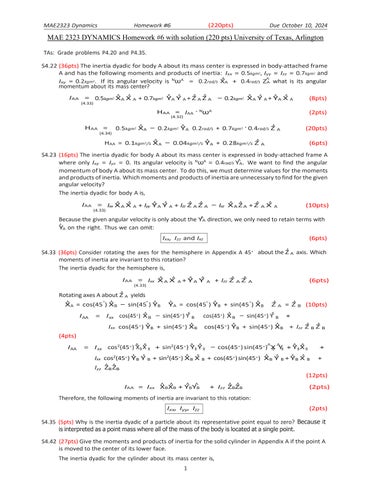
MAE 2323 DYNAMICS Homework #6 with solution (220 pts) University of Texas, Arlington TAs: Grade problems P4.20 and P4.35. S4.22 (36pts) The inertia dyadic for body A about its mass center is expressed in body-attached frame A and has the following moments and products of inertia: Ixx = 0.5kgm2, Iyy = Izz = 0.7kgm2 and ^A + 0.4rad/s Z^A what is its angular Ixy = 0.2kgm2. If its angular velocity is NωA = 0.2rad/s X momentum about its mass center? ^A X ^ A + 0.7kgm2 Y ^A Y ^ A + Z^ A Z^ A − 0.2kgm2 X ^A Y ^ A+Y ^A X ^A IAA = 0.5kgm2 X
(8pts)
HAA = IAA · NωA
(2pts)
(4.33)
(4.32)
HAA = (4.34)
^ A − 0.2kgm2 Y ^ A 0.2rad/s + 0.7kgm2 · 0.4rad/s Z^ A 0.5kgm2 X
(20pts)
^ A − 0.04kgm2/s Y ^ A + 0.28kgm2/s Z^ A HAA = 0.1kgm2/s X
(6pts)
S4.23 (16pts) The inertia dyadic for body A about its mass center is expressed in body-attached frame A where only Ixy = Iyz = 0. Its angular velocity is NωA = 0.4rad/s Y^A. We want to find the angular momentum of body A about its mass center. To do this, we must determine values for the moments and products of inertia. Which moments and products of inertia are unnecessary to find for the given angular velocity? The inertia dyadic for body A is, ^AX ^ A + Iyy Y ^A Y ^ A + Izz Z ^AZ ^ A − Ixz X ^AZ ^ A + Z^ A X ^A IAA = Ixx X
(10pts)
(4.33)
Because the given angular velocity is only about the Y^A direction, we only need to retain terms with ^ A on the right. Thus we can omit: Y Ixx, Izz and Ixz
(6pts)
S4.33 (36pts) Consider rotating the axes for the hemisphere in Appendix A 45◦ about the Z^ A axis. Which moments of inertia are invariant to this rotation? The inertia dyadic for the hemisphere is, ^A X ^ A+Y ^A Y ^ A + Izz Z^ A Z^ A IAA = Ixx X
(6pts)
(4.33)
Rotating axes A about Z^ A yields ^ A = cos(45◦) X ^ B − sin(45◦ ) Y ^B X I AA
=
^ A = cos(45◦ ) Y ^ B + sin(45 ◦) X ^B Y
Z^ A = Z^ B (10pts)
^ B − sin(45◦) Y^ B I xx cos(45◦) X
^ B − sin(45◦) Y^ B cos(45◦) X
^B Ixx cos(45◦) Y
^ cos(45◦) Y
+
^ sin(45◦) X
B
B
+
^ sin(45◦) X
+ B
+ Izz Z^ B Z^ B
(4pts) I AA
^ B + sin2(45◦) ^ ^ B − cos(45◦) sin(45◦)^X ^ ^ ^ = I xx cos2(45◦) ^ XB X YB Y B YB + Y B X B ^B Y ^ B + sin2(45◦) X ^B X ^ B + cos(45◦) sin(45◦) Ixx cos (45◦) Y 2
+
^B Y ^ B+Y ^B X ^B X
+
^BZ ^B Izz Z (12pts) ^ BX ^B + Y^BY^B IAA = Ixx X
^BZ ^B + Izz Z
(2pts)
Therefore, the following moments of inertia are invariant to this rotation: Ixx, Iyy, Izz
(2pts)
S4.35 (5pts) Why is the inertia dyadic of a particle about its representative point equal to zero? Because it is interpreted as a point mass where all of the mass of the body is located at a single point. S4.42 (27pts) Give the moments and products of inertia for the solid cylinder in Appendix A if the point A is moved to the center of its lower face. The inertia dyadic for the cylinder about its mass center is, 1