MAE2323 Dynamics
(298pts)
Homework #3
Due September 12, 2024
MAE 2323 DYNAMICS Homework #3 (298Pts) University of Texas, Arlington TAs: Grade problems P3.7 and P3.13. S3.5 (5pts) Why do we need to consider the motion of the observer when taking the derivative of a position vector? Because the derivative can be different depending on the motion of the observer. S3.9 (5pts) Why is the velocity vector always tangent to the path followed by a moving point? Because the vector representing the change in position, ∆PNA(t), becomes tangent to the actual path as the change in position approaches zero, ∆t → 0. S3.11 (5pts) Name two rules from calculus used in differentiating a position vector. The product rule and the chain rule. S3.12 (20pts) Find the velocity of point A given PNA = L X^ A + h YA^and using the relationship between the inertial and body-attached frames shown in Figure 2.26. Assume that L and h are constants, and express the result in frame A. PNA
^ N + sin(θ)Y ^ N + h − sin(θ)X ^ N + cos(θ)Y ^ N L cos(θ)X ^ N + (L sin(θ) + h cos(θ)) Y ^N (L cos(θ) − h sin(θ)) X
= =
= (3.13)
^N dL cos(θ) − h sin(θ) X + (L cos(θ) − h sin(θ)) NdX ^N + (3.11) dt dt N ^ dL sin(θ) + h cos(θ) ^ N + (L sin(θ) + h cos(θ)) dYN Y dt dt ˙ ˙ ^ N + θ (L cos(θ) − h sin(θ)) Y ^N θ (−L sin(θ) − h cos(θ)) X
=
^ N + cos(θ) Y ^N θ˙L − sin(θ) X
dPNA dt (3.10)
VA =
VA
(8pts)
=
^ N + sin(θ) Y ^N − θ˙h cos(θ) X
^ A − θ˙h X ^A VA = θ˙L Y
(8pts)
(4pts) (4pts)
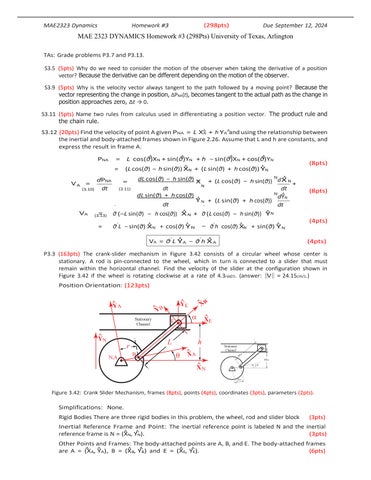
P3.3 (163pts) The crank-slider mechanism in Figure 3.42 consists of a circular wheel whose center is stationary. A rod is pin-connected to the wheel, which in turn is connected to a slider that must remain within the horizontal channel. Find the velocity of the slider at the configuration shown in Figure 3.42 if the wheel is rotating clockwise at a rate of 4.3rad/s. (answer: V = 24.15cm/s.) Position Orientation: (123pts)
Stationary Channel
r
L
h
Stationary Channel
17o
Figure 3.42: Crank Slider Mechanism, frames (8pts), points (4pts), coordinates (3pts), parameters (2pts).
Simplifications: None. Rigid Bodies There are three rigid bodies in this problem, the wheel, rod and slider block
(3pts)
Inertial Reference Frame and Point: The inertial reference point is labeled N and the inertial ^ N, Y^N). reference frame is N = (X (3pts) Other Points and Frames: The body-attached points are A, B, and E. The body-attached frames ^ A, ^ ^B, Y^B) and E = (X ^E, Y^E). are A = (X YA), B = (X (6pts)