MAE2323 Dynamics
(586pts)
Homework #11
Due November 26, 2024
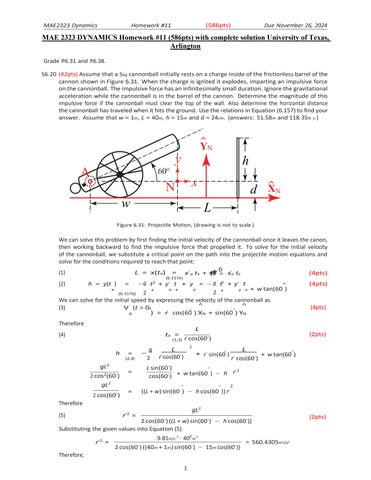
MAE 2323 DYNAMICS Homework #11 (586pts) with complete solution University of Texas, Arlington Grade P6.31 and P6.38. S6.20 (42pts) Assume that a 5kg cannonball initially rests on a charge inside of the frictionless barrel of the cannon shown in Figure 6.31. When the charge is ignited it explodes, imparting an impulsive force on the cannonball. The impulsive force has an infinitesimally small duration. Ignore the gravitational acceleration while the cannonball is in the barrel of the cannon. Determine the magnitude of this impulsive force if the cannonball must clear the top of the wall. Also determine the horizontal distance the cannonball has traveled when it hits the ground. Use the relations in Equation (6.157) to find your answer. Assume that w = 1m, L = 40m, h = 15m and d = 24cm. (answers: 51.58m and 118.35N ·s.)
A
YN
y
h x
N w
d
N
L
Figure 6.31: Projectile Motion, (drawing is not to scale.)
We can solve this problem by first finding the initial velocity of the cannonball once it leaves the canon, then working backward to find the impulsive force that propelled it. To solve for the initial velocity of the cannonball, we substitute a critical point on the path into the projectile motion equations and solve for the conditions required to reach that point: 0 ✯ (1) L = x(tx) = x˙o tx + ✟ x✟ (4pts) o = x˙o tx (6.157a)
◦ −g t2 + y˙ t + y = − g t2 + y˙ t x o x o x o x + w tan(60 ) x 2 2 (6.157b) We can solve for the initial speed by expressing the velocity of the cannonball as ^ ^ (3) V (t = 0s ◦ ◦ ) = r˙ cos(60 ) XN + sin(60 ) YN A (2)
h = y(t )
=
Therefore (4)
L
tx = =
(2,4)
2
gL
2 cos2(60◦) gL2 2 cos(60◦)
=
—
g 2
2
L r˙ cos(60◦)
L ◦ + w tan(60 ) r˙ cos(60◦)
◦
+ r˙ sin(60 )
◦ L sin(60◦) r˙2 cos(60◦) + w tan(60 ) − h ◦
=
(4pts)
(2pts)
◦ (1,3) r˙ cos(60 )
h
(4pts)
◦
2
((L + w) sin(60 ) − h cos(60 )) r˙
Therefore gL2
2
(5)
r˙ =
2 cos(60◦) ((L + w) sin(60◦) − h cos(60◦)) Substituting the given values into Equation (5) r˙2 =
9.81m/s 2 · 402 m 2 = 560.4305m2/s2 2 cos(60◦) ((40m + 1m) sin(60◦) − 15m cos(60◦))
Therefore, 1
(2pts)