MAE2323 Dynamics
Homework #10
(344pts)
Due November 21, 2024
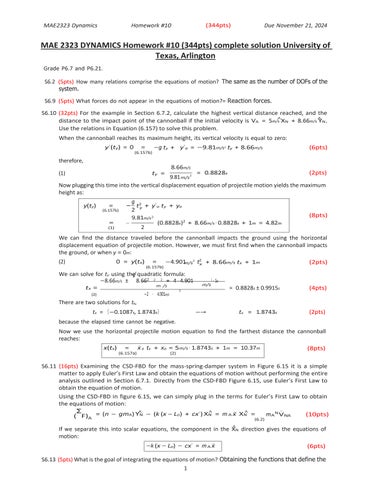
MAE 2323 DYNAMICS Homework #10 (344pts) complete solution University of Texas, Arlington Grade P6.7 and P6.21. S6.2 (5pts) How many relations comprise the equations of motion? The same as the number of DOFs of the system. S6.9 (5pts) What forces do not appear in the equations of motion?= Reaction forces. S6.10 (32pts) For the example in Section 6.7.2, calculate the highest vertical distance reached, and the distance to the impact point of the cannonball if the initial velocity is VA = 5m/s^XN + 8.66m/s ^ Y N. Use the relations in Equation (6.157) to solve this problem. When the cannonball reaches its maximum height, its vertical velocity is equal to zero: y˙(ty) = 0
=
−g ty + y˙o = −9.81m/s ty + 8.66m/s 2
(6.157b)
(6pts)
therefore, 8.66m/s
= 0.8828s (2pts) 9.81 m/s2 Now plugging this time into the vertical displacement equation of projectile motion yields the maximum height as: g (1)
ty =
(8pts) 2 We can find the distance traveled before the cannonball impacts the ground using the horizontal displacement equation of projectile motion. However, we must first find when the cannonball impacts the ground, or when y = 0m: (2)
0 = y(tx)
= (6.157b)
−4.901m/s2 t2x + 8.66m/s tx + 1m
We can solve for tx using the √ quadratic formula: −8.66m/s ± 8.662 2 2 + 4 · 4.901 m /s tx = 2 (2) −2 · 4.901m/s There are two solutions for tx, tx = {−0.1087s, 1.8743s}
2
m/s
(2pts)
· 1m
−→
= 0.8828s ± 0.9915s
(4pts)
tx = 1.8743s
(2pts)
because the elapsed time cannot be negative. Now we use the horizontal projectile motion equation to find the farthest distance the cannonball reaches: x(tx)
= (6.157a)
ẋ o tx + xo = 5m/s · 1.8743s + 1m = 10.37m (2)
(8pts)
S6.11 (16pts) Examining the CSD-FBD for the mass-spring-damper system in Figure 6.15 it is a simple matter to apply Euler’s First Law and obtain the equations of motion without performing the entire analysis outlined in Section 6.7.1. Directly from the CSD-FBD Figure 6.15, use Euler’s First Law to obtain the equation of motion. Using the CSD-FBD in figure 6.15, we can simply plug in the terms for Euler’s First Law to obtain the equations of motion: Σ ^ = m A ẍ XN^ = mA N V̇ NA (10pts) ( F)A = (n − gmA) Y^N − (k (x − Lo) + cx˙) XN (6.2) If we separate this into scalar equations, the component in the X^N direction gives the equations of motion: −k (x − Lo) − cx˙ = m A ẍ
(6pts)
S6.13 (5pts) What is the goal of integrating the equations of motion? Obtaining the functions that define the 1