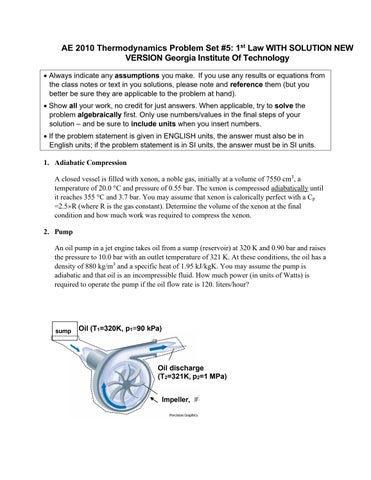
AE 2010 Thermodynamics Problem Set #5: 1st Law WITH SOLUTION NEW VERSION Georgia Institute Of Technology • Always indicate any assumptions you make. If you use any results or equations from the class notes or text in you solutions, please note and reference them (but you better be sure they are applicable to the problem at hand). • Show all your work, no credit for just answers. When applicable, try to solve the problem algebraically first. Only use numbers/values in the final steps of your solution – and be sure to include units when you insert numbers. • If the problem statement is given in ENGLISH units, the answer must also be in English units; if the problem statement is in SI units, the answer must be in SI units. 1. Adiabatic Compression A closed vessel is filled with xenon, a noble gas, initially at a volume of 7550 cm3, a temperature of 20.0 C and pressure of 0.55 bar. The xenon is compressed adiabatically until it reaches 355 C and 3.7 bar. You may assume that xenon is calorically perfect with a Cp =2.5R (where R is the gas constant). Determine the volume of the xenon at the final condition and how much work was required to compress the xenon. 2. Pump An oil pump in a jet engine takes oil from a sump (reservoir) at 320 K and 0.90 bar and raises the pressure to 10.0 bar with an outlet temperature of 321 K. At these conditions, the oil has a density of 880 kg/m3 and a specific heat of 1.95 kJ/kgK. You may assume the pump is adiabatic and that oil is an incompressible fluid. How much power (in units of Watts) is required to operate the pump if the oil flow rate is 120. liters/hour?
sump
Oil (T1=320K, p1=90 kPa)
Oil discharge (T2=321K, p2=1 MPa)