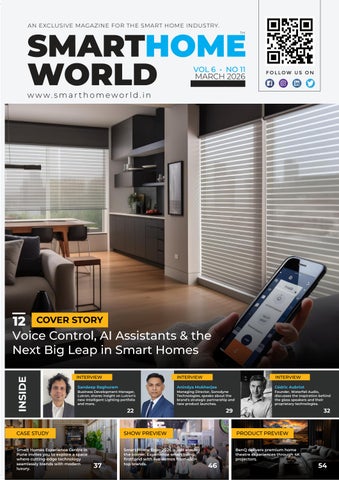
This article explores how AI, Voice Control, and IoT are transforming home automation. Experts share key benefits, challenges, and real-world experience on integrating these technologies in their projects. They also share their insights on the futuristic outlook.
22
Interviews
Sandeep Raghuram, Business Development Manager, Lutron, discusses Lutron’s new Intelligent Lighting portfolio, advantages of combining Ketra and Orluna, and how the unified HomeWorks + Ketra platform, powered by Clear Connect Type X, streamlines the commissioning and management of lighting and shading.
Anindya Mukherjee, Managing Director, Sonodyne Technologies Pvt. Ltd., speaks about Sonodyne’s strategic partnership with Pro FX, the flagship PRIVÉA home cinema range, and the brand’s focus on delivering premium, immersive residential audio experiences.
Cedric Aubriot, Founder, Waterfall Audio, shares insights into the brand’s journey of redefining high-end audio through a distinctive fusion of acoustic excellence and design innovation. He also discusses the inspiration behind the company’s iconic glass speakers.
37
Case Studies
Ar. Akshay Selukar collaborated with SI Pratik Awasthi, Founder, Autozon, to design a contemporary smart residence that seamlessly integrates modern architecture, heritage, and smart home technology.
46 54 61
Conceived by Founders Pratik Singhal and Sankalp Goyal and designed by Amit Bhat, Principal Architect, AB Architects, the new Smart Homes Experience Centre in Pune offers firsthand experience on how lighting, home theatre, automation, and climate control come together to create intelligent living spaces.
Show Preview
Smart Home Expo 2026 is bigger and better than ever, offering an immersive glimpse into the future of smart living. Visitors can explore live demos, handson automation, dedicated demo rooms, and fully integrated AV and lighting solutions, showcased by over 450 leading brands.
Product Previews
BenQ brings cinematic-quality home theatre to life with advanced 4K projectors, vibrant colours, and seamless smart home integration, transforming any space into a premium entertainment experience.
Lafit Lighting brings together design precision and advanced engineering. The brand has established itself as a trusted collaborator for architects, designers, and lighting professionals nationwide.
News
New product launches and technically upgraded solutions across home automation, smart lighting, AV systems, home theatres, and more.
This issue brings together some of the most compelling ideas shaping smart living today, beginning with our cover story on how AI, Voice Control, and IoT are redefining home automation. Experts share realworld insights, key challenges, and their perspective on what the future holds.
We also sit down with industry experts like Sandeep Raghuram, who talks about Lutron’s evolving lighting ecosystem, Anindya Mukherjee, who shares insights on Sonodyne’s partnership with Pro FX and its premium home cinema approach, and Cedric Aubriot, who reflects on blending design with high-end audio through Waterfall’s iconic glass speakers.
On the projects front, we feature a thoughtfully designed smart residence by Akshay Selukar and Pratik Awasthi, along with a new Smart Homes Experience Centre in Pune by Pratik Singhal, Sankalp Goyal, which is designed by Ar. Amit Bhat, which offers a hands-on look at integrated living.
With Smart Home Expo 2026 around the corner, excitement is building for what promises to be a bigger, more immersive showcase of smart technologies, from live demos to full-scale experience zones. We have a preview for the readers.
We also highlight product innovations from BenQ and Lafit Lighting, along with the latest updates from across the smart home and AV industry.
Voice Control, AI Assistants, and the Future of Automated Home
Are smart homes ready for the next leap? With AI, Voice Control, and IoT at the forefront, this feature explores how home automation is becoming more intuitive, predictive, and deeply integrated into everyday life.
At industry conferences and smart home seminars, one message is becoming increasingly clear: Voice Control, AI Assistants are no longer just futuristic gadgets, but they are becoming the backbone of modern home automation. What was once a novelty has evolved into central infrastructure, capable of orchestrating lighting, climate, security, entertainment, and other connected devices with a single command.
Yet, the question remains whether homeowners are truly prepared to leverage the full potential of AI, Natural Language Processing (NLP), and interconnected IoT ecosystems? While many are familiar with Voice Commands, the next step involves systems that anticipate behaviour, learn routines, and dynamically adjust environments. Achieving this level of automation requires seamless integration of multiple devices, standardised
communication protocols, and intelligent algorithms capable of handling complex interactions, all in real time.
The adoption of such predictive, intelligent solutions will not only redefine convenience and comfort but also set new standards for energy efficiency, accessibility, and security. As the technology matures, smart home owners are being invited to move from passive control to fully immersive, AI-driven living experiences, where the home does more than respond; it thinks ahead.
System Architecture and Device Integration
Modern smart homes rely on integrated ecosystems where multiple devices communicate through standardised protocols like Wi-Fi, Zigbee, Z-Wave, and emerging frameworks such as Matter. Cross-platform interoperability allows devices from different manufacturers to work together seamlessly. Voice assistants act as centralised hubs, orchestrating commands and routines across distributed devices.
Automation workflows are increasingly complex, spanning multiple devices and environmental parameters. For example, a “Good Morning” routine may involve gradually increasing light intensity, adjusting temperature based on occupancy data, and playing curated audio content—all triggered through a single voice command.
Applications Beyond Convenience
Voice-enabled automation enhances energy efficiency, accessibility, and security. Smart systems can manage power consumption dynamically, detect occupancy patterns, and optimise HVAC and lighting schedules. For differently-abled users, voice commands provide a critical interface for independent control of the home environment. Security systems integrated with AI can identify unusual activity, alert homeowners, and
trigger automated responses in real time.
High-definition streaming, immersive audio, and multi-room media distribution are increasingly managed via voice control. AI algorithms coordinate device performance, adjust audio calibration, and ensure synchronised playback across multiple zones.
Challenges in Implementation
Technical challenges remain. Privacy and data security are paramount, given continuous voice data collection and cloud processing. Network latency, device compatibility, and robustness of NLP models affect reliability. Misinterpretation of commands can compromise usability, highlighting the need for continuous refinement of AI models, local processing options, and standardised interoperability frameworks.
Smart Home World spoke to System Integrators to know how AI, NLP, IoT, and Voice Controlled automation are transforming connected homes into intelligent, adaptive living spaces.
How are Voice Control and AI assistants transforming the way homeowners interact with automated systems, and how significant is this shift for the smart home industry?
Voice Control and AI are driving a monumental shift from “Reactive Automation” to “Agentic AI.” Historically, homeowners had to issue specific commands (e.g., “Turn on the AC”). Today, AI assistants act as autonomous, goal-oriented partners that perceive their environment and take multi-step actions without human intervention.
For the smart home industry, this is significant because AI has evolved from a passive listener to an active consultant that informs and suggests operations based on real-time data. Indian homeowners are increasingly demanding wellness and sustainability, and AI is delivering this through advanced sensor integration:
• Health, Wearables, & Wellness: The most profound transformation is the integration of personal biometrics. By securely pairing with the user’s smartwatches or health bands, the home’s central system can monitor real-time vitals like heart rate, blood pressure, and sleep cycles. If the AI detects elevated stress levels or a spike in blood pressure after a long workday, it acts as a proactive wellness agent. It might announce: “Your heart rate
indicates elevated stress. I have activated ‘Decompression Mode’—dimming the lights to a warm circadian amber, lowering the AC to your preferred comfort level, and queuing acoustic relaxation music.”
• Security & Weather: The AI monitors live weather feeds and home sensors, proactively suggesting: “It is starting to rain, and the first-floor balcony window is open, close the window ?”
• Advanced Ambient Monitoring: Using continuous Air Quality (AQI) sensors ($CO_2$, VOCs, PM2.5), the system acts as a passive health guardian, automatically triggering fresh air intake to maintain cognitive health. We are even integrating ambient fall-detection radar in bathrooms for the elderly, and alcohol-monitoring sensors in garage interfaces to ensure safety before a user attempts to drive.
What are the biggest challenges System
Integrators face when implementing voicecontrolled automation across multiple devices and platforms?
The primary challenge is fragmentation. While small apartments can rely on DIY, offthe-shelf ecosystems (basic Wi-Fi gadgets and standalone smart speakers), large Indian luxury homes and villas present a vastly different reality. Integrators are dealing with multi-zone VRV/VRF air conditioning, complex architectural lighting, and distributed AV matrices.
Furthermore, modern appliances (ACs, refrigerators, washing machines) are incredibly “smart” and IoT-enabled, but they exist in isolated silos, each demanding its own App and cloud connection. The integrator’s challenge is breaking down these silos using a Multi-Protocol Integration Hub, like the LogicMachine 5 (LM5). The LM5 acts as a universal translator, bridging heavy industrial standards (KNX TP, BACnet, Modbus) with lightweight IoT protocols (MQTT, JSON) into a single pane of glass.
Bhavesh Doshi
KNX Tutor, IGBC AP, LEED GA, Cedia CIT / IST / RNS, Casambi 4C - Founder of Entelechy Group of Companies.
Delivering this requires a massive shift in integrator skillsets. Upskilling in IT/ OT (Information Technology/Operational Technology) convergence is no longer optional. Integrators must master IP networking, cybersecurity, API integrations, and custom logic scripting to ensure a robust, uninterrupted system across a massive concrete-and-brick footprint.
Do you see Voice Control becoming the primary interface for smart homes, or will it continue to complement traditional controls such as switches, apps, and touch panels?
Voice Control is an incredible convenience, but it will absolutely complement, rather than replace, traditional controls. This is largely driven by stringent privacy demands. Standard “always-listening” cloud assistants are increasingly viewed as privacy risks, besides operational latency, in ultra-high-networth Indian households.
The future lies in In-App and Edge-Based Voice Control. By leveraging the local “EDGE on Premise” capabilities of advanced controllers like the LogicMachine 5, voice processing happens locally and securely. The microphone is only active when the user explicitly engages a secure touch panel or a dedicated smartphone app. Furthermore, tactile interfaces remain necessary for precision control; you do not want to use your voice to subtly dim a light to 15% during a movie or navigate a home quietly
at 2:00 AM. More discrete functions would need manual controls.
How are advancements in AI and natural language processing expected to shape the next generation of automated homes?
Advancements in Natural Language Processing (NLP) are solving the unique complexities of the Indian demographic—specifically, the multi-lingual, multi-generational household. Localised NLP models now understand code-switching (like “Hinglish”) and regional dialects, meaning a grandparent’s command in Hindi is processed just as effortlessly as a complex English routine. Coupled with Voice Biometrics, the AI can identify who is speaking, granting access control (e.g., unlocking a door) only to authorised family members while denying it to guests or children.
Furthermore, AI is driving the sustainable and energy-efficient solutions that today’s aware consumers demand through intelligent data synthesis:
Active Energy Monitoring: Instead of just providing a monthly bill, the system analyses the real-time energy consumption of heavy loads like VRV HVACs and water boilers. The AI assistant proactively informs the user to prevent waste, suggesting: “Your living room AC has been running at maximum capacity for three hours while the room is unoccupied; shall I switch it to eco-mode?”
Sensor Fusion: This efficiency is bolstered by combining technologies. A single highresolution mmWave sensor acts as an occupancy detector to instantly power down heavy AV or lighting loads in empty rooms, while seamlessly doubling as a highly accurate intrusion detection grid when the house is armed for security.
The Art of Invisible Complexity
Ultimately, the next generation of automated homes will be defined by “invisible complexity.”
Maulik Unadkat Founder, Beyond Alliance
How are Voice Control and AI assistants transforming the way homeowners interact with automated systems, and how significant is this shift for the smart home industry?
Of all the voice control platforms, the one that we personally love the most is Apple Home. When Apple intelligence takes over, its Artificial Intelligence helps the home acclimatise to the presence and absence of each user. When someone arrives, what must happen and when someone leaves, what must happen. During the day, how must the home reach to someone’s presence or absence and during the night, how must the home behave? At sunrise and sunset and in peak hours of the east-west sun rays, how must the sheer and blackout curtains behave? All this can be orchestrated to resonate with the preferences of the homeowners.
Siri no longer needs voice command speakers placed throughout the house. A simple click on the side button of the iPhone takes the
While the backend architecture is undeniably intricate—heavily driven by IT/IoT convergence, edge computing, and multi-protocol hubs— the end result for the homeowner is exactly the opposite. By designing systems based on open global standards, we deliver solutions that are cost-effective, highly flexible, and continually software-upgradable. Despite the massive computational power operating behind the scenes, the final system remains exceptionally simple to use, cost-effective, interacting with the user in a natural, robust, and intuitive manner.
voice command even without the greeting ‘Hey Siri’. Also, what’s most challenging for most voice users is to memorise the names of each voice command. Apple Home App helps users change these names as quickly as they change the name of any folder on the home screen.
What are the biggest challenges System Integrators face when implementing voicecontrolled automation across multiple devices and platforms?
The main challenge is that all homes have a mixed bag of Android and Apple users. The most significant players in voice control, i.e., Amazon, Google and Apple, all have their own signature way of functioning. To ensure a smooth experience for such diverse users across different platforms using the same backend system is challenging for any integrator. For example, Apple Music would integrate best with Apple HomeKit and an iPhone user, while Android users would be using Spotify YouTube Music or Amazon Music as their primary choice. But the voice control must work for all these ecosystems equally well.
Do you see Voice Control becoming the primary interface for smart homes, or will it continue to complement traditional controls such as switches, apps, and touch panels?
The uniqueness of how each human being thinks, acts and behaves will continue to allow all these forms of controls to co-exist. Diversity of personalities in each home will demand different preferences for control. In face the
same user may prefer different forms of controls at different times. In the middle of the night, one may prefer a keypad. In wet areas like the kitchen and washrooms, one may prefer voice commands. Apps are extremely essential when one wants detailed control or configuration of scenes, etc. Each control complements the other and will continue to co-exist is what we feel.
How are advancements in AI and natural language processing expected to shape the next generation of automated homes?
Thanks to the translation intelligence of
all search engines and AI platforms, voice commands natively adapt to any language of choice without any additional programming effort. As integrators, we no longer need to feed these commands into the processors.
AI is learning human behaviour at the speed of light. If it can drive cars on its own, I am sure it can learn how to operate simple utilities of a home like ours. Exciting times lie ahead as we reap the benefits of R&D done across industries for decades. Kudos to each engineer who has worked on making lifestyle integrated into home automation experiences.
How are Voice Control and AI assistants transforming the way homeowners interact with automated systems, and how significant is this shift for the smart home industry?
Voice control and AI assistants are reshaping smart homes by making interactions more natural, hands-free, and personalised, but challenges in integration, latency, and reliability mean they will complement rather than fully replace traditional controls in the near future. Hospitals, Elder Care Homes and Assisted living facilities could really benefit from voice control and AI by making automation more accessible.
What are the biggest challenges System Integrators face when implementing voicecontrolled automation across multiple devices and platforms?
Devices from different brands often use proprietary protocols, making seamless integration difficult. Integrating multiple
devices across platforms requires a robust architecture and ongoing updates.
India, being a nation with numerous languages, dialects and accents, makes natural language processing complex; misinterpretations can erode trust in automation. Even sub-second delays in speech recognition or command execution can frustrate users.
Do you see voice control becoming the primary interface for smart homes, or will it continue to complement traditional controls such as switches, apps, and touch panels?
Though it seems intuitive and hands-free, I don’t think Voice Control will fully replace switches, apps, or touch panels. Instead, it will complement them, offering flexibility depending on context.
The tactile feedback and reliability of switches and touch panels will be the primary way to control automation, at least for the foreseeable future.
How are advancements in AI and natural language processing expected to shape the next generation of automated homes?
Contextual communication, rather than exact commands, will make the usage much more conversational rather than transactional. AIbased adaptive learning offering personalised suggestions will make a real difference in the way we use automation. Accurate native language processing and faster response, without depending on a cloud server, could prove to be a game-changer.
Ganesh Vudutha
Co-Founder & CEO, EDOMOTICS
Ashutosh Malpani Founder, SABR Controls
How are Voice Control and AI assistants transforming the way homeowners interact with automated systems, and how significant is this shift for the smart home industry?
In my opinion, AI in automation is currently largely linked to voice controls for a home automation system at this point, wherein a voice-controlled AI assistant can manage everything from controlling your lights, curtains, cooling/heating systems, audio video systems, as well as managing schedules all through simple voice commands. However, eventually, one would expect AI to also learn from behavioural patterns of a user to streamline and automatically adjust to the user’s routines and needs through various algorithms of the system. This would entail the use of:
• Smart Thermostats that would learn and adjust to how one uses their cooling/ heating systems on a daily basis
• Intelligent Lighting Systems are also
adapting to how one typically uses their lights on a daily basis
• Intelligent Security Systems, which would learn and recognise the faces of regular visitors to specific areas, to enable a more robust level of alerts for any suspicious/ unusual activity and be less prone to false alarms
• Smart Appliances – Refrigerators, Ovens, Washing Machines, etc., to monitor and alert the user about their daily chores and requirements of groceries, etc.
Therefore, the initial system design would require all the requisite components (with an initial manual programming of scenes and schedules within the system) to be able to gather enough data over a period of time. This should then allow the system to automatically modify existing/create new schedules and scenes based on the user’s needs and patterns whilst also optimising energy consumption.
At this time, I personally feel the shift to AI being a part of the home automation system is still in very nascent stages, apart from voice controls, which have been around for a few years now, so at this point, the shift is not significant.
What are the biggest challenges System Integrators face when implementing voicecontrolled automation across multiple devices and platforms?
I feel the biggest challenges faced are not in implementing multiple devices across platforms, but in remembering the nomenclature to trigger various commands,
as a large house can have a long list to be remembered and the issue with voice control is one would need to remember each command exactly as per the programming.
Do you see Voice Control becoming the primary interface for smart homes, or will it continue to complement traditional controls such as switches, apps, and touch panels?
Personally, I don’t see voice control becoming the primary interface for smart homes, especially not in India, where most of the homes spending money on these systems
are largely operated by staff members. Apart from that, a lot of people still live in joint families and have elderly and children in their homes. Hence, we would always need to have traditional controls as the primary interface for controls. Apart from that, I personally see a fundamental issue of remembering the exact nomenclature for each scene or operation one would want to trigger via voice controls and for a large house becomes nearly impossible. Some basic scenes and operations, of course, can be remembered, but to remember these in entirety is would be nearly impossible.
In conclusion, backed by expert insights, the smart home is on the brink of a powerful transformation, with AI, voice control, and connected ecosystems making homes more intuitive and responsive; yet challenges like privacy, security, and cost remain. So, are we ready to embrace this shift, or will we wait and watch as it gradually unfolds?
“Ketra Offers the World’s Most Advanced Tunable Light, Adapting to Every Mood While Mirroring the Natural Beauty of Daylight.”
Tell us about Lutron’s new Intelligent Lighting portfolio launched at ISE 2026.
Intelligent Lighting is the next chapter in luxury residential lighting design. Our launch at ISE 2026 represents a fully realised vision of seamlessly integrated, deeply experiential lighting for the home, elevated by advanced wireless control that can transform design freedom.
Intelligent Lighting provides colour-consistent light inspired by the sun, directly in the home environment. It allows professionals to deliver human-centric lighting experiences into the home, offering the user unifying control of natural light, electric light, and the systems that harmonise them.
The portfolio introduces two complementary product families: Ketra, and Orluna. Ketra is
Sandeep Raghuram
Business Development Manager, Lutron
Sandeep Raghuram shares insights on Lutron’s new Intelligent Lighting portfolio, illustrating how it elevates luxury homes through humancentric design, wireless control, and seamless integration for both homeowners and integrators. He also highlights the advantages of combining Ketra and Orluna, and how the unified HomeWorks + Ketra platform, powered by Clear Connect Type X, streamlines the commissioning and management of lighting and shading.
the world’s most innovative light source with over 70 patents, and Orluna, is our brand for intelligent and sustainably made architectural luminaires.
From an integrator’s perspective, what are the key advantages that intelligent lighting systems from Lutron offer in terms of design flexibility, commissioning, and long-term performance?
Our Intelligent Lighting Systems give integrators three clear advantages: greater design freedom, simplified installation and commissioning, and long-term reliability.
Because each fixture is individually addressable and offers native wireless control, integrators can create per-fixture scenes, reassign zones, and accommodate late design changes without rewiring, which allows the
integrator an exceptional level of fixture-tofixture consistency and design flexibility for luxury, high-end projects.
Installation and commissioning are faster and cleaner due to the elimination of control wiring and centralised panels. Fewer components are needed as line voltage is all that’s required, which additionally reduces coordination across contractors. Since the intelligence resides within the fixture itself instead of the control wire, system setup and configuration are faster, and re-zoning can be effortlessly achieved. Eliminating control wire also frees up significant rack room installation space, which can be re-purposed for other client uses, such as, wine cellars, extra storage, etc.
Over the last 30 years, we’ve refined our wireless technology so that fixtures and controls are engineered to work seamlessly
together, delivering consistent colour, smooth dimming and dependable performance. This gives integrators confidence that the systems they deliver remain reliable and visually cohesive long after installation.
Could you give us an overview of Ketra and Orluna, and how their respective offerings complement Lutron’s broader luxury lighting ecosystem?
Ketra and Orluna each bring unique strengths to Lutron’s luxury lighting portfolio, and when applied together can create a powerful, fully integrated offering.
Ketra delivers the world’s most advanced and innovative tunable light source that can adapt to suit every mood, moment and is designed to mirror the beauty and dynamism of natural daylight. Its ability to shift seamlessly in colour, temperature, and intensity allows light to adapt to the homeowner’s activities throughout the day. With industry-leading colour consistency, precision control and full integration into Lutron’s Intelligent Systems, Ketra allows designers and integrators to craft immersive, emotionally layered, elevated environments.
Orluna was acquired by Lutron in June 2025 and began the foundation of intelligent lighting, offering masterfully engineered decorative and architectural luminaires with uncompromising quality and perfect colour consistency across every layer of light. Known for its meticulous optical engineering and unwavering colour fidelity, Orluna ensures
that layers of light blend within the home’s aesthetic. Now fully integrated into Lutron’s Intelligent Systems, Orluna offers a versatile, individually addressable lighting platform that simplifies the installation process, enables quick and easy scene creation, and empowers a new level of creative freedom.
The new Intelligent Lighting products from Lutron complement the existing, broader luxury lighting proposition, allowing harmonious integration of natural light replication and architecturally brilliant lighting to be unified by one human-centric control.
The Indian smart home market has distinct design sensibilities, lifestyle patterns, and climatic conditions. What makes this market unique, and how is Lutron tailoring its solutions to meet local requirements?
The Indian smart home market is driven by a burgeoning population that is aspirational and tech-savvy. They are far more willing to spend on comfort and luxury than previous generations, and also very willing to adopt
newer technologies. While the vast majority of luxury homes are still standalone units, there is a fast-growing segment of premium apartment buildings.
Our wireless home systems, like RA2 Select, are well placed to cater to these homes. For the luxury homes, HomeWorks offers unparalleled power and flexibility to provide complete control of natural and artificial light.
HomeWorks, through powerful features like natural show and a wide range of window treatments, elevates the ambience of any space and helps interior designers realise the full potential of their vision.
How does Lutron position smart home systems built on Intelligent Lighting in comparison to other solutions currently available in the market?
We position smart home systems built on Intelligent Lighting as a fundamentally different approach to other control systems on the market. Rather than using multiple thirdparty products, Lutron provides a complete, integrated ecosystem, where lighting fixtures, shading, and controls are engineered to work together as one.
This allows us to deliver a level of reliability, performance, and visual consistency that can be difficult to achieve with mixed-brand solutions. Built on our purpose-designed wireless technology, not Wi-Fi, Lutron Intelligent Lighting offers a stable foundation that is engineered specifically for reliability in demanding architectural environments and works beautifully and is open for wider integration across the smart home.
The result is a refined, luxury experience that feels effortless for the homeowner, and dependable for the professionals who commission and install it.
Lutron’s expanded intelligent lighting portfolio now includes Ketra Lightbar Slim and new Ketra Lamp solutions. How are these products influencing designers’ approach to layered lighting and naturalquality illumination in luxury interiors?
With the introduction of Ketra Lightbar Slim and our expanded range of Ketra Lamp solutions, we’re seeing designers rethink how layered lighting is specified and experienced in luxury interiors.
These products allow Ketra’s full-spectrum, natural-quality light to extend beyond traditional architectural fixtures and into linear
accents and decorative applications, areas that were previously treated as secondary or purely functional.
Ketra Lightbar Slim brings the same natural, tunable light quality found in our downlights into ultra-low-profile linear applications such as joinery, shelving, and under-cabinet lighting. This gives designers the ability to treat accent and task layers with the same care as ambient lighting, ensuring consistent colour, smooth dimming and uniform illumination across the space. As a result, layered lighting schemes can feel more intentional and cohesive.
The expanded Ketra Lamp portfolio allows decorative lighting to become a fully integrated part of lighting design. By offering Ketra’s natural white light in familiar lamp formats, designers don’t have to compromise between aesthetics and light quality. Decorative fixtures can now dim, warm, and shift in colour alongside architectural lighting, which maintains visual harmony throughout the day and into the evening.
Together, these additions are influencing designers to take a more holistic approach to layered lighting, utilising Ketra consistently across ambient, accent and decorative layers. This enables luxury interiors that not only highlight materials, artwork and architecture with precision, but also deliver light that feels natural, balanced, and deeply connected to human experience.
The unified HomeWorks + Ketra platform, powered by Clear Connect Type X, simplifies commissioning and control of lighting and shading. How do these system enhancements elevate the experience for both homeowners and installers?
For homeowners, it delivers beautifully seamless control - every fixture, keypad, and shade responds with extraordinary precision, enabling richer, more personalised lighting scenes and a consistently premium experience across the entire home.
The integration with Ketra and Orluna elevates this further, offering natural light quality,
effortless colour tuning, and the flexibility to shape spaces exactly as desired.
For installers, the platform dramatically simplifies the entire project lifecycle. Clear Connect Type X provides robust, high-capacity wireless communication that reduces complexity, shortens commissioning time, and supports greater scalability. Integrators can complete projects faster, with fewer points of friction, and with the confidence that the system will perform reliably long after handover.
In essence, this new platform delivers the elegance, reliability, and simplicity that discerning homeowners expect - while empowering installers with the tools and efficiency they need to grow their business.
Looking ahead, what is Lutron’s vision for AI-integrated solutions, and how do you see artificial intelligence enhancing the future smart home experience?
Our vision is centred on enhancing the home with intelligence that is intuitive, personalised, reliable and always secure. We see AI as a powerful enabler - in the future smart home, AI
will help make spaces and experiences more responsive, seamless, and human-centric. Crucially, our approach prioritises trust, privacy, and long-term reliability, ensuring that AI enhances the experience without adding complexity. Our goal is to bring intelligence that feels effortless - empowering homeowners while enabling our partners to deliver even greater value.
Are there plans to introduce Matter compatibility within Lutron’s ecosystem to further strengthen interoperability and future readiness?
While we do not comment on future product roadmaps, Lutron, as a board-level member of the Connectivity Standards Alliance, where Matter is being developed, has supported its mission since inception.
Lutron’s support for the CSA’s mission is closely aligned with our company’s guiding principle of taking care of the customer. One important way we do this is by providing seamlessly integrated and delightful connected experiences. In fact, our systems already connect with industry-leading smart home brands like Amazon Alexa, Apple HomeKit, Google Home, Ring, Sonos and many more.
“We are Committed
to Providing a True Sonic Experience.”
Can you tell us about your collaboration with Pro FX and the vision behind this partnership? Are you planning to introduce anything as part of this collaboration?
With the advent of OTT, high-definition immersive audio is more accessible. This is an excellent platform to deliver a true cinematic experience at home. At the same time, Pro FX has excelled in garnering a strong channel in a very fragmented market. It is a very organic step for us to join forces to deliver high-quality solutions for the discerning listener.
Under this collaboration, Pro FX will spearhead national distribution, dealer development, and product placement for Sonodyne’s home theatre portfolio, including:
• IWO Range – premium in-wall and on-wall loudspeakers.
• Sonus Range – high-performance classic speakers.
Anindya Mukherjee speaks about Sonodyne’s strategic partnership with Pro FX, the flagship PRIVÉA home cinema range, and the brand’s focus on delivering premium, immersive residential audio experiences. He also shares insights on upcoming product launches and innovations in streaming and home theatre solutions.
• Roarr powered subwoofers
• Micro HTS1: 5.1 HTIB.
• SIC: High performance in ceiling speaker for music and multichannel audio.
Are there any flagship or premium offerings that you will be focusing on for the Indian audience?
The luxury custom home theatre is a small but
growing space and we have developed a specialised line, PRIVEA, for this. Privea derives its poweredspeaker technology from our globally acclaimed studio line. It is exceptionally powerful, dynamic, and clear, and importantly, it meets critical guidelines set by CEDIA and DOLBY. The go-to market is through very specialised systems integrators who need support in design and case-locking.
The partnership with Mahavir Soundroom, as exclusive distributor, is to ensure that the channel partner and end user can get the true Privea experience of luxury at every stage.
PRIVÉA is the shining star in Sonodyne’s 55-year sonic journey and brings a true cinematic experience to your private viewing space, your personal home cinema.
Will you be launching or displaying any new
products or solutions at Smart Home Expo 2026?
The PRIVÉA range will be showcased at an exclusive hall at Smart Home Expo (105A).
What are your long-term plans for expanding and establishing your brand in the Indian market?
Our products for residential audio are divided into 3 verticals.
• Luxury Range - PRIVÉA, distributed by Mahavir Soundroom.
• Home theatre systems - distributed by MS Pro FX.
• Streaming: These are Dolby Atmosenabled soundbars and we hope to make an exciting announcement for a strategic distribution partnership for this new range at the Smart Home Expo 2026.
“We
Don’t Just Design Speakers, we Create Acoustic Works of Art that Transform Both Sound and Space.”
Waterfall Audio has carved a distinctive identity in the high-end audio world through design-led innovation. Could you take us through your journey so far and their plans?
Since 1996, Waterfall Audio has pioneered the fusion of High-End Audio and Interior Design with its glass towers, becoming a piece of art, enhancing any Interior style. Using our exclusive innovations and technologies, our speakers are individually handcrafted and assembled with the highest care in our factory in the South of France.
Each piece reflects our passion for excellence and is our definition of a luxury item in true French fashion.
We propose the ultimate acoustical and visual solution for all residential audio-video requirements. A Waterfall speaker is the result
Cédric-Aubriot Founder, Waterfall Audio
Cédric Aubriot, Founder of Waterfall Audio, shares insights into the brand’s journey of redefining high-end audio through a distinctive fusion of acoustic excellence and design innovation. In this interview, he discusses the inspiration behind the company’s iconic glass speakers, its proprietary technologies, and how Waterfall continues to push boundaries in delivering immersive, design-led audio solutions for modern luxury interiors.
of a passion without limit, bringing together technology and unique design. In our profession, we are often referred to as Acoustic Jewellers, the fusion of high-end audio and Interior design, so in the future, we will just continue to design and bring more aesthetic and great-sounding products to the market.
Waterfall Audio is globally recognised for its iconic glass speakers. What inspired the use of glass as an acoustic and aesthetic material, and how does it work?
In 1996, when the Hi Fi world was already full of many products, we needed to bring out a different product and one with the WAF (woman acceptance factor) and more interior design approach; it was not easy.
First thing to remember: most audiophiles think that a speaker should be made out of
wood, but not all musical instruments are made out of wood, i.e Saxophones, trumpets, drums, cymbals, etc., then in the case of a violin or a guitar, the wooden case participates in the tune and sound by vibrating.
In the case of a loudspeaker, it is the movement of the driver and not the vibration of the case that gives the sound; in fact, when the case starts vibrating, the quality of the sound reproduction is altered. The example being that many speaker manufacturers use structure reinforcing devices to have a more rigid structure, the ideal solution so far has been to use inside panels filled with sand, for its density and inertia and glass is sand.
So the highly interesting choice of glass is not just for its aesthetic qualities but also for its extreme density, so no vibration of the case will come to alter the sound reproduction.
Clearly, Waterfall is the pioneer in this field, because as seen above, glass is very dense, but it is a very reflective material, which is a real obstacle to the conception of a speaker, as the energy generated from the back side of the driver needs to be damped. In a conventional speaker, manufacturers use various damping materials inside the enclosure, but in the case of a transparent enclosure, it is NOT possible!
The challenge was then to dampen this energy within the enclosure without using damping material, which appeared impossible.
The secret of the functioning of our speakers is all in the patented technology Acoustic Damping Tube (ADT), which, after 20 years, has evolved to the NEW Jetstream Technology
Bass plays a crucial role in immersive audio. How are Waterfall Audio subwoofers engineered to deliver depth and impact while maintaining the brand’s signature elegance?
Our floor-standing glass speakers are full range
and do not need a Subwoofer; they integrate a passive driver in the base of the speaker, which helps increase bass response.
Our Subwoofers are not made of Glass for the time being, even though the demand is there, but we have several Subs for various applications with Design elements.
We have our Pro Custom Series Cinema line, which has our famous SUB600S, which uses a fantastic 23cm ATOHM s driver design, which develops an excursion of more than 40mm. It is therefore fast, precise and powerful and yet the thickness of the subwoofer is only 21 cm thick.
How does Waterfall Audio approach home cinema design, and what makes your speaker systems and amplifiers well-suited for premium cinematic experiences?
The purpose of our Pro Custom series is to deliver the ultimate home theater sound experience to the end user while using a compact solution. The PCS ( Pro Custom
Series ) provide the ultimate home theater speaker solution: easy to integrate and capable of delivering precise and exquisite sound, without losing the Impact necessary in a professional Home Cinema system.
We have partnered for Years with ATOHM, also from France, a company highly regarded for its great driver’s production and design. All our speakers include the <<Absolute series>> range of drivers. The design of these drivers has been specifically engineered to eliminate acoustic distortion problems, which can occur in lesser quality products.
A driver is a mechanical part that reproduces the audio signal by oscillating around an idle point. The ideal driver must then be able to function in a perfectly symmetrical way.
The following parameters have been optimised to the maximum for best performance, such as the symmetrical movement of the suspensions, the strength of the magnetic flux generated by the magnet, the stability of the inductive value of the driver and the thermal dissipation of the heat.
As an example, the low-frequency drivers used in the SUB 600S, are 23 cm (9”), capable of a linear excursion of 40 mm!
This over-motorised driver provides a great extension in the low frequencies without any distortions and with amazing high power handling. In the SUB 600S the 2 x 23cm (9‘’) drivers move more air than a 30 cm (12 ‘’) driver, so if you use 2x SUB 600 in line they will move more air than a 38cm (15’’) driver, using less space since they are only 21cm (8.26‘’) deep, but equally important is the effect produced by the 4 drivers: providing quick, responsive bass, without any “boomy” effect.
Depending on the room size, you can add more SUB600S units to achieve the bass frequency level desired.
We have developed, together with our partner ATOHM, a specific power amplifier equipped with a DSP.
The purpose of the RS700-DSP - Waterfall Audio Special Edition is to offer customers the best performances with perfect control
of all the parameters and total safety, making it the perfect amplifier to work in the cinema application with the Waterfall “Pro Custom Series” sub & speakers and our full floorstanding range of XT speakers.
Could you elaborate on Waterfall Audio’s proprietary JETSTREAM™ technology and explain how it contributes to improved sound dispersion, clarity, and overall listening experience?
Waterfall engaged in extensive research and development of the acoustic technologies with its JETSTREAM SYSTEM, which allows the speakers to produce superbly accurate, high-end performance within their effectively undamped glass enclosures.
Jetstream New Technology
Based on an aluminium turbine blade structure, integrated at the back of the driver, this exclusive innovation has 5 main functions:
• It limits the return of the back wave on the cone
• It enables mid & high frequencies damping
• It optimises air flux pressure for perfect bass response
• It optimises heat dissipation
• It provides mechanical uncoupling of the mid-bass driver and the glass structure
Who are Waterfall Audio’s key partners in India, and how do these collaborations help strengthen your presence and service capabilities in the region?
Our long-standing partnership, which began in April 2018, has been extremely positive from the outset. Vinshek stands out as a full-fledged distributor with a dedicated team, including over 12 Business Development Managers actively supporting the Indian market and helping dealers grow to the next level.
They provide exceptional support to their dealer network, and their portfolio of complementary brands enables partners to deliver complete solutions across a wide range of residential projects.
Luxury, Technology, and Connected Living
Step inside Pune’s Smart Homes Experience Centre and discover how luxury meets technology. From immersive lighting and home theatre setups to seamless automation and climate control, this space lets you experience smart living firsthand.
Located in Pune, the Smart Homes Experience Centre is not just a showroom; it is a gateway into the world of luxury living reimagined through smart home technology. Conceived by Founders Pratik Singhal and Sankalp Goyal and designed by Amit Bhat, Principal Architect, AB Architects showcases the seamless integration of smart home solutions within a luxurious residential context. Unlike conventional showrooms that display products in isolation, the Experience Centre immerses visitors in a fully functional, high-end home environment, allowing them to experience firsthand how automation, lighting, HVAC, entertainment systems, and security can converge to create an intuitive and effortless lifestyle.
“It takes a lot of hard work to keep things simple, reliable, and effective. The underlying
concept behind the Experience Centre is experiential living. Every corner, every fixture, and every system is designed to demonstrate the practical application of technology in luxury residences. From the moment a visitor steps into the double-height living and dining area, the space tells a story of sophistication and tech convenience. The design evokes the feeling of stepping into a fully realised home rather than a commercial space, creating an emotional connection between technology and lifestyle,” informs Pratik Singhal, Founder, Smart Homes.
This experience centre aims at providing a real-life scenarios over static displays. The living and dining areas showcase dynamic lighting solutions and automated controls that transform the ambience according
to the time of day or mood. The home theater demonstrates immersive audiovideo experiences, complete with motorised screens, theater-grade recliners, and integrated lighting control, illustrating how entertainment can be perfectly tailored to both design and function. Bedrooms and private spaces highlight comfort-driven automation, from climate control and fresh air ventilation to subtle decorative lighting that enhances aesthetic appeal while maintaining efficiency.
“One of the centre’s core philosophies is that technology should be invisible, intuitive, and enriching, rather than intrusive. This principle guided the placement of every system and device. Visitors can witness how lighting, blinds, HVAC, and entertainment systems work in harmony, responding effortlessly to user commands while maintaining a luxurious ambience. This is further reinforced by the inclusion of central vacuum systems and access control, emphasising the seamless integration of convenience, security, and environmental control in a modern luxury home.” adds Sankalp Goyal.
Premium Brands & Solutions on Display
This Experience Centre brings together a curated selection of world-class brands and solutions that exemplify quality, performance, and design. Home automation is powered by Lutron, RTI, and Basalte, offering seamless control of lighting, blinds, climate, and multimedia through a single, unified interface. Lighting solutions from iGuzzini, IBL, LED Linear, and Eurolite provide both functional and ambient illumination, tailored to the unique requirements of each space, while decorative lighting by Bomma and DCW introduces artistic, sculptural elements that enhance the overall interior aesthetic.
The home theater and entertainment areas feature high-end brands such as M&K, Marantz, MadVR, Powersoft, Epson, Elite Screens, and Recliner India, delivering immersive audio-visual experiences. Complementing these are audio-video solutions from Architettura Sonora, Amina, Cerasonar, SpeakerKraft, Wiim, Devialet, and BenQ, which integrate multi-room audio and
high-fidelity sound throughout the residence. The Experience Centre also prioritizes comfort and convenience with solutions like fresh air ventilation by InAir, central vacuum systems from InVac, and access control through Ekey, ensuring both hygiene and security without compromising ease of use. Finally, climate management is seamlessly handled by CoolMaster, demonstrating efficient and precise HVAC control to maintain optimal indoor comfort.
Every brand and product is showcased not as a standalone entity but in its natural environment, replicating real-life installation conditions. The centre avoids static product displays or segmented brand walls. Instead, every system is seamlessly embedded into the living spaces, allowing clients to see how each component interacts with the overall design, functionality, and lifestyle of a luxury residence. Integrated Technology
At the heart of the Smart Homes Experience Centre lies the RTI XP8v processor, coupled with a customized control app that unifies all home automation, lighting, HVAC, entertainment,
and security systems. This integration allows visitors to control multiple systems from a single interface, providing a true reflection of how a modern smart home operates.
Clients can interact with the system using iPads provided at the centre or through strategically placed Lutron keypads, giving them the opportunity to experience the technology firsthand. For instance, a visitor can adjust lighting, close automated blinds, start the home theater system, and regulate HVAC, all seamlessly and intuitively. This approach not only demonstrates the capabilities of each system but also highlights the simplicity and convenience that comes with a fully integrated smart home.
Experiential Journey
Visitors are guided through a narrative journey, starting with the public areas of the residence, such as the living and dining spaces. Here, automated lighting responds to different scenarios, such as entertaining guests or relaxing in the evening. The home theater demonstrates cinema-grade audio-visual
integration, where visitors can experience the precision of sound and the clarity of highresolution projection systems.
Private spaces, such as bedrooms and personal lounges, showcase the subtler aspects of automation. Climate and air quality control, automated curtains, and ambient lighting all contribute to a restful and luxurious environment. Clients can operate systems themselves, giving them the confidence to understand how these technologies function in their own homes. This interactive, handson approach is a key differentiator from conventional showrooms, emphasizing learning through experience rather than observation.
Throughout the centre, the seamless interplay of technology highlights the philosophy that smart systems should enhance human comfort and convenience without overwhelming the design or aesthetic of a residence. Every device is intentionally placed to complement both function and form, demonstrating that technology can be both high-performing and visually unobtrusive.
Educating & Inspiring Clients
“Beyond being an interactive demonstration space, the Smart Homes Experience Centre serves as an educational platform. Clients are given the opportunity to explore, experiment, and understand the nuances of luxury home automation. They learn how lighting, entertainment, security, ventilation, and HVAC can be integrated to create cohesive, intelligent environments. They also gain insights into spatial planning, energy efficiency, and the role of technology in elevating everyday living experiences,” explains Pratik.
The experience centre demonstrates that automation is not merely a convenience but a transformative tool that enhances lifestyle, comfort, and well-being. By combining interactivity, education, and real-life application, the Experience Centre provides a blueprint for the future of luxury living.
This experience Centre allows clients to step into the future of home living. It demonstrates how thoughtful design and automation can come together to create a smart space.
A Modern Home with Smart Connectivity
Ar. Akshay Selukar designed this Smart home by blending contemporary architecture, heritage, and smart technology into a refined, multi-level living experience.
Ar. Akshay Selukar collaborated with System Integrator Pratik Awasthi, Founder, Autozon, to design this 10,000 sq ft home in Gujarat. Nestled in lush surroundings, this contemporary residence for a Gujarati family embodies the seamless integration of modern architecture, heritage, and smart home technology. Spanning multiple levels, the home is both functional and poetic, offering spaces that cater to privacy, connectivity, and lifestyle.
Designing with Nature & Heritage in Mind
At first glance, the home showcases a
dialogue between natural materials and contemporary elegance. Grey stone façades contrast beautifully with cascading greenery, while terracotta screens play with light and shadow, subtly concealing utility zones. Stone sculptures and handcrafted details evoke a sense of cultural richness, connecting the family to its heritage.
The ground floor has a parking area, office, gym, and guest bedroom, connecting seamlessly to a landscaped porch. The first floor houses the drawing room, living area, dining, kitchen, mandir, and master bedroom overlooking a raised garden, making outdoor
spaces accessible and visually connected. Upper floors include additional bedrooms, entertainment zones, and common areas, maintaining a balance between privacy and shared experiences.
Material choice shapes the sensory experience. Interiors feature a layered palette: hydro and river-washed stone, leather, grooved stone, fluted wood, and rich veneers. Exposed concrete ceilings with suspended volumes act as both structural elements and integrated lighting fixtures, enhanced with woven rattan diffusers for warm, soft illumination.
Smart Home Integration: Comfort Meets Technology
The home is fully equipped with an intelligent ecosystem that seamlessly balances
automation, security, and ease of use, all while maintaining a clean and elegant aesthetic. The HVAC system is a Mitsubishi Electric VRF with zoned control, allowing precise temperature management across different areas. Lighting is handled through DALI-based dimmable and tunable systems from Tisva and Oorja, with programmable scenes such as Relax, Entertain, Night, and Pooja Mode for effortless ambience control. Multi-zone audio by Casper and Fonestar enhances entertainment throughout the home, including the dedicated home theatre and common spaces. Security is ensured through Hikvision surveillance, Prama CCTV, and Autozone gate automation, providing remote monitoring and controlled access. All systems are managed via wallmounted panels and smartphone interfaces from Autozone, offering intuitive and seamless operation.
Ease of use was a priority. Touch panels, smartphones, and scene-based automation allow effortless control for all family members. Thoughtful zoning, wide walkways, and strategic device placement enhance accessibility, ensuring technology feels invisible yet intuitive.
This residence exemplifies the harmony of tradition, nature, and technology. It celebrates craftsmanship, natural materials, and contemporary design, while delivering a future-ready, smart home experience. A true example of how a home can be culturally rooted, visually inspiring, and technologically advanced.
TECH INSIGHTS
System Integrator: Pratik Awasthi,
HVAC: Mitsubishi Electric VRF with zoned control
Lighting: DALI-based dimmable and tunable systems from Tisva and Oorja
Entertainment: Multi-zone audio by Casper and Fonestar
Security: Hikvision surveillance, Prama CCTV, and Autozone gate automation for remote monitoring and controlled access
Interfaces: Wall-mounted panels and smartphone control via Autozone
Gate Automation: Autozone
From
Automation to AV: Smart Home Expo 2026 Showcases What’s Next
Smart Home Expo 2026 promises more than exhibits, it’s an interactive journey into the world of smart living. Visitors will experience live demos, hands-on automation, and immersive AV and lighting solutions from top 450+ brands.
Connecting the world’s smart tech brands with industry professionals, Smart Home Expo 2026 is India’s largest smart technology Expo for residential and commercial segments that returns for its highly anticipated 7th edition from April 28–30, 2026, at the Jio World Convention Centre.
This year, the Expo promises an even more dynamic, immersive, and interactive experience, showcasing the very best in smart technology and automation solutions. Visitors can expect not just products on
display, but fully functional systems, hands-on experiences, and innovative solutions that are shaping the future of connected homes and intelligent buildings.
Riding high on last year’s success, this year’s edition, Smart Home Expo 2026 is set to bring the entire smart living and intelligent buildings ecosystem under one roof.
Spanning a massive 15,000 sqm gross exhibition area and featuring over 450 exhibitors, the event is designed specifically for
trade visitors that include system integrators, architects, interior designers, consultants and professionals across residential and commercial sectors, who are looking to stay updated.
Over three action-packed days, the show will bring together over 450 leading brands showcasing solutions across smart home technology, home automation, lighting technologies, audio-video solutions, smart security systems, smart building solutions, and consumer electronics. This creates a highly focused platform for decision-makers to explore what’s next, witness innovations in action, and build meaningful business opportunities across the channel. For visitors, it’s a rare chance to experience the latest technologies side by side, compare solutions, and see how they can be integrated into realworld projects.
Smart Home Expo 2026 is supported by a strong lineup of partners across key categories, reflecting the scale and industry relevance of the event. Havells India joins as the Title Partner, Electronics Mart India Limited (EMIL) as the Powered By Partner, and KNX National India as the Technology Partner. Together, these partnerships reinforce the expo’s focus on smart technology, innovation, and design
across residential and commercial spaces.
The Platinum Partners include Sonos, Cinebels, PRO FX, Miantic, Vinshek, Smato, CP PLUS, Cavitak, and KEI. The Premium Partners lineup includes Aero, RTI, Marantz, Basalte, GM Modular, BenQ, Epson, Optoma, Focal Powered by Naim, Devialet, Yale, Raylogic, Klipsch, Theory, Loewe, Smart Node, James Loudspeaker, Dorset, Sony, Casadigi, Schneider Electric, Origin Acoustics, Gallo Acoustics, Godrej, Rako, Sonus Faber, JBL, DigiLux AI, Krix, L-Acoustics, Sound & Vision, MDT, Moorgen, EverGlow, JR Autotech, ELAN, LAFIT, Quba, and modo. This broad partner ecosystem reflects the depth of the show across categories such as audio video, smart controls, lighting, security, automation, and connected living.
The Knowledge Partners include Indian Institute of Interior Designers - Mumbai Regional Chapter (IIID-MRC), Lighting Designers Association of India (LIDAI), Council of Architecture, CEDIA, and International Association of Lighting Designers (IALD), while Connectivity Standards Alliance (CSA), Z-Wave Alliance, and Electronic Security Association of India (ESAI) come on board as Supporting Associations. Together, these associations and industry bodies strengthen
the larger ecosystem around the expo, bringing greater visibility to standards, design, interoperability, and industry collaboration.
One of the most exciting highlights for 2026 is the return of the AV Demo Rooms, purposebuilt, acoustically treated environments where professionals can experience high-end home cinema and audio performance exactly as intended. Featuring reference-grade speakers, immersive audio formats, premium projection, and integrated AV control, these rooms allow visitors to experience technology at its very best. For system integrators, AV designers, and consultants, this is a golden opportunity to evaluate products in real-world conditions, have in-depth technical conversations with brand representatives, and gain actionable insights for future projects.
Curated with leading global and Indian brands, the AV Demo Rooms are designed not only to showcase product performance but also to foster learning, collaboration, and
professional networking. They allow visitors to see how cutting-edge audio-video systems can be integrated seamlessly into residential and commercial environments, helping them make informed decisions for their clients and projects.
Another key attraction is the dedicated KNX Pavilion, returning as a focused showcase for KNX manufacturers. The pavilion will host leading KNX brands and demonstrate interoperable, scalable solutions that are ideal for professionals working on complex smart building projects. Visitors can see KNX systems in action, explore integration possibilities, and gain a deep understanding of how standardised automation technologies can simplify system design and enhance longterm value.
Beyond the exhibition floor, Smart Home Expo 2026 continues to expand its experience-led and knowledge-driven offerings. Lighting Connect brings together lighting designers,
architects, and technology experts to explore smart lighting, lighting controls, and humancentric lighting design. Through practical demonstrations, focused conversations, and insightful sessions, visitors can learn how lighting technologies can transform spaces while enhancing energy efficiency and user experience.
The Smart Space Awards continue to celebrate excellence where design and technology converge. Residential and commercial projects that demonstrate innovation, functionality, and aesthetic brilliance will be recognised, providing visitors with inspiration and benchmarks for their own work. The awards also offer an opportunity to connect with the award-winning teams behind these projects, opening doors for collaboration and future business.
The Smart Building Summit, meanwhile, acts as a dedicated forum exploring the future of intelligent buildings and connected spaces.
Through expert-led sessions, case studies, and interactive discussions, visitors can gain insights into the latest strategies, technologies, and design approaches that are shaping the built environment, from smart offices to hightech residential complexes.
For system integrators and professionals, Smart Home Expo 2026 is more than just an exhibition; it’s a complete learning, networking, and business development ecosystem. From experiencing cutting-edge solutions firsthand to attending high-level knowledge sessions, the expo offers multiple ways to stay ahead of market trends, discover future-ready products, and build strategic partnerships that can accelerate business growth.
CEDIA will conduct two Workshops, Immersive Audio and Acoustic Design Workshop Date: 26 & 27 April, 2026 Venue: Meeting Suite 207 (2nd Floor), Jio Convention Centre. This advanced workshop is about the engineering principles embodied within RP22 that underpin truly exceptional immersive audio experiences. It examines how system architecture, loudspeaker selection and placement, low-frequency design, and acoustic design interact to deliver objectively de ned levels of performance and customer experience. The focus is on designing environments where sound is not simply reproduced, but precisely rendered within a coherent, stable, and believable acoustic eld. Participants will be introduced to objective performance targets that de ne di erent levels of immersive experience, and how these targets inform decisions across discovery, design, system engineering, speci cation, and calibration. The workshop follows a teach-then-apply approach. Participants will work in small groups to analyse real-world rooms and develop engineering-led design responses that integrate system layout, low-frequency strategy, and acoustic considerations into a coherent performance-driven solution. The emphasis throughout is on objective engineering methodology and designing toward clearly de ned experiential outcomes, rather than speci c products or brands. This is not an introductory course. Participants are expected to already have a solid foundation in audio and video system design. The workshop is intended for integrators, consultants, manufacturers, and design professionals seeking to deepen their understanding of immersive audio engineering and acoustic design in private entertainment environments.
CEDIA RP32 Audio System Measurement and Veri cation Workshop Date: 30 April, 2026
Venue: Meeting Suite 207 (2nd Floor), Jio Convention Centre This intensive, hands-on workshop introduces the engineering methodology and recommended procedures
COURSE INSTRUCTORS
de ned in CEDIA’s new RP-32 Audio System Measurement and Veri cation Recommended Practice. It focuses on the critical role of objective measurement and veri cation in delivering predictable, repeatable, and high-performance audio systems across both residential environments. Participants will explore how measurement and veri cation form the essential bridge between design intent and realised performance. The workshop examines how to establish reliable measurement conditions, select and deploy appropriate instrumentation, and capture meaningful acoustic and electroacoustic data. Attendees will learn how to interpret measurement results in the context of system performance, acoustic behaviour, and listener experience. Particular emphasis will be placed on developing a structured and repeatable veri cation work ow. This includes measurement planning, microphone placement strategy, signal selection, environmental considerations, and data integrity. The workshop follows a teach-then-apply format, with participants working directly with professional measurement microphones, analysis software, and veri cation tools. Through guided exercises, attendees will gather real-world data, analyse system performance, and develop a clear understanding of how objective measurements support engineering decisions and con rm that systems perform as intended. In addition to measurement techniques, the workshop addresses professional documentation and reporting. Participants will learn how to present veri cation data in a clear, structured, and defensible manner, supporting project sign-o , client communication, and long-term system maintenance. The course will be taught by Adam Pelz, who chaired the working group that wrote RP32, and Peter Aylett, who chaired the working group that wrote RP22. Both are internationally recognised practitioners in the design, engineering, and calibration of some of the world’s best-performing private cinemas.
ADAM PELZ
PETER AYLETT
EXHIBITING BRANDS IN 2026
CLEAIR
Elevate Your Luxury Living with Premium Home Theatre Solutions from BenQ
BenQ brings cinematic-quality home theatre to life with advanced 4K projectors, vibrant colours, and seamless smart home integration, transforming any space into a premium entertainment experience.
BenQ is dedicated to delivering products that effortlessly integrate into consumers’ lives, elevating their experiences across multiple segments. BenQ is redefining the luxury home theatre experience by blending cutting-edge technology with unparalleled design and performance. Recognising the growing demand for high-end entertainment solutions, BenQ has focused on developing projectors that deliver cinematic quality right into the comfort of your home.
Technological Innovations
BenQ is committed to pushing the boundaries of technology to enhance user experiences
across our product range. They are harnessing cutting-edge technologies such as DLP and solid-state illumination (SSI), such as 4LED(RGBB), RGB Laser, and Blue Core Laser
Light Sources, to guarantee unparalleled performance
Setting industry benchmarks, BenQ’s projectors deliver high colour accuracy, covering 100 per cent of the DCI-P3 colour gamut & Filmmakers mode. BenQ’s proprietary CinematicColor™ technology ensures immersive, true-to-life colours.
BenQ has recently developed a specialised software for projectors, Qcolor. This software
provides a seamless colour calibration experience. Their focus remains on enhancing colour performance for their high-end Home Cinema Models: W Series(W5850/W5800) for an authentic calibration. This dedication results in a cohesive, optimized colour management ecosystem that professionals and cinephiles can rely on for true-to-life colour representation.
Featured Range
With W5800, you can experience up to 200” screen with laser-sharp clarity at the comfort of your home. It is a perfect choice for premium Luxury Home Theatre Rooms. Some of its Key Features at a glance:
• Outstanding visual quality: True 4K UHD resolution (3840x2160) with 2600 ANSI Lumens brightness from a laser light source. It offers 100% DCI-P3 colour gamut coverage up to 2100 ANSI Lumens brightness, ensuring vibrant and accurate colours.
• Advanced Features: With features like Local Contrast Enhancer, Dynamic Black Technology, and HDRPro™, along with HDR10/ HLG Support for perfect details in dark & bright scenes
• Flexible installation: 1.5-2.45 throw ratio, 1.6x motorized zoom, vertical ±50% and horizontal ±21% motorized lens shift, and 2D keystone correction for flexibility and ease of installation
• Enhanced Connectivity: With HDMI 2.1 support along with ARC/eARC, it delivers superior image and sound quality. USB-A port with media reader support to play 4K stored content.
Compatibility
BenQ Projectors are pivotal in enhancing the smart home setup, offering immersive entertainment and practical utility. Projectors seamlessly blend into the connected home environment, serving as versatile hubs for both information and entertainment. They are compatible with leading automation devices & software with the help of LAN and RS-232 port.
In summary, BenQ is at the forefront of delivering luxury Home Theatre Projectors designed with advanced technology, superior design, and intuitive integration. BenQ’s projectors are not just about delivering stunning visuals; they are about creating an immersive, cinematic experience that transforms your space into a high-end theatre.
Crafting Spaces Through Smart Lighting
Lafit Lighting brings together design precision and advanced engineering to transform illumination into an intelligent, seamless, and experiential element of modern design.
For over two decades, Lafit Lighting has been quietly transforming the way spaces are perceived and experienced, through a seamless blend of engineering precision and design sensitivity. Headquartered in Lower Parel, Mumbai, with two experience centres in Lower Parel and Andheri, and a 50,000 sq. ft. state-of-the-art manufacturing facility in Upper Thane, Lafit represents a rare integration of innovation, craftsmanship, and scale. With a portfolio exceeding 10,000 SKUs and a network of over 500 partners across India, the brand has established itself as a trusted collaborator for architects, designers, and lighting professionals nationwide.
At the heart of Lafit’s philosophy lies a simple yet powerful belief: lighting is not merely functional, it is experiential. Each solution is conceived to shape how a space feels, how it performs, and how it connects with its users. Whether in a luxury residence or a large-scale commercial environment, Lafit’s
lighting strikes a careful balance between aesthetic nuance and technical excellence. This approach is reinforced by strong in-house R&D, advanced testing infrastructure, and rigorous quality protocols, ensuring that every product delivers durability, consistency, and exceptional visual comfort.
In an era of intelligent environments, Lafit’s solutions are designed to integrate effortlessly. Compatibility with advanced control systems such as DALI, DMX, and smart automation platforms enables lighting to become a responsive, adaptive layer within contemporary spaces. Beyond products, Lafit extends its expertise through end-toend project support, offering lighting design consultation, customisation, installation guidance, and after-sales service—ensuring every project is executed with precision and reliability. Lafit Lighting, in essence, does not simply illuminate spaces; it helps define them.
A Comprehensive Lighting Ecosystem
Lafit’s portfolio spans a complete spectrum of architectural lighting solutions. Its indoor range includes recessed and surface ceiling lights, downlights, spotlights, magnetic and track systems, panel lights, pendants, wall fixtures, strip lighting, cabinet and bedside lights, footlights, and versatile profile systems available in recessed, surface, suspended, and inground formats.
Outdoors, the offering extends to facade lighting, floodlights, street lights, highbay fixtures, spike lights, bollards, and specialised in-ground and underwater solutions, along with strip and rope lighting designed for landscape and infrastructure applications. Complementing these is a robust smart lighting and controls segment, featuring dimming systems, DALI and DMX controls, RGB and RGBW lighting, as well as app- and voice-enabled automation, allowing lighting to evolve from a static element into a dynamic, interactive experience.
Morphix: Precision Meets Experience
Among Lafit’s standout innovations, Morphix
exemplifies the brand’s commitment to precision, performance, and refined design. Crafted from high-purity forged aluminium, the fixture is engineered for superior thermal management and structural durability. Its advanced heat dissipation system, combined with optimised airflow design, ensures consistent performance and an extended operational lifespan.
At its core lies a professional-grade optical system featuring an optical PMMA lens, delivering precise, uniform, and glare-free illumination. A specially designed diffuser softens the light output, creating a balanced and sophisticated visual experience. Powered by CREE COB LED technology, Morphix achieves exceptional colour consistency with SDCM 2-step MacAdam and a CRI Ra >90 (R9 = 60), ensuring accurate and vibrant colour rendering. With a UGR of less than 16, it offers superior visual comfort, making it particularly suited for human-centric environments.
Designed for adaptability, Morphix supports multiple control protocols, including DALI, Zigbee, Bluetooth, RF, and smart integrations, enabling dynamic and future-ready lighting applications. Its bottom-removable
architecture further enhances practicality, allowing for easy maintenance without disrupting ceiling finishes, an essential advantage in high-end projects.
Compatibility with advanced control systems such as DALI, Casambi, Zigbee, Bluetooth, DMX, and smart automation platforms enables lighting to become a responsive, adaptive layer within contemporary spaces.
Morphix is a complete modular lighting range comprising 3 fixed modules and multiple mounting frames, engineered to offer maximum configuration flexibility from a single, unified product family. Ideal for architects and designers seeking precision without complexity.
Designed for Diverse Environments
Morphix is engineered for versatility, making it ideal for a wide range of premium applications—from high-end residential interiors and hospitality spaces such as hotels, lounges, and resorts, to retail showrooms, corporate offices, boardrooms, art galleries, museums, and healthcare and wellness environments.
More broadly, Lafit’s solutions extend across multiple sectors, including hospitality, retail, residential, workspaces, education, healthcare, and cultural institutions. The brand also caters to public infrastructure such as airports, malls, cinemas, and gaming zones, as well as outdoor environments including roads, facades, landscapes, and water bodies
like pools and fountains. Its portfolio further addresses specialized spaces such as temples, ashrams, gyms, yoga centres, factories, and warehouses—demonstrating both range and adaptability.
Trusted Across Projects & Partnerships
Lafit Lighting’s credibility is reflected in its extensive portfolio of collaborations. In hospitality, it has worked with leading names such as Novotel, Radisson Hotels, The Oberoi Group, Taj Hotels, Hyatt, Marriott, The LaLiT, Four Points by Sheraton, The Fern Hotels & Resorts, and Della Resorts.
Its association with developers and corporates includes industry leaders such as Aditya Birla Group, Lodha, Raheja Universal, Rustomjee, Kanakia, Avighna, Ajmera Builders, and Tata. In the retail sector, Lafit has partnered with brands like Bata, Croma, Pepperfry, PNG, and Nexa.
Key projects span across the country, including the Ernst & Young Office in Pune, Fairfield by Marriott in Goa, Radisson Hotel in Lonavala, Hyatt Place in Vadodara, Four Points by Sheraton in Nashik, the VIP Lounge at Pune International Airport, PVR Cinema in Delhi,
and The Designera Gallery in Mumbai. The brand has also collaborated with renowned architects and designers such as Amit Porwal, Khozema Chitalwala, Rakesh Jeswani, Behzad Kharas, RED Architects, Aamir & Hameeda, Serie Architects, Studio Lotus, RAD Co Lab, and Pulin Shah.
A Commitment That Extends Beyond Products
At Lafit, quality is not treated as a checkpoint but as a continuous, evolving process. Every product undergoes rigorous testing using advanced equipment, including integrating spheres, spectrometers, and thermal testing systems, ensuring performance, reliability, and longevity. Supported by structured quality protocols and a dedicated R&D team, the brand maintains the highest standards across design, manufacturing, and delivery.
With a 5-year warranty and comprehensive after-sales support, Lafit reinforces long-term confidence for all stakeholders. By combining design intelligence, engineering precision, and end-to-end support, Lafit Lighting elevates lighting into a holistic design experience—one that goes beyond illumination to shape the very essence of space.
Because at Lafit, lighting isn’t just seen—it is felt.
Sonos Unveils Sonos Play and Sonos Era 100 SL
Sonos introduced Sonos Play™ and Sonos Era 100™ SL, two new speakers that reflect a renewed focus on strengthening the Sonos system. Sonos introduced Sonos Play™ and Sonos Era 100™ SL, two new speakers that reflect a renewed focus on strengthening the Sonos system. Designed to deliver powerful, room-filling sound, they make it easier than ever to start and expand it room by room, creating a connected listening experience that grows with you over time.
Sonos Play is the brand’s most versatile speaker with rich stereo sound that’s designed to live at home and move seamlessly beyond it.
• Part of Your Sonos System: Connect over WiFi to group across rooms or pair for stereo, with a Charging Base to anchor it in your home.
• Portable Listening: Designed for everyday carry with a removable utility loop, you can listen on the go with 24 hours of battery life in a durable, IP67-rated waterproof design and a built-in power bank to charge your phone.
• Extend Your System Anywhere: For the
first time, group multiple speakers directly from a Bluetooth connection when away from home. Connect Sonos Play to your phone, then press and hold Play/Pause on up to three additional Sonos Play or Move 2 speakers to sync them together. Automatic Trueplay™ tuning dynamically adapts the sound to any environment.
• Sustainable by Design: Built with optimized power management and a replaceable battery for a lifetime of listening.
• Control Seamlessly: Use voice services, Spotify Connect, Apple AirPlay 2, and the Sonos app to bring your music, rooms, and devices together in one experience.
Barco
to Acquire VerVent Audio Holding, Strengthening its Integrated Audiovisual Portfolio
Barco announces that it has reached an agreement in principle to acquire 100% of the shares of VerVent Audio Holding (“VerVent”), a French-British premium audio company active in high-end audio systems, headphones and automotive OEM audio solutions, with premium audio brands Focal and Naim. The agreement marks a strategic expansion for Barco’s portfolio, establishing the company as a fully integrated audiovisual solutions provider.
An Steegen, CEO of Barco, comments: “Today marks an important step in Barco’s ambition to shape the future of immersive audiovisual experiences. By welcoming VerVent and its
iconic Focal and Naim brands into the Barco family, we accelerate our strategy to deliver fully integrated solutions where image and sound reinforce each other seamlessly. Building on our leadership in visualization, we go all-in on Entertainment. The addition of high-fidelity audio strengthens the overall experience of our offering across high-end residential and broader consumer/home entertainment environments, as well as in professional markets. This combination expands our reach, deepens our technology capabilities, and positions us to capture new opportunities across the audiovisual value chain. We are excited to embark on this next chapter together.”
Sony Expands BRAVIA Theatre Audio Lineup, Launches BRAVIA 3 II LED TV
Sony Electronics Inc., under its “Cinema is Coming Home” vision, launched new BRAVIA Theater home audio products and the BRAVIA 3 II LED TV, offering more ways than ever to create a powerful cinema experience at home.
The new BRAVIA Theater lineup includes BRAVIA Theater Bar 7 and BRAVIA Theater Bar 5, as well as the optional speakers such as BRAVIA Theater Sub 9, BRAVIA Theater Sub 8, BRAVIA Theater Sub 7, and BRAVIA Theater Rear 9. These new products are designed and engineered to create a wider, more immersive surround sound field for deeper cinematic impact. The BRAVIA 3 II LED TV, a mid-tier TV, is available in sizes up to 100 inches for a bigscreen experience at home.
The new BRAVIA Theater Bar 7 brings a compact, yet powerful design equipped with nine speaker units, including dedicated up-firing speakers and side speakers that create a noticeably wider sound field. Sony’s proprietary 360 Spatial Sound Mapping
technology (360SSM), provides immersive, cinema-style surround sound from a single soundbar, along with room-calibrated audio for an optimised listening experience. Users can further enhance their setup by adding optional subwoofers and rear speakers for deeper bass and a richer surround experience.1 These upgrades also allow them to enjoy IMAX® Enhanced content at its full potential.2 This makes BRAVIA Theatre Bar 7 an ideal choice for customers new to home audio who care about sound quality and want a premium entry point.
The BRAVIA Theater Bar 5 is a 3.1ch system that is accompanied by a wireless subwoofer, delivering powerful bass, clear dialogue, and an excellent balance of performance and value. S-Force PRO Front Surround™, Vertical Surround Engine, and Sony’s unique upmixer technology create an enveloping, threedimensional immersive surround sound for movies and TV.