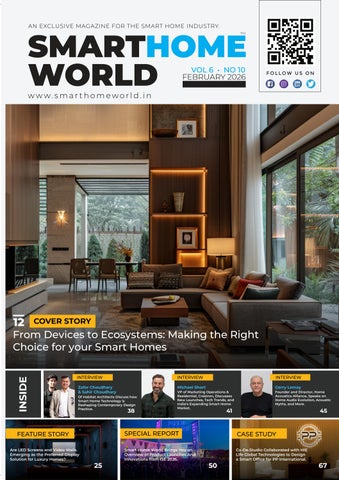
Smart Home World shares insights from the experts about choosing the right Smart Technology for your home. They explain how hybrid systems, open protocols, and predictive intelligence are helping Indian homeowners build reliable, scalable, and future-ready living spaces.
Feature Story
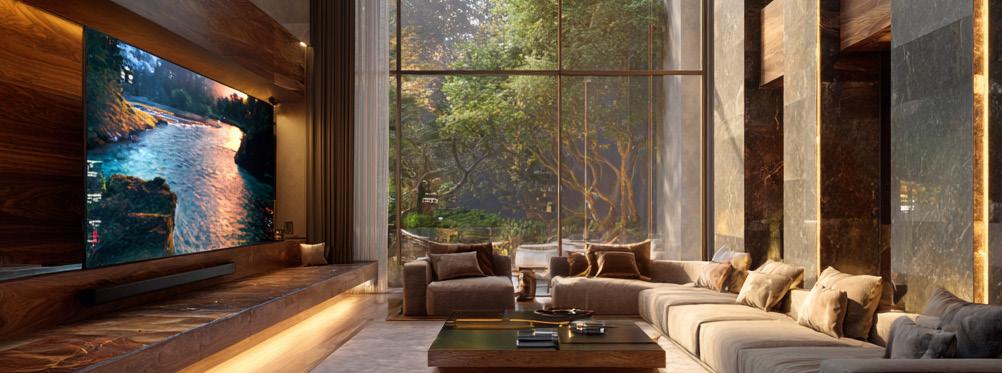
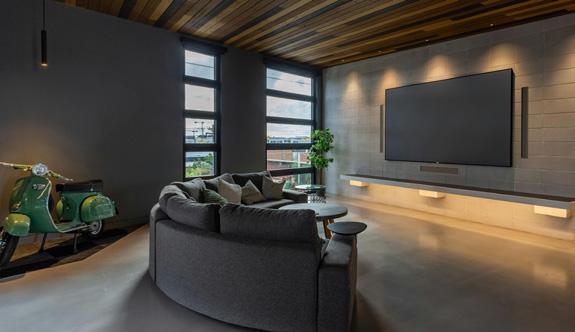
Are LED Screens and Video Walls the preferred options for luxury homes? Here are insights from AV specialists and Brand Heads on the latest innovations and the latest brand offerings.
Interviews
Zafar Choudhary, Founding Partner, Habitat Architects and Sahir Choudhary, Director, Operations & Sr. Architect, Habitat Architects, come together to discuss how smart home technology is reshaping contemporary design practice.
Michael Short, VP, Marketing Operations & Residential, Crestron, discusses the company’s latest product launches, emerging technology trends and the significant growth potential of the Indian residential smart home market.
Gerry Lemay, Founder and Director, Home Acoustics
Alliance (HAA), shares insights on the evolution of home audio, common acoustic misconceptions, and the principles behind creating truly high-performance listening environments.
Special Report
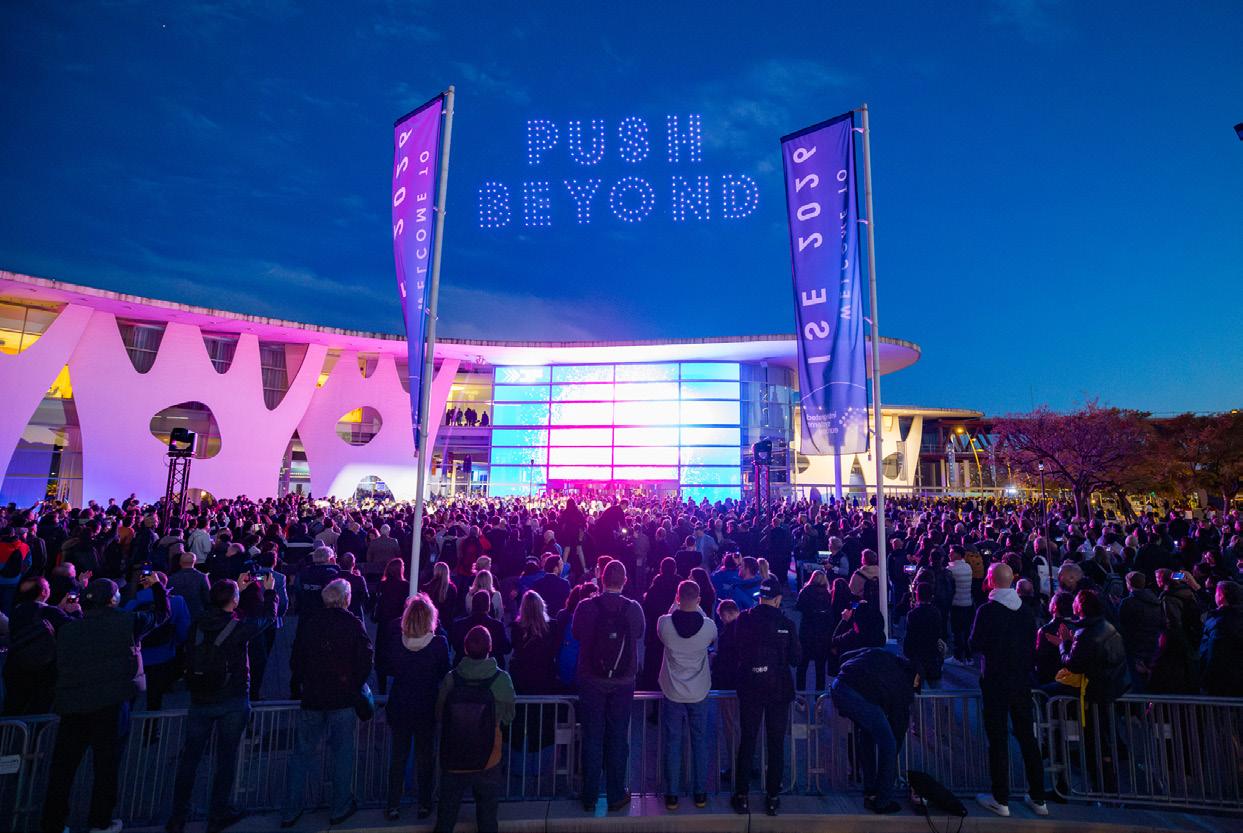
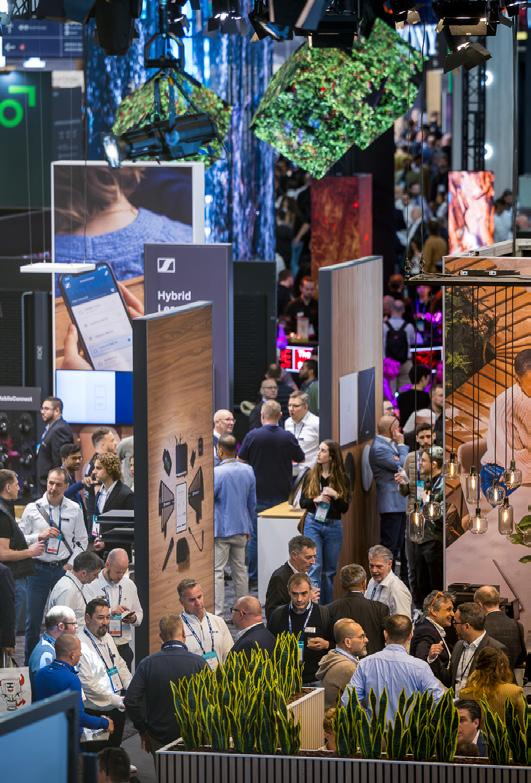
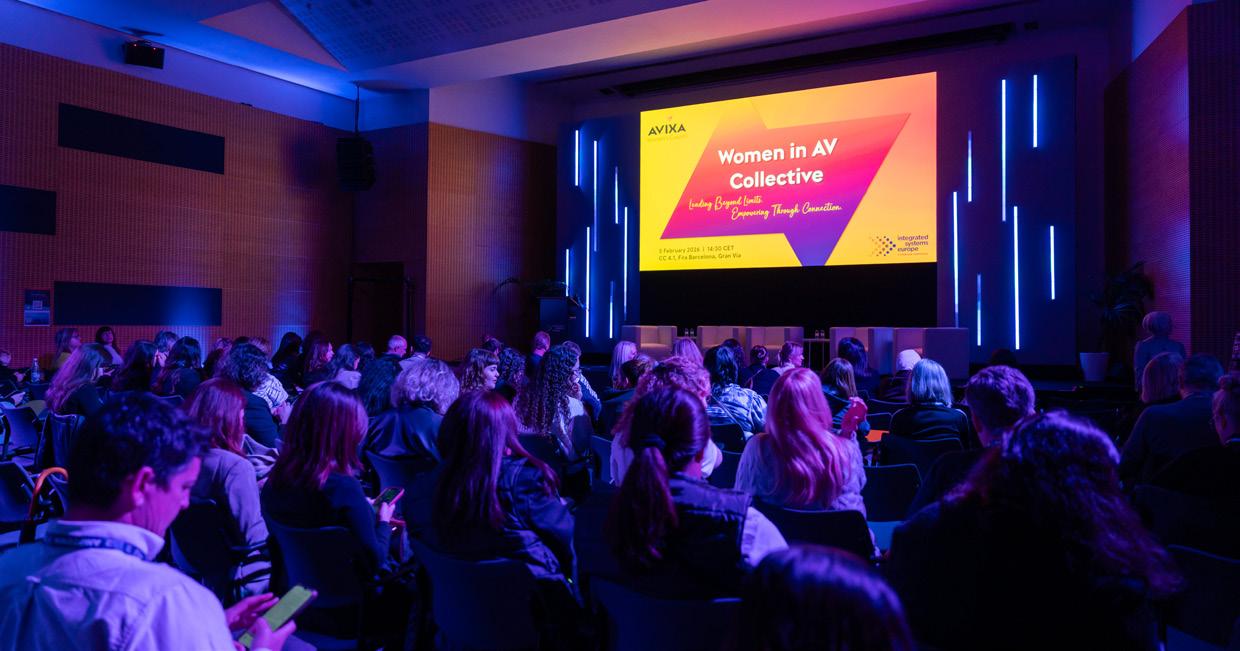
Smart Home World brings you an overview of the latest product launches in smart living, connected technologies, and integrated AV solutions from ISE 2026.
Case Studies
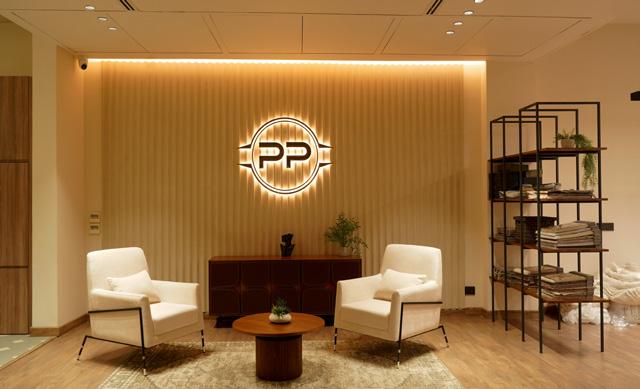
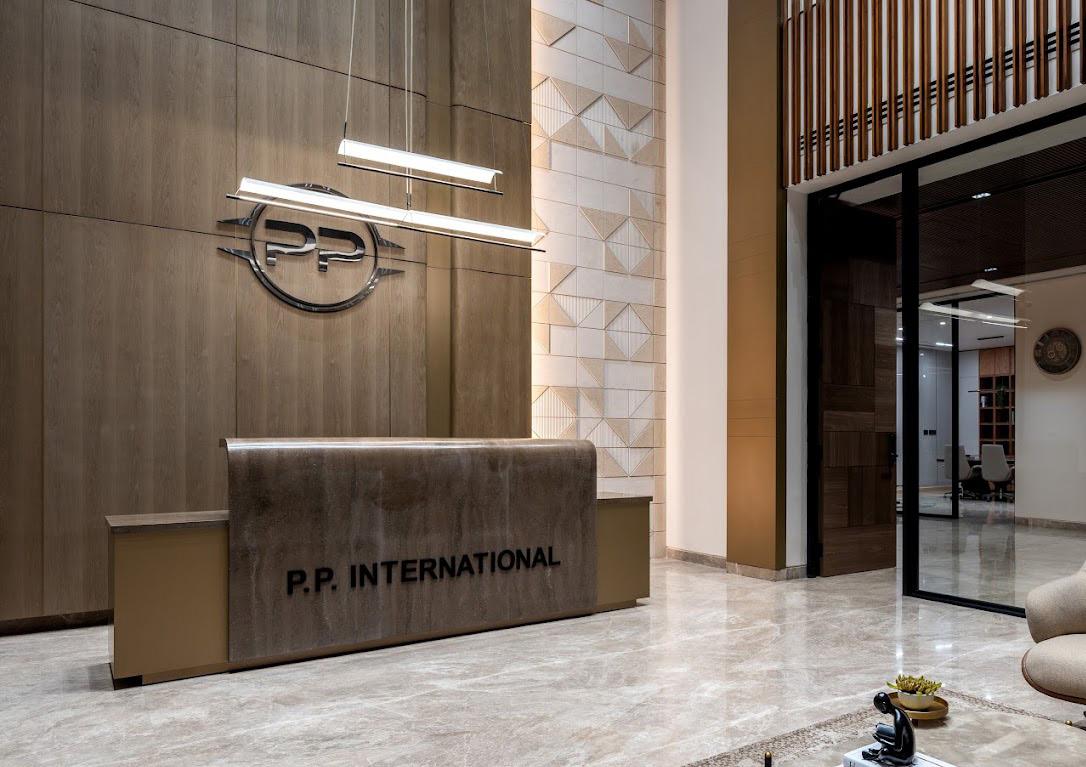
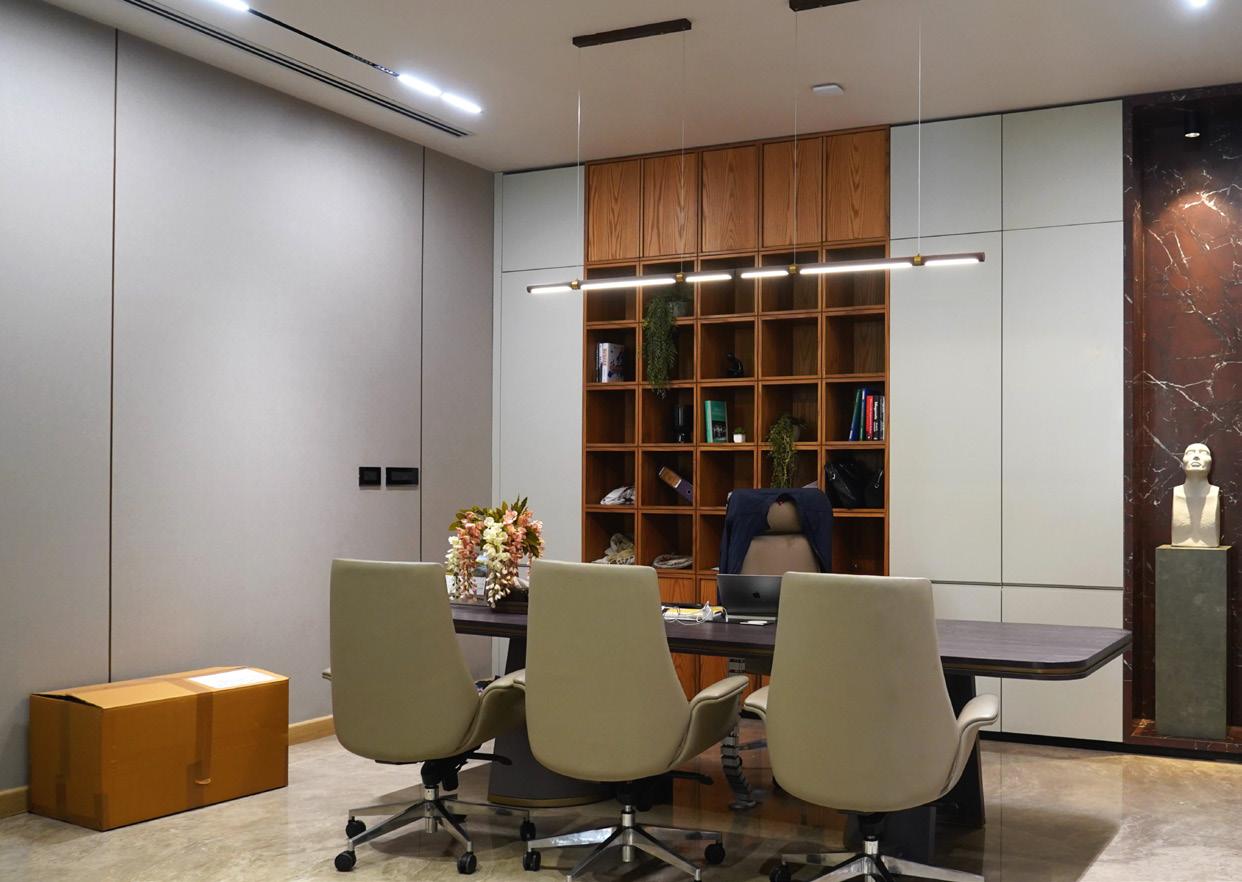
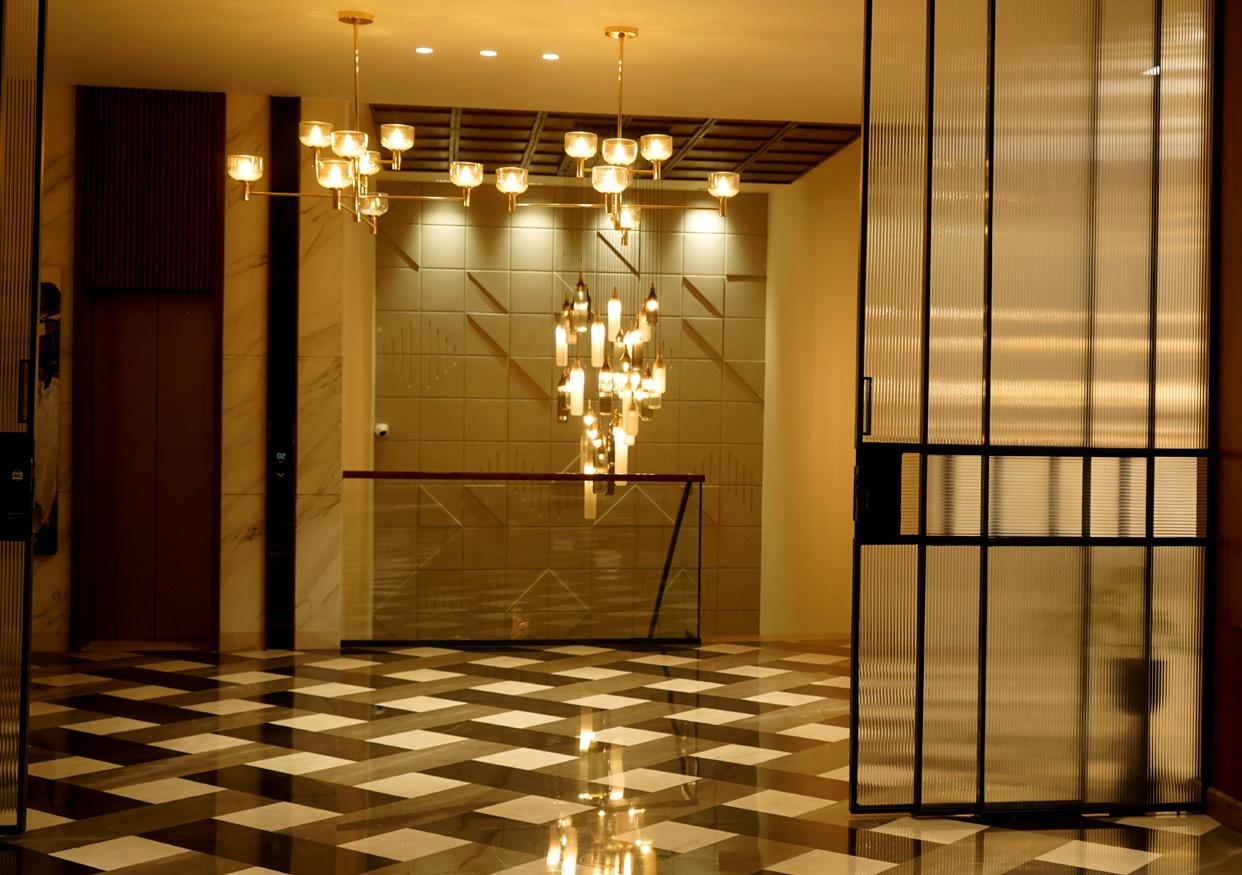
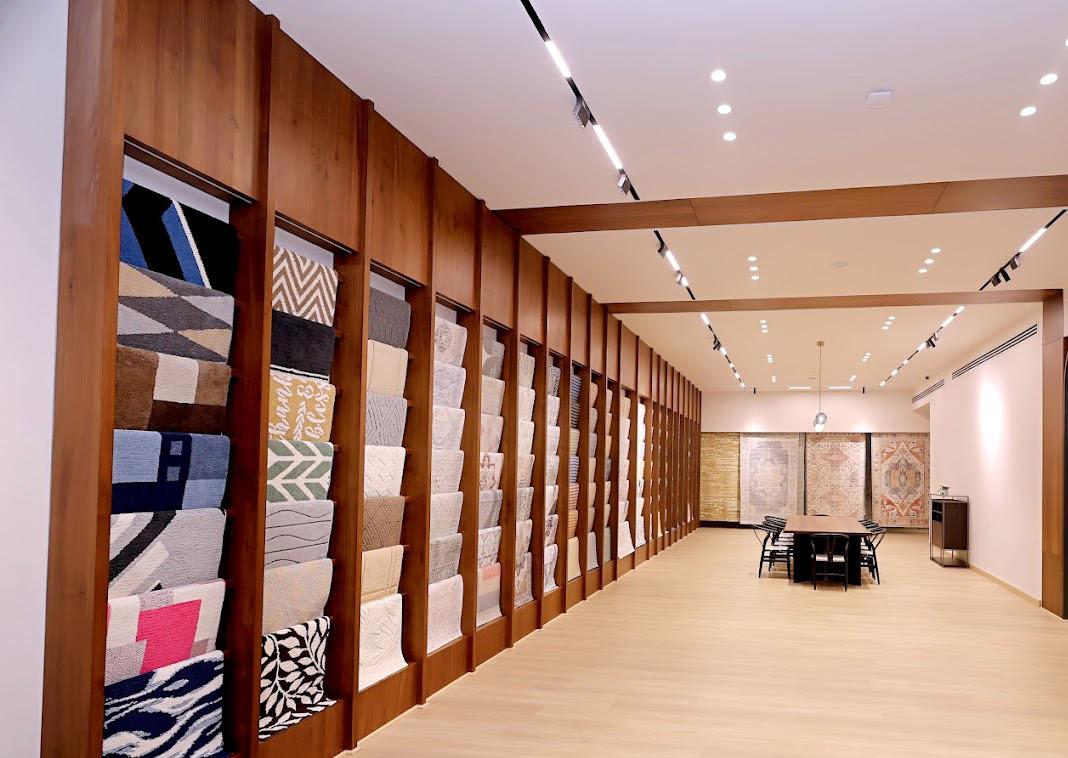
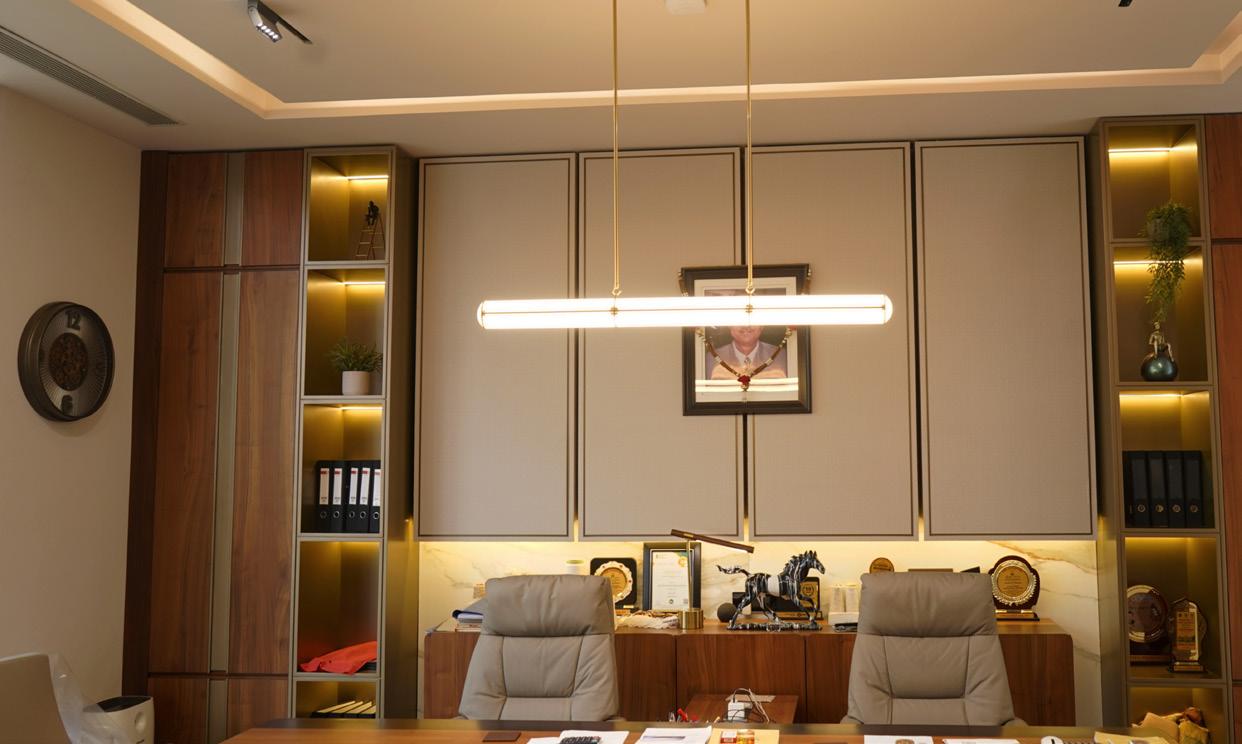
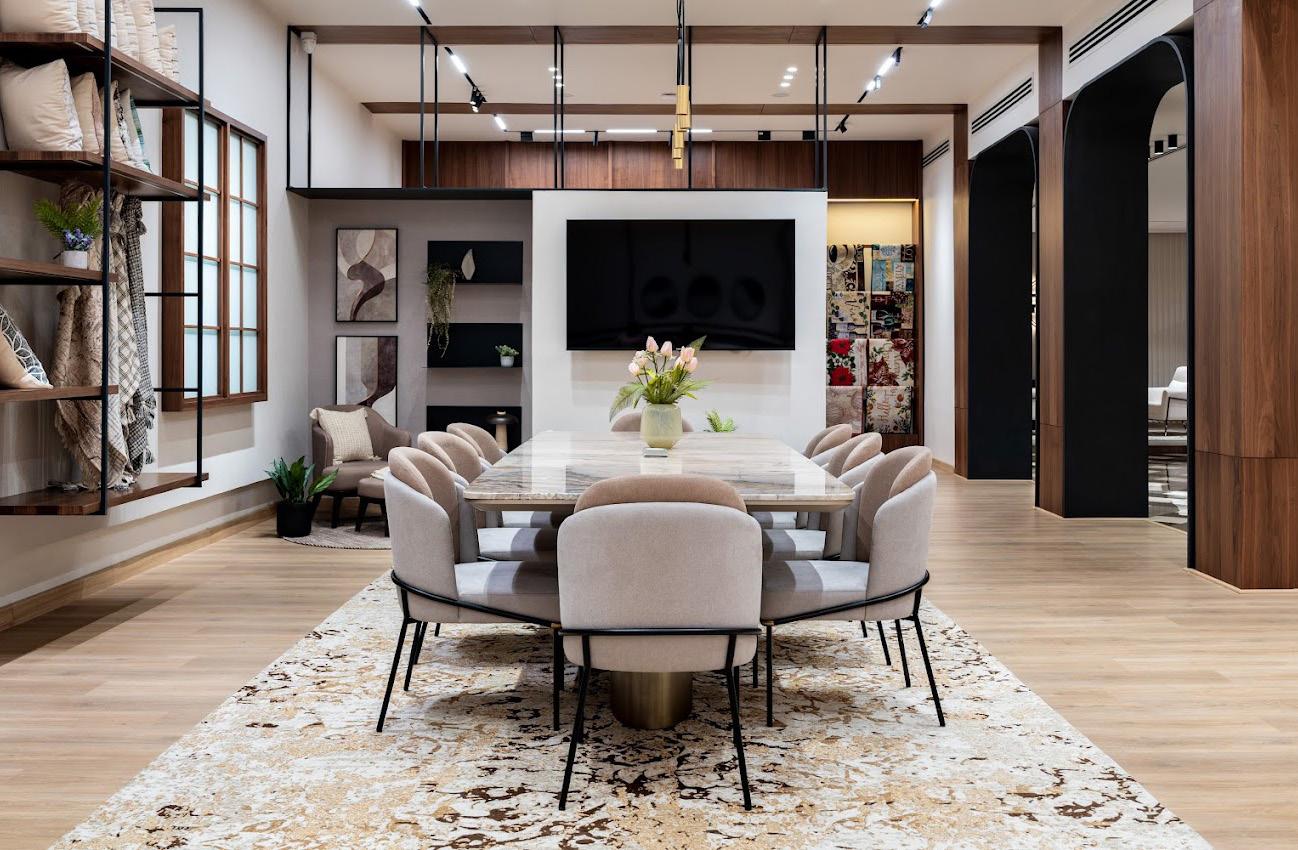
Co-De.Studio has designed a state-of-the-art Smart Office for PP International, working in collaboration with system integrator Hie Life Global Technologies Pvt Ltd, who are also winners of the Smart Space Awards 2025.
Product Preview
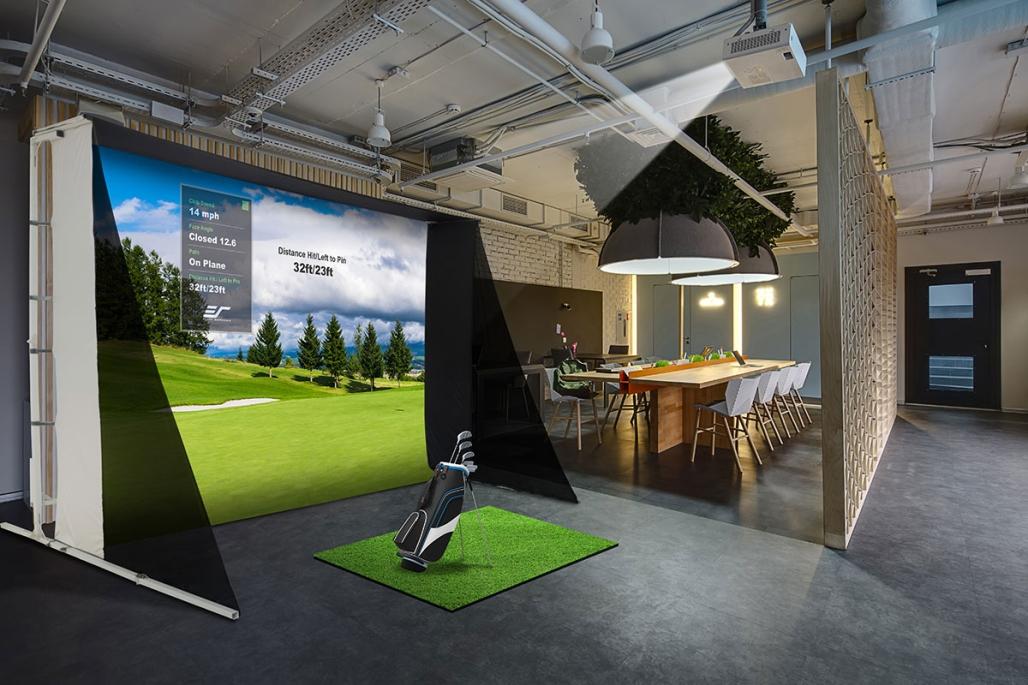
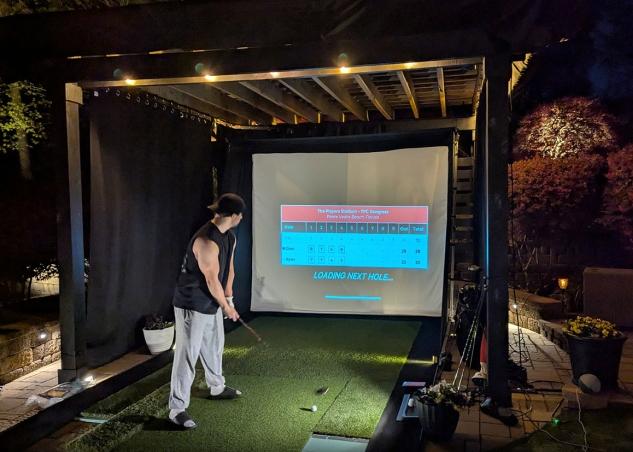
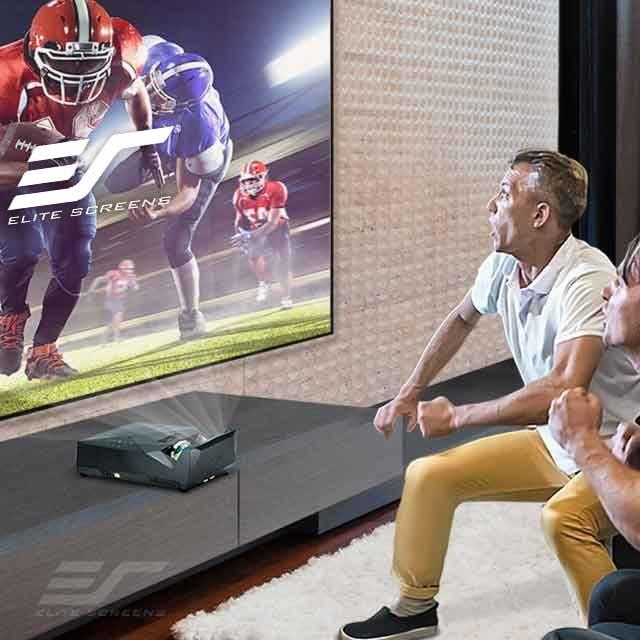
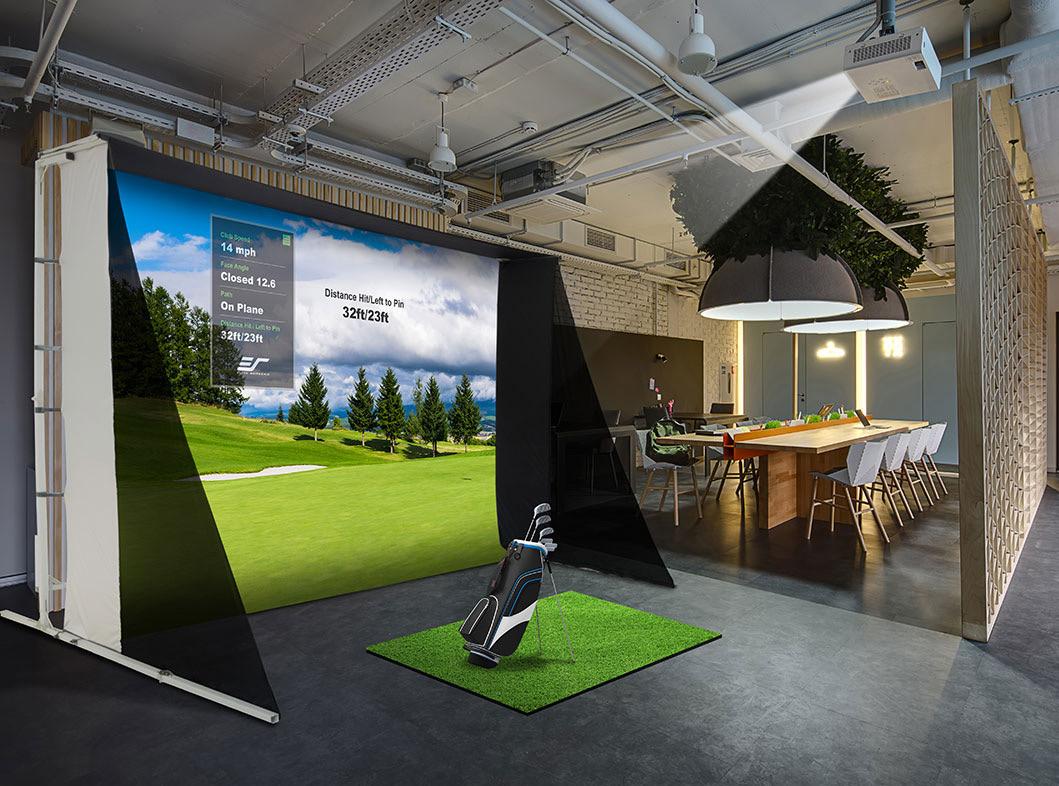
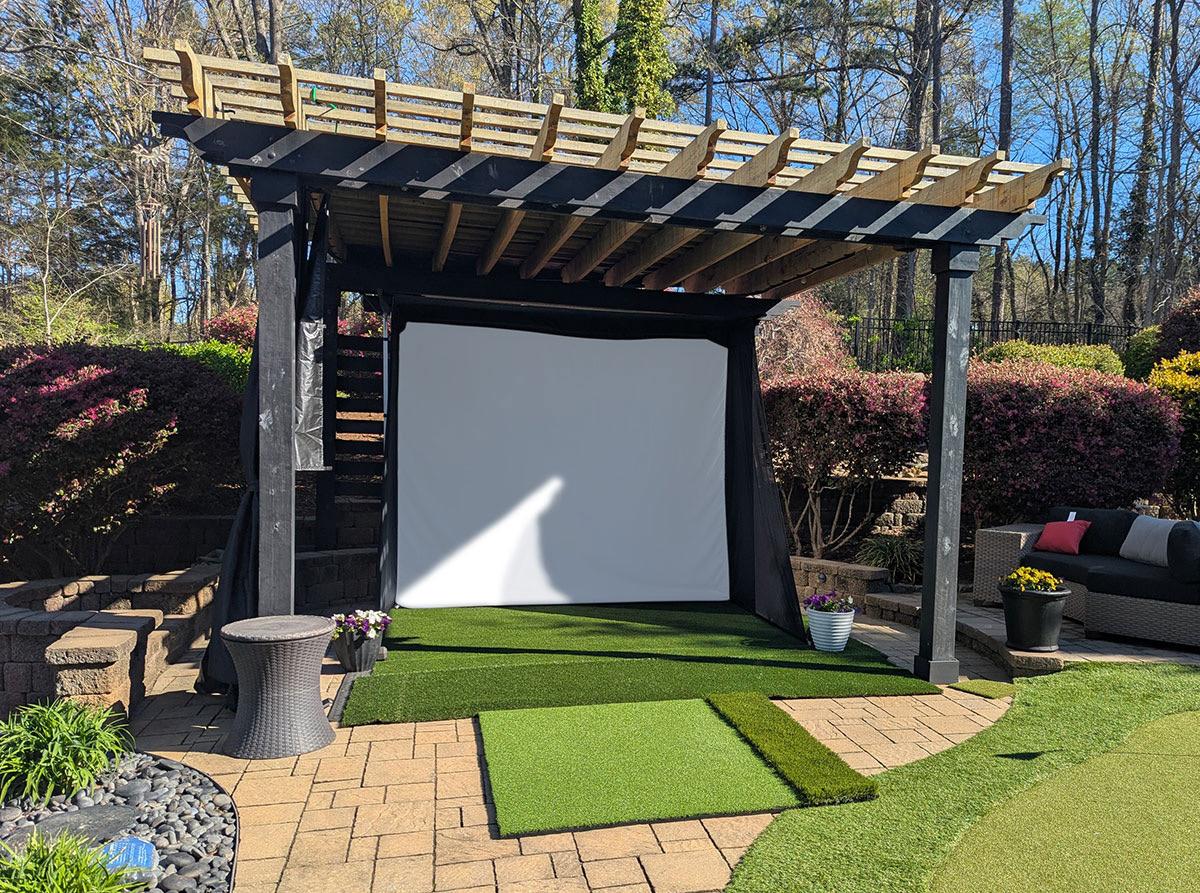
The Elite Screens GolfSim Portable ImpactWhite 350 Series stands out as a versatile solution, combining durable construction, high-quality projection performance, and a portable design.
News
The latest news and updates on home automation, smart lighting, AV and more. 12 22 38 50 57 62 64
The smart homes are evolving at a breakneck pace, and with a market flooded by endless choices, shortlisting the right technology for your home can feel like a daunting task. Our latest Cover Story cuts through the noise, bringing together industry experts to explain how hybrid systems, open protocols, and predictive intelligence are finally making it possible for homeowners to build truly future-ready ecosystems. This is followed by a Feature Story that examines the dramatic shift in luxury interior design, where LED screens and massive video walls are the new focal points of the home, featuring exclusive insights from AV specialists and global brand leaders on the latest innovations.
Our interview section features Michael Short of Crestron who discusses the emerging trends driving India’s massive growth in the smart home sector, while Gerry Lemay of the Home Acoustics Alliance demystifies the complexities of high-performance audio to help you achieve studio-quality sound at home. Furthermore, Zafar Choudhary and Sahir Choudhary of Habitat Architects provide a unique designer’s perspective on how smart technology is no longer just an add-on, but a fundamental tool reshaping contemporary architectural practices.
In the case study section, we feature one of the Smart Space Award-winning Smart Office designed by Co-De.Studio and Hie Life Global Technologies.
This issue is rounded out with a Special Report on the most exciting product launches in smart living and integrated AV, and more in our Special Report on ISE 2026.
Stay connected and stay updated as we continue to track the trends defining the future of your living space.
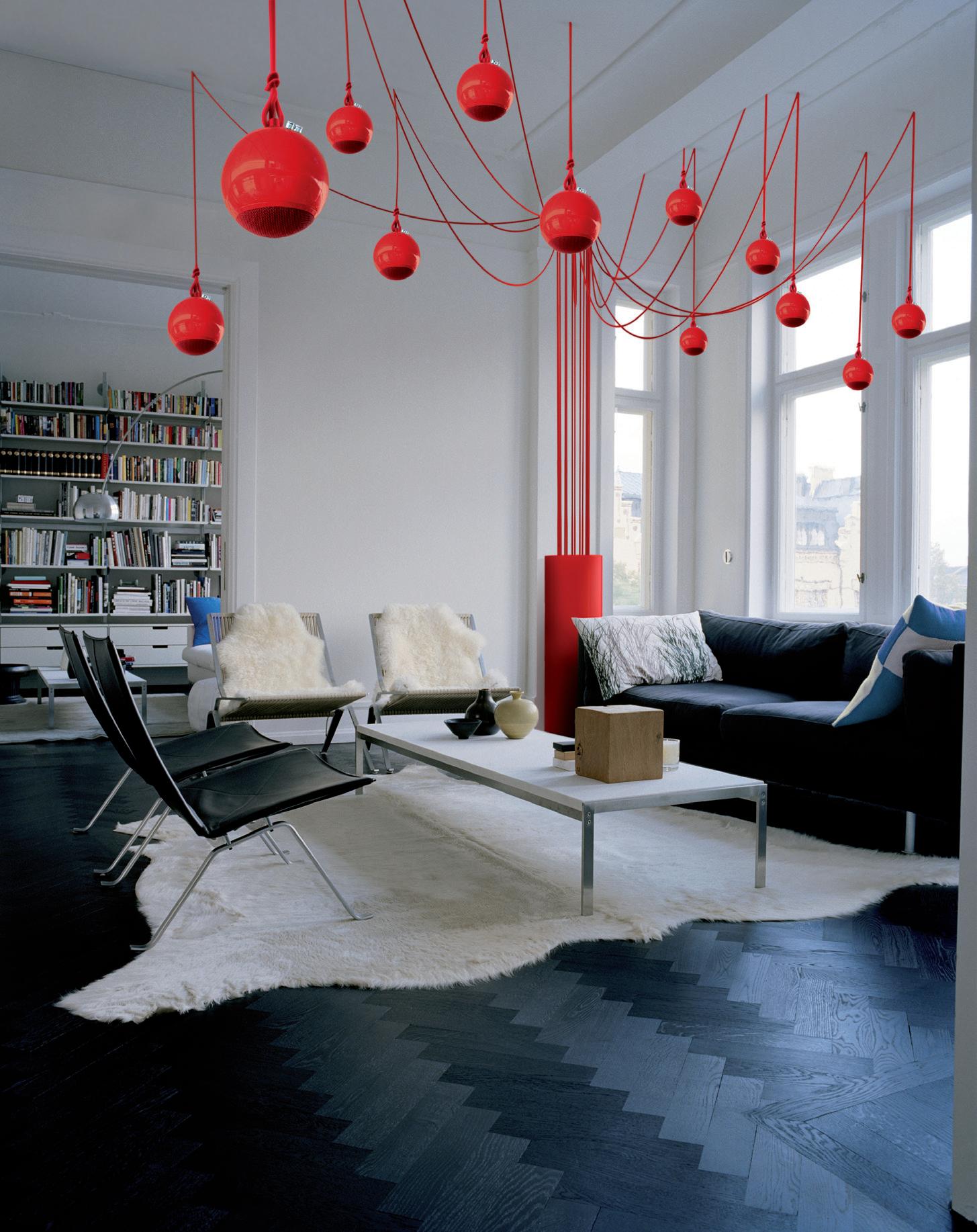
A tree that holds the rustling sounds of a forest.Originally conceived for convivial spaces,this surprising sound object is composed of twelve spherical speaker-fruitssuspended from the ceiling by creeper-cables, ripe for the picking.
By scaling the number of speakers,it can be adapted to any environment, intimate or social.I t is presented for the rst time at Milano’s Triennale during Design Week.‘Sound Tree’ starts a collection of haute couture sound objects.
Design by Maurizio Galante, Tal Lancman & Jean-Yves Le Porcher for Elipson.
GolfSlim Portable ImpactWhite 350 Series Screens
The Right Smart Home Technology Makes All the Difference
Choosing the right technology is critical for a truly smart home. Experts explain how hybrid systems, open protocols, and predictive intelligence are helping Indian homeowners build reliable, scalable, and future-ready living spaces.
In India’s fast-evolving residential landscape, smart home automation has moved far beyond novelty. What was once defined by a few appcontrolled lights or voice-enabled speakers has matured into a complex ecosystem of integrated systems. Yet, despite this growth, one fundamental mistake continues to create long-term issues: selecting technology based on trend, price, or brand popularity rather than suitability and structure. The reality is
simple: smart homes succeed or fail at the planning stage. Choosing the right technology foundation at the beginning prevents instability, incompatibility, and expensive upgrades later.
A smart home should never begin with product selection; it should begin with need analysis. Every project must first evaluate the homeowner’s lifestyle, expectations, and
long-term plans. Is the priority convenience, enhanced security, energy efficiency, centralised control, or luxury living? Is the property a new construction or a retrofit apartment? What level of scalability is expected over the next decade? Installing a high-end, complex automation system in a compact apartment that requires only basic lighting and curtain control adds unnecessary cost and complication. Conversely, deploying entry-level wireless gadgets in a large villa with extensive automation demands can lead to network congestion, signal failures, and dissatisfied users. The right technology is not the most advanced option available; it is the most appropriate option for the project.
At the core of every stable smart home lies the platform. Platform selection is significantly more important than choosing individual
devices because the platform defines how all subsystems communicate. Lighting, climate control, security, audio-video, and shading must operate within a unified ecosystem. Structured platforms such as Control4, Crestron, Lutron, and systems built on standards from the KNX Association are designed for long-term integration, reliability, and scalability. They provide centralised logic, consistent user interfaces, and the flexibility to expand without overhauling the entire system. In contrast, combining multiple standalone Wi-Fi products often results in fragmented control across different mobile apps, firmware conflicts, router overload, and cybersecurity vulnerabilities. Devices can be replaced over time; replacing a poorly chosen platform is expensive and disruptive.
Equally critical is the selection of the right hub or controller, as this determines processing capability, automation speed, integration capacity, and system stability. In Indian conditions, where internet reliability can vary, systems that rely solely on cloud processing can fail during outages.
When evaluating infrastructure realities in India, the wired versus wireless debate becomes central. Wired systems offer unmatched reliability, minimal latency, and long operational life cycles. They are ideal for new constructions where planning can begin at the design stage. However, wired installations may not always be feasible in completed homes or apartments. Wireless systems offer faster deployment and lower initial civil work, making them attractive for retrofits. Yet, heavy dependence on Wi-Fi can create interference challenges, especially in high-rise buildings with multiple overlapping networks.
This is where hybrid architecture emerges as the most practical and forward-thinking solution for Indian homes. A well-designed hybrid system combines the stability of a wired backbone with the flexibility of wireless extensions. Critical systems such as lighting control, HVAC, and security can operate on a wired infrastructure, ensuring consistent performance and minimal latency. At the same time, wireless sensors, smart switches,
and auxiliary devices can be added without extensive rewiring. Hybrid architecture not only optimises cost but also provides resilience. If one communication layer experiences issues, the overall system remains stable. Moreover, hybrid designs make future expansion easier, allowing homeowners to upgrade specific zones without disturbing the entire ecosystem. In India’s diverse housing formats, from compact apartments to expansive villas, hybrid systems strike the right balance between reliability, scalability, and practicality. Ultimately, the difference between a
successful smart home and a problematic one lies in invisible decisions. Electrical planning, network design, surge protection, structured cabling, and professional commissioning are as important as the visible touch panels and designer switches. Choosing technology purely on cost can lead to higher long-term maintenance and replacement expenses. A well-planned system, built on the right platform with an appropriate controller and a hybrid infrastructure tailored to the property’s needs, delivers consistent performance for years.
Smart Home World speaks to System Integrators to share their expert insights on choosing the appropriate smart home solutions and building future-ready automation systems.
How has the definition of a `Smart Home’ in India evolved over the last five years from a technology standpoint?
Over the past five years, the concept of a smart home in India has undergone a significant transformation. Earlier, smart homes were largely defined by standalone connected devices such as CCTV apps, smart bulbs, and video door phones, each operating independently through separate mobile applications. These systems were devicecentric, not integrated, and certainly not synchronized into a unified experience.
Smart Systems have evolved through various phases:
Phase 1 App-Controlled Devices:
The initial phase of smart homes revolved around individual products controlled via their respective apps. There was minimal interaction between systems, and automation was limited to basic remote control functionality.
Phase 2: IoT and Voice Integration:
With the rise of IoT adoption, devices began communicating within broader ecosystems. Voice assistants like Amazon (Alexa) and Google (Google Assistant) played a major role in bringing automation into the mainstream. Homes started experiencing platform-level integration rather than isolated device control.
Phase 3: AI-Driven Ecosystems:
Today, smart homes are integrated, humancentric ecosystems powered by AI and cloud intelligence. Lighting, climate control, and security systems are no longer just reactive, but they are adaptive, profile-based, and increasingly intelligent. The focus has shifted to energy efficiency, automation logic, and seamless interconnected living environments.
Why is platform selection more critical than individual device selection in a smart home project?
Platform selection is the foundation of any smart home project because it defines the system’s architecture, interoperability,
Aditya Khambhati Managing partner at Trinity Synergy Home Automation
automation logic, scalability, and long-term viability.
Devices can always be replaced or upgraded. However, the platform determines how all components communicate and function together. A strong platform ensures seamless integration between lighting, HVAC, AV, security, and other subsystems.
Selecting the right platform today guarantees flexibility for tomorrow. It prevents compatibility issues, reduces fragmentation, and ensures the home can scale without requiring a complete overhaul.
Given Indian infrastructure realities, how do you evaluate wired versus wireless or hybrid smart home systems?
When evaluating smart home systems in India, one must consider practical realities such as high wiring costs, a strong retrofit market, power fluctuations, and network instability.
Wired systems, particularly those built on standards supported by the KNX Association,
are robust, secure, and designed for long-term stability. They offer superior reliability and are ideal for new constructions.
However, wireless systems have gained popularity due to their scalability, ease of deployment, and suitability for retrofit projects. The most practical solution for India is a hybrid architecture. Hybrid systems combine the robustness and integration strength of wired infrastructure with the flexibility and cost-effectiveness of wireless devices. This approach balances performance, scalability, and budget considerations, making it highly suitable for Indian homes.
What factors should determine the choice of communication protocols in Indian residential projects?
Choosing the right communication protocol, whether a wired solution such as closed BUS systems or KNX, or wireless options like Wi-Fi, Zigbee, Z-Wave, or Thread, should be a carefully evaluated decision based on multiple projectspecific factors. Budget constraints often play a defining role, as certain protocols require
greater infrastructure investment than others. Power stability is another critical consideration in Indian conditions, where fluctuations can impact system performance. Integration requirements, particularly when coordinating lighting with AV, HVAC, security, and other subsystems, also influence protocol selection. User interface expectations, including responsiveness and centralised control, must align with the underlying technology. Scalability is equally important, ensuring the system can expand seamlessly as future needs evolve. Additionally, wall construction and structural barriers significantly affect wireless signal strength and reliability, making site conditions a key determinant. Finally, future readiness, such as compatibility with upcoming technologies and long-term upgrade potential, should guide the decision to ensure the system remains relevant and efficient for years to come.
Indian construction practices, especially thick concrete walls, can significantly affect wireless performance. Therefore, protocol selection must be carefully aligned with site conditions and long-term goals. An experienced system integrator plays a crucial role in evaluating these variables and recommending the right solution.
Do you believe hybrid architectures are the most practical solution for Indian homes today? Why?
Yes, in most Indian residential contexts, hybrid architectures are the most practical solution, not necessarily because they are theoretically superior, but because they align best with Indian infrastructure, construction styles, and buyer expectations.
Hybrid systems combine the strengths of both wired and wireless technologies, creating a balanced and practical automation framework. They deliver the robustness and reliability typically associated with wired systems, ensuring stable performance for critical functions such as lighting and HVAC control. At the same time, they provide the scalability of wireless solutions, allowing easy expansion and the addition of new devices without major structural changes. Hybrid architecture
also retains the integration advantages of structured infrastructure, enabling seamless coordination between multiple subsystems. Importantly, it offers the budget flexibility of wireless expansion, making it possible to optimise initial investment while keeping room for future growth.
They also appeal to developers and homeowners who seek performance without high initial civil costs. Hybrid architecture delivers a balanced, future-ready solution tailored to Indian conditions.
Do smart homes need to be more predictive or more adaptive — and what’s the difference in practice?
The terms “predictive” and “adaptive” are often used interchangeably in smart home marketing, but they represent distinct intelligence models.
Adaptive systems learn user habits over time and adjust accordingly. They operate reliably even with limited connectivity and focus on gradual optimisation.
For example, if a user turns on the air conditioning every evening, the system learns this pattern and begins automating it.
Predictive systems anticipate needs using broader data inputs such as weather forecasts, calendar schedules, or location tracking. They act proactively rather than reactively.
For example, the home may cool itself before the user arrives, based on travel schedules and external temperature data.
Indian smart homes should be primarily adaptive and selectively predictive.
Infrastructure variability demands reliability first. Indian households are often multigenerational with dynamic usage patterns, and users value transparency and control. Adaptive systems build trust by responding consistently to behaviour. Predictive features should be layered in only after system stability is ensured and where they genuinely enhance comfort and efficiency.
Dhanraj Sheth CEO & Director, Uniser Smartspace
How has the definition of a “Smart Home” in India evolved over the last five years from a technology standpoint?
Five years ago in India, a smart home (rather a smart space) largely meant basic automation. It was mostly about switching lights, fans, or air conditioning On and Off through an App or Voice Control, with technology added as a layer rather than designed into the space.
Today, the definition has evolved significantly. Smart spaces are no longer about isolated functions or individual devices. They are about how different systems work together to create comfort, efficiency, and consistency. While lighting was one of the earliest entry points through scenes and automation, the conversation has expanded to include HVAC, shading, security, energy management, and audiovisual systems working in sync.
From a technology standpoint, the shift has been from device-led automation to platformdriven ecosystems. Clients now recognise that the quality of their experience depends far more on the underlying infrastructure, choice of platforms and protocols, and how thoughtfully the space is designed, integrated, and commissioned.
In essence, smart spaces in India are moving from simple connected setups to wellengineered environments that are reliable, scalable, and built to last across homes, offices, showrooms, and hospitality spaces.
Why is platform selection more critical than
individual device selection in a smart home project?
The platform is what holds the entire smart space together. Once a platform is chosen, it determines how different systems communicate, how stable the setup is, and how easily the space can evolve over time.
In many projects, issues arise not because the devices are poor, but because they do not work well together. A strong platform ensures interoperability between lighting, HVAC, security, AV, and other systems, instead of creating multiple disconnected islands of automation.
Platform selection also impacts long-term reliability and serviceability. A well-chosen platform allows for easier troubleshooting, software updates, and future expansion without ripping out existing infrastructure. In contrast, device-driven approaches often lead to complexity, compatibility issues, and higher life-cycle costs.
Ultimately, a smart space succeeds not because of a few impressive devices, but because the underlying platform delivers consistency, scalability, and a seamless user experience over the long term.
Given Indian infrastructure realities, how do you evaluate wired versus wireless or hybrid smart home systems?
In India, the wired versus wireless debate has evolved significantly over the last few years.
Earlier, wired systems were often seen as the only reliable option, while wireless was viewed as a compromise. That perception has changed. Modern wireless technologies have become far more robust, secure, and responsive than before. When designed correctly with proper network planning, bandwidth allocation, and redundancy, wireless systems today can deliver excellent performance, even in demanding environments.
That said, Indian infrastructure still presents unique challenges such as variable power quality, inconsistent network performance, and wide differences in construction standards. This makes it essential to evaluate each project individually rather than follow a one-size-fits-all approach.
Often, a hybrid architecture works best. Wired systems provide a stable backbone for critical functions, while wireless systems offer flexibility, scalability, and ease of deployment where required.
The key is not choosing between wired or wireless, but designing a system where the technology supports the space, the usage,
and the long-term expectations of the client.
What factors should determine the choice of communication protocols in Indian residential projects?
The choice of communication protocols should be driven by reliability, scalability, and longterm relevance rather than brand preference or short - term convenience.
In Indian residential projects, factors such as construction type, project scale, network environment, and expected usage patterns play a critical role. A protocol must be able to perform consistently despite power fluctuations, dense wireless environments, and varied internet quality.
Interoperability is another key consideration. Protocols that allow different systems to communicate seamlessly reduce complexity and avoid vendor lock-in. This becomes especially important as homes evolve and new technologies are added.
Finally, the protocol should be well-supported, widely adopted, and future-ready. A proven ecosystem, strong manufacturer backing, and
regular updates ensure that the smart space remains serviceable and relevant long after installation.
Do you believe hybrid architectures are the most practical solution for Indian homes today? Why?
Yes, in most scenarios, hybrid architectures are the most practical solution for Indian homes today. Residential projects in India differ widely in layout, build methods, occupancy behaviour, and long-term expectations. A hybrid approach allows designers to combine the dependability of wired systems with the flexibility and speed of modern wireless technologies.
This approach also supports change over time. As lifestyles evolve and new requirements emerge, wireless layers can be added or reconfigured with minimal disruption, while the core system continues to deliver stable performance.
Hybrid architectures move the focus away from rigid technology choices and toward outcomedriven design, enabling smart spaces that are
resilient, adaptable, and future-ready.
Do smart homes need to be more predictive or more adaptive, and what’s the difference in practice?
Smart spaces need to be adaptive first. Predictive systems aim to anticipate user behaviour using data and patterns, while adaptive systems respond intelligently to real-time inputs such as occupancy, time of day, environmental conditions, and user interaction. In practice, adaptability builds trust because the system responds correctly in the moment, rather than relying on assumptions. In the Indian context, usage tends to be highly dynamic. Spaces often see fluctuating schedules, multiple users, and frequent changes in activity. Adaptive systems are better suited to this reality, as they respond to what is actually happening rather than what is expected to happen.
Predictive intelligence works best when layered on top of a strong adaptive foundation. When implemented thoughtfully, the result is a smart space that feels intuitive, reliable, and genuinely supportive of everyday living.
Priyaank Vishnoi Director, Energyify
How has the definition of a “smart home” in India evolved over the last five years from a technology standpoint?
Over the past five years, the automation industry has evolved significantly, with growing awareness and adoption across both metro and non-metro markets. In B-class cities, consumers are increasingly open to learning about smart technologies and are willing to invest in luxury automation solutions. There is a noticeable demand for retrofit installations, mobile app–based controls, and advanced security systems, reflecting a shift toward convenience and safety-driven smart living.
At the same time, in A-class cities, developers
and builders are proactively integrating smart home features into their projects as value additions. Offering pre-installed automation systems has become a competitive differentiator, enhancing property appeal and meeting the rising expectations of modern homebuyers.
Why is platform selection more critical than individual device selection in a smart home project?
Since the automation industry is largely service-driven, the choice of technology becomes even more critical. Many companies operate on their own communication standards, commonly referred to as proprietary systems. When a customer selects a proprietary platform that does not operate on an open or widely accepted protocol, they essentially become locked into that single ecosystem. In such cases, the homeowner’s long-term experience depends entirely on whether that company continues to provide product support, upgrades, and after-sales service. It becomes a long-term commitment to one brand.
Another concern is that some companies focus primarily on selling products rather than delivering complete solutions. Because no single manufacturer can meet every possible customer requirement with one product line,
there is a risk of misalignment, where a product may be recommended simply because it exists in the company’s portfolio, not because it is the most suitable solution for the project. This can lead to incorrect applications and limitations later.
In contrast, choosing an open protocol system removes many of these constraints. Open systems provide flexibility and reduce dependency on a single manufacturer. If one brand discontinues a product, compatible alternatives are often available from other manufacturers within the same protocol ecosystem. This ensures long-term security and continuity for the homeowner.
Given Indian infrastructure realities, how do you evaluate Wired versus Wireless, or Hybrid smart home systems?
Wired systems have clear advantages over wireless solutions, as they do not rely on batteries and require no replacements. Wireless systems, while convenient, have inherent limitations in range; the effective range often depends on the room layout and building infrastructure, rather than lab-tested parameters. Identifying and resolving issues is generally easier in wired systems, making them more reliable in practice.
Hybrid systems are commonly preferred in the market, as they combine the strengths of both wired and wireless technologies and can be upgraded over time. Customers can save on wiring and conduit costs during construction, but wireless systems pose more long-term challenges. Most wireless solutions today are proprietary, meaning any technical issues require support from the same brand, which can limit flexibility.
Open protocols, such as Zigbee, if made widely available in India, could make wireless systems far more productive and customer-friendly.
Wireless solutions remain most suitable for small-scale applications, such as 1–2 rooms, but for larger or long-term projects, wired or hybrid systems are generally more reliable.
What factors should determine the choice of communication protocols in Indian residential projects?
In the residential market, key priorities are cost-effectiveness, reliability, ease of upgrades, and seamless third-party integration. Solutions should be user-friendly for all age groups, require low maintenance, and rely on dependable products such as dimmable lights, motorised tracks, or VRV/AC systems at an affordable cost.
Do you believe hybrid architectures are the most practical solution for Indian homes today? Why?
Yes, hybrid architectures are currently the most practical solution for Indian customers. People are increasingly embracing ecofriendly and traditional building techniques, especially after COVID, as awareness of lifestyle and health has grown. Homeowners are seeking environmentally conscious living, and architects play a key role in guiding and motivating them toward practical, sustainable solutions that meet their specific needs. However, constructing a truly eco-friendly home remains a complex and challenging task without the right guidance
Do smart homes need to be more predictive or more adaptive, and what’s the difference in practice?
I believe a smart home should be predictive. Building a home on an adaptive basis only allows it to respond to current challenges or conditions, rather than anticipating future needs.
In Conclusion, now that we have heard from the experts, it is clear that the key to a successful smart home in India lies in choosing the right technology, platform, and architecture from the start. Hybrid systems, open protocols, and predictive intelligence offer long-term flexibility, reliability, and scalability, while catering to evolving lifestyles and eco-friendly aspirations. By focusing on practical, future-ready solutions rather than short-term trends, homeowners can ensure that their smart homes remain efficient, adaptable, and truly intelligent for years to come.
LED Screens & Video Walls for Smart Homes
In this feature, Smart Home World brings together leading system integrators, AV specialists, and brand heads to share their perspectives on the latest trends, breakthrough innovations, and the evolving role of large-format displays in shaping intelligent, design-forward homes.
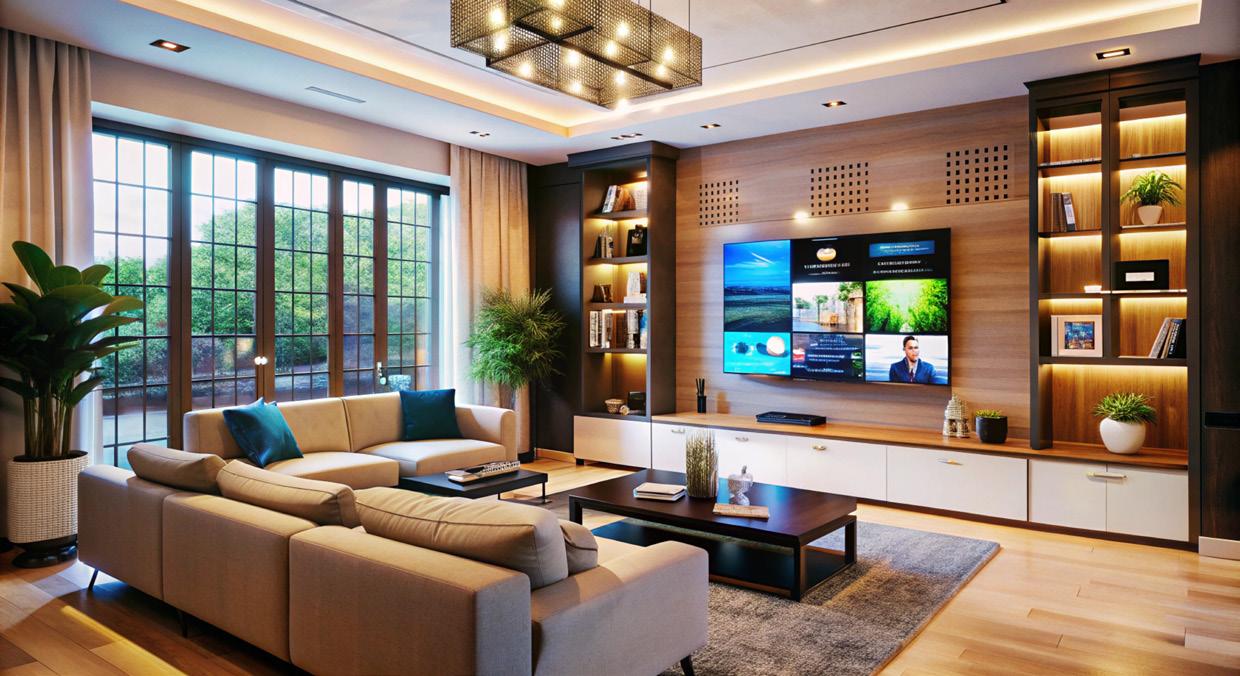
For years, LED Screens and Video Walls were predominantly associated with commercial spaces, be it the corporate lobbies, boardrooms, and retail environments. Today, however, they are steadily finding their place in high-end residences, with growing demand among luxury homeowners.
If you’re wondering what’s driving this shift, the answer lies in the evolving definition of luxury itself. For homeowners who believe that true luxury lies in experience, not just aesthetics, entertainment is no longer confined to a conventional television screen. Modern luxury residences are being designed around immersive living, where technology enhances everyday moments. This is where large-format
LED Screens and Video Walls are redefining contemporary homes.
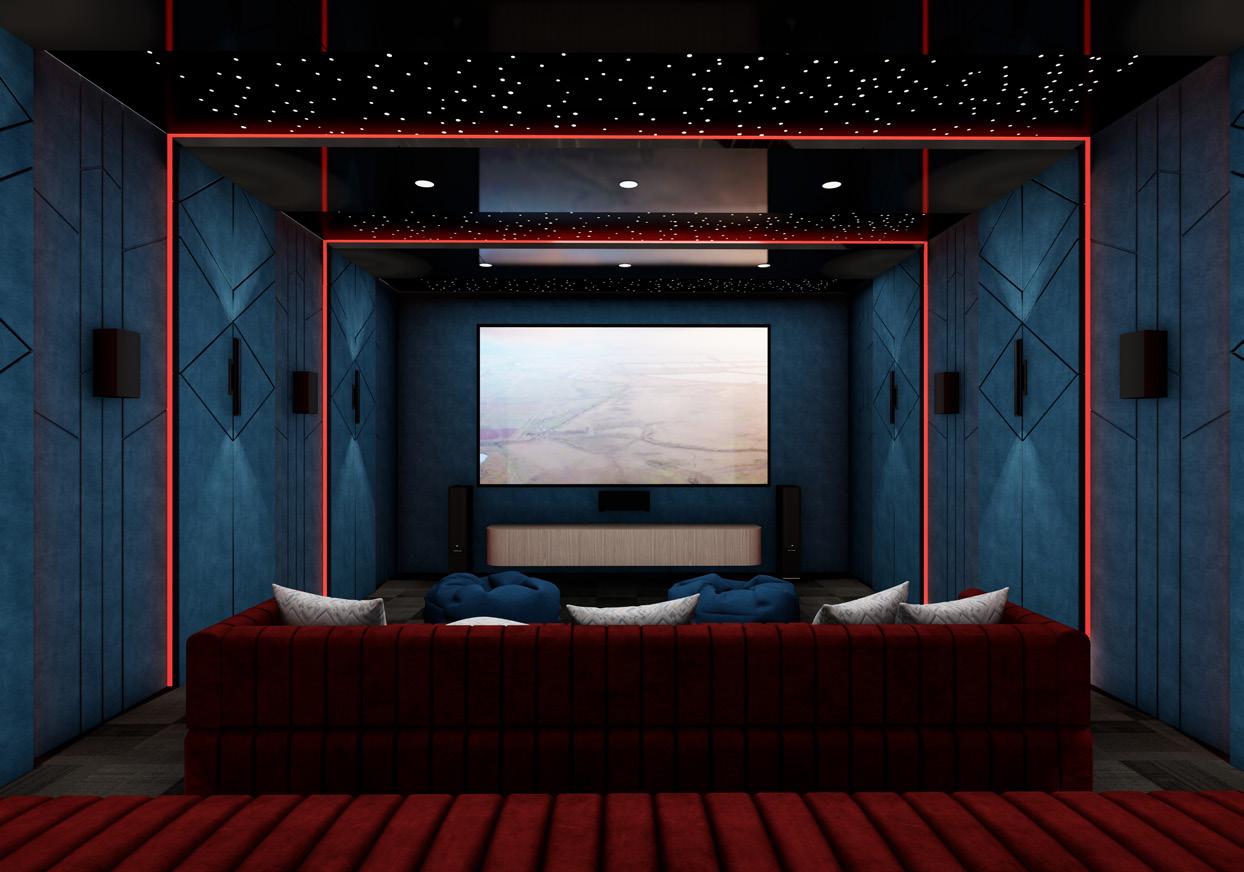
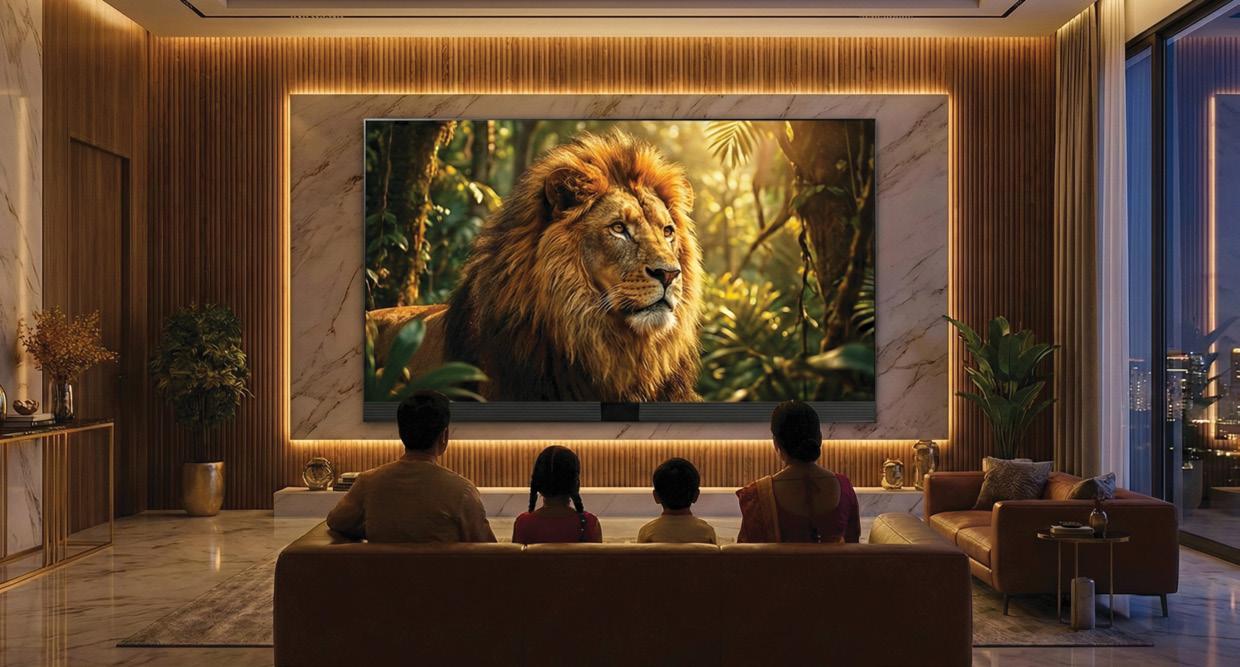
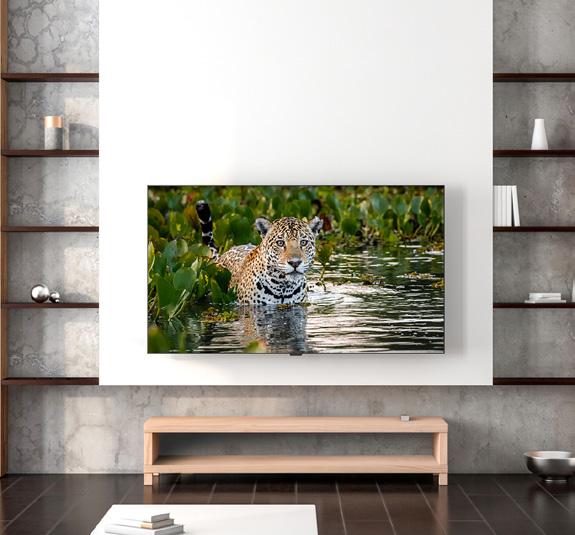
Homeowners are now choosing expansive LED displays to create a truly cinematic atmosphere within their private living rooms, lounges, or dedicated home theatres. Imagine unwinding with a visually spectacular series like Game of Thrones on a massive LED Video Wall. Every sweeping landscape, intricate costume detail, and dramatic scene comes alive with remarkable clarity and scale, transforming simple viewing into an immersive experience. Yet, the appeal of these installations extends beyond entertainment. When not in use, they seamlessly transform into dynamic digital canvases. Rather than leaving a blank black
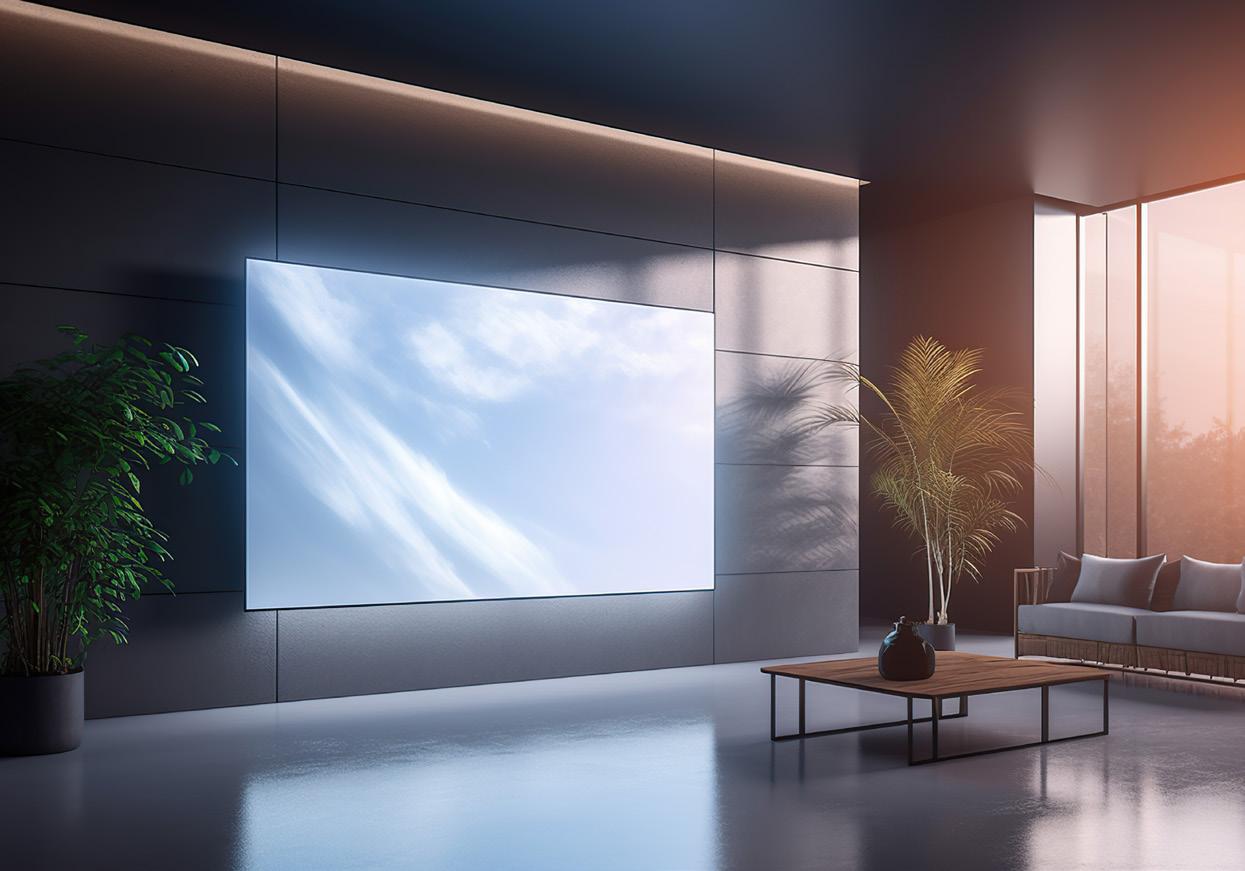
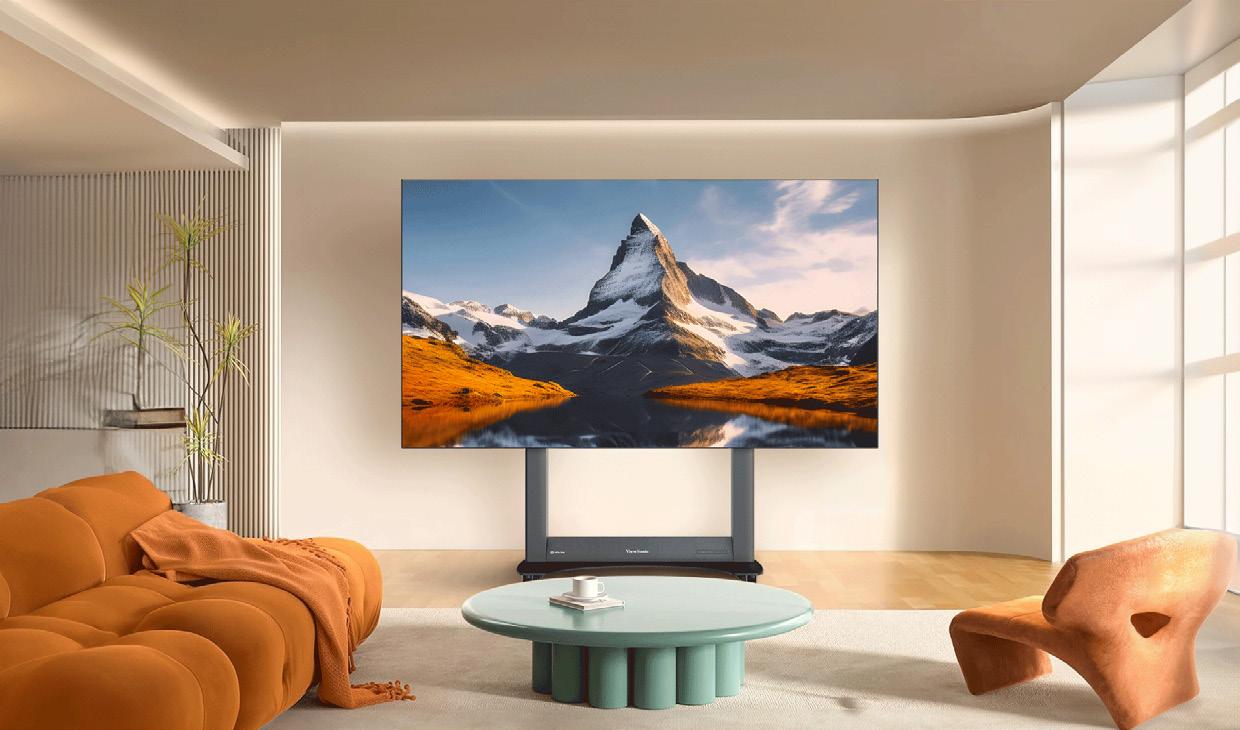
screen dominating the space, the display becomes a curated art feature, showcasing digital masterpieces, soothing natural vistas, abstract motion graphics, or even cherished family portraits. So apart from entertainment, it blends with the overall interiors.
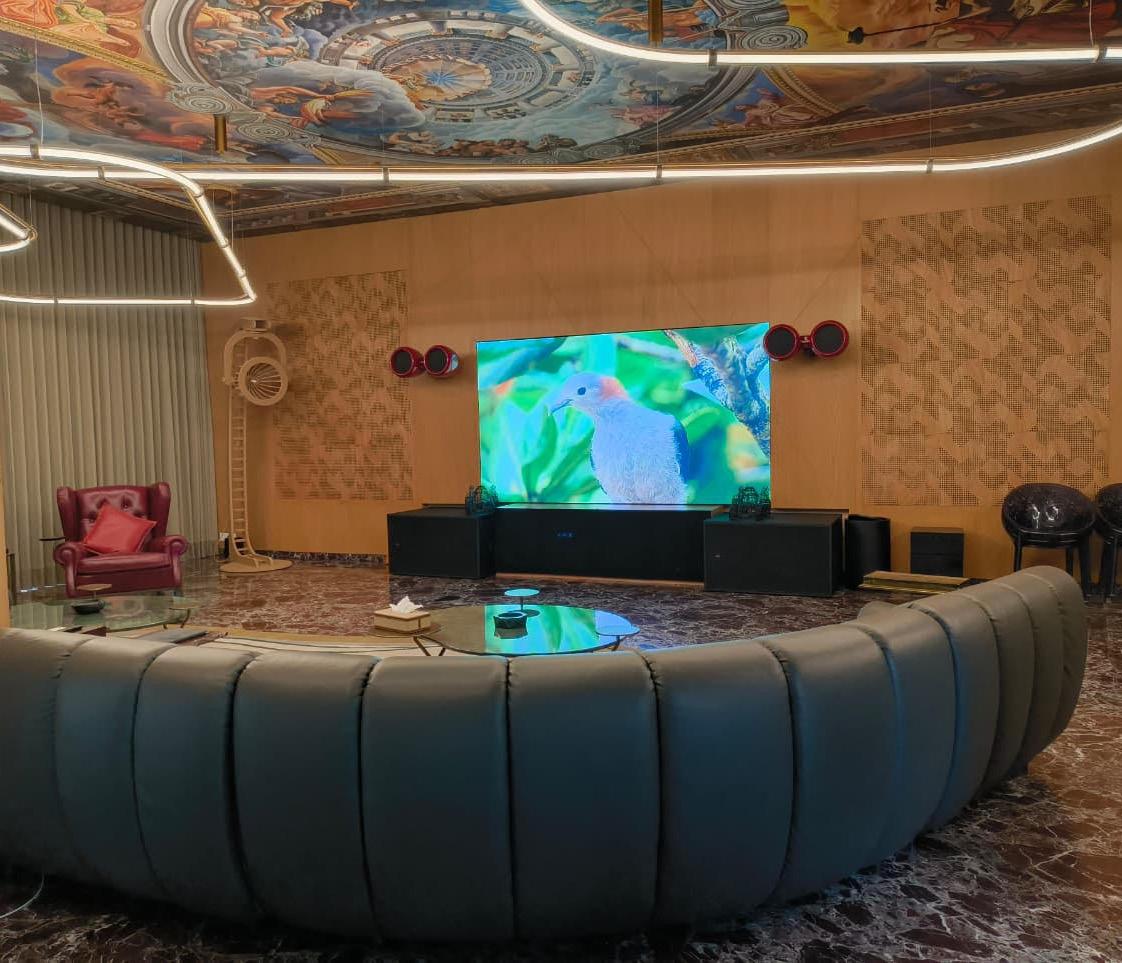
In luxury homes today, these installations go far beyond a single function. They become the cinematic centrepiece of the home, delivering an immersive entertainment experience that rivals private theatres. At the same time, they transform into digital art galleries, displaying curated visuals or personal collections that enhance the aesthetic appeal of the space.
With the ability to shift tones, colours, and visuals, they also serve as ambient backdrops that effortlessly adapt to different moods and occasions, from intimate evenings to lively gatherings. Ultimately, they stand as bold architectural statements, seamlessly integrating technology with interior design to create a space that feels both sophisticated and future-ready.
Technical Evolution and Challenges
Bringing large LED displays into homes comes with unique technical considerations. Highresolution content requires a robust network backbone, precise calibration, and effective heat management. Factors like ambient lighting, pixel pitch, viewing distance, and wall composition can dramatically affect the visual experience.
Collaboration with System Integrators and AV specialists is crucial. By considering LED installations from the early design stage, these displays become seamlessly integrated components of the home, maintaining both performance and aesthetics.
User Interaction and Automation
Luxury homeowners expect intuitive control over these systems. Video walls now integrate seamlessly with touch panels, smartphone apps, and voice assistants, allowing effortless switching between entertainment, art, and
functional interfaces. Some screens serve as command hubs, controlling lighting, HVAC, security, and multimedia, demonstrating that a display can be both visually striking and highly functional.
Automation extends the immersive experience further, syncing lighting and audio with visual content to create environments that respond
dynamically to the moment.
To better understand this emerging trend, along with the design possibilities and technical nuances involved, we spoke with industry experts who shed light on what’s driving demand, the options available to homeowners, and the key considerations.
To better understand this emerging trend, along with the design possibilities and technical nuances involved, we spoke with industry experts who shed light on what’s driving demand, the options available to homeowners, and the key considerations.
How are LED screens and video walls being reimagined in luxury residences beyond home theatres, and what planning considerations are critical for seamless integration?
Luxury residences today are expanding in scale, and naturally, the displays within them are growing just as dramatically, especially across multi-purpose halls, party zones, terraces, and outdoor entertainment areas. LED walls have completely redefined how these spaces are experienced, giving homeowners the freedom to go as large as they envision without the limitations of traditional display technologies. One of the biggest advantages of LED walls is their versatility. They perform exceptionally well in varied lighting conditions, whether installed indoors or outdoors. This flexibility allows homeowners to enjoy a vivid, highimpact viewing experience even in bright
daylight or open environments.
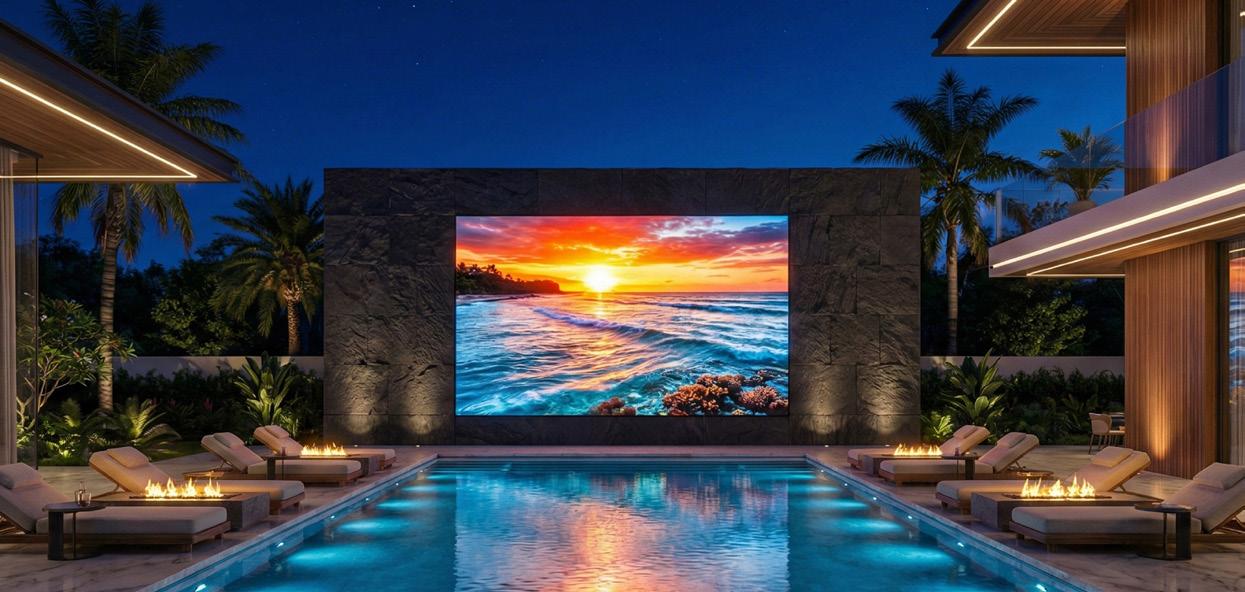
Many clients are now incorporating LED walls in their farmhouses. Installing them in open lawns, beside swimming pools, and on expansive terraces. These installations have transformed casual gatherings into immersive entertainment experiences. More importantly, they have expanded the scope of the A/V industry far beyond the conventional home theatre, turning entire sections of a residence into dynamic, large-scale entertainment zones.
Do you see LED walls becoming a mainstream replacement for TVs & home cinemas or staying a niche luxury feature?
Honestly, I don’t see LED walls replacing televisions or projection systems entirely, as each technology has its own place. Traditional TVs will continue to dominate in spaces where the display requirement is around 100 inches or below. They are practical, efficient, and perfectly suited for everyday viewing. However, once the screen size goes beyond that range, an LED wall becomes the more logical and impactful choice, offering seamless scale without compromising on brightness or clarity.
When it comes to dedicated home theatres, I generally do not recommend LED screens. In a completely dark environment, watching a direct source of light for extended periods can cause visual fatigue and discomfort. A projection system, on the other hand, reflects
Jaleel Sabir Founder, Mahavir Soundroom
light off a screen, creating a deflected and more natural viewing experience that is gentler on the eyes. For true cinematic environments designed for long-form viewing, projection remains the preferred and more comfortable solution.
What future trends in LED display and smart integration should architects and homeowners consider when investing in LED Screens and video walls today?
The most important factor in choosing the right LED screen is to know the viewing distance for the right pixel pitch. Everything else falls apart if this is chosen wrong. COB (Chip on Board) technology is a better choice today as it tightly packs LED chips, enhancing pixel density for clearer images and also offers a wide-angle
visibility. Since an LED screen can’t be a standalone component, it has to be carefully matched with a very good video processor, audio system and automation, which can control the source selection, brightness of the screen according to the daylight conditions and also maximise the power efficiency.
There are a lot of versions of LED screens available today, like motorised ones, LED tiles which are similar to the wall paint or wallpaper image, so that they can easily disappear when not in use, some even come with integrated speakers+processor+streaming device and work like a TV and many more which can complement the interior design of the place. My obvious choice would be any LED wall that can give you a very good picture quality, leaving all the fancy things for others to sell.
How are LED screens and video walls being reimagined in luxury residences beyond home theatres, and what planning considerations are critical for seamless integration?
LED walls in most high-end homes are being reimagined less as screens and more as part of the architecture. The most interesting uses are not in dedicated theatres, but in living and entertainment spaces where the wall can quietly change the mood of the room. It can vary from a simple art display, ambient visuals, personal content, or even nothing at all when it is switched off. The idea is to have that flexibility without any visual noise.
Most homes that we have catered to, an LED wall should never be the hero on its own. It needs to sit in balance with the sound, lighting, and overall feel of the space. When that balance is right, the technology disappears and the room simply feels more alive. That shift from a complex “display” to “experience” is where LED walls are truly finding their place in luxury residences.
Do you see LED walls becoming a mainstream replacement for TVs & home cinemas or staying a niche luxury feature?
I don’t think LED walls will replace TVs or home cinemas in a mainstream way, and they are really not meant to. They solve a very different problem. For me, a television is still the simplest and most practical solution for everyday viewing, and a dedicated home cinema will always make sense when the focus is purely on film and sound. LED walls belong in a more niche space where flexibility and scale matter, so they make sense in large homes where a single surface needs to serve multiple roles throughout the day, from art to entertainment to ambience. That level of integration, planning, and cost naturally keeps them in the luxury category.
That said, as the technology matures and becomes easier to integrate, we will see
LED walls become more common in highend residences. But not necessarily as a replacement for everything, but as an additional layer. When used selectively, they add something that a television or a traditional cinema setup simply cannot.
What future trends in LED display and smart integration should architects and homeowners consider when investing in LED Screens and video walls today?
When clients ask us about future trends, our answer is usually less about resolution and more about adaptability. The biggest shift we see coming is LED walls becoming more context-aware. Displays that automatically adjust brightness, colour tone, and content based on time of day, lighting, and how the
space is being used. This is where smart integration really matters, because the LED wall stops being a fixed display and starts behaving like part of the home. We also see LED walls moving towards softer, more refined applications. Thinner profiles, tighter pixel pitches for closer viewing, and better calibration mean they can sit comfortably in living spaces without feeling harsh or overpowering. A good example is using an LED wall as a digital art surface during the day, then transitioning into an entertainment screen or ambient backdrop in the evening, all without changing the character of the room. From our side, the most important thing homeowners and architects should plan for is flexibility. If it can grow and more so, adapt to the space, it will remain relevant long after the technology itself has moved on.
Some of the most trusted and prominent brand leaders share their insights on their product ranges and the technical innovations that set them apart.
What LED screen or Video Wall solutions does your brand currently offer that are best suited for Luxury homes?
Absen offers a curated portfolio for the luxury residential sector, headlined by our Absenicon series (All-in-One LED) and the Clear Cobalt (CL series), KLCOB series based on MicroLED technology. While the Absenicon provides a seamless, plug-and-play experience for largescale living rooms, the Clear Cobalt series and KLCOB series offer a customizable, cinematic
“black hole” contrast that transforms any wall into a high-end architectural feature.
What key features (pixel pitch, brightness control, form factor, acoustics, energy efficiency) make your solutions ideal for long-duration residential viewing?
For residential environments, comfort and aesthetics are paramount. Our solutions feature ultra-fine pixel pitches (as low as P0.7) for crystal-clear viewing at close range. Key technologies include:
Eye-Comfort Technology: Low blue light and flicker-free certifications to prevent eye strain during long viewing sessions.
Intelligent Brightness Control: Algorithms that automatically adjust screen luminance to match ambient lighting, from bright daylight to dimmed evening settings.
Acoustics & Heat Dissipation: Fanless, silent operation and low-heat emission (Common Cathode technology) ensure the system remains unobtrusive in a quiet home environment.
Gangasagar Amula Director, Absen India
How does your brand support seamless integration with smart home systems and automation platforms?
At Absen, we view interoperability as the backbone of the modern luxury lifestyle. Our premium all-in-one LED series, the Absenicon, is officially Crestron Connected® certified, ensuring effortless integration with worldclass automation platforms like Crestron, Control4, and Savant. Furthermore, driven by our advanced image processing engine, the display automatically optimises contrast and brightness to combat ambient light, delivering a flawless visual experience in any smart home setting. Through a combination of standard RS232, IP control, and robust APIs, our screens seamlessly become part of the larger smart home ecosystem. We are also actively embracing the Matter 1.4 standard to facilitate a new era of cross-platform stability. This empowers homeowners to
easily incorporate the Absenicon into custom macros and ‘Cinematic Rituals’, where a single ‘Movie Mode’ command simultaneously lowers motorised curtains, dims the lighting, and powers on the display, all seamlessly managed from a unified interface or via natural voice commands.”
What upcoming technologies or innovations from your brand will further enhance smart living and home entertainment experiences?
We are aggressively pivoting toward the MicroLED frontier, where inorganic durability meets infinite contrast and superior efficiency. By pioneering ‘Invisible LED’ concepts, we are moving beyond traditional hardware into the realm of Architectural Displays. When not in use, the screen vanishes into a virtual window or a digital canvas, seamlessly blending cuttingedge technology with the sophistication of modern interior design.
Sunil Khera Founder & CEO, Aero Digital
What LED screen or video wall solutions does your brand currently offer that are best suited for Luxury homes?
At Aero Digital, we offer a curated range of premium LED display solutions designed to complement the lifestyle, aesthetics, and technological expectations of luxury residences.
Aero has developed the Pitchvue 4K All-inOne LED Solution, specially designed for the luxury home market. Pitchvue 4K delivers a true cinema-like experience with a massive 135-inch screen size and ultra-fine pixel pitches such as P0.6 and P0. It offers stunning clarity, depth, and detail.
What makes Pitchvue 4K different is its all-
in-one design. The speakers, controller, and amplification are all built directly into the display. This means there is no need for external sound systems, extra boxes, or complicated wiring. Everything works together in one clean, ultra-slim unit.
Apart from this, one of Aero Digital’s unique offerings is India’s First Outdoor TV. It is designed for open spaces where traditional TVs or fixed walls are not possible. With Aero Outdoor TV, Aero offers pixel pitches from P1.2 to P4, delivering the perfect balance of high resolution, optimal viewing distance, and cost efficiency for every outdoor application. Engineered for outdoor performance, Aero displays deliver high brightness for clear daylight visibility, automatic brightness control for night viewing, and a wide colour gamut with precise calibration to ensure rich colours, sharp details, and natural skin tones. With high refresh rates and advanced grayscale control, visuals remain smooth, flicker-free, and immersive, even during fastmoving sports or live events.
At Aero, all our LED solutions are fully customizable in terms of size, format, finish, and integration. This allows architects, designers, and homeowners to create personalised, future-ready homes where technology fits naturally into the overall design. Our goal is simple—to make high-quality display technology an effortless and beautiful part of luxury living.
What key features make your solutions ideal for long-duration residential viewing?
Aero designs its display solutions with longduration residential viewing in mind, focusing on picture consistency, visual comfort, and reliable performance over time. Whether indoors or outdoors, our solutions are created to deliver a smooth and enjoyable viewing experience, even when used for long hours.
One of the most important features that sets Aero Digital apart is Calibration, especially for the Pitchvue 4K all-in-one LED displays and the only brand offering this advanced calibrated wall. Calibration helps ensure that the entire screen looks uniform, balanced, and comfortable to watch, which is essential for extended viewing in homes.
Calibration works by fine-tuning every pixel on the screen so that brightness, colour, and contrast remain consistent across the display. In large LED screens, small differences between pixels can cause uneven brightness or colour patches. Calibration corrects these variations, ensuring the picture looks smooth and professional from edge to edge. This is particularly important in COB LED technology, where viewers sit closer to the screen and even small imperfections can be noticeable.
One key benefit of calibration is balanced brightness. Calibration also improves colour
accuracy. On uncalibrated screens, colours may appear slightly off, such as whites looking bluish or yellowish. With calibration, colours are adjusted carefully so that whites look natural and colours appear realistic. This helps reduce eye strain and makes movies, sports, and everyday content more enjoyable during long viewing sessions.
How does your brand support seamless integration with smart home systems and automation platforms?
At Aero, we believe that technology should enhance lifestyle convenience without creating complexity. To support seamless smart home integration, Our Brand Aero can be customised with major ecosystems - Alexa, Google Home, and automation platforms like Crestron/KNX.
Our Products/devices can be integrated and managed through a single, central application rather than juggling multiple apps through our proprietary licensed software, which is cloudenabled. Our Pitchvue 4K can be integrated and controlled through IR or IP, directly also for a smart home automation ecosystem.
We work closely with System Integrators, Architects, and Consultants to ensure seamless installation and long-term reliability.
What upcoming technologies or innovations
from your brand will further enhance smart living and home entertainment experiences?
Innovation is at the heart of everything we do at Aero Digital. We are constantly exploring new ways to enhance home entertainment and create smarter, more connected living spaces.
Our Mirror TV collection continues to redefine how technology and luxury come together in the home. A standout among these is the Revolving Mirror TV, the first of its kind in India, featuring a unique 360° rotation that lets you effortlessly switch between viewing angles and adapt the screen to different spaces and uses.
Plus, we offer India’s first Aero-Leather TV available in different sizes from 21 to 32 inches, Aero-Leather TV can be customized to match your style. From choosing the leather colour to adjusting it according to your space, it offers a personal touch that most televisions simply don’t.
Another innovative product is Aero Framevue comes with intelligent features that make content display effortless. Auto rotation allows the screen to adjust between portrait and landscape modes, while flexible placement options mean it can fit into any space, large or small.
Looking ahead, we are also developing custom apps and enhanced features for Framevue,
giving users even more creative control. These upcoming tools will make it easier to personalise playlists, schedule content, and integrate additional forms of digital media, all while maintaining the simplicity that makes the display such a joy to use.
Apart from this, Aero is bringing true Hollywood-style cinema technology into modern homes. Our All-In-One COB Active LED display – Pitchvue 4K, with DCI compliance, certificate can be provided on request, delivers a genuine cinematic experience with picture quality traditionally reserved for professional theatres.
DCI (Digital Cinema Initiatives) standards were created by major Hollywood studios to ensure films are shown exactly as intended, with precise colour, contrast, and brightness. By aligning with these standards, Aero enables residential viewers to enjoy movies with studio-grade accuracy.
With ~97% DCI-P3 colour gamut, the display produces richer colours, natural skin tones, and remarkable depth. Combined with advanced COB technology for better uniformity and durability, high contrast, and smooth, flickerfree motion, it transforms home entertainment into an immersive, theatre-like experience.
At Aero Digital, we aim to create products that are not only visually stunning but also seamlessly connected, making every home smarter and more inspiring.
Mehmet Deniz Kaya
Vice President, Barco Residential
What LED screen or video wall solutions does your brand currently offer that are best suited for luxury homes?
At Barco Home, we bring cinema-grade and professional visualisation technologies into ultra-premium residential environments. Our LED portfolio, derived from our acclaimed TruePix platform and our DCI-compliant LED innovations, has been adapted specifically for luxury homes where image excellence, reliability, exclusiveness, and architectural integration are essential.
Our solutions are ideal for a range of luxury applications. They are perfect for private
cinemas that demand uncompromised image accuracy, as well as large-format media walls in living rooms, entertainment lounges, and multipurpose spaces. They also work beautifully as architectural LED surfaces, seamlessly integrating into interior design or serving as dynamic digital art. Designed for high-end residences, these solutions cater to clients who expect reference-level performance, flawless aesthetics, and long lifecycle value. They are particularly suited for UHNW homes, premium villas, and toptier apartments, where display technology functions not just as a tool, but as both a design statement and a functional centerpiece.
What key features make your solutions ideal for long-duration residential viewing?
Our LED solutions feature a fine pixel pitch (0.9–1.5 mm) that enables close-range viewing without visible structure, ideal for residential spaces with shorter viewing distances. Advanced brightness and contrast management allow comfortable night-time or ambient-light viewing without eye strain, while cinematic-grade HDR, deep blacks, and DCI-aligned colour science deliver true movie-theatre immersion. Modular form factors ensure perfect wall flatness, support ultra-wide formats, custom aspect ratios, hidden installations, seamless integration,
and even curved-wall designs within millwork or architectural recesses. With multiple technology types—SMD, Flip-Chip, and MIP— our displays offer options across grayscale performance, seam uniformity, serviceability, and robustness. Efficient power management, thermally stable electronics, and modern LED engines ensure low noise, reduced HVAC load, and long operational life.
How does your brand support seamless integration with smart home systems and automation platforms?
Barco collaborates closely with top integrators and leading control-system providers to ensure frictionless integration into wholehome automation ecosystems. Our displays support major control platforms, Multiple power-mode controls, Media-server and content-delivery integrations commonly used in high-end homes, remote diagnostics and service visibility for proactive monitoring. We
Muneer Ahmad Managing Director, ViewSonic India
What LED screen or video wall solutions does your brand currently offer that are best suited for luxury homes?
We offer a range of premium Direct View LED display solutions that are ideally suited for luxury residential environments where visual performance, design aesthetics, and energy efficiency are equally important. Our COB LED Video Wall solutions, particularly the LDC027G091C and LDC027G-071C models, represent the cutting edge of Direct View LED technology and are designed for high-end homes, private
work through our global integrator network to ensure that every Barco installation behaves as a natural extension of the smart home, not as a standalone AV element.
Upcoming technologies or innovations from your brand that enhance smart living & home entertainment?
Barco is currently advancing several innovations tailored for premium residential environments:
• DCI LED video wall portfolio expansion, starting from Runar DCI HDR LED video wall
• Non-DCI LED video wall portfolio expansion, introducing new module technologies with exceptional dynamic range and unique frame designs for seamless walls
• Enhanced processing and colour science, leveraging Barco’s cinema and professional visualization expertise.
theatres, and bespoke entertainment spaces.
These displays feature an ultra-fine pixel pitch of approximately 0.9 mm, enabling exceptionally sharp and detailed visuals with minimal pixel visibility even at close viewing distances, making them ideal for living rooms, home cinemas, and media lounges. Chip-onBoard (COB) technology enhances image smoothness, improves durability, and ensures long-term visual consistency. The energyefficient common cathode architecture reduces power consumption while supporting sustainability goals, and the slim, nearly seamless design allows the display to blend naturally into modern luxury interiors. As an all-in-one solution, installation is simplified without compromising performance or aesthetics.
These solutions are well-suited for luxury homes as they deliver premium cinematic image quality with ultra-fine pixel pitch and high contrast, while maintaining a designcentric form factor that complements modern interiors. They also offer energy efficiency and long operational lifespan, along with flexible usage across media rooms, entertainment walls, or visual art installations.
What key features make your solutions ideal for long-duration residential viewing?
Our LED display solutions are engineered specifically for extended residential viewing, where comfort, visual consistency, and natural image reproduction are critical. The displays support true 4K resolution, delivering refined textures, lifelike clarity, and immersive viewing experiences across movies, OTT content, gaming, and live sports.
Pixel pitch is carefully optimised according to screen size and typical residential viewing distances, ensuring seamless image reproduction without visible pixelation while maintaining smooth rendering of text and fine details. Brightness levels are calibrated for indoor environments, typically not exceeding 600 nits, which prevents glare and visual fatigue while maintaining vibrant performance even in well-lit living spaces. High contrast ratios further enhance realism by producing deep blacks, bright highlights, and improved shadow detailing.
Advanced image processing technologies ensure accurate colour reproduction, smooth motion handling, and uniform brightness across the entire display, making the viewing
experience comfortable and consistent even during long viewing sessions.
How does your brand support seamless integration with smart home systems and automation platforms?
Our LED display solutions are designed to integrate effortlessly into modern smart home ecosystems, enabling centralised control, flexible connectivity, and seamless content access. Multiple HDMI inputs allow easy connection to set-top boxes, gaming consoles, AV receivers, media players, and streaming devices, while USB connectivity enables direct playback of content without requiring additional hardware.
The displays are compatible with popular home automation systems through AV controllers and HDMI-CEC support, allowing homeowners to manage power, input switching, and viewing modes through centralised automation panels. This enables scene-based activation, such as “Movie Mode,” where the display can synchronise with lighting, audio systems, and motorised blinds for a fully immersive experience. Standard AV connectivity protocols also simplify integration within existing home theatre ecosystems,
ensuring long-term flexibility as media sources evolve.
What upcoming technologies or innovations from your brand will further enhance smart living and home entertainment experiences?
At ViewSonic, our focus remains on advancing display technologies that combine immersive visual experiences with flexibility and space efficiency for modern luxury homes. One of the key innovations in this direction is our foldable LED display technology, designed to bring large-format cinematic viewing into residential spaces with greater installation flexibility and ease of deployment.
These foldable solutions enable easier
What LED screen or video wall solutions does your brand currently offer that are best suited for Luxury homes?
As LED technology evolves, we are seeing a clear shift in how large-format displays are being used within premium residential environments. Optoma’s All-in-One 135” Direct View LED Display has been designed to bridge the gap between professionalgrade performance and refined residential integration.
Unlike traditional video walls, this all-in-one solution offers a seamless, bezel-free canvas with Full HD resolution, making it suitable for luxury living rooms, private theatres, large entertainment spaces, and even
transportation, adaptability to architectural constraints, and future-ready modular configurations. We are also introducing a new solution capable of delivering true 4K resolution on a 136-inch diagonal LED screen, allowing homeowners to experience ultra-high-definition visuals within a more compact footprint. By achieving higher pixel density in a relatively space-efficient format, this innovation makes it possible to enjoy cinematic scale and clarity even in homes where wall space is limited.
This approach allows luxury homeowners to achieve premium large-screen impact, exceptional clarity at closer viewing distances, and immersive entertainment experiences without overwhelming the living environment.
statement walls within high-end residences. Its streamlined, ultra-slim design allows it to blend into modern interiors while delivering the scale and visual impact typically associated with commercial installations.
What makes it particularly relevant for luxury homes is its simplicity, pre-assembled LED columns, a single-cable power setup, and front-access maintenance, which ensure that homeowners get a sophisticated visual experience without the complexity usually associated with LED installations.
What key features (pixel pitch, brightness control, form factor, acoustics, energy efficiency) make your solutions ideal for long-duration residential viewing?
For residential environments, visual comfort and reliability are just as important as performance. The FHDC135 is engineered with Flip-Chip COB LED technology, which creates a seamless surface with minimal pixel gaps while improving durability and energy efficiency, critical for long viewing hours in home settings.
With a brightness level of 700 nits, a 15,000:1 contrast ratio, and a high 3840Hz refresh rate, the display delivers smooth, flicker-free visuals that remain easy on the eyes, even during extended use. Its wide colour coverage— over 92% DCI-P3 and 99% Rec.709—ensures
Vijay Sharma
Managing Director, Optoma Technology India Pvt Ltd.
accurate, lifelike colour reproduction, whether the content is cinematic, live broadcast, or interactive media.
Additionally, the integrated 120W sound system enhances the overall audiovisual experience, reducing reliance on external audio for certain use cases while maintaining a clean, uncluttered setup—an important consideration in premium residential design.
How does your brand support seamless integration with smart home systems and automation platforms?
In smart residences, displays are no longer standalone devices; they are part of a larger connected ecosystem. Optoma’s all-in-one LED display is designed to integrate smoothly within professionally managed smart home and AV environments through standard connectivity and system-integrator-led setups. With a built-in Android OS, wireless content sharing, and Optoma Management Suite Cloud (OMSC), the display supports centralised monitoring, scheduling, and remote management. This allows homeowners or integrators to control content, monitor performance, and manage power usage efficiently, all from a single platform.
Rather than positioning the display as an isolated screen, we see it as a smart visual hub,
capable of working alongside automation systems, collaboration tools, and control interfaces commonly used in high-end residences and premium shared spaces.
What upcoming technologies or innovations from your brand will further enhance smart living and home entertainment experiences?
Innovation in the All-in-One direct view LED category at Optoma is already taking shape through recent launches. The FHDC135 is a relatively new addition to our portfolio, developed to meet the growing demand for seamless, large-format displays that combine high visual performance with simplified installation.
Building on this, Optoma has further expanded its All-in-One LED range with larger formats, including 196”, 245”, and 296” direct-view LED displays. These newer models address the need for greater scale and immersion in luxury residences and premium shared spaces, where display surfaces are increasingly becoming architectural elements.
Together, these developments reflect our focus on delivering scalable, future-ready LED solutions that integrate effortlessly into modern smart environments while maintaining performance, reliability, and design flexibility.
Ansh Ahuj Director, EverGlow
What LED screen or video wall solutions does your brand currently offer that are best suited for Luxury homes?
The EverGlow Aura series, featuring advanced COB technology, is perfectly tailored for luxury homes. Its high pixel density, wide viewing angles, and superior image clarity make it an ideal choice for creating immersive entertainment experiences, while its sleek design seamlessly complements sophisticated interiors.
What key features (pixel pitch, brightness control, form factor, acoustics, energy efficiency) make your solutions ideal for long-duration residential viewing?
Pixel pitch can range from P1.25 and P0.9 to as low as P0.78. The Aura Series features a 20000:1 high contrast ratio, 22 bits, 7680 Hz, 91–95% DCI-P3 coverage, brightness ranging from 600 to 2500 nits and low power consumption (125w/ m²), which aids energy efficiency and helps maintain heat management at 10 degrees. All EverGlow Screens are real pixel screens, not virtual ones sold by some competitors.
How does your brand support seamless integration with smart home systems and automation platforms?
First, the EverGlow team reviews the complete project requirements and offers the ideal solution. Our screens and controllers can integrate with automation software and various AI technologies.
What upcoming technologies or innovations from your brand will further enhance smart living and home entertainment experiences?
We are getting some exciting new products for the home with a mechanism that will really work well for Indian customers. Moreover, large-format screens will be showcased with software ideally required for luxury home theatres. To learn more, visit our booth at the Smart Home Expo 2026 to experience them firsthand.
In conclusion, with views from Brand Heads and Industry Experts, it is clear that LED Screens and Video Walls are redefining luxury homes, combining immersive entertainment, digital art, and smart automation. With careful planning and expert integration, they become multifunctional statement pieces that elevate both lifestyle and design.
“We
Prioritise Climate-Responsive Automation, Daylight-Linked Lighting, Efficient HVAC, and Systems Suited for Indian Homes.”
Could you briefly share your design journey and how smart technology has become an integral part of your projects?
Sahir Choudhary: My training and practice sit at the intersection of architecture, technology, and building systems. Early exposure to VR, AR, and data-driven design made it clear that technology is not an add-on but a design layer. Today, smart systems are integrated at the planning stage, aligned with grids, ceiling depths, and spatial hierarchy, so performance, comfort, and usability are resolved alongside architecture, not after it.
In which segments do you find smart lighting and climate control most effective, and which brands have you used in your projects?
Sahir Choudhary: Smart lighting and climate control deliver the highest impact in luxury residences, hospitality, clubhouses, and
Zafar Choudhary
Founding Partner, Habitat Architects
Sahir Choudhary
Director, Habitat Architects
Offering a rare cross-generational perspective, Zafar Choudhary & Sahir Choudhary, come together to discuss how smart home technology is reshaping contemporary design practice. While Zafar’s approach is rooted in years of architectural experience and spatial sensibility, Sahir represents a new, technologyforward mindset driven by data, immersive tools, and systems integration.
Their combined viewpoint reveals a clear shift, where automation is no longer an added layer but an intrinsic part of design thinking, quietly influencing planning decisions, enhancing user comfort, and enabling homes to become more intuitive, efficient, and future-ready.
mixed-use developments. We regularly use DALI-based lighting systems, KNX climate integration, and brands such as Lutron, Schneider, ABB, Basalte, and Philips Dynalite are chosen for reliability, scalability, and clean integration with architectural intent.
How are integrated security solutions incorporated without affecting interior aesthetics, and which brands do you typically rely on?
Sahir Choudhary: Security is planned as an invisible layer. Cameras, sensors, and access controls are coordinated with ceiling plans, millwork, and facade details from day one. We typically rely on systems from Honeywell, Hikvision (enterprise-grade), Control4 integrations, and KNX-compatible security modules, ensuring technology remains discreet while performance stays uncompromised.
How does early collaboration with system integrators and automation brands influence the performance, reliability, and usability of your projects?
Sahir Choudhary: Early collaboration is critical. When integrators are involved during schematic design, we avoid conflicts around ceiling heights, shaft planning, and service zones. This results in better system reliability, cleaner detailing, reduced site rework, and significantly improved post-occupancy user experience.
Can you share a recent project where smart home technology significantly shaped design decisions, and what key solutions were implemented?
Zafar Choudhary: In a recent high-end residential project, smart technology influenced everything from ceiling depths to
material junctions. Integrated lighting scenes, adaptive climate zoning, motorised shading, and centralised controls were embedded into the architecture. The design outcome was cleaner, quieter, and more intuitive, technology shaping space, not cluttering it.
Do you prefer wired or wireless solutions, and which standards do you typically specify?
Sahir Choudhary: For primary systems, we prefer wired solutions, especially KNX and DALI for stability, longevity, and future scalability. Wireless systems are selectively used for retrofits or secondary functions. The focus is always on long-term performance rather than short-term convenience.
What scope do you see for smart technologies in Indian residential architecture, and which solutions do you prefer in your projects?
Sahir Choudhary: India is at a strong inflection point. Beyond convenience, smart systems are increasingly about energy optimisation, thermal comfort, security, and wellness. We prioritise climate-responsive automation, daylight-linked lighting, efficient HVAC controls, and systems that adapt to Indian
lifestyles and usage patterns.
How do homeowners interact with smart home automation post-occupancy, and how does this feedback influence your design and technology choices?
Zafar Choudhary: Post-occupancy feedback consistently shows that simplicity matters more than features. Homeowners prefer intuitive interfaces, reliable scenes, and minimal intervention. This feedback directly influences our specifications, pushing us toward fewer but better-integrated systems with clear usability.
Based on your recent projects, what futureready considerations are essential when designing homes with integrated smart technologies?
Sahir Choudhary: Future-ready homes require flexible infrastructure: oversized conduits, accessible service zones, modular control systems, and open protocols. Designing for upgrades, not obsolescence, is essential. Smart technology should evolve with the home, quietly, efficiently, and without architectural compromise.
“Our Focus Is on Making Smart Home Deployment Faster, Simpler and Fully Scalable Through Unified Platforms.”
Could you tell us about your new product launched at ISE 2026?
At ISE 2026, Crestron introduced several new solutions, with a key focus on simplifying system configuration for dealers. Among the highlights is Configure Pro, the nextgeneration evolution of the widely used Crestron Home Setup App. While the earlier app enabled dealers to build projects, pair devices, create scenes, and manage backend setup without programming, Configure Pro takes this capability significantly further.
Launched in September under an Early Access program, the platform offers a completely redesigned, faster, and more intuitive configuration experience. It streamlines the entire backend process into a no-code environment, allowing dealers to execute projects of any scale with greater speed, consistency, and efficiency. For Indian
Michael Short VP, Marketing Operations & Residential, Crestron
Michael Short, discusses the company’s latest product launches and platform advancements showcased at ISE 2026. Plus, highlighting emerging technology trends, the growing importance of integrated automation ecosystems, and the significant growth potential of the Indian residential smart home market.
integrators in particular, this means the ability to deliver a uniform, high-quality user experience while scaling operations and reducing deployment time.
Tell us about the new 80 Series Touchscreens unveiled at ISE.
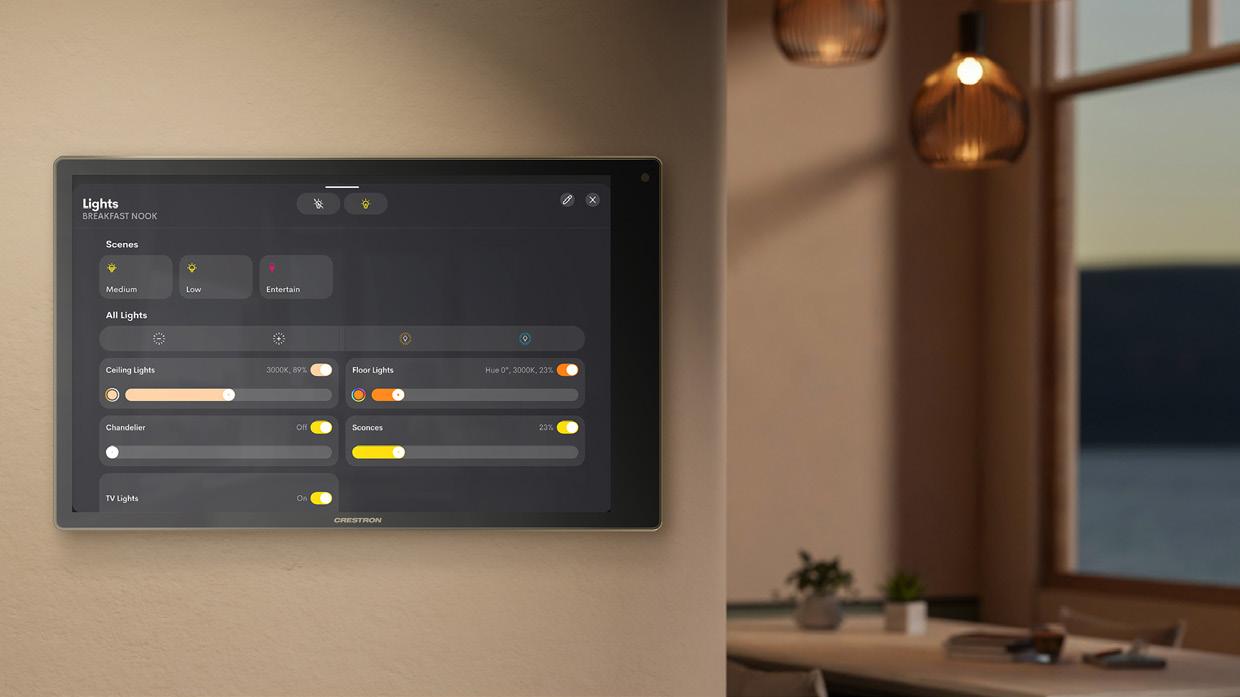
Crestron has introduced its all-new 80 Series Touchscreens, marking a significant leap forward in performance, usability, and futureready hardware design. Building on a legacy that dates back over two decades, when Crestron pioneered dedicated control touch interfaces well before consumer tablets entered the market, the new series reinforces the brand’s leadership in premium control solutions.
The 80 Series features the fastest processor ever deployed in a Crestron touchscreen, ensuring ultra-smooth responsiveness and providing
the headroom needed to support future software advancements. Enhancements also include upgraded light sensors for improved adaptive brightness, more advanced microphones for better voice interaction, and refined overall system performance.
Available in both 7-inch and new 8-inch formats, the touchscreens offer flexible orientation, allowing users to seamlessly switch between portrait and landscape modes, with the Crestron Home interface automatically adapting. Compared to the previous 70 Series, the new lineup offers faster performance, more intelligence, and better long-term scalability, making it a next-generation control hub for modern smart environments.
Can you elaborate on the Crestron CiVo Remote and other new control solutions showcased at ISE?
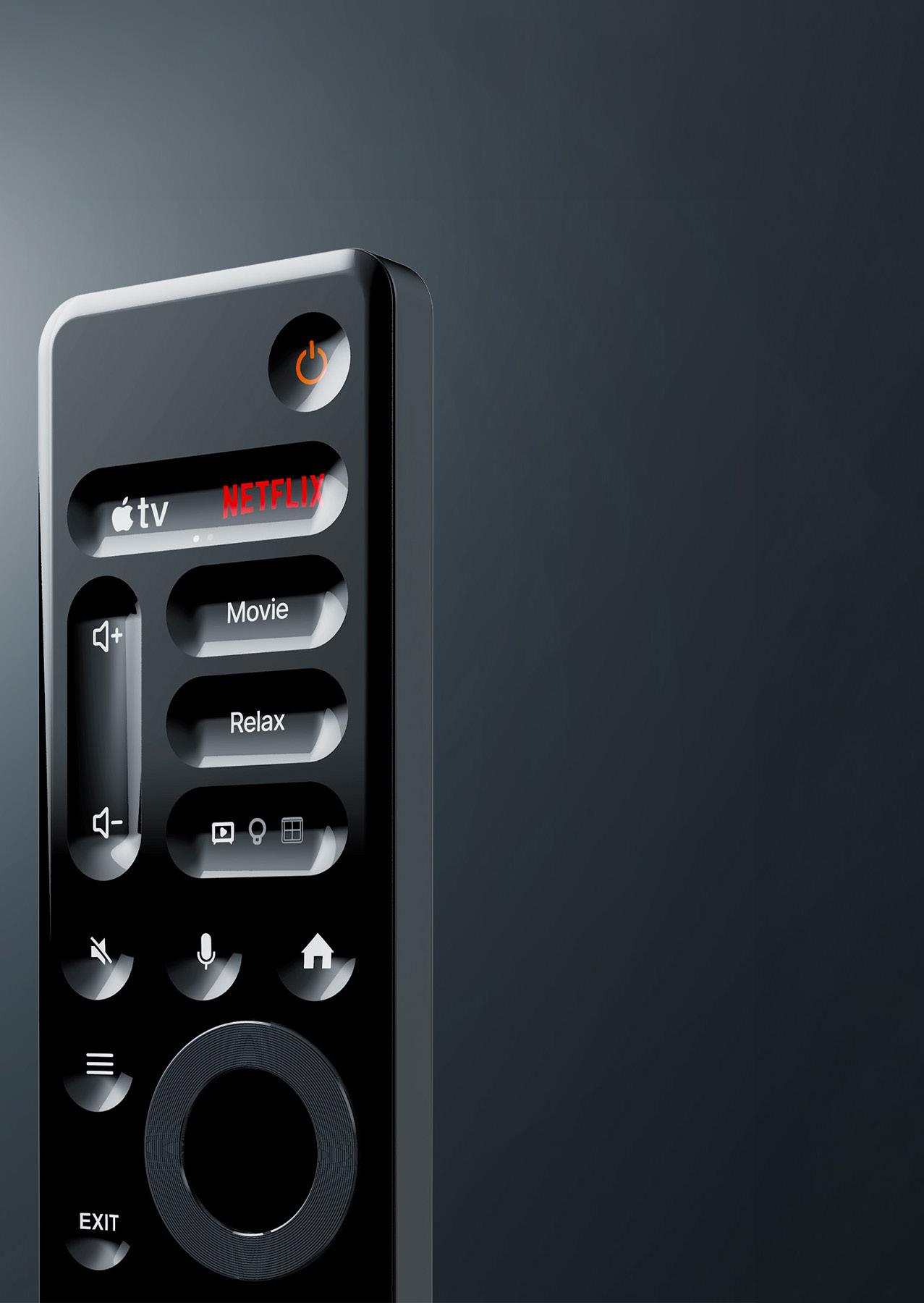
Crestron’s new CiVo Remote is designed as a premium single-room control device, combining elegant form with powerful functionality. Engineered as a compact handheld controller, it enables seamless management of key in-room systems, including video, lighting, shades, and customisable quick actions, all from a unified interface. Its luxury finish and ergonomic design position it as a refined control solution for high-end residential environments.
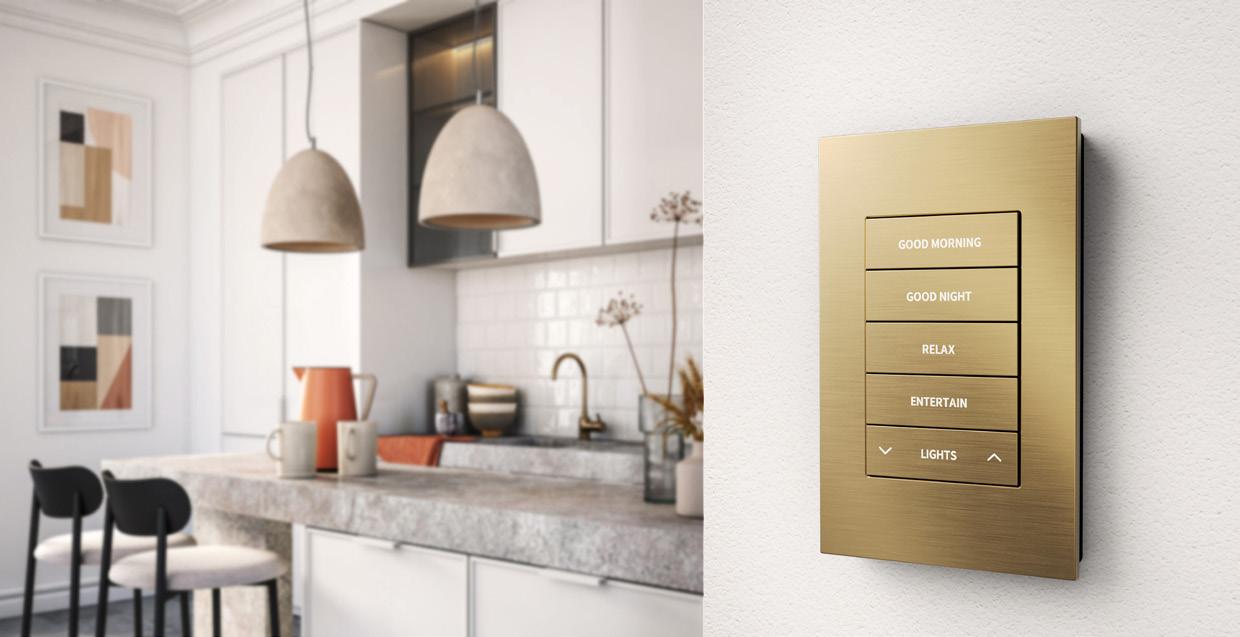
Alongside the CiVo Remote, Crestron also introduced new keypad options at the show, including the Horizon Metal and Cameo 2 series, both now available in the Indian market. These additions expand design flexibility while maintaining the brand’s focus on tactile precision and aesthetic integration.
Another major highlight is the new Multiview integration within Crestron Home, which allows users to display up to six content sources simultaneously on a single screen in multiple layouts. This capability significantly enhances monitoring, entertainment, and control scenarios, reflecting Crestron’s continued push toward more intelligent, unified smart home experiences.
As an expert, what solutions would you recommend for luxury homes in India, and which products are best suited to this market?
For India’s luxury residential segment, the emphasis is increasingly on solutions that combine advanced performance with refined materials and tactile elegance. The Horizon range of keypads is among the most premium control offerings, well-suited to this market.
Initially available in classic plastic finishes such as white, black, and almond, the Horizon lineup evolved with the introduction of sophisticated glass variants, including black and white glass, elevating its luxury appeal. More recently, the brand introduced metal finishes for the Horizon 2 series, responding to the strong preference in India for rich materials and a premium tactile experience. Available in four refined metallic options, these keypads combine craftsmanship, durability, and visual sophistication — making them ideal for highend residential environments where detailing and finish quality are critical.
Complementing this is the CiVo Remote, positioned as a premium single-room control solution. With its sleek industrial-grade finish and compact ergonomic design, it enables seamless control of video, lighting, shades,
and quick actions from a single handheld interface.
Together, the Horizon Metal keypads and the CiVo Remote form a compelling luxury proposition for the Indian market, blending aesthetic refinement with intuitive, highperformance smart home control.
What is Crestron’s stance on Matter, and are there plans to integrate the universal protocol into Crestron Home?
Crestron views Matter as an evolving industry protocol that holds long-term potential, although its adoption has progressed more gradually than many initially anticipated. Over the past few years, the conversation around Matter has centered on whether it will emerge as a truly universal standard, something that will ultimately depend on how consistently it is implemented across the market.
Crestron’s approach remains rooted in openness and collaboration. As an inherently open platform, the company already integrates with a wide range of technologies and ecosystems, working seamlessly with protocols and partners such as Philips Hue, Sony, and Samsung, among others. In this context, Matter is seen as a natural extension of that philosophy. Should it
achieve broad, consistent adoption across the industry, Crestron is prepared to support and incorporate it within the Crestron Home platform, ensuring continued interoperability and flexibility for dealers and end users.
How is AI being integrated into Crestron’s product ecosystem today?
At Crestron, AI integration is being driven primarily through the evolution of its software platforms. The new Configure Pro environment is designed to serve as a foundation for introducing AI into the Crestron Home setup experience. This will enable more intelligent configuration workflows, automationdriven optimization, and smarter system recommendations in the future.
By embedding AI capabilities within the configuration layer, Crestron aims to significantly enhance efficiency for dealers. simplifying complex setup processes while enabling more predictive, adaptive system performance. As the platform evolves, it is expected to unlock advanced features that will further streamline deployment and elevate the overall smart home experience.
Beyond the software advancements, the company is also showcasing several new hardware and solution innovations at ISE, reflecting a broader push toward more intelligent, integrated automation ecosystems.
What are your plans for the Indian residential market, and what new developments can we expect?
India continues to be a major focus market for Crestron, driven by rapid growth in the residential smart home segment. At ISE, this commitment was evident through a dedicated India Residential Summit, where the company hosted around 60 Indian dealers to share insights on upcoming solutions, including previews of new and upcoming products not yet publicly announced.
During these discussions, a key theme that emerged was the strong growth trajectory of India’s smart home market. At the same time, one of the main challenges identified is the lack of unified platforms, with many brands operating independently across categories such as lighting, shading, and control. Crestron is actively encouraging dealers to adopt more integrated approaches, using unified platforms to streamline solutions and support business growth.
The company also highlighted its ongoing investment in India, including expanding its local team to meet rising demand. With strong performance indicators across revenue and dealer engagement, Crestron sees India as a high-potential market and anticipates significant continued growth in the years ahead.
“Great Home Theatre Sound Isn’t About more Speakers, but It’s About Balance, Placement, and Acoustical Precision.”
You’ve spent over 45 years in home theatre design and acoustics. How have the fundamentals of great room acoustics evolved since you started, and what core principles still hold true today?
The understanding of acoustics in residential audio has evolved significantly over the past few decades. When I first entered the industry nearly 45 years ago, acoustics for home environments was largely overlooked. Much of the available knowledge at the time was derived from research focused on large performance venues such as concert halls, which did not translate effectively to smaller residential spaces.
A major shift began with the work of Floyd Toole at Canada’s National Research Council, which helped us establish a scientific foundation for understanding the fundamental differences between large performance spaces and
Gerry Lemay Founder and Director, Home Acoustics Alliance (HAA)
Gerry Lemay, is a globally respected authority in residential acoustics and home theatre performance. With decades of experience in designing reference demo rooms and training industry professionals, he has played a pivotal role in shaping modern approaches to immersive sound. In an exclusive interaction with Smart Home World, Gerry shares insights on the evolution of home audio, common acoustic misconceptions, and the principles behind creating truly highperformance listening environments.
small listening rooms. His research played a pivotal role in shaping modern approaches to residential acoustics, enabling more accurate, immersive sound experiences in home audio environments.
When it comes to home theatre design and acoustics, which principles remain relevant today?
Many of the foundational acoustic principles continue to hold true. For instance, the use of absorptive materials such as fiberglass remains an effective method for controlling sound reflections. However, what has evolved significantly is our understanding of how sound behaves within smaller residential spaces.
Unlike large venues, where acoustic performance tends to be relatively consistent across multiple listening positions, sound in
a small room is far more localized. There are specific “sweet spots” where audio quality is optimal, which means acoustic treatments must be carefully and strategically placed rather than applied uniformly.
Another important consideration is avoiding over-treatment. In compact spaces, excessive absorption can drastically reduce reverberation time, making the room acoustically “dead.” This can negatively impact the listening experience, highlighting the need for a balanced approach to acoustic design.
The Home Acoustics Alliance (HAA) emphasizes education and hands-on learning in room design and calibration. In your view, what’s the biggest misconception integrators or enthusiasts have about acoustics and system performance?
The Home Acoustics Alliance (HAA) is approaching its 25-year milestone, marking a significant journey in advancing professional
education in residential audio and acoustic design. The organization was originally established to address a major gap in the CEDIA ecosystem, where, at the time, there was no comprehensive, hands-on training focused specifically on home acoustics.
Early foundational training was pioneered by THX, which introduced some of the first structured programs relevant to residential audio performance. HAA was subsequently created to build on that foundation, offering more advanced instruction that combines deeper acoustical theory with practical, realworld application.
In fact, over the years, we partnered with THX, and now HAA provides THX training for them.
Can you elaborate a bit on the training part of it? What kind of modules does HAA provide?
The training framework has evolved steadily over the years, shaped by continuous feedback
from students and industry needs. Each query or suggestion has helped refine the curriculum, ensuring it remains practical, relevant, and aligned with real-world applications.
One of the most significant developments in recent years has been the introduction of an online foundation level. This first stage provides comprehensive theoretical knowledge and allows participants to learn at their own pace. The digital format also enables the inclusion of more detailed content than was previously possible within the constraints of a single-day in-person session.
The second level combines classroom instruction with hands-on workshops. It builds on the fundamentals covered online while focusing on practical skills such as using advanced measurement tools, sound analyzers, and system calibration techniques.
The final level is highly immersive and collaborative. Conducted in small groups, participants work as a team to design, configure, and calibrate a complete audio system in a real listening environment. With guidance provided throughout the process, this stage allows students to experience firsthand how precise acoustic design and calibration can dramatically enhance system performance.
As an expert in this segment, what do you think are some of the misconceptions among system integrators or audio enthusiasts?
One of the most common misconceptions about home theatre audio is that system design is relatively straightforward. At a basic level, it may seem simple, like placing front speakers at the front and surround speakers along the sides, etc. However, achieving highquality sound involves a far more nuanced process. It requires precise balancing of speaker placement, calibration, and tuning to ensure cohesive performance across the listening environment.
A major step toward addressing this knowledge gap came through CEDIA’s recommended practices initiative, particularly
the introduction of the RP22 audio guideline. This document helped many integrators recognize that effective audio design extends well beyond basic speaker placement and demands a deeper level of technical expertise. This growing awareness has also strengthened professional training in this field. While CEDIA establishes important industry standards, organizations such as the Home Acoustics Alliance build on that foundation by offering specialized, hands-on education focused on advanced acoustical principles and system optimization skills.
As smart home technology and immersive formats like Dolby Atmos and advanced multiple channels become a standard, how do you see the role of acoustic design and calibration changing in connected homes?
One of the most interesting aspects of the evolution of sound systems, from early twochannel stereo to Dolby Surround, 5.1, DTS, and immersive formats like Auro-3D, is that the core acoustic principles have remained largely unchanged. While today’s technologies are far more advanced, the fundamental concepts still trace back to the earliest days of stereo sound.
In many ways, an immersive audio system can be understood as multiple two-channel systems working together around the listener. This means that optimising stereo imaging remains a critical objective, even in modern multi-speaker environments. Achieving this balance is further complicated by how sound behaves in a room, particularly at low frequencies, where listener position can create areas of both excessive loudness and significant drop-offs due to standing waves.
As a result, system design follows a structured, step-by-step process that addresses each acoustic challenge in sequence. Speaker placement is closely tied to the reference seating position, and adjustments often need to be iterative. If optimising one element, such as subwoofer positioning, impacts the performance of front speakers, the entire configuration may need to be reassessed. This interconnected evolving process is often
described as an “acoustical framework,” reflecting the careful balance required to achieve optimal performance.
You have been credited with designing some of the world’s best demo rooms. Beyond great equipment, what truly makes a home cinema immersive?
In my experience, one of the most important and often overlooked aspects of creating a truly immersive home cinema is client collaboration. Many end-users come in with strong preconceived ideas, often driven by elaborate themes or highly stylized design concepts. While those creative ambitions are understandable, I’ve found that achieving genuine immersion requires carefully balancing aesthetic goals with acoustic performance and technical realities.
Over the years, I’ve also seen how fundamental spatial factors can make or break a room. Details such as where doors and windows are located, along with the overall proportions of the space, have a significant impact on sound behavior and system layout. Generally, I’ve found that larger rooms offer a clear advantage, as smaller spaces present more acoustic challenges and restrict flexibility in speaker placement.
When a room has adequate size, it becomes much easier to position both seating and the full constellation of speakers effectively. This flexibility allows for precise calibration and better sound balance, which, in my experience, is what ultimately creates the cohesive, enveloping experience that defines a truly immersive home cinema.
Can you tell us about some of the projects you’ve designed? Maybe something unique you have created for that space?
I would be cautious about using the word “unique” when it comes to sound design. One of the core principles of our training is that the goal is not to create a distinctive sound signature, but rather to faithfully emulate the post-production and dubbing stages where films are actually mixed. If you want to experience a film as intended, the ideal approach is to replicate the acoustic standards of professional recording and mixing environments. That’s why the best-performing theatres tend to share very similar layouts and acoustic characteristics — consistency, not uniqueness, is what ensures accuracy.
Where uniqueness does come into play is in problem-solving. Over the years, I’ve worked on rooms with highly unconventional shapes
— octagonal layouts, multiple angled walls, or other architectural constraints. In such cases, the challenge is to restore as much symmetry and balance as possible, bringing the space closer to the ideal acoustic template. Recreating the artist’s intent in a non-standard room can be demanding, but with thoughtful design and sufficient client flexibility, it is certainly achievable.
For homeowners in emerging markets who want high-end sound without professional installation, what practical acoustic upgrades or design decisions deliver the most noticeable improvements?
Check Home Acoustics Alliance and take our Level 1 class. You don’t have to be a pro to take it, and it lays out the basics.
One of the most impactful improvements involves seating position. In many homes, sofas are placed directly against the back wall, which often results in boomy, muddy bass and surround speakers being uncomfortably close to listeners. Moving the seating position more toward the center of the room — allowing
greater distance from walls and speakers — can dramatically improve clarity, balance, and overall immersion.
Another key principle is to prioritize the primary listening area. In multipurpose spaces (pool Table or a bar), homeowners often try to optimize the entire room equally. A more effective approach is to identify the main viewing seats and focus speaker placement, calibration, and acoustic adjustments around that specific zone.
Finally, it’s important not to over-treat the room. A common mistake is installing excessive acoustic panels, which can overly reduce reverberation and make the space sound dull or lifeless. The goal should be balance, controlling problematic reflections while preserving enough natural ambience to maintain an enveloping listening experience.
In essence, thoughtful seat placement, proper speaker distance, and balanced acoustic treatment can deliver the most noticeable improvements without requiring complex installations.
ISE 2026 Highlights the Rise of Next-Gen AV,
AI, and Intelligent
Systems
Smart Home World brings you an overview of Integrated Systems Europe (ISE) 2026 in Barcelona, where participation, cutting-edge innovations, and the latest advancements shaping the future of smart living, connected technologies, and integrated AV solutions.
Energy, innovation, and global collaboration defined this year’s Integrated Systems Europe (ISE) 2026, in Barcelona, Spain, as the industry’s most influential technology show that returned with its most ambitious edition to date. Bringing together cuttingedge solutions, thought leadership, and an unmatched international audience, the event highlighted the accelerating pace of transformation across the AV and systems integration segment.
Integrated Systems Europe (ISE) 2026 achieved a historic milestone this year with 92,170 visitors from around the world and hosting 1,751 exhibitors, including 323 first-time
participants. Spanning a record 101,000 sqm of show floor space, the event underscored its growing global influence and continued industry expansion.
Mike Blackman, Managing Director, Integrated Systems Events was quoted saying “Over four extraordinary days, we celebrated
groundbreaking technology, ignited bold ideas, forged lasting connections, and set new benchmarks for our industry. What excites me most is the creativity, energy, and diversity of our exhibitors and partners, and the unwavering dedication of the ISE team that makes it all possible.”
In ISE 2026, Spark debuted as a show of unity for creativity and technology, a new initiative driving innovation and knowledge sharing across the creative industries. The new event format brought together the creators of tomorrow, uniting the brightest minds from Broadcast, Live Events, Marketing, Design, and Gaming into one immersive experience.
The keynote sessions at ISE 2026, delivered by Matt Clark and Sol Rashidi, electrified the event, drawing full-capacity audiences. Clark took attendees “Behind the Façade: Building a Performance-led Mapping at Casa Batlló, from Concept to Implementation,” revealing the creative and technical mastery behind the mapping at one of Barcelona’s most iconic landmarks. Rashidi’s “The AI Reality Check: What It Takes to Scale and the Future of Leadership” offered a compelling look at how AI is reshaping industries and the leadership needed to navigate this transformation. Together, their presentations showcased ISE as the ultimate stage for innovation, creativity, and forward-thinking industry leadership.
The show featured a notable delegation of VIPs and government officials, including representatives from Latin American countries, reflecting Barcelona’s status as a global technology hub. Attendees included leaders in national and regional governments, as well as experts in digitalisation and AI policy, highlighting ISE’s impact on international collaboration and regional growth.
“ISE 2026 once again demonstrated the extraordinary power of collaboration across our global technology ecosystem,” said Daryl Friedman, Global President and CEO, CEDIA. “As co-owners of ISE, we are proud to see the event continue to expand its influence as a platform where innovation, education, and partnership converge. The energy on the show floor and throughout the conference
programme reflects a thriving industry that is not only embracing emerging technologies, but shaping how they enhance the spaces where people live, work, and connect.”
The KNX Pavilion remained one of the highlights, showcasing the latest developments in the KNX ecosystem. Numerous manufacturers presented KNX-certified solutions for lighting, HVAC, shading, energy management, and system control, emphasizing the role of open standards in smart building technologies.
Industry association CEDIA also maintained a strong presence at ISE 2026, supporting education, standards, and professional development in the smart home and residential technology sector. Through conferences, live demonstrations, and networking activities, CEDIA highlighted best practices and emerging trends in smart living, home cinema, lighting, and connected technologies.
An Overview of New Product Launches and Brand Showcases at ISE 2026
ADI unveiled major advancements to Control4, including the global availability of control4 X4, the introduction of Control4 Connect, and a preview of next-generation interface solutions. ADI offered `hands-on, In-booth’ training sessions for Control4, OvrC, Access Networks, and more. They worked through the complete workflow for deploying Luma Surveillance systems using OvrC and Control4 Composer Pro.
Bowers & Wilkins and Marantz provided an exclusive listening experience that showcased the Bowers & Wilkins 801 D4 Abbey Road Limited Edition, powered by Marantz Series 10 amplification. Limited to 140 pairs worldwide, this edition was conceived as a tribute to the 45-year collaboration between Bowers & Wilkins and Abbey Road Studios, where the 800 Series has served as a reference monitor. The Vintage Walnut + Connolly leather finish, identification plaque, and handcrafted details
K-array presented the much-anticipated Koral KO102 column loudspeaker, the newest addition to its residential portfolio. The KO102 employs six 3-inch mid-frequency drivers and a dedicated high-frequency unit in a sleek, compact frame. An onboard switch lets integrators choose between two operating modes: Pure Array or Point Source, ensuring the product can be enjoyed to its full potential in any number of acoustic environments.
Lutron Electronics unveiled its luxury residential Intelligent Lighting Portfolio. Lutron introduced Ketra and Orluna, two fully complementary product families within the Intelligent Lighting portfolio. Innovations from both brands were revealed at the show, including downlights, lamps, and linear lighting fixtures from Ketra, and downlights, tape, cylinders, uplights, and floorwash fixtures from Orluna to name a few.
Loewe showcases its latest professional and hospitality-focused offerings. Renowned for its design-led AV products, Loewe showcased the impact custom-integrated solutions have on elevating the offerings of luxury hotels, yachts, commercial spaces and high-end real estate, combining unmatched performance with seamless integration and timeless design. Loewe’s professional solutions are designed for seamless system integration and are fully compatible with leading automation platforms, including Control4, Crestron and Basalte.
Kordz, a global leader in professional-grade AV connectivity, showcased the R.4 48Gbps Rack and Marine Passive HDMI® Cable, engineered as the successor to the widely adopted R.3 18Gbps HDMI® Cable. Purposebuilt for environments where failure is not an option, R.4 supports the full 48Gbps HDMI 2.1 data rate, enabling uncompressed 8K video transmission and the complete HDMI feature set, including eARC, VRR and QMS. Each cable is independently tested and is certified to the DPL Labs Enhanced 48Gbps Reference Standard, ensuring reliable realworld interoperability.
Meridian Audio announced the all-new 2026 Editions of the DSP750 and DSP730 inwall loudspeakers, delivering flagship-level performance in an architectural format. At the heart of both models is Meridian’s Atlas software core, a new platform that significantly increases DSP capability and is a foundation designed to evolve. Both models feature an array of proprietary Meridian technologies, including Image Focus +. For under-screen installations, the DSP750 and DSP730 support Meridian’s Image Elevation, helping to anchor dialogue and key sound elements to the picture and solving a long-standing challenge in home cinema design.
Nice, a global leader in smart living solutions, showcased its dual operating systems, Yubii OS and ELAN OS Nice presents a unified ecosystem that brings intelligence, comfort, security, entertainment, and energy efficiency to residential and commercial spaces alike. On display was the Nice Smart Living ecosystem, including Nice ELAN OS 9, Yubii Home App, Yubii Home, Yubii Home Pro, Nice Thermostats Range, Nice Video Surveillance Range, Nice Video Doorbell & MyBell Range, Nice Premium Toolless Speakers, AV Distribution & Rack Solutions featuring Gefen Gen3 AVoIP, Nice Smart Modules range, Automation for gates (Robus 600 HS), and sunshades (Next Autotorque, Era Inn)
Sanus displayed its comprehensive range of integrator-friendly products, including new mounts for extra-large screens and the latest in its big brand collaborations with mounting solutions for Sony products. The Sanus WSBSBTV1-B2 is a height-adjustable soundbar mount for the Sony BRAVIA Theatre Bar 8™ and Bar 9™ soundbars, which can be directly attached to most 50”-90” TVs and popular TV mount brands. And the WSSBTQA-B2 speaker stands are designed to mount Sony’s BRAVIA Theatre Quad speakers at the perfect position and height to create a genuine Dolby Atmos sound field from just four speakers.
Waterfall Audio unveiled the Niagara XT3, its latest masterpiece in audio innovation, and the new LCR1000 high-end cinema speaker. The Niagara XT3 stands 1160 mm tall, 300 mm wide, and 346 mm deep, delivering a powerful 500 watts through dual ATOHM LD180 (7inch – 180mm) bass-mid drivers and an 8-inch UFR210 passive radiator. High frequencies are rendered via a silk dome neodymium tweeter, accentuated by Waterfall Audio’s signature horn design. The speaker’s innovative JETSTREAM damping system finely controls internal sound waves and enhances acoustic precision.
Sonos showcased Era 100 Pro, bringing simplified setup with PoE+, versatile orientation via a pro-grade mount, and more customisable control with zones, a new software tool to manage larger-scale installations. Sonos also displayed Amp Multi, a one-of-a-kind multichannel streaming amplifier designed to make complex residential audio installations simpler, more flexible, and more scalable. Developed for, and in close collaboration with, integrators, Amp Multi extends the SonosTM experience into larger, more sophisticated homes.
Weinzierl presented its extensive range of intelligent software and hardware solutions for building system technology with a strong focus on KNX. One of the most important highlights was the KNX TP Multi IO 570.1 secure, a universal I/O module. The device has 48 freely configurable input and output channels,
Rako, a smart lighting control company, showcased EOS keypad innovations, designed to blend seamlessly into any environment while enhancing functionality and radiating elegance. Rako’s latest DIN range was also on display. The DIN products were presented alongside Rako’s flexible RAK range, providing alternative installation options across commercial, hospitality, and residential sectors.
Stealth Acoustics, the industry pioneer in invisible speaker technology, showcased the most advanced generation of its invisible speaker technology and outdoor largeformat LED and loudspeaker solutions. The LineaRadiance series delivers exceptional sound quality whilst disappearing entirely into walls and ceilings. Stealth also displayed its outdoor AV solutions, including the SPT Extreme retractable LED TV system, StingRay loudspeakers, to name a few of their range on display.
enabling flexible usage for lighting, blinds, signal relays, energy meter pulse counting, and much more. An important aspect here is that the device can be controlled via ETS without a complete download. This is a major benefit during the test phase for checking the installation. Weinzierl also presented the KNX
TP Push Button 420.1 secure from its MATCH 55 series. This push button offers numerous functions in a wide variety like switching, dimming, blind control, scene management, colour control, sequence operations, and room temperature control. A wide variety of settings can be programmed in the ETS, such as short press, long press, multiple press, and much more. It should also be noted that this device has an integrated acoustic sound generator, multicolour LEDs, and a room temperature controller. Another impressive product was the KNX IP Interface 740.2 wireless secure, WiFi-based programming interface for the KNX bus. It was developed for greater flexibility during installation and enables wireless system access via ETS, allowing installers to move freely around the building with a laptop. This is just a brief overview of the numerous products offered by Weinzierl.
The ISE product roundup offers professionals essential insights into the latest innovations and trends, enabling them to stay ahead in the swiftly changing design landscape.
A Benchmark in Smart, Human-Centric Design
Co-De.Studio has designed a state-of-the-art Smart Office for PP International, working in collaboration with system integrator Hie Life Global Technologies Pvt Ltd, who are also winners of the Smart Space Awards 2025.
Nestled in Panipat, Haryana, the PP International headquarters is a striking example of how modern architecture, smart technology, and workplace design can converge seamlessly. Designed for one of India’s largest textile exporters, this fourfloor corporate space reflects the brand’s global legacy while embracing innovation, functionality, and elegance. Designed by Architect & Interior Designers, Kanika Garg and Nikhil Sharma, Partner, Co-De.Studio and System Integration by Rohit Chaudhry, CEO, Hie Life Global Technologies Pvt Ltd, this project marks a milestone that blends advanced automation with timeless design aesthetics.
A Space Where Design Meets Functionality
Spanning four expansive floors, the headquarters accommodates nearly 100 staff members, with four large workstations, multiple breakout zones, two state-of-the-art conference rooms, four luxurious MD cabins, and a grand showroom that celebrates PP International’s textile legacy. At the core of the design is a principle that balances productivity, brand storytelling, and aesthetic harmony.
“The design draws inspiration directly from textiles, their layered structures, interplay of textures, and subtle colour nuances. Warm wood, glass, soft fabrics, and brushed
metal combine to evoke the craftsmanship and elegance of fine fabrics. Natural light flows freely through open layouts and glass partitions, symbolizing transparency and openness, values deeply embedded in both the company’s ethos and the design vision,” explains Rohit Chaudhary, CEO, Hie Life Global Technologies Pvt Ltd.
Smart Technology as a Design Driver
Unlike many projects where technology is an afterthought, automation in the PP International headquarters was integral to the design. Lighting, climate, AV, and access control systems are embedded seamlessly, preserving the clean modern aesthetic while enhancing functionality. Lighting scenes dynamically adapt to the time of day and space usage, fostering the right mood and energy throughout. Conference rooms and MD cabins feature intuitive AV and climate controls, while access and security systems are discreetly integrated to maintain openness without compromising safety.
Integrated Smart Systems
The building is powered by a robust smart
ecosystem that seamlessly integrates multiple platforms to enhance functionality and user experience. Hogar provides touch switches and a central hub for controlling lighting, climate, and scene settings across all major zones. Digital locks and access control systems ensure secure, keyless entry for sensitive areas, while motorised blinds and curtains offer both time-based and manual control for comfort and energy efficiency. The Nice gate motor from Italy enables remote-controlled vehicular access, and Alexa voice integration allows hands-free operation of lighting, music, and automation scenes. A background music system and video conferencing setup enhance ambience and collaboration, while AJAX fire safety sensors provide real-time monitoring for smoke, heat, and CO levels, ensuring safety without compromising design aesthetics.
The network infrastructure is designed for stability and reliability. A central high-speed router distributes internet via dual-band WiFi and LAN across all floors, while a dedicated VLAN isolates automation and security devices. Devices communicate through Wi-Fi, Zigbee, and TCP/IP protocols, with encrypted cloud connections ensuring secure remote access. Data flows seamlessly from user inputs,
whether touch, voice, or app, to the target devices, with feedback loops providing instant confirmation and control.
Enhancing User Experience
The design prioritises usability and accessibility. Voice commands, touch panels, and mobile apps allow effortless control, while automation reduces daily manual effort. Wide walkways, strategically placed controls, and well-zoned spaces ensure ease of movement, comfort, and inclusivity.
Feedback from the client has been overwhelmingly positive, with video testimonials highlighting the intuitive nature of the systems and the overall elegance of the space. The project has not only elevated staff productivity but also enhanced client experiences, positioning it as a benchmark for smart, tech-integrated corporate offices in India.
Setting a New Standard
The PP International headquarters showcases
how technology, design, and human-centric planning can coexist seamlessly. By combining advanced automation with modern aesthetics, it sets a precedent for the future of corporate spaces in the textile sector, and beyond, showcasing what is possible when innovation and design are aligned with purpose.
Hogar App: Controls lighting, curtains, scenes, and devices.
Alexa App: Voice command setup and control.
AJAX Security App: Real-time fire/smoke alerts and monitoring.
Nice App: Gate motor control and automation.
Elite Screens GolfSim Portable Impact White 350 Series
As golf simulation technology becomes increasingly popular among golf lovers who want to be able to practice regardless of weather or time constraints, finding the right impact screen is important. Elite Screens GolfSim Portable is one solution that stands out for its design, durability, and adaptability.
Elite Screens also offers other golf simulation solutions, including the larger GolfSim Bay, as well as standalone impact screen materials for those looking to build a custom setup.
However, for most users, the GolfSim Portable strikes the perfect balance between price, performance, and convenience.
Unlike standard impact screens, where the
fabric often needs mounting on a separate frame, the GolfSim Portable comes with a frame and mounting components, making setup and takedown simple and hassle-free.
In this review, we will discuss the GolfSim Portable’s unique features, setup process, performance, and versatility, helping you decide if this screen suits your home golf simulation needs. In addition, check out our video review of the GolfSim Portable screen as well.
One of the main benefits of GolfSim Portable is in its name – portability. Many impact screens can be bulky and difficult to transport, but Elite Screens has worked to make this model a portable option that can be conveniently
stored and transported. When assembled, the screen is 8x10ft, but the unit comes in a compact five-foot-long box weighing about 44 pounds, allowing easy handling for most individuals and fitting comfortably in a standard-sized car.
Inside the box, you’ll find everything required for installation, including the screen, frame, side rails, and all necessary mounting hardware.
For many users, the ease of setup and disassembly is crucial, particularly for a product that may be used in non-permanent locations like garages or driveways. The GolfSim Portable utilizes a straightforward framing system that doesn’t require complicated tools.
The components connect easily, and Velcro strips attach the screen and sidewalls to the frame, allowing a secure setup without a great deal of effort. Ball bungees also fit through grommets on the corners of the screen to
further secure it, ensuring stability against ball impacts.
Another standout aspect of the Elite Screens GolfSim Portable is the material used. The screen is crafted from Elite Screens’ proprietary ImpactWhite™ 350 woven polyester, specifically engineered to handle high-velocity impacts, withstanding strikes up to 150 mph. This is a substantial benefit, ensuring the screen can endure even the most powerful swings without wear or damage.
Moreover, the screen’s material quality doesn’t compromise image clarity, which is crucial for those who want a high-quality visual experience. The fabric’s ISF certification ensures excellent picture quality, allowing the setup to double as a home theatre or gaming screen. This flexibility makes the GolfSim Portable a valuable addition to any household using an entertainment screen beyond golf simulation.
L-Acoustics Opens Americas Regional Headquarters in Nashville
L-Acoustics, a leading global creator of professional audio technology, opened its first dedicated Americas regional headquarters in Nashville, a bold move that puts the company at the centre of the entertainment industry’s creative power base. Located within the CAA Creative Office Building at Nashville Yards, the new 11,100-square-foot facility features the first L-Acoustics Showroom with HYRISS on the American continent, as well as an L-Acoustics
Creative Studio equipped with L-ISA and L-Acoustics DJ technology.
The opening marks a turning point for L-Acoustics in the Americas, establishing a hub in a central location where the company’s regional team, industry partners, and the world’s top creative artists can collaborate using the most advanced audio technology available anywhere.
The facility functions as both operational headquarters and innovation showcase, welcoming 23 team members by year’s end as the Americas team relocates from the West Coast and expands.
The showroom gives architects, interior designers, luxury developers, and high-end integrators direct access to the technology alongside L-Acoustics application specialists. It’s a working space where partners can bring their clients to experience firsthand how HYRISS elevates residential projects, hospitality suites, or superyacht installations without compromising design aesthetics.
“This showroom lets our partners walk in with a developer or yacht owner and demonstrate how one space can transform from a morning meditation room to an evening cinema to a late-night listening lounge—all without changing a single piece of furniture,” says Bryan Bradley, CEO Americas at L-Acoustics.
The L-Acoustics Creative Studio represents the latest evolution of the format launched in Lititz, Pennsylvania, in 2024 and Singapore in 2025. The studio features both L-ISA Immersive Hyperreal Sound technology and L-Acoustics DJ, the company’s latest innovation for club and festival environments.
This is where touring artists prepare immersive mixes for their live productions, where DJs craft spatial sets that will define the next generation of club experiences, and where sound designers push the boundaries of creativity with immersive audio. It’s a production facility built for serious creative work.
The Creative Studio serves L-Acoustics’ extensive Americas network: touring productions, festivals, theatres, clubs, houses of worship, theme parks, and premium hospitality venues. It’s the regional nerve centre for spatial audio innovation.
Aliro 1.0: The Unified Standard Set to Transform Access Control
The Connectivity Standards Alliance (Alliance) announced the release of the Aliro 1.0 specification, a new communication protocol and credential standard designed to revolutionise how users interact with access points in every aspect of their lives. While the convenience of unlocking a smart home lock often captures public attention, Aliro is built for broader impact, aiming to streamline interoperability across varied access control use cases, including corporate offices, universities, hospitality venues, and single and multi-family residential homes.
Driving Adoption Through Major Wallet Integration
A key differentiator for Aliro is the confirmed commitment from the world’s leading mobile wallet ecosystems. By aligning with Apple, Google and Samsung, Aliro offers a standardised digital credential experience leveraging the smartphones and wearables people use every day. This strategic collaboration expands adoption pathways, empowering users to move easily between homes, workplaces, and public spaces using the secure digital wallets native to their operating systems.
“Aliro is solving the fragmentation that has held back digital key adoption, replacing it with a single interoperability standard built through Alliance Member collaboration. By connecting the access control industry directly to leading mobile wallet ecosystems, it delivers a secure, frictionless experience that goes well beyond the front door. Lower integration complexity means faster innovation and shorter time to market. This is how the future of access control gets built,” said Tobin Richardson, President and CEO, Connectivity Standards Alliance.
A Unified Standard for Secured, Seamless Access
The Aliro 1.0 specification establishes a robust framework utilizing asymmetric cryptography to ensure secured and trusted interactions between user devices and readers, while respecting user privacy. This standardized protocol is designed for broad application across the entire access control ecosystem,
providing a reliable experience in corporate offices, universities, hospitality venues, single and multi-family homes, and even areas without network coverage, such as underground parking garages and elevators.
To meet diverse installation requirements, the specification supports a variety of transport technologies, including Near Field Communication (NFC) for tap-to-access, Bluetooth Low Energy (Bluetooth LE) for userinitiated long-range communication, and Bluetooth LE plus Ultra-Wideband (UWB) for a seamless, secured hands-free authentication method. To ensure global reliability, Aliro includes a comprehensive certification program and supporting test suites managed through Authorised Test Labs.
This initiative unifies a global collective of over 220 Member companies - from lock manufacturers to silicon vendors and mobile platform leaders - working together to pave the way for a better, more secure mobile access experience. Through close collaboration, Member companies, including Apple, ASSA ABLOY, Google LLC, Infineon Technologies AG, Last Lock, Inc., Samsung Electronics, and STMicroelectronics pooled technologies, expertise, and innovations to enable the Aliro 1.0 specification, with Apple, Allegion, Aqara, Google LLC, HID, Kastle, Kwikset, Last Lock, Inc., Nordic Semiconductor, Nuki Home Solutions, NXP® Semiconductors, Qorvo, Samsung Electronics, STMicroelectronics, expected to be the first to achieve Aliro 1.0 certification.
Spitfire Q Series, a New Benchmark in Performance
A New Reference in Cinematic Sound The Artcoustic Spitfire Q Series represents a new benchmark for cinema loudspeakers. Developed for high-end private cinemas and fixed professional installations, it combines the benefits of line-array performance with the elegance and simplicity of a single enclosure. At the heart of the Q Series is a tightly controlled vertical driver architecture, paired with two proprietary technologies developed exclusively for Spitfire Q: Infinity HighFrequency Lens and Stretch Flare Control. Together, they precisely shape and timealign high-frequency energy before it enters the room—delivering exceptionally wide horizontal coverage with tightly controlled vertical dispersion.
Engineered for high SPL with low distortion, the Spitfire Q Series delivers cinema-level dynamics with remarkable efficiency. By reducing amplifier demand, system stress is lowered while headroom is increased ensuring
clean, controlled performance even during the most demanding scenes.
Seamless integration with Artcoustic subwoofers provides a coherent, controlled transition into the low frequencies, delivering impact without sacrificing clarity or intelligibility.
ABB will launch New Wireless Smart Home Control at Light + Building 2026
ABB is launching the new System Access Point 3.0 Wireless at Light + Building 2026, extending ABB-free@home® Wireless with greater scale, secure remote access, and broader smart home integration. The solution is designed to help installers deliver reliable in-home control and scale projects easily as needs grow.
Wireless technologies now account for the largest share of smart home installations in Europe, reflecting strong demand for retrofitfriendly upgrades1. Many traditional systems, by contrast, have relied on complex wiring and lengthy setup, making them difficult to install in existing homes. With ABB-free@ home® Wireless and the System Access Point 3.0 Wireless, professional-grade smart home performance can be delivered without invasive installation or a single-vendor system, making it particularly well-suited to retrofit and renovation projects while remaining flexible enough for new builds.
ABB-free@home® Wireless is designed to deliver quick, reliable control within the home using a wireless connection and the ABB-free@ home® Next App. Smaller installations can run locally without additional hardware. When the new System Access Point 3.0 Wireless is added, the system can support larger projects, scaling to around 150 devices and enabling secure remote access and ongoing services through ABB myBuildings. This allows installers to reduce site visits, support systems remotely, and keep installations up to date over time.