THE DISRUPTIVE WATER MAGAZINE
SEP
2026
31
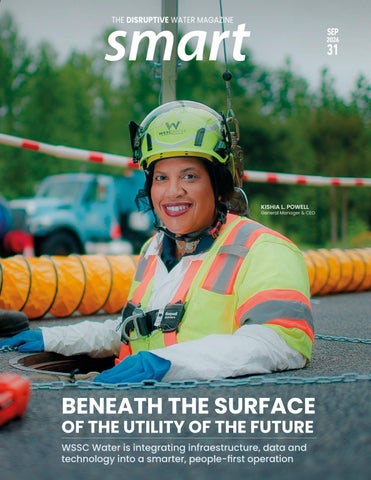
KISHIA L. POWELL
General Manager & CEO
BENEATH THE SURFACE OF THE UTILITY OF THE FUTURE WSSC Water is integrating infraestructure, data and technology into a smarter, people-first operation
FROM THE EDITOR
NOW IT'S OUR TURN
Dear reader, A year ago, in the last issue we devoted to digitalisation, I wrote that digital just works. It does. Sensors report, networks transmit, models forecast. Nobody reading these pages needs convincing any more. This issue asks a less comfortable question: why does so much of it still never make it past the pilot? The answer that runs through almost every page has little to do with technology. It comes down to two things: who pays for the digital layer in its second year, and who, inside each organisation, works differently when the data arrives. Our cover interview with Kishia L. Powell, General Manager and CEO of WSSC Water, starts exactly there. Having led utilities in Atlanta, Baltimore and Jackson, she has learned, sometimes the hard way, that transformation is about people, processes and preparedness before it is about platforms. Her case for smart metering goes well beyond leak alerts: it takes meter readers out of one of the most hazardous jobs in the utility and gives them somewhere to grow. And she draws a line every supplier should read twice: a vendor sells a product; a partner helps solve a problem.
Others take the argument further. Amit Vaidya (Xylem Vue) names the hardest step in digitalisation as the one from promising pilot to daily routine. At Ofwat, Louise Blais chose to set out expectations for AI before the rules were settled, with human oversight built in from the start. John Hammond (USGS) shows what it looks like when it works: drought forecasts weeks ahead, published with their uncertainty. Kaveh Madani and Margaret Cook turn the question around: AI is also a new and thirsty water user, and utilities belong at the table where it is planned. The features show the sector doing the work. Diehl Metering helped GAIA move from periodic to continuous monitoring, Kallipr helped Bellevue replace an inherited maintenance schedule with a measured one, and Aganova turns hidden leaks into water that can be verified.
PUBLISHER iAgua Conocimiento, S.L. López de Hoyos, 190 Entlo. B 28002 Madrid info@iagua.es MANAGEMENT Alejandro Maceira Rozados David Escobar Gutiérrez
Netmore treats connectivity as the foundation it is. KISTERS and Adasa turn raw signals into data that can be trusted, while HMS Networks, Badger Meter and RSE design security in from day one. Hidroconta asks the question every large rollout should ask: what exactly will we do with all that data? The good news is that none of this needs a breakthrough. It needs decisions: budgets that outlast a pilot, roles designed around data, partners who stay. The technology has kept its promise. Now it's our turn.
David Escobar - Partner at SWM
D @davidescobar - E @DavidEscobariAgua
EDITOR Alejandro Maceira Rozados
ADVERTISING Javier de los Reyes
WEB DEVELOPMENT Francisco Molina
EDITORIAL STAFF Olivia Tempest Prados Cristina Novo Pérez Laura Fernández Zarza
ART AND GRAPHIC DESIGN Esther Martín Muñoz Ruth Redondo Gallego Gabriel Plaza
ADMINISTRATION Gloria Méndez LEGAL DEPOSIT M-25692-2013
PHOTOGRAPHY Guillermo Martínez
SWM
3
CONTENTS
NUMBER 31 - SEP 2026
FEATURE
INTERVIEW
FEATURE
INTERVIEW
SILENT METERS, REAL LOSSES
PEOPLE BEFORE THE PLATFORM
PARTNERSHIPS TAKE CENTRE STAGE
MOVING PAST THE PILOT STAGE
Pg. 28 Connectivity, not software, is the real challenge behind smart water at scale, illustrated by Netmore's three UK deployments.
Pg. 22 Digital transformation is about people as much as tools, says WSSC Water CEO Kishia Powell, discussing AMI, AI and cloud strategy.
Pg. 116 Riyadh hosts the 2026 SHARAKAT Award this October, honouring partnerships driving Saudi Arabia's water infrastructure sector.
Pg. 32 Turning a promising pilot into daily operations remains digitalisation's hardest step, according to Xylem Vue's Amit Vaidya.
4
SWM
CONTENTS
NUMBER 31 - SEP 2026
FEATURE
INTERVIEW
FEATURE
INTERVIEW
SECURING THE DIGITAL PLANT
TURNING SCARCITY INTO STRATEGY
FROM FOUR READS A YEAR TO HOURLY
PROVING SECURITY, NOT PROMISING IT
Pg. 52 Physical and digital infrastructure are treated as one system in this RSE feature, with cybersecurity designed in from the start.
Pg. 120 Decades of scarcity shaped the UAE's approach to innovation, says Minister Abdulla Balalaa ahead of the 2026 UN Water Conference.
Pg. 44 Four meter readings a year became one an hour after GAIA adopted Diehl Metering's IoT network, aiming to halve water losses.
Pg. 48 Matt Stephenson and Erica Hermann of Badger Meter on why certification, not marketing claims, should guide utilities' trust.
6
SWM
CONTENTS INTERVIEW
SETTING AI GROUND RULES EARLY Pg. 66 Ofwat published its AI Adoption Plan mid-transition rather than wait for new rules, explains Director of Data Louise Blais. INTERVIEW
TRUST, NOT JUST TECHNOLOGY Pg. 90 Desalination projects last decades only when stakeholder trust runs as deep as the engineering, says IDRA's Shannon McCarthy. FEATURE
RECOVERING WATER ALREADY THERE Pg. 72 Hidden pipeline leaks become measurable water benefits for corporate clients through Aganova's inspection and AI-powered analytics. INTERVIEW
WHY PARTNERS OUTPERFORM RIVALS Pg. 40 Manufacturers and operators do better together, argues Alfonso Corbalán, whose family firm Hidroconta now spans thirty countries. OPINION
KEEPING KNOWLEDGE IN THE FLOW Pg. 38 As a third of the water workforce nears retirement, Lori Sutton argues utilities must pass on institutional knowledge in time. INTERVIEW
LOW-CARBON AI, HIGH WATER COST Pg. 102 A data centre's carbon footprint tells only part of the story, argues Kaveh Madani, who weighs its water and land costs equally. FEATURE
SENSORS SET A NEW SCHEDULE Pg. 96 Bellevue discovered it was cleaning some sewer lines twice as often as necessary once Kallipr's sensors supplied the data. OPINION
WHY JUDGMENT STILL LEADS AI Pg. 56 AI can extend engineers' judgment in the water sector, Ashwin Dhanasekar argues, but it cannot replace their accountability.
8
SWM
NUMBER 31 - SEP 2026
CONTENTS
NUMBER 31 - SEP 2026 INTERVIEW
CONNECTED, THEN PROTECTED Pg. 58 Closing water's digitalisation gap depends on connectivity built for security, say HMS Networks' Xavier Cardeña and Thomas Vasen. FEATURE
FROM SIGNALS TO CLEAR EVIDENCE Pg. 84 Fragmented signals become traceable evidence once sensors, SCADA and hydraulic models connect through Adasa's StormGuard platform. INTERVIEW
GROWTH SHOULD PAY FOR GROWTH Pg. 110 Existing customers should not foot the bill for water infrastructure a new data centre requires, argues Margaret Cook of HARC.
THE MAGAZINE FOR THE KEY PLAYERS OF THE WATER SECTOR
#SWM31 SPECIAL ANALYSIS
PAYING FOR THE DIGITAL LAYER Pg. 18 From UK tariffs to Saudi water contracts, what makes digitalisation scale is not the technology, but who funds it beyond year one. FEATURE
BUILDING TRUST BEFORE ANALYTICS Pg. 62 Connected, validated data is the foundation KISTERS builds before analytics or AI can be trusted with environmental decisions. INTERVIEW
SEEING DROUGHT MONTHS AHEAD Pg. 76 Forecasting drought up to thirteen weeks out across thousands of US sites is now possible, says USGS hydrologist John Hammond. Unusually low streamflow on the Peabody River in New Hampshire in August of 2012. Photo credit: U.S. Geological Survey.
SWM
9
©Funke - Own work, CC BY-SA 4.0
WSP raises takeover bid for Arcadis to EUR 51.50 a share
Ecolab closes $4.75 billion CoolIT Systems acquisition
The offer follows Arcadis rejecting an earlier bid over fit and deal certainty concerns
The deal expands Ecolab water technologies further into AI data centre cooling systems
WSP Global Inc. said it has submitted a revised, non-binding proposal to acquire all outstanding shares of Dutch engineering firm Arcadis N.V. for EUR 51.50 per share, following market speculation and a public statement from Arcadis. The offer represents a roughly 45.8% premium over Arcadis’ unaffected closing share price, and premiums of 48.1%, 59.0% and 41.6% over its three-, six- and twelvemonth volume-weighted average prices. The proposal follows an earlier bid of EUR 48.50 per share, which Arcadis’ board rejected, citing concerns over strategic fit, cultural fit, deal certainty and other stakeholders’ interests. WSP said it believes its proposal addresses those issues, including governance, integration and the roles of Arcadis’ two largest
10
SWM
shareholders, the Lovinklaan Foundation and Katalys. If Lovinklaan Foundation and Katalys take their consideration entirely in WSP shares, other shareholders would receive approximately 65% cash and 35% stock. WSP said the deal would be accretive to its adjusted net earnings per share by a high single-digit percentage before synergies, rising to the mid-teens percentage once synergies are realised. For its last fiscal year, WSP reported basic earnings per share of $7.38 and adjusted earnings per share of $9.58. WSP said a combination would expand its footprint in North America, the UK, Australia and Central Europe, strengthen capabilities in water, advanced manufacturing, advisory, digital, and project management, and accelerate AI investment.
Ecolab announced the close of its acquisition of CoolIT Systems, a leader in direct liquid cooling for high-density data centres, for approximately $4.75 billion. The deal closed earlier than expected. CoolIT's year-to-date sales have grown more than 100%, driven by demand for liquid cooling in AI data centres. With CoolIT, Ecolab extends its water technologies leadership into AI infrastructure. Water is used to produce power, and cool chips, and Ecolab says it can now offer solutions across that value chain, from ultra-pure water for chip production, to water systems for power generation, to direct liquid cooling for data centres. At Supercomputing in November 2026 in Chicago, Ecolab plans to introduce a new 3D TRASAR™ cooling platform combining CoolIT
technologies — cooling distribution units and cold plates — with 3D TRASAR™ digital optimisation and cooling fluids. Ecolab says the platform is designed to optimise water, power, and compute performance, giving operators real-time visibility to help reduce cooling power demand and move toward a near-zero water footprint. "NVIDIA has collaborated with Ecolab and CoolIT across a broad range of liquid-cooling initiatives, including coolant qualification, coolant health monitoring, cooling infrastructure development, and next-generation AI factory technologies," said Ali Heydari, technical director and distinguished engineer at NVIDIA, and Saket Karajgikar, senior engineering manager and ASME fellow at NVIDIA.
©Tony Webster from Minneapolis, Minnesota, United States
©Cleanwater1
Pentair to acquire Taco Group Holdings for $1.4 billion
Veralto to acquire Cleanwater1 in $465 million deal
Founded in 1920, Taco makes pumps, valves and controls for the HVAC and plumbing markets
Cleanwater1 brings disinfection and odour control technology to Veralto water portfolio
Pentair plc has entered into a definitive agreement to acquire Taco Group Holdings, a hydronic and water-based solutions provider, for approximately $1.4 billion, subject to customary adjustments. The price represents a multiple of approximately 10.5x 2026 estimated EBITDA, including about $165 million in tax benefits and $30 million in anticipated cost synergies. Founded in 1920 and headquartered in Cranston, Rhode Island, Taco makes pumps, valves, tanks, heat exchangers and controls for the HVAC, plumbing and industrial sectors. Pentair said Taco is expected to generate approximately $540 million in revenue in fiscal year 2026, with adjusted EBITDA margins above 20% including synergies. Pentair said the acquisition expands its exposure to high-growth commercial and
mission-critical end-markets, including HVAC, data centres, and multi-family residential, while creating cross-selling opportunities between the two companies’ distribution networks. “This highly strategic and value-creating acquisition enhances the scale and reach of Pentair’s innovative water solutions serving high-growth commercial and industrial end-markets, including HVAC and data centres,” said John L. Stauch, Pentair President and CEO. John Hazen White, Jr., Owner and Chairman of the Board, and Benjamin White, President of Taco, said the partnership would allow the company to “accelerate our growth, expand our capabilities and further invest in our innovation and technology” while preserving its values and customer relationships.
Veralto, a global provider of water and product quality solutions, has agreed to acquire Cleanwater1 for $465 million, subject to customary closing adjustments and conditions. After estimated tax benefits, the net purchase price is approximately $452 million. The deal is expected to close in the fourth quarter of 2026. Cleanwater1 specialises in on-site hypochlorite disinfection, solids management and odour filtration technologies, with an installed base of around 25,000 units. Veralto said the technologies complement its existing water treatment portfolio and will extend its presence into adjacent, faster-growing applications, with synergies expected alongside its Trojan Technologies ultraviolet business. Jennifer L. Honeycutt, President and Chief Executive
Officer of Veralto, said the acquisition would strengthen the company’s Water Quality segment and create opportunities for recurring revenue growth and deeper customer engagement. David Stanton, Chief Executive Officer of Cleanwater1, said joining Veralto would support the company’s growth and its ability to meet rising customer demand. The net purchase price of $452 million represents approximately 17 times Cleanwater1’s last twelve months adjusted EBITDA as of 30 June 2026, excluding expected synergies. Over that period, Cleanwater1 generated approximately $135 million in sales, around 25% of it from aftermarket sales, having grown at a low double-digit compound annual rate since 2023, a pace Veralto expects to continue.
SWM
11
©Xylem
Xylem to acquire Cornell Pump and Roper Pump for $1.46 billion
Osmoflo to acquire Australian water infrastructure firm Guidera O’Connor
The pumps bring patented self priming technology to Xylem Water Infrastructure segment
The deal broadens support across the water and wastewater asset lifecycle in Australia
U.S. water technology group Xylem is set to acquire pump manufacturers Cornell Pump and Roper Pump in a $1.46 billion deal, buying the businesses from Indicor as it works to deepen its footprint in industrial and municipal pumping markets. The acquisition brings into Xylem’s portfolio pumping technologies capable of handling tougher fluids, from slurries and solids to installations requiring strong suction lift performance. Cornell Pump and Roper Pump also carry patented self-priming technology and expertise built up in sectors such as agriculture, food and beverage, energy, construction, mining and municipal water systems. Once completed, the businesses will sit within Xylem’s Water Infrastructure segment.
12
SWM
Matthew Pine, President and CEO of Xylem, said: “The long-term demand drivers supporting our business continue to strengthen, creating new opportunities across industrial markets where water is increasingly critical to operational success,” he said. “This acquisition expands our presence in key growth sectors and enhances our ability to help customers address evolving operational requirements.” On financial terms, Xylem said the $1.46 billion price equates to roughly 11.6 times projected 2026 EBITDA, once run-rate cost synergies of $23 million and an estimated $170 million in tax benefits are factored in. The acquired businesses are projected to bring in more than $260 million in revenue this year, with EBITDA margins above 30 per cent.
Osmoflo has agreed to acquire Guidera O’Connor, an Australian water and wastewater infrastructure company with municipal-sector expertise in engineering, design, construction, and project delivery. Osmoflo specialises in membrane water treatment, desalination, and asset optimisation, while Guidera O’Connor brings municipal water and wastewater design, construction, and project delivery experience. According to the companies, combining the two will let them support customers across a broader part of the water and wastewater asset lifecycle, from planning and construction through to operations and long-term asset performance. The companies frame the deal as a response to pressures facing the Australian water sector, including
regulatory change, ageing infrastructure, budget constraints, and climate change. Osmoflo is part of Kanadevia Group, which it says provides financial backing for continued development of its water solutions. Carmine Ciccocioppo, CEO and Managing Director of Osmoflo, said the acquisition “strengthens Osmoflo’s ability to provide greater capability, turn-key solutions, and confidence from project delivery through to long-term asset performance.” Tony Guidera, Founder and Director of Guidera O’Connor, said Kanadevia’s financial backing, combined with Osmoflo’s technical and operational expertise, “will allow us to target a wider range of complex projects across a more diversified customer base,” adding that it also offers longterm stability for his team.
©Aquatech
©Workdry Group
Aquatech completes acquisition of UAE’s Metichem
Workdry Group acquires France’s DMTP
The acquisition joins Aquatech's global project reach with Metichem's regional presence
DMTP adds French pumping and dewatering expertise to the Workdry Group rental network
Aquatech has announced the acquisition of Metito Chemical Solutions (“METICHEM”), a specialty chemicals and operations & maintenance company headquartered in the United Arab Emirates. The acquisition brings together Aquatech’s global project experience with Metichem’s deep regional presence, positioning the combined organisation to offer more complete water lifecycle solutions to customers across the Middle East, North Africa, and Southeast Asia. Both companies bring decades-long track records in the region, having each carried out notable projects in the United Arab Emirates, the Kingdom of Saudi Arabia, and Indonesia. Together, Aquatech and Metichem will offer customers a broader portfolio spanning treatment technologies, specialty chemicals, opera-
tions & maintenance services, and digital solutions aimed at improving efficiency, reliability, and sustainability throughout the water lifecycle. On July 30, more than 300 employees across three continents gathered to celebrate Metichem joining Aquatech and to mark what the companies describe as the next chapter of growth for the combined organisation. “Today marks the close of one chapter and the beginning of an exciting new one. We are here because of the dedication of our people, and I am grateful to the Aquatech team for welcoming us as partners throughout this journey. Together, we are building a strong foundation for the future, and I look forward to embracing that future as one team,” said Mike Abla, Managing Director at Metichem.
The Workdry Group, a UKbased provider of mission-critical water solutions, has completed the acquisition of French pumping and dewatering specialist DMTP, extending its presence into the French market. The deal adds DMTP to a portfolio that already includes Selwood and Siltbuster in the UK, Holland Pump in the United States, and Vanderkamp and Workdry in Germany. Founded in 2006, DMTP serves customers in France's public sector, infrastructure and construction industries from four locations: Paris, Angers, Lyon and Marseille. The company provides pumping and dewatering solutions, specialist equipment rental, technical support and after-sales services. DMTP has also long been an exclusive provider of Selwood pumps in France. According to Workdry, the
SWM
acquisition combines DMTP's local market expertise and customer relationships with the Group's mobile and modular engineered rental solutions for water and wastewater handling and treatment. DMTP is expected to continue operating with its existing customer-focused approach while gaining access to the Group's broader scale and resources. Dan Lee, Group CEO of The Workdry Group, described France as an important market for the company and said the acquisition reflects confidence in the future of both the UK and continental European markets, building on DMTP's long-standing relationship with Selwood. Nicolas Protais, European Managing Director, said DMTP's team, growth and market position make it a natural fit for the Group's expansion in Europe.
13
APPOINT
MEET THE NEW FACES IN THE MOST INF In this section we have compiled the most important appointments that have taken place recently, and entail taking up a position or role within influential entities (public, private or mixed) in the water sector.
MEREDITH EMMERICH APPOINTED TO LEAD XYLEM’S MEASUREMENT AND CONTROL SOLUTIONS BUSINESS Meredith Emmerich takes charge of Xylem’s Measurement and Control Solutions business as part of two senior leadership changes
14
SWM
Xylem has appointed Meredith Emmerich as Executive Vice President and President of its Measurement and Control Solutions business, one of two executive leadership changes that took effect on 1 July as the global water technology company strengthens its senior management team. Emmerich takes on the role after serving as Executive Vice President and President of Xylem's Applied Water segment. She joined the company in 2024 from Carrier Global Corporation, where she was Vice President of Global Enterprise Solutions. During her tenure at Carrier, she also held senior leadership positions overseeing the Americas Commercial HVAC business and the global Residential, Light Commercial and VRF HVAC portfolio. She succeeds Mike McGann, who will remain with the company as a senior advisor to support the leadership transition. As part of the leadership changes, Joe Johnston has been appointed Executive Vice President and President of Applied Water, succeeding Emmerich. Johnston served as Senior Vice President and General Manager within Xylem's Water Solutions and Services segment. Most recently, he led the company's Global Dewatering business and has held several leadership positions since joining Xylem. Before joining Xylem, Johnston held senior leadership roles at GE Power, now GE Vernova, where he served as Executive General Manager and Managing Director. He brings more than 25 years of international experience spanning operations, business development and commercial strategy.
TMENTS_
NFLUENTIAL WATER SECTOR ENTITIES
JUAN GUERREIRO BROWN AND CALDWELL APPOINTS JUAN GUERREIRO AS CALIFORNIA WATER MARKET LEADER Juan Guerreiro joins Brown and Caldwell as California Water Market Leader, bringing more than 20 years of water sector experience
Brown and Caldwell has announced the appointment of Juan Guerreiro as California Water Market Leader. Guerreiro brings more than 20 years of experience in water and wastewater infrastructure, with a focus on Southern California. He previously held executive roles at the City of San Diego Public Utilities Department, where he worked on large-scale programs, including the Pure Water San Diego initiative. His background includes utility leadership, operations and maintenance, water resources management, and stakeholder engagement. The company stated that this experience aligns with its focus on sustainable and community-focused infrastructure solutions. Guerreiro said he was attracted to the organisation’s culture and its focus on addressing water and infrastructure challenges. He added that he looks forward to working with clients and teams on practical solutions and partnership development. He was recently included in San Diego Magazine’s “50 People to Watch in San Diego, 2026” for his role in the Pure Water San Diego Program. He has also held leadership positions in industry organisations, including the California Urban Water Association and committees related to California water planning. He continues to participate in groups such as WateReuse California, WEF, AWWA, NACWA, ACWA, CASA, and AMWA. According to the company, his experience and relationships within California water agencies are expected to support client engagement and business development across the region.
SWM
15
NISH VORA GRADIANT NAMES WATER INDUSTRY VETERAN NISH VORA TO LEAD AMERICAS EXPANSION Nish Vora joins Gradiant as Managing Director for the Americas as the water technology company expands its US presence
ANDREA VAN DER BERG XYLEM APPOINTS ANDREA VAN DER BERG AS NEW CHIEF FINANCIAL OFFICER Andrea van der Berg became Xylem’s CFO on 1 September, succeeding Bill Grogan and joining its Executive Leadership Team
16
SWM
Water technology company Gradiant has appointed Dr Nish Vora as Managing Director, Americas, the company said, as it moves to expand its footprint across the United States amid rising demand for water solutions tied to artificial intelligence infrastructure. Vora previously held senior leadership roles at GE Water, Suez Water Technologies, and most recently Veolia Water Technologies and Solutions, according to Gradiant. The appointment was announced alongside a series of expansion moves in the United States, including the opening of new offices in Phoenix, Syracuse, and Philadelphia, and the launch of a Global Innovation Center in Houston focused on next-generation water treatment technologies for North America. Gradiant, which describes itself as “the water layer of the AI economy,” said its U.S. headcount has grown 55% year to date. The company also announced new long-term operations and maintenance contracts, including one to run the ultrapure water system for a semiconductor manufacturer. Under the agreement, Gradiant said it would manage water quality, reliability, and compliance for the customer’s ultrapure water system, allowing the client to focus on its core manufacturing operations. Gradiant said the contract draws on its existing ultrapure water expertise in Europe, the Middle East, and Asia-Pacific, combined with a growing presence in the United States, an approach it said it plans to apply as it expands its operations and maintenance capabilities nationwide. Xylem Inc. (NYSE: XYL), a global water solutions company, has announced the appointment of Andrea van der Berg as Executive Vice President and Chief Financial Officer, effective from 1 September 2026. Van der Berg will report to Xylem’s President and Chief Executive Officer, Matthew Pine, and will join the company’s Executive Leadership Team. She succeeds William “Bill” Grogan, who is leaving the company to pursue another professional opportunity. Grogan will remain with Xylem until mid-September to support a smooth transition. Commenting on the appointment, Pine described van der Berg as “a proven industrial finance leader whose experience spans business operations, capital allocation, value creation and engagement with the investment community.” He added that her “deep knowledge of our business, international leadership experience and strong track record of execution position her well to help accelerate our priorities and deliver long-term value.” Van der Berg currently serves as Senior Vice President, Finance, for Xylem’s Water Infrastructure segment. She brings more than 20 years of experience in finance and business leadership, having held roles in corporate finance, financial planning, investor relations, treasury and business operations. Pine also thanked Grogan for his contribution to the company. “Bill has played an important role in strengthening Xylem’s financial foundation and advancing the discipline, capabilities and performance that support our long-term strategy,” he said.
AtkinsRéalis has appointed Ian Dyck as its Global Market Lead for Water, a newly announced leadership role aimed at supporting the company's growth in the water sector and strengthening how it delivers complex water programmes. The appointment comes as governments and utilities increase investment in water infrastructure in response to growing concerns over water security, environmental impacts and resilience. According to AtkinsRéalis, the new role will focus on expanding the reach of its water capabilities and developing partnerships and delivery models to support large-scale infrastructure programmes. The company said its expertise in the sector includes strategic planning and advisory services, design and engineering, programme and project management. AtkinsRéalis' global water portfolio includes wastewater and capital investment programmes in North America, flood resilience and water management projects in the United States and Australia, and the Thames Tideway Tunnel sewer project in the United Kingdom. Kate Kenny, Chief Growth Officer at AtkinsRéalis, said water is one of the company's key growth markets, with increasing demand driven by investment in ageing infrastructure, water quality improvements, digital technologies and resilience. Dyck joins AtkinsRéalis from AECOM, where he led the company's Canadian water business for the past seven years. Based in Calgary, he began his career in engineering design before moving into senior leadership roles at Matrix Solutions and Worley Parsons. Aegea Saneamento is changing its finance leadership as André Pires de Oliveira Dias steps down as CFO and Investor Relations Officer to take on strategy and governance responsibilities at Grupo Equipav, the company’s controlling shareholder. Yaroslav Memrava Neto, previously Vice President of New Business, has been appointed interim CFO and IR Officer. The company described the move as a planned transition, with André Pires continuing to support the search for a permanent successor. The change comes after a period of financial restructuring and capital market activity for Aegea and its parent group. The leadership change follows an intense period for Aegea’s financial and corporate structure. In September 2025, the company disclosed the restatement of its financial statements following non-cash accounting adjustments that increased net income by R$147.5 million in the first half of 2025, R$348 million in 2024, and R$245.1 million in 2023. In March 2026, Aegea completed a capitalisation process in which Equipav Saneamento, Grupo Equipav’s sanitation investment vehicle, chose not to fully exercise its preemptive rights, resulting in moderate dilution while preserving liquidity. André Pires was the executive responsible for communicating these developments to investors and creditors. A business administration graduate from FGV, with an Advanced Management Program from Wharton and more than 35 years of experience in finance and capital markets, he joined Aegea in 2020.
IAN DYCK ATKINSRÉALIS APPOINTS IAN DYCK TO LEAD GLOBAL WATER MARKET STRATEGY Ian Dyck joins AtkinsRéalis as Global Market Lead for Water, focusing on growth, partnerships and complex infrastructure programmes
ANDRÉ PIRES DE OLIVEIRA ANDRÉ PIRES DE OLIVEIRA DIAS STEPS DOWN AS CFO OF AEGEA Aegea Saneamento is reshaping its finance leadership as André Pires de Oliveira Dias leaves his CFO and Investor Relations Officer roles
SWM
17
DIGITALISATION
FUNDING CONTINUITY
INTERNAL OWNERSHIP
The pilot is
not
the problem AUTHOR : DAVID ESCOBAR
Water's digital layer is proven and, across much of the world, already funded. The markets where it compounds have two things in common, and neither is technological: something in the accounts that pays for it every year, and people inside the organisation ready to act on what it says.
The technology works. In most markets the money has already been committed. What separates the utilities where digitalisation compounds from those still at the demonstration stage has almost nothing to do with sophistication, and almost everything to do with two unglamorous questions that the leading markets have now answered: who pays for the digital layer in its second decade, and who inside the organisation acts on what it reports.
SPECIAL ANALYSIS
Every water executive can picture the same scene. A flow sensor installed three years ago on a district metered area, still transmitting, still accurate, still feeding a dashboard. The device works and the reading is right. What decides whether it earns its keep is what was designed around it: a role whose day changes when the number moves, and a line in the accounts that keeps paying for it. The sector spent the last decade proving the technology. The decade now opening is about building those two things. That absence is expensive at a scale the sector rarely states plainly. Liemberger and Wyatt, in Water Supply in 2019, put global non-revenue water at 346 million cubic metres a day, or 126 billion cubic metres a year, and valued it conservatively at 39 billion dollars annually. Almost none of that loss persists because it cannot be detected; detection has been a solved problem for a decade. It persists because detection has not been converted into an operating routine that somebody funds, staffs and repeats. The proportion is not marginal either. The World Bank's 2006 assessment of the problem put the share of produced water that never reaches a paying customer at around 35% worldwide, and cautioned that in developing systems the real figure probably sat between 40% and 50%. Those remain the reference numbers the sector quotes, two decades of technology later. This threshold is not peculiar to water, and it is worth saying so plainly. Cisco's 2017 survey of 1,845 IT and business decision-makers, drawn from industry at large rather than from utilities, found that 60% of internet-of-things initiatives stopped at proof of concept. Boston Consulting Group's 2020 work on digital transformation, again across sectors, put the share of programmes falling short of their objectives at 70%. Neither study measures water. What they establish is that moving from a
working demonstration to a funded routine is a general organisational threshold, and water is crossing it wherever the mechanism exists. So the useful question is what the markets that have moved past the demonstration stage did differently. Look at where digitalisation has genuinely scaled and a pattern appears that has little to do with the maturity of the technology stack and a great deal to do with whether somebody is contractually committed to keep paying for it. Where the regulator pays England and Wales offer the cleanest version of the mechanism. In its final determinations for the 2025-2030 period, Ofwat approved 104 billion pounds of expenditure, roughly nine-tenths of it driven by new regulatory requirements, including 12 billion pounds to cut spills from storm overflows by 45% against 2021 levels. The Competition and Markets Authority confirmed the settlement in March 2026, adding 463 million pounds for the five companies that appealed, around a sixth of what they had asked for. Argue about the adequacy of the number if you like. The structural point is that a regulator set the envelope, and that spending enters the regulated asset base, so the monitoring and analytics inside it are not a discretionary purchase competing against a pump replacement. They are recoverable. What that produces is visible in the data estate itself. The Environment Agency reported that by the end of 2023 every storm overflow in England was covered by event duration monitoring, against 7% in 2010, with 14,318 overflows returning data. That expansion followed a statutory obligation, and it produced a national data estate no single procurement round could have delivered. Regulation has become the largest single generator of digital demand in
THE PILOT IS NOT THE PROBLEM
this sector, and it arrives with its own funding mechanism attached. The European Union has just written a longer version of the same instrument. The recast Urban Wastewater Treatment Directive, adopted in November 2024, requires energy neutrality by 2045 for plants above 10,000 population equivalent, obliges pharmaceutical and cosmetics producers to cover at least 80% of the cost of quaternary treatment through extended producer responsibility, and must be transposed by member states before 31 July 2027, with the producer obligations applying from the end of 2028. Every one of those duties is unverifiable without continuous measurement: a plant cannot demonstrate energy neutrality it does not instrument, and a producer will not accept a bill it cannot audit. The counterweight is that the money is not keeping pace with the asset base. EurEau's 2025 snapshot puts European water sector investment at around 52.5 billion euros a year, 36.6 billion of it in the EU27, against the 23 billion euro annual gap identified in the Water Resilience Strategy. Infrastructure renewal is named the leading challenge by twelve national associations, and renewal rates have fallen since 2021. Digital capability in Europe is being built on a network ageing faster than it is replaced, which sharpens rather than softens the argument for knowing where the next failure will be. Where the asset is born digital The second place digitalisation scales is where nobody has to argue for it, because it was written into the contract from the earliest design stage. Saudi Arabia's independent sewage treatment plants are procured on a build-own-operate-transfer basis with twenty-five-year offtake agreements. Dammam West, the first of them, closed financing in May 2020 for 200,000 cubic metres a day, expandable to 350,000. Jeddah Airport 2, developed
SWM
19
SPECIAL ANALYSIS
with Veolia and Amwal, reached financial close on a total cost of 280 million dollars with a first stage of 300,000 cubic metres a day. The current programme runs to seven sewage plants totalling 700,000 cubic metres a day and five water plants at 1.7 million. In that structure, telemetry is not a line item that has to survive a capital committee. Payment depends on measured performance over twenty-five years, so the developer instruments the asset for its own protection. The digital layer arrives as a condition of getting paid, which is a more durable motivation than any efficiency case. The same logic explains why reuse infrastructure is built into these contracts rather than retrofitted: treated effluent already accounted for 17% of Saudi water use in 2016, on figures published in IWA's Water Reuse, and the offtake economics depend on it. The scale is not experimental. Jeddah Airport 2, developed with Veolia and Amwal, closed on a total cost of 280 million dollars for a first stage of 300,000 cubic metres a day, and the current programme runs to seven sewage plants totalling 700,000 cubic metres a day alongside five water plants at 1.7 million. Each will be handed back to the state with a quarter-century of operating data attached, a different asset from a plant that was merely built well. India reached the same destination by a different road. Under the hybrid annuity model applied along the Ganga, the government pays 40% of capital cost against construction milestones and the remaining 60% as performance-linked annuities across fifteen years, operations included. The first plant procured that way, 14 million litres a day at Sarai in Haridwar, opened in December 2019. By the close of the 2024-25 financial year the basin had 157 operational plants treating 3,722 million litres a day. When 60% of the payment is con-
20
SWM
tingent on measured performance for a decade and a half, monitoring stops being overhead. It becomes the invoice. The model did not spread by itself. The International Finance Corporation acted as transaction adviser on the first tranche of hybrid annuity plants, at Varanasi, Haridwar and Mathura, which is how a structure that began as one 14-million-litre plant became a template. By August 2026 the ministry reported 4,263 million litres a day of completed treatment capacity under the programme. The figure that matters here is not the capacity. It is that fifteen years of payments on all of it depend on somebody measuring what the plant does.
IN DAMMAM AND JEDDAH THE DIGITAL LAYER NEVER HAS TO BE JUSTIFIED ON ITS OWN: IT ARRIVES INSIDE A TWENTY-FIVEYEAR CONTRACT Where nobody pays for year two The third pattern is the most instructive of the three. The African Development Bank puts the annual investment needed for the water and sanitation goals in sub-Saharan Africa at around 35 billion dollars; World Bank figures cited by the continental investment panel put the requirement across Africa at no less than 30 billion a year against 10 to 19 billion actually invested. Capital does arrive, and it arrives with digital components. The Bank approved 124.2 million dollars for urban water sector reform in Akure, Nigeria, in December 2019, and 400 million for municipal utility reform
THE PILOT IS NOT THE PROBLEM
in South Africa's Mpumalanga province in July 2026. Both are reform programmes with digital components inside them rather than digital programmes as such, and the distinction matters: the instrumentation serves a revenue and service outcome the lender is underwriting, not a line the utility chose to buy. The asymmetry is structural, and it is about time rather than money. Akure's programme carries a total cost of 222.69 million dollars across five years, and then it ends. A tariff review does not end: it comes round again. Where the capital arrives as a programme with a closing date, the digital layer inherits that date unless somebody has decided in advance what pays for the licence, the calibration and the data plan in the year after the ribbon is cut. What makes these markets different is not ambition. It is that the justification for the digital layer has to be written in a different currency. Kenya's K-WASH programme, a 458 million dollar operation with 250 million from IDA, states the position without euphemism: non-revenue water has stagnated at a national average of 45% for a decade, and utilities lose in the order of 90 million dollars a year to inefficiency. Where revenue collection is the binding constraint, a meter is not an efficiency project. It is a collections project, and it funds its own second decade out of recovered billing, which is a harder case to build and a more durable one once built. Latin America sits in between, with the same structural question unresolved. Brazil lost 37.8% of the water it produced in 2022, on national SNIS figures, while its 2020 legal framework commits the country to 99% water and 90% sanitation coverage by 2033. Buenos Aires runs at around 41% non-revenue water, almost all of it physical loss. IDB Invest, which disburses more than a billion dollars a year into water and sanitation across the region, has calculated that at
SPECIAL ANALYSIS
current investment rates Latin America would not reach universal coverage until close to the end of the century. The targets are set and the technology is available; the mechanism that funds monitoring year after year is the piece still being designed. Spain's PERTE for digitalising the water cycle, which opened with a 200 million euro call for the urban cycle, is a useful reminder of what a time-limited public instrument can and cannot do: it can buy the equipment, and it cannot commit to operating it in 2032. The half of the problem nobody procures Even a perfect payment mechanism only solves half of absorption. The other half is whether anyone is left who can run the thing. The United States Environmental Protection Agency estimates that roughly a third of drinking water and wastewater operators will be eligible to retire within a decade; the American Water Works Association's 2025 benchmarking survey found 21% of employees eligible within five years and an average vacancy rate of 9%. EurEau records staffing among the leading concerns of its member associations. A utility that installs pressure sensors while losing the two people who understood its hydraulics has done half the job; the other half is making that knowledge outlive the people who hold it, which is exactly what a well-run digital programme does. That second half is an internal design job, and it is the one nobody can buy in. A tender can specify a platform, a sensor and a licence; the redesign of a maintenance crew's morning and the retraining of a control-room operator sit with the utility and appear on no invoice. The organisations getting most out of their technology treat the operating change as the project and the hardware as what makes it possible.
The European numbers show what happens when the second half lags. EurEau's members identify infrastructure renewal as the leading challenge in twelve countries and staffing among the leading concerns in seven, while renewal rates have fallen since 2021. A network being replaced more slowly than it ages is precisely the asset that most needs to know where its next failure will be. It is also the one least likely to have people free to act on the answer. What a mature cycle looks like Australia offers a glimpse of the discipline in its settled form. When South East Water sought approval for digital metering across Melbourne's south-east, the case put to the regulator in 2023 was not framed around innovation. It was 203 million Australian dollars of capital justified by a demand reduction of up to 1.5% a year from early leak detection and customer behaviour, which defers the need for new desalination capacity. The argument was written in the regulator's currency: deferred capital, quantified, over a defined horizon. It was approved on that basis. That is not an Australian peculiarity, it is a habit. State economic regulators such as IPART in New South Wales assess utility spending against customers, costs and credibility, which forces a digital programme to arrive with a number attached rather than a narrative. The discipline is unglamorous and it is why the pipeline keeps moving: a proposal expressed as avoided or deferred expenditure need not be defended again every budget cycle. Compare the American position, where the underlying need is larger than anywhere, and the mechanism is the most fragmented. The EPA's seventh drinking water needs assessment, published in September 2023, put twenty-year requirements at 625 billion dollars, a 32% increase on the previous
THE PILOT IS NOT THE PROBLEM
survey, including 9.2 million lead service lines to be replaced. Large utilities under rate-case regulation can and do recover digital investment through the rate base. The tens of thousands of small systems that make up most of the sector by count cannot build that case, and no amount of federal capital changes who pays for the tenth year of a software contract in a town of four thousand people. The imbalance runs deep: of the country's more than 50,000 community water systems, around 8% supply roughly 82% of the population. Fragmentation is not a footnote to the American digital story; it is the story. The two questions to ask None of this argues for less technology. The direction of travel is not in doubt: 2.1 billion people still lack safely managed drinking water and 3.4 billion lack safely managed sanitation, on the latest joint monitoring figures, and no plausible route to closing those gaps runs through unmonitored assets. The argument is about sequence. The sector has spent a decade proving that the technology works, and the work now in front of it is the more valuable half: turning that proof into something that runs, and keeps running, on somebody's budget. So when the next proposal reaches your desk, the two questions worth asking are not about accuracy, integration or the technical roadmap. They are: name the line in the tariff, the concession or the collections that pays for this in year two, and name the person whose working day changes when the data arrives. Where both answers exist, the pilot was never really a pilot; it was the first year of an operating routine. The prize is already visible in the numbers: safely managed sanitation reached 58% of the world's population in 2024, up from 48% in 2015, and the assets delivering that progress are the ones being instrumented now.•
SWM
21
ON THE COVER
Interview with Kishia L. Powell General Manager and CEO of WSSC Water
“Digital transformation is about much more than technology. It’s about people, processes and preparedness” From meter readings to artificial intelligence, Kishia L. Powell is rethinking what a modern utility looks like. WSSC Water's General Manager and CEO talks about AMI, AI and cloud technology, and why she believes every digital investment has to serve both customers and the people delivering the service. AUTHOR : CRISTINA NOVO
22
SWM
ON THE COVER
Kishia L.
Powell P.E., General Manager and CEO, WSSC Water
SWM
23
K
ishia L. Powell became General Manager and CEO of WSSC Water in January 2023, arriving with more than two decades of utility leadership behind her, including senior roles in Atlanta, Baltimore and Jackson, plus a stint as Chief Operating Officer at DC Water. That breadth of experience across different systems and challenges now informs her work at WSSC Water, where digital transformation is being woven into asset management, affordability and customer engagement under the utility's Smart One Water strategy. In this interview, Powell discusses topics such as the utility's Advanced Metering Infrastructure pilot, its work developing AI tools for water resource recovery, an expanded water quality laboratory, and a cloud-first customer strategy, part of building a human-centred digital foundation for the years ahead. You've led water utilities in Baltimore, Jackson, and Atlanta, served as Chief Operating Officer in Washington, D.C., and now General Manager and CEO of WSSC Water. Looking back, what experiences have most influenced your vision for building a modern, digitally enabled utility? In each of these experiences, there was a common theme of needing to best equip the team to be able to make the best decisions as efficiently and accurately as possible, particularly in operations where seconds count. Some of my most important lessons have come from experiences that didn’t go exactly as planned. Whether it was the rollout of advanced metering infrastructure in Jackson or our experience at WSSC Water trying to locate a major water main break in the middle of the night, those moments reinforced for me that digital transformation is about much more than technology. It’s about people, processes and preparedness.
24
SWM
ON THE COVER Experiences that might be considered setbacks by some have taught me that technology must have a clear purpose: improving the experience for our customers while enhancing the safety and efficiency of our workforce. And we have to invest in change management and training from the beginning, not after the technology is deployed. What may have been seen as setbacks weren’t failures; they were opportunities to learn, adjust and sharpen my vision and focus on digital transformation. That perspective is shaping our work at WSSC Water as we build a strong, human-centred digital foundation that supports better decisions, more proactive operations and sustained and transformative change. WSSC Water's Smart One Water strategy places digital transformation alongside asset management, affordability and customer engagement. How do you ensure technology becomes an enabler across the organisation rather than a standalone initiative? Our focus on Smart One Water is one that combines a focus on technology and innovation with a focus on holistic management across our value chain and strategic priorities. I asked our CIO to lay out a digital transformation roadmap for the Utility, not just IT. He presented the plan to our Senior Leadership Team last week – a plan that builds the foundation to enable transformation across the entire Commission. We’re embedding digital transformation into how we work across the organisation rather than treating it as a separate initiative to align people, processes, data and technology to solve real business challenges, improve decision-making and deliver better outcomes for our customers and employees. That integrated approach ensures our digital investments deliver sustained and transformative change across WSSC Water.
“
"TECHNOLOGY MUST HAVE A CLEAR PURPOSE: IMPROVING THE EXPERIENCE FOR OUR CUSTOMERS WHILE ENHANCING THE SAFETY AND EFFICIENCY OF OUR WORKFORCE"
ON THE COVER
“
"WE’RE EMBEDDING DIGITAL TRANSFORMATION INTO HOW WE WORK ACROSS THE ORGANISATION RATHER THAN TREATING IT AS A SEPARATE INITIATIVE"
WSSC Water recently launched its Advanced Metering Infrastructure (AMI) pilot. Beyond monthly billing and leak alerts, what operational benefits do you expect smart metering to deliver over the next decade? It's important to note that the most important benefits of our transition to AMI are the customer benefits. In addition to leak alerts to keep excess consumption in check - and transitioning to monthly billing for more affordable bills - we believe our customers can expect timely bills based on actual readings, and most importantly, transparency and elimination of billing errors. AMI will allow customers to track and better manage their water use – helping to reduce bills, save money and enhance trust. For our employees, AMI significantly reduces the need for manual meter reading, which can expose our team members to very real safety risks ranging from aggressive dogs and confrontational situations to verbal threats and even gun violence. In fact, meter reading is one of the most hazardous jobs in our organisation. Improving safety while giving employees the opportunity to advance into new positions is an important part of the value AMI delivers. The operational benefits of AMI are well documented: having the ability to provide the best level of customer service with real-time, regular-interval consumption data; having more timely usage data to improve system planning; the ability to efficiently manage the distribution system; a reduction in non-revenue water loss and other operating costs.
more effective. Over the next five years, I see AI helping us make better-informed decisions… faster. What we readily think about are the opportunities to predict and prevent operational issues, or optimise operations processes, including treatment. However, the potential uses of AI are vast, from developing training videos for our Supplier Diversity cohorts to assisting Human Resources tasks. AI will allow us to more effectively leverage our human resources and expand the workforce strategically. Ultimately, AI will allow us to deliver more reliable service to our customers. But AI cannot operate in a vacuum. We need clear guardrails, strong data governance and, most importantly, people involved in the decisions. Our goal is not to replace our workforce - it is to give them better information and better tools to perform at a higher level. If we get that right, AI will help us deliver sustained and transformative change across the organisation.
WSSC Water is helping develop AI tools for water resource recovery facilities. Where do you see artificial intelligence delivering the greatest operational value over the next five years? AI is a game changer, with the greatest value derived from how we use it to make Team H2O and our organisation
Your expanded water quality laboratory has brought PFAS testing inhouse while creating opportunities to support other utilities. How can advanced laboratory technologies help utilities improve efficiency and create new value beyond regulatory compliance?
As utilities become more connected, how does WSSC Water balance digital innovation with cybersecurity and protecting customer trust? We balance innovation with a strong foundation of trusted data, clear governance, a strong cybersecurity posture, and responsible technology adoption. That means establishing clear guardrails and defined use cases, while giving employees the training and tools to use new technologies securely and effectively. This allows us to innovate while maintaining the trust of our customers.
SWM
25
ON THE COVER Advanced laboratory technology allows us to test more, test faster and make better operational decisions. Bringing capabilities like PFAS testing in-house reduces costs and can cut turnaround times from weeks to hours, while advanced tools strengthen our ability to respond quickly to emerging water quality issues and adjust treatment processes. It also creates opportunities to leverage our expanded capacity and expertise to support other utilities, extending the value of our investment beyond regulatory compliance. The ability to generate non-rate revenue by providing testing services to others will aid in maintaining affordable rates for our customers. Customers increasingly expect the same digital experience from their utility as they receive from banks or retailers. How is that shaping WSSC Water's customer strategy? Customers’ expectations are being shaped by the best digital experiences they have every day - from banking and retail to healthcare and travel. The private sector has been at the leading edge of digital customer experience, and there is a lot we can learn from what they are doing well. For WSSC Water, that means we can’t limit our thinking to what other water utilities are doing. We’re looking across industries and evaluating the best technology and best practices available to us. We’ve also adopted a cloud-first strategy as an important part of our digital transformation, giving us the flexibility to modernise our systems and create better, more seamless experiences for our customers. But digital transformation isn’t about technology for technology’s sake. It’s about making it easier for customers to do business with us - whether that’s paying a bill, understanding their water use, reporting a problem or getting
26
SWM
timely information when something happens. We want the experience of interacting with WSSC Water to be as intuitive and responsive as the experiences customers have come to expect from the companies they interact with every day. And we’re going to continue looking beyond the water sector for the ideas, technologies and practices that can help us deliver that experience. Operation True North combines process redesign with investment in technology. How important is organisational change compared with digital tools when transforming a utility? Technology is only one part of transformation. Operation True North focuses equally on strengthening processes and procedures, improving training and empowering employees to deliver the high-quality, responsive service our customers expect and deserve. When you align those organisational changes with the right technology, you create sustained and transformative change and ultimately a better experience for our customers. You've encouraged technology companies to align with WSSC Water's strategic priorities rather than simply offer new products. What distinguishes a valuable long-term technology partner from a technology vendor? The work ahead of WSSC Water is too important - and too complex - for us to do it alone. We look for companies that bring expertise, innovation, and a genuine willingness to solve problems with us, not just deliver a product and move on. What distinguishes a valuable longterm partner from a vendor is alignment: a partner takes the time to understand our Strategic Plan, our vision and mis-
sion, and the needs of the communities we serve. That understanding shows up in the work itself - solutions that fit our operational realities, anticipate our constraints, and support our long-term goals rather than a one-size-fits-all offering. A vendor sells us a product; a partner helps us solve a problem in a way that reflects our values and priorities. That kind of alignment is best built through clear, transparent processes - well-defined requirements, open communication about our priorities, and consistent engagement through the full lifecycle of a project. When companies understand what we're trying to accomplish and why, they're positioned to deliver services that genuinely serve our customers, not just satisfy a contract. Looking ahead to 2030, what would success look like for WSSC Water's digital transformation, and what do you hope other utilities will learn from your experience? By 2030, success means having a strong, human-centred digital foundation that connects our people, data and systems. With an integrated Enterprise Resource Planning system and a Digital Twin, we’ll have greater visibility, stronger decision-making and the ability to manage our infrastructure more proactively. Most importantly, technology will enable our employees to perform at their best and provide excellent service to our customers. We’re imagining a world where every member of Team H 2O has answers at their fingertips… moving faster, delivering exceptional service, and serving as a beacon for our sector. We hope other utilities see that digital transformation isn’t about technology for technology’s sake, it’s about using technology to drive sustained and transformative change and prepare for the challenges and opportunities of the future.
ON THE COVER
SWM
27
FEATURE NETMORE
How the right network connectivity unlocks Smart Water at scale AUTHOR : VADIM LYU, MANAGING DIRECTOR UK AND GLOBAL PRACTICE LEAD, WATER UTILITIES AT NETMORE
28
SWM
DIGITAL
Water utilities across the world are investing in digitalisation, yet the path from investment to outcome is rarely straightforward. From regulatory-driven rollouts in the UK to federal infrastructure programmes in North America and rapid urban expansion across Asia-Pacific, the same challenge emerges: the data-driven outcomes utilities need depend on a connectivity foundation that can prove harder to build than anticipated.
S
A global inflexion point omething has fundamentally changed in the way water utilities approach technology investment. Digitalisation is no longer optional. In the UK, Ofwat's AMP8 programme has attached regulatory consequences to leakage, consumption, and customer transparency targets. In North America, the Infrastructure Investment and Jobs Act directed approximately $50 billion toward drinking water and wastewater infrastructure, accelerating AMI investment across utilities that had long deferred it. Across Asia-Pacific, governments in China, India, Singapore, and Australia are treating smart water infrastructure as a strategic national priority. Smart water metering has grown into a US$6.8 bil-
Utility-grade coverage means near-100% meter reads consistently, across every property in the service region, including the more complex locations
A 72% read rate across a million meters means 280,000 silent devices, and in a live network, that means leaks going undetected for longer lion global market, with metering systems accounting for over 20% of utilities' digital spend in 2024, according to Bluefield Research. The capabilities utilities want are well defined: predictive maintenance, remote monitoring, non-revenue water reduction, real-time leak detection, and the digital twins that are increasingly central to operational planning across Asia-Pacific. The software to deliver them is mature. The business cases are clear. Where the complexity often lies is in the connectivity layer — the foundation on which all these capabilities depend. Why connectivity requires careful engineering Water meters are buried in curbside pits and underground chambers, enclosed in metal housings, surrounded by soil and concrete. Signals must penetrate
ground, metal lids, and damp soil. A technology delivering excellent aboveground coverage may deliver significantly less where it matters most. This is why read rates vary between deployments, and why network design matters so much. A utility targeting 98% read rates and achieving 72% in the field has not encountered a minor calibration issue — it has a connectivity challenge with real consequences. For a utility deploying a million meters, a 72% read rate means 280,000 silent devices and, in a distribution network where customer-side leaks can run undetected for months, meaningful losses in water, revenue, and regulatory standing. Scale adds further complexity. A utility serving 500,000 households deploys across urban centres, suburban estates, rural areas, and industrial zones — including properties with more demanding RF environments: basement flats, thick masonry, commercial buildings with significant structural shielding. In rapidly growing cities across Asia-Pacific and North America, urban density and the pace of new construction add further layers to an already detailed coverage requirement. Longevity is an additional consideration: a meter installed today may still be in the ground in 2040, demanding battery life, network continuity, and commercial relationships that remain viable across two decades of market change.
We start with meter addresses, not a coverage map. The network is built for those exact locations — not hoped for across a general area
SWM
29
FEATURE NETMORE
LoRaWAN: open standard, global scale Low Power Wide Area Network technology (LPWAN) emerged as the connectivity standard for massive IoT because it addresses the constraints that matter most for utility applications: deep penetration, long battery life, wide area coverage, and low cost per connection. Within the LPWAN landscape, LoRaWAN has become the dominant standard for smart water metering globally, driven by its technical characteristics and the commercial freedom its open ecosystem provides. In the UK, LoRaWAN is present in 70% of AMP8 smart water metering decisions, either as the sole technology or as the primary element of a dual architecture alongside NB-IoT. The LoRa Alliance reports major deployments including Veolia and Birdz in France (3.3 million meters), Netmore and Yorkshire Water (1.6 million), Netmore and Severn Trent (1 million), and Arqiva, Netmore, Diehl and Affinity Water (400,000). Across continental Europe — where Netmore operates networks across more than a dozen countries and non-revenue water reduction is a primary driver of AMI investment — LoRaWAN is similarly establishing itself as the standard of choice for utilities seeking open, scalable connectivity. LoRaWAN networks have been deployed
LoRaWAN means never being locked into one vendor's roadmap for 20 years. That's not a technical preference — it's a procurement imperative
30
SWM
in the US to connect millions of meters, and across Asia-Pacific, LPWAN adoption is accelerating in Australia, Japan, Singapore, and Southeast Asia as utilities seek a standard offering scale economics, broad device choice, and longterm vendor independence. The open standard advantage is significant over a 15 to 20-year contract horizon. A utility deploying on LoRaWAN can choose from dozens of certified meters, including Itron, Diehl, Kamstrup, Sensus, Janz, and others, with interop-
Connectivity is where the real engineering challenge lies — most networks were not designed for millions of buried, low-power devices
erability guaranteed by the standard. If one manufacturer faces supply constraints, procurement can flex without changing the network or platform. In North America, where Build America, Buy America requirements are adding supply chain complexity to AMI procurement, this flexibility carries particular commercial weight. What utility-grade deployment demands Choosing LoRaWAN is necessary but may not be sufficient. Deploying it to utility grade requires engineering, operational investment, and commercial structure that varies significantly between providers.
Getting meter data to a billing system sounds easy. Doing it reliably, at scale, across every property for 15 years, that is the real work Utility-grade network design begins with the meter addresses, not a coverage map. A network engineered from the outset to deliver near-100% coverage to specific buried locations — accounting for ground conditions, structural shielding, and local RF environment — performs entirely differently from a general-purpose network overlaid with a metering application. Gateway density, placement, and antenna configuration must be optimised for underground penetration, with multi-gateway redundancy protecting read rates against individual failures. A network supporting a million water meters for a regulated utility is critical infrastructure. It demands carrier-grade operations: formal SLAs, 24/7 monitoring, and engineering teams who understand the regulatory context in which the network operates. Netmore's centralised Network Operations Center in Bilbao provides round-theclock monitoring and incident management across its global LoRaWAN infrastructure. Investment in AI-enabled operations is progressing, intending to move from reactive incident response toward predictive maintenance — flagging potential failures before they affect service and using incident history to sharpen detection accuracy over time. The shift from connectivity to data intelligence is where smart water pro-
DIGITAL
grammes realise their full value. Nearreal-time data from millions of connected meters enables continuous leak detection at the property level, pressure anomaly identification across distribution zones, and consumption pattern analysis that supports both customer engagement and infrastructure planning. For utilities across Asia-Pacific exploring digital twins and AI-driven analytics, the LoRaWAN network is the foundational data layer on which those capabilities depend. A digital twin is only as accurate as the data feeding it, and the difference between 72% and 98% read rates translates directly into the fidelity of the models driving operational decisions. Proof at scale Yorkshire Water, UK Yorkshire Water partnered with Netmore in 2024 to deploy 1.6 million smart water meters in two of Europe's largest LoRaWAN water metering projects. Early outcomes from the rollouts are already compelling: over 18,000 customer-side leaks identified, daily water savings of 10.22 million litres per day achieved in under the AMP 8 programme to date, exceeding an ini-
"OUR PARTNERSHIP WITH NETMORE HAS ALLOWED US TO REVOLUTIONISE WATER MANAGEMENT WITH SCALABLE, COST-EFFECTIVE TECHNOLOGY." — James Wilson, Manager of Smart Metering Delivery at Yorkshire Water
“NETMORE’S EXPERIENCE IN SUPPLYING CARRIERGRADE NETWORK CONNECTIVITY AND RELIABLY DELIVERING SMART METER DATA WILL HELP SEVERN TRENT MONITOR WATER CONSUMPTION MORE ACCURATELY, IDENTIFY LEAKS FASTER, AND REDUCE OPERATIONAL CARBON EMISSIONS IN LINE WITH OUR STATED GOALS.” — Anthony Hickinbottom, Smart Metering Networks Lead at Severn Trent tial goal of 8 megalitres of leakage per day at full deployment. Meter batteries are rated to 15 years. Yorkshire Water projects a 2-litre per person daily drop in household consumption and a 15% reduction in non-household demand by 2050. Severn Trent, UK Netmore was selected by Severn Trent, the UK's second-largest water company, to deploy and manage AMI network services for one million smart meters across more than 20 counties. The programme targets a 16% reduction in household leakage by 2030, a 7% reduction in household water use, and a 3.5% cut in business consumption. Severn Trent's Smart Metering Networks Lead noted that Netmore's carrier-grade connectivity would help the utility identify leaks faster, monitor consumption more accurately, and reduce operational carbon emissions.
Affinity Water, UK Netmore supports Affinity Water's 15-year programme covering 400,000 properties across the Home Counties, delivered in partnership with Arqiva using LoRaWAN with Diehl meters. Together, these three programmes place Netmore at the centre of more than three million LoRaWAN-connected smart water meters in the UK, which is among the largest in Europe. They sit alongside Netmore's broader European network, where operations spanning more than a dozen countries are helping utilities address non-revenue water losses at scale — the challenge that sits at the heart of smart metering investment across the continent. The combined dataset from these deployments is building the evidence base that is accelerating LoRaWAN adoption globally, and providing a growing reference point for utilities in North America, Asia-Pacific, and beyond. The foundation that makes everything else work The common thread running through every successful smart water digitalisation programme is the quality of the connectivity layer. When it performs — when read rates are consistently near 100%, when data arrives reliably at the frequency required, when the network is monitored to the standard of critical infrastructure — predictive maintenance, leak detection, digital twins, and data-driven decision-making all become possible. The stronger the connectivity foundation, the greater the value of every other investment in the stack. From regulatory programmes in Europe to federal AMI investment in North America and urban expansion across Asia-Pacific, the global water sector is investing in connectivity at scale. The deployments already live across the UK are demonstrating, with real figures, what becomes possible when that foundation is engineered to the standard the sector demands.
SWM
31
INTERVIEW XYLEM VUE
“Utility leadership now sees digitalisation as core infrastructure Amit Vaidya strategy rather than an IT side project”
Director-Growth Markets, Xylem Vue, Digital
A
As digitalisation becomes part of utilities’ core infrastructure planning, what does it take to turn investment into operational results? Amit Vaidya of Xylem Vue discusses the barriers holding back adoption across growth markets and why progress depends on people, data and financing as much as technology.
AUTHOR : OLIVIA TEMPEST
32
SWM
successful digital pilot does not always translate into lasting improvements across a water utility. For Amit Vaidya, Director, Growth Markets, Xylem Vue, Digital, the challenge lies in creating the conditions that allow promising projects to become part of everyday operations. Drawing on his experience across India, the Middle East, Southeast Asia and Australia, he explains why some utilities remain stuck at the pilot stage, how integrated data can guide investment in pipes and pumps, and what it takes for operators to trust AI recommendations. Your career moved from metering and account leadership roles at Sensus/Xylem to now directing Growth Markets across India, the Middle East, Southeast Asia and Australia. How has that path shaped your approach to digitalisation in such different markets? I spent the early part of my career close to the meter and close to the customer for more than 20 years, from evaluation of mechanical meters to smart meters, AMR to AMI, and just billing data to alarms/ hourly data/ analytics/ NRW.
That ground-level view matters more than people expect. When you've sat across the table from a utility trying to justify a digitalisation strategy, or chased down why a meter read didn't reconcile with a billing record, you stop thinking about digitalisation as a technology conversation and start thinking about it as a trust conversation — does the utility trust the data enough to act on it, and does the customer trust the bill that comes out the other end. That's shaped how I approach Growth Markets today. I don't walk into India, the Middle East, Southeast Asia or Australia with a single playbook. Each of those markets is at a different point in that trust-building journey, and my instinct, built from years of watching individual deployments succeed or stall, is to always start with the foundation: is the physical layer solid, is the data clean, does the team actually use what's in front of them and are they able to correlate this data from other sources like SCADA / hydraulic model/alarms and make more trustworthy decisions, validated by breaking silos between OT/IT systems. Comparing those four regions, what phase is each in, and which is moving fastest on digital adoption, and why?
DIGITAL
SWM
33
INTERVIEW XYLEM VUE
Broadly, I'd place them on the same maturity curve we talk about across the wider APAC footprint, just at different points on it. Australia is furthest along; many utilities there have already built out the physical layer (Smart meters, SCADA, GIS) and are firmly in the "how do we use the data we already have" phase, with real appetite for AI-driven analytics and integrated platforms. The Middle East is moving fastest in absolute terms right now, largely because of government-backed capital programmes tied to water security and desalination investment — when funding and political will align, the build-out phase compresses quickly. India and Southeast Asia are more mixed: pockets of advanced, well-funded utilities sit alongside many still midbuild on the physical foundation. The fastest movers within those regions tend to be the utilities, often in larger metro areas, that treat digital as a utility-wide programme from day one rather than a series of departmental projects. Over the last five years, has the available technology changed more, or utilities' willingness to change how they operate? What tells you the sector is genuinely advancing rather than just talking about it? Honestly, I'd say utilities' willingness has changed more than the technology. The core building blocks — smart meters, AMI, SCADA, GIS, and now AI-enabled analytics — were largely available five years ago in some form. What's changed is that utility leadership now sees digitalisation as core infrastructure strategy rather than an IT side project, and that shift in willingness is what's actually unlocking scale. What tells me this is real and not just talk: budget lines. When digital investment moves from a discretionary IT budget into the same capital planning
34
SWM
conversation as pipes and pumps, that's a structural signal, not a pilot. I also look for cross-team ownership — when a non-revenue water reduction target, an asset management KPI and a digital platform decision are being discussed in the same room by the same leadership team, that tells me the organisation is genuinely restructuring around data rather than bolting a dashboard onto the old structure of silos and discussion of point solutions. Utilities must balance digital investment with traditional infrastructure needs. How can digitalisation help them decide where investment is most urgently needed? This is really where digitalisation earns its keep — not as a competitor to infrastructure spend, but as the tool that makes infrastructure spend more precise. A utility with limited capital can't replace every ageing pipe or upgrade every pump station at once. The question is always where the next dollar does
“”
"WE SEE THAT THE DECISION TO IMPLEMENT A PLATFORM LIKE XYLEM VUE IS, IN MANY CASES, BOTH A TECHNOLOGICAL AND AN ORGANISATIONAL DECISION"
the most good, and that's fundamentally a data question. When you bring non-revenue water data, asset condition data and operational data into a single view, patterns emerge that point directly to where investment is most urgent — the zones with the highest real losses, the assets closest to failure, the areas where a targeted fix prevents a much larger emergency repair later. Digitalisation doesn't replace the capital planning decision, but it turns it from an experience-based judgment call into an evidence-based one, which matters enormously when budgets are tight and every investment has to be defensible. In fact, this is precisely the kind of approach we see in those utilities that have adopted Xylem Vue as an integrated and unifying platform, where data from different sources is analysed together to identify where an investment will have the greatest impact, both operationally and financially. The World Bank reports that fewer than 10% of utilities in low- and middle-income countries use AI, analytics or digital twins. Where is digitalisation today, and how many have moved from pilots to scale? That number doesn't surprise me, and honestly it's consistent with what we see on the ground across our Growth Markets footprint. There's no shortage of pilots — utilities running a proof-ofconcept AI model on one district metered area, or trialling a digital twin on a single treatment plant. The gap is almost entirely in the move from pilot to scale. In our experience, utilities that successfully move from the pilot phase to full-scale implementation typically rely on platforms capable of integrating data from multiple existing systems, thereby avoiding the creation of a new, isolated layer of information. That said, moving from pilot to scale-up requires three things most utilities don't have all at
DIGITAL
once: clean, integrated data across systems rather than a single showcase dataset; organisational buy-in beyond the team that ran the pilot; and a financing model that treats scale-up as core infrastructure investment rather than an innovation budget line. Until those three things line up, most pilots stay pilots — technically successful, but never generating the operational value they promised at scale. You have highlighted that digitalisation is not only a technology challenge, but also an organisational one, with utilities often working across disconnected systems and data sources. What changes in governance and processes are needed before digital platforms can deliver real value? This is the point I keep coming back to: organisational silos mirror technology silos, and you can't fix one without addressing the other. In most utilities I work with, the non-revenue water team, the AMI team, the GIS team and operations each procured and ran their own tools, solving their own problem well, but with no shared view across the utility. Before a digital platform can deliver real value, a utility needs a few governance changes. First, a single accountable owner for data quality and integration — not five teams each responsible for their own dataset. Second, shared decision-making processes that cross departmental lines, so that an insight generated by one team's data actually changes another team's operational priorities. Third, leadership sponsorship that sits above any single department, because the hardest part of this isn't the technology integration — it's getting NRW, AMI, GIS and operations to agree on what "good" looks like and act on the same numbers. The utilities that get this right treat the platform decision as an organisational restructuring exercise as
"THE SUCCESS OF AI DEPENDS LESS ON THE SOPHISTICATION OF THE MODEL ITSELF AND MORE ON THE QUALITY AND GOVERNANCE OF THE UNDERLYING DATA"
“”
much as a procurement decision. That is why we see that the decision to implement a platform like Xylem Vue is, in many cases, both a technological and an organisational decision. The goal is not only to connect systems, but to create a shared view of the utility's performance. When a utility looks at digital success stories like Sheffield or Monterrey, what should it assess to know whether the results can transfer to its own system, from data quality and sensors to operator adoption? Success stories are useful for building the ambition, but I always caution utilities against assuming the results will transfer automatically. Before drawing conclusions, I'd want a utility to honestly assess four things. First, data quality and coverage — do you actually have the sensor density and data reliability that underpinned that result, or would you be applying the same model to much sparser or noisier
data? Second, system similarity — network age, topology and operating conditions matter; a solution tuned for one hydraulic profile doesn't automatically generalise. Third, organisational readiness — did that utility have the governance and cross-team alignment we just talked about, or was the success driven by one especially motivated team that won't scale? And fourth, and often the most overlooked — operator adoption. A model can be technically excellent and still fail if the people on the ground don't trust it or don't have the training to act on what it tells them. The technology transfers far more easily than the conditions that made it work. Can you walk through one AI deployment from a Growth Market you cover: the problem it solved, the data behind it, how long it took, and the payoff in water, energy, cost or service? One example that reflects both the potential and the reality of AI adoption in Growth Markets is Satara, India, where operational data, network intelligence, and advanced analytics have been brought together to improve decision-making across the entire water cycle. In this case, the goal was not to implement Artificial Intelligence simply because it is the technology “of the moment,” so to speak. Rather, the objective was to build a more comprehensive operational view of the network by integrating data from smart meters, SCADA systems, GIS, hydraulic models, sensors, and operational workflows that had previously existed in separate environments. By bringing these information sources together within a common digital ecosystem such as Xylem Vue, the utility gained continuous visibility into network performance, consumption patterns, alarms, and operating conditions. This provided greater insight into water losses, improved operational
SWM
35
INTERVIEW XYLEM VUE
efficiency, and enabled faster, data-driven decision-making across the organisation. In other words, it supported a shift from reactive management to a truly proactive approach. What is particularly interesting, however, is that the key lesson was not really about the algorithms themselves, but about the data and information foundation that underpins them. From my perspective, whether the objective is to reduce non-revenue water, optimise operations, or accelerate access to specialised expertise, the success of AI depends less on the sophistication of the model itself and more on the quality, integration, and governance of the underlying data. Utilities that understand this principle tend to scale AI more effectively and
36
SWM
“”
"SUCCESS STORIES ARE USEFUL FOR BUILDING THE AMBITION, BUT I ALWAYS CAUTION UTILITIES AGAINST ASSUMING THE RESULTS WILL TRANSFER AUTOMATICALLY"
more rapidly because they are building an operational capability, rather than simply testing a new technology. Given the risks around AI, from inaccurate outputs to cybersecurity and explainability, which decisions should remain human-led, and what conditions are needed before utilities allow more autonomous operation? I draw the line at consequence and reversibility. Anything that touches public health — water quality thresholds, treatment dosing, decisions that could affect what comes out of someone's tap — stays human-led, full stop. Same with anything that's operationally hard to reverse quickly, like a major valve operation or a pump shutdown affecting service to a large area. AI can surface
DIGITAL
the recommendation, flag the anomaly, even rank the urgency, but a person makes the call. Where I'm more comfortable with AI operating with greater autonomy is in the lower-consequence, high-frequency decisions — flagging which meters look anomalous and worth investigating, prioritising a maintenance queue, adjusting pump scheduling within pre-approved safe operating bounds. Even there, the conditions have to be right first: the model needs a track record of accuracy on that utility's own data, not just a vendor benchmark; the outputs need to be explainable enough that an operator can understand why a recommendation was made, not just what it is; and there needs to be a clean human-in-the-loop escalation path for anything the model isn't confident about. Autonomy should
be earned incrementally, on the utility's own data, not assumed on day one. Looking ahead, what gives you the most hope, and the most concern, about closing the digitalisation gap in Growth Markets over the next decade? What gives me the most hope is that Growth Markets don't have to repeat the same sequential path that mature markets did. A utility building its digital foundation today can skip straight to an integrated platform approach instead of accumulating a decade of disconnected point solutions first — that's a genuine leapfrog opportunity, and I see more utilities recognising it every year rather than defaulting to the fragmented path. I believe that a real and latent advantage of many utilities in Growth Markets is that they can build directly on integrat-
ed platforms such as Xylem Vue, avoiding decades of disconnected systems that still hold back many mature organisations. What concerns me most is the widening gap between utilities that can make that leap and those that can't — usually a financing and workforce problem more than a technology one. The World Bank figure we discussed earlier is a symptom of that: the utilities stuck below 10% adoption aren't there because the technology doesn't exist; they're there because they lack the capital, the skilled workforce, or the organisational stability to get past the pilot stage. If we don't solve the financing and capacity-building side of this equation over the next decade, the digitalisation gap won't close — it'll just move, with a smaller group of well-resourced utilities pulling further ahead while the rest stay stuck in pilot purgatory.
SWM
37
Lori Sutton EVP AND CHIEF HUMAN RESOURCES OFFICER AT AMERICAN WATER
OPINION
Navigating the water industry’s generational shift According to the US EPA, roughly onethird of the country’s water sector workforce will be eligible for retirement over the next 10 years, making workforce development a top priority as the industry prepares for a generational shift. As experienced employees retire, our sector’s challenge is to preserve the decades of institutional knowledge shared among these workers, while also staying on top of emerging technologies, including artificial intelligence, which is fundamentally changing our industry. To continue to best serve our customers, we’ll need to attract employees who are ready to work with new technologies and develop the skills they need to thrive, ensuring we preserve valuable institutional knowledge while building the workforce of the future. At American Water, we’re rethinking how we train current employees and attract new talent, creating models other utilities can use as they build career pipelines. We’re developing new pathways to join the water industry while providing our current employees with the skills they need to grow in their careers. This two-pronged approach helps ensure our team has the technical expertise and human judgment needed to safely and efficiently deliver water service while being prepared for the future. Digitalisation offers new ways to address longstanding workforce challenges. Much of the expertise that keeps water systems running is built through
38
SWM
hands-on experience, passed from one employee to another. Technology cannot replicate the judgment that comes with experience, but it can help share that knowledge across the workforce. Technological change also means workforce development can no longer be concentrated at the beginning of someone's career. Employees need opportunities to build their skills as tools evolve. That’s why we’re investing in training centres for our employees. We recently opened a state-of-the-art training facili-
"Technology cannot replicate the judgment that comes with experience, but it can help share that knowledge across the workforce" ty in West Virginia, with another opening in Indiana in September, where our team can gain the knowledge, skills and practical experience needed to effectively operate and maintain water and wastewater systems. But training our employees is only part of the challenge. We must attract younger people to the water industry and create pathways for skilled professionals from other fields to transition into our workforce so that we don’t face another retirement cliff. We’ve launched
many programs aimed at workers early in their careers or, in some cases, before they’ve entered the workforce. We start with high school students. Our Flow Forward Summer Camp Program introduces students to water and wastewater careers through hands-on experiences, professional skill-building and interaction with employees across the company. Through our Future Wavemakers College Internship Program, college students contribute to projects across engineering, operations, finance, health and safety, communications and other areas. Our Water UP! program provides handson utility training for adults from communities in our service areas and helps them pursue careers in the water sector. These programs are not built around digital skills alone, nor should they be. A modern water workforce needs a strong foundation in the fundamentals of our industry alongside the ability to adapt as technology changes how those fundamentals are applied. The opportunity ahead is to bring together the expertise our employees have built over generations with the skills and technologies shaping the future. That will require utilities, government, workforce advocates, educators and community partners to introduce more people to water careers, create pathways into the industry and invest in continuous learning. Technology will give us new ways to work, but its impact will depend on the people prepared to use it.
INTERVIEW HIDROCONTA
"Neither the manufacturer nor the operator succeeds alone"
S
ince 2020, Hidroconta has tripled in size, revenue and capabilities. What began as a manufacturer rooted in irrigation has become one of the most active players in the digitalisation of the urban water cycle in Spain, supplying more than 200,000 smart meters in the past year and opening a new 7,000 square metre plant in Murcia. The company is now present in more than thirty countries, giving CEO Alfonso Corbalán an international vantage point few peers share. Much of that growth ran alongside Spain's PERTE for the Digitalisation of the Water Cycle, which pushed manufacturers, operators and administrations to scale up smart metering deployment. The scheme's execution deadline fell at the end of June this year, in step with the wider EU Recovery and Resilience Facility. With that chapter closing in Spain, Corbalán's attention has shifted to a different set of questions. In this conversation with Smart Water Magazine, he discusses how manufacturers turn mass metering rollouts into usable data everywhere, and what it takes for a Spanish family company to compete internationally against much larger multinationals.
40
SWM
Alfonso Corbalán CEO, Hidroconta
No two water markets are the same, says Hidroconta CEO Alfonso Corbalán, in a wideranging conversation on why manufacturers and operators do better working together than competing, what other countries should take from Spain's PERTE push, and how the family firm is turning millions of meter readings into useful data as it expands into more than thirty countries.
AUTHOR : DAVID ESCOBAR
No single catalogue for every market A basic question shapes how far Hidroconta's approach travels abroad: how much of what works in Spain actually stays unchanged. The technology base- the meter, the electronics, the data platform- is the same one developed and tested in Spain. What changes, he explains, is everything decided around that base: certifications, local communications, and market entry. "We don't believe in a single catalogue for the whole world," he says. "The technology base is the same one we developed and tested in Spain, but on top of that base we make different decisions depending on the local circumstances and, above all, on the communications infrastructure of each market. The telecoms companies operating in Spain are not the same ones operating in the rest of the world, so it's essential to check and adapt the equipment so it works with local communications in each place. It's not a minor detail: whether the meter actually manages to transmit its data depends on it." Certification is a second, less visible challenge. "There is no single standard that works for the whole world, not even within Europe," he says. "Italy, France and other countries each have their own certifications for drinking water equip-
SWM
41
INTERVIEW HIDROCONTA
ment, and the same happens in countries across the Middle East and Latin America. Meters have to be certified and approved by authorised bodies in each market before they can be sold, so part of our expansion work is precisely going out and securing those approvals country by country." The commercial model shifts too, depending on who already holds the relationship with the municipality. "In markets where a large operator is already active, our natural way in is partnership, contributing our technology to whoever already has the relationship with the municipality," he says. "In markets where that reference operator doesn't exist, we go directly to the utility or the municipality, adapting our process to how tenders work there." T h e l e s s o n f r o m S p a i n 's digitalisation push Spain's PERTE programme accelerated smart meter deployment nationally, and in the run-up to its June deadline, Corbalán described the experience in terms that mixed satisfaction with a note of caution. "The PERTE has brought many positive things," he said. "We have lived it intensely, as a great opportunity, and also, at this point, with a certain amount of concern." On the opportunity side, the PERTE, he said, "allowed us to grow and to take part in projects that we probably would have found it harder to get into." It also helped narrow the gap between urban and agricultural water management, since specific funding calls for agricultural irrigation "allowed many water user associations to make the leap to digitalisation." His caution centred on timing. "Projects done in a hurry don't always turn out well," he said. Asked what other countries should learn from Spain, Corbalán separates what worked from what he would change. "The PERTE deadline did serve
42
SWM
to accelerate the process, and it's reasonable to expect that, building on those installations, the rest of the network will gradually get digitalised, even if the pace will now be set by each utility," he says. "The bigger lesson is that digitalising is necessary for water savings. Many of the beneficiaries of the funding genuinely committed to it, and that confirms the approach was right." What he would change is giving smaller, less mature municipalities and utilities more time. "I would allow more time, especially for smaller municipalities and utilities with lower technological maturity, so that the knowledge settles and they understand the benefits of digitalisation before having to execute everything under pressure," he says. He points out that the European Commission is moving in a similar direction, with its own remote meter reading initiative and water digitalisation plan due in 2026. "What we've lived through in Spain with PERTE points to where the rest of Europe is heading too," he says. Turning millions of readings into decisions Rolling out hundreds of thousands of smart meters is one problem; using the data they generate is another, a question Corbalán returns to often. "Whenever we carry out a large-scale meter rollout, I like to ask the same question: what are we going to do with all that data?" he says. A meter that once had to be read manually every two months, six readings a year, now reports roughly once an hour, close to 9,000 readings a year per device. "When you take that to a city, a district or a sector, we're talking about millions of data points," he says, and once pressure, water quality or other sensor readings are added in, "the volume of information is enormous, and that information has to be analysed, processed, visualised and made useful."
That gap between installing sensors and extracting value from them, he adds, depends heavily on where an operator started from. "There are big cities and big operators that already have very advanced systems, but there are also thousands of municipalities in Spain that had practically no technology," he says. For those, even basic dashboards showing non-revenue water, water balances, sector performance or reservoir status "completely change how things are managed." Asked whether that same digitalisation push is producing a real convergence between agricultural and urban water management, Corbalán says yes, gradually. The pattern, he adds, mirrors the unevenness he described among municipalities: some water user associations manage their technology well, having worked for years with remote control and remote reading, and have made a lot of progress on efficiency, driven partly by scarcity, since agriculture is usually first to face cuts when drought hits. Others, though, still lack proper information systems, remote control, remote reading or tools such as geographic information systems, and some don't even have properly defined district metered areas, which makes leak detection very difficult across large networks. Having made that same journey from irrigation into urban water, Corbalán credits large operators such as Veolia and Acciona, now bringing their urban tools into agriculture, with part of that convergence, "though there's still a way to go." The case for partnering rather than competing For Corbalán, Hidroconta's collaboration with Veolia illustrates a broader argument about how manufacturers and large operators should work together. "Neither the manufacturer nor the operator succeeds alone," he says. "We provide the innovation in technology; they provide the scale and the operational
DIGITAL
"THERE IS NO SINGLE STANDARD THAT WORKS FOR THE WHOLE WORLD. METERS HAVE TO BE CERTIFIED AND APPROVED BEFORE THEY CAN BE SOLD IN EACH MARKET"
“”
experience on the ground. Together, we multiply the result. Seen only from a manufacturer's point of view, you'd have a limited picture. When you combine that with a company that has decades of experience in operations, in cutting leaks and improving efficiency, the outcome is far more powerful." He is explicit that Hidroconta wants to repeat that model elsewhere, especially where large international operators are already active, since partnering makes more sense than competing. Being a family company, he adds, gives Hidroconta the agility to decide quickly which model to enter each market with. Staying independent in a market of multinationals For Corbalán, competing against much larger multinationals as a family business is less a constraint than a source of identity. "For us it's a source of pride to remain a family company, with everything that involves in terms of values, people and, above all, a long-term vision," he says. "Not having to report quarterly results lets us think with a wider perspective." That same independence, he adds, supports faster decision-making: "if not being a big multinational is good for anything, it's for making decisions quickly and being able to roll out solutions on shorter timelines." Many peers have been acquired by international groups or investment funds in recent years; Hidroconta, rooted in Murcia, has grown while keeping that independence, creating local jobs and building ties with universities and research centres. In 2020, Corbalán predicted exciting years ahead for the company. Six years on, he says those expectations have been met and surpassed. "There is still a great deal to do," he says. "We believe in technology, we believe in digitalisation, and we are convinced that the combination of water and digitalisation will keep generating a lot of work in the years ahead."
SWM
43
FEATURE DIEHL METERING
BEYOND SMART METERS:
how GAIA built a resilient, multi-connectivity water network Almost half the water Italy treats never reaches a customer. Tuscan utility GAIA aims to halve water losses in three years thanks to its scalable fixed network that provides real-time intelligence.
GAIA operates more than 7,000 km of drinking water network across Northern Tuscany, serving over 400,000 people.
44
SWM
W
ater utilities across Northe r n Tu s c a ny are under growing pressure. Persistent hot summers place huge strain on distribution networks and local water reserves, while consumption keeps rising. In 2025 alone, more than ten million tourists visited Tuscany, swelling the local population and significantly increasing water use. At the same time, climate change is making water supply less predictable, while more stringent regulations are raising the bar for operational performance. The scale of the challenge is exacerbated by Tuscany’s decades-old water infrastructure that was never designed to handle the demand placed on it today. The result is a growing issue of non-rev-
DIGITAL
enue water (NRW): across Italy, more than 42% of drinking water is lost from distribution networks before it reaches consumers, meaning nearly half the water treated and pumped into the system never generates value. In a region already stretched thin, every litre counts. Actively reducing water loss has become a priority. Local water utility GAIA is responsible for more than 7,000 kilometres of Tuscany’s drinking water network across 45 municipalities in the Lucca, Massa-Carrara and Pistoia areas. It serves over 400,000 people and 258,000 subscribers, and manages around 500 facilities with a team of 570 staff. Recognising the urgency of tackling the NRW challenge in Tuscany, GAIA set itself an ambitious goal: to cut water losses by 50% within just three years. GAIA knew that reducing water losses
at scale would require continuous and reliable network monitoring, but this was something that its existing infrastructure was failing to provide. “To continue delivering high-quality public service, we could no longer rely on occasional data," said Severino Borrini, water network, innovation and control room manager at GAIA. "A detailed and continuous understanding of the network has become essential to sustainably reduce water losses and anticipate future challenges.” GAIA knew it couldn’t transform its infrastructure alone – and so it turned to Diehl Metering for advice. It was immediately impressed by Diehl Metering’s philosophy, which is to focus only on data that’s relevant, deliver it reliably, and help water utilities build the modern infrastructure required to help their teams make more effective decisions.
HYDRUS 2.0 smart water meters form the foundation of GAIA’s fixed AMI network, deployed at scale across the region.
SWM
45
FEATURE DIEHL METERING
Building a network designed to perform, not just connect Diehl Metering proposed a solution built around an IoT network architecture engineered for performance and resilience at scale. At its foundation is 73,000 HYDRUS 2.0 smart water meters, which are designed to deliver reliable long-term measurement with low-power hourly data collection. But these meters are only the starting point. What makes this deployment distinctive is how the data gets from those meters to the people who need it. One of the biggest technical challenges was achieving the widest possible network coverage across a large, varied region while keeping the number of gateways – and the cost of installing and maintaining them – under control. GAIA’s network runs on mioty® technology using the splitting mode of the open OMS Gen 5 standard – an approach that enables frequent data transmission over long distances while using very little energy, extending the working life of the meters in the field. With a range of up to 11 km per gateway, mioty® technology enables GAIA to cover more ground with fewer access points, cutting both deployment and ongoing operating costs without compromising reliability. The result is a multi-connectivity infrastructure robust enough to deliver hourly data across a large, varied territory, achieving up to a 98% service-level rate – meaning virtually all the data the network generates actually reaches the people who need to act on it. Crucially, this isn’t a closed system. The IZAR IoT Premium gateways at the heart of the network can handle most LPWAN technologies, so GAIA isn’t locked into a single vendor’s ecosystem as its needs evolve. The utility can extend its network with meters running other connectivity technologies such as LoRaWAN®, for example, and can integrate heat meters and other
46
SWM
IoT sensors onto the same infrastructure. This means GAIA benefits from a long-term foundation to add new services and use cases as its digital ambitions grow. That flexibility matters for utilities thinking beyond their first deployment: infrastructure decisions made today shouldn’t box in the decisions a utility needs to make five or ten years from now, as connectivity standards and operational priorities evolve.
Across Italy, more than 42% of drinking water is lost from distribution networks before it reaches consumers
Thanks to Diehl Metering’s team of experts, GAIA was able to achieve a rapid rollout of the solutions. That meant its teams were able to start working with real, usable data quickly – and reap the benefits as soon as possible. From reactive to proactive The implementation of Diehl Metering solutions has fundamentally transformed the way GAIA works. Whereas GAIA’s teams previously had just four meter readings a year to work with, they now get one every hour. This data flows continuously into the IZAR Plus Portal and Water Loss Management
software, providing GAIA’s operational teams with a digital twin of their water network. Data feeds daily simulations, helping teams understand not just what’s happening on the network right now, but what’s likely to happen next. This shift from reactive to proactive has proven to be a game-changer. Instead of waiting for a problem to surface and then responding, GAIA’s teams can anticipate network behaviour and act ahead of it. Field interventions get prioritised based on real network activity, not assumptions or a fixed schedule. “Access to hourly data gives us significantly more precise visibility into water consumption and overall network performance,” said Ester Della Santa, director of network operations and technical services at GAIA. “Teams can detect leaks and consumption anomalies faster, prioritise field interventions, and strengthen operational responsiveness within our water loss reduction strategy.” Benefits that go beyond leak detection The gains also extend well beyond faster leak detection. Because it now has real-time data, it can take immediate action. Anomalies that once went unnoticed for months now surface in hours, giving teams the ability to intervene before a small issue becomes a major loss. It also has a predictive approach to network monitoring. Rather than reacting to reported problems, operational teams can plan proactively, informed by a continuously updated picture of actual network behaviour. These benefits extend to end-consumers. More accurate, more frequent data means greater transparency and more accurate billing. This strengthens customer trust and reduces disputes, an increasingly important consideration as regulatory scrutiny on billing accuracy grows across the sector.
DIGITAL
A template for utilities everywhere GAIA’s transformation offers lessons that utilities at any stage of digital maturity can learn from. First, meters are the foundation of an effective utility, not the entire solution. The value only appears once meters, connectivity, and software work together as a single system – which is precisely why Diehl Metering positions itself as an end-to-end solution provider, not simply a meter manufacturer. Second, openness protects long-term flexibility. A network architecture built on an open standard, capable of supporting multiple connectivity technolo-
gies, gives utilities room to evolve their infrastructure without being locked into a single vendor’s roadmap. Third, and perhaps most importantly, speed and scale don’t have to be a trade-off. GAIA needed rapid deployment across a large, challenging territory, and got both a fast rollout and a resilient, high-performing network as a result. Fourth, and perhaps easiest to overlook, technology is only part of the transformation. Moving from periodic monitoring to continuous, data-driven operations also means addressing organisational and human considerations
– new working practices, new skills, new ways of using information day to day. GAIA’s phased rollout gave teams room to adapt gradually, rather than all at once. “The solution deployed by Diehl Metering marks a real turning point for GAIA,” Borrini said. “Beyond delivering continuous visibility over the network and earlier anomaly detection, it gives us a deeper understanding of infrastructure behaviour over time. We can now anticipate future needs more accurately, guide priorities and direct investments with greater precision.”
Real-time visibility lets GAIA’s field teams prioritise interventions based on actual network behaviour.
SWM
47
INTERVIEW BADGER METER
Cybersecurity from meter to software: what utilities should ask vendors
A
s water utilities connect more of their networks, cybersecurity has moved from a secondary concern to a design requirement. Matt Stephenson, Director of Software Product Management, and Erica Hermann, Manager of Software Product Marketing at Badger Meter, talk through what independent certification means for smart metering devices, how the company views data security, and why heritage and consolidation will define which vendors utilities trust. For years, cybersecurity conversations in water centred on internal risk, but in today’s increasingly connected landscape, that has changed. "There is this awareness that threats can come from global origins as much as local ones, and that the water sector may be a particular target for those that seek to unsettle our society," says Hermann. Utilities that stretched the life of older assets are also discovering a second problem: those assets were never hardened for today's bad actors. "While infrastructure has advanced, so has the sophistication of how to manipulate or infiltrate those systems," she adds. "Vigilance has now become an absolute."
48
SWM
Erica Hermann & Matt Stephenson Manager of Software Product Marketing & Director of Software Product Management at Badger Meter
Data and device security are top of mind for utility teams across the globe. Badger Meter, a global smart water hardware and software manufacturer, is committed to delivering secure, third-party validated products built for critical infrastructure operations. To that end, the company’s ORION® Cellular endpoint is the first smart water device certified under a leading IoT security programme. Matt Stephenson and Erica Hermann, of Badger Meter, discuss what that recognition took, how data stays secure from meter to software, and what utilities should look for when judging a vendor's cybersecurity claims.
A cellular pioneer, independently certified That backdrop is why Badger Meter sought independent validation for its ORION® Cellular endpoint, which in March 2025 became the first smart water device certified under the IoT Network Certified for Smart Connected Infrastructure™ programme, run by Ericsson and CTIA, a trade association representing the wireless communications industry in the United States (and which Badger Meter is a member). Badger Meter has a long history here: the company brought the first cellular-based Advanced Metering Infrastructure (AMI) endpoint to market in 2014, now deployed in the millions over more than a decade. "As leaders in this field, it was a natural choice to seek this certification," says Stephenson. "Water utilities are increasingly expected to manage cybersecurity risk while modernising operations, and third-party certification offers confidence that the technology has been evaluated against recognised criteria." The certification examined practical elements of the device: security feature implementation, protection of customer information, password management, and support for over-the-air security updates. That matters because AMI is
DIGITAL
Matt Stephenson, Director of Software Product Management at Badger Meter
SWM
49
INTERVIEW BADGER METER
a long-term investment. "Utilities are making AMI investments that are expected to last 15 to 20 years, and they need confidence that the communications technology they deploy today will continue to support secure, dependable operations into the future," Stephenson explains. The certification is not a standalone claim. "This certification complements our broader cybersecurity practices, which include third-party vulnerability testing, ongoing software testing, disaster recovery validation and industry-recognised frameworks such as ISO 27001 certification and SOC 2 Type 2 examinations," says Stephenson. "Together, these efforts help demonstrate that security is incorporated throughout the product lifecycle rather than addressed as a one-time activity." It also aligns with the company's cloud-based approach for its software applications, which demand a different security discipline than hosted, on-premise solutions. Following the data from endpoint to software Security, Stephenson says, is built into the ORION Cellular ecosystem from the outset. Meter data is encrypted as it moves from the endpoint into software applications, and the endpoints leverage secure cellular communications during transmission, reducing exposure while still ensuring reliable delivery of usage data. Hermann describes the full path a meter reading takes, from the device through the wireless network and into BEACON® software, as low risk by design. ORION Cellular endpoints rely on the same vast cellular infrastructure built by public providers such as AT&T and Verizon, but do not sit on the same public network, which brings significant resilience. "Messages are also encrypted from device to the software," she says. "We have taken steps within the host
50
SWM
"OUR SECURITY CERTIFICATIONS ARE NOT A CHECKLIST OF STANDARD RULES; THEY ARE FLEXIBLE TO THE SOLUTIONS EXAMINED AND REQUIRE A RISK ASSESSMENT APPROACH"
“”
software to help strengthen overall security," including best-in-class password management, multi-factor authentication and configurable access levels. That software layer carries its own independent scrutiny. "On an annual basis, Badger Meter is audited for security approach,” Hermann says. “We have to show our processes, proof of following those processes, and that physical locations are as secure as they can be." For utilities evaluating vendors, these certifications are a practical way to check whether a company follows industry-leading best practices on an ongoing basis. Stephenson stresses that these frameworks are not a static checklist. "Our security certifications are not just a checklist of standard rules to follow; they are flexible to the solutions being examined and require a tough risk assessment approach," he says. "The net results are standards that are right for our solutions and also for the changing nature of threats and technology as they develop." That flexibility matters because the work does not stop once a certificate is issued:
Badger Meter uses third parties to test for vulnerabilities, tests software continuously as it builds updates, and re-tests disaster recovery as new functionality is added. What utilities should look for Asked how a utility can tell a genuinely secure product from one supported mainly by broad security claims, Hermann points first to third-party validation. "Certifications from prominent organisations are paramount and the most efficient way to distinguish products," she says. A proven history of supporting a specific product also builds confidence that a technology has been hardened against current and future concerns, and utilities should understand their own application well enough to research known vulnerabilities, so they can ask vendors the right questions. Stephenson frames the same problem in terms of supplier heritage. "The industry has always had enthusiastic newcomers who can be fast to market with new ideas that offer genuine efficiency or performance upsides," he says. "The downside can be that the maturity and heritage of the parts we don't see can sometimes be questionable, maybe not built with the same consideration for time in market as long-standing suppliers naturally bring to the table." That is not a case against new ideas, he stresses, simply an argument for close examination. The strongest outcomes, in his view, often come when a larger, established supplier acquires a smaller provider and brings its manufacturing standards and cyber resilience up to the level the industry expects. Consolidation, legacy systems and a new network management platform Looking ahead, both see legacy infrastructure as a growing pressure point. "Legacy systems that are currently in
DIGITAL
network offerings, the importance of a unified and resilient network platform has never been more needed," says Stephenson. Built on the same architecture as the company's BEACON platform, and developed in-house by US- and UK-based teams, OneNetwork reflects an approach he sums up simply: "We are not prone to sharp or exaggerated changes, but when we create something, it is solid and reliable and will stand the test of time. Having cyber-resilient products, be they hardware or software, really does rely on a careful design approach and a long-in-market mindset."
place will have their end of life for the utility accelerated, along with a desire to decrease reliance on multiple vendors," says Hermann. Systems built before today's threat landscape are forcing utilities to adopt upgrades more quickly. Smaller utilities in particular, are finding it increasingly costly to evaluate whether every vendor in a fragmented stack meets requirements, pushing them toward suppliers that cover more of the water system, both for efficiency and to reduce the number of places a vulnera-
bility could appear. Stephenson expects the topic to keep growing in urgency, pointing to recent attacks on U.S. utilities, and anticipates utilities seeking more tailored advice on their own resilience, along with new ways to communicate publicly after a breach. That drive toward consolidation sits behind OneNetwork™, a new network management platform Badger Meter is launching this month as part of its BlueEdge® portfolio. "As Badger Meter has grown its water and wastewater
Where AI fits, and where it does not On what comes next, Stephenson points to artificial intelligence as the biggest catalyst for change, comparing today's moment to the early days of computing in the workplace. But he is candid about where he thinks the industry should draw a line. "The natural evolution of AI, and how it may truly deliver improvements in utility operations, arguably leads us down an inevitable path toward autonomous automation and control," he says. Badger Meter has taken a conservative position on AI systems, prioritising systems that advise rather than control. The company believes human expertise remains essential for making operational decisions. He acknowledges the tension this creates: without authority to act on its own decisions, AI's value is inevitably limited, and he expects that trade-off to keep shaping the debate. For now, the focus at Badger Meter stays closer to the ground: providing utility teams with visibility into what is happening in their networks, flagging issues before they reach end-customers, and bringing simplicity to the data utilities already collect, which is, in Stephenson's words, “the essence of OneNetwork.” Keep in touch with all things Badger Meter – visit BadgerMeter.com/SecureWater.
SWM
51
FEATURE RSE GROUP
CONNECTING PHYSICAL AND DIGITAL INFRASTRUCTURE FOR A SMARTER WATER FUTURE Digitalisation is becoming increasingly essential as organisations look to replace or upgrade existing assets and enable more intelligent, responsive infrastructure. But barriers to widespread adoption remain, and RSE Group is working with organisations to help them navigate the digital transition. Unlocking the full potential of digital systems, however, means designing them to be integrated and future-ready, with cybersecurity embedded from the outset and managed throughout the asset lifecycle. We can look across sectors for insight into good practice, while considering digital and physical infrastructure as parts of the same system rather than in isolation.
AUTHOR : STEPHEN SLESSOR, CEO OF RSE GROUP
Stephen Slessor, CEO of RSE Group
52
SWM
DIGITAL
T
Why now is the moment to accelerate digitalisation he UK water sector is at a critical moment for infrastructure investment. Utilities face mounting pressures to deliver billions of pounds of major upgrades to enhance infrastructure resilience and operational performance, while meeting ever-evolving regulatory requirements. It’s testing the sector’s ability to deliver at unprecedented scale – but it also offers an opportunity to set the industry on the right footing for decades to come. Utilities must also consider how they navigate the digital transformation happening simultaneously. As part of RSE Group, DPS provides digitalisation and cybersecurity across sectors. For water treatment infrastructure, it works alongside our wider engineering and manufacturing capabilities, enabling us to help utilities bring physical and digital systems together to improve performance and long-term operational value. Together, we see firsthand the pressure to digitalise, which goes beyond bringing systems up to today’s spec. Systems also need to be designed with the future in mind, as technology advances and further strains such as climate change, population growth and new industrial usage become more prominent. Digital systems ultimately underpin how the sector supports delivery objectives and achieves better performance. They provide the eyes and ears, gathering critical data to enable sound operational decisions and give operators greater visibility of asset and process performance. Despite this, there is a notable confidence gap between organisations’ perceived digital capabilities and confidence in delivering regulatory commitments. RSE’s recent survey of more
than 85 organisations across the water supply chain found that while 87% of respondents felt fully or mostly prepared to deliver overall, just 56% said the same of their organisation's digital requirements.
There is a notable confidence gap between organisations’ perceived digital capabilities and confidence in delivering regulatory commitments
This gap matters because digital readiness affects how well organisations can use data from their physical assets. A lot of operational data already exists but is often used primarily for control and compliance rather than improving processes and performance. Unlocking its wider value requires the right data to be available where and when it is needed, supported by appropriately designed connectivity. But technology is only part of the larger infrastructure challenge. Capacity and skills are another. The same survey found that 54% of respondents view workforce and skills as a separate barrier, while more than a third identified improving organisational capability and skills as an opportunity to help meet regulatory commitments.
The broader opportunity within the current investment period is therefore to consider physical and digital infrastructure alongside the skills needed to support it. RSE’s relationship with DPS enables us to bring these perspectives together – combining physical treatment infrastructure with the controls, data and digital systems needed to operate it. Many assets will remain operational long after the current regulatory cycle, meaning decisions made about them now will have implications for decades. Challenging the mindset on digital connectivity and security Greater digital connectivity, of course, brings its own concerns and challenges – from compatibility with ageing and fragmented systems to alignment with long-established ways of working. Overall, 52% say that cybersecurity is a main barrier to digital integration. Digitally integrated ecosystems also raise concerns about additional security vulnerabilities. While that hesitation isn’t entirely misplaced, it can reinforce a perception that less connectivity inherently means better security. Disconnection can reduce particular forms of exposure, but it’s not a complete cybersecurity strategy. Without robust monitoring, organisations can essentially be flying blind, with limited visibility of what’s happening across their operational technology systems. That in itself can be a security risk, making it harder to spot anomalous activity and respond when something goes wrong. The National Cyber Security Centre’s (NCSC) water-sector example on secure connectivity illustrates the necessary balance particularly well. Its principles emphasise limiting unnecessary exposure and controlling how systems connect and communicate through measures including network segmentation, secure and monitored access and hardened operational technology boundaries.
SWM
53
FEATURE RSE GROUP
The sector’s concerns are legitimate, but ultimately, cybersecurity is compatible and intertwined with the benefits of digitalisation. Risks can be managed more effectively when cybersecurity is considered from the early design and throughout the asset lifecycle. Designing and delivering futureready systems Future-proofing digital infrastructure is less about predicting which technologies will dominate in ten or twenty years and more about designing systems that can adapt progressively as the demands on water infrastructure change. Across RSE Group, we increasingly see digitalisation as part of an integrated infrastructure strategy connecting physical and digital assets, rather than a standalone technology programme. DPS’s approach starts with the process and operational outcome, then works
54
SWM
RSE’s relationship with DPS enables us to combine an understanding of physical treatment infrastructure with the controls, data and digital systems needed to operate it backwards to design architecture that integrates instrumentation, controls, automation, operational technology, data and cybersecurity. As part of that, security is built in from the outset, alongside standardisa-
tion – where possible – so digital systems can be supported and adapted over time without replacing the whole control environment at once. For example, we standardise the security architecture rather than the individual site. Every RSE and DPS design starts from a common reference pattern for network segmentation, operational technology boundaries and remote access and monitoring, which is then adapted to the process. This common pattern provides a consistent security baseline across sites, making systems easier to maintain in alignment with NCSC guidance and extend as new sites are added without redesigning security each time. Our Instrument to Cloud approach considers the whole digital chain – from the physical process and instrumentation, through the control and monitoring systems that operate equipment and
DIGITAL
provide site oversight, to the data platforms and applications used for analysis and optimisation. The aim is to make the right operational data securely available where it creates the most value, while ensuring each part works together as one integrated system. Once the architecture is in place, the focus shifts to ensuring systems remain effective throughout their lifecycle as operational requirements and technologies change. RSE has found considerable value in multidisciplinary teams that bring process, electrical, control, operational technology and cybersecurity expertise together. We also mitigate site risk and disruption by engineering and testing offsite where we can before delivering systems in controlled phases. The result is integrated digital infrastructure that can be supported and adapted while vital operations continue. RSE’s standard model means that 85% of delivery work happens inside the manufacturing facility, with the remaining 15% being finished on site. For utilities operating critical infrastructure 24 hours a day, modernising without disrupting services is paramount, and RSE’s phased approach is designed to bring systems up to modern standards while minimising downtime and plant access limitations. Today’s decisions will lay the foundations for years to come, and making the most of this moment means thinking beyond individual technologies and considering how the physical and digital work together as a whole. Through the combined experience of RSE and DPS, we see significant scope to help utilities bring those elements together into future-ready and secure infrastructure. Getting it right can avoid unnecessary complexity, make better use of existing operational data and ensure the sector can adapt as technologies and regulations evolve.
Harnessing insights for crosssector learning Author: Martin Brownlee, Managing Director, DPS Digital transformation is not unique to the water sector. While the challenges are rarely identical, other industries face similar issues around legacy infrastructure, complex industrial processes and secure connectivity. This creates opportunities to share proven approaches while recognising water’s particular constraints. Within RSE Group, DPS works across sectors including power, food
and beverage, pharmaceuticals, manufacturing and energy – drawing on that collective experience to help water companies adapt technologies and approaches to their own environment. This breadth of experience is a great advantage, and many of the projects we’ve worked on show that no industry is navigating digital acceleration alone. Sharing collective expertise offers leaders opportunities to break down silos, challenge underlying assumptions and capitalise on transferable solutions. Adopting a cross-sector perspective can help water modernise with greater confidence, allowing its digital transformation to progress faster and with less risk while developing systems around the sector’s distinct operational needs.
SWM
55
Ashwin Dhanasekar AI & DATA SCIENCE LEADER, BROWN AND CALDWELL
OPINION
AI in the water sector: extending judgment, not replacing it A veteran operator can walk into a treatment plant, listen to a pump for a moment, and know something is wrong before any gauge confirms it. That instinct took decades to build, and across the water sector it is retiring faster than we are replacing it. This is the quiet pressure behind almost every conversation I have with utilities: how to hold on to hard-won judgment while meeting tighter regulations, ageing infrastructure, and affordability limits with leaner teams than ever. Artificial intelligence is now entering that conversation, and it deserves a clear-eyed look rather than either alarm or hype. The honest starting point is that water has always been harder to digitise than most industries. Our work is local and physical, our data sits in separate systems that rarely talk to each other, and public-health stakes make caution a virtue rather than a flaw. Yet those same conditions are where the newest tools finally show promise. Recent analysis from McKinsey and Company argues that this generation of software is among the first that can support knowledge work, coordination, and physical operations at once, rather than one narrow task in isolation. For a utility, that means the same technology that flags an unusual change in distribution pressure can also draft the compliance summary, check it against the record, and route it for an engineer to approve. The emerging applications are practical, not futuristic. Software is already
56
SWM
helping crews find leaks in buried networks before they surface, tune chemical dosing and energy use at treatment plants, and predict which pumps and mains are most likely to fail. It can read years of monitoring data far faster than any team and surface the pattern a busy operator might miss. Pulled together across a network, these tools can act like a living map of the system, updating as conditions change instead of waiting for the next manual report. Most important
"A model can estimate the odds of a water main breaking, but it cannot stand before a city council and own the consequences" for our sector, it can capture the reasoning behind past decisions, the options weighed and the trade-offs accepted, so that experience lives inside the daily workflow rather than inside one person's memory. McKinsey estimates the value at stake across the wider engineering and construction economy in the hundreds of billions of dollars by 2030, and water utilities sit squarely within that opportunity. The challenges are just as real, and most of them are human. AI reduces
effort, but it does not reduce accountability. When a regulator or a ratepayer asks who signed off on a decision, the answer must still be a licensed professional who understands why. There is a subtler risk as well. Many of the routine tasks these tools now absorb are the very tasks junior engineers once used to build judgment. If we automate them without thought, we may end up with staff who can operate the software but have never developed the instinct to know when it is wrong. Professional engineering bodies are already updating their codes to require that AI use stay proportional to the risk involved, and utilities will increasingly need clear records of how these tools were used, what data they touched, and where a person reviewed the work. None of this changes the fundamental nature of our work. A model can estimate the odds of a water main breaking, but it cannot stand before a city council and own the consequences. AI will not replace the engineer's judgment or the operator's instinct. Used well, it can extend both, and it can help us keep knowledge before it walks out the door. The utilities and firms that invest now in training their people, and in building disciplined human judgment around these tools, will set the standard for the next decade of water work. Those that wait will train their staff eventually, only to find themselves catching up to peers who never stopped.
INTERVIEW HMS NETWORKS
Xavier Cardeña & Thomas Vasen
Market Manager · Business Development Manager Network Security, HMS Networks
HMS Networks: connecting and protecting the water sector’s digital future
T
Xavier Cardeña on closing the gap between digitalisation ambition and connectivity in the water sector wo years ago, HMS Networks’ own research found that only 26% of water sector respondents were using operational data in digital format. According to Xavier Cardeña, Market Manager at HMS Networks, what has shifted since then is less about technology and more about pressure. “Two years ago, digitalisation in water was largely a productivity conversation: save time, save trips, save energy. Today it’s also a compliance conversation,” as the EU’s revised Urban Wastewater Treatment Directive, NIS2 and the Machinery Regulation have moved from “coming soon” to “in force,” pulling digitalisation budgets into conversations with legal and risk teams. The underlying barrier, he says, has not moved as fast: integration. Most treatment plants still run a mix of PLCs, SCADA platforms and instrumentation
58
SWM
In this two-part interview, HMS Networks' Xavier Cardeña and Thomas Vasen explain why closing the digitalisation gap in water depends on connectivity as much as ambition, and why cybersecurity has to be built into that connectivity from the start. A case study from Adasa Sistemas shows the approach at scale, unifying more than 190 dispersed water assets across La Rioja under Spain's PERTE programme.
AUTHOR : CRISTINA NOVO
from different eras and vendors, on Modbus, PROFIBUS and EtherNet/IP, sometimes all three on the same site. “Layering AI-driven analytics or predictive maintenance on top of that patchwork doesn’t work until the data actually flows reliably from field device to control room, and that’s still where most pilots stall.” A second blocker, he adds, is people rather than technology: skilled automation engineers are retiring faster than utilities can replace them, which is why HMS has focused on intuitive, low-configuration tools rather than platforms that assume a data scientist on payroll. Asked to walk through what that connectivity looks like in practice, for a remote pump station on an ageing SCADA system, Cardeña describes a layered architecture. An edge gateway reads the PLC’s native tag database directly, without touching the control logic, and buffers readings locally so a lost connection becomes delayed delivery rather than a permanent gap. Once connectivity returns, data moves by report-by-exception over MQTT, publishing only when
DIGITAL
Xavier Cardeña, Market Manager at HMS Networks
a value changes beyond a threshold, cutting bandwidth consumption by roughly 80 to 95% compared with continuous polling. Redundant connections protect critical sites, and security is built in from the start, around IEC 62443 zones and
conduits with NIS2 reporting in mind. “The result is a control room with continuous, trustworthy visibility, not just data, but data it can act on.” That approach has produced measurable results. Working with Envirochemie,
ZF Friedrichshafen combined Ewon Flexy remote connectivity with Envirochemie’s Water Expert platform to cut energy consumption in its wastewater treatment recovery process by 78%, alongside a 400-tonne reduction in CO₂ emissions. Italian vacuum evaporator specialist IWE, which standardises on Ewon’s Secure Remote Access, saves more than 1,750 tonnes of CO₂ a year through reduced site visits alone. “What both cases share is the same underlying shift: moving from someone having to physically be there to know what’s happening, to the data comes to you, and you decide when a visit is actually necessary.” HMS’s newest platform, Ewon Edge and Cloud, adds single sign-on, multi-factor authentication and audit logging, which Cardeña frames as a change to a utility’s actual attack surface rather than just its convenience. Access moves from being managed per gateway to being managed per person, centrally, across an entire fleet, removing shared logins and orphaned contractor credentials. MFA is enforced on every session; NIS2’s Article 21(2)(j) names it directly as a required control for remote and privileged access. “That’s what makes remote access defensible under NIS2 and IEC 62443, not just operationally convenient.” Cardeña points to scalability and data portability when asked about one question every utility manager should ask a supplier before signing a contract: “What happens to this system in ten years, and can I get my data out if I choose someone else?” A treatment plant operates for 25 to 30 years, he notes, and a platform built for ten pump stations can fail completely at two hundred, not because the technology is bad, but because it was never architected to grow. Vendor lock-in compounds the risk: he has seen SCADA upgrades force unnecessary PLC replacements simply
SWM
59
INTERVIEW HMS NETWORKS
because a vendor’s ecosystem would not talk to anything outside it. His advice is to insist on open protocols and a concrete answer on how the architecture scales with what is already installed. “If the answer only makes sense as long as you keep buying from that one vendor, that’s the signal to walk away, regardless of how good the demo looked.” Thomas Vasen on the cybersecurity fundamentals the water sector should get right For Thomas Vasen, Business Development Manager for Network Security at HMS Networks, remote access and cybersecurity are not in tension, provided the two are properly separated. “The objective should not be to eliminate remote access, but to make it controlled and contained.” The key distinction, he says, is between connectivity and access: once a secure connection is established, a user should only reach the specific systems it needs, with segmentation limiting the impact if credentials are ever compromised. Asked about NIS2 and incidents like the Unitronics PLC compromises, Vasen notes that the failures involved were often unsophisticated: PLCs directly reachable from the internet, protected by default or no passwords. Good practice for a mid-sized utility starts with fundamentals: knowing what is connected to what, removing unnecessary internet exposure, changing default credentials, and patching according to risk. “But I would add one more step that is particularly important in OT: assume that sooner or later something will be compromised. At that point the question becomes: what can it reach?” Many organisations, he notes, invest heavily in the IT/OT boundary while the OT network behind it remains largely flat, with little to stop lateral movement once inside. NIS2’s real value, in his view, is shifting cybersecurity into organisational risk management, but the
60
SWM
objective should stay operational resilience, not compliance for its own sake. On how HMS’s own products fit together, Vasen describes Ewon and Anybus Defender as solving two complementary
problems: “Ewon secures the remote-access path; Defender helps secure and segment the operational environment itself.” An engineer might legitimately need remote access to a single PLC; Ewon pro-
Thomas Vasen, Business Development Manager Network Security with HMS Networks
DIGITAL
vides that secure path, while Defender ensures the connection stays limited to what is required and restricts unnecessary communication with the wider network. When it comes to the gap that shows up most often in HMS's OT cybersecurity assessments, Vasen says awareness is rarely the problem. “The gap is often between knowing there is a risk and having actually contained that risk in the operational architecture.” Firewalls and backup procedures may all be in place, yet PLCs and workstations can still communicate far more freely than they need to, particularly across distributed water assets built at different times. His advice to any utility that has not yet run an assessment is not to wait until it feels ready: “The assessment is how you find out where to start.” The goal is a realistic baseline and priority order, and often the first improvements- understanding what is connected, removing unnecessary exposure, tightening access- are neither the most complex nor the most expensive. Case study: digitalisation across Rioja’s water cycle Under the PERTE programme for the digitalisation of the water cycle, funded through Spain's Recovery, Transformation and Resilience Plan and NextGeneration EU, the Consorcio de Aguas y Residuos de La Rioja launched a project to modernise and unify how it manages a large and complex network. The DigiCARE project covers 5 drinking water treatment plants, 70 wastewater treatment plants, 30 pumping stations, 15 wetlands, 65 collectors and 6 industrial discharge points spread across the region, with a total budget of 6.9 million euros, 4.35 million of it dedicated specifically to digitalisation, over a 16 month rollout plus a 5 year warranty period. The challenge was significant. The Consorcio needed to bring together legacy PLCs from multiple manufac-
turers and generations into a single digital platform, while guaranteeing secure, real-time communication across geographically dispersed assets and complying with strict cybersecurity requirements under Spain's ENS framework and the EU's NIS2 directive. At the same time, the project had to enable advanced monitoring of overflows, energy use and environmental impact, laying the groundwork for hydraulic and process digital twins and data-driven management. Adasa Sistemas, the systems integrator behind the project, chose the Ewon Flexy 202 as the core integration plat-
form, deploying approximately 115 units across the network. Thanks to its multi-protocol capabilities, the gateway enabled Adasa to connect both its existing PLCs — of varying ages and makes — and the newly installed sensors (of different makes) via LoRa converters (creating a LoRaWAN network), without the need to replace the underlying infrastructure. Communications run over a private 4G APN with OpenVPN encryption, while MQTT over TLS with digital certificates secures data transfer to the central IoT platform, giving encrypted, end-to-end connectivity from the field to the control room. Security was built into the architecture from the outset rather than added later. The design includes OT and IT segmentation at the main plants, centralised management of identities and certificates, continuous monitoring with alerts for anomalous events, and consistent good practice such as replacing default passwords and ports. The result is a unified and secure communication infrastructure across all assets, giving operators improved visibility and control. Interoperability between legacy and modern systems has reduced integration and maintenance costs, while real-time monitoring and remote diagnostics now support faster decisions and less downtime. Just as importantly, the model has proven scalable: it is already forming the basis for a much larger rollout, with around 2,000 Ewon gateways planned for a similar PERTE-funded project in Valencia (EPSAR wastewater utility). As Adasa summarised: "Thanks to HMS and the Ewon Flexy solution, we have successfully unified communications across a highly complex infrastructure while ensuring top-level cybersecurity. This has enabled us to move forward with confidence in our digitalisation strategy and future scalability."
SWM
61
FEATURE KISTERS
Reliable decisions start with reliable measurement. KISTERS monitoring technologies capture hydrological data directly in the field.
From more data to better decisions: the next stage of digitalisation in water management Water organisations are collecting more environmental data than ever, yet many still struggle to use it operationally. This feature argues that the real challenge lies not in gathering more information, but in connecting, validating and trusting what already exists. Only once that foundation is solid can analytics and AI genuinely support faster, better-informed decisions across the water sector.
62
SWM
W
ater organisations are not short of data. Rainfall gauges, river level sensors, groundwater monitoring wells, telemetry networks, satellite imagery, weather models and years of historical records all feed into the systems that utilities, agencies and consultancies rely on every day. In most cases, the problem the sector faces is not a shortage of information. It is
what happens to that information once it has been collected. For many hydrologists, catchment managers and water quality teams, the challenge is no longer simply acquiring more data. More often, it is the time spent reconciling formats, chasing down a colleague who has the file that explains a gap in the record, or waiting for a spreadsheet to be checked before a report can go out. The volume and variety of environmental data available to the sector keeps growing. What has not kept
DIGITAL
pace, in many organisations, is the ability to bring that data together, trust it and use it operationally. This is the gap that the next stage of digitalisation in water management needs to close. The journey from measurement to decision It can help to think of environmental data management as a journey rather than a single task: measurement, collection, integration, validation, analytics and, ultimately, decisions. Each stage depends on the one before it, and a weakness at any point limits what the organisation can do at the end. For KISTERS, this end-toend data journey is central to how they approach digitalisation in the water sector: connecting measurement in the field with data collection, integration, validation, analytics and ultimately decision support. Measurement and collection remain fundamental, and monitoring technology continues to evolve. But as the number of sensors, systems and data sources grows, integration, validation and analytics increasingly determine whether that investment translates into real operational value. Integration means bringing together real-time monitoring, historical records, forecasts and models, and, often, third-party sources such as national meteorological agencies or neighbouring authorities, so that staff can see the full picture of what is happening across a system rather than a single fragment of it. Validation means applying consistent quality control so that when a number appears on a screen, whoever is looking at it can trust it, whether it feeds into a compliance report, a flood warning or a long-term planning model. Analytics is where connected, trusted data starts to answer more useful questions: not only what happened, but what is happening now, and what is likely to happen next.
None of these stages is glamorous work, and that is partly why they get less attention than the tools sitting on top of them. Data validation, in particular, is often invisible when it is done well. Nobody notices a reading that has been correctly flagged, checked and corrected before it reaches a report. What gets noticed is the opposite: a decision made on a figure that later turns out to have been wrong, a forecast that missed because one of its inputs had a gap nobody caught in time.
Skip any one of these stages and the value of everything downstream is reduced. Analytics run on unvalidated data produce answers nobody should rely on. Dashboards built on fragmented sources give a partial view dressed up as a complete one. The sequence matters, and it is worth being explicit about why: each stage is a precondition for trust in the next, not simply an additional feature layered on top.
to wait for someone to manually crosscheck figures from three different systems. And it shows up, most seriously, in moments that matter: a flood event, a drought declaration, a pollution incident, when the organisation needs a single, current, trustworthy view of what is happening and instead has to assemble one under pressure. The same underlying pattern shows up across very different parts of the water sector, whatever the application. These are challenges KISTERS encounters across hydrology, flood management, environmental monitoring and water-resource applications around the world. In flood management, the value comes from combining rainfall, water level, flow and forecast data so that a rising trend is visible early enough to prepare for, rather than being reconstructed after the event. In water-resource management, it comes from bringing historical and real-time hydrological information together, so that abstraction and planning decisions are grounded in long-term context rather than a single reading. In environmental monitoring, it comes from integrating monitoring networks and applying consistent validation, so that a result from one station can be meaningfully compared with a result from another. In irrigation, it comes from combining soil moisture, weather, satellite and water-quality information, so that a decision reflects actual field conditions rather than a generic assumption. Different applications, same underlying requirement: connect the data, trust it, then use it.
Why fragmentation is the real cost Fragmented data is expensive in ways that do not always show up on a balance sheet. It shows up as duplicated effort, when two teams independently collect and clean the same rainfall record because neither trusts the other's version. It shows up as delay, when a report has
Why AI needs a foundation first Artificial intelligence and advanced analytics are, understandably, dominating conversations about the future of water management. Predictive models, anomaly detection and forecasting tools all promise to help organisations move from reacting to events towards anticipating
The volume and variety of environmental data keeps growing, but the ability to bring it together, trust it and use it has not kept pace
SWM
63
FEATURE KISTERS
them. That promise is real. But it depends entirely on what these tools are built on. A predictive model trained on incomplete or poorly validated data will produce confident-looking outputs that are quietly wrong, and wrong in ways that are hard to spot until they cause a problem. This is not a reason to be cautious about AI. It is a reason to be disciplined about sequencing. Organisations that get the most value from advanced analytics tend to be the ones that had already done the less glamorous work of connecting and validating their data before layering intelligence on top of it. Digitalisation, in other words, has to start with the foundation, not the most visible technology sitting above it. This is also where the industry conversation sometimes goes astray. It is easy to treat digitalisation as a single initiative with a defined endpoint, or to treat each new data source or piece of
Connecting data collection, integration, validation, analytics and ultimately decision support is central to how KISTERS approaches digitalisation software as an improvement in its own right. In practice, a water organisation can be collecting more data than ever and still be making decisions on a fragmented, partially trusted picture. The test of digitalisation is not how much data an organisation holds. It is whether that data can be relied on, and acted on, when it matters.
What good practice looks like Organisations that are furthest along this path tend to share a few characteristics. They treat data quality as an ongoing discipline rather than a one-off cleaning exercise, with validation processes applied consistently as data flows in, not retrofitted after a problem is noticed. They design systems to bring different sources together rather than adding another isolated tool for each new sensor type or dataset. And they are honest about sequencing: building the connected, validated foundation before expecting sophisticated analytics or AI to deliver reliable results. They also tend to think in terms of who needs to see what, and when. A field technician checking a gauge, an engineer preparing a flood forecast, and a director reporting to a board all need access to the same underlying data, but rarely need to see it in the same form. Getting integration and validation right upstream is what makes it possible to serve all three
Digitalisation connects environmental monitoring in the field with data management, analytics and decision support, creating a trusted flow of information from measurement to action. Illustration: KISTERS.
64
SWM
DIGITAL
Connecting data collection, integration, validation, analytics and ultimately decision support is central to how KISTERS approaches digitalisation
Connected and validated environmental data gives water professionals a trusted foundation for analysis and decision-making. Pictured: environmental data being managed and analysed using KISTERS WISKI. onnected and validated environmental data gives water professionals a trusted foundation for analysis and decision-making. Pictured: environmental data being managed and analysed using KISTERS WISKI.
from a single trusted source, rather than maintaining separate, slightly different versions of the truth for each audience. This distinction between the underlying data and how it is presented is easy to overlook, but it matters operationally. An organisation that has invested heavily in dashboards without first securing the integration and validation behind them has, in effect, built an attractive front end on an uncertain foundation. None of this requires abandoning existing systems or starting from scratch. Much of the value comes from connecting what already exists- historical archives, telemetry feeds, models and external sources- into a coherent, trusted whole. New sensors get added, data-sharing partners come on board, and regulatory requirements evolve, so the integration and validation layer needs to absorb change rather than being treated as something to finish once and leave alone.
The connection between field measurement and the systems that manage, validate and analyse the resulting data is particularly important. Treating hardware and software as entirely separate parts of the digitalisation journey can create new silos rather than removing existing ones. This end-to-end view is precisely where KISTERS positions itself: working across the environmental data chain, from measurement and monitoring in the field, through data management and integration, to validation, analytics and decision support. That breadth matters more than any single tool within it. An organisation trying to assemble the same chain from separate, disconnected products, one for field monitoring, another for storage, a third for analytics, often ends up recreating the fragmentation it was trying to solve, simply at a more sophisticated level. Treating the chain as a whole, rather than a collection of parts
to be procured separately, is what allows data to move from field sensor to boardroom decision without losing trust along the way. The message worth remembering For water organisations weighing where to focus their digitalisation efforts, the direction is reasonably clear. Investing in another sensor network will add another stream of data to the pile. Investing in integration and validation will make every dataset the organisation already holds, and every one it adds in future, more useful. Investing in analytics before that foundation is in place risks building confidence on a picture that is not yet trustworthy. The value of digitalisation is not in collecting more data. It is in turning trusted data into better decisions, made faster, with more confidence, by the people who are responsible for the water systems the rest of us depend on.
SWM
65
INTERVIEW OFWAT
“Data literacy, culture and skills to use AI are some of the biggest factors in getting AI right”
W
ater companies are adopting artificial intelligence while the regulatory structures overseeing them prepare for change. For Ofwat, the economic regulator of the water sector in England and Wales, this creates an immediate challenge: providing guidance on responsible AI adoption during the transition to new regulatory arrangements. Published in June 2026, its AI Adoption Plan sets out an initial approach to supporting the sector through that transition. The plan recognises that AI is already being used in activities ranging from network management and maintenance planning to customer engagement and environmental analysis. It identifies five priorities: understanding adoption, developing practical guidance, enabling innovation, monitoring impacts and strengthening Ofwat’s own AI capabilities. Collaboration with other water regulators underpins this work, alongside an emphasis on data readiness and companies’ continued responsibility for decisions supported by AI. Louise Blais brings experience of organisational and technological change at National Gas and Royal Mail to her
66
SWM
Louise Blais Director of Data, Ofwat
Louise Blais, Director of Data at Ofwat, discusses the regulator’s approach to responsible AI adoption, the foundations water companies need to strengthen and why human accountability remains essential as the technology becomes more embedded in the sector.
AUTHOR : OLIVIA TEMPEST
role as Ofwat’s Director of Data. In this interview with Smart Water Magazine, she explains why regulatory transition should not delay guidance on AI and considers what it will take to translate growing adoption into reliable operational improvements. Before becoming Director of Data at Ofwat, you held a variety of leadership roles in data, digital transformation and innovation. How have those experiences shaped your approach to helping the water sector embrace AI responsibly? My last role was CDO of National Gas, which definitely has synergy with the water sector in terms of key issues, concerns and protections required for Critical National Infrastructure, so there are many experiences to leverage and compare. National Gas was also going through the separation from National Grid, so data migrations, building new greenfield capabilities and managing large-scale change is something I look for in roles. The privatisation of Royal Mail in 2013 also gave me insight into the human side of dealing with change. This is something that plays heavily into AI adoption and how people approach it. Data literacy, culture and skills to use AI are some of the biggest factors
DIGITAL
SWM
67
INTERVIEW OFWAT
in getting AI right (and unfortunately often neglected). Ofwat’s AI Adoption Plan was published during a period of regulatory transition, rather than waiting for the new regulators. Why was it important to provide guidance now? AI adoption is already progressing across the water sector, so we believe it is important to provide clarity on our expectations now, rather than wait for future regulatory arrangements to be established. Our AI Adoption Plan is intended to give water companies, stakeholders and the wider sector greater certainty during this period of transition, while supporting responsible innovation and good governance. It creates a foundation that future regulators can build on and refine as new arrangements are established. We believe transition is a reason to provide clarity, not a reason to delay it. At Ofwat, we are working with the UK and Welsh governments on the implementation of water reforms while strengthening our collaboration with partner regulators. Until these new arrangements are in place, we will keep working hard to drive water companies to improve performance and deliver maximum value for customers, communities, and the environment. The report highlights that AI is already being used across the water sector. What surprised you most about the pace and maturity of adoption? There were no surprises for me. As in all sectors of business and in all aspects of daily life, there are various levels of AI adoption at this time, each with its own set of challenges. This is a time of change for the water sector following the Cunliffe report and government reforms. AI will be an integral component of this change, and I am excited about the opportunity to shape the work and make a positive impact.
68
SWM
“”
"SUCCESS STORIES ARE USEFUL FOR BUILDING THE AMBITION, BUT I ALWAYS CAUTION UTILITIES AGAINST ASSUMING THE RESULTS WILL TRANSFER AUTOMATICALLY"
The report identifies data quality and AI readiness as the biggest barriers to adoption. What should water companies prioritise before investing further in AI? Like any business in any sector, water companies will need to focus first on the foundations for AI adoption. That means improving data quality, strengthening governance and identifying clear use cases where AI can deliver measurable benefits. Innovation should be encouraged through the safe and secure adoption of AI, recognising that organisations build capability and insight through practical experience, while operating within appropriate governance and risk controls. Many utilities have developed promising AI pilots, yet few have deployed AI across critical operations. What is preventing wider adoption? The challenge is deploying it safely, reliably and at scale in a critical national infrastructure scenario. Many AI-enabled developments are not purely the result of AI alone, but rather a combination
of AI capabilities and human expertise, judgement, and oversight – and finding qualified data professionals can be challenging. Through this transition, we are now working more closely with the other water regulators to develop clear guidance which will support water companies in their deployments. Ofwat is clear that AI should support, rather than replace, professional judgement. As AI becomes more embedded in decision-making, what is needed to maintain public trust? Public trust is built on accountability. As AI becomes more embedded in organisations, people must remain responsible for important decisions and be able to explain how those decisions have been reached. AI can support better decision-making, but trust will depend on strong governance, transparency and clear human oversight. As AI evolves and additional appropriate safeguards can be put in place, we will be able to potentially extend AI use cases into more areas. This would demonstrate that we are therefore operating responsibly and transparently to the public. The report highlights growing uncertainty around water demand from AI-driven data centres. How should the water sector prepare for this emerging challenge? Firstly, we must not lose sight of the wider benefits of embracing and adopting AI and its related infrastructure in an optimal way. In doing this, growth and efficiency will be enabled. A key challenge is managing uncertainty, but this should not act as a barrier or blocker to what is a very competitive area of technological development globally. We need a better understanding of how demand for AI-related infrastructure could develop over time and what that means for different parts of the country. By
DIGITAL
improving the evidence base and considering these issues early in long-term planning, the sector can support economic growth while maintaining resilient water supplies and protecting the environment. As regulators in the sector, we are now collaborating closely to develop this area more broadly and prepare for the future. The rollout of 10 million smart meters will generate an unprecedented volume of data. How transformative could this be for AI applications such as leakage detection, demand forecasting and customer engagement? The scale of that opportunity will depend on how well water companies
turn data into actionable insight and how well the foundational elements of AI readiness are embedded across the companies. There is an opportunity going forward to capitalise further on this data by creating open synthetic datasets where we can produce anonymised data to benchmark and model against, thereby enriching accuracy and ability to better predict outcomes. Looking beyond today's applications, where do you see AI having the greatest impact on the water sector over the next five to ten years? The greatest impact of AI will come from a combination of the sector’s recognition of the need to transform and
AI’s ability to help the sector move from reactive to predictive decision-making. As data quality improves and more information becomes available, AI could help water companies anticipate issues earlier, target investment more effectively and deliver better outcomes for customers and the environment. The organisations that gain the most value are likely to be those that combine technological innovation with strong data foundations, governance and professional expertise. We also recognise the value that will be driven from regulators being able to operate more efficiently and effectively through more automation and intelligence in the data they have to hand.
SWM
69
Janelcy Alferes R&D PROJECT LEADER, MONITORING TECHNOLOGY & DIGITAL WATER, WATERKLIMAATHUB, VITO
OPINION
Smart use of data in water utilities – where is the human in the loop? Customisable, data-driven solutions are accelerating the wastewater sector's journey towards more sustainable, efficient and resilient utilities. Digital twins, forecasting tools, real-time monitoring, and model-based plant optimisation are developing rapidly, opening new pathways for plant operation and business models. Meanwhile, the convergence of Information Technology (IT) and Operational Technology (OT) is a game changer, expanding digital capabilities, streamlining operations and enabling more informed, data-driven decision making. Yet this transition is not without challenges. Experience increasingly shows the main barriers are not necessarily technical. Some of the most significant hurdles include the human factor, security risks, data quality, high costs, and long-term reliability. Among these, the human factor is perhaps the most underestimated — yet most decisive for lasting adoption of any solution built around data. People are a cross-cutting layer across the entire data pipeline — from deciding what data to collect to transforming it into actionable intelligence. Human expertise remains essential, particularly in wastewater systems where data is strongly dependent on process and operational context. Making smart use of data starts long before advanced tools are introduced. It starts by defining what matters: which parameters should be measured? Which sensors and instrumentation are appropri-
70
SWM
ate? Can the data be trusted? Capturing meaningful data also requires implementing robust protocols to ensure high-quality data (e.g. maintenance of sensors) together with systematic data validation. Giving context to data is just as significant as the data itself: measurements need to be connected to equipment status, process behaviour and operational interventions. A simple example: a value flagged as anomalous by an AI-based anomaly detection tool may, in fact, be perfectly
"Ultimately, digitalisation in the water sector should not be about removing people from the loop but redefining their role within it" reasonable, and could result from rainfall, a maintenance activity... With the appropriate context, an operator may see an entirely explainable process response. Once reliable and contextualised data are available, providing domain knowledge becomes fundamental to building any meaningful model or data-driven solution. Which variables should be used as model inputs? Which periods of data are representative enough for training and validation? How should model performance be evaluated over time?
Is the model output reasonable? When does a model need to be recalibrated? All these questions require human oversight and domain expertise. The same applies to building trust. How should models’ outputs be interpreted? Operators are unlikely to rely on tools they do not understand, and water utilities will not engage in adopting applications that fail to demonstrate added value. Human expertise and judgement are essential to overcome distrust of black-box approaches and to translate model outputs into informed decisions, balancing the outputs with operational constraints, risks and expected benefits. Demystifying and opening the black box by showing why a recommendation was made, and making available more intuitive user interfaces will help in this regard. People are undeniably a critical part of making genuinely smart use of data in water utilities. This requires, however, more than simply introducing new digital tools. It demands a strong data culture and a data governance framework; policies; a skilled workforce; and bridging communication gaps between process experts, operators and data specialists. Ultimately, digitalisation in the water sector should not be about removing people from the loop but redefining their role within it. As utilities embrace digitalisation, the human role should not disappear; it should move upward in the value chain supporting informed, smart decision making.
Will Williams & Ben Cownie
WATER MARKET LEADER & DIGITAL SOLUTION LEADER, BLACK & VEATCH’S INFRASTRUCTURE ADVISORY SERVICES
OPINION
How water utilities can turn data into better decisions Among respondents to Black & Veatch’s 2026 Water Report, 70% said their utility collects enough data, but only 19% believe they leverage it effectively. After years of investing in monitoring systems and digital tools, water utilities have more information than ever. But the ultimate value of that data comes down to how it's used in decision making. Over time, utilities have accumulated different technologies for different purposes, but those systems were never designed to work together. Data is often fragmented, inconsistently managed and difficult to access. Water utilities must recognise that technology is only part of the answer. Governance, ownership and defined processes determine whether information can be trusted and used to support better decisions. Rather than starting with “What data do we have?”, organisations should ask: “What decision are we trying to improve?”, “Who owns and maintains the data?”, “Do engineering, operations and finance share an understanding of asset condition, cost and risk?” and “Is that information embedded in capital planning and operational workflows?” Start by identifying a decision that could be made more effectively, such as maintenance planning or water loss management. Next, identify the information, sources, owners, and workflows needed to support it. Only then determine which technology is needed. Every utility has more spending needs than it can fund. This makes it critical for
utilities to explain not only what they're investing in, but why. Beyond inventory, effective asset management requires an understanding of condition, performance, likelihood and consequence of failure, lifecycle costs and renewal needs. Only then can utilities prioritise maintenance and replacement based on risk and service value rather than simply replacing the oldest asset or responding to the loudest funding request. Risk-based planning helps utilities compare competing needs and explain
"Governance, ownership and defined processes determine whether information can be trusted and used to support better decisions" project prioritisation. Engineering may contribute asset condition assessments, operations may contribute performance and maintenance history, and finance adds affordability and funding insights. Effectively combining those perspectives makes capital decisions more transparent and defensible. Black & Veatch has applied risk-based planning methodologies to help utilities evaluate roughly $30 billion in planned infrastructure investments. In one instance, Black & Veatch helped a water
utility evaluate its capital improvement programme as a portfolio rather than reviewing projects individually. The utility compared projects based on asset condition, performance, likelihood of failure, consequence of failure and expected risk reduction, identifying projects that could be deferred and reducing the near-term capital programme enough to avoid a rate increase while maintaining an acceptable level of system risk. Better, consolidated data empowered the utility to make good, defensible decisions. That decision-first foundation is equally important in preparing for workforce turnover and emerging tech. As experienced employees retire, utilities risk losing institutional knowledge and decision-making context. Capturing and governing that knowledge is an increasingly important part of digital maturity. With a sound data foundation, AI, digital twins, simulation models and advanced analytics can help utilities identify patterns, forecast failures, evaluate investments and optimise maintenance. AI isn’t a shortcut around governance, and in many cases can amplify inconsistent data or unclear ownership. If the underlying information can't be trusted, neither can the outputs. The utilities that gain the most from digital investments will be those that turn their data into trusted information, and that information into better, timely and defensible decisions.
SWM
71
FEATURE AGANOVA
River Liffey, Dublin, Ireland, where Aganova is supporting a Microsoft-sponsored water replenishment project in collaboration with Uisce Éireann and SUEZ to reduce water losses across the city’s water network.
REPLENISHMENT PROJECTS: TURNING CORPORATE WATER COMMITMENTS INTO LOCAL WATER BENEFITS By combining advanced leak detection, artificial intelligence and end-to-end project delivery, Aganova is turning hidden water losses into measurable, scalable and locally relevant replenishment benefits.
72
SWM
W
ater replenishment has moved from the margins of corporate sustainability to the centre of water stewardship strategies. As water stress intensifies and environmental commitments face greater scrutiny, leading companies are looking beyond efficiency within their own facilities to generate measurable impact in the communities and basins where they operate. This shift is changing what companies expect from replenishment projects. Ambition is no longer enough: projects must recover real volumes, demonstrate local relevance, deliver results within realistic timeframes and provide credible data for long-term monitoring. Global companies including Microsoft and Amazon have repeatedly selected Aganova for water replenishment initiatives in Spain, Ireland, Brazil and Italy. These collaborations reflect its ability to structure, execute and monitor largescale programmes that transform invisible losses into quantifiable environmental benefits. The model addresses one of water infrastructure’s most persistent problems: leakage. Vast volumes of treated water are lost through ageing pipelines before reaching users, often in large-diameter transmission mains where conventional methods struggle to locate hidden leaks accurately. Recovering this water improves utility efficiency and resilience, makes more water available to communities and reduces pressure on rivers, reservoirs and aquifers. As the water has often already been treated and pumped, preventing leakage also cuts energy use and associated carbon emissions. Unlike indirect compensation mechanisms, this approach produces a physical result within the water system itself: wa-
DIGITAL
ter that would otherwise have been lost remains available in the same basin. More than an AI solution Artificial intelligence is increasingly prominent in water management, but it cannot find or repair a leak on its own. Its value depends on reliable field data, suitable inspection technology and the expertise to turn analysis into a repairable location. Aganova connects these elements.
Replenishment works best when it recovers real water in the basin where it is needed and turns every litre into verifiable impact
Aganova’s in-line Nautilus® technology travels through operational pipelines, gathering acoustic and other high-value data close to potential leaks. Its Nemo® analytics platform interprets this information using advanced algorithms and artificial intelligence. This combination not only pinpoints leaks and anomalies but also estimates the volume of water lost at each location. Utilities can use this actionable intelligence to define concrete repair actions and prioritise the repair campaign according to the potential water savings. Large transmission networks make this especially valuable: they carry sig-
nificant volumes but often receive less continuous monitoring than distribution pipes, while their size, depth, materials and operating conditions complicate conventional inspection. Aganova’s technologies can be deployed without interrupting supply and often without major pipeline modifications. This reduces implementation time, disruption and cost while enabling extensive inspection of critical infrastructure. From leak detection to a complete replenishment model A successful replenishment programme requires coordination between the sponsor, water utility, technology providers, operational partners, repair teams and organisations verifying the resulting water benefits. Aganova has pioneered the application of leak detection to replenishment and a model for structuring and delivering these projects at scale. Each programme begins by identifying a basin and utility where losses represent an operational challenge and a meaningful replenishment opportunity. Aganova assesses the network, defines the inspection strategy and coordinates deployment with the utility and technical partners. After inspection, the data is analysed, and potential leaks are reported for utility verification and repair. Recovered volumes are then calculated and monitored using recognised volumetric water benefit methodologies. This end-to-end approach shows corporate partners how investment becomes impact, while giving utilities access to technology and asset intelligence that may be difficult to fund through operational budgets. For sponsors, this creates a direct line between investment and outcome. For utilities, it accelerates the repair of hidden losses. For communities, more water remains available locally.
SWM
73
FEATURE AGANOVA
Scale, speed and cost per cubic metre Water Positive targets need projects that move beyond pilots, deliver significant volumes across locations and produce measurable results at scale. Aganova’s technologies can inspect long distances of pipeline in relatively short implementation windows, al-
Aganova combines in-line inspection, AI-powered analytics and field expertise to convert hidden leakage into measurable water benefits
lowing projects to progress from initial planning to measurable water savings within the same year. The system can also be adapted to different network configurations and operating environments, making it suitable for deployment across geographies. This scalability contributes to one of Aganova’s strongest competitive advantages: an exceptionally attractive cost per cubic metre of water recovered. By focusing on physical losses that can be precisely located and repaired, resources are directed towards interventions with a clear volumetric outcome. The combination of efficient deployment, high inspection capacity and data-driven repair
74
SWM
decisions maximises the impact generated by every euro or dollar invested. The benefits also extend beyond the replenished volume. Reducing leakage can lower abstraction requirements, treatment costs and pumping energy. It can improve network performance, help utilities prioritise maintenance and reduce the risk of future failures. A single replenishment investment can therefore create operational, environmental and social value at the same time. A model validated across countries and utilities In Spain, Aganova and Microsoft launched a replenishment project with the Mancomunidad de Aguas del Sorbe, which supplies municipalities in the Madrid and Castilla-La Mancha regions. The initiative combines Nautilus and Nemo to identify hidden leaks and support the utility in maintaining a highly efficient transmission network. The collaboration contributes to Microsoft’s commitment to become Water Positive by 2030 while helping protect local water resources. The model was subsequently extended to Dublin, Ireland, where Aganova is working with Microsoft, Uisce Éireann and SUEZ. The programme includes the inspection of 40 kilometres of strategic pipelines across the Greater Dublin Area over 11 months. Aganova identifies and locates leaks, Uisce Éireann leads the corresponding repairs, SUEZ supports implementation, and the resulting water conservation benefits are monitored over time. The project demonstrates how corporate funding, utility expertise and advanced technology can be brought together within a common framework. In Brazil, Amazon, Sabesp and Aganova launched a ten-year initiative in São Paulo. Approximately 64 kilometres of large-diameter pipelines are expected to be inspected, with estimated savings
of 210 million litres of water annually. The long-term nature of the programme reflects another important evolution in replenishment: moving from short campaigns towards sustained partnerships capable of generating benefits year after year. In Bergamo, Italy, Amazon selected Aganova for a project with local utility Uniacque. The initiative is expected to save approximately 200 million litres annually, with the water benefits monitored over a ten-year period. The project uses Aganova’s acoustic leak detection capabilities and AWS cloud infrastructure to support rapid analysis and precise diagnostics. More recently, Amazon and Aganova launched a further project in Recife, Brazil, designed to prevent an estimated 165 million litres of water annually from being lost. The expansion into another Brazilian basin highlights the replicability of the model while allowing each programme to respond to the conditions and priorities of the local utility. Together, these projects are expected to save around 1.8 million cubic metres of water annually, equivalent to more than 700 Olympic-sized swimming pools. From local impact to recovered water Water replenishment must be local: a cubic metre recovered in one basin cannot resolve scarcity in another. Each project must reflect the hydrological, infrastructural and social realities of its location. Aganova combines local relevance with global scalability. Its technology and project framework can be replicated, while each programme is adapted to the basin, utility network and corporate water stewardship objectives. Direct relationships with utilities are key. Aganova understands network operations and connects corporate sustainability investment with projects that utilities can implement effectively.
DIGITAL
The next phase of corporate water stewardship will be defined by delivery. Companies will need to show where investment goes, how benefits are calculated and whether they continue over time. Leak reduction addresses an existing inefficiency, strengthens public infrastructure and generates physical, local
Rapid deployment and a highly competitive cost per cubic metre make leak reduction a scalable route to corporate water goals
and measurable water benefits. Accurate inspection, AI-powered analytics and robust implementation also provide the scale and economics required by global portfolios. Aganova integrates proprietary technology, field experience, utility relationships and long-term monitoring. This allows it to move quickly, inspect at scale and offer a cost per cubic metre that makes ambitious targets more achievable. Ongoing partnerships with global technology companies show that corporate water commitments can be translated into measurable improvements within real networks. In a world where every cubic metre matters, the most effective replenishment project may begin by recovering the water that is already there.
Aganova team members reviewing field data during an inspection project.
SWM
75
INTERVIEW USGS
John Hammond
Research Hydrologist at the U.S. Geological Survey
“The common thread across our AI work is applying it where process understanding or observations are incomplete"
R
ivers can look normal on the surface and still be running dry underneath. Streamflow drought happens when rivers and streams drop below normal levels for weeks or months, shaped by snowpack, groundwater, and reservoir operations as much as by rainfall, which is why it can persist even after the rain returns. Until now, water managers had little advance notice of it. River DroughtCast, a new machine learning tool developed by the US Geological Survey, changes that: it forecasts streamflow drought one to thirteen weeks ahead at thousands of sites across the United States, each forecast paired with an explicit measure of uncertainty. It is the first operational tool of its kind to combine multiple drought intensities and forecast horizons at national scale. We spoke with John Hammond, the research hydrologist who led its development, about how the model was built, what it can
76
SWM
Streamflow drought can constrain water supply, hydropower, navigation and aquatic habitat long before anyone notices. John Hammond, USGS research hydrologist, led development of River DroughtCast, a machine learning tool forecasting streamflow drought up to thirteen weeks ahead across thousands of US sites, the first of its kind at this scale.
AUTHOR : CRISTINA NOVO
and cannot yet do, and where it is headed next. Can you tell us about your role at USGS and how River DroughtCast came about? I'm a research hydrologist with the U.S. Geological Survey's Maryland-Delaware-D.C. Water Science Center, and my research centres on streamflow drought and hydrologic extremes; how low flows are changing, how droughts start and end, and how rivers move between wet and dry extremes. River DroughtCast came out of the USGS Water Resources Mission Area's Data-Driven Drought Prediction Project. The tool grew out of a gap that emerged from a series of listening sessions co-hosted by USGS and NOAA's National Integrated Drought Information System. There is a great deal of public information about floods, and a great deal about meteorological drought, but very little about drought in the rivers themselves, despite the fact that abnormally low flows can directly constrain
DIGITAL
water supply, hydropower, navigation, water quality and aquatic habitat. The message from people who participated in the listening sessions was consistent. They needed to know where flows were heading weeks to months ahead, not just whether it had rained. What does River DroughtCast actually predict, and how is streamflow drought different from the rainfall drought most people think of? River DroughtCast forecasts the weekly streamflow percentile at each site, one to thirteen weeks ahead. The percentile answers a specific question: compared with what this river has typically done during this same week of the year across its historical record, how much water is in it now? Below the 20th percentile, we call it moderate drought; below the 10th, severe; below the 5th, extreme, which lines up with the D1, D2 and D3 categories of the U.S. Drought Monitor. Meteorological drought is a deficit of precipitation. Streamflow drought is a deficit of water in the river, and rivers integrate a lot more than last month's precipitation, including snowpack, soil moisture, groundwater storage, and human decisions about reservoirs, diversions and irrigation. A poor snow year can produce severe low flows through a summer with perfectly normal rainfall, and a few wet weeks can end a rainfall drought without refilling the aquifers that sustain baseflow. What makes this tool a genuine first for USGS and for water forecasting more broadly? To our knowledge, this is the first study to evaluate machine learning drought forecasts across thousands of gages in the United States, and the first operational prototype to span multiple drought intensities and multiple forecast horizons at once.
Existing federal tools do the flood side very well; the National Water Model and the National Weather Service's ensemble forecast service operate on roughly a ten-day horizon. Seasonal water supply forecasts from NRCS and the River Forecast Centers give you expected volumes. Climate outlooks tell you about precipitation. What did not exist was a site-scale forecast of how low the flow itself would be, several weeks out, with an explicit statement of uncertainty. Every forecast we publish carries a 90 per cent prediction interval, not just a single line, which matters for how the information gets used. How did you train the model, and why did you choose machine learning over more traditional forecasting methods? We trained on 2000 to 2020, which was the period limited by the availability of long-term reforecast meteorology. We held out the first two years and the final eighteen months for testing and trained on the block in between, so that any long-term trend in the record could not leak into the evaluation. The models use gridded meteorology, modelled soil moisture, snow water equivalent, climate teleconnection indices such as ENSO, static watershed characteristics, and importantly, weather forecast information: GEFS meteorology out to ten days, the North American Multi-Model Ensemble out to three months. Process-based hydrologic models are generally built and calibrated to represent peak flows and long-term water budgets, and their accuracy tends to degrade precisely during severe drought. The things that govern low flow (groundwater storage, reservoir operations, water use) are currently poorly observed at national scale, so a process model is being asked to represent physics it often doesn’t have data for. Machine learning lets the model infer those effects from
SWM
77
INTERVIEW USGS
the data itself. Our one-week forecasts of deseasonalized percentiles improved on existing national-scale process models for drought classification, and hybrid approaches that combine the two may be the most promising direction for future experimentation. You found that a simple method, assuming next week looks like this week, often matched your AI models when it came to classifying drought. Why did the simpler approach hold up so well? Likely because of the fact that drought is often a slow phenomenon. Streamflow drought is fundamentally a story of storage depletion where groundwater and soil moisture drain gradually, so today's percentile is genuinely a strong predictor of next week's. Persistence is a demanding benchmark for any forecast of a slowly varying quantity. But there are two things persistence cannot do, and they happen to be the things users care a lot about. First, by definition, it can never predict a change. It will never tell you that a drought is about to begin or about to break. Second, its apparent sensitivity at long lead times results from over-predicting drought. It produced the most false alarms of any model we tested. Our machine learning models outperformed it on forecasting drought onset and termination, and on estimating the actual percentile value when a river is in or approaching drought. So we deployed the models that add the information persistence cannot provide, and we published the benchmark comparison in full. How far ahead can the tool reliably forecast, and how much should confidence drop the further out you look? Roughly one to four weeks for severe drought at the 10th percentile threshold; beyond that, skill falls off sharply, and uncertainty widens considerably.
78
SWM
"THE TOOL GREW OUT OF A GAP: PEOPLE NEEDED TO KNOW WHERE FLOWS WERE HEADING WEEKS TO MONTHS AHEAD, NOT JUST WHETHER IT HAD RAINED RECENTLY"
“”
The influence of the currently observed flow, our strongest predictor, fades as you look further ahead, and the meteorological forecasts that have to replace it become less accurate. At longer horizons, our models predict drought less often than it actually occurs, which means long-lead forecasts tend to understate how long a drought will last. That is a known bias we are working on, and it is one reason we display a prediction interval rather than a single number. Rivers with dams and reservoirs are harder to model. How does River DroughtCast handle those cases today? About a third of our gages are dam-affected, so this is not a corner case. We ran experiments adding reservoir storage and outflow from the ResOpsUS database, along with the distance to the nearest upstream reservoir. In the Upper Colorado River Basin, where that data is dense, it clearly helped, but almost entirely at sites sitting directly below a reservoir. Nationally, the gain disappeared. Only a fraction of our gages had an upstream reservoir in that data-
base, and only a small subset were directly downstream. Reservoir-impacted sites are handled implicitly instead; the models learn each gage's behaviour from forty years of its own record, which includes the effects of upstream reservoir operation. Advances in the representation of reservoirs in national scale models would have the potential to substantially improve drought forecasting across the country. What would it take to bring this kind of AI forecasting to rivers that don't have a streamgage at all? This is exactly what we are working on now. Antecedent streamflow percentiles- how wet or dry the river is or has been over recent days- are our most important predictors at every forecast horizon, and at an ungaged location, it does not exist by definition. So we need to estimate it from the surrounding gage network. We have tested a range of approaches: a graph neural network propagating values along the river network as well as several kriging variants. Any interpolation pulls values toward the regional mean, and the values it flattens are the extremes we care about. Adding a step that restores the observed spread may raise our drought detection rate. We are also expanding the sample of sites we use for training by moving to less stringent record length and completeness criteria. How does River DroughtCast fit into USGS's broader strategy on artificial intelligence? It sits within a growing set of USGS machine learning applications including deep learning predictions of stream temperature, machine learning predictions of water quality constituents, and national mapping of subsurface properties. The common thread is applying these methods where process understanding or observations are incomplete.
DIGITAL
This does not substitute for the observational network. The models are trained on streamgage records, and their most important predictor is observed streamflow. More capable AI increases the value of gages rather than reducing it. You've mentioned irrigated agriculture, municipal utilities, and recreation as potential users. What are your expectations for adoption by those sectors?
Adoption of any new tool takes time. For irrigated agriculture, the one-to-fourweek window where we have real skill maps well onto irrigation scheduling and within-season decisions. Municipal utilities are in some ways the most natural fit, because many drought response plans already trigger on streamflow percentile thresholds. Recreation and fisheries management tend to care about specific reaches, which is where the forecasts for ungaged streams that we are working towards could help the most.
We designed for adoption where we could. The forecast graphics display volumetric flow in cubic feet per second rather than percentiles, because user testing showed people were far more comfortable and better oriented with that view. I think the biggest single next step to wider adoption is extending to un-gauged locations. Most communities are not sitting next to a streamgage, and until they can see their own stream or watershed, the tool's reach is limited.
A hydrologic technician from the USGS Idaho Water Science Center measures streamflow in Lightning Creek at Clark Fork, Idaho. Photo credit: U.S. Geological Survey.
SWM
79
SPECIAL ANALYSIS
Seven minutes, five hours, one year
What the Bhote Koshi flood says about a warning system that existed on paper AUTHOR : ALEJANDRO MACEIRA
A month after a glacier fell on the Langtang ridge and sent a wave down the Trishuli corridor, Nepal counts approximately 1,400 dead and more than 5,000 missing. The mechanics of the collapse are understood. What has not been explained is why a valley that flooded fourteen months earlier, and whose own district report had asked for sirens and relocations, was caught without either.
FLOODS IN NEPAL
What happened At 8:37 on 26 August, a mass of ice and rock broke off the north flank of the Langtang Himal, on the ridge that marks the border with Tibet, and fell some two thousand metres into the Lhende Khola. The U.S. Geological Survey catalogued the signal as a magnitude 5.2 landslide at zero depth: the tremor did not cause the collapse; the collapse produced it. The debris dammed the river briefly and then let go. Jeffrey Kargel of the Planetary Science Institute calculates that the surge covered its first 22 kilometres at an average speed of 193 km/h, taking less than seven minutes. It then entered the Bhote Koshi at Rasuwagadhi and continued along the Trishuli and Narayani rivers to the Terai plain, with some of the floodwater reaching India.
At 8:37 on 26 August, a mass of ice and rock broke off the north flank of the Langtang Himal, on the ridge that marks the border with Tibet By mid-September the disaster authority's list stood at 1,395 dead and 5,130 missing in Nepal, with 43 dead and 519 missing in Gyirong, on the Chinese side; the police list was shorter, and the two have never matched. Chitwan, 300 kilometres downstream, has recovered more bodies than any other district; Rasuwa, where the wave entered Nepal, roughly half as many. Fewer than one body in ten had been formally identified by then. More than 8,000 houses are gone, along with 35 road bridges, 45 suspension bridges and the whole of the road from Betrawati to the border. The Nepal Electric-
ity Authority lists 13 hydropower and transmission facilities damaged; the Independent Power Producers' Association counts 934 workers unaccounted for, most of them at Upper Trishuli-1, Rasuwagadhi and Upper Trishuli-3A, where rescuers blasted their way into a flooded tunnel in early September and brought out three survivors. Reconstruction has been put at up to six billion dollars. What failed Three things, in sequence. Upstream, the collapse happened in a valley with no instrumentation on either side of the border, and the first sign Nepal had of it was the wave. The automated gauges at Bhote Koshi and Syabrubesi went offline at 8:40, swept away, and the Department of Hydrology and Meteorology learned of the flood at 8:56 through the district administration. Formal notification from China arrived at 13:35 in the afternoon, close to five hours after the water had crossed the border. Beijing's embassy disputes that any failure to warn caused casualties and notes, accurately, that its own losses were severe. Nepal and China jointly monitor one transboundary glacial lake, Cirenmaco. That system is built for lakes that fill over months, not for an avalanche dam that forms and fails within minutes. Downstream, where time did exist, SMS alerts went out shortly before nine, by which point Timure and Syabrubesi were already gone; the wave took hours to reach Chitwan and Nawalparasi, and those districts account for nearly six in ten of the dead. And on paper: after the July 2025 flood on the same river — nine dead, the Miteri bridge lost, Rasuwagadhi damaged — the district's own assessment recommended sirens along the river, warning by SMS and FM radio, a risk map, the relocation of exposed settlements, and a geological study before any reconstruction.
None of it was implemented. Among the settlements swept away in August was one of 250 households resettled on the Trishuli's banks after the 2015 earthquake. What has to change The corridor will be rebuilt: there is no other route between Kathmandu and Tibet. The question is on what terms. Warning has to stop depending on diplomacy. Nepal has renewed its request to China for real-time data from the Poiqu and its tributaries and for a shared protocol on avalanche and dambreak events, three months after both sides met in Kathmandu to discuss this same risk. A signed arrangement with automatic triggers is the difference between a courtesy and a system. The domestic chain, for its part, has to close the gap between the 8:56 call and the phones of people two hundred kilometres away: sirens at the settlements, river-level thresholds that release alerts without a signature, and gauges placed where a wave cannot silence them before they report. Then there is where things get built. Powerhouses, intakes and workers' camps sat on the floodplain; the operators of at least one plant have said they hope it will not go back in the same place. The Ministry of Energy has ordered technical assessments before any reconstruction: assess, then build, which is what the 2025 report asked for. Whether it holds is the test.•
The Ministry of Energy has ordered technical assessments before any reconstruction: assess, then build, which is what the 2025 report asked for
SWM
81
WEBINAR SERIES
BELOW THE SURFACE: You can watch the full webinar by scanning this QR code
how flood modelling is helping Barcelona Metro build resilience
The flooding of Gorg station on Barcelona Metro Line 2 on 16 December 2025 was a reminder that underground transport networks are highly exposed to intense rainfall, and even short-lived events can cause major disruption. In the Autodesk Water webinar Flood Resilience in Barcelona Metro: From Urban Flood Modelling to Risk-Informed Transport Planning, held on 9 July 2026, researchers from the Universitat Politècnica de Catalunya’s Flumen Research Institute and specialists from Veolia explained how hydraulic modelling can turn flood risk into measurable information that supports better decisions. The panel brought together Eduardo Martínez-Gomariz and Beniamino Russo, of the Flumen Research Institute; Dr Edwar Forero-Ortiz, researcher at UPC; Àlex de la Cruz Coronas, of Veolia; and Paloma Akerman, of Autodesk Water. Akerman opened by placing Barcelona’s experience in context: cities face growing pressure to manage climate-related risk as rainfall patterns change. Autodesk Water’s approach moves from predictive asset management, through 1D2D modelling with InfoWorks ICM, to real-time forecasting with InfoWorks
82
SWM
ICM Live. Her key message: data shows where a problem may occur; physical modelling explains why — turning modelling into a decision support platform, not just a monitoring tool. Martínez-Gomariz added that, under the IPCC framework, flood risk only exists when hazard, exposure and vulnerability coincide; for Barcelona Metro, the infrastructure itself is the receptor of that risk. Understanding how floods affect the metro network
Forero-Ortiz presented findings from the EU RESCCUE project (2016-2020), with Cetaqua and Transports Metropolitans de Barcelona. Disruption is concentrated in low-lying stations such as Paral·lel, Espanya and Liceu, where rainfall can exceed drainage capacity. One critical, metro-specific threshold: past 15 centimetres above the rail bed, track circuits short-circuit, and the line stops. Modelling all 26 stations on Line 3 under a 20-year storm with climate change found 15 stations reaching high-hazard levels and 11 reaching high-risk levels. The model combined Barcelona’s drainage network, over 2,100 kilometres of pipes, with a 660,000-cell surface mesh, linking streets, tunnels and access points
to trace how water moves underground. One striking finding: between current and future scenarios, surface water depth at entrances rose by only around four centimetres, while tunnel water depth rose by 54%. Small changes at street level can have outsized consequences below ground, reinforcing that keeping water out of stations beats managing it once it has entered. During the Q&A, engineers from Europe, the Gulf and Asia asked about modelling choices and validation. Metro elements such as ventilation grilles, stairs and lifts were modelled as inlet structures with real geometry, coupled dynamically to the surface model. Russo said climate uncertainty was addressed by testing multiple IPCC scenarios instead of one prediction, while validation combined historical flow and rainfall data with photographic evidence from past events. Panellists agreed Barcelona has laid the foundations of a resilience strategy that is replicable elsewhere, provided drainage modelling is linked early to transport planning and measures like early warning systems, with operators and authorities involved throughout. As de la Cruz Coronas put it, flood resilience begins before the water arrives.
FEATURE ADASA
FROM FRAGMENTED DATA TO
OPERATIONAL INTELLIGENCE:
digitalising urban wastewater management
S
ewer mains, manholes, pumping stations, stormwater tanks, overflow structures, discharge points and wastewater treatment plants continuously generate operational information. This is supplemented by data from SCADA systems, sensors, GIS platforms, hydraulic models, weather services, spreadsheets, maintenance records and third-party applications. The result is a familiar paradox: operators have more data than ever, yet still struggle to determine quickly what is happening, where it is happening, when it began, why it occurred and what response is most appropriate. A common issue is that only part of the network is instrumented, and the monitored areas are not always representative of the system as a whole. Monitoring tends to focus on the most accessible, well-known or critical assets, while extensive areas remain blind spots. Sensors may also fail, drift, become blocked or dirty, lose communication or continue reporting an apparently valid value for hours. A reliable platform must show not only each measurement, but also its validation status, sensor condition, data gaps and
84
SWM
confidence level. In addition, connections between sensors, corporate platforms, control systems and external services expand the attack surface and make it necessary to protect both IT environments and operational technology systems. This introduces a challenge that cannot be treated as a secondary consideration: cybersecurity. Urban networks must respond to an increasingly demanding operational environment. Ageing infrastructure, urban growth, more frequent extreme weather events, environmental pressures and
A reliable platform must show not only each measurement, but also its validation status, sensor condition, data gaps and confidence level
Urban wastewater networks generate more data than ever, yet operators still struggle to turn it into timely decisions. ADASA's StormGuard connects sensors, SCADA, hydraulic models and weather data into a single operational foundation, turning fragmented signals into traceable, actionable intelligence that supports more resilient, transparent and better-informed network management. constrained budgets are pushing operators towards more active and preventive management, enabling them to identify risks, anticipate critical events and make better use of available capacity. Regulatory and environmental pressure is also increasing. It is no longer sufficient to record a value or report that a discharge occurred. It is necessary to demonstrate what happened, where it occurred, when it began and ended, how long it lasted, what volume was associated with the event, what method was used to calculate it and what evidence supports the information reported. The revised European Urban Wastewater Treatment Directive further reinforces the need for more integrated stormwater management, improved monitoring and greater traceability. Addressing these challenges requires sensors, weather data, SCADA, GIS, historical records, maintenance information, hydraulic models and external sources to be connected through a common operational foundation. This foun-
DIGITAL
dation must link every measurement to the physical and operational context of the network: catchments, assets, monitoring points, alarms and events. In this way, data is no longer interpreted solely as technical tags, but is expressed in operational language. This is not about adding another screen to the existing set of applications. It is about creating the network’s digital nerve centre: a centralised solution that monitors, organises and coordinates operational information, establishes a single source of truth and enables action based on a complete view of the system. SCADA
remains essential for direct control and supervision, while the operational layer adds context by combining data, managing events and supporting analysis and decision-making. The objective is to harness the value of real-time information to operate with greater knowledge, reduce operational uncertainty and respond at the right time. The transition from traditional monitoring to genuine operational intelligence becomes particularly clear in alarm management. A conventional alarm indicates that a threshold has been exceeded or that a device has stopped
communicating. Operational intelligence, however, must interpret whether that signal forms part of a broader event. For example, intense rainfall accompanied by a rapid increase in water level and a tank approaching its maximum capacity may indicate hydraulic risk. A high water level without recent rainfall may point to a blockage, infiltration, unauthorised discharge or sensor anomaly. An overflow signal associated with rainfall, water levels and an estimated flow can therefore be transformed into a fully traceable environmental event.
SWM
85
FEATURE ADASA
However, technology alone is not enough. Reliable digitalisation also requires data governance, clear responsibilities and integration into everyday operational processes. Operators must understand why an alert has been generated and what evidence supports it; transparent calculations and explainable models are therefore essential for building trust. From operational intelligence to model-based management Once a reliable operational foundation has been established, hydraulic and hydrological models can add another dimension to network management. Field measurements describe what is happening at instrumented points, but large areas of sewer networks may have limited or no monitoring. Models provide an engineering framework for interpreting those measurements in the context of the network as a whole, while real-time and historical observations help calibrate and validate the expected hydraulic response. Depending on the objective, available information and model maturity, deterministic hydraulic and hydrological
86
SWM
models can be complemented by data-driven and artificial intelligence techniques, or by hybrid approaches combining physical knowledge with patterns identified in operational data. Weather forecasts can also be incorporated to examine possible network responses under defined rainfall conditions. Where data quality and calibration are sufficiently robust, these capabilities can progressively support anomaly detection, scenario analysis, forecasting and digital twins. Models can also help compare operational alternatives, network configurations or infrastructure investments. Their purpose, however, is not to replace engineering judgement: forecasts and modelled scenarios depend on data quality, calibration and uncertainty and should support, rather than prescribe, decisions. The same digital foundation can transform individual signals into traceable operational evidence. In a stormwater overflow, for example, rainfall, network levels, pumping activity, overflow indications and measured or estimated flows can be combined into a structured event record including location, duration, discharged volume, calculation
method, data quality and supporting evidence. Where direct flow measurement is unavailable, hydraulic relationships can support estimation, provided that the underlying assumptions and the level of confidence associated with the result remain visible. Knowing where information is missing or uncertain is as important as the result itself. StormGuard: ADASA’s response StormGuard builds on Adasa’s more than 25 years of experience in monitoring and managing water systems. Over this period, our capabilities have evolved from early telemetry used to monitor the impact of rainfall and storm events to increasingly integrated operational environments combining real-time monitoring with hydraulic, hydrological and meteorological models to better understand their impact on the operation of water-cycle infrastructure. Experience gained across many different projects, customers and operational environments over the years has progressively shaped our understanding of these challenges and provides the foundation on which StormGuard has been conceived.
DIGITAL
A recent example of this broader experience is ADASA’s work with EPSAR in Spain. As part of EPSAR’s digitalisation programme, approximately 1,850 water-quality and overflow monitoring points were integrated into a common IoT environment through secure communication channels, with deployment completed in around ten months. The project combines water-quality, flow and level measurements with overflow detection and reclaimed-water monitoring, integrating existing field signals and new equipment with local data buffering during communication outages. Beyond the scale of the deployment, the project demonstrates the importance of treating connectivity, data quality and cybersecurity as interconnected elements of a reliable digital environment. The programme covers 467 wastewater treatment plants, including monitoring at the outlets of all 467 plants and planned inlet monitoring at 243 plants with flows above 150 m³/day, together with 359 treatment-plant overflows, 142 sewer-network overflows and 12 urban water-reuse points. Additional monitoring includes stormwater-tank level sensors, portable stations for discharge monitoring and
AI-enabled vision systems for detecting pollution events. This provides EPSAR with a more consistent and traceable operational information base for monitoring flows, water quality and overflow events, supporting earlier identification of abnormal discharges and future development of alerts, predictive models and data-driven decision-support tools. StormGuard’s modular architecture reflects the different levels of digital maturity across operators and networks. Implementation can begin with critical monitoring points, existing
Reliable digitalisation also requires data governance, clear responsibilities and integration into everyday operational processes
SCADA and third-party data, quality controls and event traceability, providing value without requiring a fully instrumented network from the outset. As the information base matures, validated historical data, weather forecasts and hydraulic models can progressively support anomaly detection, forecasting, simulation and digital-twin capabilities. This allows operators to create value at each stage while progressively increasing the sophistication of their digital capabilities. Ultimately, the transition from fragmented data to operational intelligence is not primarily about deploying more technology. It is about connecting field information, operational systems and engineering knowledge in a way that helps operators understand what is happening, recognise what remains uncertain, anticipate possible developments and compare available responses. For wastewater networks facing ageing infrastructure, climate pressure, tighter environmental requirements and constrained resources, this evolution from monitoring towards integrated, model-supported management can provide a stronger basis for reliable, resilient and transparent services.
SWM
87
WEBINAR
THE CASE FOR CERAMIC: why the economics of ultrafiltration have shifted For many years, the dominant narrative around ceramic ultrafiltration has been one of technical excellence tempered by economic caution: a technology that performs better than alternatives but costs more to install and therefore remains confined to the most demanding industrial niches. The webinar Ceramic Era: Water Filtration Redefined, held on 25 June 2026, set out to challenge that framing directly, arguing that the economics have shifted further than the industry has yet registered. Two Cerafiltec speakers led the session: Bryan Brister, Managing Director for the Americas, who opened with the market context and the economic case, and Amrith Giridhar, Head of Applications, who followed with a series of real operational deployments. Brister outlined three converging pressures reshaping the sector: a projected supply gap exceeding 40% between purified water supply and demand, demand growth of more than 25%, and the accelerating retirement of plant operators, with the US EPA projecting that between one-third and one-half of the workforce will leave within five to ten years. He also pointed to water re-
Bryan Brister
Managing Director Americas Cerafiltec
88
SWM
use as a strategic imperative, describing treated wastewater as arguably the only genuinely growing source of new water. Against this backdrop, he challenged the assumption that ceramic ultrafiltration is technically superior but economically prohibitive. The capex premium over polymeric systems sits today at 10 to 40%, far below earlier generations, while ceramic systems deliver up to 40% less energy consumption, up to 60% less maintenance, and a lifespan five times or better than polymer-based competitors. From the field: four applications, one consistent result
Giridhar pushed back on a persistent misconception: that ceramic membranes belong only in difficult industrial water. Four case studies demonstrated their performance across the full spectrum of treatment contexts. In the Middle East, a drinking water plant treating iron- and manganese-contaminated well water eliminated repeated RO replacements after switching to ceramic, which tolerates the upstream oxidation that polymeric membranes cannot withstand. A surface water plant increased throughput to 160 megalitres per day within its existing footprint us-
You can watch the full webinar by scanning this QR code
ing Cerafiltec's active cake layer filtration process, which captures PFAS and other micropollutants alongside standard ultrafiltration. A desalination plant in northern Africa replaced its entire conventional pre-treatment train with a single ceramic stage, ending persistent RO failures, and has since expanded by simply adding further modules. In Poland, a food and beverage membrane bioreactor eliminated the two-to-threeyear polymeric membrane replacement cycle that had accounted for 60 to 70% of filtration costs, and has since doubled its capacity. The Q&A covered costs, contaminants and durability. Giridhar offered a key reframing on costs: ceramic UF should be compared not to an equivalent polymeric unit alone, but to the entire solids pre-treatment chain it replaces. Brister closed by identifying three structural shifts already underway — the move toward water security, the rise of treated wastewater as a primary source, and the broadening of sustainability accounting to include water itself — pointing toward an industry increasingly optimised for the qualities where ceramic ultrafiltration has the clearest case.
Amrith Giridhar
Head of Applications Cerafiltec
INTERVIEW IDRA
Shannon McCarthy Secretary General, IDRA
“Technology alone cannot deliver water security”
T Shannon McCarthy, Secretary General of IDRA, discusses the changing role of desalination and water reuse in global water security, the evidence behind emerging technologies and AI, and the priorities shaping the association’s World Congress in Riyadh this November.
AUTHOR : OLIVIA TEMPEST
90
SWM
he water sector has become increasingly capable of delivering the technology behind desalination and reuse. Securing the investment, institutions and operating expertise to sustain these projects over decades remains a harder challenge. For Shannon McCarthy, Secretary General of IDRA, almost thirty years in the sector have shown that lasting water security depends as much on people and cooperation as on infrastructure. In this interview, she explains why success must be measured across a plant’s lifetime and why trust between policymakers, financiers, utilities and operators is essential to scaling proven solutions. Throughout your extensive career in the water sector, what experiences have shaped your vision and priorities as Secretary General of IDRA, and how do they influence your approach to advancing sustainable water solutions? Almost thirty years in the water sector have taught me one lesson above all: water is ultimately a question of how societies choose to secure their future.
I entered the sector through the Middle East Desalination Research Center, hosted by the foreign ministry of Oman and established under the Oslo Accords of the Middle East Peace Process. The idea behind MEDRC was that collaboration could create prosperity, and that political and technical stakeholders had to work on a shared challenge even when the politics around them were complex. That was an early and very powerful lesson: water can be a bridge for cooperation. Technology can provide solutions, but technology alone cannot deliver water security. It also takes political commitment, sound investment, institutions, human capacity, and collaboration among everyone with a stake in the outcome. We have become exceptionally capable of technology itself. The harder challenge is everything around it. Regulation, financing, operating capacity, stewardship, and, above all, trust between stakeholders. The people matter as much as the plant. A facility may be designed for thirty years, but its performance and cost depend on whoever operates it across that lifecycle. That is why IDRA has evolved to convene not only the technical community
BUSINESS
SWM
91
INTERVIEW IDRA
but also regulators, policymakers, investors, utilities, academia, and end-users, and to carry what they know into the policy arena as a UN-Water partner, with consultative status at UN ECOSOC and a role in the UNFCCC process. The Association is built the same way. Providing continuity and strategic direction, while empowering the team to deliver, is central to my role. Our volunteer Board brings together leaders and networks from across the global water community, while our members contribute their time, expertise, and willingness to work in good faith toward a common mission. That is what enables IDRA to convene the sector rather than simply represent it. How has IDRA's mission evolved as desalination and reuse have moved from niche solutions to mainstream water infrastructure, and what are its top priorities today? When IDRA was founded in 1973, desalination was a specialist field: engineers and scientists solving what much of the world regarded as an exotic problem for a limited number of water-stressed countries. Our early mission was largely technical. Advance the science, share knowledge, and build a community around an emerging technology. That work succeeded beyond what the founders could have imagined. Desalination and water reuse are now essential to water security in a growing number of countries, and when a technology becomes critical infrastructure, the conversation necessarily broadens. It is no longer only about whether we can produce water. It’s about how we do so sustainably, affordably, and at scale, and how we build the policy, regulatory, financial, and human-capital frameworks that enable it to succeed. We remain rooted in our technical community, with members across more than 100 countries, but our role today
92
SWM
is much broader. Our priorities follow from that: scaling water reuse as a mainstream water source, integrating desalination with renewable and next-generation energy, building a stronger global platform for regulation, policy dialogue, and circular water operations, and investing in the next generation of water leaders. That is what IDRA is becoming: the place where people who understand the technologies work alongside those who make policy, regulate systems, and finance infrastructure. The Gulf states have shown that desalination can be scaled successfully. How should we measure the success of desalination projects today, beyond cost per cubic metre, and what role should factors such as sustainability, energy efficiency, resilience, and social value play? This question points to a broader question about how we think about water infrastructure. We should stop looking at desalination simply as a cost of supplying water and start recognising it as productive economic infrastructure. The
“”
"WE SHOULD STOP LOOKING AT DESALINATION SIMPLY AS A COST OF SUPPLYING WATER AND START RECOGNIZING IT AS PRODUCTIVE ECONOMIC INFRASTRUCTURE"
question, therefore, is not only what a cubic metre costs but also what value, resilience, and security this infrastructure provides over its lifetime. That means assessing projects against lifecycle performance, not the metrics established at financial close or at the ribbon cutting. A successful plant operates efficiently, progressively reduces its carbon intensity, protects the marine environment, maintains availability through shocks, produces water to the required quality, and earns the confidence of the communities it serves. These are not abstract concepts; they are observable outcomes that should be measured. As for whether the Gulf experience travels, what this region has demonstrated is continuity of purpose. The leadership here decided many years ago that water security was not a matter for negotiation, and they have sustained that commitment while the energy underpinning desalination evolves. That has built trust between ministries, utilities, operators, and financiers over decades, and trust of that kind is what gives people the confidence to invest thirty years at a time. Among new membranes, energy recovery systems, high-recovery desalination, modular plants, and mineral recovery, which technologies are ready for wide adoption in the next five years, and what evidence should a buyer demand before deploying them at scale? Some of that list is not really emerging at all. Energy recovery is standard practice in modern seawater reverse osmosis, and membrane improvement is continuous rather than revolutionary. The genuinely open questions sit with high-recovery configurations, modular plants, and mineral recovery. Modular approaches are furthest along because the economics of standardisation have
BUSINESS
been proven elsewhere, and references are accumulating. Mineral recovery is the most exciting on paper and the least proven in practice, and I say that as someone who wants it to succeed, because turning brine from a disposal problem into a resource would change the economics of this entire sector.
As for evidence, the advice is the same for any technology. Demand operating data from real feedwater over enough time to see fouling and degradation. Demand references you can visit and operators you can question without the vendor in the room. Demand energy figures measured at the plant boundary, not modelled.
“”
AI promises to optimise energy use, predict membrane fouling, and improve maintenance. Where does it already deliver verifiable benefits, and where do you see more hype than operational evidence? Where the data exists, the benefits are real. AI and analytics are already delivering the clearest value in predictive maintenance, anomaly detection, and operational optimisation, particularly in well-instrumented plants with reliable operating histories. These applications have a clear baseline, and their outcomes can be measured in terms of energy, availability, maintenance events, or operating costs. Predictive maintenance is similar. If an analytical system identifies that a critical pump is drifting toward failure early enough to change the maintenance de-
"SHOW THE MEASURED IMPROVEMENT ON AN OPERATING PLANT, AGAINST ITS OWN BASELINE, AND TEST IT THROUGH THE BAD PERIODS, NOT THE GOOD ONES"
cision, the value is measurable in avoided downtime, damage, and emergency maintenance. A dashboard that gives you more data is not the same as AI that improves a decision. Fouling prediction is where the gap between potential and evidence is widest. It depends on feedwater chemistry, temperature, pretreatment, and membrane condition; a model that performs well at one plant does not automatically transfer to another. We should seek full-scale validation before we treat it as proven. IDRA joined the Advisory Council of the Water-AI Nexus Center of Excellence, and we share its view that this must remain human-centred. AI should augment the expertise of water professionals, not replace it. The test is deliberately unglamorous. Show the measured improvement on an operating plant, against its own baseline, and test it through the bad periods, not the good ones. A prediction is not a benefit. The benefit comes when the prediction is reliable enough to change an operating decision, and that decision produces a measurable improvement. The hype begins where that evidence ends.
SWM
93
INTERVIEW IDRA
Desalination and reuse projects must attract investors while keeping service affordable. What risk-sharing between governments, operators, multilateral funders, and private capital works best, and what safeguards protect the public interest? The principle is old and still right: risk should sit with the party best able to manage it. Trouble arises when risks are transferred to parties that cannot control them, and the resulting premium is paid through tariffs or public support. Long-term, credible offtake commitments give investors and lenders the revenue certainty they need and can materially reduce the cost of capital. But bankability also depends on getting the fundamentals right from the outset. De-
94
SWM
“”
"READ THE PRELIMINARY PROGRAM AND CHOOSE DELIBERATELY, AND DO NOT TREAT THE SCHEDULED HOURS AS THE WHOLE OF IT"
velopment and construction timelines must be realistic; tariffs must be reasonable and achievable; and the project must provide a fair and balanced return on investment across construction and operations. Pre-qualification processes and rational tender evaluations are equally important to avoid projects being structured around unrealistic or economically unsustainable assumptions. These are not simply procurement considerations; they are essential to delivering high-quality, resilient projects over the long term. The precise allocation will always depend on the project, but the principle is consistent: don't transfer a risk simply because you can; transfer it because the recipient can realistically manage it more efficiently.
BUSINESS
Multilateral guarantees can be particularly valuable in emerging markets. They allow a country to borrow credibility while it earns its own, helping to mitigate political, regulatory, payment, and other risks that private investors cannot reasonably control. In doing so, they can strengthen investor confidence and reduce financing costs. These are also the conversations we began at the IDRA Reykjavik Summit, around guarantees, tariffs, and public-private partnership models, and they continue at the IDRA World Congress in Riyadh this November. The safeguards are not mysterious: • Transparent, competitive, and realistic procurement. • Predictable and transparent tariffsetting and adjustment mechanisms. • Contracts that link payments to measurable availability, water quality, and performance, not simply to capacity installed. • Clear performance standards, monitoring, and remedies. • Regulation with the capability, independence, and information to supervise and enforce what has been agreed. That is why the Water Regulators need to be at the table for such discussions. We need to bring regulators into the conversation not as an afterthought, but as central participants in designing markets that are investable, resilient, and fair. This November, IDRA is hosting its World Congress in Riyadh. What can attendees expect from the program? The program opens before the Congress formally does. On Sunday, 1 November, in the Plenary Theatre, the Saudi Water Authority inaugurates the Water Regulation Forum, established alongside our World Congress with IDRA as Strategic Partner. Regulation determines whether good projects happen at all. The ACWA
"I HOPE DELEGATES LEAVE RIYADH WITH NEW RELATIONSHIPS, NEW IDEAS, NEW OPPORTUNITIES, AND A RENEWED SENSE OF WHAT IS POSSIBLE”
“”
Global Desalination Hackathon also runs pre-congress, bringing a much younger cohort into the building before the formal program begins, as well as a curated workshop by KACST on Emerging Contaminants in Water and the Environment: From Advanced Analytical Techniques and AI-Driven Monitoring to Sustainable Treatment Technologies and Regulatory Frameworks, and a workshop on Advances in Brine Valorisation. From Monday, delegates will find a thematic program addressing the sector's strategic questions and a technical program built from the papers our community submits, and a UN Water session connecting the conference to the wider global agenda. The Call for Abstracts generated an exceptionally strong response from the global water community, which tells you where this industry's centre of gravity now sits. Alongside the sessions, there is a robust exhibition where much of the week's networking is done. Read the preliminary program and choose deliberately, and do not treat the scheduled hours as the whole of it.
What are you personally most looking forward to at this year's Congress, and what do you hope attendees walk away with? Honestly, the reconnecting. Beyond that, the breadth of what we have curated. The IDRA Thought Leadership Summit brings economists, investors, policymakers, and energy leaders into the room, and a new Saudi Water Sector Business Forum, developed with Sharakat and Synergy Consulting, connects delegates directly to the transformation underway across Saudi Arabia's water sector. Iceland hosted the IDRA Reykjavik Summit last October, not because it has a water shortage, but because it is reading a changing climate in its own glaciers, year after year. One question we put to the room has stayed with me: if adaptation is rational behaviour, why are the successful examples so hard to scale? Riyadh answers that from the opposite end of the water story. Effectively no renewable surface water, yet one of the most capable water systems in the world, because its leadership treated water security as a matter of national purpose. The example that is so hard to scale elsewhere is standing in front of you, built by people who are still building it. That is why we work through a host country rather than simply booking a large venue in a convenient city. It embeds the World Congress within the country's water community, institutions, and people, rather than only in its conference facilities. So, I hope delegates leave Riyadh with new relationships, new ideas, new opportunities, and a renewed sense of what is possible. Most importantly, I want them to leave understanding that closing the global water gap requires us to connect the people, institutions, capital, technologies, and policies that can scale proven solutions.
SWM
95
FEATURE KALLIPR
How level monitoring reset one utility's sewer maintenance schedule The City of Bellevue put radar level sensors on its highest-maintenance sewer lines to measure how often they actually need cleaning. The data is reshaping the schedule, easing the load on a four-person crew, and reducing avoidable wear on the pipe. AUTHOR : RICHARD PECKLER, WASTEWATER SENIOR ENGINEER TECHNICIAN, CITY OF BELLEVUE
96
SWM
L
ike many utilities, the City of Bellevue, Washington, cleaned its sewers on a routine schedule for years. A line was jetted every six months, or every quarter, because that was the interval it had always been on. The frequencies came from history and habit more than from anything measured on the pipe. Collection system cleaning generally falls into two categories, scheduled and reactive, and Bellevue's program was mostly the first, set years earlier and left in place. But how does a utility know the intervals are right? Guessing carries a cost in both directions. Clean too rarely, and blockages follow, along with the emergency callouts they trigger. Overclean, and the cost is in crew hours spent on lines that were already clear, plus wear on pipe that did not need it. With wastewater still graded a D+ on the 2025 ASCE Report Card, and crews stretched thin, neither cost is easy to carry. Bellevue set out to take the guesswork out of its program, starting with the lines that generated the most work. A schedule built on habit The city's collection system runs to about 600 miles of mainline. It is monitored by a single wastewater senior engineer technician, with four crew members handling the field work day to day. The cleaning program Bellevue had inherited ran on fixed intervals with no data behind them. Some lines were jetted as often as once a month. In total, roughly 255,000 feet of pipe went through recurring cleaning each year, and at about $0.98 a foot, that came to close to $250,000 annually. When buildup did cause a problem between scheduled cleans, the team usually learned of it from a resident before catching it themselves.
DIGITAL
Measuring the real interval Rather than keep adjusting frequencies by feel, Bellevue decided to measure them. The city installed the Kallipr Captis Sewer Level Monitoring Solution on the assets with the heaviest maintenance history. Each kit pairs a Captis S2 edge device with a Kallipr Radar Sensor that reads liquid level continuously without contacting the
The city installed the Kallipr Captis Sewer Level Monitoring Solution on the assets with the heaviest maintenance history
flow, which lets the city place the sensors on live, high-maintenance lines without confined space entry or any modification to the pipe. The method that follows is deliberately simple. A line is cleaned, then left under a sensor so the level data can show how long it takes for buildup to return and begin restricting flow. That measured interval, specific to the asset, becomes the basis for the next cleaning, in place of the figure carried over from the old calendar. The readings feed into the Kallipr Kloud platform, where the team can follow a line's behaviour across weeks and months instead of inferring it from the occasional site visit.
Establishing a reliable interval for a single asset can take several months of continuous data. What the data revealed The early findings ran counter to how the program had always operated. On the assets reassessed so far, Bellevue has extended cleaning from every six months to once a year, and the lines that had been jetted monthly are next for the same review. Those reassessed lines have held the longer interval without incident. The clearer message was that the city had been cleaning more often than its network required, and that over-maintenance was costing Bellevue twice. It consumed the limited time of the crew responsible for the entire system, and it added wear to pipe that was otherwise sound. Repeated high-velocity jetting scours at pipe walls, so each unnecessary pass was quietly shortening the service life of an asset the program was meant to protect. The sensors also surfaced other behaviour. At two locations, flow rises in the early hours of the morning, a period when a collection system should be near its quietest. That kind of pattern does not appear on a cleaning calendar and would never have reached the city as a complaint. With it on record, Bellevue can investigate what is driving it. A second read on the same data Bellevue's technician sat with the two early-morning rises for a while before drawing any conclusion. There was no surface flooding tied to either line, no service call, nothing in the maintenance history that stood out. What the record showed was a pattern more consistent with something other than sanitary flow finding its way into the pipe. Nationally, that pattern has a name. Inflow and infiltration- clean water entering a sewer through cracked
SWM
97
FEATURE KALLIPR
joints, failing laterals, or a cross-connected storm drain- gets treated at full cost even though it should never have reached the plant, and at some systems it accounts for close to half of annual flow. The EPA's most recent Clean Watersheds Needs Survey put the 20-year investment need for wastewater and stormwater at roughly $630 billion, a figure that keeps climbing as more of that infiltration gets identified and priced into the estimate. The difficulty has never been believing I&I exists in an older system. It has been finding where it gets in without excavating half the network to check. A single reading at one manhole says little by itself; the same reading held against a dry-weather baseline, checked against rainfall, and compared with similar lines elsewhere in the catchment starts to say a good deal more. A line that rises well ahead of its neighbours after an equivalent storm stops being a hunch and becomes a number a rehabilitation budget can be built around, one that still holds up when a regulator asks why that section was funded ahead of another. In practice, the case gets built from a handful of things the sensor is already recording: whether the dry-weather baseline is creeping up between cleanings, how fast a level rises after a given amount of rain, how that peak compares with a similar line elsewhere, how long the line takes to drain back down afterwards, and whether any of that is drifting worse year over year. None of those readings on its own proves infiltration. Together, and tracked on the same asset for long enough, they are hard to explain any other way. Bellevue is not yet building that case across its network. What the two locations offer is a lead: continuous data pointed at a question the fixed cleaning schedule was never built to ask. Level monitoring will not replace the CCTV
98
SWM
run or the smoke test that eventually confirms where the water is getting in, but it narrows the search before either crew is sent out, which on a four-person team is not a small saving.
Utilities are working with older pipe, tighter budgets, and rainfall patterns that no longer match the assumptions the network was designed around
Moving a line from six-monthly to annual cleaning takes it from two passes a year to one, and every pass the data takes off the schedule is a crew visit that doesn’t have to happen. On a four-person operation, that adds up quickly, and the hours come back to the work that actually needs doing. The result is a crew that can cover more of the network at the interval each line needs, without adding people. Built to stay in place None of this works if the sensors themselves turn into another item on the maintenance list. The radar units Bellevue installed sit above the flow rather than in it, which is what let the crew fit them to live lines without a confined
space entry permit or any cutting into the pipe; most installs run under twenty minutes. The devices report over a cellular network back to the Kallipr Kloud platform, so a reading is available the same day rather than after the next quarterly site visit, and the units are built to run on a single battery for 5-10 years rather than months. That combination, quick to install and cheap to leave running, is what makes it realistic to treat a sewer line as something worth measuring rather than scheduling. It is also why the approach tends to start small and grow. A handful of the highest-maintenance lines, an interval nobody had actually verified, and a sensor left in place long enough to answer the question with data instead of memory, then the same process repeated on the next tier of lines once the first results hold up. It also matches where the money is heading. Utilities nationwide are working with older pipe, tighter budgets, and rainfall patterns that no longer match the assumptions the network was designed around, and recent rounds of federal infrastructure and climate resilience funding have started rewarding programs that can point to measured results rather than a maintenance log. A pilot that starts on a few of the worst-performing lines and scales only once it has proven itself is an easier program to fund than one that asks for the whole network on faith. That is the shape of Bellevue's next step. The lines that had been jetted monthly are queued for the same review that took the reassessed assets from six months to a year, using those results as the template rather than the old calendar. If the pattern holds on the busier lines too, the annual interval will not be the last change the data forces on the schedule, and the two-location anomaly will not be the only lead worth following up.
DIGITAL
A model for stretched utilities Bellevue's circumstances are common across the sector. Many utilities are operating ageing collection systems with fewer staff than the networks realistically demand, under steady budget and regulatory pressure. Under that strain, the path of least resistance is to keep cleaning on the established calendar and trust the intervals are close enough. Bellevue's experience suggests the calendar is often wrong in the costly direction. Measuring the true interval on the
Utilities are working with older pipe, tighter budgets, and rainfall patterns that no longer match the assumptions the network was designed around
assets that drive the most maintenance turns a fixed schedule into one the utility can defend with data, and it lets a small crew direct its hours toward the parts of the network that genuinely need attention. The same record supports every cleaning decision, including the decision to leave a line alone. The work is ongoing. The sensors continue to move through Bellevue's network, establishing one interval at a time, and the schedule that emerges will be one the city has measured rather than inherited.
SWM
99
WATER INFRASTRUCTURE
AUCKLAND'S CENTRAL INTERCEPTOR:
Built to cut wet-weather overflows by 80%
Credit: Watercare Services Limited
New Zealand's largest wastewater infrastructure project has reached completion. The Central Interceptor, a 16.2 kilometre tunnel running from Herne Bay to Māngere beneath Auckland city and the Manukau Harbour, became fully operational in mid2026 after seven years of construction led by Watercare with joint venture partner Ghella-Abergeldie, for NZD 1.66 billion (about USD 976 million). The project was designed to solve a long-standing problem in Auckland's oldest suburbs, where a combined network carrying wastewater and stormwater in the same pipes was regularly overwhelmed during heavy rain, discharging diluted sewage into local streams and harbours. Watercare also built in capacity for the city's growing population,
100
SWM
engineering the tunnel for a 100-year design life. Acting as a giant underground storage and conveyance tunnel, the Central Interceptor works alongside several link sewers, capturing combined flows before they reach the coast and holding them until Māngere Wastewater Treatment Plant has capacity to treat them. Once the full network has operated for a complete year, Watercare expects it to cut wet-weather overflow volumes by around 80%, improving water quality at swimmable beaches. An early indication of that benefit comes from the tunnel's southern half, live since February 2025, estimated to have prevented around 741,000 cubic metres of wastewater and stormwater from entering the environment by 1 July 2026.
WEBINAR
Capacity, not cash: what new research reveals about the UK water delivery gap The UK water sector is not short of money. It is short of the people, skills and delivery models needed to spend it fast enough. That was the message of Exclusive Preview: New Industry Research on the Future of Water Infrastructure Delivery, a webinar held on 26 August 2026 by RSE and Smart Water Magazine, where Stephen Slessor, Chief Executive Officer of RSE, and Kes Juskowiak, Managing Director at RSE, previewed findings from RSE's forthcoming report, Modular by Design: Closing the Delivery Gap. The research, run independently by the Diffley Partnership, was fielded across the UK water supply chain between May and July 2026, drawing more than 125 responses, 85 complete. Slessor put the scale of investment on the table: £104 billion committed in AMP8, plus Scotland and Northern Ireland, and a further £3.5 billion added through reopeners agreed with Ofwat, with total investment across the UK put at around £120 billion over the next five to six years. The money and the ambition are there, he said; what the research asked was whether the capacity exists to convert it. Among water companies, 56% named managing costs as
a top delivery pressure, and among the wider supply chain, 54% put workforce and skills availability at the top. It is no longer a funding problem, Slessor said, but a capacity one, with nearly four in ten seeing improved capability and skills as the biggest delivery opportunity. Closing the delivery gap
Juskowiak walked through the findings on modular and off-site construction, among the most encouraging in the research: 96% said they were familiar with it, and 90% understood how it could support their regulatory commitments. Yet only two-thirds expected modular to be involved in at least a quarter of solutions by 2030, a figure he considers low, arguing the real question is no longer why modular is growing, but how the sector moves from awareness to adoption. He pointed to RSE's model, where 85% of resources are spent in the manufacturing facility and only 15% in the field, and to Hampton Loade Water Treatment Works, where twenty ceramic membrane units were installed in just over two years without interrupting supply. A live poll found reducing delivery timescales the top opportunity, at 38%, ahead of skills and resource constraints at 28%.
You can watch the full webinar by scanning this QR code
Slessor's most surprising finding was how far ambition has outpaced digital readiness: only 3% of water companies felt fully prepared for current digital requirements, with cybersecurity and legacy equipment the most cited barriers. 85% believe modular approaches can improve digital readiness, since factory-tested systems arrive already instrumented and secured. Juskowiak turned to resilience, no longer separate from compliance in his view, citing RSE's work on Scottish Water's river basin management plan, improving phosphorus compliance at 30 wastewater sites through a modular dosing solution, as proof compliance, resilience and sustainability need not compete. Slessor closed with three points of agreement: delivery pressure is rising, capacity rather than money is the binding constraint, and the delivery model has to change, with 96% now understanding modular and 90% believing it can help meet regulatory commitments, though only 22% use it on most schemes. The Q&A covered digitalisation, asset health analytics, and the workforce challenge, with roughly 44,000 jobs needed in water alone over the next five years.
Stephen Slessor
Kes Juskowiak
Chief Executive Officer RSE Group of Companies
Managing Director RSE
SWM
101
INTERVIEW UNU-INWEH
“Water utilities should be central to conversations about AI infrastructure” Prof. Kaveh Madani
Director of the United Nations University Institute for Water, Environment and Health (UNU-INWEH)
Professor Kaveh Madani, Director of UNU-INWEH and 2026 Stockholm Water Prize Laureate, examines what the era of “global water bankruptcy” means for the expansion of artificial intelligence. He explains why AI’s environmental costs extend beyond data centres and why water utilities and affected communities should help shape decisions about new infrastructure. AUTHOR : OLIVIA TEMPEST
F
or Professor Kaveh Madani, describing the world’s water challenges as a “crisis” implies a possibility of recovery that no longer exists in many places. His concept of “global water bankruptcy” recognises both water use beyond renewable limits and irreversible damage. Managing this reality requires difficult choices about water allocation, with those least able to bear the costs having a say. The expansion of artificial intelligence brings these choices into sharper focus. In this interview, the Director of the United Nations University Institute for Water, Environment and Health (UNU-INWEH) examines AI’s
102
SWM
environmental footprint, from energy sources to mineral extraction and electronic waste. He argues that new data centres must be assessed against regional water budgets, competing uses and community interests, with water utilities central to those decisions. Your career has spanned engineering, academia, policy and international cooperation. How has this journey shaped your approach to addressing global water challenges as Director of UNU-INWEH? My career has taught me that the world’s most pressing water problems cannot be understood or solved through a single discipline. In engineering, I learned to
think in terms of systems, constraints, and solutions. Academia taught me to question the status quo and follow the evidence. Policy has shaped my understanding of how ideas (whether right or wrong) are generated and put into practice. International cooperation has reinforced the value I place on dialogue, trust, and honesty. In my current capacity as Director, I aim to merge these perspectives so that UNU-INWEH can be a global platform for evidence-informed solutions and idea generation. This platform serves to inform and advise students, the public, academics, and decision-makers with the objective of bridging the gaps between science, policy, and practice.
WATER SECURITY
"MY CAREER HAS TAUGHT ME THAT THE WORLD’S MOST PRESSING WATER PROBLEMS CANNOT BE UNDERSTOOD OR SOLVED THROUGH A SINGLE DISCIPLINE"
You've just been named the 2026 Stockholm Water Prize Laureate. What does this recognition mean to you, personally and professionally? The honour of the Stockholm Water Prize is one that I share with colleagues, students, mentors, family, friends, and my compatriots, as it reflects the unconditional encouragement, inspiration, and support they have extended to me throughout my life. This humbling recognition motivates and emboldens me to keep advocating for a more sustainable and just world, and to contribute to the design of this world through interdisciplinary research, capacity-building, and policy engagement.
You wrote the Global Water Bankruptcy Report, warning that the world has entered an era of "water bankruptcy." In simple terms, what does that mean, and what did the report find? One important outcome of the report is its central, pressing declaration: that the world has entered the era of Global Water Bankruptcy, a post-crisis state of failure. We must collectively move away from the language of crisis, which erroneously implies that historical baselines can be restored with existing mitigation frameworks, towards the language of bankruptcy management. Water bankruptcy, just like financial bankruptcy, is characterised by insolvency, which occurs when a society
consistently uses more water than it receives as renewable “income” from nature, forcing it to overdraw its water “checking account”, such as lakes and rivers, and deplete its “savings account”, such as groundwater reserves, beyond safe limits. Irreversibility is the second important characteristic of water bankruptcy and a departure from the financial analogy. It occurs when prolonged “overspending” and water quality degradation push a hydrological system to the point where idealised past conditions are unattainable, such as historical baselines of freshwater availability, wetland and cryosphere integrity, and ecosystem function. Given water’s role as the quiet infrastructure that sustains the world’s systems, it is vital to note how water bankruptcy can manifest in a multitude of dangerous ways. Wildfires, land subsidence, violent conflict, and economic pressures are all important examples. That said, while water-bankrupt practices can produce an array of disastrous outcomes, bankruptcy management — unlike crisis management — is an inherently collective practice that has the potential to create unforeseen pathways for collaboration between communities, cities, governments, and sectors. This
SWM
103
INTERVIEW UNU-INWEH
"WATER BANKRUPTCY IS CHARACTERISED BY INSOLVENCY, WHICH OCCURS WHEN A SOCIETY CONSISTENTLY USES MORE WATER THAN IT RECEIVES"
collaboration begins with decision-makers being honest about the era we now find ourselves in. Therefore, the declaration that we have entered the era of Global Water Bankruptcy means that the global human-water system, as a whole, is water-bankrupt. This does not mean that every basin, community, city, or nation is water-bankrupt. It means enough critical systems around the world (which are interconnected through migration, trade, geopolitical dependencies, and climate feedbacks) have reached insolvency and irreversibility to disrupt the world order we rely on, severely altering the global risk landscape. "Bankruptcy management" implies hard trade-offs across agriculture, cities, and industry. What measures are actually politically viable without shifting the cost onto the most vulnerable groups? The mitigation efforts of bankruptcy management almost invariably have negative consequences, which must be attenuated with reallocation plans and adaptation frameworks that are both realistic and just. For example, smallholder farmers in the Global South, Indigenous peoples, and low-income urban residents are among the groups most
104
SWM
WATER SECURITY
severely affected by the adverse impacts of Global Water Bankruptcy, while also being particularly vulnerable to the inevitable losses associated with bankruptcy management. In many parts of the world, water-intensive primary production, such as agriculture, which accounts for more than 70% of global freshwater withdrawals, must be reduced. For millions of smallholder farmers worldwide, this can mean severe financial losses, or even the loss of their livelihoods. So, these trade-offs must not be made by hegemonic actors behind closed doors, as is often the case in crisis management. In its ideal form, bankruptcy management would ensure the substantive representation of vulnerable groups in decision-making processes, so their distinct experiences and grievances are meaningfully heard. Such representation would hopefully translate into concrete measures that prevent the costs of adjustment from falling disproportionately on those least able to bear them. In the case of smallholder farmers, this might mean direct compensation and diversification of international economies to create new employment opportunities. Bankruptcy management is therefore as much an ethical process as it is a water management process. Conveniently, the necessary ethical and legal frameworks already exist under international humanitarian law: the right to clean water and sanitation, to suitable healthcare, to food, to a sustainable environment. These pre-established standards can be used as a litmus test of sorts to simultaneously gauge the ethical and environmental viability of bankruptcy management policies. The UN, having a wealth and diversity of institutional infrastructure, represents a meaningful forum for these discussions and their resulting decisions. You have said many environmental problems are also justice problems.
How can we ensure the digital and climate transitions do not shift water, land and waste costs onto vulnerable communities? To be an advocate for the environment, one must first and foremost be an advocate for justice. While emerging technologies such as AI and electric vehicles hold immense potential to contribute to a more sustainable future, their development carries a multitude of risks for vulnerable communities. Critical minerals, for example, are integral to both the digital and sustainability transitions. They are essential to technologies such as AI infrastructure, electric vehicles, and renewable energy systems. In UNU-INWEH's recent report, Critical Minerals, Water Insecurity and Injustice, we warn that mineral extraction — particularly in the Global South — creates “sacrifice zones” where local populations face the greatest humanitarian and environmental burdens while the Global North reaps the benefits of greater but isolated sustainability. So, the sustainability and digital transitions cannot be formulated by, or for, one group that imposes it on another. Like any major global decision, all stakeholders should have an equal seat at the table, alongside the amplified grievances of particularly vulnerable groups such as Indigenous peoples and frontline primary sector workers. Your report, Environmental Cost of AI's Energy Use: Carbon, Water and Land Footprints, argues that a carbon-only lens overlooks AI’s water and land impacts. What would change if companies were required to disclose these footprints alongside carbon emissions? If companies were required to disclose water and land footprints alongside carbon footprints, we would begin to understand why low-carbon approaches are not always the most sustainable. The electricity used to train or run an AI
model carries a carbon footprint from the mix of energy generation sources (coal, natural gas, wind, solar, etc.), a land footprint from energy infrastructure, reservoirs, and fuel extraction, and a water footprint from electricity generation and cooling. While employing a less carbon-intensive energy source such as bioenergy might yield a smaller and more “impressive” carbon footprint, its water and land footprints are tens of times larger than those of coal, respectively. So, we must not fall for misleading conclusions about the sustainability of less carbon-intensive energy sources, as they can often be attempts at greenwashing AI. Disclosure that adequately and transparently reflects energy use alongside these three footprints would provide governments, companies, investors, and local communities with a
"IT IS NOT SUFFICIENT TO EVALUATE THE SUSTAINABILITY OF AN AI COMPANY BASED ON THE ENVIRONMENTAL FOOTPRINTS OF ITS DATA CENTRES ALONE"
more sufficient toolkit on how to guide the trajectory of this rapidly growing technology. It would also help strengthen accountability in service of those that are most affected by the environmental costs of AI—such as Indigenous peoples—by revealing where burdens are actually concentrated and how they can be more equitably shared.
SWM
105
INTERVIEW UNU-INWEH
Your report highlights how location and energy choices shape data centres’ environmental footprints. Should site selection be considered a water and land decision as much as an energy decision? Yes, absolutely. Two data centres with identical workloads, placed in different locations, can have immensely different carbon, water, and land footprints depending on the electricity mix and environmental conditions of their respective regions. Renewable-heavy electricity systems may seem appealing from a carbon footprint standpoint, but often carry hidden and more substantial water and land footprints. Extracting water for cooling can place direct local pressures on arid regions, and the land used for energy infrastructure, reservoirs, fuel extraction, and data centres themselves is often far from negligible. What minimum transparency standards are needed for companies to meaningfully compare AI’s environmental footprint and avoid greenwashing? It is not sufficient to evaluate the sustainability of an AI company based on the environmental footprints of its data centres alone; much of the current discourse and debate surrounding AI has disproportionately focused on this dimension. Infrastructure represents only one part of AI’s much broader value chain, with environmental impacts extending far beyond the operation of data centres themselves. The extraction of critical minerals, hardware production, and e-waste disposal also carry significant environmental, social, and health ramifications that are often underexamined. Further, such ramifications are often concentrated in the Global South and in places with weaker environmental protections and oversight. Some miners are exposed to unsafe working conditions, and poorly
106
SWM
managed e-waste can expose frontline communities to hazardous substances and related health risks. Therefore, while companies should comprehensively report their carbon, water, and land footprints in a transparent manner, this practice alone does not constitute a sufficient minimum standard of transparency. Disclosure and ethical practice should span mineral extraction to the disposal of e-waste. What role should water utilities play in conversations about AI infrastructure and the growth of data centres? Water utilities should be central to these conversations because they are well positioned to assess the long-term viability of proposed AI sites. Data centres can require immense water withdrawals for cooling and energy generation, placing additional pressure on regions already facing drought and groundwater depletion. Siting and procurement are environmental decisions as much as they are financial, and water utilities can act as stewards that protect their jurisdictions from water-bankrupt practices by evaluating whether a proposed siting is sustainable.
“TWO DATA CENTRES WITH IDENTICAL WORKLOADS, PLACED IN DIFFERENT LOCATIONS, CAN HAVE IMMENSELY DIFFERENT CARBON, WATER, AND LAND FOOTPRINTS”
Many regions seeking to attract data centres are already facing water stress. How can governments balance digital development with long-term water security? Though the rapid expansion of AI infrastructure is undeniably attractive from an economic standpoint, environmental viability should also be prioritised. It is no secret that AI’s water demands complicate efforts towards long-term water security. However, this does not mean that a sustainable AI future is impossible; it means viable planning accounts for projected AI demands, including their implications for water use. Our report explores how data centres can place significant pressure on local water supplies for cooling purposes, and how the water footprint associated with their electricity use varies substantially depending on the local energy mix. At the same time, a large water footprint does not automatically mean that a data centre is an unsustainable use of water; the costs and benefits of any form of intensive water use must be weighed against each other on a regional level. For example, a large tomato farm may represent a less sustainable or efficient use of limited water resources than a data centre in the same location. Without establishing such comparisons, one cannot conclude whether a data centre represents an unsustainable use of water in a given region. Siting is also a decision of utmost importance when balancing digital development and water security. Before signing off on a project, governments need to understand what they are getting themselves into, and communities near proposed infrastructure developments should be consulted and equally well informed. This requires AI companies to report their water use in a transparent, comprehensive, and consistent way, so trade-offs are properly understood by stakeholders at every level. The digital transition is happening, one way or another. I simply warn that
WATER SECURITY
decisions about AI infrastructure be informed by comprehensive assessments of a region’s water budget, the interests of its inhabitants and environment, and the relative costs and benefits of competing water uses. Looking ahead, what gives you the most hope, and the most concern, about the world's ability to solve its water crisis over the next decade? I would like to slightly reframe this question using the language and logic of the water bankruptcy framework. The term “water crisis” implies that a community, city, region, nation, or the planet is facing a temporary disruption to its water supply that can be addressed through standard mitigation efforts with little to
no irreversible damage in the long run. This narrative is no longer sufficient as, in reality, many parts of the world have now sustained irreversible groundwater depletion, land subsidence, surface water system degradation, ecosystem damage, cryosphere loss, and countless other impairments to the natural capital that sustains water production and the hydrological cycle. We need to look beyond short-term mitigation measures and towards sustained, novel adaptation. We currently find ourselves in a fragmented world where many multilateral processes are gridlocked, where the role of water as the foundation of climate stability, biodiversity protection, land restoration, food security, employment, and peace is systematically underappreciated. I am con-
cerned about our collective future if this pervasive mindset persists. Global Water Bankruptcy and its innumerable negative externalities know no borders, yet they remain underestimated and overlooked. In this sense, it suffices to say that water is our common denominator. And this is precisely what gives me hope. Despite our divisions, we share this fundamental priority—and with it, a starting point for unprecedented collaboration through bankruptcy management. By elevating water in global policy discussions and collectively committing to protect what we have not yet lost, we can begin to rebuild trust between the Global North and South, between rural and urban populations, within nations, and across political divides.
SWM
107
Amber Walsh RESEARCH DIRECTOR, BLUEFIELD RESEARCH
OPINION
The data centre water story has moved upstream The conversation around data centres and water use has traditionally focused on what happens on-site: how much water a facility consumes for cooling, and whether the facility should be sited in a region already facing water stress. While these concerns are legitimate, a broader lens reveals a larger, less visible piece of the data centre water story — indirect water use from power generation. Bluefield estimates water consumed generating electricity for data centre operations represents approximately 72% of the total data centre water footprint. In other words, most of the footprint occurs upstream and exceeds water used for on-site cooling. Power generation is the largest industrial water user in the U.S., and no other industrial sector comes close by volume. In 2024, the power sector withdrew over 45.5 trillion gallons of water, consuming 0.9 trillion gallons, according to the U.S. Energy Information Administration. As data centre power demand climbs, projected to account for nearly 9% of total U.S. electricity demand by 2030, the power sector’s water footprint becomes harder to ignore. Historically, water use for thermoelectric power generation has been shrinking, declining at a CAGR of 3.1% over the last decade. Declining coal plants, more-efficient plants, and an influx of renewable capacity drove the decline. But rising demand from data centres, electrification, and expanding manufac-
108
SWM
turing, combined with shifts in the generation mix (e.g., new natural gas plants, delayed coal retirements) to meet that demand, is changing the water use outlook. Bluefield Research projects power sector water withdrawals to grow at a 0.4% CAGR, a meaningful shift from the historical decline. There has been an ongoing push for greater transparency from the data centre industry amid public scrutiny of its use of non-disclosure agreements to
"Bluefield Research projects power sector water withdrawals to grow at a 0.4% CAGR, a meaningful shift from the historical decline" shield water use data. As a result, many major companies have published water-use metrics in recent years. For example, Amazon Web Services (AWS) published total water use metrics for the first time this year, while Microsoft expanded its reporting to include site-specific withdrawals. These disclosures capture on-site water use but leave the larger indirect component out of view, a metric that can carry strategic value by giving companies context for cooling system selection amid water-energy trade-offs.
The shift upstream does not remove water utilities from the equation. Power generation accounts for the largest share of data centre-linked water demand, and much of that water is self-supplied. But utilities remain critical, since data centres are still direct customers of local water systems during construction and operation. Major operators are investing accordingly. AWS recently committed US$235 million to upgrade a water treatment system in Oregon, even though the data centre will only use about 5% of the system’s capacity. The rationale: many facilities still require reliable water supplies on the hottest days of the year, when cooling demand peaks. This requirement opens the door for utilities to secure private funding for system expansions. These cost-share agreements between utilities and data centre companies or developers do not follow a one-size-fitsall approach. Scope, cost allocation, and ownership vary based on negotiations and priorities of the parties involved. Bluefield has tracked nearly US$1 billion in municipal infrastructure upgrades funded by leading data centre companies. Data centre growth is rewriting the power sector's water use trajectory, expanding the water footprint of digital infrastructure upstream. At the same time, this growth is creating a new source of private capital for water-system upgrades, provided utilities are at the table early enough to shape the terms.
INTERVIEW HARC
Margaret Cook
Vice President, Water and Community Resilience at Houston Advanced Research Center
“I would like to see better local planning, better data, better transparency, and better community-industry relations”
D
ata centres are multiplying across Texas, drawn by cheap power and available land, and each one brings a quiet but growing thirst for water. Dr Margaret Cook, Vice President of Water and Community Resilience at the Houston Advanced Research Center (HARC), has spent her career studying the water-energy nexus, work that combines her dual training in environmental engineering and public affairs with a focus on solving real-world resource problems. That expertise underpins her recent report, Thirsty Data and the Lone Star State: The Impact of Data Center Growth on Texas' Water Supply, which puts numbers on that thirst. Texas data centres could consume between 29 and 161 billion gallons of water a year by 2030, a range driven largely by how they source their power. As Cook explains, the current grid uses far more water per megawatt-hour than data centres do directly, which means the electricity choices be-
110
SWM
As Texas data centres multiply, HARC's Margaret Cook has calculated the water cost, up to 161 billion gallons a year by 2030, and explains why power choices, weak transparency, and who ultimately pays for new infrastructure will decide how heavily local communities feel the impact.
AUTHOR : CRISTINA NOVO
hind a facility can matter as much as anything happening on site. That insight runs through much of her work: energy efficiency, not just water efficiency, is often the more powerful lever for cutting a data centre's true water footprint. In this interview, Cook also addresses what communities should be asking developers about cooling technology and power sourcing before a project moves forward, why voluntary transparency has repeatedly fallen short, and what fair cost sharing and genuine community protection could look like as the industry's growth collides with already stressed water systems. Water and energy security have always been closely linked, but that connection rarely gets public attention until a new pressure point emerges. How did you first find your way into this line of work? I studied the water-energy nexus in graduate school. My advisor, Michael Webber, is a champion of the water-energy nexus and trained multiple other
DIGITAL
SWM
111
INTERVIEW HARC
leaders in the field. I was recruited by Dr Webber because the dual degrees I pursued in water and environmental engineering and public affairs are a useful background for evaluating the water-energy nexus. I’ve stuck with it because of how important energy and water are to society. It’s endlessly interesting (to me) and very useful for understanding and solving problems. Your white paper estimates data centres could use between 29 and 161 billion gallons a year by 2030, a huge range. What's driving that spread, and which variable worries you most? The spread is mainly caused by the difference that power choices can make. The current Texas grid uses 2x more water than data centres do directly for each MWh generated and used. Natural gas combined-cycle power plants will continue that trend. But the power plants added to the grid in the last ten years
112
SWM
use 1/10 the water that data centres do currently. Using solar, storage, or other technologies that don't consume water for cooling takes that to 0. That leads to billions of gallons of disparity across hundreds of data centres.
"POWER CHOICES VARY SO WIDELY ACROSS HUNDREDS OF TEXAS DATA CENTRES THAT THE DISPARITY NOW ADDS UP TO BILLIONS OF GALLONS OF WATER"
A data centre's water footprint includes both direct cooling and the water used to generate its electricity. Why does energy efficiency save more water than water efficiency alone? Water is used to cool the data centre and separately to cool power plants. Reducing energy use onsite reduces heat at the data centre and the need for cooling. It also reduces the amount of energy sourced from power plants and, relatedly, the amount of water those facilities need for cooling. Water efficiency at the data centre only saves water at the data centre. It doesn't get cascading benefits at the power plant. It can actually have negative impacts if increasing water efficiency increases energy use (and the water required for cooling at the power plant). Even a "closed loop" cooling system can use up to half a billion gallons a year. What should a community ask
DIGITAL
a developer about cooling technology before a project moves forward? I think it's important to ask about the heat rejection technology AND the power source. As I mentioned, reducing the water use onsite can increase energy use and any cooling water that energy source requires. A water system could very well be able to handle the water use. It's also important for water systems to have long-term plans in place so they can be sure they have the available water now and longterm to supply new water users. And if they don't, they're factoring that into their decision to approve and what infrastructure will be needed to support it if they do. Only a fraction of Texas data centres have responded to state water use surveys, and some cite trade secrets. How do you respond to that argument, and where should the line be between proprietary information and public disclosure? The use of shared resources and potential impacts on the nearby community shouldn't be trade secrets. How they design their technologies can be trade secrets. That's not part of the survey, though. Your report warns that switching from water to air cooling could backfire if it increases electricity use on a water-intensive grid. How should Texas sequence its policy levers so good intentions don't create new problems? It's important to consider direct and indirect water use. Require reporting WUE, with a total estimated WUE of the data centre and its power source. Base incentives for efficient water use on where the problem is, encouraging different technologies or alternative water supplies based on water stress at the data centre, power plant, or both.
You've talked about data centres needing to pay their fair share so costs don't fall on existing ratepayers. What does that look like in practice, and how do you protect the most vulnerable households? It looks like a “growth pays for growth” mentality that a lot of water systems do already adopt. It would entail ensuring that tap fees, impact fees, or other capital service charges are incurred for new infrastructure needed. Sometimes these aren't charged at all, or they're waived to encourage investment. That puts costs on the existing rate base rather than the investor. Sometimes the payment is made through the water rate instead. That is a gamble on the data centre’s successful operation. If the data centre doesn't have a tenant or operate as planned, it may not use the water. That means the rate never gets paid and, even though there's no water use, the infrastructure costs get paid by the community. Some communities try to solve for this through take-or-pay clauses. Those encourage unnecessary water use by requiring payment regardless of how efficiently the data centre operates. If you're water stressed, take or pay is a bad idea. Where a data centre draws its water matters as much as how much it uses, since water pulled from a stressed, slow-to-recharge aquifer has a very different impact than water drawn from a more resilient source. When a data centre competes with other users, how should we weigh its water needs against other users’ needs? What inevitably happens is we weigh new users against existing ones because the latter were there first. Then, in impacts, we're considering the effect on those existing users. However, as we're talking about efficient water use, there are plenty of ways our current system and uses can be more efficient. Data centres can be part of that solution. Multiple developers have wa-
ter-positive plans where they pay to offset their water use. Working with them to improve water conservation in the same basin can level out the impact or even improve on baseline conditions. Communities should be looking for those solutions. And they should make sure they are independently audited to verify savings. The alternative to this is that we have new large water users that can pay more than anyone else and will win in a market contest for water somehow (e.g., neighbour well owners selling water by the truckload in Texas). The challenge for communities is making sure they win, too. If you had five minutes with the political leaders currently shaping this debate, what's the one thing about the water side of this issue you'd want them to understand before they make their next move? Everything listed above is important. Nearly all of it falls apart without verification and enforcement. Not every operator is a good actor. Many have failed in the agreements they have made (tax agreements, mainly on the jobs front) and in transparency (low response rates to surveys) because of voluntary provisions or lax enforcement. The state needs to provide that lever. If we spoke again in five years, what would tell you Texas got this right, and what warning sign would tell you it didn't? I would like to see better local planning, better data, better transparency, and better community-industry relations overall. That's a big win. And if we look back and think that water use issue wasn't a big deal after all, that would mean solutions were implemented to make sure it wasn't a big deal. We didn't get it right if we still have secrecy about what is actually happening. We can't effectively plan and solve problems with secrecy.
SWM
113
Leslie Morris-Iveson SENIOR RESEARCH FELLOW, ENVIRONMENT AND SOCIETY CENTRE, CHATHAM HOUSE
OPINION
Industrial growth should not come at the expense of water Industrial strategies have made a remarkable comeback. Governments around the world are using industrial policy to transform key sectors: from energy and AI to defence and manufacturing. Rather than being treated as domestic economic issues, they are being designed in response to geopolitics. At Davos this year, Canada’s Prime Minister Mark Carney introduced the idea of “variable geometry”, which would see governments align their industrial priorities with like-minded nations. Last year his government set out a new industrial policy dialogue with the EU. For policymakers, the danger is that in foregrounding security and competitiveness benefits, they open the backdoor to harmful, unintended consequences, such as water insecurity. This is not a new problem. Historically, part of the solution has been in greater alignment. With carbon, harmonisation has been pursued through the International Organization for Standardization (ISO) and the Greenhouse Gas Protocol. Last year, they announced a collaboration to unify their portfolios on global carbon accounting standards to reduce barriers to trade and investment. Water governance has not kept pace. If this new generation of industrial strategies pursues rapid growth-at-allcosts in water-thirsty sectors such as AI, and in water-stressed areas, they risk exacerbating an already accelerating water crisis. China, for example, is pursuing
114
SWM
greater strategic autonomy through onshoring, and many of the industries its five-year plan prioritises, such as semiconductors and advanced manufacturing, are hugely water-intensive. Water security is not just an environmental issue. Water stress abroad, vis-à-vis supply chains for food and raw materials, is a structural risk to domestic economic security and food security, along with competitiveness and industrial policy. Industrial strategies do not exist in isolation. They rely heavily on global supply
"Governments risk exacerbating the very security concerns they seek to tackle unless water resources are properly acknowledged" chains. Resilient industries must consider the water embedded in imported materials and components, and whether those supplies are sustainable. Governments need to strengthen the resilience of the supply chains their industrial strategies depend on: making realistic assessments of where they enjoy the most control, where they can intervene and how those interventions can take place. Bilateral trade deals are one way of achieving better supply chain control. While the political space for ambitious
new provisions is constrained by protectionist trends, there remains scope for trading partners to strengthen explicit virtual water provisions in the environmental chapters of existing and future bilateral and regional trade agreements. In addition to cooperation between domestic government agencies and departments, multilateral trade-related initiatives such as the Integrated Forum on Climate Change and Trade, launched at COP30, offer a forum for consumerand producer-country governments to build consensus on trade-related measures on embedded water. To ensure trade deals can be fully optimised, we need a global aggregated indicator on industrial water. Although a global water reuse ambition has been launched, alone it is not enough. We need national industrial water targets to ensure that when designing industrial policy, governments have a consistent framework for tracking expansion against available water resources. Given these geopolitically and fiscally turbulent times, it’s no wonder that governments are grasping for industrial strategies. However, unless water and other scarce resources are properly acknowledged, governments risk exacerbating the very security concerns they seek to tackle. By taking a forensic look at their supply chains and intervening where possible, governments can ensure water doesn’t become an unintended casualty of industrial policy.
FEATURE SHARAKAT
SHARAKAT
AWARD 2026
RECOGNISING THE PARTNERSHIPS POWERING SAUDI ARABIA'S WATER SECTOR
Saudi Arabia’s SHARAKAT Award is a national platform that recognises successful partners and celebrates outstanding achievements across both public and private projects within the Kingdom’s water sector.
116
SWM
T
he Award highlights pioneering projects and leading practices that have set benchmarks in performance, innovation, and sustainability. In 2026, the Award features nine categories covering the project lifecycle, from financial structuring and project delivery to operational excellence, innovation, sustainability, and wider social impact. Through this expanded scope, the SHARAKAT Award fosters a competitive environment that promotes excellence and encourages entities and project companies across the sector to adopt leading practices that enhance project efficiency, strengthen operational performance, and contribute to the continued development and sustainability of Saudi Arabia’s water sector. Saudi Arabia’s water sector will gather in Riyadh on 19 October 2026 for SHARAKAT Award, held this year under the theme "Honoring Success Partners in the Water Projects", an event recognising the project companies and partners behind the Kingdom’s expanding portfolio of public & private developed water infrastructure projects.
Hosted by the Saudi Water Partnership Company (SHARAKAT), a government-owned entity under the Ministry of Finance, the ceremony will honour entities associated with Water Purchase Agreements (WPAs), highlighting achievements in project financing, delivery, operation, innovation and sustainability, while encouraging healthy competition, strengthening partnerships and supporting investment across the sector. Held under the patronage of H.E. the Minister of Environment, Water and Agriculture and Chairman of SHARAKAT’s Board of Directors, the award reflects the continued evolution of Saudi Arabia’s water sector. As the Kingdom increases private sector participation in infrastructure development, the event provides a platform to recognise the companies contributing to the delivery of large-scale desalination, water treatment and strategic water projects. A growing award alongside a changing water sector The development of SHARAKAT Award mirrors the wider transformation of Saudi Arabia’s water sector. Through
BUSINESS
Vision 2030, the Kingdom has accelerated investment in infrastructure, expanded private sector participation and introduced new approaches to financing, delivering and operating essential water assets. SHARAKAT Award was launched in 2022 with three categories focused on recognising excellence in PPP projects. Building on the success of its first edition, the Award expanded in 2023 to recognise achievements across both public and private assets, reflecting a broader approach to excellence within the water sector. This evolution continued in 2024 with the introduction of new dimensions, including local content and reliability, further broadening the scope of recognition with six categories. Now, in 2026, SHARAKAT Award continues to evolve under the
117
SWM
theme “Honoring Success Partners in Water Projects”, featuring nine categories covering the project lifecycle, from financing and project delivery to operations, innovation, sustainability, and community impact. This expanded framework reflects the Award’s continued growth and evolution over the years, with a broader scope that recognises excellence and achievements across the Kingdom’s water sector. Nine categories covering the project lifecycle The categories are: • Fastest Financial Close Award for Private Sector Projects • Best Financing Model Award for Private Sector Projects • Project Delivery Excellence Award for private sector desalination projects
• Project Delivery Excellence Award for private sector water treatment projects • Operational Excellence Award for public sector desalination projects • Operational Excellence Award for private sector desalination projects • Operational Excellence Award for private sector water treatment projects • Innovation and Sustainability Award • Social & Community Impact Award The award is open to project companies and entities associated with SHARAKAT through Water Purchase Agreements. Eligible projects include desalination facilities, wastewater treatment plants, water transmission projects, strategic water storage facilities and public sector water production projects.
SWM
117
FEATURE SHARAKAT
Applications are assessed through a rigorous evaluation process carried out by a specialised committee against predefined technical criteria. Winners will be announced during the official ceremony in Riyadh. Recognising the performance behind infrastructure delivery SHARAKAT Award reflects a broader shift in the water sector, where successful projects are increasingly measured by more than completion dates and investment volumes.
The Award expanded in 2023 to recognise achievements across both public and private assets, reflecting a broader approach to excellence
For large-scale water infrastructure, long-term operational performance, reliability, efficiency and sustainability are becoming central indicators of success. This is particularly relevant in Saudi Arabia, where desalination and water security remain strategic priorities due to the Kingdom’s climate conditions and growing demand. By recognising achievements across financing, delivery and operations, the award highlights the different elements required to develop resilient water systems. Financial innovation, efficient project execution, advanced technologies and sustainable practices all contribute to the long-term performance
118
SWM
of infrastructure assets, with successful projects increasingly serving as reference models that inspire continuous improvement across the sector. The ceremony also provides an opportunity for companies involved in Saudi Arabia’s PPP water programme to share experience and discuss approaches that can support future projects. Bringing together government stakeholders, developers, engineers, financiers and technology providers creates a forum for exchanging knowledge and strengthening cooperation across the sector. A platform for knowledge sharing and collaboration SHARAKAT Award is designed as more than an awards ceremony. Along-
side recognising successful projects and organisations, the event aims to encourage knowledge exchange and highlight initiatives that can contribute to the continued development of the water sector. The programme includes participation from government and industry leaders, discussions around sector achievements and opportunities for networking among stakeholders involved in water infrastructure delivery. For participating organisations, recognition through the award provides an opportunity to demonstrate their contribution to Saudi Arabia’s water transformation and showcase their expertise to decision-makers, investors and industry partners, benchmark their
BUSINESS
performance against professional standards, and strengthen their institutional reputation. The award also supports the sharing of lessons learned from major infrastructure projects. As countries across the region face increasing pressure on water resources, examples of successful financing models, operational approaches and innovative solutions can provide valuable insights for future developments. Growing visibility across the sector The reach of SHARAKAT Award has increased with each edition. The most recent ceremony’s campaign generated more than three million social media views, over 80,000 online news views,
more than 50 press features and over 150,000 emails sent. The event website also recorded more than 2,000 brochure downloads, over 70,000 unique visitors and more than 500,000 total visits. These figures demonstrate the growing interest surrounding the award and the wider visibility of Saudi Arabia’s water infrastructure programme. For participating organisations, the event offers an opportunity to highlight their achievements beyond the ceremony itself and communicate their role in delivering projects that support the Kingdom’s water objectives. As the PPP model continues to expand, recognition programmes such as SHARAKAT Award provide a way
to highlight the companies, teams and partnerships contributing to the development of critical infrastructure. The programme will include the presentation of all nine award categories, sector discussions and opportunities for participants to connect with organisations involved in Saudi Arabia’s water infrastructure development. With each edition, the SHARAKAT Award has developed alongside the Kingdom’s changing water landscape. As preparations continue ahead of October, attention will turn to the entities and project companies which will be recognised among the latest group of award recipients, adding another chapter to the development of one of the world’s most active water markets.
SWM
119
INTERVIEW UAE
“The UAE's experience has demonstrated how water scarcity can catalyse innovation, resilience, and long-term strategic thinking” H.E. Abdulla Balalaa Assistant Minister of Foreign Affairs for Energy and Sustainability, UAE
H.E. Abdulla Balalaa, the UAE’s Assistant Minister of Foreign Affairs for Energy and Sustainability, discusses how the country’s experience of water scarcity is shaping its
A
s the UAE and Senegal prepare to co-host the 2026 UN Water Conference in Abu Dhabi this December, a central challenge is turning existing commitments into measurable progress on water and sanitation. For H.E. Abdulla Balalaa, success will depend on what happens beyond the conference: mobilising capital, deploying proven solutions and sustaining cooperation. In this interview, he explores the links between water, energy and development, drawing on the UAE’s experience to discuss sustainable desalination, demand management and the role of diplomacy in strengthening water security.
120
SWM
approach to innovation, sustainable desalination and international cooperation, and why investment and implementation must define the outcomes of the 2026 UN Water Conference.
AUTHOR : OLIVIA TEMPEST
Your work spans energy, climate, sustainability and diplomacy. How has this shaped the way you think about water and its role in sustainable development? My work across the energy, climate, sustainability and diplomatic spheres has reinforced my conviction that water cannot be addressed as a standalone sector. Rather, it is the connective tissue linking the systems that underpin our economies and communities – from food and energy to health, climate resilience, livelihoods, and economic growth. The more closely we consider these issues as interconnected challenges, the clearer it becomes that progress in one area depends on how effectively we manage the others.
The UAE's experience has demonstrated how water scarcity can catalyse innovation, resilience, and long-term strategic thinking. It has also underscored the importance of cooperation, both across national borders and between sectors. For me, this is why water must be placed at the centre of broader conversations on prosperity, stability, and sustainable development. Ultimately, water is about people, but it is equally about creating the conditions in which individuals, communities, and economies can thrive. It shapes livelihoods and opportunity, as well as food and energy security and the resilience of societies. This perspective has informed our approach to water diplo-
WATER SECURITY
"WATER IS ABOUT PEOPLE, BUT IT IS EQUALLY ABOUT CREATING THE CONDITIONS IN WHICH INDIVIDUALS, COMMUNITIES, AND ECONOMIES CAN THRIVE"
macy: We see water not simply as a challenge to be managed, but as an opportunity to bring countries, sectors, financial institutions, and innovators together around solutions that deliver lasting, meaningful impact. Only three UN Water Conferences have been held in the past fifty years. What would a global framework on water need to achieve to close that gap, and how would accountability among countries work in practice? The more urgent challenge is accelerating the implementation of the commitments and ambitions that already exist, with a stronger focus on coordination, delivery, and measurable progress. Progress on SDG 6 remains off track, even as recognition of water's importance continues to grow. Stronger global mechanisms and roadmaps should therefore improve coordination, support delivery, and make progress more measurable – connecting governments, finance, business, science, and communities around clear priorities and practical pathways to scale what works. Accountability needs to be practical, transparent, and focused on progress rather than process. Countries should
SWM
121
INTERVIEW UAE
be able to demonstrate what they are doing, where progress is being made, where gaps remain, and what support is needed to close them, with data and reporting helping to identify where partnerships and investment can make the greatest difference. The 2026 UN Water Conference is an opportunity to strengthen that approach by aligning efforts, building new partnerships, mobilising investment, and establishing practical roadmaps. Ultimately, the measure of success will not be another declaration in Abu Dhabi, but what happens after it: stronger partnerships, accelerated delivery, mobilised investment, and measurable progress towards SDG 6. The global financing gap for water infrastructure is estimated at more than $6 trillion. In your view, what needs to change, with multilateral banks, de-risking mechanisms and guarantee schemes, to bring in private capital, particularly in low- and middle-income countries? Scaling water solutions is as much a financing challenge as it is a technology challenge. Water underpins economic growth, public health, food systems, energy systems, and resilience – thus, investment in water creates value across all areas. Many proven technologies and solutions already exist. The challenge is mobilising the capital required to deploy them at scale. Development finance, public finance, and private capital all have complementary roles to play, and stronger financing structures, guarantees, and de-risking mechanisms can help unlock greater private-sector participation, particularly in low- and middle-income countries where the need is greatest and perceived risks can be highest. Investment is the bridge between ambition and action. We recognise that no single actor can close the global water financing gap. That is why the UAE, in
122
SWM
coordination with our co-host Senegal, the UN, and Member States, advocated for the inclusion of “Investments in Water” as a new, sixth Interactive Dialogue at the 2026 UN Water Conference. It reflects a simple principle: if we are serious about accelerating progress on SDG 6, finance cannot remain only part of the conversation – it has to be part of the solution. The 2026 UN Water Conference this December in Abu Dhabi provides an opportunity to bring governments, MDBs, development finance institutions, commercial banks, investors, and innovators around the same table to strengthen investment pipelines, share risk, and create the conditions for capital to flow towards the water solutions that can deliver greater resilience, economic opportunity, and impact at scale. As desalination technologies evolve, which factors, in your assessment, should determine what solutions are scaled up, from energy use and cost to carbon and environmental impact? The right question is not simply which desalination technology produces the most water, but which solutions deliver the greatest water security with the lowest overall resource and environmental footprint. Energy use and cost are important factors; however, they should be considered alongside carbon intensity, the source of that energy, water recovery rates, the management of brine and other waste streams, impacts on marine ecosystems, land requirements, and the potential for integration with renewable energy and water reuse. The UAE's own experience shows that innovation has to be judged by how well it works as part of a wider, resilient water system, rather than by one metric alone. The solutions we scale should be those that are efficient, affordable, resilient, environmentally responsible, and capa-
ble of being deployed at scale in different contexts. That means looking beyond today's technologies and continuing to invest in the next generation of membranes, clean desalination, water reuse, advanced treatment, and digital tools, while creating the policy and financing conditions that allow the best solutions to move from demonstration to deployment. This is the shift we want to accelerate through the 2026 UN Water Conference: connecting innovation with implementation, and ensuring that water security supports communities, economies, and the environment over the long term. Since its launch in 2024, what would you highlight as the Mohamed bin Zayed Water Initiative's principal achievements so far, and what will determine which countries or projects it takes on next? The Mohamed bin Zayed Water Initiative embodies our leadership’s commitment to accelerating and scaling innovative solutions. Through their XPRIZE on Water Scarcity, a five-year, USD 119 million global competition, the UAE is helping to advance the next generation of desalination technologies to make clean water more accessible, affordable, deployable, and sustainable. The Mohamed bin Zayed Water Initiative also leads the Al Miyah Challenge for Agriculture, which brings together innovators to develop and test solutions aimed at transforming the way water is managed and utilised in agriculture – one of the sectors in which improving water efficiency is particularly critical. These initiatives represent only the beginning. They demonstrate how the UAE has sought to turn the challenge of water scarcity into a catalyst for innovation, encouraging the development
WATER SECURITY
and deployment of solutions that can strengthen water security and contribute to more sustainable and resilient systems. Our ambition now is for the 2026 UN Water Conference to be a platform for the UAE to share our experience and innovations with the world, while learning from the expertise and solutions of others. Under the UAE Water Security Strategy 2036, what would you identify as the most significant implementation challenge at this stage, and how should progress be measured? The UAE’s water story has always been shaped by long-term planning and stewardship. One of the most significant challenges is managing demand while continuing to support economic growth and development in an environment with limited natural water resources. Meeting that challenge requires innovation, efficient resource management, strong institutions, sustained invest-
ment, and effective coordination across entities. The UAE Water Security Strategy 2036 provides clear measures against which progress can be assessed. Its targets include reducing total demand for water resources by 21%, increasing the water productivity index to USD 110 per cubic metre, reducing the water scarcity index by three degrees, increasing the reuse of treated water to 95%, and increasing national water storage capacity to two days under normal conditions. Effective implementation will continue to depend on technology, institutional capacity, data, coordination, and long-term demand management. Drawing on your experience, how can water diplomacy help build cooperation and political trust in water-stressed regions? Water connects us across borders. Transboundary rivers account for approximately 60% of the world’s freshwater flows, with these basins home to more
than 3 billion people. Rivers, lakes and aquifers do not follow political boundaries, making cooperation essential to managing shared water resources peacefully and sustainably. Water can be a bridge and tool for peace. Cooperation creates opportunities for dialogue, builds trust, and can turn shared challenges into shared solutions. Water challenges do not exist in silos, and governments cannot address them alone. Progress requires governments, international organisations, finance, businesses, researchers, civil society, and communities to work together around shared challenges and common objectives. The UAE and Senegal are co-hosting the 2026 UN Water Conference as a global platform to strengthen implementation, coordination, and partnerships around SDG 6. The UAE believes that inclusive dialogue can accelerate transformative progress – a principle that shaped our approach at COP28, where our efforts to foster constructive dialogue and bridge
SWM
123
124
SWM
WATER SECURITY
diverse perspectives culminated in the historic UAE Consensus, adopted by 198 Parties. This experience continues to guide our approach to water diplomacy and our commitment to advancing collective action on water. Water for Cooperation is also one of the Conference’s six Interactive Dialogue themes, reinforcing the importance of cooperation within the global water agenda. This Dialogue explores how water can be a tool for collaboration and peace. It will demonstrate how countries, communities, scientists, and institutions can work together through stronger governance, shared knowledge, scientific cooperation, and inclusive decision-making.
"SCALING WATER SOLUTIONS IS AS MUCH A FINANCING CHALLENGE AS IT IS A TECHNOLOGY CHALLENGE. WATER UNDERPINS ECONOMIC GROWTH AND RESILIENCE"
As Chairman of Masdar City, what lessons have you learned about reducing water and energy demand in arid cities, and which solutions have the greatest potential to scale? Water, energy, and urban development cannot be planned in isolation. The most resilient cities are those that design efficiency into the system from the outset — reducing demand, minimising waste, and using infrastructure, data, and technology to manage resources more intelligently. In a water-scarce environment, every gain in efficiency matters, because reducing water demand also has implications for the energy required to produce, move, and treat that water. The solutions with the greatest potential to scale are therefore not necessarily the most complex ones. In fact, the most valuable solutions are those that combine innovation with practical implementation and measurable outcomes. For example, digital and intelligent infrastructure can help cities understand demand and improve efficiency, while integrated planning, strong institutions, effective partnerships, and a culture of stewardship create the conditions for those solutions to work at scale.
The lesson from building cities in an arid environment is that resilience is designed - and the best solutions are those that make every unit of water and energy work harder, while creating better places for people to live and economies to grow.
align these efforts, strengthen partnerships, and accelerate the scaling and deployment of solutions that have demonstrated their effectiveness. We seek to see the Conference contribute to increased investment, strengthened international cooperation, deeper partnerships, and renewed momentum towards the achievement of the SDGs. By convening governments, financial institutions, the private sector, researchers, civil society, and communities, the Conference will provide a platform to advance practical solutions, foster collaboration, and establish clear pathways towards measurable outcomes. Ultimately, the most meaningful outcomes will extend well beyond the conclusion of the Conference. Success will be reflected in sustained action and tangible improvements on the ground – in strengthening water security, protecting and restoring ecosystems, and expanding universal access to safe water and sanitation.
The UAE will co-host the UN Water Conference in Abu Dhabi this December, together with Senegal. What would you consider the clearest markers of success, concrete outcomes rather than declarations, by the end of the conference? The success of the Conference will ultimately be measured by the tangible progress it enables and the momentum it generates beyond Abu Dhabi. The ambition for the 2026 UN Water Conference is therefore to help translate the global water agenda from commitments and ambition into sustained implementation and measurable action. Many of the solutions required to address the global water challenge already exist; innovation continues to advance, and investment is increasingly being mobilised. The priority now is to better
Looking beyond the conference, how do you see the Mohamed bin Zayed Water Initiative and the UAE's water diplomacy evolving over the next five years? The 2026 UN Water Conference should be viewed as part of longer-term efforts to accelerate implementation of SDG 6. Its legacy should be stronger implementation, scalable solutions, and lasting partnerships that continue well beyond December. The UAE will continue to draw on its own experience of water scarcity, innovation, and partnership to support progress on global water challenges. Water will only become more important as economies grow, populations expand, and climate pressures intensify, making sustained collaboration across governments, investors, businesses, researchers, and communities essential.
SWM
125
Joe Ray HEAD OF WATER, CDP
OPINION
In an age of geopolitical rupture, water resilience needs data over slogans I have just returned from World Water Week in Stockholm, where the language of resilience has become the organising frame for almost every conversation. This is unsurprising. Readers will not need reminding that water is where most of today’s environmental pressures are felt first and hardest – and resilience feels like an intuitive framing for our fractious age. Who doesn’t want to be resilient? The more interesting question is what it actually takes to build resilience in a world that is becoming more fragmented, more securitised and less able to rely on the cooperative assumptions of the last 30 years. The global system is moving away from the flawed but serviceable rules-based international order that defined the postCold War era, towards a more contested and transactional state of multipolarity. Multilateralism is at its weakest point in decades. Aid budgets have been cut sharply across many donor countries, while defence spending reaches record levels and government budgets creak under the weight of public debt. Tariffs and industrial strategy are back as serious instruments of economic and national security policy. Elements of the EU Green Deal – including the CSRD and CSDDD, which mandated environmental disclosure and due diligence, including on water — have been scaled back in the name of competitiveness. Just as climate-aggravated water stress intensifies, the mechanisms we have relied on to mitigate its harms are under unprecedented strain.
126
SWM
For companies, the response to this changing world cannot be another round of vague sustainability aspirations. For those serious about building resilience, they need to start with detailed evidence: basin-, facility- and supplier-level insight into where water dependencies, impacts, risks (and therefore opportunities) actually lie. This is increasingly urgent in today’s geopolitical context, which does not change the underlying causes of water
"The resilience agenda will fail if it treats water as a subset of climate reporting or as a reputational issue to be managed at arm’s length" insecurity, but does alter the visibility and distribution of those risks – and therefore whose balance sheet they ultimately sit on. In practical terms, the increasing primacy of trade and national security policy means companies can no longer assume that mandatory reporting regimes will consistently surface these risks, or that public authorities and multilateral institutions will manage them. As industrial and trade policy throws up new trading routes and renders others non-viable, supply chains are becom-
ing the new frontier for water resilience. Companies generally know considerably more about their own sites than about the upstream systems on which they depend. A food retailer may be exposed through farms it never contracts with directly. A semiconductor buyer may be exposed through water-intensive production clusters half a world away. A technology company may find that the water footprint of data centres is as much a permitting question as an operational one. Better data is therefore the basis for resilience. Companies need to understand withdrawals, consumption, and discharges; identify exposure to droughts, flooding, pollution, and weak local governance; map suppliers beyond Tier 1 where risk is likely to be material; and connect water metrics to procurement, capex, governance, and incentives. Disclosure helps because it creates comparable visibility. But the commercial value comes when insight changes decisions. “Water is complex” may be true, but it is not a strategy. The resilience agenda will fail if it treats water as a subset of climate reporting or as a reputational issue to be managed at arm’s length. Water is where climate, nature, trade and economic security meet. In a more water-constrained and geopolitically unsettled world, the companies best placed to thrive will be those that can see their exposure clearly, act on it early, and thereby build a deeper level of resilience.
PORTRAIT OF A CHANGEMAKER
MOROTI ADEGBOYEGA:
Turning plastic magnetic to protect the water
Moroti Adegboyega received the 2026 Stockholm Junior Water Prize from HRH Crown Princess Victoria of Sweden. Credit: Jonas Borg - Stockholm Water Foundation.
Entering Grade 12 this year, Moroti Adegboyega has already built something that sounds closer to science fiction than a school project. The student from St. John's, Newfoundland and Labrador, is the 2026 laureate of the Stockholm Junior Water Prize, recognised for Ecoferroquatics, an autonomous robot that hunts plastic debris in water using artificial intelligence, computer vision and a biocompatibility-oriented magnetic liquid. His interest in engineering and environmental innovation reaches beyond the robot itself. Adegboyega is the founder and president of TecNurtur, a youth-led nonprofit that has delivered more than 50 hours of technology classes to seniors and children, collected over 230 meals for local food banks, and secured more than $6,000 in
128
SWM
government funding. He is also a member of the RCMP National Youth Advisory Council, a SHAD alumnus, and a recipient of the Newfoundland and Labrador RISE Award. Guided by an AI model trained to identify plastic debris from camera images, Ecoferroquatics coats the material in ferrofluid before lifting it out of the water with a rotating magnetic drum, designed to reduce the harm that nets and skimmers often cause to wildlife. In pool trials, the system outperformed a simple sieve at capturing the smallest microplastics. Looking ahead, Adegboyega hopes to study engineering and continue developing technologies that benefit both the environment and his community.
MEDIA LIBRARY
BY: SWM TEAM SOMETHING TO READ...
WHEN THE WELL IS DRY The relationship between water and violence The book traces the links between water and violence across more than four millennia, from ancient conflicts to Syria and Ukraine. Peter Gleick combines history, analysis and personal reflection to examine water-related security risks and identify pathways towards cooperation and peace.
SOMETHING TO WATCH... DRY SICILY Notes from the climatic frontier Dry Sicily explores the island’s worsening water crisis through shrinking reservoirs, failing infrastructure and the voices of those living with scarcity. A quietly powerful documentary about climate change, political neglect and a crisis that extends far beyond Sicily to the wider Mediterranean. SOMETHING TO ENJOY...
SWIM By a Grammy-nominated group “SWIM” by South Korean group BTS uses water as a metaphor for resilience, emotional connection and moving forward through life’s challenges. An uplifting pop song about embracing uncertainty, staying the course and continuing to grow rather than resisting life’s changing currents.
130
SWM