THE END
Sanitation reframed as resource, market and asset
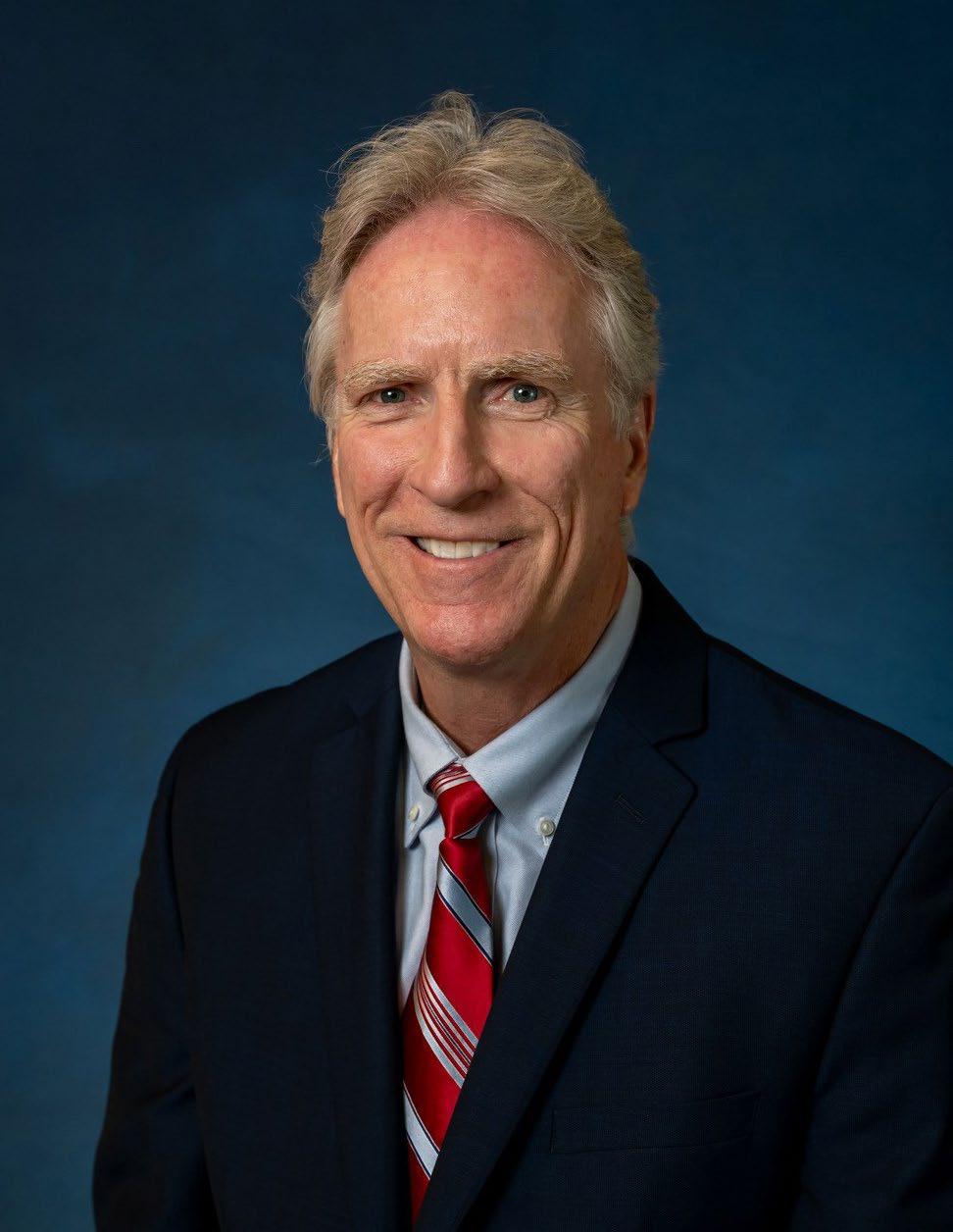
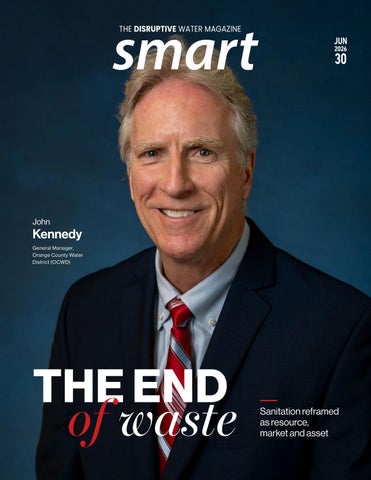
John Kennedy General Manager, Orange County Water District (OCWD)
Sanitation reframed as resource, market and asset
For most of its history, wastewater marked the end of the line — treated, discharged and forgotten. If the plant met its consent, the job was done. That assumption no longer holds.
In 2026, wastewater is no longer the end of sanitation; it is the beginning of a new chain of supply, risk and capital. It is a water source, a priced contaminant, an energy asset, a financeable market. The question is no longer which technology exists, but what comes next, who pays, and who delivers.
Our cover interview with John Kennedy, General Manager of Orange County Water District, captures the shift. He inherited the world's largest reuse system, the GWRS, as it reached full build-out — the moment construction ends and the harder discipline of operation begins. Success is no longer measured in milestones, but in reliability sustained over decades.
Yet the recurring lesson here is not technical. The technology is proven; the harder task is trust. Sedlak and Professor Joan Bray Rose — 2026 Lee Kuan Yew Water Prize laureate, whose work turned water safety into measurable science — converge on one point: reuse advances at the speed of public confidence, not engineering.
knowledge that retires with an experienced operator.
The features show the market being built. Badger Meter turns the sewer network into a single intelligence layer; ACCIONA makes underground networks predictive; Almar Water Solutions shifts to long-term, financeable partnerships; and Tedagua, Xylem Vue and Filtralite bring compact reuse, real-time visibility and reliable filtration.
That conviction is now global. Danielle Francis, Water Services Association of Australia, notes that over 30 million people already drink purified recycled water, heading past 55 million by 2050. António Pinto, Águas do Tejo Atlântico, shows digital twins remaking the plant; Sreenivasan Ramaswami makes the case for reuse in the global south; and Martin Hurst, Sustainability First, makes public trust a governance test for every utility. David LaFrance, CEO of AWWA, names the quieter risk: the
PUBLISHER
iAgua Conocimiento, S.L.
Calle López de Hoyos, 190 Entlo. B 28002 Madrid info@iagua.es
MANAGEMENT
Alejandro Maceira Rozados
David Escobar Gutiérrez
What emerges is a sector that no longer treats used water as the end. It is supply, it is risk, it is capital, it is public health. Because waste, it turns out, was always the wrong word.
The same logic runs through the issue. At Hampton Roads Sanitation District, Lauren Zuravnsky is delivering SWIFT, a $3 billion programme turning treated wastewater into regional groundwater supply, recharging an over-drawn aquifer and slowing subsidence in Virginia. From Berkeley, Professor David Sedlak frames the wider stakes: water security may depend less on technology than on dismantling the silos that keep drinking water, wastewater and stormwater apart. DaviD Escobar - Partner at SWM D @davidescobar - E @DavidEscobariAgua
EDITOR Alejandro Maceira Rozados
EDITORIAL STAFF Olivia Tempest Prados
Cristina Novo Pérez Laura Fernández Zarza ADVERTISING Javier de los Reyes
AND GRAPHIC DESIGN Esther Martín Muñoz Ruth Redondo Gallego
PHOTOGRAPHY Fotos iAgua
WAITING IS NOT A WATER
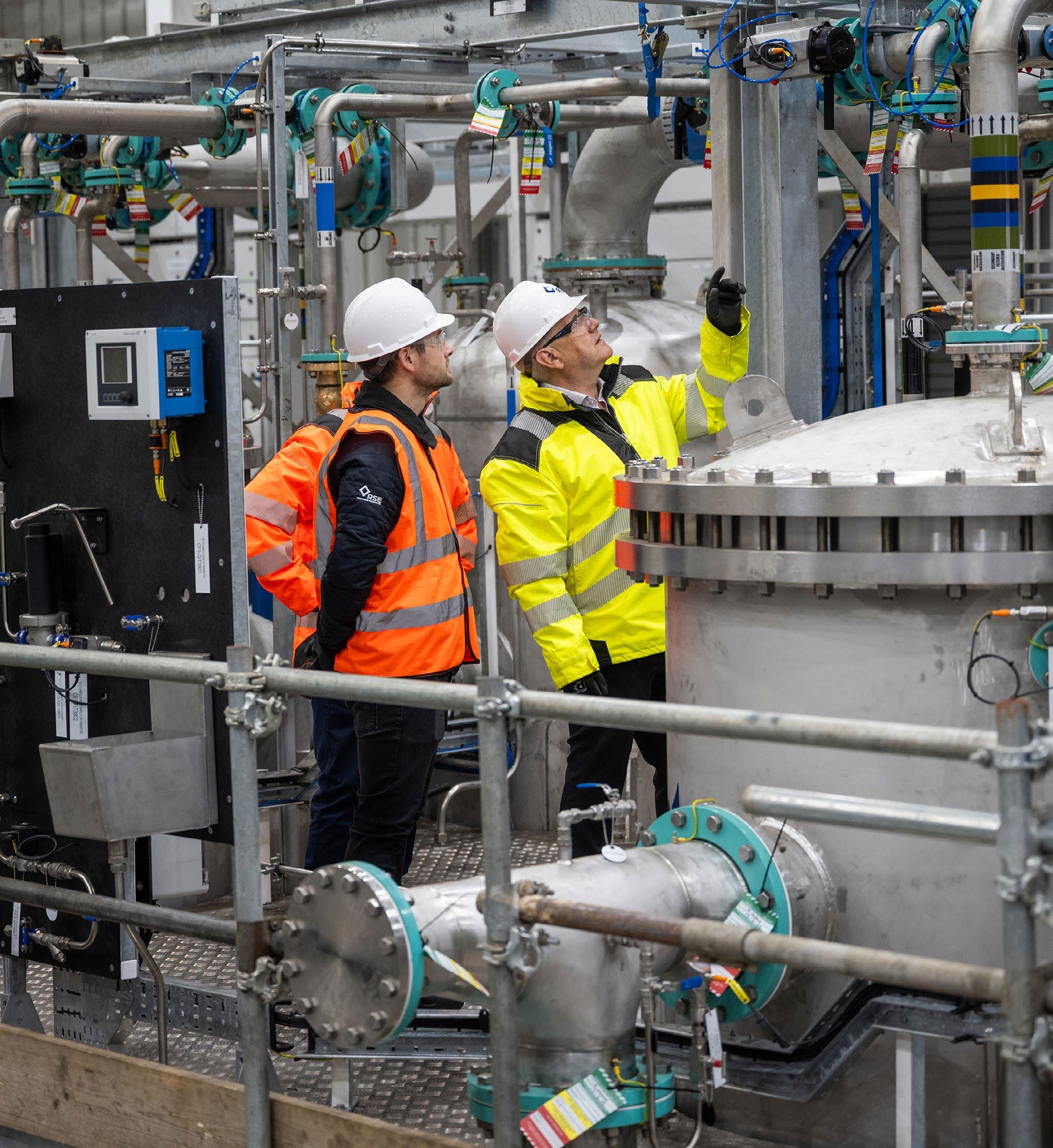
Pg. 30 RSE's Kes Juskowiak argues water reuse technology is proven at scale; the gap now is in delivery speed, not in engineering capability.
FROM EXPANSION TO EXCELLENCE
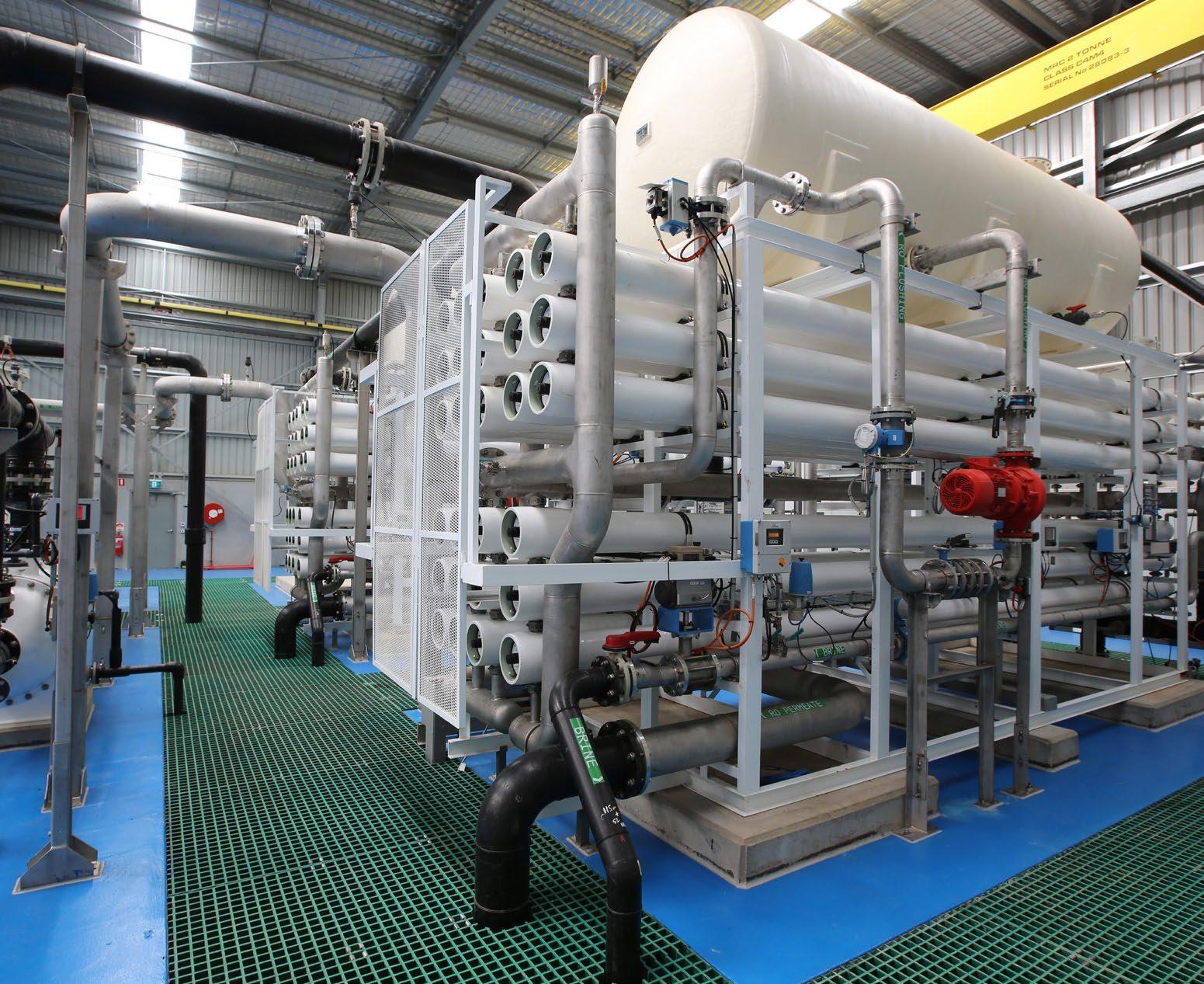
Pg. 18 The GWRS is fully built. John Kennedy of Orange County Water District now focuses on efficiency, research and long-term performance.
Pg. 26
Live in 130 Spanish municipalities, Xylem Vue's Sewer Tracker gives utilities an evidence-based view of their sewer network.
PASSING THE TORCH IN WATER
Pg. 60 Vacancies are not the hardest part. AWWA CEO David LaFrance argues the real priority is passing knowledge to the next generation.


SEEING INSIDE THE SEWER NETWORK
Pg. 78 PFAS, concentrate bottlenecks and institutional silos: David Sedlak of UC Berkeley charts the path to integrated water management. FEATURE
Pg. 36 ACCIONA integrates GIS, AI and robotic CCTV into a single ecosystem that turns sewer inspection into automated predictive maintenance.
Pg. 46 Filtralite has anchored tertiary filtration at Stockholm Vatten och Avfall since 2007. Isak Albertsson explains why it still delivers.
Pg. 64 Almar Water Solutions marks ten years of integrated partnerships across desalination, reuse and industrial water services worldwide.

FEATURE
A GLOBAL BET ON SMARTER SEWERS
Pg. 52 Badger Meter's acquisitions of SmartCover and UDlive give it a global lead in sewer monitoring, backed by the BlueEdge data platform
INTERVIEW
RECHARGING COASTAL VIRGINIA
Pg. 96 Three billion dollars, 38 active projects, one aquifer. Lauren Zuravnsky of HRSD details the engineering behind the SWIFT programme.
SPECIAL ANALYSIS
HOW BIG IS THE WASTEWATER MARKET?
Pg. 14 It depends on which number you use. Suppliers see $370 billion; total sector spending tops $1 trillion a year. Both figures are real.
FEATURE
PIPES BUILT FOR THE NEXT CENTURY
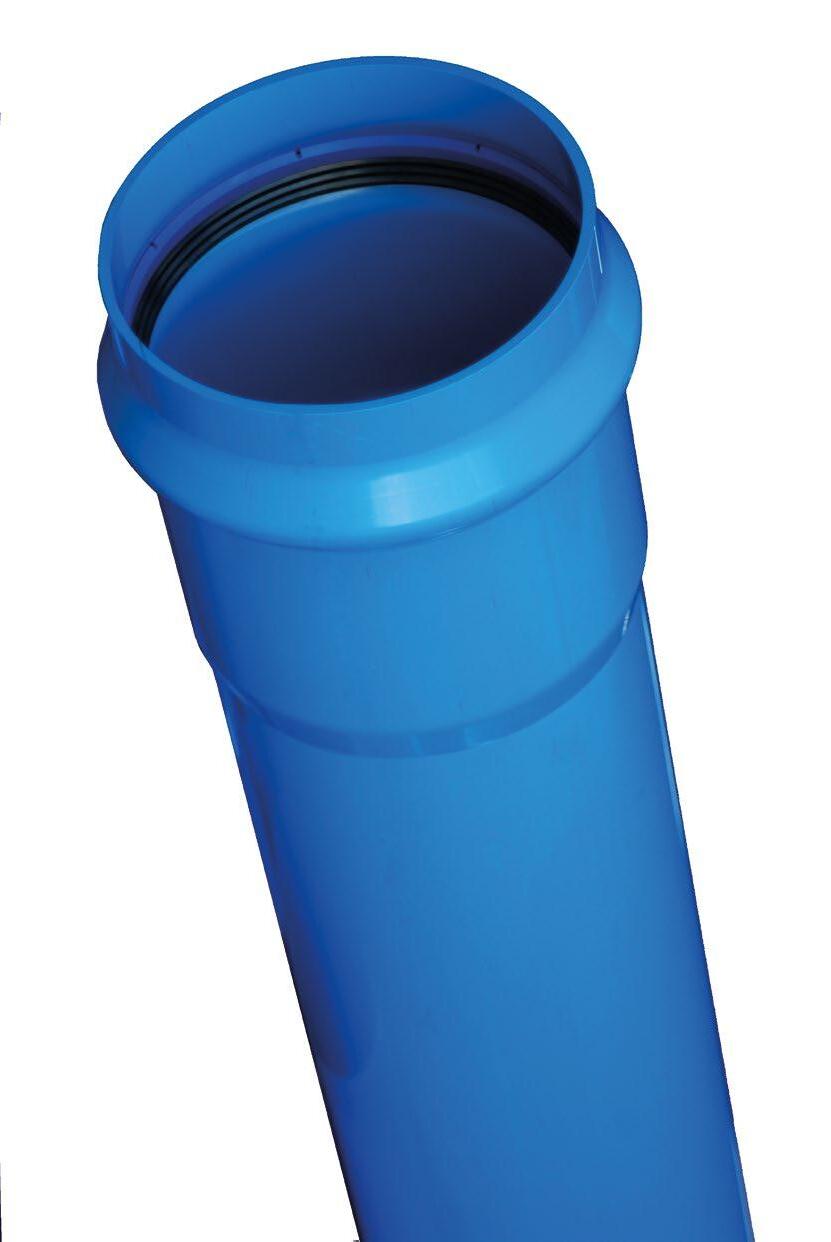
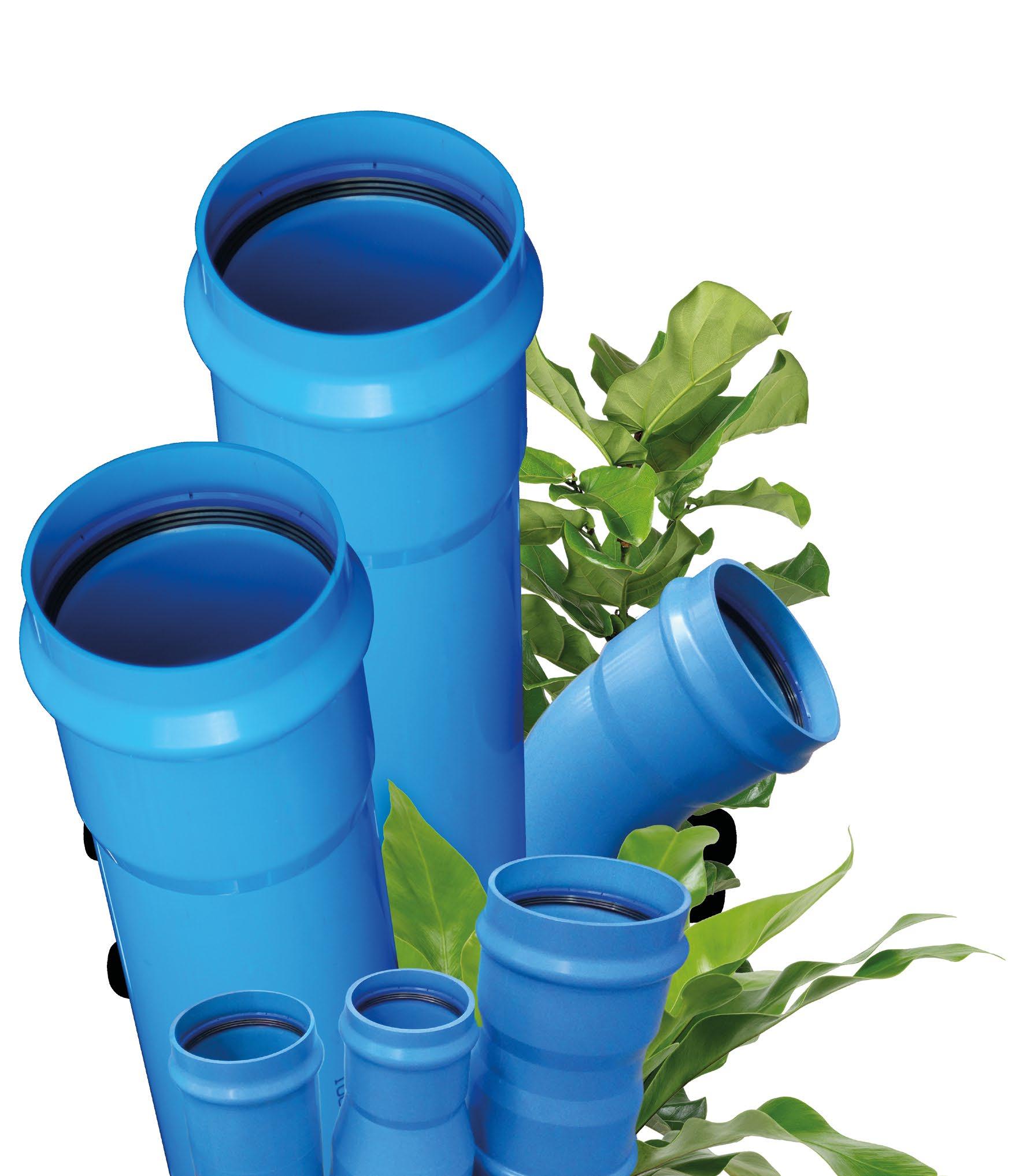
Pg. 74 Molecor's TOM® PVC-O pipes offer a 100-year lifespan, superior hydraulic capacity and a manufacturing model targeting Net Zero by 2040.
FEATURE
MODULAR REUSE, FASTER RESULTS
Pg. 92 TEDAGUA's Raúl Fernández Donado explains how compact, modular plants can compress water reuse delivery from years down to months.
SPECIAL ANALYSIS
PRIVATE CAPITAL AND PUBLIC WATER
Pg. 42 The sanitation gap is no longer about scarce capital. It is about who can structure a deal that closes, gets built and gets paid back.
FEATURE
THE RIGHT EXCHANGER FOR THE JOB
Pg. 82 HRS Heat Exchangers sets out when corrugated tube, double tube or scraped surface units best suit viscous sludge applications.
SPECIAL ANALYSIS
PFAS ARRIVE AT THE TREATMENT PLANT
Pg. 86 From criminal courts to biosolids budgets, PFAS are now reshaping how utilities plan, invest and manage the infrastructure they run.
FEATURE
KNOWLEDGE THAT WALKS OUT THE DOOR
Pg. 56 One in five US utility employees is retirement-eligible, taking with them operational knowledge that no system or database can replace.
SPECIAL ANALYSIS
THE POLLUTER PAYS, AT LAST
Pg. 68 Europe's wastewater directive makes pharma and cosmetics fund micropollutant removal, opening a billion-euro market for the sector.
SPECIAL ANALYSIS
THE GULF BETS BIG ON REUSE
Pg. 100 Reclaimed water costs a fraction of desalination. The Gulf has done the maths. Its biggest infrastructure capital is going underground.
SPEAKERS CORNER
WATER'S REPUTATION PROBLEM
Pg. 112 Cameron McWilliam of Carollo Engineers makes the case for building public trust well before any crisis forces a utility's hand.
SPECIAL ANALYSIS
A RESERVOIR HIDING IN PLAIN SIGHT
Pg. 106 The world reuses just 11% of its wastewater. Cities that close that gap will hold a structural water advantage for decades to come.
PORTRAIT OF A CHANGEMAKER
WATER SAFETY AS AN EXACT SCIENCE
Pg. 104 Joan Rose turned water safety from a qualitative judgement into a measurable science, changing how the world regulates drinking water.
WATER INFRASTRUCTURE
A DUTCH STANDARD FOR WASTEWATER
Pg. 110 Harnaschpolder treats 255,000 m3 daily, generates over half its own energy from biogas and was the Netherlands' first water sector PPP.
In this section we have compiled the most important appointments that have taken place recently, and entail taking up a position or role within influential entities (public, private or mixed) in the water sector.

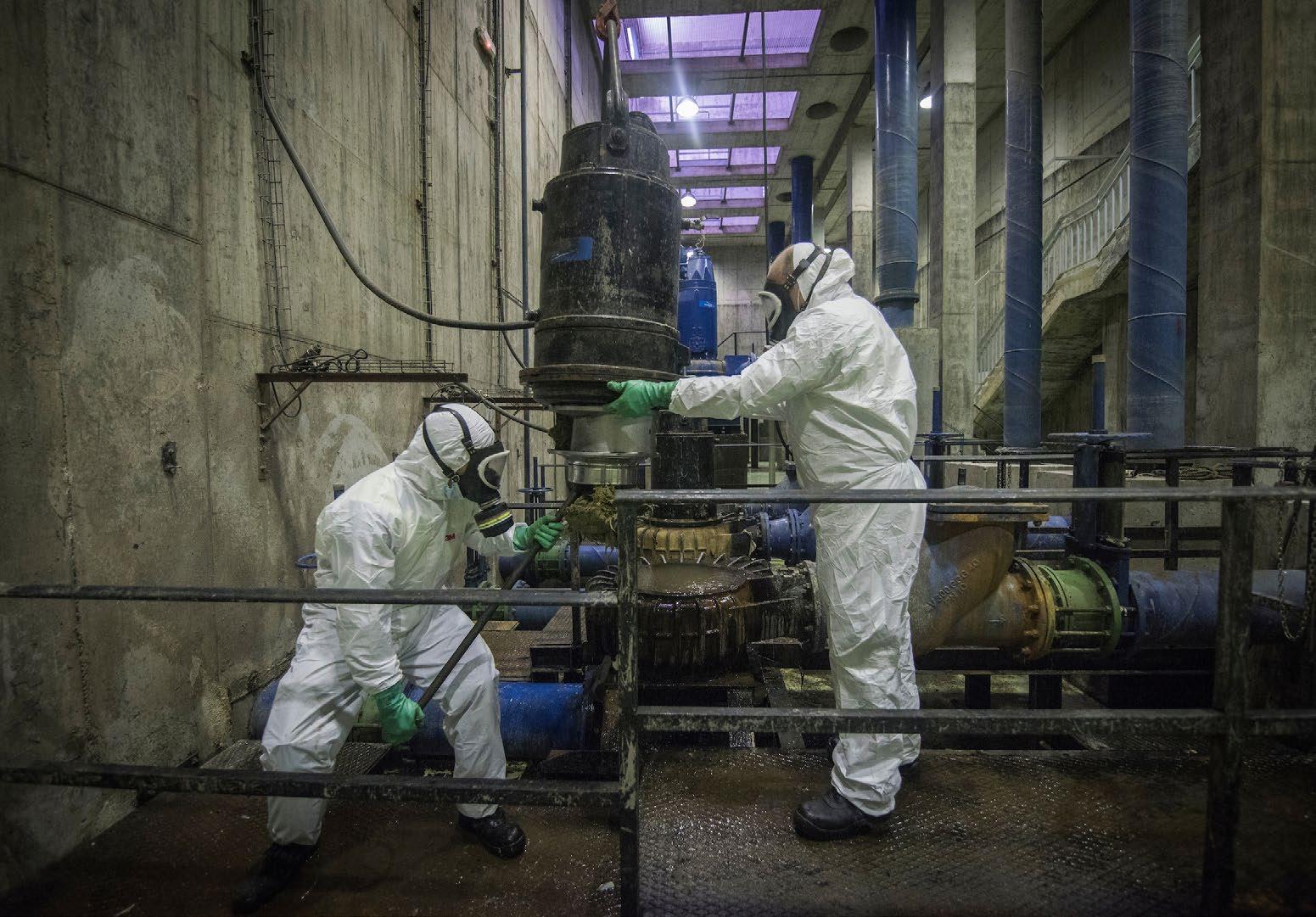
The Department for Environment, Food & Rural Affairs (DEFRA) has appointed Dame Julia Black as Senior Adviser to the Secretary of State on Water Reform Transition, a new role created to support the transition to a single, integrated water regulator for England.
The role is fixed and time-limited for 12 months, with the possibility of an extension of a further 12 months. It is designed to bridge the period before a Chair-designate is appointed to lead the new regulator, following the introduction of the planned water reform bill.
The Senior Adviser will provide strategic leadership on the design of the new regulator and offer expert knowledge to support the transition. According to Defra, the new body will bring together the relevant water system functions from existing regulators into "one, cohesive body," with central oversight of water quality and water resources, and the ability to take a whole-system view of the economic and environmental performance of water companies for the first time.
Dame
Dame Julia Black's objectives include advising Ministers and senior officials on the development of the Transition Plan; convening engagement across regulators and industry, including in relation to Price Review 2029, risk and risk-mitigation strategies, and the transitional supervision approach undertaken by current regulators; providing guidance on regulatory structures and the shape of future legislation; and assessing existing mechanisms that support innovation in the sector.
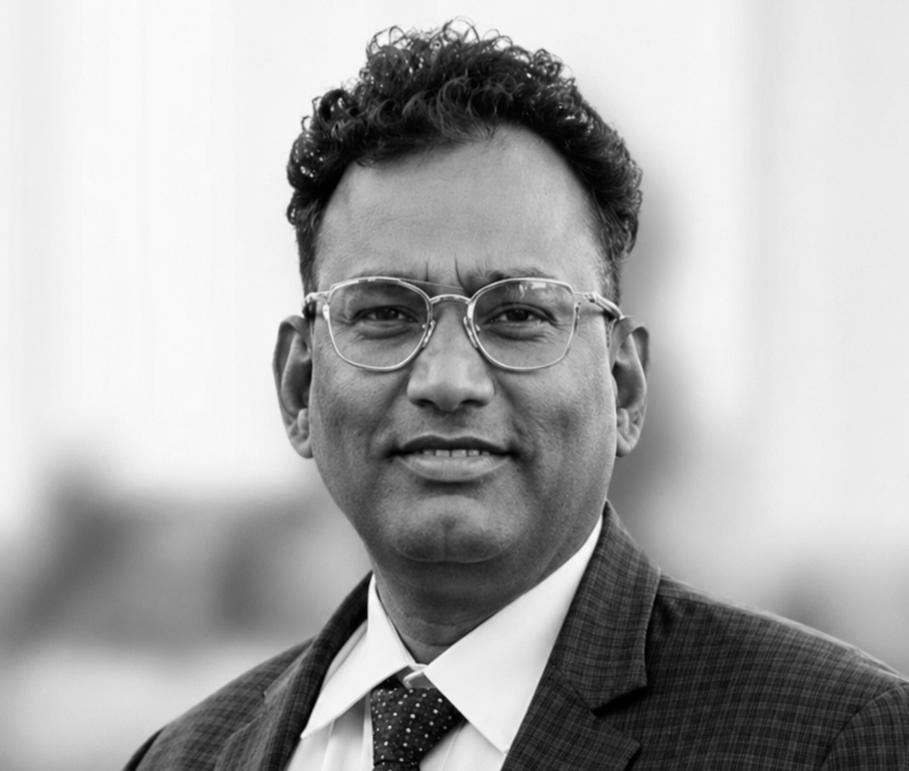
VA Tech WABAG has announced the appointment of Bhupesh Chowdary Nagineni as Deputy Managing Director, adding a senior executive with extensive international infrastructure and industrial project experience to its leadership team.
Nagineni brings over 30 years of experience in business operations, strategic growth, digital transformation and the delivery of large-scale infrastructure and industrial developments in multiple global markets.
Before joining VA Tech WABAG, Nagineni served as Executive Vice President and Chief of Operations for the Energy & Industrial Business Group at Tata Projects. His professional background also includes leadership positions at Kalpataru Projects International Limited, Khimji Ramdas, Adani Group, Larsen & Toubro, JSW Group, and McNally Bharat Engineering Company Limited.
The company said his experience managing complex operations across different regions will support its ongoing development plans. His career has included leadership responsibilities spanning Asia, the Middle East, Africa, Europe and the Americas, with experience overseeing multicultural teams and international operations.
VA Tech WABAG indicated that the appointment aligns with its current growth and transformation objectives. With experience across engineering, industrial operations and infrastructure delivery, Nagineni’s appointment adds expertise in areas that companies increasingly prioritise as they adapt to evolving market demands, including operational efficiency and digitalisation.

WSP NAMES NADA ABUBAKR HEAD OF WATER ADVISORY IN THE MIDDLE EAST
Abubakr joins WSP to drive sustainable water strategy, governance, and system-level transformation across the Middle East region
ASSOCIATION OF CALIFORNIA WATER AGENCIES (ACWA) APPOINTS KARLA NEMETH AS NEXT EXECUTIVE DIRECTOR
Before joining DWR, Nemeth served at the California Natural Resources Agency as deputy secretary and senior advisor for water policy
WSP, a world-leading engineering firm, has appointed Nada Abubakr as Head of Water Advisory in the Middle East, reinforcing the company’s focus on water security and sustainability in the region.
Nada Abubakr brings experience in water strategy, governance, and system-level transformation, with prior work across the Middle East and Australia. In her new role, she will lead the growth and delivery of WSP’s Water Advisory practice, supporting governments, utilities, and major asset owners in planning, managing, and governing water systems.
"I have worked with public and private sector clients on national and city-scale water strategies, demand-side management, and long-term resilience planning. My focus is on bridging policy, strategy, and implementation, translating complex challenges into practical outcomes. I look forward to building on this at WSP and supporting clients in delivering lasting impact,” Abubakr said.
Kathleen McGrail, Global Lead and Middle East Managing Director, Advisory at WSP, noted that the firm is expanding its water sector presence by combining advisory expertise with technical capabilities to support clients across the project lifecycle, from strategy and planning to design, delivery, and longterm asset performance. The appointment comes amid growing regional investment in water infrastructure, as governments in the Middle East seek to improve water security.
The Association of California Water Agencies (ACWA) has appointed Karla Nemeth, current director of the California Department of Water Resources (DWR), as its next Executive Director. The announcement was made by ACWA President Ernie Avila.
Nemeth will assume the role on 1 September, succeeding the leadership of the organisation that represents around 470 public water agencies across California. ACWA members are responsible for delivering approximately 90% of the water supplied to cities, agriculture and businesses throughout the state.
Based in Sacramento, Nemeth will oversee a team of over 40 employees, including staff in Washington D.C., supporting policy advocacy, educational initiatives and member services. Her appointment also marks the first time in ACWA’s 116-year history that a woman will serve as executive director.
Nemeth has led the California Department of Water Resources since 2018, after being appointed by Governor Jerry Brown and later reappointed by Governor Gavin Newsom. During her tenure, she directed efforts to address the impacts of climate change on water management, including investments in forecasting systems, groundwater management and infrastructure resilience.
In 2024, Governor Newsom assigned Nemeth responsibility for implementing several strategic projects under California’s “Water Supply Strategy – Adapting to a Hotter, Drier Future”, including initiatives linked to water conveyance modernisation, river restoration agreements and Colorado River supply stability.
Southern Water has announced the appointment of Andrew Davies as Chair Designate, with immediate effect. He will formally assume the role of Chair on 16 July 2026, succeeding Keith Lough, who will step down from the Board after nearly seven years in the position.
Andrew Davies joins the water company with extensive experience in the infrastructure, engineering and construction sectors. He previously served as Chief Executive of Kier Group plc from 2019 to 2025, overseeing a transformation programme that strengthened the company’s position in infrastructure services, construction and property development. His previous roles also include Senior Independent Director at Chemring Group plc and Chief Executive of Wates Group.
Commenting on the transition, Keith Lough said: “It has been a privilege to chair Southern Water over the last 7 years through sustained efforts to change the company’s culture and performance.” He added that the utility is now “on a stronger footing, with a more resilient financial position and a highly capable leadership team in place.”
Lough also highlighted the company’s ongoing investment programme and expressed confidence that Southern Water would continue delivering improvements for customers and the environment under Davies’ leadership. He described his appointment as coming “at such an important moment for the business and the wider sector”.
Illinois American Water has named John Killips as its new Senior Director of Engineering, reinforcing the utility’s focus on infrastructure modernisation and long-term system resilience across the state of Illinois.
Killips officially joined the company on May 4, 2026, and will be based at Illinois American Water’s office in Belleville. In his new role, he will oversee the strategic management of capital improvement programmes, including infrastructure repair and replacement initiatives designed to maintain reliable water and wastewater services for customers statewide.
The appointment comes as Illinois American Water continues to expand investment in its utility networks and treatment facilities. According to the company, more than US$280 million was invested in infrastructure projects during 2025. These works included the installation and upgrade of pipes, pumps, hydrants, valves, lift stations, storage tanks, treatment facilities, water quality systems and related technologies.
Killips brings more than 3 decades of experience in the water sector. Before joining Illinois American Water, he served as Water Collection and Distribution Service Line Lead for North America at GHD, where he supported the linear water market. Earlier in his career, he held several positions at Tetra Tech and contributed to the delivery of multiple water infrastructure programmes and projects. The firm said the appointment supports its ongoing commitment to operational reliability and infrastructure improvement.
SOUTHERN WATER NAMES ANDREW DAVIES AS CHAIR DESIGNATE
Seasoned infrastructure leader Davies succeeds Keith Lough, who departs after steering the utility through years of transformation
ILLINOIS AMERICAN WATER APPOINTS JOHN KILLIPS AS SENIOR DIRECTOR OF ENGINEERING
The appointment comes as the water utility continues to expand investment in its networks and treatment infrastructure
AUTHOR : DAVID ESCOBAR
Two numbers define the global wastewater business. Mistake one for the other, and you will misread the decade.
Ask what the world’s wastewater sector is worth, and you will get two answers that sit an order of magnitude apart. Both are correct. The distance between them is the single most important thing to understand before you commit a euro, a dollar or a dirham to this industry.
Measured as a supplier market — the technology, equipment, chemicals, engineering and operations that vendors sell to utilities — global water and wastewater treatment is worth somewhere between $320 billion and $370 billion in 2024-25. Measured as a spending effort — what utilities and governments actually pour into collecting and treating the planet’s sewage — it runs past $1 trillion every year, and still falls short of what the world needs. The first number is a market you can sell into. The second is the size of the problem. Mistake one for the other, and every business case you build will be wrong by a factor of a thousand.
Here is where most reading of this sector goes wrong. A headline quotes one figure and calls it “the market.” But wastewater is two businesses wearing a single name, and they are not the same size.
The narrower business is the supplier market: pumps, membranes, sensors, dosing chemicals, and contracts to design, build and run plants. Depending on where an analyst draws the line, that market is worth anywhere from about $65 billion — if you count only treatment technologies — to $370 billion, once you fold in services and chemicals across both water and wastewater. The spread is not carelessness. It is scope. Before you cite a number, know exactly what it includes, because a fourfold difference can hide inside the same phrase.
The wider business is total sector spend, and it dwarfs the first. The World Bank estimates that simply meeting the basic drinking-water and sanitation targets of Sustainable Development Goal 6 would require roughly $114 billion a year in capital alone — before a cent of operations — and on the order of $1.7 trillion over fifteen years, about three times what the world has historically invested. Widen the lens to full water resilience and the figure climbs further: McKinsey and the World Economic Forum put the bill at $13 trillion this decade. The United Nations’ own monitoring finds a 61 per cent gap between the money needed for water and sanitation and the money actually available.
And the spending the world does manage is not buying enough treatment. Only 56 to 58 per cent of the planet’s domestic wastewater is treated safely; the remaining 42 per cent returns to rivers, aquifers and coastlines with no adequate treatment at all. For industrial effluent, the safely-treated share falls to barely 38 per cent. Foreign aid barely moves the needle: official development assistance for water and sanitation runs at about
$13 billion a year, a rounding error against the need. At the current pace, the United Nations calculates, the world will not achieve sustainable water management until around 2049. That is the backdrop to every market number in this feature: a colossal market, and a still larger unmet need sitting directly behind it.
Within that supplier market, the money concentrates in predictable places. Removing dissolved solids is the single largest activity, close to a third of the total. Tertiary and advanced treatment commands the biggest share of revenue and the fastest growth. Municipal work, at roughly 58 per cent, still outweighs industrial — though industrial is catching up faster. Knowing which segment a figure describes matters almost as much as knowing the figure.
The map is lopsided
If you want to know where the money is, follow the concrete. No country is pouring more of it than China, which invested on the order of $810 billion in water infrastructure between 2021 and 2025 — more than a trillion yuan a year, four years running. It shows in the market: Asia-Pacific is now both the largest region in the world for water and wastewater treatment, with roughly 35 to 38 per cent of global revenue, and among the fastest-growing, expanding at 7.5 to nearly 9 per cent a year. If you build, sell or finance treatment capacity, this is the center of gravity.
Look closer at China and the shape of the prize sharpens. Its market for treatment technologies alone is set to grow from about $16 billion in 2025 to nearly $24 billion by 2030, better than 8 per cent a year, with a public-private project pipeline worth roughly $75 billion behind it. Even Chinese water reuse, from a standing start, is forecast to double to around $4 billion by the end of the decade. This is not a market you can serve
from a brochure — but it is the largest single prize in the sector.
India is the other Asian engine. Through Namami Gange, the Jal Jeevan Mission and the Swachh Bharat sanitation drive, the state is funding collection and treatment at a scale it has never attempted — and it now mandates zero-liquid-discharge for whole industrial categories, a regulatory choice that, by itself, manufactures a market.
Then there is the Gulf, where the growth rates are the steepest on earth. Saudi Arabia has earmarked some $80 billion for water projects, and under Vision 2030 it is rebuilding its entire wastewater system around reuse, with a declared target of recycling all of it. Across the Gulf Cooperation Council, the treatment market is expanding at more than 14 per cent a year — faster than anywhere else. For technology vendors locked out of mature markets by incumbency, this is open ground.
The mature West tells the opposite story, and you should read it carefully, because it is a story about replacement, not expansion. In the United States, the Environmental Protection Agency’s latest survey put twenty-year wastewater and stormwater needs at $630 billion — and north of $1.2 trillion once drinking water is included. Yet North America, holding the largest single share of the
THE WEST REBUILDS. THE REGIONS WITH THE DEEPEST NEED ARE STILL WAITING FOR THE CAPITAL TO ARRIVE
$1 T
$320–370B $550–760B
global market at around 38 per cent, is growing only 3.7 to 5.5 per cent a year: its pipes are old, its plants are built, and its spending goes to keeping them alive. Europe is much the same — utilities invest about €33 billion a year and remain roughly €23 billion short of what compliance demands, with the OECD putting the bill to meet Europe’s water directives at €255 billion by 2030. Put a figure on the mature side and the contrast is stark. North America alone is a market of roughly $142 billion in 2025, vast and lucrative and almost entirely about renewal. Win there and you win maintenance contracts, not moonshots; the moonshots are being launched elsewhere.
And then the markets that barely register in the revenue tables yet carry the largest unmet need. Latin America has sewered about half its population and treats perhaps a third of what it collects; development banks reckon the region needs on the order of $80 billion for sewerage and $33 billion for treatment across two decades, and its market — small today — is growing above 7 per cent. Africa has the widest sanitation gap of all, and its build-out leans heavily on multilateral finance. These are not where the money is. They are where the next decade of it has to go.
Capital is not flowing into wastewater because it has suddenly become fashionable. It is flowing because the law now requires it — and that is true on every
continent. If you want to predict where the next billion will be spent, read the statute book, not the technology press.
Europe has written the most consequential rule. The recast Urban Wastewater Treatment Directive will cost an estimated €3.85 billion a year once fully in force in 2040, and it changes far more than budgets. It requires a fourth, “quaternary” stage of treatment to strip micropollutants from the largest plants by 2045; it demands the sector reach energy neutrality by 2040; and, for the first time, it makes the polluter pay — pharmaceutical and cosmetics companies must fund at least 80 per cent of that advanced treatment through extended producer responsibility. The cost of cleaning up no longer lands solely on the household bill. It lands on the industry that created the contamination.
How heavily that European bill lands is still contested. The Commission’s figure is one estimate; the water operators’
CAPITAL IS NOT FLOWING INTO WASTEWATER BECAUSE IT HAS BECOME FASHIONABLE. IT IS
association, EurEau, puts the recast directive’s annual cost in a far wider band of €3.6 to €11.3 billion, depending on how member states implement it. Either way the direction is fixed, and so are the deadlines. And Europe is legislating reuse as well as treatment: a 2020 regulation now governs how reclaimed water is used for irrigation, even as the bloc still recycles barely 2 per cent of the wastewater it treats — a gap that is, for any vendor, a market waiting to open.
Britain has written the largest cheque. Through its PR24 price review, the regulator Ofwat unlocked £104 billion of investment for 2025 to 2030 — roughly quadrupling the previous round — with some £12 billion aimed at cutting sewage spills by 45 per cent before the decade is out. Customers will pay for it through higher bills, the politics are fraught, and the construction is enormous.
The United States has written the rule that conjures an entirely new market. The EPA’s drinking-water limits on PFAS — the “forever chemicals” — will, by the American Water Works Association’s estimate, cost utilities $3.8 to $5.5 billion a year to meet. Legal settlements with manufacturers, up to $12.5 billion from 3M and $1.185 billion from DuPont, will bankroll part of the cleanup. But note the asterisk: the EPA has since proposed extending its compliance deadlines, a reminder that regulation can loosen as well as tighten, and that a market built on a rule is only ever as firm as the rule.
Elsewhere the same logic repeats in different accents. China tightened its
discharge standards under the 14th Five-Year Plan; India mandates zero-liquid-discharge; the Gulf legislates for reuse. Different statutes, one effect: public money and private capital moving on command.
Now the part that should interest you most, because it is where the growth rates stop being merely healthy and turn spectacular. The fastest-moving money in water is no longer chasing clean supply. It is chasing what used to be thrown away.
Reuse leads. The global market for recycling and reusing water was worth about $18.3 billion in 2024 and is on track to reach $56.8 billion by 2034 — growth of 12.1 per cent a year, double the pace of the sector as a whole. Direct potable reuse, once unthinkable, is the fastest slice of it, expanding around 13 per cent annually, and Asia-Pacific already accounts for nearly half the market. Every drop reused is a drop a utility does not have to find, treat and pump from somewhere else.
The proof is already running. Orange County’s Groundwater Replenishment System in California and Singapore’s national reuse programme have made purified wastewater a mainstream source rather than an experiment. Saudi Arabia’s municipal reuse market alone is already worth some $4.7 billion, the third-largest on the planet. And industry is being pushed the same way: zero-liquid-discharge, mandated for textile and other sectors in India and concentrated in Asia-Pacific, turns the dirtiest effluent into recovered water and saleable solids — cost reborn as commodity.
Resource recovery is the next frontier. The market for recovering nutrients from wastewater is heading from $3.5 billion to $6.7 billion; struvite, a fertilizer reclaimed from sewage, is growing
nearly 10 per cent a year; the business of treating and valorizing sludge is worth around $30 billion and climbing toward $50 billion. And then there is energy. A wastewater plant, run well, can generate up to five times the energy its own treatment consumes — which means the sector’s single largest operating cost can be flipped into a revenue line. The plants that pull it off stop being drains on the grid and become suppliers to it.
Even the newest compliance burden is, viewed coldly, a market. PFAS and other micropollutants are not only a cost to be absorbed; they are an advanced-treatment market being summoned into existence by regulation in real time, complete with new technologies, new vendors and new contracts. Zero-liquid-discharge systems, driven by industrial mandates, are on the same path — from roughly $7 to 8 billion today toward $12 to 15 billion by the early 2030s.
Add it together and the direction is unmistakable. The supplier market worth $320 to $370 billion today could reach $550 to $760 billion by the middle of the next decade. The throughline beneath every one of those numbers is a single change in how the world sees its sewage: from cost to resource, from liability to asset, from the end of the pipe to the start of one.
So return to where you began: two numbers, an order of magnitude apart. The $370 billion supplier market tells you what is being bought today. The trillion-plus of annual spend — and the unmet need still larger than it — tells you what has yet to be built. Read only the first and you will undershoot the opportunity. Read only the second and you will mistake a problem for a market. The decision-makers who win the next decade will read both at once.
That means treating compliance as a market rather than a burden, because every rule from Brussels to Riyadh is also a purchase order. It means treating waste as a resource rather than a cost, because the water, the nutrients and the energy locked inside it are now worth recovering. And it means treating the financing gap not as a cause for despair but as the clearest pipeline your sector will ever be handed — more than a trillion dollars a year of work the world has already conceded it must do.
Be specific about where you play. If you sell technology, the value pools sit in tertiary and advanced treatment, in reuse and in the contaminant frontier — the fast-growing edges, not the mature middle. If you build and operate, the volume is in Asia and the Gulf. If you invest, the steadiest yield is in the regulated rebuild of Europe and North America, and the steepest growth in the emerging markets that can finance it. The one position with no future is the one that treats all of this as a single, undifferentiated “water market.” It never was.
The wave that built this industry is not cresting. It is still rising. The only question that matters is whether you are positioned to ride it — or waiting on the shore for it to pass. Decide now. The water will not wait, and neither will the capital. •
THE FASTESTMOVING MONEY IN WATER IS NO LONGER CHASING CLEAN SUPPLY. IT IS CHASING WHAT USED TO BE THROWN AWAY
KENNEDY
“We want the GWRS to continue serving as a global model for water reuse”

For fifteen years, one project has defined what water reuse can be. The largest advanced purification system of its kind on the planet, it takes water that was once sent to the ocean and turns it into a drinking supply for close to a million people, and in doing so has become the reference point that utilities from Singapore to Texas study before building their own. But its final expansion is now complete, and the most ambitious chapter of its story may be the one that begins where construction ends: not how big a system can become, but how well it can be run, how much it can still teach, and how far the lessons of one Californian basin can travel.
AUTHOR : DAVID ESCOBAR
When the Orange County Water District switched on the Groundwater Replenishment System in 2008, it was not inventing water reuse so much as staking a claim to its future. The District had been purifying wastewater since the 1970s, when Water Factory 21 became one of the first facilities in the world to treat sewage to a quality fit to recharge an aquifer. What the GWRS did was take that pioneering idea and build it at a scale no one had attempted: a system that would grow from 70 to 100 and finally, in 2023, to 130 million gallons a day, recycling every drop of reclaimable flow from its neighbouring sanitation district and turning what was once discharged into the Pacific into a locally controlled drinking water supply for close to a million people.
Today the GWRS is the largest advanced purification system for potable reuse on the planet, and the reference point against which projects from Singapore to Texas to Australia measure themselves. Its three-step treatment train — microfiltration, reverse osmosis and ultraviolet light with hydrogen peroxide — has become a template, but the more instructive part of the Orange County story is what surrounds the technology: a four-decade partnership between two public agencies, a groundwater basin used as both reservoir and natural barrier, an in-house research programme that few utilities of any size can match, and a community that was brought into the conversation a full decade before the plant came online. Success here was never only an engineering achievement.
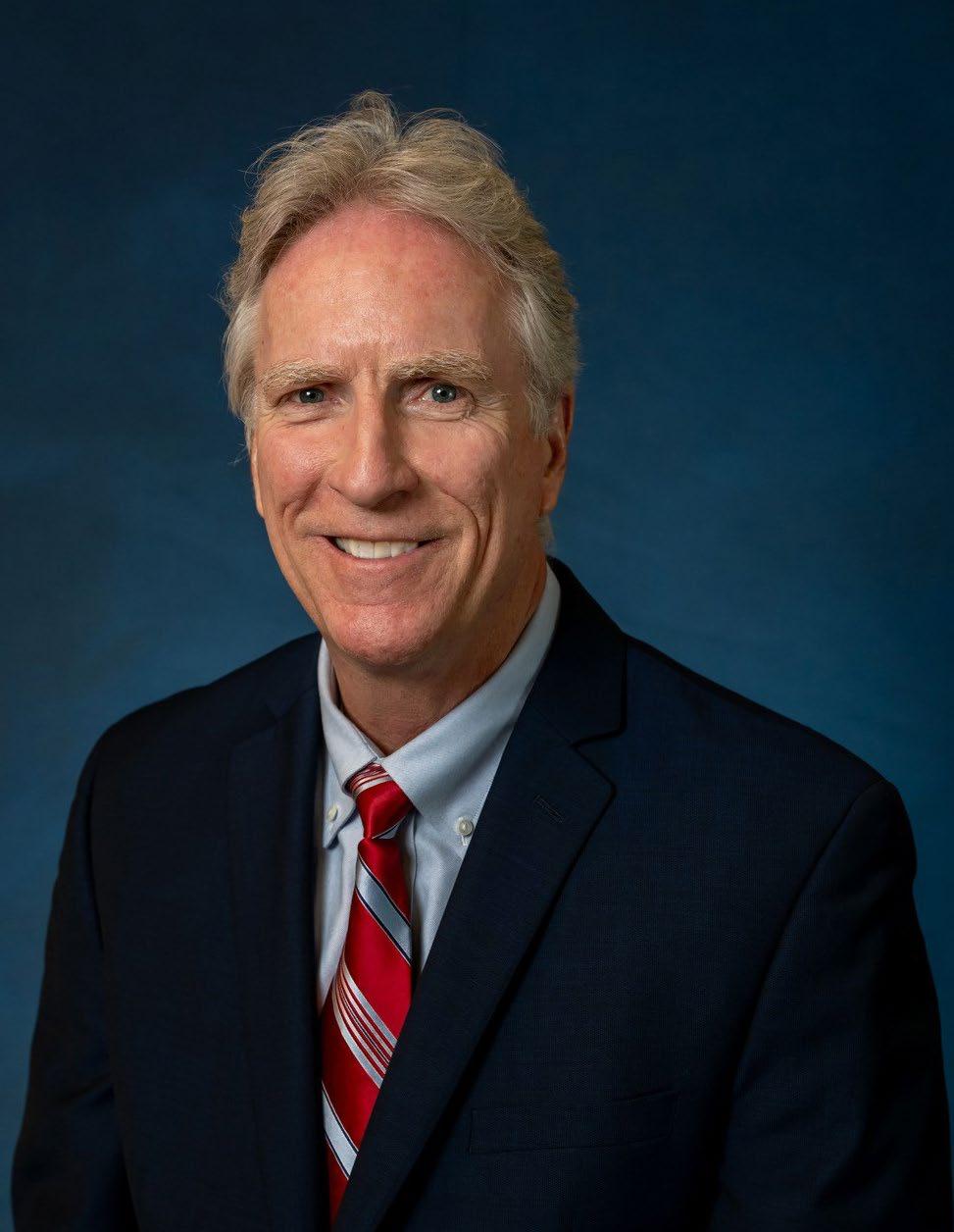
That is what makes this an interesting moment to speak with the man now responsible for it. John Kennedy took over as General Manager in early 2024, after more than four decades
at the District and immediately after the GWRS reached its final build-out — the point at which the construction era ends and a quieter, harder discipline begins: operating a mature system at peak efficiency, deciding which emerging technologies are worth the investment and which are not, and carrying the institutional knowledge of a generation into the next. In the conversation that follows, John Kennedy explains why the world's flagship reuse system measures success differently now, what its research is uncovering, and why he is convinced that local water reliability is worth paying for.
You took the helm at OCWD shortly after the GWRS reached its final build-out. Succeeding Mike Markus after his three and a half decades at the District is no small handover. What does it mean, in your day-to-day, to lead the world's largest water reuse system when the construction era is essentially behind you, and how does that shift the way you measure success as General Manager?
I worked alongside Mike Markus throughout his tenure as General Manager, so there was a lot of continuity when I stepped into the role. Mike did a great job, and I knew I could rely on my 40 years of experience in the water and civil engineering industry to build upon that momentum while adapting to changing conditions. Now that the GWRS has reached its full build-out, success is measured less by construction milestones and more by long-term performance. It’s about reliability, water quality, operational excellence, and making sure we continue considering new technologies, regulations, and challenges facing the water industry.
I’m also focused on evaluating how we operate the groundwater basin and whether there are opportunities to safely increase annual pumping and stor -
"DIRECT POTABLE REUSE DOESN'T MAKE SENSE FOR OCWD BECAUSE WE HAVE A VAST GROUNDWATER BASIN THAT DELIVERS GWRS WATER TO OUR AGENCIES"
"NOW THAT THE GWRS HAS REACHED ITS FULL BUILD-OUT, SUCCESS IS MEASURED LESS BY CONSTRUCTION MILESTONES AND MORE BY LONG-TERM PERFORMANCE"
age over time. It’s complex work, but that’s part of making sure OCWD remains forward-looking and prepared for the future.
With the system fully built out, where do you see the next frontier of operational performance and what would you say are the toughest engineering and operational challenges that remain at the GWRS today?
We’re always looking at ways to improve the efficiency and performance of the GWRS through research, emerging technologies and operational optimisation. Our R&D team plays a major role in that effort, whether it’s evaluating new membrane options, treatment processes, chemical changes or ways to operate the system more efficiently. One small change can save you millions of dollars in operating costs.
California's direct potable reuse regulations have been in effect since late 2024, and several utilities, including some of your neighbours, are moving toward DPR. OCWD operates the world's flagship IPR system. Do you see DPR as a future path for OCWD, or is the natural barrier of the groundwater basin a strategic asset you wouldn't trade?
You are correct. Direct Potable Reuse (DPR) doesn’t make sense for OCWD because we have a vast groundwater basin that delivers the GWRS water to our retail agencies. Additionally, the groundwater basin provides another treatment step, helping to ensure the quality of the water always meets federal and state regulations. And finally, and this gets little mention with the project, the low-TDS GWRS water offsets higher TDS water supplies that are used to replenish our basin.
If a utility leader anywhere in the world came to you today asking which
path to take, IPR with environmental buffer, or DPR direct-to-distribution, what would your honest advice be, and what are the conditions that should drive that choice?
Every community is different, and the approach to water reuse depends on the resources, environment, and infrastructure available locally. Communities that don’t have access to a surface water reservoir or groundwater basin may need to pursue more expensive DPR because they don’t have the ability to store water before it enters the drinking water system. In Orange County, we have the advantage of a large groundwater basin, which allows us to replenish highly purified GWRS water for storage, and it eventually becomes part of our service area’s drinking water supply.
OCWD's R&D programme, under Dr Plumlee, has published consistently in leading journals and runs pilots with industry partners such as DuPont, ROTEC, Porifera and others. Few utilities anywhere maintain in-house research at that level. Why has OCWD chosen to invest in research as a core function rather than outsource it, and what has that returned to the District?
For OCWD, it’s been worth the investment. Our staff knows the system and operations better than anyone, and having a top-tier in-house R&D program allows us to test new membranes, new chemicals, different treatment approaches, and operational strategies directly on our facilities by using pilot systems, which are essentially smaller-scale versions of the large purification systems used at the GWRS. That work helps us evaluate promising new technologies and approaches to improve water quality, enhance water recycling and groundwater recharge, and increase efficiency in District operations. The GWRS also serves as a large test bed for others to
purification capacity (≈492,000 m³/day)
100% of reclaimable wastewater recycled 2008 in operation
80+ international awards ~1 million people supplied
test emerging technologies coming on the market. We’ve also always tried to collaborate with industry partners and researchers to enhance our operations and share what we learn with the broader industry.
Beyond the GWRS, a recent example is our R&D staff’s ongoing trials of different adsorbents that remove PFAS from drinking water; this work led to a particular adsorbent being selected for the regional full-scale PFAS treatment plants we are constructing in locations where groundwater supplies have been impacted by PFAS. Fortunately, this type of treatment is not necessary for GWRS since RO does an excellent job removing PFAS from purified recycled water.
Looking at the technologies you've been piloting in recent years, from concentrate recovery to next-generation membranes to PFAS treatment, which ones do you believe are closest to being mature enough to change how potable reuse is delivered at scale globally?
While it’s critical that water utilities provide research partnerships to academia and other technology developers, the technologies that are closest to being implemented at scale are typically the innovations offered by mature companies who know the sector’s needs, as well as start-up companies positioning to bring something new commercially. For membrane-based potable reuse like done at OCWD, our R&D has demonstrated that recovery of additional water from reverse osmosis (RO) concentrate is absolutely possible, but it’s a question of whether the investment is worth it in terms of new water produced. For us, that’s still an open question. On the water quality side, our team has also been piloting a promising membrane disinfection alternative – hydrogen peroxide added before ultrafiltration and RO – that could altogether elim -
inate the production of regulated disinfection byproducts while controlling biofouling as well or maybe even better than chloramine, which is the current approach used across the industry for our type of treatment train to control membrane biofouling.
The GWRS is widely cited as producing water at a lower cost than imported supplies and at a fraction of the energy of seawater desalination. From your perspective as both an engineer and someone who has spent years on the District's financial planning, what is the honest economic case for reuse compared to its main alternatives — and where is that case most fragile? The economic case for reuse is really tied to long-term local reliability. For OCWD, the cost of GWRS water has consistently remained well below the cost of imported water, while also giving us a dependable local supply that we can manage close to home. The GWRS, with its size, clearly benefits from economies of scale. Additionally, the plant was designed to operate at the same flow rate 24/7, 365 days a year, which also contributes to the low unit costs.
These projects require major upfront investment, which is why grants, low-interest loans and other outside funding are so important to help offset costs for ratepayers. OCWD has been very proactive about securing outside funding through state and federal programs and other sources whenever possible.
From my perspective, local reliability is worth paying for. Imported water from northern California and the Colorado River is becoming more expensive and less predictable, so there’s real value in investing in a sustainable local supply. The most fragile part of the economic case is making sure agencies have access to the funding needed to build and maintain these projects while keeping water affordable for their communities.
The OCWD–OC San partnership has been described as the institutional secret behind the GWRS. Looking at projects elsewhere, in California, in Texas, in Australia, in Singapore, how replicable is that model, and what conditions does a region need before it can even attempt something similar?
The partnership factor has been a challenge for many reuse projects. The relationship between OCWD and OC San has worked because both agencies recognised early on the general benefit of water reuse to the region. Beyond the general benefit, OCWD needed additional water supplies to support groundwater replenishment and strengthen the seawater intrusion barrier, while OC San needed an alternative to building a new ocean outfall for wastewater discharge. Both agencies saw the long-term value of the project and stayed committed to making it successful from the board level through staff.
Successful projects like ours also require strong communication, clear agreements, and regular coordination between both agencies. There are a lot of operational, financial, and planning decisions that have to be worked through together over time. The model can absolutely be replicated, but it requires a true long-term partnership and a willingness from both agencies to work collaboratively through challenges as they arise.
The recent AWWA report puts the US drinking-water investment gap in the trillions, with federal participation at historically low levels. As a utility leader, how do you see the financing architecture for the next generation of reuse projects coming together — and what role should federal programmes like WIFIA, SRF and Title XVI play? State and federal funding programs like WIFIA, SRF and Title XVI are extremely important and should be maximised by agencies whenever possible. Reuse
projects require major upfront investment, and outside funding helps reduce the burden on ratepayers and makes these projects more affordable for communities. Additionally, receiving outside grant funding provides significant positive momentum for reuse projects that can take years to process. That said, OCWD would have still moved forward with GWRS even without that funding because we recognised the need for a reliable long-term local water supply for Orange County. It really comes down to need. Communities are going to have to continue investing in local water supplies for both current and future generations. Funding programs help make those projects more achievable and can accelerate how quickly agencies are able to move forward.
OCWD now runs what is widely regarded as the largest regional PFAS treatment programme in the United States, with mitigation costs projected across multiple decades. Beyond the technical response, what has this experience taught you about how utilities should be sharing the cost burden between ratepayers, polluters and public funding?
One of the biggest challenges with PFAS is that utilities and ratepayers should not be carrying this burden alone. Water agencies did not create these chemicals, so there must be a strong “polluter pays” component. Addressing PFAS in Orange County is estimated to cost approximately $1.8 billion over the next 30 years, which is simply too large for local communities to absorb on their own. That is why OCWD has aggressively pursued both litigation and external funding opportunities. To date, the District has secured approximately $283 million through outside grants and legal settlements with chemical manufacturers to help offset treatment costs and minimise impacts to ratepayers.
For OCWD, our approach has been an “all-for-one, one-for-all” model among our 19 cities and retail water districts. PFAS impacts are being addressed collectively across the basin, with OCWD partnering closely with local groundwater agencies to help fund and implement treatment projects so the responsibility is shared regionally rather than falling on any one agency alone. This principle also creates economies of scale and a more cohesive regional approach where OCWD can share technical resources, research, operational experience, and communication strategies with its member agencies while working toward the same goal of protecting water quality.
The water sector is openly worried about a workforce cliff, a wave of retirements, hard-to-fill operator and engineering roles, and the loss of institutional knowledge. OCWD has just lived through one of those generational transitions itself. What is working for you in attracting and keeping the people who actually run a system like the GWRS, and what isn't?
We’ve put a big focus on investing in our employees through ongoing training, professional development, and opportunities to grow within the organisation. These systems are becoming more advanced and technical, so you have to keep developing your workforce over time. We’ve also worked closely with local colleges, trade schools, and organisations with established internship programs, helped create apprentice opportunities, and served as a host site for interns, including in operations. Tours, career fairs, and community outreach have also helped expose students and young professionals to careers in the water industry.
At the same time, one of the biggest challenges is that a lot of this work takes years of hands-on experience to
really learn well. Replacing that institutional knowledge is not easy, which is why we place a strong emphasis on mentoring younger staff and succession planning throughout the organisation. I regularly encourage supervisors to think about who is being trained and prepared to step into key roles in the future because maintaining that continuity of knowledge and experience is critical for long-term operations.
The GWRS has been the global benchmark for water reuse for nearly two decades. With projects like Pure Water Southern California, NEWater's next expansions in Singapore, El Paso's direct-potable plant in Texas, and others on the horizon, that benchmark will inevitably move. What do you most want OCWD's contribution to the global reuse story to be ten years from now, and if you were designing the successor of the GWRS from scratch today, what would you do differently?
We want the GWRS to continue serving as a global model for water reuse and help other communities move forward with their own projects. A big part of that has always been to be willing to share what we’ve learned with the rest of the industry. Looking back, I think the phased approach worked very well for us. We also started public outreach early – 10 years before the project even came online – were honest and transparent, invited the community into the process, and built support over time through tours, independent expert review panels and legislative support.
There’s always room for improvement, but I think we did the big things right and have continued learning lessons along the way. Even today, with the system fully built out, we’re still looking at ways to improve the system and squeeze every drop to enhance water supply reliability. •
"A LOT OF THIS WORK TAKES YEARS OF HANDS-ON EXPERIENCE TO LEARN WELL - REPLACING THAT INSTITUTIONAL KNOWLEDGE IS NOT EASY"
JOHN KENNEDY
Until recently, what flowed through a city’s sewer network was largely a matter of inference. Manual grab samples, taken at a handful of control points and rarely more than once a year, gave utilities a thin slice of the picture and almost no chance of catching the kind of intermittent industrial discharge that quietly disrupts biological reactors and pushes treatment plants past their compliance limits. Sewer Tracker, a dedicated module of the Xylem Vue platform developed by Idrica, was built to change that.
The application combines continuous multiparametric sensors, hydraulic modelling, machine-learning algorithms and a full industrial census of the catchment into an evidence-based early-warning system. It is now deployed in more than 130 Spanish municipalities and is among the most ambitious in-network water-quality intelligence projects in Europe.
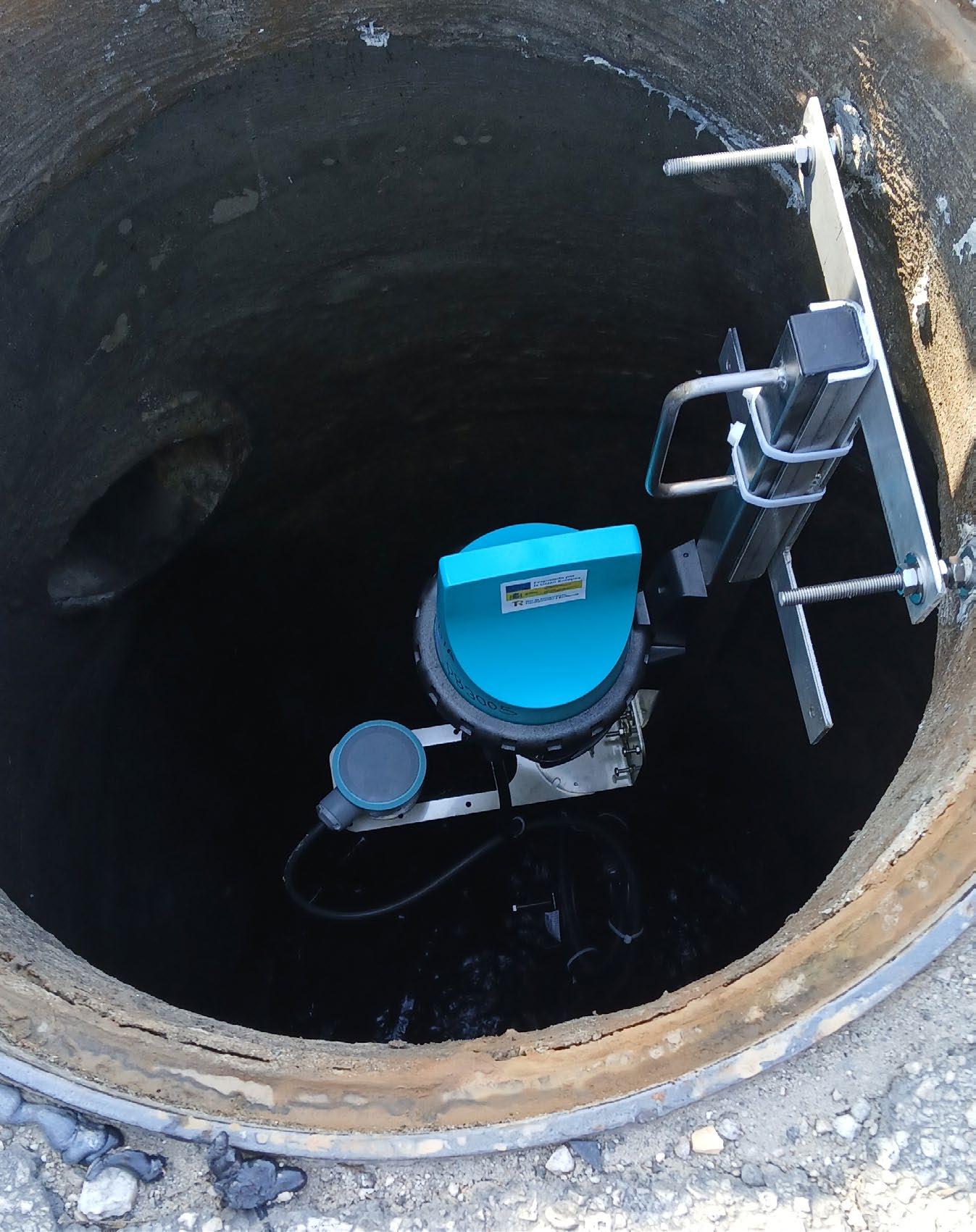
The platform measures the parameters that work in a harsh sewer environment: conductivity, oxidation-reduction potential, solids and turbidity, temperature, pH and depth via radar or
ultrasonic meters. A built-in assistant helps utilities site those sensors at the right hydraulic nodes.
Anomaly-detection algorithms run on an XGBoost backbone (a widely used gradient-boosting machine-learning method) trained on more than 400 verified discharges. They separate baseline conditions, real discharges and instrumentation failures from fouling or drift, and flag maintenance before
Sewer Tracker is now deployed in over 130 Spanish municipalities and is among the most ambitious in-network water-quality intelligence projects in Europe
readings become unreliable. When an event is confirmed, the hydraulic engine estimates its time of arrival at the wastewater treatment plant (WWTP), giving operators minutes to hours to isolate
The sewer used to be the urban blind spot. Across more than 130 Spanish municipalities, Xylem Vue’s Sewer Tracker is now turning it into a real-time, evidencebased asset, and the first line of defence for treatment plants under the EU’s revised Urban Wastewater Treatment Directive. biological-reactor lines, modulate aeration or hold the slug for analysis.
A second assistant cross-references the chemical signature against the catchment’s industrial census through a matrix that maps known pollutants to the industrial activities that typically produce them. Parameters not measured directly, such as heavy metals, are inferred from correlation with historical data. SCADA, GIS, meteorological feeds, laboratory results and CMMS (computerised maintenance management) work orders all sit in the same operational loop, so manual sampling and sensor maintenance are managed alongside the digital alarms rather than separately from them.
Sewer Tracker detects industrial discharges with a detection accuracy of more than 80%, a figure validated in a deployment in a Spanish municipality of around 20,000 inhabitants. Across 50 km of network and 11 multiparametric stations, the team verified 330 discharge events over eight months. The dataset was split 80/20, with the larger share used to train the algorithm and the held-out 20% used as a blind test,
confirming the reported accuracy. The same record also lets the system classify different discharge patterns and isolate instrumentation failures, which keeps the false-positive and false-negative rates useful in operational terms.
The same monitoring programme uncovered a chronic, unauthorised industrial discharge that had been silently inhibiting the biological reactor at the local WWTP for years, invisible to manual sampling but unmistakable in the continuous record. Once identified, mitigation measures ended the over-aeration cycle the plant had been forced into and stopped a recurring string of effluent-limit breaches.
Scale becomes the next chapter. In southern Spain, a regional deployment now coordinates discharge control across more than ten municipalities under a single operational view, the prototype for how regional water authorities will run multi-network oversight. The largest footprint is in the Mediterranean: more than 120 municipalities and over 200 continuous monitoring points, generating an aggregate data flow of more than 890 readings every 15 minutes across the network as a whole. This infrastructure has been made possible in part by targeted EU digitalisation funding. Together, they form one of the largest continuous IoT-enabled sewer water-quality monitoring systems in Europe.
The timing matters. The EU Urban Wastewater Treatment Directive (Directive 2024/3019), which replaces the 1991 framework (91/271/EEC) from August 2027, tightens phosphorus and nitrogen limits, accelerates tertiary treatment and phases in quaternary treatment for micropollutants under an extended producer responsibility scheme. For plants that were not designed around those limits, the treatment process has
to function perfectly, and an undetected industrial slug load is the difference between compliance and a fine of up to €1 million. Sewer Tracker delivers the continuous evidence layer that the new risk-management approach assumes. That evidence matters most where circular water programmes depend on it. The biological reactor at the heart of a WWTP can only deliver reclaimed water if it is protected from discharges it was never designed to absorb, and the sludge produced by that reactor can only remain viable for agricultural reuse
if heavy metals are kept out upstream. Without continuous network monitoring, both outputs end up downgraded: water that cannot be reused, and sludge diverted to landfill or incineration at high economic and environmental cost. This is what changes when a sewer network becomes addressable in real time. Sensor streams, plant telemetry, laboratory results and alarms converge in one place, with full traceability of every alert and every sample, so operators, regulators and citizens can finally see what is flowing beneath their feet.

“The sewer has always been a black box. This is the tool that opens it”
Pablo Montalvillo, Wastewater Digital Engineer at Idrica, leads Sewer Tracker, the Xylem Vue platform now deployed in more than 130 Spanish municipalities. He explains how real-time monitoring is turning the sewer network from a blind spot into a manageable asset, with measurable savings for utilities.
What is Sewer Tracker, and how does it technically detect illegal industrial discharges?
Sewer Tracker is a digital platform, one of the dedicated modules (verticals) within Xylem Vue, that turns water-quality control in the sewer network into a more transparent and manageable asset from a business standpoint. It’s a strategic early-warning system that gives wastewater treatment plants resilience, ensures regulatory compliance, and generates real cost savings.
What this tool achieves is a shift from the traditional manual, reactive sampling to more proactive and automated management. Today, Sewer Tracker is already deployed in more than 130 municipalities in Spain.
Can you quantify the value it generates for a utility: avoided disruptions, fines, or improvements in reclaimed water quality?
The value of using this tool is quantifiable, especially in four areas: sludge management, regulatory compliance, operational efficiency, and asset protection.
As a point of comparison between the cost of detecting a discharge with the traditional method (manual sampling in the network) and detecting discharges with sensors that provide real-time data, some time ago, an estimate was made of the probability of detecting a discharge with the manual method.
Most often, each sampling point in a municipality has a discharge-control plan that takes roughly one sample per month, twelve per year, and these are typically grab samples lasting about 7 seconds. If an industry discharges illegally 5 times a year, the probability of detecting it with that methodology is 1 in 300. Statistically, it would take 300 years to catch that discharge. It’s like trying to set up speed control at a point on the road by sending someone with a mobile radar for 7 seconds once a month, versus installing a fixed radar: the difference is enormous.
As for where the economic savings come from when using this tool: first, when a treatment plant fails to meet the discharge limits set by the River Basin Authorities, fines of up to €1,000,000 can be imposed on the permit holder, typically the municipal or supra-municipal entity responsible for the discharge, and if that entity cannot provide sufficient evidence to identify the industrial source, it ultimately bears the cost of those fines. If the plant can’t anticipate the impact, the effect drives up reagent consumption and energy-intensive processes, such as biological-reactor aeration, and also generates costs in the network and plant assets due to corrosion and other problems caused by discharges.
How do you see this kind of technology evolving as cities move towards circular water management? Cities need to control the discharges their industries make into the network. They can’t be blind to this, because otherwise it will be impossible for treatment plants to meet the increasingly demanding quality requirements being placed on them. It’s a tool that brings transparency to the municipality, to the system operators who need real information, and also to citizens. It’s also a way to optimise management and make it more automated, so that there is always traceability of what is happening with discharge control.
Until now, the sewer system has always been a kind of black box: you don’t really know what’s going through it. This is a tool that will help reveal what is actually happening down there.
And I’d add: we have another tool very similar to this one, with a very similar use case, for monitoring viruses, pathogens, and pharmaceuticals and drugs of abuse in the sewer system. The approach would be very similar, and it would also help make the sewer network something less completely unknown, and even allow us to obtain data on behavioural patterns in society or on the rising presence of a given virus or pathogen. I think there’s still a lot to be done in this space, and tools of this kind are going to add a lot of value. •
AUTHOR : KES JUSKOWIAK, MANAGING DIRECTOR, RSE
Any schoolchild learning about the water cycle knows water is constantly reused, but water reuse at an industrial scale regularly prompts a response that is out of kilter with this reality.
Many parts of the world, including the UK, are grappling with the requirement for water reuse for the first time as a result of shifting populations, ageing infrastructure and climate change. Closer to home, environmental protection and net-zero targets are a core focus of Asset Management Period 8 (AMP8) – the UK water industry's regulatory investment cycle running from April 2025 to March 2030. Utilities are therefore increasingly expected to have strict compliance mechanisms in place, with financial
penalties paired with short timelines to catalyse adoption.
From reducing storm overflow events to meeting tighter nutrient limits for phosphorus and nitrogen, as well as reducing forever chemicals and preparing for emerging contaminants – companies are doing this while facing an already stretched compliance environment. These challenges mean everything must happen more quickly than traditional infrastructure delivery models currently provide. Australia and Spain are key leaders in the reuse space, with the U.S. rapidly accelerating its efforts – and global shifts mean it’s time for the rest of the world to catch up.
Globally, the market is shifting from a traditional “take-use-discharge” model toward a circular water economy, where wastewater is increasingly viewed as a recoverable resource rather than a disposal challenge. This shift is accelerating investment in advanced treatment trains capable of converting municipal and industrial wastewater into high-quality reuse water suitable for agriculture, industry and, increasingly, potable applications.
The case for regulated reuse is made stronger still by the wave of data centres that are springing up across the globe. They are water-hungry, and are increasingly planned for locales with significant water stress, like southeast England. While there are no accurate usage forecasts for AI’s water requirements, estimates can be stark. Data centres could require 6.6 billion cubic metres of water globally by 2027, equivalent to almost two-thirds of England’s annual consumption, and this is set against rising scarcity. Developing closed-loop water recycling technology can support the rise in computing capability while minimising water demands on the environment.
Membrane technologies are becoming increasingly central to advanced treatment strategies. Membrane bioreactors (MBR), ultrafiltration (UF), reverse osmosis (RO) and advanced oxidation processes are being combined into multi-barrier treatment trains capable of producing exceptionally high-quality recycled water. These technologies are no longer niche solutions. Declining membrane costs, improved energy efficiency and modular manufacturing approaches are making advanced reuse systems commercially viable at a far wider range of scales.
The combination of biological treatment, membrane filtration, RO, UV disinfection and advanced oxidation creates multiple independent barriers that col-
lectively deliver water quality standards that can exceed many conventional raw water sources. Regardless of application, successful water reuse is – of course – a technical matter, requiring high-quality equipment to meet regulator-mandated clean water standards. In the UK, it is important that regulators provide a clearer view on quality limits for drinking water.
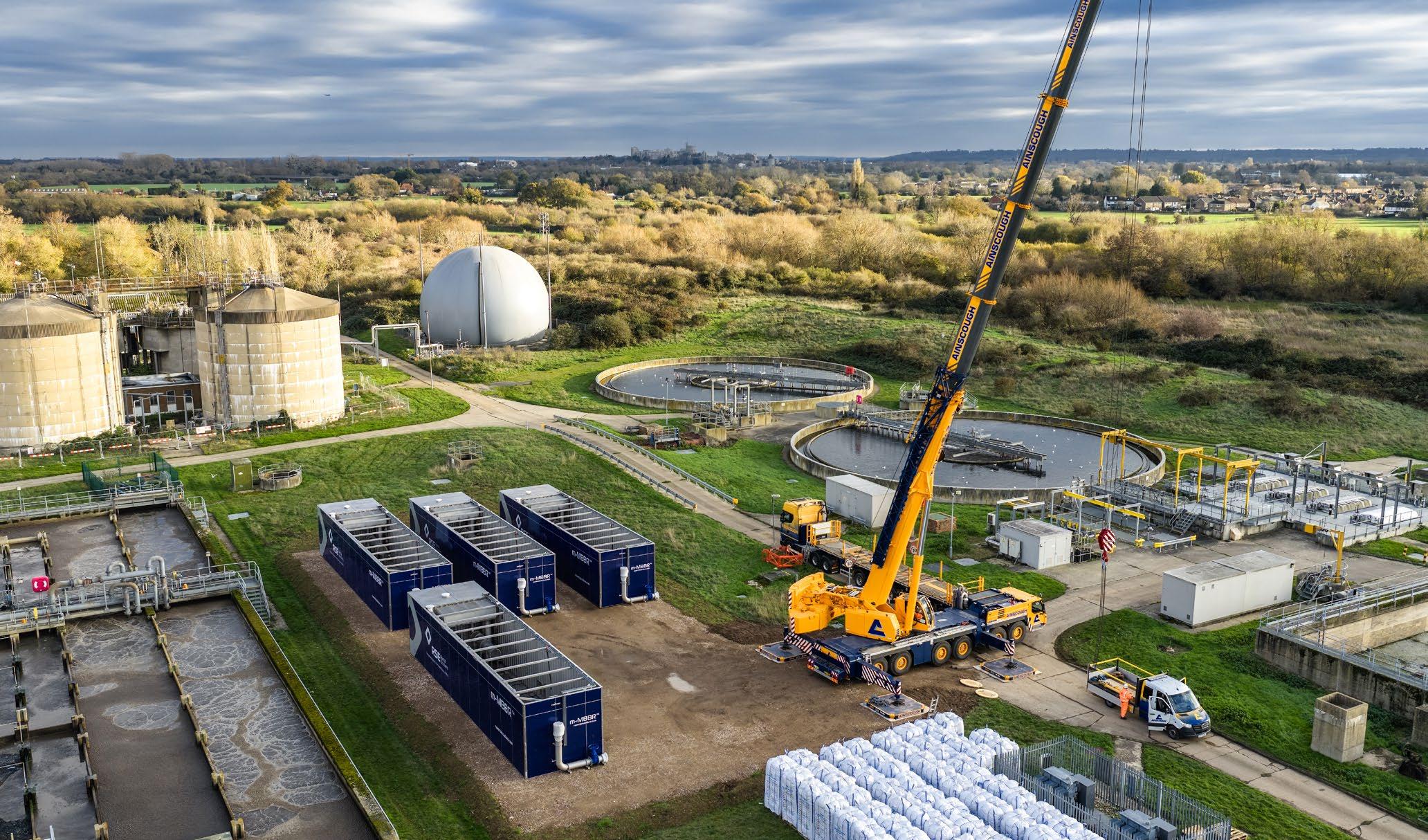
Robust quality standards don’t mean infrastructure deployment needs to move slowly, however. Historically, it took around four years to design, build, and commission a new water treatment works; including typically two years of on-site work. Today, by shifting to modular, factory-built solutions, we can complete that same build in just six months; deliver and install in three months and commission in three months.
Our systems can also allow factories to achieve closed-loop recycling – ultimately moving toward zero liquid discharge – or help municipalities to reclaim wastewater for irrigation, street cleaning, and other non-potable needs. As water becomes an increasingly valuable commodity, innovative reuse rises up the value chain.
Increasing water reuse requires public trust in the quality of drinking water – even when reuse plans don’t directly relate to potable water – and informed understanding of the pressures the system is under.
Water reuse and desalination should not be viewed as competing technologies. Increasingly, resilient water strategies combine both approaches, using desalination for drought resilience and recycled water for sustainable baseload supply and environmental protection.
The realities of system pressures can be lost in understandable cost-of-living discourse, and the fact that UK water
WATER
Data centres could require 6.6 billion cubic metres of water by 2027, equivalent to almost two-thirds of England's annual consumption
bills are rising at the fastest rate since 2005. The picture in the U.S. is no better; the American Water Works Association predicts that bills stateside could more than double as a result of required infrastructure investment. It would push 30.4 million households above the 2.5% income affordability threshold.
We will not inspire people by wringing our hands; instead, we must celebrate the engineering that can drive effective water reuse, ultimately keeping everyone’s taps open. This industry and government need to communicate cohesively and effectively about our water systems is an underweighted part of the task ahead. If consumers believe they are getting a substandard product against this cost backdrop, it is a recipe for disaster.
We’ve long known that there isn’t enough potable water for our planet’s population and the significant new projects planned. Water reuse can be an important part of the solution, but this will require investment from water companies, backed by regulator courage. None of it exists in a vacuum either. The unfair stigma that water reuse attracts in public consciousness needs to be tackled head-on.
Waiting for change is not a strategy. We now have the technology, expertise and a proven cost-effective methodology that can enable a new era of effective water reuse, but we do not yet have the political and regulatory will, and the associated public support to deliver it at the scale required.
Managing Director, RSE
What are the key challenges when it comes to water reuse at scale?
The UK, like many places, has ageing infrastructure, and this must be urgently addressed. This means time and cost are essential, so being able to find solutions that accelerate deployment, reduce risk and deliver long-term value across the water network is absolutely essential.
The future of water resilience will not depend on a single technology, but on intelligently integrated treatment trains that combine biological processes, advanced membranes, digital monitoring and modular delivery models. The technology already exists to safely recycle wastewater into high-quality reusable and even potable water at scale. The challenge now is accelerating deployment while building the public trust and regulatory confidence needed to support this transition.
What’s an emerging trend in water reuse?
The combination of treatment process trains, where high recovery rates secure circular water use, is not only an emerging trend but an imperative for the water industry. Creating systems that can recover water and treat it to a high standard, either to be directly entered into public drinking water supply or to recharge water resources such as aquifers or reservoirs. The growing understanding of the huge pressure on global water supplies is elevating focus on water reuse. In this environment, it becomes a necessity, and focus falls on costs and delivery timescales to maintain access and quality, especially at a time of record consumer bills.
We are also watching how data centres fit into the mix, particularly in water-stressed parts of the UK and other geographies. Water reuse plans will likely get much more attention from governments and regulators in the future.
Why are water companies turning to RSE for support?
Our ability to deploy modular technology quickly and effectively, leading to improved water quality results, is the primary motivator. At the same time, everyone in the water industry is having to adapt to rapidly changing conditions and demands. Our proven ability to continuously innovate is something our clients and partners value highly. With 40 years of experience delivering high-quality products in the water industry, RSE is an expert integrator in combining and commissioning different technologies quickly and efficiently for the best outcome for customers.
What can technology integration achieve?
RSE uses an integrated suite of technological solutions to develop a single delivery model, structured with efficiency and scalability in mind. Our approach combines advanced process technologies with real-time controls and monitoring,
as well as nature-based solutions, to keep our customers ahead of new targets.
At the core of RSE’s operations is modularisation, designed to simplify construction and improve operational performance. Our standard products are fully designed, manufactured and tested in-house before delivery. This saves our customers time and money by reducing build time and disruption on-site. New treatment facilities can therefore be deployed rapidly and scaled to site-specific requirements at the time – making upfront commitments less costly and more adaptable as needs change over time.
This helps utilities respond more effectively to complex and evolving targets such as storm overflow reduction. RSE’s modular treatment facilities remove pressure from treatment works by providing the effective capacity needed to process more incoming flow during peak conditions like heavy rainfall events or flooding. Where overflows can’t be avoided, our wider treatment capabilities can improve the quality of discharged water through targeted treatment stages to mitigate environmental impact and improve water quality standards more generally.
“”
Water reuse plans will likely get much more attention from governments and regulators in future, especially in waterstressed geographies
The same modular approach enables a more targeted response to environmental compliance. RSE’s configurable process trains (allowing customers to customise, add, or remove manufacturing steps and equipment to meet specific requirements without redesigning the entire system) combine chemical dosing, mechanical filtration and biological water treatment solutions to help meet strict quality standards such as those relating to nutrients or forever chemicals.
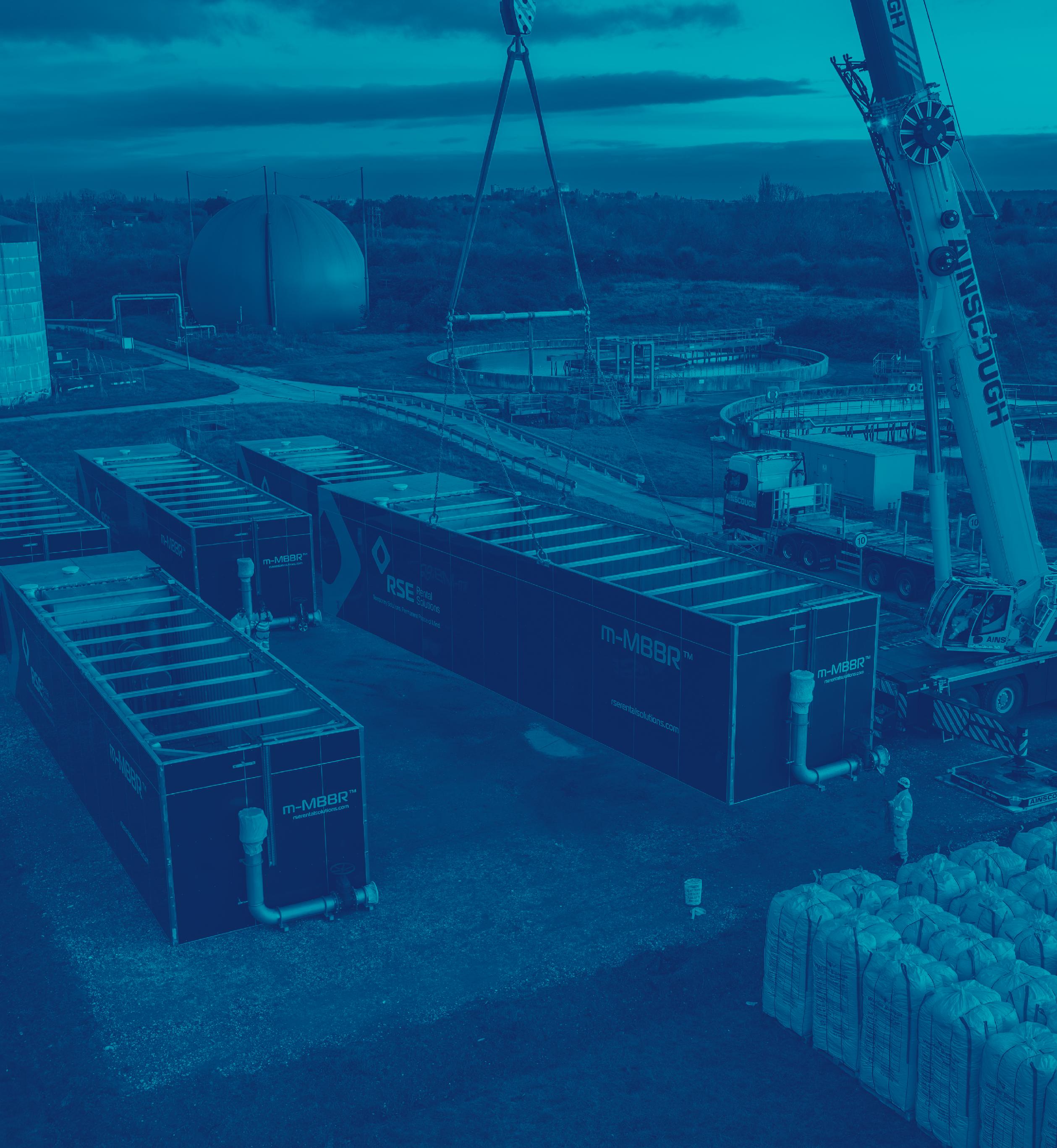
Our m-MBBR® and m-MBR are both high-efficiency modular wastewater treatment systems. They can be scaled and integrated to the needs of the client, providing a flexible platform to combine other treatment processes and support greater circularity of water resources. •

António Pinto
STRATEGIC STUDIES SPECIALIST AT ÁGUAS DO TEJO ATLÂNTICO
The most important innovation in wastewater treatment is not a single technology, but the integration of different technologies and data into plants that can think, adapt and recover value. We are no longer asking only how to meet a discharge consent, but also how to produce reusable water, cut emissions and make existing assets work better and harder. Driven by regulatory pressure, climate urgency, and technological breakthroughs that are redefining what a treatment plant can do, the change is more than a shift in name from Wastewater Treatment Plants to Water Resource Recovery Facilities (WRRF).
Perhaps the most structurally significant shift is the development of digital twins. It can test, detect, forecast, estimate, optimise and support decision-making at every level and even operate the treatment plant automatically through real-time AI-driven optimisation, moving from reactive to predictive.
The gap between the state of the art and the average plant remains wide. Data scarcity, heterogeneity, and sensor reliability issues limit model accuracy in real-world applications, and many models are trained in laboratory conditions that do not reflect operational complexity.
The new Directive opens the conversation on the following three subjects. Tertiary treatment is moving from a polishing option to a necessity. Enhanced biological phosphorus removal, post-denitrification, tertiary filtration, chemical
precipitation and low-dose carbon control will be judged by stability, not peak performance. A plant that fails to comply during wet weather or cold starts is not resilient, but operationally fragile.
This is where membranes and aerobic granular sludge (AGS) deserve attention. Membrane bioreactors can produce high-quality effluent suitable for reuse. AGS is exciting because of its capacity for carbon, nitrogen and phosphorus removal in compact reactors with excellent
"The weak point will not be technology availability; it will be data quality,
instrumentation maintenance and institutional confidence"
settling. In dense cities, footprint is becoming as important as effluent quality, and the ease of application of these technologies to old infrastructure is a practical response to ageing assets, land scarcity and tougher permits.
At the same time, innovative biological nitrogen removal technologies are gaining increasing relevance in the context of energy efficiency and process intensification. Solutions like MABR, IFAS/ MBBR systems and deammonification/ Anammox processes, for sidestream and,
increasingly, for mainstream deammonification, enable more compact, energy-efficient and flexible wastewater treatment configurations, especially in retrofit applications where footprint is limited.
Quaternary treatment is the hardest test the sector will probably endure. Ozonation and granular or powdered activated carbon, or a combination of both, are increasingly mature and can reduce many micropollutants.
In the sludge line, the optimisation of anaerobic digestion has become a priority for energy recovery. Thermal hydrolysis processes (THP) have proved transformative, dramatically improving biogas yields and reducing sludge quantities for disposal. More recently, the microbial hydrolysis process, developed by Jacobs, has attracted significant interest as a biological alternative, without the thermal energy demands of THP.
The next decade will reward hybrid intelligence. The weak point will not be technology availability; but data quality, instrumentation maintenance, cybersecurity, skills and institutional confidence. A plant cannot be smart if its sensors are neglected or its operators are excluded from the model.
The future WRRF must simultaneously recover energy, reclaim nutrients, protect receiving waters, and remove contaminants that did not exist in the regulatory lexicon a generation ago, with the minimal possible cost. That is an extraordinary challenge and opportunity.

The operational efficiency of operators today is measured strictly by their ability to predict asset behaviour, plan long-term investments and act proactively in the face of anomalies before they reach a point of no return.
This profound sectoral transformation towards true predictive maintenance is underpinned by a three-dimensional technological infrastructure: Geographic Information Systems (GIS), Computerised Maintenance Management System (CMMS) platforms, and advanced Artificial Intelligence (AI) algorithms integrated with closed-circuit television (CCTV) inspection systems. ACCIONA, as a leading pioneer in the digitalisation of the full water cycle, has succeeded in integrating these technologies into a unique automated ecosystem, eliminating traditional information silos and ensuring comprehensive, rapid and reliable infrastructure management.
GIS: the dynamic asset inventory
In ACCIONA's model, GIS has evolved from being a mere cartographic reposi-
tory or static digital map into a dynamic relational database, directly linked to day-to-day field operations and subject to continuous updates of the inventory, its characteristics and its status. At the heart of this system is the robust asset inventory, conceived as the "Data Source" for strategic decision making.
An optimised inventory within the GIS environment delivers value across three critical dimensions:
1. Operational Accuracy. Enables the georeferencing and location of physical assets.
2. Advanced Modelling and Predictive Analysis . By cross referencing spatial data with tabular variables, GIS moves beyond a purely descriptive role to become a predictive analysis tool, enabling the modelling of vulnerability scenarios and the identification of specific sections with a higher mathematical probability of suffering breaks or losses of hydraulic capacity.
3. Attribute Integrity and Business Intelligence . A geometric feature on the map is of little value if it is not linked to a rich alphanumeric matrix. Detailed
In modern urban water infrastructure management, traditional operational models based on rectifying problems after they have occurred have become obsolete. It is no longer acceptable, either economically or environmentally, to wait until a sewer has physically collapsed, a sinkhole has appeared on a public road, or an unexpected overflow has occurred during torrential rain before taking action.
tabular information, including materials, installation dates, linings, rehabilitation and operational histories, structural condition, and other attributes, transforms a simple graphical vector into an intelligent feature capable of reporting on its own life cycle.
CMMS
the engine that transforms data into operational action
For geospatial and predictive intelligence to translate into tangible improvements on the ground, a robust Computerised Maintenance Management System (CMMS) is essential. Within
ACCIONA's digital ecosystem, this central role is fulfilled by the GOTA (Acciona Work Order Management) system. GOTA acts as the fundamental logistical bridge and the two-way operational link connecting the analytical requirements of the technical office with the mobile terminals of the teams operating on public roads, directly coordinating human and material resources in real time.
The GOTA platform integrates natively with the most advanced digital inspection systems so that field units receive the Work Order (WO) and the assets to be inspected automatically. This close integration of systems eliminates the need to re-enter data manually or rely on printed document workflows, significantly accelerating on-site operations and ensuring the absolute integrity of the information. GOTA ensures that no network asset is left unmanaged
ACCIONA's model, GIS has evolved from being a mere cartographic repository or static digital map into a dynamic relational database
and that every detected anomaly is duly recorded, assigned and resolved under strict traceability controls.
To provide this digital brain with accurate information, it is vital to equip the organisation with high-precision diagnostic tools for use inside the pipes. Inspection using robotic CCTV systems, drones and robotic inspection units represents the most advanced methodology for assessing the internal condition of sewers without the need for open-cut works. The primary objective of these campaigns extends far beyond video capture, focusing instead on the systematic extraction of structured data to calculate the actual probability of failure for each section of the infrastructure.
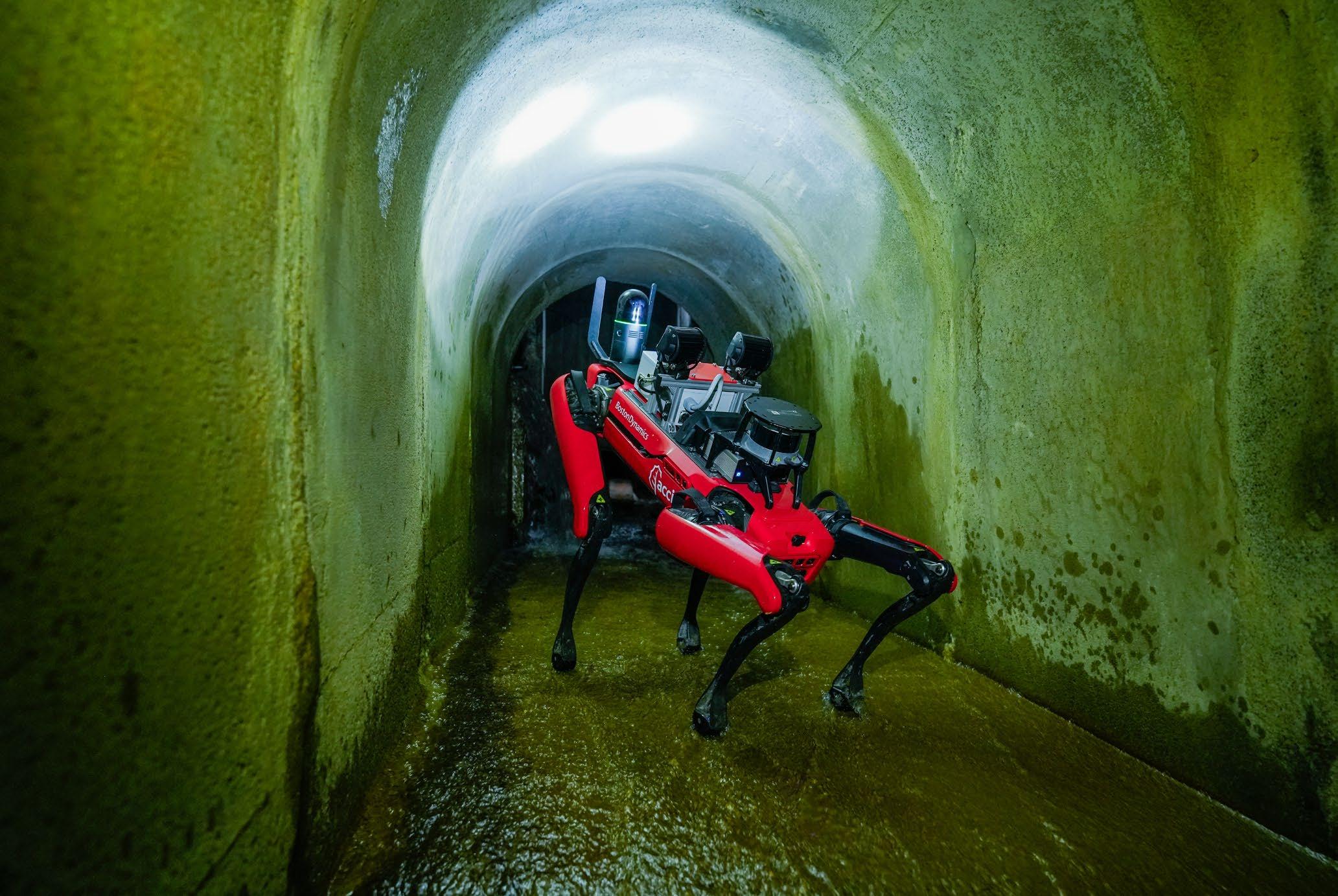
The field inspection process is carried out according to a strict technical procedure:
• Inspection using Robotic Units: Robots equipped with adaptive traction to overcome sediment, high-resolution cameras and advanced geometric sensors are inserted into the sewers. These devices travel through the sewers, recording video in real time.
• Laser Profiling Systems: The most advanced equipment incorporates a laser ring that projects a precise geometric pattern onto the inner walls of the pipe. This enables the oval deformations suffered by flexible or semi-rigid pipes due to mechanical overloads from the ground or surface traffic to be measured with millimetre precision, detecting structural faults invisible to the naked eye.
• Standardised Coding under European Standards: To eliminate subjectivity in diagnoses, observations are structured in accordance with international standards. Each finding is rigorously classified into two main categories:
1. Structural Defects: Longitudinal and circular cracks, breaks, displaced joints, vault collapses, or corrosion caused by hydrogen sulphide.
2. Functional Defects: Intrusion of tree roots, accumulation of consolidated sediments, encrustations, severe obstructions or large deposits of grease and oil.
• Numerical Condition Rating: Linked to the coding system, each type of defect is assigned a numerical value based on its severity and extent. Upon completion of the section analysis, the software algorithmically processes the penalties to assign a standardised Condition Rating on a scale of 1 to 5, accurately determining the level of degradation of the sewer.
Using network behaviour management and analysis tools, GOTA issues a digital Work Order (WO). The operator receives a project on their vehicle's field computer containing the sequential route and the technical data sheets for the assets to be inspected. Thanks to native recording tools and their geographical modules, GIS layers are displayed directly on the operator's control console, integrating the graphical inventory with the work order. The technician no longer has to manually enter infrastructure information. Subsequently, the automated system directly links each video file and inspection database to the unique ID of the asset in the inventory, safeguarding the integrity of the information and eliminating errors caused by manual transcription.
sive, standardised and strictly objective data analysis.
The competitive and performance advantages that AI brings to this workflow are disruptive for three fundamental reasons:
• Automated Detection: Computer vision algorithms analyse images frame by frame, instantly identifying defects such as cracks, blockages and roots without the operator having to constantly stop the equipment.
•Neutralisation of Fatigue and Human Error: Continuously viewing hours of footage from dark pipelines causes cognitive fatigue in operators. AI maintains a consistent hit rate and absolute precision throughout the working day.
• Absolute Standardisation of Criteria: Ensures the technical consistency of diagnoses on a global scale. A specific defect will be coded with the same severity and under the same standards regardless of whether the inspection is carried out in one geographical area or another, eliminating discrepancies in criteria between different operators or inspection technicians.
GOTA ensures that no network asset is left unmanaged and that every detected anomaly is duly recorded, assigned and resolved
Once the data has been collected and the assets in the assigned area inspected, artificial intelligence (AI) comes into play, natively integrated into ACCIONA's workflows. The incorporation of advanced deep learning and computer vision models radically transforms a process that historically depended on a technician's visual skills and subjective interpretation into a discipline of mas-
In addition to real-time analysis, AI is revolutionising post-processing in the technical office. Traditionally, drafting technical reports, selecting screenshots of defects and converting observations into regulatory codes took as long as, or even longer than, the physical inspection itself on site. With the self-coding systems implemented by ACCIONA, AI interprets visual findings and translates them directly into the character strings required by regulations, instantly populating data tables and reducing office processing times.
True technological and operational excellence does not lie in the flashy use
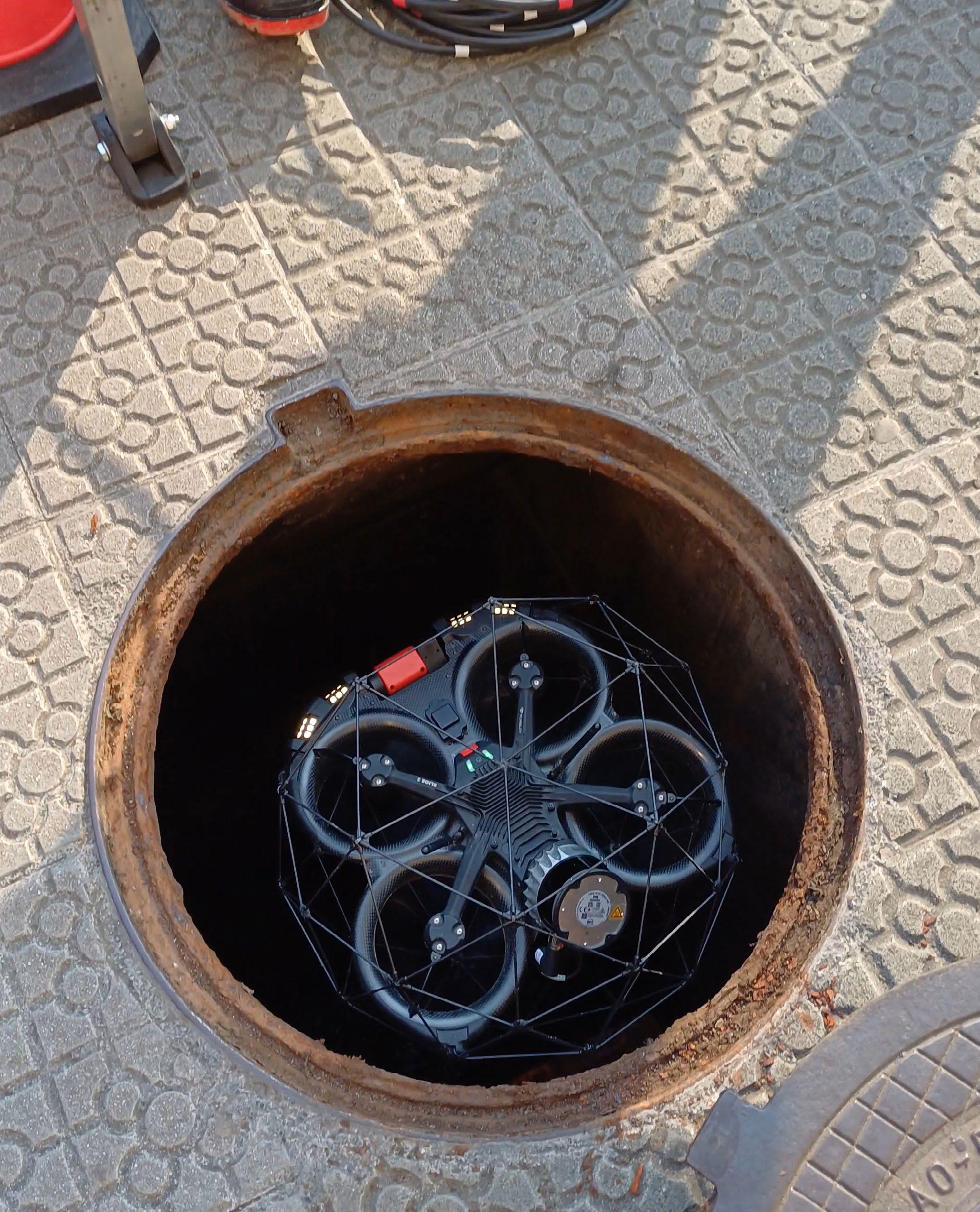

of robots or isolated algorithms, but in ensuring that engineering data flows automatically, transparently and without manual intervention between all operational and management tools, guaranteeing full traceability. This integrated flow ensures that the cartographic inventory remains a living entity, a faithful reflection of the physical reality underground.
Once the fieldwork has been completed and the AI analysis has been passed, the project is uploaded to ACCIONA's central system, which consolidates the information and automatically generates high-resolution digital technical reports for each section:
1. Analytical Longitudinal Defect Profile: A continuous engineering graph that linearly represents the pipeline's route, pinpointing the exact metre and centimetre location of each detected anomaly.
2. Linked Photographic Captures: Clear visual evidence captured automatically by the software at the precise moment the defect is detected, integrated directly as graphic appendices in the technical report.
3. Calculation of Structural and Hydraulic Condition Indices: Weighting algorithms that assess the density and severity of defects to issue a final rating of the asset's condition.
4. Indexed and Cloud-Linked Video: High-definition video files are stored on cloud servers and are permanently indexed to the collector's alphanumeric record in the GIS.
The final synchronisation with the central database updates critical attribute fields such as the Date of Last Inspection, Condition Rating and other asset attributes via automated database files for each work area. The most important aspect of this methodology, designed by ACCIONA, is the predefined coding that enables PDF files and
The competitive and performance advantages that AI brings to this workflow are disruptive for three fundamental reasons:
These advanced, automated digital ecosystems that integrate GIS, CMMS (GOTA), inspection robots and AI are not a theoretical exercise or a futuristic science fiction scenario. They represent an established operational reality that is already increasing the resilience, sustainability and efficiency of water infrastructure in complex urban environments.
alphanumeric data to be linked bidirectionally between the CCTV, CMMS and GIS environments.
From this point onwards, the automated business intelligence workflow operates autonomously based on the asset's Condition Rating:
• If the Condition is Critical (Ratings 4 or 5), GOTA automatically generates a repair request or a new Work Order for the engineering department so that the refurbishment or replacement project can begin.
• If the Condition indicates a high sediment density, the system schedules an automated preventive cleaning task for the operational calendar.
• If the Condition is Optimal (Ratings 1 or 2), the system updates the date of the next routine predictive inspection.
This entire circular process is fully recorded and documented in the asset's lifecycle history, enabling the GOTA platform to ensure that no defect identified by the technology goes unaddressed.
In this demanding, competitive landscape, ACCIONA has positioned itself at the forefront of global water engineering. Its pioneering leadership lies not merely in the individual adoption of advanced IT tools, but in its strategic vision to combine high precision water engineering with Industry 4.0 technological solutions. The company has successfully demonstrated that the key to success lies not merely in capturing data, but in its comprehensive governance, enabling corporate and technical decision-making to shift from being purely reactive to proactive and predictive, thereby optimising all operational processes.
The ultimate goal is clear: to transparently transform sewerage networks into smart infrastructure, ensuring that underground network mapping becomes, more than ever, a living tool serving sustainability and urban efficiency in our cities. •
ACCIONA’S leadership lies in its strategic vision to combine high-precision water engineering with Industry 4.0 technological solutions

AUTHOR : DAVID ESCOBAR
The global sanitation crisis is no longer a story about scarce capital. It is a story about who can structure a deal that actually closes — and the emerging economies are writing the manual.
Somewhere in the back office of a finance ministry, money that has already been approved is not being spent. This is not a metaphor. It is the single most important fact in global sanitation today, and it should reframe how you think about every project on your desk.
The conventional story about why 3.4 billion people still lack safely managed sanitation is a story about scarcity. Capital is short. Donors are stretched. The gap is too wide. All of that is true. But the World Health Organization's latest global assessment, launched in Dakar this January as the world prepares for the UN Water Conference, documents something the scarcity narrative misses. Fewer than 13% of countries reported having the financial and human resources to deliver their own WASH plans. The funding gap between identified needs and available money sits at roughly 46%. And in too many systems, close to 40% of the water that does get treated and pumped is lost before anyone pays for it. There is no shortage of evidence that the money pays for itself. The World Health Organization has calculated that every dollar invested in sanitation returns five dollars and fifty cents in lower health costs, higher productivity, and fewer premature deaths. The economic case has been settled for years. The execution case has not.
Read those numbers together and the conclusion is uncomfortable. The crisis is not only that there is too little capital. It is that the capital already in the room cannot be absorbed, executed, and recovered. That distinction matters to you, because it changes where the opportunity is. The winners in this market are no longer the players with the deepest pockets. They are the ones who can structure a deal that actually closes, actually gets built, and actually gets paid back.
For thirty years the argument about private capital in water moved between two poles. One camp wanted the state to own and run everything. The other wanted to privatize and let markets sort it out. Both positions are now largely irrelevant to how money is actually moving.
The public-private partnership reasserting itself across the Gulf, South Asia, and Latin America is not the ideological privatization of the 1990s. It is something more disciplined: a structure built to share risk in calibrated proportions rather than dump it wholesale on one side. The instruments that make this work are blended finance, performance-linked payments, sovereign offtake guarantees, and credit enhancements that turn an unbankable project into a bankable one. The skill that separates a winner from a casualty is no longer access to capital. It is the ability to assemble the package.
The case for this approach does not rest on theory. It rests on two recent contracts in the same country, structured the same way, with opposite outcomes.
Start with the model that works. In Saudi Arabia, the state water offtaker has been awarding independent sewage treatment plants on a build-own-operate-transfer basis with a consistency that should command your attention. The three plants at Madinah, Tabuk, and Buraydah, developed by Acciona with Tawzea and Tamasuk, carry a combined contract value of around one billion dollars and will treat 440,000 cubic metres a day. The financing told the real story: a green-loan package of roughly 480 million dollars, of which just over 60% was structured as Islamic Ijara finance. The plants generate up to 57% of their daily electricity on site, from solar and biogas. This is what a modern sanitation
asset looks like when capital, energy, and reuse are designed together rather than bolted on.
Then look at the two plants the same offtaker awarded at Makkah, Hadda and Arana, because they reveal where the value is migrating. The treated sewage effluent reuse system, the pipelines and storage that move reclaimed water to where it can irrigate or cool, accounts for 27% of the winning bidder's levelized cost at Hadda and 31% at Arana. Stop and absorb that. Nearly a third of the cost of a sewage plant is now the infrastructure that turns its output into a sellable product. Reuse is no longer a sustainability footnote. It is a third of the asset.
India offers the template the Gulf is now perfecting. Under the hybrid annuity model deployed along the Ganga, the government pays 40% of a plant's capital cost against construction milestones and the remaining 60% over fifteen years, contingent on performance. At Mathura, the operator sells roughly twenty million litres a day of reclaimed water to an Indian Oil refinery for cooling, the offtake agreement underwriting the project's economics. That single structure has already been replicated across eleven cities, mobilizing some 500 million dollars of private investment. Performance-linked payment is no longer an experiment. It is an export.
The winning tariffs sharpen the point. The Metito-led consortium took Hadda at 2.354 riyals per cubic metre. The Miahona-led consortium took Arana at 1.35 riyals. Five consortia competed for these contracts, including GS Inima with Alkhorayef. The model is competitive, it is repeatable, and it is producing price discovery the sector has never had at this scale.
But notice the caution embedded in the timeline. Neither Hadda nor Arana has reached financial close. The deadline has slipped beyond the second quarter of 2026. The next plant in the pipeline, the
400,000-cubic-metre Riyadh East ISTP, has not been awarded at all: bids are not even due until the end of June, with financial close pushed into the fourth quarter of the year. Even the most disciplined PPP program in the world moves slowly from preferred bidder to signed money. If you are modelling these projects, model the lag.
When the same model breaks
Now the counterexample, and it is essential, because a market that only celebrates its successes is lying to you. Earlier this year, one of the largest sanitation auctions in Brazil, a three-lot package valued at roughly 1.2 billion dollars, was cancelled. Only one lot attracted a bid, and that bid was suspended over failures in the delivery of guarantees. The auction drew open criticism over its investment assumptions and a simple lack of market interest. No relaunch has been announced.
This was not the failure of an immature market. It happened in the same country, under the same legal framework, riding the same wave of private capital that has made Brazil the cleanest natural experiment in sanitation finance anywhere. Since the 2020 regulatory reform set binding targets of 99% water and 90% sanitation coverage by 2033, Brazil has become the market everyone watches. São Paulo is preparing a regionalized concession program worth around 5.8 billion dollars, organized into river-basin blocks, with bidding expected this year. Sabesp, the state heavyweight, is consolidating, having moved
in January to acquire 90% of the Mirassol concessionaire Sanessol. The pipeline is enormous.
And yet it collapsed. It collapsed not because Brazil lacks capital or ambition, but because the risk on that particular transaction was not calibrated. The guarantees were not deliverable. The investment math did not convince the market. This is the OECD and Islamic Development Bank's central thesis made concrete: the experience with water PPPs has always been mixed, and the line between the bankable and the abandoned runs precisely through the quality of the structure. The lesson for you is not that one market is risky. It is that the model is not automatic. The same framework that rewards a well-structured concession in one state strands a poorly guaranteed package in the next.
Above the project level, something larger is happening, and it explains why this is the moment and not five years ago. The institutional capital that once treated water as the fourth vertical behind energy, transport, and digital has reordered its priorities.
The signal event is the close of Global Infrastructure Partners' fifth fund at 25.2 billion dollars in mid-2025, raised from 278 institutional investors across 35 countries and described as the largest infrastructure fundraise in history by Infrastructure Investor at the time of its close. GIP, now inside BlackRock, sits on combined infrastructure assets approximately 170 billion dollars. The question that should occupy you is not whether that capital exists. It is how much of it reaches water, in what form, and on what thesis.
The merger and acquisition data answers part of the question. There were 159 water-sector transactions in 2025. American Water Works agreed to merge with Es-
sential Utilities in an all-stock transaction with a combined enterprise value of approximately 63 billion dollars, pending regulatory approval and expected to close in early 2027. Parker-Hannifin agreed to buy Filtration Group for 9.25 billion. Below the landmark deals, private equity ran a roll-up strategy, with New Mountain Capital alone making ten acquisitions through its water platforms. The capital is not buying single assets anymore. It is building platforms, and platform consolidation is reshaping your supplier base as forcefully as any regulation.
The survey data confirms the shift is structural, not cyclical. In a 2024 industry survey, 30% of respondents each put more than 500 million dollars into water, and 96% said they would hold or increase that exposure. For the first time, the average commitment from infrastructure funds, around 1.3 billion dollars, is closing in on the public sector's 1.5 billion. The private and public pools are converging, and that convergence is the clearest quantitative proof that water has graduated into a core institutional asset class.
Four forces are driving the reordering. Regulatory pressure on contaminants and discharge standards is converting environmental obligation into predictable, mandated capital expenditure. Water scarcity is turning reuse from a marginal nicety into a strategic asset, as those Saudi reuse economics already proved. Climate risk is pushing funds toward defensive, uncorrelated assets, and water is the defensive asset par excellence. And the platform model has demonstrated that you can assemble the kind of consoli-
dated vehicle institutional capital knows how to run.
If you want a single illustration of why calibration, not capital, is the binding constraint, look at Thames Water. The KKR rescue collapsed. What remains on the table is a creditor-led recapitalization by a consortium called London & Valley Water, led by Elliott Management and Apollo among a broader group of senior creditors including Invesco, Aberdeen, M&G and PIMCO, proposing 3.35 billion pounds of new equity and up to 6.55 billion pounds of new debt, contingent on a 30% write-off of senior debt and the wipeout of everything junior to it. It is non-binding, and it is conditional on the regulator's agreement.
This is the largest, most mature, most sophisticated water market in the world, and even here the lesson holds. When the structure is wrong, when leverage outruns the regulated revenue that services it, no amount of available capital saves the asset. It simply changes who absorbs the loss. The decision-maker who reads Thames as a British anomaly is missing the point. It is the global thesis in its starkest form.
Where the gap is widest and the capital thinnest
The market that most needs this discipline is the one where private capital is scarcest. In Africa, fewer than 45% of people have access to basic sanitation, and roughly 90% of urban sanitation is non-sewered. The institutional answer is taking shape. The African Development Bank's Africa Urban Sanitation Investment Initiative, launched in 2024 with 12 million euros from the Nordic Development Fund and 6 million dollars from the Gates Foundation, aims to mobilize
320 million dollars for 50 projects and reach 15 million people over a decade.
The continent also offers a live demonstration of how operators scale through structure. Hassan Allam, in joint venture with Metito, won the upgrade of Alexandria West to 600,000 cubic metres a day of secondary treatment. Then, in April, Hassan Allam moved to acquire Metito's project arm outright, building an integrated platform spanning Egypt, the Middle East, Africa, and beyond. The same platform logic driving North American consolidation is now reshaping who builds Africa's sanitation. The open question is whether the PPP model can reach the 90% of non-sewered sanitation or whether it remains confined to the large urban plants where the economics are easy. That is not a technical question. It is a structuring question, the same one that separates a deal that closes from one that collapses. Where the guarantee can be built and the revenue can be recovered, the capital flows. Where it cannot, the plant remains a slide in a conference deck.
This is the discipline the unbanked segment demands. The 90% of African sanitation that sits outside the sewer network will not be reached by replicating a 440,000-cubic-metre Gulf megaplant. It will be reached, if it is reached, by structures patient enough to blend grant capital, concessional debt, and commercial money in proportions that make a fundamentally thin revenue stream bankable. The operators who learn to do that, and the development
WHEN THE STRUCTURE IS WRONG, NO AMOUNT OF AVAILABLE CAPITAL SAVES THE ASSET
banks that learn to de-risk it, will define the next decade of the market.
The manual for the next cycle
Step back and the patterns rewriting the rulebook come into focus. Financing packages that fuse green and Islamic capital. Performance-linked annuity structures exported from one market to the next. Reuse offtake that now constitutes a third of a plant's cost and turns effluent into revenue. Energy self-generation that answers the sector's own carbon question. And institutional capital that arrives through platforms, not projects.
Notice who is writing this manual. It is not the mature markets of Western Europe and North America. It is Saudi Arabia, India, and Brazil, the places where the contractual innovation is happening and where the risk is being calibrated in real time. The sector has stopped arguing about whether private capital belongs in water. It is now arguing about how to share the risk so the capital actually works, and the emerging economies are answering that question first.
This December, the world's water leadership convenes in Abu Dhabi for the UN Water Conference, the first full stocktake of progress since 2023. One of its six dialogues is devoted explicitly to investment, fainancing, and innovation. The data going into that room is blunt: on current trends, universal sanitation by 2030 has moved from off track to, in the assessment presented at Dakar, unattainable.
That is not a reason to retreat; the calibrated deal matters more than the big check. The money, the funds and the platforms exist. What remains scarce is the discipline to structure a project that closes, builds, and pays back. Master that discipline and you will be shaping this market, not following it. Fail to, and you will watch approved capital sit unspent while the gap you could have closed keeps widening. •
“Filtralite has been part of our filtration solution since commissioning and has performed consistently well over time”
Project and R&D Manager
at Stockholm Vatten och Avfall
With over 160 years of experience treating water in the Stockholm area, Stockholm Vatten och Avfall (SVOA) is one of Scandinavia's most respected water utilities — and one of Filtralite's longest-standing partners. Isak Albertsson, Project Manager for Research, Development, and Investment, speaks about performance, operational stability, and the challenges ahead for one of Europe's most demanding urban water systems.
Filtralite has its roots in the Nordics, and it is in Scandinavia that its case has been most convincingly made. Sweden and Norway share a strong tradition of embracing innovative solutions in water treatment, particularly when those solutions deliver lower operating costs, reduced environmental impact, and measurably better performance.
Few utilities in the region have a longer or more distinguished history than Stockholm Vatten och Avfall (SVOA). Founded in 1860, it has been responsible for treating the water of the Stockholm area for over 160 years, earning a reputation for producing some of the cleanest discharged water
in the world. Filtralite has been part of that story for several years, with its media now operational at both the Henriksdal and Bromma treatment plants.
To hear directly about that experience, we spoke with Isak Albertsson, Project Manager for Research, Development, and Investment at SVOA, who shared his feedback on working with Filtralite.
Can you describe your career, your current role, and your level of involvement with Stockholm Vatten Och Avfall?
I have been working for Stockholm Vatten och Avfall for three years. Before that, I spent eight years at Ramboll, focusing on waste and wastewater
treatment, mainly on biogas production and energy systems. Currently, my work is focused on implementing advanced treatment processes, especially targeting micropollutants.
Can you give us some figures about your plant? What solutions did you have for the filtration stage before installing Filtralite?
Filtralite has been used in combination with size-graded sand since the sand filters were commissioned many years ago. At Henriksdal wastewater treatment plant, the filters underwent renovation in 2013–2014, including full replacement of the filter media. The plant has a capacity of approximately 780,000
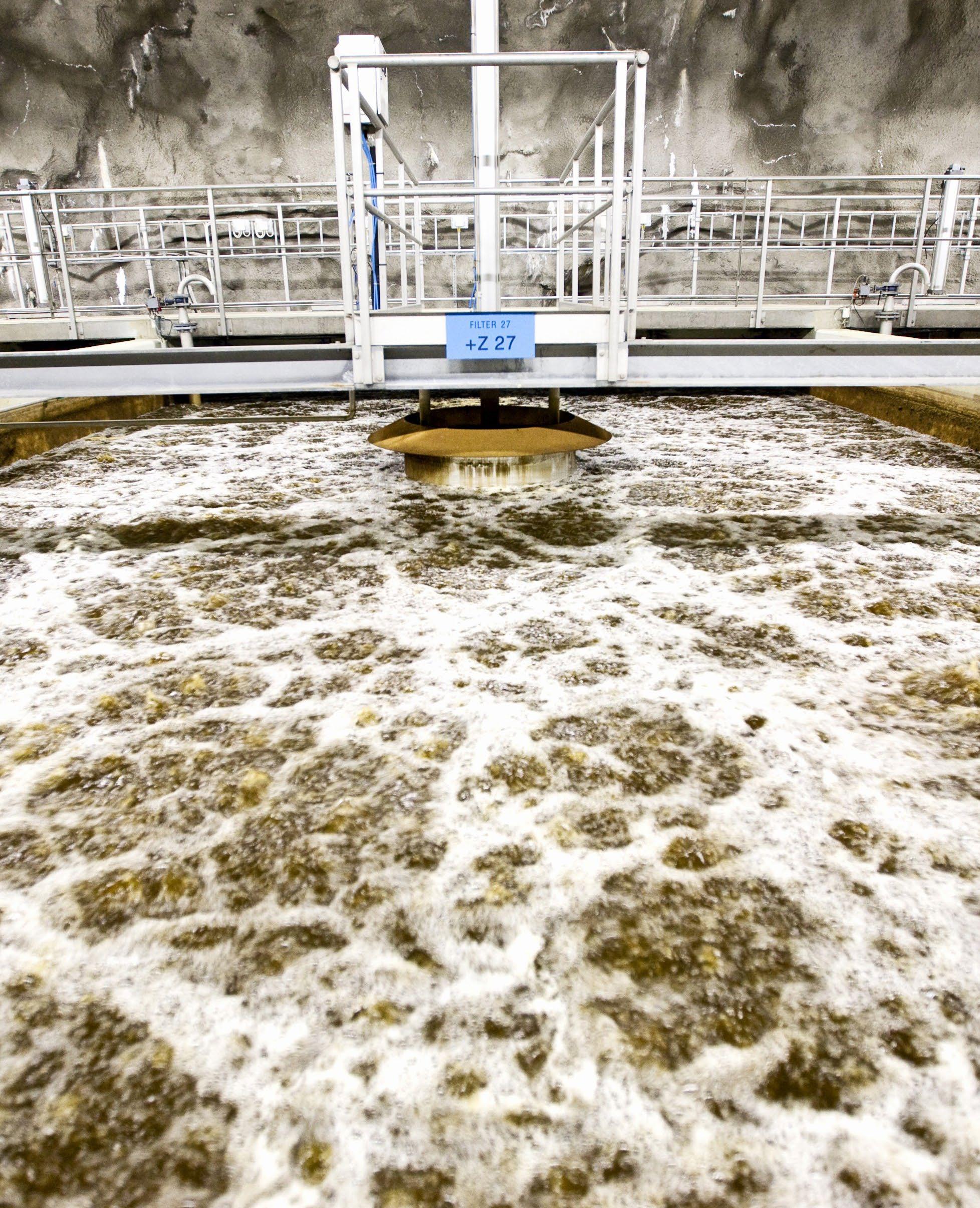
population equivalents (PE). At Bromma, Filtralite has been in use since 2007 in the tertiary treatment stage, with no major changes since installation. The plant serves around 320,000 PE. In both cases, Filtralite was integrated into the filtration design from the outset rather than introduced as a replacement for an existing system.
How did you find out about the Filtralite solution? What made you decide to use this innovative filtration medium, and what obstacles did you encounter during this project?
Filtralite is a well-established product within SVOA, and we have been working with it since 2007. It has proven to be a reliable and effective filtration medium for our needs. The decision to use it was therefore not experimental: it was based on accumulated experience and confidence in its performance. One challenge we encountered was the intermixing of filter layers, caused by a malfunction in the air backwash system, which required operational adjustments to maintain proper layer separation.
What problems justified your choice of Filtralite media, and were you able to solve these problems with Filtralite?
Filtralite has been part of our filtration solution since commissioning and has performed consistently well over time.
One of its main benefits is its ability to act as a storage layer for suspended solids in the upper part of the dual-media filter. This protects the finer sand layer underneath and allows for longer filtration cycles without clogging. As a result, the filters experience lower pressure drop compared to systems using only fine sand, and operational stability is improved. Overall, the initial challenges related to clogging and capacity are effectively addressed.
Since commissioning, Filtralite has formed part of the filtration step in our process, and its performance has held up reliably over the years. Filtralite works well as a filler material for the sludge storage capacity in the upper part of
the dual-media filter. It protects the finer-grained sand beneath and allows the filter bed to operate for longer periods without clogging. This results in a lower pressure drop across the bed compared to filters consisting of only one media fine grained sand.
Were there any unexpected results, whether positive or areas for improvement? And have you observed any variation in performance across different times of year?
We do not observe significant seasonal variations in filtration performance. The system operates in a stable manner throughout the year. Additionally, we have not identified any unexpected positive or negative effects beyond normal operational variations. However, more detailed monitoring data could potentially provide deeper insights in the future.
How would you describe the main aspects of Filtralite and its advantages compared to your initial solution?
Although we do not have a direct comparison with another solution, Filtralite performs very well in terms of suspended solids storage capacity. Furthermore, it allows for higher retention of solids, longer filter run times and also reduces clogging. Compared to sand-only systems, Filtralite contributes to more effi-
"Filtralite was integrated into the filtration design from the outset rather than introduced as a replacement for an existing system" “
"We are working on improving the plant’s resilience and adaptability, ensuring that it can handle more variable and extreme conditions"
cient and stable filtration, especially in high-load conditions.
Do you have a sense of the energy savings achieved with Filtralite? And has SVOA carried out any assessment of the return on investment?
We do not have precise energy calculations, as Filtralite has been used since the original commissioning of the filters. However, operationally, we observe that Filtralite reduces the need for frequent backwashing, which saves both time and operational effort.
Without Filtralite, filters would likely require more frequent cleaning cycles, which would increase water and energy consumption. Therefore, while not quantified, the operational savings are clearly noticeable.
If you had it to do over again, would you choose the Filtralite solution again and recommend it to your colleagues?
Yes, we would most likely choose Filtralite again. It performs reliably within our process and contributes to stable operation with fewer issues compared to alternative configurations. Based on our experience, we would also recommend it to colleagues working with similar filtration systems.
Looking ahead, what are the key projects on the horizon for your plants?
We are currently investigating the implementation of quaternary treatment at Henriksdal, including solutions such as sand filtration in combination with ozonation. The goal is to further improve micropollutant removal and meet future environmental requirements.
What are the characteristics of the current water market in Sweden, and more specifically around Stockholm?
The water sector in Sweden is highly developed, with strong regulatory re-
quirements and a clear focus on sustainability. In Stockholm, there is increasing attention on micropollutant removal, energy efficiency and resource recovery (e.g., biogas, nutrients).
Utilities are expected to continuously improve performance while maintaining high environmental standards, which drives innovation in treatment technologies.
Stockholm's water is renowned as some of the cleanest in the world. How much of that reputation weighs on you in your day-to-day work?
Yes, absolutely. The quality of water around Stockholm is something we are very much aware of in our daily work; it creates both a sense of responsibility and a genuine motivation to maintain and push standards further. That awareness shapes decision-making at every level, particularly when implementing new treatment technologies or upgrading existing systems. Protecting the receiving waters is a core priority, and it runs through both our operational practices and long-term planning.
Looking at the future, is climate change impacting your activity in your plant?
Climate change is an important factor influencing our current and future operations. We are already considering its impacts in our planning and development strategies. At Henriksdal, we have several development plans in place to address future challenges, such as rising sea levels, increased rainfall intensity, and changing precipitation patterns. These factors can affect inflow volumes, hydraulic load, and overall system performance. As a result, we are working on improving the plant’s resilience and adaptability, ensuring that it can handle more variable and extreme conditions while maintaining treatment efficiency and environmental compliance. •

Christos Charisiadis
FOUNDER & MANAGING CONSULTANT AT BRINE CONSULTING
Salt is becoming one of the most expensive invisible burdens in wastewater systems, not because it is scarce but because it is ubiquitous. In a typical developed catchment, wastewater treatment plants can discharge more than 200,000 tonnes of chloride annually, with road de-icing adding another 400,000 tonnes each winter. Domestic water softening alone contributes roughly 25–45 kilograms of chloride per person per year. Unlike organic pollutants, this load is effectively permanent: conventional treatment removes virtually 0% of dissolved salts, meaning what enters the system leaves it again, redistributed rather than eliminated.
This persistence becomes critical as reuse expands. Reclaimed water commonly contains 1,000–2,000 mg/L of total dissolved solids and up to 900 mg/L of chloride. At these concentrations, water reuse shifts from asset to constraint. Irrigation guidelines classify water above 800 µS/cm as increasingly restrictive and above 2,300 µS/cm as largely unsuitable without mitigation. Field data show soil salinity can increase four- to fivefold under saline irrigation, reducing crop yields and impairing infiltration. What appears as circular water use at the plant level can translate into long-term degradation at the field scale.
The financial consequences escalate rapidly when utilities attempt removal. Full-scale desalination of municipal wastewater using reverse osmosis and thermal concentration can require 20–
100 million euros in capital investment for mid-sized cities, with annual operating costs of 2–10 million euros. On a unit basis, zero liquid discharge systems typically cost 40–60 euros per cubic metre, while deep well injection may range from 2–4 euros per cubic metre in favourable regions but exceed 90 euros per cubic metre where transport is required. Energy demand compounds the issue: membrane systems consume around 3–10 kWh per cubic metre, while crys-
"Reducing salt inputs upstream can
remove tens of kilograms per capita annually while avoiding millions in downstream treatment costs"
tallisation processes can exceed 50 kWh per cubic metre. These are not incremental costs but structural liabilities.
Recovery does not easily resolve the imbalance. Bulk sodium chloride, the primary component of most brines, often sells for as little as 10–50 euros per tonne. Even at recovery rates above 90%, revenues rarely offset treatment costs unless there is a direct internal reuse. Higher-value products such as potassium or magnesium salts can reach 400–600 euros per tonne but require
significantly higher purity and more complex processing. While pilot systems demonstrate water recovery above 90% and energy reductions of 30–40%, their viability depends on local integration rather than open markets.
Globally, the scale of the issue is growing. Desalination alone produces more than 100 million cubic metres of brine per day, and inland systems lack low-cost disposal options. At the same time, tighter reuse regulations are shifting salinity risk onto utilities, forcing them to manage pollutants generated upstream. The result is a structural mismatch: high-cost treatment applied to low-value outputs.
The most effective response lies upstream. Reducing salt inputs through softener optimisation, alternative chemicals, and industrial controls can remove tens of kilograms per capita annually at minimal cost. A 20% reduction in influent salinity can avoid millions in downstream investment. Compared to 40–100 euros per cubic metre for end-of-pipe treatment, source control often costs less than 1 euro per cubic metre equivalent.
Salt is no longer just a water quality parameter; it is a financial signal. When concentrations exceed manageable thresholds, they expose the limits of current infrastructure and the hidden costs of circularity. The transition from waste stream to liability is already underway. The only real question is who will pay.

Dr. Sreenivasan Ramaswami
ASSISTANT PROFESSOR AT THE CENTRE FOR SUSTAINABLE TECHNOLOGIES, INDIAN INSTITUTE OF SCIENCE
The paradox facing India’s (and much of the global south’s) cities is that with an increasing water demand comes an increasing amount of wastewater generated. However, only a small percentage of it gets treated and reused.
India is among the top generators of wastewater in the world, with almost 112 billion litres of urban wastewater being generated daily, according to India's Economic Survey 2025-26, with cities accounting for nearly two-thirds of the total. However, these cities are yet to develop adequate facilities for treating it. India’s Central Pollution Control Board (CPCB) had estimated that only 28% of total wastewater from cities and towns could be treated as of 2021.
The CPCB identifies discharge of inadequately treated sewage as the country's largest source of water pollution and a key driver of water stress, compounded by rapid urbanisation and climate change. Historically, wastewater was seen as a burden, transported over long distances to centralised facilities before discharge, to minimise health and environmental hazards. Time has proved that wastewater can be managed (more) sustainably, in a decentralised manner, and that it is a resource: a source for clean water, energy, nutrients (fertilisers), and other materials.
For years, urban water management has been linear, which is no longer feasible given growing freshwater scarcity. Economic Survey 2025-26 reported that only 8% of wastewater generated was
being recycled and reused. Water resources are becoming scarce, and cities are now called upon to manage wastewater in such a way that it is seen as an asset that needs to be valorised rather than discarded.
Water circularity — embedding recovery and reuse into city planning — is a sustainable approach to urban water management. The reclaimed water can be used for fit-for-purpose on-site applications, industrial processes, construction activities, cooling towers, cooling
"India
and the global south must invest in water-wastewater infrastructure and embrace circular, resource-centric management approaches"
of data centres, landscaping, farming, etc. In this context, the Ministry of Jal Shakti has encouraged cities in India to recycle and reuse at least 20% of the water consumed in urban areas.
India's policy push for water reuse is growing, yet uptake in cities remains low — largely due to inadequate infrastructure. Wastewater collection and treatment capacities ought to increase. Furthermore, infrastructure or mechanisms for channelling reclaimed water for reuse needs to be holistically planned and established.
Another important challenge is the one of trust. Water quality data, transparency, and conformance with quality standards are important in building trust among consumers and wastewater utilities. Without these factors, it is difficult to take reuse practices to the next level.
The positive side of the story is that the advancements and availability of the technologies used in the treatment plants are easing the production of quality reclaimed water. However, there is also a strong need for capacity building and awareness creation among stakeholders at various levels. Additionally, adopting appropriate pricing of freshwater and reclaimed water would be a strong incentive for water reuse by different stakeholder groups.
India and the global south must invest in water-wastewater infrastructure and embrace circular, resource-centric management approaches. While India’s water problem is often framed in terms of scarcity, in reality, it is one of management. Wastewater is an asset that can be treated and reused to become a powerful tool in the management of urban water security, environmental sustainability, and economic growth. This also creates a plethora of economic and job opportunities in this sector.
Water circularity must become integral to India's urban planning. Wastewater could be leveraged as one of India's most significant and precious resources.
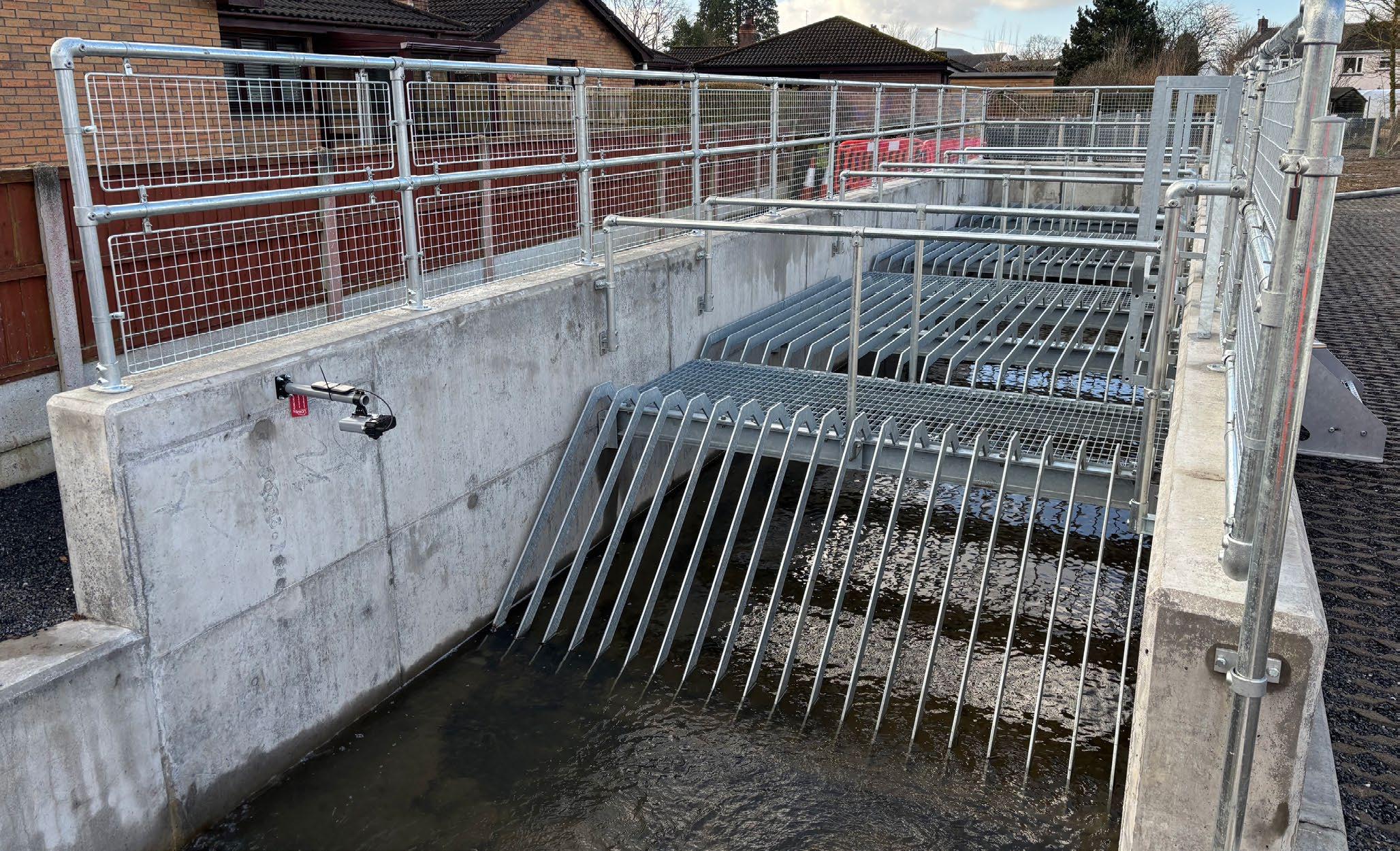
Recent strategic moves by Badger Meter, including the $185 million acquisition of SmartCover® and the $100 million acquisition of UK-based UDlive, have further positioned the company as a global leader in sewer line monitoring. Combined with its established portfolio of flow measurement, water quality sensing and automation technology now being marshalled to support Europe's emerging fourth treatment stage, Badger Meter is building one of the most comprehensive intelligence layers ever assembled for municipal wastewater networks.
Municipal wastewater networks are facing a convergence of pressures that few utility executives could have anticipated a decade ago. Ageing pipelines are exceeding their design life. Climate-driven rainfall is overwhelming combined sewers and pushing untreated discharges into rivers and coastal waters. Regulators on both sides of the Atlantic are tightening tolerance for sanitary sewer overflows and emerging contaminants alike. And operating budgets, squeezed by inflation and workforce shortages, no longer stretch to meet the inspections and high-frequency cleaning schedules that once provided a margin of safety.
Against that backdrop, the question is no longer whether utilities should digitalise their wastewater operations, but how quickly, and which partners can help them connect the disparate pieces. Badger Meter (NYSE: BMI) has answered with a sequence of moves that amount to one of the sector's most coherent technology plays. Two transformative acquisitions, SmartCover in the United States and UDlive in the United Kingdom, have given the company a clear global lead in sewer line monitoring, while its sensing, flow measurement and automation portfolio is helping European utilities prepare for the fourth purification stage.
The foundation is BlueEdge®, the company’s complete solutions offering. The hardware-enabled software suite delivers a coordinating layer that pulls signals from across the network: meters, level sensors, gas detectors, water quality probes, pumps and valves, into a common analytical environment. That matters because the operational questions facing utilities are no longer confined to a single asset. A surge in inflow during
Two transformative acquisitions, SmartCover and UDlive, have given Badger Meter a clear global lead in sewer line monitoring
a storm ripples from maintenance holes into lift stations, rising sewer levels, elevating hydrogen sulfide and hydraulic load at the treatment plant. Without a unified view, each team responds in isolation. To move toward proactive maintenance, high-resolution data visibility gives operators the context needed to make better decisions.
The $185 million acquisition of SmartCover, completed in January 2025,
makes Badger Meter the owner of the most established collection system monitoring platform in North America. Its maintenance hole-mounted sensors monitor sewer levels around the clock, building a behavioural baseline for each location and automatically alerting utilities when conditions drift toward a spill. Paired with the company's analytics software, the same hardware helps operators predict and prevent overflows, locate inflow and infiltration, detect intrusion, reduce high-frequency cleanings and control toxic gases such as hydrogen sulfide, without the cost or safety exposure of confined space inspection.
The strategic logic was articulated by Kenneth C. Bockhorst, Chairman, President and CEO of Badger Meter: “SmartCover fits directly into our BlueEdge suite of hardware-enabled software solutions, enhancing the scope of data, information and analytics that collectively strengthen our customers' water management practices… SmartCover is the market leader in the fast-growing stormwater management space.”
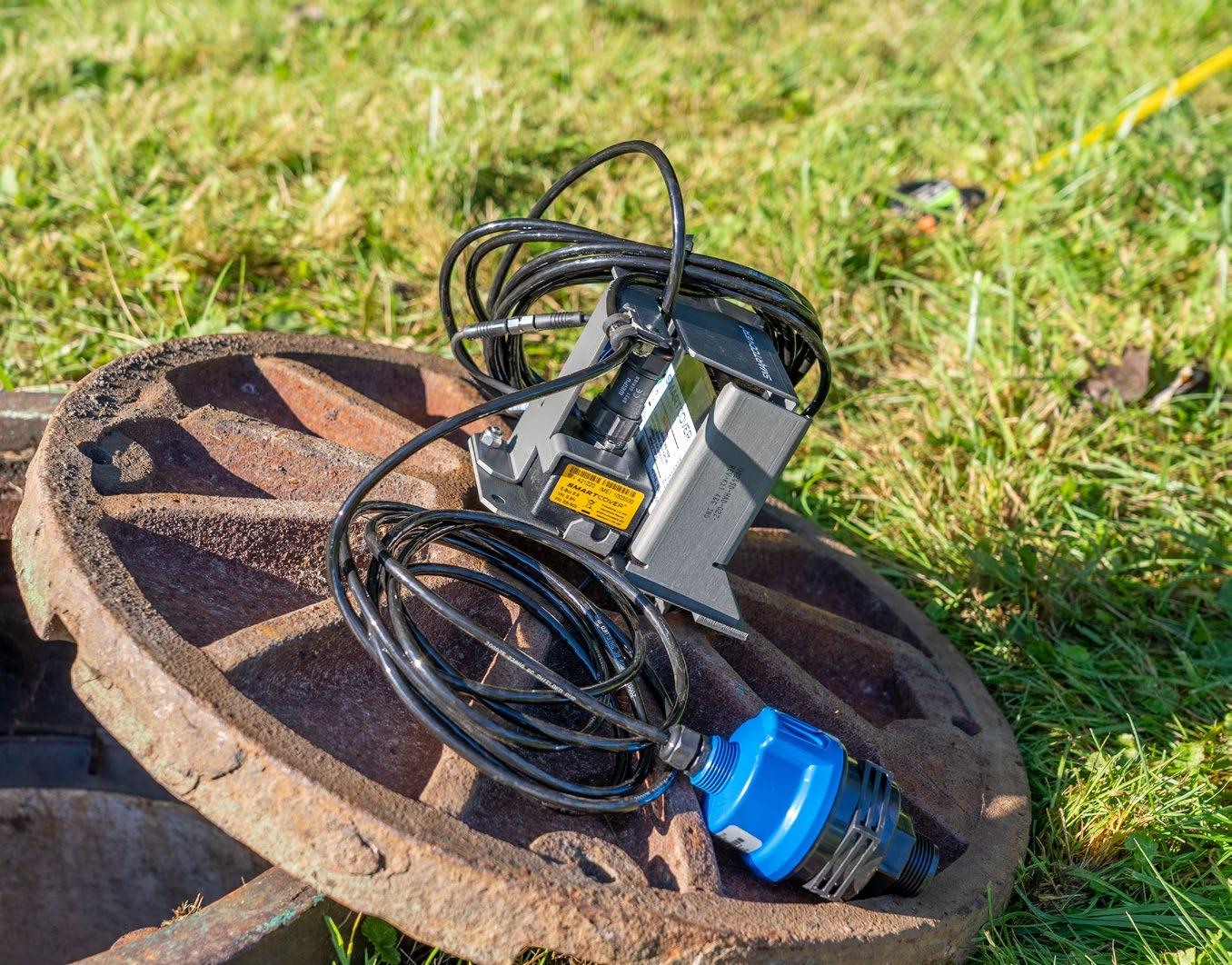
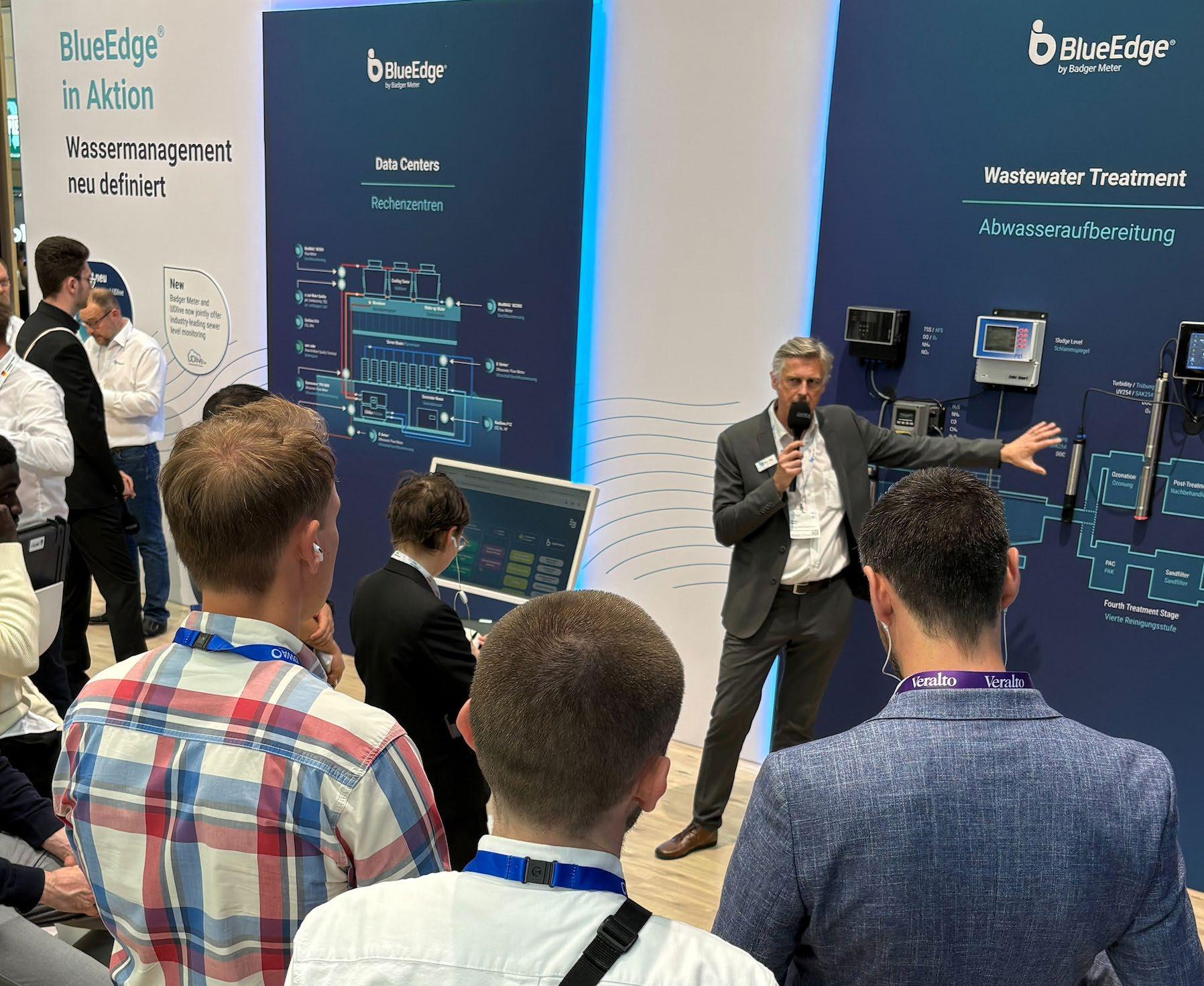
UDlive, a British leader, joins the platform
If SmartCover gave Badger Meter a commanding position in the United States, the agreement to acquire UDlive, a UKbased provider of low-power, easy-toinstall maintenance hole sensors paired with proprietary visualisation and analytics software, extends that leadership across the Atlantic. The $100 million transaction, plus contingent consideration, combines two of the most credible names in the field. UDlive reported $22 million of revenue in fiscal 2026 and
has compiled a 90% tender success rate since its launch in 2017, with technology assessment scores routinely placing it at the top of utility procurement scorecards in the United Kingdom.
Bockhorst connected the two acquisitions explicitly: “UDlive is a strong strategic fit with our BlueEdge portfolio and is a natural addition to SmartCover. Together, they will create an industry-leading global portfolio of sewer line monitoring capabilities, offering a range of solutions across a broader set of use cases and geographies… This acquisition fur-
ther advances our strategy of providing utilities with hardware-enabled software solutions that deliver actionable intelligence across the water cycle.”
Philip Bennett, Managing Director of UDlive, framed the engineering complementarity: “SmartCover and UDlive address complementary aspects of sewer line monitoring, and together we can deliver greater value to utilities seeking remote, reliable and relevant solutions to manage increasingly complex wastewater networks.” In practice, that means utilities in the UK, Europe and selected
international markets will have access to a wider spectrum of deployment options, with Badger Meter expected to leverage its global footprint to accelerate UDlive's adoption beyond British shores.
While the sewer monitoring story is about getting ahead of problems before they reach the treatment plant, an equally significant transformation is unfolding inside the plant. The EU's revised Urban Wastewater Treatment Directive obliges plants serving 100,000 population equivalents or more to install a fourth treatment stage by 31 December 2035, with smaller plants between 10,000 and 100,000 PE following by 2040 where micropollutant risk is elevated. The directive also requires
plants to operate on an energy- and climate-neutral basis by 2040 and introduces an extended producer responsibility scheme asking pharmaceutical and cosmetics manufacturers to contribute to the cost of removing their products from the wastewater stream.
The technologies involved, activated carbon adsorption, ozonation and advanced membrane filtration, are mature, but operating them economically is anything but trivial. Dosing must respond to fluctuating contaminant concentrations, ozone generation must be balanced against power consumption, and chemical and energy costs must be continuously optimised against effluent quality. This is where the instrumentation logic underpinning BlueEdge's collection system work becomes decisive at the plant gate. Electromagnetic flow
meters from Badger Meter monitor total flow through the works with robust accuracy, while its ultrasonic meters provide the precision required for chemical dosing. Likewise, optical sensors using s::can technology deliver real-time readings of organic load, turbidity, pH and other indicator parameters, enabling operators to react to events within minutes rather than hours. Advanced data and analytics platforms turn these raw signals into the audit-ready reporting the new directive demands.
A single intelligence layer, from maintenance hole to outfall
Acquired January 2025
$185M
Geography North America
Key capability
Acquired 2026 deal value deal value + contingent consideration
$100M
Geography United Kingdom & Europe
Key capability
Mounted sensors with 24/7 overflow prediction and H₂S gas monitoring
What it adds to BlueEdge Collection system intelligence and stormwater management across North America
Low-power sensors with proprietary analytics — 90% tender win rate since 2017
What it adds to BlueEdge European market entry and sewer monitoring technology for a broader use-case range
Badger Meter is no longer simply a manufacturer of meters and sensors; it is positioning itself as the connective tissue of intelligent water infrastructure. The same data architecture that warns a North American utility about a developing overflow at three in the morning is being adapted to help a German plant optimise activated carbon dosing during a pharmaceutical load spike. The engineering ethos behind UDlive's high tender win rate in the UK, low-power hardware paired with software operators actually want to open, is being applied to lift station telemetry and plant automation across continents.
For utility leaders, the hard work of the next 15 years is not about replacing pipes faster. It is about extracting more performance from assets already in the ground while meeting tighter discharge limits with leaner teams. That requires continuous visibility, intelligent automation and reliable analytics across the conveyance and treatment system, exactly the capability set Badger Meter has assembled. As Bockhorst has previously stated, the company's mission is to deliver actionable intelligence across the water cycle. Increasingly, that is the operating reality that municipal wastewater systems are quietly moving toward. For more information visit badgermeter.com/smart-solutions •
INSTITUTIONAL KNOWLEDGE LOSS IN WATER UTILITIES
One in five U.S. water utility employees is now eligible to retire within five years. The sector has long called this the silver tsunami. What the phrase rarely captures is the nature of what walks out the door, not just experience, but the operational judgment that no system, database or AI copilot yet knows how to replace.

The American Water Works Association’s 2025 Utility Benchmarking Survey put a precise figure on something discussed in general terms for years: 21% of utility employees are eligible to retire in the next five years, against an average vacancy rate of 9%. According to EPA’s America’s Water Sector Workforce Initiative, 30% to 50% of water sector workers are expected to be eligible for retirement within the next 5 to 10 years. In West Virginia, a recent study found that more than half of water utility operators and managers expect to retire within the next decade, highlighting the workforce challenges facing the sector. Similar concerns have been reported by utilities across New England as experienced workers leave the profession and recruitment struggles continue. Those numbers sit alongside the pressures documented in the 2026 Black & Veatch Water Report, where the ageing workforce ranks among respondents’ top concerns, sharing the list with ageing infrastructure, PFAS compliance and a capital squeeze forcing utilities to defer work they know cannot wait.
The statistics flatten what is actually happening. According to EPA’s America’s Water Sector Workforce Initiative, the median age of water sector employees is 48, slightly above the national median across all occupations. According to Brookings Institution research, more than 30% of the broader water workforce was aged 55 or older. The veteran operator who retires on a Friday afternoon does not hand over a folder. She takes with her a working model of the system that was never written down: which pressure zone becomes unstable at peak summer demand, why a particular pump should never start before its neighbour has been running for ten minutes, what a faint conductivity spike at monitoring station seven means about an industrial discharge kilometres upstream. That knowledge was transmitted
informally, over years of standing next to someone who already had it. When she leaves, the chain breaks.
Dan Rickard, Senior Operations Leader at Pennsylvania American Water, has spent four decades working through exactly this transition. “Probably a little bit of everything,” he says of what happens when a veteran retires. “We are able to transfer a lot of knowledge by providing job-shadowing, mentorship and other handover method procedures; we also document a lot of ‘best practices’ with SOPs, but we also lose some, which is just going to happen.” The candour matters. What gets lost is not incidental; it is often the most consequential knowledge the person held.
21% of utility employees are eligible to retire in the next five years, against an average vacancy rate of 9%
The 2026 Black & Veatch report is direct about the digital dimension of this gap. While 70% of surveyed utilities report collecting sufficient data, only 19% say they leverage it effectively. Staffing is the single largest barrier cited by utilities failing to meet their digital strategy objectives — 71% of that group name it. Losing experienced operators does not just create a headcount problem; it weakens the institutional capacity to make sense of data already gathered.
When the knowledge was never in the system to begin with Roles where the risk is most acute tend to be operational and technical ones where experience takes years to develop. Treatment plant operators, distribution engineers and instrumentation specialists carry system knowledge that is rarely fully formalised. The 2026 AWWA State of the Water Industry report ranked workforce issues among the sector’s top concerns, though at a lower position than in earlier surveys when the issue placed among the top five. That movement obscures how the nature of the challenge has shifted. The retirements have not arrived all at once; utilities adapt to individual departures. The cumulative effect, however, is a sector moving from a headcount problem to a knowledge-continuity problem: not how to replace people who retire, but how to keep the knowledge of the utility moving from one generation to the next. Water is delivered by people, and workforce pressure touches nearly every other challenge on the sector’s priority list.
The knowledge that walks out is not primarily the knowledge recorded in manuals. SCADA systems log what the system is doing; they do not log why an operator made a particular decision, or what local context shaped it. An operator who knows that a pump should never start before its neighbour has been running for ten minutes has not written that down, because to her it is not a rule, it is just how the plant works. CMMS platforms capture maintenance history without the reasoning behind it. GIS systems map the network without reflecting decades of familiarity with how its buried components actually behave. Research on European water utilities has found that even the precise location of network assets is frequently held in individual memory or on paper records that may not survive a staff transition. The more experience a person accumulates, the harder it becomes to extract because the most valuable knowledge is the kind that has been so thoroughly absorbed it no longer feels like knowledge at all.
The EPA has taken practical steps to address the problem, developing a Knowledge Retention Tool Spreadsheet to help small water systems consolidate operational information ahead of staffing changes. The tool is a useful starting point. But it also illustrates the
The 2026 American Water Works Association State of the Water Industry report ranked workforce issues among the sector’s top concerns
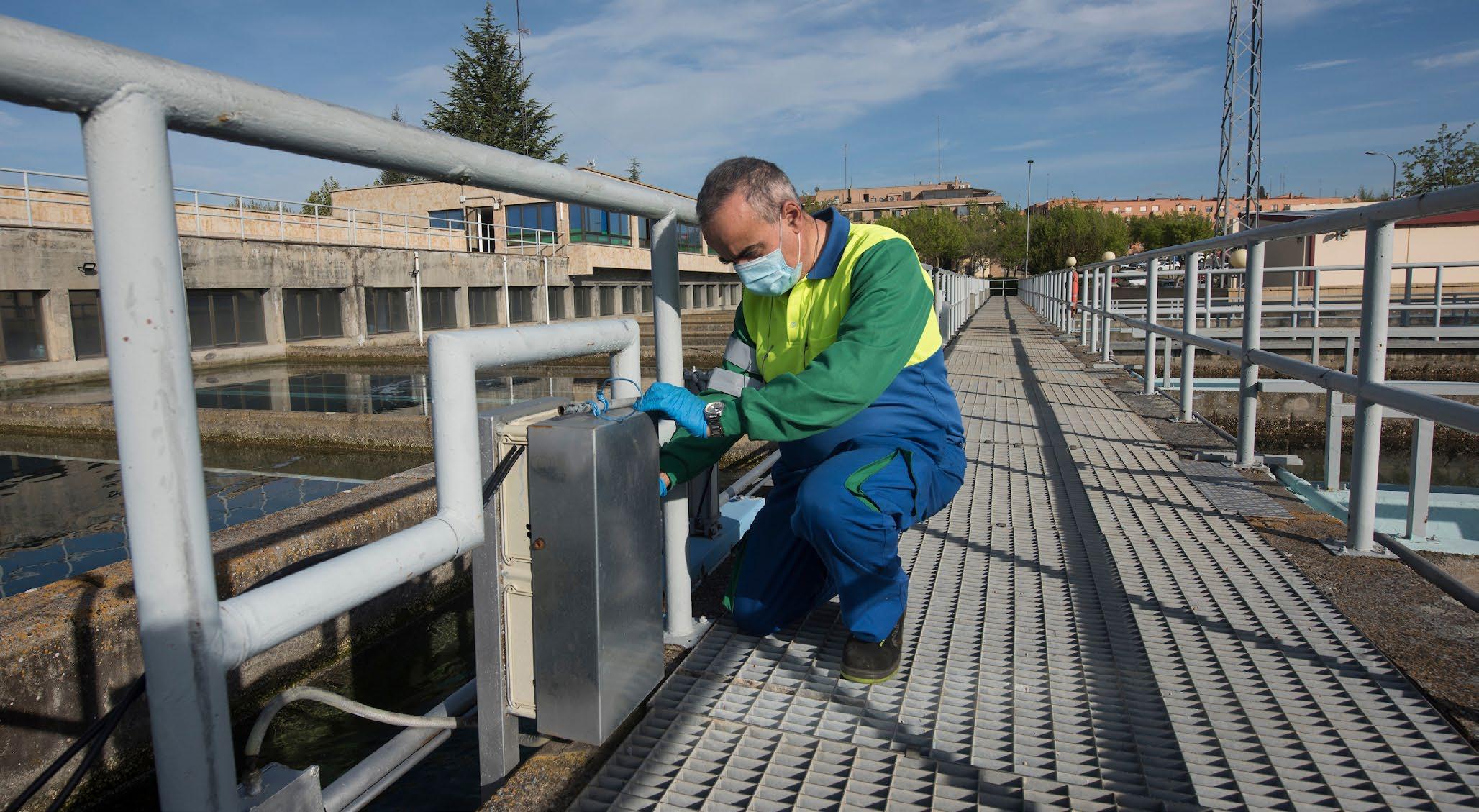
boundary the sector keeps running into: a spreadsheet can record what a system does and what procedures exist. It cannot record why an experienced operator makes the calls she makes, or what accumulated local context sits behind them.
Tom Walski, Senior Water Resources Engineer at Bentley Systems, and one of the most widely cited engineers in the water sector, frames the preparation window in unambiguous terms. The principle, he argues, is simple: before an individual leaves an organisation, someone must already be trained and ready to fill the position. “Do not wait until someone leaves to advertise the role,” he says. “On-the-job training is probably the best form, but it tends to be narrow. Licensing requirements encourage staff to understand systems beyond ‘which button do I push?’ and that broader understanding is exactly what cannot be improvised once the veteran has gone.”
Culture, Rickard argues, matters as much as any formal process. “When young employees work in a culture where they are not afraid to ask questions or provide input, they are empowered to want to learn. That leads to a strong knowledge base and a leadership skill-set that stays with the organisation.” At Pennsylvania American Water, the approach combines electronic SOPs stored on shared platforms with GIS, hydraulic models and digital twins, and equally, mandatory annual talent profiles and development goal plans for every employee, including milestones tied to union pay scales. The underlying logic is that knowledge must be embedded simultaneously in systems and culture, and that one without the other is insufficient. A well-stocked SOP library does not help the new operator who does not yet know which questions to ask; a strong mentoring culture without documentation produces knowledge that remains as personal and perishable as the veteran who carries it.
The digital water industry’s response has been substantial. Simulation environments, cloud-based asset platforms and digital twins have all advanced materially. Modelling software now allows utilities to run failure-scenario drills for events so rare or catastrophic they could never be tested on a live system, creating the experience before the emergency arrives. Cloud-based environments make the decision history of a capital programme continuously accessible to incoming staff, replacing paper plans that became obsolete overnight with a project record any team member can access from anywhere on day one.
Walski poses the central challenge of AI-assisted knowledge transfer with precision: “How do you train machine learning for something that has never happened, but will someday? With modelling software, it is possible to run simulation drills for rare or catastrophic events that could never be tested on a real system. It is better to fail in a drill than during an actual crisis.” The U.S. EPA’s ‘A Day Without SCADA’ national cyber drill reflects the same logic, rehearsing manual operation across utilities precisely because the embodied knowledge that veterans carry needs to become a designed-in institutional capability, not an inherited one.
The limits of technology are equally important to understand. AI systems learn from data that exists. If operational knowledge was never captured in structured form, there is nothing for an algorithm to learn from. There is a subtler risk too: as SCADA becomes the default interface, a generation of operators is arriving that has never run a pump station without a screen. Walski is direct about what that means in practice. “I’ve heard of systems where the control room operator only knows of a pump station as a symbol on a SCADA screen. The
operator has no idea where this station is physically located and would not know how to operate a pump manually if necessary.” That is a fragility, not a capability. New digital tools create opportunities for automation and innovation, but they also demand a workforce skilled enough to apply them, and the sector’s own data suggests it is not yet there. The 2026 Black & Veatch report rates utility expertise in digital twins at 1.69 out of 5 and in data science and AI at 1.78, both among the lowest scores recorded across all digital capability categories surveyed.
Water is delivered by people, and workforce pressure touches nearly every other challenge on the sector’s priority list
The window to transfer what veterans still carry, through mentoring overlaps, simulation development and digital documentation, is open but narrowing. The SOPs memorialise best practice; the mentorship culture ensures new employees feel entitled to ask the questions that no SOP anticipates. Neither works as well without the other, and neither works at all if the veteran has already left before the relationship was built. The utilities that invest in that bridge now will be in a fundamentally different position from those that treat knowledge transfer as a post-retirement problem. •
“We need to attract, develop and sustain skilled water professionals who can adapt to
WWorkforce concerns have ranked in the American Water Works Association (AWWA)'s top ten sector challenges for years. But in 2026, the question has shifted from how to replace retiring workers to something harder: how to stop institutional knowledge from disappearing with them.
AUTHOR : OLIVIA TEMPEST
hen AWWA published its 2026 State of the Water Industry report in March, workforce emerged once again as one of the most pressing concerns facing utilities across the United States. With 21% of employees eligible to retire within five years and vacancy rates averaging 9%, the scale of the challenge is hard to ignore. We sat down with AWWA CEO David LaFrance to dig deeper into what the data is really telling us, and what the sector needs to do to prepare.
What do the most recent SOTWI findings show about the scale of workforce concerns in the U.S. water sector? Where does "ageing workforce and retirement" rank among the top issues utilities are reporting in 2026?
Our most recent State of the Water Industry (SOTWI) survey, which primarily reflects North American water-sector perspectives, revealed that workforce issues continue to be a serious concern among water professionals in 2026. In fact, they have been in the top 10 since at least 2021. However, when you add in information for AWWA’s utility benchmarking data, the story
has become more complex than retirement alone.
This year, workforce issues ranked ninth among the top challenges facing the sector. That is lower than it was a few years ago, when workforce ranked fourth in 2022. But I would not interpret that as the workforce issue is abating. I think it tells us utilities are facing many heavy and persistent challenges all at once: ageing infrastructure, financing, long-term water supply, public understanding of their water service, and workforce.
Ultimately, water is delivered by people, though. Treatment plants, pipes, pumps, meters, laboratories and control systems all depend on the skill and judgment of the professionals operating them. So even though workforce is not the No. 1 ranked issue, it touches nearly every other issue on the list.
Through Water 2050, AWWA is looking decades ahead and charting a course for a secure, sustainable and resilient water future. Workforce is key to that vision. We need to attract, develop and sustain skilled water professionals who can adapt to new technologies, stay engaged in their work and reflect the communities they serve.
SOTWI is now a 20+ year longitudinal dataset. How have workforce concerns changed over that time? For a long time now, we've talked about the “silver tsunami”. That was useful because it helped utilities recognise that a large group of experienced employees - the baby boomer generation - was approaching retirement. That tracks with our survey data, with workforce issues entering the top-10 list of concerns in 2018.
Now, the picture is more nuanced. The retirements have not happened all at once. People retire over time, and utilities adapt. But as experienced people leave, the sector is seeing even more workforce challenges: shorter tenure, more outside hiring, more competition for talent and the need for new skills.
So the question has changed. It is not only, “How do we replace people who retire?” It is, “How do we keep the knowledge of the utility moving from one generation to the next?” That is the bigger workforce issue now.
Are there particular roles or functions inside utilities, treatment plant operators, distribution, engineering, instrumentation, where SOTWI is picking up the most acute retirement risk? SOTWI does not break the workforce question down by specific role, but we have some insight from open-ended comments shared by respondents. There is understandable concern about replacing experienced operators and losing institutional knowledge as those employees retire. Utilities often see the greatest risk in operational and technical roles where experience takes years to develop, making it difficult to replace quickly. Add to that the learning curve as new technology is introduced.
We need to approach the workforce with systems-level thinking. That means training utility professionals to think broadly about all the parts and
"THROUGH WATER 2050, AWWA IS LOOKING DECADES AHEAD AND CHARTING A COURSE FOR A SECURE, SUSTAINABLE AND RESILIENT WATER FUTURE"
Training a tech-savvy workforce will also be a top priority. The evolution of AI has allowed for automation and the streamlining of operations, but it also has made utilities more vulnerable to cyberattacks. In the SOTWI survey, 58% of respondents are “very” or “extremely” concerned about breaches or deepfakes that can interrupt treatment operations and water delivery. Retaining and building a workforce that is continually proficient at these technologies and can safeguard critical operations will be key for utilities as they move forward.
How is AWWA helping utilities prepare for the wave of retirements ahead?
processes that link together to make water systems successfully serve their communities. This is not an easy task because water systems are not simple. But when people understand the relationships across treatment, distribution, operations, water quality and customer needs, they are better prepared to carry knowledge forward.
Whether you’re a treatment plant operator, chemist or field operator, having that system-wide knowledge creates a more robust and resilient workforce.
From AWWA's perspective, what is the scale of the workforce challenge facing U.S. water utilities over the next five years?
The scale is significant. The 2025 AWWA Benchmarking Survey shows that 21% of utility employees are eligible to retire in the next five years, and utilities reported an average vacancy rate of 9%. Those numbers may be felt more acutely by small and rural utilities. When an experienced employee leaves, the challenge is about preserving the knowledge that person has built about the system, its history and its day-today operations.
AWWA helps utilities prepare by supporting water professionals at every stage of their careers. We offer live and virtual training, manuals of practice, specialty conferences, industry news and other resources that help water professionals build skills and stay current in a changing sector.
For operators, AWWA offers hundreds of hours of training content, for everything from preparing for an operator certification exam to continuing education credits. Our course offerings also include management and leadership training. We also have a decades-long partnership with Water Professionals International, which advances and standardises the operator profession through joint training, certification, and workforce development.
Speaking of leadership, AWWA is also in its third year of the Transformative Water Leadership Academy, a 10-month training program for emerging and current leaders in the water sector. A fourth cohort will be enrolled this fall.
We also partner with higher education institutions, including Xavier University on the first master’s degree program in water utilities management and the University of North Carolina’s
Water and Wastewater Leadership Center. AWWA is also partnering with UC Berkeley on an executive leadership program to help senior utility leaders think strategically about resilience, innovation and the future of water.
In addition, our student chapters and Young Professionals program help introduce people to the sector, build community and create leadership pathways for the next generation of water professionals. Through AWWA’s Water Equation, scholarships help more people access training and professional development opportunities.
On the recruitment side, what is AWWA seeing in terms of apprenticeship programs, community college partnerships, military-to-utility pipelines, and other routes bringing new workers into the sector?
All of these programs exist across the United States, and in some cases, utilities partner with external entities to inform the programming. In Denver, Colorado, for example, Emily Griffith Technical College is known for producing operators who can hit the ground running at any utility. And in Traverse City, Michigan, the city partners with two local community colleges to provide an internship program that allows participants to explore all facets of the drinking water and wastewater industries to find a job that suits their strengths and interests.
AWWA also has a Veterans Workforce Initiative to help veterans find opportunities in water, where their technical experience and sense of mission can translate well to utility work.
One of the sector’s challenges is that water work can be invisible until something goes wrong. Many people do not grow up knowing there is a career for them in water. We need to tell that story earlier and better. These are stable, meaningful jobs, and they are directly
connected to public health and community service.
From AWWA's vantage point across the sector, what does effective knowledge transfer look like inside a utility? Are there member utilities that AWWA points to as models?
SOTWI gives us a useful data point here: 63.4% of utilities reported that workforce planning, including recruitment, retention and succession, is either fully implemented or in progress. That tells us many utilities are already working on this, but it also leaves a good share still developing their approach.
When we talk about workforce programs, the focus is often on recruitment. But retention is just as important. Across the sector, we see that utilities with strong training programs, clear opportunities for advancement and competitive benefits are often better positioned to keep employees and grow leaders from within.
That is where AWWA can help. We have identified the need for practical management and leadership guidance to prepare the next generation of utility leaders. Our efforts include a robust suite of self-paced offerings, including certificate programs in management and leadership. Programs like the Transformative Water Leaders Academy help move those educational needs into action, and our Utility Management Conference is a valuable place to explore the management topics that are unique to water utilities.
The next generation of water-sector workers is arriving alongside a wave of new digital tools. Does AWWA have a view on whether these tools are closing the knowledge gap? I’m not sure “closing the knowledge gap” is the right description. New digital tools create opportunities for automation and innovation, but they also demand a new kind of workforce skilled in technology. The SOTWI report touches on this: just over half of the utility respondents say a tech-savvy workforce is the second highest priority among future innovation needs (with cybersecurity being the highest). Staying on top of technology evolution, though, requires training across the board — both tenured and new employees.
"WE HAVE IDENTIFIED THE NEED FOR PRACTICAL MANAGEMENT AND LEADERSHIP GUIDANCE TO PREPARE THE NEXT GENERATION OF UTILITY LEADERS"
We have not talked about it yet, but as we think about the next generation of the water workforce, people skills are just as vital as the technical ones. The good news is, people are increasingly interested in where their water comes from and its quality. If we can’t communicate “the water story”, those technical tools really don’t help us. Learning new technologies has to go hand in hand with building human skills. Critical thinking, communication, collaboration and adaptability all matter because technology is only useful when people know how to apply it well. •
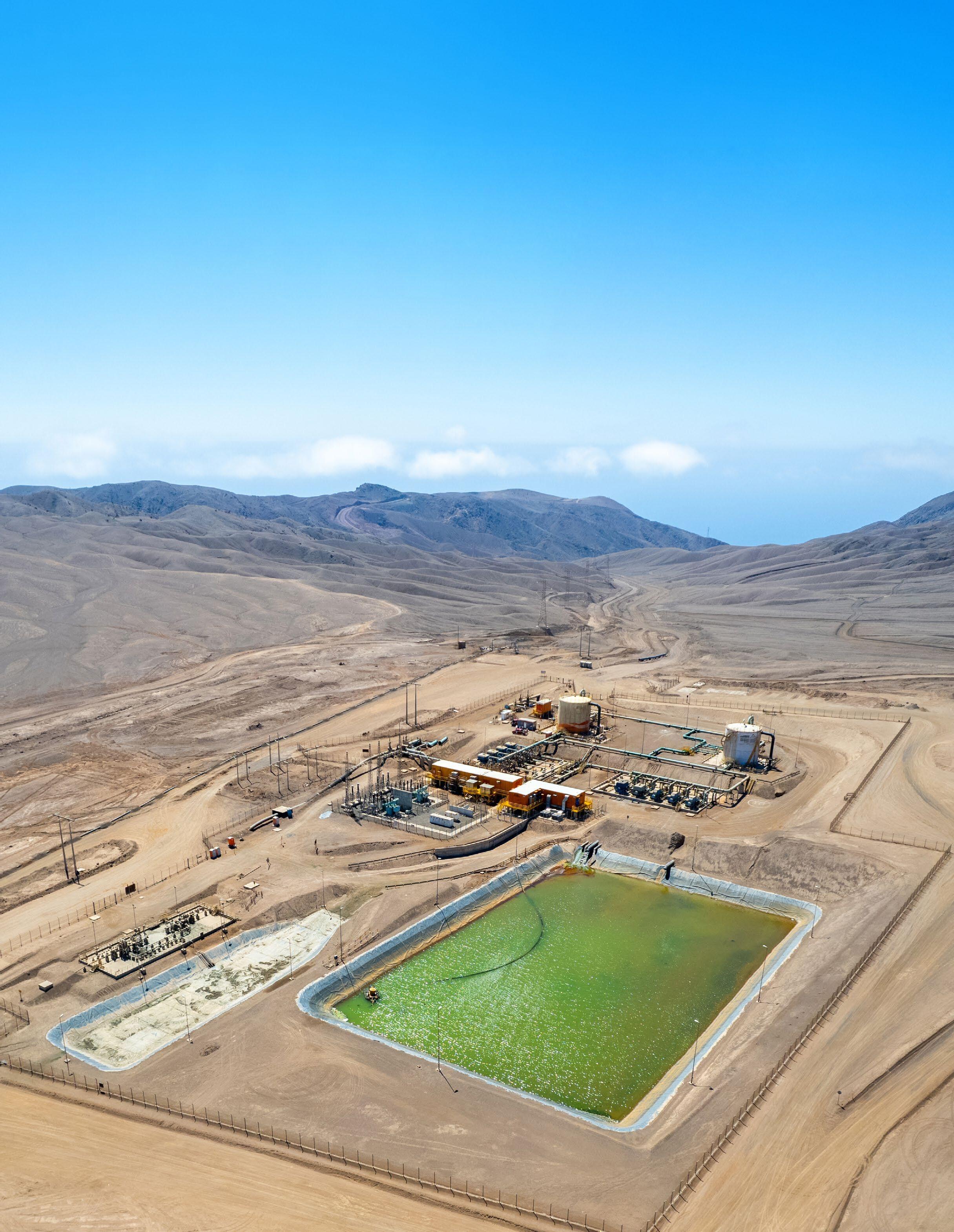
For years, the water sector spoke of an approaching turning point. Awareness of scarcity, climate risk and sustainability grew, but the structural change needed for long-term resilience lagged behind. Over the past decade, this has shifted. Water is no longer seen only as a utility or environmental issue, but as strategic infrastructure, closely linked to industrial continuity, economic growth and geopolitical stability. The evolution of Almar Water Solutions over this period reflects that wider change in the sector.
The end of water as a secondary utility
Ten years ago, debate about water sat largely within environmental policy, sustainability plans and engineering circles. Scarcity was recognised as a rising risk, especially in the Middle East, North Africa and parts of Latin America. Even so, it was seen mainly as a future concern, not an immediate economic limit. Most industries treated water as a reliable utility input, not as a factor that could restrict growth.
That view has shifted sharply. Today, access to water often decides where industrial projects can proceed, where cities can expand and where capital can be deployed. In mining, energy, manufacturing and agriculture, water security has moved beyond ESG reporting or regulatory duty. It has become a core operating condition, closely linked to cost, resilience and continuity.
The change is most visible in regions where growth and scarcity now collide. In northern Chile, mining expansion depends increasingly on seawater pipelines and non traditional sources. In the Gulf, industrial and urban growth rely on large scale desalination and advanced treatment, run through long term, complex operating models. Similar pressures are appearing across parts of Asia, Africa and southern Europe as climate volatility tightens supply.
Expectations of the water sector have also changed. For decades, the industry focused on delivery: designing plants, building assets and expanding capacity. Technology was often presented as the answer. Desalination, reuse and advanced treatment remain vital. But experience has shown that technology on its own cannot resolve deep seated water constraints.
Water infrastructure now demands long term, integrated approaches that link engineering, finance, operations and industrial planning within durable infrastructure systems.
a
Almar Water Solutions was founded in 2016 within Abdul Latif Jameel’s Environmental Services platform, at a point when the water sector was beginning to change. Engineering and project delivery were central to its activity, but the company was shaped around a broader vision than that of a traditional EPC contractor or technology supplier. Its model combined development, financing, operations and asset management within long term structures designed to address rising complexity and resource constraints.
In its early years, Almar became closely associated with desalination and other non conventional water systems, particularly in regions where scarcity was already structural. Over time, both the market and the company evolved, moving beyond the development of large municipal water projects towards a broader range of services delivered through the creation of regional services platforms.
WATER IS NO LONGER SIMPLY AN ENVIRONMENTAL ISSUE; IT IS BECOMING A STRATEGIC ECONOMIC CONSTRAINT THAT SHAPES WHERE CAPITAL CAN BE DEPLOYED
Today, Almar accumulates credentials across Europe, the Middle East, North Africa, Latin America and Asia. Its model brings together infrastructure development, project finance, long term operations, asset management and regional services platforms serving municipal and industrial sectors. Alongside desalination, its activities now cover industrial water treatment, reuse and conveyance, as well as adjacent environmental services linked to water intensive industries, including waste management, mineral recovery and emerging energy vectors such as hydrogen production.
This evolution reflects a wider shift in client demand. Increasingly, customers look for partners able not only to deliver assets, but to take long term responsibility for performance, financing and reliability across complex environmental systems.
In industries such as mining and energy, resource infrastructure has become too strategic and too interlinked for short term or transactional approaches. Operators no longer want isolated assets detached from operating realities. They require partners able to address production risk, environmental obligations, capital structure and continuity in parallel.
This move from contractor relationships to long term partnerships sits at the centre of Almar’s repositioning and brand evolution.
The company’s recent rebranding is therefore more than a visual update. It reflects the maturity of a model that has shifted from project delivery toward long term environmental services partnerships. Almar increasingly presents itself not as a provider of individual technologies, but as a business able to convert complex resource constraints into reliable, financeable and resilient infrastructure systems. That distinction is becoming more relevant as execution, financial discipline and operational accountability weigh as heavily as technical capability in the sector.
One of the most significant changes within the water sector over the past decade has been the growing importance of regional operational platforms and integrated infrastructure ecosystems. Historically, many companies in the industry operated through isolated projects with limited long-term integration between development, operation and local execution capabilities.
Increasingly, however, the market rewards companies capable of combining global expertise with strong regional presence, long-term asset management and operational flexibility.
Almar’s own evolution reflects this trend. Alongside flagship infrastructure developments, the company has progressively expanded through regional platforms such as Almar Latam and Almar Australia, as well as urban water service platforms in Indonesia and Chile. These platforms allow the company to combine local operational capabilities with global technical, financial and asset management expertise across both owned and third-party infrastructure.
It also reflects another important reality: water challenges are increasingly local in their operational complexity, even when driven by global trends such as climate change, industrialisation or population growth. Successful infrastructure models therefore require both global technical expertise and deep local operational understanding.
This integrated philosophy can be seen in some of the company’s most emblematic projects. In Chile, the Nueva Centinela seawater conveyance system developed together with Transelec supports one of the country’s largest mining expansions through a long-term BOOT model securing seawater supply for future copper production in one of the world’s most water-stressed regions. The project includes more than 140 kilometres of parallel pipelines connecting the Pacific coast with the Centinela mining complex in northern Chile.
Similarly, the Zuluf water treatment plant developed for Saudi Aramco illustrates the growing integration of advanced water infrastructure within longterm energy production systems under complex operational models. Structured under a 25-year BOOT contract, the project will provide 185,000 m³/day of treated water to support upstream operations at one of Saudi Arabia’s flagship energy developments.
THE NEXT PHASE OF THE SECTOR WILL BE DEFINED BY EXECUTION AS MUCH
These projects also demonstrate how financing and operational models are becoming as important as the physical infrastructure itself. Increasingly, the value of water projects lies not only in treatment capacity or engineering sophistication but also in their ability to provide long-term operational certainty under complex environmental, industrial, and regulatory conditions.
The water sector is now entering a new phase, defined less by awareness and

more by execution. For years, the industry succeeded in bringing water scarcity into the global debate. Governments, companies and financial institutions increasingly recognise water as one of the main challenges of the coming decades. But recognition is no longer enough. What matters now is the ability to deploy scalable infrastructure models that can secure reliable water supply under increasingly complex economic and environmental conditions.
That shift will require substantial investment, stronger public private cooperation and infrastructure models able to operate effectively over decades, not just political or investment cycles. It will also require a different kind of water company.
The next generation of sector leaders is unlikely to be defined only by the number of plants they build or the technologies they deploy. They will be defined by their ability to combine engineering, finance, operations and long term partnership into resilient infrastructure systems that can support industries, cities and regions over time.
After ten years of growth an international expansion, this is increasingly the space Almar aims to occupy. Its new positioning reflects not only the evolution of one company, but the direction in which the sector itself is moving: from isolated projects to integrated systems, from transactional relationships to long term partnerships, and from water as a utility to water as strategic infrastructure.•

AUTHOR : DAVID ESCOBAR
A landmark EU directive makes the pharmaceutical and cosmetics industries pay to clean Europe's water. It is the biggest overhaul of European sanitation legislation since 1991. A billion-euro market now hinges on whether the courts let it stand.
Europe has just done something no government has dared to do before: it has put a price on the invisible chemicals in its water, and sent the invoice to the companies that make them. For three decades, the continent's most successful environmental law did one thing exceptionally well: it got sewage treated. Now Brussels has rewritten it into something far more ambitious, and far more contentious. The revised Urban Wastewater Treatment Directive, in force since January 2025, does not merely tighten the rules. It hands a large share of the bill to two industries that never expected to pay it: pharmaceuticals and cosmetics. For water utilities, technology suppliers and investors, it is the clearest market signal the sector has had in a generation. For the companies now told to foot the cost, it is a fight worth taking all the way to the European Court of Justice.
The numbers tell the story. The directive extends mandatory collection and secondary treatment to agglomerations of 1,000 population-equivalent (p.e.), down from 2,000, pulling tens of thousands of small towns into scope by 2035. It makes tertiary treatment, stripping nitrogen and phosphorus, compulsory for plants above 150,000 p.e. by 2039. It sets a national energy-neutrality target for 2045, recasting treatment plants from power-hungry liabilities into biofactories that generate their own energy from sludge, waste heat and sunlight. It binds member states to promote water reuse in stressed regions and to fold stormwater overflows and urban runoff into integrated management plans. And it introduces an entirely new obligation: quaternary treatment, the removal of micropollutants: the pharmaceutical residues, hormones and synthetic chemicals that conventional plants let slip into rivers and seas, where even nanogram concentrations are now linked to harm. That last requirement is the one that will move markets.
The 1991 directive was a genuine success: it brought secondary treatment to almost every European city. But a 2019 review exposed three gaps it could never close. It ignored the smallest towns. It was built for nutrients and organic matter, not for the micropollutants that science now finds in every water body in the European Union. And it said nothing about the sector's energy and climate footprint, even as wastewater became one of the public sector's heaviest power users and a meaningful source of methane. The Green Deal, the Zero Pollution plan and the Climate Law did the rest, placing sanitation at the intersection of decarbonisation, circularity and water
resilience. The result is not a patch on the old law. It is a different law, with a different theory of who is responsible for clean water.
The fourth treatment is a market Quaternary treatment is not a technology. It is a performance standard: remove at least 80% of a defined panel of indicator micropollutants. How utilities get there is left to them, and the three contending technologies carry very different price tags. Ozonation removes a broad spectrum at moderate cost but penalises energy bills and demands tight control of oxidation by-products. Activated carbon, powdered or granular, is operationally simpler but sensitive to commodity prices and leaves a loaded residue to manage. High-retention membranes capture almost everything, including the most stubborn polar compounds, but their capital and energy costs confine them, for now, to plants feeding water reuse. The directive mandates the outcome, not the method. The rollout is staged: 20% of large plants equipped by 2033, 60% by 2039, and 100% by 2045.
The Joint Research Centre, the Commission's in-house science service, finally put a credible number on the effort in 2025: €1.56 billion a year across the EU once the system is fully built, at 2025 prices. That is the operating bill alone, before the capital cost of construction.
IS NOT A TECHNOLOGY. IT IS A PERFORMANCE STANDARD
Switzerland, which has required micropollutant removal for a decade, is both the proof of concept and the warning. Around a hundred of its 700 plants already run an extra treatment stage. The lesson for the rest of the continent is blunt: the bottleneck will not be the technology. It will be industrial capacity: producing ozone, regenerating carbon, installing advanced analytics fast enough to equip several hundred plants in under six years. European supply chains have never had to move at that speed. Switzerland's other lesson is more encouraging: as its plants matured, operating costs fell as the technology and the contracting models settled, a learning curve Europe can inherit if it standardises rather than reinventing the wheel in twenty-seven national markets.
The energy mandate is the quieter revolution, and arguably the deeper one. Plants above 10,000 p.e. must reach energy neutrality by 2045, measured nationally so that states can concentrate investment where the return is highest. Up to 35% of the non-fossil energy can be bought in; the rest must be generated by the operator: from biogas produced by anaerobic sludge digestion, from the waste heat in the effluent, from solar on roofs and land, from nutrient recovery. The directive never uses the word "biofactory," but its logic builds one. It also forces the sector, for the first time, to measure and cut its methane emissions, a blind spot the 1991 law ignored and the climate agenda no longer will. For utilities, the upside is real: a plant that generates its own power is a plant insulated from energy prices for the next twenty years.
There is more buried in the text. The directive folds wastewater-based epidemiology into European law, and obliges the Commission to set, before 2 July
2026, a harmonised method for monitoring antimicrobial resistance, a fresh market for laboratories that did not exist a year ago. It pushes water reuse, hard, in stressed regions, wiring the directive to the EU's 2020 reuse regulation. Each of these is a line of business in waiting.
The polluter pays: and the bill has a name
Here is where the directive breaks genuinely new ground. It is the first law anywhere to turn the "polluter pays" principle, applied to water, into a hard, quantified financial mechanism. Through an Extended Producer Responsibility (EPR) scheme, manufacturers of human medicines and cosmetics must cover at least 80% of the cost of quaternary treatment, and member states are free to push that share to 100%. The clock runs out at the end of 2028.
Why only those two sectors? Because, the Commission's impact assessment argues, pharmaceuticals and cosmetics together account for more than 90% of the micropollutants that require this treatment. That figure, and the Joint Research Centre datasets behind it, is precisely what the industry is fighting, in courtrooms and in Brussels corridors alike. Micropollutants, it argues, come from a far wider cast of sources: textiles, agriculture, the broader chemicals industry. Singling out two sectors, the argument runs, is neither proportionate nor faithful to the principle the directive claims to embody.
The courtroom is where it gets interesting
The reaction was the largest coordinated legal offensive the water sector has ever seen. In March 2025, EFPIA, Cosmetics Europe, Medicines for Europe and a wave of individual companies filed annulment actions against the EPR scheme.
On 18 February 2026, the Court of Justice of the European Union's General Court (CJEU) threw every one of them out, not on the merits, but on legal standing. To challenge an EU legislative act directly before the CJEU’s General Court, a private party must prove it is directly and individually concerned by that act, a test so demanding that trade associations and companies almost never satisfy it. The Court ruled that the applicants had not met that threshold, which meant the judges never examined whether the directive was actually lawful. In plain terms: the industry lost the right to be in the room before the argument even started. The same Court added an unrequested observation: that national courts with doubts about an EU directive’s validity should pass the question to the CJEU. The industry read it as directions to the next legal route, and promptly took them.
That looked like a clean win for Brussels. It was nothing of the sort: the ruling closed a door the industry was never going to win through, while leaving two others wide open.
A member state does not need to prove individual concern. Poland filed its own action for partial annulment directly at the CJEU in March 2025, Case C-193/25, aimed squarely at the heart of the EPR scheme, on the grounds that it breaches the polluter-pays principle and proportionality. As a privileged applicant, Poland's case proceeds to the merits, the very thing the industry's challenges could not reach. With the corporate cases dismissed, the industry has quietly moved its hopes to Warsaw, the one applicant that can force the Court to rule on whether the scheme is lawful at all, rather than on who is entitled to ask. Then, in May 2026, Ireland's High Court added a second route: hearing a challenge from Ireland's pharmaceutical industry, it suspended proceedings and referred the validity of the EPR scheme
80 %
share of quaternary-treatment costs charged to pharma & cosmetics
€1.56B
EU-wide annual cost of the fourth treatment (JRC, 2025)
to the CJEU. Two routes, both reaching the substance that February's procedural ruling never touched. Neither will resolve quickly; cases of this kind take years, and a directive of this scope will not be unwound on a technicality. But for the first time, the substance of the polluter-pays question: does it fairly fall on two sectors, or does the science say otherwise, will be argued before judges who must answer it.
The industry has carried the fight into politics, too. In March 2026, MEPs pressed the Commission for a "stop-theclock" suspension of the EPR rules. Environment Commissioner Jessika Roswall refused, pointing out that by the 2033 review barely a fifth of large plants will be equipped and that full deployment arrives only in 2045, twenty years away. Europe's water operators, far from neutral, are lobbying hard against any delay, warning that a pause would be the worst possible outcome for utilities and local authorities already planning their investments. The industry counters, by its own count, that 24 of the 27 member states have voiced doubts or asked for clarification in Council debates. Most recently, on 18 June 2026, the European Parliament adopted a non-binding resolution calling for a suspension of the EPR
scheme and a new independent impact assessment. The Commission rejected it, and the law stands unchanged; but the vote signals that political pressure is intensifying, not fading.
The price tag is where the politics turns loudest. The Commission's first estimate of €1.2 billion a year is now widely seen as low. The JRC's revised figure of €1.56 billion lands within the original margin of error, a deliberately reassuring signal that the directive is affordable. National figures tell a noisier story. Germany's federal environment agency puts its own national cost at €885 million to €1.025 billion a year, more than four times the Commission's estimate for the country. France's cosmetics industry counts €516 to €633 million, against the Commission's €130 million. The Netherlands runs up to six times higher than the EU figure. Europe's own water federation, EurEau, pegged the cost back in 2023 at €8 to €25 per person per year, or €3.6 to €11.2 billion across the European Union, several times the Commission's number. And Spain’s Ministry for Ecological Transition (MITECO), as cited by urban water association DAQUAS, estimates that full transposition will cost the country more than €24.5 billion
new threshold for mandatory treatment, down from 2,000
once new coverage, tighter nutrient limits, stormwater plans, energy upgrades and digitalisation are added together, one of the largest modernisation efforts the sector has faced in decades.
The gap is not merely an accounting quarrel. Whoever holds the best micropollutant data, and the Nordic states, with monitoring systems built up over years, hold a clear head start, will shape how the real cost is divided across Europe.
None of this stays inside the European Union's borders. The directive is European law, but its gravity is not. Through the "Brussels effect", its 80% removal threshold and its indicator panel will become de facto technical references for regulators in North America, Asia-Pacific, the Gulf and Latin America as they weigh their own micropollutant rules. The learning curve that European suppliers are about to climb: specifications, standard contracts, cost models, will be exportable to every regulated market that follows. And the polluter-pays precedent, the first of its kind in the world, will be studied wherever governments confront the politics of funding cleanup for PFAS, pharmaceuticals and emerging contaminants. With one caveat that decision-makers should not miss: until the CJEU rules on the Polish and Irish cases, that precedent is not yet settled law.
er that turns Switzerland's hard-won operational know-how into repeatable European specifications captures disproportionate share, and locks in reference plants before competitors have a track record to show. For utilities, the National Implementation Programmes that every member state must file by January 2028 are the document to watch: they will reveal each country's investment pipeline, its priorities and its tender calendar before the contracts appear.
Strip away the legal noise and the directive is, above all, a market. A stable, long-dated, fifteen-to-twenty-year market for micropollutant removal, advanced analytics, sludge valorisation and energy recovery. The first wave of tenders is already forming for 2026 and 2027, and European industrial capacity to absorb it is finite. Early movers, the utilities that commission first, the suppliers that standardise first, the states that transpose first, will set the terms for everyone who follows. Latecomers will buy the same technology later, at a premium, into a supply chain already spoken for.
2045
deadline for 100% quaternary treatment and energy neutrality
For anyone selling into this market: integrators, EPC contractors, ozone and carbon suppliers, instrument makers, the window of advantage is narrow and clear. The 2027-2033 cycle will be the most intense, because equipping a fifth of Europe's large plants by 2033 means designing, tendering and commissioning hundreds of projects almost at once. Standardisation is the prize: the suppli-
The question is no longer whether the directive will apply. It will. The real questions are sharper: which member states and which operators capture the first wave of investment, which technologies set the de facto standard, and how governments manage the legal uncertainty that Poland and Ireland have now planted over the entire scheme. What gets decided between now and 2028 will order Europe's urban water market through 2045, and write much of the global playbook for advanced sanitation well beyond it. The directive has cleared its hardest legislative hurdles. The political and legal battles are still being fought. The companies still betting it will be watered down are, on the evidence so far, betting against the house. •

Danielle Francis MANAGER, CUSTOMER AND POLICY AT WATER SERVICES ASSOCIATION OF AUSTRALIA
How many people would you guess already rely on purified recycled water as part of their drinking water supply? If you heard it’s over 30 million, in ten countries, and on track to exceed 55 million by 2050, would that shape your view?
That question is why I set out, with the Water Services Association of Australia and the WateReuse Association in the United States, to map the global extent of purified recycled water. Explaining safe drinking water often relies on complex scientific language about treatment barriers or health guidelines, which can be hard to relate to. Instead, the maps simply show where this option is already in use — a powerful story. It makes the concept tangible. The maps, online at www.water360.com.au/map/ and at water utility visitor centres, show that people in places like our own are already drinking this water safely, to meet real-world community needs.
Purified recycled water is often framed as a future solution, but in reality it is an established part of urban water systems. More than 35 cities have adopted it as part of their drinking water supply, some decades ago – with the United States leading uptake, plus Asia, Africa, Europe and Australia.
The drivers are clear. Rainfall is less reliable, population growth is increasing demand, and environmental constraints limit both extraction from traditional sources and discharge to waterways. In response, utilities are recognising
that purified recycled water offers a high-quality, climate-independent supply produced close to where it is needed. Increasingly, it is seen as a core component of resilient water systems.
At the same time, the demand landscape is shifting in new ways. The rapid growth of data centres brings a large new demand for high-quality water for cooling. The quality required often aligns closely with purified recycled water. This creates both opportunity and
"Purified recycled water is often framed as a future solution, but in reality it is an established part of urban water systems"
tension. It provides another high-value use for recycled water, supporting economic growth. But it also brings a new group of users that are relying on the same resilient supplies as communities. The result is a more complex and interconnected water future.
In this context, earlier examples of integrated water planning look rather forward-looking. Singapore’s approach, developed over twenty years ago, uses purified recycled water for industry and to augment drinking water reservoirs.
What was once seen as an efficient dual-purpose strategy now appears very prescient, offering a model for how cities can balance competing demands while maintaining water security. Despite its technical maturity, implementation can be complex. Community understanding and trust are critical. Successful projects invest in clear communication, helping people understand where their water comes from and how it is treated. One powerful insight is that water reuse already occurs in many river systems, where downstream communities rely on water that has been used, cleaned and released upstream. Recognising this can make planned reuse feel less unfamiliar and more like what it is –an extension of the natural water cycle.
Purified recycled water is also evolving. Many existing schemes use indirect approaches, adding treated water to environmental buffers such as aquifers or reservoirs. However, direct approaches are gaining traction as regulatory frameworks and technical confidence grow, particularly in the United States. This can expand the range of options available to utilities.
Looking ahead, dozens more cities are exploring purified recycled water. The direction is unmistakable. It is no longer about proving whether it works — millions of people already rely on it daily. The drive now is for quick and effective integration, so that more communities can benefit from a solution that is already hiding in plain sight.
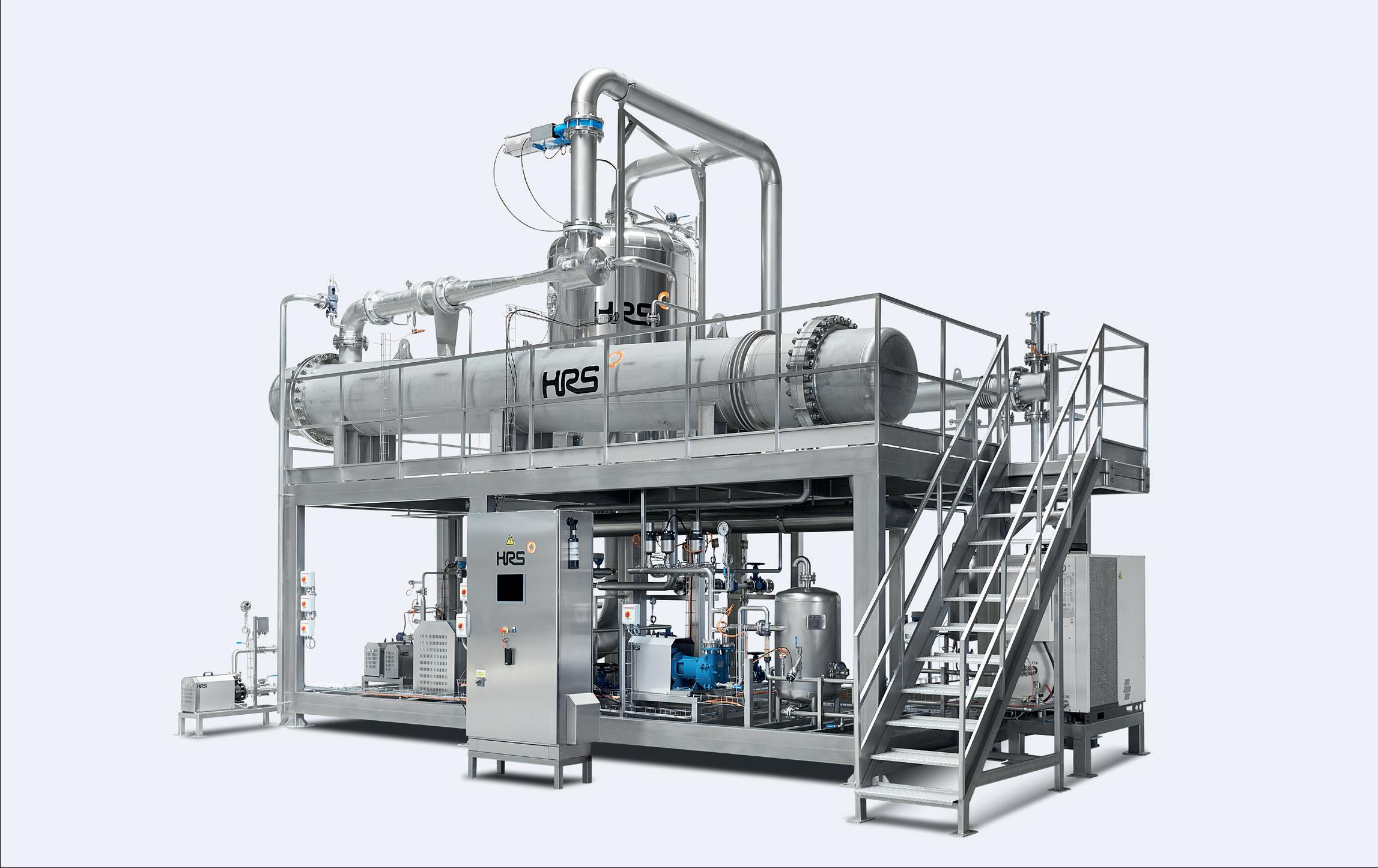
At the forefront of this shift in the water management and infrastructure sector is Molecor, the global leader in Oriented PVC (PVC-O) technology with solutions for supply, sewerage and building. Sustainability at Molecor is the foundational principle guiding every phase of their operations — from the initial extraction of raw materials and eco-designed manufacturing to the final installation and lifecycle of their products.
With an ambitious goal to reach Net Zero emissions by 2040, a full decade ahead of the European Green Deal’s 2050 target, Molecor is redefining what it means to build resilient, eco-friendly water networks.
One of the most persistent challenges in the hydraulic sector was the development of plastic solutions capable of meeting the rigorous requirements of
pipelines. Until recently, manufacturing Oriented PVC (PVC-O) pipes in large diameters was considered technically unfeasible due to the limitations of existing molecular orientation technology for high thicknesses.
Molecor’s innovation has shattered this barrier, enabling the production of TOM® PVC-O pipes in nominal diameters from DN 90 mm to DN 1200 mm. This unprecedented range represents a disruptive leap in pressure pipeline engineering, opening new possibilities for water supply, regional interconnections, and high-capacity conduction projects that previously had to rely on less efficient materials. To complement this, the ecoFITTOM® — the first line of fittings manufactured entirely in PVC-O — covers diameters from DN 90 mm to DN 500 mm, ensuring a
As global challenges such as climate change, water scarcity, and resource depletion intensify, the industrial sector is undergoing a profound transformation. Today, recycling goes far beyond simply managing waste. It requires a circular approach to the entire product lifecycle, meaning every design and production choice must focus on using resources responsibly and keeping products in circulation for as long as possible.
more complete system that maintains mechanical and functional integrity across the entire network.
Molecor’s environmental strategy is deeply rooted in its proprietary manufacturing technology. The company’s globally patented, exclusive Air-Based System for molecular orientation revolutionised the production of PVC-O pipes and fittings.
The molecular orientation process fundamentally reorganises the polymer molecules, creating a laminar structure that drastically enhances the mechanical properties of the pipe. From a sustainability perspective, this process offers unprecedented advantages:
• Material optimisation: By improving the strength and flexibility of the pipe, Molecor can optimise the wall thickness. This achieves top-tier mechanical performance using significantly fewer raw materials compared to traditional plastics or other materials. Less raw material usage translates directly into a reduction in energy consumption during extraction and production.
• High energy efficiency in production: Molecor's air-based orientation process is highly automated and relies on a clean, closed-environment system that is substantially more energy-efficient than traditional water-based orientation methods.
• Energy savings during the use phase: The operational lifespan of a water pipe is where the most energy is consumed,
primarily due to water pumping. TOM® PVC-O pipes present a highly smooth internal surface and a larger internal section, giving them an incredibly high hydraulic capacity (between 15% and 40% higher than pipes made of other materials but with the same external diameter). This minimises friction and pressure loss, ensuring that significantly less energy is required to pump water through the network over its 100-plus year lifespan.
The application of the Molecor PVC-O technology through the TOM® range provides several critical technical im -
provements. Firstly, it offers significantly increased hydraulic capacity due to lower internal roughness and an optimised design that favours flow. This reduction in pressure loss translates directly into lower energy consumption at pumping stations.
Additionally, the material offers a superior response to water hammer due to its ductility and a lower pressure wave propagation speed, which enhances safety and extends the lifespan of the infrastructure. Its high resistance to impacts and external loads also reduces the likelihood of breakage during transport, installation, or operation. Logistically, the lightness of PVC-O facilitates higher productivity on-site, requiring fewer mechanical resources for handling and
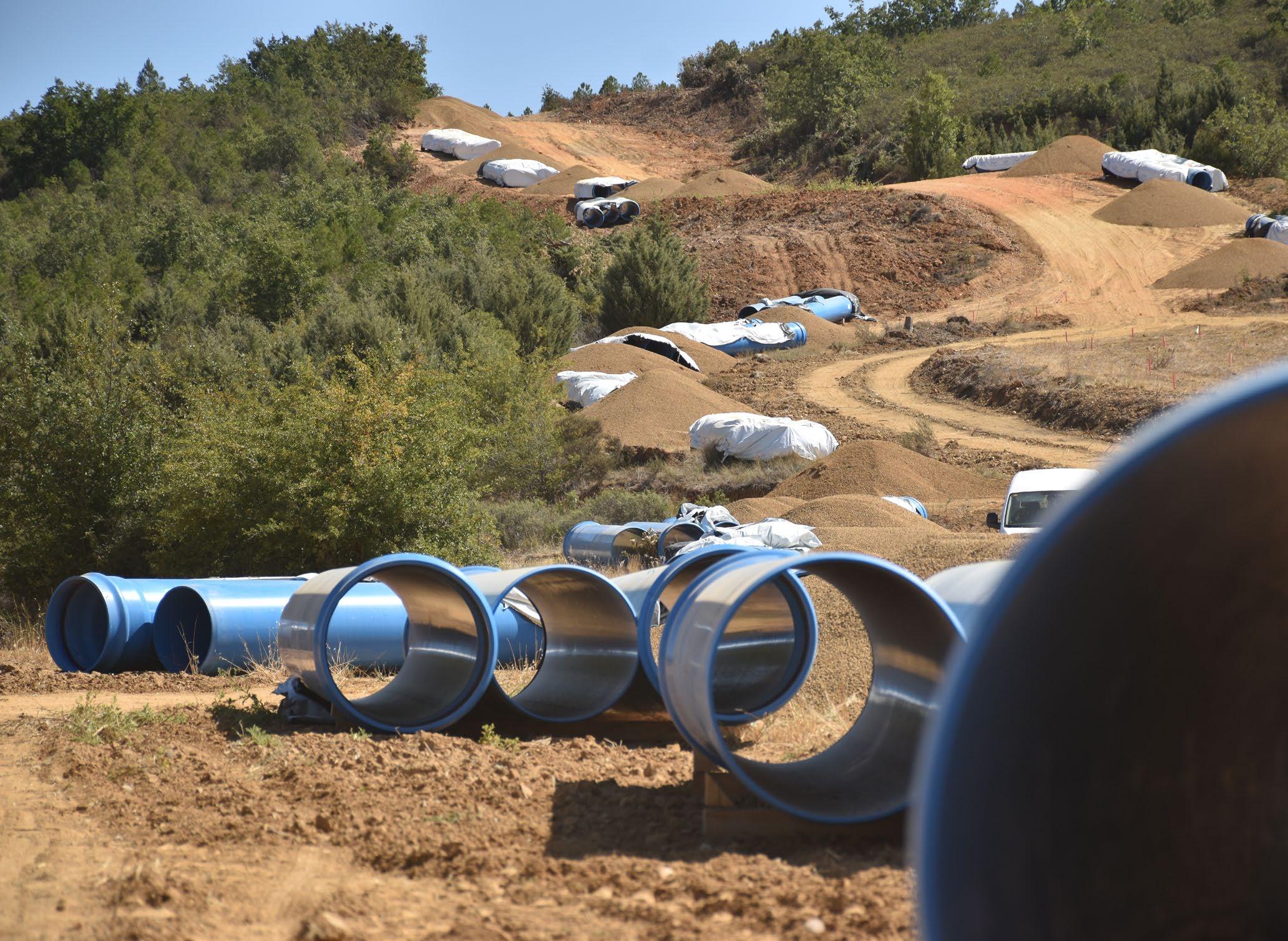
joining, which speeds up work and lowers costs. Finally, the excellent watertightness of these pipes is decisive in reducing leakages and minimising the loss of treated water.
PVC-O is a strategic material for sustainable development due to its physical and mechanical stability and low dependence on fossil resources; only 43% of its composition comes from petroleum, with the rest derived from common salt. It is fully recyclable and has an extensive lifespan, often exceeding several decades in construction applications. Studies indicate that its carbon footprint is lower than many alternative materials, and PVC products represent only 0.7% of urban solid waste.
The TOM® PVC-O pipes developed by Molecor have been tested to prove a useful life of more than 100 years, drastically reducing replacement needs and the environmental impact of the infrastructure’s life cycle. From an operational standpoint, PVC-O resists chemical degradation and maintains structural integrity over long periods. Furthermore, Molecor applies a closed-loop production model that reintroduces almost all sub-products and rejects back into the manufacturing process, minimizing waste and exemplifying an industrial use aligned with resource efficiency, circular economy and sustainability.
The challenge of modernising the world's water infrastructure requires a profound respect for the environment, proving that heavy industry and ecological responsibility are inherently linked. Molecor has moved beyond traditional manufacturing to engineer the sustainable lifelines of tomorrow, a vision anchored by its internal waste reprocessing system. By implementing mechanical recovery across its production
Molecor’s patented, exclusive Air-Based System for molecular orientation revolutionised the production of PVC-O pipes and fittings
plants, the company ensures that virtually 100% of the PVC waste generated during manufacturing, whether from testing or stream adjustments, is reintroduced as raw material.
To combat global warming, Molecor has established a rigorous Decarbonization Plan aimed at achieving climate neutrality by 2040. This path to Net Zero is supported by advanced Energy Management, including the implementation of ISO 50001 standard across key production centres like Loeches, Alovera, Alcázar de San Juan, and Antequera, all of them based in Spain. This framework ensures continuous improvement in energy efficiency and strict monitoring of consumption metrics. Complementing this, the company has integrated extensive photovoltaic self-consumption plants and guarantees that its purchased electricity is certified with a Guarantee of Renewable Origin, preventing thousands of tons of CO2 emissions annually.
Beyond energy, Molecor demonstrates its environmental stewardship through a zero-tolerance approach to microplastic pollution, via the Operation Clean Sweep (OCS) scheme. This voluntary commitment establishes strict containment and cleaning protocols to prevent the loss of microplastics. By securing these processes within their Spanish manufacturing plants, Molecor ensures its operations do not contribute to marine or terrestrial microplastic pollution. This corporate strategy is explicitly aligned with the United Nations 2030 Agenda, integrating several Sustainable Development Goals (SDGs) into daily operations and long-term R&D:
The smooth internal surface and larger internal section of TOM® PVC-O pipes give them a higher hydraulic capacity than pipes made of other materials with the same external diameter 15% to 40%
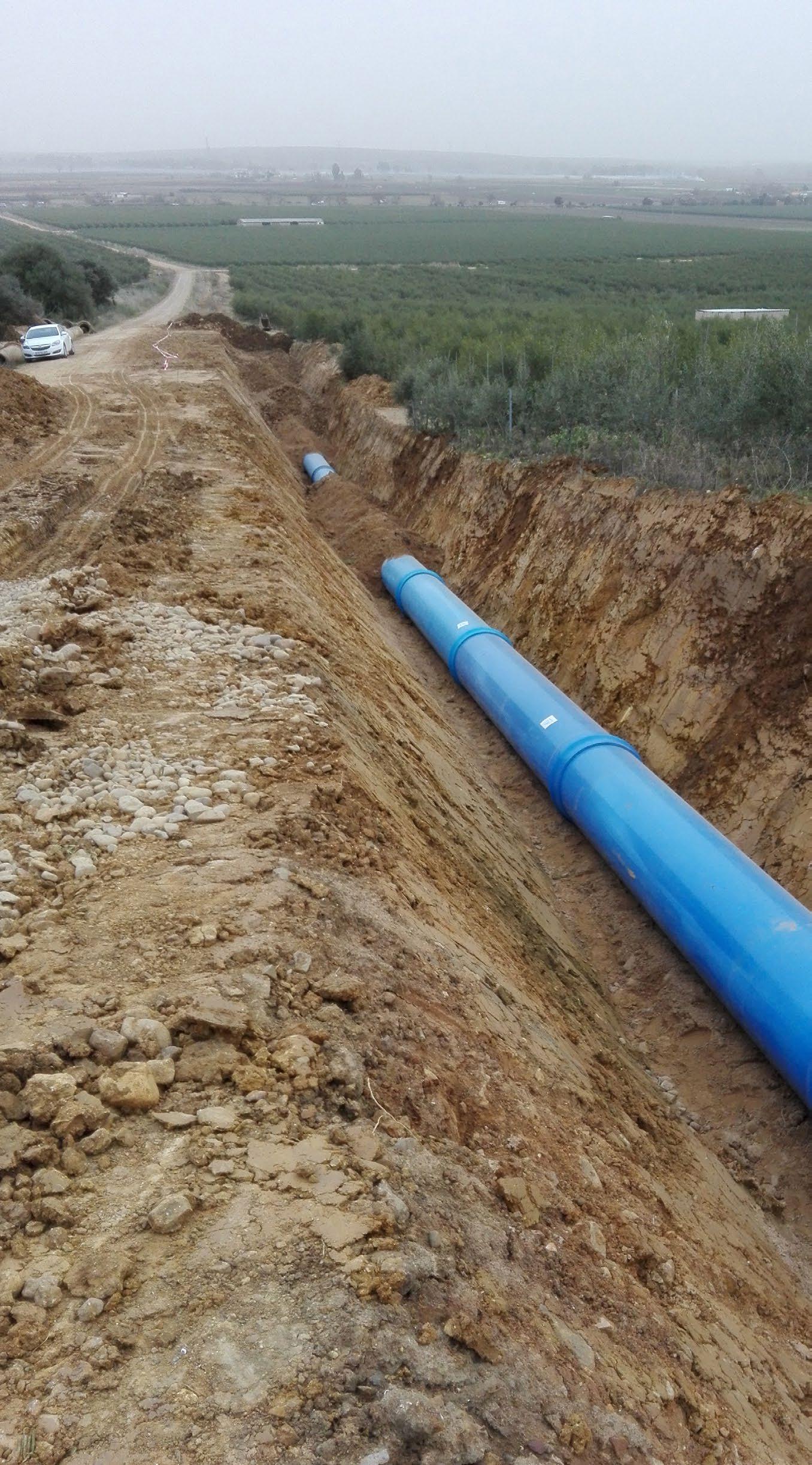
• SDG 6 (Clean Water and Sanitation): Delivering highly durable, leakproof PVC-O networks that drastically reduce water loss in global infrastructure.
• SDG 9 (Industry, Innovation, and Infrastructure): Setting the standard for resilient infrastructure through patented air-based orientation technologies and eco-designed recycled pipelines.
• SDG 12 (Responsible Consumption and Production): Achieved through mechanical recycling, the integration of up to 60% of recycled PVC in specific products, and strict adherence to OCS protocols.
• SDG 13 (Climate Action): Driven by the Net Zero 2040 commitment and the creation of energy-efficient products that lower the carbon footprint of pumping networks.
• SDG 14 (Life Below Water) & SDG 15 (Life on Land): Driven by Molecor’s commitment to OCS Europe, preventing pellet loss and avoiding microplastic pollution in both marine and terrestrial ecosystems.
Ultimately, through relentless innovation in PVC-O technology and a firm commitment to renewable energy, Molecor demonstrates that cutting-edge engineering and planetary health are the dual pillars of modern industrial leadership.
The challenge of modernising the world's water infrastructure cannot be met without a profound respect for the environment. Molecor proves that heavy industry and ecological responsibility are not mutually exclusive. Through innovation in PVC-O technology, the integration of advanced circular economy models, a firm commitment to renewable energy, and the production of highly efficient water networks, Molecor is actively building a sustainable legacy.
By prioritising the health of the planet alongside cutting-edge engineering, Molecor is not just manufacturing pipes — it is engineering the sustainable lifelines of tomorrow. •
Professor
David
Sedlak
Plato Malozemoff Distinguished Professor and Director of the Berkeley Water Center
“Our research has shown that transparency, competence and experience affect public attitudes about recycled water”
Plato Malozemoff Distinguished Professor at UC Berkeley and co-founder of major research platforms including ReNUWIt and the National Alliance for Water Innovation, David Sedlak has spent three decades bridging environmental chemistry, treatment engineering and water policy. In this conversation, he discusses public trust, PFAS regulation, the quiet bottleneck of concentrate management, and why the future of water security may depend less on any single technology than on dismantling the institutional silos that keep drinking water, wastewater and stormwater artificially apart.
Your research spans water quality, treatment technologies, and urban water systems. How did you first become interested in water reuse, and what drew you to approach wastewater as a resource rather than a challenge?
Prior to arriving in California in 1994, I had never lived in a place experiencing water scarcity. Thus, improving water quality meant cleaning up water pollu-
Thirty years ago, David Sedlak arrived in California and discovered that wastewater was not a problem to be disposed of but a resource waiting to be claimed. Today, as director of the Berkeley Water Center, he is one of the most influential voices shaping how the world thinks about water reuse, contaminant removal and the shift toward "one water" management.
AUTHOR : OLIVIA TEMPEST
tion from industrial sites and municipal wastewater treatment plants. In the American West, I discovered that treated wastewater, stormwater and agricultural runoff were potentially important water resources. My introduction to water reuse took place in 1997, when I visited a proposed potable water recycling project in San Diego. I was surprised that all the attention that was being paid to the safety of that project was focused on waterborne pathogens. The limited work on chemical contaminants that had been done was targeted at chemicals originating in industrial sources. As an environmental chemist, I knew that treated wastewater contains a wide variety of chemical contaminants from consumer products, like medicines and household chemicals. This recognition led me to start studying trace organic chemicals in wastewater. After we started finding trace organic contaminants in treated wastewater, we turned our attention to the potential for removing them during the recycling process. This turned out to be an interesting topic

that has occupied a lot of my attention over the last three decades.
Public acceptance has long been one of the trickiest hurdles for potable reuse. What have we learned about communicating these projects to commu-
nities, and what mistakes are still being repeated?
In my opinion, the biggest mistake that water professionals make when communicating about potable water reuse is the belief that marketing campaigns are the path to public acceptance. Mem-
bers of the public are attuned to efforts to convince them to do things that are not in their best interests and tend to view marketing campaigns for water with suspicion. Our research has shown that transparency, competence and experience affect public attitudes about recycled water. Almost every new technology undergoes a process referred to as legitimisation in which members of the public decide whether some new way of behaving is in their best interest and if it is being managed by organisations that they can trust. When the public doubts the motives and competence of the organisations behind a new technology, they may develop strong opposition, as was the case with nuclear power in the 1970s and genetically modified organisms in the early 2000s. In contrast, when legitimisation is achieved, as was the case with air travel in the 1950s, and more recently, potable water reuse in the western United States, the new technology becomes legitimate in the eyes of the public and is widely accepted.
Your work at the Oro Loma Horizontal Levee has explored treatment wetlands as a polishing step for wastewater effluent. What have longer-term observations revealed about the durability of nature-based systems and the lifespan of their dominant removal mechanisms?
Unless there are specific requirements for contaminant removal in discharge permits, most utilities cannot justify large expenditures for effluent polishing. Nature-based treatment systems like constructed wetlands offer an attractive alternative to engineered unit processes, especially for removing nutrients, metals and trace organic contaminants from municipal wastewater that is being discharged to surface waters. Compared to conventional unit processes, these systems are relatively inexpensive and provide multiple benefits, like shoreline
protection, recreation and habitat creation. Presently, most constructed wetlands are designed as free water surface flow systems in which treated wastewater passes through a series of basins or cells, as they are sometimes referred to by their designers. As water passes through the wetlands, it encounters microbes that are capable of denitrification and breakdown of trace organic contaminants. However, these systems require annual maintenance to minimise hydraulic short-circuiting. They also tend to get damaged by flooding. The horizontal levee, which is a subsurface wetland that employs native plants and wood chips to provide carbon to biofilms located about 30 centimetres below the ground surface, also removes nitrate, metals and trace organic contaminants. These systems are quite robust and require minimal maintenance to maintain their performance. Currently, the greatest challenge is related to the costs of sand and gravel needed to build the system as well as the relatively large surface areas needed to treat water. Thus, we have turned our attention to the treatment of concentrate generated by reverse osmosis systems used for water reuse.
PFAS dominates the contaminants conversation. Beyond removal and destruction technologies, what changes in monitoring, regulation or source control are most urgently needed to get ahead of the problem?
The good news on the PFAS front is that nearly all uses of the most toxic compounds — the eight carbon chain compounds like PFOS and PFOA — have been discontinued. Many uses of the less toxic, shorter chain length compounds also are being eliminated or curtailed. Thus, we are no longer creating PFAS-contaminated sites that will require large sums of money and years of remediation. In places that are
Available data suggest that the safe levels of many of the short-chain PFAS are probably over an order of magnitude higher than the stringent maximum contaminant levels that have been established for PFOS and PFOA. However, we need more data on the toxicity of these shorter chain length compounds to resolve questions of whether treatment is needed. We also need treatment technologies that can remove not contaminated by industrial PFAS sources, concentrations of these extremely toxic compounds will slowly decrease, as was the case for other persistent chemicals that were discontinued, like PCBs, DDT and brominated flame retardants. However, many of the shorter-chain compounds will persist and possibly even increase in concentration before they begin to decrease.
these contaminants when they do occur at unacceptable concentrations.
Reuse and desalination both generate concentrate streams that are difficult and costly to manage. How serious a bottleneck is concentrate management for the long-term scalability of reuse, and which approaches do you find most promising?
“”
"THE GOOD NEWS ON THE PFAS FRONT IS THAT NEARLY ALL USES OF THE MOST TOXIC COMPOUNDS, LIKE PFOS AND PFOA, HAVE BEEN DISCONTINUED"
The main problem associated with managing residuals produced by potable water reuse projects is related to the final fate of the concentrate produced by reverse osmosis (RO). Currently, most RO processes operate at recoveries of around 85%, meaning that for every million gallons of wastewater that is being recycled, plant operators must find a means of disposing of 150,000 gallons of water that is considerably saltier than most receiving waters (e.g., total dissolved solids concentrations in such concentrate will typically range from 2,500-5,000 mg/L). The RO concentrate may also contain concentrations of nutrients, metals and trace organic contaminants that are too high for surface discharge without additional treatment. As a result, many potable reuse projects that do not have access to either a deep ocean outfall have avoided the generation of RO concentrate by relying on alternative treatment technologies, like activated carbon and ozonation. However, these processes are expensive and generate other types of residuals, like spent activated carbon. They also do not provide low-salinity recycled water, which is the main attraction of recycled water in places where source water salinity is a concern.
In situations where the salinity of the RO concentrate is not a concern, such as discharges to estuaries or brackish surface waters, additional treatment to remove contaminants can alleviate the RO bottleneck. Conventional unit processes appear to be too inefficient to achieve
the desired water quality on this large volume of water. We are hopeful that nature-based treatment systems, such as the horizontal levee (a subsurface constructed wetland), will be a cost-effective means of treating RO concentrate from water recycling projects. Our pilot-scale studies on the horizontal levee have been encouraging, but additional research and development is needed to reduce the land area needed for contaminant removal.
Climate change is reshaping both supply and demand. Which water reuse and reclamation strategies are most underrated as climate adaptation tools — and which are over-promised? In the early years of water reuse, most recycled water was used for landscape irrigation, industrial operations such as cooling towers, and agriculture. This made sense when potable reuse was still unproven. However, construction, maintenance and operation of dedicated recycled water systems (i.e., purple pipe networks) for non-potable water recycling systems has proven to be expensive, especially when users are located far away from the source of recycled water. It also can have the unintended consequence of discouraging efforts to reduce outdoor water use. Today, much of the focus is on potable water reuse because it avoids the need for a second water distribution network.
In parallel with efforts to recycle the effluents produced by wastewater treatment plants, experience has been gained with water recycling in buildings, office parks and housing developments. This approach, which is sometimes referred to as on-site reuse or distributed water reuse, has the potential to further enhance water security if issues related to permitting and operations can be resolved. For example, autonomous operation (i.e., without on-site staff) can be enabled by use of sensors and actuators
that employ machine learning, digital twins and other advanced tools.
You have helped build cross-institutional research platforms such as ReNUWIt and the National Alliance for Water Innovation (NAWI). What does it take to translate university research into utility-scale practice in a risk-averse sector?
"EXTERNAL FUNDING FROM FEDERAL SOURCES HELPS DEVELOP INNOVATIVE WATER SOLUTIONS, INCENTIVISING RESEARCHERS AND UTILITIES TO WORK TOGETHER"
“”
Partnerships between utilities and universities require time to develop trust and understanding. Researchers are rewarded for being the first ones to report on technology applications or potential risks associated with new technologies, while utility managers are rewarded for providing a safe, affordable and abundant water supply. These objectives are not mutually exclusive, but it is not always obvious how these contrasting
objectives can be achieved. External funding from federal sources is extremely helpful in developing innovative water solutions because they incentivize researchers and utility personnel to work together as equal partners. Without the framework of an umbrella organisation that rewards collaborations, it is difficult to effectively translate university research into practice at utilities; in places that lack these kinds of organisations, it is more likely that innovators at universities will target equipment manufacturers and private companies as potential users of their innovations.
Looking ten to twenty years ahead, what is the single change you would most like to see in how the world manages its wastewater and what would have to happen in the next five years to make it realistic?
Over the past decade, water professionals have started to adopt the term “one water” to describe the need for holistic water management. This is a step in the right direction because it recognises that water from any source may be used for any purpose after appropriate treatment. This is a potentially powerful concept that, if applied properly, could change the way that we educate students, operate water systems and engage in professional activities. The one water ethos requires us to rethink many of the water institutions that have developed to support management of drinking water, wastewater, hazardous waste and stormwater as separate entities. Creating greater recognition of the potential benefits of breaking free of the mindset will allow us to create systems where tap water, industrial process water, irrigation water, cooling water and water for ecosystems are managed holistically. It also will create a greater willingness to experiment with novel solutions that will help achieve a goal of abundant, safe and affordable water for all. •

The global push toward circular economies and tighter environmental regulation is transforming how industries manage organic waste. Whether it is municipal sewage sludge, agricultural digestate, food processing effluent or industrial wastewater, the pressure to treat, concentrate and recover value from these streams has never been greater.
AUTHOR: ANTONIO GUILLERMO JARA PONCE | GLOBAL SALES MANAGER - EUROPE, HRS HEAT EXCHANGERS
Central to many of these processes is a single piece of equipment on which operational success depends: the heat exchanger. Efficient heat transfer underpins everything from pasteurisation and evaporation to energy recovery, making the right choice of equipment central to the economics and sustainability of any facility.
Yet choosing the right heat exchanger for these applications is far from straightforward. Organic waste streams vary widely in composition, solids content and rheological behaviour, meaning the same class of material can behave very differently depending on its origin and pre-treatment history. Get the selection wrong, and the consequences include excessive fouling, reduced efficiency and costly downtime. Get it right, and a well-chosen heat exchanger becomes a reliable workhorse that supports continuous, efficient operation for years.
Heat exchangers are key components in many processes in the wastewater, anaerobic digestion and waste treatment sectors, including heating, pasteurisation and evaporation. With so many differences in the composition of sludge, digestate, manure and wastewater streams, choosing the right heat exchanger for the right material and the right process is vital.
The high viscosity of most organic waste streams means that they require more energy to pump and move and often have a higher potential to foul pipework and heat exchangers, reducing heat transfer and operational efficiency.
When considering different sorts of sludges, it is useful to clarify what we mean by viscosity. It is normally defined as a measure of a substance’s resistance to motion under an applied force, based
on the amount of force required to remove one layer in relation to another (shear stress) and the change in speed of the layers relative to each other (the shear rate). It is measured in units called centipoise (cP) with one cP being equal to 1 mPa sec-1 (millipascal per second).
As you would expect, the viscosity of sludges and digestates increases as the solids content rises and also depends on temperature. As an example, a sewage sludge with 2% solids may have a viscosity of 5 cP, while a similar material with 10% solids can be 50 cP. The high variability of these materials means that example values are of little use, but liquid manures can be anywhere from 20 cP at 2.5% total solids (TS), up to 500 cP at 12% TS.
However, the viscosity of different materials can change as they are subjected to different levels of shear stress and temperature. Because of this, most fluids are classified as being either Newtonian, or non-Newtonian. Newtonian fluids have the same viscosity irrespective of changes in temperature or shear stress – the most common example of this is water. Non-Newtonian fluids (which can then be sub-divided into five different categories) have viscosities which fluctuate depending on the shear rate applied.
In practice, this means that when dealing with non-Newtonian products (such as some sludges and slurries), elements of the processing operation – including pumping, heating, cooling and passing through pipework – all have the potential to affect the waste stream’s viscosity and handling requirements.
With differences in the composition of sludge and wastewater streams, choosing the right heat exchanger for the right material is vital
Choosing the correct type of heat exchanger, together with careful system design, helps avoid such problems. Corrugated tube heat exchangers, such as those designed and produced by HRS, ensure that viscous materials can be processed efficiently as the corrugated tube design helps minimise fouling, increasing thermal efficiency during operation, and extending operational periods between cleanings. In addition, corrugated tube heat exchangers have a lower pumping requirement than smooth tube heat exchangers due to their compact nature, which results in a lower pressure drop. This helps to increase operational life while reducing maintenance costs compared with other types of heat exchanger.
Where sludge has a relatively low viscosity but contains suspended solids a double-tube heat exchanger, like the HRS DTI Series, is likely to be suitable.
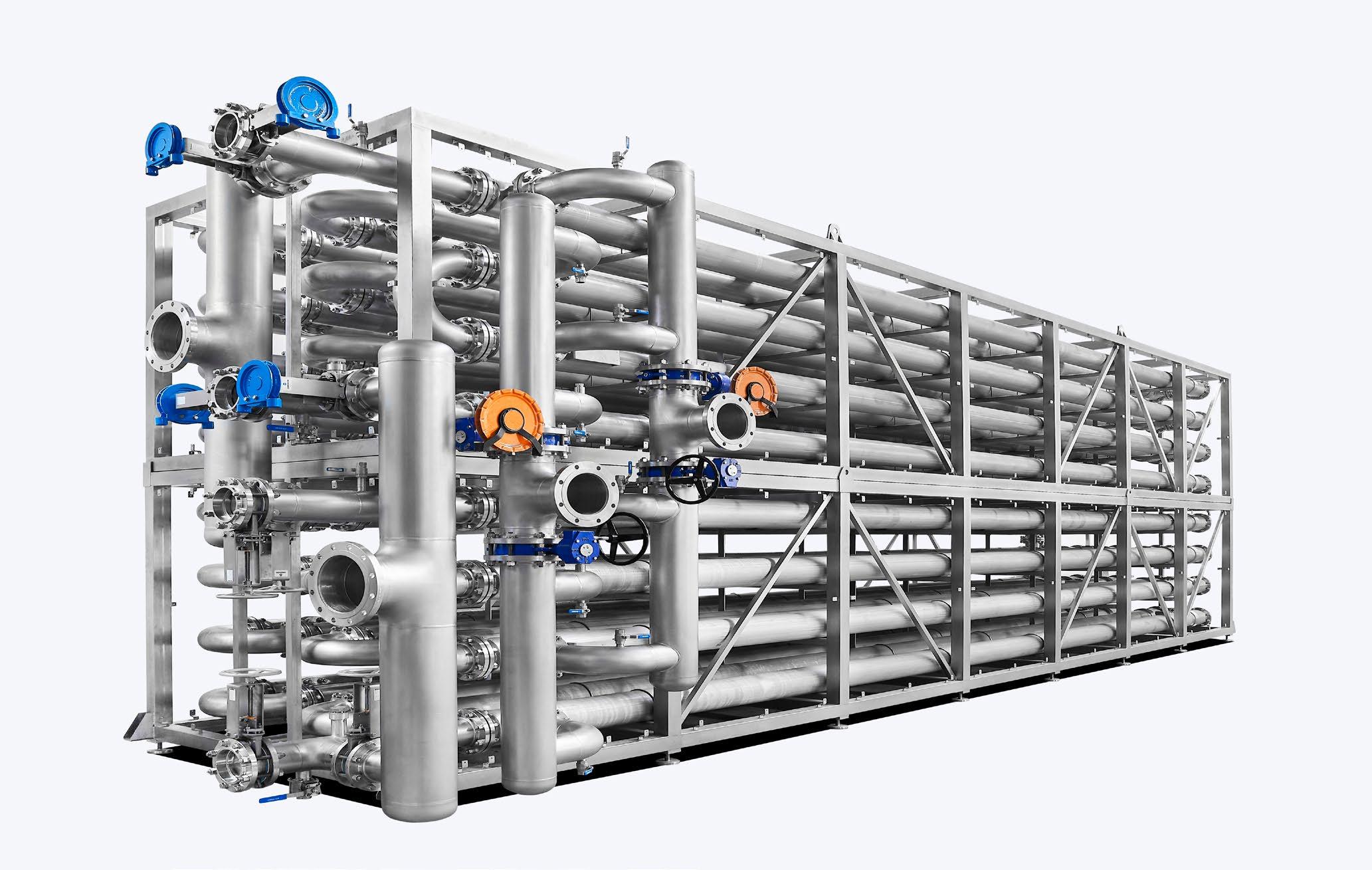
In a double-tube heat exchanger, one large tube carries the product, so there is less chance of blockages and fouling by any particles contained in the sludge. In addition, the HRS DTIR Series has a design specifically adapted for energy recovery from low viscosity sludges and features a removeable inner tube to aid cleaning and inspection.
Scraped surface heat exchangers for the toughest challenges
For the most viscous materials, the use of corrugated tubes will not be sufficient to prevent fouling or maintain movement through the exchanger. In these cases, scraped surface heat exchangers (SSHEs) are ideal, particularly for evaporation.
When linked to an on-site CHP plant, the DCS is wholly self-sufficient –no energy or water is brought in or wasted, and everything is reused
In most applications, this will involve the HRS Unicus Series, which uses a reciprocating movement to mix the fluid whilst cleaning the heat exchange surface. The separate hydraulic action of the Unicus Series means that the speed of the scrapers makes it particularly suitable for handling and concentrating brines, manures, food waste and wastewater.
We also produce a special version of the Unicus Series for evaporation applications. During evaporation, fouling and reduced heat transfer can become a problem for traditional evaporators. With the Unicus, the scraping action keeps the heat transfer surface clean and maintains high heat transfer, allowing the Unicus Series to concentrate waste streams to concentrations that traditional technologies cannot match. This makes it ideal solution for the concentration of environmental waste where
volume reduction is vital. Unicus evaporators can be applied in a multi-effect setup or in combination with mechanical vapour recompression. Concentration under vacuum can also be applied with a Unicus evaporator, while the scraped surface operation allows continuous operation and reduces downtime.
As well as the Unicus Series, the HRS Digestate Concentration System (DCS) is also available as a dedicated solution to remove up to 80% of the water content from digestate and sludge, producing a material containing 20% dry solids.
The DCS works by superheating the digestate in a vacuum to facilitate concentration, using evaporation to significantly reduce digestate volumes while, at the same time, increasing the nutrient content. The first part of the process involves heating the liquid digestate in heat exchangers; no additional water or energy is required, as the surplus water from the plant’s CHP engine (which is usually available at 85˚C) is used as the heating media. The digestate is then pumped into a cyclone separator; the high-speed rotating airflow causes the solid particles (which are too heavy to follow the tight curve of the airstream) to fall to the bottom of the cyclone, where they can be removed.
The steam produced from this first cycle (usually available at 70˚C) is then used as the heating media for the second effect, whereby the process is repeated. The subsequent steam (usually available at 60˚C) is used as the heating media for the third cycle – the number of effects is determined by the level of dry solids required, and the amount of spare heat available, up to a maximum of four cycles. After the final effect, the steam is condensed back into water and
can then be used to dilute feedstock going into the front end of the digester; a completely closed loop system. When linked to an on-site CHP plant, the DCS is wholly self-sufficient – no energy or water is brought in or wasted, and everything is re-used.
Ultimately, there is no universal solution when it comes to heat exchangers for organic waste streams. The correct choice depends on a careful assessment of the material's viscosity and solids content, the process temperatures involved, the required duty and
the operational priorities of the facility. Taking the time to match equipment to application pays dividends in efficiency, uptime and whole-life cost.
HRS Heat Exchangers has decades of experience designing and supplying heat transfer solutions for the wastewater, anaerobic digestion and waste treatment sectors. For more information on selecting the right heat exchanger for your application, please contact your local representative or our environmental systems specialists today. •
HRS corrugated-tube range at a glance.
SLUDGE / DIGESTATE
/ DIGESTATE
Multitube. Low-viscosity fluids, small particles.
Ideal for energy recovery on wastewater streams.
Tube-in-tube. Handles large particles.
Digester heating & sludge heat treatment.
Low-viscosity sludge. Removable inner tube.
Direct energy recovery, product vs. product.
Three or four concentric tubes.
For viscous fluids hard to treat in other geometries.
Larger inner tubes for low pressure drop.
Heat recovery from exhaust / flue gases.
Your treatment plant never made PFAS. The law has decided you will pay to manage them anyway. The only question left is whether you move first.

AUTHOR : DAVID ESCOBAR
On 26 June 2025, a court in Vicenza sent eleven chemical executives to prison for poisoning water. The sentences totalled more than 141 years. The ruling is a first-instance judgment and will almost certainly be appealed, but the legal and commercial signal it sends is immediate. The contamination they were convicted of had reached the tap water of roughly 350,000 people across the Italian provinces of Vicenza, Padua and Verona. The compound at the centre of the case belonged to a family of chemicals you have almost certainly never named in a board meeting, and can no longer afford to ignore: PFAS.
If you run a utility, regulate one, finance one, or sell technology to one, the Vicenza verdict is not a foreign curiosity. It is a preview. PFAS contamination is now a matter for criminal courts, not just environmental agencies. The question is no longer whether PFAS will reshape your cost base, your liability and your capital plan. It is how fast, and whether you act before the deadlines are set for you.
There are more than 10,000 PFAS compounds. They are in drinking water, wastewater, sludge, wildlife, food and human blood, on all six continents — called “forever chemicals” because the carbon-fluorine bond that makes them useful also makes them almost impossible to break down. PFOA and PFOS are linked to kidney and testicular cancer, thyroid disease, liver damage and immune suppression, and one study published in the European Journal of Public Health estimated 3,800 additional cardiovascular deaths in the exposed population of Italy’s Veneto region over 34 years. Your treatment plant did not make them, but the law is rapidly deciding that you will manage them.
Municipal wastewater plants are not a source of PFAS. They are a receiver. The chemicals arrive from households and industries connected to the network, pass through conventional biological treatment that was never designed to stop them, and leave in two directions: into the effluent and the receiving environment, and into the sludge.
wet tonne to haul and landfill what they once gave to farms. The Portland Water District watched its annual biosolids bill climb from 1.5 to 3.2 million dollars — for a product it can no longer sell or give away, and cannot stop making.
The cost of removing PFAS from wastewater, by one Minnesota estimate, runs between 2.7 and 18 million dollars per pound destroyed. You are not paying that bill because you polluted. You are paying it because the pollution arrived at your gate.
For years, regulators played whack-amole, banning PFAS one compound at a time while industry substituted the next. Europe has decided to stop playing.
PLANT DID NOT MAKE THEM. THE LAW IS RAPIDLY DECIDING THAT YOU WILL MANAGE THEM
That second pathway is where the money bleeds. When long-chain PFAS bind to biosolids, the sludge that utilities have spread on farmland for decades becomes a contamination vector. Across Europe between 2018 and 2022, between 51 and 60 per cent of rivers and up to 100 per cent of coastal and transitional waters exceeded the environmental quality standard for PFOS. And when regulators react, they react against the receiver.
Maine became the first jurisdiction in the world to ban the land application of biosolids outright in 2022. Sludge handling costs that ran around 71 dollars per wet tonne in 2018 reached 133 dollars by 2023. Many Maine utilities now pay between 190 and 240 dollars per
Since 12 January 2026, the recast EU Drinking Water Directive has made harmonised PFAS monitoring mandatory across member states, with a limit of 500 nanograms per litre (ng/L) for “Total PFAS” and 100 ng/L for the sum of twenty named compounds — member states apply one or both parameters, and all have opted for the sum of twenty approach. Several countries have gone further: Denmark enforces 2 ng/L for the sum of PFOA, PFOS, PFNA and PFHxS; Sweden 4 ng/L for a broader set of compounds; Germany 20 ng/L for the same four by 2028.
The real signal is the universal restriction proposal under REACH, filed by the Netherlands, Germany, Denmark, Norway and Sweden. In March 2026, ECHA’s Risk Assessment Committee concluded that a broad restriction was justified and that a full ban would be the most effective measure. The Socio-Economic Analysis Committee’s draft opinion, published the same month and still subject to consultation, expressed greater caution, favouring time-limited derogations of up to twelve years where alternatives do not yet exist. The final SEAC
opinion is due by year-end, after which the Commission will draft the law.
The economic argument is now quantified. A European Commission study published in January 2026 estimated that leaving PFAS contamination at current levels until 2050, with no regulatory action, would cost European society around 440 billion euros. Treating only the contaminated water would cost more than a trillion. Acting at source by 2040 would save roughly 110 billion. Inaction is not the cheap option. It is the expensive one, deferred.
The smallest molecule, a big problem
Trifluoroacetic acid, TFA, is the shortest-chain PFAS of all, just two carbons, and the final breakdown product of fluorinated gases, refrigerants and at least 32 pesticides authorised in the EU. Under the OECD definition that Europe follows, TFA qualifies as a PFAS; the US EPA uses a narrower definition that excludes it. Studies find that TFA accounts for around 98 per cent of all PFAS detected in European water samples and has multiplied fivefold in German rainfall since the 1990s, according to research published in Environmental Science and Technology.
In early June 2026, ECHA's Risk Assessment Committee confirmed its recommendation to classify TFA as toxic to reproduction and, for the first time for any substance, as persistent, mobile and toxic, and very persistent and very mobile. It is still a scientific opinion, not yet binding law. But the direction is set.
TFA breaks the conventional playbook because treatment barely touches it. Granular activated carbon, ion exchange and even reverse osmosis are largely ineffective. Control at source is not the preferred option — it is close to the only one. For any utility building water reuse or aquifer recharge, that is a design problem to solve now, while the assets are on the drawing board.
The United States runs the largest PFAS response on earth by investment and litigation. It is also, at the federal level, reversing.
In April 2024, the EPA set enforceable drinking water limits of 4 ng/L for PFOA and PFOS and 10 ng/L for three others. Then the direction changed. On 18 May 2026, the agency formally proposed two rules: one to rescind the limits for PFHxS, PFNA, GenX and the hazard index for mixtures, and one to extend the compliance deadline for PFOA and PFOS by two years from April 2029 to April 2031, though the existing limits remain operative during the rulemaking process. The comment period closes on 20 July 2026, with a public hearing on 7 July. If finalised, only two of the six compounds regulated in 2024 would keep enforceable federal limits.
is the American Water Works Association. Their argument is not that PFAS are safe, but that the EPA underestimated compliance costs and that small and rural systems cannot absorb the capital burden without steep tariff rises. Proportionality is a genuine question, raised by the same utilities that receive the contamination they are now asked to remove.
The lesson is that federal retreat does not lower your risk; it relocates it. Michigan proved that source control works: by identifying industrial dischargers and demanding better pre-treatment, it cut PFOS concentrations at some facilities by more than 85 per cent between 2018 and 2022. When the federal floor drops, the most effective lever is the one closest to the source.
The litigation is no longer a tail risk. It is a market. In the United States, collective settlements now exceed 14 billion dollars: 3M agreed to pay up to 12.5 billion over 13 years, DuPont, Chemours and Corteva agreed to 1.185 billion, and New Jersey reached a separate 2 billion dollar settlement with DuPont in August 2025.
INACTION IS NOT THE CHEAP OPTION. IT IS THE EXPENSIVE
The courts are pulling the other way. The DC Circuit has twice refused EPA requests to suspend the contested standards while litigation continues — first in January 2026, when it rejected a request to set aside the limits entirely, and again in March, when it declined to split off and pause the case over the four compounds the agency now wants to drop. Nineteen state attorneys general have filed briefs defending the 2024 rule.
The 2024 standards were challenged not only by chemical makers but by the water sector itself — the lead petitioner
Claim windows close in summer 2026: 31 July for both the DuPont and 3M action funds, 1 August for the special needs fund. Miss the deadline and you lose eligibility and release the defendants from liability. There are more than 15,000 personal injury claims pending in the federal court that handles the firefighting foam litigation, with no global settlement yet.
Europe has begun to follow. The Dutch government has issued an unprecedented liability notice to 3M over contamination of the Schelde estuary. In France, around 200 residents of the chemical valley south of Lyon have sued Arkema and Daikin for more than 36 million euros. The
$14B+ in US settlements with PFAS manufacturers
Source: 3M, DuPont/Chemours/Corteva, Tyco, BASF (US federal MDL 2873, AFFF litigation)
€440B cost of inaction to EU society by 2050
Source: European Commission, Jan 2026
141 yrs in prison: first criminal PFAS conviction
Source: Vicenza Court of Assizes, Jun 2025
Vicenza verdict ordered more than 75 million euros in civil damages alongside the prison terms. The UK Parliament, in an April 2026 report, urged a more rigorous application of the polluter-pays principle, opening the door to cost-recovery mechanisms for water companies.
Destruction becomes a business Every treatment technology you can buy today shares one flaw: it separates PFAS, it does not destroy them. Granular activated carbon, ion exchange and high-pressure membranes all concentrate the problem into a secondary waste stream that someone still has to deal with.
Supercritical water oxidation mineralises PFAS into fluoride, carbon dioxide
and water at 374 degrees and high pressure, and has demonstrated destruction above 99.7 per cent in concentrated influent. In June 2026, Reworld launched a destruction service using a different high-temperature pathway — thermomechanical incineration at its waste-to-energy plants, which run above 1,100 degrees — positioning it as the largest full-scale PFAS destruction capacity in the United States. 374Water, which builds supercritical systems, reported a gross margin of 63 per cent in the first quarter of 2026, up from 25 a year earlier — on revenues still at pilot scale — a sign the technology is starting to earn service revenue. Electrochemical oxidation is advancing in parallel, with destruction efficiencies above 98.8 per cent. The EPA’s 2026 interim guidance on PFAS destruction and disposal now recognises thermal treatment, underground injection and landfilling as commercially available options.
Estimates vary by an order of magnitude depending on scope, from 2.28 billion dollars in 2025 on one measure to nearly 30 billion by 2030 on the broadest. The opportunity is not in concentrating PFAS. It is in destroying them.
The map has holes, and the holes are the story
North America and Europe account for 80 to 90 per cent of the scientific literature, the largest lawsuits and the most significant investment. Everywhere else, the data thins out, and the thinness is itself the danger.
In the Gulf, where countries hold 60 per cent of the world’s desalination capacity and lean heavily on reused water, a single study found PFAS up to 956 nanograms per litre in coastal lagoons near Jeddah that receive treated sewage — yet a 2024 review found just five published studies in Saudi Arabia and one in Bahrain. In South Africa, reservoirs
supplying three provinces have shown PFAS sums up to 909 nanograms per litre. Across most of Africa, the capacity to measure PFAS barely exists.
Where there is no baseline data, there is no basis for regulation. Advanced jurisdictions restrict, and the chemicals and the production capacity migrate. The machinery from the convicted Italian plant was reportedly dismantled and shipped to India. The asymmetry is not an academic curiosity. It is a systemic risk that will reproduce the entire PFAS problem, geographically, on a decades-long delay.
The science is settled enough for courts and parliaments. The regulatory architecture is in force in Europe, contested in the United States, advancing across Asia-Pacific. The litigation has crossed the Atlantic. The technology to destroy these chemicals is moving from demonstration to service. None of this is on a 2050 horizon. It is on your current capital plan.
Treat PFAS as what it is: not a compliance line item, but a strategic variable that touches your liability, your tariffs, your sludge, your reuse strategy and your capital allocation at once. Map your sources before a regulator maps them for you. Build PFAS removal and destruction into reuse and recharge schemes at the design stage, because retrofitting a 50-year asset is the expensive path. Watch TFA, because it will not be stopped at the plant; it has to be stopped at source. Decide, deliberately, how the cost gets shared between ratepayers, public budgets and the companies that made the chemicals, because if you do not decide, the ratepayer pays twice.
The executives in Vicenza did not believe the reckoning would reach them. It did. The only open question is who sees it coming. •

Martin Hurst SUSTAINABILITY FIRST ASSOCIATE
The crisis facing the UK water sector is not a problem solely about the environment or regulation, or even necessarily about water. It is in some ways a litmus test of how private sector (or even mutual/charity) owned infrastructure can maintain public trust when pressure from civil society and the media becomes political – think social housing after the Grenfell fire, or energy in the run up to the price cap.
Recent government responses are in large part a reply to public and political unease. But the heart of the problem goes deeper: what is needed from a private monopoly industry supplying an essential of life, along with changes to regulation, to repair and retain trust? Without fundamental change, calls for a different model including state ownership, are unlikely to disappear. If there is a change in Labour leadership, they may grow and could lead to a broader contagion across UK utilities and infrastructure more widely.
The Government approach, following the Cunliffe review, primarily focusses on refining existing models, through proposals for tougher enforcement, clearer regulatory expectations, and greater transparency. Cunliffe was right that whatever the merits of the case, a reset requires a sacrificial victim – in this case Ofwat – and transparency is non-negotiable. But this alone could look more like rearranging the deckchairs on the Titanic, rather than a response to the crisis in
legitimacy. The sector needs to move to an approach where actions are less exclusively defined by the regulatory system. Regulators must promote the flexibilities – outcome-based approaches, earned autonomy and regulatory culture – which enable this which requires a measure of courage which has been lacking.
Public scepticism towards the sector is rooted (however unfairly) in perceptions of a fundamental imbalance between private profit and public good.
"To achieve credibility, a private owned monopoly utility must go beyond minimum compliance and demonstrate visible leadership accountability"
The erosion of trust is structural, reflecting how institutions function in practice as much as how they communicate with the public, and extends beyond water to other regulated infrastructure sectors. Poor credibility leads to greater regulatory volatility and exposes long-term investment to reputational and policy risks, making water’s current predicament a warning for all utility industries.
To achieve lasting credibility, a private owned monopoly utility must go beyond minimum compliance and
demonstrate visible leadership accountability. Executives and boards need to take ownership of systemic issues, openly communicate the difficult trade-offs that infrastructure delivery entails, and accept responsibility when outcomes fall short. Governance needs to be more inclusive with boards drawn from a wider section of society and greater visible third-party access and assurance.
This is not just for companies. Political trade-offs need to be set by government rather than being left to unelected regulators. Regulators need to create honest dialogue around the complex balance of cost and public outcomes. Environmental and societal outcomes are shaped by a range of actors, so rebuilding trust requires genuine cross-sector collaboration rather than operating through vertical regulator industry interfaces.
For business leaders, it signals a commitment to leading change, and for consumers, it demonstrates that their voices are being heard. In summary, the recent government reforms are steps in the right direction, but there is much more to do. Government need to own political trade-offs; regulators need to create the climate for more autonomy in the industry; and industry needs to respond with genuine and transparent leadership and commitment to public purpose.
The opportunity to rebuild trust remains open, but as each cycle of incremental change passes, legitimacy becomes harder to recover.
On 23 April 2026, Smart Water Magazine, in collaboration with Autodesk, hosted the webinar Discover the new game-changing Network Design in InfoWorks ICM, bringing together water professionals from around the world to explore how integrated, rule-based design is reshaping preliminary pipe sizing. The session featured Hasanain Al-Naimi, Regional Head of Autodesk Water Infrastructure for the Middle East, Turkey and Africa, Samer Muhandes, Senior Product Manager for InfoWorks ICM at Autodesk Water Infrastructure; and Ahmed Elsayed Younes, Technical Solutions Engineer for EMEA at Autodesk Water Infrastructure, who guided attendees through both the strategic context and a live technical demonstration.
Al-Naimi opened by outlining how Autodesk Water Infrastructure is positioning itself across the full water lifecycle, from planning through to operation. "We cover the complete water cycle from cloud to sea," he noted, highlighting the demand for integrated tools that unite analysis, design and collaboration. Samer Muhandes built on this idea, contrasting traditional backand-forth between separate design and
Hasanain Al-Naimi
Regional Head, Autodesk Water
Infrastructure - META (Middle East, Turkey & Africa)
modelling tools with a single, unified platform. "ICM will no longer become part of your workflow," he explained. "ICM will become the workflow."
A rule-based approach with engineer control
At the core of the new functionality is a rule-based design engine. Engineers define constraints such as pipe diameters, slopes, velocities and cover depths, and the software evaluates multiple design candidates against configurable penalty weightings. During the live demonstration, Ahmed Younes and Muhandes configured pipe catalogues, applied rainfall data through IDF curves and ran an upstream-to-downstream design in seconds, automatically sizing pipes and setting invert levels. "Now with InfoWorks ICM Network Design, things are becoming much simpler and more integrated," he observed.
The speed of execution drew particular attention, with networks of hundreds of thousands of pipes designed in under a minute. Equally important is transparency: each run produces a comprehensive report explaining which pipe sizes were considered, why certain options were
Samer Muhandes Senior Product Manager, InfoWorks ICM Autodesk
rejected and which factors governed the final slope or diameter, supporting both internal review and external audit.
With Al-Naimi acting as moderator, audience questions arrived from the Middle East, the UK, Continental Europe and Asia. Participants explored benchmarking against legacy tools, handling combined stormwater and wastewater systems, integrating fixed elements such as orifices or pumping stations, applying constraints to specific sections of a network, and the prospect of linking penalty weightings to construction costs. The speakers confirmed that more granular control and cost-driven optimisation are already on the development roadmap.
The tool is currently in technical preview, with further enhancements planned based on user feedback. By combining design and analysis in a single environment, enabling rapid iteration and making decisions fully auditable, InfoWorks ICM is changing how engineers approach preliminary pipe sizing, turning what was once a slow and opaque process into one that is faster, clearer and easier to justify.
Ahmed Elsayed Younes
Technical Solutions
Engineer, Autodesk
- EMEA (Europe, Middle East & Africa)
Water reuse has become a strategic resource in waterstressed regions, yet volumes across the EU remain far below technical potential. Spain leads in regulatory maturity, reinforced by Regulation (EU) 2020/741 and Royal Decree 1085/2024, which introduces a riskbased approach and formally distinguishes wastewater treatment from water reclamation. In this context, compact and modular plants offer a scalable, affordable and fast-deployment solution to bridge the gap between policy ambition and operational reality.
AUTHOR : RAÚL FERNÁNDEZ DONADO , TECHNICAL DIRECTOR, TEDAGUA
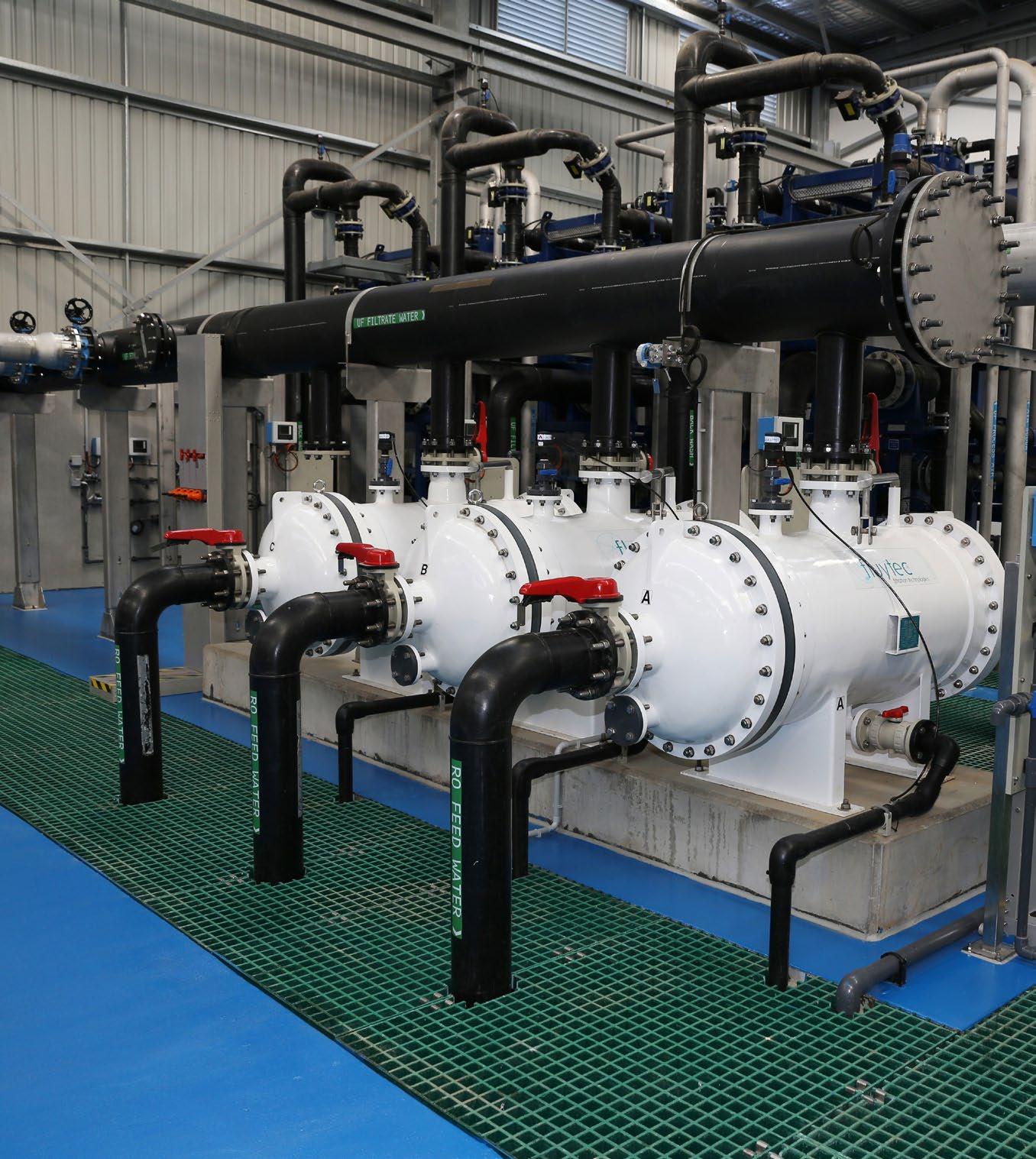
Reuse: from a complementary option to a strategic resource
Water reuse is no longer a marginal solution but a central pillar of water management policy. Increasing pressure on conventional resources, recurrent droughts and the need for resilience have shifted the focus from technical feasibility to deployment speed and operational robustness. The European framework positions reuse as a mechanism to reduce abstraction, mitigate environmental impacts and support climate adaptation.
In Spain, the transition from the traditional quality-based model towards a risk-based approach introduces stricter requirements in terms of traceability, monitoring and shared responsibility. As a result, reclamation systems must not only achieve target water quality, but also ensure reliability, auditability and adaptability under variable operating conditions.
Regulatory change: water reclamation as distinct infrastructure
Royal Decree 1085/2024 explicitly defines water reclamation as an activity distinct from wastewater treatment, introducing a dual regulatory framework: one governing the production of reclaimed water and another governing its final use. This distinction has direct implications for infrastructure planning, requiring additional treatment lines and new authorisations.
From an engineering perspective, this means that existing WWTPs must evolve into integrated systems capable of meeting both discharge and reuse requirements. This distinction is further reinforced by the new urban wastewater framework, which will require additional investment in both treatment and reclamation infrastructure. In this scenario, solutions that reduce construction time, minimise footprint and integrate seam-
lessly with existing assets become critical. Compact modular plants provide a direct response to these constraints.
contaminants in water reclamation and treatment technologies
Reclamation design must be driven by end-use requirements and limiting parameters, following a “fit for purpose” philosophy supported by a multiple-barrier approach. This implies combining processes to ensure robustness, rather than relying on a single technology.
Microbiological safety is the cornerstone of water reuse. Regulation (EU) 2020/741 is based on the principle that reuse must rely on a system of barriers and controls capable of ensuring the safety of agricultural use, combining minimum quality requirements, monitoring and risk assessment. Clear water alone is therefore not sufficient; microbiological control must be assured in accordance with the intended use.
Water reuse is no longer a complementary solution; it is becoming a strategic infrastructure asset driven by structural water stress
The most suitable technologies for this group of contaminants are, first, disinfection processes — primarily UV irradiation, chlorination and, where appropriate, other oxidative alternatives — and, second, membranes when used as an additional physical barrier. Ultrafiltration, and to some extent microfiltration, can provide a highly robust barrier against bacteria and microorganism-bearing solids, although in practice they are generally combined with a final disinfection stage in order to reinforce the overall safety of the system.
The control of suspended solids and turbidity is essential to ensure downstream performance, particularly for disinfection and membrane systems. Physico-chemical treatments such as coagulation–flocculation and lamella clarification provide high removal efficiency within compact footprints. These processes are often complemented by granular filtration. When greater stability is required, microfiltration and ultrafiltration provide a robust physical barrier, limiting fouling and improving UV transmittance.
This multiple-barrier approach is particularly relevant because microbiological compliance does not depend solely on outlet water quality, but also on operational reliability, system redundancy, monitoring and the conditions of reclaimed water distribution and use. In engineering terms, this means that microbiological control must be designed not only for removal efficiency, but also for robustness, traceability and verifiability under real operating conditions.
Salinity is a key limiting factor in irrigation reuse, especially in coastal systems affected by seawater intrusion. Reverse osmosis, nanofiltration and electrodialysis are applied to control conductivity, sodium and boron. Among these, reverse osmosis stands out for its robustness and versatility, enabling
high-quality water production under demanding conditions.
4. Nutrients
Nitrogen and phosphorus require a balanced approach. While they may provide agronomic benefits, excessive concentrations can limit reuse. Their removal is mainly addressed in biological treatment processes, although additional polishing stages may be incorporated to ensure process stability and compliance.
Compact and modular plants make it possible to accelerate implementation, reduce civil works and align investment with demand growth
advanced treatment requirements. Technologies such as ozonation and activated carbon are widely recognised for their effectiveness and form part of a broader strategy linked to environmental protection and public health beyond reuse alone.
7. Technologies with highest potential for compactness and scalability
Technologies best suited for compact implementation are those that can be configured as modular, repeatable units. Membrane systems (MF, UF, NF, RO), cartridge filtration, chemical dosing and UV disinfection are particularly well adapted to containerised or skid-mounted configurations, allowing capacity expansion through parallel lines. Highrate clarification systems also offer compactness, although with greater integration requirements. Conversely, processes dependent on large civil structures or long retention times are less compatible with phased deployment.
and phased investment
produces approximately 5,700–6,000 m³/day of high-quality reclaimed water for irrigation, addressing the needs of a region with acute water stress.
The treatment scheme follows a multiple-barrier approach combining equalisation, multilayer filtration, cartridge filtration and three independent reverse osmosis lines. This configuration stabilises feed quality, protects membranes and ensures consistent performance, with recoveries in the range of 70–75%.
From an implementation standpoint, the plant is based on modular equip-
Water reclamation requires more than outlet quality: it demands operational robustness, traceability and control under a risk-based approach
5. Organic matter and fouling precursors
Residual organic matter plays a critical role in membrane fouling, disinfectant demand and by-product formation. Technologies such as activated carbon, ozonation and advanced physico-chemical treatments are applied to control these compounds, depending on their biodegradable or refractory nature.
6. Microcontaminants
The removal of microcontaminants is gaining relevance in the context of
One of the key advantages of compact plants is their inherent scalability. In reuse schemes, demand typically evolves gradually, driven by network expansion and user uptake. Modular systems allow capacity to be installed progressively, optimising capital expenditure and reducing financial risk.
Additionally, compact plants provide an effective response in transitional scenarios, enabling rapid deployment with minimal civil works and facilitating integration into existing facilities.
The Adeje-Arona WWTP in Tenerife (Canary Islands) represents a benchmark in advanced water reuse through compact modular design. The facility
ment with limited civil works, enabling rapid deployment and flexible operation. The use of independent lines enhances operational resilience and facilitates maintenance without compromising production, while allowing future expansion through additional modules.
Beyond its technical performance, this project illustrates a replicable model for accelerating reuse deployment under demanding conditions. The integration of robust pre-treatment, advanced membranes and modular architecture demonstrates how high-quality water can be produced reliably while maintaining scalability.
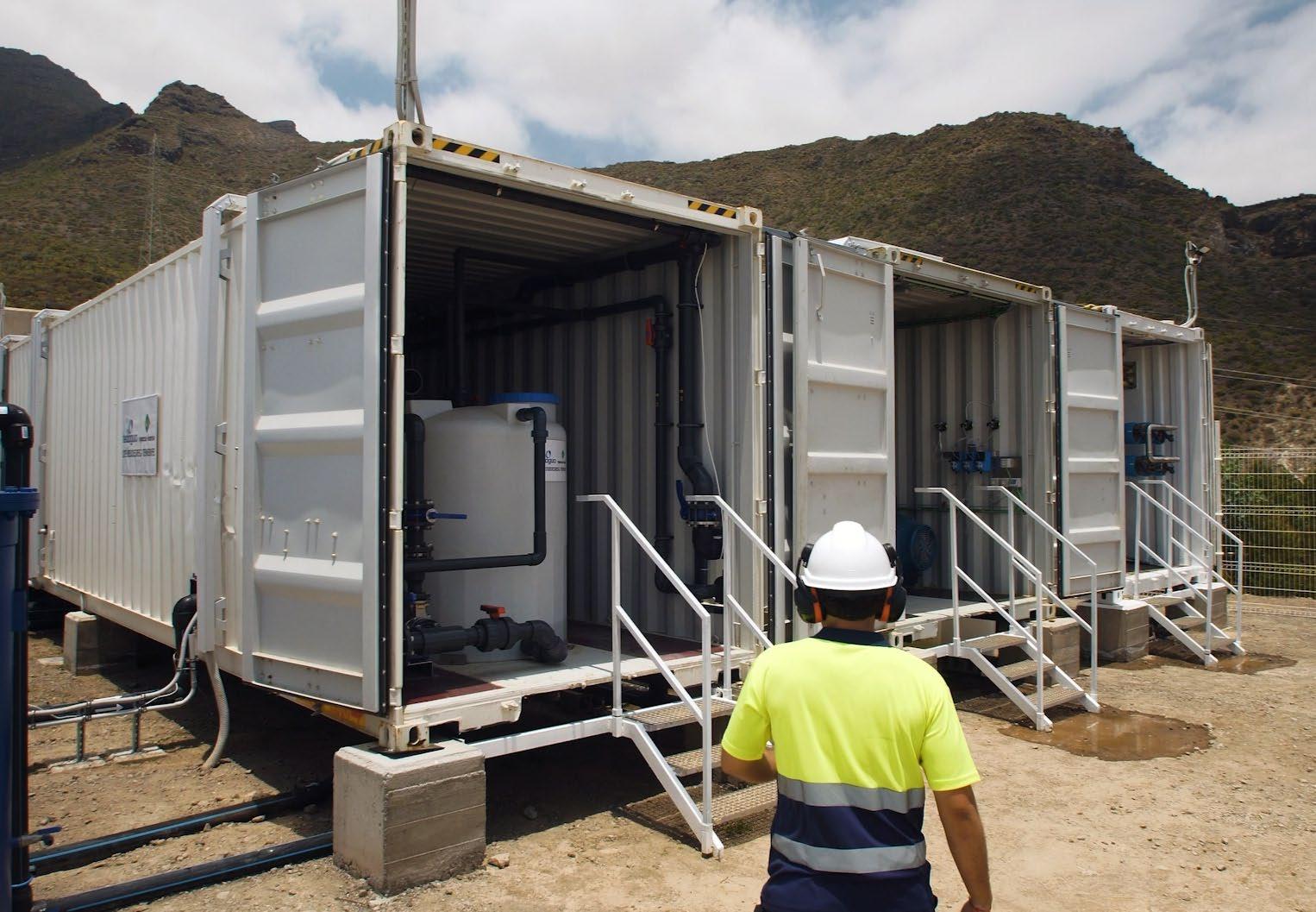
The Adeje-Arona case also highlights TEDAGUA’s capability to design, integrate and operate advanced reclamation systems, combining technological excellence with practical implementation strategies aligned with real project constraints and evolving demand.
Water reuse is consolidating as an essential component of water infrastructure under a regulatory framework based on risk management and multiple barriers. Achieving its full potential requires solutions capable of delivering reliable performance within constrained timeframes and investment conditions.
Compact modular plants represent a highly effective response to these chal-
lenges. Their ability to minimise civil works, reduce implementation times and scale capacity progressively makes them particularly suitable for accelerating reuse. Technologies such as membrane filtration, advanced oxidation and UV disinfection form the backbone of these systems.
The Adeje-Arona WWTP demonstrates that this approach can be successfully implemented at scale, providing high-quality reclaimed water while maintaining operational flexibility and scalability. In this context, TEDAGUA’s experience and technical expertise position it as a key partner in the deployment of advanced and reliable water reuse solutions. •
A benchmark in advanced water reuse through compact modular design
5,700–6,000 m³/day of reclaimed water for irrigation
Multiple-barrier approach: equalisation, filtration, RO
70–75% recovery
Few infrastructure programmes in the global water sector capture ambition quite like SWIFT, the Sustainable Water Initiative for Tomorrow: nearly $3 billion in investment, 38 active projects, and a target of 50 million gallons per day of drinking water quality SWIFT Water® recharging the Potomac Aquifer by the end of 2029. What makes SWIFT truly remarkable is the elegance of its logic: taking highly treated wastewater that would otherwise discharge into the Chesapeake Bay, subjecting it to further rounds of advanced treatment, and returning it to the ground as a resource, simultaneously reducing nutrient pollution, replenishing an over-withdrawn aquifer, slowing land subsidence and helping offset sea level rise across coastal Virginia.
At the centre of that effort is Lauren Zuravnsky, PE, Director of Design and Construction for SWIFT at HRSD. With 20 years of experience spanning drinking water research, wastewater system design and large-scale programme delivery, she has been the driving force behind translating a pioneering concept into physical infrastructure. Smart Water Magazine spoke with Lauren about the technology choices, governance structures and hard-won lessons that have shaped SWIFT.
Lauren Zuravnsky
At HRSD (Hampton Roads Sanitation District), a bold question changed everything: what if wastewater could become a regional groundwater supply? The answer is SWIFT, a programme simultaneously tackling nutrient pollution, groundwater depletion and coastal subsidence across coastal Virginia. Lauren Zuravnsky, the engineer leading its $3 billion delivery, shares the thinking, the technology and the lessons learned along the way.
AUTHOR : CRISTINA NOVO
When you joined HRSD in 2016, what was the state of the SWIFT concept, and what did you immediately identify as the defining engineering and institutional challenges ahead? The programme was still in its feasibility stage; it wasn’t even called SWIFT yet. We were working through cost and permitting feasibility alongside a public relations effort on how to speak about advanced water reuse in a way that would land well publicly. My entry point was as project manager for the SWIFT Research Centre, while sideby-side piloting of carbon-based and membrane-based treatment approaches was still ongoing. Three challenges were clear from the start: how do we communicate this well? Which treatment technologies get us to the endpoint we need? And how do we structure building $3 billion of infrastructure within roughly ten years?
SWIFT uses a carbon-based treatment train rather than a membrane-based approach. How did HRSD arrive at that decision, and what has it meant for cost, operations and regulatory acceptance?
We ran side-by-side piloting with the same water source. One outcome differed between the two approaches and

turned out to be decisive: total dissolved solids. Our discharge point is the Potomac Aquifer, which requires a certain salt content for the water to permeate effectively. Reverse osmosis would have stripped that out, requiring us to add salt back in. The carbon-based train preserved the TDS we needed and avoided generating a concentrated waste stream with nowhere to discharge. Combined with our already highly treated wastewater, it delivered comparable public health outcomes at lower capital and operational costs. On regulation, it led to genuinely collaborative conversations with the EPA and state agencies, a process I would describe as a hallmark of good co-operation.
HRSD trademarked the treated water output as SWIFT Water®, giving it a distinct product identity. How deliberate was that decision, and what role does it play in public acceptance? Very deliberate. Trademarking gave us a consistent brand we could own and define. It also served a regulatory communication function: as a regional wastewater utility rather than a water purveyor, giving the treated water its own name made clear we were creating a specific, well-defined product. On the public side, the brand became a vehicle for engagement. From the earliest piloting days, we were handing SWIFT Water® to people at events, at research centre tours, and to our own 900-plus employees. If you drank the water, you got the cup, the shirt, and the right to be an ambassador. Placing a glass of water in someone’s hand is one of the most powerful acts of public acceptance there is. I still bring SWIFT Water® to events today.
The SWIFT Research Centre has been operating since 2018 at one million gallons per day. What did those years teach you that shaped the design of the full-scale facilities?
The research centre was always conceived as a long-term platform, not a stepping stone. Using a design-build approach gave us real-time flexibility: mid-construction, we repositioned where ozone was introduced to better manage disinfection byproducts. That ozone insight has continued to evolve; the full-scale facilities use a different configuration. We also learned to introduce propane into the biofilters to encourage co-metabolism of certain challenging compounds, and to add more oxygen before the water enters the aquifer to manage redox potentials. At our most recent full-scale facility, we added an ion exchange step specifically for PFAS removal. The research centre is still running, still producing graduate research, still generating insights we deploy forward.
You are simultaneously delivering 38 active projects across two major facilities and complex transmission infrastructure. What does good programme governance look like at this scale?
In 2018, we brought on a programme management firm that introduced a controls function giving us real-time visibility on budgets, schedules, risk and contract documents across all projects. We built a programme management plan, now over 20 chapters, that we keep live and update annually. One structural change made a significant difference: operations staff who would normally have contributed to project delivery alongside their day jobs were given it as their full-time role, embedding the operational perspective from the start. We also deliberately staggered projects rather than running everything simultaneously, so we could learn from one before the next was fully committed.
In SWIFT, the Potomac Aquifer itself is part of the treatment and storage system. How does that change your design philosophy, your monitoring obligations and your relationship with regulators?
"THE CARBON-BASED TRAIN PRESERVED THE TDS WE NEEDED AND AVOIDED GENERATING A CONCENTRATED WASTE STREAM WITH NOWHERE TO DISCHARGE"
We hired a hydrogeologist into our Water Quality department to maintain a permanent focus on the aquifer’s longterm state. From a regulatory standpoint, our compliance point is at the moment of discharge into the aquifer: we must deliver water to a defined quality at that point, after which the aquifer provides a further protective barrier. Our monitoring, however, extends well beyond the recharge wells; we have compliance monitoring wells within our wellfield to track SWIFT Water® after we recharge it and observation wells hundreds to thousands of feet away, to understand water level recovery through the system. We are effectively monitoring something we have already discharged, which is a fundamentally different posture from conventional wastewater compliance.
SWIFT is permitted under the federal Underground Injection Control programme and overseen by an inde-
pendent oversight committee. What advice would you give utilities in other regions looking to pursue managed aquifer recharge?
Virginia did not take primacy in the UIC programme, so we worked directly with the US EPA. But we wanted state agencies to have a voice, so we helped to establish the Potomac Aquifer Recharge Oversight Committee (PAROC) in state legislation. It includes environmental and health regulators, a practising physician, public representatives and local water purveyors, with an independent university-linked laboratory that can take samples at any time. My advice: focus on underlying principles rather than replicating our specific structure. Be broadly visible, operate transparently, engage academic institutions so they become informed validators, and get buy-in at the state level so that the oversight mechanism sits outside your own organisation.
HRSD recently crossed one billion gallons injected into the Potomac Aquifer. What does that milestone mean to you, and what measurable signals are you seeing that the aquifer is actually responding?
More than an endpoint, the billion gallons demonstrates sustained operational capability and builds anticipation for what the full-scale facilities will show. By the end of this year, we will have the capacity to recharge up to 16 million gallons per day; by the end of 2029, up to 50 million. We are tracking aquifer response in partnership with USGS, using an extensometer near the SWIFT Research Centre that measures ground surface movement relative to bedrock. We are seeing a general upward trend at millimetre scale and are installing another extensometer at the James River facility so that, as volumes increase, we will have the data to demonstrate recovery at a meaningful scale, and better understand our ability to slow, or in some
"I WOULD LIKE TO SEE POLICY THAT PROTECTS PUBLIC HEALTH WHILE ALLOWING FLEXIBILITY IN TREATMENT TECHNOLOGY: USE THE RIGHT TOOLS FOR YOUR CONTEXT"
areas potentially reverse, aquifer-related land subsidence.
SWIFT simultaneously addresses nutrient reduction, aquifer depletion, land subsidence and saltwater intrusion. Was solving multiple problems always the intention, and how do you design infrastructure when the goalposts keep moving?
It started as a Chesapeake Bay nutrient compliance story; someone joked: what if we treated it all the way to drinking water quality? But once you reach that level, discharging it as wastewater is a waste of a resource. That is when we looked beyond our wastewater lane and saw the groundwater crisis in south-eastern Virginia. It became a one-water solution for the region. The goalposts have moved in both directions: nutrient regulations caught back up to us mid-programme, and rising infrastructure costs led us to scale back from five full-scale facilities to two in the current phase, while still meeting all original environmental goals. The core has not changed: get the water safely into the aquifer and design with enough flexibility that additional phases can be triggered when the drivers, regulatory, economic or environmental, materialise.
You were recently recognised as a “Powered by Women” honourée in the Virginia region. What has your ex-
perience been in a field still working to diversify its leadership, and what would you say to young professionals considering this sector?
I have been fortunate in having leadership that was willing to let me take the reins and make decisions. When other leaders express confidence in your work, gender stops being part of the conversation. My advice: your manager should not be your only mentor; build a broader mentor group. And learn to tell your story. I have had moments where I was so focused on doing the work that I was not making sure people understood what I was doing or why it mattered. Being able to communicate clearly, to tailor a message to its audience, to make a complex case compellingly; those skills matter in every direction, whether you are speaking to a regulator, a commission or a permit writer whose yes you need.
Water reuse is rapidly moving up the policy agenda worldwide. What must utilities and policymakers get right, and what mistakes would you most want them to avoid?
Start with communication, not as a final step, but from day one. Engage the people whose water rights or rates will be affected early and honestly. On policy, every US state approaches reuse permitting differently, which allows for local fit but makes it harder to scale knowledge. I would like to see policy that protects public health while allowing flexibility in treatment technology: use the right tools for your context, not just the ones that feel safest. For utilities getting started, think in arcs, not steps. We were excited to get going and did not always have five steps mapped out ahead of us. A multi-disciplinary team from the start and a programme management plan covering the full lifecycle will save you from discovering mid-construction what you should have decided at the beginning. •

AUTHOR : DAVID ESCOBAR
The Gulf is burying tens of billions of dollars to recycle the water it already used. The deals are being structured now. The consortia that will dominate the next decade of Gulf water infrastructure are taking shape.
For a decade, the Gulf answered water scarcity by building plants that turn seawater into drinking water. Now the same governments are pouring capital into the other end of the pipe (collection, treatment and reuse) because the arithmetic has shifted decisively. Reclaimed water costs between roughly $0.10 and $0.65 per cubic metre to produce; desalinated seawater costs $0.45 to $1.30. The energy gap is starker still: a large treatment plant runs at 0.13 to 0.79 kilowatt-hours per cubic metre, while reverse-osmosis desalination demands 2.5 to 3.5. Every cubic metre of sewage you treat and reuse is a cubic metre of expensive desalinated water freed for the tap, and a measure of carbon you never emit. This is the story the desalination headlines have been hiding.
That arithmetic has done something more consequential than shift procurement priorities. It has turned sanitation (long filed under municipal cost centre) into a financeable asset class, with 25- and 30-year concessions, sovereign-backed offtake agreements, and returns running into double digits. The Gulf is not where water reuse was invented, but it is where the financial model for scaling it has been most completely built out. If you still file wastewater under “municipal cost centre”, this market is quietly, expensively proving you wrong. Reuse targets across the region read like industrial policy, not green branding. Abu Dhabi already treats more than a million cubic metres a day, has pushed network coverage to 99%, reuses around 80% of its treated effluent and has set a target of 100% (zero discharge) by the end of 2026. Saudi Arabia treats
more than 6.5 million cubic metres of municipal wastewater a day, reuses only about a quarter today, and wants 70% by 2030. Kuwait recovers close to 60% of its domestic wastewater through a single plant. These are decision-makers treating sewage as a strategic reserve. You should too.
Saudi Arabia has built the most structured wastewater PPP market in the region around the Independent Sewage Treatment Plant: a 25-year build-own-operate-transfer contract with a state-backed offtake. The institutional design matters as much as the engineering. In 2024, the old Saline Water Conversion Corporation became the Saudi Water Authority, splitting policy, regulation and procurement into three clean roles: the environment ministry sets strategy, the new authority regulates, and Sharakat (rebranded from the Saudi Water Partnership Company in February 2026, under the Ministry of Finance) procures. That separation is what makes the contracts bankable. It is also the first thing international lenders check before they wire money.
The financing template is already set. ACCIONA’s 2022 green-loan close for three Saudi plants (Madinah, Buraydah and Tabuk) was the first sewage-treatment financing in the Kingdom to earn green-loan status, combining an Islamic Ijara tranche with green certification from S&P Global Ratings. It is the structure every serious bidder is now copying.
Levelised tariffs on recent Saudi plants cluster around SAR 1.20 to SAR 1.94 (about $0.32 to $0.52) per cubic metre, tight enough to reward operators who master lifecycle cost, not so tight as to deter serious bidders. The live deal to watch is Riyadh East, with an initial capacity of 200,000 cubic metres a day expanding to 400,000 in
phase two, targeted for commercial operation in 2029. At least six consortia, pairing names like Suez, Saur, Veolia, Metito and Miahona with Saudi partners, were bidding as this issue went to press. Whoever wins inherits a 25-year annuity; even the losing bidders come away with a sharp read on a market that keeps tendering. The same machine has already named preferred bidders for the Hadda and Arana plants in Mecca and lined up Kharj 3 behind them.
The defining engineering bet of the Gulf is deep, gravity-fed tunnelling, and it is where the largest checks are written. The logic is straightforward: a gravity tunnel lined for a 100-year service life replaces a fleet of pumping stations and their permanent operating cost. Abu Dhabi proved the model with its Strategic Tunnel Enhancement Programme: a 41-kilometre deep spine plus roughly 43 kilometres of link sewers, built for around AED 5.7 billion (about $1.55 billion), carrying an average flow near 800,000 cubic metres a day and switching off 35 conventional pumping stations. Gravity, it turns out, is the cheapest pump you will ever own.
Dubai took the concept and supersized it. The Dubai Strategic Sewerage Tunnels will lay roughly 75 kilometres of deep tunnel and more than 200 kilometres of link sewers, retire about 120 pumping stations and save an estimated
GRAVITY, IT TURNS OUT, IS THE CHEAPEST PUMP YOU WILL EVER OWN
$22B
Lifecycle cost of Dubai's DSST (including long-term operations), the world's largest sanitation megaproject
100 gigawatt-hours a year. Its lifecycle cost runs to around $22 billion, making it the largest sanitation megaproject on the planet. The first two packages alone carry a combined capital cost of nearly $5 billion: Package W at Warsan is set to go to a consortium led by EtihadWE alongside Tamasuk and Alkhorayef Water & Power, with Veolia as operator, at roughly $3 billion; Package J at North Jebel Ali is set to go to Vision Invest and Suez at under $2 billion. A separate Links package carries the first In-Country Value requirement the municipality has applied to a scheme of this size. Read that as a signal: the Gulf increasingly wants the supply chain, not just the plant, anchored at home.
loan, and offering investors a guaranteed minimum internal rate of return of 13.5%. It captures biogas for about 40% of its own energy and produces roughly 70,000 tonnes a year of Class A fertiliser. The Kuwaiti government holds 50% and is preparing to float it on Boursa Kuwait, which would make it the first PPP wastewater plant in the Gulf to go public. When a deal is structured well enough to list on a stock exchange, the sector has moved well beyond public works.
13,5%
Minimum guaranteed IRR of the Umm Al Hayman PPP (Kuwait)
Qatar is building the same idea under its Doha South Sewage Infrastructure Programme: a trunk sewer of about 45 kilometres feeding a new works sized at 500,000 cubic metres a day, dismantling more than 30 existing pumping stations, valued at $3 to $5.5 billion depending on where you draw the boundary. Qatar has also closed its first sanitation PPP, Al Wakrah and Al Wukair: a QAR 5.4 billion (about $1.48 billion) deal led by Metito with Al Attiyah and the Gulf Investment Corporation, starting at 150,000 cubic metres a day and scalable to 600,000. Its existing Doha North works already treats up to 439,000 cubic metres a day through membrane bioreactors, and a separate polishing facility at Katara turns effluent into demineralised water for district cooling, a model of resource recovery that the rest of the region is watching closely.
Bahrain's flagship Tubli works is doubling toward 400,000 cubic metres a day in a roughly $266 million expansion (reported near 80% complete) in a country where 95% of the population is already connected to the network. Almar Water Solutions holds a 35% stake in the Muharraq concession, which runs to 2040 and was the first deep gravity trunk sewer in the GCC. Oman has folded its utilities into Nama Water Services and tabled an integrated master plan worth around $28.8 billion through 2050, lifting sanitation coverage toward 75% by 2040 and treated-effluent reuse from 50% toward 71%. In 2025, Nama's plants took in some 95 million cubic metres and delivered close to 93 million, with reclaimed-water users up more than a third in a single year. Even Ras Al Khaimah signed its first wastewater PPP in February 2026: a roughly $300 million build-own-operate-transfer for a plant starting at 60,000 cubic metres a day, scalable to 150,000, with the effluent fully reused. When a smaller emirate structures its debut sewage plant as a concession, the model has stopped being an experiment.
green loans for three Saudi
The smaller states, the sharper deals Kuwait's Umm Al Hayman is one of the most closely watched deals in the region: a roughly $1.8 billion plant treating 500,000 cubic metres a day, structured as a 25-year build-operate-transfer, financed with a $650 million 26-year
The technology written into the contract
Strip away the finance, and a clear engineering doctrine remains. Deep gravity tunnels lined for a 100-year service
life replace fleets of pumping stations and the operating cost that comes with them. Membrane processes do the heavy lifting on quality: membrane bioreactors at Oman and Qatar, ultrafiltration and reverse osmosis at Kuwait's Sulaibiya, aerobic-granular and high-efficiency activated-sludge trains across the Saudi plants. Resource recovery is becoming standard rather than optional: biogas that powers the plant, Class A fertiliser that leaves it, and polishing units that turn effluent into demineralised water for district cooling at a fraction of the usual energy. The 25-year concessionaire who will live with your equipment's performance for three decades has very different purchasing criteria from a procurement office buying on capital cost alone, and that shift is already visible in how contracts are written.
NEOM illustrates the discipline the whole market demands. The gigaproject has cancelled two desalination schemes in the past two years and terminated the Trojena dam and lake contract, all as part of a broader restructuring. The reuse and zero-discharge ambitions may survive the cuts, but they have not yet reached financial close. That is not a criticism; it is the same logic that governs every serious project in this region: separate the ambition from the asset, price the asset on a 25-year lifecycle basis, and let the concession structure carry the risk. Whether NEOM's water ambitions reach financial close remains the open question.
Follow the equity and the real story is consolidation. Abu Dhabi's TAQA absorbed the emirate's sewerage company, turning it into TAQA Water Solutions, now running 41 plants across roughly 13,000 kilometres of network. Sovereign and quasi-sovereign vehicles (the Public Investment Fund behind the
National Water Company in Saudi Arabia, ADQ taking 49% of Plenary, Vision Invest backing Miahona) are buying the seats at the table. International operators increasingly sit as minority partners inside consortia led by local or sovereign champions. That is not an accident. It is the deliberate localisation of capital. The deal-making runs deeper than the marquee acquisitions: Vision Invest sold a 10% stake in Miahona in November 2025 while retaining 60%, freeing capital to redeploy, while EVN AG now owns WTE Wassertechnik, the technical partner behind both Kuwait's Umm Al Hayman and Bahrain's Tubli expansion. The map of who builds and who operates Gulf wastewater is being redrawn deal by deal.
THE ONLY SCARCE RESOURCE LEFT IN THIS MARKET IS A SEAT IN THE WINNING CONSORTIUM
The financing rails are being laid just as fast. DEWA priced a $1 billion green sukuk (Islamic bond) for renewable energy and water. The GCC sukuk market grew more than 13% in the first four months of 2026. Saudi Arabia's privatisation strategy targets more than 220 PPP contracts and over $64 billion of private capital by 2030. The instruments, the offtakes and the sovereign guarantees now exist to move serious money into a sector that, a decade ago, almost nobody outside the Gulf would underwrite. Across the wider Middle East and North Africa, the bill for water infrastructure runs to an estimated
$110 billion, demand large enough to keep green bonds, blended finance and sukuk flowing toward exactly the kind of long-dated, government-backed asset a wastewater concession represents.
about it
The Gulf has concluded that the cheapest, lowest-carbon new water it can buy is the water it already used once, and it is willing to commit tens of billions of dollars, on 25- and 30-year terms, to capture it. The contracts are bankable. The offtakes are sovereign. The returns, where disclosed, run to double digits. The only scarce resource left in this market is a seat in the winning consortium. None of this is speculative. The plants are operating or financed, the regulators are stood up, the tariffs are signed, and the first listing is in motion. The scale of the need sustains the appetite: across the wider Middle East and North Africa, the backlog of unmet water infrastructure demand is large enough to keep this pipeline running well into the next decade. What is still in flux is who captures the contracts, and that is being decided now, in the consortia forming around tenders that close this summer.
If you are a utility or an administration, the model to study is not the plant: it is the split between regulator, offtaker and operator that made the plant financeable. If you are a technology firm or a manufacturer, your buyer is no longer a procurement office; it is a 30-year concessionaire who will live with your equipment's operating cost for three decades. If you are an investor, the first Gulf wastewater IPO is being assembled in Kuwait right now, and the second will not wait for you. The desalination decade is giving way to the reuse decade. The contracts are being priced, tendered and, in places, already closed. The only question left is whether your name is on one of them. •
Professor Joan Bray Rose has spent more than three decades at the intersection of microbiology, public health and water safety. Homer Nowlin Chair in Water Research at Michigan State University and Director of the MSU Water Alliance, she is the 2026 laureate of the Lee Kuan Yew Water Prize, recognised for pioneering quantitative microbial risk assessment (QMRA), a framework that transformed water safety from a qualitative judgement into a measurable science. Her path to QMRA began in the late 1980s, investigating waterborne disease outbreaks across the United States. That work revealed a critical gap: monitoring systems could detect pathogens but not quantify the risk they posed, leaving public health responses
largely reactive. Rose set out to change that, shifting water management from detect-and-correct to predict-and-prevent.
The reach of that contribution is now global. QMRA underpins WHO drinking water guidelines and US EPA standards, and has enabled the expansion of potable water reuse worldwide. She spent two decades advising Singapore's PUB on NEWater, and her guidance contributed to California's Indirect and Direct Potable Reuse regulations, now models for water reuse standards in Australia, Spain and beyond.
For Rose, safe water has never been an abstract goal but a lifelong commitment, carried into the policies and preparedness systems that protect millions every day.
For many hydraulic modelling teams, the bottleneck is not skill or ambition; it is hardware. In the Autodesk Water webinar: Hydraulic Modelling in the Cloud with InfoWorks ICM & InfoWorks WS Pro: Lessons from Scottish Water's Early Adoption Experience, held on 3 June 2026, Samer Muhandes, Senior Product Manager for InfoWorks ICM at Autodesk Water, and Stephen Leslie, Hydraulic Principal Digital Specialist at Scottish Water, made the case that cloud-based workflows offer a practical way out of that constraint.
From the office weekend to the cloud Muhandes opened with a personal story that set the tone. Facing a deadline with simulations that had to run over a weekend, he found himself taking his young daughter into the office because the only machine powerful enough was locked to a physical workstation. The point was not nostalgia: it was a diagnosis. When a modelling workflow depends on being in the right place at the right desk, competing with colleagues for shared hardware, it becomes fragile.
The InfoWorks cloud offering, available for both ICM and InfoWorks WS Pro, is designed to remove that fragility.
Samer Muhandes Senior Product Manager, InfoWorks ICM Autodesk
Engineers can store model data centrally, run up to 80 simulations in parallel, and work from any location. Scenarios that were once computationally prohibitive become routine. Access is governed by roles: editors can modify models and run simulations, while readers, including clients or regulators, can view results via a free ICM Viewer without a paid licence, changing the economics of model sharing considerably.
Scottish Water’s migration journey
Stephen Leslie has been at Scottish Water for 18 years and within the modelling team for 13, leading the transition from standalone models through on-premises to cloud over the past eight years. The team now manages 330 wastewater models and 120 water distribution models; the water side has fully migrated to the cloud, while wastewater operates on a hybrid basis. Gaining approval required a multi-year business case, data governance sign-off, and Autodesk's written confirmation that data would be stored within Europe.
Stephen shared benchmarking data from a 1D Aberdeen model run on both systems: on-premises took 120 to 130 minutes; the cloud completed the same
run in 17 to 20 minutes, an 80 per cent reduction, and supports twice the parallel simulations. Two projects illustrated the impact: a climate change investigation across 15 models and 40 years of rainfall data was completed in 12 weeks without displacing other work, and a Section 16 investigation covering 65 catchments has cut turnaround per catchment from 35 days to approximately 10.
The Q&A drew questions from Jacobs, Southern Water, Severn Trent, Arup, and Veolia. Muhandes was explicit that migration is not a one-way decision: models can be moved back on-premises at any time. Stephen's practical advice: delete local result copies once analysed, design model trees with viewer users in mind, and build incrementally.
Both speakers closed on the same note. Cloud adoption is not a technology decision in isolation; it is a decision about how a modelling team spends its time and what it can deliver. For Scottish Water, the journey was gradual and deliberate, and the benefits are now tangible. For utilities considering a similar path, the message was simple: start where you are, and try it.
Stephen Leslie Hydraulic Principal Digital Specialist at Scottish Water

AUTHOR :
DAVID ESCOBAR
The world throws away 89 per cent of its wastewater. The cities that learn to drink it twice will own the century. The rest are about to find out what scarcity really costs.
There is no such thing as new water. Every drop on Earth has been here for billions of years, cycling endlessly through clouds, rivers, bodies and pipes. The only question that has ever mattered is how many times we are willing to use it before we throw it away. For most of human history, the answer was once. In 2026, that answer is finally changing, and the numbers reveal how far the revolution has come and how absurdly far it still has to go.
The world produces roughly 360 billion cubic metres of wastewater every year, enough to fill 144 million Olympic swimming pools. Just over half gets treated. Only about 11 per cent is ever deliberately reused. The rest, including a vast quantity already cleaned
at considerable expense, is poured back into rivers and oceans and forgotten. We are, in the most literal sense, flushing a resource we claim to be running out of.
The gap between that 11 per cent and its potential is the single largest untapped water supply on Earth: a reservoir hiding in plain sight, requiring no new dam, no negotiation with a neighbouring state. It is also one of the fastest-moving markets in the entire environmental economy. The decision-makers who understand what is happening in Singapore, Orange County, El Paso and San Antonio right now will spend the next decade with a structural advantage over those who treat reuse as a fringe concern.
market growing faster than the water tables are falling
Independent analysts converge on a global water reuse market worth around 18 billion dollars in 2025, climbing toward 30 billion or more by 2030, at compound annual growth rates clustering between 8 and 11 per cent. The industrial segment (power, petrochemicals, microchips, mining) already drives close to half that revenue, and the reason is not environmental virtue. For a factory, water security is a licence to operate. Lose access to freshwater, and the plant stops. In a mature infrastructure sector, that kind of existential pressure produces double-digit growth. It is not a trend. It is a stampede.
Two demand signals explain it. The first is physical scarcity: the American Southwest is renegotiating a river compact that can no longer deliver what it once did, the North China Plain is drawing down aquifers that took millennia to fill, and dozens of cities on four continents have already learned what happens when the taps run short. The second signal is newer and growing explosively: the thirst of the digital economy, which this article addresses in detail below. Both are converging on the same answer.
The proof of concept already exists, and it is spectacular
Sceptics should spend a day in Singapore, where PUB has made NEWater, its reclaimed water programme, one of the four pillars of the national water supply. Purified through microfiltration, reverse osmosis and ultraviolet light to a standard cleaner than what most cities pump from rivers, it meets up to 40 per cent of demand today, with a target of 55 per cent by 2060. Singapore did not do this for the environment. It did it because a small island with no aquifer decided that dependence on import-
ed water was a strategic vulnerability it would engineer its way out of.
Orange County, California offers the richest proof of what political will can achieve. The Groundwater Replenishment System, a joint venture between the county’s water and sanitation districts, now purifies 130 million gallons a day, enough for a million people, recycling every drop of the reclaimable flow sent to it. It has hosted over 60,000 tour visitors, becoming the model for the WateReuse Association’s public engagement playbook and the most-copied piece of water infrastructure in the world. Orange County won because it spent years talking to its public before it poured concrete. The projects that failed almost always started the conversation too late.
And then there is Windhoek, Namibia, which has been turning sewage directly into drinking water since 1968, the first city on Earth to do so, decades before anyone coined a marketing term for it. If a mid-sized African capital solved the hardest version of this problem more than half a century ago, the excuses available to wealthier cities grow very thin.
The new thirst: AI, data centres and the reclaimed-water reckoning
The hyperscale data centres powering the AI boom have become one of the most consequential new claimants on freshwater in the world. A June 2026
report by the UN University found that global data centres consumed as much electricity as the entire country of Saudi Arabia in 2025 alone, and electricity consumption carries a water cost that most people never see. The cooling towers at a data centre are only the visible part: for every litre of water evaporated onsite to keep servers cool, roughly twelve more are consumed invisibly at the power stations generating the electricity that feeds them. The total footprint, direct and indirect combined, is what makes the scale of the problem so much larger than the industry’s own disclosures suggest.
The industry is responding along two parallel tracks. The first is reclaimed water. Amazon already operates 26 data centre facilities on 100 per cent reclaimed water and has contracted a further 130 globally, part of its commitment to be water positive by 2030, a goal it reports being 75 per cent of the way toward as of June 2026. Google uses reclaimed or non-potable water at more than a quarter of its campuses. In San Antonio, data centres served by the city’s utility went from 48 per cent recycled water in 2023 to 75 per cent by 2025.
WE ARE, IN THE MOST LITERAL SENSE, FLUSHING A RESOURCE WE CLAIM TO BE RUNNING OUT OF
The second track is eliminating evaporative cooling altogether. Since August 2024, Microsoft has applied a chip-level cooling design that targets near-zero water evaporation to all new data centre builds, with pilot sites in Phoenix, Arizona and Mt. Pleasant, Wisconsin expected online from late 2027. The contrast is stark: a comparable evaporative campus uses roughly 5 million gallons per day at peak; a closed-loop equivalent uses about 22,000.
Regulation is tightening behind both tracks. Virginia is conditioning data centre grant funding on the use of reclaimed wastewater; South Carolina and Kansas are exploring closedloop cooling mandates; and according
to legislative tracking firm MultiState, more than 200 data centre bills were introduced across all 50 US states in 2025 alone, with momentum accelerating into 2026. EPA’s Water Reuse Action Plan 2.0, launched in April 2026, explicitly names data centres as a priority reuse market for the first time.
The phrase “toilet-to-tap” has killed real projects. San Diego, Toowoomba, Los Angeles: all watched sound engineering schemes collapse under the weight of two words and a squeamish news cycle. The disgust is rooted in a primal logic of contagion: once in contact with waste, forever contaminated. Water professionals have learned, expensively, that the answer is not better engineering but better language. “Purified water” and “advanced water purification” test consistently better; Arizona’s water regulator renamed its entire DPR programme accordingly, based on consumer research and the argument that the term more accurately reflects what the process actually does.
Singapore has shown what is possible for a city-state with no alternative. What is now happening in the United States is different in kind: a continental-scale regulatory cascade that could mainstream direct potable reuse across
dozens of cities in the world’s largest economy. Texas was the quiet pioneer: Big Spring has operated a DPR facility since 2013, feeding purified water directly into the distribution system. But it remained a curiosity. What is different now is the pace of rule-making. Colorado adopted a full DPR regulatory framework in November 2022, the first state to do so. California’s rules took effect on 1 October 2024. Arizona’s advanced water purification standards followed in March 2025.
The project everyone in the sector is watching is El Paso’s Pure Water Center: a 10-million-gallon-per-day facility costing 295 million dollars, expected online by 2028. According to El Paso Water’s project documentation, it will be the first plant in the US to feed purified water directly into a city’s distribution system at municipal scale, and will produce water at just under 500 dollars per acre-foot. For context, seawater desalination in California costs around 3,400 dollars per acre-foot, the rate at the Carlsbad plant for fiscal year 2024. El Paso Water has educated its residents about reuse since the 1990s, and the result is a community that accepted direct potable reuse without the backlash that derailed projects elsewhere. Public opinion does not shift on its own: trust, built early and transparently, is the entire game.
Nothing is accelerating this faster than a Colorado River that can no longer meet the demands placed on it. Under its Tier 1 shortage conditions, in effect since 2022 and still operative, Arizona has been subject to a 512,000 acre-foot reduction in its Colorado River supply, around 18 per cent of the state’s total allocation from the river. The 2007 operating guidelines expire at the end of 2026. Negotiations over what comes next are live: the Lower Basin states submitted a joint proposal in May 2026, but no agreement has been reached. Phoenix is planning a major DPR project at its 91st Avenue plant targeting 60 million gallons per day. Tucson has accepted 86.7 million dollars from the Bureau of Reclamation to build a DPR demonstration facility by 2032 in exchange for leaving 56,000 acre-feet of Colorado River water in Lake Mead over a decade.
The map: who leads, who is catching up
Beyond the landmark cases already described, the map of reuse leadership is broader and more surprising than most decision-makers realise. Israel remains the undisputed champion, reusing close to 90 per cent of its wastewater, according to the country’s own Water Authority. Its Shafdan complex treats the effluent of greater Tel Aviv and sends it south
11% ~90% $30B of the world's wastewater is deliberately reused reused by Israel — the global leader
Global wastewater produced annually: ~360 billion m³ — roughly 144 million Olympic pools. Just over half is treated. reuse market size by 2030
to irrigate more than 60 per cent of the Negev’s agriculture. Reuse is not a programme in Israel. It is the agricultural economy’s water supply, and it has been for decades.
Australia’s Perth offers a different model: patient, incremental and replicable. The Groundwater Replenishment Scheme, which purifies recycled water and injects it into underground aquifers for later extraction as drinking water, has banked over 100 billion litres and aims to supply up to a fifth of the city’s water by 2060, at roughly a quarter of desalination’s energy cost. Perth did not solve a crisis. It built a buffer before the crisis arrived. That sequencing is the lesson. Europe reuses a fraction of its technical potential, but the exceptions are striking. Murcia, in Spain’s parched southeast, reuses 98 per cent of its treated wastewater, confirmed by the regional operator ESAMUR, sending around 120 million cubic metres a year to irrigation communities whose crops would otherwise simply die. The 2020 EU water reuse regulation establishes common standards for agricultural irrigation across member states.
The Gulf is buying scale. The UAE, led by Abu Dhabi, which already reuses around 80 per cent of its treated effluent, stands alongside Israel as one of the world’s genuine leaders. Saudi Arabia, which treats more than 6.5 million cubic metres of municipal wastewater a day, has set a 70 per cent reuse target by 2030. These are not green commitments. They are industrial policy, backed by sovereign capital and 30-year concessions.
The most underreported story is China. Beijing recycled 1.28 billion cubic metres of water in 2023, nearly 30 per cent of the city’s total consumption, making reclaimed water what city authorities call its “stable second water source.” National policy now requires water-scarce cities to meet 25 per cent
of demand from reuse, rising to 35 per cent in the Beijing-Tianjin-Hebei corridor. And Taiwan has gone further still in industrial terms: the world’s first municipal-wastewater-to-semiconductor reuse plant, supplying TSMC’s advanced chip fabs in Tainan, has been operating since 2022. When the global supply chain for artificial intelligence depends on recycled water to manufacture its chips, the fringe-concern argument is definitively over.
The real obstacles are human, not technical
The engineering argument is settled, but the answer is not always the same. The membrane train of microfiltration, reverse osmosis and ultraviolet oxidation is mature, proven and bankable, and it dominates the sector. But it is not the only route. Windhoek has run reliably on ozone and biological carbon for more than 50 years. HRSD’s SWIFT programme in Virginia, using ozone, biofiltration and granular activated carbon rather than reverse osmosis, proves that the carbon-based route can match membrane performance while eliminating the brine waste stream and reducing whole-life costs. PFAS contamination adds a further layer of complexity, but the tools to address it are maturing fast: granular activated carbon, ion exchange and emerging destruction technologies are increasingly part of the design conversation for new reuse schemes. The lesson is not that one technology has won. It is that the right treatment train depends on the water quality, the end use and the regulatory context, and that the toolbox is richer than most project owners realise.
Three obstacles, none of them solvable by a better membrane. The first is psychological: the disgust response, malleable with communication and time but lethal when ignored. The sec-
ond is institutional: uneven regulation, fragmented permitting, and a genuine shortage of the engineering expertise and specialised equipment required to upgrade infrastructure at the pace that deadlines demand. The third is financial: the persistent reality that reclaimed water must often compete against groundwater or imported supply that is artificially cheap because its true cost is hidden in subsidies and deferred infrastructure bills. Until the price of water reflects its scarcity, the most rational investment frequently looks, on a spreadsheet, like the expensive one.
Strip it all down, and the message is uncomfortably simple. The resource is sitting right there, already collected, often already cleaned, currently being thrown away. The technology to recover it is proven and getting cheaper. The market is growing at double digits. The policy and investment direction, from California to the Arabian Gulf to Beijing, is unambiguous. And the two most powerful new demand signals, accelerating water scarcity and the AI data centre boom, are concentrating that pressure on the same arid geographies at the same moment. The cities that will thrive in a hotter, drier, more crowded century are not the ones with the most rainfall. They are the ones that decided to use every drop more than once. The water revolution is no longer a question of whether, nor even of how: both have been answered, in concrete, in cities and utilities across every inhabited continent. It is now only a question of who moves first, and who is left standing at the outfall a decade from now, explaining to their citizens and their shareholders why they watched a fortune in reusable water flow past them, treated and ready, straight into the sea. •
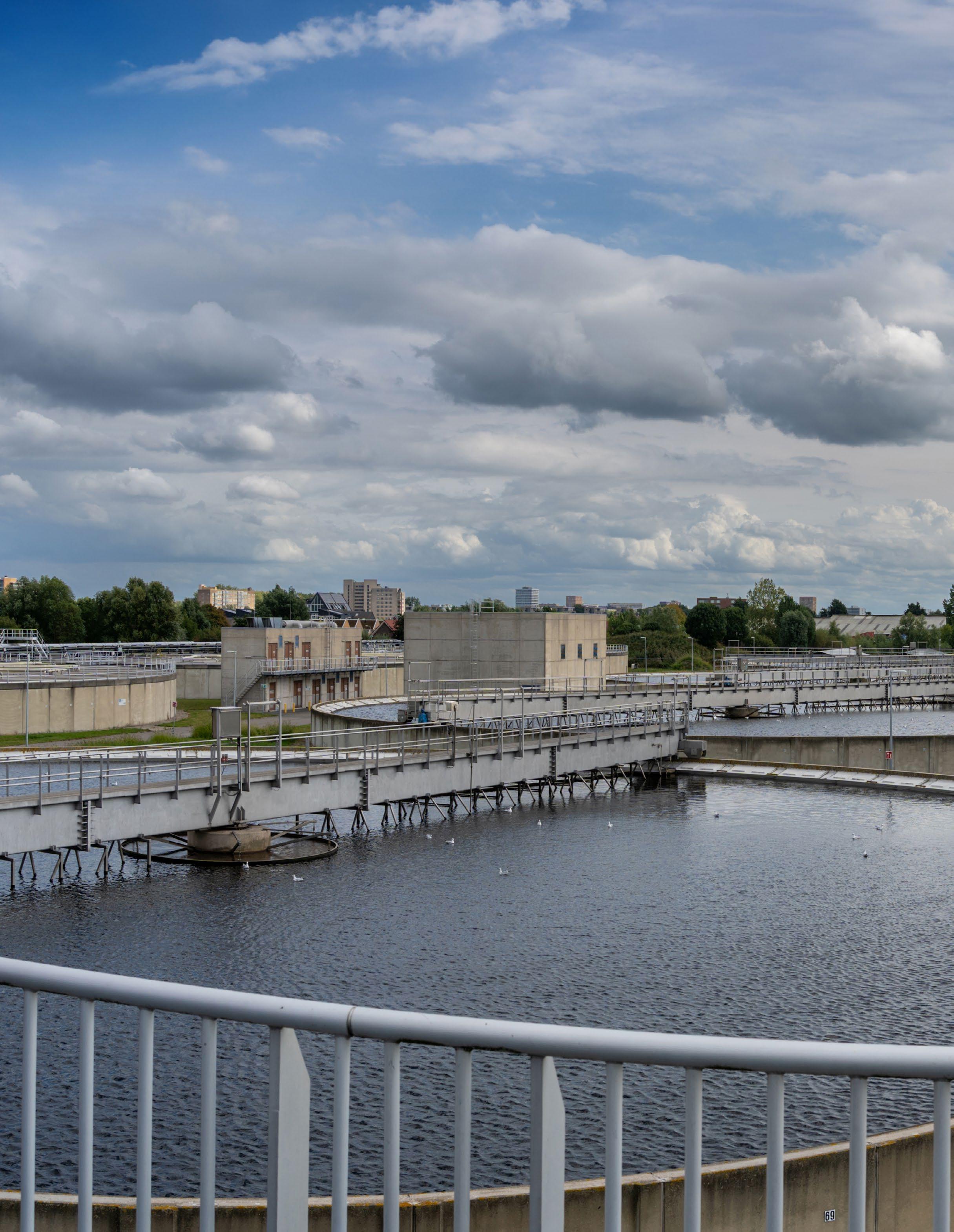
Not many water authorities can trace their origins to the Middle Ages. Hoogheemraadschap van Delfland, founded in 1289, is one that can, and its largest plant, the Harnaschpolder wastewater treatment plant near Delft, is the largest in the Netherlands with a capacity of 1.3 million population equivalents serving over one million inhabitants and 40,000 companies in the greater Hague region.
On average, the plant treats 255,000 cubic metres of wastewater per day across a 25-hectare site. Its biological treatment process removes more than 85% of nitrogen and phosphate compounds and more than 90% of organic contamination, meeting stringent European water quality standards.
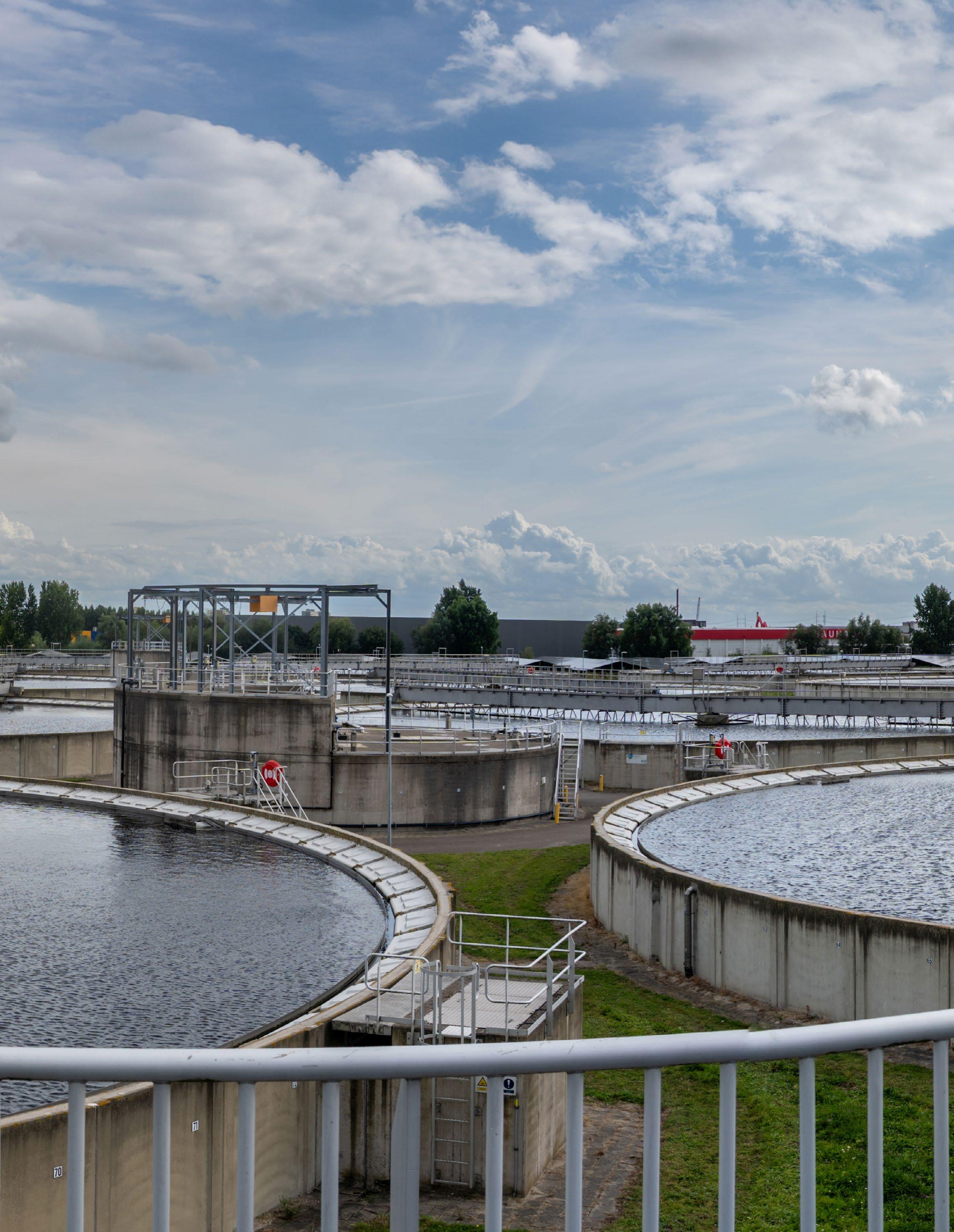
The plant was delivered through the first public-private partnership in the Dutch water sector, with Hoogheemraadschap van Delfland signing a 30-year Design-Build-Finance-Operate contract with the Delfluent consortium in 2003. This model transferred operational performance risk to the private sector while keeping public accountability with the water authority, a structure that has since been studied internationally as a reference case.
Sustainability is embedded in its operations: sludge produced during treatment is fermented to release biogas, which powers onsite generators supplying over 50% of the plant's own energy needs, part of Delfland's broader ambition to become fully energy neutral.

Cameron McWilliam, Senior Public Relations Manager and Associate Vice President at Carollo Engineers, has spent his career helping water agencies build public trust long before a crisis forces their hand. In this interview, he shares his perspective on why water communication has never mattered more, and what it takes to bring communities along.
AUTHOR : OLIVIA TEMPEST
How do you think communication in the water sector has evolved in recent years?
The biggest shift I've seen is the move from reactive to proactive. For a long time, utilities mostly communicated when something went wrong: a main break, a rate increase, a compliance issue. Now there's greater recognition that building public trust requires consistent communication, not just crisis management. The other big change is digital. Utilities are leaning into social media and video content to engage their communities, explaining where water comes from, how it's treated, and what projects are underway. What's changed is that utilities can no longer treat those platforms as one-way broadcast channels. The public expects dialogue, and reputation management has become more complex as a result. You're no longer just competing for attention; you're navigating a conversation you don't control.
Why do you think it is important to communicate about water?
Water is the most essential infrastructure that people rarely think about until they have to. When systems work well, there's no story. But the investment needed to keep them working is enormous, and public understanding of that investment is often minimal. Effective communication bridges that gap, building the trust agencies need when asking the public to accept rate increases or embrace something like water reuse. And trust, once lost, is far harder to rebuild than it is to maintain. Overcoming distrust and resistance takes far longer than bringing people along from the start. Flint, Michigan, was a turning point. It demonstrated how quickly public confidence can erode and triggered communities to start asking questions they hadn't asked before. Now, with contaminants like PFAS and microplastics in the headlines, utilities are under pressure to communicate openly about what's in their water.
The agencies that get ahead of those conversations are the ones that maintain public confidence when it matters most.
What are the most challenging aspects of communicating water-related news?
The technical complexity is obvious, but it's not the hardest part. You can translate technical content; it just takes time. The harder challenges are social and political. Water reuse is a perfect example: the technology is proven, the science is sound, but the communication challenge is enormous because people don't make decisions on facts alone. Emotions, trust, and sometimes political drivers all shape how water issues are received, and when you're up against deeply ingrained perceptions, facts only get you so far. The challenge isn't just accuracy, it's how you communicate it — tone, timing, and how it will be received. And then there's the fragmented nature of the sector. Thousands of utilities of different sizes, each with its own com-
munity dynamics, regulatory environment, and communications capacity. There's no single megaphone.
Could you highlight one of Carollo Engineers' communication success stories?
One I'm particularly proud of is The ABCs of Water Reuse, a campaign built on a simple but bold idea: translate the science of water reuse into something anyone could pick up and understand. The centrepiece is an illustrated alphabet book that explains water reuse concepts in an Ato-Z format. The goal was to contribute something useful to an industry-wide conversation, a shared resource that utilities could use when talking to their communities and the media about water reuse. The response was affirming. The WateReuse Association called it "an essential resource for communities working to advance the public acceptance of water recycling." AWWA, WEF, and ASCE added their voices too. Utilities ordered copies. It landed. •
SOMETHING TO READ...
Who owns the tap?
Christiane Tristl looks at how private corporations have moved into water supply in Kenya, using digital technology and pay-per-use kiosks to reach underserved communities. A granular, research-driven account of what it means in practice to bring market-based solutions to one of the world's most basic needs.



SOMETHING TO ENJOY...
A classic that runs deep
"Down by the River" by Neil Young, from his 1969 album Everybody Knows This Is Nowhere, is built around a hypnotic, endlessly repeated guitar riff. The river here is no place of comfort, it is a backdrop for something dark and unresolved. Nearly ten minutes of raw, unforgettable music.
BY: SWM TEAM
SOMETHING TO WATCH...
Roman Polanski's 1974 neo-noir film follows private detective Jake Gittes as he stumbles into a web of corruption centred on the control of water in 1930s Los Angeles. Polanski at his most unsparing: a slow-burning masterpiece about greed, power, and who owns what everyone needs to survive.