SOLID GOLD 2
Elevpaket – Tryckt bok + Digital elevlicens 36 mån



Elevpaket – Tryckt bok + Digital elevlicens 36 mån
Solid Gold 2 är ett elevpaket som består av två delar: elevbok och digitalt läromedel. På följande sidor kan du provläsa och bilda dig en uppfattning om såväl det digitala läromedlet som den tryckta delen.
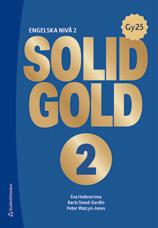
Solid Gold 2:s andra upplaga är reviderad i linje med Gy25 för Engelska Nivå 2. Det är ett utmanande läromedel för elever på högskoleförberedande program och för studerande inom vuxenutbildningen eller motsvarande. Boken innehåller texter i en mängd olika genrer, en omfattande övningsdel till texterna, en praktisk resursdel i Resource Section, språkträningsavsnitten Expand Your Vocabulary och Use of English, samt ordlistor.
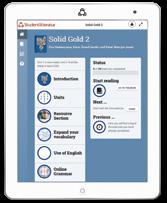
Texterna i den interaktiva elevboken är inläst med autentiskt tal och textföljning, och självrättande interaktiva övningar hjälper eleverna att utöka sitt vokabulär. Online Grammar 2 ingår i Solid Gold 2, och erbjuder genomgång av grammatik samt övningar.
Interaktiv version av boken, inlästa texter och ljud till alla hörövningar

Interaktiva övningar
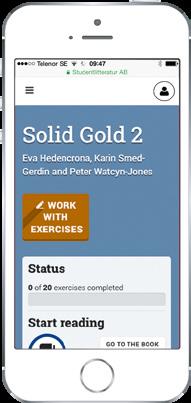
Fungerar på dator, surfplatta och delvis i mobiltelefon
Karin Smed-Gerdin
Studentlitteratur AB
Box 141
221 00 LUND
Besöksadress: Åkergränden 1
Telefon 046-31 20 00 studentlitteratur.se
Kopieringsförbud
Detta verk är skyddat av upphovsrättslagen. Kopiering, utöver lärares begränsade rätt att kopiera för undervisningsändamål enligt Bonus
Copyright Access skolkopieringsavtal, är förbjuden. För information om avtalet hänvisas till utbildningsanordnarens huvudman eller Bonus Copyright Access.
Vid utgivning av detta verk som e-bok, är e-boken kopierings skyddad.
Användning av detta verk för text- och datautvinningsändamål medges ej.
Den som bryter mot lagen om upphovsrätt kan åtalas av allmän åklagare och dömas till böter eller fängelse i upp till två år samt bli skyldig att erlägga ersättning till upphovsman eller rättsinnehavare.
Studentlitteraturs trycksaker är miljöanpassade, både när det gäller papper och tryckprocess.
Art.nr 37756
ISBN 978-91-44-15974-4
Upplaga 2:1
© Författarna och Studentlitteratur 2015, 2025
Redaktör: Charlotte Rosen Svensson
Formgivning: Helena Jansson Formgivning
Printed by Print Best, Viljandi, Estonia 2025
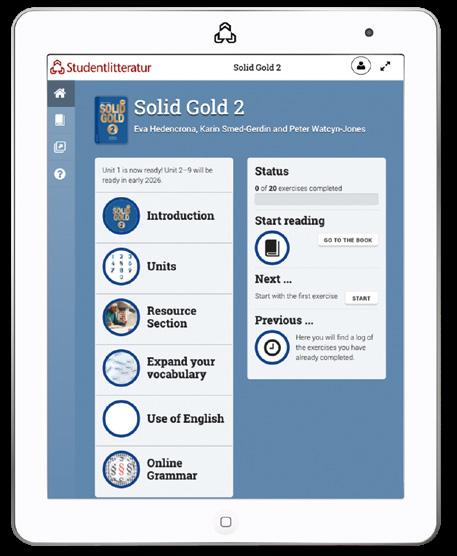
Solid Gold 2 will improve your English in a variety of ways. Firstly, it will help you build the skills you need for English at upper secondary school, and specifically for level 2 (Engelska nivå 2). You can access Solid Gold 2 fully on a computer or tablet, and partly on a smartphone, whichever suits you best. The Quick Guide to Solid Gold 2 on pages 4–5 will show you what there is and how everything works.
Solid Gold 2 covers the core content of English, level 2. The focus in the nine units is mainly on living conditions, social issues and cultural features in different parts of the English-speaking world. Solid Gold 2 also aims to make you aware of how culture influences communication. There are a variety of texts in different genres such as fiction, non-fiction, biographies, magazine features, songs, etc. The section Authors of the English-Speaking World gives an introduction to further studies of literature.
In the Resource Section you will be introduced to different strategies to use when learning English. There is also advice on how to become a better speaker or writer. For example, you will learn how to adapt your language according to the purpose, recipient and situation. Your ability to summarise, explain, discuss and argue will all be practised in Solid Gold 2. The sections On Speaking, On Writing and On Language all contain useful information on how to progress.
The Exercises deal with the language and subject matter of the texts. Many of the exercises can be done either in the printed book or digitally and there are additional digital exercises, including intensive vocabulary practice.
Expand Your Vocabulary will help you increase your vocabulary while Use of English will improve your grasp of the language. Online Grammar 2, with explanations and interactive exercises, is included with Solid Gold 2, so that you can revise and practise your grammar independently. Want Some More? offers texts for additional reading in the digital material.
We hope that Solid Gold 2 will help you move ahead in your English studies, improving your communication skills and broadening your knowledge and understanding of the world in which English is used.
The Solid Gold team
Solid Gold 2 provides a complete base for your English course, offering a wide range of printed and digital materials. You may not have time to use everything in Solid Gold 2 but we hope you will find all you need.
Reading
Nine units, each with a theme, containing a variety of texts from different countries. The authors of the texts are also presented and the illustrations are intended to provide extra food for thought and discussion.
Authors of the English-speaking world
Twenty or more important figures from throughout the world of English literature, from Shakespeare and Jane Austen to Margaret Atwood and Aravind Adiga. Thumbnail biographies plus an outline of literary history from the Renaissance to the early twentieth century. An exercise section offers methods for reviewing, analysing and discussing literature both orally and in writing, as well as suggestions for projects.
Resource Section
An invaluable handbook on how to improve your language skills. You can look up critical reading and reviewing of sources, letter writing, how to work with different genres and much more.
Exercises
In the exercise section of Solid Gold 2 there is an extensive body of exercises on each of the texts, as well as listening and grammar exercises.
Under this heading there is a selection of extra texts for further reading, some of them printed in the book and others appearing as extra texts in the digital material.
Expand your vocabulary
An opportunity to learn/revise important words which do not necessarily occur in the nine units. The exercises are divided into ten categories, e.g. British and American English, synonyms, easily confused words, phrasal verbs.
Use of English
This section will help you develop and sharpen your own use of English, with particular focus on the correct use of words and correct sentence construction. In order to complete the exercises in this section, a good knowledge of grammar is needed. These are the types of exercises found in the Cambridge First Certificate (FCE) and the Certificate of Advanced English (CAE) exams.
Word Lists
Word lists for all the texts and listening exercises.
Recorded texts and word lists
All the texts in Solid Gold 2 are recorded with native voices from different English-speaking countries. The word lists are also recorded.
Listening comprehension
The listening comprehension passages are recorded with native voices from different English-speaking countries.
Finding your way in the e-book
When a page number is available, you can often double-click on it to go directly to that page. You can also click on the digital link to follow that directly to the audio file, to different exercises, and to extra material available online.
Digital exercises
Follow the digital links to go directly to the audio files and the interactive exercises, including exercises on vocabulary, comprehension, and grammar.
Online Grammar 2
This is a digital resource with filmed grammar explanations, grammar rules, and interactive exercises. It can be found as a separate resource in your digital bookshelf (Bokhyllan).
6.
7.
8.


Before you read the text, look through the word list on page 363.
◉ BY ALLIE EDWARDSSON
Allie Edwardsson was born in England but has lived and worked in many countries, including Japan and the USA. She has extensive experience working with people from different cultures from her work as a business speaker and communication coach.

Wouldn’t it be wonderful if all you needed to succeed with effective communication was a perfect command of the language? If you could only master pronunciation, get your prepositions in the right place, and choose exactly the right word, then successful communication would be assured.
But think about the people you communicate with in your native language every day, your colleagues, boss, clients, suppliers, husband, wife, children, neighbours, parents, brothers, sisters and friends. Is your communication always effective? Do you always get the result you want? Do the people around you always understand you perfectly in your native tongue? Or do you experience misunderstandings? Do you sometimes feel that you just can’t get your message across, even though it’s perfectly clear—to you?
Deborah Tannen, an American and Professor of Linguistics at Georgetown University, has written several bestsellers on this subject, intended primarily for Americans communicating with other Americans in their native language. Titles include: That’s not what I meant! and You just don’t understand! So you see, even being a native speaker of English is no guarantee that you will succeed in your communication in English. All of us can recognise this frustration from meetings, discussions and conversations we’ve experienced.
Over the past decades there have been many studies showing how much of our communication is in fact not contained in the words we speak. You make your very first impression on someone within a fraction of a second, before you’ve had a chance to say anything. When you do speak, it is the tone, volume, pitch and so on of your voice that makes the next impression. Then there’s the content of your actual words. One popular set of percentages, known as the 7–38–55 per cent rule, from the research of Albert Mehrabian, says that the impact of our communication is: 55 per cent body language, 38 per cent voice and 7 per cent words alone.
An important concept here is congruence. Do your words and body language ‘match’? Do you look and sound enthusiastic when you want to show your enthusiasm, about a new project, for example? Do people find it easy to concentrate on your voice, or does it send them to sleep, even if the content of what you’re saying is interesting and important?
So how do we crack the code of international communication? People travel more than ever. The internet has dramatically increased our means of communication with Facebook, Twitter, YouTube, etc. We are living in the information age. If you will be visiting Japan to do business you can just Google and find enormous amounts of information on both the country and culture.
We can have webinars and teleconferences across all the continents of the world. You might think that we know enough about each other already. And yet succeeding with international communication can mean the difference between motivated employees, satisfied shareholders, and confident investors on the one hand or stranded negotiations, conflicts, and time lost on misunderstandings on the other hand. What we can find out on Google is just the tip of the iceberg.
Through my work with people I have identified five areas that need to be sufficiently developed for you to succeed with international communication. One or two of them are not enough. You need all five—in the right combination for you and your communication challenges and intentions:
Ǵ Language skills. Of course an adequate knowledge of the language is important. We have all experienced communicating primarily with our body language. It works for a while, especially in the beginning. The better you can express yourself, the more you increase your chances of communicating what you actually intend to communicate. An important part of rhetoric is choosing language that is persuasive and helps get your message across. But command of the language alone is no guarantee of success.
Ǵ Intercultural skills. We also need to understand what kind of communication will work with the culture we are communicating with. What does silence mean in that culture? How much emotion is it appropriate to show? How is a manager expected to behave with staff?
Ǵ Communication skills. This means understanding yourself as sender of the message, understanding your ‘audience’ which might be employees, customers or partners, and increasing your ability to adapt your message to maximise success.
Ǵ Personal skills. Personal skills include your self-awareness, for example of your cultural ‘baggage’. It also includes your ability to create time in your schedule to prepare. Or to keep to an exercise schedule so that you look after yourself physically as well as mentally, especially when you have a demanding presentation to deliver. It includes your ability to keep your attention and focus on the task at hand and not be distracted by negative thoughts about how you’re coming across in English.
Ǵ Small talk skills. Small talk is a kind of super-tool that helps with the other four skill areas. The main function of small talk is warming up relationships. However, it’s also a great way to warm up your English, warm up to the other person’s language and communication style, find out more about the culture you’re dealing with and get useful background information.
Questions and exercises on the text are on page 191.
Before you listen to the text, look through the word list on page 363.
◉ BY ALAN BARKER
Alan Barker began his career as an actor before turning his focus to helping people and organisations improve their communication skills, both in speaking and in writing. He now runs courses on presentation skills, speechwriting and various types of professional and academic writing. In addition, he has written several books on these topics and shares useful advice on his website.
You may like to read through the exercise on page 194 before you listen to the text in the digital material.

Before you read the text, look through the word list on page 363.
◉ BY LYDIA DAVIS
Lydia Davis (1947–) is an American author known for her short stories, which can sometimes consist of only one or two sentences. She has also published one novel, The End of the Story, and many translations from French to English. Davis was awarded the Man Booker International Prize in 2013 and the PEN/Malamud Award in 2020.
Dear Sir,
I am writing to you to object to the word cremains, which was used by your representative when he met with my mother and me two days after my father’s death.
We had no objection to your representative, personally, who was respectful and friendly and dealt with us in a sensitive way. He did not try to sell us an expensive urn, for instance.
What startled and disturbed us was the word cremains. You in the business must have invented this word and you are used to it. We the public do not hear it very often. We don’t lose a close friend or a family member very many times in our life, and years pass in between, if we are lucky. Even less often do we have to discuss what is to be done with a family member or close friend after their death.
We noticed that before the death of my father you and your representative used the words loved one to refer to him. That was comfortable for us, even if the ways in which we loved him were complicated.
Then we were sitting there in our chairs in the living room trying not to weep in front of your representative, who was opposite us on the sofa, and we were very tired first from sitting up with my father, and then from worrying about whether he was comfortable as he was dying, and then from worrying about where he might be now that he was dead, and your representative referred to him as “the cremains.”
At first we did not even know what he meant. Then, when we realized, we were frankly upset. Cremains sounds like something invented as a milk substitute in coffee, like Cremora, or Coffee-mate. Or it sounds like some kind of a chipped beef dish.
As one who works with words for a living, I must say that any invented word, like Porta Potti or pooper-scooper, has a cheerful or even jovial ring to it that I
don’t think you really intended when you invented the word cremains. In fact, my father himself, who was a professor of English and is now being called the cremains, would have pointed out to you the alliteration in Porta Potti and the rhyme in pooper-scooper. Then he would have told you that cremains falls into the same category as brunch and is known as a portmanteau word. There is nothing wrong with inventing words, especially in a business. But a grieving family is not prepared for this one. We are not even used to our loved one being gone. You could very well continue to employ the term ashes. We are used to it from the Bible, and are even comforted by it. We would not misunderstand. We would know that these ashes are not like the ashes in a fireplace.
Yours sincerely.


Questions and exercises on the text are on page 195.
Before you read the text, look through the word list on page 364.
◉ BY DAVID CRYSTAL
David Crystal (1941–) is a writer, editor, lecturer and broadcaster who lives in North Wales. He specialises in the English language and previously had an academic career as a lecturer in linguistics. He has written more than 70 books on language since he started writing in 1964 and has also edited a large number of books. This extract is from A Date with Language, published in 2023.
National Grammar Day
This is a national day in the United States, but one that’s been noted more widely. It was promoted in 2008 by Martha Brockenbrough, founder of the Society for the Promotion of Good Grammar. As she’s reported to have said: ‘March forth on March 4 to speak well, write well, and help others do the same!’ The aim was to help her students with their grammar in a lively and positive way. Unfortunately that positiveness isn’t reflected in the websites I looked at, where we see expressions like ‘grammar police’ and ‘worst grammar mistakes’, as if this was the only issue. It seems that the day is in danger of becoming no more than another example of the ‘complaint tradition’, in which pedants focus on a tiny number of grammatical points, and pay no attention to the broader issues of what actually controls comprehension and clarity of expression.
That would be a shame, as there’s far more to grammar than questions of divided usage among people of different social or regional backgrounds. Grammar is the underlying organizational principle of a language, without which there can be no linguistic communication at all. Words by themselves don’t make sense, because most are ambiguous. What does charge mean? Is it to do with electricity, money, the military, sudden movement ...? We resolve the ambiguity by putting it into a sentence. The children charged in. The garage charged too much. It’s the association of charge with other words, related by a grammatical construction, that allows us to understand what’s being said.
That’s what sentences are for. Their job is, literally, to ‘make sense’. And grammar is the study of sentences—their internal structure and how they combine to make dialogues, discourses, paragraphs, and all the other manifestations of speech and writing. It’s a subject that deserves to be celebrated. Ǵ
page 197.
Before you listen to the text, look through the word list on page 364.
◉ BY HANNAH JANE PARKINSON
Hannah Jane Parkinson (1989–) is a journalist with a popular column in The Guardian, where she writes about pop culture, music, technology, football, politics and mental health. The text that you are about to listen to is from her book The Joy of Small Things, which contains a selection of her columns from The Guardian.
You may like to read through the exercise on page 200 before you listen to the text in the digital material.

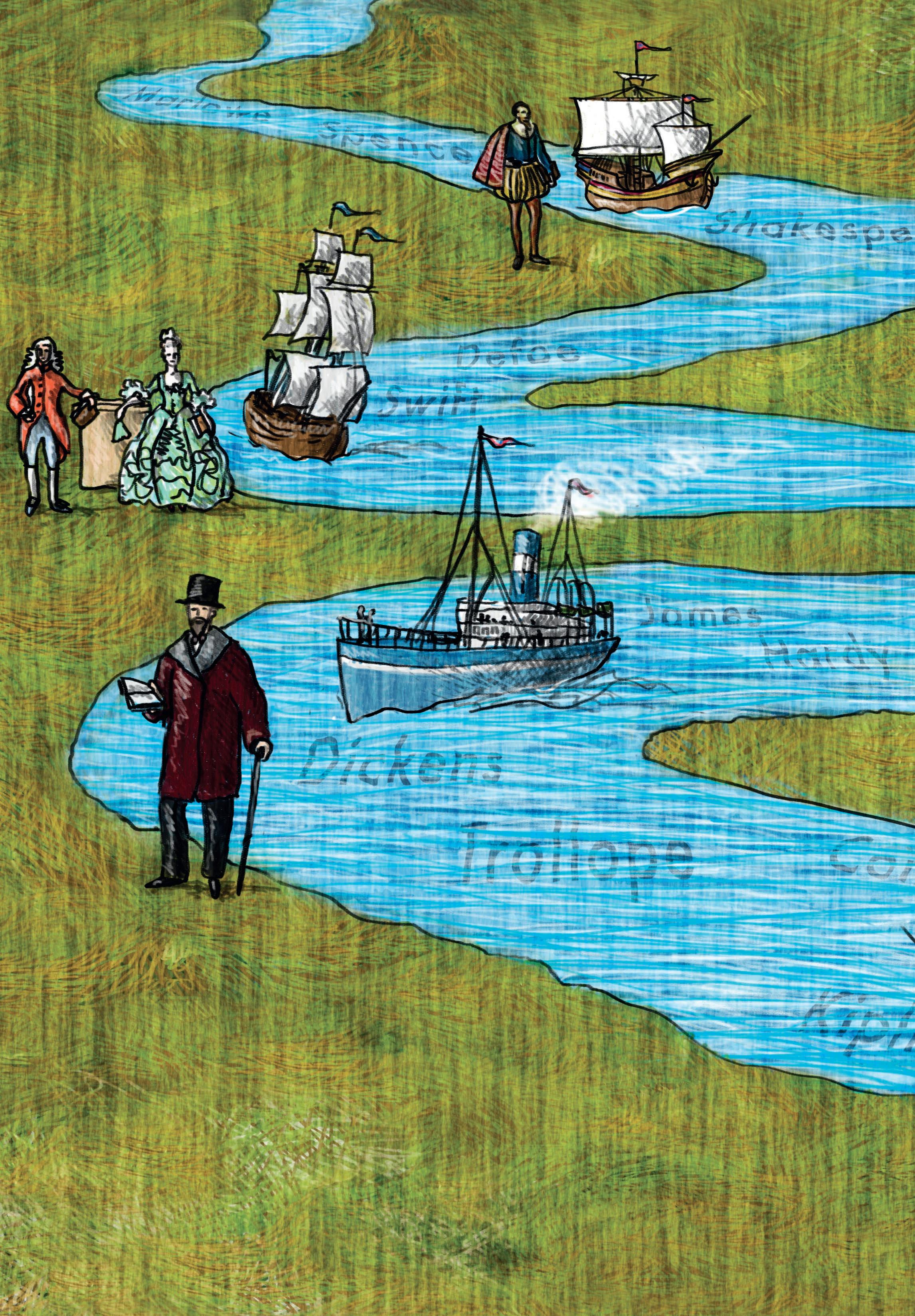

William Shakespeare 1564–1616
Shakespeare was born and brought up in Stratford-upon-Avon. At the age of 18 he married Anne Hathaway, a local farmer’s daughter. Only three years later, he left for London to make his way as an actor and playwright. By 1595, he was established and in the following twenty years he wrote and produced more than 30 plays. Some of the best known are: Romeo and Juliet, A Midsummer Night’s Dream, Richard III, King Lear, Hamlet, Much Ado About Nothing, Othello and Macbeth. Shakespeare is also loved for his poetry, especially his many sonnets.
Jane Austen 1775–1817
Jane Austen led a quiet, middle-class life with her family in Hampshire. Her novels are social comedies and the characters are generally from her own class. She observes their adventures and misadventures with affection but also with a critical, sometimes ironic eye. Her best known novels are Sense and Sensibility, Pride and Prejudice and Emma, all of which have been filmed. Jane Austen never married and died at the age of 42.
Charles Dickens 1812–1870
Charles Dickens' first success came with The Pickwick Papers, initially published as monthly episodes in a magazine. He wasn’t just a gifted storyteller, but he was also a writer with a social conscience. In particular, he describes how poverty and corruption affected ordinary people’s lives. This can be seen in such classics as Oliver Twist, David Copperfield and Great Expectations. Dickens had a special talent for giving his characters memorable and appropriate-sounding names, such as Gradgrind, Heep and Bumble.
Walt Whitman 1819–1892
Walt Whitman began work as an office boy at the age of only eleven. Later he worked as a printer, a teacher and a journalist. Whitman published his Leaves of Grass in 1855. The twelve long poems dealt with freedom and brotherhood and were looked upon as very modern at the time. This was partly because of the content but also because of their free verse form, ignoring the traditional rules of rhyme and rhythm.
Emily Dickinson 1830–1886
Emily Dickinson grew up in Amherst and remained at home all her life. In her thirties she withdrew from the outside world, never went out, seeing only her family and some very close friends. Only seven of her poems were published during her lifetime. After her death, approximately 1,800 poems were found. Emily Dickinson’s last wish had been for all her works to be destroyed. Fortunately it was not carried out.
Mark Twain 1835–1910
Mark Twain was an American writer best known for his novels The Adventures of Tom Sawyer and its sequel Adventures of Huckleberry Finn. He grew up in Hannibal, Missouri and held many jobs during his life, including as a typesetter, riverboat pilot and journalist. Twain is considered one of the greatest American writers.
Virginia Woolf 1882–1941
Virginia Woolf was one of the important members of the Bloomsbury Group—a group of writers, artists and intellectuals in London in the early 20th century. Some of her best known books are Mrs Dalloway, To the Lighthouse and Orlando. In her novels, she developed a style of writing called “stream of consciousness” where she describes life moment by moment, focusing more on inner life than on events. In A Room of One´s Own she deals with the situation of women writers.
F. Scott Fitzgerald 1896–1940
F. Scott Fitzgerald is regarded as one of the greatest American writers of the 20th century. Four of his novels were published in his lifetime, including This Side of Paradise, The Beautiful and Damned and Tender Is the Night However, his most famous work is The Great Gatsby, which has been the basis for a number of films. This novel revolves around the wealthy Jay Gatsby whose past is unclear, and who loves the beautiful Daisy Buchanan. The setting is Long Island where Gatsby hosts lavish parties for rich people.


Welcome to the Resource Section of Solid Gold 2. It’s here to help you improve the way you learn and use English. It will help you build your vocabulary and sharpen up your grammar, as well as showing you ways to get better at understanding, speaking, reading and writing in English. There’s no need to read the whole Resource Section from start to finish—just go straight to the section you need as you work through the book.
Assessing your language ability helps you to keep a record of your progress. Fill out this form when you begin your course, again halfway through the course, and finally at the end to see how you have improved.
The statements match my level of English (choose 0–4) 0 = not at all 1 = a little 2 = fairly well 3 = very well 4 = perfectly
I can understand most spoken English at a natural speed, including some regional or informal language.
I can understand spoken English and written texts in complex or formal situations, from different media.
I can read contemporary fiction, poems and plays, and understand short extracts from older literature.
I can use strategies such as taking notes, asking questions and finding the main idea to understand longer texts or spoken English.
I can review if different sources are relevant and reliable for various purposes.
I can choose words and expressions that fit the purpose, audience and situation, in both informal and formal contexts.
I can understand how to use linking words to make my speech and writing clear and well-structured.
I can see how spoken and written English can be structured to influence an audience.
I can express myself clearly and in a structured way in writing and speaking, using correct pronunciation, vocabulary, grammar and spelling for the purpose and audience.
I can discuss and argue in both informal and more formal situations, in speaking and writing, using information from different sources.
I can take an active part in discussions about social and work-related topics by asking follow-up questions, explaining my ideas, giving new viewpoints and responding to others.
I can review and improve my spoken presentations and written texts.
When studying English at this level, focus on expanding your vocabulary, improving fluency and mastering more complex grammar structures. Make sure that your writing and speaking are clear and well-organised, practise listening to different accents and take part in discussions on a variety of topics. On the following pages, you will find strategies to help you improve your English.
Before you get to those pages, here is some general advice:
• Focus on the main idea—what the text, book or listening exercise is basically about. Once that is clear, you can move on to details.
• Learn from your mistakes. When you get work back, make sure you understand the feedback from your teacher. Rewrite your text or notes so that you can remember the correct version.
• Make time for your English studies. Pick a specific time and place for studying. Make it enjoyable by listening to podcasts on your way home, playing music or watching a series. This will also improve your listening skills.
• Check your progress. Regularly ask yourself what areas you need to improve.
Read more about how you can improve your reading, listening and speaking skills in the digital material.
What is the best way of taking notes? The obvious way, and the one most people use is to write them down one line at a time—so-called ‘linear’ notes. Unfortunately, the brain does not work that way. It does not store information in neat lines and columns. The brain works primarily with key concepts in an interlinked and integrated manner, where information is stored by pattern and association. So it might help your mind to store and recall the information if you were to take your notes in the way the brain works.
You can find more information about how to create a mind map on the next page.

When you speak or write you usually adapt your language depending on three things: who you’re speaking or writing to, what the topic is and the situation you are in. These different ways of communicating are called genres or text types.
Purpose
Every genre has a specific purpose. The purpose determines how the genre is constructed. Instructions, for example, are meant to explain a process and are constructed so that the information is given step by step.
Structure
Every genre has its own structure. A set of instructions starts by stating the goal, such as ‘How to make a delicious fudge cake’. This is followed by a list of ingredients and step-by-step instructions showing how to make the cake.
A news programme can also be considered as a genre, with its own structure. This often starts with the day’s headlines, followed by details of the major news items and moving on to smaller news items before ending with the weather report. You would probably be surprised if it started with the weather report and ended with major international news.
Language
Every genre has a specific use of language. For example, many newspaper articles are reporting something in the past tense, while a set of instructions will require action verbs in the imperative form.
When writing in a particular genre you need to know how to structure the text and what type of language is required. In this Resource Section there is advice for writing a formal letter, a five-paragraph essay, a discussion essay, a book or film review and an argumentative essay. Different genres use different types of grammar and vocabulary. The examples above are written genres, but we also use genres when we speak. For example, you might need to give someone information or talk about something important—and the way you speak will change depending on the situation.
To help you, this section contains model texts and advice on the following:
How to write a formal letter/email 166
How to write a five-paragraph essay 168
How to write a discussion essay 170
How to write a book/film review 172
How to write an argumentative essay 175
Advice on writing a project 178
Using references in academic texts 179
In addition, there are more model texts in the digital material:
How to write a letter/email to the editor
How to write a letter/email of complaint
How to write an informal letter/email
A letter or email written to a business, a college or anyone not considered a friend or a family member should be written in a formal style. In addition to avoiding short forms (I’m, it’s, and so on) and slang, there are specific rules for formal letters and emails to follow. Here is an example of a letter written to an author, requesting a school visit. There are other examples of formal letters in the digital material.
The main difference when writing a formal email is you do not have to include the date (it is in the email already) or the address of the person you are writing to. You may still include your own contact details, even though your own email address is already in the email, and most people do. Of course you do not need to sign above your name either. Otherwise you can follow the same instructions.
In a letter, your own address comes first. You may also want to add an email address. The date comes after your address. Put the address of the person/ company you are writing to next.
Put the greeting here.
Introduce yourself.
Explain why you are writing.
[Your Name]
[School Name]
[School Address] [Postcode and City] [Country]
[Date]
[Author’s Name]
[Publisher’s Name or c/o Address if available] [Publisher/Agency Address] [City, Postcode] [Country]
Dear [Author’s Name],
I hope this letter finds you well. My name is [First name] and I am a student at [School Name], an upper secondary school in southern Sweden.
We recently learned that you will be visiting Sweden this spring, and we would like to kindly ask if you might consider visiting our school during your stay. We are currently reading your book, *[Book Title]*, in our English class, and many of us are very inspired by your writing. Meeting you in person would be a great opportunity for us to learn more about your work and creative process.
Use brief paragraphs using formal English.
Our school is located in [City], and we would be happy to arrange a short visit, reading or Q&A session depending on your availability. We understand that your schedule may already be full, but even a brief visit would mean a great deal to us.
Conclude the letter with a thank you.
Use an appropriate ending.
Write out your full name. Sign above it.
Thank you very much for considering our invitation. We look forward to your response.
Yours sincerely, **[First name] [Last name]**
Date: This can be written as Month Date Year (common in the US) or Date Month Year (common in the UK). It is not common in English-speaking countries to write Year Month Date.
Greeting: If you know the name of the person you are writing to, start with ‘Dear Name’. This should be ‘Mr Name’ or ‘Mrs Name’ or ‘Miss Name’ or ‘Ms Name’. You do not use first names when writing formal letters in English, especially if you have not met the person you are writing to. If you don’t know the name, you can write ‘Dear Sir’ or ‘Dear Madam’ or ‘Dear Sir or Madam’.
Ending: Use one of these endings: Yours faithfully (if you do not know the name of the person you are writing to); or Yours sincerely (if you have written to a specific person).
• Use formal language no slang or short forms like I’m or it’s.
• Keep a clear structure start with who you are, say why you're writing and finish politely.
• Use the right greeting write Dear Mr/Ms … if you know the name or Dear Sir or Madam if you don’t.
• Always be polite and respectful, especially when asking for something.
• Finish appropriately use Yours sincerely if you know the name, Yours faithfully if you don’t.


CRACKING THE CODE
Learning English
Starter
Textwork
Vocabulary: Definitions
Interact
Activity
Pair work: Small talk
Focus on verbs to do with speaking and listening
Check your English
LISTENING: USING SIGNPOSTS
Starter
Listen and recall
Interact
LETTER TO A FUNERAL PARLOR
Starter
Interact
Pre-writing
Writing: A formal letter
WSM: REMEMBER
Interact
NATIONAL GRAMMAR DAY
Starter
Textwork
Interact
Vocabulary: Words with similar meanings
Interact
Expand your vocabulary: British and American English
LISTENING: SECONDHAND BOOKS
Starter
Listen and recall
Interact
Use of English: Sentence changing 1
Sum up and comment
Books to read and enjoy
Work in groups of 3–4. Read and discuss the following.
1 How often and to what extent do you use English in your daily life? In what situations?
2 Which of the four language skills do you find most difficult in English: listening, speaking, reading or writing?
3 English is a ‘Please’ and ‘Thank you’ language. Why are these words so important to use?
Assess your English in the Resource Section on page 144. What do you need to focus on?
Before starting your studies in this course, read through the section On Studying on page 145 in the Resource Section. There is a link on that page to extra strategies for language skills in the digital material, which you should also read and discuss.
Apart from words and body language, what is important to consider when communicating? Give examples.
Show that you have understood the text Cracking the Code by completing the statements below with information from the text. Sometimes one or two words are sufficient.
1 A complete command of a language does not successful communication.
2 Sometimes, even in your native language you can experience and can feel that you’re unable to
3 That’s not what I meant is a book intended for in English.
4 When it comes to communication, the words you use, compared to other factors, are not .
5 According to the 7-38-55 rule, 55% of the impact of our communication is
6 We are now able to increase our means of communicating internationally thanks largely to
7 One example of success with international communication is that
8 One example of failure with international communication is that
9 Deborah Tannen has defined five areas that need to be developed to succeed at communication. Decide which area these sentences belong to.
1 = Language skills 2 = Intercultural skills 3 = Communication skills
4 = Personal skills 5 = Small talk skills
a) Be completely focussed on what you’re doing.
b) Understand what sort of people you’re speaking to.
c) Choose language that’s persuasive and gets your message across.
d) Be able to take part in simple, friendly conversations.
e) Know how much emotion to show.
Practise the vocabulary in Wordmatch/Spelling
004 Vocabulary: Definitions
Here are definitions of eight words from the text. Can you work out what they are?
To help you, the first and last letter of each missing word is given.
1 A period of ten years. d e
2 How high or low a sound is, especially a musical note. p h
3 A principle or idea, e.g. the of free speech. c t
4 All the workers employed in an organisation. s f
5 Your is what you intend or plan to do; your aim. i n
6 Someone who’s paid to work for someone else. e e
7 Feeling sure about your own ability to do things and be successful. c t
8 To make something larger in amount or size. i e
005 Interact
1 Were you surprised by the 7–38–55 percent rule? What else did you learn from the text?
2 Why are intercultural skills so important in communication?
3 If you have a job, do you use English at work? When?
4 What language skills will your future studies and career demand?
006 Activity
Imagine you’re a Martian anthropologist with no understanding of human practices. Try to think up explanations for what humans do for the following situations:
a Eating a fast food meal
b Catching a train
c Working out at a gym
d Going to the hairdresser
e Going fishing on a river
Work with a partner. Imagine you’re at a restaurant for lunch but there’s only one seat available—next to someone who’s already eating. You decide to sit there.
Here are the opening lines in a conversation. See if you can continue it by using small talk.
A: Excuse me, do you mind if I sit here?
B: No, of course not.
A: Thank you. It’s very crowded today, isn’t it?
B: Yes, there are a lot more people here than usual.
Complete the definitions below with a suitable verb. Choose from the words below, and use a dictionary if necessary.
announce eavesdrop mumble scold bug go on about natter snap at chat up gossip overhear stammer discuss lisp patronise waffle
1 To someone is to criticise them angrily because they’ve done something wrong.
2 To someone is to talk in a friendly way to someone you find attractive.
3 To is to talk too much about other people’s private lives.
4 To is to hear, especially by accident, a conversation in which you’re not involved.
5 To is to talk a lot but without saying anything interesting or important.
6 To something is to tell people officially about a decision, plans, etc.
7 People who pronounce the ‘s’ sound as ‘th’. So, they’d say ‘What a thweet baby’ instead of ‘What a sweet baby’.
8 To is to speak or say something quietly, and in a way that may be hard to understand.
9 To is to listen secretly to what other people are saying.
10 To someone is to talk to them as if they were stupid when in fact they’re not, or as if you were better or superior to them in some way.
11 To someone is to talk to them quickly in an angry way because you’re annoyed with them.
12 To is to talk about a subject with someone and tell each other your ideas or opinions.
13 To is to speak with difficulty, repeating sounds or words and often stopping, before saying things correctly. For example, ‘Wh-wh-when can we g-g-go?’
14 To is to talk for a long time, especially about unimportant things.
15 To is to talk too much about a particular subject, so that the people you’re talking to become annoyed or bored.
16 To a room is to put a special device somewhere in order to secretly listen in on other people’s conversations.
009 Check your English
No two people have exactly the same level of English, so here’s a chance to see how much English you already know—especially English vocabulary. Work in groups of 3–4. Your teacher will give you more information.
010 Starter
Work in pairs. What do you need to think about when writing a formal paper in English? Make a list. Compare with a friend.
011 Listen and recall
Listen to the text Using Signposts and then answer the questions below. Before you begin, read through the sentences below.
1 What are signposts in writing, and why are they important?
2 How can effective signposts help the reader understand the context of a piece of writing?
3 What is the most obvious signpost?
4 What example was given for developing headings into headlines?
5 What is the purpose of an email subject line according to the text?
6 What is the purpose of using headings and sub-headings in longer documents?
7 The purpose of the first sentence in a paragraph is to summarise what you want to say. What is this often called?
8 There are three ways to find a good topic sentence. Can you name one of them?
9 By working on headings, headlines and topic sentences, you can identify what?
10 What is the principal tool for holding your reader’s attention?
11 Robert Bruce says that every sentence you write should what?
12 Most people can recognise a sentence because it has two main things. What are they?
Practise the vocabulary in Wordmatch/Spelling
Go back to the first text Cracking the Code on page 10 and take a closer look at the text.
1 How is the text structured?
2 What is brought up in the different paragraphs?
3 What kinds of headings and sub-headings are used?
4 How does the author work with signposting?
Work in small groups. Here are some ‘new’ words that have been incorporated into the English language in recent years. Do you know them? Explain what they mean to each other. (The first one has been done for you.)
1 cremains The cremated remains of a dead person. (A person’s ashes.)
2 beatboxing
3 breadcrumbing
4 chatbot
5 doomscrolling
6 flexitarian
7 ghosting
8 nepo baby
9 nomophobia
10 photobomb
11 prompting
12 rizz
Are there any other ‘new’ words like these you’ve heard of?
1 Do you think the person who wrote the letter was being overly-sensitive about the word ‘cremains’? Why or why not?
2 The writer would prefer the word ‘ashes’ to ‘cremains’. Do you agree?
3 The writer of the letter says that ‘cremains’ and ‘brunch’ are known as portmanteau words. A portmanteau is a large heavy suitcase that opens into two parts. Can you explain the connection?
Here are some other common ‘portmanteau’ words. Can you work out which two words have been combined in each?
1 motel +
2 shopaholic +
3 brunch +
4 camcorder +
5 fanzine +
6 Oxbridge +
7 smog +
Practise the vocabulary in Wordmatch/Spelling
Vocabulary: Choose the word
Before you start writing make sure you have read and discussed the text about genres on page 165 and the rhetorical process on page 156.
Imagine you’re the owner of a funeral parlor. Write a letter in reply to the one that Lydia Davis wrote about cremains, using about 150–180 words.
Remember to start your letter with Dear Madam/Sir and end with Yours faithfully. Don’t forget to sign the letter with your full name.
For more advice on how to write a formal letter refer to the Resource Section on page 166.
Christina Rossetti wrote this poem to someone she loved when she was just 19 years old. At first, she asks him to remember her after she dies—but the ending shows a different, more gentle message.
Remember me when I am gone away, Gone far away into the silent land; When you can no more hold me by the hand, Nor I half turn to go yet turning stay. Remember me when no more day by day You tell me of our future that you plann’d: Only remember me; you understand It will be late to counsel then or pray. Yet if you should forget me for a while And afterwards remember, do not grieve: For if the darkness and corruption leave A vestige of the thoughts that once I had, Better by far you should forget and smile Than that you should remember and be sad.
017 Interact
1 How does the speaker feel about being remembered? Why does this change by the end of the poem?
2 What does the poem say about love and letting go? Is the speaker being kind, or brave or something else?
018 Starter
What comes to mind when you hear the word ‘grammar’? Give yourself two minutes to write down all the reflections and associations that pop up in your mind. Then, compare what you’ve written with a classmate. So, what does grammar mean to you?
Now find another classmate to work with. Compare and discuss what you’ve written.
Read National Grammar Day on page 16. Then complete the sentences below, basing your answers on information from the text.
1 National Grammar Day in the United States is celebrated on
2 Who was the person who promoted it in 2006? It was
3 She was the founder of the .
4 What was she reported to have said ‘March forth on March 4 to …’?
5 The aim was to .
6 Name one negative thing that was found on websites.
7 National Grammar Day is in danger because pedants focus on
8 Grammar is described as the of a language.
9 According to the text, there can be no without grammar.
10 Words by themselves do not make sense. Why?
11 Give an example of ambiguity mentioned in the text.
12 What is the purpose of sentences?
13 Grammar is the study of what?
Practise the vocabulary in Wordmatch/Spelling
1 Did you learn anything new about grammar from the text? Why does grammar deserve its own special day?
2 If you were to add one or two additional national days based on language, what dates would you choose and which language issues would you choose? Compare your answers with the rest of the group.
Complete the lists of words below with another word that has a similar meaning. Choose from the following words, all taken from the text.
ambiguous discourse literally promote resolve clarity issue lively report usage
1 dilemma, problem, 2 energetic, vibrant,
3 application, function, 4 vague, unclear, obscure,
5 boost, support,
6 conversation, dialogue,
7 settle, solve,
8 clearness, precision,
9 disclose, inform, notify, 10 actually, exactly,
Work in pairs. Take turns to ask and answer the following questions.
1 Have you ever heard of National Grammar Day? Would you like to see something like that in Sweden?
2 In the text, the word ‘charge’ was used to show how difficult some words can be in English. How would you explain the different meanings of these words: row, bark, wave and bank?
There are many words in British English and American English that are different. It’s important to know the most common ones.
Complete the sentences below with the correct British word. Choose from the following. (The American word is in brackets after each sentence.)
bonnet crisps jam plaster trainers
1 ‘Do you like my new pair of ?’ (sneakers)
2 ‘I’d like a packet of , please.’ (potato chips)
3 He lifted up the to check the engine. (hood)
4 I always put on my toast. (jelly)
5 ‘I’ve cut my finger! Pass me a .’ (Band-Aid)
Now turn to page 324 in the Expand Your Vocabulary section of the book and do the exercise British and American English.
Nowadays, it’s possible to find books to take home for free. Some people deliberately leave books on trains and buses to be picked up by a new reader. Some people leave books on public bookshelves, called ‘free libraries’, to be taken.
1 If you were to leave a book for a stranger, which book would that be and why?
2 In what ways can giving away books help the environment?
Listen to the text Secondhand Books and then answer the questions below by completing the sentences, Before you start, read through the sentences below.
1 How old was the author when she bought a book called Crossing the Water and where did she buy it from? She was years old and she bought the book from
2 Why do you think the dead fly brought her joy?
3 What is one thing she always looks for in a new place to live?
4 How do the books come to her? Choose three ways.
5 What type of books does she really like?
6 She mentions a Sherlock Holmes case to crack. What do you think she means by that?
7 In the text, she wonders about three things. List one of the things that she wonders about.
8 She describes what we can find in secondhand books. Name two things she mentions.
9 Why does she like the smell of new books? Give an example of what she compares it to.
10 What might a secondhand book do for you?
Practise the vocabulary in Wordmatch/Spelling
The writer says that when buying secondhand books, you get two stories in one. What does she mean by that?
Evaluate your spoken English by using the section on Assessment on page 144 in the Resource Section.
Complete the second sentence so that it has a similar meaning to the first sentence, using the words given. Do not change the word given. You must use between two and five words, including the word given.
1 Why wouldn’t he give you his email address? REFUSE
Why you his email address?
2 Can you give me a lift into town tomorrow? ABLE
Will me a lift into town tomorrow?
3 The lecturer didn’t speak loudly enough for the students at the back to hear.
QUIETLY
The lecturer spoke the students at the back to hear.
Now turn to page 348 in the Use of English section of the book and do the exercise Sentence changing 1.
1 What have you learned about communication that was new to you?
2 What are your goals for this course?
3 Learning new words is important. How can you work on increasing your vocabulary?
Davis, Lydia: The Collected Stories
Díaz, Junot: The Brief Wondrous Life of Oscar Wao
Haig, Matt: The Midnight Library
Hornby, Nick: About a Boy Lodge, David: Changing Places
Ng, Celeste: Everything I Never Told You
Oates, Joyce Carol: I’ll Take You There
Smith, Zadie: On Beauty
132 Use of English: Word building 1
In the two previous units you were asked to complete exercises by filling in gaps using only one word. Now it is time to work on word building.
Complete the following sentences by changing the words in bold type into a word (noun, adjective, adverb or verb) that fit suitably in each gap.
1 I’m sorry, I’ll be to attend the meeting tomorrow. able
2 There was a loud when the bomb went off. explode
3 ‘Do sit down and make yourself .’ comfort
4 Harrison was the only for the job. apply
5 My is to leave by the first available plane. intend
Now go to the Use of English section of the book and do the exercise Word building 1 on page 357.
133 Sum up and comment
1 What theme or themes in the different texts did you find the most meaningful or interesting? Why?
2 How much better have you become at ‘reading between the lines’, that is, really understanding the message of the text?
134 Books to read and enjoy
Austen, Jane: Pride and Prejudice
Brontë, Charlotte: Jane Eyre
Brontë, Emily: Wuthering Heights
Christie, Agatha: And Then There Were None, Murder on the Orient Express
Conan Doyle, Arthur: A Study in Scarlet
Dickens, Charles: Oliver Twist, David Copperfield
Fitzgerald, F. Scott: The Great Gatsby
Golding, William: Lord of the Flies
Hemingway, Ernest: The Old Man and the Sea
Huxley, Aldous: Brave New World
Mansfield, Katherine: Short Stories
Melville, Herman: Billy Budd
Orwell, George: 1984, Animal Farm
Shelley, Mary: Frankenstein
Steinbeck, John: Of Mice and Men
Twain, Mark: The Adventures of Huckleberry Finn
(PAGE 79)
On these pages you will find various suggestions on how to work with classical and contemporary writers. When working with literature, you may find the following parts of the Resource Section useful.
How to write a book or film review 172
The language of literary criticism 181
On speaking 150
Advice on writing a project 178
Checklist for writing 163
Peer response—writing 163
Peer response—speaking 153
The section on classic and contemporary writers, starting on page 80, includes some names of writers from the English-speaking world and some titles that you might want to try reading. There are also suggestions for further reading under the heading Books to read and enjoy at the end of each unit.
Suggestions for literary projects to work with:
1 Present a classic author
Pick one of the authors described starting on page 80, or another writer or poet or playwright, and prepare a 3–5 minute presentation.
1 Briefly present the literary period to which the writer belongs.
2 Introduce the writer, including their year and place of birth (and death), and any other background information or interesting trivia.
3 Outline their major works, including the genre(s) they wrote in and the titles of their best known works. Briefly summarise the content of one or two of them.
4 If presenting Shakespeare or another playwright, you might want to act out a scene or comment on some famous quotes.
5 If presenting Emily Dickinson, Walt Whitman or another poet, you might want to read a poem or parts of a poem.
6 If possible, find a clip from a filmed version of one of the works to show in connection with your presentation.
What are the British and American words for the Swedish words below? Choose from the following:
apartment check flat purse
apartment house closet French fries queue
autumn chips gasoline shop
baby carriage cookies handbag stand in line
bill curtains label store
biscuits diaper lift sweets
block of flats drapes nappy tag
can elevator parking lot tap
candy fall petrol tin
car park faucet pram wardrobe
Swedish British American
1 affär, butik
2 barnvagn
3 bensin
4 blöja
5 burk
6 etikett
7 garderob
8 gardiner
9 godis
10 handväska
11 hiss
12 höghus
13 höst
14 kex
15 kran
16 köa
17 lägenhet
18 nota
19 parkeringshus
20 pommes frites
Now complete the sentences below with a suitable American word. To help you, the English word is given in brackets after each sentence. Choose from the following. Not all the words will be used.
bill grade pants streetlight chips hardware store recess subway deck janitor restroom thumb tack downtown license plate semester trash can/garbage can dresser/bureau liquor store shift vest drugstore/pharmacy mailman sports shoes yard flashlight monkey wrench streetcars zeros freshman movie
1 He handed the cab driver a $10 . (note)
2 He lived in an old house with quite a big . (garden)
3 Where can I throw these empty packets? The is full. (dustbin)
4 She always went to work by . (underground)
5 We recently bought a new for the bedroom. (chest of drawers)
6 Pass me a , please. (drawing pin)
7 We went to the to get some nails. (ironmonger’s)
8 He crashed his car into a . (lamppost)
9 A million is a one, followed by six . (noughts)
10 Has anyone seen my ? (spanner)
11 There are still lots of in San Francisco. (trams)
12 My uncle is a at a high school. (caretaker)
13 He wore a red with his suit. (waistcoat)
14 My son’s in the 9th at school. (form, class)
15 What do you think of my new ? They’re really cool, aren’t they? (trousers)
16 It’s dark in the woods, so take a with you. (torch)
17 Excuse me, where’s the nearest ? (chemist’s)
18 Shall we go and see the new James Bond tonight? (film)
19 Can you buy some for the party? (crisps)
20 Excuse me, where’s the nearest , please? (toilet)
21 We could play bridge if someone has a of cards. (pack)
22 I have a flat . (in the city centre)
23 We went to the to buy some whisky. (off-licence)
24 My son’s a at Yale. (first year student)
25 The car had a California . (number plate)
Complete the second sentence so that it has a similar meaning to the first sentence, using the words given. Do not change the word given. You must use between two and five words, including the word given.
1 We were surprised to see Lauren at the concert. EXPECT
We to see Lauren at the concert.
2 I certainly won’t go to that nightclub again! LAST
That I go to that nightclub!
3 Everyone has heard about the hot springs in Iceland. FAMOUS
Iceland hot springs.
4 I don’t have much money so I can’t go out this weekend. COULD
If I go out this weekend.
5 Is it necessary for me to do the homework tonight? HAVE
Do do the homework tonight?
6 Molly is very excited about going to the circus. LOOKING
Molly is to the circus.
7 The hotel was full. VACANCIES
There the hotel.
8 This is the best wine I’ve ever tasted. BETTER
I’ve this.
9 The weather was so bad that we had to cancel the picnic. SUCH
It that we had to cancel the picnic.
10 The food was so hot that we couldn’t eat it. TOO
The food was eat.
11 Are they Irish? COME
Do Ireland?
12 He didn’t kiss his wife goodbye when he left. WITHOUT He his wife goodbye.
13 It’s a pity I didn’t work harder at school. WISH I harder at school.
14 I completed that crossword puzzle in ten minutes. TOOK It complete that crossword puzzle.
15 Isla and Dan’s wedding takes place next Saturday. MARRIED
Isla and Dan next Saturday.
16 ‘I’m sorry I didn’t phone to say I’d be late,’ said Mark. APOLOGIZED
Mark phoning to say he’d be late.
17 The only person who didn’t come to the party was Lucas. EXCEPT Everyone Lucas.
18 Elvis Presley was forty-two when he died. AGE
Elvis Presley forty-two.
19 The singer avoided the crowds of fans by leaving by a side door. ORDER
The singer left by a side door the crowds of fans.
20 We watched TV the whole evening. SPENT
We watching TV.
Read the text below and look carefully at each line. Some of the lines are correct, and some have a word missing. If a line is correct put a tick (√) after it. If a line has a missing word, use a stroke (/) to show where a word has been left out and on the right suggest what the missing word might be. The first two lines have been done for you.
1 Henry Ford, the founder of mass car production, was √
2 not the easiest / people to work for. He disliked of
3 chewing gum, he banned it in his factories. Any
4 worker who disobeyed was sent to chew on the 5 street for an hour pay. Ford also demanded
6 complete silence and men were forbidden whistle,
7 sing or talk at their work. One man was sacked
8 asked what he done wrong. He was shown two
9 photographs of himself taken by a factory spy. One 10 showed him talking to a colleague. In other he
11 was looking into a doorway that workers not
12 allowed to pass through.
13 Ford ruled that when starting bell rung, men
14 should already standing by their machines,
15 wearing their overalls. They had to hang their street
16 clothes on hooks were promptly whisked high
17 out of reach. To anybody going home early,
18 the hooks weren’t lowered the end of the day.
19 No chairs were provided. Furthermore, any worker
20 found sitting on the floor or leaning his
21 machine was sacked. Employees who failed to
22 their personal badges be sent home for up to
23 a fortnight.
24 But in spite of these rules, people clamoured for
25 work jobs in the 1930s were hard to come
26 by and Ford well. A teenager was so grateful at
27 being hired that he bought the foreman a present. He
28 was immediately dismissed because it was
29 the rules to give a gift a superior. That was his
30 lesson. When he learnt it, Ford gave him back
31 his job.
CRACKING THE CODE
crack knäcka command of a language behärska; kunna ett språk master bemästra, lära sig assured tryggad, säkrad native language modersmål supplier leverantör get a message across göra sig förstådd primarily först och främst decade årtionde a fraction of a second en bråkdels sekund, snabbt tone tonfall; intonation pitch tonhöjd impact intryck, effekt concept begrepp congruence överensstämmelse; kongurens increase öka webinar webbkonferens employee anställd shareholder aktieägare confident trygg, säker investor investerare negotiation förhandling sufficiently tillräckligt intention syfte, avsikt adequate tillräcklig persuasive övertygande appropriate lämplig, passande manager chef; manager staff personal ability förmåga; skicklighet adapt anpassa self-awareness självkännedom at hand till hands; ung. som är aktuell small talk småprat, kallprat super-tool toppenverktyg
LISTENING: USING SIGNPOSTS signpost vägledning provide ge, utgöra cue signal context sammanhang heading överskrift, rubrik indicate visa at a glance vid en snabb titt prime förbereda body text huvudtext; brödtext better still ännu bättre headline rubrik label etikett
folder mapp make a point h. klargöra; förtydliga subject line ämnesrad recast omformulera, arbeta om align passa med, stämma med hierarchy hierarki; system med bestämd rangordning intrigue väcka intresse; fängsla browsing nätskannande; bläddrande tempt locka, fresta paragraph stycke topic sentence ämnesmening, kärnmening expand utveckla flip kasta runt concluding point avslutande del key point huvudfråga convey förmedla capture fånga principal tool viktigaste redskap syntax satslära govern styra master behärska, klara av full stop punkt exclamation mark utropstecken rigorously noggrant limit begränsa, sätt en gräns för ellipsis uteslutningstecken; /…/
LETTER TO A FUNERAL PARLOR funeral parlor AmE begravningsbyrå award tilldela, belöna med cremains askan efter kremering deal with behandla; uppträda mot sensitive känslig h. taktfull, inkännande startle me göra bestört; störa mig in between dessemellan whether om, huruvida frankly uppriktigt sagt substitute ersättning chipped strimlad beef oxkött dish maträtt
Porta Potti namn på barnpotta pooper-scooper plastskyffel för att ta upp hundbajs cheerful glad jovial gemytlig alliteration alliteration (ord börjar på samma bokstav) portmanteau word teleskopord (t. ex. motel av motorists’ hotel) be comforted låta trösta sig
Författarna till Solid Gold, Eva Hedencrona, Karin Smed-Gerdin och Peter Watcyn-Jones är upphovspersoner till många uppskattade läromedel i engelska för gymnasiet.
Solid Gold 2, för Engelska nivå 2, är ett utmanande läromedel för elever på högskoleförberedande program och för studerande inom vuxenutbildningen eller motsvarande. Den andra upplagan har reviderats och uppdaterats i linje med Gy25.
Läromedlet innehåller texter av etablerade författare och välkända skribenter i en mängd olika genrer, en omfattande övningsdel till texterna, en praktisk resursdel i Resource Section, språkträningsavsnitten Expand Your Vocabulary och Use of English, samt ordlistor. Texterna är indelade i nio teman, och speglar den engelsktalande världen. I Resource Section finns användbara strategier, bland annat om hur man blir en bättre talare och skribent, råd för kritisk läsning och källhantering samt flera modelltexter för olika texttyper.
I det digitala materialet finns läromedlets övningar i digital, självrättande form för träning av glosor samt generella språkfärdighetsövningar. Ljudet till hörövningarna med interaktiva innehållsfrågor finns också här. I e boken finns även alla bokens texter inspelade med autentiska röster och textföljning.
Var och en kan söka på innehåll i boken, samt lägga in anteckningar och eget material, exempelvis i form av webblänkar. Tillgång till Online Grammar 2 ingår också i det digitala materialet.
Det digitala läromedlet fungerar på dator och surfplatta. På mobiltelefon kan man lyssna på bokens inspelade delar och göra digitala övningar, men inte läsa texterna i boken.
Licensen som ingår i elevpaketet gäller i tre år och kan ärvas mellan elever.
Solid Gold 2 finns även som digital elevlicens och som digitalt klasspaket.
Andra upplagan