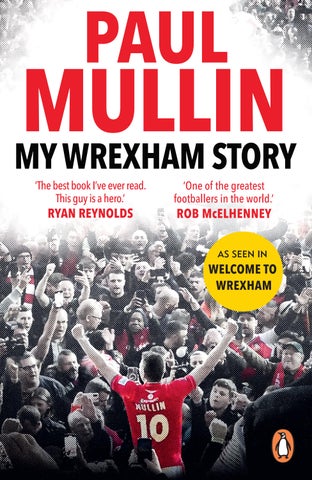
‘The best book I’ve ever read. This guy is a hero.’
RYAN REYNOLDS
‘One of the greatest footballers in the world.’
ROB
McELHENNEY AS SEEN IN WELCOME TO WREXHAM
Paul Mullin is a professional footballer who plays as a forward for Wrexham AFC. Born and raised in Litherland, he played for Morecambe, Swindon Town and Tranmere Rovers, before joining Cambridge United where he was named 2020/21 Golden Boot and Player of the Season – a feat he repeated the following year at Wrexham. Off the pitch, Mullin is a patron for Wrexham-based autism charity Your Space, and stars in the Disney+ documentary series Welcome to Wrexham.
WITH JOHN WOODHOUSE
PENGUIN BOOKS
UK | USA | Canada | Ireland | Australia India | New Zealand | South Africa
Penguin Books is part of the Penguin Random House group of companies whose addresses can be found at global.penguinrandomhouse.com
Typeset in 13.5/17.32pt Perpetua Std by Jouve (UK), Milton Keynes Printed and bound in Great Britain by Clays Ltd, Elcograf S.p.A.
The authorised representative in the EEA is Penguin Random House Ireland, Morrison Chambers, 32 Nassau Street, Dublin d02 yh68
A CIP catalogue record for this book is available from the British Library
isbn: 978–1–804–94671–8 www.greenpenguin.co.uk
Penguin Random Hous e is committed to a sustainable future for our business , our readers and our planet. is book is made from Forest Stewardship Council® certified paper.
For my Albi and Mollie
INTRODUCTION
‘Tell him to hang on while I put the baby to bed!’
It was when Rob McElhenney rang and I was just heading upstairs with my son Albi that the weirdness of my current life hit home.
I was in a situation which probably no other footballer has ever been in – playing in the fifth tier of English football and yet, outside the Premier League, one of the most talked-about players in the game. That’s me, Paul Mullin. Wrexham striker. Formerly of Morecambe, Swindon, Tranmere and Cambridge. Now doing fashion shoots with GQ magazine. They put me in a pair of shorts worth a thousand pounds. I’m used to paying a tenner at Matalan.
I’m not daft. I know that while I’m a good footballer it’s Wrexham’s owners who’ve brought that attention to the club. Knocking in forty-seven goals in one season isn’t bad, but it doesn’t get you a Disney+ documentary. Having Ryan Reynolds and Rob McElhenney sat in the stands does that. And yes, before you ask, they are, irritatingly, just as nice and caring and fun and honest as they come across on TV. Forget the fact they’re big Hollywood stars, the club is lucky to have owners who behave like normal people. Make no mistake, people in
Wrexham care about Ryan and Rob because they’re lovely individuals, not because they’re famous.
It’s because they’re great people that Welcome to Wrexham has been such a hit. The idea of breathing new life into a sleeping dragon is a good one, but without their attitude of wanting to transform a community and improve the lives of those within it, the show would never have taken off. By taking on this famous old club, Rob and Ryan not only created a documentary but a new chapter in tens of thousands of people’s lives.
For me, personally, it’s been transformational. The day-to-day existence of a National League footballer isn’t glamorous. We don’t spend our lives running away from paparazzi outside top London nightclubs. A lot of my time is spent wandering round Tesco and emptying potties – although it is changing rapidly. I parked in Liverpool city centre recently, ran 50 yards to the Apple store to get an iPad, and was stopped for six selfies. It takes me by surprise sometimes because people talk to me as if they actually know me. ‘All right Paul, mate? How are you doing?’ I’ll look at them and think, ‘Hang on, I’ve literally no idea who you are.’ I suppose that’s the great thing about the show: they don’t just show us as footballers, they let us be seen as everyday people experiencing the highs and lows of normal life.
In my case, that has meant shining a spotlight on our
wonderful little lad Albi and how his autism affects our daily lives as a family. I quickly got used to watching Welcome to Wrexham. Just like millions across the world, me and my partner Mollie would sit down in front of the TV every week – but the emotion I’d feel when Albi popped up on screen was so overwhelming that it wasn’t unusual for me to start crying.
When it came to the last episode of season one and that infamous play-off game in May 2022 against Grimsby, I wasn’t in any way prepared for how what I saw on screen would affect me. Footage of me taking a penalty was interspersed with clips of me playing with Albi in the garden. It showed what I already knew so well – that taking a penalty in a football match can never compare with being at home with my beautiful son. They got that so right. Yes, it was a big moment, but the perspective that Albi has brought into my life meant that when I kicked that ball I felt no pressure. I was ice-cold. It was just a kick in a game. I put the ball on the spot and scored.
I admire that about Rob and Ryan – they’ve never fallen into the ‘football is everything’ trap.Yes, it’s massive, and it matters to people on a very deep emotional level. But it’s nothing compared to the health and happiness of your loved ones. Truth is, if someone said, ‘Stop football tomorrow and all your worries with Albi will be over,’ I’d shake their hand and say, ‘Sound.’ That’s why everything
in this book is intertwined. In telling my Wrexham story I want to take you into a world where football and family, hope and despair, disappointment and elation, Rob and Ryan, are rolled into one.
At the heart of that story, of course, is a sporting journey that has been at times all-consuming, exciting, daunting and, in all honesty, suffocating. One where, essentially, I was no different from the people sat watching us play at home – I just wanted to know what was going to happen. I wanted a conclusion and for the end credits to roll, because the soap opera had been going on for so long – two seasons where we worked so hard for promotion that essentially they became one. At times I felt stuck in this never-ending will-they-won’t-they? drama and just wanted to be free again. It’s like being underwater: you want to come up to breathe, but there’s something – the next game, and the next, and the next – stopping you reaching the surface.
Making sure we got promoted became an obsession to me. I’ve built relationships with so many people at Wrexham, not just at the club but with the fans, and the town itself. I’ve felt the anguish and sensed the frustration, the nervousness, the tension in the stadium. All I wanted to do was make that disappear. Watching the documentary and seeing what normal everyday people had gone through to save the club, how much they cared, only heightened that sense of responsibility. I have to make this happen.
In my mind, it was on me to get us promoted. I arrived with a reputation, and because I’d taken a leap down a league instead of a jump up, I felt I had the hopes of everybody pinned on me from the day I signed. Obviously everyone in the team had their job to do, and I bet I wasn’t the only player feeling that way, but I’m a player who tries to put the weight of responsibility on myself. If something’s not going right, it’s up to me to solve it. I don’t mean that in a big-headed way, or thinking that I’m better than other people, or a great footballer, that’s just me as a person. I’m the centre-forward, so I’m the one who needs to score the goals.
I was relieved that we did what I thought we could do, but it was a long and winding road. Before we signed off at the end of 2022–23 we’d taken in more than a few weird and wonderful stopping points – last-minute goals, bust-ups in the tunnel and, perhaps most bizarrely of all, a Las Vegas blowout. And in the background at all times, a film crew!
But the media never brought any pressure or pushed the ‘need’ to fulfil the arc of the Welcome to Wrexham story and get promoted.That all came from within. After failure in the first season, no one was saying, ‘Well, we can’t have that ending again!’ – at least not out loud. I’m sure it isn’t going to hurt the show for the end of the second season to have that massive injection of happiness, achievement
and emotion compared to the disappointment of the first, but the two things – football and documentary – have always been completely separate. We’re footballers, not reality stars. You can’t script a show where so much can change with the kick of a ball.
And yet, for me, there is something that runs through Welcome to Wrexham like the letters in a stick of Blackpool rock. Something I’ve come to know a lot about – resilience. Wrexham succeeded in the end because no way was anyone connected with the club ever going to give up. And that mirrors my life exactly. In this book you will see there have been several low points where I could have walked away from football entirely. Let the game I love destroy me. Instead, I’ve become part of something truly special. With Albi, meanwhile, I’ll never stop battling to give him the best life he could possibly have. That’s a day-to-day job which throws up constant challenges – and in return he makes me the happiest dad on the planet.
If someone had said to me ten years ago that this would be my life now, this wonderful mix of football and family, I’d have said they were mad. But it’s true. It’s precisely what has happened.
There’s no other way to say it – this is my Wrexham story.
OK , I’ll be honest – I had no idea who Rob McElhenney and Ryan Reynolds were. I’m not a film person. Since learning how to walk, I’ve spent pretty much 99 per cent of my waking hours chasing around after a ball, not sat in a cinema. Had I really thought about it I might have twigged that Rob played the character of Mac in the US sitcom It’s Always Sunny in Philadelphia – I’d watched a couple of seasons of the show – but I’d never seen any of the X-Men films. So when rumours started circulating that Rob and Ryan were about to take over a fifth-tier football club in North Wales, not only did it seem unlikely, I doubt I’d have recognised them if they’d passed me in the street. Litherland, the part of north Liverpool where I was born and still live, doesn’t rival Beverly Hills from a film star point of view. Mind you, the Beatles played at the town hall more than twenty times and John, Paul, George
and Ringo are some of the most famous people who ever walked the Earth. Hollywood film stars hardly compare.
I thought I’d better do a bit of Googling. ‘Ryan Reynolds’, his Wikipedia entry told me, ‘was named People magazine’s Sexiest Man Alive in 2010 and was awarded a star on the Hollywood Walk of Fame in 2017.’ Again, this seemed a very unlikely fit for a Welsh football club wallowing in non-league. ‘Reynolds’ biggest commercial success’, continued Wikipedia, ‘came with the X-Men films Deadpool and Deadpool 2, in which he played the title character. His performance earned him nominations at the Critics’ Choice Movie Awards and the Golden Globe Awards.’ Impressive, obviously, but I’d never heard of Deadpool. The bloke was clearly a huge success, but it meant nothing to me.
OK , let’s have a look at the other fella. ‘Rob McElhenney’, Wikipedia told me, ‘is an American actor, producer, writer, podcaster and sports executive.’ Ah, so not just a bloke propping up a bar in a sitcom. No. Turns out Rob is one of the most successful all-round creatives in LA .There was definitely a lot more to him than walking into Paddy’s Pub in It’s Always Sunny and asking, ‘What’s up, bitches?’
If Rob and Ryan did buy Wrexham together they’d certainly make a bit of a change from the kind of shady characters who’d traditionally owned clubs at the lower
end of the football pyramid. I liked the idea of a bunch of outsiders coming into a historic old football club, a ‘sleeping giant’ as big clubs like Wrexham which have fallen on hard times are known, ripping up the rule book and starting again. No two ways about it, having Hollywood owners would be pretty cool. But none of that in itself would have made me want to sign on the dotted line. There was much more at stake. Having just finished the 2020–21 season as top scorer in League Two with Cambridge United, if I was going to move away from the Abbey Stadium then any new club had to fulfil two major conditions. Would I be happy there professionally? And, a thousand times more importantly, would its location mean I could spend more time with my little lad Albi?
It was Rob who initially did the persuading. ‘Hey Paul, it’s Rob McElhenney.’ A bit different from the usual calls I get – invitations to switch mobile phone plans, requests to pick up a pint of milk on the way home.
‘Hi Rob – how’s it going?’
I know that probably sounds surreal for people who follow big film and TV stars, but that’s exactly how it was.
I liked Rob straight away. From the off I could tell he was a really friendly straight-up kind of bloke. No side to him. Just a very normal person trying to sell his vision to me – where he thought Wrexham could get to, his idea of injecting new life into an entire community.
PAUL MULLIN
For my part, there were things I wanted to know. Like everyone else, ‘Why Wrexham?’ was at the top of my list of questions. Rob’s answer made total sense. The club had a history. Formed in 1864, Wrexham are the oldest club in Wales and the third oldest professional football team in the world. They had played in big European competitions as well as high up in the Football League. They also had a big catchment area, a massive existing fanbase, and the other big Welsh clubs were a long way away in the south of the country. Then there was the Racecourse, the oldest ground still to be hosting international matches – Wales first played there in 1877. When you looked at it, if Ryan and Rob’s dream of combining club and community in a sporting project like no other was going to work anywhere, then Wrexham was the place. I still thought it was mad that they wanted to do it, but I thought it was brilliant at the same time. No one had ever considered doing anything of that nature. From a business as well as a sporting point of view, it was so smart, so clever. It had the potential to be so successful – although of course that was far from guaranteed.
As a player, I wanted to know where ultimately they saw the club going. ‘Within five years,’ Rob told me, ‘we want to either be in the Championship or close to the Championship.’Which obviously is exactly what you want to hear as a player, but at the same time any club that
wants your signature will say stuff like that. The difference with Rob was that it was obvious he meant it. He wasn’t coming at the project for any reason other than to try to fulfil a dream and, in so doing, change the lives of all kinds of different people.
To be honest, I hadn’t expected Rob to know all that much about me, and it was only when I watched the documentary that it clicked – ‘Oh, right, he did a lot more research than I thought.’ I listened as he told me how much he’d love to have me at the club, and how ambitious he and Ryan were to take Wrexham forward. He was so enthusiastic about the whole plan, and I was impressed by what they were trying to do. Beforehand, I’d read a couple of things about how exciting the project was, how much they wanted to make it work; now, having spoken to Rob, I could feel it in his voice, his attitude. This wasn’t just two blokes messing about. This was totally for real. When I picked up the phone, I hadn’t decided whether I was going to go to Wrexham or not. When I put the phone down, my mind was made up.
There was another person who was key to me signing – Phil Parkinson, the massively experienced manager the new owners had persuaded to come in and propel Wrexham back into the Football League.
My first phone conversation with Phil came when I was on a run – which as a footballer isn’t a bad thing to be
caught doing when your prospective new boss gives you a call! I was literally crossing over the road down from my house.
‘Can you meet me at eleven o’clock?’ he asked.
‘I’m sorry, I can’t. I’m on a run. It’s something I need to do.’
‘Fine,’ he said. ‘Get that done and meet me at the Carden Park Hotel.’
This hotel, about 15 miles outside Wrexham, has become its own little part of the Wrexham story. Meetings have been staged there, the owners have stayed over, and we train there occasionally. One day it might get a blue plaque.
When I finally met Phil, his first question was, ‘How did the Cambridge manager get the best out of you?’
Two things about that. One, I liked the fact that he asked. It told me straight away that he wasn’t the sort of manager who imposes his own ways on a footballer irrespective of what type of player and person they are. Also, right from the outset I was being invited to tell him what works for me. It meant he wanted to know about me as a player as much as he wanted to tell me how he wanted the team to play, the kind of formations he was interested in.
I told him how Mark Bonner, the Cambridge boss, had operated, how he’d allowed me a level of freedom to
decide what was good for me off the pitch, and how that had delivered in terms of results. ‘He just let me be,’ I said. ‘He trusted that I knew my own game and allowed me to be the kind of player I’ve always known I could be.’ I wasn’t being flippant or cocky. I know how to manage myself to be able to perform on a Saturday. I don’t need a massive amount of managerial input. I’m not the sort of person who responds to someone putting an arm round my shoulder any more than I am to someone screaming and shouting at me. The pressure I put on myself to be the best I can be on a football pitch is more than enough. No one ever needs to put it on me to change. If I feel like I’m not doing something right, I’ll make sure I do everything I can to remedy that situation.
Phil was quite laid back about what I told him – which again I liked. I knew if I went to Wrexham he wasn’t going to rip up the formula that had worked so well at the Abbey Stadium. Instead he wanted to replicate and improve on it at the Racecourse. His attitude told me that he was a manager who worked with his players, communicated with them rather than just told them what to do. It sounds obvious, but managers who treat their players as human beings, as individuals, will always get the best results. It’s surprising how many there are out there who haven’t realised this. Believe me, I’ve encountered one or two.
PAUL MULLIN
Phil’s ability to get the best out of a team was there for all to see. He was in demand after a run of great achievements including, incredibly, taking Bradford City, then of League Two, to the final of the League Cup – the only manager to lead out a fourth-tier club at a major cup final. He’d also taken Bradford into League One, and got Colchester United and Bolton Wanderers promoted to the Championship. Not that his history was something I particularly thought about at the time. Neither was I asking him who else he was hoping to bring in or anything like that. All that mattered to me was that he wanted me as a mainstay of the team, knew what I could do, understood me as a footballer, and knew how he wanted me to play.
‘I’ll give you my all every single minute of every game,’ I promised. ‘In training, you have to trust I know how to manage myself to be able to perform on a Saturday. I’ll do what I feel I need to do to be in perfect condition – because then everyone will get the benefits.’
Phil knew that at the very least he was going to get someone who was going to work his arse off for the team. He also trusted that if he worked with me on the basis of how I’d performed at Cambridge, he would get a great return in goals. What I don’t think he realised at that stage was how good my all-round game was. He said as much himself in Welcome to Wrexham.
From talking to Rob, and now to Phil, I was convinced that Wrexham would fit like a glove. Make no mistake, as a footballer, being comfortable where you play is everything. That’s why, if Wrexham hadn’t come in, there’s a decent chance I’d have stayed at Cambridge. I loved it there and was in no rush to leave. In my head I’d been thinking about how I could make it work so I could stay down there and have my partner Mollie and Albi come and live with me. That wouldn’t have been cheap – house prices round Cambridge are phenomenally high – but I was serious. Along with Morecambe, Cambridge was the happiest I’d been as a footballer.When the 2020–21 season ended, I asked the club for an extra £500 a week on top of what they were offering me. Even then I’d not have been able to afford a house in the area, but that was a sacrifice I was willing to make. Mark Bonner said he’d speak to the powers-that-be. The answer was no. Which I get. Cambridge aren’t a big club. They have to look after themselves financially.
At that point I was in limbo. Cambridge obviously wanted to wait and see if there were approaches from other clubs, the hope being that I wouldn’t sign anywhere else, before offering their own terms. Championship clubs Preston North End and Birmingham City showed an interest, but neither came to anything. Wayne Rooney, then manager at Derby County, also asked me to train
with his team. Again, though, that wasn’t an option. As a footballer, training at a club without a contract is a risk. What happens if you get injured? You’re uninsured and unable to earn a wage. I couldn’t do that with a little boy in the house.
Elsewhere, a few teams in League One wanted to offer me a contract but were cash-strapped after a Covid-hit season of empty terraces. Wigan said they’d sign me if Charlie Wyke didn’t sign from Sunderland, but then that deal went through and that was the end of that. Charlton Athletic were also interested, and Gillingham offered a good contract, although there was a question over whether they were in a position to do so because of a transfer embargo. Both would have been a non-starter anyway because they were even more difficult to reach than Cambridge.
As the summer went on, another Championship side, Blackburn Rovers, wanted me to wait until it was confirmed they’d sold their frontman Adam Armstrong to Southampton. But by then Wrexham had made their offer and no way was I going to wait and miss my chance at the Racecourse. Had we not had Albi at that point, maybe I would have held out a little longer. Maybe I’d have ended up at Ewood Park. But in reality it could have been anywhere.
All the way through the build-up to me signing on the
dotted line, I had no inkling that the whole Wrexham transformation – or hoped-for transformation – would be captured on film. The Disney+ show was never a part of the sell. The first I knew about Welcome to Wrexham was when, on the same day I joined the club, I was asked to sign a form giving the film crew permission to record me and for my image to be used in the show. Even then I didn’t think too much about it. As far as I was concerned it was just something that came with the club – ‘Oh, OK , they’re making a TV programme.’ There was no part of me thinking, ‘Wow! This is great! I’ll be on TV across the world!’ Not for one minute did I think that. I came to Wrexham because it was an exciting prospect and it worked so well for me, Mollie and Albi. Everything else was just peripheral.
The first time I was actually filmed was signing my Wrexham contract. There were a lot more TV cameras than there’d usually be for an event of that kind. I had no idea that putting pen to paper for Wrexham would effectively change my life, but I did know something would have to go pretty categorically wrong for me to regret it. Because I’d made the decision to sign for Wrexham first and foremost for Albi, and because I was now earning enough to start securing his future, even if things didn’t go right on the pitch I knew I’d always consider Wrexham the best move I could have taken.
PAUL MULLIN
Obviously I’d fight every inch to get the club promotion, but Albi was always the most important consideration.
So, how did I end up in North Wales at the age of twenty-six committing the prime years of my professional career to a club in the Vanarama National League? To answer that I have to go back to the beginning.
ANFIELDDREAMS
Every kid is different. I certainly was. I had imaginary friends. Two of them, Val and Kayden, both boys. I don’t know where the names came from. I don’t think Kayden was really a name back then. Mind you, when you think about it, there weren’t that many people going round calling their boys Val either. They were around until I was about six. If I remember rightly, at that point one of them got caught up in a car crash and the other went to prison. They haven’t been back in touch, not even since I’ve been on Welcome to Wrexham. Which is a shame as they’ve got a couple of good tales to tell.
Val and Kayden, for instance, were in the back seat when, aged six, I nearly crashed my grandad’s brand-new Mercedes. An unusual feature of the car was the handbrake’s position under the steering wheel. Mum had parked up in a church while she fetched my sister Joanne
from school. She told my older brother, Greg, to keep an eye on me. A few seconds later, I was behind the wheel, the handbrake was off and the car was rolling down a hill. I was basically driving my grandad’s spanking-new Merc. Rapidly approaching was the road where all the kids were coming out of school. Disaster was imminent. I might have got the car rolling but I had no idea how to stop it. Luckily there were a couple of blokes at the bottom of the slope who managed to open the door and bring the car to a halt. When Mum asked what I thought I was doing, I told her Val and Kayden had told me to drive home to get a hammer to fix the church fence.
Mum dropped me off as usual the next day, at which point I suddenly remembered what the blokes had shouted when they tried to stop the car. ‘You know what they said, Mum? “Where’s the f**king handbrake?” ’ I think Mum was beyond being shocked by that point.
I’m not sure whether Val and Kayden were involved when I jumped over the garden fence to try to smash up a beehive. I think that might have just been me getting it into my head that bees were dangerous and so shouldn’t be around. But they were definitely partly responsible for me flooding the house. I had a Barney the dinosaur T-shirt which I’d got dirty in the garden. I needed to wash it, and what better way than in the bath? I started running the water, chucked the T-shirt in to soak and went off with my
two pals to do something a bit more interesting. Mum realised there might be something wrong when water started pouring through the ceiling below. Again, no one believed that Val and Kayden existed, but I’ll tell you right now, they did. My mum has since wondered if they might be connected to her having a miscarriage and losing twins before she had me. They say if there’s a miscarriage, your other children will have imaginary friends. I’m not so sure about that but it’s as good an explanation as any!
While some of the stories featuring Val and Kayden are a bit disputed, what definitely isn’t disputed is that wherever I went as a kid I always had a ball. I actually think I was an easy kid to parent, because pretty much the minute I was up I’d be out the door and in the garden. Football was all I cared about. I was either training, playing in the park or kicking a ball out the back of the house. Mr Windsor, our headmaster, once had me dressed up as a snowflake in the Christmas assembly just to contrast with my usual appearance – covered in mud. Not that I was different from most kids. There’s a lot of Scousers in football, and that’s because Liverpool is a football city. That’s what it was like growing up. There weren’t any trampoline parks or ice rinks like there are now. I played cricket, but it was only as a little mess-about. Truth was, everywhere you went there were kids playing football. Now there aren’t half as many football pitches as there
PAUL MULLIN
used to be. Same with kids playing in the park. When I was a kid if it got dark at six, we’d still be there at half seven. Now kids would rather play football on a computer.
With three older siblings, I was never short of playmates. I demanded high standards. When Joanne used to deliver pinpoint crosses for me to practise headers, I’d say to my eldest brother Jonathan, ‘Why can’t you do it like that?’ Jonathan had other ways of making me learn. I used to sometimes turn my back on the ball if it came hard at me. Jonathan told me he’d tie me to the fence and whack the ball at me if I did it again. ‘OK ,’ I thought, ‘I won’t be doing that no more.’
Both Greg and Joanne laugh now about how much time I used to make them spend in the garden, how they’d try to think up excuses to get back in the house – ‘Sorry, Paul, I’m desperate for the toilet!’ – so they could have a rest. But they both could see how much football meant to me. I mean, how many other kids were curling free kicks into a plastic goal unsighted from round the side of the shed? Or building makeshift barriers out of chairs to double as a defensive wall and then trying to get the ball up and over into the goal? I’m still reminded now of what I said when asked what I wanted for Christmas one year. ‘Mannequins,’ I replied. I wanted those proper training mannequins to replace the chairs.
Joanne has always been amazing with me. She really
did spoil me badly, even buying me games for my PlayStation Portable. When we went to Madrid to visit Jonathan, who was living out there at the time, she took me to a big shopping centre and bought me a new Atlético Madrid kit – she knew I preferred them to Real. It was things like that all the time. Even to this day, after her own two kids I reckon I’m her favourite person!
As a kid, Joanne was a complete tomboy. We used to call her Dave. Still do sometimes actually! She was great at football. If she was in her teens now she’d probably end up playing for Liverpool, but sadly things were different with the women’s game then. She was totally obsessed with footie, and still is. I wind her up because she’s constantly texting me about Wrexham. ‘Did you know you’ve signed a new player?’ ‘Have you seen that the game at the end of the month is being shown on telly?’ And I’ll be like, ‘No, I don’t know anything about it.’ She’s basically the source of all my information about the club.
Greg was also a very good footballer. Some – well, Dad – say he was better than me as a kid. He could do some incredible things with a football and I reckon he could have gone on to do something in the game if he had applied himself properly. Jonathan wasn’t as skilful but has a great football brain – he was playing the opposition kids offside before they even knew what it meant. Definitely the most sensible one, he went to Durham
PAUL MULLIN
University to study Spanish and French and now runs Ripon Racecourse in North Yorkshire. Greg, an engineer, is more of a hothead – if you were ever in trouble, he’d be there in an instant to help out no matter what. My sister’s character is somewhere in between the two. She’s also the cleverest. Me? I’m a mix of them all. I’m not sure whether that’s good or bad.
One thing we definitely have in common is that as kids we were ultra-competitive. The competitiveness I show in every game comes from Greg and Joanne. Back-garden playing was never just a bit of tippy-tappy. Me, Greg and Joanne definitely wanted to beat each other, desperate to be the one who runs into the house and declares, ‘Mum, Dad, I won!’ Same as we wanted to say to each other, as kids do, ‘I’m better than you!’ Actually, we still say that now! It’s just the way we are. It’s probably a good job we never got into boxing.
That’s one thing we never did – physically fight. Well, I suppose it would have been a bit weird with them all being a good bit older than me. I never wanted to fight anyway. We’re incredibly close as a family and I really liked my brothers and sister. I was only eight when Jonathan went away to university and I used to cry every time he left. The night before he went to Durham the first time we went to Formby beach and had a race down the sand dunes. You can guess what happened – another