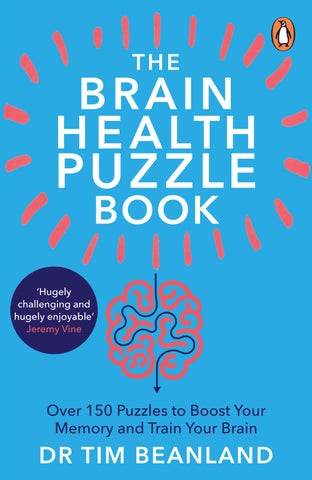
THE BRAIN HEALTH PUZZLE BOOK
‘Hugely challenging and hugely enjoyable’
Jeremy Vine
‘Hugely challenging and hugely enjoyable’
Jeremy Vine
With original puzzles by Dr Gareth Moore
PENGUIN BOOK S
UK | USA | Canada | Ireland | Australia India | New Zealand | South Africa
Penguin Books is part of the Penguin Random House group of companies whose addresses can be found at global.penguinrandomhouse.com
First published as Mind Games by Penguin Books 2023
Published in Penguin Books 2024 001
Copyright © Alzheimer’s Society, 2023
Puzzles © Dr Gareth Moore, 2023
The moral right of the authors has been asserted
Text design by Dan Prescott
Typeset in 9.54/13.28pt Plantin MT Pro by Jouve (UK), Milton Keynes
Printed and bound in Great Britain by Clays Ltd, Elcograf S.p.A.
The authorised representative in the EEA is Penguin Random House Ireland, Morrison Chambers, 32 Nassau Street, Dublin d02 yh68
A CIP catalogue record for this book is available from the British Library isbn : 978–1–804–94226–0 www.greenpenguin.co.uk
Penguin Random Hous e is committed to a sustainable future for our business , our readers and our planet. is book is made from Forest Stewardship Council® certified paper.
memory of my mother, Nancy Beanland (1932–2015)
Any man could, if he were so inclined, be the sculptor of his own brain.
Santiago Ramón y Cajal (1852–1934), neuroscientist
If we examine the di erent degrees of activity of the cerebral organs, it is necessary to consider not only their size and organic constitution, but also the exercise every faculty has undergone.
Johann Gaspar Spurzheim (1776–1832), phrenologist
Your mind needs exercise just as much as your body does. That’s why I think of jogging every day.
Anon
Preface 1 Introduction 3
1. ‘Fade to Grey’ 7
2. Brain basics 21
3. In sickness and in health 33
4. The puzzles: 1 53
5. The brain strikes back 155
6. The puzzles: 2 173
7. Plastic fantastic 247
8. About Alzheimer’s Society 265
So-called senior moments really annoy me. Forgetting the name of a colleague, hoping they’ve put their moniker in the Zoom profile. Getting to the checkout and not being able to recall your PIN even though you’ve used the card a hundred times. Putting your mobile down and having to ask someone to call you so you can find it again. (It is always in the same place in the bathroom. Why can’t I just remember?)
It’s not just that the phrase seems to trigger the earworm that is ‘Magic Moments’ in my mind. It’s more how frustrating these moments are, and that sense of, ‘If this now, what next?’
Such signs of ‘greying’ of the grey matter may be annoying. But they are not inevitable. We can all stay sharp for longer, with just a little e ort. Part of that e ort is about clean living: physical exercise, a healthy diet, and so on. But this book is about something else – think of it as mental push-ups. What do I mean? Simply that the brain is like any other muscle: to keep it trim, you’ve got to get to the gym. Such brain workouts can include time spent enjoying puzzles: fun and good for you!
As well as warding o those everyday lapses, brain workouts like regular puzzling will also help keep at bay what is now the most-feared health condition among over fifties: dementia,
whether that be Alzheimer’s disease, vascular dementia, or other, less common forms. In our ageing society, dementia has become one of the leading causes of death. Whatever shape it takes, dementia is a life-changing diagnosis, which is often lived with incredible courage. But currently without a cure.
Mention of the ‘D word’ leads me on to what Hollywood would call the ‘origin story’ for The Brain Health Puzzle Book. Of course I want you to enjoy the puzzles, stay sharp, and not get dementia. But beyond that, just by buying the book you’ve already changed someone’s life. Every purchase of The Brain Health Puzzle Book is helping to fund Alzheimer’s Society, the UK ’s leading dementia charity. Your support means we can continue to help those living with dementia now, and o er hope for better treatments and even a cure in the future.
Funding care and finding a cure for dementia have never been more needed. I know this, as I’m sure will many of you, from personal experience. My own mother Nancy lived with dementia, most of the time pretty well. In her memory and on behalf of everyone living with dementia, thank you.
Tim Beanland Winchester, Hampshire
May 2023
We are living on Puzzle Planet. Just look around. A woman excitedly scribbles in the answer to 7 down as the bus lurches along. Two old friends sit absorbed in a jigsaw, their ease with each other in the silence so eloquent. A teenager with a Rubik’s cube showboats to a would-be girlfriend. And a student plays Wordle, or Worldle, or Sudoku, on his phone – anything to avoid having to start that essay. Puzzles are everywhere.
We enjoy puzzles partly because they’re di erent from the challenges of everyday life – ‘If we invite Chris, what about Sunita?’ – because we know there is a neat and tidy answer waiting to be discovered, rather than a fudgy compromise.
Lack of a tidy solution makes for an unhappy puzzler. Lewis Carroll has the Mad Hatter famously tease, ‘Why is a raven like a writing-desk?’, but then give no answer. Carroll’s Victorian readers pestered him so much that he was forced to retro-fit what was for him a pretty weak solution: ‘Because it can produce a few notes’. Rest assured that all the puzzles in The Brain Health Puzzle Book come with tidy answers.
Something that has become apparent only very late in the long history of puzzles is how they might help to solve one of the biggest challenges society faces. For Puzzle Planet is now a Greying Globe. Life expectancy in the UK has historically, since the mid-nineteenth century, risen by three months every year. Reason to celebrate, but it comes at a price. More of us will also live to see the e ects of brain ageing – those moments when we get a bit muddled or forget someone’s name. And on Greying Globe, more of us risk developing diseases closely linked to ageing, including such devastating conditions as dementia.
At Alzheimer’s Society, we see both sides of this. It’s quite common for people who are actually ageing healthily to sense changes and worry that they are getting dementia. Conversely, a fair few people who really do have Alzheimer’s disease lose insight and think they’re actually fine.
But neither senior moments nor dementia are inevitable consequences of ageing. We can all stack the odds a bit more in our favour. What has become clear over the past thirty- fi ve years is how much we can act to reduce our own risk of losing mental sharpness as we age and lower our chances of getting dementia. We shall see that this is a story of two halves. One half is fi rmly focused on bodily wellbeing: a lifestyle of physical exercise, healthy eating, good sleep, and consuming toxins like alcohol only in moderation (if at all). ‘What’s good for the heart is good for the head,’ we will learn to chant.
The other half of our story is – thankfully – less puritanical. It is about cognitive stimulation, those mental push-ups, and that is where the puzzles come in. As we will learn, regular workouts of the grey matter can help you stay sharp as you get older. As if that were not enough, mental stimulation like this also helps to reduce your chances of developing dreaded diseases like Alzheimer’s. Anything to stack the odds a bit more in our favour is surely worth having.
So, this book is where Puzzle Planet and Greying Globe overlap. Where Sudoku meets senior moments, anagrams meet Alzheimer’s. The Brain Health Puzzle Book starts with some reflections on our ageing society, what is happening and attitudes towards it. I argue that ageing well is a possibility – even something we should all aspire to. Ageing well leads us into what happens to our brains as we get older, in health and in age-related diseases such as stroke and Alzheimer’s. We’ll see how some loss in thinking speed, attention, and memory can come with age, but also how you can fight back against this. And how, like a good wine, some functions of our brain improve with the years.
Armed with some background, you’re then into the puzzles. These are arranged by type (based on words, pictures, numbers, and so on) so that you are exercising di erent parts of your brain. Variety is the spice of brain health! The puzzles get harder as you go through them, so you’re really challenging that grey matter. When it comes to your brain, it really is a case of ‘Use it or lose it’. I’ve given you a suggested puzzle workout routine to get the most out of them.
But how does this brain workout really keep you sharp and help stave o dementia? That’s a story about brain resilience, the
brain’s way of absorbing a lot of disease without buckling to symptoms. And it’s a story with some fascinating characters. Roman Catholic nuns, London taxi drivers, people speaking two languages, and musicians all have tales to tell about how the brain benefits from being challenged.
You then get another chapter of puzzles to tease you, including some that will really exercise the grey matter.
Finally, we look at neuroplasticity, a really hot topic in brain science. That sounds a bit geeky, but without it none of the above would be possible. Puzzles can change your brain only because it is so malleable. Regularly doing puzzles taps into this lifelong plasticity to help us build brain resilience. And that is what is helping you to stay sharp and free from dementia. I’ve also thrown in some occasional trivia as a bonus: is ‘grey matter’ really grey, and – if so – why? Can fish count? A cruciverbalist is someone who . . . ? Read on to find out.
I hope that knowing a bit more about what’s going on as you do the puzzles, and the benefits that solving them brings, is interesting. Knowing the benefits might even motivate you to keep going to find the answer. Happy puzzling!
When Anne Robinson announced, aged seventy-seven, that she was stepping down as the ice-queen host of Countdown, she joked, ‘Now it is time for an older woman to take the reins.’
How could someone in their late seventies or even eighties possibly host a TV game show, let alone Countdown, with its quickfire anagrams and mental maths? I mean they’d surely be too, well . . . old?
I’m going to tell a di erent story about ageing, one in which we ditch the doom and gloom for a brighter future. While there are no quick fixes or snake-oil cures, the story is more positive than you might think, and also within your grasp.
We will look at these questions:
• Are we living healthier, or just longer, than we used to?
• How ageist is the UK now – and does it matter?
• Can how you think about yourself a ect how well you age?
• Could we change how we think about ageing as a society? What would the benefits be?
In the UK , everyone who lives to 100 still gets a congratulatory message from the monarch. During the long reign of the late Queen Elizabeth II , reaching this milestone – although still unusual – became much more common. On her accession in 1952, there were just 300 centenarians in the UK . By the end of her reign in 2022, there were more than 15,000. (The UK population rose from 50 million to 67 million over that time, so nowhere near as steeply.) It is easy to keep forgetting it, because – like the passage of time itself – things have crept up on us, but we are living in the age of ageing. Forget the cool, shiny blue of sci-fi films. The future is grey.
This shift is driven less by those centenarians – they may well be genetic outliers – and more by the long-term historical rise in average life expectancy. According to the O ce for National Statistics, average lifespans in England in the past 150 years grew on average by almost three years every decade. Three months of extra life each year.1
1 This long-term and seemingly inexorable march of progress has been unexpectedly interrupted twice in recent years. Since 2011, life expectancy in England has continued to grow, but less quickly than it had for the previous century – the causes are hotly debated. Worse was to come. In 2020–21, the excess deaths caused by Covid-19 meant that life expectancy fell sharply, by a degree not seen since World War 2. What will happen to life expectancy now is maybe less certain than it felt in 2000.
And not just in England. A similar story of population ageing is playing out across Europe, North America, and Japan. The rest of the world is catching up fast too. What is happening in the world’s wealthiest countries today will happen in the likes of Brazil, India, and China tomorrow. And in the low-income countries the day after.2
This rise in life expectancy has been oddly clocklike in its consistency. In the nineteenth century, better diet, hygiene, housing, and sanitation all helped to extend lives. (You might have heard of Joseph Bazalgette’s sewers and John Snow’s water pump.) Since the 1950s, rising life expectancy has been driven more by childhood vaccination, the introduction of the NHS , better treatments for heart disease and cancer, and fewer people smoking. Increases in average life expectancy were historically caused by saving younger lives but are now driven by older people staying alive for longer.
Reasons for this rise aside, the numbers are striking. In 1920, average life expectancy for women in England was about sixty years and for men about fifty-six. By 2020, women’s life expectancy was eighty-three years and men’s seventy-nine.3
2 It could actually happen faster than this chronology implies because the rate of ageing is quickening. In France, it took nearly 150 years for the over sixties to rise from accounting for 10 per cent of the population to 20 per cent. India is now set to do that in little more than two decades.
3 Women have outlived men in pretty much all countries for as long as data have been collected, probably due to a mix of biology and lifestyle. But the gap is gradually narrowing: in England it was six years in 1981 but is under four years today.
This long-term trend in rising life expectancy coincides with a halving of average fertility rates (i.e. births per woman) globally since 1950. In nearly every country, couples are having fewer children. So, on the conveyer belt of life that drives population age profiles, fewer babies are crawling on and the oldies are staying on for longer.
The implications of all this for society are dramatic. Projections in England suggest that the proportion of the population older than sixty-five will rise from 18 per cent in 2020 to 27 per cent by 2065. For over eighty-fives, the rise over this period will be even steeper, from 2.5 per cent to 6 per cent. Globally, low- and middle-income countries will see even more dramatic rises. By 2050, two-thirds of all the world’s over sixties will live in low- or middle-income countries.
What we die from has changed dramatically too. In the 1920s and 1930s, infectious diseases and cancer were the leading causes of death. By the 1950s, heart disease became the leading cause, as tuberculosis was increasingly treated with new antibiotics.
Covid-19 reminded us not to become complacent about infection, and fl u and pneumonia are usually still among the most common causes of death in the UK . But the leading cause of death for ten years in the UK has as often as not been dementias, such as Alzheimer’s disease. You might know that Alzheimer’s is caused by brain disease but not have thought of dementia as a terminal condition. But it is lifelimiting: if a person gets dementia, they are not going to be around as long, everything else being equal, as if they hadn’t got it.
Why is dementia now such a big killer? Stroke and heart disease used to head the list but in the past twenty years these conditions are killing far fewer people, largely because of better medical treatments. But dementia has – unique among the top ten killers in the UK – no drug treatment to prevent, cure, or slow it down. The brain has with good reason, if little respect for anatomy, been called the Achilles heel of ageing. So, as more people survive heart disease and stroke, they live long enough for some to get (and then die from) dementia in unprecedented numbers.
Alongside our tale of total life expectancy is a story about healthy life expectancy. Put simply, that is the time you live free from poor health, which is sometimes called ‘healthspan’.
As lifespans have risen, have healthspans followed suit? The picture is a bit messy but, in the fifteen years to 2020, total healthspan has fallen for both men and women. On average in the UK , more than 20 per cent of life is now lived with disability.
Could we reduce those years spent in poor health, so that healthspan grows as a proportion of lifespan? The jargon for this squeezing of poor health into fewer years is ‘compression of morbidity’. (‘Morbus’ is the Latin word for ‘disease’.) This is already the experience of some people with dementia: they live longer free from dementia, then develop it later in life and live with it for a shorter time.
So, where does this leave us? The long-term rise in life expectancy has been hailed as the greatest achievement of the past century. It will shape our lives in ways we are only just
starting to realise. When the basic UK state pension was introduced in 1948, life for a lot of people followed a fairly predictable pattern: you worked (probably in one job or career) and if you got to retirement age you put your feet up for a few years at most. And then you were done. In contrast, when someone reaches state pension age in the UK today – itself a moving target as time goes by – they can expect to live another sixteen years. That’s more than a fifth of our lives.
Those extra years certainly o er a huge potential opportunity, especially if more of them could be enjoyed in good health and happiness. How would you want to live them? What if everyone stayed active and engaged, healthy in mind and body? How about travelling, learning a new language or maybe – after a well-earned break – training for a new career?
This opportunity is the broad canvas on which The Brain Health Puzzle Book is painted.You will, I hope, get deeply engaged in the puzzles. But, while there, just occasionally switch your perspective – a bit like flipping a Necker cube4 – back to this broader picture. Shift from the Puzzle to the Brain if you like, and by extension to your Health and its future. Where do you want to take it?
Such musing aside, our ageing society undeniably also poses huge challenges. What does it mean – for all of us – to live in a world increasingly made up of older people? With those falling birth rates, will there be enough future taxpayers to fund health
4 The Necker cube is an optical illusion of a cube drawn as a wireframe in three dimensions. Most people tend to interpret it as being oriented one way, but with a little mental e ort they are able to ‘flip’ it to a di erent view. Google it and try yourself.
and social care, let alone workers to provide support for older people who might need it? What about the looming pensions crisis? It’s easy to see this as a tale that sets generation against generation, young against old.
Where do you stand on all this? That grey future is a train barrelling inexorably towards us all. Do you jump aboard for the ride or stand aside and let it whoosh by?
Your answer will depend partly on how you think about older people. It may well depend on how old you are, or even how old you feel. Anne Robinson’s salvo on leaving Countdown set out the challenge: ‘I hope, too, I’ve encouraged TV bosses to realise that not all women at the wrong end of their seventies are in care homes playing bingo and watching conjuring tricks.’ But is it just TV bosses who (allegedly) think that? Let’s look at attitudes to ageing.
What comes to mind when you think of an old person? It might be a very positive picture, but if your mental image is of someone who is frail, has lost the plot a bit, and needs help, you’re not alone. Such a bleak take on ageing has a distinguished pedigree, captured most famously by Shakespeare in As You Like It:
Last scene of all, That ends this strange eventful history, Is second childishness and mere oblivion; Sans teeth, sans eyes, sans taste, sans everything.
How we all think about older people and ageing will a ect what we do about our changing society, and what we’ll do ourselves as we age. Let’s look at some more recent evidence.
A 2021 report by the Centre for Ageing Better charity summarised public attitudes towards ageing in England. What they call the ‘dominant view’ is pretty bleak. That attitude sees ageing as an inevitable decline: all those aches and pains, and loss of vision, hearing, strength, and mental sharpness – and worse. In this pessimistic view, ageing leads only to dependency and death, which means that older people are all frail, vulnerable, and in need of support. A burden. Getting old, according to this view, is something that should be feared rather than embraced.
Drill down into the survey data and attitudes vary according to the age of who you ask. People aged fifty to sixty-nine were the most negative overall about ageing – perhaps because they are the ‘sandwich generation’, supporting children and elderly parents while still having to work. In contrast, the over seventies were the most positive about ageing. Many of them spoke of having more time and a sense of freedom. The survey doesn’t say, but you can easily imagine how someone’s health might colour this view, and there is evidence of that elsewhere. Many people begin to feel ‘old inside’ because of long-term or repeated poor health, or when disability begins to restrict daily life. But even there we vary.
In the Centre for Ageing Better survey, people aged eighteen to thirty-four were most likely to see older age as a time of frailty and dependency. Separate studies show that ageism is much less common among young people who have actually spent time
with older people.5 So, a pessimistic view of ageing seems to be held more by those yet to experience later life. That kind of makes sense. In Chapter 3 we look in detail at ageing and the brain. We’ll see that the reality of how our minds age is much more positive than most people think. A lot of things improve as the years go by.
Why do attitudes to ageing matter, both in general and when we think about brain health as we age? In lots of di erent ways, ageism prevents people from ageing well and even leads to faster loss of mental and physical abilities, and an earlier death.
In short, if we think in an ageist way (in stereotypes), it can a ect how we feel (prejudice) and hence how we behave (discrimination). Such discrimination might mean that an older person isn’t considered for a job, is unfairly denied the healthcare that a younger person might get, becomes socially isolated or depressed, is treated like a child in a care home (‘second childishness’), or is portrayed negatively in the media. At a time of greater awareness of the need to fight discrimination in all its forms, some have called ageism ‘the last socially acceptable prejudice’.6 It’s well documented that di erent forms of discrimination – racism, sexism, ageism, and so on – overlap and reinforce each other. These interactions are increasingly
5 Spending time with older relatives has become less common in the UK , thanks to our long-distance families and the way we look after so many more of our oldest in care homes.
6 ‘Ageism is one of the last socially acceptable prejudices. Psychologists are working to change that’ by Kirsten Weir, Monitor on Psychology (March 2023).
discussed under the framework of ‘intersectionality’, although definitions of that are evolving, contextual, and contested. Hollywood often excludes older women from the script, but manages to find roles for older men.
I’ve been looking mainly at data for England, but these kinds of attitudes cross national boundaries. The United Nations Decade of Healthy Ageing (2021–2030) lists combatting ageism as one of its four areas for action.
It’s fairly easy to imagine how someone might be ageist towards another person. What is less obvious is how we might hold stereotyped attitudes towards our own age – self-directed ageism. If you’ve ever thought, ‘I’d like to enrol on that language course or try that exercise class, but I’m too old to learn something new,’ you’ve acted with self-directed ageism.
This kind of prophecy can easily become self-fulfilling. This is a risk for many people who enter a settled mid-life, but it can happen at any age. We tell ourselves we’re too old to try something new, so we don’t. The risk is that we lose our selfconfidence to try new things and get into a habit of safe routines. We go to the same places, we see the same people, we do the same things. It’s called a comfort zone for a reason. And it’s not somewhere to settle if you want to help your body or brain to age well.
Or think about how your choices influence those around you. Have you ever nearly bought a slightly trendier outfit, for example, which you really fancied – but didn’t? A little voice said, ‘It’s too young for you,’ so you went for a safer option. Choices like that certainly a ect how other people view us. If
others look at our choices and think they’re a bit old, they’re more likely to treat us as old. Ageism is almost infectious. You can see how all this might spiral down.
But spirals go up as well as down. Circles can be virtuous as well as vicious. Another finding from the Centre for Ageing Better survey was that people older than fifty often felt ‘young inside’ and sometimes acted younger than their ‘real’ age – though ‘acting your age’ as a concept has more than a whi of self-directed ageism. That ‘acted’ is vital in all this. By doing things, especially things that are new or challenging, we expose our brains to experiences that allow us to change and grow. We’ll learn a lot more about how our brains respond to variety, novelty, and challenge – including puzzles – later. Your amazing brain retains a lifelong ability to reinvent itself over and over. Stimulating it does just that, forging new neural networks, and making your grey matter stronger and more resilient.
So, to summarise, society is ageing more quickly than attitudes seem to be adjusting to that fact. Older people themselves tend to see old age more positively, especially if they retain reasonable health. They often report a renewed sense of purpose and wellbeing, with greater emotional stability. Why can’t we all take a lead from older people and start thinking di erently about ageing? Let’s see where that would lead us.
What is the alternative to the pessimistic view of ageing as an inevitable decline, from ‘mere oblivion’ to death? It’s a reframing in which, rather than being seen as frail and
dependent, older people still lead active and engaged lives. In short, healthy ageing.
This more positive view sees ageing as something to accept and adapt to rather than defy. But accepting ageing doesn’t mean being defeatist about it. What if instead we choose to embrace the good things about later life – freedom to make choices on your own terms, more time for new hobbies or travel, perhaps being an active grandparent – rather than continuously chasing after youth? What if we used our wealth of experience to reframe the events that life will still throw our way as opportunities to learn?
Life has followed a linear path for generations: birth, education, work, retirement, death. But with healthy ageing, we can break free from that. Why not a career break to travel or learn new skills, followed by trying out a di erent career?
A healthy-ageing agenda like this has been brewing quietly for a while – perhaps too quietly judging from public opinions in that survey. Clearly a lot of people are still with the Bard on this. I’ve already summarised the changes in how we think about getting older behind this agenda. Medically, ageing well means that healthy life expectancy would be extended, and the time spent in poor health, disability or dependency would be squashed into a shorter period at the end of life. (To think we can avoid any such period is at the moment pure sci-fi.7) That extended healthspan would mean more people would remain sharp as
7 For an optimistic recent take on a ‘cure for ageing’ see Andrew Steele’s Ageless: The New Science of Getting Older Without Getting Old (Bloomsbury, 2020).
they aged, keeping mentally active and engaged in life. It would also mean fewer people developing dementia, or getting it much later in life and living with it for less time.
That compression of morbidity would benefit individuals and also stretched health and social care systems, because so much e ort goes into caring for older people in hospital and care homes towards the end of their lives.
In this more positive view of ageing, healthier and happier older people would actively participate in, and contribute to, society much more than at present. For that contribution, whether it be via paid work, volunteering or caring for grandchildren, older people have a wealth of experience and skills to draw on, a broader perspective on life, and a greater emotional resilience. They have, after all, done a fair bit of living.
Longer lives would then become not a burden but an opportunity – for society, for the economy, for families, and for individuals.
The dominant, ageist view is sometimes characterised as ‘Ageing is about old people’. Our more positive view of active healthy ageing has a di erent slogan: ‘Ageing is a lifelong process.’ This may seem counter-intuitive, but it conveys that ageing starts at birth and is an extended, ongoing process. Ageing is driven by multiple interactions: between our biology and psychology, but much more so by the opportunities we get and the choices we make, as well as by wider social, systemic and environmental factors. These forces that a ect how we age operate throughout our lives, from birth to death. Thus, this view of ageing is called a ‘life-course’ approach.
In this new view, di erent stages of life bring di erent experiences, opportunities, and challenges, but older age is not di erent in kind from any other life stage. Old age is much more a continuation of the rest of life than it is di erent. The life-course approach to ageing has some big implications. One is that, although it’s never too late to start looking after yourself, to live a healthy older age you should start young if you can.
We touched on some examples of how to promote healthy ageing earlier when we discussed self-directed ageism. In a nutshell, the keys to ageing well are: be an optimist (if you can), stay engaged and curious about life, keep learning and challenging yourself with new things, and, above all, be active. Keep moving, keep meeting people, keep learning, keep mentally stimulated – and that includes puzzling!
The other keys to ageing well will be familiar if you’ve read any of the books on the ‘How to live a longer, healthier life’ shelf. The authors here are people like Dr Rangan Chatterjee with his ‘four pillars’ of relaxation, diet, physical exercise, and sleep. I summarise some of this in Appendix 2, but with a focus on brain health rather than on overall health. There are, as we’ll see, some big overlaps between brain health and overall health, and between healthy brain ageing and healthy bodily ageing.
If you follow all this advice – and do all the puzzles – you will at the same time be helping your heart, blood vessels, lungs, and liver as well as your grey matter. In other words, you should live longer and happier to make the most of that healthier head. Let’s look at its contents next.
Before you get into the puzzles, it’s helpful to know a bit about your grey matter, so you can understand how it is a ected by ageing and what exactly the puzzles are exercising. So, how do your brain and its nerve cells work?
‘The brain is a world consisting of a number of unexplored continents and great stretches of unknown territory,’ wrote the Nobel laureate and father of modern neuroscience, Santiago Ramón y Cajal, way back in 1906.
More than a century on, our understanding of the brain and how it works remains paradoxical. With access to so much technology, research funding, and human ingenuity, new discoveries in neuroscience flood the specialist literature and the news daily. Yet how brain activity leads to consciousness – that subjective sensation of self – remains, like Churchill’s Russia, ‘a riddle, wrapped in a mystery, inside an enigma’.
Since long before Ramón y Cajal, the metaphors for how we think about the brain have changed repeatedly, usually in line with the leading tech of the time. In the seventeenth century, the brain was a machine like a clock or the then-fashionable automaton. To the Victorians, the brain was first an electric battery, then a telegraph. Later it was a telephone switchboard.
Since the 1950s, we’ve become used to comparisons drawn from computers, coding or artificial intelligence. All of these metaphors have become strained sooner or later.
Fortunately for both of us, our needs in this chapter are much more modest than corralling consciousness or musing about metaphors. With an eye firmly on what we will need to know later, we will look at these questions:
• How do scientists study the brain?
• What is its large-scale structure?
• How does that relate to brain function?
• What are nerve cells, and how do they work?
This might feel a bit remote from the puzzles, but it will really help you to appreciate which parts of the grey matter get worked out by the di erent puzzles. Seatbelts on!
The living human brain presents a challenge to anyone seeking to make it less of a riddle: it is firmly encased in the skull and gets distinctly unhappy if tampered with or removed. Despite this, scientists have over time found ways to breach the barriers to studying the brain.1
Since the nineteenth century, studies of patients with damage (‘lesions’) to certain parts of the brain – caused by disease,
1 For more about the history of neuroscience and the brain, see Matthew Cobb’s The Idea of the Brain (Profile Books, 2021).