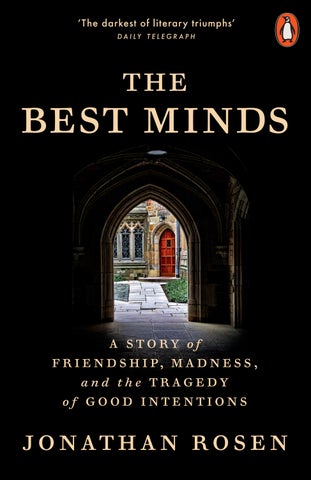
‘The darkest of literary triumphs’ daily telegraph
THE BEST MINDS
A STORY of FRIENDSHIP, MADNESS, and the TRAGEDY of GOOD INTENTIONS
JONATHAN ROSEN
THE BEST MINDS
‘Brave and nuanced . . . Effectively taking over his friend’s unfinished project, braiding it with his own story of clinical anxiety as well as skeins of history, medicine, religion and true crime, the author has transcended childhood rivalry by twinning their stories, an act of tremendous compassion and a literary triumph’ The New York Times
‘A memoir of boyhood friendship, a passionate critique of the failure of American mental health policy and a devastating story of human tragedy . . . his literary imagination shapes the book like a novel . . . This artful, reflective and even entertaining book – one of the best of this or any year – is his powerful effort to take responsibility for changing minds, to persuade us of the danger of allowing compassion to obscure truth. The Best Minds manages to honour both’ Elaine Showalter, TLS
‘Immensely emotional and unforgettably haunting’
Richard J. McNally, Wall Street Journal
‘The darkest of literary triumphs, and the most gripping of unbearable reads. Five stars’ Simon Ings, Daily Telegraph
‘An astounding piece of work, at once a portrait of Laudor made of countless fine brush strokes, a tender memoir of adolescence and young adulthood and, above all, a forensic, unflinching exploration of the factors that led to Laudor’s public rise and bloody fall’ Ben Machell, The Times
‘Extraordinary . . . It’s just so superbly written. I highly recommend it’ Nihal Arthanayake, Radio 5 Live
‘Could be the best book of the year . . . Jonathan Rosen’s The Best Minds takes its title from Allen Ginsberg’s Howl, and could end up as just as enduring a work of American writing. A memoir, a love letter, and a biblical tragedy all at once, it avoids easy answers but clings to difficult questions. A tale told with humility, it charts the path to hell by noting every good intention along the way’ New York Sun
‘A beautifully written meditation on society’s inability to cope with the problem of mental illness’ Gal Beckerman, Atlantic
penguin books
‘Like all great American texts it is the detail and the flow of ideas that gives it power. This is social and intellectual history of the most powerful sort’ Brian Morton, The Tablet
‘This book gets you in its grip from the first pages. It is the opposite of a magic trick: nothing is hidden but the revelations are constantly stunning, a testament to Jonathan Rosen’s sheer skill as an author. The Best Minds is a heartbreaking story and an astonishing work of art, its tragedy rendered with unbounded humanity and depth’ Stephen J. Dubner
‘Far and away the best book I’ve read this year’ Bari Weiss
‘A work of intimacy, scope and sweeping power, this epic book reads like a classic American novel. Both a heart-rending tragedy and a story of love and companionship, The Best Minds is utterly compelling’ Seán Hewitt
‘This is that rare book that deftly works on several levels at once while remaining a compulsive read . . . Jonathan Rosen writes with searing intelligence and admirable candor about his role in what is ultimately a heartrending story. As unobtrusively researched as it is deeply reflective, informed by a humane and comprehending voice, The Best Minds delivers on its own vaulting ambition. It is nothing short of a contemporary masterpiece’ Daphne Merkin
‘I am not sure when I last read a nonfiction book as satisfying as The Best Minds. It’s a memoir, a medical mystery, the story of a close male friendship, a clear-eyed look at the criminal justice system, and, in a weird way, an academic satire, revealing Ivy League foibles that would make you laugh if they didn’t make you tear your hair out, painfully. Jonathan Rosen has written a long book that felt too short; I wanted it to keep going and going’ Mark Oppenheimer
‘The book is a kind of lighthouse, pointing out the dangers ahead if we don’t pay attention to those small number of people with severe mental illness, who pose a risk to others, and who need long term care from professionals: not from desperate families and partners . . . The Best Minds has its own strange and terrible beauty, and despite the tragedy described therein, it is also a tribute to human love and hope for better things’ Gwen Adshead
‘A riveting narrative . . . The Best Minds is not only about genius and madness. It is about how all of us approach what we can’t understand and how each of must do better for those who can’t fend for themselves’ Thomas Insel
Jonathan Rosen is the author of two novels: Eve’s Apple and Joy Comes in the Morning, and two non-fiction books: The Talmud and the Internet and The Life of the Skies. His writing has appeared in The New York Times, The New Yorker, The Atlantic and numerous anthologies. He lives with his family in New York City.
A bou T TH e A u TH o R
The Best Minds
The Best Minds
A STORY OF FRIENDSHIP, MADNESS, AND THE TRAGEDY OF GOOD INTENTIONS
A STORY OF FRIENDSHIP, MADNESS, AND THE TRAGEDY OF GOOD INTENTIONS
Jonathan Rosen Q
Jonathan Rosen Q
ALLEN LANE an imprint of PENGUIN BOOK S
PENGUIN BOOKS
UK | USA | Canada | Ireland | Australia
India | New Zealand | South Africa
Penguin Books is part of the Penguin Random House group of companies whose addresses can be found at global.penguinrandomhouse.com.
Published in the United States by Penguin Press, an imprint of Penguin Random House LLC, New York 2023
First published in Great Britain by Allen Lane 2023
Published in Penguin Books 2024
001
Copyright © Waxwing, LLC, 2023
The moral right of the author has been asserted
Printed and bound in Great Britain by Clays Ltd, Elcograf S.p.A.
The authorized representative in the EEA is Penguin Random House Ireland, Morrison Chambers, 32 Nassau Street, Dublin D02 YH68
A CIP catalogue record for this book is available from the British Library
ISBN: 978–1–802–06325–7
www.greenpenguin.co.uk
Penguin Random Hous e is committed to a sustainable future for our business , our readers and our planet. is book is made from Forest Stewardship Council® certified paper
In memory of Robert and Norma Rosen
May their memory be a blessing
הכרבל םנורכז
And for Anna Rosen sister, savior, friend
I call to the mysterious one who yet
I call to the mysterious one who yet
Shall walk the wet sands by the edge of the stream
Shall walk the wet sands by the edge of the stream
And look most like me, being indeed my double, And prove of all imaginable things
And look most like me, being indeed my double, And prove of all imaginable things
The most unlike, being my anti-self
The most unlike, being my anti-self
W B Y, “Ego Dominus Tuus”
W B Y, “Ego Dominus Tuus”
CONTENTS Part I. The House on Mereland Road 1 CHAPTER ONE • THE SUITABLE PLAYMATE 5 CHAPTER TWO • THE GOOD EARTH 21 CHAPTER THREE • MEMORY GLASS 40 CHAPTER FOUR • STRANGERS 47 CHAPTER FIVE • AMERICAN PIE 58 CHAPTER SIX • FREEDOM SUMMER 74 CHAPTER SEVEN • MESSAGE IN A BOTTLE 90 CHAPTER EIGHT • MISREADING 109 Part II. The House of Psychiatry 129 CHAPTER NINE • THE SHADOW KNOWS 135 CHAPTER TEN • REVOLVING DOOR 142 CHAPTER ELEVEN • GOING SANE 155 CHAPTER TWELVE • STORIES 170 Q CONTENTS Part I. The House on Mereland Road 1 CHAPTER ONE • THE SUITABLE PLAYMATE 5 CHAPTER TWO • THE GOOD EARTH 21 CHAPTER THREE • MEMORY GLASS 40 CHAPTER FOUR • STRANGERS 47 CHAPTER FIVE • AMERICAN PIE 58 CHAPTER SIX • FREEDOM SUMMER 74 CHAPTER SEVEN • MESSAGE IN A BOTTLE 90 CHAPTER EIGHT • MISREADING 109 Part II. The House of Psychiatry 129 CHAPTER NINE • THE SHADOW KNOWS 135 CHAPTER TEN • REVOLVING DOOR 142 CHAPTER ELEVEN • GOING SANE 155 CHAPTER TWELVE • STORIES 170 Q
CHAPTER
CHAPTER
CHAPTER
CHAPTER
CHAPTER
CHAPTER
CHAPTER
207
CHAPTER SEVENTEEN • MAKING ILLNESS A WEAPON 220
CHAPTER
CHAPTER EIGHTEEN • UNDERCLASS 228
CHAPTER NINETEEN • HALFWAY 237
CHAPTER
CHAPTER TWENTY- ONE • MENTORS 269
CHAPTER TWENTY- TWO • PRECEDENT 280
CHAPTER TWENTY- THREE • SECRETS 286
CHAPTER
CHAPTER
CHAPTER TWENTY- FIVE • HAPPY IDIOT 311
CHAPTER TWENTY- SIX • POSTDOC 317
CHAPTER
CHAPTER
CHAPTER TWENTY- SEVEN • THOUGHTFUL ENABLING 327
CHAPTER TWENTY- EIGHT • CAREER KILLER 337
CHAPTER TWENTY- NINE • ROLE MODEL 345
CHAPTER THIRTY • TWICE BORN 354
CHAPTER THIRTY- ONE • CREATIVITY, INC. 364
THIRTEEN • CHOOSING 184
FOURTEEN • THE BREAK 191
CHAPTER
FIFTEEN • ENTANGLEMENT 200
SIXTEEN • LOCKED WARD 207
• MAKING ILLNESS A WEAPON
CHAPTER SEVENTEEN
220
EIGHTEEN • UNDERCLASS 228
NINETEEN • HALFWAY 237 Part III. The House of Law 253
TWENTY • BRAINS 257
TWENTY- ONE • MENTORS 269
TWENTY- TWO • PRECEDENT 280
TWENTY- THREE • SECRETS 286 CHAPTER TWENTY- FOUR • THE SYMPATHETIC LIGHT OF SICKNESS 299
CHAPTER
CHAPTER
CHAPTER
CHAPTER
• HAPPY IDIOT 311
TWENTY- FIVE
• POSTDOC
TWENTY- SIX
317
SEVEN • THOUGHTFUL ENABLING
TWENTY- EIGHT • CAREER KILLER 337 Part IV. The House of Dreams 343
TWENTY- NINE • ROLE MODEL 345
THIRTY • TWICE BORN 354
THIRTY-
• CREATIVITY, INC.
TWENTY-
327 CHAPTER
CHAPTER
CHAPTER
CHAPTER
ONE
364
THIRTEEN • CHOOSING 184
FOURTEEN • THE BREAK 191
FIFTEEN • ENTANGLEMENT 200
SIXTEEN • LOCKED WARD
Part III. The House of Law
253
CHAPTER TWENTY • BRAINS 257
TWENTY- FOUR • THE SYMPATHETIC LIGHT OF SICKNESS 299
Part IV. The House of Dreams
343
CHAPTER THIRTY- TWO • MICHAEL CALLED KEVIN 374
CHAPTER THIRTY- TWO • MICHAEL CALLED KEVIN 374
CHAPTER THIRTY- THREE • SHAMANS 382
CHAPTER THIRTY- THREE • SHAMANS 382
CHAPTER THIRTY- FOUR • EQUAL OPPORTUNITY 394
CHAPTER THIRTY- FOUR • EQUAL OPPORTUNITY 394
CHAPTER THIRTY- FIVE • THE BACKWARD JOURNEY 405
CHAPTER THIRTY- FIVE • THE BACKWARD JOURNEY 405
CHAPTER THIRTY- SIX • THE TWO ADAMS 416
CHAPTER THIRTY- SIX • THE TWO ADAMS 416
CHAPTER THIRTY- SEVEN • PERSONAL EMERGENCY 426
CHAPTER THIRTY- SEVEN • PERSONAL EMERGENCY 426
CHAPTER THIRTY- EIGHT • GOING BACK 434
CHAPTER THIRTY- EIGHT • GOING BACK 434
CHAPTER THIRTY- NINE • THE FATAL FUNNEL 437
CHAPTER THIRTY- NINE • THE FATAL FUNNEL 437
CHAPTER FORTY • CAIN AND ABEL 450
CHAPTER FORTY • CAIN AND ABEL 450
CHAPTER FORTY- ONE • THE ETERNAL OPTIMIST 466
CHAPTER FORTY- ONE • THE ETERNAL OPTIMIST 466
CHAPTER FORTY- TWO • ENDINGS 474
CHAPTER FORTY- TWO • ENDINGS 474
EPILOGUE • NO GOING BACK 492
EPILOGUE • NO GOING BACK 492
Acknowledgments 525
Acknowledgments 525
A Note on the Sources 531
A Note on the Sources 531
Index 541
Index 541
Part I
The House on Mereland Road
It is an illusion that we were ever alive, Lived in the houses of mothers, arranged ourselves By our own motions in a freedom of air.
—W S , The Rock Q
IIam going back fifty years. Before the lurid headlines, the Hollywood deal, the publishing contract, and The New York Times profile of the role model genius who finished Yale Law School against all odds. Before delusions mistaken for stories, and stories mistaken for life. Before the fancy clothes you bought for management consulting and wore into the hospital, the halfway house, and the Gatsby House you guarded with a baseball bat against enemies disguised as friends and family, guarded in turn by beloved neighbors.
am going back fifty years. Before the lurid headlines, the Hollywood deal, the publishing contract, and The New York Times profile of the role model genius who finished Yale Law School against all odds. Before delusions mistaken for stories, and stories mistaken for life. Before the fancy clothes you bought for management consulting and wore into the hospital, the halfway house, and the Gatsby House you guarded with a baseball bat against enemies disguised as friends and family, guarded in turn by beloved neighbors.
I am going back to the time before you graduated from Yale summa cum laude, which I always thought of as summa cum Laudor, since you achieved in three years what I failed to accomplish in four. Before high school, where you ran while I was beaten, and the horror twenty years later when it was my turn to run.
I am going back to the time before you graduated from Yale summa cum laude, which I always thought of as summa cum Laudor, since you achieved in three years what I failed to accomplish in four. Before high school, where you ran while I was beaten, and the horror twenty years later when it was my turn to run.
I am on a road racing backward out of a tragic sorrow whose circles radiate in all directions. Forgive me. I know there is no road and it isn’t racing backward. Or forward. I know there is no going back.
I am on a road racing backward out of a tragic sorrow whose circles radiate in all directions. Forgive me. I know there is no road and it isn’t racing backward. Or forward. I know there is no going back.
But here I am on a short street in New Rochelle. There is a green-andwhite colonial house at the top of the hill and a brown-and-white Tudor house at the bottom. There are two ten-year-old boys who live in those houses. Even now. They’re just illusions but they’re also real. And they’re where I’ve got to start.
But here I am on a short street in New Rochelle. There is a green-andwhite colonial house at the top of the hill and a brown-and-white Tudor house at the bottom. There are two ten-year-old boys who live in those houses. Even now. They’re just illusions but they’re also real. And they’re where I’ve got to start.
CHAPTER ONE
CHAPTER ONE
THE SUITABLE PLAYMATE
THE SUITABLE PLAYMATE
When you were a small boy, the aim of the suitable playmate could not have been more perfectly fulfilled: across the street was Michael Laudor, the ideal friend. A brilliant peer.
When you were a small boy, the aim of the suitable playmate could not have been more perfectly fulfilled: across the street was Michael Laudor, the ideal friend. A brilliant peer.
—C O , letter to the author
—C O , letter to the author
MMy family moved to New Rochelle in 1973. There were good schools, green lawns, and quaint signs painted in the 1920s bearing legends like - and , , though there were four synagogues and Metro North got you to Manhattan—the rock around which all life revolved—in thirty-three minutes. But the real reason we moved to New Rochelle was so that I could meet Michael.
That, at least, is what my mother’s best friend, the writer Cynthia Ozick, told me:
y family moved to New Rochelle in 1973. There were good schools, green lawns, and quaint signs painted in the 1920s bearing legends like - and , , though there were four synagogues and Metro North got you to Manhattan—the rock around which all life revolved—in thirty-three minutes. But the real reason we moved to New Rochelle was so that I could meet Michael. That, at least, is what my mother’s best friend, the writer Cynthia Ozick, told me:
I heard much of Michael Laudor when you were growing up. And in a way even before you knew of his existence, in this sense: that Michael, or someone like him, was always the goal in choosing where to buy a house.
I heard much of Michael Laudor when you were growing up. And in a way even before you knew of his existence, in this sense: that Michael, or someone like him, was always the goal in choosing where to buy a house.
Michael, in other words, was inevitable. I was destined to meet him, or at least someone like him, because friendship cannot actually be foretold any more than madness or the day of your death. Can it?
Michael, in other words, was inevitable. I was destined to meet him, or at least someone like him, because friendship cannot actually be foretold any more than madness or the day of your death. Can it?
THE BEST MINDS
I met Michael soon after we moved in, as I was examining a heap of junk that the previous owners had left in a neat pile at the edge of our lawn. I was looking for relics of the three athletic boys who had lived there, and wondering if a small aquarium was worth salvaging, when a boy with shaggy red-brown hair and large tinted aviator glasses walked over to welcome me to the neighborhood.
I met Michael soon after we moved in, as I was examining a heap of junk that the previous owners had left in a neat pile at the edge of our lawn. I was looking for relics of the three athletic boys who had lived there, and wondering if a small aquarium was worth salvaging, when a boy with shaggy red-brown hair and large tinted aviator glasses walked over to welcome me to the neighborhood.
He was taller even than I was, gawky but with a lilting stride that was oddly purposeful for a kid our age, as if he actually had someplace to go. His habit of launching himself up and forward with every step, gathering height in order to achieve distance, was so distinctive that it earned him the nickname Toes.
He was taller even than I was, gawky but with a lilting stride that was oddly purposeful for a kid our age, as if he actually had someplace to go. His habit of launching himself up and forward with every step, gathering height in order to achieve distance, was so distinctive that it earned him the nickname Toes.
I didn’t learn he was called Toes until fifth grade started, when I learned he was also called Big. The shortest kid in class was called Small, and when they lined us up in height order, Big and Small were bookends. Sensitive teachers sometimes let the short kids go first, which I’m sure did wonders for their self-esteem.
I didn’t learn he was called Toes until fifth grade started, when I learned he was also called Big. The shortest kid in class was called Small, and when they lined us up in height order, Big and Small were bookends. Sensitive teachers sometimes let the short kids go first, which I’m sure did wonders for their self-esteem.
Big is less imaginative than Toes, but how many kids get two nicknames? And Michael was big. Not big like Hal, who appeared to be attending fifth grade on the GI bill, but through some subtle combination of height, intelligence, posture, and willpower.
Big is less imaginative than Toes, but how many kids get two nicknames? And Michael was big. Not big like Hal, who appeared to be attending fifth grade on the GI bill, but through some subtle combination of height, intelligence, posture, and willpower.
In Brookline—the Boston suburb where my family had lived for three years before moving to New Rochelle—I’d been taller than all my friends, but nobody would have called me Big. I settled too easily at the bottom of myself in a shy sediment. Michael was only an inch or two taller than me, and just as skinny, but he seemed to enjoy taking up space, however awkwardly he filled it.
In Brookline—the Boston suburb where my family had lived for three years before moving to New Rochelle—I’d been taller than all my friends, but nobody would have called me Big. I settled too easily at the bottom of myself in a shy sediment. Michael was only an inch or two taller than me, and just as skinny, but he seemed to enjoy taking up space, however awkwardly he filled it.
Even standing still he had a habit of rocking forward and rising up on the balls of his feet, trying to meet his growth spurt halfway. He stood beside me on Mereland Road in that unsteady but self-assured posture, rising and falling like a wave. He was socially effective the same way he was good at basketball—through uncowed persistence.
Even standing still he had a habit of rocking forward and rising up on the balls of his feet, trying to meet his growth spurt halfway. He stood beside me on Mereland Road in that unsteady but self-assured posture, rising and falling like a wave. He was socially effective the same way he was good at basketball—through uncowed persistence.
I often heard in later years that people found him intimidating,
I often heard in later years that people found him intimidating,
THE BEST
6
MINDS
6
but for me it was the opposite. Despite my shyness— or because of it—Michael’s self-confidence put me at ease. Perhaps because I was conscious of the awkwardness that he overcame, or simply refused to recognize, I fed off his belief in himself.
but for me it was the opposite. Despite my shyness— or because of it—Michael’s self-confidence put me at ease. Perhaps because I was conscious of the awkwardness that he overcame, or simply refused to recognize, I fed off his belief in himself.
Besides, being shy is not the same as being modest. The same expectation shaping his life was shaping mine; the belief that your brain is your rocket ship and that simply as a matter of course you are going to climb inside and blast off. Propelled by some mysterious process—never specified, almost mystical and yet entirely real—we would outsoar the shadow of ordinary existence and think our way into stratospheric success.
Besides, being shy is not the same as being modest. The same expectation shaping his life was shaping mine; the belief that your brain is your rocket ship and that simply as a matter of course you are going to climb inside and blast off. Propelled by some mysterious process—never specified, almost mystical and yet entirely real—we would outsoar the shadow of ordinary existence and think our way into stratospheric success.
Michael told me his name and my name, too, which he shortened to Jon. He liked to give the answer before the question, and offered his opinion that if the former owners had thrown out the fish tank, it probably leaked even if it didn’t look cracked. I’ve never liked having my name abbreviated but I didn’t correct him.
Michael told me his name and my name, too, which he shortened to Jon. He liked to give the answer before the question, and offered his opinion that if the former owners had thrown out the fish tank, it probably leaked even if it didn’t look cracked. I’ve never liked having my name abbreviated but I didn’t correct him.
It’s possible his mother had sent him. Ruth Laudor was a neighborly woman who came over herself at some point to welcome us— and sometimes came over to escape the roar of her own household—but Michael’s geniality and supreme self-confidence were his own. Even then, he seemed like the ambassador of his own country.
It’s possible his mother had sent him. Ruth Laudor was a neighborly woman who came over herself at some point to welcome us— and sometimes came over to escape the roar of her own household—but Michael’s geniality and supreme self-confidence were his own. Even then, he seemed like the ambassador of his own country.
It was Michael who pointed out that while my house was first on the block, it was number 11 not number 1, something I’d never have wondered about because numbers were always unpredictable, even without the “new math” that had been introduced in the sixties so we could win the Cold War. I didn’t know it was called new math, only that having been shown a decimal point in fourth grade, I was going to spend the rest of my life trying to figure out where to put it.
It was Michael who pointed out that while my house was first on the block, it was number 11 not number 1, something I’d never have wondered about because numbers were always unpredictable, even without the “new math” that had been introduced in the sixties so we could win the Cold War. I didn’t know it was called new math, only that having been shown a decimal point in fourth grade, I was going to spend the rest of my life trying to figure out where to put it.
Michael knew, and played me a song by Tom Lehrer called “New Math,” one of many songs and records we spent hours listening to in his living room. The joke of “New Math” was that it was so simple
Michael knew, and played me a song by Tom Lehrer called “New Math,” one of many songs and records we spent hours listening to in his living room. The joke of “New Math” was that it was so simple
7
SUITABLE PLAYMATE
THE
7
THE SUITABLE PLAYMATE
THE BEST MINDS
“that only a child can do it,” which is to say it was a song for adults, which was part of its special pleasure. Michael never believed in the line separating children from adults, or many other lines either.
“that only a child can do it,” which is to say it was a song for adults, which was part of its special pleasure. Michael never believed in the line separating children from adults, or many other lines either.
The Tom Lehrer album was ten years old but new to me, full of names and concepts Michael cheerfully glossed—the Vatican; Wernher von Braun—that gave it an archaic but cutting-edge quality, like the Doc Savage mysteries he also introduced me to.
The Tom Lehrer album was ten years old but new to me, full of names and concepts Michael cheerfully glossed—the Vatican; Wernher von Braun—that gave it an archaic but cutting-edge quality, like the Doc Savage mysteries he also introduced me to.
Michael often seemed like someone who had lived a full span already and was just slumming it in childhood, or living backward like Benjamin Button or Merlin. My parents were amused by the speed with which he took to calling them Bob and Norma, and the unabashed way he looked them in the eye as he cursed the bombing of Cambodia or discussed the Watergate scandal while I waited for him to finish so we could play Mille Bornes or go outside. I knew the president was a crook, but Michael knew who Liddy, Haldeman, and Ehrlichman were, and what they had done, matters he expounded as if Deep Throat had whispered to him personally in the schoolyard just behind his house.
Michael often seemed like someone who had lived a full span already and was just slumming it in childhood, or living backward like Benjamin Button or Merlin. My parents were amused by the speed with which he took to calling them Bob and Norma, and the unabashed way he looked them in the eye as he cursed the bombing of Cambodia or discussed the Watergate scandal while I waited for him to finish so we could play Mille Bornes or go outside. I knew the president was a crook, but Michael knew who Liddy, Haldeman, and Ehrlichman were, and what they had done, matters he expounded as if Deep Throat had whispered to him personally in the schoolyard just behind his house.
Theodore Roosevelt Elementary School was so close, Michael told me, I could wake up fifteen minutes before the bell, eat breakfast, and still get to class on time. Michael treated the schoolyard, which had outdoor basketball hoops, like an extension of his backyard.
Theodore Roosevelt Elementary School was so close, Michael told me, I could wake up fifteen minutes before the bell, eat breakfast, and still get to class on time. Michael treated the schoolyard, which had outdoor basketball hoops, like an extension of his backyard.
I could see the roof of the school building from the window of my mother’s attic office, its ornate cupola suggesting a fancy barn or a village church. I could see Michael’s roof from my own window, screened by branches. There were only six or seven houses on the whole street. The Laudors, number 28, were diagonally across and down; a knight’s move away on a chessboard.
I could see the roof of the school building from the window of my mother’s attic office, its ornate cupola suggesting a fancy barn or a village church. I could see Michael’s roof from my own window, screened by branches. There were only six or seven houses on the whole street. The Laudors, number 28, were diagonally across and down; a knight’s move away on a chessboard.
Michael gave me a tour of the Wykagyl shopping center, two blocks from my house, where there was a store called Big Top that sold toys in the back and candy in the front, an A& P, a pizza place,
Michael gave me a tour of the Wykagyl shopping center, two blocks from my house, where there was a store called Big Top that sold toys in the back and candy in the front, an A& P, a pizza place,
8
THE BEST MINDS 8
THE SUITABLE PLAYMATE
and a pet shop where I could get a new aquarium. Guppies cost ten cents apiece.
and a pet shop where I could get a new aquarium. Guppies cost ten cents apiece.
Michael was the sort of guide who didn’t just point out George’s Hair Fort, he told you the names of all four Italian brothers who cut hair there. I could only ever remember Rosario, who cut my hair. He cut my father’s hair, too, and called out, Professore! when he walked in. He called Michael’s father professore too.
Michael was the sort of guide who didn’t just point out George’s Hair Fort, he told you the names of all four Italian brothers who cut hair there. I could only ever remember Rosario, who cut my hair. He cut my father’s hair, too, and called out, Professore! when he walked in. He called Michael’s father professore too.
That was something else we had in common. Our fathers were college professors, though my father taught German literature and Michael’s father taught economics. Also, my father was bald on top, with wings of white hair on either side of his head; Michael’s father had a dark pompadour combed dramatically back, like the greasers he’d grown up with on the Brooklyn waterfront.
That was something else we had in common. Our fathers were college professors, though my father taught German literature and Michael’s father taught economics. Also, my father was bald on top, with wings of white hair on either side of his head; Michael’s father had a dark pompadour combed dramatically back, like the greasers he’d grown up with on the Brooklyn waterfront.
The following year, Mr. Summa—who had given up working at the 7-Up bottling plant to become our sixth-grade teacher— started calling Michael “professor” after overhearing him use the word “epiglottis” to tell a joke about hiccups, thus giving him a third nickname.
The following year, Mr. Summa—who had given up working at the 7-Up bottling plant to become our sixth-grade teacher— started calling Michael “professor” after overhearing him use the word “epiglottis” to tell a joke about hiccups, thus giving him a third nickname.
MMichael might have been the reason my parents chose Mereland Road, but my mother’s friend Cynthia was the reason they’d chosen New Rochelle. Cynthia and my mother were both writers, with an all-consuming devotion to literature, a shared commitment to feminism, and a dark awareness of the Holocaust, the black backing of the mirror they held up to reality that made the reflected world visible. They talked on the phone every day. When they got off the phone, they wrote long letters, and when they received each other’s letters, they called, because there could never be too many words, though the written word was the only medium that truly mattered.
Cynthia lived in New Rochelle’s south end, which had been settled in the seventeenth century by Huguenots—French Protestants fleeing
ichael might have been the reason my parents chose Mereland Road, but my mother’s friend Cynthia was the reason they’d chosen New Rochelle. Cynthia and my mother were both writers, with an all-consuming devotion to literature, a shared commitment to feminism, and a dark awareness of the Holocaust, the black backing of the mirror they held up to reality that made the reflected world visible. They talked on the phone every day. When they got off the phone, they wrote long letters, and when they received each other’s letters, they called, because there could never be too many words, though the written word was the only medium that truly mattered. Cynthia lived in New Rochelle’s south end, which had been settled in the seventeenth century by Huguenots—French Protestants fleeing 9
9 THE SUITABLE PLAYMATE
THE BEST MINDS
the persecution of Louis XIV. Her house was in walking distance to the train station, the Long Island Sound, and a Victorian house in Sutton Manor that my mother had fallen in love with. But the neighborhood, and my mother’s dream house, were “quickly dismissed,” Cynthia told me, “because of the absence of any Jewish ambiance.” This objection came from my father. “The chief reason was to live in an area where there would be children appropriate for befriending.”
the persecution of Louis XIV. Her house was in walking distance to the train station, the Long Island Sound, and a Victorian house in Sutton Manor that my mother had fallen in love with. But the neighborhood, and my mother’s dream house, were “quickly dismissed,” Cynthia told me, “because of the absence of any Jewish ambiance.” This objection came from my father. “The chief reason was to live in an area where there would be children appropriate for befriending.”
Appropriate children lived in the north end, where Jews had been settling since the postwar boom. Rob Petrie—the fictional comedy writer played by dapper Dick Van Dyke—lived in a generic suburb called New Rochelle. Carl Reiner—the bald Jew who based The Dick Van Dyke Show on his own life but wasn’t allowed to play himself— lived in the north end of New Rochelle.
Appropriate children lived in the north end, where Jews had been settling since the postwar boom. Rob Petrie—the fictional comedy writer played by dapper Dick Van Dyke—lived in a generic suburb called New Rochelle. Carl Reiner—the bald Jew who based The Dick Van Dyke Show on his own life but wasn’t allowed to play himself— lived in the north end of New Rochelle.
So did Jerry Bock and Joe Stein, the composer and book writer of Fiddler on the Roof, a musical about a poor Jew who dreams about being a rich Jew, which was beloved by rich Jews who dreamed about being poor Jews, or at least remembered their grandparents who’d been poor Jews once themselves. The musical had closed on Broadway only two years before, after becoming a movie. Even my parents had the cast album, though my father considered it a Jewish minstrel show and my mother dismissed it as middlebrow schlock.
So did Jerry Bock and Joe Stein, the composer and book writer of Fiddler on the Roof, a musical about a poor Jew who dreams about being a rich Jew, which was beloved by rich Jews who dreamed about being poor Jews, or at least remembered their grandparents who’d been poor Jews once themselves. The musical had closed on Broadway only two years before, after becoming a movie. Even my parents had the cast album, though my father considered it a Jewish minstrel show and my mother dismissed it as middlebrow schlock.
Jews had moved to New Rochelle to escape New York City, then moved to the north end to escape the troubled parts of New Rochelle, which wasn’t a true suburb but a small city in its own right. There were housing projects as well as golf courses, and a once-thriving downtown killed by the departure of a department store whose arrival had also killed it, which was more than I could follow but was the sort of thing they talked about with knowing assurance in Michael’s house.
Jews had moved to New Rochelle to escape New York City, then moved to the north end to escape the troubled parts of New Rochelle, which wasn’t a true suburb but a small city in its own right. There were housing projects as well as golf courses, and a once-thriving downtown killed by the departure of a department store whose arrival had also killed it, which was more than I could follow but was the sort of thing they talked about with knowing assurance in Michael’s house.
The big Conservative synagogue my father wanted us to join, Beth El, had relocated from downtown to the leafier north end and
The big Conservative synagogue my father wanted us to join, Beth El, had relocated from downtown to the leafier north end and
10
THE BEST MINDS 10
THE SUITABLE PLAYMATE
THE SUITABLE PLAYMATE
opened its new sanctuary in 1970. Between my mother’s dream house in the south and Beth El in the north lay a patchwork of old Irish and Italian working-class neighborhoods, fancy developments, integrated middle-class neighborhoods, a moribund Main Street, and a highway-fractured zone that like the housing projects were largely Black.
opened its new sanctuary in 1970. Between my mother’s dream house in the south and Beth El in the north lay a patchwork of old Irish and Italian working-class neighborhoods, fancy developments, integrated middle-class neighborhoods, a moribund Main Street, and a highway-fractured zone that like the housing projects were largely Black.
And so instead of streets with opulent and evocative names like Sutton Manor and Echo Avenue, we moved to Mereland Road. The “mere” in Mereland must once have denoted a body of water, but for my mother the “mere” had devolved into its pedestrian homonym: nothing more.
And so instead of streets with opulent and evocative names like Sutton Manor and Echo Avenue, we moved to Mereland Road. The “mere” in Mereland must once have denoted a body of water, but for my mother the “mere” had devolved into its pedestrian homonym: nothing more.
There was no view of the water, only the blind exterior of Beth El looming over North Avenue. Designed by a disciple of Frank Lloyd Wright, the building was windowless as a power station or a mausoleum but a comfort to my father, who was making peace with the Jewish observance he’d abandoned in retaliation for God’s abandonment of his parents thirty years before, when they were murdered along with one out of every three Jews in the world.
There was no view of the water, only the blind exterior of Beth El looming over North Avenue. Designed by a disciple of Frank Lloyd Wright, the building was windowless as a power station or a mausoleum but a comfort to my father, who was making peace with the Jewish observance he’d abandoned in retaliation for God’s abandonment of his parents thirty years before, when they were murdered along with one out of every three Jews in the world.
Our neighborhood was called Wykagyl. The word is believed to be a corruption of an Algonquin name used by the Lenape, though it sounded vaguely Yiddish as pronounced by my father, who had erased a good deal of his accent but who still said his w ’s like v ’s. If you never understood why the Marx Brothers thought “viaduct” could be mistaken for “why a duck,” then you never heard my father say Wykagyl.
Our neighborhood was called Wykagyl. The word is believed to be a corruption of an Algonquin name used by the Lenape, though it sounded vaguely Yiddish as pronounced by my father, who had erased a good deal of his accent but who still said his w ’s like v ’s. If you never understood why the Marx Brothers thought “viaduct” could be mistaken for “why a duck,” then you never heard my father say Wykagyl.
Our next-door neighbor, Mr. Fruhling, a refugee from Germany who made me squeeze his eighty-year-old bicep (rock hard, he used dumbbells), also said his w ’s like v ’s. So did his tough, tiny sister, who lived in the house with him. So did Harry Gingold, a Holocaust survivor from Poland who lived one street over and gave out the honors at Beth El during Sabbath services, sidling up to congregants and
Our next-door neighbor, Mr. Fruhling, a refugee from Germany who made me squeeze his eighty-year-old bicep (rock hard, he used dumbbells), also said his w ’s like v ’s. So did his tough, tiny sister, who lived in the house with him. So did Harry Gingold, a Holocaust survivor from Poland who lived one street over and gave out the honors at Beth El during Sabbath services, sidling up to congregants and 11
11
THE BEST MINDS
murmuring furtively when it was time to open the ark, as if he were giving a tip on a horse.
murmuring furtively when it was time to open the ark, as if he were giving a tip on a horse.
To my sister and me he was a comic figure, but to my father he was part of the invisible fellowship of refugees it was his soul’s secret work to gather up. My father could pinpoint an accent and locate the sorrow behind it the way Sherlock Holmes could spot a limp and account for the accident that caused it at a glance.
To my sister and me he was a comic figure, but to my father he was part of the invisible fellowship of refugees it was his soul’s secret work to gather up. My father could pinpoint an accent and locate the sorrow behind it the way Sherlock Holmes could spot a limp and account for the accident that caused it at a glance.
Once, in a coffee shop, while Michael and I played tabletop soccer with three pennies and sugar packet goalposts, my father divined the wartime history of a waitress—Romania, Paris, the Pyrenees, Spain, Palestine, the Bronx—between the ordering of dessert and the bringing of the check. Even allowing for the brewing of a fresh pot of decaf—my father’s one constant demand in life—it was an impressive performance, especially because the information wasn’t journalistically extracted but offered in telegraphic exchanges sparked by mutual recognition. As we were leaving, my father murmured, “Her whole family. Auschwitz.”
Once, in a coffee shop, while Michael and I played tabletop soccer with three pennies and sugar packet goalposts, my father divined the wartime history of a waitress—Romania, Paris, the Pyrenees, Spain, Palestine, the Bronx—between the ordering of dessert and the bringing of the check. Even allowing for the brewing of a fresh pot of decaf—my father’s one constant demand in life—it was an impressive performance, especially because the information wasn’t journalistically extracted but offered in telegraphic exchanges sparked by mutual recognition. As we were leaving, my father murmured, “Her whole family. Auschwitz.”
Michael was fascinated by such displays, and in his way had a similar impulse. Friends might notice my father had an accent, but Michael asked where he was from and how he’d gotten out of Vienna, and incorporated the information into his way of referring to my father and perhaps me. He incorporated my father’s accent, too, which he began imitating almost immediately; not with malice, but more the way you might commit someone’s telephone number to memory.
Michael was fascinated by such displays, and in his way had a similar impulse. Friends might notice my father had an accent, but Michael asked where he was from and how he’d gotten out of Vienna, and incorporated the information into his way of referring to my father and perhaps me. He incorporated my father’s accent, too, which he began imitating almost immediately; not with malice, but more the way you might commit someone’s telephone number to memory.
He did the same thing in high school when he worked for Sam and Stella, the elderly Jewish couple who owned Stellar Gifts and like my father had fled Germany after Kristallnacht. You had to be at home with the alien strangeness of such things to find it darkly amusing, as we did, that Sam and Stella sold crystal. Michael would come to see the neighborhood’s survivors as an unseen collective of righ-
He did the same thing in high school when he worked for Sam and Stella, the elderly Jewish couple who owned Stellar Gifts and like my father had fled Germany after Kristallnacht. You had to be at home with the alien strangeness of such things to find it darkly amusing, as we did, that Sam and Stella sold crystal. Michael would come to see the neighborhood’s survivors as an unseen collective of righ-
12
12
THE BEST MINDS
teous protectors, with a mystical aura born of suffering that made them a bulwark against evil.
teous protectors, with a mystical aura born of suffering that made them a bulwark against evil.
Nothing seemed further from the Manichaean struggles of the twentieth century than Mereland Road, even if Betty Friedan called suburban houses “comfortable concentration camps” in The Feminine Mystique, where she warned that housewives “are in as much danger as the millions who walked to their own death in the concentration camps.”
Nothing seemed further from the Manichaean struggles of the twentieth century than Mereland Road, even if Betty Friedan called suburban houses “comfortable concentration camps” in The Feminine Mystique, where she warned that housewives “are in as much danger as the millions who walked to their own death in the concentration camps.”
Surely such hyperbole was an indicator of how far America was from actual concentration camps, like the one where my grandfather was murdered, if it could appear in a bestselling book that came into the world the same year Michael and I did. The book lived comfortably on a family bookshelf where I peeked into it with adolescent curiosity, misled by the title.
Surely such hyperbole was an indicator of how far America was from actual concentration camps, like the one where my grandfather was murdered, if it could appear in a bestselling book that came into the world the same year Michael and I did. The book lived comfortably on a family bookshelf where I peeked into it with adolescent curiosity, misled by the title.
WWas Michael bouncing a basketball the day I met him? He often had one with him the way you might take a dog out for a walk. I’d hear the ball halfway down the block, knocking before he knocked.
as Michael bouncing a basketball the day I met him? He often had one with him the way you might take a dog out for a walk. I’d hear the ball halfway down the block, knocking before he knocked.
Even today when I hear the taut report of a basketball on an empty street, the muffled echo thrown back a split second later like the after-pulse of a heartbeat, I have a visceral memory of Michael coming to fetch me for one-on-one or H-O-R-S-E, or simply to shoot around if we were too deep in conversation for a game or I was tired of losing.
Even today when I hear the taut report of a basketball on an empty street, the muffled echo thrown back a split second later like the after-pulse of a heartbeat, I have a visceral memory of Michael coming to fetch me for one-on-one or H-O-R-S-E, or simply to shoot around if we were too deep in conversation for a game or I was tired of losing.
If you saw Michael in the air, legs splayed, elbows out, you might not think he was going to score, but he had a sort of will to power over the ball that sent it booming off the all-weather backboard and sifting through the chain mail net that hung from the rim in rusted tatters. It took me time to realize this was actually the result of hard
If you saw Michael in the air, legs splayed, elbows out, you might not think he was going to score, but he had a sort of will to power over the ball that sent it booming off the all-weather backboard and sifting through the chain mail net that hung from the rim in rusted tatters. It took me time to realize this was actually the result of hard 13
13 THE
PLAYMATE
SUITABLE
THE SUITABLE PLAYMATE
THE BEST MINDS
work. He shot baskets in the rain and when there was snow on the court and his hands were raw with cold.
work. He shot baskets in the rain and when there was snow on the court and his hands were raw with cold.
I can’t remember if Michael had a basketball with him the day he introduced himself to me. He might just as easily have had a book. He often had several tucked under one arm that he would dump unceremoniously at the base of the steel pole holding up the schoolyard basket nearest the stairs. It was always an eclectic pile: Ray Bradbury, Hermann Hesse, Zane Gray westerns. Some were “assigned” by his father, he told me, like To Kill a Mockingbird, Gideon’s Trumpet, or a prose translation of Beowulf, but they were part of the general jumble stirred in with the Dune trilogy and Doc Savage adventures.
I can’t remember if Michael had a basketball with him the day he introduced himself to me. He might just as easily have had a book. He often had several tucked under one arm that he would dump unceremoniously at the base of the steel pole holding up the schoolyard basket nearest the stairs. It was always an eclectic pile: Ray Bradbury, Hermann Hesse, Zane Gray westerns. Some were “assigned” by his father, he told me, like To Kill a Mockingbird, Gideon’s Trumpet, or a prose translation of Beowulf, but they were part of the general jumble stirred in with the Dune trilogy and Doc Savage adventures.
Thanks to Michael, I became a big fan of Doc Savage, originally published in pulp fiction magazines in the 1930s but reissued as cheap paperbacks in the ’70s. We joked about the archaic language and dated futurisms—long-distance phone calls!—but Doc Savage, charged with righteous adrenaline, formed an important part of the occult archive of manly virtues that I received secondhand from Michael, who got them wholesale from his father, grandfathers, old movies, and assorted dime novels.
Thanks to Michael, I became a big fan of Doc Savage, originally published in pulp fiction magazines in the 1930s but reissued as cheap paperbacks in the ’70s. We joked about the archaic language and dated futurisms—long-distance phone calls!—but Doc Savage, charged with righteous adrenaline, formed an important part of the occult archive of manly virtues that I received secondhand from Michael, who got them wholesale from his father, grandfathers, old movies, and assorted dime novels.
Michael read many more volumes than I did, but he was a great summarizer of plots and situations, which were all essentially the same, and it was the characters that were so appealing. We spent hours talking about Clark Savage Jr., the golden-eyed “Man of Bronze” known as Doc because he was a surgeon, though he was essentially a mortal superman trained from birth by a team of scientists who were not only “the five greatest brains ever assembled in one group” but badass characters in their own right, handpicked by Doc’s philanthropist father to raise his remarkable son.
Michael read many more volumes than I did, but he was a great summarizer of plots and situations, which were all essentially the same, and it was the characters that were so appealing. We spent hours talking about Clark Savage Jr., the golden-eyed “Man of Bronze” known as Doc because he was a surgeon, though he was essentially a mortal superman trained from birth by a team of scientists who were not only “the five greatest brains ever assembled in one group” but badass characters in their own right, handpicked by Doc’s philanthropist father to raise his remarkable son.
Doc was the strongest, smartest, bravest, best-educated, and most dangerous man in the world. He was also so good—the books called him “Christlike,” a usage Michael explained—that rather than throwing bad guys into prison to rot, he used his surgical skills to perform
Doc was the strongest, smartest, bravest, best-educated, and most dangerous man in the world. He was also so good—the books called him “Christlike,” a usage Michael explained—that rather than throwing bad guys into prison to rot, he used his surgical skills to perform
THE BEST
14
MINDS
14
THE SUITABLE PLAYMATE
THE SUITABLE PLAYMATE
a “delicate brain operation” on them, eliminating their criminal inclinations and erasing all memory of their past evil so they could return to normal life.
a “delicate brain operation” on them, eliminating their criminal inclinations and erasing all memory of their past evil so they could return to normal life.
I needed Doc Savage like a vitamin supplement, starved as I was by high culture and the unintended fallout of my mother’s feminism, developed for use against an entrenched patriarchy but collaterally persuading me not simply that women were equal to men—which between my sister and mother was patently self-evident—but that male nature was itself a piggy corollary to a brutish, chauvinistic world, and that I would do well to keep aspects of my biological self, or at least my adolescence, hidden like a shameful secret. Tennis player Bobby Riggs might cheerfully call himself a male chauvinist pig— despite losing his “battle of the sexes” match to Billie Jean King in front of 50 million people the year we moved to New Rochelle—but he was the product of a different time and place. Besides, we kept kosher. Michael’s mother mysteriously kept a jar of bacon fat on the stove.
I needed Doc Savage like a vitamin supplement, starved as I was by high culture and the unintended fallout of my mother’s feminism, developed for use against an entrenched patriarchy but collaterally persuading me not simply that women were equal to men—which between my sister and mother was patently self-evident—but that male nature was itself a piggy corollary to a brutish, chauvinistic world, and that I would do well to keep aspects of my biological self, or at least my adolescence, hidden like a shameful secret. Tennis player Bobby Riggs might cheerfully call himself a male chauvinist pig— despite losing his “battle of the sexes” match to Billie Jean King in front of 50 million people the year we moved to New Rochelle—but he was the product of a different time and place. Besides, we kept kosher. Michael’s mother mysteriously kept a jar of bacon fat on the stove.
Michael and I both had book-filled houses, but Michael, who liked to quantify, spoke of thousands of volumes. So many, he told me, that books were used to prop up his house, which was sinking like Venice. To prove it, he took me down into his cluttered basement and showed me the makeshift columns his father had contrived using stacks of books and what appeared to be car jacks.
The book piles rose like stalagmites from tables, chairs, and the floor itself. They served as pedestals for the jacks, which could be ratcheted up to increase the tension against the sagging ceiling and doorframes. Michael laughed at this Rube Goldberg system, but he was proud of the fact that books were literally holding up his house, and that his ingenious father’s library was slowing its journey to the center of the earth.
Michael and I both had book-filled houses, but Michael, who liked to quantify, spoke of thousands of volumes. So many, he told me, that books were used to prop up his house, which was sinking like Venice. To prove it, he took me down into his cluttered basement and showed me the makeshift columns his father had contrived using stacks of books and what appeared to be car jacks. The book piles rose like stalagmites from tables, chairs, and the floor itself. They served as pedestals for the jacks, which could be ratcheted up to increase the tension against the sagging ceiling and doorframes. Michael laughed at this Rube Goldberg system, but he was proud of the fact that books were literally holding up his house, and that his ingenious father’s library was slowing its journey to the center of the earth.
My father sometimes took us into Manhattan and turned us loose in the giant Barnes & Noble warehouse store on Fifth Avenue and Eighteenth Street, around the corner from his office at Baruch
My father sometimes took us into Manhattan and turned us loose in the giant Barnes & Noble warehouse store on Fifth Avenue and Eighteenth Street, around the corner from his office at Baruch
15
15
THE BEST MINDS
College. Barnes & Noble was just becoming a national retail chain, but the Fifth Avenue store sold used books and was so vast it was in The Guinness Book of World Records.
College. Barnes & Noble was just becoming a national retail chain, but the Fifth Avenue store sold used books and was so vast it was in The Guinness Book of World Records.
There were miles of shelves and bins filled with paperbacks, some pristine, others missing covers and sold for the price of a guppy. There were tables of hardcovers in mint condition marked down to a dollar or two that my mother eyed with sorrow, as if I’d raided a tomb rather than found a bargain. “Remaindered” books did not earn royalties but were sold off to make room for newer and more successful arrivals. The next stop was getting “pulped,” like the horse in Animal Farm they turned into glue, literally worth less than the paper they were printed on.
There were miles of shelves and bins filled with paperbacks, some pristine, others missing covers and sold for the price of a guppy. There were tables of hardcovers in mint condition marked down to a dollar or two that my mother eyed with sorrow, as if I’d raided a tomb rather than found a bargain. “Remaindered” books did not earn royalties but were sold off to make room for newer and more successful arrivals. The next stop was getting “pulped,” like the horse in Animal Farm they turned into glue, literally worth less than the paper they were printed on.
Michael and I threw volumes haphazardly into our carts, though I concentrated on classics since I wasn’t going to read most of them anyway. That was my secret. I treated the volumes more as emblems of aspiration, placeholders shelved for future consumption that meanwhile propped up my metaphorical house. Michael, on the other hand, started reading in the bookstore and continued on the train ride home.
Michael and I threw volumes haphazardly into our carts, though I concentrated on classics since I wasn’t going to read most of them anyway. That was my secret. I treated the volumes more as emblems of aspiration, placeholders shelved for future consumption that meanwhile propped up my metaphorical house. Michael, on the other hand, started reading in the bookstore and continued on the train ride home.
EEntering Michael’s house, I was greeted by a round-breasted Indian dancer framed in the vestibule, and by a signature combination of odors— detergent, heating oil, hamburgers. Mail was piled on chairs and tabletops along with books, folded laundry, and unfolded sections of The New York Times, a familiar stew but stirred with a bigger stick.
ntering Michael’s house, I was greeted by a round-breasted Indian dancer framed in the vestibule, and by a signature combination of odors— detergent, heating oil, hamburgers. Mail was piled on chairs and tabletops along with books, folded laundry, and unfolded sections of The New York Times, a familiar stew but stirred with a bigger stick.
I often heard the Laudors before I saw them. It was hard to tell even with practice if someone was shouting in anger or simply shouting rather than climbing the stairs or turning down the stereo just to make a point. And someone was always making a point.
I often heard the Laudors before I saw them. It was hard to tell even with practice if someone was shouting in anger or simply shouting rather than climbing the stairs or turning down the stereo just to make a point. And someone was always making a point.
16
THE BEST MINDS 16
THE SUITABLE PLAYMATE
THE SUITABLE PLAYMATE
There were three contentious brothers, each bigger than the one before, like the Billy Goats Gruff. Michael, who was the youngest, may have been Big at school, but at home he was most likely to get butted off the bridge.
There were three contentious brothers, each bigger than the one before, like the Billy Goats Gruff. Michael, who was the youngest, may have been Big at school, but at home he was most likely to get butted off the bridge.
One of the first stories Michael told me was how his brothers had dressed him up in a Superman costume when he was little and thrown him off the roof of their old house to see if he could fly. In another version, he was already wearing the outfit and was merely persuaded to jump. Both versions ended with a broken arm, but either way he was the hero of the story— abused, perhaps, but still Superman.
One of the first stories Michael told me was how his brothers had dressed him up in a Superman costume when he was little and thrown him off the roof of their old house to see if he could fly. In another version, he was already wearing the outfit and was merely persuaded to jump. Both versions ended with a broken arm, but either way he was the hero of the story— abused, perhaps, but still Superman.
Michael celebrated his brothers along with his ability to survive them. He talked about his family with tattling amusement shot through with pride, exposing and mythologizing them all at once.
His mother, Ruth, who had a lovely voice, sometimes sang in the house, unheard, or laughed incongruously when her husband and sons hollered. What else could she do?
Michael celebrated his brothers along with his ability to survive them. He talked about his family with tattling amusement shot through with pride, exposing and mythologizing them all at once. His mother, Ruth, who had a lovely voice, sometimes sang in the house, unheard, or laughed incongruously when her husband and sons hollered. What else could she do?
I’d been raised to think of brain versus brawn, but Michael’s father was an intellectual who participated in the rough household energy. Even his name, Chuck, was a verb. Michael told me about the time his father was cutting vegetables in the kitchen when he saw a man through the window letting his dog go on the lawn. Forgetting the large knife in his hand, Chuck ran to the front door and flung it open, waving his arms and cursing. Man and dog fled.
I’d been raised to think of brain versus brawn, but Michael’s father was an intellectual who participated in the rough household energy. Even his name, Chuck, was a verb. Michael told me about the time his father was cutting vegetables in the kitchen when he saw a man through the window letting his dog go on the lawn. Forgetting the large knife in his hand, Chuck ran to the front door and flung it open, waving his arms and cursing. Man and dog fled.
Unlike my father, who favored muted Harris Tweed sport coats from Brooks Brothers, Chuck sported a black leather bomber jacket. He walked with the bouncing stride Michael had inherited, but angled for confrontation. Chuck charged at you head-on; my father preferred oblique approaches and swift exits. Even in movie theaters he liked to sit on the aisle in case he had to go to the bathroom or escape the Anschluss.
Unlike my father, who favored muted Harris Tweed sport coats from Brooks Brothers, Chuck sported a black leather bomber jacket. He walked with the bouncing stride Michael had inherited, but angled for confrontation. Chuck charged at you head-on; my father preferred oblique approaches and swift exits. Even in movie theaters he liked to sit on the aisle in case he had to go to the bathroom or escape the Anschluss. 17
17
THE BEST MINDS
I found the violent energy of Michael’s house thrilling. When my sister and I played Monopoly, she did not buy Park Place if I already owned Boardwalk. I left her the yellow properties because she liked them. In the Laudor house, the brothers wrote their names on items in the fridge, and someone was always shouting, “That better be there when I come back! ” or “Who drank my Dr Pepper? ” Michael was at the bottom of the food chain but could still threaten to piss in the orange juice to teach the others a lesson.
I found the violent energy of Michael’s house thrilling. When my sister and I played Monopoly, she did not buy Park Place if I already owned Boardwalk. I left her the yellow properties because she liked them. In the Laudor house, the brothers wrote their names on items in the fridge, and someone was always shouting, “That better be there when I come back! ” or “Who drank my Dr Pepper? ” Michael was at the bottom of the food chain but could still threaten to piss in the orange juice to teach the others a lesson.
There was a thunderous roar at feeding time, a feeling of eat or be eaten. Out of necessity Michael ate voluminously and at great speed. He could inhale, as he liked to say, an entire pizza. I managed at most three slices but adopted Michael’s habit of taking a bite immediately even though molten cheese adhered like napalm to the roof of my mouth and I was never sure if I was dislodging mozzarella from behind my braces or a small piece of my own seared flesh.
There was a thunderous roar at feeding time, a feeling of eat or be eaten. Out of necessity Michael ate voluminously and at great speed. He could inhale, as he liked to say, an entire pizza. I managed at most three slices but adopted Michael’s habit of taking a bite immediately even though molten cheese adhered like napalm to the roof of my mouth and I was never sure if I was dislodging mozzarella from behind my braces or a small piece of my own seared flesh.
Michael was calmer when his house was empty. He enjoyed playing host in his quiet kitchen. He had a ceremonious way of dealing slices of white bread and squares of American cheese like double hands of blackjack when he made us open-faced grilled cheese in the toaster oven that to me was the height of technological innovation, though microwaves were starting to appear in the houses of the rich, along with other futuristic marvels like answering machines and the video game Pong.
Michael was calmer when his house was empty. He enjoyed playing host in his quiet kitchen. He had a ceremonious way of dealing slices of white bread and squares of American cheese like double hands of blackjack when he made us open-faced grilled cheese in the toaster oven that to me was the height of technological innovation, though microwaves were starting to appear in the houses of the rich, along with other futuristic marvels like answering machines and the video game Pong.
We watched through the tiny glass door as the cheese blistered and rose into a blackened shell you cut away like the top of a softboiled egg, though we ate that too.
We watched through the tiny glass door as the cheese blistered and rose into a blackened shell you cut away like the top of a softboiled egg, though we ate that too.
MMichael had all four grandparents, something I’d seen only in Charlie and the Chocolate Factory. I was always a little jealous at this unexpected extravagance despite our roughly equivalent lives. My father’s parents had been murdered in the Holocaust twenty years
ichael had all four grandparents, something I’d seen only in Charlie and the Chocolate Factory. I was always a little jealous at this unexpected extravagance despite our roughly equivalent lives. My father’s parents had been murdered in the Holocaust twenty years
18
THE BEST MINDS
18
before I was born. My mother’s father had died of a brain tumor when I was two. Only my mother’s mother was left to spoil me.
before I was born. My mother’s father had died of a brain tumor when I was two. Only my mother’s mother was left to spoil me.
Michael’s grandparents did not all sleep in one bed, like Charlie’s grandparents, or even in one house, but he saw a lot of them. Like the amber tint of his aviators, they imparted a geriatric aura to his precocity. Getting out of a chair, Michael would sometimes groan like an old Jewish man, a habit borrowed from his father’s father, Max Lifshutz, who like his wife, Frieda, was born in Russia, and who ranked his days as one oy, two oy, or three oy.
Michael’s grandparents did not all sleep in one bed, like Charlie’s grandparents, or even in one house, but he saw a lot of them. Like the amber tint of his aviators, they imparted a geriatric aura to his precocity. Getting out of a chair, Michael would sometimes groan like an old Jewish man, a habit borrowed from his father’s father, Max Lifshutz, who like his wife, Frieda, was born in Russia, and who ranked his days as one oy, two oy, or three oy.
He loved to contrast his old-world grandparents, drinking tea in a glass with a sugar cube between their teeth, with his mother’s parents, assimilated Jews who had retired to a small Connecticut town where they lived like WASPs. I didn’t know what a WASP was. White Anglo-Saxon Protestant, Michael told me, a phrase he unfurled like a battle flag.
He loved to contrast his old-world grandparents, drinking tea in a glass with a sugar cube between their teeth, with his mother’s parents, assimilated Jews who had retired to a small Connecticut town where they lived like WASPs. I didn’t know what a WASP was. White Anglo-Saxon Protestant, Michael told me, a phrase he unfurled like a battle flag.
His improbably named grandfather, Henry James Gediman, known as Jim, had been an “adman” for William Randolph Hearst in the hegemonic heyday of print journalism, something Michael had a real appreciation for. During the Great Depression, while Max and Frieda were having three-oy days in outermost Brooklyn, Henry James had dined at San Simeon and met Hearst’s Hollywood mistress, Marion Davies.
His improbably named grandfather, Henry James Gediman, known as Jim, had been an “adman” for William Randolph Hearst in the hegemonic heyday of print journalism, something Michael had a real appreciation for. During the Great Depression, while Max and Frieda were having three-oy days in outermost Brooklyn, Henry James had dined at San Simeon and met Hearst’s Hollywood mistress, Marion Davies.
I’d never heard of Hearst’s California castle, his mistress, or Hearst himself, though his kidnapped granddaughter Patty was about to become famous. Michael referred to Citizen Kane, the movie Hearst’s life had inspired, so often that even though I hadn’t seen the movie I would murmur, “Rosebud,” in imitation of Orson Welles. In reality I was imitating Michael impersonating Welles pretending to be Charles Foster Kane, a movie character modeled on a real tycoon his grandfather had met long ago.
I’d never heard of Hearst’s California castle, his mistress, or Hearst himself, though his kidnapped granddaughter Patty was about to become famous. Michael referred to Citizen Kane, the movie Hearst’s life had inspired, so often that even though I hadn’t seen the movie I would murmur, “Rosebud,” in imitation of Orson Welles. In reality I was imitating Michael impersonating Welles pretending to be Charles Foster Kane, a movie character modeled on a real tycoon his grandfather had met long ago.
Though Michael was devoted to the Russian-born Max and Frieda, he was grateful to his father for changing Lifshutz to Laudor before
Though Michael was devoted to the Russian-born Max and Frieda, he was grateful to his father for changing Lifshutz to Laudor before
19 THE SUITABLE PLAYMATE
19
THE SUITABLE PLAYMATE
THE BEST MINDS
he was born. His grandparents had kept Lifshutz, and still lived in Brighton Beach, Brooklyn, where his father grew up and his grandmother Frieda stuffed money into a hole in the bathroom wall until a plumber came and stole it one day. Michael told stories about “crazy”
he was born. His grandparents had kept Lifshutz, and still lived in Brighton Beach, Brooklyn, where his father grew up and his grandmother Frieda stuffed money into a hole in the bathroom wall until a plumber came and stole it one day. Michael told stories about “crazy”
Frieda with such amused affection that it was a shock when he told me, years later, that she had schizophrenia.
Frieda with such amused affection that it was a shock when he told me, years later, that she had schizophrenia.
20
THE BEST MINDS
20
CHAPTER TWO
CHAPTER TWO
THE GOOD EARTH
THE GOOD EARTH
But when Quinn the Eskimo gets here Ev’rybody’s gonna jump for joy
But when Quinn the Eskimo gets here Ev’rybody’s gonna jump for joy
B D , “Quinn the Eskimo”
B D , “Quinn the Eskimo”
IIdid not learn who Norman Rockwell was until Michael and I saw Annie Hall in junior high school and heard Woody Allen accuse Diane Keaton of growing up in a Norman Rockwell painting. It was the ultimate New York put-down of all the other places where all the unfortunate people had the bad luck to be born.
did not learn who Norman Rockwell was until Michael and I saw Annie Hall in junior high school and heard Woody Allen accuse Diane Keaton of growing up in a Norman Rockwell painting. It was the ultimate New York put-down of all the other places where all the unfortunate people had the bad luck to be born.
But Rockwell himself had been born in New York City, moved to New Rochelle as a teenager, and lived there for twenty-five years. He’d established his style and launched his career in New Rochelle, found models for his paintings among the boys playing in the street, bought a vacation cottage on the water in the south end, a house and studio in the north end, sent his son Jarvis to the Theodore Roosevelt Elementary School, and even painted one of the quaint signs welcoming visitors to New Rochelle.
But Rockwell himself had been born in New York City, moved to New Rochelle as a teenager, and lived there for twenty-five years. He’d established his style and launched his career in New Rochelle, found models for his paintings among the boys playing in the street, bought a vacation cottage on the water in the south end, a house and studio in the north end, sent his son Jarvis to the Theodore Roosevelt Elementary School, and even painted one of the quaint signs welcoming visitors to New Rochelle.
In other words, Michael and I grew up in a Norman Rockwell painting. Every morning, once school started, I’d walk to the bottom of our one-block street, ring his bell, and wait for him to step groggily out from the household chaos. We’d hike up the hidden steps
In other words, Michael and I grew up in a Norman Rockwell painting. Every morning, once school started, I’d walk to the bottom of our one-block street, ring his bell, and wait for him to step groggily out from the household chaos. We’d hike up the hidden steps
THE BEST MINDS
behind his house that led to the basketball court, climb a second flight of outdoor stairs, and slip in the building through a side door that felt like a private entrance.
behind his house that led to the basketball court, climb a second flight of outdoor stairs, and slip in the building through a side door that felt like a private entrance.
One morning early in the fifth grade, Michael emerged from his house wearing a fedora and carrying a man’s jacket draped over one shoulder. Clenched between his teeth was an old-fashioned cigarette holder. He looked pleased with himself, or maybe amused by me. I was wearing a black velvet vest over a ruffled white shirt and carrying a large white feather.
One morning early in the fifth grade, Michael emerged from his house wearing a fedora and carrying a man’s jacket draped over one shoulder. Clenched between his teeth was an old-fashioned cigarette holder. He looked pleased with himself, or maybe amused by me. I was wearing a black velvet vest over a ruffled white shirt and carrying a large white feather.
Our classroom had a festive costume-party feel when we arrived. Everyone was dressed for Biography Day, prepared to give clues and answer questions. Miss Waldman had baked brownies.
Our classroom had a festive costume-party feel when we arrived. Everyone was dressed for Biography Day, prepared to give clues and answer questions. Miss Waldman had baked brownies.
When it was Michael’s turn, he commandeered Miss Waldman’s swivel chair, which she cheerfully surrendered, sitting on her desk as I wheeled him around the room. He wore his jacket cape-like over his shoulders, doffed his fedora, and raised a hand, acknowledging the adulatory multitudes.
When it was Michael’s turn, he commandeered Miss Waldman’s swivel chair, which she cheerfully surrendered, sitting on her desk as I wheeled him around the room. He wore his jacket cape-like over his shoulders, doffed his fedora, and raised a hand, acknowledging the adulatory multitudes.
Lifting his chin defiantly, Michael clamped down on the cigarette holder so that it stuck up at a sharp angle, and declaimed, “Yesterday, December 7, 1941—a date which will live in infamy —the United States of America was suddenly and deliberately attacked by naval and air forces of the empire of Japan.”
Lifting his chin defiantly, Michael clamped down on the cigarette holder so that it stuck up at a sharp angle, and declaimed, “Yesterday, December 7, 1941—a date which will live in infamy —the United States of America was suddenly and deliberately attacked by naval and air forces of the empire of Japan.”
Michael looked around in triumph, untroubled by the blank expressions. He was the most powerful man in the free world, and had just declared war. It wasn’t his problem that nobody knew who he was. Besides, Miss Waldman knew, and told the class about the president who had overcome polio and saved the country. Michael stood up stiffly, as if he really had been paralyzed, and gave Miss Waldman back her chair.
Michael looked around in triumph, untroubled by the blank expressions. He was the most powerful man in the free world, and had just declared war. It wasn’t his problem that nobody knew who he was. Besides, Miss Waldman knew, and told the class about the president who had overcome polio and saved the country. Michael stood up stiffly, as if he really had been paralyzed, and gave Miss Waldman back her chair.
Nobody knew who I was either. Even I wasn’t sure, but my mother had been so confident when she suggested Nathaniel Hawthorne, and
Nobody knew who I was either. Even I wasn’t sure, but my mother had been so confident when she suggested Nathaniel Hawthorne, and
22
THE BEST MINDS 22
THE GOOD EARTH
THE GOOD EARTH
reminded me we’d visited his house in Concord, Massachusetts, and gone to Salem, where his ancestors sent witches to the gallows, that I decided I did know. Besides, the black vest gave me an armored manly appearance, and the billowy shirt added a swashbuckling effect: a knightly pirate with a quill pen.
reminded me we’d visited his house in Concord, Massachusetts, and gone to Salem, where his ancestors sent witches to the gallows, that I decided I did know. Besides, the black vest gave me an armored manly appearance, and the billowy shirt added a swashbuckling effect: a knightly pirate with a quill pen.
It was only when I was standing before the class trying to remember The Blithedale Romance and sprouting damp sideburns that I caught a whiff of something familiar rising from my collar, or perhaps the velvet vest, filling me with horror. Perfume! Darkness scribbled before my eyes and Miss Waldman stepped forward and asked me gently to tell the class who I was. She had no idea. How could she? I had gone to school dressed as my mother.
It was only when I was standing before the class trying to remember The Blithedale Romance and sprouting damp sideburns that I caught a whiff of something familiar rising from my collar, or perhaps the velvet vest, filling me with horror. Perfume! Darkness scribbled before my eyes and Miss Waldman stepped forward and asked me gently to tell the class who I was. She had no idea. How could she? I had gone to school dressed as my mother.
Ilearned a lot walking around New Rochelle with Michael, who liked narrating the histories of people and places. The Wykagyl Country Club, a grand plantation-like building across the street from Roosevelt, was not only famous for its golf course but according to Michael still restricted. I didn’t know the word. “No Blacks or Jews allowed,” he said.
I learned a lot walking around New Rochelle with Michael, who liked narrating the histories of people and places. The Wykagyl Country Club, a grand plantation-like building across the street from Roosevelt, was not only famous for its golf course but according to Michael still restricted. I didn’t know the word. “No Blacks or Jews allowed,” he said.
I was shocked, but when I reported this to my father, he did not seem surprised. The whole country had been restricted; otherwise more of my relatives would be alive.
I was shocked, but when I reported this to my father, he did not seem surprised. The whole country had been restricted; otherwise more of my relatives would be alive.
The thought that Wykagyl Country Club might not want us made sneaking onto the grounds in winter all the sweeter. The sledding was great, but even pissing into the snow was a political act, another phrase Michael taught me. He considered a lot of things political acts.
The thought that Wykagyl Country Club might not want us made sneaking onto the grounds in winter all the sweeter. The sledding was great, but even pissing into the snow was a political act, another phrase Michael taught me. He considered a lot of things political acts.
Whether or not the country club was still excluding Jews in 1973, the rest of Wykagyl had clearly unlocked its door. Even the stone church next to Roosevelt, with its tiny Huguenot burial ground, had become an Orthodox synagogue. Converted in the 1960s, the synagogue had
Whether or not the country club was still excluding Jews in 1973, the rest of Wykagyl had clearly unlocked its door. Even the stone church next to Roosevelt, with its tiny Huguenot burial ground, had become an Orthodox synagogue. Converted in the 1960s, the synagogue had 23
23
THE BEST MINDS
retained the steeple above and the dead Huguenots below, lying under crooked tombstones in need of the orthodontic services of the Glideman brothers, the twins who took turns tightening my braces on Quaker Ridge Road.
retained the steeple above and the dead Huguenots below, lying under crooked tombstones in need of the orthodontic services of the Glideman brothers, the twins who took turns tightening my braces on Quaker Ridge Road.
Michael’s family belonged to the Reform temple, which had also started out in central New Rochelle before migrating north “as the white person flies” toward Scarsdale. The Orthodox synagogue might look like a church, Michael told me, but the Reform temple was one. He referred to Temple Israel as “Our Lady of Pinebrook Boulevard.” Our parents had no interest in joining the country club even if it wanted them and they could afford it, which they couldn’t. Michael told me, with more pride than regret, that his father was one of those economists who understood markets without ever managing to profit from them. My father had been a socialist in his youth and agreed with Balzac’s assertion, which my mother also quoted, that behind every great fortune was a great crime, though my mother would not have minded belonging to one of the beach clubs in the south end. She loved the water, and she would have been near her friend Cynthia.
Michael’s family belonged to the Reform temple, which had also started out in central New Rochelle before migrating north “as the white person flies” toward Scarsdale. The Orthodox synagogue might look like a church, Michael told me, but the Reform temple was one. He referred to Temple Israel as “Our Lady of Pinebrook Boulevard.”
Our parents had no interest in joining the country club even if it wanted them and they could afford it, which they couldn’t. Michael told me, with more pride than regret, that his father was one of those economists who understood markets without ever managing to profit from them. My father had been a socialist in his youth and agreed with Balzac’s assertion, which my mother also quoted, that behind every great fortune was a great crime, though my mother would not have minded belonging to one of the beach clubs in the south end. She loved the water, and she would have been near her friend Cynthia.
It was one more bond between Michael and me that a lot of our school friends had parents who drove Beamers and Benzes to second homes for long weekends, ate in restaurants even if it wasn’t someone’s birthday, and came back from winter vacations with Florida tans or ski tags dangling from the zippers of their parkas.
It was one more bond between Michael and me that a lot of our school friends had parents who drove Beamers and Benzes to second homes for long weekends, ate in restaurants even if it wasn’t someone’s birthday, and came back from winter vacations with Florida tans or ski tags dangling from the zippers of their parkas.
Michael and I lived in the modest section of Wykagyl and spent vacations hanging out in each other’s houses. I felt sorry for kids who couldn’t walk to the pizza place or the pet store, but apparently that wasn’t how people in the suburbs thought, any more than they considered the apartment buildings a few blocks beyond our shopping center a touch of urban class, or believed, with my father, that public transportation was the big two-hearted river of civilization.
Michael and I lived in the modest section of Wykagyl and spent vacations hanging out in each other’s houses. I felt sorry for kids who couldn’t walk to the pizza place or the pet store, but apparently that wasn’t how people in the suburbs thought, any more than they considered the apartment buildings a few blocks beyond our shopping center a touch of urban class, or believed, with my father, that public transportation was the big two-hearted river of civilization.
24
THE BEST MINDS 24
THE GOOD EARTH
RRuth got an office job as soon as her kids were old enough to allow it, though she still did plenty of housework and always seemed to be running from one place to another. My mother was home during the day, but she was writing and would have murdered anyone calling her a homemaker.
uth got an office job as soon as her kids were old enough to allow it, though she still did plenty of housework and always seemed to be running from one place to another. My mother was home during the day, but she was writing and would have murdered anyone calling her a homemaker.
She would never have called our house a “comfortable concentration camp,” but was closer to accepting Betty Friedan’s argument in The Feminine Mystique that trapped housewives not only become sick themselves but produce “atypical” offspring. Friedan had studied psychology and went so far as to suggest that women living blighted domestic lives were more likely to raise autistic and schizophrenic children, making feminism a matter of public health as well as justice.
I wanted my mother to be happy, and made my own lunch in the morning without knowing how high the stakes were for my sanity. I was very proud my mother was a writer, and loved the sound of her typing in the attic late into the night. “Everything exists to be put into a book,” a French poet said, a line my mother quoted with approval. It was a big job. I lay in bed listening to the keys of her manual machine rapping on the paper like heavy rain falling on a tin roof.
She would never have called our house a “comfortable concentration camp,” but was closer to accepting Betty Friedan’s argument in The Feminine Mystique that trapped housewives not only become sick themselves but produce “atypical” offspring. Friedan had studied psychology and went so far as to suggest that women living blighted domestic lives were more likely to raise autistic and schizophrenic children, making feminism a matter of public health as well as justice. I wanted my mother to be happy, and made my own lunch in the morning without knowing how high the stakes were for my sanity. I was very proud my mother was a writer, and loved the sound of her typing in the attic late into the night. “Everything exists to be put into a book,” a French poet said, a line my mother quoted with approval. It was a big job. I lay in bed listening to the keys of her manual machine rapping on the paper like heavy rain falling on a tin roof.
TThe maroon Chevy Malibu rusting in front of my house rhymed with the ancient Plymouth Valiant rusting in front of Michael’s. The Laudors also had a battered Ford station wagon lurking in the driveway like a wood-paneled hearse. Chuck drove it like a Ferrari, swearing and swerving and keeping an eye out for cops. He was always trying to shave a few seconds off his personal best no matter how local the driving. When he drove us to the YMCA, where Michael
he maroon Chevy Malibu rusting in front of my house rhymed with the ancient Plymouth Valiant rusting in front of Michael’s. The Laudors also had a battered Ford station wagon lurking in the driveway like a wood-paneled hearse. Chuck drove it like a Ferrari, swearing and swerving and keeping an eye out for cops. He was always trying to shave a few seconds off his personal best no matter how local the driving. When he drove us to the YMCA, where Michael 25
25
THE GOOD EARTH
THE BEST MINDS
and I played racquetball, I usually needed a few minutes with my head down in the locker room before getting changed.
and I played racquetball, I usually needed a few minutes with my head down in the locker room before getting changed.
When my father drove us to the Y, Michael liked to draw his long legs up, circling his knees with his arms in mock preparation for impact. My father was, in fact, perfectly capable of forgetting he’d put the car in reverse before pulling out of a spot, or looking behind him while lurching forward. For years I thought it took a family of four to change lanes.
When my father drove us to the Y, Michael liked to draw his long legs up, circling his knees with his arms in mock preparation for impact. My father was, in fact, perfectly capable of forgetting he’d put the car in reverse before pulling out of a spot, or looking behind him while lurching forward. For years I thought it took a family of four to change lanes.
My parents had both learned to drive as adults, though that seems insufficient to explain why they canceled car trips because of snow, rain, fog, and darkness. In the suburbs this was like being a Hun with a horse allergy.
My parents had both learned to drive as adults, though that seems insufficient to explain why they canceled car trips because of snow, rain, fog, and darkness. In the suburbs this was like being a Hun with a horse allergy.
II’d never been inside houses like the ones our friends lived in. A hefty self-effacing boy nicknamed Bremer lived in an enormous Tudor house with a turret like the Museum of Natural History. We met there to play Diplomacy— a marathon board game that used the map of pre–World War I Europe. Henry Kissinger was said to love the game, which involved whispered alliances and savage betrayals conducted between rolls of the dice.
’d never been inside houses like the ones our friends lived in. A hefty self-effacing boy nicknamed Bremer lived in an enormous Tudor house with a turret like the Museum of Natural History. We met there to play Diplomacy— a marathon board game that used the map of pre–World War I Europe. Henry Kissinger was said to love the game, which involved whispered alliances and savage betrayals conducted between rolls of the dice.
Bremer’s house had empty rooms like Versailles where you could hammer out deals. You might find Michael murmuring in a corner of the solarium with Small, while I conspired with a boy we called Eggo, who had wavy Tiger Beat hair and a confident smile, and who, despite our pact, was going to invade Turkey and wipe out my army.
Bremer’s house had empty rooms like Versailles where you could hammer out deals. You might find Michael murmuring in a corner of the solarium with Small, while I conspired with a boy we called Eggo, who had wavy Tiger Beat hair and a confident smile, and who, despite our pact, was going to invade Turkey and wipe out my army.
Eggo’s own grand house was next to the house immortalized in Ragtime by E. L. Doctorow, who lived in it, and put it in his novel the way Norman Rockwell put local boys into his paintings.
Eggo’s own grand house was next to the house immortalized in Ragtime by E. L. Doctorow, who lived in it, and put it in his novel the way Norman Rockwell put local boys into his paintings.
Michael and I cherished the rumpled status of our small, bookrich houses. We were proud that the barbers shouted, “Professore! ” when our fathers walked in, even though we were both familiar with
Michael and I cherished the rumpled status of our small, bookrich houses. We were proud that the barbers shouted, “Professore! ” when our fathers walked in, even though we were both familiar with
THE BEST MINDS 26
26
THE GOOD EARTH
THE GOOD EARTH
the phrase “a professor’s salary” as an explanation for not getting something or going somewhere.
the phrase “a professor’s salary” as an explanation for not getting something or going somewhere.
Professores had time if not money. Though our fathers had to teach summer courses to pay for camp or braces, neither of us was ever sure if they were teaching or on break. I knew a semester was over when I found my father lying on the living room sofa, his body thatched with the blue exam books he’d fallen asleep intending to grade.
Professores had time if not money. Though our fathers had to teach summer courses to pay for camp or braces, neither of us was ever sure if they were teaching or on break. I knew a semester was over when I found my father lying on the living room sofa, his body thatched with the blue exam books he’d fallen asleep intending to grade.
At Michael’s house it was often Chuck in an undershirt who flung open the door and looked me over narrowly before letting me in. Michael’s father was an explainer who put great faith in reason, economics, and shouting, with a “let me tell you” manner that suggested the world was fixable, if only people would listen to him and be less stupid. I couldn’t help admiring his self-confident style, which had a rough sort of American optimism.
At Michael’s house it was often Chuck in an undershirt who flung open the door and looked me over narrowly before letting me in. Michael’s father was an explainer who put great faith in reason, economics, and shouting, with a “let me tell you” manner that suggested the world was fixable, if only people would listen to him and be less stupid. I couldn’t help admiring his self-confident style, which had a rough sort of American optimism.
My father shared Chuck’s disgust at the state of the world, but not his faith in solutions. The New York Times was the wound and the bandage for both of them, but my father did not consider the world rational, and tended to take refuge in literary quotation, Jewish jokes, Jungian archetypes, and ambiguous evasion.
My father shared Chuck’s disgust at the state of the world, but not his faith in solutions. The New York Times was the wound and the bandage for both of them, but my father did not consider the world rational, and tended to take refuge in literary quotation, Jewish jokes, Jungian archetypes, and ambiguous evasion.
When they ran into each other on the street, my father began retreating as soon as Chuck advanced to make a point. Returning from the schoolyard, Michael and I sometimes spotted our fathers waltzing across Mereland, my father still clutching a bag of groceries from the A& P, moving backward.
When they ran into each other on the street, my father began retreating as soon as Chuck advanced to make a point. Returning from the schoolyard, Michael and I sometimes spotted our fathers waltzing across Mereland, my father still clutching a bag of groceries from the A& P, moving backward.
TThe Vietnam War was always there, at least on television, but Americans didn’t go to it anymore, as Hemingway put it about a different war, and it wasn’t on television as much as everyone said. There wasn’t that much television. Still, its effects were palpable. Small had an older brother who had successfully starved himself to avoid the draft, which made him a kind of war hero in our eyes.
he Vietnam War was always there, at least on television, but Americans didn’t go to it anymore, as Hemingway put it about a different war, and it wasn’t on television as much as everyone said. There wasn’t that much television. Still, its effects were palpable. Small had an older brother who had successfully starved himself to avoid the draft, which made him a kind of war hero in our eyes.
27
27
THE BEST MINDS
We had no intention of going to war ourselves. Ever. The draft had ended, but if they brought it back, our parents would drive us to Canada themselves, though my parents would drive there slowly and Chuck would floor it.
We had no intention of going to war ourselves. Ever. The draft had ended, but if they brought it back, our parents would drive us to Canada themselves, though my parents would drive there slowly and Chuck would floor it.
I wasn’t the only kid raised without G.I. Joes or cap guns, as if the war were sustained by the passions of boys rather than the cold calculations of Ivy League technocrats scheduling our deaths. My anti-war convictions were matched only by an illicit desire to get my hands on something that would make a bang. We grew up gunless in the golden age of revenge fantasies; everyone did Dirty Harry impressions and hoped the punk felt lucky so you could blow him away without guilt, like the avenging father in Death Wish.
I wasn’t the only kid raised without G.I. Joes or cap guns, as if the war were sustained by the passions of boys rather than the cold calculations of Ivy League technocrats scheduling our deaths. My anti-war convictions were matched only by an illicit desire to get my hands on something that would make a bang. We grew up gunless in the golden age of revenge fantasies; everyone did Dirty Harry impressions and hoped the punk felt lucky so you could blow him away without guilt, like the avenging father in Death Wish.
Technically, Michael and I were among the seventy-six million Americans born between 1946 and 1964, known collectively as baby boomers. But we arrived at the tail end, born on the border that made us what astrologers and sociologists call “cuspers.” Arriving just before closing time, we missed the feast but got there in time to split the bill. Still, we were nostalgic for the world they’d made, even if it hadn’t turned out the way they’d hoped.
Technically, Michael and I were among the seventy-six million Americans born between 1946 and 1964, known collectively as baby boomers. But we arrived at the tail end, born on the border that made us what astrologers and sociologists call “cuspers.” Arriving just before closing time, we missed the feast but got there in time to split the bill. Still, we were nostalgic for the world they’d made, even if it hadn’t turned out the way they’d hoped.
Along with nostalgia, access to drugs, and great record collections, the kids with big brothers and sisters old enough to have tasted the sixties had inherited a kind of anticipatory cynicism about the decade we were going to become teenagers in. It wasn’t that all wars had already been fought but that they had already been protested.
Along with nostalgia, access to drugs, and great record collections, the kids with big brothers and sisters old enough to have tasted the sixties had inherited a kind of anticipatory cynicism about the decade we were going to become teenagers in. It wasn’t that all wars had already been fought but that they had already been protested.
Michael knew all the words to “I Feel Like I’m Fixin’ to Die” by Country Joe and the Fish, which he sang with a sardonic grin:
Michael knew all the words to “I Feel Like I’m Fixin’ to Die” by Country Joe and the Fish, which he sang with a sardonic grin:
So put down your books and pick up a gun We’re gonna have a whole lotta fun.
So put down your books and pick up a gun We’re gonna have a whole lotta fun.
Michael found it hilarious that “the Fish” was actually Barry Melton from Brooklyn. In the sixties, even Jews could turn into animals! Mi-
Michael found it hilarious that “the Fish” was actually Barry Melton from Brooklyn. In the sixties, even Jews could turn into animals! Mi-
THE BEST MINDS 28
28
THE GOOD EARTH
THE GOOD EARTH
chael had a cousin Peter from New Jersey who had discovered his own paw prints in the snow one day after eating a hallucinogenic cactus, changed his name to Coyote, and disappeared into the California counterculture. He’d return as a famous actor by the time we were in college, but for us the age of wonders was over.
chael had a cousin Peter from New Jersey who had discovered his own paw prints in the snow one day after eating a hallucinogenic cactus, changed his name to Coyote, and disappeared into the California counterculture. He’d return as a famous actor by the time we were in college, but for us the age of wonders was over.
Country Joe and the Fish had performed their Vietnam protest song at Woodstock just four years before I moved to New Rochelle, but Woodstock was already part of the mythic past. This wasn’t simply because we were young, but because the distance between 1969 and 1973 was unbridgeable.
Country Joe and the Fish had performed their Vietnam protest song at Woodstock just four years before I moved to New Rochelle, but Woodstock was already part of the mythic past. This wasn’t simply because we were young, but because the distance between 1969 and 1973 was unbridgeable.
The Fish had parted ways with Country Joe in 1970, the same year the Beatles broke up, which was also the year Janis Joplin and Jimi Hendrix “choked on their own vomit,” a fact we knew better than their music. Their deaths did not seem like the culmination of the sixties but its unjust termination, as if they’d been throttled by the jealous new decade.
The Fish had parted ways with Country Joe in 1970, the same year the Beatles broke up, which was also the year Janis Joplin and Jimi Hendrix “choked on their own vomit,” a fact we knew better than their music. Their deaths did not seem like the culmination of the sixties but its unjust termination, as if they’d been throttled by the jealous new decade.
There were always rumors about the Beatles getting back together, the way there were Elvis sightings a decade later. But Elvis was still alive, a fat man in a jumpsuit lumped in with the disappointing present, where Paul McCartney and Wings sang “Band on the Run,” and John Lennon and Yoko Ono sang “Woman Is the Nigger of the World,” for which they were honored by the National Organization for Women for their “strong profeminist statement.”
There were always rumors about the Beatles getting back together, the way there were Elvis sightings a decade later. But Elvis was still alive, a fat man in a jumpsuit lumped in with the disappointing present, where Paul McCartney and Wings sang “Band on the Run,” and John Lennon and Yoko Ono sang “Woman Is the Nigger of the World,” for which they were honored by the National Organization for Women for their “strong profeminist statement.”
BBut the idealism of the sixties lived on in our classrooms like time in Jim Croce’s bottle. Our teachers were the products and protectors of its dreams, and we were their eager assistants—like Daniel Ellsberg’s ten-year-old daughter, who had cut off the “top secret” stamp at the top and bottom of classified documents when Ellsberg was xeroxing the Pentagon Papers for The New York Times.
ut the idealism of the sixties lived on in our classrooms like time in Jim Croce’s bottle. Our teachers were the products and protectors of its dreams, and we were their eager assistants—like Daniel Ellsberg’s ten-year-old daughter, who had cut off the “top secret” stamp at the top and bottom of classified documents when Ellsberg was xeroxing the Pentagon Papers for The New York Times.
Ellsberg was a hero in Michael’s house, where conspiracy, Vietnam,
Ellsberg was a hero in Michael’s house, where conspiracy, Vietnam,
29
29
THE BEST MINDS
the ACLU, and journalism were much shouted about. Not long before I’d moved to New Rochelle, Ellsberg’s espionage charges had been dismissed after the judge learned that White House operatives— wearing wigs and phony glasses!—had broken into the office of Ellsberg’s psychiatrist to look for information that could discredit the Defense Department analyst who had discredited the Vietnam War. We all knew about the Watergate break-in that Woodward and Bernstein made famous, but the goon squad known as the Plumbers— created to “plug leaks” like Ellsberg’s—had opened the door to Watergate when they broke into the psychiatrist’s office a full year before. This clownish failure was organized in part by an ex-CIA operative, E. Howard Hunt, inspired by members of the American Psychiatric Association who had “found out” about Barry Goldwater during the 1964 presidential election. The psychiatrists had labeled the candidate schizophrenic, manic-depressive, psychopathic, and psychotic in response to a survey sent out by Fact magazine, which published the results under a modified version of Goldwater’s campaign slogan: “In your guts you know he’s nuts.” Unlike the nearly two thousand mental health professionals who had analyzed the candidate without meeting him, the Plumbers had resorted to a smash and grab to expose the contents of Ellsberg’s character, which they hoped to find in a file cabinet containing what Hunt referred to as “the mother lode.”
The battle for hearts and minds was as old as war, but the idea that you could crack the brain like a safe, and access or rearrange its contents, was a twentieth-century phenomenon. In the aftermath of Watergate, the Senate’s Church Committee discovered five administrations’ worth of spy agency malfeasance, including the revelation that the CIA had tested mind-altering drugs on American citizens without their knowledge, a veritable Bay of Guinea Pigs sparked by fears during the Korean War that Chinese and Soviet scientists were brainwashing captured American soldiers.
the ACLU, and journalism were much shouted about. Not long before I’d moved to New Rochelle, Ellsberg’s espionage charges had been dismissed after the judge learned that White House operatives— wearing wigs and phony glasses!—had broken into the office of Ellsberg’s psychiatrist to look for information that could discredit the Defense Department analyst who had discredited the Vietnam War. We all knew about the Watergate break-in that Woodward and Bernstein made famous, but the goon squad known as the Plumbers— created to “plug leaks” like Ellsberg’s—had opened the door to Watergate when they broke into the psychiatrist’s office a full year before. This clownish failure was organized in part by an ex-CIA operative, E. Howard Hunt, inspired by members of the American Psychiatric Association who had “found out” about Barry Goldwater during the 1964 presidential election. The psychiatrists had labeled the candidate schizophrenic, manic-depressive, psychopathic, and psychotic in response to a survey sent out by Fact magazine, which published the results under a modified version of Goldwater’s campaign slogan: “In your guts you know he’s nuts.” Unlike the nearly two thousand mental health professionals who had analyzed the candidate without meeting him, the Plumbers had resorted to a smash and grab to expose the contents of Ellsberg’s character, which they hoped to find in a file cabinet containing what Hunt referred to as “the mother lode.” The battle for hearts and minds was as old as war, but the idea that you could crack the brain like a safe, and access or rearrange its contents, was a twentieth-century phenomenon. In the aftermath of Watergate, the Senate’s Church Committee discovered five administrations’ worth of spy agency malfeasance, including the revelation that the CIA had tested mind-altering drugs on American citizens without their knowledge, a veritable Bay of Guinea Pigs sparked by fears during the Korean War that Chinese and Soviet scientists were brainwashing captured American soldiers.
30
THE BEST MINDS 30
THE GOOD EARTH
THE GOOD EARTH
One former CIA agent testified that the illicit doping continued long after it was clear there were no mind-control chemicals, because the movie version of The Manchurian Candidate came out, and it “made something impossible look plausible.” Michael and I were children of a time when a “thought experiment” meant something more than Einstein imagining a beam of light on a trolley. A movie about a foreign conspiracy to brainwash Americans and destroy the country had served as justification of a domestic conspiracy to brainwash Americans in order to save it.
One former CIA agent testified that the illicit doping continued long after it was clear there were no mind-control chemicals, because the movie version of The Manchurian Candidate came out, and it “made something impossible look plausible.” Michael and I were children of a time when a “thought experiment” meant something more than Einstein imagining a beam of light on a trolley. A movie about a foreign conspiracy to brainwash Americans and destroy the country had served as justification of a domestic conspiracy to brainwash Americans in order to save it.
Such things were remote from our lives, but the fringe had a way of moving to the middle, the way the weedy bottom of the Farm Camp Lowy lake rose to the surface midway through our summer. Meanwhile, central blunders migrated outward. LSD, a drug the CIA thought capable of enslaving the mind— and tested on prisoners, mental patients, and unconsenting barflies—became a mind-expanding elixir, celebrated by artists, intellectuals, and an eager generation seeking a cure for convention, who tested it on themselves.
Such things were remote from our lives, but the fringe had a way of moving to the middle, the way the weedy bottom of the Farm Camp Lowy lake rose to the surface midway through our summer. Meanwhile, central blunders migrated outward. LSD, a drug the CIA thought capable of enslaving the mind— and tested on prisoners, mental patients, and unconsenting barflies—became a mind-expanding elixir, celebrated by artists, intellectuals, and an eager generation seeking a cure for convention, who tested it on themselves.
The first antipsychotic medication was patented in the United States the same year that LSD was sent to psychiatric institutes gratis by Swiss manufacturer. Psychiatrists had a drug for squelching hallucinations in one hand, and a drug for inducing them in the other. It was only a matter of time before things got mixed up and the symptoms of mental illness blurred into the promise of mind expansion. One generation’s brainwashing was another generation’s mental hygiene. This, too, shaped our world.
The first antipsychotic medication was patented in the United States the same year that LSD was sent to psychiatric institutes gratis by its Swiss manufacturer. Psychiatrists had a drug for squelching hallucinations in one hand, and a drug for inducing them in the other. It was only a matter of time before things got mixed up and the symptoms of mental illness blurred into the promise of mind expansion. One generation’s brainwashing was another generation’s mental hygiene. This, too, shaped our world.
The psychiatrist’s office ransacked in 1971, with its broken file cabinet (now in the Smithsonian), turns out to be a fitter symbol than the hotel burgled in 1972, not only of the decade’s political fiascoes, and the years leading up to them, but of disasters yet to come whose seeds were already planted.
The psychiatrist’s office ransacked in 1971, with its broken file cabinet (now in the Smithsonian), turns out to be a fitter symbol than the hotel burgled in 1972, not only of the decade’s political fiascoes, and the years leading up to them, but of disasters yet to come whose seeds were already planted.
Perhaps it could not be otherwise, because so many things that
Perhaps it could not be otherwise, because so many things that 31
31
THE BEST MINDS
had been overturned had truly needed toppling. We lived in the aftermath of optimistic inversions as well as cynical ones. The challenge was telling them apart.
had been overturned had truly needed toppling. We lived in the aftermath of optimistic inversions as well as cynical ones. The challenge was telling them apart.
AAbout some things we were not in doubt. There was no federal holiday yet for Martin Luther King Jr., murdered just five years before I moved to New Rochelle, but our teachers played the record of his “I Have a Dream” speech for us with solemn formality, a sacred strangeness ringing into the classroom from beyond the grave and even farther, from the American South, where “the Negro is sadly crippled by the manacles of segregation.” We were all bound to Dr. King’s dream by the year of our birth, which he announced in his speech: “1963 is not an end, but a beginning.”
bout some things we were not in doubt. There was no federal holiday yet for Martin Luther King Jr., murdered just five years before I moved to New Rochelle, but our teachers played the record of his “I Have a Dream” speech for us with solemn formality, a sacred strangeness ringing into the classroom from beyond the grave and even farther, from the American South, where “the Negro is sadly crippled by the manacles of segregation.” We were all bound to Dr. King’s dream by the year of our birth, which he announced in his speech: “1963 is not an end, but a beginning.”
But the beginning of what? The shackles had been struck off, but the dream felt faded rather than fulfilled. Or perhaps it had come and gone, like Apollo 11, which had landed at Tranquility Base and miraculously taken off again, leaving the flag behind, as if the prophetic future, like the terrible past, was one more thing we’d missed. Nobody told us what came next, least of all Dr. King, who had been murdered by a white supremacist five years after delivering his electrifying speech. For our teachers, the grief was fresh and ongoing, but so was the promise of a time when we would all be free together.
But the beginning of what? The shackles had been struck off, but the dream felt faded rather than fulfilled. Or perhaps it had come and gone, like Apollo 11, which had landed at Tranquility Base and miraculously taken off again, leaving the flag behind, as if the prophetic future, like the terrible past, was one more thing we’d missed.
Nobody told us what came next, least of all Dr. King, who had been murdered by a white supremacist five years after delivering his electrifying speech. For our teachers, the grief was fresh and ongoing, but so was the promise of a time when we would all be free together.
Triumphs and tragedies still happened, but they often lacked the meaning they were supposed to have, which we craved. That summer— my first joining Michael at hippie Farm Camp Lowy—Martin Luther King Jr.’s mother was shot to death while playing the organ in the Atlanta church where her son had preached. Alberta King’s killer was a twenty-three-year-old Black man, and a model student at Ohio State until he began exhibiting the strange beliefs and behavior that propelled him to Georgia with a gun and a list of Black ministers in his pocket he needed to kill.
Triumphs and tragedies still happened, but they often lacked the meaning they were supposed to have, which we craved. That summer— my first joining Michael at hippie Farm Camp Lowy—Martin Luther King Jr.’s mother was shot to death while playing the organ in the Atlanta church where her son had preached. Alberta King’s killer was a twenty-three-year-old Black man, and a model student at Ohio State until he began exhibiting the strange beliefs and behavior that propelled him to Georgia with a gun and a list of Black ministers in his pocket he needed to kill.
THE BEST MINDS 32
32
THE GOOD EARTH
No lawyer, Black or white, would defend him, except for a lone follower of the Nation of Islam, dismissed by the defendant, who was insulted by the suggestion he wasn’t in his right mind. Permitted to represent himself, despite incoherent outbursts about God and Satan, he was swiftly convicted of murder. Sentenced to die in the electric chair, he laughed, mimicked the convulsions of electrocution, and blew kisses to the crowd before being hustled from the courtroom while his parents wept.
No lawyer, Black or white, would defend him, except for a lone follower of the Nation of Islam, dismissed by the defendant, who was insulted by the suggestion he wasn’t in his right mind. Permitted to represent himself, despite incoherent outbursts about God and Satan, he was swiftly convicted of murder. Sentenced to die in the electric chair, he laughed, mimicked the convulsions of electrocution, and blew kisses to the crowd before being hustled from the courtroom while his parents wept.
WWe did not learn much American history, or history of any kind, but devoted ourselves to an experimental curriculum called Man: A Course of Study, MACOS for short, developed in the sixties to combat racism and ethnocentrism by teaching us to look at ourselves and others with an anthropological eye as a way to appreciate our common humanity.
e did not learn much American history, or history of any kind, but devoted ourselves to an experimental curriculum called Man: A Course of Study, MACOS for short, developed in the sixties to combat racism and ethnocentrism by teaching us to look at ourselves and others with an anthropological eye as a way to appreciate our common humanity.
MACOS was the brainchild of a brilliant Harvard psychologist, one of the experts tasked with transforming American education after the Soviet Union sent Sputnik, the world’s first satellite, into orbit on October 4, 1957. Reeling from the discovery that we were losing the space race, the US military turned to elite universities to come up with a plan to attack the cognitive deficits at the root of our national failure.
MACOS was the brainchild of a brilliant Harvard psychologist, one of the experts tasked with transforming American education after the Soviet Union sent Sputnik, the world’s first satellite, into orbit on October 4, 1957. Reeling from the discovery that we were losing the space race, the US military turned to elite universities to come up with a plan to attack the cognitive deficits at the root of our national failure.
War was too important to be left to the generals, and the education of young people was too important to be left to elementary school teachers. Who better than topflight social scientists— especially research psychologists who knew how we thought and learned—to sharpen young minds like pencils pointed at the night sky?
War was too important to be left to the generals, and the education of young people was too important to be left to elementary school teachers. Who better than topflight social scientists— especially research psychologists who knew how we thought and learned—to sharpen young minds like pencils pointed at the night sky?
MACOS was based on the belief that children of any age can learn about any subject, that animals and human beings are bound together in a single web of life, and that you can learn everything you need to know about being human by studying any human society because
MACOS was based on the belief that children of any age can learn about any subject, that animals and human beings are bound together in a single web of life, and that you can learn everything you need to know about being human by studying any human society because
33
33
THE GOOD EARTH
THE BEST MINDS
all societies are of equal value. We fought the Cold War in the corridor the conventional way, by crouching down and covering our heads, but in the classroom, we opened our minds. Starting with the life cycle of the salmon, the herring gull, and the baboon, we progressed up an evolutionary ladder of social complexity until we arrived in triumph at the Netsilik Eskimo of Pelly Bay.
all societies are of equal value. We fought the Cold War in the corridor the conventional way, by crouching down and covering our heads, but in the classroom, we opened our minds. Starting with the life cycle of the salmon, the herring gull, and the baboon, we progressed up an evolutionary ladder of social complexity until we arrived in triumph at the Netsilik Eskimo of Pelly Bay.
We still said Eskimo instead of Inuit, “man” instead of “people,” and Miss Waldman instead of Ms. Waldman, but our hearts were in the right place, and we loved the earth and were filled with sorrow and admiration for those who lived in harmony with it. On our classroom wall was a poster-sized reproduction of the beautiful “Blue Marble” photograph of our planet, taken the previous year from the window of the Apollo 17 spacecraft, the last manned moon landing. We were the first generation to know what the earth really looked like in all its blue-green glory, without people to obstruct the view.
We still said Eskimo instead of Inuit, “man” instead of “people,” and Miss Waldman instead of Ms. Waldman, but our hearts were in the right place, and we loved the earth and were filled with sorrow and admiration for those who lived in harmony with it. On our classroom wall was a poster-sized reproduction of the beautiful “Blue Marble” photograph of our planet, taken the previous year from the window of the Apollo 17 spacecraft, the last manned moon landing. We were the first generation to know what the earth really looked like in all its blue-green glory, without people to obstruct the view.
The ethnographic films we watched offered in their own way an unobstructed view of the Netsilik Eskimo, who lived in round snowhouses and went about their timeless business in the far north.
The films had no narration, a conscious attempt to avoid a Western voice of authority telling us what to think. There was just a woman with stiff braids and a half-moon knife neatly excising the eyeball of a salmon and handing it to a little boy who pops it into his mouth like a jelly bean. There was a man and woman lying together under caribou skins, their beaming faces lit by the smoky glow of a seal oil lamp, as a cherubic boy swims up for air out of the shadows between them.
The ethnographic films we watched offered in their own way an unobstructed view of the Netsilik Eskimo, who lived in round snowhouses and went about their timeless business in the far north. The films had no narration, a conscious attempt to avoid a Western voice of authority telling us what to think. There was just a woman with stiff braids and a half-moon knife neatly excising the eyeball of a salmon and handing it to a little boy who pops it into his mouth like a jelly bean. There was a man and woman lying together under caribou skins, their beaming faces lit by the smoky glow of a seal oil lamp, as a cherubic boy swims up for air out of the shadows between them.
Michael and I were indignant about the critics who protested the wife swapping, cannibalism, bestiality, infanticide, and killing of old people they claimed would compromise our moral education. We were no more encouraged to do those things than we were to eat eyeballs. Besides, the old people wanted to stay behind on the ice shelf once they began slowing the others down on the brutal winter journey to
Michael and I were indignant about the critics who protested the wife swapping, cannibalism, bestiality, infanticide, and killing of old people they claimed would compromise our moral education. We were no more encouraged to do those things than we were to eat eyeballs. Besides, the old people wanted to stay behind on the ice shelf once they began slowing the others down on the brutal winter journey to
THE BEST MINDS 34
34
THE GOOD EARTH
THE GOOD EARTH
hunt seals. Though it was true that Old Kigtak still felt “life was sweet,” and crawled across the frozen sea in pursuit of her family’s vanishing sled.
hunt seals. Though it was true that Old Kigtak still felt “life was sweet,” and crawled across the frozen sea in pursuit of her family’s vanishing sled.
We blamed religious fundamentalists for the congressional hearings the following year that terminated federal funding, which came from the National Science Foundation, putting an end to MACOS soon after. A flower of the sixties born at Harvard and nurtured in the frozen north couldn’t survive the Florida town where a Baptist minister had gotten hold of his daughter’s social studies curriculum. An irony we failed to appreciate at the time was that the Netsilik were themselves religious Christians. They’d converted to Catholicism forty years before; while we were learning about the angry witch they worshipped at the bottom of the sea, they were living in concrete houses and going to church.
We blamed religious fundamentalists for the congressional hearings the following year that terminated federal funding, which came from the National Science Foundation, putting an end to MACOS soon after. A flower of the sixties born at Harvard and nurtured in the frozen north couldn’t survive the Florida town where a Baptist minister had gotten hold of his daughter’s social studies curriculum. An irony we failed to appreciate at the time was that the Netsilik were themselves religious Christians. They’d converted to Catholicism forty years before; while we were learning about the angry witch they worshipped at the bottom of the sea, they were living in concrete houses and going to church.
As for the films, the Netsilik had gamely performed a reconstructed version of their ancestral selves, coached by the anthropologist who had trekked to Pelly Bay with a MACOS film crew in the midsixties hoping to capture the culture that the explorer Knud Rasmussen had found when he made first contact in the 1920s. The subjects of the films were also the actors, reaching back to childhood stories they’d heard from grandparents who had themselves been reaching back. Meanwhile the cameramen concealed cigarettes, rifles, crucifixes, and snowmobiles so that “student anthropologists” like Michael and me could have an unmediated encounter with an authentic culture.
As for the films, the Netsilik had gamely performed a reconstructed version of their ancestral selves, coached by the anthropologist who had trekked to Pelly Bay with a MACOS film crew in the midsixties hoping to capture the culture that the explorer Knud Rasmussen had found when he made first contact in the 1920s. The subjects of the films were also the actors, reaching back to childhood stories they’d heard from grandparents who had themselves been reaching back. Meanwhile the cameramen concealed cigarettes, rifles, crucifixes, and snowmobiles so that “student anthropologists” like Michael and me could have an unmediated encounter with an authentic culture.
TThe education revolution suited Michael and me in different ways. For me, the best thing about MACOS was that we spent so much time watching films, playing the caribou migration game, and tearing up paper seals to figure out who got the liver and who got the skin, that we did very little reading, memorizing, or writing. I was a
he education revolution suited Michael and me in different ways. For me, the best thing about MACOS was that we spent so much time watching films, playing the caribou migration game, and tearing up paper seals to figure out who got the liver and who got the skin, that we did very little reading, memorizing, or writing. I was a
35
35
THE BEST MINDS
fast talker but an easily distracted, painfully slow reader with a lousy memory for things that didn’t interest me or rhyme. The emphasis on how we knew things, rather than on what we knew, was a godsend. I might not have learned much, but I didn’t forget anything either.
fast talker but an easily distracted, painfully slow reader with a lousy memory for things that didn’t interest me or rhyme. The emphasis on how we knew things, rather than on what we knew, was a godsend. I might not have learned much, but I didn’t forget anything either.
Michael never forgot anything because, like Doc Savage, he had a photographic memory. He also read at breakneck speed, like John F. Kennedy, who read 1,200 words a minute, as we learned from someone who visited our class and gave us a crash course in the Evelyn Wood speed-reading method.
Michael never forgot anything because, like Doc Savage, he had a photographic memory. He also read at breakneck speed, like John F. Kennedy, who read 1,200 words a minute, as we learned from someone who visited our class and gave us a crash course in the Evelyn Wood speed-reading method.
The space-age world was full of information, and if you couldn’t read at rocket speed, where would you be? Instead of troubling over individual words, we were taught to run our finger down the middle of the page, taking in whole paragraphs, like JFK. Michael could do this without using his finger, “inhaling” a page the way he inhaled a pizza. For me, a long word was more like a sentence with a beginning, middle, and end that I read the way I mowed our lawn with the rusty rotary mower left in our garage; going over the same strip multiple times, I went from left to right and also from right to left. But I got good at moving my finger vertically down the page, nodding thoughtfully and trying not to overdo it as I flipped the pages.
The space-age world was full of information, and if you couldn’t read at rocket speed, where would you be? Instead of troubling over individual words, we were taught to run our finger down the middle of the page, taking in whole paragraphs, like JFK. Michael could do this without using his finger, “inhaling” a page the way he inhaled a pizza. For me, a long word was more like a sentence with a beginning, middle, and end that I read the way I mowed our lawn with the rusty rotary mower left in our garage; going over the same strip multiple times, I went from left to right and also from right to left. But I got good at moving my finger vertically down the page, nodding thoughtfully and trying not to overdo it as I flipped the pages.
The Cold War had paradoxically brought together two equal and opposite impulses: empirical precision and social-scientific vagary. Information was so important that books had been replaced by something called SRAs, which stood for Science Reading Associates; these were laminated cards featuring passages of fiction or non fiction—it didn’t matter which as long as they were boring—filed like recipes in a box. The color-coded cards were organized in ascending order of difficulty that avoided the stigma of numbered levels by introducing the stigma of colored levels. Everyone knew that rose was for dummies and aqua was for smart kids.
The Cold War had paradoxically brought together two equal and opposite impulses: empirical precision and social-scientific vagary. Information was so important that books had been replaced by something called SRAs, which stood for Science Reading Associates; these were laminated cards featuring passages of fiction or non fiction—it didn’t matter which as long as they were boring—filed like recipes in a box. The color-coded cards were organized in ascending order of difficulty that avoided the stigma of numbered levels by introducing the stigma of colored levels. Everyone knew that rose was for dummies and aqua was for smart kids.
I read at the bottom of the spectrum, though for honor’s sake I
I read at the bottom of the spectrum, though for honor’s sake I
THE BEST MINDS 36
36
THE GOOD EARTH
THE GOOD EARTH
liked to keep an olive or purple on my desk. The beauty of self-directed study was that I could fudge my way up the chart on the wall. Nobody expected you to cheat on the self-corrected assessments that would only lead to harder readings and more questions. Besides, why would Hawthorne pretend to be on aqua when his friend FDR had burned through the entire Reading Laboratory kit with such robotic swiftness that he was allowed to read whatever he wanted even during regular class time?
liked to keep an olive or purple on my desk. The beauty of self-directed study was that I could fudge my way up the chart on the wall. Nobody expected you to cheat on the self-corrected assessments that would only lead to harder readings and more questions. Besides, why would Hawthorne pretend to be on aqua when his friend FDR had burned through the entire Reading Laboratory kit with such robotic swiftness that he was allowed to read whatever he wanted even during regular class time?
Michael took full advantage of this arrangement. He kept stacks of paperbacks on his desk, working his way through fresh piles every day. He didn’t just read the books, he read them all at the same time, like Bobby Fischer playing chess with multiple opponents. After a few chapters in one, he’d reach for another and read for a while before grabbing a third without losing focus, as if they all contained pieces of a single connected story.
Michael took full advantage of this arrangement. He kept stacks of paperbacks on his desk, working his way through fresh piles every day. He didn’t just read the books, he read them all at the same time, like Bobby Fischer playing chess with multiple opponents. After a few chapters in one, he’d reach for another and read for a while before grabbing a third without losing focus, as if they all contained pieces of a single connected story.
I was a direct beneficiary of all that reading. Michael seemed to have almost as much compulsion to tell me about the books he read as he did to read them. I paid him back in murmured comments or jokes he broadcast aloud without hesitation, getting laughs or praise for my words. But I acquired a phantom bookshelf entirely populated by twice-told tales I heard while we were shooting baskets, going for pizza, or walking around the neighborhood. Michael told me about Lord of the Flies in such excited detail that I half believed I’d read it in fifth grade myself, and traded initiate phrases—“Sucks to your assmar!” and “Kill the pig! Spill his blood”—like secret passwords.
Though I didn’t get past Ralph the fair-haired boy blowing on a conch shell, after the puffing bespectacled Piggy tells him how, I knew, thanks to Michael, that Jack steals Piggy’s glasses to make fire and that Simon talks to a pig’s head stuck on a sharpened stick, and that the pig’s head talks back to him. Above all I knew that Piggy got killed, something Michael often brought up.
I was a direct beneficiary of all that reading. Michael seemed to have almost as much compulsion to tell me about the books he read as he did to read them. I paid him back in murmured comments or jokes he broadcast aloud without hesitation, getting laughs or praise for my words. But I acquired a phantom bookshelf entirely populated by twice-told tales I heard while we were shooting baskets, going for pizza, or walking around the neighborhood. Michael told me about Lord of the Flies in such excited detail that I half believed I’d read it in fifth grade myself, and traded initiate phrases—“Sucks to your assmar!” and “Kill the pig! Spill his blood”—like secret passwords. Though I didn’t get past Ralph the fair-haired boy blowing on a conch shell, after the puffing bespectacled Piggy tells him how, I knew, thanks to Michael, that Jack steals Piggy’s glasses to make fire and that Simon talks to a pig’s head stuck on a sharpened stick, and that the pig’s head talks back to him. Above all I knew that Piggy got killed, something Michael often brought up. The first time he talked about the book, he asked if I knew what
The first time he talked about the book, he asked if I knew what
37
37
THE BEST MINDS
“the red stuff” was on the rock ledge. I guessed blood but Michael shook his head gravely: brains. Piggy’s head had cracked open! I felt him mastering and expunging the horror, rehearsing it for himself while catechizing me in his experience.
“the red stuff” was on the rock ledge. I guessed blood but Michael shook his head gravely: brains. Piggy’s head had cracked open! I felt him mastering and expunging the horror, rehearsing it for himself while catechizing me in his experience.
Michael read while Miss Waldman taught, and I sometimes saw her watching him read the way my grandmother watched me eat. When he raised his hand, he kept on reading, and only looked up after he was called on and carefully put a finger on his place. When he asked a question, Miss Waldman seemed palpably relieved if it was something she could answer.
Michael read while Miss Waldman taught, and I sometimes saw her watching him read the way my grandmother watched me eat. When he raised his hand, he kept on reading, and only looked up after he was called on and carefully put a finger on his place. When he asked a question, Miss Waldman seemed palpably relieved if it was something she could answer.
Reading in class was a hard habit for Michael to break in the coming years. So was napping, as if one nighttime activity led to another. He liked to tell the story about the time Mr. Summa, after repeated warnings, overturned his desk while Michael was sleeping in the attached chair. He woke to find himself sprawled on the floor, his books scattered and his desk on its side like a tipped cow. Did that really happen or was it more like the MACOS movies, an emblematic reconstruction? He told the story at his own expense, but like the account of his brothers tossing him off the roof, it was still a superman story.
Reading in class was a hard habit for Michael to break in the coming years. So was napping, as if one nighttime activity led to another. He liked to tell the story about the time Mr. Summa, after repeated warnings, overturned his desk while Michael was sleeping in the attached chair. He woke to find himself sprawled on the floor, his books scattered and his desk on its side like a tipped cow. Did that really happen or was it more like the MACOS movies, an emblematic reconstruction? He told the story at his own expense, but like the account of his brothers tossing him off the roof, it was still a superman story.
TTwo weeks before junior high school began, I was in the Roosevelt schoolyard with Michael, Eggo, Small, Bremer, and a few other kids playing touch football when a guy on a motorized dirt bike roared onto the field. He was a teenager making a lot of noise, and we ignored him or maybe envied him but kept on playing as he rode laps around the field.
wo weeks before junior high school began, I was in the Roosevelt schoolyard with Michael, Eggo, Small, Bremer, and a few other kids playing touch football when a guy on a motorized dirt bike roared onto the field. He was a teenager making a lot of noise, and we ignored him or maybe envied him but kept on playing as he rode laps around the field.
At first, he gave us a wide berth, but he kept drawing closer with every pass until suddenly he drove right through the middle of our game so that we scattered like chickens. When he came around again, we stopped and watched as he took aim at a boy named Andy; we
At first, he gave us a wide berth, but he kept drawing closer with every pass until suddenly he drove right through the middle of our game so that we scattered like chickens. When he came around again, we stopped and watched as he took aim at a boy named Andy; we
THE BEST MINDS 38
38
THE GOOD EARTH
THE GOOD EARTH
were shouting and swearing, but he kept coming until the last second, when he swerved or Andy sprang. We were high-fiving Andy and thinking maybe it was time to go home but not moving all that fast, a little hypnotized perhaps by the buzz of the bike, and before we knew it, he had come around again.
were shouting and swearing, but he kept coming until the last second, when he swerved or Andy sprang. We were high-fiving Andy and thinking maybe it was time to go home but not moving all that fast, a little hypnotized perhaps by the buzz of the bike, and before we knew it, he had come around again.
I looked up and he was gunning right for me. He was a white kid, no helmet, older than us but not that much older, with black hair and what I would have called a crazy grin. I couldn’t remember if we’d worked out that it was better to stand still and let him move, or to jump away at the last moment. I was aware of the others shouting, but were they saying, “Run,” “Jump,” or “Freeze”? It’s possible even the kid on the bike was yelling at me; he looked angry, and his scowling mouth was open.
I looked up and he was gunning right for me. He was a white kid, no helmet, older than us but not that much older, with black hair and what I would have called a crazy grin. I couldn’t remember if we’d worked out that it was better to stand still and let him move, or to jump away at the last moment. I was aware of the others shouting, but were they saying, “Run,” “Jump,” or “Freeze”? It’s possible even the kid on the bike was yelling at me; he looked angry, and his scowling mouth was open.
The next thing I knew I was flying up into the air as if I had been tossed by a bull. Then I was on the ground, with Michael and the others breathlessly peering over me. I was not in the same spot and felt like a banana that had just shot out of its skin. It would not have surprised me if all my clothes were gone, like Charlie Brown after a line drive.
The next thing I knew I was flying up into the air as if I had been tossed by a bull. Then I was on the ground, with Michael and the others breathlessly peering over me. I was not in the same spot and felt like a banana that had just shot out of its skin. It would not have surprised me if all my clothes were gone, like Charlie Brown after a line drive.
Everyone was marveling at the arc of my flight. Michael was claiming it was a record of some sort, and using the word “trajectory.” I had a surprised sense of being all right, and pulled up my pants leg, more because my left leg itched than because it hurt. There was a pulpy bulge of red and purple like Piggy’s brains, with something white at the center more alarming than the red, which made me instantly sick. Michael turned and sprinted off to his house to call the cops, my parents, an ambulance.
Everyone was marveling at the arc of my flight. Michael was claiming it was a record of some sort, and using the word “trajectory.” I had a surprised sense of being all right, and pulled up my pants leg, more because my left leg itched than because it hurt. There was a pulpy bulge of red and purple like Piggy’s brains, with something white at the center more alarming than the red, which made me instantly sick. Michael turned and sprinted off to his house to call the cops, my parents, an ambulance.
39
39
CHAPTER THREE
CHAPTER THREE
MEMORY GLASS
MEMORY GLASS
It is a joy to be hidden but disaster not to be found.
It is a joy to be hidden but disaster not to be found.
— D. W. W— D. W. W
Ibegan Albert Leonard Junior High School on crutches, sitting out recess as the Roosevelt crowd reconstituted itself on a balding patch of field for a touch football free-for-all. Michael sometimes joined me, especially if he emerged from the school building after the football game had already begun.
I began Albert Leonard Junior High School on crutches, sitting out recess as the Roosevelt crowd reconstituted itself on a balding patch of field for a touch football free-for-all. Michael sometimes joined me, especially if he emerged from the school building after the football game had already begun.
He was often running late, though the term didn’t really apply because he operated according to his own schedule, expressing exaggerated disregard for external expectations. Kids told mythic stories about Michael’s father answering the phone when the school called about missed classes. Chuck would ask about his son’s grades, and if they were good, as they invariably were, he would tell the caller to leave his brilliant son alone. Michael was the source of these stories, but I had no trouble imagining Chuck telling some hapless administrator to shove it.
He was often running late, though the term didn’t really apply because he operated according to his own schedule, expressing exaggerated disregard for external expectations. Kids told mythic stories about Michael’s father answering the phone when the school called about missed classes. Chuck would ask about his son’s grades, and if they were good, as they invariably were, he would tell the caller to leave his brilliant son alone. Michael was the source of these stories, but I had no trouble imagining Chuck telling some hapless administrator to shove it.
Michael had begun dating a slender, dark-haired girl named Cybele who laughed easily but often seemed a little sad. Her parents were Lebanese Christians, Michael reported with excitement, though her father, a doctor, had grown up in Cairo: Arabs! Not that anybody thought of Cybele as “an Arab,” though Michael told me her big sister
Michael had begun dating a slender, dark-haired girl named Cybele who laughed easily but often seemed a little sad. Her parents were Lebanese Christians, Michael reported with excitement, though her father, a doctor, had grown up in Cairo: Arabs! Not that anybody thought of Cybele as “an Arab,” though Michael told me her big sister
was a supporter of the PLO, which he found disturbing and exhilarating. He loved heated political exchanges, especially if nobody threw a chair, and Cybele’s parents were cultured intellectuals, warm and welcoming and always eager to feed him.
was a supporter of the PLO, which he found disturbing and exhilarating. He loved heated political exchanges, especially if nobody threw a chair, and Cybele’s parents were cultured intellectuals, warm and welcoming and always eager to feed him.
Cybele fell in easily with our Jewish crowd, and sat at the lunch table where Michael and I played hearts with the Roosevelt regulars plus a few add-ons from other schools. In the background, an occasional M-80 blew up inside a milk carton while greasers pierced each other’s ears with a safety pin at a table hemmed in by girls in short skirts and snorkel jackets, hooded like Druids.
Cybele fell in easily with our Jewish crowd, and sat at the lunch table where Michael and I played hearts with the Roosevelt regulars plus a few add-ons from other schools. In the background, an occasional M-80 blew up inside a milk carton while greasers pierced each other’s ears with a safety pin at a table hemmed in by girls in short skirts and snorkel jackets, hooded like Druids.
We brought our lunch, but if it was pizza day, you could buy a lunch ticket for a quarter from a kid who’d gotten it for free. My parents didn’t want me to take food out of the mouths of the needy, but the sellers seemed to have rolls of tickets like carnival barkers and no signs of malnutrition.
We brought our lunch, but if it was pizza day, you could buy a lunch ticket for a quarter from a kid who’d gotten it for free. My parents didn’t want me to take food out of the mouths of the needy, but the sellers seemed to have rolls of tickets like carnival barkers and no signs of malnutrition.
Michael’s relationship with Cybele did not last long, though I was never sure when it ended. Cybele still sat at our lunch table and Michael continued going to her house even if she wasn’t there. Cybele would find him settled on the red couch in her living room, talking to her parents the way he talked to mine, as if auditioning for adoption. He loved other people’s houses and had a knack for leaving himself on doorsteps waiting to be found, brought inside, and swaddled in hospitality.
Michael’s relationship with Cybele did not last long, though I was never sure when it ended. Cybele still sat at our lunch table and Michael continued going to her house even if she wasn’t there. Cybele would find him settled on the red couch in her living room, talking to her parents the way he talked to mine, as if auditioning for adoption. He loved other people’s houses and had a knack for leaving himself on doorsteps waiting to be found, brought inside, and swaddled in hospitality.
I was never surprised to find Michael chatting with my mother while she gardened, or my sister while she did homework in the kitchen. Our house was a natural extension of his, but he colonized other houses too. He was a Goldilocks who didn’t run off when the bears came home, but stayed for more porridge.
I was never surprised to find Michael chatting with my mother while she gardened, or my sister while she did homework in the kitchen. Our house was a natural extension of his, but he colonized other houses too. He was a Goldilocks who didn’t run off when the bears came home, but stayed for more porridge.
In class, Michael liked to sit in the last row, tip his chair back against the wall, and play hangman. Though we shared some classes, Michael placed into every honors class, while my educational career was more checkered. After I failed one algebra test too many, my mother
In class, Michael liked to sit in the last row, tip his chair back against the wall, and play hangman. Though we shared some classes, Michael placed into every honors class, while my educational career was more checkered. After I failed one algebra test too many, my mother
41 MEMORY GLASS
41 MEMORY GLASS
went to school to ask if there was another class better suited to my “abilities.”
went to school to ask if there was another class better suited to my “abilities.”
My teacher explained that I was already in the lower of two classes, which left only the remedial class, where I must not go under any circumstances. Math had nothing to do with it, the teacher explained; I was quiet and bespectacled, and it was a matter of health and safety.
My teacher explained that I was already in the lower of two classes, which left only the remedial class, where I must not go under any circumstances. Math had nothing to do with it, the teacher explained; I was quiet and bespectacled, and it was a matter of health and safety.
To my mother’s surprise, the “tracking system” was more like the European system of train travel; you wanted to travel first class, you could survive in second, but you should avoid third at all costs. Remedial classes weren’t for remediation, they were holding pens for kids who didn’t want to learn, as well as for kids who wanted to learn but didn’t. Whether they failed for social, behavioral, emotional, or neurological reasons, who could say? It didn’t matter. Once they put the dangerous with the unlucky, the teacher said, only one outcome was possible. I would just have to pay better attention, work harder, and cheat. He didn’t say the last part, but did he have to?
To my mother’s surprise, the “tracking system” was more like the European system of train travel; you wanted to travel first class, you could survive in second, but you should avoid third at all costs. Remedial classes weren’t for remediation, they were holding pens for kids who didn’t want to learn, as well as for kids who wanted to learn but didn’t. Whether they failed for social, behavioral, emotional, or neurological reasons, who could say? It didn’t matter. Once they put the dangerous with the unlucky, the teacher said, only one outcome was possible. I would just have to pay better attention, work harder, and cheat. He didn’t say the last part, but did he have to?
My parents had left New York City because the public schools had failed, but they’d moved to the suburbs with a middle-class expectation that, like a department store, a public school provided everything under one roof. Which is probably why, in addition to the expense, nobody talked about getting me a tutor, and why Michael and I considered SAT prep classes a luxury for the spoiled rich.
My parents had left New York City because the public schools had failed, but they’d moved to the suburbs with a middle-class expectation that, like a department store, a public school provided everything under one roof. Which is probably why, in addition to the expense, nobody talked about getting me a tutor, and why Michael and I considered SAT prep classes a luxury for the spoiled rich.
But here was proof that being “smart,” if not quite a matter of life or death, was at least a matter of public safety. Luckily, I did well in humanities classes, which in my home were the ones that counted. Though still a slow reader who spelled like a five-year-old, I had compensatory verbal skills. I’d also discovered spoken word records at the New Rochelle Public Library, memorizing poems and speeches that gave me a portable library I could access in the dark.
But here was proof that being “smart,” if not quite a matter of life or death, was at least a matter of public safety. Luckily, I did well in humanities classes, which in my home were the ones that counted. Though still a slow reader who spelled like a five-year-old, I had compensatory verbal skills. I’d also discovered spoken word records at the New Rochelle Public Library, memorizing poems and speeches that gave me a portable library I could access in the dark.
Our Roosevelt friend Bremer, whose well-to-do parents actually had him tested, did disappear into the remedial world. I was vaguely aware that Michael treated him with teasing contempt, as though he
Our Roosevelt friend Bremer, whose well-to-do parents actually had him tested, did disappear into the remedial world. I was vaguely aware that Michael treated him with teasing contempt, as though he
THE BEST MINDS 42
BEST MINDS 42
THE