Who gets to be in the
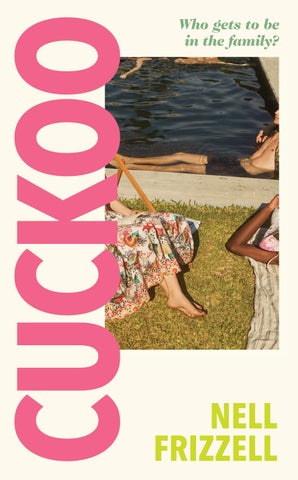
Who gets to be in the
Also by Nell Frizzell
Non-fiction
Penguin Random House, One Embassy Gardens, 8 Viaduct Gardens, London SW11 7BW www.penguin.co.uk
Transworld is part of the Penguin Random House group of companies whose addresses can be found at global.penguinrandomhouse.com
First published in Great Britain in 2024 by Bantam an imprint of Transworld Publishers
Copyright © Nell Frizzell 2024
Nell Frizzell has asserted her right under the Copyright, Designs and Patents Act 1988 to be identified as the author of this work.
This book is a work of fiction and, except in the case of historical fact, any resemblance to actual persons, living or dead, is purely coincidental. Every effort has been made to obtain the necessary permissions with reference to copyright material, both illustrative and quoted. We apologize for any omissions in this respect and will be pleased to make the appropriate acknowledgements in any future edition.
A CIP catalogue record for this book is available from the British Library.
ISBNs 9781787634343 hb 9781787634336 tpb
Typeset in 11.25 /15.75pt Sabon LT Std by Jouve (UK), Milton Keynes Printed and bound in Great Britain by Clays Ltd, Elcograf S.p.A.
The authorized representative in the EEA is Penguin Random House Ireland, Morrison Chambers, 32 Nassau Street, Dublin D02 YH68.
Penguin Random House is committed to a sustainable future for our business, our readers and our planet. This book is made from Forest Stewardship Council® certified paper.
To all my sisters. And all their siblings.
1I knew what he was as soon as I clicked on the photo.
Hair like black popcorn, nose like an axe, eyes the colour of milkless tea. It wasn’t that he looked like my father – my dead father – although of course he did. It was that he looked like me. Staring into my phone at a picture of this stranger was like looking at myself, made man.
I put the phone on my bedside table, beside a glass of water speckled with air bubbles from several untouched nights. A strand of hair poked out from behind the prostrate phone and next to that lay an Allen key that I’d used weeks ago. There was also a photo of Clive, my father – my dead father – in a frame. He was staring at the camera, wearing a blue smock. He wore smocks because he couldn’t bear the idea that anyone in the world might not immediately realize he was an artist. Dad had been the sort of man who actually put pencils behind his ear. The sort of person who sketched on the Tube. I adored him.
With slightly shaking hands, I picked up my phone again. The details about this man were lying there like cling-film-wrapped chicken: cold, pale, revolting. Oliver
Coburg. Male. Auckland, New Zealand. I felt guilty. I felt like the witness and the perpetrator all at once. I had found this man. I had spat in a tube and created him. I was Frankenstein.
This time, I pushed the phone under my pillow and walked out of the room. On the landing, a towel printed with small red flowers hung over the wardrobe door. Pulling it down, a full-length mirror appeared; and there I was. Flat feet. Three dark hairs sprouting from the knuckle of my big toe. Knees like russet apples. A pair of pyjamas bought under duress for someone’s hen do about five years ago. I didn’t even get to my face before turning towards the bathroom. Salty water was flowing into my mouth. I’m not the sort of person who normally vomits from shock but this was shock and guilt together. A combination like vinegar and baking soda. Expansive, stinging. I had done this and might never be able to undo it. I stood in front of the toilet and heaved three times. My stomach clenched. My eyes watered. But nothing else came up.
Stepping into the shower, I turned the tap and spat into the bath. That’s the thing about living alone; I could behave like a feral beast. I could eat ham for breakfast and hide dirty plates in the oven and fall asleep to my dad’s old answerphone messages and who would know? I was out of view. As the shower warmed up, I looked into the hole above the curtain rail. It had been there when I moved in, more than a year ago. A broken tile, presumably. This wasn’t a luxurious flat. Even as I’d looked round it, still liquid with grief, flush with death
money, I’d known that it needed work. I’d also known, with the certainty born of hopelessness, that I wasn’t going to do any of that work. The agent had smiled the grinding, hysterical smile of the London estate agent and told me that it had ‘literally mind-blowing potential’, and I’d nodded. Because what was I going to do? Argue? Ask to see a different flat? Demand they do the work before I moved in? Of course not. I’d just agreed and put down a deposit. It was the first and only flat I viewed and I took it. I’d lied to Rita, of course. My sister still believed that I’d sat in a branded Mini Cooper and driven around North London all day inspecting the seven flats she’d researched, and had liked this one the best. Which maybe I would have.
Rita. Pushing the soap under my armpit, I flinched. What was I going to say to Rita? She’d know something had happened. I’m not a particularly good liar and, anyway, she was my sister. Well, half-sister. But sister, really. I’d just have to explain. It was sort of her fault, anyway. If she hadn’t got a dog, none of this would have happened.
When I got back into my bedroom, I could hear the phone vibrating under my pillow. Gamar.
‘Hello?’
‘Nancy? Can you hear me?’
‘Yes, where are you?’
‘I’m in the office. In Khartoum.’
‘Oh.’ A second’s pause. ‘How long have you been back there?’
‘Only since last night.’ And, of course, he hadn’t got in touch last night. Hadn’t sent a message. He hadn’t thought of me at all. ‘But I went straight to the hospital as soon as we got back and have only just come off my shift.’ Shame coloured my cheeks. Imagine being jealous of a hospital. ‘How are you?’
‘Oh, fine. Yes. I’m fine.’
‘Sorry. There’s a bit of a delay.’
‘Yes.’ Often our calls were like shouting down a well: the reply would be slow and echoey.
‘Are you sure you’re all right? You sound a bit . . . um . . .’
Suddenly, there were tears sliding from the corners of my eyes and on to my nose. I’m so inured to crying now that I’d hardly noticed.
‘Nancy?’
‘Do you remember that DNA test I did?’ I let out a juddering sigh.
‘Yes. What is it? You know, Nance, those things aren’t accurate. If you’re worried about inherited conditions you need to do a proper—’ But I’d accidentally started to answer him, cutting off the sound of his voice.
‘No, it’s not that. Gamar?’
‘Yes.’
‘I have a brother.’
In the atrium of the Wellcome Collection, I saw Rita looking at her watch. A flock of birds hung suspended, above her head, from the high domed ceiling. She was looking at her watch because I was, at most, three minutes late. Which meant she would have been waiting there for eighteen minutes. One of Rita’s favourite ways to boost her cortisol is to arrive to appointments at least a quarter of an hour early and then start asking how long you’re going to be. Knowing that, I stood outside, holding my bike keys for a few extra seconds, just to wind her up.
‘Hello, Reetabix,’ I said, feeling her padded coat sigh against my shoulder as we hugged.
‘I’m just going for a wee,’ she replied. My sister will make a point of going to the toilet at the least convenient time possible. The moment a waiter arrives, for example. Or just as your train platform is announced. During a family holiday, Rita managed to get locked in Warwick Castle because she ran off to use the toilet as they were ushering people out of the main gates. I think it’s a power move. She says it’s a small bladder.
If that’s the case, then she must have inherited it from her mum – I regularly go for eight hours without a loo break if we’re short-staffed. As I waited, I looked up to admire the flock of birds. I needed distraction. With my neck bent back like a bottle of Toilet Duck I realized that the flock of birds was, in fact, a huge collection of speculum. Speculums? Speculi? Rita would know. Maybe I’d give her a treat and ask. Squeezing my hands into fists, I looked at them: metal, plastic, ceramic. Long-beaked, tubular, crank-handled. I swallowed.
‘You’re looking sweaty, Nantucket,’ Rita said, emerging from the toilet still rubbing at the sanitizer gel on her hands. Rita has been using hand sanitizer since dialup internet. For years, she was the only person I knew who carried it in her rucksack. Until we all did, of course.
‘Oh, just my moustache,’ I said, smiling a touch unconvincingly. ‘Maybe these are giving me an attack of the tremors.’ I nodded up towards the fiesta of gynaecology above our heads.
‘Don’t. Apparently the artist is researching fertility trauma.’ Rita gave the frown she always gives when talking about art – like she’s about to step on to a high bridge. ‘I thought they were shelving brackets.’
We made our way up the stairs in lock step, our arms crossed at the elbow. This was hard to do, as Rita is about a foot taller than me, and it also meant we were blocking the stairway to anyone wanting to pass in either direction. But Rita is a woman willing to take up space.
‘You know, I’ve started going to a weightlifting gym,’ she said, giving my forearm a vicious little squeeze under her bicep.
‘Are you going to start pulling London buses while wearing vests advertising margarine?’ It was exhausting to talk like this, to make jokes, while knowing I carried a secret. But it was utterly beyond me to fight against the pull of Rita’s momentum. Perhaps I even wanted to stay upbeat, stay on the surface, stay in my sister’s good books, just for a few minutes longer.
‘I’ve been doing that since the Tube strike,’ Rita smiled. ‘But in the meantime, I’ve discovered that the weights room is where all the cool queer women in West Ham hang out.’
‘All four of them?’
‘Oh, look, everybody’ – Rita threw her arm out wide and shouted down the hallway – ‘Dorothy Parker’s come to Euston Road!’ I cringed as a man in white trainers and rimless glasses glowered at us.
‘No, but seriously, are you sure they’re interesting queer women and not just, you know, muscle trucks?’
‘That is a Venn diagram I would very much like to climb inside,’ said Rita, doing her music-hall voice.
‘Well, in that case, I’m thrilled for you.’ I swallowed the panic rising from my guts. ‘When you start advertising whey protein on the side of the 104 bus, I’ll tell all my friends that I knew you as a wafer-thin mint.’
As we entered the exhibition, Rita unhooked her giant arm from under mine and started walking purposefully
towards one of the vitrine cases in the centre of the room. I followed, slowly, looking at a piece of silver tubing by the window that might have been part of the show or might just have been an exposed ventilation duct. My back felt heavy. Compressed. Apparently this is called Museum Walk: a real condition. Well, a real condition if you believe in the Alexander Technique. Which I’m not sure I do.
‘Chunks, look at this.’ Rita was gesturing excitedly. In front of her, in one of the cases, was a small leather notebook. I went over and rested my chin on her shoulder. The book was covered in slanted, scratchy writing broken up by little drawings of what, to me, looked like honeycomb.
‘What is it?’ I asked, lifting my head reluctantly.
‘This?’ Rita’s eyes were shining. ‘This is Franklin’s lab log!’
‘Oh, wow!’ I said, blowing the words out as if I were standing over a birthday cake, rather than an incomprehensible maroon book. ‘That must be where she wrote . . .’ I trailed off, knowing that Rita – as always – would fill in the gap.
‘Yes, the working theory of DNA and how she’d expanded it.’ The words tumbled out of my sister’s mouth like bees; ‘DNA’ felt dangerous, irresistible. I could have told her. I could have told her right then. But she was so excited. ‘This is what proves that Rosalind Franklin was analysing the data, rather than simply processing it!’
I stared again at the book, to avoid showing Rita my face.
At times like this, I felt the differences between me and my sister so sharply they could almost cut my skin. She is tall, strong, rational. She plots her life like a graph. She reads instruction manuals and buys spare toothbrushes and knows the names of birds. She bought her goddaughter shares in a barrel of Scottish whisky because it would accrue in value. She books holiday months in advance and signs up to newsletters and knows the long code of her BT Wi-Fi password off by heart. Her lips are full and her ears are small. She is top heavy with a sandbag arse. Her hair is black and curly and the skin on her nose is dark with freckles. She has a dentist and thyroid checks and plays board games that last weeks at a time.
I am the runner-up. I am out of step. I am the agent of chaos.
After an hour or so of looking around the gallery, Rita suggested that we have some lunch. I can’t afford museum lunches but also knew that admitting so would invite in a lot of unwelcome questions about bill providers and mortgage rates that I had neither the energy nor insight to answer. So, I followed Rita into the cafe and scanned the cold marble counter for something that cost less than seven pounds.
‘I’ll get these,’ Rita offered, after I’d chosen a cheese roll that looked like something you’d use to staunch a wound. It was too late to swap it for the spinach and feta pie I really wanted but I was very grateful anyway.
‘Are you sure?’
‘Call it a surprise bat mitzvah present.’
‘But we’re not Jewish,’ I replied.
‘That’s the surprise.’
Standing in the queue, I felt my panic start to rise. The secret was crawling up my throat, ready to burst out. I wanted to talk to Rita, to empty out my guilt, but I was also scared because saying it would make it exist.
‘You know that DNA test you did on Buster?’ My voice sounded fake. The aim had been light-hearted but the effect was shrill.
‘Seventy-five per cent Highland terrier; not a Chihuahua mix after all.’ Perhaps Rita was too distracted by her spinach and feta pie to notice. ‘I was so pissed off.’
‘Egg-beater, that dog couldn’t be any more Scottish if it played the bagpipes and baked its own shortbread,’ I said. Rita started to laugh, thank God, and we went to find a table. ‘You’re the only person who thought he was a Chihuahua.’
‘He has a very Latin American temperament,’ said Rita, sitting down.
‘So does Richard Madeley but I don’t think anyone is taking him to Crufts in the miniature category.’ I swallowed. Rita looked at me.
‘What?’ Rita asked, her eyebrow flickering with something like concern, something like scorn. ‘What is it?’
‘Well.’ My hunger had evaporated. I wiped the palms of my hands down my thighs and felt the shakiness in my legs.
‘Hmmmm?’
‘Well, I decided to do one on myself.’ I watched my sister’s face shift into something closer to exasperation. ‘You basically spit into a test tube and then send it off to some processing plant in Milton Keynes or whatever.’
‘And you’re also fifty per cent Chihuahua?’ asked Rita, carving out a forkful, her knife unused on the table.
‘With these thighs? I don’t think so.’ I sighed. ‘No, I just thought it would be interesting to see what Dad had passed on to us. He was always so vague about his parents, wasn’t he? Like, this nose must have come from somewhere.’ I touched my face. ‘We could actually be a bit Welsh.’ I thought of the way I’d sent off the test, imagining a pulse of something exotic in my blood. A Sephardic drop of pickled lemons, some salt-blown piece of Viking flesh, a curl of Indian saffron. ‘I just thought it would be interesting.’
‘So? What did you find?’
Looking into Rita’s so-familiar face, I felt the ocean at the back of my throat. I wanted to be sick. But instead I swallowed.
‘It said I have a brother.’
Rita said nothing.
‘Well, actually, we have a brother. You and me.’
The noise as the fork hit the ground echoed through that chamber like a cannon ball. Cutlery overboard.
‘No, we don’t,’ Rita said, in a hard, chilly voice.
‘I’m sorry, Rita.’
‘No.’
‘It was really, really weird but Dad was on there too?’
Rita hissed in a lungful of air like a cat being scorched by flames. ‘Don’t you dare bring Dad into this.’
‘But, Rita – the test website. There was a photo.’
‘I have to go.’
I grabbed her arm. It was a hopeless gesture; if she wanted, Rita could probably snap my radius like a toothpick, and we both knew it. But she stayed sitting.
‘Look, I can show you.’ But as I pulled my phone from my pocket, Rita grabbed my hand and slammed it palmfirst into the table. I was shocked – Rita and I might argue sometimes but we didn’t break each other’s stuff. Not since we were children. There was a painful silence. When I realized that Rita wasn’t going to speak, I launched in again. ‘Dad was on there too. In a red fleece, in the garden. I think he . . . He must have . . . Or he . . .’
I couldn’t say it. I couldn’t narrow down all my galloping doubts into one single accusation. Before he died, Dad had taken a DNA test and never told us. Or never told me. I flicked my eyes up at Rita but her face was like a breeze block. She hadn’t known either. Neither of us had known. ‘Which is how they found the sibling match.’
Rita had still been holding my hand, but suddenly thrust it away so hard that I hit my wrist against the hard white marble.
‘No!’
People around us were starting to look. They probably thought we were a couple; that this was a lovers’
tiff or a break-up or some weird piece of role play. Rita and I have never looked enough alike for people to assume we’re sisters.
‘Rita, this isn’t my fault—’ I’d known Rita would be surprised – upset, of course. But I hadn’t expected her to turn on me like this. This physical violence, in public, was unsettling.
‘Our family is complicated enough,’ she said, her jaw hard with anger. ‘We are still grieving.’ There was no catch in her voice, just cold fury. ‘Anne is grieving, my mother is in the middle of fucking nowhere and you have just invited a stranger into our lives. What for? He’s not our brother. Dad didn’t have a son. He was a good man, Nancy.’
‘I know.’
‘So this person’ – she spat the word – ‘is a fraud.’
‘Rita—’
‘It’s a scam, Nancy. Either that or there’s been a mistake. You should complain. In fact, you should write to the company and tell them you’re going to take legal action because this isn’t right.’
A tiredness crept across my body as though it were dissolving into clay.
‘Nancy? Are you listening?’ Rita was looking at me with something like concern beneath her fury.
‘Yes, yes, I—’ The rest of the word was swallowed in a croak. I was retching. The lights, Rita’s anger, the smell of other people’s bodies were all stuffing themselves down my throat, and all I could do was push back. Eject. Heave.
‘Don’t you dare throw up on my trousers!’ Rita was saying, standing up quickly from the table. I closed my eyes and pulled my chin into my chest. Perhaps if I could just fold myself in tight enough, this feeling would pass. I breathed in. I heard a man behind me ask to use a plug. I felt the scraping of someone else’s chair vibrate through my own.
‘I don’t know what’s going on with you,’ Rita said. I chanced opening my eyes; she was still standing up. Looming over me. ‘But I think you’re lonely. And I think you feel rejected. So you’re looking for a man to make you feel better.’ Her words felt like someone pissing through my letter box. ‘Dad is a good man.’ I didn’t correct her tense. Dad is a good man. Dad was a good man. ‘And I’m not going to let some liar with nothing better to do pretend to be his son.’ I swallowed. ‘Look what he did when my mum left. Do you think there were many single dads back in the 1980s? Can you imagine having to explain to a load of middle-class mums and suspicious nursery workers that your wife has gone to live in a commune in the South of France and you are now the sole parent of a toddler?’ I nodded. I knew the story but this was Rita’s rosary; her Hail Marys, to be repeated again and again. ‘Until he got together with Anne The Barrister, it must have been hell: working, childcare, heartbreak. All while my so-called mother was chasing enlightenment or self-actualization or inner peace or whatever meaningless phrase they were using that particular week.’
I knew Marie-Louise, Rita’s mum, had been a press officer before she went back to France. After Dad’s funeral, she and I had sat up in her small Airbnb flat and the whole story had slowly slid out. How she had felt trapped in England; how she had always been a seeker; how the racism and class system and politics of the 1980s had felt unbearable; how motherhood had temporarily washed her away. She had also explained that when she went to live in Aynac, she had done so on the understanding that Rita would live between the two places – until Rita had got to school and suddenly learned to be ashamed of her own mother. It had been the longest conversation I’d ever had with Marie-Louise: my non-mother, my father’s first wife. A woman with whom I shared no blood and yet who so easily could have been my mother, under different circumstances. A woman who had loved my dad but had also left him. I had felt sorry for her but also not entirely convinced. More, I’d had the uneasy sense that hearing Marie-Louise’s side of the story was somehow a betrayal of both Dad and Rita, so I had never repeated any of what she’d said.
‘Some random internet scammer on the other side of the world tells you that he’s your brother and suddenly everything you know about your own father just disappears?’ Rita was leaning over the table now, blocking out the white spotlights in the high ceiling. ‘Just . . . explodes? Dies?’ This last word hit me full in the face. Even Rita looked a little shaky. ‘If you want to speak to
him then that’s your problem. But when he starts asking you for money, or about the house, or wants to come to England, just remember this: he is a liar and you—’ I heard the breath in her nostrils. ‘You . . .’
While I waited for the final blow to land, I stared at Rita’s T-shirt. With me sitting down and her standing up, the visible hem of her bra was at my eyeline. I could see how she had tugged at the neck of her T-shirt to make it stretch, until it looked like all her T-shirts. I could see the small bulge above the waistband of her trousers. I could see the single dark mole on the inside of her arm.
‘You’re a wretch.’
‘What did Rita say?’
‘She said it was a scam.’ I was on the sofa, still wearing my coat.
‘Well, it might be.’ I could hear something in the tone between each of Gamar’s words. Annoyance. He was pissed off with me and making a big show of being kind. Which was somehow even crueller.
‘But Dad was on there. I saw his profile. And this man shares Dad’s DNA.’
‘Those calculations are notoriously inaccurate.’ Gamar was using his patient voice. ‘He might just be a nephew or cousin or something.’
‘He looked like us.’
‘Like who?’
‘Me and Dad.’
‘OK. Well, what do you want to do?’
I stared at a patch of white paint on the floorboard in front of me. I couldn’t answer the question. I didn’t make those kinds of decisions. For three years, I had held on to Gamar with an entirely open hand. Like trying to catch a butterfly. I loved him and had waited for him to
love me back. No pressure. No expectations. When my dad died, I collapsed but I did not cling on. I let him breathe. Three weeks after the funeral, Gamar had flown to Damascus, to save other people’s lives. Because there are always people dying somewhere.
‘Maybe I should wait to see if he contacts me,’ I said.
‘I think the first thing you need to do is talk to your mum. She might know more than you realize. And Rita will definitely tell her, anyway.’
‘I’m not sure. She seemed very angry that I’d even brought it up with her.’
I waited for a reply but there was just a thick, blank silence. Like the sound of a rubber wall.
‘Gamar?’
Still nothing. I looked at my phone. The seconds were still ticking but there was no sound, not even breathing. Gamar must have lost reception. Just at the moment when he was going to tell me what to do. I pulled at my zip in frustration.
‘—not sure if you can hear me?’
The thump in my heart was instant, beyond control. And wasn’t there a beauty in that? What other couples could say that after three years they still felt electrified by the sound of the other’s voice?
‘Yes, yes, I can! Sorry, what were you saying?’
‘No, you were talking.’ I could hear a door closing somewhere in the background as he spoke. ‘But actually I did have something I needed to tell you. Nancy?’
‘Yes.’
‘Oh, good, OK, you’re still there. Listen, I’m sorry but we’re going into lockdown here.’ The pain was as instant as the pleasure had been. My body actually winced. ‘It’s a security thing; they think it’s just too dangerous to be coming in and out of the country while there’s fighting at the airport like this.’ Gamar left a pause and I made a noise into it. Not an assent or a word; just a noise. ‘That means I won’t be able to come back for longer than expected. Maybe two months.’
Of course it had not been three years. We had not been a couple for three years. It had been ten, perhaps twelve slivers of individual weeks. A month once or twice before he was pulled away by all the other people who needed him more than me.
‘I’m sorry. Especially when you’ve got all this going on. But, well . . .’
And there in the silence hung all the things he never said; all the ways in which he was generous and I was selfish; all the reasons he couldn’t commit. He was always elsewhere, saving lives. I loved him. I wanted to feel his weight against my side as I slept. I wanted to choose a bedside light together. I wanted to move his saucepans into my kitchen. But he wanted to stand on the threshold of living and dying.
‘Will you be in Khartoum?’ I asked, at last.
‘Not for long. Next week we’re going south, further inland, towards Darfur. I have no idea what the internet will be like down there. I might not be able to call very much.’
Fury burst inside me. I was being put aside. I was his collateral damage. Because anyone can be heroic if they are alone, far from home and have nothing to lose.
‘OK, love,’ I said, my voice as flat as milk. ‘I hope it’s OK down there.’
Because what else could I do? I couldn’t beg him to come home. I couldn’t shout at him for making me feel unimportant. I couldn’t ask him to put me first. I just had to wait; to be supportive and kind and hold on until it changed. Because one day, I knew, things would change. He would move department, international policy would change, his mother would become ill: something. And then he would come home. He would take up a practice in London, move into somewhere with a garden, spend Sundays fixing things in my mum’s house. One day we would go for a walk in the country and have a pub lunch with our friends. One day we would buy a mattress together. One day he would meet me from work and know the names of all my colleagues. Gamar was the man I loved and he was my future. He just needed time.
‘Thanks, Nanook.’ He sounded quiet.
‘How are you feeling?’
‘Ah, you know. It’s hard. These people, they’re not soldiers, they’re men. Angry men. They looted the hospital; one of the doctors got killed. Not one of us, a local doctor.’
My breath caught in my chest. Killing doctors. I had tried to avoid the news but I had still seen the pictures:
streets reduced to rubble; children hiding in doorways; blood on blankets scattering the ground. And now they were killing doctors. Gamar was British, he was Eritrean; he was working for a non-government agency delivering humanitarian medical aid. But would they care? Would they even know that, as they walked through the corridors, wielding their guns? A cold fear crept down my neck. Long ago, I had stopped telling him to stay safe because I now understood that staying safe was not a choice he could make.
‘I’m sorry,’ I said.
‘We haven’t been able to bury him.’
I looked at my knee. It was perfectly still. The light at the window was as smooth and pale as an aspirin.
‘That’s awful.’
‘Yeah. Well . . .’ I heard something like a chair being scraped across the floor. ‘Anyway, have you contacted him?’
‘Who?’
‘This guy. The one from the website who you found.’
‘Oh. No.’
‘Are you going to?’
‘No,’ I replied. Meaning perhaps. Meaning yes. Meaning I don’t know; tell me what to do; how can I decide; why is this happening; I love you; come home; I’m scared.
‘OK, good. At least, maybe don’t make contact until you’ve spoken to Anne.’
‘Yes.’
‘I still think she might know more about this than you think.’
‘You think Mum knew about him all along? And Dad?’ I heard no reply. ‘So you think that he really is my brother.’ I waited. ‘Do you think they lied to us?’
The silence that came back was as solid as concrete. Hopelessly, I pulled the phone away from my ear. Call ended. He had disappeared.
I rang Rita for four days without her picking up. On the fifth day, she answered, asked if my mum had died, then ended the call. As more time passed, I began to feel as though a part of my heart was closing over, like an oyster shell. The pain, the grit, the salty wound was growing, and the only way I could cope was to either shut it completely or tear it open with a knife.
Rita, please. I need to talk to you. And Mum. She always knows when something has happened. Can’t we just discuss this like adults?
I felt nothing like an adult, of course. Adults do not spend their days eating squeezed-out cheese on Ritz crackers because it’s one of the snacks they remember their father making. They do not sit on bollards outside their front door, smoking roll-up cigarettes. They do not shudder in the disabled toilet of a primary school during morning break, ruining purple sugar paper with their own tears. Rita had read the message immediately – two blue ticks giving it away – but it had taken her forty minutes to reply.
I’ve told Mum we’re coming over tomorrow night
for dinner. She doesn’t know anything about this yet. I’m not doing your dirty work for you. You’ll have to tell her.
London, of course, is not a city. It is a collection of Gail’s bakeries with sewers. The area where my mother lives was once a Saxon village, surrounded by meadows and streams; now it is a busy, bus-trammelled suburb, full of delicatessens, bakeries and pound-a-bowl fruit stalls. It was possible to walk from London Bridge to her front door without once leaving an A road. Put it anywhere else in the country and it would look like a town centre but here, in London, it was little more than a glance out of a car window. She and Dad had bought the house back in 1983. A three-bedroom, red-brick terrace, it had come with an expectation of more children. Rita had just turned three; already furiously strong and a dedicated eater of plums. She had smacked her way along the tiles and timbers, open-palmed, for less than a year before I was born. Had my parents explained to her what little sisters were? Had Rita felt jealous? Usurped? Or relieved to no longer be the sole demolisher of broccoli and soft furnishings in the house? The story goes that on the day I was born, Rita arrived in the hospital with a yellow metal dumper truck and insisted on putting it in my plastic see-through cot for the night. The hospital has now, of course, been pulled down to make way for a development of luxury flats.
The door to number 145 hasn’t changed colour in over thirty years: goose-shit green. Set off with a black
knocker in the shape of a fox and a brass letter box that slams in the wind. Everybody in the house had always hated the colour of the door but nobody had ever been willing to repaint it; an approach to interior decoration that also explains the white plastic blinds in the master bedroom, the pale grey bathroom suite and the cork tiles on the kitchen floor. As Anne likes to put it to dinner guests and visiting family: after the first eight years in a house, you just stop noticing everything you hate.
I lifted the knocker and felt a dull ache in my chest: homesickness, loss, but also something shooting down my armpit and into my breasts. At thirty-eight, my body was a kaleidoscope of unwelcome changes. The hairs exploding from my neck, the watery nausea on waking up, thickening toenails and pale yellow bruises. They added up to nothing more than age, I knew, but sometimes they felt like an omen: preparation for events unseen.
‘Hello, darling.’ Anne’s wide face, shoulder-length grey hair and short, blunt fringe gave her the look of a cinema curtain halfway through opening. I stepped into her arms and smelled Elizabeth Arden and cheese sauce. A wiry, brown-haired Cairn terrier skidded past her feet, nearly propelled on to the pavement by its own momentum.
‘Hello, Shadwell,’ I murmured as the dog leapt against my knee. ‘Sorry, Mum, are you in the middle of cooking?’
Anne smiled. ‘No, no, I was looking through the
upstairs window.’ I glanced back over my shoulder, wondering what I’d missed. ‘I was watching to see if Malcolm has moved his stupid great van.’
Malcolm at number 138 has a taste for large, supposedly muscular cars. Malcolm at number 138 is a restaurant owner and dyes his hair the colour of CocaCola. Malcolm at number 138 asked my mother out ‘for a drive’ four weeks to the day after Dad died. ‘Come in, come in. Would you like a drink? I have red or white.’
‘Red, please.’ I nosed my trainer off with each toe. ‘Is Rita here?’
‘Not yet, no. She texted about twenty minutes ago to say she had to do some errands on the way.’
I frowned into the coats. Rita, who was always early, was making a point. I was on my own. We walked down the hallway, which was covered with collages: real, cutup photographs in frames. My grandfather hovering above a beach scene; a golden retriever dwarfing the ferry glued down beside it; me, aged two, propped up in a wheelbarrow. And there was Dad, in his second wedding suit, a mess of curly brown hair; Dad standing topless in swimming trunks holding a girl under each arm, his chest already flecked with grey; Dad crossing the finishing line of the London Marathon in a pale blue vest. I hardly stopped to look at these photos any more; at the man who made me and whom I loved. I’ve seen them so many times they had become invisible. But today they were jarring. Even as I kept walking, my eyes
flicked across the construction. Who was this man? This family man? Had he known? Had he lied to us?
In the kitchen, a programme about potholing blared out from the paint-splattered radio that, like the chopping boards and jars of dried beans, had been there longer than I could remember.
‘I’ve made a lasagne,’ said Anne, turning off the radio at the wall. ‘Please tell me you haven’t decided to be lasagne-intolerant.’
‘Mum—’
‘Donna’s daughter has just decided that she’s vegan but can’t eat pulses,’ Anne butted in. ‘I ask you.’
‘I’m still eating everything,’ I replied. Was this true? Yes and no. On bad days – on grief and heartbreak and lonely days – food sat in my mouth like sand. After Gamar had last called, I hadn’t been able to eat anything all night. ‘Apart from eggs, actually, Mum. They . . . they make me windy.’
‘Being alive makes you windy, Nantucket. You’ve always been the same.’ Anne reached over and stroked a line down my cheek from eyebrow to chin. ‘You look worried.’
Looking into my mother’s face, I felt that pull in my stomach again. A deeper, sinister gravity. Did she know? Had she always expected this moment? Or was I about to break her heart?
‘I just wish I knew what you’d been up to,’ Anne continued. ‘It’s been such a long time . . .’
‘Mum, we went to IKEA. I phoned you two days ago.’
‘Oh,’ she puffed, ‘sales shopping doesn’t count. You can’t catch up by a discounted bath mat.’
‘OK, fine.’ This old habit of hers: always wanting more of me. The more time we spent together, the more she complained that we were never together. The more affection I showed her, the more reassurance she demanded. ‘Well, Gamar is still in Sudan but I’m not sure where. He may not be home for two months and they are murdering doctors at the hospital.’ The momentum allowed me to say words that I’d not yet dared to put together in my mind. ‘Work is fine but a bit quiet. I am thinking of getting a new kettle and have stopped listening to the Today programme because I cannot stand to even hear the Prime Minister’s voice any more.’ As I reeled off this list, Mum’s face had gone through a kaleidoscope of responses: concern, pity, confusion and, last, the eye- roll of a parent who feels they are being pushed away. She stood up and walked over to the oven. I said nothing, a little awkward after my outburst. We both breathed in and out, just once. Then Mum came back to her chair and sat down with a flump.
‘I’m very sorry to hear that about Gamar. No wonder you’re worried. Does he sound OK?’
I knew that Mum didn’t quite understand my relationship. Which wasn’t a surprise as I didn’t either, and I was the one in it. So it was kind of her to take care like this; to ask; to be gentle. I’d always suspected that Dad actively hoped Gamar and I would break up, although