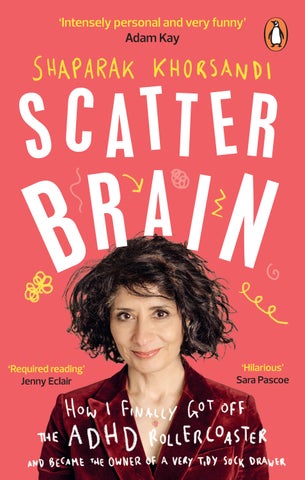
‘Intensely personal and very funny’ Adam Kay
BR A IN S C AT T E R
‘Required reading’ Jenny Eclair
‘Hilarious’ Sara Pascoe


For my mum, Fatemeh Khorsandi

Vermilion, an imprint of Ebury Publishing 20 Vauxhall Bridge Road
London SW1V 2SA
Vermilion is part of the Penguin Random House group of companies whose addresses can be found at global.penguinrandomhouse.com
Copyright © Shaparak Khorsandi 2024
Shaparak Khorsandi has asserted her right to be identified as the author of this Work in accordance with the Copyright, Designs and Patents Act 1988
This book is a work of non-fiction based on the life, experiences and recollections of the author. In some cases names of people, places, dates, sequences and the detail of events have been changed to protect the privacy of others.
First published by Vermilion in 2023
This edition published by Vermilion in 2024 www.penguin.co.uk
A CIP catalogue record for this book is available from the British Library
ISBN 9781785044205
Printed and bound in Great Britain by Clays Ltd, Elcograf S.p.A.
The authorised representative in the EEA is Penguin Random House Ireland, Morrison Chambers, 32 Nassau Street, Dublin D02 YH68 www.greenpenguin.co.uk
Penguin Random House is committed to a sustainable future for our business, our readers and our planet. is book is made from Forest Stewardship Council® certified paper
CHAPTER ONE
‘In my twenty-three years as a psychotherapist, I’ve seen the same patterns appearing. Those of us with ADHD, who struggled at school, will immediately recognise the torment and anguish hidden beneath a defensive layer of humour. That sort of classroom and playground trauma leaves indelible marks.
ADHD is not simply about diagnosis, it’s o en about the trauma one endures as a young person as a result of undiagnosed ADHD.’
Ian King-Brown, Psychoanalytical Psychotherapist
I am lying: this is not chapter one. It’s the introduction. Why am I tricking you into reading it? Well, because if you are anything like me you might skip the intro. I have ADHD (Attention Deficit Hyperactivity Disorder) and INTRODUCTION at the top of the page in a book feels to me like the warm-up act that comes on at a gig, before the lights have fully dimmed and there’s still time to grab a beer or go to the loo.
Just tell me the stu ! I think. ‘Go straight to the main bit! Just gimme the facts, tell me the story, NOW!’ I mutter to myself. ‘I don’t need it to do a little dance for me before it starts.’
This bit is important, though, so please read to the end. If you have ADHD too, slap yourself, do a twirl, sing, ‘I’ve got a Loverly Bunch of Coconuts’ – whatever you have to do to stay focused.
All my life, people had given me the nickname ‘Scatty Shappi’, and I never contested it. There was, after all, endless proof. I was always losing things, getting times wrong and being unsure of where I was meant to be or what I was meant to be doing. I was madly impulsive; rarely thought things through. I could not start things, I certainly couldn’t finish anything, yet loaded my plate with tasks and activities: ‘Yes, I’ll do that! I will be there! Dorset and Mull of Kintyre in the same day? Sure! No problem!’ I lived in a fog of daydreams. I was socially quite clueless, insanely sensitive and had a real problem with sitting still and concentrating. And by ‘real problem’, I mean I could not do it. I had a temper, too. Not an ordinary temper but a tired-hungry-twoyear-old-who’s-broken-her-banana temper, which is scary on a grown woman.
Finally, in my mid-forties, during the Covid-19 lockdown, I was diagnosed with Attention Deficit Hyperactivity Disorder (ADHD). I learned that my brain has chemical deficiencies which affect my executive functions. I started on the road to getting support and beginning to understand how my brain works. It all started with an absolute meltdown over a box of chocolates.
It was lockdown, there was a lot of uncertainty, and when my children squabbled a little over how best to open the box
of Milk Tray I hurled it across the room, burst into tears and ran out of the house with no shoes on.
My reaction was born from my ADHD affecting my ability to process emotions and react in emotionally appropriate ways. If you notice a box of chocolates has a bomb attached to it and it’s ticking, then you can justify hurling it away while screaming. If your children have a mild disagreement about how best to open said box of chocolates, it’s trickier to justify this reaction.
Frequent over-the-top reactions affected not just me, but the people I love, and occasionally people on the bus who played their music out loud. At other times, I became a compliant people-pleaser to the rest of the world in order to mask my ADHD. I had, unconsciously, throughout my adulthood, become dependent on harmful ways to mask and self-medicate for my ADHD. Compulsive overeating, bulimia, binge-drinking and other obsessive-compulsive behaviours had dogged me throughout adulthood.
I began to read about ADHD. Friends I made while walking my dog in the park told me they knew people who had ADHD and recommended an online magazine to read (it’s called ADDitude) and podcasts to listen to. This allowed me to start to make sense of myself. I felt like how I imagine Tarzan did when he realised the apes were not his blood family, that he was really a human, so it was okay that eating maggots and having sex with chimpanzees wasn’t for him. What a relief!
I found a therapist who specialised in ADHD. I had never had holistic therapy before, where I didn’t feel like I
was a problem to ‘fi x’, but a person who needed support. My therapist helped me find the words to express the decades of frustration, and he was empathetic to all of it. I also saw a psychiatrist who diagnosed me with the condition, and for the last year or two I have been learning about ADHD, how it affects me, and I have also started coming to terms with the hurt I caused to myself and others as I uselessly attempted to fit square pegs into round holes. It turned out I did not have to live how I had been living. I no longer scream at anyone or hurl good chocolate at the wall. I sit on the bus and try to think, It’s wonderful we all get to listen to this horrible music; it’ll make leaving the bus and hearing police sirens and tra c all the sweeter.
For me, ADHD is not ‘special’, it’s not a superpower and it doesn’t make you more or less intelligent than someone who doesn’t have it. It is a different way that some minds work, which the world has been ignorant about accommodating until very recently.
The first time I ever heard of ADHD was in my late teens. It was mentioned in the context of boys misbehaving, being antisocial and disruptive in class, which I was not. I remember conversations and articles in which people questioned its legitimacy as a condition. There was stigma attached to not being ‘normal’ back then. I am from a generation where, when I was at school, any issue to do with your brain was still taboo. Offensive terms, such as ‘remedial’ and ‘retarded’, ‘slow’ and ‘backward’ were still commonly used. I did not want to be called such things
and so I couldn’t admit the problems I was having with my focus, which were massively impacting my ability to study. In any case, I was always too deeply locked in daydreaming or frustration to get it together to ask for help, even if help had been available. Lack of knowledge and understanding around neurodivergence is why so many in my generation and preceding ones were left undiagnosed. Undiagnosed ADHD, for me, contributed hugely to my low self-esteem, anger issues, addiction, loss of friendships, toxic and chaotic relationships, extremely messy rooms and many unfinished upcycling projects.
So what is this fancy label that I have? ADHD means your brain has a deficiency in its neurotransmitters, particularly dopamine and norephedrine, and this really messes with your executive functions, so concentration often becomes an impossible struggle and impulsive behaviour unavoidable. Put in the simplest terms, the area of the brain which controls impulsive behaviour and helps the brain organise and process stuff gets sleepy and can’t be arsed doing its job properly. (I appreciate ‘stuff ’ and ‘arsed’ are intimidating scientific terms. I will try not to swamp you with too much jargon.) The condition makes four key parts of your brain wander off when you want it to pay attention and process your thoughts and feelings. (ALL parts of the brain are key though, I imagine? I have never heard of a ‘take it or leave it’ section of grey matter, but then I learned everything I know about the human brain from Pixar’s Inside Out.)
Those four parts are:
Frontal cortex
Possibly the most famous part of the brain, which even I had heard of. It organises the rest of your brain, controls your attention and executive function – the ability to plan, focus, multitask, exert self-control …
Limbic system
This is the deep, dark part of your brain. It processes emotions and so it is very, very important, unless you are a Vulcan.
Basal ganglia
Incredibly, not a pasta dish, but a very important component of your brain and critical in keeping other parts of your brain communicating. If they are not, you can lose concentration or impulsively jump on a trampoline WHEN YOUR IS BABY ON IT (see chapter 8).
RAS (The reticular activating system. As if you didn’t know!)
This is a busy bunch of neurons that carry messages to the correct department of your brain. They are a filter system, designed to identify the important stuff and chuck out the nonsense. When it is impaired, as it is in ADHD brains, messages can scramble or not get through. Focus can be lost because your brain cannot see the bigger picture. It craves stimulation NOW to stay awake and alert, so if you are at, say,
after-work drinks at a new job and conversations are very surface-level and unstimulating, and you are a bit nervous, your RAS can short circuit and you might suddenly blurt out something like, ‘I’ve been to this pub before! I’ve had sex in the toilets!’ A non-ADHD brain prunes defunct neurons in your RAS but an ADHD brain doesn’t do this effectively, so they can end up bouncing around, sending the wrong messages, creating havoc and oversharing.
So that’s a snapshot of what is likely going on inside an ADHD brain. How that manifests out in the world will be different for different people. Here is a list of symptoms I had:
• Impulsiveness/not thinking of consequences
• Compulsive behaviour
• Chronic boredom (my body physically reacts to boredom. If I can’t leave the room I am in, I doodle, and if I can’t doodle, I claw at my flesh or consider faking my own death)
• An inability to keep physically still
• Chronic forgetfulness
• Distracted to the point where I am unable to follow conversations or instructions
• Interrupting conversations repeatedly (I promise I am otherwise a very polite and respectful person and not simply an arse)
• Not being able to start tasks
• Not being able to finish projects
• An inability to tidy up (not an excuse. I can dedicate hours to tidying up and still finish in a mess)
• Getting locked in rumination or repetitive negative thoughts
• Getting stuck in daydreams
• Hypersensitivity (if you can’t regulate emotions properly it might feel like a work colleague hates you and wants you dead because they didn’t return your smile, when really they have stuff on their mind other than you and didn’t register it).
There are more, but you get the gist.
tThe origins of ADHD are debated: some suggest it’s a throwback to when we were hunter-gatherers and that our ancestors with ADHD were better nourished because they were better at thinking on their feet and taking risks, like hurling themselves at those who were after their food. Once we didn’t need to hunt animals and gather our food anymore, human life would have become more ordered, more linear, and those with ADHD might have struggled with this. Perhaps we became the chaos fighting back against routine and monotony? No wonder so many writers and artists have ADHD.
By the by, ADHD impulsivity and ‘not thinking of the consequences of actions’ is not an excuse to be an utter bastard. ADHD does not impair empathy or moral values, so if you have been a bastard, own it and get the support you need. Not everyone has the resources or the wherewithal
to do this, I know, but I don’t want you to think I consider ADHD an excuse to shoplift , punch people, cheat on your partner or buy a budgie just because you happened to pass a pet shop.
Also, if I may suddenly and without warning jump to another subject (I have ADHD, did I not mention it?), I don’t like the term ADHD. Not because I don’t want a ‘label’. I have no problem with labels to describe a condition I have. For example, being labelled ‘short-sighted’ is fine. I do not resist going for a sight test and getting glasses because ‘not being able to see when I’m driving will NOT define me!’ My problem with the label is that it’s not accurate.
Take the ‘attention deficit’ part for example. I can pay attention; I have plenty of focus. I have hyper focus, but I cannot direct my focus at will. When I’m meant to be doing something important, like my work, or a tax return, or hanging out the washing because we have all run out of clean socks, I will spend hours reading about Victorian workhouses instead. When I have an important deadline, I will idle on Twitter for hours or learn old music hall songs. ‘We had to move away ’cause the rent we couldn’t pay. The moving van came round just after dark.’ Yes, that’s right, I know the verses to ‘My Old Man Said Follow the Van’, ‘Where Did You Get That Hat?’, ‘Daddy Wouldn’t Buy Me a Bow-Wow’ and many, many more. I do not know when my car tax is due for renewal though. The issue is that when and where I direct my focus is not in my own hands. Or, to be more accurate, in my own brain. My hyperfocus happens when I am in the last chance
saloon with a deadline. When I am right at the edge, in real danger of falling, I will save myself, but not before.
This hyperfocused, heightened alertness also happens when I am on stage. I am a stand-up comedian. I have to think on my feet; I have to hold my focus; stay in the moment. Many people do not find getting up alone on stage in front of a load of strangers and trying to make them laugh particularly appealing. I, however, need extremes to be jolted out of my ADHD fog.
The ‘hyperactivity’ part is true, but it’s usually thought of as loud and destructive, which is why it is often associated with boys who run around being ‘naughty’ and setting off fire alarms. But hyperactivity can be very quiet and often missed, especially in girls, who are just labelled ‘a dreamer’. My form of hyperactivity was frequent and debilitating rumination, or going deep into daydreaming so I completely missed what was going on around me. (I once missed three buses in a row, while standing at the bus stop.)
When I am excited, or nervous, or overstimulated, I can talk non-stop, right over other people. I have a motor I cannot switch off. It can make me seem rude or impatient, and I am rude or impatient sometimes, but more often, I fall into a swirl of thoughts and responses that bubble up and I have to get out then and there. They can overwhelm me. Many people who experience this, misuse alcohol and/or drugs, or develop food compulsions and obsessivecompulsive behaviours, because without realising it they are self-medicating, finding ways to shut that motor up for a bit.
And as for the ‘disorder’ part, I do not believe I have a disorder. It is our disordered world that cannot accommodate brains that might work just a little bit differently.
ADHD has been described as having its ‘moment’ in the last few years. This just means that we have become more aware of how brains work differently, realising that one size does not fit all in education and the workplace. People like me, whose brain wanders off to dance in the woods, are beginning to understand that there is nothing wrong with us; it’s a lack of understanding of different types of brains that shuts us out and make us feel like failures, because we are unable to do things that other people seem to find so easy. You may have a friend, family member, partner who infuriates you because they are smart and manage some things perfectly well but they frequently lock themselves out of the house, miss appointments, constantly jump from one topic of conversation to another, interrupt, blurt out inappropriate things, can’t do admin, have a wildly unpredictable temper, can’t keep time, can’t sit still, are an utterly impulsive flibbertigibbet. Perhaps they did incredibly well at school then unravelled at university, when the scaffolding of formal schooling and parental presence came down. Or they have 17 degrees but can’t get it together to actually get a job. Maybe you know a child who seems bright but absolutely can’t keep up with school work and struggles to follow tasks or understand instructions. Or people who can’t keep eye contact, or can’t stop talking, or seem to be utterly locked in daydreams? If you suggest they may have ADHD, might they say something like, ‘ADHD? No,
why do you think that? Maltipoos are my favourite cross-breed. Caroline’s brother has ADHD. God, what this government is doing to opera is a disgrace. Have you seen the woman who works in the Co-op? She looks just like Ricky Gervais.’
I am not saying that everyone who does any of these things from time to time definitely has ADHD. It could be that at uni they discovered weed and sex and couldn’t be arsed with studying much. Or they could be just annoying. Or they could have ADHD and find it incredibly frustrating that people think they are annoying or can’t be arsed.
ADHD does not itself lead to poor mental health, but undiagnosed ADHD can create low self-esteem because nobody, not even you, can understand why you can’t learn in the way you are expected to, why you can’t manage your emotions, why you just can’t ‘PAY ATTENTION!’. You spend your life masking your difficulties. You cannot process your shame and frustration, so it just grows and grows.
My diagnosis in 2021 meant I got an explanation for why so many things that seemed easy enough for other people were impossible for me. Reading non-fiction (unless it’s autobiographical like this book!), for example, time management, planning, self-control, tidying up, starting tasks, finishing tasks, organising, not crying and having a near-panic attack when your online banking glitches, impulsive decisions and purchases (I have 23 rolls of turquoise laminate if anyone needs it) and plain old concentration.
If you don’t have ADHD you may be thinking, Oh come on! We ALL cry down the phone to our bank sometimes and
buy a llama online a er a few drinks. It doesn’t mean you have ADHD! Of course it doesn’t. ADHD-like symptoms can appear now and then for anyone. That’s why it’s easy to miss, and easy to mask. It’s why it has taken so long to get its ‘moment’.
When I first talked about my diagnosis on social media during the Covid-19 lockdown, I expected a little eye-rolling and comments along the lines of ‘everybody wants to have something these days’. But that is not what happened. I was inundated with direct and public messages, many begging me to tell them where and how I got my diagnosis. They were mostly from women my age, though I also got many messages from men and from young people who told me how they had been frustrated and full of anxiety for years. Others who had already been diagnosed wrote to me, sharing their own story of relief when they got some answers to behaviours they had battled with their whole lives.
I wrote back to as many as I could, staggered that all this time, all of my 47 years, I had not been alone. I was not an outsider weirdo who was different to everyone else, as I had sometimes suspected. There were hundreds of other people who had been struggling the same way and none of us knew how common the condition was. I carried decades of shame around my inability to focus, about ways that I had acted because I couldn’t navigate my emotions. I had become the butt of jokes for my disorganisation and untidiness. Labelled a space cadet, scatter brain, dipstick and told, ‘You are not bringing a llama into this house!’ Teachers, parents, friends,
boyfriends, employers had seen my potential and couldn’t understand why I insisted on messing things up.
Now, every time I do a gig, audience members come up to me afterwards to talk about ADHD. They tell me they have it or suspect they have it. One woman told me that her child was intelligent, curious, but simply could not concentrate and do her homework or revise. She was not frustrated with her daughter; she wanted to find out how to help her. This made me cry; good tears. However much this child was struggling, it was incredible to hear her parent recognise that it was not the fault of her child.
These messages, these conversations are why I wanted to write this book. I am not a doctor; I have not studied psychiatry, so the only advice I can give to parents who talk to me about their children is make sure your child knows that there is nothing, absolutely nothing wrong with them. It’s just that our world hasn’t bent enough yet to accommodate the different way their brain works.
I am very much behind on the deadline. I assured everyone I could write this book in six months, thinking Yes, I have a full-on stand-up comedy tour planned, two children, elderly parents, commercial commitments, radio and television bookings … and ADHD. Sure! Six months, no problem!
Procrastination is the most relatable symptom of ADHD and the one most likely to make people go, ‘Oh I do that all the time!’ Do you? To the point where you can’t leave your house? Do you get court orders and fines because you procrastinate, because you can’t open your post? Do you feel like your
world is crashing down on you and you will lose your home because you are glued to your phone looking at pornography or looking up ‘dog and cat cuddling’ (porn for some, I imagine) for five hours at a time, utterly unable to get on with your work? Well then, please understand that if you have ADHD, things get more debilitating than getting a bit sidetracked.
There was a point at which my publishers got very worried. When I got off the phone to them, I pledged to myself, I actually said out loud, ‘I will do nothing but write today.’ And then got on the internet, drove to Greenford and bought a puppy.
Here are some other things I have done in the last few months as the deadline of this book loomed:
• Upcycled my wardrobe doors with stick-on vinyl wallpaper (saves a fortune, eats your time)
• Got a puppy
• Watched hours of ‘How to groom your Maltese’ videos on YouTube
• Taken a carpentry course and learned to make a shelf with brackets
• Got a certificate in psychotherapy
• Applied for a master’s degree in psychotherapy
• Upcycled an art deco dressing table
• Made a table out of an old cable reel
• Written a play
• Taken a French class
• Played PAC-MAN until I was seasick
• Upcycled an old doll’s house
• Been to see the Sistine Chapel.
My last minute hyperfocus means you are able to read this book now. I do get things done, just not on time, and in my own way.
This book is a look back on my life when I did not know I had ADHD. Now that I do know, I have had to look back over areas of my life – particularly my education, my relationships, parenting, my compulsions, my career – through a new lens, which has been both cathartic and very painful. So this book is laid out in thematic chapters for this reason, and also because ‘structure is your Achilles heel’ (the very true words of my first-ever publisher). Before I forced myself to stick to themes, I wandered endlessly off topic, into unrelated anecdotes, and we estimated I’d still be on chapter one in 2047.
I am on medication now for ADHD. I take an amphetamine that wakes up the sleepy part of my brain, the one that organises the rest of it. I am not ‘cured’. There is no cure for ADHD. I still procrastinate (I know all the lyrics to all of Meghan Trainor’s songs) and, most recently, I turned up a month early to a friend’s book launch and a week early to my own gig. But I am much better at pre-empting mistakes and behaviours so these things happen less often, and I do not punish myself when they do. I am not flooded with shame and frustration.
Medication helps me sort through my thoughts, but it was not the pills alone that freed me from the knots of
anxiety I had been tied up in for most of my life. Medicating the symptoms of ADHD is not enough to help someone. If a child, for example, shows symptoms of ADHD, thinking that a prescription of pills is the immediate solution can lead to a dangerous road. ADHD can be hereditary, but trauma can also be a contributing factor. The whole picture of a person’s life needs to be taken into account to figure out why they cannot concentrate, keep still or stop talking, or why they may live in a daydream.
Talking therapy, being in nature, exercising, and learning about my brain have been crucial in managing my ADHD. Finally I understand that my mind settles when I give myself a breather in the open air instead of loading my life with more and more chores and activities, which I have always been driven to do. Now that I know I have ADHD, if anyone makes the mistake of calling me Scatty Shappi I forget to invite them to the pub.
So, are we clear? This is not a self-help book. I have no medical qualifications. I wanted to write this book about my experience because of the avalanche of people who contacted me to share their stories of late diagnosis of ADHD or were still living their life thinking, What is wrong with me? This may resonate with you. If none of it does, well, aren’t you the neuro-typical one?! Enjoy my chaos and luxuriate in your impeccably ordered bookcase. Everything in this book is my own personal experience. I am not an expert; I’m a little Black woman in a big silver box. (That’s a line from Jumpin’ Jack Flash. Forgive me.
I have ADHD.)
So, you are free to read this book now. I hope you enjoy it. For God’s sake, finish it.