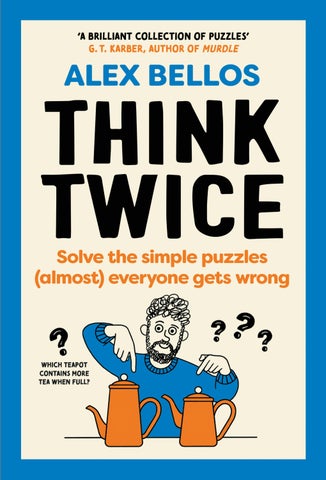
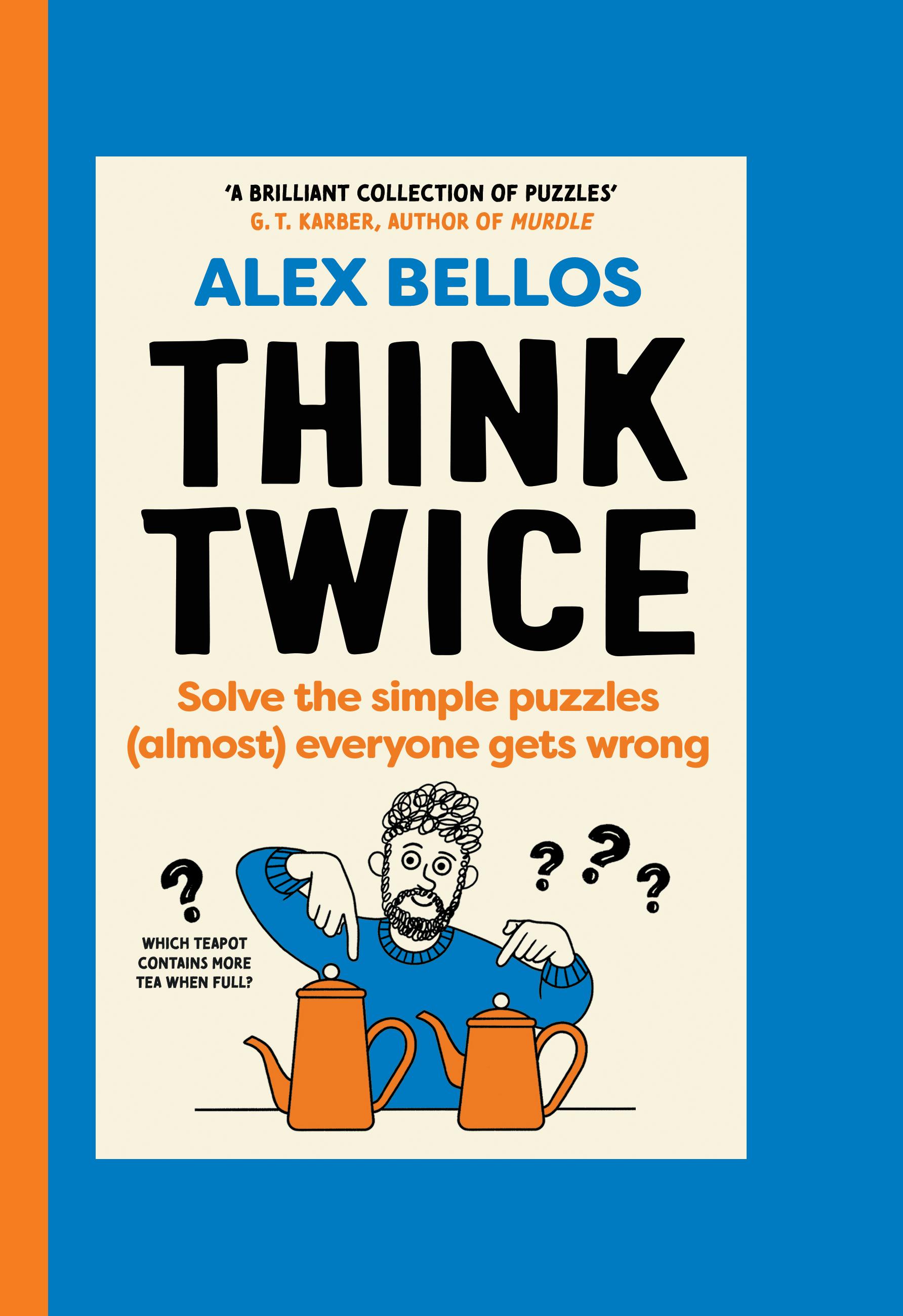
THINK TWICE
THINK TWICE
SOLVE THE SIMPLE PUZZLES (ALMOST)
EVERYONE GETS WRONG
Alex Bellos
Square Peg, an imprint of Vintage, is part of the Penguin Random House group of companies whose addresses can be found at global.penguinrandomhouse.com
First published by Square Peg in 2024
Copyright © Alex Bellos 2024
Alex Bellos has asserted his right to be identi ed as the author of this Work in accordance with the Copyright, Designs and Patents Act 1988
Illustrations © Arnaud Boutin 2024
Design © Dan Prescott at Couper Street Type Co.
penguin.co.uk/vintage
Printed and bound in Great Britain by Clays Ltd, Elcograf S.p.A.
The authorised representative in the EEA is Penguin Random House Ireland, Morrison Chambers, 32 Nassau Street, Dublin D02 YH68
A CIP catalogue record for this book is available from the British Library
ISBN 9781529934793
Penguin Random House is committed to a sustainable future for our business, our readers and our planet. This book is made from Forest Stewardship Council® certi ed paper.
To Gabriel H. S., always asking for new maths problems
Introduction
I hope you get the answers wrong to every puzzle in this book.
Reader, don’t let me down. I’m being honest. The more questions you answer incorrectly, the more fun you will have.
In the following pages are 70 of my favourite puzzles for which people invariably come to the wrong conclusions. When I rst encountered these problems, I too fell into the traps they set. My intuitions were shaky, my lines of thought easily misdirected, my logical sharpness embarrassingly blunt.
Yet when I saw the answers, each time the ‘aha!’ moment brought a giddy joy. The absurdity of my wrong thinking was such that I slapped my forehead with a beaming smile. These brainteasers are the most pleasurable and lifea rming type of puzzle. The ease with which they reliably provoke an erroneous answer sparks a wonder about the way in which we humans tend to think, reason and perceive, and also a wonder about the world itself.
I’ve chosen simple puzzles; that is, questions that are succinct, easy to understand and for which there is a single clear answer – usually yes/no, or one of a multiple choice. And I have chosen puzzles that tend to stump people at rst; that is, questions and problems with counterintuitive or confounding answers and solutions. These puzzles are not ones for which you can’t gure out an answer, they are ones where you quite quickly come to an answer, and that answer is wrong. Despite their simplicity, however, many of these puzzles touch on deep ideas.
In some cases, the claim that most people answer incorrectly is backed by data. In 2016, for example, I set the puzzle ‘Wandering Eyes’ (page 13) in my online puzzle column for the Guardian newspaper, under the headline: ‘The logic question almost everyone gets wrong.’ More than 200,000 readers submitted an answer, and more than 72 per cent proved the headline to be true. In other words, I warned a self-selecting audience of puzzle-lovers that they would make a mistake, and most of them did.
That puzzle was my most viewed column until 2023, when I set ‘Card Sharp’ (in the rst colour plate section) with the almost identical headline: ‘The simple puzzle almost everyone gets wrong.’ It notched up millions of views, and was the Guardian’s most viewed, most shared and most commented article that day. People, I realised, cannot resist a challenge to their intelligence.
Now you have been warned that you will fail the tests in this book, is there anything more likely to make you want to prove me wrong?
I have sourced these conundrums from scienti c journals, books, my own experience as a puzzle setter and lecturer, and my circle of teachers, magicians and friends. I’ve taken problems from psychology, mathematics, statistics, physics, geography, the science of perception, and more. I’ve avoided trick questions, such as puzzles that rely on ambiguous phrasing and thus are designed to make you feel foolish. Instead, I have chosen puzzles that celebrate seemingly paradoxical or unexpected results. That pit gut instinct against measured re ection. That toy with our inbuilt
biases and the many assumptions we make about our environment. That catch us o guard. The best puzzles always have an element of surprise.
To get these posers right rst time you will have to overrule your intuition. Think once and you will stumble. Think twice and you are in with a chance. Given that you know I want you to fall into the traps I have set, however, the problems provide a layered challenge. Not only am I asking you to solve a puzzle, but I am asking you to solve a puzzle about a puzzle. The meta-problem is to unpick the deception, to understand why the solution that feels correct is most reliably not. What is the right answer? What is the answer that most people give? And just why are we fooled? These are problems that lend themselves to be solved in a group, shared, discussed, and chewed upon.
The problems are in random order. If I had grouped them by subject, you would begin to know what to look out for. The experience would be less entertaining. Enjoy this book as you would a box of chocolates: you will not know in
advance what avour of problem you are going to encounter, but you will nd them moreish, each one whetting your appetite for further problem-solving and debate. Likewise, the level of trickiness varies throughout the book. My aim is to keep you all on your toes. The answers to each question are presented immediately as you turn the page, on the lefthand side, along with some thoughts on the kind of mistakes we consistently make. Puzzles, of course, provide eeting moments of fun. But they are also brain-sharpening tools. They provide a safe space to be duped, giving us the smarts not to be hoodwinked in the future. Once we learn the mistake, and why we made it, we are unlikely to make it again. By playfully reminding us of our own fallibility, the puzzles in this book teach us how to think more clearly.
Embrace the misdirection. Delight in the deception.
I have faith in you to stumble at every hurdle –I know you can do it if you really put your minds to it!
Silly Sum
In this puzzle you are going to be adding up numbers in your head.
Start with a thousand.
Add forty.
Add another thousand.
Add thirty.
Add another thousand.
Add twenty.
Add another thousand.
Now add ten.
What’s the answer?
Did you think the answer was 5,000?
Most people do, and they are wrong. If you were writing this sum down, however, you probably wouldn’t make the same mistake:
When you do the sum quickly in your head, it is easy to muddle the hundreds and thousands column. Adding 10 to 90 makes 100, of course, so the answer is 4,100 rather than 5,000.
Teapot Trouble
Which teapot contains more tea when full?
The shorter teapot on the left holds more tea when the pots are full because it has a higher spout. The level of tea in a full pot is the level of the spout, and can never exceed this level, because if it did, the tea would over ow and leak out.
However, if you somehow blocked the spouts, then the taller teapot would hold more tea, since you would be able to ll it up to its full volume.
To take advantage of a high teapot with a low, unblocked spout, you might think of installing an internal chamber with a high mouth by the spout, as below. The tea in the main section of the pot now will ll up to the height of the chamber.
Pint-sized Problem
Which is longer: the height of a pint glass, or the circumference of its rim?
Surprisingly, the circumference is longer, and by quite a way. For a traditional pint glass – the one with the bulge just before the top rim, known as the ‘nonic pint glass’ and illustrated on the previous page – the circumference is almost double the height!
The rim of a traditional pint glass has a diameter of just under 9 cm, which gives it a circumference of just over 27 cm. (The circumference is pi, or 3.14 to two decimal places, times the diameter.) The height of a traditional pint glass is only about 15 cm.
Even the higher style of pint glasses, such as the ones used for continental beers, have longer circumferences. The tall Peroni pint glass, for example, has a diameter of 8 cm, giving it a circumference of just over 25 cm, compared with a height of 24 cm.
Moral: we are bad at intuiting circumferences. We are used to measuring straight lines, so when we look at a glass side-on we see the circumference as from left to right and back again. But the circumference is not double the diameter – it is more than three times as long.
Wandering Eyes
Jack is looking at Anne, but Anne is looking at George. Jack is married, but George is not.
Is a married person looking at an unmarried person?
a) Yes
b) No
c) Cannot be determined
a) Yes. A married person is looking at an unmarried person.
When I set this puzzle in my Guardian column in 2016, 200,000 people responded and only 28 per cent of them got the right answer. That was actually a pretty good result, since it is said that only 20 per cent of people get it right – by far the most common response is c).
I knew my readers were a smart bunch!
This is the explanation:
We don’t know the marital status of Anne. But she is either married or unmarried. If she is married, then a married person (Anne) is looking at an unmarried one (George). If she is not married, then a married person (Jack) is looking at an unmarried one (Anne). So, whatever Anne’s marital status, a married person is looking at an unmarried one.
This puzzle was written by Hector Levesque, Professor
Emeritus
at the
Department
of Computer Science at the University of Toronto, and is much discussed in psychology studies.