VOGUE
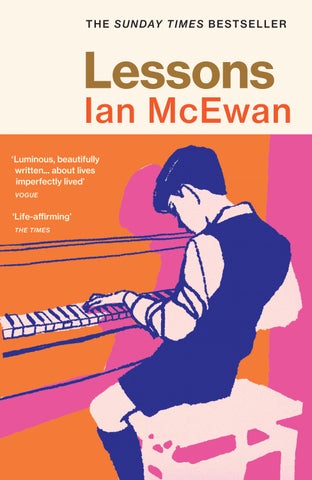
Lessons

Ian McEwan
THE TIMES
‘Luminous, beautifully written... about lives imperfectly lived’
‘Life-affirming’
THE
TIMES BESTSELLER
SUNDAY
‘Deep, life-affirming and A-grade storytelling’
The Times
‘Lessons is a luminous, beautifully written and gripping book about lives imperfectly lived’
Vogue
‘An amazing capacious generous brilliant novel’
Claire Messud
‘Astonishing . . . beguiling and irresistible . . . A masterpiece’
USA Today
‘Deeply absorbing . . . Readers will follow [Roland] every step of the way’
The Economist
‘Moving and masterful . . . The story of a life and of a century whose events have moulded it’
Irish Independent
‘Lessons triumphantly achieves its primary aim of conveying the “commonplace and wondrous” intertwining of global history and everyday life’
Daily Telegraph
‘Superb . . . A wonderful author has delivered another mesmerising, memorable novel’
Independent
IAN McEWAN
Ian McEwan is the critically acclaimed author of twenty books. His first published work, a collection of short stories, First Love, Last Rites, won the Somerset Maugham Award. His novels include The Child in Time, which won the 1987 Whitbread Novel of the Year Award; The Cement Garden; Enduring Love; Amsterdam, which won the 1998 Booker Prize; Atonement; Saturday; On Chesil Beach; Solar; Sweet Tooth; The Children Act; Nutshell; and Machines Like Me, which was a number-one bestseller. Atonement, Enduring Love, The Children Act and On Chesil Beach have all been adapted for the big screen.
ALSO BY IAN McEWAN
First Love, Last Rites
In Between the Sheets
The Cement Garden
The Comfort of Strangers
The Child in Time
The Innocent Black Dogs
The Daydreamer
Enduring Love
Amsterdam
Atonement
Saturday
On Chesil Beach
Solar
Sweet Tooth
The Children Act
Nutshell
Machines Like Me
The Cockroach
IAN McEWAN Lessons
Vintage is part of the Penguin Random House group of companies whose addresses can be found at global.penguinrandomhouse.com
First published by Vintage in 2023
First published in hardback by Jonathan Cape in 2022
Copyright © Ian McEwan 2022
Ian McEwan has asserted his right to be identified as the author of this Work in accordance with the Copyright, Designs and Patents Act 1988
Ian McEwan is an unlimited company registered in England and Wales number 7473219
penguin.co.uk/vintage
A CIP catalogue record for this book is available from the British Library
B-format ISBN 9781529116311
A-format ISBN 9781529116328
Typeset in 10.44/13.05pt Palatino LT Pro by Jouve (UK), Milton Keynes
Printed and bound in Great Britain by Clays Ltd, Elcograf S.p.A.
The authorised representative in the EEA is Penguin Random House Ireland, Morrison Chambers, 32 Nassau Street, Dublin D02 YH68
Penguin Random House is committed to a sustainable future for our business, our readers and our planet. This book is made from Forest Stewardship Council® certified paper.
1 3 5 7 9 10 8 6 4 2
To my sister, Margy Hopkins, and my brothers, Jim Wort and David Sharp
First we feel. Then we fall.
James Joyce, Finnegans Wakepart one
Thiswas insomniac memory, not a dream. It was the piano lesson again – an orange-tiled floor, one high window, a new upright in a bare room close to the sickbay. He was eleven years old, attempting what others might know as Bach’s first prelude from Book One of The Well-tempered Clavier, simplified version, but he knew nothing of that. He didn’t wonder whether it was famous or obscure. It had no when or where. He could not conceive that someone had once troubled to write it. The music was simply here, a school thing, or dark, like a pine forest in winter, exclusive to him, his private labyrinth of cold sorrow. It would never let him leave.
The teacher sat close by him on the long stool. Round-faced, erect, perfumed, strict. Her beauty lay concealed behind her manner. She never scowled or smiled. Some boys said she was mad, but he doubted that.
He made a mistake in the same place, the one he always made, and she leaned closer to show him. Her arm was firm and warm against his shoulder, her hands, her painted nails, were right above his lap. He felt a terrible tingling draining his attention.
‘Listen. It’s an easy rippling sound.’
But as she played, he heard no easy rippling. Her perfume overwhelmed his senses and deafened him. It was a rounded cloying scent, like a hard object, a smooth river stone, pushing in on his thoughts. Three years later he learned it was rosewater.
‘Try again.’ She said it on a rising tone of warning. She was
3 1
musical, he was not. He knew that her mind was elsewhere and that he bored her with his insignificance – another inky boy in a boarding school. His fingers were pressing down on the tuneless keys. He could see the bad place on the page before he reached it, it was happening before it happened, the mistake was coming towards him, arms outstretched like a mother, ready to scoop him up, always the same mistake coming to collect him without the promise of a kiss. And so it happened. His thumb had its own life.
Together, they listened to the bad notes fade into the hissing silence.
‘Sorry,’ he whispered to himself.
Her displeasure came as a quick exhalation through her nostrils, a reverse sni he had heard before. Her fingers found his inside leg, just at the hem of his grey shorts, and pinched him hard. That night there would be a tiny blue bruise. Her touch was cool as her hand moved up under his shorts to where the elastic of his pants met his skin. He scrambled o the stool and stood, flushed.
‘Sit down. You’ll start again!’
Her sternness wiped away what had just happened. It was gone and he already doubted his memory of it. He hesitated before yet another of those blinding encounters with the ways of adults. They never told you what they knew. They concealed from you the boundaries of your ignorance. What happened, whatever it was, must be his fault and disobedience was against his nature. So he sat, lifted his head to the sullen column of treble clefs where they hung on the page and he set o again, even more unsteadily than before. There could be no rippling, not in this forest. Too soon he was nearing that same bad place. Disaster was certain and knowing that confirmed it as his idiot thumb went down when it should have stayed still. He stopped. The lingering discord sounded like his name spoken out loud. She took his chin between knuckle and thumb and turned his face towards hers. Even her breath was scented.
LESSONS 4
Without shifting her eyes from his, she reached for the twelveinch ruler from the piano lid. He was not going to let her smack him but as he slid from the stool he didn’t see what was coming. She caught him on his knee, with the edge, not the flat, and it stung. He moved a step back.
‘You’ll do as you’re told and sit down.’ His leg was burning but he wouldn’t put his hand to it, not yet. He took a last look at her, at her beauty, her tight highnecked pearl-buttoned blouse, at the fanned diagonal creases in the fabric formed by her breasts below her correct and steady gaze.
He ran from her down a colonnade of months until he was thirteen and it was late at night. For months she had featured in his pre-sleep daydreams. But this time it was di erent, the sensation was savage, the cold sinking in his stomach was what he guessed people called ecstasy. Everything was new, good or bad, and it was all his. Nothing had ever felt so thrilling as passing the point of no return. Too late, no going back, who cared? Astonished, he came into his hand for the first time. When he had recovered he sat up in the dark, got out of bed, went into the dormitory lavatories, ‘the bogs’, to examine the pale globule in his palm, a child’s palm. Here his memories faded into dreaming. He went closer, closer, through the glistening universe to a view from a mountain summit above a distant ocean like the one fatty Cortés saw in a poem the whole class wrote out twenty-five times for a detention. A sea of writhing creatures, smaller than tadpoles, millions on millions, packed to the curved horizon. Closer still until he found and followed a certain individual swimming through the crowd on its journey, jostling with siblings down smooth pink tunnels, overtaking the rest as they fell away exhausted. At last he arrived alone before a disc, magnificent like a sun, turning slowly clockwise, calm and full of knowledge, waiting indi erently. If it wasn’t him it would be someone else. As he entered through thick blood-red curtains
IAN M c EWAN 5
there came from a distance a howl then a sunburst of a crying baby’s face.
He was a grown man, a poet, he liked to think, with a hangover and a five-day stubble, rising from the shallows of recent sleep, now stumbling from bedroom to the wailing baby’s room, lifting it from its cot and holding it close.
Then he was downstairs with the child asleep against his chest beneath a blanket. A rocking chair, and by it on a low table a book he had bought about world troubles which he knew he would never read. He had troubles of his own. He faced French windows and he was looking down a narrow London garden through a misty wet dawn to a sole bare apple tree. To its left was an upturned green wheelbarrow, not moved since some forgotten day in summer. Nearer was a round metal table he always intended to paint. A cold late spring concealed the tree’s death and there would be no leaves on it this year. In a hot three-week drought that had begun in July he could have saved it, despite the hosepipe ban. But he had been too busy to haul full buckets the garden’s length.
His eyes were closing and he was tilting backwards, remembering once more, not sleeping. Here was the prelude as it should be played. It had been a long time since he was here, eleven again, walking with thirty others towards an old Nissen hut. They were too young to know how miserable they were, too cold to talk. Collective reluctance moved them in time like a corps de ballet as they went down a steep grass slope in silence to line up outside in the mist and wait obediently for the class to begin.
Inside, dead centre, was a coke-burning stove and once they were warm they became riotous. It was possible here, not elsewhere, because the Latin teacher, a short and kindly Scot, could not control the class. On the blackboard, in the master’s hand: Exspectata dies aderat. Below it, the clumsy writing of a boy: The long-awaited day had arrived. In this same hut, so they had been taught, men in more serious times once prepared for war at sea,
LESSONS 6
learning the mathematics of laying mines. That was their prep. While here, now, a large boy, a famous bully, swaggered to the front to bend, leering, and o er his satirical backside to be ineffectually beaten with a plimsoll by the gentle Scot. There were cheers for the bully, for no one else would dare so much.
As the din and chaos mounted and something white was chucked across the desks, he remembered, it was Monday and the long-awaited and dreaded day had arrived – again. On his wrist was the thick watch his father gave him. Don’t lose it. In thirty-two minutes it would be piano lesson. He tried not to think of the teacher because he had not practised. Too dark and scary in the forest to arrive at the place where his thumb went blindly down. If he thought of his mother he’d go weak. She was far away and couldn’t help him so he pushed her aside too. No one could stop Monday coming round. Last week’s bruise was fading, and what was it, to remember the piano teacher’s scent? It was not the same as smelling it. More like a colourless picture, or a place, or a feeling for a place or something in between. Beyond dread was another element, excitement, he must also push away.
To Roland Baines, the sleep-deprived man in the rocking chair, the waking city was no more than a remote rushing sound, swelling with the passing minutes. Rushing hour. Expelled from their dreams, their beds, people were moving through the streets like the wind. Here, he had nothing to do but be a bed for his son. Against his chest he felt the baby’s heartbeat, just under twice the rate of his own. Their pulses fell in and out of phase, but one day they would be always out. They would never be this close. He would know him less well, then even less. Others would know Lawrence better than he did, where he was, what he was doing and saying, growing closer to this friend, then this lover. Crying sometimes, alone. From his father, occasional visits, a sincere hug, catch up on work, family, some politics, then goodbye. Until then, he knew everything about him, where he was in every minute, in every
IAN M c EWAN 7
place. He was the baby’s bed and his god. The long letting go could be the essence of parenthood and from here was impossible to conceive.
Many years had passed since he let go of the eleven-yearold boy with the secret oval mark on his inner thigh. That evening he had examined it after lights out, lowering his pyjamas in the bogs, bending to look closer. Here was the impression of her finger and thumb, her signature, a written record of the moment that made it true. A photograph of sorts. It didn’t hurt when he ran his own finger around the borders where pale skin shaded greenish into blue. He pushed down hard, right in the centre where it was almost black. It didn’t hurt.
In the weeks that followed his wife’s vanishing, the visits from the police and the sealing of the house, he often tried to account for the haunting on that night he was suddenly alone. Fatigue and stress had pushed him back on origins, on first principles, the endless past. It would have been worse if he had known what lay ahead – many visits to a careworn o ce, much waiting with a hundred others on plastic benches bolted to the floor for his number to be called, multiple interviews pleading his case while Lawrence H. Baines squirmed and babbled on his lap. Finally he won some state aid, a single-parent’s stipend, a widower’s mite, though she wasn’t dead. When Lawrence was one year old, there would be a nursery place for him while his father took up a chair – in a call centre or similar. Professor of Helpful Listening. Completely reasonable. Would he let others toil to support him while he languished all afternoon over his sestinas? There was no contradiction. It was an arrangement, a contract he accepted – and hated.
What happened long ago in a small room by the sickbay had been as calamitous as his present fix but he kept going, now as then, outwardly almost OK . What could destroy him was from the inside, the feeling of being in the wrong. If he had
LESSONS 8
*
been a misguided child to feel that then, why indulge the guilty feeling now? Blame her, not himself. He came to know her postcards and her note by heart. By convention, such notes were left on the kitchen table. She had left hers on his pillow, like a hotel’s bitter chocolate. Don’t try to find me. I’m OK. It’s not your fault. I love you but this is for good. I’ve been living the wrong life. Please try to forgive me. On the bed, on her side, were her house keys.
What kind of love was this? Was giving birth the wrong life? It was usually after a serious drink that he fixed on and loathed the final sentence she had failed to complete. Please try to forgive me, she should have said, as I have forgiven myself. The self-pity of the absconder against the bitter clarity of the leftbehind, the abscondee. It hardened with each finger of Scotch. Another invisible finger that beckoned. He hated her progressively and every thought was a repeat, a variation on the theme of her self-loving desertion. After an hour of forensic reflection, he knew the tipping point was not far ahead, the pivot in the evening’s mental work. Almost there, pour another. His thoughts were slowing and then they abruptly stopped for no reason at all, like the train in the poem that their class had to learn by heart on pain of punishment. A hot day at a Gloucestershire halt and stillness into which someone coughs. Then it would come to him again, the lucid notion as clear and keen as birdsong close by. He was drunk at last and liberated into loving her again and wanting her back. Her remote seraphic beauty, the frailty of her small-boned hands, and her voice barely inflected from a German childhood, a little husky, as though from a bout of shouting. But she had never shouted. She loved him, so the blame must be his and it was sweet of her to tell him in her note that it was not. He didn’t know which defective part of himself to indict, so it must be all of him.
Woozily contrite, in a sad-sweet cloud, he would make ruminative progress up the stairs, check on the baby, fall asleep, sometimes fully clothed, across the bed, to wake in the arid
IAN M c EWAN 9
small hours, exhausted and alert, furious and thirsty, totting up in the dark his virtues and how he was wronged. He earned nearly as much as she did, had put in his half-share with Lawrence, including nights, was faithful, loving, never tried it on as the poet-genius living by special rules. So he had been a fool, a sap, and that was why she had left, for a real man perhaps. No, no, he was good, he was good and he hated her. This is for good. He had run full circle – again. The closest he could come to sleep now was to lie on his back, eyes closed, listening out for Lawrence, otherwise lost to memories, desires, inventions, even passable lines he had no will to write down, for an hour, and another, then a third, into the dawn. Soon he would replay once more the visit from the police, the suspicion that lay on him, the poisonous cloud he had sealed the house against and whether the job needed doing again. This worthless process had brought him back one night to the piano lesson. The echoey room he had stumbled into and where he was forced to watch.
Through Latin and French he had learned about tenses. They had always been there, past, present, future, and he hadn’t noticed how language divided up time. Now he knew. His piano teacher was using the present continuous to condition the near future. ‘You’re sitting straight, your chin is up. You’re holding your elbows at right angles. Fingers are ready, slightly bent, and you’re letting your wrists stay soft. You are looking directly at the page.’
He also knew what right angles were. Tenses, angles, how to spell continuous. These were elements of the real world his father had sent him 2,000 miles away from his mother to learn. There were matters of adult concern, millions of them, that one by one would be his. When he arrived from the Latin lesson, breathless and on time, the piano teacher interrogated him about his week of practice. He lied to her. Then she sat close again. She wrapped her perfume around him. The mark she had made on his leg last week had faded and his memory of
LESSONS 10
what happened was uncertain. But if she tried to hurt him again he would run from the room without pausing. It was a kind of strength, a murmur of excitement in his chest, to pretend to her that he had practised for three hours during the week. The truth was zero, not even three minutes. He had never deceived a woman before. He had lied to his father, whom he feared, to get out of trouble, but he had always told his mother the truth.
The teacher softly cleared her throat, which indicated that she believed him. Or perhaps it didn’t.
She whispered, ‘Good. O you go.’
The large thin book of easy pieces for beginners was open at the centre. For the first time he noticed the three staples in the crease that held the book together. These did not have to be played – the stupid thought almost made him smile. The stern upright loop of the treble clef, the bass clef coiled like the foetus of a rabbit in his biology book, the black notes, the clear white ones you held for longer, this grubby dog-eared double page that was his own special punishment. None of it now looked familiar or even unfriendly.
When he started, his first note was twice the volume of the second. He moved warily to the third note and the fourth and gathered speed. It was caution, and then it felt like stealth. Not practising had set him free. He obeyed the notes, left hand with right and ignored the pencilled fingerings. He had nothing to remember but to press the keys in the correct order. The bad place was suddenly on him but his left thumb forgot to go down and then it was too late, he was already clear, on the other side, moving smoothly across the level ground above the forest where the light and space were cleaner, and for a stretch he thought he could discern the hint of a melody suspended like a joke above his steady march of sounds.
Following instructions, two, perhaps three, every second needed all his concentration. He forgot himself, and even forgot her. Time and place dissolved. The piano vanished along
IAN M c EWAN 11
with existence itself. It was as if he were waking from a night’s sleep when he found himself at the end, playing with two hands an easy open chord. But he didn’t take his hands away as the breve on the page told him he should. The chord resounded and diminished in the bare little room.
He didn’t let go when he felt her hand on his head, even when she pressed down hard to rotate his face in her direction. Nothing in her expression told him what would happen next.
She said quietly, ‘You . . .’
That was when he lifted his hands from the keys.
‘You little . . .’
In a complicated movement, she lowered and inclined her head, so that her face approached his in a swooping arc that ended in a kiss, her lips full on his, a soft prolonged kiss. He neither resisted nor engaged. It happened and he let it happen and felt nothing while it lasted. Only in retrospect, when he lived and relived and animated the moment in solitude, did he get the measure of its importance. While it lasted, her lips were on his and he numbly waited for the moment to pass. Then there was a sudden distraction and it ended. A flash of a passing shadow or movement had fallen across the high window. She pulled away and turned to look, as he did. They had both seen or sensed it at the same time, on the edge of vision. Was it a face, a disapproving face and shoulder? But the small square window showed them only ragged cloud and scraps of pale winter blue. He knew that from the outside the window was too high for even the tallest adult to reach. It was a bird, probably a pigeon from the dovecote in the old stable block. But teacher and pupil had separated guiltily and though he understood little, he knew that they were now united by a secret. The empty window had rudely invoked the world of people outside. He also understood how impolite it would have been to raise a hand to his mouth to relieve the prickling sensation of drying moisture.
She turned back to him and in a steady calming voice that
LESSONS 12
suggested she had no concern for the prying world, looked deep into his eyes as she spoke, this time in a kindly voice in the future tense, which she used to make the present seem reasonable. And now it was. But he had never heard her say so much.
‘Roland, in two weeks there’s a half-day holiday. It falls on a Friday. I want you to listen carefully. You’ll come on your bike to my village. Erwarton. Coming from Holbrook, it’s after the pub, on the right, with a green door. You’re going to come in time for lunch. Do you understand?’
He nodded, understanding nothing. That he should cycle across the peninsula by narrow lanes and farm tracks to her village for lunch when he could eat at school ba ed him. Everything did. At the same time, despite his confusion, or because of it, he longed to be alone to feel and think about the kiss.
‘I’ll send you a card to remind you. From now on you’ll have your lessons with Mr Clare. Not me. I’ll tell him you’re making excellent progress. So, young man, we are going to do major and minor scales with two sharps.’
Easier to ask where than why. Where did she go? Four hours passed before he reported Alissa’s note and disappearance to the police. His friends thought that even two hours was too long. Phone them now! He resisted, he held out. It was not only that he preferred to think she could return at any minute. He did not want a stranger reading her note or her absence ocially confirmed. To his surprise someone came round the day after his call. He was a local police constable and seemed hardpressed. He took a few details, glanced at Alissa’s note and said that he would report back. Nothing happened for a week and in that time her four postcards arrived. The specialist came unannounced in the early morning in a tiny patrol car which he parked illegally outside the house. It had been raining heavily
IAN M c EWAN 13
*
but he was oblivious to the trail his shoes left across the hallway floor. Detective Inspector Douglas Browne, the flesh of whose cheeks hung in swags, had the friendly aspect of a large brown-eyed dog. He sat hunched at the kitchen table across from Roland. By the detective’s immense hands, their knuckles matted with dark hair, were his own notebook, the postcards and the pillow note. A thick overcoat, which he did not remove, added to his bulk and enhanced the canine e ect. Around both men was a litter of dirty plates and cups, junk mail, bills, a nearempty feeding bottle and the smeared leftovers of Lawrence’s breakfast and his bib. These were what one of Roland’s male friends called the slime years. Lawrence was in his high chair, unusually silent, gazing in awe at this hulk of a man and his outsized shoulders. At no point during the meeting did Browne acknowledge the baby’s existence. Roland felt faintly o ended on his son’s behalf. Irrelevant. The o cer’s soft brown eyes were on the father alone and Roland was obliged to answer routine questions. The marriage was not in di culty – he said this louder than he intended. No money had been removed from the joint account. It was still the holidays, so the school where she worked wouldn’t know she had left. She had taken a small black suitcase. Her coat was green. Here were some photographs, her date of birth, her parents’ names and address in Germany. She might have worn a beret. The detective was interested in the most recent card, from Munich. Roland didn’t think she knew anyone there. Berlin yes, and Hanover and Hamburg. She was a woman of the Lutheran north. When Browne raised an eyebrow, Roland told him that Munich was in the south. Perhaps it was the name of Luther he should have explained. But the detective looked down at his notebook and asked another question. No, Roland said, she had never done anything like this before. No, he didn’t have a copy of her passport details. No, she had not seemed depressed lately. Her parents lived near Nienburg, a small town, also in north Germany. When he had phoned them about
LESSONS 14
another matter, it became clear she hadn’t been there. He had told them nothing. Her mother, a icted by chronic resentments, would have erupted at this news of her only child. Desertion. How dare she! Mother and daughter habitually squabbled. But his parents-in-law and his own parents would have to be told. Alissa’s first three postcards, from Dover, Paris then Strasbourg, had come in four days. The fourth, the Munich card, came two days later. Since then, nothing.
Detective Inspector Browne studied the postcards again. Each one the same. All fine. Don’t worry. Kiss Larry for me. xx Alissa. The invariance seemed deranged or hostile, as did the loveless sign-o . A plea for help or a form of insult. Same blue felt-tipped pen, no dates, illegible postmarks, Dover apart, the same bland city view of bridges over the Seine, the Rhine, the Isar. Mighty rivers. She was drifting eastwards, ever further from home. The night before, on the edge of sleep, Roland summoned her as Millais’ drowned Ophelia, bobbing on the Isar’s smooth clean waters past Pupplinger Au with its naked bathers sprawled on the grassy shores like beached seals; on her back, head first, floating downstream, unseen and silent through Munich, past the English Garden to the Danube confluence, then unremarked through Vienna, Budapest and Belgrade, through ten nations and their savage histories, along the borders of the Roman Empire, to the white skies and boundless delta marshes of the Black Sea, where he and she once made love in the lee of an old mill in Letea and saw near Isaccea a flock of rowdy pelicans. Only two years ago. Purple herons, glossy ibis, a greylag goose. Until then he had never cared about birds. That evening before sleep, he had drifted away with her to a locus of wild happiness, a source. Lately, it was an e ort of concentration to remain long in the present. The past was often a conduit from memory to restless fantasising. He put it down to tiredness, hangover, confusion.
Douglas Browne was saying consolingly as he bent to his notebook, ‘When my wife had had enough, she chucked me out.’
IAN M c EWAN 15
Roland started to speak but Lawrence cut in with a squawk. A demand to be included. Roland stood to unstrap him from his chair and settled him on his lap. A new angle, face to face, on the giant stranger silenced the baby again. He gazed fiercely, open-mouthed and dribbling. No one could know what passed through the mind of a seven-month-old. A shaded emptiness, a grey winter sky against which impressions – sounds, sights, touch – burst like fireworks in arcs and cones of primary colour, instantly forgotten, instantly replaced and forgotten again. Or a deep pool into which everything fell and disappeared but remained, irretrievably present, dark shapes in deep water exercising their gravitational pull even eighty years later, on deathbeds, in last confessions, in final cries for lost love.
After Alissa left he had watched his son for signs of sorrow or damage and found them at every turn. A baby must miss its mother, but how if not in memory? Sometimes Lawrence was silent for too long. Shocked, numbed, scar tissue forming within hours in the lower regions of the unconscious, if such a place or process existed? Last night he had screamed too hard. Enraged by what he couldn’t have, even as he forgot what it was. Not the breast. He was bottle-fed from the start at his mother’s insistence. Part of her plan, Roland thought in bad moments.
The detective inspector finished with his notebook. ‘You understand that if we find Alissa, we can’t tell you where she is without her permission.’
‘You can tell me if she’s alive.’
He nodded and thought for a moment. ‘Generally, when a missing wife’s dead it’s the husband that’s killed her.’
‘Then let’s hope she’s alive.’
Browne straightened and rocked back just a little in his chair, miming surprise. For the first time he smiled. He seemed friendly. ‘It often goes like this. So. He does her in, disposes of the body, down in the New Forest say, lonely spot, shallow grave, reports her missing, then what?’
‘What?’
LESSONS 16
‘Then it starts. Suddenly he realises, she was adorable. They loved each other. He misses her and he begins to believe his own story. She’s done a runner. Or a psychopath has done her in. He’s tearful, depressed, then he’s furious. He’s not a murderer, he’s not lying, not as he sees it now. She’s gone and he really feels it. And to the rest of us it looks real. It looks honest. Hard to crack, those ones.’
Lawrence’s head lolled against his father’s chest, and he began to doze. Roland didn’t want the detective to leave just yet. When he did it would be time to clean up the kitchen. Sort out the bedrooms, the laundry, the dirty trail in the hall. Make a list for the shops. All he wanted was to sleep. He said, ‘I’m still at the missing her stage.’
‘Early days, sir.’
At that, both men began to laugh quietly. As if it was fun and they were old friends. Roland was well disposed towards the collapsed face, its soft hangdog look of infinite wear and tear. He respected the detective’s impulse to sudden confidences.
After a silence Roland said, ‘Why did she throw you out?’
‘Worked too hard, drank too much, late every night. Ignored her, ignored the kids, three lovely boys, had a lady on the side which someone told her about.’
‘Well shot of you then.’
‘That’s what I thought. I was about to become one of those blokes with two households. You hear about them. The old doesn’t know about the new, the new is jealous of the old and you’re running between them with a white-hot poker up your arse.’
‘Now you’re with the new.’
Browne sighed loudly through his nostrils as he looked away and scratched his neck. The self-made hell was an interesting construct. Nobody escaped making one, at least one, in a lifetime. Some lives were nothing but. It was a tautology that self-inflicted misery was an extension of character. But Roland
IAN M c EWAN 17
often thought about it. You built a torture machine and climbed inside. Perfect fit, with a range of pain on o er: from certain jobs, or a taste for drink, drugs, from crime coupled with a knack of getting caught. Austere religion was another choice. An entire political system could opt for self-imposed distress – he had once spent some time in East Berlin. Marriage, a machine for two, presented king-sized possibilities, all variants of the folie à deux. Everyone knew some examples and Roland’s was a crafty construction. His good friend, Daphne, had laid it out for him one evening, long before Alissa left, when he confessed to months of feeling low. ‘You did brilliantly at the evening classes, Roland. All those subjects! But everything else you tried, you wanted to be the best in the world. Piano, tennis, journalism, now poetry. And these are only the ones I happen to know about. As soon as you discover you’re not the best, you throw it in and hate yourself. Same with relationships. You want too much and move on. Or she can’t stand the pursuit of perfection and chucks you out.’
Into the detective’s silence Roland rephrased his question. ‘So, new lady or old, what is it you really want?’
Soundlessly, Lawrence was crapping in his sleep. The odour wasn’t so bad. One of the discoveries of middle life – how soon you came to tolerate the shit of the one you loved. A general rule.
Browne gave the question serious thought. His gaze moved distractedly around the room. He saw chaotic bookshelves, magazine piles, a broken kite on top of a cupboard. Now, with elbows on the table and head lowered, he stared down into the grain of the pine while he massaged the back of his neck with both hands. Finally, he straightened.
‘What I really want is a sample of your handwriting. Anything. A shopping list will do.’
Roland let a wavelet of nausea rise and fall. ‘You think I wrote these messages?’
A mistake, after a heavy night, to have skipped breakfast.
LESSONS 18
No slice of buttery toast and honey to set against hypoglycaemia. Too busy dealing with Lawrence. Then tremulous hands made the co ee come out triple strength.
‘A note to the milkman would be fine.’
From the pocket of his coat Browne brought out a boxy leather object on a strap. With grunts and a sigh of exasperation, he freed a camera from its worn case, a task which involved turning a silver screw too small for his fat fingers. It was an old Leica, 35 millimetre, silver and black with dents in its body. He kept his eyes on Roland and made a purse-lipped smile as he unclipped the lens cap.
He stood. With pedantic attention he arranged the four cards and the note in a row. When all had been snapped, both sides, and the camera was back in his pocket, he said, ‘Marvellous, this new fast film. Go anywhere. Interested?’
‘I used to be keen.’ Then Roland added, accusingly, ‘As a kid.’
Browne took from the other pocket of his coat a sheaf of plastic. One by one, he picked up the postcards by a corner, and slid them into four transparent envelopes, which he sealed with a pinch. Into the fifth he put the pillow note. It’s not your fault. He sat down and made a neat pile, squaring it o with his big hands.
‘If you don’t mind, I’ll take these along with me.’
Roland’s heart was beating so hard that he was beginning to feel refreshed. ‘I do mind.’
‘Fingerprints. Very important. You’ll get them back.’
‘They say things get lost in police stations.’
Browne smiled. ‘Let’s take a tour of the house. So, we need your handwriting, item of her clothing, something with just her prints on it and uh, what was it? A sample of her writing.’
‘You already have it.’
‘Something historic.’
Roland stood with Lawrence in his arms. ‘Perhaps it was a mistake getting you involved in a personal matter.’
IAN M c EWAN 19
The detective was already leading the way towards the stairs. ‘Perhaps it was.’
When they reached the narrow landing Roland said, ‘I need to sort the baby out first.’
‘I’ll wait here.’
But five minutes later, when he came back with Lawrence on his hip, he found Browne in his bedroom, their bedroom, diminishing it rudely with his bulk as he stood by the window near the small desk Roland worked at. As before, the baby stared in astonishment. A notebook and three typed-up copies of recent poems were scattered around the typewriter, an Olivetti portable. In the underlit north-facing bedroom the detective was holding a page tipped towards the light.
‘Excuse me. That’s private. You’re being bloody intrusive.’
‘The title is good.’ He read it tonelessly. ‘ “Glamis hath murdered sleep”. Glamis. Lovely girl’s name. Welsh.’ He put the page down and came towards Roland and Lawrence along the narrow space between the end of the bed and the wall.
‘Not my words and Scottish actually.’
‘So you’re not sleeping well?’
Roland let this go. The bedroom furniture had been painted by Alissa in pale green with blue stencilling in an oak leaf and acorn pattern. He opened a drawer for Browne. Her jumpers were smoothly folded in three rows. The various scents she used made a muted blend, a rich history. The moment they first met overlaid with the time they last spoke. It was too much for him, her perfumes and sudden presence and he stepped back, as though from a strong light.
Browne bent down with e ort and took the nearest. Black cashmere. He turned aside to ease it into one of his plastic bags.
‘And my handwriting?’
‘Got it.’ Browne straightened and tapped the camera bulge in his coat pocket. ‘Your notebook was open.’
‘Without my permission.’
LESSONS 20
‘Was that her side?’ He was looking towards the head of the bed.
Roland was too angry to answer. On her bedside table was a red hair clip with clenched plastic teeth perched on a paperback book, which Browne picked up by its edges. Nabokov’s Pnin. Delicately, he lifted the cover and peeked.
‘Her notes?’
‘Yes.’
‘Have you read it?’
Roland nodded.
‘This copy?’
‘No.’
‘Good. We could call in forensics but at this stage it’s hardly worth the bother.’
Roland was getting himself under control and tried to sound conversational. ‘I thought we were at the beginning of the end for fingerprints. The future is genes.’
‘Fashionable rubbish. Won’t see it in my lifetime. Or yours.’
‘Really?’
‘Or anyone’s.’ The detective made a move towards the landing. ‘What you’ve got to understand is this. A gene isn’t a thing. It’s an idea. An idea about information. A fingerprint is a thing, a trace.’
The two men and the baby descended the stairs. At the bottom Browne turned. The transparent bag containing Alissa’s jumper was under his arm. ‘We don’t turn up at a crime scene looking for abstract ideas. We’re looking for traces of real things.’
They were interrupted again by Lawrence. Flinging out an arm he gave a full-throated shout that began on an explosive consonant, a b or p, and he pointed meaninglessly at the wall with a wet finger. The sound was practice, Roland generally assumed, for a lifetime of talking. The tongue had to get in shape for everything it was ever going to say.
IAN M c EWAN 21
Browne was walking down the hall. Roland, following behind, said with a laugh, ‘I hope you’re not implying that this is a crime scene.’
The detective opened the front door, stepped out and turned. Behind him, parked up on the kerb at a tilt, was his tiny car, a Morris Minor in baby blue. The low morning sun highlighted the sad drooping creases of his face. His lecturing moments were not persuasive.
‘I had a sergeant who used to say that where there’s people there’s a crime scene.’
‘Sounds like complete nonsense.’
But Browne had already turned away and seemed not to hear. Father and son watched him go down the short weedy path to the broken garden gate that had never closed. When he reached the pavement he spent a half-minute, slightly stooped, rummaging in his pockets for his keys. At last he had them and opened his door. Then, in one movement and with an agile twist of his bulk, he folded himself backwards into the car and slammed the door behind him.
So Roland’s day, a cool day in the spring of 1986, could begin and it weighed on him. The chores, the pointlessness with a new element, the untidy unwashed feeling of being a suspect. If that was what he was. Almost like guilt. A deed, wife-murder, clung to him like the breakfast that had dried to a crust on Lawrence’s face. Poor thing. Together they were watching as the detective waited to pull into the tra c. By the front gate was a spindly sapling tied to a bamboo stick. It was a robinia tree. The garden-centre assistant told him it would flourish in tra c fumes. To Roland, from this threshold everything looked randomly imposed as though he had been lowered from a forgotten place into these circumstances, into a life vacated by someone else, nothing chosen by himself. The house he never wanted to buy and couldn’t a ord. The child in his arms he
LESSONS 22
*
never expected or needed to love. The random tra c moving too slowly past the gate that was now his and that he would never repair. The frail robinia he would never have thought to buy, the optimism in the planting he could no longer feel. He knew from experience, the only way out of a disassociated state was to carry out a simple task. He would go to the kitchen and clean up his son’s face and do it tenderly. But as he kicked the front door shut he had another idea. Now, with only one thought in mind, he went up the stairs with Lawrence to his bedroom to his desk to examine his open notebook. He could not remember his last entry. Nine poems published in literary journals within fifteen months – his notebook was the emblem of his seriousness. Compact, with faint grey lines, dark blue hard covers and a green spine. He wouldn’t allow it to become a diary tracking the minutiae of the baby’s development or the fluctuations of his own moods or forced musings on public events. Too commonplace. His material was the higher stu . To follow the obscure trail of an exquisite idea that could lead to a lucky narrowing, to a fiery point, a sudden focus of pure light to illuminate a first line that would hold the secret key to the lines that must follow. It had happened before, but wanting it, longing for it to happen again, guaranteed nothing. The necessary illusion was that the best poem ever written was within his reach. Being clear-headed didn’t help. Nothing helped. He was obliged to sit and wait. Sometimes he gave way and filled a journal page with weak reflections of his own or passages from other writers. The last thing he wanted. He copied out a paragraph by Montaigne on happiness. He wasn’t interested in happiness. Before that, part of a letter by Elizabeth Bishop. It helped to appear busy but he could not fool himself. Seamus Heaney once said that a writer’s duty was to turn up at the desk. Whenever the baby slept in the day Roland turned up and waited and often, head on desk, slept too. The notebook was open as Browne had left it, to the right of the typewriter. He wouldn’t have needed to move it to take his
IAN M c EWAN 23
pictures. The light from the sash window was cool and even. The lines were at the top of the verso page: his teenage years transformed, the course of his life diverted. Memory, damage, time. Surely a poem. When he picked up the notebook the baby lunged for it. Roland moved it out of reach, provoking a squeal of protest. Behind the typewriter, gathering dust, was a fives ball. He had never played but had squeezed it daily to strengthen an injured wrist. They went into the bathroom to clean the baby’s face and wash the ball. Something for Lawrence to get his gums into. It worked. They lay together on the bed on their backs, side by side. The tiny boy, just over a third of his father’s length, sucked and chewed. The passage was not as Roland remembered, for he was reading it through a policeman’s eyes. It had not improved.
When I brought it to an end she didn’t fight me. She knew what she’d done. When murder hung over all the world. She lay buried, but on a sleepless night she springs up out of the dark. Sits close on the piano stool. Perfume, blouse, red nails. Vivid as ever, as though dirt of the grave in her hair. Ah, those scales! Horrible ghost. She won’t go away. Just the wrong time, when I need calm. She must remain dead.
He read it twice. It was perverse to blame both women, but he did: Miss Miriam Cornell, the piano teacher who meddled in his a airs by novel means over distances of time and place; Alissa Baines, née Eberhardt, beloved wife, who held him in a headlock from wherever she was. Until she asserted her existence he would not be free of Douglas Browne. To the extent that he was responsible for shaping the cast of the policeman’s mind, Roland also blamed himself. On the second reading he thought his handwriting was obviously distinct from that on the postcards and note. It wasn’t all bad. But it was bad. He rolled onto his side to look at his son. Here was a discovery he had been too slow to make – in the sum of things
LESSONS 24
Lawrence was more comfort than chore. The fives ball had lost its charm and rolled from his two-handed grasp. It lay against a blanket, shiny with saliva. He was gazing upwards. The bluegrey eyes were a blaze of attention. Medieval artists showed vision as light beaming outwards from the mind. Roland followed the beam towards speckled ceiling tiles that were supposed to retard fires, and a ragged hole from which once hung the previous owner’s bedroom chandelier. A hopeful gesture in a low room ten feet by twelve. Then he saw it, right above them now, a long-legged spider making its way upside down towards a corner of the room. So much purpose in so small a head. Now it paused, rocking in place on legs as fine as hairs, swaying as though to a hidden melody. Did the authority exist who could explain what it was doing? No predators around to ba e, no other spiders to seduce or intimidate, nothing to impede it. But still it waited, dancing on the spot. By the time the spider went on its way, Lawrence’s attention had shifted. He turned his outsized head and saw his father, and his limbs went into spasms of leg straightening and bending and arm flailing. This was dedicated work. But he was communicative, even questioning. His eyes were locked on Roland’s as he kicked out again, then he waited with an expectant half-smile. How was that? He wanted to be admired for his feats. For a seven-month-old to show o he would need some idea of minds like his own and of what it might be like to be impressed, of how desirable, pleasurable it could be to earn the esteem of others. Not possible? But here it was. Too complicated to follow through.
Roland closed his eyes and gave himself up to a slow spinning sensation. Oh to sleep now, if the baby would sleep too, if they could sleep together here on the bed, even for five minutes. But his father’s closed eyes suggested to Lawrence a universe shrinking into frozen darkness, leaving him the last remaining being, chilled and rejected on a vacated shore. He inhaled deeply and howled, a piteous piercing wail of
IAN M c EWAN 25
abandonment and despair. For speechless helpless humans, much power lay in a violent switch of extreme emotions. A crude mode of tyranny. Real-world tyrants were often compared to infants. Were Lawrence’s joys and sorrow separated by the finest gauze? Not even that. They were wrapped up tight together. By the time Roland had roused himself and was at the top of the stairs with the baby in his arms, contentment was restored. Lawrence clung to the lobe of his father’s ear. As they went down he probed its whorl with clumsy stabs.
It was not yet 10 a.m. The day would be long. It was already long. In the hall the watery trail of shoe-dirt across the lowgrade Edwardian tiles led him back to Browne himself. Yes, yes, it was bad. But here was the place to start. Eliminate. Onehandedly he fetched a mop, filled a bucket and cleared up the mess, spreading it widely. This was how most messes were cleared up, smoothed thin to invisibility. Tiredness turned everything to metaphor. His domestic routines made him resent and resist the demands and lures of the worldly life beyond. Two weeks back there was an exception. International a airs invaded his past. US warplanes in a raid on Tripoli, Libya, destroyed his old primary school but failed to kill Colonel Gaddafi. Now, to read a report of a speech by Reagan or Thatcher or her ministers made Roland feel excluded and guilty for not paying attention. But it was time to keep his head down and stay faithful to the tasks he set himself. There was value in thinking less. Manage the fatigue and care for the essentials: the baby, the house, the shopping. He hadn’t seen a newspaper in four days. The kitchen radio, which was on low all day, sometimes used a quiet voice of virile urgency to woo him back. He tried to ignore it as he walked by with his bucket and mop. This is for you, it murmured. Riots in seventeen prisons. When you were about in the world you used to care for precisely this kind of thing . . . An explosion . . . developments came to light when Swedish authorities reported radioactive . . . He hurried past. Keep moving, don’t nod o , don’t close your eyes.
LESSONS 26
After the hall he started on the kitchen while Lawrence sat in his chair eating and playing with a peeled banana. The sinkand-table clean-up was roughly achieved. He carried Lawrence upstairs. In the two bedrooms the order he imposed was cosmetic but the slide towards chaos was stayed. The world seemed minimally more reasonable. Here, after all, at the top of the stairs was a pile for the washing machine. Alissa was no better at this stu than he was. In fact – but no, today he was not thinking of her.
Later, Lawrence sucked dry a bottle of milk and slept and Roland went next door to his bedroom. Rather than sleep he had in mind some changes to his poem about sleeplessness. ‘Glamis’. In an understated way – it had to be understated because he didn’t know enough – it was about the Troubles. In ’84 he had spent some days in Belfast and Derry with a London Irish friend, Simon, newly rich from a chain of fitness gyms, and idealistic. Simon’s idea was to start a few tennis schools for kids across the sectarian divide. Roland was to be the head coach. They were looking for locations and local support. They were innocents, fools. They were followed, or thought they were. In a Knockloughrim pub a fellow in a wheelchair – kneecapped, they decided – advised them to ‘be careful’. Simon’s anglicised Ulster accent provoked indi erence everywhere. No one was much interested in children’s tennis. They were held for six boring hours at a roadblock by British soldiers who didn’t believe their story. During that week Roland barely slept. It rained, it was cold, the food was atrocious, the hotel sheets were damp, everyone chain-smoked and looked ghastly. He moved about in a bad dream, constantly reminding himself that his state of fear was not paranoia. But it was. No one touched them, or even threatened to. He worried that his poem owed too much to Heaney’s ‘Punishment’. How the figure of a woman long preserved in a bog evoked her Irish ‘betraying sisters’, victims tarred for consorting with the enemy while the poet watched on, both outraged
IAN M c EWAN 27
and complicit in his understanding. What could an outsider, an Englishman with one week’s faint engagement, have to say about the Troubles? His fresh idea was just that – to shift the poem towards his ignorance and insomnia. Tell how lost and fearful he had been. Now there was a new problem. The typed draft before him had been in Browne’s hands. Roland read the title and heard in his thoughts the detective’s flat voice and was repelled by ‘Glamis hath murdered sleep’. Weak, portentous, riding free on Shakespeare’s back. After twenty minutes he put the poem aside to contemplate his latest idea. He opened the notebook. The piano. Love, memory, harm. But the detective had been there too. In his presence privacy had been violated. An innocent pact between thought and page, idea and hand, had been ruptured. Or polluted. An intruder, a hostile presence had made him dismissive of his own phrasing. He was forced to read himself through another’s eyes and struggle against a likely misreading. Self-consciousness was the death of a notebook.
He pushed it away and stood, remembered his immediate circumstances and their weight. They were enough to make him sit again. Think carefully. It was only a week ago that she left. Enough weakness! Precious when he should be robust. Some poetic authority had said that writing a good poem was a physical exercise. He was thirty-seven, he had strength, stamina and what was written remained his own. The poet would not be deterred by the policeman. Elbows on desk, chin propped in hands, he lectured himself in these terms until Lawrence woke and began to scream. The day’s work was done.
In the early afternoon, as he was dressing the baby for a shopping trip, the sound of birds squabbling in the roof gutter at the rear of the house prompted a thought. Downstairs, with Lawrence under his arm, he checked in the desk diary he kept by the phone in the hall on top of a pile of directories. He hadn’t noticed that it was already May. Since it was Saturday then it
LESSONS 28
was the 3rd. All morning the small dusty house had been warming. He opened a window on the ground floor. Let the burglars come while he was at the shops. They would find nothing to steal. He leaned out. A butterfly, a peacock, was sunning itself on the brickwork. The sky he had ignored for days was cloudless, the air smelled richly of next door’s mowing. Lawrence would not need his coat.
Roland was not quite carefree as he left the house with the baby in the pushchair. But his constricted life seemed less important. There were other lives, bigger concerns. As he went along he attempted a breezy indi erence; if you’ve lost a wife, then do without or find another or expect her back – there was nothing much in between. The heart of wisdom was not to care too much. He and Lawrence would get by. Tomorrow they would go for dinner with good friends a ten-minute walk away. The baby would fall asleep on the sofa protected by a line of cushions. Daphne was his old friend and confidante. She and Peter were excellent cooks. They had three children, one of them Lawrence’s age. Other friends would be there. They would be curious about fresh developments. Douglas Browne’s visit, his style of questioning, the shallow grave in the New Forest, the outrageous intrusions, the little camera in his pocket, what his sergeant had said – yes, these Roland would reshape into a comedy of manners. Browne would become Dogberry. He smiled to himself as he walked towards the shops and imagined the hilarity among his friends. They would admire his resilience. To some women a man caring alone for a baby was an attractive even heroic figure. To the men he would seem a dupe. But he was a little proud of himself, of the laundry churning in the washing machine even now, of the clean hallway floor, of the contented well-fed child. He would buy some flowers from a zinc bucket he had passed two days before. A double bunch of red tulips for the kitchen table. The shop was just ahead, more newsagent than florist, and while he was in there he would buy a newspaper. He was ready to embrace the
IAN M c EWAN 29
wider turbulent world. Lawrence permitting he might read it in the park.
It was not possible to buy a paper without seeing its headline. ‘Radiation cloud reaches Britain’. He had already heard in the murmur of his kitchen radio fragments of the explosion story. While he waited by the till for the flowers to be wrapped he wondered how it was possible to know something, if only in vaguest terms, and at the same time deny it, refuse it, steer round it, then experience the luxury of shock at the moment of revelation.
He reversed the pushchair out of the shop and continued towards his errands. The normality on the street had a sinister slow-motion look. He had thought he could burrow down but the world had come to find him. Not him. Lawrence. An industrial bird of prey, a pitiless eagle, in the service of the machinery of fate, come to snatch the child from the nest. The idiot parent, virtuous with the morning dishes in the sink, with a change of cot sheets, some tulips for the kitchen, had been looking the other way. Worse, was determined to look the other way. He thought he was immune because he always had been. He imagined it was his love that protected his child. But when a public emergency erupts it becomes an indi erent leveller. Children welcome. Roland had no special privileges. He was in there with the rest and would have to listen out for public announcements, the quarter-credible assurances of leaders who, by convention, talked down to the citizenry. What was good for a politician’s idea of the masses might not be good for any individual, especially for him. But he was the mass. He would be treated like the idiot he always was.
He stopped by a letter box. Its quaint red and royal insignia, George V, were already a memento of another time, of risible faith in continuity by way of posted messages. Roland stowed the flowers in a bag that hung from the pushchair handle and unfolded the paper to read the headline again. It was of the deadpan science-fiction kind, bland and apocalyptic. Of course.
LESSONS 30
The cloud always knew where it was heading. To get here from Soviet Ukraine it would have crossed other countries that mattered less. This was a local a air. It appalled him how much of the story he already knew. A nuclear power station meltdown, explosion and fire in a faraway place called Chernobyl. An old aspect of normality, prison riots, still simmered further down the page. Below the newspaper Roland had a partial view of Lawrence’s fuzzy almost bald head swivelling as he tracked each passer-by. The headline was not as alarming as the line above it in smaller print. ‘Health o cials insist there is no risk to public’. Exactly. The dam will hold. The disease will not spread. The president is not seriously ill. From democracies to dictatorships, calm above all.
His cynicism was good protection. It prompted him to take measures that would let him feel that he was not a faceless member of the mass. His child would survive. He was a knowledgeable man and knew what to do. The nearest pharmacy was less than a hundred yards away. At the prescription counter he queued for ten minutes. Lawrence was restless, squirming, arching his back against the buggy’s safety straps. As only the well-informed knew, potassium iodide protected the vulnerable thyroid against radiation. Children were at special risk. The pharmacist, a friendly lady, smiled and shrugged stoically as she might at a day of heavy rain. All sold out. As of last night.
‘Everyone is going crazy for it, love.’
Two other pharmacies in the area told him the same, though in less friendly terms. One old fellow in a white coat was irritable: had he not seen the sign on the door? Further along the street Roland bought six one-and-a-half-litre bottles of water and a strong bag to carry them in. Reservoirs would be irradiated, tap water must be avoided. At a hardware shop he collected up packs of plastic dust sheets and rolls of sticky tape.
In the park, while Lawrence gripped in his fist a crushed portion of his second banana of the day and fell asleep, Roland
IAN M c EWAN 31
scanned the pages and formed a mosaic of impressions. The invisible cloud was sixty miles away. British students arriving at Heathrow from Minsk were radiated to fifty times normal levels. Minsk was 200 miles from the accident. The Polish government was advising against drinking milk or eating dairy products. The radiation leak was first detected by the Swedes 700 miles away. Soviet authorities had passed on no advice about contaminated food or drink to their own people. It could never happen here. But it had already. A leak at Windscale had been kept secret. The Third Secretary at the Russian embassy in Stockholm had been dispatched to ask Swedish authorities how to deal with a graphite fire. The Swedes didn’t know and referred the Russians to the British. Nothing else was publicly known. France and Germany had said there can be no harm to the public. But don’t drink the milk.
In the centrefold a detailed cutaway drawing of the power station showed how it happened. He was impressed that a newspaper could know so much so soon. Elsewhere were warnings that experts had given long ago about this design of reactor. Bottom of the page, an overview of British power stations of roughly similar design. An editorial advised that it was time to shift to wind power. A columnist asked what happened to Gorbachev’s policy of openness. It was always a fraud. Someone wrote in the letters page that wherever there was nuclear power, East or West, there were o cial lies.
Across the broad asphalt path that cut through the park, on a bench like his, a woman was reading a more popular paper. Roland had a view of the headline. ‘Meltdown!’ The entire story, the accumulated details, were beginning to nauseate him. Like eating too much cake. Radiation sickness. Two women, each pushing an old-fashioned well-sprung pram, walked past. He heard one of them use the word ‘emergency’. There was a general light-headed sensation that came from there being only one subject. The country stood together, united in anxiety. The sane impulse was to run. If he had the money he
LESSONS 32
would rent a place somewhere safe. But where? Or buy a plane ticket to the States, to Pittsburgh where he had friends or to Kerala where he and Lawrence could live cheaply. How might that look to Detective Inspector Browne? What he needed, Roland thought, was a conversation with Daphne. The weather report on the back page of his own paper predicted a north-easterly breeze. More of the cloud was on its way. His first duty was to hump the bag of bottled water home and start to seal the windows. He must continue to keep the world out. It was a twenty-minute walk. As Roland took the front door key from his pocket Lawrence woke. For no reason, in the way of all babies, he started to bawl. The trick was to pick him up as soon as possible. It was hot and clumsy work, unfastening the straps, lifting the screaming red-faced child, getting the pushchair, the water, the flowers, the dust sheets into the house. He was in, and saw it lying on the floor, writing side up, another card from Alissa, her fifth. More words this time. But he left it where it was and carried Lawrence and the shopping towards the kitchen.
IAN M c EWAN 33
Heand his parents arrived in London from North Africa in the late summer of 1959. There was said to be a heatwave – a mere 89 degrees Fahrenheit and ‘sweltering’, a new word to Roland. He was disdainful, a proud native of a place where the light of mid-morning was a blinding white, where the heat struck your face as it bounced o the ground and the cicadas fell silent. He could have told his relatives. Instead, he told himself. Here, the streets near his half-sister Susan’s rooms in Richmond were orderly, with a look of permanence. Colossal paving stones and kerbs too heavy to lift or steal. Smooth black roads empty of dung and sand. No dogs, camels, donkeys, no shouting, no car horns pressed for half a minute on end, no handcarts piled high with melons, or dates still clinging to their palm branches or blocks of ice melting under sackcloth. No smell of food in the street, no hiss and clatter, no stench of burnt oil and rubber from the workshops under awnings where they pressed old tyres into new. No calls to prayer by muezzins from their high minarets. Here the surface of the clean road was slightly curved as though mostly buried out of sight was a fat black tube. To allow the rain to run o , his father explained, which made sense. Roland noted the heavy iron drains in the unlittered cobbled gutters. So much work to make a few yards of ordinary street, and no one noticed. When he tried to explain his black-tube idea to his mother, Rosalind, she didn’t understand. The Tube was a railway, she said. The underground part didn’t reach as far as Richmond. Along the visible portion of his black tube the tra c processed evenly,
34 2
with no sense of striving. No one was trying to get ahead of everyone else.
In mid-afternoon of their first full day back ‘home’ he went with his father, Captain Robert Baines, to the English shops. The light was golden treacly thick. The dominant colours were rich reds and greens – the famous buses and the startling postboxes over which rose tall horse chestnuts and plane trees and, lower down, hedges, lawns, verges, pavement crack weeds. Red and green, his mother said, should never be seen. These clashing colours were associated with anxiety, with a tensing in his shoulders that made him lean forward as they walked. The day after next he and his parents would travel seventy miles from London to inspect his new school. The term would not begin for several days. The other boys would not be there. He was glad, for the thought of them made his stomach contract. The word ‘boys’, boys en masse, conferred on them an authority, a thuggish power. When his father referred to them as ‘lads’ they became taller in his thoughts, stringier, irresponsibly strong. In a town six miles from his school – his school – he and his parents would visit an outfitter to buy his uniform. That prospect too tightened his stomach. The school colours were yellow and blue. The list included a boilersuit, gumboots, two di erent kinds of tie, two di erent kinds of jacket. He had not told his parents that he didn’t know what to do with such clothes. He did not want to let anyone down. Who could tell him what a boilersuit was for, what gumboots were, what a blazer was, what ‘Harris tweed with leather patches’ meant and when the right time was to put them on and take them o ?
He had never worn a jacket. In Tripoli in winter, sometimes he wore a jumper knitted by his mother with a twisting cable pattern down the front. Two days before they caught the twinpropellor plane that brought them to London via Malta and Rome, his father had shown him how to knot a tie. In the sitting room he had proved to his parents several times over he could do it. It was not easy. Roland doubted that when he stood with
IAN M c EWAN 35
other boys, tall lads, hundreds of them in a line, in front of gigantic mirrors like the ones he had seen in a picture of the Palace of Versailles, he would remember how to fix his tie. He would be alone, mocked and in trouble.
They were walking to buy his father’s cigarettes and to escape the two small rooms Susan lived in with her husband and baby daughter. Already his mother had packed away the camp beds and was vacuuming the dustless carpets. The little girl, with two molars coming through would not stop crying. It was only correct that ‘the men’ should be out of the way. They walked side by side for fifteen minutes. It was where their street met the main road that the enormous horse chestnuts rose, forming an avenue towards the first of the shops. He was well used to high eucalyptus with their dusty dry rustling leaves and flaking barks, trees that seemed to live on the edge of death from thirst. He loved the high palms leaning into deep blue skies. But London’s trees were rich and grand like the Queen, as permanent as the postboxes. Here was a deeper anxiety. The lads, the boilersuit and the rest were as nothing. The individual leaves of the horse chestnuts, like the line of the Mediterranean horizon, like the writing on the blackboard in his Tripoli primary school, held a secret, one that he could barely tell himself. His vision was blurring. A year ago, he could see more clearly by screwing up his eyes. That no longer worked. There was something wrong with him and he could not bear to think about it, about where it was leading. Blindness. It was a sickness and a failure. He could not tell his parents because he dreaded their disappointment in him. Everyone could see clearly, and he could not. This was his shameful secret. He would take his condition away with him to boarding school and deal with it alone.
Every horse chestnut was a cli of undi erentiated green. As they approached the first its leaves began to appear, each one an exuberant friendly five-eared spread. Stopping to look closely might have given his secret away. Examining leaves was not the sort of thing his father approved of.
LESSONS 36
When they reached a newsagent, the Captain bought, unasked, along with his cigarettes, a chocolate bar for his son. Years of being an infantryman in barracks in Fort George, Scotland before the war, low-paid and always hungry, had made Roland’s father appreciative of the treats he could bestow on his son. He was also stern, dangerous to disobey. It was a powerful mix. Roland feared and loved him. So did Roland’s mother.
Roland was still at an age when a mix of chocolate, to ee, sugary biscuit and crushed peanuts could dominate his senses and obliterate his surroundings. When he came to, they were entering another shop. Beer for the men, sherry for the women, lemonade for himself. Later that afternoon on television there would be football miraculously beamed from Ibrox Park, Glasgow. And tomorrow a variety show from the London Palladium. There was no television in Libya, not even talk of its absence. The wireless programmes from London broadcast to the forces families abroad faded and swelled among the hiss and whine of cosmic mayhem. For Roland and his parents television was not a novelty. It was a wonder. To watch it was to celebrate. There must be drinks.
Now father and son retraced their steps from the o -licence with their heavy loads in stout paper bags. When the avenue was still five minutes ahead, with the newsagent just behind, they heard a loud bang like the sharp crack of a rifle, like the .303 Roland had heard many times at the firing range out at Kilometre Eleven. What Roland saw as he turned remained with him for the rest of his life. At its end it would feature in the dying forms and whispers of his retreating consciousness. A man in white helmet, black jacket and blue trousers was flying in a low arc. Because he went head first it looked like a choice, a feat of daring and defiance. He landed on all fours and collapsed face down on the road as he slid along the asphalt with a rasping noise. On impact his helmet tumbled away from him. By a conservative estimate he travelled thirty feet,
IAN M c EWAN 37
perhaps forty. Behind him was a small car with smashed-in front and shattered windscreen. The man had flown over its roof. The upended wreckage of a motorbike lay twisted in the gutter. In the car was a woman screaming.
The tra c stopped and stillness settled across the city. Roland ran across the road after his father. As a young soldier in the Highland Light Infantry, twenty-three-year-old Corporal Baines had been on the beach near Dunkirk and had seen much death and men split apart by bombs, still alive. He knew not to move the motorcyclist o the road. He put an ear to the man’s mouth to check his breathing and felt for his pulse in the bloodspiked hair at his temples. Roland watched closely. The Captain turned the man onto his side and parted his legs for stability. He took o his own jacket, folded it and tucked it under the man’s head. They went over to the car. By now, there was a crowd. Captain Baines was not alone – all the men, except the youngest, had been in the war and knew what to do, Roland thought. The car’s front doors were open and three men were leaning in. There was general agreement that the woman should not be moved. She was young, with blonde curly hair and a satin blouse with colourful polka dots streaked with her blood. There was a gash across the width of her forehead. She was no longer screaming but repeating, over and over, ‘I can’t see. I can’t see.’ A man’s mu ed voice came from within the car. ‘Don’t worry, pet. It’s the blood run into your eyes.’ But still she kept on calling out. Roland turned away in a daze.
Next thing two ambulances were there. The woman, silent now, was sitting on the kerb with a blanket across her shoulders. An ambulanceman was turning a dressing around her head wound. The unconscious motorcyclist was on a stretcher by the ambulance. Its interior was creamy white, lit with yellow lamps. There were red blankets, two single beds and space in between, like a child’s bedroom. His father and two other men went forward to help with the stretcher but they were not needed. There was a murmur of sympathy in the crowd as the
LESSONS 38