‘A TEAR-JERKER IN THE BEST WAY POSSIBLE’
RAQUEL VASQUEZ GILLILAND
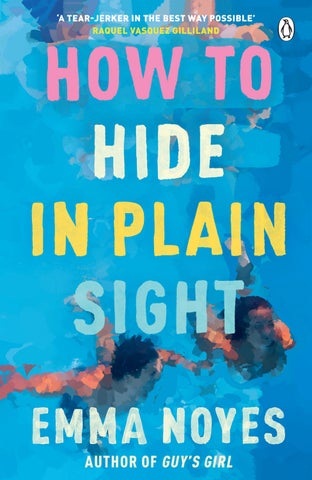
‘A TEAR-JERKER IN THE BEST WAY POSSIBLE’
Emma Noyes is the author of Guy’s Girl, How to Hide in Plain Sight and the Sunken City trilogy. She grew up in a suburb outside Chicago and attended Harvard University, where she studied history and literature. She started her career at a beer company but left because she wanted to write about mermaids and witches—eventually publishing her first YA fantasy series. She now lives in Chicago with her Swedish husband and accidentprone Pomeranian.
“Emma Noyes’s stunning adult debut is raw, real, and an emotional page-turner that will stay with you long after the last page. Th is love story is a must-read.”
—New York Times bestselling authors Krista and Becca Ritchie
“Heartbreaking and romantic, Guy’s Girl is a beautifully written and authentically raw story about the human journey through trauma, self-exploration, and self-love.”
—New York Times and USA Today bestselling author Samantha Young
“Emma Noyes completely captivated me with her spectacular debut! Guy’s Girl is an honest, no-holds-barred look at life as a twentysomething struggling to fi nd love and fi nd herself. Noyes deft ly handles incredibly tough topics with care and sincerity, culminating in a sparkling work of fiction that I could not stop thinking about. Th is one stuck with me long after I fi nished the fi nal page!”
—Falon Ballard, author of Just My Type
“Noyes beautifully captures the joy and stress of becoming a newly minted adult. Th is sings of both restlessness and hope.”
—Publishers Weekly
“Noyes captures moments of soul-searing drama in this quarterlife-crisis love story.”
—Booklist
UK | USA | Canada | Ireland | Australia
India | New Zealand | South Africa
Penguin Books is part of the Penguin Random House group of companies whose addresses can be found at global.penguinrandomhouse.com
First published in the United States of America by Berkley, an imprint of Penguin Random House 2024 First published in Great Britain by Penguin Books 2024 001
Copyright © Emma Virginia Rideout Noyes, 2024
The moral right of the author has been asserted
Book design by Diahann Sturge-Campbell Printed and bound in Great Britain by Clays Ltd, Elcograf S.p.A.
The authorized representative in the EEA is Penguin Random House Ireland, Morrison Chambers, 32 Nassau Street, Dublin D02 YH68
A CIP catalogue record for this book is available from the British Library
ISBN: 978–1–405–95771–7
www.greenpenguin.co.uk
Penguin Random Hous e is committed to a sustainable future for our business , our readers and our planet. is book is made from Forest Stewardship Council® certified paper
To my brain— You crazy motherfucker, this one’s for you.
Dear Reader,
What you have just opened is only partly a work of fiction. The story is entirely imagined, but the way Eliot’s brain works . . . is entirely not.
I have Obsessive- Compulsive Disorder. But the OCD I have is very different from society’s “usual depiction” of the disease. It has nothing to do with fearing germs or touching doorknobs a certain number of times or stepping over cracks in the sidewalk. I’m not like Monk, the detective with eight different bars of soap on his bathroom sink. The OCD I have can only be described as inner torture.
I was twelve when my symptoms fi rst showed up. At the time, of course, I didn’t know that they were symptoms; I thought I had just lost my mind. My brain wouldn’t stop looping over the same thoughts. Horrible thoughts. Taboo thoughts, things that cannot be spoken aloud in polite society. And no matter what I did, no matter how hard I tried, I couldn’t make them go away.
Th ree years of torture later, my fi rst therapist gave me my diagnosis. I didn’t believe her. Not because I didn’t want to, but because I so desperately did. The part of my brain that I once thought of as myself—the kind one, the compassionate one, the one that still knew she was a good person—wanted so badly for there to be a rational explanation for all of the horrible things happening in my mind, but the disordered part had taken over so completely that I was convinced I had no mental illness at all. I was just a bad person.
If this doesn’t make sense to you right now, that’s okay. It will once you start reading.
How to Hide in Plain Sight was scary to write. Even more scary to put out into the world. Still, I know that I must, because there are millions of people who suffer from this disease— and they do so in silence, with a false smile on their face, their disease hidden in perfectly plain sight.
I don’t want to hide anymore. And one day, I hope they won’t have to, either.
All my love, Emma
Your presence is cordially requested at the wedding of . . .
Schedule
Day 1: The Welcome Dinner
Day 2: The Cradle Island Olympics
Day 3: The Bachelor Parties
Day 4: The Wedding
m. Ex-wife #1 (divorced)
Stephen (Speedy) S. Beck IV
Caleb (49)
Clarence (46)
Wendy Beck m.
Taron (Taz) (28)
Catherine (Karma) (31)
Eliot (21)
Henry (21, deceased)
HERE’S WHAT YOU need to understand about my family: all of our money came from drugs.
Nothing illegal, of course. Not crack or quaaludes or even marijuana. All government sanctioned. e good stu , you know? Prozac. Insulin. Cialis. ( at’s a PDE-5 inhibitor, a drug that helps men get it up—the alternative to Viagra. I know. e assholes at P zer ruined any chance we had at brand recognition. ere’s only so much brain space Americans are willing to commit to boner medication.)
Another thing you need to understand about my family: it’s big. I couldn’t tell you the number of times I’ve said those words. At parties, on the job. Tell me about yourself, says someone I’ve just met. Well, I grew up in a big family. It’s a great opening line. People trust me right away, which makes no sense. As if being born into a big family says something about your character. As if there’s a reproductive threshold above which none of your children become psychopaths or serial killers. As if Je rey Dahmer would have turned out okay if only he’d had a couple more brothers and sisters hanging around.
I was a happy kid. How could I not be? I was raised the way all parents dream of raising their children: in a big house in the suburbs of Chicago, right on the shore of Lake Michigan. Our town was just large enough for me to run free on the weekend, but just small enough to come home with nothing worse than a skinned
knee. Our school district liberal enough to preach universal love, but so white that I didn’t discover racism until we reached the chapter on slavery in our h grade history textbook.
I was given everything—including, but not limited to, that most elusive of gi s: the Happy Family. Undivorced parents. Siblings who can actually stand each other. Who vacation together and eat family dinner around a worn wooden table and only try to kill each other on special occasions. Who even—when the climate is right— like each other.
ere were unhappy moments, too, of course. And chaos. Plenty of chaos. In a family of eight, if you want to be heard, you yell: at dinner, during card games, on long road trips, when the back two rows of the Suburban become louder and more political than the oor of Congress. Everyone talks over each other. Facts are not as important as volume.
As the youngest—and therefore least authoritative—member of the family, I was never going to be the loudest. So, instead, I watched. Listened. Took in the laughter and the chaos and the secrets and the broken parts. Because, yes, the Beck family is a Happy Family. But behind the curtain, we ght. We hurt each other. We even hate each other, for a time. But we forgive. We always forgive. We have to.
We’re family.
IN THE THIRTEEN hours it took me to drive from New York City to Port Windfall, Ontario, I drank three cups of co ee, started four podcasts, engaged in countless lively debates with drivers who couldn’t hear me, and listened to every single one of my Spotify playlists. Twice.
When I ran out of background noise, I took reality and shaped it into copywriting templates. I do that sometimes.
HEADLINE: Disgraced Daughter Returns to Family’s Private Island for Four-Day “Wedding of the Century”
OFFER: Ready to face your demons, relish lavish excess, and su er through nightly political diatribes, all while wearing a smile that says you’re having the time of your life?
CALL TO ACTION: Click for Free Trial!
When I tell people I’m a copywriter, most o en they picture Mad Men: long rows of women in smart wool skirts pounding at typewriters, dodging the advances of male executives, locked out of the meetings where real decisions are made. You don’t need talent to be a copywriter. You just need to be able to type.
Let me tell you a secret: copy is far more than words on an advertisement. It’s everything. It’s everywhere. We copywriters are the engine that moves society forward. Without us, progress grinds to a halt. Instruction manuals are blank. Street signs don’t exist. Travel becomes impossible. No sentence comes from nothing, a er all: from the saccharine Christmas message on the side of your soda to the screw u bro written on a bathroom stall; from the seat-back sign telling you life vest under seat to the greeting that welcomes you to a website. Even the highway sign telling you that you’re now leaving Ohio, bidding you farewell and asking that you come back soon. Do you ever think about who wrote those words? Of course not. ose words are not words to us, with authors and backstories and spellcheck. ey’re background. ey’re grass and trees, part of the landscape. emergency exit signs say emergency exit because that’s how it is. Car mirrors tell us that objects in the mirror are closer than they appear because they do. Because they always have. ese words, these pillars of society—they weren’t written. ey sprang into existence at the exact moment society needed them. Perhaps they were even created by God: And on the third day, God created the sun and the moon and the instruction manual for how to set up your Google Edge TPU ™ Application-Speci c Integrated Circuit. Anyway.
My destination was Cradle Island: a mile-around private paradise purchased by my father during the coked-up height of his second marriage. He found it in a newspaper advertisement. island for sale! I imagine the ad said. excellent value! 100% surrounded by water!
e way Dad tells it, he almost ipped right past. But then he saw the bird’s-eye shot of Cradle Island at the bottom of the advertisement. And the island looked like a cradle. An abstract cradle. A cradle on drugs. My father was also on drugs. He found this coincidence so funny that he laughed until he cried.
en he bought it.
at was a di erent lifetime. By the time I got into the car borrowed from one of my coworkers to travel from Brooklyn to Ontario, Dad was almost thirty years sober.
As was I. Recovered from my addictions, I mean. Not to drugs or alcohol—to other things. oughts, food, people, places. Oh, yes— you can be addicted to a place. It happened to me as a kid. Every year, in the middle of February—deep in the bowels of the Chicago winter—I started to crave Cradle Island. e sound of sparrows in the a ernoon. Its curving beaches, peppered with cattails. In the rst light of morning, when the lake turns to glass. It was the strangest feeling. More potent than desire for food. Because when you want ice cream or crispy, hot buttered bread, the feeling pools right atop your tongue, but when you want a place, it calls to you with every sense, sight and smell and touch and sound and, yes, even taste.
When I moved to New York, I cut all cravings out of my life. All of them. I had to. “No seas tonta,” Manuel would have said, waving a bottle of beer in my face. “Just have one.”
I gripped the steering wheel. Squeezed my eyes closed and open. Blinked his face from my memory. No. at was before. Before I took control of my life. Before I worked my schedule down to an exacting science, to a well-oiled machine that le no room for darker thoughts. Before I learned to ignore the siren call of my memories, their taunts, daring me to jump down, down, down, into that all-too-familiar place—a hole into which at times I fell accidentally and at others I climbed willingly, allowing the rest of the soil to tumble in a er me, shutting o all oxygen and blotting out the sun.
THE NERVES DIDN’T set in until just before I arrived at the marina. I was running late—Mom said to meet at the dock at ve o’clock,
and it was almost half past. All those damn cups of co ee. I hadn’t accounted for the number of times I had to pull into a nowhere gas station and sprint to the bathroom, buying a pack of gum on the way out to stave o the cashier’s cool glare. Plus, there’d been that semi moving with hair-pulling sluggishness down the winding one-lane highway . . .
All of that to say: I was late, and my siblings weren’t going to let me o easy. ey never did. e pile of wisecracks was probably growing higher by the minute.
My nerves probably should have set in long before then. Frankly, they should have set in the minute I pulled the glossy RSVP card from its envelope and laid it against the plug-in co eepot in my studio and le it there, untouched, its cheerful calligraphy mocking me every time I walked in or out the apartment’s front door. Even then, in my hesitation, I wasn’t nervous. I wasn’t anything, really.
But I should have been.
See, the issue was this: on the day I arrived at the marina for Taz’s wedding, I hadn’t seen my family in three years.
It wasn’t that I’d been avoiding them. Not at rst, anyway. I was still there, still included in all the group chats and email threads and family conference calls, during which Dad explained for the fourth or h time exactly how capital gains or xed-interest mortgages work. But I rarely contributed to these conversations. Instead, I sat silently in my apartment in New York, a spectator to the continuing lives of my family in the Midwest.
I listened to what my parents told me growing up: Make your own way. Live as if you will inherit nothing. Do not rely on anyone else to save you—including us. So I did. A er high school, I skipped the pointless charade of college. Moved to Brooklyn. Lived on a couch. Worked my ass o to nd a job. Paid my own rent and taxes. Never touched a dime of the Trust Fund, that grown-up allowance that leaked tens of thousands of dollars into my bank account each
to Hide
Plain
year. Doubtless they would prefer that I had a college degree, but such things are neither here nor there. I did it. I achieved nancial independence. And at twenty-one years old, I’d done it well before anyone else had.
I imagined my solo arrival to this wedding as a moment of triumph. Here she comes, they would say. Eliot Beck, Corporate Woman in the Big City!
But when I crossed the bridge into Port Windfall, the town where we store our boats in the winter, I started to actually picture the scene that would be waiting for me. ey’d be there, all of them, loading their bags into the Silver Heron, a y-four-foot Bertram yacht purchased by my father in 1975. Mom would be whirring around in one of her usual states. Dad would be up on the ybridge. Karma would be giving directions. Clarence and Caleb would be standing o to the side, arguing about God knows what—probably who would get the bigger bed in Tangled Blue, their favorite cabin on the island, that year. I never understood my half brothers’ relationship; they hated each other, yet they insisted on staying in the same cabin every year. Both claimed it was their favorite and neither was the type to relent.
Every family reunion begins with a round of hugs and the promise you’ve missed one another. For me, that promise was always true. But that summer, a er three years away, it was truer than ever.
And yet. And yet. I avoided everyone for a reason. For multiple reasons, actually, and it was only at the last minute—when I turned the steering wheel to pull into Kilwin Marina and heard the familiar crunch of gravel beneath the tires, smelled the algae and hull wax and molding rope—that I realized the full depth of what I was doing. Where I was going. I was driving toward not just a wedding but also a week spent trapped on a tiny island with no control over my diet. My routine. My exercise. No East River to run beside in the morning. No cabinet full of gluten-free, dairy-free, paleo-keto
Whole30 nutrition bars stolen from the pantry at work. Just me and my family. And suddenly, I felt nothing short of naked.
I parked the car. Unclipped my seat belt. Rolled down the car window.
e wind blew warm and lazy o Lake Huron, heavy with the smell of gasoline and fried sh. In the slip where the Silver Heron normally waited—tall, beast-like, built for function, the oating equivalent of a sensible boot—sat nothing. Just water. I stared at the empty slip, dumbfounded. ey’d le without me.
HERE’S A RIDDLE for you: How do you form meaningful relationships with a family you didn’t grow up with?
Sometimes, I think my entire life has been one long attempt to answer that question. When you grow up with gaps between you and your siblings as wide as the ones between me and mine (seven years at the smallest, twenty-eight years at the widest), you don’t grow up with them, you grow up behind them. e rest of the family shares a wealth of memories that you’ll never have access to. ose memories—the earliest, most formative moments—become the backbone of your family history. ey’re the stories you tell at dinners, at reunions, over beers at a bar your older siblings used to sneak into together, and seven years later, you snuck into with your best friend. ose memories become your origin story. An origin story you didn’t get to write.
FOR A FEW minutes I sat in the driver’s seat, unwilling to believe my eyes. How the hell was I supposed to get to Cradle now? Swim?
But then I spotted the Periwinkle, a twin-engine whaler used mostly for grocery runs. Next to the boat was a tall gure with dark
hair— one of my brothers, probably. Le behind to pick up the spare.
I unloaded my luggage— one backpack and one gas station bag full of snack wrappers and co ee cups—and walked down the dock craning my neck to see which of my brothers it was. But then the gure turned around and smiled. “Hey, Beck.” I froze.
No.
Only one person called me by my last name, and there was no way that person could be here, at this very moment, standing on the dock in front of me. I blinked hard. Tried to make his face go away, just as I had in the car. Blink. Blink. But he was still there.
No.
is cannot be happening. I took a step back.
He looked di erent. He’d let his hair grow long and wild, the way my mom and I always told him he should. at was all I noticed, at rst. His hair. How unfamiliar it was. And why shouldn’t it be? ree years at college will do that. Will transform the lanky teenager you once knew into something resembling a man.
An old feeling, long forgotten— or, more accurately, long bound, gagged, and stu ed away in a corner of my mind from which I bade it to never return—yawned and stretched its wings inside my stomach.
No, no, no.
He stepped forward. “Surprise,” he said, lips curving up shyly. Saliva edged up the back of my tongue. He’s here. He’s really here. What was he doing here? e rst few days of the wedding were family only—it said so in clear, shimmering letters on Taz and Helene’s invitation. So, why was my former best friend standing two feet in front of me, so chestnut eyes watching me warily beneath wild curls?
He reached out one hand. I froze, uncertain of what would happen next.
en he grabbed my shoulder and pulled me into his chest. Despite being skinny as a willow branch, Manuel Garcia Valdecasas gives hugs that feel like drowning. He sucks you into the void of his arms, drags you to the very deepest point of comfort.
“You’re here,” he said into my hair. at was it. Nothing else.
I thought I didn’t miss him. Really, I did. For three years, I pushed him from my mind. Focused on my life in New York. at’s what you do, that’s what everyone does: you grow up, you y the coop, you leave the other birds behind.
I knew I shouldn’t let myself take comfort in his embrace. I’d been a bad friend. An awful friend, really. But I did. I let myself sink, just for a moment. And it felt good. God, it felt so good. It felt just the way they say it does—that clear, heady euphoria of death by drowning.
MY STORY BEGINS with the death of my brother.
I’m ten years old. I’m standing on the porch of Sunny Sunday, the main cabin on Cradle Island. e lake is the color of storm clouds. My mom has just come outside from talking on the telephone. She pulls me onto her lap and says something I don’t understand.
“What do you mean, gone?” I ask. I study her expression. It’s too close, her face. Old people look scary up close. I want to get down. I fear I might catch whatever it is that makes her old.
“He isn’t here anymore.”
“But he wasn’t here in the rst place,” I say. “He stayed in Winnetka. You said he had summer school, so he stayed home.”
She blinks. Her eyes are big and old.
“How can he be gone if he was never here in the rst place?”
And then she starts to cry.
BEFORE THIS MOMENT, we numbered eight. Two parents, six kids. Caleb, Clarence, Karma, Taz, Henry, Eliot. Caleb, Clarence, Karma, Taz, Henry, Eliot. A list I’ve given a thousand times—to every new teacher, new friend, anyone who cares to ask. I’m the
youngest, and I love my siblings. When asked, I recite our names with near-religious pride. “CalebClarenceKarmaTazHenryEliot! CalebClarenceKarmaTazHenryEliot!” e list became a sort of spell. Recite these names enough times and you’ll nally belong to them! Because that’s all I wanted, really. To sit at the big kids’ table. When I reached the end of the list—when I got to say my own name, to attach it to those ve fully formed humans, to claim my place among them, even as just the caboose, hitched to the train by nothing more than the fragile rope of familial obligation—I said it with shiny eyes and a plump-cheeked smile.
HENRY AND I were what you call Irish Twins—siblings born less than a year apart. From the start, we did everything together. We slept in the same crib, gnawed on the same toys, even ate from the same bowls. e rst time Mom tried to acclimate me to real dishware, she dumped me onto the bench next to Hen and handed me a plastic bowl and spoon. e bowl was lled with my very own serving of mush. Henry, of course, had been eating mush for almost a year. e way Mom tells it, I looked at my bowl for only a few seconds before turning to the side and starting in on Henry’s. He didn’t say a word. Just pushed the bowl closer to my half of the table and kept eating. We took turns dipping into the mush. en, when his bowl was scraped clean, we moved over to mine and kept right on going.
Henry learned to read rst. Every night before bed, I’d burst through his door, and he would open whatever fantasy novel was on his nightstand and read aloud until my head started to nod. He created far-o planets for me. Gave each of the characters a di erent voice. Held dramatic pauses when appropriate. “Where are we going tonight?” I would say.
“ e Sahara Desert,” he would say. Or “Hogwarts.” Or “To visit the dinosaurs.”
And I cuddled in close, shut my eyes, and listened as we soared far, far away.
THE FUNERAL IS held at our church in Winnetka. All of our relatives y in. Cousins and uncles and ex-wives and third cousins and third uncles and third ex-wives—people with whom I share blood but whose names I don’t know. We ll every pew in the chapel. A big wooden box sits at the front, boy-sized, like a trick at a magic show. I understand that this is not a magic show. I understand that my brother is inside that box, and he won’t come back out.
IN THE WEEK we spend at home before returning to Cradle, as I endure Henry’s wake and funeral and hugs from relatives I don’t know and paper plates sagging beneath cheese triangles and fruit salad, I cling to the fact that it’s just a week. Just one. A er that, we’ll return to Cradle for the summer, and everything will be better. Mom calls the blue-green waters that surround the lake “healing.” When I ask her why, she says human beings come from the water, that we’re conceived in water, that we evolved from creatures who swam. So that’s what I tell myself during that miserable week in Chicago. We’re going back, I tell myself. We’re going back. And when we do, we’ll heal.
A WEEK LATER, we return to Cradle. We y in on the jet. It has eight seats, just big enough for our family. We’re one brother short, but every seat is full.
“What’s that?” I ask, pointing at the oblong purple thing fastened into the seat next to Dad. It looks like a tulip vase, all curvy and long necked.
ere’s a long silence.
Finally, seventeen-year-old Karma says, “ at’s Henry.”
I look back down at the object. at’s Henry?
“No,” I say. “ at’s a vase. Dead people don’t go in vases.”
“Sometimes they do.”
“No,” I say again. “Flowers go in vases. Dead people go in cofns.”
Karma smiles sadly. “Sometimes. But sometimes, they go in one of those instead.”
“It’s not a vase, Gup,” says Clarence from across the plane. “It’s an errrn.”
An errrn?
I turn the word over in my head. An errrn. Huh. is is a surprise. ere was a co n at the funeral; I assumed my brother was inside. I assumed I wasn’t allowed to see him, that seeing him was Big Kids Only. A lot of stu in my life is Big Kids Only, especially since Henry died. But I know how funerals go. I’ve seen them in movies. And movies tell me that dead people go inside a co n and then into the ground. So I assumed that, a er the funeral, my family took him away and buried him in a graveyard with all the other dead people, the way they’re supposed to.
I was wrong.
SHORTLY AFTER ARRIVING on the island, we gather on the porch of Sunny Sunday. e boys clear away the tables and lounge chairs. ey li them overhead and carry them down the rocks, leaving them scattered about like a poorly arranged living room. We cluster
How to Hide in Plain Sight 17
onto the empty patio, the whole family. Dad stands before us, his back to the lake. Clutched between two trembling hands is the errrn.
I glare at it. As it turns out, not only is Henry not safely underground, he’s trapped inside a tiny tulip vase. What an abomination. How did they t him in there, anyway? Did they shrink him to the size of a teacup? Did his body dissolve into a cloud and whoosh down the neck, like a genie?
Dad is talking. Cradle Island will be Henry’s nal resting place, he says. Dad will scatter Henry’s ashes at the center of the island.
Ashes?
Ashes like a er a re?
“I’m going to scatter them alone,” he continues, “so the rest of you won’t see where.”
Ashes like ugly grey powder, all thin and useless? A puddle of spent wood that used to be ame, and before that timber, and before that a tree, tall and sturdy, so tall it saw everything, saw clear across the island?
“Your mother and I . . .” He glances at Mom, who meets his gaze with watery eyes. “We don’t want Henry to be just one rock or bush or tree.” He smiles. “We want him to be the whole island.”
I watch Dad’s thumb. I think about burning trees. His thumb traces little absentminded circles along the bottom of the vase, slowly, a ectionately, as if he believes the vase can feel it. As if it were made of skin, not ceramic.
And that’s when I understand.
“What the hell did you do?” I blurt without thinking.
“Eliot!” says Mom, covering my mouth with her palm.
Dad looks down. Everyone does. I have their attention. ey’re waiting for me to go on, but I can’t. A strange feeling bubbles at the base of my throat. It’s hot. It’s boiling.
Is it anger?
No. I know anger. I’ve seen anger. It makes you say things you regret, not lose your speech entirely.
“Eliot?” Dad asks.
Did you burn my brother alive?
“Eliot?”
Is that what you did? Was he so hurt that you tossed his body into a bon re and let it burn, like nothing more than a fallen tree?
I look at Dad. I can’t ask the questions. ey’re gone. ey’ve turned to air in my throat. Instead, I ask, “When?”
“When what?”
“When are you going to do it?”
Dad pauses. “Later this summer.”
Later this summer. Later this summer, Dad will dump my brother onto a bush and leave him there. Later this summer, the last traces of Henry will wash away in a heavy rain.
I can’t breathe.
Every spring, Henry and I counted down the days until summer. Crossed them o the calendar on the fridge. A week before our ight, we packed books and sweatpants and every bathing suit in our closet. For Henry and me, summers on Cradle Island weren’t just vacations; they were bliss. ey were sunsets and swing chairs and writing musicals and forcing the Big Kids to watch. ey were wild sun and roaring thunderstorms and white cheddar mac ’n’ cheese and the wood-burning sauna we stoked until our faces melted.
And now, here on this porch, Clarence’s hand on my shoulder, Karma clinging to Mom, my three living brothers standing straightbacked and at-footed, just like at the rst funeral, only now they’re dressed in patterned swim trunks instead of black suits—even now, Cradle is still all the things Henry and I loved. It’s just that now I have no one to share them with.
THE DAY AFTER Henry’s second funeral, my family wakes to discover the island has been wiped clean of carbohydrates. Overnight, Mom cleared every last cracker, donut, noodle, and Lucky Charm out of the kitchen. Everyone is upset, but Karma, whose relationship with my mother is strained to begin with, is a living volcano.
“Are you shitting me?” she says, opening every single cabinet and slamming them closed when she nds they contain nothing but fruit and nuts. “What are we going to eat now?”
“Protein,” Mom says. She’s pan-frying scrambled eggs and cottage cheese. “And lots of it.”
“Why?”
“Protein is medicine for your muscles and immune system,” she says proudly. e line comes straight from e Zone Diet, which she read the night before.
“But I’m not sick.”
“Yes, you are. You don’t know it because simple sugars are all your body knows, but you are.”
A plate appears before each of the kids. Karma scrunches her lips with disgust, says, “Absolutely not,” slides o her stool, and storms out of the kitchen. For the rest of the week, she walks around Cradle with a sign taped to her shirt that reads, end child hunger now.
THE FIRST PASTRIES Karma bakes are macarons—the French kind, perfect little sugary sandwiches that look nearly impossible to get right. She’s never even made chocolate chip cookies before.
“Whoa,” says Taz when he walks into Sunny Sunday. “ is looks illegal.”
Karma clucks. “Nothing illegal about a little bit of sugar.”
“Where’d you even get that?” he says, eyeing the wrinkled bag of Domino Pure Cane on the counter.
“Let’s just say that there are lots of cabins with lots of cabinets on this island.”
Once Karma starts baking, she doesn’t stop. She bakes aggressively. Vengefully. Blondies. Lemon bars. Cinnamon buns. Raspberry tortes. Peppermint bark. A week passes during which we see Karma only under the strawberry-orange light of the kitchen. Her recipes grow longer, more advanced, requiring two or three tries to get right. But she never gives up. Not until they’re perfect.
Out of my sister’s earshot, I hear Mom mutter, “ is is, without a doubt, the strangest form of teenage rebellion I’ve ever seen.”
“ is isn’t rebellion, Wendy,” Dad whispers back. “It’s mourning.”
FOR AS LONG as I’ve known Taz—which is my whole life, actually— the only thing he’s wanted to do is make animated movies. Everywhere he goes, his iPad comes with. When he walks, he folds it under his arm like a purse. When he sits, he icks it open and loses himself in an unknowable universe of castles and aliens and rebreathing math teachers. Pixelated smiles. Wide-brimmed eyes.
A er Henry dies, Taz stops carrying around his iPad. Now, in the kitchen, he holds no electronics at all. He looks naked without them.
Instead he carries a sketch pad. He scratches at it throughout the day—simple drawings so faint they seem to have bled onto the paper from elsewhere. ey aren’t storyboards. In fact, there’s no connection between them at all. I nd them scattered about the island—decaying fruit, half- nished maps of the world, a face with no identi able features. It seems he doesn’t care what happens to them once he sets them down.
I start to collect them. When I nd a drawing, I slip it into the pocket of my hiking backpack, just in case he needs them one day.
I THOUGHT CRADLE Island would x us. I did. at the waters would heal us, just the way Mom said they could. But here we are, and everywhere I turn, I see grief. I see it in the strange actions of my siblings and the dead silence at the dinner table and the hushed voices of my parents in the hallway outside my bedroom door. Grief didn’t leave; if anything, it burrowed even deeper in. Took the place of the one who le . Grief sits in Henry’s chair at dinner, sleeps in his bed at night. e island, which once seemed ready to burst from all the life packed onto its shores, has become a colorless place.
As I lie in bed at night, I hear my mom whisper to my dad, “You really aren’t worried? I swear, I haven’t seen her cry once.”
“Everyone grieves di erently,” says Dad. “She’s so young.”
I shake my head into the pillowcase. Mom is silly to think there’s something wrong with me. I’m the only one who can say Henry’s name without crying. I’m the only one who eats more than half of her dinner. I’m the only one who still goes out exploring. I’m the only one who hasn’t lost her mind.
IT’S THE END of the summer. I’m hunched into a ball outside my parents’ bedroom, ear pressed to the door. Dad is inside, rummaging about his suitcase. Mom is elsewhere. Tomorrow, we leave.
“ is can’t be happening,” Dad says to no one. “ ey were in here two days ago.” e rummaging increases in intensity. “I never took them out,” he says. “I never even took them out!” Something hits the oor with a great crash. en I hear a new sound, an awful sound, like a tornado alarm or a bullhorn. I leap to my feet and throw open the door, forgetting I’m supposed to be hiding. What I nd inside is not a siren. It’s my dad, bent on all fours, wailing. at’s the word that pops into my
head: wailing. I don’t know where that word came from, but there it is, and there’s my father, hunched over himself. Wailing. e oor is covered in what appears to be the contents of every drawer, closet, and cranny in the bedroom. In the corner is a puddle of shattered purple ceramic.
e errrn.
I stand frozen in the doorway. If Dad sees me, he doesn’t say so. In fact, a er this is over—a er Dad stops wailing, a er I creep back into the hallway, a er he slowly picks up the destroyed bedroom and turns on every light in the cabin and takes a thirty-minute-long shower and crawls into bed for the night, even though it’s only 7:30 p.m.—he’ll never mention this scene, or the impossible disappearance that led to it, ever again. Not to me. Not to Mom. Not to anyone, as far as I know. Why would he? Why be so cruel? Why tell us that, when he was nally ready to scatter Henry’s ashes, when he grabbed the errrn and looked inside, there was nothing there? Why tell us that he found only an empty ceramic hole, a dark pit almost as deep as the one now yawning open within him? Why tell us he’s lost the ashes of our dead brother? Even at ten years old, I know he won’t. I watch him there on the oor, and I just know. He won’t make anyone else shoulder this burden. ere would be no point. His arms and legs quiver. His whole body shakes with the weight of holding itself up.
A few months later, his legs will give out forever.
THE BOAT RIDE was excruciating. A er taking my backpack o my hands and ring up the boat, steering us out toward the channel, Manuel o ered no explanation for his appearance. Instead, he le me to ll the awkward silence with the only tactic I knew: incoherent babbling. I talked almost nonstop from dock to dock. Filled the wind whipping past our heads with eight miles of banal nothingness. My legs shook. Out of nerves or too much ca eine, I wasn’t sure.
“ e drive was a nightmare. I haven’t been behind the wheel of a car in almost three years. You just don’t need one in New York, you know? Of course you know. You live in Boston. I mean, Cambridge.
at’s where Harvard is, right? Cambridge? Pretty funny that the best college in America is in a city named a er the best college in England. Or would that be Oxford? I wouldn’t know. Never been the smart one. at was always you, ha ha. Ha. Ha.” Et cetera. Help.
WE ARRIVED, NATURALLY, to chaos.
“Allergic to spice? e hell does she mean, allergic to spice?”