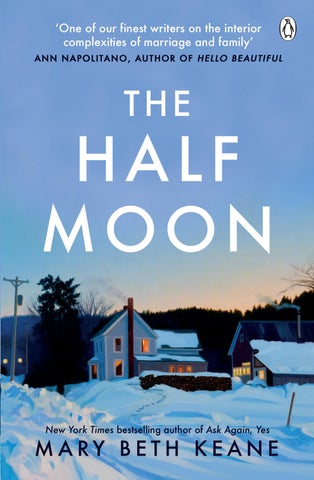
The Half Moon
MAR y BETH KEANE
PENGUIN BOOK S
PENGUIN BOOKS
UK | USA | Canada | Ireland | Australia India | New Zealand | South Africa
Penguin Books is part of the Penguin Random House group of companies whose addresses can be found at global.penguinrandomhouse.com
First published in the United States of America by Scribner, an imprint of Simon & Schuster, Inc. 2023
First published in Great Britain by Penguin Michael Joseph 2023
Published in Penguin Books 2024 001
Copyright © Mary Beth Keane, 2023
The moral right of the author has been asserted
Set in 11.5/15.6pt Calluna Typeset by Jouve (UK), Milton Keynes
Printed and bound in Great Britain by Clays Ltd, Elcograf S.p.A.
The authorized representative in the EEA is Penguin Random House Ireland, Morrison Chambers, 32 Nassau Street, Dublin D 02 y H 68
A CIP catalogue record for this book is available from the British Library
ISBN : 978– 1– 405– 95138– 8
www.greenpenguin.co.uk
Penguin Random Hous e is committed to a sustainable future for our business , our readers and our planet. is book is made from Forest Stewardship Council® certified paper
To my first loves, Annette and Catherine
Right and wrong were shades of meaning, not sides of a coin.
— Louise Erdrich, Love Medicine
One
Malcolm Gephardt could tell the bar was busy even from a block away, even from behind the filthy windshield of his Honda. The night was damp, the sidewalks along the center of town laced with dirty snow that had been refusing to melt for near a week. Most businesses had heeded the weather forecast and closed in advance of the coming storm, but when Malcolm approached the traffic light and saw his own squat, brown-shingled building at the bottom of the hill, something lifted in his chest and he leaned over the steering wheel.
‘Oh,’ he said aloud to his empty car. Something was different about the place tonight. He felt a pull of energy, that singular happy chaos that can only be found inside a crowded bar when the music is good, people are running into friends, and the whole place is cozy despite the bonecold world outside. He tried to imagine himself a stranger, tried to see his place as a stranger would. His place. His. Did it look welcoming? Was it just his imagination or did the light spilling onto the street give the whole façade a faint glow? Yes, he decided as he slid neatly into his parking spot and felt a thrill of hope, of faith, shoot through him for the first time in weeks: in himself, in his
town, in these people, in life, in destiny, in following one’s intuition. It was a good town, a good bar, and he was okay, he said to himself silently, like a prayer. Half Moon the old wooden sign above the door read, punctuated by a carving of a crescent moon (people loved pointing out the mistake) that had gone black and moldy over the years, and which Malcolm had scrubbed and then retouched with bright white paint the day after the deal went through.
Tonight, there were two people outside, smoking, and another woman just standing there, shivering. A positive sign. But it meant he couldn’t go around to the side entrance because they’d spotted him, were already lifting their chins to him, and now as he approached he had to say all the things: how’s it goin how you feelin looking good yeah more snow coming what a winter I guess nobody’s goin nowhere for the weekend hope to god we don’t lose power what’ll we do without the TV ha ha ha. He had to shake hands, kiss the women hello, pretend he didn’t know what they were talking about when they asked how he was doing, and made serious faces. And when he told them he was good, he was fine, as if he didn’t know what they could be referring to, he had to do a better job pretending when they asked him again not ten seconds later.
All of this was far more difficult without a two-footwide bar sitting between him and the person asking. It was more difficult than it used to be, that was for sure. But why? Because he believed he knew himself, he
supposed. Because he believed he knew Jess. He held fast to the good feeling from a moment earlier and told himself to keep going, to get through the night, and then maybe there’d be another one just like it. Lately, he’d been having thoughts. While at the stoplight on Wappinger a week ago, the sunset a purple bruise above Tallman Mountain and the wide Hudson hidden beyond, he thought, I could keep driving. I could turn right and head for Mexico. Turn left and make for Canada. All he had to do was keep filling the gas tank. He was handsome and charming and people liked him instantly. This was a fact he’d known about himself his entire life, and it would give him an advantage if he were to turn up in some Québécois village looking for work. His mind glanced at how much money was in the safe, how much room was left on the credit cards. He itemized everything in his house that he considered dear, but what was there that he truly loved? The coffeepot? His leather chair? Then the light turned, the thought evaporated without taking root, and he arrived at the bar feeling off-kilter, like he’d been on the verge of saying something important, but he couldn’t remember what.
As he chatted with the people standing outside, he allowed himself to hope for twenty people inside. Twenty would be a decent night, and if there were twenty people in there, he told himself to not immediately wish there were forty. He refused to look through the window as if it might bring bad luck. Thirty maybe. There might be thirty. It was the coming snowstorm.
Gallagher’s and The Parlor hadn’t even bothered to open. Primavera, next door, seated their last table at seven sharp. He wasn’t sure about Tia Anna’s or the new Thai place. If he had to close, he’d close, but until then he’d pull pints.
‘He’s here,’ Roddy said as soon as Malcolm stepped inside, and he felt his optimism wobble for a moment. As always, there was a note of urgency in Roddy’s voice, something in the timbre finding a frequency above all the conversations and reaching Malcolm like a tug on his sleeve. Forty people. More. His friend Patrick was there. Siobhán, too, and God love her she was bouncing a hip to the beat of whatever was coming out of the jukebox. His friends had been calling and dropping by his house a lot more often since Jess left, and even if their cheeriness was a performance, he appreciated it so much that one recent Saturday, when he woke up to Patrick and their friend Toby banging around his kitchen looking for coffee filters, he sat up in bed and felt pressure in his throat like he might cry. He and Patrick had been gently making fun of Toby for almost forty years, but there he was, sniffing the creamer he found in Malcolm’s fridge and searching for an expiration date. Were they calling Jess, too? Siobhán was, probably. Maybe some of the others. But no one raised the subject, no one wanted to talk about anything explicitly. If there were sides to be taken, they let him know in small ways which one they were on.
‘Malcolm!’ Roddy called over. ‘Hey!’
Malcolm nodded at Patrick and Siobhán and held up a finger to let them know he’d be just a minute. Roddy had been getting on Malcolm’s nerves from almost the first minute he started working at the Half Moon, but he seemed honest, his uncle had vouched for him, and Malcolm reminded himself that honesty was what he needed most after the disaster of the previous year, when he found out that John had been stealing money since probably the very first day Malcolm took over, just folding stacks of bills and shoving them into his pocket, running only the credit card tabs through the register. This, after all the times Malcolm had covered for him when they both answered to Hugh Lydon. All the coke John shoveled into his nose. His wife on the landline wondering where he was, though she already knew, and then turning her rage on Malcolm because he was stupid enough to have answered the phone. He hadn’t thought twice about keeping John on when it went from Hugh’s place to his place, and stealing was how John had thanked him.
Emma, his best bartender, was the one who told Malcolm. It was eleven in the morning, and they had a hundred balloons to inflate for a private party. She took him by the arm and pulled him into the women’s bathroom. For a second, when she put her warm hand on his tricep and locked the door, all his synapses fired. He didn’t want to think about what his expression told her when she stood close to him, because whatever she saw there prompted her to raise her hands as if to tell him to
relax, as if to tell him in his dreams, maybe, to get over himself, that she would shelve that conversation for another time, that first she needed to tell him something. She held a finger to her lips and listened, to make sure no one was passing in the hall, but the servers were busy with the helium tank, André was cutting long strands of ribbon, and the chairs were still upturned on the tables like a forest of mahogany legs.
She told Malcolm that she didn’t want to be a narc, but she started watching John because he wasn’t putting his tips in the jar, and look at André working two jobs, and Scotty with a whole slew of kids, she could never remember how many. She certainly wasn’t giving up every weekend of her youth just so this joker could take money out of her pocket. She told Malcolm that when she called John out, he offered her three hundred dollars on the spot.
‘Was he pulling this when Hugh was here?’ Malcolm asked.
‘I doubt it!’ Emma said. No one would have messed with Hugh Lydon. With Malcolm, however, the bad seeds saw an opening.
John left without a fight, a sign of guilt, and Malcolm needed to fill his shifts. Roddy’s uncle was a regular, a union boss, Cement and Concrete Workers. Huge guy, with a face the color of a raw porterhouse. Jess used to cross paths with him once in a while when she was newly out of law school and working for Laborers’ International. Every time he saw her, he pointed finger guns and
shouted, ‘Malcolm’s girl!’ Jess forgave him for never bothering to learn her name because she so enjoyed when the other attorneys looked at her as if to say, We can’t believe you actually know this guy. Roddy was a good boy, the uncle told Malcolm, very smart when he applied himself, but he’d dropped out of college after two semesters. He wasn’t a drinker, the uncle said. He wasn’t into drugs as far as the uncle knew. Get him away from the computer and he was fine! His dad had split years ago and he needed more male role models in his life. Would Malcolm do him a favor?
‘Malcolm!’ Roddy called again. What Roddy’s uncle failed to mention when he was talking the kid up was that Roddy was annoying. His whole vibe was nervous, and that feeling was contagious, coming from a bartender. It could infect the entire place. Malcolm thought he’d lose that nervous energy once he learned his way around, but he hadn’t, and lately it was worse than ever. That night, he was behind the stick wearing a ratty Tshirt that said ‘Byte Me’ and had a picture of an old 1980s floppy disk underneath. There was a dress code, Malcolm told him when he hired him. Wear dark colors. Shave. Comb your hair. Jesus.
Malcolm wasn’t ready to deal with Roddy yet, though he wondered for a moment if whatever Roddy wanted had to do with Jess. Maybe she’d called the landline. Maybe she was still on the phone, holding until he showed up. But who called the landline anymore except Malcolm’s mother, who had the number memorized since
he started working there twenty-six years ago, or around the Super Bowl, the old-timers who were laid up after hip surgery but wanted to buy a box. Would Malcolm cover them? Of course he would. Of course. But try getting money out of them after they lost.
Maybe she was there somewhere. He glanced around. No Jess at the bar. No Jess at the high-top she liked best. No Jess bullying people by the jukebox. She’d memorized the codes for the songs she hated, and in the old days, before the updated system, she would sit there and make sure no one pressed the combination of numbers that would serve up ‘Piano Man.’
But one look at Roddy’s face and Malcolm could see it was a problem with a customer. He took a quick glance around at the various clusters of people. Most were laughing. There was a group playing darts. ‘Gephardt!’ someone called over, and he turned to find two of his buddies from the gym. He saw an old neighbor from his mother’s block. A guy from the barbershop. He saw his friend from the deli with a new girlfriend. Cute. Everything seemed fine. Seemed better than fine, actually. He clapped a few backs on his way through the room, and felt his own back clapped in return. There was joy in the air. People making themselves at home. Did the group by the window seem too rowdy? He watched for a moment. They’d hold for a few minutes while he collected himself.
And then he saw Hugh’s guy, Billy, sitting alone at a two-top, sipping a whiskey. They made eye contact, and
Billy raised his glass as if to say cheers. Cheers to the crowd. To the money the night would no doubt bring in. Malcolm’s stomach heaved. Ignore him, he told himself. Just keep going.
He nodded hello to Emma as he tossed his keys in the usual drawer. Her hair was up in a high ponytail, and he really tried not to keep track of these things, but she had a beautiful neck, and in the one second he allowed himself to look, he followed a tendril of hair that had slipped loose.
‘How long has – ?’ Malcolm lifted his chin toward Billy’s table.
‘A while,’ Emma said. ‘Waiting for you to show up, I think.’
He pulled on his tight shoulder to stretch it and then remembered Jess saying that was what he always did when he was worried. He hated getting to the bar so late, but his mother had come by with a meat loaf. She’d looked in his fridge like he was twenty-two again, living in his first apartment. After they ate, as she wrapped the leftovers for him, Malcolm had a vision of Jess rolling her eyes. ‘I gotta go, Ma,’ he said eventually. ‘You okay to get home?’
‘What the heck are you talking about am I okay to get home?’ she asked.
In the old days, on Fridays, the construction workers would have started arriving by four. By six they’d have moved on and the commuters getting off the train would take their places. Around seven he used to start looking
for Jess, in case she wanted to have a beer and a sandwich at the bar before she kissed him good night and said she’d see him later. Jess had warned him about making changes, but how could he have guessed the depth of love people had for broken-down, sticky barstools? Who would have believed they’d want to keep listening to the same songs on the jukebox over and over and over, as if music stopped being made in 1996? And he didn’t do even a fraction of what he dreamed of doing. He stuck to things that were relatively cheap and quick. But it turned out people didn’t want things to be nice, they wanted them to be familiar.
The only demographic that got stronger once Malcolm took ownership was the underage crowd. The moment he took over, they started trying to get in after ten o’clock with their New York State dupes and their good friends from Ohio and Florida. But a bar full of kids didn’t help the bottom line because they ordered straight sodas for a dollar and then brought their drinks to the bathroom, where they pulled nips out of their pockets and mixed their own. They worked on animal instinct, these kids. It was like a call went out the very hour the bar changed hands, and next thing they started showing up with little bottles clanking in their purses.
‘I’m sure every generation thinks they invented that move,’ Jess said, when he brought that detail home. Where is she right this second? Every time he thought about it and realized he didn’t have the answer, he felt as if he’d taken a flying leap off a ledge without having a clue
where he’d land. Up until that week she’d been staying with her friend Cobie, who lived on West Twenty-Third Street with her wife and their two sons. Cobie made sense as a person to go to: a college friend, one of the few close friends who was entirely Jess’s, without any connection to their hometown. But a few days earlier, he called Cobie because Jess wasn’t answering his calls or responding to his texts, and Cobie told him that Jess was, in fact, back in Gillam.
Look at that, Malcolm thought, she was inching her way home.
To Malcolm’s ear, Cobie pronounced Gillam like she was holding her nose. The one time aside from their wedding that she’d come to Gillam was to meet Malcolm, fifteen years earlier, and she kept pointing out things that she found interesting. That there were seven Catholic churches within five miles was interesting to Cobie, and that so many business names were Irish. She found it interesting that so many cars had a union local displayed on the bumper, and as they walked through town she called out each one they passed – carpenters, sandhogs, scaffolders, ironworkers, steamfitters – as if she never knew these jobs existed. How much do jobs like that pay? she wanted to know. What were the benefits? How long could a person do a job like that?
‘Why?’ Malcolm asked. ‘You gonna start digging tunnels?’ Jess gave him a look that said, Watch it. He was sick of Cobie’s observations. He thought she was a snob.
But it was interesting that Jess was back in Gillam. She probably wanted to meet up, but she was so stubborn. Well, he had a few things to say now that he’d had space to think. He wouldn’t let her back in without a conversation, that was for sure. He had a memory of her in her twenties, just as they were getting together, how she used to stand with her friends but keep her eyes on him while he worked. How he felt electrified by that, astonished, really, given how brightly she shined and how proud everyone was of her going to that good school, her hair gleaming down her back, the breathtaking perfection of her profile when she turned to talk to the person next to her. Everything he did – mixing, reaching, leaning over the bar – he felt more acutely knowing she might glance over at him for a moment.
Since Cobie told him Jess was in Gillam, he’d been picturing her against the backdrop of her mother’s floral wallpaper, the two of them settling in to watch Dateline. He imagined her mulling over how to approach him, how to apologize. He remembered the first time he drove her home. She was not quite twenty-four and he was twenty- eight. They hadn’t done anything yet, though he decided at some point that night that he had to kiss her, and didn’t understand why he hadn’t already. They were four grades apart, just enough to have missed each other in high school. He’d overlapped with her older brother, Mickey, but Mickey was two years younger than Malcolm and played soccer and took all honors classes. Only the name rang a bell.
Jess was beautiful and funny and a little different from the other girls. When she stood near the bar, something inside of him wobbled; he became clumsy and self-conscious when normally he felt graceful and fluid, like his movements had been choreographed to precisely fit the narrow space of his workplace, his stage. He couldn’t remember ever feeling self- conscious before meeting her.
She told him she had an apartment in Manhattan but came to Gillam every few weeks, to see her parents and go out with her high school friends. On the night when he drove her home for the first time, she sat at the bar and they talked. When her group went to leave, he suggested she stay, keep him company.
The thing he remembered most about dropping her off at her parents’ at four in the morning was not the kiss, whatever that had been like, but that she hopped out of the car and ran to the front door like a little kid. She took the concrete steps two at a time, pumping her arms like a high hurdler. When she got to the door, she turned and waved at him before disappearing inside. Not a flirtatious wave. Not a demure Miss America wave. It was a dorky wave: palm wide, vigorous back and forth. Alone in his car, the stink of the bar on his skin as always, he laughed. What a weirdo.
She’d probably been driving by their house every day since she came back, looking for his car, trying to think of a way to approach him. Well, let her sweat, he thought. I’m not going knocking. No way.
The music was catchy. More people were starting to sway. He made his way over to Patrick and Siobhán.
‘Look at his place,’ Patrick said as Siobhán gave Malcolm a long, tender hug, the kind he imagined she gave her children when they woke from bad dreams. ‘Packed to the gills.’
Malcolm ignored that, hoping to imply that the bar was full all the time, but then remembered that Patrick knew, of course. His oldest friend, he could read Malcolm easily and knew almost from the start that things were not going as Malcolm expected them to. He and Siobhán had their six-year-old’s birthday party there a few months earlier, hired a magician, told Malcolm it was because Eamon loved the mozzarella sticks at the Half Moon and so would his little buddies. They invited parents, too, no doubt so the bar bill would be substantial. Malcolm wouldn’t take Patrick’s money, but then he found it in an envelope in his car, in the compartment where he kept his nicotine lozenges.
He looked around at the table where Billy had been sitting, and noted it was empty. He just wanted to be seen, Malcolm knew. He just wanted Malcolm to know that he was keeping close tabs.
‘Date night?’ Malcolm asked, flagging down Bridget, the waitress, to bring his friends another round.
Siobhán glanced at Patrick, and Malcolm caught a whiff of panic.
‘Yeah, sort of,’ Siobhán said, but when Malcolm looked at Patrick, Patrick wouldn’t meet his eyes. Malcolm
gestured toward the empties in front of them. ‘Sorry about that,’ he said as he plucked them up, said he’d send someone to wipe down the table.
‘Oh, don’t worry,’ Siobhán said.
‘Yeah, don’t worry about it, Mal.’
‘I’m usually here earlier. My mother came by with food.’
‘Do whatever you have to do,’ Patrick said. ‘We can hang out later. When you get a minute.’
‘Yeah? Okay good.’
It had been over four months since Jess left. Seventeen weeks to be exact. Thanksgiving with his mother, his sister, his brother-in-law who was on the wagon, his three near-feral nephews. He got completely hammered, and his mother, who’d normally give him a little reminder about genetics and his line of work, only guided him upstairs to his high school bed and tucked him in. She had a pot of coffee and a plate of eggs ready for him in the morning and didn’t say a word.
Christmas he spent with Patrick and Siobhán because his mother went to his sister’s in Boston. New Year’s at the bar. In his own house, he kept the TV on nonstop for company. When his friends came by, they let themselves in through the back slider, something they would never do if Jess were around. It was a shock at first. With adulthood and marriage came a turning in toward one’s own unit, but now, it seemed, he was everyone’s worry, and part of him suspected these friends, grown men, all in
their mid-forties, loved the excuse to leave their families on a Saturday afternoon and claim they were checking on Malcolm.
‘Malcolm,’ Roddy said now as Malcolm approached the bar. ‘Hey.’
The whole place was full from end to end, and from one group came a sudden swell of people singing. Others joined in from all the way across the room, and it became a call-and-response, a song everyone knew. You might not know how you felt about the song if you were alone in your car, but sung in a local pub? With a drink in your hand? Alongside strangers? Pure magic. The problem was that if Malcolm wanted the same thing to happen the next night, and the next, just having the thought in his mind and looking for the right moment would make it impossible. The warmth, the feeling of camaraderie, even the night sky swollen with snow – it was like chemistry between people – surprising, impossible to predict – but once the charge was in the air, there was no force more powerful.
He wanted to take a video and text it to Jess. See? he’d write. Didn’t I tell you?
Roddy’s expression seemed worried, but Malcolm refused to let him ruin the moment. Back in January, someone unscrewed one of the urinals from its mount and tossed it out the kitchen exit, where it broke into a dozen pieces. In Malcolm’s history tending bar, it was the third time someone had ripped a urinal out of a wall. This
time, at least, the person had turned off the water. Malcolm still couldn’t figure out who’d done it. Someone who knew his way around a stop valve and who carried a wrench in his pocket. That night, when Roddy had come up behind him and told him the urinal was gone, just gone, he looked so upset that Malcolm knew if he said the wrong thing, Roddy would cry. He was certain of it.
‘Why would they do that?’ Roddy asked, following Malcolm to the men’s room. ‘I don’t get it.’
‘What do you mean? There’s nothing to get,’ Malcolm said. He turned to study the kid. ‘Drunk people do stupid shit. You need to calm down.’
But the urinal incident seemed to make Roddy even more anxious, more on edge during his shifts. Now, as Roddy tried again to flag him down, to get him to stop and listen, Malcolm turned and gave him a look of total faith, of confidence.
‘That guy is here. Was here.’
‘I saw him.’
‘And also –’
‘Roddy, I need a minute,’ Malcolm said, and then he looked around as if to say, I don’t see anything happening here that you can’t handle for one minute. He opened the door to the basement storage room and felt his way down the stairs in the dark. It was musty down there, low ceilinged, a row of kegs on one side, towers of boxes screaming brand logos against the opposite wall. He pulled the string that turned on the light, and raised his hands to the crossbeam above his head. He listened and
felt relief bloom and grow inside his body. It would all be fine, he told himself. Heels clicked on hardwood, chairs scraped the floor. He ran his hands over a stack of tablecloths enclosed in plastic, looked at the jars of cherries, olives, vac- sealed drums of mixed nuts that wouldn’t expire for another two years. A full bar. He wanted one minute to soak it in, to remember.
He’d been working at the Half Moon for twenty-four years when he bought the place, knew it better than even his childhood home. He knew the smell of it, the way the light looked at different times of year, in different weather. It was at the Half Moon that he learned how to fix a running toilet, how to solder a pipe. He got strong at the bar, bringing case after case of Bud Light and Ultra up from the basement because Hugh wouldn’t add a light beer to the draft options. He learned about cash there, how to accept it, how to turn it away. He learned how to handle the sales reps, which ones would fork over free branded glasses and napkins and throw a few packs of cocktail straws on top, just because they liked shooting the shit for ten minutes. He learned that though he could drink for free at any bar in town, he’d drop more in tips in those places than he’d ever have paid had he come in as a regular customer. He learned how to talk to anyone, how to find common ground. He learned how to be a vessel for people’s worries, their complaints, and he learned that he’d better not have any worries or complaints of his own. He learned how to be friendly to women without crossing a line, he knew how to make them feel beautiful
without being a sleaze, and he learned how to walk those same women back when they crossed the line, without insulting them, without embarrassing them. He learned to hide his shock at some of the things they said to him, these perfectly normal-seeming women, these women in their nearly identical faux leather jackets and their wedges, their hair in banana curls like they were all heading to some pageant for middle-aged women, the things that came out of their mouths when they had too much to drink or if they’d been wronged by their boyfriends or husbands. He learned it was possible to appear to the world as an average, ho-hum person but to actually harbor thoughts that human strangers didn’t normally share with one another, until they sat at a bar for too long on a Friday night and encountered a bartender they considered attractive.
‘I mean, these are mothers, most of them,’ he reported to Jess after. ‘They have little kids at home.’ He saved all his judgments for later, for her.
But Jess never wanted him thinking badly of these women. She insisted that they shouldn’t be judged for reaching back to their youth for a moment, chasing a temporary high. When she took this position, he felt baffled. Did she want to say these things to a near stranger? That wasn’t the point, she said; the point was to try to understand wanting some of that intoxicating energy in their lives again for thirty seconds, what harm, because the truth was that most of them would wake up to a pile of dirty laundry and kids demanding a snack. Jess
had seen it crush their female friends in a way that Malcolm had mostly been shielded from. She had a friend who, when Jess asked how she did it all – the kids, the house, a job, the cloth napkins at holidays, and so on – lifted a finger to her lips and pulled open a drawer in her bedroom dresser to show Jess where she’d been stockpiling Percocet, collecting it from friends who’d had Csections but were afraid to finish their prescriptions.
‘But you still want a baby,’ Malcolm asked. ‘Even knowing that.’
‘Yes,’ she said, without hesitation. ‘Very much so.’
What had he said in response? He couldn’t remember.
The snow was really coming. The air outside was heavy and still.
He thought, she might text if she’s worried. She didn’t like weather.
He heard the creak of the storeroom door opening, a hesitant step down.
‘Malcolm?’ Emma’s voice. He looked up at her from the bottom of the stairs. She was in her usual work uniform: black jeans, a black shirt, black boots that reached to mid-shin.
‘Yeah?’ he said.
‘Just come,’ she said.
Emma filled Malcolm in as they crossed the short distance between the storeroom door and the knot of energy by the window. ‘It’s Tripp,’ Emma said. ‘I’ve never seen him like this.’ Tripp was around sixty, Malcolm
guessed. He was on the short side but broad. He’d been coming in for years, always paid cash, never ran a tab. He always sat by the window, put a few twenties on the bar, and left as soon as the twenties were gone. But tonight was different. Once he drank through his pile of cash, he added more. As they approached, he was waving his arms as he ranted about something, and Malcolm could see in the heaviness of his movements that he was very drunk.
Emma told Malcolm that she overheard him asking Roddy how often the draft lines were cleaned. He asked what detergent they used on the glasses. He said to no one in particular that he might call the board of health, that he knew a guy, that it didn’t take much to pull a liquor license. When Emma heard him ask Roddy for a Jameson, she put a pint glass of ice water in front of him instead.
Then she sighed, and Malcolm knew they were about to arrive at the more immediate problem. ‘I don’t know what they were talking about, but next thing he called the tall guy over there a “smug little shit.” ’
Part of Malcolm wanted to laugh – every twenty-fiveyear- old male was a smug little shit – until the crowd parted and Malcolm saw how angry the guy was.
‘Guys,’ Malcolm said. ‘Hey.’ He made his way to the center of the knot. But it was too late. A surge of raw energy raced through the air. He could smell it as clear as the coming storm: someone was about to get punched.
Malcolm put his hand on Tripp’s arm to stay him. He
was way too old for this nonsense. Tripp used to take a car service straight from work to the bar on Friday afternoons and as soon as he ordered, he’d take off his tie and drape it over his knee. But it had been a while since he’d come in, now that Malcolm thought about it. He was not usually one to pick fights. The worst he ever did when he had a few drinks was go on about how one day he was going to buy fifty acres in Peru and move there, land was cheap and beautiful. He was going to step out of his life and into another. He’d be off the grid and closer to nature. He’d get healthier, more balanced – a state that was impossible to achieve in the New York metro area. He said most of the parcels near the Sacred Valley had mature fruit trees – fig, guava, apple. The melt running off the Andes brought potable water. He’d put up solar panels and get his exercise doing real work, on the earth.
A lot of people had a go-to subject when drinking, a touchstone – an ex- wife, a failed music career – and moving off the grid was Tripp’s.
‘If it were that easy, everyone would do it,’ Malcolm remembered saying one time, when Tripp had launched into his favorite topic.
‘You would do it?’
Malcolm laughed. ‘No, not me. What am I going to do with fifty acres of guava trees? I’m just saying a lot of people feel exactly like you do.’
He couldn’t remember what Tripp had said in reply. He glanced over at Patrick and Siobhán, to see if they
were watching. Just like that, the magical bubble had burst.
The young guy widened his stance, screwed his face into a grimace, and drew his elbow back. ‘Hang on,’ Malcolm said, but then the kid released, and next came the unmistakable sound of meat on meat. The wave of energy surged forward, tickled the back of Malcolm’s neck. Tripp slumped.
Nick, the bouncer, caught the young man’s second punch mid-flight, as Malcolm tried to get Tripp out of there. But Tripp wouldn’t move.
‘Roddy,’ Malcolm said. ‘Help.’ Nick was dealing with the young people, telling them to gather their things and go.
Together Malcolm and Roddy marched Tripp through the swinging door to the kitchen, where they sat him on a folding chair. André was lowering a fry basket into oil. Scotty was breaking down boxes in the corner. ‘No way,’ André said, taking one look. ‘Have Nick toss him.’
Malcolm checked his watch. ‘It’s only nine thirty. I’ll get him a cab but I want him to sober up a bit. God, I hope no one calls the cops.’
‘I’m not babysitting,’ Scotty said. ‘I need to get out of here before we’re snowed in.’
‘Me too,’ André said.
Emma, watching from the door, said nothing.
‘Hey, Tripp,’ Malcolm said loudly, right near the man’s face. ‘Where do you live?’ He ran his own company, implied he had a lot of money. Malcolm was almost
certain he lived in the big Victorian at the end of Acorn Drive, but he wanted Tripp to confirm before he packed him into a cab and sent him there.
But Tripp only pressed his cheek against the cool stainless steel of the walk-in. He closed his eyes.
‘Roddy,’ Malcolm said, feeling a headache coming on. ‘You see a guy getting this banged up, you can’t just pour whatever he asks for.’
‘I was trying to tell you.’
‘Tell me what? That there’s a drunk guy at the bar? Dealing with the drunk people who come in here is the whole job.’ Malcolm sighed. ‘What about his tab?’
‘Cash as he went, like always.’
‘And the others? That younger group?’ He could tell by Roddy’s face that they’d not paid. He looked at Emma and didn’t even need to say anything. She immediately pushed through the swinging door that led back to the bar to catch them before they left.
Roddy was silent for a moment. ‘I didn’t know you were going to kick them out.’
‘Just go,’ Malcolm said. ‘Start busing.’
Out front, the night’s momentum had come to a halt. Some new faces had arrived, but it was as if they could sense they were out of the loop, and they didn’t settle in like the earlier crowd had. People were closing tabs, shrugging on their coats. There’d be no more singing. No more dancing. The night was skewed early. Everything that would have normally happened between 8:00 p.m. and 4:00 a.m. was being compressed into a much shorter
period, because of the storm. After another forty- five minutes, the only patrons left were Patrick and Siobhán. Malcolm turned the music way down.
‘Hey,’ he said as he made his way over to his friends. He saw that they’d already settled their bill.
‘That guy almost got his ass kicked,’ Patrick said. ‘He owes you.’
Malcolm sighed. ‘I’m sure that’ll be his first thought when he wakes up.’ He sat down with them. ‘Haven’t broken up a fight in a while.’
The bell chimed on the door, but Emma called out that they were closed.
‘So, Malcolm,’ Patrick said, with an expression like he was working up to something.
‘What’s with you two tonight?’
Patrick and Siobhán had some sort of silent communication, and then Siobhán turned her whole body toward him. He’d known her since they were fifteen years old, when she started hanging around his group, crushing on Patrick.
‘Mal,’ she said. ‘When’s the last time you talked to Jess?’
‘Why?’
‘We wanted to make sure you knew. Before you hear it around.’
Malcolm waited. He felt the blood coursing through his body slow down. He heard his heartbeat in his ears. Behind him, Emma was tipping everyone out. The new waitress left, shouted goodbye from the door. She’d been there since Christmas, but Malcolm still found her crying
in the walk-in every few days. He had to deal with Tripp. He had to clean up. And the snow was coming down harder now. He thought about what would be autodeducted from his account over the next day or so, what sort of dancing he’d have to do to get through another month. But as he sat there, watching his friends’ faces as they worked out the best way to tell him something difficult, everything happening in the bar at that moment seemed to be taking place at a greater distance, and something blurry in his peripheral vision stepped into clear view. He felt his chest get hot. He felt every inch of his six- foot- three frame, the width of his shoulders. And then, not one second later, he was so exhausted that the idea of stretching out on the sticky floor and going to sleep appealed to him.
‘You and Jess,’ Siobhán said, ‘you haven’t been talking, have you?’
He didn’t bother answering, since she clearly knew more than he did. He felt dead limbed, like he’d just sprinted up several flights of stairs.
‘You know she’s here? In Gillam?’
‘Yeah I heard that,’ he said, realizing he’d only assumed she was at her mother’s house. Cobie had never actually said that.
‘Meg Whelan saw her driving down Madison yesterday evening. As a passenger, I mean. Not her car.’
‘Okay.’
No one spoke for a beat.
‘Just say it,’ Malcolm said.
Patrick cleared his throat. ‘You know my friend from college? The one who moved here right around the time you bought this place?’
‘Neil,’ Malcolm said.
‘Yes,’ Patrick said.
‘Bad divorce,’ Malcolm added. The floor beneath him felt less solid than it had a moment before.
A standard guy in a golf shirt. Nothing special, as far as Malcolm could recall. He showed up at the Half Moon with Patrick one time, both of them already pretty loose. Toby was meeting up with them, too. They’d been making the rounds to give Neil a sense of the town’s offerings, and Patrick had saved the Half Moon for last, so they could really settle in. But Malcolm had been distracted that day, had argued with a vendor, and the feeling of being behind was becoming more and more familiar. After, he remembered thinking he should have been more welcoming.
‘I knew it,’ he said, though he had not known it, not even close. What they’d come to tell him – it was obvious now that the visit had a purpose – would have been anyone else’s first suspicion, but not Malcolm’s. He tried out the idea sometimes, but only to remind himself that he wasn’t dumb, that he’d considered all possibilities. But it just didn’t compute. They were having trouble, but they were a pair. Jess’s face, her body, her moods – they were all as familiar to him as he was to himself.
Malcolm tried to conjure up Neil’s face so he could study it, this near stranger, but it was just too far-fetched,
that a person he didn’t know at all could have anything to do with the person he knew best.
‘Who told you?’
‘Him. Neil.’ Patrick looked away.
‘He told you? Not her?’ Malcolm studied Siobhán. ‘Did she tell you?’
‘She’s not answering my texts.’
‘So it might not be true.’
Neither Patrick nor Siobhán could think of something to say to that.
‘It’s true,’ Patrick said finally.
‘We didn’t want you to feel stupid,’ Siobhán said. ‘We thought best you hear it from us. But I think we should keep in mind what Jess has been through, and –’
‘How does she even know him?’
Siobhán looked down at her hands. ‘They met at our house –’
‘Like barbeques and things? I met him there, too. There must have been something else.’
‘You know how it is. We get together on a Saturday and you’re here at the bar. Jess always comes. And so would Neil this past year or so.’ All three of them looked around the bar as if seeing it for the first time.
‘But did they talk? I don’t understand.’
‘He’s a lawyer, too,’ Patrick said. ‘Big firm. Graduated law school around the same time Jess did. I guess they have mutual friends.’
‘I knew that,’ Malcolm said. ‘I remember that. Somebody from her old study group is at the same firm
he’s at now.’ He had little facts tucked away about everyone. Not gossip, he didn’t like gossip, but conversation pieces should a person turn up at the Half Moon feeling low. ‘And what? You’re telling me it’s serious?’
‘Well,’ Siobhán began, but Patrick shook his head almost imperceptibly, so she swallowed back whatever she was about to say. Malcolm was relieved. Which would be worse, that it was serious or that it wasn’t? What an odd question. He didn’t want details. He wouldn’t be able to take them in. All these weeks he’d been running through the things he’d done, the ways he could have been better, but really Jess had been deep into a story that spun away from him entirely. He could feel his pulse as it pushed his blood through his body.
‘She’s going through something,’ Siobhán said in a near whisper. ‘That’s what I keep telling myself. She’s going through something that the rest of us can’t understand.’
‘I can’t understand it? You’re including me in that?’
Roddy was wiping down the bar. What a night it had been. If Malcolm could capture lightning in a bottle every time, he’d be okay. But if he couldn’t, what then? He couldn’t operate a place that was only half- full three nights a week. He was forty-five years old and he’d never had any other job. And he was good at this one. But middle age was looming and he could already see the headline that would arrive with it: that a person could be extraordinarily good at something and still fail at it.
‘It’s my fault,’ Siobhán said. ‘I didn’t like to think his