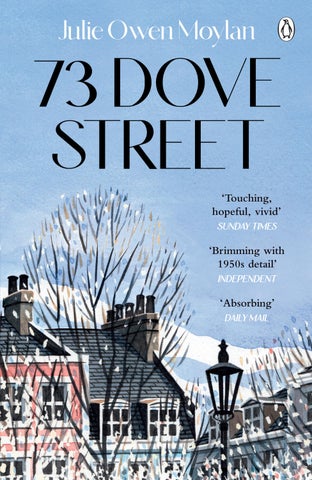
‘Touching, hopeful, vivid’ SUNDAY TIMES
‘Brimming with 1950s detail’ INDEPENDENT ‘Absorbing’ DAILY MAIL
penguin books
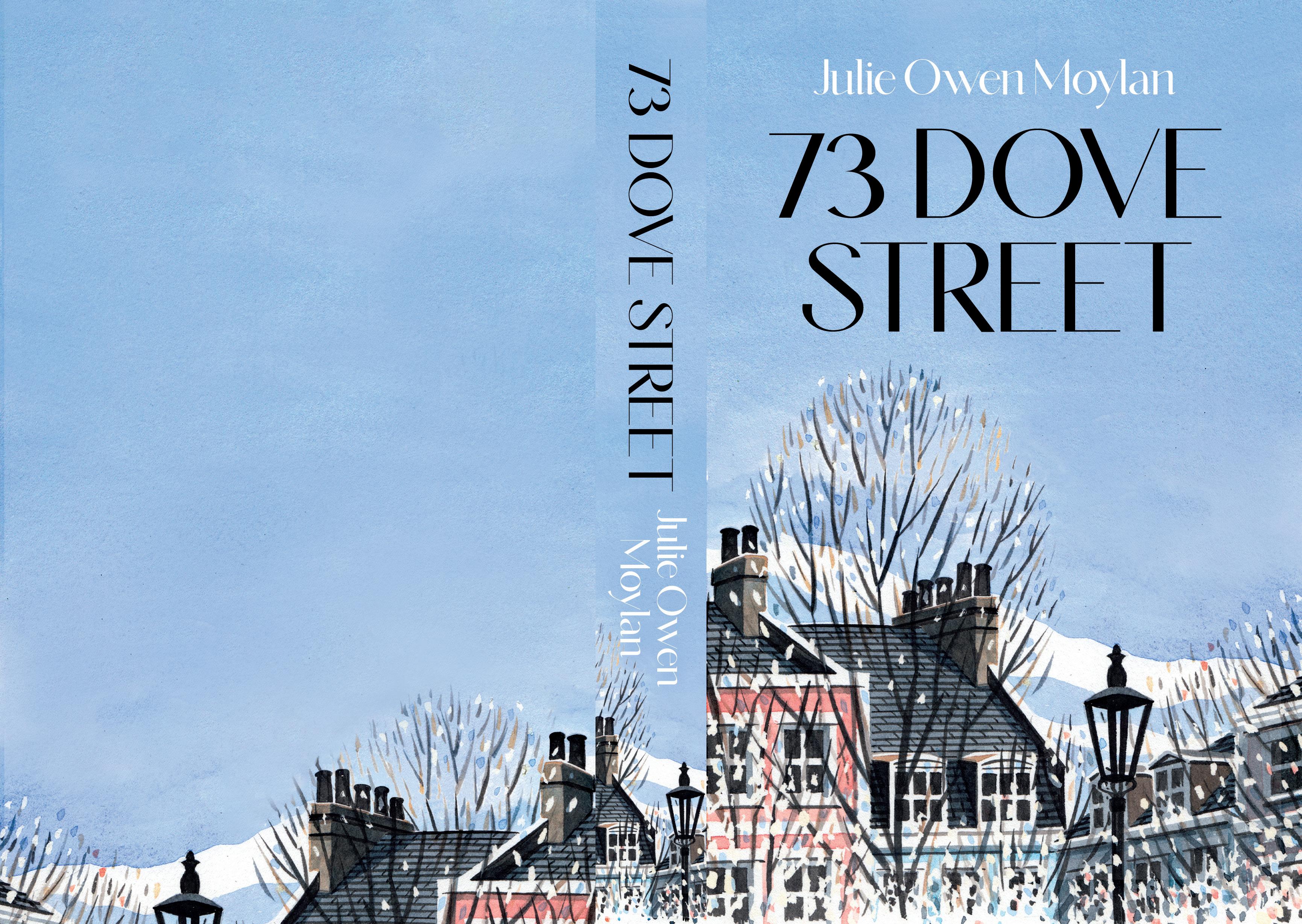
73 Dove Street
‘Touching, entertaining, hopeful. A vivid sense of time, place, people’s attitudes and fragilities’ Sunday Times
‘Psychologically astute and emotionally absorbing, this is a heartfelt read’ Daily Mail
‘73 Dove Street is a pacy and evocative account of the struggles facing women of that era’ Herald
‘Gripping . . . Julie Owen Moylan vividly recreates drab, grey, post-war London and her characters are convincing to the end’ The Times
‘From the Rivoli Ballroom to the seedy nightlife of Soho, the characters leap off the page in this compelling mystery’ Woman & Home
‘An incredibly vivid rendering of post-war London and the complicated lives of three woman whose fates intersect at a boarding house. This was an engrossing read; emotional, immersive and utterly absorbing’ Jennifer Saint
‘A corker. It’s the story of three working class women in 1950s London. I loved how the strands came together, very satisfying’ Kate Sawyer
‘A wonderfully evocative, immersive novel that brings 50s London to life, from the smog and the nightlife to attitudes towards women. It’s a vivid, absorbing and ultimately uplifting read’ Sunday Express
‘A vivid and propulsive story of three women and three dangerous secrets, 73 Dove Street so brilliantly and evocatively captures Soho in the 50s that I really feel I was there’ Sophie Irwin
‘Powerful, poignant and so beautifully drawn – every single scene comes alive’ Frances Quinn
‘Once again, Julie Owen Moylan has created a mid-century world that feels completely real and vivid. A hugely enjoyable book’ Jodie Chapman
‘Set in my end of 1950s London, the sense of time and place is beautifully evocative, the ghost of the war, and the sense of societal change about to come’ Laura Shepherd-Robinson
‘Stark choices and dangerous secrets disrupt the lives of three damaged but resilient working-class women in this compelling emotional drama’ Mail on Sunday
‘A beautiful story of friendship and new beginnings’ Best
‘Gripping and atmospheric, this novel will worm its way into your heart’ Red
‘Brimming with 1950s detail and atmosphere, pacy and evocative, authentic and well-drawn. An enjoyable read’ Independent ‘Superb’ Sun
about the author
Julie Owen Moylan is the author of That Green Eyed Girl and 73 Dove Street. Her debut novel That Green Eyed Girl was a Waterstones Welsh Book of the Month and the official runner up for the prestigious Paul Torday Memorial Prize. It was also shortlisted for Best Debut at the Fingerprint Awards and featured at the Hay Festival as one of its ‘Ten at Ten’. 73 Dove Street was named as one of Waterstones’ Books of 2023 and a Daily Mail Historical Fiction Book of the Year. As a filmmaker Julie won the Celtic Media Award for her graduation film BabyCakes before going on to win Best Short Film at the Swansea Film Festival. Her writing and short stories have appeared in a variety of publications including Sunday Express, Independent, New Welsh Review and Good Housekeeping. She has a Masters in Filmmaking and an additional qualification in Creative Writing & English Literature. Julie is an alumna of the Faber Academy.
By the same author
That Green Eyed Girl
PEGNUIN BOOKS
UK | USA | Canada | Ireland | Australia
India | New Zealand | South Africa
Penguin Books is part of the Penguin Random House group of companies whose addresses can be found at global.penguinrandomhouse.com
First published by Penguin Michael Joseph 2023
Published in Penguin Books 2024 001
Copyright © Julie Owen Moylan, 2023
The moral right of the author has been asserted
Typeset by Jouve (UK), Milton Keynes
Printed and bound in Great Britain by Clays Ltd, Elcograf S.p.A.
The authorized representative in the EEA is Penguin Random House Ireland, Morrison Chambers, 32 Nassau Street, Dublin d02 yh68
A CIP catalogue record for this book is available from the British Library isbn: 978–1–405–94944–6 www.greenpenguin.co.uk
Penguin Random Hous e is committed to a sustainable future for our business , our readers and our planet. is book is made from Forest Stewardship Council® certified paper
For my grandmother Lilian, ‘Lil’
She is clothed with strength and dignity, and she laughs without fear of the future.
Proverbs 31:25
London, October 1958
Something was burning. A tall plume of black smoke curling high up into the air, accompanied by the crackling of bright orange flames.
Edie blinked twice, slowing her pace before finally coming to a halt next to a rusty garden gate. The fizz of sparks climbed upwards, and just to be sure she blinked again – but there it was . . .
Someone had set a bonfire right in the middle of the pavement.
It was one of those London streets that had become a canvas of tatty boarding houses: windows filled with crooked pieces of cardboard saying ‘Room to Let’. The houses all looked the same: bay-fronted with scru y front gardens filled with dustbins, and children loitering on doorsteps with their runny noses and scraped knees. In one front garden sat an abandoned pram still bearing the thick, dark traces of the coal it had recently carried, while a surly cat leapt from an open dustbin where it had been ferreting for scraps.
Up ahead, the flames crawled high into the air and the heavy black smoke turned to grey as it drifted over
the upper part of the street, which was quite empty now, apart from a barefoot child playing hopscotch, the chalky-white squares of the game scratched over the grey stones of the pavement.
Edie watched as the girl tried to turn without putting her foot down. The sole was caked in grimy black dirt, and Edie couldn’t help but stare. The child stuck out her defiant arms, wobbling violently but forcing herself to hop back to safety. Suddenly aware she had an audience, her head jerked upwards. Pushing her wild tangled hair out of her eyes, she glared at Edie, sticking her little pink tongue out.
‘What you looking at?’ the girl cried and Edie hurried on, embarrassed by her own curiosity.
She began to walk towards the strange bonfire up ahead of her, a furious blister forming on the back of her left heel. It was unseasonably warm for October and she felt hot and tired. A trickle of sweat ran down the channel between her breasts. In her arms, she clutched a small cardboard suitcase to her chest as the handle had broken. The suitcase was bound up with string because the lock didn’t work either – a neat little knot holding it all together. An old leather handbag nestled softly in the crook of her elbow.
Edie was gripping a crumpled scrap of paper between her fingers; the skin around her fingernails was raw and broken where she’d been gnawing at them. From time to time she checked it anxiously, although she knew the words o by heart now: ‘73 Dove Street’.
Pressing on, she glanced nervously behind, but there was nobody following her. The smoke began to claw at her eyes and Edie didn’t really want to go any further, but she couldn’t go back either. It was too late.
‘You’ve made your bed, Edie Budd . . .’ she muttered to herself while mentally checking o the numbers of the houses one by one. There was number 65, with its sooty bushes either side of a bright green front door. The fire was getting closer now, and the smoke surrounded her. A few more steps, and Edie was standing outside number 69: the front garden a graveyard of wheels, most of them buckled, surrounded by the remains of broken prams and bicycles. A child’s red scooter had been abandoned on the ground. She checked the piece of paper one last time, counting out loud – it must be . . . that one. Her mouth fell open as she gazed at the fierce blaze right there on the pavement outside her destination. Number 73, Dove Street.
The house was a dirty red brick with a mud-brown front door, a black iron gate creaking back and forth on its squeaky hinges every time the wind blew. The front garden contained only weeds and a path leading to a grey metal dustbin, its lid fastened by means of a house brick carefully placed on top of it. The surly cat strutted past, with its questioning tail, and jumped over the low wall that separated number 73 from the neighbouring house. Next to the dustbin was a dirty white step leading up to that mud-brown front door with a brass knocker in the shape of a lion’s head. The
brass lion was roaring and seemed to indicate that casual visitors should not bother knocking.
Edie hesitated, trying desperately to find some welcoming feature about the house, then turned back to the fierce blaze on the pavement in front of her. Underneath the dense smoke and leaping orange flames was a small mattress – which had seen better days even before someone had seen fit to set it on fire. On top of the single mattress lay the smouldering remains of a man’s suit in navy blue, along with a funeral pyre of assorted belongings.
Vinyl records melted into the mattress, black and tarry. To the side of the flaming bonfire was a blackened pan; clearly, blazing lard had been thrown over both these belongings and the bodily fluids of whoever had last laid down on that mattress.
Edie was about to turn around and walk away from number 73 when suddenly a stout middle-aged woman wearing a furious expression on her face appeared at the front door and shouted, ‘If you’ve come about the room, best get inside . . .’
The two women eyed each other cautiously. After a long few seconds, Edie gulped down an anxious breath and slowly picked her way past the crackling whip of sparks in the air and a lone sock, whose mate was lost in the fire.
Five Years Earlier
The first time Edie laid eyes on Frank Budd, she was on the other side of the city: dancing on a table with a sailor in the Rivoli Ballroom. She hadn’t intended to dance in front of everybody, but the music had carried her all the way up there, every drumbeat and trumpet blast giving her feet an energy they didn’t normally possess. Her arms couldn’t stop moving, and when a passing sailor grabbed hold of her, twisting her under his arm and back again, Edie could only laugh and throw her body into it. At some point the crowd parted a little as people watched them jive, then the sailor jumped up on a table to carry on dancing. For a moment, Edie stood there all alone in the middle of the dance floor being cheered on by strangers, not knowing quite what to do until two pairs of strong arms hoisted her up, and suddenly there she was: swinging her arms in time with the music and tapping her feet, while the sailor spun her around and around until she was dizzy. Eventually the music stopped and everyone went wild, clapping and cheering. Another sailor put his arms around her waist and picked her up, showing her
o to the crowd for their applause before placing her delicately back on to the dance floor. Edie laughed and turned her head to look for her friends but she couldn’t see them. The thirsty sailors wandered o to the bar to fetch more drinks and she was left alone, her heart still racing and a sheen of sweat cooling on her forehead and arms.
There he was, standing in front of her, watching everything with those pale blue eyes. They were smiling, mischievous eyes and he nodded, staging a funny little bow to her.
‘Quite the little dancer, aren’t ya?’ he said with a soft voice. It didn’t sound entirely like a compliment.
‘I like that song, that’s all.’
He made her feel she had failed some kind of a test that she hadn’t known she was sitting. Strangely, she found that she wanted to pass it. This handsome stranger with the pale blue eyes was watching her, and, unlike the other boys, he hadn’t asked if he could get a dance, or if she’d like a gin and lime. He was older than the rest and there wasn’t that feeling of desperation which sometimes poured o them, or that sense of it all being a game to see if they could get her to go outside for some ‘fresh air’, where they would demand kisses as the price to light her cigarette, or even to let her go back inside the dance hall again.
Frank just leaned back against the wall and watched her. Edie giggled nervously and then when he didn’t join in the laughter, she stopped.
‘I can’t work you out,’ she said.
‘Ahh, you’re not alone there. I’ve been trying to get to the bottom of me for years. If you get there before me, I’ll be quite upset.’ His eyes glinted and he grinned at her.
Edie laughed with him this time, moving closer to where he was standing. It was hot inside the dance hall and she could smell soap and sweat, cigarettes and the sour tang of Brylcreem on his hair. From the corner of her eye, she could see other girls eyeing him up but he carried on smiling softly at her.
‘You’re a funny one . . .’ She inched closer, feeling as if he was pulling her to him.
‘What’s your name?’ he asked.
‘Edie.’
‘Pretty name.’
‘What’s yours?’
‘Frank.’
Edie stared up at him, her lips curling into a smile. Somewhere deep inside, part of her was already attaching her name to his: Edie and Frank . . . as if they belonged together.
‘I’ll walk you home, if you like?’ He took her arm gently and she let him lead her towards the entrance. Edie hadn’t even wanted to go home before that moment but once she felt his fingers pressing against the warm skin of her forearm, she didn’t want to stay without him either.
As they reached the door Frank paused next to a
lanky dark-haired man who had trapped a small redhaired woman against the wall and seemed to be trying his best to persuade her to go outside with him. Frank tapped him on the shoulder.
‘Pete, I’m o . Catch you tomorrow.’
Reluctantly, the man turned his attention away from the redhead, turning to look Edie up and down, before grinning at his friend. ‘Don’t do anything I wouldn’t do . . .’ Pete laughed at his own joke but Frank was already walking away, with Edie following behind him.
The streets were scattered with people coming and going from the dance hall. As they walked along, car headlights lit up couples tucked in doorways or alleyways, their mouths open and their hands inside each other’s clothing. Frank made no attempt to pull Edie into one of the dark openings and do likewise with her. They just walked in silence; the only sound was the click-clack of her heels hitting the paving stones. She wasn’t usually stuck for words, but for some reason this man made her want to choose what she said carefully.
‘I haven’t seen you there before,’ she said eventually.
‘I haven’t seen you there before,’ he said and took hold of her hand.
His fingers wrapped around hers, feeling warm and solid, as if he was something that she could hold on to. Edie liked the feeling of him touching her and to
her surprise thought she wouldn’t mind if he did pull her into one of those dark doorways to kiss her.
The pub on the corner was kicking out, and Edie could see her neighbours and her Uncle Bert wandering slowly back to their houses, shouting goodnights and sharing the last moment of the joke that had no doubt kept them chuckling for much of the evening. As their laughter faded away into the night air, Frank’s pace slowed, as if he had no wish to get caught up in their chatter. On either side of the street, the little houses leaned one against the other, as if they’d all fall over if someone moved the pub on the corner. As they approached Edie’s front door, the street was quiet again, with only the sounds of mu ed arguments going on inside the little houses as drunken husbands were greeted by their wives.
Edie could hear the sound of her own breathing as she waited for Frank to kiss her goodnight. Instead, he just kissed the hand he had been holding, pressing the back of it to his lips. Soft, warm lips they were too. She gazed up at him, wanting to fall into those smiling blue eyes, but finding something steely and unrelenting about them. He wasn’t smiling now. She snatched her hand away from his lips and stood there pouting with her chin jutting forward.
‘Goodnight then. Thanks for walking me home.’ She put her hand to the letter box, pulling out the piece of red wool they kept the front-door key on. The key
rattled up against the wood of the door until it was in her hand and she slotted it into the lock.
‘I’ll pick you up next Friday at seven o’clock,’ he said. Edie turned to face him, puzzled now and a little annoyed. She didn’t like the game he was playing, keeping her o balance and wanting her never to be sure of him.
‘Oh, is that right? I think I’m washing my hair that night.’ Edie regained her composure and stood there, staring him down. She wouldn’t be taken for a fool.
‘If you like . . . I’ll be here though – seven o’clock.’ And with that he started to walk away, whistling softly under his breath.
‘Hang on a minute there. I haven’t said I’ll go out with you.’
‘Then you won’t answer the door when I call, will ya?’ he shouted over his shoulder and raised his hand to wave as he walked away. Edie watched him go; the memory of his mouth still tracing the skin on her hand.
London, October 1958
The hallway of 73 Dove Street had an olive-green carpet, which was curling at the edges and looked as if it hadn’t been cleaned for a very long time. There was no lightshade, and the bare bulb swayed slightly with the smoky breeze blowing through the front door.
‘Close the door if you don’t mind. Come into the parlour. That’s where I like to discuss my business,’ the woman said and opened a door that was painted in army green.
The parlour was a dusty room with heavy red furniture and thick, moth-eaten curtains. There was a strong smell of camphor but, judging by the state of the curtains, it was too late for such measures. Edie wrinkled her nose.
The red velvet sofa had lost one of its little feet and was lopsided. Next to the sofa was a small table with a black Chinese vase that had clearly been glued back together: the top of the vase was chipped and a large crack ran down the centre of it, as if somebody had dropped it at some point. On the wall facing Edie as
she entered the room was a picture of the Queen in her ermine robes, and on the opposite wall a watery landscape in blues and greys, all tumbling seas and cloudy skies. There were photographs in wooden frames along the top of the mantelpiece, but their faces were all turned downwards. Edie wondered if somebody had died.
Edie had never rented a room on her own and her courage, with which she had started the day so well, had long since run out, leaving her in a nervous state. Everything had happened so quickly that she hadn’t had time to think. Standing to attention, she tried to steady herself. She just needed a few days to work out what to do next.
Her plan had been quite clear in her mind when she’d nervously scribbled down the address of a house with ‘Rooms to Let’ from a newsagent’s window earlier that morning. She would lie low for a while, maybe a week, and then she would buy a train ticket and leave London for good. The buying of the train ticket seemed like such a simple thing, but the problem was that the destination kept changing in Edie’s mind as possibilities came and went. She’d never been further than Margate – in fact, she’d barely set foot outside Deptford in her entire life. Her world had been small and she had liked it that way. Familiar houses; people she’d known her whole life. It had been all she needed until things had gone so terribly wrong. Apart from the odd shopping trip or day out, Edie had never
strayed very far and she had no idea how you might go about choosing a place to live far away from everything you’d ever known. Even 73 Dove Street, lodged firmly as it was in the shabby hinterland between Notting Hill and Ladbroke Grove, seemed quite far to travel in Edie’s mind.
There were just too many choices. Presenting themselves as sunny seaside resorts, or dark industrial cities filled with strangers, playing like images on a movie screen, and all she had to do was choose. But the choosing confused her. One choice presented all the worries of refusing the other choices, and every time Edie reached the same conclusion: she’d think about it tomorrow.
‘I’m Mrs Collier but my tenants usually call me Phyllis. I’ll answer to either . . .’
The sound of the woman’s voice cut through Edie’s worrying and she snapped to attention.
In front of her, Phyllis stood with her arms folded, droning on and on about rules. Apparently, it was very important that Edie understood the kind of respectable house she was running, as the woman carried on explaining without drawing breath. Meanwhile, Edie’s hands continued their trembling no matter what she did. Her little cardboard suitcase felt heavy in her arms, and there was a faint whi of burning in the air from the mattress that was still ablaze in the street. The wallpaper in the parlour was peeling due to the damp and Edie couldn’t help wondering: if this was
the parlour then what on earth would her room be like?
‘Come along then . . . I’ll show you up.’
Edie scurried along behind the older woman as they walked out of the damp-smelling parlour and started to climb the stairs. They were covered in the same awful olive-green carpet, which looked as though it had been nailed on to the bare boards. The wallpaper was light brown with large yellow chrysanthemums flecked with damp spots and peeling at the seams. It had one of those annoying light switches that plunged you into darkness if you were too slow reaching the next floor.
One flight up, they passed by a small shared kitchenette for the tenants, with the bathroom next door. The kitchenette had an old sink stained with dirty brown streaks, a Formica cabinet in lemon yellow for storing groceries and dishes, and a Baby Belling cooker stu ed away in the corner. The bathroom smelled of carbolic soap but was clean enough. On the back of the door was some kind of cleaning rota, but several of the names had been crossed out, so it made little sense. Just across the landing was a small room containing the lavatory with its thick wooden seat and long metal chain. On the wall beside it, a pile of old newspapers was cut up and stuck on a nail for toilet paper. Edie exhaled softly, a quiet disappointment. It would have to do for now.
By the time they climbed to the top of the house
Edie was beginning to worry about what she might find behind the closed door, but in fact it was so small there wasn’t space for anything too o ensive. A single bed pushed up against the wall with a tiny attic window. A wooden chair acted as a bedside table. In the cheap hotel where she’d stayed last night there had been bed bugs, and she’d spent hours hunting them down with a bar of soap, watching black dots scatter across the mattress as soon as she put on a light and pulled back the covers. At least this room wasn’t that bad.
Against the other wall was a small closet and a single gas ring with a tin kettle sitting on top of it, although the tap to fill it was downstairs in the kitchenette. Two dull blue cups hung precariously from metal hooks over a shelf.
The window had a small painting of a Victorian child playing with an old-fashioned hoop leaning against it, but no curtains. Edie doubted that anyone could see in, anyway, as they were so high up and the window was so small. The room seemed quite gloomy even in the daytime. On the floor by the gas heater a meter was whirring around, even though Edie couldn’t see that anything was being used at that moment.
Phyllis sni ed loudly, ‘I had two tenants leave in a bit of a hurry so there’s another room downstairs I can show you if you like, but it’s an extra ten bob a week.’
‘No, this will do . . .’ She gazed around the tiny attic room that was to be her new home, at least until she could get herself sorted out . . . whatever that might
mean. Today was a fresh day, although the same dark cloud of worry nagged at her constantly. Tomorrow, tomorrow she would decide what to do. The tiny sliver of hope soothed her nerves a little.
She nodded to Mrs Collier and finally set the small cardboard suitcase on the floor. She shook out her aching arms and decided that this would do for the time being, so reached inside her handbag and handed over two crisp pound notes.
‘Gas meter takes penny pieces, so you’ll need those. I don’t keep spares otherwise I’d be up at all hours feeding the meters for my paying guests, and I can’t do it, you see. The electricity meter is in the passageway just outside your door. Same thing. You’ll soon get the hang of it. I’ll fetch your change up later . . .’
The woman rubbed the pound notes between her finger and thumb, and finally took a moment to inspect Edie, who was standing nervously in front of her.
She stared for so long that Edie began to worry what she might see. Too much make-up and horribly bitten fingernails, the outline of a faint purple bruise on her cheekbone.
This in turn made her even more nervous, but her money was real enough and so, eventually, Phyllis handed over two small brass keys.
Edie curled her fist around the keys, suddenly overwhelmed with the idea that she could lock her own door and do whatever she pleased.
Her sense of freedom was short-lived as, suddenly, the door flew open and a young woman burst into the room, gabbling away nineteen to the dozen and reaching for a small cardboard box that was sitting on top of the bed.
‘Won’t be two ticks, Phyllis. Just getting the last of my things . . . Oh! Is this the new girl?’
‘Yes, this is my new tenant . . . Miss Budd, wasn’t it?’ said Phyllis before Edie could so much as open her mouth.
‘Yes. Edie.’
‘How d’you do? You can call me Tommie.’
The other girl was all sharp wits and weary eyes. Around the same age as Edie and slightly taller, she was wearing a loose blue dress with her hair tied back in a bright red scarf; a cigarette dangled from her bottom lip. Tommie, she’d called herself – and she embarked on a stream of chatter, all delivered without so much as a glance at Edie. Snatching up her cardboard box, she rushed back out of the room, only hesitating in the doorway long enough to give Phyllis a knowing look.
‘What about . . . my mattress ?’ Tommie raised her eyebrows as she emphasized the words. Phyllis folded her arms and pursed her lips.
‘My brother will sort it out later. Well, I think that’s all for now . . .’ Phyllis scowled at Tommie, and then turned on her heel and walked out of the room, leaving her two tenants to get on with things.
‘Matrimonial . . . Should have heard ’em – went on for days. Welcome to Dove Street,’ Tommie whispered, rolling her eyes and grinning at Edie, before pulling the door closed behind her.
Edie listened as the footsteps clattered away down the stairs, before taking out the two brass keys that Mrs Collier had given her, turning one in the keyhole and sinking back against the locked door.
She stared around the room, taking it all in. It had happened so quickly – the awful look on Frank’s face, those men hammering on the door, last night in that awful hotel, the long walk to Dove Street. She’d only left her home in Deptford yesterday morning but it seemed so far away now. Another life entirely.
Edie moved towards the bed to finally sit down, when suddenly a thought flitted across her mind and she hesitated. There was one thing she had to do first. Opening her old leather handbag, she carefully took out a small brown envelope, crammed full of cash, all tied together with a thick elastic band. She held it by her fingertips as if holding it more tightly would make everything real. It was more money than she’d ever seen in her life, and Edie didn’t want to touch it or carry it with her for one minute longer than she had to.
She searched around the room for hiding places and then gently lifted up the mattress from the metal springs underneath it. Getting to her knees, she shoved the envelope as far as it would go, so that it
was wedged firmly between the mattress and the wall. It would be safe there for a little while. Edie knew that she would have to face the fact of the small brown envelope at some point . . . but not today. She smoothed down the eiderdown, making sure that it covered the edges of the mattress, carefully checking that the money was safely tucked away out of sight. Fussing with the salmon-pink quilt, she picked at the edges of it nervously until she was completely satisfied. Only then did she let out a long sigh and sit back on her heels. When she looked down, Edie saw that a tiny cloud of glittering spangles had settled on her lap in silver, gold and blue.
Five Years Earlier
Edie tried on her two dresses, twirling around madly in front of the mirror to see which one she preferred. There was the pale green dress she’d worn out dancing with its frilly petticoats and sweetheart neckline, or a black wool dress that was tight fitting but covered everything up nicely. The black, she thought . . . after all, he’d already seen the green one and she wanted to look like a serious person. A girl you could get serious with, that was. She poured a nip of gin into her pink Bakelite toothmug and downed it in one go. He probably wouldn’t even turn up. Men like that were all charm until they got what they wanted, then you’d be left knitting booties out of lemon-yellow wool and not see sight or sound of them again. It had happened to her friend Margaret. Just the once it was too, she’d said. Her back pressed against the alley and her knickers around her ankles. ‘I wouldn’t have minded,’ she’d said, ‘but they were my best ones and I got dirty black oil on them.’ As it turned out, Margaret had got a lot more than oil on her best silk drawers. Nine months later she had a baby boy
weighing in at nearly ten pounds. ‘Like a prize turkey,’ she’d exclaimed when Edie visited her at home. The baby was wrinkled, rash-ridden and smelled of something nasty but Edie nodded and said he was handsome as could be and Margaret seemed satisfied. She couldn’t remember the last time she’d seen Margaret out and about now.
‘And let that be a lesson to you, Edie,’ she said to herself in the mirror.
Her hair was not behaving itself as it should: one curl was sticking out at an awkward angle and refused to be pinned or flattened back down. Apart from that, she looked quite nice in her black wool dress. She admired herself for a bit, the curve of her waist and her large hazel eyes. She wasn’t bad when she made an e ort . . . not that she was making an e ort for him.
Edie told herself that she honestly didn’t care about Frank as she checked the clock again. It was nearly seven but there was no sign of him. She looked nice and she might pop into the King’s Head and treat herself to a gin and lime if he didn’t come. She knew everyone who drank in there and was sure to find one or two of the girls from the biscuit factory. She’d been moved from plain to fancy biscuits but all her old mates were ‘cracker packers’ and she missed the fun they would have telling stories about their dates, or husbands in the case of the older women. Yes, that’s what she would do, and then it wouldn’t matter
whether he turned up or not. She checked the clock once more, then sat down on her bed to wait.
At exactly seven o’clock there was a loud rat-tat-tat on the door and Edie counted to ten before slowly – as slowly as she could possibly manage – walking downstairs to open it. She was glad her Uncle Bert had gone out to the pub already, as he took great pride in inspecting any male callers and teasing her about them for days afterwards.
‘I’m only doing what your father would do if he was here,’ Uncle Bert would say as Edie protested her embarrassment. She wanted to keep Frank all to herself though . . . for a while at least. He wasn’t like the others. She reached for the front door and took a deep breath.
There he stood, as handsome as she remembered, carrying flowers no less. Pink carnations, wrapped in brown paper. Edie couldn’t remember anyone ever bringing her flowers before. There was Martin, the boy who worked at the butcher’s in the High Street, who took her to the pictures once, picking a dandelion o a crack in the street before handing it over to her to blow the head o it. He said it was good luck, and Edie didn’t ever argue about things to do with luck so she had done it, but it hadn’t been lucky for Martin who had the most awful breath and never got to take her out again.
But these flowers were something else – and so was
Frank, standing there holding them in his navy suit and a clean white shirt. Those blue eyes twinkling just for her.
‘So, not washing your hair then?’ he said and Edie felt a flare of annoyance. Not You look nice or Where would you like to go? but like he’d trapped her in a game that she’d lost. She regretted the black woollen dress, and wished she’d answered the door with a towel draped around her head in a turban, wearing her old flowery dressing gown with its mismatched belt.
‘Oh, it’s you . . . I was just going out as it happens.’ Her smile was secret and spiteful, and a small frown appeared between his eyes for a brief second. Edie knew she’d struck a small blow: knocked him o balance for a moment and revealed that he wasn’t quite so sure of himself as he made out.
‘Are they for me?’ she said, reaching a hand towards the pink carnations.
‘No, they’re for my grandma. That’s why I called, actually . . . to tell you I’m going to visit my poor sick grandma so I can’t take you out after all.’
Edie’s face must have registered the same shock and surprise as Frank’s face had just a few moments ago. It was a game of chess and now she was the one checkmated. She pulled a face and withdrew her hand, feeling rather foolish. This man was constantly knocking her o balance and she both liked the challenge of it and disliked how stupid it made her feel.
‘I’m kidding . . . that’s all. Are you coming or not?’
He laughed and his face relaxed. The frown was gone now and his pale blue eyes sparkled with the fun of teasing her. The pink carnations came towards her and this time she took them, burying her face to smell them for a moment to hide her embarrassment.
‘OK then, but I can’t be out too late. I’ve got an early shift tomorrow.’
‘Don’t worry, Cinders, I’ll have you home before midnight.’
‘Where are you taking me anyway?’ Edie pouted slightly, but in a way that she knew men generally found attractive.
‘I thought I’d take you to the pictures. Might even spring for the Circle and a box of chocolates if you’re a good girl. You look beautiful, by the way . . .’
His face turned serious, all the teasing faded away and Edie saw that he liked her. She gazed up at him for a moment, feeling a faint blush spreading across her cheeks, and then they both smiled shyly at each other.
‘So, pictures it is then,’ he said firmly and she nodded.
Edie liked going to the cinema, and going upstairs to the Circle, where she could look down on everyone she knew, might be nice. She silently gave thanks that she’d chosen the black woollen dress over the pale green, which would have been quite wrong for this.
She abandoned the pink carnations on the side table by the front door where they kept the mail. She
wanted to take a moment to put them in water but Frank was hurrying her along.
‘Let’s get going then – don’t want to miss the start, do we?’ he said, moving away from the doorstep towards a large black motorbike that was parked in the street.
‘I’m not getting on that thing,’ she said, faintly horrified that he would expect her to.
‘But it’s my pride and joy!’ Frank laughed as he sat astride it.
Edie edged gingerly towards the motorbike. ‘Suppose I fall o it . . . ?’
‘Then I’ll have to find myself another date, won’t I?’
Her mouth opened and closed again as she searched for a witty retort. His face softened and he reached out his hand, pulling her towards him. ‘You won’t fall o . I’ll look after you.’
She hesitated but Frank gently squeezed her hand. ‘Climb on then!’
To her surprise Edie found herself lifting up her black woollen dress so she could straddle the bike. Raising her feet away from the ground, she clamped both arms around his waist as the engine burst into life with an awful roar.
London, October 1958
The room on the first floor of 73 Dove Street was much bigger than the one Edie was busy making herself at home in. Tommie used to have the top room herself, but she hadn’t hesitated to grab a better room as soon as the old tenant, Trudy, had left. It was worth paying out an extra ten bob a week as far as she was concerned. As she put her cardboard box down on the table, she looked around approvingly while flicking cigarette ash into the palm of her hand.
The room had a large bay window and the same light brown wallpaper with yellow chrysanthemums as the hallway, but at least here it appeared to be firmly attached to the walls. It was less gloomy than the tiny room upstairs, and that pleased her. There were two wooden chairs and a small table, plus a gas ring to make tea. There was a gas fire on the opposite wall and next to that a single bed that was missing its mattress. Tipping the cigarette ash from her hand into an empty cup, Tommie eyed the bare metal springs of the bed, shrugged her shoulders, and turned her attention to the small cardboard box.
On top of various old photographs and assorted souvenirs lay an old postcard. Picking it up carefully, she hunted around in the box for a drawing pin. The postcard was of an old tearoom somewhere in the English countryside. It was surrounded by beautiful purple wisteria and had leaded windows outlined in black. Tommie stared at it for a few moments and then pinned the postcard up next to her bed, so she could look at it before she put her light out at night.
Walking over to the bay window, she pushed back the greying net curtains with one finger so she could see what was happening. Outside in the street, the flames were dying out, leaving only the charred remains of the mattress that had once belonged to the single bed in the corner of her new room . . . and all of Mr Collier’s worldly possessions. A small boy rattled the front gates of all the houses with a long wooden stick, the clanging noise filling the air as he dragged his stick against the metal bars. If one gate made a particularly pleasing noise the boy returned and hit it again. His very own metal orchestra.
The fruit and veg man had parked up on the other side of the road, the back doors of his van flung open and a small queue of neighbours gossiping as they picked out their carrots and potatoes, or a nice bit of cabbage.
Tommie plonked herself down in one wooden chair and rested her feet on the other. Sucking in a lungful of
tobacco, she blew a chain of delicate smoke rings into the air.
As she stretched out her limbs, Tommie began to consider the possibilities for the rest of her day. A familiar ache grew as she contemplated her plans for the evening. It was as if a string were attached to the centre of her chest, so that whenever she took a breath, it pulled her closer to where she wanted to be . . . closer to him.
Leaning back in her chair, Tommie closed her eyes, imagining the narrow Soho streets, neon lights flickering on and o , the thump of loud music, the smell of greasy food and strong co ee in the air. The aching hunger grew, blooming inside her until she bit down on her bottom lip. Her eyelids fluttered open as her lips parted. Another smoke ring crawled slowly towards the yellowing ceiling and then disappeared. She began to hum a happy tune – her favourite song. Her lips curled into a hopeful smile.
Somewhere deep inside her, the ache won. There was only one place she wanted to be tonight.
Upstairs, there was the sound of a stern click and then the room plunged into darkness. Edie was curled up on her single bed having barely moved. She felt rigid, as if her muscles wouldn’t work properly. All she wanted to do was lie still and be very quiet. Everything felt strange: the mattress under her weight, the furniture, the unfamiliar smell of the musty pink
bedspread. Edie couldn’t quite take it all in yet, and so she lay there staring at everything in the room, trying to understand that she lived here now.
The moment the penny in the electricity meter was all used up, Edie realized that she didn’t have another one. She could either carry on lying on her bed until morning or go in search of change. Wearily, she got to her feet, rubbing at the blister on her heel and standing at the little window looking out at Dove Street. If she stood on tiptoe, Edie could just about peer out at the red-brick houses slashed by rain. She searched the street for signs of anyone she recognized and, finding only people scurrying out of the rain, decided to risk going outside again.
The unseasonably warm October day had turned into a cool drizzly evening and Edie reached for her coat and handbag, buttoning her coat all the way to the throat before tying her navy-blue headscarf firmly in a knot under her chin.
She opened her bedroom door a few inches, carefully checking if anyone was around, before creeping out on to the landing and locking the door behind her, then tucking the little brass keys deep into the bowels of her handbag to keep them safe.
Her mother had always kept the front-door key threaded on a loop of red wool that you could pull through the letter box to let yourself in. When Edie married, she had done the same thing, only with a piece of blue wool – but number 73 wasn’t the type of
house to have anyone put their hand through the letter box to let themselves in, and for that she was grateful. Remembering the piece of blue wool made her think about Frank, and Edie shook her head, as if she could make the thoughts go away. The last time she’d seen him . . . She couldn’t think about that now. She had to look to the future, make plans . . .
As she crept down the first flight of stairs, Edie heard the sound of somebody opening the bathroom door and stood quite still as Tommie wandered back to her room, humming a little tune as she went. She waited until the bedroom door clicked shut before running quietly down the rest of the stairs, hoping not to bump into anyone else in the house.
Edie had no idea where she might go to get change for her meter but she was certain that she had no wish to knock on any of the other doors. It was best not to mix with people. She didn’t mind if the other tenant wanted to keep herself to herself. That suited her quite nicely as she wasn’t one for gossip at the moment, and she certainly didn’t need anyone to be interested in her.
As she reached the front door, Edie could hear the strains of Mantovani seeping through the kitchen door. It was open a crack and she could see Phyllis mopping her kitchen floor. She hesitated for a moment, wondering if she might ask her for change just this once to save her going outside. Then Edie remembered her stern warning about the stock of