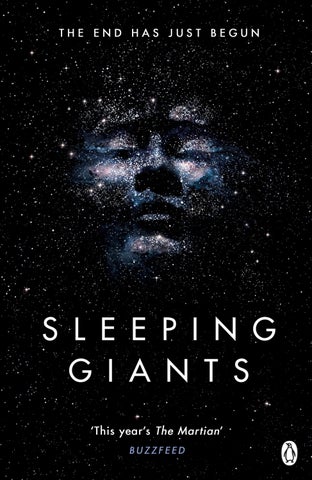
Sleeping Giants
penguin books
Sylvain Neuvel was born in Quebec and dropped out of school when he was fifteen. Since then he has sold ice cream in California, peddled furniture across Canada and taught linguistics in India. He has also worked as a software engineer, journalist, certified translator and received a Ph.D in Linguistics from the University of Chicago. He is an amateur robotics enthusiast and lifelong fan of all things science fiction. Sleeping Giants is his debut novel and the first in ‘The Themis Files’. The second, Waking Gods, is out TheThemisFiles.comNeuvel.net@Neuvelnow.
Sleeping Giants Book One of the Themis Files sylvain neuvel PENGUIN BOOKSPENGUIN BOOKS
PENGUIN BOOKS UK | USA | Canada | Ireland | Australia India | New Zealand | South Africa Penguin Books is part of the Penguin Random House group of companies whose addresses can be found at global.penguinrandomhouse.com First published in the United States of America by Del Rey 2016 First published in Great Britain by Michael Joseph 2016 Published in Penguin Books 2017 001 Copyright © Sylvain Neuvel, 2016 The moral right of the author has been asserted Set in 12.5/14.75pt Garamond MT Std Typeset in India by Thomson Digital Pvt Ltd, Noida, Delhi Printed in Great Britain by Clays Ltd, St Ives plc A CIP catalogue record for this book is available from the British Library paperback isbn: 978–1–405–92188–6 om paperback isbn: 978–1–405–92189–3 www.greenpenguin.co.ukPenguinRandomHous e is committed to a sustainable future for our business , our readers and our planet. is book is made from Forest Stewardship Council® certified paper

À
Maintenant,Théodore.onvat’apprendreàlire ...etl’anglais.
Sleeping1 Giants
Prologue3
It was my eleventh birthday. I’d gotten a new bike from my father: white and pink, with tassels on the handles. I really wanted to ride it, but my parents didn’t want me to leave while my friends were there. They weren’t really my friends, though. I was never really good at making friends. I liked reading; I liked walking in the woods; I liked being alone. And I always felt a little out of place with other kids my age. So when birthdays came by, my parents usually invited the neighbors’ kids over. There were a lot of them, some whose names I barely knew. They were all very nice, and they all brought gifts. So I stayed. I blew out the candles. I opened the presents. I smiled a lot. I can’t remember most of the gifts because all I could think about was getting out and trying that bicycle. It was about dinnertime by the time everyone left and I couldn’t wait another minute. It would soon be dark; once it was, my father wouldn’t let me leave the house until morning. I snuck out the back door and pedaled as fast as I could into the woods at the end of the street. It must have been ten minutes before I started slowing down. Perhaps it was getting a little too dark for comfort and I was thinking about going back. Maybe I was just tired. I stopped for a minute, listening to the wind throw ing the branches around. Fall had arrived. The forest had turned into a motley landscape and given new depth to the hillsides. The air suddenly got cold and wet, as if it were about to rain. The sun was going down and the sky behind the trees was as pink as those tassels.
I hadn’t noticed them before, but there were firemen above, yellow jackets buzzing around the hole. A rope fell a few feet from my head. Soon, I was strapped onto a stretcher and hoisted intoMydaylight.father didn’t want to talk about it afterward. When I asked what I had fallen into, he just found new clever ways of explaining what a hole was. It was about a week later that someone rang the doorbell. I called for my father to go, but I got no answer. I ran down the stairs and opened the door. It was one of the firemen that had gotten me out of the hole. He’d taken some pictures and thought I’d like to see them. He was right. There I was, this tiny little thing at the bottom of the hole, lying on my back in the palm of a giant metal hand.
I heard a crack behind me. It could have been a hare. Something drew my eye to the bottom of the hill. I left my bicycle on the trail and started slowly making my way down, moving branches out of my way. It was hard to see, as the leaves hadn’t fallen yet, but there was this eerie turquoise glow seeping through the branches. I couldn’t pinpoint where it came from. It wasn’t the river; I could hear that in the distance, and the light was much closer. It seemed to be coming from everything. I got to the bottom of the hill. Then the ground disappeared from under my feet. I don’t remember much after that. I was out for several hours and the sun was coming up when I came to. My father was standing about fifty feet above me. His lips were moving, but I couldn’t hear a sound.
4
The hole I was in was perfectly square, about the size of our house. The walls were dark and straight with bright, beautiful turquoise light shining out of intricate carvings. There was light coming out of just about everything around me. I moved my hands around a bit. I was lying on a bed of dirt, rocks, and broken branches. Underneath the debris, the surface was slightly curved, smooth to the touch, and cold, like some type of metal.
part one Body Parts
Interview with Dr Rose Franklin, Ph.D., Senior Scientist, Enrico Fermi Institute
7 File No. 003
—How big was the hand? 6.9 meters, about twenty-three feet; though it seemed much larger for an eleven-year-old.
Location: University of Chicago, Chicago, IL
—What did you do after the incident? Nothing. We didn’t talk about it much after that. I went to school every day like any kid my age. No one in my family had ever been to college, so they insisted I keep going to school. I majored in physics. I know what you’re going to say. I wish I could tell you I went into science because of the hand, but I was always good at it. My parents figured out I had a knack for it early on. I must have been four years old when I got my first science kit for Christmas. One of those electronics kits. You could make a telegraph, or things like that, by squeez ing wires into little metal springs. I don’t think I would have done anything different had I listened to my father and stayed home that day.
I read what little was left of his notes – most of it was redacted by the military. In the three years he spent in charge, his main focus had always been figuring out what those carvings meant. The hand itself, which is mostly referred to as ‘the artifact,’ is mentioned in passing only a few times, evidence that whoever built that room must
8
Anyway, I graduated from college and I kept doing the only thing I knew how to do. I went to school. You should have seen my dad when we learned I was accepted at the University of Chicago. I’ve never seen anyone so proud in my life. He wouldn’t have been any happier had he won a million dollars. They hired me at the U of C after I fin ished my Ph.D.
—What happened? To the hand? The military took over the site when it was discovered. —When was that? When I fell in. It took about eight hours before the military stepped in. Colonel Hudson – I think that was his name – was put in charge of the project. He was from the area so he knew pretty much everyone. I don’t remem ber ever meeting him, but those who did had only good things to say about the man.
—When did you find the hand again? I didn’t. I wasn’t looking for it. It took seventeen years, but I guess you could say it found me.
What’stime.fascinating
—What do you think that was?
is how much effort they put into dis proving their own findings. Their first analysis indicated the room was built about three thousand years ago. That made little sense to them, so they tried carbon dating organic material found on the hand. The tests showed it to be much older, somewhere between five thousand and six thousand years old. —That was unexpected? You could say that. You have to understand that this flies in the face of everything we know about American civilizations. The oldest civilization we’re aware of was located in the Norte Chico region of Peru, and the hand appeared to be about a thousand years older. Even if it weren’t, it’s fairly obvious that no one carried a giant hand from South America all the way to South Dakota, and
I have no idea. Hudson was career military. He wasn’t a physicist. He wasn’t an archaeologist. He had never studied anything resembling anthropology, linguistics, anything that would be remotely useful in this situa tion. Whatever preconceived notion he had, it must have come from popular culture, watching Indiana Jones or something. Fortunately for him, he had competent peo ple surrounding him. Still, it must have been awkward, being in charge and having no idea what’s going on most of the
9 have had a complex enough religious system. I think he had a fairly precise notion of what he wanted this to be.
10 there were no civilizations as advanced in North America until much, much later.
In the end, Hudson’s team blamed the carbon dating on contamination from surrounding material. After a few years of sporadic research, the site was determined to be twelve hundred years old and classified as a worship tem ple for some offshoot of Mississippian civilization.
I went through the files a dozen times. There is abso lutely nothing, no evidence whatsoever to support that theory, other than the fact that it makes more sense than anything the data would suggest. If I had to guess, I would say that Hudson saw no military interest whatsoever in all this. He probably resented seeing his career slowly wither in an underground research lab and was eager to come up with anything, however preposterous, just to get out of there. —Did he? Get out? Yes. It took a little more than three years, but he finally got his wish. He had a stroke while walking his dog and slipped into a coma. He died a few weeks later. —What happened to the project after he died? Nothing. Nothing happened. The hand and panels col lected dust in a warehouse for fourteen years until the project was demilitarized. Then the University of Chicago took over the research with NSA funding and somehow I was put in charge of studying the hand I fell in when I was a child. I don’t really believe in fate, but somehow ‘small world’ doesn’t begin to do this justice.
—OK, so tell me about what you do understand. Tell me about the panels.
—Why would the NSA get involved in an archaeological project?
—Yes, I have read it. You sent your report after only four months. Some might think it was a little hasty. It was a preliminary report, but yes. I don’t think it was premature. OK, maybe a little, but I had made significant discoveries and I didn’t think I could go much further with the data that I had, so why wait? There is enough in that underground room to keep us guessing for several lifetimes. I just don’t think we have the knowledge to get much more out of this without getting more data.
I asked myself the same question. They fund all kinds of research, but this seems to fall outside their usual fields of interest. Maybe they were interested in the lan guage for cryptology; maybe they had an interest in the material the hand is made of. In any case, they gave us a pretty big budget so I didn’t ask too many questions. I was given a small team to handle the hard science before we handed everything over to the anthropology department.
The project was still classified as top secret and, just like my predecessor, I was moved into an underground lab. I believe you’ve read my report, so you know the rest.
11
—Who is we? Us. Me. You. Mankind. Whatever. There are things in that lab that are just beyond our reach right now.
. .
Each wall is made of four panels and has a dozen rows of eighteen to twenty symbols carved into it. Rows are divided into sequences of six or seven symbols. We counted fifteen distinct symbols in total. Most are used several times, some appear only once. Seven of them are curvy, with a dot in the center, seven are made of straight lines, and one is just a dot. They are simple in design but very elegant.
As far as I’m concerned, there’s no real reason not to trust the carbon dating. And to be honest, how old these things are is the least of our problems. Did I mention the symbols have been glowing for the last seventeen years, with no apparent power source?
—Had the previous team been able to interpret any of the markings?
It’s all in my report. There are sixteen of them, approx imately ten feet by thirty-two feet each, less than an inch thick. All sixteen panels were made around the same period, approximately three thousand years ago. We .
Actually, one of the few sections of Hudson’s report left intact by the military was the linguistic analysis. They had compared the symbols to every known writ ing system, past or present, but found no interesting correlation. They assumed each sequence of symbols represented a proposition, like an English sentence, but
12
—If I may, I take it you do not subscribe to the crosscontamination theory?
13 with no frame of reference, they couldn’t even specu late as to their interpretation. Their work was thorough enough and documented at every step. I saw no reason to do the same thing twice and I declined the offer to add a linguist to the team. With nothing to compare this to, there was logically no way to arrive at any sort of meaning.Perhaps
I was biased – because I stumbled onto it – but I felt drawn to the hand. I couldn’t explain it, but every fiber of my being was telling me the hand was the impor tant piece. —Quite a contrast from your predecessor. So what can you tell me about it? Well, it’s absolutely stunning, but I assume you’re not that interested in aesthetics. It measures 22.6 feet in length from the wrist to the tip of the middle finger. It seems to be solid, made of the same metallic material as the wall panels, but it’s at least two thousand years older. It is dark gray, with some bronze overtones, and it has subtle irides cent
Theproperties.handisopen, fingers close together, slightly bent, as if holding something very precious, or a handful of sand, trying not to spill it. There are grooves where human skin would normally fold, others that seem purely deco rative. All are glowing the same bright turquoise, which brings out the iridescence in the metal. The hand looks strong, but . . . sophisticated is the only word that comes to mind. I think it’s a woman’s hand.
—How much does it weigh?
It proved nearly impossible to cut or otherwise alter by conventional means. It took several attempts to remove even a small sample from one of the wall panels. Mass spectrography showed it to be an alloy of several heavy metals, mostly iridium, with about 10 percent iron and smaller concentrations of osmium, ruthenium, and other metals of the platinum group.
Iridium is one of the densest elements, arguably the dens est, and even with some iron content, the hand should easily weigh ten times as much.
—How did you account for that? I didn’t. I still can’t. I couldn’t even speculate as to what type of process could be used to achieve this. In truth, the weight didn’t bother me nearly as much as the sheer amount of iridium I was looking at. Iridium is not only one of the densest things you can find, it’s also one of the rarest.
—It must be worth its weight in gold?
Thirty-two metric tons . . . I know, it’s a respectable weight, but it’s inexplicably light given its composition.
It’s funny you should mention that. It doesn’t weigh as much as it should so I’d say it’s worth a lot more than its weight, in anything.
14
—I am more interested in facts at this point. What is this strong but sophisticated hand made of?
15
—Journey to the center of the Earth?
—You lost me.
It’s rare, very rare. Let’s put it this way, if you were to put together all the pure iridium produced on the entire planet in a year, you’d probably end up with no more than a couple metric tons. That’s about a large suitcaseful. It would take decades, using today’s technology, to scrounge up enough to build all this. It’s just too scarce on Earth and there simply aren’t enough chondrites lying around.
—How rare is it in comparison to other metals?
You see, metals of this group – platinum is one of them – love to bond with iron. That’s what most of the iridium on Earth did millions of years ago when the sur face was still molten and, because it’s so heavy, it sunk to the core, thousands of miles deep. What little is left in the Earth’s crust is usually mixed with other metals and it takes a complex chemical process to separate them.
Sorry. Meteorites; stony ones. Iridium is so rare in Earth rocks that it is often undetectable. Most of the iridium we mine is extracted from fallen meteorites that didn’t completely burn up in the atmosphere. To build this room – and it seems safe to assume that this is not the only thing they would have built – you’d need to find it where there are a lot more than on the Earth’s surface.
Jules Verne is one way to go. To get this type of metal in massive quantities, you’d either have to extract it thou sands of miles deep or be able to mine in space. With all
16 due respect to Mr Verne, we haven’t come close to min ing deep enough. The deepest mines we have would look like potholes next to what you’d need. Space seems much more feasible. There are private companies right now hoping to harvest water and precious minerals in space in the very near future, but all these projects are still in the early planning stages. Nonetheless, if you could harvest meteorites in space, you could get a lot more iridium, a whole lot more. —What else can you tell me? That pretty much sums it up. After a few months of looking at this with every piece of equipment known to man, I felt we were getting nowhere. I knew we were ask ing the wrong questions, but I didn’t know the right ones.
I submitted a preliminary report and asked for a leave of absence. —Refresh my memory. What was the conclusion of that report? We didn’t build this. —Interesting. What was their reaction? Request granted. —That was it? Yes. I think they were hoping I wouldn’t come back. I never used the word ‘alien,’ but that’s probably all they took out of my report.
—Where is home? I come from a small place called Deadwood, about an hour northwest of Rapid City.
—That is not what you meant? Not exactly. There might be a much more downto- earth explanation, one I just didn’t think of. As a scientist, all I can say is that humans of today do not have the resources, the knowledge, or the technology to build something like this. It’s entirely possible that some ancient civilization’s understanding of metallurgy was better than ours, but there wouldn’t have been any more iridium around, whether it was five thousand, ten thousand, or twenty thousand years ago. So, to answer your question, no, I don’t believe humans built these things. You can draw whatever conclusion you want fromI’mthat.not stupid; I knew I was probably putting an end to my career. I certainly annihilated any credibility I had with the NSA, but what was I going to do? Lie?
—I am not familiar with that part of the Midwest.
It’s a small town built during the gold rush. It was a rowdy place, like in the movies. The last brothels were closed when I was a kid. Our claim to fame, besides a
17
—What did you do after you submitted your report?
I went home, to where it all began. I hadn’t gone home in nearly four years, not since my father died.
18
short-lived TV show on HBO, is that the murder of Wild Bill Hickok happened in Deadwood. The town survived the end of the gold rush and a few major fires, but the population dwindled to about twelve hundred.
Deadwood sure isn’t thriving, but it’s still standing. And the landscape is breathtaking. It’s sitting right on the edge of the Black Hills National Forest, with its eerie rock for mations, beautiful pine forests, barren rock, canyons, and creeks. I can’t think of a more beautiful place on Earth. I can understand why someone would want to build some thing there. —You still call it home?
Yes. It’s part of who I am although my mother would probably disagree. She appeared hesitant when she answered the door. We barely spoke anymore. I could sense that she resented the fact that I never came back, not even for Dad’s funeral, that I left her all alone to cope with the loss. We all have our way of dealing with pain, and I suppose that deep down my mother understood that this was just my way, but there was anger in her voice, things she would never dare to speak out loud but that would taint our relationship forever. I was OK with that. She had suffered enough; she was entitled to resentment. We didn’t talk much the first few days, but we quickly set tled into some form of routine. Sleeping in my old room brought back memories. When I was a child, I often snuck out of bed at night and sat by the window to watch my dad leave for the mine. He would come to my room before every night shift and have
me pick a toy to put in his lunch box. He said he would think of me when he opened it and come spend his lunch break with me in my dreams. He didn’t talk much, to me or to my mother, but he knew how important little things can be for a child and he took the time to tuck me in before every shift. How I wished my dad were there so I could talk to him. He wasn’t a scientist, but he had a clear view of things. I couldn’t talk to my mother about this. We’d been having short but pleasant discussions for a few days, which was a welcome change from the polite comments about food we’d been exchanging since I arrived. But what I did was classified and I did my best to steer our conversations away from what was on my mind. It got easier with every week that went by, as I found myself spending more time reminiscing about childhood mistakes than I did thinking about the hand. It took nearly a month before I hiked to the site where I’d first seen it. The hole had long since been filled. There were small trees starting to grow back through the dirt and rocks. There was nothing left to see. I walked aim lessly until nightfall. Why did I find the hand first? Surely there must be other structures like the one I fell in. Why did no one find them? Why did it happen on that day? The hand had been dormant for millennia. Why did it happen then? What triggered it? What was present twenty years ago that hadn’t been for thousands of years? Then it hit me. That was the right question to ask. I had to figure out what turned it on.
20 File No. 004
Location: Coleman Army Airfield, Mannheim, Germany
—I cannot do that. Now, state your name and rank for the record. ‘I cannot do that . . .’ Do you overarticulate everything all the time?
Interview with CW3 Kara Resnik, United States Army
—Please state your name and rank. You already know my name. You’re staring at my file.
—I was told you would cooperate with this process. I would like you to state your name for the record.
—I like to enunciate things. I find it allows me to avoid misunderstandings. If there is one thing I loathe, it is to repeat myself . . . Yes. My name. You can say it, if it’s so important to you.
Maybe you could start by telling me what this ‘process’ is about.
. .
—As you wish. You are Chief Warrant Officer 3 Kara Resnik, and you are a helicopter pilot in the United States Army. Is that correct? Was. I’ve been removed from flight status, but you probably know that already.
—I have not. Then why don’t you? For the record .
—There are many reasons why, some more relevant than others. From your perspective, it should suffice to know that you would never be allowed to leave this room alive if I did. You could have just said no. Do you really think threat ening me will get you anywhere?
21
I have a detached retina. It doesn’t hurt, but my vision is affected. I’m scheduled for surgery tomorrow. When I asked, they said there’s a reasonable chance I might be able to fly again . . . which sounds suspiciously like ‘no’ to me.What did you say your name was again?
—I sincerely apologize if you felt threatened in any way, Chief Resnik. It was never my intention to make you uncomfortable. I simply did not want you to think I was being coy.
—I did not. May I ask what happened?
So you were concerned for my safety? How chivalrous. Why am I here?
—You are here to talk about what happened in Turkey. Nothing happened in Turkey. Nothing interesting, anyway.
I’m not even sure what that means.
—How did you end up in Turkey? I was called on NATO duty. I arrived early in the morning and got some sleep. Mission briefing was at 16:00. They introduced me to my second, CW Mitchell, and we went over the mission. We would fly out at 02:00 on a modified stealth UH-60 out of Adana. We were to enter Syrian airspace at very low altitude and collect air samples about twelve miles south of the border, near Al-Raqqah.
—You said you had never met your second-incommand. It is my understanding that the Army likes to keep its crews together. It seems odd for them to break up a team just before a dangerous mission and have you fly with someone you barely know. Why not have your usual co-pilot come with you? He was reassigned.
22
—I will be the judge of that. You know that my clearance is several levels above yours, so start at the beginning.
23
—Why is that? You’d have to ask him.
—So it is not your fault if people have a problem with you. That is just who you are.
—I did. Would it surprise you to know he asked for any post as long as it was with another pilot? I believe the words he used to describe you were: obdurate, volatile, and irascible. He has quite the vocabulary. He plays a lot of Scrabble.
—That seems somewhat beside the point. You do not often see people willing to jeopardize their military career simply to avoid having to spend time with another person. We disagreed over a lot of things, but I never let it get in the way of our flying. I can’t help it if he wasn’t able to do the same.
Something like that. Look, you want me to say I’m not the easiest person to get along with? I’ll give you that. But somehow, I don’t think we’re here to discuss my charming personality. You want to know how I crashed a twentymillion-dollar helicopter into the middle of a pistachio farm. Is that it?
—Is that why you did not get along? I never had a problem with him.
24
—We can start with that. You said you were supposed to collect air samples. Do you know why?
—They would prefer to have some hard evidence before they take military action. They wanna catch them with their pants down. A source in the Syrian Military Intelligence told the US that underground testing was going on near Al-Raqqah, and since Syria is refusing to allow inspectors to visit suspected nuclear sites, we were to use a more covert approach.
No. We were to fly in and out. They brought in some pretty big equipment with us to detect signs of nuclear activity from the air samples we’d bring back. We left Incirlik Air Base at 02:00 as planned. We went east along the border for about an hour and turned south into Syria. We flew nap-of-the-earth for about twelve minutes with an AGL of eighty feet. We reached the designated coor dinates around 03:15, collected air samples, and headed back the way we came.
NATO believes that Syria has been pursuing a nuclear weapons program for years and they want to put a stop to it. Israel bombed a suspected nuclear reactor back in 2007, but NATO doesn’t want to do anything that drastic on a whim.
—Did this surreptitious inspection involve anything other than collecting air samples?
—Were you nervous?
25 You’re funny. I get nervous if I forget to pay my phone bill. This is a little different. You’re ground-hugging at 160 miles an hour over possibly hostile territory, at night, with night-vision goggles. If that doesn’t get your heart pump ing, I don’t know what will. So yeah, we were both on edge. You can’t see anywhere but straight ahead with the NVGs on. It feels like flying through a narrow green-lit tunnel at an incredible speed. —Did everything go as planned? Like clockwork. We were back in Turkish airspace in less than twenty-five minutes. I climbed up to eight hun dred feet while we put some distance between us and the border. We were approaching Harran when we noticed some light directly below us. It wasn’t city lights. We were over farmland, and the color wasn’t right. Then out of nowhere, the engine stopped, and the entire cockpit went dark.Wecould hear the rotors slowing down, then nothing. There was this turquoise glow emanating from the fields below. Countless small bush-like trees planted thirty feet apart with nothing but dirt in between. We just sat there, staring. It was surreal, very . . . peaceful. Then we dropped like a Therock.air bag slammed into my visor and knocked me out when we hit the ground. I woke up a few minutes later. I was alone in the helicopter. An old man in a white cotton tunic was trying to undo my restraints. He must have been at least sixty. He had dark, leathery skin. He looked at me and mumbled something he must have
He helped me out slowly, putting my arm over his shoul der. Someone grabbed my other arm, a young girl, maybe sixteen years old. She was very pretty. She kept looking down, spoke only a little bit when the man addressed her. He could have been her father, maybe her grandfather. They sat me down about a hundred feet from the heli copter and the man gave me some water out of a canteen. The young girl showed me a piece of cloth and gestured toward my forehead. As I didn’t object, she put the wet cloth over my right eye. She removed it and quickly put it away, probably hoping I wouldn’t notice the blood.
26 known I couldn’t understand. Then he just smiled. Some of his lower teeth were missing, but he had very kind eyes. I regained my composure and helped him unstrap me from the seat.
I didn’t know at first. It took a minute or two before I noticed several people gathered a few steps behind the helicopter. I couldn’t make out any of their faces, only their shadows against the turquoise light. I got up. The young woman kept repeating the same few words – ‘don’t get up,’ I suppose. I started walking toward the light. I made it to the edge of this huge crater that defaced the pistachio field. The light was so bright. Mitchell was there with some locals. He grabbed my arm and put it around his shoulder, then held me to his side. He seemed genuinely happy to see me. I’m not quite sure what we were staring at, but it was the most aweinspiring thing I’ve ever seen.
—Where was your co-pilot?
—Does it really matter? I’ll take that to mean you won’t tell me. Can you at least tell me what that thing was?
27
—How long were you there? I don’t know. Maybe ten minutes. We were distracted by the sound of other helos and the wind blowing sand in our faces. Four Blackhawks landed around the crater, let ting out more Marines than I could count. They brought Mitchell and me to one of the helicopters and we took off immediately. The Marines on the ground were moving people away from the crater. I saw two of them attempt ing to stop the local police from approaching the site.
It looked like a whale made of dark metal – maybe a ship, or a submarine, though it seemed a little small. It was sleek and curvy, like the body of a 747, but with no appar ent opening, no propeller. It looked more like an Italian work of art than it did anything practical. Turquoise veins were running through the surface at regular intervals forming a web-like pattern.
—Yes, it was . . . unfortunate . . . that the local authorities got involved. It would have been a lot easier had they arrived a few minutes later. Please go on. That’s it. There’s nothing more to tell. I was taken to the infirmary at the base in Turkey. Then they flew me here for eye surgery an hour ago. How did you even know I was here?
—The State Department is now asking the Turkish government permission to repatriate wreckage of a
You’ve got to be kidding. Some old plane wreck didn’t bring down my helo. You really expect me to believe that?
—What do you think of Chief Mitchell? You’re not going to answer my question?
28 secret WWII airplane found by local farmers in the Urfa Province.
— . . . Mitchell’s fine. He handled himself well.
—That is not what I meant. What do you think of him personally? Look, I nearly died because there’s a big shiny thing out there capable of bringing down a fully armed Blackhawk helicopter from a distance in a matter of seconds. You really wanna know what I think of my second on a per sonal level?
—I do. I am well aware that your helicopter crashed. I would have to be blind not to see that you find it insufferable not to know why. If time were not an
—What you believe is not particularly important at this juncture. What is important is what the Turkish government believes. What they need to believe is that we are taking a seventy-year-old US plane wreck back to America. So what was it?
—Thank you very much for your time, Ms Resnik
. . .
I almost forgot. If it means anything to you, your former co-pilot also said you were the best pilot he had ever seen.
What do you want me to say? I was with him for an hour and a half. We’re both from Detroit. He’s two years older than me, but we went to some of the same schools. He thought that was quite a coincidence we ended up on the same bird. He likes country music, which I can’t stand, and neither of us thinks the Lions will make the playoffs. Is that personal enough for you?
issue, we could talk about it for a few hours to validate your feelings, but I have to leave soon.
You may see what I ask as insignificant. What you must understand is that I have access to a tremendous amount of information you are not privy to. Consequently, there is very little you can tell me that I do not already know. What I do not know, and what I wish to hear from you, is what you think of Mr Mitchell.
—What is his first name? I have no idea. Ryan, I think. Are you going to tell me what that thing was? Can you tell me if there are more of these things lying around?
Could it be the Davis experiment?
Interview with Dr Rose Franklin, Ph.D., Senior Scientist, Enrico Fermi Institute
—I do not know. Could it? What is the Davis experiment? I’m sorry. I’m talking to myself. It has to be argon! I should have thought of that. My father worked at the mine for so long. —What mine? I know what argon is, but I am obviously missing whatever point you are trying to make. In the late sixties, a couple of astrophysicists devised an experiment to collect and count neutrino particles emanating from the sun. I remember reading about it when I was a kid. They built a big pool of dry-cleaning fluid almost five thousand feet belowground to shield it from other solar phenomena and basically just waited for neutrinos to hit it. When a chlorine atom is hit by a neutrino, it turns into a radioactive isotope of argon –argon-37, to be precise. Every once in a while, they would bubble up helium to collect the argon and they were able
30 File No. 007
Location: University of Chicago, Chicago, IL
31 to count the atoms that were hit. Beautiful science, they took something purely theoretical and managed to turn it into something concrete. They ran this experiment for nearly twenty-five years at the Homestake mine where my father worked, a couple miles from where I fell onto the hand. I’m willing to bet these things react in proximity to the argon.
—I am not a physicist, as you know, but . I don’t know anything about you. —Well, now you know I am not a physicist. In any case, I was thinking that the amount of radioactive material that could travel that distance must be infinitesimal.
. .
It is. But, however minute the amount may be, it can’t just be a coincidence. The helicopter that crashed in Turkey was collecting air samples to detect signs of nuclear testing. That’s what they would have been look ing for, traces of argon- 37. The pilot said they flew in some large equipment with them to Turkey. It would have been a MARDS – Movable Argon Detection System – or something like that. In any case, it’s a big machine that can detect argon- 37. An underground nuclear reaction will turn the surrounding calcium into just that. It’s a pretty reliable way of detecting a nuclear site. You can’t hide from it. You can’t cheat. Calcium’s everywhere, in sand, in rocks, in people, and some of the argon that a nuclear blast would create will