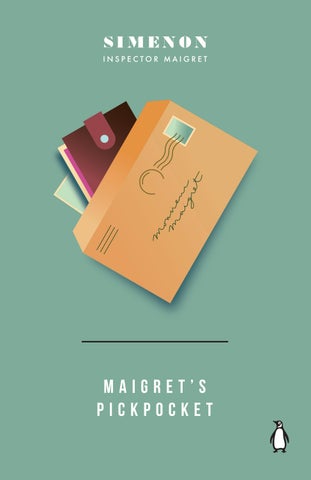
Maigret’s Pickpocket
Translated by siÂn
reynolds
PENGUIN BOOKS
PENGUIN CLASSICS
UK | USA | Canada | Ireland | Australia
India | New Zealand | South Africa
Penguin Classics is part of the Penguin Random House group of companies whose addresses can be found at global.penguinrandomhouse.com.
Penguin Random House UK
One Embassy Gardens, 8 Viaduct Gardens, London SW 11 7BW penguin.co.uk
First published in French as Le voleur de Maigret by Presses de la Cité 1967
This translation first published 2019
Published in Penguin Classics 2025 001
Copyright © Georges Simenon Limited, 1967
Translation copyright © Siân Reynolds, 2019
GEORGES SIMENON and ® , all rights reserved
MAIGRET ® Georges Simenon Limited, all rights reserved
original design by Maria Picassó i Piquer
All rights reserved
The moral rights of the author and translator have been asserted
No part of this book may be used or reproduced in any manner for the purpose of training artificial intelligence technologies or systems. In accordance with Article 4(3) of the DSM Directive 2019/790, Penguin Random House expressly reserves this work from the text and data mining exception.
Typeset by Jouve (UK ), Milton Keynes
Printed and bound in Great Britain by Clays Ltd, Elcograf S.p.A.
The authorized representative in the EEA is Penguin Random House Ireland, Morrison Chambers, 32 Nassau Street, Dublin D 02 YH 68
A CIP catalogue record for this book is available from the British Library
ISBN : 978–0–241–78817–2
Penguin Random House is committed to a sustainable future for our business, our readers and our planet. This book is made from Forest Stewardship Council® certified paper.
Maigret’s Pickpocket
‘Sorry, monsieur.’
‘Not at all.’
It was at least the third time since the corner of Boulevard Richard-Lenoir that she had lost her balance, bumping into him with her bony shoulder and crushing her string bag full of groceries against his thigh.
She apologized automatically, neither embarrassed nor genuinely sorry, then carried on gazing straight ahead of her with a calm and determined expression.
Maigret took no offence. It was almost as if it amused him to be jostled. That morning, he was in a mood to take everything light-heartedly.
He had had the good fortune to catch an older bus with a rear platform, in itself a source of great satisfaction. These buses were becoming more and more infrequent, since they were gradually being withdrawn from use, and soon he would be obliged to tap out his pipe before being enclosed in one of the huge modern vehicles inside which you feel imprisoned.
The same buses with platforms had been in circulation when he had fi rst arrived in Paris, almost forty years earlier, and in those days he had never tired of taking one along the large shop-lined boulevards on the Madeleine–Bastille line. That had been one of his fi rst discoveries.
That and the café terraces. He had never tired of the terraces either, where you could sit in front of a glass of beer and watch the ever-changing sights of the street.
Another source of wonder in that fi rst year: by the end of February, you could go out without an overcoat. Not every day, but some of the time. And the buds were beginning to swell along certain avenues, especially Boulevard Saint- Germain.
These memories reached him in waves, because this was another year when spring was early, and that morning he had left home without his overcoat. He felt as light as the sparkling air. The colours of the shops, the food stalls, the women’s dresses, were all bright and cheerful. He was not thinking of anything in particular. Just a few disconnected little thoughts. At ten o’clock, his wife would be having her third driving lesson. This was an unexpected, even amusing turn of events. He could not have said how they had reached the decision. When Maigret was a young police officer, it had been out of the question for them to afford a car. Back then, such a thing was inconceivable. Once the years had gone by, he had never seen the need for one. It was too late to learn to drive. Too many things were going through his head. He wouldn’t notice a red light, or would stamp on the brake instead of the accelerator. But it would be nice, on Sundays, to be able to drive out to Meung-sur-Loire, and their little house there. They had made their minds up recently, on an impulse. His wife had protested with a laugh: ‘You can’t mean that . . . Learning to drive, at my age!’
‘I’m sure you’ll make a very good driver.’
And now she was on her third lesson and as nervous as a girl about to sit the baccalauréat.
‘How did it go?’
‘The instructor is very patient.’
The woman standing next to him on the bus presumably couldn’t drive. So why had she gone to do her food shopping on Boulevard Voltaire, when she must live in a different neighbourhood? One of life’s intriguing little mysteries. She was wearing a hat, something else that was becoming unusual, especially in the morning. Her string bag contained a chicken, butter, eggs, celery, leeks . . .
And something hard, lower down, that kept bumping his thigh with every jolt of the bus: potatoes, no doubt.
Why take the bus to go far from home to buy such ordinary groceries, of a kind to be found in every district of Paris? Perhaps she had once lived on Boulevard Voltaire and, being used to the tradesmen there, had remained faithful to them.
To his right, a young man was smoking a pipe that was too short, too thick and thus badly balanced, which obliged him to clamp his jaws on it. Young men almost always choose a pipe that’s too short and thick.
The passengers travelling on the platform were closely packed together. That woman should have gone to sit down inside the bus. Look! Whiting for sale in a fi shmonger’s on Rue du Temple. It was a long time since he’d eaten whiting. Why was it that, in his mind, whiting, too, was associated with the spring?
Everything was spring-like today, including his mood,
and never mind that the woman with the chicken was staring fi xedly ahead, prey to problems that did not trouble ordinary mortals.
‘Sorry.’
‘Not at all.’
He didn’t have the courage to say to her:
‘Instead of being a nuisance to everyone, why don’t you go and sit down inside, with your shopping?’
He could read the same thought in the blue eyes of a bulky man wedged between himself and the conductor. They understood each other. The conductor, too, gave an imperceptible shrug of his shoulders. A sort of freemasonry between men. It was amusing.
The street stalls, especially those laden with vegetables, spilled out over the pavements. The green and white bus had to weave its way through the crowd of housewives, typists and clerks hurrying to their offices. Life was sweet.
Another jolt. The shopping bag yet again, and whatever that solid thing was, potatoes or some such. Stepping back, he bumped unavoidably into someone behind him.
‘Sorry.’
He too murmured an apology, tried to crane round, and glimpsed the face of a young man, a face marked by an emotion that was hard to read.
He could be no more than twenty-five, unshaven and hatless, and his dark hair was tousled. He looked as if he had not slept, and had recently been through some difficult or painful ordeal.
Threading his way towards the step, the same young man jumped from the bus as it was still moving. They
had reached the corner of Rue Rambuteau, not far from Les Halles, the central market, whose strong smells pervaded the air. The young man was walking quickly now, turning round as if afraid of something, then he vanished down Rue des Blancs-Manteaux.
And suddenly, for no precise reason, Maigret clapped his hand to his hip pocket where he usually kept his wallet.
He almost jumped off the bus in turn, because the wallet had gone.
His face flushed, but he managed to stay calm. Only the fat man with blue eyes seemed to realize something had happened.
Maigret’s own smile was ironic, not so much because he had just been the victim of a pickpocket, but because it was completely impossible for him to give chase.
On account of the spring, precisely, and of the air like champagne that he had started to breathe in the day before.
Another tradition, an obsession dating to his childhood, was new shoes. Every spring, at the fi rst fi ne days, he would buy slip-on shoes, the lightest available. Which he had done the previous day.
This morning he was wearing them for the fi rst time. And they pinched. Just walking along Boulevard RichardLenoir had been agony and he had reached the bus stop on Boulevard Voltaire with relief.
He would have been quite incapable of running after the thief. And the latter had in any case had plenty of time to disappear into the narrow streets of the Marais.
‘Sorry, monsieur.’
Again! That woman and her shopping bag! This time, he almost burst out with:
‘Why can’t you stop banging into other people with your wretched potatoes?’
But he confi ned himself to a nod and a smile.
In his office too, he encountered that special light of the fi rst fi ne days, while over the Seine hung a slight mist without the thickness of fog, a mist of millions of bright dancing drops, peculiar to Paris.
‘Everything all right, chief ? Nothing to report?’
Janvier was wearing a light-coloured suit that Maigret had not seen before. He too was celebrating spring a little early, since it was only 15 March.
‘No. Or rather yes. I’ve just been robbed.’
‘Your watch?’
‘My wallet.’
‘In the street?’
‘On the platform of the bus.’
‘Was there much money in it?’
‘Only about fi fty francs. I don’t carry more than that as a rule.’
‘Your identity papers?’
‘Not just my papers, but my badge!’
The famous badge of the Police Judiciaire, a nightmare for any inspector. In theory, they were supposed to carry it at all times, so that they could prove at any moment that they were members of the criminal investigation department.
It was a splendid badge, made of silver, or rather silverplated bronze, since the thin layer of silver quickly wore off, leaving it a reddish-brown colour.
On one side was an image of Marianne in a Phrygian cap, the initials RF, for République Française, and the word ‘Police’ framed in red enamel. On the other side, the Paris coat of arms, a number and, engraved in small letters, the holder’s name.
Maigret’s badge had the number 0004, since number 1 was for the prefect of police, number 2 for the director of the Police Judiciaire, and number 3, for some reason, that of the head of Special Branch.
Everyone was reluctant to carry the badge in a pocket, despite the rules, since the same regulations provided for the suspension of a month’s pay if the badge was lost.
‘Did you see the thief ?’
‘Quite clearly. A young man, thin, tired-looking, someone who hadn’t slept, judging by his eyes and his complexion.’
‘You didn’t recognize him?’
In the days when he worked on Street Patrol, Maigret had known by sight all the pickpockets, not only those of Paris, but some who came from Spain or London when there were festivals or major public events.
It was a rather exclusive speciality, with its own hierarchy. Topnotch pickpockets stirred themselves to travel only if the journey was worth it, but then did not hesitate to cross the Atlantic, for a World’s Fair, for example, or the Olympic Games.
Maigret had rather lost sight of them now. He searched
his memory. He was not taking the incident too tragically. The light-heartedness of the morning was still influencing his mood and, paradoxically, it was the woman and her shopping bag with whom he felt the most annoyed.
‘If only she hadn’t kept bumping into me all the time . . . Women shouldn’t be allowed on the platform . . . Especially since she didn’t have the excuse of needing to smoke . . .’
He was more vexed than really angry.
‘You could take a look at the records, perhaps?’
‘Yes, that’s what I’ll do.’
He spent almost an hour examining the photographs, full face and profi le, of most of the known pickpockets. There were some he had arrested twenty-five years earlier and who had come through his office ten or fi fteen times, almost becoming familiar acquaintances.
‘You again?’
‘Man’s got to live, chief. You’re still here too. We go back a bit, don’t we?’
Some of them were well dressed; others, of shabbier appearance, were content to work the scrap-metal fairs, the flea market at Saint- Ouen, or the corridors of the Métro. None of them looked anything like the young man on the bus, and Maigret knew in advance that his search would be in vain.
A professional would not have had that tired and anxious look. A practised pickpocket would work only when he could be sure his hands wouldn’t tremble. And in any case, they all knew Maigret by sight, his face, his silhouette, if only from the newspapers.
He went back down to his office and, when he found Janvier again, simply shrugged his shoulders.
‘You didn’t fi nd him?’
‘I’m prepared to bet he was an amateur. I even wonder whether he knew he was going to do it a minute beforehand. He must have seen my wallet sticking out of my back pocket. My wife’s always telling me not to keep it there. When the bus jolted and those dratted potatoes threw me off balance, he must have suddenly got the idea.’
He changed tone.
‘Right, what’s new this morning?’
‘Lucas is down with flu. And someone bumped off that Senegalese gangster in a café near Porte d’Italie.’
‘A stabbing?’
‘Naturally. No one can describe the killer. He came in at about one a.m., when the owner was shutting up shop. He went straight over to the Senegalese, who was having one last glass, and struck so quickly that . . .’
One of those routine crimes. Someone would probably grass on him, perhaps in a month, perhaps in two years’ time. Maigret headed towards the office of the chief of police for the daily briefi ng, and took good care not to mention his misadventure.
It was turning out to be a quiet day. Paperwork. Forms to sign. Routine.
He went home for lunch and looked inquiringly at his wife, who had not raised the subject of her driving lesson. It was a bit like going back to school, at her age. She enjoyed it, and was even a little proud of it, but at the same time, she felt embarrassed.
‘You managed not to drive up on to the pavement?’
‘Why do you have to say that? You’ll give me complexes.’
‘No, no. You’ll make an excellent driver, and I’m waiting impatiently for you to take us for a trip along the Loire.’
‘Well, that will have to wait at least a good month, or more.’
‘Is that what the instructor said?’
‘The examiners are getting more and more exacting, and it’s better not to be failed fi rst time. Today, we went on the outer boulevards. Who’d have thought there was so much traffic, and they all drive so fast . . . It’s as if . . .’
Ah, they were going to have chicken for lunch, like the woman on the bus no doubt.
‘What are you thinking about?’
‘My thief.’
‘You’ve arrested a thief ?’
‘No, I didn’t arrest him, but he stole my wallet.’
‘With your badge in it?’
That was the fi rst thing she had thought of too. A serious hole in the budget. It was true that he would get a new badge, where the copper wouldn’t be showing through.
‘And you saw him?’
‘As clearly as I’m seeing you.’
‘Was he old?’
‘Young. An amateur. He looked . . .’
Maigret was thinking about it more and more, without wanting to. Instead of becoming vaguer in his mind’s eye, the thief’s face was getting clearer. He was remembering
details he did not know he had registered, such as that the stranger had thick eyebrows, which met over his eyes.
‘Would you know him again?’
He thought about the thief over a dozen times during the afternoon, looking up at the window as if troubled by some problem. In the whole incident, the face, the fl ight, there was something unnatural, but he couldn’t work out what it was. Each time, it seemed that a new detail was going to occur to him, that he would understand, and then he would return to work.
‘Goodnight, boys.’
He left at five to six, while there were still half a dozen inspectors in the next office.
‘Goodnight, chief.’
He and his wife went to the cinema. He had found in a drawer an old brown wallet, too big for the hip pocket, so he put it inside his jacket.
‘Now if you’d been carrying it in that pocket . . .’
They walked home, arm in arm as usual, and the air was still quite warm. Even the smell of petrol did not seem so unpleasant tonight. It was part of the arrival of spring, just as the smell of melting tar heralds the arrival of summer.
In the morning, the sun was back again, and he ate his breakfast by the open window.
‘Funny thing,’ he remarked, ‘there are some women who go halfway across Paris by bus, just to buy their groceries.’
‘Perhaps that’s because of Telex- Consumers.’
He frowned inquiringly at his wife.
‘Every night, they tell you on television which neighbourhoods have the best prices for certain things.’
He hadn’t thought of that. How simple it was! He had wasted time on a little problem his wife had solved in an instant.
‘Thank you.’
‘Does that help?’
‘It helps me not to think any more about it.’
And, as he picked up his hat, he remarked philosophically:
‘You don’t always think about what you want to.’
The mail delivery was waiting on his desk and on top of the pile lay a thick brown envelope on which his name, title and the address at Quai des Orfèvres were printed in large capital letters.
He realized what it was before opening it. His wallet was being returned. And a few moments later, he discovered that nothing was missing, not the badge, nor his papers, nor the fi fty francs.
There was nothing else. No message. No explanation. He felt thoroughly vexed at this.
It was a little after eleven when the telephone rang.
‘Someone who’s insisting on speaking to you personally, sir, but is refusing to give his name. Apparently you’ll be expecting this call, and you’ll be furious if I don’t put it through. What shall I do?’
‘Put it through to me, then.’
And striking a match one-handed to relight his pipe:
‘Hello. I’m listening.’