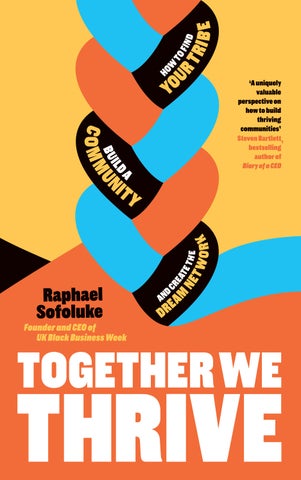
Together We Thrive How to Find Your Tribe, Build a Community and Create the Dream Network
Raphael Sofoluke
PENGUIN LIFE
UK | USA | Canada | Ireland | Australia India | New Zealand | South Africa
Penguin Life is part of the Penguin Random House group of companies whose addresses can be found at global.penguinrandomhouse.com.
First published 2024 001
Copyright © Raphael Sofoluke, 2024
The moral right of the author has been asserted Set in 11.6/15.8pt Calluna Typeset by Jouve (UK), Milton Keynes Printed and bound in Great Britain by Clays Ltd, Elcograf S.p.A.
The authorized representative in the eea is Penguin Random House Ireland, Morrison Chambers, 32 Nassau Street, Dublin D 02 Y h 68
A CI p catalogue record for this book is available from the British Library
IS bn : 978– 0– 241– 70513– 1
Penguin Random House is committed to a sustainable future for our business, our readers and our planet. This book is made from Forest Stewardship Council® certified paper. www. greenpenguin.co.ukwww.greenpenguin.co.uk
Penguin Random Hous e is committed to a sustainable future for our business , our readers and our planet. is book is made from Forest Stewardship Council® certified paper
To my wife, where my world begins, and the community takes shape. Together, we’re a force. Your unwavering support is the cornerstone of my every endeavour, making you the most vital member of my community and my life.
To my parents, my first community, who planted the seeds of belonging and togetherness in my heart.
To my children, the next chapter in our community’s legacy. May you carry forward the spirit of unity and strength.
To my siblings, with whom I navigated the landscapes of childhood, building the earliest foundations of community in our shared adventures and dreams.
To my friends, your support and laughter fuel my journey.
I love you all.
In loving memory of two remarkable men whose contributions laid the foundations for communities that continue to thrive and flourish. Their legacies are timeless, crafting spaces where people come together, grow and prosper, ensuring their impact endures for ever.
RIP Olu Oyerinde and RIP Bishop Karowei Dorgu
Introduction
Have you ever wondered how some people effortlessly establish strong personal brands and succeed in various aspects of life? What if I told you that the key isn’t just their skills or talents, but also the communities they create and engage with?
Imagine having a supportive network of people who not only cheer you on but also collaborate with you, help you grow personally and professionally, and create a sense of belonging. This is the power of community, applicable not only to businesses but to all areas of life.
In my journey, I’ve seen how vital communities are for business and personal growth. I’ve faced tough challenges but also benefited from the incredible power of community support. It’s this support that opens doors to countless opportunities, creating an environment where growth and personal development lead to endless flourishing.
‘If you want to go fast, go alone. If you want to go far, go together.’ This African proverb encapsulates the essence of individual speed versus collective endurance. Solitary endeavours might yield quick results, but the richness of experiences and true personal growth often stem from shared journeys.
The proverb emphasizes the importance of the emotional support, shared learning and diverse perspectives that community offers, strengthening personal resilience and creating an enriched life. In a professional context, it highlights the value of teamwork. While individual efforts may achieve immediate results, sustained success, innovation and significant accomplishments often arise from a cooperative environment.
I come from a Nigerian household of eight, with five siblings, and from the moment I entered this world, I was embraced by the comforting arms of my family, my initial and most intimate connection to the concept of community. Birth marks our inauguration into a web of relationships, where the tender bonds with parents, siblings and extended family form the scaffolding of our earliest interactions. In this microcosm, we learn the rhythms of communication, the warmth of support and the nuances of understanding others.
My family was my first collective, where I absorbed traditions, values and customs. It was within this nurturing cocoon that I took my initial steps to understanding, empathy, cooperation and the beauty of belonging. These foundational experiences of love, care and social integration were the cornerstones for my future relationships and interactions with the broader world.
I’m Raphael Sofoluke, a serial entrepreneur and the founder and CEO behind the UK Black Business Show, UK Black Business Week, Birmingham Black Business Show, Black Tech Achievement Awards in the UK and US , and Soar – the first bank-backed membership platform for
Black entrepreneurs in the UK . Back in 2017, I went to a huge business event, and felt left out because there was nobody else who looked like me. That feeling made me want to create a place where everyone, including people like me, could feel welcomed and included.
The importance of community within all my businesses cannot be overstated. My events and platforms bring together a network of individuals who share common goals, experiences and challenges, providing a supportive environment crucial for the success and development of Black entrepreneurs and professionals. We foster knowledgesharing, mentorship and empowerment, while engaging and allowing allies and huge corporate companies the opportunity to connect with the Black community.
In this book, we’ll explore how community-building can benefit your brand profile, advance your career, aid in selfdevelopment and enrich your social life. Whether it’s in the workplace, where a strong community can boost your progress; in your business, where it can be the foundation for building your empire; or in your personal life, where nurturing meaningful relationships can lead to profound growth – together, we’ll cover it all.
My experience of community- building has been an enriching experience, and I can’t wait to share with you all the golden tips that I’ve learned on my journey. So, if you’re ready to unlock the full potential of finding your tribe, I invite you to dive into the pages ahead and embrace the power of building a thriving community. This is the ultimate tool, and I’m giving it to you – because together we thrive.
Ties That Shape Our Lives: What is Community?
Have you ever felt that invisible tug, the unspoken connection that makes you feel part of something larger? In this chapter, I want to explore what community means and how it comes about – the magic behind these invisible ties that shape our lives.
It’s important to understand exactly how our shared experiences – those quiet nods of understanding and moments of compassion – are the very essence of community. The connections we make with each other define our identities, influence our decisions, and ultimately form the backbone of thriving societies. Learning how the close-knit bonds we have with our friends and family have a profound impact on all our relationships, inside and outside of work, is vital for anyone seeking to understand the foundation of community.
In 2004, Dan Buettner – an explorer, National Geographic Fellow, and journalist – travelled the world with a team of scientists and demographers in order to find areas populated by people who not only lived a long time but
also enjoyed a high quality of life in their old age. They dubbed these regions ‘Blue Zones’.1 The team discovered that strong social networks, a sense of belonging, and close-knit relationships – as well as shared lifestyle habits – were crucial factors when it came to longevity. The significance of community within the context of Blue Zones, where people live longer and have healthier lives, indicates the role of social connections in overall well-being.
Thousands of years prior to this, the ancient Greek philosopher Aristotle emphasized the importance of community in his ethical and political teachings. He believed that human beings are inherently social creatures, and an individual’s fulfilment and flourishing are intrinsically tied to their relationships within a larger network of people. The concept of the polis (city- state) was fundamental to his philosophy, and he envisioned a community as a cohesive unit comprising individuals striving for a common good. Aristotle believed that the well-being of the individual is intricately linked to the well-being of the community, and he advocated for a balanced and harmonious coexistence where each member contributes to the greater good.
According to Aristotle, the cultivation of virtuous and ethical behaviour within a network is what leads to a just and prosperous society, encouraging cooperation, fairness, and the development of a collective moral character essential for the stability and advancement of everyone as a whole.2
I spoke with Andy Ayim MBE , a serial entrepreneur and long-term investor in entrepreneurs with global ambitions to change society and the world positively – in exactly
the way Aristotle envisioned. He runs the Angel Investing School, a global critical thinking course for business leaders interested in investing in start-ups. In 2021, Andy received the prestigious Queen’s Honours MBE medal for his substantial contributions to diversity and technology in the UK .
Andy grew up in Tottenham, North London, one of the most multicultural places in Europe – where more than ninety nationalities exist, and 300 languages are spoken. In and out of school he had friends from Pakistan, Scotland, Jamaica and Turkey, and from a young age he could appreciate the wisdom of the African proverb ‘It takes a village to raise a child’.
When asked about what community means to him and how this has been shaped by his personal experiences, he said he could sum up its meaning with ‘the South African philosophy of Ubuntu, which translates as “I am because we are” ’.
‘You learn to appreciate all the small ways we come together regardless of our race or background,’ he told me. ‘Small things like my neighbours taking me to school or playing football locally with friends, or eating meals and opening up a door to a new and exciting culture. As I’ve grown older and travelled the world, you realize that community isn’t limited by boundaries and lines, as there is more that we have in common as humanity than what separates us.’
Ubuntu offers a powerful and expansive view that transcends traditional boundaries of geography, race and culture. With its core idea of ‘I am because we are’, it
emphasizes interconnectedness and mutual responsibility among individuals. It suggests that a person’s identity and existence are deeply tied to those around them.
Andy’s personal experience illustrates how everyday acts of kindness and connection form the fabric of community, sometimes more than traditional markers of identity. These experiences serve not only as examples of Ubuntu in action but also as reminders of the simple yet powerful ways in which our lives are interwoven with those of the people around us. Community is often built on the foundation of small, everyday interactions, which together contribute to a sense of inclusion and shared humanity.
Despite the apparent differences that might seem to divide us, there are fundamental human experiences that unite us. Andy’s realization that there is ‘more that we have in common as humanity than what separates us’ is a powerful message. It challenges us to look beyond superficial divisions and recognize the universal threads of human experience and empathy that bind us together.
This view of community, informed by Ubuntu, is a philosophical and practical guide for living. It calls for an appreciation of our mutual dependence, encouraging reallife actions that support and uplift an understanding of others. It’s a reminder that our well-being is inextricably linked to the well-being of those we have relationships with and are connected to, near and far.
Like Andy, Izzy Obeng grew up in North London, and she shared with me how coming of age in her local area shaped her life. Izzy is an entrepreneur, business consultant and the founder and CEO of Foundervine. She also sits on the board
as a non-executive director for Capital Enterprise. At Foundervine, Izzy leads a consultancy that aims to create systemic change in entrepreneurship. They support early stage companies, providing entrepreneurs from underrepresented groups with mentorship, training and access to capital.
‘I grew up in a community that was one of the most multicultural populations in all of the UK but also one of the poorest,’ Izzy shared with me. ‘I found myself immersed in local politics as a young person, sitting on my borough’s Youth Council, as well as taking part in protests against knife crime, and the kind of community disillusionment that would later see Tottenham emerge as the epicentre of the 2011 London riots.
‘These experiences were transformative. They shaped me immeasurably, opening up my mind to unconventional ideas about ways to solve social problems, and frustration at a system that works for the few and not the many. They laid the foundation for the innovative ethos that would later define Foundervine. A desire for justice, for changing the narrative regarding who gets to become a business owner and who doesn’t, played a vital role in shaping my approach to entrepreneurship, business growth and investment.’
Izzy’s involvement in local politics and activism was not merely extracurricular activities, but vital experiences that embedded in her a deep sense of social responsibility and a desire for systemic change. Her experiences, far from being disheartening, were transformative, inspiring an innovative ethos that would later be instrumental in the creation of Foundervine. This initiative was not born in isolation but was the result of years of immersion in a community.
Izzy’s drive for justice and her commitment to altering the narrative around entrepreneurship – specifically, who has the opportunity to own a business and who doesn’t – reflects a vision influenced by her early experiences within a vibrant yet challenged community. Her journey from being a Youth Council member and activist to a pioneering entrepreneur exemplifies how community experiences can significantly shape your approach to business, investment and growth.
Someone else who has been active in creating a future that rectifies historical wrongs is Jamelia Donaldson. Founder and CEO of TreasureTress, Europe’s largest subscription service dedicated to curly- hair product discovery, Jamelia has transformed the natural- hair care landscape. TreasureTress not only addresses the lack of quality products for curly hair in the UK , but also nurtures a vibrant community that transcends geographical bound aries. And Jamelia’s influence extends far beyond TreasureTress. Recognizing the beauty industry’s disregard for Black and Multi-Ethnic consumers, she has started up a consult ancy arm within her company, empowering brands worldwide to establish authentic connections and find their rightful place within this underserved market.
Jamelia was able to offer insight into how she views community based on her personal experiences. ‘Shaped by my experiences as the founder of TreasureTress and having built a “community- first” brand, I perceive communitybuilding as a deliberate yet organic journey. Since the beginning of time, women in particular have consistently formed
communities as a means of survival and support. Whether within familial structures, tribal societies or modern urban settings, women have demonstrated a natural inclination to connect, share and collaborate.
‘TreasureTress, through its network, space and community, successfully builds, maintains, celebrates and increases the visibility of the experiences of Black and Multi-Ethnic women (and girls) and their hair. Through our prominent service for discovering products tailored to textured hair, I witnessed the impact of uniting people around a shared commitment to natural-hair care, a common passion that acted as a catalyst, forging connections that transcended the digital realm.’
Jamelia describes community- building as both a strategic and organic process, and acknowledges the historical context in which women have sought to connect with other women. TreasureTress has leveraged these natural inclinations towards connection and sharing in order to build a supportive network centred around the unique experiences of Black and Multi-Ethnic women and their hair care journeys.
Jamelia has created a space that not only serves these women but also celebrates and amplifies the visibility of their experiences. By focusing on the specific needs of the natural- hair care niche, TreasureTress has managed to forge a powerful community around a shared passion, illustrating how common interests can create meaningful connections that extend beyond the digital space. Her approach to community-building demonstrates the power of aligning brand values with community needs.
Moving from thinking about community on a macro level to a more intimate perspective, I spoke to Elizabeth Uviebinené, a multi-talented entrepreneur whose outlook on community invites a broader, more inclusive understanding of the concept, and values the depth and quality of connections over quantity.
Elizabeth is the founder of Storia, a journaling app that bridges the gap between individual introspection and the human need for community. Storia is a tool to organize your thoughts into themed journals, and discover journals created by friends or like-minded individuals. She is also the multi- award- winning author of five books, including the bestseller Slay In Your Lane: The Black Girl Bible (co- authored with Yomi Adegoke), which created a new category in the publishing market.
She has been named an Ad Age Leading Woman in Europe and a Marie Claire Future Shaper, and won a Groucho Maverick award for being a culturally progressive innovator. Despite being so recognized, when asked about how community has significantly impacted her life or career, she said: ‘I have a community with my best friend. Contrary to popular belief, you can be in a community of two. Our connection was established during our university years, a formative period. University is where one typically finds their initial, crucial friendships, and ours unknowingly became a cornerstone for future careers. Being part of this community, especially away from home for the first time, proved exceptionally impactful. Without the support, I doubt I would have embarked on the journey to become an author, and my current career trajectory might have
taken a vastly different path. The shared experiences, aspirations and values we cultivated together have broadened my horizons, enabling me to evolve into who I am today.’
This intimate and reflective perspective acknowledges the significance of deep personal connections that can indeed form a community, even one as small as two people. Elizabeth challenges the conventional notion that communities must be large or broadly defined by local or cultural boundaries. She emphasizes the strength and impact of meaningful, one-on-one relationships.
For Elizabeth, her university years were a critical period of personal growth and discovery. The fact that a connection she made then became a cornerstone for her future career speaks to the influence that such relationships can have on your life direction and choices. Her experience is a testament to how a community, no matter its size, can provide a supportive and enriching environment.
Elizabeth’s insights also touch on the power of having a support network in decisive moments, such as moving away from home for the first time. The support from her community of two provided Elizabeth with the confidence and encouragement necessary to pursue a challenging and uncertain path. Her narrative challenges us to reconsider our understanding of community, and to recognize the deep impact that a single significant relationship can have on our lives.
Lynsey Campbell’s perspective, like Elizabeth’s, intriguingly challenges traditional views of community. Lynsey is a successful technology executive who has led many teams in some of the world’s largest organizations.
Mum to twin girls, she is committed to becoming a leader who inspires others to connect to their purpose and operate with passion and integrity. Lynsey serves as a trustee and ambassador for a diverse variety of charities, with the sole purpose of improving the lives and career experiences of underrepresented groups.
‘I have been part of groups officially labelled a “community” but the activity and support is not there, whereas I’ve also been part of informal groups where the community aspect is 100 per cent . . . Community is like a group “sense” and feeling versus an official brand or term, in my opinion.’
Lynsey understands true community is characterized not by a name or structure but by the quality of connections and the collective feeling it engenders among its members. The essence of community is something deeply felt and experienced on a personal level, transcending the superficial layers of designation or branding.
So, when we look at community and the importance it has on our lives, it’s fair to say that it could be the difference between a good life and a great life – and the impact of community goes far beyond enriching the life of one individual. When we get down to the root of what community is, for me it boils down to shared experiences. Our communities are platforms for individuals to express their beliefs, values and aspirations collectively.
Whether we like to think it or not, we are all part of a community – either by choice or external factors. As the world continues to grow, we are developing new types of community in new and interesting ways. Our ability to connect on a global scale through media and the internet
has allowed us to form our own identities and belong to a multitude of groups.
Now, let’s take a closer look at some of the communities that we as people generally find ourselves a part of – or ones we could look to be a part of.
Types of Communities
Community of Place
This includes urban and suburban communities and neighbourhoods; rural, national and global locations; your workplace and your home. You are bound to a community of place because of where you reside, work, visit or spend a significant portion of your time. Because of this, it’s important that you try to create genuine friendships in these places.
Communities of Interest
These are subcultures that are formed around shared beliefs and interests that can be distinct from the beliefs and interests of the dominant culture in which you live or work. For example, although my brothers and I are part of one big family, we all support different football teams! Being a member of the Liverpool FC community for me is a privilege, while my brothers have decided to support other teams like Manchester United, Aston Villa and Chelsea. When they meet someone who supports their team, they
have a connection with that person, whereas even I as a close family member cannot connect with them on that level. Have you ever met someone and found out that they shared the same interest as you? Whatever that interest is, can you remember how you felt? It’s a feeling of excitement, and there’s an almost instant connection.
Communities of Needs
These are formed on the basis of shared experiences and needs. Members of these communities bond over their shared needs, and support and advocate for one another. Examples of these groups are disabled communities and elderly communities.
Communities of Practice
These include professional networks of people who share a career or expertise, guilds and associations, business groups and more.
Identity-Based Communities
These are built on shared identities and include religious and ethnic groups. People with shared ethnicity have a common history, practices, culture and beliefs. This leads them to come together naturally to engage over those cultural practices or beliefs. When you meet someone and find out that they too are Scottish, Nigerian or Irish, you instantly feel connected because you have a shared history