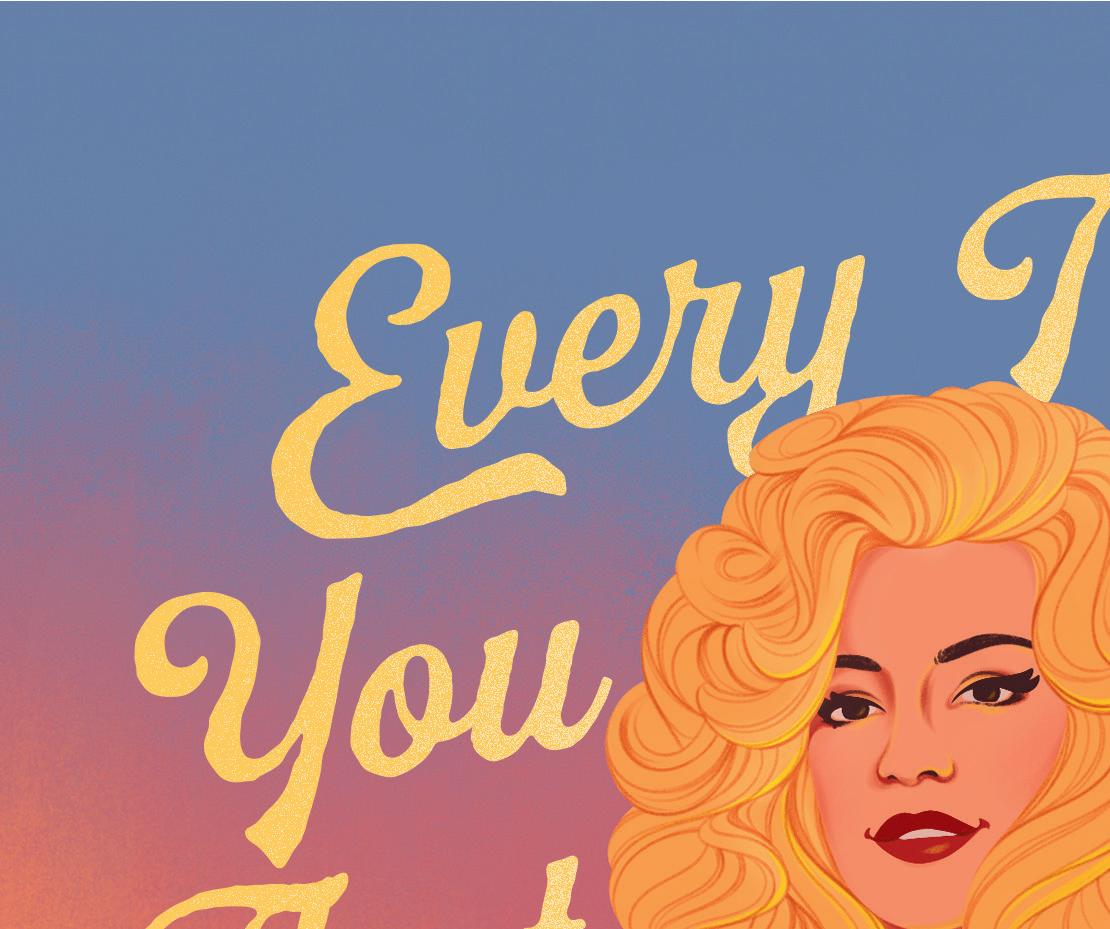
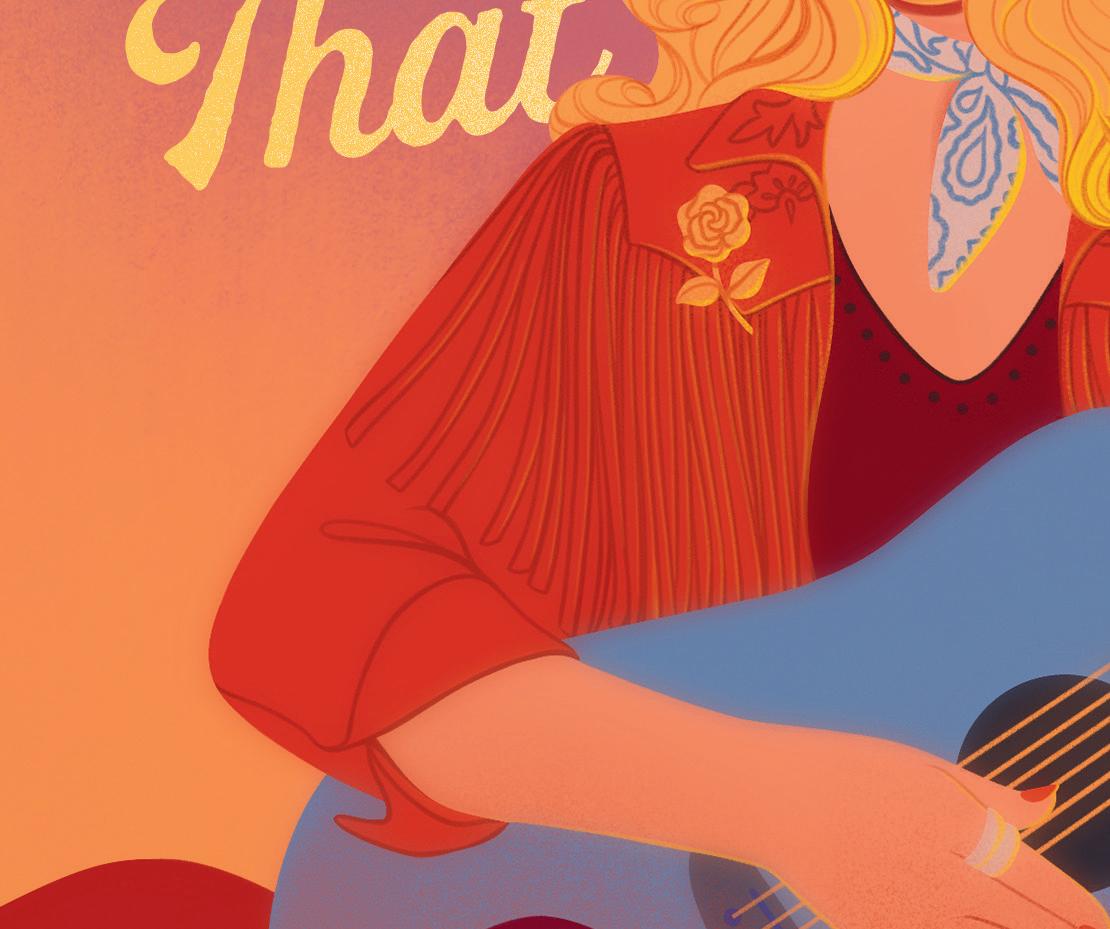
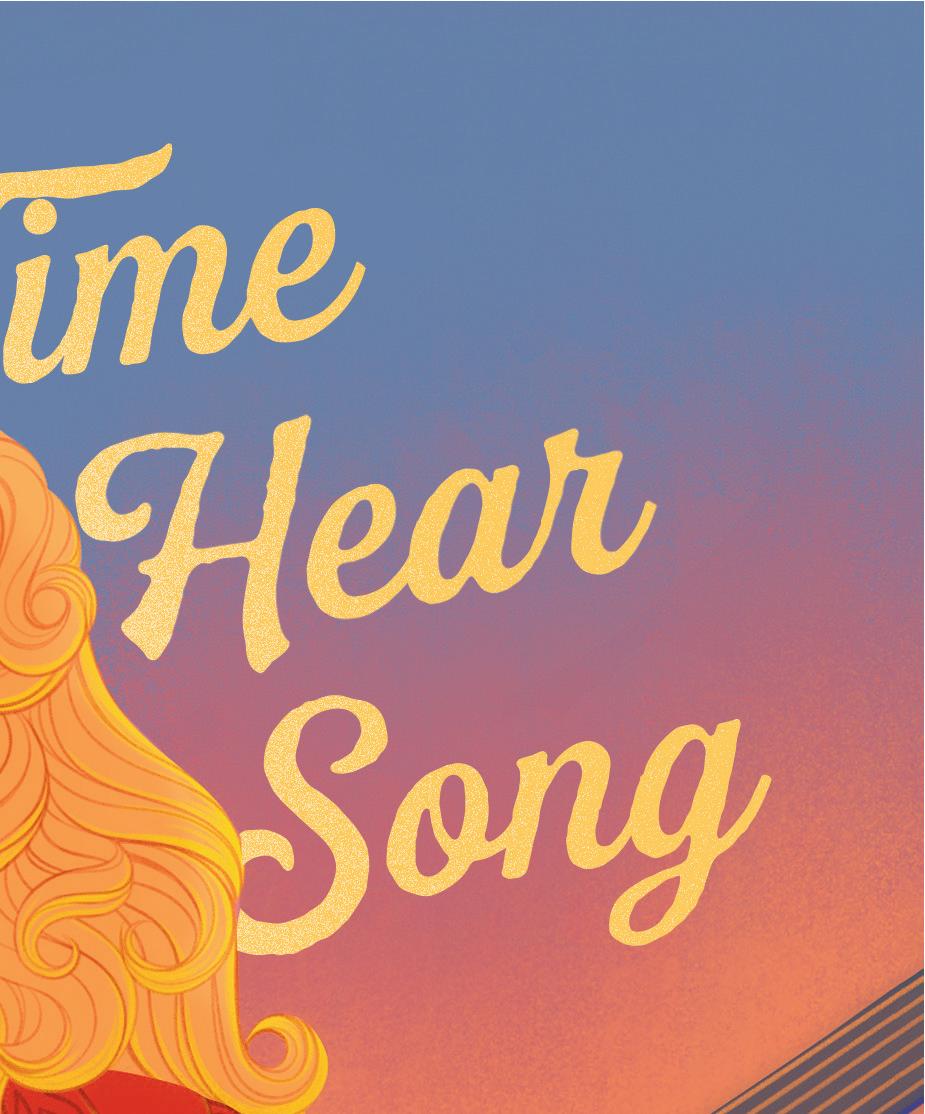
Ev y me You Hear at Song
Jenna Voris
VIKING PENGUIN BOOK S
PENGUIN BOOKS
UK | USA | Canada | Ireland | Australia
India | New Zealand | South Africa
Penguin Books is part of the Penguin Random House group of companies whose addresses can be found at global.penguinrandomhouse.com
www.penguin.co.uk
www.puffin.co.uk
www.ladybird.co.uk
First published in the United States of America by Viking, an imprint of Penguin Random House LLC, 2024 This edition published by Penguin Books UK 2024
001
Text copyright © Jenna Voris, 2024
Edited
by Maggie Rosenthal
Design by Kate Renner
Text set in Macklin Text
The moral right of the author and illustrator has been asserted
Printed and bound in Great Britain by Clays Ltd, Elcograf S.p.A.
The authorized representative in the EEA is Penguin Random House Ireland, Morrison Chambers, 32 Nassau Street, Dublin D02 YH68
A CIP catalogue record for this book is available from the British Library
ISBN : 978–0–241–68104–6
Penguin Books
Penguin Random House Children’s One Embassy Gardens, 8 Viaduct Gardens, London SW11 7BW
Penguin Random Hous e is committed to a sustainable future for our business, our readers and our planet. is book is made from Forest Stewardship Council® certified paper.
F the wildfire girls who burn too bright And f Chelsea, who’s been th e f this book (and me) since the beginning
THE TENNESSEAN
NASHVILLE, TENN.
JULY 16, 2024
Decklee Cassel, Beloved Pioneer of Country-Pop Music, Is Dead
at 76
Decklee Cassel, singer, songwriter, producer, and country-pop icon, died Tuesday morning at the age of 76 after a two-year battle with brain cancer. According to her rep, she passed peacefully in the bedroom of her Nashville home.
With 22 No. 1 singles across the US pop and country charts from 1971 to 2011, Cassel earned ten Grammys and 12 CMA awards, along with membership to both the Country Music and Rock & Roll Halls of Fame, respectively. She sold more than 100 million records worldwide, topping international charts with well-loved hits “Times Are Changing,” “Little Blue Suitcase,” and “Isn’t It Trouble?”
Decklee Cassel was born Cleo Elizabeth Patrick on Jan. 28, 1948, in Mayberry, Arkansas. She attended Mayberry County High School for one year before moving to Memphis, Tennessee, to pursue music fulltime. Her smooth, smoldering vocals and musical mastery earned the attention of DCR Records executive Richard Grasso, who produced all 42 of her studio albums.
But it wasn’t until “Whiskey Red,” Cassel’s rst No. 1 record in 1971, that she became a household name. Cowritten with her longtime collaborator Mickenlee Hooper, the soulstirring ballad about love and loss sold over
two million copies. The duo went on to cowrite 16 more No 1. hits before parting ways in the nineties due to creative differences.
The funeral is being handled by the Nashville Directive Funeral Home and the Decklee Cassel Estate. The Decklee Cassel Memorial Time Capsule, which contains a new album of previously unreleased songs, exclusive photos, and mementos throughout her career, will be opened live at the ceremony and released to the public immediately afterward.
Cassel is survived by her brother, sisterin-law, and three nieces. Although she never married or had children, she always said the fans were enough. Today, we mourn as family.
ONE Darren
On the morning of Decklee Cassel’s funeral, I’m in the employee lounge of Bob’s Gas Station, losing a fight with the coffee machine for the second time that day.
To be fair, I never stood a chance. Everything at Bob’s is at least a decade older than me, but the fact that this specific machine has started spontaneously leaking boiling water whenever I clock in feels a little personal. Kendall is already behind the register, too busy holding back the bleary-eyed morning crowd to lend me a hand, so this, overall, is not the best way to start my morning.
Oh, and Decklee Cassel is dead.
There’s also that.
I slap the OUT OF ORDER sign onto the machine and lug it back into the open. “Sorry, folks. Energy drinks are third cooler on the left.”
Kendall finally looks up from the register as the crowd dis-
1
sipates. “Coffee out again?” he asks. “Weren’t you supposed to fix that?”
I roll my eyes. Kendall is technically shift lead and technically my boss when Bob’s not around, but he’s barely a year older than me and only marginally better at operating our ancient cash register, so I don’t like to think of him as “being in charge.” I’ve known Kendall since the day my second-grade teacher went into labor and left us with the class next door. We’ve worked together for the last three years and the idea of him telling me what to do is still genuinely laughable.
“No, Bob was supposed to fix it,” I say, giving the coffee maker one more shove for emphasis. “This thing hates me, remember?”
“It doesn’t hate you, it’s just Friday.” Kendall braces his elbows on the counter. “Right on schedule.”
He has this theory that Bob’s coffee machines know what day it is. He swears they know what time it is, too, because one of them always seems to go out right in the middle of the morning rush. Today, at least, it’s summer, so we don’t have to break the news to the school crowd. Any other day I might have laughed along with him because this whole thing really is getting ridiculous, but today is Decklee Cassel’s funeral.
And there’s absolutely nothing funny about that.
In a town this small, every change feels like a kick to the gut—swift and sudden and aching with a strange sense of inevitability. You feel it in the air first, and when I came home from work Tuesday to find Mom already waiting by the door, I knew something big had happened. For a second, my mind ran wild
Voris 2
Jenna
with every terrible possibility. She was sick again. She lost her job. They were firing me for some reason.
But then Mom took a deep breath, squeezed my hand, and said, “They found Decklee Cassel at home this morning, Darren. It was peaceful, but . . . she’s gone.”
Her voice had cracked on the last word, and I was so relieved at the momentary confirmation that she herself was fine that I didn’t register the news. She had to repeat herself two more times before the reality hit me, and even then, I hadn’t really believed it until I checked my phone and found memorial videos and posts already pouring in.
The world lost a good one today, RIP Decklee Cassel.
I’ll never forget meeting her backstage in Tupelo. Her music changed my life. I’m forever grateful.
I have Whiskey Red on repeat today. Decklee’s music was my sanctuary as a kid. Still don’t know how to process this.
Most of the comments and tributes I saw were written by people more than twice my age, fans who grew up with Decklee’s music and followed her meteoric rise in real time.
Maybe that’s why I haven’t posted anything myself. I don’t know many seventeen-year-old girls whose favorite singer is a country artist old enough to be their grandmother. In a town
Time You Hear That Song 3
Every
this small, there are some things you keep to yourself.
The familiarity smothers you after a while.
I pull my phone out of my pocket, stealing a glance in Kendall’s direction in case he suddenly decides to start enforcing our no cell phones policy, before opening Instagram.
I have my private account with a handful of followers from school, but Mayberry Unpublished is the one I really care about. The account started as last year’s journalism final, a semester-long feature story broken down into individual interviews, clips, and sound bites that my best friend, Emily, said was very Caroline Calloway of me. Instead of a single human subject, I wrote about this town—its singular, stifling pull and all the people caught in its orbit. Somewhere along the way, the account developed a decent following of people outside the county line, and even though the school year is long over, I still update as often as I can.
It’s not much, but it’s something to keep the boredom away, to keep this town from feeling like one long cry for help and to keep me from counting the days until I can pack my bags and leave for good. My post from this morning already has a few hundred likes—a quick interview I’d snagged with Melanie Grauer, a girl a few grades below me. I asked if she’d heard about Decklee Cassel and she just shrugged and said, “Yeah, I saw. I don’t really listen to her music, but my dad was really upset about it.”
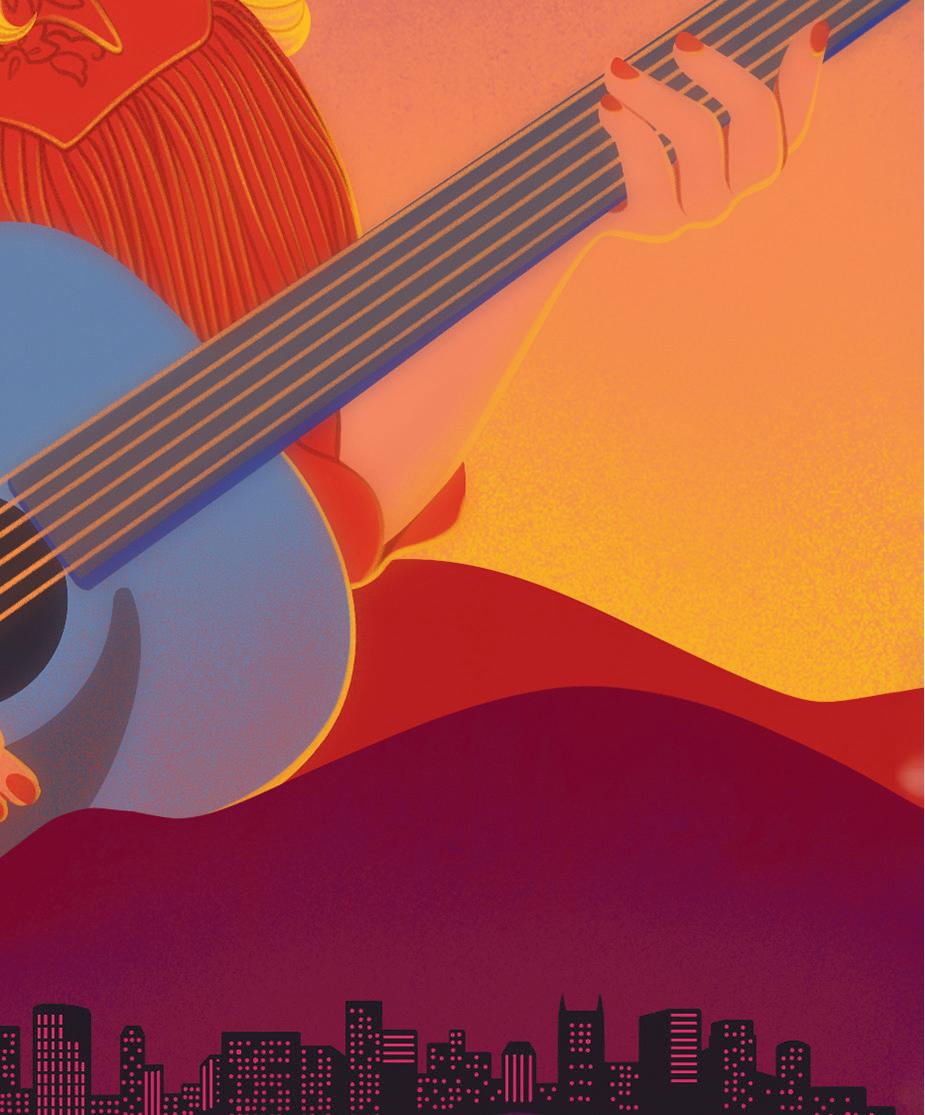
And that was it. No choking back tears, no shake of her head. Decklee could have walked right by us with her baby-blue guitar slung across her back and Melanie wouldn’t have noticed.
4
Jenna Voris
But her interview contrasts so well with the one next to it that I really can’t be mad. I’d found Clayton Sperry’s dad loading dog food into the bed of his truck the day the news broke and asked if he wanted to talk about it. That’s a little secret I learned about interviewing last year. People in Mayberry don’t like questions. They’re suspicious of most things—outsiders, CNN, people with too many piercings—but ask them to tell you about someone? Ask if they want to talk? They open right up.
When I asked Clayton’s dad about Decklee, the wrinkles on his face deepened and he ran a hand through his graying beard. “Everyone my age has a story about the first time they heard a Decklee Cassel song,” he said. “ ‘Losing You’ came out the summer of ’73 and the first person I thought of was Ellie. I remember getting in my truck, driving all the way to Little Rock to see her, and we’ve been married fifty years this Friday. That’s what those songs did. I think this town is going to miss her a lot.”
Even now, I can’t help grinning as I scroll past his photo on my grid. It has all the beats of a good story—the lede, the hook, the happy ending. His interview next to Melanie’s is a juxtaposition even I couldn’t have planned. A generational gap with me somewhere in the middle.
“Heads up!” Kendall tosses a bag of gummy bears in my direction, and I barely reach over in time to catch it. “There’s a bunch of inventory in the back. If you ever decide to work today, you can totally restock.”
I slide my phone back in my pocket. “I’m sorry, what was that?”
Time You Hear That Song 5
Every
“I said you can totally restock.”
“No, the other thing.”
Kendall grins and rips the top off another bag, dropping a handful of candy into his mouth. “Nothing.”
“That’s right.” I walk back down the aisle as the door shuts behind our last customer, Instagram momentarily forgotten. “Because it would be pretty bold of you to talk about my work schedule when you’re the one who was late this morning.”
Kendall laughs, head tipped back enough for the sun falling through the windows to cut warm shadows across his brown skin. “I honestly didn’t think you noticed. You’ve been so quiet.”
Something in my chest twists. Of course I’m quiet. I almost tell him why. But our relationship is nothing more than the result of living in the same small town. I know what Kendall eats for lunch every day. I know where his brothers live and what his parents do for work. I know him in the same shallow, superficial way I know everyone in Mayberry, and that’s exactly how I want to keep it.
So instead, I snatch the bag of gummy worms from his grasp, dump the rest into my mouth, and say, “I notice everything,” before pushing myself off the counter and striding into the back.
We only get a few more customers the rest of the morning, but it doesn’t get quiet enough to risk checking my phone again. As far as part-time jobs go, Bob’s isn’t bad. Working at a gas station wasn’t exactly at the top of my vision board, but the pay is decent, there’s plenty of air-conditioning, and it’ll be easy enough to leave when I go to college next year. There used to be another station up the road, but it closed a few years ago
6
Jenna Voris
and the raccoons took over before the people could. Now it sits abandoned and unused on the side of State Road 34, a great place to go after football games to drink stolen wine and summon ghosts.
I know because Madison, Emily, and I tried to summon ghosts multiple times last year to varying degrees of success. Madison is still convinced the place is haunted.
But that leaves Bob’s as the only viable gas station for thirty miles. And since we’re the sole place for people to grab cold drinks and subpar snacks, it also means Kendall and I aren’t alone when Decklee Cassel’s funeral starts.
I don’t know if he means to have this specific channel on. I don’t think he knows it’s unmuted, but when the first chords of a church processional start, a bag of Moon Pies slips through my fingers. It hits the floor right as Kendall reaches for the remote.
“Wait!” I’m surprised I can speak at all. The sight of people gathered in the pews on-screen feels like a shard in my chest. Real. This is real. I swallow as several heads turn in my direction. “Can you leave it?”
Kendall glances from me to the customers, most of whom have stopped shopping to watch. I know them all. There’s Ms. Rapisarda, my fourth-grade teacher, Alan Carmichael from across the street, Paul the librarian. They’re all watching the screen and I’m watching them so I don’t have to look at the casket slowly being marched down the aisle.
I’ve never been to a funeral, so I’m not sure how much of the ceremony is normal and how much is happening because this is Decklee Cassel. I try to place each speaker and musical guest Every
Time You Hear That Song 7
as they come on-screen, but I don’t have Mom’s encyclopedic knowledge of celebrity names and faces. I recognize Hunter Wallstreet in the first row, but only because that kind of star power is hard to miss. He has to be nearing ninety and his hair is shockingly white on camera, head bowed as an artist I don’t know performs a stripped-back cover of the first song Hunter and Decklee recorded together.
Behind him, hand in hand with his husband, is Markell Fansworth. His intricate purple suit stands out in the sea of black and navy, the rhinestones on his sleeves catching the light whenever he moves, and I wonder, briefly, if that’s an inside joke. If Decklee would have hated the formal, stifling atmosphere of her own funeral enough to make her oldest friend promise to make it interesting. For a minute, I wonder how she would look among the crowd of mourners, dressed in layers of sequins and glitter, arm in arm with her longtime writing partner, Mickenlee Hooper, and scratching out lyrics for their next number-one song on the back of the offering envelopes.
The thought makes my throat close. Decklee and Mickenlee haven’t worked together in decades, but I think part of me expected her to be here despite whatever creative differences drove them apart years ago.
I’m distantly aware of the customers still hovering around me, the cool interior of the gas station, and the fact that I should definitely be working right now. But I can’t move. I’m stuck in the aisle, watching the funeral continue as I grip the edge of the freezer, fingers slowly going numb with each passing second.
Voris 8
Jenna
It’s Kennedy Grasso, Decklee’s goddaughter, who concludes the ceremony eventually. She’s been sitting up front the entire time, wiping her eyes and nodding in time to each musical guest, and as she stands, I wonder if she thinks the eulogies sound genuine. It’s hard to capture someone like Decklee Cassel with words. I haven’t seen one article get it right. It’s always lists of accomplishments and accolades, a character in shoulder pads and sparkly boots; none of the things that make her feel vibrant and rich and real.
I think I could write a story like that one day, if someone let me.
The church quiets as Kennedy looks up from the podium, a smooth copper box clutched in her hands. My fingers curl around the phone in my pocket and I wonder if Mom is watching at home, perched in the middle of our couch, right where the cushions dip down. I should be there with her. We should be experiencing this together. But when I tear my eyes away from the TV, I realize I’m not alone at all.
Ms. Rapisarda blinks back tears as she presses a hand to her chest. Paul the librarian has a bottle of Gatorade clutched in one hand, like he can’t quite remember what he came here for in the first place. I swallow over the lump in my throat. Community. That’s another thing Decklee was always good at creating, and I’m grateful for it now, for how it makes this singular pocket of Mayberry feel a little more like home.
Then Kendall looks up and, because he has this complete inability to read a room, asks, “What’s in the box?” so loudly half the gas station jumps.
Every Time You Hear That Song 9
“Shhh.” Ms. Rapisarda swats him with her purse before I have the chance. “It’s the time capsule!”
I wipe my palms on my jeans, suddenly sweaty despite the frigid air-conditioning. I picture Mom doing the same, leaning forward on the couch, caught in the spell of Decklee Cassel’s legacy.
“Thank you all for being here,” Kennedy says, voice crackly on the old gas station TV. “I really think Decklee would have loved this. She loved when she could bring people together. That’s what she wanted her music to do and that’s what she wanted this to do.” She taps the box. “For the last fifty years, she’s been tucking things away in here. She wrote journals during every tour, kept photographs and ticket stubs, and even recorded an entire brand-new album with the explicit instruction to release it only after she was no longer with us,” Kennedy continues. “And even though that day came sooner than any of us would have liked, I’m comforted by the fact she found peace in this project. That she found joy in the music.”
I can’t stop my toe from tapping a nervous rhythm on the linoleum floor. This time capsule isn’t a secret; Decklee talked about it all the time. She called it a mosaic, a scrapbook of her life, and even though I, too, wish the situation was different, the idea of new Decklee music soothes a bit of the ache in my chest.
New songs for me. New songs for Mom.
It’s been eight years since the last Decklee Cassel album. She still made music after Mickenlee left and every record was objectively a hit, but it never quite replicated the magic of her
Jenna Voris 10
old stuff, the songs I knew were born on Tennessee porches, in smoky bars and old church pews.
Kennedy slides a key from the chain around her neck and slips it into the time capsule’s lock. When it turns, I swear I hear it click from where I stand, five hundred miles from Nashville. No one in that church breathes as her hands hover over the box. Then she lifts the lid and we all lean forward. Even Kendall cranes his neck to see from behind the counter. The lid falls back, the cameras zoom in, and I suck in a sharp, bewildered breath.
Because there isn’t an album at all. There aren’t crisp tour journals, piles of black-and-white photographs, or letters penned in Decklee’s familiar, looping handwriting.
The time capsule is empty.
TWO Decklee
Texarkana, 1963
This is how you light the way—with the bridges you burn behind you.
There’s a single bulb flickering above the ticket counter in the Texarkana Greyhound station. I watch it pulse and rattle and wonder if it knows me, somehow. If light can still recognize light in different forms. The man behind the counter looks halfasleep, head propped in his hand as he drums his fingers on the table.
He doesn’t know about the cash tucked against my hip, stolen from my father’s wallet in the dead of night. He doesn’t know about my brother’s watch around my wrist, under my coat where no one can see. He doesn’t know I stole that, too, that sometimes the only things you need to bring are a packed bag, a guitar case, and a dream too big to fit in either.
My mother gave me that guitar on my tenth birthday. She told me it was okay to take it slow, that everyone learns at their
1212
own pace, but my pace is wildfire. My pace is lightning and luck and all the desperate longing of the universe. Mayberry eats wildfire girls, though. It’s a place of locked doors and limits, such a messy tangle of contradictions that I don’t know where to start pulling them apart.
“When’s the next bus out of here?”
The man behind the counter looks me up and down and for a second, I wonder what he sees. A fifteen-year-old girl in a dirty coat, skinny and pale with a wild nest of blond curls that never lays flat. I wonder if part of him sees who I’ll become, or if he’s just looking through me—another nameless passenger on another unremarkable night. He rubs a hand over his face.
“Where do you want to go?”
Everywhere. To Nashville, where the streets pulse with music. To New York, a city on the brink. To Los Angeles, where it’s warm and balmy and rich.
“Out,” I say without hesitation. And I slide my father’s cash across the counter.
Later, I sit in the corner of the station, single ticket clutched in my hand, and close my eyes. My father cooked for us last night, like he had every day for the last month. He ruffled my hair and pulled me close and whispered, “I know you’re upset, Cleo. I’m sorry. We’ll talk about it next year.”
But I know we won’t. My father is soft and sentimental and weak. He won’t send me to the city, no matter how many times I ask him to let me work. He doesn’t care that I still see my mother in every inch of that house because Mayberry got her, too, in the end. It chewed her up and spit her into the ground
Time You Hear That Song 13
Every
like she was nothing, and now everywhere I look feels like an open grave.
It feels like I’m next.
My ticket is damp with sweat by the time I hand it over and board the Greyhound. Number seventeen. Express to Memphis, Tennessee. I sit alone toward the back of the bus and slide my bag under the seat. My guitar case stays locked in my arms, though, smooth leather pressed against my chest.
I’ve never been on a bus before, never ridden in anything but the bed of my father’s truck, arms wide, wind in my hair. But now I feel the growl of the engine under my feet, shuddering through me, shaking dust off my bones. The next time I see Mayberry, it’s from the road. We’re moving, cutting north as the sun breaks over the trees, and I catch a glimpse of the pale church steeple in the distance. Then I blink and it’s gone.
I close my eyes and rest my forehead against the window. Leaving is a little bit like learning to breathe, I think. It’s like waking up after a long, restless sleep to find the entire world feels vibrant and new. Maybe that’s what makes it worth it.
Maybe this is something I’ll write into a song one day.
THREE Darren
I’m still thinking about Decklee’s empty time capsule when Madison picks me up from my shift.
“Is that a new polo?” she asks when I slide into her passenger seat. “Did they finally promote you?”
Sometimes I’m convinced Madison is the one destined to be a reporter, not me. She notices everything, like the time Emily accidentally bought a hair dye two shades darker than usual, or the fact that I’m wearing a blue polo now instead of red.
“As if Bob would ever promote me,” I mutter. “No, the coffee maker exploded this morning, so I had to borrow one of Kendall’s.”
“Cute!”
I resist the urge to roll my eyes as Madison pulls out of the parking lot. She’s one of the only people my age who has a car—a privilege she says is entirely a result of her parents’ divorce guilt. Her younger sister got a puppy and she got a 2001 Ford Taurus
15
15
named Betsy who occasionally projectile vomits oil onto the road. I personally don’t think those two gifts are comparable, but I’m never going to complain about being chauffeured to and from work. I lean my head against the window, letting the cool air wash over me as we pull back onto the road.
“Wow.” Madison smirks. “What are you going to do when I leave? Are you mentally prepared to walk tomorrow?”
I groan. “Don’t remind me. Any chance you want to skip camp and drive me around forever?”
“Absolutely not.” She flashes me a wicked grin. “You could always ask Kendall for a ride.”
“I don’t know him.”
“Yes you do. Everyone knows him.”
But that’s not what I mean, and she knows it. Of course we all know each other. That’s, like, Mayberry’s whole thing, but it doesn’t mean I want to be trapped in a car with just anyone.
“I’m just saying it’s an option,” Madison adds as we turn onto my street. “Forced proximity is a really good trope.”
“Right,” I say. “And which one did you want me to try last week?”
“Fake dating,” she answers immediately. “But that usually works best if you’re trying to make someone jealous.”
Madison pulls into my driveway, shifts the car into park, and looks at me expectantly. I never know what she wants me to do with this kind of information. After she announced that my exboyfriend, Benton, and I were “endgame” (we weren’t) and that Emily was in a “clear enemies-to-lovers relationship” with her lab partner (she wasn’t), I started taking everything she says
Voris 16
Jenna
with a grain of salt. Madison might have a pile of well-worn romance books in her back seat at all times, but I have yet to find a story in this town that truly feels like me.
“Well, on that note.” I grab my bag and open the door, squinting as the afternoon sun hits me square in the face. “See you in August. Send me postcards.”
“I will!” Madison reaches across the car, pulling me into a brief, rib-crushing hug. “Stay out of trouble!”
Betsy’s gears grind back into drive as I shut the door. I wave until Madison disappears around the corner, then turn to find Mom already sitting on Carla’s porch next door, magazine in hand.
“Yikes,” she says when I drop my bag on the steps. “You look exhausted. What happened?”
My face twists as I remember the events of that morning. “Lost a fight with the coffee machine.”
She laughs, sun catching in her soft brown curls, and I collapse into the rocking chair next to her. We don’t have a porch of our own, but over the years we’ve slowly taken over Carla’s— sitting outside when the weather’s nice, letting her feed us baked goods, talking about everything and nothing with equal enthusiasm. Mom kicks her feet up on the railing and I do the same, savoring our familiar pattern. This is another great thing about summer: she’s always home. As soon as June hits and she doesn’t have to worry about being a “responsible English teacher,” it’s all T-shirt Mom and Trying to Garden Mom and Drinking White Claws at Noon Mom. All the versions of her I wish I’d had earlier. All the versions I’m still scared to lose.
Every Time You Hear That Song 17
“Did you hear back from Doctor Vij?” I ask, tone as casual as I can make it. “About next week?”
She nods, knuckles tightening on her magazine. “It’s on the calendar.”
I exhale as best I can. Mom’s been in remission for years, but the thought of more appointments, more doctors, and more tests always makes my chest tighten.
She got sick for the first time when I was seven, back when we were still getting used to being a family of two. Dad was gone—somewhere in Oregon pretending he hadn’t left a wife and daughter alone in a dead-end town with no way out—and I don’t think Mom ever told him about her diagnosis. I don’t think he asked. It was always just the two of us, in our little house across from the post office, backed up against a soybean field and seven miles from the Oklahoma border. Sometimes, I’m grateful everything happened when I was so young because I don’t remember the worst of it. I don’t remember the nights it got bad, when my grandparents came in from Texas and we all sat in the waiting room of a strange city hospital two hours away from anything familiar.
But I do remember Carla, our neighbor with the blue eyes and soft, silver hair, who took me in after school and let me play in her flower beds until the damp earth soaked through my jeans. I remember her teaching me to play piano one tremulous note at a time until I forgot all about needles and tubes and hospital walls. I remember my teachers bringing us home-cooked meals, the post office workers sending a gift basket directly to Mom’s hospital bed, and I remember thinking that, despite
Jenna Voris 18
everything wrong with Mayberry, things like this didn’t happen just anywhere.
And I absolutely remember the day Mom taught me about Decklee Cassel.
It was one of those rare weeks where she was home—tired but not in pain. We were a year into treatment, and she spent more time in the car and at the hospital than with me, but that day, we were tucked together in her room, sunlight dappled across the worn gray carpet. I was absentmindedly flipping through homework I hadn’t started when Mom leaned down, put her face close to mine, and whispered, “Do you want to do something fun, Darren?”
Mom talks about everything like that—like it’s the single best, most amazing thing to happen in the history of the universe. I used to believe her, but after the third Renaissance Faire and the endless black-and-white movie nights, I learned to view her promises of “fun” with an appropriate level of wariness. I mean, the woman loves Steinbeck novels and the Star Wars prequels. She doesn’t exactly have flawless taste.
But that day, I nodded and told myself that no matter what came next, I would pretend to love it because Mom needed a win. She ruffled my hair and reached over to where her ancient iPod sat docked in the speaker, turning the dial until the first notes of a soft guitar solo blared through the house. I sat crosslegged on the bed, enthralled as the opening chords gave way to smooth, pure vocals, and decided that finally—finally—this was something I didn’t have to pretend to like.
The first album she played me that day was Whiskey Red. I
Every Time You Hear That Song 19
didn’t understand the lyrics back then, or hear the deep yearning woven into every bridge, but I loved it from the start. Each verse was thunder in my veins, the hooks catching me right in the chest. We played it on repeat that afternoon, just ran through the tracks again and again until I memorized every word. I can’t sing to save my life, but Mom has this beautiful voice, and when the doctors declared her cancer-free and she got to ring the bell on the way out of Little Memorial Hospital almost five years after her first treatment, we danced around the kitchen exactly like we had that day in her bedroom and belted “Times Are Changing” at the top of our lungs. After that, we sang in the car back and forth from her checkups, on the way to school when I needed a morale boost, whenever and wherever we wanted.
Those songs are a shield. They’re armor. I wrapped them around my shoulders back then, held them close, and whispered them into Mom’s ear on the bad days. They were magic and they worked. Because she’s still here and we’re both still singing.
People never talked about Decklee Cassel being from Mayberry unless it was to compliment her for getting out, because here’s the truth: no one cares about towns like this until they’re behind you. Listening to her music always felt like someone was ripping back the hazy curtain of my life, leaning in and shouting, Look at her. She got out. What are you still doing here? Because if Decklee could leave, if she could turn herself into a star, what was stopping me?
Mayberry County High School isn’t exactly known for its
Jenna Voris 20
Every Time You Hear That Song
extracurriculars. Most kids take Newspaper as a blow-off class, or to sneak pictures of themselves into the yearbook. I take it for a way out. We didn’t even have an editor in chief until I created the position halfway through my first semester, and I’ve spent the last three years building a pretty decent staff. We’d be better if the school actually let us cover the beats I want, but I only have one more year of high school left. One more year of being told what to write and how to write it by adults who never pushed the boundaries of this town far enough to see if they would bend.
That’s what Decklee Cassel and Mickenlee Hooper did when they wrote together. They shattered boundaries, and when a partnership as powerful as theirs ends, I feel like it should leave something behind. It should tear the world apart. Instead we get empty time capsules and unfulfilled promises.
I don’t know why I expected this town to give me anything different.
The screen door slams behind me and Carla steps back onto the porch, plate of almond cookies in hand. She’s in blue today, a soft linen dress that brings out her eyes and perfectly matches the butterfly brooch on her collar. “Ah, there you are, Darren.” She pats my shoulder as she sets the plate next to my chair. “Busy day at work? How’s Mr. Wilkinson?”
I grin and take two of the cookies. Only Carla—perfect, polite Carla—calls Kendall Mr. Wilkinson, like he’s the lead in a Jane Austen novel. “He’s fine. How’s the garden?”
We all crane our necks to take in her front lawn, following the line of the sprinklers as they pulse back and forth. Carla
21
Krenik is good at a lot of things. Baking almond cookies, finding vintage jewelry in the back of estate sales, giving advice that’s both scathingly blunt and refreshingly honest, but this garden has always been her pride and joy. I used to think she gardened because she was lonely, living by herself in her seventies in a town with no family or visitors, but I think she just genuinely loves it. This summer, she’s growing roses.
“They look good,” I say, stretching my arms over my head.
“No.” She sighs. “They’re wilting.”
Mom laughs. “It’s a hundred degrees, I’m wilting!” She looks toward me then, lowering her voice to a conspiratorial whisper as Carla inspects one of the bushes. “Did you watch this morning?”
I immediately know what she means. I remember Decklee’s funeral playing over the grainy gas station TV, the plummeting disappointment of finding the time capsule empty. I nod and Mom blows out a breath. “It’s a shame, isn’t it? I really thought there’d be something.”
“There is something,” I say with more confidence than I feel.
“Oh yeah?” Mom raises an eyebrow. “What makes you so sure?”
I don’t have an answer. The simplest one is that Decklee Cassel never actually filled the time capsule in the first place. She was busy or life got in the way or she lost interest. But something about that doesn’t feel right. That project was never intended for the press or for celebrity speakers, it was supposed to be for us. The fans. I know because every time an interviewer brought up how she never married or had children, Decklee
22
Jenna Voris
would laugh and say, I have millions of children. They’re all buying my records.
“You know that lyric from ‘Lucky in Love’?” I say, turning back to Mom. “Everything’s a game with you, honey, but there’s one thing you forgot—”
“—I’m the master, always have been, pity those who think I’m not,” Mom finishes for me. “That’s a good one. You might know more of her songs than I do by now.”
“It’s a Mickenlee lyric. You can hear it in the rhyme.”
“See?” Mom gestures like told you so. “Why does it matter?”
I shrug again and lean my head against the wall. The sun is directly overhead now, baking us both into the pale wood of Carla’s porch. “Because maybe this is a game. Or maybe it’s lost. Someone could have taken it.”
Carla snorts, letting the petals of the nearest rosebush slide through her fingers. “It probably never existed.”
“That’s a good point,” Mom says, turning another page in her magazine. “I mean, a new album? After eight years? Feels too good to be true.”
I slide down in my chair, watching the bushes bob in the faint breeze. It probably never existed. That’s the most logical explanation, but it’s also the one I refuse to accept. There are a lot of things I’ve had to come to terms with over the years. That my teachers will never let me write the stories I want. That Bob is never going to give me a raise. That, no matter how often Emily and Madison and I discuss it, the odds of us actually getting out of this town are low.
But those are Mayberry things, normal things. Decklee
Every Time You Hear That Song 23