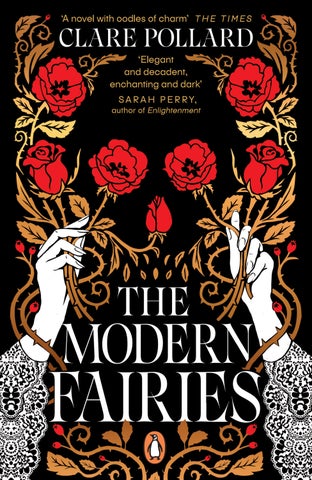
‘A novel with oodles of charm’ THE TIMES
‘Elegant and decadent, enchanting and dark’
SARAH PERRY, author of Enlightenment


‘A novel with oodles of charm’ THE TIMES
‘Elegant and decadent, enchanting and dark’
SARAH PERRY, author of Enlightenment
‘Elegant and decadent, vulgar and clever, enchanting and dark. The love child of Angela Carter and Anaïs Nin – the book I really, really needed’ Sarah Perry, author of Enlightenment
‘Funny, filthy, dancingly clever . . . A delectable confection of many-layered pleasures. A story of stories, storytellers and the lurking dangers of fairy tales, set against the lavish decadence of 1600s Versailles. I gobbled it all up’
Joanna Quinn, author of The Whalebone Theatre
‘Pollard [has a] sure touch, seamlessly blending humour and disgust . . . A novel with oodles of charm’ John Self, The Times
‘Compelling . . . Vibrant . . . The author’s sentences sing on the page with wit and intelligence . . . This memorable novel reminds the reader of the enduring power of storytelling to transform and even save lives, then and now’ The New York Times
‘Original, fantastical, historical and unputdownable’
Karen Joy Fowler, Booker Prize-shortlisted author of We Are All Completely Beside Ourselves
‘Lush and gossipy, rich and wonderfully indulgent.
The Modern Fairies is wickedly playful yet lingers, with emotional truth, long after reading. A feast of a novel. I dare you to read it!’ Molly Aitken, author of The Island Child
‘Pollard evokes the intrigue, sophistication, scandal and danger of seventeenth-century France in this bawdy, brilliant book, as dark and delicious as the chocolate served at the Modern Fairies’ salons’ Irish Times
‘Those in search of a bawdy fairy tale should look no further’ LA Times, Books to Read This Summer
‘A delightfully raunchy romp . . . This magnetic revisionist historical deserves a wide readership’ Publishers Weekly
‘A captivating work of historical fiction from a poet with an imagination perfect for the job . . . Riotous . . . Pollard, known for her evocative verse, brings a fresh perspective to age-old myths and legends with her inimitable wit. The prose is as luxurious as the subject matter, with the politics of the day and underlying tensions used to brilliant effect’ Glamour
‘The Modern Fairies gives us intimate access to the most prestigious of private Parisian salons. In a novel both aching and cruel, sumptuous and tender, Pollard’s beautiful writing leads us along winding pathways. Through its prickling branches to exquisite clearings of hope, this book consumed me’ Katie Hale, author of My Name Is Monster
‘Pollard vividly and powerfully evokes the tumult, passion and creativity of this bygone era, crafting a tale that’s both timeless and timely’ Booklist
‘Clever and glittering, this beautiful novel resembles both the court and the stories it depicts’ Kirkus
‘A luxuriously told romantic comedy’ Idler
about the author
Clare Pollard is an award-winning poet and playwright based in London. She is the author of five poetry collections and the former Editor of the Modern Poetry in Translation magazine. Her first novel, Delphi , was published by Fig Tree in 2022. The Modern Fairies is her second novel.
Also by Clare Pollard Novel Delphi
Children’s novel
The Untameables
Poetry
The Heavy-Petting Zoo
Bedtime
Look, Clare! Look! Changeling
Ovid’s Heroines
Incarnation
Non-fiction
Fierce Bad Rabbits
Play
The Weather
PENGUIN BOOK S
UK | USA | Canada | Ireland | Australia India | New Zealand | South Africa
Penguin Books is part of the Penguin Random House group of companies whose addresses can be found at global.penguinrandomhouse.com
Penguin Random House UK , One Embassy Gardens, 8 Viaduct Gardens, London sw 11 7bw penguin.co.uk
First published by Fig Tree 2024 Published in Penguin Books 2025 001
Copyright © Clare Pollard, 2024
The moral right of the author has been asserted Penguin Random House values and supports copyright. Copyright fuels creativity, encourages diverse voices, promotes freedom of expression and supports a vibrant culture. Thank you for purchasing an authorized edition of this book and for respecting intellectual property laws by not reproducing, scanning or distributing any part of it by any means without permission. You are supporting authors and enabling Penguin Random House to continue to publish books for everyone. No part of this book may be used or reproduced in any manner for the purpose of training artificial intelligence technologies or systems. In accordance with Article 4(3) of the DSM Directive 2019/790, Penguin Random House expressly reserves this work from the text and data mining exception Typeset by Jouve (UK ), Milton Keynes Printed and bound in Great Britain by Clays Ltd, Elcograf S.p.A.
The authorized representative in the EEA is Penguin Random House Ireland, Morrison Chambers, 32 Nassau Street, Dublin d 02 yh 68
A CIP catalogue record for this book is available from the British Library isbn : 978–0–241–67246–4
Penguin Random House is committed to a sustainable future for our business, our readers and our planet. This book is made from Forest Stewardship Council® certified paper.
To my husband
The histories that will be written about this court after we are gone will be better and more entertaining than any novel, and I fear that those who come after us will not be able to believe them, but will think that they are just fairy tales.
– The Duchesse d’Orléans
During the reign of Louis XIV (1643–1715) many people shared the same first names, so the names I use consistently are in capitals.
MADAME MARIE- Catherine D’AULNOY
JUDITH , her mother
NICOLAS , her father
BARON D’AULNOY, her husband, separated
Charles BONENFANT, her lover, deceased
JUDITH , daughter
THÉRÈSE , daughter
FRANÇOISE, daughter
BELLE -BELLE , a marmoset
MIMI , nurse
ANNE , cook
BERTHE , housemaid At the salon
CHARLES PERRAULT
Marie Perrault, his wife, deceased
Charles, son
Pierre, son
Madame Marie-Jeanne L’Héritier de Villandon, known as TÉLÉSILLE , Perrault’s cousin
MADAME HENRIETTE -Julie DE MURAT
COUNT DE MURAT, her husband
MADAME ANGÉLIQUE TIQUET
CLAUDE , her husband
MOURA , her valet
MADAME MIAOU, her cat
Charles BRIOU
CHARLOTTE -ROSE Caumont de La Force, lady-inwaiting for the Dauphine
Marie Anne de Bourbon, known as the PRINCESSE DE CONTI , Louis and Athénaïs’s legitimized daughter
ABBÉ Charles COTIN
Charles de SAINT- ÉVREMOND
At the court
KING LOUIS XIV
Madame de Montespan, known as ATHÉNAÏS , the king’s official mistress
MADAME DE MAINTENON, the king’s new mistress
Jean-Baptiste COLBERT, controller-general of finances
Maria Anna Christina Victoria of Bavaria, known as THE DAUPHINE
FAGON, the doctor
LA VOISIN, a fortune teller
Gabriel Nicolas de La REYNIE , chief of police



‘There was once an omnipotent king. Perhaps, some said, the most powerful ruler there had ever been. They said too – of course they did – that he managed to be both just in peacetime, and in wartime utterly terrifying. His subjects were completely content, whilst his enemies shuddered with fear. And this king had – of course he had – the most charming and beautiful wife imaginable, and their little girl was the most darling little doll. Really, one might say that their lives were perfect.’
So Charles Perrault begins to tell the tale of ‘DonkeySkin’. So, too, we begin our story.
In Madame d’Aulnoy’s salon, Perrault’s small audience sit forward keenly in their seats to hear what inevitable disaster will strike this faultless family. For the energy that lies behind all stories is a destructive energy – the urge to burn down what is for what might be. It is late autumn in the late seventeenth century, in the time of the reign of Louis XIV. The gathering is in a fine room on the Rue Saint-Benoît, in Paris, snugly luxurious with heavy, embroidered coral-coloured brocade; candles dance close to every hem.
Earlier, Charles Perrault was introduced to various members of the elite, intellectual crowd who have been meeting here regularly, for the purpose of sharing what
at this time are still largely known as Mother Goose tales – although some know them as tales of the stork, or even Donkey-Skin tales. Or perhaps you know them by the newer name, contes de fées or fairy tales? Well, it is Madame d’Aulnoy herself who has coined this term, and in the process made quite a craze of them.
Though Charles is usually good at people’s names, scanning around again he realizes a couple have slipped his mind already. There is his cousin, Marie-Jeanne L’Héritier de Villandon, ardent and a touch pious – who he cannot help but like, though he is also slightly wary of the manner in which her ordinary face so shines with good intentions. His cousin is his point of entry into this circle, thinking to be the one to lift his present gloom. She has asked that he call her Télésille within this context – it has become the fashion to have a salon name, and hers is after a Greek poet who led women into battle, something that he finds mildly preposterous but is trying to remember in politeness.
Looking around, he can also see one of the king’s illegitimate daughters, the Princesse de Conti, who always sits forward with the easy casualness of wealth, as though her legs are open beneath her skirts. A clear-skinned blonde with a strong jaw, she wears no wig or make-up. Is attractive, but in the manner of a dashing young prince rather than a princess – she smokes tobacco rakishly from a pipe.
Wealthy heiress Madame Angélique Tiquet he recognizes at once – she sprawls louchely in the soft chair at the left, wearing a pink shepherdess’s frock rummaged
out of the salon’s fancy-dress box (having acted along to an earlier tale), and is still holding her crook like a sceptre. Angélique Tiquet is the sort of woman who spills from every dress that she wears despite her age; sugar crystals bedeck the corners of her sumptuous mouth, with its rotten front tooth. She has a white cat with a jewelled collar that she often carries under her arm.
There, too, is a rare man who has been allowed into the circle – Abbé Cotin, a mediocre clergyman and scribbler known for his tedious sonnets. Beside him, her narrow nose flaring at the abbé’s mere presence, is sharp-tongued Madame Henriette de Murat. Then pretty, posy CharlotteRose Caumont . . . de La something – Force, that was it – in the latest fashions, who he recognizes as a lady-inwaiting from the court. The others, though. Minor aristocrats. Who is that tall young man with long lashes?
Thick hot chocolate is being served in very beautiful china with a pale green glaze. Women carefully check their teeth and upper lips with their tongues after each sip, for tidemarks.
This is Perrault’s first time at the salon, and he means to charm, for his cousin’s sake as well as his own. The tale of ‘Donkey-Skin’ – ‘Peau d’Ane’ – is one that has always delighted him, since his nurse told it to him by the fire’s embers. As one of the esteemed forty members of the Académie Française, that council pertaining to the French language, known as ‘les immortels’ after the academy’s motto ‘À l’immortalité’ (‘To Immortality’), he thinks he knows how to woo a small, literary audience such as this – the tale must be brief and sparkling:
a glass of champagne you have finished before you even realize it’s in your hand.
Those who take a moment to admire Perrault see a man in his fifties, under a brown wig that puts one in mind of a handsome spaniel. It is often said that he has grown into his face, which is open, with lucent eyes that cannot help but tend towards merry. He is one of those men of the world with real charisma, who have the great gift of being interested in everyone, from the Dauphin to the cook. To be held in his attention for a few gleaming moments is usually to like him, an effect which he internally, humbly acknowledges.
‘Imagine their magnificent palace!’ he continues. ‘Courtiers from all around the globe come to see their paintings by Rubens and Leonardo, their statues by Bernini, their lavish hall of mirrors . . .’ This raises another chuckle, the audience aware that he is describing the Galerie des Glaces in Louis XIV ’s magnificent palace at Versailles, one of the wonders of the Western world – the room Charles Perrault himself furnished with over three hundred large mirrors. Perhaps the most famous room in France, it is an Aladdin’s cave crowded with flatteringly lit beauties, gazing at versions upon versions of themselves. But in acknowledging it, Perrault means also to acknowledge what everyone here surely knows – that since his friend Colbert’s death he has fallen out of favour with Louis XIV. He doesn’t want anyone to think they must tiptoe around him on the subject of Versailles. He still has a pension after all; is proud of what he achieved there. It is no shame to move on.
Perrault makes sure of eye contact with Madame d’Aulnoy as he speaks, hoping to delight his hostess most of all. He was impressed by her recent novel, the society sensation The Story of Hypolitus, Count of Douglas, so is keen to get to know the writer behind it – although there is something cool and slippery about her gaze. For a moment, Perrault pictures a turret with glass walls and himself as a knight-errant, struggling slightly to catch his footing. It is not a feeling he is very familiar with. He is trying to establish a playful tone, but he realizes that it feels new and unnerving to him, to be encouraged to talk lightly of kings and palaces this way. Is this why they tell fairy tales in here? To slip rebellious thoughts past the censors, in the guise of nursery stories?
But all verbal storytelling is a kind of improvisation, done on nerve, and his instincts tell him that he must get on with the plot. ‘The king’s stables boasted steeds of every description,’ Perrault continues. ‘But something shocked those who entered the stables, though they hardly dared talk of it – the place of honour was held by a hideous donkey with two enormous ears, that had earned its position by shitting golden coins each morning instead of dung.’
A laugh at this, which is an easy laugh, he knows. His cousin Télésille’s eyes gleam with a curious mixture of emotions – he imagines she is swallowing her private distaste for such humour, but also still trusts his ability to beguile a room.
‘Now God, who keeps us attentive by mingling good with evil, permitted the queen to sicken. She grew pale
and thin; her eyes glittered. Neither the learned physicians nor the charlatans could stop her fever. Finally, with her last breath, the queen said to her husband, “Promise me that you will only marry again if you find a woman cleverer and more beautiful than me.” She was confident, you see – in her calculated vanity – that it would be impossible to find such a woman, so this dying wish would prohibit her husband from remarriage. We must admit that as she expired, she felt rather smug, with no inkling at all of the terrible consequences she had set in motion. “Of course, my love, anything for you,” the king sobbed as she died in his arms.’
(Charles swallows the saliva that lacquers his own tongue. He will not think of it now, in public. He will not think of it.)
‘For a few months, the king was inconsolable, but then urged by his courtiers to secure an heir, he did agree to marry again. This was not an easy matter, though, for he was determined to keep his promise, and who could possibly equal his queen in intelligence and beauty? Only his daughter, who every day charmed him more, with her slender grace and her sky-blue eyes. Only his daughter.
‘The thought turned in his head; it twisted his guts. It began to possess him. Only his daughter. She was his wife in miniature, his wife come back. The answer to the riddle. Only by marrying his daughter could he fulfil his vow to his dying wife! And so, one day, as she played by his feet, he proposed to her. The princess laughed, as at a game, but then she realized it was not a game. “Don’t frighten me, Father.”
‘ “It’s what your mother wanted. Her dying wish.”
‘ “Please don’t talk so strangely,” the princess replied, shivering as though a shadow had moved over her.
‘Deeply troubled at this turn of events, the princess sought out her fairy godmother who lived in a grotto of’ – Perrault glances round the room at the rich, coral fabrics and shimmering candelabras and improvises here – ‘coral and pearls.’
Perrault’s audience, largely female, nod appreciatively, their pale wigs bobbing in unison like a flock of doves thrown seed. They seem to agree that this is the type of place where fairy godmothers are found. There is the sound of drinks being slurped, a cup skittering upon a saucer, the fire’s steady crackle. The fire is a touch too hot, so Perrault is gilded with sweat, though he surely can’t be nervous. Often, when public speaking, he has quelled his nerves with the technique of picturing the audience naked, but in this instance – amongst so many of the female species – he feels that it would only increase his perspiration.
He opens his mouth again. ‘ “I know why you’re here,” the fairy godmother said. “Your heart is heavy. But we godmothers have our wiles. I’m sure nothing can harm you if you follow my advice. Tell him that first you must have a dress which has the exact colour of the sky. It will be impossible.” So the young princess went, aquiver, to her father. But the moment he heard her request, he summoned his best tailors and ordered them to make a dress the colour of the sky, straight away, or he’d hang them all. The following day the
princess got her dress. It was the changeable, radiant blue of Heaven.
‘Next, her godmother advised: “Ask for a dress the precise colour of the moon. Surely that really is impossible.” But almost anything, you see, is possible when you’re the most powerful ruler there has ever been in the entire world. The king summoned his embroiderers, made threats, and four days later a dress the colour of moonlight was ready – placed in the dark of the wardrobe, it even emitted a ghostly glow.
‘ “All right,” said the godmother, looking a little more anxious this time. “Let’s have one more try – a dress as radiant as the sun. What are they going to do, set it on fire?” This time the king summoned his jeweller and ordered him to make a cloth of gold and jewels, warning him that if he failed, he’d be beheaded. Within a week the jeweller had a finished dress that so dazzled the eyes it left little floating dots on the retinas of everyone who saw it.’
Perrault likes this bit of the tale – the pattern of it. The rhythm. He likes the shapes things make. And he likes beautiful, refined things: frescos, hyacinths, clockmakers, marzipans, butterfly wings, golden tableware, fountains, good shoes, the nightingale’s song. He is an aesthetic man. For all his disappointment, in the end, at the court of Versailles, he tries to be proud of what he helped to create there – civilization.
The room listens intently – he has them caught – as he continues his tale: ‘The princess knew she was expected to thank the king, but the word stuck in her
throat. Once again, her godmother hissed advice in her ear: “I’ve got it! Ask him for a cloak made of the skin of that donkey in the royal stable. He loves that donkey. There’s no way he’ll kill it, unless I’m badly mistaken.”
‘This was her best idea so far, but she did not understand how the king’s desire to bed his daughter now overwhelmed every other consideration. He was tortured by longing, a sensation that – given his position – he had never experienced before. Almost immediately, he spat out the command. Minutes later, his donkey’s stillwarm skin was laid before the princess: bloodied, stupid-eared, buck-toothed, wet-eyed. “Enough now, child,” he said. “We wed tomorrow.”
‘Now both the princess and her godmother were truly terrified. The godmother decided the only option was for the princess to escape, disguised beneath the donkeyskin. She filled a chest with the princess’s clothes, powders, mirror and jewels, and gave her a magic wand, telling her to touch it to the ground when she wanted the chest to appear. But otherwise the girl was on her own. So, on the morning she was meant to marry her father, the princess vanished.’
When Perrault says this a sudden cold feeling comes over him. He finds he doesn’t glance up at Madame d’Aulnoy, because he remembers – how could he be so foolish as to have picked this tale for his debut? – that this is, in part, her story. He recalls, now, how when she reappeared in the city a few years ago and opened a salon, the halls of Versailles were abuzz.
Gossip has it that Madame d’Aulnoy was married off
by her father to Baron d’Aulnoy when she was just a little girl, for financial motives. The baron was not a real baron of course, but a drunken libertine who had purchased the title. And then, after years of rumours that he ill-used and degraded his young wife (and after she had lost two of her three babies, poor thing), he was imprisoned in the Bastille for treason, having vocally complained about the king’s taxation system.
But then – this was the twist in the tale – the baron was released. Rumour swirls that this was because, having been framed for the crime, he had finally proven his innocence. It had all been a conspiracy by Madame d’Aulnoy, her mother and two men (assumed to be their lovers) to falsely accuse him! The two men had their heads chopped off, whilst Madame d’Aulnoy herself was jailed in a tower with her third, newborn baby, only to escape by jumping from a window.
Did Madame d’Aulnoy flee in disguise like DonkeySkin? And the question which obsesses the court, naturally, also resurfaces now in Perrault’s mind – why, all these years later, is she allowed to be here in Paris, at the heart of this salon?