










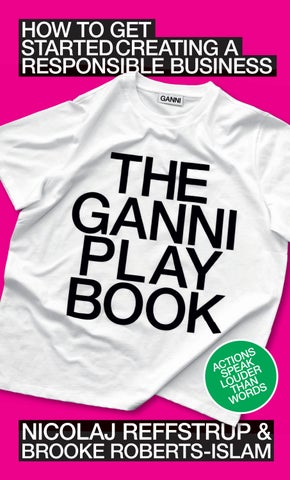
HOW TO GET STARTED CREATING A RESPONSIBLE BUSINESS NICOLAJ REFFSTRUP & ACTIONS SPEAK LOUDER THAN WORDS



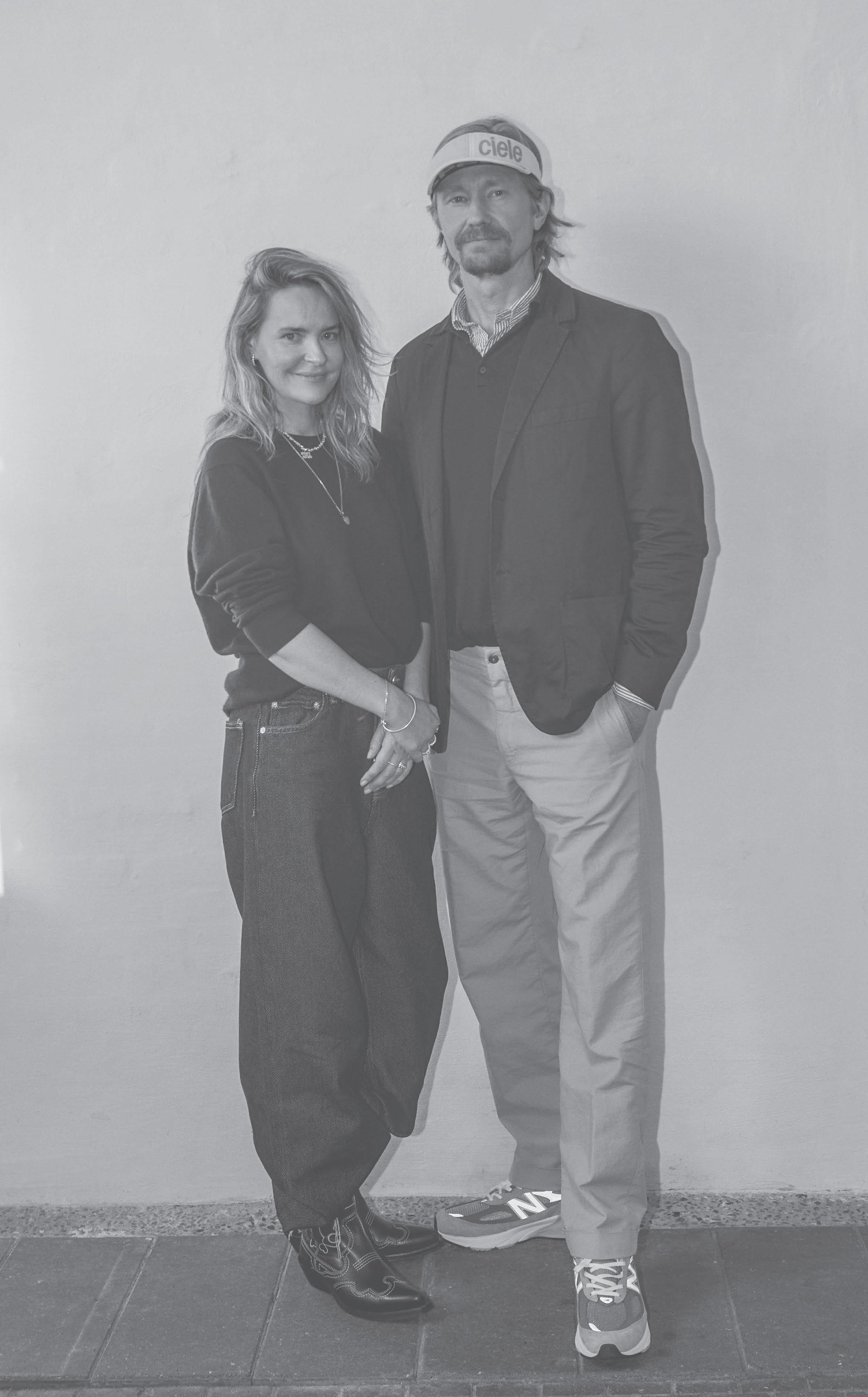
NICOLAJ REFFSTRUP co-founded GANNI and served as CEO of the brand for ten years. He has sat on the boards of the Danish Fashion Institute, Copenhagen Fashion Week and Global Fashion Agenda. Before joining the fashion industry, Nicolaj was an entrepreneur working in tech. In 2022, Nicolaj founded Look Up Ventures, a green investment fund focussed on funding businesses that can help solve issues related to the climate crisis through green tech.
BROOKE ROBERTS-ISLAM is a senior sustainability contributor at Forbes, founder of the consultancy Techstyler, and a leading voice in the fashion and textile industries.
How to Get Started Creating a Responsible Business
Nicolaj Reffstrup and Brooke Roberts-Islam
UK | USA | Canada | Ireland | Australia
India | New Zealand | South Africa
Penguin Business is part of the Penguin Random House group of companies whose addresses can be found at global.penguinrandomhouse.com.
First published 2024 001
Copyright © Nicolaj Reffstrup and Brooke Roberts-Islam, 2024
The moral right of the authors has been asserted
Typeset by Jouve (UK), Milton Keynes
Printed and bound in Great Britain by Clays Ltd, Elcograf S.p.A.
The authorized representative in the EEA is Penguin Random House Ireland, Morrison Chambers, 32 Nassau Street, Dublin D02 YH68
A CIP catalogue record for this book is available from the British Library
ISBN: 978–0–241–65655–6
www.greenpenguin.co.uk
Penguin Random House is committed to a sustainable future for our business, our readers and our planet. is book is made from Forest Stewardship Council® certified paper
I went to see a psychiatrist recently. For years, people have been telling me that I must be depressed – the way I keep banging on about climate change. But I’ve never perceived myself as depressed. I guess I am just analytical by nature, and I couldn’t ignore the facts staring me right in the face. I’d bring up climate change with friends a little too often at the bar. I genuinely thought that if I explained the science behind it, then of course they would see it clearly, just like I did. But honestly, a lot of the time I think people don’t want to hear it. They want to forget about it and have a drink.
I became curious. Am I depressed? So, I went to see a psychiatrist, who checked me for depression, autism, ADHD, and anxiety. The results came back: I’m a little bit ADHD, which the psychiatrist said is not uncommon in entrepreneurs, but no depression. So, it’s official. But that doesn’t mean I’m optimistic about the future. I’m seriously worried about humans’ ability to make it as a species. Even the most dire dystopian predictions I’ve stored away over the years have been outstripped by the realities. I never thought that humans would put ourselves in the situation we’re in right now, literally at every tipping point of irreversible damage.
Sometimes I feel like a first-class passenger on the Titanic. The floor is tilted at 30 degrees, chairs and tables are sliding towards the end of the saloon and the violinist is playing ‘Nearer, My God, to Thee’. And there I am, sipping champagne, keeping up appearances, trying not to panic.
I don’t think it’s in human nature to solve a problem like climate change. That opinion is informed by research I did as an undergraduate 25 years ago, studying Economics and Philosophy at Copenhagen Business School. In one of the modules, I delved into Game Theory, which – to put it simply – is a mathematical model of human behaviour. I was no wizard at maths, but I was fascinated by the way Game
Theory exposes our instinct as human beings to make opportunistic choices that optimize our own individual situation in the short term but undermine our collective values in the long run – making the overall outcome worse for everyone. So what is best for the individual is not best for the group. Learning about Game Theory was a real education for me. I was this kid from a happy family, a normal upbringing. But I immediately connected to this theory; it spoke a truth to me about human nature, that we are driven by self-centred motivations.
So when I started learning about climate change, I realized that probably very few people would do anything about it. It requires making long-term decisions, which involve sacrificing convenience and benefits in the short term, which we as humans rarely do. I’m as guilty of this as anyone else. I loved (still do) taking long hot showers. Even though I was aware that I could easily, instantly do good for the environment by taking colder, shorter showers, I simply couldn’t bring myself to give up the bad habit. I was pouring hot drinking water straight into the sewer. It struck me then that if I couldn’t persuade myself, with my knowledge and conviction, to drop the excessive shower, I couldn’t expect the rest of the world to fall in line and make decisions that would create a worse situation in the short term.
The same applies to CO2 emissions (which, to some extent, are hot showers to the politicians and businesses). We don’t literally see CO2 gushing out – it is invisible. There are no immediate consequences to filling the atmosphere with it. Or at least there haven’t been for many years. If CO2 was red smoke coming out of a chimney, people would see it as the pollution it is. Consumers would act for the climate, politicians would line up to launch CO2 taxes to show action and win the next election, and companies would go all-in on products that had a positive impact on the climate.
So I’ve been involved in the climate-change agenda for 25 years. But I own a fashion company – so there is a
contradiction, right there. I’m a total hypocrite. To be fair, back in 2009, when I joined GANNI, no one talked about the negative impact of fashion on the climate. If I’d known the facts back then, I don’t think I would have signed up. Now that I do know, I’ve been over it a million times in my head. If I truly wanted to avoid carbon pollution, the first thing I would do is to close down GANNI. We even talked about it for a while, shutting up shop. But that doesn’t make sense either.
It’s the kind of agonizing that many people can relate to in their lives. I have conversations with friends about it all the time. We know that we have an impact on the planet, no matter what we do. Personally, I’ve tried a lot of climate-friendly behaviours over the years. I only bought my first car a few years ago at 41, when I literally couldn’t transport my three kids around on a cargo bike any longer. I didn’t buy clothes for six or seven years, relying on hand-me-downs from friends and family. I reduced flying massively. I was vegetarian for a while, then flexitarian, then pescatarian. I don’t know if I believed that I could reduce the world’s carbon footprint single-handed – or if it was more about keeping myself sane. Either way, recently I gave up on most of it. I still consume much less red meat than I did 15 years ago but I’m back to flying and I recently went shopping for the first time in many years, fed up wearing the same outfit on repeat to events.
What I came to realize is that whatever I do has very little effect on the climate emergency. My carbon footprint saves no one. I also worked out that I was often alienating the people I wanted to influence, standing there in my virtuous moth-eaten cardigan. I decided I’d rather be an average guy, get the conversation going, raise awareness and hopefully nudge people into taking action.
As the CEO of GANNI, I took the decision to keep the business open – along with Ditte, my wife and business partner, the brand’s creative director. We concluded that to stay
in the industry and work to become more responsible is better than the alternative of opting out and doing nothing. Fashion is not going away. If we shut the business tomorrow, some other brand would come along, fill the gap, and maybe they wouldn’t care at all about sustainability. We decided to try to solve the issues we are facing through growth and innovation. An example of this is our ‘Fabrics of the Future’ platform, which serves the purpose of testing, investing and supporting the scaling of responsible, lower impact fabric innovations.
So that’s what we’re doing. We never say that GANNI is sustainable, because we make fashion, and as everyone knows, the world doesn’t need any more clothes. But we are working hard to be the most responsible version of ourselves. A lot of brands make the claim of being sustainable, but when you look under the bonnet, there’s nothing there. It’s a collection made out of deadstock or an organic denim line. At GANNI a collection made from deadstock fabric is the tip of the iceberg. We can say hand-on-heart that we’re focused on responsibility in every aspect of the business. We are putting in the hard work by committing to lower our carbon footprint by 50 per cent in absolute terms against a 2021 baseline number by 2027, by phasing out virgin leather in all our products and investing in supply-chain transparency and better wages initiatives. In 2022, we received B Corp Certification.
In the past, we’ve been pretty cautious in communicating our responsibility efforts. We didn’t want to sound self-righteous and, frankly, we were scared of being called out for greenwashing. I even thought twice about publishing this book. I don’t want people to think that I’m exploiting sustainability and the climate crisis as a marketing stunt – to create more buzz around my company. But gradually, over time, GANNI has become more open. Like a lot of fashion brands, we have a massive platform, engaging with a huge global audience daily. That gives us a duty to talk about the climate, to be open and honest about our responsibility efforts.
That’s what The GANNI Playbook is about. With the book we want to lay bare what it takes to grow a brand that is selling more, but hopefully harming less. To lift the lid on GANNI’s journey to responsibility – provide a blueprint for other businesses – and share with our audience too.
People I know have asked me why I want to share what could be seen as ‘business secrets’ – share the formula of GANNI’s responsibility. My answer is always the same. Partly it’s a moral obligation, and also I come from a background in tech, where the culture is completely different from fashion. It’s far more open and I think fashion has a lot to learn from that approach.
To be honest, I fell into fashion quite randomly. I’d never even considered it before I met Ditte. I was in tech, working on a virtual chatbot, kind of like Siri. But the project was about 15 years ahead of its time and about $3 billion short of what was needed to create something smart enough to succeed. I’d hit a dead end, and was open to trying something new when she asked me to join her at GANNI. Ditte and I have brains that work in completely different ways. She is driven by emotions and instinct, and trusts her gut feeling. I admire that about her. Whereas my brain works like an Excel spreadsheet – as a friend once put it (a compliment, I think). I am preoccupied with analyzing my way to the best results.
So I came to GANNI as a complete outsider. I still feel like an outsider in fashion, if I’m being honest. And for 10 years I ran GANNI like a tech business. I brought over a lot of tools with me from tech: scrum-style meetings, principles of testing small and failing fast and being stubborn on the vision, but flexible on the details. The culture we built at GANNI was based on the openness and transparency in tech – where, if you’re creating a new product, you opensource it, share it with everybody, hoping that somebody will come up with a better version. I was caught off guard by the ‘closed doors’ attitude of fashion.
What the fashion industry desperately needs now is to share in order to solve the really tough issues at hand. First off, as an industry we need to begin by taking responsibility for the problems we have created. Fashion is extremely competitive, always on the front foot. We were frontrunners in outsourcing the entire value chain. So, today, there are few brands who own the production of their products. The result is that for a long time the industry has shrugged. The mantra is ‘it’s not our fault’. Our excuse for not acting more responsibly is that we are dependent on other people to innovate – businesses further out in the value chain. I put my hand up to this. I’ve been guilty of repeating it as an excuse myself. What’s really telling is how few clothing companies have a Research & Development (R&D) department focused on developing responsible and sustainable textiles, production methods, or transport solutions. Hardly any clothing companies employ engineers or researchers.
As an industry, we expect other people to solve the problems we ourselves have created. But at the same time, fashion companies mostly refuse to pay for the innovation, keeping an eye on profit margins. Which is understandable, since the price of clothing in recent times has been driven lower and lower. In this way, the fashion and textile industry has taken an indefensible position on the world’s resources. We need to change our approach to running a business from being based on short-term optimization to sustainable consumption models that look further ahead.
I’ve invested prolifically as an angel investor in a range of projects that are supporting the green transition, mitigating the consequences of aggressively warming the planet. The list is endless and includes carbon-friendly clothes made in prisons, rental platforms, re-commerce platforms, innovative materials, carbon accounting platforms, supply-chain transparency technologies, air quality monitoring, regenerative farming, and probably a bunch more that I’ve forgotten about. However, what I’ve come to conclude is that
the only mitigation tech that will be successful is carbon capture as there will be big companies willing to scale this tech in order to continue with their business. I see it today as part of my responsibility to use the platform I have helped build to explore many of the opportunities that exist, despite everything, to develop a future fashion industry that behaves responsibly and contributes to finding real solutions to the challenges we face.
First and foremost, we need more and better knowledge of the consequences of what we do. The more transparent and objective the data we can access, the better.
The good news is that fashion is an industry that already adapts to change – jumping on new trends every season. Our industry’s DNA, processes, structure, and culture are geared to a fast-paced environment. There are examples too of culture change. Look at inclusivity and diversity; fashion was very fast to make the shift after the #BlackLivesMatter and #MeToo wake-up calls reverberated around the world. When people look at GANNI, I hope they judge the brand by our efforts – even if we end up failing miserably. I hope they judge the sacrifices and the investments we’ve made along the way – the bestselling virgin leather products we’ve cancelled because we cannot justify their impact. Judge us by our in-house ‘Fabrics of the Future’ programme researching and developing innovative materials. Judge the work we put into getting B Corp Certification. Judge the transparency of our conversation. Judge the products we’ve launched with suppliers whose innovative new materials turned out not to be scalable – or who couldn’t raise the next round of funding and shut down (leaving us with nothing but wasted efforts). Judge us for having the grit to get up and try again even though there’s very little reward out there, to fail miserably but stay true to the mission. That is what we should be judged by even if we do not deliver.
I want to be upfront here and confess that I didn’t write The GANNI Playbook myself. (I don’t want to be the kind
of person who hires a ghostwriter then pretends to write the book and takes all the credit.) In 2018 I stood down as CEO of GANNI to focus on our sustainability efforts. Now much of my work is focused on the GANNI Lab, a department that rethinks, tests and trials projects to continually improve our efforts to become a better company. I know sustainability, and I can arrange my thoughts on a page. But I’m not a writer, so I worked with Brooke Roberts-Islam on this book. Brooke is a respected journalist and – more importantly – an expert on the intersection between fashion, technology, and climate change. How it worked was that each chapter was written following discussions between Brooke and myself – often with key people from the GANNI team. So the book came together in true GANNI style, as a collaboration.
We didn’t always agree – Brooke and I. You could lock us up together in a room for a week, and we still wouldn’t see eye to eye on what is the most responsible approach to leather. At GANNI, we’ve phased out all virgin leather from our collections. But Brooke is still sceptical of the footprint of leather alternatives and their circularity properties, despite the black and white carbon lifecycle assessment data. That’s the beauty of bringing in an outside perspective, and it’s the GANNI way – to listen, to be open and transparent. Never assume your take is the right take. To be honest, I cringed reading some of my quotes on these pages. I think I sound cocky in places, even a bit smug. I was sorely tempted to make a few edits here and there. But in the end, I decided to leave things as they are… honest, not perfect. That’s very GANNI too.
So here we are. This book feels like a decent stab at version 1.0 of a playbook on how to run a responsible business. As honestly as I can, I’ve shared what I’ve learnt, what we’ve achieved at GANNI – where we’ve tried and where we’ve failed. Maybe this book will end up being nothing more than a mental clench for me. I hope I don’t sound self-righteous,
condescending. If you think I’m hypocritical, I get it. Most days, I feel like a hypocrite. The state of the planet is dire. I don’t believe that at GANNI we’re doing anything close to enough.
What I hope is that someone will pick up where we leave off. Someone will write an even better book with even better ideas for how to run a responsible business. Like a good tech entrepreneur, I want a company to come along, improve our models and tools, constructively criticize what we’re doing, spur change and contribute to the overall progression of the fashion industry – or any other industry for that matter. So that all of us can be better versions of ourselves…
Last thought. We have a phrase in Danish, ‘the ketchup effect’. It means that you shake the bottle, shake it again, and again – then finally the tomato sauce comes spurting out. I’d like this book to be a shake of the bottle. I want the ketchup.
This book is about what happened when a business leader decided not to bury his head in the sand about climate change; when he found the conversation with his kids about floods from melting ice caps too painful, since his success was wound up in their cause. This book asks what it is to force yourself to take a different business path, where the destination is a responsible and profit-making business.
Brazenly rational, gloriously witty, sometimes sarcastic and always honest, Nicolaj Reffstrup lifts the lid on 13 years of building a ‘local Scandi fashion label’ into an international lifestyle brand. This is the responsible business playbook. It’s time, he says, to share this philosophy and actionable strategy with individuals and companies wanting to interrogate ‘sustainability inertia’ and take action to overcome it. Welcome to The GANNI Playbook.
In 2009, a tech entrepreneur and a fashion designer invested in the humble Danish knitwear brand, GANNI. The duo –Nicolaj and Ditte Reffstrup – harboured disparate but complementary beliefs: Nicolaj, that fashion businesses operate within outdated structures that limit their success; and Ditte, that Scandi fashion lacked humour and ‘edge’ and that in finding it, global appeal could be won.
They rebuilt GANNI by instilling start-up tech principles (Nicolaj) and designing products according to a code of aspirational yet practical frivolity, applying the ‘can this be worn on a bike?’ litmus test (Ditte). The result is the edge they had diagnosed as missing.
‘GANNI Girl’ disciples joined the brand’s style movement, seduced by its unusually frank communications, bold visual identity and playful self-irreverence (probably buoyed by the sea of competitor brands weighed down by self-seriousness).
GANNI created a fashion revolution. It was labelled ‘Scandi fashion 2.0’, in recognition of its formula for combining
practical ease with stylistic abandon. The mood was: fashion’s fun and I want to make a statement. The result was ‘front-row fabulous (but on a bike)’.
Women in cities all over the world have hectic lives that demand style that’s compatible with running for a bus or standing on a commuter-packed train, so why wouldn’t this fusion feel like the ultimate solution – without compromise? Who doesn’t want to not only look cool, but be cool, whatever is being thrown at them. This allure endures and goes some way to explaining the ongoing love and devotion from global #GANNIGirl shoppers.
And yet a dark cloud of environmental shame has been gathering over the fashion industry in recent years. In response, GANNI’s frank and open communication with its captive consumer audience has steered it into less buzzy marketing territory, with the goal of authentically addressing that bleak forecast. As the fashion industry ploughs on in search of profits and growth, in its wake have followed ever bigger plumes of carbon dioxide and increased extraction of crude oil – the raw material for polyester production, which is currently growing in volume annually. While GANNI’s critical success may be indisputable, its financial success is subject to material business risks, which now include climate-change-battered cotton crops and the manufacturing supply chains upon which their products depend.1 Fashion’s not all fun, after all.
Fashion’s culpability in climate change, environmental pollution and social exploitation has been proven and quantified in the Intergovernmental Panel on Climate Change (IPCC) reports,2 and its guidance is distilled into actions governed by the 2015 Paris Agreement3 – the legally binding international treaty on climate change. The United Nations Framework Convention on Climate Change (UNFCCC) – the stewards of the Agreement’s implementation – hope that fashion
brands will conduct their own assessments to calculate their attribution and set their own emissions reduction targets accordingly.
Today, action by brands to tackle their climate impacts is optional and at the discretion of the leaders of those businesses. Such action is not yet a legal requirement in any jurisdiction. Executive-level decision-making in these jurisdictions is governed by laws stipulating that executives and directors must act to protect the financial interests of the business. Laws obliging CEOs to prioritize profits above all else provide an express mandate to ignore the environmental and social damage their company does, because doing so is the less expensive (and so more profitable) option. Sure, this approach is financially profitable, but it also points squarely at moral bankruptcy.
Fashion, and other businesses governed in this way, are therefore fundamentally at odds with the best interests of the environment and, by extension, the health and wellbeing of all living things.
Nicolaj Reffstrup reached this fork in the road several years after his fashion industry baptism, courtesy of GANNI. As a follower of scientific consensus on climate change since his university days, government inaction on global warming concerned him constantly (and led to various moments of verbal activism towards naysaying politicians and businesspeople at social gatherings). Reffstrup dabbled in several businesses prior to GANNI, even a brand that had an environmental bent (Noir Illuminati, which Reffstrup describes as ‘a failed attempt at a luxury sustainable brand’); but as the CEO of GANNI, he observed fashion’s direct involvement in rising emissions and pollution, and in 2013 appointed a Corporate Social Responsibility (CSR) manager. Her first task was to create CSR and sourcing policies, and subsequently, in 2016, to take charge of mapping the company’s carbon footprint. All the while, Reffstrup was conceptually steered by entrepreneur and author John Elkington, who devised the business
concept of the triple bottom line: people, planet and profit. In isolation these small steps don’t seem revolutionary, but from small and modest actions, profound new approaches can emerge.
Today, the consequences of climate change are clear. Business leaders are faced with a choice: to define a new path for their businesses that acknowledges this new ‘fragile normal’ or bury their heads in the sand and pretend it isn’t happening. Many people seem tempted to ask, Is fashion really so bad? Could an industry touted as ‘fun and frivolous’ really be so dark and dangerous? And is the fashion business to be taken seriously?
At the time of writing, the world’s richest person is a fashion magnate,4 and so yes, the fashion business should be taken seriously; as should its environmental and social impacts.
A study by the European parliament estimated in 2020 that the global fashion industry accounted for roughly 10 per cent of global greenhouse gas emissions.5
The number of garments produced annually doubled in the 20 years prior to 2016.6 The industry’s target is a reduction in greenhouse gas emissions by 45 per cent by 2030,7 in line with the Paris Agreement for containing global warming to within 1.5°C.8 But annual production volumes are not only failing to reduce to the necessary extent, they are actively rising, as are emissions. If this continues unabated, industry emissions are projected to double, rather than halve, by 2030.9
What’s more, the harm that fashion does goes beyond emissions. Some of its most damaging impact occurs through the extraction and cultivation of raw materials, which are then processed into textiles. The use of water and synthetic chemicals in these processes is rising, since the volume of materials produced increases year on year, to create more clothing and footwear on behalf of brands just like GANNI. These companies face economic pressure, like the rising costs of resources; their reduced profit margins then put pressure on manufacturers to cut costs (and in the worst cases,