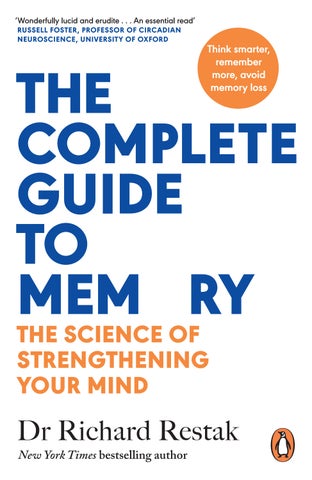
THE COMPLETE GUIDE TO MEMORY
‘Thought provoking’ The Times
‘A comprehensive compendium of everything we know about memory and how we might improve it’ New Scientist
‘A fine and comprehensive book about human memory’
Howard Gardner, John H. and Elisabeth A. Hobbs Research Professor of Cognition and Education at Harvard Graduate School of Education
ABOUT THE AUTHOR
Dr Richard Restak is Clinical Professor of Neurology at the George Washington University School of Medicine and Health Sciences and is a past president of the American Neuropsychiatric Association. He has lectured on the brain and behaviour at the Pentagon and NASA, and written more than twenty books on the human brain, two of which have been New York Times bestsellers.
THE COMPLETE GUIDE TO MEMORY
THE COMPLETE GUIDE TO MEMORY
THE SCIENCE OF STRENGTHENING YOUR MIND
THE SCIENCE OF STRENGTHENING YOUR MIND
DR RICHARD RESTAK
DR RICHARD RESTAK
PE NG UI N LI FE a n i mp ri n t o f pe ng ui n boo ks
PENGUIN LIFE
UK | USA | Canada | Ireland | Australia
India | New Zealand | South Africa
Penguin Life is part of the Penguin Random House group of companies whose addresses can be found at global.penguinrandomhouse.com.
First published in the United States of America by Skyhorse®, Skyhorse Publishing, Inc.®, a Delaware corporation, in 2022
First published in Great Britain by Penguin Life 2022 This edition published 2024 001
Copyright © Richard Restak, 2022
The moral right of the author has been asserted
Typeset by Jouve (UK), Milton Keynes
Printed and bound in Great Britain by Clays Ltd, Elcograf S.p.A.
The authorized representative in the EEA is Penguin Random House Ireland, Morrison Chambers, 32 Nassau Street, Dublin D02 YH68
A CIP catalogue record for this book is available from the British Library
ISBN: 978–0–241–63534–6
www.greenpenguin.co.uk
Penguin Random Hous e is committed to a sustainable future for our business , our readers and our planet. is book is made from Forest Stewardship Council® certified paper
To the beloved memory of my sister, Louise Restak Ollstein
To the beloved memory of my sister, Louise Restak Ollstein
Contents Chapter I. Why should I care about my memory? . . . . . . . 1 How common are memory worries? . . . . . . . . . 1 Is my memory functioning normally? . . . . . . . . 2 Can I trust my memory? . . . . . . . . . . . . . . . . . . . 8 Chapter II. Evolution of our understanding of memory. . . . . . . . . . . . . . . . . . . . . . . . . . . . . 13 Collapse of a banquet hall . . . . . . . . . . . . . . . . 13 Thinking in pictures . . . . . . . . . . . . . . . . . . . . . 14 Memory theatre of Giulio Camillo . . . . . . . . . 17 Thomas Bradwardine’s advice . . . . . . . . . . . . . 19 Here is how it can work for you . . . . . . . . . . . 21 A shy bearded introvert 22 FDR and the brain. . . . . . . . . . . . . . . . . . . . . . . 27 Albert Einstein drinking a cup of coffee . . . . . 29 Mind mapping and thought tracking . . . . . . . 32 Sunglasses and lipstick . . . . . . . . . . . . . . . . . . . 33 Situational awareness . . . . . . . . . . . . . . . . . . . 39 Chapter III. Different types of memory . . . . . . . . . . . . . . . 41 Dancers swaying to the music of time . . . . . . 41 “The magic number seven” . . . . . . . . . . . . . . . 43 Chunking . . . . . . . . . . . . . . . . . . . . . . . . . . . . . . 45 Memory tools . . . . . . . . . . . . . . . . . . . . . . . . . . 50 Hyperphantasia and hypophantasia . . . . . . . . 53 Memory method . . . . . . . . . . . . . . . . . . . . . . . . 55 The Zeigarnik effect . . . . . . . . . . . . . . . . . . . . . 58 Restaurants as memory laboratories . . . . . . . . 59 The queen of memory . . . . . . . . . . . . . . . . . . . 60 The N-back game . . . . . . . . . . . . . . . . . . . . . . . 64 Tamping iron meets brain . . . . . . . . . . . . . . . . 68 Contents Chapter I. Why should I care about my memory? . . . . . . . 1 How common are memory worries? . . . . . . . . . 1 Is my memory functioning normally? . . . . . . . . 2 Can I trust my memory? . . . . . . . . . . . . . . . . . . . 8 Chapter II. Evolution of our understanding of memory. . . . . . . . . . . . . . . . . . . . . . . . . . . . . 13 Collapse of a banquet hall . . . . . . . . . . . . . . . . 13 Thinking in pictures . . . . . . . . . . . . . . . . . . . . . 14 Memory theatre of Giulio Camillo . . . . . . . . . 17 Thomas Bradwardine’s advice . . . . . . . . . . . . . 19 Here is how it can work for you . . . . . . . . . . . 21 A shy bearded introvert 22 FDR and the brain. . . . . . . . . . . . . . . . . . . . . . . 27 Albert Einstein drinking a cup of coffee . . . . . 29 Mind mapping and thought tracking . . . . . . . 32 Sunglasses and lipstick . . . . . . . . . . . . . . . . . . . 33 Situational awareness . . . . . . . . . . . . . . . . . . . 39 Chapter III. Different types of memory . . . . . . . . . . . . . . . 41 Dancers swaying to the music of time . . . . . . 41 “The magic number seven” . . . . . . . . . . . . . . . 43 Chunking . . . . . . . . . . . . . . . . . . . . . . . . . . . . . . 45 Memory tools . . . . . . . . . . . . . . . . . . . . . . . . . . 50 Hyperphantasia and hypophantasia . . . . . . . . 53 Memory method . . . . . . . . . . . . . . . . . . . . . . . . 55 The Zeigarnik effect . . . . . . . . . . . . . . . . . . . . . 58 Restaurants as memory laboratories . . . . . . . . 59 The queen of memory . . . . . . . . . . . . . . . . . . . 60 The N-back game . . . . . . . . . . . . . . . . . . . . . . . 64 Tamping iron meets brain . . . . . . . . . . . . . . . . 68
The Lady Gaga tickets . . . . . . . . . . . . . . . . . . . 72 “Negative twenty questions” . . . . . . . . . . . . . 74 “Smooth operator” to “clumsy klutz” . . . . . . 78 The twisties . . . . . . . . . . . . . . . . . . . . . . . . . . . . 80 The forgotten baby syndrome . . . . . . . . . . . . . 82 Future memory . . . . . . . . . . . . . . . . . . . . . . . . . 84 Chapter IV. Memory in action . . . . . . . . . . . . . . . . . . . . . . . 87 An Italian dinner for our sixteenth president . . . . . . . . . . . . . . . . . . . . . . . . . . . . . . . 87 Memory training under water . . . . . . . . . . . . . 90 Catchphrases . . . . . . . . . . . . . . . . . . . . . . . . . . . 91 Always pick the biggest screen 93 Intermezzo . . . . . . . . . . . . . . . . . . . . . . . . . . . . 94 Chapter V. What can go wrong? . . . . . . . . . . . . . . . . . . . . 99 Memory’s mortal enemies . . . . . . . . . . . . . . . . 99 When I forget, where does my memory go? . . . . . . . . . . . . . . . . . . . . . . . 106 The man who could not forget . . . . . . . . . . . 109 A sense of familiarity . . . . . . . . . . . . . . . . . . . 111 Do I know you? . . . . . . . . . . . . . . . . . . . . . . . . 113 “I have been here before” . . . . . . . . . . . . . . . 119 Why does my coffee table seem so different? . . . . . . . . . . . . . . . . . . . . . . . . . . . . 119 An attack in the park . . . . . . . . . . . . . . . . . . . 122 “The parrot on a balcony” 124 The war of the ghosts . . . . . . . . . . . . . . . . . . 125 Memory morphing . . . . . . . . . . . . . . . . . . . . . 127 Gaslighting in broad daylight . . . . . . . . . . . . 129 Amnesia. . . . . . . . . . . . . . . . . . . . . . . . . . . . . . 131 What would it be like to lose your memory entirely? . . . . . . . . . . . . . . . . . . . . . . . 132 Meet Henry Gustav Molaison . . . . . . . . . . . . 134 Sudden memory failures . . . . . . . . . . . . . . . . 136 Stairways to different rooms . . . . . . . . . . . . . 139 Mood-dependent memories . . . . . . . . . . . . . 141 Why can you never remember to loan me that book? . . . . . . . . . . . . . . . . . . . . . . . . 142 The Lady Gaga tickets . . . . . . . . . . . . . . . . . . . 72 “Negative twenty questions” . . . . . . . . . . . . . 74 “Smooth operator” to “clumsy klutz” . . . . . . 78 The twisties . . . . . . . . . . . . . . . . . . . . . . . . . . . . 80 The forgotten baby syndrome . . . . . . . . . . . . . 82 Future memory . . . . . . . . . . . . . . . . . . . . . . . . . 84 Chapter IV. Memory in action . . . . . . . . . . . . . . . . . . . . . . . 87 An Italian dinner for our sixteenth president . . . . . . . . . . . . . . . . . . . . . . . . . . . . . . . 87 Memory training under water . . . . . . . . . . . . . 90 Catchphrases . . . . . . . . . . . . . . . . . . . . . . . . . . . 91 Always pick the biggest screen 93 Intermezzo . . . . . . . . . . . . . . . . . . . . . . . . . . . . 94 Chapter V. What can go wrong? . . . . . . . . . . . . . . . . . . . . 99 Memory’s mortal enemies . . . . . . . . . . . . . . . . 99 When I forget, where does my memory go? . . . . . . . . . . . . . . . . . . . . . . . 106 The man who could not forget . . . . . . . . . . . 109 A sense of familiarity . . . . . . . . . . . . . . . . . . . 111 Do I know you? . . . . . . . . . . . . . . . . . . . . . . . . 113 “I have been here before” . . . . . . . . . . . . . . . 119 Why does my coffee table seem so different? . . . . . . . . . . . . . . . . . . . . . . . . . . . . 119 An attack in the park . . . . . . . . . . . . . . . . . . . 122 “The parrot on a balcony” 124 The war of the ghosts . . . . . . . . . . . . . . . . . . 125 Memory morphing . . . . . . . . . . . . . . . . . . . . . 127 Gaslighting in broad daylight . . . . . . . . . . . . 129 Amnesia. . . . . . . . . . . . . . . . . . . . . . . . . . . . . . 131 What would it be like to lose your memory entirely? . . . . . . . . . . . . . . . . . . . . . . . 132 Meet Henry Gustav Molaison . . . . . . . . . . . . 134 Sudden memory failures . . . . . . . . . . . . . . . . 136 Stairways to different rooms . . . . . . . . . . . . . 139 Mood-dependent memories . . . . . . . . . . . . . 141 Why can you never remember to loan me that book? . . . . . . . . . . . . . . . . . . . . . . . . 142
Purple! Purple! . . . . . . . . . . . . . . . . . . . . . . . . 143 Memory through a distorted mirror . . . . . . . 144 Chapter VI. The promises and perils of memory . . . . . . . 149 “It is the star to every wandering bark” . . . . 149 Climbing a golden mountain . . . . . . . . . . . . . 152 Atoms are flitting before my eyes . . . . . . . . . 153 Landscape of a shared past . . . . . . . . . . . . . . 156 Collective memory . . . . . . . . . . . . . . . . . . . . . 158 Memory wars . . . . . . . . . . . . . . . . . . . . . . . . . 161 Memory laws. . . . . . . . . . . . . . . . . . . . . . . . . . 164 The late (?) Whitney Houston . . . . . . . . . . . . 167 Chapter VII. Accessory aids to better memory . . . . . . . . . . 169 Drugs 169 Why siestas are good for you . . . . . . . . . . . . 170 A feast or famine . . . . . . . . . . . . . . . . . . . . . . 172 Coffee and tea . . . . . . . . . . . . . . . . . . . . . . . . 175 Alcohol . . . . . . . . . . . . . . . . . . . . . . . . . . . . . . 175 Exercise . . . . . . . . . . . . . . . . . . . . . . . . . . . . . . 177 Postscript. . . . . . . . . . . . . . . . . . . . . . . . . . . . . . . . . . . . . . . . 179 Let me take you to the US memory championship . . . . . . . . . . . . . . . . . . . . . . . . . 179 All you ever have to know about improving memory 181 Glossary. . . . . . . . . . . . . . . . . . . . . . . . . . . . . . . . . . . . . . . . . 187 Bibliography . . . . . . . . . . . . . . . . . . . . . . . . . . . . . . . . . . . . . 191 Acknowledgments . . . . . . . . . . . . . . . . . . . . . . . . . . . . . . . . 193 Purple! Purple! . . . . . . . . . . . . . . . . . . . . . . . . 143 Memory through a distorted mirror . . . . . . . 144 Chapter VI. The promises and perils of memory . . . . . . . 149 “It is the star to every wandering bark” . . . . 149 Climbing a golden mountain . . . . . . . . . . . . . 152 Atoms are flitting before my eyes . . . . . . . . . 153 Landscape of a shared past . . . . . . . . . . . . . . 156 Collective memory . . . . . . . . . . . . . . . . . . . . . 158 Memory wars . . . . . . . . . . . . . . . . . . . . . . . . . 161 Memory laws. . . . . . . . . . . . . . . . . . . . . . . . . . 164 The late (?) Whitney Houston . . . . . . . . . . . . 167 Chapter VII. Accessory aids to better memory . . . . . . . . . . 169 Drugs 169 Why siestas are good for you . . . . . . . . . . . . 170 A feast or famine . . . . . . . . . . . . . . . . . . . . . . 172 Coffee and tea . . . . . . . . . . . . . . . . . . . . . . . . 175 Alcohol . . . . . . . . . . . . . . . . . . . . . . . . . . . . . . 175 Exercise . . . . . . . . . . . . . . . . . . . . . . . . . . . . . . 177 Postscript. . . . . . . . . . . . . . . . . . . . . . . . . . . . . . . . . . . . . . . . 179 Let me take you to the US memory championship . . . . . . . . . . . . . . . . . . . . . . . . . 179 All you ever have to know about improving memory 181 Glossary. . . . . . . . . . . . . . . . . . . . . . . . . . . . . . . . . . . . . . . . . 187 Bibliography . . . . . . . . . . . . . . . . . . . . . . . . . . . . . . . . . . . . . 191 Acknowledgments . . . . . . . . . . . . . . . . . . . . . . . . . . . . . . . . 193
CHAPTER I
WHY SHOULD I CARE ABOUT MY MEMORY?
HOW COMMON ARE MEMORY WORRIES?
ere are many reasons to care about your memory. Consider these: the development of a superpower memory enhances attention, focus, abstraction, naming, spatial visualization, verbal facility, language, and word acquisition. In a phrase, memory is the key to brain enhancement.
In America today, anyone over fifty lives in dread of the Big A—Alzheimer’s disease. Small social gatherings (dinner, cocktail parties, etc.) take on the atmosphere of a segment from NPR’s weekly quiz show “Wait Wait . . . Don’t Tell Me.” at’s the one where guests vie with each other in intense competitions to be the first to come up with the names of such things as the actor playing a role in the latest mini-series everybody is binging on. Almost inevitably, someone will pull out a cellphone to check the accuracy of the person who responded first. Quick, quicker, quickest lest others suspect you of coming down with the initial symptoms of the Big A.
Although Alzheimer’s disease is not nearly as common as many people fear, nevertheless worries about perceived memory lapses are increasingly expressed to friends. ey are also the most common complaint that persons over fifty-five years of age bring to their doctors. Such memory concerns are often unjustified and arouse needless anxiety. is widespread anxiety has helped create a national
2 The Complete Guide to Memory
2 The Complete Guide to Memory
pre-occupation with memory and signs of memory failure. One of the reasons for this panic is the confusion in many people’s minds about how we form memories.
pre-occupation with memory and signs of memory failure. One of the reasons for this panic is the confusion in many people’s minds about how we form memories.
Try to remember something that happened to you earlier today. It doesn’t have to be anything special—any ordinary event will do just fine. Now consider how that memory came about.
Try to remember something that happened to you earlier today. It doesn’t have to be anything special—any ordinary event will do just fine. Now consider how that memory came about.
At my request, you recovered a memory for something that you probably would have not thought about, if I hadn’t prompted you to recall it, and you hadn’t made the effort to retrieve it.
At my request, you recovered a memory for something that you probably would have not thought about, if I hadn’t prompted you to recall it, and you hadn’t made the effort to retrieve it.
Reduced to its essentials, memory involves re-experiencing something from the past in the form of a recollection. Operationally, memories are the end products of our efforts in the present to recover information that is stored in our brain.
Reduced to its essentials, memory involves re-experiencing something from the past in the form of a recollection. Operationally, memories are the end products of our efforts in the present to recover information that is stored in our brain.
Memories—like dreams and acts of the imagination—vary from one person to another. My memories are distinctly different from your memories based on our personal life experiences.
Memories—like dreams and acts of the imagination—vary from one person to another. My memories are distinctly different from your memories based on our personal life experiences.
Memory also differs from pictures or videos of events from the past. While these technologically based versions of the past can serve as memory stimulators, they are not themselves memories.
Memory also differs from pictures or videos of events from the past. While these technologically based versions of the past can serve as memory stimulators, they are not themselves memories.
IS MY MEMORY FUNCTIONING NORMALLY?
IS MY MEMORY FUNCTIONING NORMALLY?
In order to answer that question, let’s first address the idea of normal memory function. Below are several questions, which I invite you to check as involving either (a) an example of a perfectly acceptable memory or (b) perhaps the beginning of a potentially serious memory problem.
In order to answer that question, let’s first address the idea of normal memory function. Below are several questions, which I invite you to check as involving either (a) an example of a perfectly acceptable memory or (b) perhaps the beginning of a potentially serious memory problem.
Question A. “After scanning the newspapers and selecting several bargains I drove to the mall, parked my car and went into the store selling these bargains. When I came out I couldn’t remember where I had parked, and I had difficulty finding my car. It took me several minutes to locate it in the crowded parking lot.” a or b?
Question A. “After scanning the newspapers and selecting several bargains I drove to the mall, parked my car and went into the store selling these bargains. When I came out I couldn’t remember where I had parked, and I had difficulty finding my car. It took me several minutes to locate it in the crowded parking lot.” a or b?
WHY SHOULD I CARE ABOUT MY MEMORY?
3 WHY SHOULD I CARE ABOUT MY MEMORY?
3
Question B. “After exiting a store where I had gone to purchase several items that were on sale, I came out and couldn’t remember whether I drove to the shopping center or someone dropped me off there.” a or b?
Question B. “After exiting a store where I had gone to purchase several items that were on sale, I came out and couldn’t remember whether I drove to the shopping center or someone dropped me off there.” a or b?
Question C. “I can’t remember the names of my grandchildren.” a or b?
Question C. “I can’t remember the names of my grandchildren.” a or b?
Question D. “When I get together with my sister, she and I have very different memories of events we both participated in as children.” a or b?
Question D. “When I get together with my sister, she and I have very different memories of events we both participated in as children.” a or b?
Question E. “I used to play a pretty good game of bridge, but now I’m messing up. I can’t remember what cards have already been played. Nobody now wants to partner with me.” a or b?
Question E. “I used to play a pretty good game of bridge, but now I’m messing up. I can’t remember what cards have already been played. Nobody now wants to partner with me.” a or b?
Question F. “While driving home from the office, I took the wrong exit. I have never done that before.” a or b?
Question F. “While driving home from the office, I took the wrong exit. I have never done that before.” a or b?
Question G. “I have increasing difficulty remembering names.” a or b?
Question G. “I have increasing difficulty remembering names.” a or b?
Question H. “Before I go into the food market, I have to write everything down or I will forget one or two items. Yet in my work as a professional actor I have no problem, even in my eighties, studying a script over a weekend and on Monday engaging in an early rehearsal without referencing the prompt script. How can that be?” a or b?
Question H. “Before I go into the food market, I have to write everything down or I will forget one or two items. Yet in my work as a professional actor I have no problem, even in my eighties, studying a script over a weekend and on Monday engaging in an early rehearsal without referencing the prompt script. How can that be?” a or b?
Question I. “I packed my car ready for a trip, but when I got in the car, I had no idea where I was planning to go.” a or b?
Question I. “I packed my car ready for a trip, but when I got in the car, I had no idea where I was planning to go.” a or b?
Answer A. e answer to this is (a) perfectly normal forgetting. At the time you drove to the mall, you most likely were mentally
Answer A. e answer to this is (a) perfectly normal forgetting. At the time you drove to the mall, you most likely were mentally
4 The Complete Guide to Memory
4 The Complete Guide to Memory
preoccupied with the bargains that you were intending to purchase. Your concentration was far removed from such quotidian concerns as where you will park your car. You simply slipped into the first available parking place closest to the store and rushed inside and started shopping. Since you were not at all concentrating on the location of the parking place you selected, you couldn’t remember its location when you came out of the store. As Samuel Johnson stated over two hundred years ago, “ e art of memory is the art of attention.” e attention that Johnson referred to is an internal attention: riveting your mental powers on a single external object. Lacking attention to the parking place, you could only form an imperfect memory, or in this specific instance, no memory at all. We will have a lot to say about attention later.
preoccupied with the bargains that you were intending to purchase. Your concentration was far removed from such quotidian concerns as where you will park your car. You simply slipped into the first available parking place closest to the store and rushed inside and started shopping. Since you were not at all concentrating on the location of the parking place you selected, you couldn’t remember its location when you came out of the store. As Samuel Johnson stated over two hundred years ago, “ e art of memory is the art of attention.” e attention that Johnson referred to is an internal attention: riveting your mental powers on a single external object. Lacking attention to the parking place, you could only form an imperfect memory, or in this specific instance, no memory at all. We will have a lot to say about attention later.
Answer B. e correct answer here is (b): Perhaps a potentially early and serious impairment in normal memory functioning. In this example, instead of having difficulty remembering one item out of many (where you parked) you lost the ability to recall how you even arrived at the mall in the first place along with all the interactions that would invariably take place along the way if you were driven there (talking with the driver, listening to the radio, etc.) or on public transportation (choosing a seat, looking out the window, etc.).
Answer B. e correct answer here is (b): Perhaps a potentially early and serious impairment in normal memory functioning. In this example, instead of having difficulty remembering one item out of many (where you parked) you lost the ability to recall how you even arrived at the mall in the first place along with all the interactions that would invariably take place along the way if you were driven there (talking with the driver, listening to the radio, etc.) or on public transportation (choosing a seat, looking out the window, etc.).
Answer C. (a) Remembering the names of one’s grandchildren is closely aligned with the interest you have in your grandchildren, and children in general. Interest is the underpinning for the attention that Samuel Johnson referred to. We rarely pay attention to things that do not interest us. Although not being interested in one’s grandchildren, coupled with failure to remember their names, perhaps carries implications for potential intrafamilial friction, it is not necessarily a sign of an impaired memory.
Answer C. (a) Remembering the names of one’s grandchildren is closely aligned with the interest you have in your grandchildren, and children in general. Interest is the underpinning for the attention that Samuel Johnson referred to. We rarely pay attention to things that do not interest us. Although not being interested in one’s grandchildren, coupled with failure to remember their names, perhaps carries implications for potential intrafamilial friction, it is not necessarily a sign of an impaired memory.
Answer D. Siblings, even identical twins, do not share the exact same experiences. Differences in age, gender, interaction with adults,
Answer D. Siblings, even identical twins, do not share the exact same experiences. Differences in age, gender, interaction with adults,
especially relatives—all of these can lead to distinctly different experiences and therefore different memories. e answer is (a).
especially relatives—all of these can lead to distinctly different experiences and therefore different memories. e answer is (a).
Answer E. (b) Failure to perform secondary to forgetting overlearned procedures can be worrisome. e longer we have been doing something, the less likely we will forget it. So how much of a change does this represent? If you were only a middling player, when at your best, your current decreased performance probably doesn’t qualify as a major memory concern. Perhaps you have simply become bored with the game or the players? e key question is: How much of a change does this represent? If you were a highly proficient player and now nobody wants to play with you, your memory needs further investigation.
Answer E. (b) Failure to perform secondary to forgetting overlearned procedures can be worrisome. e longer we have been doing something, the less likely we will forget it. So how much of a change does this represent? If you were only a middling player, when at your best, your current decreased performance probably doesn’t qualify as a major memory concern. Perhaps you have simply become bored with the game or the players? e key question is: How much of a change does this represent? If you were a highly proficient player and now nobody wants to play with you, your memory needs further investigation.
Answer F. (a) Driving involves what neuroscientists refer to as procedural memory. After a task is carried out a sufficient number of times, it is no longer necessary to pay conscious attention when doing it. Driving from home to work and back again established over time a procedural memory, which includes when to exit. is is automated within the brain in a specific network. is procedural memory can be overwritten by daydreaming, lack of focus, or poor attention. is also explains over practice effects. Athletes have learned from experience that “trying harder” can actually interfere with their performance. In this instance the learned procedural memory, which had been established on the basis of hundreds or even thousands of hours of practice, is overwritten by a conscious motor program which had been previously automated. is is also the basis for “choking”: An athlete overrides his own procedural memory program with anxiety about his performance. As can be seen from this example of missing the exit, different aspects of memory can come into conflict with each other.
Answer F. (a) Driving involves what neuroscientists refer to as procedural memory. After a task is carried out a sufficient number of times, it is no longer necessary to pay conscious attention when doing it. Driving from home to work and back again established over time a procedural memory, which includes when to exit. is is automated within the brain in a specific network. is procedural memory can be overwritten by daydreaming, lack of focus, or poor attention. is also explains over practice effects. Athletes have learned from experience that “trying harder” can actually interfere with their performance. In this instance the learned procedural memory, which had been established on the basis of hundreds or even thousands of hours of practice, is overwritten by a conscious motor program which had been previously automated. is is also the basis for “choking”: An athlete overrides his own procedural memory program with anxiety about his performance. As can be seen from this example of missing the exit, different aspects of memory can come into conflict with each other.
Answer G. (a) is is probably the most common complaint that people of all ages express about their memory. Although they fear
Answer G. (a) is is probably the most common complaint that people of all ages express about their memory. Although they fear
5 WHY SHOULD I CARE ABOUT MY MEMORY?
5 WHY SHOULD I CARE ABOUT MY MEMORY?
6 The Complete Guide to Memory
that they may be coming down with dementia, it is actually a quite common phenomena that fits well within the category of normal functioning. If you think about it for a moment, one name can easily be substituted for another: I’m Richard Restak, but I could just as easily have been named David Restak or Justin Restak, or even something fancy such as Sebastian Restak. e point is that there is no necessary connection between a name and a face. at’s why names are so hard to remember. As we will see later, there are methods for linking faces with names. With a bit of practice, you can learn to remember the names of dozens of people and rarely experience a “senior moment”: drawing a blank when trying to come up with one person’s name in order to introduce them to someone else.
that they may be coming down with dementia, it is actually a quite common phenomena that fits well within the category of normal functioning. If you think about it for a moment, one name can easily be substituted for another: I’m Richard Restak, but I could just as easily have been named David Restak or Justin Restak, or even something fancy such as Sebastian Restak. e point is that there is no necessary connection between a name and a face. at’s why names are so hard to remember. As we will see later, there are methods for linking faces with names. With a bit of practice, you can learn to remember the names of dozens of people and rarely experience a “senior moment”: drawing a blank when trying to come up with one person’s name in order to introduce them to someone else.
e second principle of memory operation after attention involves creating meaning. A name is not meaningful unless you come up with a link between that name and a vivid picture or auditory association. is is the science of mnemonics: e use of a pattern of numbers, letters, images, or associations to assist in remembering something. Mnemonics can be traced back to the Middle Ages and even earlier. We’ll cover some of this early history in Chapter II.
e second principle of memory operation after attention involves creating meaning. A name is not meaningful unless you come up with a link between that name and a vivid picture or auditory association. is is the science of mnemonics: e use of a pattern of numbers, letters, images, or associations to assist in remembering something. Mnemonics can be traced back to the Middle Ages and even earlier. We’ll cover some of this early history in Chapter II.
Answer H. at actor’s questions foreshadow many of the themes we will be covering in this book: Concentration, motivation, deliberation, vivid images, and more. e first part of his question about the loss of memory for grocery items is (a): Within the expected memory performance of an eighty-year-old. It becomes increasingly difficult as we age to compose shopping lists and later remember them without writing them down ahead of time. ere are methods that can be used to combat this, as we will discuss in later chapters. e second question posed by the actor is intriguing. Reading a new script and memorizing its contents has become second nature to the aging actor. It is now an autonomous process. So when he sits down to read his script, a different part of his brain is involved in memorizing the character’s dialogue as compared to how his brain
Answer H. at actor’s questions foreshadow many of the themes we will be covering in this book: Concentration, motivation, deliberation, vivid images, and more. e first part of his question about the loss of memory for grocery items is (a): Within the expected memory performance of an eighty-year-old. It becomes increasingly difficult as we age to compose shopping lists and later remember them without writing them down ahead of time. ere are methods that can be used to combat this, as we will discuss in later chapters.
e second question posed by the actor is intriguing. Reading a new script and memorizing its contents has become second nature to the aging actor. It is now an autonomous process. So when he sits down to read his script, a different part of his brain is involved in memorizing the character’s dialogue as compared to how his brain
6 The Complete Guide to Memory
WHY SHOULD I CARE ABOUT MY MEMORY?
7 WHY SHOULD I CARE ABOUT MY MEMORY?
7
operates when he sits down to compose a grocery list. In the latter situation he is subject to all of the vicissitudes of memory characteristic of an eighty-year-old man. is dichotomy between his theater experience and his daily life was not consciously chosen, but resulted from his script-learning over many years in the theater. is is not inevitable among aging actors, incidentally. In later life many of them give up the theater in favor of appearing in movies because the memory burden is less challenging. But the stage doesn’t necessarily have to be abandoned. One internationally acclaimed film star in his eighties wears an earbud through which prompts are conveyed when he performs on stage. Presumably, he requires this because he can no longer depend on a once powerful memory enabling him to rapidly learn a script—a process in the acting profession known as a “quick study.”
operates when he sits down to compose a grocery list. In the latter situation he is subject to all of the vicissitudes of memory characteristic of an eighty-year-old man. is dichotomy between his theater experience and his daily life was not consciously chosen, but resulted from his script-learning over many years in the theater. is is not inevitable among aging actors, incidentally. In later life many of them give up the theater in favor of appearing in movies because the memory burden is less challenging. But the stage doesn’t necessarily have to be abandoned. One internationally acclaimed film star in his eighties wears an earbud through which prompts are conveyed when he performs on stage. Presumably, he requires this because he can no longer depend on a once powerful memory enabling him to rapidly learn a script—a process in the acting profession known as a “quick study.”
When I asked a professional actor in her forties regarding the dilemma of the eighty-year-old who could remember scripts, but couldn’t remember grocery lists, she told me: “My best guess is that when he attempts to learn lines he is not simply memorizing words. While he is reading the script of the character that he will be playing, he anticipates taking certain actions and identifies the motivation of the character who says specific words. But the older actor is embodying not just words but thoughts, so that the words of the script are processed as expressions of the character’s personality. ere is an element of ‘muscle memory’ involved too in learning a script. It is utterly different from remembering a shopping list. When we speak words on stage we use our whole body and mind to connect with the motivation and intention of the character we play. e process of learning a script is a purposely intense one, very concentrated and deliberate. e beat and rhythm of the words connect with brain areas well beyond those where language lives.”
When I asked a professional actor in her forties regarding the dilemma of the eighty-year-old who could remember scripts, but couldn’t remember grocery lists, she told me: “My best guess is that when he attempts to learn lines he is not simply memorizing words. While he is reading the script of the character that he will be playing, he anticipates taking certain actions and identifies the motivation of the character who says specific words. But the older actor is embodying not just words but thoughts, so that the words of the script are processed as expressions of the character’s personality. ere is an element of ‘muscle memory’ involved too in learning a script. It is utterly different from remembering a shopping list. When we speak words on stage we use our whole body and mind to connect with the motivation and intention of the character we play. e process of learning a script is a purposely intense one, very concentrated and deliberate. e beat and rhythm of the words connect with brain areas well beyond those where language lives.”
Answer I. As unbelievable as this experience may seem, the answer in this individual instance is (a). is Clark Griswold-like experience was described to me by an overworked, stressed patient,
Answer I. As unbelievable as this experience may seem, the answer in this individual instance is (a). is Clark Griswold-like experience was described to me by an overworked, stressed patient,
8 The Complete Guide to Memory
8 The Complete Guide to Memory
who had reluctantly agreed to use up some of his long accumulated vacation time. Although he had made most all of the vacation arrangements himself (Ellen did the rest), his contribution occurred during anxiety and mild panic episodes. A full medical work-up including full memory investigation revealed normal function. So you can put this rather bizarre-sounding true example in the list of normal functioning but only as an illustration that every memory complaint must be put in the context of the individual voicing the complaint.
who had reluctantly agreed to use up some of his long accumulated vacation time. Although he had made most all of the vacation arrangements himself (Ellen did the rest), his contribution occurred during anxiety and mild panic episodes. A full medical work-up including full memory investigation revealed normal function. So you can put this rather bizarre-sounding true example in the list of normal functioning but only as an illustration that every memory complaint must be put in the context of the individual voicing the complaint.
CAN I TRUST MY MEMORY?
CAN I TRUST MY MEMORY?
Whether you can trust your memory depends quite a bit on how well you train your memory.
Whether you can trust your memory depends quite a bit on how well you train your memory.
Lesser forms of amnesia (forgetfulness) are a normal part of life for the vast majority of people. Every time you try, but fail to remember something you once knew, you are experiencing a mild form of amnesia. us, amnesia isn’t a rare memory disorder. Do you consider yourself an exception? Let’s test that hypothesis.
Lesser forms of amnesia (forgetfulness) are a normal part of life for the vast majority of people. Every time you try, but fail to remember something you once knew, you are experiencing a mild form of amnesia. us, amnesia isn’t a rare memory disorder. Do you consider yourself an exception? Let’s test that hypothesis.
What did you have for lunch today? No problem remembering that, right? How about your lunch one month ago from today? If you can remember that, I suspect something special must have occurred that day. Let’s got back a month further: How about your memory for your lunch two months ago from today? (Some mnemonists can remember that). Once again, unless the lunch two months ago corresponded to some special event or special happening, it’s most unusual that you would be able to remember it.
e mini-experiment you just participated in establishes an important point.
What did you have for lunch today? No problem remembering that, right? How about your lunch one month ago from today? If you can remember that, I suspect something special must have occurred that day. Let’s got back a month further: How about your memory for your lunch two months ago from today? (Some mnemonists can remember that). Once again, unless the lunch two months ago corresponded to some special event or special happening, it’s most unusual that you would be able to remember it. e mini-experiment you just participated in establishes an important point.
When challenged, most of us will remember far less than we think we can. But our memory will greatly improve if something eventful or emotionally arousing is associated with what we are trying to remember. Memory is pegged to emotional significance.
When challenged, most of us will remember far less than we think we can. But our memory will greatly improve if something eventful or emotionally arousing is associated with what we are trying to remember. Memory is pegged to emotional significance.
WHY SHOULD I CARE ABOUT MY MEMORY?
ree processes underlie the formation of a memory: encoding, storage, and retrieval. An example of encoding error: Suppose you were preoccupied or daydreaming when I introduced you to someone new. As a result, you are unlikely to remember the name. Because of your lack of attention the memory was not established or encoded, and therefore you couldn’t come up with it later. Literally, there was no memory.
ree processes underlie the formation of a memory: encoding, storage, and retrieval. An example of encoding error: Suppose you were preoccupied or daydreaming when I introduced you to someone new. As a result, you are unlikely to remember the name. Because of your lack of attention the memory was not established or encoded, and therefore you couldn’t come up with it later. Literally, there was no memory.
A retrieval error involves successfully encoding a piece of information, storing it, and yet being unable to retrieve it. In such a case, the information may have been encoded, but you are not able to access it.
A retrieval error involves successfully encoding a piece of information, storing it, and yet being unable to retrieve it. In such a case, the information may have been encoded, but you are not able to access it.
One distinction between an encoding error and a retrieval error involves your ability to come up with the information under different circumstances. Since the retrieval errors are quite common, most tests are designed for multiple-choice. e test is easier to administer and score and you’ll do better in multiple-choice because you can recognize an answer correctly that you may not have been able to come up with in response to a direct question.
One distinction between an encoding error and a retrieval error involves your ability to come up with the information under different circumstances. Since the retrieval errors are quite common, most tests are designed for multiple-choice. e test is easier to administer and score and you’ll do better in multiple-choice because you can recognize an answer correctly that you may not have been able to come up with in response to a direct question.
Of the three stages of memory, the first—encoding—is the critical one. Many of the suggestions in this book pertain to ways of enhancing memory encoding. You do this by converting words into images, which come more naturally to us. If everything develops normally, we do not have to be taught how to see; we are born with that ability. But we have to learn—sometimes laboriously—how to read and write. It is the clarity and quality of the images formed that distinguish the superpower memory. Details about this will come in Chapter 3.
Of the three stages of memory, the first—encoding—is the critical one. Many of the suggestions in this book pertain to ways of enhancing memory encoding. You do this by converting words into images, which come more naturally to us. If everything develops normally, we do not have to be taught how to see; we are born with that ability. But we have to learn—sometimes laboriously—how to read and write. It is the clarity and quality of the images formed that distinguish the superpower memory. Details about this will come in Chapter 3.
As mentioned earlier, emotion is probably the greatest stimulus to the creation of vivid imagery and the formation of memory. Suppose you outplayed your friends in the weekly golf game and couldn’t wait to tell everybody. But when your ten-year-old daughter ran out to congratulate you coming off the 18th green, she was stung by a bee and needed CPR to, thankfully, fully recover from
As mentioned earlier, emotion is probably the greatest stimulus to the creation of vivid imagery and the formation of memory. Suppose you outplayed your friends in the weekly golf game and couldn’t wait to tell everybody. But when your ten-year-old daughter ran out to congratulate you coming off the 18th green, she was stung by a bee and needed CPR to, thankfully, fully recover from
9
9 WHY SHOULD I CARE ABOUT MY MEMORY?
10
10
The Complete Guide to Memory
The Complete Guide to Memory
anaphylaxis. Which memory do you think is more likely to remain with you?
anaphylaxis. Which memory do you think is more likely to remain with you?
Time works to undo even the clearest memory. But there are compensations, as described by one of my favorite authors, George Orwell.
Time works to undo even the clearest memory. But there are compensations, as described by one of my favorite authors, George Orwell.
“In general, one’s memories of any period must necessarily weaken as one moves away from it. One is constantly learning new facts and old ones have to drop out to make way for them. But it can also happen that one’s memories grow sharper after a long lapse of time, because one is looking at the past with fresh eyes and can isolate and, as it were, notice facts which previously existed undifferentiated among a mass of others.”
“In general, one’s memories of any period must necessarily weaken as one moves away from it. One is constantly learning new facts and old ones have to drop out to make way for them. But it can also happen that one’s memories grow sharper after a long lapse of time, because one is looking at the past with fresh eyes and can isolate and, as it were, notice facts which previously existed undifferentiated among a mass of others.”
Finally, you should care about your memory because if you ultimately hone your memory skills and maintain them, you could protect yourself, to the extent that it’s possible, from the ravages of Alzheimer’s and other dementias. e key concepts in doing this are develop and maintain. is book will provide you the means of developing your memory. e maintenance portion of the process will depend upon applying my suggestions every day. e application needs to be not only effective, but also fun and challenging. My basic aim is to help you develop a memory skillset that engages your interest and arouses your enthusiasm.
Finally, you should care about your memory because if you ultimately hone your memory skills and maintain them, you could protect yourself, to the extent that it’s possible, from the ravages of Alzheimer’s and other dementias. e key concepts in doing this are develop and maintain. is book will provide you the means of developing your memory. e maintenance portion of the process will depend upon applying my suggestions every day. e application needs to be not only effective, but also fun and challenging. My basic aim is to help you develop a memory skillset that engages your interest and arouses your enthusiasm.
One final point. At the present time there is no way of guaranteeing anyone that they may not eventually develop Alzheimer’s. But I have never encountered in my many years of neurologic practice a patient with highly tuned memory skills who was suffering from Alzheimer’s disease or any other degenerative brain disease. Put in another way, a poor memory doesn’t necessarily imply dementia, but a well-functioning memory virtually eliminates a concurrent diagnosis of dementia. In other words, you have everything to gain by increasing your memory skills, and nothing to lose.
One final point. At the present time there is no way of guaranteeing anyone that they may not eventually develop Alzheimer’s. But I have never encountered in my many years of neurologic practice a patient with highly tuned memory skills who was suffering from Alzheimer’s disease or any other degenerative brain disease. Put in another way, a poor memory doesn’t necessarily imply dementia, but a well-functioning memory virtually eliminates a concurrent diagnosis of dementia. In other words, you have everything to gain by increasing your memory skills, and nothing to lose.
As a first step in developing a superior memory, let’s explore how thinking about memory has developed over the centuries. When did
As a first step in developing a superior memory, let’s explore how thinking about memory has developed over the centuries. When did