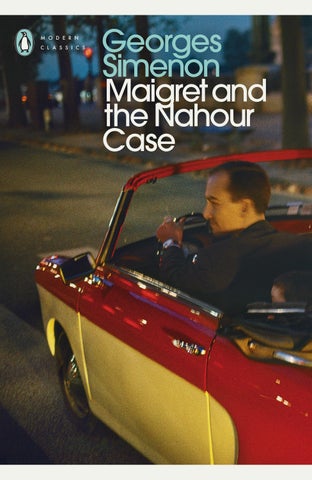

Georges Simenon Maigret and the Nahour Case



PENGUIN
Maigret and the Nahour Case
‘Extraordinary masterpieces of the twentieth century’
– John Banville
‘A brilliant writer’ – India Knight
‘Intense atmosphere and resonant detail . . . make Simenon’s fiction remarkably like life’
– Julian Barnes
‘A truly wonderful writer . . . marvellously readable – lucid, simple, absolutely in tune with the world he creates’
– Muriel Spark
‘Few writers have ever conveyed with such a sure touch, the bleakness of human life’
‘Compelling, remorseless, brilliant’
– A. N. Wilson
– John Gray
‘A writer of genius, one whose simplicity of language creates indelible images that the florid stylists of our own day can only dream of’
– Daily Mail
‘The mysteries of the human personality are revealed in all their disconcerting complexity’
– Anita Brookner
‘One of the greatest writers of our time’ – The Sunday Times
‘I love reading Simenon. He makes me think of Chekhov’
– William Faulkner
‘One of the great psychological novelists of this century’
– Independent
‘The greatest of all, the most genuine novelist we have had in literature’ – André Gide
‘Simenon ought to be spoken of in the same breath as Camus, Beckett and Kafka’ – Independent on Sunday
ABOUT THE AUTHOR
Georges Simenon was born on 12 February 1903 in Liège, Belgium, and died in 1989 in Lausanne, Switzerland, where he had lived for the latter part of his life. Between 1931 and 1972 he published seventy- five novels and twenty- eight short stories featuring Inspector Maigret. Simenon always resisted identifying himself with his famous literary character, but acknowledged that they shared an important characteristic:
My motto, to the extent that I have one, has been noted often enough, and I’ve always conformed to it. It’s the one I’ve given to old Maigret, who resembles me in certain points . . . ‘Understand and judge not.’
GEORGES SIMENON
Maigret and the Nahour Case
Translated by WILLIAM HOBSON
PENGUIN BOOKS
UK | USA | Canada | Ireland | Australia
India | New Zealand | South Africa
Penguin Classics is part of the Penguin Random House group of companies whose addresses can be found at global.penguinrandomhouse.com.
Penguin Random House UK
One Embassy Gardens, 8 Viaduct Gardens, London sw 11 7 bw penguin.co.uk
First published in French as Maigret et l’aff aire Nahour by Presses de la Cité 1966
This translation fi rst published 2019
Published in Penguin Classics 2025 001
Copyright © Georges Simenon Limited, 1966
Translation copyright © William Hobson, 2019

GEORGES SIMENON and ® , all rights reserved
MAIGRET ® Georges Simenon Limited, all rights reserved original design by Maria Picassó i Piquer

All rights reserved
The moral rights of the author and translator have been asserted
Penguin Random House values and supports copyright.
Copyright fuels creativity, encourages diverse voices, promotes freedom of expression and supports a vibrant culture. Thank you for purchasing an authorized edition of this book and for respecting intellectual property laws by not reproducing, scanning or distributing any part of it by any means without permission. You are supporting authors and enabling Penguin Random House to continue to publish books for everyone. No part of this book may be used or reproduced in any manner for the purpose of training artificial intelligence technologies or systems. In accordance with Article 4(3) of the DSM Directive 2019/790, Penguin Random House expressly reserves this work from the text and data mining exception.
Typeset by Jouve (UK), Milton Keynes
Printed and bound in Great Britain by Clays Ltd, Elcograf S.p.A.
The authorized representative in the EEA is Penguin Random House Ireland, Morrison Chambers, 32 Nassau Street, Dublin d 02 yh 68
A CIP catalogue record for this book is available from the British Library isbn: 978–0–241–30415–0
Penguin Random House is committed to a sustainable future for our business, our readers and our planet. This book is made from Forest Stewardship Council® certified paper.
Maigret and the Nahour Case
He was struggling, forced to defend himself because someone had unexpectedly grabbed hold of his shoulder. He even tried to throw a punch and had the humiliating feeling that his arm wasn’t responding but just lay limp at his side as though paralysed.
‘Who’s that?’ he shouted, vaguely aware that it wasn’t the right question exactly.
Had he even really made a sound?
‘Jules! The telephone . . .’
He had definitely heard something, a noise that sounded threatening in his sleep, but it hadn’t occurred to him for a moment that it was the telephone ringing and that he was in bed, in the middle of an unpleasant dream that he had already forgotten, and being shaken awake by his wife.
He automatically reached out a hand for the receiver, opening his eyes and sitting up as he did so. Madame Maigret was sitting in the warm bed with him, and the lamp on her side was giving out a soft, cosy light.
‘Hello,’ he said.
‘Who is that?’ he almost blurted out, as if he were still dreaming.
‘Maigret? It’s Pardon here.’
Maigret managed to make out the time on the alarmclock on his wife’s bedside table. It was 1.30 a.m. They had
left the Pardons just after eleven, after their monthly dinner, which on this occasion had consisted of a delicious stuffed shoulder of mutton.
‘Yes. Go ahead.’
‘Sorry to wake you, you must have been fast asleep. Something’s just happened here, something pretty serious, I think, that comes under your jurisdiction.’
The Maigrets and Pardons had been friends for over ten years, taking it in turns to invite one another for dinner once a month, and yet it had never crossed either man’s mind to call the other by his Christian name.
‘I’m listening, Pardon. Go on.’
The voice on the other end of the line was anxious, embarrassed.
‘I think it would be better if you came and saw me. You’d understand the situation better.’
‘There hasn’t been an accident, I hope?’ A hesitation.
‘No. Not exactly, but I’m worried.’
‘Is your wife all right?’
‘Yes. She’s just making us some coffee.’
Madame Maigret was looking inquiringly at her husband, trying to figure out what was going on from his replies.
‘I’ll come right away . . .’
He hung up. He was fully awake now, with a look of concern on his face. This was the first time Doctor Pardon had called him like that, and Maigret knew him well enough to understand it must be serious.
‘What’s happening?’
‘I don’t know. Pardon needs me.’
‘Why didn’t he come and see you?’
‘I need to go there for some reason.’
‘He was very cheerful earlier. So was his wife. We talked about his daughter and son-in-law, the cruise they’re planning to take next summer around the Balearics . . .’
Was Maigret listening? He felt uneasy as he got dressed, wondering in spite of himself what might have caused the doctor’s telephone call.
‘I’ll go and make some coffee.’
‘No need. Madame Pardon is making us some.’
‘Shall I call a taxi?’
‘There won’t be one free in this weather, or, if you do, it will take half an hour to get here.’
It was 14 January – Friday 14 January – and it had been minus 12 in Paris all day. Snow had been falling heavily for the past few days, freezing so hard that it was impossible to clear, and despite the salt spread on the pavements, there were still patches of black ice that sent pedestrians sprawling.
‘Put on your big scarf.’
A thick woollen scarf she had knitted for him which he almost never needed to wear.
‘Don’t forget your gumboots. I don’t suppose you’ll let me come with you, will you?’
‘Why?’
She didn’t like seeing him set off on his own tonight. On their way back from the Pardons, despite their both taking care, watching where they put their feet, Maigret had fallen heavily on the corner of Rue du Chemin-Vert and
remained sitting on the ground for a while, feeling dazed and ashamed of himself.
‘Did you hurt yourself ?’
‘No. I just got a bit of a shock, that’s all.’
He had refused to let her help him up or take his arm when he finally got to his feet.
‘No need for us both to fall over.’
She followed him to the door, kissed him and murmured:
‘Be careful . . .’
She left the door half-open until he got to the ground floor. Maigret avoided Rue du Chemin-Vert, where he had fallen over earlier, taking the slightly longer route along Boulevard Richard-Lenoir to Boulevard Voltaire, where the Pardons lived.
He walked slowly, hearing no one else’s footsteps. There were no taxis or cars in sight. Paris seemed deserted, and he could only remember seeing it like this, so frozen and snowbound, once or perhaps twice before in his life.
On Boulevard Voltaire, though, a truck was parked at the République end, its engine idling, and a few black figures were bustling about: workmen scattering spadesful of salt over the road.
Lights could be seen in two of the Pardons’ windows, the only windows illuminated in the entire block. Maigret made out a figure behind the curtains and when he reached the door, it opened before he could ring the bell.
‘Sorry again, Maigret.’
Doctor Pardon was wearing the same navy-blue jacket as at dinner.
‘I’ve got myself into such a tricky situation, I don’t know what to do.’
As they went up in the lift, Maigret saw his features were drawn.
‘Haven’t you been to bed?’
In an embarrassed voice, the doctor explained:
‘I didn’t feel tired when you left so I decided to catch up on some of the paperwork I’m behind on.’
In other words, despite having to work, he hadn’t wanted to put off their traditional dinner.
As it happened, the Maigrets had stayed later than usual. They had talked mainly about holidays, with Pardon observing that his patients were more and more exhausted when they came back from them these days, especially when they had been on package tours.
They passed through the waiting room, in which only a small light was on, and, instead of going on to the living room, turned into Pardon’s surgery.
Madame Pardon appeared immediately with a tray and two cups, a coffee-pot and some sugar.
‘Please forgive my appearance, I haven’t even taken the time to get dressed. I’m not staying, though. My husband’s the one who needs to talk to you.’
She was wearing a pale-blue dressing gown over her nightdress, her feet in slippers.
‘He didn’t want to bother you. I insisted and, if that was wrong of me, I’m sorry.’
She poured out the coffee and headed for the door.
‘I shan’t go to sleep before you’re finished, so don’t hesitate to call me if you need anything. You’re not hungry, are you, Maigret?’
‘I had too good a dinner to be hungry.’
‘You aren’t, either?’
‘No, thank you.’
An open door gave on to the little room in which the doctor examined his patients. In the middle there was a high folding table covered with a bloodstained sheet, and Maigret noticed some large bloodstains on the green linoleum.
‘Sit down. Have your coffee first.’
He pointed to a stack of papers and index cards on his desk.
‘You see. People don’t realize that on top of consultations and visits we have all sorts of bureaucracy to take care of. Urgent calls are always coming in, so we put it off until we end up completely swamped. I was planning to spend two or three hours on this task.’
Pardon began his house calls at eight in the morning, then his surgery opened at ten. Picpus was not a rich part of town. It was a lower-middle-class neighbourhood, and you’d often see as many as fifteen people at a time in his waiting room. Maigret could count on the fingers of one hand the monthly dinners that hadn’t been interrupted by a telephone call summoning Pardon away for an hour or more.
‘I was engrossed in this paperwork. My wife was asleep. I didn’t hear a thing until suddenly the doorbell rang, startling me. When I opened the door, I found a couple on the landing who seemed odd somehow.’
‘Why?’
‘Mainly because I didn’t know either of them, the man or the woman. Generally if I’m disturbed in the middle of the night, it’ll be one of my regular patients, one of those who don’t have a telephone.’
‘I see.’
‘I also had the sense they didn’t live locally. The woman was wearing a sealskin coat and matching hat. My wife had happened to be looking through a fashion magazine a couple of days ago and she’d suddenly said:
‘ “Next time you get me a coat, choose sealskin, not mink. Mink has become so common these days, but sealskin . . .”
‘I didn’t listen to the rest, but that came back to me as I was holding the door open, looking at them in surprise.
‘The man’s get-up was also not the sort of thing you usually see on Boulevard Voltaire.
‘He did the talking, asking with a slight accent:
‘ “Doctor Pardon?”
‘ “That’s me, yes.”
‘ “This lady has just been hurt, and I’d like you to examine her.”
‘ “How did you get my address?”
‘ “An old woman walking down Boulevard Voltaire gave it to us. She must have been a patient of yours.”
‘They had come into my surgery. The woman was very pale, as if she was about to faint, and she was staring at me with big, expressionless eyes, both hands clasped to her chest.
‘ “I think you should hurry, doctor,” said the man, taking off his gloves.
‘ “What sort of injury is it?”
‘Turning to the woman, who was very blonde and must have been just under thirty, he said:
‘ “You’d better take off your coat.”
‘Without a word, she took off her fur coat, and I saw that the back of her straw-coloured dress was soaked in blood down to the waist.
‘Look, there’s a bloodstain on the carpet next to my desk where she stood shaking.
‘I showed her into the consulting room and asked her to take off her dress. I offered to help but, still without saying a word, she shook her head and got undressed herself.
‘The man hadn’t come in with us, but the door between the two rooms was still open, and he went on talking to me, or rather answering my questions. I had put on my coat, then washed my hands. The woman was lying motionless on her stomach, not making a sound.’
‘What time was this?’ asked Maigret, who had just lit his first pipe since the telephone call.
‘I looked at the clock when the doorbell rang. It said ten past one. All this was very quick; telling you about it takes far longer.
‘In fact, I was already washing the wound and staunching the blood before I really realized what was happening. At first sight the wound didn’t seem too bad. It was in her back, on the right-hand side: a gash about eight centimetres long that was still bleeding.
‘As I got on with it, I carried on talking to the man, who was in my office, where I couldn’t see him:
‘“Tell me what happened.”
‘ “I was walking down Boulevard Voltaire, a hundred metres from here, and this woman was walking in front of me.”
‘ “You’re not going to tell me she slipped?”
‘ “No. I was pretty surprised to see her alone in the street at that time of night and I slowed down so as not to give her the impression that I wanted to accost her. That’s when I heard a car engine . . .” ’
Pardon broke off to drink his coffee and pour himself a second cup.
‘Do you want some?’
‘Yes, please.’
Maigret was still sleepy, his eyelids were stinging, and he felt he was coming down with a head cold. Ten of his inspectors were in bed with flu, which had made his job considerably more complicated in the past few days.
‘I am repeating our conversation as exactly as possible but I can’t guarantee every word. I found that the wound was deeper between the third and fourth rib and as I was disinfecting it, something fell on the floor, although I didn’t immediately take any notice.’
‘A bullet?’
‘Hang on. The man in the next room went on:
‘ “When the car drew level with this lady, it slowed down, not that it was driving that fast to start with. I saw an arm reach out of the door . . .” ’
‘The front door or back door?’ Maigret interrupted.
‘He didn’t say, and I didn’t think to ask. Don’t forget I was performing an actual surgical procedure. It happens occasionally, when there’s an emergency, but it’s not my
speciality, and I found the whole business strange. What surprised me most was the patient’s complete silence.
‘The man went on:
‘ “I heard a gunshot and I saw this person stagger, try to hold on to the front of a building, then give way at the knees and slowly crumple into the snow.
‘ “The car had already driven off and turned right into some street, I don’t know what it’s called.
‘ “I rushed forward. I saw she wasn’t dead, and she managed to cling on to me and get back to her feet unaided.
‘ “I asked her if she was hurt and she nodded.”
‘ “Didn’t she talk to you?”
‘ “No. I didn’t know what to do. I looked around for help. An old woman was passing, and I asked her if she knew where I could find a doctor. She pointed out your building and told me your name.” ’
Pardon fell silent, looking at Maigret like a guilty child.
Maigret asked the obvious question:
‘Hadn’t it occurred to him to take her to a hospital?’
‘I pointed that out, saying that Saint-Antoine’s is around the corner. He just muttered:
‘ “I didn’t know.” ’
‘Didn’t he know the station is a hundred metres away either?’
‘I suppose not. I felt in an awkward position. I knew I wasn’t allowed to treat a gunshot wound without immediately informing the police, but then again, I’d started the procedure. I explained:
‘ “I’m just giving her first aid and when I’ve finished I’ll call an ambulance.”