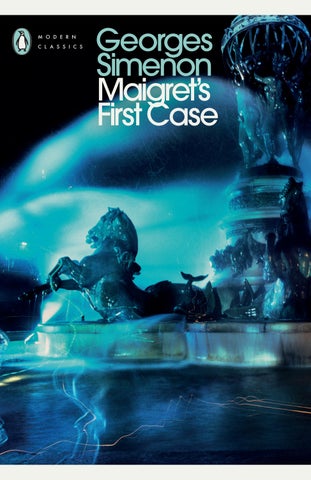

Georges Simenon Maigret’s First Case



PENGUIN MODERN CLASSICS
Maigret’s First Case
‘I love reading Simenon. He makes me think of Chekhov’ – William Faulkner
‘A truly wonderful writer . . . marvellously readable – lucid, simple, absolutely in tune with the world he creates’ – Muriel Spark
‘Few writers have ever conveyed with such a sure touch, the bleakness of human life’ – A. N. Wilson
‘One of the greatest writers of the twentieth century . . . Simenon was unequalled at making us look inside, though the ability was masked by his brilliance at absorbing us obsessively in his stories’ – Guardian
‘A novelist who entered his fictional world as if he were part of it’ – Peter Ackroyd
‘The greatest of all, the most genuine novelist we have had in literature’ – André Gide
‘Superb . . . The most addictive of writers . . . A unique teller of tales’ – Observer
‘The mysteries of the human personality are revealed in all their disconcerting complexity’ – Anita Brookner
‘A writer who, more than any other crime novelist, combined a high literary reputation with popular appeal’ – P. D. James
‘A supreme writer . . . Unforgettable vividness’ – Independent
‘Compelling, remorseless, brilliant’ – John Gray
‘Extraordinary masterpieces of the twentieth century’ – John Banville
ABOUT THE AUTHOR
Georges Simenon was born on 12 February 1903 in Liège, Belgium, and died in 1989 in Lausanne, Switzerland, where he had lived for the latter part of his life. Between 1931 and 1972 he published seventy-five novels and twentyeight short stories featuring Inspector Maigret.
Simenon always resisted identifying himself with his famous literary character, but acknowledged that they shared an important characteristic:
My motto, to the extent that I have one, has been noted often enough, and I’ve always conformed to it. It’s the one I’ve given to old Maigret, who resembles me in certain points . . . ‘understand and judge not’.
GEORGES SIMENON
Maigret’s First Case
Translated by ros schwartz
PENGUIN BOOKS
UK | USA | Canada | Ireland | Australia
India | New Zealand | South Africa
Penguin Classics is part of the Penguin Random House group of companies whose addresses can be found at global.penguinrandomhouse.com.
Penguin Random House UK
One Embassy Gardens, 8 Viaduct Gardens, London sw 11 7bw
penguin.co.uk
First published in book form as La première enquête de Maigret by Presses de la Cité 1949
This translation first published 2016
Published in Penguin Classics 2025 001
Copyright © Georges Simenon Limited, 1949
Translation copyright © Ros Schwartz, 2016

GEORGES SIMENON and ® , all rights reserved
MAIGRET ® Georges Simenon Limited, all rights reserved original design by Maria Picassó i Piquer

All rights reserved
The moral rights of the author and translator have been asserted
Penguin Random House values and supports copyright.
Copyright fuels creativity, encourages diverse voices, promotes freedom of expression and supports a vibrant culture. Thank you for purchasing an authorized edition of this book and for respecting intellectual property laws by not reproducing, scanning or distributing any part of it by any means without permission. You are supporting authors and enabling Penguin Random House to continue to publish books for everyone. No part of this book may be used or reproduced in any manner for the purpose of training artificial intelligence technologies or systems. In accordance with Article 4(3) of the DSM Directive 2019/790, Penguin Random House expressly reserves this work from the text and data mining exception.
Typeset by Palimpsest Book Production Limited, Falkirk, Stirlingshire
Printed and bound in Great Britain by Clays Ltd, Elcograf S.p.A.
The authorized representative in the EEA is Penguin Random House Ireland, Morrison Chambers, 32 Nassau Street, Dublin d 02 yh 68
A CIP catalogue record for this book is available from the British Library isbn: 978–0–241–20638–6
Penguin Random House is committed to a sustainable future for our business, our readers and our planet. This book is made from Forest Stewardship Council® certified paper.
1. The Flautist’s Statement
The room was divided in two by a black railing. In the section reserved for the public, there was only one bench, also painted black, against the whitewashed wall plastered with official notices. On the other side were desks, inkstands and pigeonholes bulging with fat black files, so that everything was black and white. Standing on a metal base was a cast-iron stove of the kind now only found in provincial railway stations, with a flue that rose up to the ceiling and then formed an elbow to cross the entire room before disappearing into the wall.
A chubby-faced officer called Lecœur had unbuttoned his uniform and was trying to sleep.
The hands on the black-rimmed clock showed 1.25. Every now and then, the single gas lamp would sputter. Every now and then too, the stove, for no apparent reason, would begin to hum.
Outside, the quiet of the night was disturbed occasionally by the sound of firecrackers at growing intervals, the singing of a drunkard or a cab clattering down the sloping street. Sitting at the desk on the left, the secretary of the SaintGeorges district police station, his lips moving silently like a schoolboy, was poring over a newly published little manual: Guide to Official Reports (Verbal Descriptions) for the Use of Police Officers and Inspectors.
On the flyleaf, handwritten in capital letters in purple ink was the name: J. Maigret.
Three times already that night the young police secretary had got up to go over and poke the stove, and for the rest of his life he would feel nostalgic for that particular stove. It was identical, or almost, to the one he would find one day at Quai des Orfèvres and later on, when central heating was installed at the headquarters of the Police Judiciaire, Detective Chief Inspector Maigret, head of the Crime Squad, would manage to keep that stove in his office.
This was 15 April 1913. In those days, the Police Judiciaire was still called the Sûreté. That morning, a foreign head of state had arrived at Longchamp station amid great pomp, and the President had been there to welcome him. The official carriages, flanked by the Republican Guard in full dress uniform, had marched down Avenue du Bois and along the Champs-Élysées lined with flags and people.
There had been a gala performance at the Opéra, fireworks and parades, and only now was the noise of the boisterous crowds beginning to die down.
The police were overwhelmed. Despite all the precautions taken, the preventive arrests, the deals made with certain reputedly dangerous individuals, there had been fears of an anarchist bomb up until the last minute.
Maigret and Lecœur were alone, at 1.30 in the morning, at the Saint-Georges district police station in the quiet Rue La-Rochefoucauld.
They both looked up on hearing hurried footsteps outside. The door opened. A breathless young man stood glancing about him, dazzled by the gas light.
‘The chief inspector?’ he panted.
‘I’m his secretary,’ said Maigret without getting up.
He didn’t yet know that this was the start of his first case.
The man was fair-haired and slight, with blue eyes and a pink complexion. He wore a beige coat over his black suit and was holding a bowler hat, while his other hand kept gingerly touching his swollen nose.
‘Were you attacked by some ruffian?’
‘No. I was trying to go to the assistance of a woman who was shouting for help.’
‘In the street?’
‘No, in a big house in Rue Chaptal. I think you’d better come right away. They threw me out.’
‘Who?’
‘A sort of butler or concierge.’
‘Don’t you think you’d better begin at the beginning? What were you doing in Rue Chaptal?’
‘I was on my way home from work. My name is Justin Minard. I am second flautist at the Concerts Lamoureux, but at night I play at the Brasserie Clichy, Boulevard de Clichy. I live in Rue d’Enghien, just opposite the Petit Parisien. As usual, I walked down Rue Ballu, then Rue Chaptal.’
Ever the conscientious secretary, Maigret took notes.
‘About halfway down the street, which is nearly always empty, I noticed a parked motor-car, a De Dion-Bouton, with its engine running. At the wheel there was a man wearing a grey goatskin jacket, his face almost entirely
hidden behind enormous goggles. As I drew level with him, a second-floor window opened.’
‘Did you take note of the house number?’
‘Seventeen A. It’s a private mansion with a carriage entrance. There were no lights in any other windows. Only the second from the left, the one that opened. I looked up and saw the shape of a woman trying to lean out, and she shouted: “Help!”’
‘What did you do?’
‘Wait. Someone in the room must have dragged her away from the window. At the same time, a shot rang out. I turned round to look at the car I’d just passed, and it sped off.’
‘Are you certain it wasn’t the sound of the engine backfiring that you heard?’
‘Absolutely positive. I went up to the door and rang the bell.’
‘Were you alone?’
‘Yes.’
‘Armed?’
‘No.’
‘What did you intend to do?’
‘Well . . .’
The flautist was so thrown by the question that he was stumped for a reply. Had it not been for his blond moustache and a few wisps on his chin, he would have looked barely more than sixteen.
‘Didn’t the neighbours hear anything?’
‘Apparently not.’
‘Did they open up the door to you?’
‘Not right away. I rang at least three times. Then I started kicking the door. Eventually I heard footsteps, then a chain being removed and a bolt pulled back. There was no light in the porch, but there’s a gas lamp just outside the house.’
One forty-seven. From time to time the flautist glanced anxiously at the clock.
‘A tall fellow in a butler’s black suit asked what I wanted.’
‘Was he fully dressed?’
‘Of course.’
‘With his trousers and tie?’
‘Yes.’
‘And yet there were no lights on in the house?’
‘Except in the second-floor bedroom.’
‘What did you say?’
‘I don’t know. I tried to get inside.’
‘Why?’
‘To go and see for myself. He barred my path. I told him about the woman who’d shouted from the window.’
‘Did he seem flustered?’
‘He glared at me and pushed me away with all his weight.’
‘Then what?’
‘He muttered that I’d been imagining things, that I was drunk and things like that. Then there was a voice in the darkness. It sounded as if it was coming from the first-floor landing.’
‘What did the voice say?’
‘“Hurry up, Louis!”’
‘Then what?’
‘He gave me a violent shove and when I resisted, he
punched me in the face. I ended up sprawled on the ground in front of the closed door.’
‘Was the second-floor light still on?’
‘No.’
‘Did the car come back?’
‘No. Hadn’t we better go there right away?’
‘We? Are you planning to come with me?’
It was both comic and touching, the contrast between the flautist’s almost feminine delicateness and his determined air.
‘I’m the one who was punched in the face, aren’t I? At any rate, I’m going to make a complaint.’
‘As you have every right to do.’
‘But it would be better if we left that till later, don’t you think?’
‘Did you tell me the number of the house?’
‘Seventeen A.’
Maigret frowned, as that address vaguely rang a bell. He pulled one of the files from its pigeonhole, leafed through it and read a name that made him frown even harder.
He was wearing a tailcoat that night, his first ever tailcoat. A memo had been sent round a few days earlier instructing all police auxiliaries to wear ceremonial dress for the duration of the royal visit, since any one of them could be summoned to join the dignitaries at any moment.
His beige overcoat, bought off the peg, was identical to Justin Minard’s.
‘Come on! Lecœur, if anyone asks for me, tell them I’ll be back soon.’
He was slightly intimidated. The name he had just read in the register did not exactly put him at ease.
He was twenty-six and had been married just five months. Since he had joined the police, four years earlier, he had worked in the lowliest departments − street duty, railway stations, department stores − and he had been secretary at the Saint-Georges district police station for less than a year.
Now the most distinguished name in the entire neighbourhood was that of the inhabitants of 17A Rue Chaptal. Gendreau-Balthazar. Balthazar Coffee. That name ran in big brown letters along the corridors of the Métro, while in the streets the Balthazar vans, drawn by four magnificent horses, were part of the Paris landscape.
Maigret drank Balthazar coffee. And whenever he walked along Avenue de l’Opéra, on reaching a certain point next to a gunsmith’s, he never failed to stop to inhale the delicious smell of coffee being roasted in the window of the Balthazar shop.
The night was cold and clear. There wasn’t a soul in the steep street, not a cab in the vicinity. In those days, Maigret was almost as thin as the flautist, so skinny that as they walked up the road they looked like two raw-boned adolescents.
‘I presume you haven’t been drinking?’
‘I never drink. Doctor’s orders.’
‘Are you certain you saw a window opening?’
‘I’m absolutely positive.’
This was the first time that Maigret was standing on his own two feet. Until now he had merely accompanied his
boss, Monsieur Le Bret, the most urbane detective chief inspector in Paris, on various raids, four of them to establish proof of adultery.
Rue Chaptal was as deserted as Rue La-Rochefoucauld. There were no lights on in the Gendreau-Balthazar residence, one of the finest mansions in the neighbourhood.
‘You said that there was a parked motor-car?’
‘Yes, right here.’
Not quite outside the door. A little higher up the street. Maigret, whose head was buzzing with fresh theories about Minard’s testimony, lit a candle-match and bent over to examine the wood-block paving.
‘You see!’ exclaimed the musician, triumphantly pointing to a large puddle of blackish oil.
‘Come on. I think it’s highly irregular for you to be with me.’
‘But I’m the one who got punched in the face!’
The situation was actually rather alarming. As he raised his hand to ring the bell, Maigret felt his chest tighten, and he wondered which regulation he could invoke. He had no warrant. Besides, it was the middle of the night. Could he really claim a crime had been committed when his only evidence was the flautist’s swollen nose?
Like the musician, he had to ring three times, but he did not have to kick the door. At length a voice called out:
‘What is it?’
‘Police!’ he said in a slightly tremulous voice.
‘One moment, please. I’ll get the key.’
There was a click inside the porch. The house already had electricity. Then they had to wait for ages.
‘It’s him,’ said the musician, who had recognized the voice.
At last, the chain was removed and the bolt drawn back to reveal a sleepy face with eyes that slid over Maigret and stared at Justin Minard.
‘Ah! You’ve caught him!’ said the man. ‘I suppose he tried his little prank on you?’
‘May we come in?’
‘If you must. Please keep quiet so as not to wake the entire household. Come this way.’
To the left, up three marble steps, was a glazed double door that led to a colonnaded hall. It was the first time that Maigret had ever been inside such an opulent residence, whose proportions reminded him of the splendour of a ministerial building.
‘Is your name Louis?’
‘How do you know?’
All the same, Louis opened a door that led not into the drawing room, but into a sort of butler’s pantry. He looked as if he had just got out of bed as he wasn’t wearing his livery but a white nightshirt with a red-embroidered collar and a hastily pulled-on pair of trousers.
‘Is Monsieur Gendreau-Balthazar at home?’
‘Which one, the father or the son?’
‘The father.’
‘Monsieur Félicien has not come home yet, and Monsieur Richard, the son, probably retired hours ago. Now, about half an hour ago, this drunkard . . .’
Louis was tall and burly. He must have been around forty-five, his shaved chin had a five o’clock shadow, his
eyes were very dark, his eyebrows black and unusually bushy.
With the feeling that he was jumping in at the deep end, Maigret took a big breath and said:
‘I should like to speak to Monsieur Richard.’
‘Do you want me to wake him up?’
‘Yes please.’
‘Would you show me your police ID?’
Maigret held out his Préfecture card.
‘Have you been in this neighbourhood long?’
‘Ten months.’
‘And you are based at Saint-Georges?’
‘That’s right.’
‘Then you must know Monsieur Le Bret?’
‘He’s my boss.’
Then Louis said, with a casual air that barely concealed a threat:
‘I know him too. I have the honour of waiting on him each time he comes here to lunch or dinner.’
He let a few seconds tick by, his gaze elsewhere.
‘Do you still want me to wake Monsieur Richard?’
‘Yes.’
‘Do you have a warrant?’
‘No.’
‘Very good. Please wait here.’
Before leaving the room, he took from a cupboard a starched shirt-front, a collar and a black tie. Then he put on his morning coat which was hanging up.
There was only one chair in the butler’s pantry. Neither Maigret nor Justin Minard sat down. They were enveloped
by silence. The entire house was in semi-darkness. It was all very solemn, very daunting.
Twice, Maigret took out his fob watch. Twenty minutes went by before Louis reappeared, still as frosty.
‘If you would be so good as to step this way . . .’
Minard attempted to follow Maigret, but the butler turned to him.
‘Not you. Unless you are also a police officer.’
Maigret had a ridiculous thought. It seemed cowardly to leave the pallid flautist behind. The butler’s pantry with dark wood panelling fleetingly made him think of a sort of dungeon, and he had a vision of the butler with his stubble-covered chin coming back to beat up his victim.
He followed Louis across the colonnaded hall and up the red-carpeted stairs.
A few solitary lamps with yellowish filaments gave out a wan glow, leaving vast areas of darkness. A door on to the first-floor landing was open. A man in a dressing gown stood framed in the light.
‘I understand you wish to speak to me? Do come in. That will be all, Louis.’
The room was a sitting room-cum-study with leathercovered walls. A smell of Havana cigar and a fragrance that Maigret could not identify hung in the air. A half-open door led into a bedroom where there was a rumpled fourposter bed.
Richard Gendreau-Balthazar was wearing pyjamas beneath his dressing gown, and on his feet were Russian leather slippers.
He appeared to be around thirty years old. He was
dark-haired and his face would have been quite ordinary were it not for his crooked nose.
‘Louis tells me you are from the local police station?’
He opened a carved cigarette box and pushed it towards his visitor, who refused.
‘You don’t smoke?’
‘Only a pipe.’
‘I shan’t invite you to smoke in here as I can’t stand the smell of pipe tobacco. I presume you telephoned my friend Le Bret before coming here?’
‘No.’
‘Ah! Forgive me if I’m not familiar with the ways of the police. Le Bret is a regular visitor to our house − not, I must emphasize, in a professional capacity. One would never guess he’s a police chief! He really is a very charming man and his wife is delightful. Now, let’s get to the point. What time is it?’
He made a show of looking for his watch, and it was Maigret who pulled his fat silver turnip watch out of his pocket.
‘Twenty-five past two.’
‘And it gets light at around five o’clock at this time of year, doesn’t it? I know because I often go riding in the Bois de Boulogne very early. I thought that during the hours between sunset and sunrise a citizen’s privacy was sacrosanct.’
‘That is correct, but—’
He interrupted Maigret.
‘Mind you, I only mention it by way of a reminder. You are young and probably new in the job. You’re lucky to