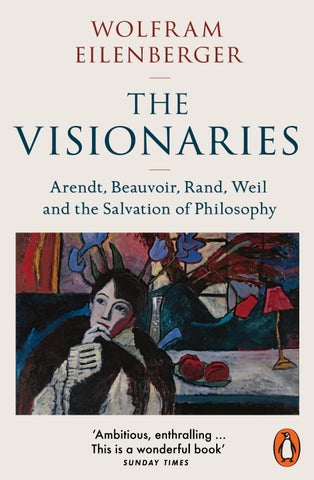
THE visionaries
Arendt, Beauvoir, Rand, Weil and the Salvation of Philosophy
‘Ambitious, enthralling … This is a wonderful book’
THE VISIONARIES
‘Eilenberger is to be commended for reminding us that these were intellectual giants who can continue to illuminate our own dark time’
Skye C. Cleary, TLS
‘Potent . . . The quartet is composed of four women, all in their 20s when the book begins in earnest, in 1933, their most productive years still ahead of them. Beauvoir, Simone Weil, Hannah Arendt and Ayn Rand: Each addressed the foundational question of the relationship between the self and others, between “I” and “we,” only to arrive at wildly different conclusions . . . Eilenberger is an energetic guide to these philosophers’ ideas’
Jennifer Szalai, The New York Times
‘Eilenberger’s group biography . . . illuminates the times through which these philosophers developed their ideas – and vice versa – often drawing poignant parallels and discontinuities between the women’
Stuart Jeffries, Observer
‘What was it like to be alive during Hitler’s ascent? To read this vivid, gripping book is to relive that time through four of the century’s most original minds’ Larissa MacFarquhar
‘This book demands close attention; it rewards rereading; it tackles big ideas unapologetically. In short, Eilenberger treats you like a grown-up’
Laura Hackett, Sunday Times
‘Lively . . . [this] sharp new book explains the legacy of four women everyone should know’ Economist
‘An exhilarating journey through the lives and thought of four exceptional women . . . Deeply researched and intimately written, Eilenberger’s book is an intellectual feast’
Lea Ypi
‘This is intellectual history at its best – lucid, rigorous and readable. The Visionaries is a gripping group biography and a much-needed reminder of the power of philosophy in the face of rising authoritarianism’ James McAuley
‘[Eilenberger’s] energetic, multilayered group portrait reveals that these celebrated thinkers were real people whose ideas, as contradictory as they may seem, developed in response to shared social or political circumstances’ Publishers Weekly
‘With the same acumen as he displayed in Magicians, Eilenberger draws compelling narratives around these women’s lives while ably synthesizing much of their core thinking . . . An absorbing, well-grounded study’ Kirkus Reviews
ABOUT THE AUTHOR
Wolfram Eilenberger is a founding editor of Philosophie Magazin and host of the Sternstunde Philosophie television programme. He has taught philosophy at the University of Toronto, Indiana University, the Berlin University of the Arts and ETH Zürich. His most recent book, Time of the Magicians, was a runaway bestseller on publication in Germany, where it won the prestigious Bayerischer Buchpreis, as well as in Spain and Italy, and has been translated into more than thirty languages.
The VISIONARIES
Arendt, Beauvoir, Rand, Weil,
and the Power of Philosophy in Dark Times
and the Salvation of Philosophy
Wolfram Eilenberger
Translated by Shaun Whiteside
PENGUIN BOOK S
PENGUIN BOOKS
UK | USA | Canada | Ireland | Australia
India | New Zealand | South Africa
Penguin Books is part of the Penguin Random House group of companies whose addresses can be found at global.penguinrandomhouse.com.
Originally published in German as Feuer der Freiheit by Klett-Cotta, Stuttgart
This translation first published in the United States of America by Penguin Press, an imprint of Penguin Random House LLC 2023
First published in Great Britain by Allen Lane 2023
Published in Penguin Books 2024 001
Copyright © 2022 by Klett-Cotta – J. G. Cotta’sche Buchhandlung Nachfoler GmbH
Translation copyright © 2023 by Shaun Whiteside
Pages 373–4 constitute an extension of the copyright page
The moral rights of the author and translator have been asserted
Printed and bound in Great Britain by Clays Ltd, Elcograf S.p.A.
The authorized representative in the EEA is Penguin Random House Ireland, Morrison Chambers, 32 Nassau Street, Dublin D 02 YH 68
A CIP catalogue record for this book is available from the British Library
ISBN : 978–0–141–99847–3
www.greenpenguin.co.uk
Penguin Random Hous e is committed to a sustainable future for our business , our readers and our planet. is book is made from Forest Stewardship Council® certified paper
For Venla and Kaisa
Women on the way
Did you imagine I would hate life, And flee to the desert?
Did you imagine I would hate life, And flee to the desert?
Johann Wolfgang von Goethe, “Prometheus” (1789)
Johann Wolfgang von Goethe, “Prometheus” (1789)
Fool me once, fool me twice Are you death or paradise?
Fool me once, fool me twice Are you death or paradise?
Billie Eilish, “No Time to Die” (2020)
Billie Eilish, “No Time to Die” (2020)
CONTENTS
CONTENTS
I
I
SPARKS: 1943 1
SPARKS: 1943 1
The Project · The Prime of Life · The Situation · Deadly Sins · Morality
The Project · The Prime of Life · The Situation · Deadly Sins · Morality
The Mission · Inspired · In a Trance · Moronic · Outrageous · Ready for Battle
The Mission · Inspired · In a Trance · Moronic · Outrageous · Ready for Battle
Only Logical · The Foreigner · No Banisters · The Split · Being Present
Only Logical · The Foreigner · No Banisters · The Split · Being Present
II
II
EXILES: 1933– 1934
EXILES: 1933– 1934
29
29
Grid · The Case of Rahel · Enlightened · Polyphonic · Being German
Grid · The Case of Rahel · Enlightened · Polyphonic · Being German
Back Door · Furious · Revolutionary · Cause for Concern · Third Ways
Back Door · Furious · Revolutionary · Cause for Concern · Third Ways
Salvation Army · Testament · Threatened · The Other · Isolated · Magic Potion
Salvation Army · Testament · Threatened · The Other · Isolated · Magic Potion
Walls · A Writing Engine · Airtight · Ideals · Nietzsche and I · Socratic Tension
Walls · A Writing Engine · Airtight · Ideals · Nietzsche and I · Socratic Tension
III
III
EXPERIMENTS: 1934– 1935
EXPERIMENTS: 1934– 1935
71
71
Accused · Facing Justice · Selfish · Second Hand · Straight out of the Movies
Accused · Facing Justice · Selfish · Second Hand · Straight out of the Movies
Provincial Manners · The Olga Principle · Sorcerers · Role-Play
Provincial Manners · The Olga Principle · Sorcerers · Role-Play
Flowers of Spirituality · Right at the Bottom · On the Conveyor Belt
Flowers of Spirituality · Right at the Bottom · On the Conveyor Belt
Knowledge and Interest · Limits of Growth · World Turned Upside Down
Knowledge and Interest · Limits of Growth · World Turned Upside Down
Modern Times · Extinction · Before the Law · Places of Origin · Contradictions
Modern Times · Extinction · Before the Law · Places of Origin · Contradictions
Question in Human Form · Virgin Territory · Exclusions
Question in Human Form · Virgin Territory · Exclusions
IV
IV
NEAREST AND DEAREST: 1936– 1937
NEAREST AND DEAREST: 1936– 1937
115
115
We the Living · Reconquest of “I” · Howard Roark · Sensory Egocentrism
We the Living · Reconquest of “I” · Howard Roark · Sensory Egocentrism
Together and Apart · Frontal · Dark Processes · Tribes
Together and Apart · Frontal · Dark Processes · Tribes
Love Thy Neighbor · Arendt Changes Direction · Paris Is for Lovers
Love Thy Neighbor · Arendt Changes Direction · Paris Is for Lovers
A Shaky Pact · Free Love · Elective Affinities · Melancholia · Headaches
A Shaky Pact · Free Love · Elective Affinities · Melancholia · Headaches
Moral Hinterland · Spirals of Dehumanization · Empty Words of Power
Moral Hinterland · Spirals of Dehumanization · Empty Words of Power
False Oppositions · Prophetic
False Oppositions · Prophetic V
EVENTS: 1938– 1939
EVENTS: 1938– 1939
163
In the Cul- de - Sac · Notes of Mercy · God’s Kingdom
In the Cul- de - Sac · Notes of Mercy · God’s Kingdom
Not Responsible for Her Actions · The Blind Light · Back to the Sources
Not Responsible for Her Actions · The Blind Light · Back to the Sources
Blocked · Hymn · Working on the Myth · Skyscrapers · A Compelling Idea
Blocked · Hymn · Working on the Myth · Skyscrapers · A Compelling Idea
Ecce Homo · The Poison of Recognition · Brand-New Dawn · One-Way Street
Ecce Homo · The Poison of Recognition · Brand-New Dawn · One-Way Street
The Most Basic Lies · Salvaged Assets · Tribal Ethics · Abnormal Dependency
The Most Basic Lies · Salvaged Assets · Tribal Ethics · Abnormal Dependency
No Future · Prepared for Battle · Equals · War of the Worlds
No Future · Prepared for Battle · Equals · War of the Worlds
The New Situation · In the Face of Fear
The New Situation · In the Face of Fear
VI
VI
VIOLENCE: 1939– 1940
VIOLENCE: 1939– 1940
211
A Relentless Spectacle · Know Thyself! · Geometry of Chance · Death and Time
A Relentless Spectacle · Know Thyself! · Geometry of Chance · Death and Time
Unique Sensitivity · Parachutists · Exodus · Borderline Situation
Unique Sensitivity · Parachutists · Exodus · Borderline Situation
Nothing But Freedom · On the March · Homecoming · Project Hegel
Nothing But Freedom · On the March · Homecoming · Project Hegel
Firmly Resolved · Scum of the Earth · Living Corpses · Transit
Firmly Resolved · Scum of the Earth · Living Corpses · Transit
Angel of History · Mishaps · The Toohey Principle · False Equality
Angel of History · Mishaps · The Toohey Principle · False Equality
Manhattan Transfer · Rand’s Constitutional Patriotism · I Want You!
Manhattan Transfer · Rand’s Constitutional Patriotism · I Want You!
VII
VII
FREEDOM: 1941– 1942
FREEDOM: 1941– 1942
257
257
As If Liberated · Emancipated at Last · Positively Charged
As If Liberated · Emancipated at Last · Positively Charged
Thanksgiving · Tense Expectation · Selfless · Without “We” · Without Opium
Thanksgiving · Tense Expectation · Selfless · Without “We” · Without Opium
Ethics of Acceptance · Superior Indifference · Crossing · This Means You!
Ethics of Acceptance · Superior Indifference · Crossing · This Means You!
New Horror · False Unity · Cosmopolitan Intentions · Small Crisis
New Horror · False Unity · Cosmopolitan Intentions · Small Crisis
Nietzsche’s Curse · American Demolitionists · Social Distancing
Nietzsche’s Curse · American Demolitionists · Social Distancing
Roark’s Defense · The Verdict
Roark’s Defense · The Verdict
VIII
VIII
FIRE: 1943
FIRE: 1943
309
On Strike · Not a Fiction · Deal! · New Train · Creative Transgression
On Strike · Not a Fiction · Deal! · New Train · Creative Transgression
Open Future · Message in a Bottle · On the Brink of the Abyss
Open Future · Message in a Bottle · On the Brink of the Abyss
Elements and Origins · No Fate · Foolish Fruits · Insoluble
Elements and Origins · No Fate · Foolish Fruits · Insoluble
Release · Grounding
Release · Grounding
CODA
CODA
333
333
Acknowledgments | 341
Acknowledgments | 341
List of Works | 343
List of Works | 343
Notes | 347
Notes | 347
Selected Bibliography | 365
Selected Bibliography | 365
Illustration Credits | 371
Illustration Credits | 371 Index | 375
Index | 375
I SPARKS: 1943
Beauvoir is in the mood, Weil in a trance, Rand in a fury, and Arendt in a nightmare.
THE PROJECT
THE PROJECT
WWhat’s the use of starting if you must stop?”1 Not a bad way to begin. That was precisely the essay’s intended subject: the tension between one’s own finite existence and the obvious infinity of the world. After all, it took only a moment’s contemplation of this abyss for every plan, every design, every self-appointed goal—be it conquering the globe or mere gardening—to be abandoned to absurdity.2 In the end, it all boiled down to the same thing. Even if no one else did, time itself would ensure that whatever work one had done came to nothing, consigning it to eternal oblivion. Exactly as if it had never existed. A fate as certain as one’s own death.
hat’s the use of starting if you must stop?”1 Not a bad way to begin. That was precisely the essay’s intended subject: the tension between one’s own finite existence and the obvious infinity of the world. After all, it took only a moment’s contemplation of this abyss for every plan, every design, every self-appointed goal—be it conquering the globe or mere gardening—to be abandoned to absurdity.2 In the end, it all boiled down to the same thing. Even if no one else did, time itself would ensure that whatever work one had done came to nothing, consigning it to eternal oblivion. Exactly as if it had never existed. A fate as certain as one’s own death.
Why then do something rather than nothing? Or, to put it better in the form of a classical trio of questions: “What, then, is the measure of a man? What goals can he set for himself, and what hopes are permitted him?”3 Yes, that worked. That was it, the structure she was looking for!
Why then do something rather than nothing? Or, to put it better in the form of a classical trio of questions: “What, then, is the measure of a man? What goals can he set for himself, and what hopes are permitted him?”3 Yes, that worked. That was it, the structure she was looking for!
From her corner table on the second floor of the Café de Flore, Simone de Beauvoir observed the passersby. There they walked. The others. Each one a private consciousness. All moving about with their own
From her corner table on the second floor of the Café de Flore, Simone de Beauvoir observed the passersby. There they walked. The others. Each one a private consciousness. All moving about with their own
concerns and anxieties, their plans and hopes. Exactly as she did herself. Just one among billions. The thought sent shivers down her spine every time.
concerns and anxieties, their plans and hopes. Exactly as she did herself. Just one among billions. The thought sent shivers down her spine every time.
Beauvoir had not agreed to this assignment lightly, not least of all because the subject was one that her publisher, Jean Grenier, had commissioned her to write about. For an anthology on the prevailing intellectual discourse of the day, he wanted her to write something about “existentialism.” 4 But neither she nor Jean-Paul Sartre had claimed this term for themselves. It had merely been coined by the arts pages of the newspaper, nothing more.
Beauvoir had not agreed to this assignment lightly, not least of all because the subject was one that her publisher, Jean Grenier, had commissioned her to write about. For an anthology on the prevailing intellectual discourse of the day, he wanted her to write something about “existentialism.” 4 But neither she nor Jean-Paul Sartre had claimed this term for themselves. It had merely been coined by the arts pages of the newspaper, nothing more.
The irony of the assignment was thus hard to overstate, because if there had been a leitmotif defining her and Sartre’s journey over the past ten years, it was refusing to be put into boxes preassigned to them by other people. That kind of revolt had been right at the heart of her project—and still was today.
The irony of the assignment was thus hard to overstate, because if there had been a leitmotif defining her and Sartre’s journey over the past ten years, it was refusing to be put into boxes preassigned to them by other people. That kind of revolt had been right at the heart of her project—and still was today.
THE PRIME OF LIFE
THE PRIME OF LIFE
LLet the others call it “existentialism.” She would deliberately avoid the term. And instead, as an author, she would simply do what she loved most since the earliest diary entries of youth: devote herself with the greatest possible concentration to her life’s most concerning questions—whose answers she did not yet know. Strangely, they were still the same. Above all was the question of the possible meaning of her own existence. As well as the question of the importance of other people for one’s own life.
et the others call it “existentialism.” She would deliberately avoid the term. And instead, as an author, she would simply do what she loved most since the earliest diary entries of youth: devote herself with the greatest possible concentration to her life’s most concerning questions—whose answers she did not yet know. Strangely, they were still the same. Above all was the question of the possible meaning of her own existence. As well as the question of the importance of other people for one’s own life.
But Beauvoir had never felt as certain and as free in this reflection as she did now, in the spring of 1943. At the climax of another world war, in the middle of her occupied city. In spite of ration cards and food
But Beauvoir had never felt as certain and as free in this reflection as she did now, in the spring of 1943. At the climax of another world war, in the middle of her occupied city. In spite of ration cards and food
shortages, in spite of chronic withdrawals from coffee and tobacco (by now Sartre was so desperate that he crawled around every morning on the floor of the café collecting the previous evening’s stubs), in spite of daily checks and curfews, in spite of the ubiquitous censorship and German soldiers swaggering about with ever greater shamelessness in the cafés, even here in Saint- Germain-des-Prés. As long as she could find enough time and peace to write, everything else was bearable. Her first novel was due to be published by Gallimard in the autumn.5 A second one lay completed in the drawer.6 There was also a play in the works.7 Now the first philosophical essay would follow. Sartre’s work
Being and Nothingness over a thousand pages in length—was also at the publisher. Within a month his drama The Flies would premiere at the Théâtre de la Cité. It was his most political play so far.
shortages, in spite of chronic withdrawals from coffee and tobacco (by now Sartre was so desperate that he crawled around every morning on the floor of the café collecting the previous evening’s stubs), in spite of daily checks and curfews, in spite of the ubiquitous censorship and German soldiers swaggering about with ever greater shamelessness in the cafés, even here in Saint- Germain-des-Prés. As long as she could find enough time and peace to write, everything else was bearable. Her first novel was due to be published by Gallimard in the autumn.5 A second one lay completed in the drawer.6 There was also a play in the works.7 Now the first philosophical essay would follow. Sartre’s work Being and Nothingness over a thousand pages in length—was also at the publisher. Within a month his drama The Flies would premiere at the Théâtre de la Cité. It was his most political play so far.
In fact, all of this was the intellectual harvest of a whole decade during which she and Sartre had created a new style of philosophizing. Just as—because the one was inseparable from the other—they had invented new ways of living their lives: private, professional, literary, erotic.
In fact, all of this was the intellectual harvest of a whole decade during which she and Sartre had created a new style of philosophizing. Just as—because the one was inseparable from the other—they had invented new ways of living their lives: private, professional, literary, erotic.
Even during her philosophy studies at the École Normale Supérieure, when Sartre had invited her to his house to have her explain Leibniz to him, they had concluded a love pact of an original kind: they had promised each other unconditional intellectual fidelity and honesty— with an openness to other attractions. They would be absolutely necessary to each other, but also at times to others. A dynamic dyad in which the whole wide world would be reflected according to their will. Since then this plan had led them to many new beginnings and adventures: from Paris to Berlin and Athens; from Husserl via Heidegger to Hegel; from treatises and novels to plays. From nicotine and mescaline to amphetamines. From the “little Russian girl” and “little Bost” to the “very little Russian girl.” From Nizan via Merleau-Ponty to Camus. It still
Even during her philosophy studies at the École Normale Supérieure, when Sartre had invited her to his house to have her explain Leibniz to him, they had concluded a love pact of an original kind: they had promised each other unconditional intellectual fidelity and honesty— with an openness to other attractions. They would be absolutely necessary to each other, but also at times to others. A dynamic dyad in which the whole wide world would be reflected according to their will. Since then this plan had led them to many new beginnings and adventures: from Paris to Berlin and Athens; from Husserl via Heidegger to Hegel; from treatises and novels to plays. From nicotine and mescaline to amphetamines. From the “little Russian girl” and “little Bost” to the “very little Russian girl.” From Nizan via Merleau-Ponty to Camus. It still
carried her, indeed it carried her more resolutely than ever (“To live a love is to throw oneself through that love towards new goals”8). By now they were able to meet their weekly timetable (maximum sixteen hours) as philosophy teachers without any great commitment. Rather than sticking to the coursework, they had their students discuss freely with one another after a brief introduction—always a success. It paid the bills, or at least some of them. After all, they didn’t have to pay only for themselves, but also for large parts of their “family.” Even after five years in Paris, Olga was finding her feet in her career as an actress. Little Bost was also struggling to make a name for himself as a freelance journalist, and Olga’s younger sister, Wanda, was still trying desperately to find something that suited her completely. Only Natalie Sorokin, the youngest of the new generation, was making her own way: at the very beginning of the war she had specialized in bicycle theft, and since then she had operated a well-organized black-market trade— obviously tolerated by the Nazis—in an increasingly wide assortment of goods.
carried her, indeed it carried her more resolutely than ever (“To live a love is to throw oneself through that love towards new goals”8).
By now they were able to meet their weekly timetable (maximum sixteen hours) as philosophy teachers without any great commitment. Rather than sticking to the coursework, they had their students discuss freely with one another after a brief introduction—always a success. It paid the bills, or at least some of them. After all, they didn’t have to pay only for themselves, but also for large parts of their “family.” Even after five years in Paris, Olga was finding her feet in her career as an actress. Little Bost was also struggling to make a name for himself as a freelance journalist, and Olga’s younger sister, Wanda, was still trying desperately to find something that suited her completely. Only Natalie Sorokin, the youngest of the new generation, was making her own way: at the very beginning of the war she had specialized in bicycle theft, and since then she had operated a well-organized black-market trade— obviously tolerated by the Nazis—in an increasingly wide assortment of goods.
THE SITUATION
THE SITUATION
TThe experiences of war and occupation had brought them closer together once again. Over the past few months, their life together had really sorted itself out, it seemed to Beauvoir, who was in practice the head of the family. They each enjoyed their role, without being reduced to it. They each knew their claims and rights, without insisting on them too rigidly. They were each happy in their own way, but without being bored when they were together.
he experiences of war and occupation had brought them closer together once again. Over the past few months, their life together had really sorted itself out, it seemed to Beauvoir, who was in practice the head of the family. They each enjoyed their role, without being reduced to it. They each knew their claims and rights, without insisting on them too rigidly. They were each happy in their own way, but without being bored when they were together.
Beauvoir was not worried about the impending judgment for her own sake alone. For over a year, investigators of the Vichy authorities
Beauvoir was not worried about the impending judgment for her own sake alone. For over a year, investigators of the Vichy authorities
had been making inquiries. Entirely by accident, Sorokin’s mother had found an intimate correspondence between her daughter and her former philosophy teacher in a drawer. She had started investigations of her own and had finally gone to the authorities with the material. The method, she charged, was obviously always the same: first Beauvoir privately befriended the students or former students who looked up to her, then she seduced them sexually, and after a time she even passed them on to her partner of many years, the philosopher and writer JeanPaul Sartre. This put at risk of being charged with the crime of “incitement to debauchery,”9 which would have involved consequences for Beauvoir, the least serious of them the permanent withdrawal of her teaching permit. So far, the only thing certain was that Sorokin, Bost, and Sartre had held their tongues when summonsed. Apart from the aforementioned letters to Sorokin, which were not in themselves finally incriminating, there was no direct evidence. On the other hand, Pétain’s regime would have no shortage of evidence as to which side of the political spectrum Beauvoir occupied—and what she stood for with the whole of her existence.
had been making inquiries. Entirely by accident, Sorokin’s mother had found an intimate correspondence between her daughter and her former philosophy teacher in a drawer. She had started investigations of her own and had finally gone to the authorities with the material. The method, she charged, was obviously always the same: first Beauvoir privately befriended the students or former students who looked up to her, then she seduced them sexually, and after a time she even passed them on to her partner of many years, the philosopher and writer JeanPaul Sartre. This put her at risk of being charged with the crime of “incitement to debauchery,”9 which would have involved consequences for Beauvoir, the least serious of them the permanent withdrawal of her teaching permit. So far, the only thing certain was that Sorokin, Bost, and Sartre had held their tongues when summonsed. Apart from the aforementioned letters to Sorokin, which were not in themselves finally incriminating, there was no direct evidence. On the other hand, Pétain’s regime would have no shortage of evidence as to which side of the political spectrum Beauvoir occupied—and what she stood for with the whole of her existence.
For years Beauvoir and Sartre had lived together, not in apartments, but in hotels on the Left Bank. It was there that they danced and laughed, cooked and drank, argued and slept together. Without any external compulsion, without any hard-and-fast rules, and above all—as far as possible—without making false promises and renunciations. Might a mere glance, a casual touch, a nuit blanche not be the spark to light the flame of a life renewed once more? They tried to believe as much. In fact, for Beauvoir and Sartre, human beings were really at one with themselves only as beginners.
For years Beauvoir and Sartre had lived together, not in apartments, but in hotels on the Left Bank. It was there that they danced and laughed, cooked and drank, argued and slept together. Without any external compulsion, without any hard-and-fast rules, and above all—as far as possible—without making false promises and renunciations. Might a mere glance, a casual touch, a nuit blanche not be the spark to light the flame of a life renewed once more? They tried to believe as much. In fact, for Beauvoir and Sartre, human beings were really at one with themselves only as beginners.
One never arrives anywhere. There are only points of departure. With each man humanity makes a fresh start. And that’s why the
One never arrives anywhere. There are only points of departure. With each man humanity makes a fresh start. And that’s why the
young man who seeks his place in the world does not initially find it . . . and feels forsaken.10
young man who seeks his place in the world does not initially find it . . . and feels forsaken.10
That was also a way of explaining why she had brought Olga, Wanda, Little Bost, and Sorokin to Paris, taken them under her wing, and supported, sponsored, and financed them in the city. It was to guide these young people out of their obvious abandonment and into freedom; to encourage them to make their own place in the world rather than simply occupying one already prepared for them. This was done as an act of love, not of subjection, of living Eros, blind debauchery. An act in which humanity was preserved. Because: “Man is only by choosing himself; if he refuses to choose, he annihilates himself.”11
That was also a way of explaining why she had brought Olga, Wanda, Little Bost, and Sorokin to Paris, taken them under her wing, and supported, sponsored, and financed them in the city. It was to guide these young people out of their obvious abandonment and into freedom; to encourage them to make their own place in the world rather than simply occupying one already prepared for them. This was done as an act of love, not of subjection, of living Eros, blind debauchery. An act in which humanity was preserved. Because: “Man is only by choosing himself; if he refuses to choose, he annihilates himself.”11
DEADLY SINS
DEADLY SINS
IInsofar as there was anything in her new philosophy that could take the place of “sin,” left free after the death of God, it was the voluntary refusal of that very freedom. That deliberate self-destruction was to be avoided at any price, both for oneself and for others, both privately and politically. And in the here and now, in the name of life itself, and as a celebration of it. And not as the supposed “existentialist” Martin Heidegger seemed to be teaching from the depths of the German provinces, in the name of a “being-for-death.” “The human being exists in the form of projects that are not projects toward death, but toward singular ends. . . . Thus one is not for death.”12
nsofar as there was anything in her new philosophy that could take the place of “sin,” left free after the death of God, it was the voluntary refusal of that very freedom. That deliberate self-destruction was to be avoided at any price, both for oneself and for others, both privately and politically. And in the here and now, in the name of life itself, and as a celebration of it. And not as the supposed “existentialist” Martin Heidegger seemed to be teaching from the depths of the German provinces, in the name of a “being-for-death.” “The human being exists in the form of projects that are not projects toward death, but toward singular ends. . . . Thus one is not for death.”12
Accordingly, the only being that counted was the being of this world. The only guiding values were worldly values. Their only true origin was the will of a free subject to grasp his freedom. That was what it meant to exist as a human being.
Accordingly, the only being that counted was the being of this world. The only guiding values were worldly values. Their only true origin was the will of a free subject to grasp his freedom. That was what it meant to exist as a human being.
Hitler and his kind had precisely this form of existence in their sights; they sought its annihilation and extinction. That had been their exact goal when they had invaded Beauvoir’s country three years before—so that, after their final victory over the whole world, they could dictate to the last people on earth how they were to write their essays, or even only to tend their front gardens, right down to the smallest detail. No, she really had better things to do than worry about the judgment of that petit-bourgeois fascist. Let them take her teaching permit away! She would reassemble herself, piece by piece! At this very moment so many doors seemed to be opening at the same time.
Hitler and his kind had had precisely this form of existence in their sights; they sought its annihilation and extinction. That had been their exact goal when they had invaded Beauvoir’s country three years before—so that, after their final victory over the whole world, they could dictate to the last people on earth how they were to write their essays, or even only to tend their front gardens, right down to the smallest detail. No, she really had better things to do than worry about the judgment of that petit-bourgeois fascist. Let them take her teaching permit away! She would reassemble herself, piece by piece! At this very moment so many doors seemed to be opening at the same time.
MORALITY
MORALITY
BBeauvoir was excited about the debates. In the evening there was going to be a general rehearsal of Sartre’s latest play. After that, as ever, they would be out on the town. Even Camus had said he was coming. If her thoughts so far had been correct, they opened the possibility of a new definition of man as an acting creature. And one that was neither empty of content, as in Sartre’s latest work, nor bound to remain absurd, as in Camus’s writings. With her essay she would reveal an alternative. A third way of her own.
eauvoir was excited about the debates. In the evening there was going to be a general rehearsal of Sartre’s latest play. After that, as ever, they would be out on the town. Even Camus had said he was coming. If her thoughts so far had been correct, they opened the possibility of a new definition of man as an acting creature. And one that was neither empty of content, as in Sartre’s latest work, nor bound to remain absurd, as in Camus’s writings. With her essay she would reveal an alternative. A third way of her own.
As far as she could see, this meant that the measure of genuinely human action was limited from within by two extremes: on the one hand, the extreme of totalitarian intrusion by external forces, and, on the other hand, the extreme of total asocial self-determination. In concrete terms, then, it existed between the inevitably lonely goal of conquering the whole world and the equally lonely endeavor of cultivating one’s own front garden. In the end, and one had only to look out of the window, there were other people apart from oneself. Therefore the goals
As far as she could see, this meant that the measure of genuinely human action was limited from within by two extremes: on the one hand, the extreme of totalitarian intrusion by external forces, and, on the other hand, the extreme of total asocial self-determination. In concrete terms, then, it existed between the inevitably lonely goal of conquering the whole world and the equally lonely endeavor of cultivating one’s own front garden. In the end, and one had only to look out of the window, there were other people apart from oneself. Therefore the goals
of moral engagement also had to be kept between two extremes: a selfemptied and necessarily undirected sympathy with all other suffering human beings, on the one hand, and exclusive attention to purely private concerns, on the other. Like a scene from real life: “A young woman gets irritated because she has leaky shoes that take in water. . . . However, another woman may cry about the horror of the Chinese famine.”13
of moral engagement also had to be kept between two extremes: a selfemptied and necessarily undirected sympathy with all other suffering human beings, on the one hand, and exclusive attention to purely private concerns, on the other. Like a scene from real life: “A young woman gets irritated because she has leaky shoes that take in water. . . . However, another woman may cry about the horror of the Chinese famine.”13
Beauvoir had once even personally experienced this situation herself. She (or rather an earlier version of her) had been the young woman with the leaky shoes. But the other, weeping woman was her then fellow fighter Simone Weil. Never again since then had she met a person who could burst spontaneously into tears because somewhere far away a disaster was happening that seemingly had absolutely nothing to do with one’s own life. That other Simone in her life was still a mystery to her.
Beauvoir had once even personally experienced this situation herself. She (or rather an earlier version of her) had been the young woman with the leaky shoes. But the other, weeping woman was her then fellow fighter Simone Weil. Never again since then had she met a person who could burst spontaneously into tears because somewhere far away a disaster was happening that seemingly had absolutely nothing to do with one’s own life. That other Simone in her life was still a mystery to her.
Beauvoir paused and looked at her watch. It was time. Tomorrow morning, she would go back to the Café de Flore and think again about this mystery.
Beauvoir paused and looked at her watch. It was time. Tomorrow morning, she would go back to the Café de Flore and think again about this mystery.
THE MISSION
THE MISSION
LLike Simone de Beauvoir, early in 1943, Simone Weil resolved to embark on radically new paths. The seriousness of the situation left her no choice. That spring, the thirty-four-year-old Frenchwoman was more certain than ever that she was facing an enemy who justified the greatest possible sacrifice. For a person like Weil, fully imbued as she was with religious belief, that sacrifice lay not in giving up her own life, but in taking another.
ike Simone de Beauvoir, early in 1943, Simone Weil resolved to embark on radically new paths. The seriousness of the situation left her no choice. That spring, the thirty-four-year-old Frenchwoman was more certain than ever that she was facing an enemy who justified the greatest possible sacrifice. For a person like Weil, fully imbued as she was with religious belief, that sacrifice lay not in giving up her own life, but in taking another.
“If I am prepared to kill Germans in case of military necessity,” she
“If I am prepared to kill Germans in case of military necessity,” she
recorded in her diary that spring, “it is not because I have suffered from their acts. It is not because they hate God and Christ. But because they are the enemies of every country in the world, including my own, and because sadly, to my acute pain, it is impossible to prevent them from doing harm without killing a certain number of them.”14
recorded in her diary that spring, “it is not because I have suffered from their acts. It is not because they hate God and Christ. But because they are the enemies of every country in the world, including my own, and because sadly, to my acute pain, it is impossible to prevent them from doing harm without killing a certain number of them.”14
In October 1942, she left New York, where she had fled into exile with her parents, on a freighter bound for Liverpool, to join the forces of Free France led by General Charles de Gaulle.15 Nothing caused Weil greater pain during those crucial weeks and months of the war than the thought of finding herself far from her home and far from her people. Immediately after her arrival at the organization’s headquarters in London, she informed the leading members there of her burning desire to be given a mission on French soil and, if necessary, to die a martyr’s death for the fatherland. She would be happy to go as a parachutist—she had studied the handbooks on the subject in detail. Or else act as a liaison with the comrades on the ground, some of whom she knew personally, having worked years before in Marseille for the Catholic Resistance group around the journal Témoignage chrétien. But ideally, she would be at the head of a special mission that she had dreamed up herself, and that she was firmly convinced would be crucial to the war. Weil’s plan was to set up a special unit of French nurses at the front who would be deployed only in the most dangerous places, to provide first aid in the middle of battle. She had acquired the requisite medical knowledge through courses with the Red Cross in New York. At the front line, this special unit would be able to save many valuable lives, Weil explained, and in support of her proposal she presented the members of the executive committee with a list of selected surgical specialist publications. But the actual value of the unit would lie in its symbolic power, its spiritual value. Like all wars, she continued animatedly, this one was primarily a war of mental attitudes—and hence one of propagandistic
In October 1942, she left New York, where she had fled into exile with her parents, on a freighter bound for Liverpool, to join the forces of Free France led by General Charles de Gaulle.15 Nothing caused Weil greater pain during those crucial weeks and months of the war than the thought of finding herself far from her home and far from her people. Immediately after her arrival at the organization’s headquarters in London, she informed the leading members there of her burning desire to be given a mission on French soil and, if necessary, to die a martyr’s death for the fatherland. She would be happy to go as a parachutist—she had studied the handbooks on the subject in detail. Or else act as a liaison with the comrades on the ground, some of whom she knew personally, having worked years before in Marseille for the Catholic Resistance group around the journal Témoignage chrétien. But ideally, she would be at the head of a special mission that she had dreamed up herself, and that she was firmly convinced would be crucial to the war. Weil’s plan was to set up a special unit of French nurses at the front who would be deployed only in the most dangerous places, to provide first aid in the middle of battle. She had acquired the requisite medical knowledge through courses with the Red Cross in New York. At the front line, this special unit would be able to save many valuable lives, Weil explained, and in support of her proposal she presented the members of the executive committee with a list of selected surgical specialist publications. But the actual value of the unit would lie in its symbolic power, its spiritual value. Like all wars, she continued animatedly, this one was primarily a war of mental attitudes—and hence one of propagandistic
skill. Yet in this sphere the enemy had so far proved to be greatly superior, to evil ends. One need only think of Hitler’s SS and the reputation that now sped ahead of it throughout the whole of Europe.
skill. Yet in this sphere the enemy had so far proved to be greatly superior, to evil ends. One need only think of Hitler’s SS and the reputation that now sped ahead of it throughout the whole of Europe.
The SS are a perfect expression of the Hitlerian inspiration. If one may believe neutral reports, they exhibit at the front the heroism of brutality, and carry it to the extreme possible limits of courage. . . . We can and ought to demonstrate that our courage is quantitively different, is courage of a more difficult and rare kind. Theirs is a debased and brutal courage, it springs from the will to power and destruction. Just as our aims are different from theirs, so our courage too springs from a wholly different inspiration. There could be no better symbol of our inspiration than the corps of women suggested here. The mere persistence of a few services in the very center of the battle, the climax of inhumanity, would be signal defiance of the inhumanity which the enemy has chosen for himself and which he compels us also to practice. The challenge would be all the more conspicuous because the services would be performed by women and with a maternal solicitude. These women would in fact be only a handful and the number of soldiers they could help would be proportionately small; but the effect of a moral symbol is independent of statistics. It would illustrate with supreme clarity the two roads between which humanity today is forced to choose.16
The SS are a perfect expression of the Hitlerian inspiration. If one may believe neutral reports, they exhibit at the front the heroism of brutality, and carry it to the extreme possible limits of courage. . . . We can and ought to demonstrate that our courage is quantitively different, is courage of a more difficult and rare kind. Theirs is a debased and brutal courage, it springs from the will to power and destruction. Just as our aims are different from theirs, so our courage too springs from a wholly different inspiration. There could be no better symbol of our inspiration than the corps of women suggested here. The mere persistence of a few services in the very center of the battle, the climax of inhumanity, would be signal defiance of the inhumanity which the enemy has chosen for himself and which he compels us also to practice. The challenge would be all the more conspicuous because the services would be performed by women and with a maternal solicitude. These women would in fact be only a handful and the number of soldiers they could help would be proportionately small; but the effect of a moral symbol is independent of statistics. It would illustrate with supreme clarity the two roads between which humanity today is forced to choose.16
Once more in her country’s history, Weil explained, the important thing was to counter the spirit of idolatry with a salutary and authentic form of faith. In short, what she had in mind was a kind of female anti-SS in the spirit of the Maid of Orléans: the plan had already been set out in writing. When Simone Weil delivered it to Maurice Schumann
Once more in her country’s history, Weil explained, the important thing was to counter the spirit of idolatry with a salutary and authentic form of faith. In short, what she had in mind was a kind of female anti-SS in the spirit of the Maid of Orléans: the plan had already been set out in writing. When Simone Weil delivered it to Maurice Schumann
in person, he promised his former fellow combatant that he would present it to de Gaulle in person. And he personally accompanied her to her accommodation in the barracks.
in person, he promised his former fellow combatant that he would present it to de Gaulle in person. And he personally accompanied her to her accommodation in the barracks.
As Schumann had predicted, it took de Gaulle less than three seconds to dismiss the “Nursing Unit”—“But she is mad!”17 which was why any other kind of deployment on French soil, they agreed, was out of the question in Weil’s case. Far too dangerous. You only had to look at her. Emaciated and practically blind without her glasses. Purely physically, she wouldn’t be able to cope with the demands required, let alone the mental ones.
As Schumann had predicted, it took de Gaulle less than three seconds to dismiss the “Nursing Unit”—“But she is mad!”17 which was why any other kind of deployment on French soil, they agreed, was out of the question in Weil’s case. Far too dangerous. You only had to look at her. Emaciated and practically blind without her glasses. Purely physically, she wouldn’t be able to cope with the demands required, let alone the mental ones.
For all the eccentricity of her appearance, Schumann pointed out, Weil was a person of the highest integrity, and above all of unique intellect: she had graduated in philosophy from the elite École Normale Supérieure in Paris, she was fluent in several languages, a gifted mathematician, with years of experience in journalism and work with trade unions. These abilities could be very useful.
For all the eccentricity of her appearance, Schumann pointed out, Weil was a person of the highest integrity, and above all of unique intellect: she had graduated in philosophy from the elite École Normale Supérieure in Paris, she was fluent in several languages, a gifted mathematician, with years of experience in journalism and work with trade unions. These abilities could be very useful.
Rather than sending her to the front to die for her ideals, Weil’s superiors entrusted her with a different special mission: for the phase after the victory over Hitler, and the subsequent assumption of power by the government in exile, she was to draw up plans and scenarios for the political reconstruction of France.
Rather than sending her to the front to die for her ideals, Weil’s superiors entrusted her with a different special mission: for the phase after the victory over Hitler, and the subsequent assumption of power by the government in exile, she was to draw up plans and scenarios for the political reconstruction of France.
Deeply disappointed, but without any open contradiction, she accepted the task, holed up in a hotel room at 19 Hill Street in Mayfair, repurposed as a study—and set about her intellectual work.
Deeply disappointed, but without any open contradiction, she accepted the task, holed up in a hotel room at 19 Hill Street in Mayfair, repurposed as a study—and set about her intellectual work.
INSPIRED
INSPIRED
In the history of humanity, there can have been few individuals more productive than was the philosophical Resistance fighter Simone
In the history of humanity, there can have been few individuals more productive than was the philosophical Resistance fighter Simone
Weil during only four months in that London winter of 1943: she wrote treatises on constitutional and revolutionary theory and on a political new order for Europe, and one investigation of the epistemological roots of Marxism, and another of the function of political parties in a democracy. She translated parts of the Upanishads from Sanskrit into French, and wrote essays on the religious history of Greece and India, and on the theory of the sacraments and the sacredness of the individual in Christianity and, under the title The Need for Roots, a 300-page redesign of the cultural existence of humanity in the modern age.18
Weil during only four months in that London winter of 1943: she wrote treatises on constitutional and revolutionary theory and on a political new order for Europe, and one investigation of the epistemological roots of Marxism, and another of the function of political parties in a democracy. She translated parts of the Upanishads from Sanskrit into French, and wrote essays on the religious history of Greece and India, and on the theory of the sacraments and the sacredness of the individual in Christianity and, under the title The Need for Roots, a 300-page redesign of the cultural existence of humanity in the modern age.18
As her “plan for an association of front-line nurses” suggests, Weil represented the actual needs of the moment in the realm of ideals and inspiration. As the continent that gave rise to two world wars within only two decades, her analysis suggested, Europe had already been suffering from a devastating hollowing of its guiding values and ideals, both culturally and politically. In fact, she told the military chiefs of staff of the French Resistance in February, in an essay of the same name, this war was “A War of Religions.”19
As her “plan for an association of front-line nurses” suggests, Weil represented the actual needs of the moment in the realm of ideals and inspiration. As the continent that gave rise to two world wars within only two decades, her analysis suggested, Europe had already been suffering from a devastating hollowing of its guiding values and ideals, both culturally and politically. In fact, she told the military chiefs of staff of the French Resistance in February, in an essay of the same name, this war was “A War of Religions.”19
Europe remains at the center of the drama. From the fire scattered over the world by Christ—the same fire, perhaps, that Prometheus brought—there were still a few live embers in England. It was enough to prevent the worst. But it was only a respite. We are still lost unless those embers and the flickering sparks on the Continent can be fanned into a flame to kindle the whole of Europe. If we are only saved by American money and machines we shall fall back, one way or another, into a new servitude like the one which we now suffer. It must be remembered that Europe was not subjugated by invading hordes from another continent, or from Mars, who have only to be driven out again. She is wasted by an internal
Europe remains at the center of the drama. From the fire scattered over the world by Christ—the same fire, perhaps, that Prometheus brought—there were still a few live embers in England. It was enough to prevent the worst. But it was only a respite. We are still lost unless those embers and the flickering sparks on the Continent can be fanned into a flame to kindle the whole of Europe. If we are only saved by American money and machines we shall fall back, one way or another, into a new servitude like the one which we now suffer. It must be remembered that Europe was not subjugated by invading hordes from another continent, or from Mars, who have only to be driven out again. She is wasted by an internal
malady. She needs to be cured. . . . The conquered peoples can only oppose the conqueror with a religion.20
malady. She needs to be cured. . . . The conquered peoples can only oppose the conqueror with a religion.20
To bring this healing process under way, first militarily, and then politically and culturally, the continent must therefore be filled with “a new inspiration”21 according to Weil notably from the writings of Plato as well as the New Testament. Because in the darkest of times anyone who wanted true healing should draw on sources that were not only from this world.
To bring this healing process under way, first militarily, and then politically and culturally, the continent must therefore be filled with “a new inspiration”21 according to Weil notably from the writings of Plato as well as the New Testament. Because in the darkest of times anyone who wanted true healing should draw on sources that were not only from this world.
This applied most specifically to her homeland, France, which, as the source of liberté in 1789, had fallen further than any other among the warring nations. In the summer of 1940, subjugated almost without a fight by Hitler’s troops in only a few weeks, it now relied on outside help for its liberation, and as a nation lost any guiding faith in itself. In other words, it was deeply shaken in terms of the most profound and important of all human spiritual needs: that of “roots.”
This applied most specifically to her homeland, France, which, as the source of liberté in 1789, had fallen further than any other among the warring nations. In the summer of 1940, subjugated almost without a fight by Hitler’s troops in only a few weeks, it now relied on outside help for its liberation, and had as a nation lost any guiding faith in itself.
In other words, it was deeply shaken in terms of the most profound and important of all human spiritual needs: that of “roots.”
To be rooted is perhaps the most important and least recognized need of the human soul. It is one of the hardest to define. A human being has roots by virtue of his real, active and natural participation in the life of a community which preserves in living shape certain particular treasures of the past and certain particular expectations for the future. This participation is a natural one, in the sense that it is automatically brought about by place, conditions of birth, profession and social surroundings. Every human being needs to have multiple roots. It is necessary for him to draw wellnigh the whole of his moral, intellectual and spiritual life by way of the environment of which he forms a natural part. . . . Uprootedness occurs whenever there is a military conquest. . . . But when
To be rooted is perhaps the most important and least recognized need of the human soul. It is one of the hardest to define. A human being has roots by virtue of his real, active and natural participation in the life of a community which preserves in living shape certain particular treasures of the past and certain particular expectations for the future. This participation is a natural one, in the sense that it is automatically brought about by place, conditions of birth, profession and social surroundings. Every human being needs to have multiple roots. It is necessary for him to draw wellnigh the whole of his moral, intellectual and spiritual life by way of the environment of which he forms a natural part. . . . Uprootedness occurs whenever there is a military conquest. . . . But when
the conqueror remains a stranger in the land of which he has taken possession, uprootedness becomes an almost mortal disease among the subdued population. It reaches its most acute stage when there are mass deportations, as in German- occupied Europe.22
the conqueror remains a stranger in the land of which he has taken possession, uprootedness becomes an almost mortal disease among the subdued population. It reaches its most acute stage when there are mass deportations, as in German- occupied Europe.22
This was Simone Weil’s assessment of the situation, as philosophical mastermind appointed specially by the shadow cabinet of General de Gaulle in the spring of 1943. Weil was born Jewish, but for years she was deeply inspired by Christianity; this analysis of a spiritual deficit at the foundation of the murderous events of the time serves as a source of her almost superhuman-seeming philosophical production.
This was Simone Weil’s assessment of the situation, as philosophical mastermind appointed specially by the shadow cabinet of General de Gaulle in the spring of 1943. Weil was born Jewish, but for years she was deeply inspired by Christianity; this analysis of a spiritual deficit at the foundation of the murderous events of the time serves as a source of her almost superhuman-seeming philosophical production.
IN A TRANCE
IN A TRANCE
AAs if in a trance, she allowed the whole range of her unique mind to flow onto the page. Hour after hour, day after day. Without getting enough sleep. And above all, as in previous years, without eating enough. In her London notebook she writes: “In view of the general and permanent condition of humanity it may be that to eat one’s fill is always a kind of theft. (I have been guilty of many kinds.)”23
s if in a trance, she allowed the whole range of her unique mind to flow onto the page. Hour after hour, day after day. Without getting enough sleep. And above all, as in previous years, without eating enough. In her London notebook she writes: “In view of the general and permanent condition of humanity it may be that to eat one’s fill is always a kind of theft. (I have been guilty of many kinds.)”23
On April 25, 1943, this trance came abruptly to an end. Weil collapsed in her room and lost consciousness. She was discovered by a colleague several hours later. Having regained consciousness, Weil categorically forbade the colleague to call a doctor. She had still not entirely abandoned the idea of her combat unit. Instead she called Schumann directly, and he replied that no final decision had been made on the question of deployment in France—in principle, anything was
On April 25, 1943, this trance came abruptly to an end. Weil collapsed in her room and lost consciousness. She was discovered by a colleague several hours later. Having regained consciousness, Weil categorically forbade the colleague to call a doctor. She had still not entirely abandoned the idea of her combat unit. Instead she called Schumann directly, and he replied that no final decision had been made on the question of deployment in France—in principle, anything was
possible, particularly if she received prompt treatment. Only then did Weil agree to be taken to the hospital.
possible, particularly if she received prompt treatment. Only then did Weil agree to be taken to the hospital.
MORONIC
MORONIC
IIf the New York author and philosopher Ayn Rand had wanted to find the epitome of all the values that, in her view, were responsible for the disaster of the World War, she could have found no more suitable candidate than the very real Simone Weil in London. In that spring of 1943, nothing seemed more devastating to Rand than the willingness to sacrifice her own life in the name of a nation. Nothing could be more morally fatal than the will to stand by others first and foremost. Philosophically, nothing could be more absurd than blind faith in God. Metaphysically, nothing more confused than the attempt to anchor one’s guiding values in a realm of unworldly transcendence. Existentially, nothing more insane than personal asceticism for the salvation of the world.
This attitude and the ethics behind it are the actual enemy. They must be overcome and unconditionally opposed wherever they appear. This irrationalism must not be granted so much as an inch. Certainly not in terms of one’s own survival.
f the New York author and philosopher Ayn Rand had wanted to find the epitome of all the values that, in her view, were responsible for the disaster of the World War, she could have found no more suitable candidate than the very real Simone Weil in London. In that spring of 1943, nothing seemed more devastating to Rand than the willingness to sacrifice her own life in the name of a nation. Nothing could be more morally fatal than the will to stand by others first and foremost. Philosophically, nothing could be more absurd than blind faith in God. Metaphysically, nothing more confused than the attempt to anchor one’s guiding values in a realm of unworldly transcendence. Existentially, nothing more insane than personal asceticism for the salvation of the world. This attitude and the ethics behind it are the actual enemy. They must be overcome and unconditionally opposed wherever they appear. This irrationalism must not be granted so much as an inch. Certainly not in terms of one’s own survival.
As Rand had painfully learned in ten years as a freelance writer, in the United States these were ultimately business-related questions. Which was why, in a letter of May 6, 1943, to her editor Archibald Ogden, she had fumed more than ever before. Regarding his mention of faith, she writes, “I don’t know what that word means. If you mean ‘faith’ in a religious sense—in the sense of blind acceptance—I don’t have any faith in anything or anybody, I never have had and never will have. I go by facts and reason,” thus setting out the actual foundations
As Rand had painfully learned in ten years as a freelance writer, in the United States these were ultimately business-related questions. Which was why, in a letter of May 6, 1943, to her editor Archibald Ogden, she had fumed more than ever before. Regarding his mention of faith, she writes, “I don’t know what that word means. If you mean ‘faith’ in a religious sense—in the sense of blind acceptance—I don’t have any faith in anything or anybody, I never have had and never will have. I go by facts and reason,” thus setting out the actual foundations
of her approach toward the world. And she even deploys them against Ogden in defense of her own interests: “What evidence has the firm of Bobbs-Merrill given me of its competence to handle the business side of a book’s publication? Whom is it that I must have faith in, and on what grounds?”24
of her approach toward the world. And she even deploys them against Ogden in defense of her own interests: “What evidence has the firm of Bobbs-Merrill given me of its competence to handle the business side of a book’s publication? Whom is it that I must have faith in, and on what grounds?”24
She had worked on The Fountainhead for seven years. Her energy and creativity, but above all her philosophy, had gone into this work. And now the novel was to be presented in the already thin publicity material as a love story among architects. The publicity department had so far not even seen fit to communicate the fact that the author of the book was a woman and not a man: “I suppose faith the blind faith of a moron—is all one feel for publicists who do this. . . . Is that the kind of faith you ask me to feel?”25
She had worked on The Fountainhead for seven years. Her energy and creativity, but above all her philosophy, had gone into this work. And now the novel was to be presented in the already thin publicity material as a love story among architects. The publicity department had so far not even seen fit to communicate the fact that the author of the book was a woman and not a man: “I suppose faith the blind faith of a moron—is all one can feel for publicists who do this. . . . Is that the kind of faith you ask me to feel?”25
A rhetorical question, obviously. In her life, Rand had been seen as all kinds of things, but never as a moron. In fact, it was clear to everyone who talked to her for even a few minutes that they were dealing with an intellect of a unique clarity and, more important, an uncompromising nature. As far as she was concerned, the fundamental problem that needed to be solved concerned not her own existence, but everybody else’s. The mysterious thing for Rand was not what her fellow humans thought and did, but why they did it: why could they not simply think and, moreover, act stringently? What exactly was preventing all these people from following their own purely fact-based judgment? She could do it, after all.
A rhetorical question, obviously. In her life, Rand had been seen as all kinds of things, but never as a moron. In fact, it was clear to everyone who talked to her for even a few minutes that they were dealing with an intellect of a unique clarity and, more important, an uncompromising nature. As far as she was concerned, the fundamental problem that needed to be solved concerned not her own existence, but everybody else’s. The mysterious thing for Rand was not what her fellow humans thought and did, but why they did it: why could they not simply think and, moreover, act stringently? What exactly was preventing all these people from following their own purely fact-based judgment? She could do it, after all.
OUTRAGEOUS
OUTRAGEOUS
WWhy did her editor, a day before the official publication date of the book, not state the obvious? The two or three advertisements
hy did her editor, a day before the official publication date of the book, not state the obvious? The two or three advertisements
promised in the contract were mere window dressing. In fact, the publishing company had just waved the book through. The marketing department had decided that, if at all, The Fountainhead would have to make its own way into the bookstores or the bestseller lists. After all, it could not have escaped anyone that this 700-page book, with its main character, the apparently superhuman architect Howard Roark, was really a philosophical manifesto masquerading as a novel. A weighty monument of ideas, full of page-long monologues, which also had the barely marketable quality of challenging all intuitions on which the moral sensibility of the mainstream American public was based.
promised in the contract were mere window dressing. In fact, the publishing company had just waved the book through. The marketing department had decided that, if at all, The Fountainhead would have to make its own way into the bookstores or the bestseller lists. After all, it could not have escaped anyone that this 700-page book, with its main character, the apparently superhuman architect Howard Roark, was really a philosophical manifesto masquerading as a novel. A weighty monument of ideas, full of page-long monologues, which also had the barely marketable quality of challenging all intuitions on which the moral sensibility of the mainstream American public was based.
Where Rand was concerned, this was precisely the unique promise of the work. That was also how it was to be presented and advertised: as a transformative literary reading experience that would open up a fundamentally different vision of the world to its readers, leading them from the cave into the light in order to see themselves and the world clearly for the first time. The author had assured her closest circles that 100,000 copies would be the minimum she could expect 26 as well as a Hollywood adaptation of the novel featuring her favorite actor, Gary Cooper, in the role of Howard Roark.
Where Rand was concerned, this was precisely the unique promise of the work. That was also how it was to be presented and advertised: as a transformative literary reading experience that would open up a fundamentally different vision of the world to its readers, leading them from the cave into the light in order to see themselves and the world clearly for the first time. The author had assured her closest circles that 100,000 copies would be the minimum she could expect 26 as well as a Hollywood adaptation of the novel featuring her favorite actor, Gary Cooper, in the role of Howard Roark.
What, in purely rational terms, suggested anything to the contrary? Certainly not quality of her work. And certainly not contemporary importance of its message! Was the current state of the world, and even America itself, not obvious enough? Did every single citizen of the country not sense that something had gone fundamentally askew? That it was more urgent than ever to save a whole culture from self- destruction? To heal it, with the power of free speech, with solid argument? To use, not least, the world-transforming power of storytelling, to cure it of the deep confusion that, in the spring of 1943, seemed poised to bring it crashing down in a global orgy of violence?
What, in purely rational terms, suggested anything to the contrary? Certainly not the quality of her work. And certainly not the contemporary importance of its message! Was the current state of the world, and even America itself, not obvious enough? Did every single citizen of the country not sense that something had gone fundamentally askew? That it was more urgent than ever to save a whole culture from self- destruction? To heal it, with the power of free speech, with solid argument? To use, not least, the world-transforming power of storytelling, to cure it of the deep confusion that, in the spring of 1943, seemed poised to bring it crashing down in a global orgy of violence?
READY FOR BATTLE
READY FOR BATTLE
TThe goal that Rand had set herself with her novel was above all to illuminate the “struggle between individualism and collectivism not in politics but in the human soul.”27 That was its actual theme; the struggle between autonomy and definition by others, between thinking and obeying, between courage and humility, between creation and copying, between integrity and corruption, between progress and decay, between Me and all the others—between freedom and oppression.
he goal that Rand had set herself with her novel was above all to illuminate the “struggle between individualism and collectivism not in politics but in the human soul.”27 That was its actual theme; the struggle between autonomy and definition by others, between thinking and obeying, between courage and humility, between creation and copying, between integrity and corruption, between progress and decay, between Me and all the others—between freedom and oppression.
Along the way to the true liberation of the individual from the yoke of altruistic slave morality, the works of Max Stirner and Friedrich Nietzsche had been a mere rhapsodic prelude. It was only with hers, Ayn Rand’s philosophy, that enlightened egoism could be given an objectively explicable foundation! It was in exactly this spirit that the author also presented her hero Howard Roark—as the redeemer from all the evils of the present day—letting him take the stand as the defendant in the crucial trial at the end of her novel. As a pioneering embodiment of a freedom-loving existence of pure creative reason. Roark’s credo was also Rand’s own:
Along the way to the true liberation of the individual from the yoke of altruistic slave morality, the works of Max Stirner and Friedrich Nietzsche had been a mere rhapsodic prelude. It was only with hers, Ayn Rand’s philosophy, that enlightened egoism could be given an objectively explicable foundation! It was in exactly this spirit that the author also presented her hero Howard Roark—as the redeemer from all the evils of the present day—letting him take the stand as the defendant in the crucial trial at the end of her novel. As a pioneering embodiment of a freedom-loving existence of pure creative reason. Roark’s credo was also Rand’s own:
The creator lives for his work. He needs no one else. His primary goal lies within himself. . . . Altruism is the doctrine which demands that man live for others and place others above himself. . . . The nearest approach to it in reality—the man who lives to serve others—is the slave. If physical slavery is repulsive, how much more repulsive is the servility of the spirit. The conquered slave has a vestige of honor. He has the merit of having resisted and of considering his condition evil. But the man who enslaves him in the name of love is the basest of creatures. He degrades the dig-
The creator lives for his work. He needs no one else. His primary goal lies within himself. . . . Altruism is the doctrine which demands that man live for others and place others above himself. . . . The nearest approach to it in reality—the man who lives to serve others—is the slave. If physical slavery is repulsive, how much more repulsive is the servility of the spirit. The conquered slave has a vestige of honor. He has the merit of having resisted and of considering his condition evil. But the man who enslaves him in the name of love is the basest of creatures. He degrades the dig-
nity of man, and he degrades the conception of love. But this is the essence of altruism.28
nity of man, and he degrades the conception of love. But this is the essence of altruism.28
Rand knew the warning her hero was talking about. She had experienced firsthand what it felt like to live in a society of state-produced slaves. Like so many formerly affluent Jewish families, the Rosenbaums of Saint Petersburg had been expropriated in the October Revolution. After the looting and destruction of the pharmacy run by their father (Lenin: “Loot the looters!”), Ayn, still called Alisa at the time, had fled with her parents and two sisters to Crimea in late 1918. Thousands of kilometers, first by train, then later on foot. Admittedly, in 1921, the family was able to move back to Saint Petersburg (Petrograd; Leningrad from 1924). But their now largely penniless father, as a former representative of the “bourgeoisie,” was no longer able to continue his profession as a pharmacist.29
Rand knew the warning her hero was talking about. She had experienced firsthand what it felt like to live in a society of state-produced slaves. Like so many formerly affluent Jewish families, the Rosenbaums of Saint Petersburg had been expropriated in the October Revolution. After the looting and destruction of the pharmacy run by their father (Lenin: “Loot the looters!”), Ayn, still called Alisa at the time, had fled with her parents and two sisters to Crimea in late 1918. Thousands of kilometers, first by train, then later on foot. Admittedly, in 1921, the family was able to move back to Saint Petersburg (Petrograd; Leningrad from 1924). But their now largely penniless father, as a former representative of the “bourgeoisie,” was no longer able to continue his profession as a pharmacist.29
In the autumn of 1921, Rand enrolled at the university, studying history and philosophy, and after graduating in 1924, she switched to the State Institute for Cinematography. But her true goal at this time was a different one: the nineteen-year-old highflier wanted nothing more than to leave the Soviet Union, she wanted to have nothing more to do with its utopia of the “new man,” but instead to make herself, through her own efforts, the person she was: a creator of her own worlds. She wanted to reach freedom, the country of her favorite film stars and directors—America!
In the autumn of 1921, Rand enrolled at the university, studying history and philosophy, and after graduating in 1924, she switched to the State Institute for Cinematography. But her true goal at this time was a different one: the nineteen-year-old highflier wanted nothing more than to leave the Soviet Union, she wanted to have nothing more to do with its utopia of the “new man,” but instead to make herself, through her own efforts, the person she was: a creator of her own worlds. She wanted to reach freedom, the country of her favorite film stars and directors—America!
Early in 1926, her parents managed to send her to relatives in Chicago on a tourist visa. Six adventurous weeks later (Riga, Berlin, Le Havre, New York), she was on the bus to Hollywood, to make her living as an author and screenwriter. Alisa Rosenbaum was just twenty-one at the time, she spoke barely a word of English, and she wanted from now on to be known only as “Ayn Rand.” If the old world could not be saved,
Early in 1926, her parents managed to send her to relatives in Chicago on a tourist visa. Six adventurous weeks later (Riga, Berlin, Le Havre, New York), she was on the bus to Hollywood, to make her living as an author and screenwriter. Alisa Rosenbaum was just twenty-one at the time, she spoke barely a word of English, and she wanted from now on to be known only as “Ayn Rand.” If the old world could not be saved,
Alisa could become someone else in the new one. She swore that she would rather die than ever return to her homeland.
Alisa could become someone else in the new one. She swore that she would rather die than ever return to her homeland.
ONLY LOGICAL
ONLY LOGICAL
SSince then she had fought every day for her American dream. While Rand felt she was closer than ever to the goal of her life with the publication of The Fountainhead, her parents and her two younger sisters had been threatened with death by starvation in Leningrad, besieged for over two years by Hitler’s Wehrmacht. That was if they were alive at all. Rand did not have the slightest possibility of finding out. The few reports of the naked struggle for survival that flew as rumors across the Atlantic were beyond any kind of humanity. About a million people were supposed to have died by the spring of 1943 in Leningrad. All the dogs and cats had been killed for food long since. There was even talk of systematic cannibalism.30 No, nobody needed to tell her anything. She had experienced it all herself. The hunger. The typhus. The deaths. Since then her eyes had been opened, and her philosophical vision sharpened.
In Rand’s view of things, Hitler’s and Stalin’s lust for blood followed a single logic, which was that of a violent state subjugation of each individual human being in the name of an ideally exalted collective. Whether that collective was called “class” or “Volk,” “nation” or “race,” there was a difference only at first sight. Because in their inspirations, their methods, and above all their inhuman effects, these “totalitarianisms”31 (the common term with which Rand summed up the political threats that had existed from the early 1940s onward) were identical. Totalitarianism had first succeeded in Russia, then in Italy, and finally in Germany. No country was safe from it. Not even the United States. But the actual secret behind the success of totalitarian forces in the
ince then she had fought every day for her American dream. While Rand felt she was closer than ever to the goal of her life with the publication of The Fountainhead, her parents and her two younger sisters had been threatened with death by starvation in Leningrad, besieged for over two years by Hitler’s Wehrmacht. That was if they were alive at all. Rand did not have the slightest possibility of finding out. The few reports of the naked struggle for survival that flew as rumors across the Atlantic were beyond any kind of humanity. About a million people were supposed to have died by the spring of 1943 in Leningrad. All the dogs and cats had been killed for food long since. There was even talk of systematic cannibalism.30 No, nobody needed to tell her anything. She had experienced it all herself. The hunger. The typhus. The deaths. Since then her eyes had been opened, and her philosophical vision sharpened. In Rand’s view of things, Hitler’s and Stalin’s lust for blood followed a single logic, which was that of a violent state subjugation of each individual human being in the name of an ideally exalted collective. Whether that collective was called “class” or “Volk,” “nation” or “race,” there was a difference only at first sight. Because in their inspirations, their methods, and above all their inhuman effects, these “totalitarianisms”31 (the common term with which Rand summed up the political threats that had existed from the early 1940s onward) were identical. Totalitarianism had first succeeded in Russia, then in Italy, and finally in Germany. No country was safe from it. Not even the United States. But the actual secret behind the success of totalitarian forces in the
systematic subjugation of the broad masses lay not in their actual support, but in a general dull indifference. With America’s successful entry into the war under the New Deal president Franklin Roosevelt, for Rand the whole world risked being destroyed by a single false idea, a fundamental philosophical misunderstanding: the ennoblement of self-sacrifice for others in favor of a collective sanctified by propaganda. That altruistic intellectual blockade was precisely what needed to be broken down. This war was a war of ideas!
systematic subjugation of the broad masses lay not in their actual support, but in a general dull indifference.
With America’s successful entry into the war under the New Deal president Franklin Roosevelt, for Rand the whole world risked being destroyed by a single false idea, a fundamental philosophical misunderstanding: the ennoblement of self-sacrifice for others in favor of a collective sanctified by propaganda. That altruistic intellectual blockade was precisely what needed to be broken down. This war was a war of ideas!
These horrors are made possible only by men who have lost all respect for single, individual human beings, who accept the idea that classes, races and nations matter, but single persons do not, that a majority is sacred, but a minority is dirt, that herds count, but Man is nothing. Where do you stand on this? There is no middle ground.32
These horrors are made possible only by men who have lost all respect for single, individual human beings, who accept the idea that classes, races and nations matter, but single persons do not, that a majority is sacred, but a minority is dirt, that herds count, but Man is nothing. Where do you stand on this? There is no middle ground.32
Rand had set down these words for a political manifesto as early as 1941. Given the geopolitical situation she now thought of developing that text as quickly as possible into a nonfiction book. By the spring of 1943, she felt more firmly resolved than ever to throw herself with her full intellectual might into that war of ideas. Out of pure self-interest, for her own threatened freedom and integrity. For everything that was dear to her in this world and no other. Who else would she have done it for?
Rand had set down these words for a political manifesto as early as 1941. Given the geopolitical situation she now thought of developing that text as quickly as possible into a nonfiction book. By the spring of 1943, she felt more firmly resolved than ever to throw herself with her full intellectual might into that war of ideas. Out of pure self-interest, for her own threatened freedom and integrity. For everything that was dear to her in this world and no other. Who else would she have done it for?
THE FOREIGNER
THE FOREIGNER
NNot far from Ayn Rand’s apartment in Manhattan, Hannah Arendt also saw that the time for a fundamental redefinition of things
ot far from Ayn Rand’s apartment in Manhattan, Hannah Arendt also saw that the time for a fundamental redefinition of things
had come. But in a much less combative spirit. “Very few individuals,” the thirty- six-year- old philosopher wrote in an article in January 1943, “have the strength to conserve their own integrity if their social, political and legal status is completely confused.”33 Exactly ten years after being driven out of Hitler’s Germany, Arendt wasn’t sure, when she looked at herself in the mirror, whether she could continue to find the energy within herself to do just that. Never in her life had she felt so isolated, so entirely empty and pointless, as she had in those past few weeks: “We lost our home, which means the familiarity of daily life. We lost our occupation, which means the confidence that we are of some use in this world. We lost our language, which means the naturalness of reactions, the simplicity of gestures, the unaffected expression of feelings. We left our relatives in the Polish ghettos and our best friends have been killed in concentration camps, and that means the rupture of our private lives. If we are saved we feel humiliated, and if we are helped we feel degraded. We fight like madmen for private existences with individual destinies.”34
had come. But in a much less combative spirit. “Very few individuals,” the thirty- six-year- old philosopher wrote in an article in January 1943, “have the strength to conserve their own integrity if their social, political and legal status is completely confused.”33 Exactly ten years after being driven out of Hitler’s Germany, Arendt wasn’t sure, when she looked at herself in the mirror, whether she could continue to find the energy within herself to do just that. Never in her life had she felt so isolated, so entirely empty and pointless, as she had in those past few weeks: “We lost our home, which means the familiarity of daily life. We lost our occupation, which means the confidence that we are of some use in this world. We lost our language, which means the naturalness of reactions, the simplicity of gestures, the unaffected expression of feelings. We left our relatives in the Polish ghettos and our best friends have been killed in concentration camps, and that means the rupture of our private lives. If we are saved we feel humiliated, and if we are helped we feel degraded. We fight like madmen for private existences with individual destinies.”34
Arendt’s account of her mood serves as an impressive example for those sufferings of the soul that Simone Weil describes as the inevitable consequence of existential “uprooting.” Except that at that moment Arendt was not living in a permanently occupied country, and neither had she herself become the victim of mass deportation. In fact, this passage in her essay “We Refugees” describes the comprehensive loss by which German Jewish refugees in a new world seemed particularly severely affected at the turn of 1942–1943. For weeks she and her husband spent their days staring into the gray nothingness of the New York winter sky. Smoking in silence. Like the last human beings on earth.
Arendt’s account of her mood serves as an impressive example for those sufferings of the soul that Simone Weil describes as the inevitable consequence of existential “uprooting.” Except that at that moment Arendt was not living in a permanently occupied country, and neither had she herself become the victim of mass deportation. In fact, this passage in her essay “We Refugees” describes the comprehensive loss by which German Jewish refugees in a new world seemed particularly severely affected at the turn of 1942–1943. For weeks she and her husband spent their days staring into the gray nothingness of the New York winter sky. Smoking in silence. Like the last human beings on earth.
NO BANISTERS
CChronically optimistic by nature, Arendt had been both tough and resourceful in her response to her situation over the previous ten years. When it came down to it, she had always found enough fire within herself to forge her journey into yet another new life. From Berlin to Paris, from Paris to Marseille, and from there to where she was now, New York. Always with a view to trying to “get along without all these tricks and jokes of adjustment and assimilation.”35
hronically optimistic by nature, Arendt had been both tough and resourceful in her response to her situation over the previous ten years. When it came down to it, she had always found enough fire within herself to forge her journey into yet another new life. From Berlin to Paris, from Paris to Marseille, and from there to where she was now, New York. Always with a view to trying to “get along without all these tricks and jokes of adjustment and assimilation.”35
In the spring of 1943, the only thing she saw as having been saved from the structure of her private life was her “Monsieur” Heinrich, with whom she shared a furnished room in a shabby apartment building on West 95th Street—and, on the same floor, helpless and ailing in the new world, her mother, Martha Beerwald, the widow Arendt. Certainly, that was more than many other fleeing “displaced persons” had managed to save. But it was a long way from being a self-determined fate worthy of the name.
In the spring of 1943, the only thing she saw as having been saved from the structure of her private life was her “Monsieur” Heinrich, with whom she shared a furnished room in a shabby apartment building on West 95th Street—and, on the same floor, helpless and ailing in the new world, her mother, Martha Beerwald, the widow Arendt. Certainly, that was more than many other fleeing “displaced persons” had managed to save. But it was a long way from being a self-determined fate worthy of the name.
A former master-student of Karl Jaspers and Martin Heidegger, she had never lost her special knack for placing herself in the exact spot between any number of stools, even during the years of exile. In fact, the number of people on whose benevolence she could truly depend could by now be counted on the fingers of one hand: Arendt’s mentor Kurt Blumenfeld in New York, and a scholar of Judaism, Gershom Scholem, in Jerusalem. Her ex-husband Günther Stern in California, and the theologian Paul Tillich, also in New York. Whether the Jasperses were still alive, and if so where, was impossible to find out. The last letter was almost a decade ago. She herself didn’t know why contact had been severed so soon—in retrospect he was the only true teacher she
A former master-student of Karl Jaspers and Martin Heidegger, she had never lost her special knack for placing herself in the exact spot between any number of stools, even during the years of exile. In fact, the number of people on whose benevolence she could truly depend could by now be counted on the fingers of one hand: Arendt’s mentor Kurt Blumenfeld in New York, and a scholar of Judaism, Gershom Scholem, in Jerusalem. Her ex-husband Günther Stern in California, and the theologian Paul Tillich, also in New York. Whether the Jasperses were still alive, and if so where, was impossible to find out. The last letter was almost a decade ago. She herself didn’t know why contact had been severed so soon—in retrospect he was the only true teacher she
had ever had. But her once stormy alliance with Heidegger had been extinguished for quite different reasons in 1933, when he joined the Nazi Party and, in a tailpiece to his Freiburg rector’s speech, informed the students, among other things: “The Führer himself and he alone is the present and future German reality and its law.”36 She had still not summoned the courage to knock on the door of Ernst Cassirer, who was now teaching at Yale and who knew of her through mutual friends.
had ever had. But her once stormy alliance with Heidegger had been extinguished for quite different reasons in 1933, when he joined the Nazi Party and, in a tailpiece to his Freiburg rector’s speech, informed the students, among other things: “The Führer himself and he alone is the present and future German reality and its law.”36 She had still not summoned the courage to knock on the door of Ernst Cassirer, who was now teaching at Yale and who knew of her through mutual friends.
THE SPLIT
THE SPLIT
SSince the United States entered the war, it had once again become more difficult to discover the fate of friends and relatives who had stayed behind in Europe—let alone to be of help to them. It was thus a particularly hard blow for Arendt, when, on December 18, 1942, the German-language exile newspaper, for which she herself had been writing columns for a year, published a report about the day of the deportation in the southern French internment camp of Gurs, followed by the long list of names of the deportees.37 Arendt had been interned there in 1940 and recognized several names.
ince the United States entered the war, it had once again become more difficult to discover the fate of friends and relatives who had stayed behind in Europe—let alone to be of help to them. It was thus a particularly hard blow for Arendt, when, on December 18, 1942, the German-language exile newspaper, for which she herself had been writing columns for a year, published a report about the day of the deportation in the southern French internment camp of Gurs, followed by the long list of names of the deportees.37 Arendt had been interned there in 1940 and recognized several names.
The article in Aufbau was only one of several publications that winter that reported on the start of a new phase in the treatment of Europe’s Jews, millions of whom were now imprisoned in concentration camps. Plainly, in line with the “final solution of the Jewish question” announced by both Hitler and Goebbels, the Nazis had begun to murder these people on an industrial scale in extermination camps—to gas them. Neither Arendt nor her husband had ever been in any doubt about the unconditional anti-Jewish hatred of the Nazis, or about their unrestrained brutality in pursuing their declared goals. But it was
The article in Aufbau was only one of several publications that winter that reported on the start of a new phase in the treatment of Europe’s Jews, millions of whom were now imprisoned in concentration camps. Plainly, in line with the “final solution of the Jewish question” announced by both Hitler and Goebbels, the Nazis had begun to murder these people on an industrial scale in extermination camps—to gas them. Neither Arendt nor her husband had ever been in any doubt about the unconditional anti-Jewish hatred of the Nazis, or about their unrestrained brutality in pursuing their declared goals. But it was
difficult at first to believe these reports. The procedure described was too monstrous, too senseless as a measure, not least from a logistical and strategic point of view, and precisely now that Hitler’s army was suffering one defeat after another. The army was said to have lost a million soldiers that winter in the Soviet Union alone.
difficult at first to believe these reports. The procedure described was too monstrous, too senseless as a measure, not least from a logistical and strategic point of view, and precisely now that Hitler’s army was suffering one defeat after another. The army was said to have lost a million soldiers that winter in the Soviet Union alone.
It was, however, plainly the case. The reports were too numerous, the sources too diverse. The loss of the world that Arendt felt in the weeks that followed was worse than anything she had ever experienced. It didn’t affect any group or community, any concrete place or time, just her sense of humanity in general. As if an abyss had opened in the middle of that world, in the middle of her very being, one that could not be bridged by anyone or anything.
It was, however, plainly the case. The reports were too numerous, the sources too diverse. The loss of the world that Arendt felt in the weeks that followed was worse than anything she had ever experienced. It didn’t affect any group or community, any concrete place or time, just her sense of humanity in general. As if an abyss had opened in the middle of that world, in the middle of her very being, one that could not be bridged by anyone or anything.
What was it that she hadn’t wanted to believe? What had she thought impossible? An entire people—and one scattered all over the world—being declared a deadly enemy was nothing essentially new. The war and its brutal battles weren’t, either. History had known such things before; in fact, it scarcely consisted of anything else. But that . . . Nothing made Arendt experience her own impotence more clearly than her lasting inability to grasp events in her own words.38
What was it that she hadn’t wanted to believe? What had she thought impossible? An entire people—and one scattered all over the world—being declared a deadly enemy was nothing essentially new. The war and its brutal battles weren’t, either. History had known such things before; in fact, it scarcely consisted of anything else. But that . . .
Nothing made Arendt experience her own impotence more clearly than her lasting inability to grasp events in her own words.38
BEING PRESENT
BEING PRESENT
IIdeally, she would simply have left her old self behind. She would have acted as if she were entirely free to decide who she was and how she would go on living in this world: there were people, even philosophers, who would casually have declared such a thing possible. But she had never been naive enough to succumb to such illusions. In fact, she knew, the creation “of a new personality was as difficult and hopeless as a new
deally, she would simply have left her old self behind. She would have acted as if she were entirely free to decide who she was and how she would go on living in this world: there were people, even philosophers, who would casually have declared such a thing possible. But she had never been naive enough to succumb to such illusions. In fact, she knew, the creation “of a new personality was as difficult and hopeless as a new