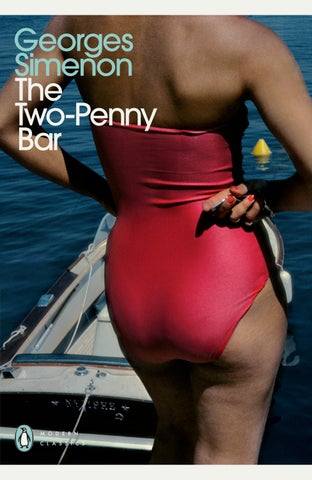
Georges Simenon The Two-Penny Bar

‘I love reading Simenon. He makes me think of Chekhov’ — William Faulkner
‘A truly wonderful writer . . . marvellously readable – lucid, simple, absolutely in tune with the world he creates’ — Muriel Spark
‘Few writers have ever conveyed with such a sure touch, the bleakness of human life’ — A. N. Wilson
‘One of the greatest writers of the twentieth century . . . Simenon was unequalled at making us look inside, though the ability was masked by his brilliance at absorbing us obsessively in his stories’ — Guardian
‘A novelist who entered his fictional world as if he were part of it’ — Peter Ackroyd
‘The greatest of all, the most genuine novelist we have had in literature’ — André Gide
‘Superb . . . The most addictive of writers . . . A unique teller of tales’ — Observer
‘The mysteries of the human personality are revealed in all their disconcerting complexity’ — Anita Brookner
‘A writer who, more than any other crime novelist, combined a high literary reputation with popular appeal’ — P. D. James
‘A supreme writer . . Unforgettable vividness’ — Independent
‘Compelling, remorseless, brilliant’ — John Gray
‘Extraordinary masterpieces of the twentieth century’ — John Banville
about the author
Georges Simenon was born on 12 February 1903 in Liège, Belgium, and died in 1989 in Lausanne, Switzerland, where he had lived for the latter part of his life. Between 1931 and 1972 he published seventy-five novels and twentyeight short stories featuring Inspector Maigret.
Simenon always resisted identifying himself with his famous literary character, but acknowledged that they shared an important characteristic:
My motto, to the extent that I have one, has been noted often enough, and I’ve always conformed to it. It’s the one I’ve given to old Maigret, who resembles me in certain points . . . ‘understand and judge not’.
Translated by david watson
Previously published as The Bar on the Seine
UK | USA | Canada | Ireland | Australia
India | New Zealand | South Africa
Penguin Classics is part of the Penguin Random House group of companies whose addresses can be found at global.penguinrandomhouse.com.
Penguin Random House UK
One Embassy Gardens, 8 Viaduct Gardens, London SW 11 7BW penguin.co.uk
First published in French as La Guinguette à deux sous by Fayard 1931
This translation first published as The Bar on the Seine in Penguin Books 2003, and revised 2014
Published in Penguin Classics 2025 001
Copyright © Georges Simenon Limited, 1931
Translation copyright © Georges Simenon Limited, 2003, 2014

GEORGES SIMENON and ® , all rights reserved
MAIGRET ® Georges Simenon Limited, all rights reserved original design by Maria Picassó i Piquer

All rights reserved
The moral rights of the author and translator have been asserted
Penguin Random House values and supports copyright.
Copyright fuels creativity, encourages diverse voices, promotes freedom of expression and supports a vibrant culture. Thank you for purchasing an authorized edition of this book and for respecting intellectual property laws by not reproducing, scanning or distributing any part of it by any means without permission. You are supporting authors and enabling Penguin Random House to continue to publish books for everyone. No part of this book may be used or reproduced in any manner for the purpose of training artificial intelligence technologies or systems. In accordance with Article 4(3) of the DSM Directive 2019/790, Penguin Random House expressly reserves this work from the text and data mining exception.
Typeset by Palimpsest Book Production Limited, Falkirk, Stirlingshire
Printed and bound in Great Britain by Clays Ltd, Elcograf S.p.A.
The authorized representative in the EEA is Penguin Random House Ireland, Morrison Chambers, 32 Nassau Street, Dublin D 02 YH 68
A CIP catalogue record for this book is available from the British Library
ISBN : 978–0–141–39417–6
Penguin Random House is committed to a sustainable future for our business, our readers and our planet. This book is made from Forest Stewardship Council® certified paper.
A radiant late afternoon. The sunshine almost as thick as syrup in the quiet streets of the Left Bank. And everything – the people’s faces, the countless familiar sounds of the street – exuded a joy to be alive.
There are days like this, when ordinary life seems heightened, when the people walking down the street, the trams and cars all seem to exist in a fairy tale.
It was 27 June. When Maigret arrived at the gate of the Santé prison he found the guard gazing soppily at a little white cat that was playing with the dog from the dairy.
Some days the pavement must be more resonant underfoot: Maigret’s footsteps echoed in the vast courtyard. He walked to the end of a corridor, where he asked a warder:
‘Does he know? . . .’
‘Not yet.’
A key turned in the lock. The bolt was pulled back. A high-ceilinged cell, very clean. A man stood up, looking unsure as to which expression to adopt.
‘All right, Lenoir?’ the inspector asked.
The man nearly smiled. But a thought came into his mind and his face hardened. He frowned suspiciously, and his mouth twisted into a sneer for a moment or two. Then he shrugged his shoulders and held out his hand.
‘I see,’ he said.
‘What do you see?’
A resigned smile.
‘Give it a rest, eh? You must be here because . . .’
‘I’m here because I’m off on holiday tomorrow and . . .’
The prisoner gave a hollow laugh. He was a tall young man. His dark hair was brushed back. He had regular features, fine brown eyes. His thin dark moustache set off the whiteness of his teeth, which were as sharp as a rodent’s.
‘That’s very kind of you, inspector . . .’
He stretched, yawned, put down the lid of the toilet in the corner of the cell which had been left up.
‘Excuse the mess . . .’
Then suddenly, looking Maigret in the eye, he said: ‘They’ve turned down the appeal, haven’t they?’
There was no point in lying. He knew already. He started pacing up and down.
‘I knew they would . . . so when is it? . . . Tomorrow?’
Even so, his voice faltered and his eyes drank in the glimmer of light from the narrow window high up the cell wall.
At that moment, the evening papers being sold on the café terraces announced:
The President of the Republic has rejected the appeal of Jean Lenoir, the young leader of the Belleville gang. The execution will take place tomorrow at dawn.
It was Maigret himself who had arrested Lenoir three months previously, in a hotel in Rue Saint-Antoine. A
split second later and the bullet the gangster fired at him would have caught him full in the chest rather than ending up lodged in the ceiling.
In spite of this, the inspector bore him no grudge; indeed, he had taken something of a shine to him. Firstly, perhaps, because Lenoir was so young – a twenty-two-year-old who had been in and out of prison since the age of fifteen. But also because he had a self-confidence about him.
He had had accomplices. Two of them were arrested at the same time as him. They were both guilty and on this occasion – an armed robbery – they probably played a bigger part than the boss himself. However, Lenoir got them off the hook. He took the whole blame on himself and refused to ‘spill the beans’.
He never put on an act, wasn’t too full of himself. He didn’t blame society for his actions.
‘Looks like I’ve lost,’ was all he said.
It was all over. More precisely, it would be all over when the sun, which was casting a golden strip of light on the cell wall, next rose.
Almost unconsciously, Lenoir felt the back of his neck. He shivered, turned pale, gave a derisive laugh:
‘It feels weird . . .’
Then suddenly, in an outburst of bitterness:
‘There are others who deserve this, and I wish they were going down with me!’
He looked at Maigret, hesitated, walked round the narrow cell once more, muttering:
‘Don’t get excited, I’m not going to put anyone in the frame now . . . but all the same . . .’
The inspector avoided looking at him. He could feel a confession coming. And he knew the man was so prickly that the slightest reaction or sign of interest on his part would make him clam up.
‘There’s a little place known as the “Two-Penny Bar” . . . I don’t suppose you’re familiar with it, but if you happen to find yourself in the neighbourhood you might be interested to know that one of the regulars there has more reason than me to be putting his head on the block tomorrow . . .’
He was still pacing up and down. He couldn’t stay still. It was hypnotic. It was the only sign of his inner turmoil.
‘But you won’t get him . . . Look, without giving anything away, I can tell you this much . . . I don’t know why this is coming back to me now. Maybe because I was just a kid. I couldn’t have been more than sixteen . . . Me and my friend used to do a bit of filching around the dance halls. He must be in a sanatorium by now – he already had a cough back then . . .’
Was all this talk just to give himself the illusion of being alive, to prove to himself that he was still a man?
‘One night – it must have been around three in the morning – we were walking down the street. It doesn’t matter which street. Just a street. We saw a door opening ahead of us. There was a car parked by the roadside. This guy came out, pushing another guy in front of him. No, not pushing. Imagine you’re carrying a shop dummy and trying to make it look like it’s your friend walking next to you. He put him in the car and got into the
driver’s seat. My friend shot me a look and we both jumped up on to the rear bumper. In those days they called me the Cat . . . that tells you all you need to know! The guy drove all over the place. He seemed to be looking for something, but seemed to keep losing his way. In the end we realized what he’d been looking for, because we arrived at the Canal Saint-Martin. You’ve worked it out, haven’t you? It was over in the time it takes to open and shut a car door. One body at the bottom of the canal . . .
‘Smooth as you like! The guy in the car must have put lead weights in the stiff’s pockets, because he sank like a stone.
‘We kept our cool. Another wink and we’re back on the bumper. Then it was just a case of checking the client’s address. He stopped in the Place de la République to have a glass of rum at the only café that was open. Then he drove his car to the garage and went home. We could see his silhouette through the curtains as he got undressed . . .
‘We blackmailed him for two years, Victor and me. We were novices. We were afraid of asking for too much . . . a few hundred at a time . . .
‘Then one day he moved house, and we lost him . . . Then three months ago I ran into him again at the TwoPenny Bar. He didn’t even recognize me . . .’
Lenoir spat on the ground, automatically searched his pockets for his cigarettes.
‘You’d think they’d let me smoke, in my situation,’ he muttered.
The shaft of sunlight above their heads had disappeared. Footsteps could be heard out in the corridor.
‘It’s not that I’m making out that I’m better than I am, but this guy I’m telling you about should be up there with me, tomorrow, on the . . .’
Suddenly the beads of sweat stood out on his forehead, and his legs buckled. He sat down on the edge of his bunk.
‘Leave me . . .’ he sighed. ‘No, don’t . . . don’t leave me alone today . . . It’s better to talk to someone . . . Hey, do you want me to tell you about Marcelle, the woman who . . .’
The door opened. The prisoner’s lawyer hesitated when he saw Maigret. He had pasted on his professional smile, so that his client wouldn’t be able to guess that his appeal had been turned down.
‘I have good news . . .’ he began.
‘I know!’
Then, to Maigret:
‘Guess I won’t be seeing you, inspector . . . Well, we’ve all got a job to do. By the way, I wouldn’t bother checking out the Two-Penny Bar. This guy is just as cunning as you . . .’
Maigret offered his hand. He saw his nostrils twitch, his dark moustache moisten with sweat, the two front teeth biting the lower lip.
‘Better this than typhoid!’ Lenoir joked, with a forced laugh.
Maigret didn’t go away on holiday; there was a case involving forged bonds that took up nearly all of his time.
He had never heard of the Two-Penny Bar. He asked around among his colleagues.
‘Don’t know it. Whereabouts? On the Marne? The lower Seine?’
Lenoir was sixteen at the time of the events he had described. So the case was six years old, and one evening Maigret read the reports for that year.
There was nothing sensational. Missing persons, as always. A woman chopped up into pieces, whose head was never found. As for the Canal Saint-Martin, it had thrown up no less than seven corpses.
The forged bonds turned out to be a complicated case, involving many lines of inquiry. Then he had to drive Madame Maigret to her sister’s in Alsace, where she stayed for a month every year.
Paris was emptying. The asphalt grew sticky underfoot. Pedestrians sought the shady side of the street, and the café terraces were full.
Expecting you Sunday without fail. Love from everyone.
Madame Maigret’s summons arrived when her husband had failed to turn up for a fortnight. It was Saturday, 23 July. He tidied up his desk and warned Jean, the office boy at the Quai des Orfèvres, that he probably wouldn’t be back before Monday evening.
As he was about to leave, he noticed the brim of his bowler, which had been torn for weeks. His wife had told him a dozen times to buy a new one.
‘You’ll have people throwing you coins in the street . . .’
He spotted a hatshop in Boulevard Saint-Michel. He tried on a few, but they were all too small for his head.
‘I’m sure this one will be just right . . .’ the spotty young shop assistant kept insisting.
Maigret was never more miserable than when he was trying things on in shops. In the mirror he was looking in, he spotted a man’s back and head, and on the head a top hat. As the man was dressed in hunting tweeds, he cut a rather droll figure.
‘No! I wanted something a bit older-looking,’ he was saying. ‘It’s not meant to be smart.’
Maigret was waiting for the assistant to return from the back of the shop with some new hats for him to try on.
‘It’s just for a little play-acting . . . a mock marriage which we’re putting on with a few friends at the TwoPenny Bar . . . there’ll be a bride, mother of the bride, page-boys, the lot! . . . Just like a village wedding! . . . Now do you see what I’m after? . . . I’m playing the part of the village mayor . . .’
The customer gave a hearty laugh. He was about thirtyfive, thickset, with rosy cheeks; he had the air of a prosperous businessman.
‘Maybe one with a flat brim . . .’
‘Hold on! I think we’ve got just the thing you’re after in the workshop. It was a cancelled order . . .’
Maigret was brought another pile of bowlers. The first one he tried on fitted. But he dallied and made sure he left the shop just before the man with the opera hat. He hailed a taxi, just in case he needed it.
He did. The man came out of the shop, got into a car
parked next to the pavement and drove off in the direction of Rue Vieille-du-Temple.
There he spent half an hour in a second-hand shop and emerged with a flat cardboard box, which obviously contained a suit to go with his top hat.
Then on to the Champs-Élysées, Avenue de Wagram. A small bar on a street corner. He stayed there only five minutes and left accompanied by a buxom, jovial-looking woman who must have been in her thirties.
Twice Maigret looked at his watch. His first train had already gone. The second would be leaving in a quarter of an hour. He shrugged his shoulders and told the taxi driver:
‘Keep following him.’
Much as he had expected, the car drew up in front of an apartment block on Avenue Niel. The couple hurried in through the entrance. Maigret waited a quarter of an hour, then went in, taking note of the brass plate:
Bachelor apartments by the month or by the day.
In a smart office which had a whiff of adultery he found a perfumed manageress.
‘Police! . . . The couple who just came in here . . .’
‘Which couple?’
But she didn’t put up much of a struggle.
‘Very respectable people, both married. They come twice a week . . .’
On his way out, the inspector glanced through the car windscreen at the identity plate.