DNA-MX
(Dynamics)

MIDDLESEX SCIENCE MAGAZINE
Biology Environmental Science Physics Technology
SPRING 2024
EDITORS-IN-CHIEF
MARY CUMMINGS & ERIC NIE
BIOLOGY EDITOR
OWEN BARRY
ENVIRONMENTAL SCIENCE EDITOR
THEA CHOYT
PHYSICS EDITOR
OLIVER ALI
TECHNOLOGY EDITOR
MAGGIE MILLER
PRODUCTION
SOPHIA YANG
FACULTY ADVISOR
DR. STEVEN MYLON
Editors’ Note Robots As Surgeons? Your Body Is Not A Soft Machine. Gene Editing, Imunosuppression, and Cocaine Artificial Intelligence String Theory Nuclear Fusion Breakthrough! Sources CONTENTS 2 3 4 5 6 7 8 9 10
From the Editors-in-Chief:
We are happy to be publishing our first publication for the second year of the Middlesex Science Magazine, DNA-MX [pronounced ‘dynamics’].
Students are excited to share their thoughtful insight on a variety of scientific fields. For this issue, students covered topics including synthetic biology, artificial intelligence, and physics phenomenons.
Through combining their skillful writing with their passion for science, we have created this magazine in hopes that our work will inspire and encourage student participation within the STEM community both in and outside of the classroom. As always, we aim to spark creativity, curiosity, and wonder.
We hope you enjoy this reading and seek out our writers if you have any questions or are interested in contributing!
- Mary Cummings & Eric Nie
EDITORIAL 3
Robots as Surgeons?
A Glance at Contemporary Biomedical Engineering
Sophia Yang
Picture the stereotypical scene of surgery: the patient is wheeled into the operating room, where the anesthesiologist asks them to count backward from ten before the surgeon can begin the operation. But what if this surgeon didn’t have eyes, or hands with blood running through them, or a human brain? What if this surgeon standing beside the table was a robot designed to execute the medical procedure?
To set the record straight, robots aren’t performing surgery at least not yet
Let’s take a step back: the field of biomedical engineering sets out to apply engineering design concepts to assist problem-solving in medicine At a fundamental level, such technology is not a contemporary idea; X-rays were first used in medical treatment in 1896, and the earliest discovered prosthetic limbs date back to as early as 1579 (Hernigou; Tubiana)

Biomedical engineers today continue to evaluate the suitability of different biomaterials for artificially implanted limbs or joints, with key considerations including durability, light weight, and biocompatibility In our modern economy, biomedical engineers are also crucial in their involvement in clinical trials, considering developing drugs’ effectiveness in terms of treatment as well as cost (Drexel University)
So what about in surgery?
Traditionally, as we might be familiar, a surgeon wields handheld instruments to operate through a large incision in the patient. However, some operations may be done using robot-assisted minimally invasive surgery
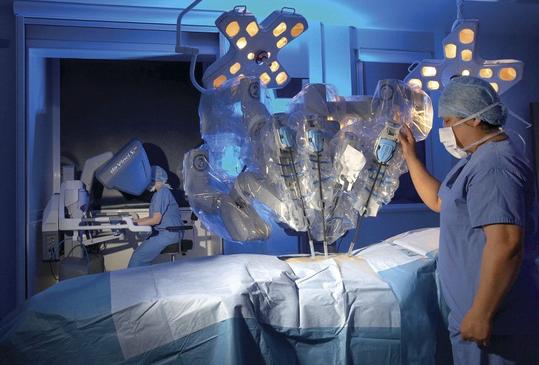
In 2000, the FDA approved usage of the computer-assisted robotic surgical tool known as the “da Vinci Surgical System ” Involved in complex surgical procedures, this device aims to perform much more precise “hand movements” through smaller patient incisions It translates surgeon instruction into ultra-fine movement of the robotic arms
The da Vinci system consists of three components: the surgeon console, where the surgeon views the patient’s anatomy (via a tiny camera inserted into the patient) and controls the instruments; the patient-side cart, stationed beside the operating table with mechanical arms holding the instruments and camera controlled by the surgeon; and the electronic cart, which contains tools including those used for suction, rinsing, as well as a light source for the internal camera (Compton; Intuitive Surgical, Inc )
The da Vinci’s vision systems allow the surgeon controlling the robot a high-resolution, three-dimensional internal view of the patient, and this robot’s “joints” are able to bend and rotate much more comprehensively than those in the human hand aspects that together seem like a powerful, cutting-edge medical invention
So why is the da Vinci in practice still so controversial? Any surgery, including those solely involving human surgeons, are not without risks Use of the robotic system not only requires prolonged operation and anesthesia durations, but its potential complications can also require ultimate transition back to traditional open surgery
Although da Vinci manufacturer Intuitive Surgical, Inc claims that the human surgeon holds full control over the system at all times, numerous individual reports of spontaneous malfunctions many directly causing serious complications or even death amongst the robot’s approximately three million patients up to date have been submitted The robotic system has also faced several mass recalls due to production flaws involving the mechanical arms manipulation of the instruments (Compton) In face of such robotics caused fatalities, the surgical system faces considerable skepticism throughout the medical world
In addition to these life-concerning apprehensions, machines like this are expensive The initial purchase of one such da Vinci device is a two million dollar check for a hospital to write not to mention the machine’s regular maintenance fees of over $100,000 When these costs flow to the patient end, they can look like up to an 80% increase over minimally invasive surgeries performed directly by human surgeons (laparoscopic surgery).
And for what? Several robotic surgery data analyses, such as Journal of the American Association’s 2013 study, show that da Vinci’s surgical results fail to offer notable progress over traditional laparoscopy (Compton).
Despite inevitable doubts, robot-assisted surgical techniques are, ultimately, still on the rise even just looking at da Vinci, one of many biomedically designed systems available; Intuitive Surgical’s 2023 second quarter revenue of $1 76 billion saw a 15% increase from 2022 second quarter’s $1 52 billion (Intuitive Surgical, Inc )
As our future becomes increasingly intertwined with technology and as artificial intelligence continues to develop, the question may no longer be if robot-assisted surgery will become robot-dominated surgery but when
4
BIOLOGY
YOUR BODY IS NOT A SOFT MACHINE.
Owen Barry
You may have seen these words posted upstairs in the Warburg Library to remind students holed up there not to let their barely written essays due the next day drive them to madness.
We’ve all been there, but some students take the easy way out and turn to AI tools like ChatGPT to do their work for them; however, at least to me, text generation models have never really felt human—how could they? They’re just a bunch of transistors—a bunch of ones and zeros—right?
Not anymore. Out of Melbourne Australia, a team of researchers at Monash University recently created a computer made of 800,000 neurons dubbed DishBrain (Ktori), and they showed that it was trainable in basic games like pong and the Google Dinosaur game when embedded in a simulated game-world (Kagan; Kan). It’s essentially a rudimentary petri dish brain living in a real-life version of The Matrix.
The researchers grew a combination of embryonic mouse neurons and human stem cells on a dense array of electrodes to communicate with it, sending and receiving electrical signals.
If DishBrain makes a poor decision, the researchers’ program critiques it in real-time by sending some unpredictable stimulus (Ktori). DishBrain inherently seeks order and predictability, so, given these basic stimuli, it learns in real-time how to minimize unpredictability by playing the game as accurately as possible (Ktori; Kan). The head researcher, Adeel Razi, stated that this new technology could “eventually surpass the performance of existing, purely silicon-based hardware” and may provide new advantages with its ability “to learn throughout its lifetime”(“Research”).
The head researcher, Adeel Razi, stated that this new technology could “eventually surpass the performance of existing, purely silicon-based hardware” and may provide new advantages with its ability “to learn throughout its lifetime”(“Research”).
The new type of hardware (or should I say wetware?) offers other advantages over traditional computing, especially when specifically studying brain behavior. Computer scientists have long created models of the brain on traditional hardware, but these models can only be programmed to reflect our current understanding of how the brain works—an approximation of what’s actually going on.
Biocomputers like DishBrain, on the other hand, open new possibilities for directly studying neural behavior under controlled conditions and stresses; the Monash team next plans to investigate how the network will respond to medicines, drugs, and alcohol. The ability to map and interact with the neurons also opens new ways of studying neurological conditions like dementia without the need for potentially cruel animal testing (Ktori).
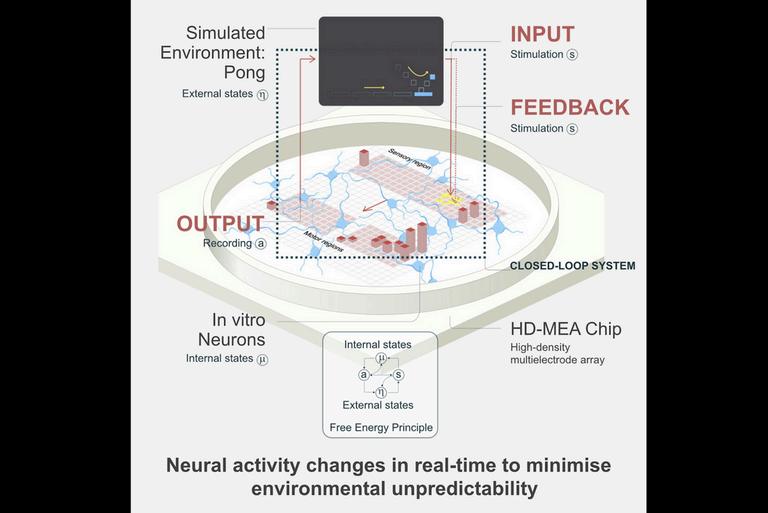
The researchers run the game—for now, let’s say pong—on a traditional computer and send basic information about the game to DishBrain like whether or not the paddle is to the left or right of the ball and how far away the ball is from the paddle. DishBrain, the player of the game, sends signals back to the array of electrodes, and the researchers interpret the locations of DishBrain’s output signals as its in-game decisions—say, whether or not the paddle should go left or right.
Currently, DishBrain only contains about 0.001% of the neurons of an adult human, but as the technology advances, biocomputers will likely grow in size and may be able to integrate truly three-dimensional organoids with computer interfaces (Johnson). Occupying three-dimensions would allow this type of computer to be far more space efficient than traditional computers (Johnson).
The brain is also incredibly energy efficient, so biocomputers could run on fairly small quantities of some nutrient-rich solution (Johnson). The human brain also has an impressive ability to store data, with an estimated 2.5 million gigabytes of storage (Johnson), another ability that biocomputers could inherit.
Although conventional computers are better at processing vast amounts of data, the higher complexity and interconnectedness of biocomputers would allow them to learn quickly and make logical connections with less information than a silicon chip would need. An obvious application of this ability is in machine learning and artificial intelligence systems, to make them more creative and overall more human.
However, there are many obstacles that still need to be overcome before larger, more capable biocomputers become a reality. One of the biggest challenges is that the computer would need some sort of circulatory system to transport nutrients and oxygen to the center of the organoids to prevent developing a “rotten core” as Thomas Hartung of Johns Hopkins University puts it (Johnson).
However, the development of increasingly complex human-neuron based computers also raises ethical concerns: when have they gone too far? Become too human? More human than us? When will they deserve rights? I know I’m entering the realm of science fiction here, but, maybe someday, our bodies will not only be soft machines, but outdated ones at that—the equivalent of the Walkman, 8-track, Discman, or the turn table—although, I hear that last one’s making a comeback.
5
BIOLOGY
Gene Editing, Immunosuppression, and Cocaine
Pig Hearts Open a New Chapter of Organ Transplantation
Zichuan (David) Yang
On September 14th, 2023, 58 year old Lawrence Faucette was admitted to The University of Maryland Medical Center after experiencing symptoms of heart failure. Doctors deemed him unfit for a traditional human heart transplant due to his peripheral vascular disease. Six days later, after an FDA “compassionate use” authorization, Lawrence Faucette became the second ever person to receive an experimental pig heart transplant.
With Mr. Faucette’s recent passing, let’s take a look back at the two existent cases of pig heart transplants and the development of transplanting organs from other species into humans, a field known as xenotransplantation. Once a figment of sci-fi imagination, xenotransplantation now is not only a reality but may be the future of organ transplantation.
A year and a half before the Faucette case, the same UMSOM (University of Maryland School of Medicine) team performed the first ever pig-to-human heart transplant on 57 year old David Bennet. Led by Dr. Bartley Griffith and Dr. Muhammad Mohiuddin, the team introduced three main innovations: genetic modifications to the pigs’ hearts, an experimental immunosuppressant called KPL-404, and a nutrient solution containing cocaine (UM Medical Center).
CRISPR/Cas-9: Revivicor, the company producing the pigs used by the UMSOM team, made ten genetic changes to prevent rejection, as the immune system attacks the organ if the patient’s antibodies recognize certain sugars on the organ as foreign (Revivicor). Revivicor knocked out three genes for enzymes that helped synthesize those sugars, particularly the CGTA1 gene that codes for Galactose-alpha-1,3-galactose (alpha-gal). Six other human genes were inserted: two anti-inflammatory genes, two genes that promote normal blood clotting, and two genes coding for proteins that reduced antibody response. The final modification removed a growth hormone to prevent oversized organs. Interestingly, the necessity of each edit was proven independently by researchers around the world over the last several decades— however, only with the revolutionary efficiency of CRISPR/Cas-9 was the UMSOM team finally able to produce the culminating pig heart that could trick the human immune system (Ryczek).
KPL-404: Even with these modifications, the UMSOM team still gave both patients a strong, experimental immunosuppressant called KPL-404. Standard immunosuppressants block the activity of T cells, which destroy cells tagged by antibodies — these immunosuppressants aren’t effective against the massive amounts of antibodies the body produces when it detects an organ from another species. KPL-404, on the other hand, uses a novel mechanism of action: it directly suppresses the antibody-producing B cells by blocking the CD40 receptor. In Dr. Mohiuddin’s opinion, “the 10 genes help, but the anti-CD40 antibody, which had been the main focus throughout my career, I think is the game changer” (Servick).
Cocaine: Aside from immune system rejection, Dr. Mohiuddin’s pig-to-baboon transplants died out in 48 hours until the UMSOM team started perfusing the hearts with a nutrient solution developed by Swedish company XVIVO. After the heart was harvested, it was stored in this solution of water, hormones, and dissolved cocaine. The specific mechanisms of how cocaine kept the heart healthy aren’t clear, but the effects on the heart were: “when we started infusing the heart with this solution, the heart became well preserved and started beating very well,” Dr. Mohiuddin says (Taub).

After a seven hour surgery, Faucette became the second ever recipient of a pig heart transplant. He was making progress the six weeks following his surgery, playing cards and even regaining his ability to walk. However, his heart started showing symptoms of rejection in the days leading up to his death. The UMSOM team is now investigating what needs to change for future transplants.
Lawrence Faucette’s passing shows just how long xenotransplantation has to go. The achievements of the UMSOM team, however, should bring hope towards a future end of the organ shortage crisis. In the United States, one person dies every seventeen minutes waiting for an organ transplant, and another is added to the waiting list every nine minutes (Fleck). The sharp global uptick in organ demand has created an “international blood market” where human organs are traded illegally.
We’re now standing at the cusp of a new age of organ transplantation, a solution to such cruelty in sight. As xenotransplantation and genetic editing mature over the coming years, it’s exciting to see not only science breaking new ground in real-time but also the profound impact xenotransplantation could have on millions of lives.

6
Faucette in recovery from pig heart transplant surgery
BIOLOGY
Artificial Intelligence
Jerry Li
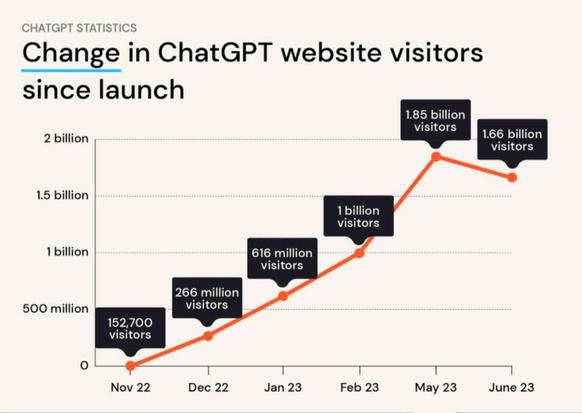
On November 30th, 2022, a new artificial intelligence (AI) technology called ChatGPT was launched Since its development, ChatGPT has amassed more than 100 million users with over 1 5 billion visitors to its website per month The technology has, however, generated a mixed response from the public Within the school system, the emergence of ChatGPT and other powerful AI’s sparked a wave of excitement in students eager to explore its capabilities, they also created concerns among teachers and educators about the future implications it holds for both teaching and school As AI becomes more intertwined with our daily lives, an unavoidable question comes: Is AI a positive tool for our rapidly growing modern society, or, rather, will the risks and negative consequences outweigh its strengths? Simultaneously, while AI can and does critically affect our students and our society if used correctly, AI can also offer huge improvements to both our teaching and learning simultaneously.
In an increasingly online world, access to AI is straightforward to use. The prevalence of AI technology in classrooms seems to overshadow what learning is all about With an overreliance on AI, our critical thinking skills as students become dull For example, a chatbot can simply answer a question that would

otherwise require thoughtfulness and research This makes students increasingly tempted to use AI rather than rely on their skills and knowledge Moreover, reliance on AI can result in the development of unconscious biases that can consolidate stereotypes, as the information provided by ChatGPT is based on existing information online, some of which are based on stereotypes and human bias
Furthermore, by relying more heavily on machine learning, people can become disconnected from society, with attendant negative consequences AI technology holds many benefits, and if used properly can greatly alter both studying and teaching positively AI creates a space to ask questions that might be uncomfortable pursuing with a person Students who previously couldn’t access comprehensive learning tools can now access AI, which can match the ability of traditional educational resources As AI develops, it will provide students with personalized learning experiences, where AI can identify personal learning patterns. While AI technology does present some negative effects on students, I am optimistic that, with an increasing technology-reliant society, AI can and will transform teaching and learning for the better
7
TECHNOLOGY
PHYSICS
STRING THEORY
Is Our Universe More Than a 3-Dimensional Reality?
Ian Lam
Imagine trying to set up a meeting with a friend after school What two things would you need to tell them? You’d probably want to provide a time and a location In our perceived three-dimensional space, describing location requires three coordinates: one each for length, width, and height Add one more number to indicate time, and we arrive at a total of four coordinates in other words, four dimensions Whether we recognize it or not, this simple scenario describes our perception of a 4-D universe: we move through three dimensions of space and one dimension of time
But what if our universe consisted of more than that? What if there were five, six, or even ten dimensions? What would those dimensions look like, and why don’t we experience them in our everyday lives? Incredible though it may sound, this is exactly what string theory a theory proposed by physicists to describe the fundamental nature of the universe posits To dig deeper, we first need to consider the underlying reason behind the proposal of such an idea
Physicists have developed two theories to model our universe: Einstein’s General Theory of Relativity and the Standard Model of Particle Physics Both are incredibly powerful and well-tested, consistently producing infallible predictions in their respective applications general relativity models the force of gravity and the curvature of spacetime at a macro level, while the Standard Model enables accurate descriptions of particles and interactions at the quantum scale (“DOE Explains”) But there’s a problem These two theories are incompatible: no attempts to introduce gravity to the Standard Model at the quantum scale succeed Other unexplained phenomena, from the existence of dark energy to the breakdown of general relativity in extreme scenarios the centers of black holes, for instance have led physicists to seek a unified “theory of everything” that can unite all fundamental forces of nature under a single framework (Siegal) Thus, string theory, and with it the proposal of extra dimensions, arises
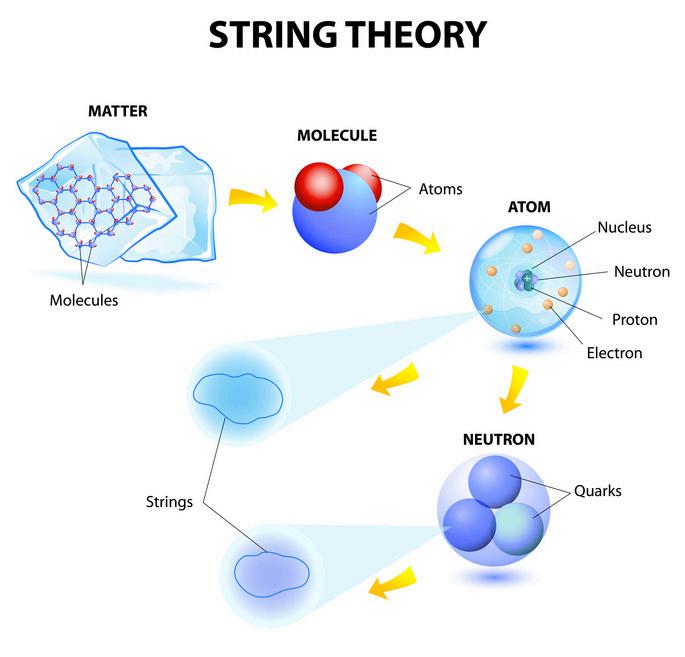
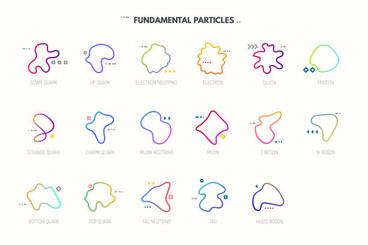
While current models of physics propose that the universe’s building blocks are infinitesimal particles for example, electrons and quarks (which make up protons and neutrons) string theory challenges this notion Particles are not fundamental, but rather, inside each is a tiny filament of energy: a string Just as a violin string produces different notes when plucked in specific ways, different patterns of vibration in these strings of energy account for the properties and forces of certain particles In string theory, a string vibrating in one way gives an electron its spin, charge, and mass, while another kind of vibration produces a photon with its own unique properties, and so on Crucially, string theory proposes the existence of the graviton, a hypothetical quantum particle that carries the force of gravity, thus offering a unification of gravity with quantum mechanics (Greene) If validated, string theory could revolutionize our understanding of the nature of the universe, explaining mysteries that continue to plague modern physics as a true “theory of everything,” from the existence of dark matter to the underlying reason behind the values of physical constants like the speed of light
The mathematics of string theory are extraordinarily elegant But they require just one caveat: extra dimensions In order for the vibrating strings to produce all of the varieties of particles observed in our universe, each with their unique respective properties, we need more than three spatial dimensions, which are simply too constrained; most variations of string theory require at least ten dimensions (Sutter)! But how do we reconcile these extra dimensions with our everyday 3D experience?
One explanation is that, unlike the three large and extended spatial dimensions we experience, the other six dimensions of space are tightly curled up and too small for us to detect (Greene). These dimensions would wrap around themselves in a shape with a diameter of around 10-35 meters, over 20 orders of
magnitude smaller than an atom (Wilkinson) a minuscule scale currently impossible to experimentally detect To understand this concept, consider the following analogy: a cable observed overhead from a distance appears as a 1D line, but an ant walking on the cable would experience it as a 3D cylinder In the same way, the extra dimensions proposed by string theory would be so small that we cannot access them, continuing to perceive a 3D space; however, the infinitesimal strings are small enough to interact with them Each time we move through 4-dimensional space, we could in fact be circumnavigating these microscopic dimensions billions of times (Sutter)!
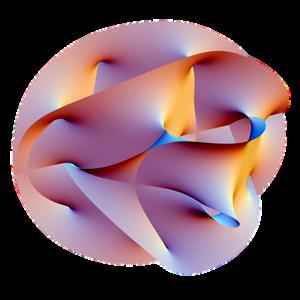
Exampleofacalabi-yaumanifoldprojectedinto3D
Nevertheless, the mere existence of these dimensions, as well as string theory itself, has yet to be proven Mathematics dictates that the extra dimensions must be wrapped in specific configurations, known as Calabi-Yao manifolds (Sutter) However, at least 10500 different possible manifolds exist, and each different structure affects the strings’ patterns of vibration, resulting in a separate universe governed by a unique set of physical laws (“Cosmological”) Frustratingly, string theory provides no means for us to determine which configuration yields the laws of our universe
The theory is at an impasse: without the crucial knowledge of the geometry of these extra dimensions, string theory remains incomplete, failing to provide any concrete predictions that can be experimentally verified Moreover, the mere existence of additional dimensions to our 4D spacetime, though an incredible idea to consider, remains yet to be proven; we simply lack the capability to detect their existence (Greene) Perhaps future developments in technology will provide empirical evidence to support string theory But for now, string theory is just that: a beautiful theory that remains yet to be validated
8
Nuclear Fusion Breakthrough!
Kwame Addison
Woah! Nuclear Fusion has finally become efficient but why is that important? To the uninformed, this seems like just another headline, but I assure you, whether you ' re involved in the scientific community or not, this research will impact your life But first, what is Nuclear Fusion?
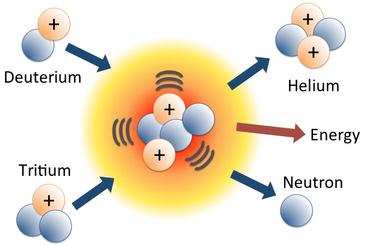
Nuclear Fusion, in the most barebones sense, is the fusion of two atoms together. In most labs, the two atoms of choice are isotopes of hydrogen, deuterium, and tritium. Using high amounts of energy, atoms are fused into Helium and a loose neutron. Now what does this mean about being “efficient”? The answer lies in the masses before and after the fusion: the mass before the fusion is GREATER THAN the mass after This mystery can easily be solved using an equation you may or may not know E=MC²! The mass (M) turns into energy (E) by a factor of the speed of light squared (C²), and the speed of light is 3 0 * 10 ⁸ m/s, a fact which means a tiny bit of mass turns into a huge amount of energy. Energy that can be used to power anything we want!
The breakthrough, as stated previously, has to do with efficiency. Previously, one of the world’s leading
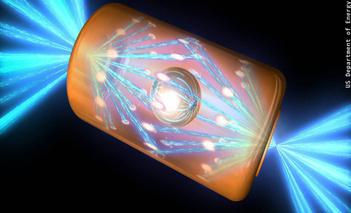
nuclear fusion facilities, NIF, had made leaps in nuclear fusion efficiency, but they had yet to achieve fusion ignition Fusion ignition is a fusion reaction where the energy put into the reaction is less than the energy put out The process NIF uses involves many lasers, miles long, pointed at a single fuel pellet with two parts. The outermost part explodes, making an equal and opposite force inwards on the inner part, deuterium and tritium. All the heat and pressure force the isotopes to fuse, releasing energy.
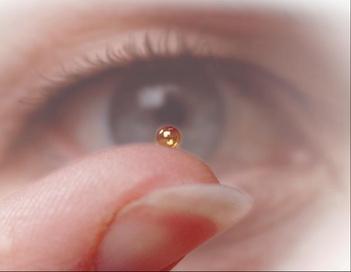
On December 5, 2022, the NIF managed to put two megajoules of energy into the capsules and get 3 megajoules out An efficiency of 1 5x energy out is remarkable, but it has taken years for them to get to this point The facility has been operational since 2009, painstakingly refining its precision and efficiency in order to get a greater direct output than direct input Though the achievement is monumental, the path to wide use of fusion energy is only just beginning If one were to take a perspective on all the energy used in the fusion at NIF, efficiency has yet to be achieved.
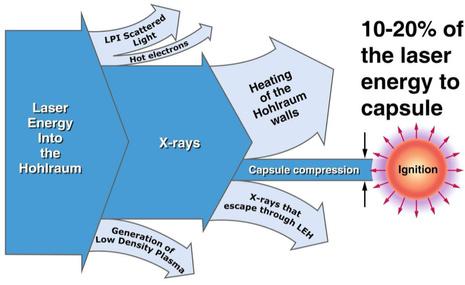
The Hohlraum, the cylinder that holds the pellet, receives essentially 100% of the energy the laser puts in. However,
before the force of the capsule on the pellet can occur, massive amounts of energy are lost throughout the process. Heat, plasma, and X-rays all take away energy before the pellet can be hit, meaning only about 10-20% of the energy from the lasers reaches the capsule on average
Does the seemingly huge gap in efficiency mean fusion research is pointless? In my opinion, no Despite the large gap in efficiency that remains, the new achievement that NIF has accomplished is still huge Even compared to two decades ago, fusion research has made massive improvements with the actual implementation of fusion-based energy on the horizon The world’s supply of fossil fuels will eventually run out, and unlike its near relative fission, nuclear fusion makes virtually zero waste. Fusion will be an efficient, clean, and abundant energy source the world can soon look forward to relying on.
9
PHYSICS
Robots as Surgeons?
Compton, Kristin "da Vinci Surgical System " Edited by Kevin Connolly Drugwatch com, 5 Sept 2023, www drugwatch com/davinci-surgery/ Accessed 24 Nov 2023
Hernigou, Phillippe "Ambroise Paré IV: The early history of artificial limbs (from robotic to prostheses) " National Library of Medicine, National Institutes of Health, 21 Apr 2013, www ncbi nlm nih gov/pmc/articles/PMC3664166/#: :text One%20of%20the%20earl iest%20written,he%20fitted%20on%20his%20amputees Accessed 24 Nov 2023
"Intuitive Announces Second Quarter Earnings " Intuitive Surgical, 20 July 2023, isrg intuitive com/news-releases/news-release-details/intuitive-announces-secondquarterearnings3#: :text=The%20Company%20grew%20its%20da,the%20second%20quarter%20 of%202022 Accessed 24 Nov 2023
"Robotic-Assisted Surgery with da Vinci Systems " Intuitive Surgical, www intuitive com/en-us/patients/da-vinci-robotic-surgery Accessed 24 Nov 2023
Tubiana, M "Wilhelm Conrad Röntgen et la découverte des rayons X [Wilhelm Conrad Röntgen and the discovery of X-rays] " National Library of Medicine, National Institutes of Health, Jan 1996, pubmed ncbi nlm nih gov/8696882/#: :text=Abstract,through%20screens%20of%20nota ble%20thickness Accessed 24 Nov 2023
"What is Biomedical Engineering (BME)?" Drexel University, drexel edu/biomed/resources/what-is-biomedical-engineering/ Accessed 24 Nov 2023 Images https://robotsguide com/robots/davinci https://blog sciencemuseum org uk/robot-surgery-the-da-vinci-robot/
Body Is Not A Soft Machine.
Johnson, Doug “Is the Future of Computing Biological?” Ars Technica, 1 Mar 2023, arstechnica com/science/2023/03/is-the-future-of-computingbiological/.
Kan, Michael “This Lab Is Merging Human Brain Cells with Computer Chips ” PCMAG, PCMag, 21 July 2023, www pcmag com/news/this-lab-is-merginghuman-brain-cells-with-computer-chips
Ktori, Sophia “Human Brain Cells in a Dish Learn to Play ‘Pong ’” GEN, GENGenetic Engineering and Biotechnology News, 2 June 2023, www genengnews com/news/human-brain-cells-in-a-dish-learn-to-play-pong/
“Research to Merge Human Brain Cells with AI Secures National Defence Funding ” Turner Institute for Brain and Mental Health, Monash University, 21 July 2023, www monash edu/turner-institute/news-and-events/latestnews/2023-articles/research-to-merge-human-brain-cells-with-ai-securesnational-defence-funding
Kagan, Brett J et al. “In vitro neurons learn and exhibit sentience when embodied in a simulated game-world ” Neuron vol 110,23 (2022): 3952-3969 e8 doi:10 1016/j neuron 2022 09 001
Images
www.pcmag.com/news/this-lab-is-merging-human-brain-cells-with-computerchips
Gene Editing, Immunosuppression, and Cocaine
JFleck, Anna “Infographic: The Organ Shortage Crisis in the U S ” Statista Daily Data, 20 May 2022, www statista com/chart/27495/organ-donation-waiting-list-and-completedtransplants/#: :text=The Accessed 14 Nov 2023
Revivicor “Technologies ” Www revivicor com, Revivicor, www revivicor com/technologies/#: :text=Revivicor Accessed 14 Nov 2023
Ryczek, Natalia, et al “CRISPR/Cas Technology in Pig-To-Human Xenotransplantation Research ” International Journal of Molecular Sciences, vol 22, no 6, Jan 2021, p 3196, https://doi org/10 3390/ijms22063196 Accessed 14 Nov 2023
Servick, Kelly “Here’s How Scientists Pulled off the First Pig-To-Human Heart Transplant ” Www science org, Science, 12 Jan 2022, www science org/content/article/here-s-how-scientists-pulled-first-pig-human-hearttransplant.
Taub, Ben “How Cocaine Helped Ensure the Success of World’s First Pig-To-Human Heart Transplant ” IFLScience, 26 Jan 2022, www iflscience com/how-cocaine-helpedensure-success-worlds-first-pig-human-heart-transplant-62379 Accessed 14 Nov 2023
University of Maryland Medical Center “UM Medicine Faculty-Scientists and Clinicians Perform Second Historic Transplant of Pig Heart into Patient with End-Stage Cardiovascular Disease ” Www umms org, 22 Sept 2023, www umms org/ummc/news/2023/um-medicine-clinicians-perform-second-historictransplant-of-pig-heart-into-patient Accessed 14 Nov 2023
Images
https://www wired com/story/how-to-make-a-pig-heart-transplant-last-in-a-person/? redirectURL=https%3A%2F%2Fwww wired com%2Fstory%2Fhow-to-make-a-pig-hearttransplant-last-in-a-person%2F https://www americanpost news/pig-heart-recipient-continues-to-recover-after-firsttransplant/
Your
10 SOURCES
Artificial Intelligence Nuclear Fusion Breakthrough!
https://www forbes com/sites/bernardmarr/2023/06/02/the-15-biggest-risks-ofartificial-intelligence/?sh=79ce5a672706
https://hai stanford edu/news/ai-will-transform-teaching-and-learning-lets-get-itright
https://news stthomas edu/the-impact-of-artificial-intelligence-and-chatgpt-oneducation/
https://schiller edu/blog/the-impact-of-artificial-intelligence-on-higher-educationhow-it-is-transforming-learning
https://www educationnext org/a-i-in-education-leap-into-new-era-machineintelligence-carries-risks-challenges-promises/
String Theory
“DOE Explains the Standard Model of Particle Physics ” Department of Energy, https://www energy gov/science/doe-explainsthe-standard-model-particle-physics Accessed 21 November 2023
Greene, Brian “Why String Theory Still Offers Hope We Can Unify Physics ” Smithsonian Magazine, https://www.smithsonianmag.com/science-nature/stringtheory-about-unravel-180953637/ Accessed 21 November 2023
Siegel, Ethan “The biggest problem with gravity and quantum physics ” Big Think, 27 September 2022, https://bigthink com/starts-with-a-bang/problem-gravity-quantumphysics/ Accessed 21 November 2023
Sutter, Paul, and William Pennat “How the universe could possibly have more dimensions ” Space com, 21 February 2020, https://www space com/more-universedimensions-for-string-theory html Accessed 21 November 2023
Wilkinson, Richard, et al “How many dimensions are there, and what do they do to reality?” Aeon, 10 January 2018, https://aeon co/essays/how-many-dimensions-arethere-and-what-do-they-do-to-reality Accessed 21 November 2023
Images
https://www worldatlas com/space/what-is-string-theory html
https://stock adobe com/images/standard-model-of-elementary-particles-stringtheory-particles-quarks-leptons-and-bosons-table-geometric-abstract-shapes-lines-anddots-with-strings-line-style-gradient-vector-illustration/196616776
https://en m wikipedia org/wiki/File:Calabi-Yau png
https://www smithsonianmag com/smart-news/chinas-artificial-sun-reactor-brokerecord-for-nuclear-fusion-180979336/
https://www iter org/sci/Fusion
https://www iaea org/newscenter/news/nuclear-fusionbasics#: :text=The%20potential%20advantages%20of%20nuclear,produced%20through%2 0fusion%20are%20minimal.
https://www energy gov/articles/doe-national-laboratory-makes-history-achievingfusion-ignition
https://www nextbigfuture com/2022/12/sorry-this-net-energy-gain-does-not-meanfusion-is-close html
11
SOURCES
SPRING 2024
DNA-MX
Cover Photo by Sophia Yang