All contributions are the responsibility of the author, and do not necessarily reflect the views of the society. All contributions are personal, except where attributed to an organisation represented by the author.
COPY DATE FOR LL4 2026 IS 26 MAY
PUBLISHED BY
The Society of Light and Lighting 91-94 Saffron Hill London EC1N 8QP www.sll.org.uk ISSN 2632-2838
The Society of Light and Lighting is part of the Chartered Institution of Building Services Engineers, 91-94 Saffron Hill, London EC1N 8QP. Charity registration no 278104
Designed and printed in the UK
Darkhorse Design Ltd
T (0)20 7323 1931 darkhorsedesign.co.uk studio@darkhorsedesign.co.uk
FROM THE EDITOR
One of the salutary lessons of maturity is the discovery of how much you don't know. And the further discovery that what you thought you knew turns out not to be the case. Developments in our understanding of lighting and its effects on our physiology is a prime example. The current focus, of course, is on the importance of red, near-infrared and infrared light.
We understood light at the blue end of the spectrum was a good thing – during the day at least – making us feel more alert, and approximating daylight for our circadian system. We understood that LEDs were a good thing. They were energy saving, neat, controllable.
But when we go deeper to microbial level – specifically mitochondrial level – we are discovering that this is very much not the case, as Prof Glen Jeffery discussed in the latest Trotter Paterson Lecture (see p5).
In a nutshell, we evolved under fullspectrum natural light, which 'established a relationship between sunlight and life in the maintenance of physiological function,' says Prof Jeffery. LEDs, concerned only with visible light, remove more than 90 per cent of the solar spectrum.
'The spectrum of light in the built environment has changed radically,' says Prof Jeffery, 'and there is now strong evidence that it undermines public health primarily by its impact on mitochondrial function.'
CURRENT SLL LIGHTING GUIDES
SLL Lighting Guide 0: Introduction to Light and Lighting (2017)
SLL Lighting Guide 1: The Industrial Environment (2018)
SLL Lighting Guide 2: Lighting for Healthcare Premises (2019)
SLL Lighting Guide 4: Sports Lighting (2023)
SLL Lighting Guide 5: Lighting for Education (2011)
SLL Lighting Guide 6: The Exterior Environment (2016)
SLL Lighting Guide 7: Office Lighting (2023)
SLL Lighting Guide 8: Lighting for Museums and Galleries (2021)
SLL Lighting Guide 9: Lighting for Communal Residential Buildings (2022)
SLL Lighting Guide 10: Daylighting – a guide for designers (2014)
SLL Lighting Guide 11: Surface Reflectance and Colour (2001)
SLL Lighting Guide 12: Emergency Lighting (2022)
SLL Lighting Guide 13: Places of Worship (2018)
SLL Lighting Guide 14: Control of Electric Lighting (2023)
SLL Lighting Guide 15: Transport Buildings (2017)
SLL Lighting Guide 16: Lighting for Stairs (2017)
SLL Lighting Guide 17: Lighting for Retail Premises (2018)
SLL Lighting Guide 18: Lighting for Licensed Premises (2018)
SLL Lighting Guide 19: Lighting for Extreme Conditions (2019)
SLL Lighting Guide 20: Lighting and Facilities Management (2020)
SLL Lighting Guide 21: Protecting the Night-time Environment (2021)
SLL Lighting Guide 22: Lighting for Control Rooms (2022)
SLL Lighting Guide LG23: Design, Creativity and Compliance (2026)
Guide to Limiting Obtrusive Light (2012)
Code for Lighting (2022)
Commissioning Code L (2018)
SLL Lighting Handbook (2018)
CIBSE TM66: Creating a Circular Economy in the Lighting Industry (2021)
CIBSE TM65.2: Embodied Carbon in Building Services – Lighting (2023)
FROM THE SECRETARY
We are looking forward to the SLL AGM, Awards and Presidential Address on the evening of 14 May. The event will take place at CIBSE head office in London EC1.
The AGM will be quite short but that gives us time to say a big thank you to outgoing SLL president Kristina Allison, and an opportunity to welcome the new president, Carolina Florian. Carolina will be the first SLL president to present their presidential address at CIBSE.
One of the many enjoyable things we do each year is congratulate the SLL Annual Award winners. This year, these will as usual include two prestigious awards for research papers published in Lighting Research and Technology Journal: the Leon Gaster and Walsh-Weston Awards, as well as the Regional Lighting Award, Lighting Award, Honorary Fellowship and the President's Medal.
I hope that many of you will join us (see box for link to register).
We are delighted to confirm that Lighting Factfile LF12: Thermoplastic lighting diffusers and fire safety (2026) was launched in March. The Lighting Factfile identifies the requirements for thermoplastic lighting diffusers and fire safety in buildings. It acknowledges the various Approved Documents and Building Regulations (in England, Wales and Northern Ireland, and in the Building Standards Scotland) in regard to how each deals specifically with the use of thermoplastic materials, commonplace in lighting fixtures. It describes the implications that they may have on the selection and use of luminaires within buildings.
Our thanks go to Richard Caple, SLL past president, who authored the previous edition as well as the 2026 version. In addition, Richard will be presenting a #GrowYourKnowledge webinar dedicated to the Factfile which you can register to join (see box).
The new Lighting Guide, LG23: Design, Compliance and Creativity has been very well received and the author of the guide, SLL past president Jeff Shaw, hosted a #GrowYourKnowledge webinar on the guide in March. This can be viewed in the Knowledge and Resources section of the SLL website under Lighting On Demand
Webinars and Past Presentations.
We had a great evening at UCL with Professor Glen Jeffery, professor of neuroscience, Institute of Ophthalmology, UCL, who presented the 2026 Trotter Patterson Lecture (see p5). Professor Jeffery delivered The Importance of the Unseen, a presentation on light and health. We hope to be able to share the recording of the lecture with you all soon. Our thanks to Peter Raynham for organising the event, along with the SLL Events committee.
The entry deadline for SLL Young Lighter 2026 has now passed. A big thank you to all who entered. The entries are with the judging panel to determine who will go through to the next stage of the competition.
However, you still have time to submit your proposals for the Jean Heap Bursary 2026. The entry deadline is 11 May and we will confirm the bursary recipient soon.
BRENDAN KEELY BKEELY @CIBSE.ORG
To register for the SLL AGM, Awards and Presidential Address: cibse.org/events/search-events/ sll-agm-awards-presidentialaddress-2026/
To register for the Factfile 12 webinar: cibse.org/events/search-events/slllf12-thermoplastic-lighting-diffusersand-fire-safety-in-buildings/
To view the webinar on LG23: Design, Compliance and Creativity: cibse.org/sll-on-demand
To apply for the Jean Heap Bursary: cibse.org/sll-jean-heap
RED SHIFT
Are LEDs leading to premature ageing – and could our need for red light mean a return to incandescent? Prof Glen Jeffery, specialist in mitochondrial infrared (MIR), gives the latest Trotter Paterson Lecture
SEALING THE CITY'S FETE
The closure of Lumiere Durham is not just the end of a festival, says Rodrigo Barbosa of the LUCI Association. It is a signal
DIVINE INTERVENTION
This year's winner of the IALD Radiance Award: the 'pinnacle' of what the lighting profession can achieve
VISUALISING THE FUTURE
Iain Carlile selects two very diverse topics – video game design and the effect of lighting on moths – from the latest papers in LR&T
PHYSICAL ACTIVITY
Top 5: Kate Turley on five ways light has been used in modern technologies
EVENTS
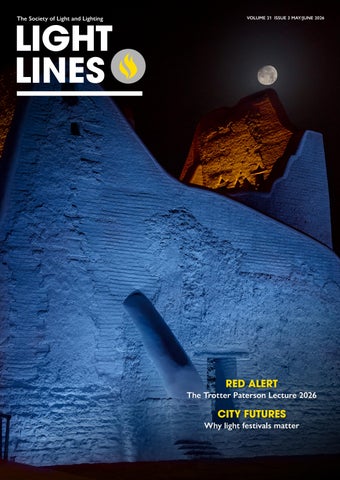
COVER: At-Turaif, the 15th-century first capital of Saudi Arabia and Unesco World Heritage site, winner of an Award of Merit at the 2026 IALD Lighting Design Awards (p11). Lighting design by Speirs Major Light Architecture
BUILDING BRIDGES
A new specification suite for wirelessto-DALI gateways was announced at this year's Light + Building in Frankfurt.
BODIES VOICE CONCERN AT SATELLITE DAYLIGHT PROPOSAL
DarkSky International and the Royal Astronomical Society are among bodies expressing concern at a US company's proposal that would dramatically affect the night sky.
Reflect Orbital wants to deploy multiple satellites with inspace mirrors to beam reflected sunlight back to Earth at night. Describing it as 'sunlight on demand', the company says the system could extend daylight for solar farms or illuminate streets at brightness levels more than three times that of the full moon.
The proposal 'would not only have a disastrous impact on the science of astronomy, [but] would also hinder the right of everybody on Earth to enjoy the night sky,' said Dr Robert Massey, deputy executive director at the RAS. 'That is unacceptable.'
'Such illumination would introduce an entirely new source of artificial light at night, with farreaching consequences, including disruption to wildlife and ecosystems that depend on natural cycles of light and dark, as well as serious public safety concerns,' said a statement from DSI.
Once each satellite reaches its 600km-high orbit, it will deploy a giant 18m x 18m mirror to redirect sunlight down to targets of around 5km diameter on Earth. The initial launch of two satellites – potentially this year – would create 0.1 lux brightness for five minutes, comparable to a full moon. The aim is to incrementally launch more satellites over the next nine years, culminating in a staggering total of 50,000-plus satellites by 2035, producing 36,000 lux for hours comparable to daylight or up to 100 lux 24/7 comparable to indoor work areas.
Reflect Orbital's website also advertises other applications such as 'unforgettable' sunlit evenings at 'entertainment venues, corporate events and urban public spaces.' However, it says it would 'maintain strict exclusion zones for astronomy and sensitive environments', and that the light is adjustable (full moon to full noon) and can be turned off (by rotating the satellite).
The proposal has been submitted to the US Federal Communications Commission (FCC), responsible for authorising satellite launches and operations. 'If approved, they would alter the night sky as we know it, with impacts that would be increasingly difficult, if not impossible, to reverse,' said the DSI statement.
One to write home about... the outsize (1.8m) BIC lamp by designer Mario Paroli for Italian brand Seletti.
At 12 times the size, it replicates the ubiquitous 1950 Bic Cristal ballpoint by Italian-French manufacturer and Bic cofounder Marcel Bich. Unchanged in 80 years, the design is in the collections of New York's MoMA and the Pompidou.
The wall, floor and pendant luminaires come in classic black, blue or red with
matching colour cord. The transparent hexagonal shaft features a 22W LED tube (2400lm, 3000K). Ink-credible. seletti.it
satellite illustration)
It can act as the link between classic DALI installations and wireless standards Bluetooth NLC and Zigbee. The gateways pave the way for improved integration with smart building ecosystems, according to Paul Drosihn, general manager of the DALI Alliance.
'They not only facilitate the integration of lighting controls into building networks, they also enable access to comprehensive operating, energy and diagnostic data from D4i luminaires – a decisive step toward intelligent, data-driven lighting systems,' says Drosihn.
GREEN PAPERS
At the heart of this year’s Recolight Circular Lighting conference, supported by the SLL, is Vision 2040: Restructuring the lighting sector, where the keynote speaker will 'imagine a world beyond the take-make-use-waste model'.
Following the keynote presentation, delegates can choose from six specially curated sessions. They will feature practical case studies demonstrating how fittings can be reused at scale, a scrutiny of whether EPDS is fit for purpose, and a materials masterclass, offering a deep dive into materials innovation.
Other topics are alternatives to Cat A, a showcase of sustainable luminaires, and a look at the stand-out lighting schemes of 2026, revealing what sustainable design looks like in practice.
Circular Lighting 26 takes place on 8 October at the Minster Building, City of London
RED SHIFT
p Li fe evolved over billions of years under broad spectrum sunlight – a driver of evolution but also establishing a link between sunlight and life in the maintenance of physiological function
Are LEDs leading to premature ageing – and could our evolutionary need for red light mean a return to incandescent? Prof Glen Jeffery, specialist in mitochondrial infrared (MIR), explored these implications in the latest Trotter Paterson Lecture
Life evolved over billions of years under broad spectrum sunlight of around 300-2500nm. This was not only a driver of evolution but also established a relationship between sunlight and life in the maintenance of physiological function. This includes patterns of metabolism, immunity and ageing, and their homeostatic regulation.
Additionally for humans it played a significant role in our evolutionary footprint over the past five million years or so from our origins in the African Great Rift Valley, close to the equator, where sunlight was stable with little seasonal or daily change in daylight or its length.
While migration of present-day humans out of Africa around 70,000 years ago represented a challenge to this light pattern, it was partly ameliorated because humans had already developed the controlled use of fire, which as a black body source was like sunlight.
Likewise, much further along the history of human development, the adoption of the Edison light bulb toward the end of the 19th century again provided an additional black body source with a wide sunlight-like spectrum.
This changed radically at the end of the last century with the development of the lightemitting diode (LED), which only produced light that was visible to the human eye (400-700nm), removing more than 90 per cent of the solar spectrum. But these were highly energy efficient light sources and won the developers the Nobel Prize for physics.
In the built environment we now spend more than 90 per cent of our lives largely under LED illumination. This highly restricted spectrum of light has never previously been experienced by life across evolution and there are consequences for human health from this dramatic shift in light exposure. These consequences reside mainly in our mitochondria.
Mitochondria are organelles present in every cell, often in their thousands. They evolved around 1.7 billion years ago from primitive bacteria and essentially have the same function across life forms. They convert glucose and oxygen to produce adenosine triphosphate (ATP), which is the energy that runs much of our metabolism. We make our own weight in ATP each day.
'The LED only produces light visible to the human eye, removing more than 90 per cent of the solar spectrum'
SLL Trotter Paterson
EMitochondria also control ageing and cell death, and influence inflammation. They are key players in many aspects of human health, and they act as a community across the body, signalling systemic changes in disparate tissues in response to local events1
Critically, mitochondria respond to light differentially. In the normal solar spectrum, there is a balance between long and shorter wavelengths, but this balance has been shifted with the introduction of LEDs and mitochondria have responded to this to our detriment.
'There are consequences for human health from this dramatic shift in light exposure. These reside mainly in our mitochondria'
There are two spectral ranges that mitochondria respond to. The first is in the shorter wavelength range that is at the lower end of human visual sensitivity, between 420450nm in the Soret band. This is often a significant component of LED lighting that also lacks infrared components. These wavelengths are absorbed by mitochondrial porphyrin resulting in reduced respiration and production of harmful reactive oxygen singlets even at environmental levels2
When animals are exposed exclusively or predominantly to these shorter wavelengths over time, mitochondrial function declines and, as such, they require less glucose from the blood and hence blood sugars become unstable. Consequently, animals gain weight rapidly and inflammatory markers in the blood shift. They also show behaviour signs that are consistent with low-level chronic inflammation3
Current research is also showing in mice that these wavelengths are associated with fatty liver development and abnormal sperm morphology, as sperm are mitochondrial rich. Similar shifts in blood glucose can be found in humans with a prediabetic shift following blue light exposure.
Interestingly, NASA published a study revealing that the generally fit astronauts on the international space station were becoming prediabetic and showed signs of premature ageing. Their environment was illuminated with hard white LEDs to which they were exposed for months4. There are also clear changes in human heart rate and blood pressure that are the results of exposures to light in the Soret5. Critically, in shorter-lived animals,
exposure to these wavelengths reduces lifespan and damages the brain6
The second spectral range to impact on mitochondria is the near-infrared and infrared range (IR 670-900nm), which are wavelengths absent from standard LEDs. These wavelengths improve electron transport in mitochondrial respiration that results in an increase in ATP production and a reduction in systemic inflammation 7,8
Also, they can penetrate deeply and can be measured passing through the human body. Mitochondria regulate the pace of ageing and themselves decline with age.
Hence, exposure to IR can be significant to improve general physiology in an ageing population.
As a significant proportion of ATP is used to maintain membrane potentials widely in the nervous system, it would be predicted that IR exposure should have widespread effects, which is the case. There have been multiple experiments showing beneficial effects of such exposure in a highly conserved pattern across species, although many of these sit on the back of environments where LEDs form the background lighting and hence provide significant spaces for general improvement.
Longer wavelengths exposure in shortlived animals extends mean lifespan and aged mobility, significantly reducing midlife deaths8. In these animals they also improve aged cognitive function9. Across species including humans there are improvements in visual function from infrared exposures10
The importance of the balance of long and shorter wavelengths in human visual performance can be seen when standard incandescent lights that have an extended IR spectrum are introduced to a windowless LED illuminated environment. Here there is a significant and sustained improvement in human colour vision11
It would be of value to know whether this would be the case had the subjects come from work environments in the open where they are exposed to broad spectrum sunlight. This has yet to be revealed.
Consistent with improved mitochondrial performance, IR exposure reduces human blood sugar levels, potentially avoiding the development of diabetes12. It has also been shown to be effective widely in human health when challenged, including during Covid, where hospitalised patients are generally under LED lighting13. However, there are also specific mitochondrial diseases where IR wavelengths have provided marked improvement.
p Human cell showing mitochondria
Here, Parkinson’s disease stands out as a disease with a specific mitochondrial basis and where in experimental models IR exposure has provided marked improvement. However, in cases of pathology, IR exposure commonly requires early intervention14
The spectrum of light in the built environment has changed radically and there is now strong evidence that it undermines public health primarily by its impact on mitochondrial function. This will be marked in the vulnerable and elderly. It has long been known that hospital patients with beds by windows recover faster, although this is unlikely to be true in modern hospital environments with LED lighting and IR-blocking windows.
The impact of reduced IR exposure is likely to be slow and may only be truly recognised in longer-term epidemiological studies. However, it is very clear that all-cause mortality is significantly greater in those who spend less time in daylight and more time in the built environment, which should be a warning flag15
What are the routes out of this problem? IR wavelengths can be added to standard LED lighting, which does improve function. However, it is far from ideal as much better results are found with incandescent lighting with its smooth extended spectral output11
Aligning multiple LEDs to try and create this has so far proved unsuccessful. Further, using IR LEDs has limitations because there is a biphasic response where after consistent use improving effects drop off unless the energy level applied is very low16. To date we do not know how much IR is needed.
An alternative is to accept incandescent light but not in its original form. If incandescent lights are run at low power the visible light declines much faster than the IR component and the
REFERENCES
units have an extended lifespan. Hence if the minimum IR level can be established, the return of incandescent lighting, albeit in a different form, might be acceptable.
Professor Glen Jeffery, is professor of neuroscience at the Institute of Ophthalmology, University College London. His Trotter Paterson Lecture, The Importance of the Unseen, was given at the Darwin Lecture Theatre, UCL, on 14 April
1 Lane N (2006) Power, sex, suicide. Mitochondria and the meaning of life. Oxford University
2 Kaynezhad P et al (2022) Near infrared spectroscopy reveals instability in retinal mitochondrial metabolism and haemodynamics with blue light exposure at environmental levels. J Biophotonics e202100283. doi: 10.1002/jbio.202100283.3
3 Al-Hussaini H et al (2025) Impact of short wavelength light exposure on body weight, mobility and anxiety like behaviour and cytokine expression. Scientific Reports doi: 10.1038/s41598-025-89081-2
4 da Silveira W et al (2020) Comprehensive multi-omics analysis reveals mitochondrial stress as a central biological hub for space flight. Cell 183, 11851201.e20. DOI: 10.1016/j.cell.2020.11.002
5 Stern M (2018) Blue light exposure decreases systolic blood pressure, arterial stiffness and improves endothelial function in humans. European J Preventive Cardiology 25. doi.org/10.1177/204748731880007
6 Nash T et al (2019) Daily blue-light exposure shortens lifespan and causes brain neurodegeneration in Drosophila. Aging. doi.org/10.1038/s41514-019-0038-6
7 Kokkinopoulos I et al (2013) Age-related retinal inflammation is reduced by 670nm light via increased mitochondrial membrane potential. Neurobiology of Aging 34,2 602-609.
8 Begum R et al (2015) Near-infrared light increases AT, extends lifespan and improves mobility in aged Drosophila melanogaster. Biology Letters. doi: 10.1098/ rsbl.2015.0073.
9 Weinrich T et al (2017) Improving mitochondrial function significantly reduces metabolic, visual, motor and cognitive decline in aged Drosophila melanogaster Neurobiol Aging 60. DOI: 10.1016/j.neurobiolaging.2017.08.016
10 Shinhmar H et al (2021) Weeklong improved colour contrast sensitivity after single 670nm exposures associated with enhanced mitochondrial function. Scientific Reports DOI: 10.1038/s41598-021-02311-1
11 Barrett E and Jeffery G (2026) LED lighting (350-650nm) undermines human visual performance unless supplemented by wider spectra (400-1500nm) like day light. Scientific Reports doi.org/10.1038/s41598-026-35389-6
12 Powner M and Jeffery G (2024) Light stimulation of mitochondria reduces blood glucose levels. J Biophotonics 10.1002/jbio.202300521.
13 de Matos B et al (2021) Photobiomodulation therapy as a possible new approach in COVID-19: A Systematic Review. Life doi.org/10.3390/life11060580
14 Darlot E et al (2016) Near infra-red light is neuroprotective in a monkey model of Parkinson Disease. Ann Neurol 79 DOI: 10.1002/ana.24542
15 Weller r (2024) Sunlight: time for a rethink. J Invest Dermatol. 144 doi: 10.1016/j.jid.2023.12.027.
16 De Ridder D et al (2026) Transcranial photobiomodulation for neuromodulation of brain disorders: A perspective. Neuromodualtion DOI: 10.1016/j.neurom.2025.12.006.
p Outcomes of mitochondrial dysfunction
p Functions of mitochondria
SEALING THE CITY’S FETE
The closure of Lumiere Durham is not just the end of a festival, says Rodrigo Barbosa of the LUCI Association. It is a signal
In November 2025, the Lumiere Festival in Durham (UK) took place for the last time – a decision shaped by rising costs and shifting public funding priorities.
In nine editions across 16 years, the festival transformed the historic city of Durham into a temporary open-air gallery, bringing contemporary light art into public space and attracting hundreds of thousands of visitors.
Organised by Artichoke and curated under
the artistic direction of Helen Marriage, Lumiere became one of Europe’s most recognised light festivals – not only for its scale, but for the quality of its artistic vision, its relationship with place, and its deep connection to local communities.
Its closure is not just the end of a festival. It is a signal.
At a moment when many cities are facing increasing financial pressure, competing priorities and rising demands on public budgets,
cultural events – even highly successful ones – are becoming fragile. Lumiere Durham’s final edition reminds us that light festivals cannot be taken for granted. They need to be understood, valued and defended for what they truly bring to cities.
Light festivals are often discussed in terms of visitor numbers, hotel nights, or economic return. These metrics matter – and in many contexts they are necessary. But they are not sufficient.
p Field of Colour by Nicholas Elias, Vivid Sydney 2013. Top right: Heron by Jon Voss on the River Wear at Lumiere Durham 2017
As was discussed during LUCI’s Light Festival Working Group meeting in Lyon in December, cities across Europe and beyond are increasingly realising that the main value of light festivals lies beyond the purely economic layer. Light festivals do many things for a city:
● They create moments of collective experience in public space
● They foster a sense of belonging, pride and shared identity
● They make culture accessible, free and inclusive
● They support artistic creation, experimentation and local talent development
● They reshape how citizens and visitors perceive their city – emotionally, socially and symbolically
In Durham, Lumiere was not simply a visitor attraction. It became part of the city’s identity. It allowed residents to rediscover familiar streets, landmarks and public spaces through art. It brought people together across generations and social backgrounds. It positioned Durham internationally as a place of creativity, culture and openness.
The festival ‘has sparked joy and conversation… transforming the city into a place where light, art and community have come together,’ said Helen Marriage, artistic director of Artichoke and long-time driving
force behind Lumiere, in her recent article for The Guardian.
These impacts are real, but they are often invisible in traditional evaluation frameworks. The challenge is that what is not measured is not protected.
One of the central conclusions of the Lyon discussion was clear: light festivals are vulnerable not because they lack value, but because their value is not always made visible in ways that speak to decision-makers.
Economic impact studies are often the first – and sometimes the only – form of justification available. Yet many of the most meaningful contributions of festivals are social, cultural, educational and symbolic:
● strengthening social cohesion
● improving the perceived quality of life
● supporting wellbeing through joy, beauty and shared experiences
● building long-term cultural ecosystems and skills
● contributing to the city’s image, attractiveness and international profile
When these dimensions are not documented, articulated and communicated, festivals become easy targets in times of constraint. They appear as optional, decorative, or expendable – rather than as strategic investments in urban life.
Lumiere Durham’s closure illustrates this
risk. Even a highly respected, internationally recognised festival can disappear if its full value is not structurally embedded in how a city understands and supports culture.
This is why LUCI considers the end of Lumiere Durham not only as a moment of reflection, but as a call to action. Cities, organisers, cultural institutions and networks share a responsibility to:
‘Festivals are easy targets in times of constraint. They appear as optional, decorative, or expendable rather than as strategic investments in urban life’
p Facade projection at 195 Piccadilly (BAFTA HQ) by NOVAK (UK), Lumiere London 2016
p Elephantastic! by Catherine Garret of Topla, Lumiere London 2016
● better articulate what light festivals do for cities
● develop more robust ways of assessing their social and cultural impacts
● share stories, methods and evidence across the network
● build stronger narratives that connect festivals to long-term urban strategies
During LUCI’s Light Festival Working Group meeting in Lyon, cities expressed a strong interest in working together on this: aligning impact questions, sharing evaluation approaches, learning from different models, and building a common language around value – not only return.
The goal is not to compete or rank festivals, but to strengthen them collectively. To ensure that smaller or younger festivals can draw on the experience of more established ones. To ensure that decision-makers can see festivals not as costs, but as contributors to resilience, identity and quality of life.
Lumiere Durham may be ending, but what it represents should not. It represents
a belief that public space can be a place of wonder, encounter and imagination. That cities need moments of lightness, joy and beauty – especially in difficult times. That culture is not an accessory to urban life, but one of its foundations.
If we want light festivals to continue playing this role, we must be clearer, stronger and more strategic in how we talk about them, evaluate them and support them.
Let’s not let the lights go out – not in Durham, and not elsewhere. Let’s make sure that what light festivals bring to cities is seen, understood and valued for what it truly is.
This article first appeared on the LUCI website. Founded in 2002, LUCI 'brings together local authorities worldwide that sustainably use light as a tool for social, cultural and economic development'. The body also has associated members from other areas of urban lighting including the lighting industry, design agencies, light artists, light festival organisers and research institutes. www.luciassociation.org
p Ovo, by Koert Vermeulen, at the 2012 Amsterdam Light Festival
p Top: Jacques Rival's I Love Durham installation put a traditional statue into a 'snow dome' with pink neon. Above: also at Durham Lumiere in 2011, fish lanterns in a community parade that opened the festival
DIVINE INTERVENTION
This year’s winner of the IALD Radiance Award has been described as the pinnacle of what the lighting profession can achieve
This year’s IALD Radiance Award for Excellence went to Licht Kunst Licht (LKL) for what judges described as its ‘transformative’ exterior lighting of Cologne Cathedral, Germany, a Unesco World Heritage Site since 1996. The project was an exemplar of breakthrough heritage conservation techniques, they said, reducing energy consumption and light pollution by
substantial margins while revealing 50 per cent more architectural detail than the previous system.
‘The lighting design for Cologne Cathedral represents the pinnacle of what our profession can achieve,’ said IALD Awards co-chair Colin Ball. ‘This project demonstrates how contemporary lighting technology can enhance both the spiritual presence and civic identity of a historic monument while meeting modern sustainability standards.’
The first lighting scheme for the building was installed in 1838 when the cathedral was still incomplete – despite having been started six centuries before – honouring the visit of Crown Prince Friedrich Wilhelm. Eventually completed, it wasn’t illuminated until 1929, when Mayor Konrad Adenauer (later Chancellor of West Germany) ordered
a regular lighting system and the cathedral’s distinctive twin towers became a feature of the city’s night-time skyline.
The spiritual and secular significance of this image was underlined in the summer of 2022, when the lighting of public buildings, including the cathedral, was turned off at night due to the energy crisis caused by Russia’s invasion of Ukraine. By that time, however, LKL was already developing a sustainable lighting system, sending a small anticipatory signal in 2020 with the installation of the Star of Bethlehem on top of the crossing tower.
Up to that point, the cathedral had primarily been lit with floodlights mounted on the roofs of surrounding buildings. The outdated and more energy profligate 1000W metal halide lamps flooded the building in bright neutral white light, washing out the architectural
‘Energy consumption of the new system has been reduced by 80 per cent while delivering superior visual quality’
Sustainability was a top priority throughout the entire planning process. The energy consumption of the new system has been reduced by 80 per cent to 11,000W while delivering superior visual quality.
All new lighting measures are easily dismantled and non-invasive, respecting both the architecture and the cathedral’s heritage. All elements are mounted using custom clamping systems developed by LKL and the cathedral workshop, using lead-padded brackets to distribute pressure and protect the historic structure.
The luminaires can be individually or collectively operated to create custom lighting scenes, orchestrated from two control centres, one at ground level and one in the crossing tower, as well as remotely. Directional and grazing light, with their interplay of shadows, emphasises the spatial depth and the soaring structure of the cathedral’s buttresses, pinnacles and figures that converge into its ornate facade.
details of the facade and creating considerable light pollution. For LKL, following the principle of treating light as an integral part of architecture, this approach was a particular challenge, explains Philipp Schmitz, lighting designer and project lead at LKL.
‘We conducted years of extensive on-site lighting tests – experimenting with optics, angles and positions’
‘The lack of detailed architectural documentation required an extensive analytical study of the facade and Gothic elements,’ he says. ‘Because digital simulations were insufficient for such a complex, heterogeneous structure, we conducted years of extensive onsite lighting tests – experimenting with optics, angles and positions to achieve the desired effects through empirical observation.’
Closely cooperating with the Dombauhütte (the Cologne cathedral workshop) and power company RheinEnergie as the commissioning body, LKL developed a lighting system comprising more than 700 LED luminaires. The compact, glare-free units were installed with great precision on or in front of the historic structure, discreetly placed and virtually invisible during the day.
The result is that only 10 per cent of the light now comes from fixtures located away from the building compared to 80 per cent previously. This significantly reduces unwanted light scatter and improves overall precision. The lighting is fully dimmable, and the colour temperature can be adjusted to a warm white (up to 2700K), complementing the sandstone’s colour, and supporting seasonal adaptation and evolving environmental standards.
Special attention was also given to the iconic 157m towers, according to LKL. Gentle backlighting combined with vertical grazing light traces the contours of the structure up to the spires. ‘A new approach is the lighting installed inside the towers, which shines through the delicate Gothic tracery and establishes the cathedral as a steadfast beacon in Cologne’s night-time cityscape,’ says Schmitz.
For the installation on the cathedral plaza, all stakeholders collaborated on the development of minimalist, multifunctional stainless-steel lighting poles designed to blend discreetly into the urban landscape. For orientation, integrated glare-free lighting modules illuminate the areas directly in front of entrances and the cathedral portals, while additional spotlights highlight selected facade elements. All light sources are shielded to prevent glare and preserve key sightlines.
‘Cologne Cathedral is a landmark of the city and deeply embedded in its identity,’ says Schmitz. ‘Our goal was to preserve its visual presence after nightfall and to make its architectural richness visible even from afar. We’re proud that the result now reveals the cathedral’s form and detail, even from the opposite side of the Rhine, giving it a sculptural, dignified night-time presence that does justice to its significance.’
The 43rd annual IALD International Lighting Design Awards took place during Light + Building in Frankfurt on 10 March
p Directional and gr azing light, with their interplay of shadows, em phasises the spatial depth and the soaring structure of the ornate facade
Project: Al Mujadilah Centre and Mosque in Doha, Qatar
Lighting design: Buro Happold
Architect: Diller Scofidio + Renfro
The lighting concept for the first purpose-built contemporary mosque designed specifically for women in the Muslim world draws on Islamic tradition, where light serves as a metaphor for spiritual guidance.
It centres on the dynamic qualities of daylight filtered through nearly 6000 conical skylight perforations embedded in the building's signature undulating roof. These small apertures, wider at the ceiling than at the rooftop to minimise heat gain from Qatar's intense sun, create a diffuse, ethereal luminosity throughout the 874sqm prayer hall. As daylight fades, dynamic white LED fixtures integrated into the roof apertures seamlessly continue the same quality of ambient light, ensuring visual and spiritual continuity.
The Qibla Wall, which extends away from the roof plane and directs worshippers toward Mecca, is bathed in focused daylight through a dedicated skylight at the mihrab niche, identifying it as the primary architectural and religious focal point.
'The LEED Gold-certified project demonstrates how lighting can honour tradition while elevating women's role in Muslim society,' commented the judging panel.
Project: Public areas and rooms, Grand Hyatt Kunming, China
Lighting design: The Flaming Beacon/Isometrix for the Grand
The lighting concept creates a series of distinct experiences throughout the hotel's public spaces, each telling a story connected to the region's heritage. Instead of decorative elements, light quality, shadow and carefully considered colour moments are used to evoke the spirit of place.
The 10m-high arrival hall features an illuminated parabolic ceiling that references the traditional rice fields of Yunnan, where the sky's reflection in water-filled terraces has been a defining visual element of the landscape for centuries. This sets the tone for the entire property, using light to create a sense of place that is both grand and intimately connected to the local culture.
Throughout the hotel, the lighting design uses shadow play as a key storytelling element, particularly in the ballroom, which honours the traditional practice of cliff honey collecting. The reception hall draws inspiration from Yunnan's copper-mining heritage, with warm metallic tones that create a rich, welcoming atmosphere. Colour is used with restraint, limited to woven bamboo reflectors at guestroom entries programmed to represent Yunnan's colourful seasons.
At-Turaif Diriyah, Saudi Arabia
Lighting design: Speirs Major Light Architecture
BAPS Hindu Mandir, Abu Dhabi, United Arab Emirates
Lighting design: Studio Lumen (pictured above)
Chongqing Science Hall, Chongqing, China
Lighting design: Beijing Pro
Lighting Design
Desert Rock Resort, Saudi Arabia
Lighting design: Delta Lighting Design
Four Seasons Tamarindo, Costalegre de Jalisco, México
Iain Carlile selects two very diverse topics – video game design and the effect of lighting on moths – from the latest papers in Lighting Research and Technology
Kafili’s paper attempts to identify theoretical and practical connections between the fields of video-game design and architectural design. He observes that as video games have become a popular medium for architectural visualisation, there is a growing need for knowledge transfer from video-game design to architecture.
With advancements in Global Illumination (GI) mathematical models for the simulation of light behaviour within physical environments, a compelling sense of realism can be created and can be used to create effective atmospheres.
With architectural design expanding into digital worlds, providing capacity for spatial exploration, the evolving GI models offer designers, of both the built environment and video games, new opportunities for cross-discipline innovation,
as well as the creation of new tools to create experiential and spatially resonant environments.
Kafili proposes future directions of research to include physically based rendering and physically based shading.
Examining the effects of light pollution on nocturnal insects, Andersson and Jägerbrand’s paper presents a study into the impact of light-induced attraction on the abundance, richness and diversity of moths between grassland and forest ecosystems.
An experiment was conducted using sight traps set up across 32 different sites in grassland and forest environments south of Stockholm. The light source integrated into the light trap was 3000K LED lighting in accordance with the upper CCT for urban environments, as recommended by Swedish road lighting guidelines.
The lighting was shielded and at low levels to
p Light properties and the use of ray-traced GI (RTGI) to create a hyper-realistic render. Arrows illustrate the initial directional light rays and demonstrate how, through computational simulation, they reflect and scatter in a scene to generate effects such as surface glossiness, caustics and colour bleeding (D Kafili)
simulate light spill from road lighting in natural environments. Vertical illuminance measurements were recorded at different heights and distances from the trap, and varied from 4 lux at 1m high and 0.5m from the trap, to less than 0.3 lux at heights between 0.5m and 2m at a distance of 2m from the light source.
This comprehensive light characterisation, which the authors note is rarely conducted in moth attraction studies, confirmed that light influence was localised and did not spread extensively through the surrounding space.
The traps were mounted one to two hours before sunset, with one forest site and one grassland site being sampled each night. Control traps without a light source were also placed 25m from the light traps.
None of the non-lit control traps caught any moths, confirming that the shielded light sources in the light traps only influenced localised moth behaviour. Traps were visited in the morning and records of moths captured were made, before they were then released.
The results showed that even at the low light levels used, significant impacts on moth activity were recorded. The authors note their concern at this finding due to the limited activity periods of moths. They go on to state that their findings demonstrate the need for ecosystem-specific approaches to light pollution mitigation strategies.
Iain Carlile, FSLL, is a past president of the SLL and a senior associate at dpa lighting consultants
Lighting Research and Technology: OnlineFirst
In advance of being published in the print version of Lighting Research and Technology (LR&T), all papers accepted for publishing are available online. SLL members can access these papers on the SLL website (www.sll.org.uk)
Deep Silver and 4A Games
A play of light: A transdisciplinary study of simulated illumination between architecture and videogame design
D Kafili
Ecosystem-specific moth attraction to warm-coloured LED simulating road lighting conditions
P Andersson and AK Jägerbrand
PHYSICAL ACTIVITY
Kate Turley looks at five ways the different qualities of light have been exploited in modern technologies
Afamiliar tale among many lighting designers is that we ‘stumbled into the field of lighting’. My first degree being in geophysics I can wholeheartedly say this resonates with me. Since early university days, I was amused that you could spark a roundtable debate by posing the seemingly simple question, ‘what is light?’
Light behaves both as a wave and a particle, and this discovery paved the way from classical to modern physics. Light has the capacity to bend, split and scatter, and we can observe this in physical phenomena such as rainbows or sunsets. By harnessing these unique properties of light, scientists have been able to develop many of the modern technologies that now define the world we live in. Below are five examples that depend on the behaviour of light to function.
Kate Turley was SLL Young Lighter 2024, examining circadian lighting for dementia sufferers, using luminaires to gather data. She has recently joined CIBSE as a research manager
Digital cameras When light enters the lens of a camera it gets focused on to millions of pixels which contain a semiconducting material. Similarly to the operation of solar panels, the light’s energy frees the electrons which creates a small charge in the pixels which become brighter as more electrons are freed. RGB filters placed over the pixels then allows for the calculation of the amount of light transmitted which can then be combined to reconstruct the original image and create a photograph.
Lasers Light that is monochromatic, phasealigned and directional can form a perfect beam. This is created by a process known as stimulated emission whereby electrons within an atom are purposely excited to higher energy states than their neighbouring electrons, and when they return to their ground state they release energy of a specific wavelength, producing photons (light energy). This then creates an incredibly precise laser that can maintain power over vast distances and is used in a variety of contexts: medical applications (eye surgery, cosmetic lasers), sensing technologies (such as LiDAR, pictured) and barcode scanners.
Solar panels When sunlight hits a cell that has semiconductor properties (such as silicon), electrons escape their atoms and create movement which creates an electric charge. This charge flows directionally and creates electricity that is often inverted to an alternating current for use in households. This phenomenon, where light exchanges its energy with matter, is used to operate calculators, solar panels and large-scale solar farms.
The internet Formed from a network of cables on the seabed the internet allows for the transmission of data across the globe. These cables contain very thin glass strands that allow light to be continually reflected, travelling forward with minimal energy loss. These light signals are sent as pulses which are encoded with data, transmitted via a process of total internal reflection and decoded at the receiving end to deliver the information. It allows us to share information internationally on a colossal scale via video streams and cloud computing.
Quantum technology This is based on the controlled use of single photons. These behave strangely at the singular level, are extremely sensitive and can exist in more than one state at once. Observing the behaviour of a singular photon changes it, which means any attempt at observation is traceable. These properties are therefore harnessed to develop ultra-secure communications as information sent via a single photon, if observed, will change it and flag the attempted hack. Extremely sensitive, quantum sensors can also detect extremely small signals and are used in subsurface exploration, medical imaging and navigation systems.
For details of all upcoming webinars, go to: www.cibse.org/society-oflight-and-lighting-sll/sll-events/upcoming-webinars-and-online-content
For previously recorded CPD webinars (including regional webinars), go to: https://www.cibse.org/get-involved/societies/society-of-light-andlighting-sll/sll-events/on-demand-webinars-past-presentations
EVENTS
FACTFILE LF12: THERMOPLASTIC LIGHTING DIFFUSERS AND FIRE SAFETY IN BUILDINGS
(a #GrowYourKnowledge live webinar organised by the SLL)
Date: 13 May
Time: 12-1pm
Speaker: Richard Caple FSLL, lead author, Thorlux Lighting cibse.org/events/search-events/sll-lf12-thermoplastic-lightingdiffusers-and-fire-safety-in-buildings/
SLL AGM, AWARDS AND PRESIDENTIAL ADDRESS
Date: 14 May
Venue: CIBSE, Saffron Hill, London EC1 cibse.org/events/search-events/sll-agm-awards-presidentialaddress-2026/
IALD ENLIGHTEN EUROPE 2026
Date: 17-19 June
Location: Paris https://iald.org
TECH-X 2026
(organised by the LIA)
Date: 2 July
Venue: Edgbaston Park Hotel and Conference Centre thelia.org.uk/ems-event-calendar/tech-x-2026.html
ICEL Emergency Lighting Conference
Date: 10 September
Venue: Cavendish Conference Centre, London W1 thelia.org.uk/ems-event-calendar/icel-emergency-lightingconference-2026.html
CIRCULAR LIGHTING LIVE 2026
Date: 8 October
Venue: The Minster Building, London EC3 https://circularlighting.live/ LiGHT26
Date: 18–19 November 2026
Venue: Business Design Centre, Islington, London https://www.lightexpo.london/
LET DIPLOMA IN LIGHTING DESIGN
For details and registration: lightingeducationtrust.org