ABORIGINAL ART 2026
1
JOHNNY YUNGUT TJUPURRULA (c.1930-2016)
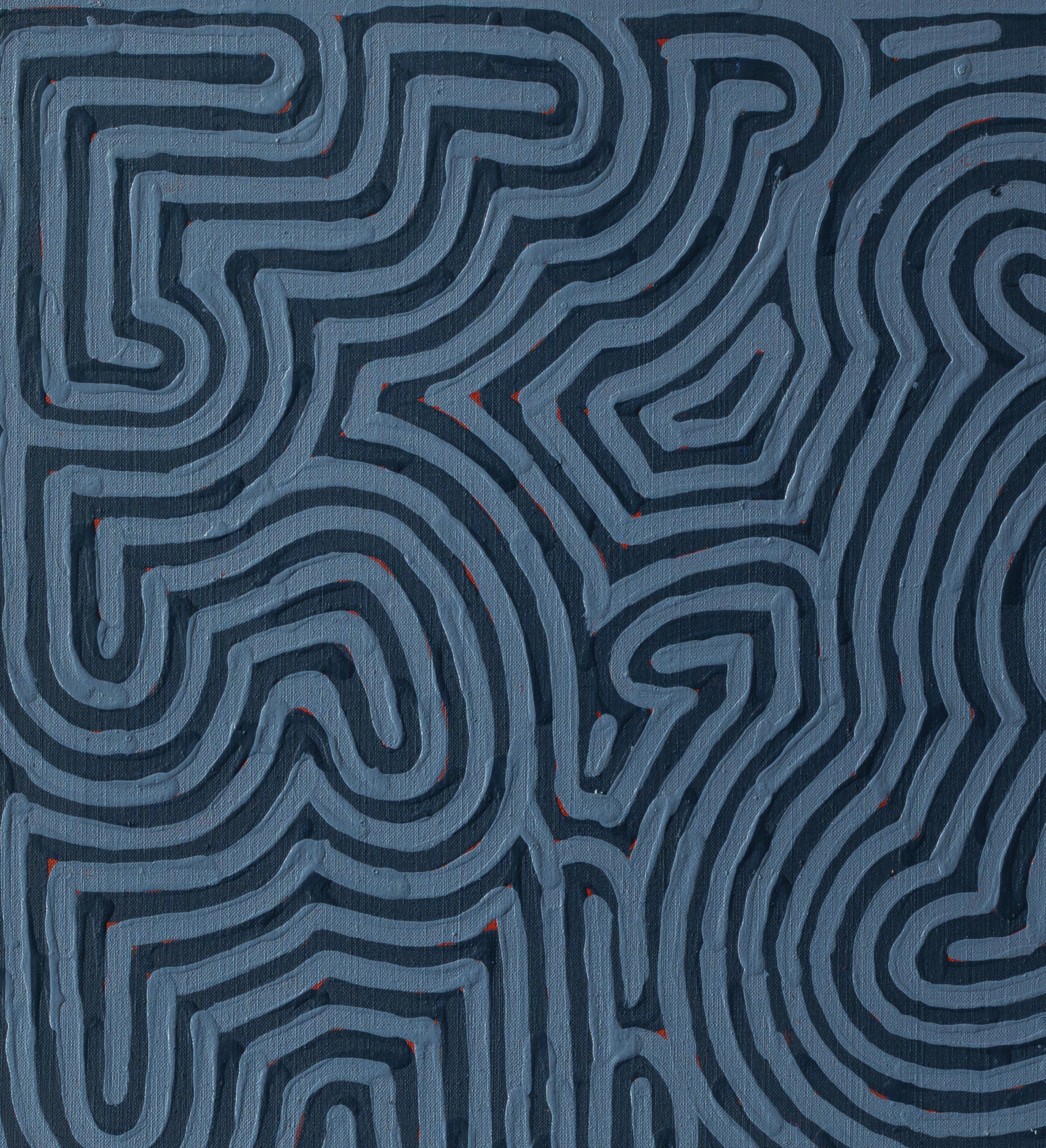
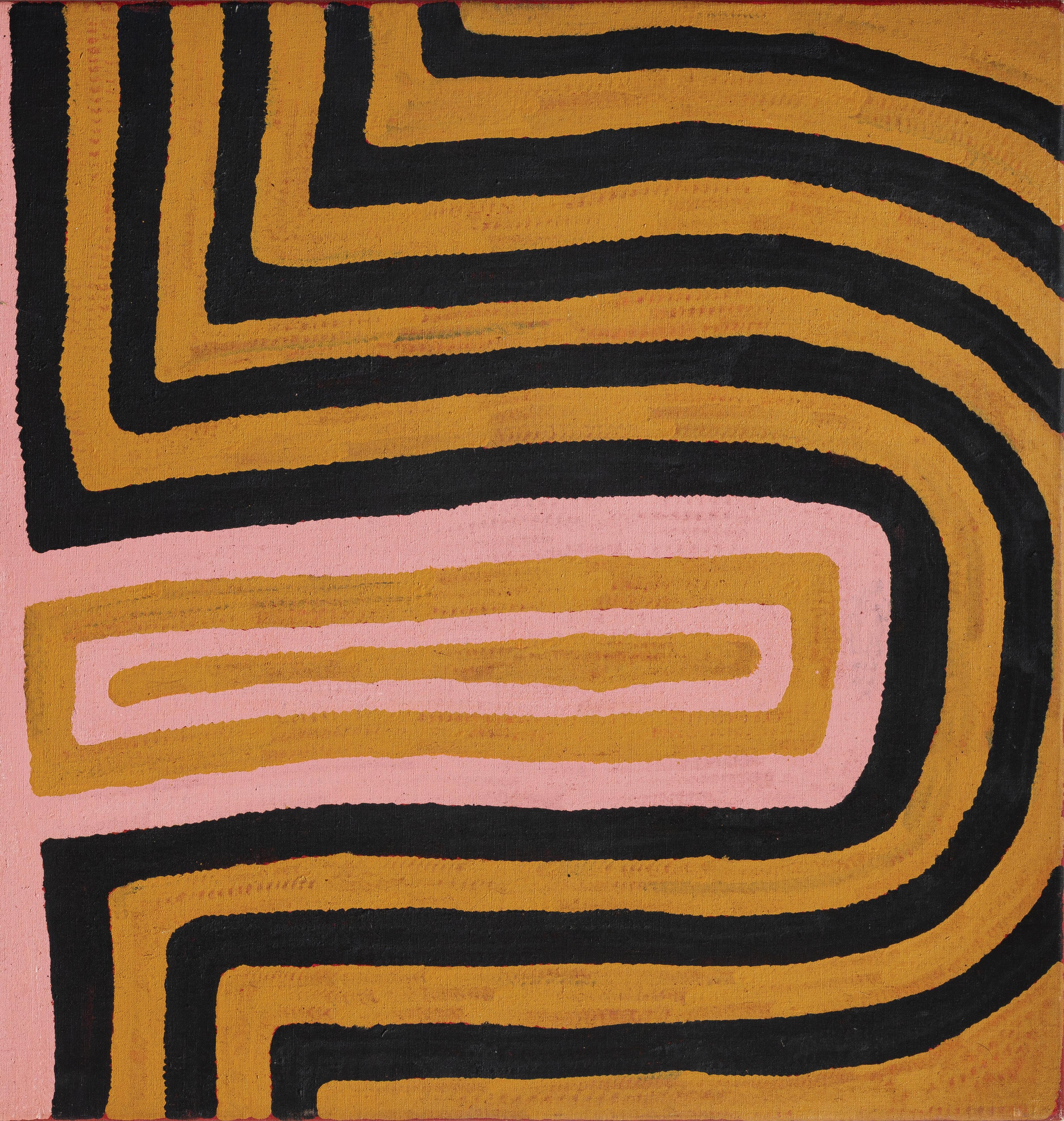
ROCKHOLE SITE OF WILKINKARRA (LAKE MACKAY), 2012
Papunya Tula Artists cat. JY1212065
acrylic on Belgian linen
91 x 46 cm
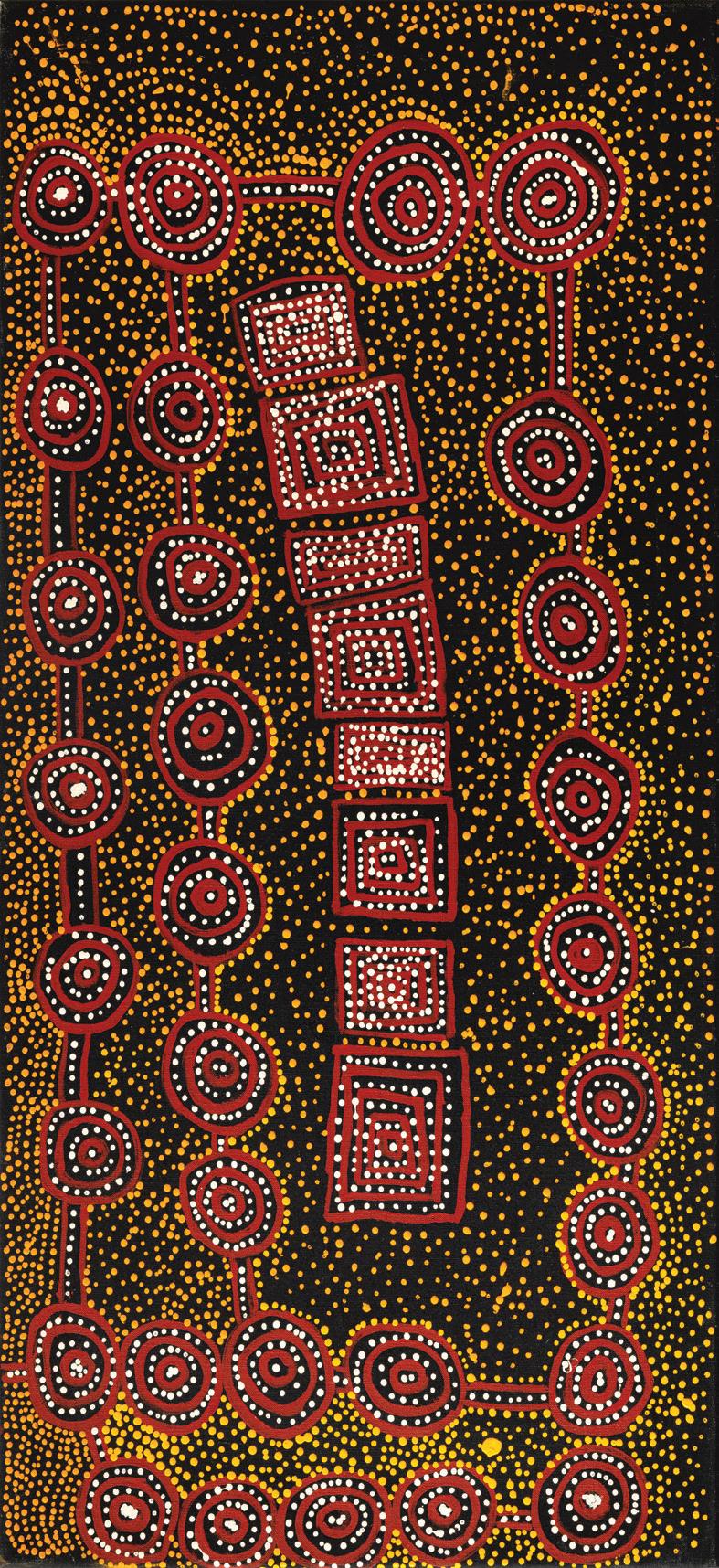
This painting depicts designs associated with the rockhole site of Wilkinkarra (Lake Mackay). In ancestral times a large group of Tingari men came to this site carrying the Fire Dreaming. Once the fire was lit at Wilkinkarra it quickly became out of control and chased the men west towards Kiwirrkura. Wilkinkarra is also associated with Larularunya, a species of snake who had travelled from Mt Wedge to the lake where it escaped the fire by travelling underground to Nyinmi. This snake was assisted in his escape by clouds of water which dampened the full force of the fire...
“Throughout his artistic career Johnny Yungut Tjupurrula has drawn particular inspiration from his birthplace of Tjangimanta, north-east of where the Kiwirrkura Community now stands. Tjupurrula and his extended family lived a nomadic desert existence in this region until, in the early 1950s, they made the long journey north to the mission at Balgo. After a brief stay Tjupurrula and the majority of his family decided to return to live on the fringes of Wilkinkarra (Lake Mackay). After a chance encounter with Donald Thompson at Lappi Lappi rockhole in 1957, Tjupurrula and his travelling party decided to migrate toward the government settlements in the east. The following year they arrived in Haasts Bluff, where Tjupurrula would
marry his second wife, Walangkura Napanangka, and start a family. Soon after, due to overcrowding and the poor water supply, the family relocated to Papunya.
It wasn’t until Tjupurrula had returned to live near his homelands in Walungurru that he began to paint on a regular basis. Under the influence of some of the leading members of the Papunya painting movement he created modest versions of the Tingari theme in a unique palette of muted tones of skin and sand colours. As he began to move between Kiwirrkura and Walungurru his approach to mark-making began to evolve, with irregular rectangles and jagged lines depicting the soakage waters, rockholes and sandhills of his country to the west and north...
An unforeseen intensity appeared in his painted line. This shift in focus has been spawned by his pure desire to paint, the formality of his Tingari styled paintings of the past having given way to a blaze of luminous colour and energy that reveals the immense experiene of this quiet, reserved figure.”
Unique Perspectives: Papunya Tula Artists and the Alice Springs Community , an exhibition at Araluen Arts Centre, 17/11/1216/04/13, jointly published by Araluen Arts Centre and Papunya Tula Artists, p. 62
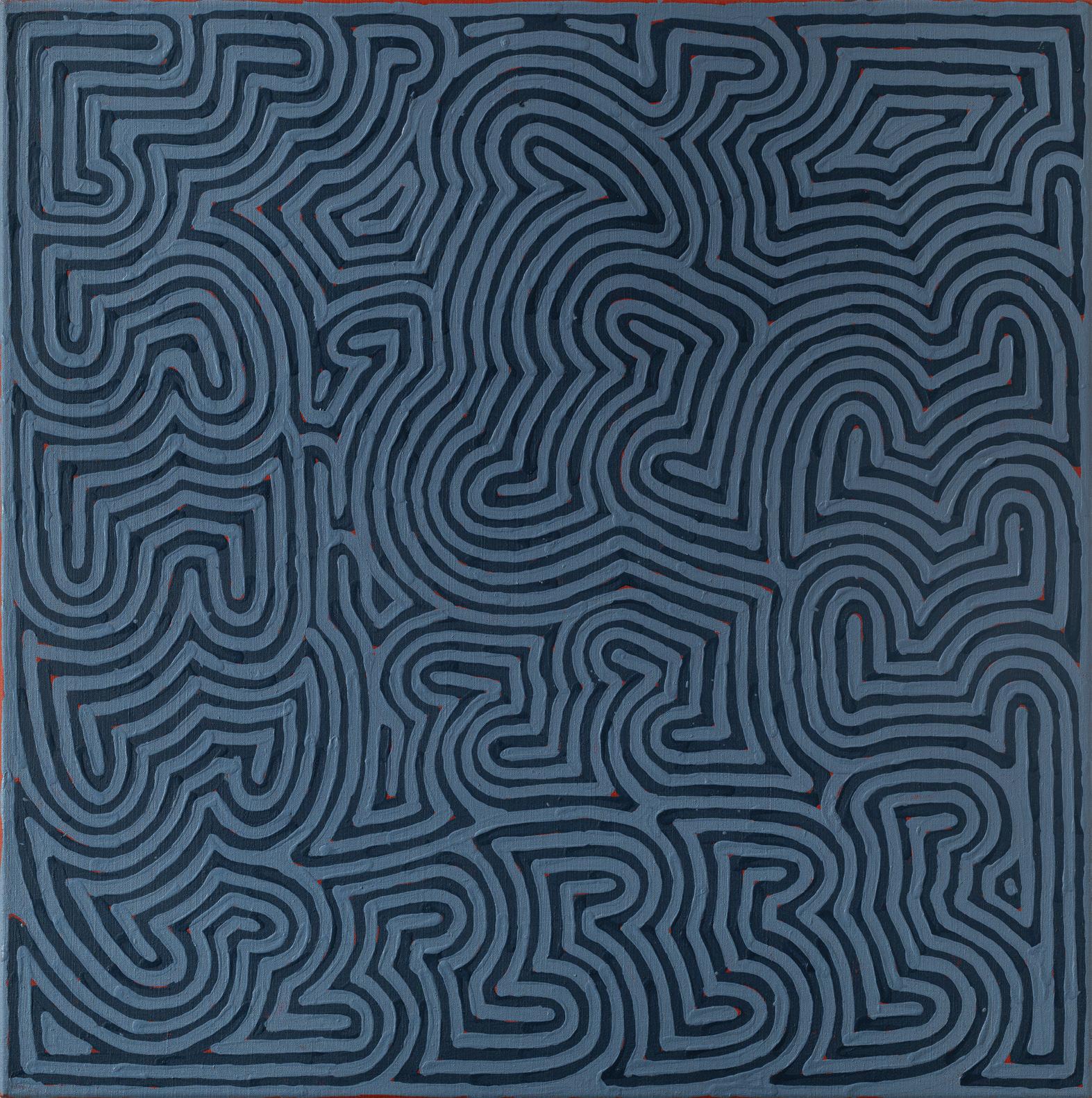
AUBREY TJANGALA (B orn 1974)
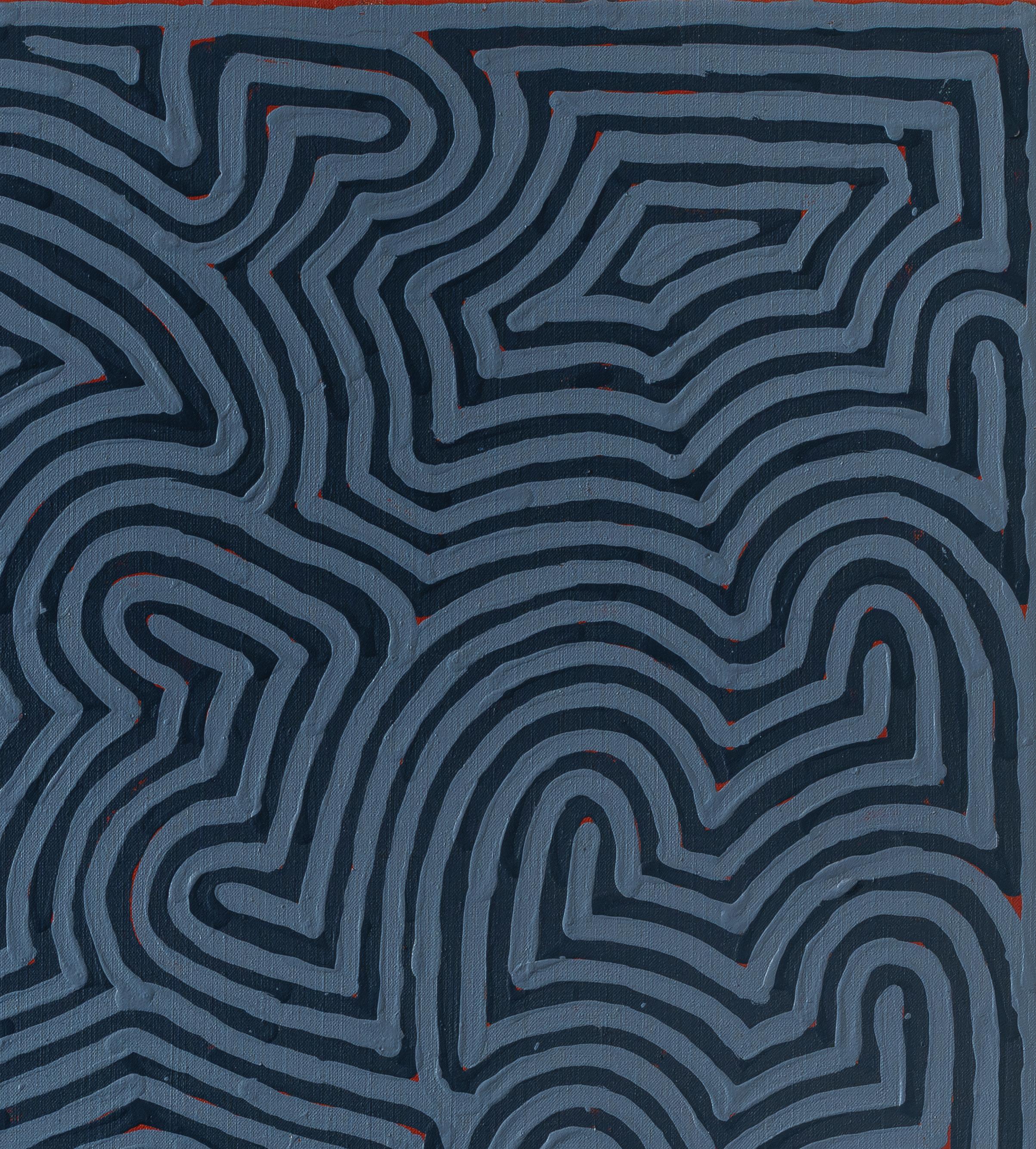
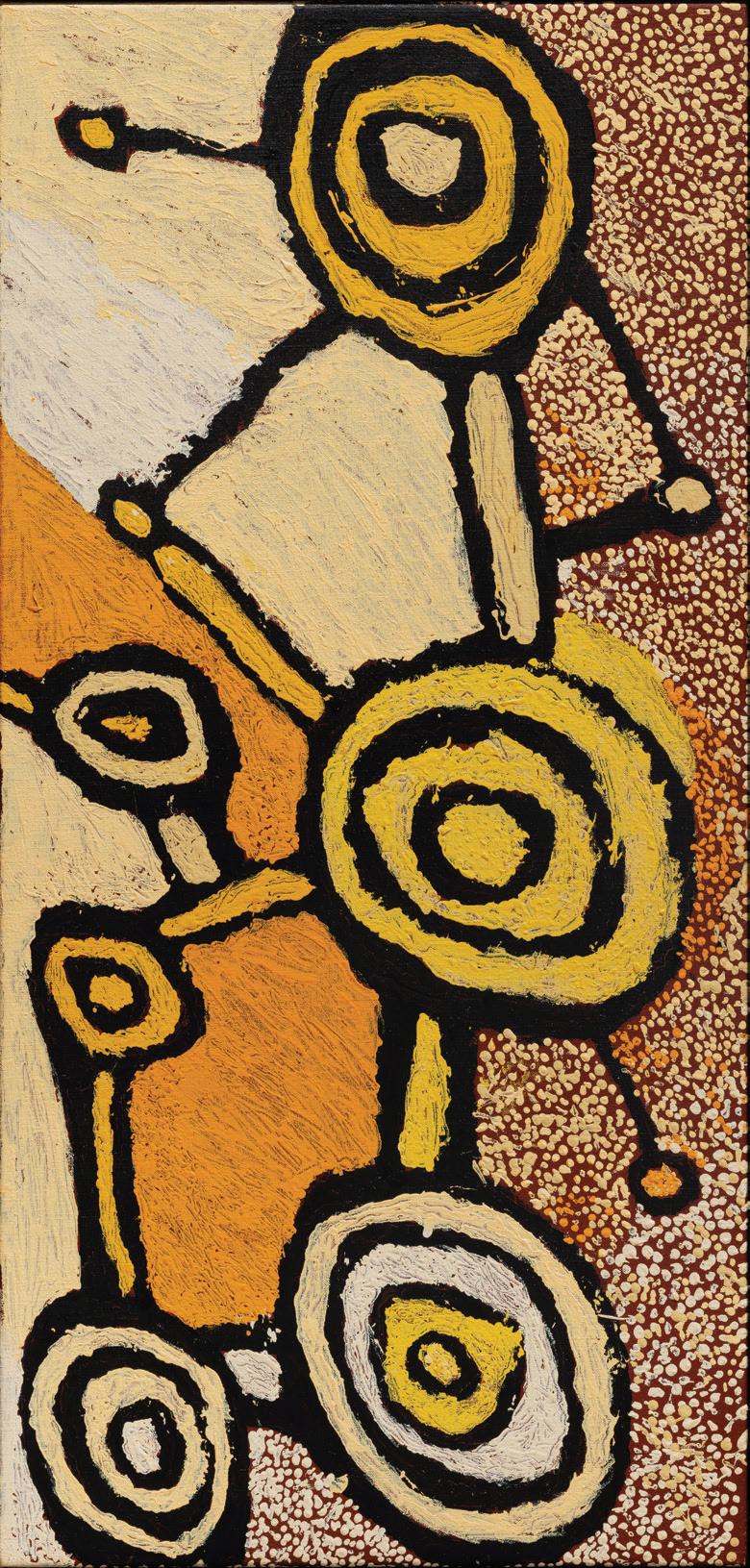
ILKALITA, 2026
Papunya Tula Artists cat. AT2602156
acr ylic on B elgian linen
91 x 91 cm
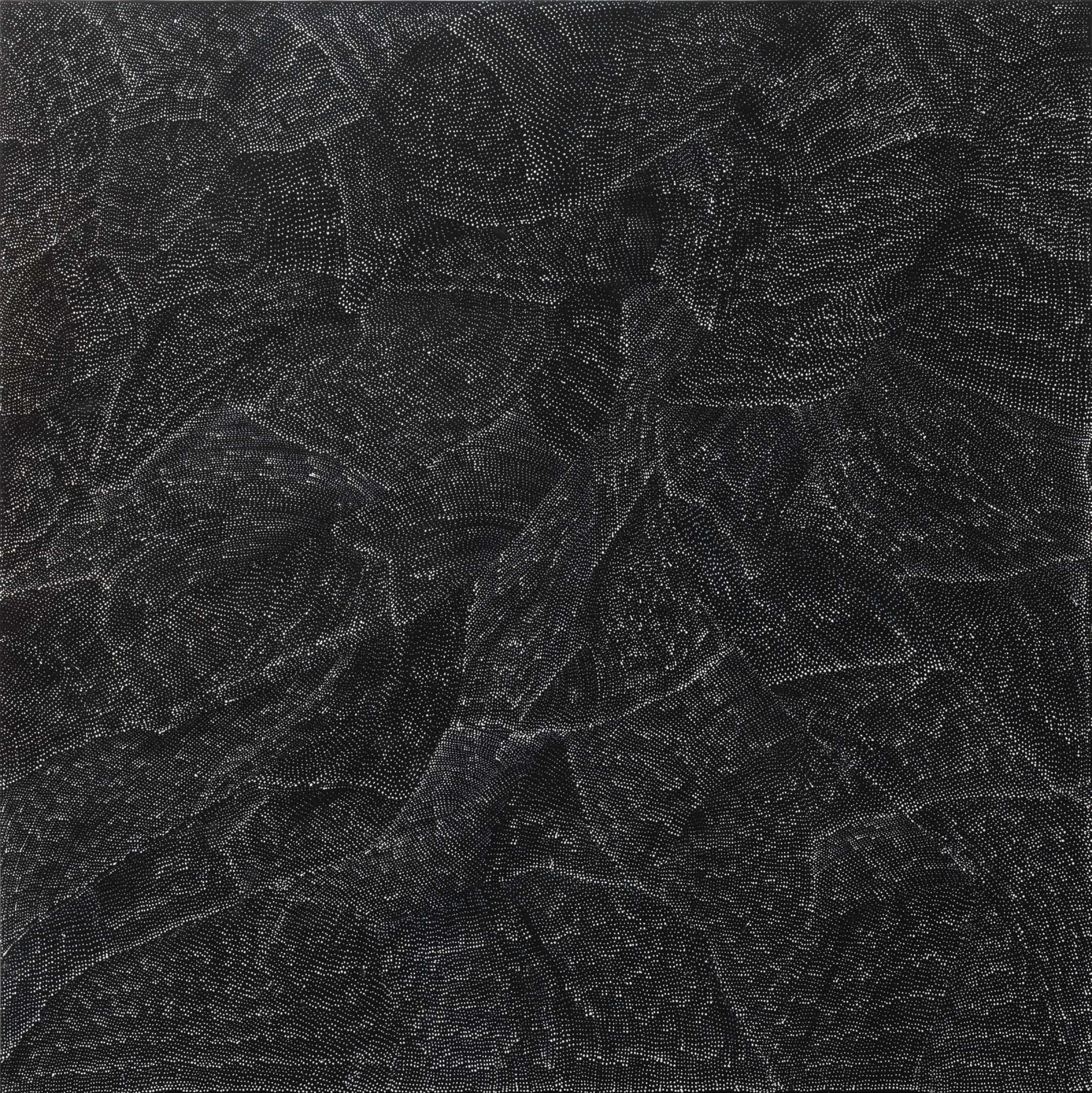
This painting depicts designs associated with the site of Ilkalita, a rockhole situated behind the Men’s Mountain in the area near Kintore Community. This site is also associated with the Tingari song cycle. Since events associated with the Tingari Cycle are of a secret nature no further detail was given...
Aubrey was born on the 11th of February 1974 at the Pintupi outstation of Yayi Yayi, approximately 30km west of Papunya. Yayi Yayi was a temporary settlement set up by the Pintupi people as they began their migration back to their Western Desert homelands from Papunya, where they had earlier been centralised by the government welfare branch. After Kintore Community was established in the early eighties (1980s), he lived for a while on his father’s outstation known as Ininti, which was slightly north-west of the community.
Aubrey went through traditional law in Tjukurla and has since been a permanent resident of Kintore.
Aubrey is the son of the world-renowned painter Ronnie Tjampitjinpa, a shareholder, and former Director of Papunya Tula Artists, and one of the most important and successful artists in the company’s history. His style closely resembles his father’s art, no doubt a result of watching and studying his father’s work for over four decades. Aubrey painted his first works for the company in 2019 and has since become a regular figure in the Kintore studio. As a traditional owner of the country close to Kintore, his paintings refer to the stories central to that area; including the story of the Two Travelling Women, the Perentie Dreaming, and the Fire Dreaming at Wilkinkarra (Lake Mackay).
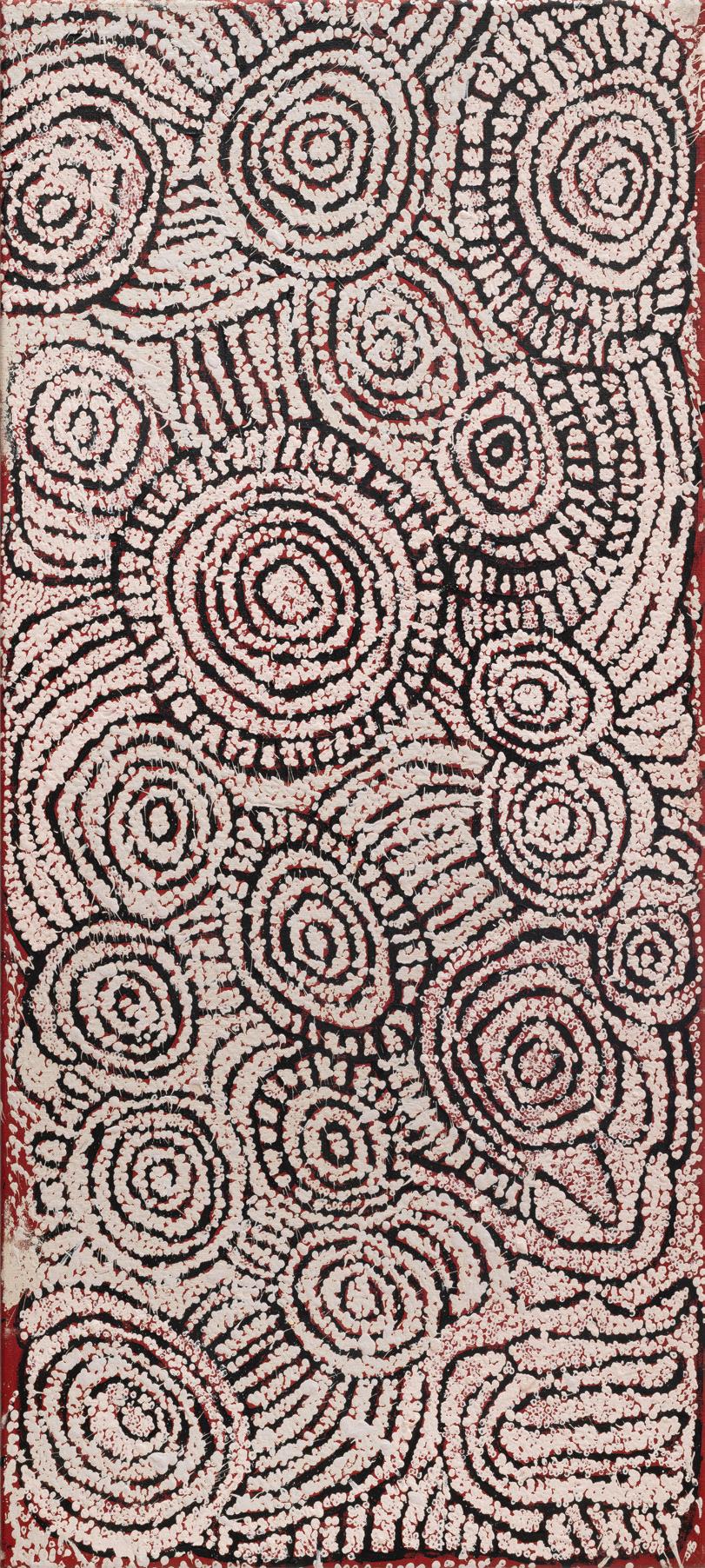
WALANGKURA REID NAPURRULA (c.1935-2004)
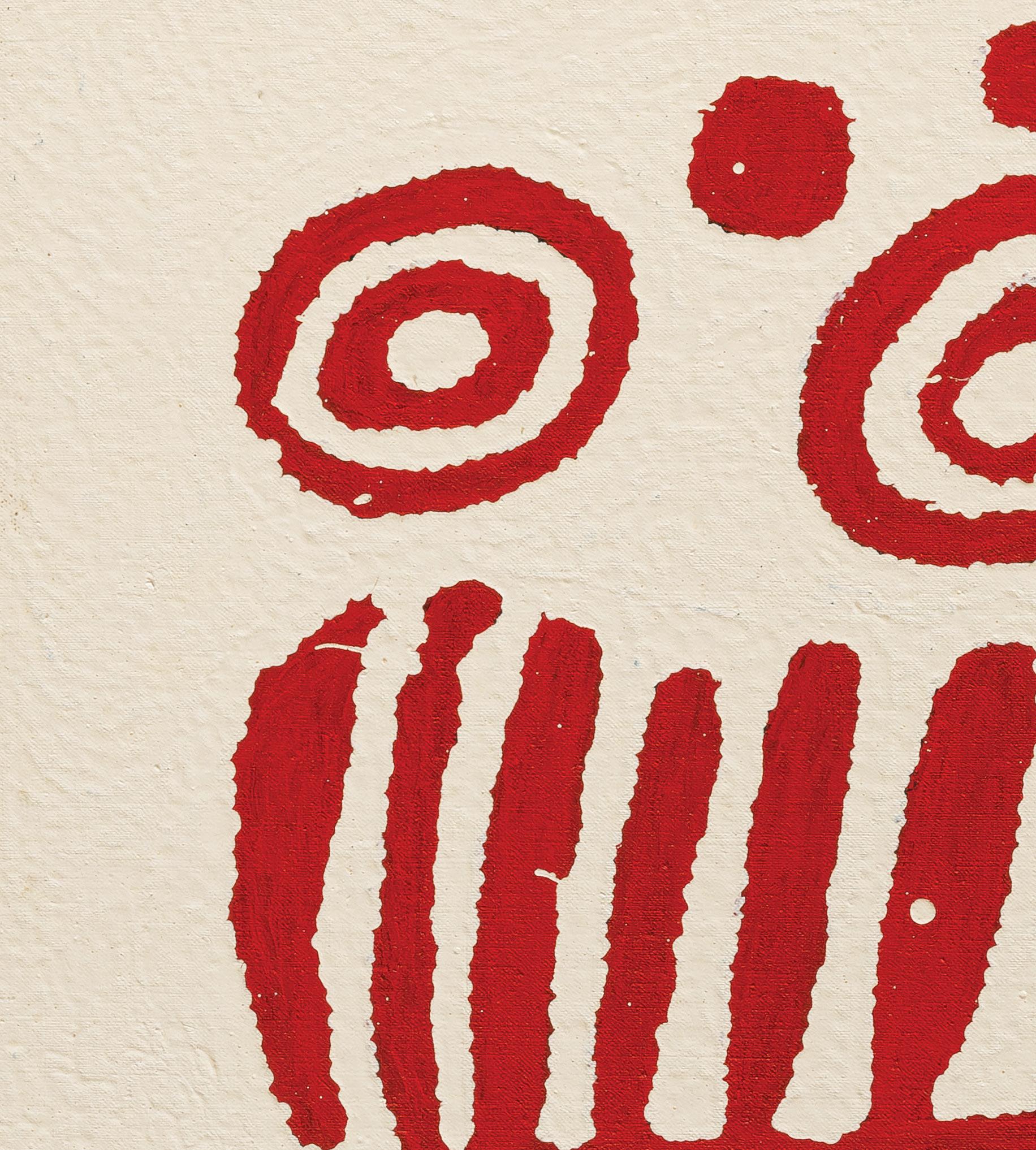
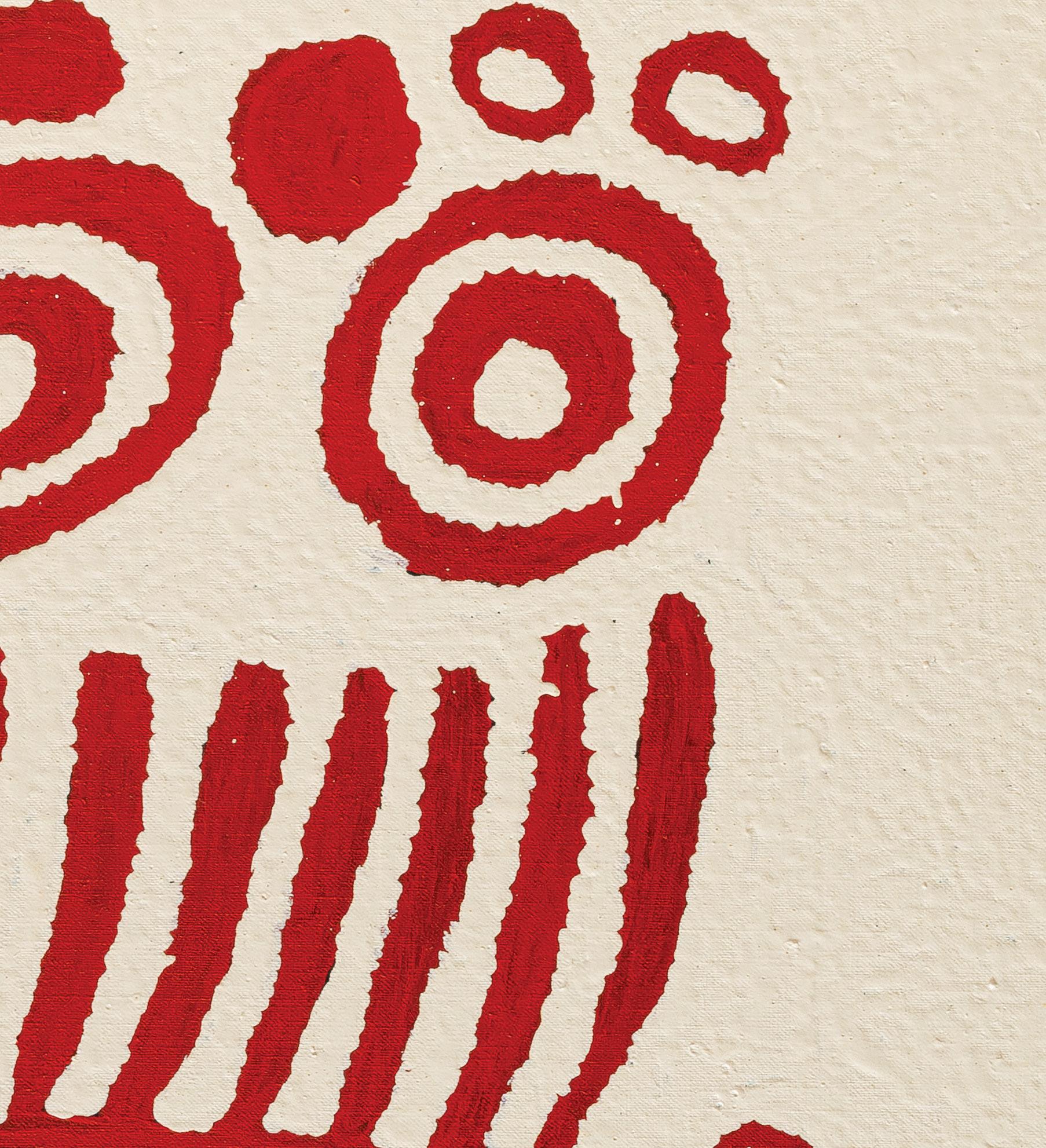
SEVEN SISTERS’ DREAMING, 2002
Papunya Tula Artists cat. WR0206016
acrylic on Belgian linen
122 x 61 cm
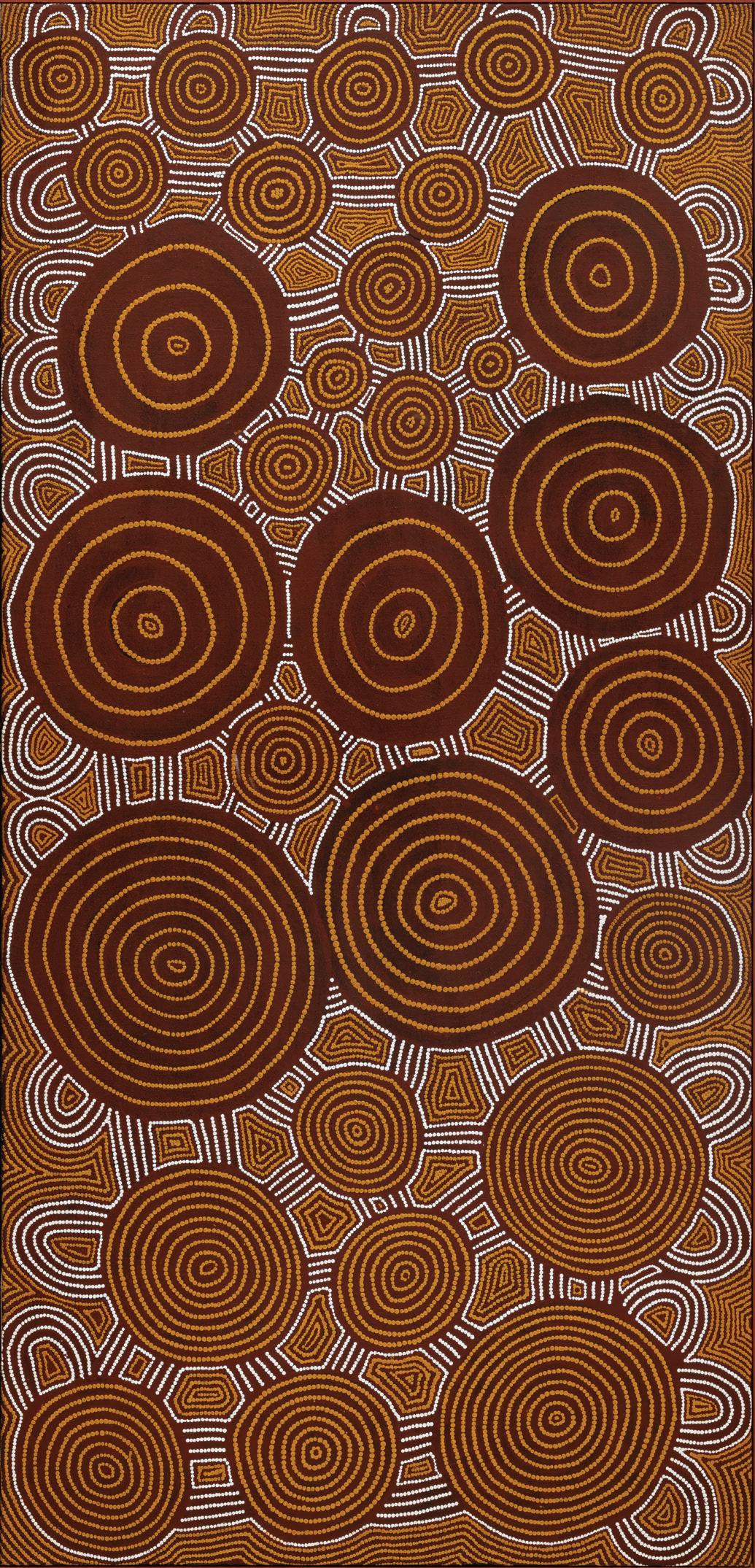
This painting depicts designs associated with the Seven Sisters’ Dreaming at Dale Creek, east of Warakuna, near Giles Weather Station. The roundels represent camp sites of a group of women of the Napaltjarri kinship subsection who were being pursued by a man of the Tjakamarra kinship subsection. The women travelled over quite a distance but managed to keep ahead of him.
“Walangkura’s first contact with kartiya (outsiders) was at the Giles weather station in 1956. She remained in this region until, in 1964, she encountered missionary and patrol officer Walter MacDougall, who then transported Walangkura and her family into Papunya. She lived for most of her life between the communities of Tjukurla and Warakurna, and frequented Walungurru, where her two daughters resided. She settled there more permanently in 1999 and began to paint for Papunya Tula Artists. Her black and white depictions of stories related to the Kungkarangkalpa (Seven Sisters) Dreaming often reference the petroglyphs that adorn rockfaces throughout the Western Desert.”
Unique Perspectives: Papunya Tula Artists and the Alice Springs Community , an exhibition at Araluen Arts Centre, 17/11/12-16/04/13, jointly published by Araluen Arts Centre and Papunya Tula Artists, p. 95
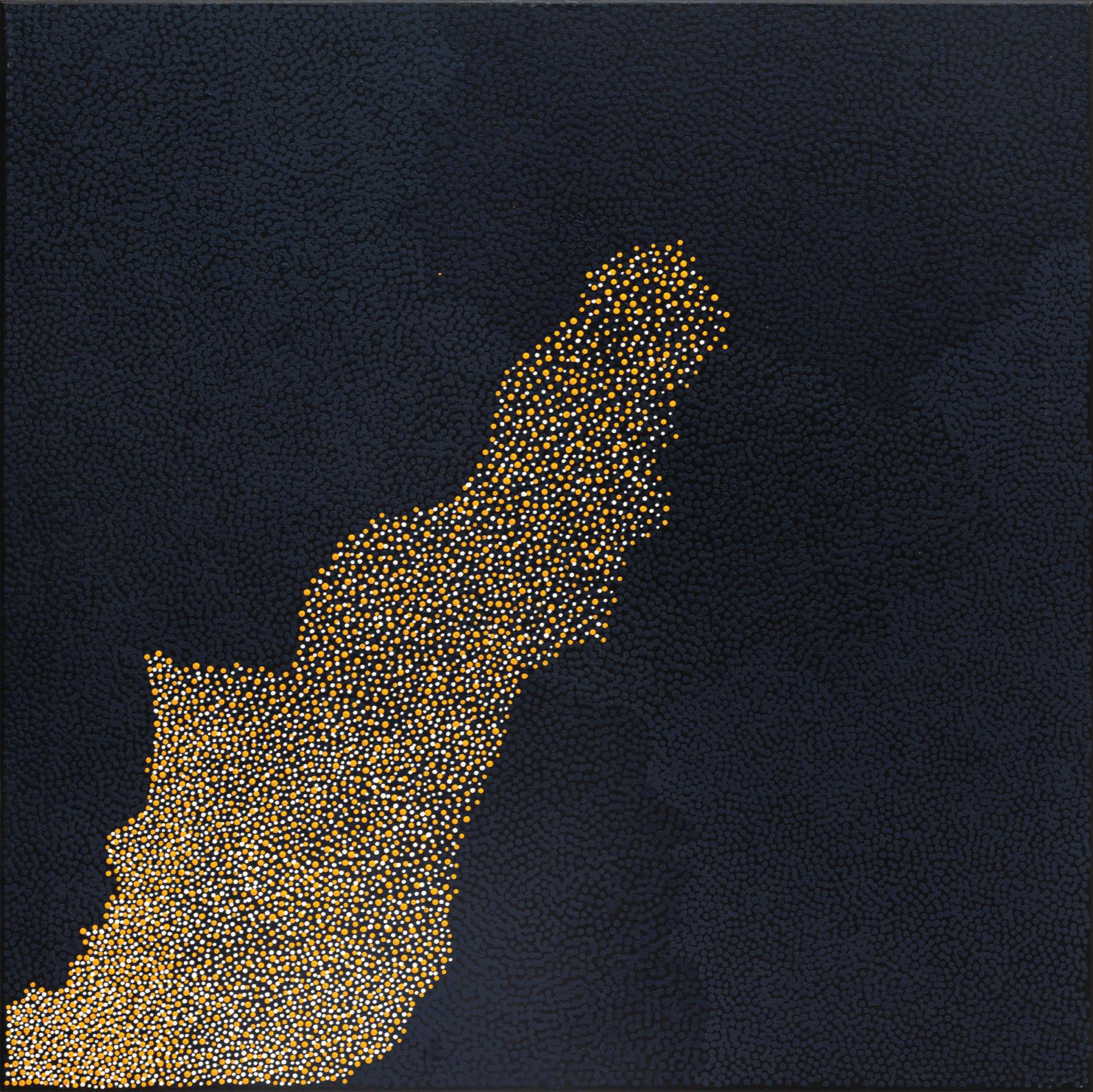
ANGELINA
(MARKS) NUNGURRAYI (Born 1981)
TJUNGINPA (MARSUPIAL MOUSE) DREAMING, 2025
Papunya Tula Artists cat. AM2503110
acrylic on Belgian linen
91 x 91 cm
In this painting the artist has painted one of her late father’s dreamings, the Tjunginpa (Marsupial Mouse) Dreaming at the site of Marnpi to the south of the Kintore Community. The mice were looking for food and water at this site.
Angelina is the daughter of world-renowned artist Mick Namarari Tjapaltjarri and Elizabeth Marks Nakamarra, also an established Papunya Tula artist. She was born at the Alice Springs Hospital in July 1981 and began painting in Kintore in 2000. Angelina has taken over custodial rights for her father’s country around Marnpi south of Kintore, associated with the Tjunginpa Tjukurrpa (Marsupial Mouse Dreaming).
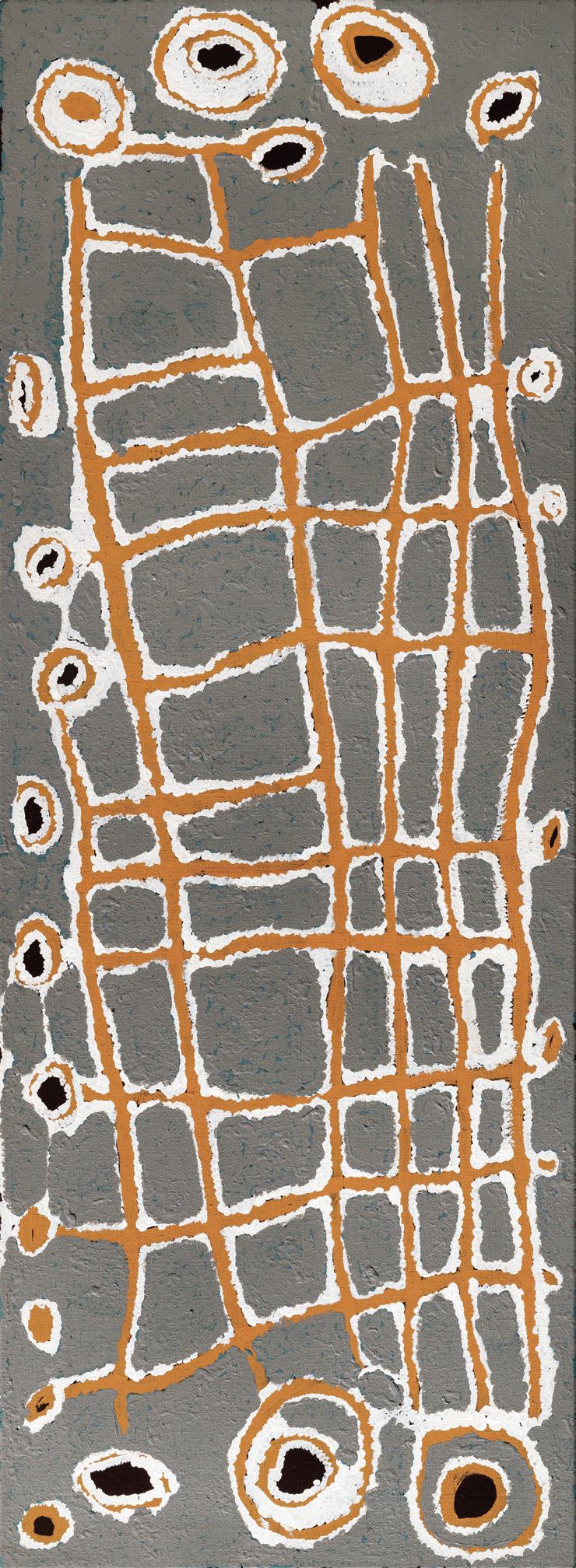
INYUWA NAMPITJINPA (c.1922-1999)
KUTUNGKA NAPANANGKA,
1999
Papunya Tula Artists cat. IN990404
acrylic on Belgian linen
152 x 61 cm 5
PROVENANCE
Papunya Tula Artists, Alice Springs
Kozminsky Galleries, Melbourne
Private collection, Melbourne
This painting depicts designs associated with the travels of an old woman, Kutungka Napanangka. She travelled from Ngartanga, a rockhole site in hills, east of Mt. Webb in Western Australia. She passed through several sites along the way and eventually arrived at the large permanent water site of Muruntji, south-west of the Mt. Liebig Community. This old woman was considered a bit of a dare-devil. While she was resting she was accosted by one of the group of boys. She chased and killed them with the exception of the culprit who managed to escape. She later cooked and ate them.
“Born at Punkilpirri, a large water site south of Tjukula, Inyuwa Nampitjinpa arrived at Haasts Bluff in December 1956 from west of the Kintore Range. Inyuwa began painting in 1994, joining the collaborative
painting project between women artists from Kintore and Haasts Bluff which culminated in the ‘Minyma Tjukurrpa’ exhibition at Tandanya (1995). Inyuwa began painting for Papunya Tula Artists in 1996. Her paintings often depict designs associated with permanent water sites on the route of a group of travelling women, and include references to their utensils and foods gathered. She was the widow of Tutuma Tjapangati, one of the founding members of Papunya Tula Artists. Inyuwa and Tutuma are the parents of Walangkura Napanangka and Pirrmangka Napanangka, who both now paint for Papunya Tula Artists. In 1999 Inyuwa held a solo exhibition at Gallery Gabrielle Pizzi...”
Papunya Tula: Genesis and Genius , published on the occasion of the exhibition, Art Gallery of New South Wales, 18 August12 November 2000, p. 294
6
KANYA TJAPANGATI (c.1951-2006)
TINGARI BODY PAINT DESIGNS FOR KIRRITJINA
NORTH OF JUPITER WELL, 2001
Papunya Tula Artists cat. KT0103238
acrylic on Belgian linen
120 x 90 cm
PROVENANCE
Papunya Tula Artists, Alice Springs
Gallery Gabrielle Pizzi, Melbourne
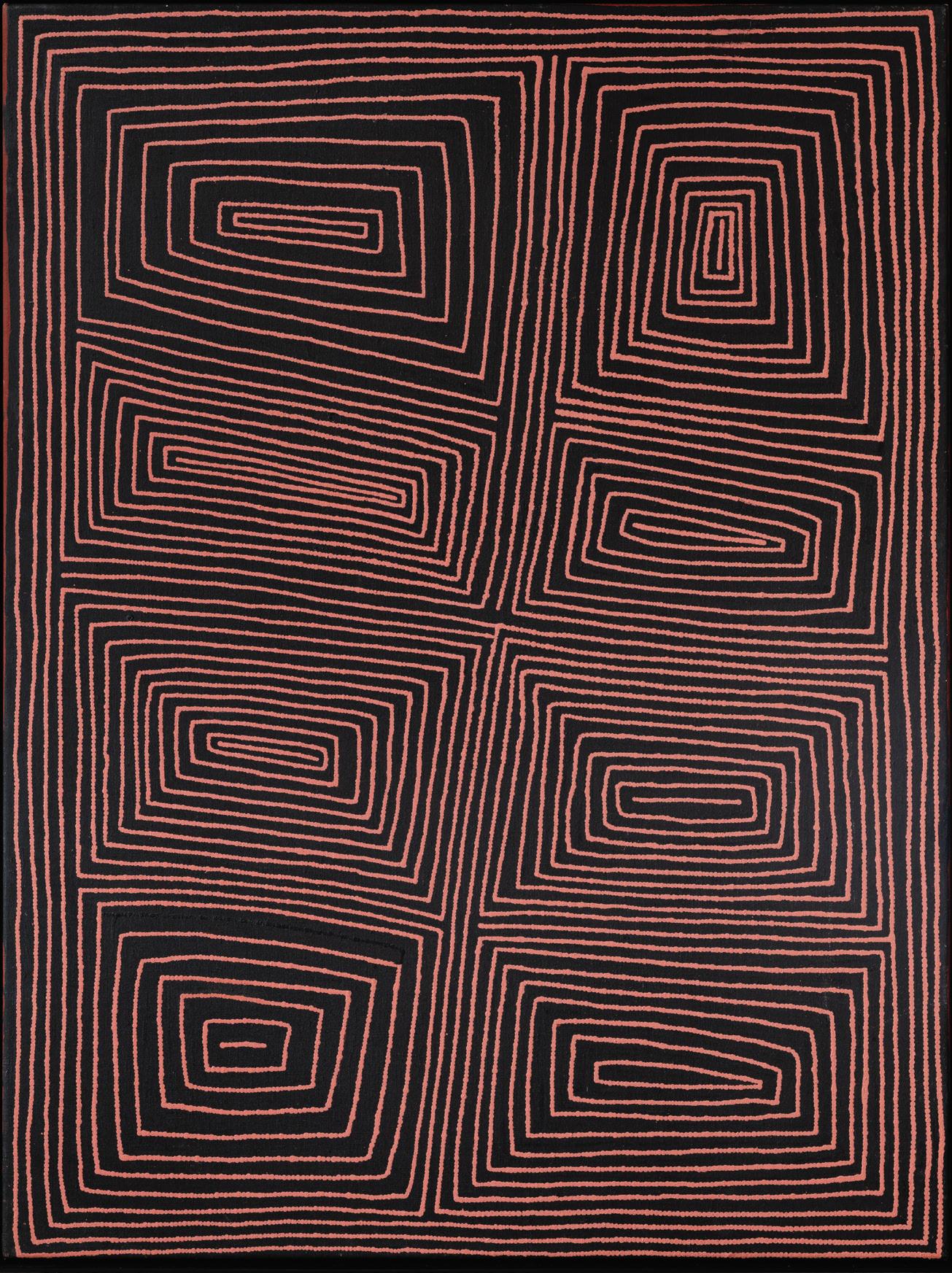
This painting depicts body paint designs associated with Tingari Ceremonies at the large rockhole site of Kirritjina, north of Jupiter Well. In mythological times a large group of Tingari Men camped at this site before travelling east to Kiwirrkura and then north-east to Lake Mackay...
Kanya was born at the site of Pamatjatunya, which is west of the Jupiter Well area in Western Australia. His father has three wives and was the older brother of Pinta Pinta Tjapanangka. Charlie Tjapangati and Nanyuma Napangati are also closely related to Kanya, sharing the same father but different mothers. He travelled into Papunya with Jeremy Long by truck on one of the last government patrols in the area. Kanya commenced painting for Papunya Tula Artists in 1981 and in 1999 contributed to Kiwirrkura men’s painting as part of the Western Desert Dialysis Appeal.
7
PATRICK TJUNGURRAYI (1935-2017)
MUMPANGA ROCKHOLE, 1999
Papunya Tula Artists cat. PT9905158
acrylic on Belgian linen
168 x 45 cm
PROVENANCE
Papunya Tula Artists, Alice Springs
Private collection, Melbourne
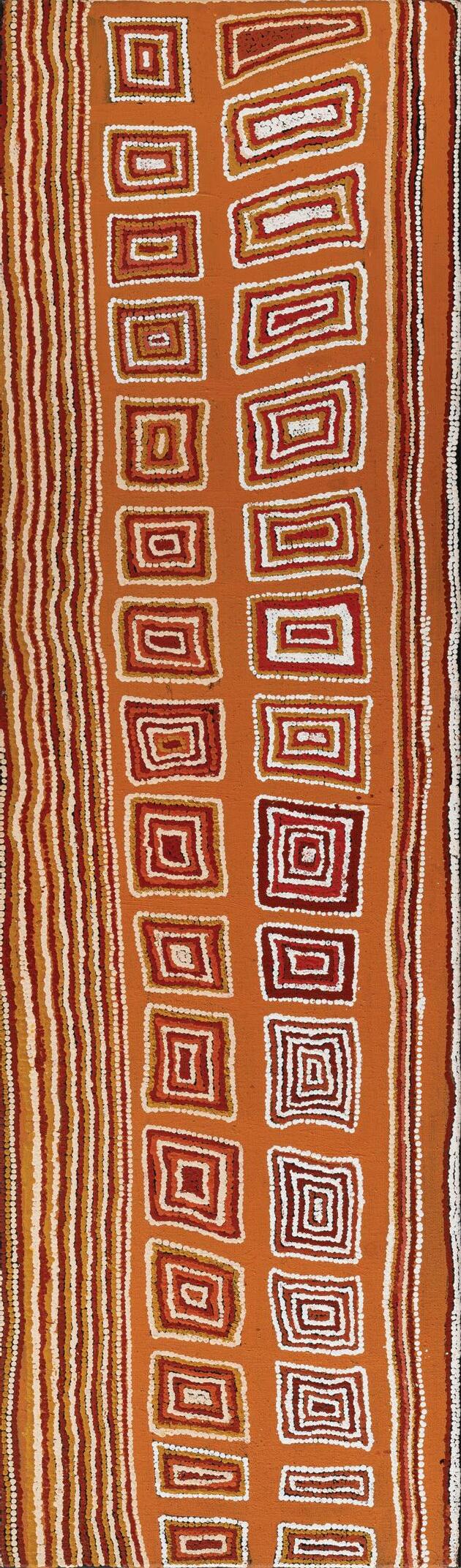
This painitng depicts the site of Mumpanga, a rockhole surrounded by Mulga trees, west of Jupiter Well. In mythological times a large group of Tingari Men camped at this site before continuing their travels further west...
“... During the late 1990s, Patrick refined his vision, tweaking and turning designs into increasingly powerful paintings. This process coincided with a decreased use of differnet pigments. Brown, black, yellow, white. These were enough. His paintings from this time reveal an artist focussed on the formal challenge of his craft, on structure and composition, on how, by controlling the canvas he could also make it sing...”
Carty, J., Patrick Tjungurrayi: Beyond Borders , 2015, p. 62
GEORGE TJUNGURRAYI (Born c.1947)
MARRAPINTI, 1999
Papunya Tula Artists cat. GT9909117
acrylic on Belgian linen
122 x 122 cm
PROVENANCE
Papunya Tula Artists, Alice Springs
Scott Livesey Art Dealer, Melbourne
Private collection, Melbourne
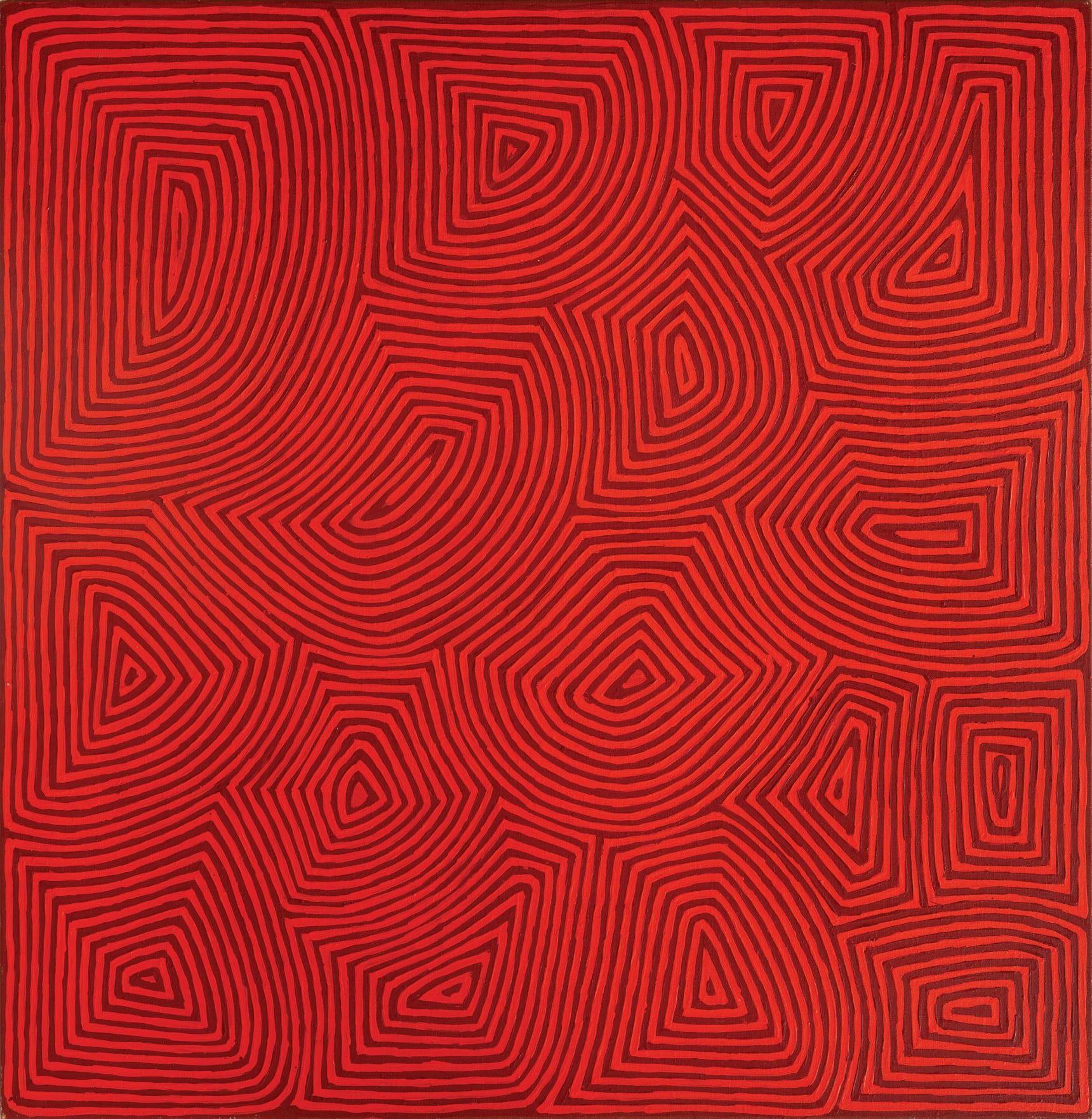
This painting depicts designs associated with the travels of a group of Tingari Women from the rockhole and soakage water site of Marrapinti, west of the Kiwirrkura Community. The women had been performing the dances associated with the area. They travelled east stopping at Ngaminya and the rockhole site of Wirrulnga, east of the Kiwirrkura Community, before continuing their travels further east to Umari, east of Mt. Webb.
“George Tjungurrayi was born in the vicinity of Kiwirrkura and came in from the desert by the way of Mount Doreen and Yuendumu. In 1962 he accompanied Jeremy Long on a patrol out west. He began painting in West Camp, Papunya in about 1976.
He has painted at different locations since then, including Yayayi and Mount Liebig, and now at Walungurru.
In recent times his development of a disinctive style based on optical stripes has bought his work to prominence. George’s work was exhibited in ‘Friendly Country - Friendly People’ at the Araluen Arts Centre, Alice Springs (1990). He held his first solo exhibition in 1997 at Utopia Art Sydney.”
Papunya Tula: Genesis and Genius , published on the occasion of the exhibition, Art Gallery of New South Wales, 18 August12 November 2000, p. 294
LEAH BRADY (1962-2024)
WANAMPI TJUKURPA / PILTATI, 2023
APY Adelaide Studio cat. 21-23AS
acrylic on linen
167 x 200 cm
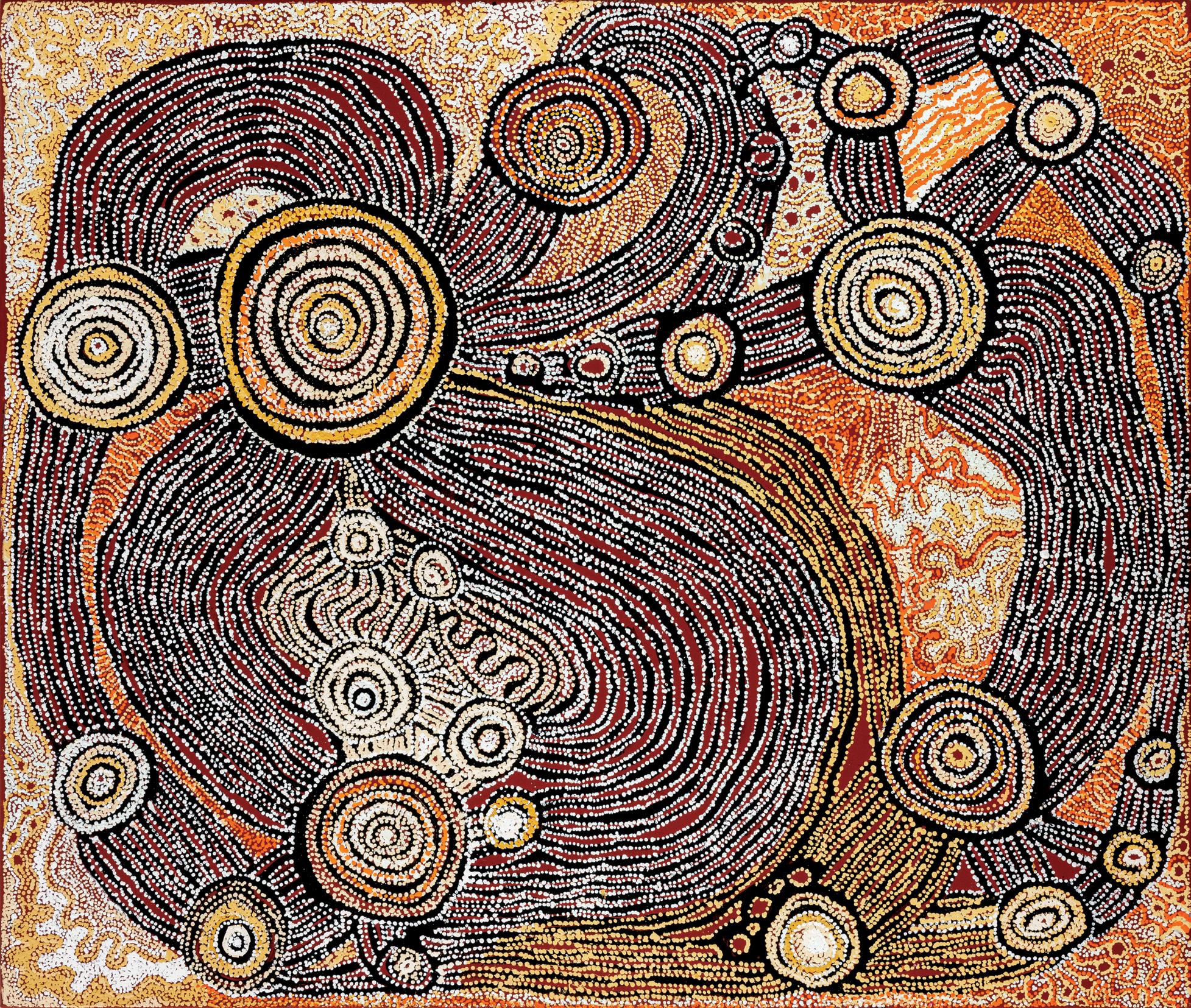
This story tells of two snake brothers and their wives, who are sisters, that lived near Piltati, west of Amata.
Every day the women went out hunting, and every evening they bought home kuka (meat for cooking) for the men, who didn’t do anything but perform ceremonies. After a while the sisters became annoyed at the men’s laziness and decided to eat all the food they caught, leaving the men to fend for themselves. The snake brothers were angry, and decided to punish the women for their insubordination.
After lots of talking, the brothers agreed to change themselves into a Wanampi (a giant mythical water serpent, which also had the power to travel above and below ground) and play a practical joke upon the women. They went to a marsupial rat hole where the women had been digging and imitated the tracks of a large snake by rubbing the back of a spear thrower on the ground. Then they entered the hole, and one of them left out enough of his tail for the women to see. The younger sister became very excited when she saw the tracks of such a large snake and its tail popping out. She begun to pull the snake from its burrow, but the tail kept slipping from her grasp. Again and again he let himself be caught before wriggling free once more. Eventually the younger sister became tired, gave up and returned to her sister.
In the evening, when they were eating dinner, the younger sister told her elder sister how she had almost caught a carpet snake as big as a Wanampi, but couldn’t pull it from its burrow as it was too strong. The big sister said she would help her to catch it the next day. The next morning the women set off with their wana (digging sticks) and piti (large wooden bowl). They dug all day long, then the next day and the next, occasionally glimpsing the snake.
They continued to dig after the Wanampi, but they never caught him. In their pursuit the women dug a trench from Aparatjara to Piltati, now a watercourse, approximately 25km long.
Their burrow became deeper, and the women dug many subsidiary branches in their pursuit, creating the gorge at Piltati, with its creeks and piles of rock that clutter the valley floor. Finally the elder sister changed her tactics. She dug a pit ahead of the entrance to the burrow (now the largest rock hole at Piltati), uncovering the Wanampi before he could get away, then she threw her digging stick, piercing the side of the Wanampi. The younger Wanampi left the burrow, chased and swallowed his wife, the younger sister. The injured snake (big brother) was angry and in great pain, so he caught, killed and ate the elder sister at the mouth of Piltati gorge.
BOXER MILNER TJAMPITJIN (c1934-2009)
PURKITJI, 2002
Warlayirti Artists cat. 759/02
acrylic on canvas
117.5 x 77.5 cm
PROVENANCE
Warlayirti Artists, Western Australia
Private collection, Melbourne
“Boxer is a senior Law man who, along with his two brothers, is custodian for the country Tjukurrpa (Dreaming) stories and songs on the Sturt Creek area. Boxer’s paintings all depict different physical and mythological aspects of the middle and upper stretches of Sturt Creek. He often depicts the flooding of the creek, and the changes to the country this brings, both during the flooding, and after the water starts to recede.
The area of Milnga-Milnga is a major flood plain for Sturt Creek and is inundated every summer after the rains. This is important for all nature, including people, and Boxer’s family who have always lived here and ‘look after’ the area by keeping its associated Law and ceremonies. A significant portrayal of the water in Boxer’s paintings of Sturt Creek is white, depicting the ‘milk water’ that runs after rain has fallen in the clay soils upstream of Billiluna.
His work includes the depiction of rainbows, rain clouds and the temporary creeks that are formed during the wet season.
As a younger man Boxer worked around this area as a stockman effectively utilising his intimate knowledge of the country.
Boxer began painting in the mid 1990s and his unique style has seen him emerge as one of Warlayirti Artists’ most recognised and sought after artists...”
Balgo 4-04: New paintings from the Kutjungka Region , Warlayirti Artists, April 2004, p.67
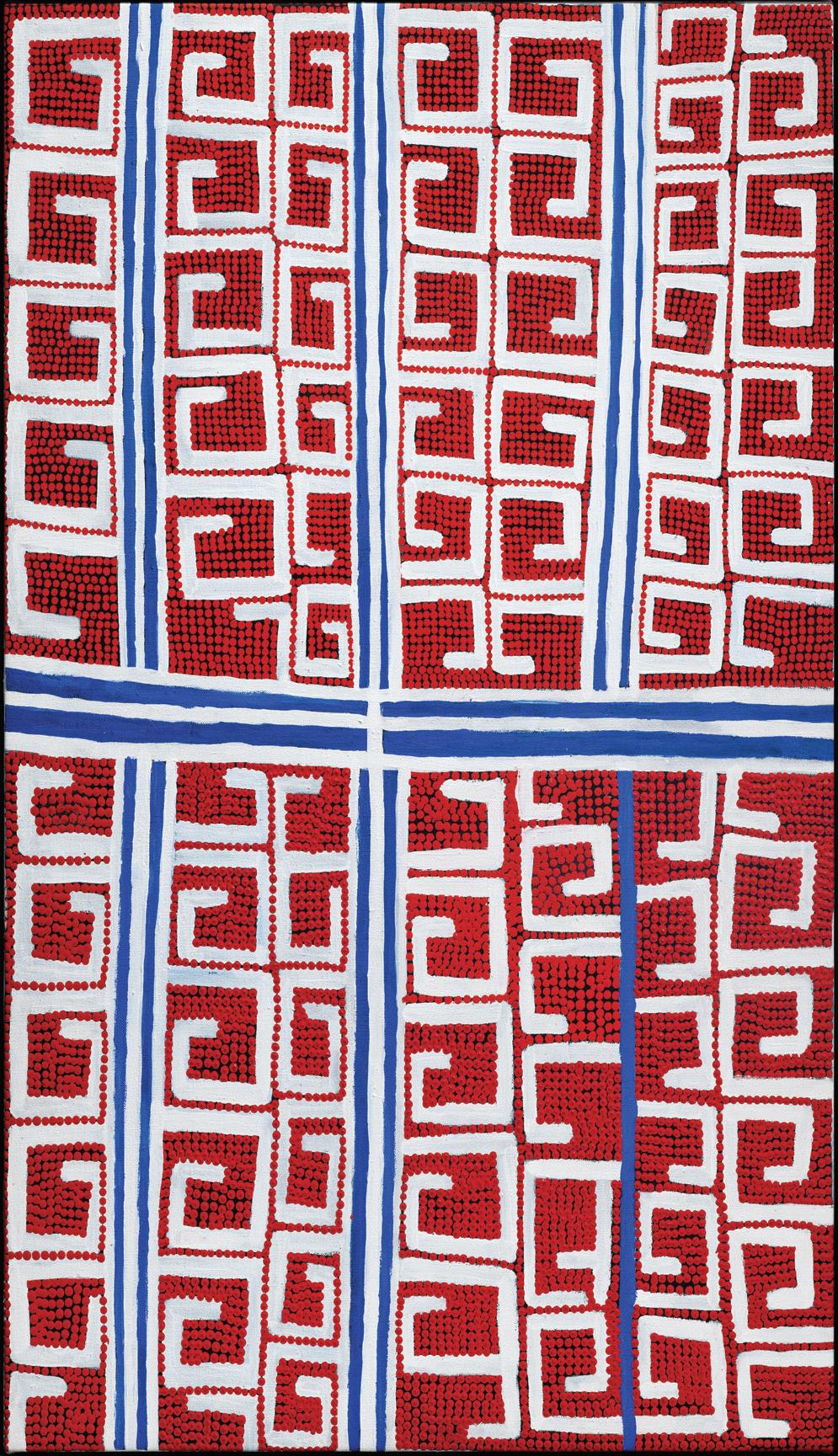
NAATA NUNGURRAYI (1932-2021)
ROCKHOLE SITE OF MARRAPINTI, 2000
Papunya Tula Artists cat. NN0009086
acrylic on Belgian linen
122 x 122 cm
PROVENANCE
Papunya Tula Artists, Alice Springs
William Mora Galleries, Melbourne
Private collection, Melbourne
This painting depicts designs associated with the rockhole site of Marrapinti, just to the west of the Kiwirrkura Community. A large group of senior women camped at this rockhole making the nose-bones which are worn through a hole in the nose-web. These nose-bones were originally worn by both men and women but are now only worn by the older generation on ceremonial occasions. The women later travelled east passing through the Kiwirrkura area. During their travels they gathered the edible berries known as kampurarrpa or desert raisin from the small shrub Solanum centrale. The arcs represent the sandhills surrounding the site.
Naata Nungurrayi was born at the site of Kumil, west of the Pollock Hills in Western Australia, c.1932. She moved to Papunya with her family on one of Jeremy Long’s government patrols, and started painting for Papunya Tula Artists in 1996.
In 1999 she contributed to the Kintore women’s painting as part of the Western Desert Dialysis Appeal, and in 2002 one of her paintings entered into the Telstra National Aboriginal & Torres Strait Islander Art Awards was highly commended by the judges. In 2003 she was chosen along with four other Papunya Tula Artists to have one of her paintings represented on an Australia Post international stamp. In 2004 she was named as one of the Top 50 Australia’s Most Collectable Artists in Australian Art (issue 27 Jan-March 2004)
“...As Naata’s confidence grew, so too did her presence among the painters. She developed a unique iconography, teeming with giant ‘U’ shapes representing ancestral bodies as they moved through the landscape collecting kampurarrpa, lighting fires and making camp to prepare for ceremony. Mollusc-like forms depicting rocky outcrops and deep-etched lines representing the surrounding sandhills bulge like scars on an arm or cleavage. Armlets, grids and roundels that are concealed in dense layers of colour often map the complex topographies of Marrapinti, Unkunya and Irrultutu.
Time and age has seen Naata emerge as an instinctive painter whose command of line, colour and form is immediate and breathtaking. Artist and art rarely so inextricably linked, each a precious balance of cultural authority, artistic spontaneity, conviction and whim.”
Unique Perspectives: Papunya Tula Artists and the Alice Springs Community , an exhibition at Araluen Arts Centre, 17/11/1216/04/13, jointly published by Araluen Arts Centre and Papunya Tula Artists. p. 45
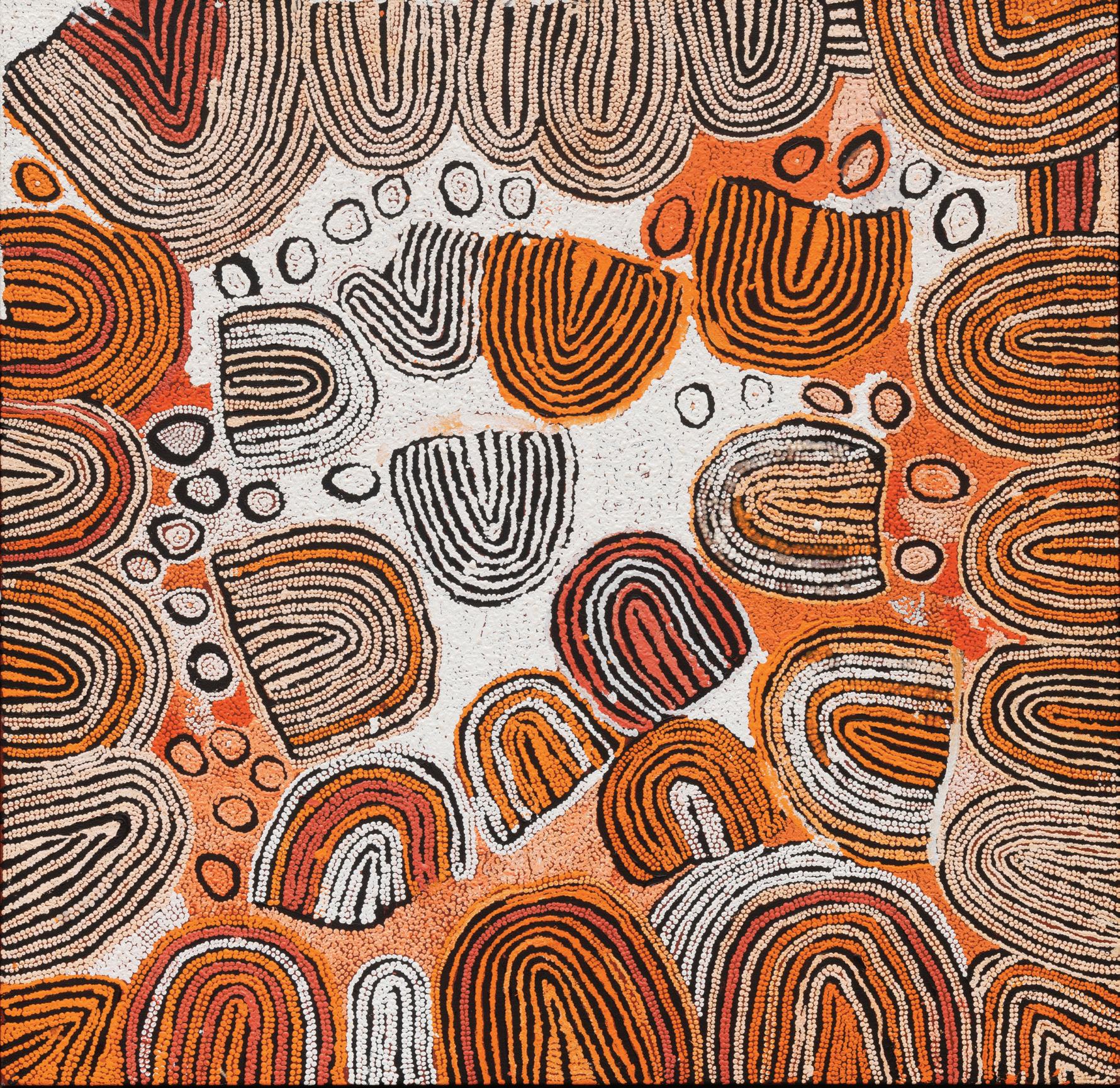
12
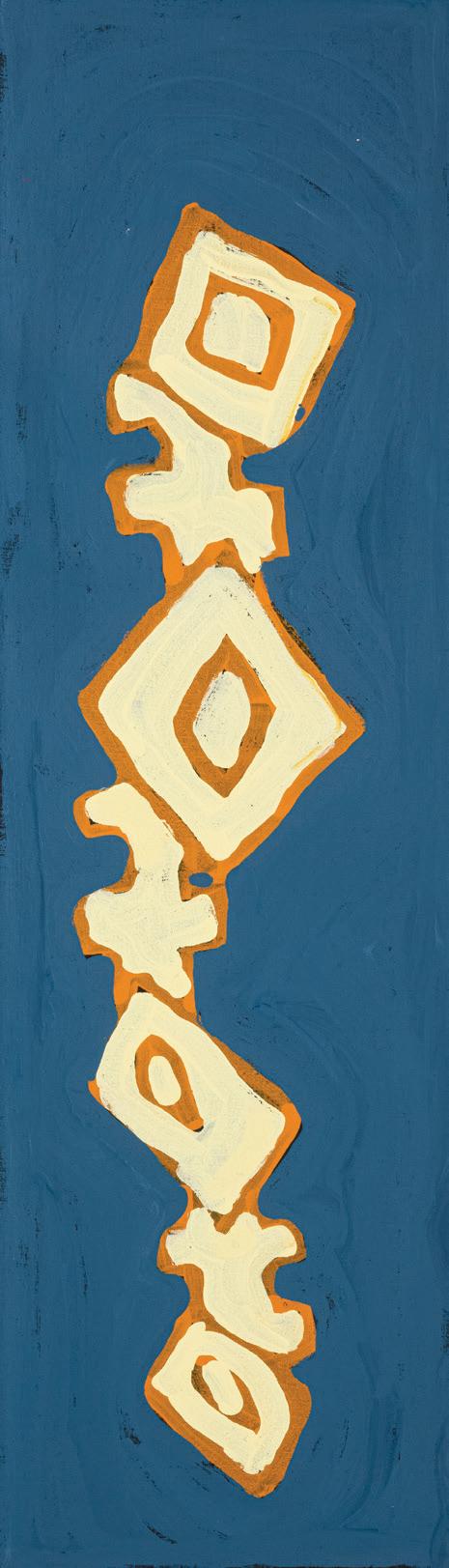
NYILYARI TJAPANGATI (Born 1964)
WILKINKARRA (LAKE MACKAY), 2022
Papunya Tula Artists cat. NT2211043
acrylic on Belgian linen
107 x 28 cm
13
NYILYARI TJAPANGATI ( Born 1964 )
WILKINKARRA (LAKE MACKAY) , 2023
Papunya Tula Artists cat. NT2307023
acrylic on Belgian linen
107 x 28 cm
14
NYILYARI TJAPANGATI ( Born 1964 )
WILKINKARRA (LAKE MACKAY) , 2023
Papunya Tula Artists cat. NT2305165
acrylic on Belgian linen
107 x 28 cm
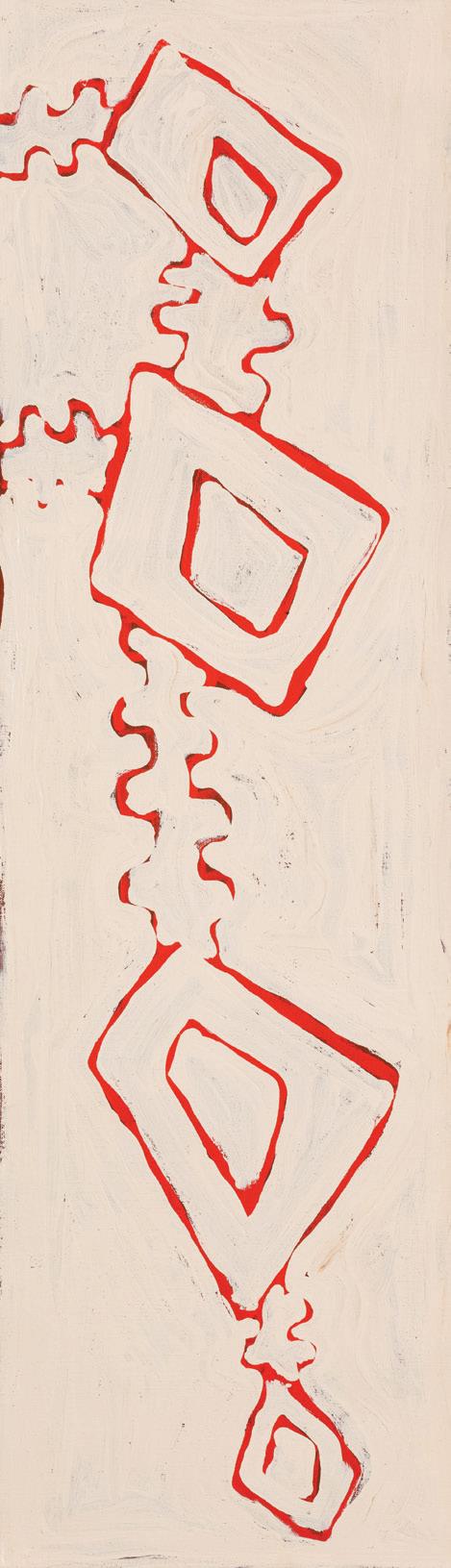
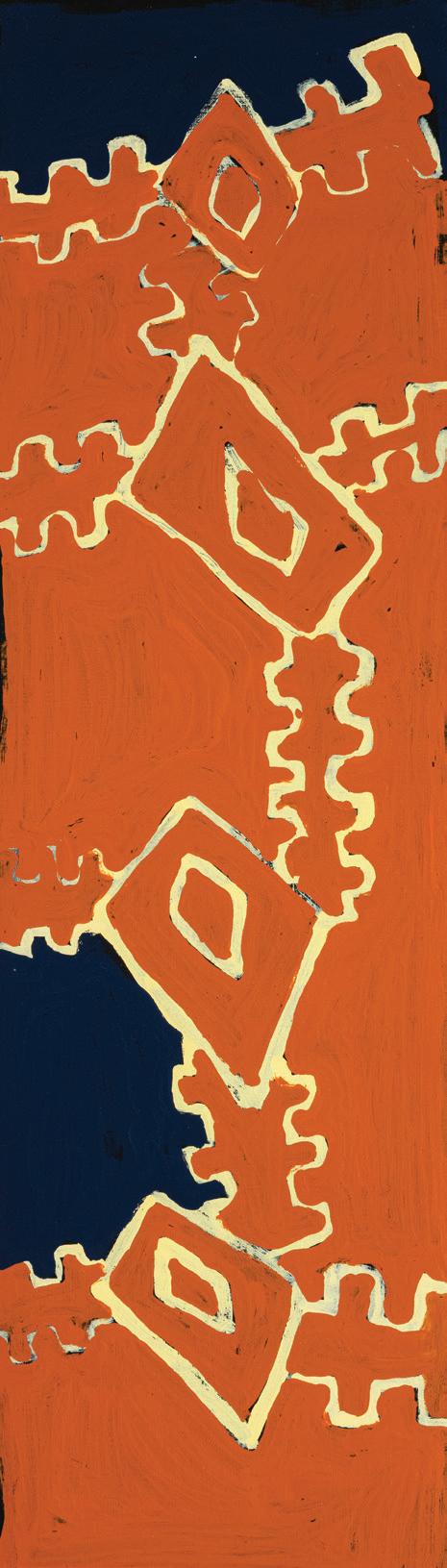
These paintings depict designs associated with the salt lake site of Wilkinkarra (Lake Mackay)... Please refer to associated certificates for expanded stories.
YUMPULULU TJUNGURRAYI (c.1925-1998)
DREAMING STORY AT WANUNUNYA, 1988
Papunya Tula Artists cat. YT8807172
acrylic on Belgian linen
122 x 122 cm
PROVENANCE
Papunya Tula Artists, Alice Springs
Gallery Gabrielle Pizzi, Melbourne
Private collection, Melbourne
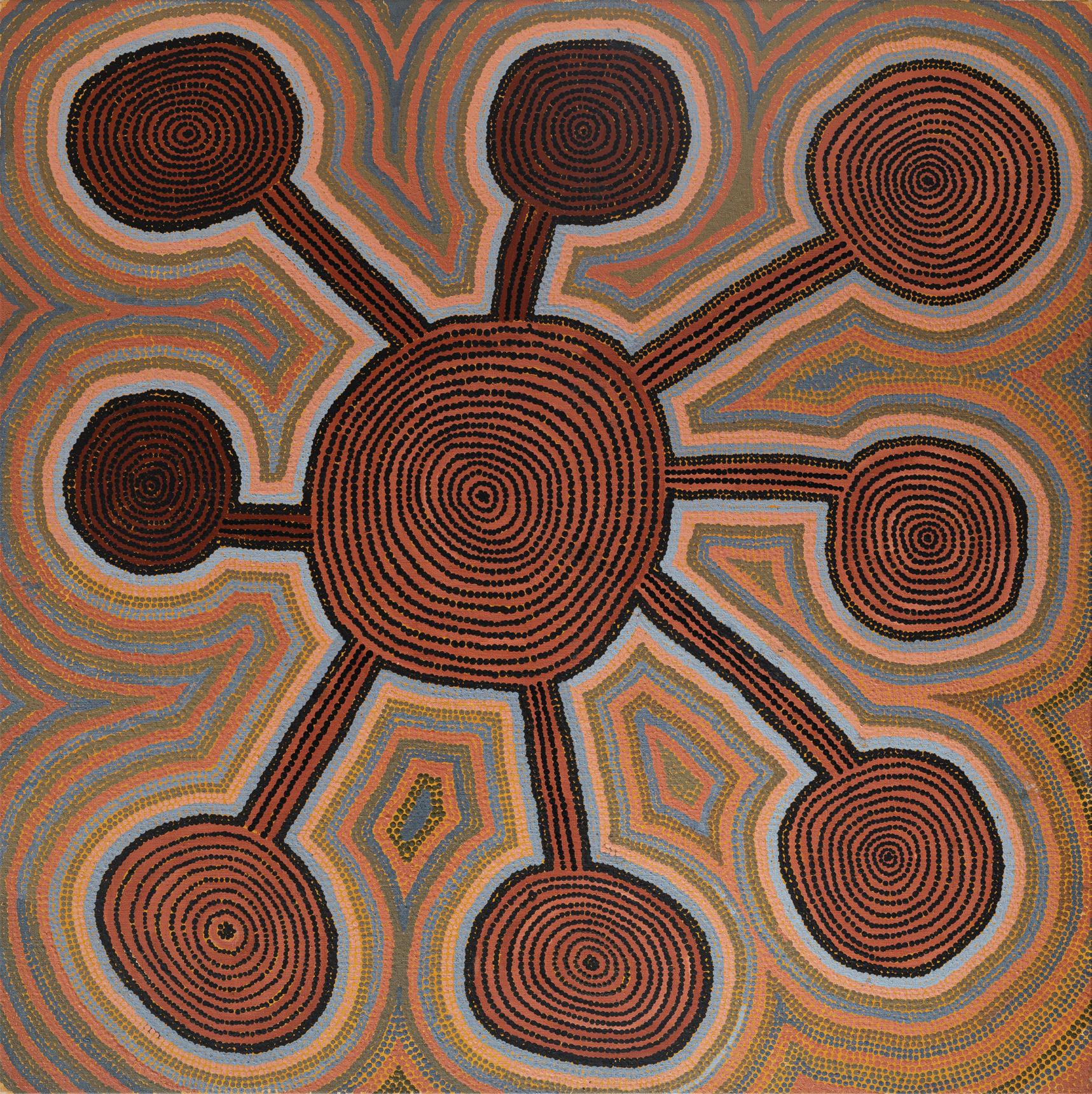
This painting is a representation of the Dreaming story at Wanununya. Wanunu is the name of a seed which is ground and cooked as a damper. The site has become an increase centre for this plant. The circles show the camps of the women who were preparing these seed cakes for the men who had been travelling a long way.
As a boy, Yumpululu Tjungurrayi travelled with his family over the country between Jupiter Well and Kiwirrkura, in the Gibson Desert, before making contact with Europeans. His close friendship with Anatjari Tjampitjinpa dated from this time. Tjungurrayi came to Papunya in 1964 and was one of the original Papunya Tula shareholders (and painters).
In 1981 he joined the Pintupi in their move back to their traditional lands at Kintore, later settling in Kiwirrkura. He painted a few small boards in the 1970s, often distinctive for their quirky designs.
16
RONNIE TJAMPITJINPA ( c.1942-2023 )
TINGARI AT WILKINKARRA (LAKE MACKAY), 1994
Papunya Tula Artists cat. RT941226
acrylic on Belgian linen
183 x 91 cm
PROVENANCE
Papunya Tula Artists, Alice Springs Gallery Gondwana , Alice Springs
Aboriginal & Oceanic Art, Sotheby’s, Melbourne, 15-16 November 2005, Lot 73
Private collection, Melbourne
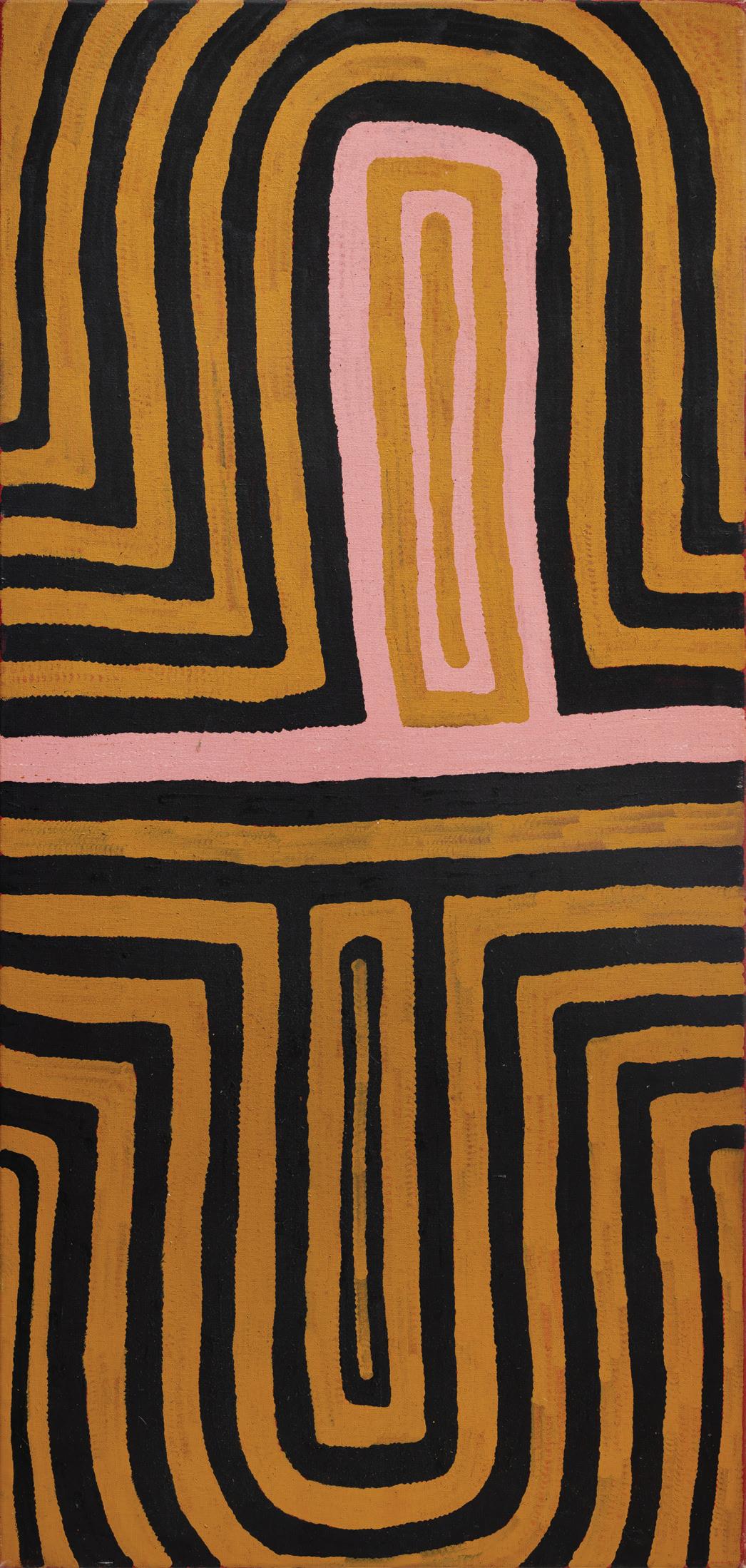
This painting relates to a story from the Tingari Cycle and tells of mythical characters and their travel from Balgo to Tjikari, a site on the north side of Wilkinkarra (Lake Mackay). There they met up with other Tingari who had travelled from Kalipinypa in the west. They all travelled on together to Uluru in the south...
“Born at Tjiturrunya, west of Muyinga over the West Australian border, Ronnie Tjampitjinpa’s family moved around their country and the area around Wilkinkarra in the Northern Territory. Ronnie was initiated at Winparrku in the Northern Territory. His family walked to Haasts Bluff in December 1956 from the Dovers Hills/Yumari area due to the severe drought affecting the region. Here Ronnie began working as a stockman before the family moved to the newly established settlement at Papunya, where he worked at fencing
cattle yards... Ronnie began painting in 1971 with the founding group of Papunya painters, and became an important influence on the outstation movement. Ronnie moved to Walungurru with his family after it was established in 1981. In the early 1980s Ronnie painted only intermittently for Papunya Tula Artists; however, by the late 1980s and early 1990s his distinctive graphic style attracted considerable attention. In these later works his delicate, dotted Tingari designs have been transformed into bands of colour to dazzling optical effect. He has exhibited widely both within Australia and overseas. Ronnie won the Alice Prize in September 1988...”
Papunya Tula: Genesis and Genius , published on the occasion of the exhibition, Art Gallery of New South Wales, 18 August12 November 2000, p. 297-298
BILL WHISKEY TJAPALTJARRI (1920-2008)
ROCKHOLES NEAR THE OLGAS, 2006
Watiyawanu Artists cat. 77-06021
acrylic on Belgian linen
122 x 122 cm
PROVENANCE
Watiyawanu Artists, Mt Liebig
Private collection, Melbourne
“Bill Whiskey Tjapaltjarri was born at Pirupa Alka, in the southwest of the Northern Territory near Pirrulpakalarintja outstation, about a hundred kilometres west of Uluru. He was called Mininderi while he and his family group lived a traditional lifestyle. As a teenager after his father’s death, he and his family walked hundreds of kilometres north to Haats Bluff. He cleared land and constructed buildings in the area, for which he was paid in damper, tea and tinned meat, and later he worked as a cook on pastoral stations. At Haasts Bluff he met and married Colleen Nampitjinpa, with whom he had five children. Both were ngangkari (traditional healers). They later moved to nearby Amunturrngu (Mt Liebig). He received the name Whiskey because of his bushy ‘whiskery’ beard - a potentially misleading title for a teetotaller.
For many years he painted dot designs on small nulla-nullas and spears. However, in 2004, when well into his eighties, he walked into the paint room at Mt Liebig and requested paints and canvases. Almost overnight he became recognised as a significant
contemporary artist. For the few short years of his artistic career he painted almost obsessively, beginning daily at 8am and sitting at work until late afternoon.
By far the most common of his work is rockholes near the Olgas, the country where he grew up. He appears to have been the only person to paint this particular story from the Cockatoo Dreaming.
It tells of a cockatoo that was preparing kangaroo meat to store for the time she would lay her eggs. A jealous crow tried to steal some of the meat for himself. The cockatoo and crow fought for some time - leaving big holes in the country - until the crow hit the cockatoo with a rock, badly injuring her. An eagle decided to help the cockatoo. She told the crow she wanted to make love, but instead she struck him with hot spinifex wax, scolding his genitals...”
Desert Country was published by the Art Gallery of South Australia on the occasion of the exhibition, 29 October 201026 January 2011, p. 84
MARTIN TJAMPITJINPA (c.1965-2007)
CLAYPAN SITE OF NGURRAPULANGU, 2006
Papunya Tula Artists cat. MT0608224 acrlic on Belgian linen
122 x 61 cm 18
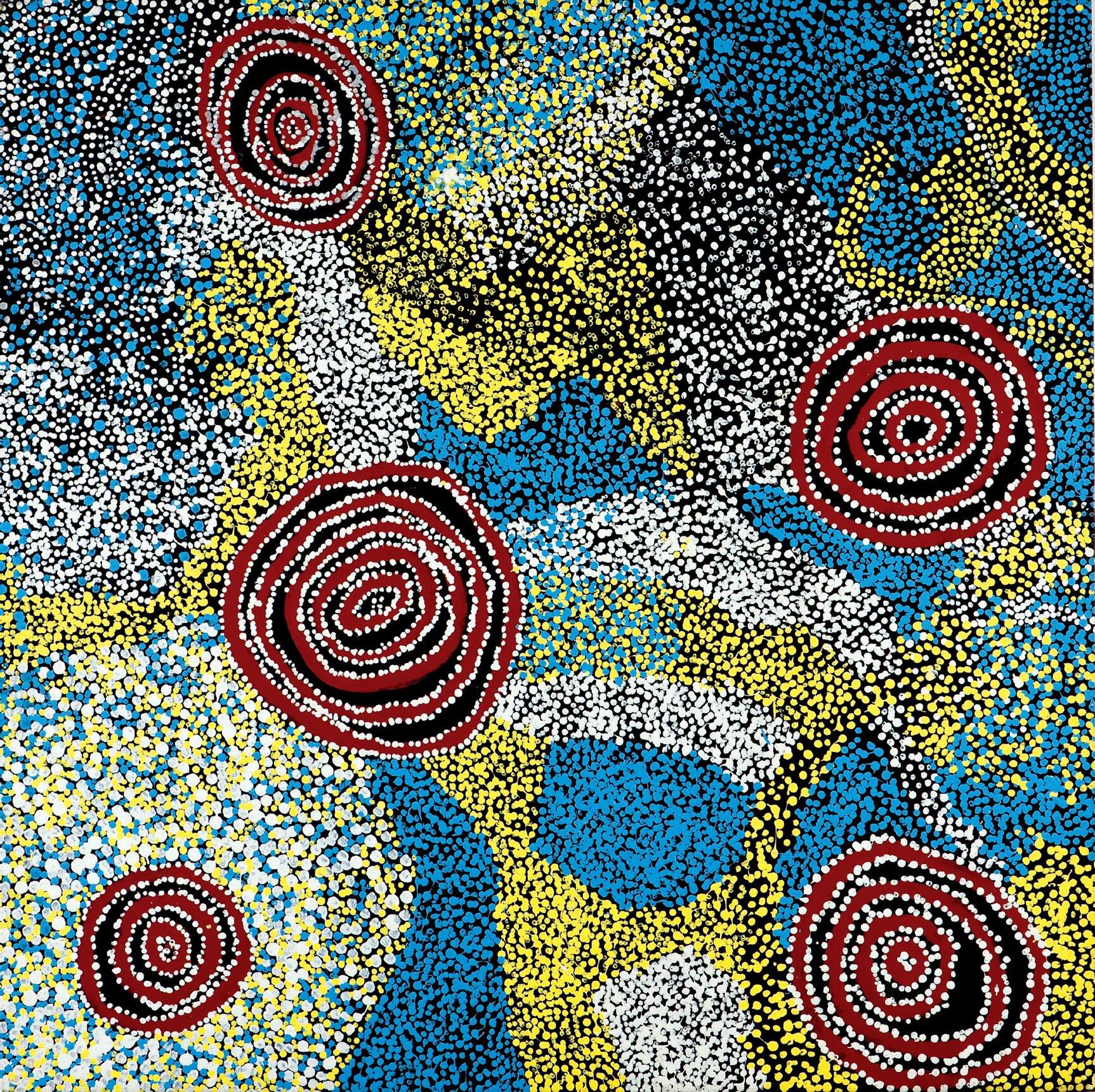
This painting depicts designs associated with the important claypan site of Ngurrapulangu, approximately halfway between the communities of Kintore and Kiwirrkura. This is a low lying area situated at the base of a long escarpment which consists of a number of huge claypans...
“Martin (Maatja) Tjampitjinpa - His art remains, each painting a self-portrait, a memory map. A gentle man of infinite joy, mischief and mystery...
The youngest of four brothers, Tjampitjinpa was a precious gift, born of the union of forbidden love. Warm-hearted, generous and fiercely loyal in friendship, his laughter was tinged with remembrance of things past. His paintings drew on that reservoir of experiences and memories, which forged his artistic sensibility.
First and foremost, his work depicted the travels of that pivotal figure in his life, his late father, Uta Uta Tjangala, whose intuition, poise and selflessness he inherited. For Tjampitjinpa, to paint was to journey alongside Tjangala to the grand soakage waters of Ngurrapalangu, to the complex geography of Umari,
and beyond. His paintings are rare histories of another generation, passages of time in the recent past.
Tjampitjinpa was in his element in the heartlands of the Western Desert, journeying with family in newly acquired Toyotas to distant football carnivals and surrounding sites of significance. The desert yields epic tales of Tjampitjinpa and his kin: stories of love and loyalty, of tragedy and survival. Transcribed in paint, they raise up the surface of life, like scars on skin.
A catalyst in Tjampitjinpa’s development as an artist was the return to Kintore of his beloved mother, Walangkura Napanangka. Her vital presence and authority, and her inspiring, raw artistic ability, gave him a new sense of purpose and belonging.
Tjampitjinpa did not paint prolifically. His irregular contortions of concentric squares and circles sit poised in defiance of the flat surface of the canvas, echoing the deep, irregular incisions once made on stone and on the patterned contours of wood. They chart familiar yet unexpected places...”
TJAMPITJINPA : Commemorative Exhibition, Papunya Tula Artists, November 2007, essay by Luke Scholes
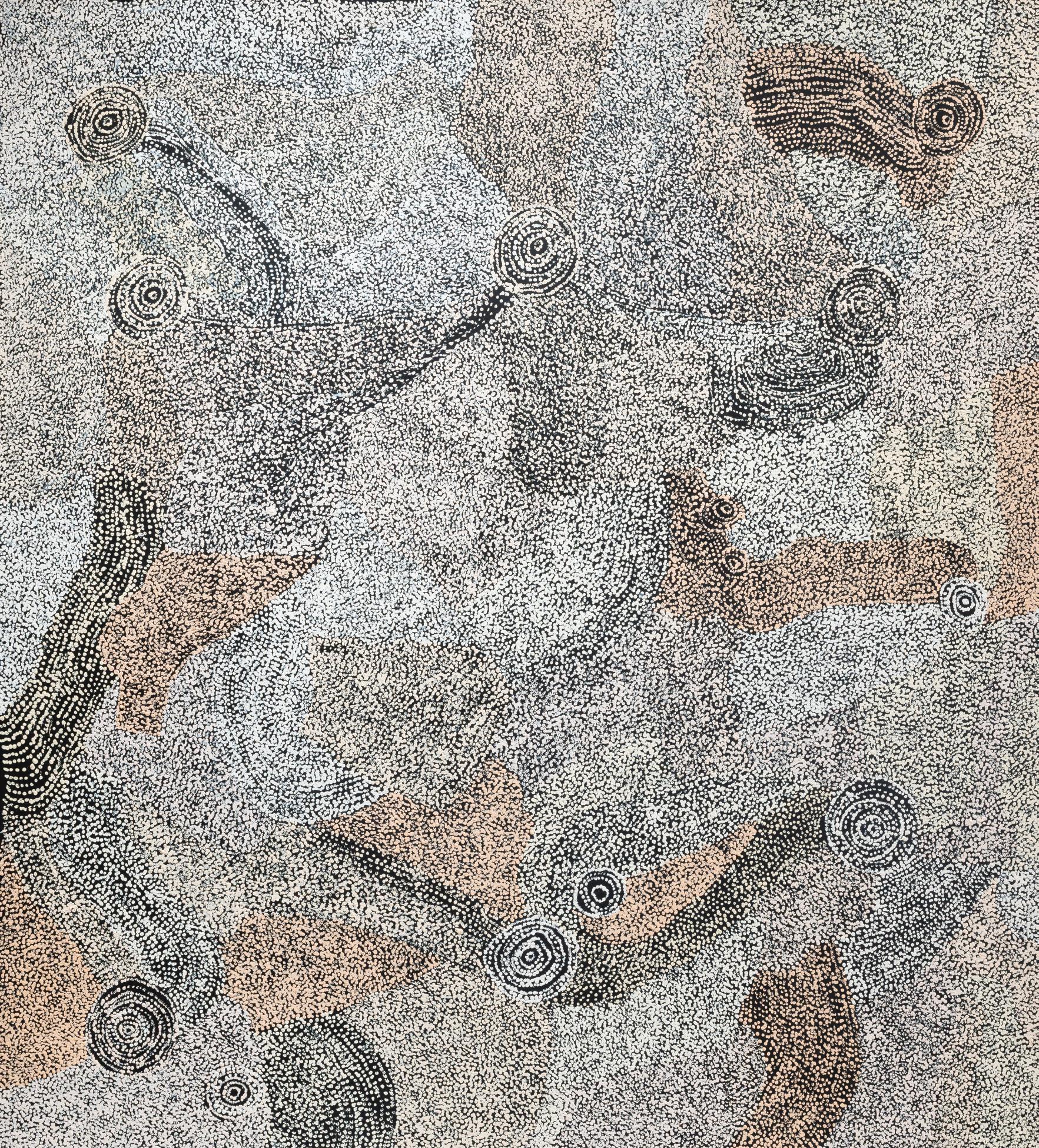
BETTY KING (Born 1950)
MALANGKA PUYINI (AFTER RAIN), 2025
Iwantja Arts cat. 7-25
acrylic on linen
167 x 152 cm
PROVENANCE
Iwantja Arts, Indulkana Community, APY Lands
Short St Gallery, Broome
I paint Wantjapilla, a special place not far from Indulkana where there is a very big soakage. I used to swim at Wantjapilla when I was a teenager, and I would take my two daughters, Judith and Julie to swim there when they were younger too. It’s a good place for swimming and camping out. The Country there is full of good memories. We often go fishing there, and we like to find duck eggs to cook too! In my paintings, I like to paint the rockholes of Wantjapilla, and the long narrow cracks in the ground that come up after the heavy rain.
Iwantja Arts is an artist studio located within the remote Indigenous community of Indulkana, on the Anangu Pitjantjatjara Yankunytjatjara (APY) Lands. Iwantja Arts is an Aboriginal corporation owned and governed by a board of directors. The art centre aims to encourage and support artistic excellence and cultural development within the community by providing opportunities, career development, and economic independence for practicing artists.
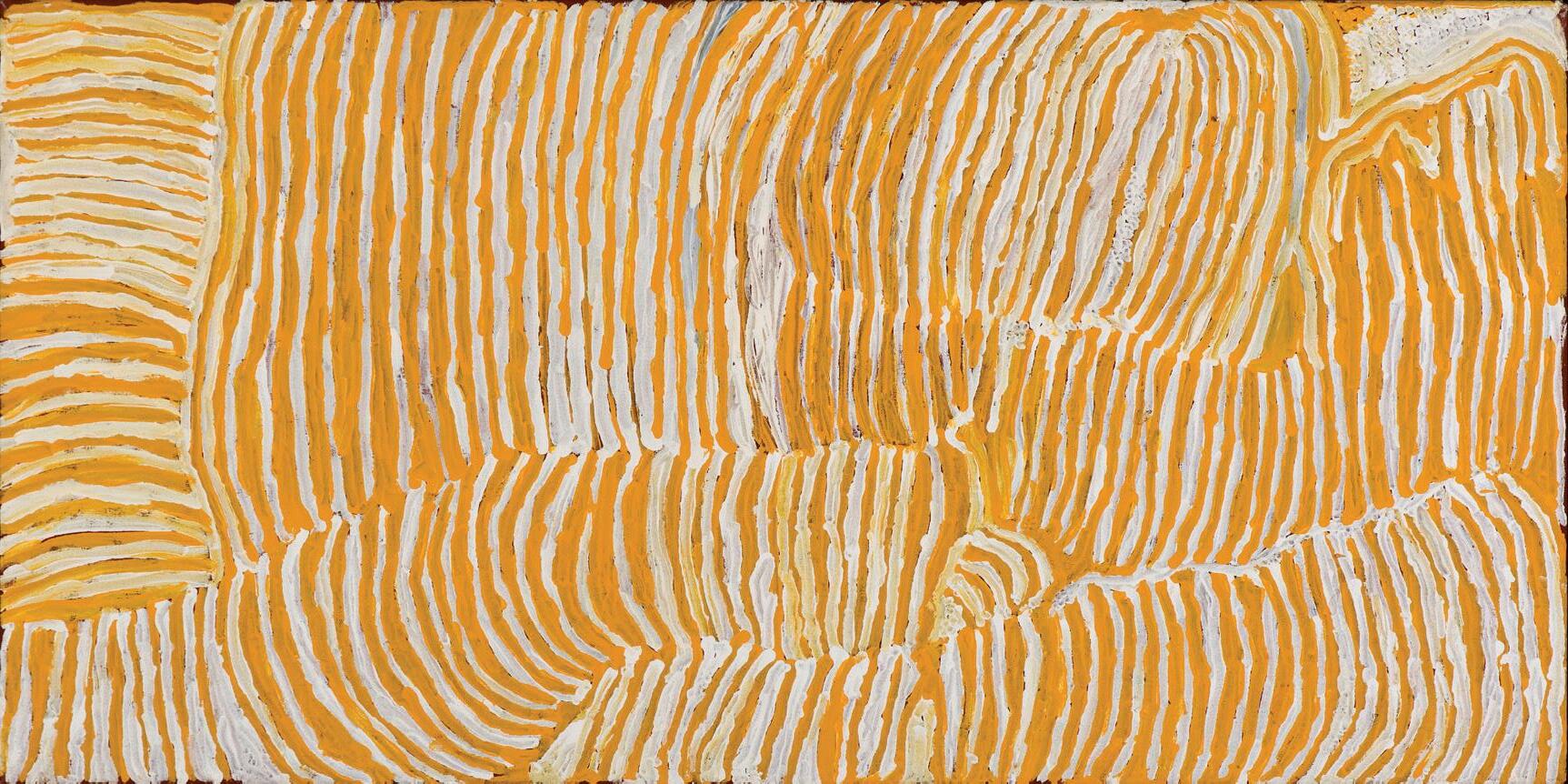
MAKINTI NAPANANGKA (1930-2011)
ROCKHOLE SITE OF LUPULNGA, 2002
Papunya Tula Artists cat. MN0202015
acrylic on Belgian linen
61 x 122 cm
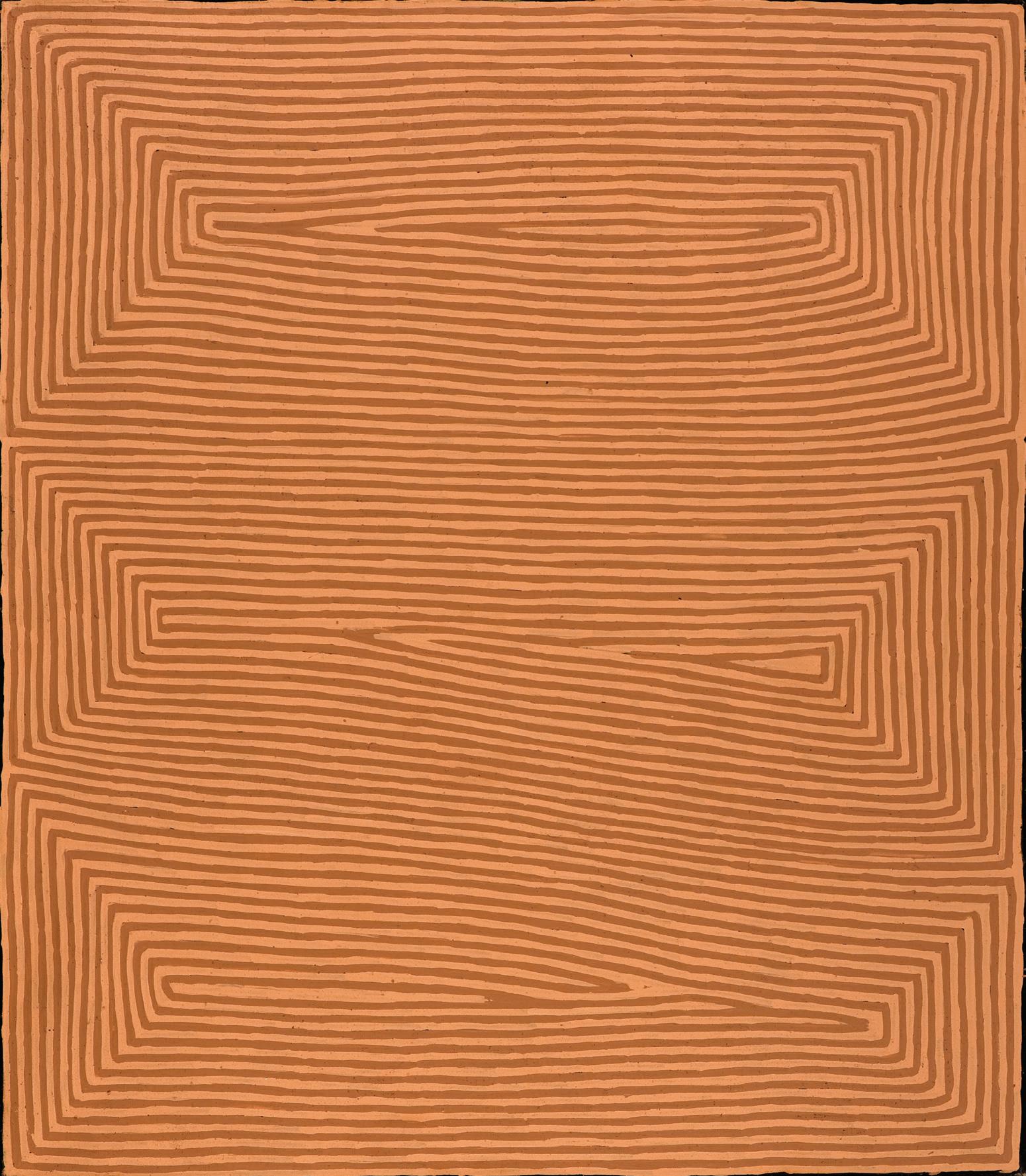
This painting depicts designs associated with the rockhole site of Lupulnga, south of the Kintore Community. The Peewee (small bird) Dreaming is associated with this site. The lines in the painting represent spun hair-string which is used in the making of hair-belts which are worn during the ceremonies associated with the area.
“From the moment Makinti Napanangka’s brush first touched the canvas she immediately distinguished herself from her painting contemporaries. Compositionally, her paintings were worlds apart from those being produced beside her. They were of course drawn from the same rich cultural history shared by other Pintupi women, but at the same time, were vastly different. From the very outset Makinti defined herself with a purely painterly technique, which reflected an unwavering confidence and ability to write in paint exactly what she wanted to say. This was done spontaneously and without hesitation on whatever shaped canvas she worked on, and, as a testament to her individuality and conviction...
Being well under five foot tall, Makinti makes any surface over four foot square appear dramatically bigger... Despite this, she has never been overwhelmed or intimidated by the size of any unpainted surface, but instead will calmly position herself at a chosen place on
PROVENANCE
Papunya Tula Artists, Alice Springs Gallery Gabrielle Pizzi, Melbourne
the canvas and begin to paint her story. The daily chatter and chaos around the art shed at Kintore does nothing to break her intense concentration as she revisits the ‘cheeky’ quoll at Lake MacDonald or the two travelling women at Lupul.
By the early 2000s Makinti’s style had become refined to a more minimal palette, and the tightly drawn roundels had been replaced by long, sweeping arcs representing nyimparra, or hair-string skirts, worn by dancing women. As the ancestral women had once danced across the earth at her most beloved and celebrated site of Lupul, south of Kintore, so too did the bright bands of rich colour flow across her canvas. Her preference for yellows and whites became a signature element in her work and the repetition of these colours would occasionally be punctuated and boldly interrupted by a single stripe of orange or purple...
Throughout her career as an artist Makinti has passed on through her paintings a clear vision of her spirituality and oneness with her country. For someone to interpret her stories repeatedly, so frequently and for so long, and for them to be done with such confidence and devotion, is an indication of her love of, and respect for, those things she holds so dear...”
MAKINTI : Solo Exhibition, Papunya Tula Artists, November 2007, essay by Paul Sweeney.
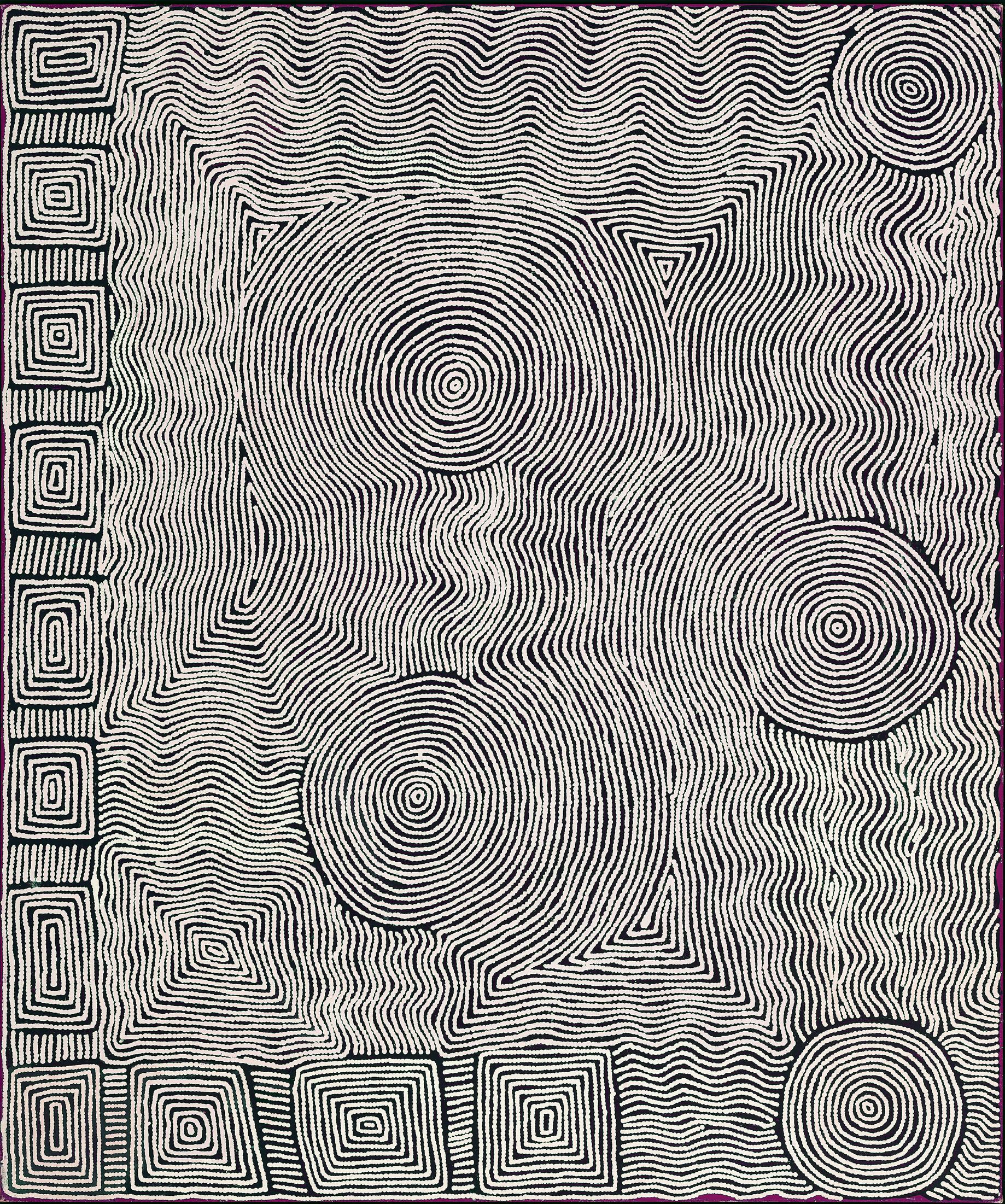
WARLIMPIRRNGA
TJAPALTARRI (Born c.1958)
MARAWA, 2002
Papunya Tula Artists cat. WT0203219
acrylic on Belgian linen
182 x 152 cm 21
PROVENANCE
Papunya Tula Artists, Alice Springs
Private collection, Tasmania
Joel Fine Art, 3 June 2008, Lot 53
Private collection, Sydney
Private collection, Melbourne
This painting depicts designs associated with the swamp and rockhole site of Marawa, to the west of Lake Mackay. The roundels represent soakage waters at the site and the squares are hills and mulga trees. In mythological times the Dingo Dreaming travelled from this site to Nyunmanu, south-east of the Kintore Community. This mythology forms part of the Tingari Cycle.
“Warlimpirrnga Tjapaltjarri and members of his family — including younger sister Yukultji Napangati — lived a semi nomadic life as hunter-gatherers in the Gibson and Great Sandy Desert regions of Australia with little or no outside contact until 1984. His artworks, which have become leading international exponents of contemporary
painting from Australia, depict undulating landscapes that oscillate with visual energy. Few painters can match the optical intensity found in his work.
Shimmering like a mirage, they pulse and swirl, hovering between the canvas and the eye like an electromagnetic field. The artist generates this effect by painting patterned backgrounds on which he meticulously adds tight, meandering lines composed of thousands of dots. The se lines and switchbacks correspond to mythical stories of the Pintupi people and the formation of the desert in which they live, operating more as mnemonic devices than representations of narrative or visual memory...”
Warlimpirrnga Tjapaltjarri, biography, Salon 94, New York, NY.
22
NAATA NUNGURRAYI ( 1932-2021 )
MARRAPINTI, 2003
Papunya Tula Artists cat. NN0312027
acrylic on Belgian linen
91 x 46 cm
23
NAATA NUNGURRAYI (1932-2021)
MARRAPINTI, , 2001
Papunya Tula Artists cat. NN0109120
acrylic on Belgian linen
91 x 46 cm
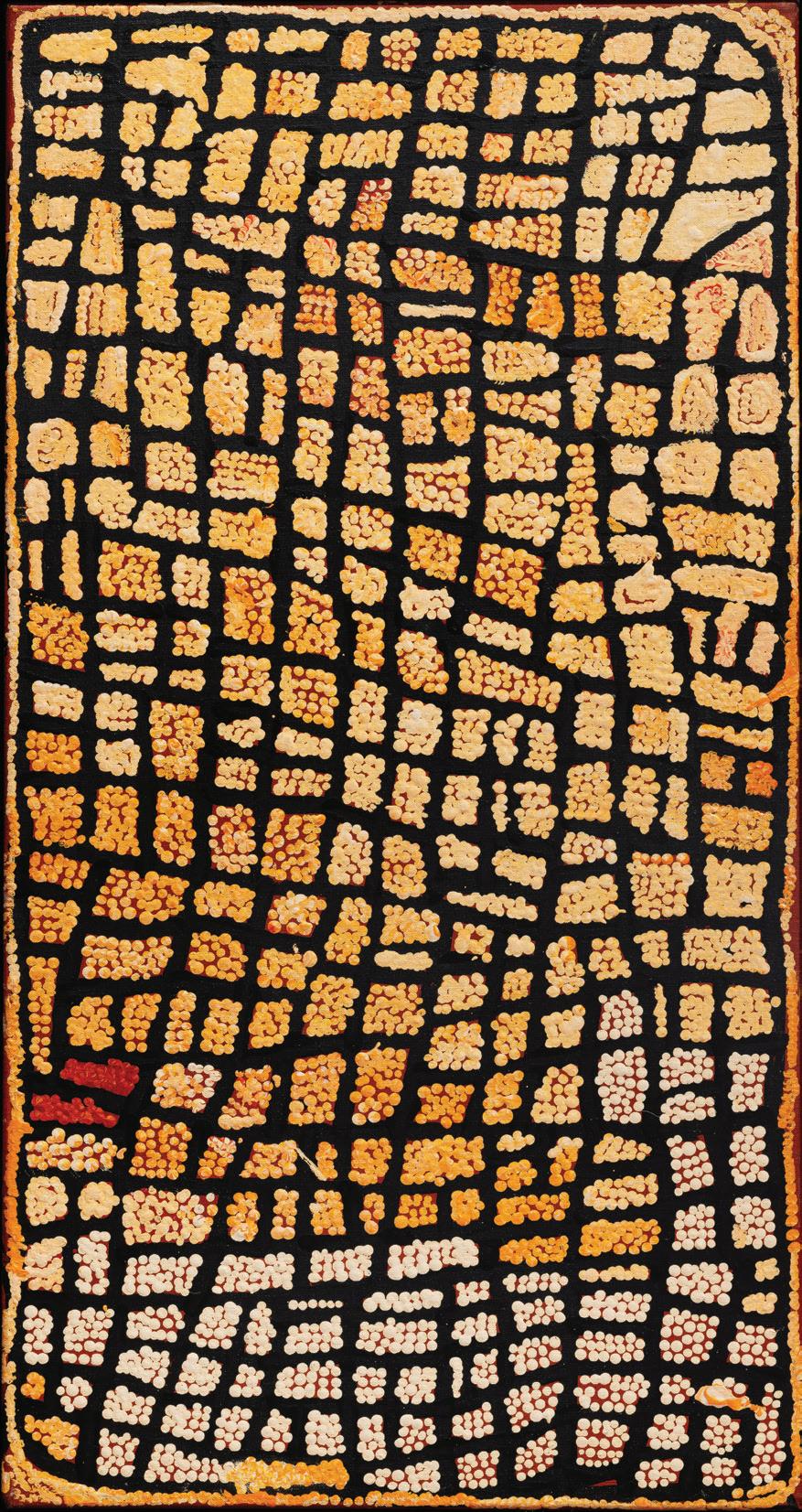
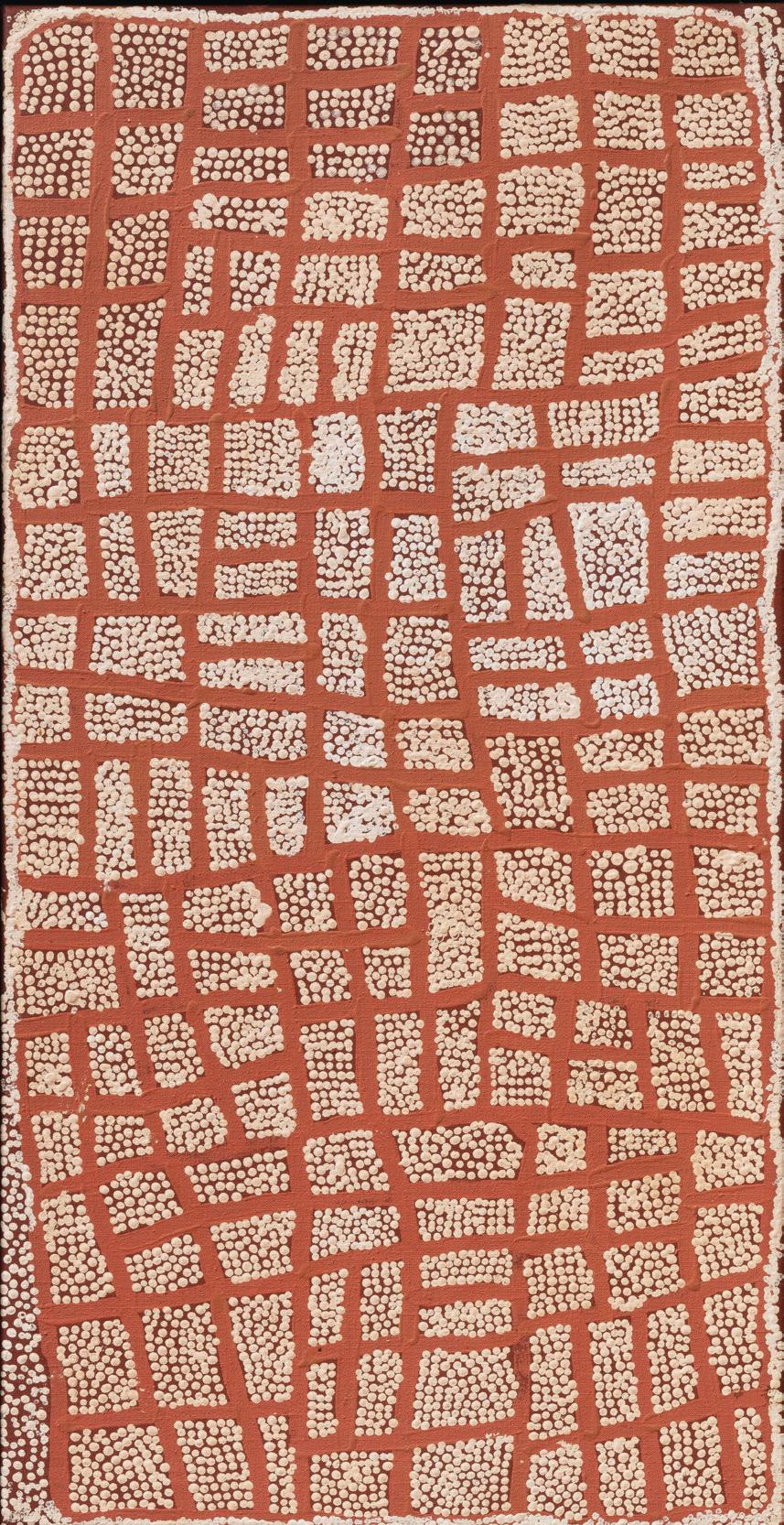
These paintings depict designs associated with the rockhole and soakage water site of Marrapinti, to the west of the Pollock Hills in Western Australia. A large group of senior women camped at this rockhole making the nose-bones which are worn through a hole in the nose-web. These nose-bones were originally worn by both men and women but are now only worn by the older generation on ceremonial occasions. The women later travelled east passing through Wala Wala, Kiwirrkura and Ngaminya...
Please refer to associated certificates for expanded stories.
NED GRANT (Born 1941)
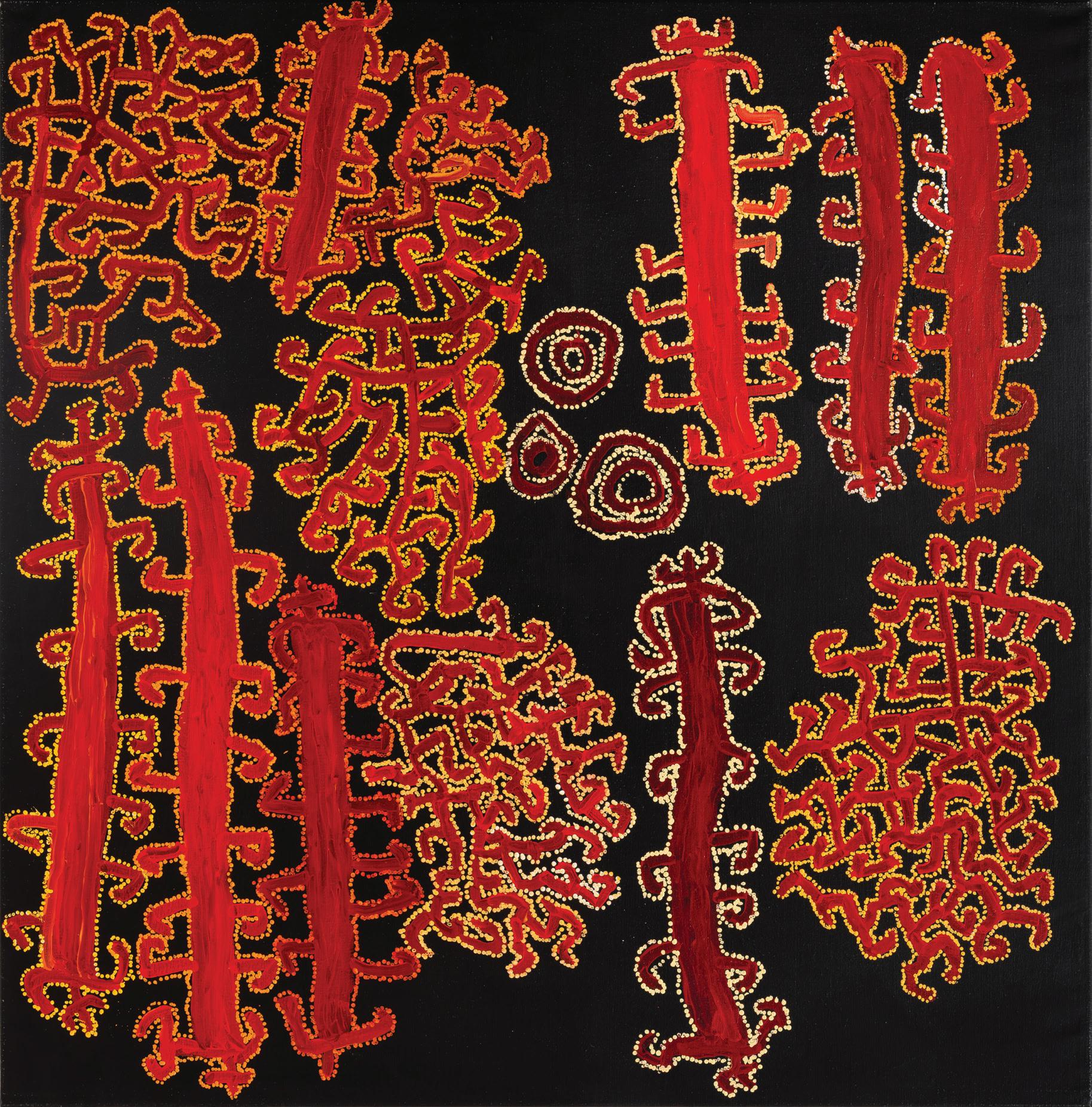
PALPATATJARA, 2024
Spinifex Arts Project cat. 24-179
acrylic on canvas
140 x 137.5 cm
EXHIBITED
Spinifex Arts Project, Desert Mob Exhibition 2024, Araluen Arts Centre, Alice Springs
“... As Fred, Ned and Ted sat in the mechanical animal they had speculated about so intensely, they felt an enormous wind push against them and saw the trees moving past. The ground moved so quickly it took some time to realise they were moving forwards, rather than the Country moving backwards. But the illusion was the truth: they were going away while their Country was rushing to stay behind.
Ted never saw his Country again. Fred and Ned would not see the Country of their birth for another half century. After growing up in the desert, they became men on the mission. It was in this fertile communal environment at Cundeelee, where religious leaders from across the desert had come to live, that Fred and Ned matured and finished their spiritual and politcal education.
And after all their walking, they would in time be
among the leaders who walked the Spinifex People back home. This was a three-year journey, visiting and staying at sacred locations along the way.
The Spinifex People camped at Yakatunya on the edge of Untiri (Nullarbor Plain) for two years and then followed the religious path of the Sun and Shadow – Wati Nyiinyi the Zebra Finch and Kipara the Bustard – to the place they had departed thirty years before.
Encamped at Tjuntjuntjara the Spinifex People regained their Country, sought and won the recognition of their traditional rights to it. Fifty years after being taken south, Fred and Ned walked again on the sands of their birth.”
Sun & Shadow: Art of the Spinifex People, edited by John Carty and Luke Scholes. Ned and Fred, essay by Scott Cane, 2023, p. 262
ANGUS TJUNGURRAYI (Born 1988)
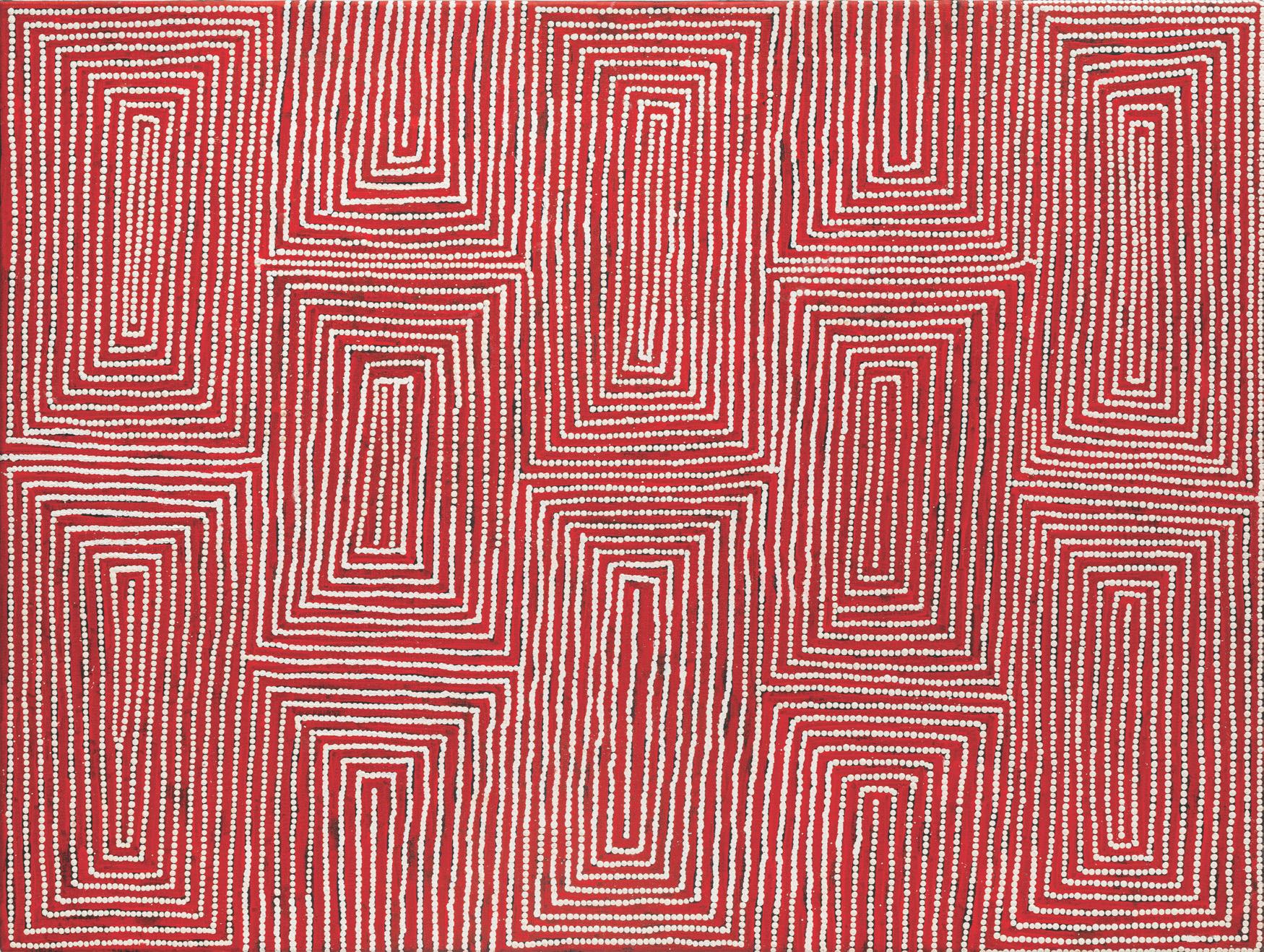
WILKINKARRA (LAKE MACKAY), 2026
Papunya Tula Artists cat. AT2602026
acrylic on Belgian linen
91 x 122 cm
This painting depicts designs associated with the salt lake site of Wilkinkarra (Lake Mackay) in Western Australia. In mythological times two ancestral Tingari men travelled to Wilkinkarra from the soakage water site of Marawa in the west. When the men arrived at Wilkinkarra they lit a large fire in order to flush out the malu (kangaroo) that they were hunting. They later entered the earth and continued their travels underground towards the east. This story forms part of the Tingari cycle...
Angus Tjungurrayi is a Pintupi artist from Kiwirrkura, WA. Born in Alice Springs in 1988, Angus is the son of acclaimed Papunya Tula artists Warlimpirrnga Tjapaltjarri and Yalti Napangati, both members of the Pintupi Nine, the last group of traditional hunter-gatherers who first encountered non-Indigenous Australians in 1984. Angus was a Wynne Prize finalist in 2025 at the Art Gallery of New South Wales.
ANATJARI TJAMPITJINPA (1927-1999)
TJULNGA, 1987
Papunya Tula Artists cat. AT8707110
acrylic on Belgian linen
182 x 91 cm
PROVENANCE
Papunya Tula Artists, Alice Springs
Private collection, NSW, purchased 1988
Private collection, Sydney
A small hill known as Tjulnga, to the north-east of the Kiwirrkura Community is the site depicted in this painting. In mythological times a large group of Tingari Men came to this place from the east. They were joined by another group who had travelled from just north of Kintore. As this site forms part of the secret Tingari Cycle, the artist did not reveal any further information...
“One of the founding Papunya Tula artists, Anatjari Tjampitjinpa and family met Jeremy Long’s Northern Territory Welfare Branch patrol at Wudungunya rockhole and arrived in Papunya from the west with other Pintupi people in 1964. They left Papunya at the
beginning of the outstation movement and lived successively at Alumbara, Yayayi, Inyaling, Mount Liebig, Walungurru and Balgo before finally settling in Kiwirrkura.
Anatjari was instrumental in instructing other artists about painting with canvas and acrylics, including his brother Dini Campbell Tjampitjinpa, his sons George Yapa Tjangala and Ray James Tjangala and daughters Mantua Nangala and Yinarupa Nangala...”
Papunya Tula: Genesis and Genius , published on the occasion of the exhibition, Art Gallery of New South Wales, 18 August12 November 2000, p. 292
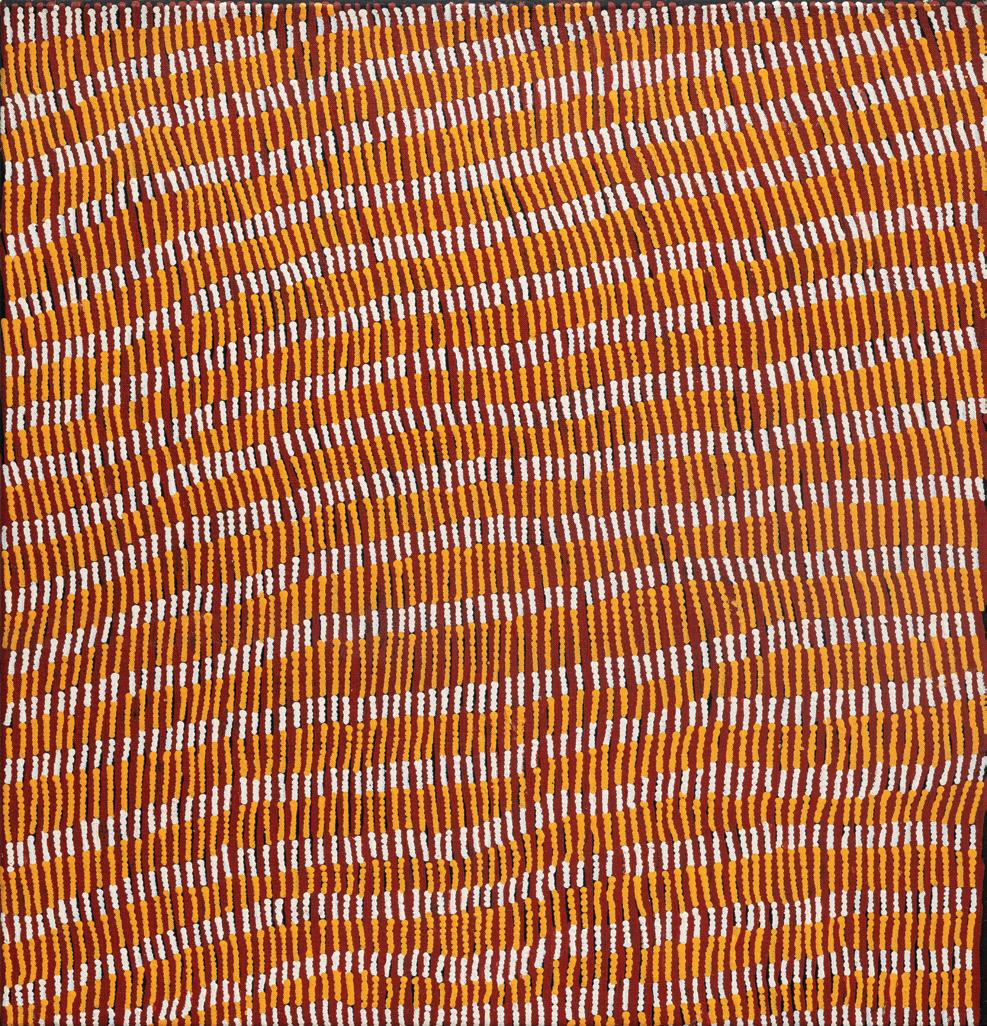
SANDHILLS, 2009
Watiyawanu Artists cat. WALKN09001
acrylic on Belgian linen
180 x 180 cm
Lilly Kelly Napangardi was born at Haasts Bluff (Northern Territory) in c.1948. S he moved to the newly established settlement of Papunya in the 1960s with her family. During her time in Papunya before relocating to Amunturrngu (Mt Liebig), Lilly married Norman Kelly Tjampitjinpa and they had several children. She is highly regarded and her paintings are represented in some of the most important museums and collections around the world, including Musée du quai Branly in Paris.
“... Her Luritja mother was Narputta Napurrula, whose country was around Haasts Bluff. Her Warlpiri father was from Mt Liebig...
At Papunya, Lilly Kelly Napangardi had been witness to the emergence of the Western Desert painting movement. Later she helped her husband with his painting, dotting the backgrounds of his works and gaining valuable technical experience before taking up
painting in her own right. She began to paint for Papunya Tula Artists in 1986, later painting for Watiyawanu Artists at Amunturrngu. She won the Northern Territory Art Award in the year she took up painting and has since been a finalist in the Telstra National Aboriginal and Torres Strait Islander Art Award. She often paints sandhills, wind and ‘after rain’. Her stories are from areas of Haasts Bluff (her birthplace), Kintore, Coniston and Kunajarrayi (Mt Nicker, west of Yuendumu), particularly the women’s Dreaming story there...”
Desert Country was published by the Art Gallery of South Australia on the occasion of the exhibition, 29 October 201026 January 2011, p. 74
PUKARATJINA, 2000
Papunya Tula Artists cat. GT20000375
acrylic on Belgian linen
122 x 107 cm
This painting depicts designs associated with the soakage water site of Pukaratjina, west of the Kiwirrkura Community. In mythological times a large group of women, accompanied by children, came from the west and made camp at this site before travelling to Kiwirrkura. They performed the dances and sang the songs associated with the area through which they passed. A group of men also travelled a similar route but kept apart from the women and children.
29
YUKULTJI NAPANGATI (Born c.1971)
YUNALA, 2026
Papunya Tula Artists cat. YN2604006
acrylic on Belgian linen
61 x 55 cm
30
ANGUS TJUNGURRAYI (Born c.1990)
SALT LAKE SITE OF WILKINKARRA (LAKE MACKAY), 2025
Papunya Tula Artists cat. AT2511099
acrylic on Belgian linen
61 x 55 cm
Please refer to associated certificates for expanded stories.
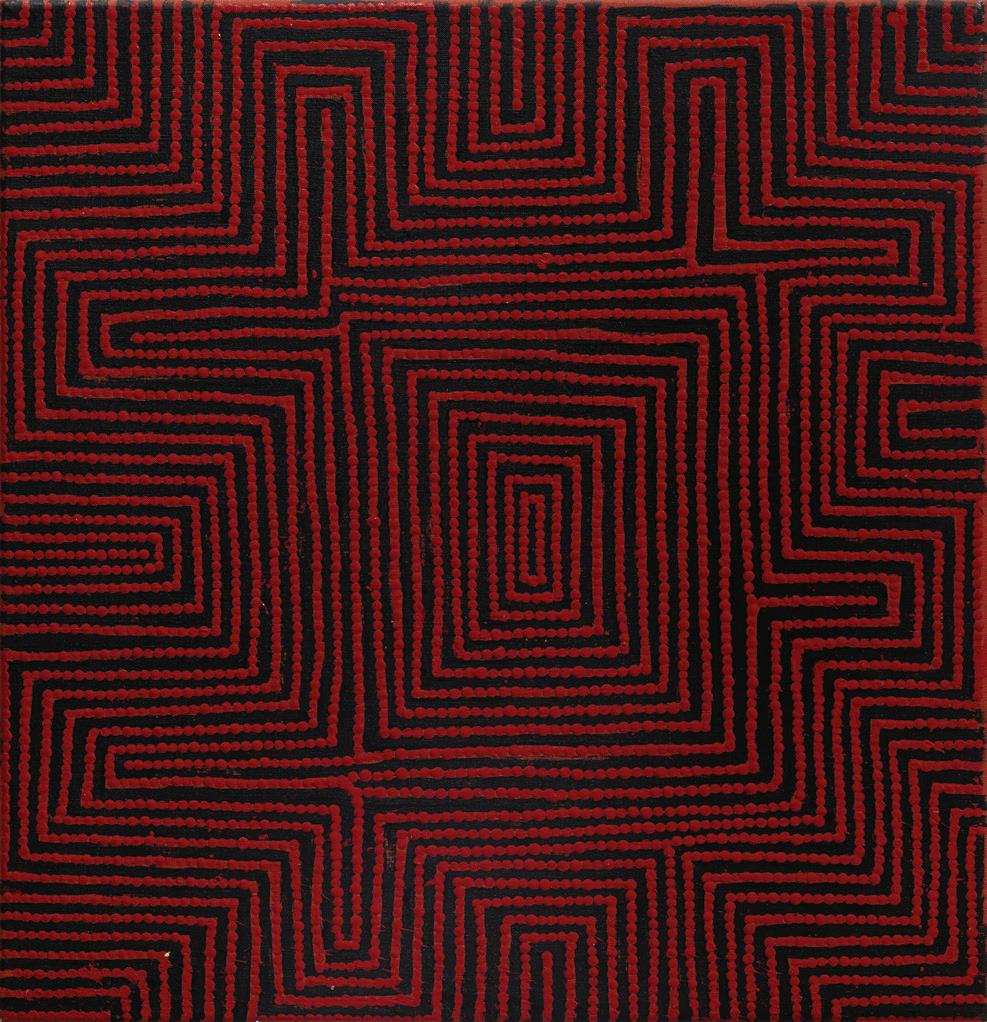
TINGARI CEREMONIES AT WILKINKARRA (LAKE MACKAY), 2001
Papunya Tula Artists cat. RT0107153
acrylic on Belgian linen
122 x 61 cm
This painting depicts body paint designs associated with Tingari Ceremonies at Wilkinkarra (Lake Mackay). In mythological times a large group of Tingari Men came to this site from the west. Since events associated with the Tingari Cycle are of a secret nature no further detail was given.
Generally, the Tingari are a group of mythical characters of the Dreaming who travelled over vast stretches of the country, performing rituals and creating and shaping particular sites. The Tingari Men were usually followed by Tingari Women and accompanied by novices and their travels and adventures are enshrined in a number of song cycles. These mythologies form part of the teachings of the post initiatory youths today as well as providing for contemporary cust oms.
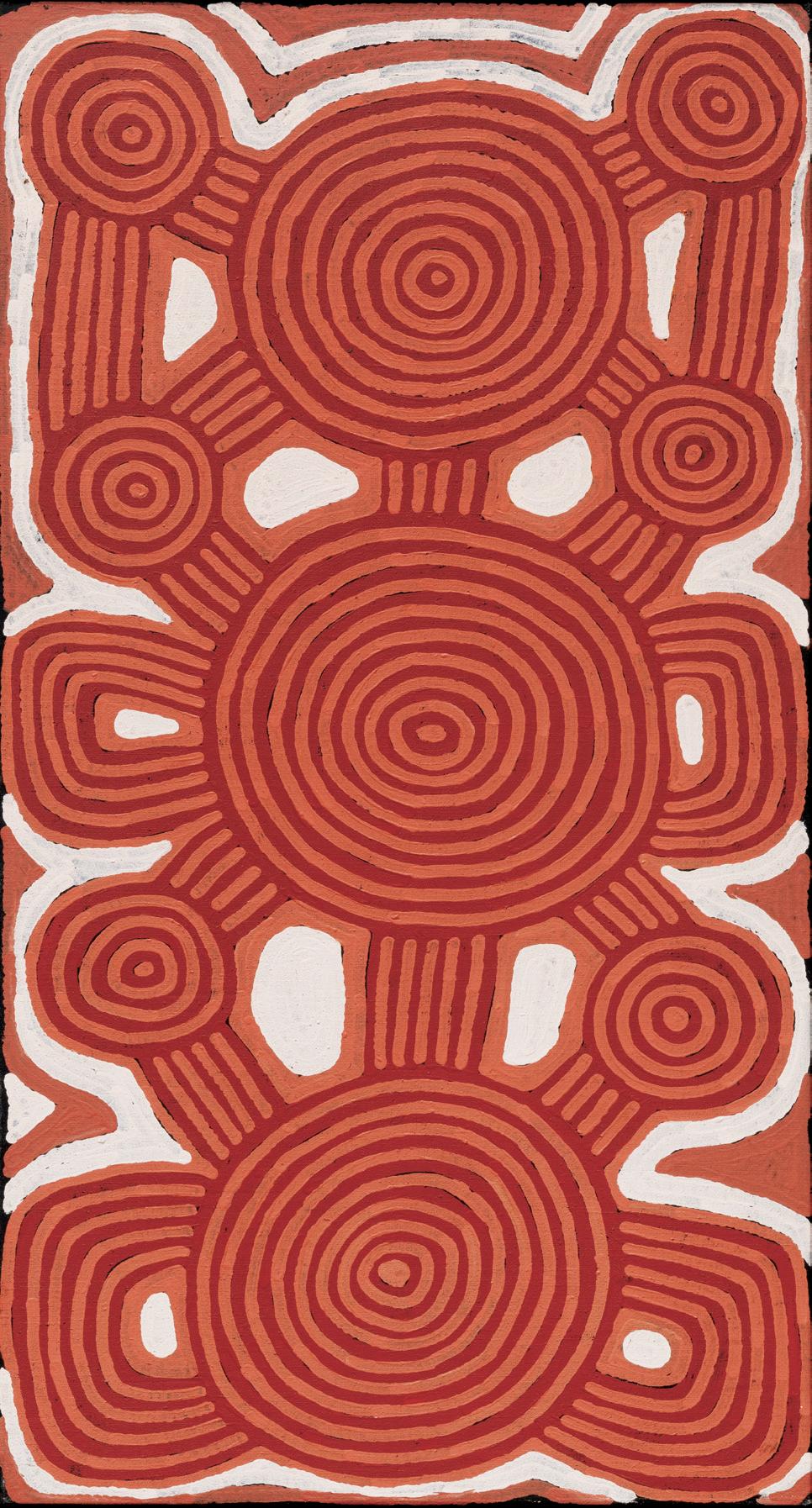
WARLIMPIRRNGA TJAPALTJARRI ( Born c.1958 )
ROCKHOLE SITE OF TJUNTULPUL, 1999
Papunya Tula Artists cat. WT990924
acrylic on Belgian linen
137 x 91 cm
PROVENANCE
Papunya Tula Artists, Alice Springs
The Thomas Vroom Collection, the Netherlands
Important Australian and Aboriginal Art, including The Thomas Vroom Collection, Bonhams, 7 June 2016, lot 128
This painting depicts designs associated with the rockhole site of Tjuntulpul, south-east of the Kiwirrkura Community. In mythological times a large group of Tingari Men, accompanied by Tingari women, camped at this site before continuing their travels to Wilkinkarra (Lake Mackay). After reaching Wilkinkarra they entered the lake.
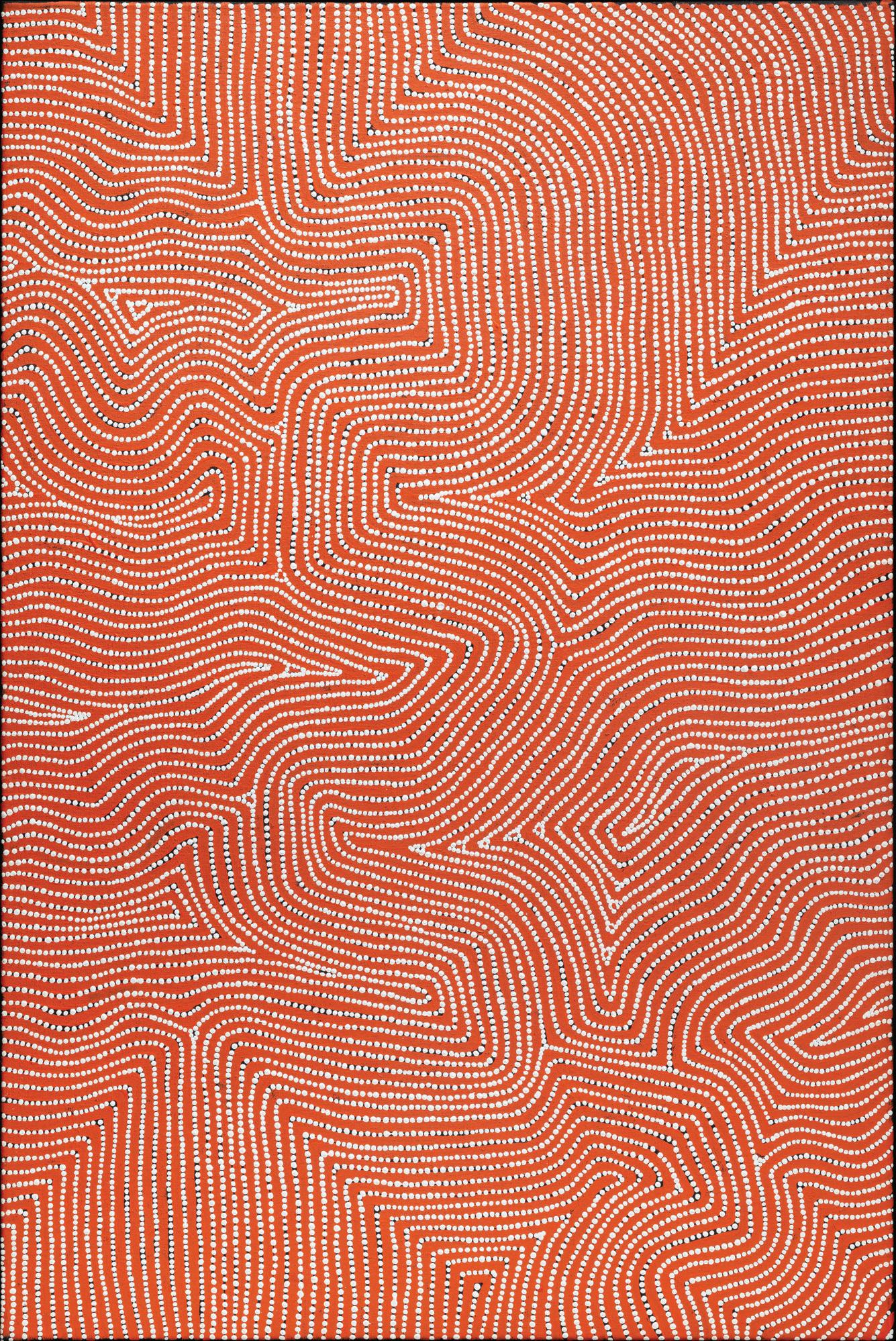
NYILYARI TJAPANGATI ( Born 1964 )
SALT LAKE SITE OF WILKINKARRA (LAKE MACKAY), 2022
Papunya Tula Artists cat. NT2205099
acrylic on Belgian linen
91 x 107 cm 33
This painting depicts designs associated with the salt lake site of Wilkinkarra (Lake Mackay). In ancestral times a large group of Tingari Men visted this site on their travels towards the east. The men had previously visited the rockhole site of Winparku (Mt. Webb) further south. The concentric squares in this painting depict the soakage waters near Winparku, while the jagged lines represent the path of the Tingari men as they travelled towards Wilkinkarra. This design is also consistent with those used during rain making ceremonies...
“In the Kintore studio, where he attends most days, Nyilyari cuts a dashing figure with his bum bag and cowboy hat, calmly smoking a cigarette and surveying the chaos unfolding around him. Largely non-verbal following a stroke some years ago, Nyilyari lacks the volume that normally secures a place on the painting roster on any given day. His decision to paint is so rare that myself and my colleagues drop everything when he
gestures towards a canvas and makes the dipping hand motion that symbolises a desire to paint that day.
This is not to romanticise Nyilyari’s silence, howeverthe man is quick to excite when he mentions art workers distant or old, or become outraged at the proximity of a dog, child or dissatisfaction with colour.
Distinctive in both his unique use of symbols, the diamond-shaped rockhole and interlocking key, and his wielding of a brush instead of a watiya, Nyilyari attends to his painting with the utmost faith in his ability. While Papunya Tula works are (in)famous for their shimmering quality, particularly by the male artists, this is a movement back and forth – a wiggling of sorts. Nyilyari’s work is instead painting of great depth. He fills the segments on his canvas, working inwards from the perimeter. This quasi-circular motion results in a mark-making that is simultaneously hypnotic and soothing...”
Jaxon Waterhouse (Field Worker, Papunya Tula Artists)
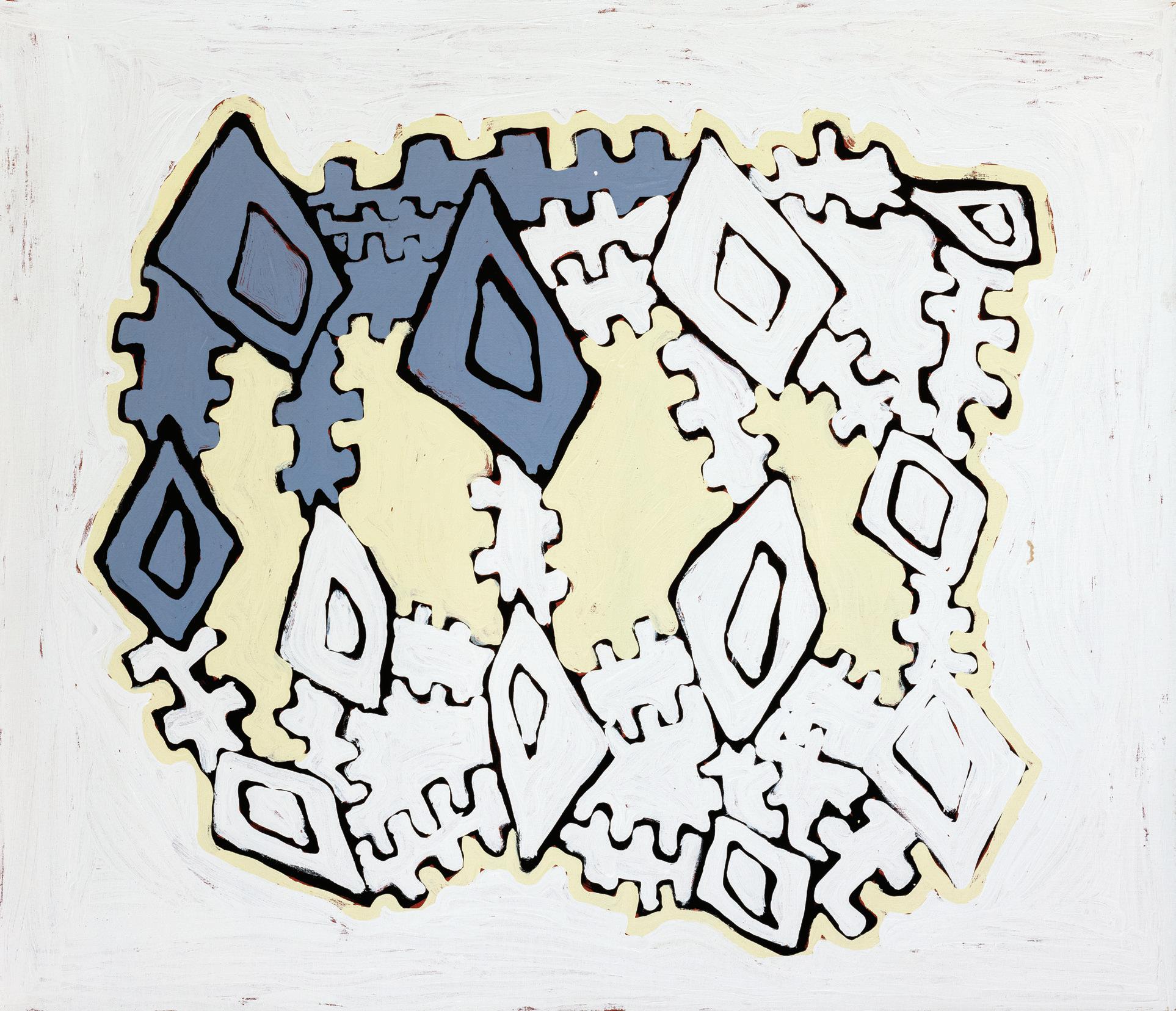
34
WINTJIYA NAPALTJARRI (c.1932-2014)
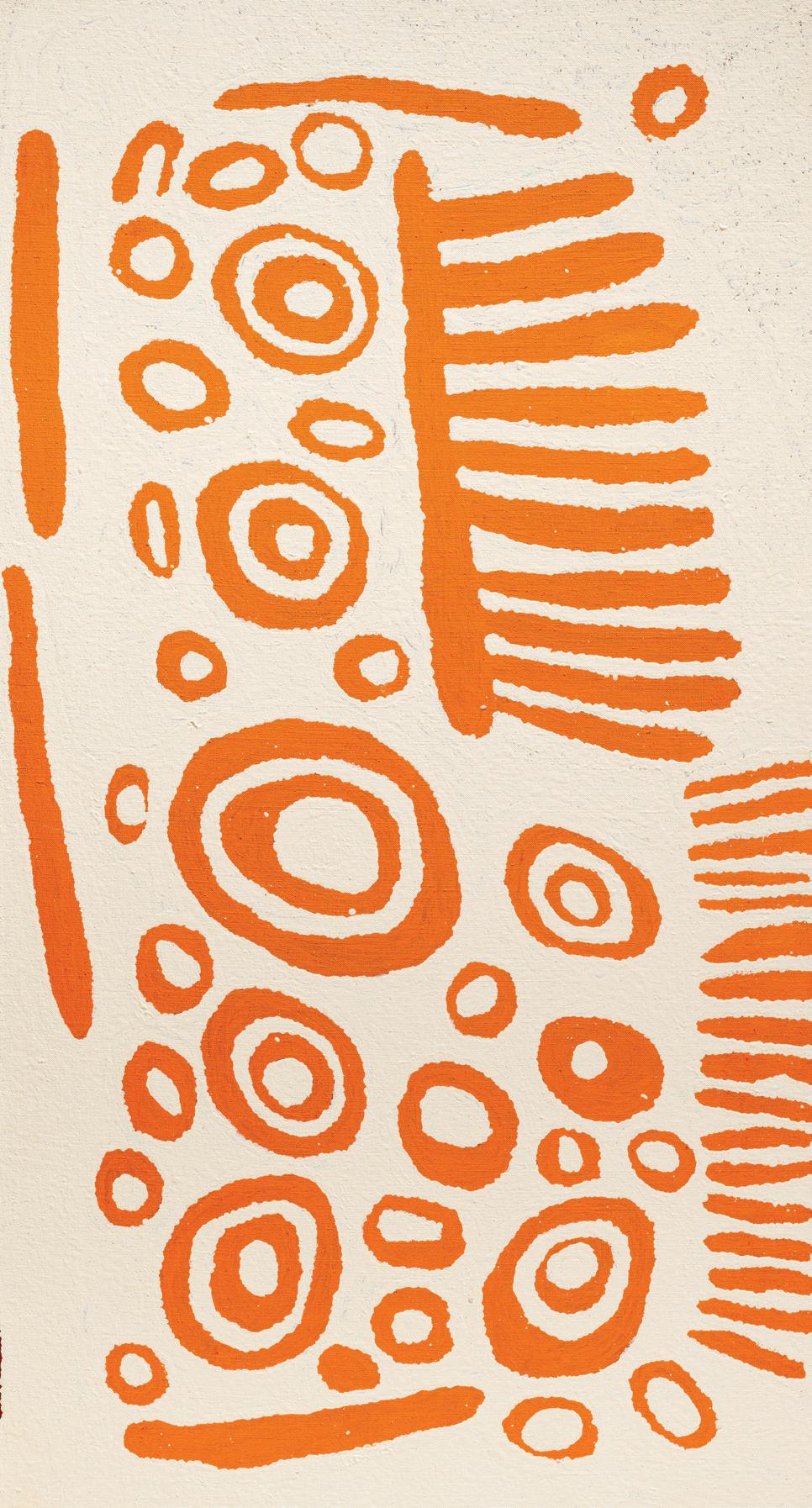
WATANUMA, 2009
Papunya Tula Artists cat. WN0911135
acrylic on Belgian linen
122 x 61 cm
35
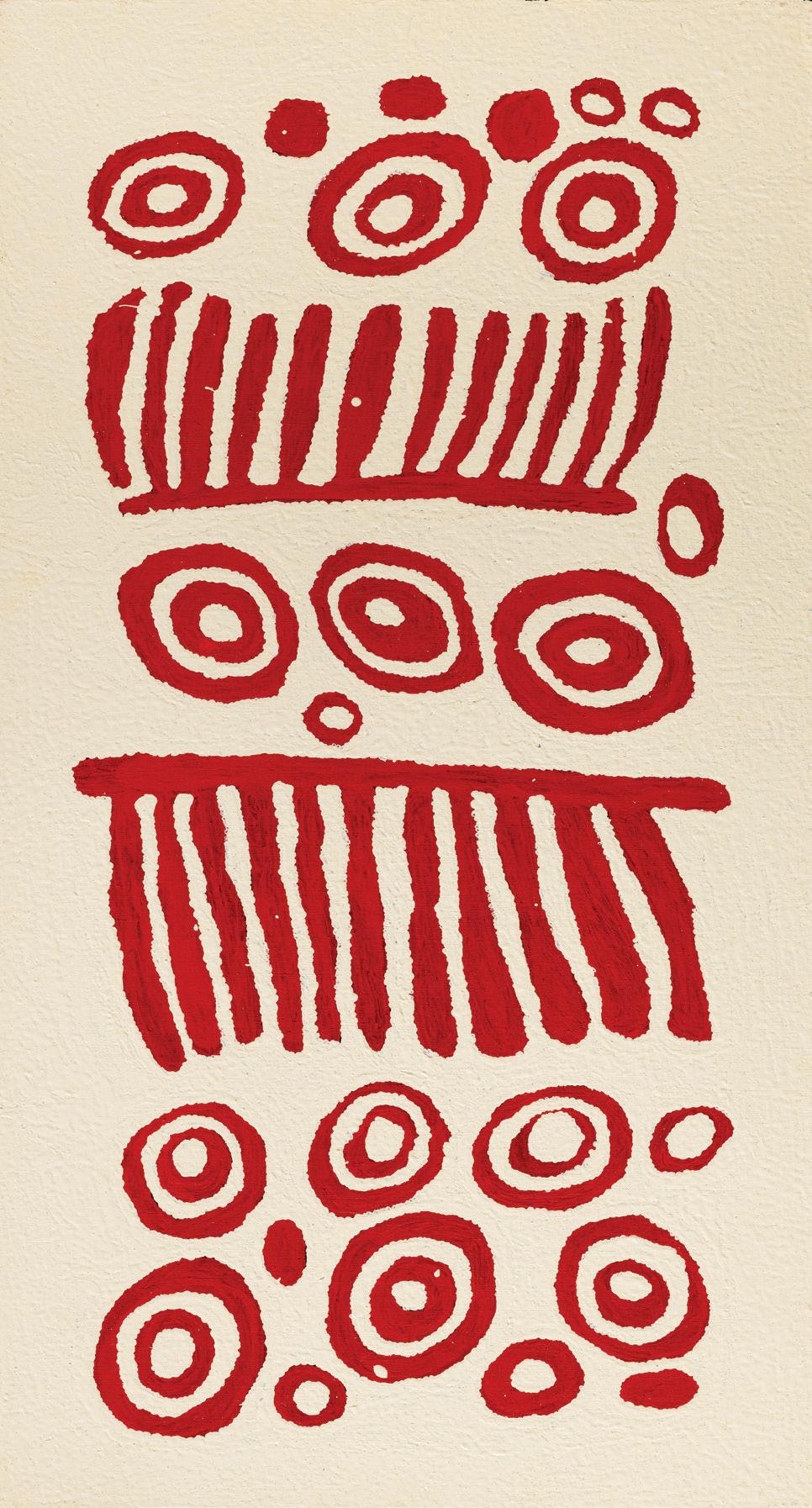
WINTJIYA NAPALTJARRI (c. 1932-2014)
WATANUMA, 2008
Papunya Tula Artists cat. WN0806103
acrylic on Belgian linen
122 x 61 cm
“Wintjiya was born at Malparingya, north-west of Walungurru, and remained in this region with her family until they decided to journey to the ration depot of Haasts Bluff sometime in the 1950s. Later, with her husband, she joined her Pintupi relatives at ‘west camp’ in Papunya and eventually returned to live close to her desert homelands at Walungurru when it was established.
Her first recorded painting for Papunya Tula Artists was completed in 1981; however, it wasn’t until April 1996 that she and many other women from Walungurru and Kiwirrkura began to paint for Papunya Tula Artists on a regular basis. Initially she collaborated on modest, ochre-coloured works with her sister, Tjunkiya Napaltjarri. Despite their occasional differences, the elderly siblings drew upon their extraordinary shared histories to find a compatible union in paint. As the interest in the women’s work intensified, Wintjiya was
able to work alone, utilising a pale palette suggestive of the often gentle hues found in the desert flora. Her early brushed, pastel-coloured works were gradually refined into bold, iconic marks that provide a vivid narrative of the ceremonies of ancestral women at her beloved Watanuma.
Her peerless body of work reveals small painted circles depicting the burrowed holes of the flying ants, also known as watanuma. Comb-like shapes represent the nyimparra (hair-string skirts) that the women wore as they sang and danced beside the rockholes depicted by a series of roundels. When the women had completed the ceremonies to this site, they journeyed to Malparingya, the place where Wintjiya was born...”
Unique Perspectives: Papunya Tula Artists and the Alice Springs Community , an exhibition at Araluen Arts Centre, 17/11/1216/04/13, jointly published by Araluen Arts Centre and Papunya Tula Artists. p. 50
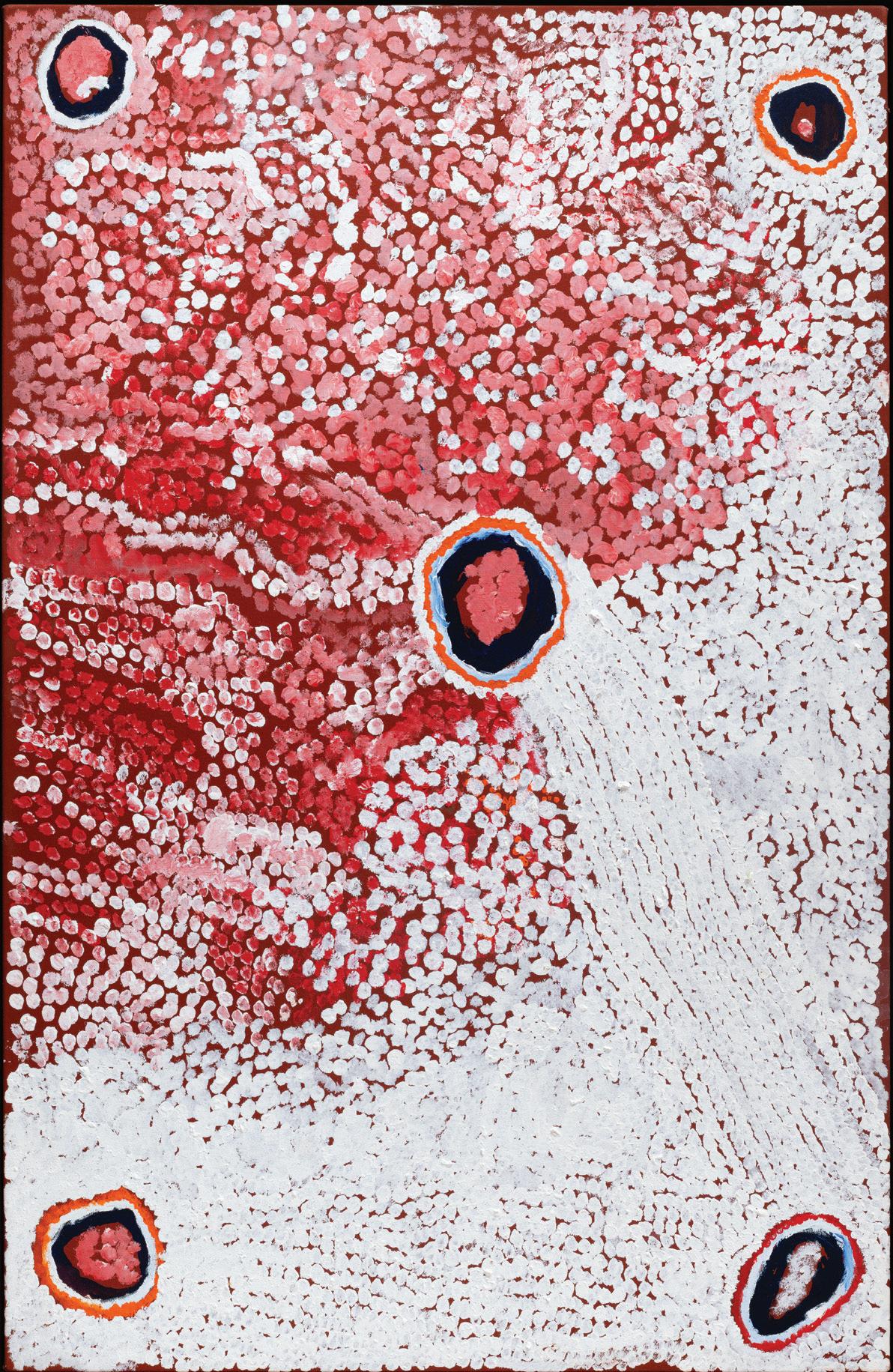
NANCY NANINURRA NAPANANGKA (c.1932-2010)
TJUKURJEE, 2004
Warlayirti Artists cat. 708/04
acrylic on canvas
120 x 80 cm
Nancy has painted some of her country located a little south of Balgo in the Great Sandy Desert. The painting depicts the country known as Tjukurjee and features a warniri (rockhole), represented by the central circle in the painting. The outer circles are pamarr (hills) and the dotting represents the tali (sandhills). There is also an abundance of bushtucker to be found here including karnti (bush potato).
“Nancy’s country lies to the south and east of Balgo, between Nyirripi, Kintore and Lappi Lappi. Nancy grew up on these lands and in her early twenties a white man brought her family to Mount Doreen Station near Yuendumu and they settled there for a while. Nancy worked sorting rocks at the mine that is now closed down.
Nancy married a Warlpiri man from the Tanami area and lived in Yuendumu, then at Granites mine where
her husband worked while Nancy cared for their first two children. The family gradually moved northwest from the Tanami to Gordon Downs Station where they had another son.
Together with her sisters, Nancy is an important Law woman with responsibility to maintain the song cycles of her country. An influential person, she was involved in the production of traditional artifacts in the 1970s and early 1980s and became a key figure in the early Balgo women’s painting movement.
Nancy’s works have been exhibited widely in Australia and overseas.”
Balgo 4-04: New paintings from the Kutjungka Region , Warlayirti Artists, April 2004, p.69
37
BILL WHISKEY TJAPALTJARRI (1920-2008)
ROCKHOLES NEAR THE OLGAS, 2007
Watiyawanu Artists cat. 77-07380
acrylic on Belgian linen
120 x 30 cm
38
BILL WHISKEY TJAPALTJARRI (1920-2008)
ROCKHOLES NEAR THE OLGAS , 2008
Watiyawanu Artists cat. 10-08468
acrylic on Belgian linen
120 x 30 cm
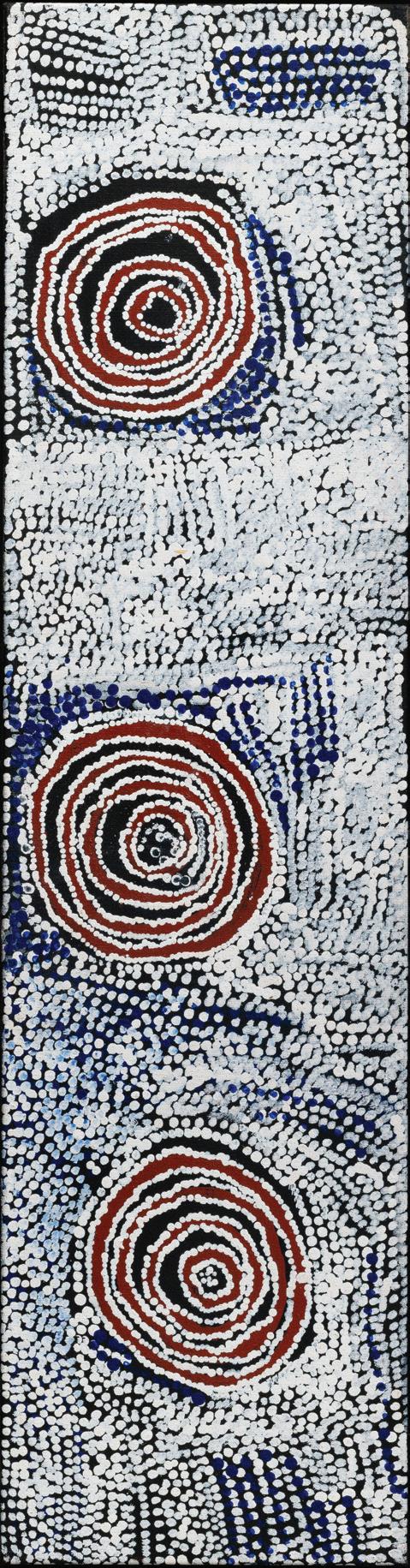
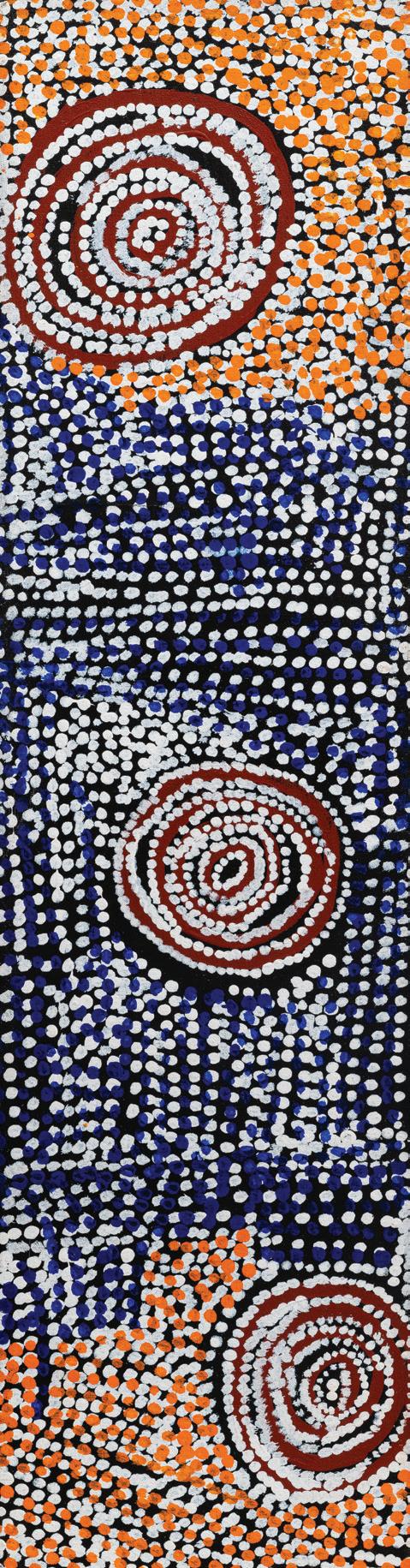
RAY JAMES TJANGALA ( Born 1958 )
Papunya Tula Artists cat. RJ0011105
acrylic on Belgian linen
122 x 61 cm
This painting depicts designs associated with the soakage water site of Yuntutjurra, west of Yunala which is west of the Kiwirrkura Community.
In mythological times an old woman was travelling in this area when she came across a pack of vicious dogs. She killed them all and the small rocks at the site are said to be these dogs. The old woman’s footprints can also be seen at the site.
“Ray James Tjangala is the son of Anatjari Tjampitjinpa, one of the founding members of Papunya Tula Artists. Anatjari and family, including Ray James, were encountered by Jeremy Long in 1963 at Wudungunya rockhole north-west of Jupiter Well. The family, subsequently moved to Papunya. Ray James now lives at Kiwirrkura and began painting for Papunya Tula Artists in the early 1990s. His paintings often feature an
interlocking grid pattern rendered in contrasting colours, a design associated with the site of Yunala, west of the Kiwirrkura Community, where a large group of Tingari men camped. He has exhibited jointly with Warlimpirrnga Tjapaltjarri at Gallery Gabrielle Pizzi, Melbourne (1999)...”
Papunya Tula: Genesis and Genius , published on the occasion of the exhibition, Art Gallery of New South Wales, 18 August12 November 2000, p. 297
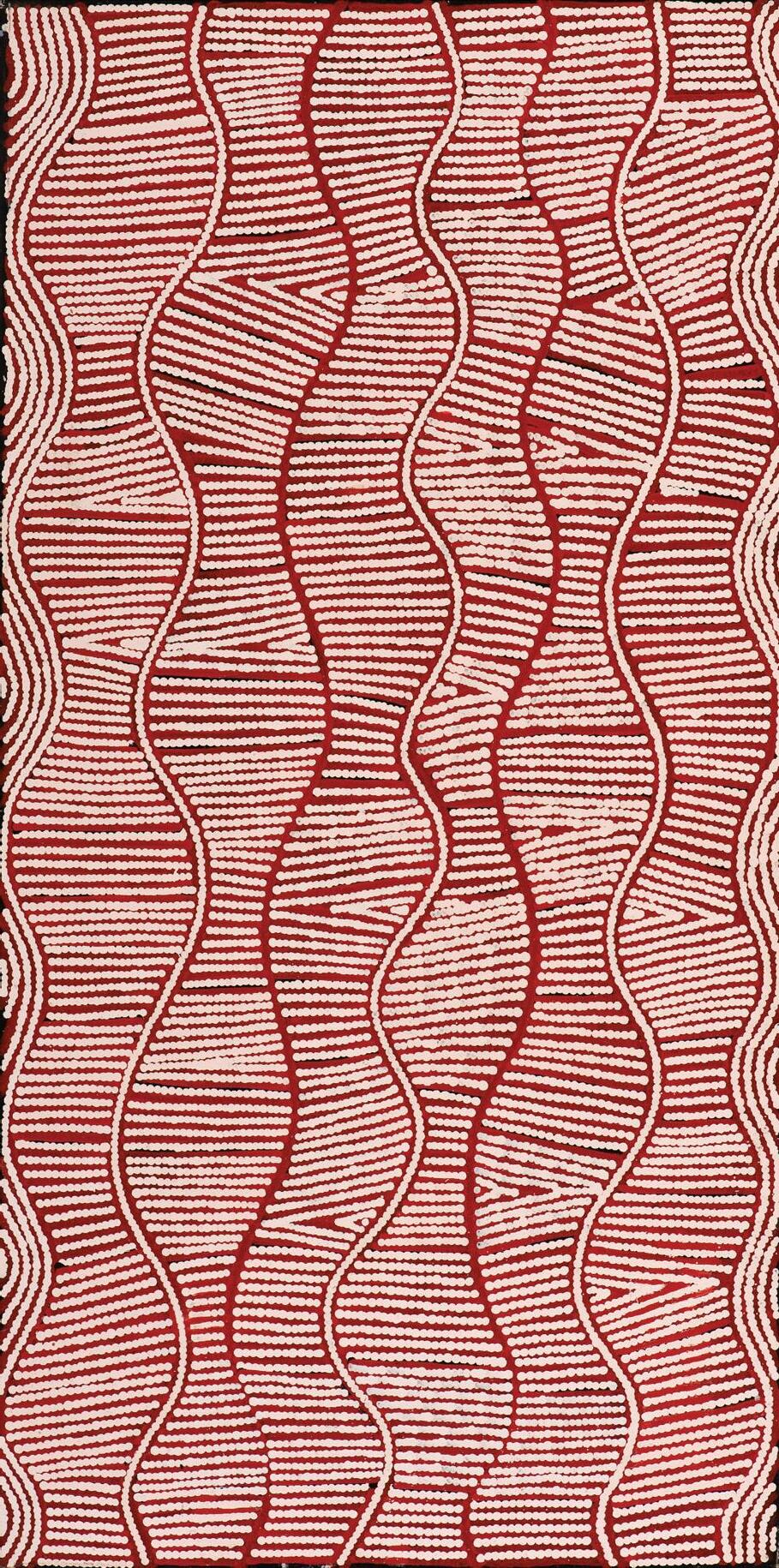
WILLY TJUNGURRAYI ( c.1930-2018 )
KAAKURATINTJA (LAKE MACDONALD), 2000
Papunya Tula Artists cat. WT0009057
acrylic on Belgian linen
153 x 122 cm
This painting depicts designs associated with the site of Kaakuratintja (Lake MacDonald). In mythological times a large group of Tingari men, both young and old, travelled to this site from the west. A fierce hail-storm occurred which killed them all...
Willy Tjungurrayi was born at Patjantja, to the south west of Lake MacDonald. He is the second of three brothers, one of which was Yala Yala Gibbs Tjungurrayi. Tjungurrayi (Willy) was living on the Western side of Lake MacDonald prior to walking into Papunya with a large group in 1976. His first contact with Europeans was one of Jeremy Long’s welfare patrols near Lake MacDonald. In the 1980s he emerged as one of the senior Pintupi painters. Willy’s senior position in his community enables him to paint the most significant and secret parts of the Tingari stories, many of which cannot be revealed to the uninitiated.
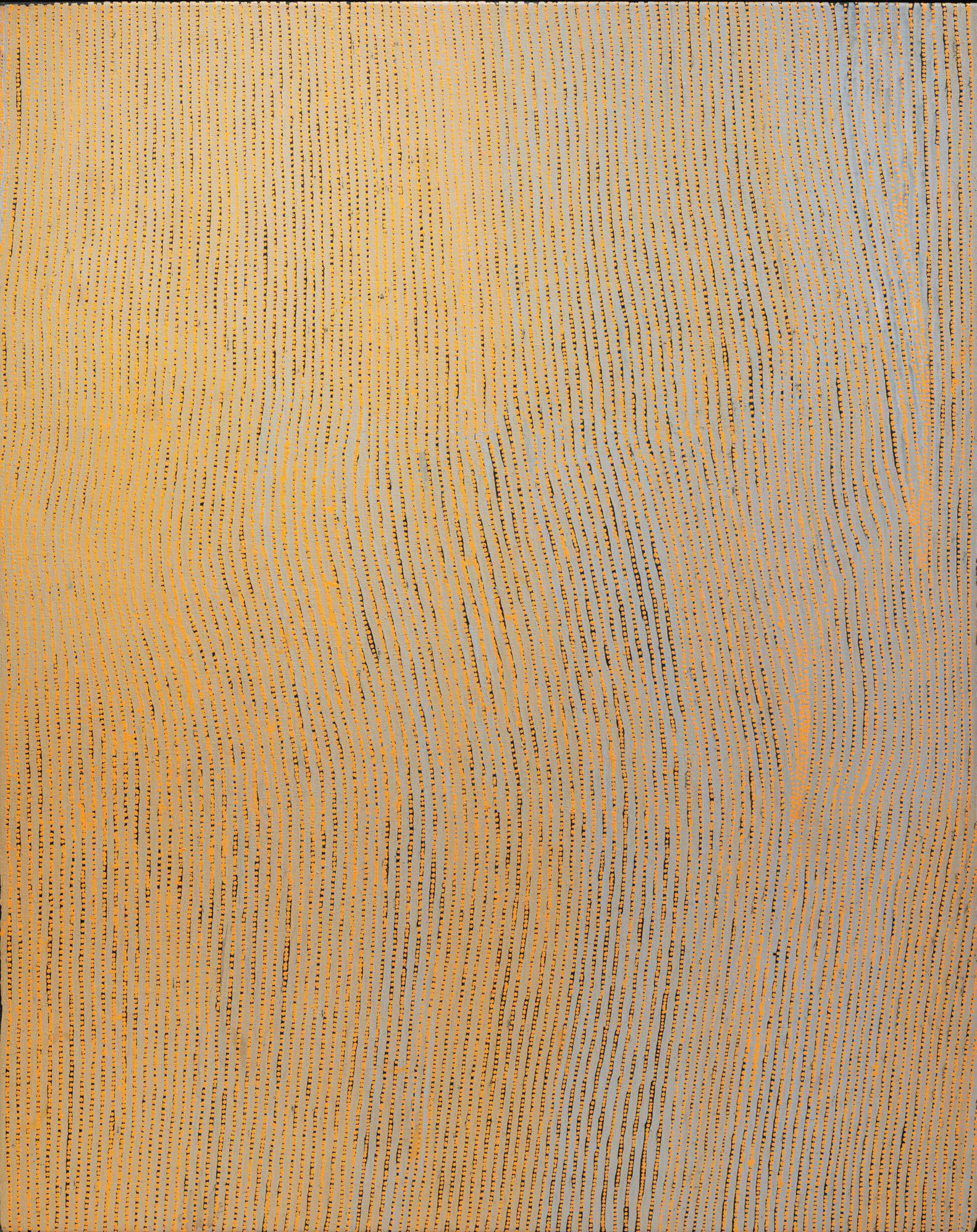
1937)
WARTAMURA, 2005
Warlayirti Artists cat. 625/05
acrylic on canvas
180 x 120 cm
Ningie has painted some of her country south west of Balgo in the Great Sandy Desert. This country is known as Wartamura named after the two tjurrnu (soakwater) depicted. Ningie would use this tjurrnu during the hot times in the desert. Surrounding the tjurrnu and dominating the country are tali (sandhills). This is the country of Ningie’s youth and is a place she would often hunt goanna.
“Born in the Piparr/Kiwirrkura area. Her mother and father died when she was very young, and she came to the old Balgo mission on the invitation of Aboriginal people living there, when her family group was camped at Lirrwati close to Balgo. Like many people at that time, she returned to her own country before settling more permanently at the old mission, first at Tjaluwan, then at its present site at Balgo from 1964. As a young woman she tended the mission goats, gathering bush food for them to eat. Her first husband was a Tjapanangka and they had four children. After he passed away Tjumpo Tjapanangka, one of Warlayirti Artists’ most recognised artists, became Ningie’s husband and together they had a further five children.
Ningie began painting in the late 1980s. Her bold, dramatic and unique style produced through the application of thick ‘rivers’ of paint has brought her increasing recognition as one of the senior artists at Warlayirti Artists.”
Balgo 4-04: New paintings from the Kutjungka Region , Warlayirti Artists, April 2004, p.70
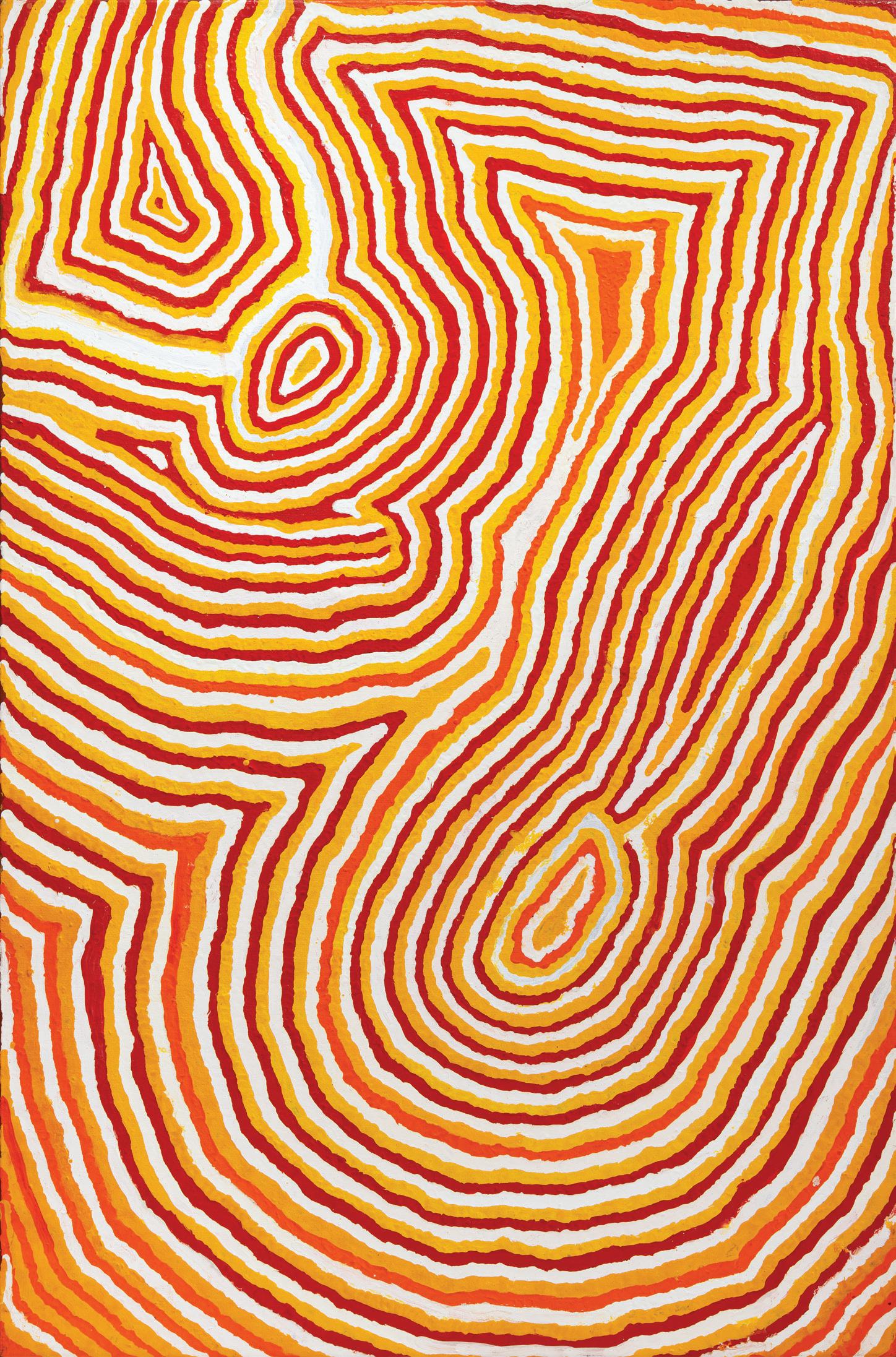
ACKNOWLEDGEMENTS
Papunya Tula Artists
Warlayirti Artists
Watiyawanu Artists
Iwantja Artists
Spinifex Arts Project
APY Art Centre Collective
Gretel Bull
Jaxon Waterhouse
Beth Conway
Olivia Sproull
Louise Foley
Paul Sweeney
Susie Bowie
Peta Appleyard
Special thanks to Simon Strong Photography
Scott Livesey Galleries would like to acknowledge the traditional owners of the land on which this exhibition is held. We pay our respects to their Elders past and present and acknowledge that sovereignty was never ceded.
Catalogue compiled by Scott Livesey
Designed by Sophie Foley
© COPYRIGHT 2026
ISBN | 978-1-7636980-3-1