NEGATIVE
SPAC E
Negative Space
i
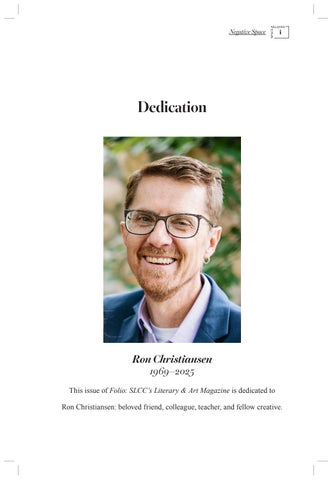
Dedication
Ron Christiansen 1969—2025
This issue of Folio: SLCC’s Literary & Art Magazine is dedicated to Ron Christiansen: beloved friend, colleague, teacher, and fellow creative.
SPACE
ii
NEGATIVE
Negative Space
© 2025 Fall 2025 Semester issue: Folio: SLCC’s Literary & Art Magazine Volume 26: Negative Space. Folio is intended for free public distribution and is not for sale. The works included in this edition, Negative Space, are published with permission from their respective creators. All rights are reserved by this publication and the creators whose works are published in Negative Space. Folio: SLCC’s Literary & Art Magazine gathers art, photography, literary works, and other creative endeavors from Salt Lake Community College students, staff, and alumni. We encourage and accept these submissions so that all members of the SLCC community can showcase their talent, creativity, and diverse lives in an award-winning magazine. We hope our efforts help you, the reader, find a greater appreciation for these artists and their works. Folio: SLCC’s Literary & Art Magazine is curated, edited, formatted, designed, and published by SLCC students and staff. Contact slccfolio@ gmail.com for information on enrolling in ENGL 1830: Literary Magazine Studies—the course that produces Folio: SLCC’s Literary & Art Magazine. Cover design by Olga Gao. Cover art “Stitched Between Something and Nothing #2” by Nash Hutto. Typefaces used are [Warbler, Times New Roman]. Special Thanks To: Folio Advisory Board: Daniel Baird, Kati Lewis, Cristin Longhurst, Stacey Van Dahm, and Virag White. Professor Darin Jensen, Associate Dean of Department of English, Linguistics, and Writing Studies. Dr. Roderic Land, Dean of School of Humanities and Social Sciences. Theresa Adair and staff at SLCC Printing Services. SLCC Poet Laureate Brenda Sieczkowski. Amanda Rubino, Prison Education Program, Office of Learning Advancement Publication Center staff Ken Nelson, Olga Gao, and Oliver Harrington. All of the SLCC students, faculty, and staff who shared their voices and creations with Folio: SLCC’s Literary & Art Magazine! Don’t forget to explore more amazing works published online at www.slcc.edu/folio
NEGATIVE
SPAC E
Negative Space
iii
From the Folio faculty advisor, It has been an honor to guide the creation of the Fall 2025 issue of Folio: SLCC’s Literary & Arts Magazine in English 1830, Literary Magazine Studies, the course that markets, curates, edits, designs, publishes, and launches an edition of Folio every fall semester. The Folio team consists of a faculty advisor, students taking English 1830, and paid part-time staff. As the faculty advisor, I have big shoes to fill. Since its inception in 2009, Folio had been led by dedicated faculty from the department of English, Linguistics, and Writing Studies and built by the outstanding and creative students enrolled in English 1830. I took over from Professor Daniel Baird, who led the magazine since 2021. Professor Baird has been an invaluable resource for me as I learned the ropes of teaching magazine publication in our unique community. And our community owes him a special thank you for producing so many issues of the magazine, including the award-winning issues of Reverie (spring 2022) and Lucidity (spring 2023). I could not have completed this issue without the excellent work of publication staff Olga Gao and Oliver Harrington, whose design and editorial skills facilitated the success of this issue. I am grateful to them and to the fall 2025 students of English 1830 whose creativity, vision, and ability to find consensus around all creative challenges have made the magazine what it is – a beautiful homage to the SLCC community. Thank you, Tracy Fraatz, Gracie Gerrard, Ellie Marsh, and Jayla Santillan. This is your magazine! A special thank you also goes to Amanda Rubino, whose dedication to the SLCC students participating in the Prison Education Program has made it possible for Folio to include some of their creative work in this issue of Folio. I invite readers to enjoy the literary and art pieces throughout Negative Space, the newest issue of Folio: SLCC’s Literary & Art Magazine. Stacey Van Dahm
SPACE
iv
NEGATIVE
Negative Space
English 1830 Students / Folio Staff Tracy Fraatz Gracie Gerrard Elizabeth Marsh Jayla Santillan
Publication Center Staff / Editing and Design Olga Gao Oliver Harrington
Folio Faculty Advisor Dr. Stacey Van Dahm
NEGATIVE
SPAC E
Negative Space
v
Negative Space This is an invitation to take a look into Negative Space. Negative space is the supposedly empty space in a design that helps bring the image itself into view, but it often holds the possibility of another image—a new and unexpected idea. It offers a place for creative thought and seeing something in a new way.
We encourage you to spend time with these pieces. As you do, look beyond what simply lies on the page. Find the negative space and what that means to you. It can be a negative mental space, the space around our daily lives, the in-between that does not pertain to us but still is part of us. Negative space represents the beauty and pain in human experience, and that is what we encounter in art. However you choose to interpret Negative Space, there is and always will be a choice open to you.
Welcome to Negative Space.
SPACE
vi
NEGATIVE
Table of Contents
Table of Contents Note: Artists/authors named by a single letter (B, K, C) represent work submitted by students participating in SLCC’s Prison Education Program (PEP). We are not permitted to share their names, but we are honored to share their voices.
Poetry
Collective Piece—On Hope ������������������������������������������������������ 124 Gracie Gerrard, Jayla Santillan, Elizabeth Marsh, T. Consuelo Fraatz
The Smokescreen ��������������������������������������������������������������������������1 Kaiser Gerrard
Defiance ���������������������������������������������������������������������������������������� 2 Gracie Gerrard
THE CENTIPEDE ����������������������������������������������������������������������� 14 C
UNTITLED �����������������������������������������������������������������������������������15 C
parasite ����������������������������������������������������������������������������������������18 Benny Johnson
winter yearning ���������������������������������������������������������������������������21 Benny Johnson
Sestina for People Who Spend �������������������������������������������������� 32 Too Much Time Staring at the Ceiling Elizabeth Marsh
Transcendental ��������������������������������������������������������������������������34 T. Consuelo Fraatz
Toby ���������������������������������������������������������������������������������������������49 Jordan Baum
A Young Widow ��������������������������������������������������������������������������50 Rebecca Gutz
Sometimes (Strange) ��������������������������������������������������������������������51 Sydney M. Redd
NEGATIVE
SPAC E
Table of Contents
vii
IN MY REDS ������������������������������������������������������������������������������� 66 K
Inclusion Af firmative ���������������������������������������������������������������� 69 Rosie Red K.
Stand Out: A Reckoning ������������������������������������������������������������� 72 Rosie Red K.
Empty stares and burning friendships. �����������������������������������84 Arwen Claudell Rasmussen
The Muse �������������������������������������������������������������������������������������85 Arwen Claudell Rasmussen
The spiral staircase of a lovesick fool. ��������������������������������������86 Arwen Claudell Rasmussen
A Look into Being Transgender ������������������������������������������������92 B
She is Me, Now That She is Old Enough to See ����������������������� 109 C.C. Hart
Danny’s Poem ���������������������������������������������������������������������������� 110 C. C. Hart
Fiction
Dream ������������������������������������������������������������������������������������������ 23 Anna Belle
The Euphorium ��������������������������������������������������������������������������53 C
You Can’t Wake Up From Every Dream ������������������������������������56 Quel Helianthus
Angelic Pride ������������������������������������������������������������������������������ 61 Mars
Cranberry Orange Cookies ��������������������������������������������������������81 Kennedi Christensen
One Life �������������������������������������������������������������������������������������� 101 Erin Morton
The Tale of the Teleporting Cart ��������������������������������������������� 119 Kade McLane
SPACE
viii
NEGATIVE
Table of Contents
Creative Nonfiction
Three Out of Ten �������������������������������������������������������������������������� 5 Nell Roberts
Can I Have This Job? ������������������������������������������������������������������ 10 Alexandrea May
Beyond the B ������������������������������������������������������������������������������� 37 Ludmilla P.
Stillness Speaks Volumes ���������������������������������������������������������40 Celeste Little
Looking Over the Valley ����������������������������������������������������������� 41 Oliver Harrington
Splat! ��������������������������������������������������������������������������������������������42 Mary Margaret McShane
The Little Engine That Could ���������������������������������������������������� 74 Tanner Wood
Mission Improbable �������������������������������������������������������������������88 Jen Swan
Muir-làn (High Tide) ������������������������������������������������������������������97 Katherine Smith
A White Coat Knows More Than a Body ��������������������������������� 112 Jesse Suliin-Drew
Art
Ocean of Possibilities ������������������������������������������������������������������ 4 Rylie Nadauld
It Will Be Okay ���������������������������������������������������������������������������30 Rylie Nadauld
Lewis in Color ����������������������������������������������������������������������������36 Jasmine Malouf
The Doctor ���������������������������������������������������������������������������������48 Brittany Nadauld
Tim and Tom on a Date ������������������������������������������������������������� 52 Aubrey Nadauld
The Tiger ����������������������������������������������������������������������������������� 60 Patchworks
NEGATIVE
SPAC E
Table of Contents
ix
I PROMISE ���������������������������������������������������������������������������������68 K
Old School ��������������������������������������������������������������������������������� 80 Aubrey Nadauld
Lovely Rainy Day ����������������������������������������������������������������������� 83 Joani Desotos
Stitched Between Something and Nothing 1-3 ���������� 94, 95, 96 Nash Hutto
Skating Dreams ������������������������������������������������������������������������ 121 Aubrey Nadauld
Photography
Red Line Tram ����������������������������������������������������������������������������13 Nell Roberts
Gas Station ��������������������������������������������������������������������������������� 16 Layne Snow
I AM ATM ������������������������������������������������������������������������������������17 Layne Snow
3 AM ������������������������������������������������������������������������������������������� 22 Rylie Nadauld
Hidden World of Macro �������������������������������������������������������������31 Athena Davenport
Stillness Speaks Volumes ���������������������������������������������������������40 Celeste Little
Looking Over the Valley ����������������������������������������������������������� 41 Oliver Harrington
Hola Mahala ������������������������������������������������������������������������������� 87 kapturedbyher
Mossy Stairs �����������������������������������������������������������������������������100 Jen Swan
Salt Lake City in March ���������������������������������������������������������� 108 Nell Roberts
Soul ��������������������������������������������������������������������������������������������122 Jayla Santillan
The Smokescreen
» Kaiser Gerrard
Staff Pick
NEGATIVE
SPAC E
The Smokescreen
1
Silently choking on imposter syndrome while I shake hands with the appearance I contorted and willed into existence; rejecting my nature with a feeble attempt at an exorcism. A monstrous curse, the very parasite lurks in my blood, lies between the layers of my skin, And swims through the gaps in my teeth. Once, while the man stares at me - a premonition. Lace and bells, a loophole. Once again, staring straight through the veil with a gaze that grapples itself down my throat, Constricting my vocal folds and binding itself at my waistline; contemplating to descend with a reluctant curiosity, or to retreat. gently? My head expands and contracts while I sprint home, letting my tears sputter down my skin, a form of expulsion I can stomach. One hour and fifty minutes later… Locking the door so I can sink to the ground; Then I’ll quickly jump onto my bed to escape the beating heart underneath my floorboards. weary and depleted, I secretly surrender to the flesh that condemns my bones to one place. Frozen, the evidence hidden by modern medicine. The beast that remains dormant until the apocalypse begins. or until my heart stops beating.
SPACE
2
NEGATIVE
Defiance
Defiance » Gracie Gerrard
You want to see me bare raw breathless born bankrupt criminal candescant condensed dispersed and breathless again in reverie in utero utterly unbound and in an outrage You wanted to see every facet I bore beneath my sinking skin how it shone, chrome What more? To feel atoms, at once for the first time touching It always felt we were defying something when we touched In this defiance, birthed what is pre-living In this defiance, we searched until there is no paint over flesh it is just flesh
In this touching we felt nothing of what was beneath our dwindling skins: blood, each untamable atrocity (a burning of eternally solid scrap metal, the You and Is who murder) We, in disobedience partly, in disbelief mostly, touched. It was thievery of the good, orderly world only to make no use of it Howling and laying draped over one another pearlescent and silky with a mid-afternoon light that ran like sweat leaving only salts on our paintless flesh.
NEGATIVE
SPAC E
Defiance
3
SPACE
4
NEGATIVE
Ocean of Possibilities
Ocean of Possibilities » Rylie Nadauld A two-block linocut print
Three Out of Ten
» Nell Roberts
Staff Pick
NEGATIVE
SPAC E
Three Out of Ten
5
CW — Attempted Suicide Performance Instructions: Read every word of instruction included in this text along with the text itself—including these words—aloud to the audience in the linear order prescribed by the page. Select 5 oblong ovular objects somewhat representing a pill. The specifics of each object are left to the discretion of the performer, but they must not be made of meat. When instructed to, throw each object one-by-one onto the floor as hard as you can. While throwing, stop reading aloud, turn around to the audience, and scream loudly. Prepare a golf ball. You will use it later. Keep it on your person. Enjoy yourself. Begin transcribing.
Picture this: You are afraid of the dentist. Most ten-year-old kids are. Picture this: You are particularly afraid of the dentist today. Picture this: You are sitting on the exam table hyperventilating. Picture this: I think I’m having a panic attack.
The worst thing about a panic attack is not the experience itself but the judgement cast upon you by other people in the room. Even positive affections carry with them the constant wonder. Were they genuine? Do they care? Am I justified in feeling this way? A chaser of anxiety washes down the cerebral dissemination experienced during the attack. The seizure of all your thoughts is abruptly concluded by the need to know more. Then was the time for worry, now and forevermore it is the time to worry again. For what it’s worth, I think you were justified. On that day, at least.
Performance Instructions: Throw the first object.
SPACE
6
NEGATIVE
Three Out of Ten
Picture this: You go into Walmart. Picture this: Your grandparents tell You to pick out a toy. Picture this: You like picking out toys. Most ten-year-old kids do. Picture this: You do not like picking out a toy today. Picture this: You are keenly aware that this toy will outlive you.
That toy now lives on a bookshelf behind your desk. You wrote this piece on that desk. While writing this, you picked up the toy. You felt it. Not any specific piece or part, just ... it. This thing. A consolation prize, a participation trophy, an apology, an attempt to stop your crying. Sometimes an object is created before it is born. When they’re born, they have a certain kind of unconscious power infused within them. Intrinsically tied to a place, a sense, a memory, a person. A powerful object can know the world without being real. Sometimes you feel like an object. Sometimes that’s okay.
Performance Instructions: Throw the second object.
Picture this: You swallow a pill. Picture this: You swallow a pill roughly the size of Your thumb. Picture this: You hate taking pills. Most ten-year-old kids do. Picture this: You will hate taking pills for the rest of Your life. Picture this: You are woken up at 3:00 AM by Your family. Picture this: You hear someone begging You to swallow this looming oblong thing in Your hand. Picture this: It hurts.
You can never truly know a thing without knowing its opposite. You found both in the routine. As the pills touched your gullet, the labels attributed to
NEGATIVE
SPAC E
Three Out of Ten
7
it undulated in your brain. The slow metamorphosis of terms and definitions left you with a markedly less easy feeling about the providence of medicine.
Performance Instructions: Throw the third object.
Picture this: You miss school. Picture this: You miss a lot of school. Picture this: You miss so much school that once You finally get back to class Picture this: You are a stranger to all of Your friends. Picture this: You stand holding Your dad’s hand as he talks to Your teacher. Picture this: You will never remember what they are saying. Picture this: You look into the eyes of Your best friend in the whole world. Picture this: You will never forget the way he looks at you. For the rest of Your life You will always be able to picture this as though it were still happening because it will be soldered onto Your brain: The way a stream of tears falls out of him but he doesn’t dare turn his gaze away because he knows that every single second that passes could be the last second he ever gets to look at you.
Picture this: You look at your best friend in all the world. Picture this: You are ten years old. Picture this: You like looking at your best friend in all the world. Most tenyear-old kids do. Picture this: You still do. Picture this: You have already accepted the fact that this is the last time You will ever see Your best friend in all the world.
SPACE
8
NEGATIVE
Three Out of Ten
Performance Instructions: Throw the fourth object. Scream again. Do it again.
Picture this: You did not feel victorious. Picture this: You did not feel relieved. Picture this: You did not feel happy. Picture this: You were told it’s over. Picture this: You are told words. Picture this: You will never escape. Picture this: Keep picturing it. Keep it in your head. Nurture it. Let it hurt You. Never let it leave You. Picture it every day.
Performance Instructions: Have a flashback while sitting in a doctor’s office. Performance Instructions: Rip Your hair out when You get a tooth ache. Performance Instructions: Separate Your mind and body so as to reduce the deficit. Performance Instructions: Desecrate Your youth. Performance Instructions: Contend with the reality of death. Performance Instructions: What does it feel like to die? Performance Instructions: You are ten years old. You are ten years old. You are ten years old. Picture this: The world caught You, held You for one decade, and threw You back.
Performance Instructions: Throw the fifth object.
NEGATIVE
SPAC E
Three Out of Ten
9
Picture this: You sit on the examination table in the dentist’s office. Picture this: You are informed that golf ball-sized swelling mass which has grafted itself onto the left side of Your mouth is an infection. Picture this: You are informed that treatment must begin immediately. Picture this: You are informed that if treatment does not begin immediately, the infection will Picture this: You are informed that even if treatment begins immediately, there is a very real possibility that Picture this: You are ten years old. Picture this: It is Your birthday. Picture this: You are going to die.
And then You just don’t. And You will never really understand why. And You will always wonder.
Performance Instructions: Lay down on the floor and cry for 15 seconds. Then, while still laying down, hold your breath for 15 seconds. Afterwards, stand up and read aloud the final piece of this text.
Audience Instructions: Do not provide applause.
Thank you.
SPACE
10
NEGATIVE
Can I Have This Job?
Can I Have This Job? » Alexandrea May
I often get asked if I did debate in high school, which I think is just people calling me a bitch without calling me one. Or telling me they aren’t really listening to me. Because who wants to listen to a lawyer or likes them. I’ve always found it difficult to be a person. Feeling like I am something just outside of it, still human, but not considered such. What I mean is that I’ve never really got it. The whole human interacting with human bit. Everyone around me seems to know the rules and no one has given me the manual. And then there’s being emotional and passionate about interactions. Often, I am told that I am too sensitive and too angry, and I try to change that despite my true feelings. I try to put those parts of myself in boxes that I can take out when I am alone and spend time with those pieces of myself. But in doing this, I have to become a bit numb, robotic even, spending time observing and taking in others’ interactions so I can formulate it. Every time I am trying to make a new friend, I have to prepare for it. Think of what I am supposed to say so I won’t fry the connection. In my brain I think about interacting with others like a corporate interview. Picture this, rows of gray and white desk cubicles, rows of the same cropped haircuts and neat up-dos in different colors. I’m brought to a room by the person I am attempting communication with. They are dressed in slacks, a button down and a tie, cinched up tight, topped with a cropped haircut or a neat up-do. They sit opposite me and have perfect posture. I attempt to match posture, but I’ve been told this is rude to imitate others, so I fidget between a slouch and upright. Then there’s my hands. I’m never really sure what to do with them, and I fidget with them, which again I am told is rude. So, I try and flex them out open palms and fingers so no movement can be detected, but my hands get tired, so I relax and again flex. Flex, relax, flex, relax. Then there’s my breathing. I have been told that I sigh a lot and breathe loudly, so I try to hold my breath a lot. Most of the time I spend holding my breath.
NEGATIVE
SPAC E
Can I Have This Job?
11
“So, what do you do?” They ask this question first. “What do I do?” Uh-oh why didn’t I prepare for this question? It wasn’t in my flashcards. What do I do? What do I do? What do I do? Oh God, what do I do? Fuck, just keep eye contact, shit I haven’t taken a breath in a while, shit now I’m sighing, God, do I look bored? Please don’t stop talking to me, I really need this job. “Yeah for, like, fun or work I guess.” They respond. “Oh, for fun I, um, do things that people do,” I reply. Was that a normal answer? I can’t think of what I do. My mind is completely blank; please believe I am interesting. I do have hobbies and enjoy the world, but I can’t think of a single thing I’ve done in my entire life. “Oh, you’re funny, like kind of weird, but funny I guess.” They laugh awkwardly. I laugh a little too loudly. “Yes, well, I try really hard.” Here is where I tell an awkward joke and laugh too loudly again. I’m trying to be funny because they think I’m funny, so if I’m not, they won’t talk to me anymore and then I’ll be unemployed. And I can’t be unemployed again. They give a slight sympathetic chuckle at my pathetic attempt a joke, but they look like they aren’t interested anymore. It’s the same look, they are trying to be polite, and I appreciate that, but their eyes dart from behind me to at me and then away again. I need to think of something to ask, anything that will get me the job. “What is your favorite kind of noodle?” I ask, hoping it’s a silly enough question to break the tension, but also keep them talking to me. “Oh um, I don’t really know. That’s an odd question.” They again, sympathetically chuckle. But their eyes are still looking around, like they are hoping the secretary will come in and tell them the next interview is here. “Yeah, I suppose it is an odd question. Mine is fettucine because they are long, but not too thin like an ang—”
SPACE
12
NEGATIVE
Can I Have This Job?
“Okay, well, we’ll call your references and give you a call if we’re interested. But we have a lot of other candidates,” cutting off my babbling about pasta, saving us both the energy of continuing the interview. I’m not getting the job. They stand and reach for my hand to shake. Physical contact uh-oh. If I shake too hard, I will hurt them. If I am too soft, they’ll think I’m stuck-up. I grab their hand, give one shake. “Do you have any questions before we end the interview?” Yes, how could I have done this interaction better? Could you please rate my interpersonal skills on a scale of 1 to 10. I want so desperately to ask this. I know I fucked it up and I don’t know how to change it. But I know this isn’t what I am supposed to ask. So instead, I say, “No. Thank you for your time.” I force myself not to add, sorry for wasting it. Still unemployed.
NEGATIVE
SPAC E
Red Line Tram
13
Red Line Tram » Nell Roberts
Photography
SPACE
14
NEGATIVE
THE CENTIPEDE
THE CENTIPEDE »C
Nocturnal and predatory (Calm and ready) Arachnid, arthropod, centipede Everything you could ever feel or want or need Slinking through the dusk and the night Illuminated in sharp contrast by a streetlight Total apathy; emotional deprivation Always on a spiritual vacation Many-legged; creepy and strange Bursts of bright light; an explosion of flame Are we what we do? Are we defined— By our worst moments, our transgressions and our crimes?
UNTITLED »C
It’s not personal; it’s an electric demon Painting the night in shades of neon Everyday normalcy is a kind of façade Is there something wrong with wanting to play God? Existential dread; crushing apathy Just another excuse for a catastrophe Viewing the world through a distorted prism Ever waiting for a cataclysm The futility of my existence Doesn’t negate my persistence I’m always after the wrong things Anarchic and apocalyptic; smoke and diamond rings Love to me is a distant moon Sharp teeth and gone too soon Choking on emptiness; swallowing absence Other people are cardboard cut-outs; animate presences
NEGATIVE
SPAC E
UNTITLED
15
SPACE
16
NEGATIVE
Gas Station
Gas Station » Layne Snow Photography
NEGATIVE
SPAC E
I AM ATM
17
I AM ATM » Layne Snow
Photography
SPACE
18
NEGATIVE
parasite
parasite » Benny Johnson
woken up from my sleep, my phone buzzing on the nightstand a spam call, maybe? or is it the thousandth fake number you’ve called me with? i blocked your real one the georgia area code reminding me of when i was 1700 miles away from everything i ever loved everything i ever loved except you a life thrown away for someone that never deserved it friends and family ignored because you were the only one that mattered to me you were going to propose after all, but those plans kept conveniently being put off for months “Sorry, I don’t have money, sorry, we need to move into a new place, sorry, I’ve lost interest in you entirely.” that was about the time She came around a master manipulator in Her own words told as a funny joke in passing almost like it meant nothing when to me it meant the world so of course you orbited Her like one of jupiter’s many moons i still blame myself sometimes like it could have been helped, like you would have gotten better one day,
NEGATIVE
SPAC E
parasite
19
like we should have worked out in the end, when i know better now Woulda, Coulda, Shoulda the 3 horsemen of stagnation destroyed from the inside over the course of years until i resembled a husk of a person eating disorder and all it’s amazing how the delusions disappear when you don’t starve your brain anymore
but i’m disturbed from my ruminations of the past as you dial my phone once more taking hints was never your strong suit after all why did i pick up again? am i stupid or something? mentally beating myself up because of course you’re trying to apologize to me as if my mental anguish could be fixed with a hurried “I’m sorry” you cry at me through the phone because that was truly the one thing you were good at you told me it was all Her fault i don’t think you’ve ever taken accountability for anything in your life why should you when you can just blame the state of the world, the economy, your mental health, blah, blah, blah just a pot of word stew that’s boiling over
SPACE
20
NEGATIVE
parasite
when did you decide that you were healed again? did a therapist tell you that? did your friends tell you that? or did you finally realize that your life was significantly worse without me babying you every day? too young to be a parent but stepping up anyway a grown adult reverting into a child whenever convenient but you’re not peter pan, you’re a jumble of negative traits masquerading as a person and for some reason i allowed you in, an energy vampire infiltrating my home sucking away my life force then disappearing once i had nothing more to give
so i’ll leave you with this: i hope you heal but i also hope you stay the hell away from me clearly you can’t do either of those things, so until you figure it out you’ll always be just a Parasite.
NEGATIVE
SPAC E
winter yearning
21
winter yearning » Benny Johnson
do you remember those freezing cold winter days? the ones where the chill seeped through to your bones but you didn’t care because you craved yet another cigarette the ones where your ears began to sting and throb flakes of snow falling to the ground, muffling the noise of the night in a deafening silence you ache for the simplicity of the year before seeming like the scorching heat of summer lasts so much longer than it did in the past becoming no more than a forgotten fever dream of yesterday when will the harsh rain morph into a soft white blanket yet again? how many lifetimes have I lived already? seasonal depression coming back with fury to ravage my being, yet I find myself here thanking god for the freeze a frostbitten soul wandering, forever lost out in the snow.
SPACE
22
NEGATIVE
3 AM
3 AM » Rylie Nadauld Photography
Dream
» Anna Belle
Staff Pick
NEGATIVE
SPAC E
Dream
23
This is a short story about what it’s like to love the person who hurt you. It’s about the gray area between good and bad, the way childhood can be beautiful and terrible and lovely and how nothing and no one can make what happened to you okay, but there will be moments when someone is stroking your hair and you feel like you’re going to be okay.
CW — Child Abuse
It was winter when I first saw the ghost. I was five, I think, and too young to be afraid of her. Aside from the silver glow that emanated from her skin and the half-moons of violet under her eyes, she looked like someone I might know, a childhood friend I’d forgotten about, or an actress from an old movie I’d only seen once. She was so beautiful, even with the darkness under her eyes, even though she looked like she might cry. At five I remember thinking I’d found an imaginary friend, those elusive creatures that only the luckiest, bravest, most imaginative of children are blessed with. But I would soon learn that this ghost was not the imaginary friend type. Wherever she appeared, she never stayed long, only long enough to look at me with bloodshot eyes, lacey white nightgown rippling in the breeze from the open window and then disappear around a corner or behind the sofa or into the shadows of Mom’s room. Mom. I suppose that’s who you want to hear about. Well, the stories overlap, anyway. I was going to find Mom when I first ran into the ghost. I’d had a terrible nightmare, I think, though I can’t remember now what it was about, just that it was frightening enough to compel me to jump out of bed and venture down the dark hallway to Mom’s room. I’ve always been afraid of the dark. “Mom?” I whispered, not yet daring to open the door. My voice sounds so little in my memory. I hate writing about these things. Sometimes I forget I used to be a kid.
SPACE
24
NEGATIVE
Dream
I stood there for a while, occasionally glancing over my shoulder, as you do at that age, to make sure you’re not being followed by demons or strangers or ghosts. I needn’t have worried, though. The only ghost in the house was on the other side of the door. Finally, I swung it open, and there she was. After the purple under her eyes and the way her veins shone through her translucent skin like lightning flowers, the first thing I noticed was the color of her eyes. They were crystal blue, like Mom’s, so bright and glittery that she looked to be on the verge of tears. Mom often looked that way too, like she might cry at any moment, but she swore it was just the sparkle in her eyes, allergies, the sun. I believed her, then, but now I have the same sparkle, and I stopped getting spring allergies years ago. I could just make out Mom’s sleeping figure through the ghost’s stomach, her shape distorted by the wrinkles in the ghost’s nightgown, and I found it in my little five-year-old willpower to ignore the ghost, for now, and focus on the real task at hand. “Mom?” I said again. She stirred, and the ghost took a step toward me. Her expression was hard and cold, but I was a kid—I didn’t know how to read expressions yet. It would be years before I learned to recognize the ghost’s various expressions, before I learned that right now, she was trying to tell me to leave. Mom’s eyes were still closed, but she said, “Go back to sleep.” “Please. I had a bad dream.” It’s funny how I can hear my voice so clearly, like there’s still a part of that little girl inside me. I only just now remembered that back then they were called bad dreams, not nightmares. I only just now remembered how I used to wake up in the middle of the night, too scared to move, and call for Mom, louder and louder until my voice got too tired or she finally came. Sometimes she would scratch my back for a minute and then go back to bed, and sometimes she would fall asleep on the floor beside my bed, listening to me tell her all about the dream until it all seemed very silly and not so scary at all. Why does that make me want to cry?
NEGATIVE
SPAC E
Dream
25
Mom stood up and walked toward me. I remember breathing a sigh of relief. She was going to hug me, and even if she sent me back to bed, at least she’d hug me. Hugs from her could last the whole day. I remember wondering vaguely where Dad was, glancing at the empty side of the bed with the sleep apnea machine, although back then he told me it was a box of sky, and then looking at the ghost, whose eyes were desperate, and then back at Mom and, well, I don’t want to write the next part of this story. When she finally reached me, she grabbed me by the shoulders, shoved me out of the room, and slammed the door. I was too surprised to cry, at first, too surprised even to leave, so I stood outside her room for what felt like a long time but was maybe only a few minutes, waiting for her to open it, for her to apologize and give me a hug and let me sleep on the empty side of the bed, or at least let me tell her about the dream, but she never did. Finally, I went back to bed, and I remember wondering if Mom had had a bad dream, too. Where do grown-ups go when they have bad dreams?
I saw the ghost a lot that winter, especially around Christmas time. She spent a lot of time in my bedroom doorway, almost like she was guarding it, almost like she didn’t want me to get out. I didn’t mind, though. I liked my room, and I especially liked the little radio-alarm clock Mom had let me buy at a yard sale one day for fifty cents. I spent most of that winter, and several winters to come, lying in bed listening to radio static and watching the ghost pretend not to cry. I’d discovered that only radio static was loud enough to drown out the yelling from downstairs. Mom hated Christmas. Seasonal depression and all. It wasn’t until spring that Mom started to act like herself again, but every year it was like she left a little bit of herself behind, like winter took something from her that spring couldn’t give back.
Anyway. Spring. It was the first time I saw the ghost in broad daylight. I would have expected the sunlight to wash her out, but, as a matter of fact, she looked more human out in the sunshine than I’d ever seen her look before. Her hair was a bright, platinum blonde, and even her skin had pinkened and
SPACE
26
NEGATIVE
Dream
freckled a bit in the warmth. I was older, then, maybe seven or eight, so I was smart enough to wonder about the ghost, who she had been before she died. While Mom was arranging us for pictures with bony, aggressive hands, I remember thinking that the ghost must have loved sunshine. I imagined her on a beach, collecting seashells and building sandcastles and getting dirt beneath her fingernails. I tried to imagine away the nightgown, put a sundress in its place, but all I managed was a slightly less faded one, and I couldn’t, no matter how I tried, imagine a smile onto her face. Maybe that had nothing to do with the ghost, though, and everything to do with me. I was crying. Mom had been yelling all morning, at all of the girls but mostly at me, because I’d made such a fuss about wearing the itchy button-up she’d prescribed me to wear. I had mostly calmed down by the time we made it to the garden where we were taking pictures, but then Mom grabbed my arm rather aggressively and unexpectedly and yanked me into position, and I’d started crying again. The photographer prepared her camera, and Mom told me to shut the hell up through clenched, smiling teeth. I looked to the ghost for comfort, but she was crying now, too, the partly cloudy sky shining through her tears, and a bed of thorned roses glowing through her nightgown, like it had been stained with blood. It was then that I imagined the ghost was brutally murdered, and that made me cry even harder, and suddenly Mom’s acrylic nails were digging into my forearm, and she’d pulled me behind a particularly tall shrub of bluebells. She’d named me after bluebells. “You are going to stop crying right this second and smile your biggest smile.” Her voice was cold, the way it sounded during winter or when she talked to Dad or her mom on the phone. That voice would become familiar to me, more familiar than the warm voice she reserved for my sisters, but I didn’t know that yet. “Or I’ll kill you back here,” she added. I don’t remember being scared, don’t remember much after that, honestly, just that I stopped crying, stared at the red handprint on my arm for a moment, and then smiled.
NEGATIVE
SPAC E
Dream
27
I did eventually see the ghost smile. It was raining and I’d just gotten home from school, my hair and shoes dripping on the carpet, and the house smelled like sugar. The ghost was standing by the kitchen window, watching the rain with a half-smile on her lips—I’d never noticed she had dimples— and Mom was mixing pink sprinkles into candied popcorn in a big silver bowl on the counter. It became a tradition after that. Candied popcorn and a movie every time it rained on a school day. We lived in a desert, so it didn’t happen often enough for it to lose its magic, but just enough for it to start to feel familiar. Me and my sisters would watch recorded Disney Channel specials until we ran out of popcorn, and then we’d turn the volume down real low, because Mom had usually fallen asleep by then, and keep watching until she woke up to tell us to do our chores or our homework or whatever other responsibilities we’d taken rain checks on. These were my favorite days.
Summers were my least favorite. That was, until the summer we went to Disneyland. I was ten, and I’d never been to Disneyland, and it seemed that all of my friends had been a hundred and one times, so I just about exploded when Mom surprised us with Minnie Mouse hats and matching T-shirts. She loved dressing us up all the same, like dolls, and I wonder now if she ever learned the difference between the dolls she took care of until she was thirteen and the four doll-looking little girls she started making at nineteen. I wonder now if she ever loved us as much as she loved them. Or maybe she loved us more, too much to tell us. I wonder if she knew that real girls can be mean and sad and angry and love you back. And need you. I threw up on the car ride there, and Mom slapped me, but I didn’t even mind because we were going to Disneyland. Even when I got into a fight with one of my sisters and shoved her and Mom pulled the car over and made me get out and sit on the curb in the dark for half an hour. Even when she threatened to leave me there. Even when we finally made it and I begged for the bed by the window and Mom called me an ungrateful brat, bitch, shithead, all of the names she’d come up for me over the years—I sometimes wondered if she’d forgotten my real name—and the ghost watched me from
SPACE
28
NEGATIVE
Dream
the hotel closet with its empty hangers and ironing board and stiff pillows. It was okay. At least we weren’t at home, listening to Mom give the run-down about the annual summer regime, how we were forbidden to leave the house, how we would spend each and every day cleaning a different area of the house until we learned how to be grateful and “contribute to the household.” She never followed through on those regimes, anyway, but for a few weeks at the beginning of every summer I really believed my life was over. At least we weren’t at home. We were going to Disneyland.
It was fall when I moved back home and saw the ghost for the last time. She looked sick, if ghosts can get sick, paler than usual, broken capillaries stretching out from her eyes and spider-webbing her feet in red and violet. Only the blue of her eyes remained bright, the rest of her faded like an old photograph. Her white-blonde hair almost looked gray. I’d woken up from a nightmare. Nightmares weren’t uncommon for me, but this one in particular had been endless, stopping and starting up again every time I woke, ignoring the rules of REM and infiltrating every stage of my sleep like my mind was trying to tell me something. In the dream I was here, in my bedroom, curled up in bed, and people kept bursting into my room, their figures silhouetted in the dim moonlight. First someone pulled off my covers, then someone else knocked all the books off my shelf, then someone else kissed my forehead, then someone else shook my bed frame, then someone else opened the blinds, then someone else scratched my back, gently, with familiar hands, then someone else beat me, over and over, and I couldn’t say anything, and then someone put the covers back on and said, “It was just a bad dream.” It wasn’t until I got out of bed that I realized I’d had that dream before, or maybe it wasn’t a dream at all. “Mom?” I said, before I’d even reached her bedroom. It was so dark that I almost couldn’t tell her door was open, and then I saw the ghost, flickering silver, sitting beside Mom. I stood in the doorway, watching, and the ghost didn’t seem to notice me—or if she did, maybe she didn’t mind that I was there. She touched a hand to Mom’s cheek, her little halo of light casting a
NEGATIVE
SPAC E
Dream
29
glow on Mom’s skin, illuminating the wrinkles that used to be freckles, the sags that used to be dimples, the gray hairs that used to be a sunny, towhead blonde. The grown-up version of the face whose eyes now cried for her. I recognized her, now, from a photograph on Grandma’s fridge, buried under magnets and bills and grocery lists—a little girl in an outdated floral kitchen, her lacey white nightgown bunched up at the chest where she cradled a baby doll, sunny hair falling in front of her ocean eyes and golden freckles. She was smiling. “Mom?” I said again. She stirred, but the ghost took no notice, just brushed Mom’s hair back, quiet tears dripping down her cheeks and disappearing where they should have hit the sheets. “Can I sleep in here?” “What’s wrong?” She was still half asleep, but she blinked her eyes open and sat up a bit. “I had a bad dream.” “Of course. Of course, honey.” I climbed into bed, into what used to be Dad’s side, turned toward the wall, and pulled the covers up to my chin. The dream would probably start up again when I went back to sleep, but at least I wouldn’t wake up alone. Moms are like nightlights. I was on the edge of sleep when the room went suddenly dark, darker than before, only slivers of moonlight peeking through the blinds to illuminate it. The ghost was gone. I almost turned to look, just to be sure, but I felt a hand on my head, soft and tired. Mom ran her fingers through my hair. I remembered, suddenly, how she used to do that, so long ago that I couldn’t be sure it wasn’t just a dream. A good dream. “My sweet Belle,” she said.
SPACE
30
NEGATIVE
It Will Be Okay
It Will Be Okay » Rylie Nadauld
Acrylic on Canvas, Embroidery
This piece depicts a representation of my older current self comforting my younger self. The roses represent my personal growth and my continued growth in the future with the roses spreading across the canvas.
NEGATIVE
SPAC E
Hidden World of Macro
31
Hidden World of Macro » Athena Davenport Photography
SPACE
32
NEGATIVE
Sestina for People Who Spend Too Much Time Staring at the Ceiling
Sestina for People Who Spend Too Much Time Staring at the Ceiling » Elizabeth Marsh
I spend a lot of time staring when I should be writing My papers for class or homework or poetry to confide in. I look at my walls and the ground and my ceiling And at people at times when I feel like I’m past feeling; I look at the pen resting on my page because I have to take breaks To think of the best thing to say. Thirty-nine lines is a lot when you have so little to say! And when you’re not sure why you’re writing. I worry I’ll write something so bad my pen breaks— An act of God to keep the rot in. Or maybe that would fill me with some immense undeniable feeling! And I wouldn’t be stuck here staring at my ceiling. When do you know when you’ve hit your ceiling? I’m just asking for a friend who’s too nervous to say All of the inexplicable things that they’re feeling That’s all there is to it! Don’t read into this writing, No one’s throwing the towel in, Not everyone sees blood when skin breaks. The great prolific writers probably never took breaks, I bet they wouldn’t even recognize the ceiling Of their childhood bedroom in the town they grew up in. They don’t have to sift through word magnets for something to say They roll out pages like red carpet when writing, Always filled to the brim with that undeniable feeling!
Sometimes I’m convinced no one shares what they’re feeling If they don’t think it’ll lead to one of those big breaks. Then they slice up their self to stuff in their writing, Ruthless as the loud fan hanging from the ceiling. It’s all for nothing if no one cares what you have to say So open your mind and let the masses in! Do you open your heart and let people take all that in? I worry I’ll get bogged down by the feeling. There’s only so much that one person can say, The story dam dwindles when the fever breaks. And then there’s only the cracks in the ceiling And the nagging feeling that you should be writing! But there’s nothing to say. Look at the bed and climb in To try to forget about writing, to escape the feeling That everything breaks. Just look at the ceiling.
NEGATIVE
SPAC E
Sestina for People Who Spend Too Much Time Staring at the Ceiling
33
SPACE
34
NEGATIVE
Transcendental
Transcendental » T. Consuelo Fraatz
A super nova coalesces into one moment One final bright moment Yet, it is not only this moment in time, but all the ones before it It exists for this glorious purpose And yet it was there because it was imagined That seed did not grow in sterile land but in the tilled soil of desperation to be To see, feeling so ardently It’s the sulfur in our cells And the sodium in our bones It’s holding a little one high to press a hand in the imprint of ‘creation’ that comes with life In this one act we seek– to be understood in turn is to understand the moment and the emotion Dip your hands in the essence of stars, stained with a need to act, they did it, so we did as well
With bursts of light so powerful They can connect through space and time If I place my hand in that imprint Can’t I feel the warmth of the one who placed it there? Art coalesces in one moment That one bright final moment Yet, it is not only this moment in time, but all the ones before it This is art.
NEGATIVE
SPAC E
Transcendental
35
SPACE
36
NEGATIVE
Lewis in Color
Lewis in Color » Jasmine Malouf
Acrylic on Canvas
NEGATIVE
SPAC E
Beyond the B
37
Beyond the B » Ludmilla P.
I was late to work that morning. I was rushing up the stairs two at a time, my chest tight as I tried to catch my breath. Halfway up, I passed Dr Assaad. He did not react to the echo of my footsteps on the stairs and seemed pensive, not his usual bright and chirpy self. “What’s the matter sir?” I dared to ask, still panting. “My son got his ass whooped yesterday,” He answered, looking frustrated. I held in my laugh still trying to breathe. I stopped and turned around to face him. “Uh-oh. What did the poor devil do?” “He got a B on his math exam,” he said with such disappointment on his face. The memories of my childhood flashed in my mind. With those words, I could hear my father’s voice. Dr Assaad and his wife are brilliant physicians and have high expectations for their sons’ future. We continued that conversation into the office and ended with me reassuring him that his son would be just fine and that a B is not the end of the world. If only someone had told my parents the same thing. I surely was not laughing when I was in Dr Assaad’s son’s shoes. In my home, a B was not a grade; it was a punishment waiting to happen. I remember my first day of school like it was yesterday. I was placed in Mr. Amah’s class. Mr. Amah was at least 6’2. His round belly and long grey beard reminded me of Santa Claus. He was standing on the doorstep, holding his suspenders. When he saw me, he frowned, and I wondered if I already was in trouble. He placed his gigantic hand on my shoulder and said, “I have my eye on you.” Was it encouragement or was it a threat? I could not tell but I realized at that moment that I was expected to be great. My sisters
SPACE
38
NEGATIVE
Beyond the B
had already set the bar high. And I was constantly reminded of that because I was their little sister. Everyone expected the same from me. I felt a mix of pride and pressure. My dad was a professor and by middle school, he had me grading his students’ paper like it was my homework. We would sit at the dinner table; I would read the papers and correct the spelling and conjugation. I was responsible for correcting the form and my father would correct the content. My mother repeatedly said: education is the only path to success. There was no room for just fine. There was no room for a B. Learning for me, then, was never a personal journey. It was the weight of family reputation. When teachers handed back papers, my stomach knotted, and if it was not an A, I would get ready for the questions at home: why not better? I quickly learned that grades were more than letters or numbers; they were what I meant to everyone. I remember the time I got my first C on a test. My stomach sank, my hands shook, and when I told my parents, they did not yell, but the silence felt heavier than words. I witnessed them walking around with the same expression of disappointment that Dr Assaad carried on his face that morning at work. The pressure followed me for years. If my parents wanted perfection, I would work for it. Not because I had the determination to chase understanding, but because I wanted approval. Learning had become the only way to be loved, to be appreciated and celebrated. Still, there were times I wanted to breathe, when I wished someone would say, “you’ll be just fine.” At seventeen, the weight of all that expectation met a different kind of pressure: leaving home. I packed up a suitcase that felt heavier than me stuffed with clothes, books and the sound of my mother’s voice telling me that Education was the only way forward. At the airport, the hallways were crowded, the announcements loud, the smell of coffee and pastries thick in the air. I felt nervous but also aware that now, my learning was in my hands; I had to manage my studies, my times, my mistakes. I felt both fear and freedom. On the plane, I looked out the window at my small hometown city below getting smaller and wondered who I would be without my parents’ eye on every grade. For the first time, learning was not about pleasing someone else. It was about surviving, figuring out things on my own.
NEGATIVE
SPAC E
Beyond the B
39
College brought a lot of change. I struggled with assignments, misread instructions, and failed tests. I remember one math quiz where I blanked out entirely, staring at the paper in disbelief. Later that day, I sat on the floor in my room, determined to find the answer to the question I was asking myself: “what is wrong with me?” I took that test twice. After the first failure, I forced myself to seek guidance from my professor. “I don’t understand what happened,” I said, my voice shaking. He looked at me, not with judgement but with patience. Professor Allred’s voice was calm, almost soft. It was obvious he had explained these problems hundreds of times but never lost patience. “Let’s go through this together.” His hand moved slowly across the page, circling mistakes and underlining steps, never rushing. Mr. Allred did not expect me to get an A; he just wanted me to do better than the last time. He taught me something that my early schooling had not: learning is not about perfection; it is about identifying what you don’t know, asking questions, and trying again. Over time, I started to see myself as a learner capable of understanding, adapting, and improving. Looking back now, I see how my attitude toward learning has transformed. In my early years, I associated learning with success and measured that success by how much I lived up to my family’s expectation and reputation. But college broke that illusion. Sitting in my professor’s office, facing the reality of my failed quiz, I learned that real success is not about being the smartest person in the room or never failing. It is about resilience, humility, and courage. I now embrace learning as a lifelong commitment and a source of curiosity. If I could, I would tell Dr Assaad’s son what I know now: that grades are just one measure, not the whole representation of who we are as learners.
SPACE
40
NEGATIVE
Stillness Speaks Volumes
Stillness Speaks Volumes » Celeste Little
Photograpy
NEGATIVE
SPAC E
Looking Over the Valley
41
Looking Over the Valley » Oliver Harrington Photography
SPACE
42
NEGATIVE
Splat!
Splat! » Mary Margaret McShane
I’d already been trapped at this point: shifting without rhythm on a $20 supermarket skateboard and making laborious small talk with Penny, a sweet as pie 19-year-old in a Slipknot tee and Barbie doll roller skates. The sun was setting. The gray, dead sky scorching orange at the edges of the world. We’d been waiting at the garden for almost an hour. Ellie said to meet at 6 PM—it’s a true wonder her brain can still function through all that weed. I’m annoyed and not nearly as stoned as I knew Ellie would be when she finally showed, side by side with her boyfriend, Kevin. Such a strange, gawky, nonsensical couple. Polar opposites, conjoined at the hip by a crippling, chemical dependency. Pastel vapes and smoke pass back and forth between their mouths and pale faces like marooned mountaineers shrinking and curling into themselves as their limbs darken and harden. I was jealous of their numbness and brash tardiness. Rolling and skipping in quick, hopping movements on my board, I frame up my camera and balance the exposure, cocking the film and taking a couple shots of the incoming longboard-toting tokers. I let the camera hang around my neck and push around on the skateboard anxiously, pacing on wheels as the pressure of turning on, locking in, mounts; stiffening joints force me upright with a zapping chill, submitting myself into an overdrive of adrenaline-fueled social promiscuity. Every cell and fiber consumes maximum physical and psychic energy driving toward the same goal: sell yourself. It’s an unconscious, uncontrollable inevitability. Like fighting sleep. It slips over me. A laced line tearing me out of my body, launching me off a cliff. A sinking fate: relax and let control leave. Every human interaction is a loaded gun tickling the hairs on my back. I like to think I’m not so nervous, so easily panicked or susceptible to the full-body endocrine rush and shut-down of an anxiety attack as I used to be. I haven’t had an attack in ages—only because I can talk myself down. I am still an exposed nerve. I had sweat so hard and so putridly during a class
NEGATIVE
SPAC E
Splat!
43
presentation over the summer that I reeked for hours afterward, obsessively keeping my arms steadily at my side, lavishing hand sanitizer all the way down to my elbows in a cheap attempt to throw the teenaged hounds I had for classmates off my scent—my scent of weakness and incompetence. I always thought the fear, the cold sweat, nausea and constrained lungs that overcame me and crippled me in the most inconsequential of times was a weakness. I buried the weakness and purposefully avoided any circumstance where the weakness would rear its ugly head. The weakness composed of fear soon dominated my life; an ironic aversion, a fear of being afraid again. So, the four of us, Kevin, Ellie, Penny and I, are chatting, and I don’t really know about what or really care, because that pained, foreign mask of nodding and smiling and riffing has taken the wheel and is steering me wherever the most socially appealing direction that faceless sociopath I share a body with decides. “Ready to go?” Ellie mumbles, stepping onto her longboard and kicking off. Ellie skates with surprising skill, far better than me. I’d only just gotten the hang of it, and between a crash-course skating tutorial YouTube marathon and skiing all winter, I was brimming with a newfound athletic confidence I’d not had since I first found myself paralyzed by that weakening, anxious fear about a dozen years ago. Kevin and Ellie lead Penny and I down the chilly botanical garden path. I bring up the rear, hoping for a good angle to capture on film. Though I’m sore from a day of skiing, I keep up, navigating tight concrete with spry hips, thighs burning. Dancing with fire. That exhilarating, addictive experience of completely letting go, the mind entrusting its life entirely to its disembodied limbs. It is like poisoning yourself with alcohol, grabbing the tail of a dragon, hoping and praying your body can recover; I’m throwing myself into turns, craving a rush, willing my heart to drop and my legs to compress it back into rhythm. I’m speeding a bit faster, keeping my right foot at the ready for a quick brake. I ready my camera. There’s not a part of my being that isn’t ready. A sharp shift on the concrete spins my front wheel around suddenly and
SPACE
44
NEGATIVE
Splat!
awkwardly. My left knee swivels and contorts. I try to keep my wayward, convulsing calf and thigh muscles strong and in sync as my right leg is jerked up and off the board. It swings pendulously—a wrecking ball offsetting all balance. The camera remains tight in my grasp, I’m clinging to the precious hunk of metal, and its buried, undeveloped beauty as though I held my own severed, still blinking head in the palm of my hand. Without a thought, I spin over my right shoulder, hoisting myself up and lifting the camera safe from impact, sacrificing my dominant arm to break the fall. My arm bends, presenting my pointy elbow bone to the greedy, almighty gravel, begging for mercy with a worthy offering. My elbow crushes down, crunching with shots of stinging ice emanating through my veins and into my skeleton, sending my brain swimming into glacial ponds as the rest of me crumbles to the ground. The camera is safe, cuddled close to my breathy, hijacked chest. “Oh nooooo, Mary!” I jolt upright, riding a lightning bolt of denial and adrenaline, no thoughts in my reeling brain but a primal, possessing and desperate instinct to remain cool. “Are you okay?” someone asks, I couldn’t tell who, I’m lightheaded and can hardly breathe, my lungs are heavy, malfunctioning—the suddenness of my standing and moving is completely involuntary, my body is numbed and driving on, I’m a headless chicken. “I’m good!” I manage to laugh out. Shell-shocked and silent, I can’t remember what happens next. I know I’m standing surrounded by Kevin, Ellie and Penny, but can’t see them, only black and stars, twinkles of electricity—all the oxygen swept out of my drowning body. I am completely overwhelmed by panic and weakness at this point. I am speaking to my friends and can’t hear a word. I think I’m laughing and smiling, submerged in a fugue state, blacked out, grinning with gritted teeth out of embarrassment. They’re talking about something. I see their mouths moving and bulbous eyes prying. A paranoid and warped perception takes hold, and I see their predatory gazes pitying me. Their warmth and concern read as revulsion; their faces echo a cuttingly self-conscious spiral I can’t
NEGATIVE
SPAC E
Splat!
45
pull myself out of. How pathetic, how weak I am, how disgustingly deformed and worthless my brittle, irreparably broken body is. When I can finally hear again, Penny is saying something about not being confident enough to skate through an upcoming section, wanting to take her roller-skates off and walk, but not knowing where to put them. In my first true act of free will since testing the laws of gravity, I see my opportunity for escape and leap through the open door she’s provided me. “I can put your skates in my car.” I chirp, my voice foreign and girlish, strained. I take Penny’s skates in my hands, my extremities still numb and set off with an unnaturally brisk pace back to my car. It’s a short walk, thank God, but I can’t tell what is happening to me. I’m hyperventilating now, and whispering to myself that it’s okay, that I’m okay, but not believing a word. Any second, I feel I could pass out, keel over, vomit, burst into tears, scream, or feel my arm split in half at the joint. I focus on my breath and my steps. I reach my car and throw Penny’s roller skates into the trunk. I stroke my right arm lightly, dabbing my sleeve to check for blood. It’s dry. I reach down to my elbow and palpate with two fingers, feeling for a bump, bruise, some abnormality. Along the once sharp cap of my bone, my fingers sink deeply into a vacuous void: Play-Doh encasing loose, lonely tendons. Cotton rushes up my throat, an earthquake of a shudder vibrates my hanging, drooling jaw, mixing shattered bone and blood up and down my ever worsening, mangled arm. I yank my fingers away from the elbow, and I see spots—bubbling celluloid in my eyes. Two terrible realizations dawn upon me. One: my elbow is broken, dislocated, shattered—something horrific is stirring within that joint, and I need to go to the hospital. Two: I have to walk back to the group, without passing out, find the correct words to properly convey what’s happening to me and why I need to leave without raising alarm, without causing panic, without losing my autonomy in this moment. I pitter patter my skate shoes through the parking lot, holding the throbbing, slowly swelling remnants of my elbow across my chest, plodding back to my coworkers. I’m hurt. I need to leave, I repeat to myself. Just say it. Just tell them.
SPACE
46
NEGATIVE
Splat!
I walk, seemingly endlessly, back to Penny, Kevin and Ellie. I can feel the weight of the words choking me. The strong, icy hands of the weakness throttling me, tensing then shutting me down, and suddenly I’m frozen by a nondescript, vague and pervasive terror of all that’s real and imagined, puny and hopeless. I can’t remember what I wound up saying to Penny, Kevin and Ellie when I got back—“I think I hurt myself, something doesn’t feel right, I should go get it checked out,”—something very nonchalant and pacifying through failing vision, assuring the trio that it wasn’t a big deal—my knees buckling, my ears ringing—but I should probably, maybe, leave, gaslighting myself in real time: that faceless sociopath hypnotizing and quieting all rational fear. Fight, flight, freeze, what’s the fourth option? Smile and pretend it’s not there? No one seemed too concerned about me driving off somewhere with one arm, not that I would be able to tell in that fugue state anyway. Back to my car, one Herculean feat after another, I fasten my seatbelt, turn my key, and, finally, in the comfortable vulnerability of being alone, like exhaling a fat beer gut after a first date, I squeal with an honest display of anguish as I contort my left arm over my right to shift into reverse. It’s slow and difficult maneuvering the wheel: backing up and escaping the parking lot like a fleeing, injured sloth. Even with one arm and waning consciousness, I always use my turn signal. As I check for oncoming traffic, not yet prepared to embark on a 15-minute drive to the hospital, my brain begins to frazzle and overwhelm with racing thoughts. The shock slowly retreats from my body, excruciating pain tiptoes and settles its way into my nerves, escalating every second with each calculated, calming exhale—like tears building in my ducts, pooling and gaining with no release in sight. Folky music blares in my Toyota Yaris, the banging speakers yanking me back from the high, floating high of surreal, out-of-body pain back to the ugly reality of Earth, and the present dilemma. I wait at the stop sign a moment, thinking, doubting my decision making for a split, dragging second, considering alternatives: how much does an ambulance cost? Who can I call for help? More importantly, how much does the relent of control, the shame of seeking help cost me? And why am I so afraid of it? I figure that’s a can of worms
NEGATIVE
SPAC E
Splat!
47
too complex to crack into now and resolve to snuff away the feeling with a shrill, shattering scream. Behind the wheel, I scream like a bleeding banshee, screaming away all weakness and stomping on the gas pedal. I fly into the streets, wailing with all my might. Unblinking, my left hand clenching the wheel, I drive the familiar streets of my hometown, concentrated on the road, fighting off fearful thoughts of further misfortune. What happens if I crash? I’d still, eventually, end up at a hospital, albeit with more collateral damage. Red light after red light, each braking, accelerating, and steering feels like another crushing of bone. There’s nothing to do about my arm but ignore it, let it sit limply, try not to think about how the blood is pooling into a golf ball sized lump, like a water balloon awaiting an exsanguinating explosion, how the bumps and turns on the trip are bobbling bits of marrow around, embedding themselves into my muscles, shredding my tendons, fraying my spaghetti-like nerve-endings. I don’t cry. I whisper affirmations: you got this, you’re almost there, and sing along to the music with a disorientating, inappropriate exuberance. Will you be a nihilist with me? If nothing matters, man, that’s a relief! Closer and closer to the hospital, the last minutes of sunlight boring into my eyes through the windshield, I start to laugh—an amused giggle of hope building into a hearty chuckle as I pull towards the emergency room, the chuckling turning into a maniacal, celebratory cackling of disbelief. I park and scream again, like Jesse Pinkman, an accomplished, “YEAH BITCH!” I leave my bag and camera in the car, taking only my phone, keys, wallet and broken body with me.
SPACE
48
NEGATIVE
The Doctor
The Doctor » Brittany Nadauld Intaglio print
NEGATIVE
SPAC E
Toby
49
Toby » Jordan Baum
Warm and tan. A big ball of fluff flew through the air. Leading to sudden Impact. A wince and a blink as a tongue assault begins. Routing a black nose, pink tongue, both lacking grace. Smirking victory as the small fluff cannot advance. Furry retreat, a ready stance, resume the dance. Another kick off the ground, brown ball round thrown. Missed toss lands a little long. Landing among Cushioned contentment, Whirlwind reaching rest, becoming a panting pillow. Hand on head, like a bird’s wing. Good pats given for a joyful boy. Settled sweetly among shoulders and couch backs. Snapped picture. captures, Making a friend. Door squeaks, apartment dark. Stride in a yawning hall. Lying prone, my sleepy head, Alone in a hardstruck bed. My heart still full, From a canine grin, Wait until I see him again.
SPACE
50
NEGATIVE
A Young Widow
A Young Widow » Rebecca Gutz
“It’s been roughly 2 years,” I’ll reply when asked. A rough 2 years, in my head. The audacity of death taking without warning giving no explanation wounding creating chaos, desolation and leaving a permanent tear. It’s 5 AM, I’m sitting in his chair missing my husband enveloped by emptiness. Grasping, they’ll reply, “You’re too young to be a widow.”
My husband died about two years ago. Since he died, I’ve come to find out that there are more people who have been widowed in their 20s and 30s than I would’ve ever imagined. It’s just not something we talk about as a culture because we are as a whole uncomfortable with discussing death. It helps to know that you are not alone when you are mourning.
Sometimes (Strange) » Sydney M. Redd
I think of you, sometimes: Your head in a tilt, and Wearing that familiar expression, with The space between us inestimable In the shapes of our face. I dream of you, sometimes, And you’re laughing in a frame That soon carries you away. If, say, I met you in the coming days, would You leave, or maybe grace Me with some statement of Affection or love lost, something Vague–or vaguely in place; maybe A suggestion that, as years go by, You’ll think of me, sometimes.
NEGATIVE
SPAC E
Sometimes (Strange)
51
SPACE
52
NEGATIVE
Tim and Tom on a Date
Tim and Tom on a Date » Aubrey Nadauld A Linocut Print on Pearlescent Paper
NEGATIVE
SPAC E
The Euphorium
53
The Euphorium »C
I first stumbled upon it after my first break-up. I was fifteen, still a young girl. My curls hung in auburn tangles down to my waist, and I wore ripped jeans and a My Chemical Romance t-shirt. This hadn’t been just any break-up. It was my first, and I was totally emotionally enmeshed with my now ex. He was my whole world. I couldn’t be happy without him … or so I thought. I’d been walking down a twisting and twining street in London when something caught my eye. A shop, lights twinkling merrily. That first sighting is still branded in my memory. It was part of a string of shops, but for some reason it stood out to me. The wind was cold, and the shop looked warm and inviting. I didn’t have much money on me, but something drew me to that store … I approached. When I pushed the door open, a chime jangled. The interior of the shop was surprisingly expansive, with rows and rows of shelves. And what those shelves held was simply marvelous. Trinkets and baubles of all shapes and sizes, each one prettier and quainter than the next. Wind chimes, garden gnomes, candles, miniature sculptures, glass animals, wood and ivory carvings, and the orbs. Oh, the orbs! Spheres of every size and shape, each one made of blown glass. Each sphere was its own shade or hue … there were lemon yellows and tangerines, robin’s eye blues and turquoises and lapis lazuli, cinnamon and emerald. It was a veritable feast for the eyes. As I stared in wonder, the shopkeeper walked toward me. I knew immediately that he was the shopkeeper, for what else would he be? The shopkeeper was an elderly man with a rich grey beard and a strange little hat. His eyes were bright green and twinkled like the lights in his shop. He smiled, and it was a warm comforting smile. “Hello, Alice,” he greeted me, although later I wouldn’t remember if I had ever told him my name.
SPACE
54
NEGATIVE
The Euphorium
“Hi,” I said. “What is this place?” “This, my dear, is the Euphorium,” the shopkeeper explained. “The Euphoria Euphorium.” I took that in. “So, you sell…” “Happiness,” the shopkeeper said simply. “All kinds. Euphoria, like the name of my shop, is quite rare and considerably expensive. Joy is common and cheaper, satisfaction even more so. But I have such a wide variety of products! Delight, pleasure, elation, exhilaration, bliss, enjoyment… the list goes on. What, precisely, are you looking for?” I thought about this for a moment. “Joy. Just joy.” “Perhaps just for now, but maybe later…” The shopkeeper smiled. “Very well. Joy it is. Come with me to select your bauble.” I followed the shopkeeper deep into the labyrinthine rows of the store. As we walked, I gawked at the various trinkets on the shelves. Part of me wondered if this was such a good idea, but the rest of me was in something approaching a trance. Mindlessly, I followed the shopkeeper. Finally, we reached a particular shelf. It contained a number of orbs, all in varying shades of purple. Plum and pastel and lilac, among many others. “Make your selection,” the shopkeeper told me. I stared at the spheres for what could have been an eternity. Each one was lit from within by a soft light. But the glass was too opaque for me to see the source of that light. Finally, I chose a small deep purple orb. “Excellent,” said the shopkeeper. “Now, you must smash it to release its contents.” Smashing the perfect glass felt almost sacrilegious… but I did what the old man instructed me to do and threw the sphere onto the gnarled wood of the floor.
NEGATIVE
SPAC E
The Euphorium
55
The effect was immediate. I was filled with a sense of utmost joy and felt kilograms lighter. I grinned brightly and turned to leave this strange shop. “Not so fast,” the shopkeeper said. “It’s time for payment.” “Payment?” I repeated. “What kind of payment?” “Nothing too steep, I assure you. Just a few memories.” “Memories?” “Indeed. What is it that brought you to this shop?” I hesitated. “My boyfriend dumped me.” “Did he, now? Well, then you certainly wouldn’t mind surrendering your memories of him. You’ll be better off without them.” “Wait,” I began. Ethan and I hadn’t worked out in the end, but giving up my months of happy memories of the two of us together? I could never… Never what? What was I just thinking about? I blinked at the shopkeeper. What was I doing in this place? The only thing I was sure of was how happy I was.
SPACE
56
NEGATIVE
You Can’t Wake Up From Every Dream
You Can’t Wake Up From Every Dream » Quel Helianthus
CW — Sexual Violence and Abuse
Inspired by “Some Dreams You Never Wake Up From” by Valerie Broussard
Cold. It’s the first thing you notice when you wake up. It’s bitter and biting and dark. The curtains dance ceaselessly with the breeze from the open window. The stars dddshining brightly in the distance act as a reminder: it’s the time of the black moon. You get up and open the pine box at the foot of your bed. The notes are there, and it’s time to share them now. They’re proof of the corruption. The records you worked tirelessly to obtain. You grab the lantern by the door, taking only a second to light it before heading out to the forest, leaving behind the safety of your home. The river runs quickly, like it’s trying to hide from the secrets the night is concealing. They’re heavy, but the reward of uncovering them would be the greatest glory of all and bring about the prospect of safety you’ve been dreaming about your whole life. In order to get there, you must take the risks of exposing the King’s secrets. As you approach the riverbed, you see a red fox darting away—an omen of danger you chose to ignore. Azrael waits for you, watching the river. Once you approach, everything seems to go quiet. You’re almost done. Almost safe. The King tried to pay off the devil’s debt, but he can’t hide from the demons he created. And you intend to let him burn in the screams he can’t silence. You want him to be chained to the weight of the pain of his lust. “Do you have them?” Azrael turns to you. You hand the notes over. It’s proof. And pain. And all the secrets unraveled. He can’t run from his sins anymore. His reign of terror will end soon, and you and all the others will finally be free. “They’re all here. We can finally take that bastard off the throne.”
NEGATIVE
SPAC E
You Can’t Wake Up From Every Dream
57
There’s an almost triumphant smirk playing at the corners of his lips. But it doesn’t feel right. This is your dream, yet you feel the need to wake up. Remember how it felt in that castle, you think to yourself. The cold bricks were freezing me out as I faded into the puppet they always wanted. That was until I met Azrael. A strong-spirited boy, the exact opposite of what I was curated to be. Azrael was there the last time the prince laid himself on me. He got me out. And is now standing by my side to overthrow the now King’s Court. He taught me to fight for the fire in my soul, and I intend to do exactly that. Fight, until my bones turn to dust and my body grows into the soil where it’ll be laid. The memory haunts you; Azrael seems to notice. His expression has softened, and he offers you a small smile. “It’s okay, we’ll get through this. We always do.” You smile back, hoping he’s right. The snap of a twig brings you back to the present. Something is watching you. Azrael motions for you to stay quiet and get low. Your lantern is still flickering softly, and its light casts shadows that creep around the trees. The fox is back, watching you intently like it’s expecting something. It bares its teeth and prowls behind a tree as it moves further down the riverbed, rarely taking its eyes off you. “Stupid fox,” Azrael stands up and continues looking through the notes. “Yeah,” You agree with him, but it feels off. A shiver runs down your spine as a gust of wind blows your hair around you, blocking your line of sight. All you want is to feel safe, and Azrael has a plan to do that. You just have to follow it. It’s simple, really. Get proof. Show the people the truth. Remove The King from power and kill him. You’re so close. But it doesn’t feel real. A sharp crack rings past your ear, and you spin around in time to see Azrael fall with a muted thud. His arm hits the lantern as blood pools from
SPACE
58
NEGATIVE
You Can’t Wake Up From Every Dream
his chest. The leaves on the ground are set ablaze from the fallen lantern, and the fire mercilessly swallows up the notes. The rising flames block Azrael from sight. This dream of yours seems to be turning into a nightmare. Your ears ring. There’s shouting in the distance. You don’t know what to do, but your legs seem to move. As you run away, crossing the river on a fallen log, you see the fox following you. But you don’t have time to question it. The forest behind you is brightening the night with its flames, undoing the work of the black moon. You jump off the log onto the ground across the river, and you run into Him. “Long time no see, princess.” The sound of his voice makes you dizzy and nauseous. You were so close. Why is he here now? He can’t be here now. “Did you miss me?” You freeze, staring at him with a mix of shock and terror. No, no no no nonononono this can’t be happening—it’s not—it can’t be… You push away from him, trying to escape, but he grabs your arm and keeps you trapped. “I’ve missed you. But I heard you’ve been pitifully trying to undermine my authority. Trying to dethrone me, love?” He’s smirking like he holds all the power. A feeling of cold dread starts sinking in as you realize the worst part: he does. As you try to breathe, the smoke fills your lungs, and his presence suffocates you. “You always were weak. Too bad you don’t have your little protector now.” He leers at you, a dreadful knot forming in your stomach. No, no! This can’t be happening. Get away. I have to get away! You push as hard as you can—he just holds you tighter. He’s speaking, but you can’t hear him. You can’t hear anything. Just the ringing in your ears and whipping of the wind. It’s faster now. More persistent. There has to be a way out. You were so close. Azrael will be here soon. He’ll help you;
NEGATIVE
SPAC E
You Can’t Wake Up From Every Dream
59
he always does. The image of Azrael’s body falling replays in your mind, bringing you to the horrible realization. Azrael is gone. He can’t help you. You’re alone. You kick your legs around wildly, and as soon as you hear him groan, you push off again and run as fast as you can, trying to get away. You go back to the log to try to cross the river again. He won’t follow you through the fire’s heat. Your only focus is on each step, one foot after the other, after the other. You inhale. Suddenly, your feet are no longer on the log. A sharp, searing pain shoots through your head as you land in the river, hitting a jagged rock. The fox still sits on the log watching the river run red, lit up by the fire burning through the soul of hope, as everything goes black. You finally relax.
Your dream fades with every red drop in the river Vanishing in the heat of the smoke
But the fox knows He saw everything
SPACE
60
NEGATIVE
The Tiger
The Tiger » Patchworks Digital Drawing The Tiger is inspired by quilting, folk art, and of course, the mysterious jungle. I aimed to create a sense of symmetry and balance in the border, only to break in the center panel because tigers are wild and free.
NEGATIVE
SPAC E
Angelic Pride
61
Angelic Pride » Mars
CW — Violence and Gore 13 hours. 13 hours staring down the chamber of a rifle, itching to shoot anything he catches a glimpse of behind the densely packed woodland. His brow itched, yet he did not move a finger. The cold mountain air suffocated him, and he felt as though he could pass out at any point, sacrificing his body to the mountain. The man’s stomach was empty and his tongue was dry. But still, he didn’t move an inch. The man laid himself firmly in the shrubbery, concealing himself as his rifle peeked through the grasses. He was told by many that he was foolish, and this venture would only make him miserable. And yet, he laid there, still. Not moving an inch. The pride of a poacher couldn’t be understated, and he would have never accepted anything less than a pound of flesh in one hand and money in the other. Truthfully, the man himself was very poor, with nothing but his rifle to his name. No other man would dedicate himself so much to the arduous path to the peak of the mountain which he had, let alone the grueling wait of 13 hours. The man did all of this despite the warnings and ridicule launched at him, because he knew the possibility of success was worth all the suffering he had stomached and endured at this point. What the man did not know, however, was his target. All he had known about was the townsman’s talk of the month: a glowing figure, deep in the mountain’s woods. Some thought of such a figure as merely an illusion, whereas others assumed it was a deity. One particularly popular rumor was that the figure was an angel, abandoned by God, deserted to guard the mountain till the end of the universe. To tell the truth, the man had no interest in such rumors. What he did care about, was the excitement generated from such dialogue.
SPACE
62
NEGATIVE
Angelic Pride
Killing a creature… an angel. I could change my life, The man thought, climbing the mountain. Truly, the idea of an angel which was abandoned by God was fascinating to everyone. What could a creature like that have done to be hated by God himself? Dropped to the ground with common folk, like trash. I’d be doing it a favor by ending it! Clearly, even Satan himself didn’t want it. Is hell not where a banished angel disappears to? The man’s head mostly echoed with skepticism regarding such a case. That’s not to say he felt sympathy for the creature. The man, despite his faith, was a slave to wealth and prosperity. After all, is defacing life for a profit not the action of one who accepts himself as damned? Can one truly call himself a man of morals if he spends most of his waking life exchanging flesh for finance? It’s not as if the man hadn’t mulled over the implications of such questions, but rather that he never had the opportunity to do anything but poach. He was not a very intelligent man, and he spent most of his time in school alone. It’s not as if he was shy, but rather that he had neglected the very concept of society in favor of isolation. Empathy and pity were tools of weakness, and guilt wouldn’t give him pay. As a result, the man never hesitated. Even if he had hit the wrong target. If he could be compensated for it, he felt neither pity nor shame. Regardless, the man laid still, staring down the scope of his rifle. Just as his instincts had persuaded him to close his eyes, he caught a glimpse of a figure in the distance; glowing in excellence against the dark wood surrounded by it. The man stared in sheer wonder at the lights glowing so intensely that it may have been the sun itself. Yet, despite its pale appearance, it was awe inspiring to the man. He lay still, staring at the creature between the woods, completely stunned by its elegance. As the man gazed at the angel, he felt his skin suddenly start burning up and coloring itself red. A drop of sweat dripped down the man’s face as he stared in the creature’s vicinity, shaking ever so slightly. He had thought his trek up the mountain was enough to prepare him to see the full of it. Yet, that wasn’t true. As the man shook in total fear, he remembered what he had been there for in the first place. If he were not to take his chance as it appears to him, he
NEGATIVE
SPAC E
Angelic Pride
63
may regret it for the rest of his life. The man regains a tinge of focus, enough to grasp his rifle, and takes aim at what he believes to be the angel’s head. Taking a deep breath, and steadying his aim, the man shoots. Instantly, the bullet launching from the rifle made an ear-shattering sound. The man had heard a devastating rattle shortly after, with a thud that hit the ground hard as an earthquake, drumming and shaking each individual leaf in the man’s vicinity. He immediately ran after the rattle, pushing himself away from the grasses he had laid in for hours prior. I’ve done it! Now I’ll finally make my money! The man laments, running in pure exhilaration at the thought of a grand payout to come from this apparent angel. However, a shred of doubt existed within the man. This is what an angel is? I’ve hunted deer which go down harder. However, despite his lingering worries, the man ran as fast as he could, eager to see what creature had its life taken by him in the first place. The moment he had finally made his way to the creature, any shred of excitement once inhabiting his body had been destroyed. The man stood in horror, his eyes nearly jutting out of his skull. His hairs began to stand, and his body began to shake, unnerved and disgusted by the monster in front of him. There was no radiance or beauty in the creature’s carcass, no blinding sunlight or enchanting figure, only a feathered mess with a pool of blood leaking from the trench on its head, dying all the white feathers a disgusting yellowish red. The creature was pale under its feathers, with skin that shined like porcelain. Its eyes were red, pulsing rapidly, with a white iris that turned in circles constantly, disoriented and malfunctioning. The creature was shaking in place, nerves attacking it all at once, causing it to rip it’s claws at the ground, thudding the ground again and again and again and again and again and again— Another shot ripped through the creature’s head. And another. And another. And another. And another until the top of it was a gored mess which could only be compared to a pile of dirt, if not for the color of the creature’s blood and brains. The man flinched, staring at the creature and shaking still, disgusted and disturbed by both his actions and the events that transpired
SPACE
64
NEGATIVE
Angelic Pride
seconds earlier. He could not bring himself to even touch the creature, staring at it for minutes, sitting by it in utter silence. In all his power, the man tried to move, but he could not. He tried to avert his eyes from the mess he had created, but he could not. All he could do was sit in silence, hugging his knees and staring at the creature’s carcass, keeping him company as his head was ripping itself into pieces attempting to process what had transpired. Hours later, the clouds begin to form, and he sits all the same. The rain begins to pour, and he sits all the same. He cannot think, he cannot move, and he cannot speak. The freshwater rain, pure and cold, dripped from his hair onto his arms, soaking him and darkening his clothes. It never cleansed the creature, however. Its blood stayed on its feathers all the same, and it never unsullied itself, despite hydrating and cleansing everything else. The rain poured for six days on that mountain, and the man still never moved. On the seventh day, the man finally rose. His body was weak, and yet he rose nonetheless. Walking to the edge of the cliff, where the mountain overlooks his town, his back chilled. The town was decayed, full of ash and nothingness where it once lay. In fact, everything below the mountain was decayed. For miles, the man could not see anything but blackness. An uninhabitable world consumed by fire and ash, except for the mountain. At the sight of this, the man once again fell to his knees. Desperate, he crawled to the cliff of the mountain, his head blaring and overpowering any rationality he once had, and his guilt consuming him completely. And yet, the man could not throw himself off the cliffside. He could not move any farther. It was as if God himself had not allowed him to move. As the whole world decays, only he can live. The fiery abyss had made a martyr of society, as each and every man died for his sins. And yet, the man himself was not allowed to die. The world had ruled that he could not die. No, death was not the cure for a member of society who had no respect for one of God’s children. The man understood this, he felt it force itself into his head. His
NEGATIVE
SPAC E
Angelic Pride
65
crimes against the Lord have saved humanity, only to doom himself for a thousand years on a desolate earth, watching as it grows from its ruination. Until society has rebuilt itself into a respectable entity, the man was tasked with observing, and eventually guiding it to that point. The man’s eyes were forced ajar, doomed to stare at the sight in front of him until the earth could once again be inhabited. Feeling the heat of the sun against the cliff he sat on, burning his neck till the skin was charred, he sat in agony.
SPACE
66
NEGATIVE
IN MY REDS
IN MY REDS »K
NEGATIVE
SPAC E
IN MY REDS
67
SPACE
68
NEGATIVE
I PROMISE
I PROMISE »K
Traditional, Ink and Colored Pencil
Inclusion Affirmative » Rosie Red K.
I don’t fight for myself — I’m tired of needing to. My identity is performance. Parades of inclusion litter like confetti, Diversity is not decoration — It is stunted legacies, Resilience forged in silence. I’ve stood in rooms where My presence was an afterthought, My silence mistaken for consent, My character buried beneath Policies of —
Anti-Harassment and Protected Discrimination.
I’ve worn inclusion like an ill-fitting blazer — T-Shirts that wouldn’t fit my figure. I attend conferences that I regret. And still, I adhere to procedure. You say “belong,” I understand, “be small.” I fear my difference, Whole, Unfolding, In a system that measures equity in key risk indicators. Am I reduced To a checkbox in key performance.
NEGATIVE
SPAC E
Inclusion Affirmative
69
SPACE
70
NEGATIVE
Inclusion Affirmative
I don’t fight for myself — I am grateful For the patches of recognition —
Sticky and earned business.
Your sympathy is late, —
Though condolences are honest.
—
Thank you.
You fear the truth in my voice But want the sound of it — Edited, palatable, Something you can feature You are listening. And still, I show up in all that I am. And still, I try to make space where none was given. And still, I don’t fight for myself. Still, I cannot disappear. I lead for the ones who come next. I am not a check mark, I rise, Not from your grace, But from my ground. I won my resilience. I define my worth. I am not your inclusion. I am what remains If progress is an illusion to fade;
NEGATIVE
SPAC E
Inclusion Affirmative
71
I am me— Quiet, Resolute, Still standing. I don’t fight for myself — I am not your inclusion. I am proof that we survive. I am me. As he stood, so do I. I own resilience. I am inclusion. I am my worth. I will remain if illusion of progress does fade; I don’t fight for myself — I am proof We can survive.
Words are my ammunition for resilience, fire. Writing is the beginning of healing my penned generational trauma; giving my voice a chance to find its place in the concrete jungle my father’s story escaped to. These poems explore what it means to exist in systems that offer visibility without protection, opportunity without access, and belonging that comes at the cost of wholeness.
SPACE
72
NEGATIVE
Stand Out: A Reckoning
Stand Out: A Reckoning » Rosie Red K.
I wasn’t looking for a handout – But I’m glad you had your hand out Reputations run intersecting streets. Cross and you must look both ways. And I – I have not learned to tiptoe In the crosswalks of adversity. Visibility doesn’t require permission. My perception of it accepts submission, Within reason I see what is praised and who is protected. What hides behind the policies of polite principle? When truth burrows under tenure and titles – Are opinions immunity on identity checklists? — We have thoughts from a corporal language. — We make investments in broken shares for community. — There is causation but who is correlating? I’m learning the old way — But I move in new ways. Do I stand out Or should I stand down?
Can you lift me like a diaspora? —
A people scattered but never lost.
Can our hearts cross where bridges burn in quiet fire? Can vulnerability pulse words with what we shushed unwritable? — Can we twist worth until it tells the truth. —Will we craft new lies for the projected. —Do we grieve what is said to believers. Can you understand me — Or do I —
stand out?
NEGATIVE
SPAC E
Stand Out: A Reckoning
73
SPACE
74
NEGATIVE
The Little Engine That Could
The Little Engine That Could » Tanner Wood
It sits fashionably on the side of the street. The Rx8. Inside is a carpet-y aroma, a crayon-heavy smell characteristic of the Mazdas of this era. This aroma, unified with the metallic blue body, creates a personally comforting and sporty sensation. It’s transported me to another universe. The car keys find their home. I apply a twist. Smooth bliss. The motor of this car does not rumble; you can feel it oscillating from the gentle vibrations of the steering wheel. It is comparable to the steady purrs of a small cat. My hand moves the gear shift, my left foot lifts; the vehicle does not drive, it glides, and makes its way out of suburbia. The blue view from the driver’s seat is emblematic of something which is hard to grasp. I first tasted it before buying the sports coupe. Back then, it was exhilarating and fast-paced— everything was new. Now, it is far more familiar, yet the core of which this car’s characteristics communicate is still highly elusive and attractive. We take each other to the highway. It’s here that the engine can open up a little more than usual, and to it I listen closely. It speaks, telling me a story. This particular motor never saw the speeds it was made for, much like Mazda’s first rotaries, which had hit the road in 1950. These experimental little motors found their way into a commuter vehicle, the R100. The front end of the vehicle was lightweight when it featured a rotary engine, and all the power of this motor was to be had when it was revved up high with no reservation. This created an excitable experience—one that had an alien-like smoothness about it. Mazda’s rotaries were free of the harsh vibrations a conventional piston motor had had. This is due to the smooth method these rotaries operate on. The inner workings of these engines rely on two triangle-shaped “rotors” which move in a circle to create power. This is entirely unlike piston motors, which use an arm and head of metal moving up and down, back and forth, with sudden
NEGATIVE
SPAC E
The Little Engine That Could
75
and opposite changes in direction. And so, the rotary has less moving parts and produces hefty amounts of power. Despite its small size, it requires substantial amounts of fuel and oil. It was recommended by Mazda to redline your rotary engine often to help keep the insides clean and free of buildup from fuel and oil. The sound of my rotary engine sounds like it was hand-tuned, musical notes trumpeting in my ears. I’m merging onto the highway, letting my car speed up so that the engine may get its due cleaning. When the throttle body opens, so does my heart. My blood flows faster, too, as sweat begins cleaning my pores. The effort of driving creates an unintended consequence of clearer skin. Both this car and I have an unfulfilled desire to go places we would no longer belong. While we both know better, we walk proudly to our doom. Maybe we believe returning to some kind of home is in the nature of all things. At this stage in the motor’s life, no matter how smoothly it seems to run, catastrophic engine failures become a possibility. The endless highways hold the option to enjoy ourselves conservatively until I have the money to overhaul this motor. And yet, east of the network of inner-city highways lies the canyon, which allows me to enjoy this motor the way it was intended to be, here and now, with tight turns requiring adept handling and engine performance. A black, glooming debt weighs heavily over those mountains, far away from the protective lights of the city. I could hear the motor beginning to tire. It had become difficult to start when hot, which was a telltale sign of low compression. While these motors could live to see 200k miles without a rebuild (something most would claim they need every 60-120k miles), this one had not been treated right. To see those numbers required a conscious owner—one who understood the heating system of these cars and was conscientious enough to replace thermostats with ones that turn the cooling system on even at lower temperatures. It also required someone to be thoughtful about when and where they push the motor—just enough to remove the gunk that could build up from the more-than-average fuel and
SPACE
76
NEGATIVE
The Little Engine That Could
oil consumption, but not enough to constantly wear the motor’s fragile seals. The previous owners hadn’t been bad owners per se, but they hadn’t been specialists, and that’s something this particular engine needed. I remember first getting into cars, and that these rotary Mazdas particularly filled me with a joyous and curious attitude. The type of wonder these cars inspired in me felt like something that’d been missing my whole life. I contemplated how maybe I’d know more about these mechanical curiosities if I’d only discovered them sooner. What these cars represented to me felt much like the robotics courses my parents had briefly put me through in elementary school. Learning to think mechanically using LEGO and programmable control units felt unique and exciting. It had the sort of staying power I needed in my life and provided something key to a child with ADHD and autism—non-linear progression. This felt absent from my adolescence, which was largely defined by my personal war against a rigid curriculum. When I was diagnosed by my school with ADHD and high-functioning autism for the third time, I was allowed to eat snacks in class when it wasn’t disruptive and wear headphones during tests. But these freedoms felt superficial. The classroom was a rigid place for me, and when I made the transition from elementary school to middle school, I wasn’t prepared for the eight different classrooms I would now be going to. As far as social protocol went (an undervalued aspect of curricular success), it was too much for me to keep up with. That particular year was especially challenging for me. The curriculum was not made for me. In first grade, I was sent home every day for a week with a pencil cutout that read, “My behavior was unacceptable in class today!” This was supposed to receive a parent’s signature, but I usually wouldn’t show it to them. They didn’t want to be bothered by the passing judgment of a person who had known their son for less than a couple of months. Eventually, my parents started to hear from the principal that I had been too loud in class and was creating problems for the teacher, all because I hadn’t been raising my hand. They knew me, knew I could be reasoned with, and didn’t understand why the teacher wasn’t trying to compromise. 6-year-olds are different from programmable LEGO robots.
NEGATIVE
SPAC E
The Little Engine That Could
77
Tired of the energy and unprompted comments that I made as a 6-yearold, my teacher separated me from the classroom by placing me in a low-level reading group. This didn’t make that much sense to me because everything we’d read in class up until this point was easy to understand. But I soon realized that my teacher hadn’t been grading me on my actual reading ability, but rather on my ability to participate in the way she wanted me to in classroom reading activities. She’d decided to put me in a lower-level reading group outside of the classroom because I had been reading sentences without raising my hand. At 6 years old, I assumed my teacher did not want to keep me around, and because she saw me as a bad kid, she didn’t care about making sure I was being educated properly. I now realize that neither of these was an assumption; it was social literacy. My parents put up protests to the principal, but he didn’t listen to the parents of a problem child in his favorite teacher’s classroom. She’d had great results with the “normal” students. My escape from this came when my parents put me into a charter school in second grade. Teachers here could be hired and fired by the faculty administration, an administration that cared about the individual student, at least until I left. Teachers here also seemed incentivized to really work with their students on education. I was put in an advanced reading group by my second grade teacher, where I would remain for the next few years. Over the next few years, I developed a love for mathematics and the sciences. I was interested in so many different things. Reading from a young age allowed me a head start on learning about aircrafts, dinosaurs, boats, utility vehicles, history, geography, and more from Smithsonian books. Among these was an interest in LEGO and its robotics platform, Mindstorms. Mom recognized my love for robotics and tried putting me into an extracurricular robotics course, which featured kids of all ages. Here, I learned so much and had the chance to grow with other children at our own pace by getting to know and work with each other on something we all found interesting. It was a truly magical environment, and it gave me a new idea of learning. What would it be like if I got to choose my own pace?
SPACE
78
NEGATIVE
The Little Engine That Could
I shifted gears from 5th to 3rd, and I exited the freeway for the mountains. The closer I got to them, the more the radio began to blur, and voices from it became hard to make out. Static chants plagued the interior, an ominous premonition. I felt that the destiny of this motor in my hands was to be blown, here, tonight. I accepted that doing this meant I would have to invest time and resources in learning about these motors and that I would be forced to experience everything technical that these cars have to offer if I wanted to stay close to them. I would rebuild this motor as many times as it took to keep this car in my life. The motor didn’t last long, and after about 15 minutes of high revs and tight turns, oil starvation had fried the engine. This was something I should have expected, and which could have been prevented. But I had been all but completely taken by the strange desire to watch my own mistake take place. The engine seized, causing my rear wheels to drop speed extremely fast. The tail end of my car swerved, and I instinctively counter-steered and threw my left foot onto the clutch. The vehicle was under my control again, but I had little hope of getting out of this canyon. That little hope was to try and attempt a way to break the motor free. I put my car into 3rd gear and released the clutch, attaching the motion of the wheels to the motion of the engine. By bump starting my car, the engine miraculously came unseized and was brought back from the dead. My intuition hadn’t failed me, and I could hear my engine running, even if by a single rotor. But the one rotor left to power me didn’t provide enough power to climb the hills. On top of that, I had to turn around—at the low speed required to U-turn; the engine would shut off, and who knew if it would start again. Sure enough, the engine stalled when I attempted a U-turn. My only option was to wait for the engine to cool off and hope that the metal chamber would shrink enough around the rotor for it to start back up again. As I waited for the engine to cool down, I felt afraid, but also a strange catharsis. I had taken this car out to experiment at my own pace, and I would learn from that decision.
NEGATIVE
SPAC E
The Little Engine That Could
79
I pushed the car up a hill, jumped into the driver’s seat, and would once again attempt to bump start the car. And bump start it did, another miracle. It took me 15 miles to get home, the single rotor surviving all of it. The little engine that could—if only those Mazda engineers from 70 years ago could know that their design could survive a catastrophic engine failure and continue for 15 miles. When I got home, I wanted to start tearing apart the engine as soon as I could. It didn’t take long for me to start removing pieces from my engine bay, and I found that a valve had frozen shut, protecting the motor from itself by not letting it create as much power. After fixing this valve one night at 2 a.m., I took the car for a completely needless test drive. Now that the engine could make full power again, it had become too much for it to handle in its weakened state. The car came to a slow, smoky halt that night. The motor was blown for good. I felt angry for what I had done. The little engine that could had undergone multiple miracles to live just a little bit longer, only for me to push it past the point of revival. This engine, which I found so relatable, wasn’t allowed to stop while it was ahead and get the treatment it deserved. But from this failure was the opportunity to become a true Mazda rotary specialist, and to build a motor that would last even longer. I vowed that this car would be with me until I died. The shattered rotor I found when I tore the engine apart became a trophy, one which I would build a stand for and proudly display in my future garage. The little engine that could has given me something so special, and now, having been forged by the memories it has given me, I will give it the specialized treatment it has always deserved.
SPACE
80
NEGATIVE
Old School
Old School » Aubrey Nadauld Oil Painting
NEGATIVE
SPAC E
Cranberry Orange Cookies
81
Cranberry Orange Cookies » Kennedi Christensen
I open my eyes and look up at the ceiling. The white tiles blur into one another. I’m confused. Where am I? What’s going on? Reality starts to come back. I now remember trying to fight the nurses, trying to scream for someone to help me. Someone is taking me! I thought. All my thoughts are lucid now. Where is everyone? Where is my husband? My children? My grandchildren? As I close my eyes, they fill with tears as I think about them all and how much I miss them. Haziness starts to overwhelm me again and my mind drifts. The faint smell of oranges fills the air. I am back to a time when I was young, around 9 or 10 years old. I am remembering my mom. We were in the kitchen, listening to music. My mother sings happily as she spins around, dancing as she gathers the ingredients to make my favorite cranberry orange cookies. I laughed and I was filled with joy. This was perfect—baking cookies with my mom, singing, and dancing. She twirled around the kitchen, flour dusting her apron. The spinning continues, only now it’s my mind. My mind shifts again, and I am somewhere else. Oh. It was the first time I met my husband. I was on a train heading to the university. I sat in the back so I wouldn’t be bothered by anyone. I took out my book and a bag of cookies that my mom sent with me that morning. It was a rare thing for her to be baking anymore. Her disease claimed more of her personality every day. I felt a man sit next to me and I turned to see him smiling at me. He asked how I liked my book. I ignored him at first and turned back to my book. He pulls something out of his bag. A book. I sneak a peek at it. It is the
SPACE
82
NEGATIVE
Cranberry Orange Cookies
same book I am reading. I turn to him to see him smiling at me again. I offer him one of my cookies. “Cranberry orange,” he said, “My Favorite.” My mind floats backwards again. It takes me a moment to realize where I am now. It is 3 years later. I don’t want to be here. I turn to him, now my husband of a little over a year. I bury my face in his jacket as I start to sob. We stay like that for a few minutes before I turn back to the casket. The person inside doesn’t look like my mother at all. Too pale, too still. My mother was never perfectly still; she had more energy than anyone else I knew. Her disease has taken so much of her these past few years. In the end, she didn’t even remember me—her own daughter. Until I got married, it was always just me and her. I can’t see her bright smile, or her wide eyes anymore. I’ll never hear the sound of her smooth, loving voice or smell her very subtle floral perfume. I’ll never taste a cranberry orange cookie that was as good as hers. I am swept away from the pain of that memory into another. I remember a time when my own daughter was young. I decided to take her out of school for the day. I wanted to spend some time with her. I packed us some lunch, a blanket, and some sunscreen as she changed into her swimsuit. We drove the two hours to the beach and spent the day laughing, chasing each other, building sandcastles, and having the most perfect day. At lunchtime, I pulled out some cookies and her face lit up. “Cranberry orange!” She says, “My favorite!” Now, as I look up at the boring white ceiling, I smile despite the tears. My heart is lonely. I wonder again, where is my family? They should be here. Everything slowly goes dark. Through the haze, I think I make out faces. My husband. My daughter. My granddaughter. I hear the monitor start to beep slower, until everything is silent.
NEGATIVE
SPAC E
Lovely Rainy Day
83
Lovely Rainy Day » Joani Desoto
Digital Painting A character connected to my childhood whimsy.
SPACE
84
NEGATIVE
Empty stares and burning friendships.
Empty stares and burning friendships. » Arwen Claudell Rasmussen
“Do you want to burn?” smoke fills my already aching lungs. The mice and gears of your mind have stopped running. “What?” you whisper into the scalding room. Your eyes are like a void, your thoughts having them prance and wander elsewhere. “Huh?” you murmur as I yell at you again. Where are your primal instincts? Do you not feel as your clothes catch the flames? “The house is on fucking fire!” I scream at your unmoving figure. Wood beams crack and you snap back. “Oh, I know,” you reply calmly. Now I’m the one who stares blankly. “You are burning,” I say quietly. You simply nod and I turn to find my escape. “Why are you leaving?” you ask dubiously. I have primal instincts. I do not want to feel my clothes catch the jumping flames. “I don’t want to burn,” I say. “But, I thought we were friends, do you not love me?” you say back. My feet make towards the exit and I do not answer the question. For the flames are encroaching and I have the right to live even if you deem our friendship worthy of death by fire. I slam the door and find the cool street. I do not look back as I hear the house collapse. I do not look back as I hear the sirens approach. I do not look back as I hear your screams of betrayal. I do not look back because I knew this was coming; I saw you buy the gasoline, I saw you with your matches, so when the house went up in a deadly blaze I was only a little phased by your empty gaze.
NEGATIVE
SPAC E
The Muse
85
The Muse » Arwen Claudell Rasmussen
Why are you surprised to find that I am more than just a pretty thing to observe in haste? I am certainly no sunset, no flower, but I am a muse. Artists look at me with delicate eyes, careful to etch my essence into the canvas. You are a simple gallery lurker, pausing at my beauty and not caring to know my story. Bartering, begging, and meager courtesies are thrown at my frame. “I want to take you home, hang you on my wall, and leave you to collect dust.” You want me simply so you can say you are a lover of the arts. I am no sunset, no flower, and no taken woman; but, that does not mean you have the right to own me in all my virtue, purity, and maidenhood. I am no sunset, no flower, but I am a muse.
SPACE
86
NEGATIVE
The spiral staircase of a lovesick fool.
Teasing. Banter. Flirting. Coffee. Dinner. Movie. Attraction. Desire. Love. One step at a time, but I keep tripping, tumbling, plunging, every inch forward being rewarded with a downward migration. I am starting to believe that I will never share a set of house keys.
The spiral staircase of a lovesick fool. » Arwen Claudell Rasmussen
Staff Pick
NEGATIVE
SPAC E
Hola Mahala
87
Hola Mahala » kapturedbyher
Photography
Hola Mahala, one of the biggest festivals in the heart of Hazur Sahib every Chet Mahina, early March. A time of reflection, and gratitude expressing the unwavering commitment of courage against the weight of oppression.
SPACE
88
NEGATIVE
Mission Improbable
Mission Improbable » Jen Swan
“Hello Swan. This mission, should you choose to accept it, will cost you roughly ten months of grief for a lifetime of insanity,” said the crazy scientist reviewing the mission details (Operation: Patients Chart). “Your target: A specialized genetic fertilized egg. You will find this egg located in a highly restricted facility where it is currently being stored frozen. You will need to load the egg into the package for incubation. From there, monitor the incubator until the timer runs out. Lastly, you will then drop the package off at a safe house. If you fail this mission, the world will fall into chaos. This may be a dangerous mission for some, but I have faith that you can handle it.” Sounds simple enough, but we all know that things are never as they seem. Below is the intel I am reporting back regarding this specific mission. Training Day 1 at 1300 Hours: I visited headquarters for testing and training purposes. Due to the long timeframe of this mission, I have to undergo body modifications and endurance training. The scientist runs their test by drawing my blood and scanning my body every other day. I called it the three O’s test (oww, oomph, and oh). At the same time, they pump me full of pills and shots on a daily basis. This will modify my body in order to transport the package. For the endurance training, I have to continue to complete my daily task as if I am not in agony. The scientists are seeing if I will break under pressure, but they have no idea who they are messing with. Training Day 159 (I think): The days are starting to melt together so that I can’t keep track. I do the same test and task everyday as if I was living a scene in Groundhog Day. The days have become so boring that I have started craving alcohol, and I find myself chanting, “Shots! Shots! Shots! Shots! Shots! Shots! Shots! Shots! Shots! Shots! Shots! Shots! Shots! Shots! Shots!” But instead, I just get more medicine. My mental health is starting to take a toll as I watch other agents complete their trainings in 30 days or get forcefully “retired.” If it wasn’t for the trees changing season, I would have thought that time was standing still.
NEGATIVE
SPAC E
Mission Improbable
89
Training Day 385 at 0800 Hours: I have finally completed all of my testing and training. I now have the package in my custody and am monitoring the incubator daily. As it turns out, I am now the incubator carrying the package. This makes it easier to monitor the package from everything in the world. My ten-month mission starts now. Misson Day 1: I am so excited to finally be done with training, but I am on a mission, which means I cannot have a celebratory drink. I also cannot tell anyone about this mission for the first three months as they are the most crucial. For now, I have to do my daily tasks while my closest friends and family are none the wiser. The only person who knows about the mission is the agent I requested and trust to help me complete the mission successfully. Halfway through the mission, my brain will start to fog over. I will no longer be a coherent being. Instead, I will be just a puppet who is only good at following orders. This is why it was so important to have someone I trust by my side. Codename Rook (the bird) because he is sociable, intelligent, and Irish. In folklore, the Rook is a symbol of misfortune and wisdom. All fitting characteristics to describe him. Rook did not have to go through the same training as me, though he did have his own training to go through. My partner is very book smart. He was assigned a lot of reading materials and videos. They will teach him different protocols to follow in case something happens. He also went above and beyond the required training to help calm his nerves. His motto should be, “The more you know, the better off you will be.” What a show off. Mission Day(s) 14-150: The fog is slowly seeping into my brain. My memory and my thoughts are disappearing as I speak. Even my body is against me. It keeps growing and won’t stop. Every task I do now is harder than before, and with each day that goes by, the difficulty level of these tasks increases. Soon I will no longer be able to do simple tasks (like pulling the wet clothes out of the washer). Thank God for my endurance training. I would have forgotten to take my many supplement pills due to this fog. This task has now become muscle memory instead. Even though I am slowly losing my mind, I must always stay vigilant. The world is after this package. No one can be trusted, myself included.
SPACE
90
NEGATIVE
Mission Improbable
Mission Day(s) 151- ?: My energy is leaving me. I can no longer remain awake for an entire day. I sleep mostly in the afternoon now due to uncomfortable living conditions at night. But what’s worse is that I can no longer consume water and most foods. I am currently surviving off of the following: ● Water: ○ Water supplements (Gatorade) ○ IV fluids ● Food: ○ Saltine crackers ○ Breath mints I will suddenly get hungry after the IV because of the chemicals mixed in. My training did not prepare me for this. The timer on the incubator broke. I can no longer tell when the time will be up, but I feel it may be soon. D-Day at 1200 Hours: I went to the safe house to complete a routine surveillance check. At that time, an anomaly was discovered. I was moved into a confinement room for monitoring and interrogation. No one would tell me what was happening, but since this was the best I had felt in a long time, I didn’t care. I just kept doing my daily tasks as instructed no matter what headquarters said. That is what I was trained to do. D-Day at 1600 Hours: The mission director finally shows up with a file in her hand. The file contains all the information her team has been gathering in her stead. After looking over the information, she debriefs me. This is when I discovered that there was a miscalculation with my body enhancements and my organs were failing. There was nothing I could do. Not even panic, for that would just make my organs fail faster. After hearing all of this, I signaled my partner to rendezvous at my location. It’s go time! D-Day at 2100 Hours: In my last encounter, they wheel me into a bright room where I instantly become invisible. Everyone is focused on getting ready to save me. They provided me with one agent whose whole job is to
NEGATIVE
SPAC E
Mission Improbable
91
keep me calm but before he can do that, he has to scare me first. This agent will soon become my only life support in the room, so I have to be nice. This will be an easier task once he removes the giant needle from my spine. I just kept focusing on getting this fully formed egg out. D-Day at 2152 Hours: During the procedure, I was accidentally nicked by a knife and started to lose blood quickly. It was just a tiny cut, but if you cut the right spot, it can have dire consequences. My partner became nervous but tried not to show it. I didn’t care. I was just relieved that the mission was almost over. I was determined for this mission to be a success, even if it meant the death of me. Luckily, we were able to get my wounds treated, and I was on my way to recovery. The last thing I remember before passing out was being wheeled into the elevator where I immediately started to throw up everywhere as the doors were closing. New Mission Unlocked. Operation: Mother
SPACE
92
NEGATIVE
A Look into Being Transgender
A Look into Being Transgender »B
CW — Transphobia and Violence Of all my darkest days, the second darkest was growing up in a body I didn’t want. I tried to tell those I loved, but they didn’t want to hear a word. I daily hear words like, “Dude, Bro, Man, Guy, Freak, It, Weirdo, Loser.” These are but a few. I protest, but it falls on deaf ears. I feel like I’m stuck like I got punched in the gut.
I want to hear anything but. this. T.V., Movies, Radio, we get hated on everything. In passing, I hear threats. Movies tell stories of trans people
being raped, assaulted, and killed. All this hate causes me enough fear, to bring me to tears. Now for a personal look at only me. The pain and discomfort are so very strong, because it feels to me to be so very wrong to be born as a man and not a woman. To be born as Something I am Not.
NEGATIVE
SPAC E
A Look into Being Transgender
93
Stitched Between Something and Nothing #1 » Nash Hutto
Oil Paint/Mixed
Staff Pick
SPACE
Stitched Between Something and Nothing #1
94
NEGATIVE
NEGATIVE
SPAC E
Stitched Between Something and Nothing #2
95
Stitched Between Something and Nothing #2 » Nash Hutto
Oil Paint/Mixed
This series explores what it means to be a multifaceted human that doesn’t fit into any one mold, the fear and bravery that it takes to create yourself without a model, and the self love that’s required to put in that work.
SPACE
96
NEGATIVE
Stitched Between Something and Nothing #3
Stitched Between Something and Nothing #3 » Nash Hutto
Oil Paint/Mixed
NEGATIVE
SPAC E
Muir-làn (High Tide)
97
Muir-làn (High Tide) » Katherine Smith There are twenty species of lemmings. Cousins to meerkats and voles, these squat rodents only live in one place—the arctic tundra of the northern hemisphere. They aren’t large, the biggest reaching just 22 centimeters or eight inches. Short legs, a shorter tail, barely visible nose and ears—an ovoid with the suggestion of appendages. The lemming varies in color from species to species—grey, white, sand, burnt umber, slate. The collared lemming coat changes seasonally: white in the winter, dusty browns and reds in the summer. They eat their fill of seeds, grass, berries, moss. Six hours of every day are spent consuming enough to fuel themselves onward. Unlike many other tundra-dwelling creatures, lemmings do not hibernate. They stay awake throughout the harsh winters of the Arctic Circle, some growing forked claws to dig through the frozen earth. They weather storms, seek warmth in underground tunnels, and flee from an array of predators—owl, fox, wolverine—almost any carnivore will make quick work of a lemming, given the opportunity. They do most of this in solitude. Lemmings spend the majority of their lives alone, coming together only to mate or migrate. They are born fast, mature fast, and die fast. They have a gestational period of 20 days, can reproduce within a month of birth, and have an average lifespan of two years. 38 lemmings will come and go in the span of an average human’s life. But. Ask a stranger on the street about the lemming; they won’t tell you about their forked claws. The average human doesn’t know how long they live, how long they spend procuring and devouring food in the harsh northern tundra, or their mating tendencies. No, lemmings are famous for something else entirely–their proclivity towards mass suicide. Every few generations, when the lemming population booms to unsustainable amounts, masses of lemmings will come together and in an instinctual, tumbling, frenzied mass,
SPACE
98
NEGATIVE
Muir-làn (High Tide)
throw themselves from clifftops into the Arctic Sea below. Somewhere, written in their genes, amidst their escape response and reproductive drive, coded into their DNA, is the instinct to die—to swarm and fall and drown along with hundreds of their kind. Only they don’t. The most well-known piece of lemming trivia, nothing more than a folk legend. A hoax. The origins of the myth are debated, but it is widely accepted that a single 1958 nature documentary from Walt Disney Studios carries much of the blame for its perpetuation. When the studio could not capture the swarming masses in real life, they decided to fabricate it. It was an engineered tragedy, relocated lemmings stirred into frenzies with a snowcovered turntable, thrown off a cliff in Alberta, Canada (a place lemmings do not live). The gruesome scene was framed as fact, and sixty-five years later, scientists have yet to eradicate the misconceptions caused. Not every myth is so mundane as the lemming. Selkies, silkies, sea people, selkie-folk—whatever you call them—they are beings of folklore. Half seal, half man, they swim in the ocean as animals, occasionally shedding their skin on land to transform into beautiful people. Steal their fur, and a person could trap them in human form, condemning them to life on dry ground. Countless legends tell of a bachelor stealing a selkie woman’s fur, marrying her and keeping her until the day she dies—or until the day she finds her skin and slips back into the water. They will live as humans until their fur is discovered or returned, but it is a somber life, overcome with longing for the sea. The legend of the Selkie is as old as it is debated. Extending from the north-western coastline of Scotland, along archipelagos and Ireland, there is no singular myth. To some, the Selkie are sinners, cursed to live out the rest of their days in the water. To others, the Selkie are the souls of drowned sailors. Some even thought of the Selkie as a different creature altogether— something made of magic, a fairy or fallen angel. The word Selkie comes from the Scottish word for seal. Many scholars believe that the myth of the Selkie came about as a way to explain birth anomalies or as an explanation for Finnish travelers that the Irish and Scottish encountered, who bore coats and canoes of seal skin. There is one commonality. In any version of the myth, they love the sea and wane when parted from it.
NEGATIVE
SPAC E
Muir-làn (High Tide)
99
There is something about the water—something of its push and pull that coerces humanity into its depth. We have always been drawn in, horrified and entranced in equal measure. Poems about sea longing stretch centuries back. Paintings of figures against coarse waves, staring or swimming or drowning in its depths, litter history. Landscape with the Fall of Icarus, The Great Wave off Kanagawa, Wanderer above the Sea of Fog. We swim, wade, dive, even when the water may turn against us. We throw ourselves into its depths, seeking oblivion. Absolution. Suicide by sea is so common in media that it’s become a trope. In 1899 Edna Pontellier loses the strength and will to swim back in The Awakening. 1991’s Point Break has Bodhi surfing into oblivion, towards a wave he has no hope of escaping. A hundred years difference, and still, we are captivated. It’s no wonder we could believe a species of rodents equally susceptible to that same siren call. The moon pulls the tide. Every twelve and a half hours the waves surge as the earth rotates through tidal “bulges.” Back and forth, growing and consuming and coaxing. Swelling, surging, crashing against the shore, again and again and again—ad infinitum. Are we not the same? We surge against the tide, against the culture, against ourselves. We forgive when we shouldn’t, fight when odds seem impossible, dance the same steps a million times. We fall into love with the same reckless abandon as surging lemmings, frenzied and certain and uncaring about whatever fate may lie at the bottom of it all. Another I’m sorry whispered in the light beneath the dining table. Another prayer for healing or respite, another chance when chances are spent, another sleepless night coddling a colicky child. We yearn and yearn and yearn like the Selkie, wanting all that escapes our grasp. Thinking we can get it if we stumble upon the perfect combination. We push and pull away from each other, a swaying mass, an invisible string. A thread connecting me to you and him and them and us. A tide of humanity, pulled by an unseen moon. ~~~ A man kisses you in the hallway, and you know you shouldn’t let him in, but you will. You always do.
SPACE
100
NEGATIVE
Mossy Stairs
Mossy Stairs » Jen Swan Photography
NEGATIVE
SPAC E
One Life
101
One Life » Erin Morton
The red wine swirled around the cup, but not a single drop was spilt. White-tipped nails tapped the side of the glass with a gentle tsk tsk tsk. The cup was just as full as it had been when the dinner party started two hours ago. The liquid seemed to mock him, knowing something he didn’t, locking his gaze in place. A shrill laugh snapped Luca from his stupor. Bracelets jingled as a woman beside him lifted her hand to her mouth to cover her wide grin and slightly crooked teeth. He hadn’t heard what had been said, but the woman clasped her cold fingers around his arm and shook her head. “No, no,” she giggled to the person who sat across the table from them. Her eyeliner was drawn on so thick that Luca couldn’t focus on anything else. “The bedroom next to ours would become the nursery, of course.” Luca’s shoulders tightened, suddenly much more interested in the conversation than he had been before. He turned to his wife, her cold fingers still clamped over his bare arm, sending an uncomfortable shiver down his spine. “My art room?” He asked, trying to shake off the drowsiness that hung over him like a storm cloud. “What about it?” “Oh!” His wife said, as if she’d just now realized that he was even there at all. “Don’t worry, we won’t get rid of your things, dear, just move them into the garage.” Her voice dripped with sweetness so thick it was suffocating. But beyond that, past the pursed lips and wrinkled eyes, it felt like a poison, seeping into his heart. “No,” he shook his head, knowing the garage wasn’t an option. “It gets no light in there, and the winters are too cold to paint. My fingers would freeze and snap off.” This earned another shrill giggle from his wife. He bit down on his tongue, forcing his heart to keep a steady beat. “Don’t be dramatic, dear. You’d be too busy with a baby anyway for the little hobby of yours.”
SPACE
102
NEGATIVE
One Life
His teeth clamped down harder as he took a long blink. A baby. It’s not that he didn’t want kids; in fact, he had dreamed about having a large family from the time he was small. He wanted to be like his father. But after he got married young, he began working at his father’s company, staying there long nights for the sole purpose of having enough money to do what he wanted to do. He had become successful. But in the back of his mind, he had always hoped one day that success would come from painting. But with each year that slipped by, that dream felt more distant. His canvases sat emotionless for months, collecting dust while he was caged at a desk. And a baby meant forever. Forever. The word bounced around in his head, gaining speed and repeating itself over and over and over again. Forever like this, forever in this life. Forever the cold hand forcing him still when all he wanted to do was run. With wide eyes, he turned to his wife. She nodded along to something their guest said, her mouth curved upwards in a polite smile. Her wine still sat untouched and undrunk. Was she…? The cold hand felt like it moved from his arm to his heart, squeezing it till it ran dry. His lungs constricted with fear and realization. There wasn’t any other reason she would be bringing it up like this. Above his head, the lights flickered. Or was that just his imagination? The smell of the food on his plate turned his stomach unpleasantly. Another shrill laugh pierced his ears. One more and he was sure they might start bleeding. Before he really knew what he was doing or where he was going, he lunged upwards, his chair clattering backwards and slamming against the hardwood floor. A collective sound of gasps rose up from the guests, and his heart hammered faster in his chest. “Honey, what are you-” “Sorry,” Luca cut her off, already walking away. He didn’t say any more. He kept walking until he was past the front door, then the gate up front, then down the road. He kept walking until his house faded in the distance, and all he could see was the road that stretched out in front of him.
NEGATIVE
SPAC E
One Life
103
The sun had dipped below the horizon hours ago, and the moon was hidden by clouds, only a faint blue light escaping from the confines. He let the dim light guide him through the empty streets where wind whistled by with a sad tune. His steps didn’t stop until he stood at the edge of the lake, his reflection glaring back at him through murky water. It hadn’t been his plan to come here; all he knew was that he needed to get away. But no away felt far enough. Something had simply snapped, or rather, shattered inside of him. But how could he complain? After all, he had everything he had ever wanted. A wife, a house, a job, and now … possibly a kid. He might be a father. But the reflection looking back at him did not look like one. He patted his pockets absently, as if he’d find the answer hidden within the folds. Nothing was there. Something bumped into him from behind and he stumbled forward, grabbing tightly onto the rails to keep himself from taking a cold plunge below. “Sorry, sir! I didn’t see you.” A young boy, maybe ten years old, said, stopping to look at him with wide apologetic eyes. Luca cleared his throat, bringing himself back into the present. “No worries. I’m okay,” he tried to smile, but it felt like it didn’t quite fit right on his face. The boy wiped his hands down his shirt, smearing dirt across the printed words in the front. His hair was ruffled and kept falling in front of his eyes, and he wore no shoes. But his gaze was filled with curiosity, and he took a step closer. “Woah, are you a painter?” Luca blinked, trying to make sense of the words. He understood them, of course, but he couldn’t figure out how the little boy would know such a thing. “You are! I knew it!” The boy jumped up and down in excitement, clapping his messy hands together. A certain light filled his eyes, and a sense of nostalgia filled Luca’s lungs. He remembered exactly how the boy felt, and yet he couldn’t remember the last time he had felt it. “How did you-”
SPACE
104
NEGATIVE
One Life
“I saw your picture in the paper a few weeks ago!” The boy cut him off, eyes scanning him from head to toe. Standing there, Luca felt both embarrassed and completely in awe. He had never been recognized for his work before, and never would he have guessed it would be by a little kid. And yet, there they were, standing face to face. It had been the first time Luca had made it in any sort of newspaper or article, but they had written about his latest piece titled The Looking Glass. It had been by far his favorite one, filled with emotion. He still remembered exactly how it felt to paint it, locked in his art room for hours, but it somehow only felt like minutes. The paint had seemed to fall perfectly on the canvas, the colors smearing and swirling together like magic. He hadn’t thought about anything else in those hours. There had been no stress or worry, no anger or frustration, only peace and burning passion. It had reminded him exactly what he lived for. But then why had he once again forgotten the last part? “One day, I’m going to grow up to be just like you,” the young boy boasted, pulling out a paintbrush from the depths of his pocket. The bristles were no longer straight, sticking up in every direction, and dry paint covered almost the whole handle. Luca wasn’t sure what the original color was supposed to be. Luca’s eyebrows shot upwards, and he let out a surprised breath. Like him? But he wasn’t anything special. His life was not the one he had ever imagined for himself. This kid couldn’t want to be like him, a failed artist in a miserable marriage. It was laughable, really. Luca didn’t have to respond before the boy spoke again. “I never want to do anything else but paint,” he explained with a broad, toothy smile, waving the brush in the air in front of his face. Suddenly, Luca realized that the dirt on the kid’s shirt was dirt at all; it was paint. Growing up, all of Luca’s clothes had looked the exact same. His mother constantly scolded him for it, but he wouldn’t ever care. He loved it because it felt like showing off what he loved to do. The kid, barely having lived ten years, was full of so much hope, his head a collection of dreams and wonder. Something about it struck Luca, and
NEGATIVE
SPAC E
One Life
105
his throat constricted with a warning sob, his eyes prickling with tears. He was once like this, so excited for life and the possibility of what it could be. The boy’s hand dropped back to his side, and his head tilted with question. “Are you okay, sir?” Luca cleared his throat, shaking away the feeling. No matter what, he would not stifle this kid’s spark. “Keep painting, okay? I can tell you’re good.” He sent him a wink and ruffled his hair, earning a shy smile back. “You mean it?” “I mean it.” And he realized he really did. He turned back towards the water and looked down again, an unfamiliar feeling settling deep inside of his chest. “One day, I’ll be reading about you in the paper,” he craned his neck back, but stopped short. A quick burst of wind kissed his face and ran down his bare arms, leaving chills in its wake. He spun in a full circle, scanning the now-empty streets. The little boy was gone, as if he had caught a ride on the gust and flown away. At the same moment, the moon finally showed its face, illuminating the streets with a soft white glow. “Hello?” Luca hesitantly called out, even peering over the railing, scanning the water below. Had he fallen in? There was no splash of water or sound of screams. But then where had he— “Such a pretty night, isn’t it?” A voice said behind him, but it wasn’t the young boy. This voice was much, much older. A man sidled up next to him, leaning against the railing and propping his cane up next to him. He let out a long sigh as if he could feel the weight of the world pressing down on him from above. Startled, Luca looked up and around him, taking in the night air. The reflection of the moon danced in the water, moving in time with the small lapping waves. The feeling in his chest loosened and for the first time since leaving his house, he felt like he was able to fully fill his lungs with the fresh night air.
SPACE
106
NEGATIVE
One Life
“I don’t think I’ve seen you here at this time before, Luca,” the old man said, barely even looking at him. Instead, his gaze was locked on something in the distance, eyes trailing the horizon. Luca’s brows reached high, and he peered at the old man’s face, searching for recognition. Had they met before? “I’m sorry, I don’t know—” “How’s your wife these days?” The man interrupted. It was clear the two knew each other, but Luca couldn’t recall from where. Would it be rude to ask him his name? Clearing his throat, Luca decided to play along and hope he remembered on his own. “Good,” he muttered. “Good. She’s back at the house, hosting a little get-together.” “Were you not invited?” “Oh no, I was, I just…” he trailed off. He wasn’t sure how to continue that sentence because he really didn’t know what he was doing. What was he supposed to say? That he had been suffocating at the table? That he literally ran away from his problems? Instead, a pitiful laugh slipped past his lips. The old man smiled back at him, understanding dawning in his eyes. “Ah,” he sighed, shaking his head. “Can I give you some advice?” Luca nodded his head, willing to accept anything at this point. He was desperate. “I’ve obviously lived a long life,” the man chuckled, shaking his head. “And do you know what I regret the most?” “What?” “Nothing.” This caught Luca off guard. It was the last thing he had expected to hear. He thought everyone had something to regret. That’s just how life was. “But what do you—” “I regret nothing,” he said again, with a simple shrug of his shoulders. “There were unpleasant moments in my life, of course, or moments I wished had gone in a different direction. But I regret none of it because every
NEGATIVE
SPAC E
One Life
107
moment meant something.” He turned to look Luca directly in the eyes, leaning over to rest a warm palm on his shoulder. “You only have one life, but here’s the crazy part: no one else has a say in it.” Luca shook his head, hardly agreeing with the old man. “You don’t understand. I want to paint but—” “But nothing. If you want to paint, then what’s stopping you?” The question sounded genuine, not scolding. It took a moment for Luca to gather his words, wanting to explain how dreams are just that… dreams. “With my job and the expenses of the house and—” “Want to know the most beautiful thing about living?” The man sighed, cutting off his answer with a disappointed sigh. “The only person you will spend every moment with is yourself. And it’s never too late to build a life you think you deserve. This is your life. You can’t waste it living someone else’s.” My Life. Luca repeated the words in his head over and over again. He sat in the moment, letting himself feel and understand it. Silence washed over them, but it was far from heavy. The old man released his shoulder and collected his discarded cane. With a shaky hand, he pointed in the direction Luca had walked from, back towards the house where his wife waited for him. “Go live.” Luca let his gaze follow the motion, taking another deep breath. He felt like he stood straighter than he had when he first walked away. “Thank you—” But once again, he stood alone. The wind kissed his cheek, carrying with it the slight sting of cold. A thousand possibilities flickered in his mind. There was no way of telling how the night would end, but in that moment, he might actually be ready to see.
SPACE
108
NEGATIVE
Salt Lake City in March
Salt Lake City in March » Nell Roberts
Photography
NEGATIVE
SPAC E
She is Me, Now That She is Old Enough to See
She is Me, Now That She is Old Enough to See » C.C. Hart
She can’t understand I feel all her words She cries as a lamb I cry that she hurts I want to protect I want to defend But he won’t select He’ll only pretend Unintentional His neglect will sting Words impeccable Leaves bread crumbs for we It won’t be her fault When she falls in line Intelligence halt Is his armor shine But maybe her blood Reflecting his own Will outwit the mud I’ve stuck in so long
109
SPACE
110
NEGATIVE
Danny’s Poem
Danny’s Poem » C. C. Hart
I’ve missed you longer, Than I’ve known you today. Your memory’s so distant, I’ve almost forgotten your face. What once was so vivid, Now is so vague. Perhaps I obsessed, Let it overplay. I heard somewhere A memory is not, But a memory of the memory —a copy bot. And as we recall, Pieces fall out, Until the memory is nothing And filled with doubt. What if I did that, Recalled too many times? Now your real memory’s gone, I’ve replaced all the lines. Am I still tracing your tattoo? Am I still counting your freckles? Am I still hearing you sing? Did your blue eyes even have green speckles?
Maybe you were right, Maybe you taught me. I may have had it backwards, In argumentative heat. And how is a false memory, So damn clear? How do I remember you falling, when I wasn’t even there? I know I made it up, I pictured the event. So if a tree falls alone, I guess the audio depends. How much did that tree matter? Did it impact a life? Did it bear a set of initials? Did it feel a carving knife? I’d imagine those initials, Held a memory too. Suppose their namesake came to visit, Suppose the tree had grown mildew. Suppose the mildew caused decay, And the tree had begun to rot. The initials and their namesake, Forever would be lost.
NEGATIVE
SPAC E
Danny’s Poem
111
SPACE
112
NEGATIVE
A White Coat Knows More Than a Body
A White Coat Knows More Than a Body » Jesse Suliin-Drew
CW — Medical Negligence This is a memoir about living with life-or-death chronic illnesses. The one thing almost anyone with a chronic illness can tell you that’s “good” is the consistency of their condition. It may be hell, but it’s one we live everyday and know how to navigate. I don’t have a happy ending, but I have a relatable one, and maybe there’s something good to find when you’re not in hell alone.
Being diagnosed with Superior Mesenteric Artery Syndrome (SMAS) really puts a damper on your 20s. Add on Median Arcuate Ligament Syndrome (MALS), and you start to question if you are being punished for your past life. SMAS is a condition where you lose the fat pad that protects your mesenteric artery, giving it all the free range it wants. It takes that power and squeezes your small intestine, making your passageway for food like a garden hose that got stuck on a corner. You don’t digest what you eat because it can’t pass, so you spend hours throwing up until you’re malnourished. MALS is when your median arcuate ligament presses down on the main artery that provides blood flow to every part of your stomach. It’s like trying to drink from a straw that has one end partially covered by your finger— the liquid still passes, but not easily. The lack of blood flow creates the same issues that SMAS does, just add a little more pain after eating. SMAS affects 0.3% of people, MALS 0.002%, yet they’re 100% of my life. I was diagnosed when I was 20, and despite all odds, I was doing okay for years. There was no need for surgery or intervention yet because I ate so little, everything was able to pass. That was until I was 25. After nearly 5 years of living symptom-free, everything that can happen from these conditions hit me at lightning speed. I went from being a carefree 25-yearold to someone who spent at least one day a week in the hospital. When you have nothing left to throw up, your body starts producing bile from its own nutrients. It starts giving more than you’ve got. I dealt with being frequently dehydrated, hypoglycemia, a revolutionarily high white blood cell count, and kidney dysfunction. During these episodes, I’d need
NEGATIVE
SPAC E
A White Coat Knows More Than a Body
113
to go to the hospital to have anti-nausea medication thrust directly into my bloodstream with IV nutrients and monitoring of my kidney function. Back pain always indicated involvement of my kidneys, and it navigated where I spent my episodes. If an episode without back pain occurred, I could go to my local ER behind the McDonald’s by my house. They’d pump me full of IV fluids and anti-nausea medication, discharging me when I could go 30 minutes without vomiting. If my back ached during an episode, I needed to go to my main hospital that had surgeons ready to operate in case my kidneys gave out. I went to my McDonald’s ER for an episode due to my lack of back pain. I was their most loyal customer, and the doctor decided to change my usual recipe—instead of Ondansetron, I was given Droperidol. They both stop nausea; Droperidol just sometimes works better in extreme cases. The nurse warned me I might feel some anxiety as she slowly administered the drug, but she didn’t warn me it would turn me into a walking frenzy. The moment that drug entered my bloodstream, I became a WWE fighter. My pulse reached record speeds, my muscles became filled with tension that needed release, and all I could think was run. My dad was trying to soothe me with a soft stroke of my hair, but I bit his hand to escape. I jumped out of the tiny blue bed and raced to the door, unknowingly pulling out my IV and painting the ground with a stream of blood. I was only stopped by my dad’s and nurse’s quick reflexes. To make a long story short, Droperidol was the first drug ever listed on my file as an allergy. Half awake at 3 a.m., my boyfriend, Sam, rubs small circles into my back, trying to ease a pain we both know he can’t touch. It’s only been a week since the Droperidol incident, but my back ached this time, so we went to my main hospital. I’m sitting up on the emergency room bed. Too small for me to lie comfortably in, but even if I could, my stomach wouldn’t have allowed for that luxury. One of my hands holds a blue vomit bag that’s already halfway filled with the contents of my stomach. The other is preoccupied with the nurse trying to find any way to insert an IV into my dehydrated arm. I peek down and notice the bruising from the nurse’s first three attempts—purple polka dots with neon yellow centers linger where my
SPACE
114
NEGATIVE
A White Coat Knows More Than a Body
veins should be. The nurse digs under my skin, looking for some entry point to my bloodstream, and it feels like a fire ant trying to dig itself out from under my skin. “I’m dying,” I cry to Sam as he tries to keep my shaking body still. “They’re going to help you,” he whispers, holding us both together as we wait for the doctor. He wasn’t wrong. In my five years of hospital experience, the doctors have always helped. Not every doctor was great, not every experience left me satisfied, but they kept me alive time and time again. “I see your chart has Droperidol listed as an allergy. What reaction do you have from it?” the nurse questions from the side. “I go crazy,” is all I can squeak out. Sam’s eyes widen at the nurse to tell him, “Listen to her, she’ll go insane.” The nurse leaves us to get the doctor, and only now do I allow my sobs to take control of the last of my power. It never gets easier being here, but I never imagined the doctor making it unbearable. A young man strolls into the room, too casually for someone who’s screaming as bile spills from their mouth. “Alright, Jessica, I see you’re here today for vomiting, but what is your main concern?” He asks with raised brows. “My kidneys… when I throw up like this, they start eating themselves,” I drool out. “They eat themselves?” he’s holding back a laugh. “Yeah, that’s what the first hospital told me when this started, and every doctor since finds that issue,” I slur back. “Well, I don’t know what that means, and it doesn’t sound like something a doctor would say,” he retorts.
NEGATIVE
SPAC E
A White Coat Knows More Than a Body
115
Yeah, I figured, but I’m not a doctor… they’re going to dumb it down for me. “We’ll run some blood work, I guess,” he sighs, “But we need to get this vomiting under control.” Thank god he’s rational. “But I’m seeing you have Droperidol listed as an allergy because it makes you crazy… What do you mean?” He questions. Sam takes the handles, knowing how bad my panic gets, “She tried biting her dad and ripped out her IV, she can’t take the drug.” “Well, I’ve never heard of that before, and Droperidol is the only drug I feel comfortable giving you.” He responds, arms folded. “I can either give you Droperidol, or we can just wait until your labs are back.” Sam and I share a panicked look, finding ourselves in the same helpless spot. If this vomiting doesn’t end, we came here for nothing. If I take the drug, we now have more issues than I entered with. Sam tries putting up a fight, but the only human more helpless in an ER against a doctor than the patient in the bed is their companion. The doctor lists the benefits of the drug and tells me it will make me feel better. I am desperate for the pain to stop. I’ll do anything, even Droperidol. Nodding to the doctor to give my okay, tears begin to flow as the nurse slowly fills my blood with the cursed potion. This time is different; this time, I know how I’ll react. I can beat it. I lasted 40 seconds before “Ohno,” left my mouth. Sam’s immediately on his feet, gently trying to push my body back against the hospital bed I’m now trying to escape. My pulse is a mile a minute. My muscles brace for impact. Everyone wants to kill me. I’ve never been a fight or flight reactor; I’ve always been the extreme of both, and Droperidol heightens each. “You’re okay, I’m right here,” Sam says, still pinning me to the bed.
SPACE
116
NEGATIVE
A White Coat Knows More Than a Body
“I’M GOING TO DIE!” I kick and thrash. We go back and forth—him telling me I’ll be okay, me convinced he’s in on a plot to end my life. “I’m gonna go get help, please just don’t move, I’ll be quick,” he shouts, racing out the hospital doors. I’m going to die I’m going to die I’m going to die. Sam’s back in the room, by his side, our nurse from earlier, concern painted across both faces. “Sweetie, tell me what’s going on,” the nurse asks, checking my vitals. “I AM GOING TO DIE!” I spit back. “You’re having an anxiety attack, you’re going to be okay,” the nurse reassures, but hearing that while being convinced of your soon-to-be departure from life doesn’t help. Sam and the kind nurse sit by my side until the wave of violence leaves my body. I am still filled with the energy to run, but I no longer have a reason to, a feeling more uncomfortable than showering in your clothes. The doctor never came to check on me, but I saw him watching from outside the room from time to time. Sam and I agree that when he returns, I need to be discharged; things are only getting worse. “I see you’re feeling better now that you took the Droperidol.” Arrogance drips from the doctor’s voice. Yeah, I guess forcing someone into fight-or-flight mode really changes the body’s priorities. I am too weak to fight him, and Sam is too angry to be civil. We just nod our heads to speed up the process of going home. It’s almost 6 a.m. now, and we’ve spent the last three hours fighting a panic attack. Do you know how bad a panic attack needs to be for multiple people to be left exhausted from it?
NEGATIVE
SPAC E
A White Coat Knows More Than a Body
117
“Your boyfriend says you want to go home, but I reviewed your labs, and your Bun/Cr levels came back high,” he casually states. “Ideally, I’d keep you for six more hours and check again to see if they’ve improved.” “My what?” I question. “Your kidneys aren’t filtering properly right now,” he relents, “but it could be worse.” So, my kidneys are eating themselves. “However, since you’ve stopped vomiting and finished a liter of IV fluids, I would be okay sending you home if you really want to leave,” he says, “I wouldn’t label it as against medical advice.” “Yes,” Sam and I say. We are both done for the night, and we feel more unsafe under his care than on our own. “Let me type up your discharge paperwork.” He leaves the room, and I finally allow myself to experience some relief. I get to leave. Sam and I rush out of the emergency room once we receive my paperwork. I don’t know if most people read their discharge paperwork, but I know this doctor wasn’t planning for me to read mine. “25-year-old woman with a history of anorexia, bipolar disorder, panic disorder, depression, and ADHD presents with severe vomiting,” my paperwork began. None of that was false, just irrelevant. Where’s SMAS and MALS? Why would he label me a psych case? “Though the patient greatly protested Droperidol being administered, after discussing the benefits with the patient, she allowed the drug, and it worked wonderfully and stopped her vomiting, with no adverse reactions.” Every ounce of self-confidence I had left faded when I read those words. He labeled me crazy, so I couldn’t fight what he put in my report. Nobody would believe my or my boyfriend’s account of the story over him. It was his word vs. ours. In my history of hospital visits, I’ve never had a
SPACE
118
NEGATIVE
A White Coat Knows More Than a Body
doctor directly lie about my condition. I knew the next time I went to the hospital, they would see the drug didn’t harm me because of what he put. Imagining a future where no one believed how horribly I handled this drug felt like drowning when you know how to swim. I followed up with my general doctor the next day, the person who has believed in me and fought for me in ways nobody else ever has. I didn’t know if he’d believe my story, but I knew he was my only option. I handed him my paperwork, Sam sat beside me, and together we recounted the story as he looked over each line of text. “HA,” he laughed at the way I was introduced, but that laugh soon became silent as he dug deeper. The lie was loud. My doctor already knew of my allergy because I told him the first time. Even if he didn’t believe I was allergic to Droperidol, he confirmed there were more options. “Yeah, he could have just given you Ondansetron. It does the same thing,” he said. My doctor updated my chart and listed Droperidol as a severe allergy that could kill me, so that I wouldn’t face pushback again, and he told me to avoid that hospital from here on out. He told me I had every right to file a complaint against the ER doctor, but some fights are just too heavy. I thought I would walk away from that night unfazed, just like all the other nights I spent in the ER. But the truth is, for five years straight, I walked into every ER like it was my best friend’s house that had a spare bed waiting for me. Every time I’ve been back to the ER since that night, even when reassured I won’t be given Droperidol, I start shaking and saying— “I’m going to die.”
NEGATIVE
SPAC E
The Tale of the Teleporting Cart
119
The Tale of the Teleporting Cart » Kade McLane
It was the summer of 2015 in West Jordan, Utah, when my older brother and I stumbled upon something that would haunt us and our neighborhood for years. One warm evening, we were riding our bikes down the quiet suburban street, near 7800 South, when we spotted it: a lone shopping cart. It sat abandoned, a little weathered, next to a mailbox just off the sidewalk. The cart was a typical, rusted metallic gray with chipped paint. Nothing too remarkable, except for one thing—it was perfectly in the middle of the neighborhood. No store nearby, no logical reason for it to be there. And the thing that made it so much weirder is that it was from Publix, which is a grocery store chain primarily in the southeastern part of the United States. Utah has never had a Publix. Curiosity got the best of us. The thought crossed our minds—what if we could use it? It looked sturdy enough. With the click of its wheels and a nudge from my brother, the cart slid easily, inviting us to hop in. At first, we pushed it around for fun, joking about how we were the only ones brave enough to be the cart’s “new owners.” But then something strange happened: the cart started to move on its own. Not like a ghost, but almost as if it was guiding us. We’d sit in it, and it would glide down the street without us having to push. We laughed, calling it a “magical cart.” It felt like some kind of secret adventure, like we were the chosen ones and the called, allowed to use this mysterious object. The next day, it was gone. We didn’t think much of it. Maybe someone took it or pushed it down the road. But, strangely, we found it again a week later—right in the middle of a different cul-de-sac, like it had teleported there. We knew it wasn’t just coincidence. This cart was up to something. We couldn’t resist the temptation. We would jump in, let the cart take us for another ride, gliding effortlessly down the street. The sensation of moving without any effort was addictive. But the longer we used it, the more we noticed things started to feel ... wrong. The cart never stayed where we left it, and every time we used it, it felt like it was pulling us toward
SPACE
120
NEGATIVE
The Tale of the Teleporting Cart
places we didn’t recognize. One afternoon, the cart pulled us so far out of the neighborhood, we ended up near the edge of a canyon trail. We weren’t supposed to be there. The road was too steep and too rocky. Suddenly, the cart jerked to a stop, and we both flew off, landing hard on the ground. We looked back at it, and it was gone. We searched for the next two hours but found nothing. The cart had disappeared, as if it had never existed at all. Over the following days, we noticed something eerie: the cart never stayed in the same place. It always appeared somewhere unexpected. Once it was by the old gas station on 2700 West. Another time, it showed up near the park where we used to play basketball. Every time, it was like it was calling us back. But now, it wasn’t fun anymore. It felt as though the cart was trying to lead us somewhere, like it had an agenda that we didn’t understand. We started avoiding it. We didn’t talk about it much after that. The cart seemed to have a will of its own, and every time we used it, we ended up further away from home, in places we didn’t want to be. Months passed. The cart never reappeared, and the memories of it faded. But I learned something that summer. Some things are not meant to be used, no matter how tempting they seem. That cart, whatever it was, didn’t belong to us. It wasn’t our possession to claim. And taking something like that, without asking, led us into places we shouldn’t have been. It took us on a journey we weren’t ready for, and it left us with a lesson: Never take what isn’t yours, and never use something just because it seems like fun. Some things have their own rules, and breaking them can lead you to consequences you’re not prepared to face. And as for the cart? We never saw it again. But every now and then, we hear rumors in the neighborhood about it—how it shows up just when you least expect it and disappears without a trace. But nobody in the neighborhood dares to touch it anymore. Not after what happened to us and the legends that now the whole neighborhood knows surrounding that cart. The End
NEGATIVE
SPAC E
Skating Dreams
121
Skating Dreams » Aubrey Nadauld Oil Painting
SPACE
122
NEGATIVE
Soul
Soul » Jayla Santillan
Photography
NEGATIVE
SPAC E
Negative Space
123
... everything and nothing can be written on a face through its lines, through the way skin around the eyes crinkle or how the shifting of a mouth belies joy or sarcasm or simple placation. [...] even amateurs understand that faces allow an entry point and that
negative space is the key to any good painting: what isn’t included is sometimes more important than what is. » Adam Gallari, We Are Never As Beautiful As We Are Now
SPACE
124
NEGATIVE
Collective Piece—On Hope
Collective Piece—On Hope » Folio Staff
Let’s be honest: the world feels terribly bleak. We all feel it. As we gathered pieces for the magazine, that weight became clear, and we knew we needed to end on a lighter note. That’s how this segment was born. In art, negative space is the background that gives the subject its form. In our lives, it’s the challenging moments that make the bright spots shine even brighter. This is our focus on those spots. We want to remember that even in the dark times, in the Negative Spaces, there is a contrasting light. There is love. There is community. So long as we have these, there is Hope.
Consider this a gentle reminder to look for the light and hold it close.
Hope » Gracie Gerrard
I lived on an island where night gingerly holding her midnight purse agape lingered to collect your drowning pulling it from parted lips like silk of a thread you’d just pooled spit over to make smooth it rings hitting the bottom of the bag the ring a reminder of song of birds who fly from parted pink lips drawing wings wide like dew suspended on a breeze pretending it is rain
NEGATIVE
SPAC E
Hope
125
SPACE
126
NEGATIVE
Hope
and song comes from the soft underbelly of the infinite called the finite called the crook of an arm which holds stars, and so who become rapturous and frenzied and tussle for gravity and so Earth, a pink gem wrung through the rock tumbler of the universes, spins and so beneath tides the seabed gently tends clams and barreleyes alike and so the toad lily bears purple bloom in the fall despite swift steps of pending frost
and so you stand atop your father’s feet while he dances and so you are dancing too and so a blizzard whistles and so a fire lights turning blue windows orange against the chill of the night
and so the electromagnetics glimmer for the songbird and so she sings how all things sing when they are touched and how all things are touched by some thing and so the finite is infinitely singing
NEGATIVE
SPAC E
Hope
127
SPACE
128
NEGATIVE
Hope
Hope » Jayla Santillan
It is something to hold on to Yet not being there It is something to bring us all together When we all need it most It is the comfort in someone’s darkness When they are all alone It is the light in someone’s life During the times they need it most It is something to look forward to Even when everything is good But we have to keep in mind Things don’t always go the way we Hope
On Hope » Elizabeth Marsh
The moon looks so beautiful right now! It is hard to remember when the sun’s up And the world spins wildly That a brilliant crescent, big But small to you Will rise and peer through your window. And for five minutes The magical to-do list, The one that accumulates tasks faster than Your hurried pen can cross them off, Will stand silent. All you will be able to think about Is how the moon looks So beautiful right now.
NEGATIVE
SPAC E
On Hope
129
SPACE
130
NEGATIVE
—Hope is
She is child’s laughter Peeking beyond soft hands at the world and she is a lost pet– reunited–found after a storm She is a worm held in warm hands Dropped safely To the other side And she is a circle Bodies a barrier To ward scavengers off She is 5 dollars from a brother, a sister, a sibling You don’t know, but Enough to be loved And she is a dance Hand in hand with mine She is a bad joke Not funny Yet we laugh Like we’ve got no time
NEGATIVE
SPAC E
—Hope is
131
And she is honey With lime tea Brewed just right She is soft talks at dawn Arms around me As I cry like at birth For as long as I want And, She sounds like you And a lot like me My neighbor, my childhood friend, my teacher, that man in the bus, the waitress at that restaurant, your ex-best friend, your doctor, that nurse Like everyone and, and , and— And! she just is Isn’t she?
—Hope is » T. Consuelo Fraatz
SPACE
132
NEGATIVE
Staff
Staff Faculty Advisor Stacey Van Dahm
Professor Van Dahm has a PhD in Comparative Literature. She teaches literature and writing courses, and she enjoys translation. She studies mural and public art, and she is interested in ways to make art accessible to wider audiences. As the faculty advisor of Folio and instructor for English 1830, Stacey enjoys collaborating with students and staff to solicit, review, and edit submissions to produce the next issue of Folio: SLCC’s Literary & Art Magazine.
Pub Staff
Olga Gao
Olga has worked with Folio for two years and counting. She has a Bachelor’s degree in Fine Arts and an Associate’s in Graphic Design. She is happy to be part of a team that brings together literature and art to inspire fresh ideas. It’s a wonderful way to engage more people with literature while fostering an appreciation for art at the same time. As a passionate graphic designer, she’s always enjoyed creating engaging content for her audience. Being part of the Folio team gives her the freedom to design pieces that inspire others to explore and appreciate the world of design.
Pub Staff
Oliver Harrington (He/They)
Professional Cat Dad and Pancake Connoisseur. Driven by a strong commitment to social justice, equity, and equal access to education, with degrees in English, Psychology, and Sociology, Oliver strives to make a positive impact in the lives of others. Much of his time outside of his academic and professional pursuits is spent catering to the whims of his very spoiled cats, writing, drawing, gardening (when the weather allows), and immersing himself in books and video games.
Students
NEGATIVE
SPAC E
Students
133
Fraatz Meza Tracy Consuelo (She/Her) Tracy is a current SLCC student majoring in Writing Studies. She is proud of her identity as a Guatemalan Peruvian Queer woman. Tracy, ever since her childhood, has been passionate about writing. Both creating it and reading. She’s an avid fanfiction writer and reader, and she loves writing short stories in her free time. Her goal is to eventually write and illustrate children’s picture books depicting her experiences with different aspects of her identities. Tracy is excited to work with Folio students and staff to allow the Fall 2025 edition of Folio to shine as it broadcasts the diverse and powerful voices of SLCC.
Gracie Gerrard Gracie is a current SLCC student studying English. In her free time, she loves spending time outdoors, writing poetry, discovering new hobbies, and being with loved ones. As an admirer of all things creative, Gracie has really enjoyed being involved in the production of Folio this semester.
Elizabeth Marsh Elizabeth is a SLCC student majoring in English. Some of her favorite hobbies are reading and creating. She loves the way that literature and art can connect people coming from all different walks of life, and has felt lucky to be on the Folio team to be able to foster this connection in our own community.
Jayla Santillan Jayla is a first-year student at SLCC majoring in Radiology. She loves learning new things and is willing to get out of her comfort zone. Joining Folio was one of those things. She has enjoyed seeing the community’s creativity when it comes to interpreting art and has also been able to show some of her creative side. Some of her favorite things about Folio is meeting some really creative people and being able to be a part of the 2025 fall edition of Folio.
SPACE
134
NEGATIVE
SPAC E
NEGATIVE
135
SPACE
136
NEGATIVE
Remember to visit
https://slcc.edu/folio/ to view the web edition!
Thank you to all past and current Folio artists, writers, musicians, dancers, photographers, activists, and more for trusting Folio with your creations!