UN/SEEN
WOMEN IN GRAPHIC DESIGN UP TO THE BAUHAUS
Edited by Petra Eisele and Isabel Naegele
Graphic and Decorative
A The Feminization
B Women Designers and the Women’s Movement(s)
A ! Berlin: Graphic Design at the Lette-Verein JH
B ! Berlin: Unterrichtsanstalt des Preussischen Kunstgewerbemuseums
C ! Munich’s Art-Educational Landscape 1871–1918 SW
D ! Weimar: Kunstgewerbliches Seminar and the Grossherzoglich-Sächsische Kunstgewerbeschule
E ! Karlsruhe: Freelance Women Artists as Commercial Graphic Artists BB
F ! Leipzig: Artistic Courses for Women at the Akademie für graphische Künste und Buchgewerbe JB 82
G ! Dresden: The Women’s Department of the Kunstgewerbeschule KS/UT 87
H ! Hamburg: Women at the Staatliche Kunstgewerbeschule JM 89
(04) BOOKS & CRAFTS 92 The Book Art Movement: Women as Book Designers PE 96
A Lina Burger: Illustration and Book Decoration AG 100
B Women Only: The »Ladies’ Issue« of the Journal »Jugend« AG 102
C Charlotte Anger & Margarethe Bartsch: Pioneers in Leipzig JB 103
D The Applied Arts Studio of Martha von Kranz and Laura Lange (Munich) AG 109
E Maria Lühr and the Commission for the Œuvres de Frédéric le Grand: A Case Study JN/AG 111
F Decorated Papers: Facets of Female Surface Art JR 116 Decorated Paper Techniques JR 124 (05)
A The Lettering and Typography Movement around the Turn of the Century IN 134
B Anna Simons: Pioneer, Teacher, and International Mediator PE/IN 139
C Between Tradition and Renewal: Anna Simons as Calligrapher and Typographer IN/PE 16&
D »DEM DEUTSCHEN VOLKE« IN/PE 157
E Typography and Gender: Early Women in Type Design IN/AG 16& (06) PRODUCTION & LABOR 17 Gender and Class: Anonymous Women in the Printing Industry PE 174
A »Without work, no livelihood« US 1
B »Women Workers! Go Forth and Fight!« PE 188
B Else Oppler and the Profession of Decorator AG 211
C Brand Aware: The Advertising Designer Dore Mönkemeyer-Corty PE 213
D Bahlsen: The Hannover Cake Factory and its Women Graphic Artists GB 222
E Appel and Änne Koken GB 228
F Collectible Pictures for the Stollwerck Chocolate
!08) PRESENTATION & INITIATIVE Out of Competition: Exhibitions by Women PE
A Women Advertising Artists in the Deutsches Museum für Kunst in Handel und Gewerbe GB 269
B The Exhibition »Die Frau in Haus und Beruf« GB 273
C Strict Objectivity: Posters and Advertising Stamps for the »Haus der Frau« at the Werkbund Exhibition PE 276 D Female Idiosyncrasies:
4 A Aspiring Women Typographers between Exile and Persecution IN 316 B Modern Advertising by Women? PE
23 C At the Bauhaus: Women Book Designers and Commercial Graphic Artists PE
Petra Eisele, Isabel Naegele
Being seen is the !rst step toward being perceived. Those who are not seen remain invisible.
These days women graphic designers are well represented both in studies and in professional life in advertising agencies and design studios. They often even outnumber their male colleagues. If we look at leadership positions, publications, lists of speakers at conferences, or juries for design competitions, however, very di erent percentages can be found. Women are usually underrepresented in the latter. Women graphic designers lack visibility—and not just today, they always have.
To counteract this, the present study takes an unusual step: It returns to the beginnings of graphic design in Germany and makes the historical achievements of women in the !elds of graphic design and typography visible. This not only contributes an essential part to the historiography of design, but also o ers designers new perspectives on their own history and previously unknown !gures with whom they can identify. In the end, making the historical design achievements of women visible and recognizing them is essential to the expectations of self-realization of today’s women designers and to their conviction that they can accomplish the tasks they are given. Those who have role models who are admired and perceived positively by the society as a whole will view themselves as standing in long, important tradition and be able to meet future challenges.
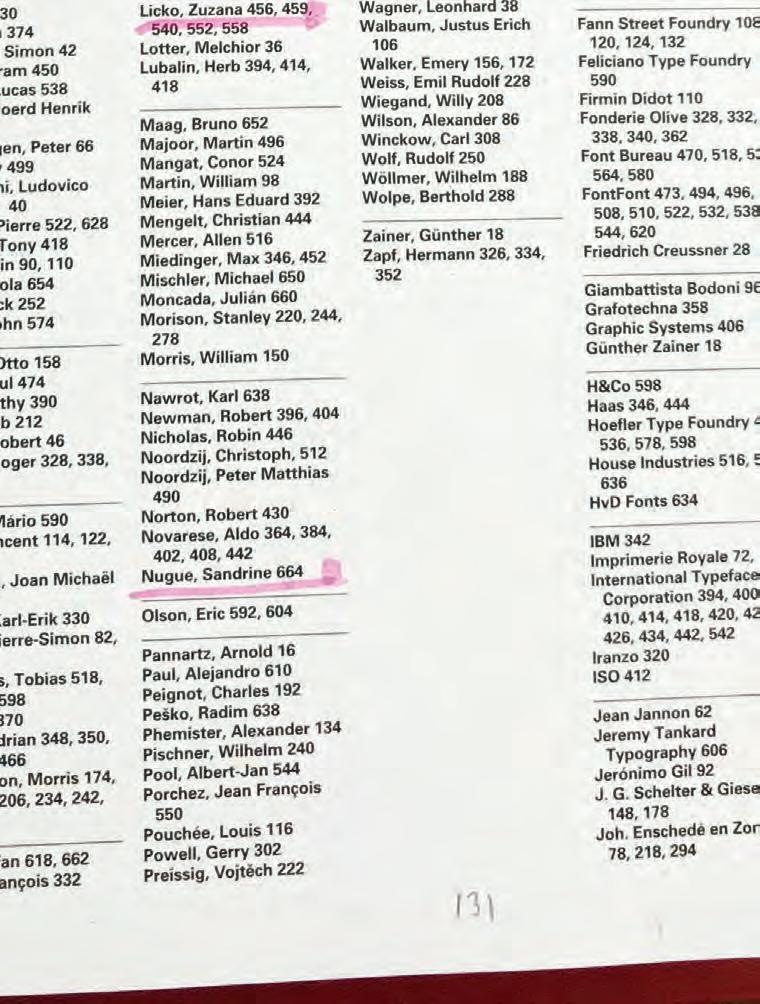
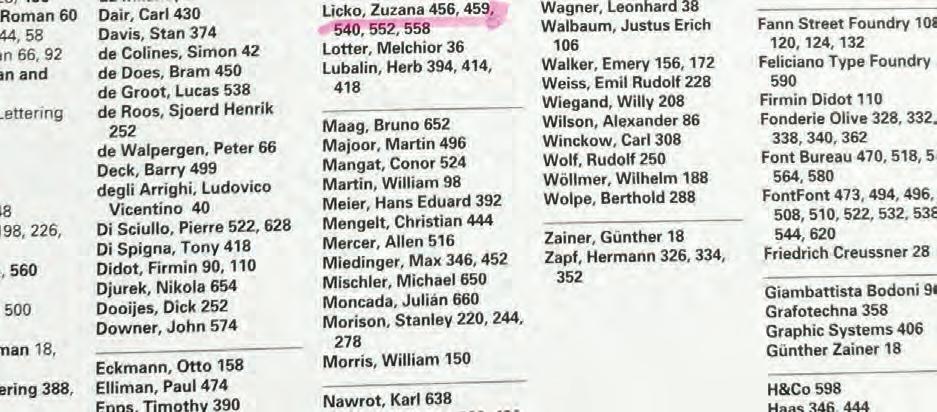
Studying the name indexes of relevant graphic design and type design compendia of the past !fteen years shows that women have been sorely underrepresented, ranging from more than #% (The History of Graphic Design, vol. #,
eds. Jens Müller and Julius Wiedemann, 2%#&) to just over '% (Welt aus Schrift [World of Script], 2%#%). On average, they are represented by around (%, as in Paul McNeil’s Visual History of Type (more than )%, 2%#&) and The Phaidon Archive of Graphic Design (more than (%, 2%#2 ). If one also asks about the historical achievements of women in graphic design prior to World War*+, most surveys of the history of design do not mention any women at all. These percentages are deeply shocking and therefore call for a revised perspective and detailed study of the causes.
The ,agrant contradiction between the social reality experienced and lived today and the canon of design history raises questions about the mechanisms of writing history: Why are women so poorly underrepresented today in the literature on graphic design? Why are their works only sketchily visible and corresponding poorly represented, if at all, in the canon of the history of design?
Women graphic designers can scarcely be found in historical collections and archives either. In the Kunstbibliothek (Art Library) of the Staatliche Museen zu Berlin, for example, women represent just around (% of the artists. Evaluation of the standard work Das frühe Plakat in Europa und den USA (Early posters in Europe and the -./, #98%) o ers a similar statistic: for the period from #8'5 to #9#9, about (% of the poster designers are women. An analysis of the journal Das Plakat results in almost (% in commercial graphic art.
The historical holdings from the early period of graphic design o er new perspectives, in terms not only of numbers but also of content: How was it possible that women, who were not permitted to study at the time, were represented in artistic poster design at all—the »king« of graphic art disciplines. Were they also working as commercial graphic designers? How many of them were? To which professions and !elds were they able to gain access? What exactly was the social context, which prejudices did they have to combat, and with which strategies did they professionalize and establish careers and even self-employment? The present publication provides answers to all these questions.
women graphic artists have been described in more detail in order to provide context for their design works in histor y of design. Graphic symbols have also been provided to make the diverse and sometimes complex relationships among the women visible.
The present publication is intended to be foundational work that deliberately concentrates on the national and cultural circumstances and relationships in Germany with the goal of stimulating further research in the international context. For that reason, this English edition is also being published.
We thank our competent authors and very especially our research associates Aliena Guggenberger and Julia Neller for the outstanding collaboration. Gerda Breuer deserves special thanks here. She worked with us when conceiving the project, contributed central texts, and has been a great role model for us in the !eld of gender research.
For statistics, see: Jens Müller and Julius Wiedemann, eds., The History of Graphic Design, vol. # (Cologne: Taschen, 2%#&); Anita Kühne and Michael Lailach, Welt aus Schrift: Das !0. Jahrhundert in Europa und den USA (Cologne: Walther König, 2%#%); Paul McNeil, The Visual History of Type (London: Laurence King, 2%#&); Emilia Terragni, et al., The Phaidon Archive of Graphic Design (London: Phaidon, 2%#2); Klaus
Popitz and Heinz Spielmann: Das frühe Plakat in Europa und den -./ Ein Bestandskatalog, vol.*) Deutschland (Berlin: Gebr. Mann, #98%).
References to chapter, place of education, biography, and illustration
(01) CURRENT ISSUES & RESEARCH
Narratives of design historiography shape the way we see the world, what we know about it, how we evaluate it, and how we act—and natu rally also how designers design. This in turn in,uences our ideas about gender as a social construct, which !nds expression not just in speech and action, but also in the design process and what is designed. Like our society, design and the design canon are mutable through speaking, acting, and designing, through writing about design— through design historiography. All things mutually in,uence one another.
Petra Eisele

(01)A New Narratives. Rewriting the History of Design
Petra Eisele
Gender in Design
Designer shapes design. Design shapes society. Society shapes gender.
The history of design features a selection of those people, events, and designed creations that have been and will be handed down. In this sense, there is neither a comprehensive nor an objective design historiography. Quite the contrary: to date, the selection of those people and/or examples of design that are considered to be particularly characteristic has been made almost exclusively from a bipolar, patriarchal perspective.
Accordingly, design historiography focused on (hetero)normative thinking that understood and imparted certain values and principles as standards. In the practice of design, too, patriarchal thinking patters have informed and continue to inform nearly all areas so that the masculine also represents the norm here. As a result, the needs and characteristics of women have been and continue to be ignored to such an extent that the negative consequences of ignoring their speci!c physical characteristics are simply accepted.#
Women were and are still largely treated and perceived as »the second sex,«2 in design historiography as well. When women were mentioned it was as »the other,« as a remarkable exception, as a deviation from the norm. Thus it’s hardly surprising that the indices of relevant publications and surveys in graphic design list disproportionately few women. Correspondingly, the design canon is almost exclusively dominated by men, meaning that the achievements of women designers remain largely invisible.)
The narrative of design history is characterized by linearity, also as it relates to graphic design.( Metaphorically speaking, this means that design historiography follows a broad path of linear narratives and iconic works. It additionally tends to avoid supposedly deviant byways and subtopics and/or previously unknown or little-known positions in design that took place in parallel to the preferred narrative such that these are much less noticed or seen not at all.
Furthermore, the demands of Modernism’s design and theory established architecture as the guiding principle for all areas of design and developed a »functional« design that connects the practical, technical, and aesthetic aspects. Rationally justi!able and calculable design decisions made by a (male) KünstlerIngenieur (artist-engineer) as personi!cation of modern, forward-looking creatives reinforced binary stereotypes5 and also exerted great in,uence on design-historical evaluations of the past. This is because in order to establish »modern« design, applied and decorative arts were denigrated as traditionally characterized by artisanship and individuality, as were the women who were already active in this !eld in relatively large numbers. In this respect, it must be noted that women who were already known and recognized in their era were excluded from the history of design by this particular interpretation of »Modernism«— they became invisible.
In contrast, postmodern design historiography argues in a much more complex manner: selected objects were now used to introduce a wide variety of worlds of meaning. By perceiving and interpreting what has been designed in the past in many di erent ways, interest could be directed toward questions of individual perception, with far-reaching consequences for design historiography as well—it was recognized and acknowledged that history is neither neutral nor universal. Instead, it always represents a selection of people, events, and designed commodities that are passed down and interpreted. These interpretations of artefacts from graphic
design are characterized by cultural values and social conventions that form our society and thus our own experience of the world in our society.' It was also recognized that individual, but also collective horizons of knowledge change the perception of design at di erent times, meaning design history also represents a phenomenon of adopting existing knowledge.& As a result, the focus of design historiography has shifted more toward the history of its reception, the social contexts, questions of perception and interpretation.8 With this in mind, in #99# Tibor Kalman, J. Abbott, and Karrie Jacobs criticized »bad history,« which selects, decontextualizes, and evaluates design purely on style. They instead argue for design being understood as a medium and expression of an abundance of languages that speak to a multitude of people.9
So what could be more obvious than integrating women’s perspectives into design history? Back in #9&) , Sheila Levrant de Bretteville described female perspectives in design;#% in #98', Cheryl Buckley criticized the categorical exclusion of female designers from design history by focusing on industrially produced things—precisely the !eld from which women were excluded to the greatest extent.## With the advancement of feminist theory in the #99%s, Martha Scotford published her essay »Messy History vs. Neat History« in #99( that distinguished between conventionally neat history and that of messy history— the other, hidden history of women in graphic design.#2 She also analyzed the imbalance between men and women in standard works on the history of design and thus criticized the canon of graphic design. Beyond this, she also highlighted the socially determined roles of women, which led to them being less visible, partly due to the fact that women often worked together, also with or for a man, and their support for him went more or less unnoticed.#)
Characterized by a strong dominance of design modernism, the role of women in the history of German design was ignored for a long time. In 2%#2, with Women in Graphic
Design/Frauen und Gra k-Design, 18&0 –!01!, Gerda Breuer and Julia Meer presented a !rst important overview that set out in search of clues and showcased critical analyses of women’s strategies for professionalism in graphic design along with biographies, interviews, and important primary texts.#( Breuer’s 2%2) book HerStories in Graphic Design continued this research, but is now even more international and focused on current questions of intersectionality 01C. #5
Ideas about design have changed today in the sense that everything is and can be design—not just privileged, habitual design, but also the »wild« heterogeneous things to which one ascribes (social) meaning.#' Everyday practices and the production of everyday things, as well as planning, (re)arranging, or reutilizing can also be understood as design.#&
Accordingly, the role models are currently changing from the idea of the exaggerated, heroically idealized, ingeniously inspired (mainly male) »authors-designers« and the correspondingly idealized design icons to people and design positions with whose value systems we are in harmony with and from whom we can learn.#8 Derived from this is the task of design historiography to reconstruct and to convey the lives and design examples of lesser-known or previously unknown women designers. In this sense, attempts are now being made to liberate the history of design from the traditional guidelines, gender, and aesthetics and to take into account the accomplishments and practices of women designers who have been overlooked to date.#9
Multiple aspects result from this discourse for -n/.een: to create the historical design foundations for further basic gender-critical research in graphic design, the time before #9#9—and thus before the Bauhaus—must be explicitly analyzed in detail.
Since women were active (often anonymously) in less-prestigious creative !elds due to social power dynamics, research must also be conducted in a more open and nonhierarchical manner, for instance in relation to technical printing applications. The focus
(02) ERA & DISCOURSES
From the late nineteenth century to the Weimar Republic, there were a number of advantageous cultural and economic conditions that bene!ted the professional creativity of women graphic designers despite numerous restrictions and a dominant conservative image of women.
Gerda Breuer
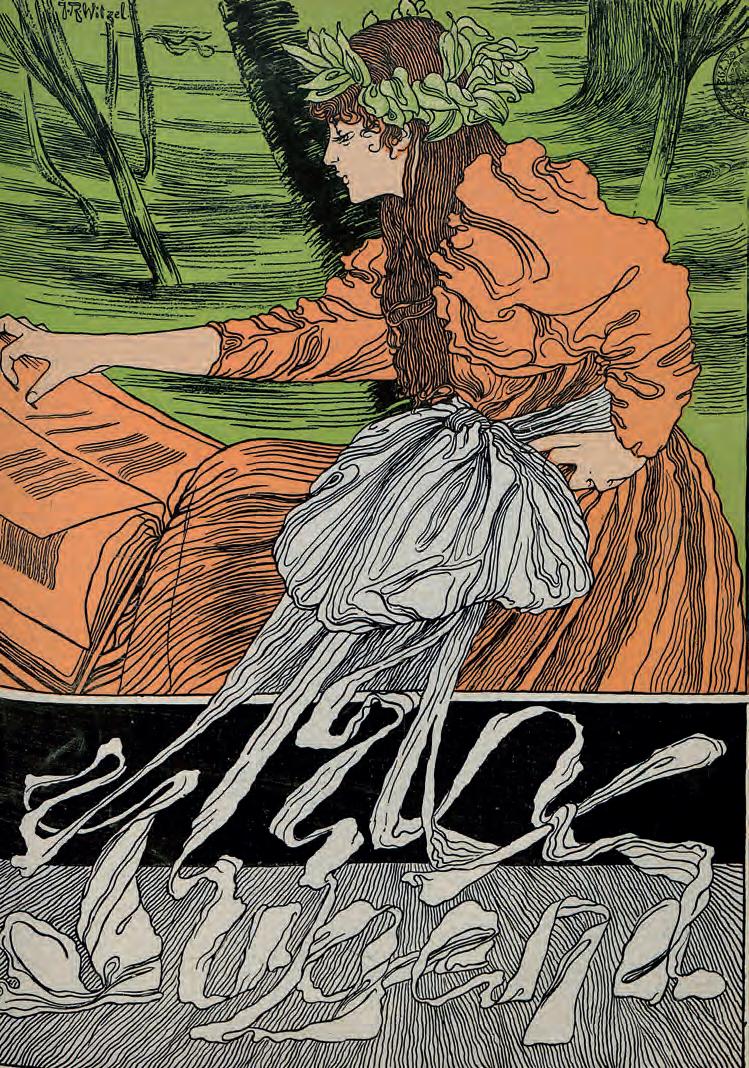
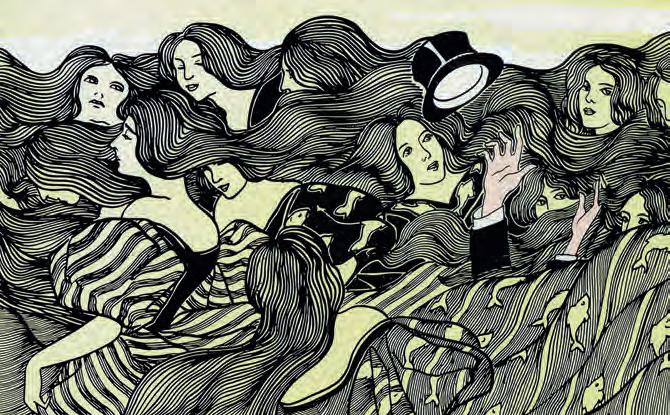
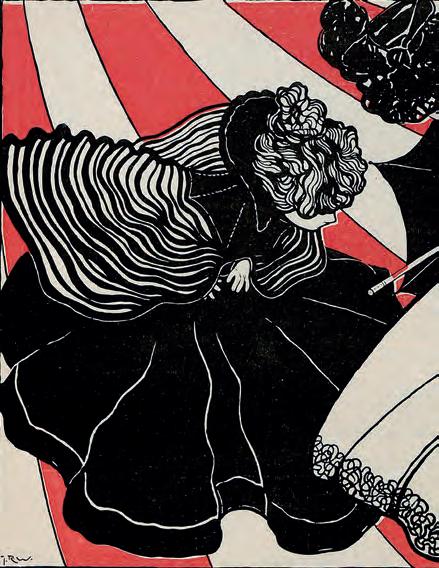
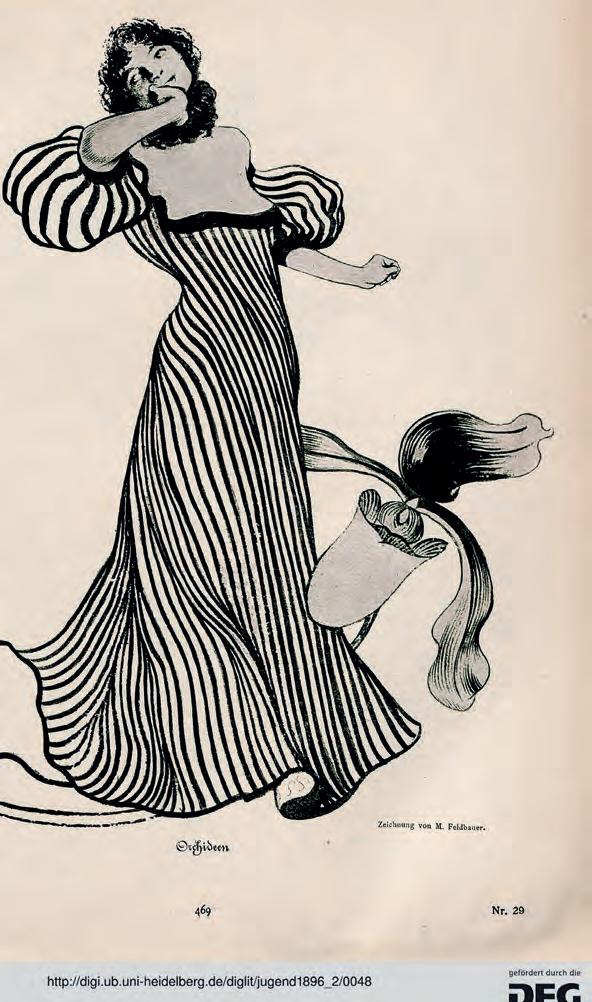
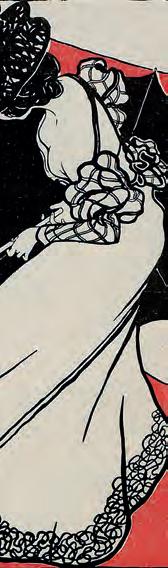
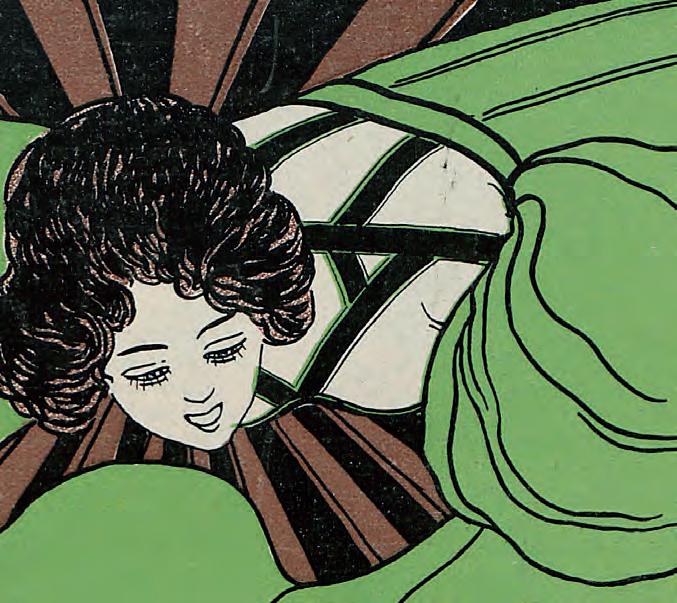
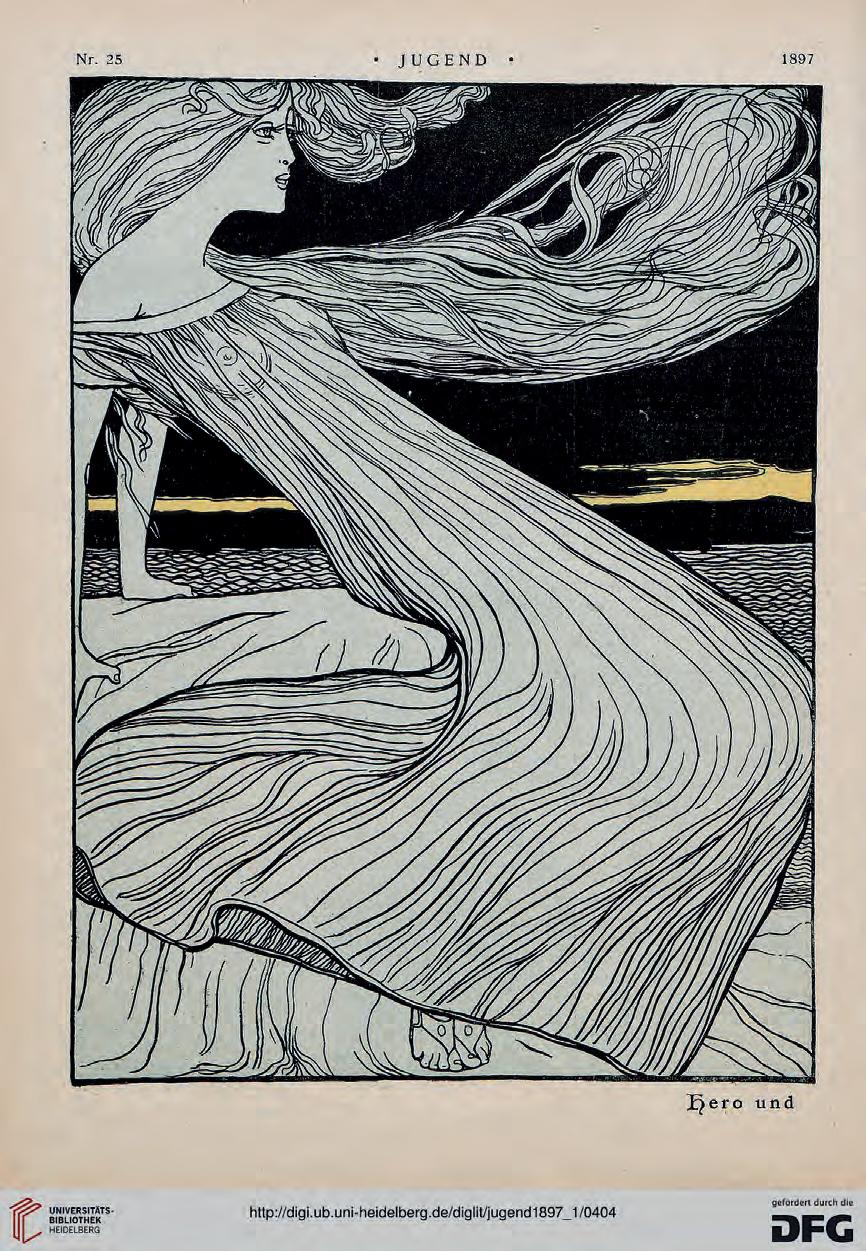
Artists such as Josef Rudolf Witzel and Max Feldbauer shaped not only the graphic aesthetics but also the imagination of femininity in Art Nouveau in their illustrations for the magazine ›Jugend‹: covers and illustrations taken from the magazine ›Jugend‹, 1896/97

The Reform Movement in the Arts
From around #89% onward, artists and intellectuals turned away from the art and culture of the German Empire, rejecting it as conservative. The artistic avant-garde and Secessionist movements breaking away from the art academies grew in importance. The opposition to the monarchy’s o icial art policies by means of splintering and founding new groups included individual women, networks of women, and women’s movements. Käthe Kollwitz, for example, is now seen as one of the most famous oppositionists who (unsuccessfully) protested the prohibition of the academy of art in Berlin that denied women training in the arts. Moreover, her work was subjected to numerous negative sanctions from the monarchy and its representatives.
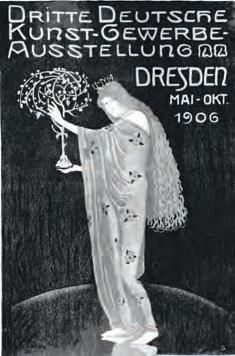
Artistic countermovements developed a number of new styles and forms to connect to modernity. The third Deutsche Kunstgewerbeausstellung (German Exhibition of the Applied Arts) in Dresden of #9%' represented a turning point. The future heroes of the reform movement in the applied arts, the majority of whom were male, appeared here. They attributed to art a new role in the concept of the applied arts and saw themselves as opponents of the applied arts industry of the Gründerzeit. The protagonists of the exhibition included important architects, artists, and entrepreneurs who were already known to the German public such as Peter Behrens, Henry van de Velde, Fritz Schumacher, Hermann Muthesius, Wilhelm Kreis, Richard Riemerschmid, Otto Gussmann, Karl Schmidt, Joseph Maria Olbrich, Bernhard Pankok, and many more. Although a woman is illustrated prominently on the exhibition poster by Otto Gussmann Fig.02 , women were all but unrepresented as participants in the exhibition. Of the seventy-six artists, only three were women: Gertrud Kleinhempel, Margarete Junge, and Margarethe von Brauchitsch.
Deutscher Werkbund (DWB)
Many women artisans and commercial graphic designers of this period were also members of the Deutscher Werkbund (dwb). The dwb, which brought together experts from business, art, and cultural theory, had been founded in #9%&. With its united forces, this institution programmatically advocated the new orientation around functional, high-quality design and employed diverse methods to promote it such as large-scale architecture exhibitions, publications, trade fairs, and numerous journal articles. The dwb developed a design ethos that would serve not least to promote highquality German products for the international market.
The reform movement in the applied arts increased the role of artists. In #9%8, for example, Friedrich Naumann, a representative of the dwb, complained about »art for courts and princes« that did not o er artists any room to develop and kept them anonymous.) It was not surprising given that backdrop that men and women artists placed their name or signet on their designs for advertising, packaging, or book covers. »Now they are ›free artists,‹ that is to say, sellers of ideas and designs who appear in full and have the legitimate desire not to be simply assisting members within large companies but also to guide commercial production with their skill […]. They demand
that their works bear their name, that their name is exhibited […].«( He lets his euphoria carry him away to the judgment: »This almost volcanic element of a top level of commercial artists causes all the crafts thus far to ferment.«
The new artistic ambitions included designing the modern book with all its elements, promoting companies with modern posters, developing one’s own trademark down to the smallest details of commercial correspondence. The dwb yearbook of #9#2, titled Die Durchgeistigung der deutschen Arbeit (The Spiritualization of German Labor), therefore reads: »The most elegant means of promoting industry are of course its products, to the extent that they meet the demands of the market in the best sense. Scarcely less important, however, are forms of advertising on paper: the print ad, the yer as insert in a newspaper or letter, and the poster.«5 The author, Willi Roerts of the Gra!sche Werkstätten (Graphic Workshops) in Hannover, emphatically explained in his essay every element of the e ect of advertising and correspondence.
The vast majority of the women in the dwb were passive members but a few were actively involved in the association’s work. One of the few women among the founding members, for example, was Margarethe von Brauchitsch, who headed the dwb department of advertising for textiles and clothing. Lilly Reich, a student of Else Oppler-Legband, joined the Werkbund in #9#2 and in #92% was the !rst woman to be appointed to its board.'
Finale
The sense of upheaval and a new dawn in the crafts around #9%% also a ected many women who despite adverse conditions and prejudices found the ways and means to break free of traditional ideas of gender-speci!c roles and being reduced to the home, marriage, and motherhood in order to develop in the manner of a modern woman with a career. Despite many favorable circumstances, women always needed a considerable amount of self-initiative. This was true both in achieving suitable training as well as learning a successful business practice to ensure !nancial independence. Support networks for women, exhibitions by women, pension funds, and the advice centers established by the likes of the Lyceum-Club and the Verein der Künstlerinnen und Kunstfreundinnen zu Berlin (Association of Women Artists and Friends of the Arts in Berlin) supported them 02B. Thanks to e ective publicity for professional women designers, women also entered new professions in the applied arts in which they competed with men. This was all the more true because many craft and design activities had traditionally been reserved for women. Such activities of young women of »good background« or the unpaid charity work middle-class women did not provide !nancial security. As Elisabeth Hahn wrote in her essay »Die Frau im Kunstgewerbe« (Women in the Crafts), published in Eugenie von Soden’s three-volume standard work Das Frauenbuch (The Book of Women) of #9#), for such women »[…] the general boom in the crafts of recent years has once again opened up a rich eld of work. In this sphere, their experiences have even provided the certain proof that in many areas the achievements of women exceed those of men […].«&
Fig.02 Otto Gussmann: Poster for the Third German Art Exhibition, Dresden, 1906
# While women were denied access to art academies, access to universities was slowly loosened toward the end of the nineteenth century. In Munich, the !rst woman attended lectures as a guest student in #8'5; the number rose to sixteen women guest students over the following years. In Leipzig, women started attending lectures in #8&%; in Heidelberg, there were eight women students in #8&). Several foreign women received doctorates from German universities, however without oral examinations and a public defense of their work. Women were granted the right to matriculate in #9%8/9, !rst in Karlsruhe, Heidelberg, and Freiburg. However, this did not mean that women were entitled to admission to university examinations or had quali!ed for entry into a state licensing or occupational system. See Herber 2%%9, Albisetti 2%%&, p.*#(', and Gerhard #99', pp.*#55–58
2 Berger #982, pp.*9#–92
) Droste #989, S. #&'–#&&
( Berger #982, pp.*8&–88/Gerhard #99', p.*8)
5 For the history and chronology see especially Wingler #9&& and Buchholz, Theinert 2%%&
' Since teaching of applied arts was adapted to the changing local conditions for the trades and industry, teaching
this at such schools was extremely inconsistent. The boundaries between advanced training schools, trade schools, craft schools, and artisan schools and schools of applied arts were ,uid. See Moeller #982, p.*##)
& See the #88( /85 annual report and program for the Kunstgewerbeschule Mainz, Mainz #885 (Wiss. Stadtbibliothek Mainz); thanks to the friendly suggestion of Ullrich Hellmann, Mainz.
8 Berger #982, pp.*89–9%.
9 See the #88%/8# annual report of the Gewerbeverein Mainz (Mainz Trades Association) in the Wissenschaftliche Stadtbibliothek (Academic City Library) Mainz and also the Trade Journal for the Grand Duchy of Hessen, no.*)%, second page, #89( (Wissenschaftliche Stadtbibliothek Mainz)—yet for many decades no examinations could be taken, only from #9%9 onward was there a state examination (courtesy of Ullrich Hellmann, Mainz).
#% »Kunstschule des Westens für Zeichnen und Malen,« FrauenRundschau 2) March #9%5, p.*#)
## Stalmann #929
#2 Berger #982, p.*9%
#) Ibid., pp.*9%–9#
#( Reimann #9'', p.*25. On the ReimannSchule, see also Kuhfuss-Wickenheiser 2%%9
#5 Petition from Peters Behrens for
»Admission of Ladies to the Schools of Applied Arts,« 22 February #9%( (Stadtarchiv Düsseldorf, :+++ ##%), in: Moeller #99#, p.*&#
#' Decree of #5 December #9%(, concerning teaching of applied arts in training workshops, in: Ministerialblatt der Handels- und GewerbeVerwaltung (#9%(), p.*(9(, citation in Moeller #982, p.*#2( #& Hellmann 2%22, p.*#92 #8 Königlich Preussisches Ministerium für Handel und Gewerbe (Royal Prussian Ministry for Trade and Crafts) #9%', p.*#'
#9 Decree of 28 March #9%5, concerning courses for teachers in artistic calligraphy and typography, in Ministerialblatt des Handels- und GewerbeVerwaltung (#9%5), p.*&(, citation in Moeller #982, p.*#2( 2% Königlich Preussisches Ministerium für Handel und Gewerbe #9%', p.*(% 2# Hermann Muthesius, »Die neue Entwicklung und der heutige Stand des kunstgewerblichen Schulwesens in Preussen«, in Das deutsche Kunstgewerbe (#9%'), cat.*+++, Deutsche Kunstgewerbeausstellung, Munich #9%', p.*(9
22 It should be noted that these women were not only engaged in the !eld of commercial graphic arts.
2) See Droste #989, p.*#8%
(03)A
; Berlin: Graphic Design at the Lette-Verein
Jana Haase
The Lette-Verein (Lette Association) was founded in Berlin in #8'' as a private group for promoting female employment in trade and commerce. Bourgeois women were to be able to provide for themselves and not be dependent upon a marriage for support. The association founded a school in #8&2. # Drawing courses were o ered in its Handelsund Gewerbeschule (Commercial and Trade School) as well as a seminar for women trade teachers. In addition, design drawing, coloring, and ornamental drawing were important components of the trade training for women’s employment in textile companies, publishers, and as drawing teachers. One of the graduates was Johanna Beckmann (#8'8–#9(#), who after her training worked for many years as a designer at the Königliche PorzellanManufaktur (Royal Porcelain Factory—<=>) in Berlin.
The Setzerinnenschule
In #8&5 , the Lette-Verein and the publisher Carl Janke established a school for women typesetters based on the British model. The Setzerinnenschule was located on Ritterstrasse in Berlin. Girls aged sixteen and older could attend a three-year training program after completing secondary school or higher girls’ school. After one year they received standard wages and worked ten hours a day, although two of those hours were a lunch break.2 The fact that bourgeois women wanted to occupy jobs in the printing shops worried the male printers’ union: »As far as the ›women’s question in front of the type case‹ in general is concerned, we cannot help but regard the general introduction of female typesetters in the book- printing business as an arti cially in ated bogeyman as
long as the complete transfer of the book-printing business into a factory operation does not make the use of ›factory girls‹ at the type case appear pro table.«—was written in #88% in the magazine C orrespondent für Deutschlands Buchdrucker und Schriftgiesser (Correspondent for Germany’s Book Printers and Type Foundries). It further recommended paying the men more so that the women would be well o and wouldn’t need to work 06A . ) However, the women typesetters prevailed and the school continued to exist until #9%'. No further details are known about the careers of any individual graduates as of yet.
The Photographische Lehranstalt
There was a special focus on professions in the publishing and printing industry at the founding of the Photographische Lehranstalt (Photography Academy) when the Lette-Verein was founded in #89%. The new technique of photography seemed to have a variety of possibilities for printing and copying processes. Retouching and reproduction were thus two essential areas of training. ( Extensive drawing lessons were on the time table, from portrait drawing and retouching to overpainting. The images by Hedwig Mutter preserved in the archive of the Lette-Verein Berlin show how many work steps and techniques were required for retouching an illustration. She was probably a student at the Photographische Lehranstalt around the year #9#(. Objects were cropped from photographs, details were emphasized with retouching techniques and overpainting, contours were sharpened, and unevenness smoothed out, all using analogue techniques.
These sorts of retouched templates could then be used to produce a printing plate for a magazine, an advertisement, or a textbook. Working as a retoucher provided many women entry into the profession of photographer, where, like typesetters, they competed with men.
(03)B ; Berlin: Unterrichtsanstalt des Preussischen Kunstgewerbemuseums
Aspects of the Training of Women
Graphic Artists and Book Designers
Antje Kalcher
With a few exceptions, this essay focuses on women designers who made a name for themselves in the !eld of graphic design and/or book art during their studies but who are hardly known or recognized today. At the same time, we will take a look at the training in two relevant specialist subjects. The !les in the archive of the Berlin Universität der Künste (University of the Arts) o er a rich stock of materials ready to be discovered.
History and Teaching
Before we dive in, let us !rst take a brief look at the history of Unterrichtsanstalt des Preussischen Kunstgewerbemuseums (Academy of the Prussian Museum of Applied Arts).# In the very !rst school year after its founding in #8'8, the proportion of women students was ten percent and was seventeen percent in #8&2. 2 By the turn of the century, the number of women students had risen to almost thirty-seven percent.) With the exception of drawing courses with nude models, women students had access to all the subjects. They were initially taught in separate classes for women, but this could not be done for long due to the large number of students, both for reasons of cost and space. Looking back at the academy’s development, we can see that the attempt for setting up common classes was »accompanied by the best success.«( Teaching was initially mainly focused on further education, which took place in the evening hours and on Sundays. After the painter Ernst Ewald took over as director in #8&( , the focus turned to daytime teaching and various specialist classes were established
for designing furniture, utensils, and vessels, the drawing and modeling of !gures, and also designing ,at patterns. At the same time, the more technical subjects related to the building trade were removed from the curriculum. The training was now increasingly oriented toward artistic activities.5
A strong focus on practical applicability stood out right from the start. It was expressly desired that the students be involved with the commissions their teachers received.
Beyond this, a wide range of competitions were held inside and outside of the academy in various !elds of applied art in order to obtain commissions for designs or to create products.' The works were awarded prizes by the teaching sta , in case of external competitions, companies could purchase the results.&
Graphic Arts and Book Illustrations
For the students who focused on graphic arts and book illustration, the courses in ornament al and pattern drawing (also called ,at pattern or ,at ornament) formed the foundation of their training. The goal was to acquire knowledge of all the forms of ornamentation and their use on a variety of materials, including commercial graphic products such as posters, bookplates, and advertising material, known at the time as »advertising« but without the negative connotations of today.8 Of course, the teaching contents were not clearly de!ned, but merged seamlessly into one another, but also depending on how the individual teacher perceived it. In retrospect, it is clear that the specialist classes taught by Emil Doepler (the Younger) and Emil Orlik produced a particularly large number of especially talented women designers over many years.
The foundation for the greatly abbreviated compilation in this essay are the names of the recipients of the Kronprinzessinnen-Medaille (Crown Princess Medal) and Kaiserin-Friedrich-Medaille (Empress Friedrich Medal), which were awarded to the two best women students in a school year from #8&# and #888, respectively.9 The list was supplemented by
the author based on her own research carried out as part of her archival work. The information is mostly limited to the year the medal was awarded, although further details are known in a few cases.
Emil Doepler (1855–1922)
Emil Doepler, a commercial graphic artist, craftsman, and heraldist originally from Munich, taught the specialist class for ,at ornamentation starting from #88', which was known as the Specialist Class for Pattern Drawing Etc. since #892. After #9%& it was called the Specialist Class for Decorative Painting and Pattern Drawing. Doepler taught this class until his retirement in #92#. #% His designs for the Stollwerck confectionary company, for which he created advertising materials in the form of enamel signs and collectible pictures for many years, are particularly well known.##
Women Students from Emil Doepler’s Class
Margarete Friedlaender (Kaiserin-FriedrichMedaille #9#2/#)), Hedwig Heller (KaiserinFriedrich-Medaille #9#( /#5), Gertrud Kilz (Kaiserin-Friedrich-Medaille #9%%/%#), Else Maerker (Kaiserin-Friedrich-Medaille #9%&/%8), Frieda Opdenhoff (Kaiserin-FriedrichMedaille #9%2/%)), Charlotte Pfeil (KaiserinFriedrich-Medaille #9#5 /#'), Maria Sinsteden (Kaiserin-Friedrich-Medaille #9#%/##), Anna Schmücker (Kaiserin-Friedrich-Medaille #9%#/%2), Margarete Ste en (Student Medal #9#) /#(), Elisabeth Weinberger (KaiserinFriedrich-Medaille #9%( /%5).
Elli Hirsch
I would like to pay special tribute to the graphic artist Elli (Aurelie) Hirsch. She studied in Emil Doepler’s class and married him in #9%9. She created series of images for Stollwerck in the time from #9%% to #9%8 07F. A total of one hundred of these designs are her work.#2 In #9(2, she was deported by the Nazis to the Theresienstadt concentration camp and murdered there.
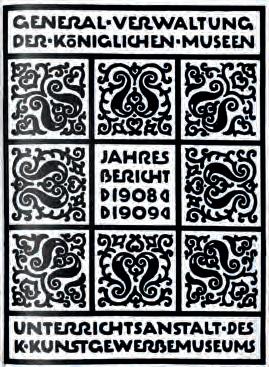
Fig.01 Else Gericke: Title page of the annual report of the teaching institute for the Museum of Decorative Arts 1908/09
Fig.02 Grade list for the pattern drawing class for the summer semester 1892/93 with entries by Emil Doepler on his students Helene Varges and Elfriede Wendtlandt
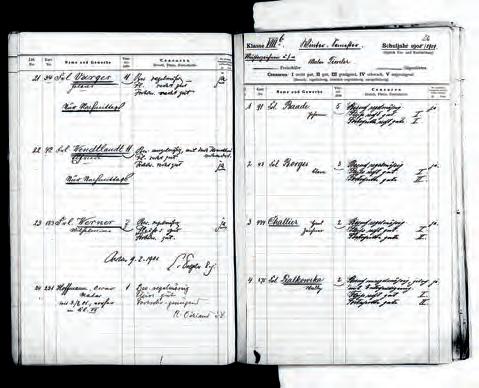
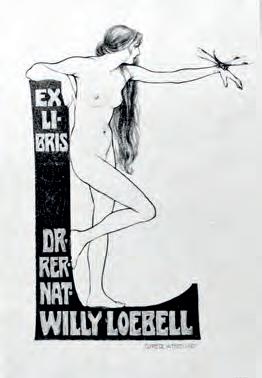
Fig.03 Elfriede
Wendtlandt: Ex Libris
Dr. rer. nat. Willy Loebell, etching, around 1900
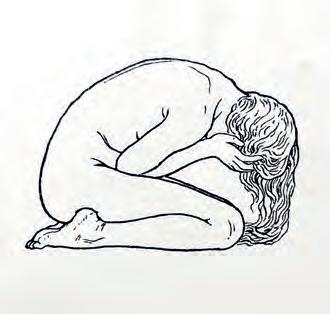
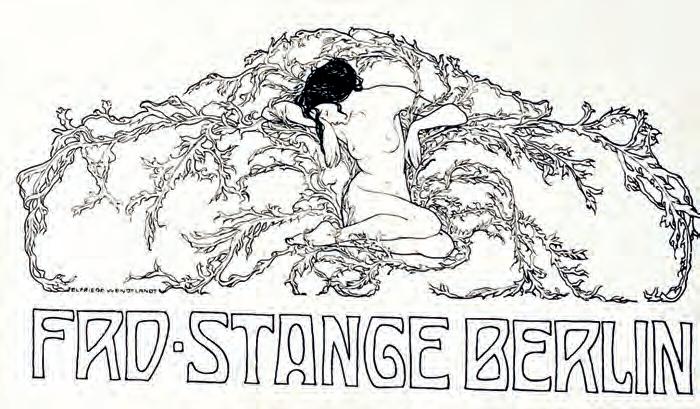
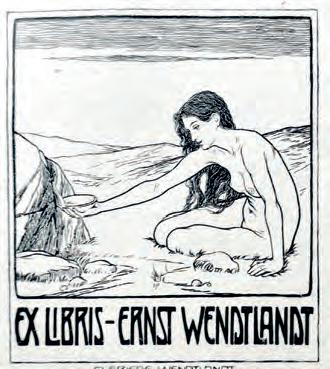
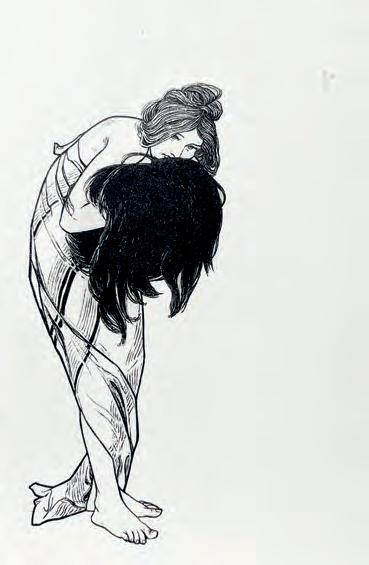
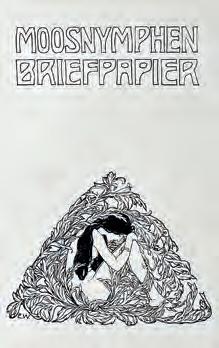
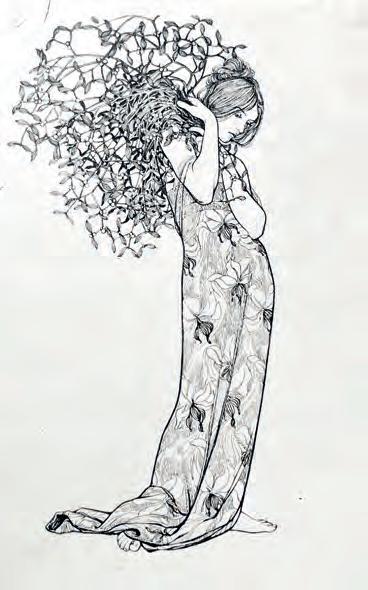
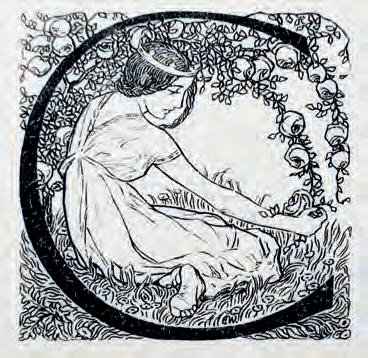
Fig.04 Elfriede Wendtlandt: Etchings, around 1900
Elfriede Wendtlandt
Elfriede Wendtlandt, who had already won numerous awards as a schoolgirl, owes her distinctive aesthetic sense to her comprehensive artistic training. In addition to Emil Doepler’s specialized class in pattern drawing, she attended Ludwig Manzel's class in nude drawing and Wilhelm Haverkamp's modeling class from #89' to #9%) . Some of her expressive etchings are illustrated in this article.
Emil Orlik (1870–1932)
In April #9%(, the Specialist Class for Graphic Art and Book Art was established and assigned to Emil Orlik (#8&% –#9)2), a painter, graphic artist, and craftsman originally from Prague. He continued teaching until June #9)2. For Orlik, as also for Doepler, the perfect mastery of drawing from nature was the prerequisite for perfect artistic expression.#) In his courses, the women students were able to practice and apply various graphic techniques.#( With the establishment of the teaching workshop for the graphic and book arts and the one for lithography in #9#%, #5 they were also given
the opportunity to produce some of the products themselves.
Women Students from Emil Orlik’s Class
Emmy Freyberg (Kaiserin-Friedrich-Medaille #9%8 /9), Else Gericke (Kaiserin-FriedrichMedaille #9%5 /%'), Hannah Höch#' (KaiserinFriedrich-Medaille #9#5 /#'), Eva Maria Marcus, Else Penzig#& (Kaiserin-Friedrich-Medaille #9%'/%&), Erna Schindler (Kaiserin-FriedrichMedaille #9#( /#5), Erna Schmidt (KaiserinFriedrich-Medaille #9#&/#8), Marianne Steudel#8 (Kaiserin-Friedrich-Medaille #9#%/##), Ursula Stolte#9 (Kaiserin-Friedrich-Medaille #9#'/#&), Elisabeth Wiegandt (KaiserinFriedrich-Medaille #9#) /#().
This brief presentation is intended to stimulate research into the biographies of the women artists trained at the Unterrichtsanstalt des Kunstgewerbemuseums. Numerous additional details on the biographies of the above-mentioned designers are waiting to be processed, even in the Archive of the Berlin Universität der Künste, and readers are cordially invited to do so.
# The most detailed account of the history of the Unterrichtsanstalt to the year #9)) as of yet is o ered by Rothkirch-Trach #98(. The Unterrichtsanstalt was merged into the Vereinigte Staatsschulen für freie und angewandte Kunst (Uni!ed State Schools for the Liberal and Applied Arts).
2 Generalverwaltung der Königlichen Museen. Kunstgewerbe -Museum. Berlin #88', p.*5
) See the annual report of the Generalverwaltung der Königlichen Museen, Kunstgewerbe -Museum, Jahresbericht 1&00/1&01, p.*'
( Generalverwaltung der Königlichen Museen. Kunstgewerbe -Museum. Berlin #88', p.*'.
5 The academy was logically transferred from the Ministry of Trade and Industry to the Ministry of Spiritual, Educational, and Medical A airs in #8&9
' The variety and diversity of the competitions can clearly be seen in the printed annual reports that
were published from #88# to #9#( /#5
& Both the printed annual reports and the relevant !les in the series Schülerarbeiten (Student Works) provide information on this. See the Berlin Universität der Künste, University Archive [UdK-Archiv], Portfolio &, Nos. #8% to #8).
8 As far as Mortiz Meurer was concerned, ornamental drawing formed the foundation for all work in the applied arts. Ornaments were also used on other materials such as wood, metal, and fabrics.
9 See Steguweit 2%%9, pp.*#2'–2& #% For the teachers at the Unterrichtsanstalt see Kalcher/Schenk 2%2).
## For Doepler’s teaching, see the !les Jahresberichte der Fachlehrer: UdK-Archiv &–#)% and &-#)# as well as Rothkirch-Trach #98(, pp.*##2–#( #2 Lorenz 2%%%, pp.*#%&–%9
#) See Rothkirch-Trach #98(, pp.*###–#( #( See ibid., pp.*##'–#8
#5 See ibid., pp.*##8
#' Numerous publications have appeared on Emil Orlik’s most famous student, most recently: Schweitzer 2%##. #& For Else Marcks-Penzigs, see the biography here in this book 05E as well as Marcks #995 #8 Steudel immigrated to the United States and became a highly esteemed craftswoman under the name Marianna von Allesch. Her preferred materials were glass and ceramics.
#9 The historical novel Ursula und die Farben der Ho(nung (Eine Familie in Berlin, Bd. 2) by Ulrike Renk about Ursula Stolte (married name: Dehmel) was published in 2%22
new earning opportunities for both men and women artists. So it was only a small step toward decorative arts. Comparing Jenny Fikentscher’s lithographs from both !elds, it becomes clear that they correspond in both form and content. The bookplates by Emma Dessau-Goitein and Maria La Roche also demonstrate the creative proximity of freelance work and applied works.
The women artists received professional recognition for their work in art magazines and at art exhibitions. However, appreciative reviews could also be quite ambivalent. In #9%2, for instance, a review of a book design by Käthe Roman-Foersterling in the Zeitschrift für Bücherfreunde (Magazine for Book Lovers) reads: »The typographical lines, which consist of tiny rows of apples, are also very cute [niedlich].«#) Even back then, »cute« was probably considered derogatory and was not used to describe works by men. Maria la Roche received a silver medal for her bookplates at the Internationale Ausstellung für Buchgewerbe und Graphik (Bugra: International Exhibition of the Book Trades and Graphic Arts) in Leipzig in #9#( 08D. #(
The question remains as to what other !elds of activity women graphic designers might have worked in. The Bugra catalogue provides an important clue; Margarete Schroedter from Karlsruhe is named among the women participating.#5 She was a scienti!c draftswoman at the municipal hospital and member of the Vereinigung wissenschaftlicher Hilfsz eichnerinnen (Association of Assistant Scienti!c Draftswomen). Her job would have been to translate the medical !ndings and research into drawings and gouaches that, in turn, could be used as models for teaching and for printing in publications. This shows that this was an important !eld of work for trained women artists who were looking for permanent employment.#'
As the biographies of Alwine Schroedter and Margarethe Hormuth-Kallmorgen show, it wasn’t unusual for women artists to be working intensively as graphic designers alongside their familial and household duties.
Käthe Roman-Foersterling also chose this path. In #89#, she married Max Roman, who was twenty-two years older than her and a professor at and later director of the Malerinnenschule. The couple had two children. Starting from #9%# she taught at the Malerinnenschule herself and also taught at the Ladies’ Class at the Kunstgewerbeschule from #9%) . For #9%&, it is noted in the personnel !les that she was on leave for several months due to her children being sick.#& It was probably also around this time that she divorced her husband, who, together with her mother, had her declared »permanently mentally ill« and incapacitated in #9%8. She was now no longer in charge of her legal a airs. Was she overwhelmed by her many responsibilities, or did she perhaps not su iciently conform to the social norms of the time, which is why she was condemned as »hysterical«?#8 Nonetheless, she regularly participated in the Deutsche Kunstausstellung (German Art Exhibition) in Baden-Baden in the years that followed. Political events had a direct impact on the lives of these women artists. Marie La Roche was the only one from this circle who, in Munich, ran a decorative arts workshop. She probably had to give it up due to World War*+ and return to her home country of Switzerland.#9 Emma Dessau-Goitein lived in Perugia with her husband, the chemist Bernhard Dessau, who held a professorship in Bologna. In #9#&, he was dismissed because he was German, and the family went into exile in Florence. After the German occupation of the city in #9() , they went into the underground and survived, but Emma Dessau-Goitein never resumed her artistic activities.2% Anna Klein’s private drawing school in Munich was closed by the Nazis in #9)) , forcing her to earn a living working in a mattress factory. She was deported in #9(# and murdered in the concentration camp in Kaunas in Lithuania the same year.2#
# The !rst German grammar school for girls was founded in Karlsruhe in #89). See Asche #992, p.*2%).
2 Baumstark 2%%9, pp.##5–22
) Baumstark #995, p.*#'#
( Baumstark 2%%', from p.*#)
5 Baumstark 2%2#, pp.*8%/22)
' Boser 2%%8, pp.*) /'/9 and Baumstark 2%2#, pp.*8%/2)#–)2
& Beyerle/Nêmecková 2%#8, from p.*2%2.
8 Schweizer Ex Libris Club 2%2%, pp.*&9–#%2/#%&–2%
9 Brandenburger-Eisele #995, pp.*#)5–)8
#% This is the book Der alte Bauerngarten der Basler Landschaft und angrenzenden Gegenden by Hermann Christ, published in Basel in #9#' La Roche designed twenty-one text illustrations along with the color title plate.
## Junge #989
#2 Baumstark 2%%'
#) Zeitschrift für Bücherfreunde (#9%2), p.*2#2.
#( Schweizer Ex Libris Club 2%2%, p.*#%#
#5 Die Frau im Buchgewerbe und in der Gra!k, Sondergruppe der Weltausstellung für Buchgewerbe und Gra!k, Leipzig #9#(, pp.*#9/2)) /)%& #' Bugra (see note #5), p.*)%8
#& Generallandesarchiv Karlsruhe 2)'/#8582
#8 Figiel 2%2#, p.*#(8
#9 Schweizer Ex Libris Club 2%2%, p.*8&
2% Baumstark 2%2#, p.*22)
2# Ibid., pp.*8%/2)#–)2.
(03)F
• Leipzig: Artistic Courses for Women at the Akademie für graphische Künste und Buchgewerbe
Julia Blume
Before women were first admitted to the Königliche Akademie für graphische Künste und Buchgewerbe (Royal Academy for the Graphic Arts and Book Design) in 1905, there were already courses being offered in Leipzig for women interested in art in which teachers from the former Königliche Kunstakademie und Kunstgewerbeschule (Royal Academy for the Arts and Applied Arts) were involved.
Henriette Goldschmidt founded the Verein für Familien- und Volkserziehung (Association for Family and Popular Education) in 1871. Following fundamental reforms at the Leipziger Kunstakademie (Leipzig Art Academy), two artists—Melchior zur Strassen (from 1875) and Oswald Ufer (from 1873)—came to Leipzig and took on managing the newly founded Kunstgewerbemuseum (Museum of Applied Arts). Henriette Goldschmidt was able to recruit both of them for teaching positions in her association. In 1879, it was written in a newspaper article: »The teaching course in modeling for ladies established by the Verein für Familien und Volkserziehung has been so well received that two sections had to be set up. Classes are held eight hours a week (four hours for each section, sixteen students) so that only eight to ten more female students can be accepted from Easter onward.«1
Verein der Künstlerinnen und Kunstfreundinnen
Charlotte (Lotte) Windscheid founded the Verein der Künstlerinnen und Kunstfreundinnen L eipzig (Association of Women Artists and Art Lovers of Leipzig) in 1896, the bylaws
of which codified the qualification of women artists. Classes were held in the Drawing Room of the Kunstgewerbemuseum by her herself as well as by artists and drawing teachers in the city including Mathieu Molitor, Otto Richard Bossert, and Paul Horst-Schulze. In addition, several artists offered private lessons in her atelier.2 Philippine Wolff-Arndt, the deputy director of the Verein der Künstl erinnen und Kunstfreundinnen Leipzig, recalled in her book Wir Frauen von einst (We Women from Back Then) an encounter with Max Seliger, the director of the Königliche Akademie für graphische Künste und Buchgewerbe, during which he spoke of his desire to enable women to attend the Academy and requested that she encourage attendees of the association’s courses to become active in this matter.3 In fact, in March 1906, women students in the association’s courses approached Max Seliger with a request for admission to the Academy. 4
Women at the Leipzig Academy
At that point in time, the Academy in Leipzig offered both applied arts courses, primarily focused on book design, as well as instruction in drawing and painting and original graphic techniques. From 1901, courses in reproduction graphics had been replaced by workshop courses in woodcuts, lithography, etching, and copperplate engraving that focused on free artistic work. Since the training facility had historically been a symbiosis of an applied arts school and academy, there were no laws preventing women from being admitted. Accordingly, Seliger wrote to the ministry in Dresden that he welcomed the admission of women to the Academy. Since he found that the male students were lacking in manners, »the presence of ladies [could therefore] only have a beneficial influence« and the women’s better education might rub off on them.5 In truth, the prospective women students belonged to the wealthier middle class—the fathers of the first women students included lawyers, factory owners, doctors, and merchants—while the male students mainly
came from the book trade and who were continuing their education at the Academy. In a letter from the ministry to Max Seliger dated May 6, 1905, approval was given for the trial admission of women students for the 1905/06 winter semester, together with the instruction that no special costs or inconveniences should arise from this. As a result, thirty-one women enrolled for the start of courses in October 1905. Among them were Alice Clarus, Erna Engelsmann, and Maria Süssmilch, three signatories of the March 1905 petition. The length of time students remained the Academy varied greatly at the time: anything from one semester to several years, and later re-enrolment was possible.
For some of the first women students, the training at the Academy in Leipzig marked the beginning of an independent career as an artist or applied artist. Among them were Alice Clarus, Elsa Gallwitz, Helene Baumeyer, and Carla Witte. Alongside prospective stud ents who applied for only specific drawing courses and remained there just a short time, others completed the full program of classes. The majority of women students chose the courses taught by Hans Dannhorn (bookbinding ), Hermann Delitsch (lettering and typography), and Hugo Steiner-Prag (ornament al drawing and illustration), but also trained in the graphic arts techniques of woodcuts, etching, and lithography, or took the drawing course given by Otto Richard Bossert. While women studied with men in most of the courses, women were still excluded from the drawing courses with nude models until 1908.6 Starting in the summer semester of that year, a separate course of drawing with nude models was offered for the women students, for which additional fees were charged until 1910. It wasn’t until some women students refused to pay the fee that such studies became a part of the regular teaching program with a permanent teacher in 1910.7
The Academy’s report for the period from 1906 to 1908 provided an overview of »actual and desired occupations« of the Academy’s students. Although no distinction was made
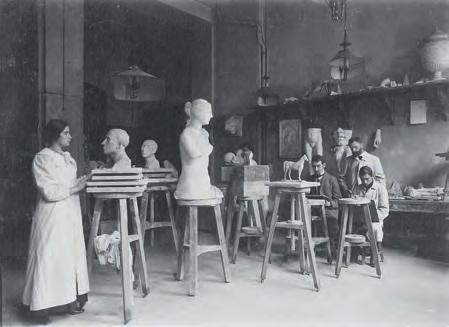
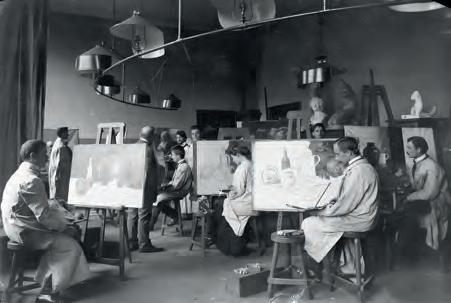
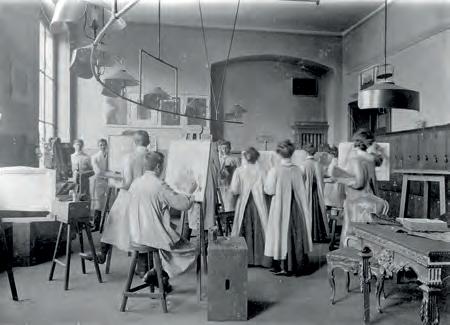
Fig.01 Modeling from plaster casts, Leipzig, around 1910
Fig.02 Painting and drawing lessons, Leipzig, around 1910
Fig.03 Painting and drawing lessons, Leipzig, around 1910
(04)A Lina Burger: Illustration and Book Decoration
Aliena Guggenberger
As early as #9%#, an article on Lina Burger in the Archiv für Buchgewerbe clearly noted that art history was dominated by men—and not because women lacked competence by nature but as a result of societal relations and not being entrusted with large commissions.# At the same time, the article justi!ed the rareness of women working in the !eld of printmaking and book decoration by reference to »the lady easily inclined to nervousness« who lacked a » rm hand« for the con!dent stroke. Quite contrary to that, Lina Burger self-con!dently employed a pen rather than the correctable pencil for her nature studies. She thus demonstrated precisely the very artistic con!dence that women were said not to possess. By #89# at the latest, her pen drawings were being used for book covers and decorations as well.
Work for Publishing Houses
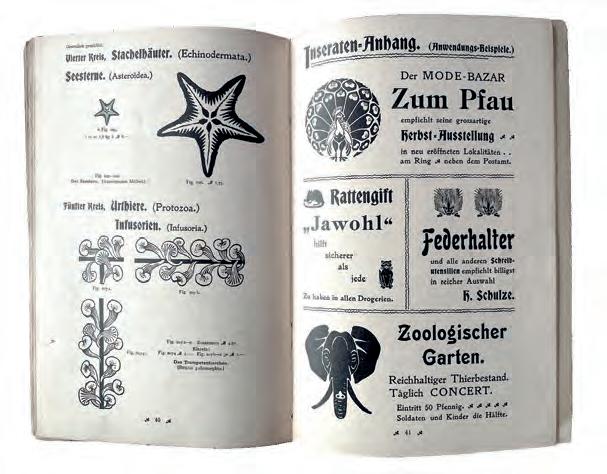
Lina Burger (née Schröder) was educated at the Unterrichtsanstalt des Kunstgewerbemuseums (Academy of the Museum of Applied Arts) in Berlin and the Mal- und Zeichenschule für Damen (Painting and Drawing School for Ladies) in Leipzig, which had been founded by the painter Anton Klamroth in #89) . From #895 onward, she produced several illustrations, bindings, and decorations for books published by Max Hesse (Leipzig), Alexander Koch (Darmstadt), and G.H. Meyer (Berlin) and especially for large publishing houses in Leipzig such as Breitkopf & Härtel, Schelter & Giesecke, and Fr. W. Grunow. In #898, Zoologie für Buchdrucker (Zoology for Book Printers), designed by Lina Burger, was published for the !rst time by Breitkopf & Härtel, with stylized motifs of ,ora and fauna as examples Figs.02 03
of their use for prospectuses and advertisements.2 All of her designs could be used as models for diverse modern printed matter.
In her studio in Oetzsch, a town south of Leipzig, Burger had been extremely productive since at least #89& designing book ornamentation, endpapers, vignettes, posters, as well as title pages and ,yers. The designer not only found inspiration for her works in nature but also found models among the people in her immediate surroundings. For example, sketches of children from Oetzsch were turned into initials for a Gothic alphabet produced for the Grunow publishing house prior to #9%% Fig.01 .
Her most numerous works, also as etchings, were the book plates and bindings she designed from the end of the #88%s into the #92%s. Her book covers and detailed ornamental borders for the top and bottom of a page also re,ect the ,oral, ornamental style typical of Jugendstil in the book arts.
Connections
She may have made important contacts in her native city through her father-in-law, the book illustrator and painter Ludwig Burger (#825–#88(), and her husband, Konrad Burger (#89'–#9#2). Lina Burger and her husband shared a fascination for and expertise in the practice and theory of book ornamentation. Together they translated works on decorative illustration by Walter Crane and Joseph Pennell, for example, from English into German.) Konrad Burger also worked as a curator at the Buchgewerbemuseum (Book Trade Museum, now the Deutsche Buch- und Schriftmuseum [German Museum of Books and Writing]) in Leipzig and from #89) as director of the library of the Börsenverein Deutscher Buchhändler (German Publishers and Booksellers Association) in Leipzig. Lina Burger was commissioned by Börsenverein in #895 to design an ex libris for former chancellor Otto von Bismarck, which it gave to him for his eightieth birthday. Her status in bibliophile circles in Leipzig must have helped her achieve a corresponding large degree of fame.
Her entry in the Allgemeines Lexikon der bildenden Künstler in #9## demonstrates that she was highly regarded already during her lifetime. ( She had connections as far away as Berlin, where she was a member of the Künstlerinnenverein (Association of Women Artists) from #9%# to #92&. For its exhibition in #9%(, she designed a prizewinning poster showing an unidenti!able and perhaps invented goddess.5 The iconography, with the attributes of a rose and a laurel wreath, points to a passionate and victorious woman who—with an eagle as headgear—expresses her power as a pendant to Zeus, the mighty father of the gods.

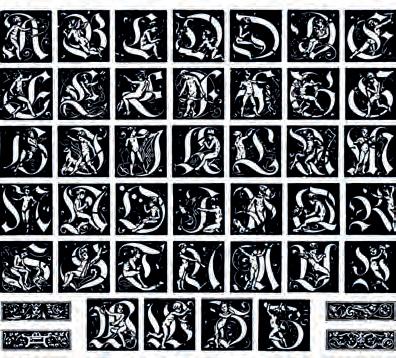
Fig.01 Lina Burger: Fraktur alphabet (galvanos) for the Grunow publishing house, around 1900
Fig.02 Breitkopf & Härtel publishing house logo in the chapter on predators in Zoologie für Buchdrucker (Zoology for Printers), 1898
Fig.03 Inside pages of »Zoology for Printers« by Breitkopf & Härtel with numerous illustrations by Lina Burger, 1898
# Anonymous, »Zeichenkünstler im Dienste der graphischen Kunst: :+++. Lina Burger,« in Archiv für Buchgewerbe 9 (#9%#), pp.*))(–)9, esp. p.*))(
2 A revised edition of Zoologie für Buchdrucker was published in #9%( ) Walter Crane, Of the Decorative Illustration of Books Old and New (London: George Bell & Sons, #89'),
was published as Von der dekorativen Illustration des Buches in alter und neuer Zeit: Vorträge und Aufsätze (Leipzig: H. Seemann, #9%#), and Joseph Pennell, The Illustration of Books (London: T. Fischer Unwin, #89'), as Die moderne Illustration (Leipzig: H. Seemann, #9%#).
( Allgemeines Lexikon der Bildenden Künstler von der
Antike bis zur Gegenwart, ed. Ulrich Thieme and Felix Becker, vol. 5 (Leipzig: H. Seemann, #9##), p.*2(&. 5 Allgemeine Zeitung, 2( Jan. #9%(, p.*5, reprinted in Doosry/Ebert 2%#), p.*('
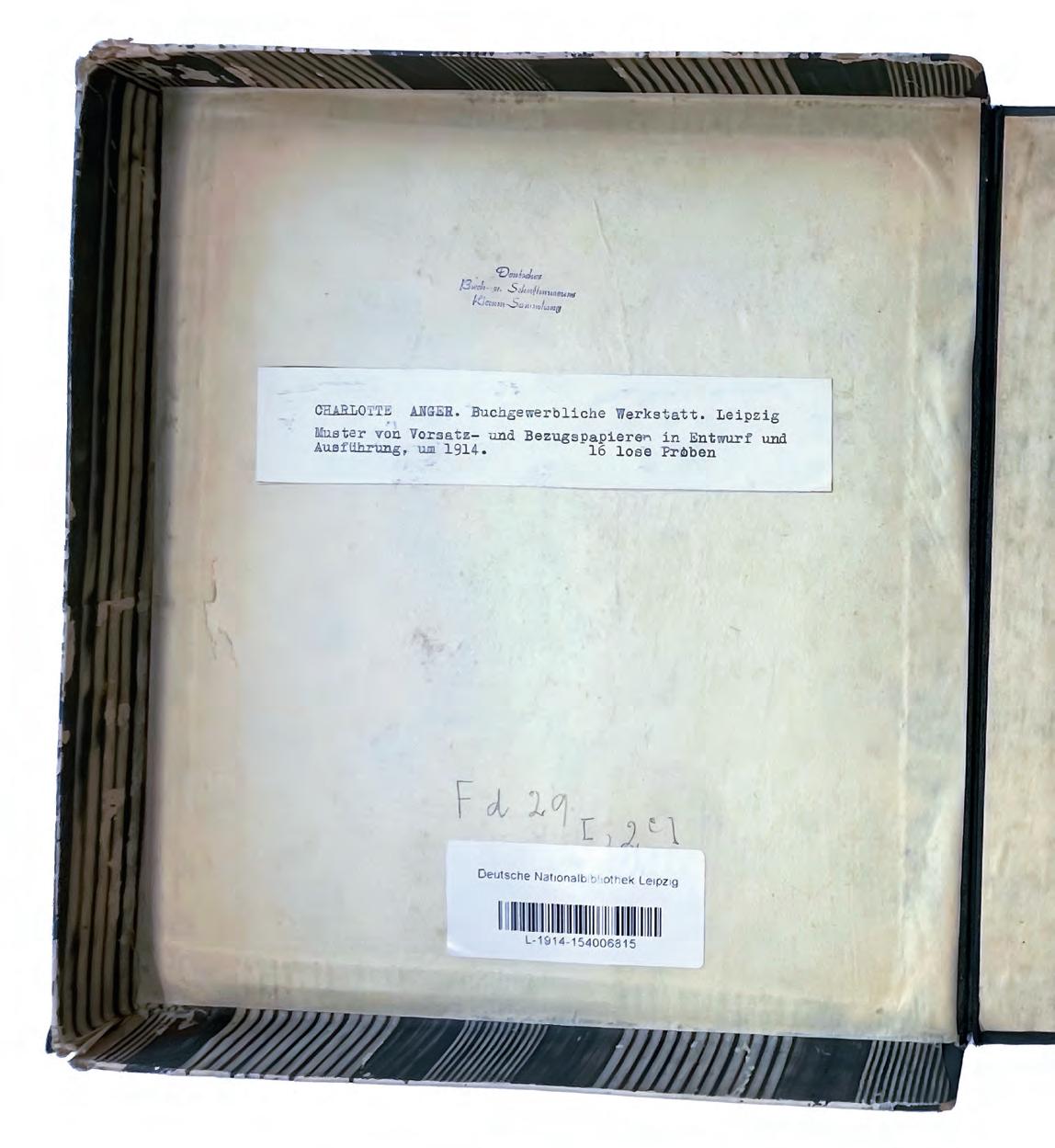
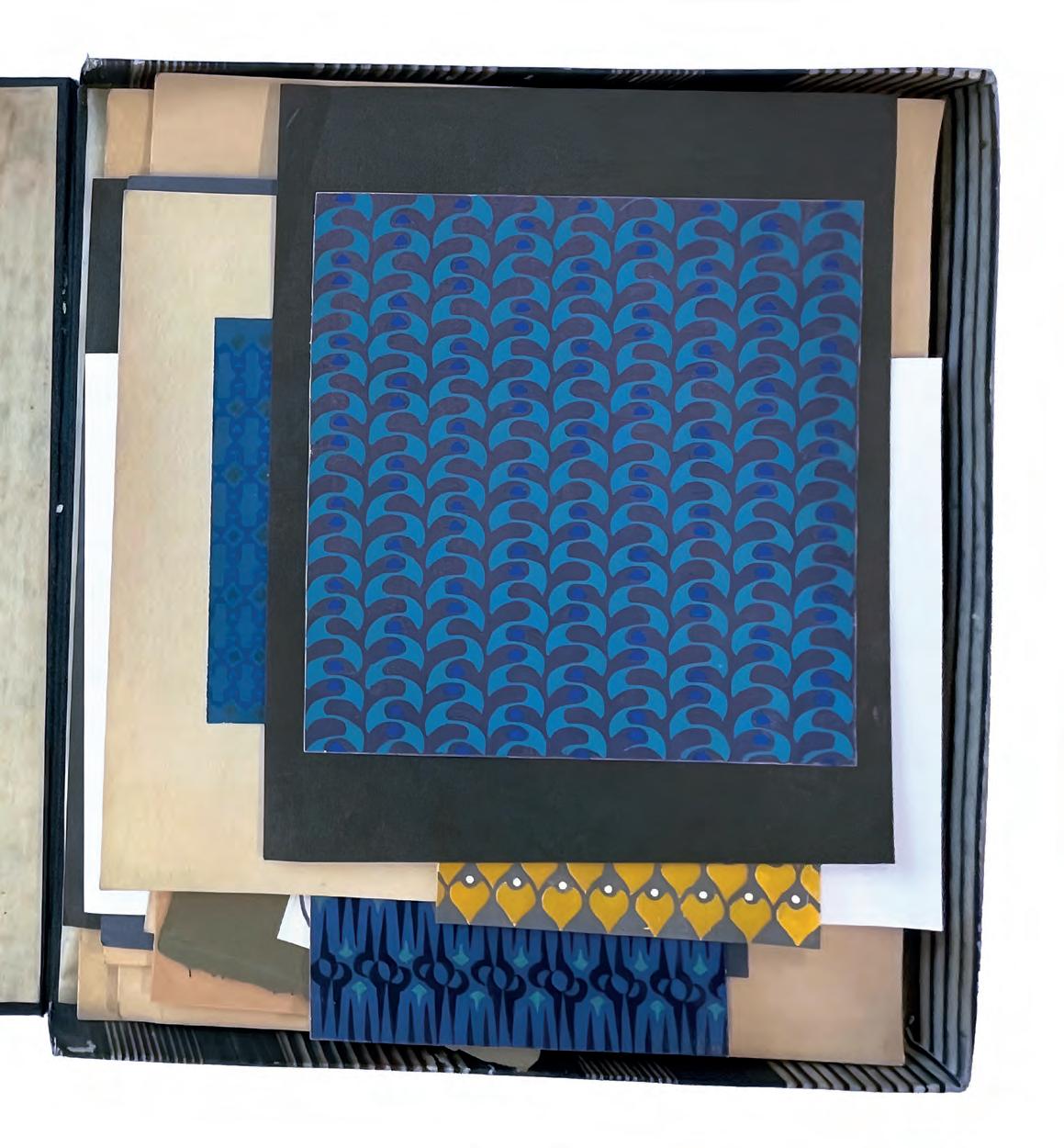
Fig.03 Charlotte Anger: Portfolio with endpapers and cover papers in design and execution, around 1914
(04)F
Decorated Papers: Facets of Female Surface Art
Julia Rinck
»… a playful imagination that nds variations«#
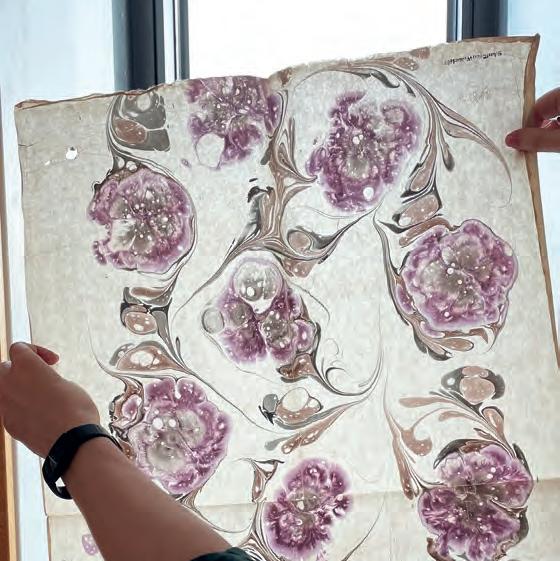
In the early modern period, the running of papermills was done almost exclusively by male papermakers; training for women in the trade did not exist. Their tasks were to assist, for example, with the preparatory tearing and sorting of rags 06A and the removal and packing of the handmade sheets of paper. From the !fteenth century onward, women were active not only in paper production but also in paper processing. The Rezeptbüchlein (Booklet of Recipes) from the St. Katharinenkloster (Convent of St. Catherine) in Nuremberg, which dates around #(&%, is the oldest written source about the production of decorated papers: !nished papers designed as planar decoration for bindings or endpapers, brochure covers, or the backs of playing cards but also for devotional objects. The Rezeptbüchlein describes, among other things, the production of monochrome brushed papers2 and the technique of Veloutieren (,ocking) on canvas, which can also be applied to paper.)
From the mid-seventeenth century onward, a new branch of professions emerged: the craft production of decorated papers using a variety of techniques such as paste papers and marbled papers, block-printed papers, bronze-varnish and brocade papers. Because this craft was not subject to any guild at !rst, women could also work in this new trade and thus have a source of income without having to make large investments. (
Following industrialization in Germany, the !rst decorated paper factories were built Figs.03 05, in which !nished papers were produ ced in large quantities using mechanical
techniques such as lithography and roller printing.5 »Because of competition with industrially produced decorated papers that were considerably less expensive, handmade production declined severely in the second half of the nineteenth century; many techniques fell into oblivion.«'
Around 1900, inspired by the British Arts and Crafts movement, German artists and artisans also turned to the aesthetic design of all areas of life and hence also to di erent handicraft techniques. As a consequence, numerous techniques for decorated papers were revived and »obtained artistic signi cance for the rst time as well.«&
At the intersection between craft, design, and art, women self-con!dently went public. They discovered Flächenkunst (planar art) as their central artistic theme and developed autonomous forms of expression for handmade paste papers and marbled papers or created designs for lithographed papers.
At the beginning of the twentieth century, periodicals such as Deutsche Kunst und Dekoration and Zeitschrift für Bücherfreunde organized design competitions for decorated papers, and the prizewinning examples would be reprinted in the journal or inserted as a pattern. Numerous exhibitions document the development of modern decorated papers;8 such as the Sonderausstellung Buntpapier (Special Exhibition of Decorated Papers) in #9%&, which was initiated by Peter Jessen, who was director of the Kunstbibliothek (Art Library) in Berlin at the time. The Buchgewerbeverein in Leipzig regularly organized both annual exhibitions and smaller presentations, and exhibitions of decorated papers were also held in Stuttgart, Prague, and Vienna. The sheets by contemporaneous designers exhibited there often subsequently entered public collections. For example, the collection of the Kunstbibliothek in Berlin includes sheets by Lilli Behrens, Laura Lange 04D, Maria Lühr 04E, Lise Netke, and Margarethe Rumpf, among others. It also has a graphic marbled paper by the Austrian artist Therese
Trethan and the outstanding Holzstöckeldrucke (stamp-printed papers) by Marie von Uchatius from the milieu of the Wiener Werkstätte (Vienna Workshop).9 In addition, private collectors such as the Viennese Privy Councilor Franz Bartsch made sheets from their collections available to various exhibitions. He arranged for his collection, which in addition to Japanese papers and decoratedpaper patterns focused above all on the decorated papers of artisans and artists of his day, to be transferred to the Deutscher Buchgewerbeverein in Leipzig—now part of the Deutsche Nationalbibliothek (German National Library) as the Deutsches Buch- und Schriftmuseum (German Museum of Books and Writing)—after his death in #9%9. Felix Hübel, the son of the founder of the large Hübel & Denck bindery in Leipzig, had assembled another extensive private collection. In #9#(, he donated it to the Deutsches Museum in Munich, where it is now preserved in the archives of the Papierhistorische Sammlung (Historical Paper Collection).#%
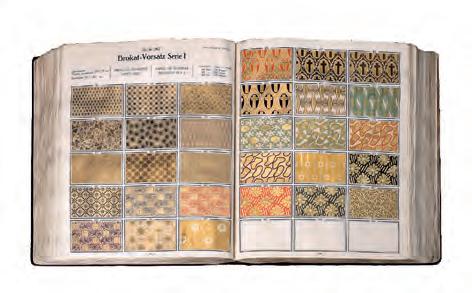
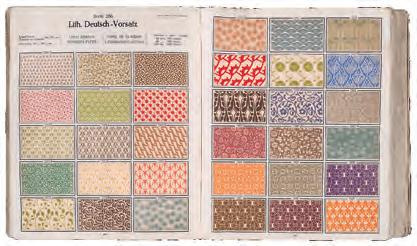
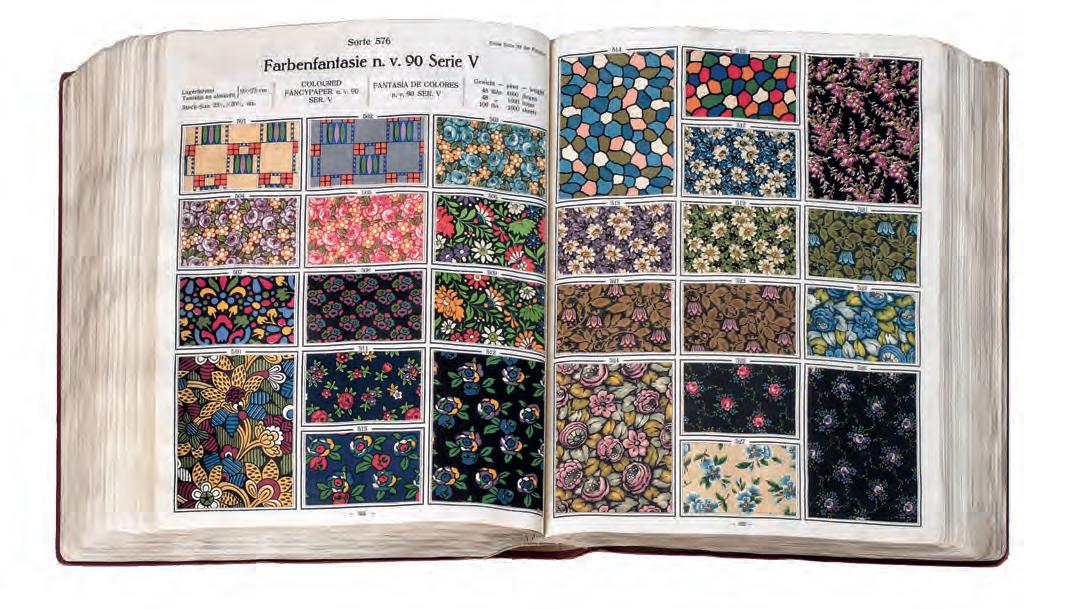
Fig.03—05 Sample book from the Aschaffenburg Colored Paper Factory, 1920s, DBSM/DNB
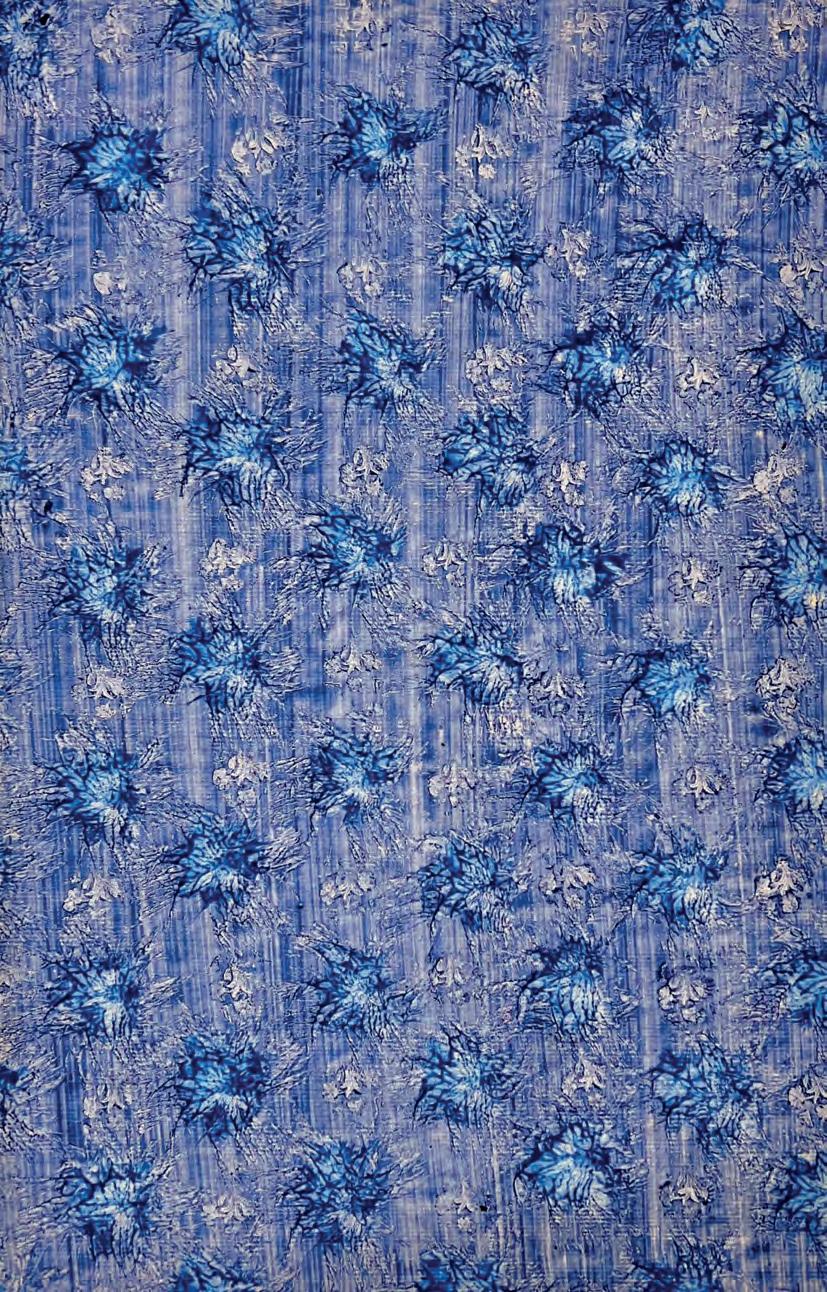
Fig.16 Elsa Gallwitz, paste paper, 1908
DBSM/DNB
»As a result of the events of the war, conscription, nancial di(iculties, and increasingly shortages of materials, many handicraft business and self- employed bookbinders limited themselves to simple works to earn a living. Moreover, in ation caused numerous patrons from the prewar era to lose their wealth, and so there were no commissions for workshops, artists, and designers either.«29
Looking Ahead
Anne-Marie Irmler was one of the women artists who again provided fresh impulses for artistic decorated papers with their new techniques and bright colors. She was one of the !rst to design papers using the stenciland-wipe technique)% Fig.10 as a modern surface design in,uenced by Cubism and Constructivism, but she also experimented with monotypes. Anne-Marie Irmler presented her papers and applied objects at the
Grassimesse (Grassi Trade Fairs) in Leipzig, among other places.)# In addition to an extensive collection of works at the Buchmuseum in Leipzig, she is represented along with Johanna Altenkirch, by sheets using the stenciland-wipe technique in the holdings of the Kunstbibliothek in Berlin.
This !rst heyday of artistic decorated papers ended with the #92%s. Not until the second half of the twentieth century would decorated papers be rediscovered as historical objects by scholars of art history but also by artisans and designers as a !eld of the arts and crafts. Increasingly, young book designers are turning to this aspect of (book) design, and artists are rediscovering decorated papers as a medium of !ne art. Many of those designers creating bindings and endpapers for books or surface designs for paper, or using the techniques of decorated paper in their art are women.
# Carstanjen #9%(, p.*)'&.
2 See Haemmerle #9'#, pp.*28–29
) See ibid., pp.*)#–)(
( See Haemmerle #9'#, p.*#'
5 Little is known about the women working in decorated-paper factories, and research on the subject would be welcome.
' Rinck 2%22b, p.*95 & Rinck/Krause 2%2#, p.*'(
8 For example, in #9%#, Alte und Neue Buntpapiere (Old and New Decorated Papers) at the Deutsches Buchgewerbemuseum in Leipzig; in #9%(, the exhibition on decorated papers organized by the Museum of Decorative Arts of the Chamber of Trade and Commerce in Prague; in #9%&, the Sonderausstellung Buntpapiere at Kunstgewerbemuseum in Berlin; and, in #9%9, the Ausstellung von künstlerischen Vorsatzpapieren (Special Exhibition of Artistic Endpapers) at the Landesgewerbemuseum in Stuttgart.
9 On this, see Denscher 2%22
#% Rinck 2%#2, pp.*&#–&2
## See Hauptmann #9&', p.*(5
#2 See, among others, Breysig #9%#/%2, pp.*#8( and #9&, and Behringer #9%9, p.*2%'
#) See, among others, Jessen #9%&, p.*#), and Carstanjen #9%(.
#( For example, in the Kunstbibliothek in Berlin, the Deutsches Buch- und Schriftmuseum in Leipzig, and the archives of the Deutsches Museum in Munich but also in the Olga Hirsch Collection at the British Library in London.
#5 Behringer #9%9, p.*2%'
#' See Rinck 2%22a, p.*52.
#& For example, decorated papers by Josef Ho mann, Kolo Moser, and Leopold Stolba; the Danish bookbinder Anker Kyster in cooperation with the designer Thorvald Bindesböll; sheets from the estate of the painter Otto Eckmann and of the Leipzig bookbinder Hugo Ochmann, and many more.
#8 For example, Emmy Hottenroth stamped her sheets with references to her awards. See Schmidt/Feiler #998, p.*))
#9 See Schmidt/Feiler #998, p.*)5
2% Schmidt/Feiler #998, p.*)#
2# Haus der Frau #9#(, p. X.
22 Ibid., p.*).
2) Ibid., p.*#8#
2( See ibid., p.*&)
25 See ibid., p.*2%&
2' See ibid., p.*2(%
2& See ibid.
28 See ibid., p.*2(#
29 Rinck 2%22b, p.*9'.
)% Visually, the technique resembled sprayed decorations on ceramics, porcelain, and other materials.
)# See the trade-fair card by Anne-Marie Irmler in the holdings of the Deutsches Buch- und Schriftmuseum, b. ?. Pe, Kasten Irmler.





(05)C Between Tradition and Renewal: Anna Simons as Calligrapher
and Typographer
Isabel Naegele, Petra Eisele
In addition to her pedagogical work, Anna Simons also gained a great deal of creative in,uence through her artistic lettering and typography work.
In #9#2, she temporarily lived at Rosenstrasse*2%, with Minna Blanckertz in Düsseldorf. Minna’s son, Rudolf Blanckertz was owner of the family-owned company Heintze & Blanckertz based in Berlin, which produced and sold items made of steel and was particularly active in the manufacturing of new writing nibs.# In addition, he published texts on penmanship and writing te chniques through his lettering- and typeface-focused Verlag für Schriftkunde (Publishing House for the Study of Lettering) and produced textbooks, teaching materials, and tools for teaching art, lettering, and typography.2 Simons designed numerous hand-written single sheets, brochures, and a series of advertisements for the company Heintze & Blanckertz. )
In Munich in #9#) , Simons met Willy Wiegand, cofounder and director of the bibliophile Bremer Presse, ( for which she drew all the title pages and initials. It was precisely the combination of the initials with the typeface, which was limited to just a few sorts, that became an independent, style-de!ning typographical element.5 Following the exampl e of the British Doves Press, Wiegand eschewed all illustrations and limited the design elements for his books purely to the typography, with calligraphic title pages and initials as the sole form of ornamentation. Nevertheless, he strove for a modulation of the typescript that would correspond to the
mutability of the human voice. He viewed his requirement ful!lled in »title pages and initials that, through their design, draw the eye to certain forms of letters and give it changing coloration and lines, and thus a changing character.«'
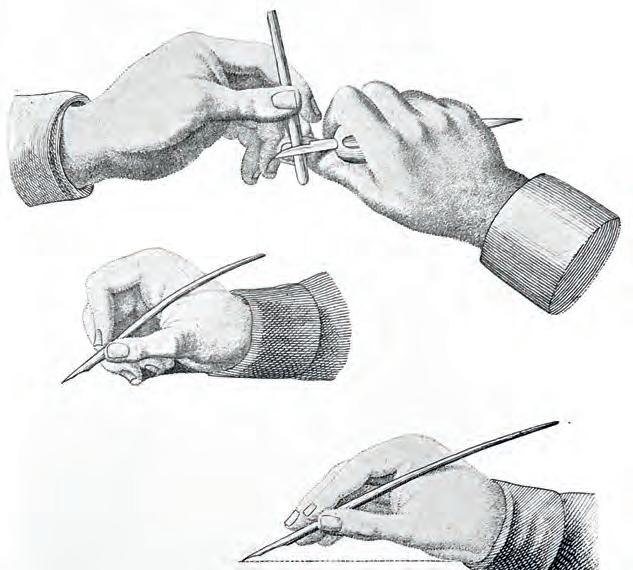
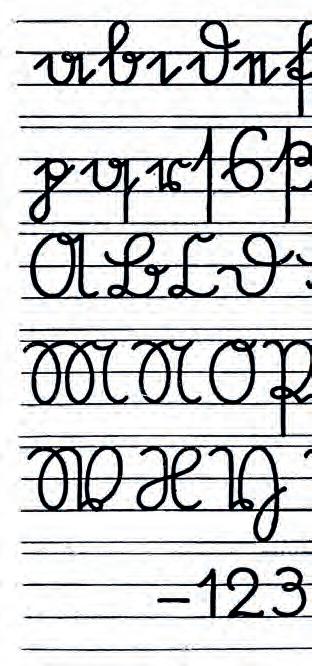
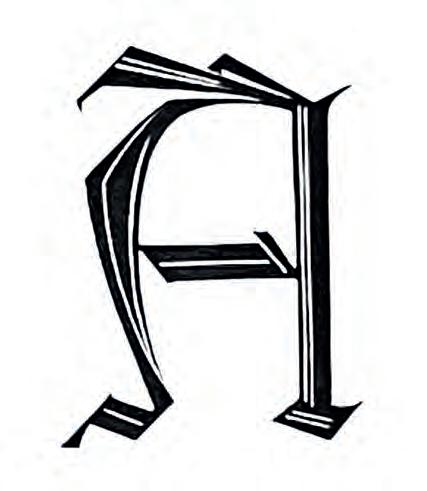
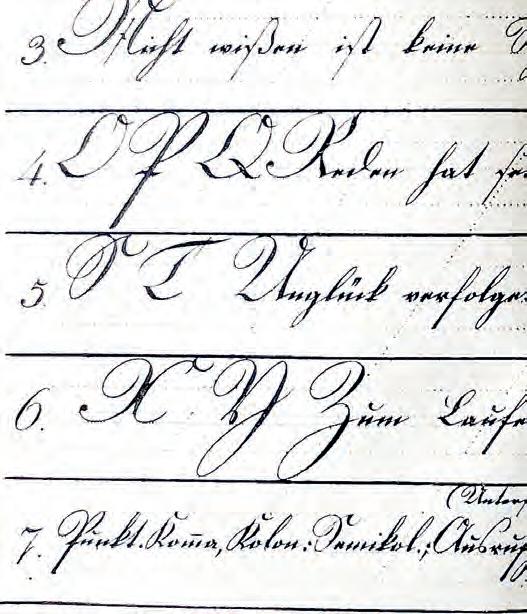
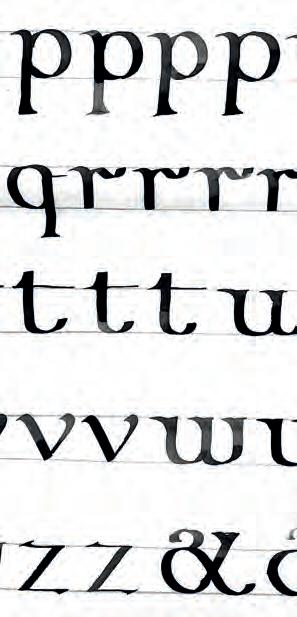
The initials in particular—there are said to have been around #,(%% by the time the Bremer Presse closed in #9)(—stand out in Anna Simons’s artistic work. Typography became an image in the elegant design of the large initials and imposing letter constructions and had a lasting impact on the character of the Bremer Presse. The letters, written with a quill, were carved into wood, set against the text set in lead,& and printed on handmade paper in limited editions of up to three hundred copies. In the ! le entitled »Title pages and Initials for the Bremer Presse« from #92', 8 the thirty-seven title pages and '#5 initials that had been realized by then are printed on largeformat plates. The sheets impressively show the historic range of type design that Anna Simons was able to draw on Figs.02 03. With large contrasts in the line widths and !nely drawn out, sometimes curved hairlines, the initials appear highly individual and timelessly modern at the same time. Anna Simons developed individual uppercase alphabets for each publication and literary text, all of which were di erently proportioned but also have very individual, drawn-out serifs and ornaments. The variety in the numerous alternates is surprisingly playful and elegant, often with uncials—a true inspiration for today’s type designers! Particularly noteworthy are the extravagant letter/word constructs, for instance in Dante’s Divine Comedy Fig.02 , 9 where she seems to have left the historical models behind her for the most part and have found her interpretation of the »modern spirit.« The cover designs for the Bremer Presse’s bimonthly magazine CORONA Fig.01 , which was published by Martin Bodmer and Herbert Steiner from #9)%, are also exceptional. The catalogue for the Haus der Frau (Woman’s House) at the Internationale Ausstellung für Buchgewerbe und Graphik (Bugra: International Exhibition of the Book Trades and Graphic
Arts— 08D) still listed Anna Simons as a »lettering ar tist« with her academic title / .@.A. / . (Associate of the Royal College of Art) under her London address and with her membership in the Lyceum Club, the Deutsche Werkbund, the Ar ts & Crafts Ex-Society, and the Women’s Guild of Art. #% After the outbreak of World War +, Anna Simons then moved to Munich, where she continued teaching lettering and typography courses, but also worked in a !eld post o ice and, later, in missing persons research.## Her work with Peter Behrens for the inscription »de> de-B.ACen :DE<e« (To the German People) on the Reichstag probably also dates from this period 05D.
After World War I
Simons taught courses in Halle, Frankfurt am Main, Nuremberg, Hamburg, and Zurich.#2 She taught the lettering and typography courses at the Kunstgewerbeschule (School of Applied Arts) in Munich from #928 to #9)( and was awarded the title of professor#) by the governments of Bavaria and Prussia around #928. However, since she was not permanently employed nor a civil servant, she remained self-employed—much honor for a woman, but little income. She also o ered private lessons in her own atelier on Kaulbachstrasse in Munich during this time for a »moderate fee« Fig.07 .
Typeface Design
Her work undoubtedly centered on calligraphy and lettering, but—according to Warren Chappell’s writings#(—in the mid-#9)%s she developed a medieval script for the typeface foundry Stempel /?. However, it was not developed by Chappell, a former employee of Stempel, until #9)8 and published after the war as »Trajanus« Fig.08. According to Hans Reichardt, Anna Simons is also said to have designed a typeface for the Genzsch & Heyse typeface foundry in Hamburg (working name »Anna-Simons type«), which also remained unpublished.#5 In Ho mann’s Typeface Atlas of #9)#/#952, designs for an Antiqua cursive and an Antiqua roman are illustrated



Fig.04 Anna Simons: Details from the portfolio: Title and initials for the Bremer Presse, 1926
(06)A »Without work, no livelihood«
Historic Gender Pay Gap and Industrial Working Conditions
UN/SEEN
»Since the beginning of the industry, western typography has always been a very gendered eld, dominated and designed by white men. From the time of the creation of the rst lead characters for the printing press, the printing trade in Europe serves a conception of typography that we still know today.«#
Since the development of letterpress printing with moveable type was invented in Germany, the production and handling of type became an essential identity-forming national—and male—skill. This raises the central question for design history and research as to whether, how, and when women were allowed to work in the production of type, as typesetters, but also as type designers. The nature and scope of the activities that women carried out in the printing trade and the printing industry also illustrate the social roles ascribed to women. Accordingly, the tasks and working conditions of the »anonymous« women in the printing industry, which also reveal strategies for emancipation, are of interest.2
Paper, Type, and Typesetting
During the Gründerzeit, literally founder’s era, the German Empire experienced an economic boom starting in the #8&%s and industrialization became widespread, something that also greatly bene!tted the book and printing trades. In Germany, the typesetters, and particularly the job printing typesetters, were well organized in typographic associations and trade unions. Founded in #8'', the Verband der Deutschen Buchdrucker (Union of German Book Printers) was the second central trade union—after the tobacco worker’s union.) The high intellectual demands of the profes-
sion ensured an exclusive status as a quali!ed skilled worker; a pronounced sense of status additionally led to a special role for book printers and typesetters as the »avant- garde of trade -union wage policy.«( This position was also used to consistently keep women out of these professions. Working conditions in the printing industry were more than di icult for women since they were barred from quali!ed training until after World War*+. They were denied apprenticeships or work as typesetters on the basis of very ,imsy arguments and collective-bargaining policy tricks. An overview of the employees in printing houses in Mainz in #89% lists )(*print shops, #52*typesetters, and (( typesetter apprentices, while the number of women typesetters is given as zero.5 At the same time, the number of women inserters in book printing is high, with !fty women employees and the »girls« in bookbinding is also high with forty-six women employees: these are the »anonymous« women in the book trade and, as the research has shown, they are represented in greater numbers than was previously known.
The following describes in detail the working conditions and earning opportunities for women in relation to their male coworkers (historic gender wage gap), as well as alternative training courses for women typesetters, for instance at the Berlin Lette-Verein (Lette Association) 03A.
Paper Industry/Paper Production
The production of paper was a grueling activity involving many individual steps that were carried out by women as well Fig.02. First of all, old rags had to be sorted, cut, and boiled. For the period between #89& and #9%%, a total of 2( ,%%% female employees were reported to be employed in larger companies.' In Germany, the proportion of women working in the !eld of paper and cardboard ranged between )%.8 percent (#882) and )'.' percent (#895).& On average, women earned half of the wages of their male colleagues.8 The tasks of paper !nishing such as smoothing the paper, counting and folding the sheets,
and the satinizing and embossing, were now also carried out by women. They even outnumbered men in the production of colored paper 04F.
Type Production
Lead letters were produced in a complex process: based on typeface designs, the punchcutter’s task was to produce a corresponding steel stamp. The matrix (also Mater, Latin for »mother«) is created by striking a punch into it. It served as the casting mold for the lead letters.9 Punchcutting was not a traditional apprenticeship profession; the skill was passed down—from man to man—like secret knowledge. Good punchcutters were therefore highly sought after. The existence of women punchcutters during the nineteenth century has not been passed down. It was only with the introduction of the pantograph that milling work could be handed over to less-specialized workers and thereby scaled up to a larger extent.
Type Foundry
The lead letters were cast according to casting slips, which speci!ed which letters were needed and how often for each language and the intended use of the typeface. The proportion of women in type foundries and in woodcutting varied between #% percent (#882) and 8.5 percent (#895).#% However, women were excluded from the actual work of type foundries since this craft originated from the tradition of metal casting and, according to tradition, was exclusively male.## Yet women were employed in the post-production processes and for sorting the cast letters: milling, undercutting, polishing, and dividing Figs.04 05 . #2
When the Genzsch & Heyse type foundry was established in Hamburg in #8)) , three assistants and an apprentice were working at each of the two casting furnaces.#) Fifty years later, the foundry had sixty-eight men employees working as engravers and punchcutters, adjusters, !nishers, type founders, stereotypers, metalworkers, and machinists as well as apprentices working in type
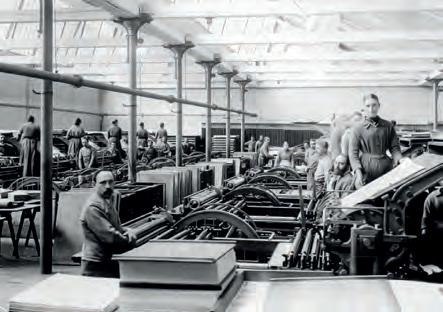
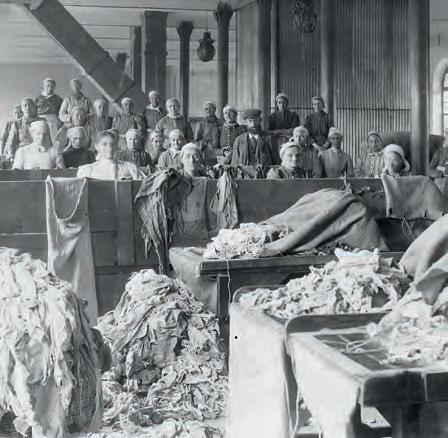
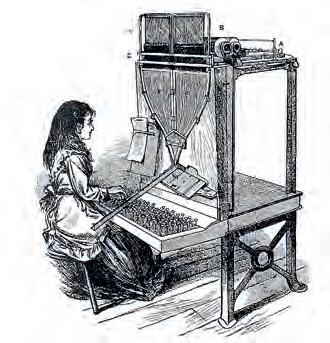
Fig.01 View of the machine room at the Klingenberg Brothers printing works Detmold, 1905—at the high-speed presses in the front left, a machine operator raises the feeders who insert individual sheets of paper into the machine from above
Fig.02 Rag sorting room at the Rauch Brothers paper factory, Heilbronn am Neckar, around 1905
Fig.03 Woman at the Fraser typesetting machine, 1876
»We also help at the machine, I as an inserter and my older sister as turner, while for larger [print runs] the washerwoman steps in, who of course cannot sit at either the turning nor the washing. […] My older sister may work as a typesetter at the box, or she works in tabular and tabular typesetting, while I prefer the specialties in title typesetting. […] We are also not far removed from bookbinding, for example we set, print, press, perforate, and trim following the stenography guide ourselves, and occasionally operate and move the satin-screen machine. We have recently set a stenographic manuscript into a lecture that lls ! + sheets.«
Her concluding arguments in favor of women working are also impressive: Since there was a surplus of 2 . 25 million marriageable women according to the #8&5 census in the German Empire, unmarried women should take care of independently earning on their own as early as possible »[…] because without work, no livelihood.«2(
Women Typesetters as Stand-Ins
With industrial mass production in the printing industry, women typesetters were also seen as potential strikebreakers from the #8&%s onwards against the backdrop of increasing labor disputes for better working conditions and wages.25 In fact, there are references to a typesetter dispute in Leipzig in #8'5 in which the employers also resorted to »girls who had previously trained as typesetters.«2' Elsewhere, there is a report of two printers and publishers who allowed women to learn this profession.2& In Vienna, too, several journal owners and a committee of book printers approached the Frauen-Erwerbsverein (Women’s Employment Association) in Vienna in #8&% with a request to train women typesetters after a strike by male typesetters had restricted production. However, they refused because they did not want to be »used to exert pressure.«28
Lette-Verein
It is unclear whether and to what extent the decision of the Lette-Verin (Lette Association)
in Berlin was based on such considerations,29 but what is certain is that women were trained as typesetters 03A Fig.06 starting in #8&5 . )% Three male members of the responsible commission— Martin Stettiner, Jacques Meyer, and Otto Janke—had founded a joint-stock company with their own capital and purchased Otto Janke’s print shop; his son Karl became the director.)# The concessions they made to the women paid o , at least for the company’s owners: the publication of some newspapers during the strike of the Berlin newspaper typesetters in the summer of #8&5 was only possible with the help of the women types etters from the Lette-Verein. On 28 June, twelve women typesetters from the school moved into the printshop for the Reichs- und Staats-Anzeiger newspaper and produced it for two days. Ten others went to the printshop of the Post, which they printed for ten days,)2 while another four typeset the Berliner Bürgerzeitung newspaper. They received the highest praise from all sides.)) As a result, typesetting seemed to be recognized as a !eld of work for women. However, the statistics of the Buchdruckerei-Berufsgenossenschaft (Book Printing Trade Association) in #9#2 reveal the true numbers: there were only a few hundred trained women typesetters versus '#,2'5 male typesetters.)( Arguments about the physical strenuousness of the work continued to be put forward against women working as typesetters: they were more susceptible to the harmful e ects of lead dust; moreover »standing in one spot, with almost only the right hand in constant motion during work […] has a far more detrimental e(ect on the female organism than the male.«)5
Casting and Setting Machines
The nineteenth century was also characterized by advances in mechanization of lining up and setting type. In her #99' publication Vom Pianotyp zur Zeilensetzmaschine (From Piano Type to Typesetting Machine), Brigitte Robak investigated how the introduction of typesetting machines changed gender typi!cation in the working world during these
technological upheavals.)' What’s especially notable is that the !rst typesetting machine in Germany—a British Millar machine—was located in a women’s typesetting school, the Lette-Verein of all places. Its founders obviously considered working on the machines to be an appropriate activity for »daughters of upper classes.«)&
With the changeover from traditional manual typesetting to casting and typesetting machines,)8 the working conditions for all typesetters changed drastically.)9 Especially from the #8&%s onward, there are indications that the profession of typesetters—now freed from manual casting techniques—was more akin to the work of a secretary or piano player due to the sedentary position. Some of the typesetting machines were advertised or presented with pictures of a young woman working on them. In later publications after #89# using the exact same illustration of the typesetting machine Fig.03, however, the female !gure has been removed. (%
Typesetter Strike
What happened? The introduction of the machines was anything but well received by the typesetting profession; the fear of being replaced by the new technology was too great. In #89#, there was a ten-week, uncompromising strike in the printing trade.(# In this context, blacklists of strikebreakers and so-called »seducers« were compiled in Mainz, but also in other places. Women were seen here as potential strikebreakers and ostracized. Those women who wanted to continue working as typesetters found themselves increasingly isolated. After #89', the collective-bargaining associations succeeding in being able to determine the working conditions in the printing trade. What was a clear victory for the union and its male members turned out to be de!nitive professional exclusion for the women professionals. Brigitte Robak sums up the fate of the women typesetters as follows: »For the women typesetters, the collective agreement meant the end in the long run. On the one hand, the contractual relationship between assistants
and principals was designed to provide employment exclusively to workers who complied with the collective agreement; on the other hand, it was made practically impossible for women typesetters to gain access to this group.«(2 Women were only able to join the Buchdruckergewerkschaft (Book Printers’ Union) or the Verband der Deutschen Buchdrucker() after the World War +. Even after a four-year apprenticeship, women typesetters could only !nd employment in small businesses in rural areas at best. They had lost the support of the trade union, the proletarian women’s movement , and new allies nowhere to be found. (( During the war, women were tolerated on an emergency basis as »female substitutes.«
In an article in the Typographische Mitteilungen in #9#& about substitutes in book printing works during the war, the author makes a derogatory comment about the »female assistant substitute,« postulating: »After the war, however, this war commodity should also disappear from the scene along with the others.«(5
Proofreading
The highest intellectual activity, that of proofreading the !rst proof, was reserved exclusively for men until World War +. As late as #9#( , the print shop owner Friedrich Streissler emphasized that the profession of a woman proofreader was conceivable but—unless it was the wife or daughter of the principal— would hardly ever be able to establish itself: »The proofreader is the superior of the typesetter in a certain sense, and they form the elite of the working class, are strictly organized in trade unions, and will certainly not put up with a female superior. A female proofreader could never gain the necessary authority and she would soon be, as they say in the working class, would soon be ’frozen out’ or ’driven out’.«('
With Germany’s entry into World War*+, even these arguments became obsolete: The few women typesetters were now »fullyedged replacements.«(&
(06)B
»Women Workers! Go Forth and Fight!«
From the Women’s Movement to the Labor Movement to Women’s Su rage
Petra Eisele
Although women workers played a large part in the production of the German printing industry, they were denied adequate wages. It was not only the low wages and the resulting poor living conditions for them but also the additional exploitative developments in the allocation of jobs that prompted women assistants to form associations in solidarity with the (women’s) trade union organizations.
Frauenverband im Buch- und Steindruck In the #8'%s, the women assistants in book and lithographic printing founded the Verein zur Wahrung der Interessen der Arbeiterinnen (Association for the Protection of the Interests of Women Workers) in Berlin, in which they organized job placement.# Then, in #898, the Verband der Buch- und Steindruckerei-Hilfsarbeiter und -Arbeiterinnen (Association for Book and Lithography Printing Male and Female Laborers—:bCi) was founded as a central organization representing the workers from various cities (mainly Berlin, Leipzig, Dresden, Hannover, Munich, and Hamburg).2 Starting in #89#, it even had its own association magazine, named Union or Neue Union (New Union), and was later renamed Solidarität (Solidarity).) The association also won sixte en marks weekly wages for the women laborers, which led to an increase in their membership. In #9%) , the association had 2,'%' paying members. It was also the last year in which men were in the majority. By #9%5 , the membership had tripled, probably also because the :bCi enforced national collective bargaining agreements throughout the empire and introduced staggered membership contributions according to income and
regardless of gender, as well as support payments in the event of illness and unemployment . ( In #9%&, there were #2,'89 members, whereby around a third of all women working in the printing trade were organized in the :bCi—in Berlin, a staggering 9&.) percent of the woman pressfeeders and women pointers were :bCi members. With an average wage of #8.'& marks, their pay was even at or above the level of the corresponding wage for men in other German cities; furthermore, a support for women who had just given birth was introduced in #9%8. 5 In #9#( , there were then more than #5 ,%%% members, including 8,%%% women.' Their political engagement thus signi!cantly improved working conditions for women workers in book and lithographic printing within a generation.
Women’s Union in Book Printing
The early union movement for the women unskilled laborers in book printing is also well documented.& They had organized thems elves in their own union for eight years, from #89% –#898; in March #89%, the Verein der Arbeiterinnen an Buchdruck-Schnellpressen (Association of Women Workers in Letterpresses) was founded, which was the only all-women female trade union organization to ever exist in the German Empire and that quickly grew to #,2%% members.8 By #895, almost 2,%%% women laborers in book printing were already organized in Berlin.9 It’s particularly noteworthy that the women workers, who were otherwise excluded from job placement, kept their own job register, meaning a record of vacancies, three months before their male colleagues started doing so and thus set up their own job placement service. It worked as follows: the machine foreman reported vacancies for female laborers along with the working conditions, which the women workers organized in the association matched against a list of women colleagues looking for work, so that they were placed or received o ers with better working conditions.#% As the women in the placement o ice were able to decide which workers were sent
to which print shop and when, they had an important political tool at their disposal to exert targeted pressure on individual companies with regard to wages and working conditions.## In #89#/2, the Verein der Arbeiterinnen an Buchdruck- S chnellpressen was also fervidly involved in the !ght for the nine-hour day, which ended in defeat despite the huge strike in the book printing trade (#2,%%% book printers in Leipzig alone). After the nine-hour day and other improvements for the book printing assistants were able to be achieved in #89', )%% workers walked o the job and !nally also won their demands for a nine-hour day and other bene!ts.#2
From International Women’s Day to Women’s Su rage
In #9%&, an International Socialist Women’s Conference took place in Stuttgart, in which Paula Thiede also participated, who had become the !rst chairwoman of the mixed-
gender :bCi trade union. In #9#%, the Second International Socialist Women’s Conference was held in Copenhagen. The women union representatives Paula Thiede, Emma Ihrer, and Gertrud Hanna were there again and, together with Clara Zetkin, Luise Zietz, and Johanne Reitze they were part of the thirteenmember German delegation. They submitted a motion that the »socialist women of all countries should organize an annual Women’s Day, which would primarily ght for women’s su(rage.«#) This motion was adopted at the time and International Women’s Day is still celebrated today. In Germany, it was again the women unskilled laborers in the book printing industry who massively supported this !rst International Women’s day and made it a success: On (*February, the union magazine Solidarität published four militant editorials and called for a »massive demonstration« for women’s su rage on #9*March.#( This then took place at Ballschmieder’s Kastanienwäldchen, in a
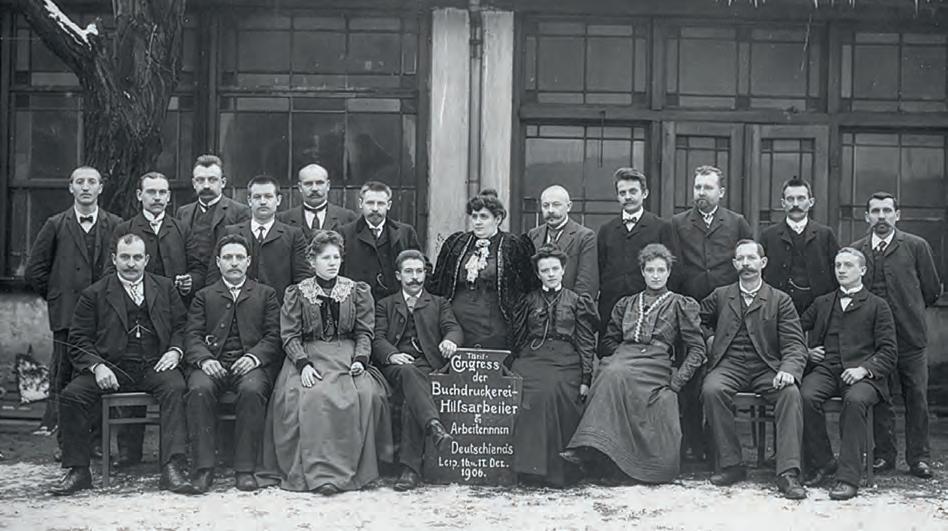
Fig.01 Congress of German printing press assistants and workers, Paula Thiede in the center of the picture, 1906
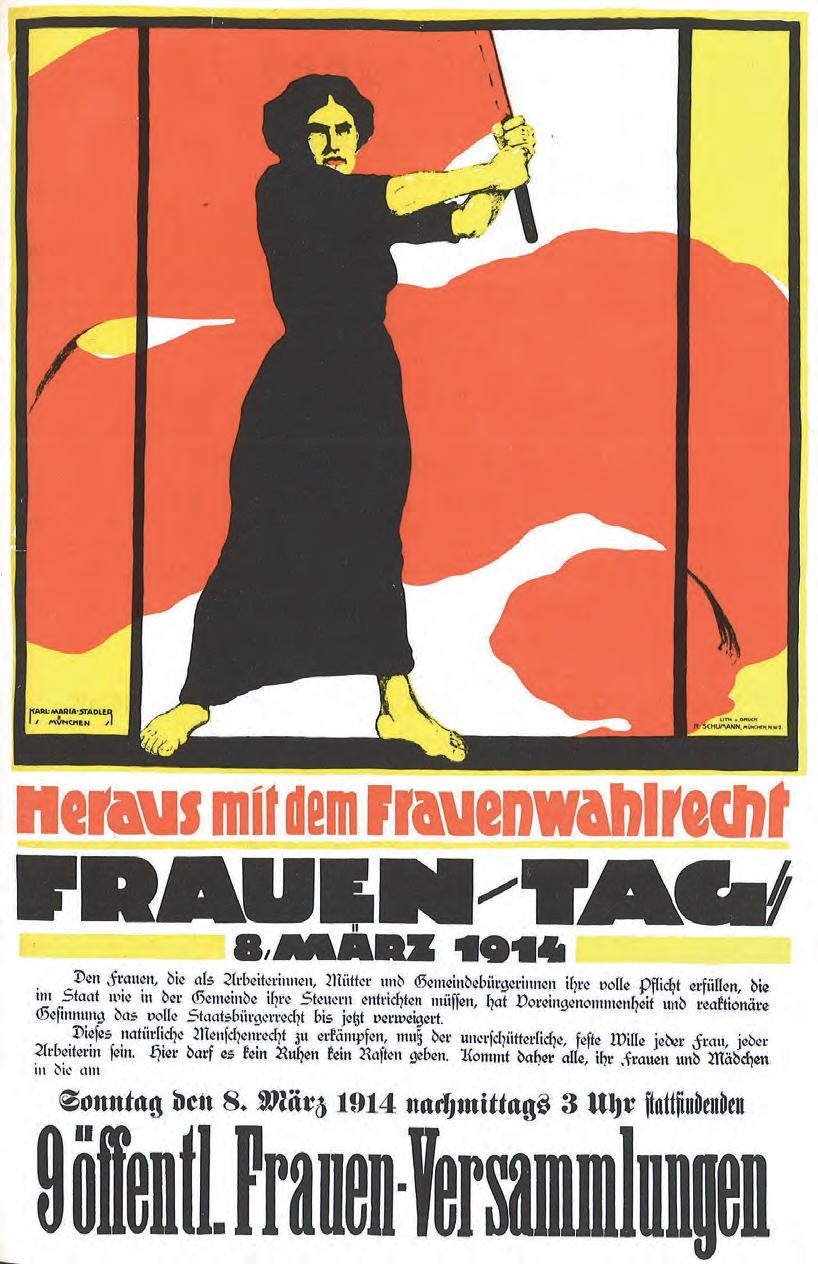
Fig.02 Karl Maria Stadler: Out with women’s suffrage, poster for International Women’s Day on March 8, 1914
large festival hall near Berlin’s Gesundbrunnen, which was so overcrowded that the »small minority« of men were forced outside into the beer garden.#5
»Women Workers! Go Forth to Fight!«
In Berlin alone, 5%,%%% people, mainly women, responded to this call published in Solidarität on March ##, #9##. In total, around one million people took part in the demonstrations in many large German cities as well as across Europe and in the United States. At an event in Berlin’s Mitte district, bourgeois women’s rights activists also expressed their solidarity.#' In #9#2, France, the Netherlands, and Sweden adopted International Women’s Day, and it was held for the !rst time in Russia on March 8, #9#) . #& Further women’s assemblies were held on March 8, #9#( Fig.02. Another large rally for women’s su rage with speakers including Marie Jucharcz, Marie Schritt (chairwoman of the Deutsche Verband für Frauenstimmrecht (German Association for Women’s Su rage)), and Gertrud Hanna (a longtime :bCi functionary), was held just three days after the end of World War*+, on November #( , #9#8. Shortly thereafter,
) ,%%% delegates of the proletarian workers’ and soldiers’ councils con!rmed the Council of People’s Deputies—the provisional government of Germany during the !rst part of the German Revolution—which decreed full women’s su rage on November #2, #9#8. #8
The historical developments make clear that the women’s assistants in the printing trade, after being excessively exploited for a long time, emancipated themselves by founding trade unions in a spirit of solidarity. Integrated into the socialist and social-democratic workers’ movement, the early trade union movement in the German printing industry, which was strongly in,uenced by women, led to the establishment of International Women’s Day and—after huge demonstrations— ultimately to women’s su rage. The journal Solidarität, as the organ of the German Verband der Buch- und Steindruckerei-Hilfsarbeiter und -Arbeiterinnen, played a particularly important role as it enabled the assistants to use their core skills in the professional production of mass printed matter to published their own ideas and demands, and thus make them accessible to everyone—but now for solidarity in networking on their own behalf.
# Fuhrmann 2%#9, pp.*52–5).
2 Ibid., p *#'&
) From #9%# named Solidarität. Organ des Verbandes der Buch- und SteindruckereiHilfsarbeiter und -Arbeiterinnen Deutschlands
( Fuhrmann 2%#9, pp.*#5) and #55
5 Ibid., p.*#55 ' Fuhrmann 2%2#, p.*#%
& They joined forces in the Verband der Buch- und
Steindruckerei-Hilfsarbeiter und -Arbeiterinnen Deutschlands. See Fuhrmann 2%2#, p.*8
8 Fuhrmann 2%2#, p.*#5 and Fuhrmann 2%#9, p.*5(
9 Fuhrmann 2%#9, p.*8%
#% Ibid., pp.*5)–5(
## Ibid., p.*55
#2 Ibid., pp.*8#–82
#) Report from the Second International Socialist Women’s Conference, Vorwärts, August )%, #9#%,
p.*#) (supplement to Vorwärts, p.*#), cited in Fuhrmann 2%#9, p.*#58; also see Fuhrmann 2%2#, p.*#&'
#( Fuhrmann 2%2#, p.*#8%
#5 Ibid.
#' Ibid., p.*#82
#& This is why communist women declared 8 March as International Women’s Day in #92#
#8 Fuhrmann 2%2#, p.*#8)

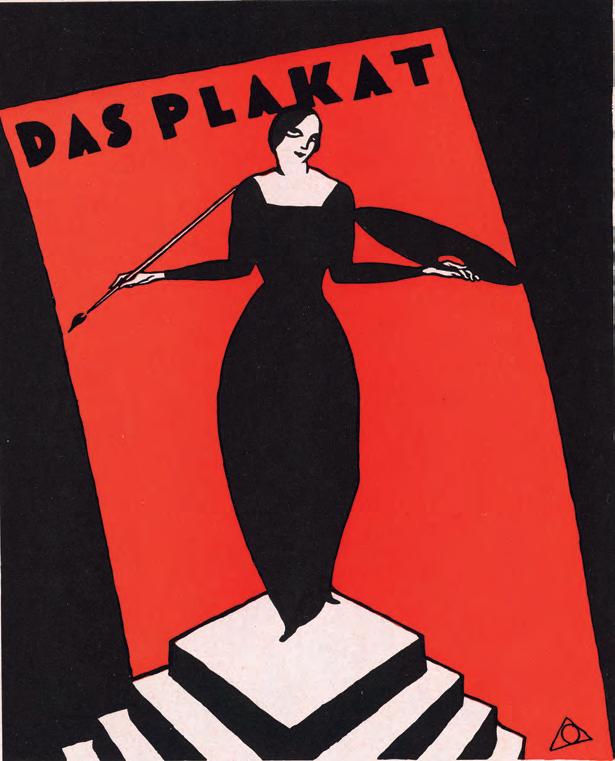
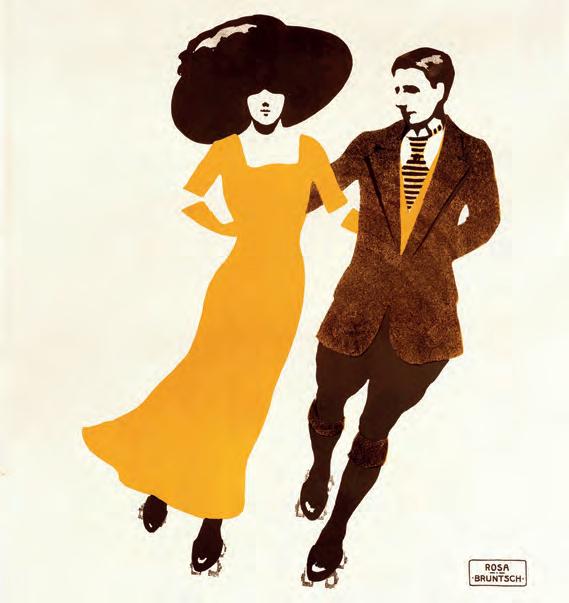

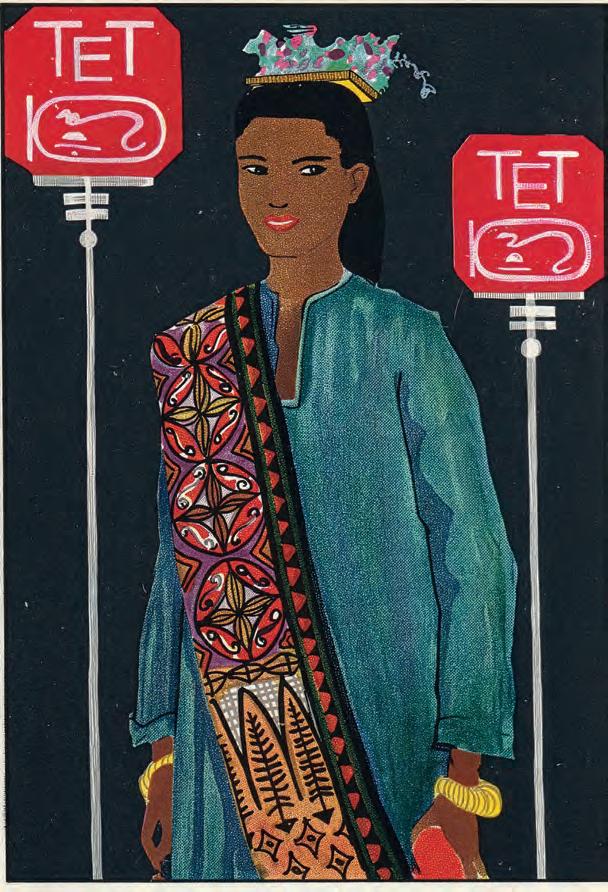
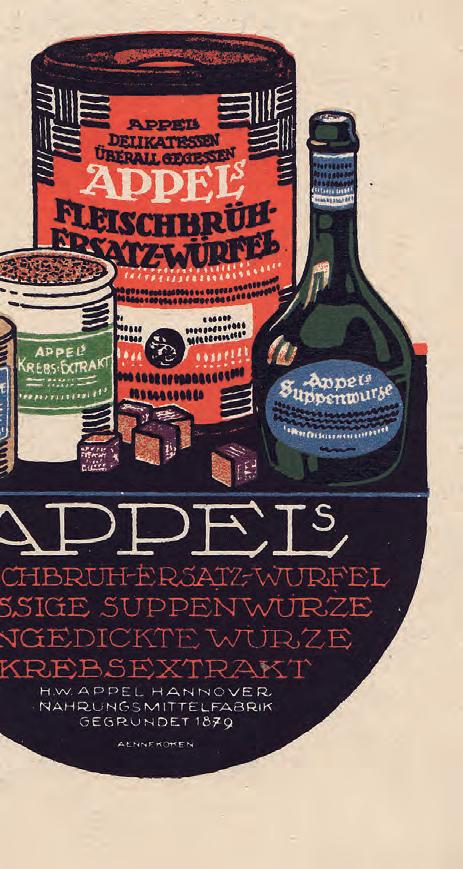
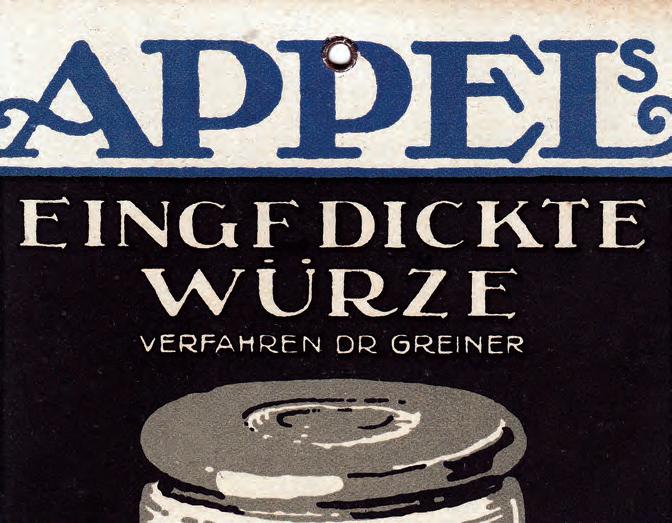
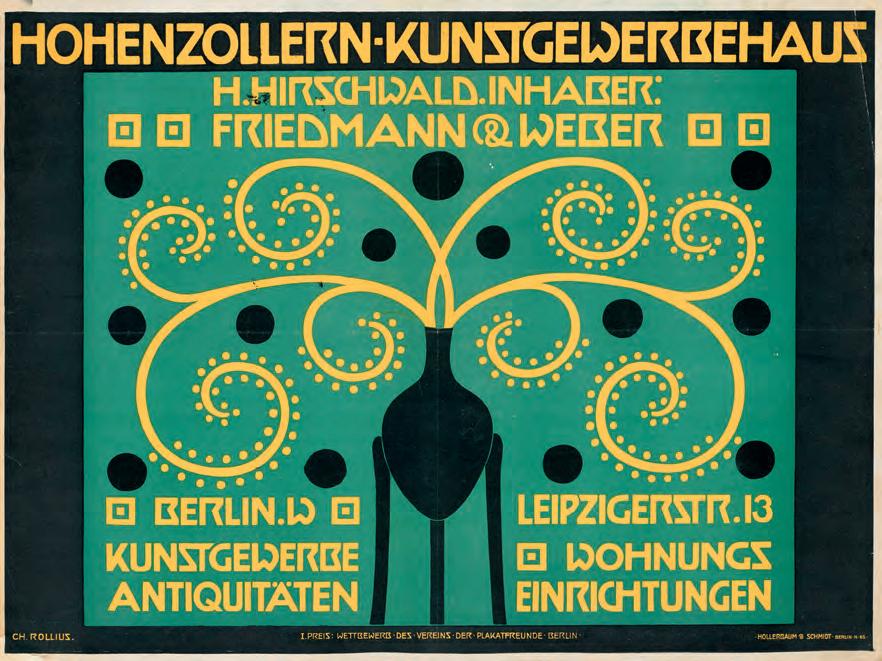
Charlotte Rollius: Hohenzollern Kunstgewerbehaus (Hohenzollern Arts and Crafts House) 1st prize from the Verein der Plakatfreunde Berlin (Berlin Poster Friends Association), poster, printed by Hollerbaum & Schmidt Berlin, 1907

Fig.04 Käte Drascher: Holorenbräu / Malzbier labels, around 1909
Fig.03
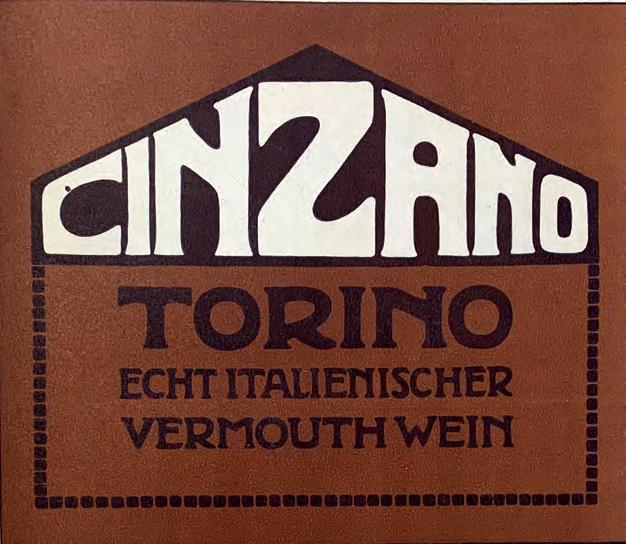
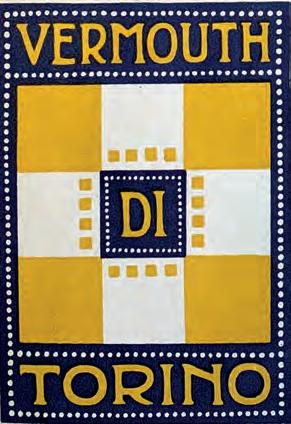
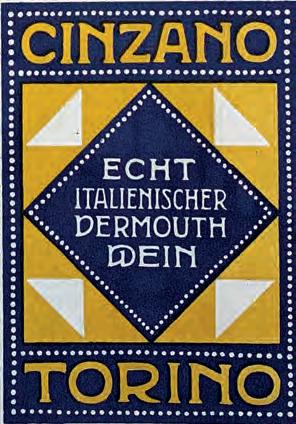
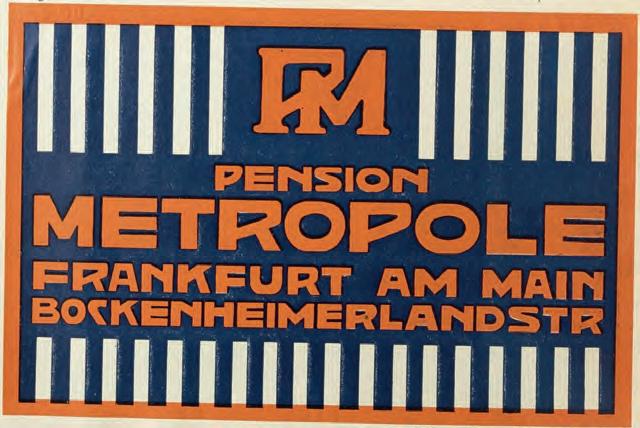
Fig.05 Käte Drascher: Cinzano / Vermouth di Torono labels, around 1909
Fig.06 Linna Eisenmann: Pension Metropole, hotel luggage tag, 1915
(07)A Women as Experts in Commodities
Friederike Berger
»The man must acquire; the woman seeks to preserve,«# stated the Brockhaus ConversationsL exicon in #8#5 , thereby de!ning the distribution o f roles in an upstanding bourgeois household: When keeping house, she was to hold on to what he earned.2 Over the course of the nineteenth century, however, the virtue of frugality came into con,ict with the increasingly socially relevant task of status from the wealth earned by the bourgeois husband.) The wife was »constantly walking the tightrope« between stinginess and showing o . ( In the late nineteenth century, this tightrope grew ever smaller as the separation of private and public areas of life became more strict: To demonstrate her husband’s success, it be!tted a wife not to work—she had to support him privately as a housewife, otherwise the suspicion could arise that the master of the house alone was not earning enough.5 Appearances and reality went their separate ways, of course. If household income did not reach the desired standard, the wife would have to work at home, far from the public eye, in order to supplement it or resourcefully !nd savings in the budget—and when necessary, could deftly dish it up. Carefully budgeting shopping for food, household goods, clothing, furnishings, and decoration became the ambitious task of the bourgeois housewife, especially in cities where self-su iciency was ruled out. Experience, exchange, and literature turned her into an expert in commodities.
The Department Store
This same expertise made women the target audience of the phenomenon of the department store that emerged in the mid-nineteenth century: the Ladies’ Paradise, as the title of a contemporaneous novel by Émile Zola had it.' The wonderful world of consumption—with
refreshment rooms, tea parlors, boudoirs, and even playrooms for children&—tailored to the needs and (un)written rules of behavior for the bourgeois woman: It was not appropriate to b e out in public unaccompanied. The semipublic world of the department store, by contrast, o ered a new gray area in which women could move in an urban space outside of the domestic »sphere of in uence« assigned to them,8 without their moral intentions being questioned. The protected space of the department was aimed entirely women customers, which is why its space can be understood to be female-coded.9 Here one could be astonishe d by the very consciously presented products without being a ected by the wind, weather, or unwanted stares.
The department store also o ered new working opportunities for women: They could advise, present goods, and run the cash register Fig.01; decorate display cases and store wind ows; and design products, packaging, and advertising. Advertising concepts were therefore often focused on women; after all, they were the shoppers and supposedly easier to in,uence with advertising than men were.#% But who knew this target audience better than the women themselves? Advertising also resulted in new tasks for designing posters, print advertisements and advertising stamps, packaging and product design and presentation that enabled women, especially in the context of the reform in the applied arts, to professionalize as designers and play a crucial role in the market.## Outstanding innovative women artists in this !eld include Else OpplerLegband, Anna Muthesius,#2 Clara MöllerCoburg, and Änne Koken 07B,07G,07E.
Spending Spree
In the collective memory, the department store does not stand for the self-empowerment and freedoms that women managed to obtain with the opportunities available to them at the time. Rather, it fed into the cliché of the so-called »weaker sex« being led to the thrill of buying, having been manipulated by the presentation and advertising of goods to—at
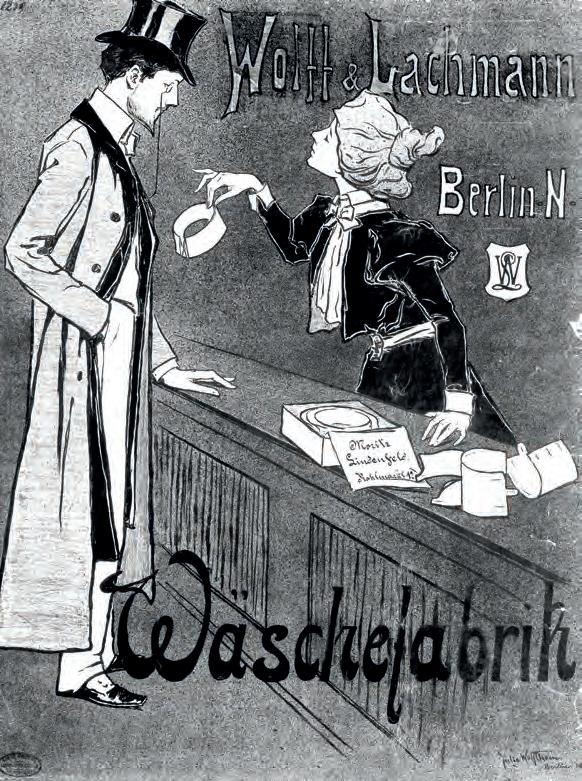
the cost of men—consume to the point of »hysteria« or even become criminal and steal.#)
The woman in a spending spree of the sort that Émile Zola was already describing in the late nineteenth century is still a common topos today.#( Then as now, this is an image of women tending to irrationality and ignoring the consequences even to the point of running up d ebt.#5 In contrast to earlier times, women today are for the most part (but not without exception) in a position to operate more freely and to spend money they have
earned themselves as they wish. But in heteronormative relationships, that does not free women of the suspicion that they are squandering their husband’s (or father’s) money. With the rise of the Internet, the site of the purchase has increasingly shifted from the shops and department stores in city centers to online retail in a virtual space that is only seemingly private. It becomes public, for example, when purchases are presented on social media, by which means women »in,uencers« earn money, and sometimes
Fig.01 Julie Wolfthorn: Wolff & Lachmann Berlin N. Linen Factory, color lithograph, 1905
(07)D
Bahlsen: The Hannover Cake Factory and its Women Graphic Artists
Gerda Breuer
Like many other companies, around #9%%, the Bahlsen company commissioned its advertising from artists who had made their names in the reform movement in the arts. They included women as well: Mela Köhler, Änne Koken, Ella Margold, and Martel Schwichtenberg . Their artistic work was wide-ranging: They designed factory architecture, retail stores, window dressing, fair booths, packaging, announcements, posters, promotional and !eld postcards, and the advertising stamps that were popular at the time. Hermann Bahlsen ( #859 –#9#9) founded a bakery in Hannover in #889 that grew into the Hannoversche Cakes - Fabrik H. Bahlsen . In #89# , the company named its cookies with butter ,avor (which it called »Butter-Cakes«) after the philosopher Gottfried Wilhelm Leibniz, who was court librarian in Hannover for many years. In his day Bahlsen had recommended rusks to feed soldiers because it had a long shelf life. The Bahlsen butter cookies represented an improvement in quality. The company’s founder recognized early on the importance of aesthetic design for his company. The family company in Hannover earned a reput ation for its outstanding packaging and became an internationally known brand. The company did not seek to create a uniform and original Bahlsen style but instead give the artists a great deal of freedom to design advertising in a wide range of formats and media. Nevertheless, taken together they seem like an early example of corporate design. At the time the company was founded, cookies were still a luxury product. French biscuits and English cookies were expensive in the German Reich because of tariffs. # Hermann Bahlsen was familiar with the butter
cookie market from stays in England. The cookie tins and cardboard packaging were supposed to look like artistically designed jewelry boxes and gave consumers the feeling that purchasing them was a way to participate in an opul ent lifestyle. The designers were mentioned by name or identi!ed by their signet, not always on the tins themselves but often in the advertising 09A.
Hermann Bahlsen had come into contact with the Arts and Crafts movement in England. The idea of aestheticizing his company and its products was inspired by John Ruskin, William Morris, and other representatives of that British reform movement. The goals of the British protagonists were, however, more closely connected to ethical and political goals—in particular increasing the value of work—than those of German companies generally. Bahlsen was, however, also intereste d in the social welfare of its workers; for example, he provided clean, bright, and spacious workplaces—usually with tiled walls—and a good working environment.2 As a private collector, moreover, he acquired numerous works of contemporary art and decorated his company’s factories and administrative buildings with them so that his employees could participate in modern culture and motivating them through more beautiful surroundings. Around #9%%, he founded a company health insurance fund for his )%% employees. He also introduced technical innovations early on: punch cards in #9%5 and the !rst European plant to employ conveyor belts.
Of the women graphic artists who worked for Bahlsen, Änne Koken deserves special emphasis. In Hannover in #9#%, she opened her own Werkstatt für angewandte Kunst (Workshop for Applied Art). From there she worked for various renowned companies; in addition to Bahlsen, Appels Feinkost (Appel’s Delicatessen) 07E, the Lindener Samtfabrik (Linden Velvet Factory), Günther Wagner (Pelikan o ice supplies) 07H, and die Hannoversche Waggonfabrik (Hannover Railroad Car Factory), for example. Koken was also appointed to the
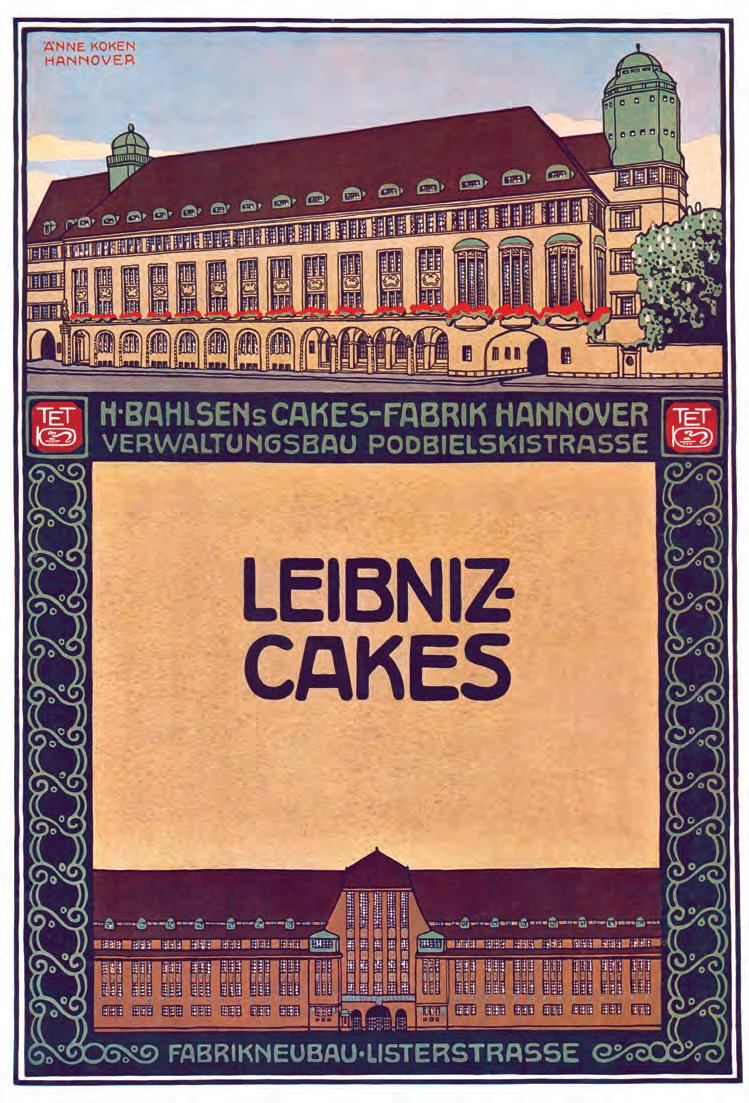
Artistic Advisory Board of the Hannoversche Cakes-Fabrik (Bahlsen) and created two series of advertising stamps there: the Künstlermarken (Artists’ Stamps), Series C from January #9#) onward and F Series a month later. In Series C, twelve individual advertising stamps illustrated the process of making Bahlsen
cookies, from the ingredients via the manufacturing process to their consumption. All the stamps have a small winged putto with reddishblonde hair depicted doing the activities in question. On a small border along the upper edge of each stamp, viewers read, in addition to the series identi!cation C and a consecutive
Fig.01 Änne Koken: Bahlsen’s cake factory in Hannover, color magazine advertisement for Bahlsen, 1911
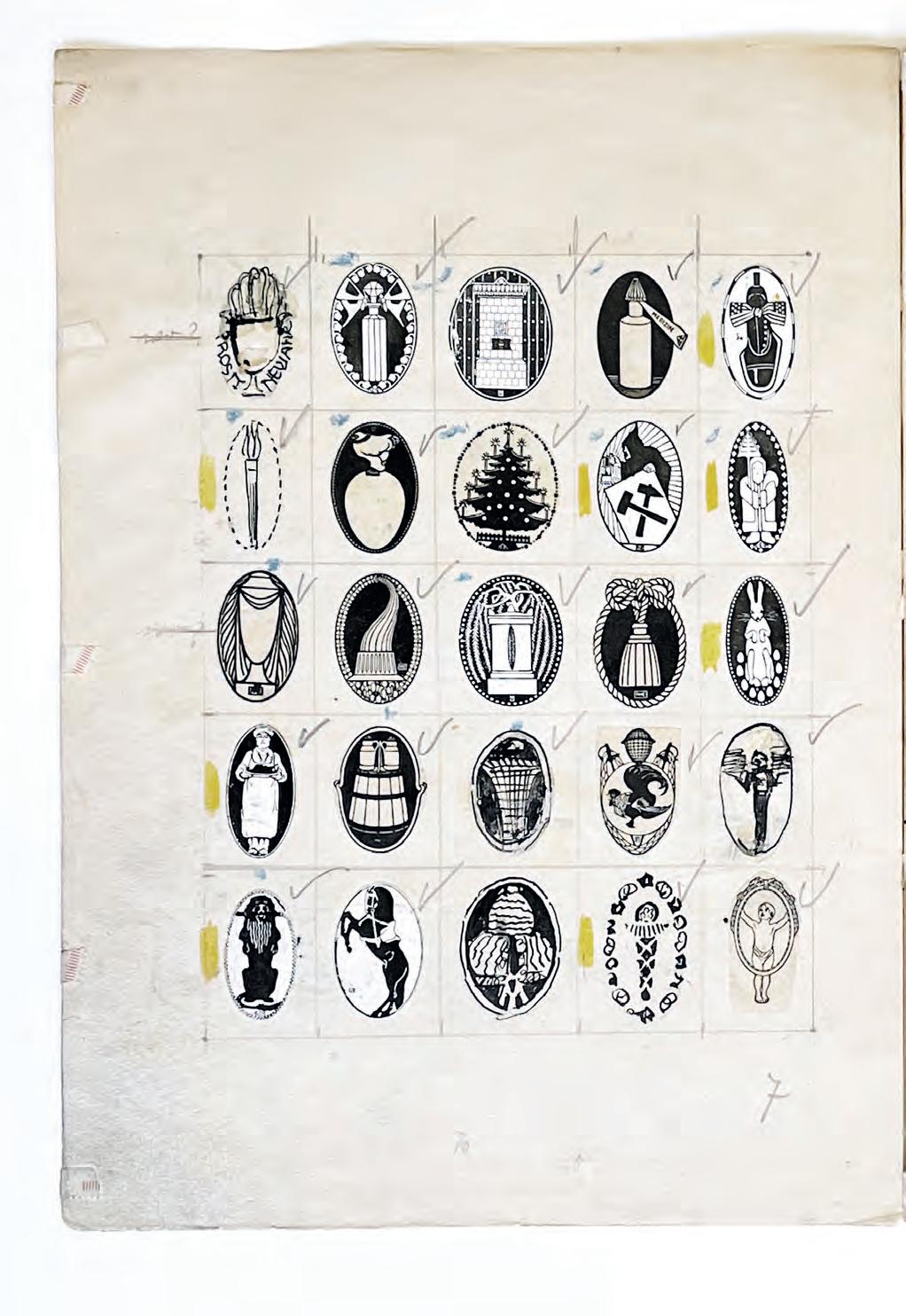
Fig.24 Clara Möller-Coburg (and F.H. Ehmcke?): Designs for guild symbols for the Rudhard Foundry in Offenbach am Main, around 1904/1905
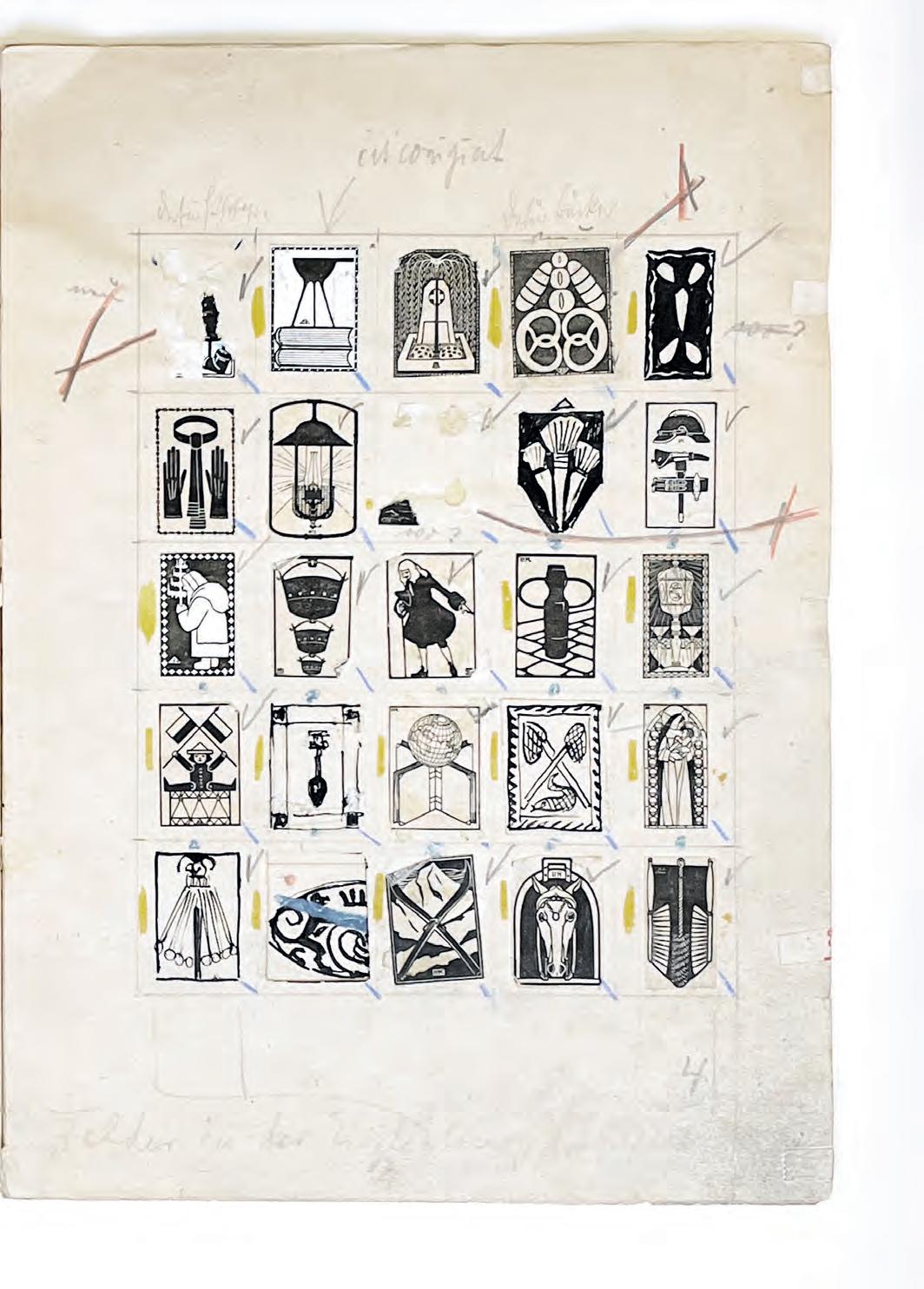
Music Publishers« section in which the works of women composers were performed and were available for purchase.#9
Another of the exhibition’s goals was to make visible the high proportion of women’s contributions in the book trade and graphic arts and »the work performed by women in factories and at home.«2% The social statistics section had the declared goal of »showing the high number of female workers in book production« and thus to demonstrate »that this branch of our industry could not have reached its high level of achievement without the cooperation of women.«2# Accordingly, »social-historical« aspects were exhibited, »meaning the numerical calculations of women’s work in these areas, their working conditions, wages, etc.,« complied by economist Dr. Marie Bernays from Heidelberg, a student of Max Weber.22 The »Social Statistics of Women’s Work in the Book Trade and Graphic Arts« section presented a detailed look at the »numerical development of women’s work in the main cultural countries« as well as !ndings on »age and marital status of female workers;« on »self- employed workers, technical civil servants, and women workers;« on the »ratio of women’s and men’s work in trades; furthermore, changes in this due to new machinery in particular;« on »women’s wages;« »health hazards in trades;« »accidents;« »protective and welfare facilities;« and »organization of women workers 06B at home and abroad, and labor strikes.«2)
The positive engagement for questions of emancipation was openly represented in the »Book Trade« section, in which »women’s literature from all cultural countries« could be purchased, and in the »Press« section, which has a reading room with women’s magazines and a sales stand that carried current women’s magazines from Germany and abroad.2(
With respect to the actual specialist topic of the Bugra, there were exhibitions of »Book Production,« »Writing« (calligraphy, script design, artistic lettering), »advertising« (poster design and advertising materials), and »Photog raphy.« Several sections were dedicated to Book Production, with a particularly
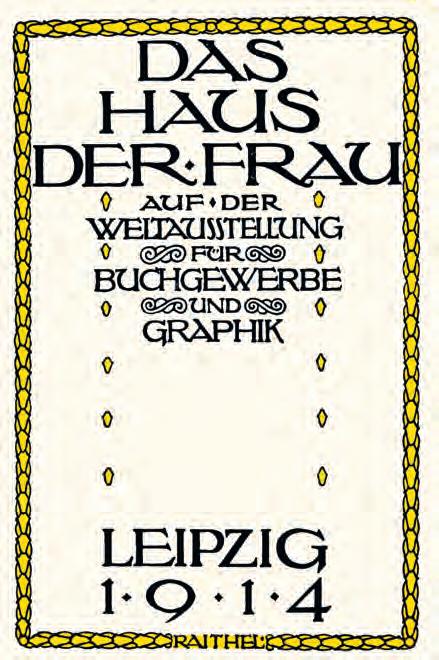
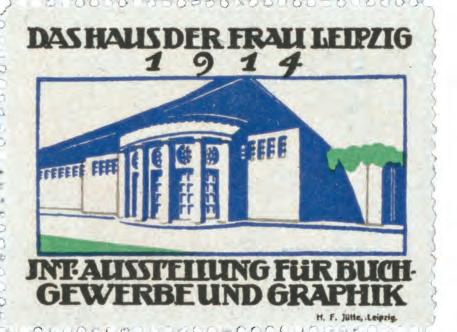
Fig.05 Cover of the catalog »The House of Women« at the World Exhibition for the Book Trade and Graphic Arts, Leipzig, 1914
Fig.06 Advertising stamp »House of Women Leipzig 1914,« designer unknown, 1914
Advertising stamps »Sondergruppe der Frau« (Special Women’s Group) on various topics shown in the »Haus der Frau,« designed by
identifiable authors
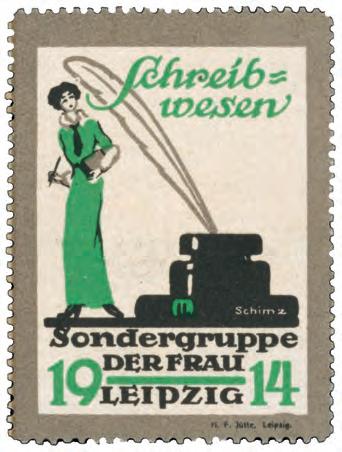
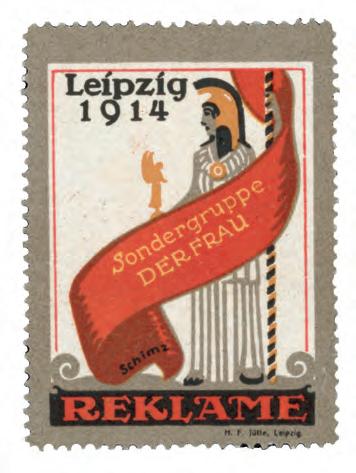
Fig.07
Adelheid Schimz and Luise Rudolph, some without
(09) WAR & UPHEAVAL
World War + changed the lives of everyone, including women. They often became sole supporters of their families and had to take over their husband’s job: in departments and o ices, in shipping and transportation, in factories and the armaments industry, in foodstu s but also in communication and printing, because the typesetters had been conscripted into military service or the Vaterländischer Hilfsdienst (Auxiliary Services for the Fatherland). From #9#' onward, the Hilfsdienstgesetz (Auxiliary Services Law) required women as well to do national service.
Petra Eisele
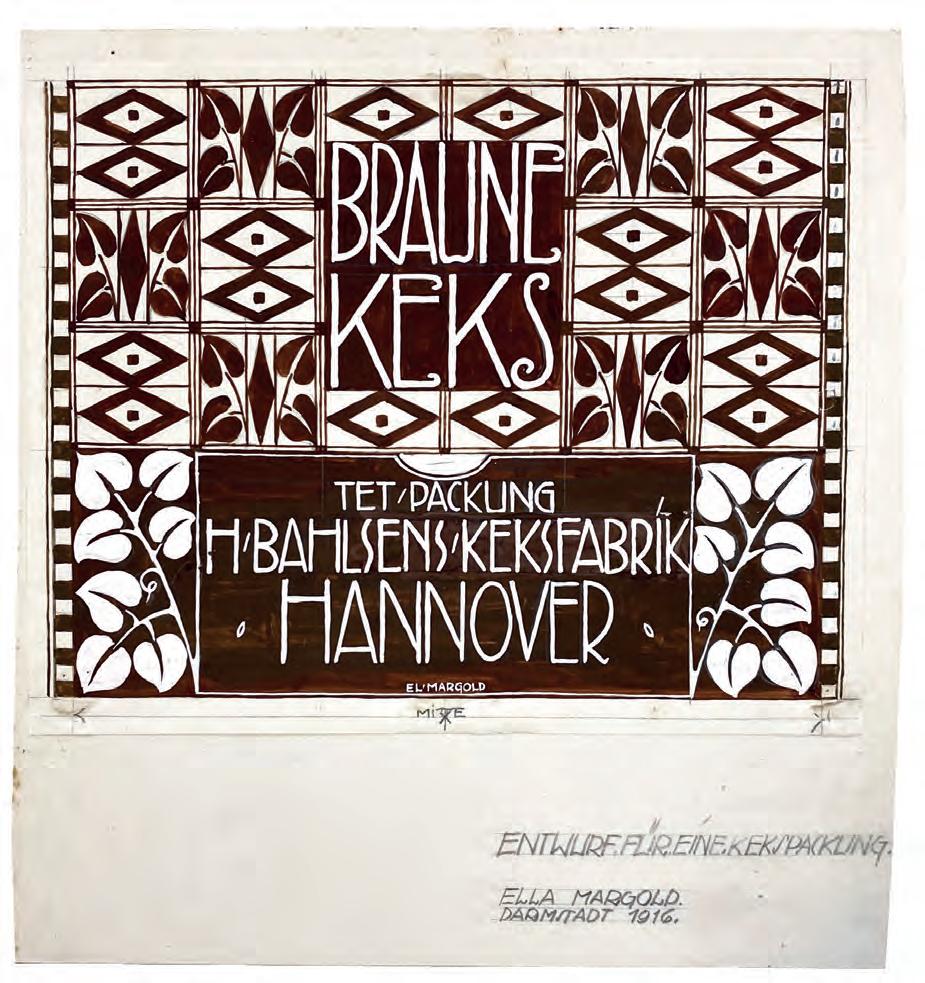
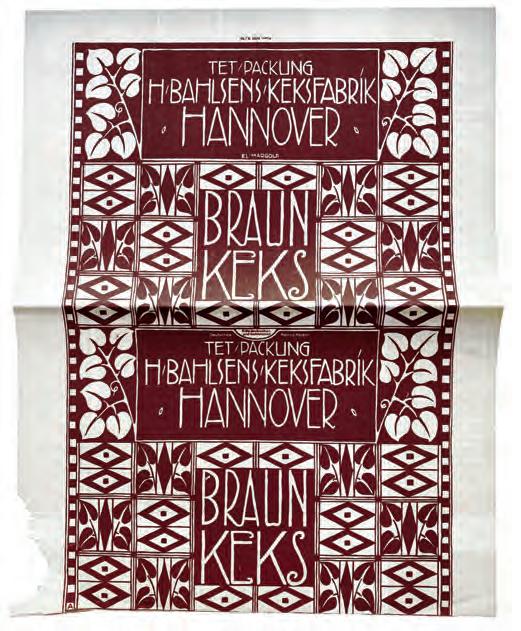
Figs.09—10 Ella Margold: Brown cookie, signed design and printing implementation TET package for H. Bahlsen, 1916
Fig.11 Ella Margold: Caraway biscuits, design for biscuit packaging for Bahlsen, signed Ella Margold, Darmstadt 1916
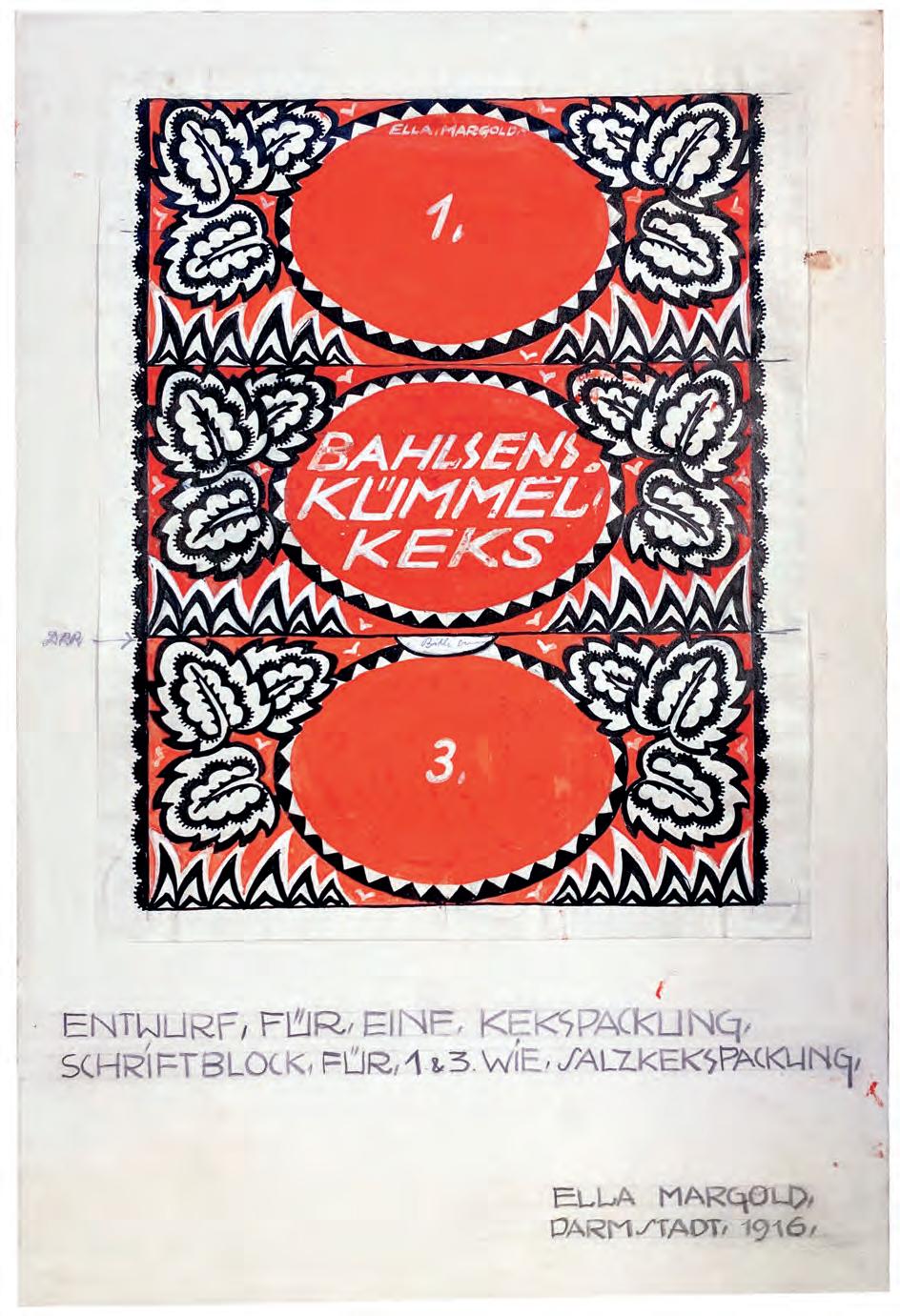
(10) VISIONS & OUTLOOKS
The Roaring Twenties represented the dawn of a new era. With the end of both World War + and the German Empire, the legal situation for women changed. A decree from the Council of People’s Representatives enshrined women’s su rage in November #9#8, which was then implemented during the election to the German National Assembly on January #9, #9#9 : )& of the total (2) representatives were women, corresponding to a share of women of approximately nine percent.
Because gender equality was enshrined in legislation of the Weimar Republic, the education and professional situation for women also changed. From that point forward, they were allowed to study without restrictions at universities, and therefore also at art academies and art colleges.# This meant that men and women students were granted equal opportunities for a design education.
Petra Eisele
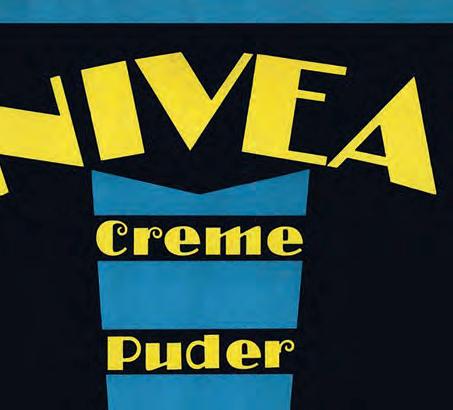

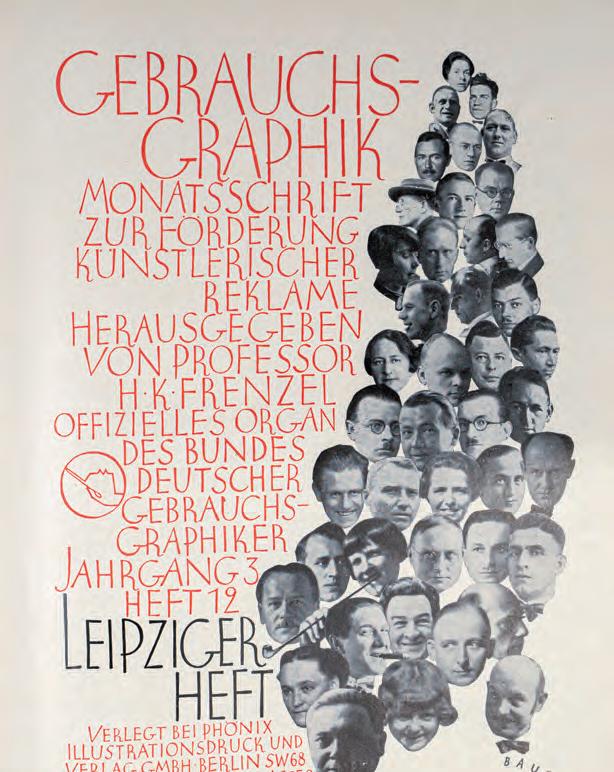
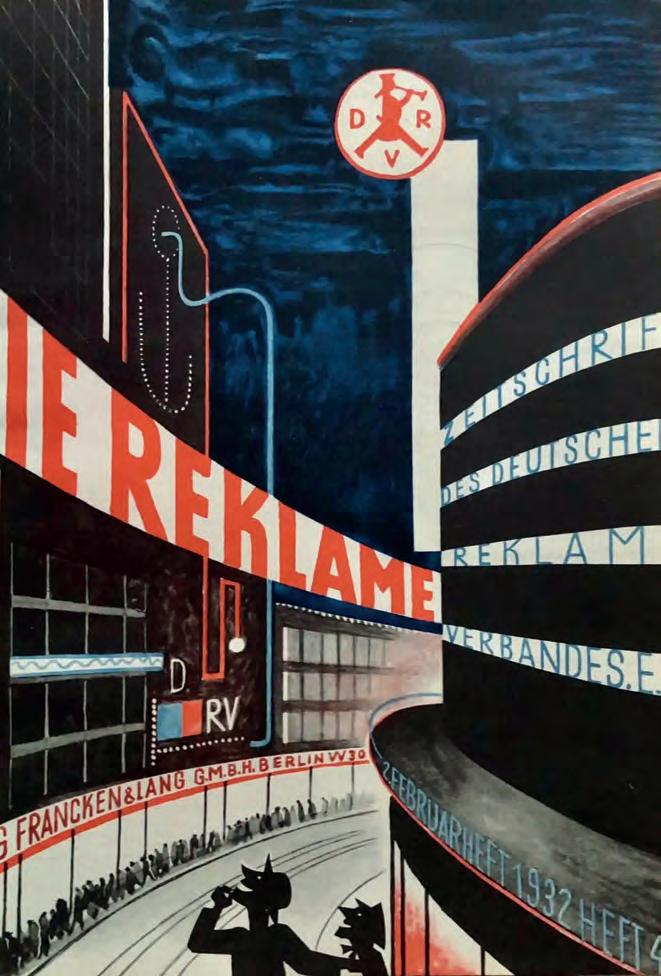
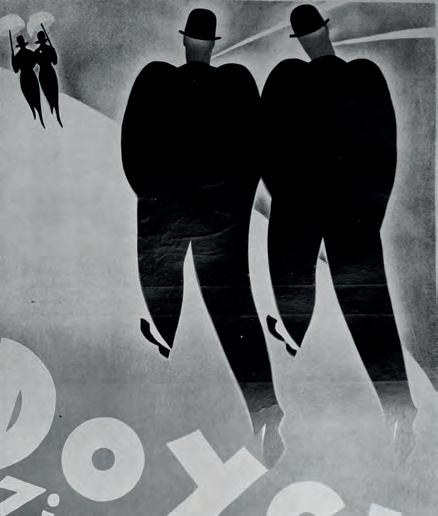

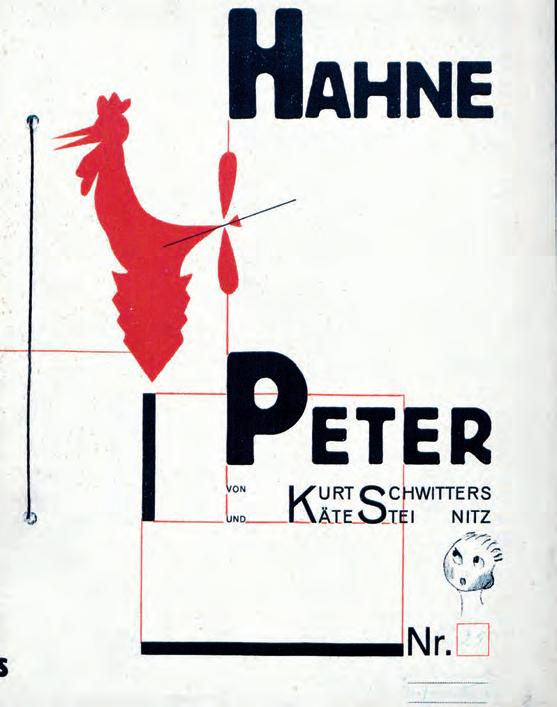
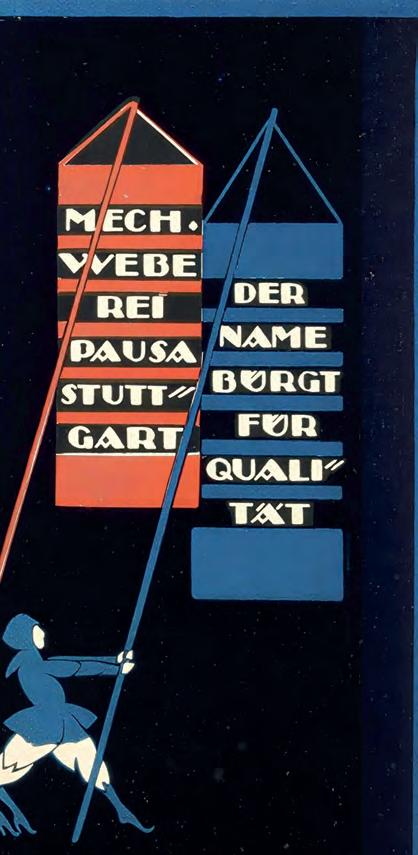
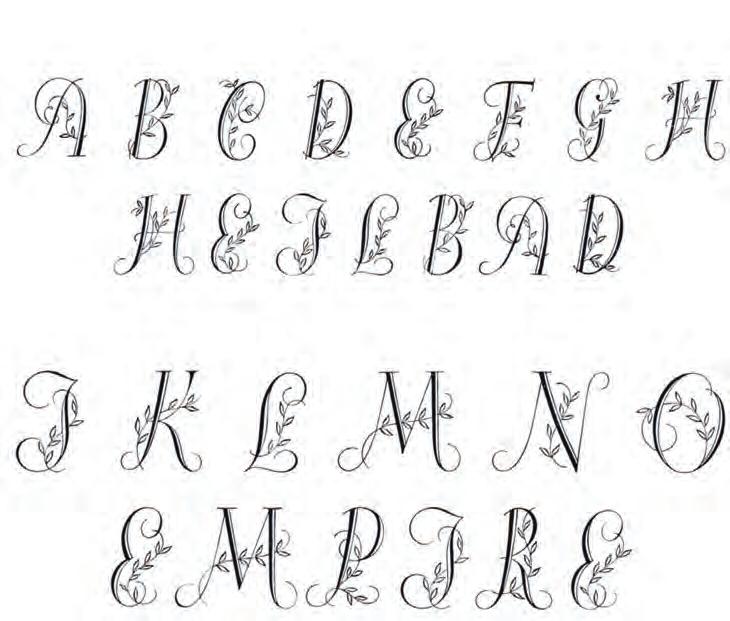
Friedel Thomas Geboren 1895, gestorben
Fig.10 Maria Ballé: Calligraphic initials, electrotypes Bauersche type foundry, 1928

Fig.11 Friedel Thomas: Thomas font, ca. 1956
# See Kupferschmid 2%#& and Popova 2%2#, p.*'#
2 See Wardi 2%#' and Erni/Jessen 2%#5 ) Friedlaender/Stern*#98(, pp.*#–(. ( Messner 2%#', p.*25
5 Handbuch der Schriftarten (Zweiter Nachtrag) (Leipzig: Albrecht Seemann, #929), p.*#9 ' Handbuch der Schriftarten (Dritter Nachtrag) (Leipzig: Albrecht Seemann, #9)%), p.*2' & Messner 2%#5, pp.*#%–#5
8 Wardi/Lavi-Turkenich 2%#', p.*2)).
9 Custom fonts are typefaces that are speci!cally commissioned or licensed for a speci!c appearance. #% www.klingspor-museum.de/KlingsporKuenstler/ Schriftdesigner/Baruch/FBaruch.pdf (accessed February 5, 2%25).
## For further documentation see Wardi/LaviTurkenich 2%#', pp.*2))–(5
#2 The fashion magazine published by Ullstein at the end of #9## under the name DIE DAME was considered a sophisticated magazine by the #92%s at the latest, combining !ction by established authors with articles on fashion and lifestyle and innovative photography and illustration.

#) Paucker #998, p.*&
#( Hansert 2%%9
#5 Ibid.
#' www.klingspor-museum.de/KlingsporKuenstler/ Schriftgiessereien/Bauer/Bauersche.pdf (accessed February 5, 2%25).
#& Popova 2%2#, p.*&( #8 Andreu Balius digitalized the Elizabeth ND in 2%%5 on behalf of BauerTypes, see https://bauertypes.com/en/bauer-classics/ elisabeth-nd (accessed on Feb. 5, 2%25).
#9 Hans Bohn, typeface designer, graphic artist, alumnus of the later O enbach, worked for the Klingspor type foundry in O enbach from #9#9 to #9)%. From #9(' bis #95' he was a professor at the Werkkunstschule O enbach (today: HfG O enbach) in the lettering and typography course.
2% Die Frau im Buchgewerbe und in der Graphik, Leipzig #9#( (Bugra catalogue #9#(), p.*#82
2# Goetze #9#9, p.*#%8
22 Ibid., pp.*#)8–)9
2) Distributed by MyFonts and ARTypes (among others) as Maria Ballé Initials or by Andreas Seidel as Alea.
2( Lucian Bernhard was a famous poster and typeface designers, as well as later also a professor in Berlin and successor to Else Marcks-Penzig. The Bernhard Schönschrift was published in #925 by the Bauersche Schriftgiesserei.
25 Bernhard Schönschrift (#9)8), pamphlet digitized and available at the Staats- und Universitätsbibliothek Hamburg Carl von Ossietzky: https://digitalisate.sub.uni-hamburg.de/ recherche/detail? (accessed February ', 2%25).
2' DeGaine 2%22, p.*)'
2& Popova 2%2#, p.*&#
28 Gebrauchsgraphik*9, no. ( (#9)2), p.*'#
29 DeGaine 2%22, p.*)%
)% Breuer/Meer 2%#2, p.*5&)
)# The :eb Typoart was founded after the war in East Germany through the merger of the companies Schelter & Giesecke (:eb Polygraph after the war) and Schriftguss <? (Schriftguss Dresden :eb) in the year #95#. The type foundry Ludwig Wagner was added in #9'%
(10)B
Modern Advertising by Women?
Petra Eisele
By the time the Great Depression started in #929, a new (typo)graphic design and advertising ar t had established itself, however, it was far less strongly dominated by women than women commercial graphic artists had hoped. The fact that the !eld of modern commercial art was understood from a male perspective is illustrated by the job title of the »Werbefachmann«—an advertising specialist, but in German this is speci!cally a male specialist, a women specialist would be a »Werbefachfrau«—who was viewed as a crucial driving force in the economy and industry. This (male) person was deemed to have the technical knowledge about printing that was considered essential for the ideal realization and e ective dissemination of successful advertising. Furthermore, it was considered a male skill to be able to make the correct decisions, both intellectually and strategically, with which German (industrial) products could be established as brands and marketed internationally. Therefore, the periodical Gebrauchsgraphik (Commercial Graphic Art) was launched in #92( with a special issue about »Industry Advertising« in which women were entirely unrepresented as designers and as expert authors.# Accordingly, this important trade journal was dominated with the names of male designers and authors, whose commercial graphic works were presented with very detailed and elaborately produced design examples. In practice, they also held almost all the positions in this rapidly expanding professional !eld, which developed into its own prospering and internationally networked advertising industry during the #92%s: Advertising design (extensive design of the visual appearance and brand images as well as advertising, advertising !lms), book design (bookbinding, cover design, layout) and
magazine design (layout), typeface design, and the correct handling and use of typefaces (typography) Fig.01. In #928, Michael Spondé summarized this incredibly blatant contradiction b etween education or studies and professional life as follows: »Whoever pays a visit to the classes of our art schools is always surprised about the high percentage of women among the students. This proportion stands in absolute contrast to the proportion that we come upon in practical professions. Here, the number of women working in the arts is completely inferior to that of men. Only just a few women are able to carve out a space for themselves and come out on top.«2 The directory of the Bund Deutscher Gebrauchsgraphiker (bd?: Association of German Commercial Graphic Artists), founded in #9#9, testi!es to the stark disproportion of women and men active in commercial graphic arts: Among the &29 full members, (' were women, meaning around '.) percent.)
It is striking that those women who were mentioned in specialist periodicals such as Das Plakat (The Poster) or Gebrauchsgraphik were often associated with small and detailed design works that not only required technical skills, but also patience, dexterity, and/or (artistic) craftspersonship: Calligraphy (Anna Simons, Elisabeth Friedländer, Eva Ascho (#9%% –#9'9), Margarete Leins (?–?), ( Ilse Bentel (married name Schüle, #9%)–#99&), Erika Hansen (?–?),5 Paquita KowalskiTannert (#89% –#9'8)', and Hedwig Bauer (?–?)&; vignettes and so-called small graphic artworks or smaller, sketch-like illustrations, often for (fashion) magazines (Marianne Amthor8, Gertrud Bernhard-Nothmann (#89&–#9(( in Auschwitz),9 Anny Knittel (?–?),#% Lotte Pfeil (?–?),## Marlice Hinz (#9%)–#9&8),#2 and Dorothea Su rian (#89(–#9'&) Fig.02 . In addition, women were increasingly represented in supposedly gender-speci!c themes, i.e., in the areas of needlework, textiles, and fashion illustrations Fig.02 04 (Marianne Amthor/Marlice Hinz/Elly Maetzig-Meisel (#89(–#958)).#)
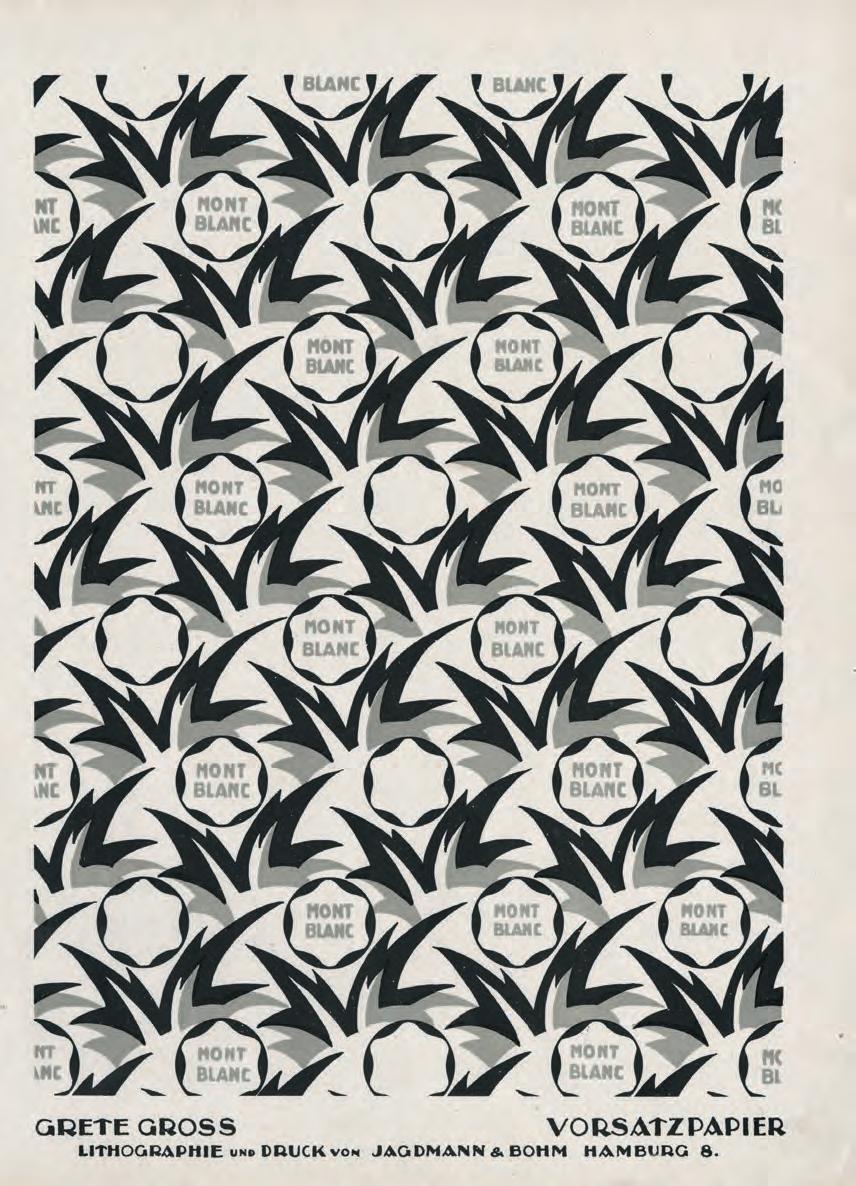
Fig.17 Grete Gross: Endpaper for Montblanc, before 1921
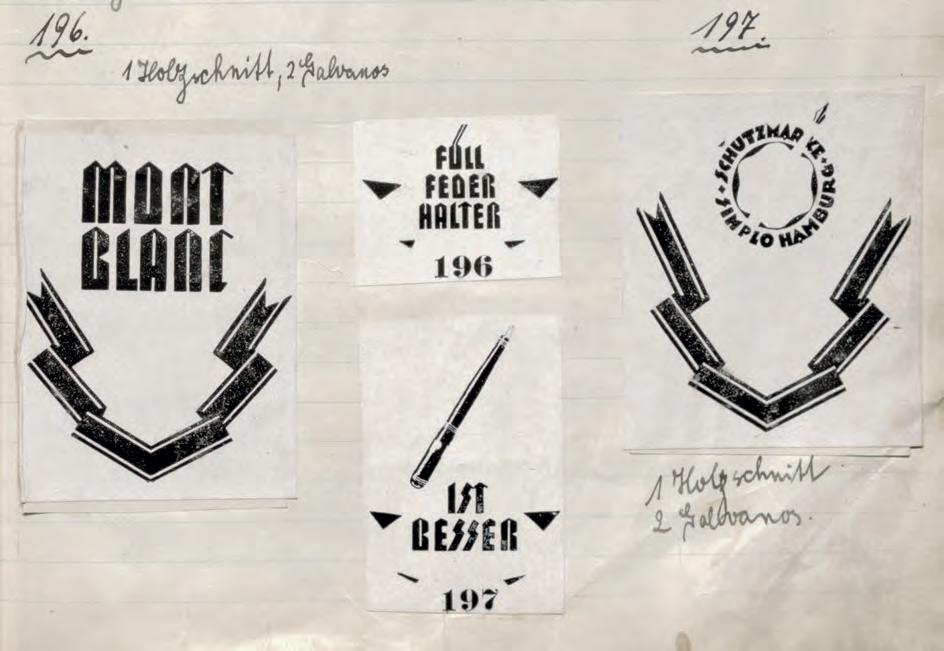
Figs.18—19 Grete Gross: Advertisements for Montblanc
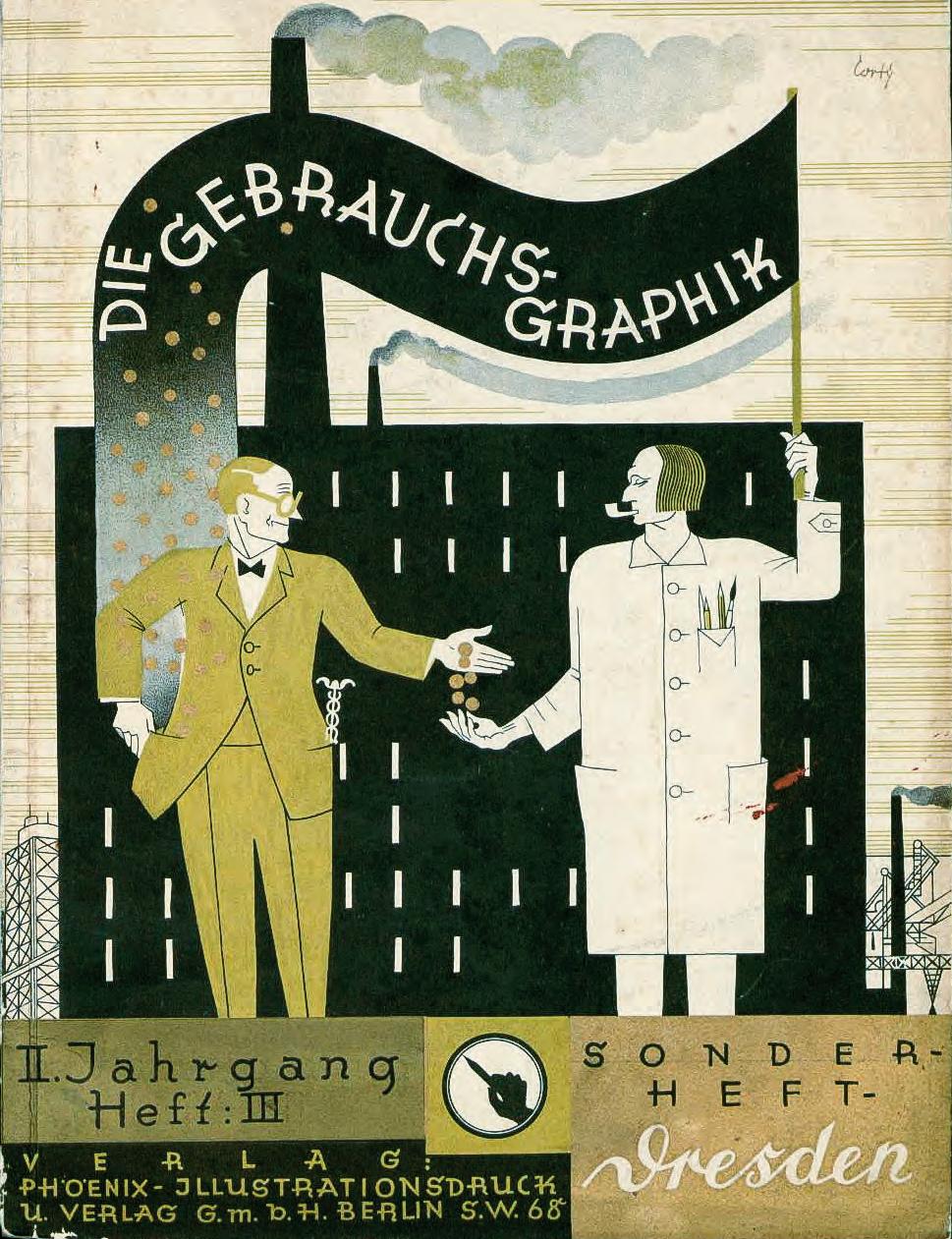
Fig.31 Dore Mönkemeyer-Corty: Cover of the special issue »Dresden« of the magazine Gebrauchsgraphik, issue III, 1931
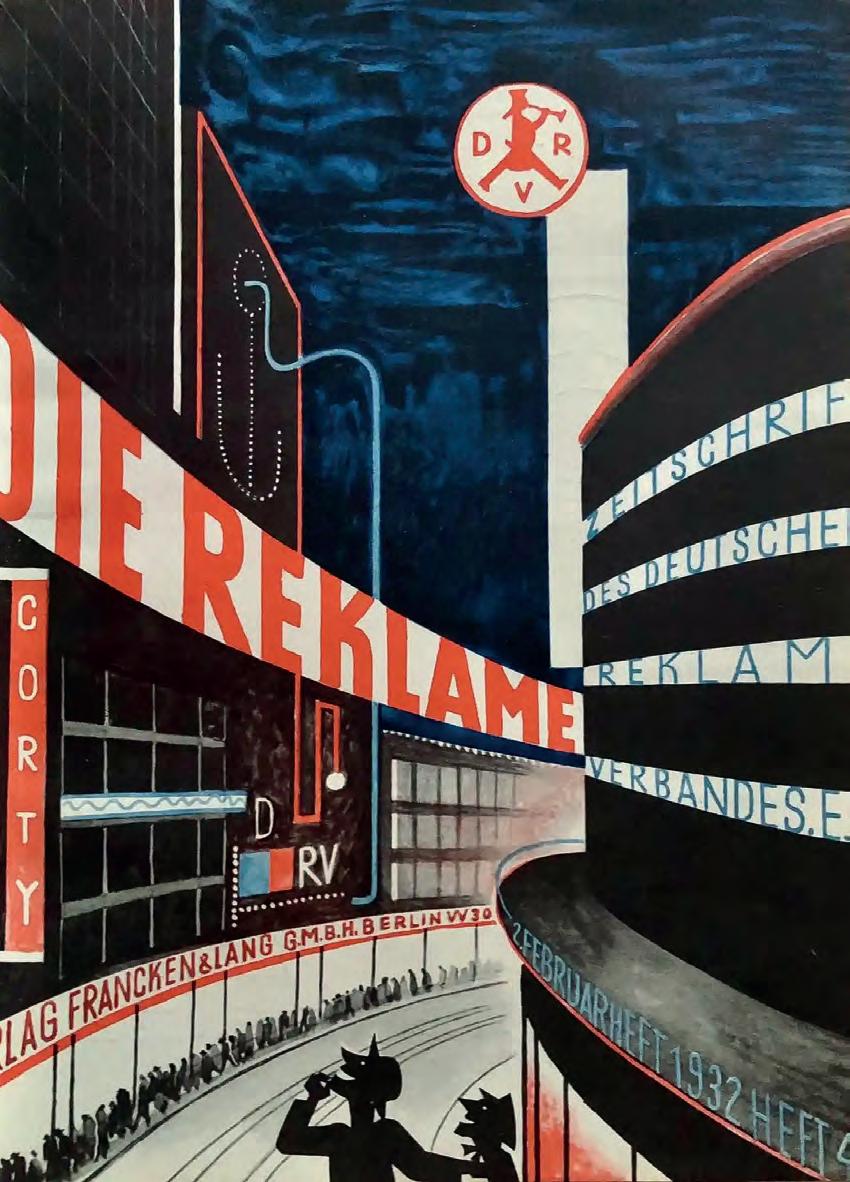
Fig.32 Dore Mönkemeyer-Corty: Cover »Die Reklame,« February 1932




heading the important magazine die neue linie (the new line) 10C Fig.03 for twenty years— one of the !rst woman art directors worldwide.&5 As an important city for trade fairs, Leipzig also hosted advertising fairs as part of the Mustermesse (sample fair), while an international book art exhibition also took place there in #92&. &' In the address directory of the Leipzig issue of Gebrauchsgraphik, which was published for this occasion, seven women are named among the forty-eight people: Alice Greinwald-Clarus,&& Ruth Krüger(-Pauly) (?–?), who herself was represented in the magazine with a logo in #92&. &8 In April #9)5 Krüger designed a cover for die neue linie. &9 Also listed there were Marianne Lindam (#9%)–?) (cover and label designs),8% Käte Luise Rosenstock (?–?) (mainly bookbinding works),8# Luise Rudolph (mainly book bindings),82 Adelheid Schmiz (packaging),8) and Lotte Winter (?–?) (packaging).8(
Stuttgart
Eva Ascho , who studied at the Kunstgewerbeschule in Stuttgart in the #92%s, subsequently trained as a bookbinder in Munich and Hamburg. She successfully headed a bookbinding workshop in Freiburg in which she not only designed decorated papers, but also worked for the Insel and Hanser publishing houses; she also worked as a calligrapher.85 Ilse Schüle also studied at the same school, where she worked under Professor F.H. Schneidler and was also a lecturer there. After marriage and the birth of twins, she worked as a typographer, designer, and graphic designer, designing numerous book covers for the Deutsche Verlags-Anstalt. 8' Maria Andler-Jutz (#892–#98#) came from Stuttgart and presumably lived in Munich in the early #92%s, where she worked for the publisher Hermann Reckendorf. 8& She later worked for the S. Fischer publishing house in Berlin, for which she designed the jacket for Alfred Döblin’s Berge Meere und Giganten (Mountains Seas and Giants).88 From #92) to #925 , Grete Stern (#9%(–#999) also studied at the Kunstgewerbeschule in Stuttgart in the Graphic Arts
Short Biographies
Preliminary Remark
This section includes female designers who were already active before #9#9 (female designers active from the #92%s onwards are listed in 10). The designers identi!ed themselves as craftswomen who practised a holistic, i.e. interdisciplinary, approach to design in the best sense of the word. In this respect, the biographies mention the sometimes diverse !elds of activity, although the focus is on training and the graphic design and typography disciplines examined in this publication.
Abbreviations
Bugra – International Exhibition for the Book Trade and Graphic Arts (Internationale Ausstellung für Buchgewerbe und Graphik) in Leipzig #9#( DNB – Deutsche Nationalbibliothek Leipzig
HFBK – Hochschule für Bildende Künste Hamburg
HLMD – Hessisches Landesmuseum Darmstadt
MK&G – Museum für Kunst & Gewerbe Hamburg
SLUB – Sächsische Landesbibliothek Staats- und Universitätsbibliothek Dresden
SMB – Staatliche Museen zu Berlin
Contemporary Exhibition Catalogues Exhibition Die Frau in Haus und Beruf (Women in Home and Career), #9#2 in the exhibition halls at the Zoological Garden Berlin, Rudolf Mosse Publishing House, Berlin #9#2
Hereinafter abbreviated: Catalogue Die Frau in Haus und Beruf #9#2
International Exhibition for the Book Trade and Graphic Arts (ed.): Die Frau im Buchgewerbe und in der Graphik. Special group of the World Exhibition for the Book Trade and Graphic Arts, Leipzig #9#( . Hereinafter abbreviated: Catalogue Bugra 1&1,.
AF Ade, Mathilde, 8 Sep. #8&& in Sárbogárd, Hungary– & Jun. #95) in Munich
In #892, Ade began studying at the Kunstgewerbeschule (School of the Applied Arts) in Munich and a year later attended the Damenakademie (Ladies’ Academy) there. For twenty years beginning in #89(, she was an illustrator for the journal Meggendorfer Blätter, as well as for Fliegende Blätter and Jugend—in #898, she contributed to its so-called »Ladies’ Issue.« From #9%2, several children’s books were published for which she designed the text and images. Her work came to focus on numerous ex libris using various graphic techniques. She also did commercial graphic works such as calling cards, greeting cards, and advertisements. An eye disease and the in,ation triggered by the war ended her career in the late #92%s.
—Ade, Mathilde: Überkinder-Bilderbuch, Esslingen/München #9%2
—Ade, M.: Das Tierleben – waschbar –unzerreissbar, #9%2
—Kern/Schutt-Kehm/Selle #99#
F Adler, Rosa, ?–?
Adler studied at the Kunstgewerbeschule (School of the Applied Arts) in Weimar during the #9##–#2 academic year and from #8 April to 9 May #9#2, took F Anna Simons’s calligraphy and typography course.
—Wahl 2%%&, p. 5#&
F Altenkirch, Alexe (Alexandra), 5 Jul. #8&# in Kreuznach–25 Sep. #9() in Bad Kreuznach Altenkirch attended the private Eliseninstitut für höhere Töchter (Elisen Higher Girls’ Institute), which her aunt ran in Kreuznach. Her parents supported her wish to study art. In #888, Altenkirch chose technique-oriented art studies with Paul Andor and her uncle Emil Thormählen at the Zeichenakademie
(Drawing Academy) in Hanau, where she began by learning a variety of textile techniques. Later, she attended the Kunstgewerbeschule in Munich and the Damenakademie (Ladies’ Academy) of the Münchener Künstlerinnenverein (Munich Association of Women Artists) as well as private painting schools. In Paris, she learned life drawing, among other things. Then she spent two years in Nice with the landscape and genre painter Édouard Menta. A stay in Italy for studies followed as well as a trip to the Balkans, where she learned batik techniques and professionalized her fabric weaving.
On the advice of Emil Thormählen, she went to Karlsruhe in #9%% to work on advertising graphic art and lithographs in Franz Hein’s studio. She opened her own studio in Karlsruhe. To gain practical experience in the production of advertising, she worked with the Klimsch printing house in Frankfurt am Main. In the winter of #9%2, she accepted an invitation from Princess Marie Alexandra Victoria of Edinburgh to the royal court in Bucharest to carry out some commissioned works. After her return, she taught art to women and girls, including family members of the Russian czar, at her parents’ villa. On 28 September #9%), she attended the women’s conference of the Allgemeiner deutscher Frauenverein (/dG: General Women’s Association) in Cologne, where she met the women’s rights advocates Gertrud Bäumer and Helene Lange. She then began to work in further education for girls.
In #9%', she took a position as »Reklame-Leiterin« (head of the advertising department) of the J.W. Zanders paper factory in Bergisch Gladbach—a task she carried out successfully until #9)2. In #9#%, she received a gold medal for designing the factory’s booth for the World’s Fair in Brussels. She later continued designing trade-fair stands and a festschrift for Zanders
In #9%&, Altenkirch was appointed to the Kunstgewerbeschule (School of the Applied Arts) in Cologne. She was a lecturer in the Damenabteilung für Textilentwurf und Freie Malerei (Women’s Department of Textile Design and Fine Art Painting). For !fteen years, she was the only female teacher. Together with the second director, she organized a day class for women students in #9#% and taught primarily so-called higher daughters from the bourgeoisie, including painting nudes, which at the time was extremely unusual for women.
Altenkirch opened her own Atelier für freie und angewandte Kunst (Studio for Fine and Applied Art) at Hohenzollernring (8. In #9%5, she cofounded, with members from Cologne’s upper-middle
society, the Kölner Frauenklub (Cologne Women’s Club), where women could meet for various events. In addition to a salon and a dining hall, the building also had guest rooms and a library, for which Altenkirch designed the catalogue. In #9%', she was appointed to the board of the Kölner Frauenclub in order to head its art committee.
In #9#2, she became a member of the Werkbund and in #9#( designed the interior of the library in Das Haus der Frau (The Woman’s House) at the Werkbund exhibition in Cologne. After the Reich passed a law granting women the right to become professors in #92), Altenkirch was appointed professor of textile design and !ne art painting. In the #92%s, she taught increasing numbers of female students who were dependent on !nancial support. She remained a lecturer at the Kölner Werkschulen until #9)2, teaching interior design, furniture design, advertising graphic art, textile design, fashion, and !ne and applied painting. She retired from teaching after circa twenty-three years at the age of sixty-one. ?b
—Altenkirch, Alexe: Die Bedeutung der Zeichenkurse, in: Neue Deutsche Frauenzeitung Nr. # bis ) (#9%5). —Online FrauenGeschichtsWiki (accessed %& #% 2().
F Alvensleben, Elisabeth von, ?–?
Von Alvensleben took F Anna Simons’s calligraphy and typography course at the Kunstgewerbeschule (School of the Applied Arts) in Weimar from # to 2%*February #9%9 but probably did not otherwise study at the school.
—Wahl 2%%&, p. 5#'
F Amthor, Marianne Berta, 5 Oct. #898 in Rudolstadt–?
Amthor studied from #9#) to #9#& at the Kunstgewerbeschule (School of the Applied Arts) in Hamburg, from #9#5 in the graphic arts class of Carl Otto Czeschka. There she did her !rst fashion drawings, which are now in the archive of the CGb< Hamburg. In #9#9 she designed an advertisement for Francken & Lang Plakataushang and drew the postcard series »Kunstgewerbe und Mode« (Applied Arts and Fashion) for the Friedmann & Weber publishing house and other designs with fashion motifs for the Hohenzollern-Kunstgewerbehaus. In #92%, she was one of four women in Unsere Reklamekünstler (Our Advertising Artists), published by the magazine Das Plakat. In #92#, a special issue of Das Plakat dedicated to commercial graphic art illustrated additional works by her. In the #92%s, she ran the Atelier Schuber Amthor for poster painting with her
husband, Hans Schubert, on Binderstrasse in Hamburg. In #9)8, Amthor emigrated to Buenos Aires. Twenty-three of her drawings are now in the collection of the Kunstbibliothek (Art Library) in Berlin. Das Plakat Nr. #% (#9#9). Das Plakat Nr. &/8 (#92#).
—Marianne Amthor, Hamburg, in: Unsere Reklamekünstler, 2. Teil (Handbücher der Reklamekunst), hrsg. vom Verein der Plakatfreunde Berlin #92#, pp. (–5
—Guggenberger 2%2(a.
F Anger, Charlotte, 2# Nov. #8&5 in Eythra, near Leipzig–#% Mar. #95& in Leipzig
Anger received her !rst painting lessons privately in Leipzig and with Lovis Corinth in Berlin. She studied bookbinding at the Akademie für Graphische Künste und Buchgewerbe (Academy of Graphic Arts and the Book Trade) from #9%9 to #9#( . In #9#), she was commissioned by the Supreme Court of the Reich in Leipzig to design the leather binding with gold lettering for a congratulatory letter for the twenty-!fth anniversary of the reign of Kaiser Wilhelm*++. Together with F*Margarethe Bartsch, she cofounded the Buchgewerbliche Werkstatt Anger & Bartsch (A & B Book Trade Workshop) in October #9#( . That same year, she and Bartsch received a bronze medal for bookbinding at the special exhibition Die Frau im Buchgewerbe und in der Graphik (Women in the Book Trades and Graphic Arts) of the Bugra. That same month, both passed their journeywoman’s exam as bookbinders. With their workshop, which Bartsch continued to run until #9&#, even after Anger’s death, they took part in several additional trade fairs. Anger also took several trips in northern Germany to paint. Part of her estate is now in the Deutsches Buch- und Schriftmuseum (German Museum of Books and Writing) of the Deutsche Nationalbibliothek (German National Museum) in Leipzig.
Dresdner Nachrichten ' ' #9#), p. 2
F Arper, Gertrud, #' Jun. #89( in Weimar–22/2) Jan. #9'8 in Haarlem, Netherlands
Arper studied from the #9#2/#) academic year to #9#5 at the Kunstgewerbeschule (School of the Applied Arts) in Weimar and from ) to 2' April #9#) took part in F Anna Simons’s calligraphy and typography course. During the #9#) /#( academic year, she received the !rst prize twice and the third prize once in a design competition for a set of tubular furniture. From #9#5 onward, she worked in the building department of the W.H. Müller & Co and as a freelance designer of the
socialist furniture factory L.O.V. (Labor Omnia Vincit).
—Wahl 2%%&, p. 2&); 5#&.
B
F Baldeweg, Johanna, #89%–?
Baldeweg studied from #9%9 to #9#' at the academy of art in Leipzig. She was a member of the Deutscher Frauenkunstverband (German Women’s Art Association). At the Bugra she showed dioramas, diaphanies, and glass painting. From #9#& to #9#9 she taught etching at the Königliche Kunstgewerbeschule (Royal School of the Applied Arts) in Munich.
—Catalogue Bugra #9#(, p. )28
—Jehl/Sternberg 2%#(
F Ballé, Maria, ?–?
Ballé was active as a type designer and illustrator at the Bauersche Schriftgiesserei (Bauer Type Foundry) in Frankfurt am Main. Her ,oral Ballé Initials are being used again today. Issues of the journal Das Plakat document her participation in competitions, including one for the Schönberger Cabinet-Sektfabrik in Mainz. It is also documented that she won prizes for cigar packaging and posters around #92%. In #9)2, the journal Gebrauchsgraphik mentions Ballé’s involvement in Heinrich Jost’s design of the typeface Beton for the Bauersche Giesserei. It emphasized her »feminine sense for the charming interplay of lines,« which demonstrated »buoyant designs with delicate trimmings.«
Das Plakat Nr. ( (#9#9), p. )%& Das Plakat Nr. #2 (#92%), p. ++ Schwäbischer Merkur #9. (.#92# (Abendausgabe).
Gebrauchsgraphik Nr. ( (#9)2), p. '%–')
F Bartels, Wera von (aka Bartels-Heimburg), # Jun. #88' in Munich–22 Jul. #922 in Munich
Von Bartels was the daughter of writer Wanda von Bartels née Grohs and the painter Hans von Bartels, who gave her private lessons in his studio. She began making wax models of animals to be manufactured in porcelain. In #9%5, she received an honorable mention at the Salon des Arts de la Femme in Paris. From the late #9#%s onward, she turned to graphic art. During and after World War*+, von Bartles illustrated books and journals such as Jugend and Licht und Schatten. She also designed posters, in particular with political motifs connected with the November Revolution.
—Voit 2%#(, pp. 222–225
F Bartsch, Margarethe, ## Apr. #88% in Oschatz–28 Dec. #9&# in Dresden In #9#2, Bartsch participated in the poster competition of the Grosse Kunstausstellung (Large Art Exhibition) in Dresden. In #9#), she was commissioned by the Supreme Court of the Reich in Leipzig to design the dedication of a congratulatory letter on parchment for the twenty!fth anniversary of the reign of Kaiser Wilhelm*++. From #9#( onward, she and F*Charlotte Anger ran the Buchgewerbliche Werkstatt Anger & Bartsch (Book Trade Workshop) in Leipzig. That same year, they both passed their journeywoman’s example before the bookbinders’ guild in Leipzig. Bartsch took on several tasks for the Bugra: She was the !rst chairwoman of the Künstlerische Schrift (Artistic Type) working committee and artistic consultant on Schreibwesen und Papierverarbeitung (Calligraphy and Paper Processing). She and Anger volunteered to make signs in artistic typefaces for various departments. Their studio was also represented by several handbound books at the Bugra. In #9#( , the studio received a bronze medal in bookbinding in the special exhibition Die Frau im Buchgewerbe und in der Graphik (Women in the Book Trades and Graphic Arts) at the Bugra. The archive of the Deutsches Museum (German Museum) in Munich has colored papers by Bartsch. Leipziger Tageblatt und Handelszeitung #).).#9##, p. 2. Dresdner Nachrichten ' ' #9#), p. 2 —Catalogue Bugra #9#(, p. 2#, 25%
F Baruch, Franziska, 2# Nov. #9%# in Hamburg–) Sep. #989 in Jerusalem Baruch was seventeen when she began her studies at the teaching institute of the Preussisches Kunstgewerbemuseum (Prussian Museum of the Applied Arts) in Berlin, which she attended from #9#9 to #925. Courses she took included the graphic and book design class of Ernst Böhm and private lessons in type design with F*Else Marcks-Penzig. She received her !rst commissions and awards while still a student. In #92#, she drew letters for a Passover Haggadah illustrated by Jacob Steinhardt and received much attention from Hebraic cultural circles. Her design for the Hebrew font Stam was marketed by Berthold AG in #928. In #925 she was involved in the lettering and installation of the German Pavilion at Pressa in Cologne. From #92', she worked for Reichskunstwart (Reich Art Protector) Edwin Redslob and was responsible for the graphic identity of the Weimar Republic.
In #9)), after the political climate had changed, Baruch emigrated to Tel Aviv. Her mother and sister were
murdered in Theresienstadt. She designed typefaces such as Schocken-Baruch, logos, and codesigned insignia of the newly founded state of Israel such as its passport cover.
—Erni/Jessen 2%#5
—Stern #98(
—Messner 2%#5 /#', pp. #%–#5
F Baumeyer, Helene Clara, #8&5 in Leipzig–after #95( (?) Baumeyer studied from #9%5 to #9%8 and again in #9#9 at the Königliche Akademie für graphische Künste und Buchgestaltung (Royal Academy for the Graphic Arts and Book Design) in Leipzig.
She exhibited in »applied and decorative graphic arts« in the exhibition Die Frau in Haus und Beruf (Women at Home and at Work) in Berlin in #9#2. In #9#( , she contributed a poster to the BugraExhibition in Leipzig #9#( . Baumeyer was active in Leipzig and a member of the Allgemeine Deutsche Kunstgenossenschaft (General German Art Cooperative).
—Catalogue Die Frau in Haus und Beruf #9#2, p. 2&
—Catalogue Bugra #9#(, p. 2)%
F Beckmann, Johanna, ) May #8'8 in Brüssow–8 Feb. #9(# in Berlin As a child, Beckmann learned the technique of folding and cutting to make symmetrical forms. In #88', she attended three art schools in Berlin, including the teaching institute of the Kunstgewerbemuseum (Museum of the Applied Arts). In #889, she passed her exams in teaching drawing at the drawing school of the Lette-Verein (Lette Association) and in #89# began to work as a designer for the Königliche Porzellanmanufaktur (Royal Porcelain Factory), where she designed Jugendstil catalogues and decorations. After she was hired by Eduard Schulte’s Kunstsalon (Art Salon) in Berlin in #895, many more followed. She published her works, including cutouts and poems, in journals. Her cutouts appeared on stationery, lampshades, and glass objects. She published her !rst book, Natur: Vom Wollen und Walten (Nature: On Will and Domination), in #9%5, which was followed by around thirty more by #92% In #9#(, she was represented by !ve works in the book illustration section of the Bugra. In the special exhibition Die Frau im Buchgewerbe und in der Graphik (Women in the Book Trades and Graphic Arts), she received the silver medal in book illustration. For her !rst books, she used a brush to design the Beckmann script. An eye disease forced her to abandon her work as an artist in the late #9)%s.
—Beckmann, Johanna: Die schwarze Kunst, #9##
—Jessen, Jarno: Johanna Beckmann, in: Kunstgewerbe fürs Haus H++ (#9#2), pp. #%#–#%5
—Catalogue Bugra #9#(, p. 9, 28%
—Mohr 2%##
—Steinheider 2%#), pp. #)'–#(&
F Beck-Valentin, Meta, ?–?
Represented by scienti!c drawings in the special exhibition Die Frau im Buchgewerbe und in der Graphik (Women in the Book Trades and Graphic Arts) in Leipzig in #9#(
F Beekmann, Anna, ?–?
Studied in the graphic arts class of F.H. Ehmcke at the Kunstgewerbeschule (School of the Applied Arts) in Düsseldorf. The Kunstbibliothek (Art Library) in Berlin has a lithographic paper by her.
F Behrens, Lilli (aka Lilly; Elisabeth; née Krämer), #8 Jan. #8'9 in Gemünden am Main as Elisabeth Josephine Georgine Christine Maria Krämer—29 Sep. #95& in Planegg, near Munich
Behrens lived and worked in Berlin, Darmstadt, Düsseldorf, and Munich. From #89% onward, she was married to Peter Behrens from #899 and lived with him and their children in the Künstlerkolonie Mathildenhöhe (Mathildenhöhe Artists’ Colony) in Darmstadt. They had three children: Josef (b. #89%), Petra (b.*#898), and Heinz-Victor (b. #9%)). From #89( , she worked as a commercial graphic artist. For example, the Allgemeines Lexikon der bildenden Künstler (Thieme/Becker) stated in an entry of #9%9: »Already from 18&, onward, she was producing her own designs and works for carpets, pillows, etc. In Darmstadt (1&00), she expanded her activity in the applied arts by supporting and decisively engaging in the reform of women’s clothing.« Elsewhere, too, #89( is also identi!ed as the year she began making her own textile designs but goldwork and bookbinding (handmade endpapers and cover papers) are also mentioned. In Darmstadt, Lilli Behrens designed carpets, bookbindings, metal objects, toys, and clothing. Several works by her—a silver beaker, a handknotted carpet, a tablecloth, and a toy— could be seen in the artist colony’s !rst exhibition: »No area was ignored: textile industry, tailoring, glass making, ceramics, the book trade, even the toy of modern dolls (by Lilli Behrens). Everything one can imagine is represented—a convenience store in the purest sense.« In #9%#, she received the gold medal for meritorious achievements at a exhibition of the applied arts in Leipzig.
From #9%2 onward, she produced paste papers, which brought her dazzling successes. She sold around #%,%%% sheets of paste papers to Friedrich Volckmar in Leipzig. Others were purchased as far away as the United States. Several of them were acquired by museums of the applied arts in Berlin, Hamburg, Krefeld, and even Rothenburg an der Tauber. In #9%), she moved to Düsseldorf. Of the paste papers she made from #9%( onward, circa )'% colored papers are in the Bartsch Collection in the Deutsches Buch- und Schriftmuseum (German Museum of Books and Writing) in Leipzig; 88 in the Deutsches Museum (German Museum) in Munich, and 5) paste papers in the Kunstbibliothek (Art Library) in Berlin. In #9%5, Lilli Behrens was the only female applied artist in the !rst edition of Hermann Degener’s encyclopedia of important people, Wer ist’s? In #9%', she was represented by colored papers at the third Deutsche Kunstgewerbeausstellung (German Exhibition of the Applied Arts) in Dresden. That same year, she received a diploma »in recognition of outstanding achievements« for her endpapers at the Internationale Buchbindekunstausstellung (International Bookbinding Art Exhibition) in Frankfurt am Main. In #9%&, she moved to the Erdmannshof in Babelsberg (then still Neuendorf). In #9%9, forty-!ve of her patterns for colored paper were shown in Stuttgart in an exhibition of the Bartsch Collection. In #9#2, Lilli Behrens exhibited her own collection in the department of applied and decorative graphic art in the exhibition Die Frau in Haus und Beruf (Women at Home and at Work); that same year, her models were praised as »especially charming« in the special exhibition Das Kinderkleid (The Child’s Dress) at the Wertheim department store. In #9#2–#), her paste papers could be seen in a traveling exhibition of the Deutsches Museum für Kunst in Handel und Gewerbe (German Museum for Art and Trade in Industry) in Newark, Chicago, Indianapolis, Pittsburgh, Cincinnati, and St. Louis. In September #9#', she gave a course on artistic paste papers at the Lette-Verein. In #92%, she curated an exhibition of children’s dresses and toys by applied artists as part of a charity event of the Frauenverein (Women’s Association) in Berlin. Colored papers by Lilli Behrens can be found in many German collections today, including the Kunstbibliothek (Art Library) in Berlin, the Buch- und Schriftmuseum in Leipzig, and the Deutsches Museum in Munich.
Lilli Behrens: Marmorierte Vorsatzpapiere (Friedrich Carstanjen: Künstlerische Buntpapiere, in: Dekorative Kunst #9%) /%( (#9%(), p. )'&/)'8
—Hermann Degener (Hg.): Wer ist’s?, #9%5, p. (5
—Ichenhäuser, Eliza: Die bedeutenden deutschen und amerikanischen Frauen, in: Hamburger Correspondent #( ( #9%5, p. 2 Münchner Neueste Nachrichten )# 8 #9%', p. 9
Dekorative Kunst #9%'/8, Beilage, p.*:+
Berliner Tageblatt (General-Anzeiger) ' #2 #9#2, p. 2
—Deutsches Kunstgewerbe. Katalog der Wanderausstellung des Deutschen Museum für Kunst in Handel und Gewerbe unter Mitwirkung des Österreichischen Museums für Kunst und Industrie Wien. Newark, Chicago, Indianapolis u.a. #9#2–#), p. (2 Berliner Tageblatt (General-Anzeiger) 2& ' #9#', p. #9
—Anzeige im Berliner Tageblatt 29 ( #92%
—Schmidt/Feiler #998, p. 29
—Schmidt/Hausberg 2%%&, pp. 5'–5&.
F Belwe, Käthe (née Röhler, also mar. (?) as Weissgerber), #88&–#9'# (?) Belwe studied from #9%5 to #9#% and again in #9)(–)5 and #9(#–() at the Königliche Akademie für graphische Künste und Buchgestaltung (Royal Academy of the Graphic Arts and Book Design) in Leipzig. In #9#(, she designed the binding for the catalogue of international literature by women at the Bugra
—Fischer/Jacobs 2%#(, p. (%'
F Bercht, Erna Ottilie, & Jul. #88#–#9''?
Bercht studied at the Akademie für Bildende Künste (Academy of Fine Arts) in Dresden. From #9#% onward, she was an illustrator, primarily of children’s books. A binding by her is held in the Dry Collection in the Staatsbibliothek (State Library) in Berlin.
F Berlepsch, Eva von, ?–?
Berlepsch was active in Charlottenburg and in #9#2 took part in the applied and decorative graphic art department of the exhibition Die Frau in Haus und Beruf (Women at Home and at Work).
—Catalogue Die Frau in Haus und Beruf #9#2, p. 25
to 9 May #9#), she took F*Anna Simons’s calligraphy and typography course.
—Wahl 2%%&, p. 25), 5#&.
F Blüthner, Dora, ?–?
Blüthner studied from #9## to #9#) at the Kunstgewerbeschule (School of the Applied Arts) in Weimar and from ) to 2' April #9#) took F*Anna Simons’s calligraphy and typography course.
—Wahl 2%%&, p. 5%9–5#%; 5#&
F Blume, Hedwig von, ?–?
Von Blume was active in Nikolassee and in #9#2 took part in the applied and decorative graphic art department of the exhibition Die Frau in Haus und Beruf (Women at Home and at Work).
—Catalogue Die Frau in Haus und Beruf #9#2, p. 2&
F Blumenthal, Hedwig, ?–?
Blumenthal studied in the graphic arts class at the Kunstgewerbeschule (School of the Applied Arts) in Magdeburg. Linocuts by her are held by the Kunstbibliothek (Art Library) in Berlin.
F Boetticher, Klara von, ?–?
Boetticher was active in Potsdam and in #9#2 took part in the applied and decorative graphic art department of the exhibition Die Frau in Haus und Beruf (Women at Home and at Work).
—Catalogue Die Frau in Haus und Beruf #9#2, p. 2&
F Boje, Julie, ?–?
Boje studied with Leonore Vicari at the Mainz School of Arts and Crafts around #9#&, but lived in Darmstadt. In #9#8, she designed a poster for the appeal for donations of women’s hair for the war e ort. This was printed in the magazine »Das Plakat«.
F Bitterlich, Grete, ?–?
Bitterlich was from Vienna and in #9#( was represented in the Werkbund exhibition Haus der Frau (The Woman’s House) with a poster for the !rm Wol( und Sohn, perfumery and soap factory. Bitterlich’s poster (»Gold«) won !rst prize of 2%% marks in the associated competition.
—Wettbewerbe, in: Das Plakat Nr. ( (#9#(), p.*#82
F Blome, Nora E., ?–?
Blome studied at the Kunstgewerbeschule (School of the Applied Arts) in Weimar during the #9##/#2 academic year and received an honorary diploma in ornamental drawing in #9##–#2. From #8 April
F Bosse, Edith, #895 in Weimar–?
Bosse studied between #9## and #9#5 at the Kunstgewerbeschule (School of the Applied Arts) in Weimar and in the exhibition of students works for the year #9#2/#) she received an award for ornamental drawing. She took F*Anna Simons’s calligraphy and typography course from ) to 2' April. After marrying Count Hugo Hamilton, she moved to Copenhagen and wrote poetry.
—Wahl 2%%&, pp. 5#2–5#); 5#&
Biographies of the Authors
Brigitte Baumstark
Carpentry apprenticeship; studied art history, history, and the history of architecture in Karlsruhe and Vienna. #98(: participated in the study course ›Papstgrabmäler in Rom und Latium‹ (Tombs of Popes in Rome and Latium) at the Bibliotheca Hertziana in Rome; #988: PhD, Karlsruhe; research intern, Badisches Landesmuseum, Karlsruhe; #989: director of the P!nzgau-Museum, KarlsruheDurlach; #99': research associate at the Städtische Galerie, Karlsruhe; #998 onward: deputy director and, among other things, conception of exhibitions: Per Kirkeby: Die Karlsruher Jahre (2%%%), Wilhelm Loth: Torso der Frau (2%%#), MalerBildhauer aus der Sammlung Garnatz (2%%)), HAP Grieshaber: Figuren-Welten (2%%)), Wie Malerei: Lithogra e um 1&00 (2%%'); 2%%8 onward: director of the Städtische Galerie, Karlsruhe; numerous publications on art of the nineteenth and twentieth centuries; since December 2%2%, retired.
Friederike Berger
Studied fashion design and art history in Stuttgart and Dresden; 2%#8: worked on the project ›Designerinnen der Deutschen Werkstätten Hellerau, #898 bis #9)8,‹ Kunstgewerbemuseum—Staatliche Kunstsammlungen Dresden; 2%#9–2#: curatorial internship at the Museum der Bildenden Künste, Leipzig; dissertation project on the fashion designer and theorist Anna Muthesius, Humboldt Universität, Berlin; since 2%2#: project coordination for the Frauen*stadtarchiv Dresden; research, publication, and exhibition projects with Sarah Thomas (F*SA): HERRschaft: Macht: Körper: Feministische Perspektiven (2%22); Ingeborg Geissler: Leben und Werk einer Dresdner Künstlerin (2%2)); Auf die Strassen(schilder), fertig, los: Frauen* im Dresdner Stadtbild (2%2)/2(). Essays in Modebilder–Kunstkleider (2%22); Tailored for Freedom: The Artistic Dress around 1&00 in Fashion, Art, and Society (2%#8). Lectures: ›Reformmodebewegung in Dresden—eine Spurensuche, Netzwerk Mode Textil‹ (2%22); ›Margarete Junge—erste Professorin an der Königlich Sächsischen Kunstgewerbeschule,‹ HfBK (2%2# and 2%2().
Julia Blume
Studied art history; research associate with independent teaching at the Hochschule für Gra!k und Buchkunst (C?b) in Leipzig; since #99& (until 2%#' with Günter Karl Bose): Director of the Institut für Buchkunst at the C?b and research director of the archives and collections; since 2%#%: director of the C?b Abendakademie; 2%%%–2%2): chairwoman of the Verein zur Förderung von Gra!k und Buchkunst e.V. for the awarding of the international Walter-Tiemann-Preis; since 2%#': founding member and chairwoman of the Verein Künstlerische Vor- und Nachlässe Leipzig e.V.; exhibition projects, above all on the art of the book and the history of the C?b: Freundschaftsantiqua (2%#(), Vom Buch auf die Strasse (2%#(); Spuren sichtbar machen (2%#'). Texts: ›Jubiläumsgabe und Geburtstagsfest: Die Leipziger Akademie für graphische Künste und Buchgewerbe und die Bugra‹ (2%#(); ›Book Art in and from Leipzig‹ (2%22); ›Ausländische Studierende an der Leipziger Kunsthochschule (C?b)— ein unterbelichtetes Kapitel‹ (2%2)); biographies for the ›Frauen machen Geschichte‹ online portal of the City of Leipzig.
Gerda Breuer
Professor emeritus for art and design history, Universität Wuppertal (University of Wuppertal). Museum director for three museums in North Rhine-Westphalia and Darmstadt. Chairperson of the scienti!c advisory board for the Bauhaus Dessau Foundation and Fellowship. Curator of the discourse series for the Deutscher Design Club (ddA). Publications include ›Women in Graphic Design, 18&0–!01!‹ (with Julia Meer), 2%#2; ›Gespiegeltes Ich – Fotogra sche Selbstbildnisse von Künstlerinnen und Fotogra nnen in den 1&!0er Jahren‹ (Re,ected Self—Photographic Self-Portraits of Women Artists and Photographers in the #92%s), 2%#); ›HerStories in Graphic Design – Dialoge, Kontinuitäten, Selbstermächtigungen. Gra kdesignerinnen 1880 bis heute‹ (Dialogue, Continuity, Self-Empowerment. Women Graphic Designers from #88% until today), 2%2) Research focuses: design history, visual culture. Curator of numerous exhibitions. 2%22–2%2' External cooperation partner and author b>GB@ research project ›-n/.een: Innovative Women in Graphic Design #8'5–#9#9 & Today‹.
Petra Eisele
Studied art history and German; research project ›bauhaus medial—zur medialen Rezeption des Bauhauses,‹ Universität Trier; PhD with a dissertation on the evolution of postmodern design since the #9'%s (+<e/-Stiftung scholarship), Universität der Künste in Berlin; 2%%%–2%%): research associate for history and the theory of design, Department of Design, Bauhaus-Universität Weimar; research visit Archives of American Art, Smithsonian Institution, Washington, DC; since 2%%': professor of the history and theory of design at the Hochschule Mainz; 2%%8: founded the Gesellschaft für Designgeschichte (GfDg) and chair until 2%#(; since 2%#%: member of the Institut Designlabor Gutenberg (idg), Hochschule Mainz; research, publication, and exhibition projects: On Type: Texte zur Typogra e (2%#2); Neue Schriften/New Typefaces (2%#)); Futura: The Typeface (2%#'), Moholy-Nagy and the New Typography (2%#9). Numerous lectures, symposia, and publications, including Klassiker des Produktdesign (2%#( /2%#9) and Design: Texte zur Geschichte und Theorie (ed. with Gerda Breuer) (2%#8). 2%22–2': project leader of the b>GB@ research project ›-n/.een: Innovative Women in Graphic Design, #8'5–#9#9 & Today.‹
Aliena Guggenberger
Studied art and cultural history in Augsburg and Heidelberg. 2%2): PhD with dissertation on the Karlsruhe fashion designer Emmy Schoch and the German reform dress movement around #9%% (E>-, Munich); 2%#9–2): research and teaching assistant at the Institut für Europäische Kunstgeschichte Heidelberg; 2%2)–25: research associate in the b>GB@ project ›-n/.een: Innovative Women in Graphic Design #8'5–#9#9 & Today‹ at the Designlabor Gutenberg Mainz; lectureships in the history of fashion and design at the Hochschule Mainz, the Universität Paderborn, and the Universität Augsburg. Publications on the history of fashion and fashion and gender.
Jana Haase
Studied library sciences, Slavic studies, European ethnology; since 2%%): responsible for the library and archive of the Lette-Verein in Berlin. Since 2%#': coordinator for digitalization projects as part of funding programs, including digiS Berlin, Digitales Deutsches Frauenarchiv,
Erinnerungskultur; ›Handels- und Gewerbeschule des Lette-Vereins,‹ in Digitales Deutsches Frauenarchiv (2%2%); ›Photographische Lehranstalt des Lette-Vereins,‹ in Digitales Deutsches Frauenarchiv (2%2%); with Sophie Hofmann and Jutta Mettenbrink, ›Berlin zeichnet Mode,‹ in Netzwerk Mode Textil Jahrbuch (2%22); with Magdalene Schlösser, ›Frauen und Technik: Die Mustersammlung zur Technischen Fotogra!e aus der Photographischen Lehranstalt des Lette Vereins,‹ AKMB News (&/2%2)).
Antje Kalcher
Studied archival sciences and documentation, #992–9'; 2%%%–2): archivist, Hochschule/Universität der Künste, Berlin, in addition to her primary activity there, various research and inventorying projects: inventorying the archives of the violinists and violin professors Joseph Joachim and Max Rostal (dG? Project), inventorying the archives of the garden architect Gottfried Kühn (dG? Project), research project ›Archive der Musikkultur nach #9(5‹ (dG? Project), and a research project to inventory the photography collection of the UdK (b>bG Project); since October 2%2), archivist in the Department of Modern and Most Recent Holdings of the Municipal Archive of Augsburg. Publications: Max Rostal: Violin-Schlüssel-Erlebnisse (2%%&); Archive zur Musikkultur nach 1&, (2%#'); Vor der UdK: Die Lehrenden an den Vorgängerinstitutionen der Universität der Künste Berlin; ein Katalog (2%2(); Herta Schönewolf: Spiel + Bühne; (Berlin 2%2() as well as biographical articles for the online encyclopedia of persecuted musicians during the Nazi era.
Julia Meer
Studied communication design; with Gerda Breuer, published Women in Graphic Design, 18&0–!01!; research visits at the Museum of Modern Art and the Getty Research Institute (supported by the Stifterverband für die Deutsche Wissenschaft and the d//d); PhD with a thesis on the reception of New Typography, Bergische Universität Wuppertal; research projects at the Interdisciplinary Cluster of Excellence ›Bild Wissen Gestaltung‹ of the Humboldt-Universität zu Berlin; visiting scholar at the Massachusetts Institute of Technology, Cambridge, -./ (support from the VW-Stiftung); research association with an emphasis on teaching at the Fachhochschule Potsdam; curator and director of the Graphic Art and Poster collection at the Museum für Kunst und Gewerbe Hamburg; numerous lectures, symposia, teaching positions, publications, and
exhibitions, including The F*word: Guerrilla Girls und feministisches Gra kdesign and Wiki Women: Working Together to ll the Gaps.
Julia Mummenho
Studied art history, literature, and ethnolog y, >/ degree. Freelance author, art critic, and journalist; editor of the arts section at the magazine Szene Hamburg, online editor at dpa.infocom; since 2%%9: employee in the Department of Communication and Networking at the Hochschule für bildende Künste Hamburg, where her primary responsibilities are the university magazine and other publications and since 2%#( the university archive.
Isabel Naegele
Studied human medicine and received her PhD at the Goethe-Universität Frankfurt, worked as a physician at the Evangelisches Krankenhaus Elisabethenstift, Darmstadt; since #98&: freelance designer in cultural and theatrical !elds; #992–9&: diploma in visual communication from the Hochschule für Gestaltung in O enbach; worked for Intégral Ruedi Baur, Paris, and Studio Dumbar, The Hague. Since 2%%%: intensive collaboration on the exhibition concept Dialog im Dunkeln (Dialogue in the Dark) and in the cultural sector; since #999: professor of typography and the fundamentals of design at the Hochschule Mainz, Studiengang Communication Design; since 2%#&: director of the Institut Designlab Gutenberg (idg). Research, publication, and exhibition projects: with P. Eisele, On Type: Texte zur Typogra e (2%#2); Neue Schriften / New Typefaces; Call for Type (2%#)); Futura: The Typeface (2%#'); Moholy-Nagy and the New Typography (2%#9); with K. Kletzka, A Touch of Type (2%2)); .een–Around the World Symposium (2%25); numerous international design awards. 2%22–2': project lead and art direction of the b>GB@ research project ›-n/.een: Innovative Women in Graphic Design, #8'5–#9#9 & Today.‹
Julia Neller
Studied communication design at the Hochschule Mainz and the Academy of Arts, Architecture, & Design in Prague; lecturer on editorial design and visual identities; design research, and research associate at the Institut Designlabor Gutenberg. 2%2)–25 research associate in the b>GB@ project ›-n/.een: Innovative Women in Graphic Design #8'5–#9#9 & Today‹ at the Designlabor Gutenberg Mainz. Worked for many years at the Irma Boom O ice, Amsterdam. Since 2%#(: Berlin design studio focusing on cultural education, architecture, and scholarly
communication as well as developing individual design concepts and content for visual storytelling; regular teaching positions on these subjects at the Hochschule Mainz and the Hochschule für Technik und Wirtschaft Berlin.
Antje Neumann
Studied art history, Romance literature, and linguistics in Jena, Berlin, and Aixen-Provence; PhD with a dissertation on ›Harry Graf Kessler und Henry van de Velde: Der Briefwechsel‹ (published 2%#5); 2%%#–#9: research associate at the Klassik Stiftung Weimar and editor of the !rst three volumes of the catalogue raisonné of the Belgian artist Henry van de Velde (Vol. +: Metallkunst, 2%%9; Vol. ++: Textilien, 2%#(; Vol. +++: Keramik, 2%#'); 2%#9–22: curator of the Kunstsammlungen Chemnitz (Textile and Applied Arts Collection and Henry van de Velde Museum, Villa Esche); since 2%22: director of the Bauhaus-WerkstattMuseum in Dornburg and of the KeramikMuseum in Bürgel; since 2%2): member of the board of the Museumsverband Thüringen e. V.; curator of exhibitions and author of publications on the art and cultural history of Weimar from #8'% to #925 with a focus on ›Neues Weimar,‹ the Kunstgewerbeschule, the Kunstschule, and the Bauhaus and on the subjects of arts and crafts, design, and painting in the !rst half of the twentieth century.
Bettina Richter
Studied art history and German and Romance literature in Heidelberg, Paris, and Zurich; PhD with a dissertation on the antiwar graphic art of ThéophileAlexandre Steinlen; #99&–2%%': research association and since 2%%& curator of the poster collection at the Museum für Gestaltung Zürich; 2%%%–2%%5: teaching at the Hochschule der Künste in Zurich; regular publications and lectures on the history of art and literature as well as on the poster. Exhibitions and publications: The Magic of Things (2%#2), Kirschblüten und Askese (2%#(), Protest! (2%#8), Visuelle Poesie: Zeitgenössische Plakate aus dem Iran ( 2%2) ), and Talking Bodies ( 2%2) ); editor of the Poster Collection series, Museum für Gestaltung Zürich/Lars Müller Publishers.
Julia Rinck
Studied German literature, art history, and musicology; specializing in historical techniques for decorated papers and modern paper !nishing, and planar design on paper; since 2%%(: member and since 2%#8 director of the Arbeitskreis Buntpapier; since 2%%9: scholarly inventory of the decorated papers and historical paper collections; since 2%2%: curator of
the Graphic Collection/Colored Paper
Collection of the Deutsches Buch- und Schriftmuseum of the Deutsche Nationalbibliothek in Leipzig; lectureships at, among others, the Universität Leipzig, the Hochschule für Techniken, Kultur und Wirtschaft (CBw<) in Leipzig, and the Universität Hildesheim. Lectures, workshops, and publications: Buntpapier: Ein Bestimmungsbuch/Decorated Paper: A Guide (2%%9, 2%#'), Handbuch Buntpapier (2%2#).
Kerstin Stöver
Studied art history at the Martin-LutherUniversität Halle-Wittenberg; #985–9): thesis on the historical holdings of tapestries in the Residenzschloss in Dresden; #98# onward: work in various museums of the Staatliche Kunstsammlungen Dresden; since #99): research associate at the Kunstgewerbemuseum Dresden, where she was responsible for scholarship on the collections of textiles, leather, and paper as well as for the collection of educational materials; research and publications on the history of the collection as well as on its holdings of Japanese stencils for dyeing (katagami).
Ute Thomas
Studied art history and German as a second language in Dresden; master’s thesis on Jamaican art; since 2%##: research, curatorial, organizational, and educational assistance on various exhibition and publication projects on art and design in the twentieth century; 2%#&–#9: research internship at the Staatliche Kunstsammlungen Dresden; since 2%2): research associate for design of the twentieth and twenty-!rst centuries at the Kunstgewerbemuseum Dresden (replacement during parental leave). Research emphases: history of the Kunstgewerbeschule Dresden, connection between craft and design, product and fashion photography, transcultural questions in art. Participation in exhibition and publication projects: Gegen die Unsichtbarkeit! Designerinnen der Deutschen Werkstätten Hellerau, 18&8–1&, (2%#8), Nouveautés! Kunstschule und Spitzenindustrie in Plauen (2%2%), Mythos Handwerk: Zwischen Ideal und Alltag (2%22–25), MADE IN Platform for Contemporary Crafts & Design (2%2)–25).
Christina Thomson
Studied art history at the University of Warwick (?b); #999, PhD with the dissertation ›Contextualising the Continental: The Work of German Émigré Architects in Britain, #9))–#9(5‹; since 2%%2: freelance work on numerous exhibitions and publications, including Das Universum Klee (2%%8) and Rudolf
Belling: Skulpturen und Architekturen (2%#&) for the Neue Nationalgalerie in Berlin; 2%#%–#): Provenance research project ›Die Galerie des 2%. Jahrhunderts‹; since 2%#&: Head of the Graphic Design Collection at the Kunstbibliothek of the Staatliche Museen zu Berlin, and curator of Transit-Zonen: Henning Wagenbreth (2%#9) and Marken: Zeichen: Das Gra sche Atelier Stankowski + Duschek (2%2%); 2%2): Grosses Kino: Filmplakate aller Zeiten at the Kulturforum in Berlin.
Sabine Wieber
Studied art history at the University of British Columbia, Vancouver; PhD with a dissertation on the development of a national design style in Germany, #8&#–#9%%, University of Chicago; postdoctoral thesis ›Madness and Modernity: Mental Illness and the Visual Arts in Vienna #9%%‹; since 2%#%: senior lecturer on modern art, architecture, and design at the University of Glasgow; research, publications, and exhibition projects: Madness & Modernity: Kunst und Wahn in Wien um 1&00 (Wien Museum, 2%#%); Journeys into Madness (2%#2); ›The Warp & the Weft: Skaerbaek Tapestries‹ (2%#5); ›Between Innovation and Tradition‹ (2%#9); ›Je me declare Dieu-Mère, Femme Créateur: Johanna Wintsch‹ (2%2%); ›Designs on Modernity: Gertrud Loew‹ (2%2%); Jugendstil Women and the Making of Modern Design (2%2#).
Bibliography
A Adams, Annmarie, and Peta Tancred. 2%%% Designing Women: Gender and the Architectural Profession. Toronto: University of Toronto Press. Albisetti, James C. 2%%&. Mädchen- und Frauenbildung im 1& Jahrhundert Bad Heilbrunn: Julius Klinkhardt. Albrecht, Franz. #899–#9%%. Der Ratgeber für den Guten Ton in allen Lebenslagen. Berlin: W. Herlet. Alexander, Zeynep Celik. 2%#8
Kinaesthetic Knowing: Aesthetics, Epistemology, Modern Design. Chicago: University of Chicago Press. Alexiou, Artemis, and Rose Roberto. 2%22 Women in Print 1: Design and Identities. Oxford: Peter Lang. Allner, Kathleen. 2%%8 Pelikan: Ein Unternehmen schreibt Geschichte Schriften des Historischen Museums Hannover )%. Hannover: Historisches Museum. Alscri (pseudonym). #9#( »Eine moderne Buchbinderin.«
Die Kunstwelt ), no. #8 (June #5, #9#(): p.*'%%. Anonymous #88% »Die ›Frauenfrage‹ vor dem Setzkasten.« Correspondent für Deutschlands Buchdrucker und Schriftgiesser #8, no. &5 (July*2): pp.*#–2. Anonymous #9%5–%' »Buchbinderinnen.« Blatt der Hausfrau*#', no. #%: 2&( Anonymous #9#( . »Wettbewerbe,« Das Plakat 5, no. 2 (March #9#(), p.*98 Anonymous [with F.H. Ehmcke et al.]. #9)( Anna Simons. Festschrift. Schriften der Corona 8. Munich: Corona. Archer-Parré, Caroline, Christine Moog, and John Hinks. 2%22. Women in Print !: Production, Distribution and Consumption. Oxford: Peter Lang. Asche, Susanne. #992. Karlsruher Frauen, 1.1–1&,: Eine Stadtgeschichte. Verö entlichungen des Karlsruher Stadtarchivs #5. Karlsruhe: Badenia. Assel, Jutta. #98( . F. H. Ehmcke und seine Neusser Schüler: H. Cossmann, E. Malzburg, J. Urbach. Neuss: ClemensSels-Museum. #985
»Der Sonderbund: Auszug aus F.H. Ehmckes Lebenserinnerungen +: #9%9–#9##.« Neusser Jahrbuch für Kunst, Kulturgeschichte und Heimatkunde, 5–25 Att!eld, Judy. 2%2%. Wild Things: The Material Culture of Everyday Life. Radical Thinking in Design Series. New York: Bloomsbury Visual Arts.
Aynsley, Jeremy. 2%%% Graphic Design in Germany, 18&0–1&,. London: Thames and Hudson.
B
Babias, Marius, Oliver Schwarz, and Ursula Ströbele. 2%22
Hans Haacke, Der Bevölkerung: Wir (alle) sind das Volk. n.b.k. Ausstellungen
25. Exh. cat. Neuer Berliner Kunstverein. Cologne: Walther König.
Bast, Eva-Maria, Elena de F. Oliveira, and Melanie Kunze. 2%#8
Dresdner Frauen: Historische Lebensbilder aus der Stadt an der Elbe. Überlingen: Bast Medien; Dresden: Dresdner Neueste Nachrichten.
Baudin, Katia, Ina Ewers-Schultz, and Magdalena Holzhey, eds. 2%2). The Grand Seduction: Karl Ernst Osthaus and the Beginnings of Consumer Culture. Exh. cat. Kaiser Wilhelm Museum, Krefeld. Cologne: Wienand.
Bauer, Konrad Friedrich. ca.*#9'5. Wie eine Buchdruckschrift entsteht Frankfurt am Main: Bauersche Giesserei.
Baum, Silva, Claudia Scheer, and Lea Sievertsen. 2%#9
Notamuse: A New Perspective on Women Graphic Designers in Europe. Salenstein: Niggli.
Bäumer, Gertrud, and Helene Lange, eds. #9%#
Die Geschichte der Frauenbewegung in den Kulturländern Handbuch der Frauenbewegung #. Berlin: W. Moeser. eds. #9%2.
Die deutsche Frau im Beruf. Handbuch der Frauenbewegung 2. Berlin: W. Moeser. Baumho , Anja. #99& »Gleichberechtigung, Duldung oder Ausschluss? Bauhäuslerinnen in der Weimarer Republik.« In Radewaldt et al. #99&, pp.*8&–92.
2%%#
The Gendered World of the Bauhaus: The Politics of Power at the Weimar Republic’s Premier Art Institute; 1&1&–1&/!. Frankfurt am Main: Lang.
2%%8
»›… und sind doch alle auf das Bauhaus hin entworfen‹: Strategien im Umgang mit geschlechtsspezi!sch geprägten Mustern in Kunst und Handwerk am Bauhaus Weimar.« In Grenzgänge zwischen den Künsten: Interventionen in Gattungshierarchien und Geschlechterkonstruktionen. Edited by Jennifer John and Sigrid Schade. Studien zur visuellen Kultur 9, pp.*')–8%. Bielefeld: Transcript.
Bäumler, Susanne, ed. #99'
Die Kunst zu werben: Das Jahrhundert der Reklame. Cologne: DuMont. Baumstark, Brigitte. #995. »Kunstgewerblerinnen in Karlsruhe und Baden.« In Frauen im Aufbruch? Künstlerinnen im Deutschen Südwesten 1800–1&,. Edited by Sylvia Bieber, #5#–'( Karlsruhe: Städtische Galerie. ed. 2%%' Wie Malerei? Lithogra e um 1&00. Stuttgart: Neuer Kunstverlag. ed. 2%%9. Adolph Schroedter: Humor und Poesie im Biedermeier. Lindemanns Bibliothek 89. Karlsruhe: Info. ed. 2%2# Verborgene Spuren: Jüdische Künstler*innen und Architekt*innen in Karlsruhe, 1&00–1&0. Petersberg: Michael Imhof. Beauvoir, Simone de #95)
The Second Sex, trans. H.M. Parshley. London: Jonathan Cape [Org.: Le Deuxième Sexe; Paris #9(9] Becker, Ruth, and Beate Kortendiek, eds. 2%#% Handbuch Frauen- und Geschlechterforschung: Theorie, Methoden, Empirie. )rd rev. ed. Geschlecht & Gesellschaft )5. Wiesbaden: Verlag für Sozialwissenschaften.
Behrens, Peter. #9##. »Den Gegnern der deutschen Schrift eine deutsche Antwort.« Werdandi ( , no. #: 8. 2%#5 Zeitloses und Zeitbewegtes: Aufsätze, Vorträge, Gespräche, 1&00–1&/8. Edited by Hartmut Frank and Karin Lelonek. Schriftenreihe des Hamburgischen Architekturarchivs 29. Munich: Dölling und Galitz.
Behringer, Joseph August. #9%9 »Lilli Behrens.« In Allgemeines Lexikon der Bildenden Künstler von der Antik bis zur Gegenwart, vol. ). Edited by Ulrich Thieme and Felix Becker, p.*2%'. Leipzig. Behrmann, H. #9#8 »Das Plakat für die Leipziger Mustermessen.« Das Plakat 9, no. 2 (March): pp.*9(–9'. Beirut, Michael, Jessica Helfand, and Steven Heller, eds. #999 Looking Closer /: Classic Writings on Graphic Design. New York: Allworth Press. Belting, Isabella. 2%%5. »Maskerade – von Tagträumern und Nachtschwärmern«, In Münchner Stadtmuseum. 2%%5 Die !0er Jahre: Mode, Graphik, Kunstgewerbe aus den Sammlungen des Münchner Stadtmuseums. Exh. cat. Münchner Stadtmuseum, Modemuseum. Wolfratshausen: Minerva, p.*##(
Berding, Bianca. 2%#2
Der Kunsthandel in Berlin für moderne angewandte Kunst von 18&. bis 1&1, Munich: Dr. Hut.
Berger, Friederike. 2%22 »Anna Muthesius und das Eigenkleid in der frühen Modefotogra!e.« In Modebilder, Kunstkleider: Fotogra e, Malerei und Mode 1&00 bis heute. Edited by Thomas Köhler and Annelie Lütgens, pp.*8%–9). Cologne: Wienand.
Berger, Renate. #982 Malerinnen auf dem Weg ins !0. Jahrhundert: Kunstgeschichte als Sozialgeschichte. Erstverö . dumont Taschenbücher #2#. Cologne: DuMont.
Bergho , Hartmut, and Manfred Grieger. 2%2( . Die Geschichte des Hauses Bahlsen: Keks, Krieg, Konsum, 1&11–1&.,. Göttingen: Wallstein.
Besser, Ernst. #9#& »Unsere Plakatkünstler im Felde.« Das Plakat 8, no. 2 (March): pp.*#%(–#9
Beyerle, Tulga, and Klára NImeJková, eds. [2%#9]. Gegen die Unsichtbarkeit: Designerinnen der Deutschen Werkstätten Hellerau, 18&8 bis 1&/8. Munich: Hirmer.
Bieber, Sylvia, ed. #995. Frauen im Aufbruch? Künstlerinnen im Deutschen Südwesten, 1800–1&,. Karlsruhe: Städtische Galerie.
Bieling, Tom, ed. 2%2%. Gender (&) Design: Positionen zur Vergeschlechtlichung in Gestaltungskulturen Design Meanings 2. N.p.: Mimesis International.
Bloch, Sabine. 2%#( . »Vielseitige Künstlerin im Schatten des erfolgreichen Ehemannes.«
In Voit 2%#( , pp.*2#(–#& 2%#9 »Clara Möller-Coburg: Ostereier: Ein Beitrag zum #5%. Geburtstag von Clara Möller-Coburg zu Ostern 2%#9.« http:// goethezeitportal.de/digitale-bibliothek/ quellen-und-studien-zur-bildungs-undkulturgeschichte/ostern–2%#9.html (accessed July #8, 2%2().
Blume, Julia. 2%#( . »Jubiläumsgabe und Geburtstagsfest: Die Leipziger Akademie für graphische Künste und Buchgewerbe und die Bugra.«
In Fischer and Jacobs 2%#( , pp.*#55– &5.
Blume, Julia, and Fred Smeijers, eds. 2%#%. Ein Jahrhundert Schrift und Schriftunterricht in Leipzig. Orange !les ( . Leipzig: Hochschule für Gra!k und Buchkunst. Blümm, Anke. 2%2# »Vergessene Bauhaus-Frauen: Lebensschicksale in den #9)%er und #9(%er Jahren.« https://haitblog.hypotheses. org/#259 (accessed February ', 2%25). Bockwitz, Hans H. #9)% »Das Deutsche Museum für Buch und
Schrift: Sein Werden und seine Ziele.«
Archiv für Buchgewerbe und Gebrauchsgraphik '&, no. ): pp.*#%9–2' #9(&.
»Seit wann gibt es Frauenarbeit im Papiermacher- und Druckgewerbe?« Das Papier #, nos. )–(: pp.*&2– &( . Bohnet, Iris. 2%#'
What Works: Gender Equality by Design. Cambridge, MA: Harvard University Press. Boser, Elisabeth, ed. 2%%8. Anna Klein und andere Künstlerinnen in Dachau um 1&00. Dachau: Zweckverband Dachauer Galerien und Museen. Bosselt, Rudolf, Hugo Bosch, and Hermann Muthesius, eds. #922. Kunstgewerbe: Ein Bericht über Entwicklung und Tüchtigkeit der Handwerkerund Kunstgewerbeschulen in Preussen Berlin: Ernst Wasmuth. Brandenburger-Eisele, Gerlinde. #995 »Von Hofmalerinnen und Malweibern: Karlsruher Künstlerinnen im #9. Jahrhundert.« In Frauen im Aufbruch? Künstlerinnen im Deutschen Südwesten 1800–1&,. Edited by Sylvia Bieber, pp.*#29–5% Karlsruhe: Städtische Galerie. Brandes, Uta. 2%#&
Gender Design: Streifzüge zwischen Theorie und Empirie. Board of International Research in Design. Basel: Birkhäuser. Braun, Helmuth F., and Michael Dorrmann, eds. 2%%)
»Dem Deutschen Volke«: Die Geschichte der Berliner Bronzegiesser Loevy. Zeitzeugnisse aus dem Jüdischen Museum Berlin. Cologne: DuMont.
Braun, Lily. #9%#
Die Frauenfrage: Ihre geschichtliche Entwicklung und wirtschaftliche Seite Leipzig: Hirzel.
Breuer, Gerda, ed. #98( Der westdeutsche Impuls, 1&00–1&1,: Kunst und Umweltgestaltung im Industriegebiet Düsseldorf: Kunstmuseum. 2%2)a.
»The Emergence of Professionalism: Women Applied Artists at the Deutsches Museum für Kunst in Handel und Gewerbe.« In Baudin, Ewers-Schultz, and Holzhey 2%2), pp.*#'(–8). 2%2)b.
HerStories in Graphic Design: Dialoge, Kontinuitäten, Selbstermächtigungen. Gra kdesignerinnen 1880 bis heute / Dialogue, Continuity, Self-Empowerment: Women Graphic Designers from 1880 until Today. Berlin: Jovis.
Breuer, Gerda, and Julia Meer, eds. 2%#2. Women in Graphic Design / Frauen und Gra k-Design, 18&0–!01!. Berlin: Jovis. Breysig, Kurt. #9%#–2. »Das Haus Peter Behrens.« Deutsche Kunst und Dekoration 9: pp.*#))–9( Brinks, Dieter, ed. 2%%%
Vom Ornament zur Linie: Der frühe Insel-
Verlag, 18&& bis 1&!,: Ein Beitrag zur Buchästhetik im frühen !0. Jahrhundert. Assenheim: Brennglas.
Brömsel, Sven. 2%#9. Alraune des Jugendstils: Ilna EwersWunderwald. Düsseldorf: Zagava. Brüning, Ute. #995. »Kalligraphie und Konstruktion.«
In Das A und O des Bauhauses: Bauhauswerbung: Schriftbilder, Drucksachen, Ausstellungsdesign. Edited by Ute Brüning, pp.*)(–(9. Berlin: BauhausArchiv; Leipzig: Edition Leipzig. #999. »Druckerei, Reklame, Werbewerkstatt.« In Bauhaus. Edited by Jeannine Fiedler and Peter Feierabend, pp.*(88–5%5 Cologne: Könemann.
2%#2a.
»Anna Simons.« In Breuer and Meer 2%#2, pp.*#((–5# 2%#2b.
»Dore Mönkemeyer-Corty: Fighting a Losing Battle as a Poster Artist?«
In Breuer and Meer 2%#2, pp.*#)2–(). Brusberg, Felix. 2%#( »Reklame kann unter Umständen Kunst sein: Die künstlerisch gestaltete Warenverpackung bei Bahlsen in der Zeit von #9#9 bis #9(5; Martel Schwichtenberg, Kurt Schwitters und die grosse Unbekannte.« In Ho mann 2%#( , pp.*&(–#%). Buchholz, Kai, and Justus Theinert. 2%%&. Designlehren: Wege deutscher Gestaltungsausbildung. Stuttgart: Arnoldsche. Buckley, Cheryl. #98'.
»Made in Patriarchy: Toward a Feminist Analysis of Women and Design.« Design Issues ), no. 2: pp.*)–#( , https://doi.org/#%.2)%&/#5##(8%. #99% Potters and Paintresses: Women Designers in the Pottery Industry, 18.0–1&. London: Women’s Press.
2%2#.
»Made in Patriarchy ++: Researching (or Re-Searching) Women and Design.« In Design Struggles: Intersecting Histories, Pedagogies, and Perspectives. Edited by Claudia Mareis and Nina Paim. =E-@/E ), pp.*()–5&. Amsterdam: Valiz. Bürdek, Bernhard E. 2%%5. Design: Geschichte, Theorie und Praxis der Produktgestaltung. )rd ed. Basel: Birkhäuser.
Büsing, Anne, Kirsten Büsing, and Heide Haarländer. 2%#&. Alumnen und ihre Exlibris: 600 Jahre Universität Rostock. Rostock.
C
Carnap, W. von. #9%&.
»Die Ausstellung Wilhelm von Debschitz im Deutschen Buchgewerbemuseum.« Archiv für Buchgewerbe (( , no. ) (March): pp.*8#–8&
Carstanjen, Friedrich. #9%( . »Künstlerische Buntpapiere.« Dekorative Kunst: Illustrierte Zeitschrift für angewandte Kunst #2: pp.*)'&–'8. Carstensen, Heike. 2%## Leben und Werk der Malerin und Graphikerin Julie Wolfthorn (186,–1&,,): Rekonstruktion eines Künstlerinnenlebens. Marburg: Tectum.
Chalmers, F. Graeme. #998. Women in the Nineteenth-Century Art World: Schools of Art and Design for Women in London and Philadelphia. Contributions to the Study of Art and Architecture 5 Westport, CT: Greenwood Press. Chappell, Warren. #9&( Littera Scripta Manet: My Life with Letters. New York: Typophiles.
Classen, Albrecht. 2%%% »Frauen als Buchdruckerinnen im deutschen Sprachraum des #'. und #&. Jahrhunderts.« Gutenberg-Jahrbuch &5: #8#–95. Club of Printing Women of New York, ed. #955. Antique, Modern, & Swash: A Brief History of Women in Printing. New York. Collin, Ernst. #92). »Die Buchbinderei als Handwerk und Frauenberuf.« Deutsche Frauenkleidung und Frauenkultur 2%, no. 2: )%–)& #929. »Ein viertel Jahrhundert kunstbuchbinderischer Erziehung: 25 Jahre Berliner Kunstklasse.« Archiv für Buchbinderei 29, no.*9: #%'–8
Conrad, Hans-Gerd. 2%%2. Werbung und Markenartikel am Beispiel der Marken rma Dr. Oetker von 18&1 bis 1&.in Deutschland. Berlin: w:b [Dissertation].
Conze, Werner, ed. #9&'. Sozialgeschichte der Familie in der Neuzeit Europas: Neue Forschungen Industrielle Welt 2#. Stuttgart: Klett. Corwegh, Robert. #92% »Josef Emanuel Margold.« In »Die Packung.« Special issue. Das Plakat ##, no. 9 (September): pp.*)95–98. Cossmann, Milly H. #9#'. 0 Jahre Lette -Verein: Bericht verfasst im Auftrage des Lette -Vereins. Berlin: Greve. Costanza-Chock, Sasha. 2%2% Design Justice: Community-led Practices to Build the Worlds We Need. Information Policy Series. Cambridge, >/: >+B Press. Cramsie, Patrick. 2%#%
The Story of Graphic Design: From the Invention of Writing to the Birth of Digital Design. London: British Library. Crane, Walter, #89'. Of the Decorative Illustration of Books Old and New. London: George Bell & Sons.
Criado-Perez, Caroline. 2%#9
Invisible Women: Exposing Data Bias in a World Designed for Men. London: Chatto & Windus. Cullen, Michael S. #98)
Der Reichstag: Geschichte eines Monuments. Berlin: Frölich & Kaufmann. 2%%)
»Still zu erledigen.« In »Dem Deutschen Volke«: Die Geschichte der Berliner Bronzegiesser Loevy. Edited by Helmuth F. Braun and Michael Dorrmann. Zeitzeugnisse aus dem Jüdischen Museum Berlin. Cologne: DuMont.
DDeGaine, Lauren Elle. 2%22. »A Woman’s Type: Early Women Type Designers in 2%th-Century Book History.« University of Victoria [>/ research project]. Dehrmann, Martha. #9#) /#9#( »Vom Frauenkunstverband.« Deutsche Kunst und Dekoration )), no. #: #(%–(2 Denscher, Bernhard. 2%22. Gebrauchsgra k aus Österreich: 1 Lebensläufe. Wolkersdorf: Aesculus.
Deseyve, Yvette. 2%%5
Der Künstlerinnen-Verein München e.V. und seine Damen-Akademie: Eine Studie zur Ausbildungssituation von Künstlerinnen im späten 1&. und frühen !0. Jahrhundert. Kunstwissenschaften #2. Munich: Herbert Utz.
Deutscher Werkbund, ed. #9#2 Die Durchgeistigung der deutschen Arbeit: Jahrbuch des Deutschen Werkbundes.
Jena: Eugen Diederichs.
D’Ignazio, Catherine, and Lauren F. Klein. 2%2)
Data Feminism. <Strong> Ideas Series. Cambridge, >/: >+B Press.
Dingler, Catrin. 2%#9
Der Schnitt: Zur Geschichte der Bildung weiblicher Subjektivität. Frankfurt am Main: Campus.
Dogramaci, Burcu. 2%%) »Fenster zur Welt: Künstlerische Modegraphik der Weimarer Republik aus dem Bestand der Kunstbibliothek zu Berlin.« Jahrbuch der Berliner Museen (5: 2%#–)).
Dogramaci, Burcu, ed. 2%#%
Grossstadt: Motor der Künste in der Moderne. Berlin: Gebr. Mann.
Dohrmann, Inken. 2%%#. 10 Jahre Verein Berliner Buchbindermeister, gegründet 18,&: Geschichte, Kämpfe, Geselligkeiten. Berlin: Verein Berliner Buchbindermeister.
Dolgner, Angela, Katja Schneider, and Rita Gründig. #99)
Burg Giebichenstein die Hallesche Kunstschule von den Anfängen bis zur Gegenwart. Halle: Burg Giebichenstein. Droste, Magdalena. #989
»Beruf: Kunstgewerblerin.« In Frauen im Design: Berufsbilder und Lebenswege weit
1&00. Edited by Angela OedekovenGerischer, pp.*#&(–2%). Stuttgart: Haus der Wirtschaft.
Droste, Magdalena, and Bauhaus-Archiv. #998 Bauhaus, 1&1&–1&//. Translated by Karen Williams. Cologne: Taschen.
Drucker, Johanna, and Emily McVarish. 2%#). Graphic Design History: A Critical Guide 2nd ed. Boston: Pearson.
Druckrey, Inge. 2%2( Modern Pioneers in Typography and Design: Anna Simons, Edward Johnston, Rudolf von Larisch, F.H. Ehmcke. Cheshire, AB: Graphics Press. Dry, Graham. 2%#( »Produktive Künstlergemeinschaft.« In Voit 2%#( , #)8–(# 2%22. »Das Hof-Atelier Elvira: München unter Wasser und die ›Neue Frau.‹« In Richardsen 2%22, pp.*#&(–9).
EEbert, Anja, and Yasmin Doosry. 2%#). Ausstellungsplakate, 188!–1&/!: Die Nürnberger Plakatsammlung im Germanischen Nationalmuseum. Nuremberg: Germanisches Nationalmuseum.
Eckart, Wolfgang U. 2%#5 »Erster Weltkrieg, #9#(–#9#8: Hunger und Mangel in der Heimat.« Deutsches Ärzteblatt, no. ': pp. A2)%–A2)2 Ehmcke, Fritz Helmut. #92%. »Bahnbrecher der deutschen Plakatkunst: 8. Die Steglitzer Werkstatt.« Das Plakat ##, no. ( (April): pp.*#&9–9% #922. »Das graphische Aufgabenfeld der Kunstgewerbeschule.« In Bosselt, Bosch, and Muthesius #922, pp.*2'–)2. #928 Persönliches und Sachliches: Gesammelte Aufsätze und Arbeiten aus ! Jahren; Zu seinem 0. Geburtstag. Berlin: Hermann Reckendorf. #929.
Ziele des Schriftunterrichts: Ein Beitrag zur modernen Schriftbewegung. Jena: Eugen Diederichs. #9)5
»Anna Simons und ihre Schule: Vortrag bei Gelegenheit der Ausstellungserö nung im Schriftmuseum Rudolf Blanckertz, Berlin am ). Dezember #9)( .« Das Zelt #%, no. &: pp.*#–5 Ehmcke, Fritz Helmut, and Clara Ehmcke. #9## Monographien deutscher Reklamekünstler. Flugschriften vom Deutschen Museum für Kunst in Handel und Gewerbe # and 2. Dortmund: Rufus.
Eisele, Petra. 2%%9
»László Moholy-Nagy und die ›Neue
Image Credits
© Reproduction photographs and illustrations -n/.een, Institut Designlab Gutenberg (+d?), Mainz University ogf Applied Sciences, unless otherwise indicated.
The editors and the publishing house have tried to identify all copyright owners of images. People and institutions who were not reached and claim rights to illustrations used are requested to contact the publishing house.
/@AC+: de@ CDAC.AC-Ee GK@ b+Edende <Kn.Be d@e.den, be.B/nd b+Ed/@AC+: (03)G Fig.01
/@AC+: de@ +nBe@n/B+Dn/Een .AC@+GBde.+?ne@ (10)A Fig.11
/@AC+: de@ >/..en=@e..e =/B@+A< @L..Ee@ e@G-@B (10)B Fig.48 , (10)C Fig.3
/@AC+: C?b Ee+=M+? (03)F Fig.01 05
/HeE .=@+n?e@ -EE.Be+n .Nnd+A/B+Dn ?>bC (10)B Fig.11,13
b/CE.en ?>bC O AD. <?, /@AC+: (09)A Fig.06 18 , (10)B Fig.52
b+bE+DBCe<en de@ .B/dB >/+nM –w+..en.AC/GBE+ACe .B/dB-
b+bE+DBCe< (07)G Fig.01 03 Inv.-Nr. )'-%#&)9((#
AeA+E+/ ne-P/C@-.ACDe>/nn (10)C Fig.05
de-B.ACe. b-AC- -nd .AC@+GB>-.e-> de@ de-B.ACen n/B+Dn/E-
b+bE+DBCe< Leipzig (04)A Fig.02 03 , (04)C Fig.01 06 , (04)F Fig.01,03 05,07,09 12,14 16
©Foto: dnb, Fig.02,06,08,13,17 20, Fig.1 3,5,7,9 , (05)E Fig.02 04 , (06)A Fig. 02 , (08)D Fig.01 07,10
de-B.ACe d+?+B/Ee b+bE+DBCe<, AA (05)D Fig.03 04
de-B.ACe. C+.BD@+.ACe. >-.e-> be@E+n, =E/</B./>>E-n? (07)C Fig.04,13,15
d+e ne-e ./>>E-n? – BCe de.+?n >-.e->, AD-@Be.N (07)G Fig.07,11 13,14 16
© Foto: Die Neue Sammlung –The Design Museum
G/>+E+en/@AC+: dLEE+n?e@ (04)D Fig.01 02
GDA<e->-.e->, b@e>en (09)B Fig.07,09
© Foto: Martin Luther
?eCe+>e. .B//B./@AC+: =@e-..+.ACe@ <-EB-@be.+BM (04)E Fig. 01 03
?-Benbe@? b+bE+DBCe< >/+nM (05) Fig.02 , (05)A Fig.04 06
CDAC.AC-E/@AC+: CGb< C/>b-@? (03)H Fig.01,02 03 © Foto: Franz Rompel
+nBe@neB /@AC+:e AA (10)A Fig.02
<E+n?.=D@ >-.e-> DGGenb/AC />
>/+n
(05)A Fig.02,04 05 , (05)B Fig.02 03,07 , (05)C Fig.01 06 , (06)A Fig.05,08 , (07)G Fig.04 06,08 10,17 19,21 22,24 , (10)A Fig.05 08
<-n.Bb+bE+DBCe<, .B//BE+ACe >-.een M- be@E+n – ./>>E-n?
?@/G+<-de.+?n
(01)B Fig.04 , (02)B Fig.03 , (04)F Fig.04,08,10 , (07) Fig.01 03 , (08)A Fig. 03
© Foto: Dietmar Katz
<-n.B>-.een <@eGeEd, ./>>E-n? d> (08)A Fig.01 02
<-n.B./>>E-n?en -nd
>-.een /-?.b-@? (09) Fig.03 05
EeBBe-:e@e+n be@E+n (03)A Fig.01 02
>DnBbE/nA /@AC+:e (10)B Fig.15
>-.e-> GK@ ?e.B/EB-n? MK@+AC (01)B Fig.01
© Foto: Susanne Völlm, (02)C Fig.05 07
>-.e-> GK@ <-n.B -nd
?ewe@be C/>b-@?
(01)B, Fig.02 03 © Foto: Henning
Rogge, (05)D Fig.07 09
n/ACE/.. E+.eEDBBe >KEEe@, /OC ?eD@?.dD@G, G@/n<G-@B /> >/+n (10)B Fig.50 51,53
=eE+</n-/@AC+: C/nnD:e@ (07)H Fig.01 04 , (08)C Fig.02
=E/</B./>>E-n? > </@/?LM (02)A Fig.03 04 , (07) Fig.07 , (09)B Fig.04,10 (10)B Fig.26 27 © Foto: Museum Wiesbaden/ Bernd Fickert, (02)B Fig.02 , (03)C Fig.01 , (07)G Fig.23
=@+:/Bbe.+BM (03)B Fig.03 04 , (03)D Fig.01 02 , (07)D Fig.01 09 , (07)E Fig.01 15 , (07)F 01 03 , (09) Fig.01 02 , (09)A Fig.01 , (10)B Fig.47
=@+:/Bbe.+BM -E@+<e >/@A<. (05)E Fig.05 07
.B//B.?/Ee@+e .B-BB?/@B, ?@/=C+.ACe ./>>E-n? (07)A Fig.01
.B//B.- -nd -n+:e@.+BQB.b+bE+DBCe< d@e.den (05)E Fig.01
.B+GB-n? b/-C/-. de../de= .BL@ (+ ((#558) (10)B Fig.45
@Ce+n+.AC-we.BGQE+.ACe. w+@B.AC/GB./@AC+: M- <LEn (07) Fig.13 (Signaturen im Uhrzeigersinn: Stollwerck’s Chocolate Liqueur Beans (2%8- -9-%#), Stollwerck Frühstück-Schokolade (2%8- #2 %%5), Stollwerck Victoria-SpeiseSchokolade (2%8- -5-%#)), Stollwerck’s Chocoladen Bonbons Mischung Columbia (2%8- -#2 %%9), Stollwerck Vanille-Schokolade (2%8-#2 %%#), Stollwerck
Feine gemischte Dessert-Bonbons (2%8- -#2 %%&), Victoria SpeiseSchokolade Stollwerck (2%8- -#2 %#&)
-n+:e@.+BQB./@AC+:, -n+:e@.+BQB de@ <Kn.Be be@E+n (03)B Fig.01 02
-n+:e@.+BQB.b+bE+DBCe< Ce+deEbe@? (05)A Fig.06 ©Digitalisat :e@ d+ be@E+n (06)B Fig.01 :? b+Ed -<-n.B, bDnn 2%2' (02)A Fig.01
w+<+>ed+/ AD>>Dn., AA (05)A Fig.10 12 , (05)D Fig.01,06,11, 12 , (10)A Fig.01,04 05
Acknowledgements
The editors thank all who have supported this project and made it possible. Our gratitude goes to the authors and colleagues who made important contributions with their expertise, texts, and assessments.
We are especially appreciative of scholarly assistance from the following archives and institutions:
/@AC+: de@ de-B.ACen G@/-enbewe?-n? </..eE, Silke Mehrwald /HeE .=@+n?e@ .e, Lars-Broder Keil, Sascha Begemann b/CE.en ?@D-= /@AC+: C/nnD:e@, Birgit Nachtwey, Carla Frese b/d+.ACe. E/nde.>-.e-> </@E.@-Ce de-B.ACe n/B+Dn/Eb+bE+DBCe<, G@/n<G-@B /> >/+n de-B.ACe n/B+Dn/Eb+bE+DBCe< Ee+=M+? de-B.ACe. b-AC- -nd .AC@+GB>-.e-> Ee+=M+?, Julia Rinck, Christine Hartmann de-B.ACe. C+.BD@+.ACe. >-.e->, Matthias Struch de-B.ACe. =/BenB- -nd >/@<en/>B >KnACen, Kirsten Bernotat-Kiefer de-B.ACe. BeACn+<>-.e-> be@E+n, Kerstin Wallbach, Martin Brennigk
d@ /-?-.B DeB<e@ <?, b+eEeGeEd, Claus-Carsten Andresen
d+e ne-e ./>>E-n? >KnACen, Caroline Fuchs
de-B.ACe. =E/</B >-.e-> / >-.e-> GDE<w/n? e..en, René Grohnert, Julia König
G@/-en*.B/dB/@AC+: d@e.den ?-Benbe@?->-.e-> >/+nM, b+bE+DBCe< C/-. de@ .B/dB?e.AC+ACBe, DGGenb/AC /> >/+n, Lukas SvatekStorch
Ce+n@+AC-Ce+ne-+n.B+B-B dK..eEdD@G
Cen<eE /? O AD. <?//, Jana Scholz Ce..+.ACe. E/nde./@AC+: Ce..+.ACe. C/-=B.B//B./@AC+: w+e.b/den
Ce..+.ACe. E/nde.>-.e-> d/@>.B/dB, Martin Faass
C+.BD@+.ACe. >-.e-> G@/n<G-@B, Dorothee Linnemann, CDAC.AC-E- -nd E/nde.b+bE+DBCe< @Ce+n>/+n w+e.b/den
CDAC.AC-Ee GK@ b+Edende <Kn.Be C/>b-@?, Julia Mummenho
CDAC.AC-Ee GK@ ?e.B/EB-n?
DGGenb/AC /> >/+n, Christa Scheld
CDAC.AC-Ee GK@ ?@/G+< -nd b-AC<-n.B Ee+=M+?, Julia Blume
CDAC.AC-Ee >/+nM, Bibliothek, Ivana Teronic Oruc, Stefan Klein, Nadja Ilsemann, Eugen Zitzer +n.B+B-B >/BC+EdenCLCe d/@>.B/dB, Philipp Gutbrod, Sandra BornemannQuecke
PDC/nne. ?-Benbe@? -n+:e@.+BQB >/+nM, Klaus T. Weber
<e@/>+<->-.e-> bK@?eE, Antje Neumann
<E/..+< .B+GB-n? we+>/@, Sabine Walter
<E+n?.=D@ >-.e-> DGGenb/AC, Dorothee Ader, Martina Weiß, Stephanie Ehret-Pohl
<-n.Bb+bE+DBCe< .B//BE+ACe >-.een M- be@E+n, Christina Thomson, Michael Lailach
<-n.B?ewe@be>-.e-> be@E+n, Claudia Banz
<-n.B>-.een <@eGeEd, Katia Baudin, Magdalena Holzhey, Ina Ewers-Schulz
E/nde../@AC+: BCK@+n?en, C/-=B.B//B./@AC+: we+>/@
EeBBe :e@e+n be@E+n, Jana Haase
E:@-+nd-.B@+e>-.e-> e-.<+@ACen, Christiane Lamberty
>DnBbE/nA +nBe@n/B+Dn/E ?>bC, C/>b-@?, Martin Herde, Nora Pauline Berg
>-.e-> /n?ew/ndBe <-n.B G@/n<G-@B /> >/+n, Grit Weber >-.e-> GK@ ?e.B/EB-n? MK@+AC, Bettina Richter
>-.e-> GK@ <-n.B -nd ?ewe@be C/>b-@?, Julia Meer, Joanna KlyszHackbarth
>-.e->.be@? GEen.b-@?, Nina Maria Reichel
>-.e-> w+e.b/den, Peter Forster =eE+</n :e@B@+eb.?e.eEE.AC/GB C/nnD:e@, Wilfried Leuthold =@DPe<BBe/> we@<.B/BB de@ be:LE<e@-n?, Sonia Hilpert >KnACne@ .B/dB>-.e->, Antonia Voit, Henning Rader .QAC.+.ACe E/nde.b+bE+DBCe< –.B//B.- -nd -n+:e@.+BQB.b+bE+DBCe< d@e.den – .E-b, Stella Philipp .B//BE+ACe <-n.B./>>E-n?en d@e.den <-n.B?ewe@be>-.e->, Kerstin Stöver
.B//B.?/Ee@+e .B-BB?/@B .B//B.b+bE+DBCe< M- be@E+n, Silke Trojahn
.B/dB/@AC+: /-?.b-@? .B/dB/@AC+: >/+nM, Ramona Weisenberger .B+GB-n? @Ce+n+.AC-we.BGQE+.ACe. w+@B.AC/GB./@AC+: M- <LEn, Dorothee Gräfrath BeACn+.ACe. >-.e-> w+en, Sophie Gerber, Carla Camilleri BeACn+.ACe -n+:e@.+BQB d@e.den, Natalia Bienkowski -n+:e@.+BQB de@ <Kn.Be be@E+n, Antje Kalcher
-n+:e@.+BQB Ee+=M+?, Friederike Berger -n+:e@.+BQB.b+bE+DBCe< >/+nM, Klaus T. Weber
-n+:e@.+BN DG ?E/.?Dw, .ACDDE DG A-EB-@e O A@e/B+:e /@B., Sabine Wieber
-n+:e@.+BN DG :+@?+n+/, Alexa Clark w+..en.AC/GBE+ACe .B/dBb+bE+DBCe< >/+nM, Stefan Lankuttis
For their specialized expertise and support, we are especially grateful to Till Behrens (Frankfurt a. M.), Sabine Bloch (Herrsching), Michael S. Cullen (Berlin), Bernhard Denscher (Wien), Graham Dry (München), Tiziana Foit (Dresden) René Grohnert (Deutsches Plakatmuseum Essen), Andrea C. Hansert (Frankfurt a.M.), Florian Hardwig (Berlin), Wolfgang Hartmann (Barcelona), Ulrich Hellmann (Mainz), Babette Kaiserkern (Potsdam), Maximilian Karagöz (Wiesbaden), F. Leidinger (Schweden), Ulrike Marcks (Heidelberg), Birgit Nachtwey (Hannover), Hans Reichardt, Frau WelkerPaulun (Frankfurt), Patrick Rössler (Erfurt) sowie Karl Zimmermann.
Our gratitude goes !rst to Ms. Sabine Hartel-Schenk, without whose initial impulse and tireless support this project would not even exist. We thank Gerda Breuer for her expertise, consultation on the concept, and support as external cooperation partner. Our sincere thanks also go to our colleague Ms. Katrin Simons for her knowledge and critical reading and scholarly copyediting.
From the Mainz University of Applied Sciences, President Susanne Weissman, Vice President Anett Mehler-Bicher, and Ms. Elke Bruck of Research and Technology, Ms. Ivana Oruc of the library, Marco Moll of the Printing and Paper Workshop, and Marion Gleissner of the book bindery stood by us with advice and support—to all of you, too: our sincere appreciation. Not least, we thank the tutors of the Communication Design program, namely, Jessica Berngard, Liselotte Dier, Carmen Kunz for scanning and repro work.
The wiki workshops accompanying the project were supported by Chris Regn, Daniela Brugger, and Doris Stolle. We would also like to express our sincere thanks to them.
We thank Julia Kahl of the Slanted publishing house for her enthusiastic support of the project—across all obstacles.
Our personal gratitude goes to our two research associates, Aliena Guggenberger and Julia Neller, without whom this research project could not have been conducted with the same rigor and in this scope. Their innovative contributions to both the content and the design shaped this project crucially. It has been a great joy to form the -n/.een team together.
-n/.een is part of the Innovative Women in the Spotlight funding regulations of the Federal Ministry of Research, Technol ogy, and Space. On behalf of our sponsor, we thank very especially Mr. Markus Weiland of the Deutsches Zentrum für Luft- und Raumfahrt e.V. for constructive cooperation. We thank the Metavorhaben +G+G for coordination and support.
The project »-n/.een. Innovative Women in Graphic Design #8'5-#9#9 & Today« was funded by the Federal Ministry of Research, Technology and Space (b>GB@) under the grant number %#FP22%#2
The responsibility for the content of this publication lies with the authors.
Slanted Publishers UG (haftungsbeschränkt)
Nördliche Uferstraße (–' &'#89 Karlsruhe
Germany
T +(9 (%) &2# 85#(82'8 info@slanted.de slanted.de @slanted_publishers
© Slanted Publishers, Karlsruhe, 2%2' Nördliche Uferstraße (–', &'#89 Karlsruhe, Germany
© Petra Eisele und Isabel Naegele Institut Designlabor Gutenberg / Hochschule Mainz 2%2'
All rights reserved.
+.bn 9&8-)-'92%2-%%2-% #st edition 2%2'
Publishing Direction
Lars Harmsen, Julia Kahl
W Editors
Petra Eisele and Isabel Naegele
Institute Designlab Gutenberg / Mainz University of Applied Sciences
t Project Lead
Petra Eisele and Isabel Naegele
Research & Management
Aliena Guggenberger and Julia Neller
Z Scientific Editing
Katrin Simons
e Translation
Anthony B. Heric and Steven Lindberg
X Design
Julia Neller
n Typefaces
Retroskop by Andrea Tinnes
Diatype by Dinamo
c Production Management
Julia Kahl
c Paper
Arena Rough #2%g/m2
b Print
Stober Medien GmbH, Eggenstein
Disclaimer
PARTNER OF Colophon
The publisher assumes no responsibility for the accuracy of all information. Publisher and editor assume that material that was made available for publishing, is free of third party rights. Reproduction and storage require the per mission of the publisher. Photos and texts are welcome, but there is no liability. Signed contributions do not necessarily represent the opinion of the publisher or the editor.
The German National Library lists this publication in the German National Bibliography; detailed bibliographic data is available on the Internet at dnb.de.
About
Slanted Publishers is an independent design, publishing and media house founded in 2%#( by Lars Harmsen and Julia Kahl. They publish the award-winning print magazine Slanted biannually featuring global design and culture. Since 2%%( , the daily blog highlights international design and showcases inspiring video interviews. Slanted Publishers initiates and creates publications, focusing on contemporary design and visual culture, working closely with editors and authors to produce outstanding publications with meaningful content and high quality. Slanted was born from great passion and has made a name for itself across the globe. Its design is vibrant and inspiring—its philosophy open-minded, tolerant, and curious.
About the Designlab Gutenberg
The goal of the Designlab Gutenberg (+d?) is to make research !ndings visible and contribute to the social discussion on design. The institute's name re,ects the tension it navigates: preserving and sharing Johannes Gutenberg's rich artistic legacy in bookmaking, while also looking ahead and engaging in social and technological changes of our time.
designlabor-gutenberg.de unseen-women.design

WOMEN IN GRAPHIC DESIGN UP TO THE BAUHAUS
Why do so many women graphic designers remain invisible? How is the present connected to its past?
In seeking answers to these questions, UN/SEEN turns to the very beginnings of graphic design in Germany and examines the period leading up to the Bauhaus.
Drawing on numerous previously unknown examples spanning the fields of book design, poster design, typography, illustration, and packaging, UN/SEEN reveals just how successful and self-assured this first generation of women graphic designers was. UN/SEEN also makes the anonymous work of women in the applied arts and the printing industries visible for the first time.
In doing so, UN/SEEN challenges longestablished narratives of design history and foregrounds new role models within the ongoing discussion of design, gender, and class.
www.unseen-women.design