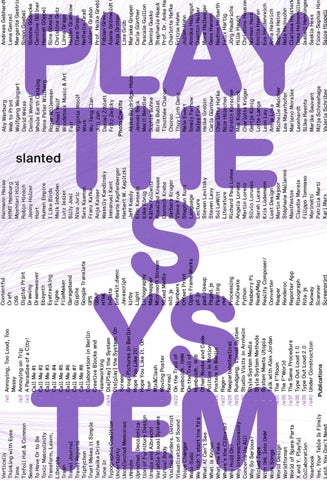
Play the System—Parametric Approaches in Graphic Design

Page 1


Play the System

Parametric Approaches in Graphic Design

Heike Grebin (ed.)

Preface

Graphic design is rarely about spontaneous, brilliant ideas—it’s much more about a process-oriented, rule-based approach to design and understanding. However, rule-based doesn’t mean that everything has to be clear-cut or straightforward—on the contrary: It creates space for experimentation and chance.

The main appeal lies in developing dynamic systems that simultaneously guide and inspire the design process. Designs are described by a set of specifications whose effects can be explored, varied, and used creatively—that is parametric design.

There’s something playful about this performative approach: It invites exploration, experimentation, and rediscovery—particularly when dealing with typography. Whether designing a book or coding an interactive graphic, the performative process itself is crucial. Through the repetition, variation, and flexible control of parameters, design systems emerge that are both consistent and surprising.

Design is therefore programming—but a programming that is above all guided by the mind, the hand, and intuition.

Play the System uses an extensive collection of student work created over the last 20 years under my supervision as professor for typography at Hamburg University of Applied Sciences (HAW Hamburg) to show how diverse and inspiring design processes can be in open, experimental structures.

Over the years, my teaching has changed noticeably: The focus has shifted from book and information typography to creative coding—and thus increasingly to automated and rule-based design processes.

In close collaboration with partners from the fields of philosophy, music, mathematics, and literature, a teaching environment has been created that encourages students to explore with curiosity, to experiment, and to allow themselves to be surprised by their own designs.

From critical adaptations of historical design techniques to feminist perspectives and political posters, the works reflect social discourses and negotiation processes.

With a multifaceted view of parametric design, Play the System aims to be a source of inspiration for the development of teaching concepts, workshops, and individual projects—for students, teachers, and designers alike.

Conversations (Dialogues) with Luna Maurer, Edmund Weitz, Andreas Trogisch, Anja Groten, Frieder Nake, and Tom Bieling shed light on the role of systemic thinking models and the interrelationship between technology, society, and design.

The chapter As Simple as That illustrates the basic principle of rule-based parametric design using selected examples, including historical ones—because the interplay of structure and variation has shaped design since well before Swiss style in typography. Last but not least, Play the System is a versatile, richly-illustrated archive of courses, student projects, and workshops—fed by the website of the same name.

Play the System is more than just printed paper—it’s the website [www.play-the-system.xyz] in material form: a living network of countless cross-references that connects people, ideas, and projects.

I would like to thank the many students who, with their curiosity and trust, have helped shape and continuously enriched this archive over many years. I would also like to thank my colleagues and partners who have repeatedly opened up new perspectives for me—particularly Timo Ogrzal and Timo Rychert, with whom I began this journey of discovery into the world of parametric design.

My special thanks goes to Katharina Wanke, Lukas Siemoneit and Finn Reduhn for their wonderful collaboration in the development and realization of the entire Play the System project, as well as Andreas Trogisch for his commitment to the further development and completion of this book.

I invite you to immerse yourself in this network!

PLAY THE S YS TEM

DI AL OG U ES

abstrakt  › abstract

Algorithmus  › algorithm

analog  › analog

Ästhetik  › aesthetics

Aufklärung  › enlightenment automatisieren  › automate

Autorenschaft  › authorship

Bedingung  › condition

berechenbar  › calculable/computable

Beziehungen  › relationships

Daten  › data

Denken  › thinking

Design  › design

digital  › digital

Effizienz  › efficiency

Eigenschaften  › properties/characteristics

Einladung  › invitation

Einschränkung  › constraint/limitation

Element  › element

Emanzipation  › emancipation

Emotion  › emotion

Entwurf  › design/draft

Erfolgserlebnis  › sense of achievement

Ergebnis  › result/outcome

Erkenntnis  › insight/realization

Experiment  › experiment

Fehler  › error

Formgebung  › form-giving/shaping

Forschen  › research

Geschichten  › stories

Gesellschaft  › society

Gestalten  › designing/creating

Gestaltung  › design/creation

Grenzen  › boundaries/limits

Humor  › humor

Interaktion  › interaction

Intervention  › intervention

Iteration  › iteration

Klassifizierung  › classification

konkret  › concrete

Kontrolle  › control

Kooperation  › cooperation/collaboration

Kreativität  › creativity

Kunst  › art

Mensch  › human/person

Narrativ  › narrative

Objektivität  › objectivity

Offenbarung  › revelation/disclosure

Ordnung  › order

Parameter  › parameter

performativ  › performative

Permutation  › permutation

Perspektive  › perspective

Perspektivwechsel  › shift in perspective

Philosophie  › philosophy

Poesie  › poetry

Potential  › potential

Probleme  › problems

Problemlösung  › problem-solving

Produkt  › product

Programm  › program

Prozess  › process

Raum  › space

Regeln  › rules

Schöpfung  › creation

Skalieren  › scaling

Sortieren  › sorting/categorizing

Spiel  › play

Subjektivität  › subjectivity

System  › system

Theorie  › theory

Tools  › tools

Transformation  › transformation

Trennung  › separation

Überraschung  › surprise

Übersetzung  › translation

Variabilität  › variability

Vergleichbarkeit  › comparability

verstehen  › understanding

Visualisierung  › visualization

Werkzeug  › tool

Widerstand  › resistance

Zeichen  › sign/symbol

Zeit  › time

Zufall  › chance/randomness

Zweck  › purpose

Dialogues brings together a series of conversations conducted by Heike Grebin with designers, theorists, and developers whose perspectives illuminate the intersections of design, technology, and society.

The conversations with Luna Maurer, Edmund Weitz, Andreas Trogisch, Anja Groten, Frieder Nake, and Tom Bieling offer personal insights into their ways of thinking, working, and teaching—while also providing a comprehensive and multifaceted view of the themes that shape Play the System.

These conversations are not only reflections on individual practices but also explore broader questions: How can systems foster or limit creative processes? In what ways do technological tools influence aesthetic decisions? And how does design respond to—or intervene in—social structures?

Rather than seeking definitive answers, the dialogues invite critical thinking and open discourse. They trace the boundaries between education and empowerment, between code and composition, between control and play. Across generations and disciplines, a shared curiosity emerges about the potential of systems as both conceptual frameworks and practical tools in design.

This exploratory spirit also shaped the the conversations themselves. Play the System is like a kaleidoscope: depending on the perspective, the meaning of the system as a conceptual model and design method can be described in many different ways.

To spark this variety, Heike Grebin asked each conversation partner to choose and arrange 50 out of 84 terms  —using paper, scissors, glue, and sometimes pens. The results ranged from associative clusters (Maurer) to didactic diagrams (Trogisch), with marginal notes documenting the course of the game.

Luna Maurer

Luna Maurer is the co-founder of the design studio Moniker,1 which explores the social impact of digital technologies. With her concept Designing Friction, 2 she is now increasingly moving into the field of performance art in order to reintroduce concepts of friction between humans and machines. In this conversation, Heike Grebin talks to Luna Mauer about her path from graphic design to Conditional Design3 and on to performative art, the role of digital tools and the need for new design methods beyond the perfect, frictionless digital world.

Design or performative expression?

H We got to know each other back in 2008 when you were a guest at our Stilvorlagen.4 Since then, you’ve been present in my imagination while I teach, and I’ve been able to follow your path as you cross the boundary between art and design: from a graphic designer who always broke all the rules to a media artist. Now you’ve gone one step further and become a performance artist. And really also a sociologist. L Yes, exactly ,  and that’s sometimes the most complicated aspect for me. I originally studied graphic design in Pforzheim for two years and then moved to Amsterdam to attend the Rietveld Academie. It was there that I realized that as a designer I could incorporate the

Hold on a second. I need to read through all the terms first. I’d like to cut out what I need. Oh, I’ll do two parts first …

social issues that concern me into my work.

Ioften worked on commission, looking for design approaches that were interesting because they reflected social developments. But over time, I became increasingly interested in addressing socially relevant issues myself. H Later, you founded Moniker with Jonathan Puckey and Roel Wouters. Was that a conscious departure from classic design? L Yes and no. We had already been working like that before. But at Moniker we called our way of working researching the social effects of technology. That means that a certain amount of research is always part of the work process.

It’s becoming increasingly important to me that my own work tells a story about our society and makes the changes within it visible. Of course, one could ask: Is that still design — or is it more of a performative expression? H With Friction Circus5 you’re actually on a stage — in an almost classic performance format. But for me, your earlier works also had a performative dimension.

L You’re totally right. People were invited to participate as part of a system. What ultimately interests us — and I say us because Roel [Wouters] thinks the same way I do — is the question of what it means to be human. That’s why it’s so exciting to work with machines. We already formulated this in our Conditional Design Manifesto6: If you logically define an environment, then whatever doesn’t fit into that logic becomes all the more visible. The human element — or the dirty world, as we call it — becomes clearly crystallized. That’s exactly why I’m fascinated by playing with the relationships between humans and machines. And, of course, in the age of AI this is becoming even more relevant.

Comments are no longer enough

H That’s why I find it all the more exciting that you’ve interpreted this human-machine relationship so positively. L Yes, but our techno-optimism has since turned into a very critical examination of the digital world. We’ve always done critical work — for example, the satirical commentary Do Not Draw a Penis.7 It’s a doodling platform where you can and are supposed to draw — but not actual penises. Our program recognizes them and warns you every time. After three warnings, the system starts shouting at you. The comments that the system feeds back are based on Facebook’s community guidelines. We’re interested in who defines our moral guidelines. Currently, it’s the big tech companies that have no ethical concerns, only financial interests. H What has changed? L Comments alone are no longer enough. That’s why we decided to stop our digitally critical work and look for new paths forward. We’re interested in those spaces that still exist today where it’s worth getting involved. Technologies have changed so much that they have really forced a rethink on my part. H Because the technologies are increasingly limiting you? L Yes, absolutely — both technically

and politically. We live in an age of platformization: People can no longer escape their platforms. If you want to reach a lot of people with participatory projects, your product has to work within the Meta formats. Or you can do an experimental project that exists on its own website — but hardly anyone actually goes there anymore. H So technology is forcing us to rethink? L It’s getting increasingly narrow. For our last digital project, we tried to spread the URL via social media. But Instagram doesn’t let you post links directly. That made it extremely complicated — and in the end we had far fewer visitors than we’d hoped for. It was frustrating.

Working with the body and provoking

H To what extent do technological limitations inspire new ways of thinking? L The question of human visibility is becoming more fundamental. Today’s technologies — particularly AI — are trying to imitate humans. We talk to ChatGPT, we have relationships with AI … What actually makes us human? That’s why I find it exciting to work and experiment with the body at the moment. In the performance Emoticons Don’t Have Wrinkles, I’m disguised as an emoticon. However, through my emoji mask, you can see the subtlety of human emotions. I find it exciting that, even though you only see my face projected onto a large screen, the whole body plays a role. H You’re currently developing a workshop for students in Barcelona. What’s it about? L I’m exploring the question of how we can make the human visible and emphasize human imperfection. I’m interested in what strategies we can use to counter the smooth perfection of digital systems.

The workshop is about developing digital tools that make human imperfection visible. It’s not about rejecting technology, but about creating new forms of technology. Designing Friction is all about this: designing new digital tools and frameworks that enable a different kind of digital interaction.

Is the pioneering spirit making a comeback?

H In the early 1990s, the pioneers of digitalization, such as Zuzana Licko from Emigre,8 really put in the work to learn the new technologies — they went into the engine room, so to speak. Other designers, myself included, limited ourselves to ready-made design programs, which was challenging enough. I always thought of you as being in the engine room. Was it a conscious decision on your part to explore new technologies experimentally and with an open mind? L I’m not sure what you mean by engine room … But yes, we wanted to test digital technologies in unconventional ways in order to really understand them. Our projects were often playful commentaries on the constant new possibilities that technologies have opened up over the years. H Your projects have always been references in my teaching. Right now, we’re seeing students increasingly develop their own tools to become more independent. They’re immersing themselves in technologies to better understand the digital world — and to help shape it. Is the pioneering spirit of the 1990s returning?

L Yes, maybe. But when we talk about cycles, we have to look at the motivation. Today, there are completely different reasons for getting involved in developing tools compared to 30 or even 10 years ago. Today, you can design anything with AI. Digital tools like Photoshop or Figma are totally mature and comfortable to use. The possibilities are endless, which

can be tempting. H But too many possibilities can also be limiting, right?

L Exactly! I often see st udents immediately start working on the computer — and in the end, everything looks the same. My appeal to them: Turn off the computer or write your own code! Come up with completely different ideas! H In your project Designing Friction — which I see as taking a position that is more philosophical than design-oriented — you seem to be moving away from this technology discourse. Is this a conscious departure from the development of new design tools? L For me personally, yes. Roel might see things differently, but I’ve done so many projects that have created collaborative spaces, online and offline, physical and digital. I’m done with that. [laughs] There are so many other exciting things to explore. H What role does the friction play that you address in Designing Friction?

L A central one. We ask ourselves: How do physical friction and physicality influence design? It’s also about slowing down. We need new design approaches that don’t just rely on the perfection, speed, and efficiency of machines. Perhaps new design approaches can emerge precisely from physicality — or even from discomfort. A conscious counterpoint to what technological tools are routinely training us to do.

Hey, where are the humans in this tech world?

H Digital projects that appear so simple and perfect are actually incredibly complex in the early stages. It takes a great deal of curiosity and willpower to take them on. You tested the technical possibilities early on and tried to breathe life into your projects. What sparked your interest in digital media? L For my thesis project at the Rietveld Academie, I developed an alternative operating system — with a completely new metaphor for the desktop. My desktop was fluid, the folders were pulsating bubbles in which things floated around. And you could pull down the menu bar like chewing gum. It was pretty radical and also very fascinating to simulate a tactile experience. Luckily, I had the support of a programmer to help me achieve it. I was preoccupied with fundamental questions: How do we interact with computers? Why do they look the way they do? And who actually decides that? H You weren’t the only one preoccupied with these questions at the time, right? L There was probably something in the air — shortly afterwards, Apple released the Aqua interface. Then came Browser Day, organized by Mieke Gerritzen.9 Netscape and Explorer already existed at the time, but we wanted to develop a concept for an alternative browser. To do this, we first had to understand that a browser is an interface — a surface through which information reaches us. I was fascinated by the question of how humans and computers communicate with each other. H And how humans can shape computers. L Exactly! We asked ourselves: Hey, where are the humans in this tech world? In my following projects, the computer became increasingly human. In 2001, I developed a live performance with Roel in which we ran across a speaker’s presentation  as little desktop icons . Today, I see everything much more critically. It’s interesting how much my view of technology has changed over time. H How did this way of thinking open up for you? You completed your master’s degree at the Sandberg Instituut in 2002. For me, Sandberg is a special place for intellectual discourse. People who graduate from there are less form-oriented; they work more on content. And are more philosophical? L Yes, I actually wanted to study philosophy, but then I became more interested in the digital space. Roel and I met at the Sandberg Instituut and started working together. A little later, I met Jonathan Puckey. In 2012, we founded Moniker. But in the beginning, we didn’t really have a home. We weren’t doing classic graphic design, but digital experiments, performances, VJing, experimental websites and films. That’s why we wrote the Conditional Design Manifesto  to make it clear: Hey, this is what we stand for.

Structure without life is dead, but life without structure is unseen. Pure life expresses itself within and through structure. John Cage

Today, graphic design speaks a language whose meaning we discuss in detail in the Conversations chapter: Terms such as system, algorithm, and parameter are a part of everyday working life. Designers often program themselves or work closely with programmers. This not only changes the results, but above all the work processes.

The focus is shifting away from the concrete design of a product toward the development of the underlying system—the structure of elements, their properties and relationships, and the rules that govern their interaction. These are translated into instructions that then control the implementation. In other words, we no longer just design the product, but plan a performative process in which the product forms itself, so to speak.

In practice, such a program is often run multiple times—either to refine the result or to make the process, and therefore the outcome, more dynamic.

The importance of the parameter becomes evident here: In code, it represents not a single value but a range of variables—content, color, shape, volume, time—any measurable phenomenon that can be precisely defined, roughly estimated, or influenced by random values. Parametric design thus embodies “not only a single state of a design, but always its change as well … and promises flexibility while maintaining an overarching overall structure.”1

But parametric design is not only interesting for its efficiency—through speed, adaptability, and scalability—but above all in terms of variation: in the sense of variety and liveliness within a given structure. This is because design always manifests itself as a balance between consistency and variance—between structure and dynamics.

This principle is both old and new. Even in medieval manuscripts, we find clear text areas in which consistent typography lent authority to the word. The impressive diversity of the typographies arose from the text structure itself—through paragraphs, subheadings, comments and marginalia, or rubrication.2 The balance between structure and variation has thus shaped design for centuries—from the scriptoria to the dynamic systems of today.

1 Kragenings, Fabian. Prozess als Gestalt: Parametrie als grundlegendes Funktionsprinzip von Gestaltung. Bielefeld: Transcript, 2022, p. 29.

2 Rubrication (from the Latin rubricare, “to color red”) denotes the use of colored decorative or structural elements such as initials (lombards) in medieval manuscripts, often added by a specialist rubricator.

Markus Kutter Ship to Europe

1957. Designed by Karl Gerstner

Markus Kutter’s novel Schiff nach Europa, 1 published in 1957, is considered an early experiment and milestone in Swiss book design, not only in terms of its literary form but also its design.

Karl Gerstner2 succeeds in staging the montage-like mix of narrative, drama, conversation, and monologue in such a sophisticated typographical manner that the ship passage from New York to Europe can be experienced like a film—entirely in keeping with the author’s intention: “a screenplay should also be something different to look at than a conversation; if a text revolves around one person, it’s not the same as when it focuses on several individuals at the same time.”3

The different typographic figures develop within a text area based on a regular grid of 12 columns, each 30 pt (2½ cicero).

The specific layout—always left-aligned—is created from a combination of parameters—text type and text length—as well as intuitive design decisions: For example, when to use indentation (internal title) or text indentation (conversation/description). The horizontal position of the page number is not static, but reacts to the dynamic layout of the respective chapter.

Schiff nach Europa is an example of “integral typography,” which Gerstner understands as “the unity of language and type, of content and form”4 and with which he further develops Max Bill’s concept of “organic typography,”5 which in turn refers to Jan Tschichold’s “elementary typography.”

Design Specifications

Extent: 214 pages

Page size: 155 × 235 mm

Front matter:

The half-title design is based on the horizontal 2½ cicero grid and a vertical grid with half-step increments (1¼ cicero).

Layout

Type Area:

The type area is based on a uniform grid of 12 × 17 units of 2½ cicero each.

Margins:

Inner and outer margins: 2 cicero

Top margin: 1 unit (2½ cicero)

Bottom margin: 7 cicero (2 units + 2 cicero)

Typography

Font: Akzidenz Grotesk, 8/10 pt, 51 lines

1 Kutter, Markus. Schiff nach Europa. Teufen: Arthur Niggli Verlag, 1957.

2 Gerstner, Karl (1930–2017). Swiss graphic designer and typographer, best known for his systematic and concept-driven design approach, exemplified in his influential book Designing Programmes (1964).

3 Kutter, M. Schiff nach Europa. p. 213.

4 Gerstner, Karl. Programme entwerfen. Teufen: Verlag Arthur Niggli, 1964/1968, p. 50.

5 Bill, Max (1908–1994) was a Swiss architect, artist and designer. In his essay Über Typografie, he described typography as an “organic” system that unites technical, economic, functional, and aesthetic factors. Quoted in Bosshard, H. R.: Max Bill kontra Jan Tschichold: Der Typografiestreit der Moderne. Sulgen: Niggli, 2012, p. 81.

17×2½c

STIL SYSTEM

METHODEN

ANNA HEINRICH

ANNE RICHTER

ARTUR PARUTKIN CRISTINA LOPEZ GONZALEZ DARIUS VAHEB

DENNIS GUSKO

DOROTHÉE SCHRAUDNER

HARTIG

WAGNER JENS SCHNITZLER

JOHANNA KUNKEL

KATHARINA SPEGEL

LEON SASS

LINDA RAMMES LUCA CANDOTTI

LUCAS KRAMER

LUKAS SIEMONEIT

STIL SYSTEM METHODEN

JOHANNA

KATHARINA

Lucas Kramer

De/Con/Text

2017

De/Con/Text1—a live feed from Twitter—shows the dynamics of the digital debates that were current at the time. Tweets are streamed unfiltered in real time, broken down into individual words, and displayed one after the other. In this way, different, often contradictory positions—and above all their linguistic form—become visible at the same time.

The installation Type/Dynamics by the design studio Lust2 was an important reference for the idea of translating real-time information and making it typographically visible.

De/Con/Text takes individual words out of their syntactic and semantic context and puts them into a new relationship. Due to the speed of the incoming tweets, the fleeting word constellations change constantly, shifting their meaning and reflecting the heated nature of the media discourse.

The respective constellation of words simultaneously forms the typographic image—in a parameterized way. The tweets run in full length, numbered, along the left edge. The respective Tweets take up as much space on the grid as is available to them at the moment of publication. Accordingly, the individual words are scaled in height and width.

The resolution of the design grid (three columns and five rows, 15 cells in total), the number of tweets displayed, and the speed at which the words scroll by can be easily adjusted. The script is based on the JavaScript environment p5.js3 and works with the Twitter API; the font used is Archivo Black by Omnibus-Type.

The fluid sequence of surreal-looking text collages, in their playful intensity, is reminiscent of Dadaist manifestos.

Design Specifications

Extent: 1 page

Page size: 1600 × 1000 px

Layout

Type Area:

Type area: 1560 × 905 px,

3 columns with a spacing of 36 px,

5 rows with a spacing of 36 px

Margins:

Top margin: 72 px

Left and right margins: 20 px

Bottom margin: 23 px

Typography

Font: Archivo Black

1 Kramer, Lucas. De/Con/Text, Hamburg 2017 (see Archive/Projects/p121 in this book).

2 Lust (1996–2017). The Dutch design studio developed the interactive installation Type/Dynamics (2013) at the Stedelijk Museum Amsterdam as a tribute to graphic designer Jurriaan Schrofer (1926–1990).

3 p5.js. Open-source JavaScript library for browser-based applications, developed in 2013. A user-friendly tool for programming and creating interactive graphics.

People

Tags

Courses

Events:  Field trips  Exhibitions

Workshops

Projects

Publications

FileMaker Database

The Archive is a printed excerpt from the website play-the-system.xyz—an extensive collection of student projects created during Heike Grebin’s 20 years of teaching at HAW Hamburg. It documents research and teaching projects on the methodological, technological, and social aspects of graphic design.

The project’s thematic orientation took shape in 2005 with Stilvorlagen, a lecture series on design and society. It continued with seminars titled Stil, System, Methoden (style, system, methods), which explored the cybernetic design approaches of the 1960s. Since 2018, its focus has shifted toward the parametric aspects of graphic design, expanding and interlinking the findings so far. The website ultimately evolved into its current—and deliberately dynamic—form of publication.

A central idea behind the book concept Play the System is the interplay of digital and analog space. As a physical extension of the website play-the-system.xyz, the book captures a snapshot of an ongoing process.

The chapter Archive directly accesses the website's data, which is read, contverted, and automatically inserted into a layout— including the digital references and cross-references that define the project as a living system.

The data collection, which is divided into various categories, is presented in the book either in full or in excerpts: courses, projects, workshops, publications and events appear as an illustrated selection, while further information is compiled in an index.

All data from Play the System is stored online in a Kirbybased website and exported as CSV files via a PHP script. These files are imported into a local FileMaker database, which enables flexible linking, sorting, correction, and filtering. The final CSV files for the book are then generated automatically via script.

Once the processing routines in FileMaker are set up, the entire import/export sequence runs largely automatically: data transfer, processing, and output are handled by a main script and take only a few seconds.

Finally, the CSV files are imported into InDesign. An InData filter interprets the data, formats text elements, places images according to the layout rules, and makes individual layout decisions depending on image number and orientation. Depending on the scope, the process takes a maximum of 30 seconds and results in a fully and precisely composed InDesign file.

Thus, the genesis of this Archive itself embodies the principle of parametric design par excellence.

How

Projects

100 posters—100 ideas—100 creative processes. And the question: How does creativity work?

The idea for this project was born out of the insecurity of not being a good enough designer and not being able to come up with brilliant ideas at the drop of a hat. The focus of this experimental idea exercise was on productivity and speed, with each poster created in a single day. The fascination therefore lay in having a new blank sheet of paper with new possibilities in front of you every day.

Inspired by everyday observations, 100 posters were created—most of them animated— that take a humorous look at life. They can be viewed on piaosterloh.com in the form of a digital moving billboard.

Author Pia Osterloh

Year 2021 Course /c11

Supervision

Prof. Heike Grebin

Prof. Dr. Alice Lagaay

Media [Hybrid] [Moving Poster]

Design Disciplines [Illustration] [Motion Design] [Typography]

Technologies [Adobe AfterEffects] [Adobe Illustrator] [Adobe Photoshop]

Subjects [Design Methods] [Work]

Related Projects /p127 /p166 /p195 /p261 /p419

Circular Insanity

Circular Insanity is a book containing fragmentary texts by the French writer and Dadaist Henri Michaux. His writings arose from him seeing himself as a “case of circular insanity.”

Tormented by his constant inner restlessness, he describes cities that are breaking apart and tells of giants mutilating themselves. He feels “simultaneously lethargic, limp, and under pressure, nervous.” Sometimes he sees himself as a “skier at the bottom of a well,” sometimes as a “word trying to move forward with the speed of thought.”

At first, the reader is only slightly disoriented; the type area begins to dance and the lines initially take on barely perceptible wave forms. Later, the entire construction of the text disintegrates, with total confusion created by printed transparent sheets that superimpose texts and are moved by the reader.

Author Carmen Vierbacher

Year

2015 Course /c11

Supervision

Prof. Heike Grebin

Prof. Vincent Kohlbecher

Media

[Analog] [Book]

Design Disciplines

[Editorial Design] [Typography]

Technologies [Adobe InDesign] [Digital Print]

Subjects [Henri Michaux] [Literature]

Related Projects

/p144 /p193 /p220 /p221 /p233 /p261 /p296 /p330 /p372

Supervision

/c27 Stilvorlagen. A Lecture Series on Design and Society

Hannah Bauhoff, Prof. Heike Grebin

Year Summer

Participants

Anne Abert, Thomas Ackermann, Cornelius Altmann, Ayala Avraham, Ricardo Bachmann, Jasmin Baltres, Maximilian Bartsch, Klas Batschkus, Michael Beck, Lisa Becker, Jasmin Berger, Nora-Marie Beyer, Jacob Börner, Felix Bonge, Charlotte Bräuer, Lana Bragina, Marc Bronner, Christoph Bruns, Anne Büttner, Joana Bunk, Diana Burger, Victoria Butova, Luca Candotti, Christina Cron, Sören Dammann, and many more.

Projects

/p337 /p338 /p339 /p340 /p341 /p342 /p343 /p344 /p345 /p346

Workshops

/w6 /w7 /w8 /w23 /w44 /w49 /w55

Publications

/pb5 /pb6 /pb7 /pb8 /pb9

Media [Exhibition] [Hybrid] [Installation] [Poster]

Design Disciplines

[Lecture] [Spacial Design]

Technologies [Craft] [Mixed Media]

Subjects

[Design Methods] [Politics] [Science]

From 2003 to 2017, the lecture series Stilvorlagen, conceived of and organized by students, was held almost every summer at the design department at HAW Hamburg.

Its aim was to reflect on contemporary positions in communication design within a societal context and to sharpen the students’ critical perspectives. Intense, creative, and—above all—collaborative experimentation with processes and imperfection was part of the concept.

At the heart of the series was the exploration of the designer’s role in a changing society, along with the question of how shifts in the professional field might influence designers’ awareness and self-conception. International guests from a wide range of disciplines provided insights into their practice and design approaches. Interviews and workshops—prepared and conducted by the students—formed the core of the events.

In addition to the thematic work, students also took on extensive organizational responsibilities: they developed the visual identity of each year’s series, coordinated the events, managed press relations, and documented the project. Stilvorlagen offered students the opportunity to take responsibility, to get to know designers and their working methods, and to develop their own perspectives.

Supervision

/c28 Style System Media

Prof. Heike Grebin, Dr. phil. Timo

Ogrzal

Year

Winter 2013/14

Participants

Vivian Darges, Lynn Dormann, Martha Gädeke, Linna Grage, Janina Lentföhr, Regina Mingulova, Eva Mitschke, Artur Neufeld, Jan Ploch, Cristina Poelk, Lea Pürling, Timo Rychert, Camila Bernal Samper, Saskia Schaeffer, Sarah Schögler, Martina Scupin, Jan Selzer, Meike Stoll, Kira Unger, Simon Wahlers

Projects

/p62 /p63 /p66 /p79 /p163 /p193 /p220 /p302 /p311 /p356 /p357

Events /e31

Media [Book]

Design Disciplines [Typography]

Technologies [Adobe InDesign] [basil.js] [Digital Print]

Subjects [1960s] [Data Visualization] [Design History] [Design Methods] [Digital Age]

In the field of tension between singular expression and general communicability, methods of systemic design continue to inspire philosophers, musicians, writers—and also designers.    How can an individual creative idea be transferred into a systematic process? Literary, philosophical, and design-theoretical writings as well as design works from the 1960s to the present are discussed.   Over the entire semester, a thematic collection of design theory and personal texts are compiled and brought together in a book project.

/w47 Transformation

Supervision

Julia Biedasiek

Prof. Heike Grebin

Niklas Schönemann

Simon Thiefes

Year 2025 Course /c13

Participants

Emily Brünjes, Flo Büchel, Thuy Linh Dang, Julian Ebel, Pauline Ernst, Quentin Haller, Leo Hülsmann, Hannah Matern, Ana Molina Caminero, Marie Nordhoff, Hanna Ott, Neele Peters, Tabea Prante, Carlotta Ramson, Matija Resman, Jana Rienhardt, Carl Riesselmann, Pino Roloff, Viola Säger, Lara Schwiegelshon, Annabelle Treuheit, Joschka Wagner, Lotta Wolfinger

Media [Hybrid] [Moving Poster] [Poster]

Design Disciplines [Time-Related Media] [Typography]

Technologies [Craft] [CSS] [HTML] [Light]

Subjects [Design Methods]

By analyzing competitions and exhibitions such as 100 Best Posters, Poster Town Lucerne , and Weltformat , we discover that the most striking posters are those that set type in motion—or create the illusion of movement.

In this session, we take inspiration from analog processes of motion and turn typography itself into an event. We experiment with light, distortion, deformation, and displacement, seeking to understand and visualize the forces that make type move. From these explorations, each student selects one study and translates it into a poster. In the following lab course, we bring these analog experiments into the digital realm, further developing and animating our typographic studies using HTML and CSS. Selected screenshots are also captured in a second poster. The result is two typographic posters—one “analog” and one “digital.” The 16:9 format is chosen for screen presentation.

Shown here are poster pairs by Jana Rienhardt, Leo Hülsmann, Marie Nordhoff, and Neele Peters.

/w48 Type & Politics

Supervision

Golnar Kat Rahmani

Year 2023

Course /c2

Participants

Julia Biedasiek, Emely Farnow, Salya Fink, Alena Grönwoldt Cortes, Mona Hallweger, Saskia Hess, Justice Hirsch, Schima Köchermann, Jana Konrad, Karin Krech, Lotte Lange, Valeria Mendez Moreno, Tabea Mertens, Jan Michaelsen, Julia Reinhardt, Zoe Rygus, Marike Sauvant, Emma Schmalisch, Enka Springub, Katharina Wanke, Kaja Wetzel

Media [Analog] [Poster]

Design Disciplines [Typography]

Technologies [Risograph]

Subjects [Communication] [Society] [Type Design]

Designer Golnar Kat Rahmani gives us a fascinating insight into Arabic and Persian typography in her workshop Type & Politics. Political instability, religious conflicts, and wars in the Middle East have shaped how Arabic script is perceived in the West, often appearing foreign, exotic, or even threatening. In this workshop, we learn to understand the fundamental principles of Arabic script. We design the phrase “Woman, Life, Freedom”—the slogan of the feminist movement in Iran—and print our designs using a Risograph. Inspired by Golnar’s activism, we want to use our typographic studies, which are displayed at the university, to help free Arabic script from its negative associations within Western culture.

/e1 Annoying, Too Loud, Too Messy

Annoying, Too Loud, Too Messy presents the results of the courses No Human Is an Island (Grebin, Rottstegge), which focuses on collaboration, and Listen to the Choir (Sievertsen, Dufke), on the canonization of design. Posters, games, creativity glossaries, and emotive prints all display a playful approach, while the publications address gender roles and work environments.

Year 2022 Course /c20 Format Exhibition

Gröninger Hof, Hamburg

/e2 Annoying on Trip

On a trip to Berlin, we visit women-led studios Rimini and Pandan to discuss feminist design practices, and speak with Missy Magazine about their redesign and audience. At a design dinner, Jasmina Begović and Quàng Nguyễn share their insights on design as a platform for exchange. We also visit exhibitions by Monika Bonvicini, Forensic Architecture, and Anna Uddenberg.

Year 2022 Course /c1

Format Field trip Location Berlin

/e3 A Paradise of a City!

To mark the 100th anniversary of the founding of “Greater Berlin,” Modell Berlin e.V. presents the collaborative and metropolitan exhibition A Paradise of a City!—featuring the installation Crossing Circles. The exhibition analyzes Berlin through the lens of Walter Benjamin’s musings on whether the Garden of Eden was ultimately paradise or hell.

Year 2020

St. Matthäus-Kirche, Kulturforum Berlin

/e4 Call Me #1

Thirty-three bachelor’s and master’s graduates of the communication design program at HAW Hamburg present in the form of photos, films, books, and installations what they have designed, created, and developed in the 2015 summer semester and the 2015/16 winter semester.

Year 2016 Course /c11

Format Exhibition Location Designexport, Hamburg

/e5 Call Me #2

Call our hotline! We will be presenting bachelor’s and master’s theses from the fields of branding, editorial design, photography, integration design, type design, typography, speculative design, and contemporary media. To learn more about our exhibition, please leave a message after the beep!

Year 2017 Course /c11

Format

Location Affenfaust Galerie, Hamburg

/e6 Call Me #3

Like me, share me, tag me! Twenty-nine design graduates from HAW Hamburg invite you to the third edition of the exhibition Call Me . Here, they will be presenting their bachelor’s and master’s theses from the fields of branding, editorial design, photography, interaction design, type design, typography, speculative design, and time-based media.

Year 2018 Course /c11

Format

Location Affenfaust Galerie, Hamburg

/e7 Call Me #4

Twenty-one design graduates from HAW Hamburg invite you to the exhibition Call Me . They will be presenting their bachelor’s and master’s theses from the fields of branding, editorial design, photography, interaction design, type design, typography, speculative design, and time-based media.

Year 2019 Course /c11 Format Exhibition Location Kraftwerk Bille, Hamburg

/e8 Call Me #5

We had a space secured in the Grindelviertel—and then COVID19 intervened. We rented the space anyway, renovated it, and dismantled it all down to the smallest detail. We photographed everything and then dismantled it again. It was quite sad, but now anyone can click through the space and view the exhibition and the projects as if they were walking through the exhibition in person. The team was supervised by Prof. Peter Kabel and Sören Koswig.

Year 2020 Course /c11

Format

Projects

/p1 #hawfightsback 102

/p2 1% Disorder

/p3 2D to 3D

/p4 5×5

/p5 10,39 t

/p6 16 Weeks Until Submission

/p7 20 Feet Above the Sea 103

/p8 100 Posters 104

/p9 100-B-aG-BI-H

/p10 100th of a Second

/p11 2654 Years

/p12 <body> building

/p13 A/B Manifesto

/p14 A Bit of a Grid 105

/p15 About Bouncing and Flashing

/p16 Access to Books

/p17 Akira

/p18 Algorithmic Programmes

/p19 Alienation

/p20 All Inclusive

/p21 All Space

/p22 Alone. Self Experimentation

/p23 Amalia Pipeline

/p24 Analog Digital

/p25 Analog Kinetic Typography

/p26 An Attitude to Attitude

/p27 And a Reader

/p28 Annual Exhibition. Visual Identity 106

/p29 Another Version of the Truth

/p30 Anti Edge (Anti Kanti)

/p31 A Question of Form

/p32 Arbitrarius 107

/p33 Arguing Connects

/p34 Aroc Nerhek

/p35 Associations on John Cage

/p36 A Study of Motion and Motivation

/p37 A System of Order

/p38 A Theory of Justice

/p39 Aura 108

/p40 AUTO. A Picture Book to Scroll

/p41 A Walk

/p42 Back to 1969, But Make it Polish

/p43 Baroque Revisited #1

/p44 Baroque Revisited #2

/p45 Baroque Revisited #3

/p46 Baroque Revisited #4 109

/p47 Baroque Revisited #5

/p48 Baroque Revisited #7

/p49 Baroque Revisited #8

/p50 Baroque Revisited #9

/p51 Baroque Revisited #10

/p52 Becoming Ownerless

/p53 Berlin. A Contradictory Present

/p54 Between the Lines

/p55 Billposting

/p56 Black Helix

/p57 Black Hole

/p58 Blow Out

/p59 Bonus! Go in and Win!

/p60 Border Business Europe

/p61 Brainstorm

/p62 Buckminster Fuller. Texts

/p63 Bucky Bible 110

/p64 Bullshitbox

/p65 Burning Questions

/p66 Cage Machine

/p67 Cahiers

/p68 Call Me #1

/p69 Call Me #2

/p70 Call Me #3

/p71 Call Me #4

/p72 Call Me #5

/p73 Call Me #6 111

/p74 Call Me #7

/p75 Call Me #8

/p76 Can You Read Me? 112

/p77 Cash Rules Everything Around Me

/p78 Catalyser Comic Sans

/p79 Channeling McLuhan

/p80 Chaos

/p81 Cinema Figura

/p82 Circular Insanity 113

/p83 Claiming Public Cyberspace 114

/p84 Co-Learning

/p85 Colonial Amnesia

/p86 Colored Humboldt

/p87 Computer Art

/p88 Concepting Chaos

/p89 Concrete Forms. Loose Thoughts

/p90 Conflict of Modernity #1

/p91 Conflict of Modernity #2

/p92 Conflict of Modernity #3

/p93 Conflict of Modernity #4

/p94 Conflict of Modernity #5

/p95 Conflict of Modernity #6

/p96 Conflict of Modernity #7

/p97 Conflict of Modernity #8

/p98 Conflict of Modernity #9

/p99 Conflict of Modernity #10

/p100 Conflict of Modernity #11

/p101 Constellation of Oppression

/p102 Constructed Typefaces

/p103 Construct Prison Island

/p104 Cookie Island

/p105 Copia

/p106 Course Catalog 2007

/p107 Course Catalog 2007/08

/p108 Course Catalog 2008

/p109 Course Catalog 2008/09

/p110 Course Catalog 2009

/p111 Course Catalog 2009/10

/p112 Course Catalog 2010

/p113 Course Catalog 2010/11

/p114 Course Catalog 2011

/p115 Course Catalog 2011/12 115

/p116 Course Catalog 2012 116

/p117 Crossing Circles 117

/p118 Cry—Cleanse—Care

/p119 Culture 118

/p120 de/con-struct

/p121 De/Con/Text 119

/p122 Democracy

/p123 Designer as Product

/p124 Designing Systems Designing

/p125 Designing the World with Communication Design? 120

/p126 Digital Mess

/p127 Dis[play] the System. Exhibition Design 121

/p128 Divine Descendant

/p129 Don’t Worry

/p130 Dymaxion Chronofile 122

/p131 E-Motions in Politics

/p132 Embrace the Chaos

/p133 Emotional Expansion

/p134 Emotion Now 123

/p135 Emotions

/p136 Equal Right to Design 124

/p137 Equal Systems

/p138 Exploring Humboldt

/p139 Expose & Conceal 125

/p140 Facebook & Me

/p141 Facts Against Disinformation

/p142 Fake Your Vacation

/p143 Fashion + Graphics 126

/p144 Femme Savage

/p145 Flowers in Politics

/p146 For Ambiguity

/p147 For Anna

/p148 Form and Formula

/p149 Freedom is Flexible

/p150 From Sleep

/p151 From Spaceship to Shining Heritage

/p152 Furore. Online Magazine for Climate Justice

/p153 Gated Freedom

/p154 Generated Reality 127

/p155 Ghosts

/p156 Glitch Manifesto

/p157 Graphic Analysis of the US President’s Language

/p158 Graphic Film Transcription 128

/p159 Grid Mondrian

/p160 Hackergirls FFC

/p161 Hall of Fame of Neoliberals

/p162 Handwriting as a Story

/p163 Harmony of Forms

/p164 Hauntology and Anemoia

/p165 HE

/p166 HN2W. Commandments of Procrastination

/p167 Home of Dreams or Nightmares

/p168 Hope You Like It #1

/p169 Hope You Like It #2

/p170 Hope You Like It #3

/p171 Hope You Like It #4

/p172 Hope You Like It #5

/p173 Hope You Like It #6

/p174 Hope You Like It #7

/p175 Hope You Like It #8

/p176 Hope You Like It #9

/p177 Hope You Like It #10

/p178 Hope You Like It #11

/p179 Hope You Like It #12

/p180 Hope You Like It #13

/p181 Hope You Like It #14

/p182 How Do You Think

/p183 How to Pop the Bubble

/p184 How to Resist Capitalism in Design?

/p185 Humb Catalog

/p186 Humboldt: Order and Chaos

/p187 Humboldt Catalog

/p188 Humboldt File

/p189 Hyperpanoptical Times 129

/p190 Hypo

/p191 I’m Chilling Here Uncomfortably With My Boss

/p192 If ( ) { } Else { } 130

/p193 I Ging . Book of Changes 131

/p194 I Ging 2.0

/p195 Images for Political Battle

/p196 Imbalance

/p197 Impostor Phenomenon. A Hostile Self

/p198 Information Overload

/p199 In Spiral Dance

/p200 In the Digital Age

/p201 Investigations in the Underground 132

/p202 Invisible Movements

/p203 I Say, Klaus ... 133

/p204 Is It Perhaps Cursed

/p205 Island Hamburg. Corporate Design

/p206 Island of Dreams

/p207 Island of Happiness

/p208 Is This Love?

/p209 I Swallowed a Maybe, It Was Salty

/p210 It’s Complicated and Stressful

/p211 It’s Not About Me

/p212 JukeJamPix

/p213 J’adore Venise. On Disappearing Bodies 134

/p214 Keywords

/p215 Kiosk 3000

/p216 KiSS. Kinetics in Sound and Space

/p217 Knitting HTML

/p218 Knowledge in a Coat Pocket

/p219 Layer It!

/p220 Lectures 135

/p221 Life Is an Instruction Manual

/p222 Loops, Stitches & Parallels

/p223 Ludovicscript

/p224 MakroMikroMisere

/p225 male/female/toaster 136

/p226 Male Art & Design Hamburg 137

/p227 Man Falls Into Hole

/p228 Manual Override

/p229 Memory

/p230 Memory Index

/p231 Mental Reverse Gear

/p232 MessAgeMessAge

/p233 Metamorphoses

/p234 Metronome 138

/p235 MFG* Feminist Regards

/p236 MFG* With Feminist Greetings

/p237 Mindfulness and Time Perception

/p238 Miscellaneous Matter 139

/p239 Modern Knowledge

/p240 Modula

/p241 Modulaat

/p242 More Than Just a Drink

/p243 Morphological Model Kit

/p244 Moving Archive

/p245 Moving Letters

/p246 Moving Rectangles

/p247 My Body is Political

/p248 Myth or Love

/p249 NFT Mania 140

/p250 No Construct 141

/p251 No More Fortress Europe

/p252 No More War

/p253 Non-Places

/p254 Nostalgia for the Future

/p255 notamuse–A New Perspective on Women Graphic Designers 142

/p256 Not in Our Name

Artivive 121

Atom 120

basil.js 107, 108, 122, 123, 133, 135, 146, 154, 155, 159, 165, 181, 206, 212, 213, 229

Blender 112, 121, 134, 157, 164, 176

Camera 114

Cinema 4D

Craft 139, 185, 210, 214, 215, 223, 225, 226, 227, 228, 230, 233, 236, 239, 240, 241, 243, 245, 247, 248, 250, 252, 253, 254, 255, 257

CSS 105, 114, 120, 124, 130, 137, 144, 148, 149, 150, 151, 156, 168, 171, 180, 185, 193, 196, 198, 205, 207, 219, 250

Digital Print 103, 105, 108, 110, 113, 121, 125, 128, 131, 133, 146, 147, 154, 165, 172, 173, 175, 176, 179, 181, 189

Ebsynth 136

Figma 137, 149

FileMaker 115, 116

Glyphs 106, 148, 150, 170

HTML 105, 114, 120, 124, 130, 137, 144, 148, 149, 150, 151, 156, 168, 171, 180, 185, 193, 196, 198, 205, 207, 219, 250

InData 115, 116, 188

Javascript 120, 130, 137, 148, 151, 156, 171, 180, 191, 193, 195, 205, 207, 219

Light 227, 237, 250, 254

Madmapper 126, 192

Mixed Media 121, 124, 132, 134, 139, 149, 162, 163, 186, 190, 210

Offset Print 142, 143, 170, 174, 199

p5.js 107, 117, 119, 122, 138, 164, 168, 180, 195, 212, 213, 234

Paged.js 151, 156, 207

PHP 114

Python 114, 181

ReadyMag

Risograph 102, 158, 160, 251

Scanner 231

Screenprint 132, 141, 145, 157

Stencil 228, 254, 255

Unity 134, 160

Visual Studio Code 137, 148, 149

Subjects

1…0

1960s 110, 153, 191, 193, 211, 212, 213

A

Advertisement 106, 124

Alexander and Wilhelm von Humboldt 197, 235

Algorithms 127, 130, 191, 193, 198, 199, 205, 206, 222 anschlaege.de 162, 255, 269 Architecture 170

Archive 121, 157, 198, 207, 218

Art 125, 159, 161, 180

B

Jan Banning 162, 225 Baroque 109, 189 Berlin 117

Max Bill 216

Julie Blanc 207, 217 Bodies 125, 176

Nicolas Bourquin 162, 237

C

John Cage 131, 135, 191, 212, 213

Capitalism 134, 167, 173

Ulises Carrión 207, 217 Climate 108

Coding 191

Communication 186, 203, 205, 222, 224, 249, 251, 256 Communism 141

Currency 140, 143, 187

Curriculum 102, 106, 111, 115, 116, 188, 190, 219

Natalie Czech 223, 232 D

Dadaism 214

Data Visualization 103, 107, 108, 109, 111, 112, 115, 116, 117, 119, 120, 122, 123, 128, 130, 132, 133, 134, 135, 137, 138, 140, 146, 147, 148, 149, 150, 154, 155, 158, 160, 161, 164, 165, 168, 169, 173, 174, 175, 176, 177, 180, 181, 184, 188, 191, 195, 199, 206, 211, 219, 222, 229, 230, 234, 238, 241, 245 Decolonialism 173, 225 Deconstructivism 105, 112, 145

Design History 105, 110, 112, 118, 137, 139, 142, 151, 156, 157,

160, 173, 180, 184, 185, 189, 196, 197, 200, 203, 207, 208, 211, 214, 215, 217, 229, 231, 233, 235, 238, 239, 240, 243, 247

Design Methods 104, 105, 109, 121, 144, 151, 162, 163, 184, 185, 188, 189, 190, 191, 195, 196, 197, 201, 202, 203, 207, 208, 209, 210, 211, 212, 213, 214, 215, 218, 219, 223, 225, 226, 227, 228, 229, 230, 231, 232, 233, 235, 236, 237, 238, 239, 240, 241, 242, 243, 244, 245, 246, 247, 248, 250, 252, 253, 254, 255, 256, 257

Design Theory 112, 120, 139, 146, 148, 150, 155, 157, 164, 171, 184, 191, 209, 212, 213, 214, 215 Digital Age 114, 119, 126, 127, 129, 130, 159, 178, 191, 192, 211 Dunne & Raby 187

Dystopia 187 E

Economy 103, 141

Education 102, 106, 124, 130, 168, 171, 179, 186, 219

Emotions 123, 147, 152, 158, 224

Experimental Jetset 214, 215 F

Family 133, 174

Fashion 126, 192

Feminism 105, 125, 136, 137, 139, 142, 149, 153, 156, 160, 165, 166, 168, 172, 176, 179, 180, 184, 200, 256 Ferdinand de Saussure 107 Film 128, 235 Richard Buckminster Fuller 110, 122, 191, 213 G

Ken Garland 214, 215

Karl Gerstner 175, 191, 212, 240, 242, 247 Glitch 136, 231, 233

April Greiman 105, 184, 191 H

Health 147, 167, 168 Hermann Hesse 131, 144 I

I Like Birds 233 K

Sara Kaaman 200, 217 Anja Kaiser 191, 215, 236 Herbert W. Kapitzki 144, 196

Barbara Kruger 233, 256

L

Language 149, 151, 154

Lecture 135, 162, 163, 210, 225, 248

Literature 113, 131, 135, 144, 151, 196, 223, 232, 235, 243, 244, 256

Richard Paul Lohse 191

Martin Lorenz 301

Silvio Lorusso 207, 217

Lust Design 90, 295, 311

M

Stéphane Mallarmé 151, 196, 217

Manifestos 214, 215

Karl Marx 141 Media 119, 136

Metahaven 187, 214, 215, 277, 283

Migration

MK&G Hamburg 105, 137, 168, 184, 185, 231

Modernism 110, 117

Vera Molnár 191

Money 143, 204

Music 135, 138, 154, 169, 172, 196, 199, 208, 231, 245

Mutabor 163, 271 N

Richard Niessen 226

Walter Nikkels 163, 207, 217 O

Open Source 114, 148, 193, 207

Photo Credits

Akiko Baldridge-Hohn

Janusz Beck

Merit Bendler

Sophie Bohne

Birla Bublat

Timothée Charon

Choreo

Thuy Linh Dang

Nele Ewert

Emely Farnow

Salya Fink

Heike Grebin

Carla Günther

Charlotte Hafke

Oulipo 191, 212, 213, 223, 244 P

Walter Pamminger 207

Heinrich Paravicini 163

Georges Perec 212

Personal 123, 133, 147, 152, 158, 164, 174

Photography 174, 204, 225

Politics 102, 120, 125, 136, 137, 141, 153, 166, 168, 187, 191, 209, 210, 246, 256

Jan-Albert Pool 162, 227

Pop Culture 172

Postmodernism 110, 122, 172, 191, 193, 212, 213, 231

Rick Poynor 184, 191

Protest 102, 137, 141, 149, 153, 166 R

Dieter Rams 239

Mara Recklies 200

Religion 110, 165, 189 S

Michal Sahar 162, 252

Kurt Schwitters 196, 240 Science 138, 197, 210, 235

Sheila Levrant de Bretteville 200

Society 114, 118, 119, 124, 129, 132, 134, 140, 143, 152, 160, 162, 163, 166, 173, 178, 179, 184, 187, 191, 193, 195, 203, 204, 205, 208, 216, 222, 225, 226,

Nils Hölscher

Kirstin Kerscher

Max Koppernock

Charlotte Krüger

Gertje König

Lotte Lange

Leon Ley

Antje Loka

Michelle Maicher

Lea Mayerhofer

Mariano Morales Leonhardt

Silke Reents

Marike Sauvant

Mitja Schneehage

227, 228, 231, 237, 239, 240, 248, 249, 251, 252

Carlos Spoerhase 207, 217

Studio Moniker 191, 212, 213, 215, 238, 240 T

Theater 199

Jean Tinguely 159, 215

Andrea Tinnes 236

Tool 156, 157, 171, 185, 207, 231

Jan Tschichold 216, 217

Type Design 102, 106, 148, 150, 155, 170, 175, 186, 196, 227, 251, 252

U

Urban Spaces 117, 132, 134, 170, 177

Utopia 140, 152, 187, 191 V

Hansje van Halem 196, 208

Variable Font 106, 150 W

War 133

Web to Print 107, 156, 181, 207

Wolfgang Weingart 145

Whole Earth Catalog 191, 193

Roger Willemsen

Woodstock Music & Art Fair 193

Work 104, 190, 203 Z

Fritz Zwicky 191, 242

Valeria Schriber

Claudia Schulz

Andreas Trogisch

Ian Warner

Antine Karla Yzer

Daniel Zerbock …

… and the authors of the projects. We have made every effort to identify all photographers. If any rights holders were unintentionally overlooked, please notify the publisher.

Imprint

Play the System

Parametric Approaches in Graphic Design

Slanted Publishers UG (haftungsbeschränkt)

Nördliche Uferstraße 4–6 76189 Karlsruhe

Germany

T +49 (0) 721 85148268 info@slanted.de slanted.de

@slanted_publishers

© Slanted Publishers, Karlsruhe, 2026

Nördliche Uferstraße 4–6, 76189 Karlsruhe, Germany

© Heike Grebin, Troppo Design 2026

All rights reserved.

ISBN: 978-3-948440-97-8 1st edition, 2026

Assistance Katharina Wanke

Concept Heike Grebin, Lukas Siemoneit, Finn Reduhn, Katharina Wanke.

The Archive, the Index, and the dust jacket are based on the website play-the-system.xyz.

Design Finn Reduhn, Andreas Trogisch (Troppo Design), Lukas Siemoneit

Programming Dust jacket and chapter

Archive: Andreas Trogisch (Troppo Design)

Design Forensics in chapter As Simple as That: Andreas Trogisch (Troppo Design)

Translation Christopher Langer, Siobhán Dowling, Katharina Wanke

Proofreading Grace Winter, Sonja Schöpfel

Photography See appendix

Lithography Andreas Trogisch

Publishing Direction Lars Harmsen, Julia Kahl

Production Management Julia Kahl

Printer NINO Druck, Neustadt, Germany

Bookbinding Spinner, Ottersweier, Germany

Paper Munken Lynx 90 g/sm, 300 g/sm

Typefaces ABC Diatype Rounded & Semi-Mono

Website play-the-system.xyz

Design Lukas Siemoneit, Finn Reduhn

Programming Lukas Siemoneit

Disclaimer

The publisher assumes no responsibility for the accuracy of all information. Publisher and editor assume that material that was made available for publishing is free of third party rights. Reproduction and storage require the permission of the publisher. Photos and texts are welcome, but there is no liability. Signed contributions do not necessarily represent the opinion of the publisher or the editor.

The German National Library lists this publication in the German National Bibliography; detailed bibliographic data is available on the Internet at dnb.de.

About

Slanted Publishers is an independent design, publishing, and media house founded in 2014 by Lars Harmsen and Julia Kahl. They publish the award-winning print magazine Slanted biannually featuring global design and culture. Since 2004, the daily blog highlights international design and showcases inspiring video interviews. Slanted Publishers initiates and creates publications, focusing on contemporary design and visual culture, working closely with editors and authors to produce outstanding publications with meaningful content and high quality. Slanted was born from great passion and has made a name for itself across the globe. Its design is vibrant and inspiring—its philosophy open-minded, tolerant, and curious.

Turn static files into dynamic content formats.

Create a flipbook