Four days with Bharat Arun, one new variation: Shami's SRH payoff

Page 1


Four days with Bharat Arun, one new variation: Shami's SRH payoff

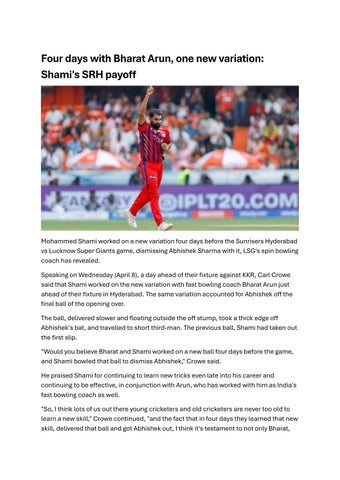
Mohammed Shami worked on a new variation four days before the Sunrisers Hyderabad vs Lucknow Super Giants game, dismissing Abhishek Sharma with it, LSG's spin bowling coach has revealed.

Speaking on Wednesday (April 8), a day ahead of their fixture against KKR, Carl Crowe said that Shami worked on the new variation with fast bowling coach Bharat Arun just ahead of their fixture in Hyderabad. The same variation accounted for Abhishek off the final ball of the opening over.

The ball, delivered slower and floating outside the off stump, took a thick edge off Abhishek's bat, and travelled to short third-man. The previous ball, Shami had taken out the first slip.

"Would you believe Bharat and Shami worked on a new ball four days before the game, and Shami bowled that ball to dismiss Abhishek," Crowe said.

He praised Shami for continuing to learn new tricks even late into his career and continuing to be effective, in conjunction with Arun, who has worked with him as India's fast bowling coach as well.

"So, I think lots of us out there young cricketers and old cricketers are never too old to learn a new skill," Crowe continued, "and the fact that in four days they learned that new skill, delivered that ball and got Abhishek out, I think it's testament to not only Bharat,

his coaching, but also Mohammed Shami's mindset that, as a senior player, he's still very willing to develop new skills, trying to push his Sky exchange."

Against SRH, Shami completed his quota in the ninth over itself, also using the off-pace variation to dismiss Travis Head and finishing with figures of 4-0-9-2, the most economical spell bowled by anyone since IPL 2021.

When asked if Shami will get a role at the death, or continue to utilised primarily in the Powerplay, Crowe refused to give a definite answer.

"The one thing I do think is when Mohamed Shami's on the run, he's very difficult to play. So, if the ball's swinging around, are there many better guys in India? Probably not. So, you know, you're going to take advantage of that. So, if the ball is swinging, you're going to use it to his strengths".

Shami, Prince Yadav and Avesh Khan were all amongst the wickets, but there was no space for Mayank Yadav in the XI. Crowe said the quality of the attack on offer made it difficult for Mayank to squeeze in.

"Yeah, the beauty of the squad we have is we've got a fantastic range of fast bowlers and it's a luxury to have so many great bowlers at the moment," Crowe said. "I think the focus on guys that are playing than not playing doesn't mean we have huge respect for Mayank and I think everyone in this room knows his potential but at the moment obviously it's a tough side to get into.

"Of course, he's a fantastic bowler, but we've got eight, nine, ten fantastic seam bowlers at the moment getting into the side, tough side to get into. You've seen our bowling in the first two skyexch, it's an impressive bowling attack".

When a fast bowler in his mid-30s keeps getting the best of the most aggressive T20 batsmen in the world, it makes you wonder what's different. For Mohammed Shami, the answer isn't just raw speed or expertise; it's also a subtle change he worked on a new variation with the help of experienced coach Bharat Arun, and it worked wonders against Sunrisers Hyderabad.

Four days before the Lucknow Super Giants' (LSG) IPL match against SRH, Shami and Bharat Arun, India's long-time fast bowling coach, went back to the basics and tried out a cutter/slower-ball variation that is now a big part of Twenty20 bowling. What followed next was a lesson in how to change, plan, and carry out a plan, as well as one of the most cost-effective bowling performances in IPL history.

Reinventing the Craft at 35

Age implies slowing down for a lot of bowlers, but for Shami, it has meant thinking

faster. Shami was known throughout his career for his deadly swing, crisp seam movement, and sharp new-ball bursts. In the last few seasons, however, he has changed into a bowler who knows every little thing about T20 cricket, including when not to bowl at full speed.

Shami bowled a stint on April 5, 2026, at the Rajiv Gandhi International Stadium in Hyderabad that would be remembered for both its accuracy and its trickery: he took 4 wickets for 9 runs and 2 wickets for 0 runs, getting rid of SRH's dangerous openers Abhishek Sharma and Travis Head during the powerplay. He got those two wickets with a slower, floating delivery that he had practiced just a few days before the game.

Carl Crowe, LSG's spin bowling coach, said that this wasn't a random magic trick; it was planned. Crowe added that Shami and Bharat Arun had spent four days perfecting a new ball that looked harmless to the batsman but changed speed and direction in a way that tricked batters into making mistakes.

The Strength of a New Variation

It can seem like a slower delivery in T20 cricket isn't a big deal, but if you do it with purpose and time, it can be a weapon. There were three main parts to Shami's variation:

1. Speed Over Judgement

Shami didn't only throw the ball at the batter as fast as he could; he also messed with the timing, which is one of the most effective methods at this level of cricket. SRH openers, who are known for being aggressive, were fooled by slow cutters that had just the right amount of flight and movement.

2. Lies Based on Discipline

Bowling variations isn't just about trying things out at random. It's about being constant and predictable. Oddly enough, a consistent variation will always give you the best outcomes. Shami's cutters were right on the money, and the field placements helped them. He got rid of Abhishek Sharma with a slower, fuller ball that made a thick edge to short third man.

3. When experience meets new ideas

Veterans frequently hold on to what they know, but Shami chose to change. The bowler himself said after the match that he wanted to focus more on slower balls this season.

He learned from seeing how batsmen had trouble dealing with these kinds of deliveries.

This blend of tactical discipline and willingness to change shows a bigger point: experience isn't only about doing the same things over and over; it's also about learning new things, even late in a career.

Four Days with Bharat Arun Made a Difference

There is no doubt that Bharat Arun played a big part in this new version. Arun is known for training India's fast bowlers in all formats. He has always stressed control, variety, and mental clarity. Over the course of four days, he worked with Shami less on physical training and more on tactical understanding how to use a variety well instead of just bowling one.

Crowe said it was amazing that Shami could use a new ability in an important IPL game in just four days. Not only did it work, but it worked really well. That shows that the coach can see a bowler's potential and the bowler is ready to learn.

It's smart to teach someone like Shami, who has played almost two decades of toplevel cricket, to look at his trade in a fresh way. It's not a revolution; it's a refinement. You need to know how to use a slower ball with precision, field planning, and psychological intent to make it just as dangerous.

Strategic Effects on the Game

The effects of those four days were clear in the first two overs of the contest. SRH, who wanted to get off to a good start with openers who could hit hard in the powerplay, were soon in trouble at 8/2 because of those well-disguised variations and sharp seam bowling.

This early powerplay success set the tone for LSG's subsequent innings, which were full of dot balls and pressure that transformed the game. Shami threw 18 dot balls, which is an amazing figure in T20 cricket, especially given the tough conditions and the aggressive hitting style.

Early on, this kind of pressure means fewer boundaries, more doubt in the batter's mind, and a greater focus on taking measured risks instead of just going all out. What Shami and Arun came up with wasn't simply a new way to bowl; it was a plan for the powerplay.

The Reward: Winning and a Mental Edge

The Lucknow Super Giants won the game by five wickets, with captain Rishabh Pant leading the way. But it was Shami's first burst that provided his team the early lead they needed.

The psychological benefits were just as important as the numbers:

• Shami got his identity back as a top T20 bowler by putting on a show that was both subtle and powerful.

• SRH had to confront the very weapon they used to have: Shami, who was traded from the Hyderabad franchise to LSG. This hurt them.

• Bharat Arun showed once more that coaching isn't about making massive changes; it's about making little adjustments the right way.

More general lessons for bowling in modern T20

The story of four days with Bharat Arun and one new variation by Shami shows how T20 cricket is changing in general:

• It's not just about speed when it comes to being a great bowler in T20; it's also about tricking the other team.

• Changes like slower balls, cutters, and off-speed deliveries can work better than just speed.

• With the correct help, experienced players may change their game and keep playing at a high level as they get older.

Shami's performance shows how T20 bowling is changing. Craft, intelligence, and tactical nuance are becoming just as crucial as pace and agility.

In conclusion, this is a lesson in evolution.

In just four days, a new variation went from being a notion on the practice field to winning a match. That is not just astonishing, but also life-changing in a sport as fastpaced as T20 cricket. Shami's period against SRH was more than just a good return; it showed that he could adapt and use his experience with purpose.

It's not just a bowler or a coach that gets credit for it; it's a reminder to all cricketers that there is always room to learn one more technique, even at the greatest levels.

Turn static files into dynamic content formats.

Create a flipbook
Four days with Bharat Arun, one new variation: Shami's SRH payoff by skyexchen - Issuu